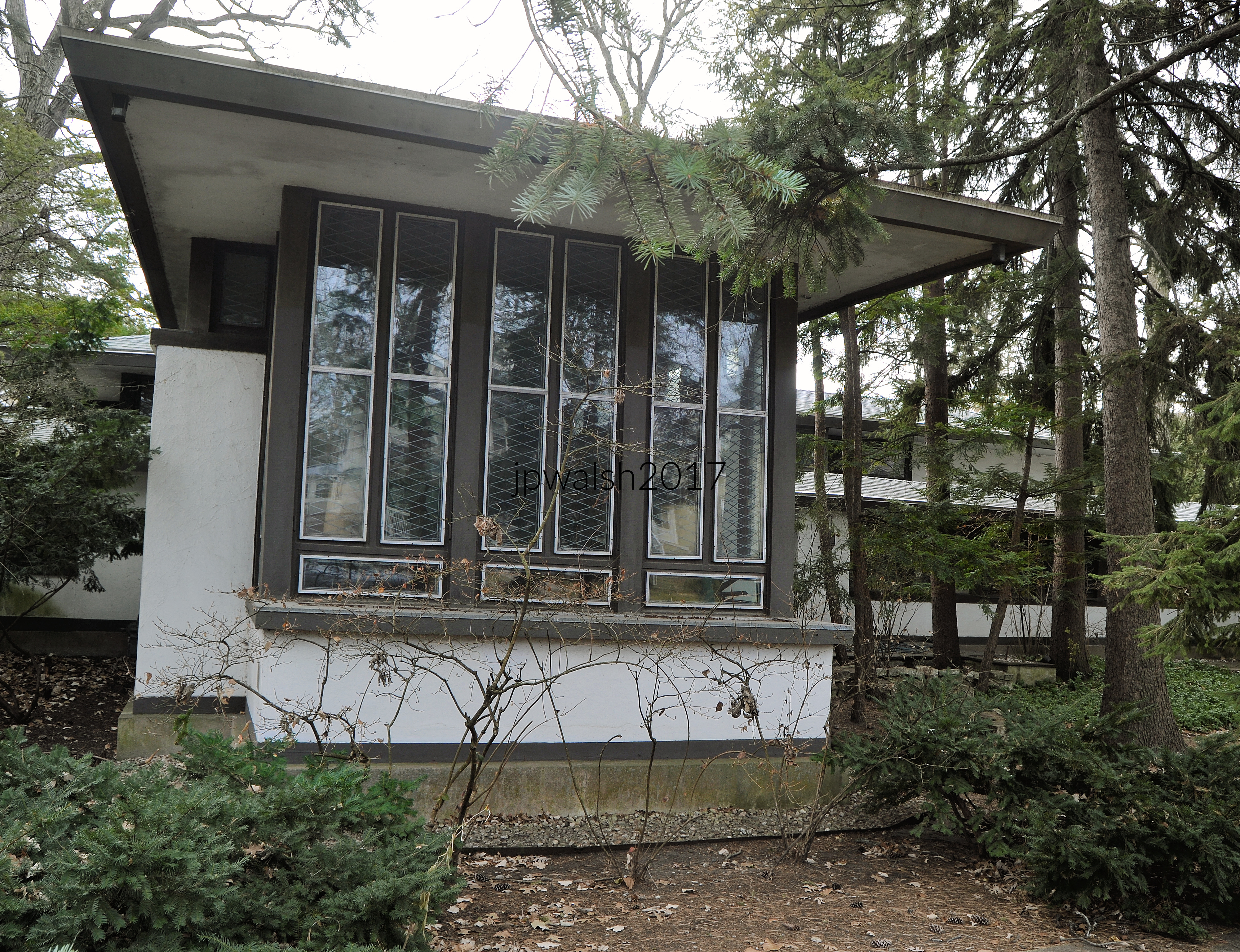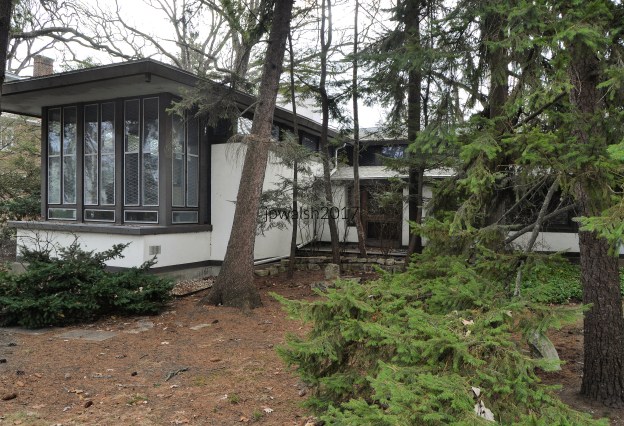

Feature image: Frank J. Baker House, Frank Lloyd Wright, 1909, Wilmette, Illinois. Frank J. Baker (1864–1922) was a driving force in Wilmette’s early growth — a sharp‑minded engineer and influential executive with the North Shore Electric Company and Commonwealth Edison who helped bring electricity to the North Shore. He is most remembered for the remarkable 1909 Frank J. Baker House, a Prairie‑style landmark designed for him by Frank Lloyd Wright. A civic leader as well as an innovator, Baker co‑founded the First National Bank of Wilmette. He died in his Wright‑designed home just a week before Christmas in 1922 at 58 years old. December 2017. 99% 7.20mb DSC_0560. Author’s photograph.
The Frank J. Baker House, situated at 507 Lake Avenue in Wilmette, Illinois, is a 4,800‑square‑foot residence that stands as a significant example of Frank Lloyd Wright’s evolving Prairie School vocabulary. Designed in 1909, the house incorporates five bedrooms, three and a half bathrooms, and three fireplaces, yet its architectural importance lies less in its programmatic elements than in its role within Wright’s broader experimentation with spatial organization and structural expression during this period.
By the first decade of the twentieth century, Wright had begun to move beyond the predominantly single‑story Prairie houses of the late 1890s, exploring the potential of vertically layered two-story domestic space. The Baker House reflects this transitional moment through its T‑shaped floor plan—a configuration Wright employed in several contemporaneous works, including the Isabel Roberts House (below) built the previous year in River Forest, Illinois.
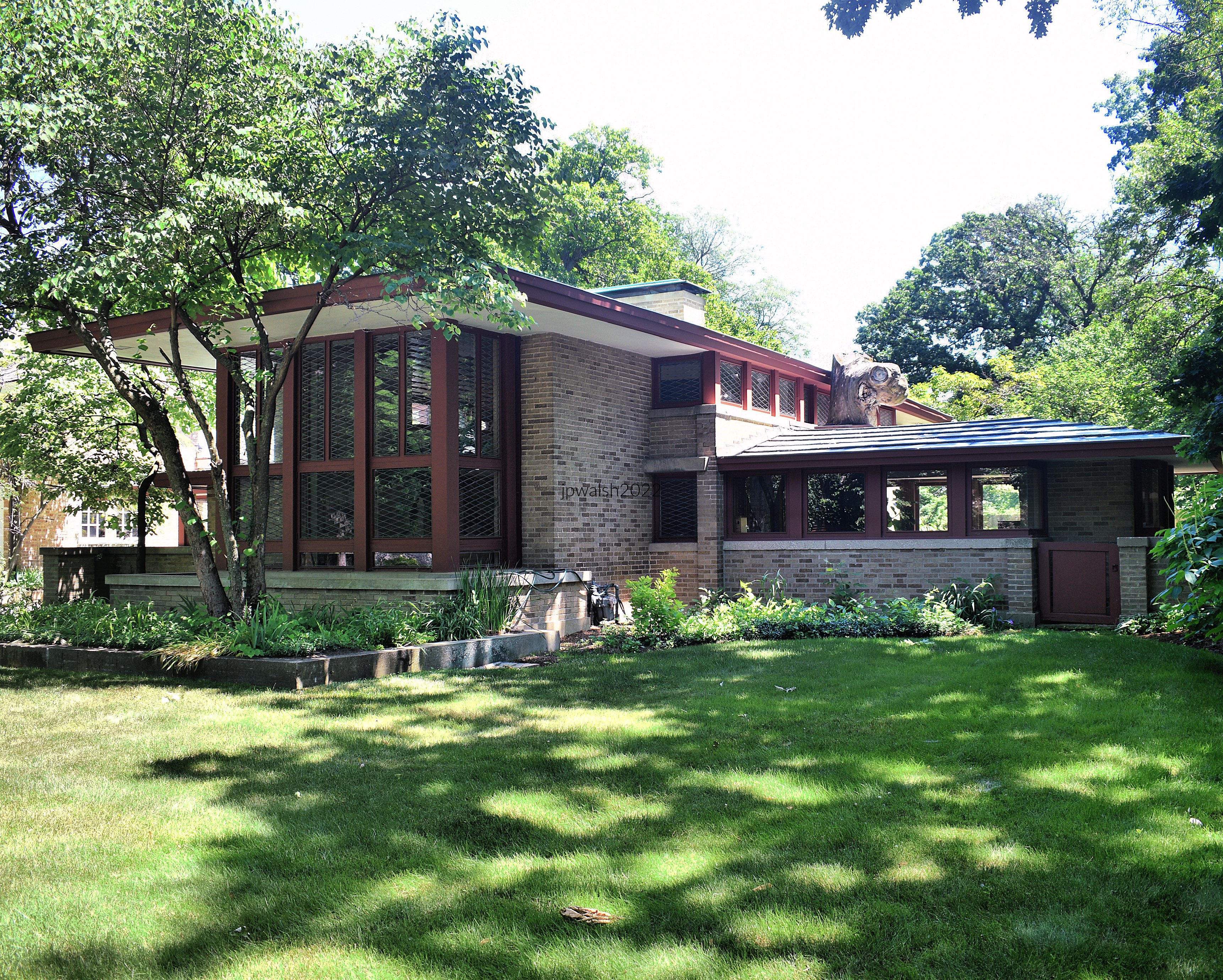
The T‑plan allowed Wright to choreograph circulation along a dominant longitudinal axis while creating subsidiary wings that modulated privacy, light, and spatial hierarchy. In the Baker House, this plan form becomes a mechanism for integrating interior volumes with the surrounding landscape, reinforcing the Prairie School’s emphasis on horizontality and environmental continuity.
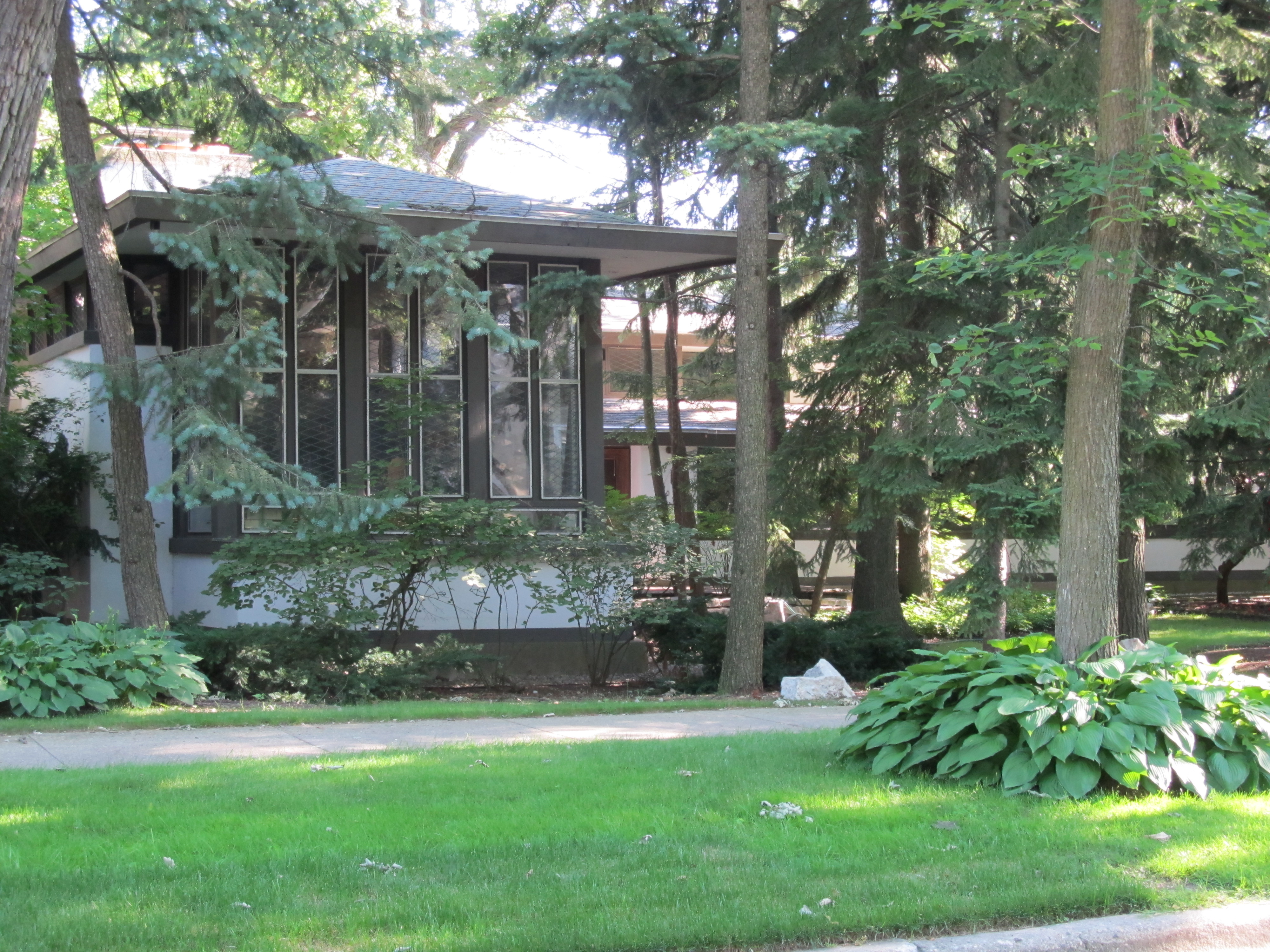
The exterior composition demonstrates Wright’s mature command of Prairie Style principles: a pronounced horizontal orientation, low‑pitched rooflines, and deeply cantilevered overhangs that visually anchor the structure to its site. These elements work in concert to diminish the building’s vertical massing, producing the characteristic “sheltering” effect that Wright associated with Midwestern domestic architecture.

The two‑story living room is the spatial and symbolic core of the house. Its brick fireplace—an archetypal Wrightian hearth—functions as both a literal and conceptual center, organizing the surrounding spaces and reinforcing Wright’s belief in the fireplace as the spiritual heart of the home. The sloped ceiling and continuous band of leaded‑glass windows along the north wall create a dynamic interplay of light and volume, while the vertical expansion of the room contrasts deliberately with the home’s otherwise horizontal emphasis. Few surviving Wright houses retain this particular combination of a T‑shaped plan and a two‑story principal interior, making the Baker House an important artifact in understanding Wright’s spatial experimentation.
The property was listed on the National Register of Historic Places on November 8, 1974, acknowledging its architectural significance. A comprehensive restoration initiated in 2020 under new ownership has sought to preserve both the material integrity and the spatial logic of Wright’s original design.
Interior Analysis.
Upon entry, the visitor encounters a twenty‑two‑foot dining room articulated with diamond‑patterned leaded‑glass windows, a pitched ceiling, and extensive wood trim. This space exemplifies Wright’s strategy of compressing and releasing volume: the relatively intimate proportions of the dining room heighten the dramatic expansion experienced upon entering the adjacent living room.
The main‑floor kitchen, accompanied by a modest breakfast nook, reflects Wright’s early efforts to modernize domestic workspaces by integrating them more fluidly into the overall plan. The living room, by contrast, adopts a quasi‑ecclesiastical spatial character. Its cantilevered ceiling, which extends into a loft above, creates a sense of upward movement unusual in Prairie houses. The continuous horizontal and vertical window bands dissolve the boundary between interior and exterior, a hallmark of Wright’s belief that architecture should mediate rather than separate human habitation from the natural environment.
At the center of the home stands the principal brick fireplace, accompanied by an overhead balcony that provides an elevated vantage point and reinforces the vertical layering of the space. On the second floor, the master bedroom includes one of the home’s three fireplaces and a private enclosed balcony, further demonstrating Wright’s interest in creating intimate, retreat‑like upper‑level spaces within an otherwise horizontally oriented composition.