Category Archives: Art – Gothic

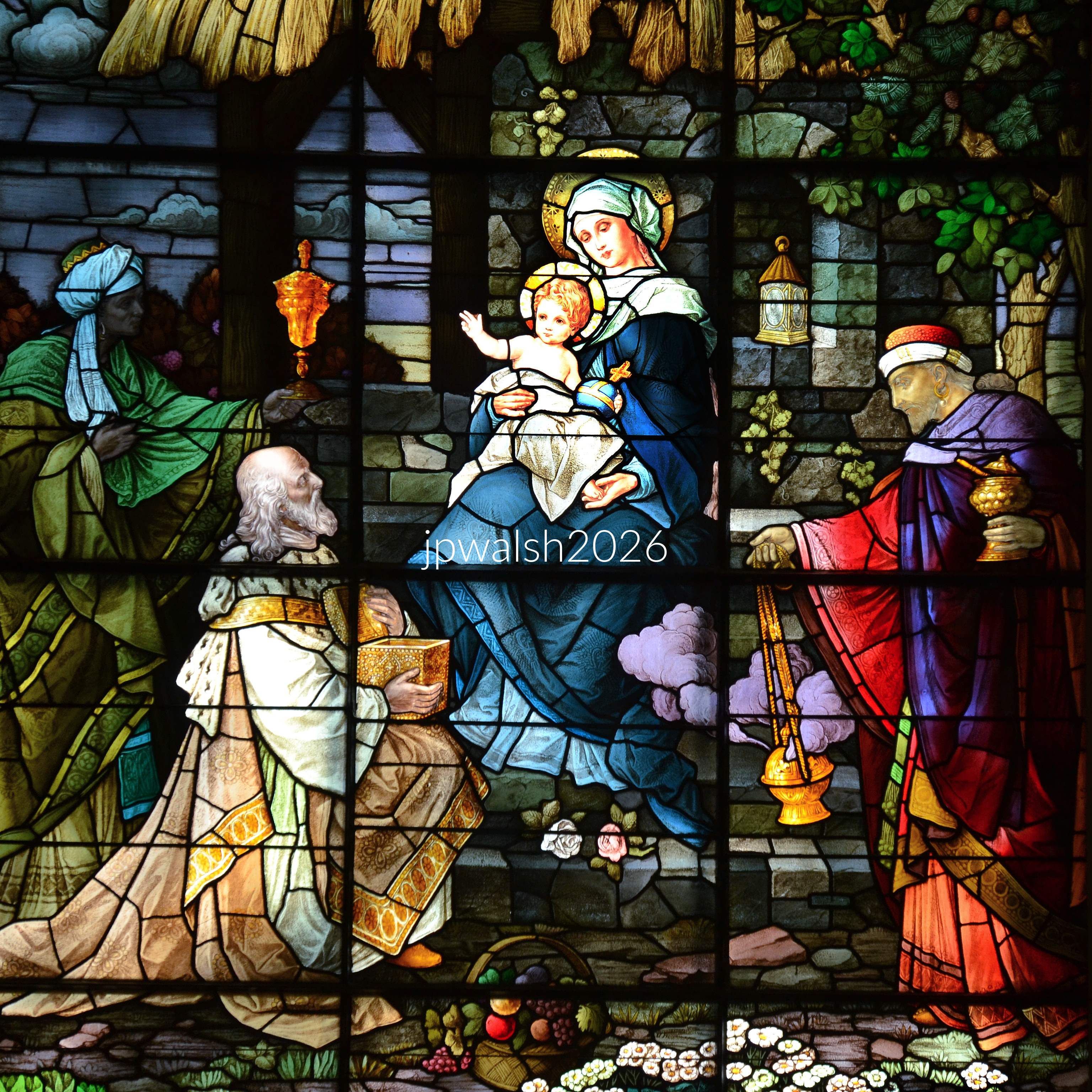
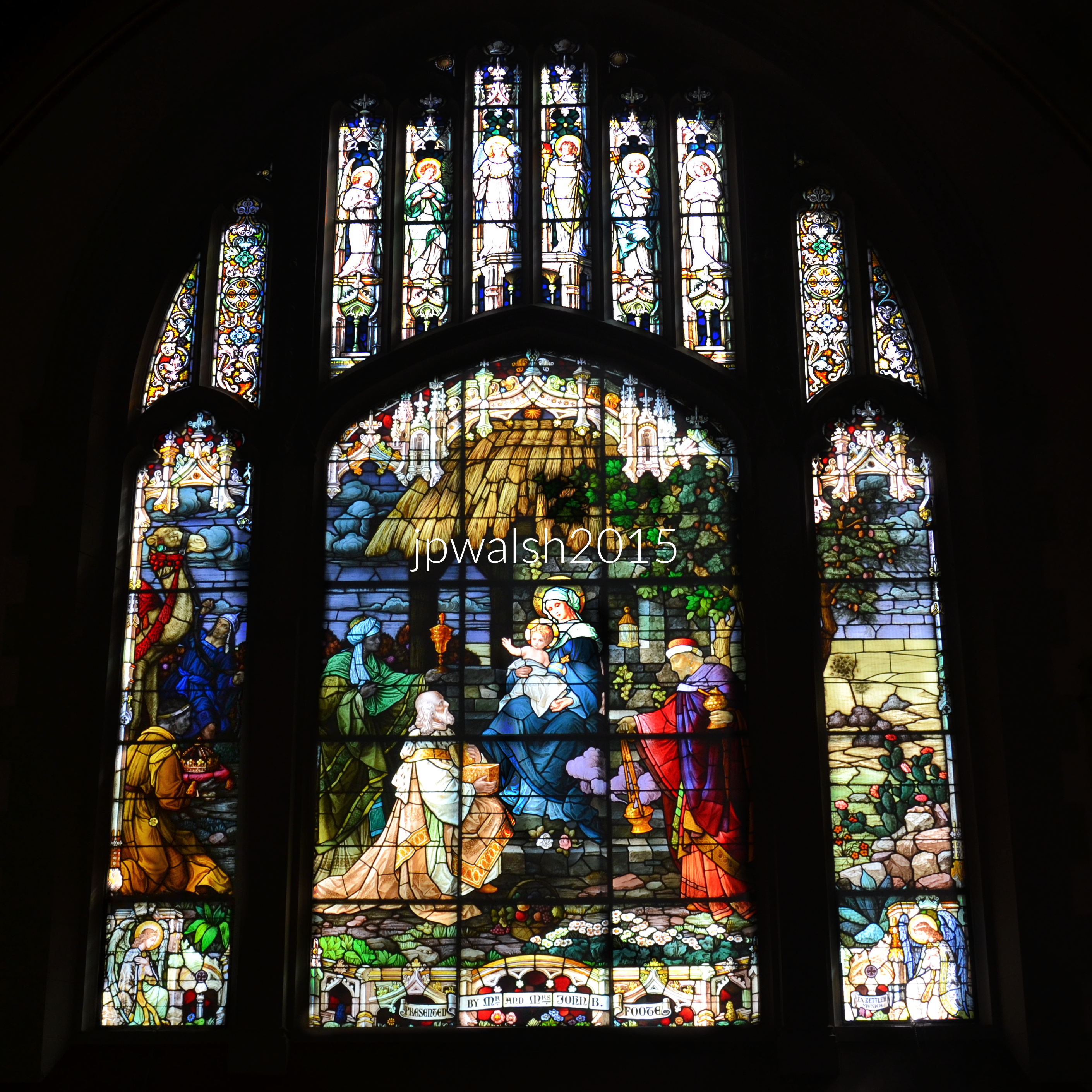
My Art Photography: Stained Glass of New Testament Scenes by F.X. ZETTLER STUDIOS OF THE ROYAL BAVARIAN ART INSTITUTE, Munich, Germany, 1907-1910, in St. Edmund Church in Oak Park, Illinois.

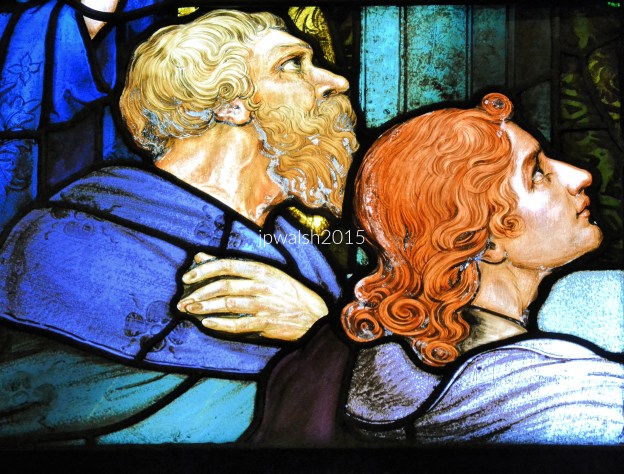
Feature Image: Two apostles, detail, Institution of the Eucharist window, F.X. Zettler, 1907-1910, St. Edmund Church. Author’s photograph. September 2015.
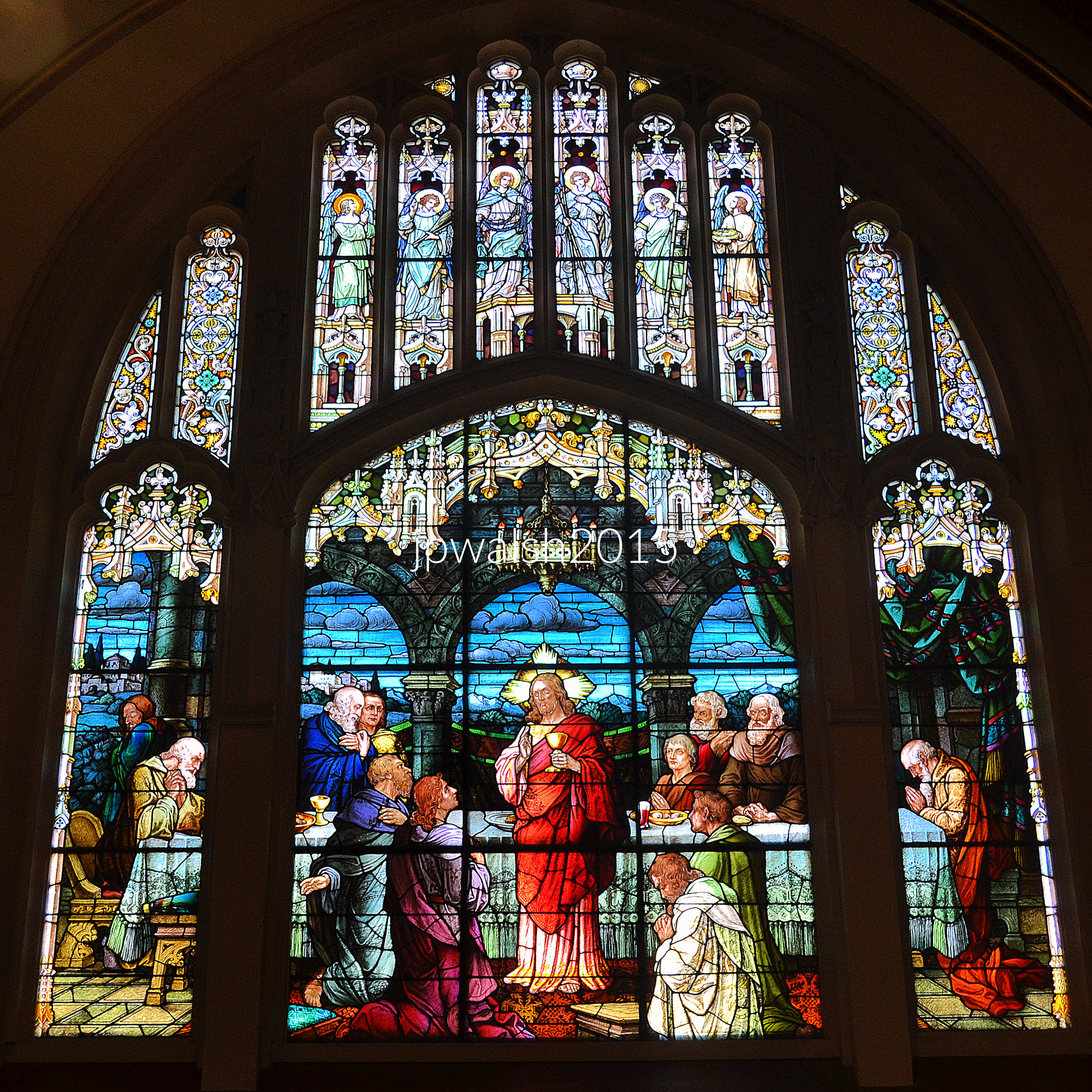
By 1910 F.X. Zettler’s mastery of the “Munich Style” – characterized by detailed scenes and vibrant colors on glass – made his German company one of the most popular designers in late 19th century and early 20th century American churches. These windows are religious paintings that are pedagogical as well as sacred images. The Roman Catholic Church teaches that Christ is “really present” in the Eucharist (a Greek word, eucharistia,that means “Thanksgiving”) and that his sacrifice on the cross on Calvary is repeated at every Mass as Christ gives His Body and Blood under the appearance or species of bread and wine in Holy Communion as food for eternal life. As parishes offer school children their first holy communion, Christ’s pose evokes that same event for the apostles. Accounts of the Institution of the Eucharist at the Last Supper are in Luke 22, Mark 14, Matthew 26, and its significance explicated in John 6. It is recounted in Paul’s First Letter to the Corinthians, 11. Author’s photograph. September 2015.
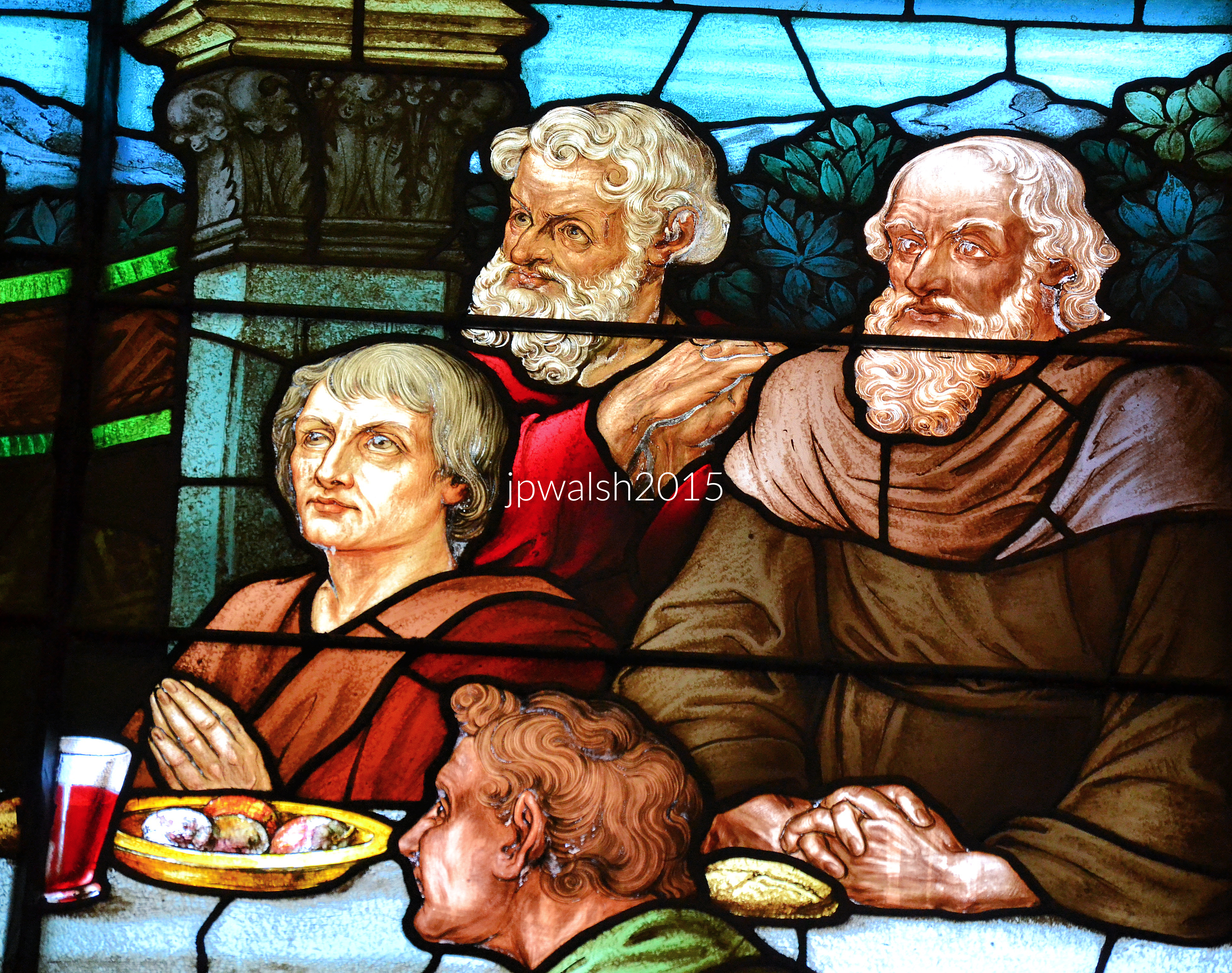
Four apostles, detail, Institution of the Eucharist window, F.X. Zettler, 1907-1910, St. Edmund Church. Author’s photograph. September 2015.

In 2022, owing to continuously declining numbers in the church, St. Edmund Church at 188 S. Oak Park Avenue, Oak Park, IL, located close to the heart of its suburban downtown, was combined with another historic Oak Park parish, Ascension Church, at 808 S. East Avenue, about one mile to the south. Founded by Archbishop James Quigley (1854-1915) in June 1907, St. Edmund was the first Catholic parish in the village and one of the 75 new parishes founded by Quigley during his tenure between 1903 and 1915. James Quigley’s successor was Cardinal George Mundelein (1872-1939) who founded 80 more new parishes during his administration. Trying to fit into the longstanding predominantly Protestant community, St. Edmund was built in generous cooperation with its leading citizens and designed in a refined English neo-Gothic style. Evoking a low-profile parish country church, this kind of Catholic footprint would be imitated in other prosperous Chicago suburbs with strong Protestant roots well into the 20th century so to discreetly integrate into the community.
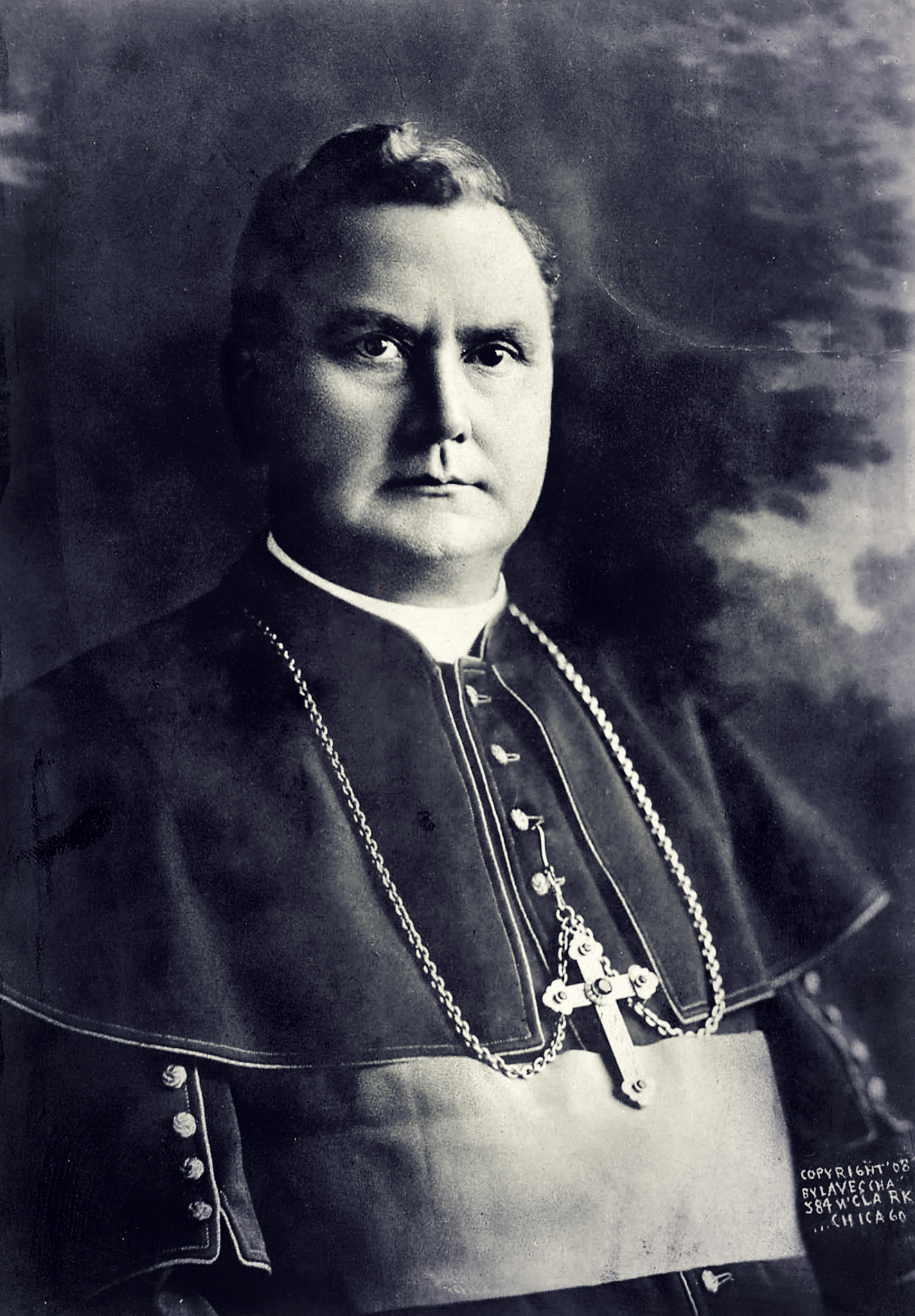
Most Rev. James Quigley, Archbishop of Chicago (1903-1915). In 1907 Archbishop Quigley traveled by car to Oak Park to attend the opening. Public domain.

Since the mid-1980s reports from 2022 indicate a reduction by the Archdiocese of Chicago of more than 100 parishes from its nearly 450 parishes due to declining attendance and financial problems, of which St. Edmund is another example. It remains fortunate that this beautiful church building continues to exist and be used for worship. The English neo-Gothic style church was designed by prolific Chicago church architect Henry Schlacks (1867-1938) and dedicated in May 1910. The art glass windows were executed by the F.X. Zettler Studios of the Royal Bavarian Art Institute in Munich. Zettler also made mosaics such as at St. Anthony Church in Bridgeport also designed by Schlacks and consolidated first with All Saints parish and then both closed and combined with St. Mary of Perpetual Help. St. Edmund Church has undergone various mid-20th century redecorations that included the addition of paintings and marble upgrades for its altar, pulpit, and baptismal font designed by Chicago-based DaPrato Rigali founded in 1860. Exterior changes to the building were also made in the 1950’s replacing the church’s original red tiles for the roof and steeple to, respectively, slate and steel coverings.
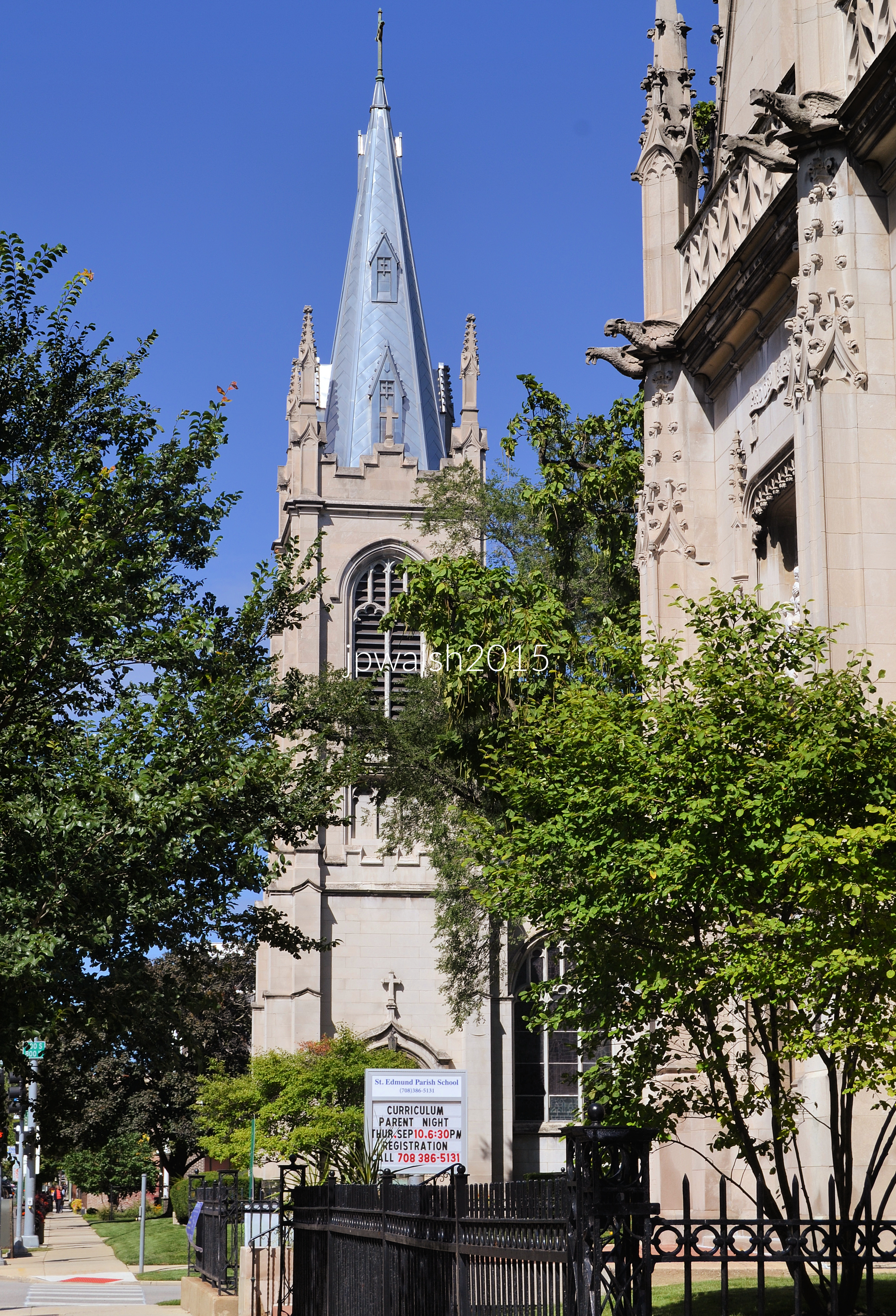
St. Edmund Church, Oak Park, Illinois, dedicated in 1910, was designed in the late 19th century English neo-Gothic style. The later school (right), opened in 1917, was designed in the French neo-Gothic style. Both are the work of architect Henry Schlacks (1867-1938). Author’s photograph. September 2015.
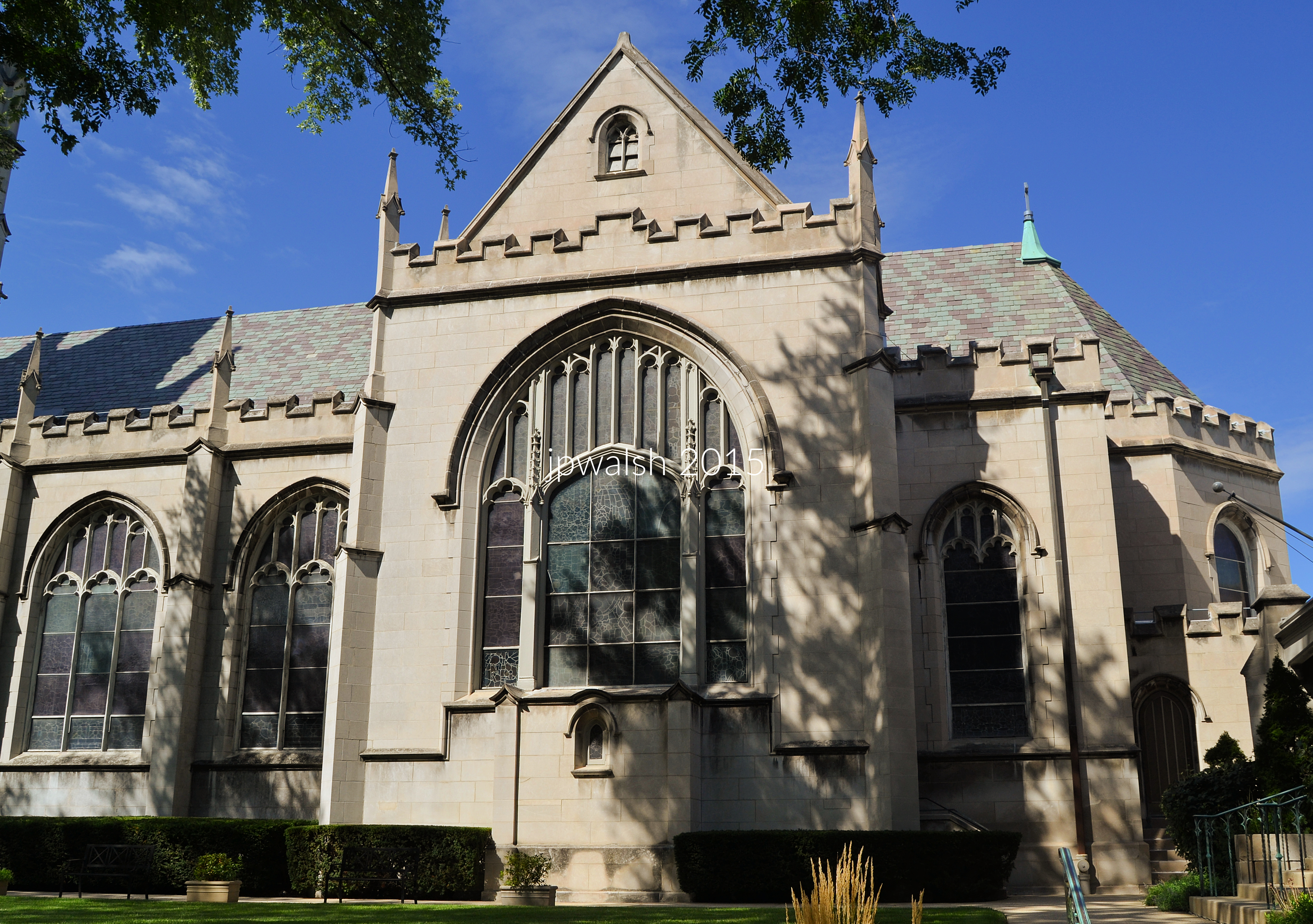
St. Edmund Church, Oak Park, Illinois, part of the nave, transept and apse, south view. Author’s photograph. September 2015.

St. Edmund Church and school have been a work in progress. The school, a flamboyant neo-Gothic structure designed by Henry Schlacks, opened in 1917. During the post-war baby boom, additions to it were built in 1948 and 1959. In June 2016 the school closed. When the parish was young and growing with Catholic families, it purchased an architecturally significant private home in 1929 for the nuns who staffed the school. With post-Vatican II declining vocations of nuns and school enrollment, the convent was sold in the 1980’s. A 2000 renovation of the church included cleaning and restoring the stained-glass windows that portray scenes from the New Testament. In other Chicago churches with Zettler windows, such as, in St. Stanislaus Kosta Church in West Town, there are themes of the Rosary, while St. Adalbert, a Polish parish in Pilsen since closed by the archdiocese and sold for condo development, it was historic saints of Poland. Henry Zimach of HPZA was the architect of the St. Edmund renovation. In its first 49 years the church was led by one pastor: successful fundraiser Msgr. John H. Code. The next 49 years saw 6 pastors until the church had to combine with a nearby parish. Of the $100,000 construction cost for the church, one donor (Mrs. Mary Mulveil) donated half of it. From an operating expenses viewpoint this elite donor model is how even today some Catholic parishes across the Chicago region stay open. In 2026 one leading Catholic parish published tithing information that showed 95% of registered families do not tithe one dime and about a dozen families donate annually between $15,000 and $25,000 each. With pews half full, one can conclude that non-tithing families might not be at Sunday Mass either. With the Vatican discouraging any “pressure” on anyone, there’s little to no outreach by the parish to the vast majority of its wayward flock as long as apparently the affluent pay their church bills. Of course, if things really get untenable, the bishop then can simply decide to close one more parish.
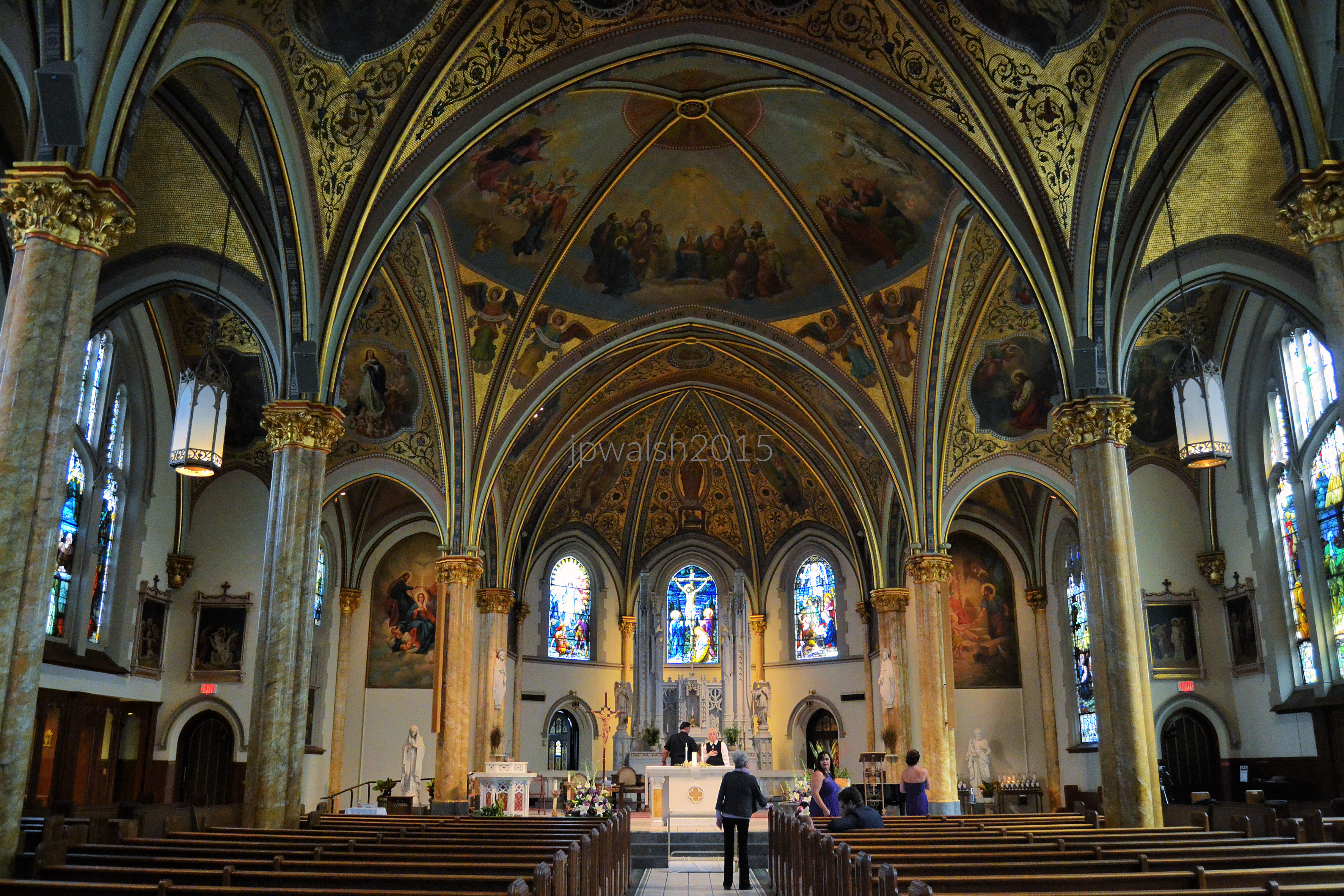
Mid-20th century redecorations at St. Edmund Church included the addition of paintings and marble upgrades for its altar, pulpit, and baptismal font. Author’s photograph. September 2015.

These are religious paintings as they serve to teach the viewer by depicting scenes from the earthly episodes of Christ. But they are also sacred images, pure iconography, as they invite the viewer to contemplate and pray to those persons existing in the spiritual and heavenly domain with whom they are surrounded. Further, as Zettler’s stained glass are some of this church setting’s most spectacular art, they play a key role in aiding in worship. Individually and taken together, the gloriously colorful and drawn illuminating images accompany worshipers as they place them in the visual presence of the Trinity, the Blessed Mother, and the angels and saints and carry them upwards into their presence as they participate in the sacraments.
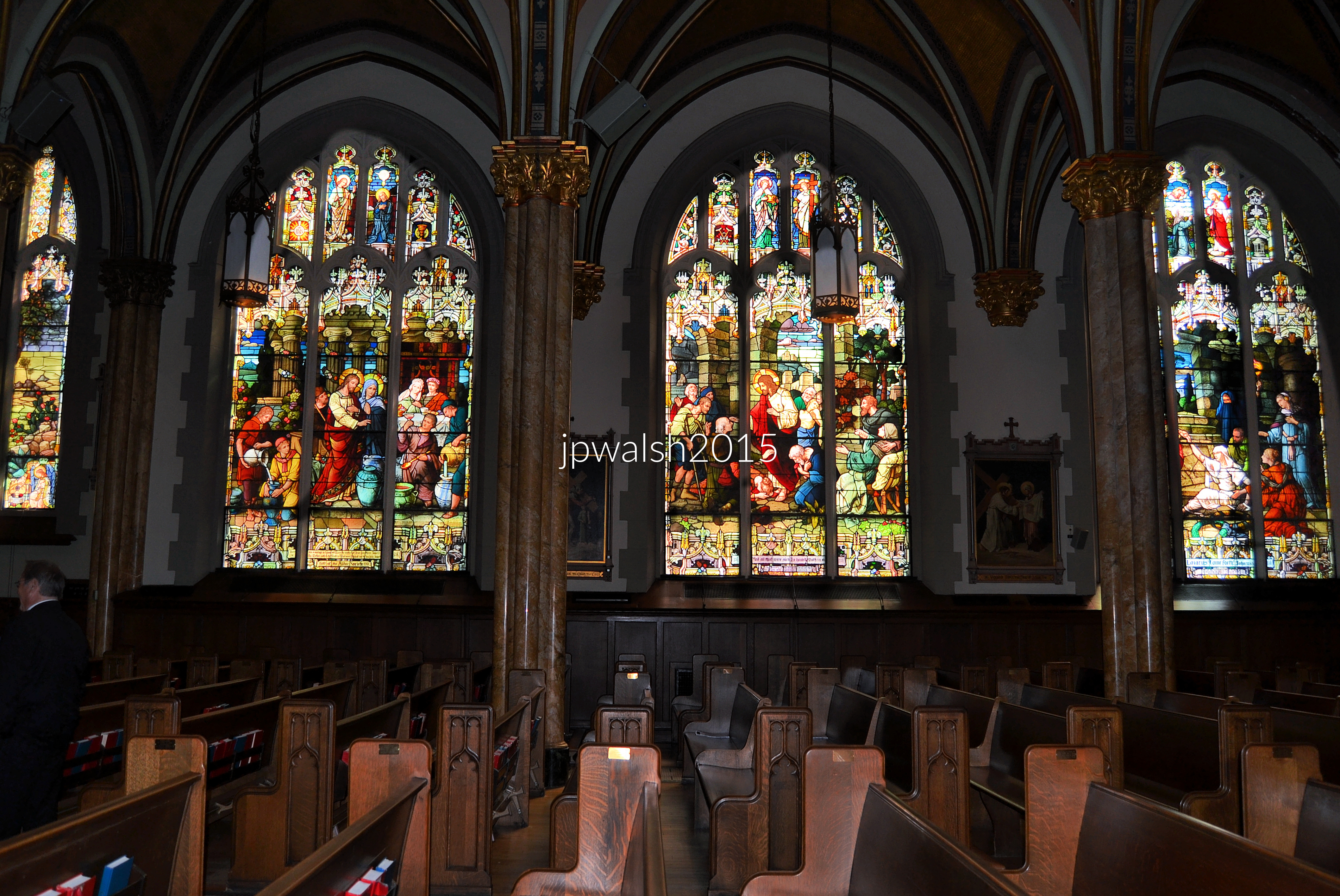
The Zettler windows in St. Edmund in Oak Park fill the church interior with the colorful light of glorious art that is both pedagogical and iconographical of the Biblical Catholic faith. Author’s photograph. September 2015.

German Art Glass.

Jesus healing the blind man (detail). This window presents healing stories such as found in John 9 (healing the blind man from birth), Mark 8 (healing a blind man at Bethsaida) and healings of two blind men in Matthew 9. The figure of a woman bending down to have her hair touching Jesus’ feet evokes Luke’s gospel (chapter 7) of the sinful woman who washes Jesus’ feet with her hair. The man at right carried by two others alludes to Jesus’s healing miracle of a man who could not walk found in Mark 2 and Luke 5. Author’s photograph. September 2015.
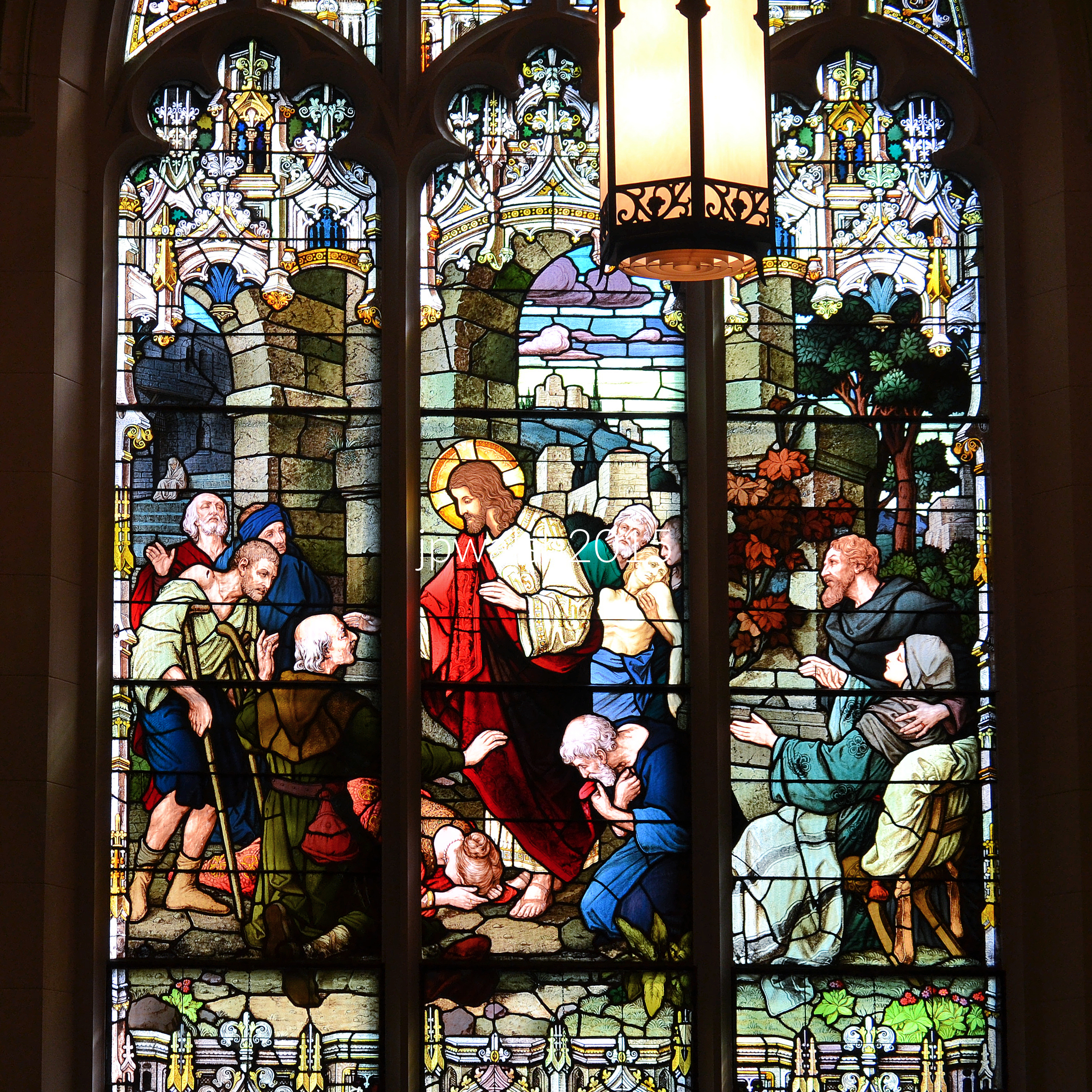
Zettler window of Jesus’s ministry of healing miracles. Author’s photograph. September 2015.
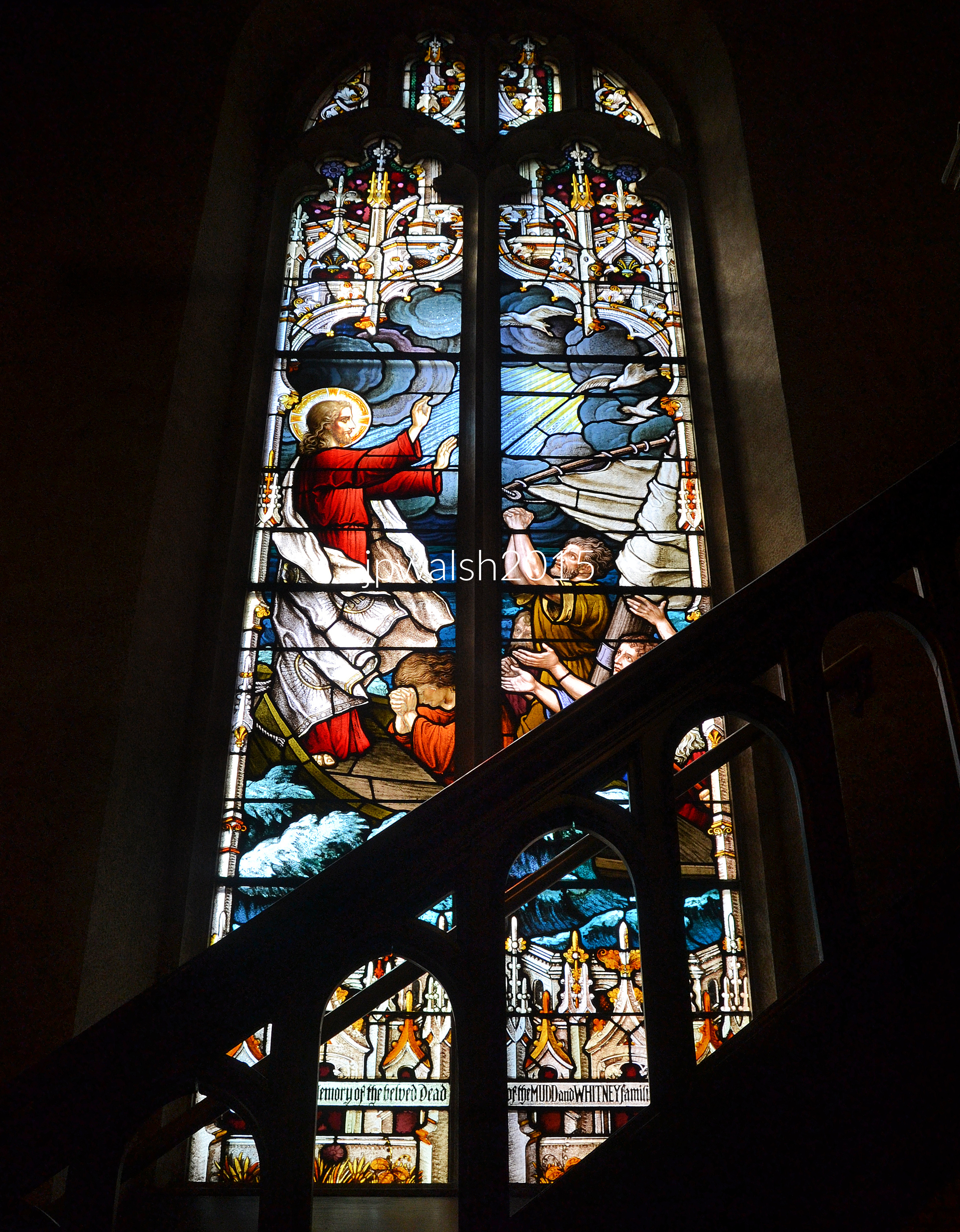
Zettler Window of Jesus calming the storm found in Luke 8, Matthew 8, Mark 4, and John 6. The event demonstrates the God-Man’s authority over nature. Author’s photograph. September 2015.
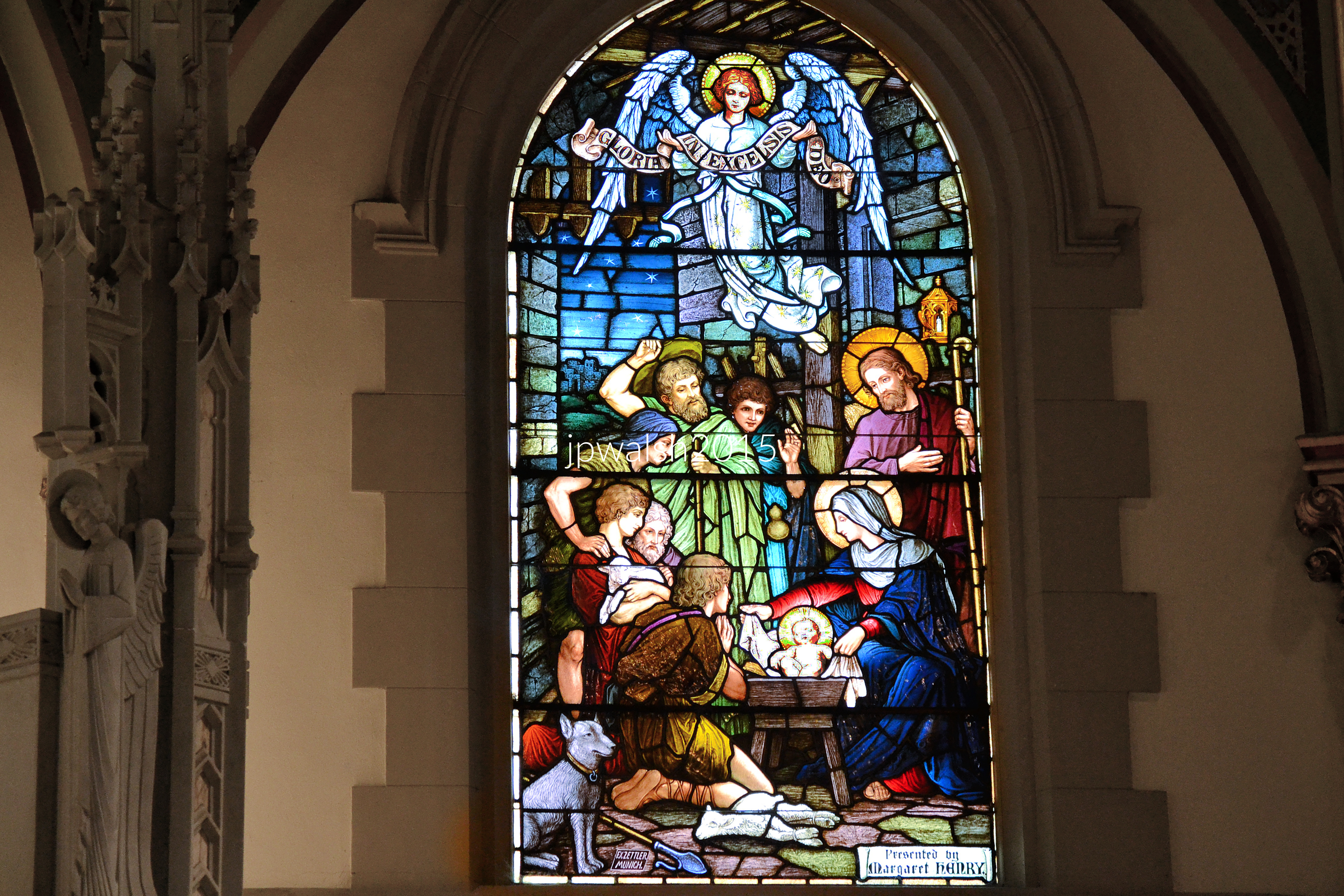
Nativity window found in Matthew and Luke. A dog in the lower left corner is one of many such animals scattered throughout Zettler’s windows in St. Edmund Church. Author’s photograph. September 2015.
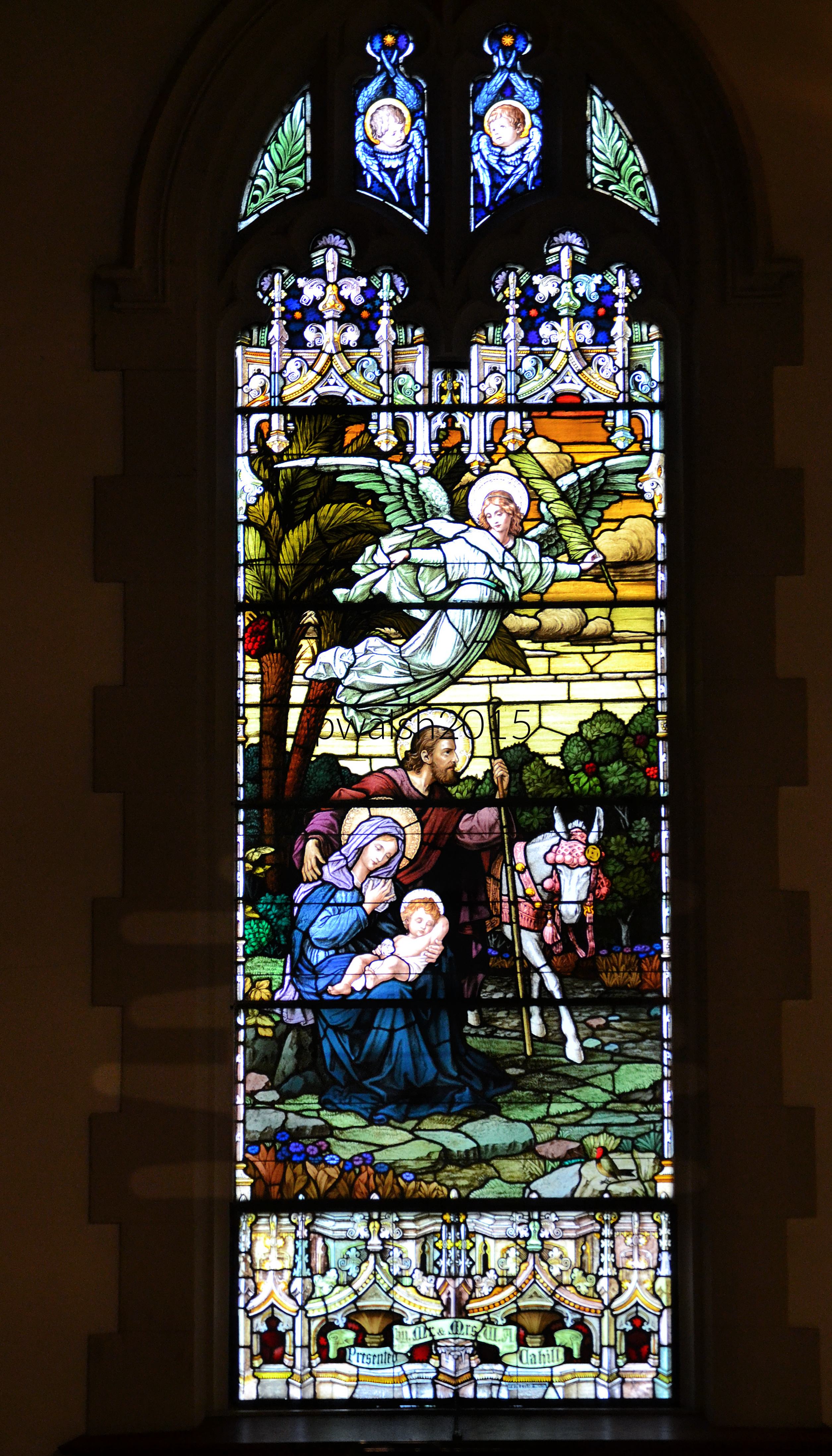
The flight into Egypt window. Recounted in Matthew 2, the story relates how the Holy Family—Mary, Joseph, and infant Jesus—flee to Egypt to escape King Herod, who ordered the killing of young children to eliminate the prophesied King of the Jews. Joseph, warned by an angel in a dream, swiftly carried his family to Egypt, where they stayed until Herod’s death, fulfilling prophecy and symbolizing Christ’s presence in a world of darkness. The episode has long been a popular subject in Christian art, and Zettler depicts the episode focusing on the Holy Family’s determination under angelic protection. In popular piety, the event is one of the “seven sorrows” of Mary which she pondered in her heart. Author’s photograph. September 2015.

Above the entrance from the street to St. Edmund Church is a half circle stained glass window depicting Jesus as The Good Shepherd. Jesus calls Himself the Good Shepherd in John 10. Author’s photograph. September 2015.

WHO IS ST EDMUND OF CANTERBURY?
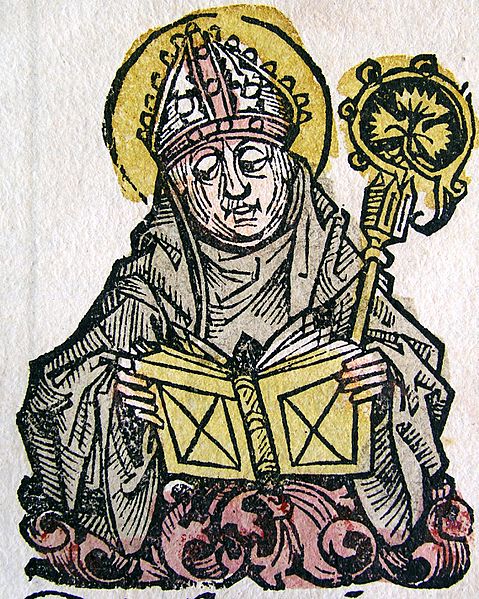
Nuremberg chronicles, Edmund, Archbishop of Canterbury (1493). Public Domain.

St. Edmund church in Oak Park is named for English saint Edmund of Canterbury (c. 1174–1240). Son of Edmund Rich, Edmund is also known as Edmund of Abingdon where he was born and made Archbishop of Canterbury in 1233 by Pope Gregory IX (1227-1241). History speaks of his parents as being practicing Catholics with his mother more fastidious and his father more laconic. Edmund, taking after his mother growing up, was considered a bit of a sanctimonious prig. Around the age of puberty, Edmund dedicated himself to the Blessed Mother and took a vow of perpetual chastity. When this vow of purity was later challenged by a young woman Edmund vigorously fought her back sufficiently that, as the young woman recalled, he called her “an offending Eve.” Edmund was educated in Paris but, starting around 1200, returned to Oxford to teach mathematics and philosophy in the circle of Stephen Langton (c. 1150–1228). In Edmund’s time, Langton was an influential English cardinal and Archbishop of Canterbury who participated in the political issues of his day including the Magna Carta crisis in 1215. Edmund is remembered at Oxford for building a Lady’s chapel with funds from his teaching stipend and passing much of his free time in prayer. The site where Edmund lived and taught became an academic hall at Oxford in his lifetime (1236) and remains today part of the college of St Edmund Hall, claimed to be the oldest surviving academic society to house and educate undergraduates in any university in the world. Notable alumni of St Edmund Hall include, at the time of posting, current British prime minister Keir Starmer.
Edmund studied theology between 1205 and 1210 and spent a year with the Augustinian canons of Merton Priory. Afterwards he became a priest and doctor of theology and would take frequent retreats at Reading Abbey in this period. Around 1219 and for the next 12 years the eloquent, learned and virtuous Edmund financed his education by serving as treasurer for Salisbury Cathedral, preached the Sixth Crusade in 1227 (a crusade which led to a shared Christian-Muslim governance situation in Jerusalem) and garnered several influential English friends.

In a mid-14th century manuscript, Frederick II, Holy Roman Emperor (left) meets al-Kamil Muhammad al-Malik (right), whose negotiations led to shared Christian-Muslim governance in Jerusalem during the Sixth Crusade. Vatican Library. Public Domain.

In 1233, the 59-year-old was appointed Archbishop of Canterbury by Pope Gregory IX though the Canterbury chapter recommended several other candidates first. Accepting the position reluctantly, Edmund, consecrated on April 2, 1234, fought for independence of the English church from any foreign influence and this led to an episcopal tenure characterized by incessant and unseemly brawls with King Henry III and the papal delegation as the archbishop admonished the king for a government of baronial favoritism. Threatening the king with excommunication, the crown backed down temporarily but harbored enduring antipathy towards Edmund and looked for relief in Rome. In favor of strict discipline and truthful justice in civil and ecclesial government and life, coupled to a strong stance against any encroachment on the English church, including jealousy for his authorial rights to be enforced by litigation when necessary, the possibly soft spoken but clearly combative Edmund made for a very unpopular figure among the powerful and eventually led to his forced resignation in 1240.  In 1236, with the object of freeing himself from Edmund’s control, the king requested a sympathetic legate from the pope who arrived to insult and contradict everything of importance Edmund chose to do and say in relation to current issues – from the marriage of Simon de Montfort and Henry’s sister Eleanor that Edmund found invalid, to Edmund’s own cathedral priests and monks who were opposed to Edmund’s rule. Edmund reacted to the opposition erratically, excommunicating at will, all of which was ignored by the pope who let his legate’s, and not Edmund’s, decisions stand which favored the king. Edmund was left to complain that the discipline of his national church was being undermined by the flaccid standards of world politics. Before thinking to resign, Edmund went to Rome in December 1237 to plead his cause in person before the pope.  But already Henry III’s exactions and usurpations were backed up by the papal legate and Edmund’s mission was futile. Edmund returned to England in August 1238 where he was made to heel. Edmund resigned in 1240.
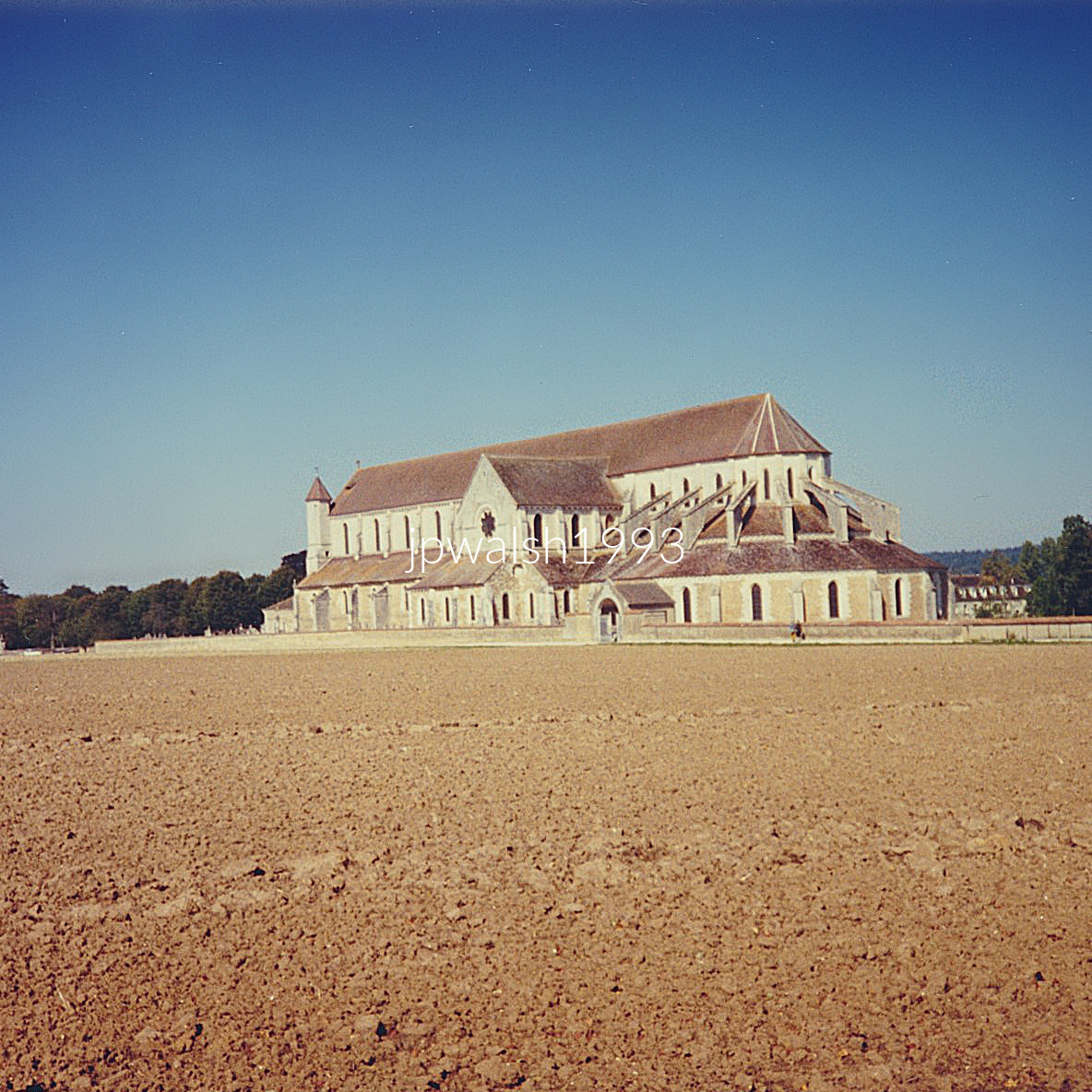
Abbey of Pontigny, view from south. The Cistercian abbey of Pontigny in France was a refuge for England’s persecuted archbishops, including Stephen Langton (c. 1150–1228), and Saints Thomas Becket (1120-1170) and Edmund of Canterbury (c. 1174–1240). Author’s photograph, September 1993.

At that juncture, Edmund set out for the Cistercian Abbey at Pontigny southeast of Paris in France, which had been a refuge for Edmund’s predecessors, Stephen Langton and Thomas Becket (1120-1170). The archbishop’s health soon gave way and, though Edmund decided to return to England, he died en route at Soisy-Buoy in the house of the Augustinian Canons on November 16, 1240.

Pontigny, north aisle, 12th century. At Pontigny St. Edmund of Canterbury led the life of a simple monk. Author’s photograph. September 1993.

Edmund’s remains were returned to the Abbey of Pontigny where he was buried and lies in state today in a reliquary above the high altar. Miracles were soon reported at Edmund’s tomb leading to his canonization by Pope Innocent IV in December 1246, making Edmund one of the fastest English saints to be canonized. When Blanche of Castile (1188 –1252) and King Louis of France (1214-1270) visited Pontigny, Edmund’s body was exhumed and shown to be incorrupt. His relics survived the French Revolution and when his tomb was opened again in 1849 his body, still incorrupt, had one arm found detached. This major relic was sent to the United States, where it is enshrined today on Enders Island off the coast of Mystic, Connecticut, inside the chapel of Our Lady of the Assumption at St. Edmund’s Retreat, run by the Society of Saint Edmund founded at Pontigny in 1843. Edmund’s life was one of self-sacrifice and devotion to others. From boyhood he practiced austerity and asceticism, fasting, and spending his nights in prayer and meditation. St. Edmund of Canterbury’s feast day is November 16. 

St. Edmund of Canterbury, detail from the Westminster Psalter, mid-13th century, British Library. Public domain.

The Story of F.X. Zettler’s Royal Bavarian Art Institute.

About 100 miles south of Munich, Germany, was the home base of popular and well-regarded stained-glass studios such as Franz Mayer & Company and Zettler of which St. Edmund has a full coterie presented in this post. These photographs were shot by me in September 2015.

Franz Xavier Zettler was born in Munich, Germany in 1841 and worked as an ecclesial artist, founding his stained-glass design company after 1870, until his death in 1916. When he married Anna Mayer, Zettler married into another family of artisans, following a long tradition of artisans doing so. In 1848 Joseph Gabriel Mayer (1808-83) founded the Establishment for Architecture, Sculpture, and Painting (“Institute of Christian Art”) under the patronage of King Ludwig I of Bavaria (1786-1868). With royal commissions in Germany for the massive Cologne and Regensburg Gothic cathedrals as well as the Mariahilfkirche in Munich (Vorstadt Au) – the first German neo-Gothic church whose foundation was laid in 1831 – Mayer directed his son Franz Borgias Mayer, and son-in-law F. X. Zettler, to expand the establishment by including a division for stained glass in 1870.

King Ludwig I of Bavaria in Coronation Regalia (König Ludwig I. von Bayern im Krönungsornat) by Joseph Karl Stieler (1781-1858), 1826, oil on canvas, 96 x 67.3 in., Neue Pinakothek, Munich. see – Sammlung | König Ludwig I. von Bayern im Krönungsornat – retrieved January 14, 2026. Public domain.

Zettler’s company, the Bayerische Hofglasmalerei, enjoyed quick success with his award-winning windows displayed at the 1873 International Exhibition in Vienna. By 1882 Zettler’s firm was decreed as the “Royal Bavarian Art Establishment” by King Ludwig II (1845-1886). Almost immediately, these Munich and Austrian stained-glass companies had a profound relationship with immigrant Catholic churches in the United States as Zettler and the others, provided high quality glasswork that was familiar with Catholic piety and themes.

König Ludwig II. von Bayern als Hubertusritter (King Ludwig II of Bavaria as a Knight of Hubertus), Ferdinand Piloty d. J. (1828-1895), 1879, oil on canvas, 217,5 x 132,5 cm, Neue Pinakothek, Munich. See – Sammlung | König Ludwig II. von Bayern als Hubertusritter – retrieved January 14, 2026. Public domain.

After the Great Chicago Fire in 1871, these stained-glass companies sent representatives to Chicago to sell them on various stained-glass patterns from which to choose in a rebuild or renovation. Before the turn of the 2oth century, these large studios had set up branch offices in America, including Zettler’s, that catered to a booming church-building industry hungry for traditional pious art that had been the Catholic tradition since Ravenna and only slowed in the life of the church following Vatican II’s radical turn. Chicago and its environs particularly became a great center for this traditional German and Austrian made stained glass until just before the Great Depression. From the 1870s to the 1920s, Chicago became the most influential center of Catholic culture in the United States with German and Austrian stained glass, such as the Zettler windows in Saint Edmund Church in Oak Park, having the strongest reach. After 20 years, the predominance of these European glass companies was finally challenged in the last decade of the 19th century by an American company. Though Zettler won a top prize at the World’s Columbian Exposition in Chicago in 1893, Louis Comfort Tiffany (1848-1933) gained notoriety with a display of his designed comprehensive collection in Art Nouveau style of jewelry, pottery, paintings, art glass, leaded-glass windows, lamps, and other decorative interiors that continued to gain in popularity, including in houses of worship, right up to World War II.  A steep tariff imposed on imported stained glass in the United States after 1894 impacted some international art purchases though Catholic churches in particular continued to turn to German and Austrian glass for their workmanship and pious imagery taken from the Middle Ages and Renaissance. At some financial cost pastors believed that such traditional art aided their mostly immigrant congregation of professional and industrial factory-workers and their families in worship. 

Zettler Studios was innovative in the perfection of the “Munich style” of windows, in which religious scenes were created in a process of painting and melting large sheets of glass in kiln heat. Zettler was also inspired by the German Romantic Nazarene art movement of the early 19th century whose artists rejected Neoclassicism to revive spiritual and religious-focused art of the Italian Renaissance. In Zettler’s array of religious figures depicted in stained glass windows his team used Italian Renaissance art principles of three-point perspective and line drawing that evoked realism in gestures, expressions and various garb.
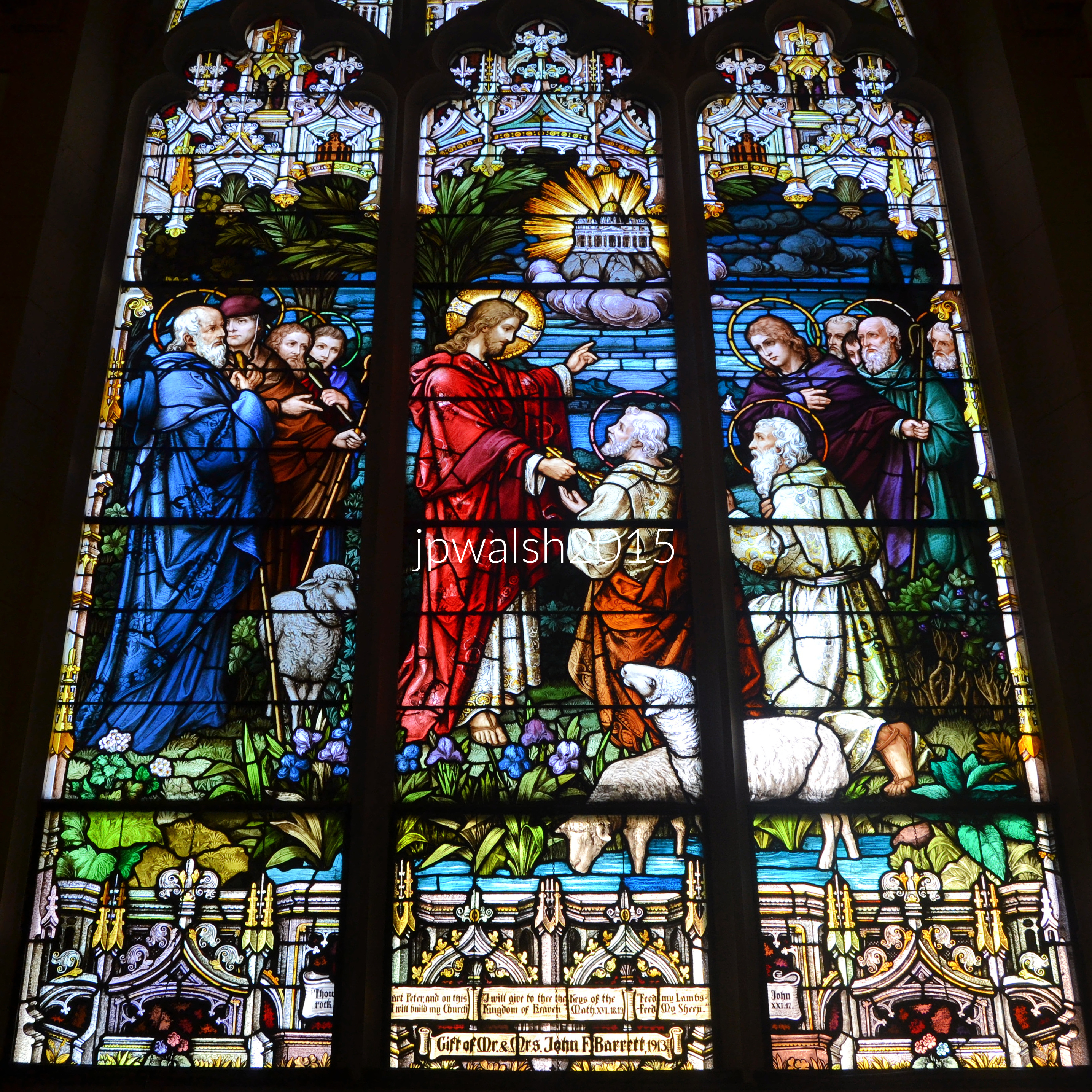
Jesus gives the Keys of the Kingdom of Heaven to Simon Peter.
Jesus asks, “Who do the people say I am?” leads to Peter’s confession of faith in Jesus as the Christ. it took place at Caesarea Philippi, a new city established by Philip the Tetrarch and was a Gentile community. The gospel writers usually show a lack of understanding of geography, but Matthew was better than Mark and in this incident the location is explicit and about a day’s journey on foot from Capernaum on the Galilee Sea where the disciples were first called. At this juncture in his mission Jesus lays down a challenge to his disciples and asks: Who am I? The story also appears in Mark and Luke and, again, there are differences with Matthew’s account. in Matthew Jesus calls himself by the title “son of man” (Mark and Luke have no title at that point) and Matthew adds Jeremiah to their common list of figures like John the Baptist and Elijah (Zeffirelli adds Ezekiel) that the people think Jesus is. it is “Simon Peter” that answers for the group: “You are the messiah.” Once again Matthew reflects a higher Christology, adding: “The son of the living God,” though the simpler statement is likely the original. These next verses are not in Mark or Luke. Jesus attributes Simon Peter’s confession to divine revelation (“for flesh and blood has not revealed this to you but my heavenly father”). Jesus Christ then elects Simon Peter to a new commission of authority with a new name. There is no other verse in the New Testament that explains Peter’s name change. It is clear Peter is the rock upon which the church is built as his commission from Christ. What is its precise or working sense as that foundation is mysterious. Peter is the rock because as representative and mouthpiece of the disciples he has gathered up and articulated their faith as a group. Jesus makes a bold claim that the group he has formed, the church, will endure as long as there is faith among them that he is the Messiah and that by that enduring faith “the gates of Sheol (the biblical abode of death) shall not prevail against it.” Giving Peter the keys at the establishment of the church following his confession of faith as representative of the disciples echoes Isaiah 22 and is a sure sign of royal power and authority that Jesus confers on Peter. This, as Jesus himself journeys to Jerusalem to his condemnation and crucifixion. Peter evokes the master of the palace, the highest officer in the Israelite royal court. The office of Peter is not as a caretaker or underling but master of the church (ecclesia) and the kingdom of heaven that scholars say here carries a similar meaning. Jesus bestows broad authority to Peter to “bind and loose” which is an obscure phrase with no biblical background but found in the role of rabbis who could impose and remove. Peter’s special position in the church is also made clear from other passages in the gospels as well as Acts of the Apostles. This confession of faith and charge of authority is followed by an instruction on the suffering of the Messiah, making this a crisis moment in the gospel narrative. Following miracles and wonders, the Suffering Messiah was entirely foreign to the Judaism of New Testament times and Matthew, Luke and Mark (the Synoptics) here briefly relate some of the early great disillusionment in the minds of the disciples at this point about the teacher which was never fully remedied until after the resurrection.
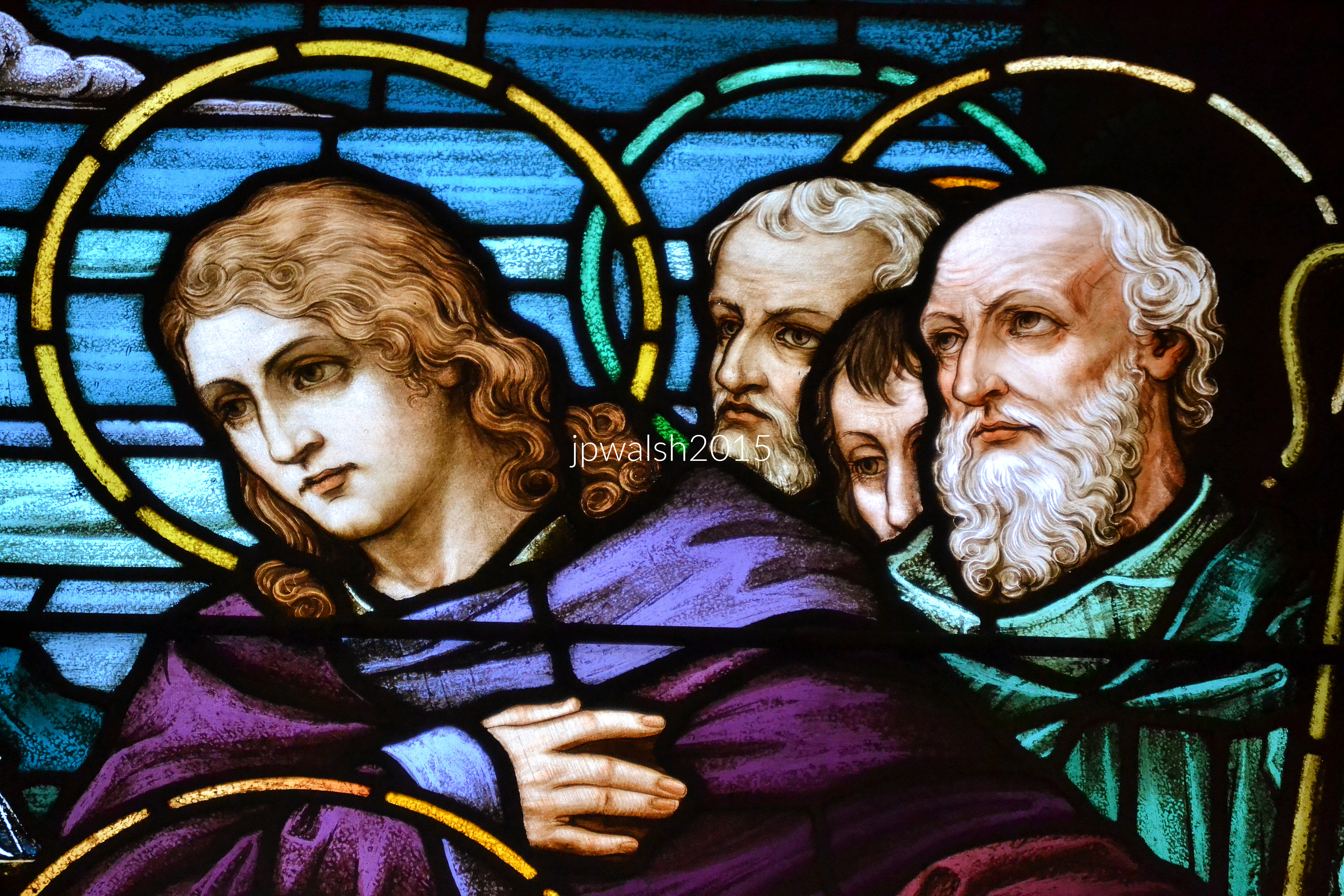
Keys of the Kingdom window, detail.

Jesus at the wedding feast of Cana (John 2). On the prompting of his mother, Jesus performed his first miracle of changing water into wine. The Blessed Mother was the primary catalyst in starting her son Jesus, living a hidden life for 30 years, to begin his public ministry.
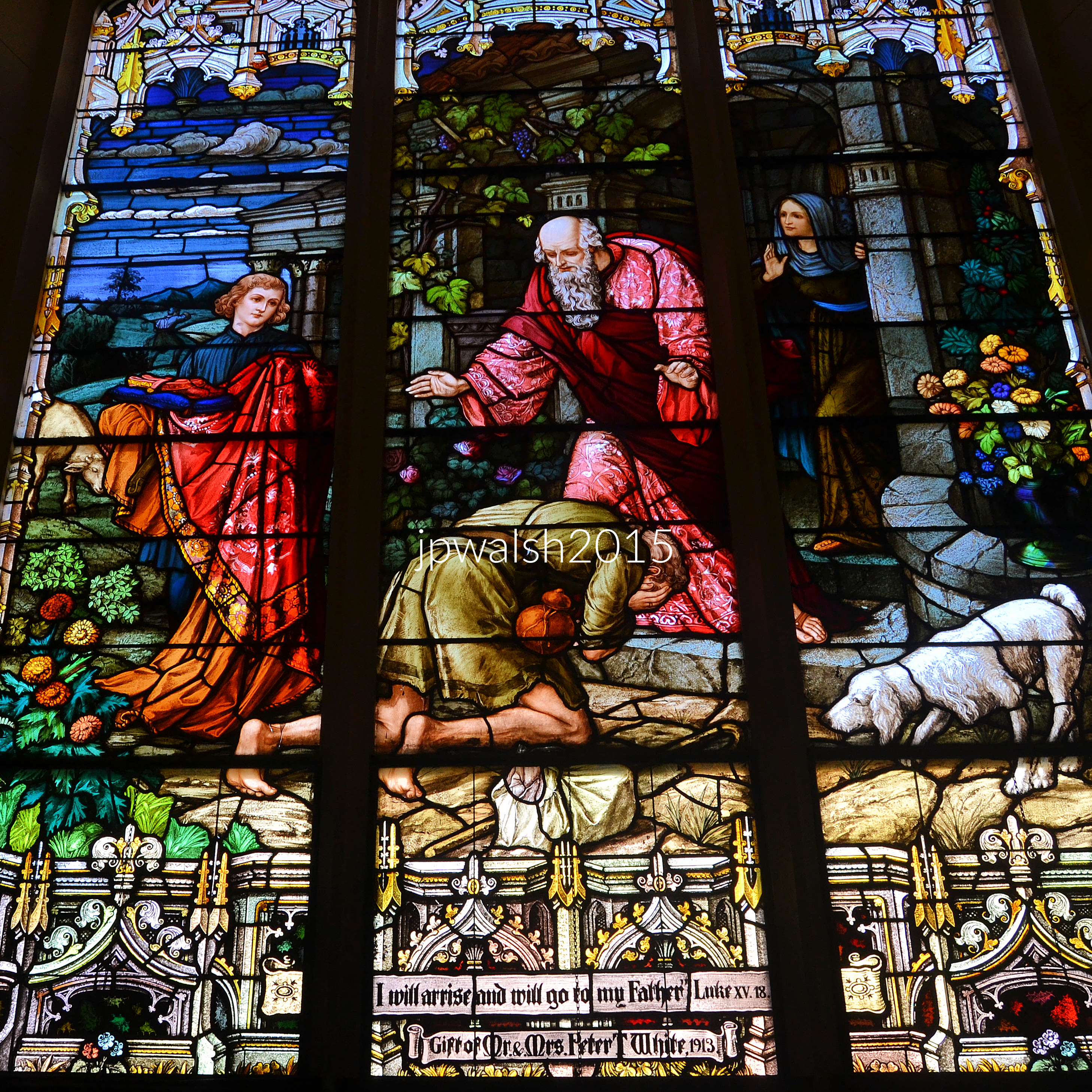
The Prodigal Son window. One of Jesus’ greatest parables, Luke 15 tells the story about a rebellious younger brother and son who demands from his father his share of the inheritance and proceeds to squander it on “riotous living” (Luke 15:13). He returns home destitute, asking only to be a servant in his father’s house, and finds instead that he is awaited, joyfully welcomed, and forgiven by his father, symbolizing God’s boundless love and restoration for repentant sinners. This is contrasted by the antagonist in the story – the self-righteous older brother who resents the celebration. He deems his repentant younger brother as an unredeemable trespasser and whose condemnation extends to this older brother’s envy of the prodigal’s special reception. The father reminds the older brother that “‘You are here with me always. Everything I have is yours” (Luke 15:31) and that it is right to especially celebrate the prodigal son’s return. For the father explains: “Your brother was dead and has come to life again. He was lost and has been found” (Luke 15: 32). Jesus’s parable teaches about sin, grace, and redemption, and the importance of unconditionally celebrating the return of the lost.

SOURCES:

First-ever Sacred Spaces House of Worship Walk in Oak Park this weekend – Wednesday Journal  – retrieved January 13, 2026.

https://oprfmuseum.org/this-month-in-history/st-edmunds-parish-dedicates-new-oak-park-church – retrieved January 13, 2026.

Chicago Churches and Synagogues: An Architectural Pilgrimage, George Lane, S.J., and Algimantas Kezys, Loyola University Press, Chicago, 1981.

AIA Guide to Chicago, 2nd Edition, Alice Sinkevitch, Harcourt, Inc., Orlando, 2004.

Franz Xaver Zettler – Wikipedia – – retrieved January 13, 2026.

Ascension and St. Edmund Parish – Catholic Communities of Oak Park and Neighbors – Archdiocese of Chicago – Oak Park, IL – retrieved January 12, 2026.

Louis C. Tiffany Stained Glass Windows in Western New York – retrieved January 12, 2026.

Stained Glass Legacy – Ecclesiastical Sewing – retrieved January 13, 2026.

German Stained Glass in Buffalo – retrieved January 13, 2026.

Munich Mayer — Gelman Stained Glass Museum – retrieved January 13, 2026.

Zettler Stained Glass Window | Campus Crucifixes | University of Notre Dame – January 13, 2026.

The New Iconoclasm: What We’ve Forgotten – The Catholic Thing – retrieved January 14, 2026.

Saint Edmund Rich of Canterbury (1175-1240) – Find a Grave Memorial – January 14, 2026.

Our Lady of the Assumption Chapel – St. Edmund’s Retreat Inc. – Mystic, CT – retrieved January 14, 2026.

The New American Bible, Catholic Book Publishing Corp, New York, 1993.

The Saints: A Concise Biographical Dictionary, edited by John Coulson, Guild Press, New York, 1957, pp. 249-250.

CATHOLIC ENCYCLOPEDIA: St. Edmund Rich – – retrieved January 14, 2026.

Saint Edmund of Abingdon | Biography & Facts | Britannica – retrieved January 14, 2026.

The Jerome Biblical Commentary, edited by Raymond E. Brown, S.S., Joseph A Fitzmeyer, S.J., and Roland E. Murphy, O. Carm., Englewood Cliffs, New Jersey: Prentice-Hall, Inc., 1968.


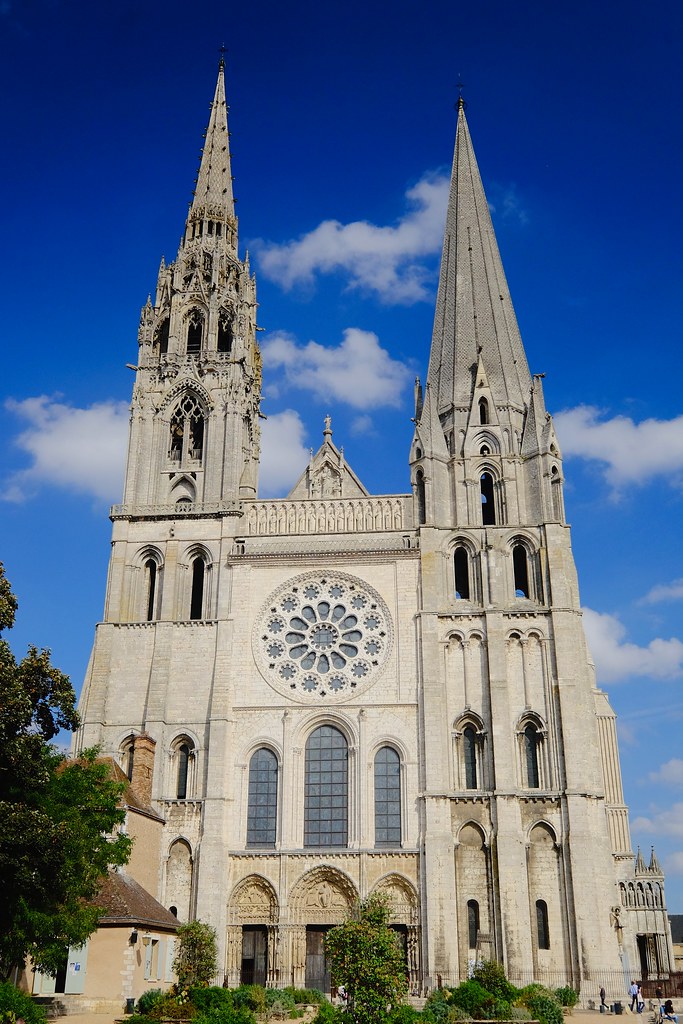
FRANCE. My Art Photography: Cathédrale de Chartres, ROYAL (WEST) PORTAL (12th century), anonymous, Chartres, France.

FEATURE image: “Chartres, North Porch, Central Portal, LeftJamb” by profzucker is licensed under CC BY-NC-SA 2.0. The North Porch was constructed at the start of the 13th century. The North Porch, like the North Rose Window (below) crafted in the same time, depicts the glories of the Virgin Mary along with Old Testament figures.

I visited Chartres Cathedral for the first time in 1985, and again in 1989, 2002, and 2005. I participated in my first Malcolm Miller tour in Chartres Cathedral in 1985. A guide there since 1958 his work, as I was backpacking through Europe, inspired me to see how a person can dedicate his energies to one major work. Chartres Cathedral is famous perhaps mostly for its stained glass from the 12th and early 13th centuries. The shimmering beauty of these intact colorful windows from over 800 years ago is unparalleled. Almost all the windows are “read” from left to right starting at the base and ascending to the top. Once a Roman site, several cathedrals have stood where today’s monumental building stands. Previous cathedrals were literally destroyed during the Merovingian and Viking eras and in 12th century fires. A cult of the Virgin Mary as protectress developed around the cathedral that led to a gift in the 9th century of its famous Marian relic known as Sancta Camisa, or the Virgin’s veil. When the cult of the Virgin Mary arose universally in the church in the 12th century Chartres Cathedral, which was dedicated to Mary’s Assumption, was poised to become an important place of pilgrimage.

The North Rose window in Chartres Cathedral displays the Virgin Mary and Child in the center surrounded by small circles of doves, angels and thrones. In the outer circles are depicted the 12 kings of Judah (who were Jesus and Mary’s ancestors) and the 12 minor prophets. Chartres – cathédrale – rosace nord” by Eusebius@Commons is licensed under CC BY 2.0.

On my first visit to Chartres cathedral in 1985, after having breakfast in Paris, I walked to Gare Montparnasse and boarded a train direct to Chartres. On that visit Malcolm Miller explored the North Rose Window (c. 1231) with the Blue Virgin Window (c. 1194) below it as well as parts of the Noah Window (c. 1210). The Noah window included a depiction of the 6th century bishop of Chartres, St. Lubin, who was the patron of wine merchants, a group that helped pay for the window. Miller also took us outside to discuss the 12th century statuary on the West portal that I photographed in 1989. Following a fire in 1120 a large Romanesque church was built in the same period as Vézelay Abbey. Another fire in 1134 damaged the church and precipitated the construction of the north tower completed in 1150. The south tower was begun and completed about 10 years later than the north tower. The Royal Portal was built between 1145 and 1155. Most of the present church was rebuilt following a devastating fire in July 1194 which destroyed not only the church but much of the city. Notable exceptions to the fire’s destruction were the cathedral’s mid12th-century west front with its royal doors and two contrasting towers. The rest of the church visited today – including, with some exceptions, its magnificent stained glass windows – was rebuilt and crafted between 1195 and 1220. The North Rose Window was donated by King Saint Louis IX of France (1214-1270) and his mother Blanche de Castille (1188-1252). During the French Revolution, the church was desecrated and used as a temple to the Goddess Reason. It wasn’t returned to the church and reconsecrated until 1855.

The West Front is from the 12th, 13th and 16th centuries. The photograph’s column statues below are on the right side of the West Portal’s central door. Though likely originally intended in the 12th century to be enclosed in a narthex, that structure was not built and these sculptures remained outdoors. Chartres 2014 – 2” by evocateur is licensed under CC BY-SA 2.0.

By the 11th century there was a renewal of learning in Europe that, particularly in Northern Europe, was centered in monastic and, slightly later, cathedral schools. One Gerbert of Aurillac (c. 946-1003) who later became Pope Sylvester II, had studied in Spain, and was head of the cathedral school in Reims in the 970’s. Gerbert’s pupil, St. Fulbert of Chartres, as bishop of Chartres, opened its cathedral school which became the most illustrious center of learning in the 12th century and marked a new era for Western civilization. These were schools grappling with varying philosophical concepts of God and man that were hotly debated in the 12th century. Though the present Gothic building was, after 25 years of construction, roofed and finished around 1220, Chartres Cathedral was reconsecrated in October 1260. Three popes visited Chartres in the 12th century and in the next centuries several saints prayed there including St. Thomas Becket (1118-1170) as well as French saints Bernard of Clairvaux (1090-1153), Francis de Sales (1567-1622), Vincent de Paul (1581-1660), Louis de Montfort (1673-1716) and, bien sûr, Benedict Joseph Labre (1748-1783). While pilgrimages to Chartres began before the 12th century and important pilgrimages continued into the 16th and 17th centuries, these had waned since the French Revolution. Though pilgrims were returning to Chartres by the end of the 19th century, French poet Charles Péguy is held responsible for restarting the traditional Paris to Chartres pilgrimage route. It was on June 14, 1912 that Charles Péguy set out on this pilgrimage when he walked its almost 150 kilometers in three days. The previous year he had made a vow to do so at the bedside of his son who was ill. “Chartres is my cathedral,” Péguy later wrote. On September 5, 1914 as a lieutenant in the 19th company of the French 276th Infantry Regiment during World War I, Péguy was killed, shot in the head, near Villeroy, Seine-et-Marne. Charles Péguy was 41.

The Royal (West) Portal, 12th century, Cathédrale de Chartres (1145-1220), France. While art historians have made attempts to identify the portal column statues, it remains speculative. It appears that these column statues represent Old Testament figures – in this photograph, possibly King Solomon at right holding a scroll and the Queen of Sheba next to him. What is important is the inexpressible joy that these faces of stone from almost 1000 years ago convey. Author’s photograph. 12/1989 1.24 mb

The 12th century artist’s ambition was to concentrate the life of these statues in their faces. While Chartres cathedral’s flying buttresses and its stained glass are rightly world famous, some art historians believe that it is the statuary that is the cathedral’s most interesting aspect. The statuary certainly represents 12th century art at its zenith.

SOURCES: Chartres: Guide of the Cathedral, Étienne Houvet, revised Malcolm B. Miller, B.A., Editions Houvet-la Crypte, n.d.; Medieval Thought, Gordon Leff, Humanities Press, Highland, NJ, 1958. https://drupal.americamagazine.org/issue/681/article/voice-chartres – retrieved Aug. 23, 2025; https://www.worldhistory.org/article/1277/the-stained-glass-windows-of-chartres-cathedral/ – retrieved Aug. 23, 2025; https://www.cathedrale-chartres.org/en/cathedrale/pilgrimages/the-great-pilgrimages/ – retrieved Aug. 23, 2025.

This explanatory article may be periodically updated.

FRANCE. Thirty miles west of Paris, the 1000-year-old fortified royal town of MONTFORT L’AMAURY, showcases its 11th century crusaders’ castle, 16th century flamboyant Gothic church with 37 intact Renaissance stained-glass windows and homes of 20th century composer Maurice Ravel and playwright Jean Anouilh.

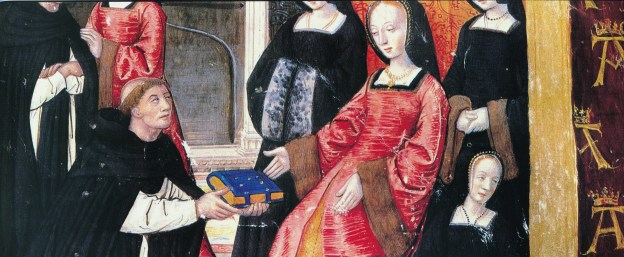
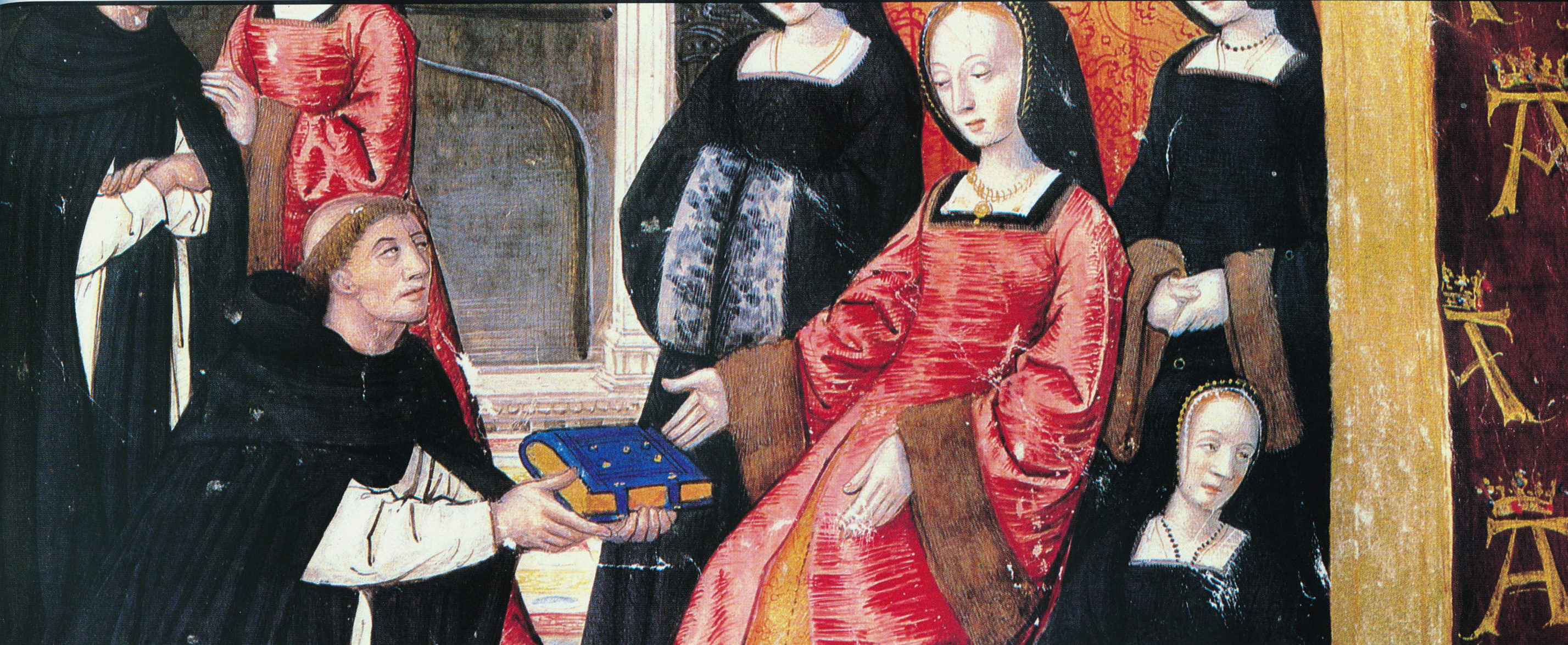
FEATURED image: Manuscript 16th century (detail): Queen consort Anne of Brittany (1477-1514) receiving a Book of Hours from her Dominican confessor, Antoine Dufour (d.1509). Montfort L’Amaury returned to the crown of France after Anne of Brittany married Charles VIII “the Affable” (1470-1498) in 1491.

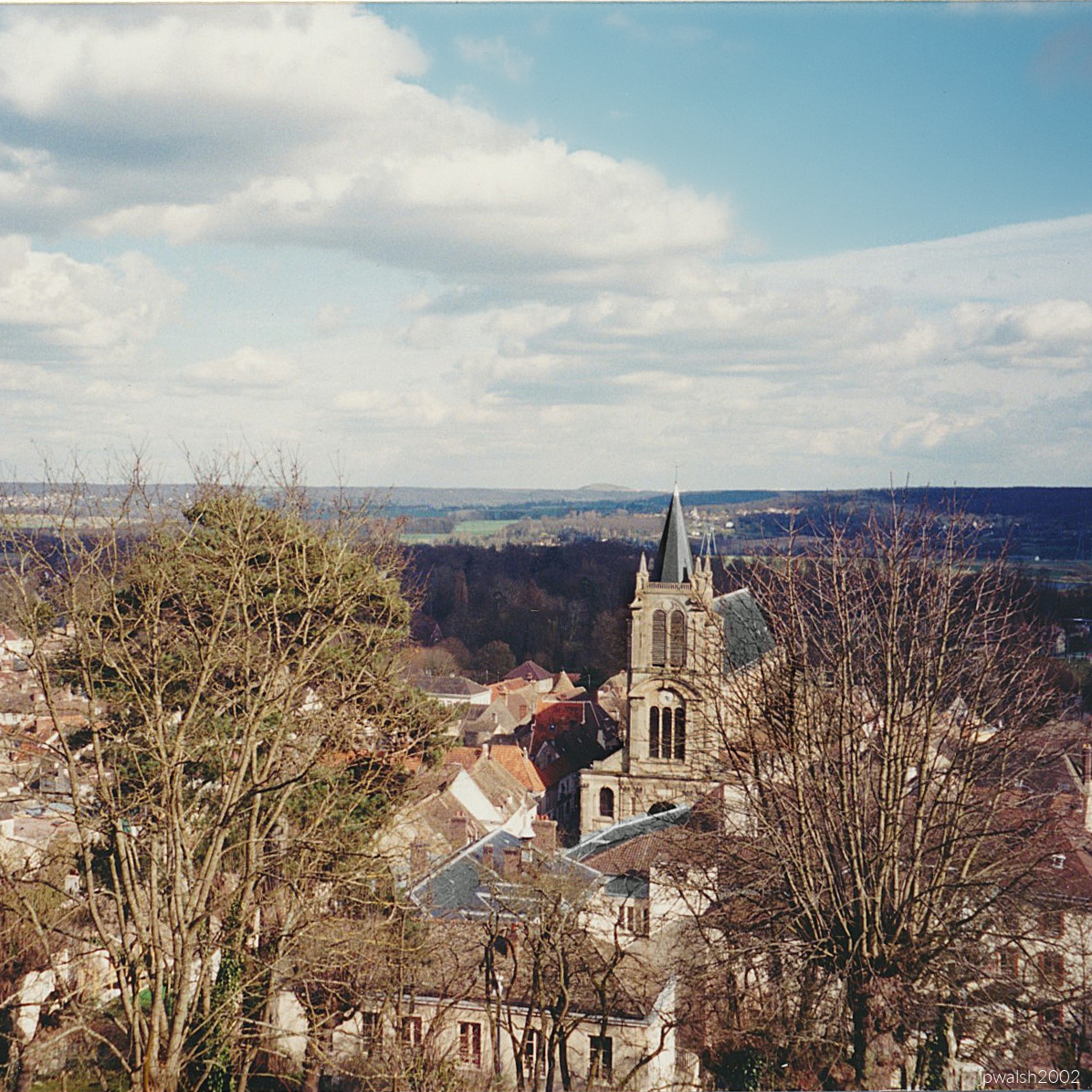
Started in the 11th century, L’Église St. Pierre anchors part of the centre ville of Montfort L’Amaury, a town in France about 30 miles west of Paris. The photograph is taken from the ruins of the chateau on the town’s heights. The late 10th century Frankish king Robert II built a castle in the hills of Montfort. From the start of the 11th century, Montfort-l’Amaury was the stronghold of the Montfort family. Author’s photograph.

At the north edge of the Rambouillet forest the city of Montfort L’Amaury spreads along the restored ruins of its ancient fortified castle. Founded under the Capetian kings, the city owes its fame to Simon de Montfort (1208-1265), Anne de Bretagne (1477-1514), the Valois royal dynasty, and Henry IV (1553-1610). Its monuments begin in the 11th century, stretch towards exceptional Renaissance stained-glass windows and half-timbered houses as its civilization has attracted writers, artists, and musicians to live there. This would include the house of Maurice Ravel (1875-1937) called Le Belvédère where he lived from 1921 until his death and where we were invited to sit at, and play, the piano where Ravel composed Boléro. It was in March 2002 during a visit to Paris and the Île-de France that we ventured through Yvelines by train to Montfort-L’Amaury for a day trip which included a memorable déjeuner in a restaurant that has since disappeared.

Interior, L’Église Saint-Pierre (Church of St. Peter), late 15th century, Montfort L’Amaury, France. Author’s photograph.

The interior of Saint Pierre church is bright and intimate. Like other French monuments, today’s Saint-Pierre was completed over many centuries. Its origin is in the 11th century. A notable reconstruction of the edifice began in the late 15th century by initiative of Queen Consort, Anne of Bretagne. There is a vast ambulatory around both sides of the nave. Since 1840, the church has been an historic monument because of its unique ensemble of 37 stained glass windows. The oldest date from the 1540s and 1570s. The others were installed in the late16th century. That ecclesial project was started by Catherine de Medicis (1519-1589) in 1562. The windows were installed during the time of the Council of Trent (1545-1563) and some of the glass commemorates that event. As none of the glasswork is signed, it is not known whether its painters are from Montfort L’Amaury or elsewhere.

St. Peter Window. L’Église Saint-Pierre, Montfort L’Amaury, France. Throughout France starting in the 1540s there was a growing taste and demand for stained glass windows in their local churches. The experimentation in glasswork and painting by the middle of the 16th century allowed for the iconography in these stained glass windows to express numerous details and refined techniques. Public Domain.
Detail. St. Peter Window. Public Domain.
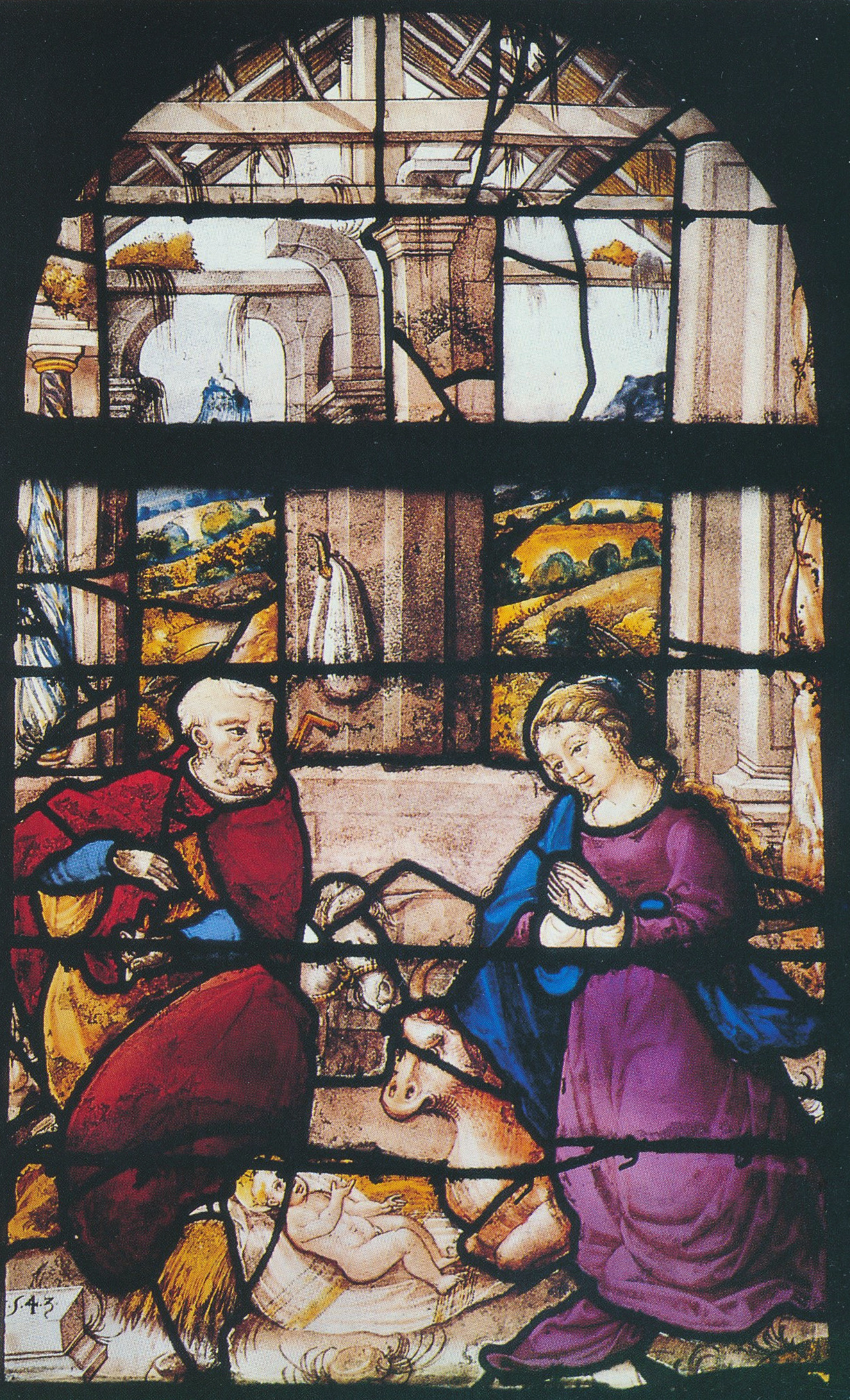
Detail. Nativity Window. Public Domain.
The south exterior of L’Église Saint-Pierre along Rue de Dion in Montfort L’Amaury. The exterior wall shows flying buttresses designed in the French Renaissance style as well as gargoyles that were sculpted in the late 15th century. The building is constructed of calcified stone that came from towns to the north, precisely, Maule, and a more distant Vernon on the Seine. The interior ambulatory that surrounds the nave on both sides and ends at the chevet expresses the building’s gothic aspect. Street lamps and a narrow street with tight parking has room for a small tree next to the church. Author’s photograph.
Montfort L’Amaury has half-timbered houses dating to the 16th century. This is no. 16, Place de la Libération, just steps from the front entrance of Église St. Pierre. At the beginning of October 1825 young Victor Hugo (1802-1885) lived in Montfort L’Amaury for a few days. He wrote a letter to his father in Paris and described it as “a charming little town ten leagues from Paris, where there are ruins, woods, and one of my friends…” Author’s photograph.
Portrait de Victor Hugo sur fond de Notre-Dame de Reims, Jean Alaux, 1825, Maison de Victor Hugo – Hauteville House, oil on cardboard. Public Domain.
https://www.parismuseescollections.paris.fr/fr/maison-de-victor-hugo/oeuvres/portrait-de-victor-hugo-sur-fond-de-notre-dame-de-reims
View of the church from the east. The church of Saint Pierre is of late gothic origin. It was rebuilt and decorated in the 15th, 16th, and early 17th centuries. Following the French Revolution and its aftermath, the church building received an extensive restoration in the mid19th century, including a new steeple. Except for one stained glass window that was restored in situ, all the 16th-century stained glass windows were taken out, restored, and reinstalled by a master painter in Metz between 1851 and 1857. Author’s photograph.
Chevet. L’Église Saint-Pierre. Public Domain.
On Saint Pierre’s front stoop is busy Place de la Libération and with Rue de la Libération just beyond. At the end of the street is the rounded 16th century La Porte Bardoul, one of gateways to the chateau. It was named in the 16th century for the Captain who built the ramparts of Montfort L’Amaury in the 11th century (Hugues Bardoul). Author’s photograph.
Charles Aznavour – Disque D’Or” by Piano Piano! is licensed under CC BY 2.0.
Charles Aznavour (1924-2018), dubbed France’s Frank Sinatra, never lived in Montfort L’Amaury. For 60 years, the singer lived in Galluis, a neighboring town just 5 minutes by car up the road. Yet, in those many years, Aznavour frequently came to Montfort L’Amaury, sometimes to go shopping or visit friends or eat at one of its excellent restaurants. In 2018 Aznavour was buried in the cemetery in Montfort L’Amaury and has become a pilgrimage site for his many fans.
The cemetery at Montfort L’Amaury dates from the sixteenth century and is an interesting site to visit for its history, architecture, and people buried within. As dead bodies were originally buried in the ground as they are today, over the many centuries the bones were later exhumed and deposited in ossuaries. This was essential during epidemics that occurred regularly when ground-space for burials was at a premium for the bodies of the newly dead. Built to give the appearance of a cloister, these galleries are actually a mass grave. Its architecture is charming and conveys the aspect of a Romantic bone-yard. Fair Use.  
Ruins of the castle of Montfort-l’Amaury. In the foreground is Le Belvédère, the house of Maurice Ravel. Montfort-l’Amaury Donjon by ℍenry Salomé (Jaser !) 08:12, 21 November 2006 (UTC) – Cliché personnel, own work is licensed under CC BY-SA 3.0

The role of Montfort l’Amaury as a town began to develop in the High Middle Ages when Capetian king, Robert II (976-1031), built a castle there in the forest of Yvelines which was then a royal prerogative. William of Hainaut built the castle whose walls were finished around  1050. Hugues Bardoule was captain of the castle and thus a later 16th century gateway is named after him. It is in the 11th century that L’Église Saint-Pierre and L’Église Saint Laurent begin to be built. Robert II was married three times, and excommunicated by the Catholic Church – one of the early examples of French royals who married as they wished.

In the twelfth century, Bertrade de Montfort (1070-1117), after giving birth to a boy who would become King of Jerusalem, left her husband, the Duke of Anjou, Fulk IV (1043-1109) in 1092. She married the king of France, Philip I “the Amorous” whose spouse, Bertha of Holland, was also still living.

Philip was so in love with Bertrade that he refused to leave her even when threatened and finally excommunicated by Pope Urban II (1035-1099) in 1095. Because of his excommunication Philip was prevented from taking part in the First Crusade (1096-1099).

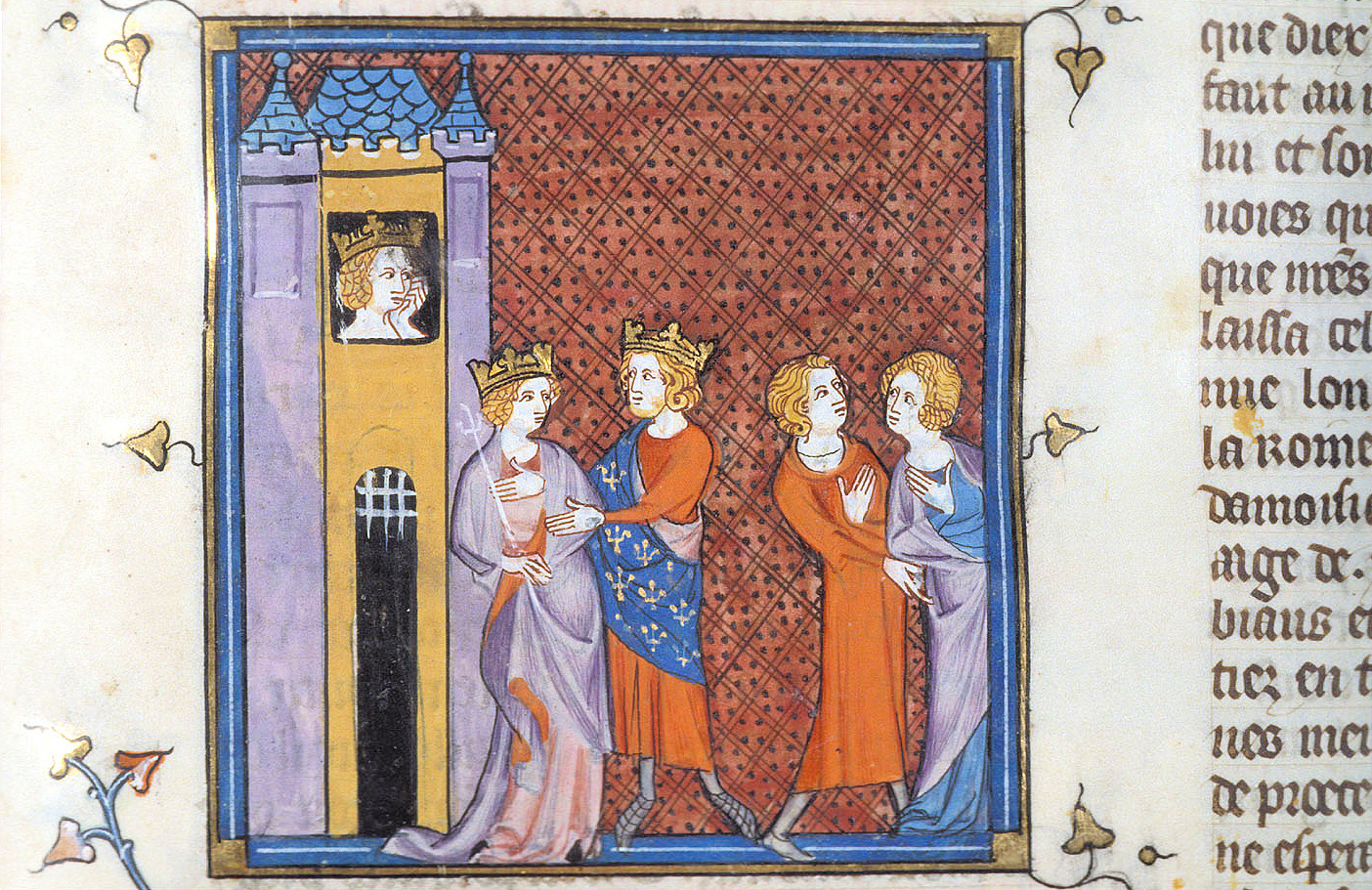
Bertrade de Montfort and King Philip I “the Amorous.” Chroniques de Saint-Denis (ou de France), British Library, Royal 16 G VI f. 271. 14th Century (1332-1350). https://www.bl.uk/IllImages/Kslides%5Cbig/K137/K137596.jpg
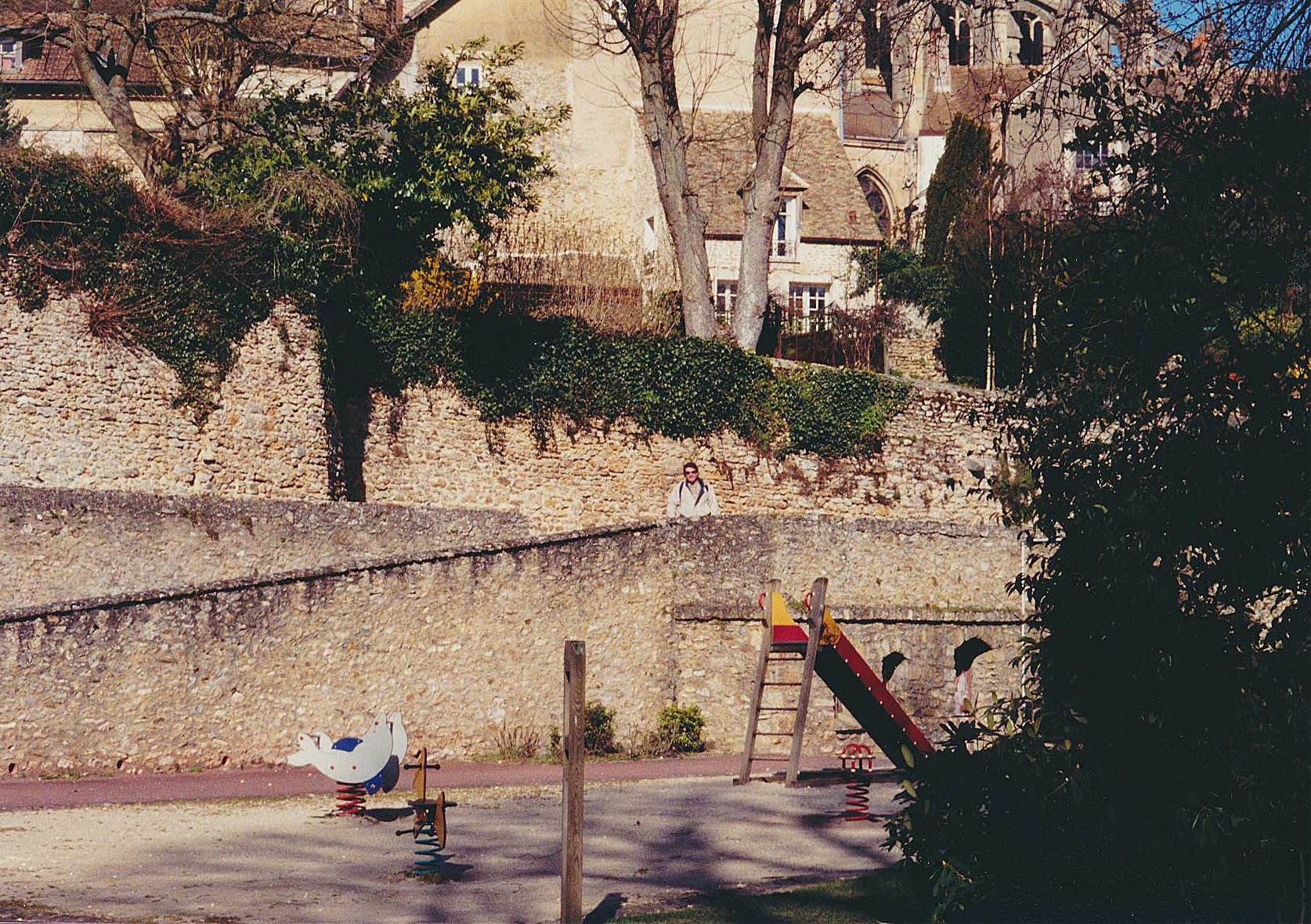
The ramparts and castle. Author’s photograph.

The ramparts and castle were destroyed by the English during the Hundred Years’ War in the 15th century. After the battle of Agincourt in 1419, the English occupied the French domain and it was during this time that the castle at Montfort was destroyed. The two rebuilt towers were named for Anne of Brittany after she assisted in the castle’s restoration. From this height, the fort overlooked the old Roman road from Beauvais to Chartres.

Also from this place, troops assembled at Montfort L’Amaury in the 12th century as Amaury III raised lords and knights to fight alongside Louis VI (1081-1137) against the Emperor of Germany. Simon IV fought alongside Philippe II Auguste (1165-1223) against the English as well as to the Crusades in the Middle East and the Albigensian Crusade in southern France. The Montforts distinguished themselves especially in this crusade against the Cathars.

At the beginning of the Third Crusade (1189-1192), not wanted by King Philippe Auguste (1165-1223), the future Louis VIII “the Lion” (1187-1226) was looking for companions. Simon IV, Lord of Montfort (1175-1218), embarked on the crusade where victory was equalled by its terror.

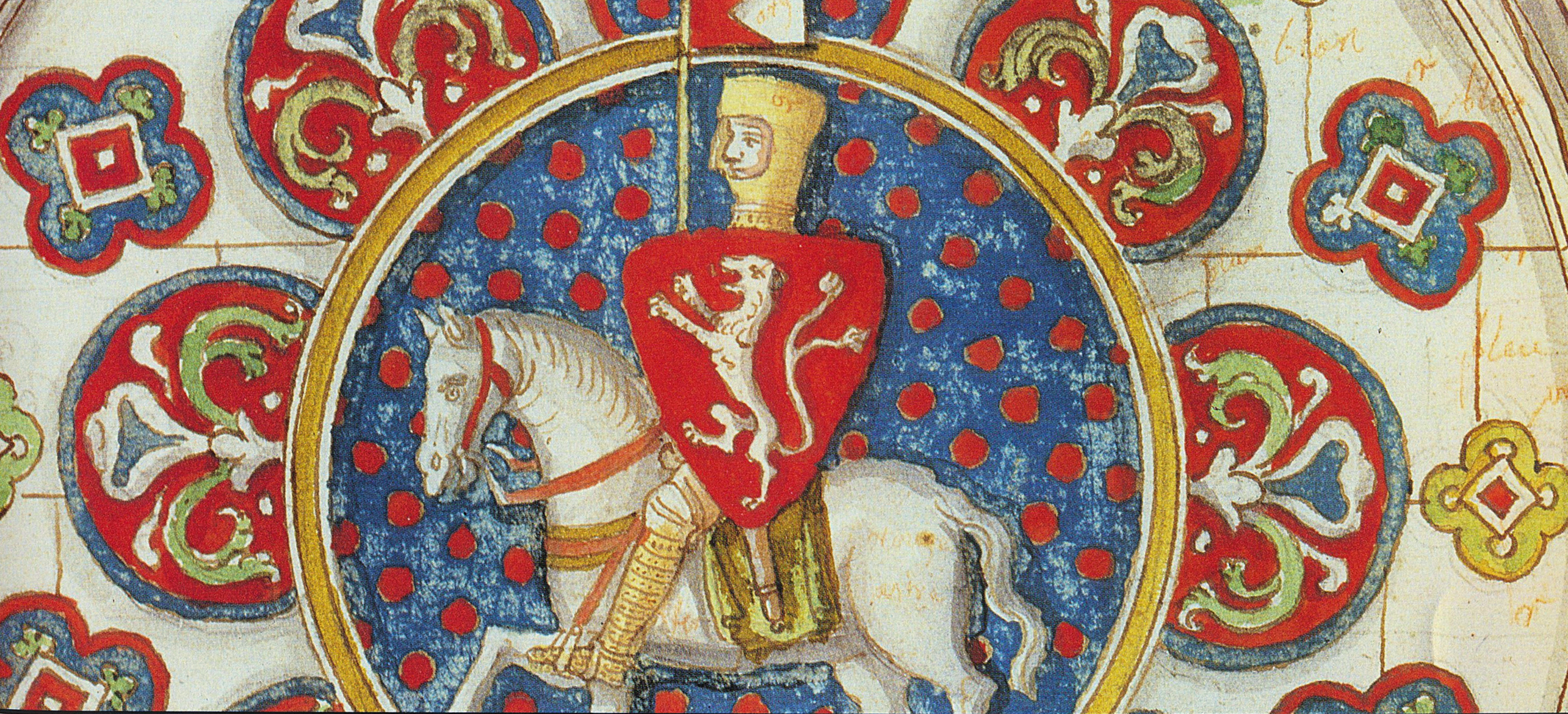
Stained glass (detail) Chartres cathedral: Simon de Montfort V (1208-1265). Simon was born in the chateau in 1208. Whereas his brother Amaury V (1191-1241) inherited his father’s French properties, including in the south of France owing to his father’s Cathar crusade, Simon V is known to history as having a major role in the constitutional development of England where he successfully led the barons’ opposition to the absolute rule of King Henry III (1207-1272) of England. During his rule of England Simon de Montfort V called two famous parliaments, one of which recognized the voices of ordinary town citizens in the affairs of government making him one of the progenitors of modern parliamentary democracy. Public Domain.
In January 1238, Montfort married  Eleanor of England, daughter of King John and Isabella of Angoulême and sister of English King Henry III. While this marriage took place with the king’s approval, the act itself was performed secretly and without consulting the great barons. Eleanor had previously been married and swore a vow of perpetual widowhood after her husband died. This vow was broken when she married Montfort and, for that reason, the Archbishop of Canterbury condemned it. The English nobles protested the marriage of the king’s sister to a foreigner who was only of modest rank. Most notably, Richard, 1st Earl of Cornwell, the king’s and Eleanor’s brother, rose up in revolt over the marriage. King Henry III eventually bought off his brother and peace was restored. The marriage brought property to Montfort and when a child was born of the union in late 1238, he was baptized Henry, in honor of his uncle, the king. In February 1239, Montfort was finally invested as Earl of Leicester where he acted as the king’s advisor and became godfather to Henry’s eldest son, Edward, who became King Edward I (“Longshanks”).

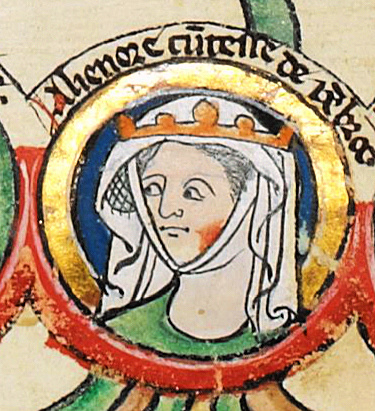
Eleanor of England who married Simon de Montfort V in 1238 in an early-fourteenth-century Genealogical Roll of the Kings of England. Public Domain.
The author at the ramparts. These fortifications were originally built over 1000 years ago in the early 11th century by Amaury I. The walls run from east to west creating a superficial size of Montfort at about 4 to 5 hectares (one hectare equals about two and a half acres). Portions of the wall were dismantled during the 100 Years War but rebuilt during the Wars of Religion (1562-1598) as well as Montfort’s reception of a royal charter by Charles IX in the mid16th century. The rebuilt wall had to expand to meet the development of Montfort under Anne de Bretagne a half a century before, though substantial portions of the original 11th century wall were incorporated into the construction. Author’s collection.
Manuscript 16th century (detail): Queen consort Anne of Brittany (1477-1514) receiving a Book of Hours from her Dominican confessor, Antoine Dufour (d.1509). Montfort L’Amaury returned to the crown of France after Anne of Brittany married Charles VIII “the Affable” (1470-1498) in 1491.

From Montfort L’Amaury, the lords continued to assist the French kings in the crusades. After John I, only a daughter allowed the continuity of the Montfort family. Beatrice d’Albidon married Robert, Count of Dreux. The Comté de Montfort was related to the Duchy of Brittany following the marriage of Yolande de Dreux-Montfort (1263-1330) with Arthur II of Brittany (1261-1312) in 1294. With their marriage in February 1492, Anne of Brittany became the first Queen of France crowned in St. Denis basilica. The marriage contract of Anne to Charles VIII “the Affable” stipulated a union of France and Brittany though the ruthless Charles forbade her to reign with her title, “Duchess of Brittany.” The contract also stated that if the queen were to die first and was childless, the king would inherit all her property. In this pre-nuptial agreement, it further stipulated that if Charles VIII died first Anne must marry his successor. This would be his cousin and brother-in-law, the handsome and seductive Louis II of Orléans, later, Louis XII (1462-1515). Though Charles and Anne often lived apart, she was pregnant for most of her married life with a child on average every fourteen months that produced two sons who died and two daughters who lived. After the accidental death of warring Charles in April 1498 (he hit his head on a door lintel), there was no male heir and 22-year-old Anne duly married Louis. Before she married French kings, Anne was engaged 8 times and briefly was married in 1490 to the Holy Roman Emperor, Maximilian, which the French did not like. Anne was still a married woman when she and Charles the Affable exchanged vows in December 1491. To prevent scandal the marriage had to be regularized by the pope who annulled Anne’s marriage to Maximilian in February 1492 and granted the royal couple a dispensation for each marrying their relative. Before new king Louis XII could marry Anne he had his 22-year marriage to Joan of France – a marriage of longer duration than Anne was then alive – annulled. In 1476 Louis believed he had had Joan forced on him by Louis XI (“The Universal Spider”) and never really cared for her. In what has been described as one of the seamiest lawsuits of the Middle Ages, Joan went on childless from her disappeared marriage to die in a nunnery. In 1499 it was the king’s second marriage and Anne’s third. Anne was quite aware that she was no longer a child but a 33-year-old woman, divorced and widowed with two children. She proceeded to actively insist at court on her rights and prerogatives. Though King Louis XII ruled Brittany, he officially recognized Anne’s title Charles had forbade and Louis promulgated decisions in her name. Their contract stipulated that Anne’s second child with Louis XII would rule Brittany. But with Anne’s death at 36 years old in 1514 this was not honored. Anne was coronated again in St. Denis basilica in 1504. She lived mostly at Blois and was an important patron of the Italian and French fine arts. Louis XII died the next year without a legitimate heir and his cousin and son-in-law Francis I mounted the throne. The couple were buried in St. Denis basilica. During the French Revolution in the wake of the frenzy of having decapitated the king in January 1793, revolutionaries made their way to St. Denis basilica and desecrated the graves of Anne of Brittany and Louis XII and threw their remains into a mass grave. This 15-16th century union of Brittany and France brought increased benefits to Montfort L’ Amaury compared to a union with Brittany alone. The new period saw the town’s castle ruins restored and there was new construction everywhere. The cemetery was relocated outside city walls. Churches were rebuilt and enhanced with that day’s art. While reaping these material improvements from its royal benefactors, Montfort maintained a semi-autonomy from the crown of France that would not be changed until 1550 when Brittany and the French Crown finally united under a single sovereign, Henry II (1519-1559).

Jean Perréal (1455-1529), Portrait Louis XII, c. 1514, Windsor collections de S.M. la Reine d’Angleterre. Jean Perréal’s most important attribution is this portrait of Louis XII who was King of France from 1498 to 1515. Louis XII was married three times – the first annulled; the second leaving the king a widower, and, in his last three months of life, to Mary Tudor (1496-1533), the favorite sister of King Henry VIII of England. Despite these wives, the king had no living sons. The Salic Law prohibited his line to continue on the French throne through his daughters. When Louis died in 1515, his throne eventually passed to his cousin, Francis I.

Under the Valois the Yvelines region of which Montfort is a central part received royal favor. Catherine de Medici (1519-1589) was named the Lady of Montfort in 1561. When the Wars of Religion broke out (1562-1598), the king, Charles IX (1550-1574), offered to the city home-rule in exchange for the reconstruction of its medieval ramparts at his expense. At the end of these wars, the passage of the future king, Henry IV (1553-1610) on the road that led him to Paris to take power, allowed Montfort L’Amaury to prove its loyalty to the new king. Montfort provided Henry Navarre with weapons and later obtained special rights in exchange. During the reigns of the first two Bourbon kings of France, Henry IV and Louis XIII (1601-1643), there are frequent royal visits to Montfort L’Amaury.

A canonized Catholic saint among the Valois- Joan of Valois (1464 – 1505), sister of Charles VIII, and betrothed of Louis XII.

Portrait of Joan of Valois as abbess by Jean Perréal (1455-1530).

The second daughter of Louis XI (1423-1483) and Charlotte of Savoy (1411-1483), Joan of Valois was a fleeting Queen of France as the wife of King Louis XII following the death of her brother, King Charles VIII. Her marriage was soon annulled so that Louis could, as pre-arranged by contract, marry Charles VIII’s widow, Anne of Brittany.

Joan’s demeanor was characterized by an accepting and placid countenance. When she retired from court politics to become Duchess of Berry, the former Queen of France remarked: “If so it is to be, praised be the Lord.”

In Bourges, Joan of Valois founded a monastic order of sisters and served them as their abbess. In terms of her personality, Joan could be autocratic as an administrator of her nuns, which may have been a vestige of her former high-born role. Joan was canonized in May 1950, almost 450 years after her death.

Workshop of François Clouet. Catherine de’ Medici wears the black cap and veil of widow, after 1559. Upon seeing Catherine in the flesh, an Italian diplomat noted that “her mouth is too large and her eyes too prominent and colorless for beauty. But she is very distinguished-looking, has beautiful skin, a shapely figure, and exquisitely made hands.”
Portrait de Henri IV, roi de France et de Navarre (1553-1610) 1600 / 1700 (XVIIe siècle), Atelelier de Frans Pourbus II Louvre. Hung in Versailles chateau. https://collections.louvre.fr/en/ark:/53355/cl010057776
Marie de’ Medici, 1616, Frans Pourbus the Younger (Flemish, 1569-1622), oil on canvas, The Art Institute of Chicago. Marie de Medici (1575-1642) married Henry IV of France in 1600. After the king was assassinated in Paris in 1610, Marie de Medici served as the regent for their young son, Louis XIII. Marie de Medici brought Frans Pourbus to the French court to make regal portraits of the royal family.
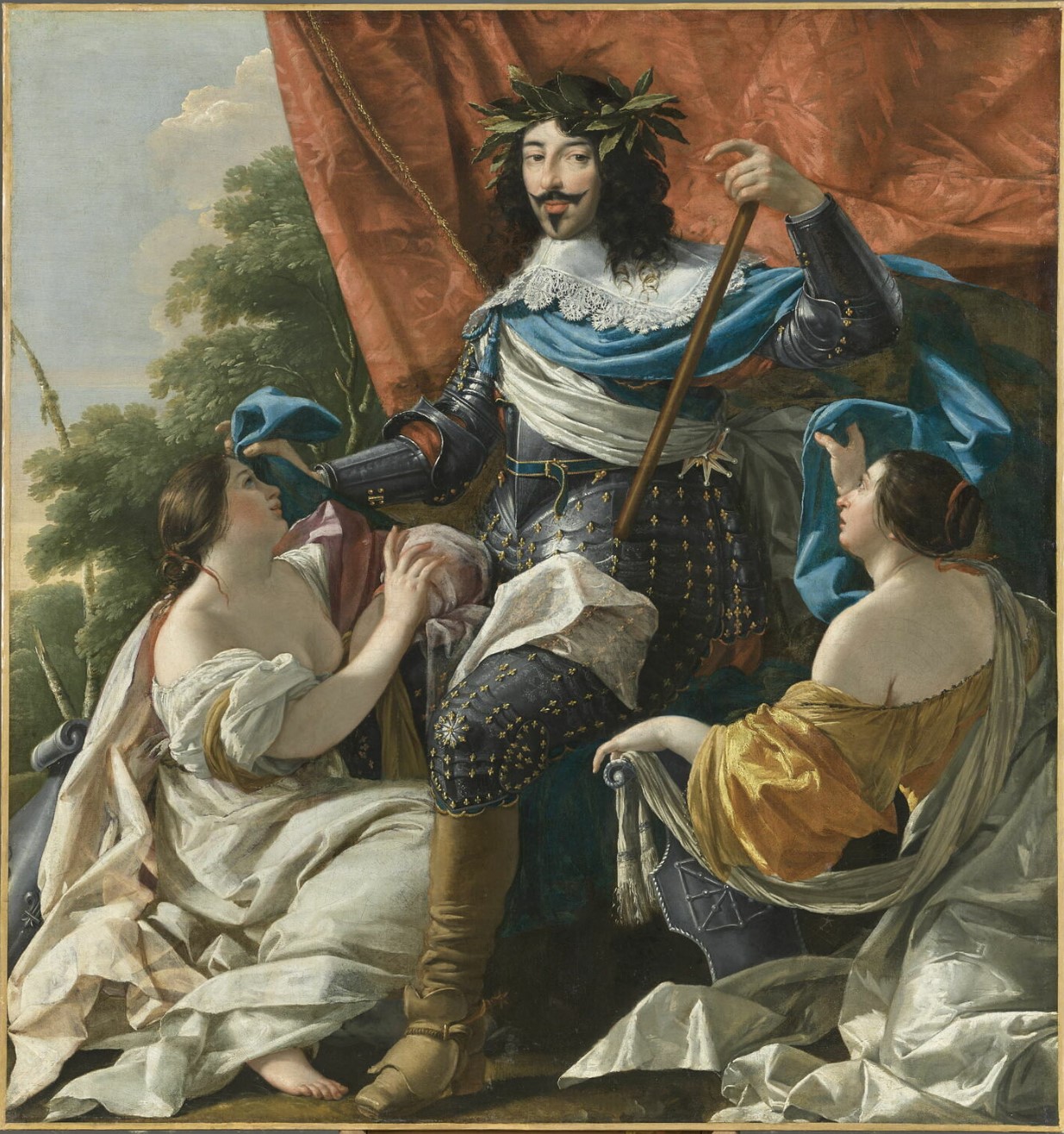
Louis XIII between the figures of two young women symbolizing France and Navarre. 1636/38, School of Simon Vouet (1590-1649). Louvre, Paris. https://collections.louvre.fr/en/ark:/53355/cl010062003

Le Belvédère: the House of Maurice Ravel from 1921 to his death in 1937 at Montfort L’Amaury.

The author in front of Le Belvédère, the house of Maurice Ravel, and ready to go inside for a visit. Author’s collection.
Pianist Jacques Février with Maurice Ravel in 1925 in Le Belvédère, the house of the composer in Montfort-l’Amaury. Public Domain.
The salon of the Ravel house. Author’s photograph.
Ravel’s house sits on an ascent from the centre ville where Ravel could look out his garden-side window  to back towards town and south and east to the green countryside between Montfort and Paris. Author’s photograph.

https://www.radioclassique.fr/classique/concerts-festivals/le-cerveau-de-ravel-le-livre-qui-retrace-la-vie-du-compositeur-a-travers-ses-etats-de-sante/

https://www.radioclassique.fr/classique/maurice-ravel-letrange-sortilege-qui-a-lese-son-cerveau-decrypte-par-des-neurologues/

George Maas” by Crossett Library Bennington College is licensed under CC BY-NC-SA 2.0.

Jean Anouilh (1910-1987) was a French dramatist who lived in Montfort-L’Amaury in France. Anouilh’s 1944 play, Antigone, was an adaptation play of Sophocles’ play of the same name. The 34-year-old Anouilh’s work was seen as an attack on the Vichy government of Marshal Pétain (1856-1951) in World War II.

Anouiih also wrote Becket. The original French play is titled Becket ou l‘Honneur de Dieu. It was staged in Paris at the Théâtre Montparnasse-Gaston Baty in October 1959 and directed by Anouilh. The play dramatizes historical martyr and Catholic saint Thomas Becket (1120-1170), the Archbishop of Canterbury In England, whose feast day is December 29.

Becket was the best friend to younger King Henry II of England. Cunning and proud, vulnerable and lonely, pent-up King Henry is interested in hunting and women, and not necessarily in that order. Henry is bored with political affairs and as king has his one friend, Thomas Becket, who is his companion in vice and debauchery.

Becket serves his king loyally, without compromise. Wanting to strengthen his power over the Church in England and believing his idea to be an excellent one, Henry appoints Becket as chancellor of England and he later becomes Archbishop of Canterbury. But nothing goes as planned. Becket, on his path to sainthood, finds he cannot serve both king and God.

For Henry the arrangement is one of disillusionment, resentment, hatred, and torn friendship – and, later, repentance. For Becket it is a tale of courage, renunciation, and honor as the archbishop  seeks to defend church freedom in England against an ambitious secular power. Such conflict provokes Becket’s murder by the king’s knights in the archbishop’s own cathedral.

Anouilh’s Becket became an international sensation. Successive productions in English translation were mounted in London (starring Christopher Plummer and Eric Porter) and in New York City (starring Laurence Olivier and Anthony Quinn). In 1964 Becket became a major motion picture starring Richard Burton and Peter O’Toole which won the Academy Award for Best Screenplay.

SOURCES:

Montfort L’Amaury de l’an mil à nos jours, Marie-Huguette Hadrot, Paris: Somogy Editions d’Art, 2002.

Montfort-L’Amaury, Le Syndicat d’Initiative des Fêtes et des Arts de Montfort-L’Amaury et ses Environs, 1972.

Montfort-L’Amaury Les Verrières de L’Eglise Paroissiale Saint-Pierre(Yvelines), Laurence de Finance and Marie-Huguette Hadrot, Paris: Centre de Documentation du Patrimoine, 1994.

https://montjoye.net/chateau-de-montfort-lamaury

https://www.francebleu.fr/infos/medias-people/du-monde-a-montfort-l-amaury-pour-se-recueillir-sur-la-tombe-de-charles-aznavour-1541236036

https://fr.wikipedia.org/wiki/Anne_de_Bretagne

http://www.montfortlamaury.free.fr/fr/index.php/Montfort-l-amaury-un-millenaire-d-histoire

The Saints: A Concise Biographical Dictionary, edited by John Coulson, Guild Press, New York, 1957.

Ramparts, Montfort L’Amaury. Author’s photograph,

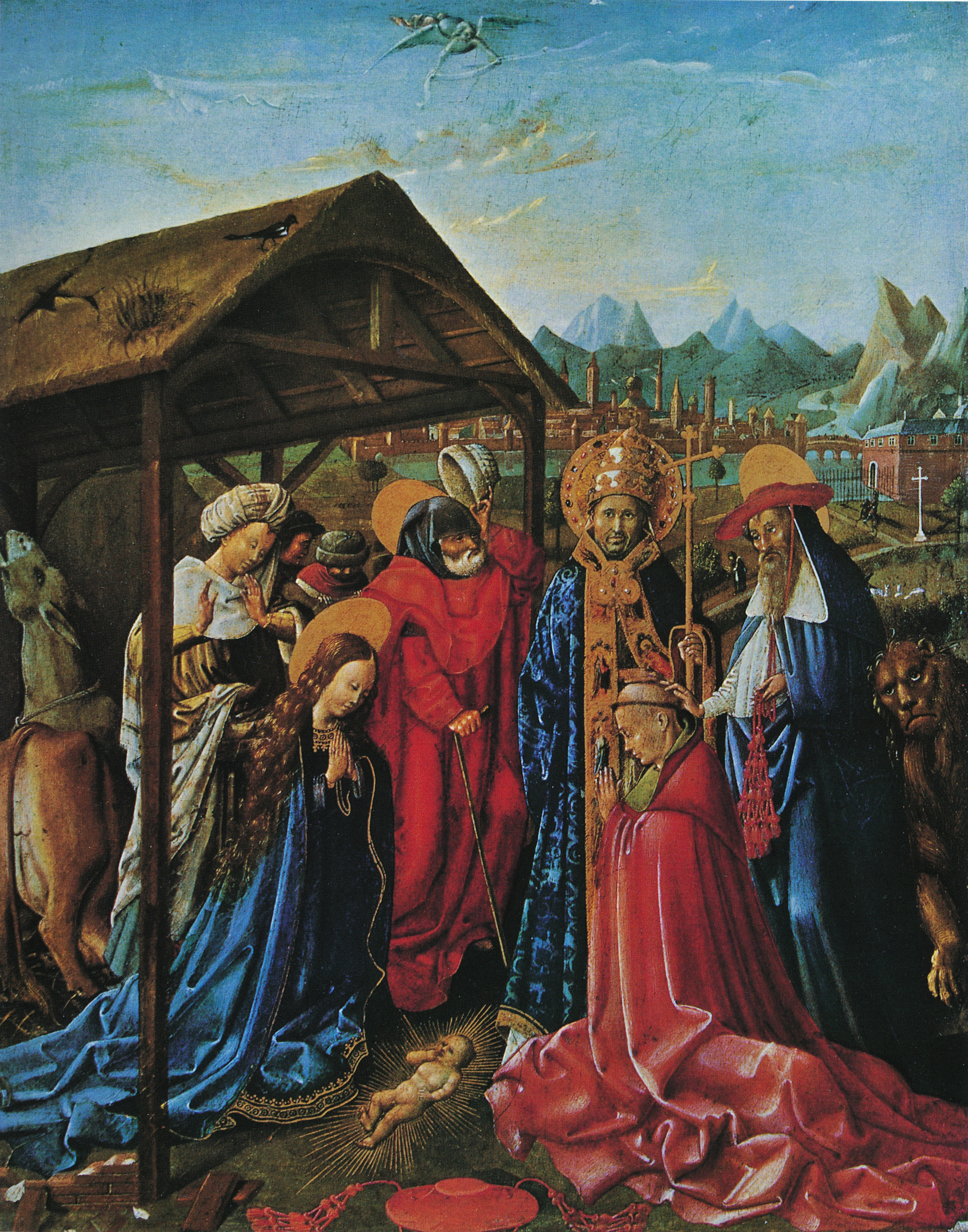
FRANCE. French art in the 15th Century.

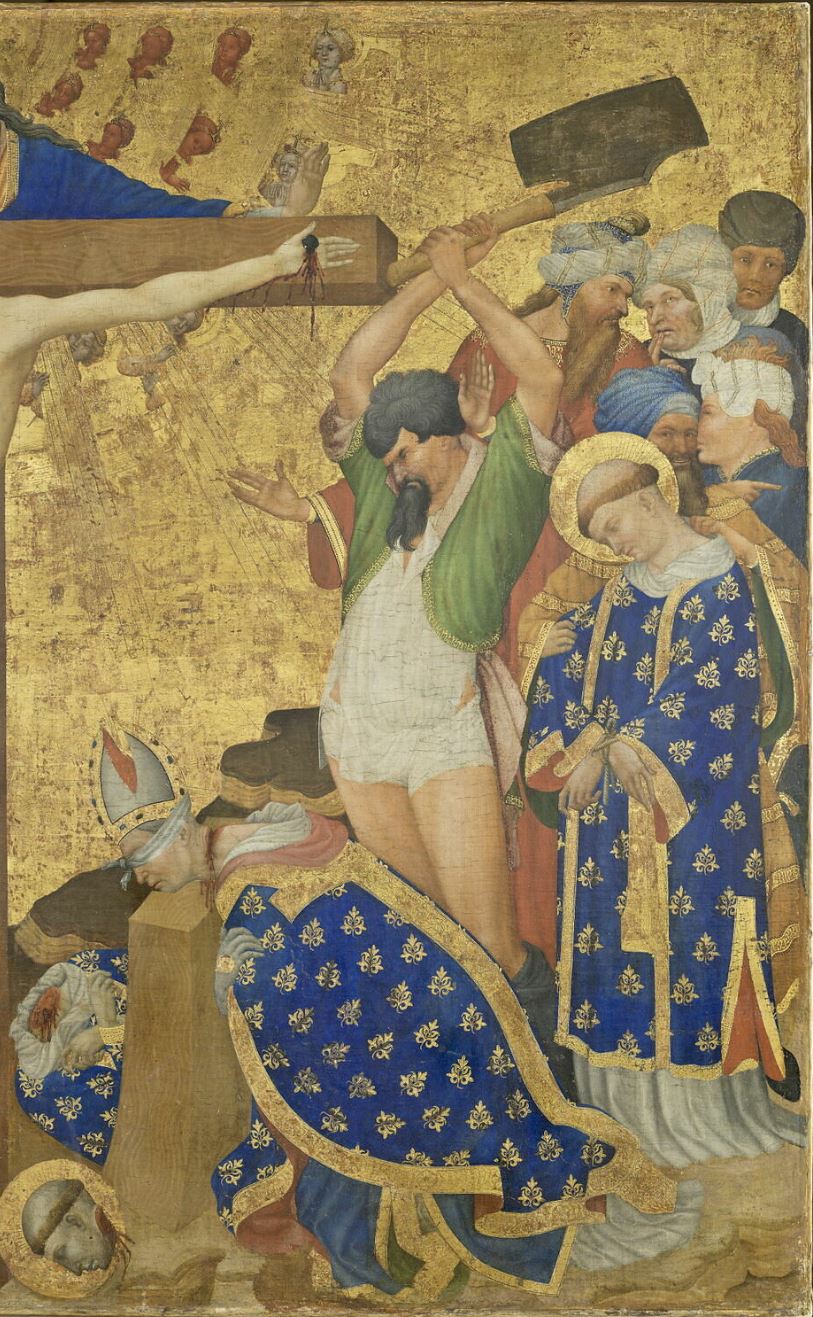
FEATURE image: DETAIL, Henri Bellechose (1415-1440), École de Bourgogne, Retable de saint Denis, 1416, https://collections.louvre.fr/ark:/53355/cl010063178

Anonymous master. Portrait of John le Bon (1319-1364) c. 1360. Musée de Louvre, Paris (“Louvre”).
Henri Bellechose (1415-1440), École de Bourgogne, Retable de saint Denis, 1416, https://collections.louvre.fr/ark:/53355/cl010063178

Retable de Saint Denis, (above), was completed in 1416 for the church of the Charterhouse of Champmol that is adjacent to Dijon. The artwork’s attribution has long been debated between Bellechose and Jean Malouel (1370-1415). Written evidence points to Bellechose possibly only completing the painting started by Malouel who was Bellechose’s predecessor at the head of the ducal workshop. However, recent connoisseurship does not see two different styles that would indicate two painters and the artwork in the Louvre is not the same size as the artwork mentioned in the early 15th century document that supports the dual attribution.

DETAIL, Henri Bellechose (1415-1440), École de Bourgogne, Retable de saint Denis, 1416, https://collections.louvre.fr/ark:/53355/cl010063178

St. Denis is the most famous cephalophore (beheaded saint holding his head) in Christian history. Denis and two companions were martyred on Montmartre in what became a future Paris in the mid-3rd century. Much later, in the ninth century, an anonymous chronicler told the tale of the martyr Denis and mentioned his carrying his head from his execution spot on Montmartre to Saint-Denis. There the abbey of St-Denis rose to become the burial place of French kings. Soon after, this preposterous but delicious tale of Denis’ post-mortem pilgrimage received further embellishment by an abbot chronicler so that the legend took hold in St. Denis’ hagiography and iconography. St. Denis is the patron of Paris in France and against headaches and any strife or frenzy.

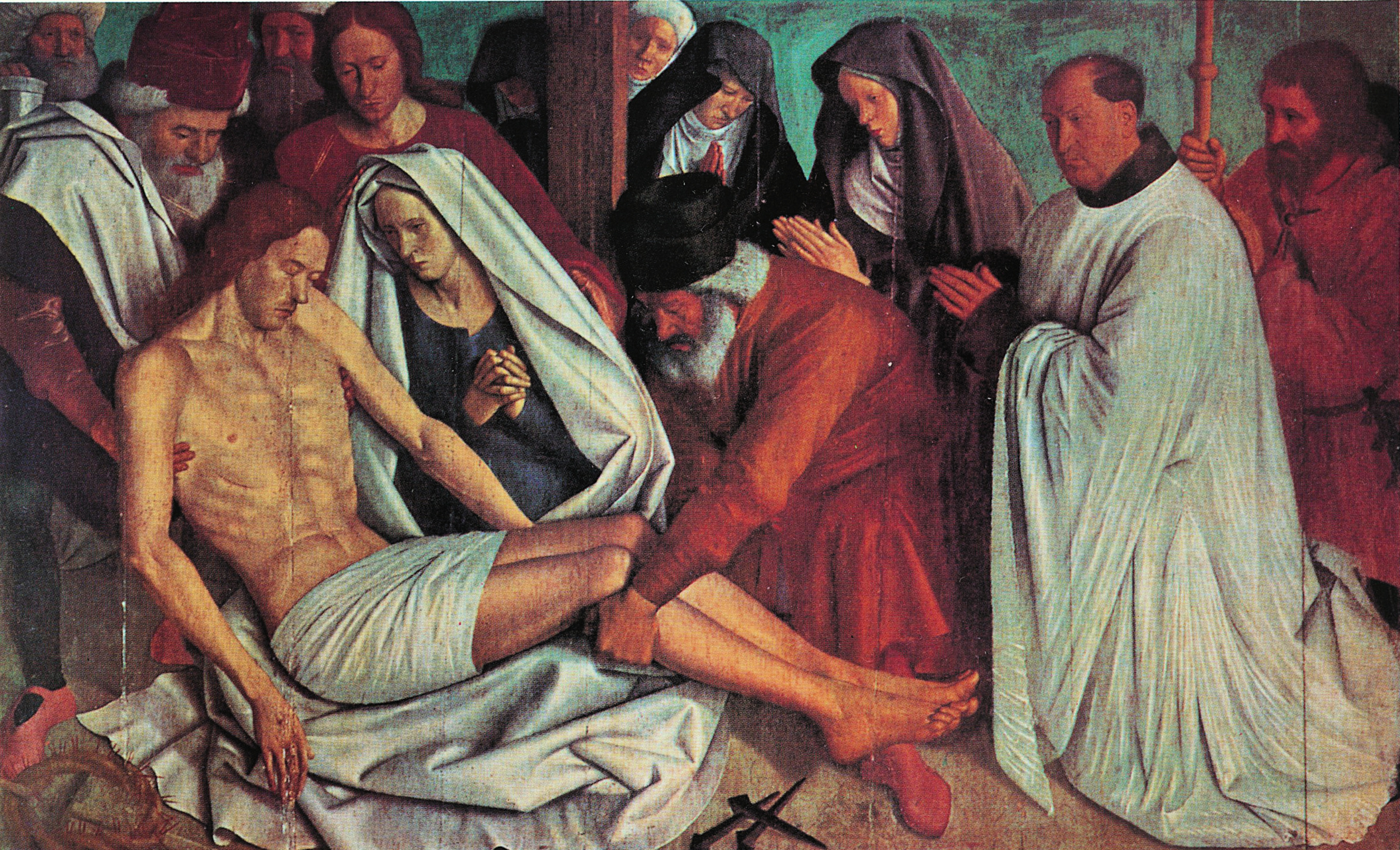
Anonymous, École de Île-de-France? Bourgogne? Studio Henri Bellechose? Dead Christ Placed in the Tomb,
1400-1425. Louvre. https://collections.louvre.fr/ark:/53355/cl010065413
Anonymous master, The Annunciation, France, possibly Netherlands, late 14th century (1380s), tempera and oil with gold on wood, 15 7/8 x 12 3/8 x 1 7/8 in. Cleveland Museum of Art.

The angel Gabriel’s wings resemble peacock feathers. The panel painting was once joined to another panel to form a diptych. Its opulent ornate style and small size allowing for easy mobility points to its use as a devotional artwork for an aristocratic patron around 1400.

Anonymous, The Crowning of the Virgin, c. 1400-1410, Paris, oak on wood. 20.5 cm. Staatliche Museum, Berlin.

In Christian Biblical tradition, the Virgin Mary was the only human person to be received into heaven after her death as a physical body prior to the Last Judgment. By the Middle Ages, the event’s narrative was elaborated so that the Virgin in Heaven came to be understood as a royal court where angels acted as court pages. In Heaven’s throne room, Mary is crowned as Queen by her son, Jesus Christ.

In the French tondo, Christ wears a red cloak symbolizing his Resurrection and a violet robe symbolizing his Passion. He sits on a stone throne and sets the crown on his mother Mary’s head as she kneels on a splendid cushion.

Strewn on the green-tiled floor of the celestial throne room are a variety of cut flowers which point to Mary’s purity and love for humanity. One angel carries her dress’s train and is himself dressed in a liturgical-type costume.

The tiny panel is remarkable for its delicate execution, lovely colors, and precise articulation of details such as the angels’ multi-colored wings. Its overall imagery was 14th century Italian in origin and arrived into Paris in the 15th century. Like the Annunciation panel in the Cleveland Museum of Art (above), this panel was likely produced as a private devotional image for a patron of high rank who dwelt among the milieu of the Parisian court.

Les Frères de Limbourg, Meeting of the Three Wise Men c. 1416 from Les Très riches heures du duc de Berry folio 51 verso. Chantilly, Musée Condé.
Entourage des Frères de Limbourg. Adoration de L’Enfant, c. 1415, Glasgow Art Gallery and Museum.
Maître des heures de Rohan (active 1410-1435), The Last Judgment c. 1420, Paris, Bibliothèque nationale.
Maître des heures de Rohan, Annunciation Angel and donor, c. 1420/30, Musée de Laon.
 Maître des heures de Rohan, Portrait de Louis II d’Anjou, c 1420. Paris, Bibliothèque nationale.

Not much more is known of the Maître des heures de Rohan than if he were anonymous. The artist had ties to Troyes, a Burgundian market town, and settled in Paris between 1415 and 1420. He was a commercial illuminator and is found in the service of the Dukes of Anjou around 1420. In addition to the Grandes Heures de Rohan, c.1430-1435, he produced other exceptional books, including the Hours of René d’Anjou (Bibliothèque nationale de France), the Hours of Isabelle Stuart (Fitzwilliam Museum, Cambridge, UK) and the Hours for the Use of Angers (former Martin Le Roy collection).

Artwork by Maître des heures de Rohan reflects a highly personal vision. The artist was completely unconcerned with his contemporaries’ preoccupation to introduce Renaissance realism into painting. The artist ignored perspective and chiaroscuro through concrete depictions and continued to develop his artistic meditations on faith and death using highly original invention of forms. In this way, the Maître des heures de Rohan is an enduring artist from early 15th century France as some of his more fashionably progressive contemporaries are not as he stayed true to his vision to create some of the most expressive pages of medieval Christian mysticism.

Maître of the Aix Annunciation, Annunciation, before 1445, Église de la Madeleine d’Aix-en-Provence.

The precise identification of the artist called the Maître of the Aix Annunciation is unknown. The artist is believed to be male and French, and could be Jean Chapus who lived in Aix and was working for King Réne of Anjou in the 1430s and 1440s. The Annunciation which was placed in the church in 1445 and has been there since, was part of a triptych. The other wings have been split off and are in Brussels, Amsterdam, and a private Dutch collection (one wing was also split). The style shows influence from Italy (Naples) and Flemish art.

DETAIL. Maître of the Aix Annunciation, before 1445, Église de la Madeleine d’Aix-en-Provence.
Maître du Coeur l’amour épris, Rencontre de Coeur et d’Humble requête, c. 1479, Vienna, National Library.
Anonymous. Annunciation, c. 1447-1450, Stained glass, Bourges cathedral, Chapel of Jacques Coeur.
Jean Fouquet (1420-1480), Diptych de Melun, c. 1450, right panel: The Virgin and Child Jesus. Antwerp, Museum of Fine Arts.
Jean Fouquet (1420-1480), Diptych de Melun, c. 1450, left panel: Chevalier Stephan presented by Saint Stephan. Staatliche Museum Berlin.

Jean Fouquet was a major French painter of the 15th century. He was in Rome in the mid-1440s and is presumed to have painted portraits. Under what circumstances the twenty-something Fouquet traveled to Rome is unknown. In any event Fouquet returned to Tours in 1448 and was working in the court of Charles VII. Louis XI appointed him official painter to the king in 1475. A handful of miniatures are documented artworks by Fouquet though other pictures, such as the Melun diptych and others, are attributed to him.

Jean Fouquet (1420-1480), Medallion, self-portrait, 1452/1455. Louvre.
Jean Fouquet (1420-1480), Charles VII, 1440/1460. Louvre.
Jean Fouquet (1420-1480), The Visitation, c. 1450. The Musée Condé, Chantilly.
Jean Fouquet (1420-1480), Announcement of the Death of Saul to David, c. 1470. Les Antiquités Judaïques, Ms. fr. 247, folio 135 verso. Paris Bibliothèque Nationale.
Jean Fouquet (1420-1480), Pietà, c. 1470-1480. Parish church, Nouans (Indre-et-Loire).
Jean Fouquet (1420-1480), Pietà (detail), c. 1470-1480. Parish church, Nouans (Indre-et-Loire).
Retable du Parlement de Paris, c.1455. Louvre. see – https://collections.louvre.fr/en/ark:/53355/cl010061369 – retrieved September 15, 2025.

It depicts the scene on Calvary on Good Friday with Jesus Christ crucified in the center with saints at its base including, left to right, Saint Louis, John the Baptist, the Virgin Mary, Saint John, a beheaded Saint Denis, and Charlemagne. In the background is the tour de Nesle (c. 1200-1665), Seine, the Louvre, Hôtel du Petit-Bourbon, and Palais de la Cité. Formerly identified as an artwork by Philippe de Mazerolles, it is currently identified by the Louvre as “anonymous“ in the School of France influenced by the Master of Dreux Budé who is likely André d’Ypres, active between 1425-1450. Philippe de Mazerolles was also a French painter and illuminator who was active in Paris and in Bruges. Trained in Paris, Philippe de Mazerolles’ style was directly inspired by the Maître de Bedford, an anonymous illuminator active in Paris slightly earlier between 1415 and 1435. The Master of Dreux Budé was a Parisian illuminator whose works show his knowledge of the repertoire of models of the Master of Flémalle (1375-1444). see – https://initiale.irht.cnrs.fr/en/intervenant/3443 – retrieved September 15, 2025.

DETAILS retable du Parlement de Paris (above), c.1455. Louvre:

AnonymeFranceMaître de Dreux Budé (André d’Ypres?), Musée du Louvre, Département des Peintures, RF 2065 – https://collections.louvre.fr/ark:/53355/cl010061369https://collections.louvre.fr/CGU
DETAIL retable du Parlement de Paris (detail), c.1455. Louvre.
AnonymeFranceMaître de Dreux Budé (André d’Ypres?), Musée du Louvre, Département des Peintures, RF 2065 – https://collections.louvre.fr/ark:/53355/cl010061369https://collections.louvre.fr/CGU
Enguerrand Quarton (1410-1466), The Coronation of the Virgin, 1452-53, Altar of the Charterhouse (hospice) of Villeneuve-lès-Avignon.

Also known as Charonton, the French painter worked in Avignon in southern France. His large Coronation of the Virgin is a documented artwork that was completed in 1454. It is one of the most important surviving 15th century French paintings.

Enguerrand Quarton (1410-1466), The Coronation of the Virgin (detail), 1452-53, Altar of the Charterhouse (hospice) of Villeneuve-lès-Avignon.
DETAIL. Enguerrand Quarton (1410-1466), The Coronation of the Virgin, 1452-53, Altar of the Charterhouse (hospice) of Villeneuve-lès-Avignon.
Enguerrand Quarton (1410-1466), attributed, Pietà de Villeneuve-lès-Avignon. École de Provence, c. 1455. Louvre. https://collections.louvre.fr/ark:/53355/cl010063345

DETAILS Pietà de Villeneuve-lès-Avignon (above), c.1455. Louvre:

Nicolas Froment (1461-1483), Triptych (center panel): Mary in the Burning Bush, 1476. Cathedral St. Sauveur, Aix-en-Provence.

DETAIL Triptych (center panel): Mary in the Burning Bush (above), 1476. Cathedral St. Sauveur, Aix-en-Provence:

Nicolas Froment (1461-1483), Mary in the Burning Bush (detail), 1476. Aix-en-Provence, Cathedral St. Sauveur.Triptych (center panel).
Nicolas Froment (1461-1483) The Burning Bush, 1476. Aix-en-Provence, Cathedral St. Sauveur.Triptych (right and left panels).

Nicolas Froment worked in the south of France and was painter to Réne d’Anjou. The triptych is a documented artwork by the artist.

Josse Lieferinxe, called Maître de Saint-Sébastien, Part of an altarpiece shutter. The marriage of the Virgin. Musées royaux des Beaux-Arts de Belgique.
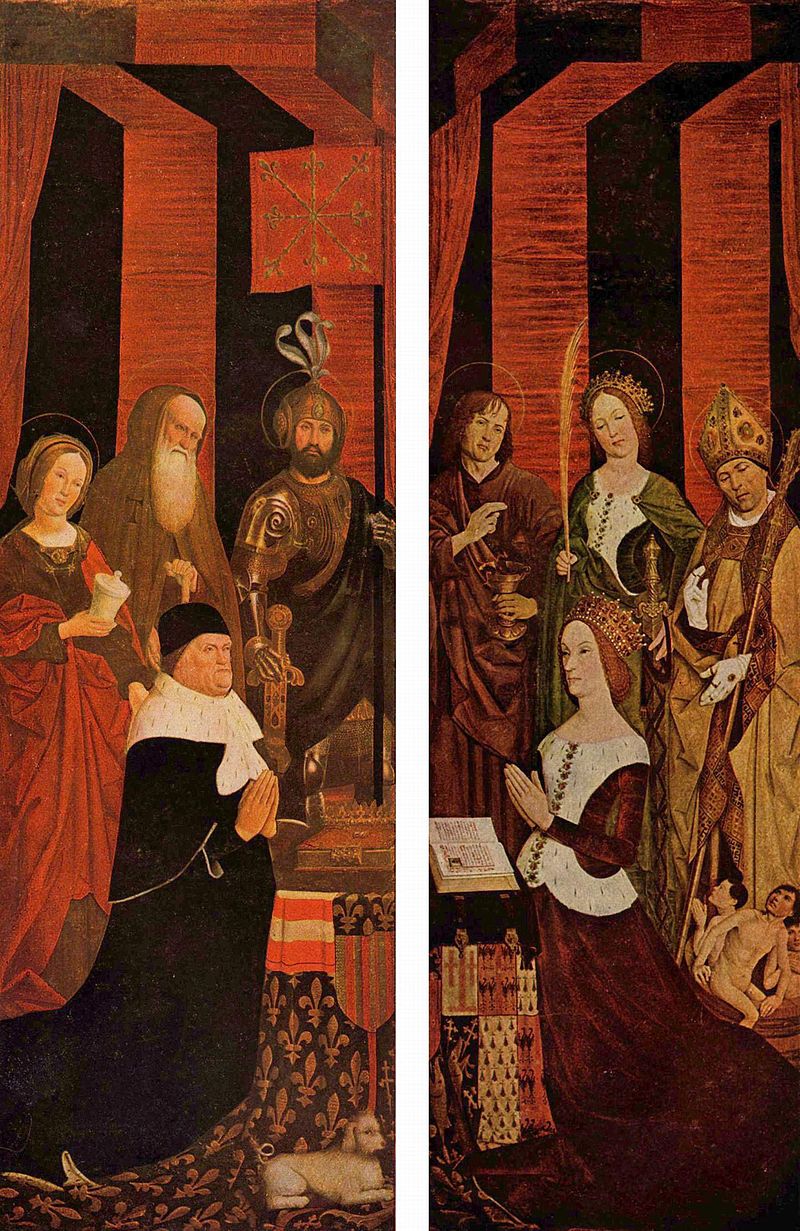
Maître de Moulins, active 1475 to 1505, Triptych de Moulins, center panel: The Virgin and the Child in Glory, c. 1498. Cathedral de Moulins.

DETAILS Triptych de Moulins, center panel: The Virgin and the Child in Glory (above), c. 1498, Cathedral de Moulins:

The Master of Moulins is one of the great French painters of the 15th century. He was influenced by Hugo van der Goes (died 1482) and takes his name from the triptych painting of the Madonna and Child with angels and Donors (above) in Moulins Cathedral dated from 1498/99. Other works attributed to the Master of Moulins are in Autun, Paris, Chicago, Brussels, London, Munich, and Glasgow.

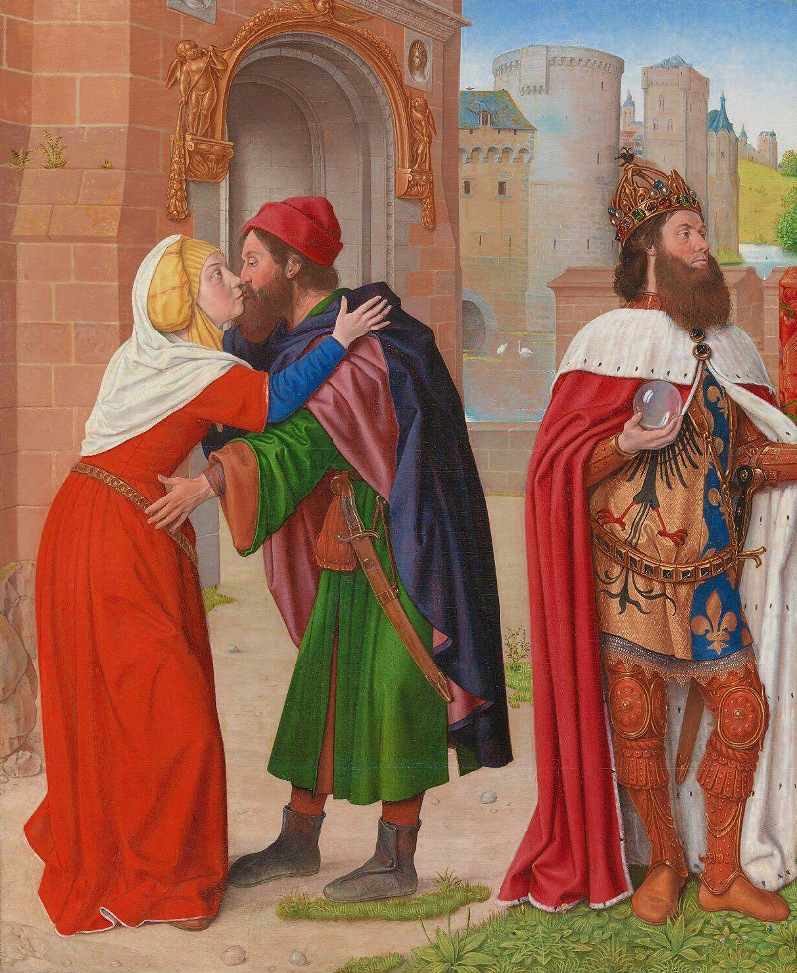
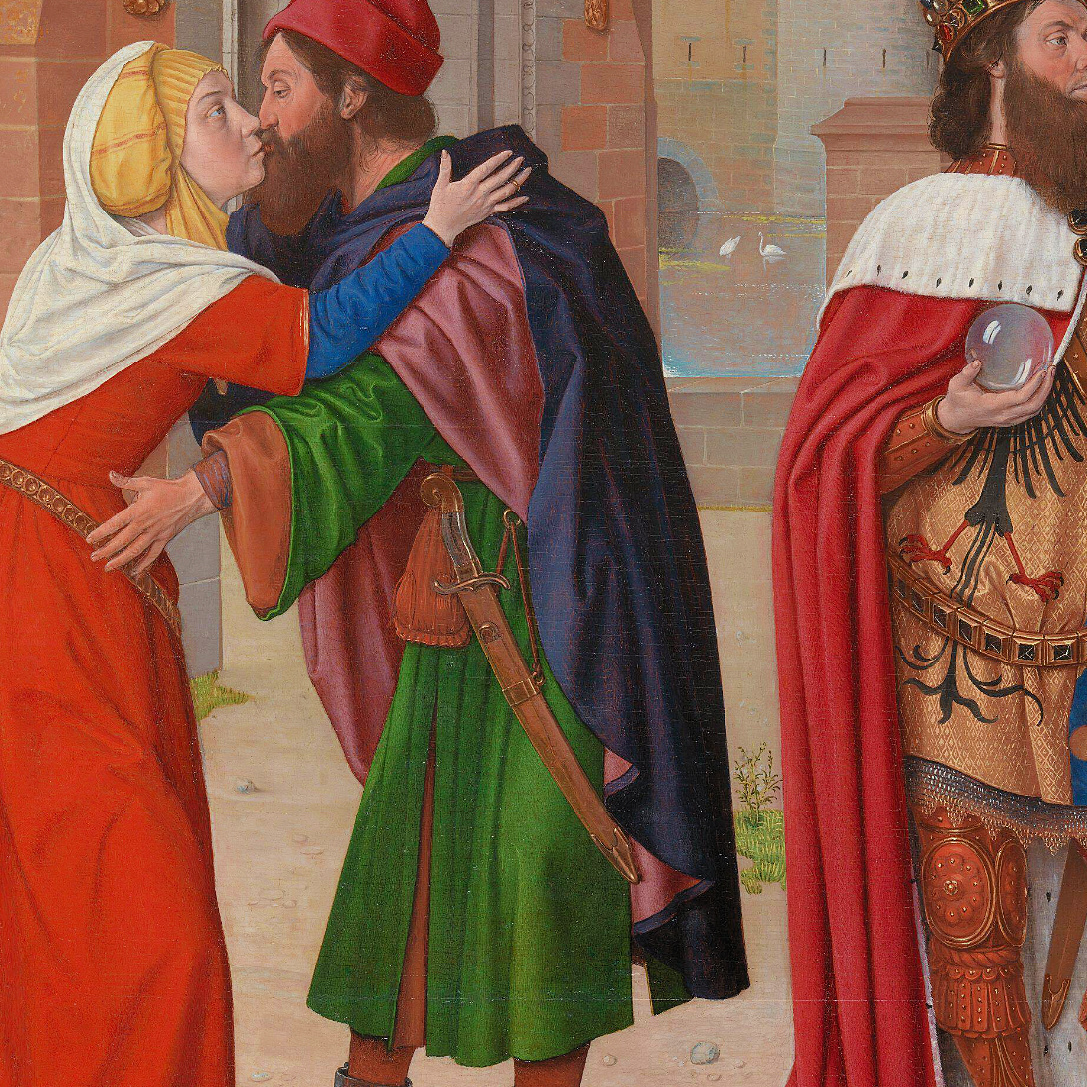
Maître de Moulins, active 1475 to 1505, Meeting of Saints Joachim and Anne at the Golden Gate with Charlemagne, oil on oak, about 1491-1494. 72.6 x 60.2 cm, National Gallery, London.
Maître de Moulins, active 1475 to 1505, The Virgin with Child surrounded by angels, c. 1490, Musées royaux des Beaux-Arts de Belgique.
Maître de Moulins, active 1475 to 1505, François de Chateaubriand presented by St. Maurice or St. Victor with Donor, c. 1485, Kelvingrove Art Gallery and Museum Glasgow.
Jean Bourdichon (1457-1521), King David and Bathsheba, Leaf from the Hours of Louis XII, 1498–1499, Tempera and gold, Leaf: 24.3 × 17 cm (9 9/16 × 6 11/16 in.), The J. Paul Getty Museum, Los Angeles, Ms. 79, 2003.105.

Jean Bourdichon served as official court painter to four successive French kings: Louis XI, Charles VIII, Louis XII, and François I. Bourdichon was almost certainly a pupil of Jean Fouquet, the previous court painter.

Simon Marmion (active 1449-1489), The miracle of the True Cross in Jerusalem in the presence of Saint Helena Empress, 2nd half of 15th century (1450/1500). Louvre. https://collections.louvre.fr/ark:/53355/cl010061655

Simon Marmion (died 1489) who worked in Amiens and Valenciennes and temporarily in Tournai was a painter and illuminator where his miniatures were admired for their rich decoration and landscape details. In the mid1440s the artist moved from Amiens to Valenciennes where he became a leading painter. His most important painting is the Saint Bertin Altarpiece in Berlin and London.

St. Bertin Altarpiece, 1459:

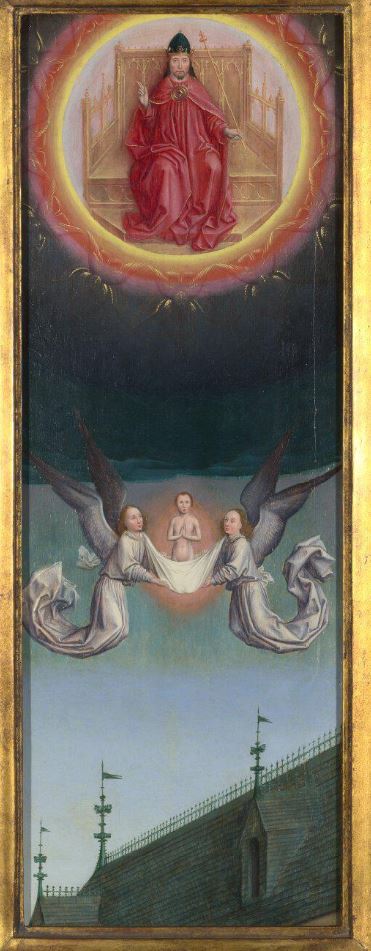
Simon Marmion, The Soul of Saint Bertin carried up to God. Fragment of Shutters from the St. Bertin Altarpiece, 1459. National Gallery London.

The Soul of Saint Bertin carried up to God was the upper section of a wing for an altarpiece for the high altar of the abbey church of St Bertin at Saint-Omer in northern France. It was commissioned by the influential Guillaume Fillastre, Abbot of St Bertin (1450-73), Bishop of Verdun (1437-49), Bishop of Toul (1449-60), Bishop of Tournai (1460–73), Chancellor of the Order of the Golden Fleece and a close confidant of the powerful Duke of Burgundy, Philip the Good. The artwork, whose main parts are in the Gemäldegalerie, Berlin, was consecrated in 1459. The altarpiece was intact in the abbey until 1791 when, as with many church goods, it fell victim to the French Revolution. https://www.nationalgallery.org.uk/paintings/simon-marmion-the-soul-of-saint-bertin-carried-up-to-god

Simon Marmion, A Choir of Angels. Fragment of Shutters from the St. Bertin Altarpiece, 1459. National Gallery London.
Simon Marmion, St. Bertin Altarpiece, 1459. Gemäldegalerie, Berlin. http://www.smb-digital.de/eMuseumPlus?service=direct/1/ResultLightboxView/result.t1.collection_lightbox.$TspTitleImageLink.link&sp=10&sp=Scollection&sp=SfieldValue&sp=0&sp=0&sp=3&sp=Slightbox_3x4&sp=0&sp=Sdetail&sp=0&sp=F&sp=T&sp=4
Simon Marmion, St. Bertin Altarpiece, 1459. Gemäldegalerie, Berlin. http://www.smb-digital.de/eMuseumPlus?service=direct/1/ResultLightboxView/result.t1.collection_lightbox.$TspTitleImageLink.link&sp=10&sp=Scollection&sp=SfieldValue&sp=0&sp=0&sp=3&sp=Slightbox_3x4&sp=0&sp=Sdetail&sp=0&sp=F&sp=T&sp=5

A Dictionary of Art and Artists, Peter and Linda Murray, Penguin Books; Revised,1998.

La Peinture Française: XVe et XVIe Siècles, Albert Châtelet, Skira, Genève Suisse, 1992.

French Painting: From Fouquet to Poussin, Albert Châtelet and Jacques Thuillier, Skira, 1963.

FRANCE. “NOTRE DAME IS ON FIRE!”: architectural history of the 12th century Gothic cathedral and its shocking blaze of April 15, 2019.

FEATURE image: Notre Dame under re-construction, 2019.

N.B. Following more than five years of restorative work gathering artisans, donors, and planners from across the spectrum of global society, Notre Dame de Paris was gloriously re-opened at a celebratory dedication ceremony attended by the world’s dignitaries, including 40 heads of state, on December 8, 2024. Begun in 1163, Notre Dame was first dedicated at its completion in 1345.

By John P. Walsh, May 21, 2019.

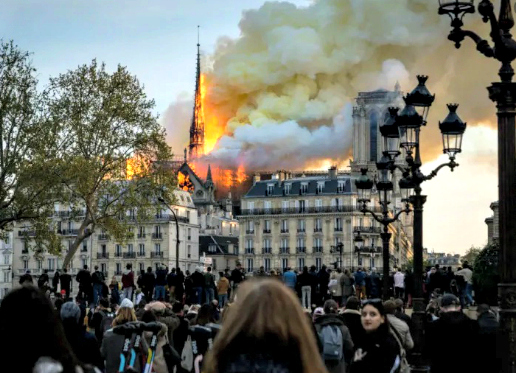
Flames engulf Notre Dame de Paris in an early evening blaze on Monday, April 15, 2019. The fire left the 850-year-old Gothic cathedral standing, but with extensive structural damage.
Hundreds of Paris firefighters battled the blaze for hours. First responders saved the cathedral though its timber roof, frame and spire crashed into the nave.

Fire broke out with 1,000 people inside the building

Notre Dame de Paris suffered a devastating fire on April 15, 2019 causing most of its roof and a 300-foot oak spire to collapse. The fire broke out during an early evening Mass when more than 1,000 people were in the cathedral which is the most touristic site in the center of the most touristic city in the world. The priest had been in the middle of reading that day’s Gospel of John. It was Holy Monday, the first day of Holy Week where the gospel tells the story of Mary pouring oil over the feet of Jesus which will anoint him for burial. Judas complains the perfume could have been sold and the money given to the poor.1

Pledges to rebuild

Notre Dame de Paris (“Our Lady of Paris” named in honor of the Virgin Mary) will take years, even decades, to rebuild and at great expense. This will be the case whether the edifice is simply restored or, as some have argued for, more creatively re-imagined for modern times. Whichever rebuilding vision or visions are followed – and there will be voices from many quarters involved in the restoration process ahead – French president Emmanuel Macron promised to complete its rebuilding by around 2024. Within 48 hours of the fire, donations poured in from around the world to rebuild the cathedral amounting to more than one billion dollars whose substantial amount may prove inadequate to fully cover rebuilding costs.2

Spotty maintenance for 850-year-old stone & wood building

While the fire’s precise ultimate cause is yet to be fully determined, the conditions surrounding the blaze are recognizably available: its spotty maintenance record over 10 centuries; complex 21st century renovation when fire broke out; the flammable oak “forest” of the medieval frame and roof; the challenges of fighting a fire owing to the cathedral’s size and location in central Paris. In a turn of irony, the cathedral roof that burned had been the 12th century builder’s largest monied investment.3

BRIEF ACCOUNT OF NOTRE DAME DE PARIS’S ARCHITECTURAL HISTORY

Notre Dame de Paris is one of Paris’s famous icons–an historical and religious treasure–and one of France’s great cathedrals along with Reims (which was nearly destroyed by fire during World War I) and Chartres (reconstructed after a fire in 1194). Others on any short list of great French cathedrals would include Amiens and Bourges, among others.

Notre Dame de Paris before the April 15, 2019 blaze. The cathedral is an important part of Paris’s identity and a tourist mecca.
After the April 15, 2020 fire: the cathedral’s great nave.
Reims Cathedral on fire in World War I. The cathedral was the site of the coronation of French kings. The Gothic cathedral was virtually destroyed by bombing. After the war, the massive cathedral was completely rebuilt.

In 1163 when it became time to roof the superstructure of Notre Dame de Paris’s choir which was the first part of the church to be constructed, Paris bishop Maurice de Sully (1120-1196) provided 5000 French livres so that it could be richly and securely layered with lead. That and other of the Cathedral roof’s protective lead covering was stolen during the French Revolution in the eighteenth century.

The roof’s space and design provided a large part of the church’s riddle of secret passages -– including spiral staircases in the nave’s columns -– that served mainly for the needs of the religious complex’s operation and maintenance. Engineering of the 12th and 13th centuries proved resilient over nearly 1000 years — through hardly impervious to obsolescence and decay.

The 2019 blaze caused serious damage to the cathedral infrastructure. The flames left behind many questions to be answered about the medieval stone and timber building’s ultimate stability. History’s endurance for more than a church was at stake. Notre Dame de Paris is Paris Point Zero – the very center of the Île-de la-Cité, Paris, and all distances in France and, by extension, the world, are to be judged.4

Paris bishop Maurice de Sully (1120-1196). The bishop with his chapter of cathedral canons started the building of Notre Dame de Paris in 1163. The Gothic structure was mostly completed by 1250.
Episodes from the Life of a Bishop Saint, c. 1500, oil on panel, 61.5 x 47 cm, Master of Giles, National Gallery of Art, Washington, D.C. The scene is from about 300 years after the death of Bishop de Sully yet captures the history of the archbishop on the front steps of his cathedral in Paris. Public Domain. see – https://www.nga.gov/collection/art-object-page.41596.html#provenance.

The Gothic Cathedral: A Quintessentially French Story

The French Gothic building project stretched from a Collégiale Notre-Dame-et-Saint-Laurent d’Eu (1186) in northeastern France to Toulouse Cathedral (13th century) in France’s Languedoc in the south.

The story of the Gothic cathedral, such as Notre Dame de Paris, is essentially a French story.

By the end of the Gothic Movement in the late 14th century, all corners of France -– and points between — possessed a Gothic church that displayed pointed arch, stained glass, and buttresses, some of them magnificently flying.

The style and power of Gothic art reflected not only a new theological thinking in the Renaissance of the 12th century but also an assertion of royal power.5

Notre Dame de Paris viewed from the other side of the Seine. The building’s flying buttresses support the nave and apse. The oak spire that was added in 1860 went up in flames like a torch and crashed into the nave in the April 15, 2019 fire.
The Gothic church called Collégiale Notre-Dame-et-Saint-Laurent d’Eu is in northeastern France. looking to paris for inspiration, it was constructed between 1186 and 1240.
Its subterranean crypt contains the tomb of Irish St. Laurence O’Toole (1128-1180). The saint’s heart is in Dublin at Christ Church Cathedral.
The main impetus for the building of the new Gothic church was to accommodate pilgrims who came to venerate at O’Toole’s tomb.

Impact of the 13th century Crusades on Notre Dame de Paris

The Gothic age was characterized by international crusades of Western conquest to the Holy Land. The French king, Louis IX, or St. Louis (1214-1270) led its seventh manifestation from 1248 to 1254. Louis died while on its Eighth.

In the Holy Land the French king purchased relics to bring back to France, including the highly prized Crown of Thorns reputedly worn by Jesus Christ at his crucifixion. Relics were an investment that could pay off by generating pilgrimages.

In the April 2019 fire, scores of ordinary people and cathedral personnel formed a human chain to save the cathedral’s artifacts, most irreplaceable, and prevent their consumed in the hellish blaze.

Louis IX (St. Louis) with counselors and mother, Blanche de Castile (1188-1252). Miniature, 15th century.
King Louis IX, or St. Louis (1214-1270) led the Seventh Crusade from 1248 to 1254.

As one of the first cathedrals built, Notre Dame de Paris is of enduring architectural significance. Monday, April 15, 2019 was a tragic day in history as fire broke out in the 850-year old edifice while the world watched.

Notre Dame de Paris is on fire, April 15, 2019. Countless pictures were taken anonymously and transmitted instantaneously around the world.
Extent of the fire damage (in red) at Notre Dame de Paris on April 15, 2019. Fair use.

Thousands of people gathered in the streets of Paris, and transmitted pictures of the dramatic blaze from smartphones and other devices onto the internet and television as a major live news event. It caused many to shed tears and ask questions about what is ahead for a beloved symbol of Paris.

THE FIRE’S IMMEDIATE AFTERMATH

In the aftermath of the 2019 fire, workers aimed to secure and protect the edifice which will take several months to finalize.

By May 2019, the north tower was stabilized and secured while the transept’s beams were declared in good condition.

Although the interior was not damaged, the structural integrity of the high vaults that protected it remains uncertain and requires further close study. The cathedral is undergoing a major effort to remove fire debris including the oak spire (or flèche) dating from 1860 as well as the arch that burned and crashed into the nave.

Cataloguing debris and predicting the building’s future

To the highest degree possible, each bit of fallen debris will be deciphered, cataloged and saved for potential reuse in a restoration. One month after the fire, it was declared premature to know if the building is completely stable or if it might further collapse.

Working on the cathedral in the 21st century are virtually the same type of skilled laborers who built it in the first place in the 12th and 13th centuries – namely, masons, stonecutters, carpenters, roofers, iron workers, and master glassmakers.6

The work associated with the Notre Dame de Paris in the aftermath of the 2019 fire promises to concentrate centuries of history into one location looking to sustain its continued thriving existence for future generations.

NOTES:

1. “Vows to Restore Notre Dame Following a Harrowing Rescue,” by Sam Schechner and Stacy Meichtry, The Wall Street Journal, April 17, 2019; see Gospel of John, Chapter 12.

2. “Some say the $1 billion donated to the Paris cathedral should’ve been directed elsewhere,” by Sigal Samuel, Vox, April 20, 2019 – https://www.vox.com/future-perfect/2019/4/20/18507964/notre-dame-cathedral-fire-charity-donations- retrieved May 21, 2019.

3. Gimpel, Jean, The Cathedral Builders, Grove Press, Inc., New York and Evergreen Books, Ltd., London, 1961, pp. 171-72.

4. see “Paris Point Zero” – https://www.atlasobscura.com/places/paris-point-zero – retrieved May 21, 2019.

5. Duby, Georges, The Age of the Cathedrals: Art and Society, 980-1420, translated by Eleanor Levieux and Barbara Thompson, The University of Chicago Press, Chicago and London, 1981, p.97.

6. “Notre-Dame de Paris: Very serious damage that can be repaired,” Élodie Maurot, La Croix International, May 14, 2019 – https://international.la-croix.com/news/notre-dame-de-paris-very-serious-damage-that-can-be-repaired/10094 – retrieved May 20, 2019.

January 2024: “What’s there looks exactly like what was there before…It’s so impressive to be around all the other trades….500 or 600 people are on the site everyday all with different specialties…”