Category Archives: History – France

FRANCE. Thirty miles west of Paris, the 1000-year-old fortified royal town of MONTFORT L’AMAURY, showcases its 11th century crusaders’ castle, 16th century flamboyant Gothic church with 37 intact Renaissance stained-glass windows and homes of 20th century composer Maurice Ravel and playwright Jean Anouilh.

FEATURED image: Manuscript 16th century (detail): Queen consort Anne of Brittany (1477-1514) receiving a Book of Hours from her Dominican confessor, Antoine Dufour (d.1509). Montfort L’Amaury returned to the crown of France after Anne of Brittany married Charles VIII “the Affable” (1470-1498) in 1491.

Started in the 11th century, L’Église St. Pierre anchors part of the centre ville of Montfort L’Amaury, a town in France about 30 miles west of Paris. The photograph is taken from the ruins of the chateau on the town’s heights. The late 10th century Frankish king Robert II built a castle in the hills of Montfort. From the start of the 11th century, Montfort-l’Amaury was the stronghold of the Montfort family. Author’s photograph.

At the north edge of the Rambouillet forest the city of Montfort L’Amaury spreads along the restored ruins of its ancient fortified castle. Founded under the Capetian kings, the city owes its fame to Simon de Montfort (1208-1265), Anne de Bretagne (1477-1514), the Valois royal dynasty, and Henry IV (1553-1610). Its monuments begin in the 11th century, stretch towards exceptional Renaissance stained-glass windows and half-timbered houses as its civilization has attracted writers, artists, and musicians to live there. This would include the house of Maurice Ravel (1875-1937) called Le Belvédère where he lived from 1921 until his death and where we were invited to sit at, and play, the piano where Ravel composed Boléro. It was in March 2002 during a visit to Paris and the Île-de France that we ventured through Yvelines by train to Montfort-L’Amaury for a day trip which included a memorable déjeuner in a restaurant that has since disappeared.

Interior, L’Église Saint-Pierre (Church of St. Peter), late 15th century, Montfort L’Amaury, France. Author’s photograph.

The interior of Saint Pierre church is bright and intimate. Like other French monuments, today’s Saint-Pierre was completed over many centuries. Its origin is in the 11th century. A notable reconstruction of the edifice began in the late 15th century by initiative of Queen Consort, Anne of Bretagne. There is a vast ambulatory around both sides of the nave. Since 1840, the church has been an historic monument because of its unique ensemble of 37 stained glass windows. The oldest date from the 1540s and 1570s. The others were installed in the late16th century. That ecclesial project was started by Catherine de Medicis (1519-1589) in 1562. The windows were installed during the time of the Council of Trent (1545-1563) and some of the glass commemorates that event. As none of the glasswork is signed, it is not known whether its painters are from Montfort L’Amaury or elsewhere.

St. Peter Window. L’Église Saint-Pierre, Montfort L’Amaury, France. Throughout France starting in the 1540s there was a growing taste and demand for stained glass windows in their local churches. The experimentation in glasswork and painting by the middle of the 16th century allowed for the iconography in these stained glass windows to express numerous details and refined techniques. Public Domain.
Detail. St. Peter Window. Public Domain.
Detail. Nativity Window. Public Domain.
The south exterior of L’Église Saint-Pierre along Rue de Dion in Montfort L’Amaury. The exterior wall shows flying buttresses designed in the French Renaissance style as well as gargoyles that were sculpted in the late 15th century. The building is constructed of calcified stone that came from towns to the north, precisely, Maule, and a more distant Vernon on the Seine. The interior ambulatory that surrounds the nave on both sides and ends at the chevet expresses the building’s gothic aspect. Street lamps and a narrow street with tight parking has room for a small tree next to the church. Author’s photograph.
Montfort L’Amaury has half-timbered houses dating to the 16th century. This is no. 16, Place de la Libération, just steps from the front entrance of Église St. Pierre. At the beginning of October 1825 young Victor Hugo (1802-1885) lived in Montfort L’Amaury for a few days. He wrote a letter to his father in Paris and described it as “a charming little town ten leagues from Paris, where there are ruins, woods, and one of my friends…” Author’s photograph.
Portrait de Victor Hugo sur fond de Notre-Dame de Reims, Jean Alaux, 1825, Maison de Victor Hugo – Hauteville House, oil on cardboard. Public Domain.
https://www.parismuseescollections.paris.fr/fr/maison-de-victor-hugo/oeuvres/portrait-de-victor-hugo-sur-fond-de-notre-dame-de-reims
View of the church from the east. The church of Saint Pierre is of late gothic origin. It was rebuilt and decorated in the 15th, 16th, and early 17th centuries. Following the French Revolution and its aftermath, the church building received an extensive restoration in the mid19th century, including a new steeple. Except for one stained glass window that was restored in situ, all the 16th-century stained glass windows were taken out, restored, and reinstalled by a master painter in Metz between 1851 and 1857. Author’s photograph.
Chevet. L’Église Saint-Pierre. Public Domain.
On Saint Pierre’s front stoop is busy Place de la Libération and with Rue de la Libération just beyond. At the end of the street is the rounded 16th century La Porte Bardoul, one of gateways to the chateau. It was named in the 16th century for the Captain who built the ramparts of Montfort L’Amaury in the 11th century (Hugues Bardoul). Author’s photograph.
Charles Aznavour – Disque D’Or” by Piano Piano! is licensed under CC BY 2.0.
Charles Aznavour (1924-2018), dubbed France’s Frank Sinatra, never lived in Montfort L’Amaury. For 60 years, the singer lived in Galluis, a neighboring town just 5 minutes by car up the road. Yet, in those many years, Aznavour frequently came to Montfort L’Amaury, sometimes to go shopping or visit friends or eat at one of its excellent restaurants. In 2018 Aznavour was buried in the cemetery in Montfort L’Amaury and has become a pilgrimage site for his many fans.
The cemetery at Montfort L’Amaury dates from the sixteenth century and is an interesting site to visit for its history, architecture, and people buried within. As dead bodies were originally buried in the ground as they are today, over the many centuries the bones were later exhumed and deposited in ossuaries. This was essential during epidemics that occurred regularly when ground-space for burials was at a premium for the bodies of the newly dead. Built to give the appearance of a cloister, these galleries are actually a mass grave. Its architecture is charming and conveys the aspect of a Romantic bone-yard. Fair Use.  
Ruins of the castle of Montfort-l’Amaury. In the foreground is Le Belvédère, the house of Maurice Ravel. Montfort-l’Amaury Donjon by ℍenry Salomé (Jaser !) 08:12, 21 November 2006 (UTC) – Cliché personnel, own work is licensed under CC BY-SA 3.0

The role of Montfort l’Amaury as a town began to develop in the High Middle Ages when Capetian king, Robert II (976-1031), built a castle there in the forest of Yvelines which was then a royal prerogative. William of Hainaut built the castle whose walls were finished around  1050. Hugues Bardoule was captain of the castle and thus a later 16th century gateway is named after him. It is in the 11th century that L’Église Saint-Pierre and L’Église Saint Laurent begin to be built. Robert II was married three times, and excommunicated by the Catholic Church – one of the early examples of French royals who married as they wished.

In the twelfth century, Bertrade de Montfort (1070-1117), after giving birth to a boy who would become King of Jerusalem, left her husband, the Duke of Anjou, Fulk IV (1043-1109) in 1092. She married the king of France, Philip I “the Amorous” whose spouse, Bertha of Holland, was also still living.

Philip was so in love with Bertrade that he refused to leave her even when threatened and finally excommunicated by Pope Urban II (1035-1099) in 1095. Because of his excommunication Philip was prevented from taking part in the First Crusade (1096-1099).

Bertrade de Montfort and King Philip I “the Amorous.” Chroniques de Saint-Denis (ou de France), British Library, Royal 16 G VI f. 271. 14th Century (1332-1350). https://www.bl.uk/IllImages/Kslides%5Cbig/K137/K137596.jpg
The ramparts and castle. Author’s photograph.

The ramparts and castle were destroyed by the English during the Hundred Years’ War in the 15th century. After the battle of Agincourt in 1419, the English occupied the French domain and it was during this time that the castle at Montfort was destroyed. The two rebuilt towers were named for Anne of Brittany after she assisted in the castle’s restoration. From this height, the fort overlooked the old Roman road from Beauvais to Chartres.

Also from this place, troops assembled at Montfort L’Amaury in the 12th century as Amaury III raised lords and knights to fight alongside Louis VI (1081-1137) against the Emperor of Germany. Simon IV fought alongside Philippe II Auguste (1165-1223) against the English as well as to the Crusades in the Middle East and the Albigensian Crusade in southern France. The Montforts distinguished themselves especially in this crusade against the Cathars.

At the beginning of the Third Crusade (1189-1192), not wanted by King Philippe Auguste (1165-1223), the future Louis VIII “the Lion” (1187-1226) was looking for companions. Simon IV, Lord of Montfort (1175-1218), embarked on the crusade where victory was equalled by its terror.

Stained glass (detail) Chartres cathedral: Simon de Montfort V (1208-1265). Simon was born in the chateau in 1208. Whereas his brother Amaury V (1191-1241) inherited his father’s French properties, including in the south of France owing to his father’s Cathar crusade, Simon V is known to history as having a major role in the constitutional development of England where he successfully led the barons’ opposition to the absolute rule of King Henry III (1207-1272) of England. During his rule of England Simon de Montfort V called two famous parliaments, one of which recognized the voices of ordinary town citizens in the affairs of government making him one of the progenitors of modern parliamentary democracy. Public Domain.

In January 1238, Montfort married  Eleanor of England, daughter of King John and Isabella of Angoulême and sister of English King Henry III. While this marriage took place with the king’s approval, the act itself was performed secretly and without consulting the great barons. Eleanor had previously been married and swore a vow of perpetual widowhood after her husband died. This vow was broken when she married Montfort and, for that reason, the Archbishop of Canterbury condemned it. The English nobles protested the marriage of the king’s sister to a foreigner who was only of modest rank. Most notably, Richard, 1st Earl of Cornwell, the king’s and Eleanor’s brother, rose up in revolt over the marriage. King Henry III eventually bought off his brother and peace was restored. The marriage brought property to Montfort and when a child was born of the union in late 1238, he was baptized Henry, in honor of his uncle, the king. In February 1239, Montfort was finally invested as Earl of Leicester where he acted as the king’s advisor and became godfather to Henry’s eldest son, Edward, who became King Edward I (“Longshanks”).

Eleanor of England who married Simon de Montfort V in 1238 in an early-fourteenth-century Genealogical Roll of the Kings of England. Public Domain.
The author at the ramparts. These fortifications were originally built over 1000 years ago in the early 11th century by Amaury I. The walls run from east to west creating a superficial size of Montfort at about 4 to 5 hectares (one hectare equals about two and a half acres). Portions of the wall were dismantled during the 100 Years War but rebuilt during the Wars of Religion (1562-1598) as well as Montfort’s reception of a royal charter by Charles IX in the mid16th century. The rebuilt wall had to expand to meet the development of Montfort under Anne de Bretagne a half a century before, though substantial portions of the original 11th century wall were incorporated into the construction. Author’s collection.
Manuscript 16th century (detail): Queen consort Anne of Brittany (1477-1514) receiving a Book of Hours from her Dominican confessor, Antoine Dufour (d.1509). Montfort L’Amaury returned to the crown of France after Anne of Brittany married Charles VIII “the Affable” (1470-1498) in 1491.

From Montfort L’Amaury, the lords continued to assist the French kings in the crusades. After John I, only a daughter allowed the continuity of the Montfort family. Beatrice d’Albidon married Robert, Count of Dreux. The Comté de Montfort was related to the Duchy of Brittany following the marriage of Yolande de Dreux-Montfort (1263-1330) with Arthur II of Brittany (1261-1312) in 1294. With their marriage in February 1492, Anne of Brittany became the first Queen of France crowned in St. Denis basilica. The marriage contract of Anne to Charles VIII “the Affable” stipulated a union of France and Brittany though the ruthless Charles forbade her to reign with her title, “Duchess of Brittany.” The contract also stated that if the queen were to die first and was childless, the king would inherit all her property. In this pre-nuptial agreement, it further stipulated that if Charles VIII died first Anne must marry his successor. This would be his cousin and brother-in-law, the handsome and seductive Louis II of Orléans, later, Louis XII (1462-1515). Though Charles and Anne often lived apart, she was pregnant for most of her married life with a child on average every fourteen months that produced two sons who died and two daughters who lived. After the accidental death of warring Charles in April 1498 (he hit his head on a door lintel), there was no male heir and 22-year-old Anne duly married Louis. Before she married French kings, Anne was engaged 8 times and briefly was married in 1490 to the Holy Roman Emperor, Maximilian, which the French did not like. Anne was still a married woman when she and Charles the Affable exchanged vows in December 1491. To prevent scandal the marriage had to be regularized by the pope who annulled Anne’s marriage to Maximilian in February 1492 and granted the royal couple a dispensation for each marrying their relative. Before new king Louis XII could marry Anne he had his 22-year marriage to Joan of France – a marriage of longer duration than Anne was then alive – annulled. In 1476 Louis believed he had had Joan forced on him by Louis XI (“The Universal Spider”) and never really cared for her. In what has been described as one of the seamiest lawsuits of the Middle Ages, Joan went on childless from her disappeared marriage to die in a nunnery. In 1499 it was the king’s second marriage and Anne’s third. Anne was quite aware that she was no longer a child but a 33-year-old woman, divorced and widowed with two children. She proceeded to actively insist at court on her rights and prerogatives. Though King Louis XII ruled Brittany, he officially recognized Anne’s title Charles had forbade and Louis promulgated decisions in her name. Their contract stipulated that Anne’s second child with Louis XII would rule Brittany. But with Anne’s death at 36 years old in 1514 this was not honored. Anne was coronated again in St. Denis basilica in 1504. She lived mostly at Blois and was an important patron of the Italian and French fine arts. Louis XII died the next year without a legitimate heir and his cousin and son-in-law Francis I mounted the throne. The couple were buried in St. Denis basilica. During the French Revolution in the wake of the frenzy of having decapitated the king in January 1793, revolutionaries made their way to St. Denis basilica and desecrated the graves of Anne of Brittany and Louis XII and threw their remains into a mass grave. This 15-16th century union of Brittany and France brought increased benefits to Montfort L’ Amaury compared to a union with Brittany alone. The new period saw the town’s castle ruins restored and there was new construction everywhere. The cemetery was relocated outside city walls. Churches were rebuilt and enhanced with that day’s art. While reaping these material improvements from its royal benefactors, Montfort maintained a semi-autonomy from the crown of France that would not be changed until 1550 when Brittany and the French Crown finally united under a single sovereign, Henry II (1519-1559).

Jean Perréal (1455-1529), Portrait Louis XII, c. 1514, Windsor collections de S.M. la Reine d’Angleterre. Jean Perréal’s most important attribution is this portrait of Louis XII who was King of France from 1498 to 1515. Louis XII was married three times – the first annulled; the second leaving the king a widower, and, in his last three months of life, to Mary Tudor (1496-1533), the favorite sister of King Henry VIII of England. Despite these wives, the king had no living sons. The Salic Law prohibited his line to continue on the French throne through his daughters. When Louis died in 1515, his throne eventually passed to his cousin, Francis I.

Under the Valois the Yvelines region of which Montfort is a central part received royal favor. Catherine de Medici (1519-1589) was named the Lady of Montfort in 1561. When the Wars of Religion broke out (1562-1598), the king, Charles IX (1550-1574), offered to the city home-rule in exchange for the reconstruction of its medieval ramparts at his expense. At the end of these wars, the passage of the future king, Henry IV (1553-1610) on the road that led him to Paris to take power, allowed Montfort L’Amaury to prove its loyalty to the new king. Montfort provided Henry Navarre with weapons and later obtained special rights in exchange. During the reigns of the first two Bourbon kings of France, Henry IV and Louis XIII (1601-1643), there are frequent royal visits to Montfort L’Amaury.

A canonized Catholic saint among the Valois- Joan of Valois (1464 – 1505), sister of Charles VIII, and betrothed of Louis XII.

Portrait of Joan of Valois as abbess by Jean Perréal (1455-1530).

The second daughter of Louis XI (1423-1483) and Charlotte of Savoy (1411-1483), Joan of Valois was a fleeting Queen of France as the wife of King Louis XII following the death of her brother, King Charles VIII. Her marriage was soon annulled so that Louis could, as pre-arranged by contract, marry Charles VIII’s widow, Anne of Brittany.

Joan’s demeanor was characterized by an accepting and placid countenance. When she retired from court politics to become Duchess of Berry, the former Queen of France remarked: “If so it is to be, praised be the Lord.”

In Bourges, Joan of Valois founded a monastic order of sisters and served them as their abbess. In terms of her personality, Joan could be autocratic as an administrator of her nuns, which may have been a vestige of her former high-born role. Joan was canonized in May 1950, almost 450 years after her death.

Workshop of François Clouet. Catherine de’ Medici wears the black cap and veil of widow, after 1559. Upon seeing Catherine in the flesh, an Italian diplomat noted that “her mouth is too large and her eyes too prominent and colorless for beauty. But she is very distinguished-looking, has beautiful skin, a shapely figure, and exquisitely made hands.”
Portrait de Henri IV, roi de France et de Navarre (1553-1610) 1600 / 1700 (XVIIe siècle), Atelelier de Frans Pourbus II Louvre. Hung in Versailles chateau. https://collections.louvre.fr/en/ark:/53355/cl010057776
Marie de’ Medici, 1616, Frans Pourbus the Younger (Flemish, 1569-1622), oil on canvas, The Art Institute of Chicago. Marie de Medici (1575-1642) married Henry IV of France in 1600. After the king was assassinated in Paris in 1610, Marie de Medici served as the regent for their young son, Louis XIII. Marie de Medici brought Frans Pourbus to the French court to make regal portraits of the royal family.
Louis XIII between the figures of two young women symbolizing France and Navarre. 1636/38, School of Simon Vouet (1590-1649). Louvre, Paris. https://collections.louvre.fr/en/ark:/53355/cl010062003

Le Belvédère: the House of Maurice Ravel from 1921 to his death in 1937 at Montfort L’Amaury.

The author in front of Le Belvédère, the house of Maurice Ravel, and ready to go inside for a visit. Author’s collection.
Pianist Jacques Février with Maurice Ravel in 1925 in Le Belvédère, the house of the composer in Montfort-l’Amaury. Public Domain.
The salon of the Ravel house. Author’s photograph.
Ravel’s house sits on an ascent from the centre ville where Ravel could look out his garden-side window  to back towards town and south and east to the green countryside between Montfort and Paris. Author’s photograph.

https://www.radioclassique.fr/classique/concerts-festivals/le-cerveau-de-ravel-le-livre-qui-retrace-la-vie-du-compositeur-a-travers-ses-etats-de-sante/

https://www.radioclassique.fr/classique/maurice-ravel-letrange-sortilege-qui-a-lese-son-cerveau-decrypte-par-des-neurologues/

George Maas” by Crossett Library Bennington College is licensed under CC BY-NC-SA 2.0.

Jean Anouilh (1910-1987) was a French dramatist who lived in Montfort-L’Amaury in France. Anouilh’s 1944 play, Antigone, was an adaptation play of Sophocles’ play of the same name. The 34-year-old Anouilh’s work was seen as an attack on the Vichy government of Marshal Pétain (1856-1951) in World War II.

Anouiih also wrote Becket. The original French play is titled Becket ou l‘Honneur de Dieu. It was staged in Paris at the Théâtre Montparnasse-Gaston Baty in October 1959 and directed by Anouilh. The play dramatizes historical martyr and Catholic saint Thomas Becket (1120-1170), the Archbishop of Canterbury In England, whose feast day is December 29.

Becket was the best friend to younger King Henry II of England. Cunning and proud, vulnerable and lonely, pent-up King Henry is interested in hunting and women, and not necessarily in that order. Henry is bored with political affairs and as king has his one friend, Thomas Becket, who is his companion in vice and debauchery.

Becket serves his king loyally, without compromise. Wanting to strengthen his power over the Church in England and believing his idea to be an excellent one, Henry appoints Becket as chancellor of England and he later becomes Archbishop of Canterbury. But nothing goes as planned. Becket, on his path to sainthood, finds he cannot serve both king and God.

For Henry the arrangement is one of disillusionment, resentment, hatred, and torn friendship – and, later, repentance. For Becket it is a tale of courage, renunciation, and honor as the archbishop  seeks to defend church freedom in England against an ambitious secular power. Such conflict provokes Becket’s murder by the king’s knights in the archbishop’s own cathedral.

Anouilh’s Becket became an international sensation. Successive productions in English translation were mounted in London (starring Christopher Plummer and Eric Porter) and in New York City (starring Laurence Olivier and Anthony Quinn). In 1964 Becket became a major motion picture starring Richard Burton and Peter O’Toole which won the Academy Award for Best Screenplay.

SOURCES:

Montfort L’Amaury de l’an mil à nos jours, Marie-Huguette Hadrot, Paris: Somogy Editions d’Art, 2002.

Montfort-L’Amaury, Le Syndicat d’Initiative des Fêtes et des Arts de Montfort-L’Amaury et ses Environs, 1972.

Montfort-L’Amaury Les Verrières de L’Eglise Paroissiale Saint-Pierre(Yvelines), Laurence de Finance and Marie-Huguette Hadrot, Paris: Centre de Documentation du Patrimoine, 1994.

https://montjoye.net/chateau-de-montfort-lamaury

https://www.francebleu.fr/infos/medias-people/du-monde-a-montfort-l-amaury-pour-se-recueillir-sur-la-tombe-de-charles-aznavour-1541236036

https://fr.wikipedia.org/wiki/Anne_de_Bretagne

http://www.montfortlamaury.free.fr/fr/index.php/Montfort-l-amaury-un-millenaire-d-histoire

The Saints: A Concise Biographical Dictionary, edited by John Coulson, Guild Press, New York, 1957.

Ramparts, Montfort L’Amaury. Author’s photograph,

FRANCE. Last battles, death mask of NAPOLEON BONAPARTE (1769-1821) at the 200th anniversary of his death on May 5, 1821, on remote Saint Helena.

FEATURED image: Napoleon near Borodino, Vasily Vereshchagin (1842–1904), 1897, oil on canvas, State Historical Museum, Moscow.

The Emperor Napoleon in His Study at the Tuileries, 1812, Jacques-Louis David (1748-1825), National Gallery of Art, Washington, D.C.

Major facts of the life of Napoleon Bonaparte (1769-1821) are well known. Known as Napoleon I, the French Emperor who died two centuries ago was a shrewd, ambitious and skilled military leader who conquered much of Europe in the early 19th century.

Born on the island of Corsica that had recently handed authority from Italy to France, Napoleon rose rapidly in the French military during the unsettled period of the French Revolution after 1789 and until 30-year-old Napoleon seized power in a coup d’état in 1799.

In 1804 Napoleon crowned himself emperor in Notre Dame Cathedral in Paris in the presence of the pope. In the next decade Napoleon successfully waged war against various coalitions of European nations and expanded his empire. Following his disastrous French invasion of Russia in 1812 explored in some detail in this post, Napoleon abdicated his throne in 1814 and was exiled to the island of Elba not far from his native Corsica in the Mediterranean Sea near Italy.

In 1815, he escaped Elba and returned to France where he briefly returned to power in his Hundred Days campaign. He received a crushing defeat at the Battle of Waterloo in today’s Belgium and was exiled until his death on May 5, 1821 to the remote island of Saint Helena in the South Atlantic Ocean. Napoleon Bonaparte was just 51 years old at the time of his death stemming from mysterious circumstances, though likely something such as stomach cancer.1

Napoleon on St. Helena, Franz Josef Sandmann (1805-1856), c. 1820. Musée national des châteaux de Malmaison et de Bois-Préau.

In 2021, the bicentenary of the death of Napoleon I is commemorated. While 200 years is a long time ago, in terms of History it is a relatively short span amount of time. In other words, Napoleon, who might have come to the United States (New Orleans) after his exile, is not very far away from modern times.

Napoleon Bonaparte, born in Corsica which had just switched allegiance from Italy to France, was born in 1769. In 1821 when he died on May 5 he was 51 years old. The former French emperor died far away from Europe on the island of Saint Helena in the middle of the South Atlantic Ocean. Napoleon had been exiled there following his defeat at Waterloo in Belgium in 1815 and escape from Elba in the Mediterranean, the British Government’s first location for his confinement.

Between the continents of Africa and South America, St. Helena is much more remote. The island built its first airport only in 2011.

Napoleon lived on St. Helena for about 6 years and died there, somewhat unexpectedly, at Longwood House. Napoleon’s permanent residence was completed for him in December 1815.

Napoleon was buried on St. Helena. In 1840, stirring old wounds of controversy, the remains of the warring General and French despot were transferred to Paris. Napoleon’s tomb in Les Invalides had been a military hospital whose construction was by Louis XIV (1638-1715).

Napoleon’s plaster death mask, known as the Malmaison mask, May 1821.

The death mask was made on Saint Helena about two days after the former French Emperor’s death there on May 5, 1821 at Longwood House. (see http://www.lautresaintehelene.com/autre-sainte-helene-articles-malmaison2.html – retrieved May 5, 2021).
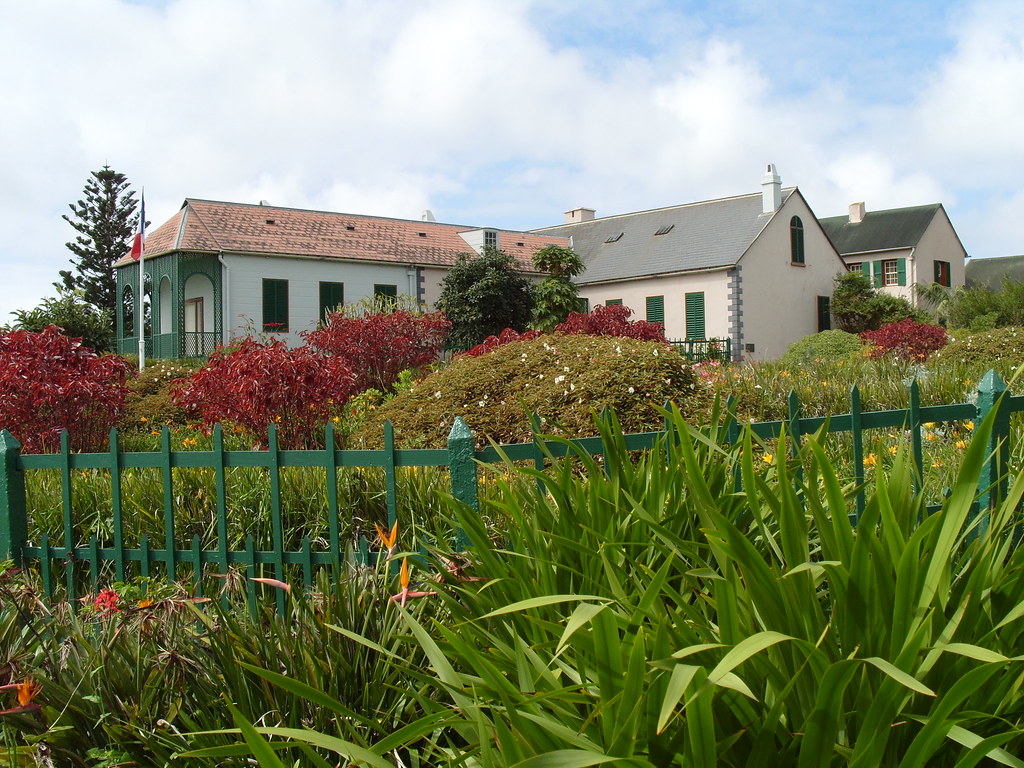
On St. Helena, Longwood House was Napoeleon’s permanent residence completed for him by his British captors in Decemeber 1815. “Longwood House (c) St Helena Tourism” by sthelenatourism is licensed under CC BY-ND 2.0.

In 1858, French emperor Napoleon III, nephew of Napoleon I, purchased Longwood House and various other lands associated with Napoleon I on St. Helena for the French government. Though Napoleon’s remains were returned to France in 1840, Napoleon III’s purchase on St. Helena remains the property of France . It is administered by a French representative under the authority of the French Ministry of Foreign Affairs. (see – https://fondationnapoleon.org/en/activities-and-services/preserving-heritage/operation-st-helena/retrieved May 5, 2021).

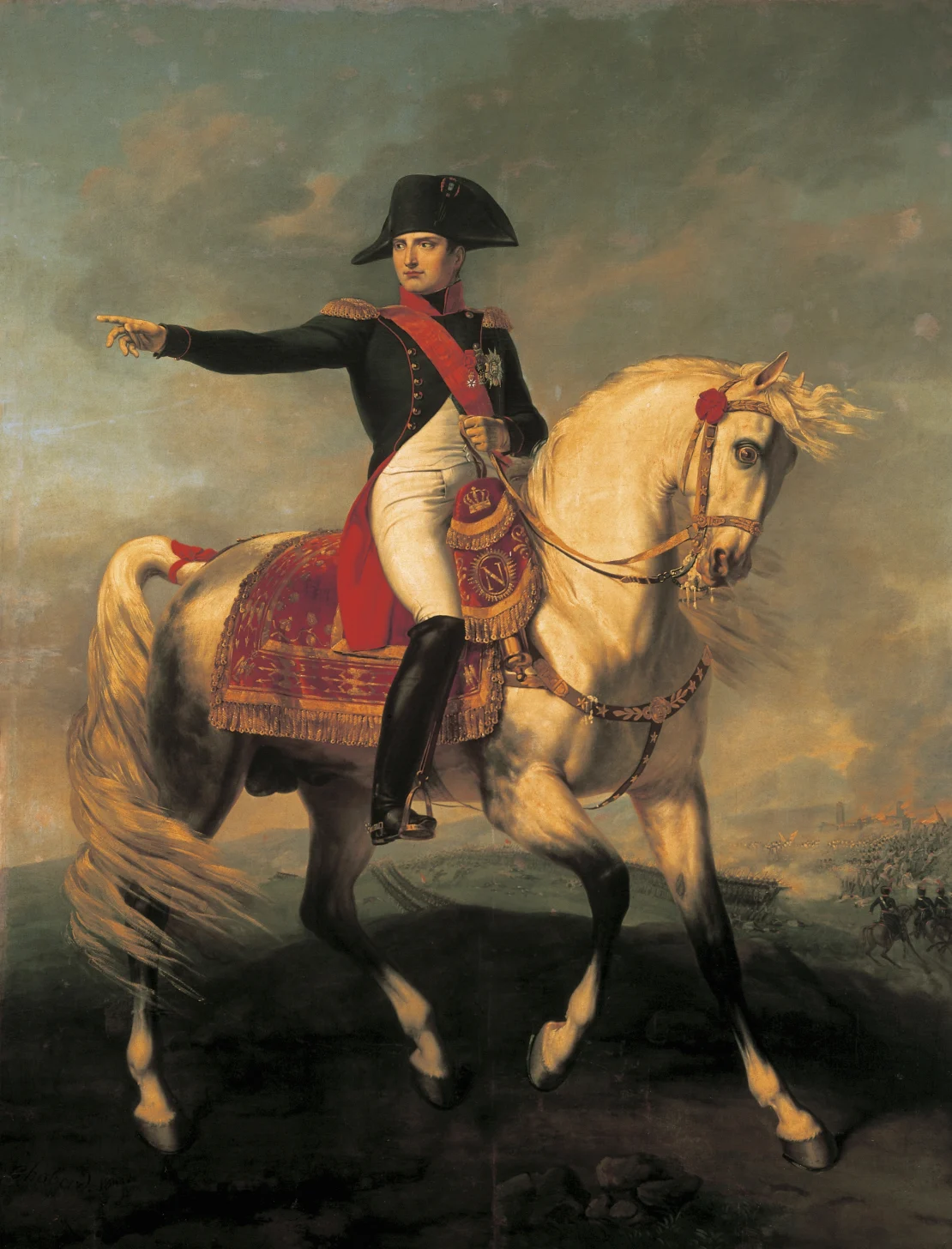
Napoléon at Battle of Wagram, July 5-6, 1809, Joseph Chabord (Chambèry 1786-Paris 1848), 293 cm (115.3 in) x 224 cm (88.1 in), Museo Napoleónico, Rome, Italy. On July 5-6, 1809 took place north of Vienna the greatest battle in world history up to that time – the Battle of Wagram. It was Napoleon’s last and greatest victory. It opposed the Austrian army led by Archduke Charles, Duke of Teschen (1771-1847) against the Franco-Italo-German army under Napoleon I, Emperor of the French, King of Italy, Protector of the Confederation of the Rhine. The painting depicts the plain of Wagram, the scene of the battle with the dominant figure of Napoleon, perfectly settled upon a wild-eyed horse. The Emperor wears the uniform of Colonel of the Chasseurs on Horseback with the insignia of the Legion of Honor and the Iron Crown. The grandeur of the rider-horse group, which contrasts with the small figures of the soldiers in the background, accentuates the heroic character of Napeoleon, a charismatic strategist who dominates the events. The  commemoration painting probably was linked to an official commission. The painting was in the collection of Hortense de Beauharnais (1783-1837), the daughter of Napoleon’s first wife, Joséphine de Beauharnais. in Arenenberg, where the former Queen of Holland lived from 1817 until her death. It remained there until 1905, when the last owner of the castle, the former Empress Eugenie, wife of Napoleon III, donated it to Count Giuseppe Primoli. Public Domain. See – https://www.museonapoleonico.it/it/percorsi/percorsi_per_sale/sale_i_e_ii_il_primo_impero/napoleone_sul_campo_di_battaglia_di_wagram
  

IN THE YEAR 1812 – A BAD ECONOMY, CONTINENTAL BLOCKADES, AND A DISASTROUS INVASION OF RUSSIA BY NAPOLEON

During the War of 1812 which had ramifications for the U.S., world domination by Napoleon was being attempted within a sagging, uncooperative economy in Europe.

France had 300,000 French troops and a rafter of French generals occupying Spain to keep the blockaded British from invading. Napoleon, in a near constant state of war since 1793, had created an Empire whose subjected parts didn’t cooperate. In 1812, Napoleon had to choose between losing his blockade in Spain or in Russia.

Since the Treaty of Tilsit in 1807 which followed the Battle of Friedland where Napoleon defeated the Russian army, Russia continued to transact business with England. This was a violation of the agreement and the pretext for Napoleon’s invasion of Russia in 1812.

While over 1,500 miles away from Paris, Napoleon wanted to shut down Russia’s economy and take full control. For Russia, Napoleon’s invasion required the defense of their homeland.

NAPOLEON’S NEW WAR CAMPAIGN NEEDS 700,000 CONSCRIPTED SOLDIERS

Napoleon needed fresh conscripts but a third of Napoleon’s French draftees didn’t report for duty. Many of Napoleon’s generals advised the dictator to stay in Paris and enjoy life’s spoils. Napoleon refused. He explained that he would not rest until he fulfilled the dream to form a United States of Europe.2

Napoleon assembled 700,000 men with the monumental task to pay for it. For years the Emperor had been stockpiling supplies along the route to Russia and even arranged for their delivery on the battlefield.

Napoleon left St. Cloud for Moscow in June 1812. His high stakes gamble would affect not just Napoleon’s fortunes but the Empire’s inhabitants.

Ernest Meissonier (1815-1891), Campaign of France, 1814, 1864. Oil on wood, 51.5 x 76.5 cm, Paris, Musée d’Orsay.

Ernest Meissonier’s Campaign of France, 1814, was the artist’s first painting produced in a cycle of Napoleon’s conquests. Though the episode Meissonier depicts was painted for the fiftieth anniversary of Napoleon’s invasion of France from Elba in 1814, it captures the overall desolation that surrounded the former French Emperor by the time of his invasion of Russia in 1812.

The series made by the 49-year-old artist, an admirer of seventeenth-century Flemish and Dutch small-format painting, captures the desolate landscape the Grande Armée endured. It also depicted a solitary, unusually unkempt, and tenuous figure of Napoleon who is leading the General Staff and troops in an over-extended military campaign that spelled defeat.

For the painting, the artist’s imagination was informed by historical documentation including interviews of surviving eyewitnesses, including the detail of the Emperor’s grey coat. Its realist style was a prevailing aspect of mid-19th century artistic taste during the Second Empire headed by Napoleon III from 1852 to 1870.

(see https://www.musee-orsay.fr/en/collections/works-in-focus/painting/commentaire_id/campaign-of-france-1814-8947.html?tx_commentaire_pi1%5BpidLi%5D=509&tx_commentaire_pi1%5Bfrom%5D=841&cHash=41368ad16b#:~:text=Campagne%20de%20France%2C%201814%20%5BCampaign,demonstrates%20his%20nimble%2C%20polished%20style. – retrieved May 5, 2021.

FAILURE OF THE SUPPLY CHAIN

The army marched 1,200 miles to Lithuania to defeat the Russian army. But the Russians had retreated. Napoleon’s men had to march another 550 miles to Moscow. The generous supply lines got snarled. French troops turned sick and exhausted.

In the Battle of Smolensk, the French invaders—viewed by some to be fighting for a united liberal Europe over small state autocrats—set that town on fire. Napoleon’s criminal reputation preceded him – he murdered without mercy and often by treachery. Royalists criticized him but also articulate liberals like Alexis de Tocqueville (1805-1859) and François-René de Chateaubriand (1768-1848). The emperor was the enemy of liberty. Chateaubriand wrote: “Les Français vont indistinctement au pouvoir, ils n’aiment pas la liberté, l’égalité est leur idole. Or l’égalité et le despotisme ont des liaisons secrètes” (“The French go to power indiscriminately, they don’t like liberty, equality is their idol. But equality and despotism have secret links”).

With casualties for the Battle of Smolensk around 15,000 for both sides, the Czar appointed Mikhail Kutuzov (1745-1813) as commander of Russian forces. Napoleon called Kutuzov, “The sly old fox of the north“ (cited in Roger Parkinson, The Fox of the North, 1976). At 67 years old, Kutuzov was lazy and lecherous, but knew how to fight—and, regarding Napoleon’s invasion of Russia, how to retreat strategically. It made Napoleon’s thirst for further battle on his own terms impossible.

Portrait of Mikhail Kutuzov, 1829, George Dawe (1781–1829). Oil on canvas, State Hermitage Museum, Winter Palace War Gallery, St. Petersburg, Russia.

70 MILES WEST OF MOSCOW, THE BATTLE OF BORODINO PITS 242,000 TOTAL COMBATANTS WITH OVER 1,000 BIG GUNS ON SEPTEMBER 7, 1812

In his address to troops before the Battle of Borodino General Kutuzov told his men: “Napoleon is a torrent we are yet unable to stem. Moscow will be the sponge that sucks him dry.”3 Napoleon knew what he was up against. Without supplies, Napoleon ordered his men to keep marching: “Motion alone keeps this army together.”4

The march from Smolensk to Moscow took 3 weeks. Many soldiers of the Grande Armée died on the march. Kutuzov set up a defensive position in Borodino, about 70 miles west of Moscow. On Sept. 7, 1812, French forces engaged the Russians. Both sides were evenly matched – Napoleon had 587 guns and 130,000 troops and the Russians had 640 guns and 112,000 troops.

Hanging over the battlefield was the feeling that the destiny of Europe lay in the balance. The battle’s outcome was a draw. The French were masters of the field as the Russians retreated. It was another day for war’s slaughter— combined French and Russian losses was 80,000 soldiers.

Battle of Moscow (or Borodino), the Capture of the Great Redoubt. Engraving by unknown artist, 1820’s. State Borodino Military Historical Museum, Russia.
Battle of Moscow (or Battle of Borodino) in 1812. Attack of the Lithuanian Life Guards Regiment, oil on canvas, 1912, Nikolay Semyonovich Samokish (1860-1944). State Borodino Military Historical Museum, Russia.
General Uvarov at Borodino, Auguste-Joseph Desarnod (1788-1840), State Hermitage Museum, St. Petersburg, Russia.

In the War of 1812 Fedor Petrovich Uvarov (1769 -1824) commanded the 1st Cavalry Corps and then the Cavalry of the 1st and 2nd Russian Armies. With the Cossacks of Matvei Platov (1753-1818), Uvarov distinguished himself in the Battle of  Borodino when he turned the left flank of the French army and made a raid to its rear. The Russian attack of the main French forces delayed Napoleon’s battle plans for two crucial hours.

Napoleon near Borodino, Vasily Vereshchagin (1842–1904), 1897, oil on canvas, State Historical Museum, Moscow.

The image of a sullen dictator (above) seated on his field chair with boots raised onto a battle drum, as his General Staff views in their spyglasses the men of the Grande Armée in harm’s way at the Battle of Borodino, can be seen as indicative of Napoleon’s exercise of arbitrary power as the first of modern history’s tyrants.

Battle of Borodino, 7th September 1812, 1822, Louis-François Lejeune (1775-1848).

WHEN LEJEUNE’S BATTLE-PICTURES WERE SHOWN IN LONDON, EAGER CROWDS CAME TO SEE THEM FOR THEIR REALISTIC, DETAILED DEPICTIONS OF SIGNIFICANT CONTEMPORARY EVENTS.

In the French invasion of Russia in 1812, Lejeune was made général de brigade and chief of staff to Davout (1770-1823). During the retreat, Lejeune was frostbitten on the face and left his post where he was subsequently arrested on Napoleon’s orders.

During his military service, Lejeune produced a series of important battle-pictures based on his experiences. They were generally executed from sketches and studies made on the battlefield. Known for their lofty perspective which, according to Chase Maenius in The Art of War[s], “offer[ed] a panoramic view of the totality of the battle’s events,” the Battle of Borodino… of 1822 is considered his masterwork.

In his Memoirs of Baron Lejeune, aide-de-camp to marshals Berthier, Davout, and Oudinot (translation, 1897), Lejeune related one of the many wretched scenes that the Napoleonic Wars produced. He wrote: “As we were pushing on the next day, we came upon two poor creatures at a turn in the road whose condition tore our hearts. They were a handsome well-built man of about forty and a woman of about thirty, also with a fine figure, both stark naked. They approached us and said to us in very good French, ‘Our home has been sacked by Cossacks, who stripped us of everything and left us as you see us. For pity’s sake help us.’ We could do nothing for them but give them a little food, and we felt very wretched as we turned away. The next day at a bivouac some distance off a fresh irresistible demand was made upon our pity, and our stock of provisions was so much reduced that I don’t know what we should have done but that some German peasants brought us a few sheep, with which we replenished our larder.” (p. 158, https://archive.org/details/memoirsbaronlej01maurgoog/page/n170/mode/2up
—retrieved May 5, 2021.)
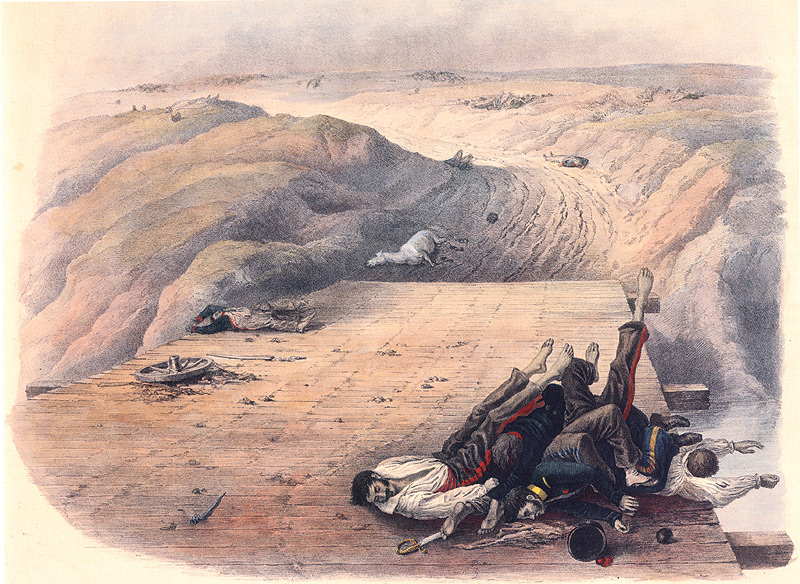
The bodies of dead soldiers of Napoleon’s Grand Armée left on the bridge over the River Kolocha after the Battle of Borodino, 1812.  Christian Wilhelm von Faber du Faur (1780-1857), published 1830’s.
Gen. Kutuzov at the conference of Fili deciding to surrender Moscow to Napoleon, Aleksey Kivshenko (1851–1895), 1880, oil on canvas, Tretyakov Gallery, Moscow.

Following the Battle of Borodino on September 7, 1812, the Russian army retreated towards Moscow and camped near Fili. A military council led by General Kutuzov assembled in a hut in Fili where, despite objections from younger generals, Kutuzov insisted on his plan to abandon Moscow.

The action not only saved the remains of the Russian army but worked to stymie and ultimately defeat Napoleon’s invasion drive. The personalities in the painting include Prince Michael Andreas Barclay de Tolly (1761-1818), who was replaced by Kutuzov on order of the Czar and sits in the corner below the Virgin Mary and Child Jesus icon. Fyodor Uvarov sits near Barclay holding a paper. Nikolay Raevsky (1771-1829) sits by the window with his fingers locked together. Aleksey Petrovich Yermolov  (1777-1861) stands on the far right. The much younger Yermolov resented old general Kutuzov’s plan and demanded to fight the enemy.

Napoleon and about 100,000 French troops reached Moscow on September 8, 1812, Napoleon found only Russia’s poor and displaced. Moscow was Russia’s largest city, its capital, and its Holy City—and French troops of the Enlightenment set it ablaze. The fires burned for 4 days as Napoleon’s army looted it.

Napoleon wrote a letter of apology and condolence to the Czar, Alexander I Pavlovich, the Blessed (1777-1825). One result was that Tthe Russians resolved never to surrender to their would-be conqueror. Only some of the wealthy in Russia looked to negotiate with Napoleon mainly out of fear of losing their assets, that is, the serfs. Napoleon surmised, “I beat the Russians every time—but that does not get me anywhere.”5 Old general Kutuzov’s inaction attained his objective to defend Russia whereas 43-year-old Napoleon failed to rally his men for his Empire these many hundreds of miles from home.

In Ridley Scott’s Napoleon, after trudging with his conscripts through most of Europe, the French Emperor (Joaquin Phoenix) reaches Moscow in Russia. Itching for a fight, the Holy City is, instead, deserted. Disappointed and mocked, Moscow is looted and set ablaze by Napoleon’s men before they retreat.
Posthumous Portrait of Czar Alexander I of Russia, 1826, George Dawe, State Hermitage Museum, St. Petersburg, Russia.

Napoleon’s interest became retreat. There was an intended coup d’état in Paris that Napoleon had to raise more fresh recruits to crush. Other parts of the Empire also raised their head following Napoleon’s inglorious retreat. But it grew worse to become one of world history’s worst defeats.

Weather in Russia turned to snow and ice. The Russians retreated into Mother Russia before they were defeated. The French retreated to the west in defeat. Reports of cannibalism among Napoleon’s army is recorded. Turning back to Paris, the French army lost another half of their men. All of Napoleon’s supply lines had been sacked. Adding further injury, the French were chased out of Russia by Kutuzov’s 80,000 troops.

Famous tell-all graph by French civil engineer Charles Joseph Minard (1781-1870) showing the size of Napoleon’s Grande Armée as it marched towards Moscow (top gray line, left to right) in summer of 1812 and its retreat (bottom black line, from right to left) in the late fall of 1812. Frozen temperatures during the humiliating retreat are plotted on the bottom graph.

On the retreat, surviving warriors fought among themselves over any existing supplies. Napoleon’s retreat included the humiliation of being chased out of Russia by Kutuzov’s redeployed 80,000 troops. The old man’s hot pursuit did not allow Napoleon, the once young Enlightenment military figure, to rest.

Under military surgeon Baron Dominique Jean Larrey (1766-1842), the Grand Army’s medical and sanitary measures were the finest in the world but the retreat route offered no food and no medical care. As a remedy for possible future ills, including his capture, Napoleon convinced his doctor to give him a vial of poison which the dictator could ingest if conditions deteriorated to become inescapably dire.

Portrait of Dominique-Jean Larrey, oil on canvas, 1804, Marie-Guillemine Benoist (1768-1826), Musée des Augustins, Toulouse, France.

Baron Dominique Jean Larrey was a French surgeon and military doctor who distinguished himself during the near endless wars of the French Revolution and under Napoleon. Baron Larrey served as the Grand Army’s medical and sanitation leader and was an important innovator in triage who is considered the first modern military doctor and surgeon.
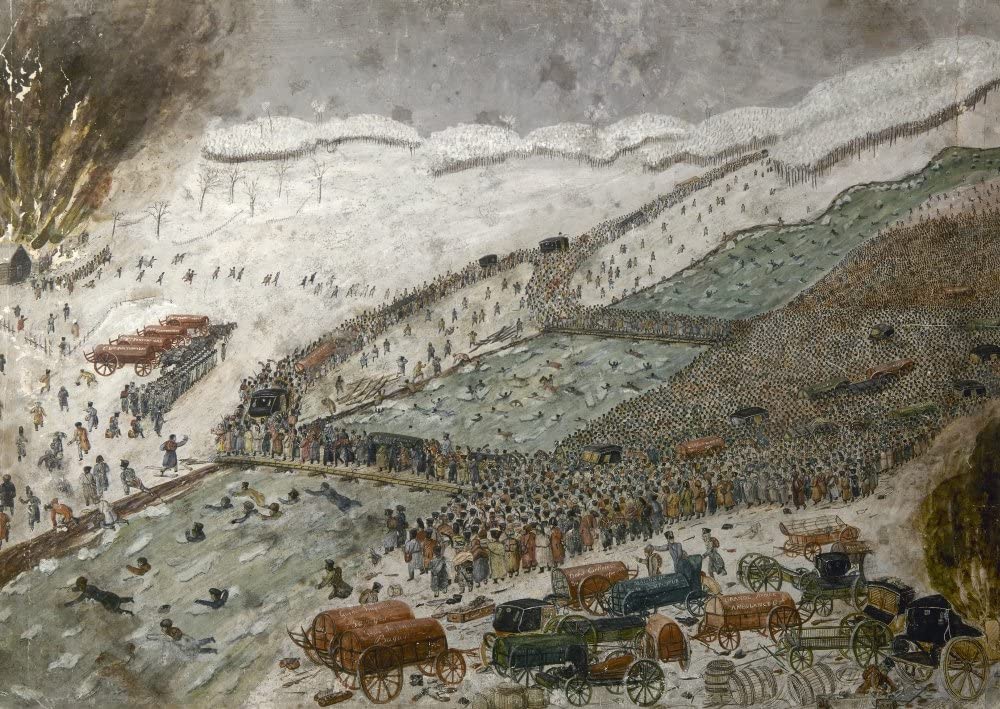
Napoleon: Retreat, 1812. /Ncrossing The Beresina River In Russia During The Retreat Of The Grand Army Under Napoleon Bonaparte, December 1812; Baggage Carts And Ambulances Have Been Abandoned In The Foreground. Watercolor, c. 1812, attributed to General François Louis Fournier-Sarlovèze (1773-1827).

During the Russian Campaign, Fournier commanded a brigade of light cavalry composed of French, German, and Central European horsemen, and led a noted cavalry charge at the Battle of Smolensk.

Generals Kutuzov and Wittgenstein attacked at a bridge crossing in what today is Belarus. Hundreds of Frenchmen drowned. To slow the attack, Napoleon ordered the bridges destroyed. In the process the general stranded hundreds of his troops to enemy gunfire.

Napoleon now told his aide-de-camp, Armand-Augustin-Louis de Caulaincourt, what the Russian campaign taught him: “I can hold my grip on Europe only from the Tuileries.” In Warsaw, Napoleon met Abbé de Pradt, his ambassador, and told him: “From the sublime to the ridiculous is but a step.”6

As Tchaikovsky’s 1812 Overture with its famous climax using cannon fire, ringing chimes and brass fanfare, commemorates a Russian defensive victory, French losses were staggering. Of Napoleon’s 700,000 men led into Russia, only 30,000 survived. Only 1,000 soldiers returned to active duty.7

NAPOLEON IN RUSSIA, HIS FORCES LOSE THE PENINSULAR WAR IN SPAIN; THE FOLLOWING YEAR, IN 1813, NAPOLEON LOSES THE BATTLE OF LIEPZIG, THE LARGEST LAND BATTLE UNTIL WORLD WAR I.

Simultaneous with the debacle of Napoleon’s Russian invasion, French forces lost the long fight (since 1808) in Spain and Portugal to keep the British off the Continent.

Significant losses in the east and west of the Empire were followed in 1813 by the Battle of Leipzig, Napoleon’s penultimate defeat by an international coalition that included Austria, Prussia, Russia and Sweden.

NAPOLEON FORCED TO ABDICATE IN 1814. EXILED TO ELBA; DEFEATED IN 1815 AT WATERLOO.

After Napoleon withdrew into France, in March 1814 these allied forces captured Paris. By early April 1814 Napoleon was forced to abdicate as Emperor. Napoleon had to go for his pursuit of glory had become a menace to his country and the world.

With the Treaty of Fontainebleau, Napoleon was exiled to Elba, and, following his brief escape into France in 1814, he was defeated for the final time at the Battle of Waterloo and exiled to St. Helena which held him until his death at 51 years old on May 5, 1821.
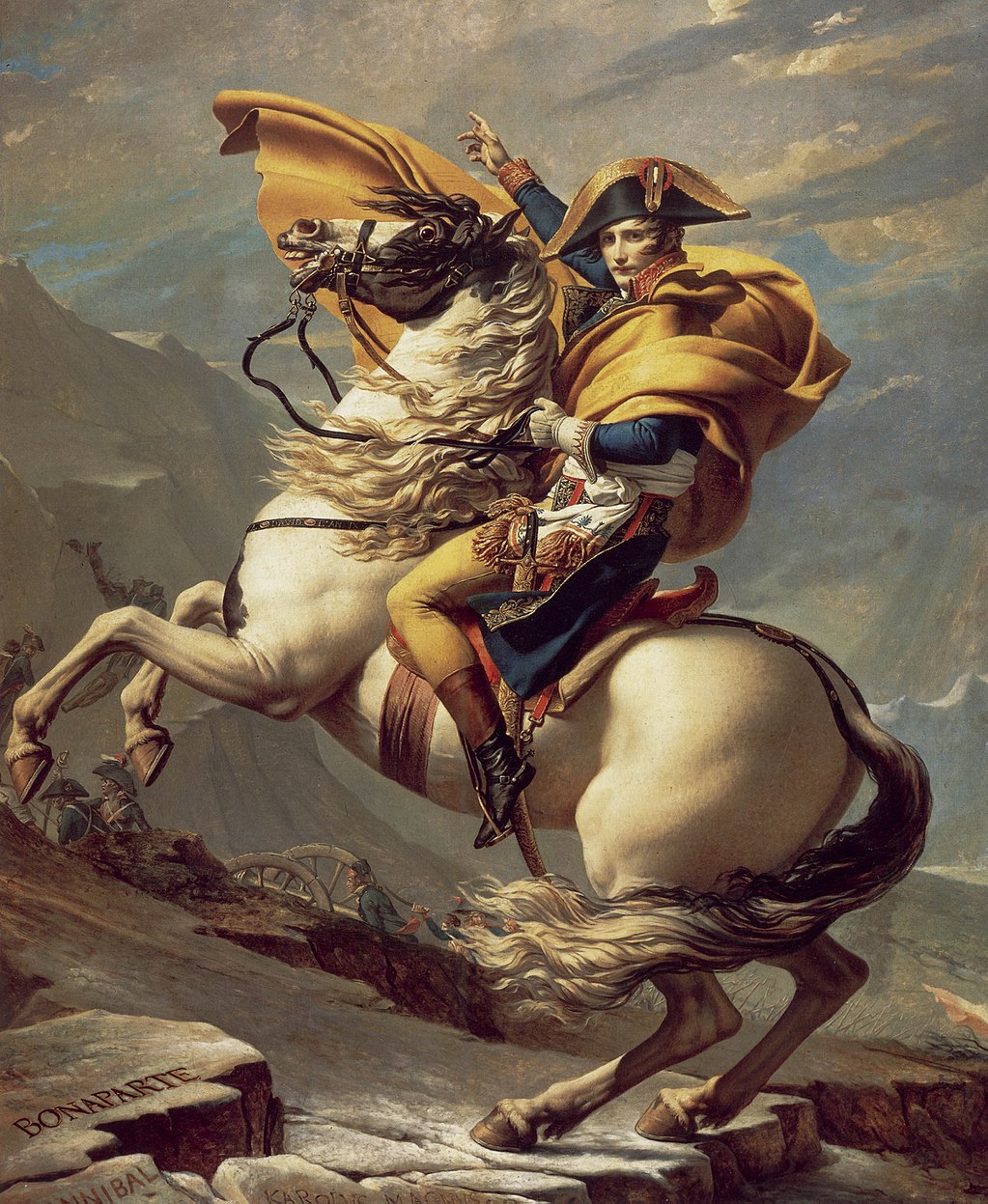
Napoleon Crossing the Alps, Jacques-Louis David, 1801, oil on canvas, 102 1⁄3 × 87 in., Château du Malmaison.

NOTES:

1. see- https://www.history.com/topics/france/napoleon

–retrieved May 5, 2021.

2. The Age of Napoleon, Will and Ariel Durant, Simon & Schuster: 1975, p. 698.

3. A Dictionary of Military Quotations, edited by Trevor Royle, Routledge: 1989, Section 105, quote 13.

4. http://www.military-info.com/freebies/maximsn.htm

5. The New York Times, “The Napoleon Legend—A New Look; How can we know the man whose transformation into a myth began long before his death?; Napoleonic Legend,” April 5, 1964. https://www.nytimes.com/1964/04/05/archives/the-napoleon-legenda-new-look-how-can-we-know-the-man-whose.html#:~:text=When%20he%20failed%2C%20he%20never,in%20defense%20of%20their%20country.–retrieved May 5, 2021.

6. Bartlett’s Familiar Quotations, 13th edition, p. 199.

7. https://slate.com/technology/2012/12/napoleon-march-to-russia-in-1812-typhus-spread-by-lice-was-more-powerful-than-tchaikovskys-cannonfire.html 

— retrieved May 5, 2021.