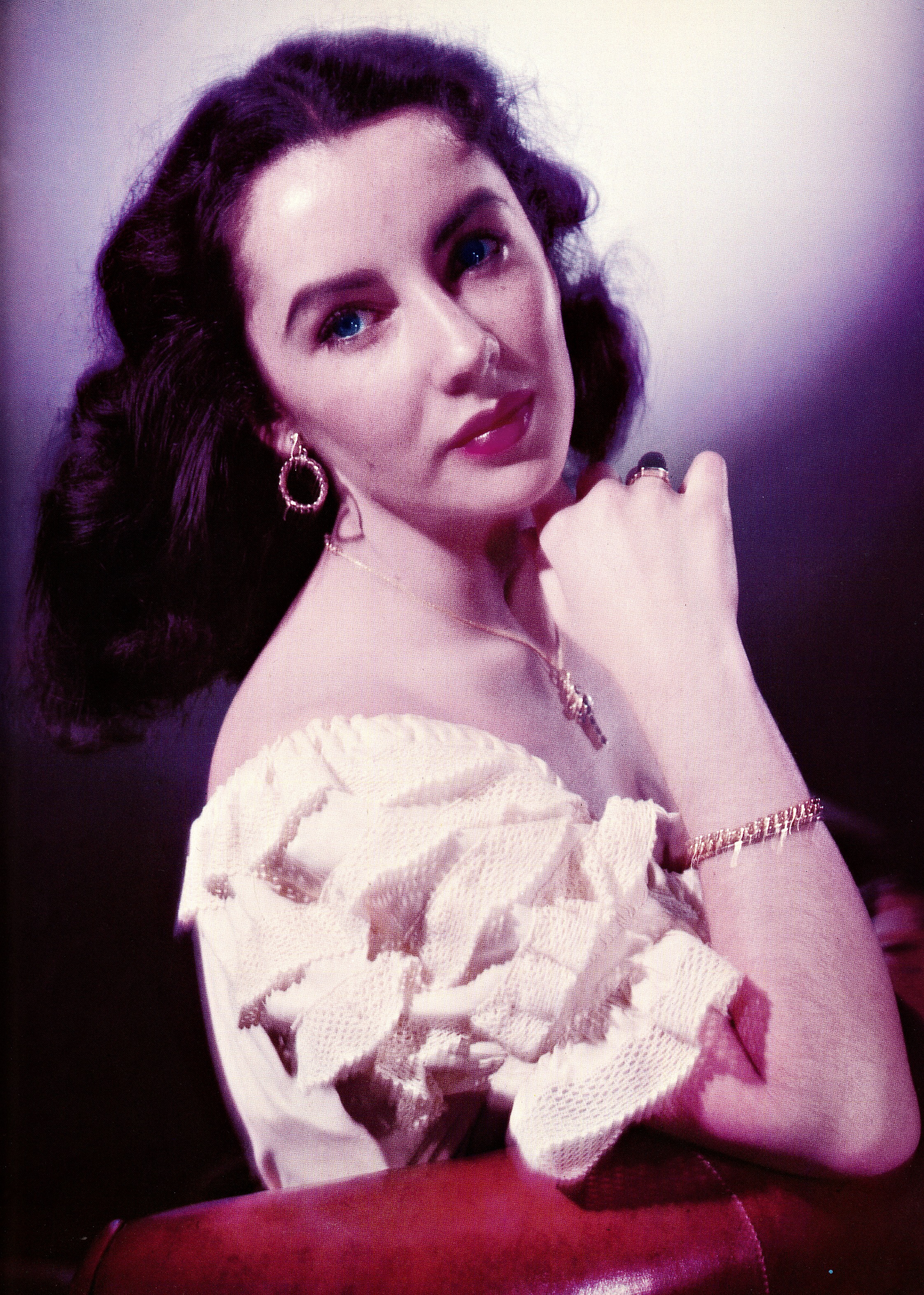
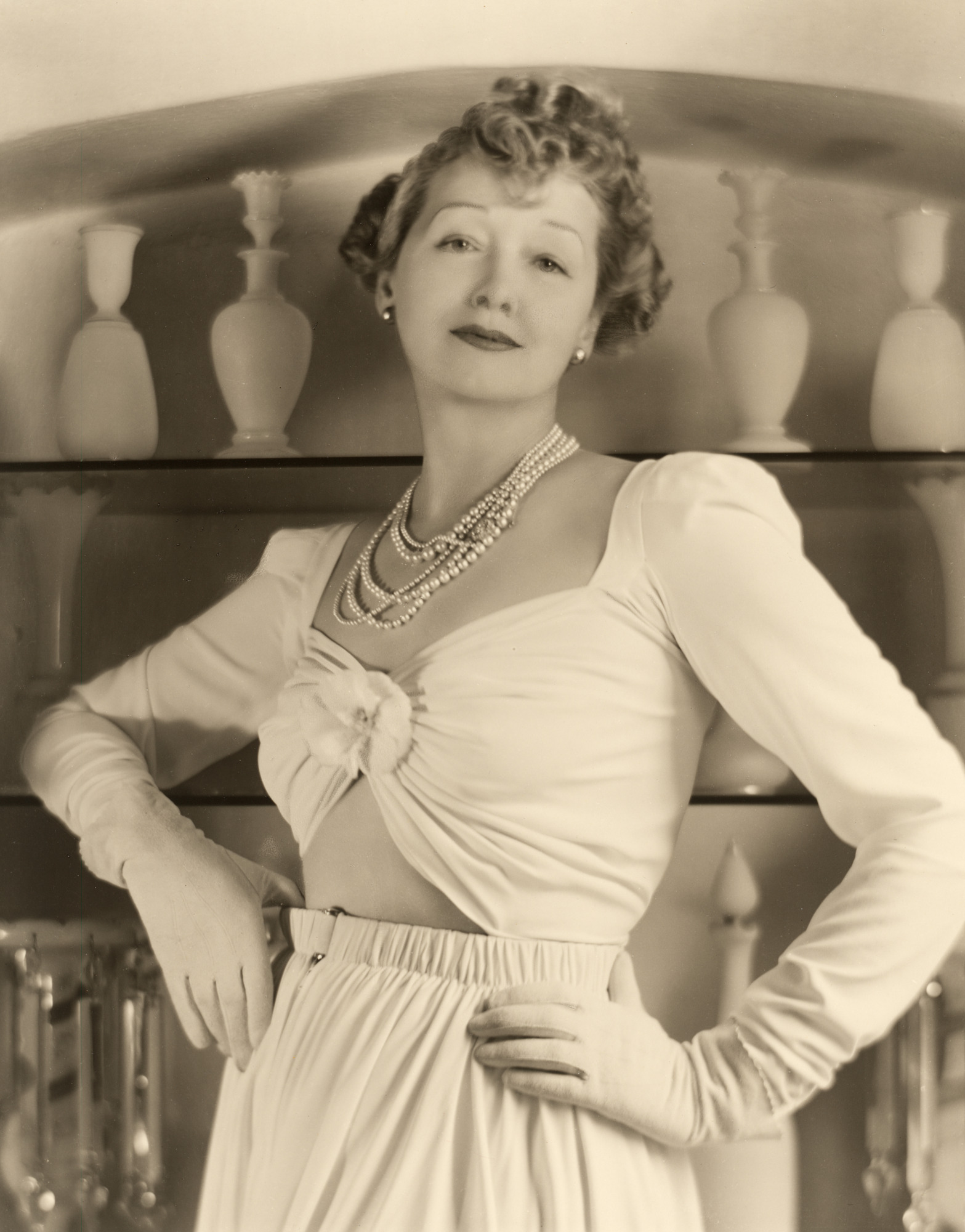
FEATURE image: Hedy Lamarr, M-G-M, 1940. Photograph by László Willinger (1909-1989).
PHOTO credit: Fair use.*
Hedy Lamarr, M-G-M, 1940. Photograph by László Willinger (1909-1989).
Hedy Lamarr (1914-2000) posed for the glamour portrait (above) in 1940. The legendary Austrian beauty in Hollywood was 27 years old. Since her first American film in 1938, Algiers from United Artists, Lamarr was believed to be the most beautiful women in the movies, if not the world. Her beauty was so great that when she entered a room all activity in it stopped so to admire her.
The publicity photograph of Lamaar was for the 1940 American adventure film Boom Town from Metro-Godwyn-Mayer. It co-stars Clark Gable, Spencer Tracy and Claudette Colbert. Boom Town was the highest grossing film of 1940.
Hedy Lamarr, 1939, László Willinger.
PHOTO credit: Fair use.*
The beautiful color portrait of its co-star was taken by László Willinger (1909-1989). Willinger was a German-born emigré who made many glamour photographs of celebrities starting in the later 1930’s.
Sigrid Gurie, Charles Boyer and Hedy Lamarr, publicity still for Algiers. American 1938 film in Public Domain.
In Boom Town, Austrian-born Lamarr plays Karen VanMeer, a sophisticated and elegant corporate spy. She is recruited by Clark Gable who plays “Big John” McMasters, an oil speculator.
M-G-M splurged on its star power to turn a routine oil-well story into a four-time Academy Award-nominated money gusher called Boom Town. The field was crowded with new films in 1940 just from M-G-M studio, including 18 pictures in Technicolor. Escapism was still the most rewarding M-G-M product.
Producer Sam Zimbalist brought big names to the screen in Clark Gable, Spencer Tracy, Claudette Colbert, and Hedy Lamarr backed up by an “A” list screenplay and Jack Conway’s forceful direction. The movie was the first Gable made under a new seven-year contract with MGM.
Hedy Lamarr, 1938. Photograph by Clarence Sinclair Bull (1896-1979).
Lana Turner, Hedy Lamaar, Judy Garland. Publicity photo for M-G-M’s Zeigfield Girls, 1941. Public Domain**Hedy Lamarr, publicity photo for “The Heavenly Body,” M-G-M, 1944. Public Domain**
*The photograph copyright may be believed to belong to the distributor of the film, Metro-Goldwyn-Mayer, the publisher of the film or the graphic artist. The copy is of sufficient resolution for commentary and identification but lower resolution than the original photograph. Copies made from it will be of inferior quality, unsuitable as counterfeit artwork, pirate versions or for uses that would compete with the commercial purpose of the original artwork. The image is used for identification in the context of critical commentary of the work, product or service for which it serves as poster art. It makes a significant contribution to the user’s understanding of the article, which could not practically be conveyed by words alone. As this is a publicity photo (star headshot) taken to promote an actress, these have traditionally not been copyrighted. Since they are disseminated to the public, they are generally considered public domain, and therefore clearance by the studio that produced them is not necessary. (See- Eve Light Honthaner, film production expert, in The Complete Film Production Handbook, Focal Press, 2001 p. 211.) Gerald Mast, further, film industry author, in Film Study and the Copyright Law (1989) p. 87, writes: “According to the old copyright act, such production stills were not automatically copyrighted as part of the film and required separate copyrights as photographic stills. The new copyright act similarly excludes the production still from automatic copyright but gives the film’s copyright owner a five-year period in which to copyright the stills. Most studios have never bothered to copyright these stills because they were happy to see them pass into the public domain, to be used by as many people in as many publications as possible.” Kristin Thompson, committee chairperson of the Society for Cinema and Media Studies writes in the conclusion of a 1993 conference with cinema scholars and editors, that they “expressed the opinion that it is not necessary for authors to request permission to reproduce frame enlargements … [and] some trade presses that publish educational and scholarly film books also take the position that permission is not necessary for reproducing frame enlargements and publicity photographs.”(“Fair Usage Publication of Film Stills,” Kristin Thompson, Society for Cinema and Media Studies.)
**This work is in the public domain in the United States because it was published in the United States between 1927 and 1977, inclusive, without a copyright notice. Note that it may still be copyrighted in other countries.
FEATURE image: Madame Bovary (Jennifer Jones) and Rodolphe Boulanger (Louis Jourdan) waltz at the ball in a still from Metro-Goldwyn-Mayer’s 1949 film Madame Bovary directed by Vincente Minnelli. Fair Use.
In the 1949 film Madame Bovary directed by Vincente Minnelli, a beautiful and charming Madame Bovary (Jennifer Jones) meets wealthy Rodolphe Boulanger (Louis Jourdan) at a ball where he literally sweeps her off her feet. Selfishly aggravated by her husband Charles Bovary (Van Heflin) for not fitting into high society, Madame Bovary begins a love affair with Rodolphe. Though the pair scheme to elope to Italy, Rodolphe does not love Madame Bovary.
Filming began at M-G-M’s Culver City studios in mid-December 1948. Though producers wanted Lana Turner for the role of Emma Bovary, Minnelli preferred Jennifer Jones. The Academy-Award-winning actress (for “Song of Bernadette”) was glamorous which was a necessary dimension to the role of a woman with a repressed passion, but likely not to raise further issues with the Production Code Office that would be busy assessing the film’s controversial story.
The Waltz Scene was Filmed to the Music
One of the film’s most carefully wrought and delightful scenes is this ballroom sequence. It was one of the last segments to be shot. The film footage was tailored to Miklós Rózsa’s music. Minnelli explained to the composer in advance the camera movements so he could write the music in an arrangement for two pianos. The scene was then filmed to match it. Their artistic collaboration produced one of cinema’s most original scenes uniting robust music with weaving and gliding images on film.
Madame Bovary (Jennifer Jones) and Rodolphe Boulanger (Louis Jourdan) waltz at the ball. It is one of the film’s most delightful scenes and one of the last to be shot. Director Vincente Minnelli made certain its choreography carefully matched the music of Miklós Rózsa. Madame Bovary was nominated for an Oscar for Best Art Direction-Set Decoration, Black-and-White.
Beautiful and charming Emma Bovary (Jennifer Jones) is repulsed by her uncouth husband, Charles Bovary (Van Heflin), an undistinguished medical doctor, and begins an affair with Rodolphe Boulanger (Louis Jourdan). Their plans to elope, however, do not materialize as Emma hoped.
“Break the Windows” dramatizes a heroine’s transition into madness
As Rodolphe swirls her, Emma Bovary’s head spins until she becomes dizzy. The viewer sees her disorientation as the camera takes her viewpoint. She keeps dancing but asks for fresh air. Her request leads to an extraordinary and incredible reaction by the stewards. They start to smash the ballroom’s windows with chairs to help her cool down. This fantastically destructive action of broken glass aligns with the destruction of Emma’s romantic illusions throughout the film.
In reaction to Madame Bovary becoming dizzy while waltzing with a new lover, the stewards smash the ballroom windows to give her air. The extraordinary action ultimately becomes symbolic of the destruction of Madame Bovary’s romantic illusions with handsome, wealthy Rodolphe and her own descent into madness.
Night of Repressed Passion
Along with her husband’s boorish behavior at the ball and everywhere else, Madame Bovary’s romantic disappointment leaves her feeling publicly humiliated. Instead of love and excitement, Madame Bovary runs out of the ball in shame. Though she yearns for happiness and excitement, her pursuit of selfish pleasures ends in scandal and ruin.
Jennifer Jones as Madame Bovary offers a performance that is elegant and beautiful. It is equally insightful to the selfish and nervous personality of Flaubert’s fictional character.
A film poster for Vincente Minnelli’s Madame Bovary. Several different versions of the film poster were produced for the marketing of the 1949 film.
This publicity photo for Madame Bovary showed the love triangle of Madame Bovary (Jennifer Jones), her handsome lover Rodolphe Boulanger (Louis Jourdan), and her cuckolded husband Charles Bovary, a medical doctor (Van Heflin).
Thirty-year-old Jennifer Jones plays Gustave Flaubert’s doomed title character, Madame Bovary, from his 1856 serial novel.
Vincente Minnelli’s film of the same name offered two costume and wardrobe managers: Walter Plunkett for women and Valles for men.
Walter Plunkett (1902-1982) was a prolific costume designer who worked on more than 150 projects in his Hollywood career, including Gone With The Wind. In 1951, Plunkett shared an Oscar with Orry-Kelly and Irene Sharaff for An American in Paris.
Valles (1886-1970) specialized in men’s costumes at M-G-M. Valles received two Academy Award nominations, including Spartacus in 1960.
Van Heflin is Charles Bovary, whom Madame Bovary (Jennifer Jones) had loved and hoped to build a respectable life, but in whom she grew disillusioned.
In the role of Madame Bovary Jennifer Jones gives a performance beyond the superficiality of display or machination of melodrama and enters into the inner psychology of the character whose anxious egomania manifesting joy and elation is driven by disillusionment to deterioration and self-destruction. Director Vincente Minnelli worked closely with composer Miklós Rózsa to integrate the image, plot and characters with the musical score which the composer admired for its artistic cinematic outcome.
A unique example of the Valles’ costume design for Louis Jourdan and Walter Plunkett’s costume design for Jennifer Jones for the 1949 film Madame Bovary. The next year, in 1950, both Valles and Walter Plunkett were nominated for the Academy Award for Compton Bennett’s That Forsyte Woman/Saga.
Madame Bovary danced wildly with Rodolphe at the ball and loves him. The illicit couple plan to elope to Italy. But Rodolphe leaves for Italy without her and shatters Madame Bovary’s spirit and dreams.
Costumes were by award-winning Valles and Walter Plunkett, both award-winning Hollywood costume designers.
Madame Bovary (Jennifer Jones) is indulged by an unscrupulous shop-keeper as she lives beyond her means in the pursuit of happiness. She takes on a heavy debt that is impossible to pay back.
The film plot is told from the point of view of the author, Gustave Flaubert (James Mason). A legal proceedings takes place where Flaubert is accused of corrupting morals by writing Madame Bovary. It is an historical fact that, in 1858, Flaubert and his publisher had faced government charges of immorality for Madame Bovary. But the outcome of the trial was that Flaubert was completely acquitted.
Charles, who never stopped loving his wife, begs her to wait for a doctor to arrive. Madame Bovary sighs, “Oh, Charles, why are you always trying to save me?”
From the waltz scene through to her death scene Jennifer Jones as Madame Bovary offers a performance that is elegant and beautiful. It also provides insight into the contradictions offered by a selfish and nervous personality.
In the end Madame Bovary finds that her own death is more attractive to her than living with her shattered dreams.
A 1949 film poster for Madame Bovary that includes a publicity head shot of James Mason as Gustave Flaubert, the novel’s French author.
Minnelli’s film is told in flashback through the character of Flaubert who is on trial for charges of immorality for writing the novel. After Flaubert’s work was serialized in the Revue de Paris in 1856, the government charged and tried the author and his publisher for immorality. Both were acquitted in 1859. After Madame Bovary appeared in book form in France, it became an instant classic.
Vincente Minnelli directs Jennifer Jones and Louis Jourdan in a scene from Madame Bovary.
Reviews from film critics had been mixed and Madame Bovary lost money at the box office. Whether it is the fault of the film-makers or the unhappy story becomes a debatable point.
Reviews for Madame Bovary, released in late August 1949, were mixed with the film not recouping its full production costs.
*The photograph copyright may be believed to belong to the distributor of the film, Metro-Goldwyn-Mayer, the publisher of the film or the graphic artist. The copy is of sufficient resolution for commentary and identification but lower resolution than the original photograph. Copies made from it will be of inferior quality, unsuitable as counterfeit artwork, pirate versions or for uses that would compete with the commercial purpose of the original artwork. The image is used for identification in the context of critical commentary of the work, product or service for which it serves as poster art. It makes a significant contribution to the user’s understanding of the article, which could not practically be conveyed by words alone. As this is a publicity photo (star headshot) taken to promote an actress, these have traditionally not been copyrighted. Since they are disseminated to the public, they are generally considered public domain, and therefore clearance by the studio that produced them is not necessary. (See- Eve Light Honthaner, film production expert, in The Complete Film Production Handbook, Focal Press, 2001 p. 211.) Gerald Mast, further, film industry author, in Film Study and the Copyright Law (1989) p. 87, writes: “According to the old copyright act, such production stills were not automatically copyrighted as part of the film and required separate copyrights as photographic stills. The new copyright act similarly excludes the production still from automatic copyright but gives the film’s copyright owner a five-year period in which to copyright the stills. Most studios have never bothered to copyright these stills because they were happy to see them pass into the public domain, to be used by as many people in as many publications as possible.” Kristin Thompson, committee chairperson of the Society for Cinema and Media Studies writes in the conclusion of a 1993 conference with cinema scholars and editors, that they “expressed the opinion that it is not necessary for authors to request permission to reproduce frame enlargements … [and] some trade presses that publish educational and scholarly film books also take the position that permission is not necessary for reproducing frame enlargements and publicity photographs.”(“Fair Usage Publication of Film Stills,” Kristin Thompson, Society for Cinema and Media Studies.)
Michèle Mercier (born New Year’s Day 1939) is a French actress perhaps best known for playing the lead role of Angélique in the mid1960s film series of the same name based on the 1956 sensational novel Angélique, the Marquise of the Angels by husband and wife writing team of Anne and Serge Golon. Their mid-17th century character was based on a real life Suzanne du Plessis-Bellière who was one of France’s most famous women from the time of Louis XIV, the Sun King. The historical Suzanne first appeared in a French novel in the mid-nineteenth century, one by Alexandre Dumas, père, called Le Vicomte de Bragelonne, ou Dix ans plus tard. Similar to these 5 films inspired by the Golons’ novel of (by 1961) six books — Angélique, the Marquise of the Angels which is the first book published in 1957 (the novel expanded to 13 books after the 1964 film’s release) — Dumas’s novel, the third of his d’Artagnan trilogy, was also serialized in popular media from 1847 to 1850.
Michèle Mercier as Angélique is a French Italian beauty who has entered the pantheon of screen goddesses based largely on the legendary five-film role that stretched from 1964 to 1968.
For the part of Angélique, many other beautiful and more famous actresses were approached before Michèle Mercier who was little known in the French cinema at the time. Seasoned French film producer Francis Cosne (1916-1984) wanted sex symbol Brigitte Bardot to play the part, but she rejected the offer. Young Catherine Deneuve was considered perhaps too naive for the lusty role. American Jane Fonda spoke French but could an American play fully a quintessentially French role? Italian beauty Virna Lisi was too busy doing Hollywood films. Not being already famous eliminated statuesque Danish actress Annette Stroyberg from the running until ultimately Michèle Mercier was decided upon after almost losing the part to French actress Marina Vlady who at the last minute didn’t sign the contract.
Michèle Mercier as Angélique.
When the opportunity of Angélique presented itself to Michèle Mercier, she was a relative newcomer to the French cinema – but this was not the case for her either in French theatre arts or Italian films where before 1964 she had acted in over 20 of them. With a father who was French and mother who was Italian, Michèle Mercier from her early teens growing up in Nice, France, was determined to be a professional ballet dancer. In 1957, at 17 years old, she moved to Paris which was a decision that changed her life. By 1960, when she was just 20 years old, she was acting in French New Wave film director François Truffaut’s second film, Shoot The Piano Player.
After Angélique, the Marquise of the Angels was released — an unlikely heroine’s role where Angélique’s singular flaming red-haired beauty is acknowledged throughout — the role became a blessing and a curse for the budding actress Michèle Mercier. It catapulted her to instant stardom so that her fame rivaled sex symbol Brigitte Bardot in celebrity and popularity, but the role in 5 popular films typecast her and effectively ended her film career almost as soon as it started. Following the first Angélique film in 1964 Michèle Mercier starred in four sequels that includes Merveilleuse Angélique in 1965, Angélique et le Roy in 1966, IndomptableAngélique in 1967 and Angélique et le Sultan in 1968. All these films in the series were directed by French film director Bernard Borderie (1924-1978) and starred Michèle Mercier which bestowed upon the stories a consistent filmic world but also encased the beautiful star in a popular role that was virtually impossible to escape from.
Following the fifth and final film of the Angélique series in 1968 the French Italian beauty went on to make six more films before her career ended in 1972. Although Michèle Mercier had always appeared in a variety of film genres – the actress played dozens of other women besides Angélique – it was for this 17th century fictional character in five memorable films in 1960’s France that has affixed her into the pantheon of screen goddesses for which she receives enduring adoration today.
Michèle Mercier in 1965.
Michèle Mercier on the cover of the April 20-26, 1968 French weekly magazine, Télé 7 Jours with Jacques Chazot. In these months, Michèle Mercier was riding high in the Angélique film series. Indomptable Angélique had been released in October 1967 and was a world-wide smash hit. In the film, Angélique discovers that her first husband is alive and she Angélique travels to the South of France not realizing he is now an infamous pirate. Angélique is captured by slave traders and taken far away to Crete where they intend to sell her. In March 1968, Angélique et le Sultan had just been released. It became the fifth and unintended final entry in the Angélique series based on the novels of Anne and Serge Golon. A planned sixth film called Angelique the Rebel was announced but never made.
1964: Angélique, Marquise des Anges Michèle Mercier as Angélique Directed by Bernard Borderie Released December 8, 1964 Distributed by S.N. Prodi; Gloria Film; Butcher’s Film Distributors
1965: Marvelous Angelique (Merveilleuse Angélique) Michèle Mercier as Angélique Directed by Bernard Borderie Released July 7, 1965 Distributed by S.N. Prodi; Gloria Film
1966: Angelique and the King (Angélique et le Roy) Michèle Mercier as Angélique Directed by Bernard Borderie Released February 4, 1966 Distributed by Gloria Film
1967: Untamable Angelique (Indomptable Angélique) Michèle Mercier as Angélique Directed by Bernard Borderie Released October 27, 1967 Distributed by S.N. Prodi; Gloria Film
1968: Angelique and the Sultan (Angélique et le Sultan) Michèle Mercier as Angélique Directed by Bernard Borderie Released March 13, 1968 Distributed by S.N. Prodi; Gloria Film
How Deep Is Your Love (1977) by the Bee Gees ranks number 375 on Rolling Stone’s list of the 500 Greatest Songs of All Time.1 It sits between White Room (1968) by Cream and Unchained Melody (1965) by The Righteous Brothers. Barry Gibb, the lone surviving Bee Gee today, reportedly said that How Deep Is Your Love is his favorite Bee Gees song. 2 In 2011 it was voted in a TV poll as the UK’s favorite.3 Recorded in the spring of 1977 in anticipation of the album and film Saturday Night Fever to be released later that year— How Deep Is Your Love was released in the U.S. as a single in September 1977. Three months later, after the smash-hit film Saturday Night Fever starring John Travolta was released, How Deep Is Your Love became the number one song in the U.S. on Christmas Eve 1977 and stayed in the top spot for three weeks. Although the song had started on the charts in October 1977, when it reached number one it stayed in the top 10 for four months until April 1978 which, at that time, set a longevity record. There are two official music videos for How Deep Is Your Love featuring the Bee Gees.4
Fig. 1. There are two official music videos performed by the Bee Gees of How Deep is Your Love. The music of the Bee Gees (left to right: Robin, Barry, and Maurice Gibb) and the 1977 film Saturday Night Fever starring John Travolta breathed fire into the disco music craze and helped define the disco era in the late 1970’s.
Fig 2. A huge international pop music hit starting in late 1977, How Deep is Your Love written and performed by the Bee Gees made its way into the Saturday Night Fever: The Original Movie Sound Track album that went Platinum on January 3, 1978 and was certified 16x Multi-Platinum on November 16, 2017. It remains one of the top ten-selling albums of all time.
When the Bee Gees were asked by film producer Robert Stigwood to provide five songs for a film tentatively titled Tribal Rites of the New Saturday Night based on the 1975 New York magazine fiction article about the urban disco scene, they didn’t want to compose music specifically for a film (although Barry did write the title song for Stigwood’s follow-up picture, Grease). It didn’t help that the Bee Gees were given neither a script nor told what the movie plot was about. They offered Stigwood, their longtime manager, songs that they were already working on: Stayin’ Alive, Night Fever, If I Can’t Have You (later sung by Yvonne Elliman), More Than A Woman, and How Deep is Your Love.5 At one early screening that included John Travolta and director John Badham, the Bee Gees were pleased though a little surprised that their songs, while demo cuts, meshed perfectly with the film’s scenes now re-titled Saturday Night Fever. To be added to the Bee Gees’ astonishment— and anyone else’s attending that night’s rough cut— was that no one had any idea that they were embarking on a motion picture that would be a milestone in film history and forever define the disco age.
Stayin’ Alive was released in December 1977 as the second single from the soundtrack and it, too, climbed to no. 1 on the Billboard Hot 100 in February 1978. It stayed in the top spot for four consecutive weeks. One year later, in February 1979, Stayin’ Alive won the Grammy Award for Best Vocal Arrangement for Two or More Voices.
Fig. 3. John Travolta attended the London premiere of Saturday Night Fever on March 22, 1978 with Kay Edwards.
Following its world premiere in Hollywood on December 7, 1977, Saturday Night Fever became an enormous success. It became Chicago film critic Gene Siskel’s favorite film—soon after, Siskel famously bought Tony Manero’s white suit at a charity auction in 1978 for $2,000. Colleague and friend Roger Ebert writing shortly after Siskel’s death in 1999, believed that Saturday Night Fever had struck Siskel mainly on an emotional level but also for its themes that had impressed him. Other influential film critics were similarly praiseworthy of the film’s subject matter. At the 50th Academy Awards on April 3, 1978 Saturday Night Fever had received only one nomination (John Travolta for Best Actor) in a year where Annie Hall and Star Wars dominated the competition.Robin Gibb later observed that Saturday Night Fever was made on a very low budget, released very late in the year and had no expensive promotion. The film’s word of mouth was good, however, which even included its star, John Travolta, who at its world premiere at then-Mann’s Chinese Theatre admitted watching the musical film on the big screen as if seeing a fantasy or dream for the first time.6
Fig. 4. Tony Manero’s shiny white polyester suit — bought off the rack in Brooklyn for the making of the film Saturday Night Fever— has been compared to a symbol of aspiration and hope in what is otherwise a dark movie.
Conceptually the song How Deep Is Your Love materialized when, working with collaborator Blue Weaver, Barry Gibb’s instigating question to him in beginning to compose it was: “What is the most beautiful chord that you know?”7 It was the first song the Bee Gees composed that ended up in the film Saturday Night Fever. After a creative hit-and-miss process at the piano – and further collaboration with Robin and Maurice – the song was put together in the middle of night in about four hours at the Château d’Hérouville studios in France.8 This was part of the Bee Gees’ usual working process – arriving into the studio around three o’clock in the afternoon and ending their workday near or after midnight – resulting in all of the film’s songs written quickly, with the lyrics finished later and the disco music taking longer.9 The Bee Gees’ falsetto singing had always been emotional, and it was often by way of collaborating with industry talent— other musicians, producers, and the like—that their music developed in new directions. By the time How Deep is Your Love came about, the Bee Gees had a reputation for being open to suggestions, including the personally emotional piano chords Blue Weaver offered the Brothers Gibb that night.10 The creation of How Deep Is Your Love followed a course already prevalent in the Bee Gees musical career – an attitude of collaboration and creativity in the studio that allowed ideas to be suggested, and beautiful melodies to quickly emerge as the result. Though How Deep is Your Love was composed in one sitting, its arrangement and production took longer which changed some of the song’s original structure. The title was based on what the Bee Gees simply maintained was the variety of connections listeners could make with the phrase How Deep is Your Love – and so providing the song with further universal appeal.11 Following the film’s U.S. release by Paramount Pictures on December 14, 1977 Maurice Gibb believed its ultimate success was the combination of its phenomenal 23-year-old star John Travolta and the music soundtrack whose album had already been certified Gold on November 22, 1977 and certified Platinum on January 3, 1978. The combination of star power and music – along with stunning word of mouth and critical acclaim – created a record-shattering synergy for both film and soundtrack album featuring Bee Gees songs making the cultural impact of Saturday Night Fever swift and enduring. How Deep is Your Love remains one of the most anthologized love songs of the modern era. As recently as November 16, 2017, the soundtrack album was certified 16x Multi-Platinum.12
Fig. 5. John Travolta in the 1970’s. Playing 19-year-old Tony Manero in Saturday Night Fever about a teen with a good job at the local hardware store in Brooklyn who is trying to dance his way to a better life. His performance earned the 23-year-old Travolta an Academy Award nomination for Best Actor in a Leading Role that year.
Fig. 6. Brooklyn-born Donna Pescow was a newcomer and played Annette in Saturday Night Fever. Annette is Tony’s former dance partner and would-be girlfriend.
Fig 7. Like Donna Pescow and others in the cast of Saturday Night Fever, co-star Karen Lynn Gorney, John Travolta’s love interest in the film, was a newcomer. Even Travolta who had a swelling fan base because of his ongoing role as Vinnie Barbarino in the popular late 1970’s TV sitcom Welcome Back, Kotter, was not seen as a dance man. Hungry to take his acting career to the next level, Travolta’s energetic dance scenes had critics praising his performance as among the best ever filmed.
Fig. 8. A two-minute scene of disco dancing by John Travolta thrust his energetic performance and the new star into the annals of film history. (This is a portrayal of Travolta as Danny Zuko in Grease.)
Fig. 9. “Robert Stigwood explained to the Bee Gees about this young guy, who every weekend blows his wages at a disco in Brooklyn. He’s got a really truly Catholic family, and he’s got a good job, but he blows his wages every Saturday night. He has his mates with him. Then he comes back and starts the week again, and this goes on every Saturday night. But it’s just this one Saturday night that’s filmed. So that’s what we knew (about a film we were writing music for) except it was John Travolta playing the part…” Maurice Gibb in Bee Gees: The Authorized Biography.
How Deep Is Your Love quickly reached number one internationally in countries such as Canada, Brazil, Finland, Chile, and France. In the Bee Gees’ native England it reached number three which delighted the newly–resurgent pop music group in that they had a top five hit in a country that by the mid-to-late 1970’s saw Punk and New wave rock in the ascendant.13 The Sex Pistols’ God Save the Queen, also released in 1977, was banned on the airwaves by the BBC for its “gross bad taste” though today it ranks number 175 on the Rolling Stone’s Greatest Hits list – 200 slots higher than the Bee Gees’ disco ballad, How Deep Is Your Love. How Deep Is Your Love and the Saturday Night Fever album provided superstar momentum for the Bee Gees’ next projects, but like their careers up to that point, the English-Australian pop-rock band simply continued their readiness to create music. In The Ultimate Biography of the Bee Gees, Blue Weaver understood the Bee Gees’ success during this period was not due to their “virtuosity,” although their falsetto vocals were “brilliant,” but their collaborative working method which they pursued until reaching the final product that satisfied them – and clearly satisfied some part of the rest of the world.14
Fig. 10. In 1978 Barry Gibb observed about Robin and Maurice and himself: “When we were kids, we’d sit on each other’s beds all night and plan our careers. We decided that when we got to the top, we’d have our own office. We wanted to get to a point where we wouldn’t have to ever work again so we could sit back and enjoy everything we had accomplished. A few years ago that seemed forever out of reach. Sometimes I think I’m living that dream now. We’ve never really made it before. If this is indeed the top, then it’s better than what we imagined. It’s a lot of fun.” Bee Gees: The Authorized Biography.As the Bee Gees, Barry and twins Maurice and Robin became one of the world’s biggest bands ever selling more than 220 million records. In 1997 they were inducted into the Rock and Roll Hall of Fame. Maurice died in 2003 and Robin in 2012. In 2017 Barry told CBS News: “So when I lost them all, I didn’t know whether I wanted to go on. ”
Fig. 11. 70-year-old Barry Gibb was honored during Stayin’ Alive: A Grammy Salute to the Music of the Bee Gees in April 2017 where he got up on stage to close out the show to perform a few hit songs.
During one visit to the hospital while Robin was in a coma, Barry sang a song that he had written for him called The End Of The Rainbow.
Song’s recording and release dates – Bee Gees Anthology (songbook) by the Bee Gees, Hal Leonard (1991) and Bee Gees The Authorized Biography, Barry, Robin and Maurice Gibb (as told to David Leaf), Delilah Communications/A Delta special, 1979, p.116.
Didn’t want to compose music for a film – The Ultimate Biography Of The Bee Gees: Tales Of The Brothers Gibb, By Melinda Bilyeu, Hector Cook, Andrew Môn Hughes, 2001, Omnibus Press, London, pp. 411; Hardly told the film plot – Bee Gees The Authorized Biography, Barry, Robin and Maurice Gibb (as told to David Leaf), Delilah Communications/A Delta special, 1979, p.110.
Surprised music with unseen film meshed – Bee Gees The Authorized Biography, Barry, Robin and Maurice Gibb (as told to David Leaf), Delilah Communications/A Delta special, 1979, p.111; Ebert on Siskel’s favorite film – https://www.rogerebert.com/reviews/great-movie-saturday-night-fever-1977 – Retrieved January 24, 2018; other critics’ praise of film- see Pauline Kael, “Nirvana,” The New Yorker, December 26, 1977, pp. 59-60; film low budget, released late- The Ultimate Biography Of The Bee Gees: Tales Of The Brothers Gibb, By Melinda Bilyeu, Hector Cook, Andrew Môn Hughes, 2001, Omnibus Press, London, pp. 411. Regarding the white suit that had been bought off the rack in Brooklyn for the film, its symbolism in Saturday Night Fever has been postulated. Professor Deborah Nadoolman Landis, a designer and historian of film costume stated that the white suit was a symbol of aspiration and hope in an otherwise “dark little movie” – see https://www.theguardian.com/artanddesign/2012/aug/06/john-travolta-white-suit-v-and-a – retrieved January 25, 2018.
Song’s musical concept – The Ultimate Biography Of The Bee Gees: Tales Of The Brothers Gibb, By Melinda Bilyeu, Hector Cook, Andrew Môn Hughes, 2001, Omnibus Press, London, pp. 411-412.
First song composed for Saturday Night Fever, Château d’Hérouville – Bee Gees The Authorized Biography, Barry, Robin and Maurice Gibb (as told to David Leaf), Delilah Communications/A Delta special, 1979, p.109.
Songs written quickly – Ibid., p.109; lyrics later – The Ultimate Biography Of The Bee Gees: Tales Of The Brothers Gibb, By Melinda Bilyeu, Hector Cook, Andrew Môn Hughes, 2001, Omnibus Press, London, p. 415.
Open to suggestions – Bee Gees The Authorized Biography, Barry, Robin and Maurice Gibb (as told to David Leaf), Delilah Communications/A Delta special, 1979, p.107. emotional piano chords – The Ultimate Biography Of The Bee Gees: Tales Of The Brothers Gibb, By Melinda Bilyeu, Hector Cook, Andrew Môn Hughes, 2001, Omnibus Press, London, p. 411-12.
song composing, arrangement, and production – The Ultimate Biography Of The Bee Gees: Tales Of The Brothers Gibb, By Melinda Bilyeu, Hector Cook, Andrew Môn Hughes, 2001, Omnibus Press, London, pp. 409 and 412. Title chose Ibid. p. 412.
Movie’s ultimate success – Bee Gees The Authorized Biography, Barry, Robin and Maurice Gibb (as told to David Leaf), Delilah Communications/A Delta special, 1979, p.112. Costing $3.5 million to make, Saturday Night Fever earned an impressive $237.1 million –see “Saturday Night Fever, Box Office Information”. Box Office Mojo – retrieved May 26, 2014. Soundtrack album certified God and Platinum -http://www.beegees-world.com/bio_gplat.html -Retrieved February 1 , 2018. certified 16x Multi-Platinum on November 16, 2017 – see https://www.riaa.com/gold-platinum/- retrieved January 24, 2018.
Carolina Crescentini is an Italian film and television actress who has appeared in more than 20 films since 2006. Born in Rome in 1980 (April 18) Carolina grew up in the elegant Monteverde Vecchio district. Not unlike Grace Kelly of Philadelphia, Carolina wanted to become an actress from an early age and studied and worked diligently in the craft.
Carolina attended Italian acting schools including the Centro Sperimentale di Cinematografia – or, The Center for Experimental Cinematography. This Italian institution hosts a national film archives (Cineteca Nazionale) as well as one of Italy’s most prestigious film acting schools (Scuola Nazionale di Cinema).
Soon after, Carolina began her acting career in television commercials, short films and music videos. The blonde beauty whose stage presence is similar to Kate Hudson and whose fashion savvy is like Chloë Sevigny got her first big break in films from another Centro Sperimentale di Cinematografia alumni – Fausto Brizzi.
It was in the sequel to Brizzi’s 2006 film Notte prima degli esami (The Night Before The Exams). The original film was a phenomenon in Italy. It earned around 15 million euros and won the David di Donatello Award (the Italian Oscar) and several more awards.
In Brizzi’s 2007 hit Italian teen comedy Notte prima degli esami – Oggi (The Night Before The Exams – Today), Carolina Cresentini plays Azzurra, the love interest of the main character. Where Brizzi’s 2006 teen comedy is set in Rome in 1989, the 2007 sequel which featured many of the same actors in the same roles—with the addition, of course, of Carolina Crescentini— it is set in the summer 2006. This is the same summer Italy played for the World Cup which they won that year.
Brizzi’s sequel and Carolina’s first major film was an even bigger hit than the original. Even the French film industry made a version of Notte prima degli esami calling it Nos 18 ans and featuring French teenagers set in 1989.
Carolina Crescentini in a still photo from the pillow fight scene in Notte Prima degli Esami – Oggi (2007). The film gave the the Italian actress her breakout role.
Italian actors Nicolas Vaporidis and Carolina Crescentini during filming of Notte Prima Degli Esami – Oggi. About six months later they starred again together in the film thriller Cemento armato.
The pillow fight scene in Fausto Brizzi’s sequel Notte Prima degli esamei – Oggi. It is where Luca (Nicolas Vaporidis) and Azzura (Carolina Cresecentini) first meet. A box office smash in Italy, it was Carolina Crescentini’s first major film and started her on the road to stardom. In Italian. (3.22 minutes).
Within the year of her first major film Carolina immediately co-starred with Italian star Nicolas Vaporidis in Cemento armato (Concrete Romance). It is a 2007 Italian neo-noir thriller directed by Marco Martani. Crescentini’s dramatic performance as Asia, a rape victim, earned her a Best Actress nomination at the prestigious Nastro d’Argento (Silver Ribbon) Awards.
The next year, in 2008, Carolina was nominated for a David di Donatello Award for Best Supporting Actress for playing Benedetta, a fragile and spoiled rich beauty pursued by Silvio Muccino in Parlami d’amore (Speak to me of love). The film became another smash hit in Italy that year.
The trailer for Cemento armato. In a role that earned her a Best Actress nomination at the Nastro d’Argento awards in 2008, blonde beauty Carolina Crescentini wears her hair dark which matches the film’s often violent character. In Italian (1.27 minutes).
Carolina Crescentini’s performance in the Italian thriller Cemento armato (Concrete Romance) earned her a Best Actress nomination in 2008.
Before becoming an actor, Carolina Crescentini thought she would be an art or film critic. Reading about tennis star Andre Agassi.
Carolina Crescentini’s beauty has been called special. A blonde with gentle features, her beauty captivates yet does not immediately overwhelm. Her attraction is fed by details: blue eyes surrounded by sensual dark circles that give an uneasy and lived-in air.
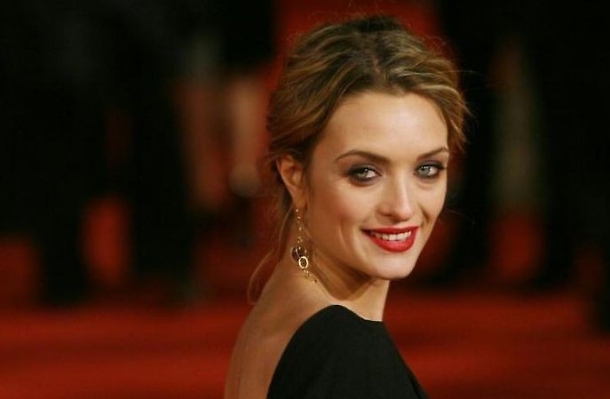
Carolina Cresentini at the 66th annual Venice International Film festival, held in Venice, Italy, in September 2009. Maria Grazia Cucinotta served as the festival’s hostess.
A scene from Carolina Crescentini’s third film Parlami d’amore (Speak to me of love) in a role which led to her being nominated for a David di Donatello Award for Best Supporting Actress. Her co-star is Silvio Muccino. (2:34 minutes).
Carolina at the premiere of Tell me About Love (Parlami d’Amore).
Carolina made films where her roles were smaller but memorable. She played Anna in veteran Italian director Giuliano Montaldo’s I demoni di San Pietroburgo (The Demons of St. Petersburg). It is a bio-pic about Russian novelist Fyodor Dostoevsky. With a soundtrack by prolific Ennio Morricone, Carolina said her experience for this 2008 film on location in Russia was very beautiful.
The trailer from The Demons of St. Petersburg which was one of Carolina Crescentini’s favorite films to work on. It is a biopic of Fyodor Dostoyevsky shot on location in Russia featuring an all-star international cast. (1:41 minutes).
Playing Anna in The Demons of Saint Petersburg (2008) which Carolina described as a beautiful film work experience.
In 2010 Carolina’s body of work was again recognized by winning the Giuseppe De Santis Award for Best Female Newcomer as well as the Giffoni Award at that venerable international children’s film festival.
In 2011 Carolina won the People’s Choice Ciak D’Oro award for Best Supporting Actress playing Corinna in the 2011 Italian comedy film Boris-Il Film which was based on a popular Italian TV series of the same name.
From Boris-Il Film (58 seconds):
Carolina Crescentini as Corinna in Boris-Il Film.
Carolina Crescentini dressed in Ferragamo for a press conference in Rome for Boris-Il Film. Part of the SS2011 collection it is elegantly detailed within a warm and refined tone. Carolina chose to combine a double-breasted jacket with brown high heel boots for a delightfully easy look.
Carolina Crescentini at the D&G SS10 Fashion Show.
In 2010 Carolina Crescentini appeared in the film “Twenty Cigarette” about a survivor of the 2003 Nasiriyah bombing in Iraq. Carolina commented that the film was an authentic story told straight-forwardly, and with sensitivity and respect for the feelings of the fallen family.
Carolina Crescentini plays Angelica in the 2009 Italian comedy film “Generazione 1000 euro” written and directed by Massimo Venier. The film received two Nastro d’Argento nominations for best comedy film and for best supporting actress.
Excerpt from a trailer for the 2009 Italian comedy film Oggi sposi (Just Married) directed by Luca Lucini where Carolina plays Glada. The movie is about a reformed ladies’ man who has his heart set on marrying the daughter of the Indian ambassador. (56 seconds)
In the 2011 award-winning drama film The Entreprenuer (L’Industriale), Carolina worked again with director Giuliano Montaldo. It follows the story of a businessman facing extreme challenges to make his enterprises successful. A press event above with the director and cast (4:07 minutes) is followed by a clip below featuring Carolina Crescentini and Pierfrancesco Favino in a scene from the Italian Golden Globes Best Film.
Carolina Crescentini and Pierfrancesco Favino in The Entrepreneur (2011) directed by Giuliano Montaldo.
In addition to regular work in Italian TV series and movies including the series I bastardi di Pizzofalcone (2017) and movie Donne:Pucci (2016), Carolina Crescentini is a fashion icon in Italy wearing designs by prestigious fashion houses, both old and new, Italian and international.
Carolina has appeared on magazine covers including her shoot for Playboy in May 2010. Carolina said that in shots must have been “photoshopped” becausee in them she can’t recognize herself.
Tu Style Magazine, Italy (9 May 2016)
Carolina’s recent film work includes Tempo instabile con probabili schiarite (Partly Cloudy with Sunny spells), a 2015 Italian comedy about business partners who find oil on their land at the same time their furniture factory is going out of business. Carolina plays Elena, the wife of the lead.
She also appeared in the discomfiting satiric film called Pecore in erba (The Sheep in the Meadow, a.k.a. Burning Love) written and directed by Alberto Caviglia which debuted at the Venice Film Festival in 2015.
In 2015 Carolina worked once again with veteran Italian film directors— this time the brothers Taviani in their wry Maraviglioso Boccaccio (Wonderous Boccaccio). The film is based on vignettes from the fourteenth centuryThe Decameron. Both the book and the film premiered in Florence, albeit six centuries apart.
Trailer for the wry and witty 2015 film Maraviglioso Boccaccio directed by veteran Italian film directors Paolo and Vittorio Taviani (1:34 minutes):
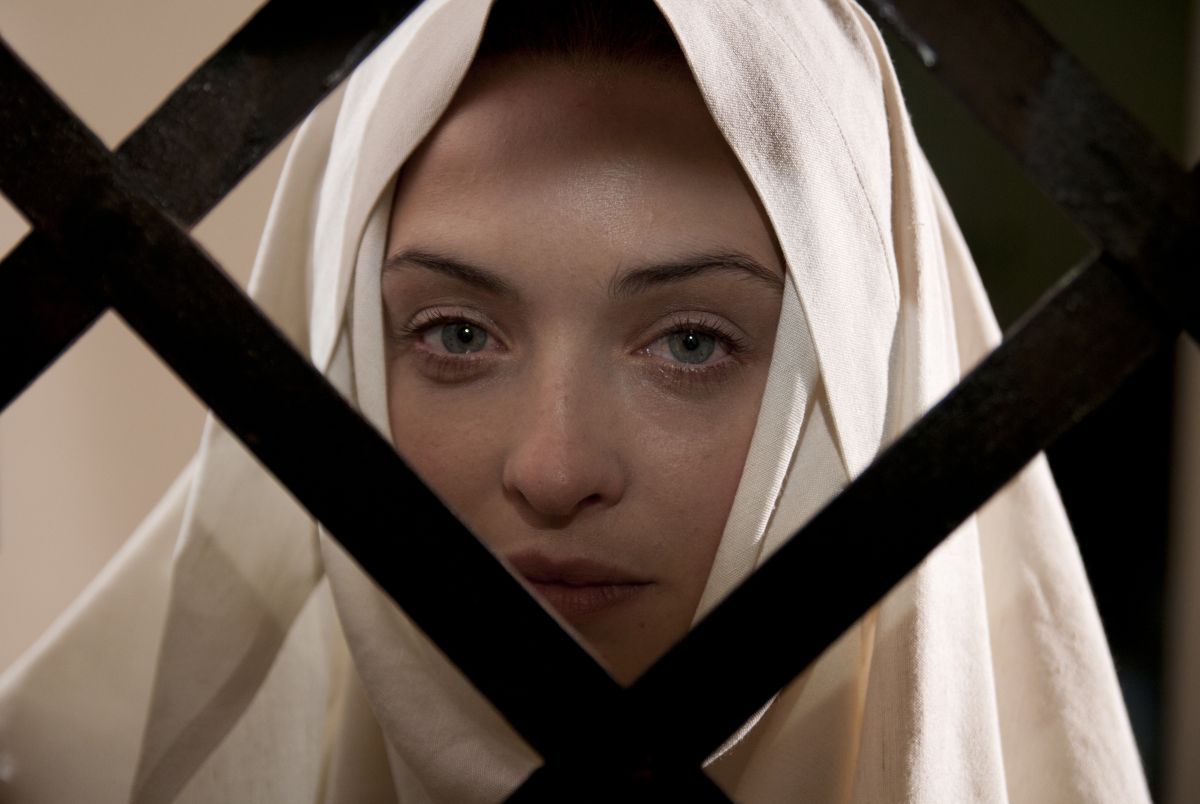
Marvelous Boccaccio: Carolina Crescentini in a scene where she plays a wayward nun.
A scene from Maraviglioso Boccaccio featuring Carolina Crescentini as Isabetta, a wayward novice. Featured is Paola Cortellesi as the convent’s superior. (3.02 minutes)
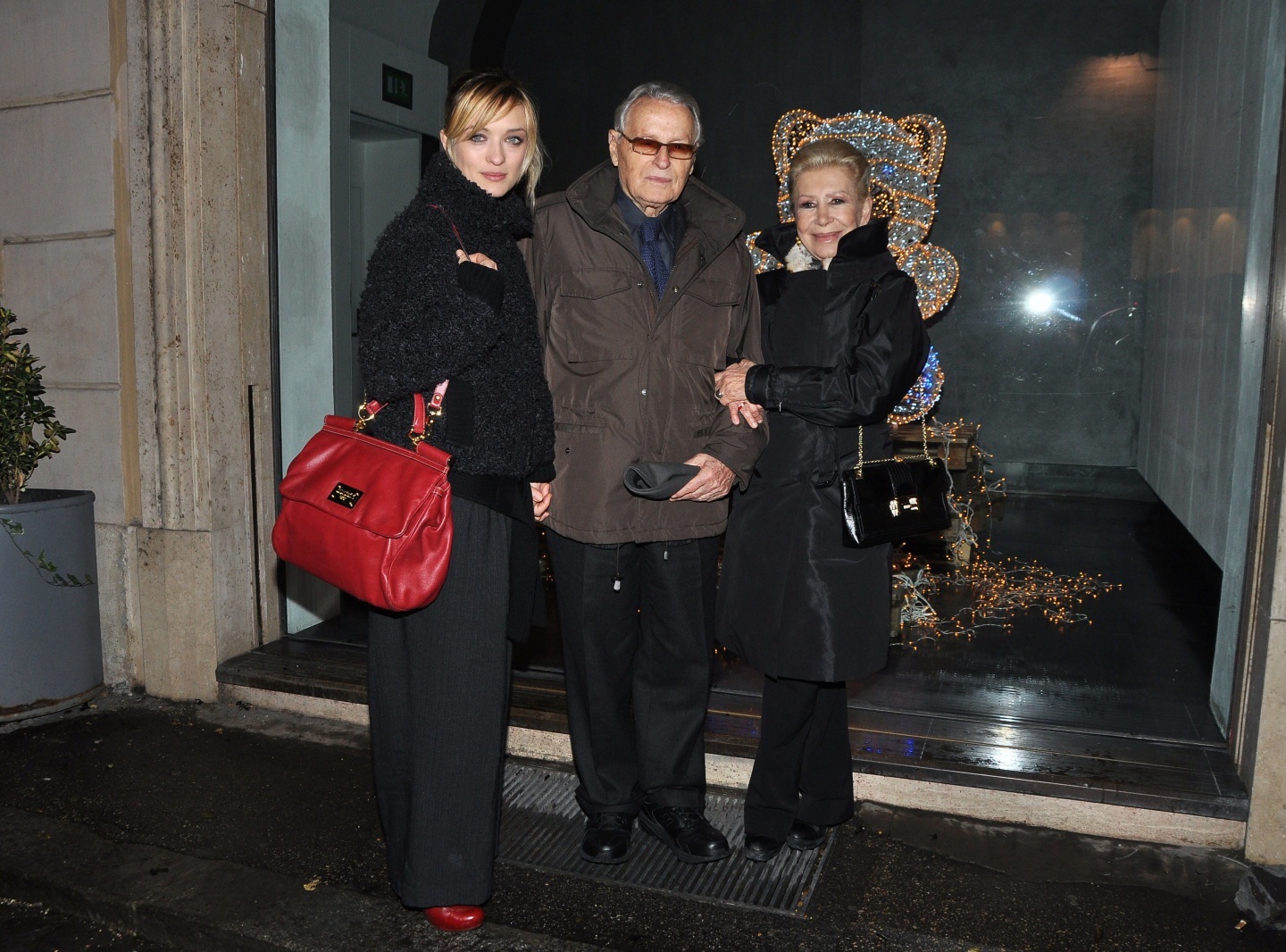
Carolina Crescentini, costume designer Piero Tosi and Anna Fendi.
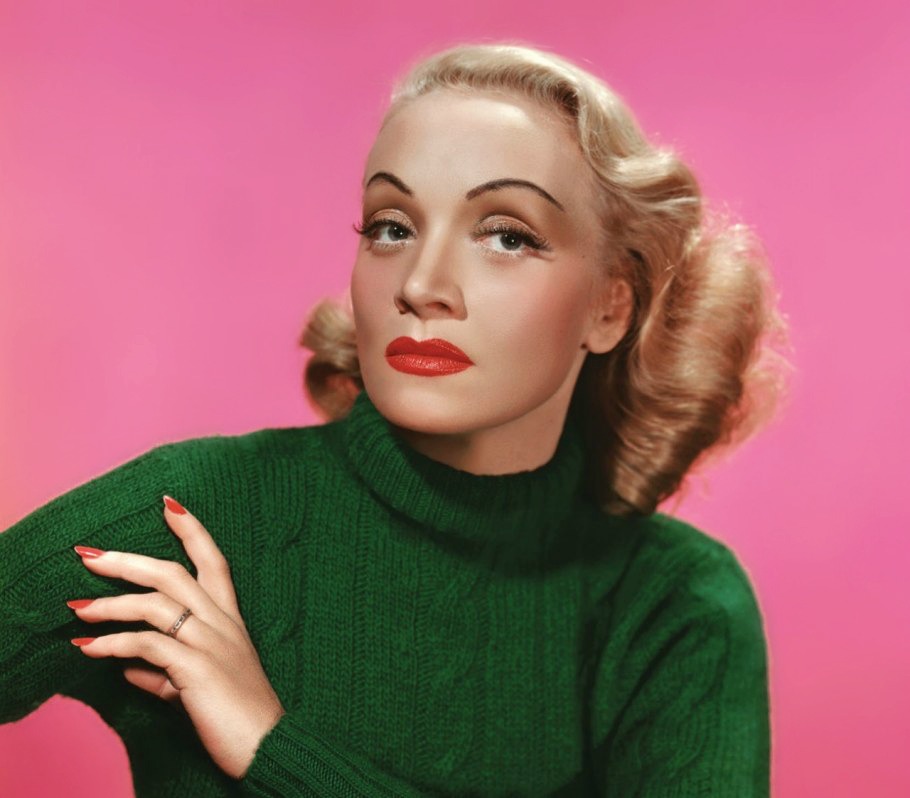
FEATURE image: Marlene Dietrich. Paramount, 1947. Photograph by A.L. “Whitey” Schafer. The actress was appearing in Golden Earrings, a 1947 romantic spy film made by Paramount Pictures and starring Ray Milland and Marlene Dietrich.*
Photographer A. L. “Whitey” Schafer (1902-1951) was a still photographer who started shooting stills in 1923 and continued in that line of work at Columbia Pictures when he moved there in 1932. Personally outgoing, Schafer was appointed head of the stills photography department at Columbia three years later. In the 1940’s Shafer wrote copiously on his craft and advocated for techniques in glamour photography that are seen in this Dietrich color portrait.
Born in in Salt Lake City and growing up in California, “Whitey” Schafer ran the leading portrait gallery at Columbia in the 1930’s and early 1940’s. His work contributed to the emerging stardom of Rita Hayworth. Unknown photographer, May 1936, Motion Picture Studio Insider. Fair use.
“Whitey” Schafer wrote an important book on glamour photography
In 1941 Schafer published Portraiture Simplified, a book in which he argues that “portraiture’s purpose is the realization of character realistically.” Among his technical observations Schafer wrote elsewhere that “composing a portrait is comparable to writing a symphony. There must be a center of interest, and in all portraits this naturally must be the head, or your purpose is defeated. Therefore, the highest light should be on the head.”
In 1941 Schafer replaced Eugene Richee (1896-1972) as department head of still photography at Paramount Studios. Schafer remained in that position where he photographed the stars until he died at 49 years old in an accident in 1951.
MARLENE DIETRICH
Marlene Dietrich. Paramount, 1947. Photograph by A.L. “Whitey” Schafer.
This Hollywood glamour portrait of forty-six-year-old Marlene Dietrich (1901, Berlin – 1992, Paris) wearing a green turtleneck sweater was taken when the movie actress was starring in Golden Earrings, a romantic spy film made by Paramount Pictures. It was her comeback film following World War II.
The film’s song, “Golden Earrings,” with music by Victor Young (1900-1956) and lyrics by Ray Evans (1915-2007) and Jay Livingston (1915-2001) was sung in the movie by actor Murvyn Vye (1915-1976). It was a hit recording in 1947-48 by Peggy Lee.See- https://digital.library.unt.edu/ark:/67531/metadc1633213/m1/#track/4
1940s blondes
Like other leading ladies in the 1940’s, the Hollywood glamour machine transformed Dietrich into a golden-haloed blond which accentuated her magnificent cheekbones and sultry eyes under penciled-arc eyebrows and painted nails that A.L. “Whitey” Schafer’s color portrait makes evident.
It was also in 1947—the same year that the photograph was made— that Dietrich received the Medal of Freedom. Dietrich called it her life’s proudest achievement.
While Golden Earrings was a decent film, its main purpose was to provide the actress with a job. It led into her next project—the 1948 American romantic comedy A Foreign Affair directed by Billy Wilder. That film made Dietrich again a top star.
Following Dietrich’s meteoric rise at Paramount Pictures starting in 1930 her acting parts later stagnated as film directors —including Josef von Sternberg and others—seemed to use her more as a piece of expensive cinematic scenery than as a serious dramatic actress.
From Paramount Pictures, A Foreign Affair is a 1948 American romantic comedy-drama film directed by Billy Wilder. The film made Marlene Dietrich once again a top star in the post-war years.
ELIZABETH TAYLOR.
Elizabeth Taylor. M-G-M, 1949. Photograph by Hymie Fink.
Though still a teenager, Elizabeth Taylor (1932-2011) in 1949 when the publicity still photograph was made, was celebrated as the new generation’s great beauty. In 1942, at 10 years old, Elizabeth made her film debut and her life and beauty blossomed over the decade in front of the cameras. The photograph captures Taylor after she made a little over a dozen films.
In 1950 she co-starred in M-G-M’s comedy film, Father of the Bride. Directed by Vincente Minnelli, Taylor played Kay, the daughter of Stanley T. Banks (Spencer Tracy) who is trying to cope with the preparations for her wedding day.
In 1950 Elizabeth Taylor co-starred in Father of the Bride, M-G-M’s comedy film that was nominated for three Academy Awards. It was directed by Vincente Minnelli.
WHO IS HYMIE FINK? HIS IDENTITY REMAINS A MYSTERY
Who was Elizabeth Taylor’s photographer, Hymie Fink? Was Hymie Fink a studio photographer? Freelancer? Pseudonym for an unknown talent or combination of unknown talents?
His name appears among the stars starting in the late 1930’s until his death was announced by Hedda Hopper in the mid-1950’s. The gossip columnist ended her newspaper column for September 28, 1956 with this epitaph: “Hymie Fink, one of the sweetest men in Hollywood, died of a heart attack on Jane Wyman’s TV set. Hymie photographed every star and every major event in (Hollywood) for twenty-five years.”
Hedda Hopper (1885-1966) was a powerful voice in Hollywood whose gossip columns were read by tens of millions. “Hedda Hopper” by Baron Adolph de Meyer, 1 Sep 1868 – 6 Jan 1946 is marked with CC0 1.0.
LANA TURNER.
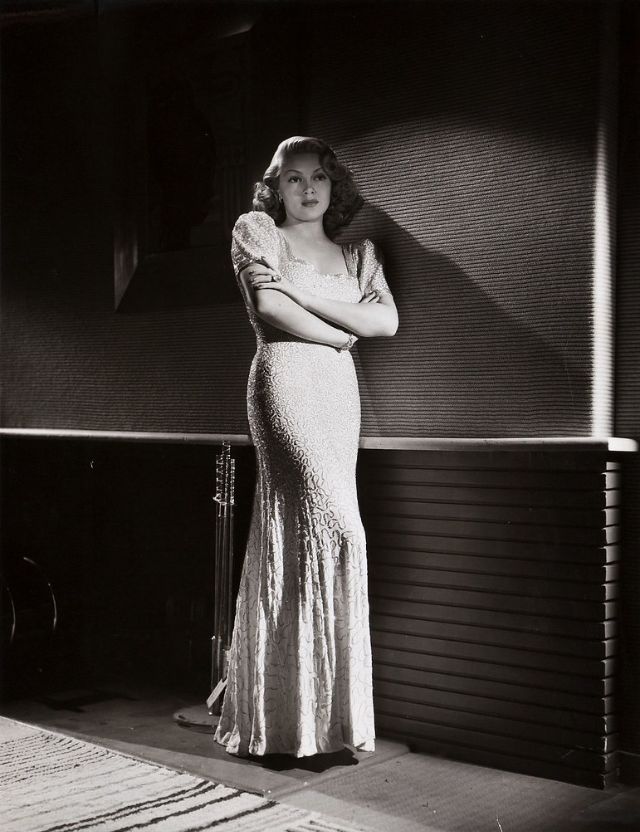
Before she became in the 1940’s the well-known Hollywood sensuous platinum blonde of movie legend and fame, Lana Turner (1921-1995) was a pretty redhead from Idaho named Julia Jean Turner.
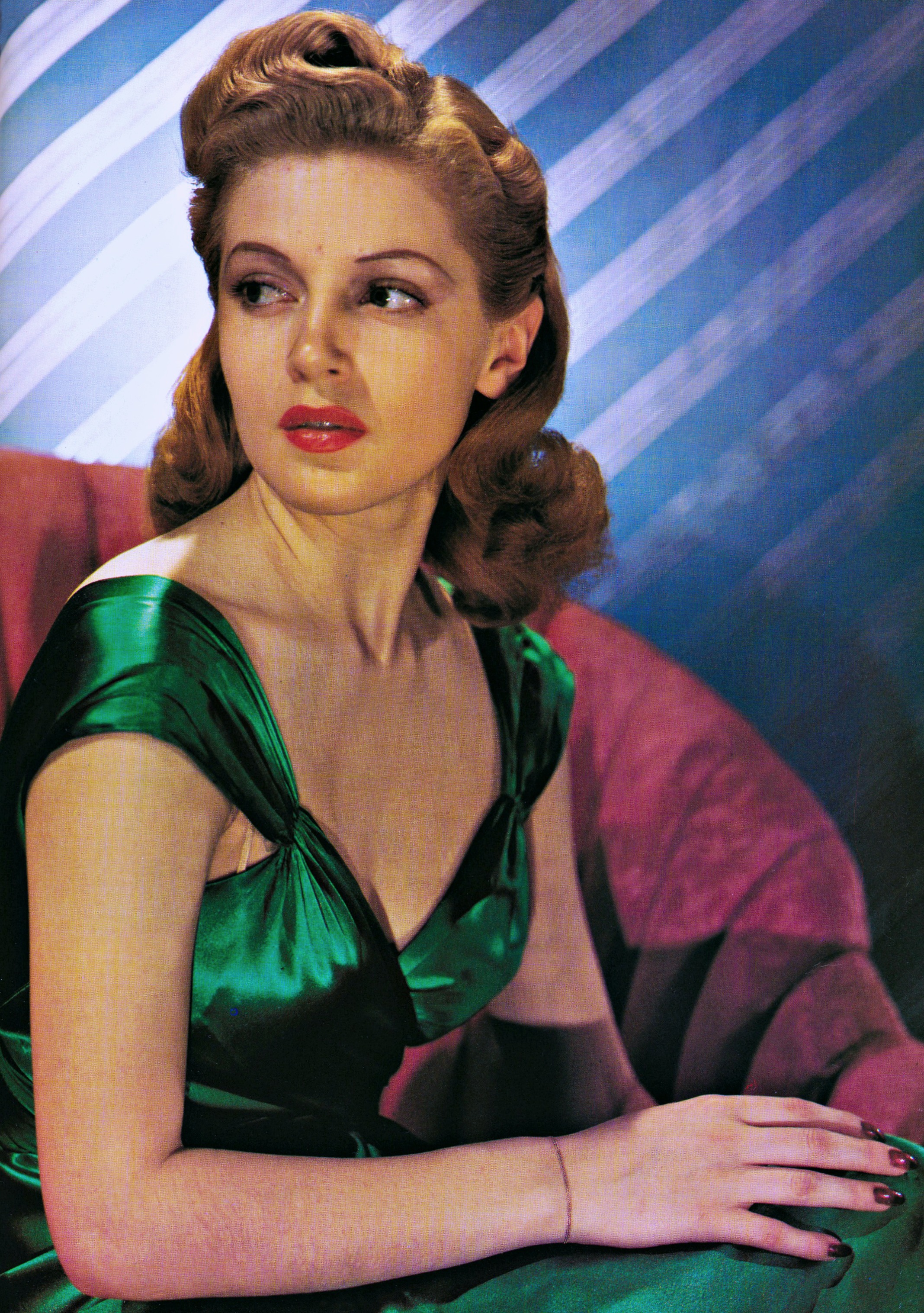
Lana Turner. 1939, photograph by László Willinger.*
Lana Turner, 18 years old in this unretouched color portrait by László Willinger (1909–1989), had been discovered three years earlier. Her discovery in a malt shop near Hollywood High School where she was a student, has entered the annals of show-biz mythology. Her discovery’s immediate result was a movie contract with producer-director Mervyn LeRoy (1900-1987).
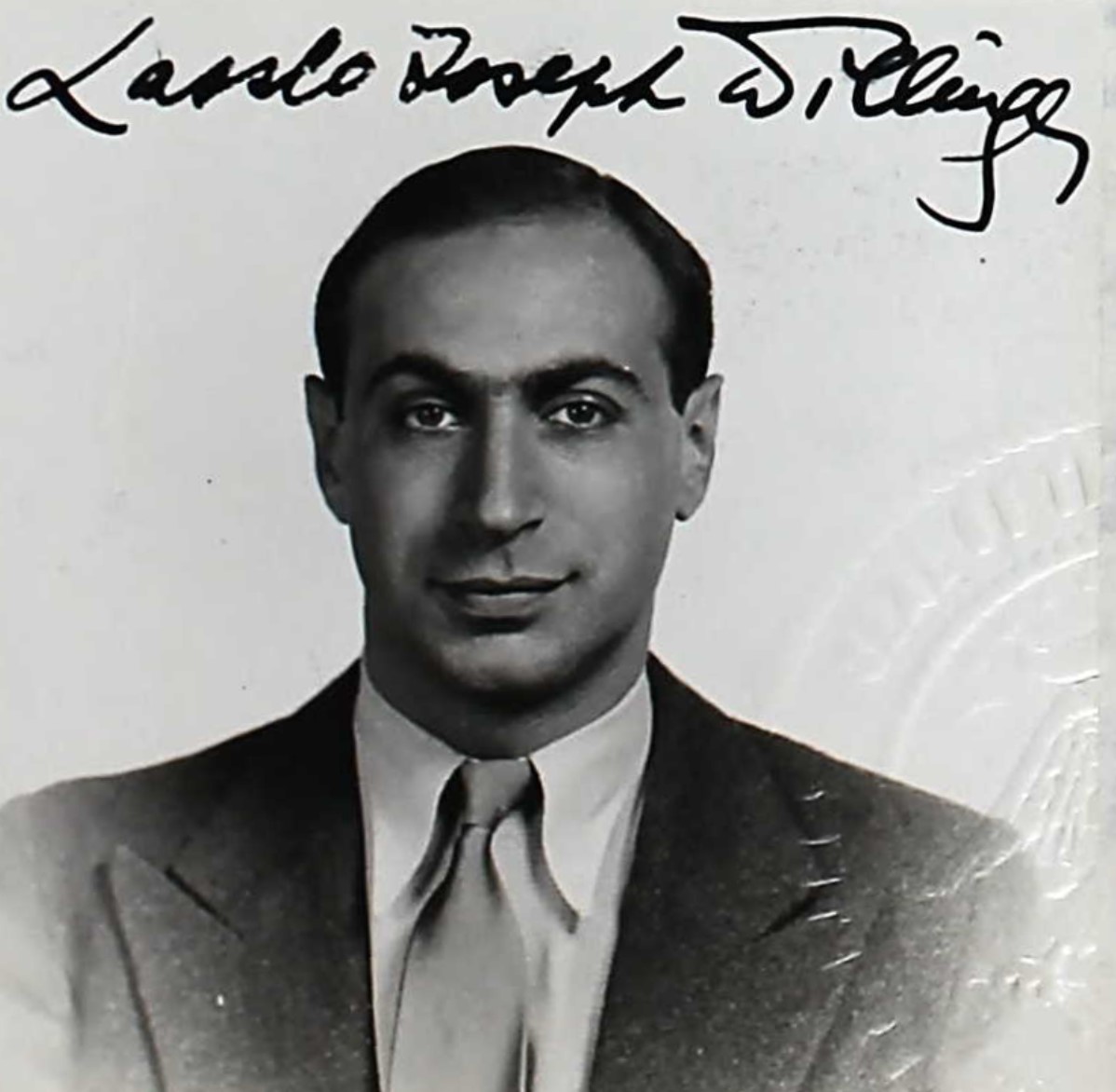
László Willinger
Hungarian-born photographer László Willinger started his professional career in Vienna, Austria. He left Europe for America in 1937 where he joined M-G-M that same year. Soon after, he made this lush shot of 18-year-old Lana Turner in a silky green dress seated on a red divan (or chair) with her head turned and looking to one side with slightly bloodshot eyes.
Willinger’s color portrait of red-headed Lana Turner emphasizes the sensuality of her personality manifested in her full red sensuous lips and painted nails. In 1944, László Willinger left MGM and established his own photography studio in Hollywood. For the next 40 years he successfully practiced his craft.
László Willinger’s portrait photography career of film stars and celebrities started in 1937. Public Domain.
“America’s Sweater Sweetheart”
The title of Lana Turner’s first film in 1937 for Warner Brothers was They Won’t Forget. The title proved prophetic for Lana Turner’s Hollywood career as she went on to make over 50 glamorous films, most of them at M-G-M.
Lana Turner was only 16 years old when she debuted in a part that totaled about five minutes screen time. At one point, in this scene of about 20 seconds, she struts in a tight-fitting sweater and cocked beret that made her an overnight national sex symbol.
Lana’s image in her film debut created such a stir among movie-going audiences that gossip columnist Walter Winchell (1897-1972) coined her “America’s Sweater Sweetheart.” Over the next 20 years, a bevy of Hollywood actresses would wear tight sweaters over specialty bras that emphasized the bust line in the hope of sparking the same Lana Turner movie success story for themselves.
Walter Winchell, influential newspaper gossip columnist and radio news commentator, dubbed 16-year-old Lana Turner in 1938,” America’s Sweater Sweetheart,” and the moniker stuck. “Walters Winchell Julius 1” by Goosefriend is licensed under CC BY 2.0.
New Jean Harlow?
Lana was originally being groomed to be the new Harlow. She followed the sex-bomb script in full force in 1941 when the studio dyed her hair whitish blonde for Ziegfeld Girl. Lana co-starred with Judy Garland and Hedy Lamarr and stole the show.
Lana Turner in Ziegfeld Girl in a photograph by Eric Carpenter, 1941. Fair use.
About her own reputedly rowdy personal life in those M-G-M years, Lana Turner later remarked: “My plan was to have one husband and seven children, but it turned out the other way…”
SOURCES:
DIETRICH – “Miss Dietrich to Receive Medal,” The New York Times, November 18, 1947; https://ladailymirror.com/2013/11/04/mary-mallory-hollywood-heights-mdash-a-l-whitey-schafer-simplifies-portraits/; http://vintagemoviestarphotos.blogspot.com/2014/11/a-l-whitey-schafer.html; They Had Faces Then. Annabella to Zorina: The Superstars, Stars and Starlets of the 1930’s, John D. Springer and Jack D. Hamilton, Citadel Press, Secaucus, New Jersey, 1974. Hollywood Color Portraits, John Kobal, William Morrow and Company. Inc., New York, 1981. https://www.aenigma-images.com/2017/04/a-l-whitey-schafer/ PHOTO CREDIT – *The photograph copyright may be believed to belong to the distributor of the film, Paramount, the publisher of the film or the graphic artist. The copy is of sufficient resolution for commentary and identification but lower resolution than the original photograph. Copies made from it will be of inferior quality, unsuitable as counterfeit artwork, pirate versions or for uses that would compete with the commercial purpose of the original artwork. The image is used for identification in the context of critical commentary of the work, product or service for which it serves as poster art. It makes a significant contribution to the user’s understanding of the article, which could not practically be conveyed by words alone. As this is a publicity photo (star headshot) taken to promote an actress, these have traditionally not been copyrighted. Since they are disseminated to the public, they are generally considered public domain, and therefore clearance by the studio that produced them is not necessary. (See- Eve Light Honthaner, film production expert, in The Complete Film Production Handbook, Focal Press, 2001 p. 211. Gerald Mast, Further, film industry author, in Film Study and the Copyright Law (1989) p. 87, writes: “According to the old copyright act, such production stills were not automatically copyrighted as part of the film and required separate copyrights as photographic stills. The new copyright act similarly excludes the production still from automatic copyright but gives the film’s copyright owner a five-year period in which to copyright the stills. Most studios have never bothered to copyright these stills because they were happy to see them pass into the public domain, to be used by as many people in as many publications as possible.” Kristin Thompson, committee chairperson of the Society for Cinema and Media Studies writes in the conclusion of a 1993 conference with cinema scholars and editors, that they “expressed the opinion that it is not necessary for authors to request permission to reproduce frame enlargements … [and] some trade presses that publish educational and scholarly film books also take the position that permission is not necessary for reproducing frame enlargements and publicity photographs.”(“Fair Usage Publication of Film Stills,” Kristin Thompson, Society for Cinema and Media Studies.)
TURNER – Hollywood Color Portraits, John Kobal, William Morrow and Company. Inc., New York, 1981. Lana Turner interview with Phil Donahue, 1982 – https://www.youtube.com/watch?v=uhu6_V7pNL0 “Hollywood Photographer Dies,” The Hour, Associated Press, August 9, 1989 – https://news.google.com/newspapers nid=1916&dat=19890814&id=azIiAAAAIBAJ&sjid=uXQFAAAAIBAJ&pg=1804,2177679 PHOTO CREDIT: *The photograph copyright may be believed to belong to the distributor of the film, Metro-Goldwyn-Mayer, the publisher of the film or the graphic artist. The copy is of sufficient resolution for commentary and identification but lower resolution than the original photograph. Copies made from it will be of inferior quality, unsuitable as counterfeit artwork, pirate versions or for uses that would compete with the commercial purpose of the original artwork. The image is used for identification in the context of critical commentary of the work, product or service for which it serves as poster art. It makes a significant contribution to the user’s understanding of the article, which could not practically be conveyed by words alone. As this is a publicity photo (star headshot) taken to promote an actress, these have traditionally not been copyrighted. Since they are disseminated to the public, they are generally considered public domain, and therefore clearance by the studio that produced them is not necessary. (See- Eve Light Honthaner, film production expert, in The Complete Film Production Handbook, Focal Press, 2001 p. 211. Gerald Mast, Further, film industry author, in Film Study and the Copyright Law (1989) p. 87, writes: “According to the old copyright act, such production stills were not automatically copyrighted as part of the film and required separate copyrights as photographic stills. The new copyright act similarly excludes the production still from automatic copyright but gives the film’s copyright owner a five-year period in which to copyright the stills. Most studios have never bothered to copyright these stills because they were happy to see them pass into the public domain, to be used by as many people in as many publications as possible.” Kristin Thompson, committee chairperson of the Society for Cinema and Media Studies writes in the conclusion of a 1993 conference with cinema scholars and editors, that they “expressed the opinion that it is not necessary for authors to request permission to reproduce frame enlargements … [and] some trade presses that publish educational and scholarly film books also take the position that permission is not necessary for reproducing frame enlargements and publicity photographs.”(“Fair Usage Publication of Film Stills,” Kristin Thompson, Society for Cinema and Media Studies.)
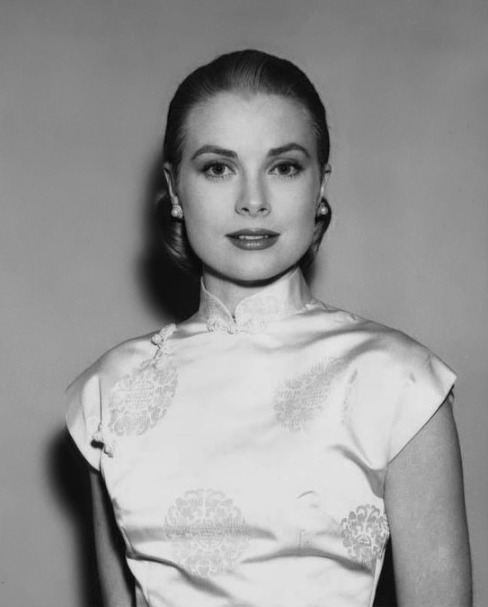
Philadelphia-born Grace Kelly (1929-1982) had a short but dazzling film career in Hollywood. Called the “Greatest Screen Presence in Film,”1 passionate and dramatically talented Grace Kelly was Alfred Hitchcock’s favorite actress when she starred in three of his classic films of the 1950’s: Dial M For Murder (1954), Rear Window (1954) and To Catch a Thief (1955).
After Grace was discovered in 1951 by Gary Cooper who said that Grace was “different from all these actresses we’ve been seeing so much of”2—and cast in High Noon (1951) as Cooper’s movie wife—Grace Kelly’s incomparable charm and allure swiftly impressed Hollywood and the world.
From September 1951 to March 1956 Grace Kelly’s star blazed across the silver screen in eleven major motion pictures for five different Hollywood studios. Grace was at the height of her career when she exited Hollywood to get married to the prince of Monaco in Europe, in April 1956.
Lloyd Bridges, Katy Jurado, and Gary Cooper co-starred with Grace Kelly in High Noon. Gary Cooper took credit for discovering Grace. Cooper was impressed with her acting talent, good looks, work ethic, and professionalism.
Grace Kelly and her stand-in Dorothy Towne on the set of High Noon (1952).
With 2 Hollywood films under her belt, Grace Kelly was nominated for her first Oscar for Best Supporting Actress in John Ford’s Mogambo (1953). Kelly plays Linda Nordley who arrives at the camp with her husband and soon has an affair with the camp’s big game hunter, Marswell (Clark Gable) that leads to a fit of jealous rage.
Following High Noon for United Artists, Grace’s performance for M-G-M on John Ford’s Mogambo (1953) led to her first Academy Award nomination as Best Supporting Actress. This was a coup for Grace Kelly who had made two films and was only one of many actresses considered for the role. Neither was Grace the studio’s first choice for the part of Linda Nordley, but English actress Deborah Kerr. It was mostly thanks to fellow Irish-American John Ford that worked to get fellow half-Irish Kelly the role – and Grace got to see the continent of Africa, “all expenses paid.” Always looking ahead, Kelly did Mogambo for many reasons not least of which was its overseas international connection.
Location filming in Africa began in November 1952 and continued until the end of January 1953. It was a major production, and out of the nervous excitement that seemed to imbue the project for the actors and crew, there shortly developed a sense of camaraderie and confidence. Grace contributed to the exciting professional spirit and a major outcome was that the Technicolor film from M-G-M was successful both critically and at the box office. It also raised the career prospects of its principals—namely, director John Ford, and Clark Gable, Ava Gardner, and newcomer Grace Kelly.3
Ava Gardner and Grace Kelly in Africa during the filming of Mogambo, M-G-M’s 1953 Technicolor adventure/romantic film directed by John Ford.
Clark Gable repeated the role of big-game hunter Victor Marswell that he played in Red Dust, M-G-M’s 1932 film co-starring Jean Harlow and Mary Astor. In the 1953 film, Marswell’s competing love interests were now played by Ava Gardner as Eloise Kelly and Grace Kelly as Linda Nordley. Grace Kelly was dressed by Helen Rose (1904-1985) costumer designer at M-G-M, for Mogambo. She wore a memorable well-cut pink shirt and, during one evening dinner, a flower dress which inspired its imitation among movie-goers. In 1956 Grace would be dressed again by Helen Rose for The Swan, though it is by being dressed by older and prolific costume designer Edith Head (1897-1981) that Grace Kelly became a fashion film icon.
From left: hairstylist Annabella Levy, actor Elizabeth Taylor and costume designer Helen Rose in 1954. Helen Rose did most of her costume design work at M-G-M which was also Grace Kelly’s home studio. Helen Rose dressed Grace in Mogambo (1953) and The Swan (1956). Public Domain. PD-US (licensing information : [1]) – no copyright notice (see source). https://en.wikipedia.org/wiki/Helen_Rose#/media/File:Levy-Taylor-Rose_in_Rhapsody.jpg
GRACE BEGINS HER FASHION COLLABORATION WITH ACADEMY-AWARD-WINNING COSTUME DESIGNER EDITH HEAD IN 1953.
By 1953 Grace Kelly was becoming as well-known as Audrey Hepburn for her fashion sense and costume designer Edith Head found it a joy to work with her. “Grace Kelly” by twm1340 is marked with CC BY-SA 2.0.
Grace Kelly in wardrobe by Edith Head for The Bridges of Toko-Ri. Filming began in January 1954.
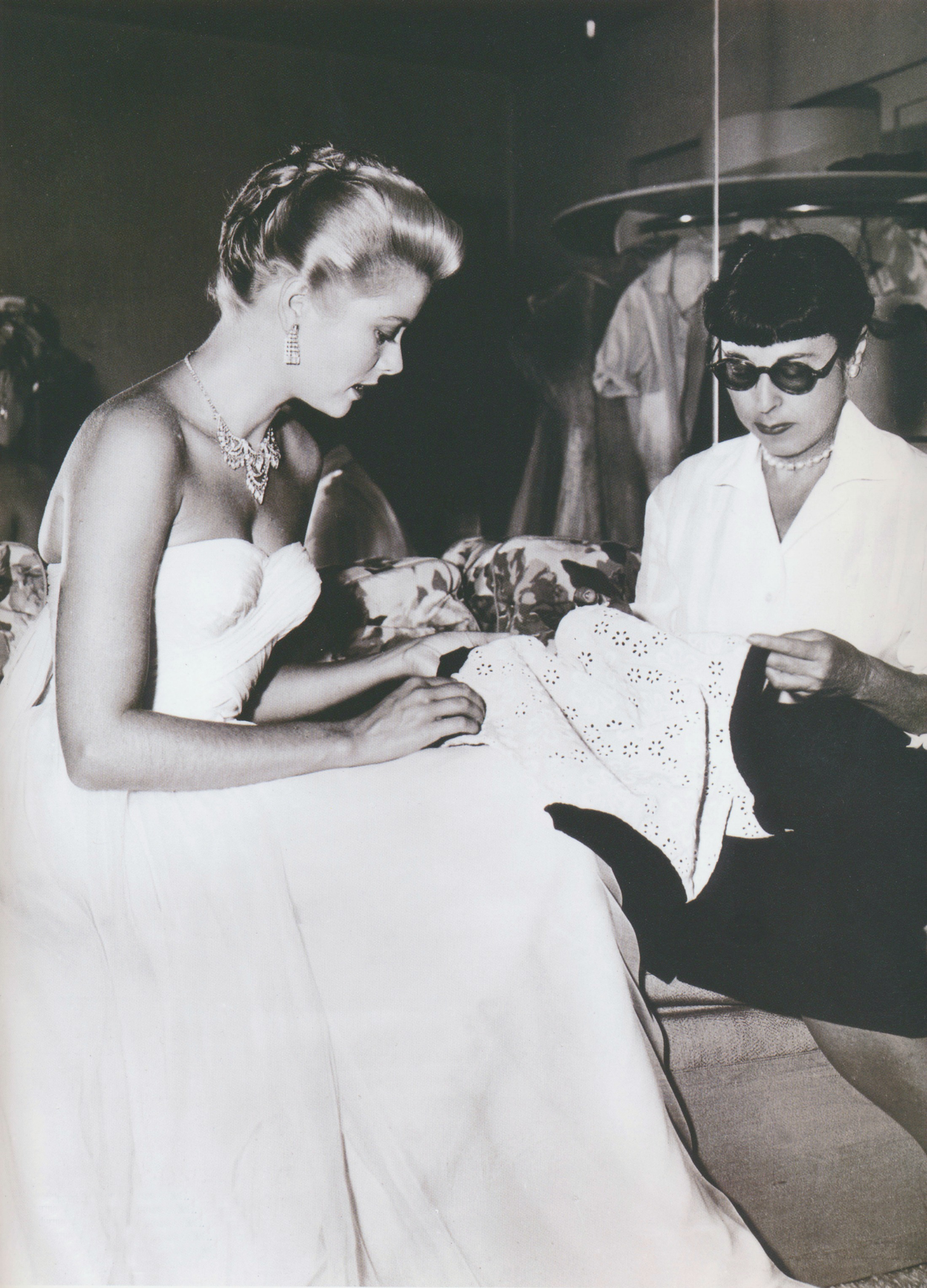
In July 1953 Grace began work on Dial M For Murder for Warner Brothers where she met Alfred Hitchcock who became a cinematic mentor. Soon after, The Bridges at Toko-Ri (1954) at Paramount Pictures began Grace’s ground-breaking multi-film collaboration with Academy-Award winning costume designer Edith Head. In the 1930’s, costume designer Edith Head leaned liberal in her costume designs. By the 1950’s, when she worked with Grace, Head’s fashion designs became more conservative. Edith Head and Grace Kelly became lifelong friends. Even after Grace left Hollywood and became Princess of Monaco, Edith Head, who had a very busy schedule as a prolific and successful costume designer in Hollywood – a record eight Academy Awards for Best Costume Design between 1949 and 1973 – visited Grace in Monaco on vacations right up to the time of Kelly’s untimely death at 52 years old on September 14, 1982 following a car accident.
In 1952 Grace Kelly played Amy Fowler Kane in Fred Zinnemann’s High Noon. In 1953 Kelly received an Oscar nomination for Best Supporting Actress for her performance as Linda Nordley, one side of a love triangle, in John Ford’s Mogambo with Hollywood stars Clark Gable and Ava Gardner. Grace had made her first of three films with Alfred Hitchcock as Margot Mary Wendice in Dial M For Murder (released in May 1954). So, when filming started in January 1954 for The Bridges at Toko-Ri, Grace Kelly, who just turned 24 years old, had already made remarkable films.
The year 1954 proved to be a banner year for Grace Kelly’s scintillating Hollywood career. In August/September 1954 Alfred Hitchcock’s Rear Window was released. The part of Lisa Carol Fremont solidified Kelly’s image as a fashion icon. Other films released in 1954 starring Grace Kelly were Green Fire with Stewart Granger, The Bridges at Toko-Ri with William Holden and The Country Girl with Bing Crosby – all December 1954 releases. In the dressed-down role of Georgie Elgin Grace Kelly’s performance brought her that year’s Academy Award for Best Actress in a Leading Role in March 1955. In May 1955 Grace Kelly met Prince Rainier III (1923-2005) of Monaco and the couple were engaged by the end of the year.
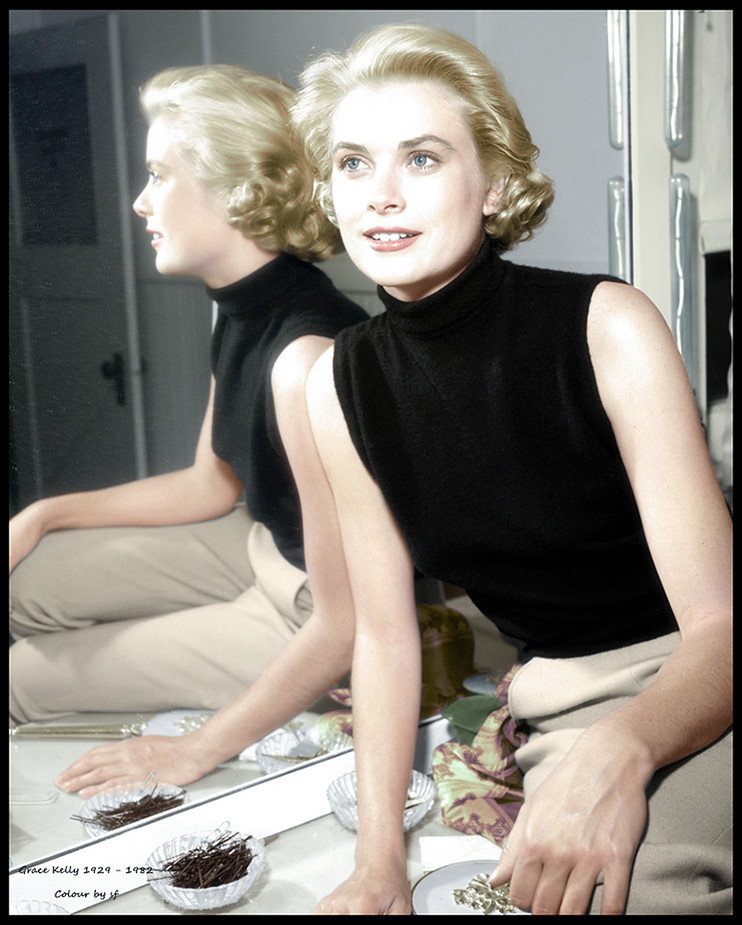
In The Bridges of Toko-Ri Grace played the small but pivotal role of Nancy Brubaker, wife of Lt. Harry Brubaker (William Holden). Kelley wears a sleeveless turtleneck and tan pants in her dressing room on set in 1954. PHOTO credit: “Grace Kelly 1929 – 1982” by oneredsf1 is marked with CC BY-NC-SA 2.0GRACE KELLY APPEARED in 5 FILMS RELEASED IN 1954, INCLUDING HER ACADEMY-AWARD-WINNING BEST ACTRESS PERFORMANCE IN THE COUNTRY GIRL. “Grace Kelly 1929 – 1982” by oneredsf1 is marked with CC BY-NC-SA 2.0.On the set of Green Fire in 1953 Grace Kelly wears a belted beige dress and matching sunhat. PHOTO credit: “Grace Kelly 1929 – 1982” by oneredsf1 is marked with CC BY-NC-SA 2.0.
Grace Kelly was the reason the box office thrived for Green Fire, a drama about emerald miners in South America co-starring Stewart Granger. It was produced in Cinemascope and Eastman Color. The film was panned by many.
Kelly had been working constantly since 1951. She made the entertaining color action feature The Bridges at Toko-Ri for Paramount Pictures. The film is significant for the fact that it started the collaboration of Grace Kelly with costume designer Edith Head as well as was a serious film dealing with the Korean war.
Before meeting Prince Rainier III in May 1955 upon leading the American delegation that year to the Cannes Film Festival and making the Hitchcock thriller, To Catch a Thief, co-starring Cary Grant, Grace had her share of romantic involvements, including during the making of The Bridges at Toko-Ri.
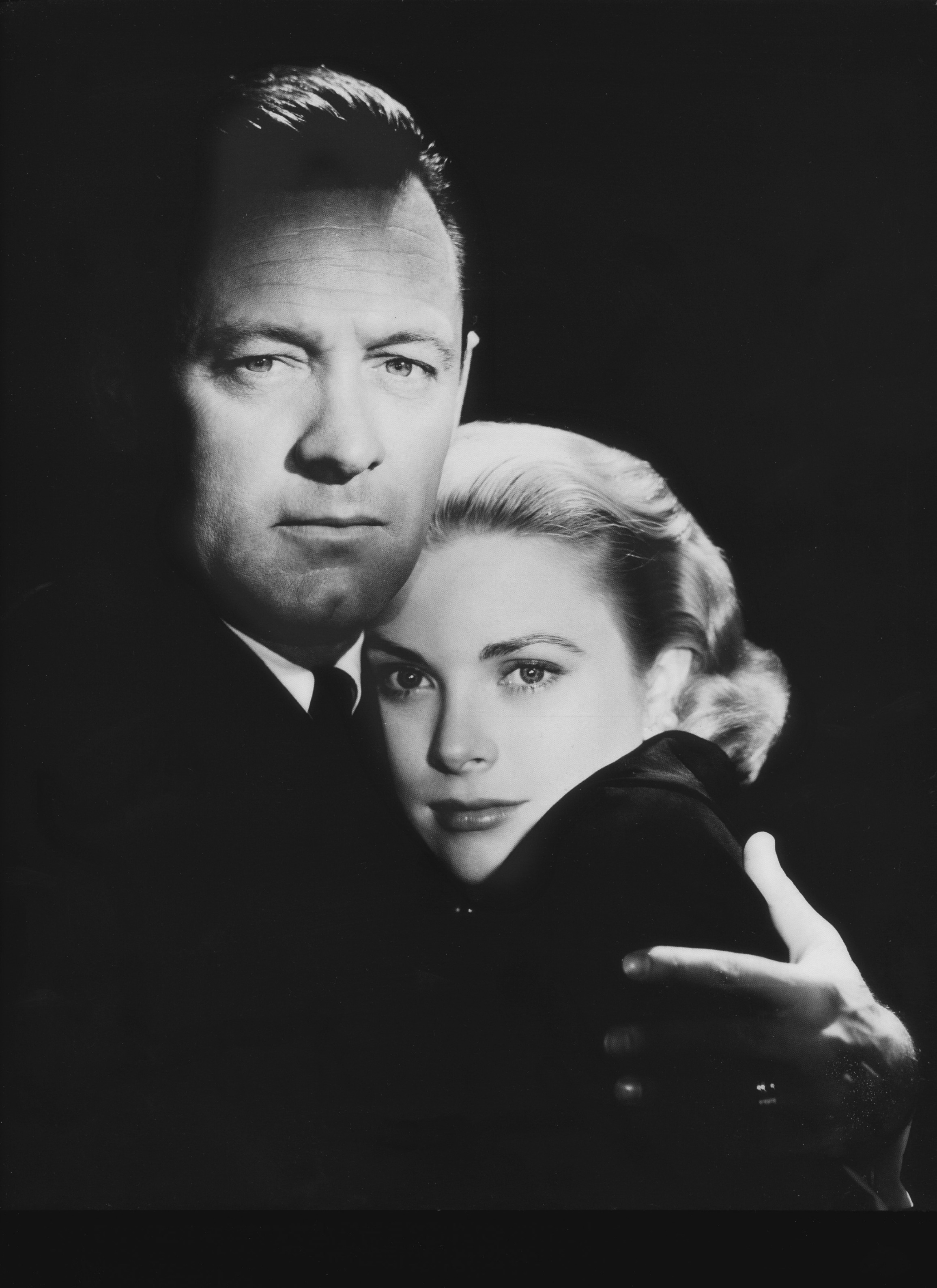
Grace Kelly and William Holden play the husband-and-wife lead roles in Paramount Pictures’ 1954 war film, The Bridges at Toko-Ri. During filming, Grace Kelly fell madly in love with her Bill Holden, her co-star, who was married and 11 years older. PHOTO image: “Grace Kelly 1929 – 1982” by oneredsf1 is marked with CC BY-NC-SA 2.0.
Off screen Grace Kelly had fallen madly in love with co-star William Holden. Holden was 11 years older than Grace Kelly—and married. But they had an affair throughout the making of the picture. The electricity of that affair is evident in the love scenes where they played movie husband and wife.
In The Bridges at Toko-Ri Grace Kelly is Nancy Brubaker, the young wife of Navy pilot Lieutenant Harry Brubaker (Holden). A husband and father, Brubaker never wanted to be a flyer in the Navy and still wants out. Yet he accepts a very risky and dangerous mission during the Korean War and is killed in action. The commander asks—is it really a good mission if lives of good men are lost? The film is based on a novel by James Michener who recounted actual missions he covered as a correspondent on U.S. air craft carriers that were flying bombing missions on railroad bridges in North Korea in 1951 and 1952.
In The Bridges at Toko-Ri Grace Kelly played Nancy Brubaker, the wife of a U.S. Navy pilot (William Holden) who is killed in action in the Korean War. Grace is radiant in every scene in which she appears.
Though Kelly has a relatively small part in the war film, she is radiant in every scene. This is the first film where Grace Kelly appears in bed. Directed by prolific Marc Robson, The Bridges at Toko-Ri was one of the biggest hits of his career. Lyn Murray composed the musical score. Murray started in Hollywood in 1950 doing vocal arrangements for Walt Disney but soon was writing music for feature films throughout the 1950’s and 1960’s.
The film is a noisy and straightforward tale of one small American family in war-time. It combines humor notably provided by Mickey Rooney as CPO NAP Mike Forney that soon collides with war’s high-stakes mortal danger whose scenes look to presage Vietnam. The film’s cooperation with the U.S. Navy led to realistic and spectacular aerial and carrier action scenes that, in 1956, won the Academy Award for Best Special Effects.
Grace Kelly had a small but important role in The bridges at Toko-Ri, one of the best motion pictures made dealing with the Korean war. From Paramount Pictures and based on a book by James Michener, it was filmed in Technicolor and had the full cooperation of the U.S. Navy.
Holden as Airman Brubaker tenderly expresses his sense of loss when his fellow airmen Mike Forney and Nestor Gamidge (Earl Holliman) are whisked off to other navy assignments. Their entire job was to save the lives of airmen in battle—and had saved Brubaker’s – so that their sudden professional absence is personally and deeply felt.
This is a film of the mid 1950s with caring commanders who look and talk remarkably like Ike, then President of the United States and who had just ended the Korean action in July 1953. Chain smoking by nearly everyone in the cast appears to be de rigueur. Listening to navy radio Lieutenant Harry Brubaker is riveted hearing a broadcast from Chicago’s famous Chez Paree nightclub showcasing jazz trumpeter Henry Busse. The local flair and period cultural items add interest to the fine acting and timeless beauty of Grace Kelly along with the film’s fact-based war story and blockbuster action. Almost 70 years after its initial release, The Bridges at Toko-Ri continues to be a worthwhile entertainment.
A stage play on film, the action in Dial M For Murder is limited to a few rooms about a tennis player (Ray Milland) who arranges to kill his wife (Grace Kelly) to inherit her money. Shot in WarnerColor, it co-starred a cast that included Robert Cummings. “Grace Kelly 1929 – 1982” by oneredsf1 is marked with CC BY-NC-SA 2.0.
On the set of Rear Window (1954).
In Rear Window released in September 1954, Grace Kelly received equal billing with co-star Jimmy Stewart and director Alfred Hitchcock.
Grace refused other lucrative film offers to work again with Hitchcock, this time at Paramount Pictures, on Rear Window co-starring Jimmy Stewart. In this landmark mystery thriller film which came out in summer 1954, one of Hitchcock’s dramatic emphases for Grace Kelly’s film persona was to display her natural elegance and sex appeal—he was amused by her public image as an “Ice Queen”4—by having her costumed in an array of fabulous Edith-Head-designed lingerie, dresses, and pants. Growing up in Philadelphia Grace Kelly as an adolescent and teenager had modeled in local fashion shows but, by the middle 1950’s in her mid-twenties, she became an international fashion and style icon.
Edith-Head lingerie, dresses, and pants highlighted the differences in lifestyle between the character of Lisa played by Kelly and the photojournalist L.B. Jeffries played by Jimmy Stewart.
In the scene where Kelly is first introduced in the film, Stewart awakes to a full close up of Lisa coming toward him for what may be cinema’s greatest kiss. The dress Lisa describes as “fresh from the Paris plane” offered a simple neckline to frame Grace’s face for the close-up, a fitted black bodice and a full skirt to mid-calf, among other accessories. The $1,100 price tag in 1954 that Lisa talks about is about $13,000 today. Hitchcock wanted the audience to know immediately that Lisa was no ordinary woman that had arrived to Jeff’s apartment.Studio publicity still of Grace Kelly for the film Rear Window (1954). Public Domain. “Grace Kelly in Rear Window” by thefoxling is marked with CC BY-NC-SA 2.0.
Action In Rear Window – like Dial M For Murder – was in a confined setting. In Alfred Hitchcock’s first picture for Paramount Pictures, the action was confined to one room with a hero (Jimmy Stewart) confined by a broken leg. Rear Window, which is about a photojournalist who sees strange goings-on as he watches people in the privacy of their apartments using a telephoto lens, was an artistically and financially suspenseful parlor drama that was hugely successful.“Alfred Hitchcock, Grace Kelly, Jimmy Stewart (1)” by oneredsf1 is marked with CC BY-NC-SA 2.0.“Grace Kelly 1929 – 1982” by oneredsf1 is marked with CC BY-NC-SA 2.0.
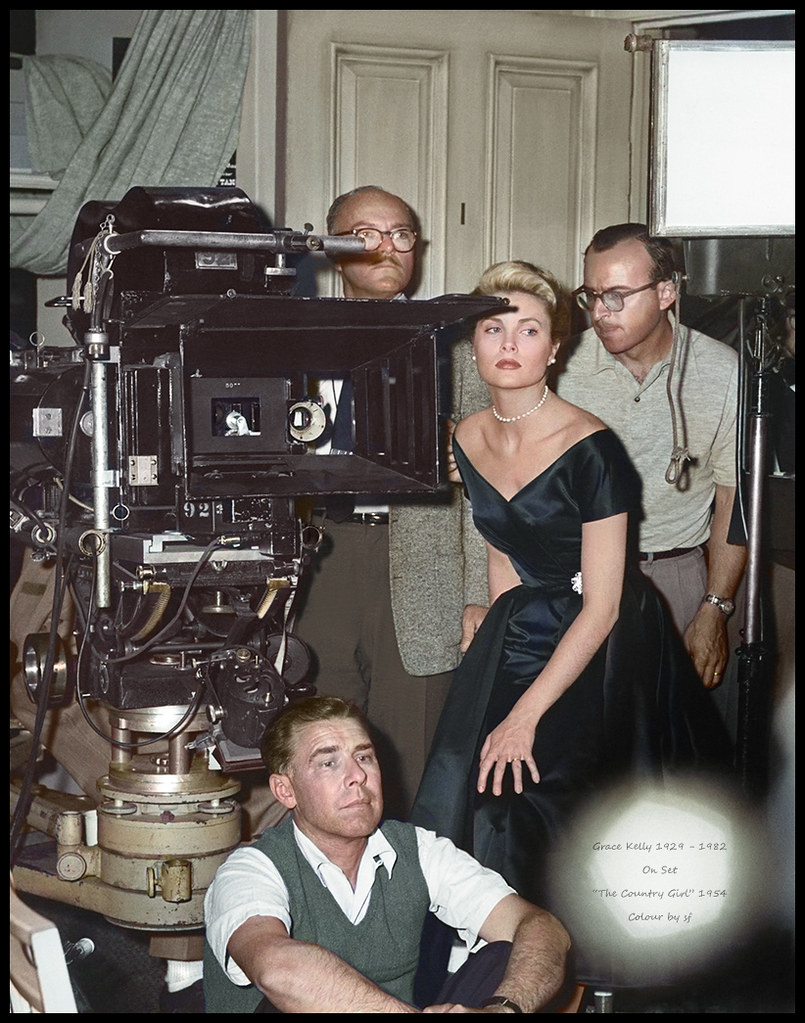
Never just a pretty face, Grace Kelly insisted in her studio contract that she be allowed regular breaks to be able to act in live theater.5 From childhood, Grace admired the art of the live stage and welcomed demanding theater and film roles that challenged and exhibited her acting range and abilities. This love of the theater was a big part of her motivation to seek the hardly glamorous but dramatically impressive role of Georgie Elgin in George Seaton’s The Country Girl (1954) for Paramount Pictures.
With co-stars Bing Crosby and William Holden, the film featured Grace playing Georgie, the long-suffering wife of an alcoholic actor struggling to resume his career (played by Crosby).
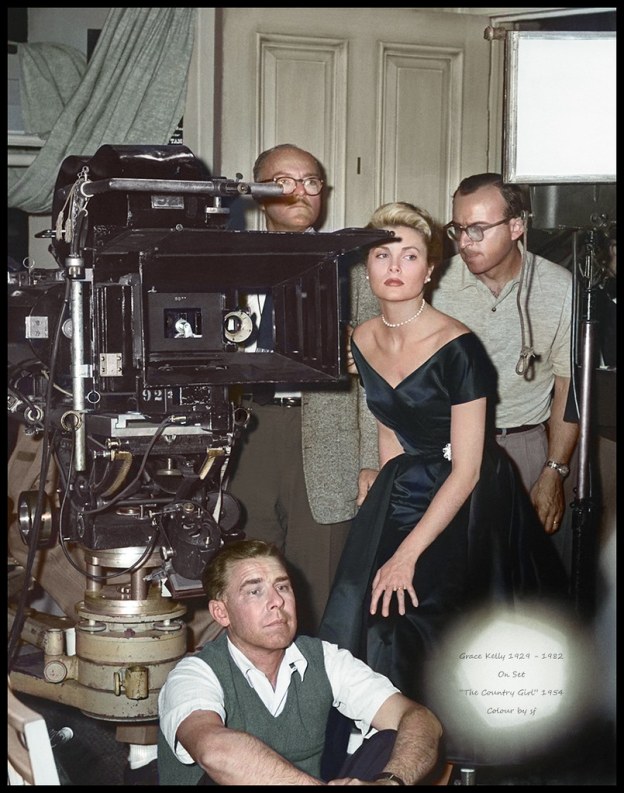
Grace Kelly studying the script during filming of George Seaton’s The Country Girl. The 1954 drama film received 7 Academy Award nominations and won two Oscars – including Grace Kelly as Best Actress.
The Country Girl features actors playing against type and revealing new facets of their acting talents. William Holden plays Bernie Dodd, a stage director, who takes a chance on Frank Elgin (Bing Crosby), a great star who has lost jobs because of his dipsomania. Dodd blames Elgin’s wife Georgie (Grace Kelly) but realizes that Frank Elgin would have crumbled without her. When Frank pulls himself together for an opening night triumph, Dodd proposes to Georgie and she must decide to leave with the handsome, hardworking stage director or stay with her troubled husband. Grace on the set of The Country Girl,1954. “Grace Kelly 1929 – 1982” by oneredsf1 is licensed under CC BY-NC-SA 2.0.
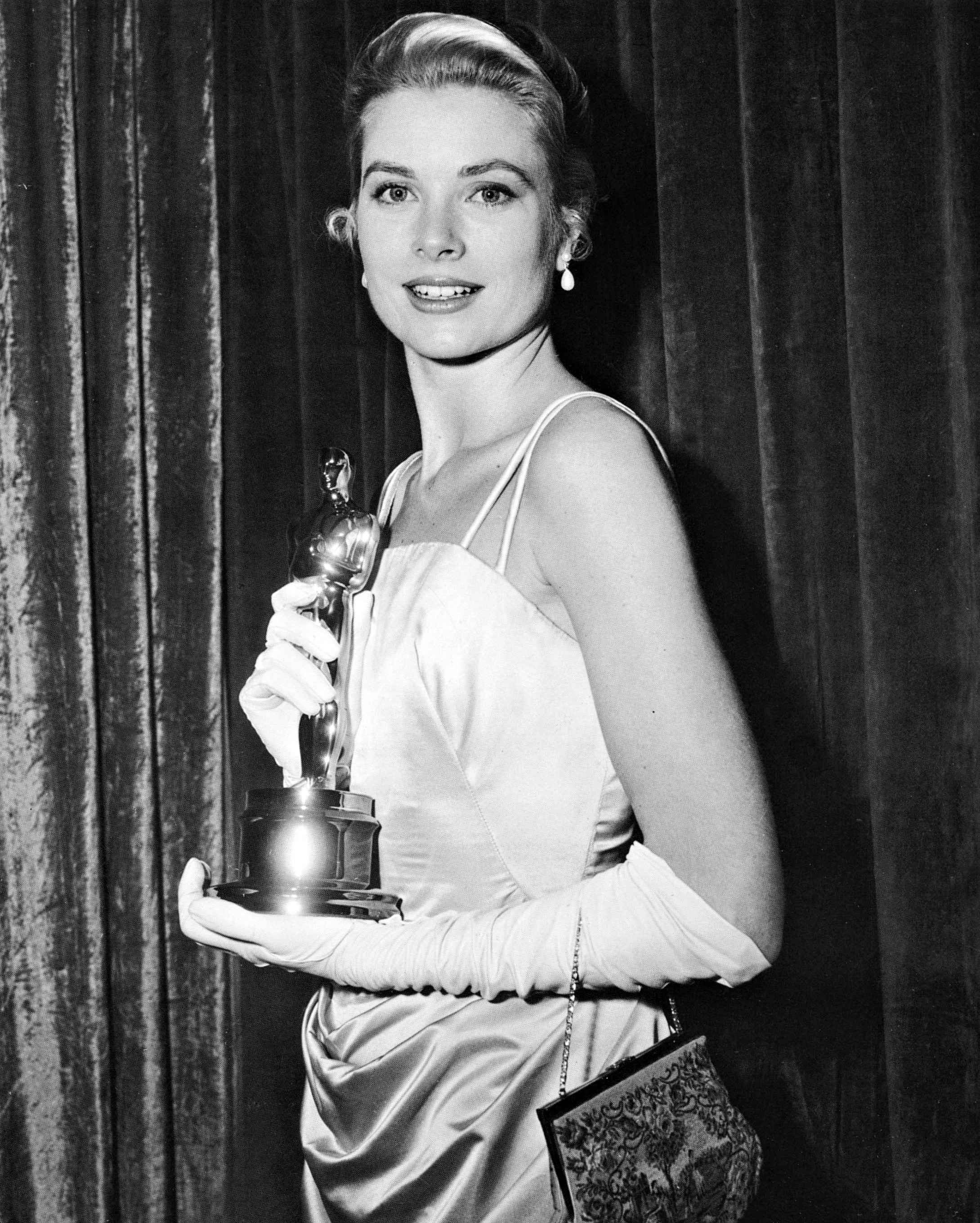
At its release, The Country Girl was a hit and nominated for seven Academy Awards. On Wednesday, March 25, 1955, at the telecast of the 27th annual Academy Awards held at RKO Pantages Theatre, the third time the ceremony was televised nationally, The Country Girl won two Oscars, including one for Grace Kelly for Best Actress.6 At 25 years old Grace Kelly of the ambitious and hugely competitive Kellys of Philadelphia had reached the pinnacle of the cinema arts holding her profession’s gold-plated statuette.
Grace Kelly backstage after the 27th annual Academy Awards on March 25, 1955.
During the evening Grace won the Oscar for Best Actress for her dressed-down and dramatic role in The Country Girl.
At the 27th Annual Academy Awards, presenter Bette Davis is joined by Marlon Brando and Grace Kelly, each holding their golden trophies for Best Actor and Best Actress.
In early 1954 Grace had flown to South America to make Green Fire (1954) for M-G-M with Stewart Granger. In May 1954 she was at the French Riviera to make her third film with Alfred Hitchcock: To Catch a Thief (1955) co-starring Cary Grant for Paramount Pictures.
Grace liked the Riviera. In April 1955 she traveled there again for the 8th annual Cannes Film Festival. It was during this early spring 1955 Mediterranean trip that Grace Kelly was first introduced to Prince Rainier III of Monaco.
Grace Kelly in a chiffon-draped gown by Edith Head in To Catch a Thief (1955).
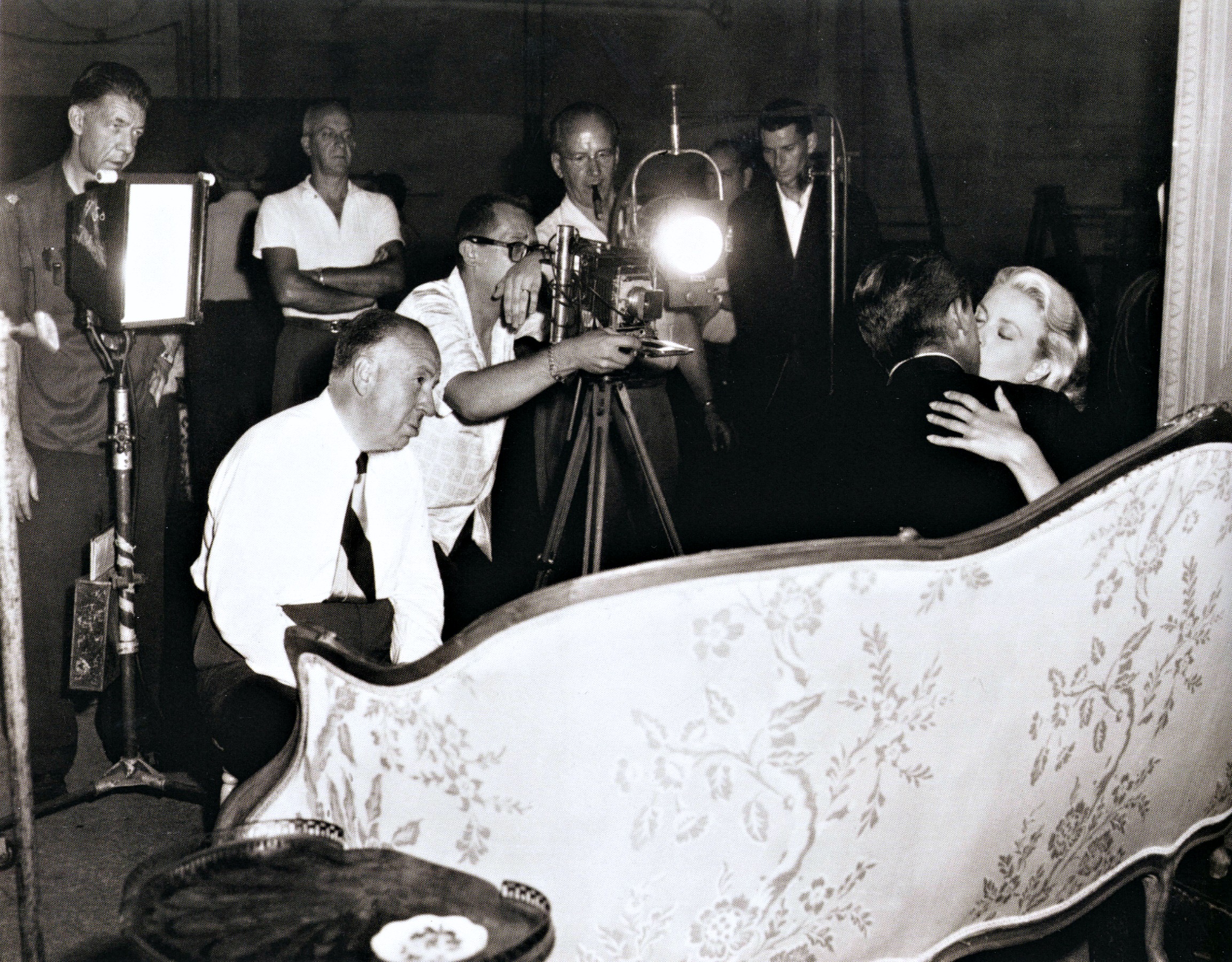
Sitting in a director’s chair with her co-star Cary Grant’s name emblazoned on it, Academy-Award-winning Best Actress Grace Kelly is served a beverage by director Alfred Hitchcock on the set of To Catch A Thief.
Cary Grant’s reaction to the beach dress makes its stunning design even more iconic. “Grace Kelly” by twm1340 is marked with CC BY-SA 2.0.
Hitchcock had found his blonde muse in Grace Kelly and aided mightily to reveal her star qualities. Grace Kelly and Cary Grant in To Catch a Thief (1955). Kelly and Grant were lifelong friends. PHOTO credit: “Grace Kelly & Cary Grant, ‘To Catch a Thief’, 1955” by thefoxling is marked with CC BY-NC-SA 2.0.
Grace wears a pink dress for a walk in the south of France. Grace Kelly on the set of To Catch A Thief. “grace kelly” by ___carmendy is marked with CC BY 2.0.About Grace Kelly, friend and co-star Cary Grant recalled that the Academy-Award winning actress commanded so much respect during the filming of “To Catch a Thief” that there was almost total silence when she arrived on the set.Fair use.
Grace Kelly dressed for the ball in the penultimate scene of her penultimate film, To Catch A Thief.
Grace Kelly by Howell Conant, 1955. Conant was Grace Kelly’s friend and favorite photographer.
26-year-old Grace Kelly and 31-year-old Prince Rainier III on their first meeting at the palace in Monaco, May 6, 1955. They would be engaged to be married by the end of the year. Photo: Edward Quinn. Fair Use.
Grace Kelly stood five foot seven inches tall and weighed 118 pounds. Her dress size was two.7 She was born on November 12, 1929 into the Kelly family of Philadelphia. Grace Patricia Kelly was the third of four children and one of that Irish-German family’s three girls. Elder sister Peggy and younger sister Lizanne were athletic and shared their mother Margaret’s model looks. Margaret was the family disciplinarian who the Kelly children liked to call “the Prussian General.”8
Grace Kelly models a fashionable dress for her mother in the mid1950’s. Grace’s reflection is in the mirror.
As a child Grace was dreamy and shy while her siblings were outgoing and athletic. Yet Grace inherited a keen awareness of her body using her arms and legs to be dramatically expressive in an actress’s rather than athlete’s way.9 At 18 years old Grace’s beautiful rectangle-shaped face with soft pear-shape dimensions displayed thick blond hair, almond-shaped blue eyes, a small high-bridge nose and ruby lips evident in later glamour photographs.
Each member of the Philadelphia Kelly family was an exuberant competitor in areas of American life such as athletics, business, politics, or high society.
in addition to her remarkable beauty, one of Grace’s major strengths was her ability to focus on the goal she decided to pursue whether professionally or personally until that goal was achieved.
When Grace won the Academy Award for Best Actress in 1955 it was a brick in the Kelly family wall of ambition for success.
Before she was a teenager Grace performed in plays so that during her teenage years a desire to be a professional actress grew. Since Grace was situated within a protective and affluent family as well as educated in Philadelphia Catholic and other private schools she sought theater work in New York City instead of Hollywood. Even when she had achieved the pinnacle of film success Grace still considered New York Theater a worthwhile aspiration and Hollywood as a pitiless machine of cinematic production.10
The Kellys in Philadelphia. Grace and Peggy flank Jack and Lizanne on his shoulders, c. 1946. Grace Kelly moved to Southern California to be in motion pictures. She appeared in her first film called Fourteen Hours for 20th Century-Fox in 1951 when she was 22 years old.“Grace Kelly 1929 – 1982” by oneredsf1 is marked with CC BY-NC-SA 2.0.Grace Kelly, 1955. Four years after her arrival to Hollywood Grace Kelly was one of the most glamorous women in the world.
It was Aristotle Onassis who suggested to Prince Rainier that he marry a beautiful American movie star to bring the glitterati back to Monaco. Onassis’s list at the time did not include Grace Kelly.11
Invited to the 1955 Cannes Film Festival after she had won the Academy Award for Best Actress for The Country Girl one month before, Grace was curious enough about the prince to be introduced to him in Monaco on Friday, May 6, 1955.
What is memorable from the photographs of their meeting at the palace is that the Prince looks chic and handsome and Grace is at her most beautiful in a black silk floral print dress with her blond hair pulled back into a German-style bun.
That evening Grace returned to Cannes for the festival’s screening of The Country Girl helping to conclude a day that Grace herself called “pretty wild.”12 But Grace’s career in Hollywood wasn’t over—nor her life half begun. She was back in Paris before the festival’s winners were announced (she had won nothing there),13 and soon returned to Hollywood to make what turned out to be her final two Hollywood movies – The Swan and High Society.
Grace Kelly and Prince Rainier were engaged in December 1955. One of her female co-stars observed that the gem of Grace’s engagement ring that she received from the prince was the size of a “skating rink.”
Grace Kelly wears her engagement ring from Prince Rainier on the set of High Society.
Grace Kelly in a make-up test for the honeymoon scene in High Society.
High Society from M-G-M, starring Grace Kelly as socialite Tracy Lord, was the biggest money making film of 1956. It was a musical adaptation of M-G-M’s The Philadelphia Story (1940) starring Katharine Hepburn in the lead role. High Society co-starred crooners Bing Crosby and Frank Sinatra and songs by Cole Porter. The film was Grace Kelly’s swan song before she departed Hollywood forever. In High Society (1956) Grace Kelly plays Tracy Samantha Lord. C.K. Dexter-Haven (Crosby), her former husband, remains in love with her but she is now engaged to socially prominent and snobbish George Kittredge (John Lund). With the help of a sympathetic reporter (Sinatra), Dexter-Haven has a short window of time to convince her that she really still loves him. Costumes were by Helen Rose who worked at M-G-M from 1942. Photograph by Eric Carpenter (1909-1976), a Clarence Sinclair Bull assistant, Fair use. Grace Kelly in High Society (1956). “Grace Kelly” by thefoxling is marked with CC BY-NC-SA 2.0.Grace Kelly, The Swan.
In the same year that The Swan (1956), a film featuring royalty, was released, Grace Kelly had married the Prince of Monaco. Grace Kelly in a M-G-M publicity photograph for The Swan.
Grace behind the wheel of a Mercedes-Benz for a scene in High Society.
Leaving “Tinsel Town” for what turned out to be forever, the 26-year-old movie star sailed for Monaco. The Kellys paid a $2 million dowry and, in April 1956, Grace married her prince. She became a wife, mother, and royal princess of a sovereign city-state and microstate on the Mediterranean Sea – and one of the wealthiest places in the world.14 Grace, however, traveled frequentl to the United States, and though her acting career had precipitously ended, she remained Hollywood royalty as well.
Fourteen Hours Grace Kelly as Louise Anne Fuller Directed by Henry Hathaway Released March 6, 1951. Twentieth-Century Fox
1952:
High Noon Amy Fowler Kane Directed by Fred Zinnemann Released July 24, 1952 United Artists
1953:
Mogambo Linda Nordley Directed by John Ford Released October 9, 1953 M-G-M
1954:
Dial M for Murder Margot Mary Wendice Directed by Alfred Hitchcock Released May 18, 1954 Warner Bros.
Rear Window Lisa Carol Fremont Directed by Alfred Hitchcock Released September 1, 1954 Paramount Pictures
The Bridges at Toko-Ri Nancy Brubaker Directed by Marc Robson Released December 31, 1954 Paramount Pictures
The Country Girl Georgie Elgin Directed by George Seaton Released December 15, 1954 Paramount Pictures
Green Fire Catherine Knowland Directed by Andrew Marton Released December 29, 1954 M-G-M
1955:
To Catch a Thief Frances Stevens Directed by Alfred Hitchcock Released August 3, 1955 Paramount Pictures
1956:
The Swan Princess Alexandra Directed by Charles Vidor Released April 18, 1956 M-G-M
High Society Tracy Lord Directed by Charles Walters Released July 17, 1956 M-G-M
TEXT NOTES:
It was actually my brother Kevin who, when he was working in the Chicago Film Office, wrote to me this description of Grace Kelly and Rear Window as the greatest film ever.
Quoted in Roberts, Paul G., Style Icons Vol 4 Sirens, Fashion Industry Broadcast, p. 74.
Scott Eyman, Print The Legend: The Life and Times of John Ford, Simon & Schuster, 1999, p. 419-21; Kenda Bean and Anthony Uzarowski, Ava: A Life in Movies, Philadelphia: Running Press, 2017, p. 118
Dherbier, Yann-Brice and Verlhac, Pierre-Henry, Grace Kelly A Life in Pictures, Pavilion, 2006, p. 11.
Edith-Head-designed apparel for Rear Window – Haugland, H. Kristina, Grace Kelly: Icon of style to Royal bride (Philadelphia Museum of Art), Yale University Press, 2006, p. 956; so she could act in live theater – TBA
First meeting in Monaco of Grace Kelly and Prince Rainier III. He would tell her, “This is Europe, not America, We think differently here, and you will have to get used to it.” Fair use.







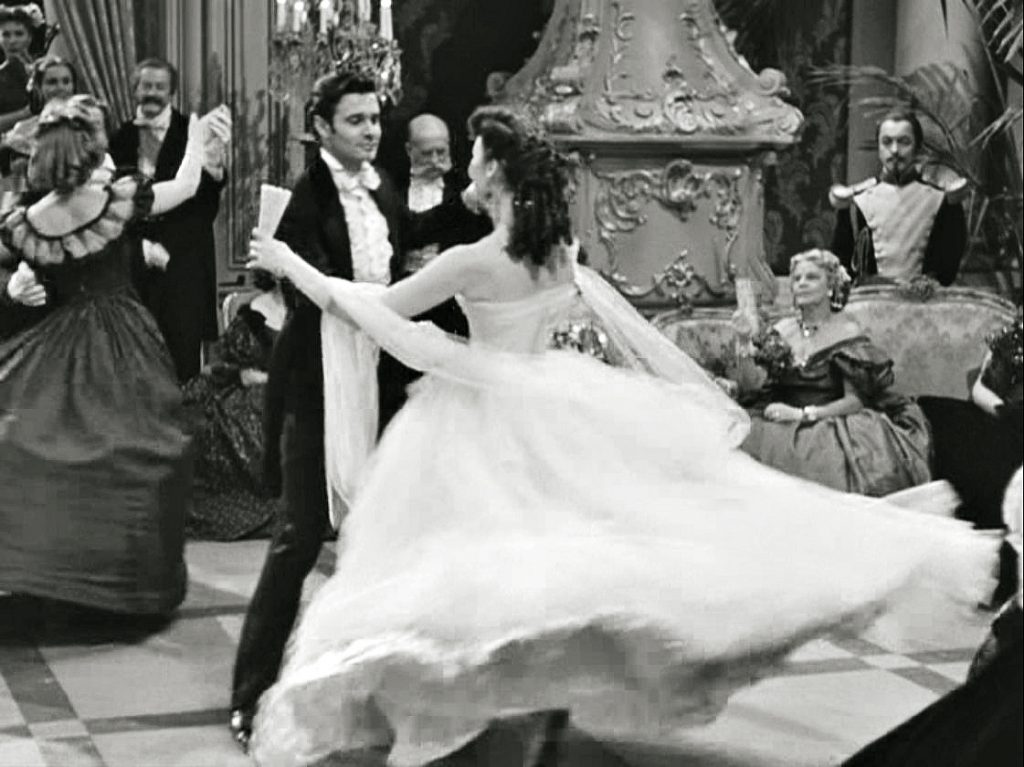





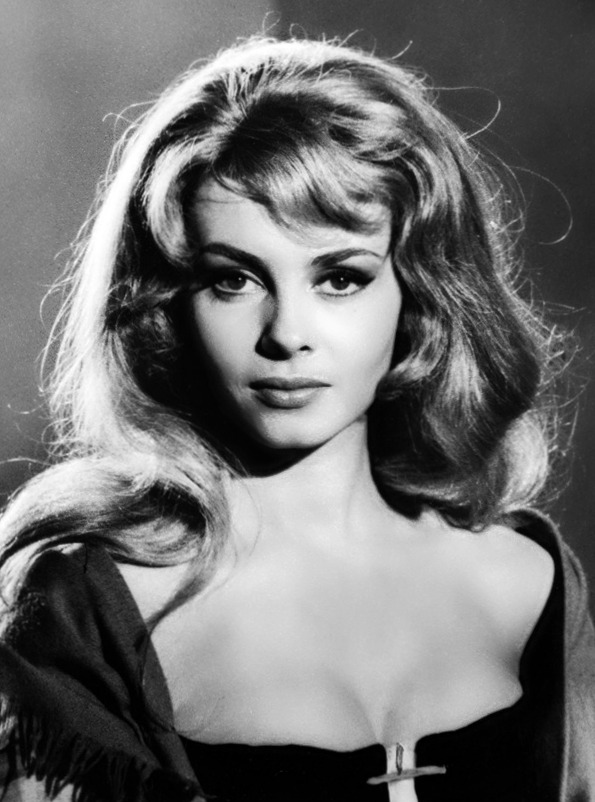
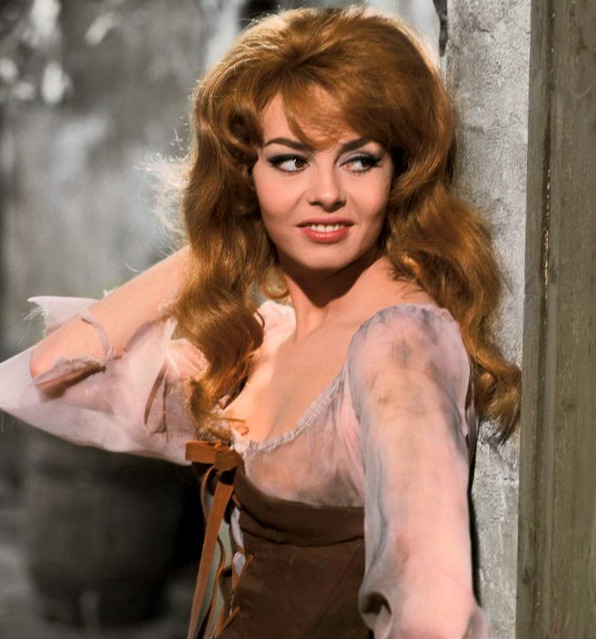


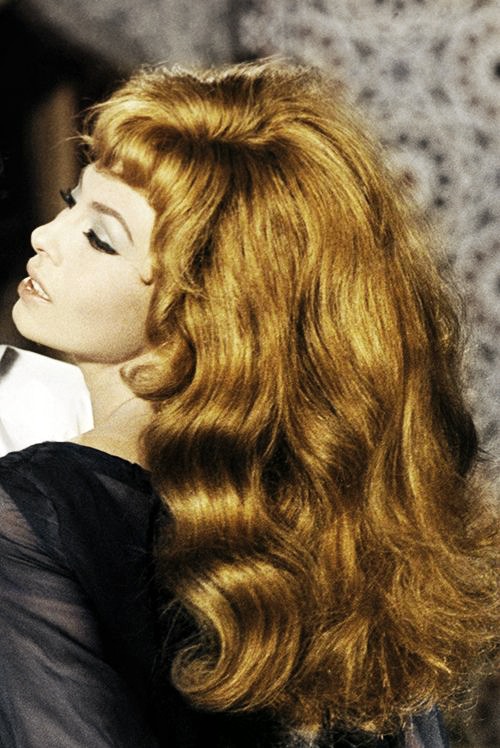
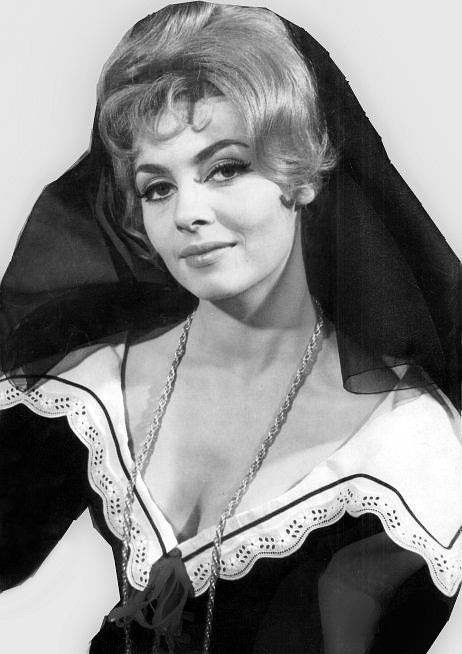
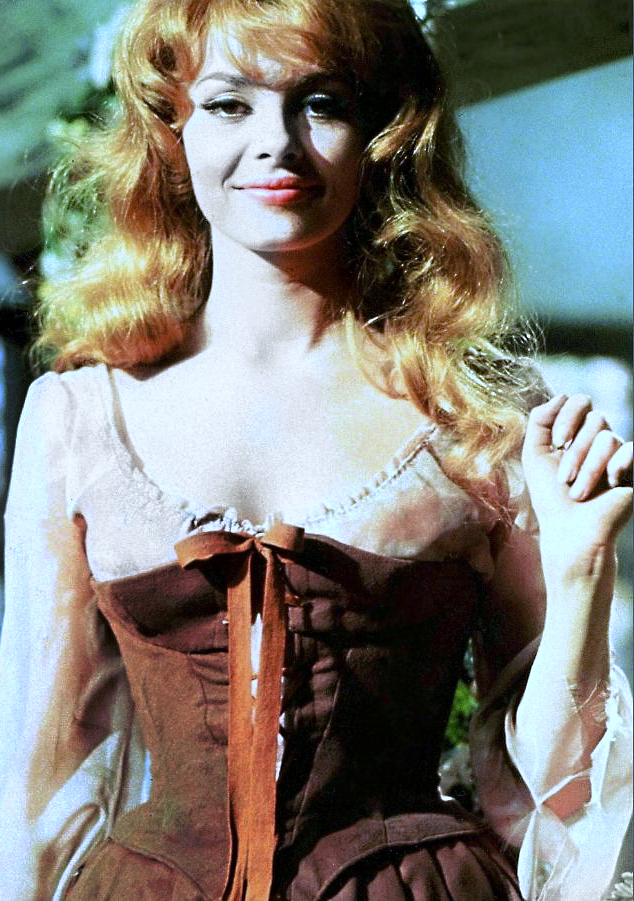

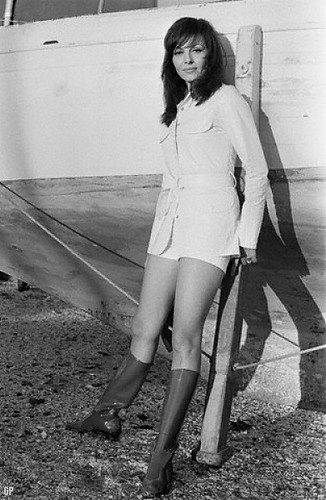


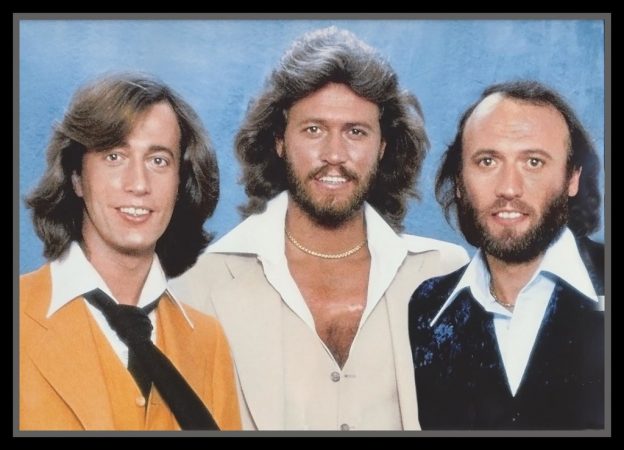

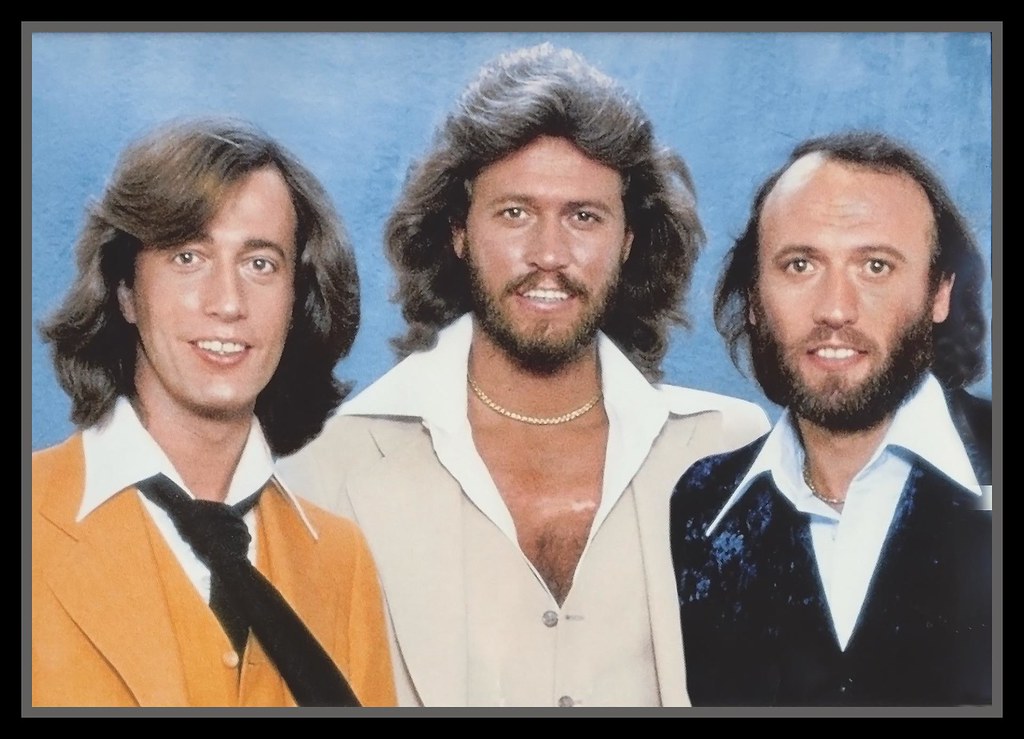
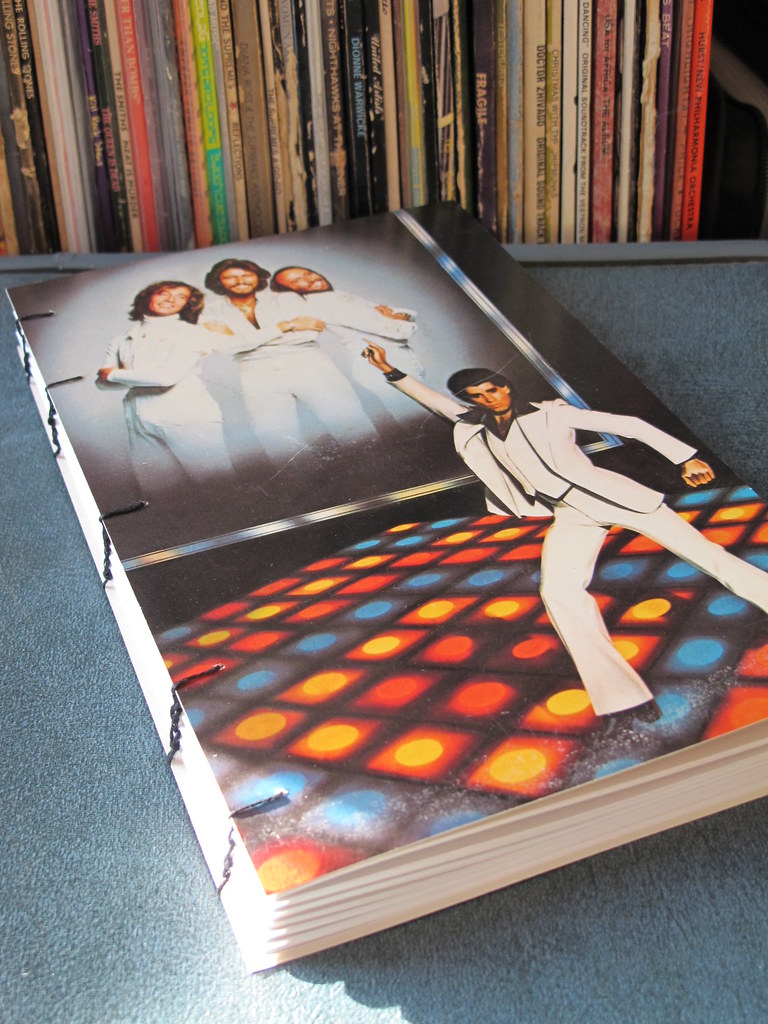
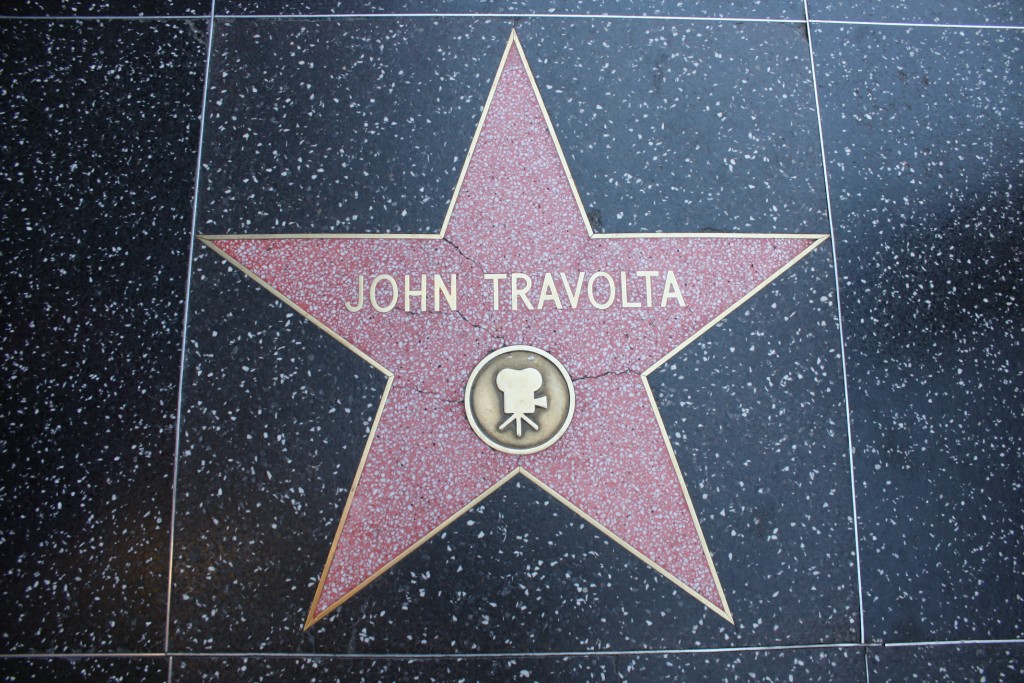
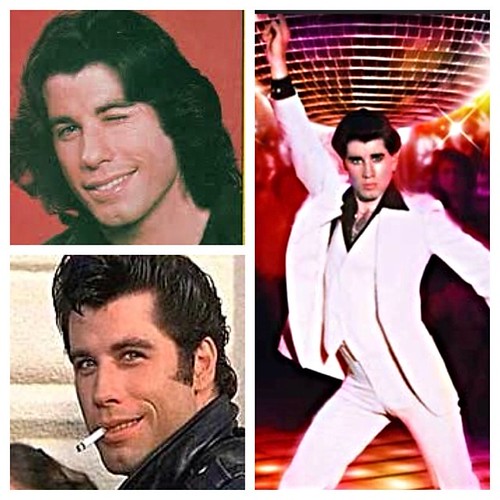

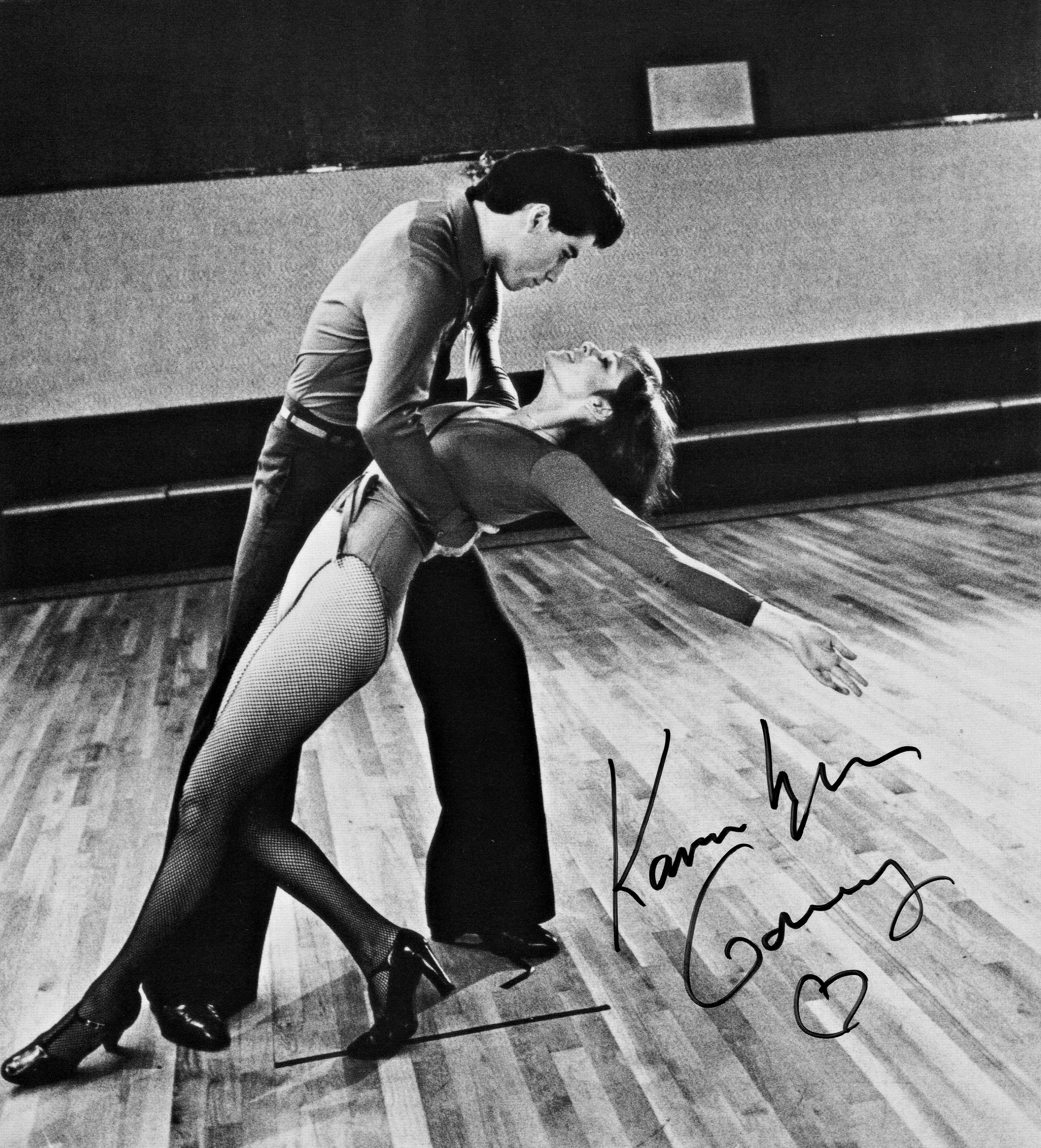

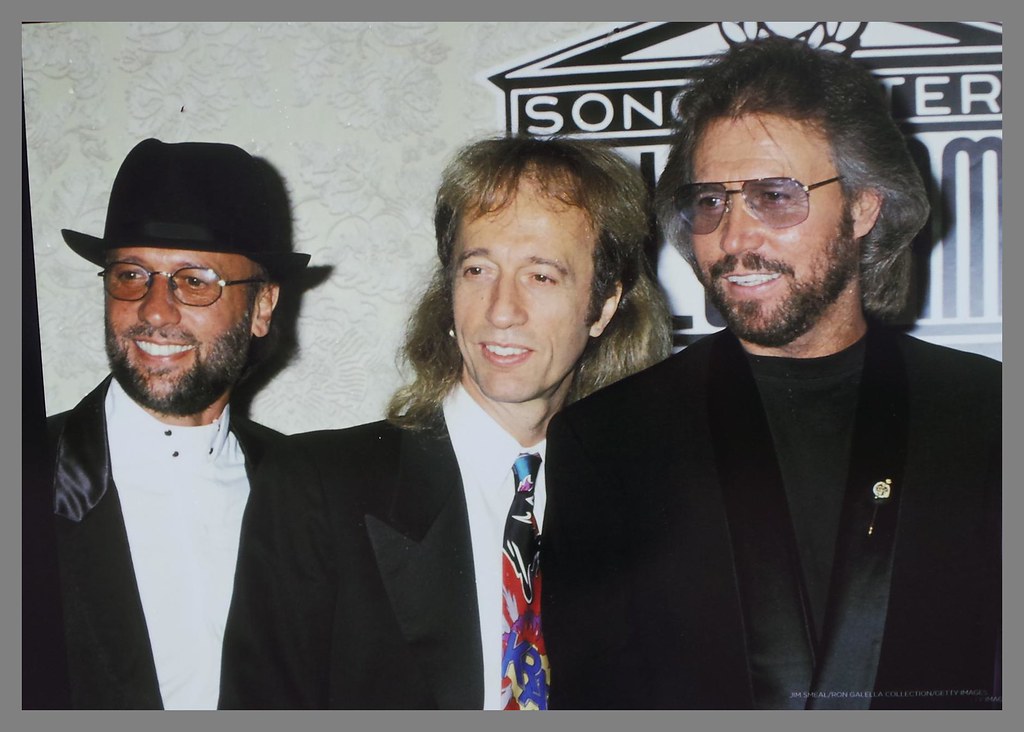
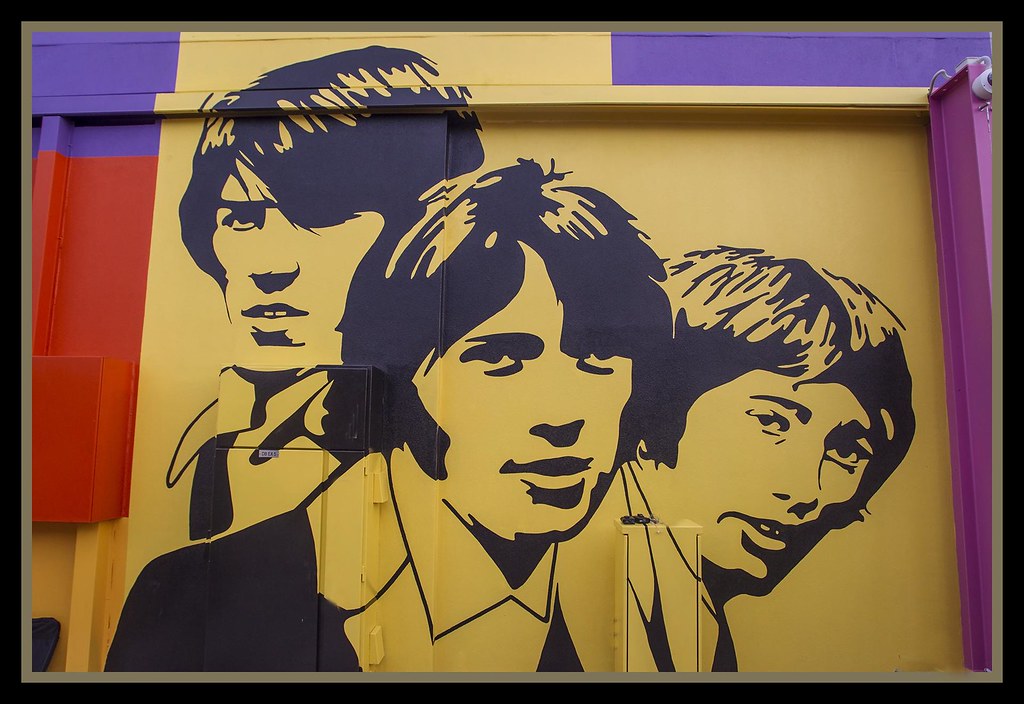
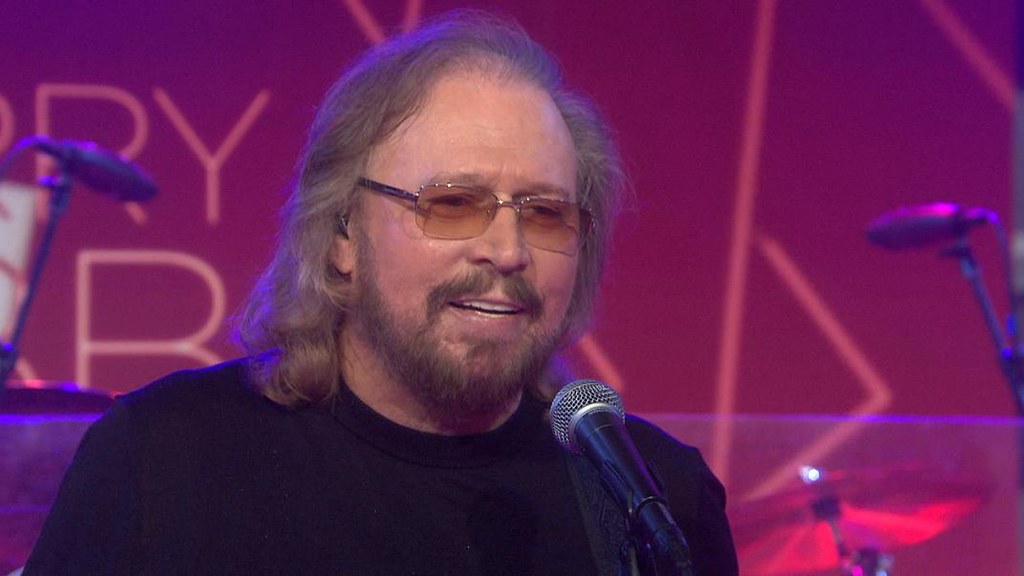


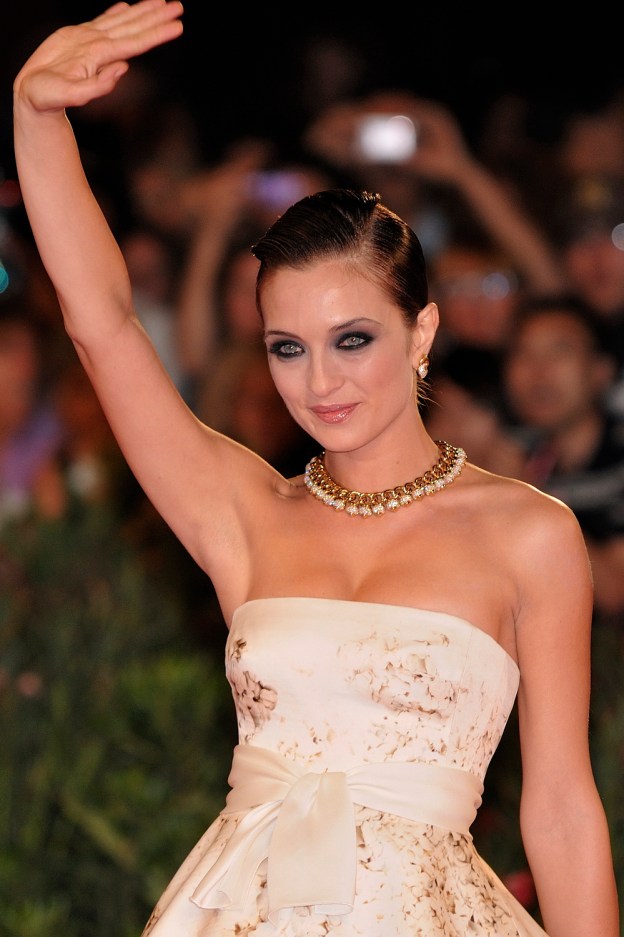

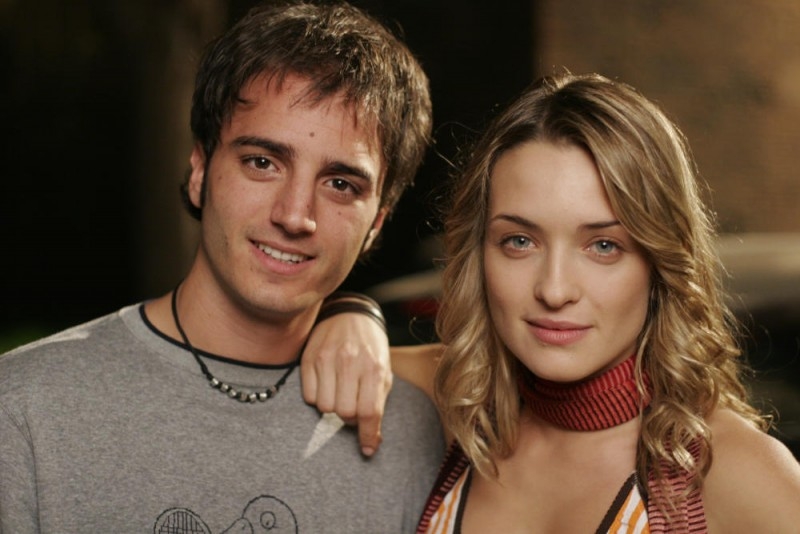
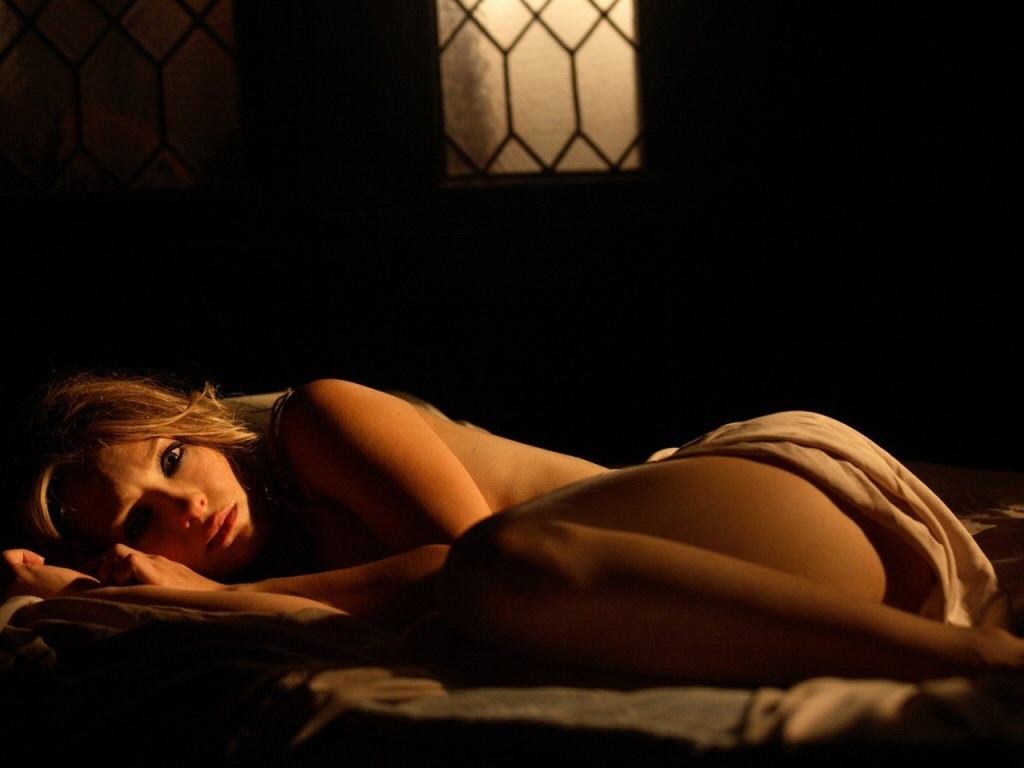


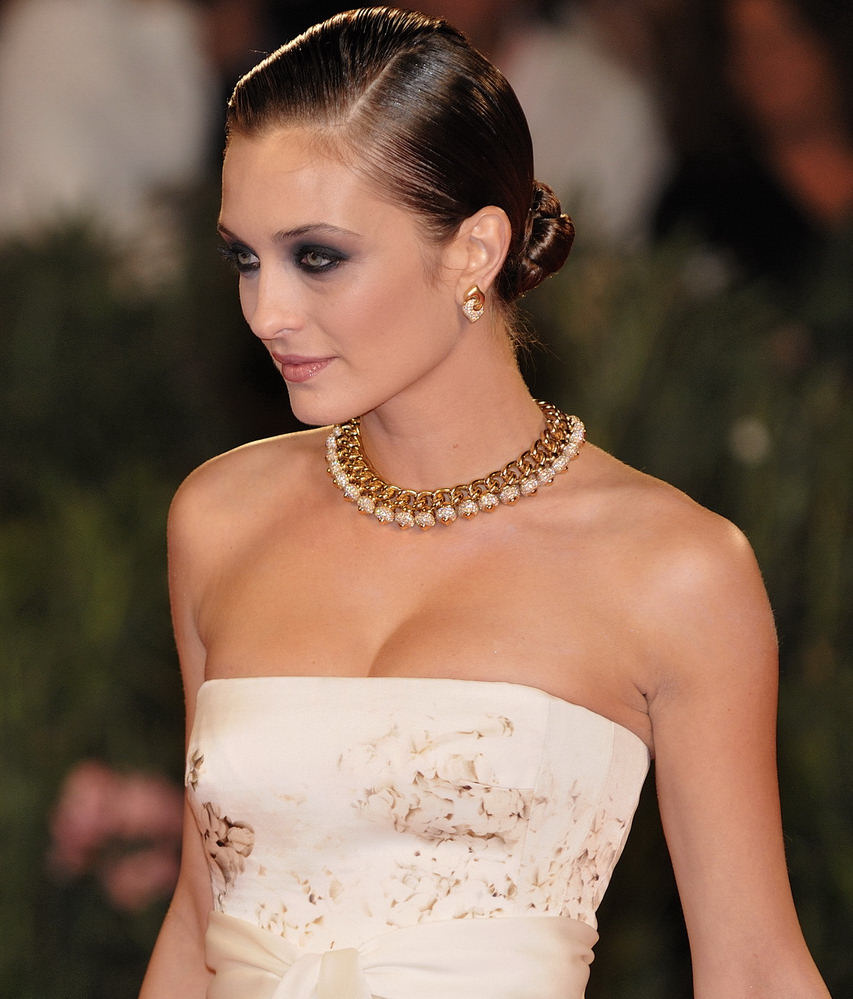

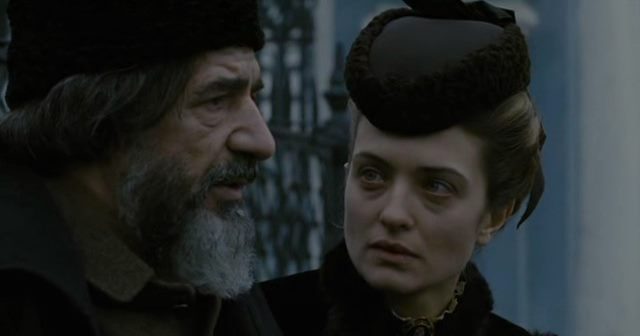
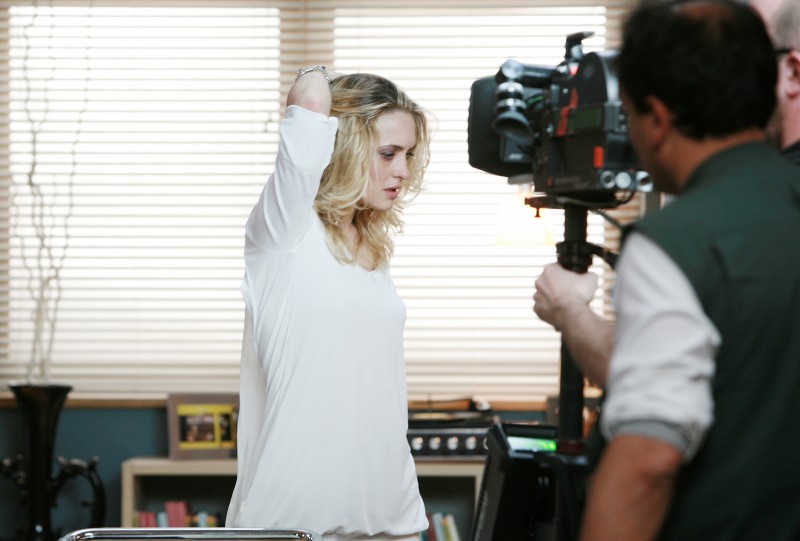
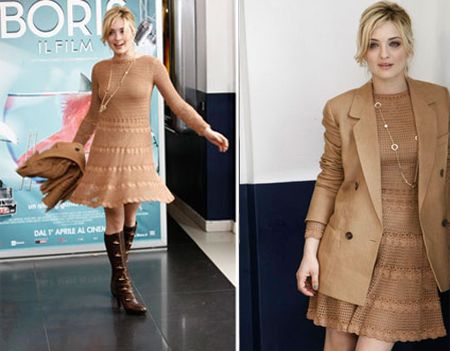
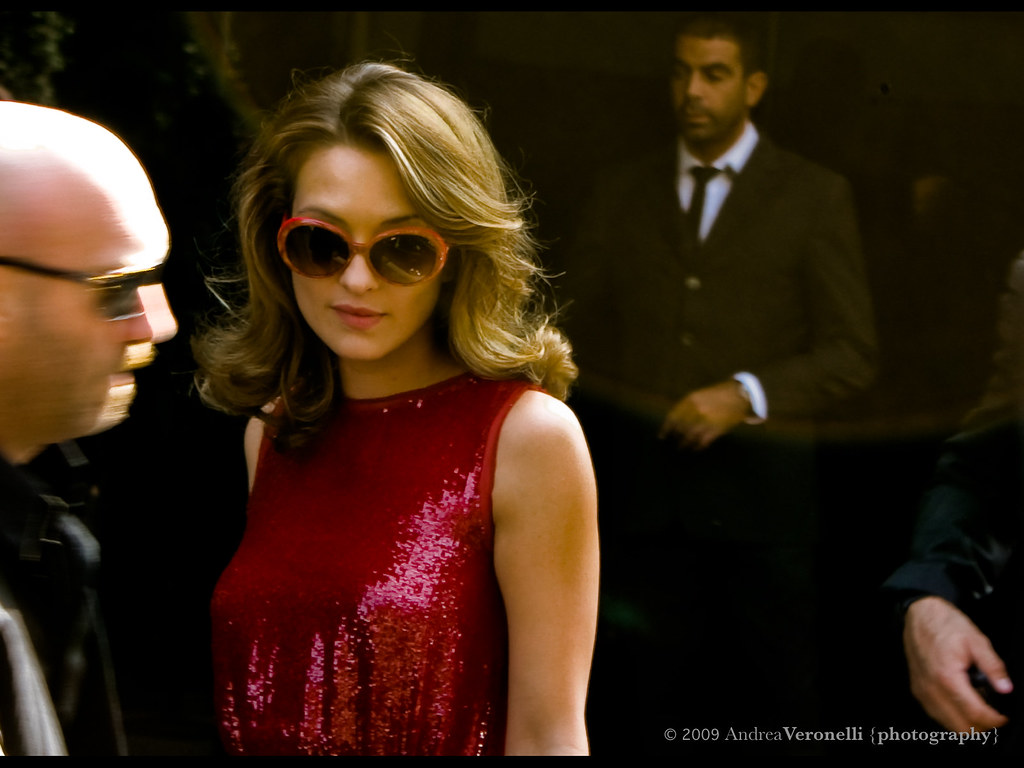
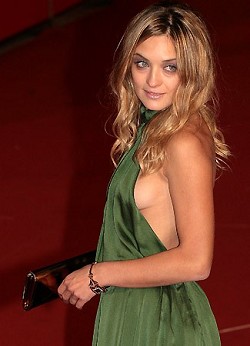
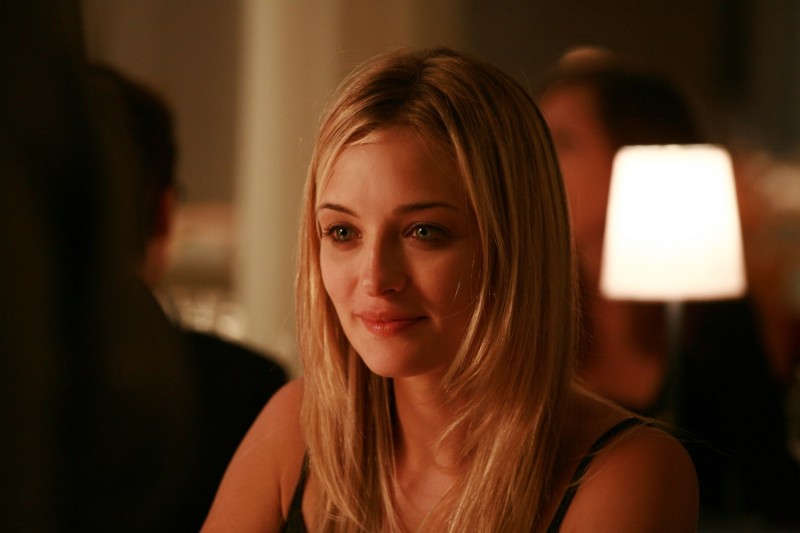
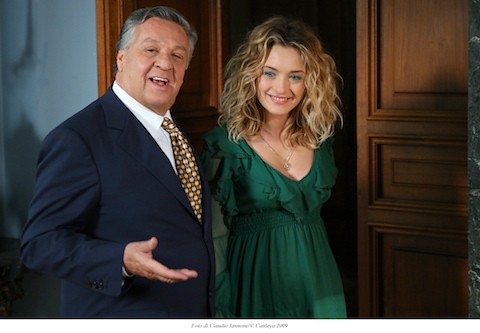
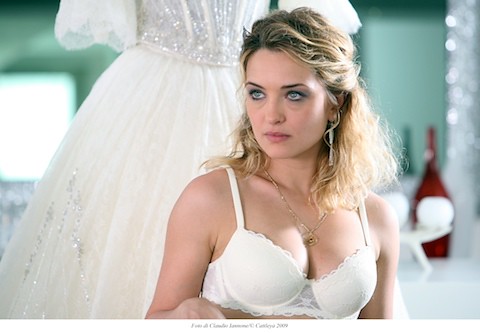
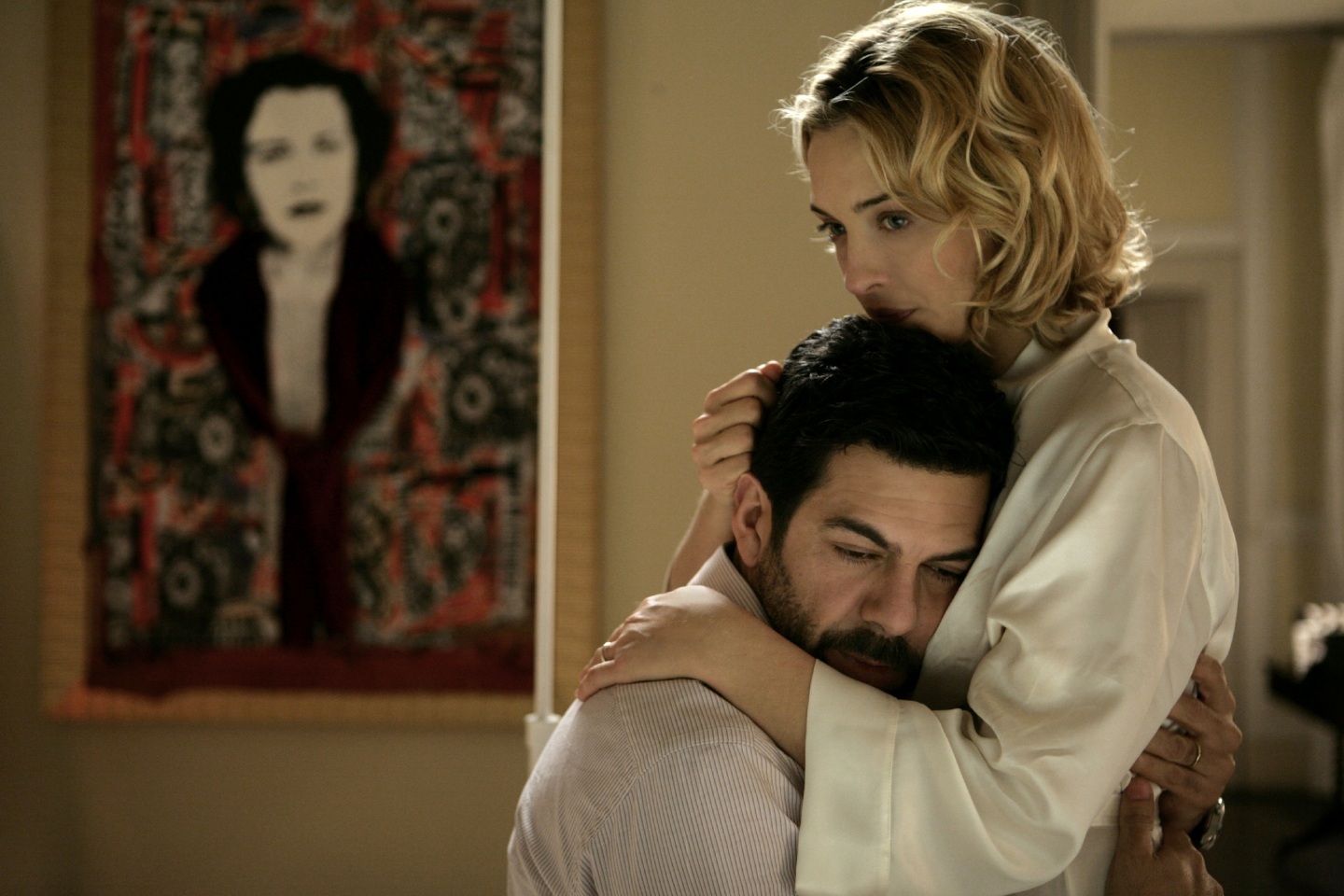
![Tu Style Magazine [Italy] (9 May 2016)](https://jwalsh2013.files.wordpress.com/2017/10/tu-style-magazine-italy-9-may-2016.jpg)