
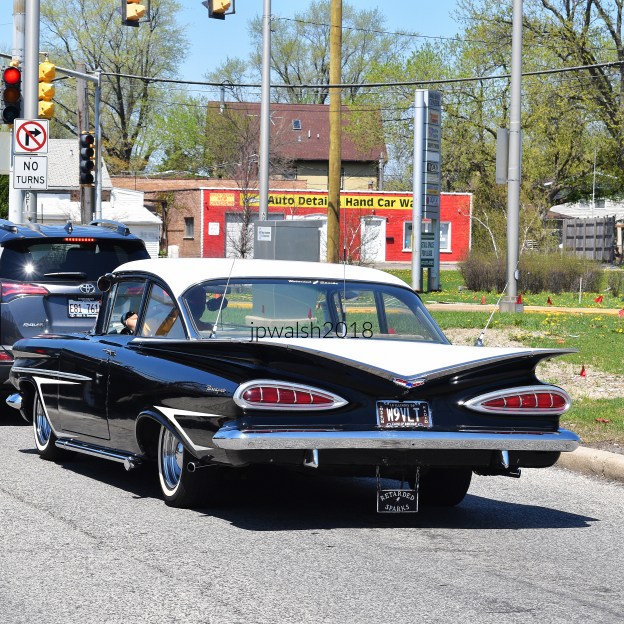
Feature Image: 1959 Chevy Biscayne, 7.89 mb, author’s photograph, May 2018.
In the 1950’s, American cars were noted for their V-8 engines, chrome, and tailfins of one kind or another. The late 1950’s was also marked by a recession which began in 1957 and continued into 1958 that led to a drop in car production in that period by nearly a third. “What is good for General Motors is good for America” could be true in 1950’s America when it was said, attributable to a 1953 Senate hearing, but its converse was also clearly the situation in the last years of that decade.
“From the Progress of the Past – the Promise of the Future.”
This was the tag line for General Motors that was celebrating its 50th anniversary in 1958. Many cars were painted golden to mark the “Golden Milestone.” It was the same year that the full-size Biscayne model made its first appearance. All Chevrolets in 1958 underwent an all-new “Sculptutamic Styling” that included the “gull wing” style fenders and twin taillights in the back of the Chevy Biscayne. The gull wing back extended along the body side to a “v” dip or gap. Another subtle styling addition was the quarter panel bulge between the rear wheel opening and the rear bumper. The Biscayne series replaced the Chevy 210 where the interior was made more colorful and instrumentation had a horizontal bias that, by 1959, was designed to be within easy sight of the driver. In 1958 Chevy introduced the X- shaped frame chassis and full coil suspension that provided greater stability that included 6-cylindar and V8 models, the 283 CID V8 replacing the 265 CID V8, with an optional 348 CID.

“Dollars never went further or bought longer lasting pride than in Chevrolet’s new Biscayne series for ’59.”
In 1959 General Motors – emulating a Chrysler corporate revamp in 1957 – redesigned the bodies of its entire fleet line so that many interior parts and some exterior parts were interchangeable on cars. In the process Chevy reshuffled their brands so that the Impala, that was a luxury option on the Bel Air in its first year in 1958, became Chevy’s own top-of-the-line brand in 1959. The Bel Air took the place of the Biscayne and the Biscayne in 1959 replaced the budget-priced Delray that was discontinued. Chevy Biscayne was produced in its second generation over two model years (1959 and 1960) and would be produced in five generations whose last model year was 1975.
The 1959 Chevy: a.k.a. “Batmobile.”
In 1959 the most remarkable design change was an enlarged windshield and rear window on all cars for greater driver visibility of the road and a “flat top roof.” The bodyside was characterized, at the front, by a slight crease at the turn signal which joined a gentle, sloping bodyside curve. The tail fin started at the rear of the front door that carried to the slightly higher back-end splaying in a “v” shape above the “teardrop”-shaped taillights. The design of the 1959 Chevrolet later came to be known as the “Batmobile” for its body design affinities, particularly the wing-shaped tailfins, and that was featured in the Caped Crusaders’ custom built “bat motif” vehicle during the popular ABC “Batman” TV series in 1966 to 1968.

Batmobile, rear view. With its ‘bat motif” wing-shaped tail fins, the 1959 Chevys, including the Biscayne, shared similarities with the Caped Crusaders’ custom built vehicle. PHOTO: “Batmobile, rear view” by KWH703 is licensed under CC BY-NC-SA 2.0.
Drag racing footage of what looks like a 1960 Chevy Biscayne. The Biscayne was introduced as a full-sized Chevrolet model in 1958 in tandem that year with the top-of-the-line luxury Impala. They joined the Bel Air which has been offered since 1950. These cars constituted about 85% of all Chevy sales in 1960. The Biscayne was the slightly lowest price model with a Biscayne 2-door hardtop like this one setting back the American consumer $2230 BASE MSRP (less than $25,000 in 2025) and weighing about 3500 pounds. https://youtube.com/shorts/7oJPm104q0Y?si=ytYL4v1ruWa2jDTx – retrieved November 30, 2025.
The Feature Image 1959 Biscayne represented over a quarter of all Chevy sales that year. Its main competition was the Ford Custom 300, Plymouth Savoy, and Rambler. The Biscayne featured nylon and vinyl upholstery, cloth headliner, dual sun visors, color-keyed floor coverings, two-spoke steering wheel, stainless steel trim on the windshield and rear window, tail fins, small hubcaps, and 7.50 x 14 BSW tires. In 1959 the average price of a Chevy Biscayne was $2, 383 ($26,597.88).
SOURCES:
J. “Kelly” Flory, Jr., American Cars, 1946-1958, McFarland & Company, Inc. pp. 855-857, 866-867, 870-871, 949.
J. “Kelly” Flory, Jr., American Cars, 1960-1965, McFarland & Company, Inc. pp. 23-24, 26.
This explanatory article may be periodically updated.


