Category Archives: General Motors

My Street Photography. GENERAL MOTORS: CHEVROLET IMPALA (1958–1985; 1994–1996; 2000–2020).

FEATURE IMAGE: The 1966 Chevrolet Impala is 6 foot 7 inches wide (79.9 inches). See –https://www.conceptcarz.com/s9332/chevrolet-impala-series.aspx – retrieved May 7, 2024. May 2024. 94% 7.65mb Author’s photograph.

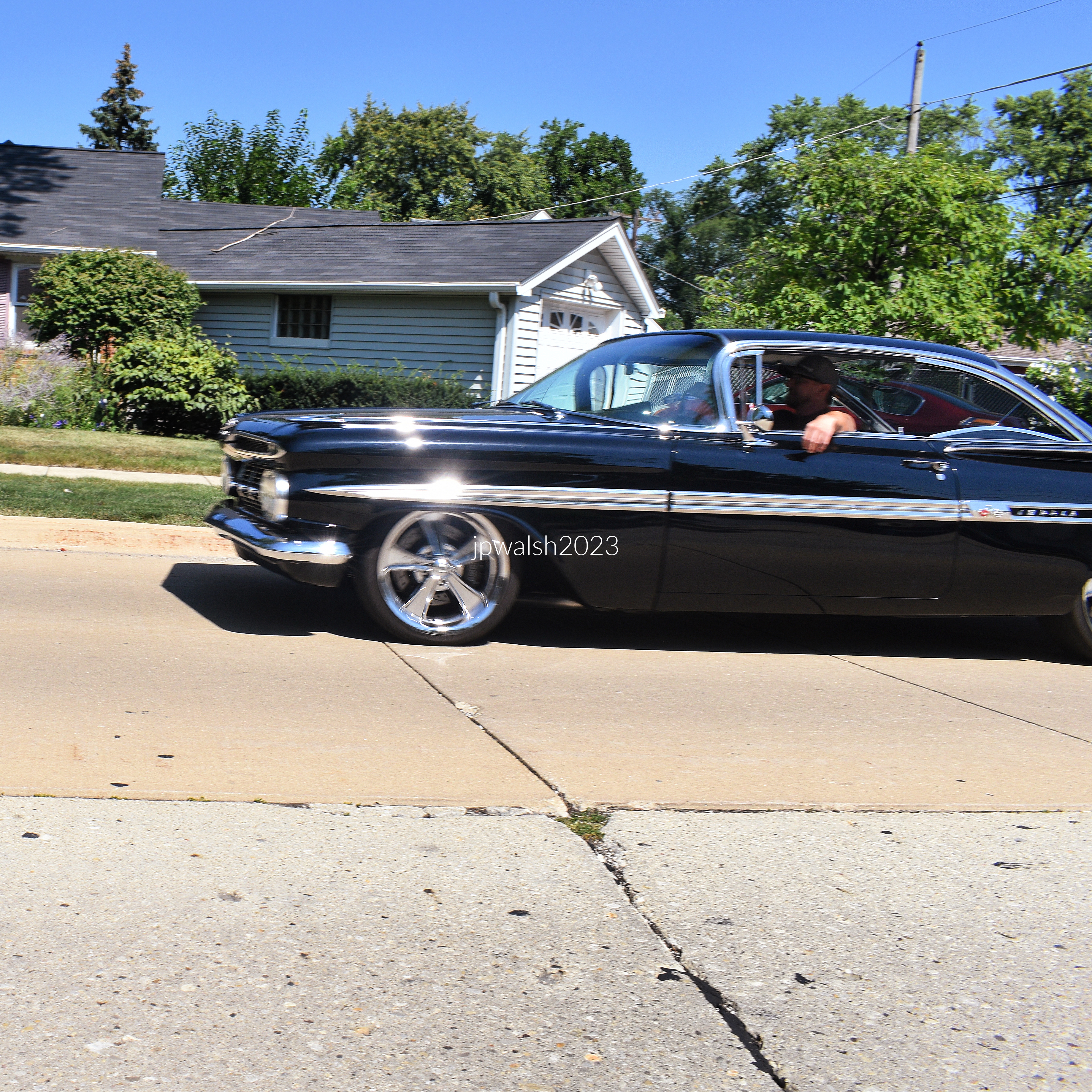
1959 Chevrolet Impala 2-door hardtop. Second Generation (1959-1960). August 2023. Author’s photograph.

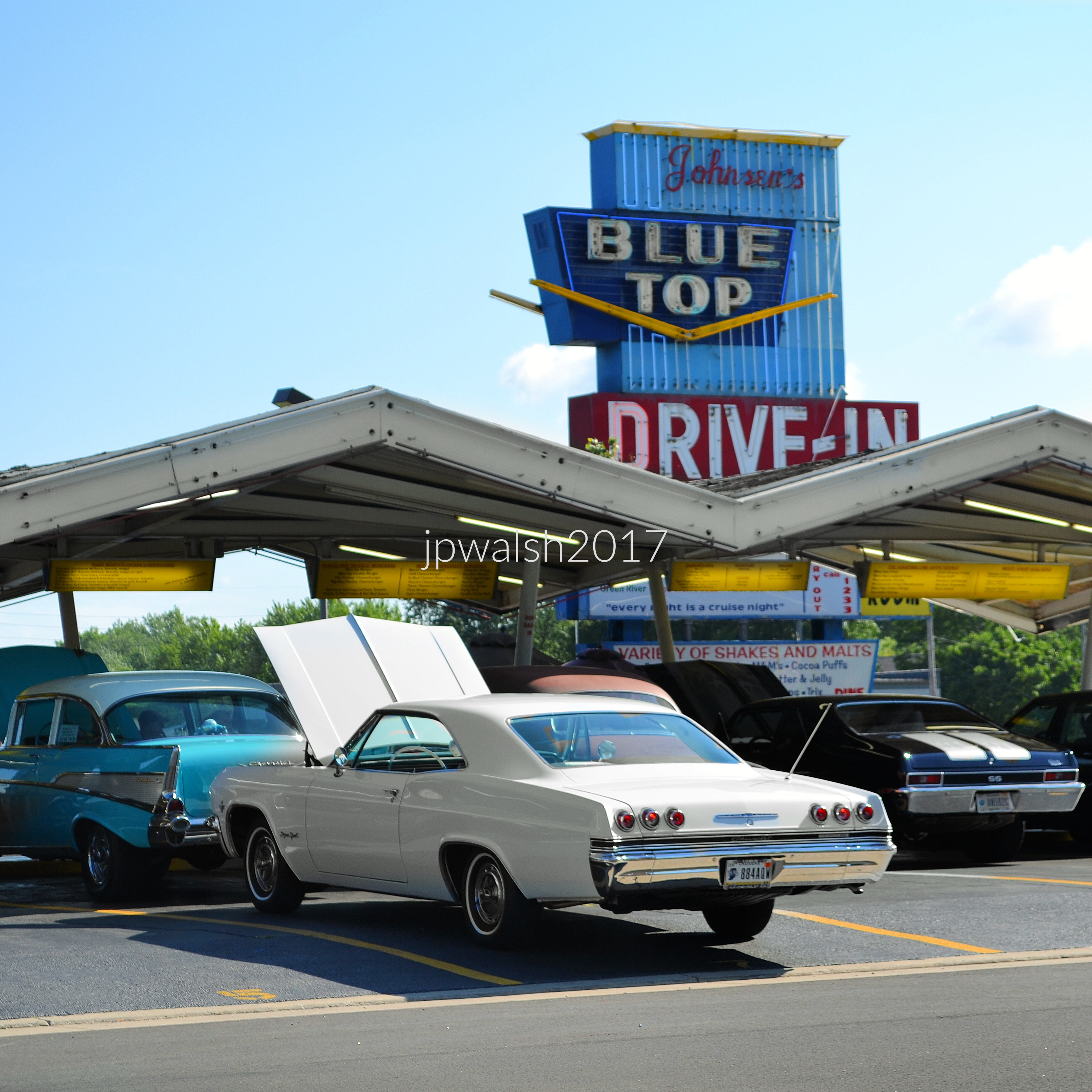
1965 Chevrolet Impala, Fourth Generation (1965–1970). Recognizable by its signature triple taillight design and flowing full-size body, the Chevy Impala was commonly equipped with a V8 engine, such as the 350 or 409ci. Redesigned in 1965, the Impala set an all-time industry annual sales record that year. July 2017. 2.77mb DSC_0419 (1). Author’s photograph.

1965 Chevrolet Impala SS, Fourth Generation (1965–1970). The Impala SS (Super Sport) was introduced as an option in 1960 as an appearance/performance package. Soon it was limited to hardtop and convertible coupe models. From 1964 through 1967 (Impala’s third and fourth generations), the Super Sport was a separate model, with its own VIN prefix: for instance, in 1965-67 cars 166/68 was the prefix for a V8-equipped Impala SS. August 2021. 10.9 mb. Author’s photograph.
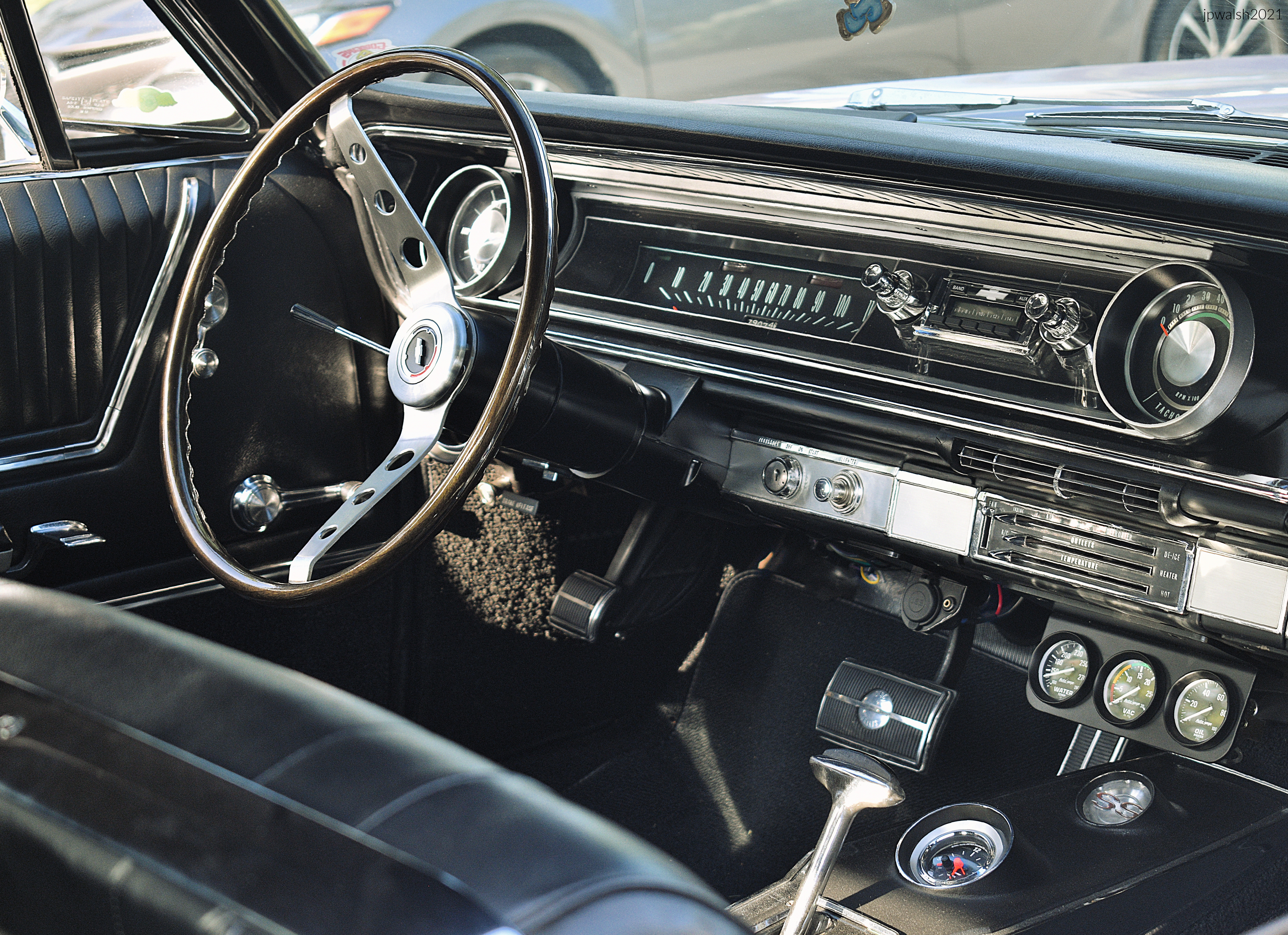
1965 Chevrolet Impala SS, Fourth Generation (1965-1970). From 1962 to 1964, Super Sports came with engine-turned aluminum trim which was used to fill the side moldings of the car. In 1965 this was replaced by a “blackout” trim strip that ran below the taillights. August 2021. 11.4 mb. Author’s photograph.

1965 Chevrolet Impala SS, Fourth Generation (1965-1970). At its debut in 1958, the Chevrolet Impala was distinguished from other models by its symmetrical triple taillights. By the late 1960’s, classic muscle or “big block” cars focused on smaller models. The last model year for the Chevrolet Impala Super Sport series was 1969. August 2021. 7.71 mb. Author’s photograph.

1966 Chevrolet Impala 2D Coupe. As cited above, from its debut in 1958, the Chevrolet Impala was distinguished by its symmetrical triple taillights. For the model year 1965 the Chevrolet Caprice was introduced as a top-line Impala Sport Sedan and later a separate series above the Impala in 1966. The Impala remained above the Chevrolet Bel Air and the Chevrolet Biscayne and continued as Chevrolet’s most popular full-sized model through the end of its initial production run in model year 1985. The 1966 Impala had a sexy sleek appearance with a 396 Turbo Jet that gave plenty of power and a smooth ride. May 2024. 89% 7.94mb Author’s photograph.

The 1966 Impala was a mild restyle of the 1965, featuring a new instrument panel, grille, wheel covers (except for SS models), and, instead of six round taillights, rectangular taillights that wrapped around to the side of the quarter panels. May 2024. 79% 7.85mb Author’s photograph.

Standard features on the 1966 Chevrolet Impala included lap belts front and rear, reverse lamps, day/night rearview mirror, and a padded dashboard. In a year of the introduction of the luxury Caprice and a slight redesign, sales plummeted compared to its record sales the year before. May 2024 97% 7.77mb Author’s photograph.
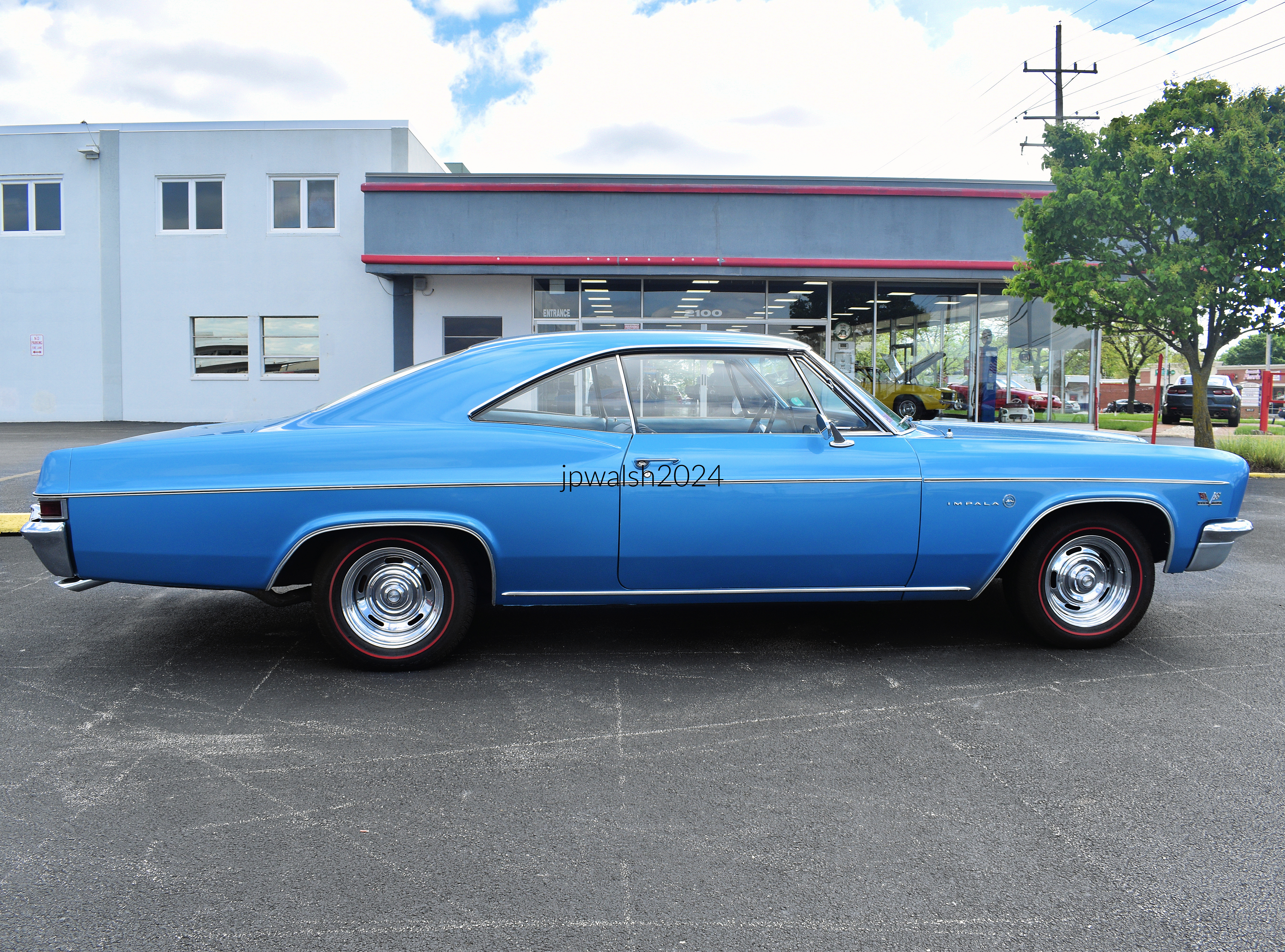
The 1966 Chevrolet Impala is nearly 18 feet long (213.2 inches). see –https://www.conceptcarz.com/s9332/chevrolet-impala-series.aspx – retrieved May 7, 2024. May 2024. 85% 7.56mb Author’s photograph.

1969 Chevrolet Impala. The 1969 models were unique in several ways. Disc brakes were optional in previous years and standard in 1969 joined to 15-inch wheels. This was also the only year that the cars had the name Impala anywhere on the body. May 2024. 84% 7.93mb Author’s photograph.

Nearly 40% of the Chevrolet’s entire production for 1969 (2,082,947) was the Impala (777,000) and topped Caprice production. see –https://www.conceptcarz.com/s24095/chevrolet-impala.aspx – retrieved May 8, 2024. May 2024. 90% 7.42mb. Author’s photograph.

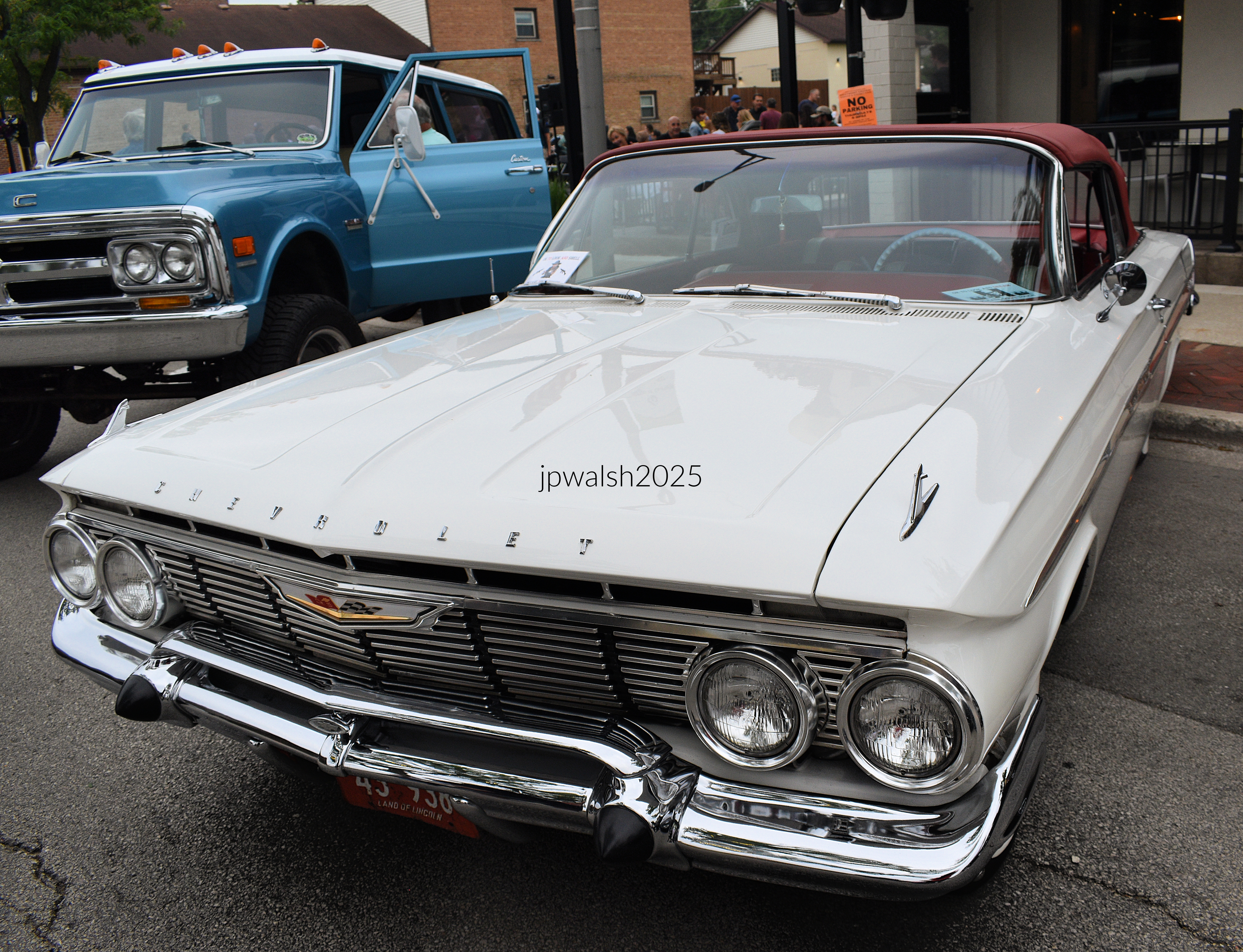
1970 Chevy Impala. September 2022. 67% Author’s photograph.

Chevrolet Impala Evolution: All Generations (1958–2020s) (https://www.youtube.com/watch?v=5Q-mu16nfvY) – retrieved April 27, 2026.

This explanatory article may be periodically updated.

My Street Photography. GENERAL MOTORS: CHEVROLET BISCAYNE (1958-1975).

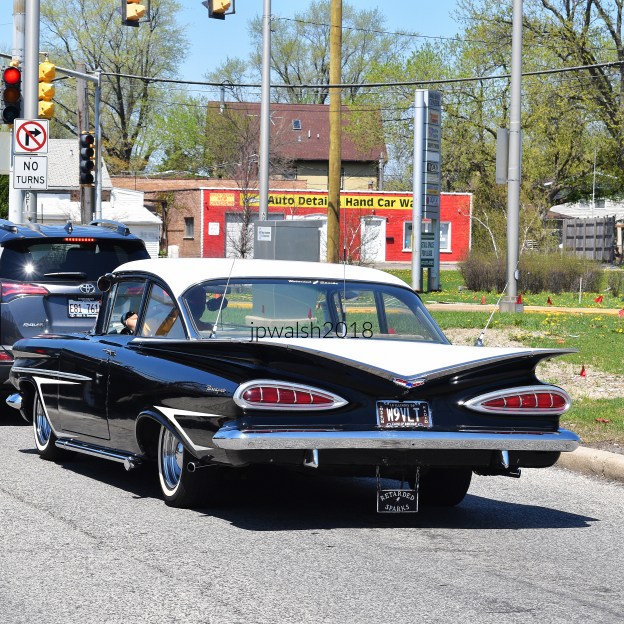
Feature Image: 1959 Chevy Biscayne, 7.89 mb, author’s photograph, May 2018.

In the 1950’s, American cars were noted for their V-8 engines, chrome, and tailfins of one kind or another. The late 1950’s was also marked by a recession which began in 1957 and continued into 1958 that led to a drop in car production in that period by nearly a third. “What is good for General Motors is good for America” could be true in 1950’s America when it was said, attributable to a 1953 Senate hearing, but its converse was also clearly the situation in the last years of that decade.

“From the Progress of the Past – the Promise of the Future.”

This was the tag line for General Motors that was celebrating its 50th anniversary in 1958. Many cars were painted golden to mark the “Golden Milestone.” It was the same year that the full-size Biscayne model made its first appearance. All Chevrolets in 1958 underwent an all-new “Sculptutamic Styling” that included the “gull wing” style fenders and twin taillights in the back of the Chevy Biscayne. The gull wing back extended along the body side to a “v” dip or gap. Another subtle styling addition was the quarter panel bulge between the rear wheel opening and the rear bumper. The Biscayne series replaced the Chevy 210 where the interior was made more colorful and instrumentation had a horizontal bias that, by 1959, was designed to be within easy sight of the driver. In 1958 Chevy introduced the X- shaped frame chassis and full coil suspension that provided greater stability that included 6-cylindar and V8 models, the 283 CID V8 replacing the 265 CID V8, with an optional 348 CID.

“Dollars never went further or bought longer lasting pride than in Chevrolet’s new Biscayne series for ’59.”

In 1959 General Motors – emulating a Chrysler corporate revamp in 1957 – redesigned the bodies of its entire fleet line so that many interior parts and some exterior parts were interchangeable on cars. In the process Chevy reshuffled their brands so that the Impala, that was a luxury option on the Bel Air in its first year in 1958, became Chevy’s own top-of-the-line brand in 1959. The Bel Air took the place of the Biscayne and the Biscayne in 1959 replaced the budget-priced Delray that was discontinued. Chevy Biscayne was produced in its second generation over two model years (1959 and 1960) and would be produced in five generations whose last model year was 1975.  

The 1959 Chevy: a.k.a. “Batmobile.”

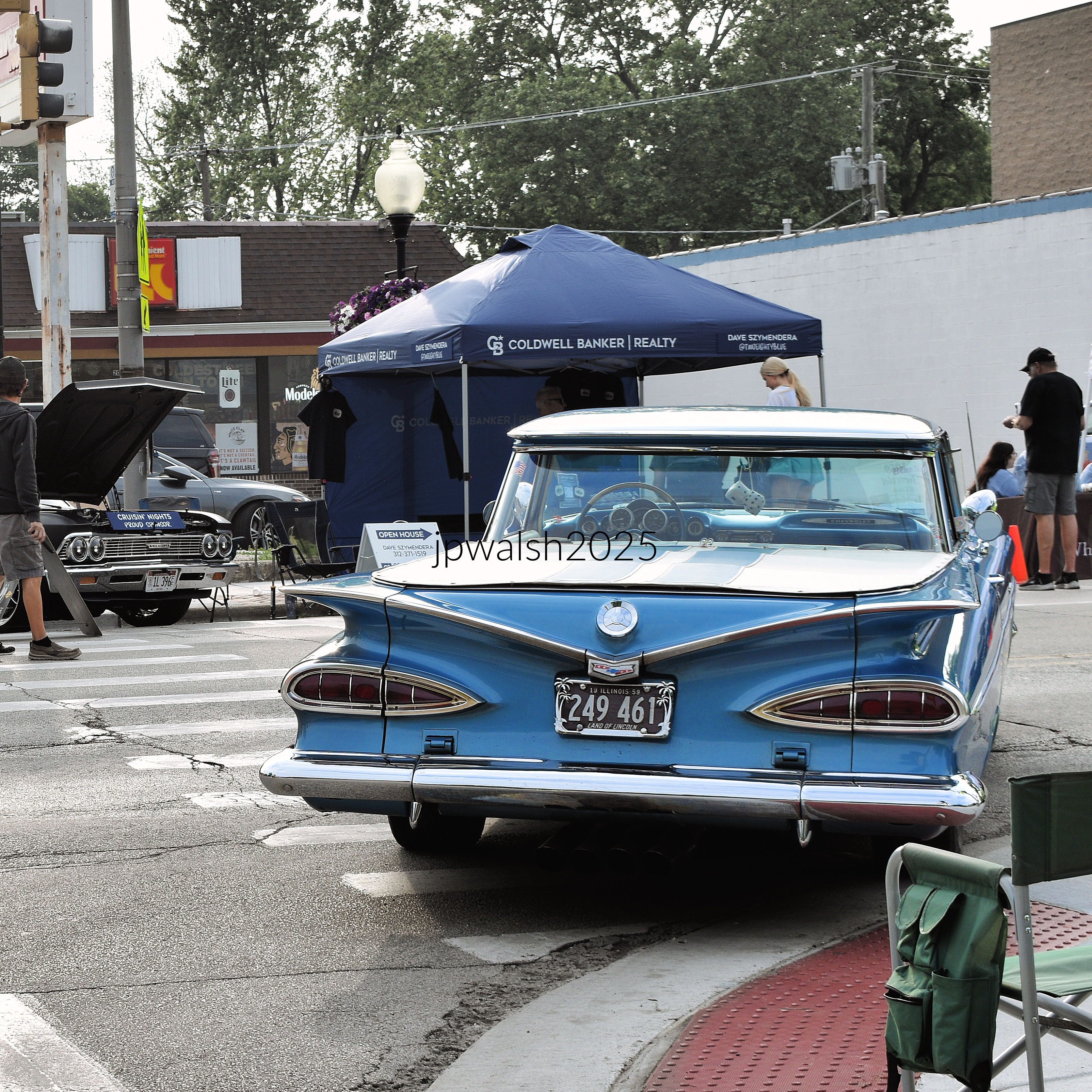
In 1959 the most remarkable design change was an enlarged windshield and rear window on all cars for greater driver visibility of the road and a “flat top roof.” The bodyside was characterized, at the front, by a slight crease at the turn signal which joined a gentle, sloping bodyside curve. The tail fin started at the rear of the front door that carried to the slightly higher back-end splaying in a “v” shape above the “teardrop”-shaped taillights. The design of the 1959 Chevrolet later came to be known as the “Batmobile” for its body design affinities, particularly the wing-shaped tailfins, and that was featured in the Caped Crusaders’ custom built “bat motif” vehicle during the popular ABC “Batman” TV series in 1966 to 1968.

Batmobile, rear view. With its ‘bat motif” wing-shaped tail fins, the 1959 Chevys, including the Biscayne, shared similarities with the Caped Crusaders’ custom built vehicle. PHOTO: “Batmobile, rear view” by KWH703 is licensed under CC BY-NC-SA 2.0.

Drag racing footage of what looks like a 1960 Chevy Biscayne. The Biscayne was introduced as a full-sized Chevrolet model in 1958 in tandem that year with the top-of-the-line luxury Impala. They joined the Bel Air which has been offered since 1950. These cars constituted about 85% of all Chevy sales in 1960. The Biscayne was the slightly lowest price model with a Biscayne 2-door hardtop like this one setting back the American consumer $2230 BASE MSRP (less than $25,000 in 2025) and weighing about 3500 pounds. https://youtube.com/shorts/7oJPm104q0Y?si=ytYL4v1ruWa2jDTx – retrieved November 30, 2025.

The Feature Image 1959 Biscayne represented over a quarter of all Chevy sales that year. Its main competition was the Ford Custom 300, Plymouth Savoy, and Rambler. The Biscayne featured nylon and vinyl upholstery, cloth headliner, dual sun visors, color-keyed floor coverings, two-spoke steering wheel, stainless steel trim on the windshield and rear window, tail fins, small hubcaps, and 7.50 x 14 BSW tires. In 1959 the average price of a Chevy Biscayne was $2, 383 ($26,597.88).

SOURCES:

J. “Kelly” Flory, Jr., American Cars, 1946-1958, McFarland & Company, Inc. pp. 855-857, 866-867, 870-871, 949.

J. “Kelly” Flory, Jr., American Cars, 1960-1965, McFarland & Company, Inc. pp. 23-24, 26.

This explanatory article may be periodically updated.

My Street Photography. GENERAL MOTORS: CHEVROLET CAPRICE (1965-1996).

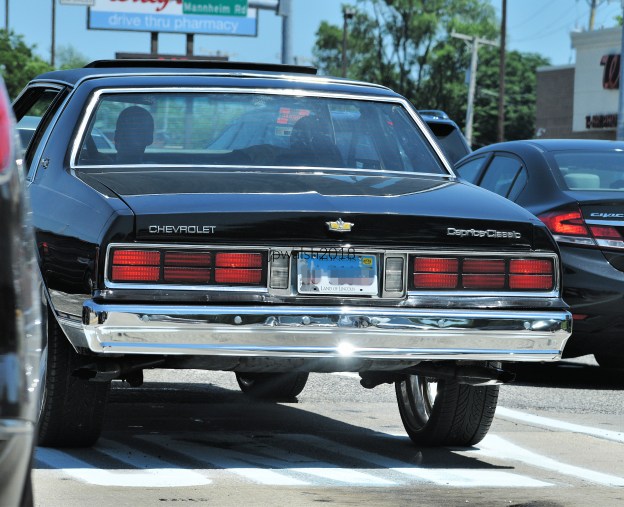
Feature Image: 1982 Chevy Caprice Classic. June 2018. Author’s photograph. 92% 7.79 mb.

Chevrolet had a golden year in 1965. Sales had not been that stellar since 1955. What a difference one model year makes. In 1966 Chevrolet took a beating from Ford mainly from Ford’s new sporty Mustang for which Chevy had no direct competition yet. The closest was the Chevy II V-8 with its front engine rear-wheel drive but it wasn’t sporty and became competition for Ford’s Falcon. Further headaches for Chevy included negative publicity from consumer advocate Ralph Nadar’s book “Unsafe at Any Speed,” published in 1965 that criticized the automotive industry for its safety record, focusing on the Corvair, particularly driver handling concerns with the rear-engine economy car. As Nader’s work led to the passage of the National Traffic and Motor Vehicle Safety Act in 1966, which mandated federal safety standards for vehicles, it impacted Chevrolet sales in the short term adversely. In 1966 the Chevrolet Full Size whose model lines included the Bel Air (1950), Biscayne (1958), and Impala (1958) that represented more than 70% of Chevrolet’s sales volume now included the bumped-up Caprice in 1966 as the new top of the line model. The Caprice, which started in 1965 as a luxury option to the Impala 4 Door Hardtop, became popular as its own model and competed with the Plymouth VIP and new Ford Galaxie 500 LTD.

“The New Chevrolet. We Made It Right For the ‘80s.” – Ad tag line in 1980 for Impala and Caprice Classic.

The Chevrolet Caprice is a full-size car produced by Chevrolet in North America for the 1965 through 1996 model years. Full-size Chevys were touted as “The New Chevrolet.”

By 1980 the full-size Caprice Classic received with the Impala (1958-1985) an exterior makeover to be more aerodynamic for fuel economy with all new sheet metal as it retained the same chassis and basic interior and exterior design and appearance. In the pursuit of reducing drag, the front fenders and hood were lowered and the back trunk lid and rear quarter were raised. The roofline was formalized and body sides were smoothed. A new grille insert was “egg crate” style that was 4 rows high and five times as wide. On behalf of better fuel economy, the weight of this streamlined Chevy Caprice was reduced by 100-150 pounds.

The 1982 model year was part of the Caprice’s Third Generation that went from 1977 to 1990. In 1982 the Caprice Landau Coupe was dropped with only the three-seat Caprice Wagon, Sports Coupe and Four-Door Sedan offered. Both the two-door six -passenger V6 Sports Coupe and Four Door Sedan had an optional V8 engine. The Sports Coupe listed for $8,221– $8,291 (about $27,479.52 today) while the Four Door Sedan listed for $8,367 – $8,437 (about $27,967 today). Fully loaded options inside and out could add over $3000 ($10,000 today). In 1980 the Impala and Caprice Classic amounted to over 25% of Chevy’s sales volume. Caprice featured specific triple unit taillights, bright roof trim moldings, stand up hood ornament, and full wheel covers along with an interior velvet-look knit cloth or all-vinyl front bench seat, fold down center armrest (4-doors only), front door pull straps and lower door panel carpeting, electric clock, and extra acoustical insulation and courtesy lights.  

SOURCES:

See – https://www.capriceclassic.com/onamarie.geo/chevy1982.html – retrieved July 17, 2025.
J. “Kelly” Flory, Jr., American Cars, 1966 to 1972, McFarland & Company, Inc. pp. 32-33; 38-39.
J. “Kelly” Flory, Jr., American Cars, 1973 to 1980, McFarland & Company, Inc. pp. 798-800; 809-810.

This explanatory article may be periodically updated.

My Street Photography. GENERAL MOTORS: CHEVROLET CORVETTE  (1953-).

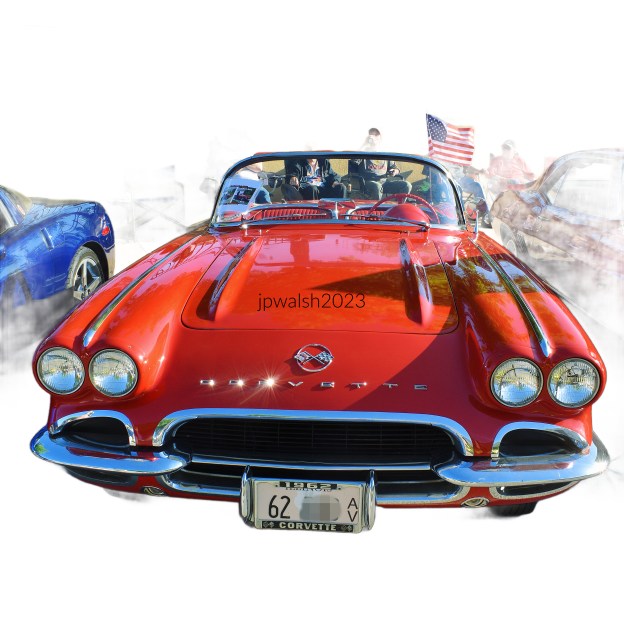
Feature Image: 1962 Corvette. Advertising in 1962 included the tag line: New power. New profile for America’s sports car! May 2023. 4.20mb DSC_2074 (1). Author’s photograph.

While in 1962 Chevrolet was focused on its competition with Ford Motor Company in compact cars (Chevy Corvair; Chevy II), there was a big change in 1962 under the hood for the sporty Corvette. A 250 h.p,, 327-cid V8 engine came standard and was an option on full-sized Chevys as well. The engine was more powerful and weighed no more than its 283 predecessor on which it was built. The 327-cid V8 engine was so efficiently made that with fuel injection it increased to 375 horses under the hood.

1962 Chevrolet Corvette. July 2022. 96% 7.89 mb DSC_6582 Author’s photograph.
1962 corvette July 2022. 88% 7.92mb DSC_6581 Author’s photograph.
1962 Corvette May 2023 92% 7.90 DSC_2078 Author’s photograph.
1962 Corvette. May 2023. 82% 7.90mb DSC_2076 Author’s photograph.
1962 Chevy Corvette August 2025. 7.66mb DSC_4553. Author’s photograph.

The Corvette originated in 1953 and in its first generation introduced a new body for the 1956 model year that featured a revised front end and side coves that continued through the 1962 model year. The first generation Corvette was equipped with deep contoured bucket seats, deep pile carpeting, and complete instrumentation. In 1962 the two -door convertible Corvette listed for $4,038 ($43,129.18 in 2025 dollars).

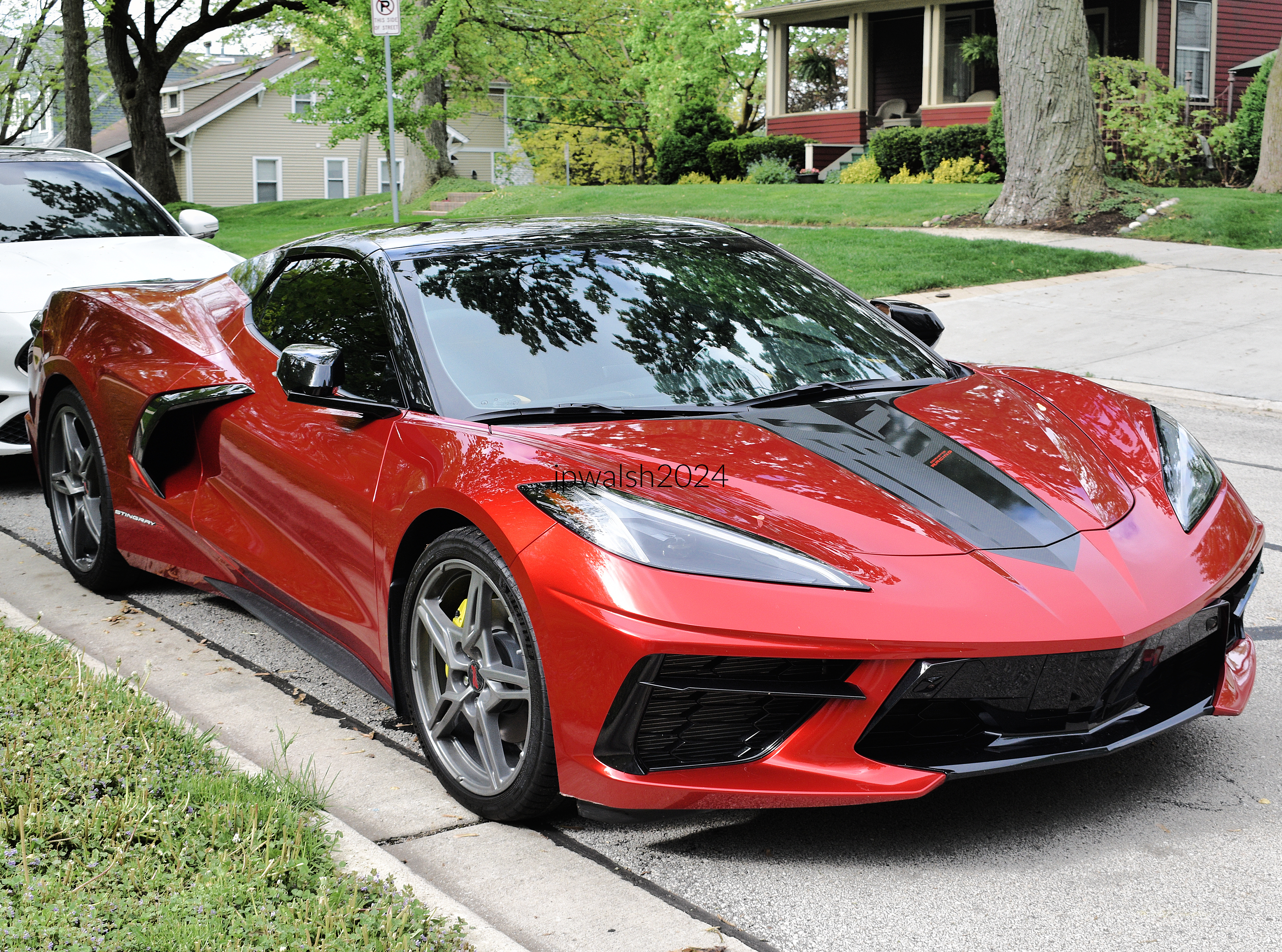
2023 Chevrolet Corvette Stingray, May 2024. 7.93mb DSC_5381 Author’s photograph.

Since the 2020 model year the Chevrolet Corvette Stingray is in its eighth generation. The sports car is assembled in Bowling Green, Kentucky. The 8th generation Corvette introduced GM’s first rear mid-engine since the Pontiac Fiero was discontinued in 1988. The engine has two radiators, one on each side in the front and offers an 8-speed dual-clutch automated transmission which is the first time Corvette offered a no manual transmission option since model year 1982 (third generation). The C8 features a new design from previous Corvettes with aluminum architecture, coil-over springs and more aggressive aerodynamics such as bigger air intakes and prominent side scoops. The base price for the 2023 1LT coupe was $65,595 and $70,795 to $73,095 for the 1LT convertible. – https://www.motorauthority.com/news/1136183_2023-chevy-corvette-price-increases-again-this-time-by-2-300 retrieved April 9, 2025. 

1970 Chevrolet Corvette Stingray. September 2023. 87% 7.76mb.Author’s photograph.

In 1970 the advertising pitch line for the Corvette was People have the idea you can tell what cars of the future will be like looking at Chevrolet’s Corvette. They’re right. Well, the future is here and unfortunately cars on the road in 2025 don’t look much like this gem of classic sports car. Major standard equipment in the 1970 Corvette included all-vinyl bucket seats with full-length center floor console, complete instrumentation, Astro ventilation, removable roof panels on the coupe and manually operating folding top on the convertible, 4-wheel disc brakes and F70x 15 WSW tires and wheels with trim ring and ribbed center hub. In 1970 a Corvette 2-Door-Coupe set the customer back $5,192 ($43,228.48 in 2025 dollars).

1965 Corvette. September 2014. 3.74 mb Author’s photograph.

From rubber to roof, still America’s true sports car. In a league all its own, the Corvette was in the midst of its second generation in 1965. It was the same year that saw the introduction of the popular Ford Mustang. There were only minor trim changes from the year before including tweaking the hood design, sill moldings and a new grille. For the $4,022 Base MRSP ($41,247.59 in 2025 dollars) major standard equipment included bucket seats, cockpit cluster console, walnut-like steering wheel, full carpeting, complete instrumentation, manually operating folding top and 6.70 x 15 BSW tires.

2016 Chevy Corvette. May 2022 7.92 mb 82% Author’s photograph.

The 2016 Corvette is 7th generation. By the 2000’s the 50 year old Corvette was increasingly viewed as a car purchased by the older buyer (55 years and up). Though in development since 2007, the Corvette 7th generation was delayed until the 2014 model to make the classic sports car more appealing to younger buyers including a design that kept production costs lower. The new generation Corvette in 2014 started using the “Stingray” name again which started in 1963 and was discontinued in 1976. Whereas the 1965 Corvette Stingray weighed less than 3,000 pounds (2,980) the C7 was almost 15% heavier at 3,444 pounds. For 2017 model year Chevrolet also re-introduced the Grand Sport (GS) model that cost $66,446 (87,570.36 in 2025 dollars). “2017 Corvette Grand Sport Priced at $66,445”media.gm.com (Press release).

2001 Chevy Corvette. April 2025. 5.89mb DSC_9337 (1) Author’s photograph.
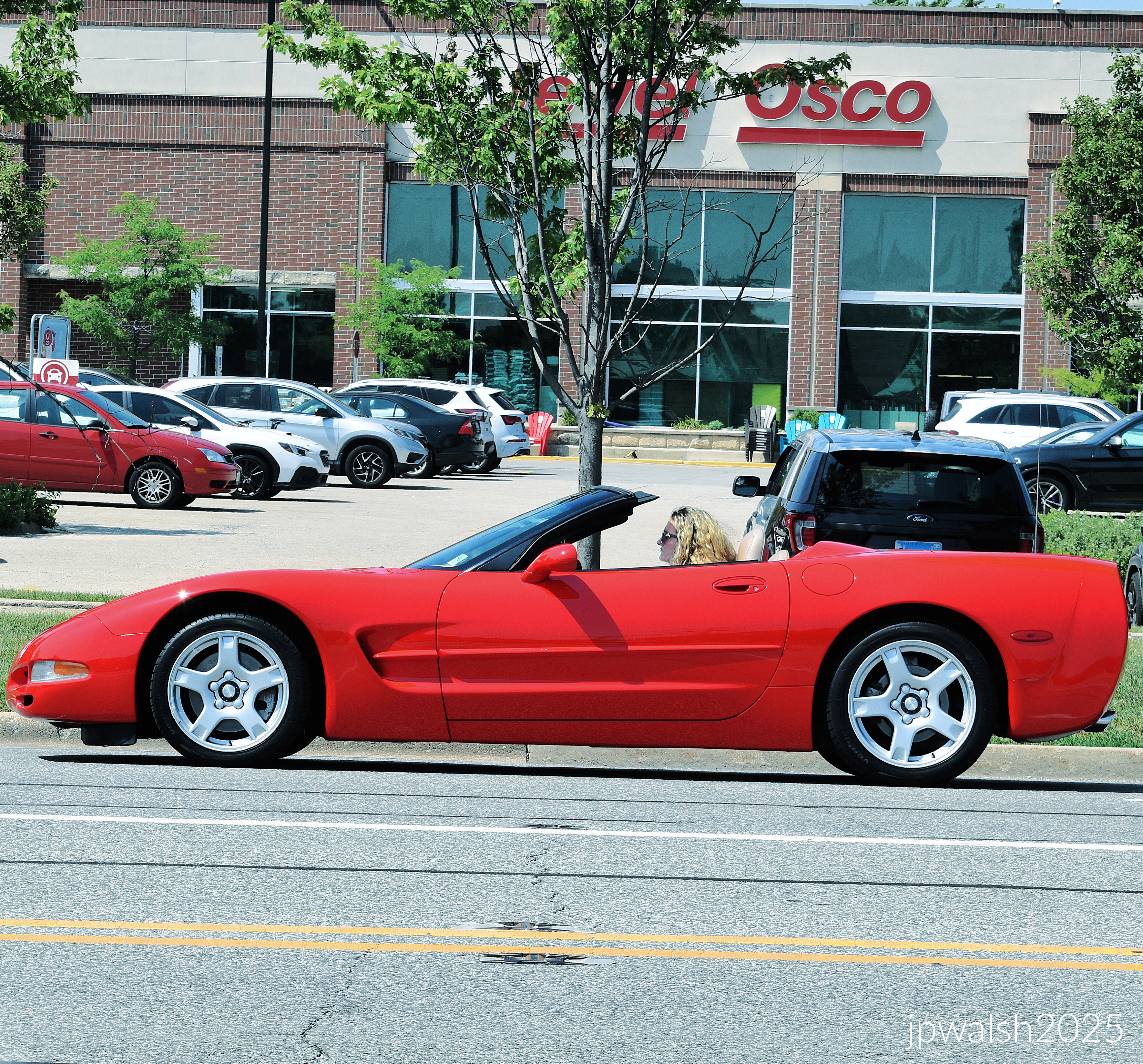
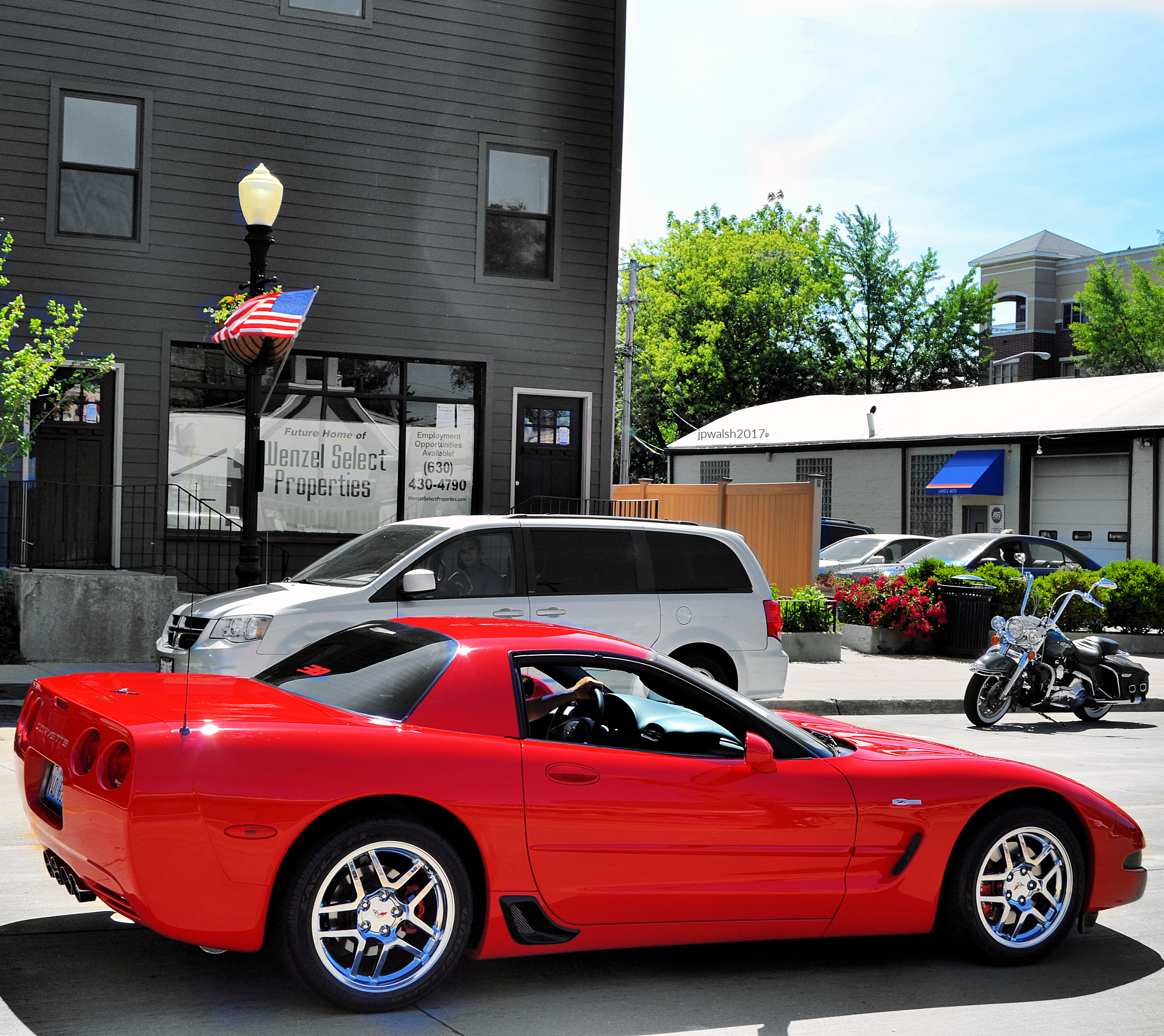
1999 Chevrolet Corvette Convertible in Torch Red. July 2025. 99% 7.63mb DSC_3802 (1) Author’s photograph.

The two cars above and the one below are all C5 (5th Gen) Chevrolet Corvettes produced between 1997 and 2004.  The base-model Chevrolet Corvette C5 includes a 5.7-liter V8 LS1 engine that from 1997 to 2000 produced 345 horsepower and 350 lb-ft of torque. For 2001, Chevrolet revised the LS1, raising output to 350 horsepower and up to 365 lb-ft of torque, a specification that carried through the end of C5 production in 2004. The C5 is equipped with a 4-speed automatic or 6-speed manual transmission and includes rear wheel drive.

2000 C5 Corvette. April 2026. 83% 7.95mb DSC_4179 Author’s photograph.
2014 Corvette Stingray. October 2015. 3.54 mb Author’s photograph.

A green premium edition 2014 Chevrolet Corvette Stingray (C7 generation) with chrome wheels and a carbon fiber hood. The model is powered by an all-new 6.2-liter LT1 V8 engine with 455 horsepower and 460 lb-ft of torque. Active Fuel Management is a feature that allows cylinder deactivation so that the engine can run as a 3.1-liter V4 under light loads to improve fuel efficiency.

2020 Chevrolet Corvette Stingray. June 2022. C7.66 mb 74% Author’s photograph.

Available in 1LT, 2LT, and 3LT trim levels, it offers a 6.2-liter V8 engine producing 490-495 horsepower. 

2003(?) Chevrolet Corvette. June 2017. 3.08 mb Author’s photograph.

Torch Red Chevrolet Corvette Z06, 2001-2004, C5 generation. Powered by a 5.7-liter LS6 V8 engine that produces 405 horsepower paired with a 6-speed manual transmission.  Distinguishing features include a fixed-roof coupe design, functional rear brake cooling scoops, and lightweight alloy wheels.

SOURCES:

J. “Kelly” Flory, Jr., American Cars, 1960 to 1965, McFarland & Company, Inc. pps. 155-156; 352, 357-358; J. “Kelly” Flory, Jr., American Cars, 1966 to 1972, McFarland & Company, Inc. page 338.

This explanatory article may be periodically updated.
My Street Photography. GENERAL MOTORS: BUICK GS455 (1970-1972).

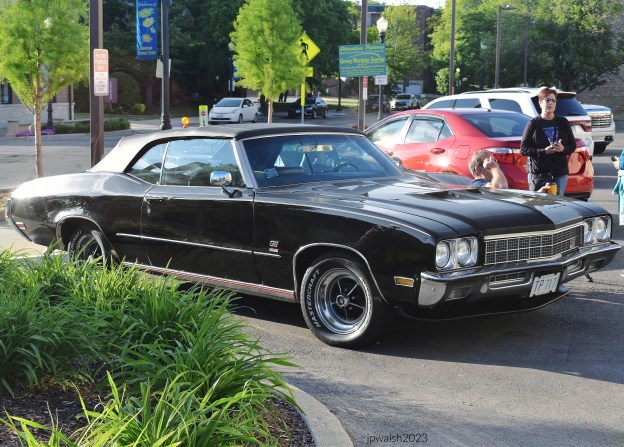
Feature Image: May 2023. 1971 Buick (Gran Sport)GS455 Convertible 7.72 mb 73%

Wouldn’t you really rather have a Buick? 1971’s advertising tag line for this GM American automobile maker.

The GS 455 was an option to the base GS during the 1971 and 1972 model years. The GM A-body platform was the base for many iconic American cars including Buick. Approximately 81 GS 455 Stage 1 convertibles were produced for the model year. Just as manufacturers were producing some of the most desirable muscle cars of all time the U.S. government required unleaded gasoline that reduced these machines’ power (compression). Due to these government mandates starting for 1971, the advertised power of the car’s 455ci V8 with a single four-barrel carburetor and factory-rated 345 horsepower and 460 lb-ft of torque dropped variously at installation. The GS 455 engine was the same basic big-block that had been introduced in the 1970 model year. The Stage 2 version of the 455 did not go much further than Stage 1 and there was about the same number produced as Stage 1 though aftermarket did take things further. GS buyers could choose between automatic or manual transmission. The Turbo Hydra-matic had an option of column-mounted lever or full-length center console. Manual was a 3- or 4-speed floor-shift stick. The 1971 Buick GS 455 convertible is one of the rarest of Buick muscle cars. Major standard equipment exclusive to the GS included dual exhausts, functional hood air scoops, and heavy duty springs, shocks and stabilizer bar. In 1971, total GS 2-Door Convertible production was 902 vehicles with a base MRSP of $3,476 ($27,726.29 in 2025 dollars). In 2025 the Buick GS 455 had an average resale price of $52, 250.

SOURCES: See – https://bringatrailer.com/listing/1971-buick-gs-9/ https://www.classic.com/m/buick/gran-sport/455/year-1971/
https://www.hemmings.com/stories/1971-72-buick-gs-455/ https://classiccarsbay.com/for-sale-1971-buick-gs-455-in-mooresville-north-carolina-49118 – retrieved August 30, 2025.
J. “Kelly” Flory, Jr., American Cars, 1966 to 1972, McFarland & Company, Inc. pp. 396-399.

This explanatory article may be periodically updated.

My Street Photography. GENERAL MOTORS: CHEVROLET CAMARO (1967-2002; 2010-2014).

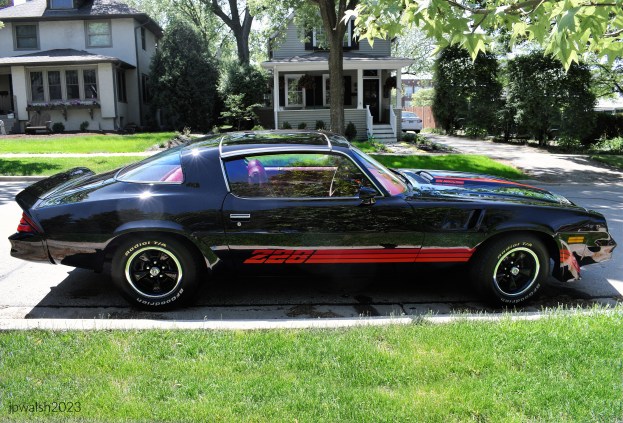
Feature Image: 1979-1981 Chevrolet Camaro Z28 (Details in post). May 2023. 7.72 mb 66%. Author’s photograph.

1979-1981 Chevrolet Camaro. May 2023. 7.74 mb 88% Author’s photograph.

Interior packages included cloth and custom cloth, and vinyl and custom vinyl. In 1980 the five interior colors included oyster, black, blue, carmine and tan. In 1981 the five interior colors changed to silver, black, blue, camel and red. In 1980, to save gas during the gas crisis, the car’s 130-mph speedometer was reduced to an 85-mph speedometer. See – https://mikeduman.com/blog/history-z28https://www.caranddriver.com/news/a43578551/2025-chevrolet-camaro-z28-future-cars/https://www.hemmings.com/stories/article/1980-81-chevrolet-camaro-z-28 – retrieved May 22, 2023.

1979-1981 Chevrolet Camaro (above). The name Z/28 was introduced by General Motors in December 1966. In 1967 to 1969, Chevrolet continued to improve the car’s list of engine and performance options. The year 1970 introduced Gen II in a new Camaro design. In 1982 the car was redesigned again marking Gen III. There have been more redesigns over the decades with Chevrolet announcing that production of the Gen VI Camaro would officially end in December 2023, with the 2024 model year serving as the final run and the Z/28s with it.

Classic muscle car.

Among debates about classic muscle cars, none gets hotter than the Chevrolet Camaro versus the Ford Mustang. With the exception of the 6.6-liter Trans Am, the Z/28 represents the best Detroit had to offer in the early 1980s, and an excellent entry point. A great car with its own ups and downs as its model developments moved ahead, the Camaro Z/28 at the outset was known for its good looks and sleek, crisp styling. It hugged the road and moved fast with superb handling. By 1980, the standard wheel cover was matched by a rear deck spoiler and hood and deck stripes and, soon, a front spoiler to reduce drag. The 1980 models were the last that offered the quintessential muscle car power-train combination-a 350-cu.in. V-8 with four-speed transmission. The loaded Z in 1981 would cost around $12,000 (or $40,000 in 2023 dollars). The Z/28 was 197.6 inches long and rode on a 108-inch wheelbase. It stood at a height of 49.2 inches and was 74.5 inches wide. The body was all steel. Author’s photograph. May 2023. 7.72 mb 66%.

2018 Chevrolet Camaro 2LT Coupe. Author’s photograph. June 2024. 73% 7.83 mb 8246

2011(?) Chevrolet Camaro. Author’s photograph, June 2017. 4.19 mb

2010 Chevrolet Camaro. The Chevrolet Camaro is a pony car that began production in model year 1967. It ceased production in model year 2002 in its Gen IV. Starting in 1993 the iconic American car was produced exclusively in Canada in Sainte-Thérèse, Quebec. In 2008 GM faced a severe liquidity crisis, having lost over $30 billion in 2008. In 2009 Chevrolet restarted its Camaro production in Gen V that was built exclusively in Canada though shifted to Oshawa, Ontario. Then-GM Chairman and CEO Rick Wagoner said about his Canadian-made car: “Camaro is much more than a car; it symbolizes America’s spirit and its love affair with the automobile.” That same year the Obama administration demanded he resign for GM to receive a massive taxpayer-funded federal bailout. Without this federal assistance, the company was expected to go into liquidation, which officials estimated would cost more than one million jobs. The total bailout for General Motors and Chrysler amounted to approximately $80 billion, with the government taking a majority stake in GM during the process to guide its reorganization. The 2010 Camaro became the model’s best seller (81,299 units) since 1995 (122,738 units). The first half of the 2010s was a renaissance for Camaro though its heyday remained the late 1960’s and 1970’s. The 2010 Camaro was intentionally designed and produced along the lines of the 1969 model and is almost identical to the car’s original concept. The original MSRP for a 2010 Chevrolet Camaro ranged from $22,680 ($33,187.71 in 2025) for the LS coupe to $33,945 ($49,671.82 in 2025) for the 2SS coupe. Author’s photograph. April 2025. 7.16mb DSC_8471

1998(?) Chevrolet Camaro SS. The Chevrolet Camaro SS model is equipped with a 6.2L LT1 V8 engine and offered as a 6-speed manual and 8-speed automatic. The SS is capable of 455 horsepower and 455 lb.-ft. of torque, performing a 0-60 in 4.0 seconds. Author’s photograph. May 2018. 7.39 mb

May 2023. 1969 Chevrolet Camaro Z28. 7.85mb 98%

This explanatory article may be periodically updated.

My Street Photography. GENERAL MOTORS: CHEVROLET NOVA (1962-1979; 1985-1988).

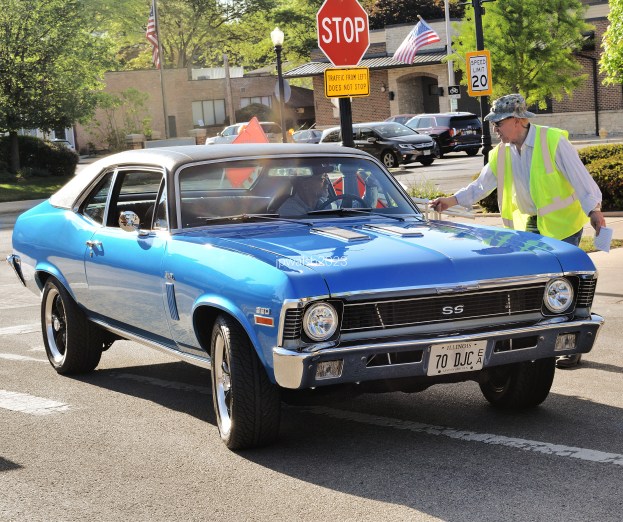
Feature Image: May 2023. 1972 Chevrolet Nova SS. 7.82mb 80%. Author’s photograph.

Building a better way to see the U.S.A. was Chevy’s 1972 advertising tag line. Nova’s ad tag line in 1972: How to see less of you mechanic and more of America.

In 1972 there were labor strikes in GM assembly plants that severely impacted production of popular brands (Camaro; Pontiac Firebird) and delayed other model redesigns and rollout plans into 1973. New government regulations on car manufacturers also adversely impacted production schedules. The Chevrolet Nova was assembled in the same plant as Camaro that sat idle for six months. Both cars were saved that year because of enterprising Chevrolet executives who moved their production to other plants. Despite these challenges, Chevrolet became America’s best-selling car brand again in 1972 and Nova sales in particular were excellent.

The Chevrolet Nova was produced in four generations from 1962 to 1979 and in a fifth generation from 1985 to 1988. It was the top trim level for the new Chevy II compact whose inception was to counter the popular 1960 Ford Falcon. The SS package was introduced by Chevrolet for 1963. By 1969 Chevy dropped the Chevy II nameplate and Nova become the nameplate throughout the 1970’s. The car’s growing engine capacities in the mid 1960’s was cut off by Chevrolet for what would be their premier muscle car, the Chevy Camaro, in 1967. With the Chevy II/Nova third generation beginning in 1968 Chevrolet introduced an all-new compact with contemporary semi-fastback styling that continued to 1974. It was with this generation that the car was simply called “Nova.” As a muscle car, Nova’s history ended in 1973 when the SS package was limited to appearance options and a jacked-up heavy-duty suspension although the car could be combined with a 175-horsepower 350. In 1972 major standard equipment for the Nova included cloth and vinyl bench seat, deluxe steering wheel. hub caps, front-door vent windows, bright moldings on the windshield and rear window, manual drum brakes, vinyl-coated rubber floor tires and E78-14 wide whitewall tires. The Base MRSP on the 2- Door Coupe was $2,351 ($18,169.52 in 2025 dollars). The 4-Door Sedan was $2,379 ($18,385.91 in 2025 dollars). Starting in mid-1971 the Rally Nova option was introduced that was basically an appearance option though it included heavy duty front and rear suspension (RPO-F40) which could be mono-leaf or multi-leaf in the rear.

July 2022. 1972 Chevy Nova SS 350 5.53mb DSC_6546. Author’s photograph.

SOURCE:
https://cokertire.com/tires/e78-14-coker-classic-2-3-8-whitewall-tire.html?srsltid=AfmBOopDvzpu_2cdKTJYosN-5STf4twvFZE5PXmIzNGnWjXnK5P8ZXM2 – retrieved Aug. 30, 2025.
https://en.wikipedia.org/wiki/Chevrolet_Chevy_II_/_Nova – retrieved August 8, 2022.
J. “Kelly” Flory, Jr., American Cars, 1966 to 1972, McFarland & Company, Inc. pp. 485-486; 490.

This explanatory article may be periodically updated.

My Street Photography. GENERAL MOTORS: CHEVROLET DELUXE (1941-1952) and CHEVROLET 210 (1953–1957).

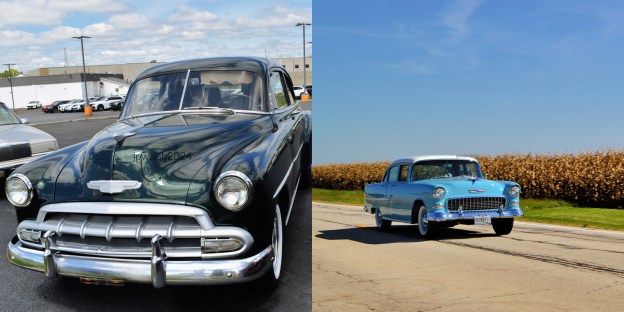
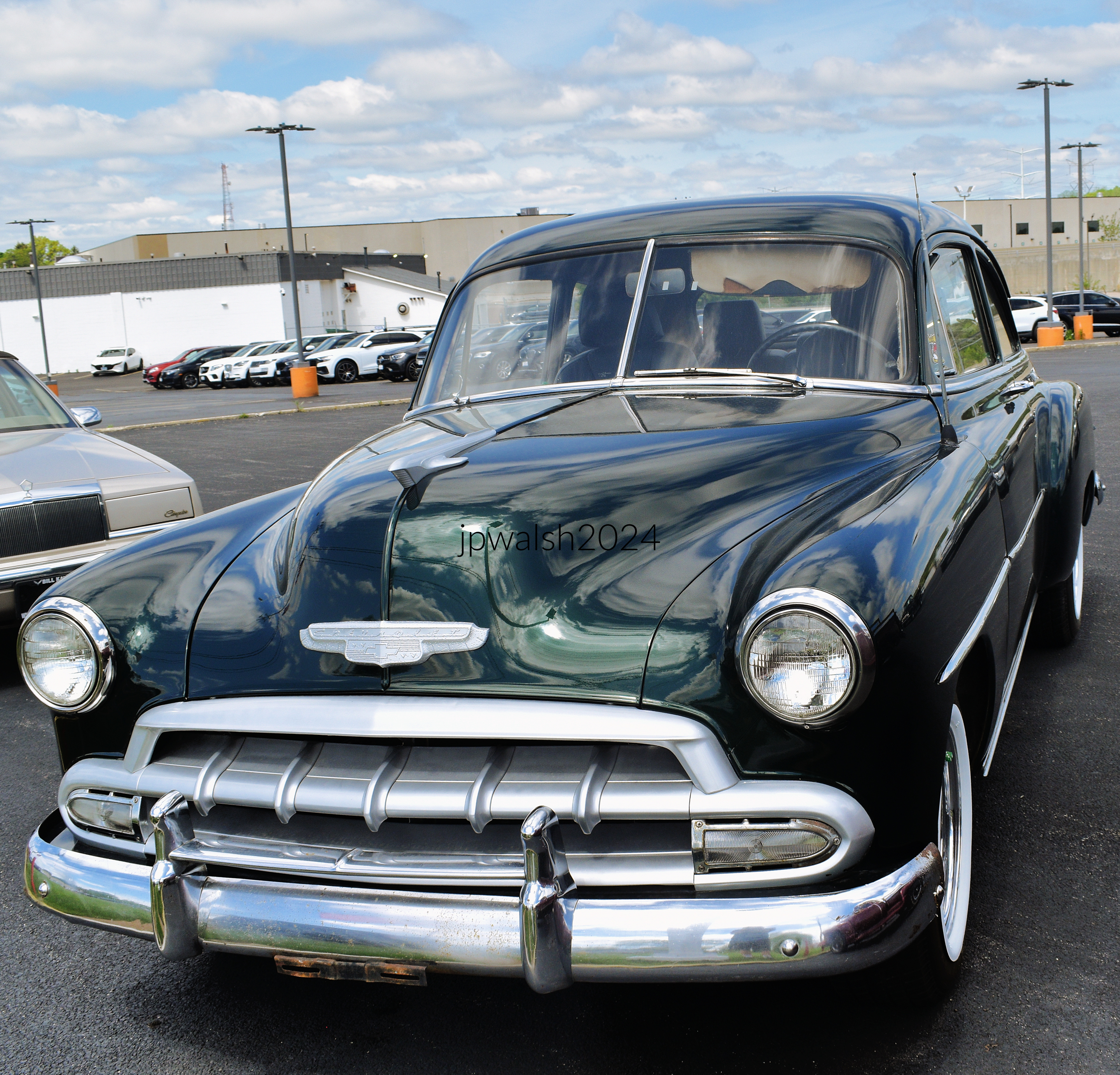
Feature Image: The buyers for the Chevrolet Deluxe (’41–’52) (left) and the Chevrolet 210 (’53–’57) (right) were cut from the same cloth — folks chasing that sweet spot of affordable style without stepping into full‑blown luxury. The 210 picked up right where the Styleline DeLuxe left off, sliding into Chevy’s mid‑range slot between the bare‑bones 150 (formerly the Special) and the flashier, top‑shelf Bel Air. Both the Styleline Deluxe and later the 210 played the same role: the step‑up car for families and everyday drivers who wanted something nicer than the entry-level model. They delivered a blend of clean looks, decent comfort, and approachable pricing, making them the go‑to choice for anyone wanting a little class without breaking the bank.

Chevy Deluxe.

The Chevrolet Deluxe is a trim line of Chevrolet automobiles that was marketed from 1941 to 1952. The car model was the volume sales leader for the market during the 1940s. The Chevy Deluxe was especially prevalent in the early 1950s as a mid-tier option, focusing on efficiency and often used for basic, reliable family transportation. It was commonly seen as a four-door sedan or stylish coupe in the 1950-1952 years.

1951 Chevy Deluxe. May 2024. 5.45mb DSC_5540 (1). Author’s photograph.

Chevy 210.

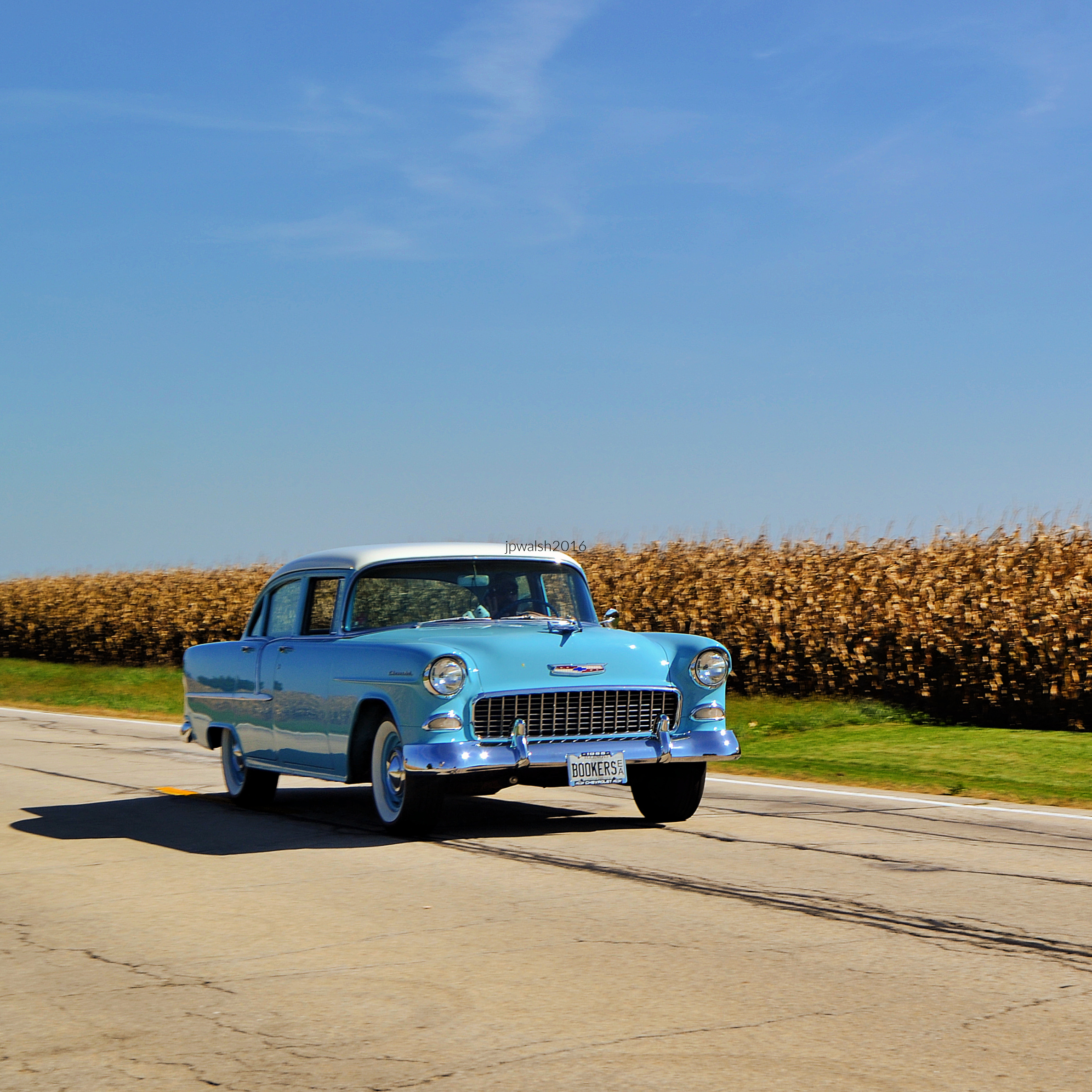
1950s Chevy 210. October 2016. 1.92 mb Author’s photograph.

The Chevy 210 ((shorthand for the 2100 series) arrived in 1953 like a fresh coat of chrome on a familiar silhouette, stepping in for the old Styleline Deluxe but carrying the spirit of the era forward. Where the Deluxe had been a dependable, no‑nonsense cruiser of its day, the 210 felt like the moment when Chevy let a little more pride slip into the sheet metal — cleaner lines, brighter trim, and the sense that families were starting to dream bigger on the open road. The 210 flashed more chrome, sharper interior trim, and that modern “wraparound” look that defined the ’55–’57 Chevys — a big step up from the cleaner, simpler lines of the early‑’50s Deluxe.
Through its 1953 to 1957 run, the 210 became the car you remember from faded snapshots: two‑tone paint catching the sun, bench seats that smelled like summer, and engines with just enough extra muscle to make a Sunday drive feel like something. Compared to the earlier Deluxe, it wasn’t just better equipped — it belonged to a more hopeful, more stylish moment in American motoring. The 210 series could be equipped with more powerful engines, such as the 265 and 283 cubic inch V8s by 1957. The 210 was Chevrolet’s best-selling model in 1953 and 1954.

1954 Chevrolet 210. September 2021. 6.23 mb. Author’s photograph.

This explanatory article may be periodically updated.