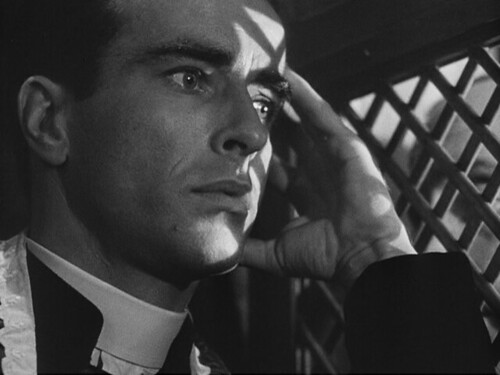
In I Confess, a 1953 film noir by Alfred Hitchcock (1899-1980) from Warner Bros., a Catholic priest, Fr. Logan (played by Montgomery Clift) hears the confession of a man who works in the rectory and just killed another man.
That killer had been dressed as a priest and, among other circumstances, points to Fr. Logan as the primary suspect for the police Inspector (Karl Malden) and prosecutor (Brian Aherne) for the murder of Villette, a prominent lawyer.
Because of the seal of confession – that is, when a person confesses his sins to a priest in Confession, the priest must maintain absolute secrecy about anything that the person confesses – Fr. Logan does not and cannot under any circumstances divulge the identity of the confessed killer though he (and the audience) knows it.
Even after Fr. Logan is arrested for the crime and put on trial for murder for it, the priest does not reveal the identity of the killer but only protests for his own innocence.
Hitchcock’s black-and-white film was shot by cinematographer Robert Burks (1909-1968) who would later shoot Hitchcock’s The Birds in 1964. It is edited by German-born Rudi Fehr (1911-1999) who in 1954 edited Hitchcock’s triumphant color feature, Dial M For Murder.
The story in I Confess was based on a 1902 play by Paul Anthelme Bourde (1851-1914), a French journalist who coined the term “decadent” for the avant-garde when he called indecipherable poets such as Symbolist Stéphane Mallarmé (1842-1898) one in the late 19th century.
The film follows the play which is about a killer who confesses to a priest knowing his crime cannot be betrayed. To complicate matters further, the killer blackmails the priest for a long-ago love affair he had with Ruth Grandfort (Anne Baxter), the wife of a leading citizen, and who still loves him. For the priest, the love affair is in the past though for Mrs. Grandfort it is not.
This work is in the public domain in the U.S. because it was published in the U.S. between 1927 and 1977, inclusive, without a copyright notice.
Clearly, for Hitchcock in I Confess, the priest in this situation is a highly curious figure. By the end of the film, it becomes clear that the seal of confession is a cross for the priest because of his priesthood – and though sins do not always deal with high crime – demonstrates the personified sacramental nature of self-sacrifice that is involved for the priest with each confession he hears. Throughout the film, Fr. Logan is a tragi-comic figure as he simply does not state the obvious of who the murderer is on behalf of social justice and his own innocence, but equally personifying the religious nature of living with and taking on another’s sin particularly when a person refuses their own responsibility and makes amends for it. In I Confess, the murderer has no intention of turning himself in and is content to let the priest under seal of confession take the rap in the courtroom of the law and public opinion.
Fr. Logan never impedes law enforcement’s investigation. He continually states his own innocence for which a jury of his peers is brought in to decide what to believe.
The sin of commission/omission – and in I Confess it is for and surrounds the gravity of murder – remains with the impenitent Otto Keller (O.E. Hasse) although his loving wife, Alma (Dolly Hass), to whom Keller confessed the crime outside confession’s seal, cannot abide by his secret.
If, despite the seal of confession, crimes can be revealed to government investigators then the sanctuary of the law of the cross is extricated to get at evil – which is not contradiction nor improvement to the confessional box (the priest may ask the penitent for a release from the sacramental seal to discuss the confession) but its obligatory public replacement. As there is often no transparency and plenty of state secrets in and around various government agencies, this becomes no less problematical than breaking down a Catholic (and Lutheran) church’s confessional door as well as, in the United States, violating the free exercise of religion (the First Amendment).
Although found “not guilty” for lack of evidence to convict, the presiding judge expresses his disbelief in Fr. Logan’s innocence. When Fr. Logan exits the court building, he is followed and faced by a hostile crowd – “Preach us a sermon, Logan!” The prosecutor, as he watches the ugly scene from his office above, is forced to lament his actions: ”Do you think I enjoyed it?” he says, washing his hands. After Fr. Logan is crashed into a car window in the crowd, Alma, Keller’s wife, (her name means “soul”) rushes in towards the priest to tell what she knows – and which an accompanying police guard relates to the Inspector – “She said he was innocent.”
Considered Hitchcock’s once most Catholic of films, I Confess is a tight drama with a truly despicable villain, whose murderous rampages continue. The film is ahead of its time in terms of direction – presaging some of the camera angles, editing, pacing and themes of international crime and psychological dramas that would come to greater fruition in the decades ahead.
An online search by title at the US copyright office yielded no copyright renewal. In the absence of renewal of the US copyright, this poster art entered the public domain 28 years after its US publication date.
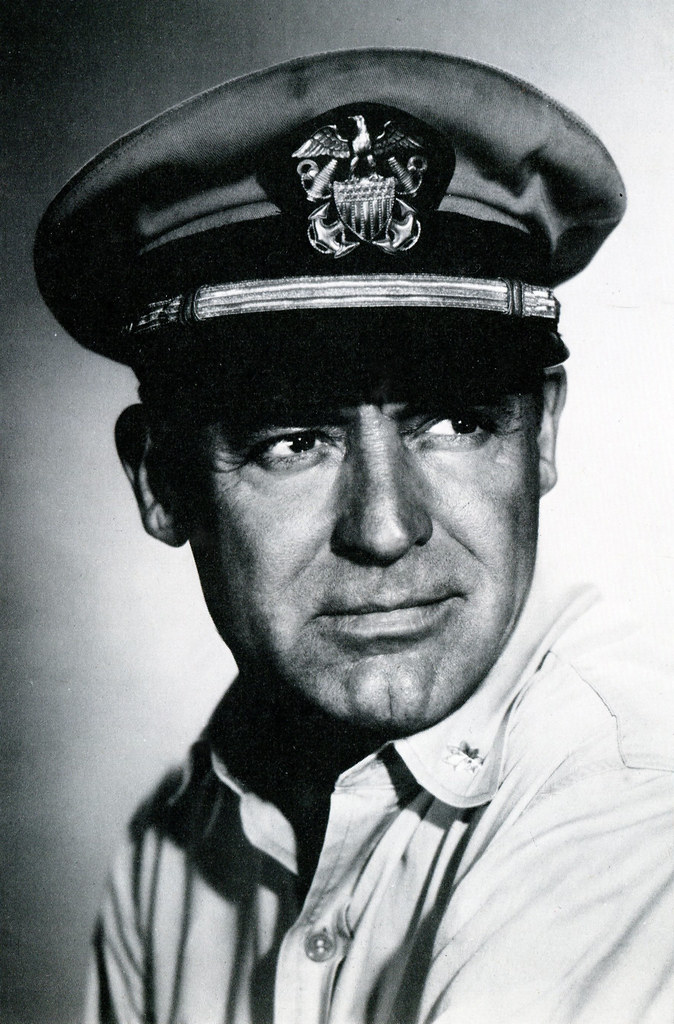
FEATURE image: “Cary Grant” by classic film scans is licensed under CC BY 2.0.
By John P. Walsh
Cary Grant made 72 feature films between 1932 and 1966- 34 in the 1930’s, 20 in the 1940’s, 13 in the 1950’s, and 5 in the 1960’s. (Grant also appeared in 10 more short films between 1932 and 1976). His feature films ranged from all classics of the genre. The debonair English-American actor with boundless energy and superb timing tangled with THRILLERS—Suspicion (1941), To Catch a Thief (1955), North by Northwest (1959)— COMEDIES—Bringing Up Baby (1938), His Girl Friday (1940), The Philadelphia Story (1940)— ROMANCES—Notorious (1946), An Affair to Remember (1957) – and much more. Grant was nominated twice for an Academy Award for Best Actor – in 1941 for Penny Serenade (directed by George Stevens) and None but the Lonely Heart in 1944 – but did not win.
In his 34-year Hollywood career Grant made his last films in the 1960’s. These included That Touch of Mink (1962), Charade (1963), Father Goose (1964), and Walk, Don’t Run (1966). These films became some of his best work. Afterwards, Grant decided to retire at what was a professional – and personal – high note. In June 1965 the 61-year-old Grant married actress Dyan Cannon, 33 years his junior, and they both had their first child, a girl, born in February 1966. It was Dyan Cannon’s first marriage; Grant’s fourth. They divorced in 1968.
With an acting career spanning four decades—Grant’s film debut was in 1932 for Paramount Pictures’ comedy, This is the Night—Grant said good-bye to the silver screen at 62 years old. In 1970 he received his sole Oscar, an honorary one, for which he was pleased and humbled in his acceptance speech before the Academy. It was Hollywood’s Golden Age, and in that time, Cary Grant was a household name synonymous with suavity, comedy, drama, romance, and perpetually fit and tanned-and-pressed good looks.
The 66-year-old leading man and comic actor, whose film career ranged from 1932 to 1966, never won an Oscar. In 1970 he thanked the Academy whose audience that night gave him a standing ovation. Grant, who made over 80 films, including a long list of classic titles, expressed gratitude for “being privileged to be part of Hollywood’s most glorious era.”
“Ours is a collaborative medium—we all need each other,” Cary Grant said as he accepted his honorary Oscar from presenter and friend Frank Sinatra at the 42nd Annual Academy Awards ceremony on April 7, 1970 at the Dorothy Chandler Pavilion in Los Angeles, California.
Grant’s final film came in 1966 with the summer release of the comedy, Walk, Don’t Run. It was one more film made by one of Grant’s new production companies and distributed by Columbia Pictures. Grant’s departure from film coincided with the birth of his daughter, Jennifer— Grant becoming a father for the first time. Grant called her his “best production”— and now wanted to give her all his time and attention. Grant said: “My life changed the day Jennifer was born. I’ve come to think that the reason we’re put on this earth is to procreate. To leave something behind. Not films, because you know that I don’t think my films will last very long once I’m gone. But another human being. That’s what’s important.”
Cary Grant and wife Dyan Cannon with their baby daughter who was born on February 26, 1966.
Grant starting wooing Dyan Cannon in 1962. Within a three-year whirlwind courtship, she became pregnant with Grant’s baby so that, in1965, the 28-year-old actress wanted a marriage proposal. Cary Grant was the epitome of cinema’s best and most important actors. After their marriage, Dyan Cannon discovered that their relationship turned polite and frostier than she had expected with Hollywood’s quintessential leading man. On March 20, 1968 — less than three years after tying the knot in a secret wedding ceremony in Las Vegas, Nevada followed by a honeymoon in England taking a private jet supplied Howard Hughes – Cannon sought and got a divorce. While Cannon received alimony from Grant to raise their daughter, the young mother and up-and-coming actress had to sort things out more completely after their break-up. Theirs had been a love affair with many memorable romantic moments. But what Grant told her when they were still dating was remembered by Cannon after the marriage failed. Grant said: “I don’t know what it is, but something happens to love when you formalize it. It cuts off the oxygen.”
Grant appears in character as an angel named Dudley in this promotional photograph for the 1947 fantasy romance film, The Bishop’s Wife. By seductively playing a certain song on the harp, Dudley convinces a rich woman to support the bishop’s cathedral building project. In real life, Grant was an ardent piano player.
CHARADE (1963):
When Grant first asked to meet Dyan Cannon, she assumed it was for an acting part. Grant began his romance with then-25-year-old Dyan Cannon in 1962. That fall the couple flew from California to New York where Cannon began rehearsing for The Fun Couple, a Broadway comedy play starring Jane Fonda and directed by Andreas Voutsinas. Grant meanwhile worked with film director Stanley Donen on Charade, a romantic-comedy pseudo-Hitchcock mystery thriller that Grant co-starred in with Audrey Hepburn. Hepburn had been filming another romantic comedy, Paris When it Sizzles, with William Holden.
Promotional poster for Stanley Donen’s Hitchcock-inspired suspense thriller, Charade. The 1963 hit film was made in Paris in 1962 and 1963 and released during Christmas 1963. It starred Cary Grant and Audrey Hepburn.
Charade’s animated Main Title and music follow a widescreen shot of a pre-dawn countryside in Europe as a speeding train finally approaches and screeches past. A body is dumped out of the moving train, plunges down the ravine and stops in a ditch, the camera providing a close-up of the dead victim’s face. Colorful animation follows of pinwheels as the wood-block-driven music heighten tension for what will be two charming lovers, Grant and Hepburn, caught in a mysterious web of criminals after money.
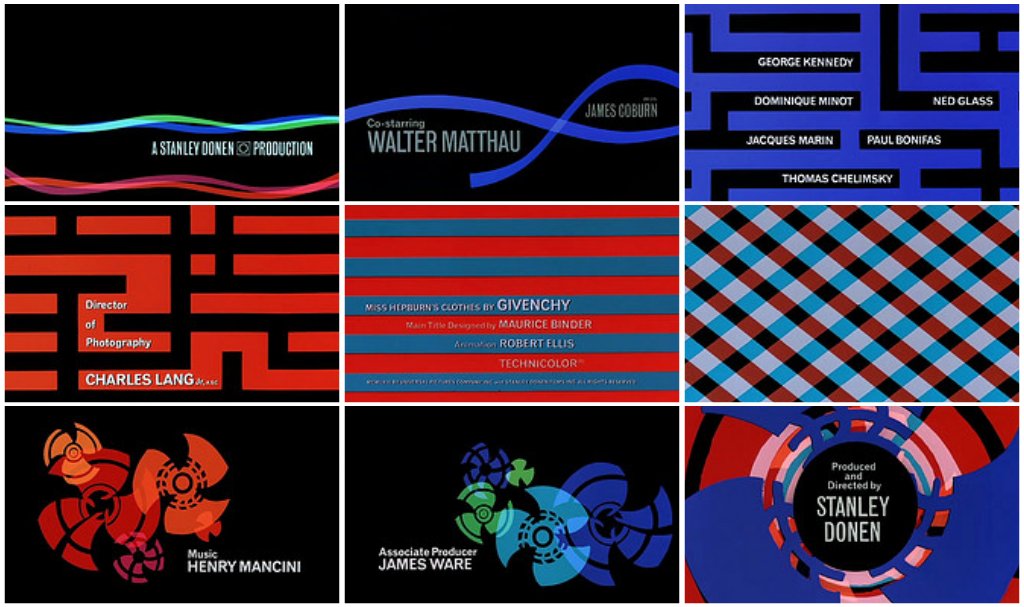
The Main Title for Charade with its punchy animated titles by Maurice Binder (1918-1991) was composed by Henry Mancini (1924-1994). The Main Theme from Charade was the first of a number of successful film score collaborations Mancini had with film director Stanley Donen in the 1960’s.
Stills montage of Maurice Binder’s Main Title for Charade that accompanies Henry Mancini’s music.
Grant reluctantly left Cannon and the comforts of his suite at the Plaza Hotel in New York City to make his way to Paris to shoot Charade (Hepburn lived near Paris). Many Paris locations were used in the film: near Notre Dame is the Pont au Double bridge, just below the Quai de Montebello. During the filming of Charade, Cary Grant and Audrey Hepburn walked along the riverbank below this bridge as they discussed who the killer is. Another location was the Musée Cernuschi just outside of Parc Monceau on the Avenue Velasquez. The museum is featured in Charade where it is used as Reggie’s apartment which she finds ransacked after returning from a holiday ski trip. Finally, the Palais Royal near the Louvre appears in Charade in its final scenes when the real Carson Dyle is revealed and shooting begins.
Shooting scenes for Charade involved many locations in Paris.
When Dyan Cannon had her first holiday break from Broadway rehearsals at Christmas 1962, she hopped on a flight to Paris. Arriving on December 26, Grant and Cannon spent the next several days together in his hotel. On New Year’s Eve, the couple were the special guests of Audrey Hepburn and her husband Mel Ferrer at their castle where a sumptuous dinner and many flights of crisp and creamy French champagne were served. Cannon flew back to the States on January 2, 1963, after a most pleasant holiday. She resumed her theater work in New York City while Grant and Hepburn stayed behind in Paris to continue filming Charade.
Cary Grant, making his 70th film, was reluctant to leave the U.S. in late 1962 for Paris to film Charade. The film premiered at Radio City Music Hall in New York City on Christmas Day 1963.
Radio City Music Hall in 2008. Charade opened on December 25, 1963 at Radio City Music Hall. The film made six million dollars while the reviews, though mixed, were mainly positive. Critics did remark on the age difference between the romantic leads –Cary Grant was 59 years and Audrey Hepburn, at 34, was almost half his age. In early 1964 the suave and likeable leading man of the last 30 years was thinking about retirement. But there were still some things he hoped to accomplish first.
The film Charade is well-known for its Hitchcock-style inspiration and screenplay by the original story’s author Peter Stone (1930-2003). From Stone’s 1961 short story, The Unsuspecting Wife, the film Charade offers witty lines and a head-knocking, heart-pounding whodunit. In Charade, Regina “Reggie” Lampert (Hepburn) is on winter holiday in the French Alps. Returning to her home in Paris, she is shocked to find that it has been ransacked of everything of value. The mysterious victim thrown off the train in the Main Title and the mysterious man Reggie met on holiday in Grenoble– Peter Joshua, alias Alexander Dyle, alias Adam Canfield, alias Brian Cruikshank (Cary Grant) –converge into her life to help her solve the mystery of why these crimes have occurred and what they mean. Charade is about hidden money, spies and larcenists, double-crossing and being on the run. In addition to all that, it’s a love story. Charade was one of the last of the suspense-screwball comedy films –a staple of the Hollywood film genre since the 1930’s that faded in the gritty realist films of the 1960’s and 1970’s until its reemergence in the 1980’s.
Father Goose (1964):
With Charade in the rear-view mirror, Grant came home just as Cannon became mostly absent. Throughout 1964 and much of 1965 Cannon had done no film work yet but continued a busy theater career as she was touring the country in the musical How to Succeed in Business Without Really Trying. Looking for something to do with his time, Grant formed a production company and made Father Goose.
Grant’s character, Walter Eckland, played against Grant’s film type. Ecklund was a bedraggled loner in the South Pacific during World War II who reluctantly takes under his protection an unmarried French school teacher (Leslie Caron) and her seven grade school students. They were suddenly made refugees from the war during a Japanese bombing raid. The heart-warming Father Goose was a mega-hit at its release during Christmas 1964 and made millions of dollars. Receipts, however, were significantly less than in each of Grant’s three previous films — Operation Petticoat in 1959 with Tony Curtis, That Touch of Mink in 1962 with Doris Day, and Charade. Despite a lot of pre-Oscar buzz, Grant wasn’t nominated for his performance. Father Goose was one more disappointment for Grant as he worked to possibly be given an Academy Award before he might retire.
Photographs above and below: Cary Grant in Operation Petticoat (1959).
That Touch of Mink (1962):
Cary Grant and Doris Day in the hit romantic comedy, That Touch of Mink. Grant was dismayed that his 1964 romantic comedy adventure film Father Goose made less money than Charade and almost $6 million less than That Touch of Mink in 1962 and Operation Petticoat in 1959 combined.
That Touch of Mink co-starred Doris Day and Cary Grant. It was the hit movie of summer of 1962 though outshined in the movie world by Lawrence of Arabia and The Longest Day later that year. The romantic-comedy is great fun—it won a Golden Globe award for Best Comedy Picture-—and became a popular rerun on TV for the next decade.
Cary Grant was cast as wealthy businessman Philip Shane, a role originally meant for Rock Hudson. That Touch of Mink was, above all, intended to be a Doris Day vehicle. From 1962 to 1964 Doris Day was the top box office star in Hollywood. Her presence definitely contributed to Universal Pictures’ bottom line since That Touch of Mink was the fourth biggest money maker of the year.
Playing working girl Cathy Timberlake, the movie is basically a stylish “boy meets girl, boy loses girl, boy gets girl back”—and given a chance to learn his lesson, they get married. American audiences loved the concept as well as Day and Grant together on the big screen. The film was the fastest million-dollar earner of 1962 and set a record at the time for the highest gross earnings in an initial theatrical release.
For Grant it was his second highest grossing film of his 30-year career, which was especially prosperous since the 58-year-old actor was a co-producer. Grant made $4 million for That Touch of Mink (around $35 million in today’s money). Three weeks after its opening, Betsy Drake, Grant’s third wife, filed for divorce.
The court proceedings of the high-profile couple after over a decade of marriage were followed closely in the press. The settlement for Drake who told the papers: “I was always in love with him and I still am…but…he left me long ago,” included more than one million dollars in cash and profit sharing in every Cary Grant film ever made up to that time.
That Touch of Mink, a film thick with early 1960’s conventional sensibilities, was nominated for 3 Academy Awards. Both Grant and Doris Day never won an Academy Award. The story goes that after her exit from films Doris Day was offered the Honorary Oscar multiple times but always turned it down. Grant won and accepted his Honorary Academy Award in 1970. In 1962 That Touch of Mink was nominated for Best Sound, Best Art Direction and Best Screenplay. In the first two categories Oscar went to Lawrence of Arabia and in the third to Divorce Italian Style.
That Touch of Mink was the fastest million-dollar earner of 1962 and set a record at the time for the highest gross earnings in an initial theatrical release. It was mainly a Doris Day vehicle that co-starred Cary Grant who co-produced.
Newly married in June 1965 to Dyan Cannon who was expecting their baby, Grant announced he was flying to Japan to make another movie. Grant returned to California permanently just in time to drive his wife to the hospital to deliver their first child, a baby daughter, born on February 26, 1966.
In June 1965, with Father Goose and the Oscars behind him and Dyan Cannon’s national tour ended—Grant and Cannon, who was now pregnant, got married. After a secret marriage ceremony in Las Vegas and a honeymoon, their news was eventually publicized. As the excitement began to settle down, Grant informed Cannon he would be making another film—and was traveling to Japan by himself for the next many months.
Walk, Don’t Run (1966):
Grant formed another production company and, with producer Sol C. Siegel, signed with Columbia Pictures to distribute his new film. Buying the rights to The More the Merrier, a World War II-era comedy, Grant took the role that had been nominated in the early 1940’s for an Academy Award. Grant’s 1966 remake was called Walk, Don’t Run in which he played a British industrialist, Sir William Rutland.
The music is by Quincy Jones including its main title, “Happy Feet.”
Grant’s mid 1960’s romantic-comedy vehicle is familiar territory that allowed the now-married father to continue to cash in on his popularity. The film is light fare even when compared to other such Grant vehicles such as Dream Wife (1953), Houseboat (1955), and, more recently, Father Goose (1964). Walk, Don’t Run was a safe remake of an Oscar-nominated World War II-era comedy, The More the Merrier, directed by George Stevens, and starring Jean Arthur, Joel McCrea, and Charles Coburn with Grant taking the Coburn part, a role which was Oscar-nominated in 1943 for Best Supporting Actor. Transferred to the 1964 Summer Olympics in Tokyo during a housing shortage, the story is about three strangers who come to share an apartment — industrial magnate Sir William Rutland (Grant), American Olympian Steve Davis (Jim Hutton), and young single British expat Christine Easton (Samantha Eggar). For Grant’s last film he intentionally worked it so he did not get the girl. Instead, Sir William plays matchmaker to Christine, engaged to boring British diplomat Julius Haversack (John Standing), so that she goes for Hutton. Grant personally cast Hutton and Eggar for their roles. Very predictable fare with stodgy stage direction, the decent performances by the leads bestride what amounts to an anachronistic production, despite its contemporary setting and delightful score from Quincy Jones, his first big break in films.
In the film, Christine, whose tiny apartment it is, would prefer a female roommate. She sublets to Sir William because he is pushy, charming and a fellow Brit in need. But he immediately sublets half of his portion to Hutton, making for three. Comedy results from three outsized adults sharing a very small living space as they pursue their lives’ conflicting schedules as normally as possible.
Samantha Eggar glows in each of her scenes in Walk, Don’t Run though she hasn’t much to work with in terms of a script as evidenced here.
Walk, Don’t Run was one of Quincy Jones’s first big breaks. The 33-year-old Chicago-born Jones came to score the film after its star and Executive Producer, Cary Grant, recommended him for the job. Grant met him briefly through their mutual friend, singer Peggy Lee. From that meeting Grant felt Jones’ style would be perfect for the film and he made sure he was hired. Jones went on to enormous success as the composer of numerous film scores such as In the Heat of the Night in 1967 and The Color Purple in 1985 as well as the producer of successful pop rock recordings such as Michael Jackson’s bestselling albums and the 1985 global recording phenomenon, We Are The World. In 2013, Quincy Jones was inducted into the Rock and Roll Hall of Fame.
After Grant returned from Asia and the baby was born, in private and public he insisted that Walk, Don’t Run was his last film. It proved to be true. Grant stated he would not make a film with his wife, Dyan Cannon, a talented actress whose career had just begun. Instead, Grant insisted Cannon should retire from acting and be a stay-at-home mother. Dyan Cannon did not welcome these stay home ideas. Even in 1966 Cannon began to wonder if—following an exciting courtship and a 33-year age difference they barely mentioned—her marriage to Cary Grant was on the rocks.
NOTES:
Best production— “Hollywood loses a legend”. Montreal Gazette. December 1, 1986. p. 1.
That’s what’s important— McCann, Graham (1997). Cary Grant: A Class Apart. Columbia University Press, 1998.
Fastest million-dollar earner of the year and record for highest gross earnings in an initial theatrical release – “Million-$ Gross In 5 Weeks; ‘Mink’ A Radio City Wow”. Variety, July 18, 1962. p.1. and “B’way as Spotty as Weather; ‘Town’ Big $41,000, ‘Guns’ Only Okay $20,000, ‘Grimm’ Giant 59G, ‘Mink’ 151G, 10th” Variety, August 22, 1962. p.9.
Betsy Drake settlement – Eliot, Marc, Cary Grant A Biography, Harmony Books, NY 2004, p 337.
Last film and would not make a film with his wife— Ibid., p. 352.
Might be in trouble—Cannon, Dyan, Dear Cary: My Life with Cary Grant, 2011, p. 217 ff.
PHOTO CREDITS:
FEATURE image-Cary Grant by classic film scans is licensed under CC BY 2.0.
2-Cary Grant by classic film scans is licensed under CC BY 2.0.
3-Fair use.
4-Cary Grant by twm1340 is licensed under CC BY-SA 2.0.
5-CHARADE by Laurel L. Russwurm is marked with CC0 1.0.
6-Public domain published in a collective work i.e. periodical in the US between 1925 and 1977 and no Copyright.
7-Bond Films Openings Montage (Amalgamation) by avhell is licensed under CC BY-SA 2.0.
8-Charade titles by Maurice Bender by Stewf is licensed under CC BY-NC-SA 2.0.
9-Charade_1963_Audrey_Hepburn_and_Cary_Grant public domain because it was published in the United States between 1925 and 1963 and although there may or may not have been a copyright notice, the copyright was not renewed.
10- Cary Grant, in Charade 1963 by Movie-Fan is licensed under CC BY-NC-SA 2.0.
11- Let’s continue this little Charade by Thiophene_Guy is licensed under CC BY-NC-SA 2.0.
12-Radio City Music Hall (2008) by jpellgen (@1179_jp) is licensed under CC BY-NC-ND 2.0.
13-Cary Grant by classic film scans is licensed under CC BY 2.0.
14-MM008600-39 by Florida Keys–Public Libraries is licensed under CC BY 2.0.
15- Cary Grant and Doris Day by classic film scans is licensed under CC BY 2.0,
16-1947 Bristol-born Hollywood film star Cary Grant alighting from Bristol Freighter G-AGVC at Los Angeles, 13 Jan 1947. by Gary Danvers is licensed under CC BY-SA 2.0.
17- Walk, Don’t Run poster. Fair use.
18-Fair use.
CARY GRANT HOLLYWOOD FILMOGRAPHY (1962-1966):
1962:
That Touch of Mink Cary Grant as Philip Shayne Directed by Delbert Mann Released June 14, 1962 Universal Pictures
1963:
Charade Peter Joshua / Alexander Dyle / Adam Canfield / Brian Cruikshank Directed by Stanley Donen Released December 5,1963 Universal Pictures
1964:
Father Goose Walter Christopher Eckland Directed by Ralph Nelson Released December 10, 1964 Universal Pictures
1966:
Walk, Don’t Run Sir William Rutland Charles Walters Released June 29, 1966 Columbia Pictures
This explanatory article may be periodically updated.
*The photograph copyright may be believed to belong to the distributor of the film, Universal Pictures and Columbia Pictures, the publisher of the film or the graphic artist. The copy is of sufficient resolution for commentary and identification but lower resolution than the original photograph. Copies made from it will be of inferior quality, unsuitable as counterfeit artwork, pirate versions or for uses that would compete with the commercial purpose of the original artwork. The image is used for identification in the context of critical commentary of the work, product or service for which it serves as poster art. It makes a significant contribution to the user’s understanding of the article, which could not practically be conveyed by words alone. As this is a publicity photo (star headshot) taken to promote an actress, these have traditionally not been copyrighted. Since they are disseminated to the public, they are generally considered public domain, and therefore clearance by the studio that produced them is not necessary. (See- Eve Light Honthaner, film production expert, in The Complete Film Production Handbook, Focal Press, 2001 p. 211.) Gerald Mast, further, film industry author, in Film Study and the Copyright Law (1989) p. 87, writes: “According to the old copyright act, such production stills were not automatically copyrighted as part of the film and required separate copyrights as photographic stills. The new copyright act similarly excludes the production still from automatic copyright but gives the film’s copyright owner a five-year period in which to copyright the stills. Most studios have never bothered to copyright these stills because they were happy to see them pass into the public domain, to be used by as many people in as many publications as possible.” Kristin Thompson, committee chairperson of the Society for Cinema and Media Studies writes in the conclusion of a 1993 conference with cinema scholars and editors, that they “expressed the opinion that it is not necessary for authors to request permission to reproduce frame enlargements … [and] some trade presses that publish educational and scholarly film books also take the position that permission is not necessary for reproducing frame enlargements and publicity photographs.”(“Fair Usage Publication of Film Stills,” Kristin Thompson, Society for Cinema and Media Studies.)
FEATURE image: Hedy Lamarr, M-G-M, 1940. Photograph by László Willinger (1909-1989).
PHOTO credit: Fair use.*
Hedy Lamarr, M-G-M, 1940. Photograph by László Willinger (1909-1989).
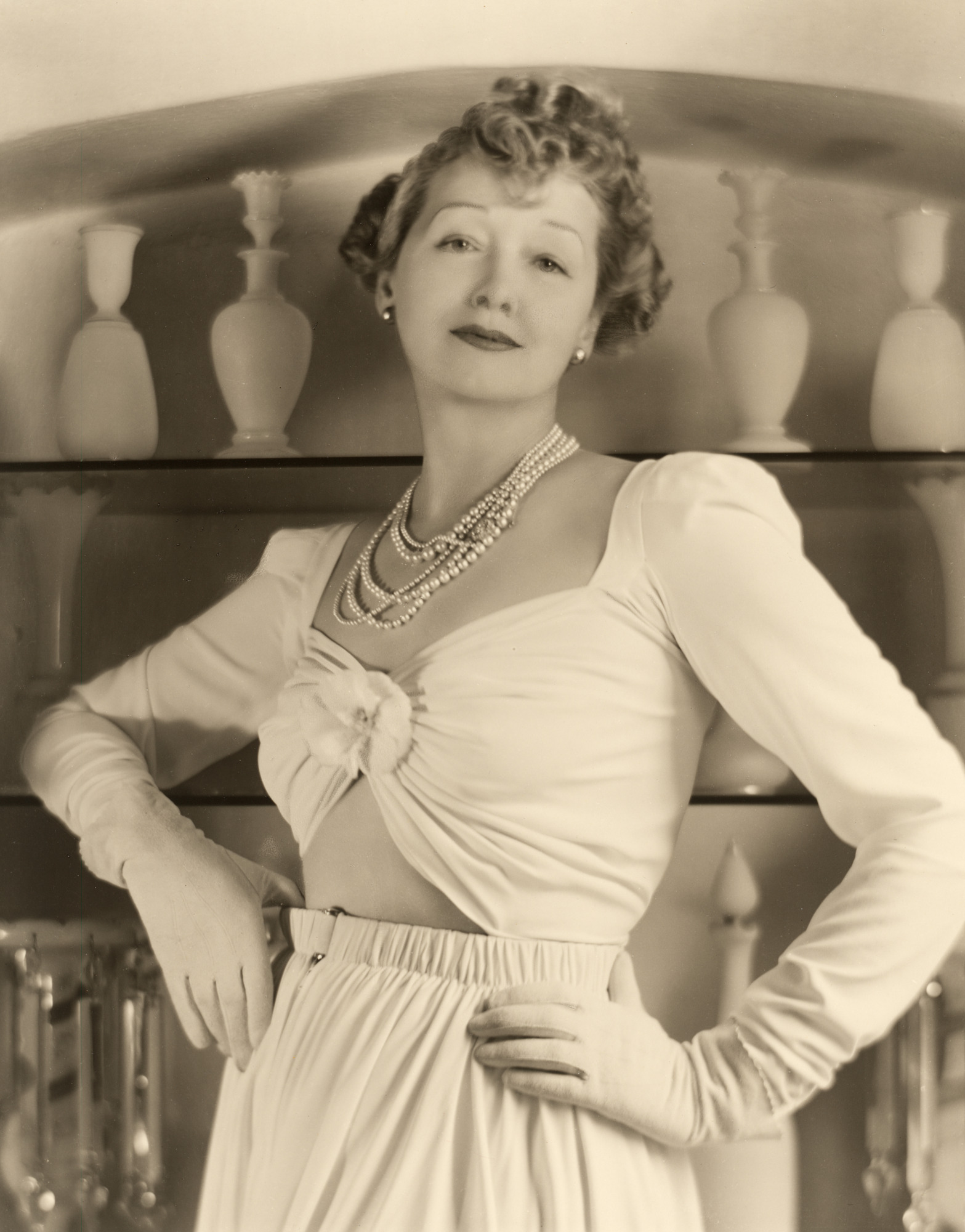
Hedy Lamarr (1914-2000) posed for the glamour portrait (above) in 1940. The legendary Austrian beauty in Hollywood was 27 years old. Since her first American film in 1938, Algiers from United Artists, Lamarr was believed to be the most beautiful women in the movies, if not the world. Her beauty was so great that when she entered a room all activity in it stopped so to admire her.
The publicity photograph of Lamaar was for the 1940 American adventure film Boom Town from Metro-Godwyn-Mayer. It co-stars Clark Gable, Spencer Tracy and Claudette Colbert. Boom Town was the highest grossing film of 1940.
Hedy Lamarr, 1939, László Willinger.
PHOTO credit: Fair use.*
The beautiful color portrait of its co-star was taken by László Willinger (1909-1989). Willinger was a German-born emigré who made many glamour photographs of celebrities starting in the later 1930’s.
Sigrid Gurie, Charles Boyer and Hedy Lamarr, publicity still for Algiers. American 1938 film in Public Domain.
In Boom Town, Austrian-born Lamarr plays Karen VanMeer, a sophisticated and elegant corporate spy. She is recruited by Clark Gable who plays “Big John” McMasters, an oil speculator.
M-G-M splurged on its star power to turn a routine oil-well story into a four-time Academy Award-nominated money gusher called Boom Town. The field was crowded with new films in 1940 just from M-G-M studio, including 18 pictures in Technicolor. Escapism was still the most rewarding M-G-M product.
Producer Sam Zimbalist brought big names to the screen in Clark Gable, Spencer Tracy, Claudette Colbert, and Hedy Lamarr backed up by an “A” list screenplay and Jack Conway’s forceful direction. The movie was the first Gable made under a new seven-year contract with MGM.
Hedy Lamarr, 1938. Photograph by Clarence Sinclair Bull (1896-1979).
Lana Turner, Hedy Lamaar, Judy Garland. Publicity photo for M-G-M’s Zeigfield Girls, 1941. Public Domain**Hedy Lamarr, publicity photo for “The Heavenly Body,” M-G-M, 1944. Public Domain**
*The photograph copyright may be believed to belong to the distributor of the film, Metro-Goldwyn-Mayer, the publisher of the film or the graphic artist. The copy is of sufficient resolution for commentary and identification but lower resolution than the original photograph. Copies made from it will be of inferior quality, unsuitable as counterfeit artwork, pirate versions or for uses that would compete with the commercial purpose of the original artwork. The image is used for identification in the context of critical commentary of the work, product or service for which it serves as poster art. It makes a significant contribution to the user’s understanding of the article, which could not practically be conveyed by words alone. As this is a publicity photo (star headshot) taken to promote an actress, these have traditionally not been copyrighted. Since they are disseminated to the public, they are generally considered public domain, and therefore clearance by the studio that produced them is not necessary. (See- Eve Light Honthaner, film production expert, in The Complete Film Production Handbook, Focal Press, 2001 p. 211.) Gerald Mast, further, film industry author, in Film Study and the Copyright Law (1989) p. 87, writes: “According to the old copyright act, such production stills were not automatically copyrighted as part of the film and required separate copyrights as photographic stills. The new copyright act similarly excludes the production still from automatic copyright but gives the film’s copyright owner a five-year period in which to copyright the stills. Most studios have never bothered to copyright these stills because they were happy to see them pass into the public domain, to be used by as many people in as many publications as possible.” Kristin Thompson, committee chairperson of the Society for Cinema and Media Studies writes in the conclusion of a 1993 conference with cinema scholars and editors, that they “expressed the opinion that it is not necessary for authors to request permission to reproduce frame enlargements … [and] some trade presses that publish educational and scholarly film books also take the position that permission is not necessary for reproducing frame enlargements and publicity photographs.”(“Fair Usage Publication of Film Stills,” Kristin Thompson, Society for Cinema and Media Studies.)
**This work is in the public domain in the United States because it was published in the United States between 1927 and 1977, inclusive, without a copyright notice. Note that it may still be copyrighted in other countries.
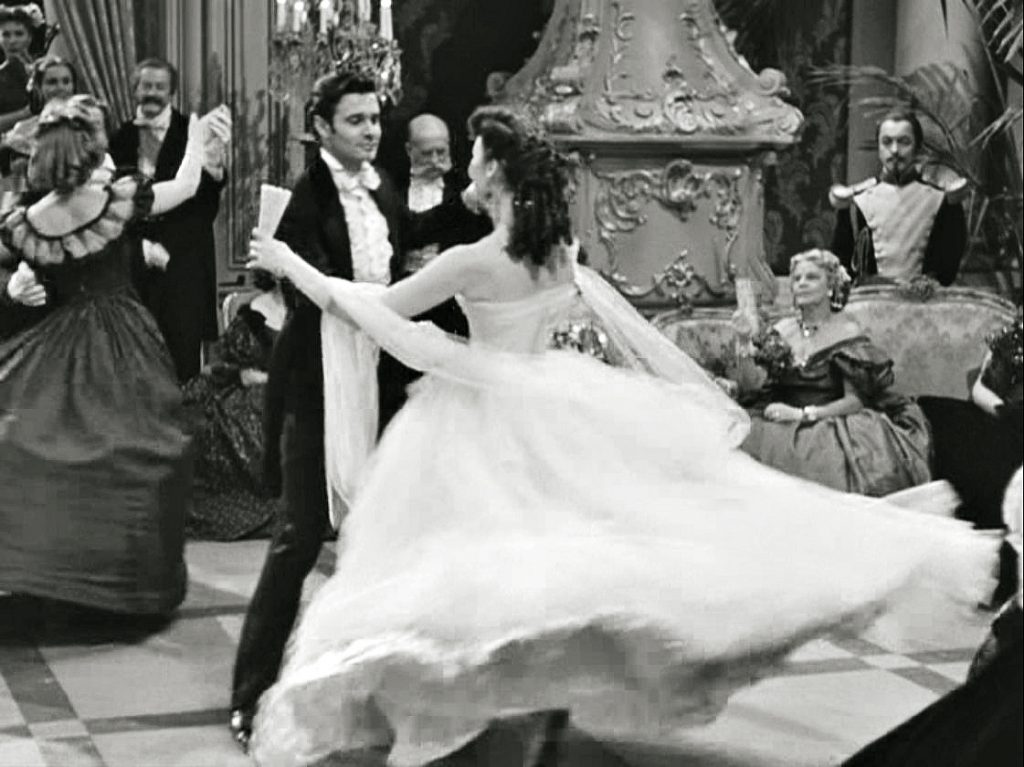
FEATURE image: Madame Bovary (Jennifer Jones) and Rodolphe Boulanger (Louis Jourdan) waltz at the ball in a still from Metro-Goldwyn-Mayer’s 1949 film Madame Bovary directed by Vincente Minnelli. Fair Use.
In the 1949 film Madame Bovary directed by Vincente Minnelli, a beautiful and charming Madame Bovary (Jennifer Jones) meets wealthy Rodolphe Boulanger (Louis Jourdan) at a ball where he literally sweeps her off her feet. Selfishly aggravated by her husband Charles Bovary (Van Heflin) for not fitting into high society, Madame Bovary begins a love affair with Rodolphe. Though the pair scheme to elope to Italy, Rodolphe does not love Madame Bovary.
Filming began at M-G-M’s Culver City studios in mid-December 1948. Though producers wanted Lana Turner for the role of Emma Bovary, Minnelli preferred Jennifer Jones. The Academy-Award-winning actress (for “Song of Bernadette”) was glamorous which was a necessary dimension to the role of a woman with a repressed passion, but likely not to raise further issues with the Production Code Office that would be busy assessing the film’s controversial story.
The Waltz Scene was Filmed to the Music
One of the film’s most carefully wrought and delightful scenes is this ballroom sequence. It was one of the last segments to be shot. The film footage was tailored to Miklós Rózsa’s music. Minnelli explained to the composer in advance the camera movements so he could write the music in an arrangement for two pianos. The scene was then filmed to match it. Their artistic collaboration produced one of cinema’s most original scenes uniting robust music with weaving and gliding images on film.
Madame Bovary (Jennifer Jones) and Rodolphe Boulanger (Louis Jourdan) waltz at the ball. It is one of the film’s most delightful scenes and one of the last to be shot. Director Vincente Minnelli made certain its choreography carefully matched the music of Miklós Rózsa. Madame Bovary was nominated for an Oscar for Best Art Direction-Set Decoration, Black-and-White.
Beautiful and charming Emma Bovary (Jennifer Jones) is repulsed by her uncouth husband, Charles Bovary (Van Heflin), an undistinguished medical doctor, and begins an affair with Rodolphe Boulanger (Louis Jourdan). Their plans to elope, however, do not materialize as Emma hoped.
“Break the Windows” dramatizes a heroine’s transition into madness
As Rodolphe swirls her, Emma Bovary’s head spins until she becomes dizzy. The viewer sees her disorientation as the camera takes her viewpoint. She keeps dancing but asks for fresh air. Her request leads to an extraordinary and incredible reaction by the stewards. They start to smash the ballroom’s windows with chairs to help her cool down. This fantastically destructive action of broken glass aligns with the destruction of Emma’s romantic illusions throughout the film.
In reaction to Madame Bovary becoming dizzy while waltzing with a new lover, the stewards smash the ballroom windows to give her air. The extraordinary action ultimately becomes symbolic of the destruction of Madame Bovary’s romantic illusions with handsome, wealthy Rodolphe and her own descent into madness.
Night of Repressed Passion
Along with her husband’s boorish behavior at the ball and everywhere else, Madame Bovary’s romantic disappointment leaves her feeling publicly humiliated. Instead of love and excitement, Madame Bovary runs out of the ball in shame. Though she yearns for happiness and excitement, her pursuit of selfish pleasures ends in scandal and ruin.
Jennifer Jones as Madame Bovary offers a performance that is elegant and beautiful. It is equally insightful to the selfish and nervous personality of Flaubert’s fictional character.
A film poster for Vincente Minnelli’s Madame Bovary. Several different versions of the film poster were produced for the marketing of the 1949 film.
This publicity photo for Madame Bovary showed the love triangle of Madame Bovary (Jennifer Jones), her handsome lover Rodolphe Boulanger (Louis Jourdan), and her cuckolded husband Charles Bovary, a medical doctor (Van Heflin).
Thirty-year-old Jennifer Jones plays Gustave Flaubert’s doomed title character, Madame Bovary, from his 1856 serial novel.
Vincente Minnelli’s film of the same name offered two costume and wardrobe managers: Walter Plunkett for women and Valles for men.
Walter Plunkett (1902-1982) was a prolific costume designer who worked on more than 150 projects in his Hollywood career, including Gone With The Wind. In 1951, Plunkett shared an Oscar with Orry-Kelly and Irene Sharaff for An American in Paris.
Valles (1886-1970) specialized in men’s costumes at M-G-M. Valles received two Academy Award nominations, including Spartacus in 1960.
Van Heflin is Charles Bovary, whom Madame Bovary (Jennifer Jones) had loved and hoped to build a respectable life, but in whom she grew disillusioned.
In the role of Madame Bovary Jennifer Jones gives a performance beyond the superficiality of display or machination of melodrama and enters into the inner psychology of the character whose anxious egomania manifesting joy and elation is driven by disillusionment to deterioration and self-destruction. Director Vincente Minnelli worked closely with composer Miklós Rózsa to integrate the image, plot and characters with the musical score which the composer admired for its artistic cinematic outcome.
A unique example of the Valles’ costume design for Louis Jourdan and Walter Plunkett’s costume design for Jennifer Jones for the 1949 film Madame Bovary. The next year, in 1950, both Valles and Walter Plunkett were nominated for the Academy Award for Compton Bennett’s That Forsyte Woman/Saga.
Madame Bovary danced wildly with Rodolphe at the ball and loves him. The illicit couple plan to elope to Italy. But Rodolphe leaves for Italy without her and shatters Madame Bovary’s spirit and dreams.
Costumes were by award-winning Valles and Walter Plunkett, both award-winning Hollywood costume designers.
Madame Bovary (Jennifer Jones) is indulged by an unscrupulous shop-keeper as she lives beyond her means in the pursuit of happiness. She takes on a heavy debt that is impossible to pay back.
The film plot is told from the point of view of the author, Gustave Flaubert (James Mason). A legal proceedings takes place where Flaubert is accused of corrupting morals by writing Madame Bovary. It is an historical fact that, in 1858, Flaubert and his publisher had faced government charges of immorality for Madame Bovary. But the outcome of the trial was that Flaubert was completely acquitted.
Charles, who never stopped loving his wife, begs her to wait for a doctor to arrive. Madame Bovary sighs, “Oh, Charles, why are you always trying to save me?”
From the waltz scene through to her death scene Jennifer Jones as Madame Bovary offers a performance that is elegant and beautiful. It also provides insight into the contradictions offered by a selfish and nervous personality.
In the end Madame Bovary finds that her own death is more attractive to her than living with her shattered dreams.
A 1949 film poster for Madame Bovary that includes a publicity head shot of James Mason as Gustave Flaubert, the novel’s French author.
Minnelli’s film is told in flashback through the character of Flaubert who is on trial for charges of immorality for writing the novel. After Flaubert’s work was serialized in the Revue de Paris in 1856, the government charged and tried the author and his publisher for immorality. Both were acquitted in 1859. After Madame Bovary appeared in book form in France, it became an instant classic.
Vincente Minnelli directs Jennifer Jones and Louis Jourdan in a scene from Madame Bovary.
Reviews from film critics had been mixed and Madame Bovary lost money at the box office. Whether it is the fault of the film-makers or the unhappy story becomes a debatable point.
Reviews for Madame Bovary, released in late August 1949, were mixed with the film not recouping its full production costs.
*The photograph copyright may be believed to belong to the distributor of the film, Metro-Goldwyn-Mayer, the publisher of the film or the graphic artist. The copy is of sufficient resolution for commentary and identification but lower resolution than the original photograph. Copies made from it will be of inferior quality, unsuitable as counterfeit artwork, pirate versions or for uses that would compete with the commercial purpose of the original artwork. The image is used for identification in the context of critical commentary of the work, product or service for which it serves as poster art. It makes a significant contribution to the user’s understanding of the article, which could not practically be conveyed by words alone. As this is a publicity photo (star headshot) taken to promote an actress, these have traditionally not been copyrighted. Since they are disseminated to the public, they are generally considered public domain, and therefore clearance by the studio that produced them is not necessary. (See- Eve Light Honthaner, film production expert, in The Complete Film Production Handbook, Focal Press, 2001 p. 211.) Gerald Mast, further, film industry author, in Film Study and the Copyright Law (1989) p. 87, writes: “According to the old copyright act, such production stills were not automatically copyrighted as part of the film and required separate copyrights as photographic stills. The new copyright act similarly excludes the production still from automatic copyright but gives the film’s copyright owner a five-year period in which to copyright the stills. Most studios have never bothered to copyright these stills because they were happy to see them pass into the public domain, to be used by as many people in as many publications as possible.” Kristin Thompson, committee chairperson of the Society for Cinema and Media Studies writes in the conclusion of a 1993 conference with cinema scholars and editors, that they “expressed the opinion that it is not necessary for authors to request permission to reproduce frame enlargements … [and] some trade presses that publish educational and scholarly film books also take the position that permission is not necessary for reproducing frame enlargements and publicity photographs.”(“Fair Usage Publication of Film Stills,” Kristin Thompson, Society for Cinema and Media Studies.)
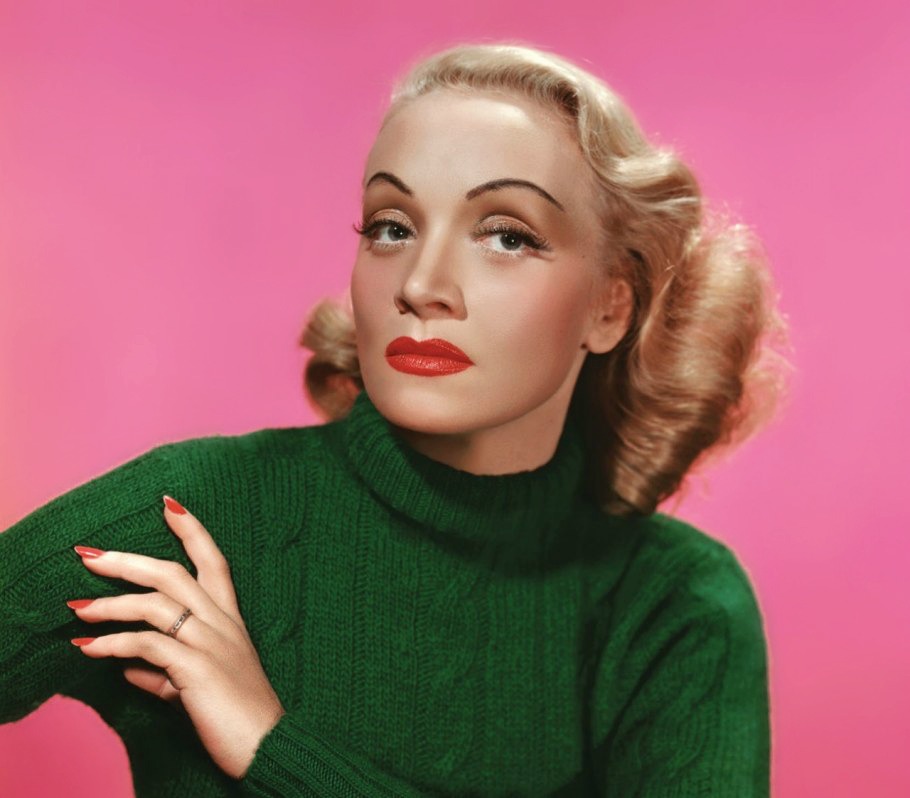
FEATURE image: Marlene Dietrich. Paramount, 1947. Photograph by A.L. “Whitey” Schafer. The actress was appearing in Golden Earrings, a 1947 romantic spy film made by Paramount Pictures and starring Ray Milland and Marlene Dietrich.*
Photographer A. L. “Whitey” Schafer (1902-1951) was a still photographer who started shooting stills in 1923 and continued in that line of work at Columbia Pictures when he moved there in 1932. Personally outgoing, Schafer was appointed head of the stills photography department at Columbia three years later. In the 1940’s Shafer wrote copiously on his craft and advocated for techniques in glamour photography that are seen in this Dietrich color portrait.
Born in in Salt Lake City and growing up in California, “Whitey” Schafer ran the leading portrait gallery at Columbia in the 1930’s and early 1940’s. His work contributed to the emerging stardom of Rita Hayworth. Unknown photographer, May 1936, Motion Picture Studio Insider. Fair use.
“Whitey” Schafer wrote an important book on glamour photography
In 1941 Schafer published Portraiture Simplified, a book in which he argues that “portraiture’s purpose is the realization of character realistically.” Among his technical observations Schafer wrote elsewhere that “composing a portrait is comparable to writing a symphony. There must be a center of interest, and in all portraits this naturally must be the head, or your purpose is defeated. Therefore, the highest light should be on the head.”
In 1941 Schafer replaced Eugene Richee (1896-1972) as department head of still photography at Paramount Studios. Schafer remained in that position where he photographed the stars until he died at 49 years old in an accident in 1951.
MARLENE DIETRICH
Marlene Dietrich. Paramount, 1947. Photograph by A.L. “Whitey” Schafer.
This Hollywood glamour portrait of forty-six-year-old Marlene Dietrich (1901, Berlin – 1992, Paris) wearing a green turtleneck sweater was taken when the movie actress was starring in Golden Earrings, a romantic spy film made by Paramount Pictures. It was her comeback film following World War II.
The film’s song, “Golden Earrings,” with music by Victor Young (1900-1956) and lyrics by Ray Evans (1915-2007) and Jay Livingston (1915-2001) was sung in the movie by actor Murvyn Vye (1915-1976). It was a hit recording in 1947-48 by Peggy Lee.See- https://digital.library.unt.edu/ark:/67531/metadc1633213/m1/#track/4
1940s blondes
Like other leading ladies in the 1940’s, the Hollywood glamour machine transformed Dietrich into a golden-haloed blond which accentuated her magnificent cheekbones and sultry eyes under penciled-arc eyebrows and painted nails that A.L. “Whitey” Schafer’s color portrait makes evident.
It was also in 1947—the same year that the photograph was made— that Dietrich received the Medal of Freedom. Dietrich called it her life’s proudest achievement.
While Golden Earrings was a decent film, its main purpose was to provide the actress with a job. It led into her next project—the 1948 American romantic comedy A Foreign Affair directed by Billy Wilder. That film made Dietrich again a top star.
Following Dietrich’s meteoric rise at Paramount Pictures starting in 1930 her acting parts later stagnated as film directors —including Josef von Sternberg and others—seemed to use her more as a piece of expensive cinematic scenery than as a serious dramatic actress.
From Paramount Pictures, A Foreign Affair is a 1948 American romantic comedy-drama film directed by Billy Wilder. The film made Marlene Dietrich once again a top star in the post-war years.
ELIZABETH TAYLOR.
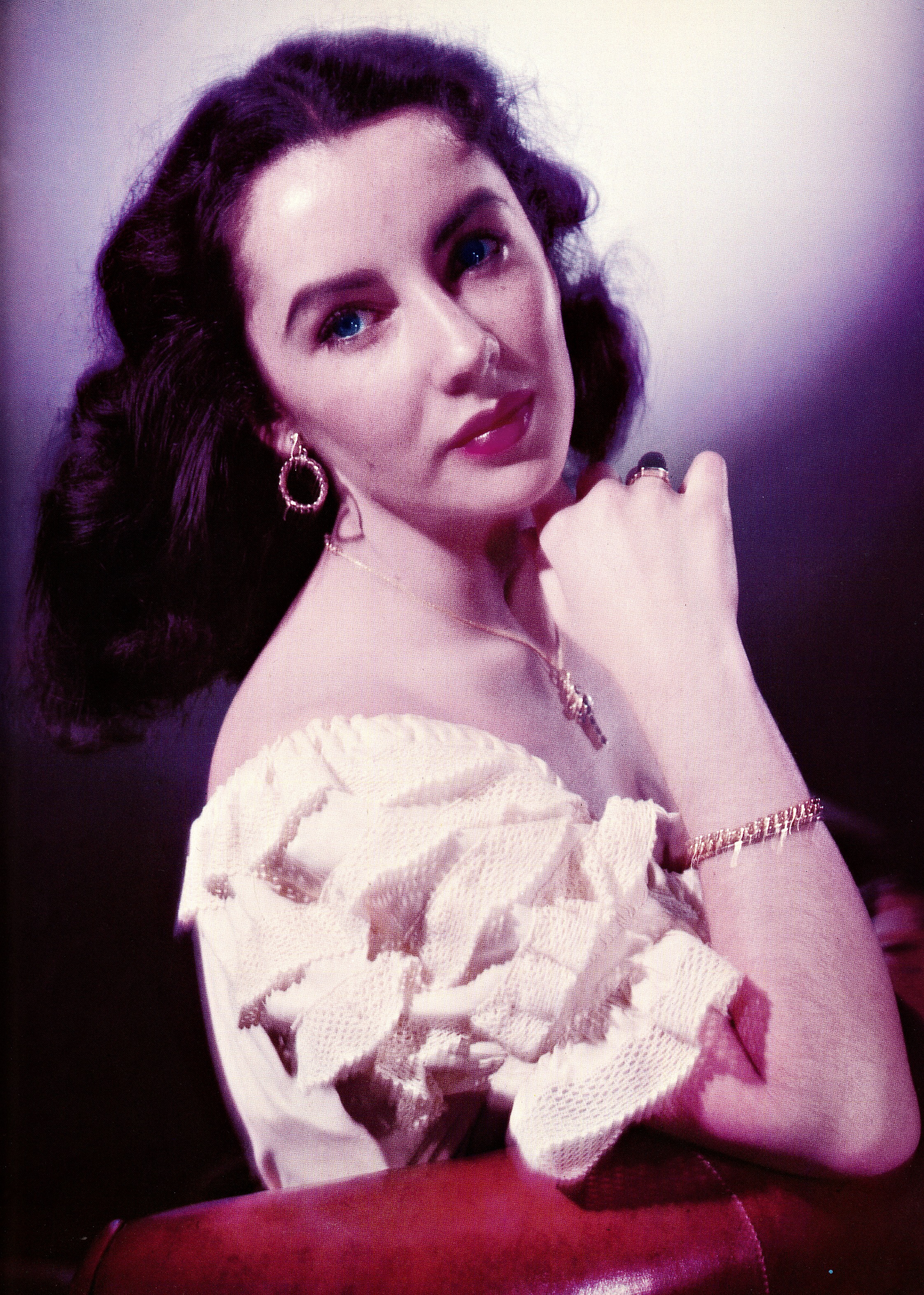
Elizabeth Taylor. M-G-M, 1949. Photograph by Hymie Fink.
Though still a teenager, Elizabeth Taylor (1932-2011) in 1949 when the publicity still photograph was made, was celebrated as the new generation’s great beauty. In 1942, at 10 years old, Elizabeth made her film debut and her life and beauty blossomed over the decade in front of the cameras. The photograph captures Taylor after she made a little over a dozen films.
In 1950 she co-starred in M-G-M’s comedy film, Father of the Bride. Directed by Vincente Minnelli, Taylor played Kay, the daughter of Stanley T. Banks (Spencer Tracy) who is trying to cope with the preparations for her wedding day.
In 1950 Elizabeth Taylor co-starred in Father of the Bride, M-G-M’s comedy film that was nominated for three Academy Awards. It was directed by Vincente Minnelli.
WHO IS HYMIE FINK? HIS IDENTITY REMAINS A MYSTERY
Who was Elizabeth Taylor’s photographer, Hymie Fink? Was Hymie Fink a studio photographer? Freelancer? Pseudonym for an unknown talent or combination of unknown talents?
His name appears among the stars starting in the late 1930’s until his death was announced by Hedda Hopper in the mid-1950’s. The gossip columnist ended her newspaper column for September 28, 1956 with this epitaph: “Hymie Fink, one of the sweetest men in Hollywood, died of a heart attack on Jane Wyman’s TV set. Hymie photographed every star and every major event in (Hollywood) for twenty-five years.”
Hedda Hopper (1885-1966) was a powerful voice in Hollywood whose gossip columns were read by tens of millions. “Hedda Hopper” by Baron Adolph de Meyer, 1 Sep 1868 – 6 Jan 1946 is marked with CC0 1.0.
LANA TURNER.
Before she became in the 1940’s the well-known Hollywood sensuous platinum blonde of movie legend and fame, Lana Turner (1921-1995) was a pretty redhead from Idaho named Julia Jean Turner.
Lana Turner. 1939, photograph by László Willinger.*
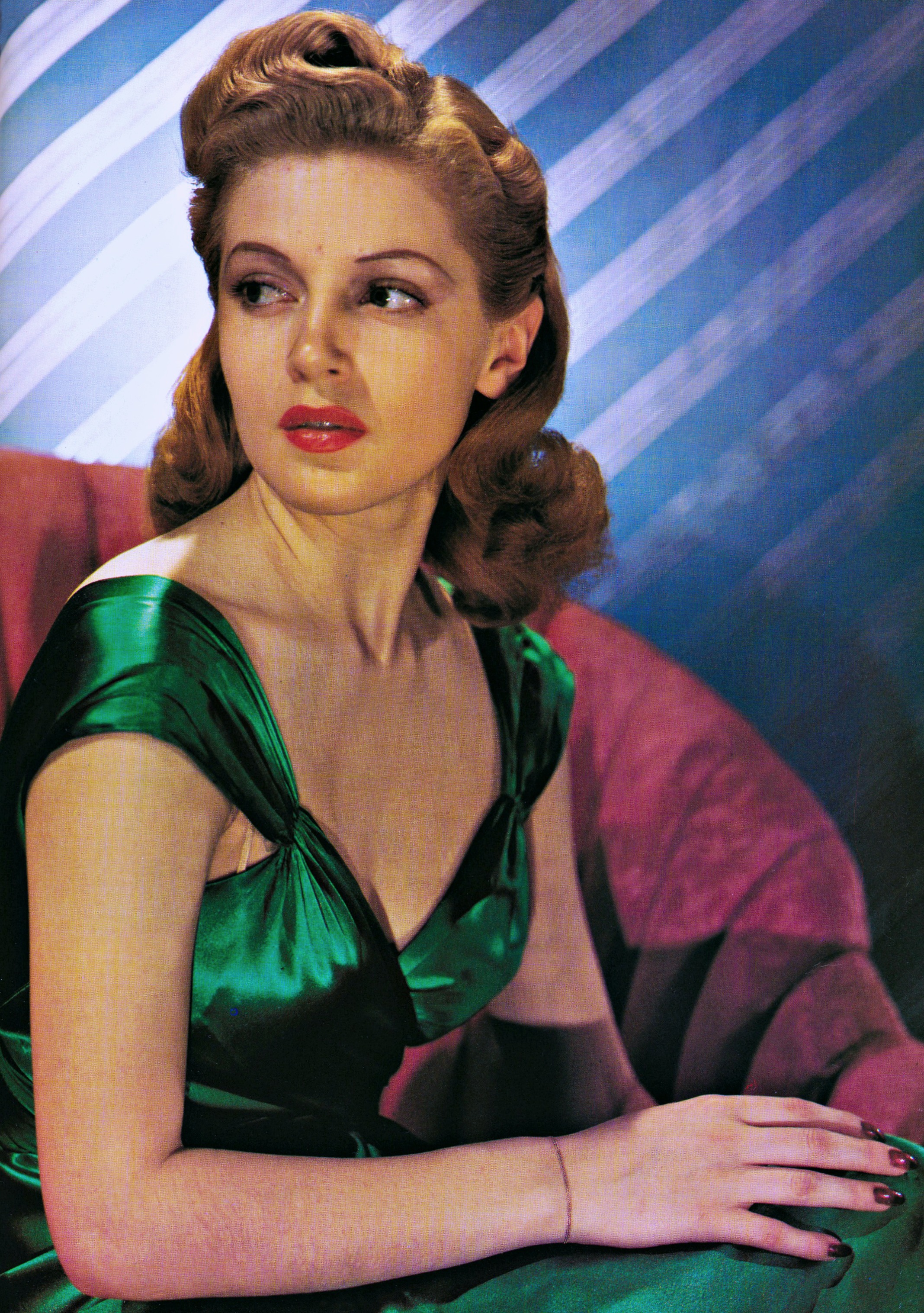
Lana Turner, 18 years old in this unretouched color portrait by László Willinger (1909–1989), had been discovered three years earlier. Her discovery in a malt shop near Hollywood High School where she was a student, has entered the annals of show-biz mythology. Her discovery’s immediate result was a movie contract with producer-director Mervyn LeRoy (1900-1987).
László Willinger
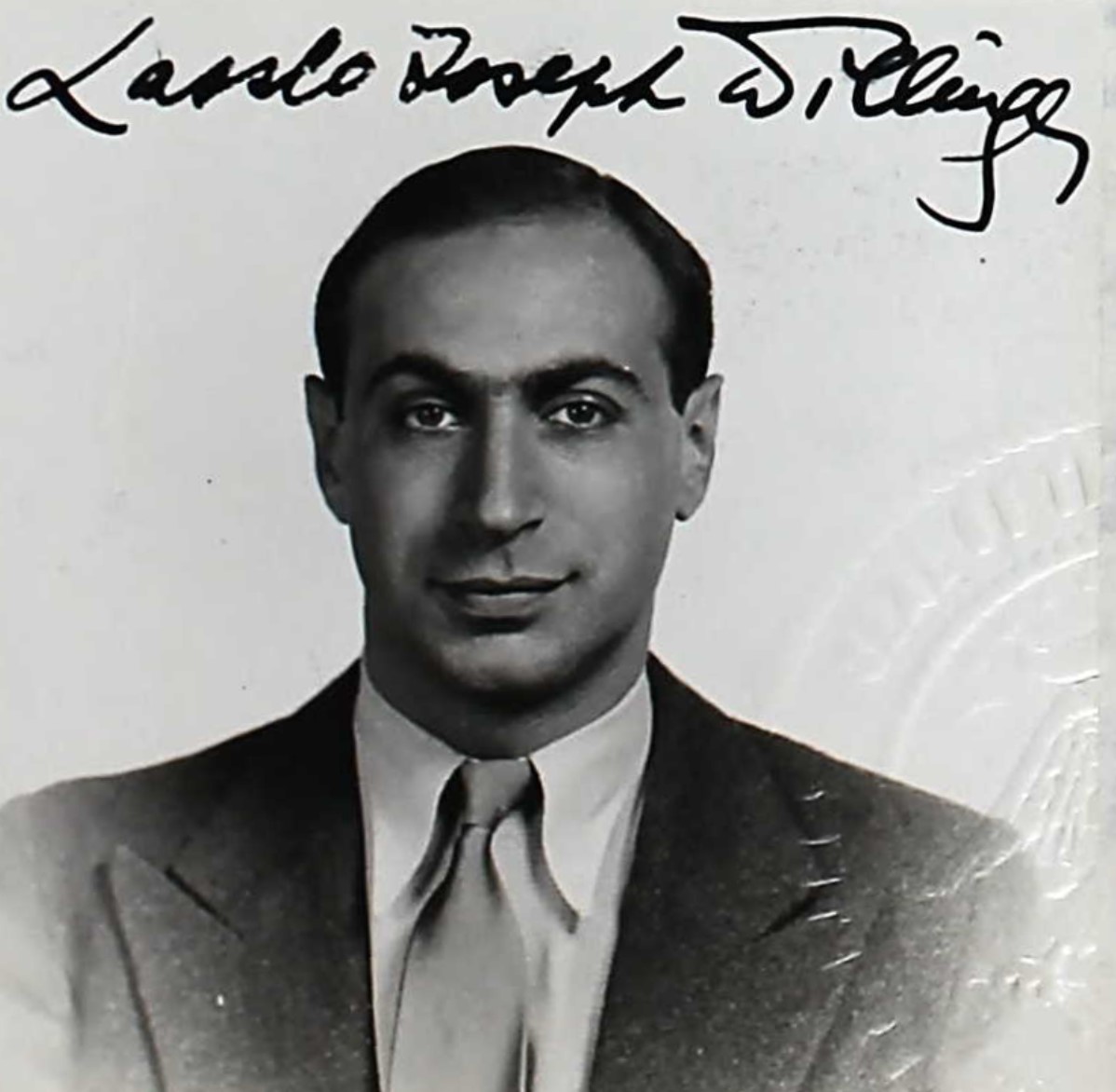
Hungarian-born photographer László Willinger started his professional career in Vienna, Austria. He left Europe for America in 1937 where he joined M-G-M that same year. Soon after, he made this lush shot of 18-year-old Lana Turner in a silky green dress seated on a red divan (or chair) with her head turned and looking to one side with slightly bloodshot eyes.
Willinger’s color portrait of red-headed Lana Turner emphasizes the sensuality of her personality manifested in her full red sensuous lips and painted nails. In 1944, László Willinger left MGM and established his own photography studio in Hollywood. For the next 40 years he successfully practiced his craft.
László Willinger’s portrait photography career of film stars and celebrities started in 1937. Public Domain.
“America’s Sweater Sweetheart”
The title of Lana Turner’s first film in 1937 for Warner Brothers was They Won’t Forget. The title proved prophetic for Lana Turner’s Hollywood career as she went on to make over 50 glamorous films, most of them at M-G-M.
Lana Turner was only 16 years old when she debuted in a part that totaled about five minutes screen time. At one point, in this scene of about 20 seconds, she struts in a tight-fitting sweater and cocked beret that made her an overnight national sex symbol.
Lana’s image in her film debut created such a stir among movie-going audiences that gossip columnist Walter Winchell (1897-1972) coined her “America’s Sweater Sweetheart.” Over the next 20 years, a bevy of Hollywood actresses would wear tight sweaters over specialty bras that emphasized the bust line in the hope of sparking the same Lana Turner movie success story for themselves.
Walter Winchell, influential newspaper gossip columnist and radio news commentator, dubbed 16-year-old Lana Turner in 1938,” America’s Sweater Sweetheart,” and the moniker stuck. “Walters Winchell Julius 1” by Goosefriend is licensed under CC BY 2.0.
New Jean Harlow?
Lana was originally being groomed to be the new Harlow. She followed the sex-bomb script in full force in 1941 when the studio dyed her hair whitish blonde for Ziegfeld Girl. Lana co-starred with Judy Garland and Hedy Lamarr and stole the show.
Lana Turner in Ziegfeld Girl in a photograph by Eric Carpenter, 1941. Fair use.
About her own reputedly rowdy personal life in those M-G-M years, Lana Turner later remarked: “My plan was to have one husband and seven children, but it turned out the other way…”
SOURCES:
DIETRICH – “Miss Dietrich to Receive Medal,” The New York Times, November 18, 1947; https://ladailymirror.com/2013/11/04/mary-mallory-hollywood-heights-mdash-a-l-whitey-schafer-simplifies-portraits/; http://vintagemoviestarphotos.blogspot.com/2014/11/a-l-whitey-schafer.html; They Had Faces Then. Annabella to Zorina: The Superstars, Stars and Starlets of the 1930’s, John D. Springer and Jack D. Hamilton, Citadel Press, Secaucus, New Jersey, 1974. Hollywood Color Portraits, John Kobal, William Morrow and Company. Inc., New York, 1981. https://www.aenigma-images.com/2017/04/a-l-whitey-schafer/ PHOTO CREDIT – *The photograph copyright may be believed to belong to the distributor of the film, Paramount, the publisher of the film or the graphic artist. The copy is of sufficient resolution for commentary and identification but lower resolution than the original photograph. Copies made from it will be of inferior quality, unsuitable as counterfeit artwork, pirate versions or for uses that would compete with the commercial purpose of the original artwork. The image is used for identification in the context of critical commentary of the work, product or service for which it serves as poster art. It makes a significant contribution to the user’s understanding of the article, which could not practically be conveyed by words alone. As this is a publicity photo (star headshot) taken to promote an actress, these have traditionally not been copyrighted. Since they are disseminated to the public, they are generally considered public domain, and therefore clearance by the studio that produced them is not necessary. (See- Eve Light Honthaner, film production expert, in The Complete Film Production Handbook, Focal Press, 2001 p. 211. Gerald Mast, Further, film industry author, in Film Study and the Copyright Law (1989) p. 87, writes: “According to the old copyright act, such production stills were not automatically copyrighted as part of the film and required separate copyrights as photographic stills. The new copyright act similarly excludes the production still from automatic copyright but gives the film’s copyright owner a five-year period in which to copyright the stills. Most studios have never bothered to copyright these stills because they were happy to see them pass into the public domain, to be used by as many people in as many publications as possible.” Kristin Thompson, committee chairperson of the Society for Cinema and Media Studies writes in the conclusion of a 1993 conference with cinema scholars and editors, that they “expressed the opinion that it is not necessary for authors to request permission to reproduce frame enlargements … [and] some trade presses that publish educational and scholarly film books also take the position that permission is not necessary for reproducing frame enlargements and publicity photographs.”(“Fair Usage Publication of Film Stills,” Kristin Thompson, Society for Cinema and Media Studies.)
TURNER – Hollywood Color Portraits, John Kobal, William Morrow and Company. Inc., New York, 1981. Lana Turner interview with Phil Donahue, 1982 – https://www.youtube.com/watch?v=uhu6_V7pNL0 “Hollywood Photographer Dies,” The Hour, Associated Press, August 9, 1989 – https://news.google.com/newspapers nid=1916&dat=19890814&id=azIiAAAAIBAJ&sjid=uXQFAAAAIBAJ&pg=1804,2177679 PHOTO CREDIT: *The photograph copyright may be believed to belong to the distributor of the film, Metro-Goldwyn-Mayer, the publisher of the film or the graphic artist. The copy is of sufficient resolution for commentary and identification but lower resolution than the original photograph. Copies made from it will be of inferior quality, unsuitable as counterfeit artwork, pirate versions or for uses that would compete with the commercial purpose of the original artwork. The image is used for identification in the context of critical commentary of the work, product or service for which it serves as poster art. It makes a significant contribution to the user’s understanding of the article, which could not practically be conveyed by words alone. As this is a publicity photo (star headshot) taken to promote an actress, these have traditionally not been copyrighted. Since they are disseminated to the public, they are generally considered public domain, and therefore clearance by the studio that produced them is not necessary. (See- Eve Light Honthaner, film production expert, in The Complete Film Production Handbook, Focal Press, 2001 p. 211. Gerald Mast, Further, film industry author, in Film Study and the Copyright Law (1989) p. 87, writes: “According to the old copyright act, such production stills were not automatically copyrighted as part of the film and required separate copyrights as photographic stills. The new copyright act similarly excludes the production still from automatic copyright but gives the film’s copyright owner a five-year period in which to copyright the stills. Most studios have never bothered to copyright these stills because they were happy to see them pass into the public domain, to be used by as many people in as many publications as possible.” Kristin Thompson, committee chairperson of the Society for Cinema and Media Studies writes in the conclusion of a 1993 conference with cinema scholars and editors, that they “expressed the opinion that it is not necessary for authors to request permission to reproduce frame enlargements … [and] some trade presses that publish educational and scholarly film books also take the position that permission is not necessary for reproducing frame enlargements and publicity photographs.”(“Fair Usage Publication of Film Stills,” Kristin Thompson, Society for Cinema and Media Studies.)
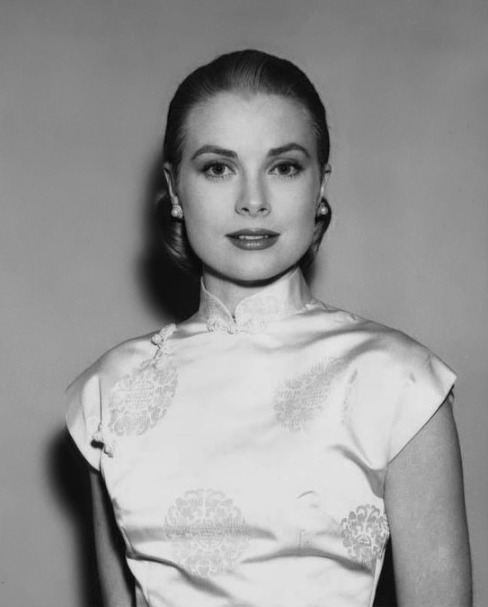
Philadelphia-born Grace Kelly (1929-1982) had a short but dazzling film career in Hollywood. Called the “Greatest Screen Presence in Film,”1 passionate and dramatically talented Grace Kelly was Alfred Hitchcock’s favorite actress when she starred in three of his classic films of the 1950’s: Dial M For Murder (1954), Rear Window (1954) and To Catch a Thief (1955).
After Grace was discovered in 1951 by Gary Cooper who said that Grace was “different from all these actresses we’ve been seeing so much of”2—and cast in High Noon (1951) as Cooper’s movie wife—Grace Kelly’s incomparable charm and allure swiftly impressed Hollywood and the world.
From September 1951 to March 1956 Grace Kelly’s star blazed across the silver screen in eleven major motion pictures for five different Hollywood studios. Grace was at the height of her career when she exited Hollywood to get married to the prince of Monaco in Europe, in April 1956.
Lloyd Bridges, Katy Jurado, and Gary Cooper co-starred with Grace Kelly in High Noon. Gary Cooper took credit for discovering Grace. Cooper was impressed with her acting talent, good looks, work ethic, and professionalism.
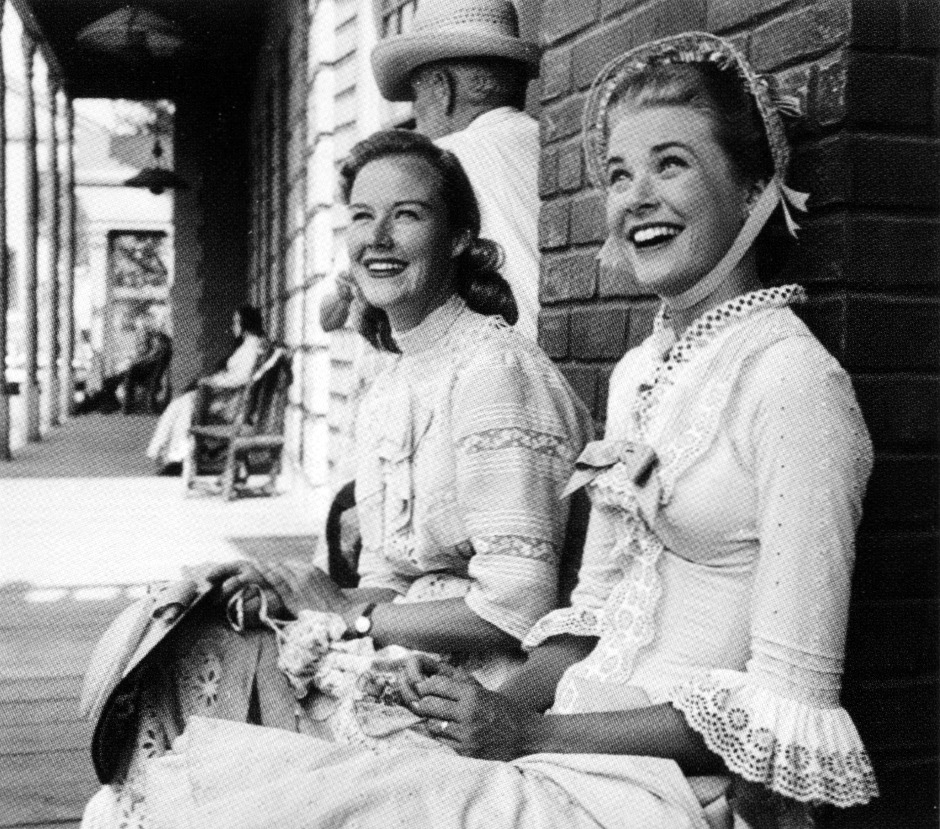
Grace Kelly and her stand-in Dorothy Towne on the set of High Noon (1952).
With 2 Hollywood films under her belt, Grace Kelly was nominated for her first Oscar for Best Supporting Actress in John Ford’s Mogambo (1953). Kelly plays Linda Nordley who arrives at the camp with her husband and soon has an affair with the camp’s big game hunter, Marswell (Clark Gable) that leads to a fit of jealous rage.
Following High Noon for United Artists, Grace’s performance for M-G-M on John Ford’s Mogambo (1953) led to her first Academy Award nomination as Best Supporting Actress. This was a coup for Grace Kelly who had made two films and was only one of many actresses considered for the role. Neither was Grace the studio’s first choice for the part of Linda Nordley, but English actress Deborah Kerr. It was mostly thanks to fellow Irish-American John Ford that worked to get fellow half-Irish Kelly the role – and Grace got to see the continent of Africa, “all expenses paid.” Always looking ahead, Kelly did Mogambo for many reasons not least of which was its overseas international connection.
Location filming in Africa began in November 1952 and continued until the end of January 1953. It was a major production, and out of the nervous excitement that seemed to imbue the project for the actors and crew, there shortly developed a sense of camaraderie and confidence. Grace contributed to the exciting professional spirit and a major outcome was that the Technicolor film from M-G-M was successful both critically and at the box office. It also raised the career prospects of its principals—namely, director John Ford, and Clark Gable, Ava Gardner, and newcomer Grace Kelly.3
Ava Gardner and Grace Kelly in Africa during the filming of Mogambo, M-G-M’s 1953 Technicolor adventure/romantic film directed by John Ford.
Clark Gable repeated the role of big-game hunter Victor Marswell that he played in Red Dust, M-G-M’s 1932 film co-starring Jean Harlow and Mary Astor. In the 1953 film, Marswell’s competing love interests were now played by Ava Gardner as Eloise Kelly and Grace Kelly as Linda Nordley. Grace Kelly was dressed by Helen Rose (1904-1985) costumer designer at M-G-M, for Mogambo. She wore a memorable well-cut pink shirt and, during one evening dinner, a flower dress which inspired its imitation among movie-goers. In 1956 Grace would be dressed again by Helen Rose for The Swan, though it is by being dressed by older and prolific costume designer Edith Head (1897-1981) that Grace Kelly became a fashion film icon.
From left: hairstylist Annabella Levy, actor Elizabeth Taylor and costume designer Helen Rose in 1954. Helen Rose did most of her costume design work at M-G-M which was also Grace Kelly’s home studio. Helen Rose dressed Grace in Mogambo (1953) and The Swan (1956). Public Domain. PD-US (licensing information : [1]) – no copyright notice (see source). https://en.wikipedia.org/wiki/Helen_Rose#/media/File:Levy-Taylor-Rose_in_Rhapsody.jpg
GRACE BEGINS HER FASHION COLLABORATION WITH ACADEMY-AWARD-WINNING COSTUME DESIGNER EDITH HEAD IN 1953.
By 1953 Grace Kelly was becoming as well-known as Audrey Hepburn for her fashion sense and costume designer Edith Head found it a joy to work with her. “Grace Kelly” by twm1340 is marked with CC BY-SA 2.0.
Grace Kelly in wardrobe by Edith Head for The Bridges of Toko-Ri. Filming began in January 1954.
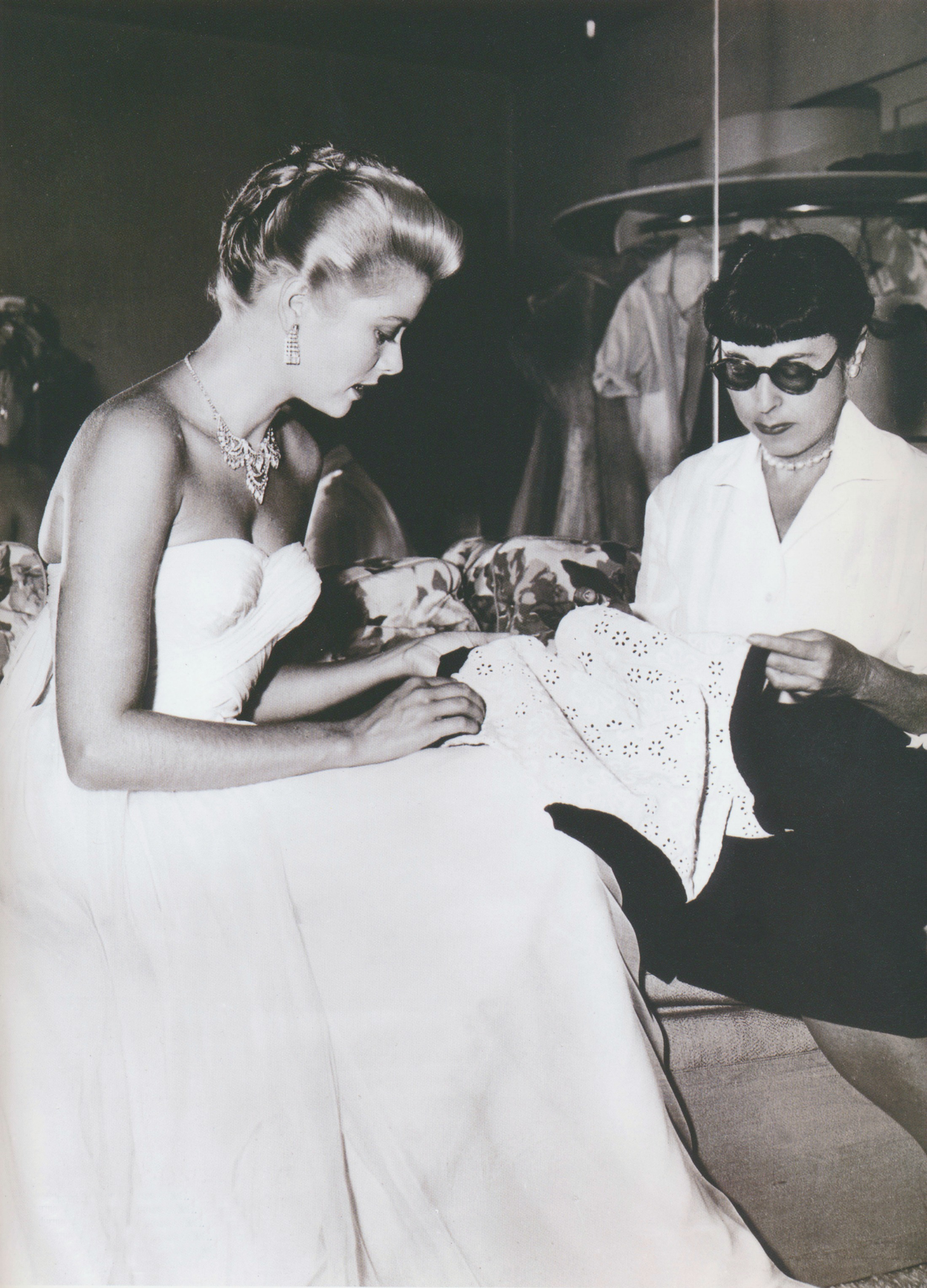
In July 1953 Grace began work on Dial M For Murder for Warner Brothers where she met Alfred Hitchcock who became a cinematic mentor. Soon after, The Bridges at Toko-Ri (1954) at Paramount Pictures began Grace’s ground-breaking multi-film collaboration with Academy-Award winning costume designer Edith Head. In the 1930’s, costume designer Edith Head leaned liberal in her costume designs. By the 1950’s, when she worked with Grace, Head’s fashion designs became more conservative. Edith Head and Grace Kelly became lifelong friends. Even after Grace left Hollywood and became Princess of Monaco, Edith Head, who had a very busy schedule as a prolific and successful costume designer in Hollywood – a record eight Academy Awards for Best Costume Design between 1949 and 1973 – visited Grace in Monaco on vacations right up to the time of Kelly’s untimely death at 52 years old on September 14, 1982 following a car accident.
In 1952 Grace Kelly played Amy Fowler Kane in Fred Zinnemann’s High Noon. In 1953 Kelly received an Oscar nomination for Best Supporting Actress for her performance as Linda Nordley, one side of a love triangle, in John Ford’s Mogambo with Hollywood stars Clark Gable and Ava Gardner. Grace had made her first of three films with Alfred Hitchcock as Margot Mary Wendice in Dial M For Murder (released in May 1954). So, when filming started in January 1954 for The Bridges at Toko-Ri, Grace Kelly, who just turned 24 years old, had already made remarkable films.
The year 1954 proved to be a banner year for Grace Kelly’s scintillating Hollywood career. In August/September 1954 Alfred Hitchcock’s Rear Window was released. The part of Lisa Carol Fremont solidified Kelly’s image as a fashion icon. Other films released in 1954 starring Grace Kelly were Green Fire with Stewart Granger, The Bridges at Toko-Ri with William Holden and The Country Girl with Bing Crosby – all December 1954 releases. In the dressed-down role of Georgie Elgin Grace Kelly’s performance brought her that year’s Academy Award for Best Actress in a Leading Role in March 1955. In May 1955 Grace Kelly met Prince Rainier III (1923-2005) of Monaco and the couple were engaged by the end of the year.
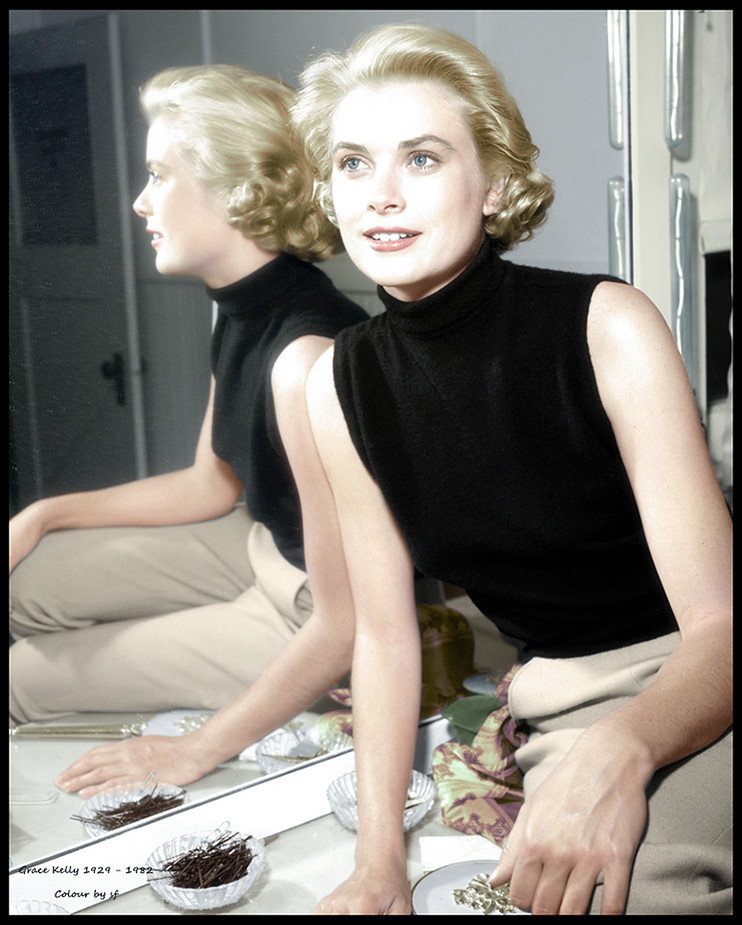
In The Bridges of Toko-Ri Grace played the small but pivotal role of Nancy Brubaker, wife of Lt. Harry Brubaker (William Holden). Kelley wears a sleeveless turtleneck and tan pants in her dressing room on set in 1954. PHOTO credit: “Grace Kelly 1929 – 1982” by oneredsf1 is marked with CC BY-NC-SA 2.0GRACE KELLY APPEARED in 5 FILMS RELEASED IN 1954, INCLUDING HER ACADEMY-AWARD-WINNING BEST ACTRESS PERFORMANCE IN THE COUNTRY GIRL. “Grace Kelly 1929 – 1982” by oneredsf1 is marked with CC BY-NC-SA 2.0.On the set of Green Fire in 1953 Grace Kelly wears a belted beige dress and matching sunhat. PHOTO credit: “Grace Kelly 1929 – 1982” by oneredsf1 is marked with CC BY-NC-SA 2.0.
Grace Kelly was the reason the box office thrived for Green Fire, a drama about emerald miners in South America co-starring Stewart Granger. It was produced in Cinemascope and Eastman Color. The film was panned by many.
Kelly had been working constantly since 1951. She made the entertaining color action feature The Bridges at Toko-Ri for Paramount Pictures. The film is significant for the fact that it started the collaboration of Grace Kelly with costume designer Edith Head as well as was a serious film dealing with the Korean war.
Before meeting Prince Rainier III in May 1955 upon leading the American delegation that year to the Cannes Film Festival and making the Hitchcock thriller, To Catch a Thief, co-starring Cary Grant, Grace had her share of romantic involvements, including during the making of The Bridges at Toko-Ri.
Grace Kelly and William Holden play the husband-and-wife lead roles in Paramount Pictures’ 1954 war film, The Bridges at Toko-Ri. During filming, Grace Kelly fell madly in love with her Bill Holden, her co-star, who was married and 11 years older. PHOTO image: “Grace Kelly 1929 – 1982” by oneredsf1 is marked with CC BY-NC-SA 2.0.
Off screen Grace Kelly had fallen madly in love with co-star William Holden. Holden was 11 years older than Grace Kelly—and married. But they had an affair throughout the making of the picture. The electricity of that affair is evident in the love scenes where they played movie husband and wife.
In The Bridges at Toko-Ri Grace Kelly is Nancy Brubaker, the young wife of Navy pilot Lieutenant Harry Brubaker (Holden). A husband and father, Brubaker never wanted to be a flyer in the Navy and still wants out. Yet he accepts a very risky and dangerous mission during the Korean War and is killed in action. The commander asks—is it really a good mission if lives of good men are lost? The film is based on a novel by James Michener who recounted actual missions he covered as a correspondent on U.S. air craft carriers that were flying bombing missions on railroad bridges in North Korea in 1951 and 1952.
In The Bridges at Toko-Ri Grace Kelly played Nancy Brubaker, the wife of a U.S. Navy pilot (William Holden) who is killed in action in the Korean War. Grace is radiant in every scene in which she appears.
Though Kelly has a relatively small part in the war film, she is radiant in every scene. This is the first film where Grace Kelly appears in bed. Directed by prolific Marc Robson, The Bridges at Toko-Ri was one of the biggest hits of his career. Lyn Murray composed the musical score. Murray started in Hollywood in 1950 doing vocal arrangements for Walt Disney but soon was writing music for feature films throughout the 1950’s and 1960’s.
The film is a noisy and straightforward tale of one small American family in war-time. It combines humor notably provided by Mickey Rooney as CPO NAP Mike Forney that soon collides with war’s high-stakes mortal danger whose scenes look to presage Vietnam. The film’s cooperation with the U.S. Navy led to realistic and spectacular aerial and carrier action scenes that, in 1956, won the Academy Award for Best Special Effects.
Grace Kelly had a small but important role in The bridges at Toko-Ri, one of the best motion pictures made dealing with the Korean war. From Paramount Pictures and based on a book by James Michener, it was filmed in Technicolor and had the full cooperation of the U.S. Navy.
Holden as Airman Brubaker tenderly expresses his sense of loss when his fellow airmen Mike Forney and Nestor Gamidge (Earl Holliman) are whisked off to other navy assignments. Their entire job was to save the lives of airmen in battle—and had saved Brubaker’s – so that their sudden professional absence is personally and deeply felt.
This is a film of the mid 1950s with caring commanders who look and talk remarkably like Ike, then President of the United States and who had just ended the Korean action in July 1953. Chain smoking by nearly everyone in the cast appears to be de rigueur. Listening to navy radio Lieutenant Harry Brubaker is riveted hearing a broadcast from Chicago’s famous Chez Paree nightclub showcasing jazz trumpeter Henry Busse. The local flair and period cultural items add interest to the fine acting and timeless beauty of Grace Kelly along with the film’s fact-based war story and blockbuster action. Almost 70 years after its initial release, The Bridges at Toko-Ri continues to be a worthwhile entertainment.
A stage play on film, the action in Dial M For Murder is limited to a few rooms about a tennis player (Ray Milland) who arranges to kill his wife (Grace Kelly) to inherit her money. Shot in WarnerColor, it co-starred a cast that included Robert Cummings. “Grace Kelly 1929 – 1982” by oneredsf1 is marked with CC BY-NC-SA 2.0.
On the set of Rear Window (1954).
In Rear Window released in September 1954, Grace Kelly received equal billing with co-star Jimmy Stewart and director Alfred Hitchcock.
Grace refused other lucrative film offers to work again with Hitchcock, this time at Paramount Pictures, on Rear Window co-starring Jimmy Stewart. In this landmark mystery thriller film which came out in summer 1954, one of Hitchcock’s dramatic emphases for Grace Kelly’s film persona was to display her natural elegance and sex appeal—he was amused by her public image as an “Ice Queen”4—by having her costumed in an array of fabulous Edith-Head-designed lingerie, dresses, and pants. Growing up in Philadelphia Grace Kelly as an adolescent and teenager had modeled in local fashion shows but, by the middle 1950’s in her mid-twenties, she became an international fashion and style icon.
Edith-Head lingerie, dresses, and pants highlighted the differences in lifestyle between the character of Lisa played by Kelly and the photojournalist L.B. Jeffries played by Jimmy Stewart.
In the scene where Kelly is first introduced in the film, Stewart awakes to a full close up of Lisa coming toward him for what may be cinema’s greatest kiss. The dress Lisa describes as “fresh from the Paris plane” offered a simple neckline to frame Grace’s face for the close-up, a fitted black bodice and a full skirt to mid-calf, among other accessories. The $1,100 price tag in 1954 that Lisa talks about is about $13,000 today. Hitchcock wanted the audience to know immediately that Lisa was no ordinary woman that had arrived to Jeff’s apartment.Studio publicity still of Grace Kelly for the film Rear Window (1954). Public Domain. “Grace Kelly in Rear Window” by thefoxling is marked with CC BY-NC-SA 2.0.
Action In Rear Window – like Dial M For Murder – was in a confined setting. In Alfred Hitchcock’s first picture for Paramount Pictures, the action was confined to one room with a hero (Jimmy Stewart) confined by a broken leg. Rear Window, which is about a photojournalist who sees strange goings-on as he watches people in the privacy of their apartments using a telephoto lens, was an artistically and financially suspenseful parlor drama that was hugely successful.“Alfred Hitchcock, Grace Kelly, Jimmy Stewart (1)” by oneredsf1 is marked with CC BY-NC-SA 2.0.“Grace Kelly 1929 – 1982” by oneredsf1 is marked with CC BY-NC-SA 2.0.
Never just a pretty face, Grace Kelly insisted in her studio contract that she be allowed regular breaks to be able to act in live theater.5 From childhood, Grace admired the art of the live stage and welcomed demanding theater and film roles that challenged and exhibited her acting range and abilities. This love of the theater was a big part of her motivation to seek the hardly glamorous but dramatically impressive role of Georgie Elgin in George Seaton’s The Country Girl (1954) for Paramount Pictures.
With co-stars Bing Crosby and William Holden, the film featured Grace playing Georgie, the long-suffering wife of an alcoholic actor struggling to resume his career (played by Crosby).
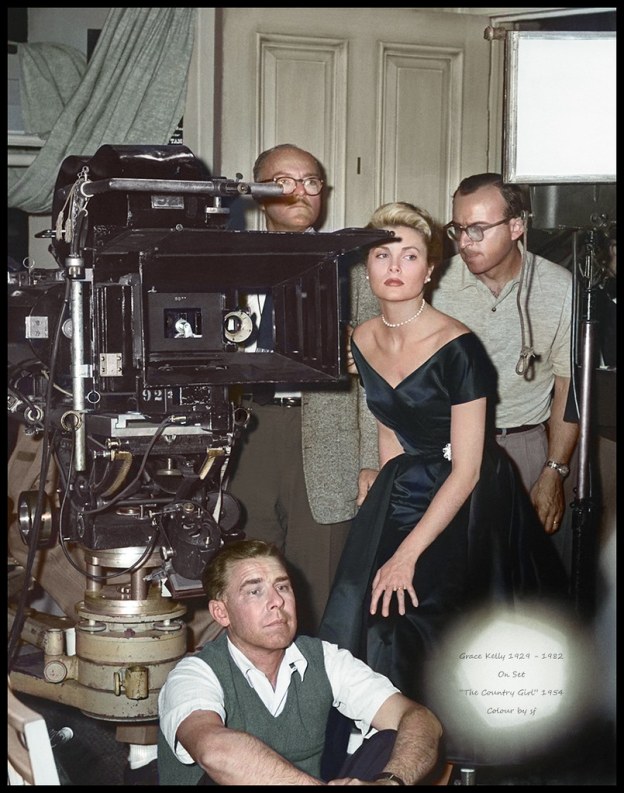
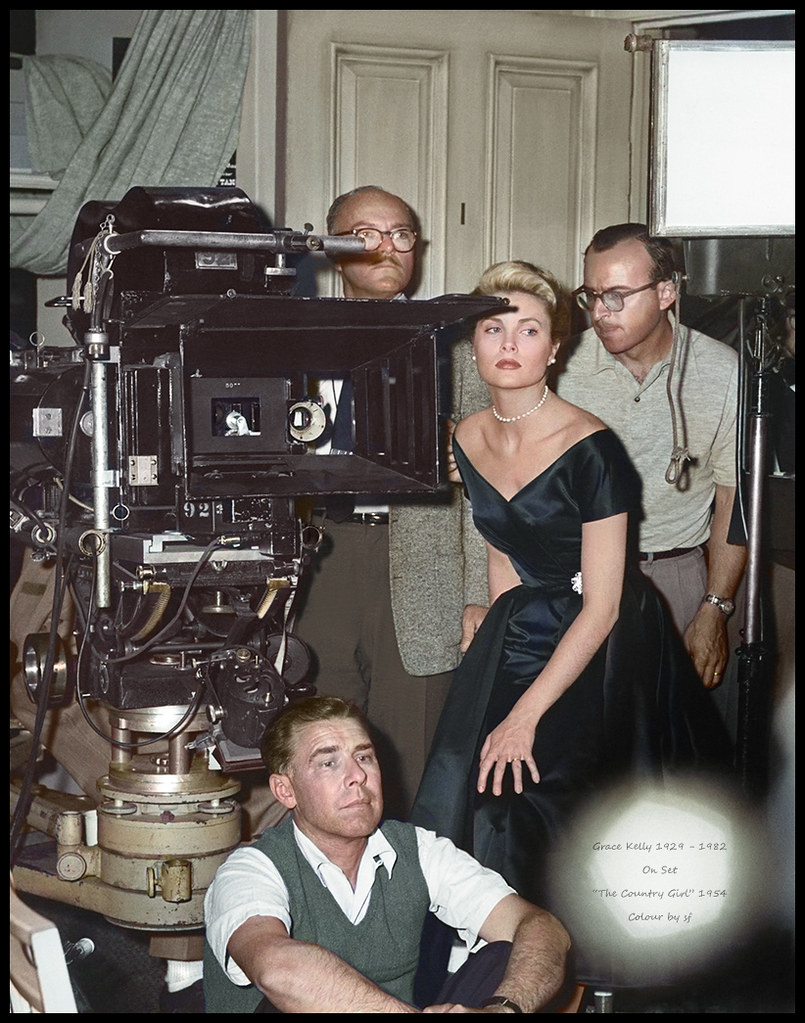
Grace Kelly studying the script during filming of George Seaton’s The Country Girl. The 1954 drama film received 7 Academy Award nominations and won two Oscars – including Grace Kelly as Best Actress.
The Country Girl features actors playing against type and revealing new facets of their acting talents. William Holden plays Bernie Dodd, a stage director, who takes a chance on Frank Elgin (Bing Crosby), a great star who has lost jobs because of his dipsomania. Dodd blames Elgin’s wife Georgie (Grace Kelly) but realizes that Frank Elgin would have crumbled without her. When Frank pulls himself together for an opening night triumph, Dodd proposes to Georgie and she must decide to leave with the handsome, hardworking stage director or stay with her troubled husband. Grace on the set of The Country Girl,1954. “Grace Kelly 1929 – 1982” by oneredsf1 is licensed under CC BY-NC-SA 2.0.
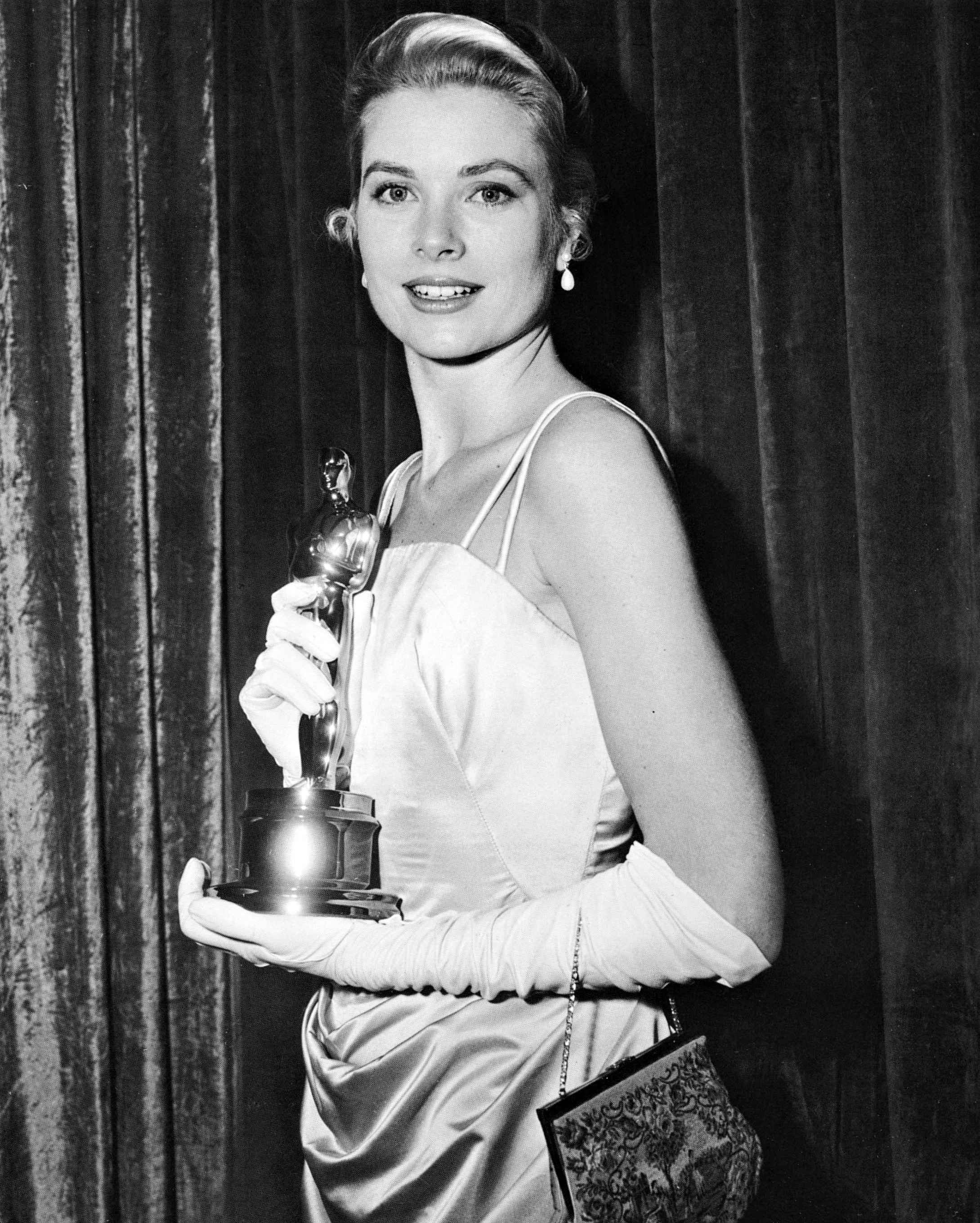
At its release, The Country Girl was a hit and nominated for seven Academy Awards. On Wednesday, March 25, 1955, at the telecast of the 27th annual Academy Awards held at RKO Pantages Theatre, the third time the ceremony was televised nationally, The Country Girl won two Oscars, including one for Grace Kelly for Best Actress.6 At 25 years old Grace Kelly of the ambitious and hugely competitive Kellys of Philadelphia had reached the pinnacle of the cinema arts holding her profession’s gold-plated statuette.
Grace Kelly backstage after the 27th annual Academy Awards on March 25, 1955.
During the evening Grace won the Oscar for Best Actress for her dressed-down and dramatic role in The Country Girl.
At the 27th Annual Academy Awards, presenter Bette Davis is joined by Marlon Brando and Grace Kelly, each holding their golden trophies for Best Actor and Best Actress.
In early 1954 Grace had flown to South America to make Green Fire (1954) for M-G-M with Stewart Granger. In May 1954 she was at the French Riviera to make her third film with Alfred Hitchcock: To Catch a Thief (1955) co-starring Cary Grant for Paramount Pictures.
Grace liked the Riviera. In April 1955 she traveled there again for the 8th annual Cannes Film Festival. It was during this early spring 1955 Mediterranean trip that Grace Kelly was first introduced to Prince Rainier III of Monaco.
Grace Kelly in a chiffon-draped gown by Edith Head in To Catch a Thief (1955).
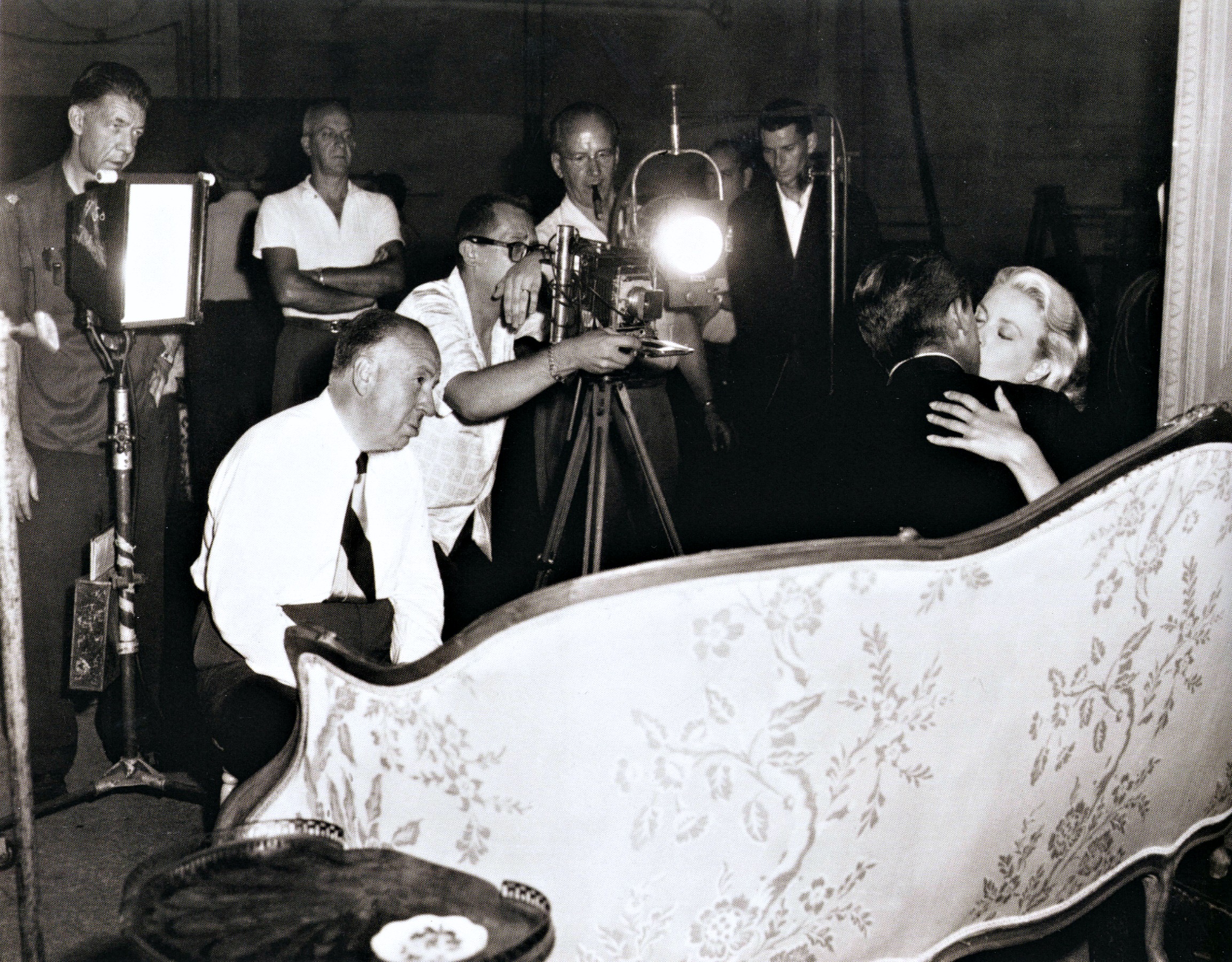
Sitting in a director’s chair with her co-star Cary Grant’s name emblazoned on it, Academy-Award-winning Best Actress Grace Kelly is served a beverage by director Alfred Hitchcock on the set of To Catch A Thief.
Cary Grant’s reaction to the beach dress makes its stunning design even more iconic. “Grace Kelly” by twm1340 is marked with CC BY-SA 2.0.
Hitchcock had found his blonde muse in Grace Kelly and aided mightily to reveal her star qualities. Grace Kelly and Cary Grant in To Catch a Thief (1955). Kelly and Grant were lifelong friends. PHOTO credit: “Grace Kelly & Cary Grant, ‘To Catch a Thief’, 1955” by thefoxling is marked with CC BY-NC-SA 2.0.
Grace wears a pink dress for a walk in the south of France. Grace Kelly on the set of To Catch A Thief. “grace kelly” by ___carmendy is marked with CC BY 2.0.About Grace Kelly, friend and co-star Cary Grant recalled that the Academy-Award winning actress commanded so much respect during the filming of “To Catch a Thief” that there was almost total silence when she arrived on the set.Fair use.
Grace Kelly dressed for the ball in the penultimate scene of her penultimate film, To Catch A Thief.
Grace Kelly by Howell Conant, 1955. Conant was Grace Kelly’s friend and favorite photographer.
26-year-old Grace Kelly and 31-year-old Prince Rainier III on their first meeting at the palace in Monaco, May 6, 1955. They would be engaged to be married by the end of the year. Photo: Edward Quinn. Fair Use.
Grace Kelly stood five foot seven inches tall and weighed 118 pounds. Her dress size was two.7 She was born on November 12, 1929 into the Kelly family of Philadelphia. Grace Patricia Kelly was the third of four children and one of that Irish-German family’s three girls. Elder sister Peggy and younger sister Lizanne were athletic and shared their mother Margaret’s model looks. Margaret was the family disciplinarian who the Kelly children liked to call “the Prussian General.”8
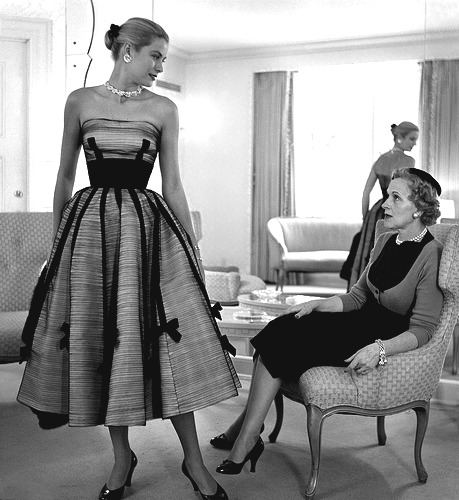
Grace Kelly models a fashionable dress for her mother in the mid1950’s. Grace’s reflection is in the mirror.
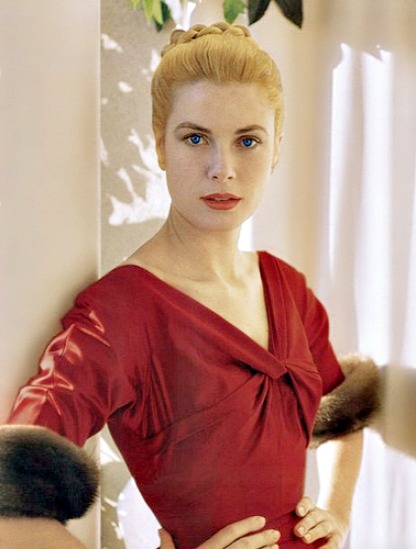
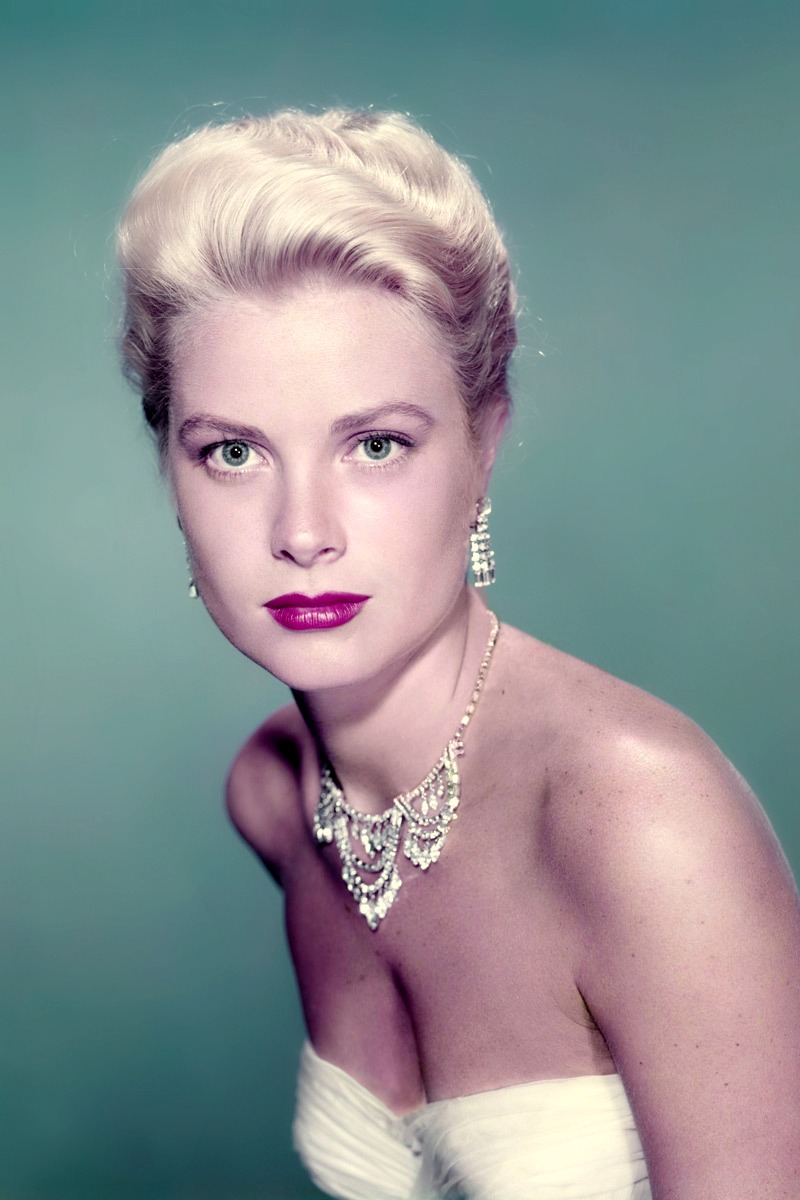
As a child Grace was dreamy and shy while her siblings were outgoing and athletic. Yet Grace inherited a keen awareness of her body using her arms and legs to be dramatically expressive in an actress’s rather than athlete’s way.9 At 18 years old Grace’s beautiful rectangle-shaped face with soft pear-shape dimensions displayed thick blond hair, almond-shaped blue eyes, a small high-bridge nose and ruby lips evident in later glamour photographs.
Each member of the Philadelphia Kelly family was an exuberant competitor in areas of American life such as athletics, business, politics, or high society.
in addition to her remarkable beauty, one of Grace’s major strengths was her ability to focus on the goal she decided to pursue whether professionally or personally until that goal was achieved.
When Grace won the Academy Award for Best Actress in 1955 it was a brick in the Kelly family wall of ambition for success.
Before she was a teenager Grace performed in plays so that during her teenage years a desire to be a professional actress grew. Since Grace was situated within a protective and affluent family as well as educated in Philadelphia Catholic and other private schools she sought theater work in New York City instead of Hollywood. Even when she had achieved the pinnacle of film success Grace still considered New York Theater a worthwhile aspiration and Hollywood as a pitiless machine of cinematic production.10
The Kellys in Philadelphia. Grace and Peggy flank Jack and Lizanne on his shoulders, c. 1946. Grace Kelly moved to Southern California to be in motion pictures. She appeared in her first film called Fourteen Hours for 20th Century-Fox in 1951 when she was 22 years old.“Grace Kelly 1929 – 1982” by oneredsf1 is marked with CC BY-NC-SA 2.0.Grace Kelly, 1955. Four years after her arrival to Hollywood Grace Kelly was one of the most glamorous women in the world.
It was Aristotle Onassis who suggested to Prince Rainier that he marry a beautiful American movie star to bring the glitterati back to Monaco. Onassis’s list at the time did not include Grace Kelly.11
Invited to the 1955 Cannes Film Festival after she had won the Academy Award for Best Actress for The Country Girl one month before, Grace was curious enough about the prince to be introduced to him in Monaco on Friday, May 6, 1955.
What is memorable from the photographs of their meeting at the palace is that the Prince looks chic and handsome and Grace is at her most beautiful in a black silk floral print dress with her blond hair pulled back into a German-style bun.
That evening Grace returned to Cannes for the festival’s screening of The Country Girl helping to conclude a day that Grace herself called “pretty wild.”12 But Grace’s career in Hollywood wasn’t over—nor her life half begun. She was back in Paris before the festival’s winners were announced (she had won nothing there),13 and soon returned to Hollywood to make what turned out to be her final two Hollywood movies – The Swan and High Society.
Grace Kelly and Prince Rainier were engaged in December 1955. One of her female co-stars observed that the gem of Grace’s engagement ring that she received from the prince was the size of a “skating rink.”
Grace Kelly wears her engagement ring from Prince Rainier on the set of High Society.
Grace Kelly in a make-up test for the honeymoon scene in High Society.
High Society from M-G-M, starring Grace Kelly as socialite Tracy Lord, was the biggest money making film of 1956. It was a musical adaptation of M-G-M’s The Philadelphia Story (1940) starring Katharine Hepburn in the lead role. High Society co-starred crooners Bing Crosby and Frank Sinatra and songs by Cole Porter. The film was Grace Kelly’s swan song before she departed Hollywood forever. In High Society (1956) Grace Kelly plays Tracy Samantha Lord. C.K. Dexter-Haven (Crosby), her former husband, remains in love with her but she is now engaged to socially prominent and snobbish George Kittredge (John Lund). With the help of a sympathetic reporter (Sinatra), Dexter-Haven has a short window of time to convince her that she really still loves him. Costumes were by Helen Rose who worked at M-G-M from 1942. Photograph by Eric Carpenter (1909-1976), a Clarence Sinclair Bull assistant, Fair use. Grace Kelly in High Society (1956). “Grace Kelly” by thefoxling is marked with CC BY-NC-SA 2.0.Grace Kelly, The Swan.
In the same year that The Swan (1956), a film featuring royalty, was released, Grace Kelly had married the Prince of Monaco. Grace Kelly in a M-G-M publicity photograph for The Swan.
Grace behind the wheel of a Mercedes-Benz for a scene in High Society.
Leaving “Tinsel Town” for what turned out to be forever, the 26-year-old movie star sailed for Monaco. The Kellys paid a $2 million dowry and, in April 1956, Grace married her prince. She became a wife, mother, and royal princess of a sovereign city-state and microstate on the Mediterranean Sea – and one of the wealthiest places in the world.14 Grace, however, traveled frequentl to the United States, and though her acting career had precipitously ended, she remained Hollywood royalty as well.
Fourteen Hours Grace Kelly as Louise Anne Fuller Directed by Henry Hathaway Released March 6, 1951. Twentieth-Century Fox
1952:
High Noon Amy Fowler Kane Directed by Fred Zinnemann Released July 24, 1952 United Artists
1953:
Mogambo Linda Nordley Directed by John Ford Released October 9, 1953 M-G-M
1954:
Dial M for Murder Margot Mary Wendice Directed by Alfred Hitchcock Released May 18, 1954 Warner Bros.
Rear Window Lisa Carol Fremont Directed by Alfred Hitchcock Released September 1, 1954 Paramount Pictures
The Bridges at Toko-Ri Nancy Brubaker Directed by Marc Robson Released December 31, 1954 Paramount Pictures
The Country Girl Georgie Elgin Directed by George Seaton Released December 15, 1954 Paramount Pictures
Green Fire Catherine Knowland Directed by Andrew Marton Released December 29, 1954 M-G-M
1955:
To Catch a Thief Frances Stevens Directed by Alfred Hitchcock Released August 3, 1955 Paramount Pictures
1956:
The Swan Princess Alexandra Directed by Charles Vidor Released April 18, 1956 M-G-M
High Society Tracy Lord Directed by Charles Walters Released July 17, 1956 M-G-M
TEXT NOTES:
It was actually my brother Kevin who, when he was working in the Chicago Film Office, wrote to me this description of Grace Kelly and Rear Window as the greatest film ever.
Quoted in Roberts, Paul G., Style Icons Vol 4 Sirens, Fashion Industry Broadcast, p. 74.
Scott Eyman, Print The Legend: The Life and Times of John Ford, Simon & Schuster, 1999, p. 419-21; Kenda Bean and Anthony Uzarowski, Ava: A Life in Movies, Philadelphia: Running Press, 2017, p. 118
Dherbier, Yann-Brice and Verlhac, Pierre-Henry, Grace Kelly A Life in Pictures, Pavilion, 2006, p. 11.
Edith-Head-designed apparel for Rear Window – Haugland, H. Kristina, Grace Kelly: Icon of style to Royal bride (Philadelphia Museum of Art), Yale University Press, 2006, p. 956; so she could act in live theater – TBA
First meeting in Monaco of Grace Kelly and Prince Rainier III. He would tell her, “This is Europe, not America, We think differently here, and you will have to get used to it.” Fair use.