Monthly Archives: April 2026

My Street Photography. GENERAL MOTORS: CHEVROLET IMPALA (1958–1985; 1994–1996; 2000–2020).

FEATURE IMAGE: The 1966 Chevrolet Impala is 6 foot 7 inches wide (79.9 inches). See –https://www.conceptcarz.com/s9332/chevrolet-impala-series.aspx – retrieved May 7, 2024. May 2024. 94% 7.65mb Author’s photograph.

All photographs in this post are the author’s original work.

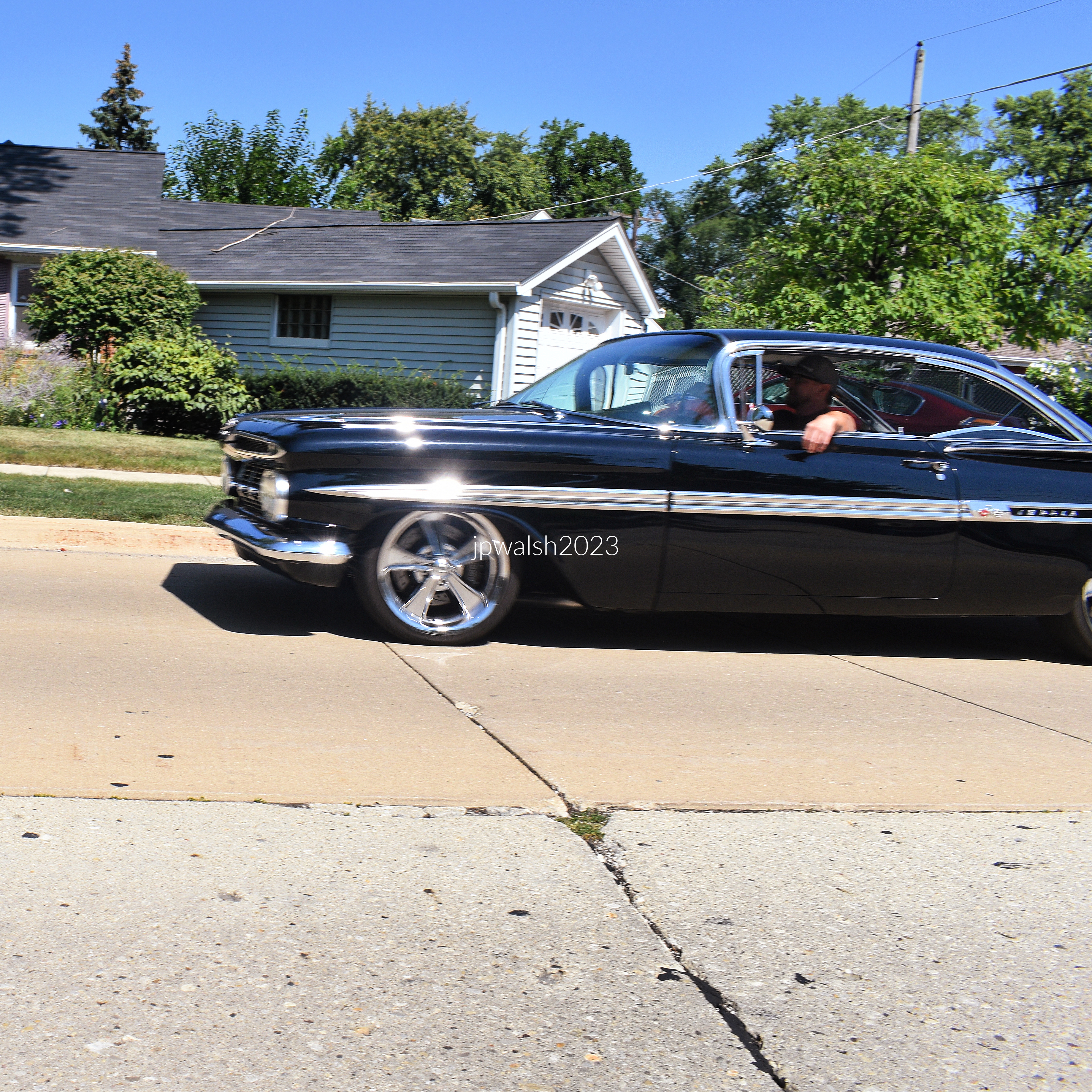
1959: Ad tag line Chevrolet for ’59 – all new all over again! GM overhauled its entire lineup that year with fresh body designs, and the shake‑up came with a reshuffling of model names. The Impala, which had been the top trim within the Bel Air line in 1958, was elevated to its own full series. By 1959 it had fully taken over as Chevrolet’s premium offering, while the Bel Air slid into the mid‑range slot.

The new design on all cars included a taller, wraparound windshield and rear windows that were greatly enlarged joined to thinner roof pillars for greater visibility. The slightly curved rear window went high into the roof line and sported a “flat top” roof.

The front end carried a grille made of nine horizontal bars crossed by seven thicker, evenly spaced vertical bars. The center horizontal bar was heavier, and each intersection with the verticals ended in a blunt, squared‑off cap. Above the side‑by‑side headlights and grille sat a pair of horizontal, teardrop‑shaped inlets, and centered between them on the hood was the Chevy insignia.

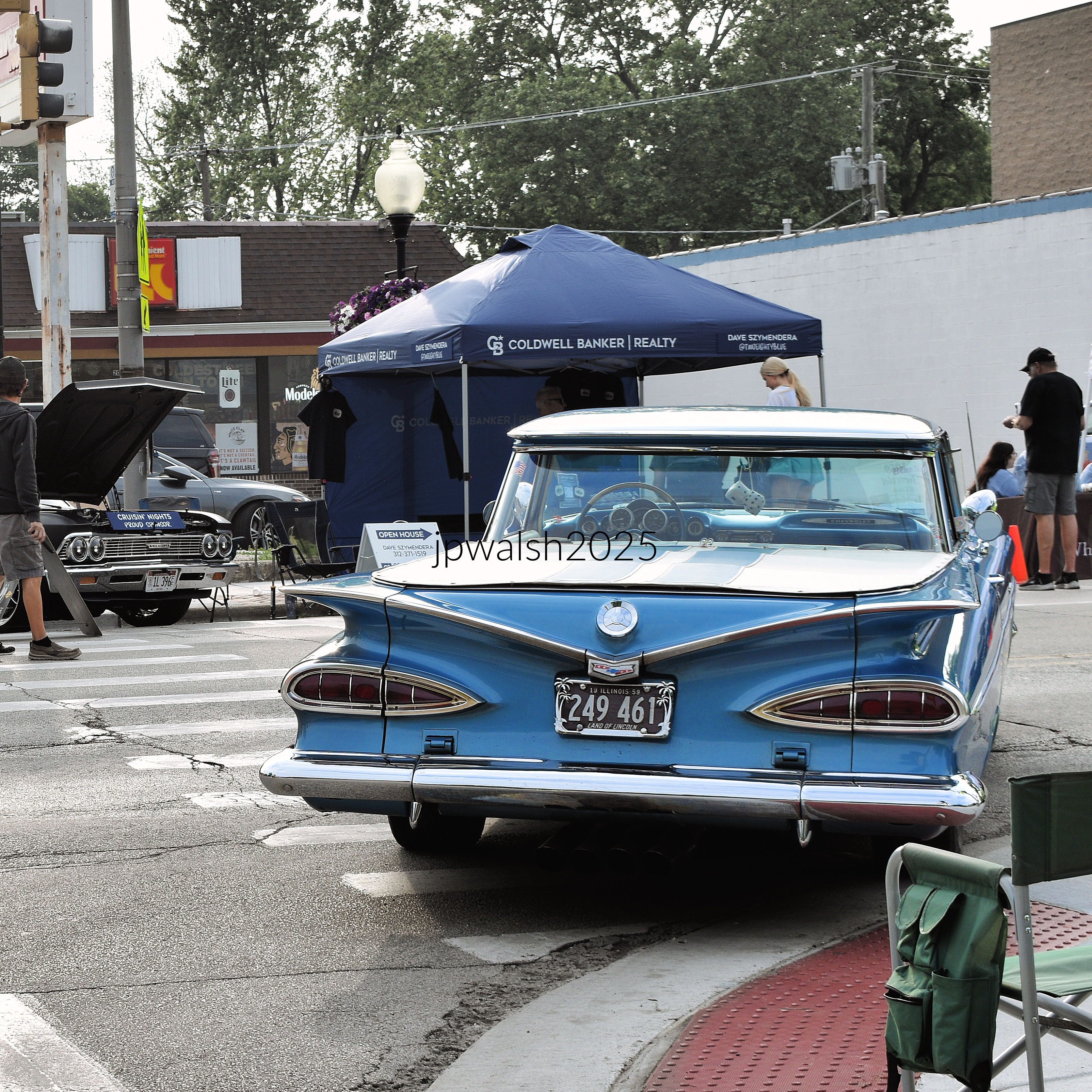
The tailfin began its rise just behind the front door, running cleanly to the rear with a subtle lift in height. At the back, the horizontal fins overhung the taillights and converged at the centerline, forming a crisp “V” that defined the car’s signature rear profile.

The body style lasted through model year 1960. Impala’s average price in 1959 was $2,719 (about $31,000 in 2026 dollars). Chevy produced a little over 500,000 Impalas in 1959.

Ad tag line for the 1959 Chevy Impala: “Chevy’s glamorous new series. Stunning and elegant.”

August 2023. 1959 Impala. 7.60 mb DSC_6290.
August 2023. 1959 Impala 6.71mb DSC_6291 (1)

1959 Chevrolet Impala 2-door hardtop. Second Generation (1959-1960). In 1959 Chevy Impala replaced the Bel Air as Chevy’s full-size premium model.

August 2023.1959 Impala. 3.28mb DSC_6289 (1)
June 2025. 1959 Chevy Impala. 74% 7.86mb DSC_1603
June 2025.1959 Chevy Impala 6.15mb DSC_1604 (1)

The Ad tag line for 1961 Impala: “America’s most popular cars, now trimmer in size.”

American automakers spent roughly two decades — from the early ’50s into the early ’70s — preaching the gospel that bigger was better. But running alongside that full‑size bravado was a quieter, persistent current of practical, economy‑minded engineering. A string of recessions — 1953–54, 1957–58, 1960–61, then again in 1969–70 and 1973–75 — kept reminding Detroit that not every buyer wanted (or could afford) a land yacht. Add in the first real wave of international competition, and the planners finally blinked. The result: the 1960 compact‑car push, with the Big Three rolling out smaller, thriftier models — and by 1961, expanding those compacts into higher‑trim, higher‑priced variants as the market proved there was real money in “small but smart.”

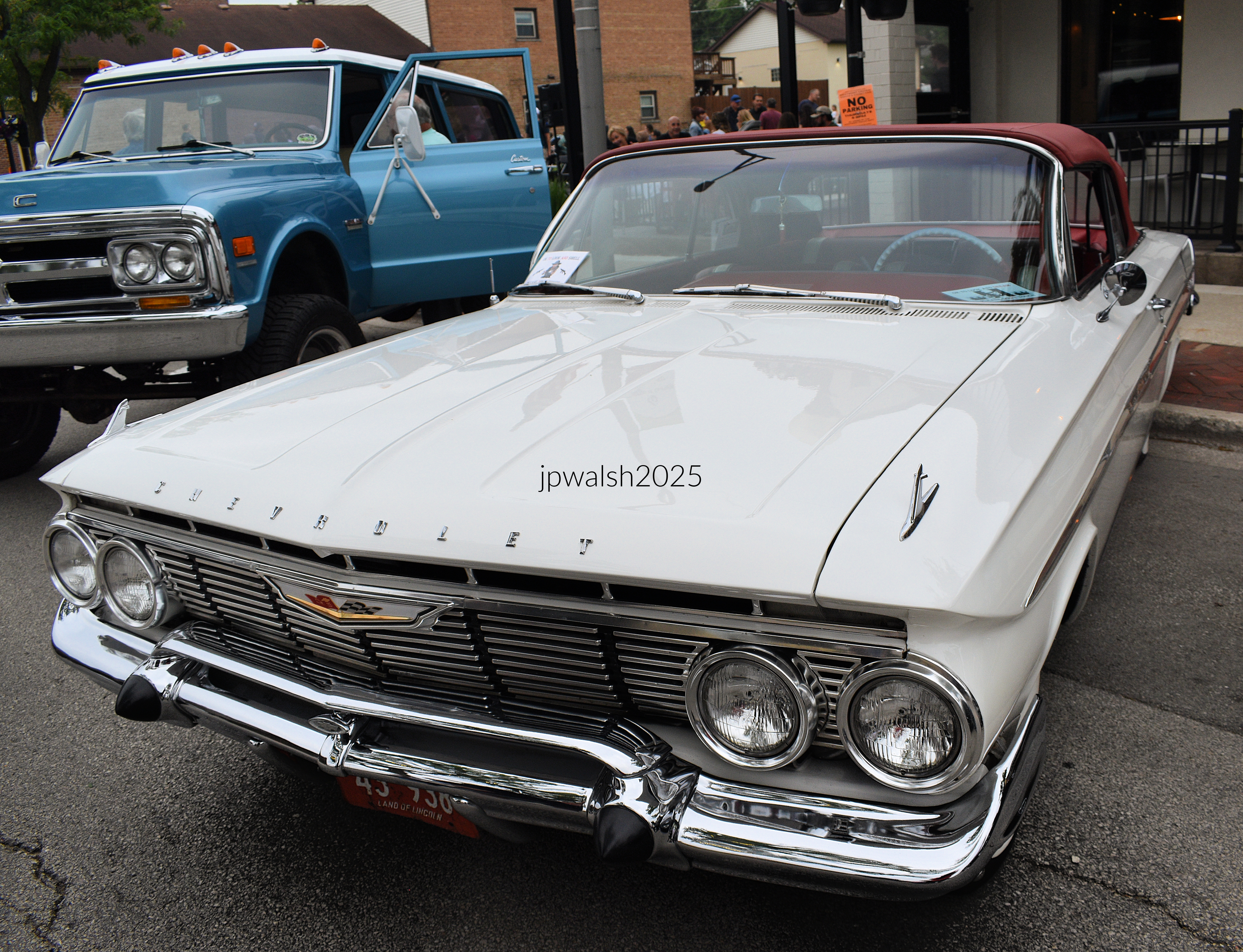
June 2025. 1961 Chevy impala. 7.40mb DSC_1703 (1)
June 2025. 1961 Chevy impala. 94% 7.96mb DSC_1705

Chevrolet owned the scoreboard in 1961, cranking out nearly 1.45 million vehicles and standing as the undisputed manufacturing leader. The full‑size lineup — Impala, Biscayne, and Bel Air — accounted for roughly 80% of that volume, proving that Chevy’s big‑car formula still had the magic touch.

At the top of the heap sat the Impala, the premium full‑size offering. In convertible trim it came dressed with vinyl upholstery and headliner, an electric clock, carpet‑and‑vinyl combo flooring with coated rubber matting, and dual backup lamps — the kind of upscale touches that separated it from its Biscayne and Bel Air siblings.

The ’61 full‑size Chevrolets were completely reworked, trimming a bit of length and width for a cleaner, more modern stance. The redesign ditched the wraparound windshield and the last traces of tailfins, but kept the signature center “V” dip out back. Up front, the cars wore a full‑width grille flanked by dual headlamps on each side, with parking and turn‑signal lamps perched above — a crisp, squared‑up face that set the tone for Chevy’s early‑’60s look.

June 2025. 1961 Chevy Impala. 99% 7.81mb DSC_1709 (1)

In 1965 the Chevrolet Full‑size line was sold with the tag line “Exciting, new look of elegance,” and the 1965 model year pushed that promise with a noticeable shift toward greater performance.
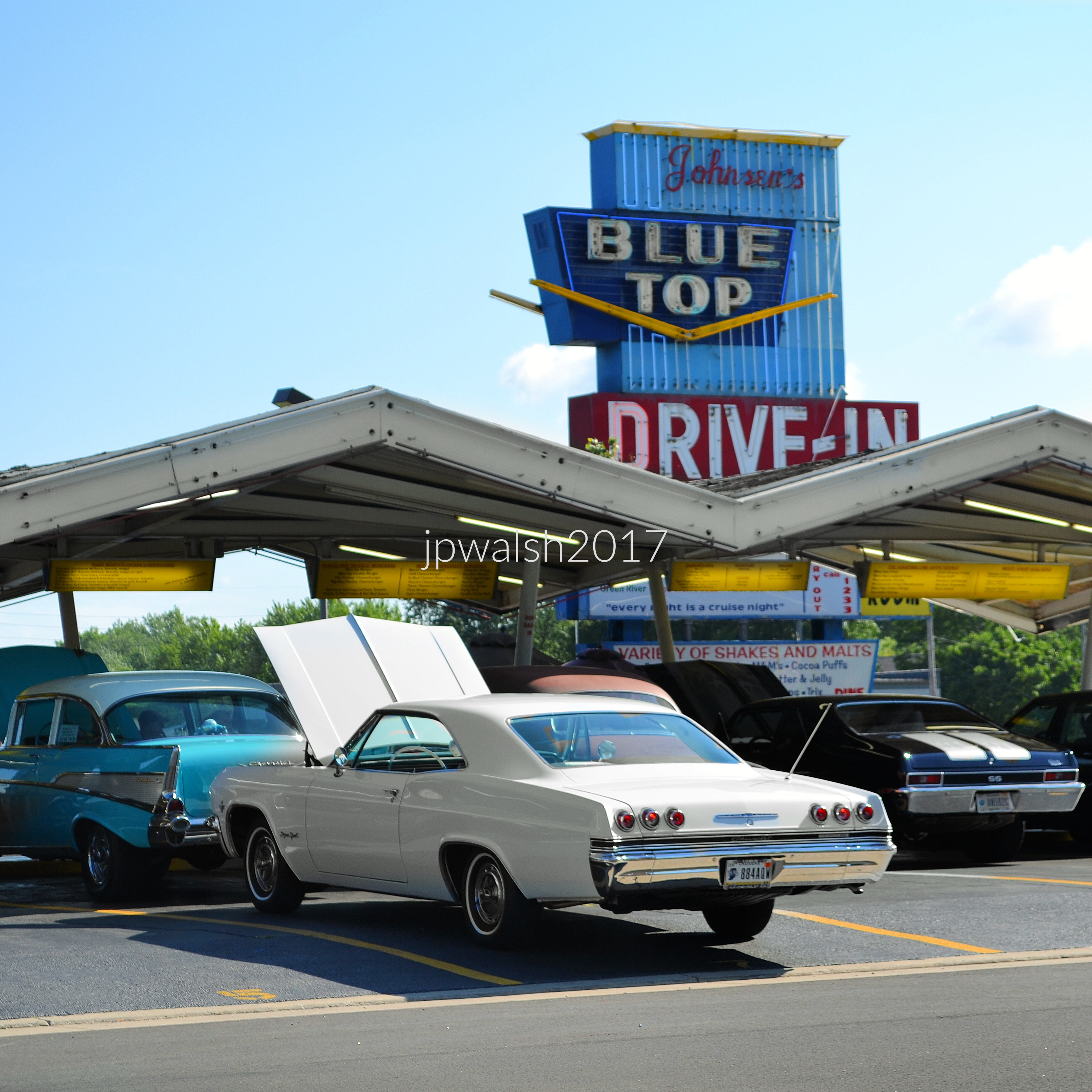
1965 Chevrolet Impala, Fourth Generation (1965–1970). Recognizable by its signature triple taillight design and flowing full-size body, the Chevy Impala was commonly equipped with a V8 engine, such as the 350 or 409ci. Redesigned in 1965, the Impala set an all-time industry annual sales record that year. July 2017. 2.77mb DSC_0419 (1). Author’s photograph.

The redesigned body introduced for 1965 carried through into 1966, giving the lineup a fresh, modern profile. That year, the Full‑Size series — Bel Air, Biscayne, and Impala — dominated Chevrolet’s output, accounting for nearly 70% of total production (1.647 million cars). The Impala alone made up almost three‑quarters of that figure, with 1,230,915 units built.

The Impala SS (Super Sport) debuted in 1960 as an appearance‑and‑performance package, and before long it was restricted to the hardtop and convertible coupes. From 1964 through 1967 — the Impala’s third and fourth generations — the Super Sport became its own standalone model, identified by a unique VIN prefix. In 1965–67, for example, 166/168 denoted a V8‑equipped Impala SS. August 2021. 10.9 mb. Author’s photograph.
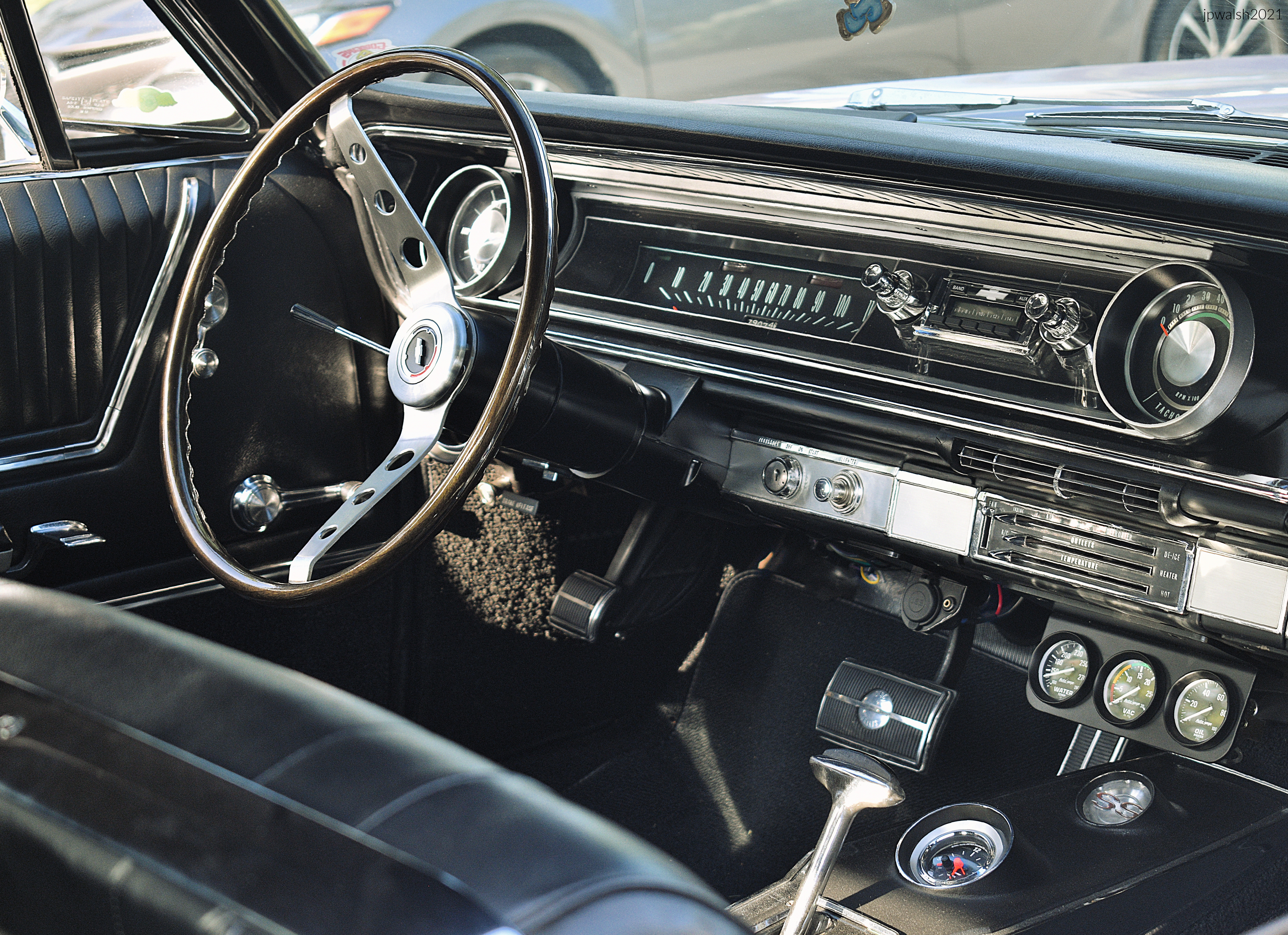
1965 Chevrolet Impala SS, Fourth Generation (1965-1970). From 1962 to 1964, Super Sports came with engine-turned aluminum trim which was used to fill the side moldings of the car. In 1965 this was replaced by a “blackout” trim strip that ran below the taillights. August 2021. 11.4 mb. Author’s photograph.

1965 Chevrolet Impala SS, Fourth Generation (1965-1970). The Chevrolet Impala arrived in 1958 with a signature design cue that set it apart from the rest of the lineup: its symmetrical triple taillights. By the late 1960s, as the muscle‑car era shifted toward smaller, lighter “big‑block” performers, the full‑size Super Sport began to fade from the spotlight. The Impala SS saw its final model year in 1969, closing out the original Super Sport era. August 2021. 7.71 mb. Author’s photograph.

The 1966 Chevrolet Full‑Size line carried the confident promise of its ad tag line — “Choose any Jet‑smooth 1966 Chevrolet. It’ll be well built, comfortable, dependable, and good looking.” Nearly 1.5 million full‑size Chevrolets rolled off the line that year, with the Impala once again leading the division at almost 960,000 units.

For 1965, Chevrolet introduced the Caprice as a top‑line Impala Sport Sedan; by 1966 it had become a separate series positioned above the Impala. The Impala itself continued to sit above the Bel Air and Biscayne and remained Chevrolet’s most popular full‑size model through the end of its initial production run in 1985.

By the late 1960s, as the muscle‑car movement shifted toward smaller, lighter platforms, the full‑size Super Sport gradually lost its footing. The Impala SS made its final appearance in 1969, closing the book on the original Super Sport era.

For Chevrolet in 1966, the company’s most painful competitive gap wasn’t in the full‑size field at all — it was the absence of a true answer to the runaway success of the Ford Mustang.

1966 Chevrolet Impala 2D Coupe. The Chevrolet Impala debuted in 1958 with a defining visual signature — its symmetrical triple taillights, a cue that instantly set it apart from the rest of the lineup. The 1966 Chevrolet Impala Super Sport (SS) Sport Coupe had a sexy sleek appearance with a 396 Turbo Jet that gave plenty of power and a smooth ride. May 2024. 89% 7.94mb Author’s photograph.

The 1966 Impala carried forward the clean lines of the ’65 but with a restrained, well‑judged refresh. It introduced a redesigned instrument panel, a new grille, revised wheel covers (excluding SS models), and a shift from the familiar six round taillights to rectangular units that wrapped subtly into the quarter panels, giving the rear a wider, more contemporary look. May 2024. 79% 7.85mb Author’s photograph.

Standard features on the 1966 Chevrolet Impala included lap belts front and rear, reverse lamps, day/night rearview mirror, and a padded dashboard. In a year of the introduction of the luxury Caprice and a slight redesign, sales plummeted compared to its record sales the year before. May 2024 97% 7.77mb Author’s photograph.
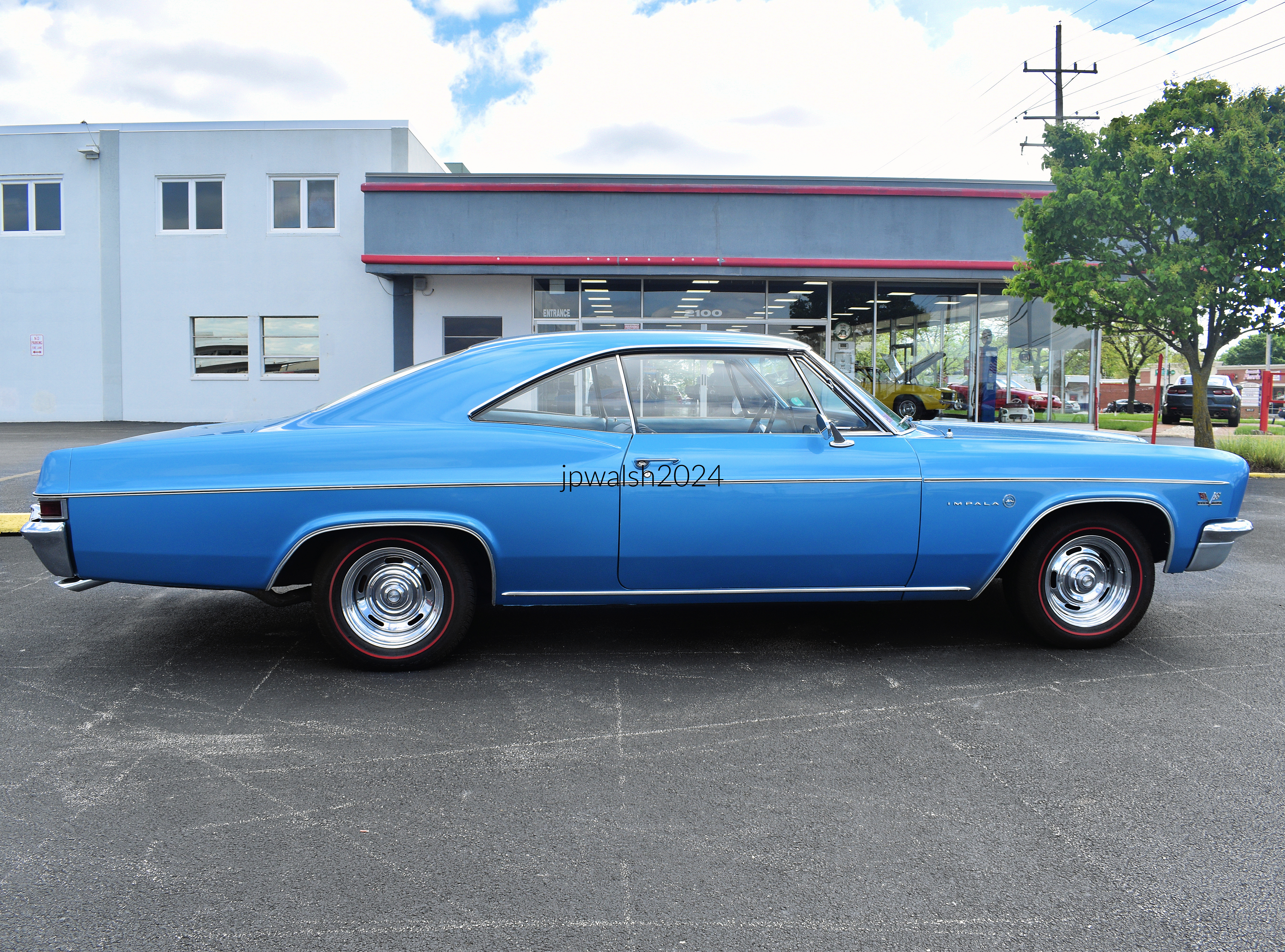
The 1966 Chevrolet Impala is nearly 18 feet long (213.2 inches). May 2024. 85% 7.56mb Author’s photograph.

The ad tag line in 1969 for Chevrolet’s Full‑Size lineup — “Never has so little money bought so much happiness” — captured the appeal of the Impala, Bel Air, and Biscayne as the brand’s value‑packed workhorses. By 1969, the Impala stood out not just as Chevrolet’s volume leader but as a model entering a distinctive moment in its evolution.

The 1969 Impalas carried several one‑year‑only traits that make them instantly recognizable to enthusiasts. After years of being optional, front disc brakes became standard equipment, paired with 15‑inch wheels — a setup that gave the big Chevys stronger stopping power and a more planted stance. It was also the only model year in which the cars actually wore the Impala nameplate on the body, a small but memorable break from tradition.

Production numbers underscored the Impala’s dominance. Out of Chevrolet’s 2,082,947 cars built for 1969, the Impala accounted for roughly 40% of the total — about 777,000 units — easily outpacing the more upscale Caprice and reaffirming its role as Chevrolet’s full‑size cornerstone.

1969 Chevrolet Impala. May 2024. 84% 7.93mb Author’s photograph.

1969 Chevrolet Impala. May 2024. 90% 7.42mb. Author’s photograph.

Chevrolet’s corporate message for 1970 — “Putting you first, keeps us first” — doubled as both a boast and a battle cry. And the Full‑size Chevrolets backed it up with their fourth restyle in four years. While they retained the broad‑shouldered stance and many cues of the ’69s, the 1970 models wore an entirely new face and tail, giving the big Chevys a fresher, more squared‑off presence on the road.

The 1970 model year opened with Chevrolet and Ford locked in a production slugfest, their rivalry on full display. When the dust settled, Chevy edged out Ford by fewer than 43,000 units — a razor‑thin margin in a combined output of 3,986,909 cars. Together, the two giants towered over the rest of the industry, their volume dwarfing every competitor in sight.

For the Full‑size line, the ad writers sharpened the pitch even further: “We’ll let other cars go their way. We’re going yours.” It was a confident nod to the brand’s bread‑and‑butter buyers — and fittingly, the Impala once again dominated production, anchoring Chevrolet’s full‑size lineup as its undisputed volume leader.

1970 Chevy Impala. September 2022. 67% Author’s photograph.

Chevrolet Impala Evolution: All Generations (1958–2020s) (https://www.youtube.com/watch?v=5Q-mu16nfvY) – retrieved April 27, 2026.

SOURCES:
J. “Kelly” Flory, Jr., American Cars, 1946-1959, McFarland & Company, Inc. pp. 949 and 953.
J. “Kelly” Flory, Jr., American Cars, 1960 to 1965, McFarland & Company, Inc., pp. 76-78, 87-92; 352 and 357.
J. “Kelly” Flory, Jr., American Cars, 1966 to 1972, McFarland & Company, Inc. pp. 32, 38-39; 235-36, 253-54, 260-61; 311-12, 330, 337.
see –https://www.conceptcarz.com/s9332/chevrolet-impala-series.aspx – retrieved May 7, 2024.

This explanatory article may be periodically updated.

Once More into the Breach: Shakespeare, History, and Olivier’s 1944 Henry V.

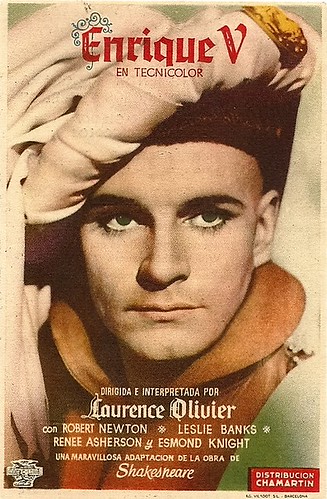
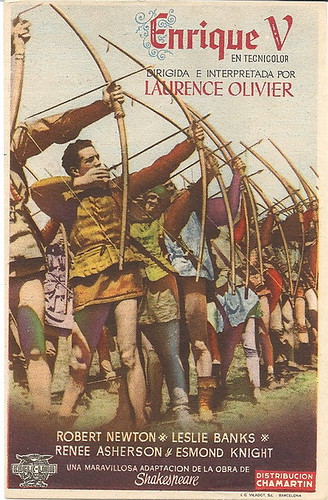
Feature Image: Movie poster in Spanish for Laurence Olivier’s 1944 Technicolor adaptation of William Shakespeare’s play, Henry V (1599). Produced in Ireland to serve as a British morale-boosting propaganda tool during WWII, the film achieved global distribution through theatrical releases and subsequent re-releases and is today frequently used in university studies (e.g., Cambridge Core) on cinematic Shakespeare. Photo: “Enrique V” by Kirby York is marked with Public Domain Mark 1.0.

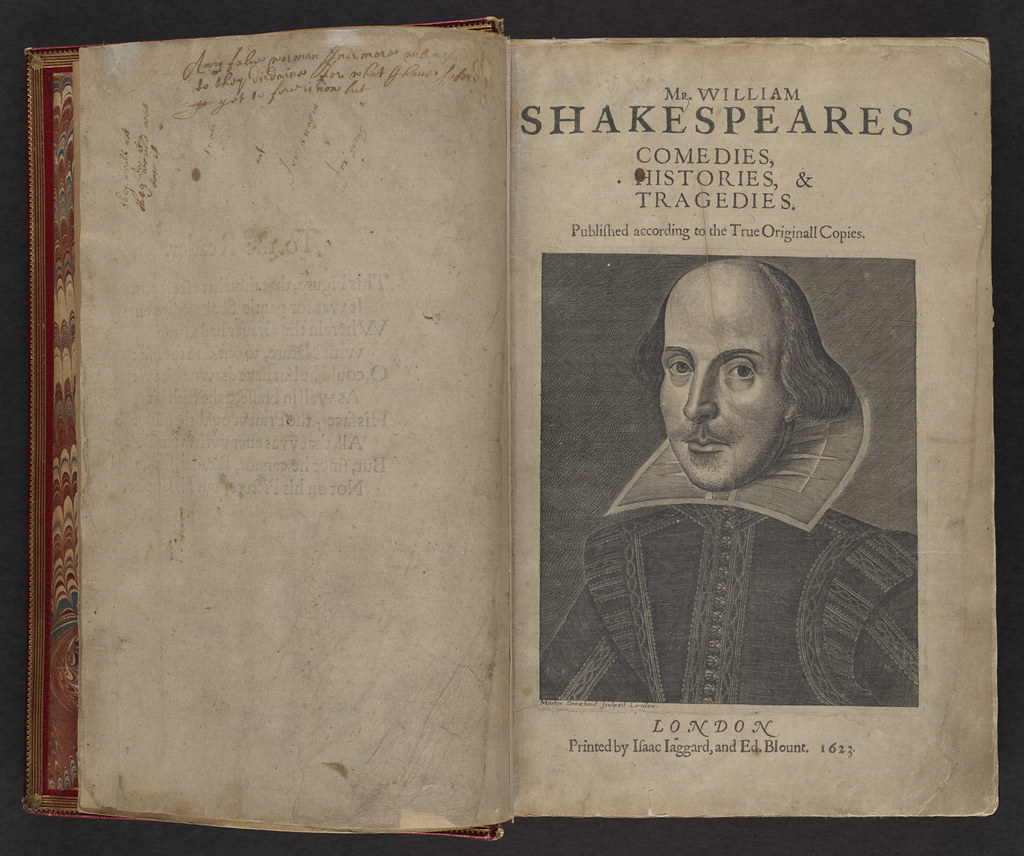
Shakespeare’s Henry V was first published in 1600 in a quarto edition and in subsequent editions in 1602 and 1619. A more complete, reliable text was later published in the First Folio in 1623. Photo: “Mr. William Shakespeares Comedies, Histories & Tragedies [Title page]” by Boston Public Library is licensed under CC BY 2.0.

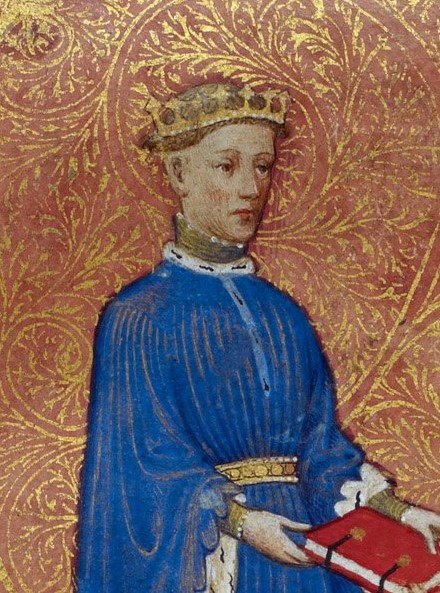
Henry V in the Regement of Princes, c. 1411–1413. Henry V died in 1422 at the age of 35, likely from dysentery contracted in the unsanitary conditions of his military camp. In his will, he named his brother, John of Bedford, as regent for his infant son, the future Henry VI, who would not be crowned in his own right until 1437. Although the Treaty of Troyes had positioned Henry V to inherit the French crown, he never became King of France; Charles VI outlived him, preventing the succession. His son, Henry VI—often described as gentle, passive, and averse to violence and warfare—proved unable to sustain his father’s hard‑won claims. His authority in France collapsed, and at home he was deposed in March 1461 by the Yorkist Edward IV. A brief restoration in 1470 returned him to the throne, but only for months; Henry VI was permanently deposed and killed in May 1471. Public Domain.

William Shakespeare likely wrote Henry V in spring 1599. The play dramatizes the 28-year-old English king’s campaign to claim the French throne, culminating in his victory at Agincourt on October 15, 1415—a battlefield I visited in 1993, still largely unchanged after six centuries. Henry based his claim on his ancestor Edward III, and his triumph was aided by a France divided by civil war between Burgundians and Orléanists.

At the Battle of Agincourt (1415), roughly 80% of Henry V’s army were longbowmen—an overwhelming concentration of missile power that defined the fight. Henry deployed thousands of archers along his flanks and center, unleashing relentless, high‑velocity arrow storms that tore through the densely packed, heavily armored French ranks. Behind their sharpened stakes, these archers acted as an offensive engine, cutting down waves of advancing knights before they ever reached English lines. The result was one of military history’s most lopsided victories. Estimates suggest 6,000–10,000 French dead—including more than ninety nobles—against only a few hundred English losses. French formations collapsed, morale shattered, and an army that outnumbered the English by as much as six to one simply disintegrated. Agincourt proved that disciplined, trained, often low‑born archers could annihilate superior numbers of elite, armored cavalry. It didn’t just win a battle—it rewrote the rules of medieval warfare. Photo: “Enrique V (3)” by Kirby York is marked with Public Domain Mark 1.0.

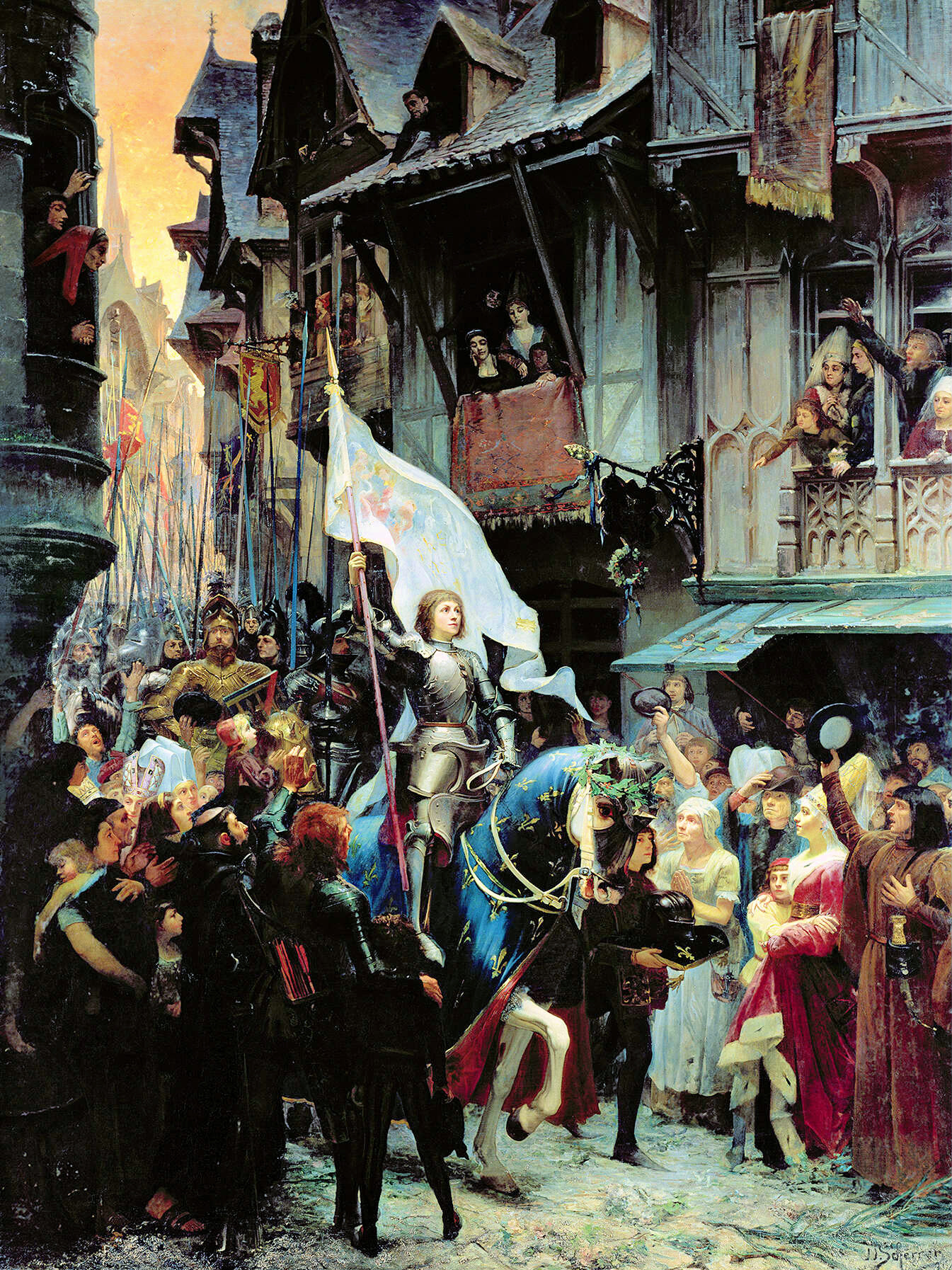
Entrée de Jeanne d’Arc à Orléans (“Entrance of Joan of Arc into Orléans”), painted in 1887 by the academic artist Jacques Scherrer (1855-1916), portrays Joan’s triumphant arrival in Orléans on May 8, 1429, after she lifted the city’s siege during the Hundred Years’ War. Her victory set in motion the campaign that culminated in the Dauphin’s coronation as King Charles VII at Reims on July 17, 1429. Public Domain.

Within fifteen years, Jeanne la Pucelle—Joan of Arc—led Orléanist and Armagnac forces to lift the siege of Orléans in 1429. Captured by Burgundians in 1430, she was handed to the English and condemned by their puppet ecclesiastical court before being burned in Rouen. Henry’s 1415 victory enabled the 1420 Treaty of Troyes, which disinherited the Dauphin, named Henry regent and heir to Charles VI, and arranged his marriage to Catherine of Valois, sister of the future Charles VII. On July 17, 1429, after Joan’s visions and military successes, she stood beside the Dauphin as he was crowned at Reims. By 1453, the French had expelled the English entirely from France.

The 1944 Technicolor film follows a performance of Shakespeare’s history play at the Globe in 1603 as it evolves toward a sharper, more realistic style. Laurence Olivier’s bold, experimental film adaptation—directing and starring in the title role—reimagined Shakespeare for the screen centuries after the play’s premiere. The production became a landmark of cinematic Shakespeare, celebrated for its visual flair and Olivier’s command of film technique, especially in the sweeping, meticulously staged battle sequences. (8) William Walton : Henry V : Touch her soft lips and part. Film clips. – YouTube (https://www.youtube.com/watch?v=pnQl4Wj8NXc) – retrieved April 23, 2026.

The play Henry V emerged during an intensely creative year for Shakespeare and was likely among the first plays staged at the new Globe Theatre. Though often read as patriotic, it also probes the ethical and personal costs of war, exposing its brutality and questioning the justice of Henry’s campaign. Laurence Olivier’s 1944 Technicolor adaptation transformed the play into wartime propaganda to bolster British morale and later earned recognition as a landmark Shakespearean film. Its iconic score was composed by William Walton.

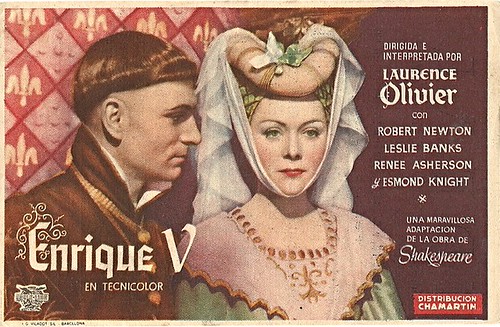
Henry V starred British actors Laurence Olivier as Henry V and Renée Asherson as Catherine of Valois. Photo: “Enrique V (2)” by Kirby York is marked with Public Domain Mark 1.0.

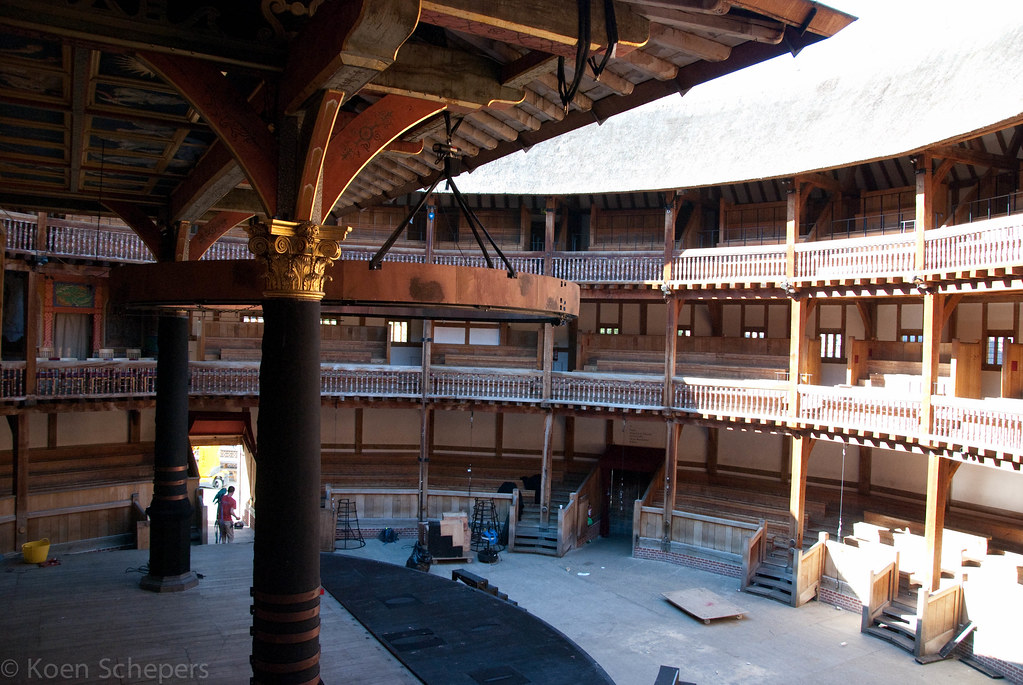
The original Globe Theatre opened in summer of 1599 in Southwark, London, built by the Lord Chamberlain’s Men which was the company William Shakespeare wrote for and part-owned.  It is widely believed that the first play by Shakespeare performed at the Globe was Julius Caesar, likely alongside Henry V and As You Like It. Today’s Globe Theatre in London is the third Globe. see – Globe Theatre | About us | Discover | Shakespeare’s Globe – retrieved April 23, 2026. Photo: “Shakespeare’s Globe” by Werkmens is licensed under CC BY-NC-ND 2.0.

Trinity United Methodist Church (1929), 1024 Lake Avenue, Wilmette, Illinois — Stained Glass by Willett Studios (Philadelphia) and Its “Home Alone” Legacy.

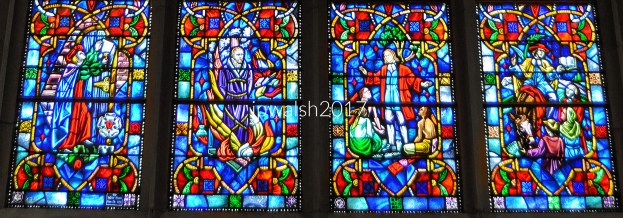
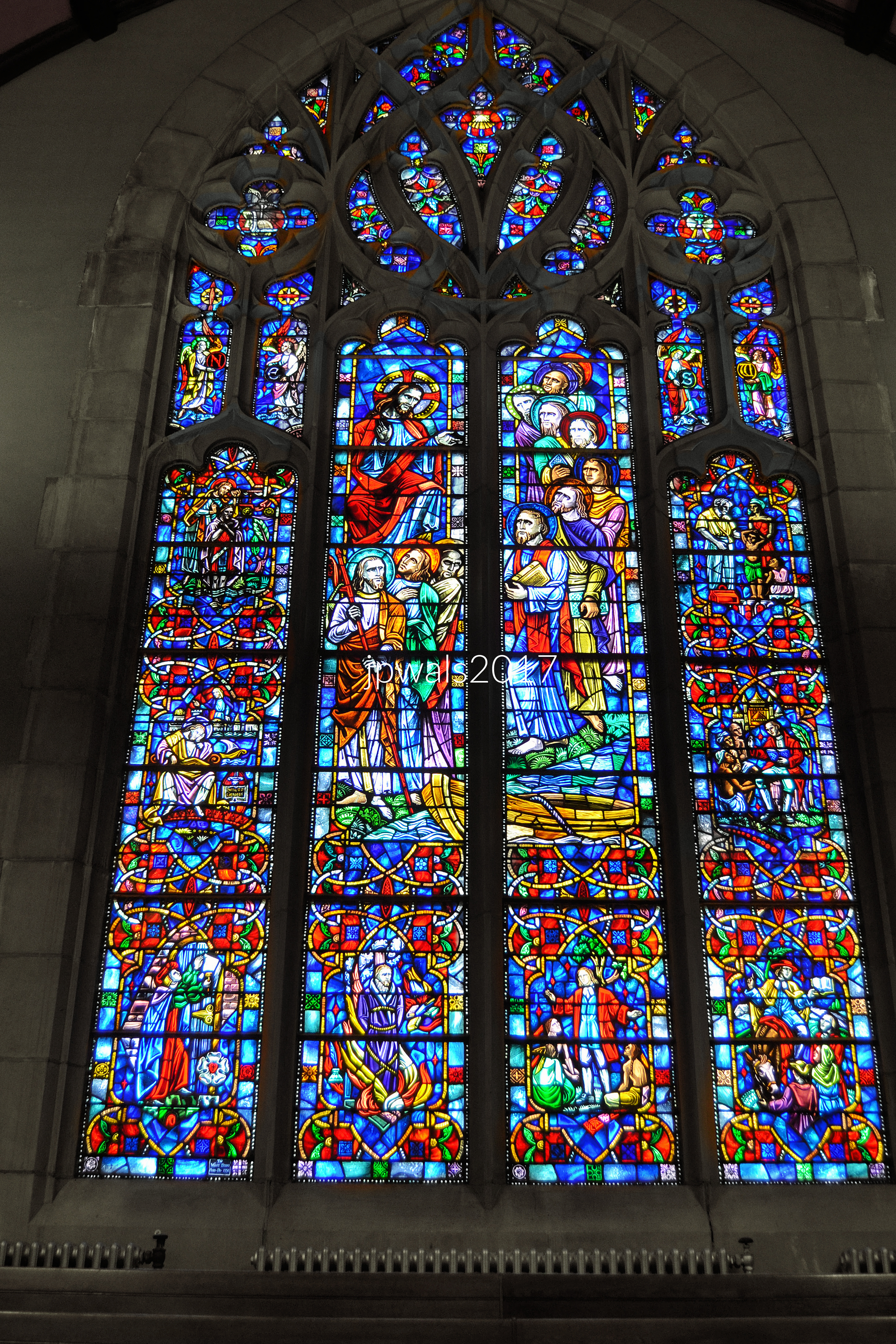
FEATURE Image: Reformation and the 18th century missions of Methodist founder John Wesley, detail of Willet stained- glass window, Trinity United Methodist Church, 1024 Lake Avenue, Wilmette, Illinois. March 2017. Author’s photograph.

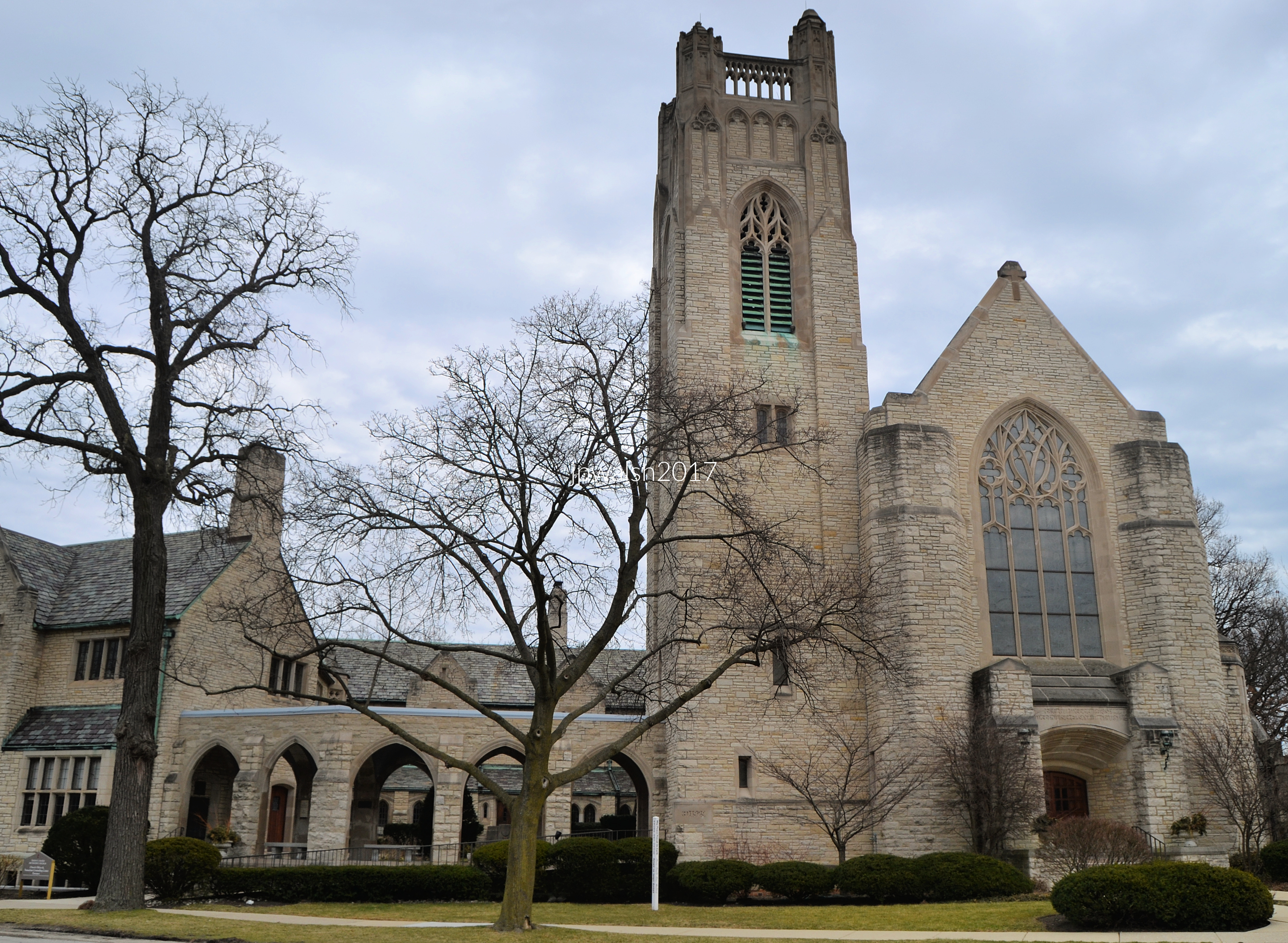
The church buildings complex displays the key ecclesiastical architectural features of late American Gothic Revival style. Trinity UMC, Wilmette. March 2017. Author’s photograph. 4.38mb DSC_0634 (1).

Architecture of Trinity United Methodist Church, Wilmette.

The Ashlar limestone church has stood on a prominent triangular corner of Lake and Wilmette Avenues for nearly 100 years. In the late American Gothic Revival style that flourished in the first third of the 20th century, the church displays in my photo its key ecclesiastical architectural features of (1) pointed‑arch windows with stone tracery, (2) tall bell tower with louvered openings, (3) buttress‑like vertical stonework emphasizing height, (4) a steep slate roof and (5) stained‑glass windows set in deep stone.  Designed by Granger & Bollenbacher, the church building completed in 1929 is designed to feel ancient, monumental, and rooted in medieval Christian tradition — exactly what Methodist congregations of the era wanted. Trinity UMC stands out on the North Shore because it is scaled to frame its narrative, more medieval stained glass and not for grandeur comparative to its neighbors such as Christ Church (Episcopal) in Winnetka designed by Bertram Goodhue, or for crisp academic lines such as First Presbyterian in Wilmette designed by Coolidge & Hodgdon, among others. Of Gothic Revival churches built between 1900–1935. Trinity fits squarely into that movement, but with its own personality, specifically its didactic windows. The building was erected when the congregation outgrew its earlier 1908 Romanesque brick church. The church’s current Gothic Revival building, designed by Chicago architects Granger and Bollenbacher, reflects inspiration from European cathedrals. Construction began in the late 1920s, but the 1929 Stock Market Crash halted many of the planned interior details. The stained- glass windows, including the prominent façade window, were designed and installed by Henry Lee Willet in 1954.

Founding History and Its “Home Alone” Legacy.

Trinity United Methodist Church in Wilmette is one of the North Shore’s oldest congregations, with a history that stretches back to the 19th century. Founded on March 24, 1874, the church originally bore the name First Methodist Episcopal Church of Wilmette. Over the decades, it evolved through several identities — Wilmette Parish Methodist Church (1930–1968), Trinity Church of the North Shore (1968–1989), and finally Trinity United Methodist Church of Wilmette, the name it carries today.  The church’s historic bell — once used to call worshippers, toll for local deaths, and warn the village of fires — now sits on display near the parking lot.

While its spiritual and community roles define its core identity, Trinity United Methodist Church is also widely recognized for its unexpected place in American pop culture. The church’s exterior appears in two memorable scenes in the 1990 Christmas classic “Home Alone.” In the film, directed by John Hughes, young Kevin McCallister (Macaulay Culkin) first spots the church while fleeing the burglars and hides in the Nativity scene on the lawn. Later, Kevin approaches the church at night, drawn by the sound of the choir singing “O Holy Night.” These moments set the stage for one of the film’s most emotional sequences — Kevin’s conversation with Old Man Marley — though that interior scene was filmed at Grace Episcopal Church in Oak Park. Securing permission to film at Trinity was not straightforward. When Twentieth Century Fox approached the Village of Wilmette in early 1990, the Village Board narrowly approved the request in a 4–3 vote after discussion and date changes. Filming took place in late winter of that year, and the church’s brief but iconic appearance has since become a point of local pride. Today, Trinity embraces this connection, often noting that to many visitors, it is simply “the Home Alone church.”

More than a movie landmark, Trinity United Methodist Church in Wilmette remains a vibrant congregation committed to worship, music, community service, and hospitality — a place where history, faith, and a touch of Hollywood intersect on the corner of Lake and Wilmette Avenues.

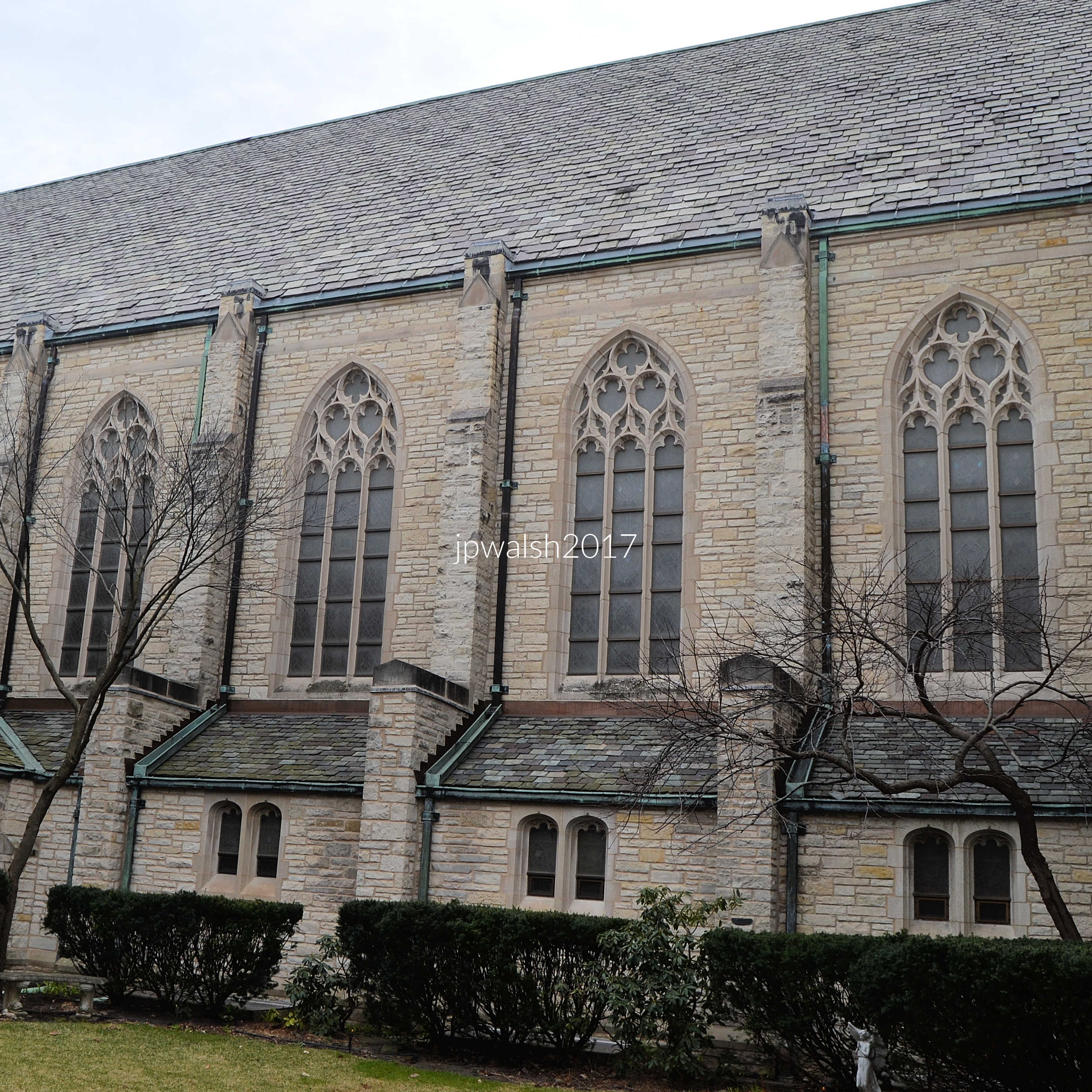
Designed by Granger & Bollenbacher, a procession of stained‑glass windows that line the nave are set in deep stone. Trinity UMC, Wilmette. March 2017. Author’s photograph. 3.40mb DSC_0635 (1)

How the architecture relates to the stained‑glass program.

The stained glass was created by Henry Lee Willett of Willett Stained Glass Studios in Philadelphia, one of the leading American studios of the mid‑20th century. The major façade window, dated February 14, 1954, shows Willett’s signature use of rich blues, jewel‑tone reds, elongated Gothic figures, and clear narrative panels. Its scale and design were chosen for narrative clarity, while the church’s deep window wells intensify color saturation and create a natural shadow‑frame that draws the eye toward the visual telling of Scripture — a hallmark of Methodist stained‑glass design. While Trinity’s windows feel sacred and are tall enough to make a visual statement, they are also narrow enough to keep scenes readable and, like most narrative stained-glass windows, arranged in story cycles. The church’s façade and nave proportions create a natural processional reading of the windows, allowing each panel — and the entire cycle together — to unfold as a coherent theological arc. Methodist churches of the 1920s often used architecture to shape a catechetical journey, with the Gothic style providing both a sense of transcendence and a visual link to the continuity of the church across the millennia. The building and the glass tell the same story: God speaks, calls, teaches, transforms.

Interior Analysis: Gothic Revival Structure.

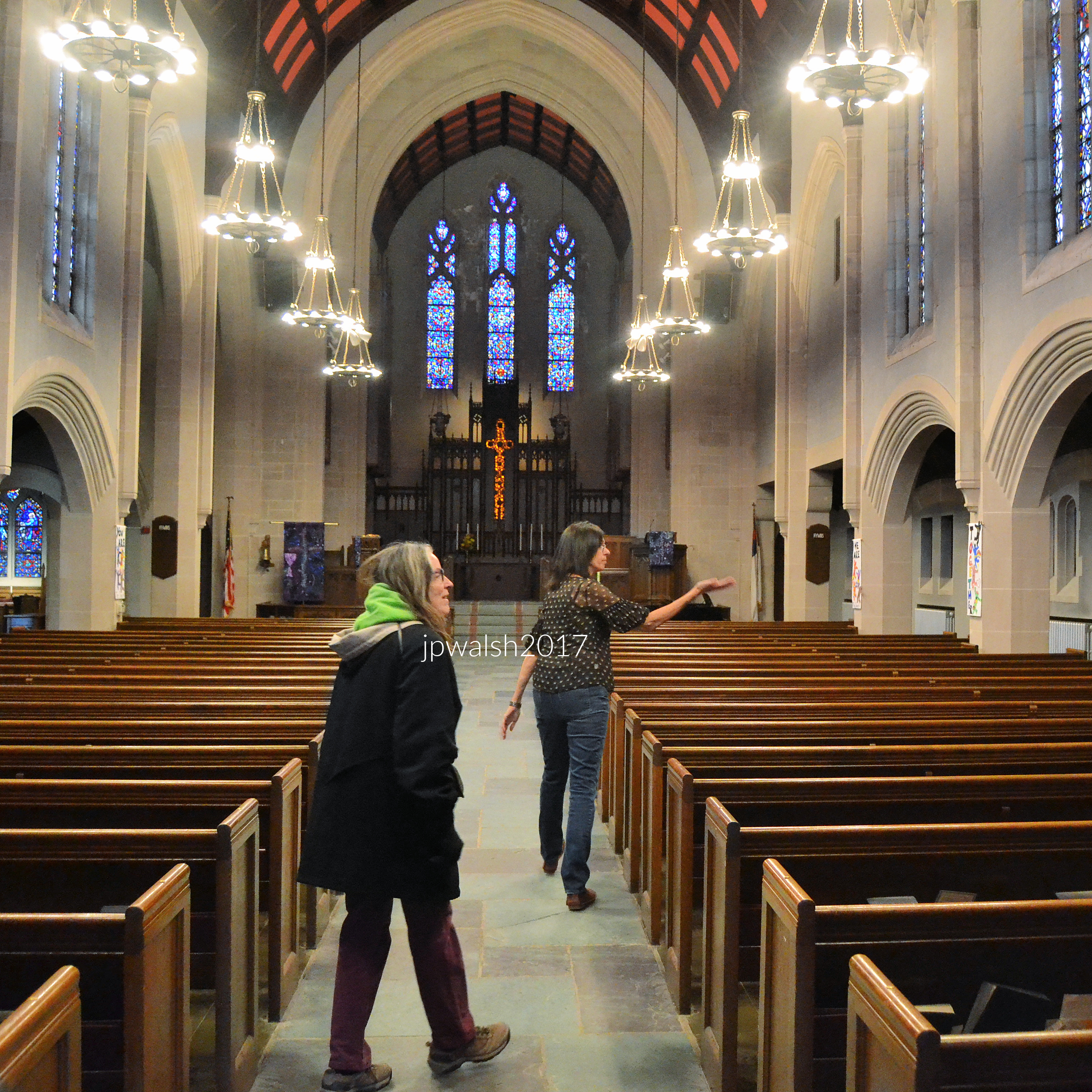
The sanctuary speaks in the familiar Gothic vocabulary. Trinity UMC, Wilmette. March 2017. Author’s photograph. 4.48 mb DSC_0654 (1)

A procession of rounded arches line the nave arcade, a testament to the congregation’s former Romanesque church building, with Gothic pointed-arch stained -glass windows above them guiding the eye upwards and forward. Above these, a ribbed or groin‑vaulted ceiling lifts the gaze further upward into a sense of height and devotion that feels almost instinctive. Reinforcing this vertical pull, the tall, narrow stained‑glass windows have proportions echoing centuries of Gothic design stretching light into color. Stone columns with simple capitals mark each step of the nave, guiding you along the long central aisle toward the chancel. The sanctuary is familiar Gothic interpreted through the American 1920s–30s lens—lighter, more vertical, devotional rather than medieval.

Trinity UMC, Wilmette. March 2017. Author’s photograph. 3.89mb DSC_0657 (1)

The space warms into Methodist Gothic. Dark wood pews, wooden chancel furnishings, a prominent pulpit or lectern, and a central cross create an interior that feels both sacred and approachable. The materials and layout quietly affirm the Methodist emphasis on Scripture, preaching, and congregational participation.

Overhead, hanging lantern chandeliers complete the atmosphere. Their medieval‑inspired metalwork casts a warm glow that softens the stone and wood. Evenly spaced along the nave, they reinforce the processional rhythm, drawing the eye—and the worshipper—toward the chancel and the unfolding narrative held in glass and architecture. Gothic in form, Methodist in function, Willett in storytelling, and 1920s–30s American in craftsmanship, including acoustics shaped for congregational singing, the interior of Trinity UMC is a space designed to make worship feel like a journey: from the world outside, through the nave, toward the light of the chancel and the story told in glass.

How Methodist theology shaped 20th‑century stained glass.

Methodist stained glass in the early–mid 1900s has a distinctive character shaped by Methodist convictions about Scripture, preaching, and discipleship. Because windows were expected to teach, almost every Methodist window cycle from this era functions as a visual sermon. Their imagery is intentionally accessible, with a strong Biblical orientation and a clear narrative movement through salvation history.

Methodists understand themselves as heirs of the Old Testament, followers of Jesus, children of the Reformation, and participants in the church’s ongoing renewal. As a result, their stained‑glass programs blend Old Testament, New Testament, and Reformation themes. Typical cycles include scenes of the prophets, episodes from the Life of Christ, and depictions of key Reformers such as Martin Luther (1483-1546), William Tyndale (c. 1494-1536), and Methodist founder John Wesley (1703-1791).

Trinity UMC, Wilmette. March 2017. Author’s photograph. 5.29mb DSC_0655 (1)

Façade window: Jesus Calling the First Disciples.

Façade window of Jesus Calling the First Disciples. Trinity UMC, Wilmette. March 2017. Author’s photograph. 7.65mb DSC_0649 (2)

A foundational moment in the Gospels — and a favorite subject in mid‑20th‑century Methodist stained glass — is Jesus calling the first disciples. In this scene, Jesus summons fishermen from their boats with the words, “Follow me, and I will make you fishers of men.”

The boat anchors the story in the Sea of Galilee, while the iconography makes the identification unmistakable. Jesus is shown with a cruciform halo and red and blue garments, signaling his dual nature. His authoritative, summoning gesture directs attention to the haloed figures of Peter, Andrew, James, and John, who look up toward him in response to the call.

Detail of Façade window depicting Reformers.

At the bottom of the façade window are four scenes from the life of the Reformers. At LEFT is Martin Luther nailing his 95 theses to the door of the Castle Church (All Saints’ Church) in Wittenberg, Germany, on October 31, 1517, that sparked the Reformation. At the bottom right of the panel is a white rose with a red heart and black cross. That is Luther’s personal emblem, designed in 1530 and used on his letters and publications. He is wearing scholarly robes in the colors of deep red, green, and brown that Willett often used for Reformers.

At LEFT CENTER is the burning at the stake of William Tyndale in 1536 whose crime was translating the Bible into English for the ordinary people. Tyndale believed Scripture should be accessible to ordinary people and died for that conviction. The Reformation’s gift is to take the Bible out of the hands of the elite and place it into the hands of the people.

At CENTER RIGHT is John Wesley, founder of Methodism, preaching in the open air to Native Americans — specifically the Muscogee (Creek) people —during his mission to the Georgia colony between 1735 to 1737 which, after his return to England, accelerated the Methodist Movement which Wesley founded at Oxford in 1729. Wesley began preaching in the open air, embracing traveling ministry and forming societies as he did in America. By 1739, he built the first Methodist meeting house in Bristol, England.

At RIGHT John Wesley preaching to early American settlers. Wesley served as Anglican pastor of Christ Church in Savannah, Georgia, where he introduced strict spiritual disciplines. His time was marked by conflict, including a failed romantic relationship, and backlash from residents against his strictness, causing him to return to England heartbroken and disillusioned after only two years. 

Methodist stained glass seeks to be beautiful where clarity is key. The style tends to bold outlines, well delineated figures and readable gestures with minimal abstraction.

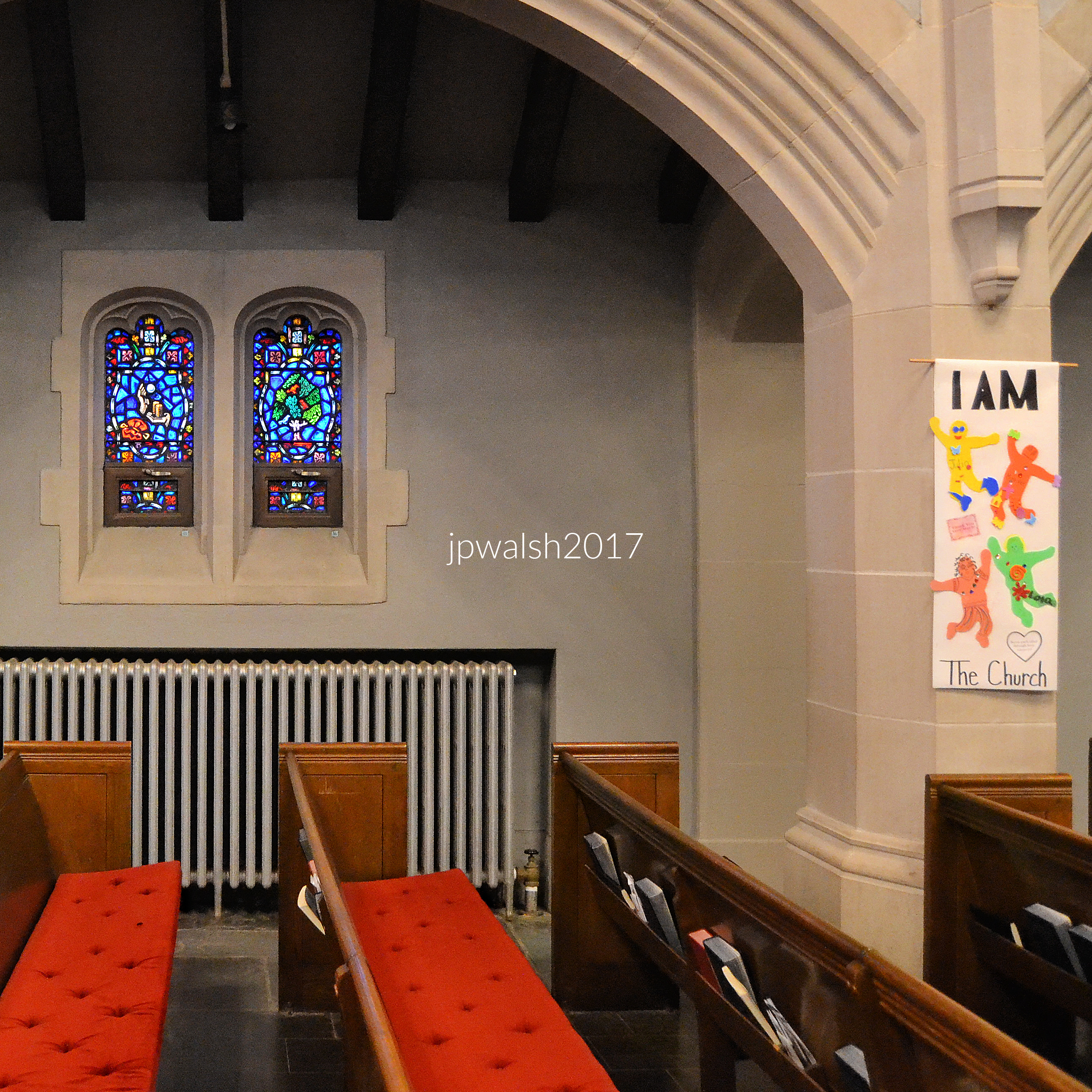
Trinity UMC, Wilmette. March 2017. Author’s photograph. 5.20mb DSC_0645 (1)

Traditional enough to feel sacred – Modern enough to feel fresh – narrative enough to teach – artistic enough to inspire: Why Willett Studios was chosen.

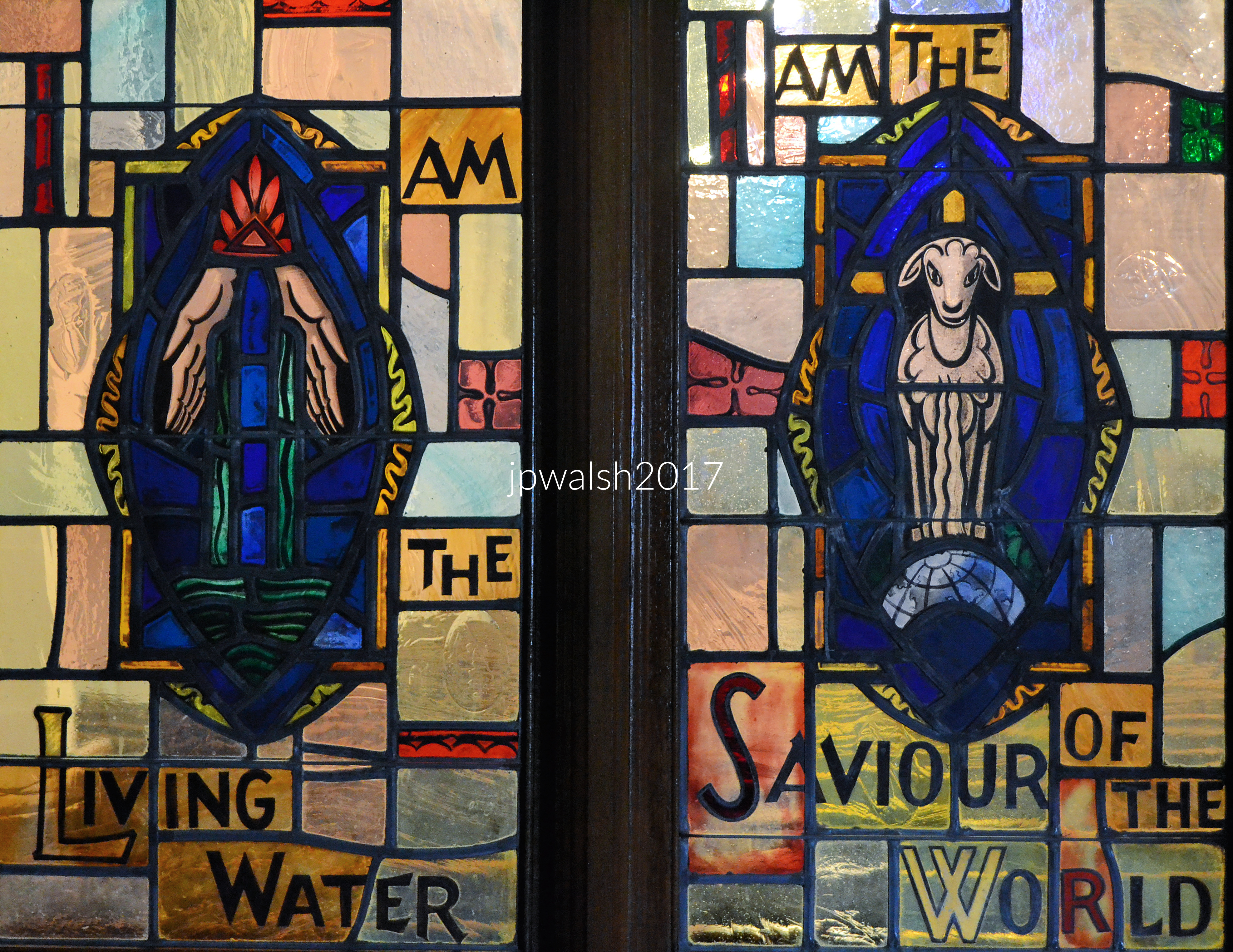
Christ the Teacher — sometimes also read as Christ the Good Shepherd window. Trinity UMC, Wilmette. March 2017. Author’s photograph. 3.95mb DSC_0664 (2)

This Willet window is a Life of Christ triptych, arranged in the traditional Methodist/Willett narrative pattern.

At the left, the window shows the ministry of compassion: a haloed Christ blessing or forgiving a kneeling woman, possibly inspired by the woman who washed his feet with her tears and dried them with her hair. Willett often preferred such non‑specific healing scenes, using them to emphasize Christ’s compassion rather than tie the image to a single Gospel episode.

At the center, Christ stands elevated and alone in Willett’s characteristic depiction of Christ the Teacher — sometimes also read as Christ the Good Shepherd when paired with lamb symbolism above. He bears the cruciform halo (reserved only for Jesus) and wears red and blue robes to signify his dual nature as God and Man. His arms extend slightly in a gesture of blessing and invitation.

At the right, the scene shifts to Christ’s agony in the garden before his betrayal and arrest, capturing the moment of solitary struggle that precedes the Passion.

“Do all the good you can.”

Taken together, these panels proclaim a unified message: Christ at the center of the Christian life, the one who heals, restores, and calls disciples to follow. The sequence echoes the Methodist conviction embodied in the familiar motto: “Do all the good you can.”

Trinity UMC, Wilmette. March 2017. Author’s photograph. 4.12.mb DSC_0637 (1)