
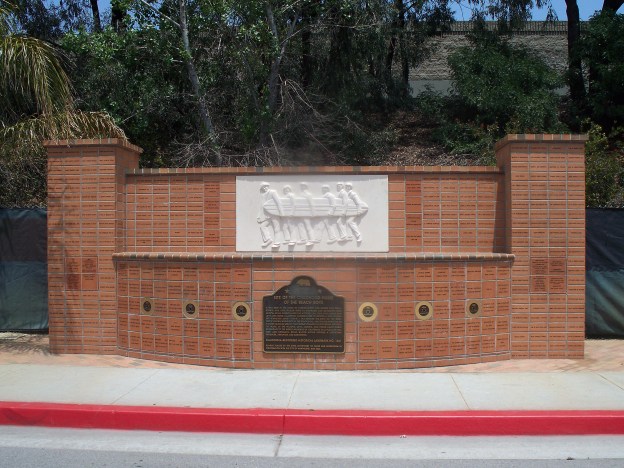

Feature image: The site of the Wilson family home in Hawthorne, California, where Brian Wilson composed Don’t Worry Baby with lyrics by then-collaborator Roger Christian, a DJ at KFWB in L.A., over the course of a couple days in 1963. The home where Brian, Dennis and Carl Wilson grew up with their parents Murray and Audree Wilson, and where they honed their musical skills and formed the Beach Boys with cousin Mike Love and friend Al Jardine in 1961, was lost to development in the name of progress (a new highway). Similarly, in February 1964, the Beach Boys, who had the no. 1 single of 1963 (Surfin’ U.S.A.), overnight had to rethink the direction of their opus in the wake of the Beatles and British Invasion that forever changed the trajectory of rock and roll and the recording industry in the 1960s and beyond. “Beach Boys Landmark – Plano general I” by tkksummers is licensed under CC BY-SA 2.0.

As stated by film production expert Eve Light Honathaner in The Complete Film Production Handbook (Focal Press, 2001, p. 211.):
“Publicity photos (star headshots) have traditionally not been copyrighted. Since they are disseminated to the public, they are generally considered public domain, and therefore clearance by the studio that produced them is not necessary.”
Nancy Wolff, in The Professional Photographer’s Legal Handbook (Allworth Communications, 2007, p. 55.), notes:
“There is a vast body of photographs, including but not limited to publicity stills, that have no notice as to who may have created them.”
Film industry author Gerald Mast, in Film Study and the Copyright Law (1989, p. 87), writes:
“According to the old copyright act, such production stills were not automatically copyrighted as part of the film and required separate copyrights as photographic stills. The new copyright act similarly excludes the production still from automatic copyright but gives the film’s copyright owner a five-year period in which to copyright the stills. Most studios have never bothered to copyright these stills because they were happy to see them pass into the public domain, to be used by as many people in as many publications as possible.”
Kristin Thompson, committee chairperson of the Society for Cinema and Media Studies writes in the conclusion of a 1993 conference of cinema scholars and editors[1], that:
“[The conference] expressed the opinion that it is not necessary for authors to request permission to reproduce frame enlargements… [and] some trade presses that publish educational and scholarly film books also take the position that permission is not necessary for reproducing frame enlargements and publicity photographs.”
Brian Wilson’s first car was a light burgundy Mercury. It was passed down from his mother and Wilson called it “the Merc.” He failed his first driver’s test and got a reputation for being a bad driver because he was constantly distracted thinking about other things. His father tutored him behind the wheel and Brian started to get the hang of driving when he compared the car’s controls to playing a musical instrument. As the comparison dawned on him, it developed: like a musical instrument a driver had to play the car just right – not to hard or fast – so to get the results desired. But the comparison was also limited: Brian realized you could do a lot more unique things playing a musical instrument than driving a car. After he passed his driving test the second time, he drove “the Merc” for a year until he acquired a used 1957 Ford Fairlane. For Hawthorne, Brian knew it was a great car but he saw there were greater cars driven by other guys. He loved his used ’57 Ford and it was when he was in it that he first heard the Beach Boys’ first single, Surfin‘, playing on the radio in 1962. Brian said he revved and raced his Ford fast – but nobody believed it. (i am Brian Wilson a memoir, pp. 115-116).
LYRICS Surfin’ is the only life, the only way for me
Now surf
Surf with me
I got up this mornin’, turned on my radio (Ooh, surfin’)
I was checkin’ out the surfin’ scene to see if I would go (Ooh, surfin’)
And when the DJ tells me that the surfin’ is fine (Ooh, surfin’)
That’s when I know my baby and I will have a good time
We’re goin’ surfin’, surfin’
Surfin’, surfin’, surfin’
Surfin’, surfin’, surfin’
Surfin’ is the only life, the only way for me
Now surf
Surf with me
From the early mornin’ to the middle of the night (Ooh, surfin’)
Any time the surf is up, the time is right (Ooh, surfin’)
And when the surf is down to take its place (Ooh, surfin’)
We’ll do the Surfer’s Stomp, it’s the latest dance craze
We’re goin’ surfin’, surfin’
Surfin’, surfin’, surfin’
Surfin’, surfin’, surfin’
Surfin’ is the only life, the only way for me
Now surf
Surf with me
Now the dawn is breaking and we really gotta go (Ooh, surfin’)
But we’ll be back here very soon, that you better know (Ooh, surfin’)
Yeah, my surfer knots are rising and my board is losing wax (Ooh, surfin’)
But that won’t stop me, baby, ’cause you know I’m comin’ back
We’re goin’ surfin’, surfin’
Surfin’, surfin’, surfin’
Surfin’, surfin’, surfin’
Surfin’ is the only life, the only way for me
Now come on, pretty baby and surf with me, yeah
Brian Wilson soon associated girls and cars. He was also beginning to understand the association of music and emotions after he heard Be My Baby by The Ronettes on the radio. Brian was also impressed by how simple vocal gestures, such as was achieved by Aretha Franklin and Dionne Warwick, could get maximum mileage from a listener’s reaction. (i am Brian Wilson a memoir, pp. 172).
In 1963 Brian Wilson offered Don’t Worry Baby to girl-group The Ronettes after the 21-year-old Wilson had become obsessed with their Be My Baby – a no. 1 hit (Cash Box) in August 1963. But they declined it and the Beach Boys produced it for themselves instead. It became one of the Beach Boys’s classics of the period. Wilson wrote Don’t Worry Baby as a response to Be My Baby and both songs have an affinity in pacing, structure, melodic lilt, and subject matter. Wilson wrote Don’t Worry Baby with lyrics by then-collaborator Roger Christian (1934-1991), a DJ at KFWB in L.A., over the course of a couple days at the Wilson family home in Hawthorne, California. It is ostensibly about a guy’s race car and his caring girlfriend, of which Wilson observed later: “It was a very simple and beautiful song. It’s a really heart and soul song, I really did feel that in my heart.” see – https://americansongwriter.com/brian-wilson-gods-messenger/4/ – retrieved February 24, 2025.
LYRICS Well, its been building up inside of me
For, oh, I don’t know how long
I don’t know why, but I keep thinking
Something’s bound to go wrong
But she looks in my eyes
And makes me realize
And she says (now don’t) (don’t worry, baby)
Don’t worry, baby (don’t you worry) (don’t worry, baby)
Everything will turn out alright (now don’t) (don’t worry, baby)
Don’t worry, baby (don’t you worry) (don’t worry, baby)
I guess I should’ve kept my mouth shut
When I started to brag about my car
But I can’t back down now, because
I pushed the other guys too far
She makes me come alive
And makes me wanna drive
When she says (now don’t) (don’t worry, baby)
Don’t worry, baby (don’t you worry) (don’t worry, baby)
Everything will turn out alright (now don’t) (don’t worry, baby)
Don’t worry baby (don’t you worry) (don’t worry, baby)
She told me, “Baby, when you race today
Just take along my love with you
And if you knew how much I loved you
Baby, nothing could go wrong with you”
Oh, what she does to me
When she makes love to me
And she says (now don’t) (don’t worry, baby)
Don’t worry, baby (don’t you worry) (don’t worry, baby)
Everything will turn out alright (now don’t) (don’t worry, baby)
Don’t worry, baby (don’t you worry) (don’t worry, baby)
Everything will turn out alright (now don’t) (don’t worry, baby)
Don’t worry, baby (don’t you worry) (don’t worry, baby)

Don’t Worry Baby was one of Brian Wilson’s strongest lead vocals countered by Mike Love singing bass, and Al Jardine, and Dennis and Carl Wilson singing back up. It was one of the last songs recorded before the Beatles’ appearances on Ed Sullivan that changed rock music’s trajectory. After the Beach Boys’ Surfin’ U.S.A. was ranked Billboard’s no.1 song of 1963 (Be My Baby was no. 35), Don’t Worry Baby was the second track and likely best song on Shut Down Volume 2, promoted as a “hot rod” album and released in February 1964 that rose to no.13 on the Billboard 200 and was certified Gold. It turned out that it was the final Beach Boys’ album exploring the dark and light of the California sound before the British invasion that shook things up fundamentally. Through the demise of their car and surfer music hastened by the Beatles – it can’t be known for sure what might have happened otherwise – Brian Wilson understood that a gauntlet for musical supremacy was thrown down to which he must respond. At first Wilson thought about quitting for he was so disappointed that what they had been working on and striving for since 1961 was eclipsed overnight. After Fun, Fun, Fun peaked at no. 5 in March 1964, I Get Around was released in May 1964 with Don’t Worry Baby on the B-side. I Get Around became the no. 1 song on the Billboard Hot 100 for two weeks in July 1964 while Don’t Worry Baby charted on its own at no.24.

With the Beatles in mind Brian Wilson set to work on new material, this time integrating older musical sources into something new, as well as being more open than ever before to experimenting with arrangements and instrumentation so to achieve a new sound. Wilson worked to reinvent the Beach Boys just as he had been succeeding in inventing them. By the end of 1964 it was the Beatles that secured not just the top spot on Billboard’s year-end singles (I Want To Hold Your Hand) but the second spot as well (She Loves You) though the Beach Boys were still in the top 5 with I Get Around.
SOURCES:
The Beach Boys: America’s Band, Johnny Morgan, Union Square & Co.; Illustrated edition, 2015, p. 67.
Good Vibrations: My Life as a Beach Boy, Penguin Publishing Group, Mike Love, 2016, pp. 64-65, 96-97, and 248.
The Beach Boys FAQ, All That’s Left to Know about America’s Band, Jon Stebbins, Backbeat Books, 2011, pp. 8 and 49.
The Beach Boys: The Definitive Diary of America’s Greatest Band on Stage and in the Studio, Keith Badman, Backbeat Books; First Edition, 2004., p. 53.
Brian Wilson with Ben Greenman, Da Capo Press, Boston, Massachusetts. pp. 115-116


