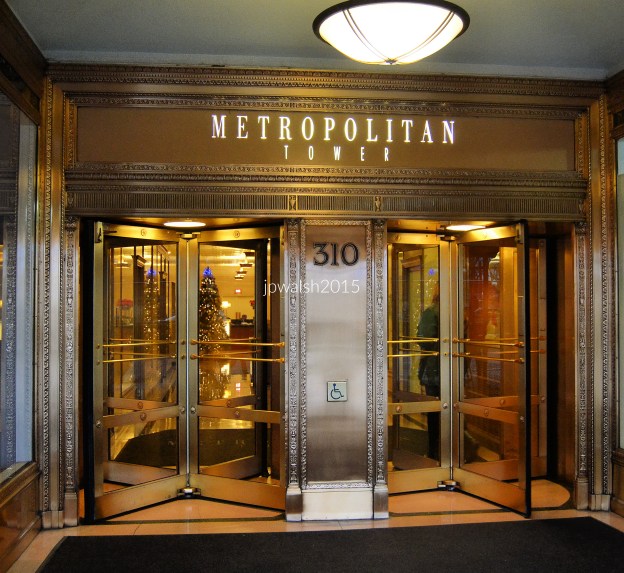

Feature Image: December 2015. Main Entrance, Metropolitan Tower (1924), Chicago. 4.89 mb DSC_0963 (1). Author’s photograph.
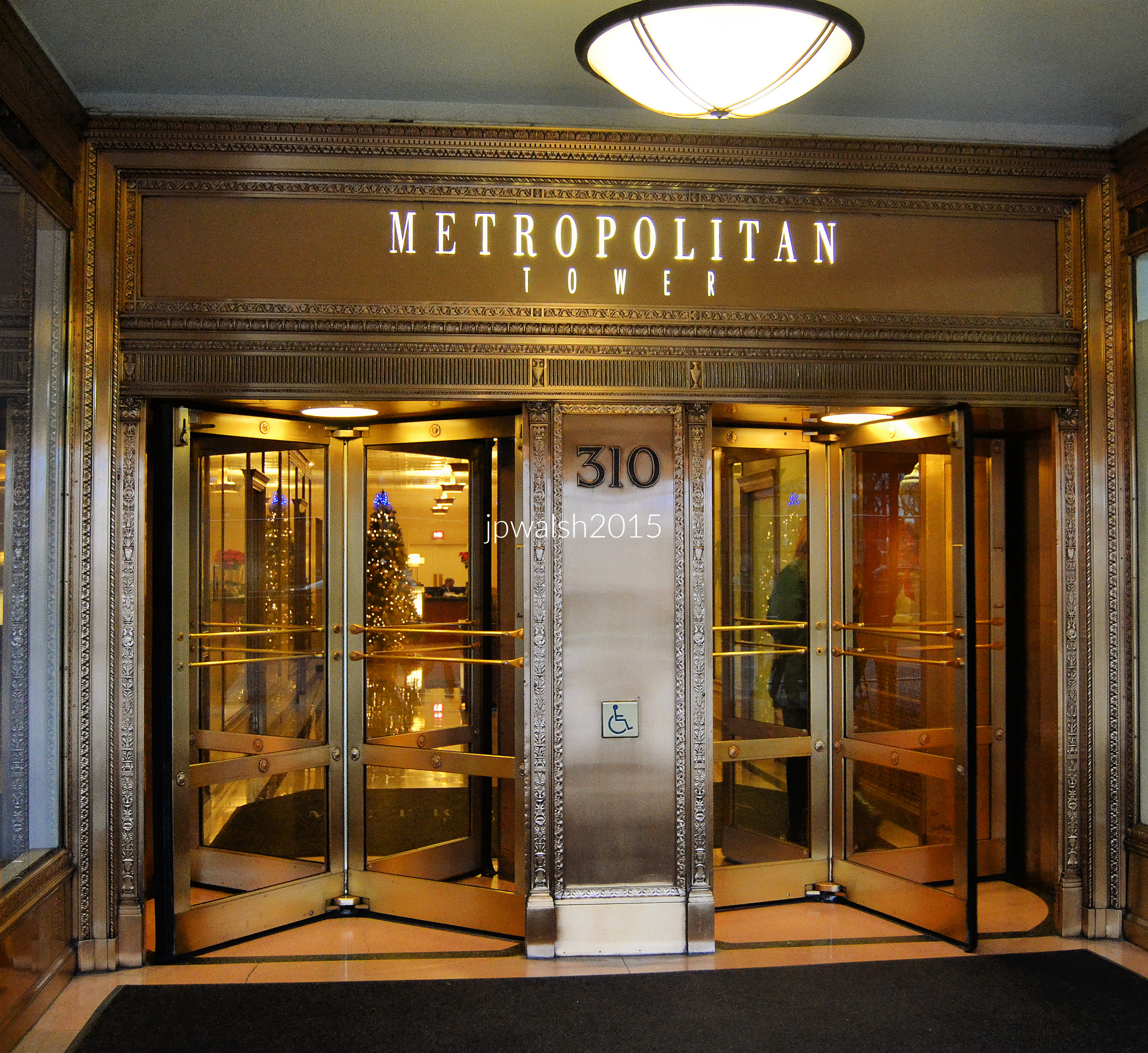
Located at 310 South Michigan Avenue on the southwest corner of Jackson Boulevard, Metropolitan Tower originally served as corporate headquarters for S.W. Straus and Co., a banking and investment firm. The building was erected in 1924 by Graham, Anderson, Probst & White in their signature classical style. The architectural firm was one of the largest in the first half of the twentieth century and went on to build Chicago’s Civic Opera Building in 1929. Founded in 1912, the firm was the successor to D. H. Burnham & Co. by way of partner, Ernest R. Graham (1868-1936), and Burnham’s sons, Hubert and Daniel Jr. Five years later the Burnhams left to form their own firm (Burnham Brothers) and Graham partnered with others of the firm’s members: William Peirce Anderson (1870-1924), Edward Mathias Probst (1870-1942), and Howard Judson White (1870-1936). No expense was spared for the Straus Building’s interior, though of the original lobby’s opulence all that remains are the elaborate bronze elevator doors. The entrance’s coffered bronze doors by Italian sculptor Leo Lentelli (1879-1961) were destroyed. see – Saliga, Pauline A., editor, The Sky’s The Limit A Century of Chicago Skyscrapers, Rizzoli New York, 1990, p. 117.

Ernest R. Graham (1868-1936).

William Peirce Anderson (1870-1924).

Edward Mathias Probst (1870-1942).

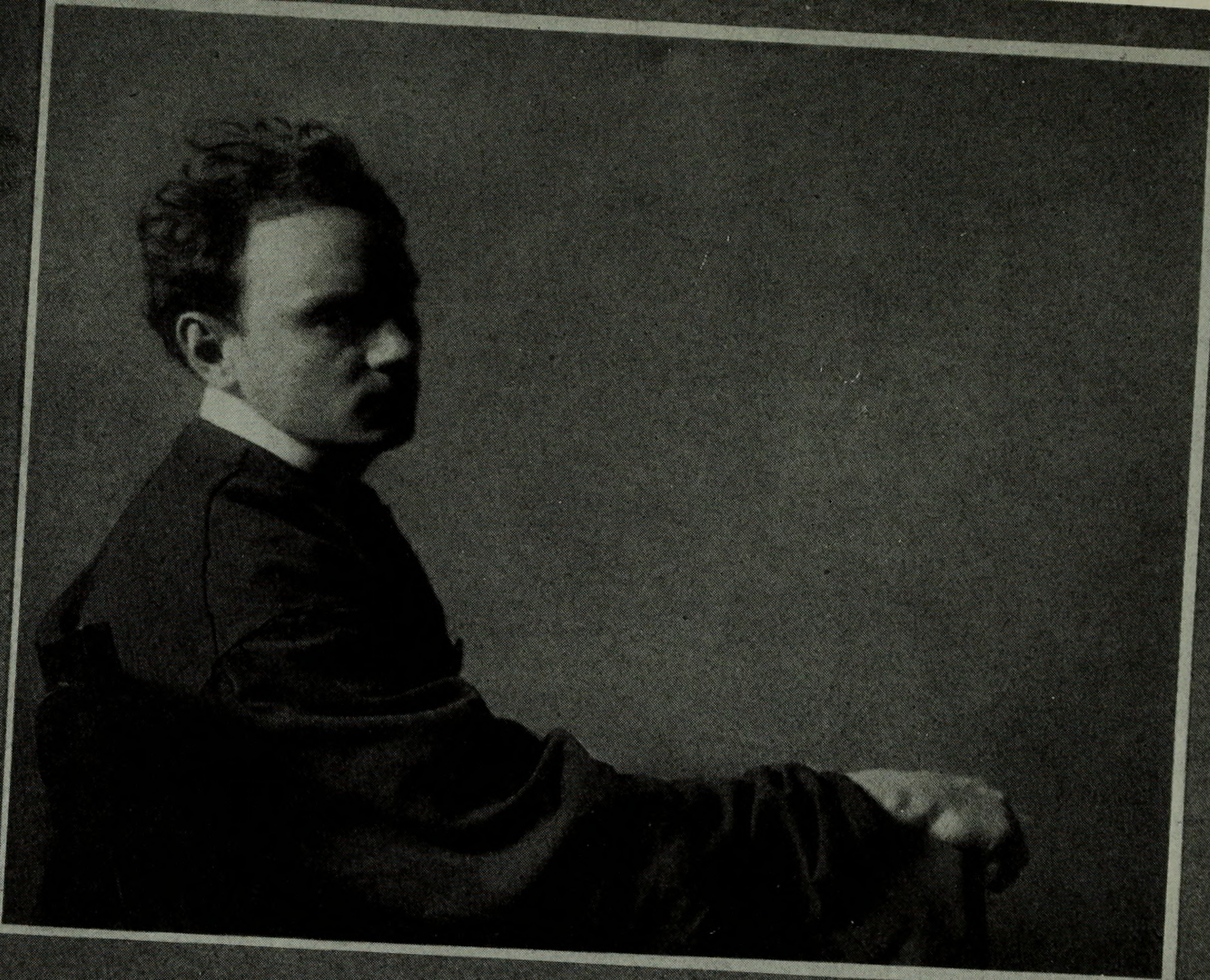
Howard Judson White (1870-1936).
The 30-floor classical-style Straus Building was renamed over the years for other of its famous inhabitants including Continental National Insurance Co. and Britannica Center for Encyclopedia Britannica. Metropolitan Tower was the first building in Chicago that took advantage of the new 1923 zoning ordinance for skyscrapers that allowed buildings taller than 260 feet (30 or more floors) with the necessary setbacks. Metropolitan Tower’s required setbacks begin at the 21st floor on which sits a nine-story tower until there is a second setback and then the final two stories. Crowned by a stepped pyramid and possessed of a powerful beacon that opened in 1924, the building is Chicago’s first Michigan Avenue skyscraper.

Unused for years, the building’s 1,500-pound carillon bells were restored in 1979 for Pope John Paul II’s visit to Chicago. Just steps from Metropolitan Tower, the papal visit included an outdoor mass in Grant Park on October 5, 1979, which attracted over one million attendees, the largest gathering ever in Grant Park history up to that time. see – CBS Chicago Vault: Pope John Paul II enthralls Chicagoans on 1979 visit – CBS Chicago – retrieved March 18, 2026.
At one time, the thirtieth floor was the Straus Tower Observatory, which was open to the public for viewing the city in all four directions. see – Home | Metropolitan Tower – retrieved February 24, 2026. Home to the Continental National Insurance Company soon after it was built, this iconic skyscraper is located within Chicago’s Landmark Historic Michigan Boulevard District. The glass “beehive” supported by four bison figures at the top of the building held the blue light of a four-direction beacon. The ensemble, symbolizing industry, strength, and thrift, saw its beacon, signifying global reach, permanently shut down in 1934 following the financial failure of the S.W. Straus and Company during the Great Depression. The building was converted to residential condominiums in 2007. see – Metropolitan Tower | Powered by Baird & Warner– retrieved February 24, 2026; AIA Guide to Chicago, 2nd Edition, Alice Sinkevitch, Harcourt, Inc., Orlando, 2004, page 42.