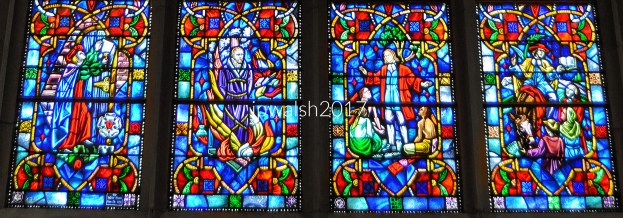

FEATURE Image: Reformation and the 18th century missions of Methodist founder John Wesley, detail of Willet stained- glass window, Trinity United Methodist Church, 1024 Lake Avenue, Wilmette, Illinois. March 2017. Author’s photograph.
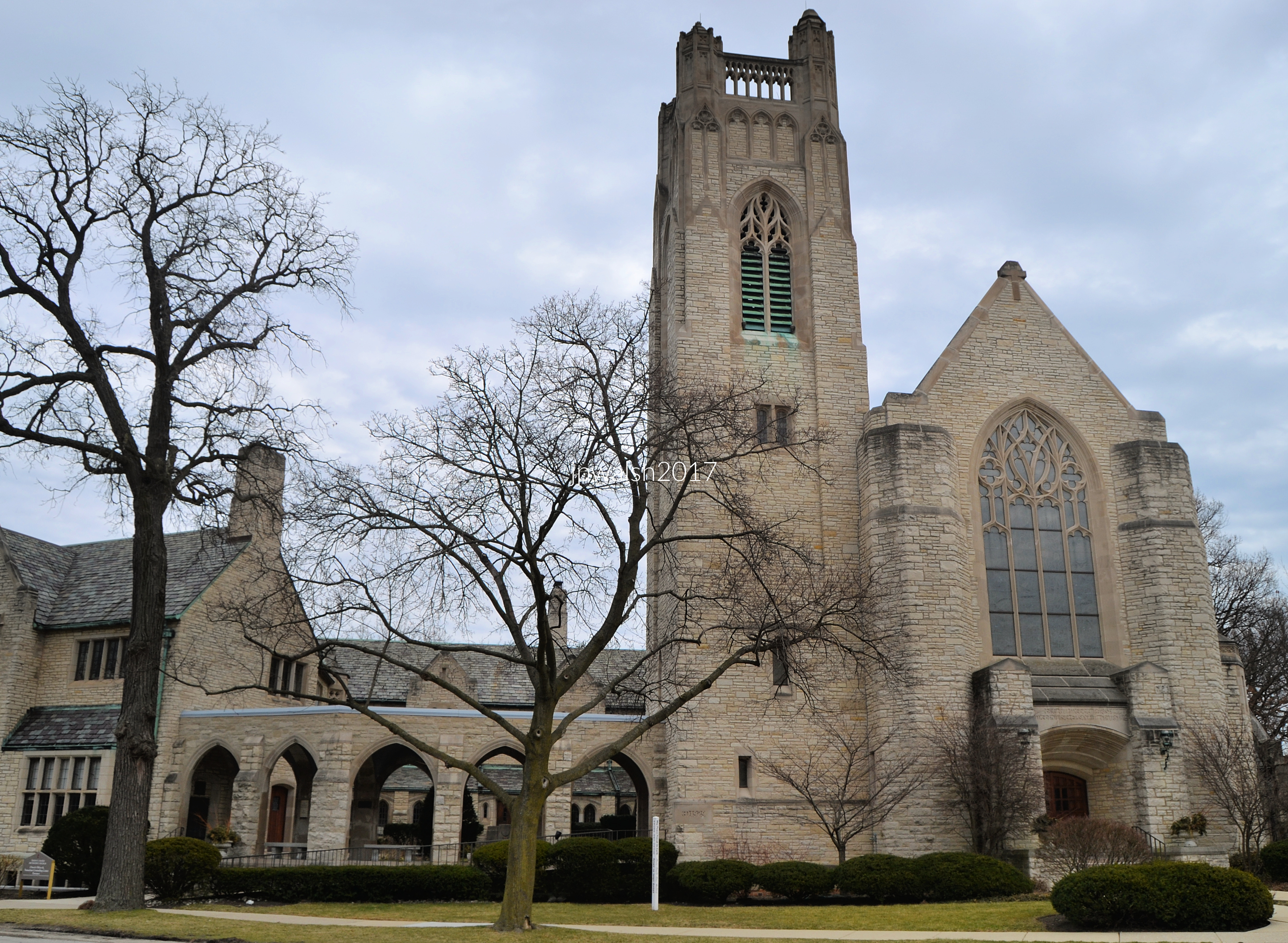
Architecture of Trinity United Methodist Church, Wilmette.
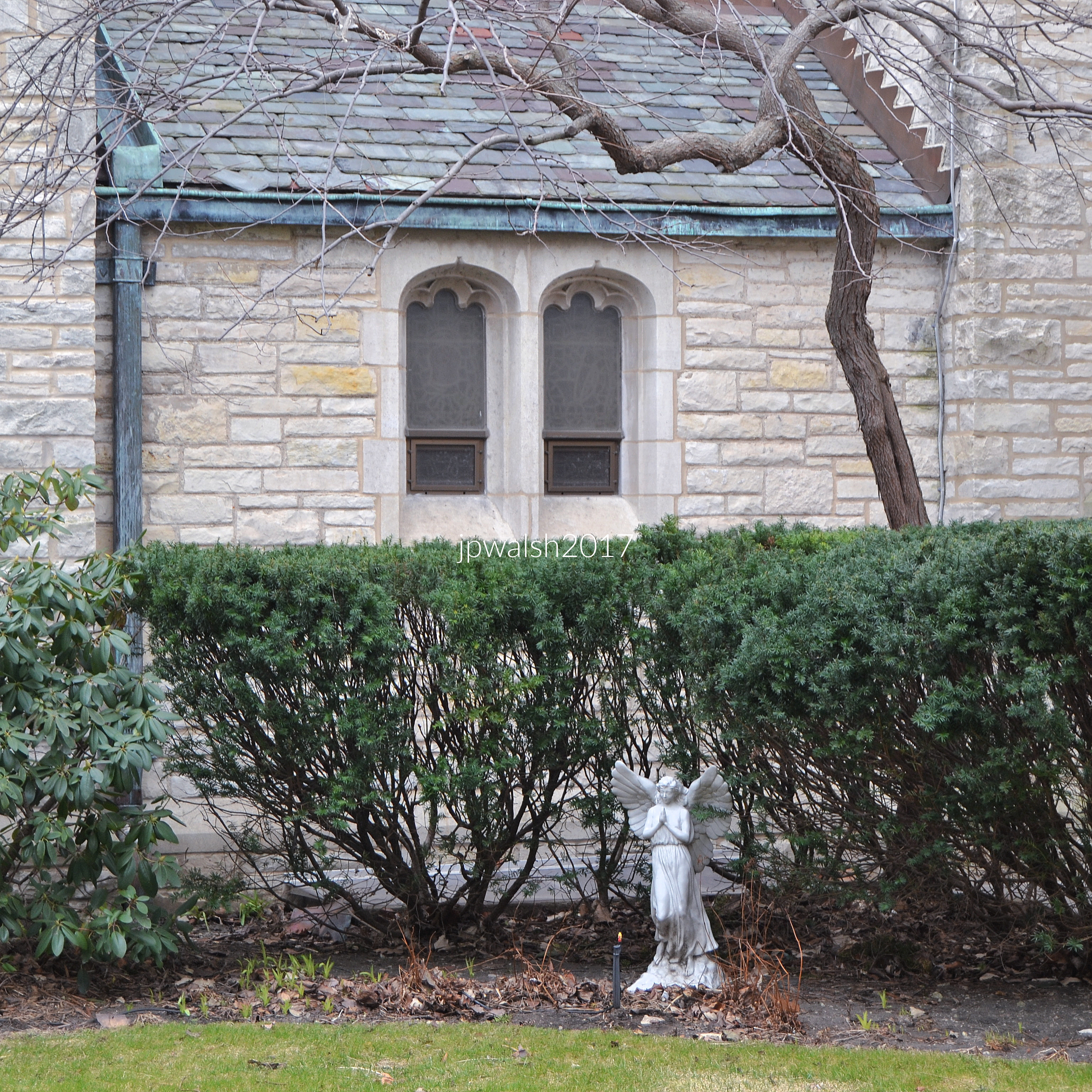
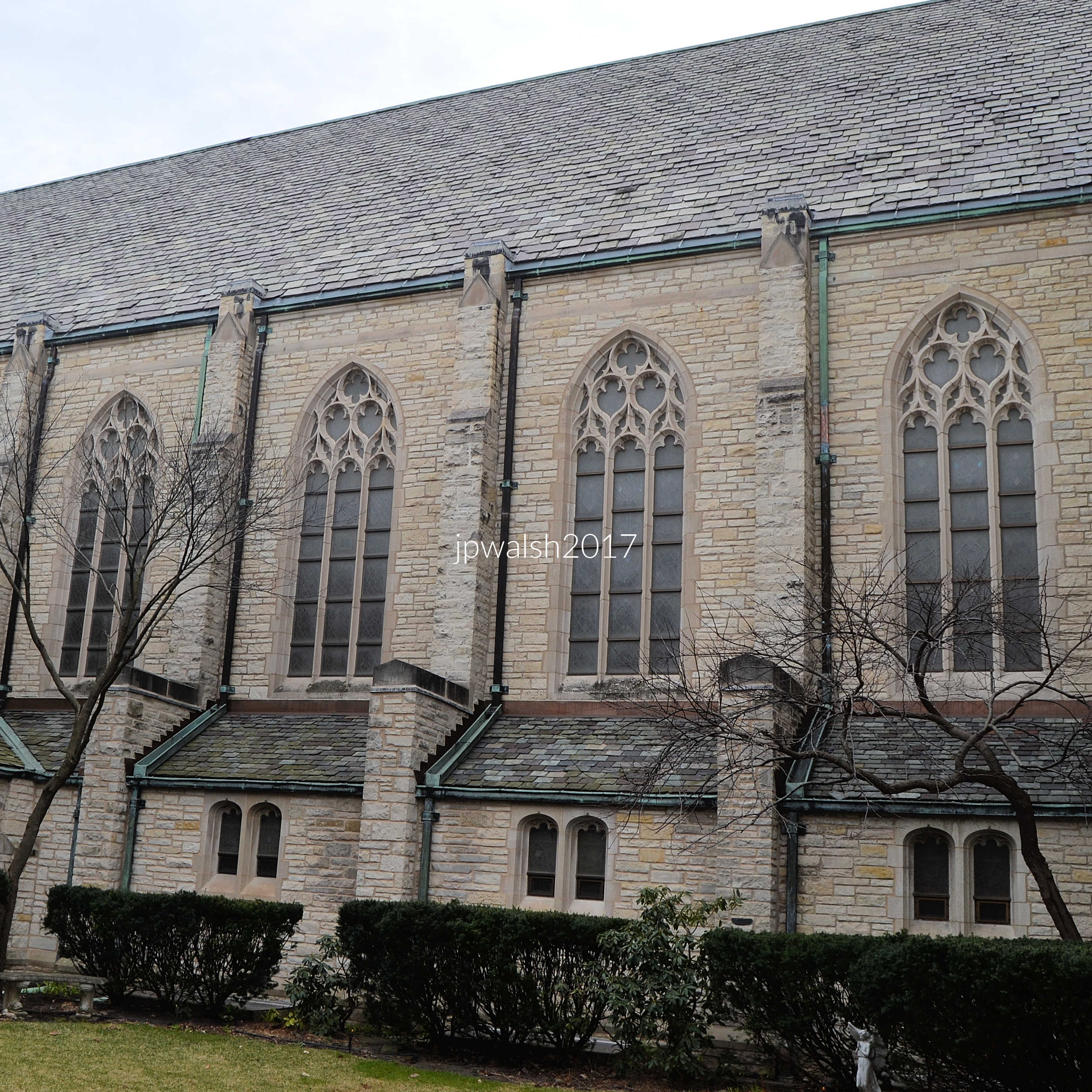
The Ashlar limestone church has stood on a prominent triangular corner of Lake and Wilmette Avenues for nearly 100 years. In the late American Gothic Revival style that flourished in the first third of the 20th century, the church displays in my photo its key ecclesiastical architectural features of (1) pointed‑arch windows with stone tracery, (2) tall bell tower with louvered openings, (3) buttress‑like vertical stonework emphasizing height, (4) a steep slate roof and (5) stained‑glass windows set in deep stone. Designed by Granger & Bollenbacher, the church building completed in 1929 is designed to feel ancient, monumental, and rooted in medieval Christian tradition — exactly what Methodist congregations of the era wanted. Trinity UMC stands out on the North Shore because it is scaled to frame its narrative, more medieval stained glass and not for grandeur comparative to its neighbors such as Christ Church (Episcopal) in Winnetka designed by Bertram Goodhue, or for crisp academic lines such as First Presbyterian in Wilmette designed by Coolidge & Hodgdon, among others. Of Gothic Revival churches built between 1900–1935. Trinity fits squarely into that movement, but with its own personality, specifically its didactic windows. The building was erected when the congregation outgrew its earlier 1908 Romanesque brick church. The church’s current Gothic Revival building, designed by Chicago architects Granger and Bollenbacher, reflects inspiration from European cathedrals. Construction began in the late 1920s, but the 1929 Stock Market Crash halted many of the planned interior details. The stained- glass windows, including the prominent façade window, were designed and installed by Henry Lee Willet in 1954.
Founding History and Its “Home Alone” Legacy.
Trinity United Methodist Church in Wilmette is one of the North Shore’s oldest congregations, with a history that stretches back to the 19th century. Founded on March 24, 1874, the church originally bore the name First Methodist Episcopal Church of Wilmette. Over the decades, it evolved through several identities — Wilmette Parish Methodist Church (1930–1968), Trinity Church of the North Shore (1968–1989), and finally Trinity United Methodist Church of Wilmette, the name it carries today. The church’s historic bell — once used to call worshippers, toll for local deaths, and warn the village of fires — now sits on display near the parking lot.
While its spiritual and community roles define its core identity, Trinity United Methodist Church is also widely recognized for its unexpected place in American pop culture. The church’s exterior appears in two memorable scenes in the 1990 Christmas classic “Home Alone.” In the film, directed by John Hughes, young Kevin McCallister (Macaulay Culkin) first spots the church while fleeing the burglars and hides in the Nativity scene on the lawn. Later, Kevin approaches the church at night, drawn by the sound of the choir singing “O Holy Night.” These moments set the stage for one of the film’s most emotional sequences — Kevin’s conversation with Old Man Marley — though that interior scene was filmed at Grace Episcopal Church in Oak Park. Securing permission to film at Trinity was not straightforward. When Twentieth Century Fox approached the Village of Wilmette in early 1990, the Village Board narrowly approved the request in a 4–3 vote after discussion and date changes. Filming took place in late winter of that year, and the church’s brief but iconic appearance has since become a point of local pride. Today, Trinity embraces this connection, often noting that to many visitors, it is simply “the Home Alone church.”
More than a movie landmark, Trinity United Methodist Church in Wilmette remains a vibrant congregation committed to worship, music, community service, and hospitality — a place where history, faith, and a touch of Hollywood intersect on the corner of Lake and Wilmette Avenues.
How the architecture relates to the stained‑glass program.
The stained glass was created by Henry Lee Willett of Willett Stained Glass Studios in Philadelphia, one of the leading American studios of the mid‑20th century. The major façade window, dated February 14, 1954, shows Willett’s signature use of rich blues, jewel‑tone reds, elongated Gothic figures, and clear narrative panels. Its scale and design were chosen for narrative clarity, while the church’s deep window wells intensify color saturation and create a natural shadow‑frame that draws the eye toward the visual telling of Scripture — a hallmark of Methodist stained‑glass design. While Trinity’s windows feel sacred and are tall enough to make a visual statement, they are also narrow enough to keep scenes readable and, like most narrative stained-glass windows, arranged in story cycles. The church’s façade and nave proportions create a natural processional reading of the windows, allowing each panel — and the entire cycle together — to unfold as a coherent theological arc. Methodist churches of the 1920s often used architecture to shape a catechetical journey, with the Gothic style providing both a sense of transcendence and a visual link to the continuity of the church across the millennia. The building and the glass tell the same story: God speaks, calls, teaches, transforms.
Interior Analysis: Gothic Revival Structure.
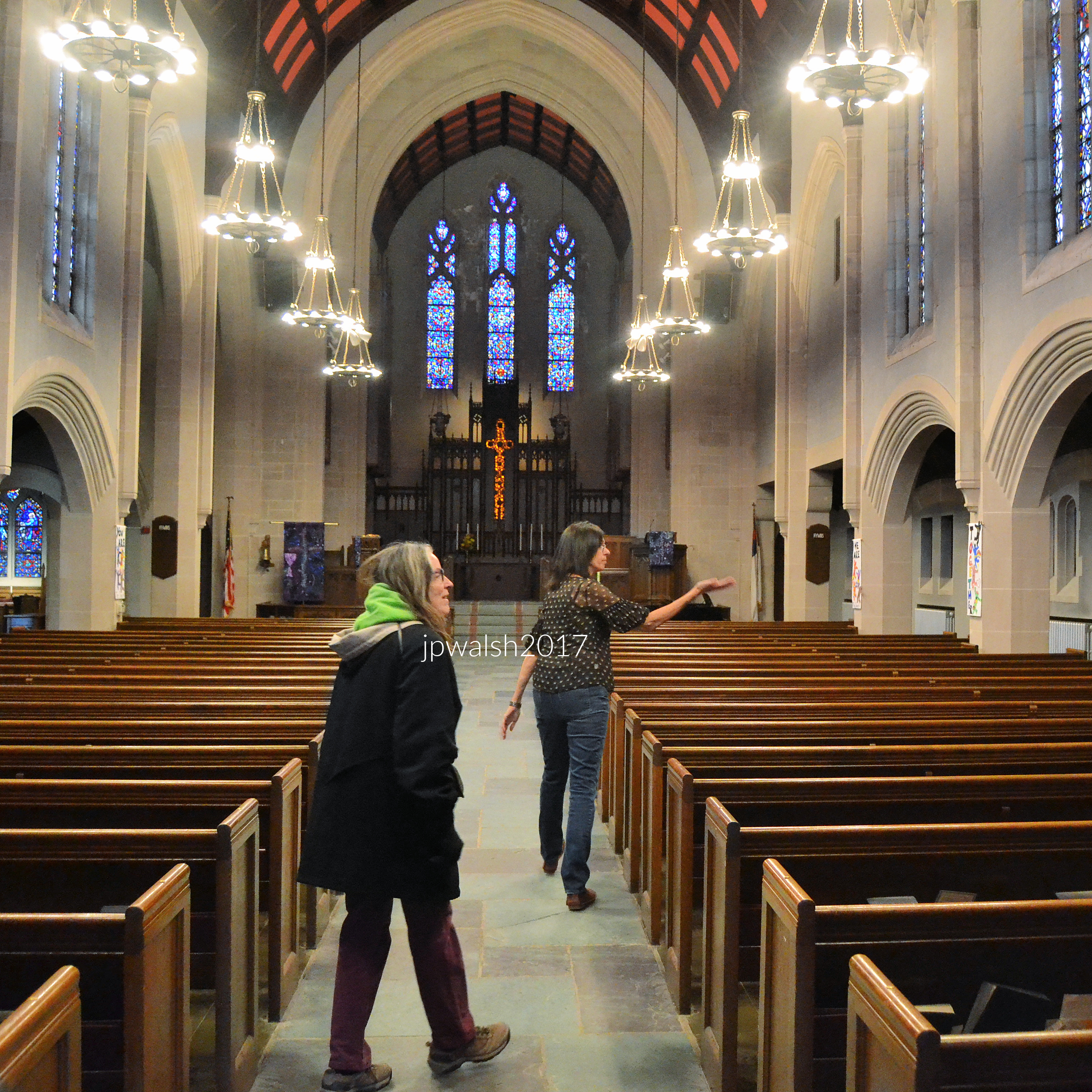
A procession of rounded arches line the nave arcade, a testament to the congregation’s former Romanesque church building, with Gothic pointed-arch stained -glass windows above them guiding the eye upwards and forward. Above these, a ribbed or groin‑vaulted ceiling lifts the gaze further upward into a sense of height and devotion that feels almost instinctive. Reinforcing this vertical pull, the tall, narrow stained‑glass windows have proportions echoing centuries of Gothic design stretching light into color. Stone columns with simple capitals mark each step of the nave, guiding you along the long central aisle toward the chancel. The sanctuary is familiar Gothic interpreted through the American 1920s–30s lens—lighter, more vertical, devotional rather than medieval.
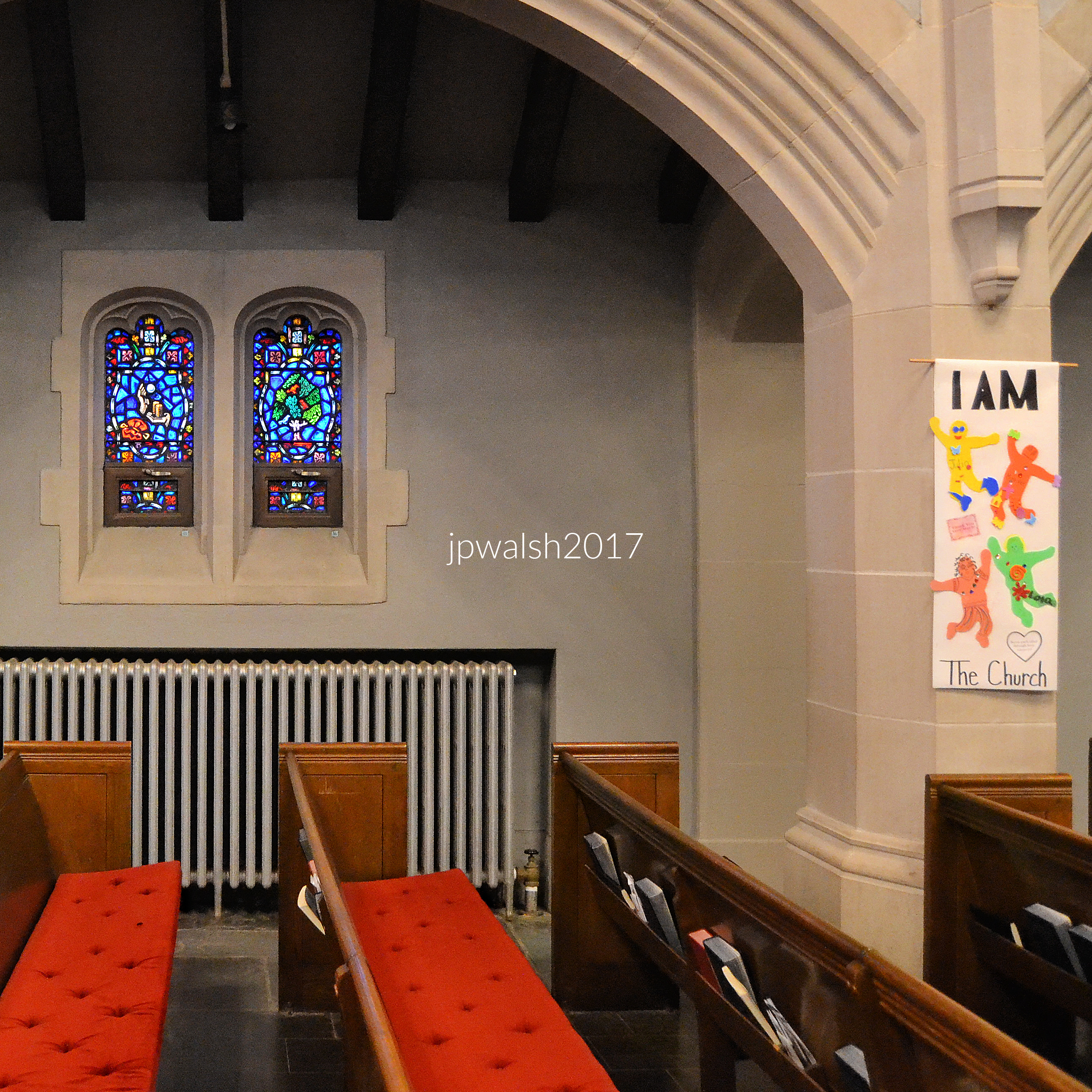
The space warms into Methodist Gothic. Dark wood pews, wooden chancel furnishings, a prominent pulpit or lectern, and a central cross create an interior that feels both sacred and approachable. The materials and layout quietly affirm the Methodist emphasis on Scripture, preaching, and congregational participation.
Overhead, hanging lantern chandeliers complete the atmosphere. Their medieval‑inspired metalwork casts a warm glow that softens the stone and wood. Evenly spaced along the nave, they reinforce the processional rhythm, drawing the eye—and the worshipper—toward the chancel and the unfolding narrative held in glass and architecture. Gothic in form, Methodist in function, Willett in storytelling, and 1920s–30s American in craftsmanship, including acoustics shaped for congregational singing, the interior of Trinity UMC is a space designed to make worship feel like a journey: from the world outside, through the nave, toward the light of the chancel and the story told in glass.
How Methodist theology shaped 20th‑century stained glass.
Methodist stained glass in the early–mid 1900s has a distinctive character shaped by Methodist convictions about Scripture, preaching, and discipleship. Because windows were expected to teach, almost every Methodist window cycle from this era functions as a visual sermon. Their imagery is intentionally accessible, with a strong Biblical orientation and a clear narrative movement through salvation history.
Methodists understand themselves as heirs of the Old Testament, followers of Jesus, children of the Reformation, and participants in the church’s ongoing renewal. As a result, their stained‑glass programs blend Old Testament, New Testament, and Reformation themes. Typical cycles include scenes of the prophets, episodes from the Life of Christ, and depictions of key Reformers such as Martin Luther (1483-1546), William Tyndale (c. 1494-1536), and Methodist founder John Wesley (1703-1791).

Façade window: Jesus Calling the First Disciples.
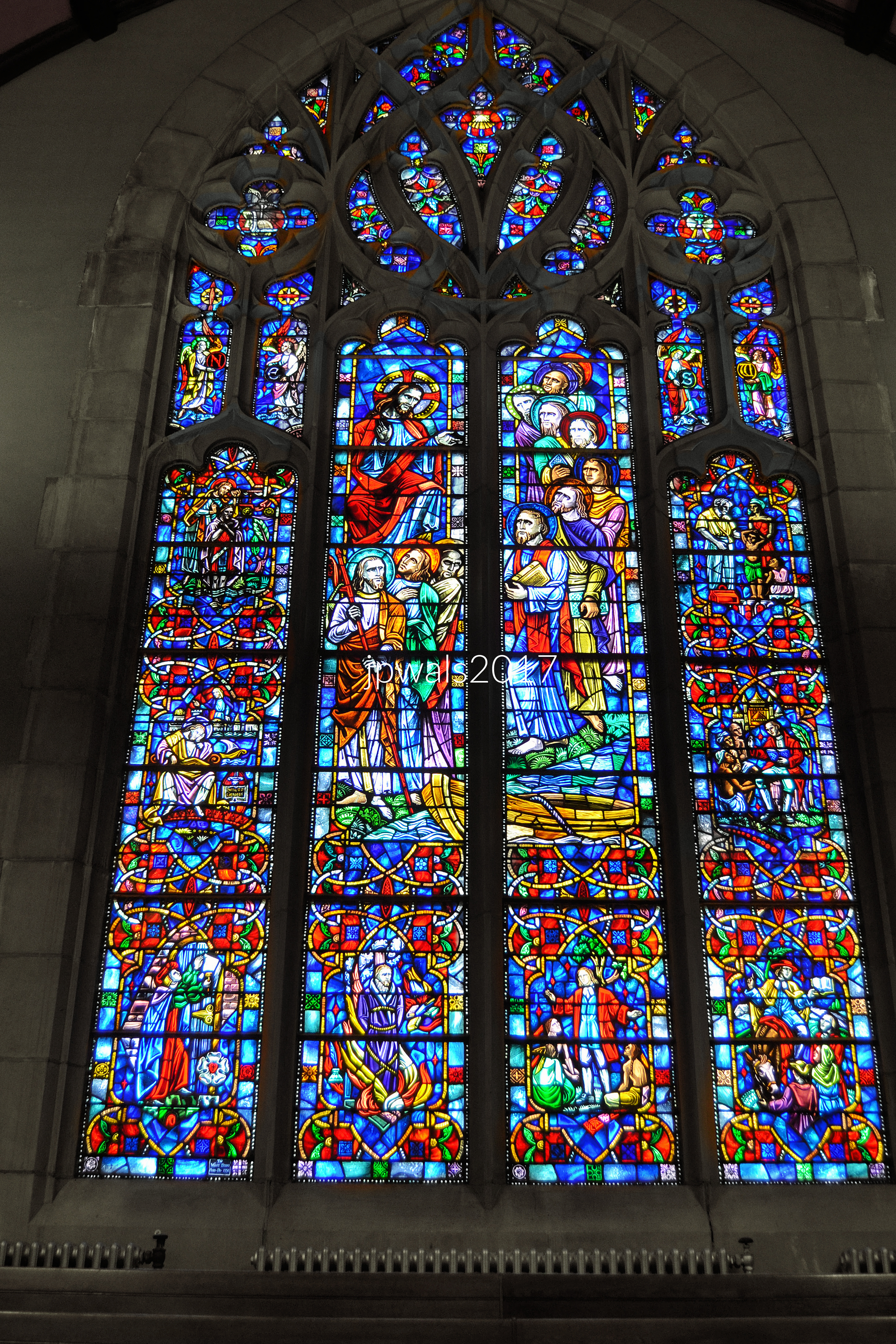
A foundational moment in the Gospels — and a favorite subject in mid‑20th‑century Methodist stained glass — is Jesus calling the first disciples. In this scene, Jesus summons fishermen from their boats with the words, “Follow me, and I will make you fishers of men.”
The boat anchors the story in the Sea of Galilee, while the iconography makes the identification unmistakable. Jesus is shown with a cruciform halo and red and blue garments, signaling his dual nature. His authoritative, summoning gesture directs attention to the haloed figures of Peter, Andrew, James, and John, who look up toward him in response to the call.

At the bottom of the façade window are four scenes from the life of the Reformers. At LEFT is Martin Luther nailing his 95 theses to the door of the Castle Church (All Saints’ Church) in Wittenberg, Germany, on October 31, 1517, that sparked the Reformation. At the bottom right of the panel is a white rose with a red heart and black cross. That is Luther’s personal emblem, designed in 1530 and used on his letters and publications. He is wearing scholarly robes in the colors of deep red, green, and brown that Willett often used for Reformers.
At LEFT CENTER is the burning at the stake of William Tyndale in 1536 whose crime was translating the Bible into English for the ordinary people. Tyndale believed Scripture should be accessible to ordinary people and died for that conviction. The Reformation’s gift is to take the Bible out of the hands of the elite and place it into the hands of the people.
At CENTER RIGHT is John Wesley, founder of Methodism, preaching in the open air to Native Americans — specifically the Muscogee (Creek) people —during his mission to the Georgia colony between 1735 to 1737 which, after his return to England, accelerated the Methodist Movement which Wesley founded at Oxford in 1729. Wesley began preaching in the open air, embracing traveling ministry and forming societies as he did in America. By 1739, he built the first Methodist meeting house in Bristol, England.
At RIGHT John Wesley preaching to early American settlers. Wesley served as Anglican pastor of Christ Church in Savannah, Georgia, where he introduced strict spiritual disciplines. His time was marked by conflict, including a failed romantic relationship, and backlash from residents against his strictness, causing him to return to England heartbroken and disillusioned after only two years.
Methodist stained glass seeks to be beautiful where clarity is key. The style tends to bold outlines, well delineated figures and readable gestures with minimal abstraction.
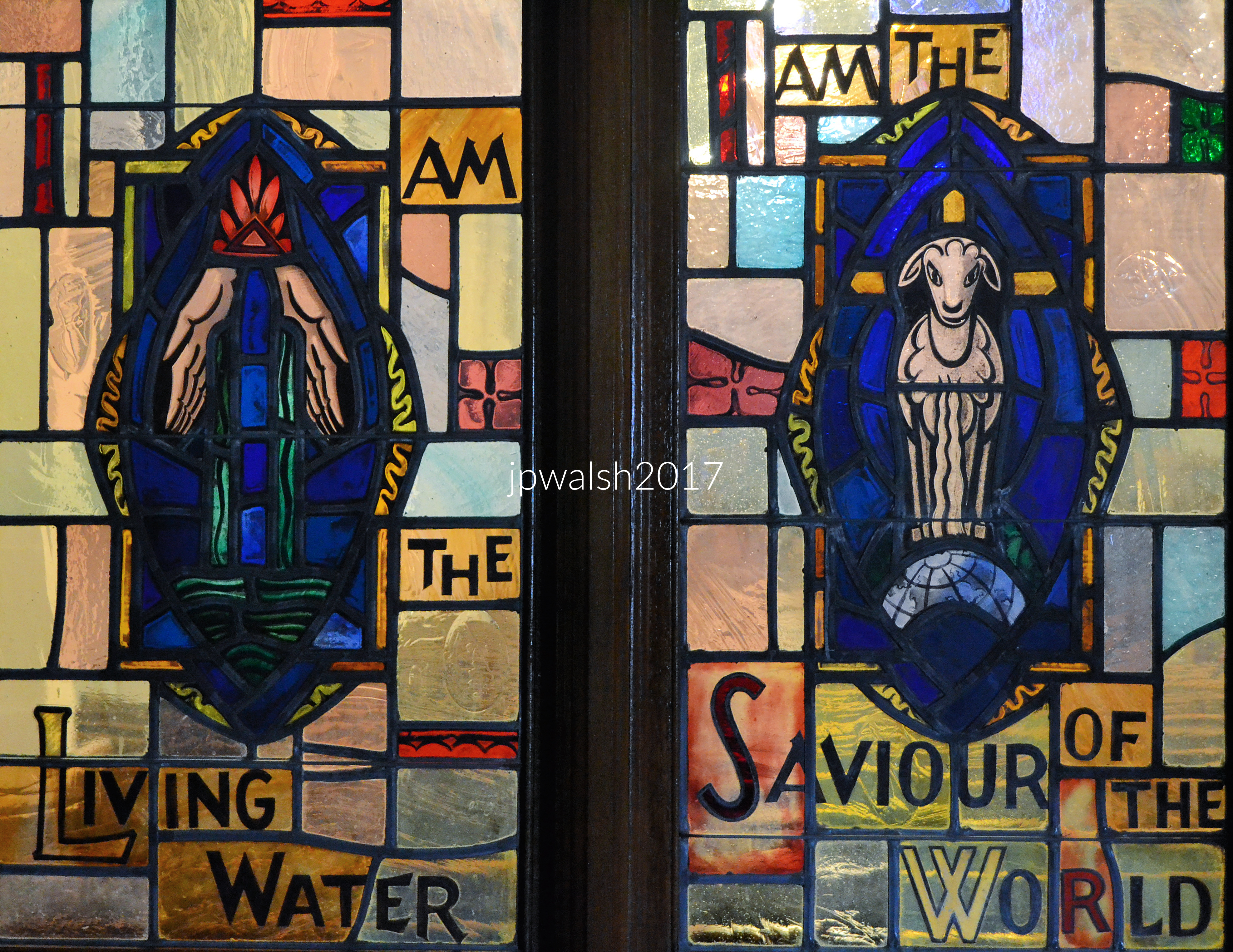
Traditional enough to feel sacred – Modern enough to feel fresh – narrative enough to teach – artistic enough to inspire: Why Willett Studios was chosen.

This Willet window is a Life of Christ triptych, arranged in the traditional Methodist/Willett narrative pattern.
At the left, the window shows the ministry of compassion: a haloed Christ blessing or forgiving a kneeling woman, possibly inspired by the woman who washed his feet with her tears and dried them with her hair. Willett often preferred such non‑specific healing scenes, using them to emphasize Christ’s compassion rather than tie the image to a single Gospel episode.
At the center, Christ stands elevated and alone in Willett’s characteristic depiction of Christ the Teacher — sometimes also read as Christ the Good Shepherd when paired with lamb symbolism above. He bears the cruciform halo (reserved only for Jesus) and wears red and blue robes to signify his dual nature as God and Man. His arms extend slightly in a gesture of blessing and invitation.
At the right, the scene shifts to Christ’s agony in the garden before his betrayal and arrest, capturing the moment of solitary struggle that precedes the Passion.
“Do all the good you can.”
Taken together, these panels proclaim a unified message: Christ at the center of the Christian life, the one who heals, restores, and calls disciples to follow. The sequence echoes the Methodist conviction embodied in the familiar motto: “Do all the good you can.”