
Category Archives: Art History – Britain

BRITAIN. James McNeill Whistler’s favorite contemporary British artist: ALBERT JOSEPH MOORE (1841–1893). Four meticulously painted large-format visions of human figures in a mysterious, at once ancient and modern, idealized natural world that pursued beauty.

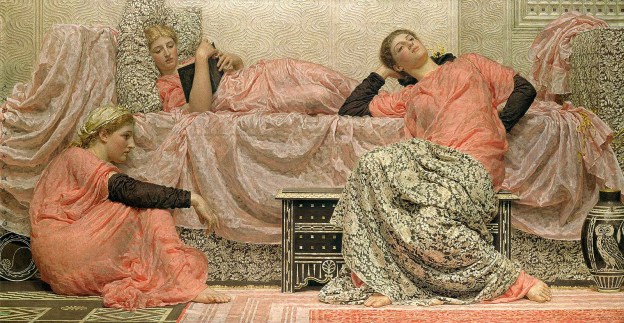
FEATURE image: Albert Joseph Moore (1841-1893), READING ALOUD, 1884, oil on canvas, 42.24 x 81 in., Glasgow Art Gallery & Museum.

The artist: Albert Joseph Moore (1841-1893).

INTRO: Albert Joseph Moore was born in 1841 into a family of artists in North Yorkshire in England. Moore through his own advanced aesthetic experiments in the milieu of theoretical and practical advancements of mid-to-late 19th century modern art in England and France – such as a systematic analysis of nature, mathematical plotting, and principles for quintessential combinations of color, line and form – created art that was, in formal terms, in its conception and execution, on the cutting edge of abstraction that would continue to develop and blossom into early 20th century Cubism. Moore’s art gained the respect of other progressive artists (Moore was called “a painter’s painter”), patrons and collectors, if not always the critics and contemporaries who viewed Moore’s work as merely decorative. Moore was actively collected in his lifetime and exhibited regularly in major venues such as the Royal Academy. Unmarried and of a lifelong independent disposition, Moore died in 1893 at 52 years old, having just completed his last monumentally ambitious artwork (“The Loves of the Winds and the Seasons,” Blackburn Museum and Art Gallery, posted below) a handful of days before. Several of Moore’s pictures are now in public collection throughout the UK, including the Tate and the British Museum in London. 
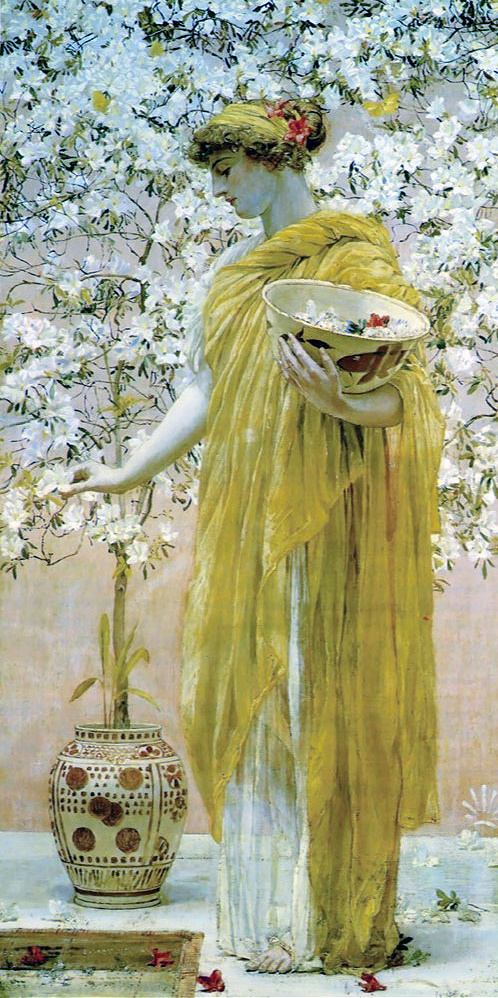
Albert Joseph Moore (1841-1893), AZALEAS, 1867, Hugh Lane Municipal Gallery of Modern Art, Dublin, Ireland.

Azaleas was a popular artwork by Albert Moore for its harmonies of color and the “Greek refinement” that the artist infused into his work. This bigger-than-life-size canvas called Azaleas was painted in 1867, exhibited in 1868 and demonstrates the artist’s ability to represent the human figure on a grand scale.

The 26-year-old artist had some architectural design experience in theory and practice and used this in his preparatory process. This artwork incorporated ideal geometry along with typical academic methods.

Moore’s process followed, first, making studies of the nude figure and draped figure. Moore next made a larger-than-life-sized full-scale nude figure cartoon which, at this stage, was informed by geometric abstraction of the figure in a setting guided by, or through, the milieu of the object in the artist’s hands.

The geometric quality guided the composition rather than was externally imposed by the artist. Moore’s “system of line arrangement” sought the directions of the prominent lines of the composition so to plot parallels of them throughout the drawing resulting in a statuesque yet corporeally vivacious figure.

Nature, specifically the landscape, ultimately served as the inspiration for the manifestation of line parallels and optical balance rather than the mathematically ideal. Moore’s geometric construct and its interplay determined every element of the composition – from the position and placement of the figure to the location of accessories, such as wall hangings, distribution of drapery folds, and architectural elements. The canvas’s shape and size also were ultimately determined by this idiosyncratic geometric arrangement.

Traces of Moore’s preparatory practice are in evidence in Azaleas’ full size nude cartoon with its vestiges of diagonal and horizontal lines through the midsection of the figure and near to her feet. Using these lines in the nude drawing it is apparent that Moore experimented with the placement of the figure’s head, the extended hand, and a raised heel which was ultimately hidden under opaque drapery. Moore used a live model for his figure.

The final nude cartoon was transferred to the canvas and this outline was built up with oil colors. A drapery cartoon was then transferred on top of the transferred, built-up nude figure cartoon. Using this method Moore rendered greater transparency of the fabric since the underlying nude cartoon showed through faintly. This painstaking preparation was masked by Moore’s fresh and free style of painting. For instance, the drape folds of the left shoulder are painted in long, fluent, and elegant strokes while the azaleas are rendered in energetic strokes. Moore’s objective was for the final painting to look like an impromptu and expressive sketch when, in fact, it was carefully planned and executed.

About painting Moore taught his students to think long about it but execute with quickness and determination. This technique aided in transforming oil painting into the manner of Graeco-Roman fresco in that Moore’s working method allowed for painting only what could be finished in a day.

Moore’s careful planning, rapid execution, and brush technique also suggested the influence of Japonisme. Asian influences in Azaleas included the carp bowl held in the women’s arm (an actual studio prop) and the geometric pattern in the azalea pot whose symmetry Moore saw as part of both Greek and Japanese art. To integrate and transition the predominantly yellow figure in the predominantly white background Moore used a device taken from Japanese art of painting flitting butterflies around the azalea bush. Moore also painted russet blossoms in the woman’s hair and bowl and on the floor that further unites the monumental composition.

Moore’s observation of Japanese prints also likely influenced the English artist’s color scheme in Azaleas. This is identifiable in its limited schematic of hues. The color placement, however, was also subject to the geometric practices in the whole composition.

When Azaleas was exhibited at the Royal Academy in 1868 it was consigned to an out of the way place on the wall of its North Room. It was observed that Moore’s canvas looked more like a tapestry than an oil painting. In this way, Moore anticipated James McNeill Whistler’s comment about color in that it should appear “embroidered” on the canvas, in the same way a thread is embroidered on fabric. Whistler attributed this color quality to Japanese art in that those artists looked for repetition in color application and not contrast.

Architecture critics in 1868 noticed and especially admired Moore’s Azaleas. Its systematic repetitions and geometric construction were labeled the only “decorative” painting in the 1868 English exhibition. Art critics were less generous. Straining with opera glasses just to see the work they recognized its beauty and Moore’s talent but called its design and execution eccentric. Others turned up their critical nose to the new decorative work as “curious” and little more than a luxurious indulgence of art for art’s sake. Art critics were unhappy with the paintings’ colors as they found they lacked the requisite black that marked contemporary French art and, instead, opted for a quiet and delicate dreamscape.

English writer William Michael Rossetti (1829-1919) declared Azaleas one of the most important English pictures of 1868 and decried those looking to judge it by way of actual historical pictures from Greek antiquity. With Algernon Swinburne (1837-1909), Rossetti compared Moore’s artwork to another painting in the 1868 exhibition: “The Wife of Pygmalion, A Translation from the Greek” by the older George Frederic Watts (1817-1904). In that work Watts sought to create a painterly equivalent of classical sculpture. William Gladstone (1809-1898) wanted to purchase Watts’ picture after seeing it at the Academy in 1868. In a letter to Gladstone in May 1868 Watts informed Gladstone that it had been “claimed” but invited Gladstone to visit him in his studio to see the cast of the fragmentary Greek original from which the painting was derived.

Swinburne saw the poetry and musicality of Moore’s artwork .While most art critics snubbed the painting (and by extension the painter) for its art for art’s sake qualities, Swinburne praised them. Of Azaleas, Swinburne wrote: “The melody of color, the symphony of form is complete: one more beautiful thing is achieved, one more delight is born into the world; and its meaning is beauty; and its reason for being is to be.”

Albert Joseph Moore (1841-1893), SEA-GULLS, 1870/71, oil on canvas, 27 x 61 inches (68.5 x 154.8 cm), Williamson Art Gallery & Museum, Birkenhead, UK.

Sea-gulls was accepted for the 1871 Royal Academy exhibition. It was the third painting for Albert Moore to exhibit at the Royal Academy. Moore was absorbed in painting Sea-gulls, a major work, for British shipping magnate Frederic Leyland (1831-1892) and this work occupied him up to the Royal Academy Exhibition that spring.

Its creation by the 36-year-old Moore was not without headaches owing to controversy. Moore’s friend and admirer, American ex-patriate artist, James Abbott McNeill Whistler (1834-1903), had learned of Moore’s preliminary work on the painting through Leyland, a major art collector and the artists’ mutual friend.

Whistler expressed concern that Moore’s work perhaps overlapped adversely with some of Whistler’s own preliminary sketches for a painting. Whistler saw a pair of sketches Moore had sent to Leyland as potential commissions. Whistler felt that Moore’s sketch may have been influenced by seeing one of Whistler’s sketches. Whistler feared that if Moore’s painting was exhibited first, it would reflect badly on Whistler as an imitator when in fact the artwork Whistler was working on ante-dated Moore’s conceptions. This was a mortifying prospect for Whistler who prided himself on originality.

Whistler’s anxiety may have also stemmed from the fact that with Sea-gulls, Moore would fulfill his second commission for Leyland, while Whistler who introduced them had yet to complete a picture for Leyland that had been commissioned in 1867.

To ease Whistler’s fears, the American artist proposed that Moore accompany another mutual friend, architect William Nesfield (1835-1888), to Whistler’s studio in Chelsea to inspect his older original sketch that Moore had seen.

Nesfield, acting as mediator, concluded in September 1870 that the recent work of the two artists shared themes, but each maintained their own artistic originality. The crisis was averted and led to Moore exhibiting Sea-gulls.

During this crisis and shortly thereafter, Moore did not finish to his satisfaction his painting when it was time for its exhibition in April 1871. A major effort required to complete Sea-gulls had deeply undermined Moore’s health. After the exhibition the painting was returned to the artist, but he could not yet immediately set to work on it to completion. Months later it was finished and sold to Leyland.

In Sea-gulls Moore introduced obvious analogies between the liquid patterns of the sea and the rippling and splashing motion of the figure’s hair and drapery. Moore’s intention was to discern patterns inherent in nature. The drawings also suggest that he exaggerated the effect of air currents by employing the revolving fans that were simultaneously in use for Sea-gulls and another painting titled Shells.

Much of Moore’s work to complete the painting after the exhibition revolved around redressing the picture surface. Moore had been experimenting for some time with the surface quality of his paintings. In the early 1870s, Moore’s technique had developed to combine transparent and opaque fabrics that created unusual layering effects. Following the 1871 exhibition, Moore seemed to apply this technique in Sea-gulls that involved unusually thick paint layers.

Much later, during the winter of 1880, Sir Coutts Lindsay (1824-1913) – the British artist and watercolorist founded Grosvenor Gallery on Bond Street as an alternative exhibition space to the Royal Academy which became a venue for avant-garde artists, particularly those associated with art for art’s sake – mounted a show on the subject of artists’ working sketches. Moore contributed the preparatory studies for Sea-gulls to the show that included his sketches of hands, heads, drapery, plants and flowers, as well as the painting’s cartoon.

Although biographers of Whistler and Moore have attached no importance to their friendship, particularly after the September 1870 controversy over Sea-gulls which they claim ended it, the artists in fact remained on intimate terms unbroken until Moore’s death in 1893. In the later 1870s they again were thrust together in a contentious situation but this time on the same side of sorts. When Whistler became involved in libel proceedings against Ruskin in later 1878 Albert Moore was the only artist who the American ex-patriate artist could rely on to both publicly attend the proceedings and actually give evidence on Whistler’s behalf. 

Albert Joseph Moore (1841-1893), READING ALOUD, 1884, oil on canvas, 42.24 x 81 in., Glasgow Art Gallery & Museum.

Reading Aloud was one of three large-format paintings Albert Moore completed in the 1880s. Completed in 1884, Moore had been working on Reading Aloud for years – at least since 1881. Moore had drawn a chalk sketch of the geometrically designed composition over which the artist would lay a piece of translucent glass. By painting directly on the glass, he could experiment with colors without redrawing the picture. He then could transfer the trial color experiment on glass (as well as a final drawing) onto tracing paper by which the final artwork was then made by pinning the tracing paper to the canvas. The artist then painted the composition directly to the canvas, section by section, working as he painted to unify color scheme and, as figural poses and other details are different in the final artwork than surviving preparatory materials, drawing. It was meticulous organizing and harmonizing creative work that helps to explain why Moore labored for years on the almost 7×4 foot oil on canvas.

While these three reclining figures are static their contrasting drapery folds whether they are swirls, zigzags or sweeping diagonals – with the sofa’s swags to unite them – enliven the picture. As classicism revivalists are noted for their mere realism and moralistic anecdote, Moore’s evocation of classicism, though containing allegorical qualities, belies a modernity by way of its abstract combination of line and form in the depiction of languid female figures in a neutral setting. The black-and-white owl vase that Moore included in the lower right corner of the painting had been absent from previous studies (originally it was a seated cat) and provides a narrative sign. It connotes the quality of wisdom as well as perhaps the goddess Athena with which the owl is associated so to apply it to the various states of the readers though the overall picture with its fascination with repose is more subtly mysterious than anecdotal. Yet the classicism/modernity enigma continues as the honey bee which Moore paints on the face of the owl vase was the symbol used by the picture’s purchaser, pig iron industrialist William Connal (1819-1898), for himself.

Moore, Albert Joseph; William Connal; York Museums Trust; http://www.artuk.org/artworks/william-connal-8009

After his wife of 25 years Emelia Jessie (Campbell) Connal died in 1877, 56-year-old industrialist William Connal faced life alone at Solsgirth, his Scottish country manor. Connal turned his attention to the arts and, in addition to Moore, became an avid collector of contemporary art by such painters as Edward Burne Jones (1833-1898), Edward Poynter (1836-1919), Frederick Sandys (1829-1904), Roddam Spencer Stanhope (1829-1908), Fernand Knopff (1858-1921) and Adolphe Monticelli (1824-1886) along with the Old Masters. Connal owned Symphony in Silver and Grey by American artist James McNeill Whistler (1834-1903) who greatly admired Moore. In 1883, Connal invited Moore to stay at Solsgirth House in Perthshire for a month allowing the artist to recuperate after a serious illness. It was during this stay that Connal commissioned Moore to paint his portrait that shows him wearing a honeybee brooch, the emblem that Connal used on his personal items (Connal’s portrait today is in York Art Gallery).

Moore’s pictorial methodology which he continued to develop over his artistic career is in evidence in Reading Aloud. Moore works out and unifies various and moving parts depicting a scene’s animating personality based in psychology with its physical forms that are mathematically contrived by way of lines and curves and, ultimately, color and texture, and whose impact on the viewer of the completed artwork is allowed to be emotional rather than cerebral. In Reading Aloud Moore constructed the image based on two pairs of diagonals that intersect into a pattern. Though the geometric system is visually subdued, it is evident in the figure on the right whose arms coincide with a set of diagonals. It is obvious also in the picture’s overall use of contrasting bold colors – the fabrics’ pinks and creams are integrated to, though angularly distinct from, the charcoal greys of the covered limbs and book cover. The edges of the book cover also coincide with some of the complex design of diagonal lines whose subliminal quality is an intrinsic expression of the psychic nature of the artwork. This angularity based on diagonals was a deliberate strategy for Moore when he painted the final artwork. There is also the horizontal lines component in the painting manifested in the outstretched arms of the crouching figure at left and the table and vase. Moore’s design strategies were innovative in 1884 startling contemporary viewers approaching to what Cubism would accomplish 25 years later. Critics when viewing Reading Aloud, being neither particularly understanding nor sympathetic to Moore’s methods or intentions, praised the picture’s overall gracefulness but impugned his drawing skills and identified the painting as mostly static decoration. Yet the static figures form part of a complex array of abstract and naturalistic patterns that fill every inch of canvas. Reading Aloud is a testament to the artist’s ability to translate such natural phenomena into a stylized form. Most prominent among them is a fabric effect found in other of Moore’s paintings of the period, in which white lace is layered over cloth of a darker color. Reading aloud was exhibited at the Royal Academy where, starting in 1883, Moore chose to exhibit annually.
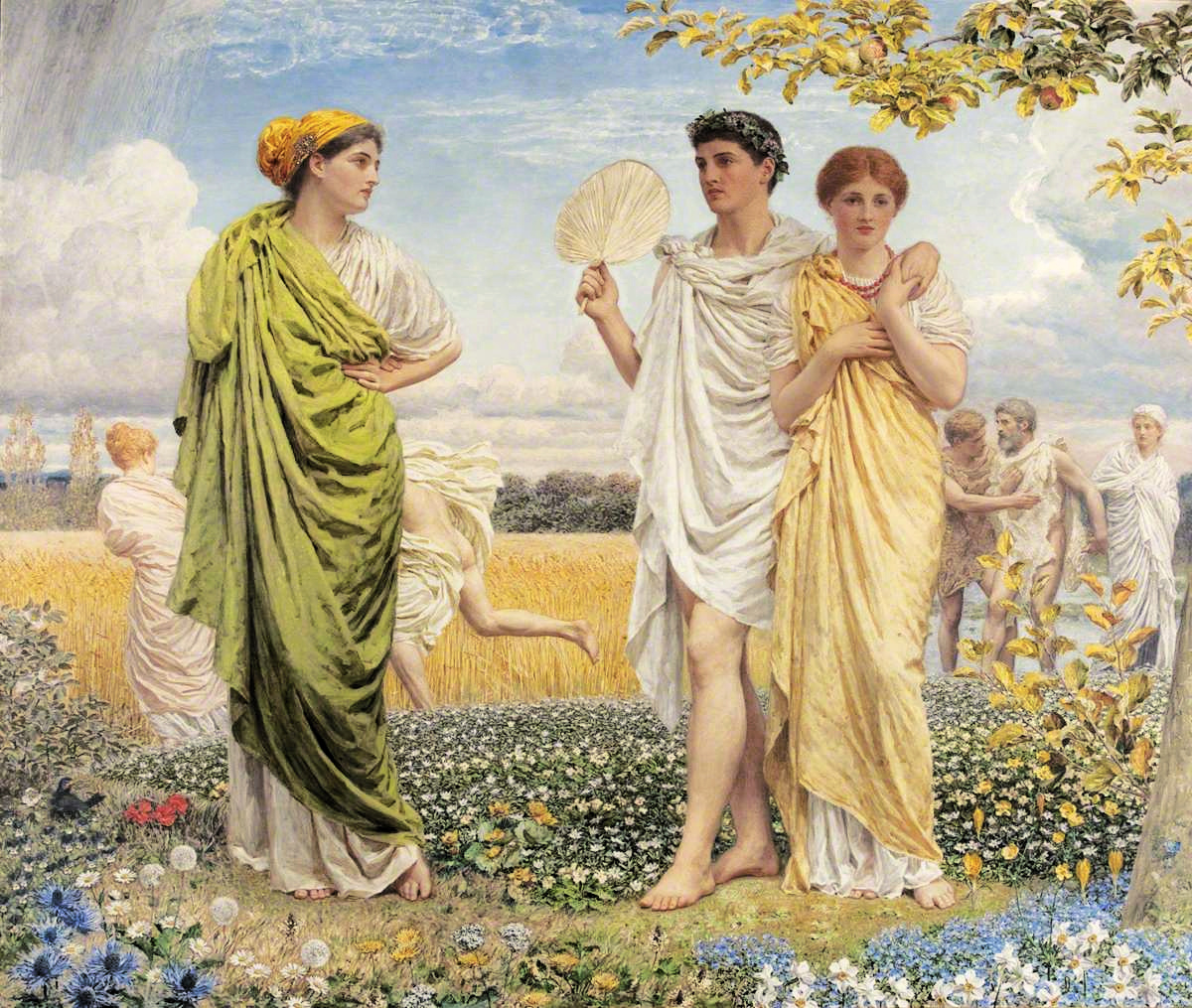
Albert Joseph Moore (1841-1893), The Loves of the Winds and the Seasons, 1893, oil on canvas, Blackburn Museum and Art Gallery, Blackburn, UK.

The Loves of the Winds and the Summer was English artist Albert Moore’s final and largest artwork of his career. It is 6 feet tall and 7 feet wide and is the jewel in the crown of the Blackburn Museum and Art Gallery near Manchester, England. It is the result of Moore’s study of the psychology of his subject matter, that of love. Love begins to manifest formally for Moore by the expression of soft bodily postures, changing and harmonious curves, and piercing gazes expressed in deep coral colors. The male figure of the Wind is flanked by the spurned female figure of Summer to the left and the embraced female figure of Autumn to the right. Moore was so enveloped in his amorous themes that while working on this picture he was writing poetry about what the human face was like when in love – and it is found in his picture. The Love of the Winds and the Seasons is Moore’s fullest expression of animating personality united to depicted physical forms that are first lines, curves and color, with the result being an emotional impact on the viewer who encounters the artwork. This exquisite artistic sensitivity by Moore is made more remarkable since the artist was dying in 1893. In the company of his young and attractive live models in his new capacious art studio, Moore worked day after day on this work. Moore had cancer (a tumor on his thigh) and had submitted to three operations to keep ahead of it. When his doctors told him they could operate no more, and that the cancer continued to spread throughout his body, Moore was resigned to his situation. He is reported to have said: “Well, there’s an end of it.” In the limited time left to him Moore intended to finish his painting of love, The Loves of the Winds and the Seasons. The artist did not want to lose any time. His legs had swollen to twice their size and had to be drained. In acute pain he worked around the clock for the next six months. His friends thought the intense work as well as the cancer was killing Moore but as the painting progressed to completion, they observed that the artist’s personal tranquility and happiness became apparent. The project was monumental – numerous preparatory studies, drapery studies, full scale and life-sized cartoons (i.e., 4’ 9” tall by 1’4” wide for Autumn) , nude studies – all technically meticulous and versatile- and that underwent the artist’s elaborate and idiosyncratic geometric platting system that he began in the late 1870s. Moore was the consummate auteur that slightly older American ex-patriate painter James Abbott McNeill Whistler (1834-1904) most admired in England. Moore conceived his paintings from start to finish – and The Loves of the Winds and the Seasons was at once its pinnacle and completion. Moore, as Whistler aspired to be, was sole master of his work. In 1893 Moore now expanded this mathematical process to amalgamate his diagonals with horizontals so that his creative process could not suffer the critique that Ruskin hurled at Whistler of “ask(ing) 200 guineas for flinging a pot of paint in the public’s face.” The painting was a commission for the Australian mine-owner George McCulloch (1848-1907). Moore’s calculations included various adjustments of the models’ natural poses to submit to the mathematical formulas on the canvas. This formal submission of subjects to linear construction extended to each detail in the entire composition, such as the flowers for which also study drawings were made. Within these design rigidities, the preparatory drawings of the live models and subjects were transferred to the artwork with little idealization though slight but important adjustments were made, such as to Summer’s hairstyle. Knowing his own time was short, Moore made his cartoons in color so that his transfer to the canvas was as efficient as possible as he painted the final artwork. Critics have observed that despite the intense planning and preparation, the final artwork is executed unevenly – parts are meticulous and vigorous, mostly in the foreground, while others in the background are loose and crude. To what degree this is the artist’s intention or the result of his declining health, is a matter for speculation. During the artistic process the terminally ill artist isolated himself mostly. His handful of visitors remarked that the artist was cheerful, cracked jokes, told funny stories, and smoked his pipe. These select parties knew, however, that their social calls were in the context of final good-byes. In those last days and months of Moore’s life, the artist’s mind, by evidence of the art from his past that he referenced in 1893, stretched back to an earlier career which shared long-held important aspects with The Loves of the Winds and the Summer. For his last artwork. Albert Moore glossed the picture’s narrative in verses he wrote to accompany it:

Lo! fickle Zephyr chaseth wayward Spring,

It is a merry race;

Flowers laugh to birds that sing,

Yet frequent tears shall cloud her comely face.

The South Wind shall with blushing Autumn mate,

Contented with her lot;

Summer sigheth – such her fate

She and her burning kisses are forgot.

Two lovers rough for shudd’ring Winter strive,

Beneath a shroud of snow;

Heaven haply shall contrive

Their violence she may not further know.

Through its figural and intellectual prism of ancient classical mythology, Moore worked in his career to update the complex equation of the natural world’s varying and transitory seasons to human life’s copious physical, emotional, and spiritual expressions and contradictions. With their immersion in Moore’s modern art, the painter achieved a graciously-contrived visual dramatic interplay of nature and humanity, ancient and present-day, whose quest is eternal in time and space.

Albert Joseph Moore passed away in the middle of the night on September 25, 1893. He died 9 days after finishing his last painting, The Loves of the Winds and the Summer. Moore was 52 years old.

SOURCES: ALBERT MOORE, Robyn Asleson, Phaidon, 2000, pgs. 70, 97-100, 104, 108. 164, 166-168, 177, 179, 185, 199-202; https://houseandheritage.org/2017/05/19/solsgirth-house/ – retrieved September 5, 2023.
BRITAIN. HANS HOLBEIN THE YOUNGER (German, 1497-1543): Humanist Portraits in England, 1526-1528.

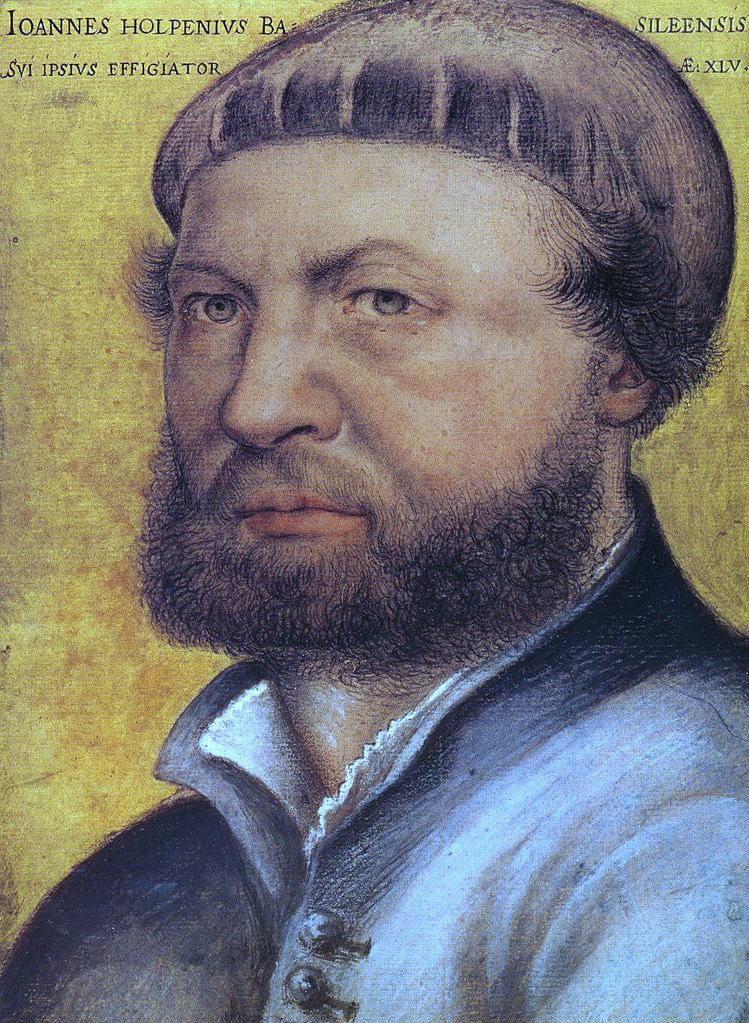
Featured Image: Self-Portrait, Hans Holbein the Younger, 1542/3, black and colored chalks, 23 x 18 cm, Florence, Galleria degli Uffizi. This is the only confirmed self portrait by Holbein.

Self portrait Hans Holbein

Self-portrait Hans Holbein The Younger, Oil on paper, mounted on oak, 16.5 x 14 cm, inscribed on the left and right of the head: H H; on the left above the shoulder: AN [N] O. 1554 / ETATIS SVE/45, Kunstmuseum Basel, donated by Prof. J.J. Bachofen-Burckhardt Foundation in 2015. While Lüdin was probably working from a graphic reproduction, the unknown painter of this picture, if not Holbein’s own drawing, surely had one of the copies made shortly after his death in the narrow workshop environment. This is one more Hans Holbein self-portrait based on the secure Florentine drawing.

Self portrait Holbein

Self-Portrait Hans Holbein, copy by Johannes Lüdin, c. 1647-1667, Oil on canvas, 61.5 x 47.5 cm, Kunstmuseum Basel. In fall 1526 twenty-nine-year-old Hans Holbein crossed the channel from Antwerp to England where the German immigrant’s first concerns were to find work, useful friends, and a place to stay. While Lüdin’s painting was given as a gift to a major art collector in Basel and probably based on a graphic model whose type proliferated after 1600, it is the drawing in the Uffizi (see Featured Image) that remains the only secure self-portrait image according to current Holbein scholarship.

Introduction by John P. Walsh

Hans Holbein the Younger was born in Augsburg, Germany, in 1497. After 1515, he lived and trained in Basel, Switzerland. Over two visits, one starting in 1526 and another in 1532, Holbein spent a total of thirteen years in Henry VIII’s England until the artist’s death in 1543. The focus for this post is Holbein’s first visit to England which lasted two years – specifically, from around September 1526 to mid-August 1528. His second, more permanent, visit to England started in 1532 (Holbein likely arrived in the spring) and lasting to his death, almost certainly from plague, in late 1543. It was during that second, longer visit in England that Holbein became the most important court artist in the time of Henry VIII. His first visit is characterized by the activity of a young immigrant German artist – Holbein was about 29 years in 1526 – getting established in a foreign land and developing a mastery of his craft.

Holbein arrived in England in late 1526 with a letter of introduction from Dutch humanist Desiderius Erasmus (1466-1536) addressed to Sir Thomas More (1478-1535). This was not the first time Erasmus wrote to More asking him to temporarily lodge a friend.1 More would be appointed Lord Chancellor in 1529, but in 1526 Sir Thomas was the Speaker of the House of Commons and Chancellor of the Duchy of Lancaster. By 1526, Erasmus and More had been friends for more than a quarter century. They met during Erasmus’s first high-spirited stay in England in summer 1499. In that year, Erasmus was 33 years old and More twelve years his junior. Other major protagonists in this story – namely, Hans Holbein the Younger and the future King Henry VIII – were just children in 1499.2 While Erasmus began writing seriously on theological topics during his first English stay he also reveled in the gentle and happy personality of More. Part of More’s reception to Holbein in 1526 by way of Erasmus’s request may go back to the two old friends’ first meeting in England in 1499. After Erasmus had been encouraged by More to bring his money into England which More assured the relatively poor scholar would be safe, most of it was confiscated by English customs at Erasmus’ departure. This unpleasant shock not only left Erasmus with keen anger towards England for months afterwards—he never, however, blamed More (and one other English friend) for the misinformation—but left him lacking for money in Paris and elsewhere for several years thereafter.3 Similar to Holbein’s effort in 1526, Erasmus returned to England in 1505 to improve his fortunes by staying with his new friends, including Thomas More, and working to establish a network of influential English contacts. Erasmus emigrated in large part to access various English scholars as well as to counteract friends in the Netherlands who were mostly ignoring his work. It was by way of a new English contact that Erasmus in June 1506 ventured to Italy where he stayed for three years.4 Back in England on his third visit in 1509, Erasmus wrote his Praise of Folly, probably his most enduringly famous work, while living in the house of Thomas More. But writing and lecturing (at Cambridge) brought Erasmus little profit.5 It was only when the Archbishop of Canterbury, another English friend, gave him a stipend in 1512 that Erasmus was relieved of practical destitution. But the favored scholar would remain chronically in need of money and wrote more books to help fill the need. A scholar’s life in cold Britain, however, following three years in Italy’s southern climes, proved tiresome for Erasmus. He found his many months of writing and teaching at Cambridge to be like “a snail’s life, staying at home and plodding.”6 Erasmus was lonely; the plague was frequently about; and, for whatever his labors, he was making literally no money. Further, a state of war between England and France commenced in June 1513 which alarmed and depressed Erasmus, prompting him to publish his first anti-war writings and resolved to leave the island as soon as he could. He sailed for Antwerp in the summer of 1514.7

In 1526 when Erasmus wrote to More asking him to welcome German artist Han Holbein the Younger, both old friends had achieved literary fame in Europe. Thomas More’s Utopia appeared in Latin in 1516, edited by Erasmus and published in Louvain. During the first years of the Reformation, Erasmus remained More’s link to the Continent as they continued their amiable correspondence following Erasmus’ settling in Basel, Switzerland, in 1521. That city would be Erasmus’s dwelling place for the next eight years. Erasmus relied on More’s friendship in the 1520’s as the disputes of the Reformation intensified.8 In 1523 when Hans Holbein the Younger painted two portraits of Erasmus, the young German artist and the older Dutch humanist had been acquainted for some years. Before Holbein joined the workshop of Hans Herbst (c. 1470-1552) in 1516 or had been taken into the Basel painters’ guild in 1519, the teenage Holbein provided a pen and ink drawing for the Basel edition of Erasmus’s Praise of Folly in 1515 which apparently pleased the humanist. From 1519 to 1526 before his first visit to England, Holbein, now in his 20’s, was a whirlwind of artistic activity in Basel. His expressive drawings and paintings were a leading feature, but he demonstrated talent and skill in the many topical arts of his time, including printmaking, metal engraving, frescoes, and altarpieces.9

By 1523 Holbein desired to focus his talent on portrait painting.10 Basel’s most famous resident of Basel was certainly Erasmus. Before his relocation to the Swiss city, the writer and theologian had been famously embroiled in controversies swirling around German reformer Martin Luther (1482-1546). Erasmus came to Basel from Louvain to escape these difficulties and live in relative tranquility.11 In 1523 in Basel Holbein painted three portraits of Erasmus of Rotterdam. One exists today in Basel (in the Öffentliche Kunstsammlung), in Paris (Louvre) and in London (on loan from the Longford Castle collection to the National Gallery). The Reformation was, for the foreseeable future, taking its toll in terms of the visual and plastic arts. Erasmus described to More the state of the arts on the Continent, citing Basel in particular: “Here the arts freeze.”12

Historian David Starkey has called Holbein’s three-quarter profile portrait of Erasmus which was sent to the Archbishop of Canterbury William Warham (c.1450-1532) as a gift in 1524 as “the most important portrait in England”13 Starkey claims the painting is the beginning of portraiture itself when so-called “realism” was introduced into art. By way of Erasmus’s portrait to Warham, Thomas More learned of Holbein’s artwork up to two years prior to the young artist’s arrival in England. It is probable that like Erasmus before him, Holbein lodged in More’s house during his first English visit. Such accommodation provided practical hospitality to a friend’s friend on many levels including the fact that immigrant artists in England were disallowed from dwelling  within the city gates of London (More’s house was in nearby Chelsea). Further, More, as a rising political figure in England, became Holbein’s first patron and in that way could secure Holbein’s modern art portraiture for himself. Indeed, the major work of Holbein’s first stay in England between 1526 and 1528 is the portrait of the household of Thomas More as well as the famous portrait of Sir Thomas painted around the same time. In this first two-year period in England Holbein also set to work on a variety of artistic projects, but the portraits highlighted the stay.

Like his famed classicist sponsor Erasmus before him, Holbein came to England to improve his fortunes as an artist. Holbein had visited France in 1524 with the hope for a royal commission but was ignored.14 While English guild artists required Holbein’s exclusion from London proper, the time restriction on his stay was owed to the city of Basel. At the cost of losing his citizenship, Holbein was allowed no more than two-year’s absence from the Swiss city. On August 29, 1528, Holbein returned to Basel.15 This marked the end of Holbein’s first visit to England, but not before he had developed many new influential contacts and established his mastery of craft within the orbit of one of Europe’s most dynamic royal courts. Little more than three years later, in spring 1532, with his old friend Thomas More in the last throes of service as Lord Chancellor (More would almost immediately resign that year as dangerous political storms grew), Holbein returned to England. The Continent’s political and religious revolution was creeping across the channel for England’s own idiosyncratic reasons such that the English world Holbein visited in the 1520’s was rapidly declining. A revolutionary zeal was emerging, especially under Thomas Cromwell between 1535 and 1539, which would inspire new challenges for artistic accomplishment which Hans Holbein the Younger met and engaged throughout his second rewarding visit in England from 1532 to 1543.16

Holbein the Younger Erasmus 1523 Louvre
Hans Holbein the Younger: Portrait of Erasmus, 1523, oil on wood, 42 x 32 cm, Louvre, Paris.

Holbein Erasmus Hands 1523 Louvre
One of Holbein’s study drawings of Erasmus’s hands for the profile portraits, silverpoint and chalks, 1523. Louvre.

Holbein erasmus
Hans Holbein the Younger: Portrait of Erasmus, 1523, oil on wood, 73.6 x 51.4 cm, London, National Gallery. Erasmus gifted this portrait to the Archbishop of Canterbury in 1524. The humanist is shown in three-quarter profile wearing a fur collar overcoat seated behind a table with his hands on an inscribed book. Behind the classicist and theologian are painted symbolic elements of the sitter’s profession and achievements: a Renaissance pilaster, green curtain and shelf of books with glass bottle. David Starkey of the National Gallery called this portrait “arguably the most important portrait in England” where “portraiture actually begins.”

Holbein Erasmus 1523 Basel
Hans Holbein the Younger: Portrait of Erasmus, 1523, paper mounted on wood, 36.8 x 30.5 cm, Öffentliche Kunstsammlung, Basel. Closely related to the Louvre portrait, it is lightly smaller but offers the same strict profile of the sitter. The profile derives from an ancient classical pose signifying political or intellectual power. In this painting Erasmus’s writing can be discerned: it is the opening of a commentary on the gospel of St. Mark dedicated to the king of France. (Wolf, p. 39)

Hans Holbein the Younger in England, 1526 to 1528.

Holbein the Younger, Thomas More, 1527

Hans Holbein the Younger: Thomas More (1477-1535), 1527, oil on oak panel, 29.5 in x 23.7 in. (74.9 cm x 60.3 cm), Frick Collection, New York. More became Lord Chancellor in 1529 where thereafter the great humanist scholar, author, and statesman, who resigned in 1532, defied the Act of Supremacy of 1534 that made Henry VIII head of the Church in England and was beheaded on July 6, 1535 for high treason. The “S-S” chain of office More wears in Holbein’s painting is an emblem of service to the King. (Frick, p. 48) More’s execution, coming in quick succession to John Fisher’s two weeks earlier, grieved Erasmus in Basel. Later, Erasmus in a letter lamented More’s involvement in “that dangerous business” which should have been left to “the theologians,” and ignored More’s plea on behalf of his conscience. (Huizinga, p. 183).

Thomas More_Frick_1527_head

Thomas More, 1526/27

Hans Holbein the Younger: Thomas More, 1526/1527, black and colored chalks, 9.8 x 29.9 cm sheet of paper, outlines pricked for transfer. The inscription is a later addition (18th century). Royal Collection Windsor.

Thomas More 1526/27

Hans Holbein the Younger: Thomas More, black and colored chalks, and brown wash on paper, 37.6 x 25.5 cm. Royal Collection Windsor. More’s career included study at Oxford and becoming a lawyer. He became a MP in 1504, King’s Councillor in 1518, was knighted in 1521, and became Speaker of the House of Commons in 1523. More became Lord Chancellor of England in 1529, but practical politics proved outside More’s forte. He resigned the office in 1532 and was beheaded for high treason in 1535. Thomas More was Holbein’s first patron in England, the German artist to enjoy a happier fate as the preeminent painter in the court of Henry VIII starting in the 1530’s. (Ganz, pp. 231-232)
The Living Room of the Frick Collection. Thomas More against Olver Cromwell with El Greco's Saint Jerome in the middle.

Frick Collection, New York City. Holbein the Younger’s Thomas More (1527) and Thomas Cromwell (1533) with El Greco’s Saint Jerome (1610) above the fireplace.

Anne Lovell, 1528

Hans Holbein the Younger: Portrait of a Lady with a Squirrel and a Starling (Anne Lovell), 1528, oil on oak, 56 x 38.8 cm, National Gallery, London. Recent scholarship has produced interesting speculations as to the identity of this unknown woman who, in any case, was in Thomas More’s circle (Foister, p. 30; Ganz, p. 232).

Lady Alice More, 1527.

Hans Holbein the Younger: Alice Middleton, Lady More, 1527, Corsham Court (private collection) near Bath, England, oil and tempera on oak, 14 1/2 x 10 5/8 in. This is a color study for the large family picture. The color chalk study is missing. Alice was Thomas More’s second wife.

Preparatory drawing More Family 1526/27

Hans Holbein the Younger: Portrait of Thomas More with his family, 1527, pen and black ink on paper,  Öffentliche Kunstsammlung, Basel. This is the preparatory drawing for a group portrait of the family of Sir Thomas More that was the major work of Holbein’s first period in England. The finished painting, whether on canvas or wood or a mural, is missing and was probably destroyed. It is the first nondevotional or ceremonial group portrait made north of the Alps (Ganz, p. 276). This is the household into which Holbein had taken up residence during his first visit to England. Thomas More lived outside London in a country house with his second wife Alice, his father John, his son John and bride to be Anne, three married daughters, eleven grandchildren and a live-in relative (Margaret Giggs). From left is Elizabeth Dauncy, More’s second daughter; Margaret Giggs; More’s father; Thomas More’s future daughter-in-law, Anne Cresacre; Sir Thomas More; More’s son; court entertainer Henry Patenson; More’s youngest daughter, Cecily Heron; eldest daughter, Margaret Roper; and More’s second wife, Alice. The Latin inscriptions in brown ink of the sitters’ names and ages were added by astronomer-in-residence Nikolaus Kratzer (whose portrait was painted by Holbein).

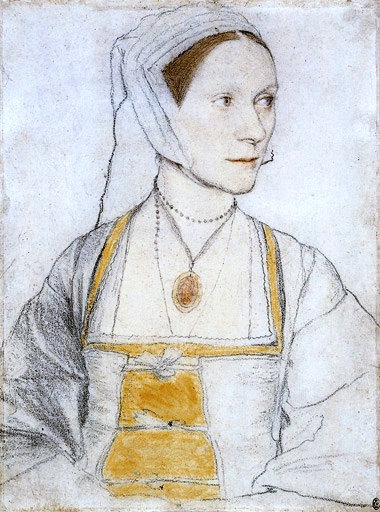
Elizabeth Dauncey 1526/27

Holbein’s preparatory drawing of Elizabeth Dauncey, middle daughter of Thomas More. In 1525 she married Sir William Dauncey who served Henry VIII and was a member of parliament. This drawing’s later inscription (not by Nikolaus Kratzer) is inaccurate in its identification. (see – https://www.royalcollection.org.uk/collection/400046/sir-henry-guildford-1489-1532)

Margaret Giggs by Hans Holbein the Younger.jpg
Margaret Giggs Clement was Thomas More’s foster daughter. In 1526 she married John Clement, a court physician. Margaret eventually had eleven children and died in exile in the Netherlands in 1570. While the extant More family group drawing by Holbein shows Margaret leaning towards John More, this drawing may actually have served as the now-lost or destroyed painting’s final study. The exact meaning of the inscription “Mother Iak” is unknown. Royal Collection, Windsor.

Anne Cresacre , 1526/27.

Hans Holbein the Younger: Anne Cresacre (c.1511-1577), for the More family portrait. Royal Collection, Windsor.

Cecily Heron 1526/27

Hans Holbein the Younger: Cecily Heron (b, 1506 or 1507), youngest daughter of Sir Thomas More. She was married to Giles Heron, a Member of Parliament who was hanged for treason in 1540. Royal Collection, Windsor.

john more 1526

Hans Holbein the Younger: Sir John More (c.1451 – 1530), black and colored chalks, 35.1 x 27.3 cm. Thomas More’s father was a respected judge and described by a biographer as “very virtuous” and “merry.” Royal Collection, Windsor.

(Below) Hans Holbein the Younger: John More, black and colored chalks, 38.1 x 28.1 cm. Thomas More’s son. Royal Collection, Windsor.

john more son 1527

Sir Henry Guildford, 1527.

Hans Holbein the Younger: Sir Henry Guildford (1478-1532), Controller of the Royal Household, inscribed and dated, 1527, oil and tempera on wood, 32 1/8 x 26 in. (82.6 x 66.4 cm), Royal Collection, Windsor. Wearing the collar of the garter for his military service – which was the occasion for the portrait – Guildford, a physical giant of a man, holds the wand of office as Comptroller of the King’s Household. Sir Henry stands against a deep blue background, decorated with the twisting vine found in several Holbein portraits. Above the sitter’s head is a curtain rail, from which hangs a rich green curtain. This detail has lost context in the separation of the portrait from its companion, that of Guildford’s wife Mary.

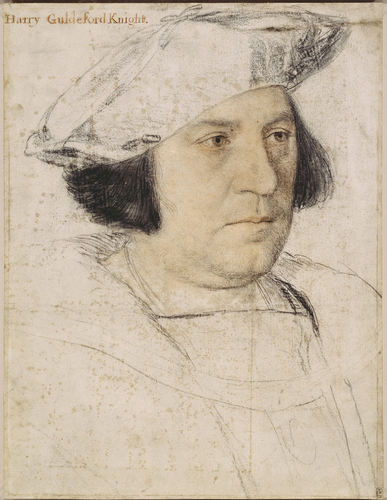
Sir Henry Guildford (1489-1532)

Sir Henry Guildford, Black and colored chalks, and pen and ink on paper, 38.3 x 29.4 cm. The drawing is a study for the painted portrait. Sir Henry was one of Henry VIII’s closest friends and an early patron of Holbein.

Royal Collection, Windsor.

Mary Wotton, Lady Guildford 1527

Hans Holbein the Younger: Mary Wotton, Lady Guildford, inscribed and dated, 1527, tempera and oil on oak, 34 1/4 x 27 13/16 in.( 87 × 70.6 cm), St. Louis Art Museum. Mary was Sir Henry Guildford’s second wife. They married in 1525. She holds a devotional book.

Mary,_Lady_Guildford,_drawing_by_Hans_Holbein_the_Younger
Mary Wotton, Lady Guildford, 1527, black and colored chalk on paper, 55.2 x 38.5 cm, Kunstmuseum Basel, Kupferstichkabinett. A study from life for the painted portrait. In the portrait Holbein muted the sitter’s overall playful expression and smile. Mary outlived Sir Henry to marry again.

William Warham, 1527

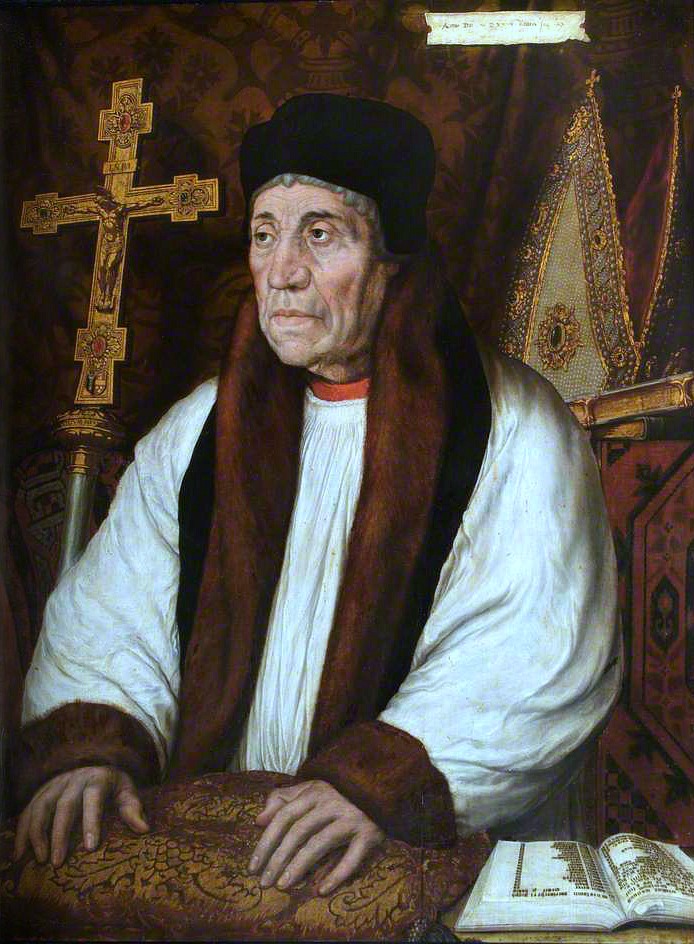
Hans Holbein the Younger: William Warham (1456-1532), Archbishop of Canterbury (first version), 1527, Oil and tempera on wood, 30 in x 25.75 in., Lambeth Palace, London.

William Warham, Archbishop of Canterbury, 1527

Hans Holbein the Younger: William Warham, Archbishop of Canterbury (second version)1527, Tempera on wood, 32.3 in x 26.4 in. (82 cm x 67 cm), Musée du Louvre, Paris. Both versions include the episcopal crucifix of gold and jewels with Warham’s coat-of-arms and his motto, prayer books and the Archbishop’s jeweled miter. Warham had this “original replica” painted to reciprocate for a portrait of Erasmus he received. The color is richer in the replica. The brown curtain is replaced with a green one. A later copy of this painting resides in the National Portrait Gallery in London.

William Warham Archbishop Canterbury drawing by Hans Holbein the Younger

Hans Holbein the Younger: William Warham, Archbishop of Canterbury, 1527.  Colored chalk on paper, 40.1 x 31 cm, The Royal Collection, Windsor.  This is the preparatory drawing for the Louvre portrait. The sitter had been in his position since 1504 and remained there until his death in 1532. The similarities between the Holbein portrait of Erasmus (1523) and that of Warham (1527) are striking for their compositional elements and the conveyance of each sitter’s function by way of iconographical symbols so that these forms are a portrait template.

Holbein erasmus
  
William Warham, Archbishop of Canterbury, 1527Nikolaus Kratzer, 1528
Hans Holbein the Younger, Portrait of Nikolaus Kratzer (1487-1550), 1528, Tempera on oak, 83 x 67 cm, Musée du Louvre, Paris. The sitter was born in Munich and studied in Cologne and Wittenberg. Appointed professor to Corpus Christi College in Oxford, Kratzer relocated to England. A humanist, he became friends with Thomas More and his family and, starting in 1519, served as astronomer to Henry VIII’s court. The painting, created during Holbein’s first stay in England, continues to exemplify Holbein’s lively style of illustrating a sitter’s career. Kratzer was a maker of mathematical and geometrical instruments and is shown in practical involvement with these tools. Compared with the Guildford portraits of the year before, Holbein expresses a new subtlety of lighting and refined range of tones.

Sir Thomas Godsalve and His Son
Hans Holbein the Younger: Double Portrait of Sir Thomas Godsalve and His Son John, 1528, Resin tempera on oak, 35 x 36 cm, Gemäldegalerie, Dresden. Thomas Godsalve (1481-1542) was a notary from Norfolk.  Holbein cleverly shows him writing his name and age on a sheet of paper. By 1528, the Godsalves were among London’s most wealthy and politically influential men. (Wolf, p. 51) His son John (1510-1556) later had a double portrait of himself and his wife painted by Holbein.

Sir Henry Wyatt, c, 1528

Hans Holbein the Younger: Sir Henry Wyatt of Allington Castle, c. 1528?, oil on oak, 15.4 × 12.2 in. (39 × 31 cm), Musée du Louvre, Paris. Sir Henry Wyatt served in the court of Henry VII and Henry VIII and a member of the latter’s Privy Council. Sir Henry was part of the circle of Thomas More. N.B. This portrait, once thought to have been painted during Holbein’s first visit to England from 1526 to 1528, is today believed to have been painted towards the end of Sir Henry’s life.

Sir Brian Tuke c. 1527/1528 or c. 1532/1534

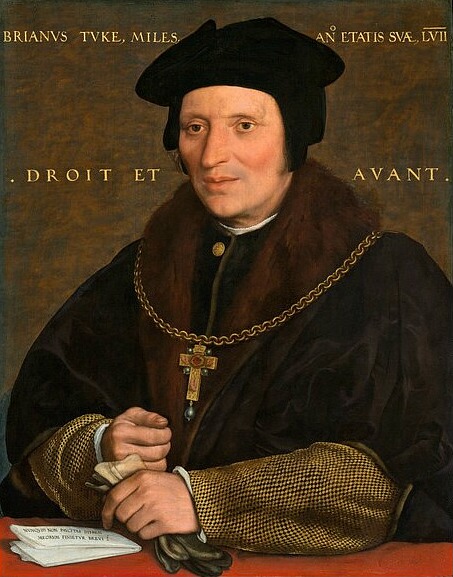
Hans Holbein the Younger: Sir Bryan Tuke, c. 1527/1528 or c. 1532/1534, oil on wood, 49 x 39 cm, National Gallery of Art, Washington, D.C. The sitter is about 57 years old. The date of the painting is unknown and its conjecture is based on its style although that leads to at least two possibilities. The physical mass of the body and the sitter’s expression suggest Holbein’s last year in England (mid 1528) although the painting’s other features (notably its horizontal lines of text) suggest the painting was made after Holbein’s return to London in 1532.  There are further later additions after that. The subject, Bryan Tuke (1470-1545), was, starting in 1509, Clerk of the Signet and then Cardinal Wolsey’s secretary. By 1528 Sir Bryan was Treasurer of the Royal Household and secretary to the king for French affairs, a post he held until his death in 1545. There exist several versions of this portrait.

St. Thomas 1527
Hans Holbein the Younger: St. Thomas, 1527, Pen and black ink, brush and gray wash, heightened with white gouache, 8 1/16 x 4 1/8 in. (20.4 x 10.5 cm). Metropolitan Museum of Art, New York.  Holbein produced a diversity of art in England, including design and decorative works (at Greenwich), book illuminations, and sacred art.  St. Thomas is part of a series of apostles of which nine are known. The ultimate application of these drawings is not known and even may have reached their final form in these studies. (Foister, p. 128)

noli me tangere

Hans Holbein the Younger: Noli Me Tangere, 1526-1528?, Oil on oak panel, 76.7 x 95.8 cm, Royal Collection Windsor. Holbein paints the gospel narrative of Mary Magdalen meeting Jesus Christ at his resurrection, with angels illuminating the tomb and night breaking for dawn. Between the major figures, a rushing Peter and John in the background are discussing matters.  Royal Collection, Windsor.

Sir Nicholas Carew

Hans Holbein the Younger: Sir Nicholas Carew, 1527, black and colored chalk sheet: 54.8 x 38.5 cm, Kunstmuseum Basel, Kupferstichkabinett, Amerbach-Cabinet. Sir Nicholas was Henry VIII’s Master of the Horse until he was implicated in one of the various popular uprisings against the same king’s religious policies in the mid-1530’s, and summarily executed in 1539. (Foister, p.121)
Portrait of an Unknown Englishman 1527
Hans Holbein the Younger: Portrait of an Unknown Englishman, 1527, black and colored chalk and leadpoint on prepared paper; outlines traced blind, 38.9 x 27.7 cm,  Kunstmuseum Basel, Kupferstichkabinett.

Portrait of an Unknown Englishwoman 1527
Hans Holbein the Younger: Portrait of an Unknown Englishwoman, 1527, black and colored chalk and leadpoint on prepared paper; outlines traced blind, 38.9 x 27.7 cm,  Kunstmuseum Basel, Kupferstichkabinett. These two drawings were prepared for transfer to panels for painting portraits, neither of which survive.

FOOTNOTES (Introduction).

  1. Erasmus and the Age of Reformation, Johan Huizinga, Harper & Brothers, New York, reprint 1957, p. 223.
  2. Huizinga, p. 29.
  3. Huizinga, pp. 35-36.
  4. Huizinga, p. 58.
  5. Huizinga, pp. 79-81.
  6. Huizinga, p. 83.
  7. Huizinga, p. 85.
  8. Huizinga, p. 87.
  9. Hans Holbein The Younger: The German Raphael, Norbert Wolf, Taschen, Cologne, Germany, 2006, p. 28.
  10. Wolf, p. 38.
  11. Huizinga, p. 161.
  12. Wolf, p. 45.
  13. See podcast – https://www.nationalgallery.org.uk/paintings/hans-holbein-the-younger-erasmus.
  14. Wolf, p. 39.
  15. Holbein in England, Susan Foister, Tate Publishing, London, 2006, p. 13.
  16.  An Advanced History of Great Britain: From the Earliest Times To the Death of Edward VII, T.F. Tout, M.A., Longmans, Green, and Co, New York, London, Bombay and Calcutta, 1913, p.342.

SOURCES:
An Advanced History of Great Britain: From the Earliest Times To the Death of Edward VII, T.F. Tout, M.A., Longmans, Green, and Co, New York, London, Bombay and Calcutta, 1913.
Erasmus and the Age of Reformation, Johan Huizinga, Harper & Brothers, New York, reprint 1957.
Five centuries of British painting: from Holbein to Hodgkin, Andrew Wilton, London: Thames & Hudson, 2001.
Holbein in England, Susan Foister, Tate Publishing, London, 2006.
Hans Holbein The Younger: The German Raphael, Norbert Wolf, Taschen, Cologne, Germany, 2006.
The Frick Collection /A Tour, Edgar Munhall, et.al, The Frick Collection, New York, 1999.
The Paintings of Hans Holbein: First Complete Edition, Paul Ganz, Phaidon, London, 1950.

LINKS:
https://www.flickr.com/groups/536163@N24/ – retrieved February 26, 2018

Hans Holbein the Younger: ‘A man very excellent in taking of physionamies’ (sic) – Dr Susan Foister – https://www.youtube.com/watch?v=3UnbWlZnYv4 – retrieved February 26, 2018.

http://sammlungonline.kunstmuseumbasel.ch/eMuseumPlus – retrieved February 26, 2018.

BRITAIN. Complete signed, dated, documented, inscribed artwork (33 paintings) of MARCUS GHEERAERTS THE YOUNGER (c. 1562-1636).

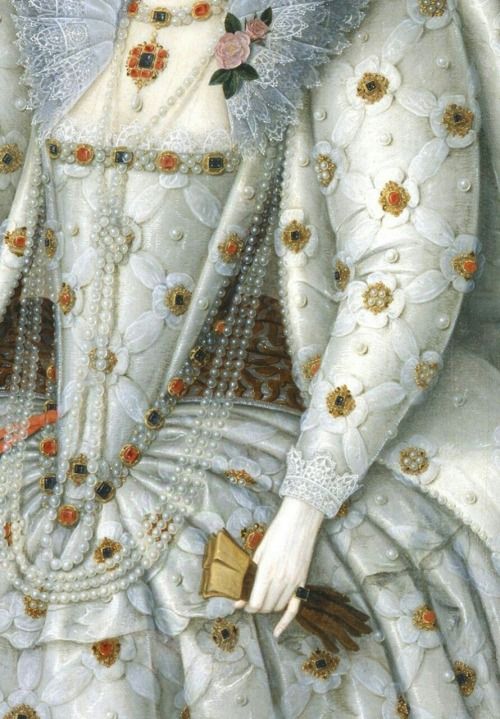
FEATURE image: Detail, Queen Elizabeth I. Ditchley portrait. Marcus Gheeraerts the Younger, 1592.

Marcus Gheeraerts the Younger, Captain Thomas Lee in Irish Dress, oil on canvas, 1594 (purchased 1980), Tate Britain.

Captain Thomas Lee (c.1551-1601) had his portrait painted by 33-year-old Marcus Gheeraerts the Younger (Bruges, 1561-1636) in London in 1594. Captain Lee was 43 years old and had worked as a military adventurer for English colonization in Ireland since the early 1570’s.

The young artist was the son of Gheeraerts the Elder (c. 1520–c. 1590), a painter and printmaker associated with the Tudor court in the late 1560’s and 1570’s. Fleeing religious persecution in Flanders, Gheeraerts the Elder arrived into England with his 7-year-old son Marcus in 1568. In 1577, Gheeraerts the Elder had likely returned to Flanders.

By 1594, when the portrait of Captain Lee was made, Gheeraerts the Younger was a rising young contemporary artist working in Elizabeth I’s Tudor court.  Sir Roy Strong, the English art historian who served as director of the National Portrait Gallery and the Victoria and Albert Museum in London is unequivocal about Gheeraerts the Younger’s artistic importance to English art history. Strong wrote that Gheeraerts is “the most important artist of quality to work in England in large-scale between (Hans) Eworth (c. 1520 – 1574) and (Anthony) van Dyck (1599-1641).”1 

In addition to a discussion of the early painting of Captain Lee, a complete collection of Marcus Gheeraerts the Younger’s 33 art works– including signed and dated works, documented and dated works, inscribed and dated works, and inscribed and undated works– is included in this post following this introduction.

Social contract: Marriages of court artists in late-16th-century Tudor England.

At 22 years old in 1583, Marcus Gheeraerts the Younger’s world in and around London was ideally enclosed by marriage to the sister of talented Tudor court painter John De Critz (c.1555-c.1641). De Critz, like his new brother-in-law Gheeraerts the Younger, was a child expatriate from Flanders to England in 1568.2 

In 1571 Gheeraerts the Elder had married his son’s future wife’s sister, making father and son Gheeraerts also eventually brothers-in law.3 

Over two decades later, in 1602, Gheeraerts the Younger’s sister married the court artist Isaac Oliver (c.1565-1617).4 

This was typical social behavior at the Tudor court where many active artists were connected by ties of marriage, family, and artistic training as well as shared European origin.

In Gheeraerts the Younger’s circle, for instance, John De Critz was apprenticed to the wealthy portrait painter Lucas de Heere (1534-1584) who may also have helped train Gheeraerts the Younger. De Heere – like Gheeraerts the Younger and De Critz – was a religious refugee to England from Flanders.

Isaac Oliver, Gheeraerts the Younger’s other brother-in-law, studied under leading Tudor portrait miniaturist and goldsmith Nicholas Hilliard (c.1547-1619). 5 Roy Strong as Director of the National Portrait Gallery in London links Hilliard to Gheeraerts by way of the supreme artistic quality found in both of these contrasting artists’ masterpieces.6 

One remarkable technical innovation that the young artist applied in his portraits was the use of stretched canvas in place of wood panel that allowed for larger and lighter surface areas on which to paint and more easily transport pictures of the grand gentlemen and ladies of the time.

By way of marriage to an Irish Catholic woman, Captain Thomas Lee became a man of considerable property in Ireland. Captain Lee had separated from his wife by the time of his portrait. The next year -– in 1595 –- Lee married an Englishwoman. Over the decades, Captain Lee’s military reputation became one of an enfant terrible in Ireland which did not mellow over time. Powerful friends looked to explain Thomas’s frequent reckless political and military behavior. It was justified as the occupational hazard of a longtime English soldier in Ireland.

Planning and posing of Captain Lee’s portrait.

Lee posed for Gheeraerts when the captain was straight off the battlefield from Ulster chieftain Aodh Mag Uidhir (Hugh Maguire, d. 1600) and in London for delicate negotiations.

To presumably express Thomas’s faithful service to the Crown, the portrait includes a Latin inscription in the tree that refers to Mucius Scaevola (c. 500 BC), an ancient perhaps mythical Roman fighter who remained loyal to Rome even after he was captured by mortal enemies.  

Captain Thomas Lee was related to Sir Henry Lee as paternal half cousins. Sir Henry was Queen Elizabeth I’s Champion for almost 25 years until his retirement in 1590. In that capacity, Henry was the creator of the stunning imagery for her publicly-popular Accession Day festivals that he annually planned. Along with Gheerearts the Younger’s Elizabethan allegorical portrait Lady in Fancy Dress (The Persian Lady) (#30 below) and the Ditchley portrait of Queen Elizabeth I (#31 below)both painted in the early 1590s — Henry, who remained active and influential in political affairs, may have helped devise the symbolism in Captain Lee’s portrait. The portrait also came from Ditchley, Sir Henry Lee’s timber-framed family house set in the wooded farmsland of north Oxfordshire.

While the painting’s landscape where Captain Lee stands is likely a representation of Ireland’s wild landscape, Henry Lee’s symbolism may provide other subtle and humorous features. 

Troublesome Thomas, for example, stands under an oak, which may refer to Sir Henry’s political protection but also that these trees are prone to dangerous lightning strikes. 

The final seven years of Captain Thomas Lee’s life iterated a legendary standard: at times negotiating with or killing Irish enemies he also served time in prison in Ireland on a charge of treason. Ultimately, Sir Henry could not save his familial junior– in 1601 Thomas faced execution in England for treason against Elizabeth I.

English colonial rule tightens in 17th century Ireland.

English power became increasingly absolute in 17th century Ireland.  

In the 1590’s, the Protestant Ascendancy in Ireland believed turning their backs on the mostly Catholic natives was the most effective governing strategy. While an oath of allegiance to the Crown remained law to divest Irish rebels of their property to English rule, it was not vigorously applied until the arrival in 1604 into Ireland of Lord Deputy Arthur Chichester (1563-1625). 

The 1590’s continued to implement England’s new plantation system in Ireland which amounted to confiscating Irish property for English and Scottish settlers. While this provided quick and lucrative rewards for the conquerors, the political situation was not free of ambiguity. English laws were attacked by Irish chiefs seeking protection under older common law.

Protestant settlers had their own uneasy relationship with the English Crown who, in turn, fought a tug of war with an English Parliament.

About half of settlers in Ulster were Presbyterians who were dissenters from the English church which itself was at war with Anglo- and Gaelic Irish Catholics. Moreover, London viewed new Protestant landowners in Ireland –- such as Captain Thomas Lee –- with no less suspicion as despoiled Catholics. The Crown believed that the new Protestant vanguard in Ireland had power to usurp the island’s treasure more readily than pillaged Catholics who could, ironically perhaps, be better disposed to the idea of royal governance.7

While Thomas Lee’s special status is expressed in the painting’s lace embroidery on his rolled-up shirt and inlaid pistol and Northern Italian-made helmet, the Captain is dressed as a common foot-soldier who traveled through Ireland lightly armed. Captain Lee is also, both seriously and humorously, barelegged.

Sir Henry Lee must have been one of Marcus Gheeraerts the Younger’s earliest patrons, as the Ditchley collection had several portraits which can be ascribed to the artist.8

FOOTNOTES:

  1. Strong, Roy, The English Icon: Elizabethan & Jacobean Portraiture, The Paul Mellon Foundation for British Art London Routledge and Kegan Paul Limited New Haven Yale University Press, 1969, p.22.
  2. Ibid. p.259.
  3. Hearn, Karen, Marcus Gheeraerts II: Elizabethan Artist, In Focus (Tate Publishing), 2003, p. 11ff.
  4. Strong, p.269.
  5. Hearn, p.130.
  6. Strong, p.23.
  7. See Roger Chauviré, A Short History of Ireland, New American Library, 1965; T.W. Moody & F.X. Martin, editors, The Course of Irish History, Mercier Press, Cork, 1978; http://www.tate.org.uk/art/artworks/gheeraerts-portrait-of-captain-thomas-lee-t03028 – retrieved May 28, 2017.
  8. The Captain Thomas Lee portrait was first recorded at Ditchley by Vertue in 1725 who noted there a portrait of ‘Lee in Highlanders Habit leggs naked a target & head piece on his left hand his right a spear or pike. Ætatis suae.43.ano.Dni 1594’.

1. SIGNED AND DATED WORKS (8 works):

Louis Frederick, Duke of Württemberg, 1608.

1 – Marcus Gheeraerts The Younger, Louis Frederick, Duke of Württemberg, 1608, oil on canvas, 225.1 x 113.1 cm, St James Palace. Probably painted for James I though first recorded in Charles II’s collection. (Strong 255, The English Icon).

Gheeraerts II painted portraits of several foreign dignitaries on their visits to the English court. Louis Frederick, Duke of Württemberg visited James I in London for three months in the latter part of 1608 and likely the artist produced this work at that time.

Gheeraerts the Younger Wm Camden 1609

2 – Marcus Gheeraerts the Younger, William Camden, 1609, oil of panel,, 76.2.x 58.5 cm, Bodleian Library, Oxford. Given to the Schools by Camden Professor (1622-1647) Degory Whear. (Strong 256).

Gheeraerts the Younger, Lucy Davis. 1623. Private collection.

3 – Marcus Gheeraerts the Younger, Lucy Davis, Countess of Huntingdon, 1623, oil on panel, 76.8 x 62.3 cm, Private Collection. (Strong 257).

Marcus_Gheeraerts_the_Younger_William_Pope,_1st_Earl_of_Downe, 1624

4 – Marcus Gheeraerts the Younger, William Pope, 1st Earl of Downe, 1624, oil on panel, 62.3.x 47.1 cm, Trinity College, University of Oxford. It was presented to Trinity College in 1813 by Henry Kett. (Strong 258).

Gheeraerts the Younger, Elizabeth Cherry, Lady Russell, 1625.

5 – Marcus Gheeraerts the Younger, Elizabeth Cherry, Lady Russell, 1625, oil on canvas, 194.5 x 105.6 cm, The Duke of Bedford. This painting has been at Woburn Abbey since 1625. (Strong 259).

Gheeraerts the Younger Sir William Russell, 1625

6 – Marcus Gheeraerts the Younger, Sir William Russell, 1625, oil on canvas, 195.6 x 111.8 cm, The Duke of Bedford. Always at Woburn Abbey. (Strong 260).

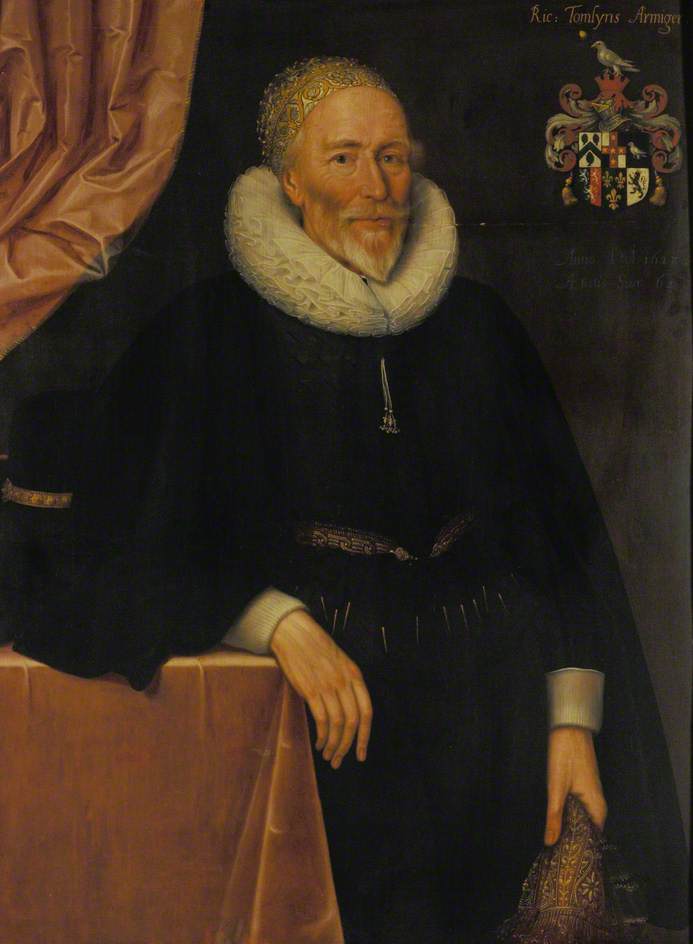
Gheeraerts the Younger, Richard Tomlins, 1628.

7 – Marcus Gheeraerts the Younger, Richard Tomlins, 1628, oil on panel, 111.8 x 83.9 cm. The Bodleian Library, Oxford. It was in the Library in 1759. (Strong 261).

Gheeraerts_Anne_Hale_Mrs_Hoskins

8 – Marcus Gheeraerts the Younger, Anne Hale, Mrs. Hoskins, 1629, oil on panel, 111.8 x 82.7 cm. Jack Hoskins Master, Esq. The painting remains in the family. (Strong 262). With detail.

2. DOCUMENTED AND DATED WORKS (3 works):

Gheeraerts_Barbara_Gamage_with_Six_Children 1596

9 – Marcus Gheeraerts the Younger, Barbara Gamage, Countess of Leicester, and her children, 1596, oil on canvas, 203.2 x 260.3 cm, The Viscount De L’Isle. Always at Penshurst Place near Tonbridge, Kent, 32 miles southeast of London; first recorded 1623. (Strong 263).

Marcus_Gheeraerts_the_Younger_William_2nd_Lord_Petre

10 – Marcus Gheeraerts the Younger, William, 2nd Lord Petre, 1599, oil on panel. 111.8 x 90.2.cm. The Lord Petre; custody of the Essex County Record Office. (Strong 264).

Marcus Gheeraerts the Younger, Katherine Somerset, Lady Petre, 1599.

11 – Marcus Gheeraerts the Younger, Katherine Somerset, Lady Petre, 1599, oil on panel, 111.8 x 90.2 cm. The Lord Petre. Always at Ingatestone Hall, the 16th century manor of the Barons Petre in Essex, England. Queen Elizabeth I spent several nights there in 1561. (Strong 265).

3. INSCRIBED AND DATED WORKS (18 works):

# 12 800px-Marcus_Gheeraerts_II_-_Portrait_of_Mary_Rogers,_Lady_Harington_-_Google_Art_Project
Unknown Lady (Mary Rogers, Lady Harington), 1593

12 – Marcus Gheeraerts the Younger, Unknown Lady (Mary Rogers, Lady Harington), 1593, oil on panel, 114.3 x 94 cm, Tate (purchased 1974). The identity for the sitter is speculative, although her age (23 years old) is inscribed. It is one of the earliest known portraits by Gheeraerts. (Strong 266).

Detail, Unknown Lady (Mary Rogers, Lady Harington), 1593. The sitter is identified in part by the clothes she wears: the distinctive black and white pattern on her dress heralds the Harington coat of arms. The sitter is 23 years old and her portrait may have been painted in connection with a visit to Kelston (The Harington homestead) in 1592 by Queen Elizabeth. The Latin inscription in the painting reads, “I may neither make nor break” a dramatic phrase whose meaning is no longer clear.

Marcus Gheeraerts the Younger, Captain Thomas Lee in Irish Dress, 1594.
Captain Thomas Lee in Irish Dress, 1594.

13 – Marcus Gheeraerts the Younger, Captain Thomas Lee in Irish Dress, oil on canvas, 1594 (purchased 1980), Tate Britain. (Strong 267). With detail.

si francis drake 001 FIXED

14 – Marcus Gheeraerts the Younger, Sir Francis Drake, oil on canvas, 1594. Versions at National Maritime Museum, Greenwich and Lt.- Col. Sir geirge Tapps-Gervis-Meyrick.

Marcus Gheeraerts the Younger, Unknown Man, 1599.

15 – Marcus Gheeraerts the Younger, Unknown Man (Called the Earl of Southampton), 1599, location unknown. (Strong 269).

Marcus Gheeraerts the Younger, Unknown Lady, 1600.

16 – Marcus Gheeraerts the Younger, Unknown Lady, 1600, oil on panel, The Lord Talbot de Malhide. (Strong 270).

Sir Henry Lee by Marcus Gheeraerts Tate Britain, 1600

17 – Marcus Gheeraerts the Younger, Sir Henry Lee, oil on canvas, 1600, private collection on loan since 2008 to Tate Britain.

Sir Henry Lee (1533–1611), a Tudor Court favorite under Elizabeth I, was appointed as Queen’s Champion and Master of the Armoury. In that capacity, Sir Henry organised the annual public Accession Day festivals in honor of the queen. He commissioned the famous Ditchley portrait of Elizabeth I by Gheeraerts for his house at Ditchley in Oxfordshire. In 1597 he was made a Knight of the Garter and in Gheeraerts‘s portrait wears that order’s gold chain and bejeweled medal of St George slaying the dragon. (Strong 271).

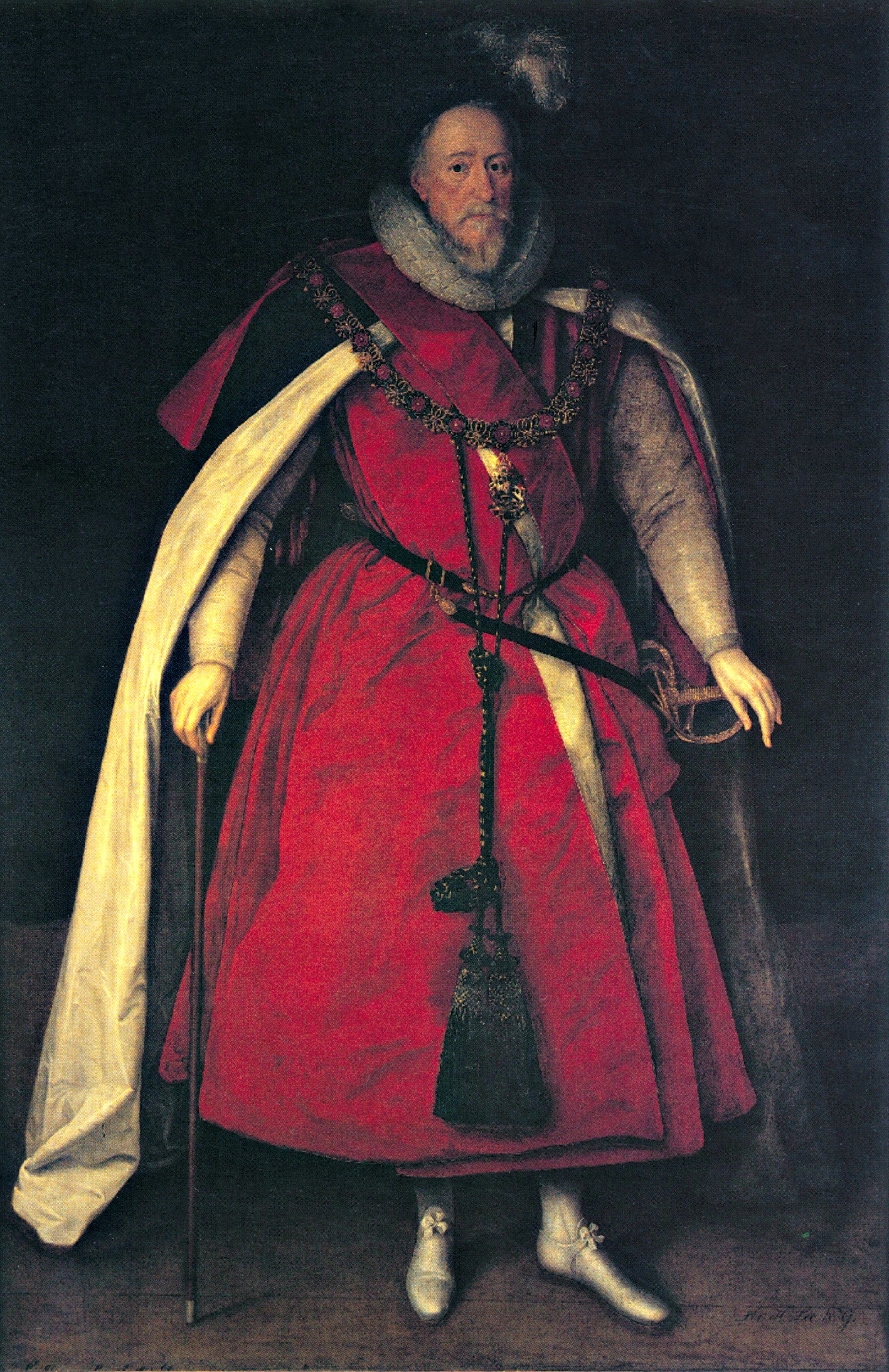
Sir Henry Lee in Garter Robes, 1602.
Sir Henry Lee in Garter Robes, 1602 (detail).

18 – Marcus Gheeraerts the Younger, Sir Henry Lee in Garter Robes, 1602, oil on canvas, 216.2 x 137.2 cm. Always at Ditchley until 1933. Today at The Armourers & Brasiers’ Company of the City of London. Founded in 1322, the livery company was awarded its first Royal Charter in 1453 from King Henry VI. In 1708 the Armourers joined with the Brasiers and received its current charter from Queen Anne. (Strong 272).

Detail, Sir Henry Lee in Garter Robes, 1602. One of Gheeraerts II’s finest portraits, Sir Henry Lee is a former man of action, whose old head is remarkably shrewd.

Marcus Gheeraerts the Younger, Christophe de Harlay, Comte de Beaumont, 1605.

19 – Marcus Gheeraerts the Younger, Christophe de Harlay, Comte de Beaumont, 1605, oil on canvas, The Marquess of Salibury.

The Comte de Beaumont was the French ambassador to England at a time when the Kings of England and France were looking in their own ways for a diplomatic solution to the religious controversies in Europe. The painting was made for Robert Cecil, 1st Earl of Salisbury, a politician who had won James I’s trust. (Strong 273).

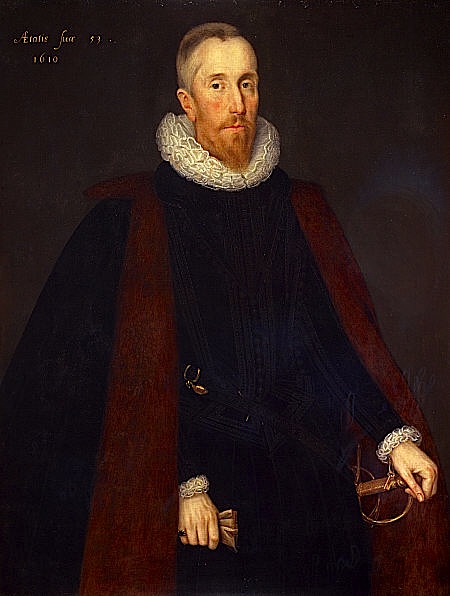
Marcus Gheeraerts the Younger, Alexander Seton 1st Earl of Dunfermline, 1606.

20 – Marcus Gheeraerts the Younger, Alexander Seton 1st Earl of Dunfermline, 1606.

Alexander Seton, 1st Earl of Dunfermline (1555–1622), a Scot, was regarded as one of the finest legal minds of his time. Seton served as Lord President of the Court of Session (top judge) from 1593 to 1604, Lord Chancellor of Scotland (top presiding officer of state) from 1604 to 1622 and Lord High Commissioner to the Scottish Parliament. (Strong 274).

Marcus Gheeraerts the Younger, Anne of Denmark, 1614

21 – Marcus Gheeraerts the Younger, Anne of Denmark, 1614, oil on panel, 109.4 x 87.3 cm, Windsor Castle.

At 15 years old, Anne married the future James I of England in 1589. The Queen consort bore James three children who survived infancy, including the future Charles I (reigned 1625-1649).

Once fascinated with his bride, observers regularly noted incidents of marital discord between the dour and ambitious James and his independent and self-indulgent wife.

Before she died in 1619 the royal couple led mainly separate lives. (Strong 275).

Gheeraerts the Younger, Ulrik, Duke of Schleswig-Holstein, 1614.

22 – Marcus Gheeraerts the Younger, Ulrik, Duke of Schleswig-Holstein, 1614, oil on canvas, 211.2 x 114.3 cm, The Duke of Bedford.

Prince Ulrik of Denmark, (1578–1624) was the second son of King Frederick II of Denmark and his consort, Sophie of Mecklenburg-Güstrow.

As second-born Ulrick bore the merely titular rank of Duke of Holstein and Schleswig although he later became Administrator of Schwerin.

After his sister Anne became Queen of England, Ulrik was godfather to Princess Mary. (Strong 276).

Gheeraerts the Younger, Sir John Kennedy, 1614.

23 – Marcus Gheeraerts the Younger, Sir John Kennedy, oil on canvas, 1614, The Duke of Bedford. Upon James I’s accession, Elizabeth Brydges — Maid of Honour of Queen Elizabeth I — married Sir John Kennedy, one of the king’s Scotch attendants. This occured at Sudeley Manor in Gloucestershire.

Chandos appears to have opposed the match, and it was rumored in early 1604 that Sir John Kennedy had a wife living in Scotland. James I wrote to Chandos (February 19, 1603 or 1604) entreating him to overlook Sir John’s errors because of his own love for his attendant.

Elizabeth Brydges apparently left her husband and desired to have the matter legally examined. As late as 1609 the legality of the marriage had yet to be decided.

Lord Chandos declined to aid his cousin, and Sir John Kennedy’s wife died deserted and in poverty in 1617. (Strong 277).

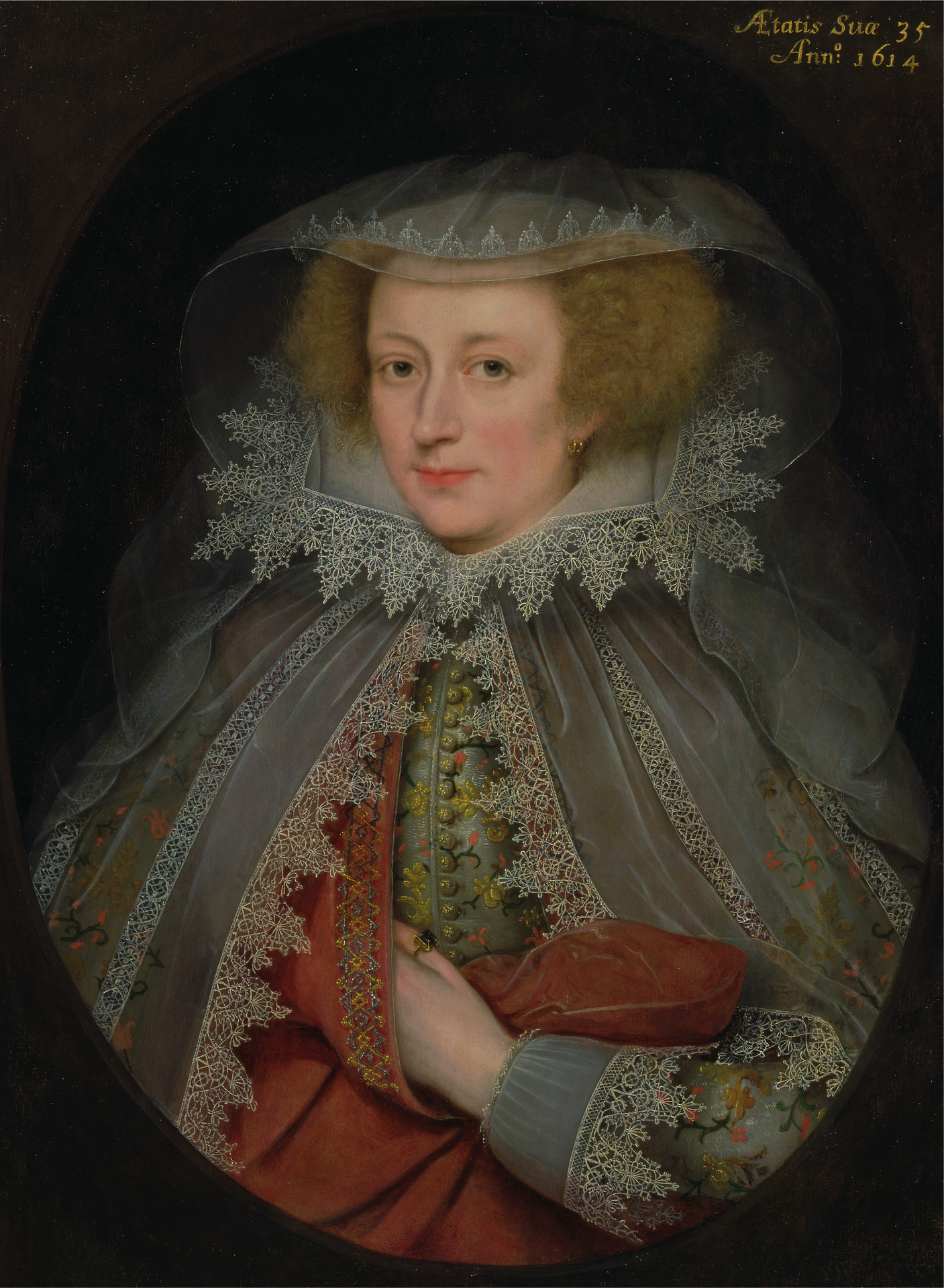
Gheeraerts the Younger, Catherine Killigrew Lady Jermyn, 1614.

24 – Marcus Gheeraerts the Younger, Catherine Killigrew, Lady Jermyn, 1614, oil on panel, 73.7 x 57.2 cm, Yale Center for British Art. (Strong 278). 

Catherine Killigrew was 35 years old when she sat for this portrait. The wife of an MP as well as the mother of three children, Catherine was the daughter of Sir William Killigrew (d. 1622) who was a courtier to Queen Elizabeth I and to King James I. Her father, Sir William, served as Groom of the Privy Chamber. (Strong 278).

Gheeraerts the Younger, Probably Mary (née Throckmorton), Lady Scudamore, oil on panel, 1615.

25 – Marcus Gheeraerts the Younger, probably Mary (née Throckmorton), Lady Scudamore, oil on panel, 1615, 45 in. x 32 1/2 in. (1143 mm x 826 mm), National Portrait Gallery, London, purchased 1859.

The sitter, once wrongly identified as the Countess of Pembroke, is likely Lady Scudamore though about whom little is known. The portrait is likely for the occasion of her son’s marriage (John, later Viscount Scudamore) to Elizabeth Porter of Dauntsey, Wiltshire.

The wreath of flower and inscribed motto ‘No Spring Till now,’ suggest the hope that this marriage must have represented within the family. (Strong 279).

Gheeraerts the Younger, Sir Henry Savile, 1621.

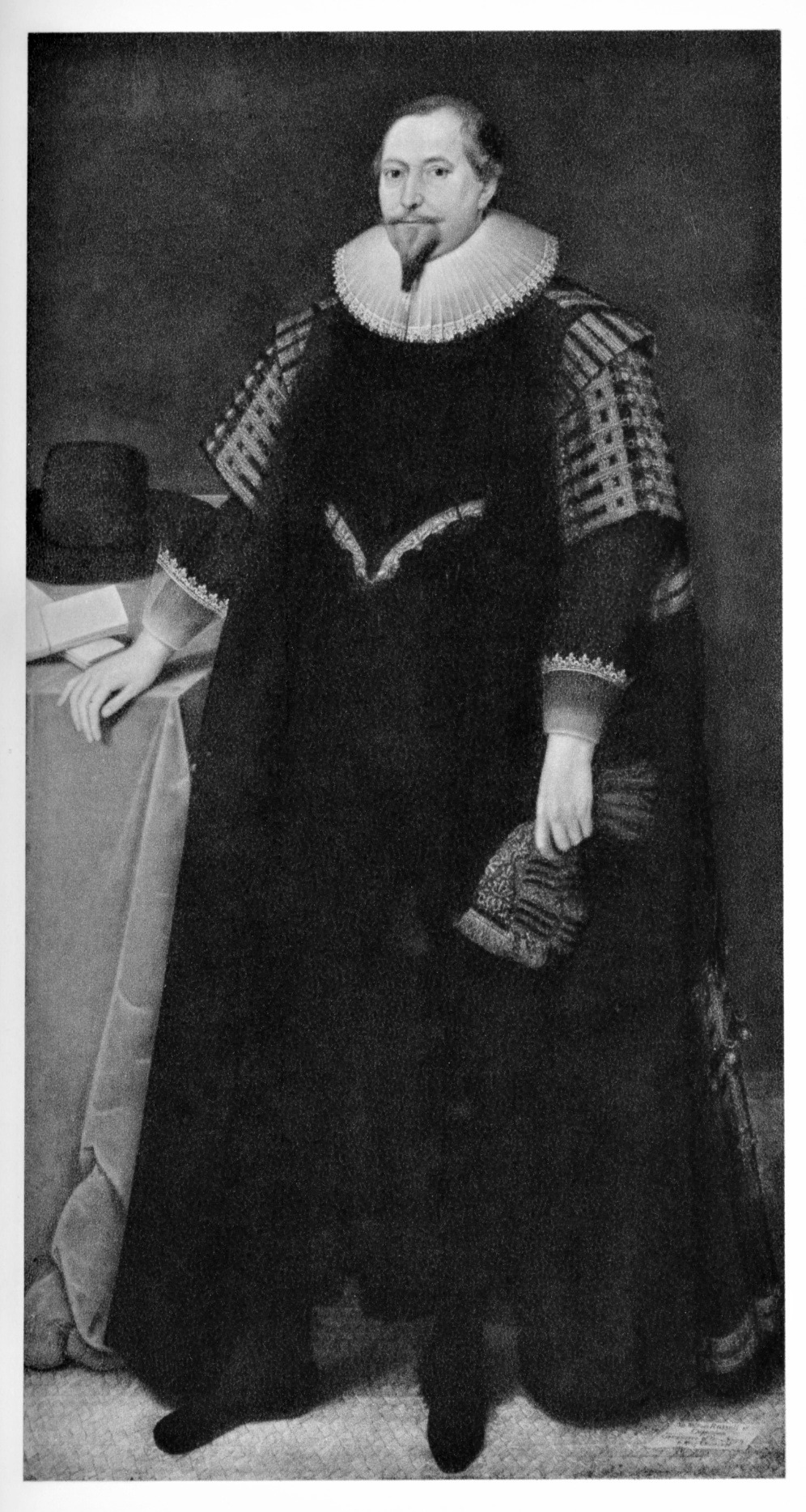
26 – Marcus Gheeraerts the Younger, Sir Henry Savile, 1621, 216.2 x 127 cm, Bodleian Library, Oxford. Gift from the sitter’s widow, 1622.

Sir Henry Savile (1549-1622) was an enterprising Bible scholar. When his qualifications did not meet the standards for the role of Provost of Eton, he had Queen Elizabeth I waive the college’s rules for him.

As Warden of Merton — a post secured with the help of influential friends — he was unpopular with faculty and students though the college itself flourished.

Sir Henry’s brother was a powerful lawyer who helped guide his brother’s career which included knighthood in 1604. (Strong 280).

Gheeraerts the Younger, Sir Henry Savile, 1621.

27 – Marcus Gheeraerts the Younger, Sir Henry Savile, 1621, oil on canvas, 1621, 203.7 x 122 cm, Eton College. A second smaller copy of the Bible scholar and college administrator. (Strong 281).

Gheeraerts the Younger, William Herbert, Earl of Pembroke, 1628.

28 – Marcus Gheeraerts the Younger, William Herbert, Earl of Pembroke, 1628, oil on panel, 68.5 x 48.2 cm, Philip Yorke.

Under King James I, William Herbert, 3rd Earl of Pembroke (1580 –1630), founded Pembroke College, Oxford, in 1624. In 1623 the First Folio of Shakespeare’s plays was dedicated to him and to Philip Herbert, Earl of Montgomery (the later 4th Earl of Pembroke), his brother.

A bookish man, the 3rd Earl of Pembroke was engaged to be married three times. The first engagement was to Elizabeth Carey in 1595. Elizabeth was the granddaughter of the Lord Chamberlain who ran Shakespeare’s company. William simply refused to marry her. In 1597 William was engaged a second time. This time it was to Bridget de Vere. As William found her dowry arrangements to be unsatisfactory, negotiations dragged out to a tiresome point where the match became unacceptable.

In 1600 William impregnated a mistress at court whom he  refused to marry. The child was born and died soon after. Following this episode, William and the mistress (Mary Fitton) were barred from court.

In 1604 William married Mary Talbot. Their children both died in infancy. At the same time, William was having an extra-marital affair with his cousin, Lady Mary Wroth, which produced two illegitimate children.

A lively patron of the arts, William Herbert, 3rd Earl of Pembroke died suddenly in 1630 at 50 years old. He is buried in Salisbury Cathedral in the family vault at the foot of the altar. (Strong 282).

Gheeraerts the Younger, Charles Hoskins, 1629.

29 – Marcus Gheeraerts the Younger, Charles Hoskins, 1629, oil on panel, 66.1 x 52.7 cm, Jack Hoskins Master. Esq. (Strong 283).

Gheeraerts the Younger, Lady in Fancy dress (the Persian Lady), 1590.

30 – Marcus Gheeraerts the Younger, Lady in Fancy Dress (The Persian Lady), 1590s, oil on panel, 216.5 x 135.3 cm, Hampton Court.

First recorded in the collection of Queen Anne but believed to be part of the Royal Collection before that time, in the cartouche the sonnet reads: “The restless swallow fits my restless minde, Instill revivinge still renewinge wronges; her Just complaintes of cruelty unkinde, are all the Musique, that my life prolonges. With pensive thoughtes my weeping Stagg I crowne whose Melancholy teares my cares Expresse; hes Teares in sylence, and my sighes unknowne are all the physicke that my harmes redresse. My only hope was in this goodly tree, which I did plant in love bringe up in care: but all in vaine, for now to late I see the shales be mine, the kernels others are. My Musique may be plaintes, my physique teares If this be all the fruite my love tree beares.

Lady in Fancy Dress is a good example of Elizabethan allegorical portraiture. Importantly, the painting may be related to the Ditchley portrait of Elizabeth I (Strong 285) as well as the portrait of Captain Thomas Lee (Strong 267 ). These three portraits may be connected in some way to the entertainment given by Sir Henry Lee, the Queen’s Master of the Armouries and Champion of the Tilt, when the Queen visited Ditchley in 1592. (Strong 284).

ditchley a-elizdetail-1g

Queen Elizabeth I is standing on a map of England. Detail from The Ditchley Portrait of Elizabeth I by Marcus Gheeraerts the Younger in 1592.

ditchley detail fan

Detail of a bejeweled fan in Queen Elizabeth I’s right hand from The Ditchley Portrait of 1592 by Marcus Gheeraerts the Younger. In the decade before The Ditchley Portrait Gheeraerts the Elder, Marcus II’s father, had painted a full- length oil on panel portrait of Elizabeth I. In the ensuing handful of years, practical technical innovation in art is in evidence in the Elizabethan court — the the son’s oil portrait of the same royal personage was able to be produced on canvas on a much larger scale.   

ditchley.detail
ditchley

Detail of the beautiful garment and accessories.

ditchley 800px-queen_elizabeth_i_the_ditchley_portrait_by_marcus_gheeraerts_the_younger

Detail, Queen Elizabeth I. Ditchley portrait. Three fragmentary Latin inscriptions in the painting have been interpreted as: “She gives and does not expect”; “She can, but does not take revenge”; and, “In giving back, she increases.”

An inscribed sonnet, whose author is not known, takes the sun as its subject. At some later date the canvas was cut more than 7 centimeters fragmenting the final words of the each line. 

NPG 2561; Queen Elizabeth I ('The Ditchley portrait') by Marcus Gheeraerts the Younger

31 – Marcus Gheeraerts the Younger, Queen Elizabeth I (“The Ditchley Portrait”), oil on canvas, 1592, 95 in. x 60 in. (2413 mm x 1524 mm). National Portrait Gallery, London. Bequeathed by Harold Lee-Dillon, 17th Viscount Dillon, 1932.

Queen Elizabeth was nearly 60 years old when this portrait was made. It is traditionally understood to have been painted on the Queen’s visit to Ditchley, the timber-framed family house in north Oxfordshire of Sir Henry Lee (1533-1611).

Like John II Walshe (d.1546/7) of Little Sodbury, Gloucestershire, who was the King’s Champion to Elizabeth’s father Henry VIII, Henry Lee served at that standard for Queen Elizabeth from 1570 until his retirement about two years before this painting was made. 

Ditchley once provided lodging and access to the royal hunting ground of Wychwood Forest.  (Strong 285). 

Marcus Gheeraerts the Younger, Sir Henry Lee, 1590s.

32 – Marcus Gheeraerts the Younger, Sir Henry Lee, 1590s, oil on canvas, 117 x 86.4 cm, The Ditchley Foundation. Always at Ditchley. The painting and inscribed verses memoralize an incident where Bevis – Lee’s dog – saved his master’s life. “More faithfull then favoured…” (Strong 286).

Michael Dormer, mid 1590s.

33 – Marcus Gheeraerts the Younger, Michael Dormer, mid 1590s, oil on canvas, 122 x 91.5 cm, J.C. H. Dunlop, Esq. There are Latin inscriptions which surround and are written across the globe and shield. (Strong 287).

The social and cultural world of Sir Henry Lee once again influences the young artist’s portrait of Michael Dormer, who was an Oxfordshire neighbor to Sir Henry. In Dormer’s three-quarter-length portrait, the right hand is posed similarly to Thomas Lee’s portrait. As Captain lee’s portrait is the centerpiece of this post’s explorations,it may be said with Michael Dormer’s this post has traveled full circle around Marcus Gheeraerts II’s verifiable portraiture in Elizabethan and Jacobean England.


Here then concludes the complete collection of Marcus Gheeraerts the Younger’s signed and dated works (Strong 255-262); inscribed and dated works (Strong 266-283); and, inscribed and undated works (Strong 284-287). Not included here are works dated and attributed to the artist (Strong 288-294) and attributed and undated (Strong 295-313). The last group includes several well-known portraits including William Cecil, Lord Burghley, c. 1595, in the National Portrait Gallery (Strong 295) and Robert Devereux, 2nd Earl of Essex, c. 1596, in collection of the Duke of Bedford. (Strong 300).

CAPTION NOTES:

Strong 255 – Hearn, Karen, Marcus Gheeraerts II, Elizabethan Artist (In Focus series), Tate Publishing, 2002, p. 29.

Strong 264 and 265 – http://www.ingatestonehall.com/

Strong 266- http://www.tate.org.uk/art/artworks/gheeraerts-portrait-of-mary-rogers-lady-harington-t01872

Strong 271- http://www.tate.org.uk/art/artworks/gheeraerts-sir-henry-lee-l02883

Strong 272- http://www.armourershall.co.uk/armourers-hall

Strong 277 – http://www.tudorplace.com.ar/BRYDGES.htm#Catherine BRYDGES (C. Bedford)

Strong 278- http://collections.britishart.yale.edu/vufind/Record/1669266

Strong 279 – http://www.npg.org.uk/collections/search/portrait/mw05683/Probably-Mary-ne-Throckmorton-Lady-Scudamore#sitter

Strong 280 – https://artuk.org/discover/artworks/sir-henry-savile-15491622-228559/search/actor:gheeraerts-the-younger-marcus-1561156216351636/view_as/list/page/2;  White, Henry Julian (1906). Merton College, Oxford. pp. 93–94; http://www.historyofparliamentonline.org/volume/1558-1603/member/savile-henry-ii-1549-1622; https://www.oxforduniversityimages.com/results.asp?image=BOD000038-01; https://en.wikipedia.org/wiki/Henry_Savile_(Bible_translator)

Strong 282 – https://en.wikipedia.org/wiki/William_Herbert,_3rd_Earl_of_Pembroke

Strong 284 – https://www.royalcollection.org.uk/collection/406024/portrait-of-an-unknown-woman; https://en.wikipedia.org/wiki/Artists_of_the_Tudor_court; http://www.tate.org.uk/art/artworks/gheeraerts-portrait-of-captain-thomas-lee-t03028; https://en.wikipedia.org/wiki/Thomas_Lee_(army_captain)https://commons.wikimedia.org/wiki/User:PKM/icon4

STRONG 285 – John II Walshe (d.1546/7) of Little Sodbury, Gloucestershire, was King’s Champion at the coronation of Henry VIII in 1509 and was a great favorite of the young king’s. Transactions of the Bristol & Gloucestershire Archaeological Society, Vol.13, 188/9, pp. 1–5, Little Sodbury”. Bgas.org.uk. Archived from the original on March 16, 2012. Retrieved 2012-03-19; Sir H Lee – Butler, Katherine (2015). Music in Elizabethan Court Politics. Woodbridge: Boydell and Brewer. pp. 129–42. ISBN 9781843839811.; Ditchley once provided lodging and access to the royal hunting ground of Wychwood Forest. – timber-framed family house in classic north Oxfordshire wooded farmland, – https://web.archive.org/web/20070404233018/http://www.ditchley.co.uk/page/37/ditchley-park.htm; Inscriptions – http://www.npg.org.uk/collections/search/portrait/mw02079/Queen-Elizabeth-I-The-Ditchley-portrait#description; http://npg.si.edu/exhibit/britons/briton1.htm; Hearn, Karen, Marcus Gheeraerts II, Elizabethan Artist (In Focus series), Tate Publishing, 2002, p. 31.

STRONG 287 – Hearn, Karen, Marcus Gheeraerts II, Elizabethan Artist (In Focus series), Tate Publishing, 2002, p. 24.

BRITAIN. Joshua Reynolds (1723-1792).

FEATURE image: Reginald Pole, 1743-44, 76 x 86.5 cm, Trustees of the Carew Pole Family Trusts, Antony House, Cornwall. See no. 2 below for the painting’s story.

Notes by John P. Walsh

#1 NEWEST  The Revd Mr Thomas Smart Engravings from the Works of Sir Joshua Reynolds, 1822
1- REVEREND MR. THOMAS SMART, portrait after Reynolds (1735, private collection), 1822, mezzotint with scratching, 22.6 x 16.3 cm, British Museum, London.

Reverend Mr. Thomas Smart was Vicar of Maker when, in 1735, 11-year-old Joshua Reynolds painted his portrait. It was the same year the sitter died. This print is a much later derivation of the oil on canvas in a private collection. With art materials provided by George, 1st Earl of Mount Edgcumbe (1720-1795), it is traditionally believed to be Reynolds’s first painting.

2 – Reginald Pole, 1743-44, 76 x 86.5 cm, Trustees of the Carew Pole Family Trusts, Antony House, Cornwall.

Reginald Pole (1717-1769), son of a Devon clergyman and his wife, married a woman whose brother was painted by Reynolds. The 26-year-old sitter wears a blue velvet coat.

3 – Charles Cutcliffe, c. 1743, City Art Gallery, Plymouth, 28 x 22 cm (oval).

The sitter was an attorney in north Devon at Bideford who helped Reynolds secure an apprenticeship to English portrait painter Thomas Hudson (1701-1779). This picture is identified as a young Reynolds’s work based on an August 1743 letter from his father to Cutcliffe.

4- Richard Eliot (1733-1746), 1743-44, 48.2 x 43 cm, Private Collection.

The attentive young subject is a midshipman in the British navy.

5 – Richard Edgcumbe, 1st Baron of Mount Edgcumbe (1680-1758), 1740, 127 x 101 cm. Destroyed.

Richard Edgcumbe, son of Sir Richard Edgcumbe, became at 22 years old MP from Plympton where he served for 32 years. He was a reliable ally to long-serving British prime minister Sir Robert Walpole (1676-1745). Edgcumbe married in 1715 but six years later was a widower. Reynolds’ painting was destroyed by bombing in World War II.

Mrs. Elizabeth Field, 1744, 76 x 63 cm, Private Collection.

Reynolds’ blood uncle’s wife’s sister. Though called “Mrs.,” the sitter never married.

7 – Mrs. Mary Kendall, 1744, 76.3 x 63.5 cm, Private Collection.

An early example of the artist’s use of the profile. Mary Fletcher married Walter Kendall of Cornwall in 1740.

8- known as Miss Mary Kendall, 1744, location unknown.

The identity of the sitter in a blue dress is uncertain. She may be an in-law of Walter Kendall.

9- Master Nicholas Kendall, 1744, 75 x 62.2 cm, Private Collection.

Part of a collection of 6 or 7 Kendall family portraits painted in 1744 when Reynolds was 21 years old.

10 – Walter Kendall (born 1689), 1744, 72.5 x 59.7 cm, Fraunces Tavern Museum, NY.

Walter Kendall was Plymouth Dock’s town clerk.

11-Mrs. Kerley, 1744.

Elizabeth Murray married John Kerley, a town official of Plymouth. Their son became a captain in the Royal Navy.

12-Edward Eliot, 1st Lord (1727-1804), 1744-45, 76 x 63 cm, Trustees of the St Germans Estate, Port Eliot, Cornwall.

Edward Eliot was MP for Cornwall and a life-long friend of Reynolds. Described as lively, very clever and most agreeable, 50 years later he was a pall-bearer at Reynolds’ funeral.

13- Mrs. Foote, 1744-45, 76 x 63.3 cm, private collection.

Wife to Rev. Josiah Foote, Rector of Antony and Kingsteignton in South Devon, the sitter is also the mother of Captain John Foote.

14-Richard Parsons, 2nd Earl of Rosse (c.1718-1764), 1744-46, 127 x 102 cm, private collection.

Rosse was an Irish peer whose portrait was painted in London likely. He married Olivia Edwards in 1754. The composition is derived from a portrait of James Stuart, Duke of Richmond and Lennox, c. 1634–35 by Anthony van Dyck (Flemish, 1599–1641). The van Dyck hangs today in The Metropolitan Museum of Art in New York.

15- Clotworth Skeffington, later 1st Earl of Massereene (1714-1757), 1744-46, 121.3 x 96.5 cm, Private Collection.

Clotworth Skeffington’s portrait was painted in London perhaps. It was Reynolds’ most ambitious painting to date.

16-Sir William Morice, 3rd Bt (c.1707-1750) 1745, 123 x 99 cm, St. Michael’s Mount, Cornwall.

Sir William had his portrait painted other artists. In Italy in 1729 and 1730 he collected Canalettos. In 1731 he married Lady Lucy Wharton. They divorced in 1738.  In 1741 he married Anna Bury. In 1745 Reynolds painted Sir William wearing a brownish silk tunic and grey cloak with a red velvet hat lined in fur.

17 – “Amelia Watts,” 1745, 155 x 102 cm, Private Collection.

Family tradition identifies this as a young girl who married in 1769 and died in childbirth soon after.