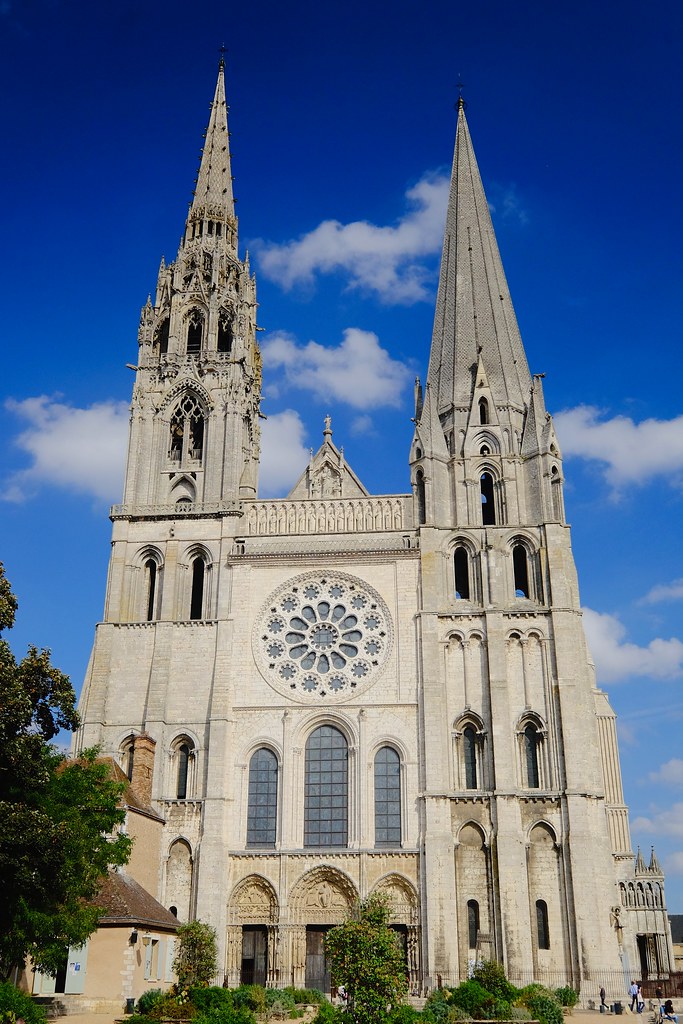
FEATURE image: “Chartres, North Porch, Central Portal, LeftJamb” by profzucker is licensed under CC BY-NC-SA 2.0. The North Porch was constructed at the start of the 13th century. The North Porch, like the North Rose Window (below) crafted in the same time, depicts the glories of the Virgin Mary along with Old Testament figures.
I visited Chartres Cathedral for the first time in 1985, and again in 1989, 2002, and 2005. I participated in my first Malcolm Miller tour in Chartres Cathedral in 1985. A guide there since 1958 his work, as I was backpacking through Europe, inspired me to see how a person can dedicate his energies to one major work. Chartres Cathedral is famous perhaps mostly for its stained glass from the 12th and early 13th centuries. The shimmering beauty of these intact colorful windows from over 800 years ago is unparalleled. Almost all the windows are “read” from left to right starting at the base and ascending to the top. Once a Roman site, several cathedrals have stood where today’s monumental building stands. Previous cathedrals were literally destroyed during the Merovingian and Viking eras and in 12th century fires. A cult of the Virgin Mary as protectress developed around the cathedral that led to a gift in the 9th century of its famous Marian relic known as Sancta Camisa, or the Virgin’s veil. When the cult of the Virgin Mary arose universally in the church in the 12th century Chartres Cathedral, which was dedicated to Mary’s Assumption, was poised to become an important place of pilgrimage.
The North Rose window in Chartres Cathedral displays the Virgin Mary and Child in the center surrounded by small circles of doves, angels and thrones. In the outer circles are depicted the 12 kings of Judah (who were Jesus and Mary’s ancestors) and the 12 minor prophets. “Chartres – cathédrale – rosace nord” by Eusebius@Commons is licensed under CC BY 2.0.
On my first visit to Chartres cathedral in 1985, after having breakfast in Paris, I walked to Gare Montparnasse and boarded a train direct to Chartres. On that visit Malcolm Miller explored the North Rose Window (c. 1231) with the Blue Virgin Window (c. 1194) below it as well as parts of the Noah Window (c. 1210). The Noah window included a depiction of the 6th century bishop of Chartres, St. Lubin, who was the patron of wine merchants, a group that helped pay for the window. Miller also took us outside to discuss the 12th century statuary on the West portal that I photographed in 1989. Following a fire in 1120 a large Romanesque church was built in the same period as Vézelay Abbey. Another fire in 1134 damaged the church and precipitated the construction of the north tower completed in 1150. The south tower was begun and completed about 10 years later than the north tower. The Royal Portal was built between 1145 and 1155. Most of the present church was rebuilt following a devastating fire in July 1194 which destroyed not only the church but much of the city. Notable exceptions to the fire’s destruction were the cathedral’s mid12th-century west front with its royal doors and two contrasting towers. The rest of the church visited today – including, with some exceptions, its magnificent stained glass windows – was rebuilt and crafted between 1195 and 1220. The North Rose Window was donated by King Saint Louis IX of France (1214-1270) and his mother Blanche de Castille (1188-1252). During the French Revolution, the church was desecrated and used as a temple to the Goddess Reason. It wasn’t returned to the church and reconsecrated until 1855.
The West Front is from the 12th, 13th and 16th centuries. The photograph’s column statues below are on the right side of the West Portal’s central door. Though likely originally intended in the 12th century to be enclosed in a narthex, that structure was not built and these sculptures remained outdoors. “Chartres 2014 – 2” by evocateur is licensed under CC BY-SA 2.0.
By the 11th century there was a renewal of learning in Europe that, particularly in Northern Europe, was centered in monastic and, slightly later, cathedral schools. One Gerbert of Aurillac (c. 946-1003) who later became Pope Sylvester II, had studied in Spain, and was head of the cathedral school in Reims in the 970’s. Gerbert’s pupil, St. Fulbert of Chartres, as bishop of Chartres, opened its cathedral school which became the most illustrious center of learning in the 12th century and marked a new era for Western civilization. These were schools grappling with varying philosophical concepts of God and man that were hotly debated in the 12th century. Though the present Gothic building was, after 25 years of construction, roofed and finished around 1220, Chartres Cathedral was reconsecrated in October 1260. Three popes visited Chartres in the 12th century and in the next centuries several saints prayed there including St. Thomas Becket (1118-1170) as well as French saints Bernard of Clairvaux (1090-1153), Francis de Sales (1567-1622), Vincent de Paul (1581-1660), Louis de Montfort (1673-1716) and, bien sûr, Benedict Joseph Labre (1748-1783). While pilgrimages to Chartres began before the 12th century and important pilgrimages continued into the 16th and 17th centuries, these had waned since the French Revolution. Though pilgrims were returning to Chartres by the end of the 19th century, French poet Charles Péguy is held responsible for restarting the traditional Paris to Chartres pilgrimage route. It was on June 14, 1912 that Charles Péguy set out on this pilgrimage when he walked its almost 150 kilometers in three days. The previous year he had made a vow to do so at the bedside of his son who was ill. “Chartres is my cathedral,” Péguy later wrote. On September 5, 1914 as a lieutenant in the 19th company of the French 276th Infantry Regiment during World War I, Péguy was killed, shot in the head, near Villeroy, Seine-et-Marne. Charles Péguy was 41.
The Royal (West) Portal, 12th century, Cathédrale de Chartres (1145-1220), France. While art historians have made attempts to identify the portal column statues, it remains speculative. It appears that these column statues represent Old Testament figures – in this photograph, possibly King Solomon at right holding a scroll and the Queen of Sheba next to him. What is important is the inexpressible joy that these faces of stone from almost 1000 years ago convey. Author’s photograph. 12/1989 1.24 mb
The 12th century artist’s ambition was to concentrate the life of these statues in their faces. While Chartres cathedral’s flying buttresses and its stained glass are rightly world famous, some art historians believe that it is the statuary that is the cathedral’s most interesting aspect. The statuary certainly represents 12th century art at its zenith.
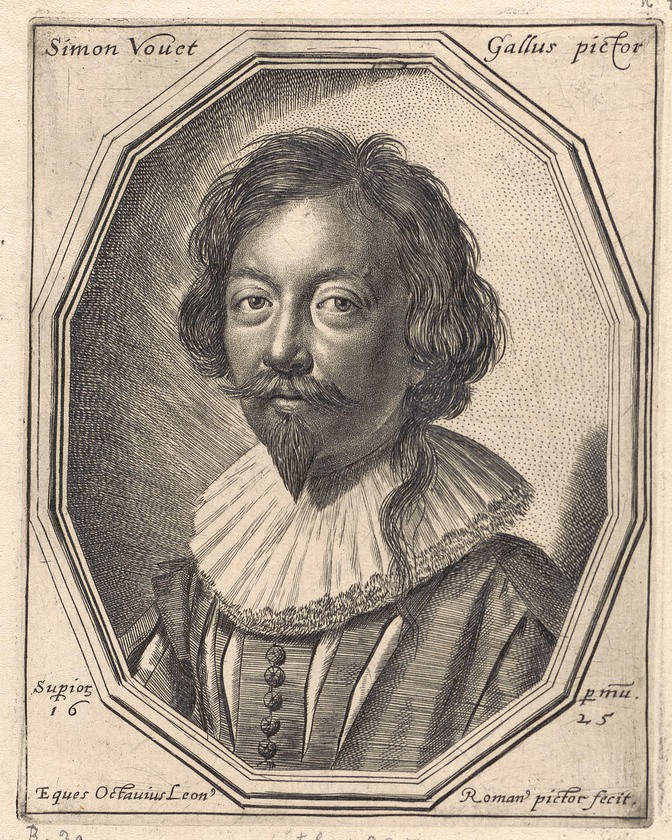
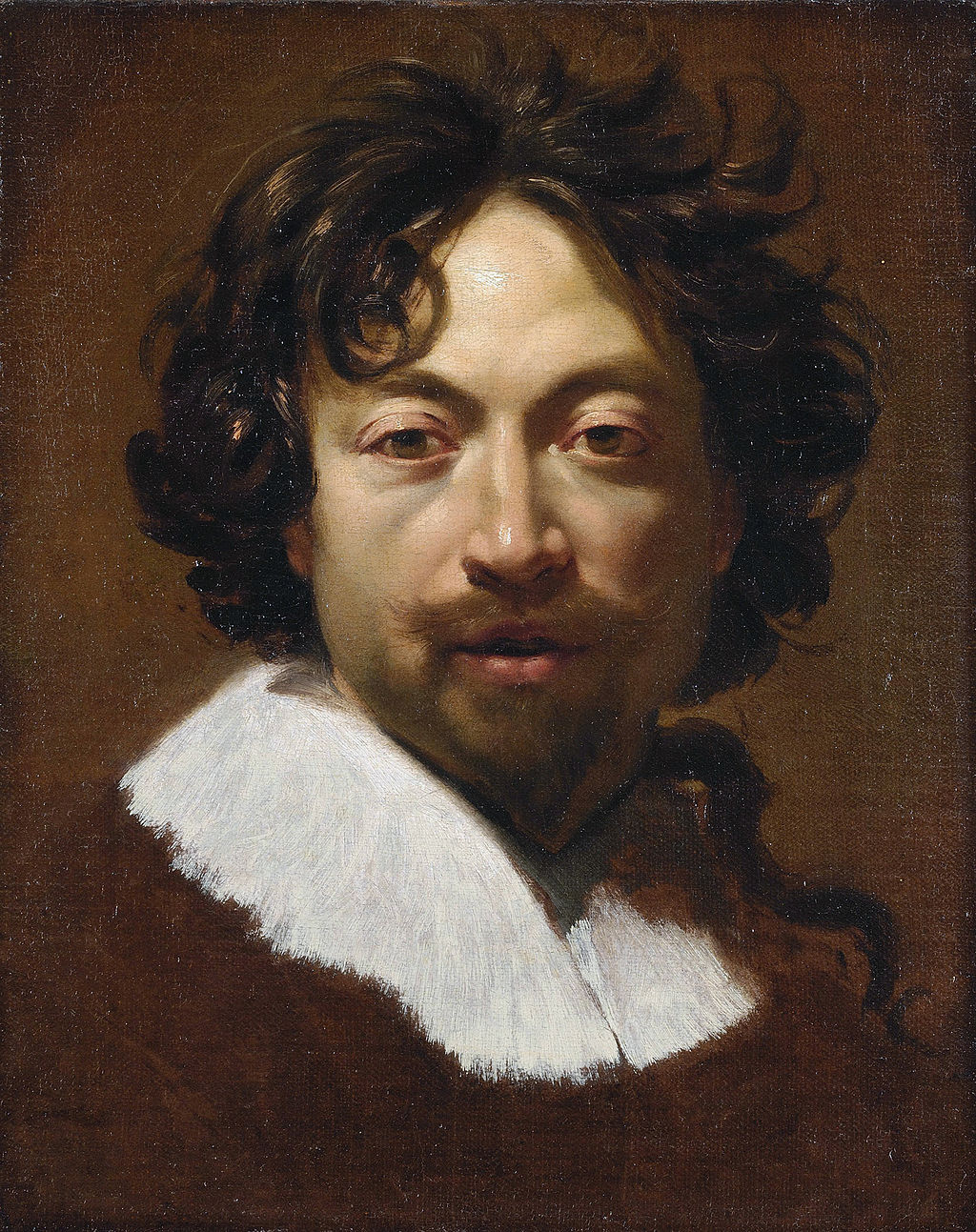
FEATURE Image: Simon Vouet (1590-1649), Self-portrait, c. 1626–1627, Musée des Beaux-arts de Lyon. https://www.mba-lyon.fr/fr/article/simon-vouet In Simon Vouet’s self portrait painted in his final years in Rome he displays his signature rapid brushwork and desire for movement in the picture.
Simon Vouet was born into modest circumstances in Paris on January 9, 1590. After stays in England in 1604, Constantinople in 1611 and Venice in 1613 of which little is known, the French painter Simon Vouet (1590-1649) spent nearly 15 years in Rome starting around 1614. In 1624 Vouet was elected to lead the Accademia di San Luca, an artists’ association founded in 1593 by Federico Zuccari (1539-1609).
Most French painters born in the 1590s made a stay in Rome which influenced art in France in the 17th century. Vouet was in Italy, primarily in Rome, between around 1613 until 1627 and received a special privilege from the French crown in 1617. It was this traffic of young French, Flemish and other international artists between Italy and their home countries in the first third of the 17th century that, for France, helped revolutionize French art. This was achieved by way of the contemporary application of ideas and styles influenced by late Renaissance Italian realist artists such as the aesthetic of Caravaggio (1571-1610) and the history painting method of Annibale Carracci (1560-1609), among many others, to which French artists were exposed while in Italy. In Rome Vouet, like other French artists such as Valentin de Boulogne (1591-1632), was patronized by Cardinal Francesco Barberini (1597-1679) and Cavaliere del Pozzo (1588-1657), among others. In 1624 Vouet was commissioned to paint the fresco to accompany Michelangelo’s Pietà in St. Peter’s and while greatly admired it was destroyed in the 18th century.
In addition to Rome, Vouet traveled to Naples, Genoa in 1620 and 1621, and, in 1627, Modena, Florence, Parma, Milan, Piancenza, Bologna and again Venice where he copied Titian (1488-1576), Tintoretto (1518-1594) and Paolo Veronese (1528-1588). During these visits Vouet studied the chief art collections that informed Vouet’s own style which amounted to a free form of temperate, classicized Baroque. This is the style, along with the latest Venetian-influenced brighter colors, vivid light, and painterly execution that Vouet returned and introduced to France in the 1630s. In France, Vouet had taken to himself as a painter his particular appreciation for the classicized compositions of Nicolas Poussin (1594-1665) and the cool colors of Philippe de Champaigne (1602-1674).
In 1627, King Louis XIII (1601-1643) called Vouet back to Paris to be his court painter. Vouet refined Caravaggio’s innovations into a style that would become the French school of painting starting in the 1630s and extending into the middle of the 18th century. Until about 1630 it was Late Mannerism which dominated in French painting and included unnatural physiognomy, strained poses, and untenable draperies. This changed with Vouet’s return who brought back from Italy a style with classical, realist, and Baroque painting components that was unknown in France until then and which Vouet stamped with his own style.
This painting entered the Louvre as a work of the Neapolitan school. It was recent scholarship that attributed it to Vouet which would make it one of his earliest portraits in Rome. Building on the premise, scholars have proposed Francesco Maria Maringhi (1593-1653), a Florentine patrician and lover and protector of Italian Baroque painter Artemisia Gentileschi (1593-1656), as the model.
Vouet married twice. His first wife was a young Italian woman he met in 1625 – Virginia da Vezzo (1600–1638). In France Vouet’s wife, who bore him 4 children, was well received by the French court. After Virginia died in 1638, Vouet married Radegonde Béranger (b. 1615), a young beauty from Paris, in July 1640. Radegonde bore Vouet another 3 children (one died in infancy), and survived him.
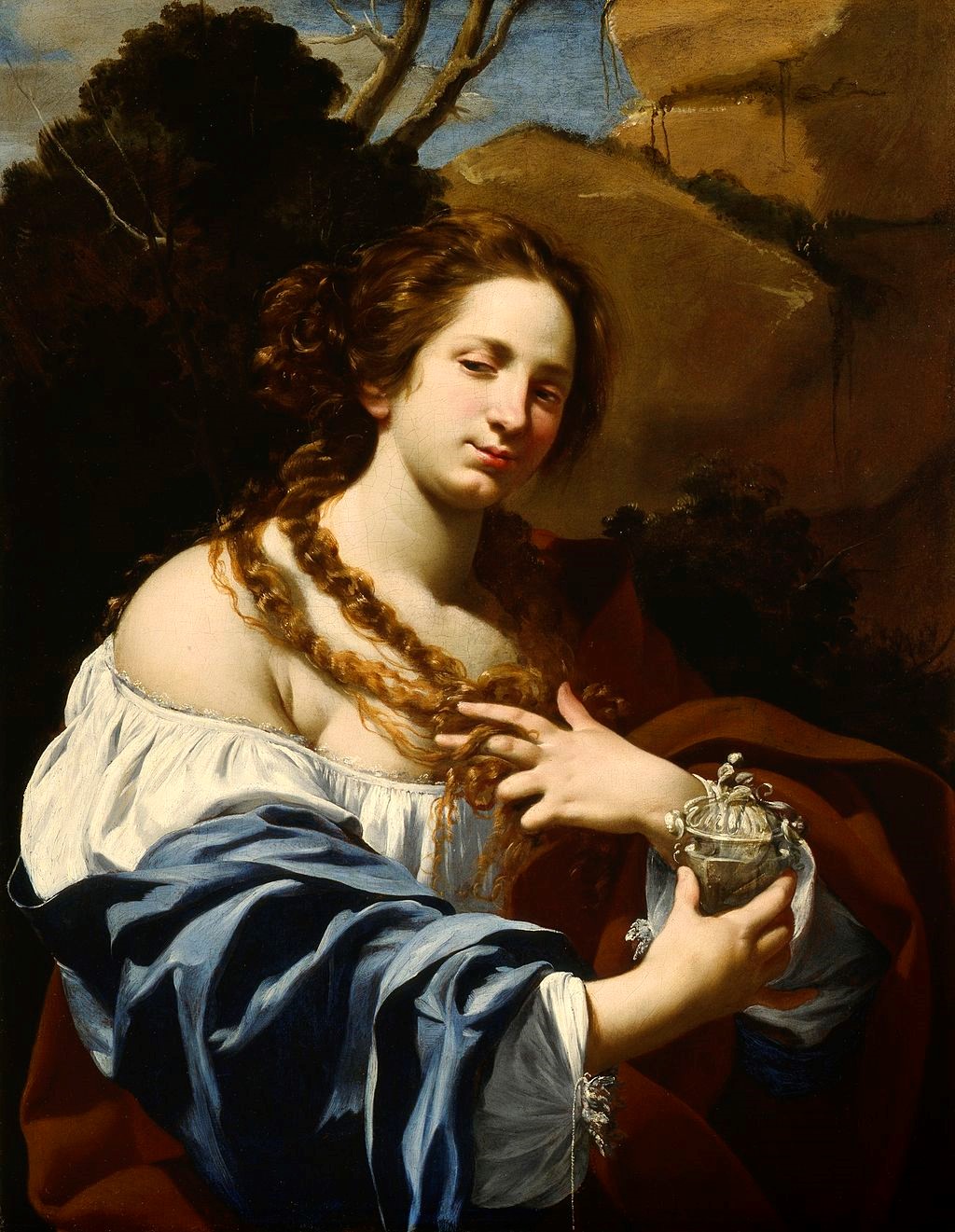
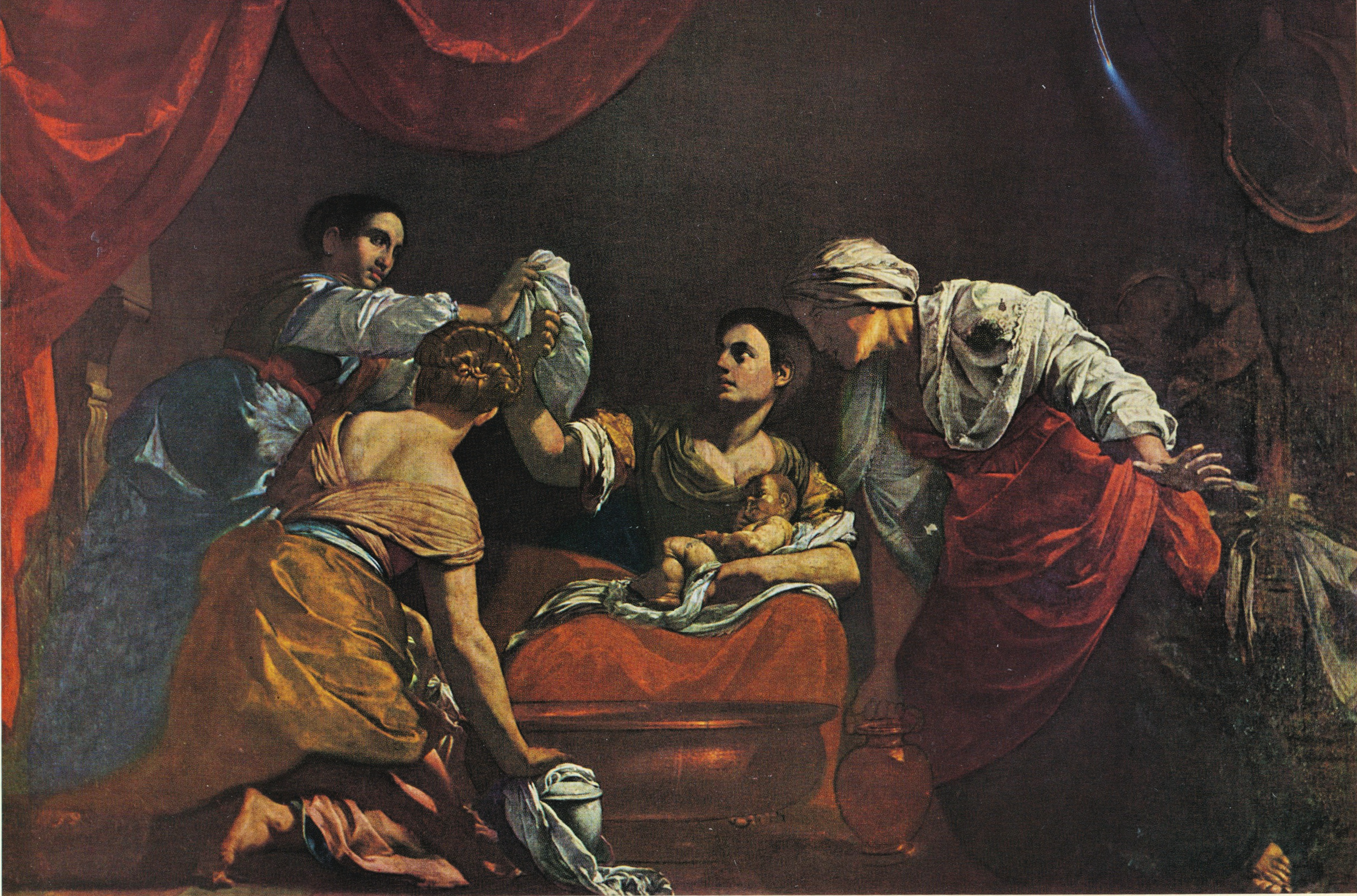
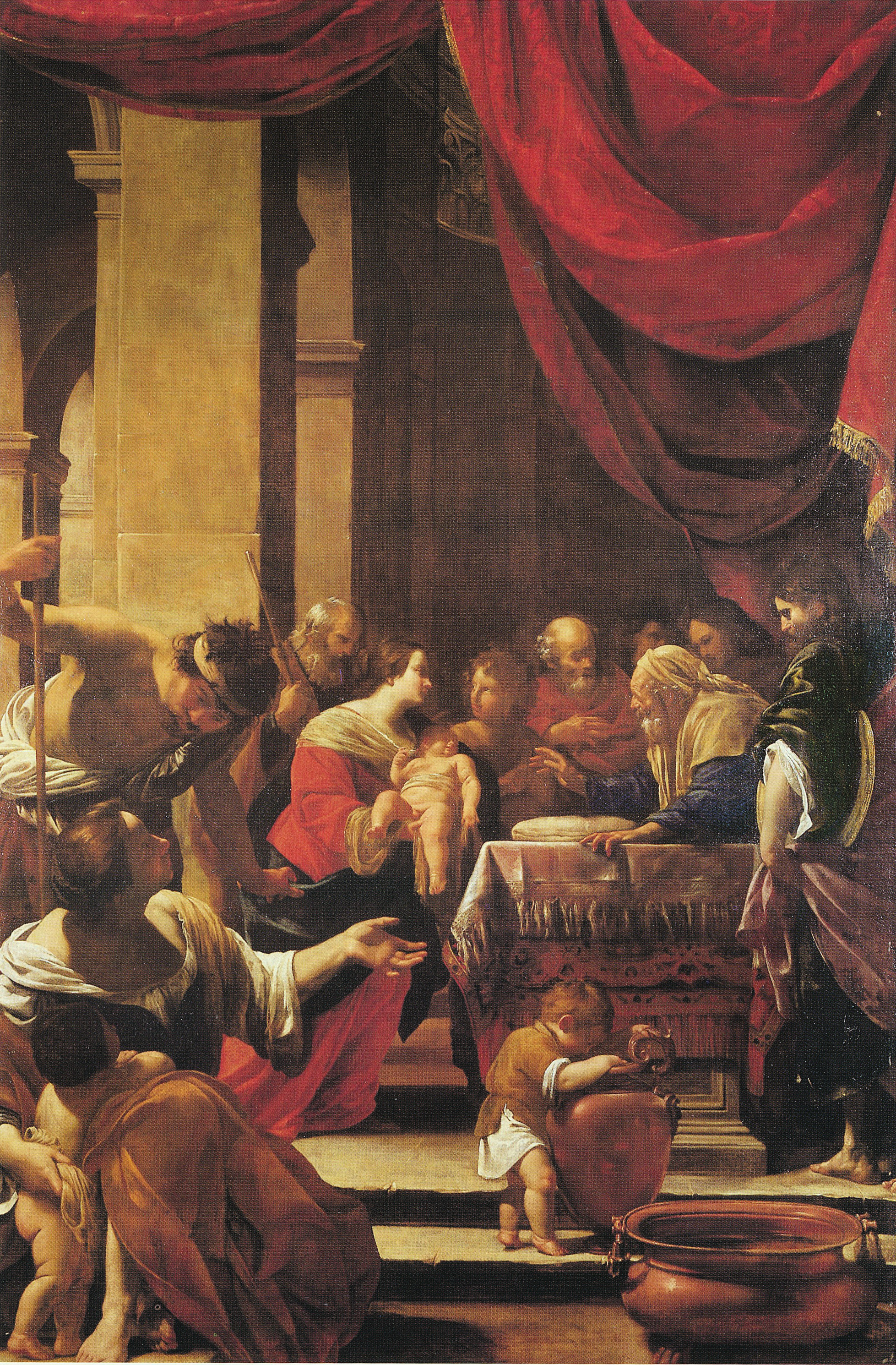
Simon Vouet (1590-1649), Virginia da Vezzo, the Artist’s Wife, as the Magdalen, oil on canvas, 40 × 31 in. (101.6 × 78.7 cm), oil on canvas, c. 1627, Los Angeles County Museum of Art. https://collections.lacma.org/node/247903Simon Vouet (1590-1649), Judith with the head of Holofernes, 1620/1625, 97 x 73,5 cm, oil on canvas, Bayerische Staatsgemäldesammlungen München-Alte Pinakothek, https://www.sammlung.pinakothek.de/de/artwork/jWLpZea4KY/simon-vouet/judith-mit-dem-haupt-des-holofernesSimon Vouet (1590-1649), The Birth of the Virgin c. 1620 Rome S. Francesco a Ripa.Detail: The Birth of the Virgin.
The Birth of the Virgin was one of many paintings in a somber palette that Vouet produced in Rome influenced by Caravaggio though its mood is more vibrant. The composition is broad, low and somewhat setback from the picture plane. Amidst the swirling movement and vitality of the drawing and figures, including sumptuous draperies, it is observed that the head of the maid servant in the middle of the composition is modeled on one by Michelangelo Buonarroti (1475-1564). These early qualities that Vouet had taken from Italian painting were, when he returned to France, taken over by a heightened decorative style in the 1630s and 1640s.
Ottavio Leoni (1578–1630), Simon Vouet in Italy, engraving, sheet 9 3/8 × 7 1/16 in. (23.34 × 17.94 cm), Carnegie Museum of Art, Pittsburgh.Simon Vouet (1590-1649), Portrait presumed of Aubin Vouet, c.1625. Musée Réattu, Arles. Simon Vouet (1590-1649), The Temptation of Saint Francis, c. 1620 Rome Basilica of Saint Lawrence in Lucina.
Simon Vouet (1590-1649), The Temptation of Saint Francis, c. 1620, Basilica of Saint Lawrence in Lucina, Rome. In Rome Frenchman Simon Vouet adopted a Caravaggesque style coupled with elements from Michelangelo such as in this painting for an ancient (4th century) church in Rome. While Vouet worked directly from the model and used closely observed poses from reality, the head of St. Francis of Assisi seems to be taken from one by Michelangelo. In Franciscan spirituality and tradition there is much greater emphasis on the presence of God and the joys of living the evangelical counsels (poverty, chastity, and obedience) in community and in nature than there is on the vocation’s temptations, trials or penances that could only be part of any religious saint’s story. While the early Franciscans tell tales of the devil, these are always quickly resolved as they relate the saint’s or another Franciscan brother’s beautiful victories over the Tempter by prayer, fasting and humility. Simon Vouet’s early painting in Rome presents an ostensibly Franciscan subject but with a Renaissance modern sensibility focusing on the twisting bodies of the figures of a contemporary woman presenting herself to the young Italian 13th century saint who, himself half naked, is all muscles and who gestures at the moment of first encounter with fleshly temptation to an unresolved ending adding to the painting’s worldly intrigue. see –https://www.finestresullarte.info/en/works-and-artists/-almost-as-unbelievable-as-a-church-painting–simon-vouet-and-his-saint-francis-tempted
Attributed to Vouet, Annunciation, Uffizi, c. 1621. oil on canvas 1.20 x 0.86m (see Crelly, pp. 162-63). Simon Vouet (1590-1649), The Circumcision, oil on canvas, Church of Sant’ Angelo a Segno Naples.Simon Vouet (1590-1649), The Crucifixion with Mary and John, oil on canvas, Church of Jesus and Saints Ambrogio and Andrea GenoaSimon Vouet (1590-1649), Appearance of the Virgin to St Bruno, c. 1624, Naples, S. Martino.
As Vouet stayed in Italy he increasingly turned to a Baroque style of which The Crucifixion with Mary and John in Genoa is an early example. The Appearance of the Virgin to St. Bruno in the Carthusian monastery of San Martino in Naples is a later and more fully realized Baroque style example. The atmosphere of each showing saints in ecstasy is a clear element in Baroque’s intensified and elaborated religious representation. In Italy Vouet’s paintings are more restrained than the full contemporary Baroque art of Pietro da Cortona (1597-1669) and his followers such that the French painter’s figure of the Virgin in his Naples’ picture tends towards a classical Renaissance tradition that would be an important part of the expression of French taste in the 1630s and 1640s.
Simon Vouet (1590-1649), Modelli for Altarpiece St-Peters Rome, 1625, Los Angeles County Museum of Art.Simon Vouet, The Clothing of St. Francis of Assisi, Rome, S. Lorenzo in Lucina, Alaleoni Chapel, 1624. Vouet decorated the chapel with dozens of paintings. Simon Vouet, Allegory of the Human Soul, Rome, Capitoline Musem, 1.79 x 1.44 m. It probably entered the collection of the Capitoline Museum in the 17th century (See Crelly, p.213). Simon Vouet (1590-1649), The ill-matched couple (Vanitas), c. 1621.Simon Vouet (1590-1649), David with the Head of Goliath, c. 1621,Palazzo Bianco, Genoa.Simon Vouet (1590-1649), St. Catherine, c. 1621. Simon Vouet (1590-1649), Young Man wearing armor, c. 1625/271,165 m x .91 m, oil on canvas. Musée du Louvre. https://collections.louvre.fr/en/ark:/53355/cl010061299
The painting by Vouet towards the end of his Roman period, the identity of the young man above is unknown though speculation by modern scholars is impressive (i.e., St. Thomas Aquinas, among others). The painting’s copies are numerous which points to the composition’s success. These copies can be found in major museums throughout Europe.
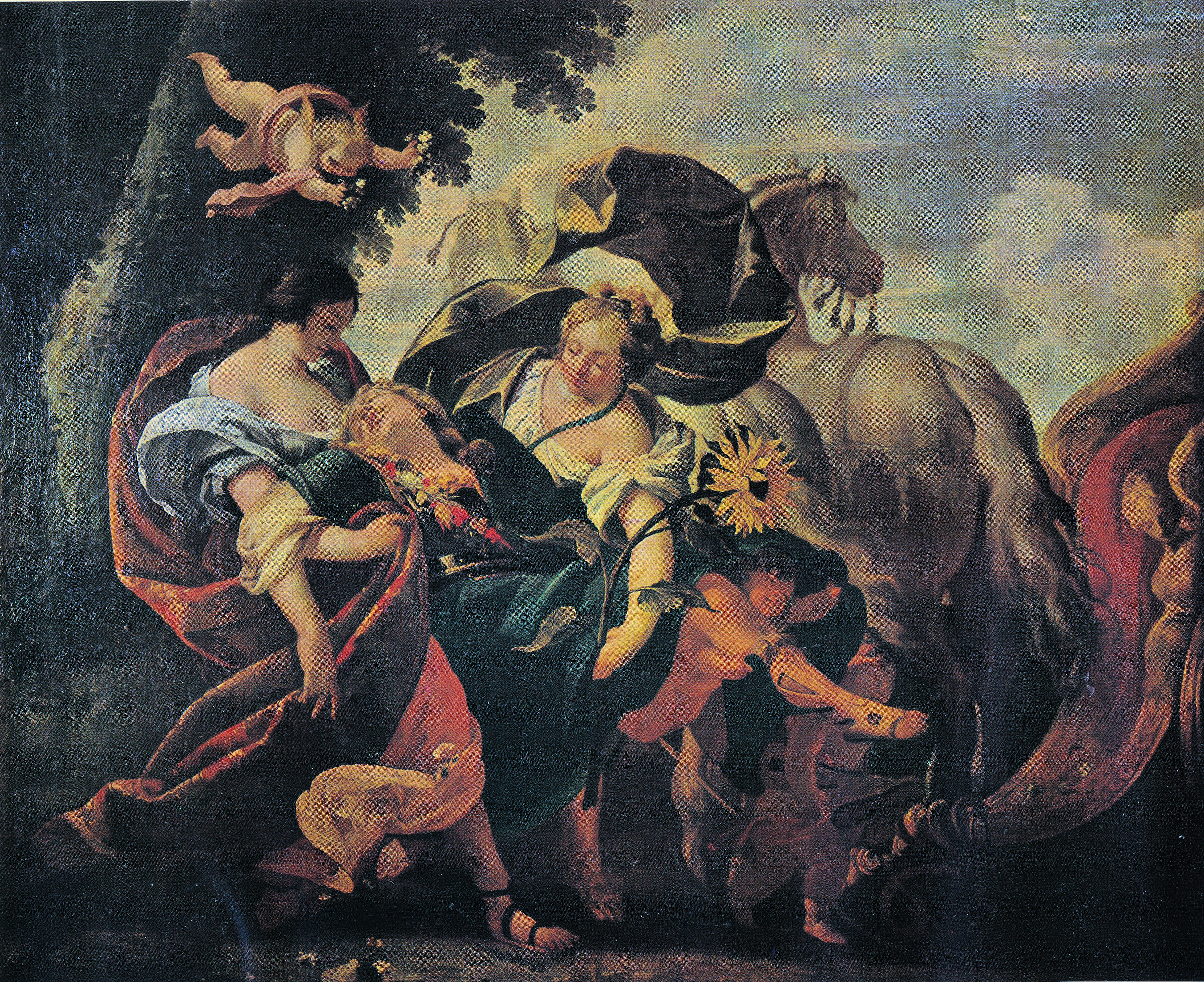
Vouet, Sophonisbe receives the poison cup through a messenger, c. 1623, oil on canvas, 125,5 x 156,5 cm, Kassel, Staatliche Gemäldegalerie. The painting was previously attributed to Guido Reni (1575-1642). The painting was in Kassel by 1738. (see Crelly, p. 167). https://altemeister.museum-kassel.de/33982/0/0/147/s1/0/100/objekt.html. The tragic events are condensed in the expressive eye contact. Sophonisbe, the patriotic daughter of the Carthaginian general Hasdrubal, knew how to keep her husband Syphax on the Carthaginian side in the war with Rome. He was captured by the Numidian prince Masinissa, who was allied with Rome, and Sophonisbe threatened with extradition to the Romans. When she begged Masinissa for protection, he fell in love with her and married her. Now the Romans sensed betrayal and demanded the surrender of the dangerous enemy. Masinissa did not dare to resist, but he sent Sophonisbe a servant with a poisoned cup, which she drank (Livy 30:15). The subject topic could also be Agrippina receives the poison cup sent by Nero.Simon Vouet (1590-1649), Saint Jerome and the Angel, c. 1622/1625, 144.8 x 179.8 cm (57 x 70 13/16 in.), oil on canvas, The National Gallery of Art, Washington D.C. https://www.nga.gov/collection/art-object-page.46151.html
In 1627 Vouet painted Saint Jerome and the Angel featuring an elderly bearded saint and a winged curly-haired angel holding a trumpet that signifies the Last Judgment. While the composition is Caravaggesque in its naturalistic depiction of half figures, stark lighting, and dark-brown palette, Vouet’s painting features brighter colors in the robes and clothes which was a departure from the Caravaggesque tradition and, among some contemporary artists in Rome in the late 1620s, an aesthetic innovation. The painting demonstrates Vouet’s superb fluid handling of paint which he brought back to and deployed in France starting in the 1630s.
Vouet was a leading French artist in Rome when asked to return to France by the king in 1627. At his arrival, though embraced by King Louis XIII and his mother, Marie de’ Medici, Vouet was kept at a distance by Cardinal Richelieu (1585-1642) who viewed the ambitious artist as a social climber. Though modest compared to the great collections in London and Madrid, Cardinal Richelieu collected about 272 pictures, the canvasses listed in an inventory compiled by Vouet and his student, Laurent de la Hyre. Though Richelieu succeeded in getting Poussin to return to France from Rome in 1641and as “First Painter,” this direct competition to Vouet was short-lived. Richelieu died in 1642 and Poussin left for Italy the same year.
The king set Vouet to the task of painting portraits of the court nobility though just one survives today – that of Richelieu’s secretary. In 1648, when the Académie Royale de Peinture et de Sculpture was established – an organization that held monopoly power over the arts in France for the next 150 years – Vouet was not invited to join. Vouet understood that the academy, which included his pupils Le Brun and Le Sueur, was established in part as a generational shift that challenged his influence and authority. Vouet countered by modernizing the old painter’s guild but did not live to see the battle joined. He died of exhaustion in June 1649. The Academy went on to school artists, provide access to prestigious commissions, and hosted the Salon to exhibit their work. After Vouet’s death, the Académie soon rose to prominence with Jean-Baptiste Colbert, First Minister of State from 1661 until his death in 1683 under Louis XIV, as its protector and Charles Le Brun as First Painter and the Académie’s director.
Atelier of Simon Vouet (1590-1649), Michel le Masle (1573-1662), 1628,, oil on canvas, musée Carnavalet, Paris.
Upon Vouet’s return to France in late November 1627, his French style set to work mainly on religious subjects which were admired by the public, particularly in diocesan and religious orders’ churches of Paris. As late as 1630, the eye of the Paris art consumer was used to prevailing late 16th century mannerism. It took time for the French to better accept Vouet’s new Caravaggesque naturalism. Further, while France was a so-called eldest daughter of the Catholic Church, Parisians did not share the intense religious enthusiasm that was the art expression in the papal states. Parisians did not fully accept the swirling heavenly masses found in Italian Baroque. In France Vouet had to temper his stylistic synthesis of classicism, naturalism and baroque as the French expression of and contribution to a great international style.
Vouet’s new and tempered French style is exquisitely represented in Madonna and Child (1633). During the religious reformation period in the 16th century one of the Catholic Church’s responses was the renewal of devotion to the Virgin Mary. This cult of the Virgin, once blossomed in the 12th century, was in renewed full maturity in the 1630s and even inspired the French king to dedicate his North American empire to her in 1638. Vouet painted more than a dozen compositions of the Virgin and her son at half-length. While the blank background and figurative monumentality remain from his Roman days, Vouet’s mastery of light and use of bright colors signal the realization of the new French style. The monumental figure of the seated Virgin depicted in a Mannerist and Classical synthesis holds her son on her lap and looks at him with drooping eyes.Her arm supported by the foundation of a classical column, Mary’s dark hair is held back by a fabric band as her neck and shoulder are exposed. The Christ child reaches up to kiss his mother, his body in a Baroque twist as he caresses her face. The brilliantly executed moment expresses intimacy and tenderness while maintaining religious seriousness.
The Bible story of depravity that Vouet depicts is that of Lot and his daughters found in Genesis 19. The angels have warned Lot who is an upright man that Sodom and Gomorrah are to be destroyed for its sins. As Lot’s family escapes, they are warned not to look back on the Divine destruction. Lot’s wife disobeys and is turned into a pillar of salt. Despairing of finding husbands where they are going and so carry on their own people, Lot’s daughters devise to get their father drunk and lie with him. Both daughters become pregnant in this way.
Vouet depicts Lot of the Old Testament story as they break the taboo of incest to carry on the race in desperate times using Renaissance artistic language of a god from pagan mythology. In place of moralizing, Vouet composes a sensual scene showing Lot, a male figure of late middle age, tasting the company of two nymph-like young women in a canvas filled with the attraction of the flesh and drunken debauchery. The lines and forms of Vouet’s new painting give priority to its narrative power which will be the manner of his artwork following his return to France. It is noted that Vouet used a contemporary engraving of an ancient relief to model the figure of the seated daughter.
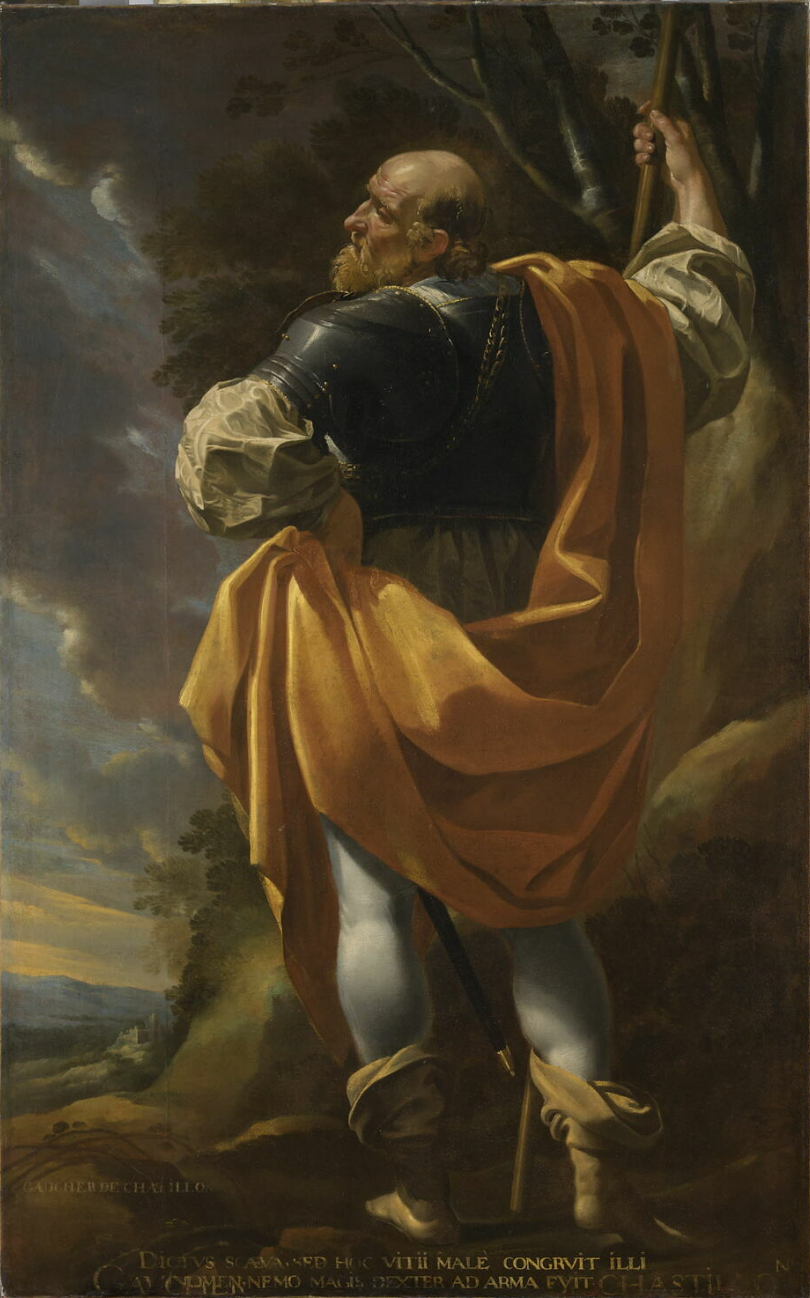
Commissioned by Cardinal Richelieu for his Palais Royal’s Gallery of Illustrious Men the painting ofGaucher de Châtillon was set into one of its bays. The portrait was greatly admired in that generation for the figure’s resolute pose as well as the execution of Vouet’s drawing and painting. Critics assessed that since the pose and head were so artistically beautiful Vouet’s subject was not modeled from life but inspired by Carracci. Seeing the subject turned and from behind was in the Mannerist tradition that Vouet loved and adopted for this historical figure of Gaucher de Châtillon (1250-1328), a constable of France and advisor to Capet kings, Philip IV the Fair (1268-1314), and then to his sons, Louis X the Quarreler (1289-1316), Philip V the Tall (1293-1322) and Charles IV the Bald (1294-1328). The Louvre’s picture has been restored.
Back in France Vouet had a successful career as the painter of large decorations and religious and allegorical paintings. His studio was the largest international workshop and school in Paris. Vouet was a most sought-after and beloved teacher and his art collaborators were numerous (Le Brun, Le Sueur, Mignard, Du Fresnoy, Le Nostre, among others). Per usual practice among professional artists in Europe, those with talent were encouraged to marry into the master’s family so to keep the training, skill and social connections “in house.”
The 1630’s began an age of cultural realignment and reorientation in France that would remain until about the French Revolution. In 1634 the Académie Française was founded under Cardinal Richelieu. In 1637 René Descartes published in French his Discourse on Method (“Je pense, donc je suis” “I think, therefore I am”) ushering in radical subjectivity in philosophical thought. That same year Peter Corneille’s Le Cid was produced, the first great stage play. In 1640 the Imprimerie Royale was founded to publish scholarly books and improve societal erudition. The decade’s innovations continued to transform culture over the next 30 years. By the 1660s French artists, writers and others in France viewed their language, thought, and artistic culture as the world’s most refined and unparalleled in history. Vouet’s return in 1627 was well situated for him to contribute to this prolonged period of interest in artistic matters in France.
In the mid17th century, wealthy French patrons began to collect Italian and Italian-inspired art. This included Louis Phélypeaux de La Vrillière (1599-1681) who collected 240 major paintings for his house in Paris. Critics have observed about Vouet that as he played the role of art functionary by importing and translating Italian art tradition into France, he remained less of a truly profound original artist.
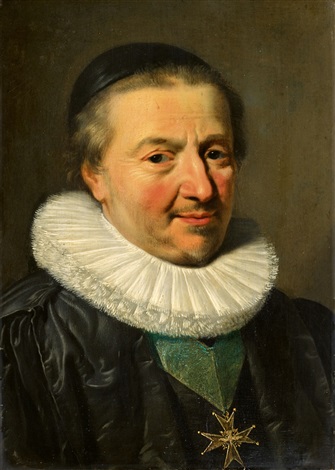
Louis Phélypeaux de La Vrillière, secrétaire d’Etat de la religion prétendue réformée. He built the Hôtel de la Vrillière in 1st arrondissement in Paris designed by François Mansart (1598-1666) between 1635 and 1650.
In the 1630s, classical understanding of Carraci from Domenichino (1581-1641) was giving way to a different understanding of history painting from Giovanni Lanfranco (1582-1647). Lanfranco viewed Caracci’s legacy as decoration in search of vitality more than a spatial or formal articulation which extended to include figures in action. Vouet worked rapidly to populate the churches, monasteries and abbeys, royal palaces and private mansions, many newly built, of Paris, with his artwork. Vouet also produced large public commissions, all of which expressed a prevailing Baroque potpourri.
Vouet’s most significant contribution to French painting is his innovations in decorative painting whose influence was felt in France into the mid18th century. Vouet’s influence may be out sized to his intellectual quality and artistic originality but he made a tremendous impression on his contemporaries and was the artist, in a city of intense competition, who was the leading figure of the new Italian art manner for the French public and in many different projects for over 20 years. Vouet’s position as painter is on par with architects Jacques Lemercier (c.1585-1654) and Louis Le Vau (1612-1660) as part of that same generation in France who formed the classicizing French Baroque. They used French art practice since King Francis I (1494-1547) and solid current Roman practice forged into a French synthesis associated with Cardinal Richelieu and Louis XIII. Vouet’s pupils, Charles Le Brun (1619-1690), Pierre Mignard (1612-1695), Nicolas Mignard (1606-1668). Le Sueur (1617-1655), and François Perrier (1590–1650) carried on the tradition of Vouet’s artwork.
Philippe de Champaigne (1602-1674), Jacques Lemercier with dome of Sorbonne.Louis le Vau.Philippe de Champaigne (1602-1674), Cardinal Richelieu, 1642, Musée des Beaux-Arts de Strabourg.Peter Paul Rubens (1577-1640), Young Louis XIII.
For his decorative work Vouet collaborated with artists in other media such as sculptor Jacques Sarrazin (1592-1660). Vouet painted large-scale decorations for royal patrons such as Anne of Austria (1601-1666), wife and mother of French Kings, at Fontainebleau in 1644 and at the Palais Royal between 1643 and 1647. Vouet did a decorative series at the Arsenal. At Hôtel Séguier (no. 16 rue Séguier) in Paris for the chancellor of France, Pierre Séguier (1588-1572), Vouet painted the chapel, library, and lower gallery. In these projects, Vouet reintroduced forgotten French painting traditions of illusionism practiced by Italian artists at Fontainebleau in the 1530s. Vouet synthesized it with the new Italian style in the 1630s, including imitating the use of gold mosaic and big oval designs derived from Venice. Today these decorations survive only by others’ engravings of them.
Pierre Séguier.
Some of Vouet’s decorative schemes survive at the Château de Wideville west of Paris. The castle was originally built in the late 16th century and sold to King Louis XIII’s minister of finances, Claude de Bullion (1569-1640), in 1630. Starting in 1632, the new owner set about building and expanding the castle in the Louis XIII style, with red bricks, white quoins and a pair of chimneys. Bullion involved the best decorators including Vouet for painting as well as Jacques Sarrazin (1591-1660) and Philippe de Buyster (1595-1653) for sculpture. Château de Wideville later became base for Louise de La Vallière (1644-1710), maitresse d’amour of King Louis XIV.
Claude de Bullion, oil on panel, 33 x 23,5 cm.
Vouet completed a later decorative panel, Muses Urania and Calliope in or around 1640, with the help of his studio. Likely commissioned as an altarpiece for the private chapel of a wealthy Parisian, the painting depicts porcelain skin women, bejeweled drapery, and putti in a classical architecture setting.
With his patrons Vouet was an amenable creator and he was a facile painter. His wealthy and powerful patrons wanted showy decorative artwork painted in the modern Italian manner without very serious religious or political messages for their often newly-acquired or built residences. The Toilet of Venus is exuberant and intriguing though based on the latest Italian art of the day – the theme is inspired by a treatment of Francesco Albani (1578-1660) while the figure of Venus is derived from Annibale Carracci. Though the figures remain weighty in the mode of Italian Naturalism, Vouet transforms the group into curvaceous polished and floating interlocking forms.
As many of Vouet’s large-scale decorative and other works were virtually systematically destroyed in the Revolution so that the connoisseur must assess Vouet’s artistic merit by way of surviving decorative schemes more than individual canvases or fragments, The Presentation in the Temple is an important extant painting by the hand of Vouet that allows qualitative comparisons to other 17th century French artists such as Laurent de La Hyre (1606-1656), Eustache Le Sueur, Charles Le Brun, and Jean-Baptiste Jouvenet (1644-1717). Commissioned for the Jesuits by Richelieu in 1641 for what is today’s Saint-Paul-Saint Louis in Paris’s Marais it was part of a rich ensemble of artifacts whose overall artistic scheme was dedicated to Christ and the French monarchy. Vouet’s presentation theme evokes the birth of Louis XIV and the painting was flanked by sculptures of Jesuit saints and French political figures.
There remains some similarity to what Vouet had produced in Italy in the mid1620s, particularly in The Appearance of the Virgin to St Bruno in Naples, such as his use of diagonals. Yet 15 years later in France Vouet’s composition is more classical in orientation including a rational not emotional or supernatural treatment of the subject more in the style of Nicolas Poussin who was called back to France from Italy the year before.
To give the illusion of grandeur, Vouet provides a very low position at the bottom of the stairs surrounded by gigantic religious architecture of which he paints a fragmentary synecdoche. For depth, Vouet interposes firmly-modeled foreground figures that partly mask more distant such figures in statuesque draping. Vouet’s cool colors reflect the influence of Philippe de Champaigne and the Baroque turning movement extends into the entablature of the architecture of the temple of Jerusalem, as well as the inclined position of the two angels painted in the upper portion.
By 1762, 20 years after Vouet painted The Presentation, politics changed unpleasantly for the Jesuits as they were suppressed by the Pope and their Paris flagship church’s high altar ensemble was dismantled. The painting was housed in the Royal Academy of Painting and Sculpture and later transferred to the Louvre during the French Revolution.
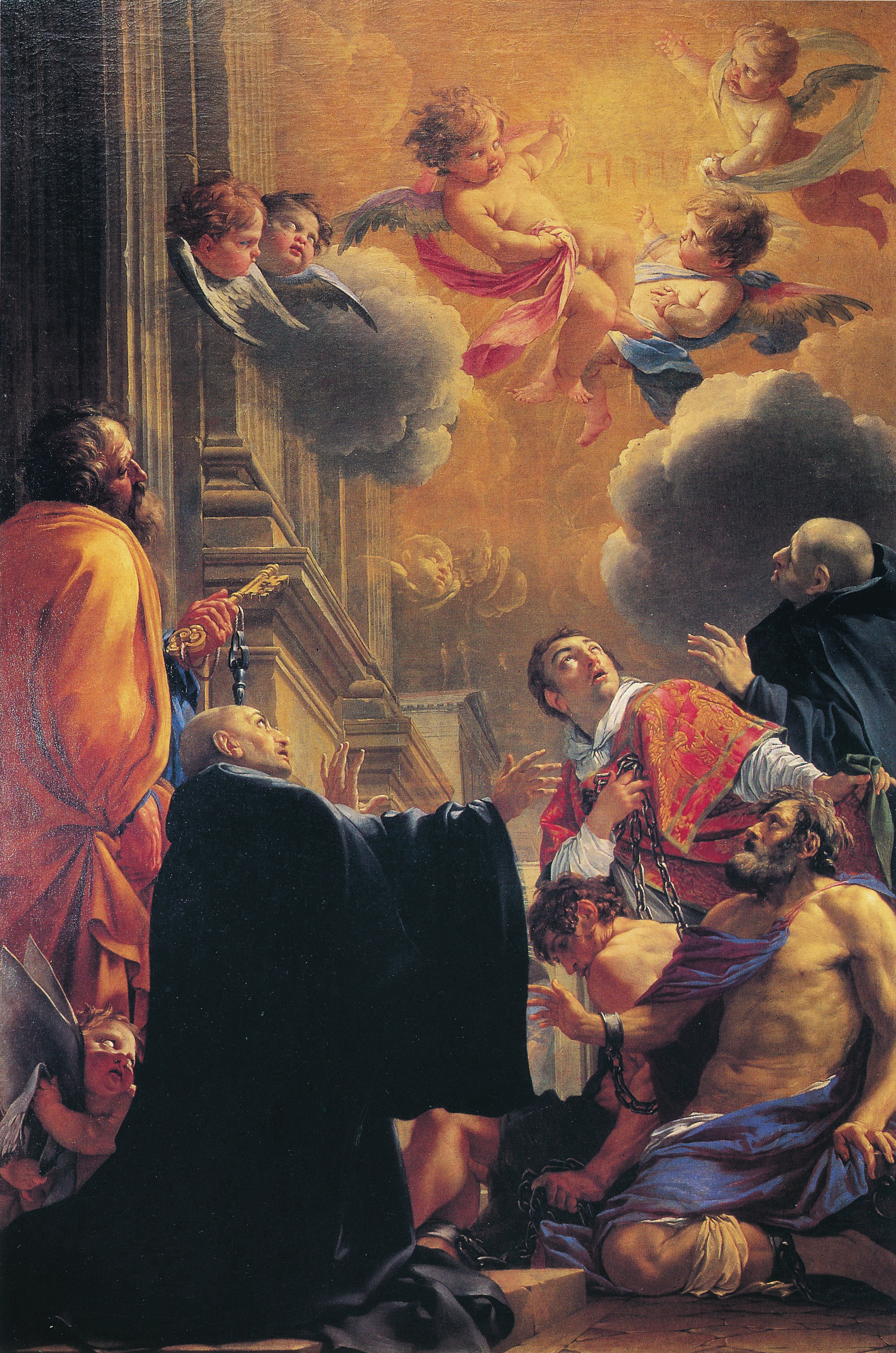
Simon Vouet (1590-1649), The Adoration of the Holy Name by Four Saints, oil on canvas,265 x176 cm, Église Saint Merri, Paris.Simon Vouet (1590-1649), Altar piece, Église Saint-Nicolas-des-Champs, Paris.Simon Vouet (1590-1649), Virgin with oak branch, known as Madonna Hesselin, c. 1640/1645, Musée du Louvre. https://collections.louvre.fr/en/ark:/53355/cl010067259
In 1651, two years after the death of Vouet, the painting above was inscribed in Latin to state that Vouet had painted the artwork and in the house of “very noble lord” Louis de Hesselin, one of the king’s advisors. The inscription also gives the meaning of the palm branch the Virgin holds – it is a sign of the means of her effectual assistance to the afflicted. Sieur Hesselin was a confident to the artist who was both godfather to Vouet’s eldest son in 1638 and witness to the marriage of Vouet’s daughter 10 years later. Two other known versions of the painting are found in the United States and in England. X-rays revealed that Vouet fully completed the neckline of the virgin before he added the painted golden robe upon it.
Simon Vouet (workshop), Christ at the Column, c. 1635/40, 1.28 m x .66m, oil on canvas. Musée du Louvre.
Louis XIV owned this painting of Christ being scourged by Roman soldiers at the pillar during his Passion. In the 18th century the painting was attributed to Eustache Le Sueur which still has its defenders today. Attribution to Simon Vouet began in the 20th century among scholars. In the 21st century scholars have proposed Charles le Brun (1619-1690) and the “Workshop of Simon Vouet” which the Louvre has settled upon. Preparatory drawings for the painting exist at the Bayerische Staatsbibliothek in Munich and at the Musée des Beaux-Arts in Besançon. The artwork may have come from a chapel of the Château in Saint-Germain-en-Laye. The painting was restored twice in the 18th century and in the 1960s.
At the same time that Vouet was painting religious subjects for churches in Paris he was painting allegorical and poetical artwork. For these paintings Vouet’s designs are freer, modeling looser and, in the Venetian style, the composition determined more by color and light.
Vouet painted this artwork and two other allegorical paintings for the decoration of the châteauneuf of Saint-Germain-en-Laye. In the 17th century the painting was known as “Seated Victory.” The female figure holds a flaming heart in her right hand and palm leaf in her left hand as a Cupid-like figure of love places a laurel wreath on her head. Later, the allegorical figure was called “Faith.” The painting was heavily restored in the mid1960s.
The painting was made for the decoration of the Château Neuf de Saint-Germain-en-Laye. In the 18th century the female figure wearing a laurel was described as “Victory” and holding Louis XIV in her arms. In the 19th century the female figure was viewed as an allegory for “Wealth” though other attributes such as the main figure’s foot resting on a cornerstone and strewn open books point to a figure representing “Christian Faith.” The standing cherub who offers her sparkling necklaces and the child on her lap have been interpreted as figures representing earthly and heavenly love, respectively.
Vouet depicts a scene on the standing silver vase of the nymph Daphne being pursued by Apollo, god of the arts. It is a classical mythological story which, despite aid from Cupid, the god of love, relates the vanity of earthly goods and pleasures. The scholarly theory of what is depicted in Vouet’s painting adds up to “Christian Faith” holding onto the figure of heavenly love as she is being tempted by baubles and pleasures of earthly love. The painting was restored in the 1950s and 1980s.
Beyond the thoughtful allegorical presentation, Vouet’s innovative style and reliance on lyrical emotion and sentiment more than ordered arrangement is in evidence as he presents a sensual winged goddess with healthy, chubby children in a fantasia of rich draperies and elegant linear architecture amid a metallic treasure hoard, all of which together enlivens the picture. Its languorous elegance derives from the Italian Baroque. Though a dictatorial teacher, unrivaled ambitious artist, and living in Paris during the grim era of the Thirty Years’ War, in Vouet’s painting for the French nobility there is no sense of unease and any subject’s forthrightness is tempered by superficiality.
Simon Vouet (1590-1649),The Three Marys at the Tomb, n.d., 52 1/4 x 66 1/2” Église Sainte Marie Madeleine de Davron Seine-et-Oise (11th century).
A chasm of space between the two angels holding up the shroud and the three women at the tomb before dawn on the third day delineates the heavenly from the earthly although all these figures are linked by vibrant colors and a reflective animation of spirals. Detailed drawing is forgone for conventional pose and vague, mannered forms. Inasmuch as Vouet is interested in the Biblical story or its meaning he is involved with the vivacity of the narrative by way of its stylistic elements. In contrast to Nicolas Poussin’s statuesque figures or Le Valentin’s introspective art, Vouet introduced Baroque lyricism and fancy into French art.
Saturn who represents Time in Roman mythology has tumbled next to a scythe and hourglass, his attributes. Holding him by the hair the bare breasted figure has been identified as Beauty but also Truth and is likely a portrait of Vouet’s Italian wife. Virginia da Vezzo. She holds a lance over him. To the left is Hope who holds out a hook, her symbol, as a trio of cupids pluck feathers from Time’s wings. The allegorical message may be that Love defies Time.
Simon Vouet (1590-1649), Saturn Conquered by Love, Venus and Hope, 1643/45, , Musée de Berry, Bourges.
In another allegorical painting of the same theme, Saturn is Father Time. The old man is overcome by Love (Cupid), Beauty or Truth (a bare breasted figure, perhaps Venus), and Hope (holding an anchor, her traditional symbol). Above these in colorful robes is Fama, the figure of fame, who announces herself blowing her trumpet. Fama embraces Occasio, her hair traditionally blowing forward, holding an emblem of wealth, and signifying the fortunate occasion. In Vouet’s picture which synthesizes classical elements such as statuesque figures in the style of Poussin and swirling masses and vibrant colors of the international Baroque style, Time is the victim of what he usually despoils. The large painting originally hung in the Hôtel de Bretonvilliers in Paris.
Simon Vouet (1590-1649), Allegory of Good Government, 1644/45, oil on canvas, 2.37 m x 2.71 m, Musée du Louvre.
In the collection of Louis-Philippe d’Orléans (1725-1785) in the Palais-Royal in Paris before 1785, it entered the collection of Louis Philippe Joseph d’Orléans (1747-1793), known as Philippe Égalité afterwards, and was sold in 1800. In 1961 Friends of the Louvre acquired it in New York City and donated it to the Louvre that same year.
The young woman seated on an elevated throne wearing armor is, according to the influential Iconologia of 1593 by Cesare Ripa (1555-1622), the allegory for Reason. The pair of young women, one offering an olive branch and the other a palm branch, are allegories for Peace and Prosperity. The golden vase is decorated with a bacchanalia. Above the main scene are two cherubs bringing a palm frond and laurel with a twisted column wrapped with a vine that symbolizes Friendship.
Vouet painted this allegory of good government about Anne of Austria as she cooperated with Cardinal Mazarin’s peace policies. The painting was probably commissioned for the decoration of Anne of Austria’s apartment at the Palais-Royal around 1645. It was kept in the collection of the Dukes of Orleans at the Palais-Royal in the 18th century. and moved to London after the death of Philippe Égalité. It was purchased in New York by the Société des Amis du Louvre in 1961. The work was re-oiled with glue by Jacques Joyerot and restored in a pictorial layer by Jeanine Roussel-Nazat between 1979 and 1981.
Simon Vouet died in Paris on June 30, 1649 at 59 years old. His burial details are unknown.
17th and 18th Century Art Baroque Painting Sculpture Architecture, Julius S. Held, Donald Posner, H.W. Janson, editor, Englewood Cliffs, N.J.: Prentice-Hall, Inc. and New York: Harry N. Abrams, Inc., 1972.
French Painting in the Seventeenth Century, Alain Mérot, trans. by Caroline Beamish, New Haven and London: Yale University Press, 1995.
Kings & Connoisseurs Collecting Art in Seventeenth-Century Europe, Jonathan Brown, The National Gallery of Art, Washington, D.C. and Princeton, NJ: Princeton University Press, 1995.
Mannerism: The Painting and Style of The Late Renaissance, Jacques Bousquet, trans, by Simon Watson Taylor, Braziller, 1964.
Valentin de Boulogne: Beyond Caravaggio, Annick Lemoine, Keith Christiansen, Patrizia Cavazzini, Jean Pierre Cuzin, Gianni Pappi, Metropolitan Museum of Art; 2016.
FEATURE IMAGE: Valentin de Boulogne (1591-1632), Allegory of Rome, 1628, oil on canvas, 330 x 245 cm, Villa Lante (Institutum Romanum Finlandiae Foundation). Villa Lante in Rome is an example of the work of the 16th century Raphael school in the reign of the Medici popes. The Renaissance villa, which was a residence for Roman aristocracy, was purchased in 1950 by the Finnish state. The Institutum Romanum Finlandiae Foundation started operating there in April 1954.
Ruins of the Coliseum in Rome, Circle of Willem van Nieuwlandt, II, c. 1600, Pen and brown ink, with brush and brown and gray wash, on pieced cream laid paper, 35.3 × 61.3 cm (13 15/16 × 24 3/16 in.) The Art Institute of Chicago. https://www.artic.edu/artworks/95904/ruins-of-the-coliseum-in-rome
INTRODUCTION.
Le Valentin de Boulogne (c.1591/1594-1632), sometimes called Jean Valentin, Jean de Boulogne Valentin, or simply Le Valentin, was a French painter. Born in Coulommiers-en-Brie about 35 miles east of Paris, Le Valentin may have been at least half Italian. His artwork was certainly influenced by Italian painting more than any other though he was familiar with Northern or Flemish painting. Le Valentin may have been in Rome as early as 1612 – German painter and art-historian Joachim von Sandrart (1606-1688) remarked in 1675 that Valentin reached Rome before Simon Vouet (1590-1649) who had arrived around 1614. Whether in 1612 or definitely by 1620 (Le Valentin appears in the census), Le Valentin spent the rest of his life In Rome. In the Eternal City Le Valentin was greatly influenced by Simon Vouet (French, 1590-1649) and Bartolomeo Manfredi (Italian, 1581-1622), a leading Caravaggiste or follower of Carravaggio (Italian, 1571-1610).
Joachim von Sandrart, Self Portrait, 1641.Bartolomeo Manfredi, The Martyrdom of St. Bartholomew (detail).Simon Vouet, Self-portrait, c. 1626–1627 Musée des Beaux-arts de Lyon.
Le Valentin’s oeuvre is today around 55-60 paintings, most of them identified by modern scholarship (i.e., Jacques Bousquet; Roberto Longhi). Le Valentin’s major commissions date from the last seven years of his life. Opportunities to acquire his artwork was rare, though avid collectors such as Cardinal Mazarin (1602-1661) and Louis XIV collected them.
Cardinal Mazarin by Pierre Mignard, Musée Condé, Chantilly, France.Louis XIV, Charles Le Brun, Château de Versailles.Piazza del Popolo, Rome. “Piazza del Popolo.. Rome” by Nick Kenrick.. is licensed under CC BY 2.0
In Rome Le Valentin forged close ties with other French artists and lived with many of them in and around the Piazza del Popolo to the Piazza di Spagna. Most French painters born in the 1590s made a stay in Rome – and influenced art in France in the 17th century. Reasons young painters fled to Italy in the early 17th century included depletion of opportunity in Paris due to the professionalization of artistic practice in and outside the capital although establishment French art was no longer flourishing. Conversely, Roman art – and not only the schools of Michelangelo and Raphael but new horizons afforded by Annibale Carracci (1560-1609) and Caravaggio (1571-1610) -was at an apex. The Eternal City was drawing international artists from Paris and elsewhere and, between 1610 and 1630, the Roman style became internationalized. The dialogue among artists in Rome in this period was exciting – and its outcomes often unpredictable. The culture of Rome (and the papacy) could actually be liberating for foreign, usually destitute, often libertine talented young artists who had great ambitions for a prominent commission as they were exposed to Rome’s virtue and vice almost equally. Many of these young artists, even ones whose artworks survive, exist today virtually anonymously. Le Valentin de Boulogne is one of the better-known artists of the period, although his precise name is uncertain and his artwork requires connoisseurship based on modern scholarship.
Annibile Carracci, Self-portrait, 1604, Hermitage Museum, St. Petersburg, Russia.Caravaggio, David with the Head of Goliath, included a self portrait of the artist, 1610, oil on canvas, Borghese Gallery, Rome.
In 1626 Valentin, in Rome several years, was invited by Vouet to organize with Nicolas Poussin (1594-1665) the festival of the Accademia di San Luca ‘s patron saint. Around the same age, Vouet led the academy whose artists’ association was founded in 1593 by Federico Zuccari (1539-1609). This appointment signaled that Valentin was an active and respected rising French artist in Rome in these years. Though Caravaggio died in 1610 his influence was still felt very strongly in Rome in the 1620s.
Two of Caravaggio’s masterpieces—The Martyrdom of Saint Peter and The Conversion of Saint Paul—hung in the neighboring church of Santa Maria del Popolo which Le Valentin certainly had opportunity to study. In Italy, Valentin took swift, direct, and enduring inspiration from Caravaggio’s chiaroscuro and realistic depiction of characters drawn from Roman street life, including extensive use of half figures. As one of the young Caravaggisti, Valentin applies these elements to his artwork, whether genre or, later, Biblical subjects.
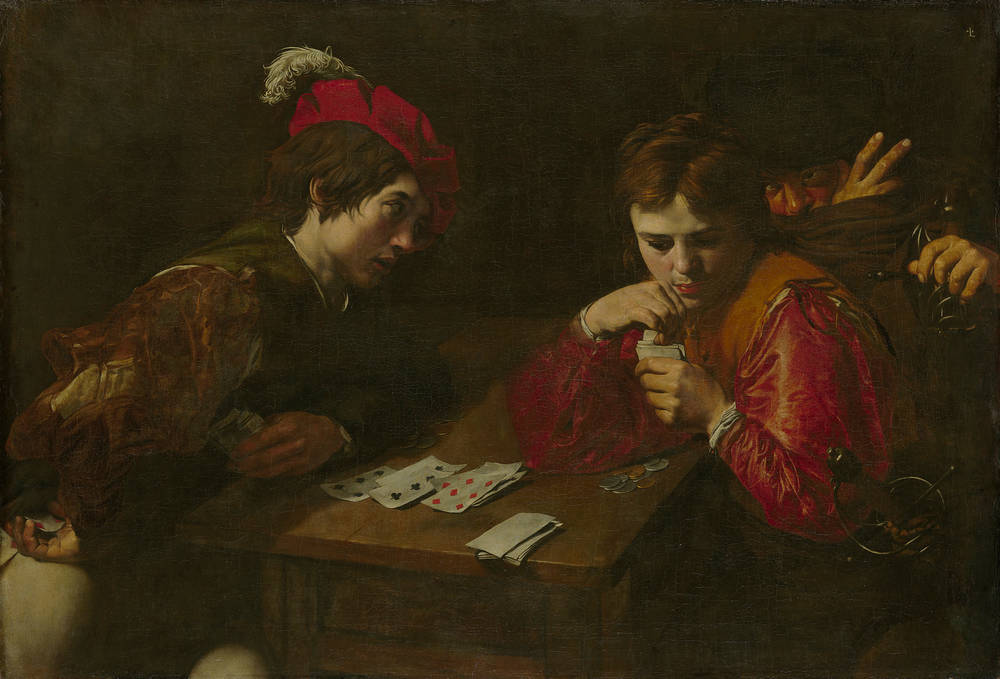
None of the works from Le Valentin’s earliest Roman years is documented, but it is believed he produced his Card Sharps (Dresden, Staatliche Kunstsammlungen), The Fortune Teller (Toledo Museum of Art), and Soldiers Playing Cards and Dice (The Cheats) (NGA) – and probably in this order – between 1615 and 1620.
In Le Valentin’s compositions which often contain several actors in a scene, the French artist’s realism and Caravaggio-inspired technique is often imbued with energetic rhythm in which diagonals and geometric concurrences play a role. This schematic suggests animation in the subject matter while retaining the human figures’ inner reserve and mystery. This creates a psychological quality in his artwork that is unique whichever drama is unfolding in the picture. Louis XIV who was an admirer of le Valentin acquired and hung several of his paintings in his bedroom at Versailles. Cardinal Mazarin, another art collector with a keen eye, acquired works by Valentin, some of which today are in the Louvre.
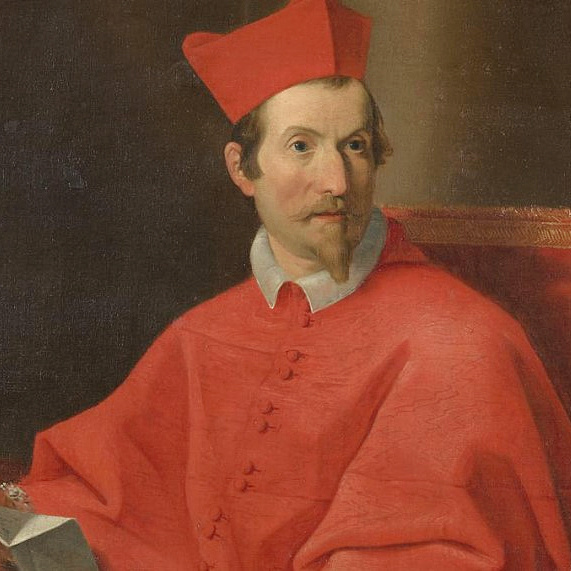
Andrea Sacci, Cardinal Francesco Barberini, Wallraf-Richartz-Museum, Cologne, Germany, oil on canvas, c. 1631-1633 (detail).
By way of Le Valentin’s important young patron, Cardinal Francesco Barberini (1597-1679) – made a cardinal in 1624 by his uncle, Pope Urban VIII (1568-1644) – Valentin became a competitor to his artist friend Nicholas Poussin. Le Valentin’s first documented work commissioned in May 1629 and completed in the spring of 1630 called Martyrdom of SS. Processus and Martinian is a compendium to a slightly earlier work by Poussin–both in the Vatican (Poussin’s was a different stylistic statement called Martyrdom of S. Erasmus). Valentin had further won the patronage of Cavaliere del Pozzo (1588-1657), the secretary of Cardinal Francesco Barberini and one of Rome’s leading art patrons. Paid the handsome sum of 350 crowns for Martyrdom of SS. Processus and Martinian , after 1630 Valentin’s artwork continued to command high prices and prestige.
Valentin de Boulogne, Martyrdom of Saints Processus and Martinian, 1629–30, Oil on canvas, 118 7/8 × 75 9/16 in. (302 × 192 cm), Vatican Museums, Vatican City/Jan van den Hoecke (Flemish, 1611-1651), Portrait of Cassiano dal Pozzo. Pozzo’s portrait was painted by Le Valentin though it is lost.
Though SS. Processus and Martinian is Le Valentin’s most important public work, he also produced many pictures for private commissions. There are several pictures by, or today attributed to, Le Valentin in many of the world’s leading art museums. Le Valentin produced artwork especially for the ruling Barberini family and their circle.
How Le Valentin died in 1632 is not certain though it was sudden and of natural causes. The professional artist who is admired in today’s major art institutions reportedly left no money to pay for a funeral. Identified as a “Pictor famosus” on his death certificate, Le Valentin was buried at Santa Maria de Popolo on August 20, 1632 paid for by Cassiano dal Pozzo (1588-1657).
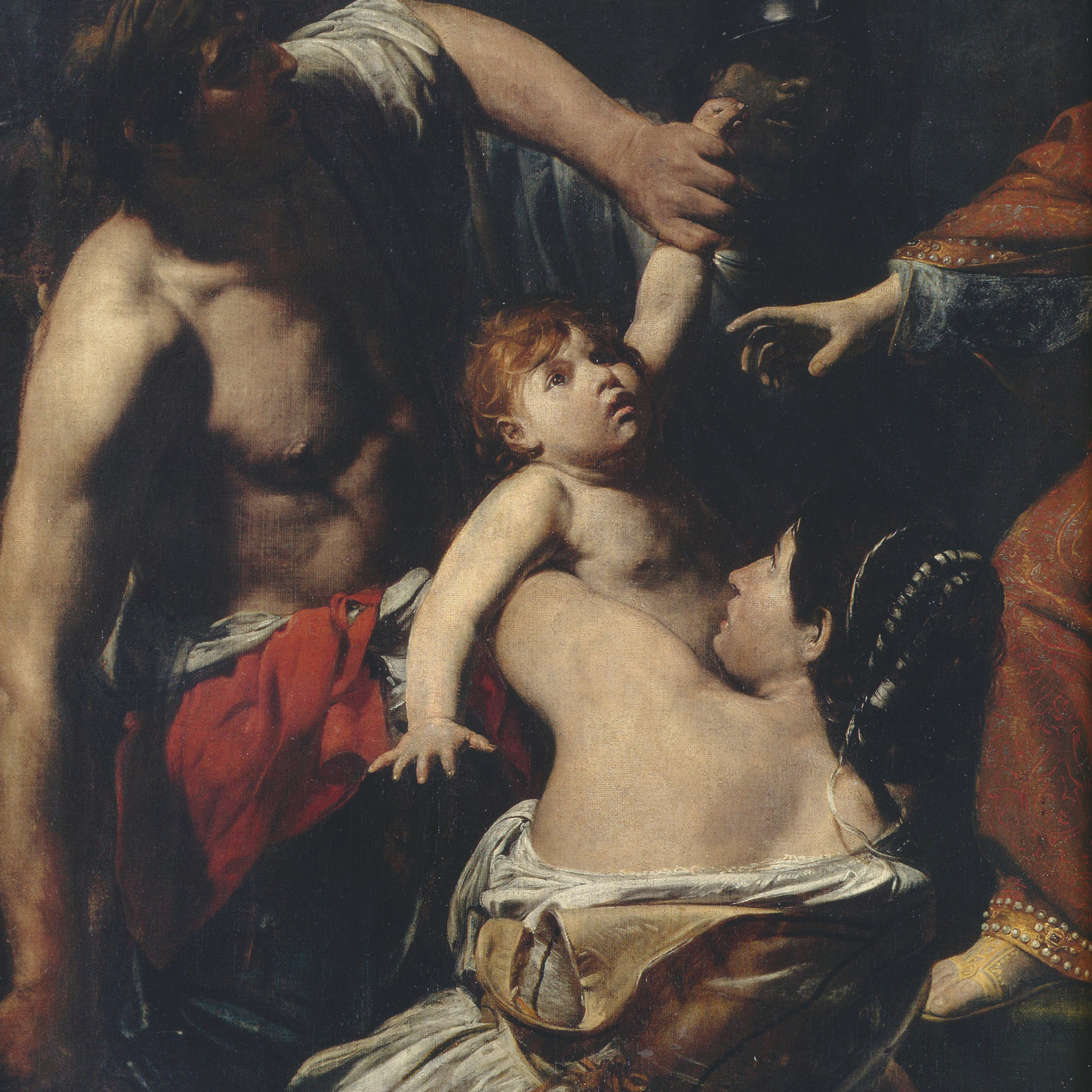
One of the most moving and beautiful stories in the Bible is the judgment of King Solomon in the case involving two disputing harlots over who was the mother of a living child (I Kings).
Both had had a child, though one died and the other lived. To have an offspring was considered a blessing. One harlot claimed that her living child had been taken from her bosom at night by the other harlot. She replaced the child with her dead child after “she had smothered him by lying on him” (I Kings 3:19).
Since this was a case of one harlot’s word against another’s Solomon had no simple and fair resolution at hand. King Solomon said: “Cut the child in two and give half to one woman and half to the other” (I Kings 3:25). Le Valentin shows the viewer what is at stake – a real flesh and blood child. The import of Solomon’s judgment could not be missed. Le Valentin’s women are modeled on those mothers and others the artist observed along Via Margutta.
Detail. Judgment of Solomon. Le Valentin.
When one harlot said, “Divide it! it shall be neither mine nor yours!” and the other harlot said, “Please, my lord, give her the living child. Please do not kill it!”, the king’s judgement changed.
Solomon spoke again and said, “Give her the child alive, and let no one kill him, for she is his mother” (1 Kings 3: 16-28). Solomon knew a woman privileged to be a mother would seek to see the child live most of all.
It is this final pronouncement that Solomon appears to give in Le Valentin’s painting, as the complete biblical episode can be readily seen in the gestures and expressions of its characters.
Acquired by Louis XIV at Cardinal Mazarin’s death in 1661, The Judgment of Solomon has long been presented as a counterpart to The Judgment of Daniel. These canvases, which may actually be pendants, share the same format and show examples of just judgment in the Bible. The Judgment of Solomon is dated later than The Judgment of Daniel. There is a variant of it by Le Valentin in Rome at the Barberini Gallery in the same format and oil medium. The Louvre painting was restored in 1966.
The subject is taken from chapter 13 of the Book of Daniel, the book’s addendum. In Babylon, a pair of wicked elders covet Suzanne, “a very beautiful and God-fearing woman” who was the wife of the “very rich” and “most respected” Joachim. After these wicked elders surprised Suzanne in her bath, she refuses their advances and they denounce her for adultery with the intent to put her to death.
Daniel condemns these wicked elders for “growing evil with age” including their past sins of “passing unjust sentences, condemning the innocent, and freeing the guilty.” Daniel interrogates them and, by their own words, shows the assembly they are lying. The painting depicts that moment of judgment.
Detail. Judgment of Daniel. Le Valentin.
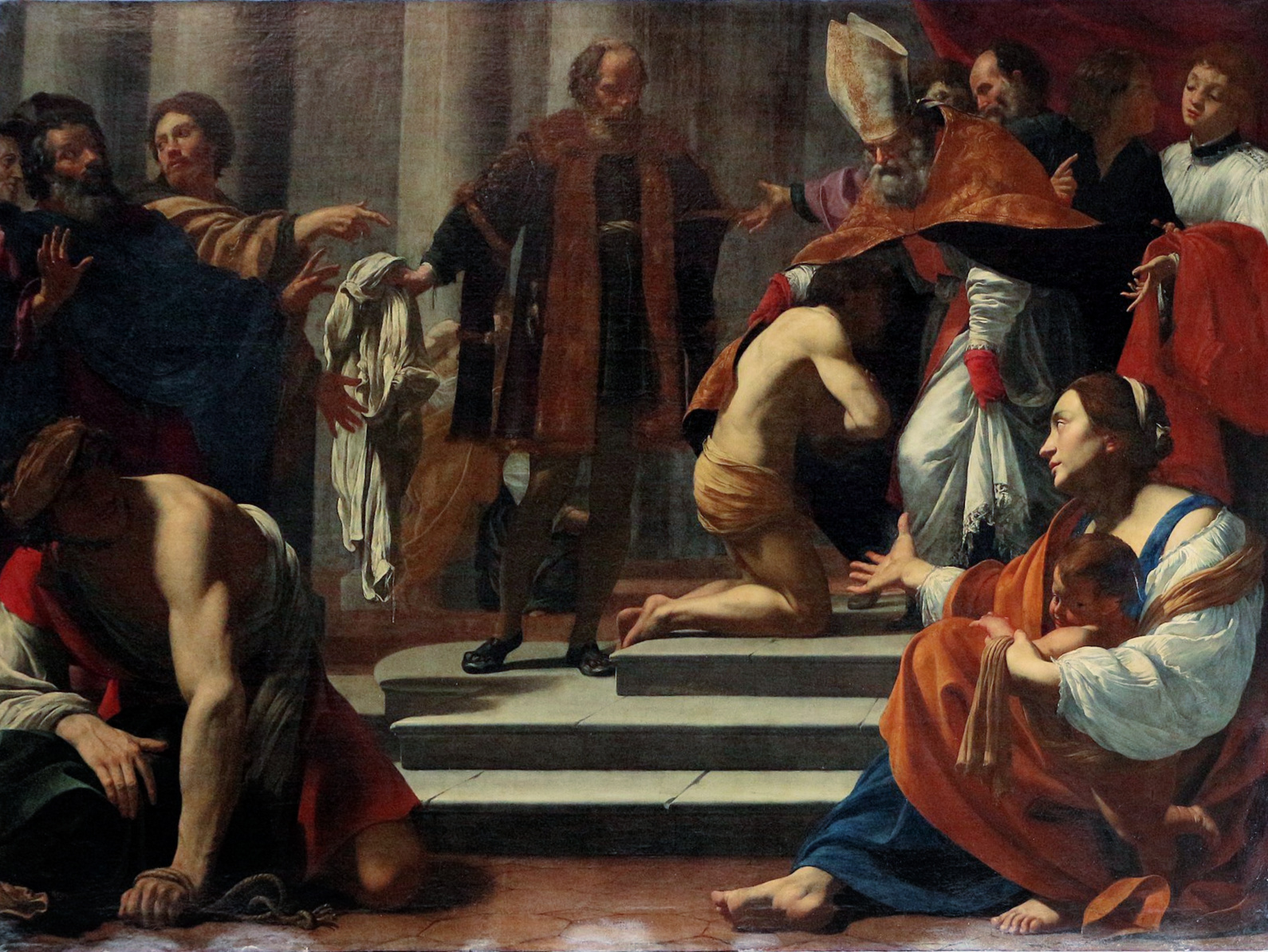
Le Valentin depicts Daniel in the painting instead of Suzanne in her bath which was a more popular subject. Suzanne is at right, her hands across her chest, “As she wept, she looked up to heaven, for she trusted in the Lord wholeheartedly” (Daniel 13:35). A guard seizes one of the wicked elders as the other shows surprise and incredulity. Young Daniel, at left, is seated on a throne under a red canopy and stretches out his hand in judgment over the scene for their sin. For each judgment by Le Valentin the artist was inspired in some of its details by Raphael’s artwork in Rome. Louis XIV acquired the painting in 1662.
Valentin de Boulogne, Martyrdom of Saints Processus and Martinian, 1629–30, Oil on canvas, 118 7/8 × 75 9/16 in. (302 × 192 cm), Vatican Museums, Vatican City.
Within iconography that is cyclonic, two Roman soldiers are placed on the rack to be tortured after they refused their commander’s orders to sacrifice to an idol. The soldiers had been converted to Christianity by Saints Peter and Paul when they guarded them in prison. The altar to Jupiter is on the upper left while, at right, the commander clutches his eye with his left hand after God blinded him in retribution for the idolatry. The foreground figures build on 16th century Franco Italian Mannerist style. One has his back to the viewer; another grinds the wheel of the rack; and, a third bends down with his arm outstretched. All are advanced expressions of realistic figural development and rendered in spatial perspective correctly.
Le Valentin’s powerful painting is an artwork with a psychological dimension. To the left, a hooded figure, Lucina, is a Christian woman who encourages the martyrs to be steadfast as an angel out of heaven extends a palm of martyrdom. To the right, realistically portrayed, is a Roman soldier indifferent to another brutal slaying by the authoritarian government in the face of nascent, meddling, heroic, and expanding Christians in their pagan global empire.
With his attention to detail, Le Valentin’s picture accomplishes an exciting imagined drama based on Renaissance-inspired natural world observation and by way of colorful contemporary 17th century formulations that give a viewer visionary immersion into a complex and significant Bible scene.
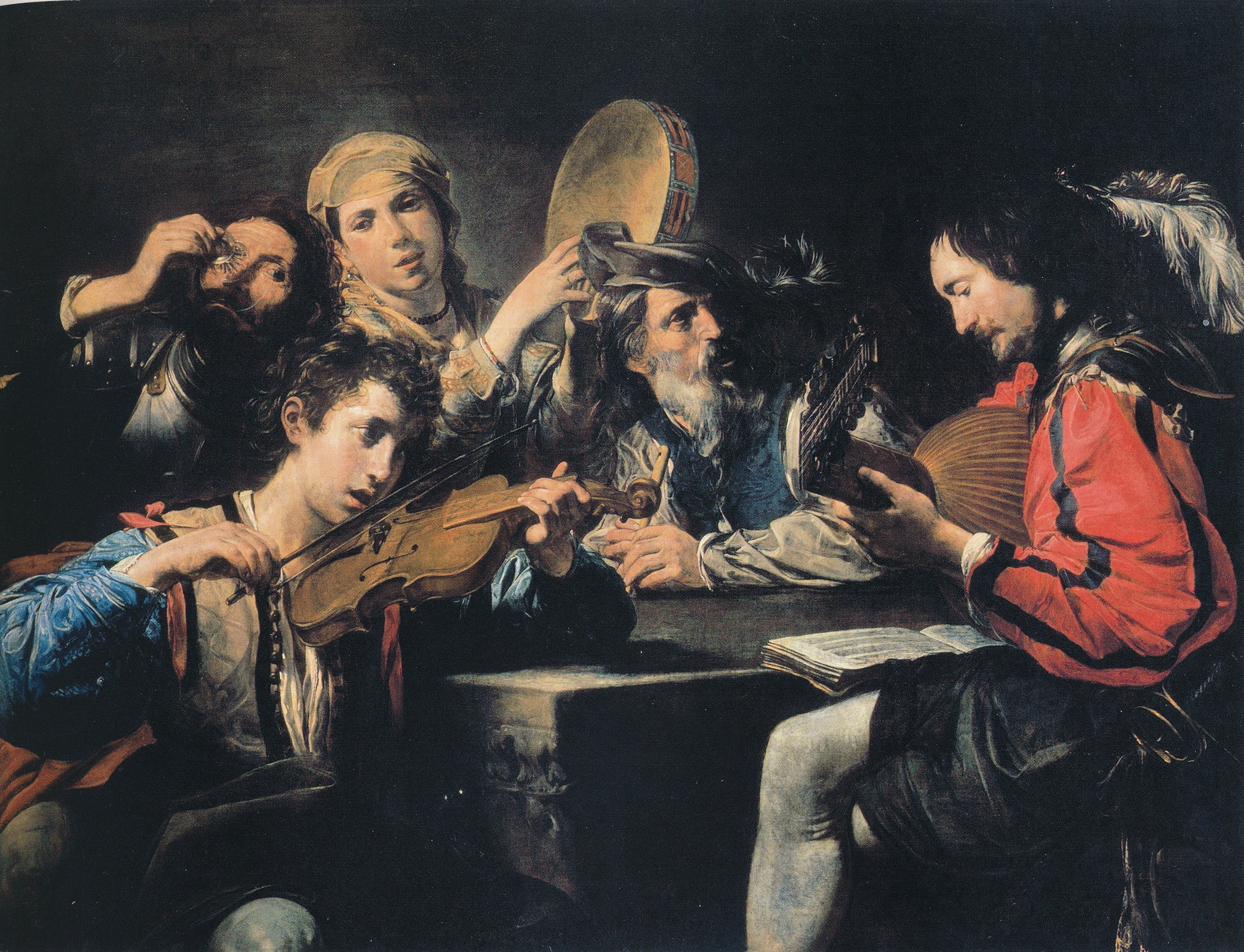
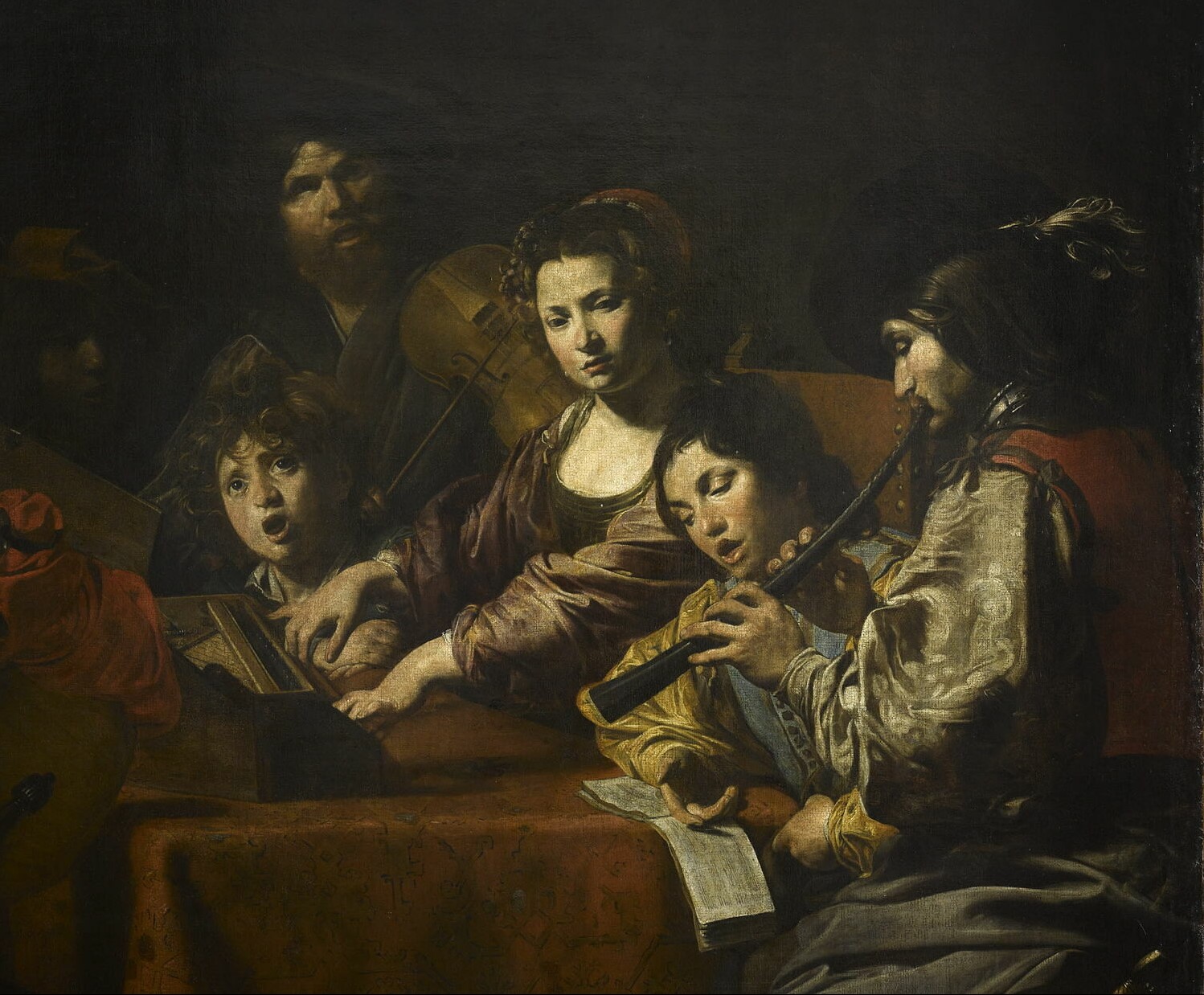
Some of Le Valentin’s great ambition as an artist is demonstrated by this large format canvas whose composition includes eight realistically delineated figures including 5 musicians and 3 singing youths. The five instruments are depicted accurately as well as the demeanors of the musicians and singers. Instruments have been identified by others as a polyphonic spinet, an alto, a chitarrone, a bass viol and a cornetto.
Detail. Concert in an Interior. Le Valentin.
The painting had been dated at around 1626, though more recent connoisseurship dates it to around 1628 or 1630. It was restored in 1940. It was owned by that avid art collector, Cardinal Mazarin.
Valentin de Boulogne (1591-1632), The Concert in bas-relief, 1624/26, oil on canvas, 1.73 m x 2.14m, Louvre.Detail. The Concert in bas relief. Le Valentin. Detail. The Concert in bas relief. Le Valentin.
Le Valentin painted seven figures gathered around a classical bas-relief. There are a pair of drinkers, one in the foreground, the other in the background; two singers; and three musicians – a violinist, guitarist and lutenist.
The painting, filled with mystery and gravity, is Caravaggesque and not merely telling a story or depicting a genre scene of performance. The painting has been dated to as early as 1622 by some connoisseurs. It was owned by Cardinal Mazarin and restored in 1959. It entered the collection of the Louvre in 1742.
Valentin never ceased producing genre paintings as attested by Concert with Eight Figures and Fortune Teller (both Musée du Louvre, c. 1628), and what is thought to be his very last painting, the Gathering with a Fortune Teller (Vienna, Liechtenstein Collection) in 1632.
Valentin de Boulogne (1591-1632), Musicians and Soldiers, c. 1626, oil in canvas, 155 x 200 cm, Musée des Beaux-Arts, Strasbourg.
This is a tavern scene with impromptu music-making among transitory musicians. They are playing for a pair of drinking soldiers. Le Valentin’s painting is Caravaggesque with its interplay of shadows and light, dark palette, and depiction of realistic figures, and a psychological vivacity that is imbued by Le Valentin. It is by his passion and energy for Caravaggio that Le Valentin helped revolutionize art in 17th century Europe.
Valentin de Boulogne (1591-1632), Jesus and Caesar’s Coin, around 1624, oil on canvas, 1.11 m x 1.54m, Louvre.
In Matthew’s Gospel the Pharisees were plotting to entrap Jesus by his own words. They sent some of their followers along with local government types (“Herodians”) to flatter Jesus as a truthful and humble man. They asked him to reply to a question: “Is it lawful to pay the census tax to Caesar or not?” (Mt 22:17).
Jesus, knowing their motivation, responded hardly very nicely, by calling them “hypocrites.” He asked them to show the coin that paid Caesar’s tax.
Le Valentin’s painting depicts the moment when the Pharisee’s henchmen show Jesus the coin with Caesar’s image and inscription on it. Jesus tells them: ”Repay to Caesar what belongs to Caesar and to God what belongs to God” (Mt 22: 21).
Owned by Louis XIV it was put in his dressing room at Versailles in 1680. The Louvre acquired it during the French Revolution in 1793.
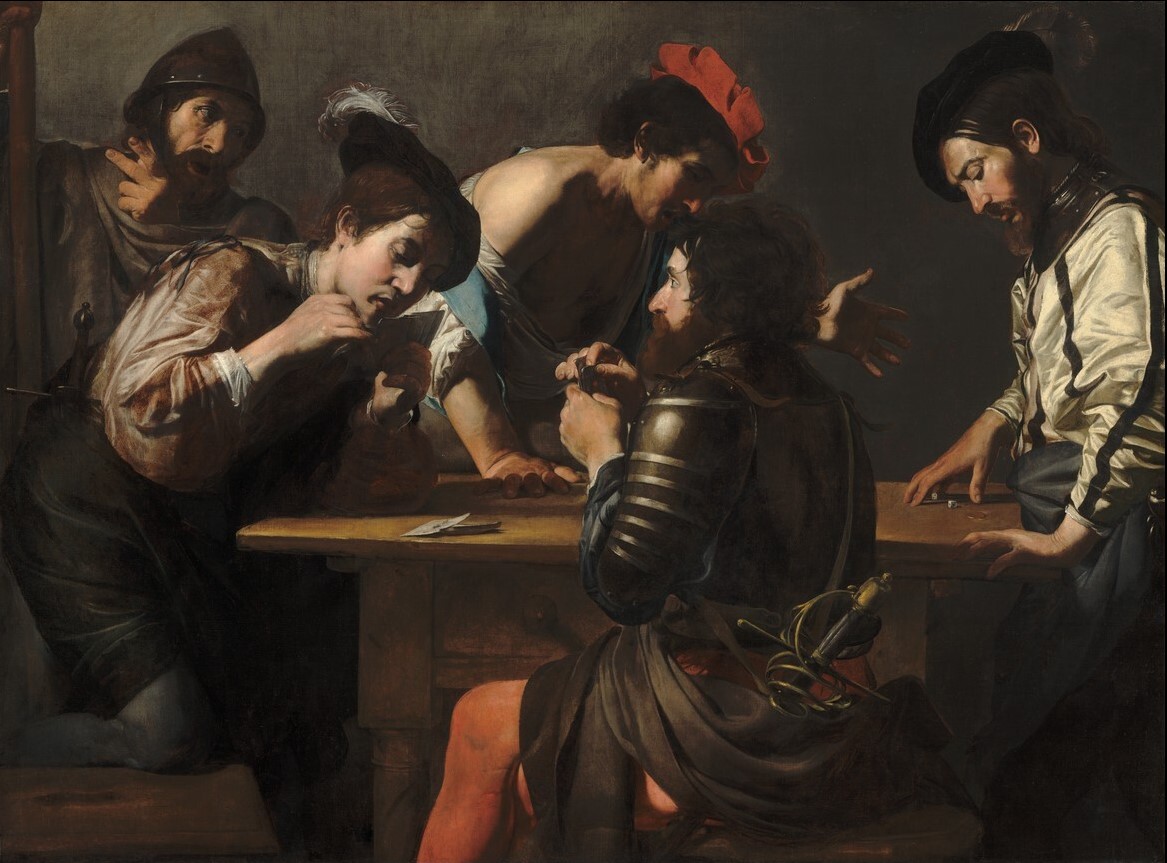
Valentin de Boulogne (1591-1632), Soldiers Playing Cards and Dice (The Cheats), c. 1618/1620, oil on canvas, 121 x 152 cm (47 5/8 x 59 13/16 in.), The National Gallery of Art, Washington DC. https://www.nga.gov/collection/art-object-page.107315.html
This painting is inspired by Caravaggio’s The Cheats in the Kimbell Art Museum in Fort Worth, Texas. Le Valentin’s painting, only discovered in 1989, shows a group of soldiers idling in Rome and identifiable by their piecemeal armor and other livery. The crowding of the figures into the picture space adds to the scene’s tension.
In this early painting in Rome, Le Valentin presents a scene of its contemporary street life. These figures are seriously gaming at a table where two players (center and right) roll dice and two others (left and center) play cards. A fifth figure in the background signals to his accomplice what is in the hand of the card player in a feathered hat. It is an early artwork that Le Valentin gives a psychological dimension.
As had been Caravaggio’s practice, the artwork is painted alla prima, that is, directly onto the prepared canvas without under-drawing or any preliminary work which works to give it greater spontaneity. The painting is indebted to Caravaggio not only for its subject, but for its vivid sense of actuality with which Le Valentin invested his protagonists as well as for the chiaroscuro, and a thinly and rapidly-applied brushed execution.
This painting is one of the first genre pictures Le Valentin painted in Rome. It is a pair of figures to which Le Valentin would soon numerically expand in his pictures. The composition is simple and sturdy.
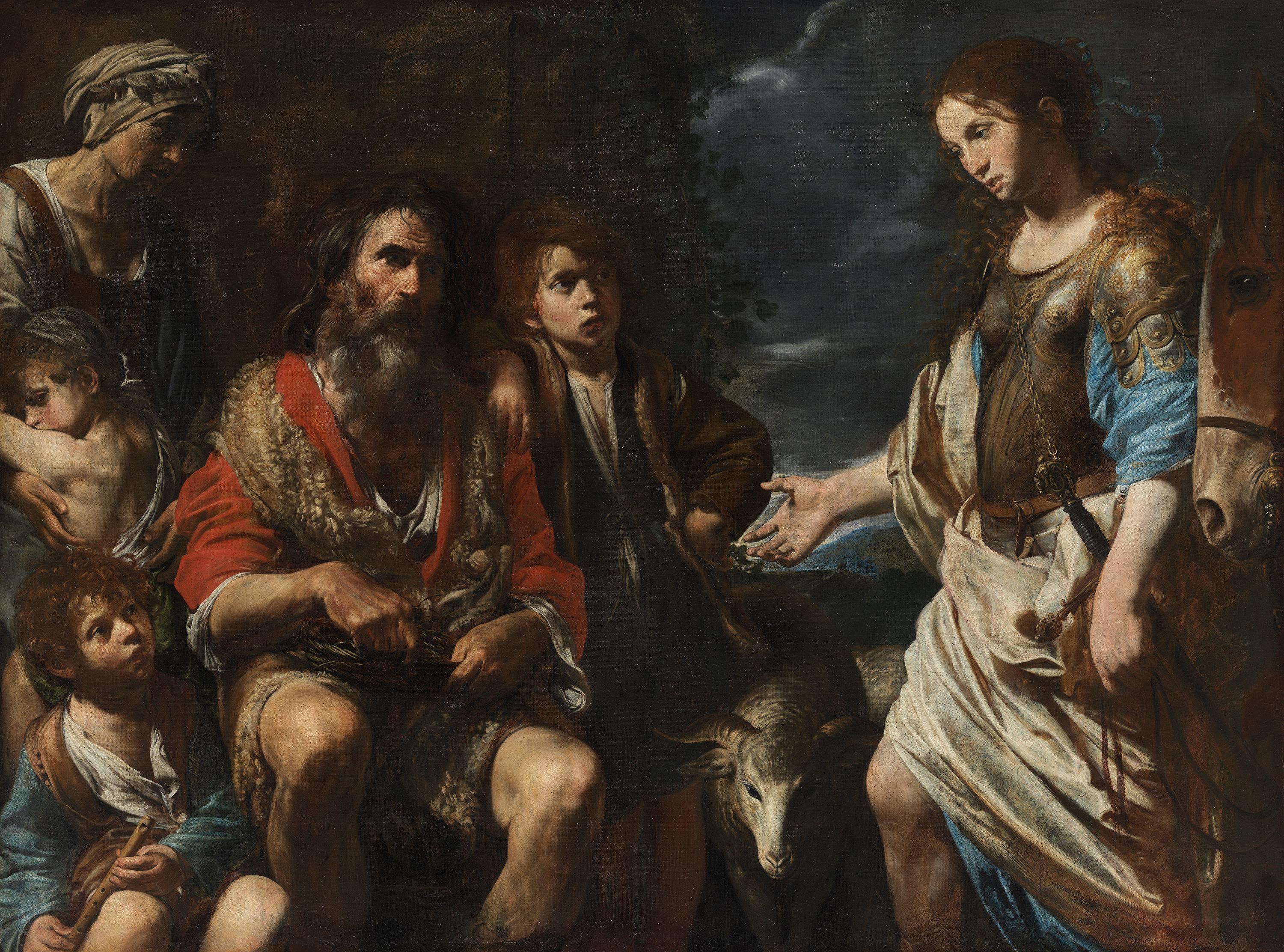
Valentin de Boulogne (1591-1632), Herminia among the Shepherds, c. 1630, oil on canvas, 134.6 x 185.6 cm (53 1/8 x 61 5/8”) Bayerische Staatsgemäldesammlungen – Alte Pinakothek München. https://www.sammlung.pinakothek.de/de/artwork/RQ4XPr8410
Erminia, the king’s daughter, escapes her persecutors and asks a peaceful shepherd family for shelter. The scene is based on a contemporary (1576) epic poem The Liberated Jerusalem by Torquato Tasso (1544-1595). The picture was a private commission whose patron was likely a Roman art collector and cognoscente. Valentin’s painting combines Caravaggesque chiaroscuro with exquisite coloring. In this realistic depiction of a human encounter between characters who represent contrasting social experiences, the subject matter is rendered psychologically sensitively.
Valentin de Boulogne (1591-1632), Crowning of thorns of Christ, around 1616/17, oil on canvas, 173 x 241 cm Bayerische Staatsgemäldesammlungen München-Alte Pinakothek, Munich https://www.sammlung.pinakothek.de/de/artwork/bwx0jkJGm8
One of the great artworks of Le Valentin’s early phase in Rome, biblical subjects painted before 1620 such as The Crowning of Thorns of Christ were interpreted in the street-life idiom, with expressive protagonists and bystanders resembling the cast of characters in his genre paintings. Although the painting was earlier believed to be by Caravaggio, it may have been a pendant to Le Valentin’s much-later Abraham Sacrificing Isaac (c. 1629) in The Montreal Museum of Fine Arts.
This is Le Valentin’s most ambitious of 3 such “crowning with thorns” pictures. The artist in horizontal-format depicts Jesus before his going to Calvary. Christ is mocked and tormented; a crown of thorns is pressed onto his head (Matthew 27: 27-31; Mark 15:16-21; Luke 23:11; John 19: 1-3). With its dramatic lighting and shadows, the naturalistic depiction of Christ’s body and soldiers in contemporary costume is Caravaggesque.
Le Valentin’s scene adheres to the Bible episode: a whole cohort of soldiers surrounded Jesus, stripped off his clothes and threw a scarlet military cloak on him. Henchmen have weaved a crown out of thorns and are placing it on Jesus’s head. Another puts a reed as a faux scepter into Jesus’s right hand. To mock him they kneel before him and say: “Hail, King of the Jews!” The soldiers spit on Jesus and then take the reed away and strike him repeatedly with it. When they were done with these violent actions, the soldiers stripped Jesus of the military cloak, dressed him in his own clothes and led him out to be crucified.
Le Valentin’s Passion theme is a later vertical-format picture of a subject he had painted masterly before. In these last years the subject matter had gained in classical beauty as well as psychological involvement compared to Le Valentin’s earlier artwork. The painting covers over a discarded portrait of Cardinal Barberini which suggests Valentin’s close relationship with the ecclesial prince, very likely being in his employ. What caused the artist to revisit the subject of a brutalized Christ is unclear though it may have been based on the artist’s own struggles or that of his employer whose portrait he painted over.
Valentin de Boulogne (French, 1591–1632), Noli me tangere c. 1620. Oil on canvas. Perugia, Galleria Nazionale dell’Umbria.Valentin de Boulogne (French, 1591–1632), Christ and the Samaritan Woman c. 1620. Oil on canvas. Perugia, Galleria Nazionale dell’Umbria.Valentin de Boulogne (1591-1632), Martyrdom of St. Lawrence, 1622/24, oil on canvas, 195 x 261 cm, Prado, Madrid. Spain.
St. Laurence (225-258)—Laurentius is Latin for ”laurelled”—became a popular early Roman martyr. Laurence has been continually highly honored by the church since the 4th century and is a patron of Rome.
In the mid 3rd century, Laurence was archdeacon to the new pope, Sixtus II (257-258). Sixtus II was martyred along with his seven deacons, including Laurence, during the persecution of Christians by Emperor Valerian (199-264). When Laurence met the pope, the pope was under arrest and Laurence expressed the desire to join him in his sufferings. Sixtus promised Laurence that martyrdom would soon be his but in the meantime asked his archdeacon to distribute the church property among the poor. Word of this planned dispersal reached the ears of the Emperor and Laurence was arrested.
Following the pope’s martyrdom by decapitation, Laurence, in prison, was ordered three days’ reprieve to collect and hand over the church treasures to the emperor. Instead, Laurence gathered and distributed these goods to Rome’s poor folk and presented the people to the emperor. These paupers appeared in Le Valentin’s painting to the left.
Infuriated, the emperor ordered the Catholic deacon to sacrifice to Rome’s gods which Laurence refused to do (in prison Laurence converted his guard) and was summarily condemned. After undergoing a series of tortures, the 32-year-old Laurence was martyred by the method of being roasted alive over a fire on a spit. The saint is famously quoted as telling his executioners: “One side is roasted, so you can turn me over and roast the other side.”
In the Prado Le Valentin gives orderly arrangement to a complex scene of 15 figures and a horse. It shows the saint during his martyrdom isolated in the center of the composition. As with Caravaggio’s figures, the soldiers are in modern costume, use of chiaroscuro is evident, and further drama is added by the use of diagonals whose construction suggest movement that add to the tension of the naturally rendered figures. However, Le Valentin uses these derived elements unconventionally.
St. Laurence is the patron saint of people whose occupation involves working with fire such as traditionally cooks, bakers, brewers, textile cleaners, and tanners and also those whose occupation values fire prevention such as traditionally librarians, archivists, miners, and poor people. St. Laurence of Rome is also, truly, the patron saint of comedians.
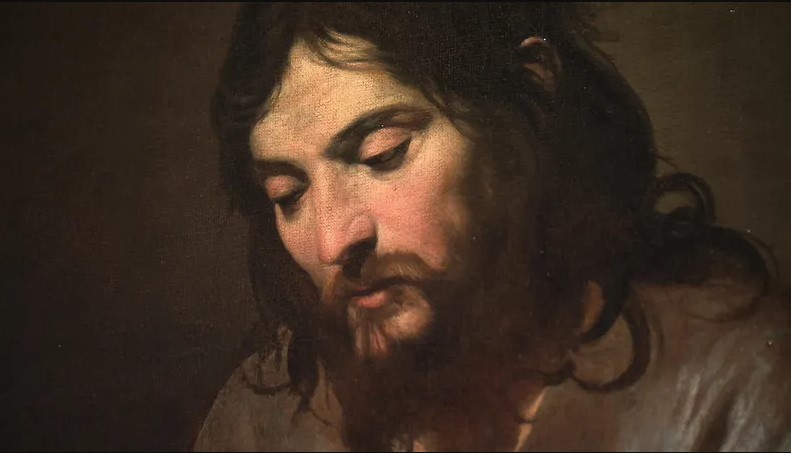
Valentin de Boulogne (1591-1632), St Luke, Evangelist, 1624/26, oil on canvas, 120 x 146 cm, Palace of Versailles, Versailles.Detail. St. Luke Evangelist. Le Valentin.
Dating from the years 1624-1626, le Valentin painted all four Evangelists (Matthew, Mark, Luke and John) for the same religious order in Rome whose name is unknown. They entered the collections of the Sun King in 1670.
Valentin de Boulogne (1591-1632), The Last Supper, c. 1625, oil on canvas, Galleria Nazionale d’Arte Antica, Palazzo Barberini, Rome.
For his The Last Supper, Le Valentin was, at least through engravings, aware of Leonardo da Vinci’s Last Supper (c. 1495–1498) in Milan and Raphael’s Last Supper (1518-1519) in Palazzi Pontifici, Vatican. Le Valentin explores the 12 apostles’ reactions. Commissioned by Asdrubale Mattei (d. 1638), one of Rome’s nobili, to decorate a gallery in his family’s palace, the picture depicts a central event presented in the gospels. The moment that is depicted in these Last Supper paintings is when Christ announces that one of his disciples will betray him. Judas, in the foreground left, was treasurer for Jesus’s disciples and betrayed Jesus for a bribe payment of 30 pieces of silver. The picture, with its simple and monumental composition, so impressed Jacques-Louis David (1748-1825) in 1779 that he copied it and sent it from Rome to Paris.
An Old Testament Judge, Samson was born in a miraculous fashion and with an angel telling his mother and father, “No razor shall touch his head” (Judges 13:5). Samson is often depicted with his locks unshorn. As a youth Samson displayed an incredible physical strength attributed to “the spirit of the Lord rushing upon him” (Judges 14:6).
Le Valentin’s picture presents Samson’s legendary strength by showing the solid demeanor of his physical body as well as objects which hold symbolic value of his strength. These include that he killed a lion with his bare hands and liberated the Israelites by slaughtering a thousand Philistines with a donkey’s jawbone (Judges 15: 15-16). The strength of his arm is displayed as his fingers curl under his jaw as his wandering gaze looks off with intense interiority. One contemporary allusion in the painting is Samson’s breastplate which is joined at the shoulder by a clasp in the form of a bee which was the emblem of the Barberini family who commissioned the painting. It is speculated that the facial features of Samson in a picture before his fateful meeting with Delilah (Judges 16), may be a self-portrait of Le Valentin.
Valentin de Boulogne (1591–1632), Judith with the Head of Holofernes. c. 1626-27. Oil on canvas. Musée des Augustins, Toulouse.
The story of Judith in the Old Testament relates of a woman of great beauty and reverence to the God of Israel who is highly respected by her people and its leaders. The nation, desperate for survival, turns to Judith who is given the opportunity to kill their enemy’s military leader which she believes she can and must do and that all believed impossible as Israel’s military defeat by their enemies was a foregone conclusion.
The story has a femme fatale aspect as Holofernes was captivated by Judith’s physical appearance, but the Biblical episode of the execution, while a climax of her mission, pales in comparison with the relating of Judith’s overall dedication to her people and her God, a femme forte, which carries on into her long life of blessedness to her natural death. Le Valentin chooses that sacred element of the Bible book when he shows an iconic Judith, triumphant woman of Israel, holding in her hands the decapitated head of one of Israel’s once-formidable mortal enemies. Judith is shown as a heroic woman with her hand raised as she admonishes: “But the Almighty Lord hath disappointed them by the hand of a woman.”
For Le Valentin’s artwork, Judith is an icon of God’s justice to his obedient people. Purchased for French King Louis XIV from German banker Everhard Jabach, the picture was installed in the king’s bedroom at Versailles to be especially admired.
The picture belongs to Le Valentin’s period of maturity for it displays the artist’s full interpretation of the realism of Caravaggio and Manfredi though, as expressed here, with a new appreciation for colors. The pretext of a Judith who, according to the Bible, had adorned herself in her best finery so not to dissuade Holofernes’s gaze (Judith, 13, 14), allows le Valentin to illuminate the dress’s rich fabrics with monochrome refractions, while the jewels and hair are bathed in ethereal light.
The Four Ages of Man is a painting commissioned by Cardinal Barberini. It is an allegorical work whose human figures are painted by Le Valentin in natural poses. Groups of figures around a table were common in the work of Caravaggio and his northern followers. The allegory of the ages of man was a common subject for paintings during the sixteenth and seventeenth century, though its quantity of ages varied.
The allegory presents humanity in four categories of age – childhood (holding an empty bird trap); youth (playing a lute); adulthood (with a book and victor’s laurel); old age (with coins of wealth and delicate glassware).
The theme had its origin in classical literature: Ovid’s Metamorphoses and Dante’s Inferno acknowledged the stages of human life according to physical growth and decline. Contemporary poems were written on the subject that Le Valentin may have known.
In the 17th century, the painting was owned by Michel Particelli, seigneur d’Emery (1596–1650) in Paris. In the 18th century it was in the Orléans collection at the Palais Royal. During the French Revolution and the dispersal of the collection in 1791, the painting was brought to England where it is today.
Le Valentin painted many half- or three-quarter-length figures of saints, prophets and narrative scenes including this painting. The scene of Christ expelling the moneychangers from the Temple of Jerusalem is told in all four gospels of the New Testament. Le Valentin adapted the method of half-length, full size street figures depicted in dark, precisely lighted spaces and emerging in relief from the shadows from the Caravaggistes.
Gospel readers would recognize that the cleansing of the temple was prophesied in the Old Testament as a sign of the ushering in of the Messianic Age (Zechariah 14:21). In the synoptic gospels (Matthew, Mark and Luke) the episode appears at the close of Jesus’s public ministry and in John’s gospel at the start (2:13-17). The chronology of the episode in Jesus‘ ministry is generally not considered its most important element.
Le Valentin shows the “whip of cords” held by Christ, a detail mentioned only in John (Jn 2:15). There are overturned tables, a bench, and scattered coins. Le Valentin depicts the gestures, movements and emotions of the characters involved, focused on a wrathful Christ and fear of the unrighteous.
While in Synoptics the point of the episode appears to be the dishonesty of the Temple money changers, in John’s gospel Jesus’s wrath is directed to the Temple institution itself. In John’s Gospel Jesus declares the Temple is to be “My Father’s house.” Though not a term unique to John, he uses it more than any other Gospel writer (27 times).
Derived from Caravaggio are the types of ordinary people, distinct contrasts of light and shade and the natural plasticity of the figures involved in the composition.
The painting entered the Hermitage collection in 1772.
Valentin de Boulogne (French, 1591–1632), Expulsion of the Money Changers from the Temple. Oil on canvas, 195 x 260 cm (76 ¾ x 103 1/8 in.). Palazzo Corsini, Rome.
The painting’s structural asymmetry lends energy to the scene. With Christ’s raised arm, he is a menace to the money changers. Le Valentin, taking inspiration from Caravaggio, unabashedly renders a scene in grand format of violence in the gospels. The painting was rediscovered in Rome in the mid19th century.
The oil painting called Allegoria d’Italia by Le Valentin was originally called Historia d’Italia. Its massive volumes imbued with inner life are rendered using a brown palette and highlights that retained the Caravaggiste tradition. Le Valentin’s redoubling his commitment to Caravaggio in the late 1620s was on display in this painting as other leading painters, such as Vouet, Poussin, Giovanni Lanfranco (1582-1647) and Pietro da Cortona (1597-1669), were deploying brighter “modern” colors.
In March 1628 Cardinal Barberini gave Le Valentin the commission for the Extraordinary Jubilee of 1628 and paid 113 crowns for it. This major painting which renewed Caravaggio-inspired technique in the late 1620s attracted greater attention to Le Valentin’s artwork not only by Caravaggeschi but the broader Roman art circles.
A young Roman girl wears an emperor’s cuirass, holds a spear and shield, as the personification of Italy. At her feet are the fruit and nuts of the land’s bounty. Below her image are two male figures, naked and bearded, who represent the Tiber and the Arno, Italy’s great rivers. The figure of the Tiber is joined by Romulus and Remus and the suckling wolf who founded Rome and the later Papal States. The Arno that runs through Florence is joined by its symbol of the lion. In the top left corner, a tree stump with a bee swarm symbolizes the Barberini.
The gospel story that Le Valentin depicts using the typical Caravaggiste method (half-length, full size street figures in shadow and light) is from John 8. The story had been painted by the Flemish and the Venetians. The plump young woman in a torn garment exposing her shoulders and full-formed breasts is taken into custody by soldiers in armor to Jesus. According to the law the woman should be publicly stoned for adultery. The Pharisees lay verbal and other traps repeatedly in the gospels for Jesus to say or do something that is expungable. Jesus’s response moves past their premise. Whereas Jesus will soon be arrested, tried, and condemned by the authorities for his “transgressions,” the focus of le Valentin’s artwork is Jesus showing mercy to the sinful woman. From a theological viewpoint, Jesus’s innovative teaching is again based on the appeal to an extant biblical tradition of God’s anger towards, and forgiveness of, harlotry or unfaithfulness when such sin is repented (Hosea 5:4). Jesus tells her: “Go and sin no more” (John 8:11). While the woman’s disheveled look suggests the nature of her sin, she represents humankind and points to Christ, the God-Man and prophesied suffering servant (Isaiah 53). Christ takes the harlot’s place as the arrested agitator and manhandled by soldiers along the Via Dolorosa. In that episode, Christ goes to the cross to shed his blood in the new covenant whose outcome for “adulterous” humankind is eternal forgiveness of sins and rising to new life.
The image of a young soldier singing in armor breastplate a love madrigal is unique in Valentin’s oeuvre. The painting was part of the collection of Cardinal Mazarin, minister to Louis XIV.
Valentin de Boulogne (1591-1632), Return of the Prodigal Son, c. 1615–16, oil on canvas, 59 1/16 × 70 1/16 in. (150 × 178 cm), Museo della Venerabile Arciconfraternita della Misericordia, Florence.
One of Jesus’s most famous parables, The Prodigal Son tells the story of a young man who demanded his “full share of [his father’s] estate that should come to [him],” and departed to waste it “on a life of dissipation” (Luke 15). When the lost son falls on hard times, he seeks his father’s house though “only as a hired servant.” The forgiving father who has been on the look-out for his lost son (dressed in rags) since the day of his departure welcomes him back as a son “who was dead and has come back to life.” Which of the other figures may be the older brother who is unhappy about his dissolute brother’s return is not clear. Le Valentin treats the parable as a human story of repentance, forgiveness, and unconditional love.
The attribution to Le Valentin and its dating for this artwork is the result of modern scholarship. Art historians can thereby draw conclusions and make conjectures about the development of Le Valentin’s early artwork in Rome -he uses a larger format, growing complexity of compositional qualities and its subject matter, and the retention of low-life characters and stylistic indebtedness to Caravaggio as he moves beyond him.
A dark tavern filled with low-life characters provides the setting for a scene of fortune and deceit. As a gypsy fortuneteller reads the palm of a young soldier he is looking pensively as she speaks his fate, there are carousers and thieves in the scene. The picture is emblematic of Le Valentin – the techniques of a somber palette and dramatic lighting and tabletop groupings but also a mysterious mood and psychological depth to the complex interplay among its characters.
Valentin de Boulogne (French (active Rome), 1591-1632), Portrait of Roman Prelate, 128 x 94 cm, private collection.
The prelate is dressed in the robes of a papal chamberlain. Modern scholarship has proposed various individuals as the sitter from cardinals to lawyers.
Moses led the Israelites out the slavery of Egypt into the freedom of the Promised Land during the Exodus. The event is told and retold in the Old Testament and Moses as Liberator and Law Giver is its most significant figure. Le Valentin shows him holding a miraculous rod that he used to open the Red Sea (Exodus 14), struck the rock to produce water (Numbers 20) and, after its transformation into an iron snake, healed the ill (Numbers 21). Moses points to the stone tablets of the Ten Commandments of God (Exodus 20; Deuteronomy 5). This late work by Valentin is characteristic in its dark and pensive tone that is reminiscent of Caravaggio.
The picture is one of Valentin’s last paintings before his death in 1632. Prince Hans Adam Il von und zu Liechtenstein (b. 1945) acquired the work in 2004. Throughout his painting career, Le Valentin never ceased producing genre paintings.
SOURCES:
A Dictionary of Art and Artists, Peter and Linda Murray, Penguin Books; Revised,1998.
French Paintings of the Fifteenth through the Eighteenth Century, The Collection of the National Gallery of Art Systematic Catalogue, Philip Conisbee and Frances Gage, Washington, D.C., 2009 pp, 413-414.
Art for the Nation, text by Philip Conisbee, National Gallery of Art exhibition catalogue, 2000.
French Painting From Fouquet to Poussin, Albert Chatâlet and Jacques Thuillier, trans. from French by Stuart Gilbert, Skira, 1963.
The Saints: A Concise Biographical Dictionary, edited by John Coulson, Guild Press, New York, 1957.
The New American Bible, Catholic Book Publishing Corp, New York, 1993.
Mannerism: The Painting and Style of The Late Renaissance, Jacques Bousquet, trans, by Simon Watson Taylor, Braziller, 1964.
The Liberation of Jerusalem, Torquato Tasso, trans by Max Wicker, Oxford World’s Classics, 2009.
Valentin de Boulogne: Beyond Caravaggio, Annick Lemoine, Keith Christiansen, Patrizia Cavazzini, Jean Pieere Cuzin, Gianni Pappi, Metropolitan Museum of Art; 2016.
Raymond E. Brown, Joseph A. Fitzmyer, S.J, and Roland E. Murphy, O. Carm.,The Jerome Biblical Commentary, Prentice Hall Englewood Cliffs, NJ, 1968.
Lehmbeck, Leah, editor. Gifts of European Art from The Ahmanson Foundation. Vol. 2, French Painting and Sculpture. Los Angeles: Los Angeles County Museum of Art, 2019.
Marandel, J. Patrice and Gianni Papi. 2012. Caravaggio and his Legacy. Los Angeles: Los Angeles County Museum of Art.
Fried, Michael. After Caravaggio. New Haven: Yale University Press, 2016.
Schmid, Vanessa I., with Julia Armstrong-Totten. The Orléans Collection. New Orleans: New Orleans Museum of Art; Lewes: In association with D. Giles, 2018.
Merle Du Bourg, Alexis. “L’omniprésence de la musique.” Dossier de L’Art no.246 (2017): 64-67.
FEATURE image: Eugène Boudin, The Beach at Villerville, 1864, Oil on canvas, 18 × 30 1/16 in. (45.7 × 76.4 cm), National Gallery of Art, Washington, D.C.
In 1893, in the last years of his long and successful art career, 69-year-old Eugène Boudin returned to the Normandy coast for which this French painter of skies and beaches is rightly associated. It was at this time that he painted Sunset on the Beach (below) in a private collection. After Boudin began to be widely collected in the 1870’s and 1880’s he traveled and lived and worked far away from the region where he was born and grew up and had embarked on a career as an artist. Yet, as soon as the mid-to-late 1850’s, important artists and writers were already appreciating the sensitivity to which Boudin painted artwork in nature. Charles Baudelaire (1821-1867) believed he could identify with precision the season and hour of Boudin’s subject matter. Realist painter Gustave Courbet (1819-1877) who once said “show me an angel and I will paint him” called Boudin a “seraph.” Remarkably, Barbizon painter Camille Corot (1796-1875) exclaimed: “Boudin, you are king of the skies!”
Eugène Boudin (1824-1898), Sunset on the Beach, oil on canvas, 1893, private collection.
Throughout the mid-to-late nineteenth century, Boudin’s subject matter was timeless land, sea and skyscapes which he sometimes populated with contemporary human figures in modern bourgeois costume and dress. Often, the landscapes are devoid of human presence excepting the artist’s gaze.
Eugène Boudin, White Clouds over the Estuary, c.1857.Eugène Boudin, Crinolines on the Beach, 1863.Eugène Boudin, Douarnenez, Fishing Boats at Dockside, 1855. Eugène Boudin, Deauville, Low Tide, c.1863.Eugène Boudin, The Beach at Villerville, 1864, Oil on canvas, 18 × 30 1/16 in. (45.7 × 76.4 cm), National Gallery of Art, Washington, D.C.
Boudin was a friend of the Impressionists and exhibited in their first exhibition in Paris in 1874. Claude Monet (1840-1926), born in Paris, also grew up in Normandy. Boudin and Monet painted together en plein aire as each sought, discovered, and honed their artistic styles.
Eugène Boudin ,Seascape with Large Sky, 1860.
Boudin did not think of himself primarily as an avant-garde artist and did not exhibit in the Impressionist exhibitions after 1874. Yet, with these Impressionists, Boudin’s artwork depicted light and its reflections, especially its darker filaments, in preference to volumes and forms.
In addition to beach scenes, skies, sea, and countryside, Boudin painted still life, animals, and a few portraits. In the 1870s Boudin painted harbors and ships. In his subject matter his pictures presented a complete and even-handed depiction, evocative of eighteenth-century genre paintings.
Eugène Boudin, Spray of Flowers – Hollyhocks, 1858.Eugène Boudin, study of cows, c. 1860.Eugène Boudin, Vue de Trouville, 1873.Eugène Boudin, Entrance to the Harbor, Le Havre, 1883, National Gallery of Art, Washington, D.C.
Slightly older Dutch painter Johan Jongkind (1819-1891) had encouraged Boudin to paint outdoors. Boudin, now surrounded by nature, became increasingly spontaneous in his artwork and used brighter colors.1
Eugène Boudin, Trouville, Shore and Rocks, c.1862.
In 1859, 35-year-old Eugène Boudin, the painter of seascapes and beaches, made his debut at the Salon. The annual Salon began in the late 17th century (1667). It was sponsored by the monarchy and highlighted artwork of members of the Academie royale de peinture et de sculpture. The all-important Salon operated in this basic form for almost 200 years. It was held irregularly at first (frequently there would be no exhibition held for years) though between 1774 to 1792 the Salon was held biennially.
This elite Salon was a competitive platform for artists to display their work where the goal was to gain public and private commissions. The Salon was the sole venue in France for contemporary fine art and was popular to visit by a cross-section of society where many purchased the livret, the Salon’s official catalogue. In 1795 during the French Revolution the historically royal venue was opened to all artists. This more inclusive Salon experience led to the extension of official French art’s influence throughout Europe. In the Salon of 1800, American artists exhibited for the first time.2
Between 1864 and 1879 Boudin exhibited in the Salon every year.3 However, important critics, such as the influential Albert Wolff (1835-1891), ignored Boudin for much of this time. It was in 1881, 22 years after Boudin’s Salon debut, that M. Wolff published an article in Le Figaro that led to Boudin’s greater official recognition.4
In the last decades of the 19th century, Boudin exhibited yearly from 1880 to 1889 at the Salon des Société des Artistes Français5 and, with a single exception, from 1890 to 1897 at the Société National des Beaux-Arts.6 Some of Boudin’s works were bought by the State in the late 1880’s and early 1890’s.7 Ernest Chesneau (1833-1890) had written on Boudin in Paris-Journal that while the painter was ignored by official art world critics he was a “real talent” among the Salon’s “latest banalties.”
In 1881 control of the Salon was ceded to the Société des Artistes Français. In the 1880’s and 1890’s there were several groups outside the Salon who mounted exhibitions. These included the one-time Salon des Refusés in 1863, the Société des Artistes Indépendants or Salon des Indépendants, beginning in summer 1884, and the salons of the Société nationale des beaux-arts, from 1890. These types of independent, unofficial exhibitions, continued into the 20th century with the Salon d’automne in 1903.8
In 1859 Boudin met Gustave Courbet who introduced Boudin to the poet and art critic Charles Baudelaire. Courbet, painting at Boudin’s side, exclaimed: “Mon Dieu, you are a seraph, Boudin! You are the only one of us who really knows the sky!” In 1861 Boudin met Camille Corot who called Boudin the “king of the skies.”
Eugène Boudin, Elegant Women on the Beach, 1863.
Charles Baudelaire noted in 1859 that he had seen in Boudin’s studio “hundreds of pastel studies improvised before the sea and the sky.” Baudelaire described these artworks as “the prodigious magic of air and water.”9 The economy of Boudin’s artwork with its summary figures of modern life attracted Baudelaire’s praise during the 1859 Salon. Baudelaire became convinced, when looking at a Boudin painting, that he could identify the season, hour and wind direction of the subject matter depicted in pastel or paint.10
Eugène Boudin, Near Honfluer, c.1856.
At the Impressionist Exhibition of 1874, the critic Castagnary (1830-1888), author of “The Triumph of Naturalism” in 1868, wrote on Boudin in Le Siècle. He cited “the very high prices” that Boudin was experiencing as collectors “fought over” his beach scenes and seascapes. Castagnary concluded in 1874 that the 50-year-old Boudin had “commanded respect for years.”11 In 1868 Boudin’s auction of 40 paintings and 100 watercolors and pastels at the Hôtel Drouot had been quite successful. That same year Boudin won a silver medal at the Exposition maritime international exhibiting with Courbet, Charles-François Daubigny (1817-1878), Monet and Édouard Manet (1832-1883).
In 1874, Marc de Montifaud (Marie Amélie Chartroule, 1850-c.1912), art critic for L’Artiste and soon to found L’Art modern magazine in 1875 (and which merged with Les Beaux-Arts in 1877) cited the titles of a few paintings by Boudin out of the 13 works he exhibited which included watercolors and pastels. Yet De Montifaud’s placement of Boudin’s work under the category of “marine paintings,” did little to elucidate exact canvasses when the time came later to identify such.12
In the 1860’s Paris dealers such as Martin, Hagerman and Gauchez were regularly buying his work. Boudin’s growing reputation and financial security enabled him to travel extensively in the 1870s and 1880s. Boudin, who married Marie-Ane Guédès in 1863, painted in Belgium, the Netherlands and southern France in that period. From 1892 to 1895 he regularly visited Italy, traveling to Venice. In addition to being awarded medals at the Salon, the Exposition Universelle in 1889, and other exhibitions, Boudin, in 1881, became represented by Paul Durand-Ruel (1831-1922).
Eugène Boudin, Place Ary Scheffer, Dordrecht, 1884, oil on panel 27×21.5 cm Dordrecht Museum, Netherlands.
In the late 1870s Boudin, then without dealer representation, held several auctions of his artwork which produced varying sales results. In 1881, Durand-Ruel bought all of Boudin’s studio inventory. In 1883 Boudin had a solo exhibition at Durand-Ruel’s that featured 150 paintings, and pastels and watercolors and in 1886 an exhibition of 23 works at Durand-Ruel’s in New York City. From July 8 to August 14, 1889 – the year Boudin’s wife died – the artist staged a one-man exhibition in Paris at Durand-Ruel’s featuring 98 pictures.13 In 1890 Boudin held an exhibition at Durand Ruel’s in Boston featuring 13 paintings and a solo exhibition in Paris at Durand-Ruel’s with 34 paintings, and as many pastels and several drawings in 1891.
Eugène Boudin, Le port d’Antibes, 1893, Musée d’ Orsay.
As a refuge for his ill-health, Boudin lived in the south of France for many years but finally returned to Deauville. In 1898 Boudin died at 74 years old under the skies of La Manche which he had been inspired to paint often.
In 1892 Eugène Boudin was made a knight of the Légion d’honneur which recognized the artist’s talent and influence on the art of his contemporaries. Today, the Société Nationale des Beaux-Arts gives the Eugène Boudin Prize.
Eugène Boudin, Étretat 1891,Chazen Museum of Art, Madison, Wisconsin.
After Boudin’s death, his artistic reputation continued to grow. In 1899, The École des Beaux Arts held a major retrospective with 457 works (including 364 paintings, 73 pastels, and 20 watercolors). Boudin was praised by art critics Roger Marx (1859-1913), Arsène Alexandre (1859-1937), and Guillaume Apollinaire (1880-1918), among others,
Despite the artist’s modest consideration for his art, Boudin was viewed in retrospect by 20th century’s critics as an initiator of the avant-garde, though he did not quite ascend to the turbulent aesthetic heights of Manet and Monet.14.
In 1872, art critic Louis Duranty (1833 -1880) published a short story that included fictional and historical characters including artists such as Boudin, Manet, Corot, Jean-François Millet (1814-1875), Edgar Degas (1834-1917), and Courbet. Of Boudin, Duranty wrote: “Here is a simple, sagacious, conscientious mind who puts forward (the artwork’s) feeling in gray, fine, fair notes.”
FEATURE image: Ulysses and Penelope, Francesco Primaticcio called Le Primatice (1504-1570), Toledo Museum of Art, c. 1560, oil on canvas, 44 3/4 x 48 3/4 in. (113.6 x 123.8 cm).
Jean Perréal (1455-1529), Portrait Louis XII, c. 1514, Windsor collections de S.M. la Reine d’Angleterre.
Jean Perréal’s most important attribution is this portrait of Louis XII who was King of France from 1498 to 1515. Louis XII was married three times – the first annulled; the second leaving the king a widower, and, in his last three months of life, to Mary Tudor (1496-1533), the favorite sister of King Henry VIII of England. Despite these wives, the king had no living sons. The Salic Law prohibited his line to continue on the French throne through his daughters. When Louis died in 1515, his throne eventually passed to his cousin, Francis I.
Jean Perréal (c.1455-1530) was Court painter to the Bourbons and later worked for the kings of France starting with Charles VII. Perréal journeyed to Italy several times. In 1514 he went to London to paint Mary Tudor’s portrait and supervise her new dresses as Mary, aged 18 years, sister of the English king, married the 52-year-old King Louis XII of France.
Master of Saint Giles (active 1490-1510), St. Giles protects a wounded deer for Charles Martel, c. 1500, National Gallery, London, oil on oak, 63.4 × 48.4 cm.Master of Saint Giles (active 1490-1510),Virgin with Child, c. 1500, Louvre.Master of Saint Giles (active 1490-1510), St. Giles’ Mass, c. 1500, National Gallery, London, oil on oak.
The Master of Saint Giles was a Flemish or Flemish-trained painter who was active in France. He is named after artworks in London attributed to the artist called Scenes from the Legend of St. Giles. As the artist’s identity is obscure, the saint depicted in his artwork is shrouded in legend.
St. Giles is possibly an 8th century hermit in France who became the patron saint of beggars, the handicapped, and blacksmiths which was an important trade in the Middle Ages. In one work, the artist depicts a famous story about St. Giles. Before King Flavius’s hunting party, he protected a deer from their bows and arrows. The king was apologetic and Giles persuaded him to establish a Provençal monastery in which St. Giles served as its first abbot.
IlRosso (1494-1540), La Fontaine de Jouvence (The Fountain of Youth), c 1535, fresco, Chateau de Fontainebleau, Galerie Francois I.
France conducted wars in Italy starting in 1494 that continued into the 16th century. By way of this warmongering, many of the Italian Renaissance’s ideas and practices were brought back to France. In the 12th century French ideas, particularly of chivalry and the troubadours, were brought back to Italy following trade expeditions by Italian merchants. After fighting ceased, King Francis I invited Italian artists into France, most famously Leonardo da Vinci (1452-1519) in 1516. Following more war in Spain, Francis I in 1526 began a revolution in art in France making the Château de Fontainebleau one of the most active artistic centers in Europe. It attracted many Italian artists such as Primaticcio or Primatice (c. 1504-1570) and Il Rosso (1495-1540). The French Renaissance, under the influence of Italian masters, synthesized French and Italian art whose style was later described as the School of Fontainebleau. Il Rosso or Rosso Fiorentino was a friend of Pontormo (1494-1557) and worked under Andrea del Sarto (1486-1530), a founder of Italian Mannerism. He first worked in Florence (1513-1523) and then in Rome (1524-1527). German troops of the Holy Roman Emperor Charles V (1500-1558), making war in Italy, sacked Rome in 1527. By these means, what Rome lost, France gained: Il Rosso wandered about Italy for a while so that by 1530 he was in Venice and, in that same year, onward to France. At Il Rosso’s arrival to Fontainebleau he became, soon with Primaticcio, one of the founders of the Fontainebleau style which had a tremendous influence on French painting from that time until about 1610. Reputedly a neurotic person, Il Rosso’s death was accounted a suicide by Vasari though that is unconfirmed. The classic style found in Il Rosso’s The Fountain of Youth was increasingly replaced by his later emotionally charged style as in Pietà in 1540.
Primaticcio (c.1504-1570) was a founder of the Fontainebleau School in France with his fellow Italian artist Le Rosso in the 1530s. Primaticcio was a talented artist of universal range – from painting and interior decoration to sculpture and architecture.
From the mid1520s to 1532 Primiticcio trained in Mantua under Giulio Romano (c. 1499-1546). He was called to France by King Francis I in 1532 where he worked at Fontainebleau with Le Rosso. Between 1540 and 1542 the artist represented the king in Italy on an art buying expedition. In that time when he was away Rosso died, and Primiticcio, upon his return to France, began working with Niccolò dell’Abbate (c. 1509-1571) at Fontainebleau. It was in this period that he produced decorations in the galerie d’Ulysses that have been lost. In 1546, and again in 1563, Primaticcio went to Italy where on one trip he made casts of Michelangelo’s sculpture and in the other met Vasari.
The style of the painting is Mannerist which predominated in the 16th century. Mannerists went beyond the depiction of nature to flights of imagination and invention. For a stylistic statement, forms were twisting and elongated giving them greater pliability. Mannerists rejected the High Renaissance’s reliance on strict perspective and symmetry and preferred to construct compressed spaces with shaded tones, harsh colors, and the overall feeling of dreaming while awake.
After battling the Trojans and other subsequent troubled adventures, Greek hero Odysseus (Ulysses) has returned home to his wife, the faithful Penelope. Into the night, the reunited lovers recount their lives apart from one another. While Penelope counts the number of suitors on her hands who she held at bay, Ulysses cradles her chin in a gesture of tenderness and compassion. The composition is based on one of 58 wall frescos of scenes from Homer’s Odyssey at the palace of Fontainebleau near Paris. Unfortunately, the Gallery of Ulysses, Primaticcio’s masterpiece, was destroyed in 1738 after it had been allowed to decay over 200 years.
A preparatory drawing by Primaticcio in the Louvre for a lost composition of the cycle of L’Histoire d’Alexandre painted in the Room of the Duchess of Etampes in Fontainebleau. It was the masquerade that brought about the fire in Persepolis, an historic event that took place in 330 BCE when Alexander the Great conquered the Achaemenid Persian Empire following the battle of Guagamela the year before.
It is not disputed in history that after Alexander arrived to the Persian capital city of Persepolis it was looted and burned to the ground, destroying many great cultural treasures. Though recorded by several historians, accounts vary. The first century Roman historian Quintus Curtius Rufus wrote that while drunk during a large celebration with his companions, attendants and courtesans, Alexander himself started the fire as the rest joined in. (see – https://www.worldhistory.org/article/214/alexander-the-great–the-burning-of-persepolis/
Niccolò dell’Abbate (c. 1509-1571), The Death of Eurydice, c. 1550s-1560s, oil on canvas, 189.2 × 237.5 cm, National Gallery London.
Niccolò dell’Abbate was from Modena in Italy. He was influenced by the sculptural and optical illusion achieved in the artwork of Andrea Mantegna (1431-1506). He was also influenced by Correggio (1489-1534), a master of chiaroscuro. By 1552 dell’ Abbate was in France helping Primaticcio at Fontainebleau with the royal chateau’s interior decorations though most of his artwork has disappeared. The Death of Eurydice is a fine example of the Mannerist landscape which the artist is responsible for having introduced into France.
Le Maître de Flore (active 1540-1560), Le triomphe de Flore (The Triumph of Flora), private collection (Vicenza).
Le Maître de Flore is a French painter of the mid16th century Fontainebleau School. The use of the moniker Maître de Flore derives from this and another artwork.
The painting above by the Master of Flore in the Metropolitan Museum of Art in New York is seen as depicting the birth of Cupid, with attendants in the birthing room assisting Venus. The composition, which is animated and decorative, is an example of the School of Fontainebleau, the high art style developed in 16th century France by Italian artists under the sponsorship of the French king.
Perhaps the most famous artwork to come out of the School of Fontainebleau is an anonymous work in the Louvre entitled Diana the Hunter. With influences of both Le Rosso and dell’ Abbate, Italian masters of the school, it is believed to depict Diana de Poitiers, the legendary French beauty and mistress of Henry II.
School of Fontainebleau, Woman in her Toilet, c, 1550, Musée des Beaux-Arts, Dijon.
A recurring theme of the Italian masters and French artists in the 16th century is that of the naked woman, shown half-figure in her bath, or dressing. Some have an allegorical significance, others are combined with a portrait. This particular work which depicts some beauty of the day was so admired that there are known 16th century copies of it in Basel and in Massachusetts.
Jean Cousin the Elder (1490-1560), Saint Mammès coming to surrender to the court of the governor of Cappadocia, around 1541, tapestry, 440 × 450cm, Paris, Louvre Museum.
Jean Cousin was born in Sens and died in Paris. He was a French painter, engraver and sculptor.
St. Mammès was martyred under Emperor Aurelian in Cappadocia around 275. In Asia Minor he was highly revered by early Christians. In the 8th century his relics were taken to France and into Langres cathedral. Around 1540, eight tapestries were produced for the cathedral chancel depicting scenes from the saint’s life. Three of the tapestries survive: two in Langres and one in the Louvre.
In the Louvre tapestry, St. Mammès is accompanied by a lion to visit Aurelian who condemned him to death. In the background building the saint’s execution is already taking place. The tapestry’s elements point to the wave of influence that was the Italian Renaissance: its expansive landscape; its compositional use of perspective; and its classicizing architecture and buildings’ decoration, all of which came together in Francis I’s School of Fontainebleau. The tapestry’s varied and nuanced use of color lend a painterly appearance to the woven artwork.
Pseudo Félix Chrétien (active 1535-37), Three men lower barrels into the cave, Städel Museum Frankfort.
The picture displays a scene at one of the likely nearby hôtels that housed merchants, diplomats and others so to be close by the king. It is evident by Félix Chrétien ‘s artwork that creative activity went far beyond the confines of the royal chateaux. Many painters whose names and works are unknown flourished in 16th century France. Italian Renaissance techniques are used in the painting such as its correctly rendered spatial perspective, realistic figural development, and the typical gestures found in the latest Franco-Italian Mannerist style.
Jean Clouet (1485-1540), François Ier, 1524, Louvre.
Jean Clouet was the Court Painter to King Francis I. While Clouet was an influential artist in the establishment of Renaissance portraiture in France, his only documented painted portrait is that of Francis I’s librarian, Guillaume Budé (1467–1540).
A leading humanist of the sixteenth century, Budé’s fingers hold his page and a quill in the midst of writing. The words on the page in Greek presents an epigram: “While it seems to be good to get what one desires, the greatest good is not to desire what one does not need.”
Jean Clouet, Guillaume Budé, c. 1536, The Metropolitan Museum of Art, New York, oil on wood, 15 5/8 x 13 1/2 in. (39.7 x 34.3 cm).
Jean Clouet, also called Jean Clouet II and Janet, was probably the son of a Flemish painter who was the Court Painter to the Duke of Burgundy. Jean Clouet II made a number of portrait drawings of the Court that survive, most in Chantilly.
Jean Clouet, Portrait of Admiral Bonnivet, c. 1516. Musée Condé, Chantilly, France.French Anonymous, Head of a bearded man, capped with a hat, three-quarters to the right. End of 16th century. Louvre.Francois Clouet (before 1520-1572), Portrait of Pierre Quthe, 1562, Louvre.
François Clouet was the son of Jean Clouet II and succeeded him as Court Painter to the king in 1541. Like his father, he was also called Janet and specialized in portrait drawings, most of which are housed in Chantilly. Francois Clouet’s first signed painting was the 1562 portrait of Pierre Quthe in the Louvre. Its style was influenced by the Florentine artists, particularly Angelo Bronzino (1503-1572).
François Clouet, A Lady in Her Bath, c. 1571, oil on oak, 92.3 × 81.2 cm (36 5/16 × 31 15/16 in.), National Gallery of Art, Washington, D.C.
The identity of Clouet’s model has long been debated. She may have been Marie Touchet, the mistress of Charles IX, or possibly Diane de Poitiers, the legendary French beauty and mistress of Henry II. The painting is boldly composed as it evokes poses of Venus, the love goddess, found in Italian art but also in its presentation of fecundity such as the nurse suckling a child and a bowl of ripe fruit of the season. The raised curtain is a device used in royal portraiture though here it may be just decorative.
François Clouet, La reine Marguerite enfant, c. 1560, Chantilly. Workshop of François Clouet, Marie de Gaignon, marquise de Boissy (1524-1565), c. 1550-1565, Louvre.Corneille de Lyon (active 1533-1574), Portrait de Marot, c. 1540, Louvre.
Corneille de Lyon (active 1533-1574) was born in The Hague and worked in Lyons, France for over 30 years starting around 1540. A contemporary and rival of François Clouet (c. 1520-1574), Corneille de Lyon is well documented as a popular leading painter in the French style. As the artist did not sign or date his works, it is virtually impossible to positively identify his artwork. It was only in 1962 that his first work –and nearly all of them are miniature in scale – was positively identified. The nature of his work was described by contemporaries. In 1551 the Venetian ambassador who visited the artist’s studio observed: “We paid a call to an excellent painter who…showed us the whole Court of France, both gentleman and ladies, depicted with the utmost likeness on a great many small panels.”
Working in oil on wood panel, Corneille de Lyon was Peintre et Valet de Chambre du Roi to Henry II (1519-1559) and Charles IX (1550-1574). Corneille likely did paint the entire court. Portraits usually show half-length figures dressed in dark colors against a neutral, somewhat iridescent and greenish background. Groups of such portraits are of uneven quality marking studio artists supervised by the master. The precise drawing of facial features with its smooth planes and enamel-like techniques conveys sitters of placid expression whether their gaze is distant or engaged. Costumes are portrayed with detailed realism yet in a rich, modulated and less definite form.
Painter to the king since 1551, Corneille became a landowner by gift of the king in 1564. In June 1564 one of the artist’s high-born visitors to his home was Catherine de‘ Medici (1519-1589), then regent. Before his death in 1574, the Netherlandish-born Corneille, with his family and household, became Roman Catholics after working in the French Court for nearly 35 years.
Corneille de Lyon (active 1533-1574), Portrait of Gabrielle de Rochechouart, c. 1574, Oil on wood, 16.5 x 14 cm, Musée Condé, Chantilly.Pierre Dumonstier “the Uncle” (c.1545-c.1610), Portrait of an Unknown Man, chalk drawing with watercolor, c. 1580, Musée Jacquemart-André.
Towards the close of the 16th century, there were two families of French artists who were active – namely, the Dumonstiers and the Quesnels.
The Dumonstiers were descendants of one of Le Rosso’s fellow workers at Fontainebleau in the 1530s. Pierre Dumonstier (c.1545-c.1610) was one of three brothers, all of whom were portrait painters. The brothers had close links to the royal house, particularly to Catherine de’ Medici. Pierre produced several drawings, many in color giving them a somewhat painted appearance. Portrait of an Unknown Man is a chalk drawing with watercolor.
In terms of style, what in the beginning of the 16th century produced precise drawing of facial features in portraiture gave way by the end of the century to greater modeling fluency so to achieve intense expression. Portraiture’s overall format, however, remained constant: a face isolated on a neutral background rendered with close analytic attention.
The Quesnel artistic dynasty began with a court painter to James V of Scotland (1513-1542). One of that painter’s sons, François Quesnel (1543-1619), produced many drawings. His painted portrait of Mary Ann Waltham is signed and dated by the artist. Quesnel concentrates on rendering the face with the rest of the body and costume handled perfunctorily. This dichotomy of attention to form was the case in the drawings as well. It may be that the master produced the face in these portraits and left the body and costume to studio assistants.
François Quesnel (1543-1619), Mary Ann Waltham, 1572. 22 x17.5 in., Private, UK.
SOURCES:
A Dictionary of Art and Artists, Peter and Linda Murray, Penguin Books; Revised,1998.
La Peinture Française: XVe et XVIe Siècles, Albert Châtelet, Skira, Genève Suisse, 1992.
French Painting: From Fouquet to Poussin, Albert Châtelet and Jacques Thuillier, Skira, 1963.
Anonymous master. Portrait of John le Bon (1319-1364) c. 1360. Musée de Louvre, Paris (“Louvre”).Henri Bellechose (1415-1440), École de Bourgogne, Retable de saint Denis, 1416, https://collections.louvre.fr/ark:/53355/cl010063178
Retable de Saint Denis, (above), was completed in 1416 for the church of the Charterhouse of Champmol that is adjacent to Dijon. The artwork’s attribution has long been debated between Bellechose and Jean Malouel (1370-1415). Written evidence points to Bellechose possibly only completing the painting started by Malouel who was Bellechose’s predecessor at the head of the ducal workshop. However, recent connoisseurship does not see two different styles that would indicate two painters and the artwork in the Louvre is not the same size as the artwork mentioned in the early 15th century document that supports the dual attribution.
St. Denis is the most famous cephalophore (beheaded saint holding his head) in Christian history. Denis and two companions were martyred on Montmartre in what became a future Paris in the mid-3rd century. Much later, in the ninth century, an anonymous chronicler told the tale of the martyr Denis and mentioned his carrying his head from his execution spot on Montmartre to Saint-Denis. There the abbey of St-Denis rose to become the burial place of French kings. Soon after, this preposterous but delicious tale of Denis’ post-mortem pilgrimage received further embellishment by an abbot chronicler so that the legend took hold in St. Denis’ hagiography and iconography. St. Denis is the patron of Paris in France and against headaches and any strife or frenzy.
Anonymous, École de Île-de-France? Bourgogne? Studio Henri Bellechose? Dead Christ Placed in the Tomb, 1400-1425. Louvre. https://collections.louvre.fr/ark:/53355/cl010065413Anonymous master, The Annunciation, France, possibly Netherlands, late 14th century (1380s), tempera and oil with gold on wood, 15 7/8 x 12 3/8 x 1 7/8 in. Cleveland Museum of Art.
The angel Gabriel’s wings resemble peacock feathers. The panel painting was once joined to another panel to form a diptych. Its opulent ornate style and small size allowing for easy mobility points to its use as a devotional artwork for an aristocratic patron around 1400.
Anonymous, The Crowning of the Virgin, c. 1400-1410, Paris, oak on wood. 20.5 cm. Staatliche Museum, Berlin.
In Christian Biblical tradition, the Virgin Mary was the only human person to be received into heaven after her death as a physical body prior to the Last Judgment. By the Middle Ages, the event’s narrative was elaborated so that the Virgin in Heaven came to be understood as a royal court where angels acted as court pages. In Heaven’s throne room, Mary is crowned as Queen by her son, Jesus Christ.
In the French tondo, Christ wears a red cloak symbolizing his Resurrection and a violet robe symbolizing his Passion. He sits on a stone throne and sets the crown on his mother Mary’s head as she kneels on a splendid cushion.
Strewn on the green-tiled floor of the celestial throne room are a variety of cut flowers which point to Mary’s purity and love for humanity. One angel carries her dress’s train and is himself dressed in a liturgical-type costume.
The tiny panel is remarkable for its delicate execution, lovely colors, and precise articulation of details such as the angels’ multi-colored wings. Its overall imagery was 14th century Italian in origin and arrived into Paris in the 15th century. Like the Annunciation panel in the Cleveland Museum of Art (above), this panel was likely produced as a private devotional image for a patron of high rank who dwelt among the milieu of the Parisian court.
Les Frères de Limbourg, Meeting of the Three Wise Men c. 1416 from Les Très riches heures du duc de Berry folio 51 verso. Chantilly, Musée Condé.Entourage des Frères de Limbourg. Adoration de L’Enfant, c. 1415, Glasgow Art Gallery and Museum.Maître des heures de Rohan (active 1410-1435), The Last Judgment c. 1420, Paris, Bibliothèque nationale.Maître des heures de Rohan, Annunciation Angel and donor, c. 1420/30, Musée de Laon. Maître des heures de Rohan, Portrait de Louis II d’Anjou, c 1420. Paris, Bibliothèque nationale.
Not much more is known of the Maître des heures de Rohan than if he were anonymous. The artist had ties to Troyes, a Burgundian market town, and settled in Paris between 1415 and 1420. He was a commercial illuminator and is found in the service of the Dukes of Anjou around 1420. In addition to the Grandes Heures de Rohan, c.1430-1435, he produced other exceptional books, including the Hours of René d’Anjou (Bibliothèque nationale de France), the Hours of Isabelle Stuart (Fitzwilliam Museum, Cambridge, UK) and the Hours for the Use of Angers (former Martin Le Roy collection).
Artwork by Maître des heures de Rohan reflects a highly personal vision. The artist was completely unconcerned with his contemporaries’ preoccupation to introduce Renaissance realism into painting. The artist ignored perspective and chiaroscuro through concrete depictions and continued to develop his artistic meditations on faith and death using highly original invention of forms. In this way, the Maître des heures de Rohan is an enduring artist from early 15th century France as some of his more fashionably progressive contemporaries are not as he stayed true to his vision to create some of the most expressive pages of medieval Christian mysticism.
Maître of the Aix Annunciation, Annunciation, before 1445, Église de la Madeleine d’Aix-en-Provence.
The precise identification of the artist called the Maître of the Aix Annunciation is unknown. The artist is believed to be male and French, and could be Jean Chapus who lived in Aix and was working for King Réne of Anjou in the 1430s and 1440s. The Annunciation which was placed in the church in 1445 and has been there since, was part of a triptych. The other wings have been split off and are in Brussels, Amsterdam, and a private Dutch collection (one wing was also split). The style shows influence from Italy (Naples) and Flemish art.
DETAIL. Maître of the Aix Annunciation, before 1445, Église de la Madeleine d’Aix-en-Provence.Maître du Coeur l’amour épris, Rencontre de Coeur et d’Humble requête, c. 1479, Vienna, National Library.Anonymous. Annunciation, c. 1447-1450, Stained glass, Bourges cathedral, Chapel of Jacques Coeur.Jean Fouquet (1420-1480), Diptych de Melun, c. 1450, right panel: The Virgin and Child Jesus. Antwerp, Museum of Fine Arts.Jean Fouquet (1420-1480), Diptych de Melun, c. 1450, left panel: Chevalier Stephan presented by Saint Stephan. Staatliche Museum Berlin.
Jean Fouquet was a major French painter of the 15th century. He was in Rome in the mid-1440s and is presumed to have painted portraits. Under what circumstances the twenty-something Fouquet traveled to Rome is unknown. In any event Fouquet returned to Tours in 1448 and was working in the court of Charles VII. Louis XI appointed him official painter to the king in 1475. A handful of miniatures are documented artworks by Fouquet though other pictures, such as the Melun diptych and others, are attributed to him.
Jean Fouquet (1420-1480), Medallion, self-portrait, 1452/1455. Louvre.Jean Fouquet (1420-1480), Charles VII, 1440/1460. Louvre.Jean Fouquet (1420-1480), The Visitation, c. 1450. The Musée Condé, Chantilly.Jean Fouquet (1420-1480), Announcement of the Death of Saul to David, c. 1470. Les Antiquités Judaïques, Ms. fr. 247, folio 135 verso. Paris Bibliothèque Nationale.Jean Fouquet (1420-1480), Pietà, c. 1470-1480. Parish church, Nouans (Indre-et-Loire).Jean Fouquet (1420-1480), Pietà (detail), c. 1470-1480. Parish church, Nouans (Indre-et-Loire).Retable du Parlement de Paris, c.1455. Louvre. see – https://collections.louvre.fr/en/ark:/53355/cl010061369 – retrieved September 15, 2025.
It depicts the scene on Calvary on Good Friday with Jesus Christ crucified in the center with saints at its base including, left to right, Saint Louis, John the Baptist, the Virgin Mary, Saint John, a beheaded Saint Denis, and Charlemagne. In the background is the tour de Nesle (c. 1200-1665), Seine, the Louvre, Hôtel du Petit-Bourbon, and Palais de la Cité. Formerly identified as an artwork by Philippe de Mazerolles, it is currently identified by the Louvre as “anonymous“ in the School of France influenced by the Master of Dreux Budé who is likely André d’Ypres, active between 1425-1450. Philippe de Mazerolles was also a French painter and illuminator who was active in Paris and in Bruges. Trained in Paris, Philippe de Mazerolles’ style was directly inspired by the Maître de Bedford, an anonymous illuminator active in Paris slightly earlier between 1415 and 1435. The Master of Dreux Budé was a Parisian illuminator whose works show his knowledge of the repertoire of models of the Master of Flémalle (1375-1444). see – https://initiale.irht.cnrs.fr/en/intervenant/3443 – retrieved September 15, 2025.
DETAILS retable du Parlement de Paris (above), c.1455. Louvre:
Also known as Charonton, the French painter worked in Avignon in southern France. His large Coronation of the Virgin is a documented artwork that was completed in 1454. It is one of the most important surviving 15th century French paintings.
Enguerrand Quarton (1410-1466), The Coronation of the Virgin (detail), 1452-53, Altar of the Charterhouse (hospice) of Villeneuve-lès-Avignon.DETAIL. Enguerrand Quarton (1410-1466), The Coronation of the Virgin, 1452-53, Altar of the Charterhouse (hospice) of Villeneuve-lès-Avignon.Enguerrand Quarton (1410-1466), attributed, Pietà de Villeneuve-lès-Avignon. École de Provence, c. 1455. Louvre. https://collections.louvre.fr/ark:/53355/cl010063345
DETAILS Pietà de Villeneuve-lès-Avignon (above), c.1455. Louvre:
Nicolas Froment (1461-1483), Triptych (center panel): Mary in the Burning Bush, 1476. Cathedral St. Sauveur, Aix-en-Provence.
DETAIL Triptych (center panel): Mary in the Burning Bush (above), 1476. Cathedral St. Sauveur, Aix-en-Provence:
Nicolas Froment (1461-1483), Mary in the Burning Bush (detail), 1476. Aix-en-Provence, Cathedral St. Sauveur.Triptych (center panel).Nicolas Froment (1461-1483) The Burning Bush, 1476. Aix-en-Provence, Cathedral St. Sauveur.Triptych (right and left panels).
Nicolas Froment worked in the south of France and was painter to Réne d’Anjou. The triptych is a documented artwork by the artist.
Josse Lieferinxe, called Maître de Saint-Sébastien, Part of an altarpiece shutter. The marriage of the Virgin. Musées royaux des Beaux-Arts de Belgique.Maître de Moulins, active 1475 to 1505, Triptych de Moulins, center panel: The Virgin and the Child in Glory, c. 1498. Cathedral de Moulins.
DETAILS Triptych de Moulins, center panel: The Virgin and the Child in Glory (above), c. 1498, Cathedral de Moulins:
The Master of Moulins is one of the great French painters of the 15th century. He was influenced by Hugo van der Goes (died 1482) and takes his name from the triptych painting of the Madonna and Child with angels and Donors (above) in Moulins Cathedral dated from 1498/99. Other works attributed to the Master of Moulins are in Autun, Paris, Chicago, Brussels, London, Munich, and Glasgow.
Maître de Moulins, active 1475 to 1505, Meeting of Saints Joachim and Anne at the Golden Gate with Charlemagne, oil on oak, about 1491-1494. 72.6 x 60.2 cm, National Gallery, London.Maître de Moulins, active 1475 to 1505, The Virgin with Child surrounded by angels, c. 1490, Musées royaux des Beaux-Arts de Belgique.Maître de Moulins, active 1475 to 1505, François de Chateaubriand presented by St. Maurice or St. Victor with Donor, c. 1485, Kelvingrove Art Gallery and Museum Glasgow.Jean Bourdichon (1457-1521), King David and Bathsheba, Leaf from the Hours of Louis XII, 1498–1499, Tempera and gold, Leaf: 24.3 × 17 cm (9 9/16 × 6 11/16 in.), The J. Paul Getty Museum, Los Angeles, Ms. 79, 2003.105.
Jean Bourdichon served as official court painter to four successive French kings: Louis XI, Charles VIII, Louis XII, and François I. Bourdichon was almost certainly a pupil of Jean Fouquet, the previous court painter.
Simon Marmion (active 1449-1489), The miracle of the True Cross in Jerusalem in the presence of Saint Helena Empress, 2nd half of 15th century (1450/1500). Louvre. https://collections.louvre.fr/ark:/53355/cl010061655
Simon Marmion (died 1489) who worked in Amiens and Valenciennes and temporarily in Tournai was a painter and illuminator where his miniatures were admired for their rich decoration and landscape details. In the mid1440s the artist moved from Amiens to Valenciennes where he became a leading painter. His most important painting is the Saint Bertin Altarpiece in Berlin and London.
St. Bertin Altarpiece, 1459:
Simon Marmion, The Soul of Saint Bertin carried up to God. Fragment of Shutters from the St. Bertin Altarpiece, 1459. National Gallery London.
The Soul of Saint Bertin carried up to God was the upper section of a wing for an altarpiece for the high altar of the abbey church of St Bertin at Saint-Omer in northern France. It was commissioned by the influential Guillaume Fillastre, Abbot of St Bertin (1450-73), Bishop of Verdun (1437-49), Bishop of Toul (1449-60), Bishop of Tournai (1460–73), Chancellor of the Order of the Golden Fleece and a close confidant of the powerful Duke of Burgundy, Philip the Good. The artwork, whose main parts are in the Gemäldegalerie, Berlin, was consecrated in 1459. The altarpiece was intact in the abbey until 1791 when, as with many church goods, it fell victim to the French Revolution. https://www.nationalgallery.org.uk/paintings/simon-marmion-the-soul-of-saint-bertin-carried-up-to-god
Feature Image: East side (detail), Marc Chagall, Four Seasons, 1972, Chase Tower Plaza, Chicago. May 2014. 7.44 mb 92%. Author’s photograph.
Composed of thousands of inlaid chips in over 250 colors, The Four Seasons (1972) mosaic in Chase Tower Plaza, Chicago, by Marc Chagall (1887-1985) portrays scenes of Chicago. It features Chagall’s modernist art informed by this Russian-Jewish artist’s heritage and images found in his paintings, including birds, fish, flowers, suns and human figures. Chagall observed that “the seasons represent human life, both physical and spiritual, at its different ages.”
May 2014. East side (detail). 5.19 mb. Author’s photograph. December 2017. East side (detail). 1.35 mb. Author’s photograph. December 2015. West side. 4.16mb DSC_0967 (2). Author’s photograph.
FEATURE image: Nadar, Rosine Stolz (1815-1903), Paris, c.1857. Rosine Stoltz was a French mezzo-soprano.
By John P. Walsh.
This presentation is excerpted from content of university course I taught whose research project is ongoing.
Nadar was born on April 6, 1820 to 26-year-old Thérèse Maillet and 49-year-old Victor Tournachon at 195 rue Saint-Honoré in Paris. His parents didn’t marry until 1826. After Gaspard-Félix (Nadar’s birth name) was born his parents moved to 26 rue de Richelieu. A younger brother, Adrien, was born in 1825. In an age of political censorship, Victor Tournachon’s printing business began to decline and the family moved again to 45 rue Saint-André-des-Arts on the Left Bank. Tournachon brothers’ upbringing was marked by this financial difficulty of their father, especially after the July Revolution in 1830. After Victor Tournachon closed his business in 1833 he moved with his family to Lyon. Gaspard-Félix stayed in school at Versailles where he started his creative writing and had a natural inkling for making friends. His school career effectively ended in 1837 when his father died and Gaspard-Félix moved to Lyon. Though he started medical studies with the idea of supporting his mother and brother, it belied his active interest in journalism.
In 1838, Gaspard-Félix returned to Paris. Into the 1840’s his expanding circle of friends became his new family where his nickname of Nadar began to evolve and he started a journalism career working for up-and-down literary publications, writing reviews and short stories, and drawing caricatures. Throughout the 1840’s he traveled in bohemian literary circles, made the rounds of Paris cafés and met a string of artists, writers, critics and poets such as Gérard de Nerval (1808-1855), Charles Baudelaire (1821-1867) and Théodore de Banville (1823-1891) – all of whom became subjects for Nadar’s photography. Part of the reward for this aesthetic conviction was to spend time in a Paris debtor’s prison at the start of the 1850’s. While Nadar’s literary and artistic activities continued for the next forty years he also remained a type of eccentric politically-radical bohemian even after he was rich and famous.
Mid-nineteenth-century Paris was a city in upheaval both politically and physically. The Revolution of 1848 ended up toppling the constitutional monarchy and replacing it with a second republic. Georges-Eugène, Baron Haussmann’s renovation of Paris literally turned over the old city. These developments perfectly mirrored Nadar’s character to be restlessly innovative, curious, energetic, concrete, and persuasive. In a writing career that worked in the burgeoning literary world of newspapers, magazines, journals, gazettes, etc., and, as the press was starkly partisan, Nadar encountered many personalities who favored the liberal side of the political and cultural spectrum. By way of a journal for which he was editor in chief, Nadar in 1839, met Honoré de Balzac. An active member of the Société des gens de lettres since 1844, Nadar connected to the professional literary group for friends, funds and more writing opportunities, mainly short pieces for periodicals. Nadar never became disenchanted with writing or wanting to be a literary celebrity, but starting in 1844, began to augment his skills and income by publishing caricatures. He made sketches and drawings for a short-lived Journal du dimanche, the influential Le Charivari, an antisocialist LeJournal, a new weekly La Revue comique, and also Journal pour rire (which became Journal amusant), Tintamarre, Illustrated London News, and Count Charles de Villedeuil’s L’Éclair. Nadar’s success as a draughtsman – as well as his intuitive grasp of the emerging celebrity culture in Paris – led to the establishment in 1850 of the first studio under the Nadar brand name. Patronage for his caricatures allowed him in 1854 to move to 13 rue Saint-Lazare with his mother who, with Adrien, had returned to Paris in 1845. This address eventually served as Nadar’s photographic studio. When Nadar began his photographic services career there was a handful of professional photographers in Paris. By 1870, around the time Nadar exited the full-time profession in 1873, there were many hundreds. Nadar was at the start of a cultural sensation. Practicing a new and exciting medium, the photographer still held an undetermined and possibly precarious socio-economical position in Paris –was he an artist or technician? Was Nadar’s photographic services installed in what should be called a studio or shop?
Nadar married Ernestine-Constance Lefèvre (1836-1909) in 1854, a woman half his age, who fully supported her husband’s photographic venture. His young wife was one of his first—and final–photographic models. Nadar’s portraits included a wide range of sitters, many of whom were bohemian friends and notable personalities of his day. Nadar who for years had made portrait caricatures of celebrities such as in his lithographic project, Panthéon Nadar, now took their photographic portraits. A large number of Nadar portraits included painters, sculptors, actors, writers, historians, philosophers, politicians, journalists, and musicians as well as the public bourgeois clientele. The subject Nadar photographed the most was Nadar himself. A sitter would be welcomed into the outdoor courtyard on rue Saint-Lazare which served as Nadar’s studio. His first work was often done in the natural light that achieved a high contrast between light and dark on the sitter’s features. Like in a theatrical production, sitters were costumed by Nadar in place of their street clothes which worked to generalize their social position and contemporaneity. Using plain dark backgrounds and no props to begin, Nadar’s portraits are spare. Another key practice by Nadar to achieve a successful portrait is the photographer’s skillful lighting of the sitter. From the mid1850s until the early 1870s Nadar’s relaxed and easy style inviting friends and celebrities into his studio for portraits resulted in a sympathetic rapport between a seductive and energetic photographer and his trusting and extemporaneous subjects enthusiastically interacting to produce these portraits.
Adrien learned how to take photographs from Gustave Le Gray (1820-1884). Le Gray, who was the same age as Nadar, was already one the most important photographers of his time. Adrien first set up photographic services with his older brother taking portraits. Yet Adrien and Le Gray remained contacts for Nadar only through the 1850s: Le Gray fled France in 1860 because of creditors and the brothers split professionally in a lawsuit brought by Nadar and decided in 1859. In April 1860 Nadar took over renting Le Gray’s sumptuous studio at 35, rue des Capucines and expanded it with an iron-and-glass penthouse which opened in September 1861. This became Nadar’s fashionable quarters until 1872 when he retired and, in 1873, left a thriving photographic business to his son, Paul Nadar. In 1861 the new establishment, lavish and sporting its famous outdoor sign “Nadar,” one of its unforgettable modern notes made by 21-year-old Antoine Lumière (1840-1911), was packaged to attract the urban bourgeois. Nadar also looked to charge high prices based on his appeal as an anti-establishment photographer who sometimes took erotic photographs and always cultivated Paris’s society of artists and political radicals.
At the new studio his photographs were more polished than his and Adrien’s work on rue Saint-Lazare in the 1850’s. Nadar took photographs of Sarah Bernhardt (1844-1923) and George Sand (1804-1876) in several sittings. Nadar was a man of constant curiosity and enthusiasm which led to creative innovations in taking photographs. In addition to portraiture, Nadar used artificial light to photography the Paris catacombs in 1864. For anyone who has visited this underground necropolis, it is naturally always pitch dark. The Paris sewers, a modern marvel, also attracted Nadar’s camera and artificial lighting. The first aerial photographs in history were taken by Nadar when he hooked up a gondola to a balloon and lifted into the air over Paris in 1865. It promoted both the cause of human flight and his photography business. During the seige of 1870, Nadar took to the air again with his camera for patriotic reasons.
SOURCES:
The Great Nadar: The Man Behind the Camera, Adam Begley, Tim Duggan Books, NY, 2017.
Nadar: Gaspard-Félix Tournachon (55), James H. Rubin, Phaidon Press, 2001.
The World of Proust as seen by PaulNadar, edited by Anne-Marie Bernard, The MIT Press, Cambridge, MA, 2002.
Nadar, Maria Morris Hambourg, Françoise Helibrun, Philippe Neagu, et.al., Harry N. Abrams, 1995.
Nadar, Self Portrait, 1854. Throughout his career, Nadar took images of himself. This was used as a simple record of the artist but also a form of publicity for his business.
Nadar, Self Portrait, 1855.
Nadar, Atelier at 35, boulevard des Capucines, c. 1861. Nadar moved out of his mother’s house where he had his first studio into this grandiose showplace on the new boulevard which attracted celebrities, onlookers, and those eager to have their portrait taken in the nineteenth century. The script sign “Nadar” across the building’s facade at its upper floor offered a dramatic advertisement for the enterprising photographer.
The Nadars, c. 1864. Paul Nadar (1856-1939), Gaspard-Félix Nadar (1820-1910), Ernestine-Constance Nadar née Lefèvre (1836-1909). A family portrait portrayed both a close family unit of mother, father, and son, as well as the dynastic quality of Nadar’s photographic business to be inherited by none other than young Paul by the 1890’s.
Nadar (and Adrien Tournachon), Gérard de Nerval (1808-1855), 1855. The poet played a major role in introducing French readers to the works of German Romantic authors, including Friedrich Gottlieb Klopstock (1724-1803), Gottfried August Bürger (1747-1804), Johann Wolfgang von Goethe (1749-1832) and Friedrich von Schiller (1759-1805). His own poetry was a major influence on Marcel Proust (1871-1922), André Breton (1896-1966), and the avant-garde movement of Surrealism in 1920’s that sought to release the creative potential of the unconscious mind. Nadar claimed that Nerval sat for him just once and only days before the bohemian poet committed suicide.
Nadar, Charles Baudelaire (1821-1867), 1855. In an early portrait by Nadar, his friend Baudelaire reclines in an armchair with an intense and dreamy gaze. The poet and critic was involved in producing poems to be published in 1859 as Les Fleurs du mal. Baudelaire’s critique of photography was its negative impact on judgement and feeling of the beautiful.
Nadar, Charles Baudelaire (1821-1867), 1855. The lumpy coat is likely a costume provided by Nadar that helps contrast the sitter’s slim frame and fine facial features. The formal gesture of the right hand inside the coat, a pose known in Ancient Greece to indicate good manners, had appeared in eighteenth century art to establish calm and deliberation in its subject so posed. Baudelaire’s left hand in the pocket is informal and could intentionally serve to undermine or mock the classical gesture. Nadar’s portrait series of Baudelaire is important to view as a group since these are the few images of the French Symbolist poet that exist from the mid nineteenth century and in a manner of pose inspired by the artistic interchange of the diverse and inventive Nadar and his subject who was also his friend, the experimental modernist writer Baudelaire.
Nadar, Baudelaire, c. 1856.
Nadar, Charles Baudelaire (1821-1867), c. 1862. Rather than dreamy, Baudelaire’s expression — mouth turned down, eyes gleaming — is defiant and the pose is stern but whimsical.
Nadar, Charles Baudelaire (1821-1867), c. 1862.
Nadar, Théodore de Banville (1823-1891). Banville was a French poet , writer and critic who was a leader of the Parnassians and whose work was later influential on French Symbolism. His first book of verse, Les Cariatides (“The Caryatids”) in 1842, owed much to the style and manner of Victor Hugo (1802-1885). The chief quality of his poetry is its technical virtuosity — he experimented with forms such as the ballad and rondeau that had been neglected for 300 years — though contemporaries also admired his poems’ erudition, wit and whimsy. His best-known collection, Les Odes funambulesques (“Fantastic Odes”) published in 1857, is dedicated to Hugo who praised it. Such is the first stanza of Mascarades: Le Carnaval s’amuse!/ Viens le chanter, ma Muse,/En suivant au hasard/ Le bon Ronsard!
Nadar, Théodore de Banville, 1854.
Nadar, Henri Murger (1822-1861), Paris, c. 1855.
Nadar, Charles Philipon, Paris, 1854. The founder of Le Charivari in 1831, among other popular journals, Charles Philipon (1800-1862) was Nadar’s mentor and an important collaborator in Nadar’s bid to establish himself as a caricaturist. Philipon and Nadar, though from different generations, both shared an energetic and inventive personal character as well as a keen interest, skill, and talent for contemporary caricature (though censorship killed political cartoons after 1851). Charles Philipon, however, being the better businessman, provided Nadar in this period with editor in chief jobs at new magazines that Philipon founded and, until the day he died in 1862, stayed solicitous of Nadar’s future in illustration. Except that, after Charles Philipon died, Nadar lost all interest in the practice.
Adrien Tournachon (1825-1903), c. 1855. Nadar’s younger brother was a quirky and talented artist and photographer in his own right. By the mid-to-late 1850’s Adrien collaborated closely with his older brother in the photographic studio’s services. Their work in this period is often enmeshed so that an exact delineation between them can be difficult to ascertain. Is this photograph a self portrait or a collaborative (self-)portrait? The photograph presents Adrien at about age thirty, wearing casual attire and posing with a bohemian air marked by a broad-brimmed dark straw hat and holding a hand-rolled and lit cigarette in his mouth. Adrien Tournachon opened a photographic studio at 11, boulevard des Capucines in 1853. The two brothers worked together closely in photography which each also worked in other professions, Nadar as a caricaturist and Adrien as a painter (whom Nadar helped to establish). Adrien’s photography career included being active in newly-formed photographic societies, securing a patent for a photo-mechanical process, and later specializing in horse and animal photography as well as other photography-related businesses.
Jean-Charles Deburau (1829-1873) as Pierrot series, c. 1855. This is another series of Nadar’s photographs–Deburau’s portrayal of the stock character Pierrot– that should be viewed as a group to appreciate the sitter portrayed in a single portrait, although this post includes only a small portion. A collaborative project by Nadar and Adrien. Nadar issued the invitation for Deburau to pose in the studio. Deburau is dressed as Pierrot, the famous commedia dell’arte character. These are rare full-length portraits in Nadar’s oeuvre and include Pierrot in a variety of dramatic poses, some more natural than others, in strongly sculptural light and shadow. There is Pierrot surprised, Pierrot listening, Pierrot in pain, Pierrot laughing and, most famously, Pierrot photographer which explicitly suggests the performative dialogue between sitter and photographer.
Pierrot running.
Pierrot laughing.
Pierrot listening.
Nadar, Théophile Gautier (1811-1872), Paris, c. 1855. Gautier was a French poet, dramatist, novelist, journalist, and art and literary critic.
Nadar, Jules Michelet (1798-1874), c. 1858. Historian of France. Nadar positions his camera lens below the subject so that Michelet can look out from above and has arranged the light reflectors to sculpt Michelet’s features in high relief.
Nadar, Prince Adam Jerzy Czartoryski (1770-1861), c. 1858. A Polish patriot, Nadar’s portrait of the prince was exhibited in 1859 at the Société Française de Photographie. In 1848 Nadar had volunteered to fight for the liberation of Poland when Lamartine called for an expeditionary force of 300 Polish and 200 French (including Nadar) to incite revolution against a Russian regime there since 1830. Nadar was captured, spent time in prison in Germany, and returned by foot to Paris.
Auguste Préault (1808-1879), Paris, c. 1854. A student of David d’Angers (1788-1856), Préault was a sculptor who first exhibited at the Paris salon in 1833. Works by Préault are in the Louvre, d’Orsay, and other museum collections mainly in France.
Created in 1842, the medallion titled Le Silence in the Louvre is one of the most famous works of Auguste Préault, who was the romantic sculptor par excellence. Reduced to its simplest expression, the deeply-engraved artwork — a funereal figure with a finger on the lips evoking the chasm between Life and Death — both fascinates and terrifies. This is the sculptural work on the tomb of Jacob Roblès in Père Lachaise where Préault abandoned recent traditional funerary imagery begun by his mentor David D’Angers of artwork that evokes the person who died, and fashioning in its place an enigmatic and mysterious evocation of death itself. Préault, who died in 1879, is also buried in Père Lachaise.
Nadar, Pierre-Clément-Eugène Pelletan (1813-1884), c. 1857. Protestant minister, mystic, socialist pamphleteer, an associate of George Sand and Lamartine. This is lionizing portrait – gleaming eyes, furrowed brow – that epitomized for the photographer the nobility of the Romantic hero.
Nadar, Benoît Molin (1810-1894), Paris, 1858. A student of Baron Gros (1771-1835), Molin was a portrait, genre, Religion and History painter. Molin regularly exhibited at the Salon starting in 1843 and became the Director of Chambéry Musée des beaux-arts in 1850.
Molin, Le Baiser rendu (Judas et Satan), 1840s, Chambéry; Musée des Beaux-Arts.
Nadar, Gioachino Rossini (1792-1868). Italian composer who wrote 39 operas, including his French grand opera, Guillaume Tell (William Tell) in 1832 based on Friedrich Schiller’s 1804 play that is based on the previous William tell legend.
Gioachino Rossini: William Tell Overture (1829). London Philharmonic, Alfred Scholz.
Alexandre Dumas père (1802-1870), Paris, c. 1855. The French writer’s works have been translated into many languages, and he is one of the most widely read French authors. Many of his historical novels of high adventure were originally published as serials including The Count of Monte Cristo, The Three Musketeers, and Twenty Years After, among others. His novels have been adapted since the early twentieth century into hundreds of films.
Based on the 1844 novel Le Comte de Monte Cristo (The Count of Monte Cristo) by Alexandre Dumas père, this excerpt from the 1998 French-Italian TV miniseries finds Edmond Dantès (Gerard Depardieu), who is now the Count of Monte Cristo, encountering his beautiful former fiancée, Mercédès (Ornella Muti). When the count as a young man is unjustly betrayed and sent to the Château d’If – from which he escapes after several years – Mercédès has married not only another man but one of the Count’s betrayers. Though Mercédès regrets marrying Fernand and not waiting for Dantès, she never stops loving Dantès and ends up being miserable for it.
François-Louis Lesueur (1820-1876), Paris, c. 1855. Lesueur was a French actor.
Nadar (and Adrien Tournachon), Edmond Goncourt (1822-1896) and Jules Goncourt (1830-1870), Paris, c. 1855. The brothers were taste-makers of their time. The Prix Goncourt, the best known and most prestigious of French literary awards, is named for them.
Joan of Arc on Horseback, 1874, Place des Pyramides, Paris by Frémiet. The pedestal was designed by the architect Paul Abadie (1812-1884). The model for Joan was Aimée Girod (1856–1937).
Nadar, Louis-Charles-Auguste-Couder (1789-1873), c. 1856. French painter and student of Jean-Baptiste Regnault (1754-1829) and Jacques-Louis David (1748-1825).
Couder, Le Serment du Jeu de Paume, 20 juin 1789, 1848, Musée de la Révolution française, Vizelle.
Nadar, Mariette (Standing Nude), c. 1855. Only by viewing Nadar’s nude portraits in a group can the viewer begin to get a sense of the photographer’s inventiveness and grace in posing the model that achieves the maximum effect of the sitter’s degrees of vulnerability and beauty.
Nadar, Mimi, c. 1857.
Nadar, Draped Standing Nude, c. 1858.
Maria L’Antillaise, Paris, c. 1858.
Mademoiselle de Sanzillon, Paris, c. 1858. Nadar took photographs of this society woman of the time. In a time when married women were still the legal property of their husband, Nadar’s portraits reveal a liberality of practice to find and display the individual personality of each female sitter. This is achieved by how the photographer posed them and captured their expression and outward fashion. The extent of Nadar’s abilities in the area of photographing women is best appreciated by seeing a select grouping of small-sized portraits that illustrate the range of this quality that he produced though a fraction of his oeuvre.
Finette, c. 1857.
Mère Marie Jamet, c. 1860. From an inscription on the back of the photograph, it is speculated, though by no means certain, that this is the founder and mother superior of the Petites Soeurs des Pauvres (Little Sisters of the Poor).
Nadar (and Adrien Tournachon?), Musette (also Mariette), c. 1855.
Young woman in profile, c. 1859.
Marie Laurent (1826-1904), Paris, c. 1856.
Maria L’Antillaise, Paris, c. 1858.
Young Model, Paris, c. 1858.
Juliette Adam (1835-1936), Paris, c. 1858.
Carlotta Grisi ( 1819-1899), Paris, 1865.
Nadar (Adrien Tournachon), Jules Janin (1804-1874), Paris, c. 1855. Known as the “prince of critics,” Janin enjoyed a 40-year-career as a theater critic, novelist, and literary historian from the 1830’s to the 1870’s.
Kopp (d. 1872), Paris, c. 1857. Kopp was a comic actor at the Théâtre des Variétés, a theatre and “salle de spectacles” on the boulevard Montmartre in Paris. Several opéra bouffe by Jacques Offenbach premiered there in the 1860’s.
Le Théâtre des Variétés, sur le boulevard Montmartre, à Paris (IIe).
Nadar (and Adrien Tournachon), Émile Blavier, 1854. A young sculptor who gained recognition at the Salon of 1852.
Blavier, Buste de fillette au chignon.
Hector Berlioz (1803-1869), Paris, c. 1857. Hector Berlioz’s Symphonie fantastique: Épisode de la vie d’un artiste … en cinq parties (Fantastic Symphony: Episode in the Life of an Artist… in Five Parts) was composed in 1830. and is one of the most important orchestral works of the period. Franz Liszt made a piano transcription of it in 1833. Leonard Bernstein described the symphony as the first musical expedition into psychedelia because of its hallucinatory and dream-like nature. The symphony is in five movements.
The Orchestre philharmonique de Radio France conducted by Myung-Whun Chung performs Berlioz’s “Symphonie fantastique”. Live recording on September 13th 2013 at the Salle Pleyel (Paris)
Paul Chenavard (1807-1895), Paris, c. 1857.
Nadar, Pierre-Alfred Ravel (1811-1881). Master comic on the Paris stage at the Théâtre du Palais-Royal for a quarter of century. Each brilliant conversationalists, both sitter and photographer were both at the height of their powers. The glorious theater interiors that still stand in Paris today give the best indication of the celebrity quality that surrounded many of Nadar’s sitters.
Foyer, Théâtre du Palais-Royal, 38 Rue de Montpensier, (1e).
Théâtre de la Montansier/Théâtre du Palais-Royal, 1er, Paris.
Rosine Stolz (1815-1903), Paris, c.1857.
Pierre Cicéri (1782-1868), Paris, c.1857.
Jean-Baptiste-Camille Corot (1796-1875), Paris, c. 1857.
Honoré Daumier (1808-1879), Paris, c. 1857. Four masterful portraits taken in the same sitting. Nadar and Daumier both started their cartoon careers under Charles Philipon. Daumier started by drawing and was prompted, again by Philipon, to model unbaked clay figurines of lawmakers in the July Monarchy. For the rest of his long career Daumier was a master in drawing, painting, sculpture and lithography where the contemporary human element was key admired by Delacroix and Baudelaire. Daumier was friends with the sculptor Préault, painters Corot, Daubigny, Rousseau, and Dupré, and writers Théodore de Banville and Théophile Gautier. Although his first large solo exhibition (at Impressionist art dealer Durand Ruel’s gallery) was when the caricaturist was 70 years old, he had already been compared to novelist Balzac and philosopher Saint-Simon in that his art chronicled an era in French history. It is by viewing the several poses by Nadar of sitter during the same session that one begins to understand the appearance and personality of the subject for the first time.
Honoré Daumier (1808-1879), Paris, c. 1857.
Honoré Daumier (1808-1879), Paris, c. 1857. This portrait of Daumier was exhibited in 1859 at the Société Française de Photographie.
Honoré Daumier (1808-1879), Paris, c. 1857.
Daumier, Caricature de Photographie-A Collection of Ten Lithographs, lithograph, 36 x 24 cm. (14.2 x 9.4 in.), c. 1840–1867
Daumier, Le passé, le présent, l’avenir, lithographie, 19.6 x 21 cm, Coll. privée, “La Caricature.”
Gustave Doré (1832-1883), Paris, c. 1857.
Nadar, Gustave Doré, Paris, 1867.
Gustave Doré, Vision of the Valley of Dry Bones, 1866. Printmaker and engraver, Doré’s illustrations for the Bible in 1866 were a huge success. This print depicts a vision in Ezekiel 37 when God transported Ezekiel to a valley full of dry bones. God directed Ezekiel to speak to the bones saying that God would make breath enter the bones and they would come to life. This would be just as God did at creation for Adam and Eve as told in Genesis’s first chapters. In Doré’s print, Ezekiel spoke, and God’s breath enters the bones so that they begin to come together, develop flesh and skin, and stand up and form a vast army.
Jean Journet (1799-1861), Paris, c. 1858. Fourierist “apostle.” Champfleury included Journet in his Excentriques and Nadar looked to achieve a passionate and inspired image in this photographic portrait portrait to offset Courbet’s anti-idealized artwork of Journet included below (Lithograph in black on wove paper, 1850, The Art Institute of Chicago).
François Guizot (1787-1874), Paris, c. 1857. Guizot was a government official in certain of the conservative governments that ruled in early-to-mid-nineteenth century France. Where Guizot was contentious and controversial as a public official, his breath of learning on French History and European Civilization led to the publication of historical tomes that he wrote on these subjects that are comprehensive and well written and remain exciting classics of the period.
Moses Saphire (1795-1857), Paris, c. 1857. A cartoonist and satirist known as Maurice Gottlieb.
Eugène Delacroix (1798-1863), Paris, 1858. Many volumes could be and are dedicated to the work of this great French Romantic artist and painter. The Musée Delacroix in Paris reports that the artist lived in ten different dwellings and changed studios six times prior to 1857, the year he moved to 6 Rue de Fürstenberg. The apartment he occupied there became the Musée Delacroix in 1932. Delacroix decorated the Salon du Roi (1833–1838) and the library (1840–1846) of the Assemblé Nationale, followed by the library of the Sénat (1840–1851). He was then commissioned for the ceiling of the Galerie d’Apollon for the Musée du Louvre (1850–1851). Between 1851 and 1854, he also created the décor of the Salon de la Paix in the Paris Hôtel de Ville, although his work was unfortunately lost in the fire of 1871. Apart from that particular ensemble, all of Delacroix’s secular decoration still remains in its original location for our viewing pleasure today. The Musée Delacroix has the model of the Orpheus for one of the hemicycles of the Assemblée Nationale ceiling, as well as the model for the hemicycle of the Sénat library depicting Alexander Placing Homer’s Poems in a Golden Chest.
Delacroix, Two Bearded Heads, after Veronese (detail from “The Marriage at Cana”), 1820, oil on canvas. Photo by author.
Delacroix, Lion Hunt (detail), 1861, The Art Institute of Chicago. Photo by author.
Adolphe Crémieux (1796-1880), Paris, c. 1858.
Isadore Severin, Baron Taylor (1789-1879), Paris, c. 1858.
Nadar, Philippe de Chennevières-Pointel (1820-1899), c.1855. Museum administrator and scholar. A good friend of Baudelaire who praised Chennevières’ modesty in the face of his humanitarian ideals and work ethic.
Emma Livry (1842-1863), Paris, c. 1859.
Nadar, Self Portrait, c. 1858.
Nadar, Self-Portrait, c. 1859.
Nadar, Self-Portrait, c. 1860.
Nadar, Self Portrait in artificial light, c.1859-1860.
Manet, Steamboat Leaving Boulogne, 1864, oil on canvas, The Art Institute of Chicago.
Manet, Le Christ mort et les anges / Le Christ aux anges (The Dead Christ with Angels), 1864, Oil on canvas, The Metropolitan Museum of Art, New York.
Nadar, Legrand, c. 1858. An understudy to Baptise Deburau as Pierrot and a friendly rival to Charles Deburau, Legrand was short and stocky and in his performances was known for his deftness in pantomime to convey character, especially sentiment and tears.
George Sand (1804-1876), Paris, 1864.
Sarah Bernhardt (1844-1923), Paris, c. 1864.
Sarah Bernhardt in her late teens, c. 1859.
Sarah Bernhardt (1844-1923), Paris, c. 1864. In 1893 Sarah Bernhardt (1844-1923) took over the direction of the Théâtre de la Renaissance in Paris. Built in 1873, the theater stands next to the Porte Saint-Martin monument constructed in 1674. During the next six years (until 1899) many productions premiered in Bernhardt’s theater: Gismonda, a Greek melodrama in four acts, by Victorien Sardou (1831-1908) in 1894; La Princesse Lointaine, a play based on the story of a 12th-century troubadour, by Edmond Rostand (1868-1918) in 1895; two plays by Maurice Donnay (1859-1945), Amants in 1896 and L’Affranchie in 1898; La Figurante by François, Vicomte de Curel (1854-1928) in 1896; and two other productions in 1898, La Ville morte by Gabriele D’Annunzio (1863-1938) and Lysiane, a five-act play, by Romain Coolus (1868-1952). In 1896, Sarah Bernhardt in the Théâtre de la Renaissance, played the title role in Alfred de Musset’s Lorenzaccio, performing the part at the age of 52 and declared by the critics to be “from beginning to end, and at every moment, incomparably sublime.”
Théâtre de la Renaissance, Paris (10e).
Stage, Théâtre de la Renaissance, 20 boulevard Saint-Martin (10th), Paris. Sarah Bernhardt directed this theater from 1893 to 1899. It was built in 1873.
Sarah Bernhardt photographed by Nadar.
Sarah Bernhardt photographed by Nadar in the title role of Théodora in 1884.
In 1899 Sarah Bernhardt signed a long lease for the Théâtre des Nations/Théâtre Lyrique at 2 Place du Châtelet in the Fourth arrondissment and renamed it Théâtre Sarah-Bernhardt. It was designed by Gabriel Davioud (1824-1881) and built in 1862 by Baron Haussmann (1809-1891). It was virtually completely destroyed by fire in May 1871 at the end of Paris Commune and rebuilt according to the original plans in 1874. The renowned actress produced there until her death in 1923.
Impressive Haussmannian architecture of the Théâtre de la Ville has stood opposite the Théâtre du Châtelet, on the square of the same name in Paris, since 1862.
Théâtre Sarah-Bernhardt today is Théâtre de la Ville.
Part of a program for a production of La Vierge d’Avila in 1907-1907 at the Théâtre Sarah-Bernhardt.
Sarah Bernhardt photographed by Nadar in a production of La Tosca in 1887.
Jules Champfleury (1821-1889), Paris, c. 1865. French writer and modern art critic. Champfleury was a prominent supporter of the Realistmovement in painting and fiction and a champion of Gustave Courbet.
Gustave Courbet (1819-1877), Paris, c. 1866.
Courbet, Woman With A Parrot, 1866, oil on canvas, 51 x 77 in. (129.5 x 195.6 cm), The Metropolitan Museum of Art. New York. When this painting was shown in the Salon of 1866, critics censured Courbet’s “lack of taste” as well as his model’s “ungainly” pose and “disheveled hair.” Yet the provocative picture found favor with a younger generation of artists who shared Courbet’s disregard for academic standards.
Nadar, Charles-François Daubigny (1817-1878), c. 1857. Born near Paris into a family of artists, Daubigny was first taught by his father, the artist Edme François Daubigny. His uncle Pierre Daubigny, a miniaturist, was also influential in his life. Daubigny carried on the tradition by his son Karl Daubigny (1846-1886), an accomplished landscape painter.
Daubigny, The Village of Groton, 1857, Oil On Panel, 29.8 x 53.7 cm (11 3/4 x 21 1/8 in.), Fine Arts Museums of San Francisco.
Nadar, Jean-François Millet (1814-1875), c. 1857. Nadar admired Millet of whom he wrote in 1857 was “one of the most serious talents of the French school.” Some wanted to make Millet’s canvases into sociopolitical manifestos such as in Courbet’s works, but Millet was not intentionally political. Rather Millet’s works looked to depict a toiling peasantry with monumentality and the noble simplicity.
Millet, The Angelus, c 1857, Oil on canvas, 55.5 x 66 cm, Musée d’Orsay.
Jacques Offenbach (1819-1880), Paris, 1875.
The famous can-can from Orphée aux Enfers (“Orpheus in the Underworld”) composed in 1858.
Charles Garnier (1825-1898), Paris, 1877. Architect of the opulent Opéra Garnier constructed between 1861 and 1875. The Palais Garnier is probably the most famous opera house in the world and one of the symbols of Paris.
Paris Opera exterior and interior. Stock photos.
Constance Quéniaux (1832-1908), Paris, 1861. Documentary evidence (a letter between Alexandre Dumas fils and Georges Sand) points to the sitter in Nadar’s photograph, a former dancer at the Paris opera and a mistress of the Ottoman diplomat and art collector Khalil Bey as the subject in Gustave Courbet’s erotic painting, The Origin of the World (1866), in the Musée d’Orsay in Paris.
FEATURE image: Eugène Atget, Place Saint-Médard, 1889-99.
Eugène Atget in an anonymously-taken photograph.
Eugène Atget, Photographer’s Studio, c. 1910.
Atget was born in 1857 near Bordeaux (Libourne) and after his parents died in 1862, the 5-year-old boy was brought up by his grandparents in Bordeaux. Atget received a solid education and, similar to Paul Gauguin, eventually went to sea in the merchant navy and later, in 1878, settled in Paris where he aspired to be a dramatic actor. For the next decade, Atget was a traveling thespian in the Paris theaters. Even after he left Paris and the theater profession in 1888 to become a fine arts painter in the provinces, Atget always considered himself to be an actor. By 1890, his brief painting career over, Atget was back in Paris where he decided to become a documentary photographer.
There is a portrait of Eugène Atget (1857-1927) by Berenice Abbott created in 1927 that can be found here: https://www.icp.org/browse/archive/constituents/eug%C3%A8ne-atget?all/all/all/all/0. The portrait was taken in Berenice Abbott’s studio after Atget had recently taken up photography again. In August 1927, he died. It was at Man Ray’s suggestion that Berenice Abbott introduced herself to Atget in 1925 and began taking photographs of him. Of her subject she observed: “[Atget] will be remembered as an urbanist historian, a genuine romanticist, a lover of Paris, a Balzac of the camera, from whose work we can weave a large tapestry of French civilization.” (quoted in Paris Eugène Atget 1857-1927, Taschen, 2000, p. 22).
Eugène Atget, Children Playing, Luxembourg Gardens, c.1898. Atget created many photographs with people in them, including this straightforward portrayal of Parisian life that also serves as a document of historical interest.
Eugène Atget, The Old School of Medicine, Rue de la Bûcherie, 1898. Near the cathedral Notre Dame de Paris and the Place Maubert, between La Seine and Boulevard Saint-Germain, Rue de la Bûcherie is one of the oldest Left Bank streets. In the Middle Ages discarded meats were prepared here to feed the poor. The dome of this sixteenth-century building built for the University of Paris housed an auditorium in which classes were held. In Atget’s time it was a hotel that housed a street-level wine shop. After 1910 it became a school dormitory and a library after that. Today, the Old School of Medicine has been restored to original appearance.
Eugène Atget, Façade, St-Julien-le-Pauvre, 1898. The chapel on this site since the sixth century was destroyed in the ninth century by the Normans. Remnants of a twelfth century church that was sacked by students in 1524 remain after the church was reconstructed in 1651. During the French Revolution the church was used to store and sell various stock, and rededicated as a church in 1826. When Atget photographed it, St Julien-le-Pauvre was a Melkite Catholic Church which it is today. The arch at the top of Atget’s photograph is a camera effect from the glass plate not being covered by the lens. The church guard is seated to one side of the main door. The buildings to the side of the passageway in the photograph are largely gone today.
Eugène Atget, Place Saint-Médard, 1889-99.
Eugène Atget, Hôtel de Brinvilliers, Rue Charles V, 1900.
Eugène Atget, Au Bon Puits, rue Michel-Le-Comte, 1901.
Eugène Atget, Lampshade Seller, rue Lepic, 1901.
Eugène Atget, Ragpicker, avenue des Gobelins, 1901.
Eugène Atget, Fountains at Juvisy, 1902.
Eugène Atget, Petit Bacchus, rue-St-Louis-en-l’Ile, 1901-02.
Eugène Atget, detail, Petit Bacchus, rue-St-Louis-en-l’Ile, 1901-02.
Eugène Atget, The Temple of Love, the Petit Trianon, 1902.
Eugène Atget, Paris Antique Store, Rue du Faubourg-Saint-Honoré, 1902.
Eugène Atget, Façade du no 2 , Place du Caire, 1903.
Eugène Atget, Courtyard of Farewells, Fontainebleau, 1903.
Eugène Atget, Ancienne Barrière (tollgate) du Trône, Paris, 1903-04.
Eugène Atget, France Triumphant, Versailles, 1904.
Eugène Atget, Palais-Royal, Paris, 1904-05.
Eugène Atget, Tree Roots, Saint Cloud Park, 1906.
Eugène Atget, Rue Sainte Opportune, Paris, 1908 (or 1912).
Eugène Atget, Water Lilies, before 1911.
Eugène Atget, Old Courtyard, rue Quincampoix, 1908 or 1912.
Eugène Atget, Entrée du passage de la Réunion, 1 et 3 Rue du Maure, 3° arrondissement, 1911.
Eugène Atget, Tinsmith’s Shop, rue de la Reynie, 1912.
Eugène Atget, Dress shop, rue de la Corderie, 1920.
Eugène Atget, Hairdresser’s shop, boulevard de Strasbourg, 1912.
Eugène Atget, Ragpicker’s Hut, 1912.
Eugène Atget, Old Mill, Charenton, 1915.
Eugène Atget, Reflecting Pool, Saint-Cloud, 1915-19.
FEATURE image: Henri de Toulouse-Lautrec (1864-1901), La Revue Blanche, 1895, Paris. Lithograph in four colors.
By John P. Walsh
The nineteenth century in France brought about a radical transformation of the role of the artist. In place of artwork for aristocratic patrons, artists in all media were increasingly left to their own devices and began creating works of art in their studios and looking to sell them in the open marketplace. Innovative forms, new subjects, and new styles emerged from these changing economic structures brought about by the dawning of the industrial and technological age as well as the growing importance of cities.
In Paris and elsewhere, enterprising artists sought to attract new clients increasingly composed of the urban bourgeoisie. By the mid-to-late nineteenth century the involvement of the public in artistic matters became an irrevocable fact which had been secured by the improved means of mass production. New processes in lithographic and photographic printmaking, for example, made art widely available to a popular audience. The entry of this sort of democracy into artistic production coincided with current aesthetic influences such as a Japonisme movement prevalent in France in the years before 1890. In addition, there was a new understanding of modern beauty that began around 1830 that rejected traditional forms of beauty manifested in classical and later art forms.
By the early 1890’s when Henri Toulouse Lautrec (French, 1864-1901) created his mass-produced posters in Paris a new artistic practice had appeared whose idea of beauty was contemporary, sophisticated and subtly realistic. By 1890, Lautrec’s art could react in several ways to the modern art tradition. Toulouse-Lautrec repudiated the bourgeois modernity of the Impressionists from the 1870’s and 1880’s displayed in the drawing-room paintings of Claude Monet (French, 1840-1926) and Pierre-Auguste Renoir (French, 1841-1919) and, owing to cultural spaces that had shifted by the 1880’s to artistic cabarets and literary cafés, Lautrec could also claim to be a direct heir to an earlier 1830’s romantic bohemian and 1840’s flâneur.
There are several interpretations for this cultural shift and its effects on artists and artistic practice in the 1890’s including Toulouse-Lautrec’s mass-produced commercial posters. Building on a rejection of bourgeois art forms, Mary Gluck at Brown University argues that artists such as Toulouse-Lautrec—who with others was a creature of the cabarets and cafés—desired commercial mass media to be the means by which the public sphere would eclipse individual lives which modern society had fragmented. At the center of their art production, Gluck believes, is a distinct vision of modernity identified with a city’s public space as opposed to the private anonymity of bourgeois culture (see Popular Bohemia: Modernism and Urban Culture in Nineteenth-Century Paris, 2005). To strive to transform the public sphere by way of the legacy of the café-concert about and for which Toulouse-Lautrec created a significant amount of his mass-produced commercial art could only be an ambitious cultural task. These cabarets and café-concerts, mostly centered on and around Montmartre in Paris, were crowded, loud and often rowdy. Its performances and clientele were often unpolished and popular. Small but well-known art movements such as Les Arts incohérents and their Montmartre cabaret Les Hydropathes begin to describe the level of social parody and frivolity to be expected within these establishments. While Lionel Richard at the University of Picardy attributes these activities to social rebels (see Cabaret, Cabarets: Origines et décadence, 1991), Jerrold Seigel at New York University views it as a calculated new relationship between the popular classes and the bourgeoisie where the aspiring artist, such as Toulouse-Lautrec, could create art for potential customers (see Bohemian Paris: Culture, Politics, and the Boundaries of Bourgeois Life, 1830-1930, 1986). For T. J. Clark, the cabaret’s diverse audience as a venue for some form of cultural democracy by way of a mixing of classes is illusory (see “The Bar at the Folies-Bergères,” The Wolf and the Lamb: Popular Culture in France, From the Old Régime to the Twentieth Century, 1977). Charles Rearick of the University of Massachusetts, Amherst, casts an eye on those frivolous aspects of the Montmartre cabarets, dance halls, and literary cafés. His conclusion is that these activities allowed a Parisian to escape modern society’s social constraints of respectability typically found everywhere else (see Pleasures of the Belle Epoque: Entertainment & Festivity in Turn-Of-The-Century France, 1985). Phillip Dennis Cate at The Jane Voorhees Zimmerli Art Museum at Rutgers University viewed the role of cabarets in the artistic context of these bohemian antics being the genesis of what became twentieth-century avant-garde aesthetics (see The Spirit of Montmartre: Cabarets, Humor, and the Avant-Garde, 1875-1905, 1996). It is the affirmation of the values of spontaneous experience and direct communication as an integral aspect of the modern experience and, for the fin-de-siècle bohemian, parodic performances which helped criticize the official art establishment that carried forward into artistic attitudes in the new century.
The fruit of reflection for this late-nineteenth-century artistic period in Paris is numerous and diverse. It leads to the observation—whether of Henri de Toulouse-Lautrec or the variety of subjects in his mass-produced commercial art—that the stereotype of the artist, poet, or performer as bohemian, owing to their psychological nuance and stylistic antisepsis as aesthetic modernity—and possibly its inverse—becomes a source for their estrangement and alienation from modernity—that is, to emerge as an alienated human figure detached from their society and time. With Toulouse-Lautrec’s sixth poster (Divan Japonais, 1893) it is clear that his mass-produced commercial poster art in Paris was making an important impact on modern art in the 1890’s. It was a new art form for its deploying the rapidly developing technique of color printing. It utilized new approaches to composition and subject matter which were created for a mixture of new and popular commercial establishments. Finally, and perhaps most significantly, they became the first regularly displayed art commodity for public mass consumption. Each of these art principles and practices found in Toulouse-Lautrec’s posters of the 1890’s continue to impact contemporary art-making today.
1. Henri de Toulouse-Lautrec – Moulin Rouge-La Goulue, 1891.
1. Moulin Rouge-La Goulue is a lithograph done in 4 colors: yellow, blue, red, and black. The Moulin Rouge opened in 1889 and, in summer 1891, the poster was commissioned by its owners. It depicts La Goulue (“The Glutton”) who is 21-year-old Louis Weber (1870-1929) and Valentin-le-Désossé (“the Boneless”) (1843-1907). This is Toulouse-Lautrec’s first, largest, and many estimate, most complex and artistically important poster. Printed by Charles Levy, it is made up of two sheets although Toulouse-Lautrec thought the printer had made mistakes and didn’t use him again. When this poster was plastered around Paris, the artist knew that his own silhouetted profile could be found in the background of silhouetted figures. The art of the streets pioneered by Jules Chéret (1836-1932) and immediately recognized for its implications by writers such as the Goncourt brothers and J.K. Huysmans (1848-1907) Lautrec exploited in the 1890’s aided by technological advances in color printing that continued to improve throughout the decade.
2. Henri de Toulouse-Lautrec – Le Pendu, 1892
2. The poster Le Pendu is a lithograph done in 2 colors: black and dark green. It was commissioned by a magazine editor to publicize a new theater play. Based on a true story of a wrongful capital death, the poster depicts the son’s suicide. Created in charcoal in late 1891, it was printed in 1895 in a limited edition for collectors only.
3. Henri de Toulouse-Lautrec – Ambassadeurs Aristide Bruant, 1892.
3. The poster Ambassadeurs Aristide Bruant is a lithograph in 5 colors yellow, blue, red, black, and olive green. Aristide Bruant (1851-1923) was a singer and this was a promotional poster for a café concert that opened in June 1892. The poster appeared all over Paris and on stage during the performance. The café owner thought the poster was a “disgusting mess” and refused to hang it until Bruant threatened to cancel his show. The subject wears a heavy dark velvet jacket, red shirt scarf, and wide brimmed hat with a riding crop. His head rises out of a dark mass which is lifted wholesale from a Japanese print by Katsukawa Shunshō (1726-1792).
4. Henri de Toulouse-Lautrec – Eldorado Aristide Bruant. 1892.
4. The poster Eldorado Aristide Bruant is a lithograph in 5 colors (olive green, yellow, red, blue, and black). It includes the letters “TL” and signed monogram which will appear on other posters. The poster was created for the singer’s event on Boulevard de Strasbourg (north of Boulevard Montmartre at Sebastopol). With the same but reversed design, the customer and artist cut poster costs while increasing brand identity. In modern art the figure of the imposing heroic individual performer was new and Bruant became an overnight celebrity that year in Paris. Toulouse-Lautrec made no money on this project because the café owners were shocked by its content and refused to pay him.
5. Henri de Toulouse-Lautrec – Reine de Joie, 1892
5. The poster Reine de Joie is a lithograph in 4 colors (olive green, yellow, red, and black). It includes the emblematic letters “TL” and is signed. The poster was an advertisement for a suggestive new serialized novel by Victor Joze (1861-1933) and depicted the moment in the novel when the heroine kisses a fat banker, the latter being modeled by Georges Lasserre, a Lautrec friend. The poster, also used as the novel’s cover, caused a scandal across Paris and prompted a poster tear-down campaign. Speculation ran rampant as to who might be the real-life personalities on which characters in the novel were based.
6. Henri de Toulouse-Lautrec – Divan Japonais, 1892-93.
6. The poster Divan Japonais (1892-93) is a lithograph in 4 colors (olive green, yellow, red, and black). The cabaret on rue des Martyrs came under new ownership in 1892 and was totally refurbished in a trendy Japanese style. The poster depicts 24-year-old Jane Avril (1868-1943) with critic Edouard Dujarden (1861-1949) in the cabaret. On stage are shown the long black gloves of new singer Yvette Guilbert (1865-1944). In a stylistic move, the artist cuts off Guilbert’s head and shoulders in the poster much to the consternation of the young singer just getting started in her career. (She later commissioned a poster by another artist to depict her complete figure). When this poster went up all over Paris it created a sensation and was another triumph for Lautrec. In 1894 the Divan Japonais closed to be replaced by another establishment. As with his other posters, there were several preliminary sketches the artist made for Divan Japonais. The posters used the new and improving popular mechanical technique of color printing and applied it to commercial establishments and popular entertainers, subject matter usually reserved for cruder forms of advertisement.
Divan Japonais is one of Toulouse-Lautrec’s early posters. In his poster career the artist usually used anywhere from 2 to 5 colors. It is signed by Toulouse Lautrec. This Montmartre cabaret was taken over in 1892 by a new owner and totally refurbished in the avant-garde Japanese style which was the inspiration for the cabaret’s name. By February 1893 when this sixth poster was made by Lautrec and put up all around Paris, his 5 previous posters had already made him famous.
7. Henri de Toulouse-Lautrec – Jane Avril, 1893.
7. The poster Jane Avril is a lithograph in 5 colors (olive green, yellow, orange, red, and black). The same subject who appeared in Divan Japonais, Jane Avril commissioned this poster for her performance at the Jardin de Paris, a new café-concert. The letters for the name of the establishment were added later by someone other than Lautrec. The artist first produced 20 collector prints and after, with its newly-added letters, the poster went into mass production. Known as La Mélinite—a type of explosive—Jane Avril looked to this poster to reinvigorate her career as a performer in Paris. The poster helped her to take Paris by storm as she went on to perform at the Casino de Paris, the Moulin Rouge and the Folies-Bergères. In terms of composition, the poster is noteworthy for its strong diagonals inspired by Japanese prints and the detail of a large musical instrument—including the meticulously drawn hairs of a musician’s fingers—which rounds out the design and is seen as homage to Degas who used a similar motif in his artwork.
8. Henri de Toulouse-Lautrec – Aristide Bruant Dans Son Cabaret, 1893.
8. The poster Aristide Bruant Dans Son Cabaret is a lithograph in 4 colors (olive green, brown, red, and black). Lautrec’s third image of the singer became a Parisian icon. From the poster’s inception the singer used this image to promote his appearances—and for the next twenty years until 1912.
9. Henri de Toulouse-Lautrec – Au Pied De L’Echafaud, 1893.
9. The poster Au Pied De L’Echafaud is a lithograph in 4 colors (grey, red-brown, red, and black). The poster was an advertisement for the memoirs of a prison chaplain published in 1893.
10. Henri de Toulouse-Lautrec – Caudieux, 1893.
10. The poster Caudieux is a lithograph in 4 colors (olive green, yellow, red and black). Lautrec depicts Caudieux, who was a popular cabaret comedian, to be striding across the stage. Lautrec used the partial figure in the prompt box in other artwork.
11. Henri de Toulouse-Lautrec – Bruant Au Miriton, 1893.Bruant Au Miriton, 1893.
11. The poster Bruant Au Miriton is a lithograph in 2 colors (olive green or black and red). Represented with his back to the viewer, the popular performer is identified simply by his costume and the way he stands. This artistic device had already been used by Degas based on a theory by an art critic that a person’s economic and social class could be revealed simply by the way he or she comports themselves. The poster was recycled by Bruant as a songbook cover.
12. Henri de Toulouse-Lautrec – Babylone D’Allemagne, 1894
12. The poster Babylone D’Allemagne is a lithograph in 5 colors (olive green, yellow, red, dark blue and black). This was Lautrec’s second poster for another Victor Joze novel following his Reine de Joie. Lautrec wrote to his mother at this time to relate how busy he was with his art projects. Because of Joze’s anti-German message in the book, the author wanted the poster suppressed but it went up all over Paris nonetheless.
13. Henri de Toulouse-Lautrec – L’Artisan Moderne, 1894.
13. The poster L’Artisan Moderne is a lithograph in 4 colors (dark blue, yellow, green, and brown). The lettering is not done by Lautrec. Because of the impact of the cabaret and book posters, Lautrec began to be commissioned to make posters for the trades. This poster was provided to an interior design firm.
14. Henri de Toulouse-Lautrec – P. Sescau, Photographe, 1894
14. The poster P. Sescau, Photographe is a lithograph in 4 colors (dark red, yellow, green, and dark blue). The lettering is not done by Lautrec. This poster was provided to Paul Sescau, a professional photographer and personal friend of the artist.
15. Henri de Toulouse-Lautrec – Confetti, 1894.
15. The poster Confetti is a lithograph in 3 colors (dark olive green, red and yellow). This is Lautrec’s poster for the English paper manufacturer Bella & de Malherbe. The model is Jeanne Granier (1852-1939). These paper manufacturers hosted poster exhibitions in 1894 and 1896 to which Lautrec was invited.
16. Henri de Toulouse-Lautrec – May Belfort, 1895.
16. The poster May Belfort is a lithograph in 4 colors (olive black, red and yellow). Following his trades posters Lautrec returned to the subject of the single musical performer. May Egan (whose stage name was May Belfort) was an Irish singer who appeared at the Cabaret des Décadents where Jane Avril performed.
17. Henri de Toulouse-Lautrec – La Revue Blanche, 1895.
17. The poster La Revue Blanche is a lithograph in 4 colors (blue, red, black, and green). The subject is Misia Natanson (1872-1950) who was married to Thadée Natanson whose brother was editor of La Revue Blanche from 1891 to 1903. Misia was muse to a generation of avant-garde artists, composers, and writers as the publication itself was the remarkable meeting point for the Paris literary and artistic worlds in the 1890’s. Lautrec shows Misia wearing an ostrich feather hat, spotted dress, fur jacket and muff and ice skating which was a popular activity in Paris. Two preparatory drawings for this poster are known.
18. Henri de Toulouse-Lautrec – May Milton, 1895.
18. The poster May Milton is a lithograph in 5 colors (blue, red, black, yellow and olive green). This poster was never posted in Paris but produced as an advertisement in a magazine to promote the U.S. tour of May Milton, an English dancer at the Moulin Rouge in Paris. Picasso owned a copy of this poster and used some of its compositional elements in his own artwork. Art dealers would commission limited editions of black-and-white lithographs of performers such as May Milton because they sold quickly.
19. Henri de Toulouse-Lautrec – Napoleon, 1895.
19. The poster Napoleon is a lithograph in 5 colors (blue, reddish brown, black, yellow and olive green). Toulouse-Lautrec produced this poster for a book cover competition that he lost. Failing to sell this artwork, the artist produced a limited edition of 100 copies at the artist’s expense. The artist’s fee for his poster artwork varied a good deal, although during his career Lautrec clearly made more money from the output of his graphic work than his paintings.
20. Henri de Toulouse-Lautrec – Salon Des Cents, 1895.
20. The poster Salon Des Cents is a lithograph in 6 colors (blue, dark blue, black, yellow, ochre, and red). This poster is Lautrec’s homage to a married woman he met and became infatuated with during a summer cruise in 1895. The young woman sits in a deck chair under an awning facing out to sea. He produced the poster at his rentrée to Paris that fall and used it for international poster exhibitions sponsored by the journal La Plume at the Salon des Cent during winter 1895-96 and later in 1896 at the Libre Esthétique exhibition in Brussels.
21. Henri de Toulouse-Lautrec – The Chap Book, 1895.
21. The poster The Chap Book is a lithograph in 5 colors (olive green, blue, yellow, pink and red). The lettering is not done by Lautrec. The artist used the setting of an Irish-American bar near Place Madeleine in Paris to promote The Chap Book, an American magazine. Along with its identifiable characters, Lautrec includes the image of a bartender preparing a cocktail which was a libation newly introduced to Paris.
22. Henri de Toulouse-Lautrec – La Chatelaine, Ou ‘Le Tocsin’, 1895
22. The poster La Chatelaine, Ou ‘Le Tocsin’ is a lithograph in 2 colors (blue and blue-green). This poster was commissioned by former Republican politician and Editor-in-chief Arthur Huc (1854-1932) to advertise a novel by Jules de Gastyne (1847-1920) which appeared in his newspaper in popular serial form in 1895. Letters were added by others after copies of the poster were printed for collectors of Lautrec’s increasingly popular artwork.
23. Henri de Toulouse-Lautrec – Troupe De Mlle Églantine, 1896.
23. The poster Troupe De Mlle Églantine is a lithograph in 4 colors (green-blue, red, yellow and dark brown). The lettering is not designed by Lautrec. This was commissioned by Jane Avril for her work in London at the Palace Theatre and elsewhere. The formation dance was comprised of four identified dancers including Mlle Églantine and Jane Avril and derived from the famous French can-can.
24. Henri de Toulouse-Lautrec – La Vache Enragee, 1896.
24. The poster La Vache Enragée is a lithograph in 5 colors (dark blue, green-blue, red, yellow and black). The lettering is not designed by Lautrec. This was an advertisement for a new monthly magazine founded by Adolphe Willette (1857-1926). Its editor, Adolphe Roedel, organized an annual parade through Montmartre called the Vachalcade to lampoon the artist’s state of life in a major urban center.
25. Henri de Toulouse-Lautrec – Elles, 1896.
25. The poster Elles is a lithograph in 4 colors (yellow, dark green, orange and blue). Later lettering is not designed by Lautrec. Degas would visit a Paris brothel to sketch its denizens, but Lautrec moved in for weeks at a time to do his artwork. Elles is a series of lithographs of the lives of prostitutes. Although considered some of the finest of lithographs of the nineteenth century, its portfolio of prints could not find collectors and they had to be sold singly. An exhibition of the complete lithographic series was held at La Plume starting in April 1896 where Lautrec adapted Elles’ title-page lithograph as the poster to advertise the show.
26. Henri de Toulouse-Lautrec – L’Aube, 1896.
26. The poster L’Aube is a lithograph in 2 colors (dark blue and blue-green). The lettering is not designed by Lautrec. This was another advertisement for a new journal, the leftist L’Aube, first published in 1896. After its printing, the printer and artist had a rafter of remainders of this poster which they tried to sell for next to nothing.
27. Henri de Toulouse-Lautrec – Cycle Michael, 1896.
27. The poster Cycle Michael is a lithograph in 1 color (olive green). Bicycling had developed into a cult sport in France by the 1890’s. Lautrec’s interest in the new sport led to this poster commission of British cyclist Jimmy Michael with his trainer (left background) and a sports writer with a hand in his coat pocket. The bicycle company rejected Lautrec’s design in part because the depiction of its mechanics was inaccurate which left the artist to print a limited edition for collectors at his own expense.
28. Henri de Toulouse-Lautrec – La Chaine Simpson, 1896
28. The poster La Chaîne Simpson is a lithograph in 3 colors (red, yellow and blue). The lettering is not designed by Lautrec. This is Lautrec’s second poster for the new sport of bicycling which had become immensely popular in France in the 1890’s. It depicts popular rider Constant Huret (left) and, in the background wearing hats, two British and French bicycle and chain manufacturers. Lautrec was fascinated with the cycling sport and its imagery appears in other of his artwork.
29. Henri de Toulouse-Lautrec – The Ault & Wiborg Co, 1896.
29. The poster The Ault & Wiborg Co is a zincograph in 4 colors (brown, red, yellow and black). The lettering is not designed by Lautrec. The smallest of Lautrec’s posters, it was commissioned by an American ink manufacturer whose sitters are not precisely identified. Before it became a poster advertisement, Lautrec had an edition of it printed which he titled Au Concert.
30. Henri de Toulouse-Lautrec – Henri de Toulouse-Lautrec – Jane Avril, 1899.
30. The poster Jane Avril is a zincograph in 4 colors (black, red, yellow and blue). After six years of intense poster production, Lautrec temporarily left its practice in 1897 and 1898. When he returned to it in 1899 he found that technology had advanced to make the printing technique for his artwork more efficient. This poster was commissioned by Jane Avril but never publicly displayed. Lautrec looked to capture her dancing style and graceful and wistful figure which the artist admired. The serpentine-themed dress Jane Avril wears was a popular motif in the Art Nouveau.
31. Henri de Toulouse-Lautrec – La Gitane, 1899-1900.
31. The poster La Gitane is a lithograph in 5 colors (black, grey, red, brown and blue). The lettering is designed by Lautrec. Lautrec’s last poster was produced for a Carmen-like play that opened in January 1900 at the Théâtre Antoine in the tenth arrondissment. The play was unpopular, the poster never published, and Lautrec’s modern art poster career had come to an end.
Select Bibliography: Ash, Russell, Toulouse-Lautrec:The Complete Posters, Pavilion Books Limited, London, 1991. Beauroy, Jacques, Bertrand, Marc, Gargan, Edward T., editors, The Wolf and the Lamb: Popular Culture in France, From the Old Régime to the Twentieth Century, Anma Libri, Saratoga, CA, 1977. Cate, Phillip Dennis, The Color Revolution: Color Lithography in France, 1890-1900, Peregrine Smith, Inc., Santa Barbara and Salt Lake City, 1978. Cate, Phillip Dennis and Shaw, Mary, editors, The Spirit of Montmartre: Cabarets, Humor, and the Avant-Garde, 1875-1905, Jane Voorhees Zimmerli Art Museum, Rutgers, New Brunswick, New Jersey, 1996. Denvir, Bernard, Toulouse-Lautrec, Thames and Hudson, London, 1991. Gluck, Mary, Popular Bohemia: Modernism and Urban Culture in Nineteenth-Century Paris, Harvard University Press, Cambridge, MA, 2005. Foxwell, Chelsea, Leonard, Anne, et.al. Awash in Color: French and Japanese Prints, Smart Museum of Art, University of Chicago, 2012. Oberthur, Mariel, Cafés and Cabarets of Montmartre, Peregrine Smith Books, Salt Lake City, 1984. Rearick, Charles, Pleasures of the Belle Époque: Entertainment & Festivity in Turn-Of-The-Century France, Yale University Press, New Haven and London, 1985. Seigel, Jerrold, Bohemian Paris: Culture, Politics, and the Boundaries of Bourgeois Life, 1830-1930, Penguin Books, New York, 1986. Thory-Frèches, Claire, Roquebert, Anne, Thomson, Richard, Toulouse-Lautrec, South Bank Center, 1991. Weisberg, Gabriel P., Montmartre and the Making of Mass Culture, Rutgers University Press, News Brunswick, New Jersey and London. 2001.