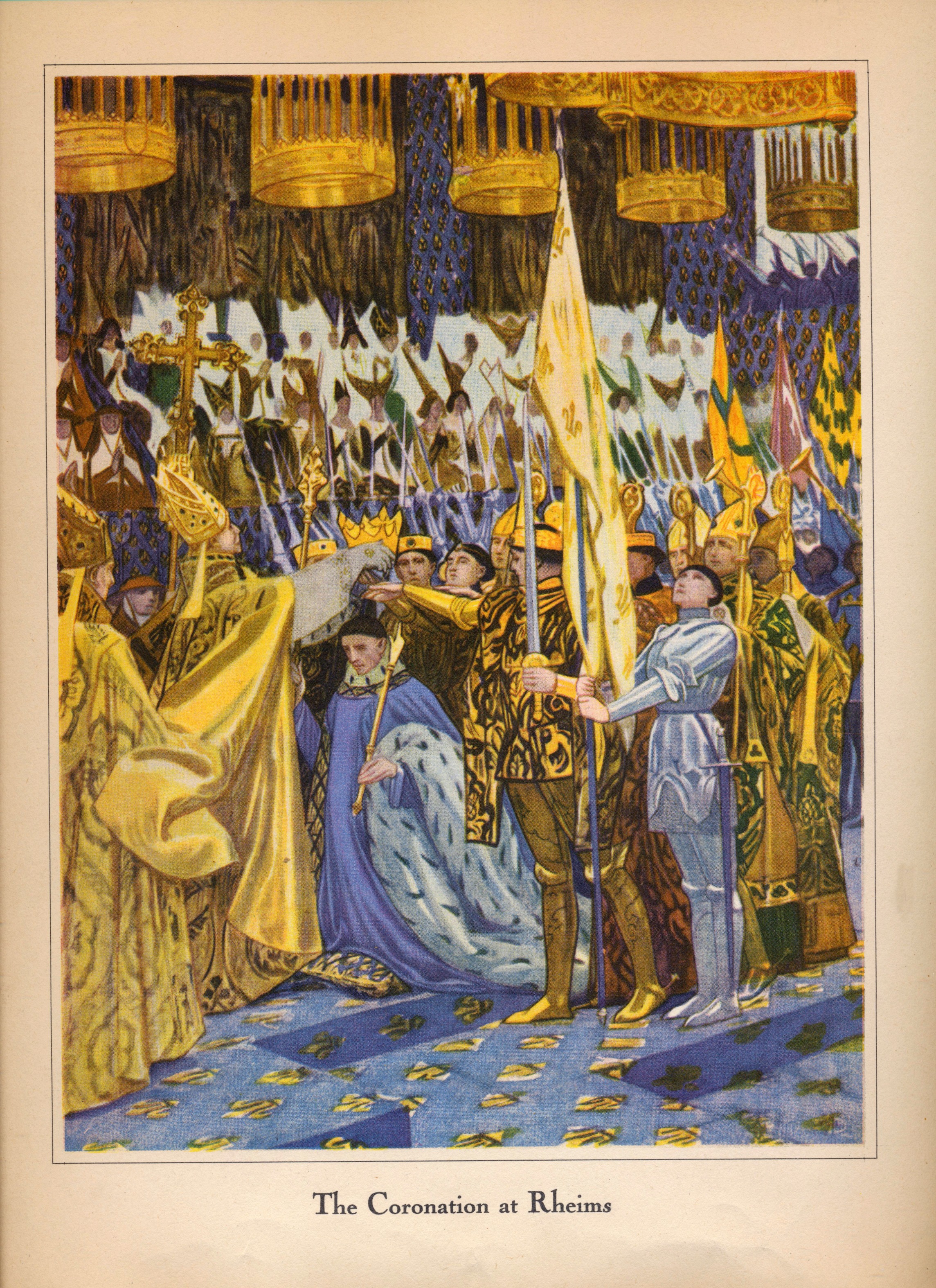
FEATURE image: King’s Coronation at Reims Cathedral. France was divided in the early 15th century when a teenage girl called Joan of Arc heard her Voices with their explicit instruction for her to go to the French royal court to aid France as a warrior-maid. For a young girl to dress and act as a military figure was shocking and unsettling to many who up to now had simply taken one side or another in the situation of France’s national divide.
JOAN OF ARC (French, 1412-1431) is one of the best documented and most popular of late medieval saints. The story of Jeanne La Pucelle, as she is known in France, has been beautifully depicted by artists and writers for centuries—as well as in films.
In France many of the places and sites associated with “the Maid” of 600 years ago are intact and can be visited today. Visiting the same buildings and places where Joan was in the late Middle Ages provides a concrete connection to and sense of her world.
There are stacks of academic and popular nonfiction as well as historical fiction about Joan. The fascination with her story started in her own century with her trial’s transcripts. Modern authors have also devoted their books and tomes to her, such as Mark Twain (Personal Recollections of Joan of Arc, 1896), George Bernard Shaw (Saint Joan, 1923), and Vita Sackville-West (Saint Joan of Arc, 1936) as well as, in our times, Helen Castor (Joan of Arc: A History, 2016), Kathryn Harrison (Joan of Arc: A Life Transfigured, 2014) and Kimberly Cutter (The Maid: A Novel of Joan of Arc, 2011). There are many, many more actually. Each and every year there are new scholarly tracts and other nonfiction to add to the long list of books and articles. Within this immense educational and informational field, there are several ways to approach the subject of France’s warrior-maid, Joan of Arc – and the combination of art and literature is one of them.
One approach is the artwork of Octave Denis Victor Guillonnet (1872-1967), a popular French illustrator.
Anyone interested in Joan of Arc first meets her when she is a humble peasant girl in the small village of Domrémy in eastern France.
Before Joan is a teenager, and for the rest of her life, Joan hears and is called by the heavenly voices of Saints Michael, Margaret, and Catherine of Alexandria.
Their explicit instruction is for the teenage girl to aid France as a warrior-maid.
Joan’s spiritual and military involvement started at a critical juncture in the king of France’s involvement in the Hundred Years’ War. The king of France was fighting against competing powers of England and Burgundy for control of France.
Joan’s military mission began in 1429 at 17 years old. Following fast and spectacular military successes, Joan led the dauphin to Reims Cathedral to be crownedas Charles VII (1401-1461), King of France, in 1429.
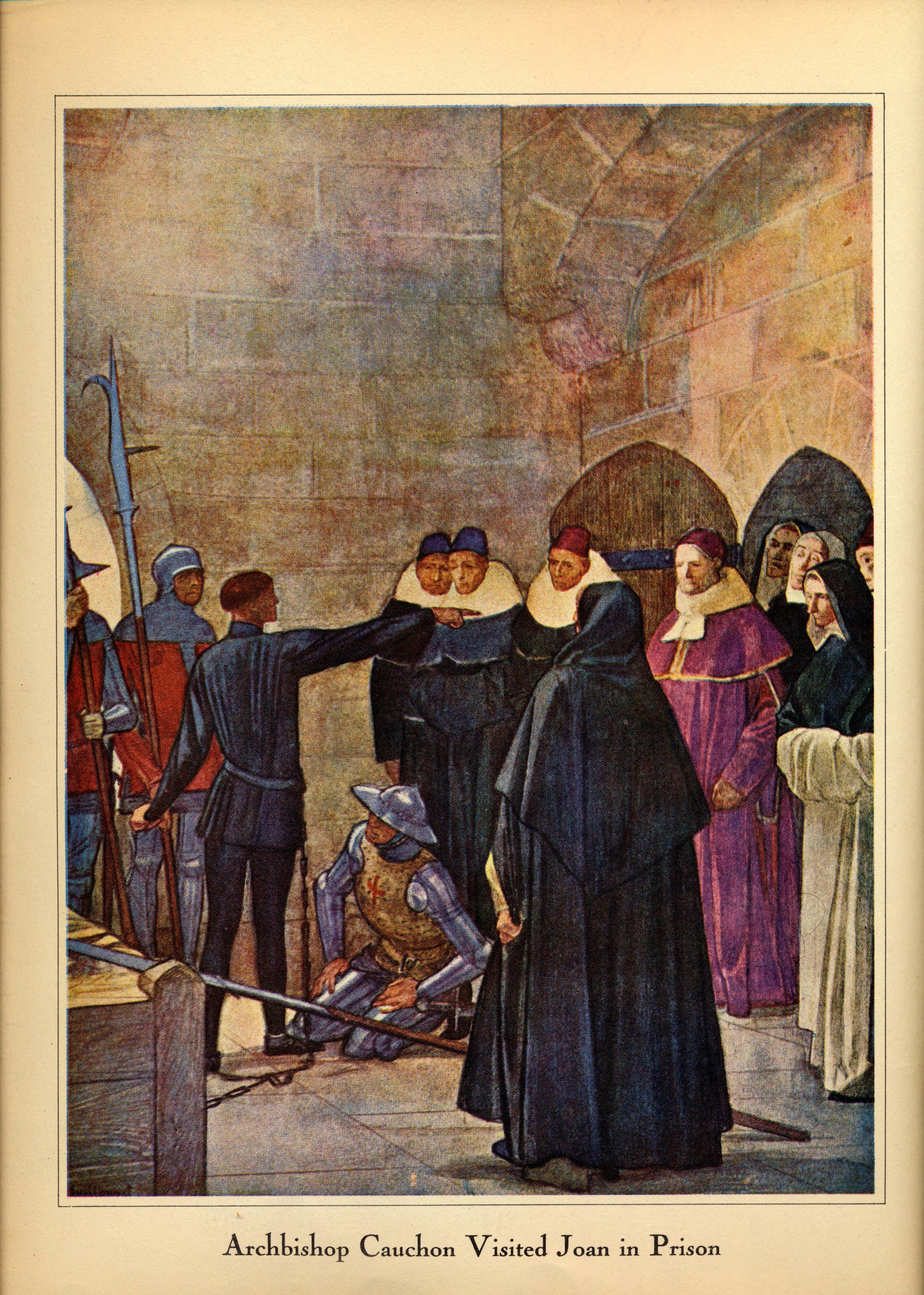
Joan’s military role ended abruptly with Joan’s capture on the battlefield.
Joan was held in prison for a ransom that her King never paid. There were attempts to rescue her but they failed.
Joan’s enemies put her on trial as a heretic. The result was that the Maid was infamously burned at the stake in Rouen, France, on May 30, 1431. Her condemnation by local Church officials sympathetic to England was overturned in 1456 by higher Church authorities which set justice aright in Joan’s case.
Joan of Arc was condemned as a heretic by 37 judges sympathetic to her enemies in England. The next day, May 30, 1431, the 19-year-old French visionary and soldier was burned at the stake in the market place of Rouen, France. Illustrations by French artist, Octave Denis Victor Guillonnet (1872-1967), are in the Public Domain.
In May 1920, Joan was consecrated as a Catholic saint. There are miracles attributed to the Maid’s intercession.
Joan was 19 years old when she died. Her brief and successful military and political career—as well as her unshakable belief under incredible duress that she was on God’s errand — put France on the path to sovereignty and earned Joan of Arc a place as a co-patron of France today.
GLOSSARY by John P. Walsh.
Versailles – The Palace of Versailles (French: Château de Versailles), or simply Versailles is a royal castle in Versailles, west of Paris in the Île-de-France region that includes Paris and its environs. The Château is open today as a museum and is a very popular tourist attraction. For more visit: http://en.chateauversailles.fr/
Joan of Arc – Joan of Arc (French: Jeanne d’Arc) was born January 6, 1412 and died by execution (burned at the stake) in Rouen, France, on May 30, 1431. Nicknamed “The Maid of Orléans” (French: La Pucelle d’Orléans) Joan of Arc is considered a heroine of France for her role during the The Hundred Years War and is a canonized Roman Catholic saint. She is one of several patrons of France today.
Domremy – (French: Domrémy, today Domrémy-la-Pucelle in reference to Joan of Arc.) Domremy is a small commune in the Vosges department in Grand Est in northeastern France. It is the birthplace of Joan of Arc. In 1429 Domrémy (and neighboring Greux) was exempted from taxes “forever” by King Charles VII which was the sole request made of the king by Joan of Arc when Charles asked her how he could show her his appreciation for seeing him made king. Taxes were imposed again upon Domrémy and Greux during the French Revolution and the people have had to pay taxes again ever since.
Meuse – (French: la Meuse.) The Meuse is a major European river, originating in France and flowing through Belgium and the Netherlands and draining into the North Sea. It has a total length of 925 km (575 miles).
Rivulet of Three-Fountains – (French: Le ruisseau des Trois Fontaines.) In Jeanne’s time, the village of Domremy was divided by the Creek of Three Fountains, so named because of three sources that fed it. To the south of it (right bank) is the Barrois and to the north of it (left bank) is Champagne. The stream also separates Domremy and Greux. Champagne was part of the royal domain, and when Joan left her home to aid the “Dauphin” Charles at Chinon or went to Nancy to visit the Duke of Lorraine, she had to seek safe conduct.
The Duchy of Lorraine – (French: Lorraine) was a duchy or dukedom that today is included in the larger region of Lorraine in northeastern France. Its capital was Nancy.
Province of Chaumont – Chaumont is a small commune of France which historically was the seat of the Counts of Champagne.
Jacques d’Arc – also Jacquot d’Arc. (b. 1375/80-d. 1431). Father of the Maid, he was born about 1375 at Ceffonds, in the diocese of Troyes, according to the Traité sommaire of Charles du Lys published in 1612. It was about the time of his marriage that he established himself at Domrémy, for his wife Isabelle Romée was from Vouthon, a village about seven kilometers away. He seems to have enjoyed an honorable position in this countryside, whether he was rich, as some have implied, or not. In 1419 he was the purchaser of the Chateau de I’Ile, with its appurtenances, put up at auction that year. In a document of 1423 he is described as doyen or sergeant of the village. He therefore took rank between the mayor and the provost, and was in charge of collecting taxes, and exercised functions similar to those of the garde Champêtre which is a combination of forest ranger, game warden, and policeman in certain rural communes in France. The same year finds him among the seven notables who responded for the village in the matter of tribute imposed by the damoiseau of Commercy. In 1427 in an important trial held before Robert de Baudricourt, captain of Vaucouleurs, he was again acting as a delegate of his fellow citizens. We know that he opposed with all his power the mission of his daughter, whom he wished to marry off. However, he went to Reims for the coronation of the King, and the King and the municipality defrayed his expenses and gave him a horse for his return to Domrémy. He was ennobled in December, 1429. Jacques d’Arc died 1431, it is said, from sorrowing over his daughter’s end.
Castle of the Island – In front of Domremy, and connected by a bridge, the Castle of the Island was the possession of the Bourlemont family, the lords of Domremy. It was rented by the inhabitants in the time of Joan and served, at times, as a refuge for their cattle.
Brothers Jacques, Jean, and Pierre, and sister, Catherine – Jacquemin d’Arc (b. 1402 d. 1450). There is very little known about Jacquemin, other than he was born 1402 in Vaudeville-le-Haut, and died in 1450. He was married to Catherine Corviset who was born in 1405 and died in 1430. They were married at Domremy.
Jean d’Arc (b. 1409 d. 1447) fled with his sister Joan to Neufchâteau; accompanied her to France; and was lodged at the house of Jacques Boucher at Orléans. With his father, he was ennobled in December 1429. As provost of Vaucouleurs he worked for the rehabilitation of his sister; appeared at bodies in Rouen and Paris; and formed a commission to get evidence from their native district and produce witnesses. He was Bailly of Vermandois and captain of Chartres.
Pierre d’Arc (b. 1408 d. ?) went to seek his sister in France; fought along with her at Orléans; lived in the same house with her in that city; accompanied her to Reims; and was ennobled with the rest of the family. He was captured with Jeanne at Compiègne, but was eventually released. Pierre retired to the city of Orléans where he received many gifts – from the King, the city of Orléans, and a pension from Duke Charles, among them the Île aux Boeufs in 1443. The descendants of Pierre had in their possession three of Jeanne’s letters and a sword that she had worn. The letters were saved but the sword was lost during the the French Revolution.
Catherine d’Arc (b. 1413 d. 1429). There is very little known about Catherine, other than she married Colin, the son of Greux’s mayor, and died very young in childbirth near the end of 1429.
Isabella Romée – Isabelle Romée (b. 1385 d. Dec. 8, 1458), known as Isabelle de Vouthon. Isabelle d’Arc and Ysabeau Romée, was the mother of Jeanne. She moved to Orléans in 1440 and received a pension from the city. She petitioned Pope Nicholas V to reopen the court case that had convicted Jeanne of heresy, and then, in her seventies, addressed the assembly delegation from the Holy See in Paris. On July 7, 1456 the appeals court overturned the conviction of Jeanne. Isabelle gave her daughter an upbringing in the Catholic religion and taught her the craft of spinning wool.
BIBLIOGRAPHY
The First Biography of Joan of Arc, with the Chronicle Record of a Contemporary Account. Translated and Annotated by Rankin, Daniel S., Quintal, Claire. [Pittsburgh] University of Pittsburgh Press [1964].
Joan of Arc by Herself and her Witnesses.Pernoud, Régine. Lanham, MD : Scarborough House, [1994]. Translation of: Jeanne d’Arc par elle-même et par ses témoins.
Joan of Arc: Her Story. Pernoud, Régine. New York: St. Martin’s Press, 1998. Translation of: Jeanne d’Arc.
Joan of Arc. Lucie-Smith, Edward,New York: Norton, 1977.
Joan of Arc. Twain, Mark, New York, Harper and Brothers [c.1924].
Joan of Arc. Boutet de Monvel, Louis Maurice (1850-1913), New York: Pierpont Morgan Library: Viking Press, 1980.
Joan of Arc : A Life Transfigured. Harrison, Kathryn, New York: Doubleday, 2014.
Joan of Arc : A History. Castor, Helen, New York, NY: HarperCollinsPublishers, [2015].
The Beautiful Story of Joan of Arc The Martyr Maid of France, Lowe, Viola Ruth, illustrations by O.D.V. Guillonnet, 1923, multiple U.S. editions.
The Saints: A Concise Biographical Dictionary, edited by John Coulson, Guild Press, New York, 1957, pp. 577; 399-402.
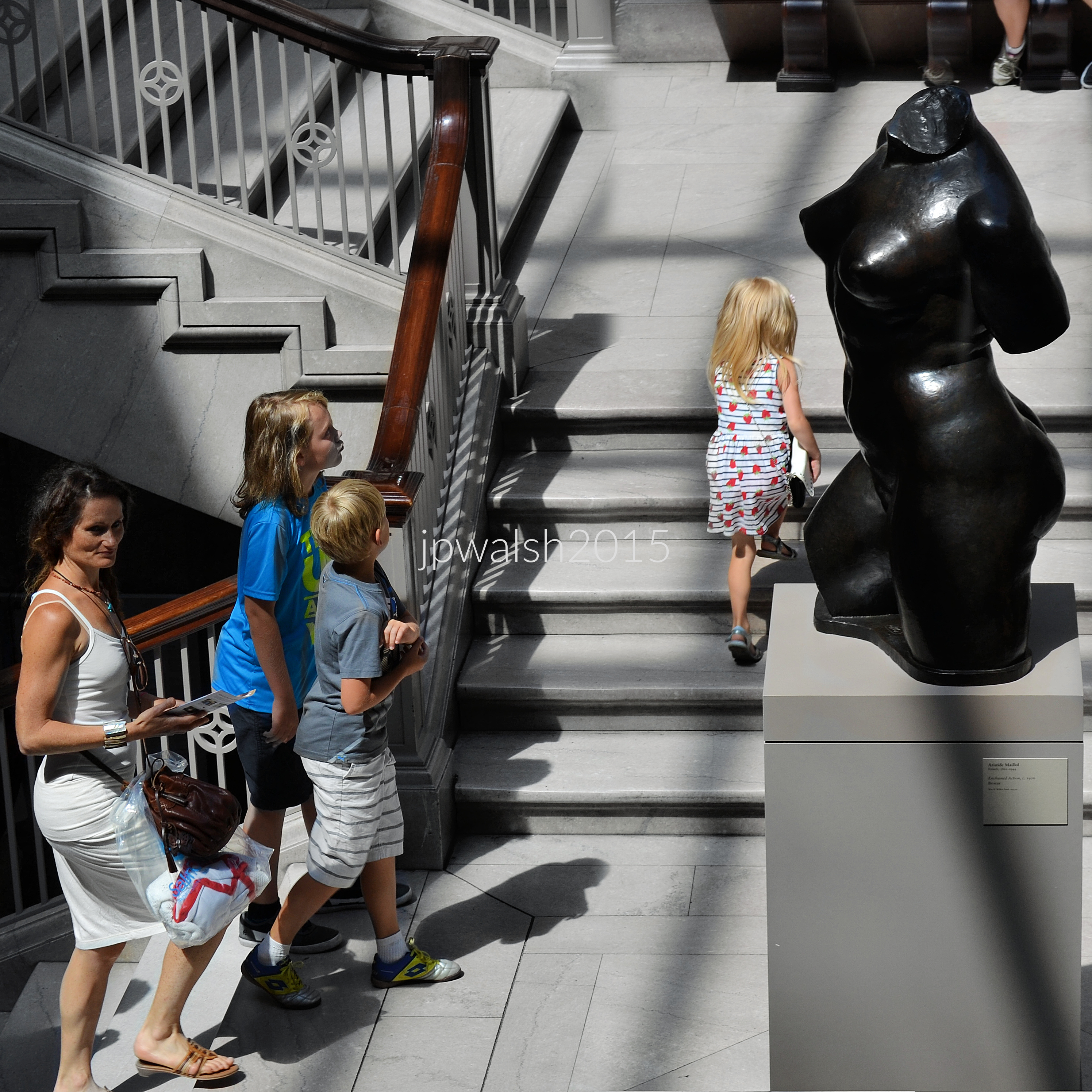
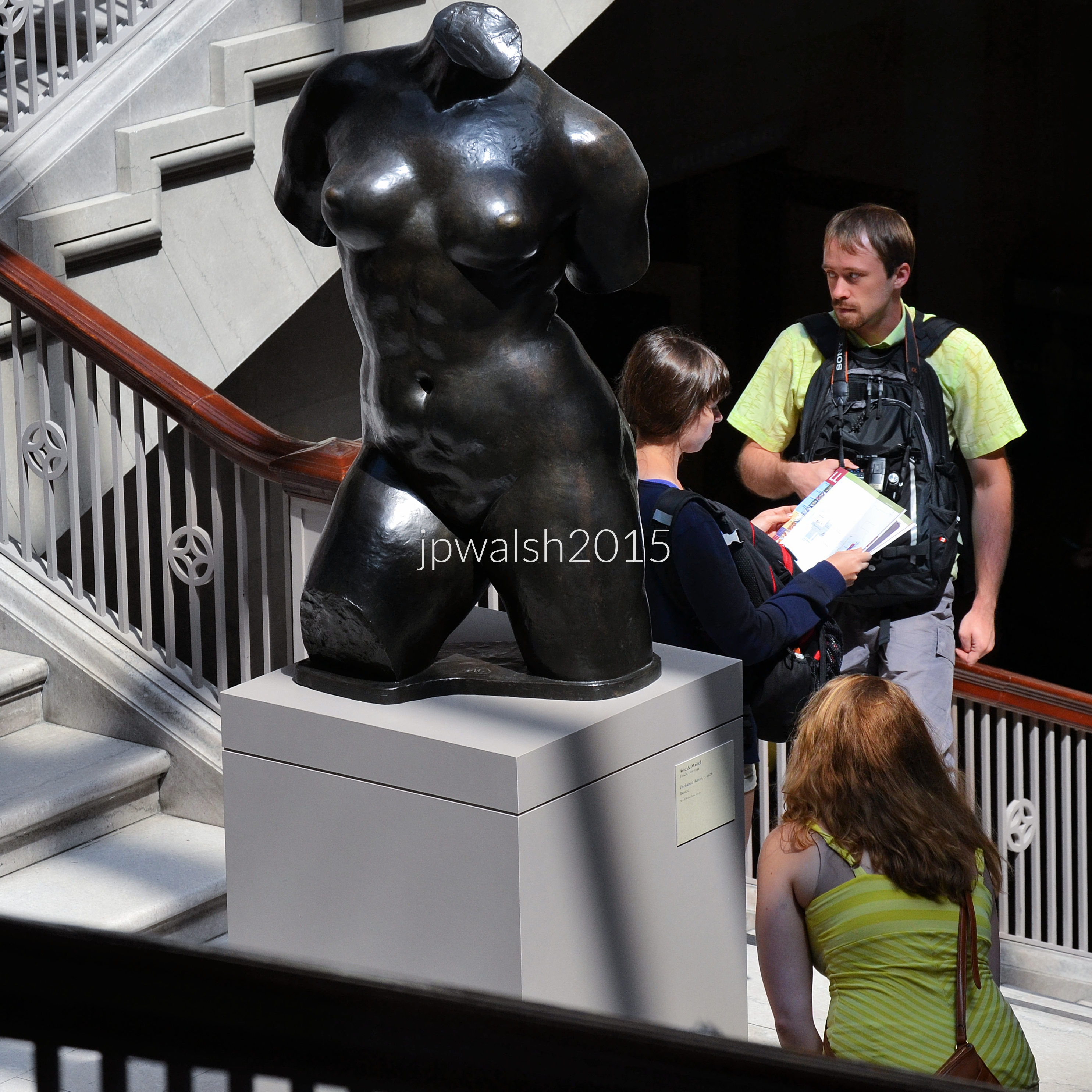
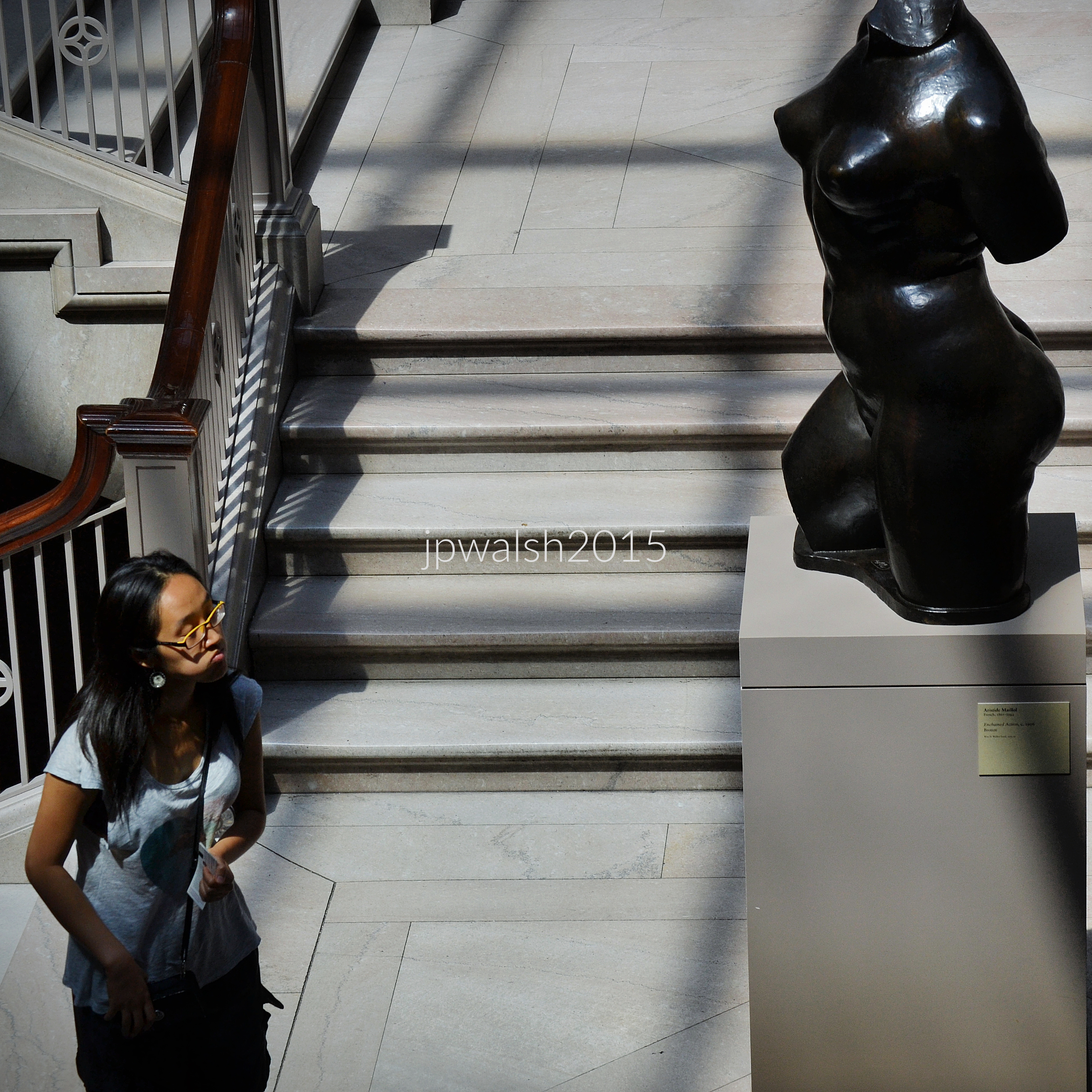
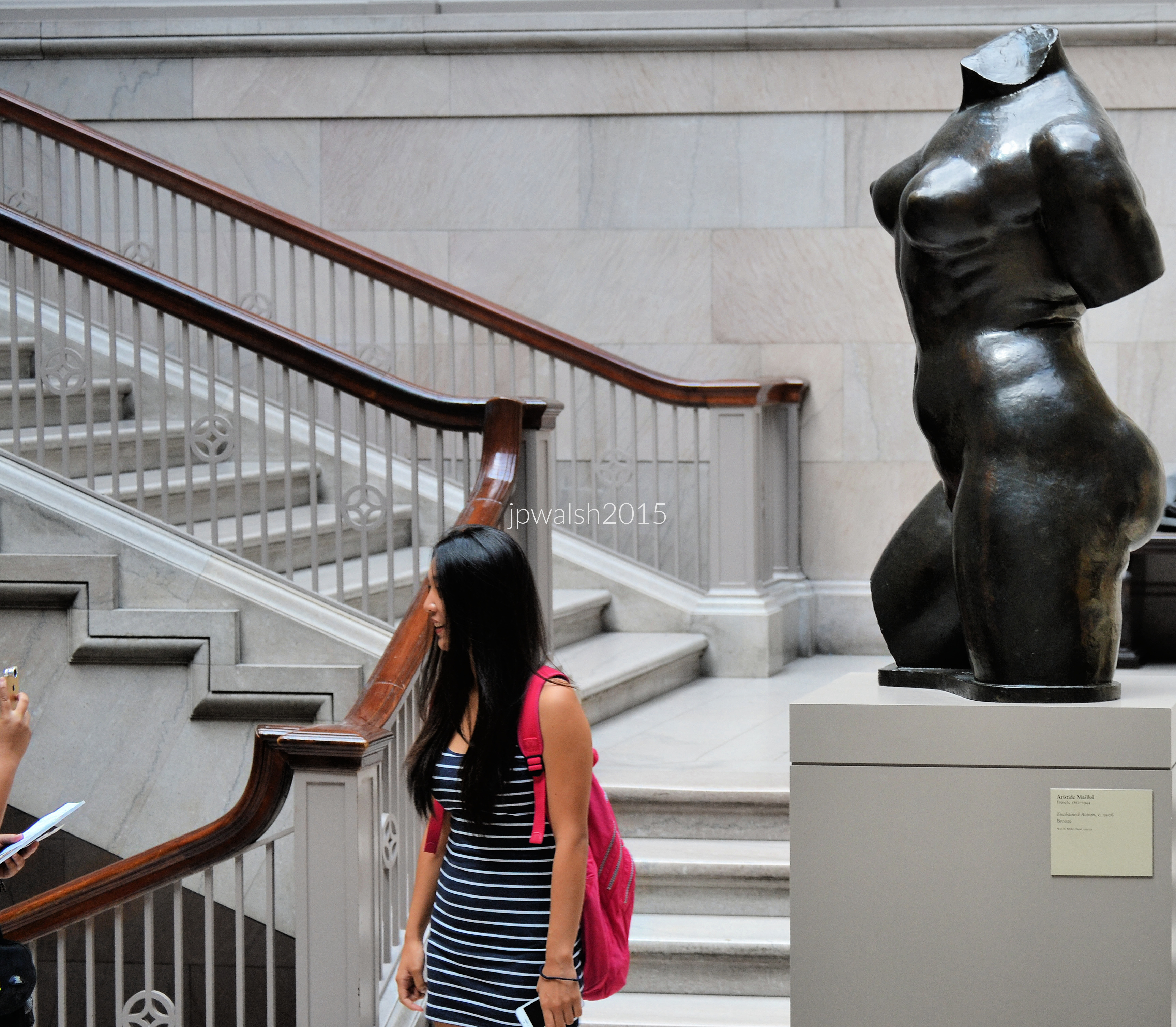
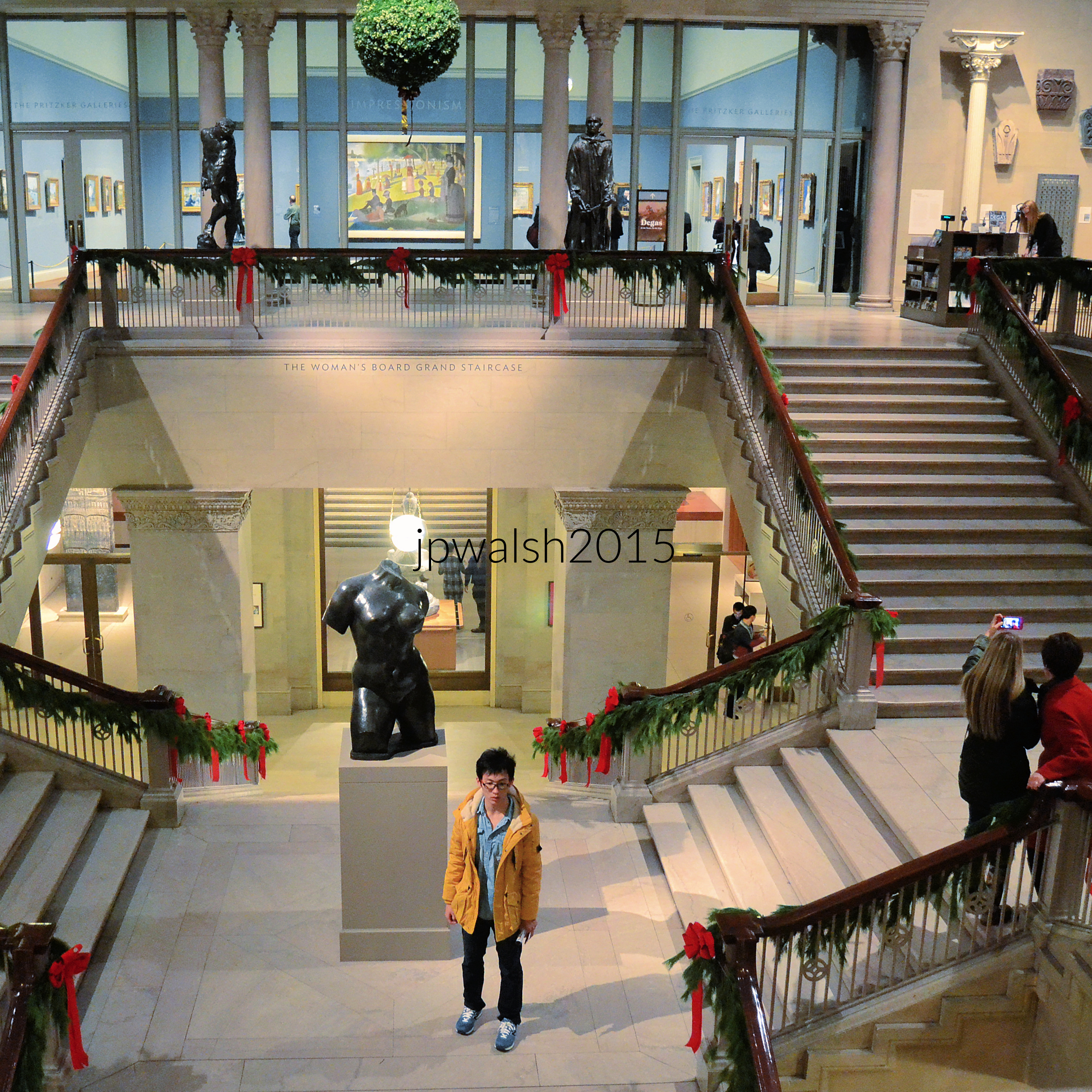
N.B. When this post was published in July 2016, Aristide Maillol’s Enchained Action — a torso cast in bronze and created in 1905 in France — enjoyed a lengthy time on the Women’s Board Grand Staircase at the Chicago art museum. In 2017 the torso was removed by museum curators and placed in an undisclosed location out of public view (see – https://www.artic.edu/artworks/82594/enchained-action). It was replaced by Richard Hunt’s Hero Construction (1958) (see – https://www.artic.edu/artworks/8633/hero-construction).
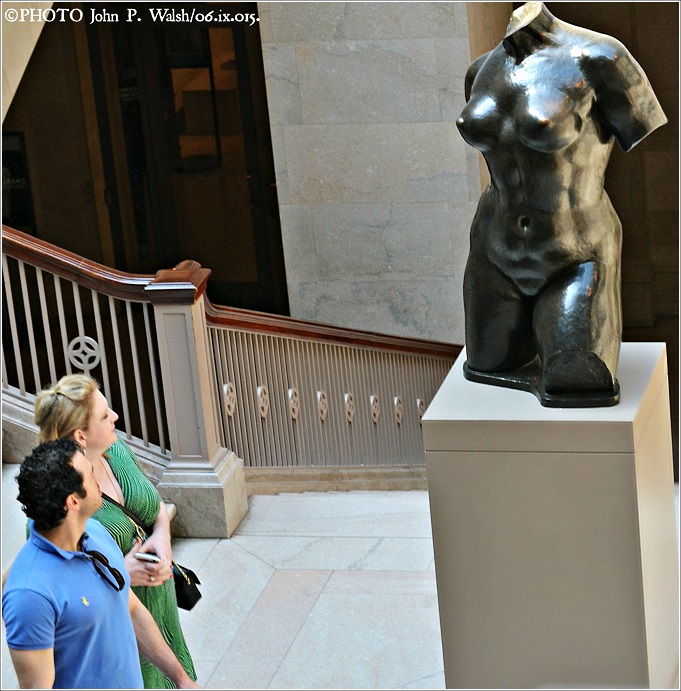
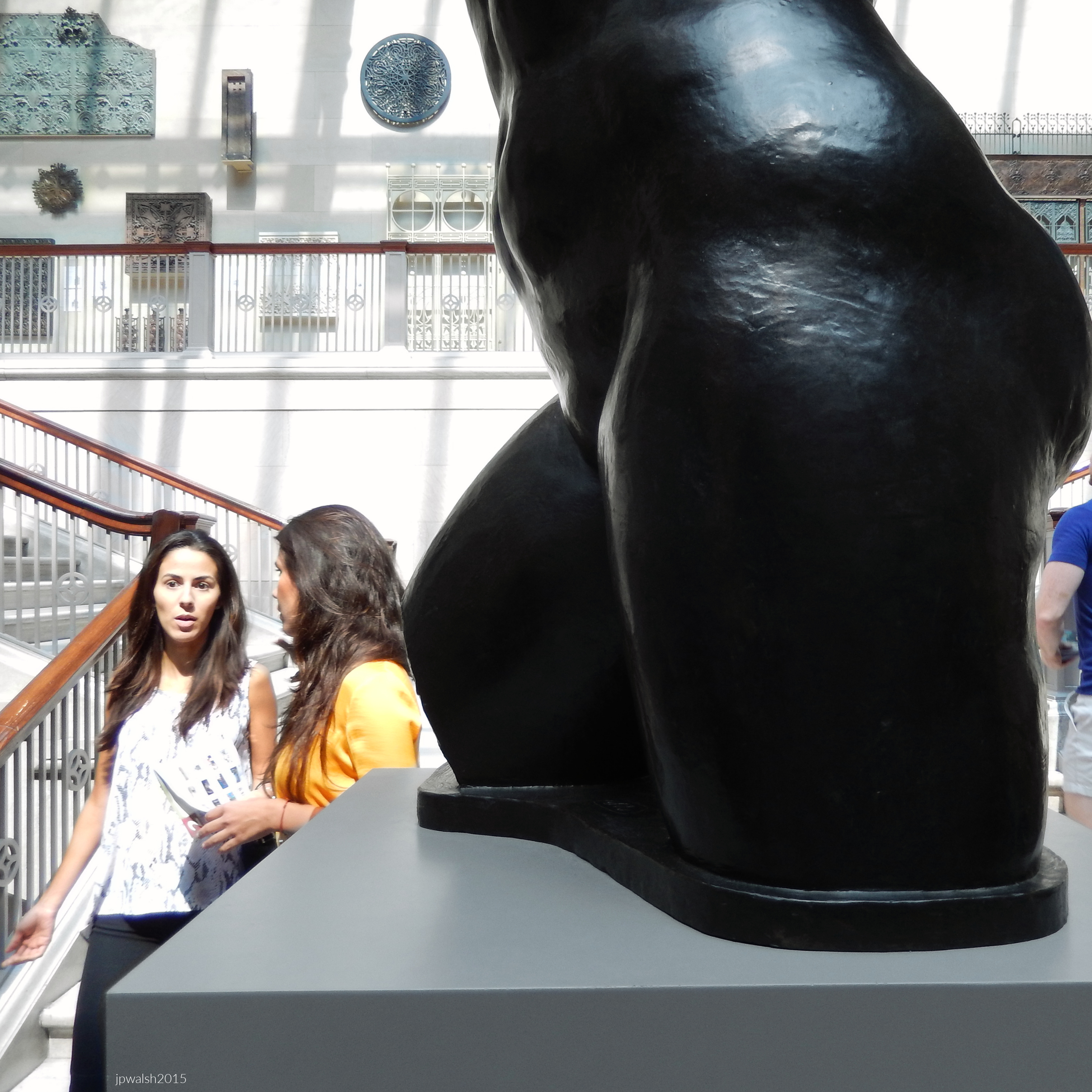
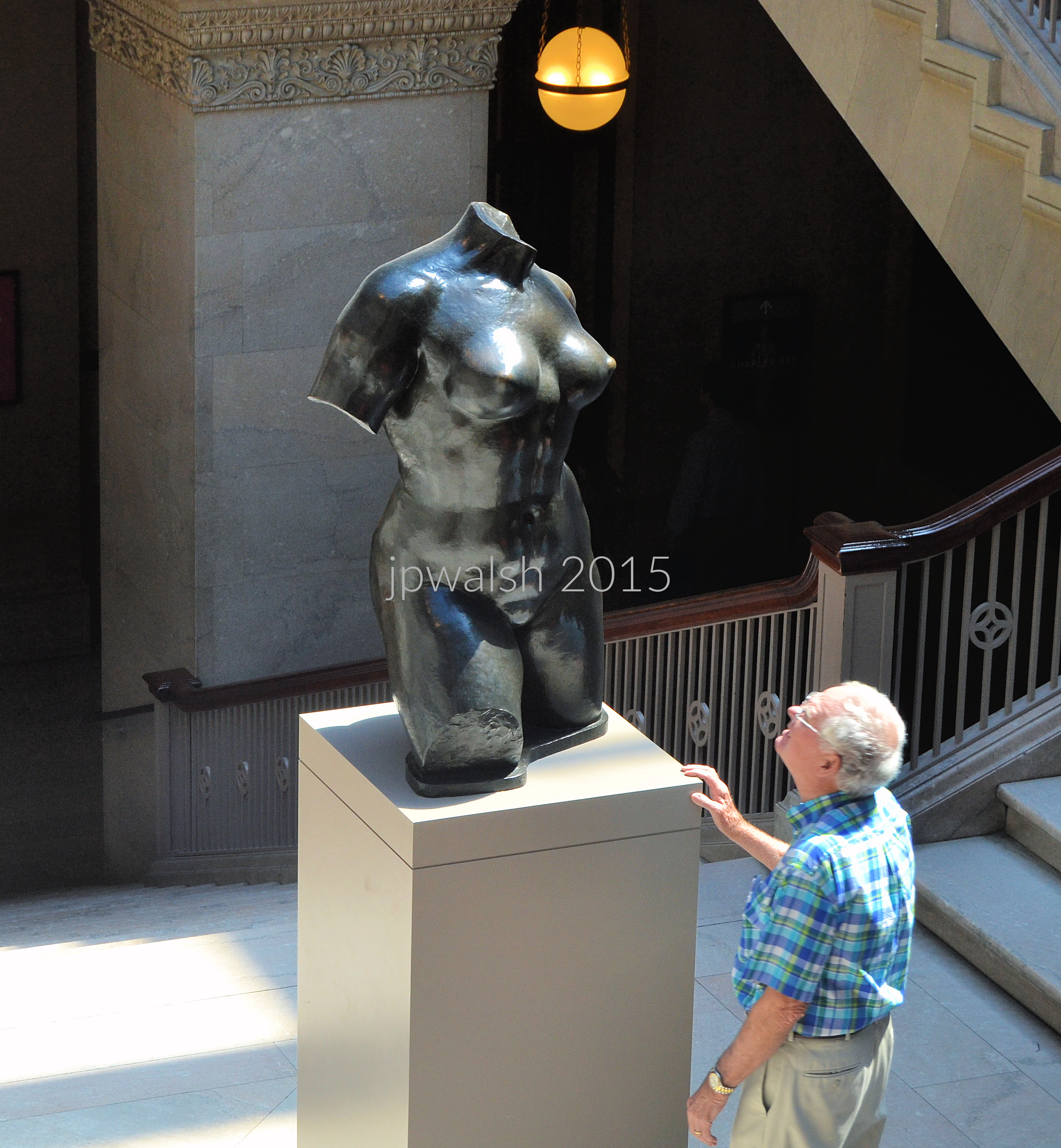
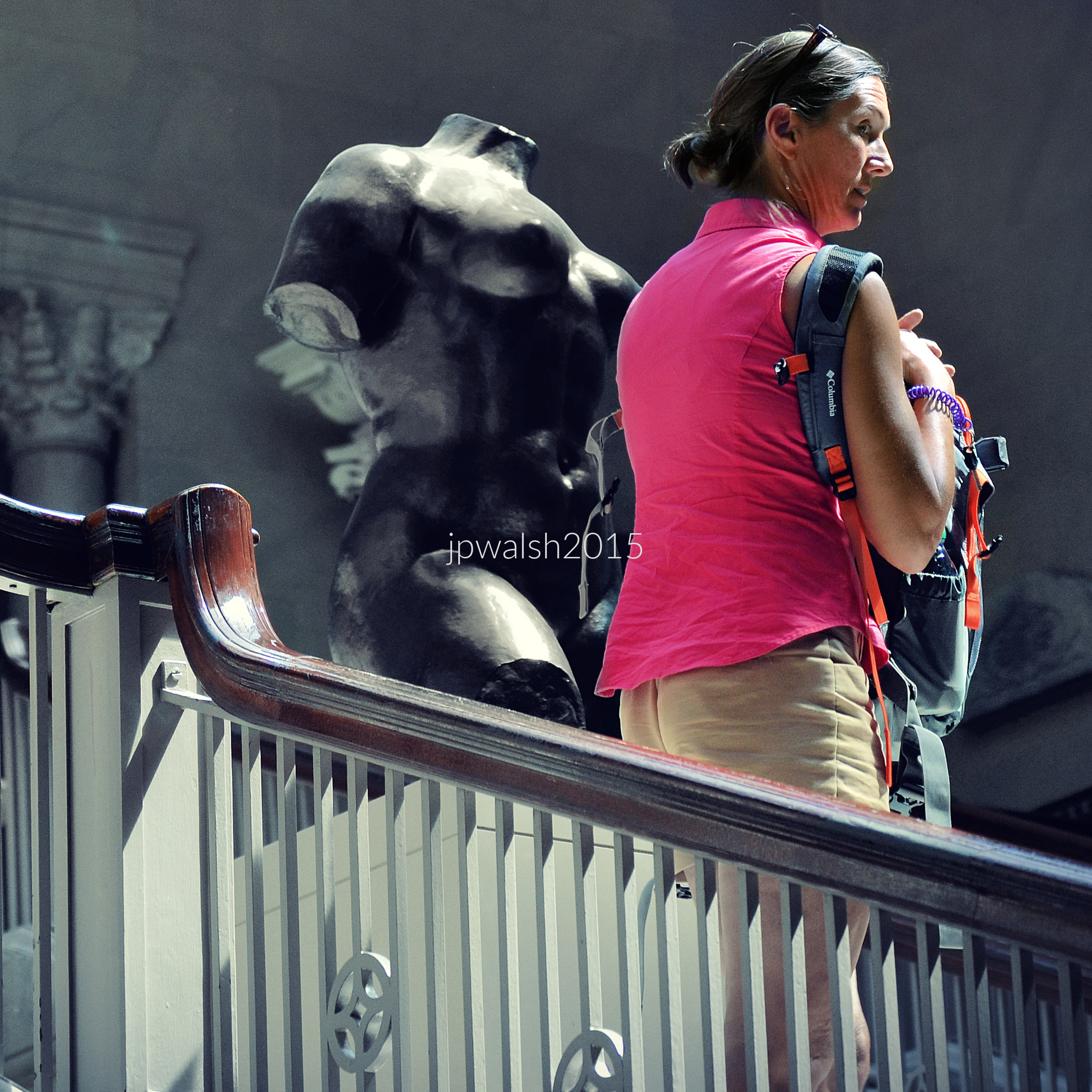
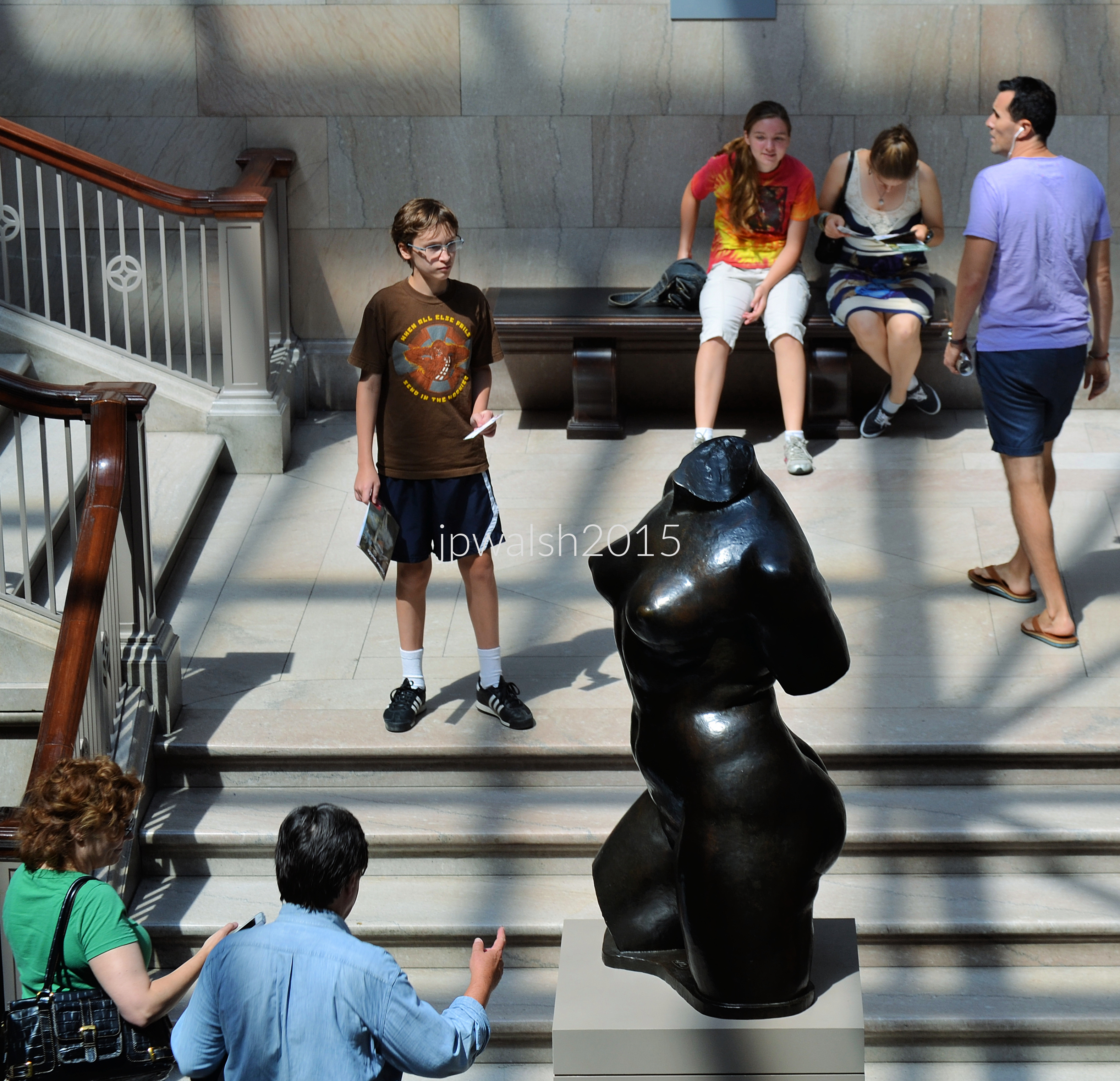
September 2015. 20th Century. France. Aristide Maillol (1861-1944), Enchained Action, c. 1906, Bronze. 47 1/2 × 28 × 21 in. (121.2 × 71 × 53.3 cm). The Art Institute of Chicago. August 2015. 20th Century. France. Aristide Maillol (1861-1944), Enchained Action, c. 1906, Bronze. 47 1/2 × 28 × 21 in. (121.2 × 71 × 53.3 cm). The Art Institute of Chicago.
Text and photographs by John P. Walsh.
In September 2016 the Musée Maillol re-opens in Paris following its unfortunate closure due to poor finances earlier in the year. Under the new management team of M. Olivier Lorquin, president of the Maillol Museum, and M. Bruno Monnier, chairman of Culturespaces, the museum’s new schedule calls for two major exhibitions each year which will look to honor the modernist legacy of the artist, Aristide Maillol (French, 1861-1944) and the museum’s founder, Maillol’s muse, Dina Vierny (1919-2009).
This photographic essay called “Encountering Maillol” is constituted by 34 photographs taken by the author in The Art Institute of Chicago from 2013 to 2016 of the artistically splendid and historically notable sculpture Enchained Action by Maillol and random museum patrons’ reactions when viewing it. The impressive bronze female nude from 1905 stands almost four feet tall atop a plain pedestal which greets every visitor who ascends the Grand Staircase from the Michigan Avenue entrance. Enchained Action is one of Maillol’s earliest modernist sculptures and is doubtless filled by a dynamism not encountered anywhere else in his oeuvre.1
Modelled in France in 1905 by a 44-year-old Maillol who by 1900 had abandoned Impressionist painting for sculpture (first in wood, then in bronze) Enchained Action is one of the artist’s most impressive early sculptures. From the start of his sculptural work around 1898 until his death in 1944, the female body, chaste but sensual, is Maillol’s central theme. What can be seen in Enchained Action expresses the intensity in his early sculptural work which is not found later on—particularly the artist’s natural dialogue among his experimental works in terracotta, lead, and bronze each of which is marked by an attitude of robust energy expressed in classical restraint and modernist simplicity. Enchained Action exhibits Maillol’s early facility for perfection of form within a forceful tactile expression which deeply impressed his first admirers such as Maurice Denis (1870-1943), Octave Mirbeau (1848-1917) and André Gide (1869-1951) and cannot fail to impress the museum goer today.2 By force of this new work in the first decade of the twentieth century, Maillol started on the path of becoming an alternative to and, dissonant heir of Auguste Rodin (1840-1917).3
Maillol’s early sculptural work is important for what it is—and is not. Modeled around three years after he completed his first version of La Méditerranée in 1902 in terracotta and for which his wife posed—a major modernist achievement of a seated woman in an attitude of concentration—and whose radically revised second version was exhibited at the 1905 Salon d’Automne, Enchained Action forms part of Maillol’s revolution for sculpture starting around 1900. Maillol made a radical break with neoclassicism and stifling academicism with its strange blend of realism and mythological forms—and with a rising generation of young sculptors such as Joseph Bernard (1866-1931), Charles Despiau (1874-1946) and Antoine Bourdelle (1861-1929)—blazed a new path for sculpture. Except for Maillol, all these young sculptors worked in menial jobs for Rodin. Because of Maillol’s chosen artistic distance from Rodin’s work, Maillol did not need to react to it and so rapidly achieved his own new style as soon as 1905, the year of Enchained Action.
Maillol’s concept and primary approach to the beauty of the human body was to simplify and subdue forms. This pursuit began in early 1900 and advanced until the artist’s first time outside France on his trip to Greece in 1908 with Count Kessler (1868-1937). An important early sculpture—Recumbent Nude, 1900—was cast with the help of his lifelong friend Henri Matisse (1869-1954). This friendship had ramifications for the Art Institute’s Enchained Action in that it was purchased from Henri Matisse’s son, art dealer Pierre Matisse in 1955 right after his father’s death. While it would prove quaint for The Art Institute of Chicago to install Maillol’s limbless torso of Enchained Action on The Grand Staircase to pay homage or evoke the Louvre’s Winged Victory or Venus de Milo, it is historically significant so to embody Maillol’s artistic outlook in 1905 for his new sculpture, of which Enchained Action is an example. In the years between 1900 and 1908, Maillol searched beyond realism and naturalism to create sculpture with an abstract anatomical structure that jettisoned the sign language of physical gestures which are emotional and where limbs could be problematic for Maillol’s end design. The human torso of Enchained Action foregoes limbs and head to alone embody and convey the artist’s import for it.4
On The Art Institute of Chicago’s Grand Staircase Enchained Action displays Maillol’s sensitive surface modeling capturing human flesh’s animation and sensual power more than its suppleness as found in Italian masters such as Bernini –such difference serves Maillol’s purpose for his subject matter. The torso is differently pliant—toned, muscular, and strident. It displays the humana ex machina whose stance and posture express the modern hero’s defiance and whose nakedness retains the beauty uniquely imbued in the female human body. Enchained Action is a different work altogether than every work Maillol modeled and cast up to 1905. His art progresses in experimentation by its direct interface with politics. Enchained Action is not only an artwork but a political artwork where Maillol empowers both spheres. For today’s viewer who reacts to nudity in art with the shame of eroticism, they may see (or avoid seeing) its sprightly breasts, taut stomach, and large buttocks of Enchained Action only in that mode. The museum limits such visitors to this narrow viewpoint because they do not explain to them Maillol’s artful technique, conceptual artistic revolution by 1905, or unique political and socioeconomic purpose for this imposing artwork in plain view.
With an aesthetic interest established for Enchained Action—for it signals a break with the artistic past and the birth of modern sculpture in its abstraction – a question is posed: what are the political and socioeconomic purposes for this work? Its original and full title reveals a radical social implication: Torso of the Monument to Blanqui ([En] Chained Action). Abbreviated titles—and such appear at The Art Institute of Chicago, The Metropolitan Museum of Art (Torso of Chained Action) and in the Jardin des Tuileries in Paris (L’Action enchaînée)—neatly avoids or even voids the sculpture’s original radical social message. Maillol’s Enchained Action is dedicated it to the French socialist revolutionary Louis Auguste Blanqui (1805-1881).
In 1905 Maillol’s Enchained Action was a public monument honoring the centenary of Blanqui’s birth and consolidation of the French socialist movement that same year into the Section Française de l’Internationale Ouvrière (SFIO), a single leftist political party that was replaced by the current Socialist Party (PS) in 1969. Given this background a visitor may simply stare at or bypass the torso but perhaps for reasons of politics rather than eroticism. The title omission—first promoted by André Malraux in 1964 for the Tuileries’ copy—does disservice to Maillol’s accomplishment and its full title should be restored. The Metropolitan has an incomplete title but on thee label includes information on Blanqui and clearly states their version was cast in 1929. The Art Institute of Chicago’s casting date for the torso is obscure. For a better appreciation of the artwork, familiarity with its social and political historical context is important to locate the intended nature of the energy expressed in it. Torso of the Monument to Blanqui ([En] Chained Action) is a figure study of a strident naked female torso and an expression of radical politics in France at the turn of the last century.
By 1905 Maillol’s new sculptural work attracted important collectors. Rodin introduced Maillol that year to Count Kessler at the Paris gallery of Ambroise Vollard (1866-1939) and to other progressive writers, art critics, and painters. Maillol’s work was a new art form for a new century. It was in 1905 that Paris friends, among them Anatole France (1844-1924), Georges Clemenceau (1841-1929), Gustave Geffroy (1855-1926), Jean Jaurès (1859-1914) and Octave Mirbeau, approached Maillol to persuade the avant-garde artist to accept a commission for the politically sectarian Blanqui monument. It would be a tribute très moderne to a fierce socialist revolutionary but and the entire Blanqui family tradition which had voted to guillotine Louis XVI in the French Revolution and plotted against each ruling regime in France afterwards. Immense confidence was placed in Maillol by these bold turn-of-the-century intelligentsia and by the artist himself who came from a generation that came to believe they were the torchbearers of a new art.
In France public opinion was frequently divided on art matters. When Rodin agreed to Maillol’s commission—he wanted Camille Claudel to do it, but she had become seriously psychotic by 1905—the older sculptor admired and purchased Maillol’s new sculpture—in addition to experiencing his own deep familiarity with the vagaries of creating public monuments. Committee members, by and large left-wing sympathizers, made a favorable impression on Maillol who agreed to do the work. On July 10, 1905, Maillol promised Georges Clemenceau, “I’ll make you a nice big woman’s ass and I’ll call it Liberty in Chains.”5 After that, Maillol’s new sculpture—a symbolic monument to a political revolutionary erected in October 1908 under protest of town leaders on the main square of Blanqui’s native village of Puget-Théniers in the south of France—became the subject of unending intense scrutiny. How to respond to a large and powerful standing figure, tense and in motion where human struggling is borne to the edge of absorbing mute serenity by restraint of chains symbolizing Blanqui’s thirty years in jails by successive French governments?6 In the first ten days of working on the new commission, Maillol made three small sketches and two maquettes of an armless torso followed by other preliminary work. He finished a final clay version in 1905 whose contemplative intimacy reflected socialist Jean Jaurès’sagenda for political life: “We are inclined to neglect the search for the real meaning of life, to ignore the real goals—serenity of the spirit and sublimity of the heart … To reach them—that is the revolution.”7 Sixty-five-year-old Rodin whose critical judgment of the new sculpture which undertook to streamline art forms to the point of austerity against Rodin’s “monstrous subjects, filled with pathos” remarked tersely on Enchained Action.8 Although Maillol saw this public monument as more reliant than ever on Rodin’s concepts, M. Rodin after seeing it was reported to ambiguously mutter: “It needs looking at again.”9
It may be better to judge Enchained Action inside its historical moment. Former Metropolitan curator Preston Remington (1897-1958) praised his museum’s copy of the torso calling it “splendid” and “impeccable” in its observation of the human form. Yet he concludes that it is “essentially typical” of the sculptor for it “transcends the realm of visual reality.”10Enchained Action displays none of the delicacy, awkwardness, luminosity, or calm of the artist’s earlier sculptures and predates major developments in Maillol’s oeuvre after 1909 which differs extensively from that of Enchained Action11 and for which is based much of the artist’s legacy, even by 1929 when Remington is writing. Is it fair to identify Enchained Action as “essentially typical” even as it sublimates form? Viewed in 1905—a watershed year for modern art, including an exhibition of Henri-Matisse’s first Fauvist canvases at the Salon des Indépendents and at the Salon d’Automne—Enchained Action became that year Maillol’s largest sculptural statement to date. The commission, while relying on Rodin’s concepts in its depiction of strenuous physical activity—a quality Preston Remington recognized as “exceptional” in the torso and yet as a critical judgment ambiguous as to whether it refers to Maillol’s reliance on Rodin—afforded Maillol further confidence to execute his monumental art after 1905 for which today he is famous. While for Mr. Remington the representative quality of Enchained Action was what he sought for a museum collection, its exceptional qualities in values that are literally not “essentially typical” for the sculptor.
The complete final figure of Monument to Blanqui([En] Chained Action)—and not only the torso that is displayed on the Grand Staircase of The Art Institute of Chicago—depicts a mighty and heroic woman struggling to free herself from chains binding her hands from behind. Both of these “complete” versions are in Paris and found in the Jardin des Tuileries and in the Musée Cognacq-Jay. Maillol’s later studies for Enchained Action commenced without its head and legs that expressed a heightened anatomical intensity in place of Rodin-like strife.12 Chicago and New York each have a bronze replica of the torso. The Tate Britain has one in lead. Following the Great War, Maillol’s Monument to Blanqui ([En] Chained Action) standing for 14 years in Puget-Théniers’ town square was taken down in 1922 so to erect a monument aux morts. During World War II fearing that the extant original sculpture would be melted down for Nazi bullets, Henri Matisse purchased it from Puget-Théniers and gave it to the city of Nice. The original bronze was saved and now stands in the Tuileries Gardens in Paris.13
NOTES
Dynamism not anywhere else in his oeuvre – “Maillol/Derré,” Sidney Geist, Art Journal, v.36, n.1 (Autumn 1976), p.14.
In 1964-65, 18 large bronzes were placed in the Jardins du Carrousel, Paris, owing to André Malraux and Dina Vierny, Maillol’s last model-http://www.sculpturenature.com/en/maillol-at-the-jardin-tuileries/ – retrieved July 26, 2016; Metropolitan copy cast in 1929 –http://www.metmuseum.org/collection/the-collection-online/search/196526; AIC cast date obscure- http://www.artic.edu/aic/collections/artwork/82594?search_no=6&index=12 – retrieved September 8, 2015; Maillol meets Count Kessler – http://www.metmuseum.org/art/collection/search/204794-retrieved May 25, 2016; torchbearers – Rodin: The Shape of Genius, Ruth Butler, Yale University Press, 1993, p.284; Rodin admired Maillol’s new sculpture- Lorquin, p.52; Rodin wanted Camille Claudel for commission– Lorquin, p. 55; “make you a nice big woman’s ass…”- quoted in Lorquin, p 56.
Sketches, maquettes, final version – Lorquin, p. 57-58.; Jaurès quoted in Uncertain Victory: Social Democracy and Progressivism in European and American Thought, 1870-1920, James T. Kloppenberg, Oxford University Press, New York & Oxford, 1986, p. 297.
“A Newly Acquired Sculpture by Maillol,” Preston Remington, The Metropolitan Museum of Art Bulletin, Vol. 24, No. 11, Part 1 (Nov., 1929), pp. 280-283.
Such works as Night (1909), Flora and Summer (1911), Ile de France (1910–25), Venus (1918–28), Nymphs of the Meadow (1930–37), Memorial to Debussy (marble, 1930–33; Saint-Germain-en-Laye) and Harmony (1944) which are composed, harmonious, and monumental nude female figures often labeled “silent” by critics.
Enchained Action was first modeled with arms. The story of how the first limbless final version came about involving Henri Matisse – see Lorquin, p.58.
May 2016. September 2015.May 2015. August 2015. August 2015. August 2015. July 2015.November 2015.September 2015.August 2015. September 2015.September 2015.August 2015.August 2015.May 2015. July 2015. May 2016. August 2015.September 2015. August 2015.July 2015. November 2015.September 2015. May 2015. September 2015. May 2016. August 2015. August 2015. July 2015. 20th Century. France. Aristide Maillol (1861-1944), Enchained Action, c. 1906, Bronze. 47 1/2 × 28 × 21 in. (121.2 × 71 × 53.3 cm). The Art Institute of Chicago.
In situ: Aristide Maillol’s Enchained Action. The torso is cast in bronze and created in France in 1905. It sits on the landing of the Grand Staircase (main entrance) of The Art Institute of Chicago.
August 2015. August 2015. August 2015. August 2015. September 2015. September 2015. September 2015. September 2015. 624kb 35%September 2015. 5.66 mbSeptember 2015. 6.70 mbSeptember 2015. 4.88 mbSeptember 2015. 668kb 30%September 2015. 30%May 2016. 3.67mb DSCN2516July 2015. 5.01 mb DSC_0539 (1)August 2015. 2.87mb DSC_0641 (2)August 2015. 2.01mb DSC_0964 (1)August 2015. 2.75mb DSC_0975 (1)August 2015. 2.75mb DSC_0976 (1)August 2015. 2.77mb DSC_0972 (1)August 2015. 3.28mb DSC_0983 (1)August 2015. 3.31mb DSC_0088 (1)November 2015. 3.64mb DSC_0314 (2)Maillol in 1925. Photograph by Alfred Kuhn. (Public Domain)https://www.academia.edu/27662632/ENCOUNTERING_MAILLOL_A_CONTEMPORARY_PHOTOGRAPHIC_ESSAY_OF_ARISTIDE_MAILLOLS_ENCHAINED_ACTION_ON_THE_GRAND_STAIRCASE_OF_THE_ART_INSTITUTE_OF_CHICAGO
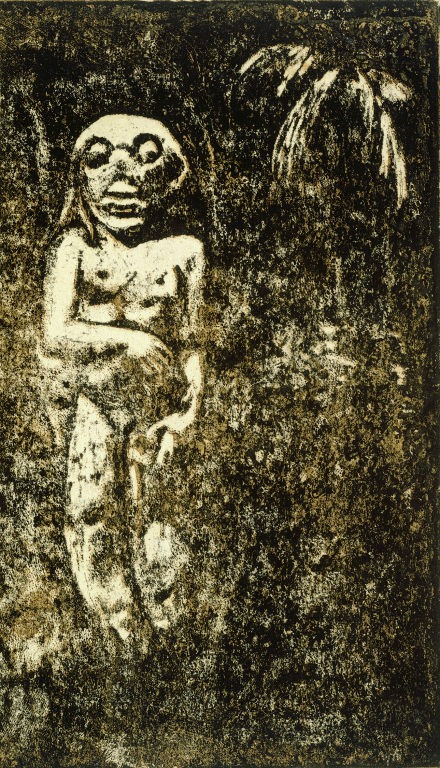
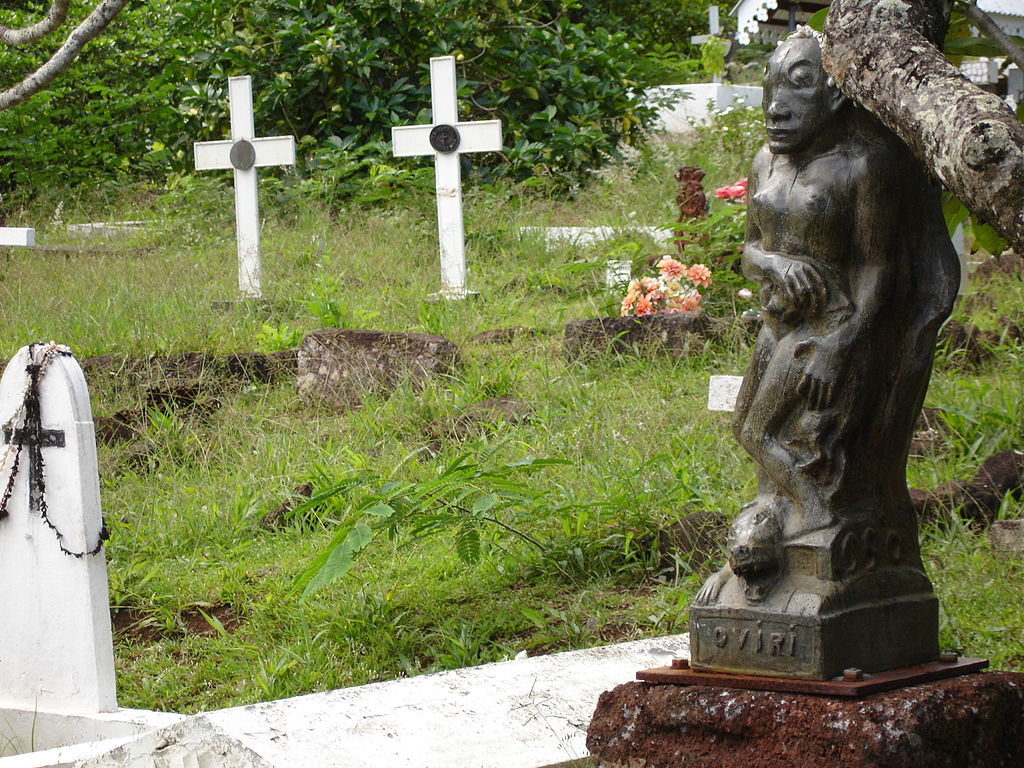
FEATURE image: Paul Gauguin, Oviri (Savage),1894, stone, 75 x 19 x 27 cm, Musée d’Orsay, Paris. Public Domain.
By John P. Walsh
By 1887 French Post-Impressionist artist Paul Gauguin (1848-1903) had created over 50 ceramic sculptures and carved several decorative panels. So it may be expected that during his interlude in Paris between 1893 and 1895 that he would create a woodcut based on his most recent and important discovery of this Paris interval—the hideous Oviri.
Gauguin made a large ceramic of Oviri (fig. 13) in the winter of 1894-1895. The Tahitian name translates as “wild” or “savage” and, a more recent interpretation, “turned into oneself.” The artist submitted it to the annual exhibition of the Société Nationale des Beaux-Arts for April 1895.
fig.12. Paul Gauguin, Oviri (Savage), 1894 – woodcut printed in black on cream Japan laid paper, 8.03 x 4.56 inches (204 x 116 mm). The Art Institute of Chicago, Clarence Buckingham Collection.
Submitted, Rejected, Overridden
The ceramic, envisioned by the artist as a modern, savage funerary monument (fig.14), was rejected by the judges for inclusion into the salon of the Société Nationale des Beaux-Arts. Gauguin’s latest Tahiti-inspired art was deemed too ugly even by an organization of artists that, since its renewed inception in 1890, is seen as Europe’s first Secessionist movement. Although Auguste Rodin (1840-1917) was a founding member of the group and since 1891 working on his commission from the Société de Gens Lettres for a Paris Balzac statue (that “obese monstrosity”), it was ceramist Ernst Chaplet who insisted on Gauguin’s admittance.56
When Gauguin discovered this mysterious figure who holds a blunted she-wolf, crushing the life out of her cub — occasionally understood as a symbol of female sexual potency — he did not let her go.55 In the print impression — and he made 19 prints from the same wood block, none of which are exactly alike — Gauguin’s Oviri is encountered in the primeval forest as inky blackness.
Paul Marsan, called Dornac (1858-1941), photograph of Ernest Chaplet (Sèvres, 1836 – Choisy-le-Roi, 1909), octobre 21, 1904.fig. 14. Bronze Oviri on the grave of Paul Gauguin on the Marquesan island of Hiva Oa.
Where exactly the ceramic Oviri was displayed in the salon is unclear, but its subsequent route into the collection of the Musée d’Orsay in 1987 is highly circuitous.57 Gauguin often exploited favorite images by repeating them in various media — and the ceramic transposed to the print depicts his idol showering a black light that blots out most of the natural reality around her.
In another Gauguin print from the time period that can fit in the palm of the hand, the artist offers a splendor of darkness, the mystery of a palm frond forest, and a stark confrontation with Oviri who is, as Gauguin described to Stéphane Mallarmé on the poet’s version of the print, “a strange figure, cruel enigma.”58
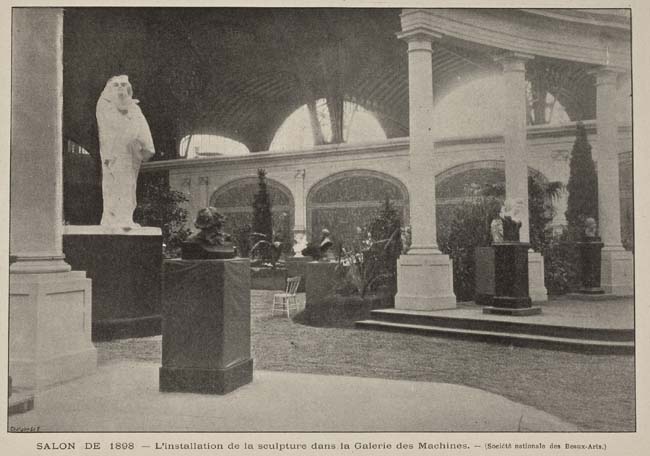
Société Nationale des Beaux-Arts in 1898.
NOTES:
“turned into oneself” – Anne Pingeot, “Oviri,” in Gauguin Tahiti, George T.M. Shackelford and Claire Frèches-Thory, MFA Publications, 2004, p. 140; “symbol of female sexual potency” – Mathews, p. 203; Gauguin’s ceramic and carved panel output -Barbara Stern Shapiro, “Shapes and Harmonies of Another World,” in Gauguin Tahiti, George T.M. Shackelford and Claire Frèches-Thory, MFA Publications, 2004, pp. 117 and 126.
19 prints from one wood block – Shapiro, p. 126; savage, modern funerary monument – Mathews, p.208; first secessionist movement – Hans-Ulrich Simon, Sezessionismus. Kunstgewerbe in literarischer und bildender Kunst,: J. B. Metzlersche Verlagsbuchhandlung, Stuttgart ,1976, p. 47; Gauguin and the 1895 Société Nationale des Beaux-Arts salon – Mathews, p. 208; “obese monstrosity” – Grunfeld, Frederic V., Rodin:A Biography, Henry Holt and Company, New York, 1987, p. 374.
Anne Pingeot, “Oviri,” in Gauguin Tahiti, George T.M. Shackelford and Claire Frèches-Thory, MFA Publications, 2004, pp. 136-138.
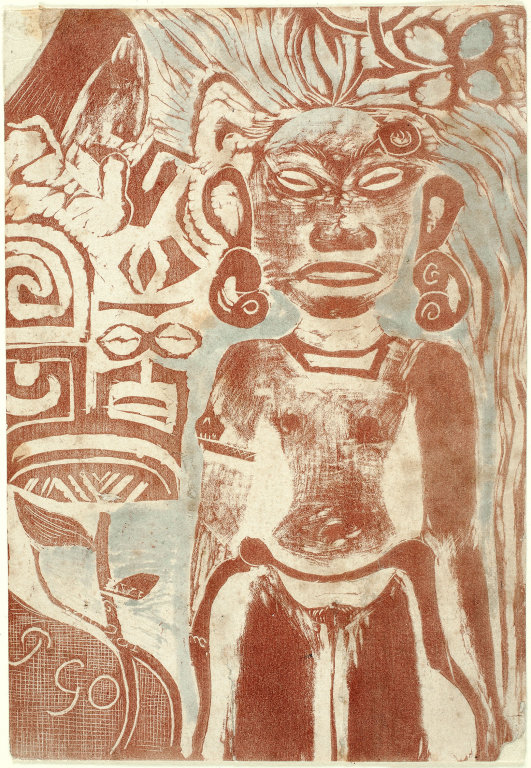
FEATURE Image: Paul Gauguin, Tahitian Idol-The Goddess Hina, 1894/95 – woodcut in black ink, over ochre and red, with touches of white and green inks, on tan wove paper, 5.78 x 4.72 inches (147 x 120 mm). The Art Institute of Chicago, Edward McCormick Blair collection.
Produced in Paris inspired by Tahiti: Tahitians Fishing – Tahitian Landscape – Tahitian Idol the Goddess Hina.
By John P. Walsh
To take a look at a selection of three prints produced in Paris by Paul Gauguin (1848-1903) that were inspired by his long trip to Tahiti from 1891 to 1893—and followed by his return there in 1895 until his death in 1903— elucidates both his artistic ideas and methods and techniques he used to produce them in this time period unique to his career.
Ever the consummate craftsman—even Gauguin’s modern art critics largely conceded his graphic arts expertise—his traced monotypes (also called watercolor transfer drawings or printed drawings) employed a simple but creatively unique process to offset his watercolor or gouache designs onto paper.
The first step in Gauguin’s process was to place slightly damp paper over his hand-drawn design and with the pressure he exerted from the back of an ordinary spoon the moisture in the paper and the water-based medium worked to transfer the reverse image of the design onto the paper. Gauguin could then reprint his design so that each would be variable images, imparting a pale, soft value to the work — outcomes that the artist sought for these Tahitian pieces.
By 1898, having returned to Tahiti, Gauguin created a new print medium which was essentially a reversal of early Renaissance silverpoint. His new technique required Gauguin to apply a coat of ink to one sheet of paper, place a second sheet over it, and draw on the top sheet with pencil or crayon. The pressure of the drawing instrument transferred the ink from the first sheet of paper onto the back or verso side of the top sheet. Gauguin greatly admired his technical discovery and considered it an expression of “childlike simplicity.”
Fig.1 . Tahitians Fishing, 1893/5 – watercolor and black ink, over pen and brown ink, on vellum laid down on brown wove paper, 9.84 x 12.48 inches (250 x 317 mm). The Art Institute of Chicago, Edward McCormick Blair collection.
1-Tahitians Fishing
In the first print to be seen, Tahitians Fishing is a small work (fig. 1). Its figures are flat, with little modeling or detail. The impact created is one of a dream. Gauguin presents a primitive world that is half-naked and childlike. In its Synthetist elements, it is reminiscent of a major painting he completed the year before, Fatata te Miti (By the Sea) (fig.2). It shares its flat colors, abstract shapes, and unbroken curves uniting to make an integrated decorative pattern.
Fig. 2. Gauguin, Fatata te Miti (By the Sea), 1892, oil on canvas, 67.9 x 91.5 cm (26 3/4 x 36 in.), The National Gallery of Art, Washington, D.C.
Yet Tahitians Fishing is a sketch. It is divided into distinct zones like Day of the Gods (Mahana No Atua) (fig.3) created by Gauguin in the same years in Paris. The print shows a grassy foreground and sea/vegetation/sandy shore that creates two horizontal zones. These are bisected by a dominant vertical (a tree) that divides the piece into informal quadrants. The tree, a powerful element, is a void―a space of black ink―while its branches and roots are delineated with the same facile modeling as the rest of the composition. The pair of main roots and twelve or so ancillary roots sit ambiguously atop the grassy foreground with its childlike delineation of blades and sinks into sandy soil. The tree surrounds a naked squatting female, her bare breasts exposed. Is she hiding herself from a second woman working with a net in the area of sand and sea? This second worker is aided by three others who are perhaps completely nude figures that stand waist deep in water. Two are male but the third figure’s sex is uncertain as s/he is turned so the viewer sees only a naked back. There is very little personality to the figures. They are, instead, composition elements like cartoons.
Fig.3. Gauguin, Day of the Gods (Mahana No Atua), 1894,
oil on canvas, 26 7/8 x 36 in. (68.3 x 91.5 cm), The Art Institute of Chicago.
Gauguin’s visual image and text searches and reflects European Symbolism and Tahiti to create a new hybrid
In the time Gauguin was making Tahitians Fishing, he was working on the text and suite of ten wood block prints for his book Noa Noa. Tahitians Fishing also involves text and the visual image. Gauguin places a verse by living French Symbolist poet Paul Verlaine (1844-1896) into a visual work about Tahiti. This artistic admixture could be part of Gauguin’s reaction to one of Symbolist art’s major indictments by naturalist modern art critics ― that it is preoccupied with ideas and should be subsumed exclusively into the domain of literature.41
Gauguin’s literary career began in the midst of this critical argument that predated his first departure to Tahiti and maintained itself at his return. From an artist who confronted disparate parts to create something new, Tahitians Fishing is a hybrid piece of Symbolist literary and visual elements using Gauguin’s obsession with Tahiti as its unifying theme. It indicates that the artist was reflecting on his Tahitian art, if not searching for more. Many Paris critics believed his art confused East and West. Gauguin gives validity to that belief by putting a poem at the top of the sheet in its own artistic “zone” and not straying into the visual image itself or making letters into art. While his pillaging from the Western world could set Gauguin’s critics alight, sympathizers saw his juxtapositions as a productive and creative artistic strategy.42 Verlaine’s nature poem ― “Qu’as-tu fait, ô toi que voilà/Pleurant sans cesse./Dis, qu’as tu fait, toi que voilà/De ta jeunesse?”43 ―provides another facet to Gauguin’s imposition of the Edenic dimension of good and evil onto the image.
Tahitians Fishing tested Gauguin’s powers to illustrate text which he was working on for Noa Noa, a phrase that means “perfume.” The Man with the Ax (fig.4), a print from this Paris period (1892/94) is a complex of thinned gouache and pen and black ink over pen and brown ink on dark tan wove paper and laid down on cream Japanese paper. At approximately 12 x 9 inches it is – by virtue of its tripartite landscape, stooping figure and monumental and vertical figure enclosed in Cloisonnist dark contour – a retrospective of work done in Tahiti between 1891 and 1893.
Fig. 4. Gauguin, Man with an Ax, 1891/93, thinned gouache with pen and black ink, over pen and brown ink on cream wove paper (discolored to tan), laid down on cream Japanese paper, 317 x 228 mm, The Art Institute of Chicago.
Tahitians Fishing is new as it reflects Tahiti and adds a contemporary French Symbolist text. It contains similarities in composition, theme, and figures to the forward-looking painting Day of the Gods. Both share the image of a “Savage Eve” figure which obsessed Gauguin throughout 1893 to 189544 and both have a dominant central vertical―a tree in Tahitians Fishing and an idol in Day of the Gods. Each has distinct horizontal zones and ground-and-water block-like forms. Even the amoeba-shaped waters in Day of the Gods are reflected in the steeply pitched water-as-sky in Tahitians Fishing. Maurice Denis identified Gauguin by his bright, unnatural colors45, but this exercise piece is more than that. It explores compositional forms and themes of his Tahitian and Synthetist works and includes avant-gardist French Symbolist verse. Gauguin’s work in these pieces is not always simply, as Julien Leclerq wrote in December 1894, “(the) transposing into another medium motifs from his Tahitian works.”46 Gauguin may have used this particular Verlaine poem if he was anywhere outside Paris, but it seems less likely. He continued to experiment with mixing text and visual image, a courageous act in the face of conservative critics who, with artists Edgar Degas and Paul Cézanne, castigated Gauguin for the repetitive elaboration and recombination of pictorial ideas. On the recto side of this work no signature of any sort is detectable.
2-Tahitian Landscape
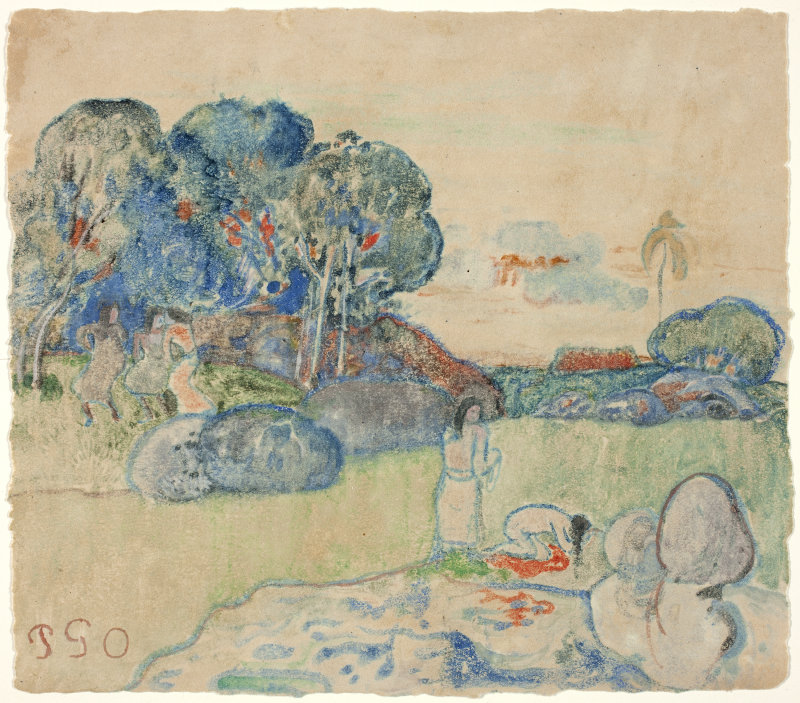
As Belgian critic Emile Verhaeren saw him, Paul Gauguin (French, 1848-1903) produces “child art.”47 The artist’s anagram “P.Go.” looms large in the lower left hand corner making it plain that the 46-year-old Gauguin made this print. Gauguin’s use of color and form are significant as they build up the image of five women in a landscape―two foreground figures more fully defined than the three figures merging into the background. It is ambiguous whether it is a channel of water or grass that separates the two foreground women who appear to perform a rite of worship and a trio in conversation or, as Richard Brettell interprets, dancing.48 As the Seine flows through Paris where Gauguin created this print, there exists in Tahitian Landscape (fig. 5) a commentariat on the Right Bank and artisans spilling blood in their offerings on the Left Bank. Modeling of the three women has affinities with Ta Matete of 1892 (fig.6) as Gauguin uses the same flat, static figures that have been traced to Egyptian painting with the ethnological implication that the Polynesians’ origins are in mankind’s oldest civilizations.49
Fig. 5. Paul Gauguin, Tahitian Landscape, 1894 – watercolor monotype, with brush and watercolor, on cream wove paper, 8.66 x 9.72 inches (220 x 247 mm). The Art Institute of Chicago, Edward McCormick Blair collection.Fig. 6. Gauguin, Ta Matete (The Market), 1892, 28.7 x 36.2″ (73 x 92 cm), Öffentliche Kunstsammlung, Basel.
Continual rhythm or “musicality” of bodily contours with intervening empty space gives Tahitian Landscape a Synthetist sensibility to the figures while its overall Symbolist ambiguity is a result of pale color and de-emphasized form. The figure of the woman on her knees to the right is engaged in a ritual bathing as Brettell believes or may be bowing before a vague natural stone construct (Brettel, however, denies any hint of religion).A pool of red flows at, or under, her chest that may represent bathing water as Brettell offers or perhaps a hint of light or shadow or, more intensely, the figure’s blood. Red appears again in one of the three dancing figures. In this landscape Gauguin allows for several possible interpretations.
Gauguin presents a scene of bewilderment, ambiguity, and mystery
Under close examination the artist seems to encourage bewilderment by producing a scene of ambiguity and mystery. If Gauguin acted as an ethnologist―as art critic and historian Roger Marx compared him in November 1893 – it would be impossible for the artist to depict an authentic blood sacrifice in Tahiti since, in the 1890s, it was prohibited by French law. The artist then dreams a scene in a Tahitian setting of a woman and her associates offering a savage blood sacrifice to a stone god. This piece asks questions about Gauguin’s attitude for Tahiti and sheds light on some of his deepest desires in Paris. The formulation of the sky, waters, and ground create a Synthetist landscape but it is the Symbolist figures and the mystery surrounding their presence that is the central power of the work. This use of mysterious figures in a landscape is found in Gauguin’s previous work in Martinique (“the land of the Creole gods”50 he wrote in a letter) and in Brittany (figs. 7 and 8).
fig. 7. Gauguin, By the Sea, oil on canvas, signed and dated at lower left, P. Gauguin 87, 18 1/8 x 24 in. (46 x 61 cm), private collection, Paris. Fig. 8. Gauguin, Be Mysterious, 1890, low relief, polychrome lime tree wood 73 x 95 x 5 cm., Musée d’Orsay, Paris.
In Tahitian Landscape, on the other side of the green, blue, and peach-color chasm heavily outlined on the right and halted by a built-up “shore,” the three dancing women who are barely modeled or detailed appear to be observed by an idol figure. It lies in blue shadow in dense foliage and is nearly invisible. As in Tahitians Fishing (see part 2 of “Savagery in Civilization…” ) it is by way of foliage, boulders, and rounded forms of the landscape that there emerges a similarity with the jigsaw puzzle-like lagoon in that same year’s Day of the Gods. However, the forms in Tahitian Landscape are flatter and less organic-looking. As popular graphic art methods could not produce the deliberately pale character of the surface Brettell proposes that this image was made as a transfer or counterproof on wetted paper from a now lost watercolor matrix.51
3- Tahitian Idol-The Goddess Hina
For some pieces of graphic art Paul Gauguin (French, 1848-1903) uses the moniker “P.Go.” to sign them.52 In Tahitian Idol-The Goddess Hina (fig.9, at top of the blog post), the moniker is present in the lower left corner slightly on its side. While Day of the Gods, painted in Paris in 1894 at the same time as the woodcut, received a simple signature of “Gauguin” (the painting was not exhibited in the artist’s lifetime), Gauguin sometimes used these new graphic art works as “image translations” to explain his Tahitian art to the Parisian public. This may explain the pretension of the anagram here.53
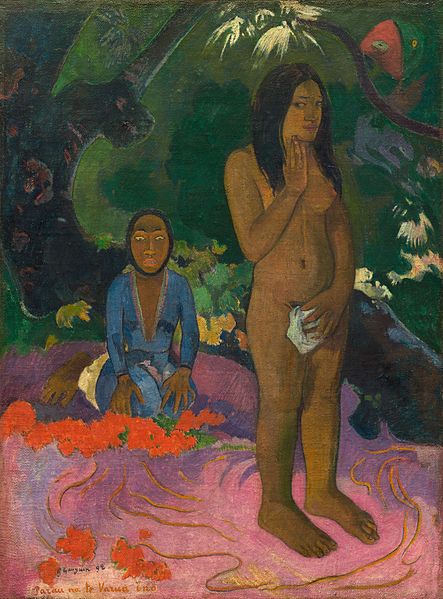
fig.10. Gauguin, Parau na te Varua ino (Words of the Devil), 1892, oil on canvas, 91.7 × 68.5 cm (36 1/8 × 25 15/16 in.), National Gallery of Art, Washington, D.C.
Artist’s obsession with representations of the primitive and “savage”
Gauguin’s obsession with the primitive, the savage, is evident in this work. The small woodcut is an image of a Tahitian goddess where the composition’s diverse elements congeal to a single mask to be held in the palm of one’s hand. Goddess Hina, immobile and august, is fitted into the composition as a first among equals. A tree fills the left border like a totem with a V-formed sprout. At the woodcut’s top border – and peering out of a branch at the tree trunk’s crux – is a profile of an evil spirit represented by a head. The grassy hair of the goddess fills about half the background and falls to nestle by her left arm. Gauguin uses several stock elements in different attitudes or positions. For example, he used the evil head in the 1892 painting Parau na te Varua ino (Words of the Devil) (fig.10) and this woodcut’s symbolism likewise remains complex. In the woodcut, to Goddess Hina’s right and immediately below the malevolent spirit who materializes in strange and frightening humanoid forms, appear abstracted forms of a coiled snake and other ceremonial visages. Goddess Hina is primitive and statuesque whereas the evil head possesses a sinister aspect with circles that serve as open eyes.
When Gauguin wrote from Tahiti in March 1899 to Belgian Symbolist poet and critic André Fontainas with reflections on the South Seas, he expressed strong feelings of awe, personal vigil, and dream-like vision. Such qualities must have been experienced on his first Tahiti trip for they permeate a work like Tahitian Idol – The Goddess Hina:
“Here near my hut, in utter silence, I dream of violent harmonies in the natural fragrances that exhilarate me. A pleasure heightened by an indefinable sacred awe which I divine towards the immemorial. In bygone days, an odor of joy that I breathe in the present. Animal figures in statuesque rigidity: something inexpressibly old, august, religious in the rhythm of their gesture, in their rare immobility. In dreaming eyes, the cloudy surface of an unfathomable enigma. And here is nightfall – everything is at rest. My eyes close in order to see without understanding the dream in the infinite space that recedes before me, and I have a sense of the doleful march of my hopes.”54
Paul Gauguin’s hut in Tahiti – Jules Agostini (1859-1930), December 31, 1904. Bibliothèque nationale de France.
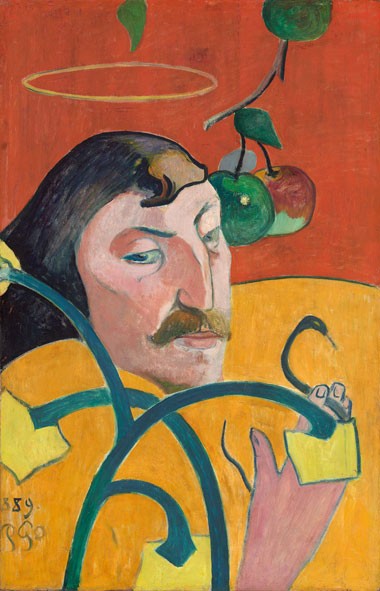
In a work of approximately 5 x 4 inches―and its small size in no way diminishes its artistic force―Gauguin achieves in Tahitian Idol-The Goddess Hina a craftsman’s unity of good and evil in nature. Before his first visit to Tahiti Gauguin already had familiarity with this theme of nature’s duality for he uses it in his 1889 painting Self-Portrait (fig. 11) where halo and snake vie within and for creation.
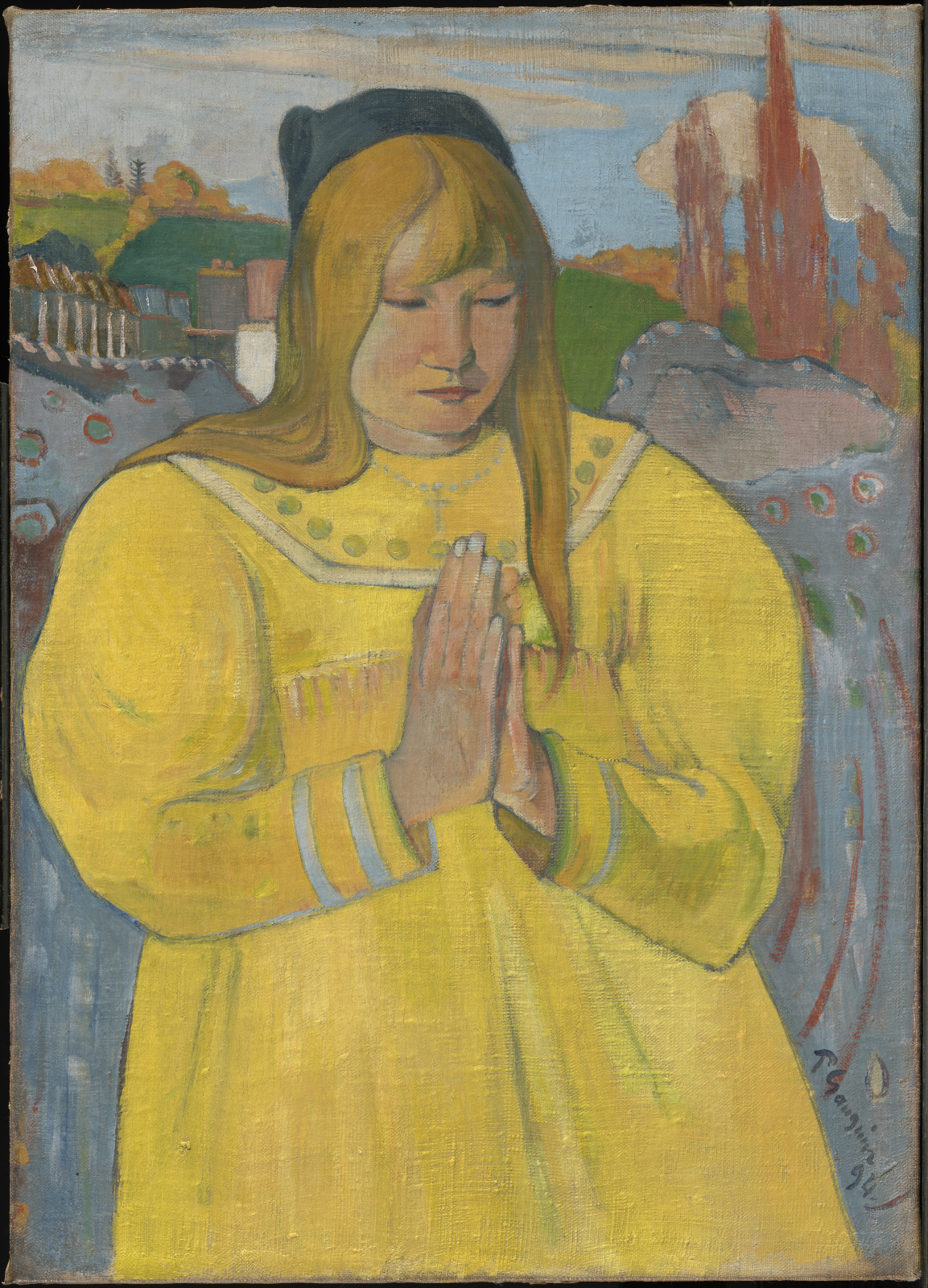
fig.11. Gauguin, Self-Portrait, 1889, oil on wood, 79.2 x 51.3 cm (31 3/16 x 20 3/16 in.), National Gallery of Art, Washington, D.C.PAUL GAUGUIN, Tahitian Woman, 1894?, irregularly shaped; charcoal and pastel, selectively stumped, and worked with brush and water on wove “pasted” paper, glued to secondary support of yellow wove paper mounted on gray millboard. The Brooklyn Museum. A pastel where Gauguin subverted the medium.PAUL GAUGUIN The Young Christian Girl, 15 3/8 x 18 inches, oil on canvas, Clark Institute Art Institute, Massachusetts. Gauguin painted this work in Northern France fusing imagery from his recent experiences in Tahiti. She is shown in a dress similar to those brought by Christian missionaries to the South Sea Islands.
NOTES:
Marlais, p.99.
Salvesen, p. 51.
“What have you done – you who are Forever crying? Speak! What have you done – you who are so young?” – my translation.
quoted in Barbara Stern Shapiro, “Shapes and Harmonies of Another World,” in Gauguin Tahiti, George T.M. Shackelford and Claire Frèches-Thory, MFA Publications, 2004, p.131.
Thomson, Gauguin, p. 130.
Brettell, p. 359.
Thomson, Gauguin, p. 152.
Brettell, p. 80; “denies any hint of religion” and “bathing water”- Brettell, p. 359. Brettell’s denial here of Tahitian religion does not preclude his proposing that the bowing figure may be an adaptation of the naked and penitent Magdalen at the foot of the cross, which is part of Catholic tradition.
Ibid., p. 359.
Brettell., p. 330.
Ibid., p. 330.
Delevoy, Robert L., Symbolists and Symbolism, Rizzoli International Publications, Inc., New York, 1982, page 54.
FEATURE image: Gauguin, Self-Portrait with Palette, winter 1893-94 or 1894-95, 92 x 73 cm (35 7/8 x 28 1/2 in.), private collection.
Paul Gauguin, Self-Portrait, 1893-1894. Oil on canvas, 18 x 15 in. (46 x 38 cm), Musée D’Orsay, Paris. The artist portrays himself in his new studio in Paris painted in bright colors with exotic decor including a blue and yellow sarong at the lower right. Behind him is his Manau Tupapau (The Spirit of the Dead Keeps Watch, Buffalo, Albright-Knox Art Gallery) painted in the South Pacific in 1892.
By John P. Walsh
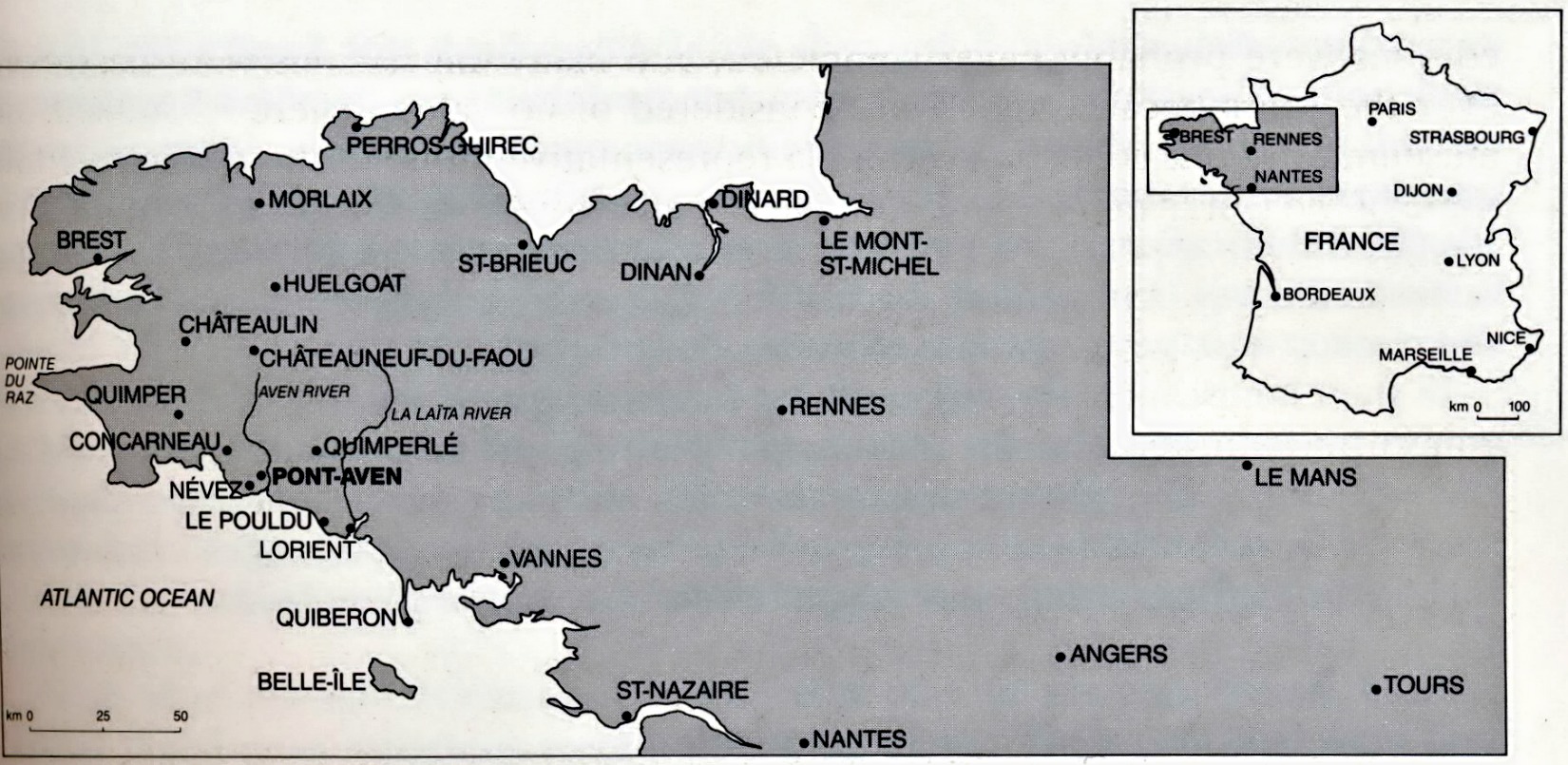
In May 1894 during a working visit to Brittany filled with nostalgia, a 45-year-old Paul Gauguin broke his leg above the ankle in a scuffle with sailors in broad daylight. In France just nine months after being away in French Polynesia for over two years, Gauguin was spotted playing the role of bohemian artist in Concarneau, an old fishing port which had become a busy international art colony. Gauguin made an attractive target in his outlandish attire and shoulder-length hair huddled with a coterie of young art disciples, a pet monkey, and a Ceylonese child mistress whose dark skin offended late-nineteenth-century social norms as much as her age.1
Map of Brittany in northwestern France showing the principal sites where Gauguin and other avant-garde artists lived and worked in the late 1880s and 1890s.
Exhibiting his penchant for questioning prevailing assumptions and bringing to Brittany the easy sexual standards he experienced in Tahiti, a dissolute Gauguin now paid for his personal freedom with serious bodily harm. The violent incident added to the changed relations Gauguin found for himself in France since his return to his homeland in late August 1893. After his 27-month artistic exile in the middle of the South Pacific starting in April 1891, the midcareer artist strove to re-establish ties among dealers, critics, collectors and artists in Paris. He had a misguided anticipation for sales of his new Tahitian paintings based on his past artistic triumphs and the handful of new Tahiti work he sent ahead of his arrival into France for exhibition in Paris to carry his objectives forward.2 In Brittany Gauguin’s injury required him to be hospitalized and put on morphine and alcohol as pain killers for a two-month recuperation. By late August 1894 Gauguin’s leg had healed where he traveled to nearby Quimper for his assailants’ trial. The artist had sued the ruffians for 3,000 francs, but local justice meted out a small fine.3
Gauguin did not rest on his laurels or his recent injury. Rather, since his return to France, Gauguin engaged himself almost nonstop in self-promotion on behalf of his new Tahitian art portfolio. During his recuperation Gauguin found he was unable to paint in his first full summer back in France in 1894. This was a hard irony since in his Tahitian work between 1892 and 1893 Gauguin was primarily a painter. In summer 1894 he turned to work exclusively on wood cuts and monotypes (the latter art form also called transfer drawings, watercolor transfer drawings, printed drawings, and traced monotypes). Working alone and with other artists from the Pont-Aven group, Gauguin experimented with new images, new arrangements and new applications without committing anything to oil. These print techniques ―different from etching which Gauguin found too dainty― afforded him the painterly effects, unusual textures and distorted forms that he sought and which his opponents in the modern art world vocally despised. For the sake of this post’s length and logic, a fuller presentation of four of these “savage” prints which Gauguin finished in Paris between 1893 and 1895 (among scores of others) can be discovered in a separate blog post. Excluding the collective power of his ten large and earliest woodcuts made for Noa Noa, no works of graphic art by Gauguin in this Paris period are more mysterious than the ones this article will consider – namely, Tahitians Fishing (involving Savage Eves), Tahitian Landscape (blood sacrifices), Tahitian Idol – The Goddess Hina (vying spirits in the natural world) and Oviri based on Gauguin’s ceramic sculpture.
TAHITIANS FISHING, 1893/5 – watercolor and black ink, over pen and brown ink, on vellum laid down on brown wove paper, 9.84 x 12.48 inches (250 x 317 mm). The Art Institute of Chicago, Edward McCormick Blair collection.TAHITIAN LANDSCAPE, 1894 – watercolor monotype, with brush and watercolor, on cream wove paper, 8.66 x 9.72 inches (220 x 247 mm). The Art Institute of Chicago, Edward McCormick Blair collection.TAHITIAN IDOL – THE GODDESS HINA, 1894-95 – woodcut in black ink, over ochre and red, with touches of white and green inks, on tan wove paper, 5.78 x 4.72 inches (147 x 120 mm). The Art Institute of Chicago, Edward McCormick Blair collection.OVIRI (SAVAGE), 1894 – woodcut printed in black on cream Japan laid paper, 8.03 x 4.56 inches (204 x 116 mm). The Art Institute of Chicago, Clarence Buckingham Collection.
In November 1894 when Gauguin was able to return from Brittany to Paris he opened the door to his studio to find that its two rooms had been ransacked save for own art work. It had been the undertaking of Gauguin’s Ceylonese mistress, called Annah la Javanaise, who had exacted her sense of savage justice on the man from France for her services.4
Gauguin’s Studio at 6 rue Vercingétorix in Paris. Gauguin is seated at left in the broad brimmed hat. Behind him is artist Paul Sérusier with Annah la Javanaise. Standing in the black hat is painter Georges Lacombe. The two musicians are Fritz Schnedklud (center) and Larrivel (right). Photograph: Musée Gauguin, Papeari.
Following his passage from Tahiti into France on August 30, 18935, Paul Gauguin, virtually penniless, stayed in Paris with art historian Émile Schuffenecker with whom he had been estranged and by more than the High Seas.6 From fall 1892 into early spring 1893 Gauguin had been sending to Paris his new work from Tahiti ―nine canvases in total – including his first portrait of a Tahitienne, namely, Vahine no te Tiare of 1892 which today hangs in Copenhagen. Displayed in the Boulevard Montmartre gallery of Boussod, Valadon & Cie (the former Goupil & Cie),7 critical reaction to the portrait which was so important to Gauguin turned out to be mixed.8 The portrait might have served as a bellwether to Gauguin and those who paid attention to his work. Its tepid, divided response would mark the reception he received for his much larger Tahitian oeuvre in Paris between 1893 and 1895.
Gauguin, Vahine No te Tiare (Woman with Flower), 1891. Oil on canvas, 70 x 46 cm, Ny Carlsberg Glyptotek, Copenhagen.
While Edgar Degas spoke well of and invested in Gauguin’s work, the two were not personally close.9 It was in conversation with younger artists and one older artist, Odilon Redon, that in January or February 1890 Gauguin was inspired to pursue the idea of a “Studio of the Tropics.” Although Redon by late summer of 1890 told Gauguin he was against his leaving France – whether to Madagascar, as first entertained, or as it happened, to Tahiti in April 1891, Gauguin was clearly not persuaded. Redon was convinced that Gauguin’s artistic development in Europe would be significant and appealed to Gauguin to reconsider.10 Gauguin wrote to Redon from Le Pouldu in September of 1890:
“…The reasons you give me for staying in Europe are more flattering than they are likely to convince me. My mind is made up…I judge that my art, which you like, is only a seedling thus far, and out there I hope to cultivate it…Here, Gauguin is finished, and nothing more will be seen of him…”11
In Tahiti Gauguin made his home in Papeete and soon after in Mataiea before he returned to Paris two years and three months later in August 1893. He stayed in the French capital for twenty-two months until a second departure for Tahiti in June 1895 when this time, indeed, nothing more would be seen of him (“My design, Gauguin wrote, “(is) to bury myself in the South Sea Islands.”)12 It could not be known until December 1894 that Gauguin had decided to return to Tahiti – although in 1894 his letters expressed longing for it.13 His time in Paris possessed a “liminal” quality in that he occupied a position at or on both sides of a boundary or threshold of Tahiti. From 1893 to 1895 in Paris Gauguin had two distinct worlds to draw on and consider for his art – one, an echo of Redon’s advice in 1890 to develop artistically in Europe and two, his memory of Tahiti from 1891 to 1893. The South Seas had imparted to Gauguin new images for him to paint that he could not find in France – and he worked to promote these discoveries and ruminate on them in current work. Unlike Brittany of which the artist was fond, Tahiti surrounded Gauguin with a strangeness that allowed his imagination to take greater hold of the mystery, savagery, and otherness that he increasingly sought to express in his artistic work. Both worlds can be found in Gauguin’s art of this Paris period – Tahiti in the new images based on primitiveness and savagery and France in the forms of Symbolism and Synthetism that Gauguin learned and helped lead after 1888. Each of these worlds – one definitely savage and the other civilized or also savage based on one’s art critical perspective in early 1890s Paris – informed the other in formal terms and the impressions inspired by the artist’s dreams, exaggerations and inventions.
Paul Gauguin had come back to France actually intending to stay14 but as time passed his connection to the faraway islands became too strong to forsake. At Café Escoffier in Paris on December 7, 1894, Gauguin announced his return to Tahiti and left France forever the following year. In those 660 days in France Gauguin worked to force rapid public acceptance of his work and ended up being all but shunned by the French public. Gauguin brought to Tahiti in 1891 the experience of all the art he had made in the late 1880s with Vincent Van Gogh in Arles and with Émile Bernard and Paul Sérusier in Brittany as well as his deep admiration for Redon’s noirs. Primitive culture in Polynesia, while truncated and absorbed into French rule, appealed to him and in the Paris interlude Gauguin obsessed about the island in his literature and art.15
Gauguin. Manao Tupapau (Spirit of the Dead Watching), 1892. Oil on canvas. 28 1/2 x 36 3/8 in. (72.5 x 92.5 cm), Albright-Knox Art Gallery, Buffalo, NY.
Gauguin took the initiative to woo the French art-buying public and even the State to embrace the sixty-six paintings that comprised his Tahitian portfolio. His failure to take Paris by storm in this period― book-ended by a two-week commercial exhibition at Durand-Ruel’s in November 1893 and a Drouot auction on February 18, 1895 ―is blamed for his leaving for Tahiti the second and final time. These disappointments had a financial bearing – he sold only eleven of forty-one paintings from Tahiti at Durand-Ruel’s and just nine out of forty seven works at the Hôtel Drouot – but their apathetic reception affected more than a mercantile Gauguin. It is a historical irony that one of Gauguin’s unsold Tahitian paintings from this period – his 1892 double portrait “Nafea Faa Ipoipo” (When Will You Marry?)” – was sold in February 2015 by a Swiss family foundation to a group of state museums in Qatar for a record nearly $300 million. In 1893 the artist priced it at no higher than 3,000 francs or about $15,000 in 2015 dollars.
Gauguin, Nafea faa ipoipo (When Will You Marry Me?), oil on canvas, 101 by 77 cm (40 in × 30 in.).
In art work Gauguin was preparing for the public and for his private rumination he continued his “searching deep within himself”16 begun in Tahiti with its exotic theme being paramount. Throughout the period of 1893 to 1895, in Paris and in Brittany, Gauguin escaped into a Tahitian world of his own imaginings by way of his highly experimental graphic work.17 Gauguin brought to Paris with him his notes and sketch books from Tahiti and meditated on them during the course of his Paris sojourn. He thought of these mementos as “my letters, my secrets”18 and one wonders about his intention to commercially exhibit these trial works. In summer 1894 Gauguin gave away some of his watercolors19 and while this action may serve as a memento or payment to a friend, it points to a tentativeness with which Gauguin viewed these first works. “The world I am discovering,” Gauguin wrote in a letter months later, “is a Paradise the outlines of which I shall have merely sketched out and between the sketch and the realization of the vision there is a long way to go.”20
Aside from around fifteen paintings he did in France from 1893 to 1895, Gauguin’s work is mainly (with some overlap in art forms) in the graphic arts and literature, including Noa Noa, Ancien Culte Mahorie, and Cahier Pour Aline. Starting in Paris during this period and until his death in May 1903, Gauguin worked to transform himself from an artist to an artist and writer. The general idea for this effort was not original to Gauguin; it may even be a reaction to his critics who derided him as a “writer’s painter” – that is, one who obscured his instinctive painterly talent with literary or ideal concerns. Criticism of Gauguin’s art for this specific reason was deep and extensive in 1890s France by many leading intellectuals who favored the prevailing Impressionist and Neo-Impressionist art forms which promoted a naturalist and modernist art and that Gauguin had abandoned in the late 1880s. Gauguin angered and annoyed artists and critics and they derided his current work forcefully. According to Félix Fénéon Gauguin’s art was unnatural, irrational and illogical and constituted a step backwards for modern art which had staked a secular, democratic, and progressive course. For Camille Pissarro and Impressionist artists such as Paul Signac – Gauguin’s Synthetist and Symbolist styles and forms were retrograde and should be actively resisted. “Let us study Delacroix, Corot, Puvis, Manet and leave those (other) humbugs to their own devices,”21 wrote Signac in 1895 about Monsieur Gauguin.
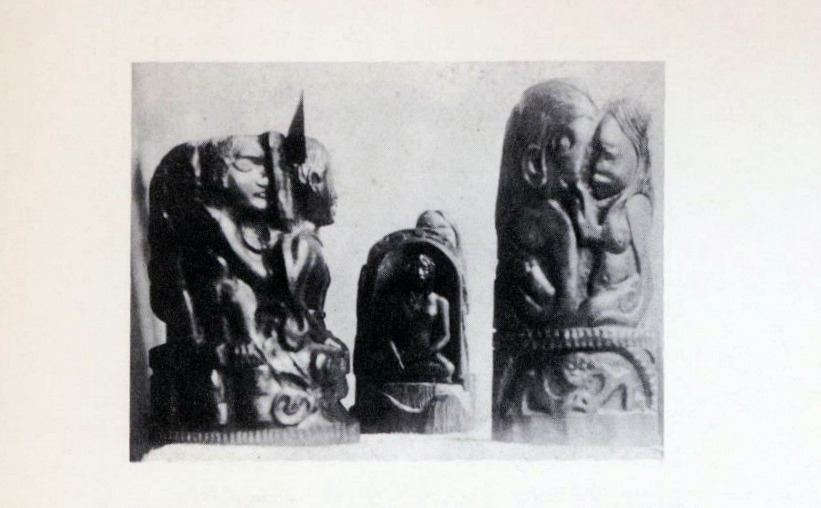
Gauguin, three wooden sculptures exhibited at Durand Ruel’s in November 1893. Photography Georges Chaudet. Gauguin’s commercial exhibition at Durand-Ruel’s included 41 Tahitian paintings, 3 Brittany paintings, 1 ceramic and wood sculptures called “tiis.”
Although brief and contentious, Paris turned out to be a productive time for Gauguin’s art.22 In December 1893 following decent sales after his exhibition at Durand-Ruel’s, Gauguin wrote from Paris to his wife Mette in Copenhagen and pointedly did not discuss his earnings which likely netted him about 10,000 francs – or $50,000 in 2015 dollars.23 Gauguin talked around the money issue to reflect on his attitude for any future art world gambit which would likely be undertaken immediately. “My show,” Gauguin wrote to his faraway spouse, “has not in fact given the results that might have been expected but we must look facts in the face…The most important thing is that my exhibition had a very great artistic success, has even provoked passion and jealousy. The press has treated me …rationally, with words of praise. For the moment I am considered by many people to be the greatest modern painter.”24
Many viewers, however, were perplexed by the artist’s refusal to translate into French the Tahitian titles found in scores of his paintings. Others were amused by the bohemian role he had assumed for himself in astrakhan hat and gilet. Gauguin was obsessed with exhibiting his major Tahitian paintings, continuing to produce that kind of work in Paris and trying to explain this portfolio to the public through his studio invitations, writings, and “image translations.” He wanted to see his Tahitian work conquer the Paris art world.25 While many Parisians did not accept or understand Gauguin’s Tahiti art they were fascinated by it. The World’s Columbian Exposition in Chicago opened in May 1893 and closed just ten days before Gauguin’s Tahiti show opened at Durand-Ruel’s. The Chicago Fair, inspired by the 1889 Paris Universal Exposition, showcased ethnological “villages” that attracted nearly thirty million people. Despite a set course for Impressionism as the parameter for modern art, Gauguin’s cutting-edge Tahiti art could not be ignored completely by Parisians who felt an intense curiosity about exotic locales, especially French Polynesia.26 In Paris Gauguin showed himself to be tireless to capitalize on this current passion. In his letters he ceaselessly complains, justifies his every action, demands extraordinary things of others and lays grand plans for himself because he believed his artistic career was on the verge of greatness but frustratingly incomplete. He poured his energy into his several artistic exhibitions in Paris and elsewhere, produced critical articles and letters for journals, and began to pull together his Tahiti adventures to write Noa Noa with his occasional friend Charles Morice. Morice added a preface, a chapter entitled “Songeries,” as well as the poems. Portions of Noa Noa (“pleasing fragrance”) appeared for the first time in La Revue Blanche, between October 15 and November 1, 1897, more than two years after Gauguin returned to Tahiti. Yet Gauguin used the writing project in late 1893 to excuse himself from traveling to Copenhagen to see his wife Mette.27
Eugène Carrière, Portrait of Charles Morice, 1893 Oil on canvas, 46.5 x 38.5 cm, Clemens Sels Museum, Neuss, Germany.
Gauguin, Portrait of Mette, 1877, The Courtauld Gallery, London.
In Paris Gauguin produced a slew of graphic work and some painting and sculpture. His message from the French capital to his far off wife was interchangeable with what it had been from Tahiti: “I am up to my neck in work!” and that he needed money.28 Regardless of his committed efforts at self-promotion and artistic expansion in Paris – including all aspects of publicity, catalog production, and stock preparation for his Tahiti exhibitions as well as mending fences with old friends and rejoining social networks such as Stéphane Mallarmé’s “les jeudis”29 – criticism and sales receipts did not fulfill the artist’s hopes for his new art. Following Durand-Ruel’s, Gauguin in January 1894 rented a two-room studio on Rue Vercingétorix and fills it with his unsold art that amounted to dozens of paintings and sculptures as well as his current work, some flea-market exotica, and an ethnographic collection. He famously decorated the walls in chrome yellow and olive green―reminiscent of Pierre Loti’s residence in western France with its valuable Far Eastern art collection30― and invited friends to share in his les mardis where they played music, told travel stories, and the host read from his work-in-progress, Noa Noa. 31
Courtyard apartment, 6 rue Vercingétorix, in the Montparnasse section of Paris, around the time of Gauguin’s residence. The location is difficult to imagine in modern Paris today.
One question asked about Gauguin’s Tahitian and Tahitian-inspired oeuvre was which of it is strictly Tahitian and which is western influenced – or, what is direct observation and what is artifice? Exceptional global coordinates did not prevent Gauguin’s first Tahitian experience from 1891 to 1893 to have a European and specifically French flavor. At Durand-Ruel’s exhibition one critic traced the origins of Gauguin’s Ia Orana Maria of 1891, now in the Metropolitan Museum of Art in New York, to a late-1870s work by Jules Bastien-Lepage. In the French press he scoffed at Gauguin’s canvas as “nothing but a Bastien-Lepage done Tahitian style.”32 This sort of critical charge underscores the ground-breaking nature of Gauguin’s art as it introduced primitivism into the European cosmopolitan avant-garde at the turn of the century. Tahiti was an official French colony since 1880 and like most Frenchmen Gauguin had little to no knowledge of its indigenous beliefs and customs. Further, he found no indigenous cultural artifacts during his first stay although he did late in his stay discover published sources for indigenous objects and practices that influenced his art by way of a Belgian scholar.33 In addition to Gauguin’s main artistic threat at “terrorizing reality” and creating ugly art as Fénéon and others strongly postulated, the challenge to Gauguin’s lack of direct observation of Tahitian subject matter or overall Tahitian expertise helped to dismiss his new art as “inauthentic.” Gauguin’s personal life was also fodder for criticism by his artistic enemies. For instance, that it was discovered that Gauguin procured his exotic mistress, Annah la Javanaise, only after his return to Paris stealing her from a French singer after meeting her possibly through art dealer Ambroise Vollard lent an almost boorish air to his art-world bearing. That after1895 Annah la Javanaise became Alphonse Mucha’s mistress in the same building in which she ransacked Gauguin’s studio in August or September 1894, was a further curiosity.34
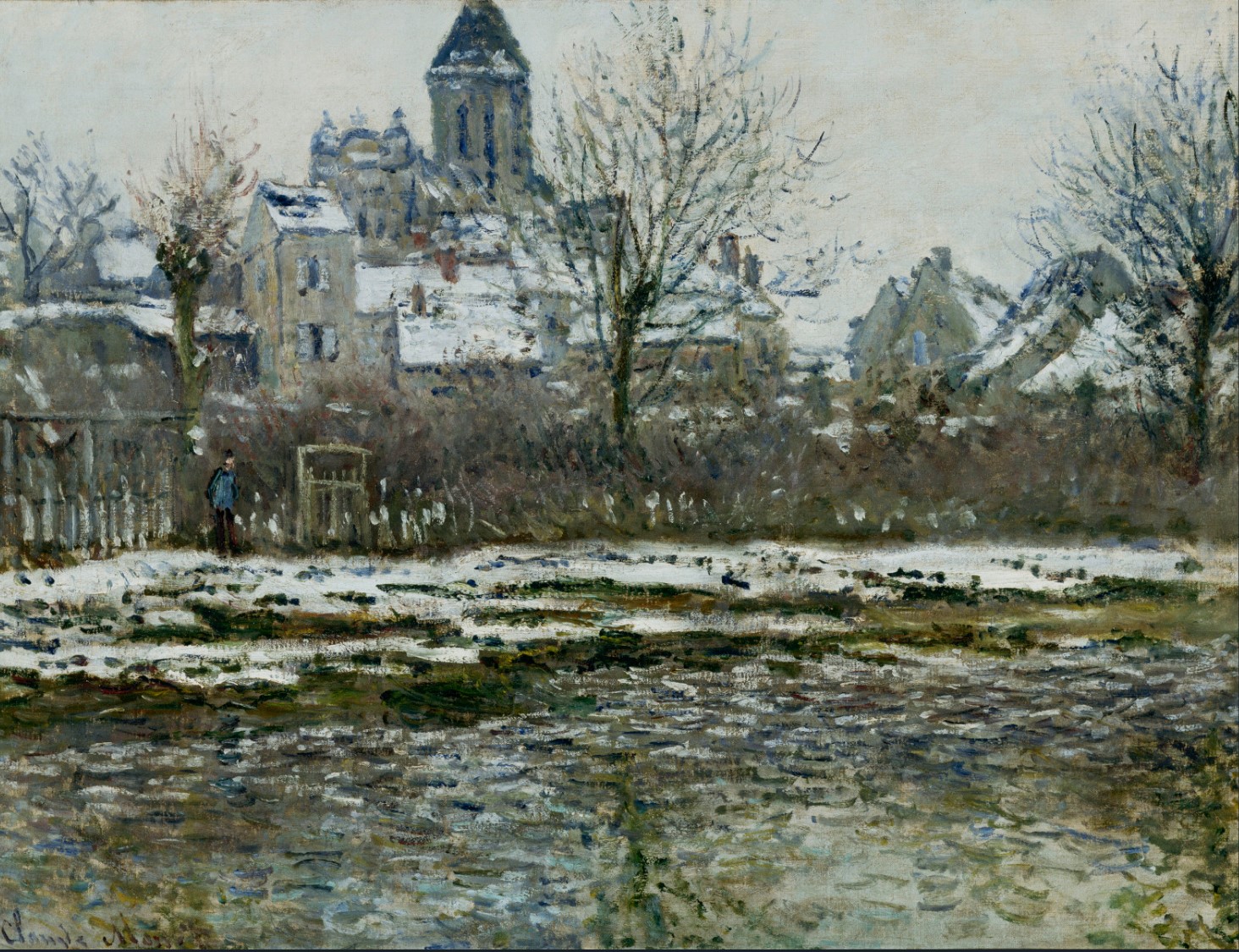
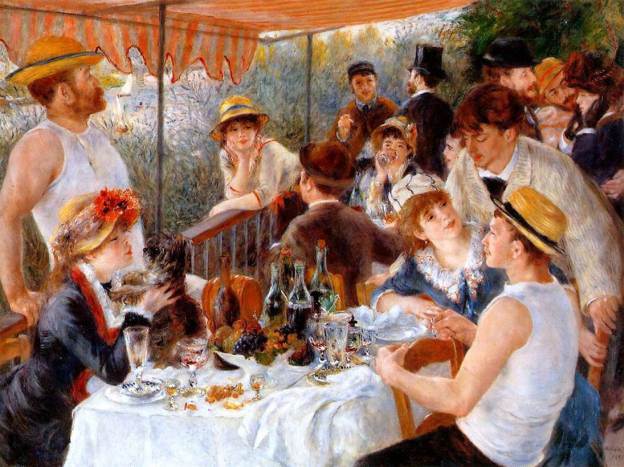
Perhaps to be expected from leading Impressionists such as Claude Monet, Pierre-Auguste Renoir, Camille Pissarro and Paul Signac, each balked before Gauguin’s forty-one Tahitian canvases during his one-man show at Durand-Ruel’s in November 1893. Two days before the show closed Pissarro wrote to his cher Lucien: “I saw Gauguin; he told me his theories about art and assured me that the young would find salvation by replenishing themselves at remote and savage sources. I told him that this art did not belong to him, that he was a civilized man and hence it was his function to show us harmonious things. We parted, each unconvinced. Gauguin is certainly not without talent, but how difficult it is for him to find his own way! He is always poaching on someone’s ground; now he is stealing from the savages of Oceania.”35 Yet during that two-week show Gauguin received a complimentary review from Octave Mirbeau, his old champion, and a reported verbal endorsement from major Symbolist poet Stéphane Mallarmé. While some new paintings done by Gauguin in Paris are clear aesthetic hybrids of Europe and Polynesia―such as Portrait de Upaupa Schneklud and Aita Parari te Tamari Vahine Judith, both from 1894―Vaïraumati tei oa (Her Name is Vairaumati), a painting he started in Tahiti in 1892 based on his new-found knowledge of indigenous gods, received its mystery and savagery out of French Symbolism and this trend of inculcating his Tahitian iconography with contemporary if controversial European influences would significantly deepen in Paris.
Gauguin, Upaupa Schneklud, 1894, oil on canvas, 92.5 x 73.5 cm (36 x 28 5/8 in.), The Baltimore Museum of Art.Gauguin, Aita Tamari Vahine Judith Te Parari, 1893-1894, oil on canvas, 116 x 81 cm (45 1/4 x 31 1/2 in.), private collection.
The argument over whether Gauguin’s Tahitian oeuvre was either authentic, exploitative colonialism or the condition for an artistic sham continued during his Paris stay. After it was revealed that Gauguin was returning to Tahiti in spring 1895, the regular art critic for Mercure de France ridiculed his decision based on the artist’s published contention that his rendering of the unnatural and the ideal were his muses. “Why must he leave his Breton digs,” Camille Mauclair wrote, “and exile himself in Tahiti to execute his painting which could, as Gauguin himself said, be done without leaving his room?” Even the artist traveling to Tahiti could be viewed, under certain critical conditions, as inauthentic to Gauguin’s own Tahitian-inspired modern art.36
Gauguin. Vaïraumati tei oa (Her Name is Vairaumati). 1892. Oil on canvas. The Pushkin Museum of Fine Art, Moscow, Russia.
Lagging sales in Paris and in Copenhagen of Gauguin’s Tahitian art portfolio remained a sore point for the artist. Whatever the date or venue― Durand-Ruel’s from November 10-25, 1893; an auction of Père Tanguy’s art collection with six works by Gauguin on June 2, 1894; a sales-exhibition in his atelier of Gauguin’s woodcuts, monotypes, wood sculptures and Tahitian paintings from December 2-9, 1894; or a February 18, 1895 Drouot auction of 47 works of art – sales performance for the “greatest modern painter” consistently underwhelmed. Such headwinds pushed Gauguin to “face facts” in a changed manner. In December 1893 he had bragged to Mette about bidders at Durand-Ruel’s going as high as 1,500 francs on his asking price of 2,000 to 3,000 francs for a Tahitian canvas and he conceiving a potential fallback price of 1,000 francs for each of his paintings. A year later, hungry for cash and wanting to unload his 4-year-old stock, Gauguin offered the same dealer thirty-five Tahitian canvases for 600 francs each.37
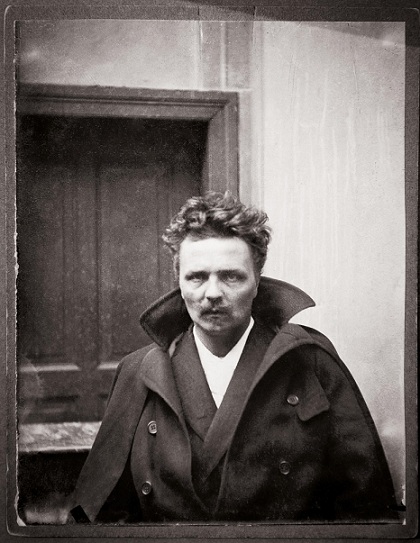
What might have occurred for Gauguin if he had stayed in Paris instead of going back to Tahiti, while impossibly speculative, is hinted at by his choice of Swede August Strindberg to write his catalog introduction for the February 1895 Drouot auction. While Strindberg could be simply viewed as another national hybrid – that of the Nordic lands and France – by the mid 1890s there could be no more propitious moment for Gauguin to interact with this avant-garde literary figure. About Gauguin’s age, Strindberg had also broke with naturalism around 1890 and subsequently was in personal and artistic crisis as he sought new arts forms in an emerging Symbolism. For his proposed catalog introduction Strindberg recognized Gauguin to be a savage and what defined a savage, according to the playwright, novelist and poet, is that he created art work that is neither beautiful nor harmonious but original and unique.
August Strindberg, Self Portrait in Berlin, 1892, National Library of Sweden.
In mid1890s Paris the city was in the midst of a technological revolution. It was in color lithography and that mechanical art form proliferated among artists like wildfire which a competitive Gauguin could not have failed to notice. His reaction to the popular modern modality was to remain undeterred in his pursuit of the low-tech woodcut. The savage, Strindberg wrote, is independent and uncompromising. In the rush to technology, Gauguin’s defiance – or what Mette called his “most monstrously brutal egoism” –contributed to the woodcut’s revival at this time. More important, in the graphic arts no contemporary French artist could approach Gauguin’s power and vitality.38 In the Paris period from 1893 to 1895 – and extending to 1900 – Gauguin had no dealer representation. Gauguin broke and then drifted away from the security of Impressionism that Degas, Monet, Renoir and Cassatt enjoyed.39 Strindberg, an artistic visionary, could bring little to Gauguin by way of collectors or patrons. Like Gauguin, he brought the integrity of his artistic experience which around that time was regrettably bordering on insanity. Three months before leaving France, Gauguin, resigned or relishing his social and artistic isolation, wrote to writer-artist Maurice Denis in March 1895. Gauguin wrote to congratulate the younger artist on an article he published on Armand Séguin, Gauguin’s print-making comrade in Brittany in summer 1894―and includes this short line on a modern artist’s role that might serve as Gauguin’s epitaph in France:
“What prompts me to write you is the pleasure it gives me to see painters looking after their own business….Go on all of you fighting with the brush as well as the pen, and in my retreat (in the South Seas) I shall cherish this fervent hope.”40
Gauguin, Self-Portrait with Palette, winter 1893-94 or 1894-95, 92 x 73 cm (35 7/8 x 28 1/2 in.), private collection. His new friend Armand Séguin (1869–1903) described the older Gauguin at this time with “his astrakhan hat and his huge dark blue overcoat buttoned with a precious buckle, in which he looked to the Parisians like a sumptuous, gigantic Magyar, or like Rembrandt in 1635.” (Séguin 1903a, 160).
The Paris interlude for Gauguin was about reworking and reinterpreting his first Tahitian experience. Whether Breton coifs or Tahitian pareos, Gauguin uses them to express his themes of distant memory, savagery, mystery, darkness, androgyny, sensual melancholy, exoticism, and the hieratic. His art united disparate objects and themes but under a veil of mystery and ambiguity. As a craftsman he uses symbolical objects to express a deeper idea than the surface meaning of the artifacts that a viewer can identify. Along with his unsold canvases Gauguin filled his Paris studio with Tahitian fabrics, wooden sculptures, weapons, trophies, and photographs and then advertised for collectors to come and steep themselves in the new language of modern art.41 Through hard work and artistic vision in France involving Synthetism, Symbolism, and from 1893 to 1895, Tahitianism, Gauguin remained an avant-garde leader. Gauguin’s art divided critical opinion but ever the passionate individualist who possessed an optimistic expectation for himself he saw much of his ambition realized in Paris in those short months. His wife Mette was responsive to his interests and he received his share of critical praise and sales for his exhibitions. In his art Gauguin combined fact and fantasy, reality and imagination and used a variety of artistic media and innovative techniques.42 In Paris by way of his re-workings of his Tahitian experience Gauguin deepened his vision of the islands and served his appetite to be, as Gustave Flaubert might arrange, “violent and revolutionary” in his work. Between 1893 and 1895 Impressionist Paris is artistically lost in the background to Paul Gauguin: there is no more than one canvas of its snow-covered roofs out of a courtyard window that was painted by him. The importance of Tahiti in Gauguin’s psyche in this Paris interlude cannot be overstated – and it becomes increasingly evident after his return there which soon resulted in his second (and final) Polynesian sojourn.
Mathews, Nancy Mowll, Paul Gauguin: An Erotic Life, Yale University Press, New Haven, 2001, p. 205.
Ibid. p.193.
Malingue, Maurice, Paul Gauguin: Letters to his Wife and Friends, The World Publishing Company, Cleveland and New York, 1949 (Letter 150, Gauguin to William Molard), p. 193.
“First Tahitian period Gauguin primarily painter…” Brettell, Richard, et.al., The Art of Paul Gauguin, National Gallery of Art, Washington, D.C. and The Art Institute of Chicago, 1988, p. 297; “exclusively on watercolor transfers and woodcuts” – Ibid., p. 293; “print techniques” – Boyle-Tuner, Caroline, in collaboration with Samuel Josefowitz, foreward by Douglas Druick, The Prints of the Pont-Aven School: Gauguin and His Circle in Brittany, Abbeville Press, New York, 1986, p.106; “atelier…plundered…”, Bretell, p. 294.
For Gauguin’s return date, August 30, 1893 according to Gloria Groom in Brettell, p. 291 and August 23, 1893 according to Nancy Mowll Mathews in Mathews, p. 193.
Mathews, p. 194.
Mathews, p. 300; Thomson, Belinda, Gauguin, Thames and Hudson, New York, 1897 (reprinted 1997), p 138.
Thomson, p 138.
Mathews, p.195.
Rewald, John, Post-Impressionism: From Van Gogh to Gauguin, The Museum of Modern Art, New York, Third Edition, 1978, p. 414.
Malingue, (Letter 157, Gauguin to Maurice Denis), p. 200.
Mathews, p. 207.
Salvesen, Britt, Gauguin, Harry N. Abrams, Inc., Publishers, New York, 2001, p. 57.
Thomson, Gauguin, p.156.
Ibid., p.140.
Brettell, p. 300.
Exhibition Pamphlet, “Intimate Encounters Paul Gauguin and the South Pacific,” The Edward McCormick Blair Collection, September 6, 2003 to January 11, 2004, the Art Institute of Chicago.
Mathews, p. 203.
Malingue, (Letter 154, Gauguin to August Strindberg), February 5, 1895, p.197.
see Georges Lecomte (1867-1958), “Salon XX, conférence de M. Georges Lecomte,” L’Art moderne, 28 February 1892, p. 67 and Francois Thiébault-Sisson (1856-1944), “Les Petits Salons” in Le Temps, December 2, 1893. “What artist would be more gifted if exclusively literary friendships did not cloud his judgment and paralyze the instinctive sense of painting that he has?” -quoted in Mathews, p. 203. For Félix Fénéon, Camille Pissarro and Paul Signac quote, see Marlais, Michael, Conservative Echoes in Fin-de-Siècle Parisian Art Criticism, The Pennsylvania State University Press, University Park, PA, 1992, pp. 98-101.
see Brettell, p. 297; Delevoy, Robert L., Symbolists and Symbolism, Rizzoli International Publications, Inc., New York, 1982, p. 159; Stevenson, Lesley, Gauguin, Gallery Books/W.H. Smith Publishers, Inc., New York, 1990, p. 56; Crepaldi, Gabriele, trans. Sylvia Tombesi-Walton, Gauguin, Dorling Kindersley, London, 1998, p. 92.
Mathews, p. 197.
Malingue, (Letter 145, Gauguin to Mette), pp. 187-88.
“image translations” –Brettell, p. 330; Druick, Douglas W. and Zegers, Peter Kort, Van Gogh and Gauguin: The Studio of the South, Thames & Hudson, New York 2001, p. 342.
Malingue, letter 142, Gauguin to his wife, September 1893, p.186.
Mathews, p. 195-196.
Ibid., p. 197.
Brettell, p. 301.
Thomson, Gauguin, p.146.
“European sources” – Ibid., p. 143; “little knowledge of indigenous beliefs and customs” and “by way of a Belgian” – Ibid., p.156; “found no indigenous cultural artefacts” – Ibid., p. 161.
Salvesen, pps. 50-51.
Pissarro, Camille, Letters to his Son Lucien, edited by John Rewald, Peregrine Smith, Inc., Santa Barbara and Salt Lake City, 1981, p. 280.
Mirbeau – Mathews, p.197; Mallarmé reportedly said: “It is extraordinary that one should be able to put so much mystery into so much splendor.” – Dorra, Henri, Symbolist Art Theories: A Critical Anthology, University of California press, 1994, p.209; Mauclair – Mathews, p.210.
“bragged about bidders..” Malingue (Letter 145, Gauguin to Mette), p. 187-88; “thirty-five canvases for 600 francs each…” -Brettell, p. 294.
Strindberg –Mathews, p. 207; color lithography and woodcuts revival – Shapiro, p. 133; “brutal egoism”-quoted in Claire Frèches-Thory, “The Exhibition at Durand-Ruel,” in Gauguin Tahiti, George T.M. Shackelford and Claire Frèches-Thory, MFA Publications, 2004, p. 84.
Ibid., p. 200.
Malingue, (Letter 157, Gauguin to Maurice Denis), pp. 200-201.
FEATURE image: Chaval’s cartoons, mainly wordless, are often derisive, ironic and filled with dark humor. In the 1950s Chaval was mentioned in American publications with cartoonists such as James Thurber, Charles Addams and William Steig.
By John P. Walsh
The 53-year-old French cartoonist’s suicide in Paris in winter 1968 served as a tragic end to a witty career. Born Yvan Le Louarn near Bordeaux in 1915, Chaval left a suicide note on the apartment door that read “Mind the gas.” But today it is his actions as a young man in his late 20s that mark him for controversy.
Chaval’s professional name is a bastardization of Chevel, an early twentieth century architect for whose work the term “architecture naïve” was coined. While Chevel came to fantastical architecture after being a poor farmer, Chaval trained for years at the École des Beaux-Arts in Paris, the nation’s foremost art school.
It is a specific period in the cartoonist’s past that erupted into a controversy in late spring 2008 as a major French art museum mounted a retrospective exhibition of Chaval’s career.
During the nearly incredible period of World War II, Chaval created drawings after 1940 with a racist and anti-Semitic slant for publication in Le Progrès, a Vichy newspaper. His drawings were characterized as “Pro-German Vichy and not just” by Pascal Ory, a leading French cultural historian of the Université de Paris-I-Panthéon-Sorbonne. When the Musée des Beaux-Arts in Bordeaux hosted an exhibition of 120 of Chaval’s pen-and-ink cartoons in summer 2008 none of his wartime anti-Semitic drawings was displayed. In an article in La Croix, the daily Paris Roman Catholic newspaper, Professor Ory revealed the nature of some of these hidden racist works as the exhibition opened.
By the mid 1950s Chaval was an international sensation, his cartoon work mentioned in the same breath in American publications with icons such as James Thurber (1894-1961), Charles Addams (1912-1988) and William Steig (1907-2003). Immediately after the war Chaval was cleared of wrongdoing and started to be published in top French publications—Punch, Le Figaro, Le Nouvel Observateur, Paris Match. He won the industry’s highest awards and remained at the top of his field until the time of his death.
In a June 5, 2008 article Professor Ory described Chaval’s wartime cartoons as “compelling” of racist anti-Semitism. One published Chaval wartime cartoon Professor Ory described—and the Bordeaux fine arts museum director confirmed its existence—shows two figures with exaggerated noses and wearing yellow stars on their coats. One of them wears two yellow stars and says to the other: “He made me a good price!” Professor Ory criticized not only the drawing’s crude racist ontology but that the Bordeaux art museum would seek to ignore or even cover up the cartoon’s existence in Chaval’s oeuvre. “I’m surprised,” Ory said, speaking in 2008, “that after thirty years of historiography, we are always looking to conceal the period of collaboration under the Occupation in France.”
That the art museum buried Chaval’s early racist work from view without explanation did not stop the museum director, M. Olivier Le Bihan, from defending an impugned Chaval after his controversial work was publicized: “We do not have the right to condemn a man because he made a tendentious drawing. Remember that after the war a trial cleared Chaval of some of the anti-Semitic cartoons ascribed to him. Chaval was called a humanist in Robert Merle’s 1954 Holocaust novel (“Death is my Trade”).”
Professor Ory, author of the classic Les Collaborateurs 1940-1945 (published in 1976), counters that it is “absurd” for the museum to justify the overriding purpose of an art exhibition as “first drawing” or that Chaval “does not deserve this trial of intent” because “he did it to eat.” Professor Ory states there is a “dialogue gap” between art historians and historians that leads to an “endemic lack of historical understanding” of the issues involved in an art exhibition resulting only in an ensuing public spectacle of controversy. Ory points to a similar mistake being made in another 2008 exhibition held in Paris of photographs by collaborationist André Zucca (French, 1897-1973). This exhibition caused a public furor for not being specific about the conditions under which these images of the city during the Nazi Occupation had been made.
Ory contends that Chaval’s case is not simply a matter of a hungry young artist making due in wartime. There is further documentation of Chaval’s friendly relations with racist editors and writers on the Vichy newspaper. Beyond these facts is Professor Ory’s principled belief that “the problem of political engagement is not secondary” to any artist’s life or work. Chaval, professor Ory concludes, is a “draftsman collaborationist” – and though his political affiliations do not detract from his artistic talent it becomes important for the art historian and curator to explain the historical context including “the artist’s overall character” to the viewer. This practices intellectual honesty and makes the enterprise of art making and art exhibition “more human,” according to Ory.
FEATURE image: Pierre-Auguste Renoir, The Swing, 1876, oil on canvas, 36 1/2 x 28 1/2 inches. Musée d’Orsay, Paris.
CAILLEBOTTE BEQUEST: L’Estaque, c. 1878/9, oil on canvas, 23 1/4 x 28 3/4 inches, Paul Cézanne. Musée d’Orsay, Paris.
By John P. Walsh
Gustave Caillebotte (1848-1894) and Pierre-Auguste Renoir (1841-1919) exhibited together in the Second Impressionist Exhibition in 1876 and became lifelong friends. Just two years later, in 1878, Caillebotte appointed Renoir to be executor of his will. Now in the wake of Caillebotte’s death in 1894, Renoir and Martial Caillebotte (1853-1910), the artist’s younger brother, were resolved to carry out Caillebotte’s final wishes to the letter. The most important charge given to Caillebotte’s advocates was to persuade the French State to accept their late friend’s collection of Impressionist art that came to be known as the “Caillebotte Bequest.” These 68 paintings were the wealthy artist’s assemblage of prime Impressionist art which today provides a glittering foundation for museum collections around the world, especially the Musée d’Orsay in Paris. An exact count of the bequest varies whether based on the inventories by the estate in 1894, by art writer Gustave Geffroy (1855-1926) also in 1894 or by Renoir, Martial Caillebotte and Léonce Bénédite (1859-1925) in 1896.
Pierre-Auguste Renoir (French, 1841-1919) at Montmartre in a photograph by Martial Caillebotte around 1885.Martial Caillebotte (1853–1910), photographer and composer, with brother Gustave Caillebotte (1848-1894), artist, collector and arts organizer.Gustave Geffroy (1855-1926) in a portrait photograph by Nadar.Léonce Bénédite (1856 – 1925), at left, curator for the Caillebotte Bequest.
In 1894 Caillebotte’s bequest included paintings by living artists such as Camille Pissarro, Edgar Degas, Paul Cézanne, Alfred Sisley, Claude Monet, and Pierre-Auguste Renoir. Two artists in the collection were already dead – and both Jean Millet (1814-1875) and Édouard Manet (1832-1883) were more highly prized than the others at the time. A vast majority of Caillebotte’s more than five dozen paintings were painted and purchased before 1880.
CAILLEBOTTE BEQUEST: Edouard Manet, The Balcony, 1868-69, oil on canvas, 67 3/4 x 40 1/4 inches, Musée d’Orsay, Paris.
The French government was accustomed to selecting and purchasing works for the national collection on their own initiative and looked on Caillebotte’s donation as a “tricky business” as expressed by Republican Henry Roujon, Fine Arts administrator who had only recently worked for Jules Ferry. From a wanting-to-oblige Establishment viewpoint the bequest was complicated because Caillebotte boldly stipulated that all 68 works be accepted together and earmarked as a group for entrance into the Louvre. Up to now the French State only had experience in purchasing Sisley and Renoir (“Young Girls at the Piano,” acquired in 1892) for the national collection. Moreover the acceptance of Caillebotte’s collection would change State policy to exhibit no more than three works by any artist for Caillebotte’s bequest included more paintings than that number for each artist. Although twenty years had passed since the first Impressionist exhibition in Paris in 1874, the French State had never taken much of a public interest in this diverse group of nonacademic artists. On the other side of the table as Renoir and Martial Caillebotte were primarily concerned with the State’s acceptance of the entire body of work, those living artists in the bequested collection had their concerns if they succeeded.
Henry Roujon (French, 1853-1914) in 1912.
One antidote to this attitude of entrenchment was that the Republican French state in 1894 was halfway into its second decade of shepherding progressive policies onto France and its cultural leaders realized this must extend to a determined national support for this windfall of abstruse avant-garde artists. Following a year of negotiation with executors Renoir and the younger Caillebotte the State cut its deal. They might have refused the whole lot of them, but accepted a majority of the bequest and more than one painting of each artist. Further they formally agreed to exhibit all 40 works and they were duly hung in the Musée du Luxembourg in February 1897. In addition to two by Millet, these 38 Impressionist masterworks are today in the Musée D’Orsay. None of Caillebotte’s own paintings were included in the legacy. Protests by traditional art voices were now useless: the Impressionists, accused of “ruining young artists,” were now on national museum walls. Cézanne’s response to the inclusion of two of his paintings is forthright: “Now (William-Adolphe) Bouguereau can go to hell!” During this hard-edged contest to determine which artists and art works were included or excluded, it was not the museums that picked up the pieces but the mainly French and American collectors as well as the gallery dealers who mounted historic one-man shows for Caillebotte (at Durand-Ruel in June 1894), for Cézanne (at Ambroise Vollard in 1895) and for Monet (Durand-Ruel in May 1895).
The settlement accepted in January 1895 and promulgated a year later was not the last word for Renoir who continued to try to fully achieve his friend’s terms. On at least two occasions – in 1904 and 1908 – the works refused by the State in 1894 were proffered to them. Both times these 28 remaining works were refused and as far as the French State was concerned the case of the Caillebotte Bequest was closed. Only by his death in 1919 were Renoir’s efforts to honor Caillebotte’s bequest to France halted (Martial had died in 1910). In 1928, over thirty years after Caillebotte’s death and bequest, the French State dared to make a legal claim to those remaining 28 works they had rejected three times previously. Inexorably cloaked in superiority, this latest endeavor of the official art establishment revealed its opportunism as the changing winds of taste now clearly favored Impressionism. Both original executors of Caillbotte’s bequest now dead, it was left to Martial Caillebotte’s son’s widow to respond to these highly-placed administrative scratchings. Her decision: she refused to hand over these works and placed them on the open market. The “rejected” and overlooked works of the “Caillebotte Bequest” were sold to private collectors all over the world, including to Americans Albert C. Barnes (1872-1951), and H.O. Havemeyer (1847-1907) and Louisine Havemeyer (1855-1929). Many of these remainder works’ locations are unknown.
CAILLEBOTTE BEQUEST: Bathers at rest, (Baigneurs au repos), 1876/77, oil on canvas, 32 5/16 x 39 7/8 inches, Paul Cézanne. The Barnes Foundation.CAILLEBOTTE BEQUEST: Edgar Degas, The Dance Lesson, c. 1879, pastel and black chalk on three pieces of wove paper, 25 3/8 x 22 1/8/inches, The Metropolitan Museum of Art, New York, NY.
FEATURE image: P.A.-Renoir, A Luncheon at Bougival, 1881, The Phillips Collection, Washington, D.C. The Seventh Impressionist Exhibition – 1882.
Gustave Caillebotte, The Bezique Game (Partie de bésigue), 1880, private collection. The Seventh Impressionist Exhibition-1882.
By John P. Walsh
In the five years between the “balanced and coherent” Third Impressionist Art Exhibition in April 1877 and the penultimate Seventh Impressionist Art Exhibition in March 1882 which included Gustave Caillebotte’s The Bezique Game, significant changes had occurred in the art world.
One major development that was especially impactful for the band of independent and ever-varying avant-garde artists known as the “impressionists” was that, after 1877, the group had fallen apart.
The Third Impressionist Exhibition in 1877 organized by Caillebotte and Camille Pissarro (1830-1903) demonstrated the benefit of a detailed marketing plan within a professional arts organization. Caillebotte’s attempted follow-up to host an impressionist exhibition in 1878, however, failed to get off the ground.
It wasn’t for any lack of his trying. In 1877, Caillebotte could measure success in the Third show by 18-count modern artists under a new brand name, along with 230 works. Show attendance numbers were up from the first and second exhibitions almost four fold. Picture sales were up.
In less than one year, the enterprise devolved to nothing tangible. This was because of a lack of collective coherence among the artists in terms of artistic and business outlook. Seeds of destruction among this klatch of mostly young, avant-garde artists became increasingly evident during the “glorious” 1877 show.
Caillebotte’s genius in the Third Exhibition was to know strengths to promote and problem to ignore. He avoided the veritable train wreck coming from associated artists who were antagonistic creatively by keeping them mostly literally physically apart.
The Impressionists had two major factions. One was led by classically-trained Edgar Degas (1834-1917) with his realist urban figure drawing. The other was the nonacademic, “broken-brush” innovators or strict impressionists such as Claude Monet (1840-1926) and Pierre-Auguste Renoir (1841-1919) who explored the effects of light.
For the duration of the Third Impressionist exhibition, all of Degas’s 25 beach and ballet works hung in a room of their own.
EDGAR DEGAS (1834 – 1917).CLAUDE MONET (1840-1926).GUSTAVE CAILLEBOTTE (1848-1894).
As a business seeks popular and financial success, a caveat towards that objective for the third and upcoming 4th, 5th, 6th and 7th impressionist art shows was “the terrible Monsieur Degas.”
Although Degas had an argumentative personality, major reasons for Degas’s dispute with Caillebotte’s impresionist show were not Degas’ making. After 1877, the battle line which ensued between Degas and his group of trained artists and Monet and his nonacademic group affected every next impressionist show up to the 8th and last one in 1886.
The catalyst for the Impressionists’ artistic divisions was their different understandings of what became another major development to affect the art world and all contemporary artists.
Throughout the 1860s, the Salon continued to be anti-democratic. By the late 1870s, there was a clear trend towards a more liberalized Salon. In 1881, the French government took itself out of the Salon. Even before that, in 1878, the year of the scrapped 4th Impressionist show, the government allowed strict or “broken brush” Impressionists like Monet and Renoir to participate in their “Exhibition of Living Artists.”
Édouard Dantan, Un Coin du Salon en 1880 (A Corner of the Salon in 1880), 1880, oil on canvas, 97.2 x 130.2 cm (38.2 x 51.2 in.). Private collection.
Biggest art show in Paris.
Whatever its drawbacks, the Salon remained the biggest art show in Paris.
While Caillebotte’s Third Impressionist Exhibition in 1877 attracted 15,000 visitors in its one month run—a remarkable statistic—the Salon attracted 23,000 visitors per day.
The Salon displayed around 23x more art than the Impressionist show and attracted 50x more visitors. Opportunities for sales and new clients at one of these nineteenth-century warehouse events was immense.
In 1878, after years of fighting for greater participation in the Salon— the Salon des Refusés took place in 1863—innovative Impressionists were finally allowed to freely hang their artwork in an annual show that for hundreds of years had been the institurional enclave of the Paris art world’s elite.
Yet, In terms of the 4th impressionist art show, the bourgeois Degas devised an ingeniously small-minded idea that he presented ennobled by some principle.
Despite this historic opening of the Salon to young avant-garde artists—Monet and Renoir were in their late 30’s, Degas in his mid 40’s—the older and financially secure artist insisted that all impressionists must make a choice.
Either exhibit in the Salon or with the Impressionists.
Degas’s ultimatum was crafted to pressure the “broken brush” impressionists such as Renoir, Monet, Sisley and Cézanne to break ranks to the Salon—and likely improve their sales and reputations in a rapidly changing art market—and leave the impressionist art organization to Degas and his followers.
Degas’s wedge actually worked. By 1880, the “broken brush” impressionists were purged from the Impressionist exhibitions by their own choice to exhibit in the Salon. Though they saw no conflict with the Impressionist art organization per se that broken brush artists helped found, Degas’s ultimatum had been permitted to stand for the 4th, 5th, and 6th impressionist art shows and helped secure these Impressionist shows of 1879, 1880, and 1881 under the leadership of Degas.
Pierre-Auguste Renoir (French, 1841-1919).Paul Cézanne (French 1839-1906) and Camille Pissarro (French, 1830-1903).Alfred Sisley (British, born France, 1839-1899).
The 4th, 5th, and 6th exhibitions featured Degas and his favorite artists. It was in these Degas-led shows that the public had their first in-depth look at Mary Cassatt (1844-1926) and Paul Gauguin (1848-1903), among others.
Not all of the Impressionists’ original members and strict impressionists decided to exhibit in the Salon. Camille Pissarro and Berthe Morisot (1841-1895) chose to stay in the independent art group and continued doing so for the eight shows. (Morisot had a baby during the 4th and didn’t participate).
Gustave Caillebotte had invested his talent, reputation and resources into the independents since 1876 and continued to organize and exhibit with them in 1879 and 1880. Before the 6th show in 1881, Caillebotte himself finally broke with the Degas regime in a dispute nominally over a advertising issue.
As the calendar proclaimed a new decade, new opportunities for Impressionist exhibitions began percolating in Caillebotte’s head as he painted The Bezique Game (1880) within the shifting artistic environment.
Mary Cassatt (American, 1844 –1926) in later years.Édouard Manet (French, 1832-1883).Berthe Morisot (French, 1841-1895) in 1875.
Card games
The game of Bezique is a 64-card game for two players and curiously French. In the game two singles players sit across the net to compete to 1000 points. The rest are score keepers or observers. As the game carries on, card “tricks” pile up on the table.
Some art critics viewing Caillebotte’s contemporary subject of a popular game identified the painting as a “legible and tightly ordered” image out of the long-held pictorial tradition of card playing. Yet idiomatic clichés related to card playing such as “playing one’s cards right” or “holding one’s cards close to the chest” may be read into the painting. It is one of the canvasses painted by impressionist artists during this time that relate to the Impressionist group’s recent and ongoing exhibition experiences.
Nineteenth-century art critics usually grouped together the artwork of Caillebotte and Degas, Neither artist was among the “strict” impressionists such as of Monet and Renoir. Several critics wondered aloud in the newspaper why Caillebotte would even have dealings with those “broken-brush” daubers now at the Salon with Édouard Manet.
4th (1879):
Competition between Degas’s partisans and the mostly younger strict impressionists such as Claude Monet, Renoir, and others, resulted in a schism in 1879. In addition to himself, Degas recruited talented newcomers such as Mary Cassatt (1844-1926), Jean-Louis Forain (1852-1931), and Federico Zandomeneghi (1841-1917) for the 4th.
Edgar Degas, Chevaux de course (Jockeys before the Race), 1869-1872, oil, essence, pastel on paper, 107 x 73 cm, 42 1/8 x 28 3/4 in., The Barber Institute of Fine Arts, University of Birmingham. The Fourth Impressionist Exhibition-1879.Gustave Caillebotte, The Skiffs, 1877, oil on canvas, 88.9 x 116.2 cm (35 x 45 3/4 in.), National Gallery of Art, Washington, D.C. The Fourth Impressionist Exhibition-1879.Mary Cassatt, Femme dans une loge (Woman in a Loge), 1879, oil on canvas, 80.3 x 58.4 cm (31 5/8 x 23 in.), Philadelphia Museum of Art. The Fourth Impressionist Exhibition-1879.Edgar Degas, Miss Lola, au Cirque Fernando, 1879, oil on canvas, 117 x 77.5 cm ( 46 x 30 1/2 in.), National Gallery, London. The Fourth Impressionist Exhibition-1879.Claude Monet, Jardin à Sainte-Adresse (Garden at Sainte-Adresse), 1867, oil on canvas, 38 5/8 x 51 1/8 in. (98.1 X 129.9 cm), The Metropolitan Museum of Art, New York. The Fourth Impressionist Exhibition-1879.Jean-Louis Forain, Café Interior, c.1879, gouache on paper, 12 7/8 x 10 in. (32.8 x 25.5 cm). The Fourth Impressionist Exhibition-1879.Federico Zandomeneghi, Portrait of M. Diego Martelli, 1879, oil of canvas, 28 3/8 x 36 1/4 in. (72 x 92 cm), Galleria D’Arte Moderna, Florence. The Fourth Impressionist Exhibition-1879.
The Third Impressionist Art Exhibition held in April 1877 is known as “Caillebotte’s Exhibition.” It is the highlight of the eight Impressionist exhibitions held between 1874 and 1886. While scholars agree that the Third Impressionist Exhibition was in every sense “glorious,” the show’s euphoria was short lived. Two weeks after the show closed, as hope for picture sales grew high, there was a Constitutional crisis in the French government. The political turmoil resulted in a consolidation of Republican power defeating Royalists which led to a national economic recession. The Impressionist group, conceived and carefully built to unity by Gustave Caillebotte, resorted to squabbling as the artists jostled to survive in receding good times.
Gustave Caillebotte’s efforts for a fourth impressionist exhibition in 1878 were stymied and the next 3 exhibitions would be under Degas’s rule. In 1879 Degas exclude the “broken brish” artists Pierre-Auguste Renoir, Paul Cézanne and Alfred Sisley. In 1880, Degas cast out Claude Monet. The destructive outcome of these intramural politics was not lost on Caillebotte.
Caillebotte built the group’s brand in the Third Impressionist Art Exhibition in 1877 largely on “broken brush” impressionists nwho were excluded from Degas’s shows. Caillebotte, however, worked with Edgar Degas and his artistic coterie in 1879, 1880 and 1881. Oy was before the opening of the Sixth Impressionist Exhibition in 1881 that Caillebotte finally departed the Degas-led organization. Caillebotte cited differences on an advertising issue.
Yet Caillebotte’s nonparticipation with the Impressionists was short lived.
The 32-year-old Caillebotte looked to a retro-style vision for an Impressionist Art Exhibition in 1882. His emerging partner was 51-year-old Impressionist art dealer Paul Durand-Ruel (1831-1922).
5th (1880):
The Fifth exhibition lost Monet to the Salon which per Degas’s ultimatum excluded the figurehead through which the term “impressionism” received its label in 1874 from exhibiting with the group of independents in 1880. Other broken or free brush painters such as Camille Pissarro and Berthe Morisot did continue to exhibit in the 5th show. Ironically, critics responded to the truncated, Degas-led show, by wondering out loud what made this Impressionist show any different than a recently liberated Salon. While Morisot and American Mary Cassatt’s artwork received especial attention and praise in the 5th show, the month-long April 1880 show also introduced important newcomers to its Paris audience such as Paul Gauguin (1848-1903) and Jean-François Raffaëlli (1850-1924).
Marie Bracquemond (1840-1916), La dame en blanc Ithe woman in white), oil on canvas, 180×100 cm. Musée de Cambrai. Marie Bracquemond (1840-1916), Sur la terrasse à Sèvres, 1880, oil on canvas, 88 x 155 cm, Petit Palais, Geneva. Félix Henri Bracquemond (1833-1914), Edmond de Goncourt, charcoal on canvas (original), 1880. Louvre. (This is a slightly later 1882 engraving.)Gustave Caillebotte (1848-1894), Interior (Woman at the Window), 1880, 116×89 cm, private. Gustave Caillebotte (1848-1894), Still Life, 1879, oil on canvas, 50×60 cm, private. Mary Cassatt (1844-1926), Portrait of Madame J. , c. 1880, oil on canvas, 80.6×64.6 cm, The Peabody Institute, Baltimore MD. Edgar Degas (1834-1917), Toilette, c. 1879, 21×15.9 cm. Private New York. Edgar Degas (1834-1917), The Dance Examination, pastel and charcoal on paper, 63.4×48.2 cm, Denver Art MuseumEdgar Degas (1834-1917), The Dance Lesson, oil on canvas, 38×86.3 cm, Private Virginia. Paul Gauguin (1848-1903), The Market Gardens of Vaugirard, c. 1879, oil on canvas, 65×100 cm, Smith College Museum of Art, Northampton MA. Berthe Morisot (1841-1895), Summer (Young Woman By the Window), oil on canvas, 76×61 cm, Musée Fabre, Montpellier.Berthe Morisot (1841-1895), Woman at Her Toilette, c. 1875, 60.3×80.4 cm, The Art Institute of Chicago. Berthe Morisot (1841-1895), portrait (Young Woman Dressed for the Ball), oil on canvas, 71×54 cm, Musée d’Orsay. Camille Pissarro (1830-1903), The Woodcutter, 1879, oil on canvas, 89×116.2 cm, Holmes à Court Gallery Australia. Camille Pissarro (1830-1903), Autumn Path through the Woods, oil on canvas, 81×65 cm, Private Paris. Jean-François Raffaëlli (1850-1924), Mayor and Town Counselor, oil on canvas, 53.5×73 cm, Private New York. Henri Rouart (1833-1912), Melun (Terrace on the Banks of the Seine), oil on canvas, 46.5×65.5 cm, Musée d’Orsay. Federico Zandomeneghi (1841-1917), Mother and Daughter, 1879, oil on canvas, 62×52 cm, Private Italy.
6th (1881):
Mary Cassatt and Berthe Morisot continued their impact as the most progressive impressionists according to critics during the 6th Impressionist show in 1881. Morisot’s Nurse and Baby was startlingly abstract to viewers of the 1881 show. Zandomeneghi’s Place d’Anvers quietly inspired artists to explore anew early Renaissance Italian mural painting. Raffaëlli, displaying over 30 works in the 6th show, made a huge impact for his realist, socially aware artwork. The 6th show’s centerpiece was Degas’ statuette of the ballet student in a fabric tutu that put impressionism in 3D and affected modern sculpture going forward. Gustave Caillebotte who had participated in the 2nd, 3rd, 4th and 5th impressionist exhibitions (and would the 7th) as well as organized the 3rd, 4th, and 5th (and would the 7th), bowed out of participating at all in the 6th show.
Mary Cassatt (1844-1926), The Garden (Lydia Crocheting in the Garden at Marly), oil on canvas, 66×94 cm, The Metropolitan Museum of Art. Mary Cassatt (1844-1926), The Cup of Tea, 1879, oil on canvas, 92.4×65.4 cm, The Metropolitan Museum of Art. Edgar Degas (1834-1917), Cabaret, c. 1877, The National Gallery of Art, Washington, D.C., (Formerly, Corcoran Gallery of Art). Edgar Degas (1834-1917), The Little 14-Year-Old Dancer, wax statuette, c.1881, The National Gallery of Art, Washington, D.C. Author’s photograph, 2010. Edgar Degas (1834-1917), Room in a Brothel, monotype in black ink on laid paper, 21×15.9cm, The Iris & B. Gerald Cantor Center for Visual Arts at Stanford University, formerly the Stanford University Museum of ArtJean-Louis Forain (1852-1931), Loge d’actrice, 1880, watercolor with gouache, 28×23 cm, private Paris. J.-B. Armand Guillaumin (1841-1927), Quai de la Rapée, oil on canvas,50×79 cm, Private Paris.Berthe Morisot (1841-1895), Nurse and Baby, 1880, oil on canvas, 50.2 x 61 cm, Private New York.Camille Pissarro (1830-1903), Thatched Cottages at Val Hermé, 54×64.7 cm, private. Jean-François Raffaëlli (1850-1924), Les déclassés (Les buveurs d’abstinthe), oil on canvas, 110.2×110.2 cm, Private. Federico Zandomeneghi (1841-1917), La place d’anvers, 1880, oil on canvas, 100×135 cm, Galleria d’arte moderna Ricci Oddi Piacenza.
The Seventh Impressionist Art Exhibition: Caillebotte and Paul Durand-Ruel (1831-1922)
The changing art market in the 1870s had taken a financial toll on the art dealer’s modern art business. Durand-Ruel re-tooled his dealership to focus not on large-scale group shows but small shows of individual artists. Overall the French economy had sunk into hard times and big shows cost more money. Following the disastrous Hôtel Drouot auction in 1875—which Durand-Ruel believed was an attempt by his critics to discredit him as an art dealer—the well-stocked Impressionist art dealer reluctantly agreed to go forward with Caillebotte’s exhibition plan for 1882. Caillebotte convinced the dealer that the Seventh show would earn a small profit.
P.A.-Renoir, A Luncheon at Bougival, 1881, The Phillips Collection, Washington, D.C. The Seventh Impressionist Exhibition – 1882.
Caillebotte’s main hook was to re-integrate the excluded “broken brush” or “strict” impressionists including Renoir and Claude Monet. Degas and his faction of artists including Mary Cassatt stayed away from the Seventh Impressionist exhibition though Paul Gauguin was represented. Also missing was the artist of Aix, Paul Cézanne, who was experimenting with volumes in the south of France. Cézanne would not be seen in a Paris art show until 1895 when a huge body of his work was featured in a landmark retrospective exhibition at Ambroise Vollard’s gallery.
Caillebotte’s first move was to secure the popular Renoir for the upcoming March 1882 show. Renoir sent 24 new works, including his iconic large-format A Luncheon at Bougival (Un déjeuner à Bougival). Durand-Ruel insisted on a standardized presentation, including simple white frames for every work. In addition to Monet and Renoir, the seventh show hailed a triumphant return for Alfred Sisley. Camille Pissarro displayed several paintings of peasant girls. His tiny pseudo-pointillist brushstrokes overlaid with occasional dabs of thicker paint, built up an uneven surface that integrated the figure and background which worked to visually mimic the textures of the sitter’s wool clothing.
Caillebotte, “Rising Road (Chemin Montant).” 1881. The Seventh Impressionist Art Exhibition-1882.
Caillebotte sent 17 works to the show. The Bezique Game (Partie de bésigue) painted in 1880, was joined by Rising Road (Chemin Montant) painted in 1881. This latter work’s path hardly rises—a feature that contributed to the canvas’s mystery. The question was asked whether it was a reprise of the “enhanced perspective” that aggravated critics in 1876 when they saw it in The Floor Scrapers.
Rising Road is painted with a free handling of colors in the loose brushwork style of Monet and Renoir whose closer re-acquaintance Caillebotte made. One critic poked fun at the painting’s mysterious pair as viewers wondered with him who is “the conjugal couple…seen from the back” ? Their identities and location are uncertain although speculation has put Caillebotte in the painting with his lifelong companion Charlotte Berthier.
Rising Road (Chemin Montant) has had only two owners since 1881. It sold in 2003 for nearly $7 million ($6,727,500) at Christie’s in New York City,
7th (1882):
Gustave Caillebotte and Impressionist art dealer Paul Durand-Ruel organized the exhibition which marked the triumphant return of the broken-brush or strict Impressionists, such as Claude Monet, Alfred Sisley, and Pierre-Auguste Renoir. In many ways it was Renoir’s wide-ranging artwork that was the star of the 7th show.
Gustave Caillebotte, Balcon (Balcony), 1880, oil on canvas, 26 1/4 x 24 in. (68 x 61 cm). Private Collection, Paris. The Seventh Impressionist Exhibition-1882.Paul Gauguin, A la Fenêtre, nature morte (At the Window, Still Life),1881, oil on canvas, 7.5 x 10.625 in (19 x 27 cm), Musée des Beaux-Arts de Rennes. The Seventh Impressionist Exhibition-1882.Jean-Baptiste-Armand Guillaumin (1841-1927), Paysage (fin octobre) (Landscape, End of October), c, 1876, oil on canvas, 17 7/8 x 48 1/8 in. (180 x 123 cm), Nasjonalgallereit, Oslo. The Seventh Impressionist Exhibition-1882.Claude Monet (1840-1926), Soleil couchant, sur la Seine, effet d’hiver (Sunset on the Seine, Winter Effect), 1880, oil on canvas, 39 3/8 x 59 7/8 (100 x 152 cm), Musée du Petit Palais, Paris. The Seventh Impressionist Exhibition-1882.Camille Pissarro, Jeune paysanne prenant son café, (Young Peasant Woman Drinking Her Coffee), 1881, oil on canvas, 65.3 × 54.8 cm (25 11/16 × 21 9/16 in.), The Art Institute of Chicago. The Seventh Impressionist Exhibition-1882.Pierre-Auguste Renoir, Jongleuses au Cirque Fernando, (Jugglers/acrobats at the Cirque Fernando), 1879, oil on canvas, 131.2 × 99.2 cm (51 ½ × 39 1/16 in.), The Art Institute of Chicago. The Seventh Impressionist Exhibition-1882.Alfred Sisley, Saint-Mammès, temps gris (Saint-Mammès, Cloudy Weather), c. 1880, oil on canvas, 21 5/8 x 29 1/8 in. (54.8 x 74 cm), Museum of Fine Arts, Boston. The Seventh Impressionist Exhibition-1882.Claude Monet, Bouquet de soliels (Bouquet of Sunflowers), c. 1880, oil on canvas, 39 3/4 x 32 in. (101 x 81.3 cm), Metropolitan Museum of Art, New York. The Seventh Impressionist Exhibition-1882.
Sources: Charles Moffett, The New Painting, 1986. Anne Distel, Urban Impressionist, 1995. Ross King, The Judgment of Paris: The Decade that Gave Us Impressionism, 2006. John Milner, The Studios of Paris, 1990. Alfred Werner, Degas Pastels, 1998. http://www.christies.com/LotFinder/lot_details.aspx?intObjectID=4181485
FEATURE image: Gustave Caillebotte, Paris street; a rainy day (Rue de Paris, Temps de pluie), 1877, The Art Institute of Chicago. Caillebotte submitted his painting to the Third Impressionist Art Exhibition held in Paris in 1877.
The first Impressionist exhibition was held in Paris in 1874. Gustave Caillebotte (1848-1894) did not exhibit with the Impressionists in that watershed show. In 1875 the 27-year-old Caillebotte divided a more than two-million-franc inheritance with his older half-brother Alfred (1834-1896) who was a Catholic priest and younger brother Martial (1853-1910).
Henri Rouart (1833-1912) who was of the same high-class circle as his neighbor Gustave Caillebotte was one of the two signatures on a formal invitation to Caillebotte inviting him to exhibit in the Second Impressionist Exhibition in 1876. The other signatory was Pierre-Auguste Renoir (1841-1919).
Caillebotte accepted and sent eight paintings including his famous The Floor Scrapers (Les raboteurs de parquet) that today hangs in the Museé D’Orsay.
Gustave Caillebotte, Les raboteurs de parquet (The Floor Scrapers), 1875, oil on canvas, 102 x 146.5 cm (40.2 × 57.7 in.). It was originally bestowed by Caillebotte at his death in 1894 to the Musée du Luxembourg and, in 1929, transferred to the Musée du Louvre. In 1947, it was moved to the Galerie nationale du Jeu de Paume, and in 1986, brought to the Musée d’Orsay in Paris.
Rejected by the Salon.
The Impressionists were not purists to their collective cause and to varying degrees many of them, if reluctantly, also exhibited in the French Government’s huge annual exhibition known as the Salon. Despite its attempts at modernizing its policies and art stock, the Salon remained a conservative venue. While The Floor Scrapers of 1875 was exhibited in the Impressionist show in 1876 it had been rejected by the Salon in the previous year.
Artwork called “vulgar” and “leftist.”
In addition to its subject matter and artificially enhanced perspective, The Floor Scrapers was called “vulgar” and “leftist” by critics. This was because the painting commutes the nude—a traditional academic subject—into the Impressionist specialty of a modern life subject.
The floor scrapers in the painting are not removing old wax as might be first suspected. Their efforts show them working in a new building where they are preparing the wood by inducing its buckling with water and scraping it smooth.
Gustave Caillebotte, Raboteurs de parquets (The Floor Scrapers), 1876, oil on canvas, 80 x 100 cm (31.5 × 39.375 in.).
The other 6 paintings sent by Caillebotte to the 1876 show:
Gustave Caillebotte, Jeune homme jouant du piano (Young man Playing the Piano), 1876, oil on canvas, 80 x 166 cm (31.5 x 45.625 in.). Private collection.Gustave Caillebotte, Déjeuner (Lunch), 1876, oil on canvas, 80 x 166 cm (31.5 x 45.625 in.). Private collection.Gustave Caillebotte, Jeune Homme à sa fenêtre (Young Man at His Window), 1876, oil on canvas, 116.2 x 81 cm (45 3/4 x 31 7/8 in.). J. Paul Getty Museum, Los Angeles.Gustave Caillebotte, Woman under a tree (Femme sous un arbre), 1872-73, oil on canvas, 46 x 38 cm. Private collection.Gustave Caillebotte, Jardin à Yerres (Garden at Yerres), 1876, 59 x 82 cm. Private collection.Gustave Caillebotte, Jardin à Yerres (Garden at Yerres), 1876, 65 x 92 cm
Gustave Caillebotte’s Dinner Invitation Leads to the Exquisite THIRD IMPRESSIONIST EXHIBITION of 1877.
Gustave Caillebotte, Rue Halévy, sixth floor view (Rue Halévy, vue d’un sixième étage), 1878. Private collection.
Richard R. Brettell, chair in Art and Aesthetics at the University of Texas at Dallas, states plainly that in January or February 1877 a soirée of seven male artists constituted what was “arguably the most important dinner party of painters held in the nineteenth century.”
The reason for this social occasion was all business—specifically, to ponder and discuss the future of French modern art. It was hosted in the well-appointed Paris apartment of fellow artist Gustave Caillebotte (1848-1894) on Rue Miromesnil in the Faubourg Saint- Honoré in Paris.
Richard R. Brettell. For much of the 1980’s, Brettell was Searle Curator of European Painting at The Art Institute of Chicago. Fair Use.
The clubby dinner idea and its invitation to artists ranging in age from 28-year-old Caillebotte to 49-year-old Pissarro was the initiative of those two arists as evidenced in a surviving letter from Caillebotte to Pissarro. In the letter, haute bourgeois Caillebotte invites sometime anarchist and socialist Camille Pissarro (1830-1903) to this smart-set gathering and shares with Pissarro an advance guest list.
Monday night dinner of Impressionists.
Five of the greatest avant-garde painters of their generation joined Caillebotte and Pissarro on the next Monday night. They were: Edgar Degas (1834-1917), Claude Monet (1840-1926), Pierre-Auguste Renoir (1841-1919), Alfred Sisley (1839-1899), and Édouard Manet (1832-1883), “the dean” of modern artists. If Gustave Courbet (1819-1877) was not in self-imposed exile in Switzerland for being unwilling to pay a heavy indemnity to the French Government and Paul Cézanne (1839-1906) was not creating misunderstood masterpieces even by avant-garde standards, the tally in Caillebotte’s suite of rooms would still fit Richard Brettell’s description.
Caillebotte’s aim was direct. He wanted to facilitate frank and fruitful discussion among these artists to set an agenda and strategy for the future of French modern painting. Their plans included a third exhibition of their so-called “new painting.” A likely agenda item was marketing for these modern artists’ first exhibition that was advertised as “Impressionist.” Such is the an ambiguous moniker of descriptive iconography and critical valuation that endured.
Modern art show on the new Paris Boulevards.
Caillebotte selected the venue for the April 1877 show. It was a five-room luxury apartment in the heart of Baron Haussmann’s newly-constructed Paris. The capital’s boulevards became a symbol of French wealth, modernity, and prestige.
Caillebotte’s organizational methods worked. The Third Impressionist Exhibition is judged to be “the most balanced and coherent” of the eight exhibitions held between 1874 and 1886. Gustave Caillebotte contrived, solicited and arranged for what he wanted to see as a “democratic” exhibition of 230 works representing 18 artists. In its 30-day run, the exhibition attracted 500 attendees per day.
Gustave Caillebotte, Paris street; a rainy day (Rue de Paris, Temps de pluie), 1877, The Art Institute of Chicago.
Caillebotte sent six of his paintings to the show including his iconic Paris Street: A Rainy Day. It hangs today in The Art Institute of Chicago though in 2012 and until January 20, 2013 it was loaned out to the Musée d’Orsay in Paris.
Brettell thinks it is fair to say that Caillebotte had just one notable set back during this third exhibition affair—the young art show producer and artist was unable to convince Édouard Manet to “desert the Salon and join forces with the Impressionists” to exhibit with them.
The other 5 paintings sent by Caillebotte to the 1877 show:
Gustave Caillebotte, Le Pont De L’Europe, 1876, oil on canvas, 125 x 181 cm, Petit Palais/Musée d’art moderne, Geneva, Switzerland.Gustave Caillebotte, Portraits à la campagne, 1876. oil on canvas, 95 × 111 cm (37.4 × 43.7 in.), Musée Baron Gérard, Bayeux.Gustave Caillebotte, Portrait de Madame Caillebotte (The Artist’s Mother), 1877, Private Collection.Gustave Caillebotte, Portraits dans un intérieur (Portraits in an Interior), 1877, oil on canvas, 46 x 56 cm (18 1/8 x 22 in.). Private Collection, New York.Gustave Caillebotte, Peintres en bâtiments (House Painters), 1877, 89 x 116 cm, Private Collection, Paris.
Sources: The New Painting: Impressionism 1874-1886, 1986, Charles S. Moffet.
Gustave Caillebotte: Urban Impressionist, 1995, Anne Distel, editor.