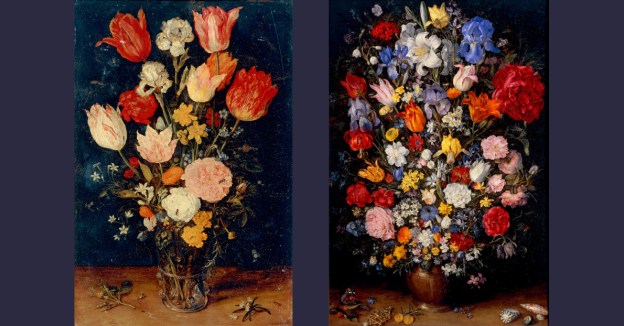
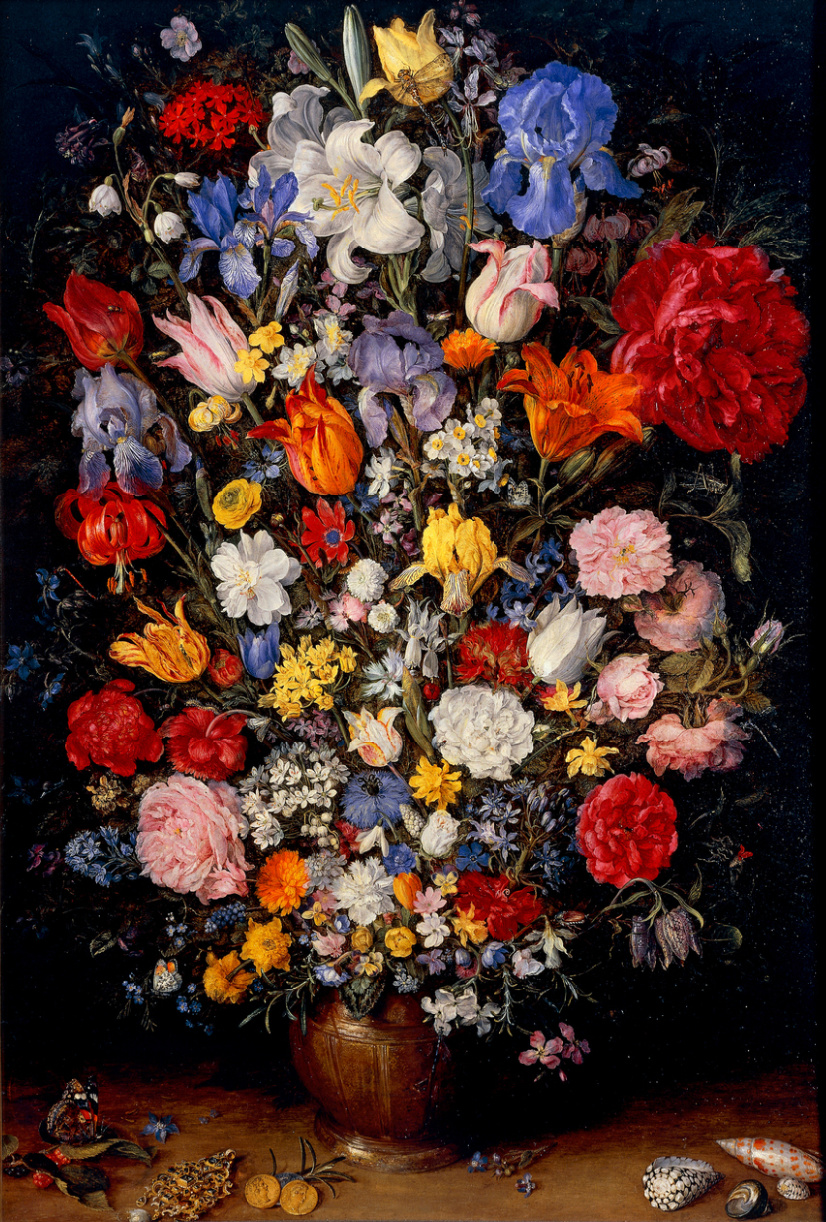
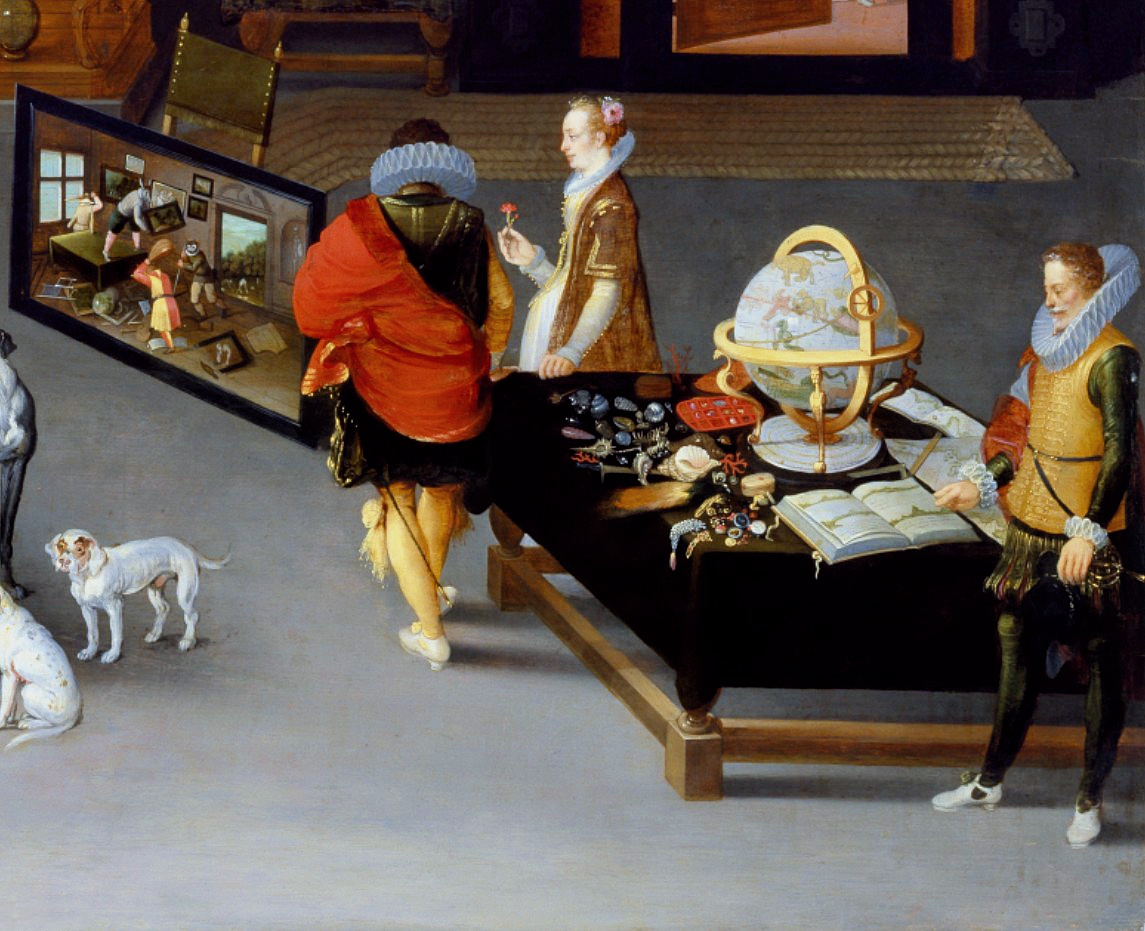
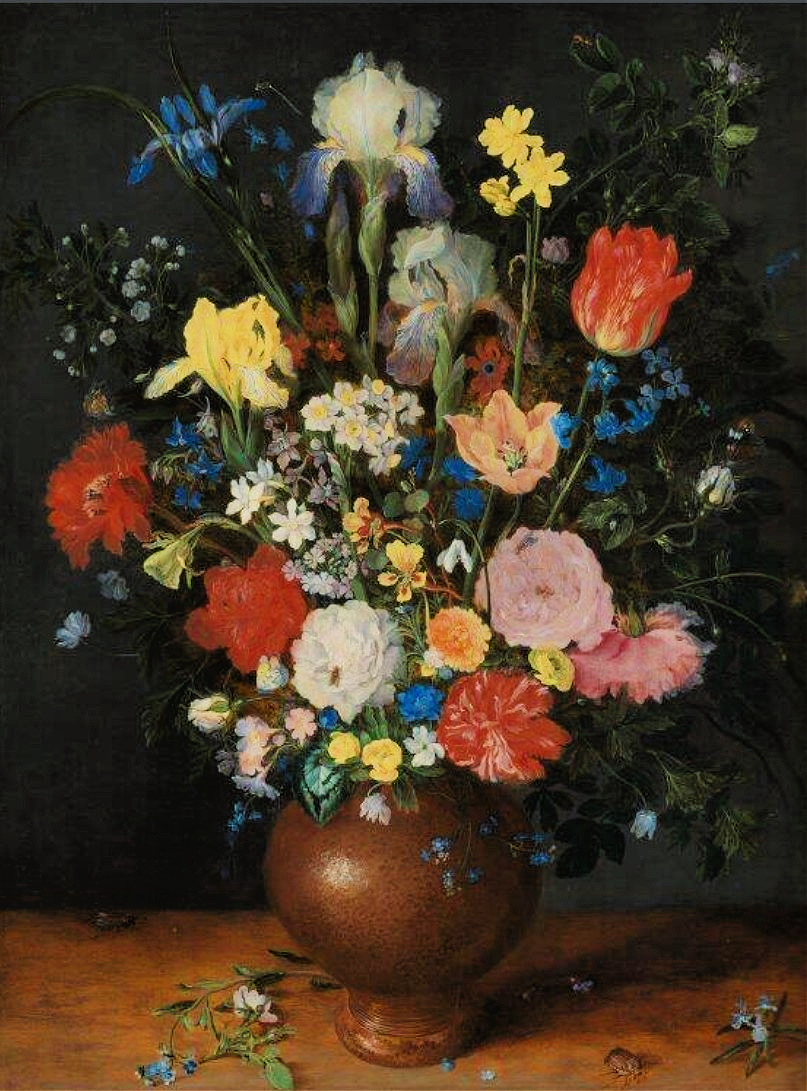
Feature Image: Flowers in a Vase and Flower Vase with Jewel, Coins, and Shells, both 1608, oil on copper, by Jan Brueghel the Elder and in the Pinacoteca Ambrosiana, Milan, Italy.
Jan Brueghel the Elder (Flemish, 1568-1625) produced hundreds of paintings by his own hand and in collaboration with other master painters. His painterly skill ranged over an immense variety of subject matter including these innovative still life floral artworks of which the artist is seen as the founder of the genre. These flowers are not allegorical or imaginative accessories nor merely decorative but a stand-alone subject whose sole focus is the opportunity for a close observation of nature through the artistic lens. Brueghel’s pioneering still lifes show a bouquet bursting with a wide variety of colorful flowers seen from an elevated viewpoint that have been carefully delineated and are clearly visible. Born in Brussels in 1568, Jan Brueghel was the son of Pieter Brueghel the Elder (c. 1525–1530-1569) and younger brother of Pieter Brueghel the Younger (1564-1638). Brothers Jan and Pieter were both sent to Antwerp to study oil painting. In 1568, at 20 years old, Jan Brueghel left Antwerp for Italy where he settled and worked in Naples and, by 1592, in Rome. In Rome Jan Brueghel worked for Cardinals Ascanio Colonna (1560-1608), Benedetto Giustiniani (1554-1621), Francesco Maria del Monte (1549-1627) and Federico Borromeo (1564-1631) who patronized Caravaggio and was the official “Cardinal Protector” of the Roman Accademia di San Luca, an artists’ association founded in 1593 by Federico Zuccari (1539-1609).
Ascanio Colonna (1560-1608). The cardinal enjoyed a reputation for eloquence and learning.Benedetto Giustiniani (1554-1621). The clergyman’s inventory at death included 280 paintings. Ottavio Leoni, Francesco Maria del Monte ((1549-1627) in 1616. Born in Venice of a Tuscan aristocratic family, Cardinal del Monte was an important connoisseur of the arts. Four centuries later his fame rests on his early patronage of Caravaggio and his art collection which provides detailed provenance for many important works of the period.
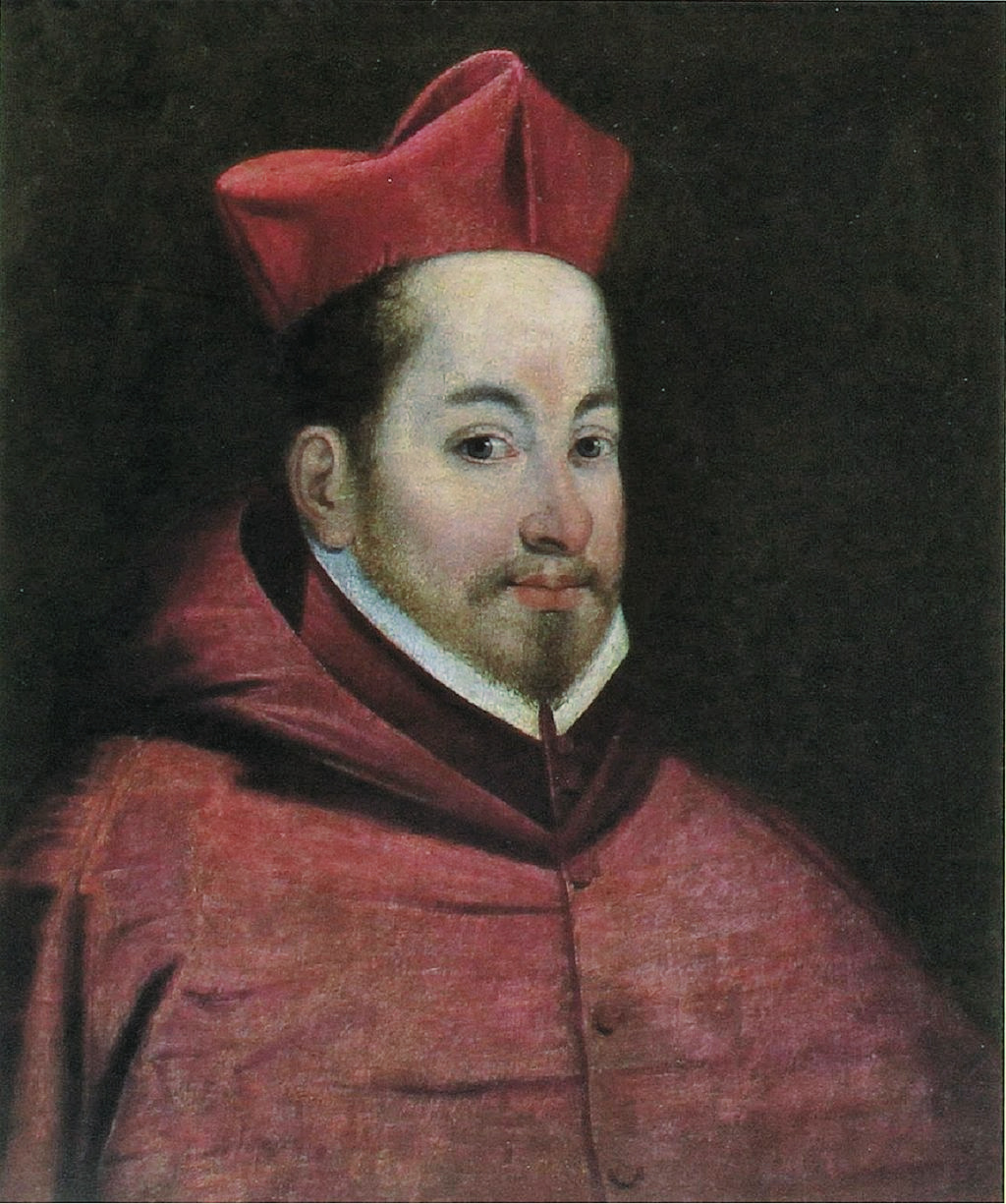
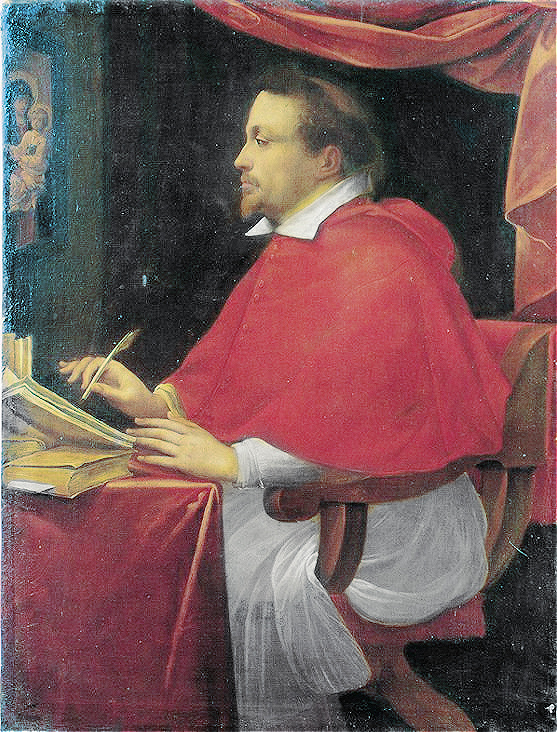
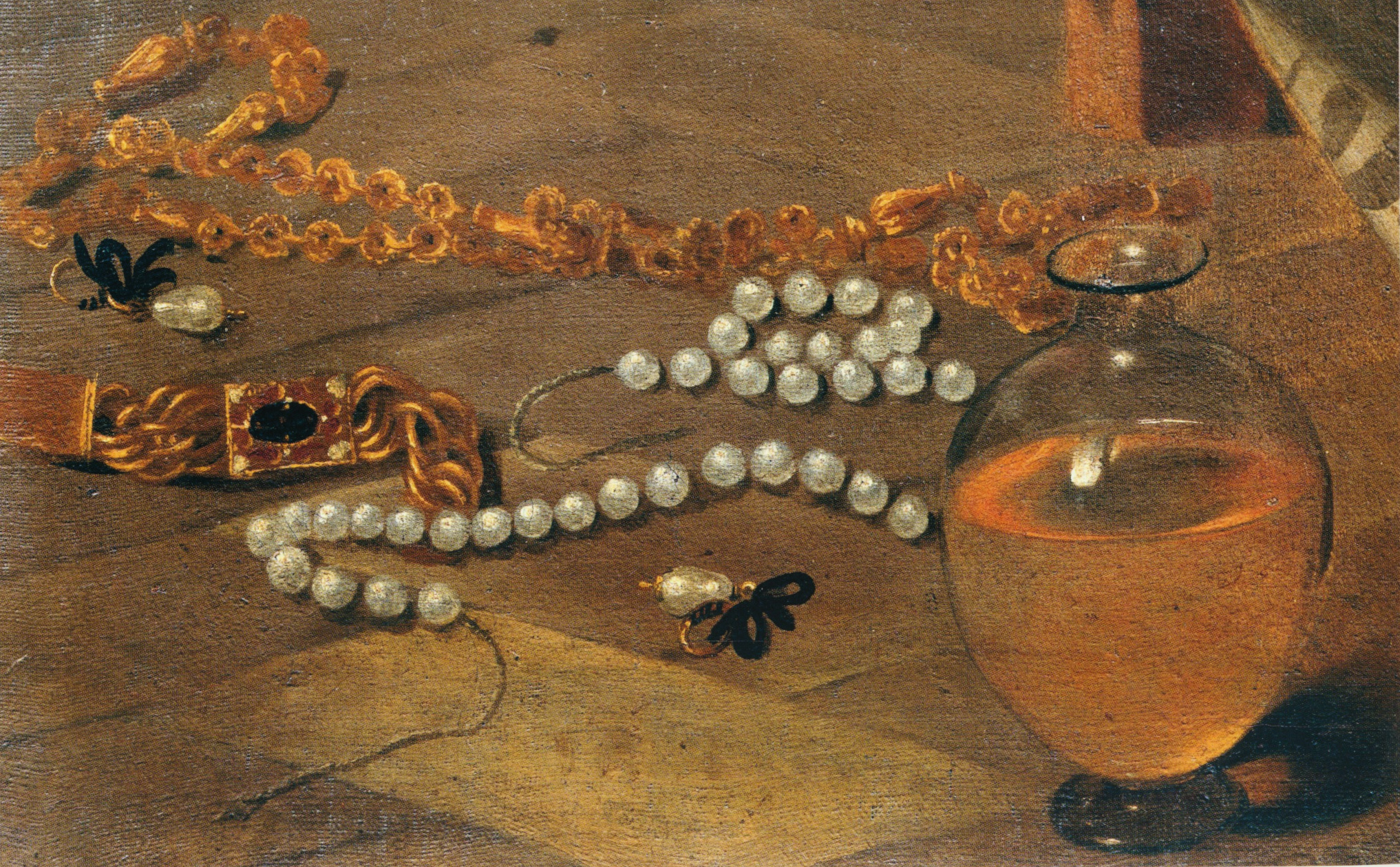
Federico Borromeo (1564-1631). About Flower Vase with Jewel, Coins, and Shells (discussed later below) by Jan Brueghel the Elder purchased for his Milano Ambrosiana, Cardinal Borromeo wrote in the Musaeum: “Brueghel painted a diamond on the lower part of the vase…: the author wanted to indicate that the value of his work was equal to that of the gems and this is the price we paid to the artist.”
FLOWERS IN A VASE, 1608, oil on copper, 43 × 30 cm by Jan Brueghel the Elder. Pinacoteca Ambrosiana, Milan, Italy.
In a Römer glass vase, typical of Rhenish manufactures and often depicted in Northern European painting of this period, there are colorful blooms with tulips used to anchor his bouquet. The painting was likely the one mentioned by Brueghel in a letter dated June 13, 1608. The letter is evidence for the origin of the painting as well as that these Flemish artists, in dialogue with the Italian renaissance, practiced copying nature from life, frequently with a scientific precision. Brueghel, the younger son of Flemish Renaissance painter Pieter Bruegel the Elder (c. 1525-1569), was a close friend and frequent collaborator with Peter Paul Rubens (1577-1640). Both Jan Brueghel and Rubens were the leading Flemish painters in Flemish Baroque painting of the first three decades of the 17th century.
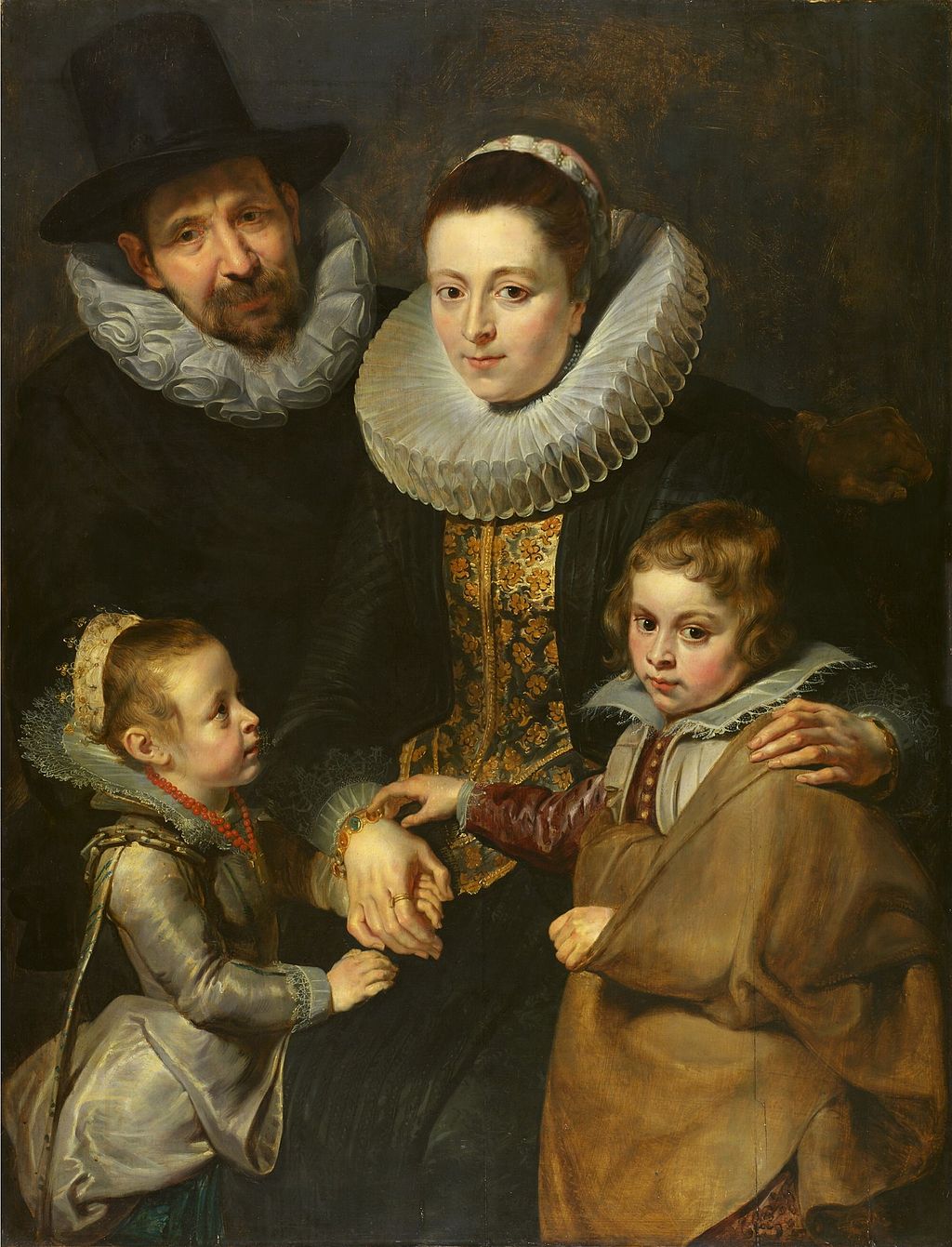
Family of Jan Brueghel the Elder by Peter Paul Rubens. 1613-15. oil on panel, 125.1x 95,2 cm,The Courtauld Gallery, London. Jan Brueghel, painter and friend of Rubens, poses with his second wife, Catherina, and their two children, Peter and Elisabeth. Both children, along with their father, died during the cholera epidemic of 1625. see – https://gallerycollections.courtauld.ac.uk/object-p-1978-pg-362 – retrieved June 24, 2025.
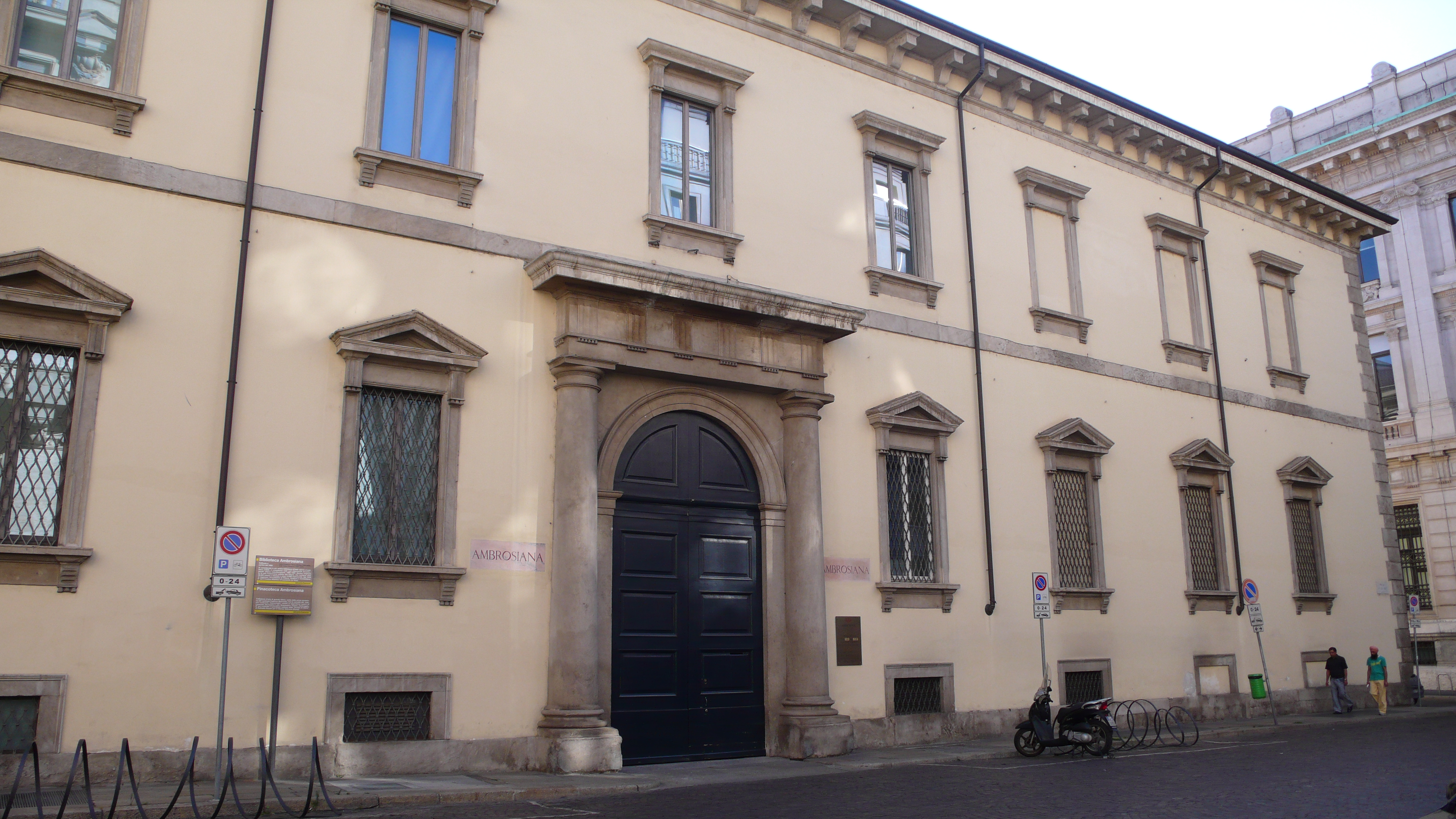
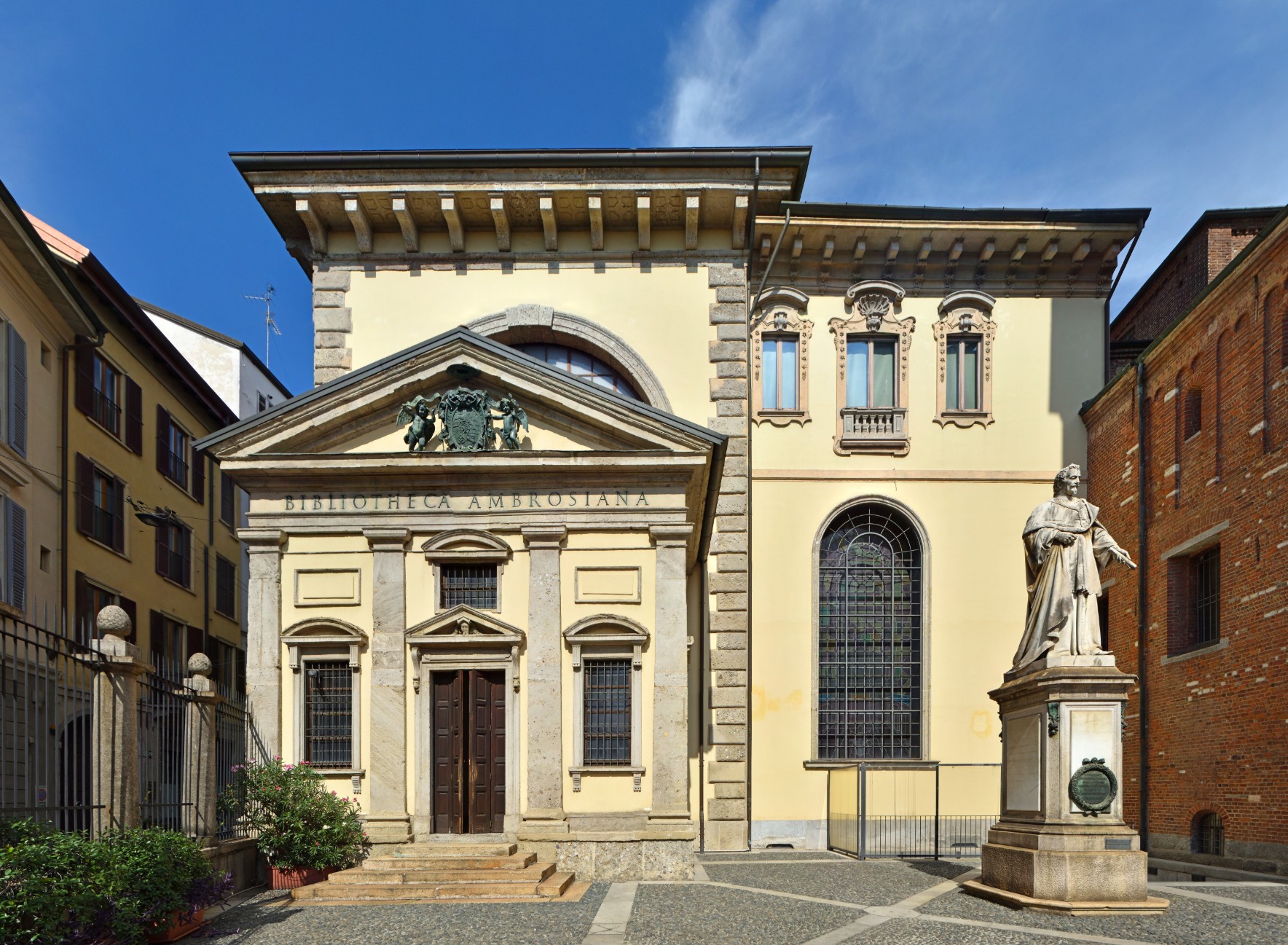
The painting Flowers in a Vase is in the collection of the Ambrosian Art Gallery (Pinacoteca Ambrosiana) of the Biblioteca Ambrosiana in Milan, Italy. It was in the possession of Cardinal Federico Borromeo, cousin to Saint Charles Borromeo (1538-1584), both cardinal archbishops of Milan.
Saint Charles Borromeo (1538-1584) was a cousin of Federico Borromeo. Both were cardinal archbishops of Milan, Italy. Proclaimed a saint in Rome in 1610, Charles was much loved in his diocese for his numerous good works and for his personal humility as well as a spirit of self-sacrifice that he showed during the plague of 1576 and 1577, Cardinal Borromeo was a great reformer and played an important role in the Council of Trent. There is a colossal statue of him outside Arona on Lake Maggiore. The so-called Sancarlone, it was based on a design by Giovanni Battista Crespi, known as “ il Cerano.” Its sculptors Siro Zanella and Bernardo Falconi made the copper parts to be assembled for a work that was completed in 1698. see – https://terreborromeo.it/en/about-us/history and https://www.statuasancarlo.it/la-statua/– retrieved June 24, 2025.
The colossus of St. Charles Borromeo (1698).
In May 1585 Federico earned a doctorate in theology at the University of Pavia and was sent to Rome where he was made a cardinal at 23 years old by Pope Sixtus V. Federico voted in the papal conclaves of 1590 (Urban VII, Gregory XIV), 1591 (Innocent IX), 1592 (Clement VIII), 1605 (Leo XI, Paul V) and 1623 (Urban VIII). He missed the 1621 conclave (Gregory XV). At the August 1623 papal conclave Cardinal Borromeo received 18 votes out of 54 votes but was opposed by the Spanish party, one of the church’s major factions. The church had to compromise with Urban VIII, a neutral candidate known as the first pope to actively campaign for votes.
In April 1618 Archbishop Federico Borromeo bequeathed Flowers in a Vase with his collection of paintings, drawing, and statues in his will to the Biblioteca Ambrosiana, which he founded on September 7, 1607 and opened on December 8, 1609. Conceived by the cardinal as a center for study and culture it was open to the public from the beginning. The library collections include over one million printed volumes (including thousands of incunabula and books dating from the 16th century), 40,000 manuscripts (including the celebrated Codex Atlanticus) in many languages, 12,000 drawings (including works by Raphael, Pisanello, and Leonardo), 22,000 engravings, and miscellanea including old maps and musical manuscripts. Along with the cardinal’s achievement, other institutions flourished beside it such as the Board of Fellows (Collegio dei Dottori, 1607), the Art Gallery (Pinacoteca Ambrosiana, 1618) and the Academy of Drawing for teaching painting, sculpture and architecture (Accademia del Disegno, 1620). The Pinacoteca Ambrosiana consists of some of the Italian Renaissance’s great masterpieces such as the Portrait of a Musician by Leonardo da Vinci, The Basket of Fruit by Caravaggio, the cartoon for the School of Athens by Raphael, the Adoration of the Magi by Titian, the Madonna of the Pavilion by Sandro Botticelli and the magnificent Flowers in a Vase by Jan Brueghel. The museum’s collection today includes paintings by 17th-century Lombard artists such as il Morazzone (1573–1626), Giulio Cesare Procaccini (1574–1625), Daniele Crespi (1598 – 1630) and Carlo Francesco Nuvolone (1608-1669) and 18th-century artists such as Giovanni Domenico Tiepolo (1727-1804), Fra’ Galgario (1655-1743), and Francesco Londonio (1723-1783). Cardinal Federico Borromeo, who lived in Rome from 1586 to 1601, was not particularly interested in politics, but focused on classical and oriental scholarship and prayer. In the Counter-Reformation, the cardinal was a great propagator of the faith using religious art, but also was an avid collector of still life. Jan Brueghel the Elder, nicknamed “Velvet,” was a contemporary artist who was erudite and innovative – he invented new types of paintings such as flower garland paintings and paradise landscapes – and his art did not escape the cardinal’s cultivated eye. The Cardinal and young artist met in Rome where the Cardinal became his patron so that the artist took up residence in Cardinal Borromeo’s palazzo.
Cardinal Federico Borromeo by Giulio Cesare Procaccini (1574-1625), Museo diocesano di Milano. The Borromeos, a prominent Italian noble family, started as merchants around 1300 in San Miniato in the province of Pisa in Tuscany and became bankers in Milan after 1370.
When Borromeo became archbishop of Milan in June 1595, Brueghel followed him and became part of the Cardinal’s household. Cardinal Borromeo was a reformer in the sense of promoting discipline among the clergy, founding new parishes and schools, as the faith flourished in the 50 years since the Council of Trent completed in 1564. The archbishop was accessible to the flock. Under his leadership, Milan underwent both prosperity and significant cultural flourishing and renewed spiritual energy for a generation. Brueghel stayed with the Cardinal for a year where he painted landscapes and flower paintings and then returned to Antwerp where he lived and worked for the rest of his life. Also nicknamed “Flower” Brueghel, the artist’s flower pieces such as Flowers in a Vase, are dominated by floral arrangements placed against a neutral dark background. Brueghel repeated these motifs in his flower pieces and yet each work was imbued with its own singular freshness and vitality.
FLOWER VASE WITH JEWEL, COINS, AND SHELLS. 1608, oil on copper, 65 × 45 cm by Jan Brueghel the Elder. Pinacoteca Ambrosiana, Milan, Italy.
A lush bouquet of flowers, executed by the artist for Cardinal Federico Borromeo (1564-1631), was innovative as a stand-alone bouquet painting of its kind. The subject is composed of around one hundred different species of flowers, some of which are very rare and of great value. In addition to its execution of profuse natural beauty, the picture expressed the nature of the early 17th century culture’s encyclopedic curiosity which extended, among leading collectors, into the natural sciences. It is known by way of a letter that Brueghel was working on the picture in 1606 after he had seen many of these flower varieties in the garden in Brussels of Albert VII, Archduke of Austria (1559-1621) and Isabella Clara Eugenia (1566-1633), who jointly ruled the Spanish Netherlands (1556-1714). The artist’s picture of these flowers was, in a scientific approach, intended to “portray them from nature.” Virtually nothing today remains of the Archdukes Albert and Isabella’s Palace of Codenberg in Brussels nor of their summer retreat at the Château of Mariemont (today’s Morlanwelz in Belgium) south of Brussels which was painted frequently by Jan Brueghel the Elder nor anything of their hunting lodge in nearby Tervuren east of Brussels. In 1633, at the death of Isabella, Albert (who died in 1621) and Isabella’s magnificent collections of art works, scientific instruments, naturalia and artificialia were scattered and much of it lost.
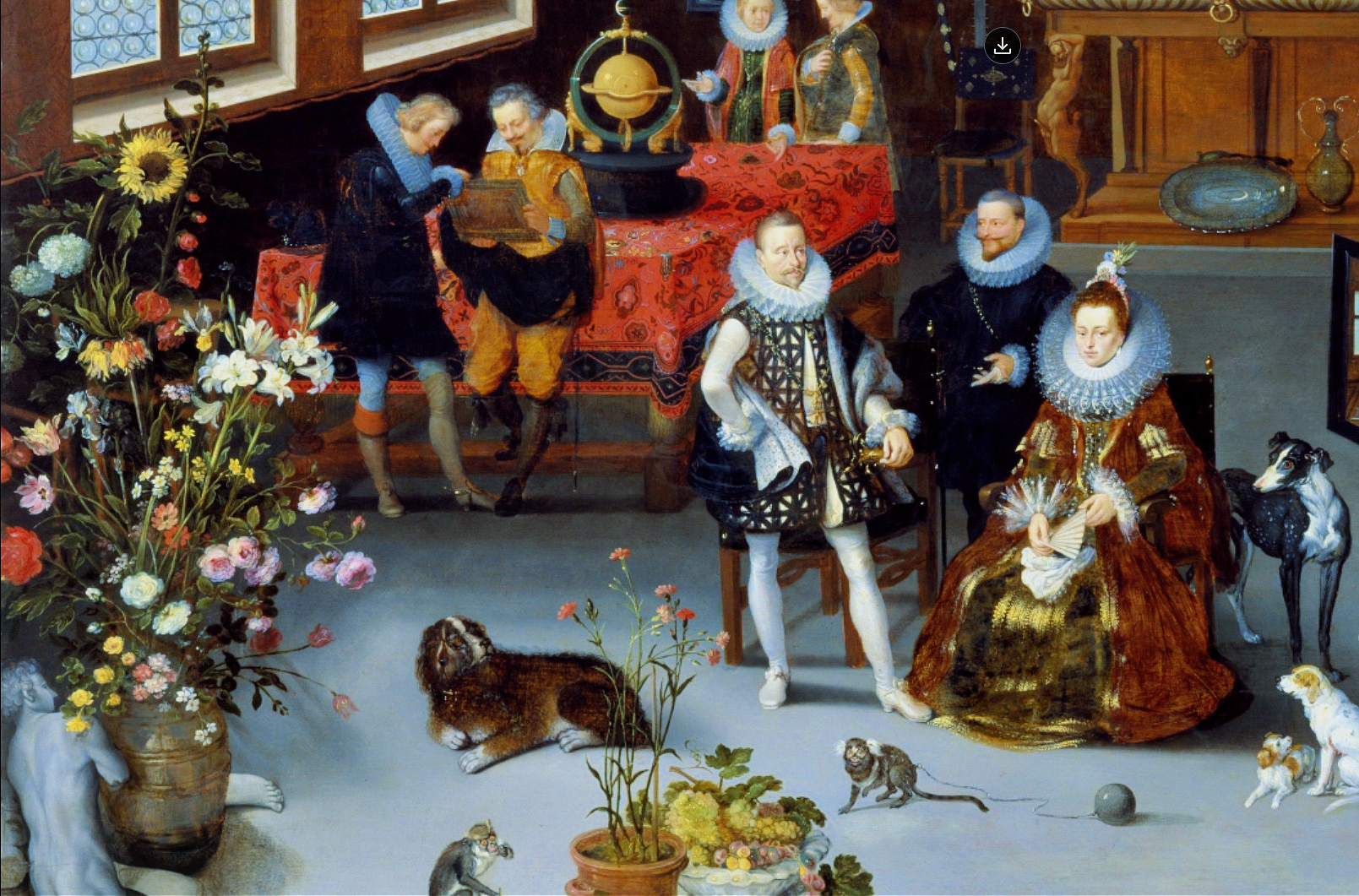
The Archdukes Albert and Isabella Visiting the Collection of Pierre Roose, c. 1621-1623, Jan Brueghel the Elder and Hieronymus Francken II, oil on panel, 37 × 48 ½ in. (94 × 123.19 cm). see – https://art.thewalters.org/object/37.2010/ – retrieved June 21, 2025.
Some of that magnificence was evoked in a picture from 1621-23 by Jan Brueghel the Elder with Hieronymus Francken II (1578-1623) called Albert and Isabella visiting an art gallery. The large format painting (around 3 feet by 4 feet) in the Walters Art Museum depicts a private gallery (or cabinet) of Pierre Roose in Brussels being visited by the Archdukes Albert and Isabella. It includes in a foreground corner an immense vase of flowers by Jan Brueghel and depicts how these collectors are as interested in natural botany and scientific instruments as they are of paintings and sculpture.
DETAIL of above: Isabella is seated, while her husband standing to her right and their host, Pierre Roose, behind.DETAIL of above:These collectors are as interested in natural botany and scientific instruments as they are of paintings and sculpture.
Following Albert’s death, Isabella continued to rule on behalf of her nephew Philip IV of Spain (1605-1665) though it was Albert and Isabella’s reign which marked the consolidation of Catholic rule in the Southern Netherlands following severe persecutions of Protestants that ended only in 1597. Though most Protestants had left the region, in 1609 an act of toleration was granted to the Protestants that remained though they could not publicly practice their religion. Conversely, Catholic religious orders like the Jesuits, Capuchins, and Discalced Carmelites received large cash grants and endowments by the wealthy governing elite which helped fund many of these religious groups’ ambitious building and artistic programs in Brussels and Antwerp. As a widow Isabella joined the Third Order of Franciscans until her death. Though despotic and kingly, these rulers have earned a well merited reputation in art history as patrons of the arts. A most notable example is that, in 1609, one year after the Pinacoteca Ambrosiana’s flower picture was created, the Archdukes, whose gardens inspired the work in Italy, appointed Peter Paul Rubens (1577-1640) as their court painter. Commenting on this flower artwork in Milan, Cardinal Borromeo wrote in the Musaeum: “Brueghel painted a diamond on the lower part of the vase…: the author wanted to indicate that the value of his work was equal to that of the gems and this is the price we paid to the artist.”
Bouquet in a Clay Vase, 1609, Jan Brueghel the Elder,oil on wood, 56 x 42 cm. The National Gallery, London. see – https://www.nationalgallery.org.uk/paintings/jan-brueghel-the-elder-bouquet-in-a-clay-vase – retrieved June 24, 2025. Jan Brueghel the Elder is considered the 17th century northern painter, active in the Low countries as well as Italy, who invented and mastered the genre of flower still life. While used at times as a decorative or allegorical element within a painting, there are major examples where the artist aesthetically assembled and presented an impressive bouquet from a high viewpoint based on scientific observation of rare garden species as the sole focus of the painting. Bouquet in a Clay Vase in The National Gallery in London is one such artwork.
This explanatory article may be periodically updated.
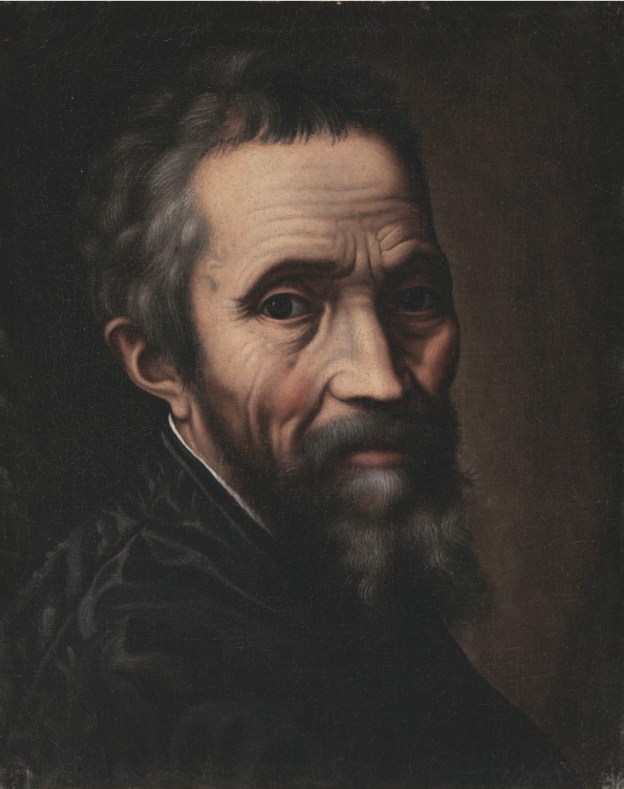
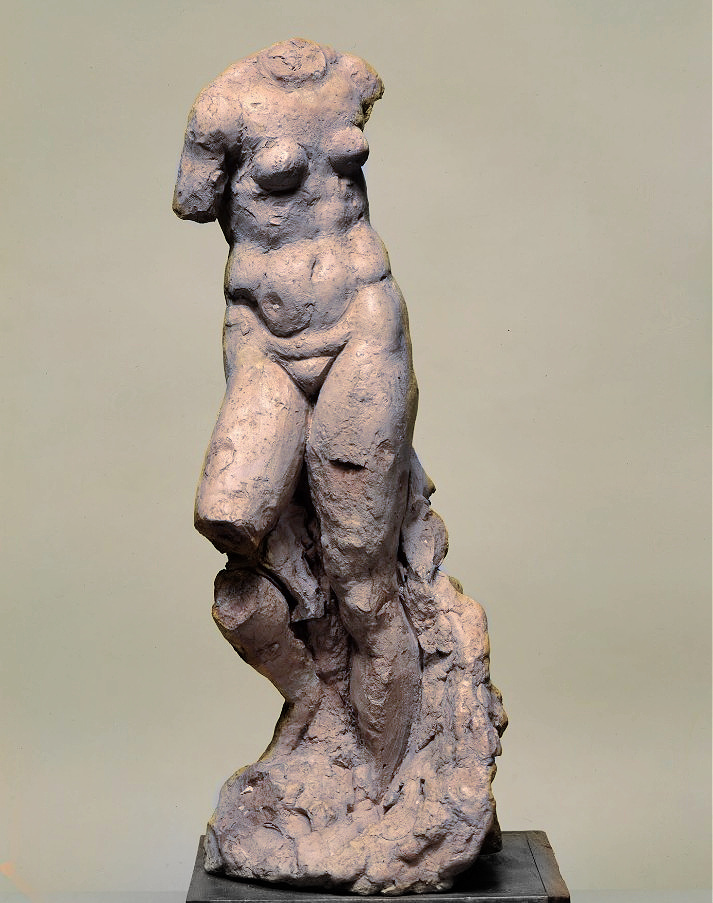
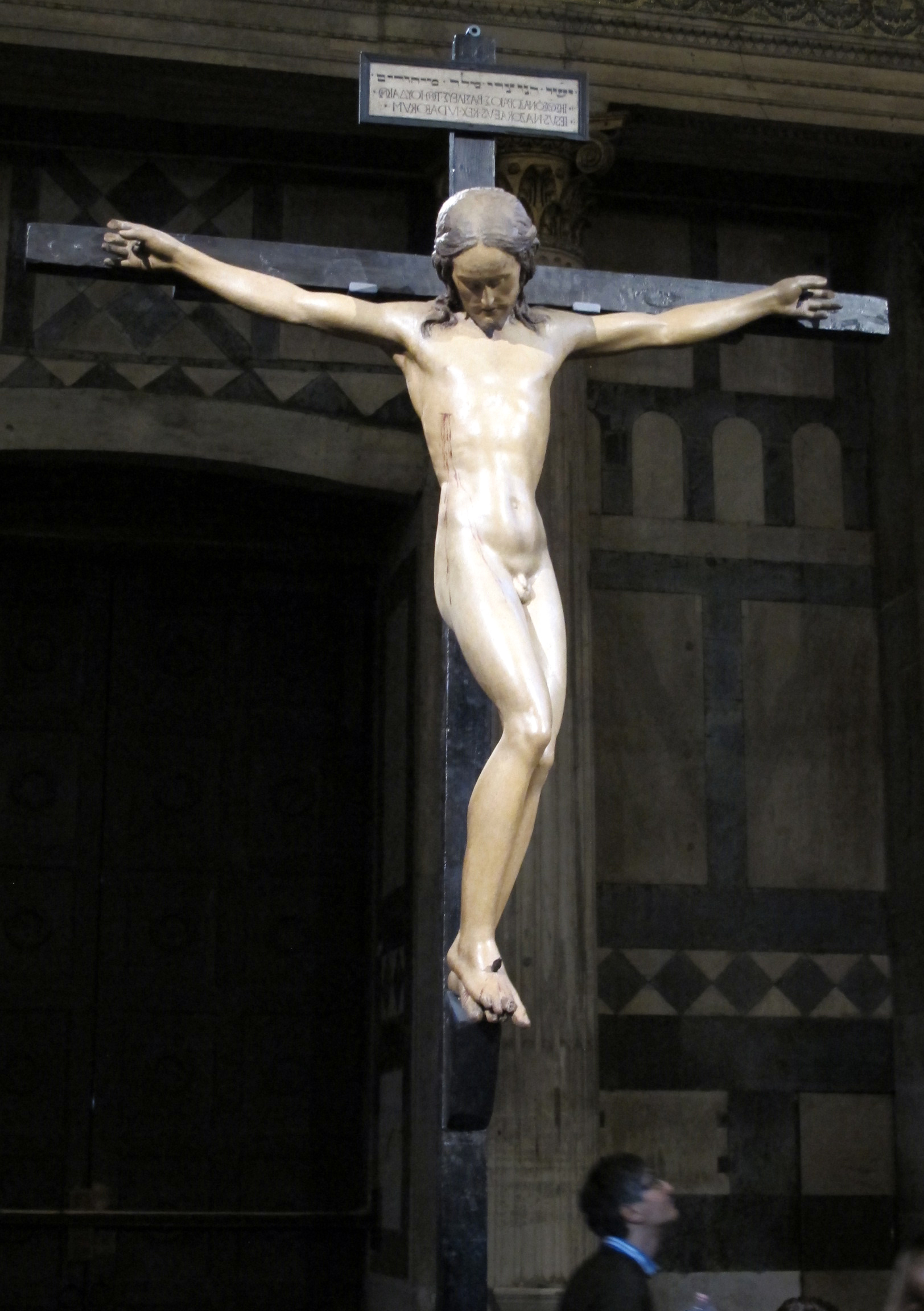
Attributed to Michelangelo Buonarotti, 1513, terracotta, Casa Buonarroti, Florence, Italy. The work is a study of a male torso, conceived to be without the head and upper and lower limbs. The work has been identified as a preparatory model for one of the figures of the Prisoners, intended to decorate the tomb of Julius II in Rome. see – https://artsandculture.google.com/asset/torso-virile/zQGx46asE5jBIg?hl=it&ms=%7B%22x%22%3A0.5%2C%22y%22%3A0.5%2C%22z%22%3A9.086882915528859%2C%22size%22%3A%7B%22width%22%3A3.3866676762513332%2C%22height%22%3A1.2375000000000005%7D%7D – retrieved March 6, 2025. Michelangelo Buonarotti, Madonna della Scala, 1490. Casa Buonarroti, Florence, Italy. Though it is small-sized the relief subject of the Madonna and child presents a monumental scope. The female figure fills the entire space. The meaning of the ladder (“scala”) in the title is ambiguous and may have reference to the children playing and holding a drape behind the Madonna. The date of the relief has been much discussed. However, a placement around 1490, before the Battle of the Centaurs, seems to be confirmed.see – https://artsandculture.google.com/asset/madonna-della-scala/xQF2nwLhAXd26w?hl=it – retrieved March 6, 2025. Michelangelo Buonarotti, Nude female, 1533, Casa Buonarroti, Florence, Italy. This figure of a female nude is linked to the New Sacristy in Florence to accompany the marble effigy of Giuliano de’ Medici. It has been linked to the figure of the Earth that, together with the Sky, was to be part of Giuliano’s marble effigy. The project of building a proper Medici family mausoleum was conceived in 1520, when Michelangelo began work on the New Sacristy upon the request of Cardinal Giulio de Medici, the future Pope Clement VII, who expressed a desire to erect the mausoleum for some members of his family including Lorenzo the Magnificent and his brother Giuliano assassinated in Florence’s Duomo in 1478. After completing the architectural works in 1524, Michelangelo worked until 1533 on the sculptures and the sarcophagi that were to be featured on the chapel walls. The only ones actually completed were the statues of Lorenzo, the Duke of Urbino; Giuliano, the Duke of Nemours; the four statues of the allegories of Day and Night, and Dawn and Dusk; and the group representing the Madonna and Child. see – https://artsandculture.google.com/asset/nudo-femminile/xgHfNWIKU6r13g?hl=it – retrieved March 6, 2025 and http://www.museumsinflorence.com/musei/Medici_chapels.html#:~:text=The%20project%20of%20building%20a,the%20Magnificent%20and%20his%20brother – retrieved March 6, 2025. Michelangelo, crucifix, 1493, wood, Santo Spirito, Florence. It was placed by the artist in 1493 above the lunette of the high altar and has been there since.
The Italian Renaissance artist was born in Florentine territory in Caprese in the provinces of Tuscany where his father was a government bureaucrat. The family soon relocated to Florence where Michaelangelo grew up. Becoming friends with Francesco Granacci (1469-1543) who saw Michaelangelo’s drawing talent, at 13 years old Michelangelo announced he wanted to be an artist. Despite his parents objection, they eventually yielded to their son’s aspirations, and he was apprenticed to Domenico Ghirlandaio (1448-1494) for the next three years.
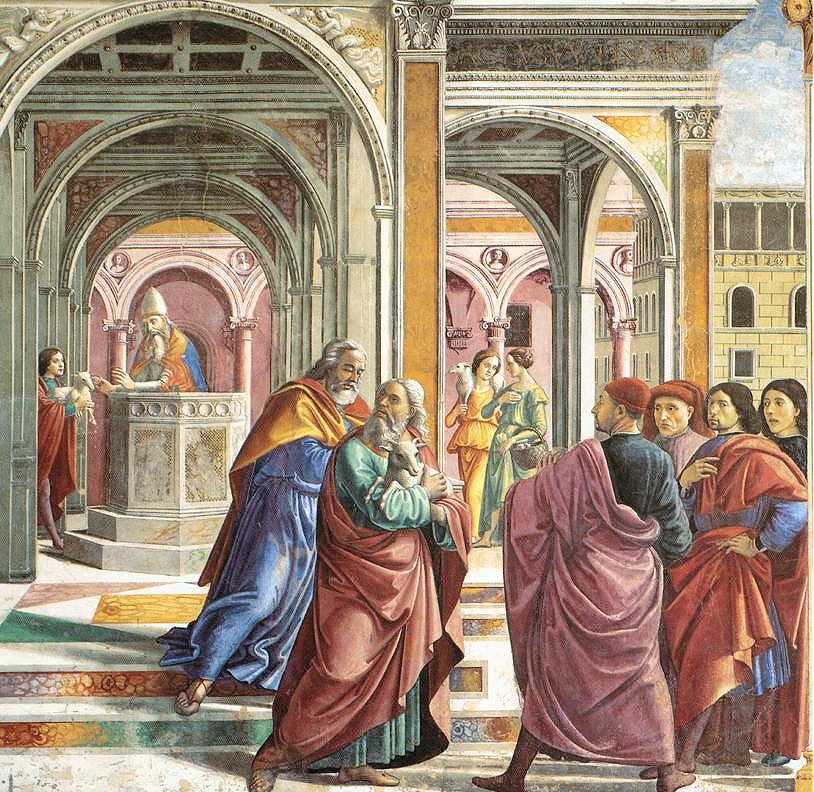
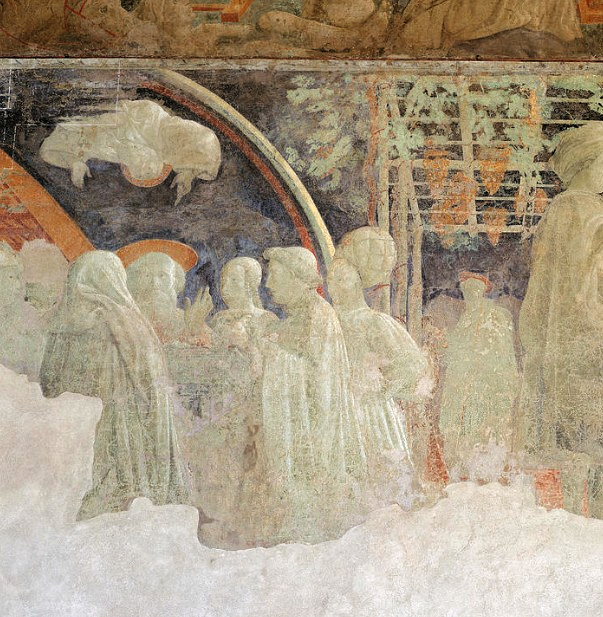
Domenico Ghirlandaio (1448-1494), Expulsion of Joachim From the Temple, fresco (detail), 1486-1490. Santa Maria Novella, Cappella Tornabuoni, Florence. In the background, the mitered high priest receives sacrificial lambs at the altar where a fire burns. Joachim, according to sacred tradition, father of the Virgin Mary and grandfather of Jesus Christ, is sent away at this time since he is childless. He is married to Anne. To the right Ghirlandaio depicts an assembled group of contemporary Florentines including, second from right, Ghirlandaio himself. In 2nd century apocryphal writings, childless Joachim left for the desert where he prayed and fasted for 40 days. Angels appeared to Joachim and his wife Anne, and promised them a child. Joachim then returned to Jerusalem and embraced Anne at the city gate, a scene popularly depicted in medieval and Renaissance art. After this, Anne became pregnant and became the mother of the Virgin Mary and Jesus’s grandmother. This apocryphal relating of Joachim and Anne to Biblical figures Elizabeth and Zechariah and the birth of their son, John the Baptist (Luke 1) and Abraham and Sarah and the birth of their son, Isaac (Genesis 21) was a popular subject depicted in Christian art until the Council of Trent (1545–1563) when the church restricted public displays of these simple stories and events from apocryphal sources in a severe reaction to the Protestant reformation.
Michelangelo’s training was erratic, likely having left Ghirlandaio before his contract was complete, and working under the city’s ruler, Lorenzo de Medici for his contracted master, Bertoldo (1420-1491). Later in life Michelangelo did not advertise his training credentials as he believed art – such as freeing subjects from stone – emerged by the sheer artistic power of the individual. In this period, as a teenager, Michelangelo learned the art of fresco painting and drawing, copying previous masters such as Giotto (1267-1337) and Masaccio (1401-1428). Michelangelo absorbed the artwork of the naturalists, such as Paolo Uccello (1397-1475), whose artwork looked to present subjects with a viewpoint like a scientist interested in objective fact rather than looking to convey some established figural attitude. Where young Michelangelo was materially as great as Giotto and Masaccio, he also possessed a new means undreamt by those previous masters, as he drunk of the art of Donatello (1386-1466), Pollaiuolo (1429-1498), Verrocchio (c.1435-1488) and Leonardo da Vinci (1452-1519). Further, Michelangelo understood better than these others, that the epitome of these Renaissance artistic studies was to be expressed by one subject above all: the human nude.
Bernard Berenson described Michelangelo as “the pupil of nobody, the heir of everybody, who felt profoundly and powerfully what to his precursors had been vague instinct, who saw and expressed the meaning of it all.”
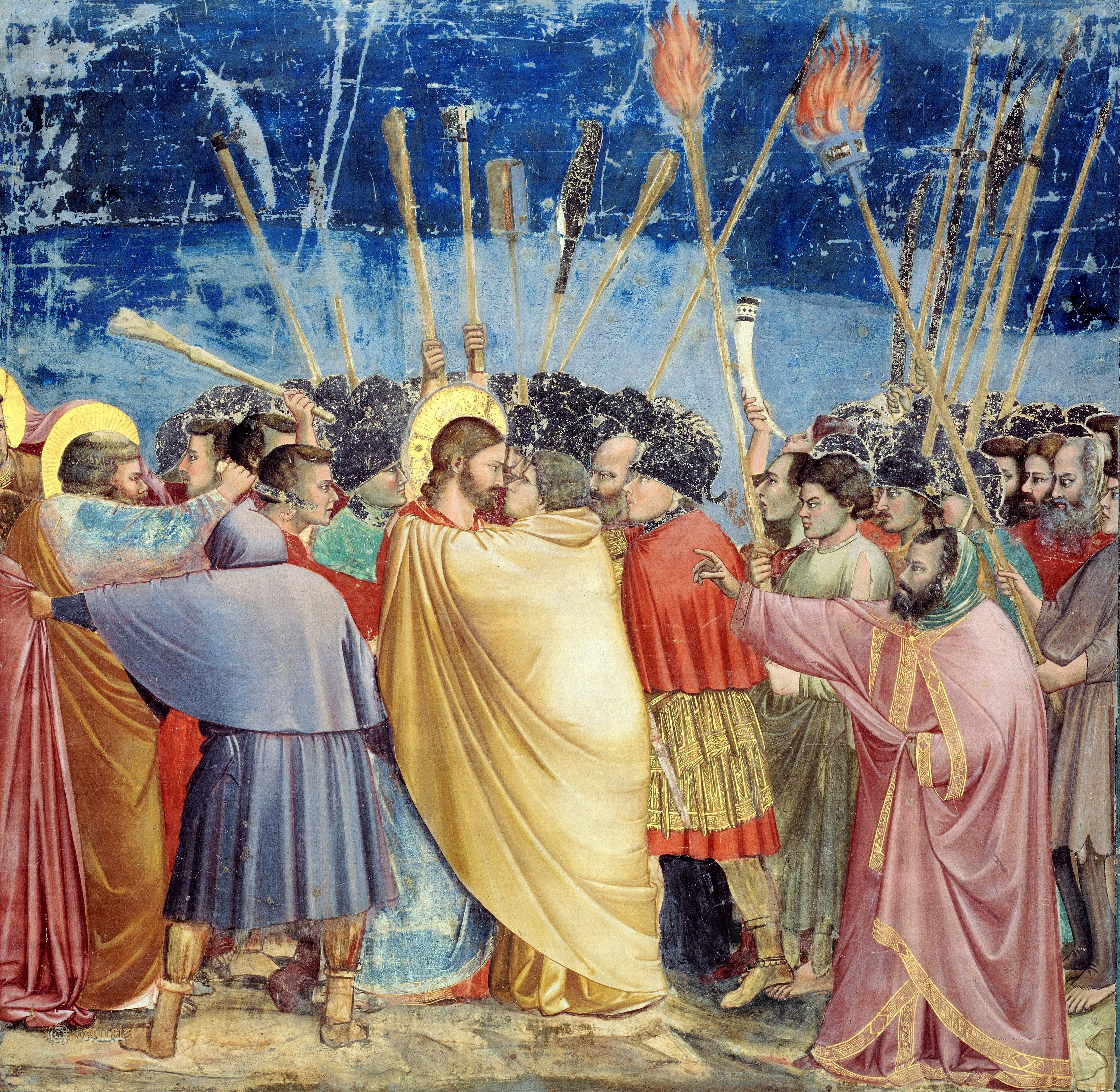
Giotto, The Arrest of Christ (Kiss of Judas ), 1304, Padua, Scrovegni Chapel.
The Arena, or Scrovegni Chapel, was commissioned by Enrico Scrovegni in 1303. A nobleman of Padua, Enrico dedicated the chapel as an act of atonement for the sins of his father, Reginaldo, a moneylender whom Dante placed among the damned in the Inferno. The exterior of the chapel is austere, but its interior is filled with Giotto’s frescoes, completed by the time of the chapel’s dedication in late March 1305, with remaining work finished by March 1306. By this point, Giotto—then in his late thirties—was already a mature master, and in this cycle he transformed the course of Italian painting.
What had appeared as youthful brittleness and restlessness in his frescoes at Assisi in the late 1290s—works that had secured his fame and led to the Padua commission—has here developed into a fully realized visual language of narrative concision, solemnity, and decisive, almost fatalistic, plastic form. Although the subjects of the Life of the Virgin, the Life and Passion of Christ, and the Last Judgment draw upon a venerable medieval tradition, Giotto renders them with a striking immediacy. Human emotion, individualized gesture, and the presence of everyday life infuse the sacred narratives with a naturalism that conveys profound dignity and emotional gravity rather than rhetorical flourish.
The dramatic center of the Betrayal fresco is the confrontation between Christ and Judas. Once Christ accepts His fate in the agony of the garden, the world wastes no time in presenting Him with the cross He has embraced. One of His own apostles—an unsettling reminder of the failures of religious leaders across the ages—betrays Him with a kiss. Christ’s body nearly disappears beneath Judas’s enveloping cloak, yet His classical profile remains visible, fixed in a calm, penetrating gaze upon His betrayer. Judas’s pursed lips embody the chilling intimacy of treachery. As John 13 recounts, the devil—whether through possession or the alignment of Judas’s will with Satan’s designs—provides the impetus for the betrayal.
Giotto had previously depicted Judas as youthful and handsome, but here the apostle’s features bear the accumulated marks of moral decay. At the left, Peter lashes out at Malchus, the high priest’s servant, severing his ear; at the right, the high priest himself gestures toward the betrayal, yet his posture suggests a momentary hesitation before the full enormity of the act. Through these figures, Giotto constructs a scene of moral and emotional complexity, capturing the decisive moment when divine purpose and fallen humanity collide.
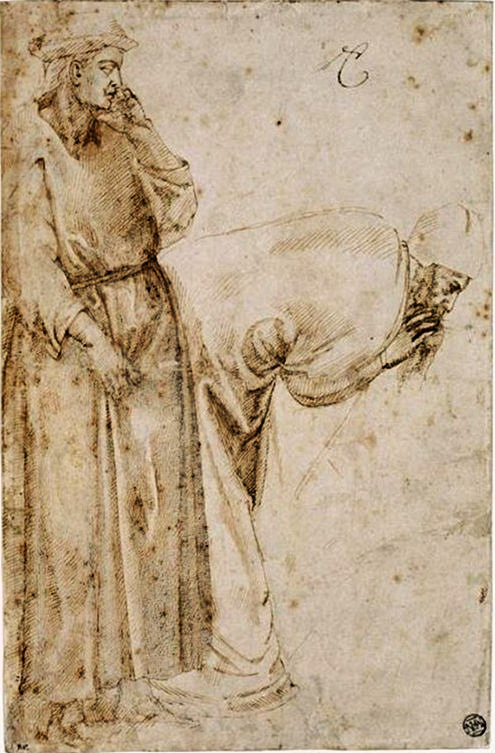
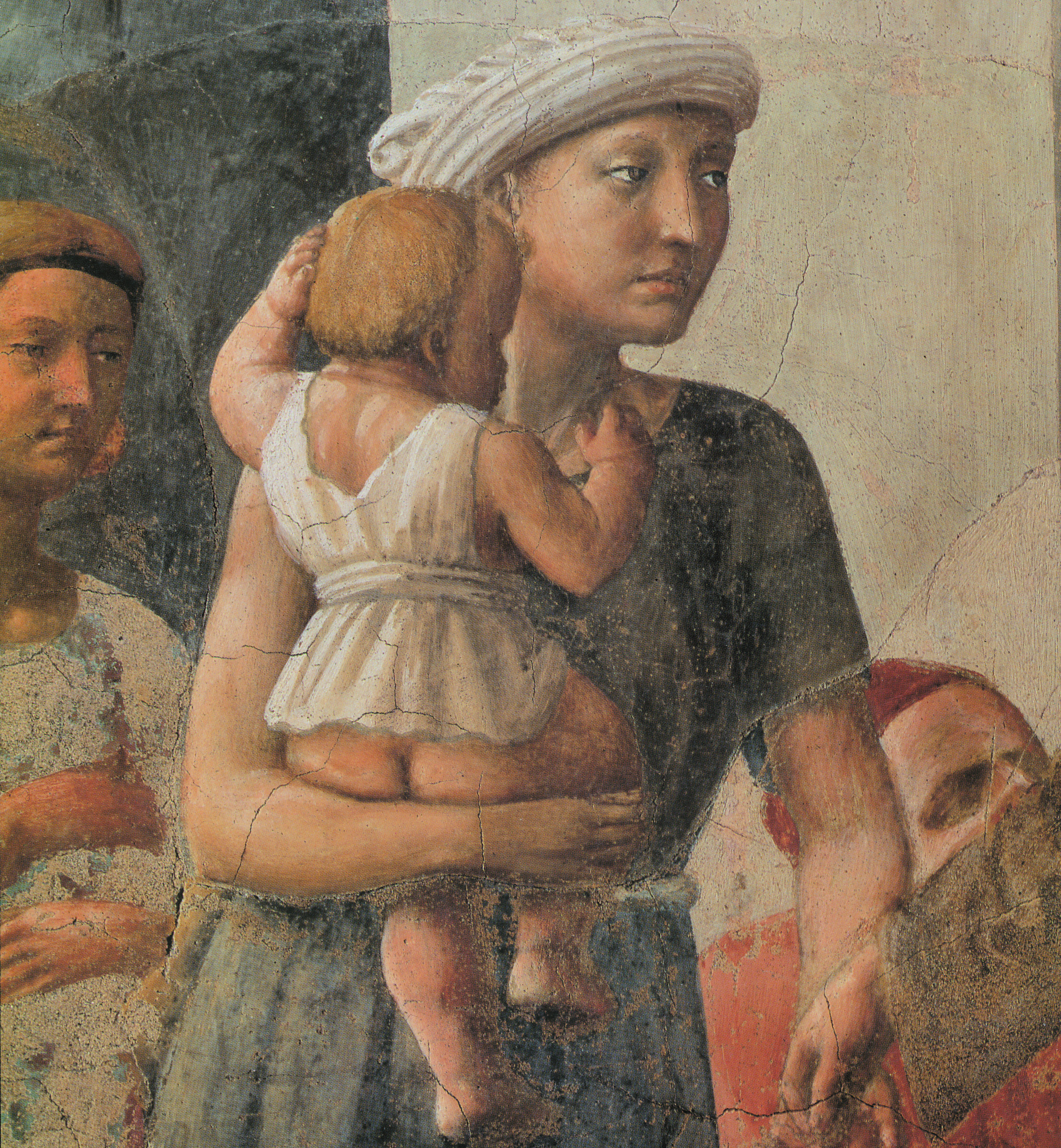
Michelangelo after Giotto, Drawing from “Ascension of the Evangelist,” 1490-1492. Louvre. see – https://collections.louvre.fr/en/ark:/53355/cl020001224 – retrieved March 6, 2025. Paolo Uccello, Sacrifice of Noah And Noah’s Drunkenness (detail), 1447-48. Uccello was not interested primarily in conveying in art the possible “artistic” intention of this story’s scene. Instead, as Bernard Berenson described it, the artist produced “nothing but the scientific intention to find out how a man swooping down head-foremost would have looked if at a given instant of his fall he had been suddenly congealed and suspended in space.” These studies of reproducing objects as they really are, in anatomy and perspective, had a great bearing for the art of Leonardo da Vinci and Michelangelo. quoted in Berenson, p.54.Masaccio, Distribution of Alms and Death of Ananias (detail), 1425-1427, Brancacci Chapel, Florence. An episode from Acts of the Apostles (4:43-37 and 5: 1-11) depicting Ananias’s wife and child whose husband withheld their tithe from the early church leaders with the outcome being that Ananias dropped dead in divine retribution. When it was painted, viewers in the 1420’s and afterwards, read it as an artistic display of a New Testament endorsement of the equitable redistribution of wealth and the divine punishment of death forthwith for those who falsely withheld their fair share. 67% 7.95mb
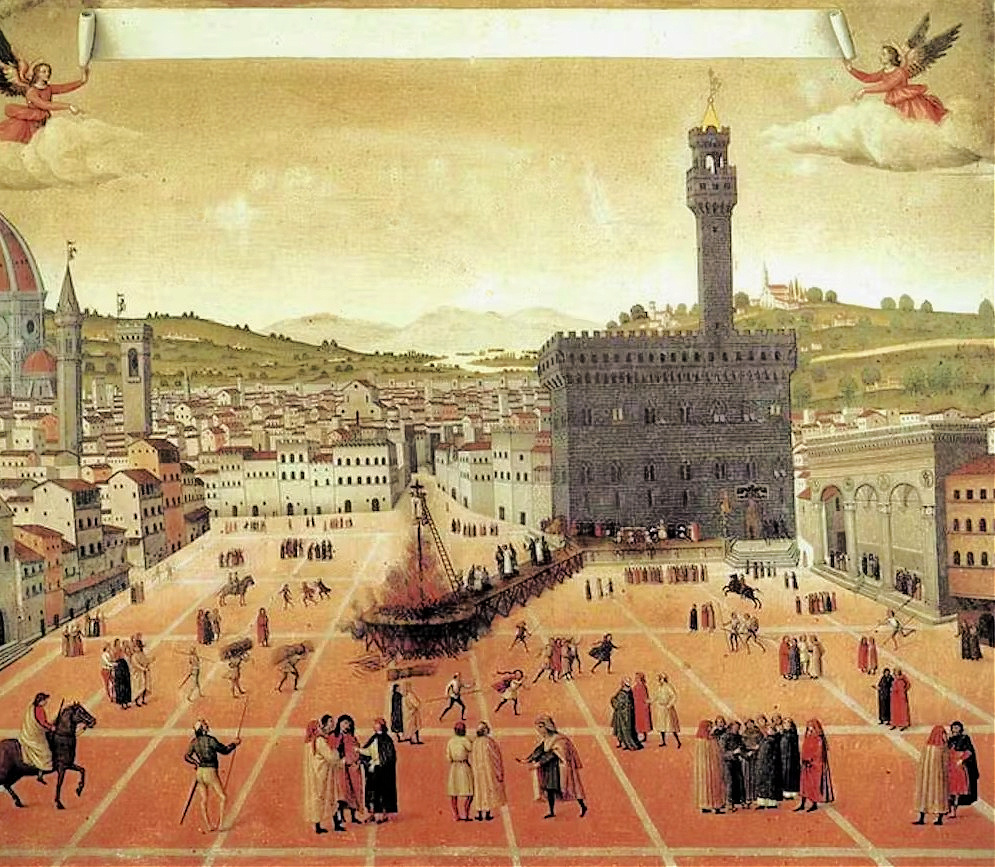
When the Medici fell and Florence became a theocracy under Savonarola (1452-1498), 19-year-old Michelangelo decided to leave Florence. He lamented the fall of Lorenzo the Magnificent, his artistic patron, and the young artist lived hand to mouth going to Bologna, then to Venice, and back to Bologna, and finally to Rome in June 1496. The popes’ tremendous influence in capitalist Italy started in the 13th century and augmented into the 17th century, leading to what art critic Bernard Berenson (1865-1959) called an encroachment of “soulless Vaticanism” towards modern art. But clearly Rome had no use for a firebrand friar who refused to support the pope’s troops against the invading French army. As Columbus set out to discover America, It was the unpleasant chapter of the Italian War of the 1490s that helped fill the times with ongoing brutality, duplicity, complicity, intrigue, opportunism and expedience. A looming danger of looting and violence of the invading French army were emphasized by the impassioned sermons of Girolamo Savonarola that frightened the people and led to their heightened resentment against the ruling Medici. Florence was traditionally pro-French, but Piero di Lorenzo de’ Medici (“Piero the Unfortunate”) (1472-1504), son of Lorenzo the Magnificent, had deployed against them to defend Naples. Under pressure from citizens and outside French forces promising church reforms and civic transparency, the Medici was forced to flee and the city was proclaimed a Republic. The Florentines, with Savonarola in the lead, facilitated the invasion of French king Charles VIII (1470-1498) and against the pope which they considered corrupt. Pope Alexander VI (1431-1503), a Borgia and one of the most corrupt popes in history, ascended to the papal throne in 1492 and was immediately condemned in fiery sermons by Savonarola. Yet all was not well between “liberator” Charles VIII and his Florentine supporters. Immediately the French king demanded a huge sum of money, a ransom payment of sorts, from the Florentines in appreciation, as well as to pay for, the pro-French liberation. The Florentine government refused and the king threatened to loot the city. Faced with a backlash and real threat of popular revolt, the French bully relented and continued onto Rome. Charles postured, but was constantly fearful of antagonizing the European powers and announced his decision that he would not depose the corrupt old pope after all. By having kidnapped the pope’s mistress Giulia Farnese, wife of the pope’s military ally Orsino Orsini, who commanded 4,000 Neapolitan soldiers freshly landed to defend papal interests on the peninsula, Charles VIII was able to extract full entry into Rome in exchange for her release. Once in Rome the French troops looted the city. The pope, in a panic, arranged a quick safe passage for Charles VIII out of the Papal States towards Naples during which the king’s army massacred many hundreds of local inhabitants.
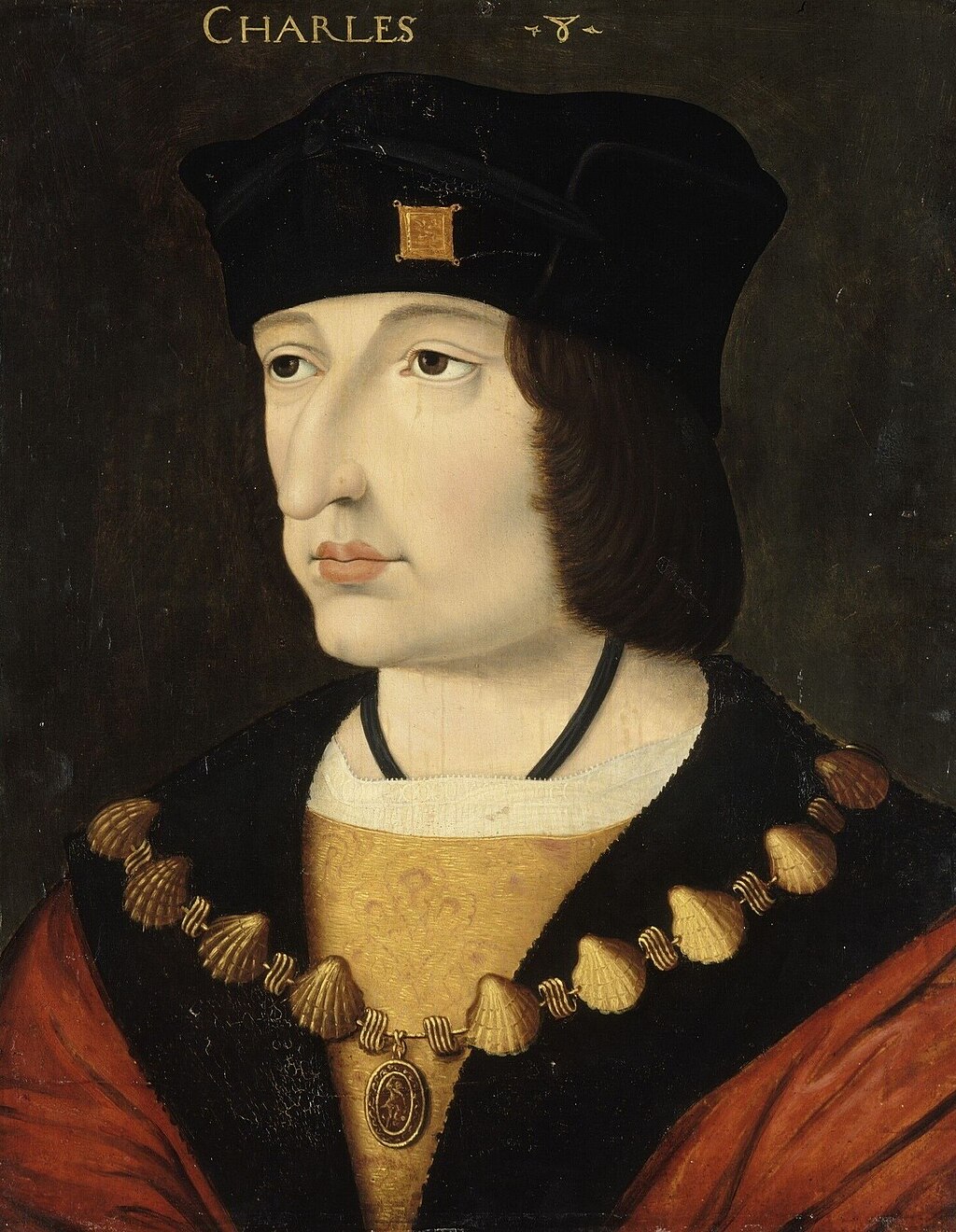
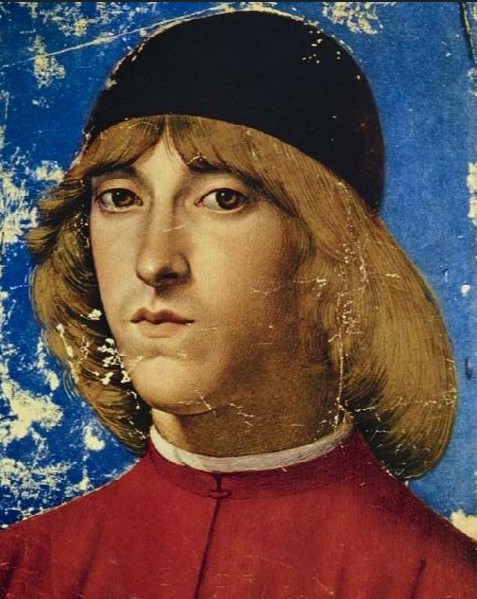
Charles VIII, roi de France, anonymous, c. 1550. Entering Florence in a power vacuum the invading French king demanded a huge sum of money from the citizens who refused to pay and leading to a stand-off. Public Domain. Domenico Ghirlandaio’s 15th century portrait of Piero the Unfortunate. Eldest son of Lorenzo the Magnificent, Piero di Lorenzo de’ Medicisucceeded him as ruler of Florence in 1492. When Piero determined in 1494 to stay neutral during French king Charles VIII’s invasion of Italy, effectively defending Naples the object of the king’s campaign, he was challenged. Suffering from an abandonment of the Florentine elite under the spell of Savonarola, Piero totally capitulated to Charles VIIi’s demands. Having succeeded in alienatating everyone in Florence, Piero fled to Venice, aided by a French diplomat, in November 1494. Attempting to make a comeback several times to Florence he was constantly rebuked, Piero drowned in the Garigliano River while attempting to flee the aftermath of the Battle of Garigliano in 1503, Public Domain.Pope Alexander VI Borgia, c.1495, attributed to Spanish painter Pedro Berruguete (c. 1450-1504), Vatican Museums. Alexander Vi was a wily politician from a prominent family who practiced nepotism and sired several children by way of his many mistresses.
Savonarola played an important role in this French infiltration in Italy — and Rome did not forget. Then, in February 1497, during Mardi Gras of that year, Savonarola, whose message was a combination of religious purist and civic republican preached his most dramatic act of cultural desecration by seeking that artworks, books, clothing items and cosmetics were thrown into a bonfire of the vanities as a sign of monied and other social decadence. The flames became his final undoing: Savonarola was excommunicated for heresy and sedition by Pope Alexander VI on May 12, 1497 after the preacher called “the contemporary Church leadership…a pockmarked whore sitting on Solomon’s throne.” The pope also threatened Florence with severe interdictions if they continued to be a sanctuary for Savonarola and his ilk. Savonarola was imprisoned on April 7, 1498 after failing a literal public trial by fire (it rained). Finally, he was dragged from his prison cell and with two other contemptible friars was condemned as a heretic and schismatic and hanged and burned at the stake on May 23, 1498, with the Vatican and the Medici observing it all from a safe distance. Yet the cult of Savonarola, his person as well as his political and religious ideas, did not go quietly up in smoke. Though seen today as a sort of vile figure, his supporters around 1500 and afterwards saw him as a martyr and encouraged his veneration as a saint to which many complied. In Florence Savonarola’s disputed legacy went on until the Medici more or less permanently re-installed themselves in 1530. Yet Protestant reformers in Germany and Switzerland were intrigued and influenced by Savonarola’s ideas and, in 1558, even Pope Paul IV, who was 22 years old when Savonarola was executed, declared him not a heretic and always in communion with the Catholic Church. Saint Philip Neri (1515-1595), a Florentine established in Rome, and regularly characterized as a most relatable prelate of and for the masses, also defended Savonarola’s memory.
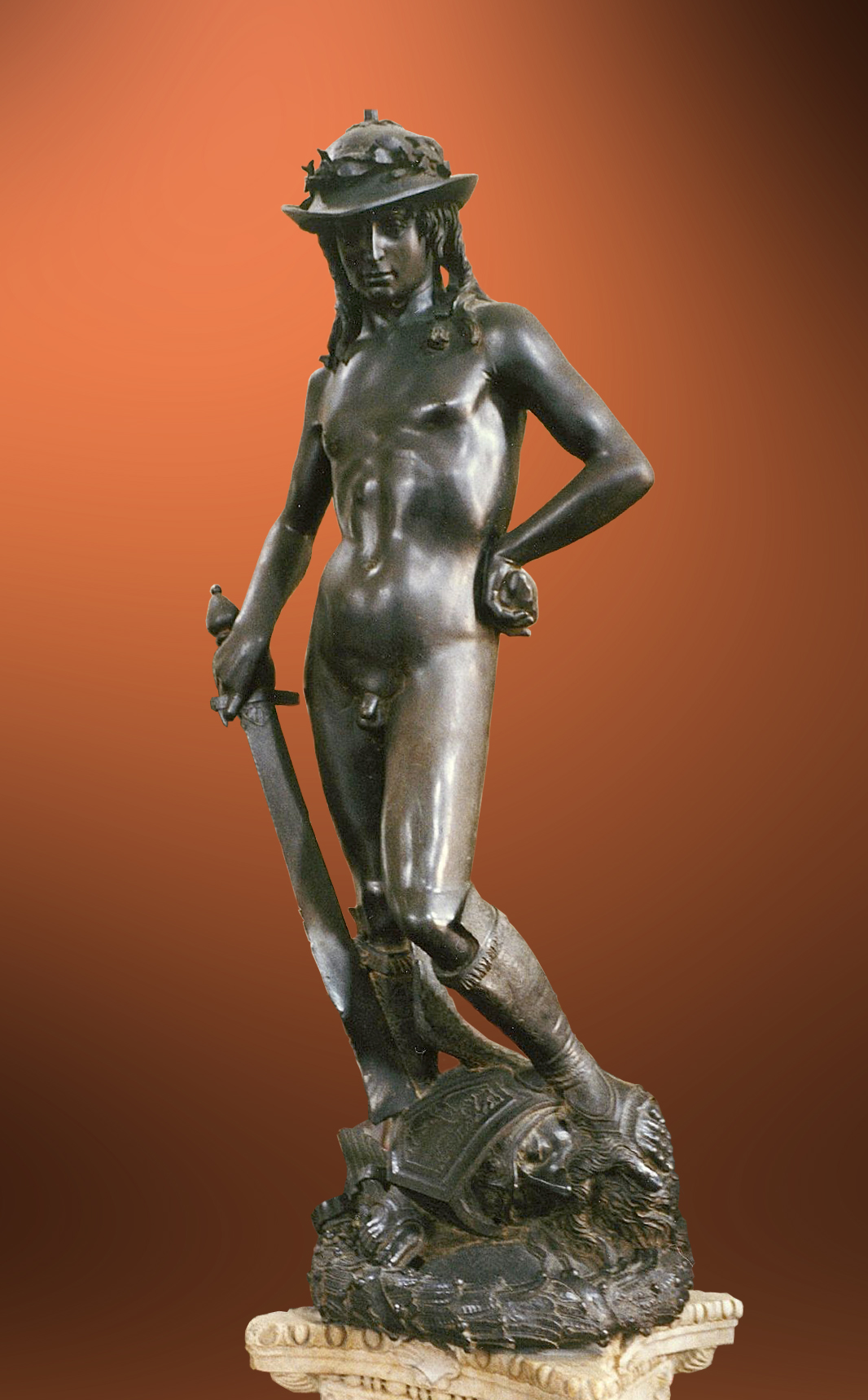
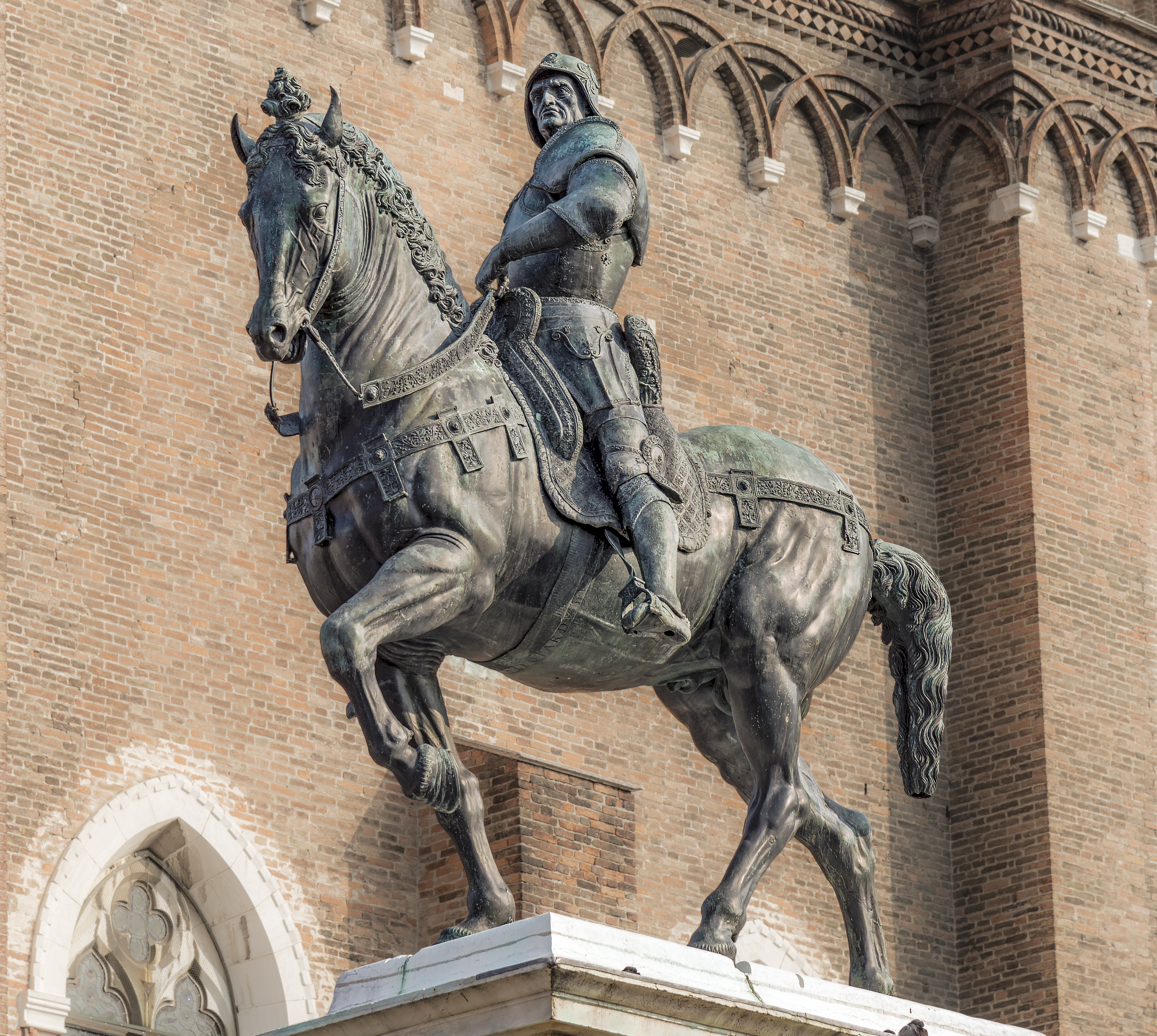
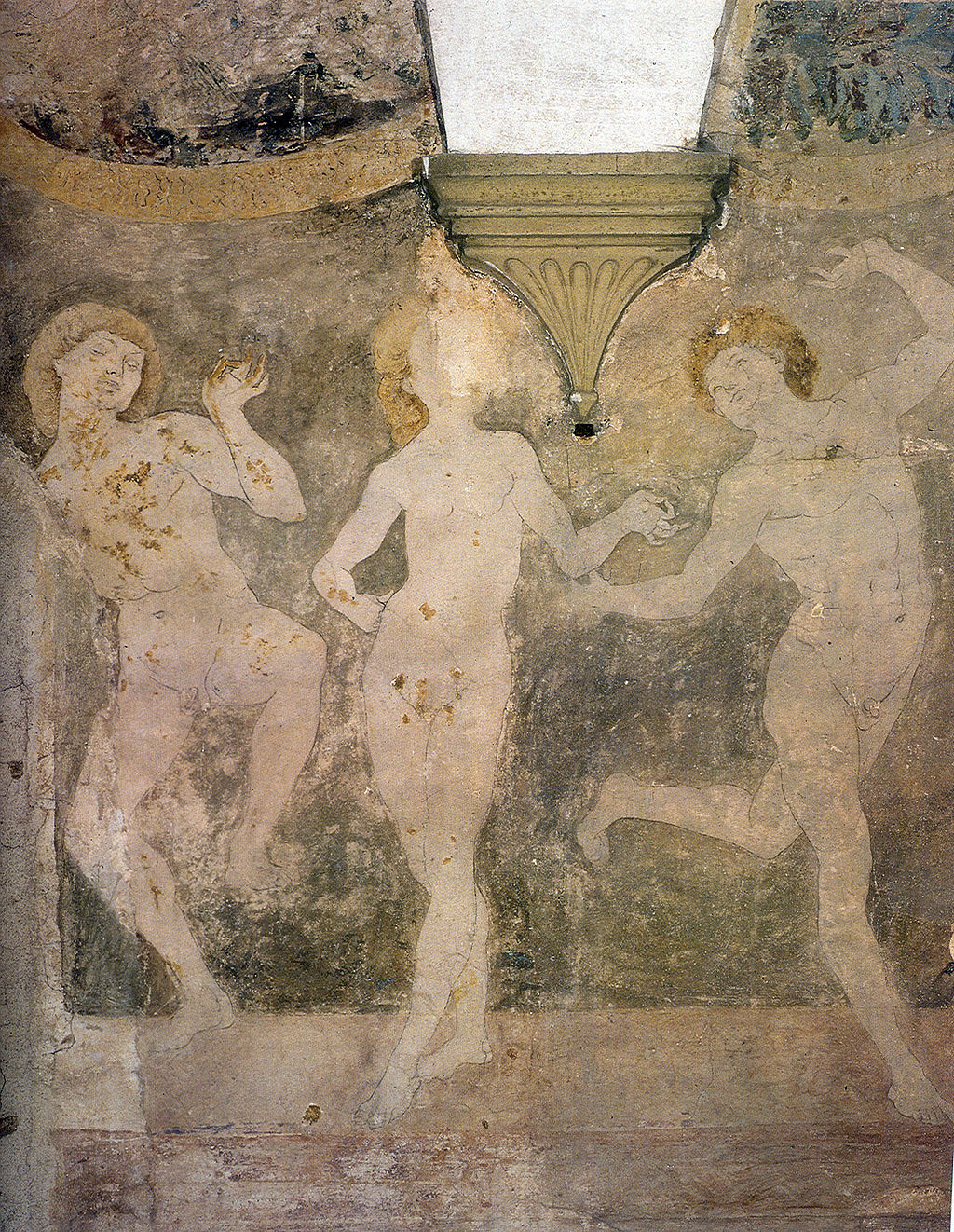
Francesco Rosselli (1445-1513), The Execution of Savonarola and Two Companions at Piazza della Signoria, 16th century, oil on canvas, Galeria CorsiniBernard Berenson as a young man, Berenson described Michelangelo as “the pupil of nobody, the heir of everybody, who felt profoundly and powerfully what to his precursors had been vague instinct, who saw and expressed the meaning of it all.” quoted in Berenson p. 72. Public Domain. “Donatello – David – Florença” by original file by Patrick A. Rodgers is licensed under CC BY-SA 2.0. Verrocchio, Equestrian Statue of Bartolomeo Colleoni, 1480s, Venice. Bartolomeo Colleoni (1400-1475) was an Italian condottiero, who became captain-general of the Republic of Venice. Colleoni gained a reputation as the foremost tactician and disciplinarian of the 15th century. “Bartolomeo Colleoni by Andrea del Verrocchio” by Didier Descouens is licensed under CC BY-SA 4.0.Antonio del Pollaiuolo, Nude Dancers, 1470s, Fresco Arcetri, Villa La Gallina. A fresco frieze of dancing nude figures, in a villa near Florence, shows the artist’s same interest in extreme body poses. Public Domain.
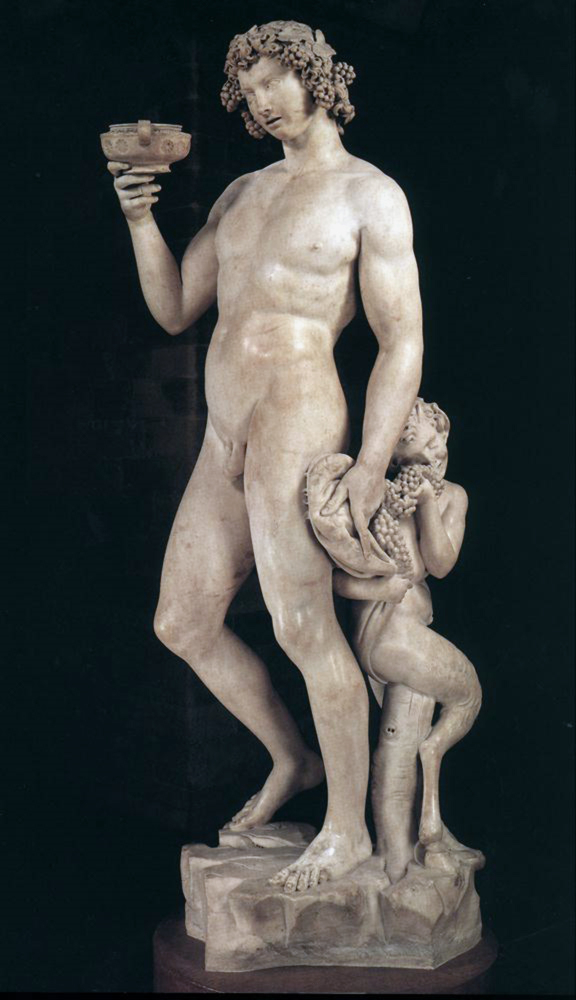
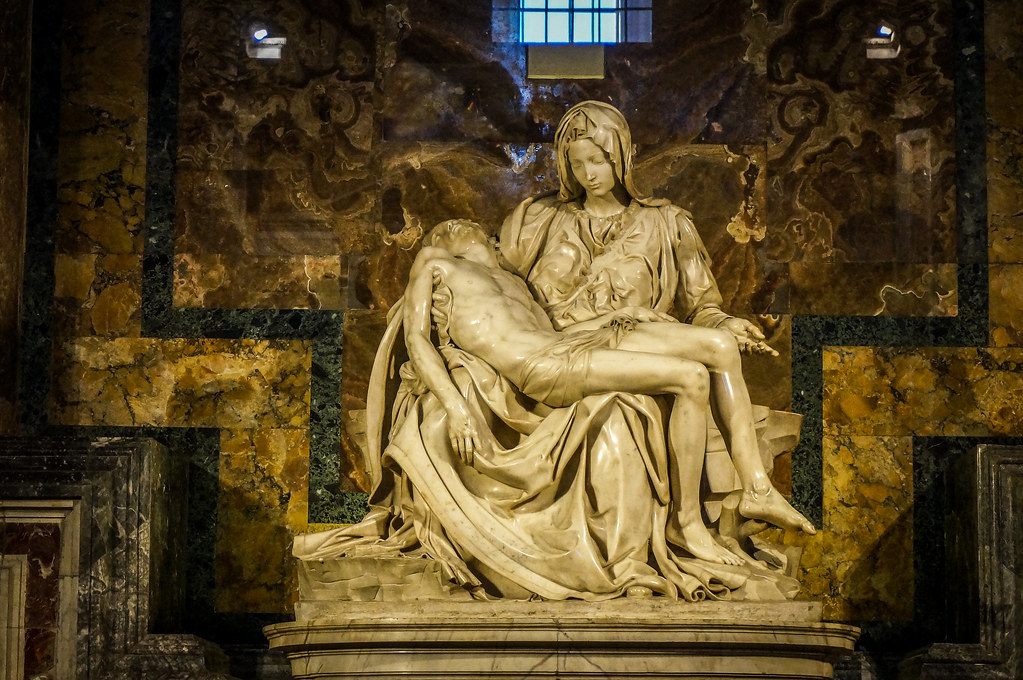
Meanwhile, in Rome, Michelangelo sculpted his first major marble works. The first, Bacchus, was commissioned by Cardinal Raffaele Riario (1461-1521) in partnership with Jacopo Galli, a Roman collector, that was displayed in Galli’s garden until it was sold in 1572 to the Medici and is today in the Bargello. The second is the sublime Pietà (St. Peter’s Basilica, Vatican City) that was commissioned by a French cardinal in Rome and placed in the Santa Maria della Febbre. Vasari described the Pietà as “a revelation of all the potentialities and force of the art of sculpture.” Though the Pietà made Michelangelo famous in Rome, he returned to Florence following its installation to work on the David, a commission made by the Florentine republic after the expulsion of the Medici.
Michelangelo, Bacchus, marble. 1497, Bargello, Florence.Michelangelo, Pietà, marble, 1498-1499, St. Peter’s Basilica, Rome. A 24-year-old Michelangelo was all the rage in Rome as an artist in the late 1490’s and wrote his name promonently across the sash of the Blessed Mother. The artist did this after it was completed and heard a group admiring the artwork and attributing it to a different artist. Michelangelo was having none of it and one night whet into the chapel and chiseled his name for none to miss seeing. “Pieta (Michelangelo)” by elixirk is licensed under CC BY-NC-SA 2.0.Michelangelo’s David, created in c. 1501-1504, has been in the Galleria dell’Accademia since 1873, The biblical figure of David came to symbolize the defense of civil liberties embodied in the 1494 constitution of the Republic of Florence, an independent city-state threatened on all sides by more powerful rival states and by the political aspirations of the Medici family.Author’s collection.
This explanatory article may be periodically updated.
SOURCES:
Bernard Berenson, The Italian Painters of the Renaissance, Phaidon, New York, 1959.
Ornella Casazza, Masaccio and the Brancacci Chapel, Scala, 1990.
Enzo Carli, translated by Susan Bellamy, Giotto and His Contemporaries, Crown Publishers, 1958.
Andreas Quermann, Ghirlandaio, Könemann, 1998.
A Dictionary of Art and Artists, Peter and Linda Murray, Penguin Books; Revised,1998.
Giorgio Vasari, trans. George Bull, Lives of the Artists, Penguin Books, Harmondsworth, Middlesex, England, 1965.
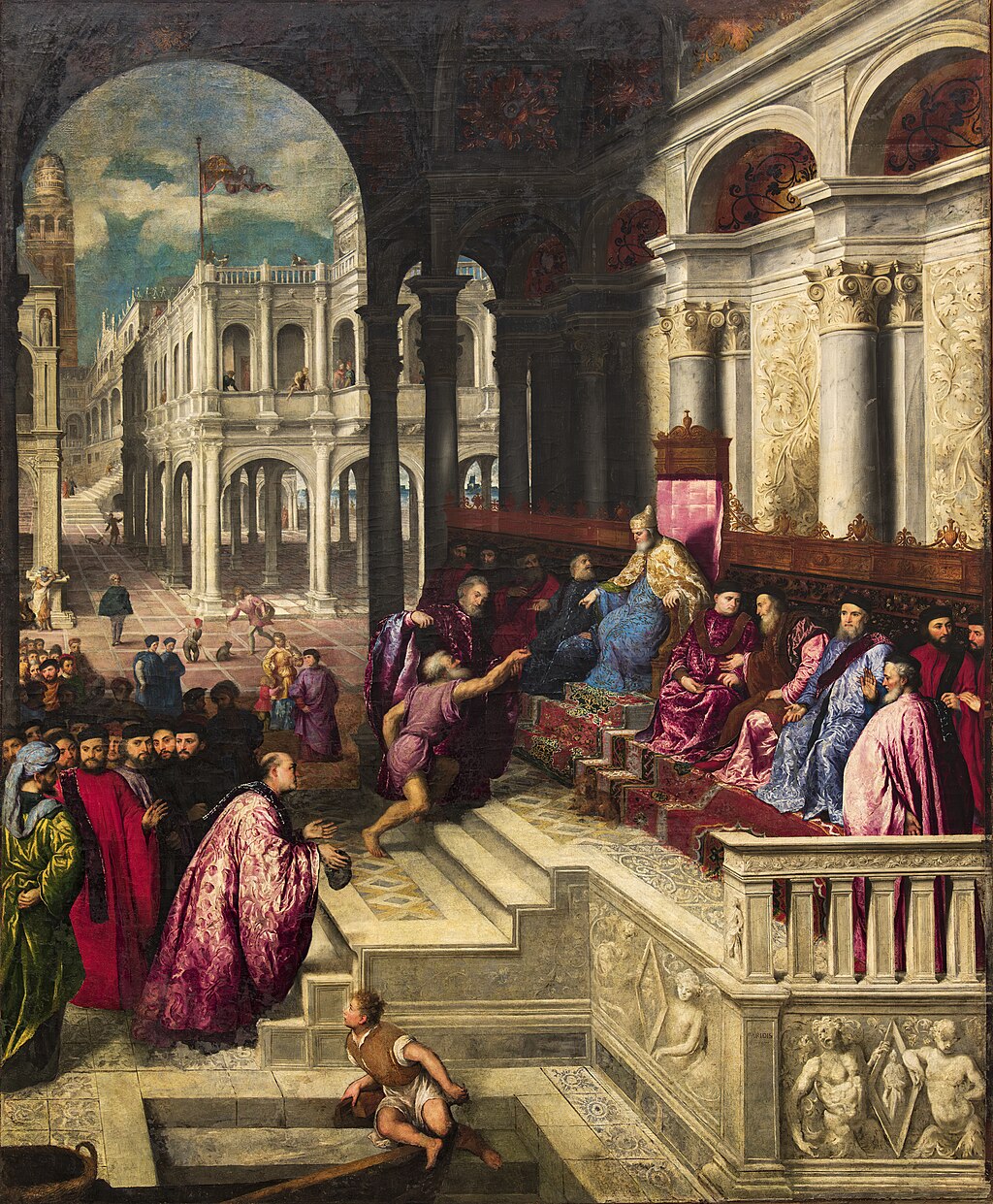
FEATURE Image: Paris Bordon/e (1500-1571), Fisherman Presenting a Ring to the Doge Gradenigo, 1534, oil on canvas, 370 x 301 cm (145.7 in × 118.5 in), Gallerie dell’Accademia, Venice.
INTRODUCTION TO PART 1.
Venice is one of the great Italian cities for Renaissance art and its wide-ranging influences. Reflecting a city in the sea, its art is characterized by light and color. Its most remarkable artistic production was between 1470 and 1590 – the rise, height, and decline of the Italian Renaissance. Developed into a powerful maritime empire between the 9th and 11th centuries, Venice was an independent city state that rivaled all other Italian maritime empires such as Genoa, Pisa, and Amalfi; and lesser-known Ragusa, Ancona, Gaeta and Noli, and until the fall of the Republic in 1797. From its trade routes Venice inherited and fortified the coloristic tradition of Byzantium and the Eastern Mediterranean, Islamic countries and the Far East, Ravenna along the Italian coast to the south, and Aquileia near Trieste. Trade routes also included to the Free Cities of the North and its medieval Gothic culture. These activities led to a cosmopolitan culture manifested in Venice’s art and architecture. Around 1500 the Republic also had expanded its territorial holdings to a great extent across Italy, Dalmatia, the Alps, and the Aegean Sea.
The Tuscan Renaissance came to Venice starting around 1430 via Padua, a prestigious university town known for its science and philosophy departments, and part of the Venetian state. Artists such as Giotto (c.1267-1337), Filippo Lippi (c. 1406-1469), Donatello (c. 1386– 1466), Andrea Mantegna (1431-1506) and Paolo Uccello (1397-1475) brought essential elements of the Early Florentine Renaissance to Venice. Since 1469 Venice was a publishing center and had been a stop since late medieval times for humanist authors such as Petrarch (1304-1374). As the Mediterranean’s dominant naval force, Venice’s cosmopolitan mercantile culture brought financial and human capital to the lagoon city whose concentration spawned technological innovation. Politically, since Venice was a Republic and not a duchy or bishopric, publications and ideas were unencumbered by censorship present elsewhere. For example, Aldine Press established in 1495 began by printing Greek and Roman classics and later worked with leading humanists such as Desiderius Erasmus (1466 – 1536), Pietro Bembo (1470-1547) and Giovanni Pico (1463-1494). The Aldine Press also produced the first proto-type of today’s lightweight and portable paperbacks. By the 16th century over 250 publishing houses operated in Venice making the city a beacon for humanist writers and artists. (see – https://www.bbc.com/travel/article/20190708-the-city-that-launched-the-publishing-industry – retrieved December 15, 2024).
These propitious contacts and developments led to the establishment of Venetian Renaissance art by GIOVANNI BELLINI (c. 1430-1516). From an old family of painters, Bellini established a dialogue between Florentine artistic principles of space and form and its philosophy of the natural world with man at the center with Venetian painterly practice. His major discovery was, beginning in his artwork of the 1490s, the situating of naturalistic color to replace the urbane decorative palette used in medieval painting. He also moved past the older mythological subject matter to a naturalistic presentation of religious themes.
Bellini was joined by Sicilian painter Antonello da Messina (1430-1479) who studied with Piero della Francesca (c. 1416-1492) and introduced the influential geometric design to his compositions that influenced CIMA DA CONEGLIANO (c. 1459 – c. 1517). More isolated in his work – and thereby more important for art practice – was the work of VITTORE CARPACCIO (1465-1526) who introduced his synthesis of strict realism, including a sense of space and proportion. Carpaccio captured not only Venice’s contemporary architecture in the work of classicist Mauro Codussi (1440-1504) and sculptor Pietro Lombardo (1435-1515) but its social activity as well. Following Antonello da Messina and Piero della Francesca, Carpaccio used original and expressive colors. Though Carpaccio’s output faded before 1510, Bellini’s work continued until 1516 and through him formed a continuity of style between the late 1400’s and early 1500’s in Venice.
In this first period, GIORGIONE (1478–1510), a student of Bellini, was another important figure in exploring color in Venetian art. Though influenced by Bellini, Giorgione was original in his transformation of his teacher’s stoic elite classicism to a grounding in intimacy and humanity. Many of his religious subjects are based on individualized portraits. In his unidealized landscape painting based on the realism of German Albrecht Dürer (1471-1528), Giorgione replicates feelings produced in nature rather than rigid archeological reconstructions that Bellini, Mantegna and Donatello produced. Giorgione was also imbued in Flemish painting including Gerard David (c.1460-1523) and Hans Memling (c. 1433-1494). When Giorgione died at 32 years old in a pandemic in 1510, he left to others his melancholic contemplation of the natural world as a direction for Venetian painting, particularly TITIAN (1488-1576) who is to be featured in another post.
Titian was part of a family of artists who, in 13th-century and 14th century in Italy, had been civic leaders such as mayors, magistrates, and notaries. In Italian his name is Tiziano Vecellio, but in English the artist is famously known as Titian. Titian became the leading painter in Venice and an influential artist throughout sixteenth-century Italy. In the 15th century, two Vecellio brothers had children who became artists. Titian was the grandson of one of those brothers who was ambassador to Venice where the family had a timber trade. A follower of Giorgione, Titian was more intense and dominating in vision and style than the earlier master including his rich dark hues without drawing. Titian also took advantage of Germanic engraving and painting sources for his art, particularly its compositional realism, dynamism and classical references as manifest in Dürer. Though a perfunctory colorist, PARIS BORDON/E (1500-1571) was another artist who came under the influence of Titian’s imperially theatrical style and made a success of it.
There were other artists who followed Giorgione by way of his subject matter rather than, as Titian had, his color. This included artwork of SEBASTIANO DEL PIOMBO (1485-1547), particularly his early Venetian work before he departed for Rome in 1511, and JACOPO NEGRETTI, CALLED PALMA IL VECCHIO (c.1480–1528) who eventually fell into Titian’s orbit but painted arcadian subject matter inspired by Giorgione.
Prolific Venetian artist LORENZO LOTTO (c. 1480 – 1556) retained his independence and highly individual style in a prolific career influenced by Bellini’s composition, Antonello da Messina’s color, and Dürer’s realism. Lotto started in Treviso in 1503 and returned to Venice in 1525 via Recanati, Rome (where he worked with Raphael in the Vatican apartments making his drawing pliant and coloring mellow) and Bergamo. Lotto’s output was primarily deeply spiritual religious paintings and portraits which plumbed psychological depth, and were very popular. In Venice Lotto became one of the leading artists with Titian and Il Pordenone (1484-1539), painting altarpieces, devotional scenes, and portraits for wealthy patrons in the city. Lotto left Venice in 1533 to return to the papal states of the Marches where he intermittently returned to Venice. In 1554 Lotto became a lay brother at the Santa Casa in Loreto and died there in 1556.
ARTWORKS.
Giovanni Bellini (c. 1430-1516)Madonna with the Child, 1470-1476, oil on canvas transferred from wood, 20.4 in. x 16.9 in (52 x 43 cm), Museo Correr, Venice.
Giovanni Bellini came from a family of artists and began work in his father, Jacopo’s workshop. The Bellini brothers Giovanni and Gentile (d. 1507) were greatly influenced by their contemporary Andrea Mantegna who married their sister Nicolosia in 1454. The chronology of Bellini’s paintings is challenging to definitively settle upon since he ran a large workshop of pupils and assistants whose production output was signed with his name. Bellini’s pupils and influences extended to great names of Renaissance Venetian painting: Giorgione, Titian, Palma Vecchio, Sebastiano de Piombo and had influence beyond his direct contacts and into the future. Bellini also studied Donatello so to develop his personal style in the 1450’s and 1460’s. This is manifested in this Madonna and child of which there are several which expresses in light and color harmonious formal three-dimensional beauty and human feeling.
Giovanni Bellini (c. 1430-1516), Portrait of Joerg Fugger, 1474, oil on panel, 10.2 in. x 7.8 in., 26 cm x20 cm, Norton Simon Museum, Pasadena, California. https://www.nortonsimon.org/art/detail/M.1969.13.P – retrieved December 17, 2024.
In the mid 1470’s, following a practice popularized by Sicilian Antonello da Messina, Bellini moved from tempura painting to oil. Bellini began to use more rounded figures, also taken from Antonello. He also adapted Piero della Francesca’s perspective system. These artistic elements were evident in Northern European artwork commissioned by Italian families from Rogier Van der Weyden (1399-1464), Hugo Van Der Goes (c.1440-1482), Jan Van Eyck (c. 1385-1441), Petrus Christus (c. 1395-1472), Dieric Bouts (c. 1415-1475) and Hans Memling (c. 1433-1494). Bellini’s oil on panel portrait is the artist’s first. The sitter is of Joerg Fugger, the 21-year-old heir to a wealthy banking family in Germany. Bellini depicts his subject with small blue blossoms in his hair, the sign of a scholar. The portrait is three-quarter length instead of profile and set against a neutral background or, later, with landscape and sky. The portrait informed a coming generation of portraiture and religious images in Italy including Raphael (1483 – 1520), Leonardo da Vinci (1452-1519), and Fra Bartolomeo (1472-1517).
The 1470’s saw Bellini produce his most glorious landscapes including the warm and glowing St. Francis at the Frick. Specific details about this painting’s provenance are speculative. It is presumed to have been painted in the late 1470’s for Venetian patrician Zuan Michiel, and was destined for the monastery of San Francesco del Deserto on a remote Venetian island. By 1525, the painting hung in the palace of Taddeo Contarini in Venice. (further reading- https://www.frick.org/exhibitions/bellini_giorgione – retrieved December 17, 2024.). Francis is shown receiving the stigmata in a natural mystical light surrounded by a variety of animals. Bellini’s setting for this religious event that took place in September 1224 is a valley in the Venetian countryside (it took place in Umbria), with a small hilltop town in the background and Francis standing outside his hermit’s dwelling. Saint Francis is said to have composed his Canticle of Creatures also in late 1224, considered one of the first masterpieces of Italian verse.
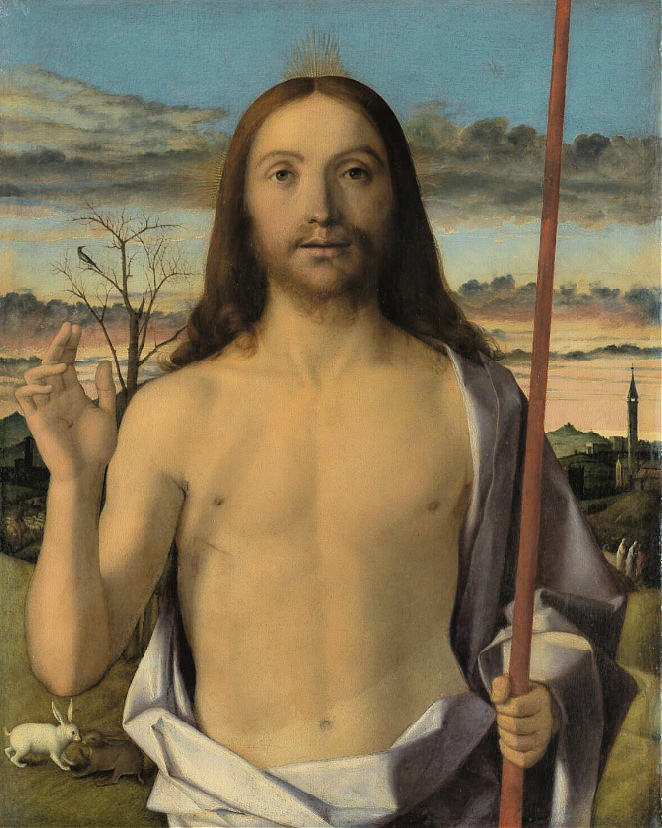
“Bellini and Giorgione in the House of Taddeo Contarini” on view until February 4, 2024, reunited for the first time in about four hundred years the Frick’s “St. Francis in Ecstasy” by Giovanni Bellini with Giorgione’s “Three Philosophers,” on rare loan from Vienna’s Kunsthistorisches Museum which hung in the palace of Venetian art collector Taddeo Contarini.Giovanni Bellini (c. 1430-1516), Christ Blessing c. 1500, Tempera, oil, and gold on panel, 23 1/4 x 18 1/2 in. (59 x 47 cm), Kimbell Art Museum, Fort Worth, Texas. https://kimbellart.org/collection/ap-196707 – retrieved December 17, 2024.
In Bellini’s long career he depicted Jesus Christ differently over time. In his early years he often depicted the dead Christ in a lonely solitude. Later he added angels, and grief-stricken figures of his mother Mary and the apostle John. Bellini developed to depict Christ as triumphant or beatified in his miraculous apparitions of the Transfiguration, Resurrection and Ascension. In Christ Blessing Bellini animatedly portrays the God-Man sent to bless the world on one hand and holding the shepherd’s rod to guide his flock in the other (it may also be logically seen, though not completely in view, as his staff with the traditional red cross on a white flag atop symbolizing his triumph over death). A devotional image presenting the Resurrected Savior, its vibrant figure is brought close to the picture plane where his level gaze and shadowed arm of blessing informs the viewer of the matter-of-fact reality of the scene in quiet harmonious colors. Yet, at the same time, golden rays of light emanate from the top and sides of his head, making thoroughly evident His Divinity. In the background Bellini depicts prolific rabbits, shepherds tending their flock and three shrouded figures who likely are the three Marys at the tomb on Easter morning. There is also a lighted church bell tower to convey the presence of Christ in his Church.
Giovanni Bellini (c. 1430-1516), Drunkenness of Noah, oil on canvas, c. 1515, 40.5 in. x 61.8 in (103 cm x 157 cm), Musée des Beaux-Arts et d’Archéologie de Besançon.
In one of Bellini’s last works the master shows how he adapts his work to the developing artistic style after 1510 led by Giorgione and Titian: the composition is fluid and dynamically conceived, with dramatic realism, aqueous colors and excited brushstrokes. Its attribution to Bellini has been accepted by scholars since 1927 though it remains open to debate.
Cima da Conegliano (c. 1459-c.1518), Virgin and Child in a Landscape, 1496-99, North Carolina Museum of Art, Raleigh, oil on panel, 28 x 24 3/4 in. (71.1 x 62.9 cm). https://ncartmuseum.org/object/virgin-and-child-in-a-landscape/ – retrieved December 12, 2024.
Cima was a Venetian artist who admired Bellini’s use of color and Antonello’s style of the Netherlandish masters. In contrast to renewed classicism which appeared in Venice in its art and architecture, Cima attempted a sophisticated art reliant on the study of nature that was prevalent in the provinces. Born in Treviso in about 1459, Cima worked in Vicenza in Mantegna’s circle and then moved to Venice in 1492. He was associated with the school of Alvise Vivarini (1442/1453–1503/1505), though Cima remained linked to the gentle and rustic naturalism of the provinces. His models included Madonnas and religious figures in peaceful landscapes such as this painting of a peasant mother and her child in a landscape that includes behind them a monastery and hilltop fortification. The crystalline colors and fluid drawing indicate Antonello’s influence while its overall placidness is characteristic of Cimi’s artwork.
Vittore Carpaccio (1465-1526), Apparition of the Martyrs of the Mount Ararat in the Church of Sant’ Antonio di Castello, c.1513-14, oil on canvas, 47 5/8 x 68 ½ in. (121x 174 cm), Gallerie dell’ Accademia, Venice.
A pupil of Gentile Bellini (Giovanni’s brother), and a follower of Giovanni and Giorgione, his finest work began in 1490. The Legend of Saint Ursula and other pageant-type pictures was early and masterful Italian genre painting. Carpaccio depicted detailed episodes of sacred history and legend using the settings and minutiae of contemporary everyday Venetian society within a formal pictorial schema. This Apparition of the Martyrs of the Mount Ararat in the Church of Sant’ Antonio di Castello is a small canvas that captures the compelling simplicity and authentic emotion of a religious scene that was present in his earlier larger format cycles and series. The painting is of a vision of the prior of St. Anthony monastery kneeling at the altar on the far left. He turns to see the 10,000 martyrs of Mount Ararat he called upon in prayer during a plague that had broken out among the friars. As the martyrs process into the church, they are blessed by St. Peter, the first pope. Carpaccio depicts the interior of a Gothic Church – including an elaborate wooden screen at left and cargo ships suspended from the ceiling – that was demolished in 1807.
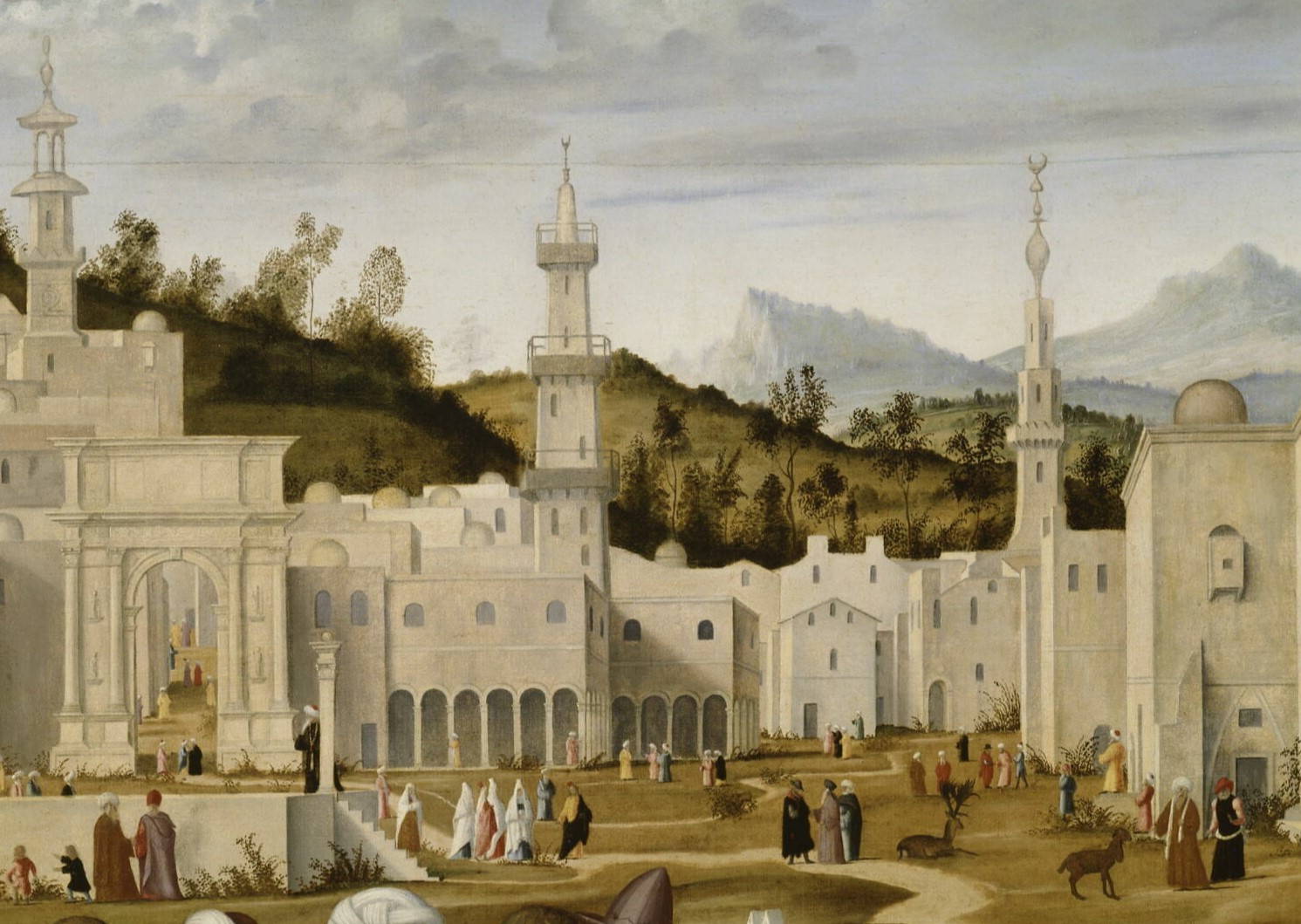
Vittore Carpaccio (1465-1526), Preaching of St. Stephen, 1500-1525, oil on canvas, 1.48 x 1.94m, Louvre. In place until the abolition of the brotherhood in 1806; P. Edwards, 1807; Pinacoteca di Brera, Milan, 1808; entered the Louvre by way of exchange, 1812. https://collections.louvre.fr/en/ark:/53355/cl010062650 – retrieved December 19, 2024. detail. detail. detail.
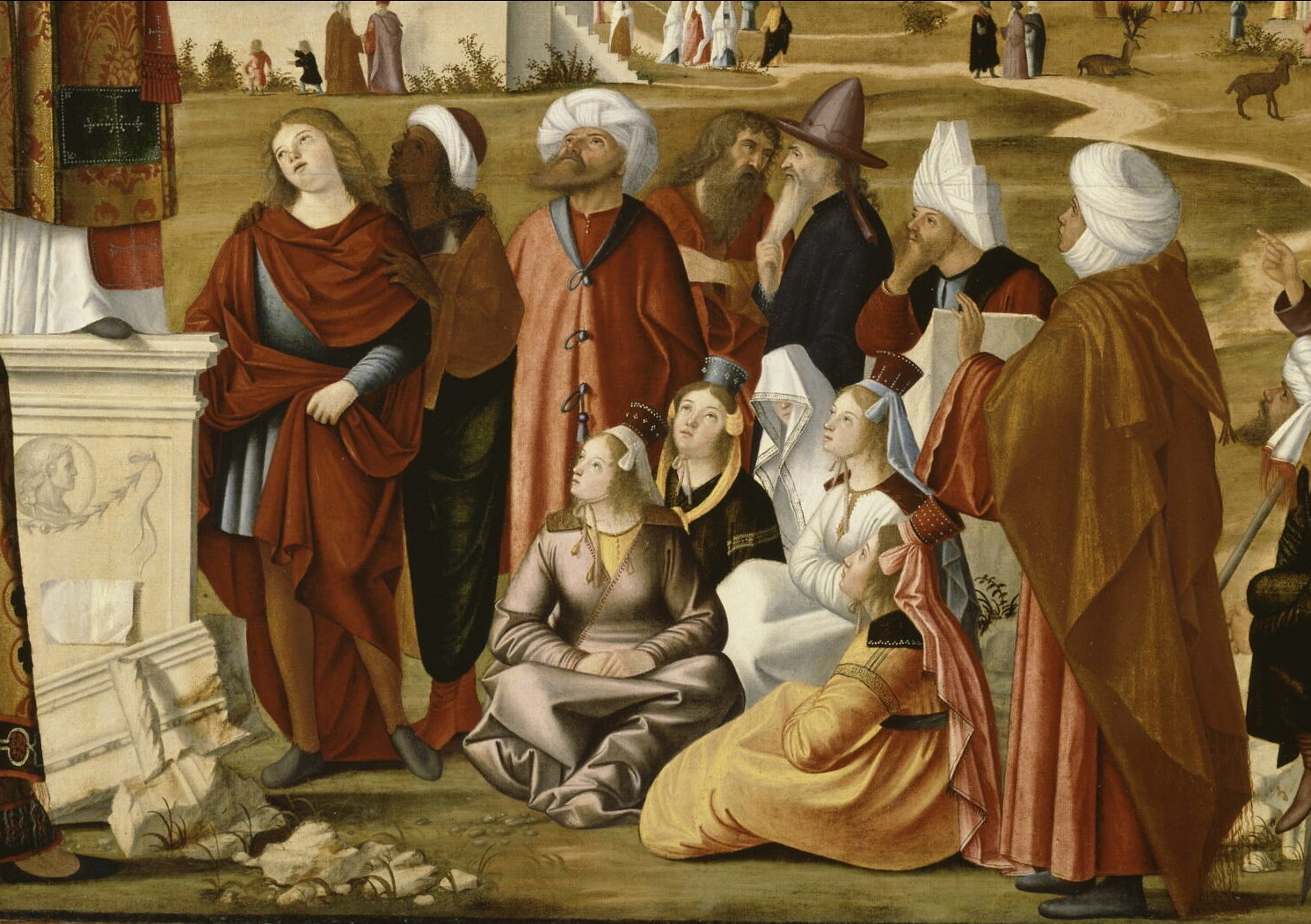
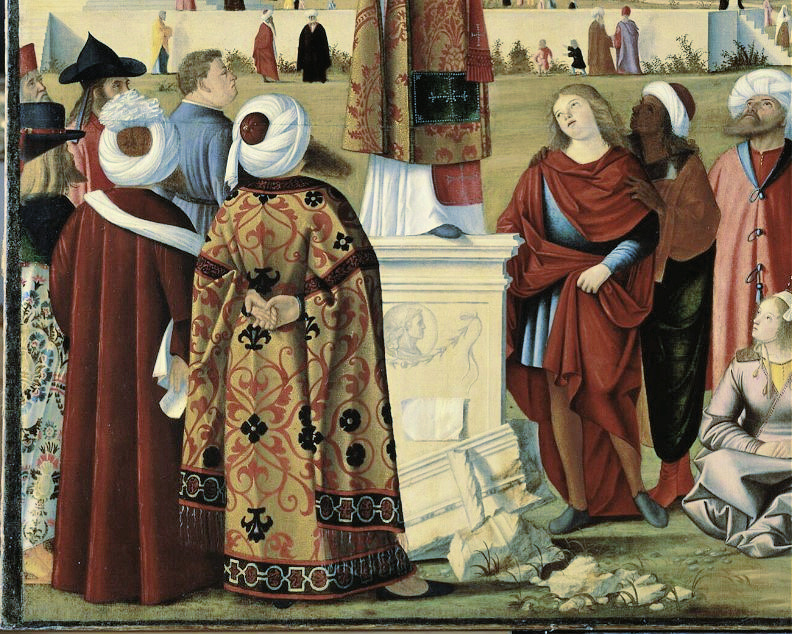
Preaching of Saint Stephen by Vittore Carpaccio was done on the first quarter of the 16th century. It depicts the first Christian martyr, St. Stephen, giving a sermon whose actions and words involve its audience as active witnesses. Set within a spacious landscape it reflects an ideal city view, reminiscent to Jerusalem. It is suggested that Carpaccio may have been in Jerusalem as this scene is reminiscent of life in that city and of the Haram-ash-Sharif with the Mosque of Omar.
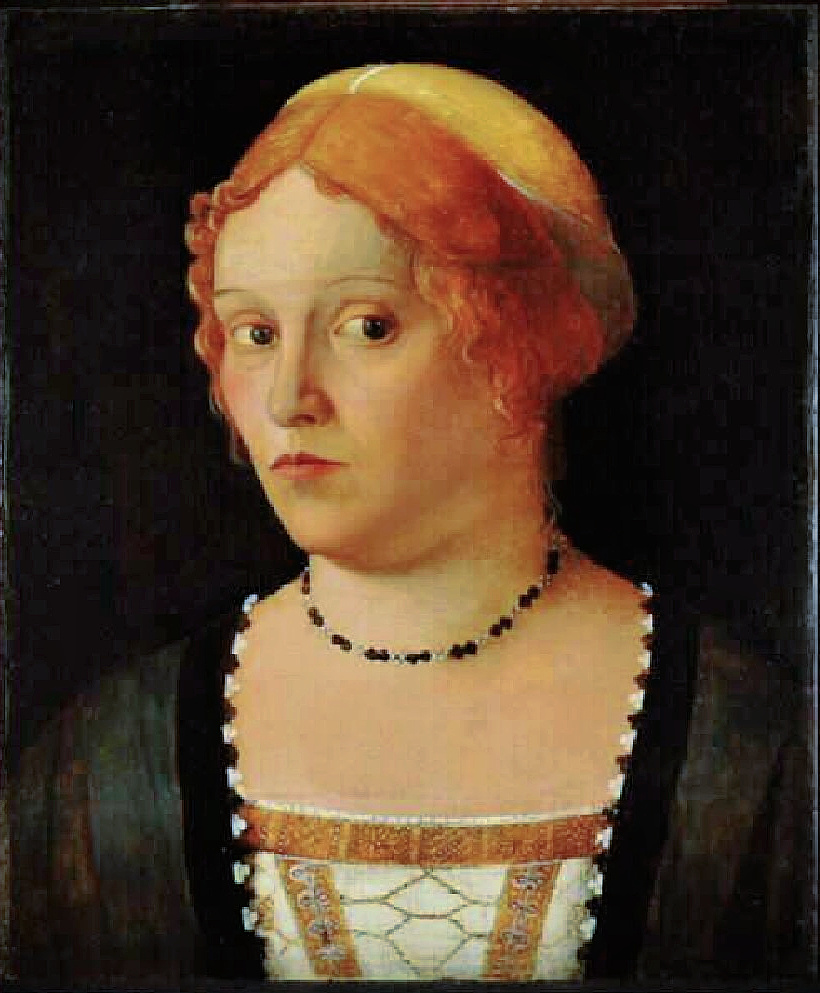
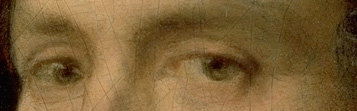
Carpaccio’s realism in numerous portraits in his ceremonial pictures was influenced by the Flemish masters already popular in Italy in the 1490’s. This bust-length independent portrait of a woman set against a plain dark background is almost an abstract construct of eyes, mouth and hairstyle. Her large head is turned slightly in one direction while her limpid eyes look in the other direction. Her reddish hair is pulled loosely back from her face and, at the crown of her head she wears a yellow net to hold some of it. Her square-neck dress is slate blue edged in black, with a white and gold embroidered front panel. Around her neck she wears a choker of white and black beads.
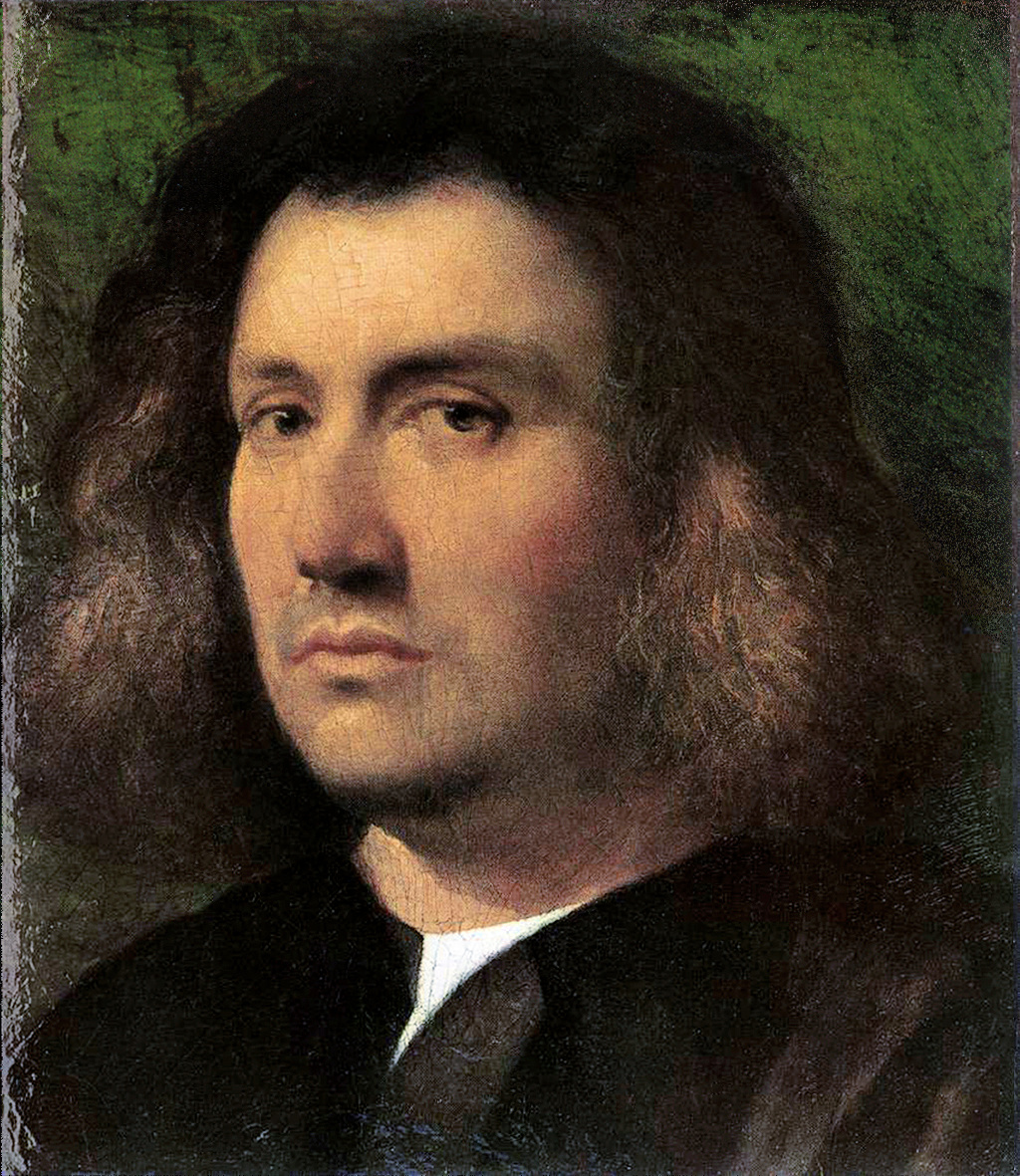
Giorgione who moved to Venice around 1500 is the transitional figure between Bellini and Titian. Instead of a prevailing late 15th century practice of precise brushstrokes and sculptural composition in his art, Giorgio expressed his subject matter in studied tonal gradations of color and precise analysis of human emotional expression described in gentle brushstrokes. Vasari saw Giorgione’s painting as if having no intermediary between art and life. Painted in the same period as Old Woman (Gallerie dell’ Accademia, Venice), this Portrait of a Man epitomizes what Vasari called the “modern manner” where Giorgione sought to paint “living and natural things.” With its plain dark background and close head crop the man’s carefully observed turning gaze and ambiguous expression is wholly engaging and alive.
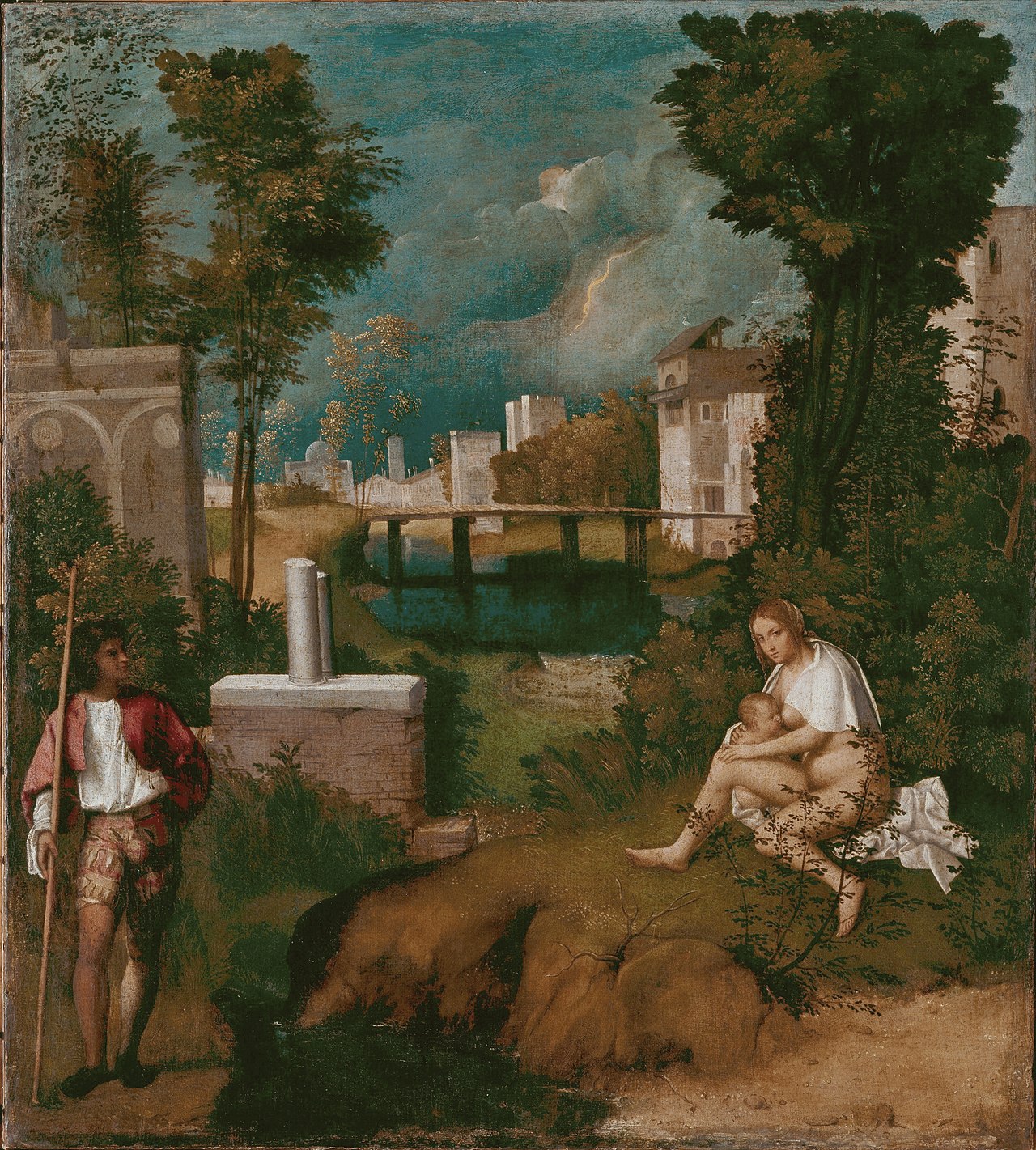
Giorgione (1478–1510), The Tempest, c. 1508, oil on canvas, 83 cm × 73 cm (33” × 29”), Gallerie dell’Accademia.
With Leonardo da Vinci, Giorgione is ranked as one of the founders of modern art. He was the first artist in Venice who often painted small artworks in oil of mysterious and evocative subjects for private commissions instead of public church works. The Tempest, originally commissioned by a Venetian noble of the House of Vendramin, is one of those artworks. Known as “a landscape of mood,” it has no discernable subject matter outside of expressing the tension and heat of an approaching storm. Its meaning remains elusive today. Giorgione’s career and personal life are equally mysterious. The artist is known to have shared a studio with Venetian painter Vincenzo Catena (c. 1480-1531) in Venice, worked on the Doges’ palace (though these works are lost) and on frescoes on the exterior of the German Merchants headquarters in Venice where Titian was working as well in a lesser role. Giorgione was an innovator but his known output is small, questionable, and, dying in the plague in 1510 at 32 years old, sometimes completed by others including his pupils, Titian and Sebastiano del Piombo, who were profoundly influenced by him.
Because of Giorgione’s early death in 1510 and other circumstances he did not complete many of his later paintings, making their ultimate identification difficult. That Titian completed many of these works is documented. Once in the collection of the House of Vendramin, this painting is such of jumble of painterly hands it is today attributed to the Circle of Titian though when earlier it was attributed to Giorgione the hand of Titian was apparent particularly in the figure of Christ. Titian was more aggressive in his use of colors –such as browns and grays- than Giorgione’s refined yellows and blues. X-rays reveal another composition – believed to be Giorgione-like- over the ponderous right hand of the angel painted over it.
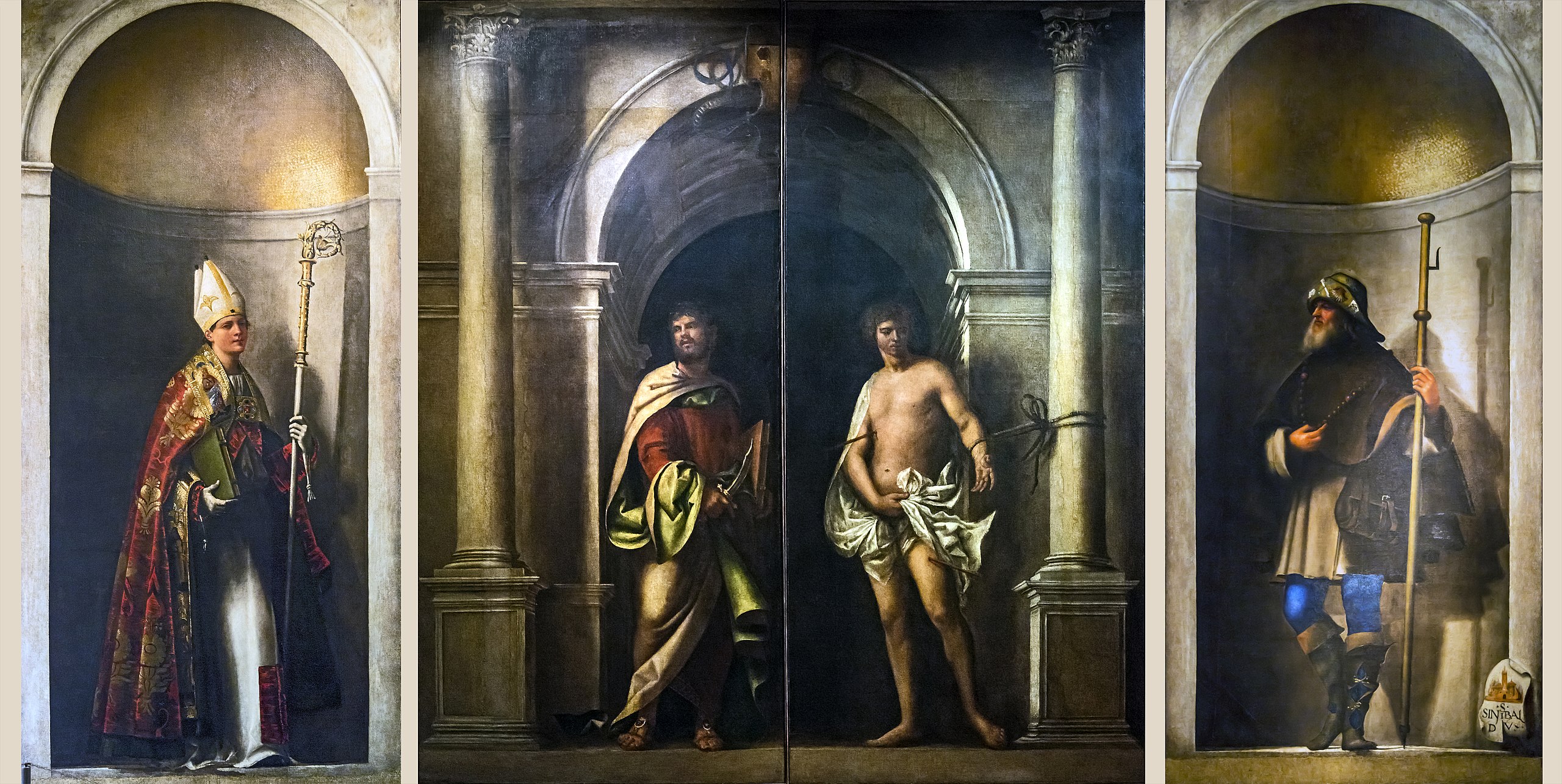
Sebastiano de Piombo (1485-1547), Organ Shutters, Four Saints, c. 1507-09, 115.3 in. x 53.9 in., 293 cm x 137 cm Gallerie delle’ Accademia, Venice (formerly in the Church of San Bartolomeo al Rialto).
When the organ shutter doors closed they formed a single image of two martyrs: Saint Batholomeo and Saint Sebastian. These organ shutters for San Bartolomeo al Rialto are the earliest documented works of Sebastiano. Commissioned by the church’s vicar in late 1507, it was completed in 1509.
Detail of above. St. Louis of Toulouse.
St. Louis of Toulouse was a bishop of Toulouse in France consecrated by Boniface VIII in 1297. Because of his princely standing Louis won the episcopal appointment, but as bishop he turned his office and efforts to meeting the material and spiritual needs of the poor in his diocese, feeding the hungry, and ignoring his own material interests. After six months, exhausted by his labors, he abandoned the position of bishop and died at Brignoles of fever, possibly typhoid, at 23 years old. St. Louis of Toulouse is one of the inside panels inside a niche of gray stone and gold mosaic (the other is St. Sebald of Nürnberg) by Sebastiano in his first documented commission.
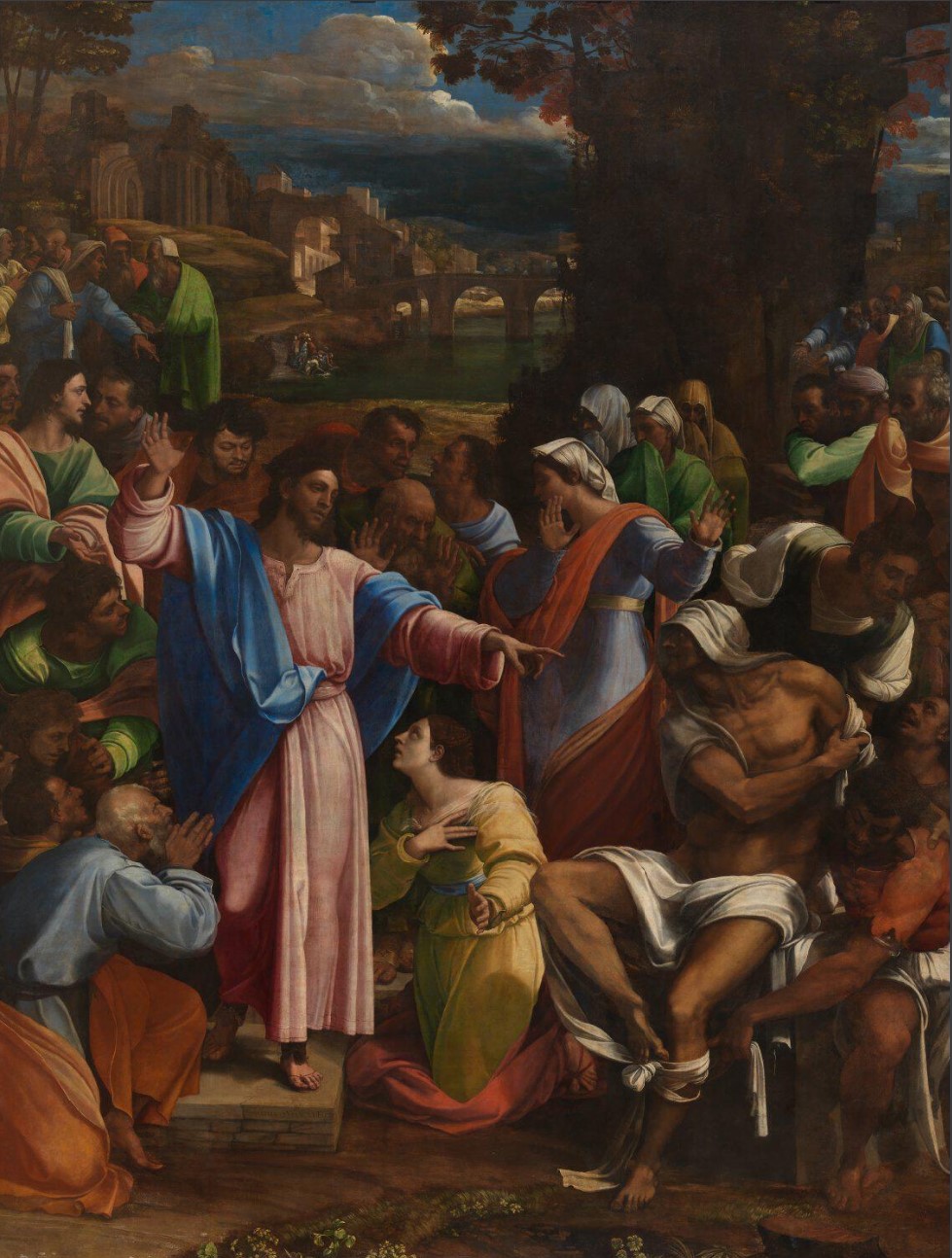
Sebastiano Luciani, a pupil of Giorgione who deeply influenced him, was born in Venice in 1485. He didn’t become “del Piombo” until after 1531 when he became Keeper of the Papal Seal (“Il Piombo”). After Giorgione’s death in 1510 del Piombo may have completed some of Giorgione’s work and, in 1511, moved to Rome. Working at Villa Farnesina in Raphael’s circle that included Baldassare Peruzzi (1481-1536), del Piombo fell out with Raphael and became a devoted follower of Michaelangelo (1475-1564). Both eagerly worked to outperform Raphael, an artistic rival, and Michelangelo lent del Piombo some of his drawings to work from for some of the main figures in the complex composition of The Raising of Lazarus. The gigantic painting was commissioned for Narbonne Cathedral in southern France by Cardinal Giulio de’ Medici (1478-1534), later pope Clement VII, who had also commissioned Raphael’s last painting Transfiguration for the same cathedral.
“The Raising of Lazarus” by Sebastiano del Piombo is introduced by curator Matthias Wivel in this talk as part of the series ‘The History of the National Gallery in Six Paintings.’Sebastiano del Piombo (1485-1547), Portrait of Clement VII, c. 1531, oil on slate, 105.4 × 87.6 cm (41 1/2 × 34 1/2 in.), J. Paul Getty Museum, Los Angeles. https://www.getty.edu/art/collection/object/103RJN – retrieved December 18, 2024.
The pope visited the artist’s studio and was pleased with his original three-quarter length portrait seated in a chair positioned diagonally, and ordered this oil copy on slate. The practice originated in Rome around 1500 in an attempt towards immortality in art. However, the material was heavy and would shatter if not handled with care. After 1531 del Piombo painted rather less and turned to making admirable portraits which combined his Venetian training in color and Roman discipline in form.
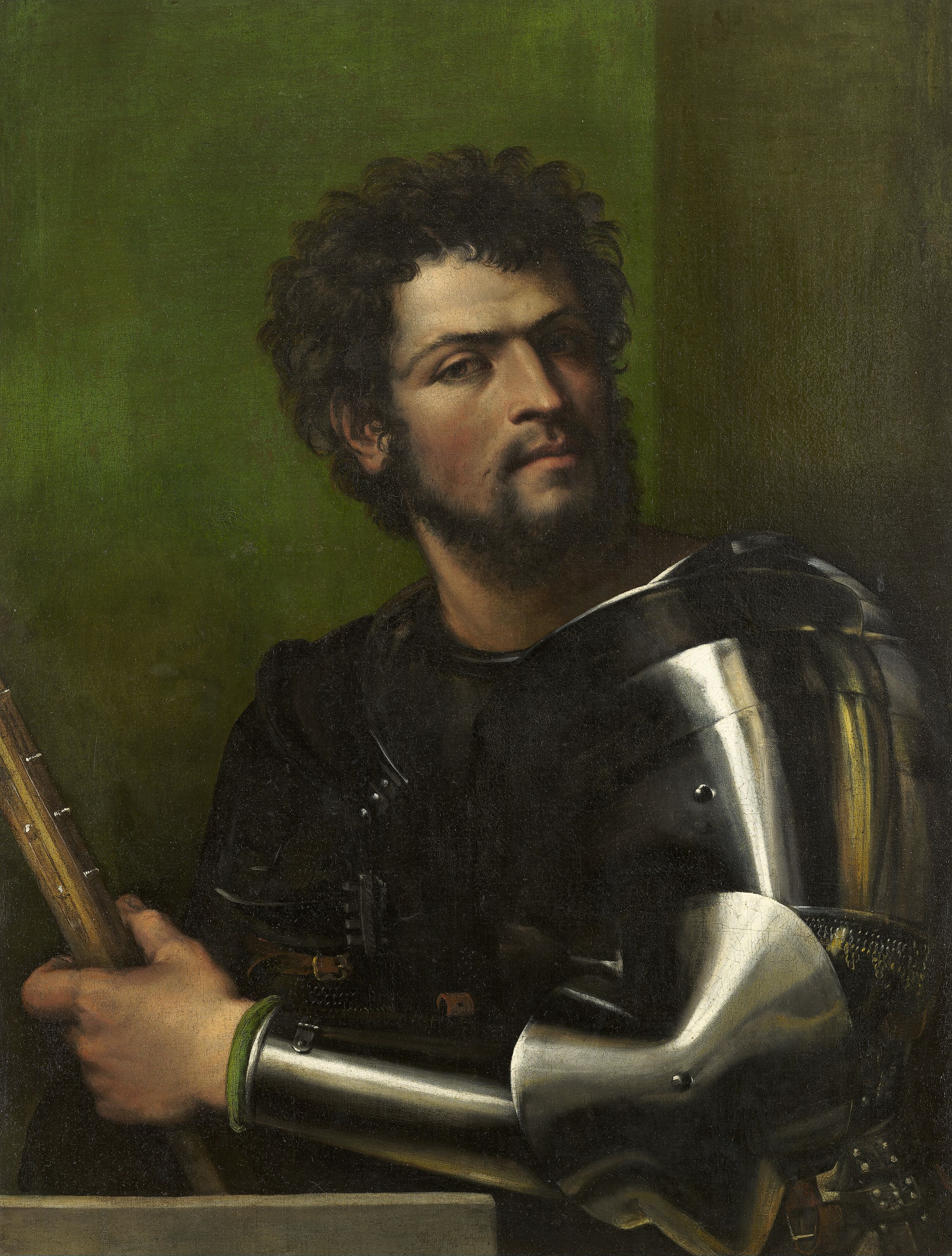
Sebastiano del Piombo (1485-1547), Portrait of a Man in Armor, c. 1511-15, oil on canvas, 34 ½ x 26 ¼ in (87.6 x 66.7 cm) Wadsworth Atheneum, Hartford.
Sebastiano made this portrait under the influence of Giorgione in terms of its gentle, engaging expression and subtly dramatic “over the shoulder” pose. Until more recently, this painting was attributed to Giorgione and, as it is Sebastiano, it recalls the deep influence Giorgione had on his pupils who imitated him profoundly. It has been postulated that the sitter is the Florentine general Francesco Ferrucci (1489-1530) who fought in the Italian Wars.
Jacopo Negretti called Palma il Vecchio (c. 1480-1528), Diana and Callisto, c. 1525/28, oil on canvas, 30 ½ x 48 ¾ in. (77.5 x 124 cm), Kunsthistorisches Museum, Vienna (Kunsthistorisches Museum Wien, Gemäldegalerie) https://www.khm.at/en/objectdb/detail/1291/?offset=34&lv=list – retrieved December 12, 2024.
Palma Il Vecchio was a Venetian painter who was a pupil of Bellini and influenced by Titian, Giorgione and Lotto. He is chiefly remembered for his paintings of female figures, particularly a blonde Venetian type of ample charm which extended even to paintings of several female saints. The subject of the naked woman located in a natural setting was pioneered by Giorgione and Titian but Palma Il Vecchio progressed the subject to work out the figure in three-dimensions and reliant on the linear curves in and of a complex assembly and interplay of naked female figures. In this painting, Palma il Vecchio adapted the poses of the sculptors of antiquity and drew on Mannerist contemporaries such as Giulio Romano (1499-1546) and Marc Antonio Raimondi (c. 1470/82–c. 1534). The sensuous surface texture typically found in Venetian art has given way to porcelain-like coolness.
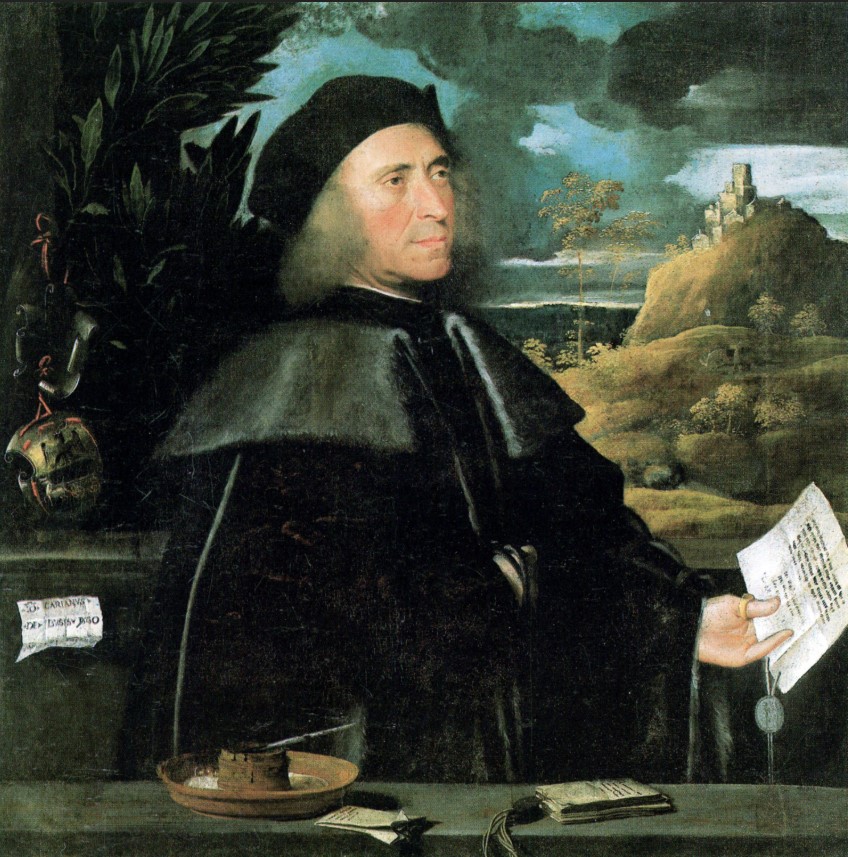
Giovanni Cariani (a. 1490-1547), Portrait of a Man, 1525-30, oil on canvas, 36 1/2 x 36 1/2 in. (92.7 x 92.7 cm), National Gallery of Canada, Ottawa.
Little is known about Cariani’s biography though it is speculated he was born in Bergamo in or before 1490. In his gentle, soft shaded subjects and arcadian elements Cariani’s early work is Venetian influenced by Giorgione. The artist was also inspired by Bellini and close to Palma Il Vecchio. He moved to Bergamo before 1520 and mastered portraiture under the influence of Lorenzo Lotto which are the highlight of his career. One of Cariani’s masterpieces is this portrait of a man of letters holding a seal that is possibly imperial or papal. The luminous colors are influenced by Palma Il Vecchio while the psychological insight of the sitter is learned from Lorenzo Lotto. The sitter is believed to possibly be Giovanni Benedetto da Caravaggio, a professor and administrator at the University of Padua.
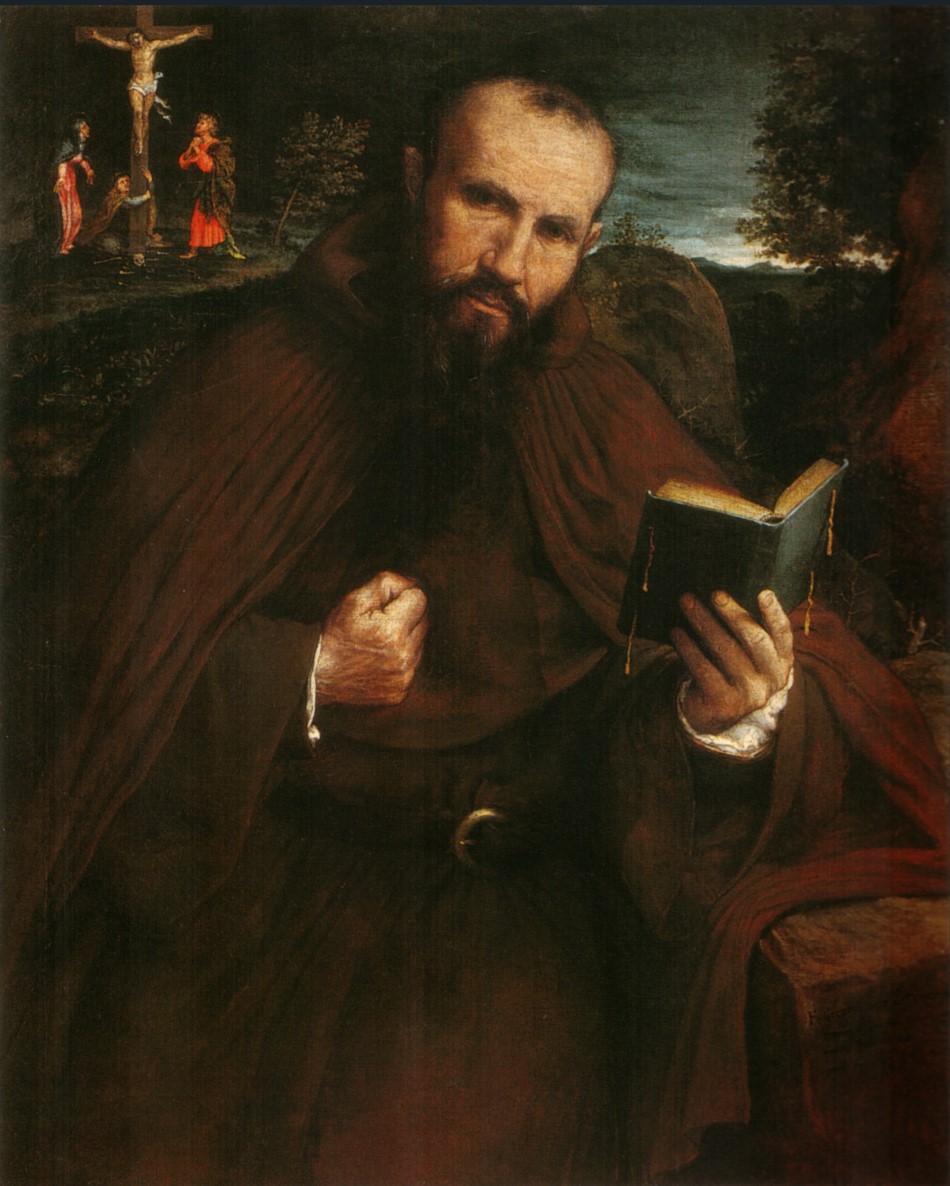
Lorenzo Lotto (c. 1480 – 1556), Fra Gregorio Belo of Vincenza, 1547, oil on canvas, 34 3/8 x 28 in (87.3 x 71.1 cm) The Metropolitan Museum of Art, New York City. https://www.metmuseum.org/art/collection/search/436917 – December 18, 2024.
The sitter beats his fist into his chest in penance, lifts an open book of Passion meditations, and is surrounded by a brooding sky and background living scene of Calvary, all of which works for the artist to scrutinize the mental state or inner thoughts of his sitter, here a religious brother in an order of poor hermits. Lotto had studied portraits of Albrecht Dürer, who made two trips to Venice, to learn to convey these deeper psychological states. Lotto’s assertively confessional portraits under his intense handling of light and dourly earthy colors, were astutely new and sometimes rejected by clients.
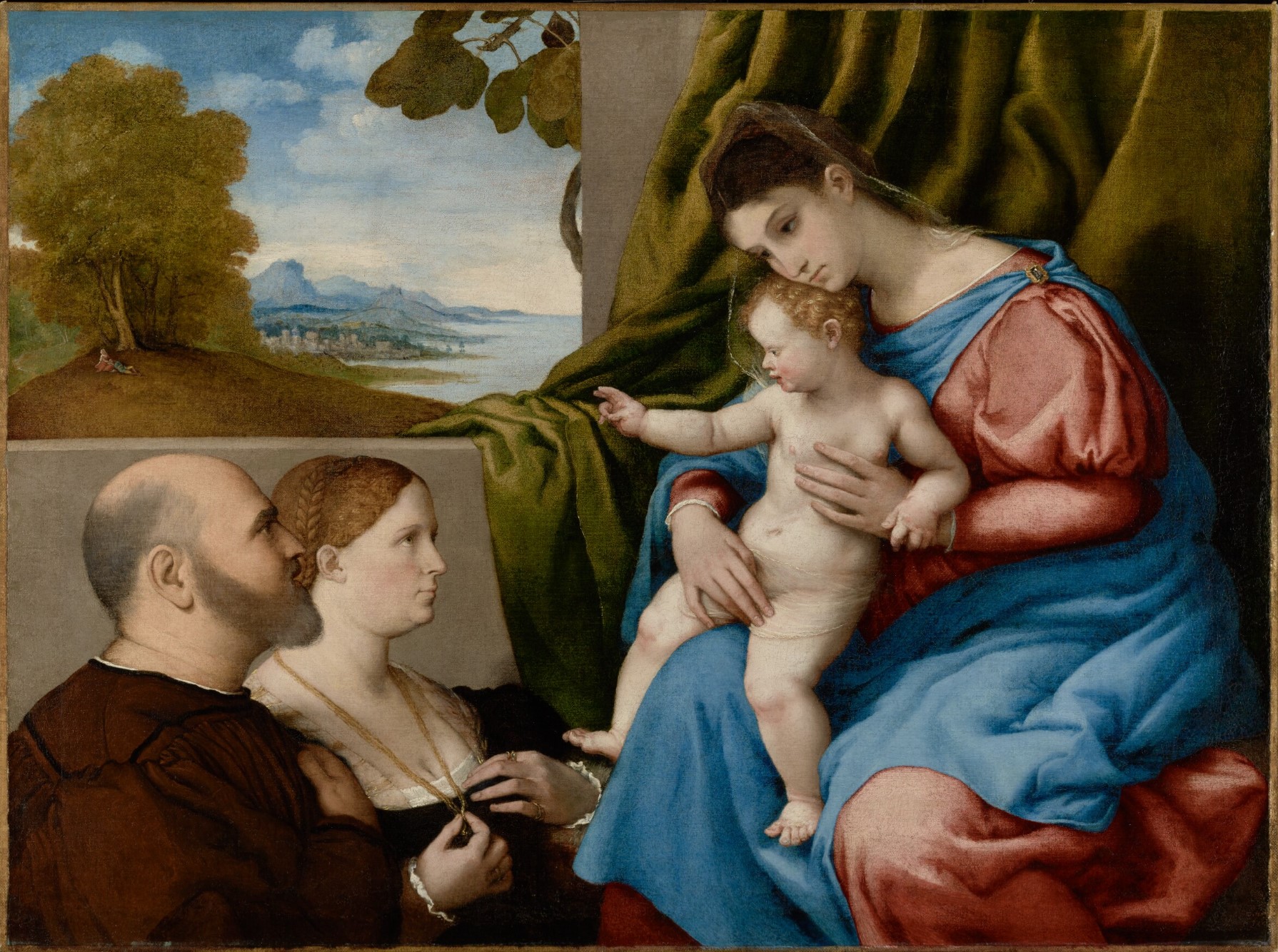
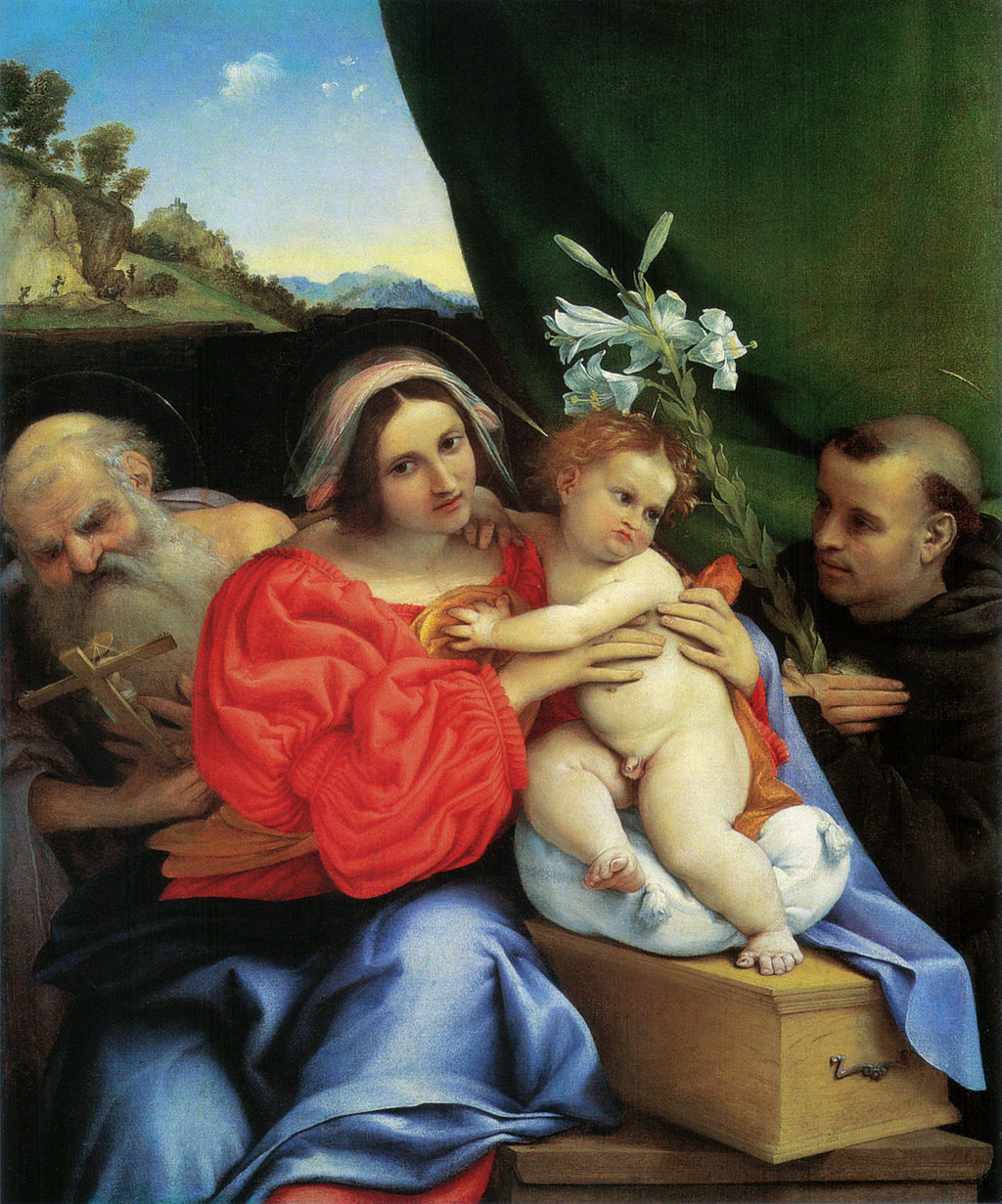
Lotto, a deeply religious man and one of the most independent of the 16th century Venetian artists, had a highly singular artistic vision with penetrating insight into the human personality. This painting is a mixture of the artist’s realism and idealism. The setting is natural as are the donors who Lotto draws with a Northern European Art sensibility. The Madonna and child are not derived from models, but expressed from an artistic conception of spiritual superiority. Kneeling donors in profile with the Virgin and Child was a motif developed in Venice in the 1490’s by Bellini. From the medieval period forward, donors were frequently portrayed in artworks they commissioned and such was more popular than ever in the early 1500’s.
Lorenzo Lotto (c. 1480 – 1556), Madonna and Child with Sts. Jerome and Anthony of Padua, 1521, oil on canvas, 37 1/8 x 30 5/8/ in. (94.3 x 77.8 cm), Museum of Fine Arts, Boston.
While strongly influenced by Bellini at the start Lotto developed an independent chameleon-like style influenced by a range of contemporary Renaissance artists such as Sandro Botticelli (1445-1510), Fra Bartolomeo, Raphael, Corregio (1489-1534), Giorgione, Titian, as well as Germans, Dürer and Hans Holbein the Elder (1460-1524). But Lotto’s well-known character of independence had as much an historical context as a personal one. About Lotto, Bernard Berenson observed that the Venetian painter was “a psychological painter in an age which ended by esteeming little but force and display, a personal painter at a time when personality was getting to be of less account than conformity, evangelical at heart in a country upon which a rigid and soulless Vaticanism was daily strengthening its hold” (quoted in Pignatti, page 66). This painting from the 1520’s is remarkable for its renewed vision of the picture plane, here with an interlocking group of figures filling a shallow foreground like a frieze and a delimited background.
Paris Bordon/e (1500-1571), Fisherman Presenting a Ring to the Doge Gradenigo, 1534, oil on canvas, 370 x 301 cm (145.7 in × 118.5 in), Gallerie dell’Accademia, Venice.
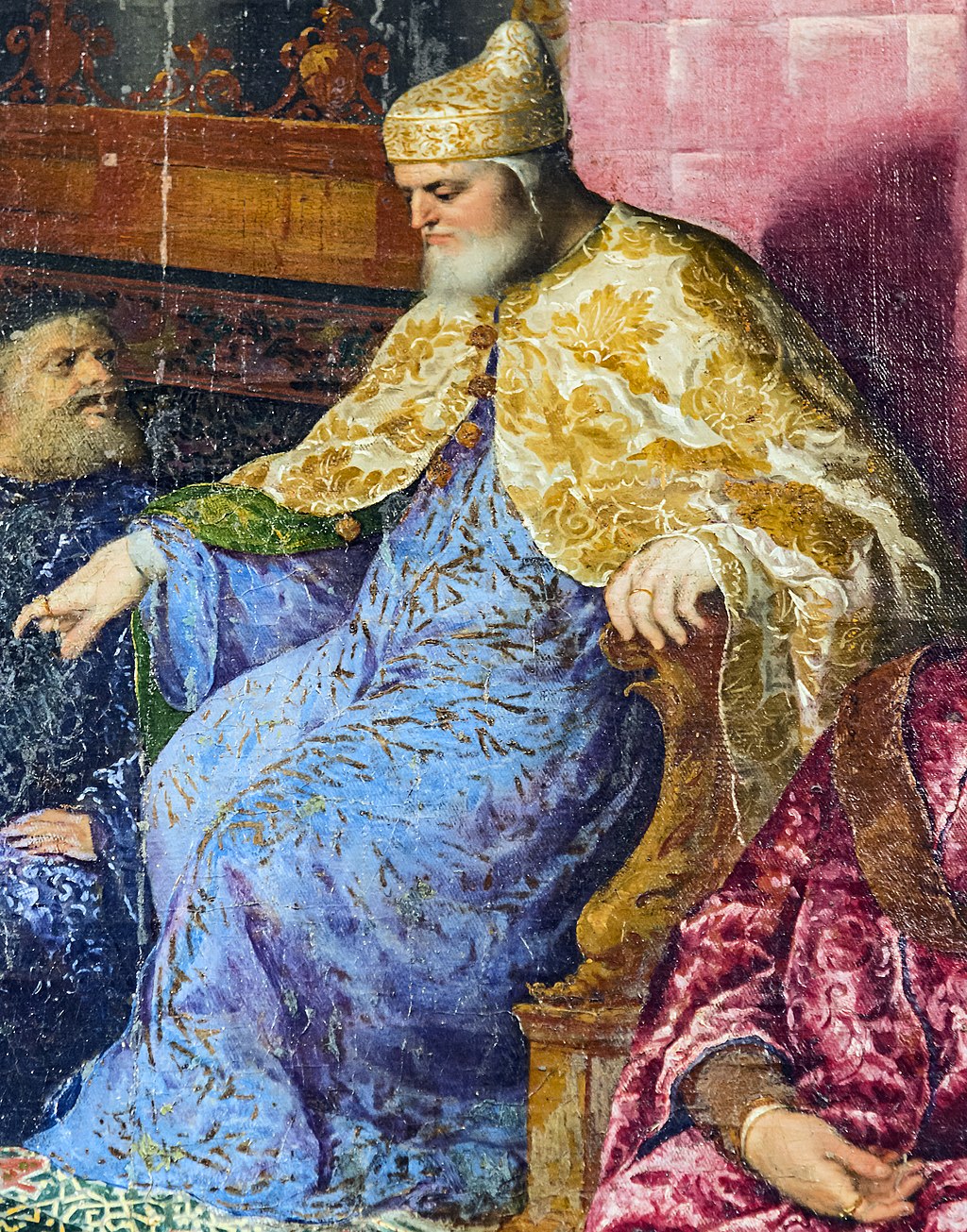
It was painted in Venice for the confraternity of San Marco in 1540. Bartolomeo Gradenigo (1263-1342) was the 53rd Doge of Venice for three years, from 1339 to 1342. He was born in Venice to an ancient noble family and was a rich trader who practiced politics from an early age and lived a life of luxury. The painting depicts a famous legend that occurred in Gradenigo’s reign when a storm was pushed back by the intercession of Venice’s saints. Afterwards the saints gave a humble fisherman the “Ring of the Fisherman” to present to the doge.
Accademia – Doge Bartolomeo Gradenigo by Paris Bordon/e.Paris Bordon/e (1500-1571), Portrait of a Knight in Armor, oil on canvas, 36 x 30 in. (91.4 x 76.2 cm) Frame: 44 3/4 x 38 x 3 1/2 in. (113.7 x 96.5 x 8.9 cm), North Carolina Museum of Art, Raleigh. https://ncartmuseum.org/object/portrait-of-a-man-in-armor/ – retrieved December 13, 2024.
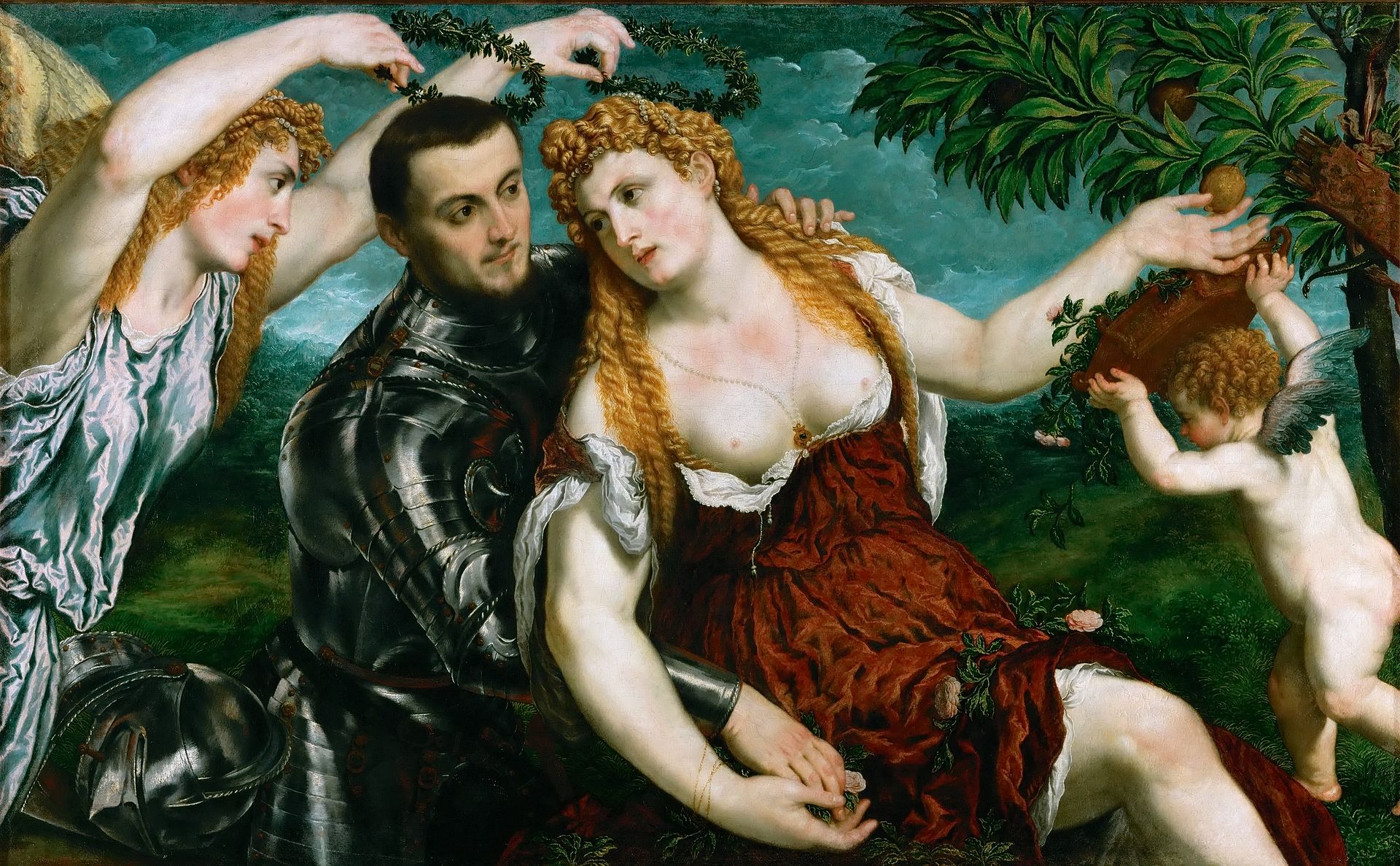
Paris Bordon/e was born in Treviso in 1500 and moved to Venice in 1508. where he was based his entire life until his death in 1571. His training is unknown though apparently in Venice where he listed as an independent painter in 1518. As a young professional he reflected the influence of Giorgione in his sentimental portraits and Titian in his use of bold and fluid colors. In the mid 1520s he took on a figural monumentality reminiscent of Pordenone. In the late 1530s Bordon/e was in France at the court of Francis I making realistic portraits and, in 1540, in Augsburg, where he painted for the wealthy Fuggers. Bordon/e was well known for his subjects’ delineated costumes and detailed intellectual landscapes.
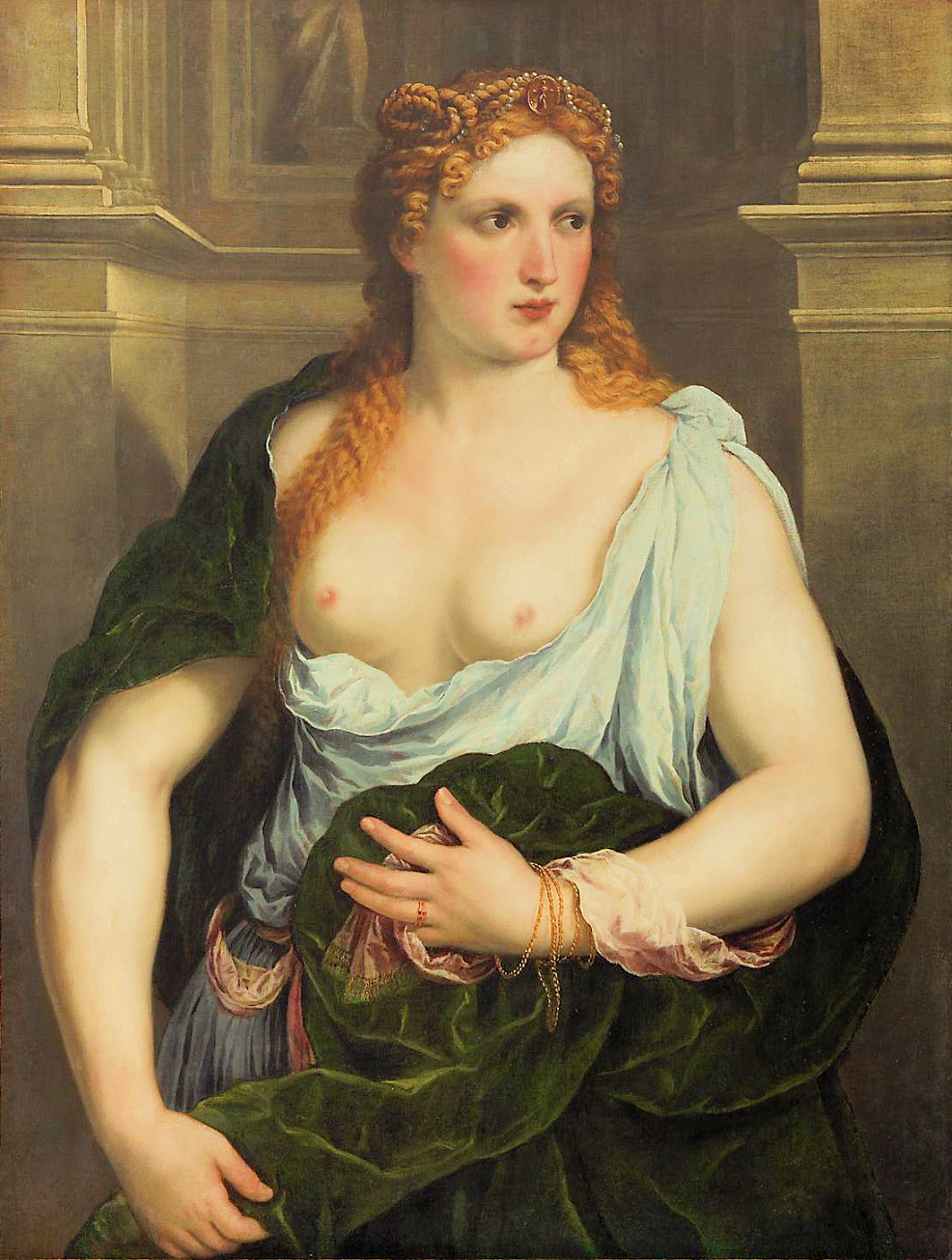
Paris Bordon/e (1500-1571). Gladiator fight, c. 1560, oil on canvas, 218 × 329 cm, Kunsthistorisches Museum Wien, Gemäldegalerie. https://www.khm.at/en/objectdb/detail/292/?offset=0&lv=list – retrieved December 13, 2024.Paris Bordon/e.Paris Bordon/e.Paris Bordon/e (1500-1571), Portrait of a Young Woman in a Green Coat, c. 1550, oil on canvas, 40 1/8 x 30 ½ in. (102 cm × 77.5 cm), Kunsthistorisches Museum Wien, Gemäldegalerie.https://www.khm.at/en/objectdb/detail/288/?offset=11&lv=list – retrieved December 13, 2024.
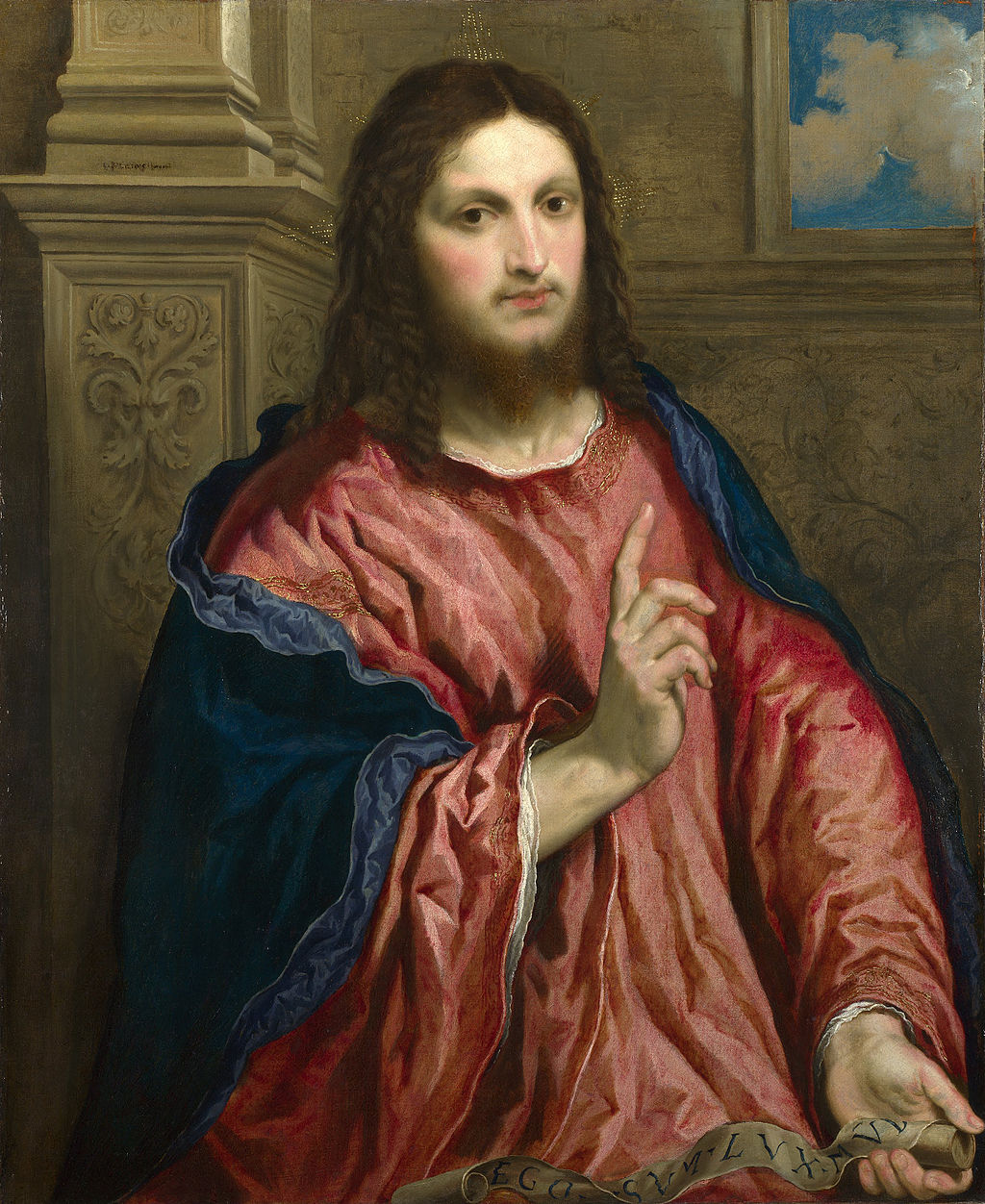
Bordon/e’s painting is closely related to Titian’s style yet in this female figure expresses with elegance and refinement Bordon/e’s own sophisticated stylistic vision. This may be a portrait of Veronica Franco, a Venetian courtesan who played an outsized role in the social and cultural life of the city in the mid16th century.
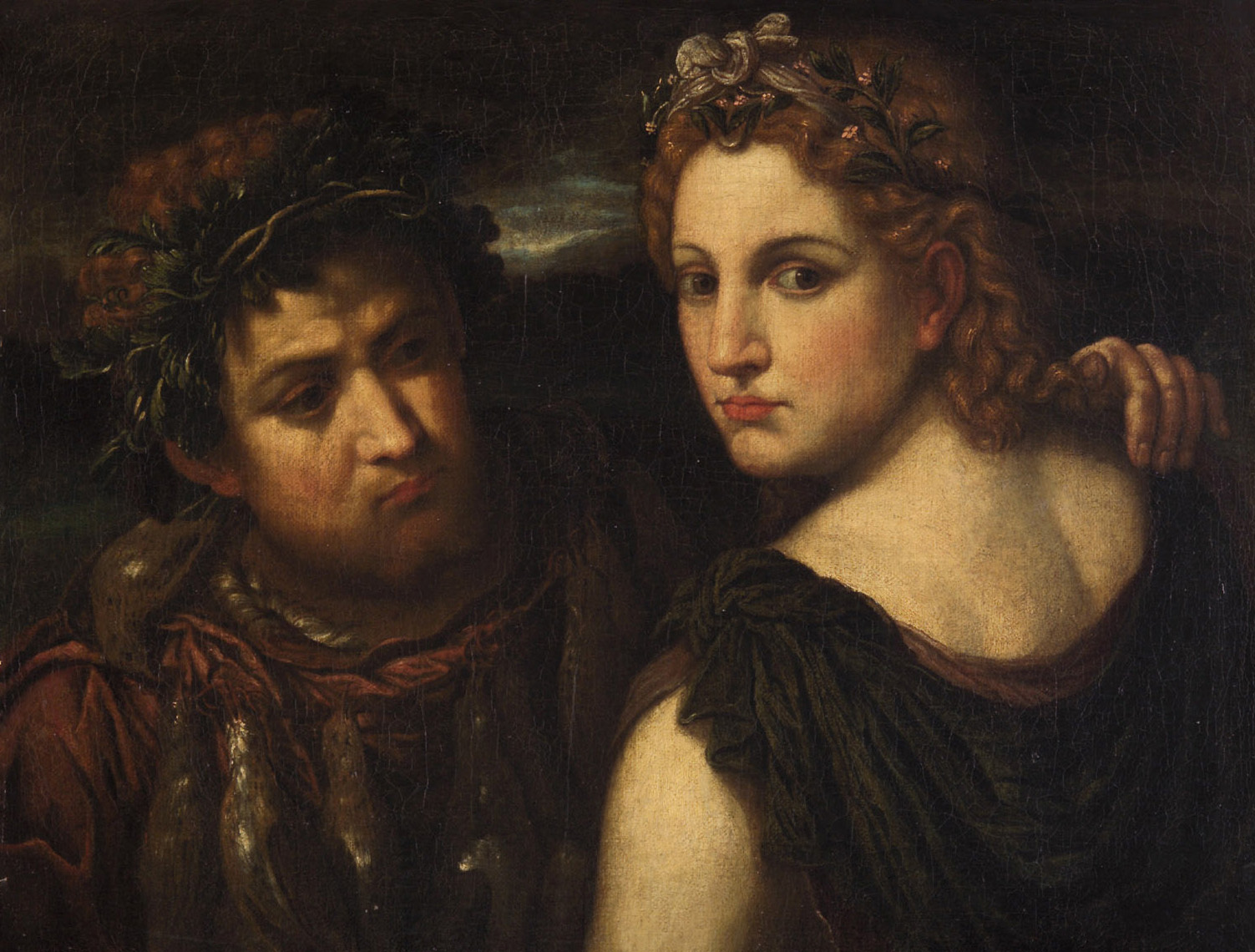
Paris Bordon/e (1500-1571), Nymph and hunter, 1550s, 45 × 61 × 2.4 cm, Kunsthistorisches Museum Wien, Gemäldegalerie.https://www.khm.at/en/objectdb/detail/294/?offset=1&lv=list – retrieved December 13, 2024.Titian (c.1511-1576), The Death of Actaeon. c. 1559-75, oil on canvas, 178.8 × 197.8 cm. National Gallery London.
SOURCES: The Golden Century of Venetian Painting, Terisio Pignatti, Los Angeles County Museum of Art and New York: George Braziller, Inc., 1979.
A Dictionary of Art and Artists, Peter and Linda Murray, Penguin Books; Revised,1998.
History of Italian Renaissance Art, 2nd edition, Frederick Hartt, Harry N Abrams. 1987.
Architectural History of Venice, 2nd edition, Deborah Howard, Yale University Press, New Haven and London, 2004.
FEATURE Image: Caravaggio (Michelangelo Merisi), Judith Beheading Holofernes, c. 1598, oil on canvas, 56 ¾ x 76 ¾” 145 x 195cm Galleria Nazionale d’Arte Antica, Rome. https://barberinicorsini.org/opera/giuditta-e-oloferne/ – retrieved October 12, 2024.
Ottavio Leoni (1578-1630), Portrait of Caravaggio, c. 1621/25, red and white chalk on blue paper, 23.4 x 16.3 cm, Biblioteca Marucelliana, Florence.
INTRODUCTION.
The chalk portrait above is probably the most faithful likeness of Caravaggio. Born Michelangelo Merisi in 1571, Caravaggio became an influential figure in Italian and European art in and well after his lifetime. He revolutionized painting by his theatrical use of light, dramatic narrative, and the naturalistic physical depiction of everyday people. His depiction of figures in historical narrative using dramatic interplay of light and shadow called chiaroscuro along with its naturalistic composition was further modernized in its scenes’ inclusion of the emotional and psychological human state. These artistic qualities were admired and emulated by many young European artists going forward into the balance of the seventeenth century.
Caravaggio came to Rome around 1592 from Lombardy, where he was influenced by the works of Giovanni Girolamo Savoldo (c.1480-1548), Lorenzo Lotto (c. 1480-1557), Romanino (c.1484-1566) and Moretto (c. 1498-1554?). For a while he worked in the workshop of the leading late mannerist Giuseppe Cesari (1568-1640), but soon broke away from the established course in Roman-Florentine artistic mannerism. His completely new approach of intense realism and chiaroscuro — that is, dramatic use of light and darkness to situate a scene – made him the “master of darkness” and completely revolutionized art in Rome around 1600. Along with Annibale Carracci (1560-1609), Adam Elsheimer (1578-1610) and Peter Paul Rubens (1577-1640), Michelangelo Merisi, called Caravaggio, was one of the progenitors of 17th century painting.
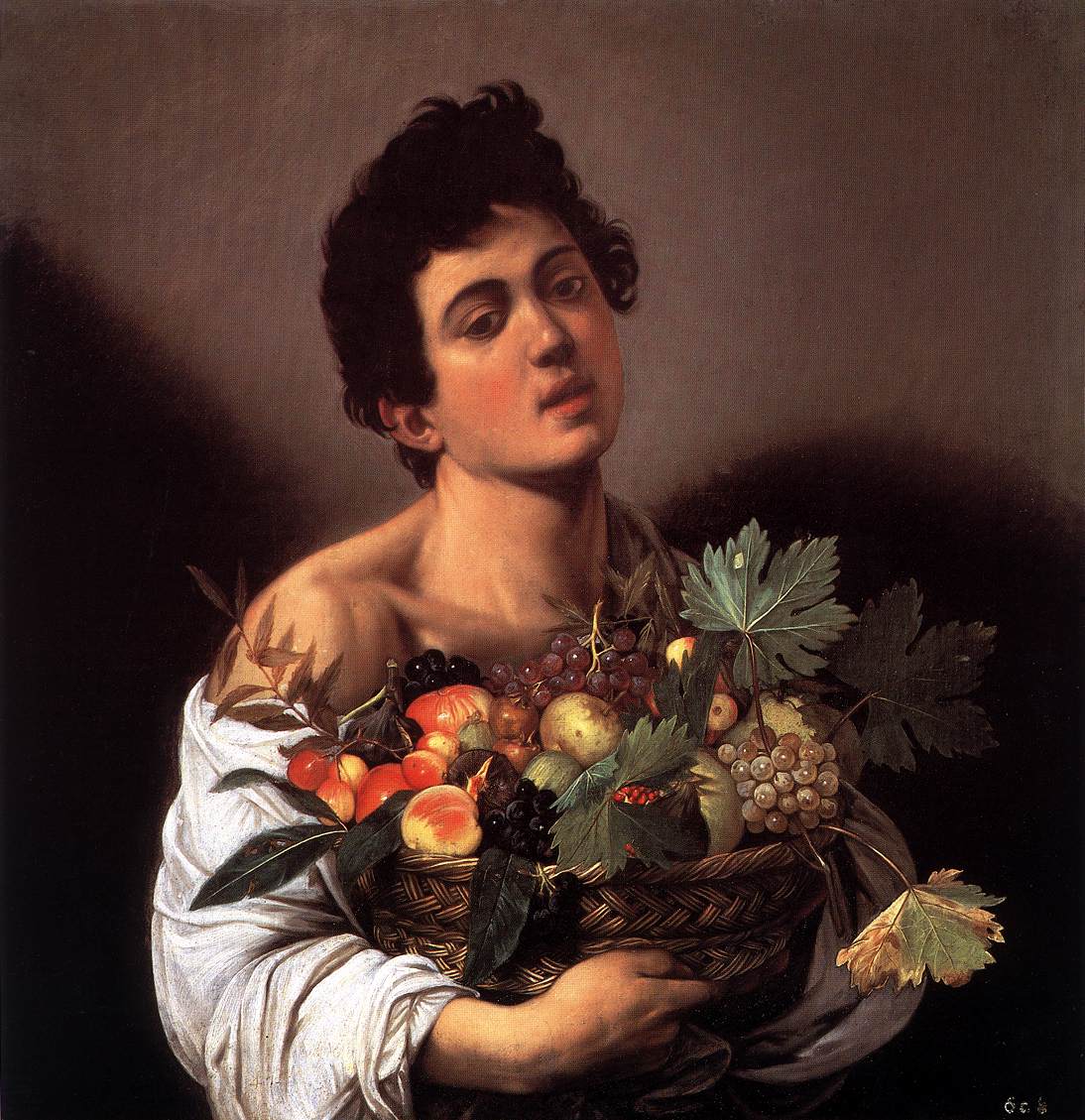
Caravaggio’s Il Fruttaiuolo (“Boy with a Basket of Fruit”) presents a remarkable contrast of the detailed, colorful, and sensuous depiction of fruits of the season and the refined and delicate innocence of an adolescent boy holding its basket. The placid scene of typical everyday life is enhanced by an expressive and careful execution. The model was Caravaggio’s friend, Sicilian painter Mario Minniti, at about 16 years old. According to Giovanni Pietro Bellori (1613-1696) who included Caravaggio in his Lives of the Artists, the artist learned “to paint flowers and fruit so well imitated that everybody came to learn from him how to create the beauty that is so popular today.”
Caravaggio’s Il Bacchino Malato (“The Young Sick Bacchus”), also known as Bacchino malato (“The Sick Bacchus”) or Autoritratto in veste di Bacco (“The Self-Portrait as Bacchus”), is an early self-portrait by Michelangelo Merisi da Caravaggio, dated between 1593 and 1594. The artwork dates from Caravaggio’s first years in Rome when he moved to the Eternal City from his native Milan in 1592. The painting was in the collection of Giuseppe Cesari (1568-1640), Caravaggio’s early employer. In 1607 it was confiscated from Cesari by the Pope in exchange for the Italian mannerist’s freedom following an illegal firearms charge. The pope gifted it to his nephew, Cardinal Scipione Borghese (1577-1633), together with the Boy Peeling Fruit and Boy with a Basket of Fruit (“Il Fruttaiuolo“).
The painting is a realist portrait of a young man displaying the typical attributes of Bacchus, the god of drunkenness. The sitter is turned to the viewer in a three-quarter pose, holding in his hands a bunch green grapes held next to his ailing greenish complexion. The sitter has been identified as the artist since it is documented that he was in the Ospedale della Consolazione in Rome around this time for undefined reasons. This interpretation provides the origin for the artwork’s title.
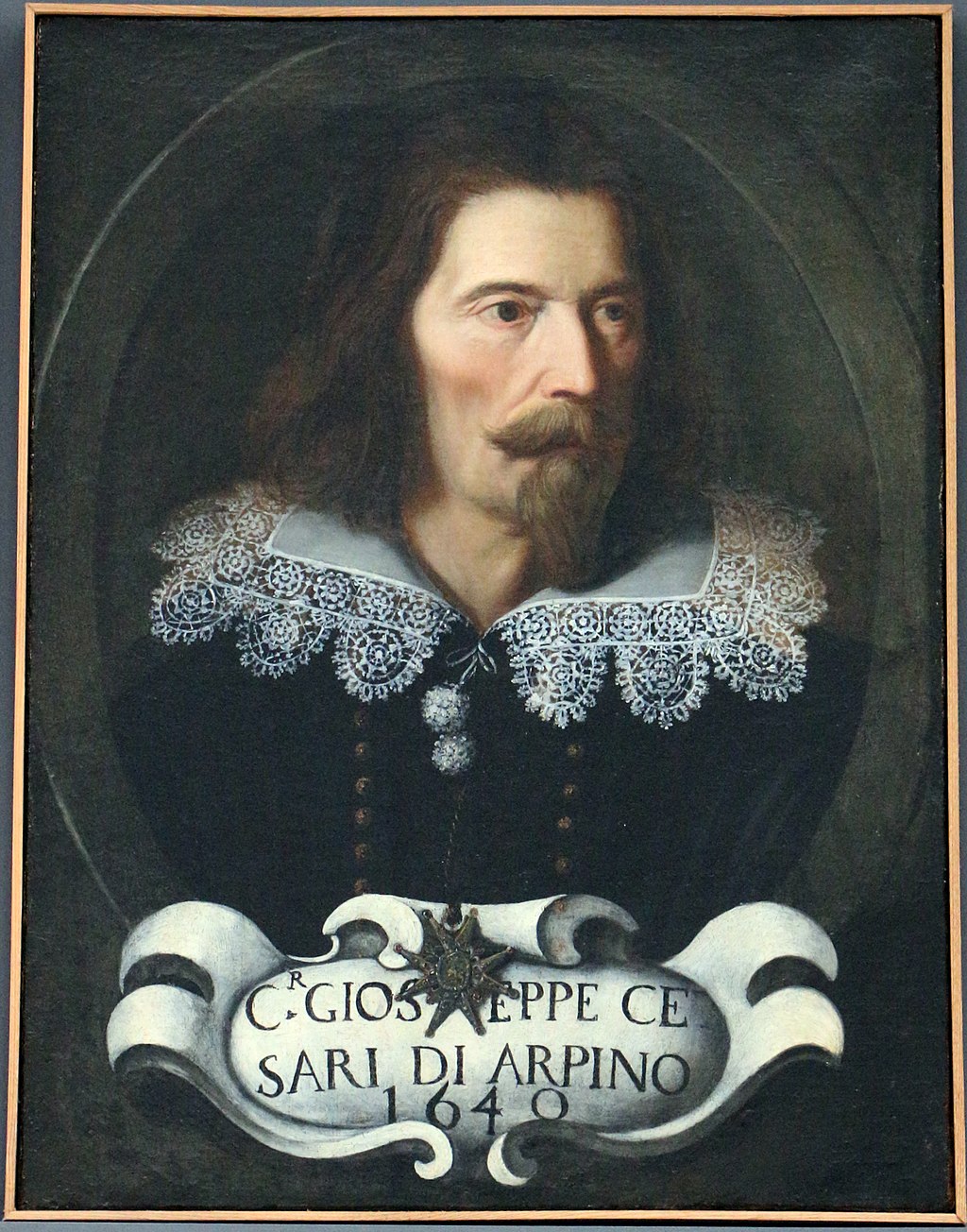
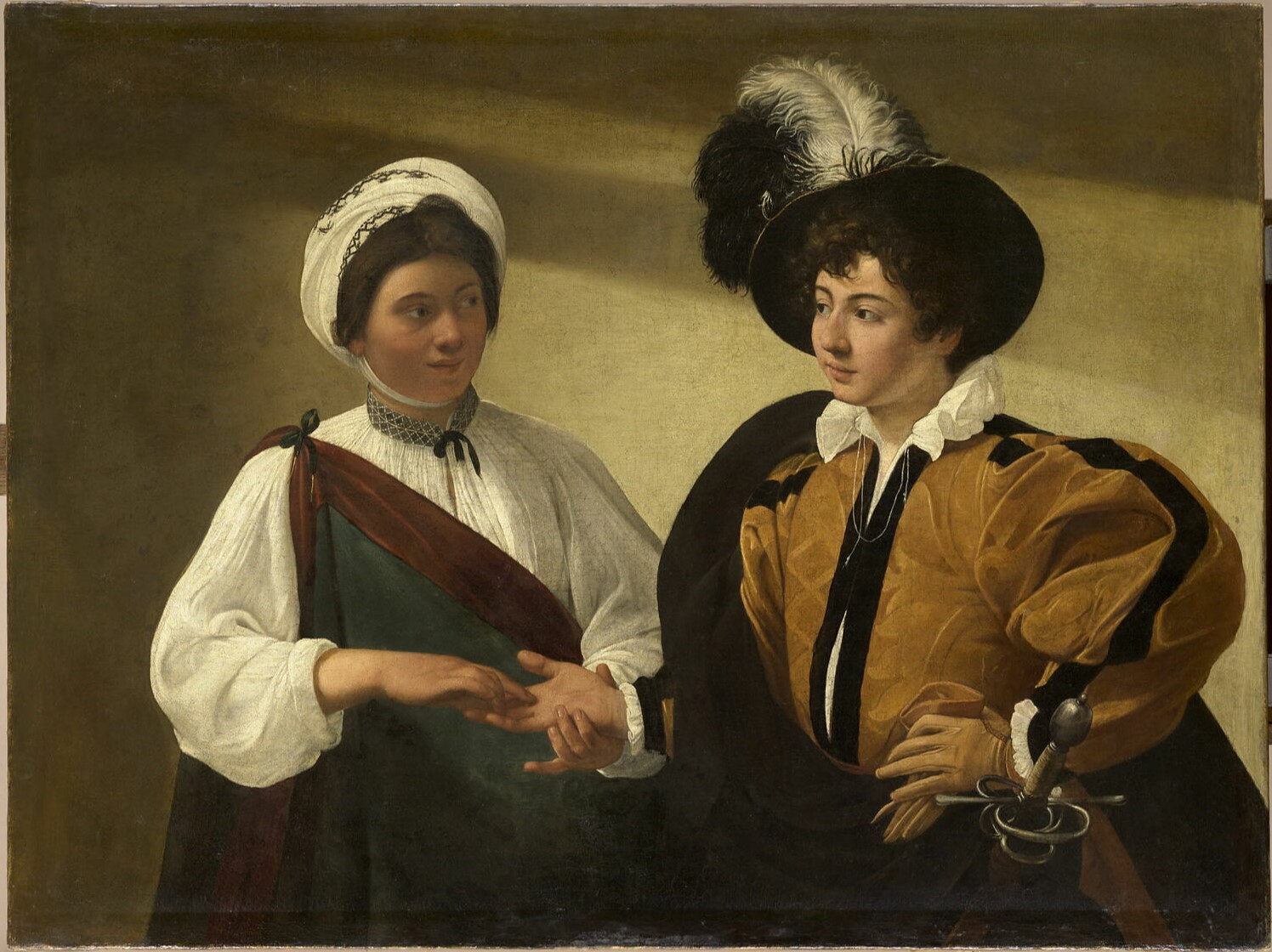
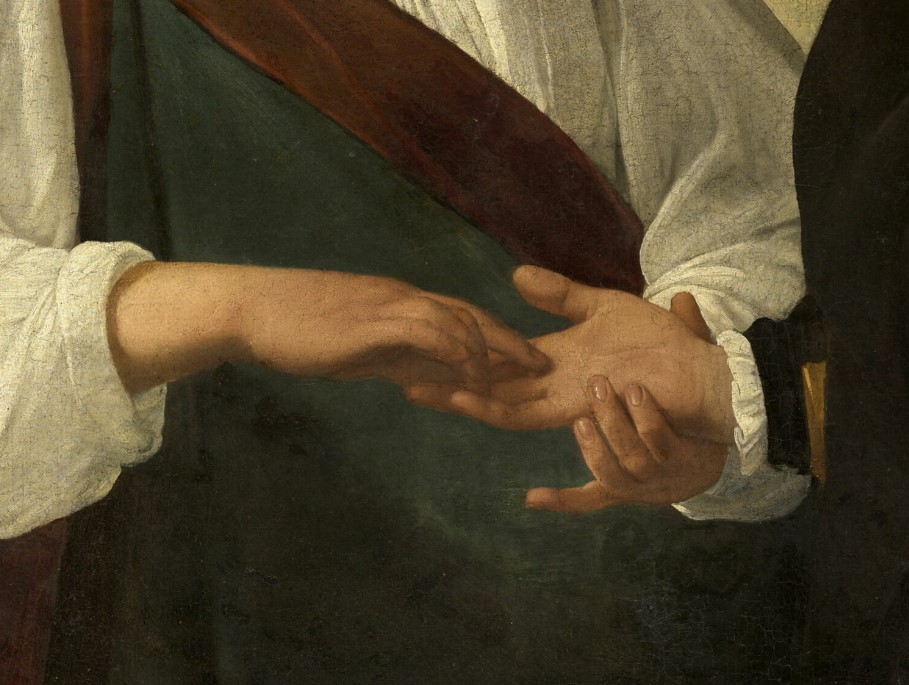
Giuseppe Cesari, Self-portrait, 1640, Accademia di San Luca. Cesari was Caravaggio’s first employer and in possession of The Young Sick Bacchus that was confiscated by the pope. Ottavio Leoni, Portrait of Cardinal Scipione Borghese. The sitter was not only the pope’s nephew and a Cardinal in the Catholic Church but the recipient of early Caravaggio paintings by gift. Such a gift was not at random: the cardinal’s growing art collection, including Caravaggio and Bernini, formed the basis of the Villa Borghese in Rome. Caravaggio (Michelangelo Merisi), The Fortune-Teller (“La Buona Ventura”), c. 1594, oil on canvas, 39 x 52 3/8”, Louvre, Paris. https://collections.louvre.fr/en/ark:/53355/cl010062329 – retrieved October 10, 2024Detail of above.
According to Giulio Mancini, Caravaggio painted The Fortune-Teller for a proverbial song while staying with Archbishop Fantino Petrignani (1577-1601). By 1620 when Mancini was writing, the painting was owned by Roman art collector and Catholic prelate Alessandro Vittrici (d. 1650). Later (1657) it was in the collection of Catholic Cardinal Camillo Francesco Maria Pamphili (1622-1666) who sent it with Bernini (1598-1680) to Paris as a gift to Louis XIV.
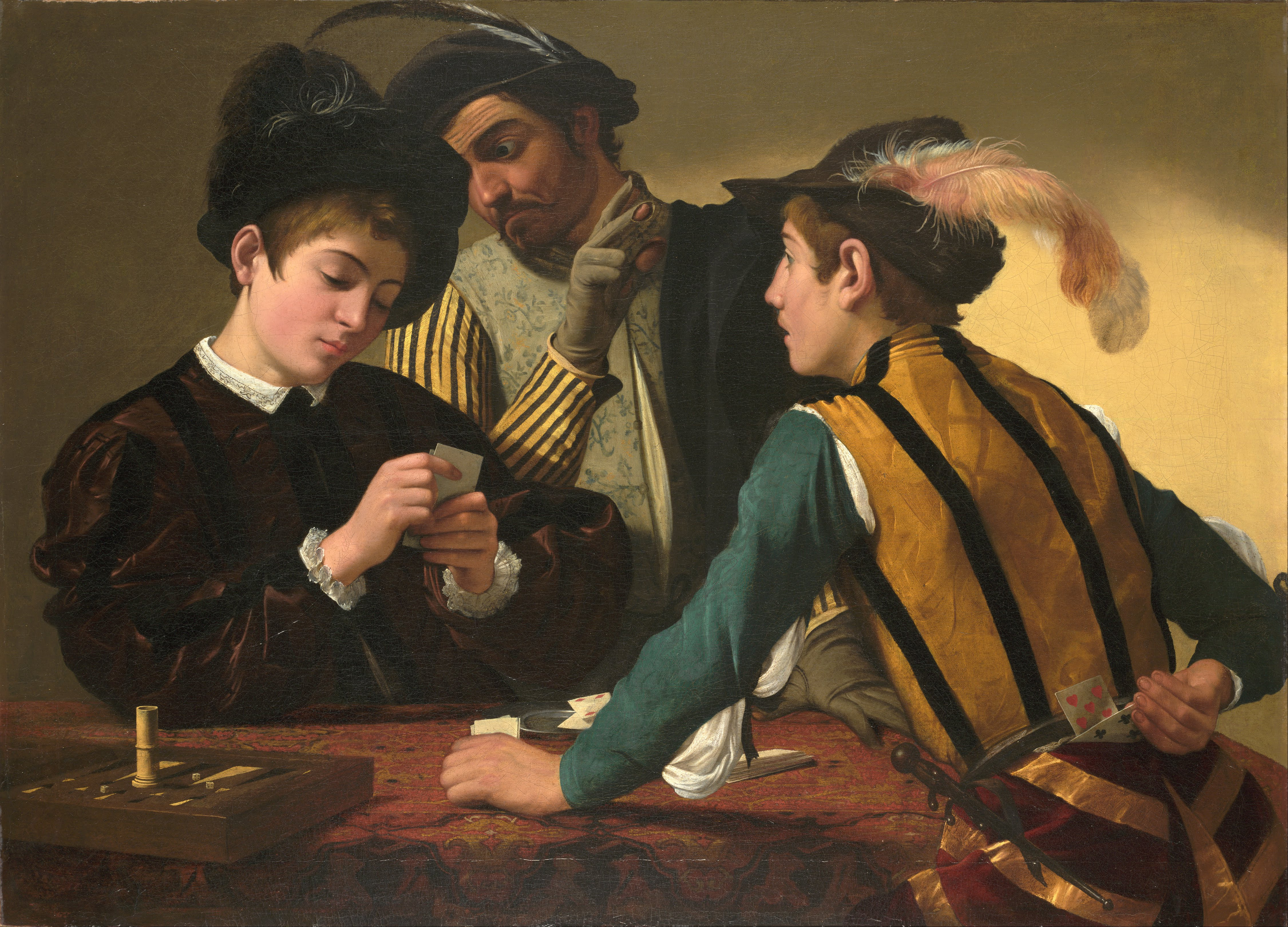
Caravaggio (Michelangelo Merisi), cardsharps,1594/95, oil on canvas, 37 1/16 x 51 9/16 in. (94.2 x 130.9 cm), Fort Worth, Kimbell Art Museum, Fort Worth, Texas. https://kimbellart.org/collection/ap-198706 – retrieved October 18, 2024.
Playing the game of primero the player at left is oblivious to a bearded cardsharp who uses his gloved fingers to signal to the other player the content of the cards. The other cheater is reaching for a hidden card from his pants behind his back. Caravaggio’s composition is novel with a naturalistic treatment of the figures whose distinct expressions and gestures convey a realistic and hard drama of being cheated and cheating. This painting was owned and stamped by Cardinal del Monte and in his inventory of 1627 following his death. It had been lost for almost a century when it was discovered in a European private collection and purchased by the Kimbell in 1987.
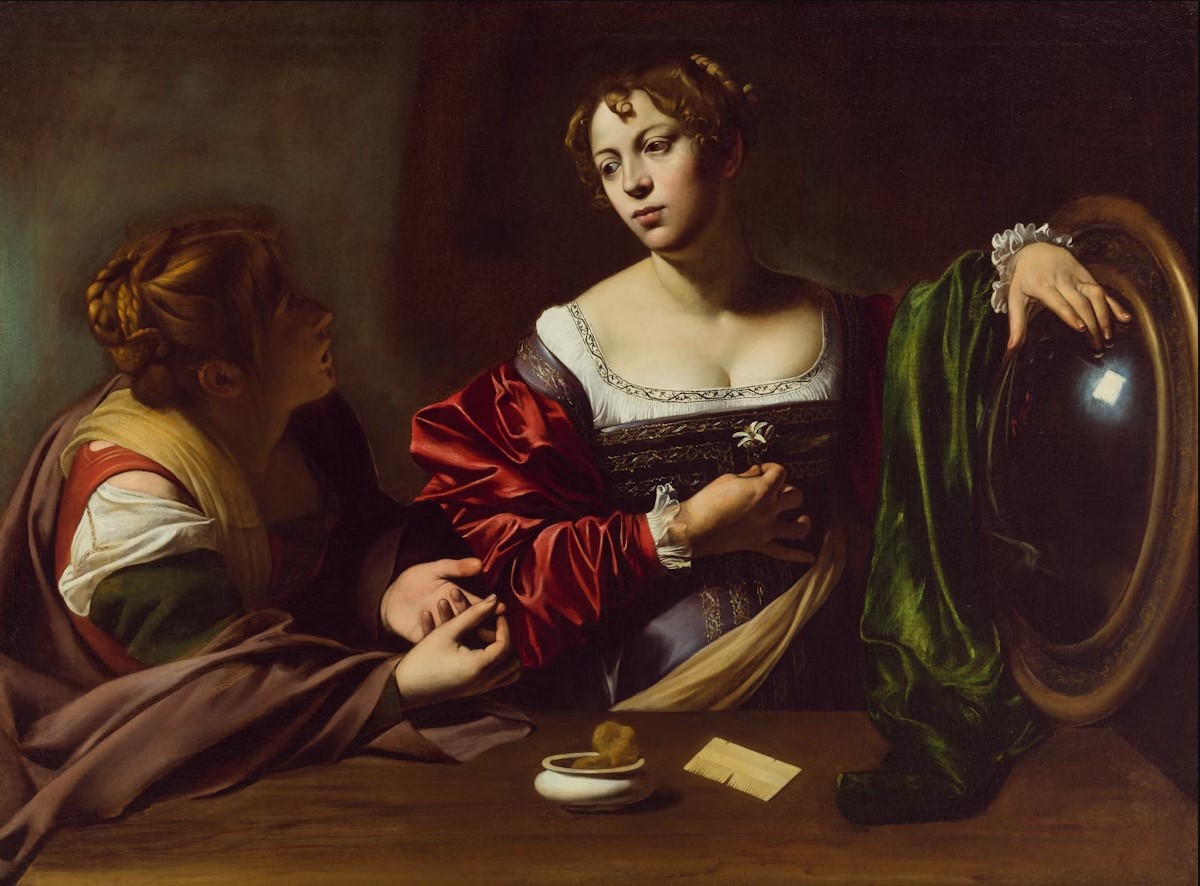
Caravaggio (Michelangelo Merisi), Martha and Mary Magdalene, c. 1598 Detroit Institute of Arts.
“Caravaggio helped to popularize half-length religious paintings like this, made for private collectors rather than for public church settings. His greatest innovation was in depicting biblical characters as if they belonged to contemporary Roman society, basing them on studio models and dressing them in 17th-century attire, as he does here.” https://www.artic.edu/articles/1071/caravaggio-s-dramatic-life-and-paintings – retrieved October 15, 2024.
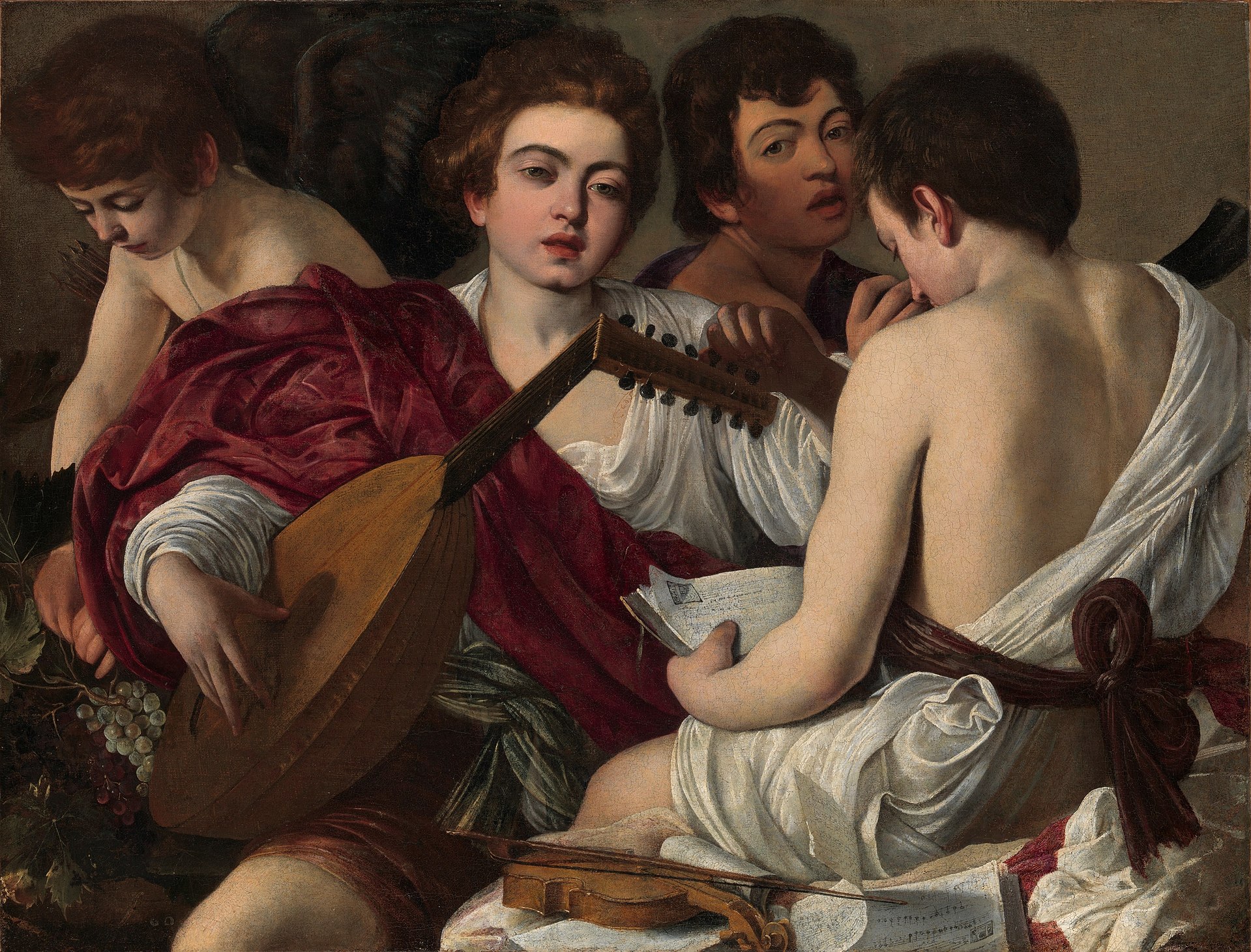
Caravaggio (Michelangelo Merisi), The Musicians, 1595/96, oil on canvas, 36 ¼ x 46 5/8” (92.1 x 118.4 cm), The Metropolitan Museum of Art, New York. https://www.metmuseum.org/art/collection/search/435844 – retrieved October 10, 2024.
The painting was commissioned by Francesco Maria del Monte (1549-1627), a Catholic cardinal and important arts patron in Rome. This is an allegory painting of music manifested by the presence of Cupid in the background, but also a depiction of contemporary performance with individualized sitters, including Caravaggio’s self portrait second from right.
Ottavio Leoni, Francesco Maria del Monte, 1616. Born in Venice of a Tuscan aristocratic family, Cardinal del Monte was an important connoisseur of the arts. Four centuries later his fame rests on his early patronage of Caravaggio and his art collection which provides detailed provenance for many important works of the period.
Caravaggio (Michelangelo Merisi), The Lute Player, 1595/96, oil on canvas, 37 x 46 7/8” The Hermitage Leningrad.
The Lute Player was owned by Cardinal del Monte. It was sold to Vincenzo Giustiniani (1564-1637), an aristocrat Italian banker, art collector and intellectual, and appeared in his inventory in 1638. Caravaggio’s model for the painting is the same as for The Musicians.
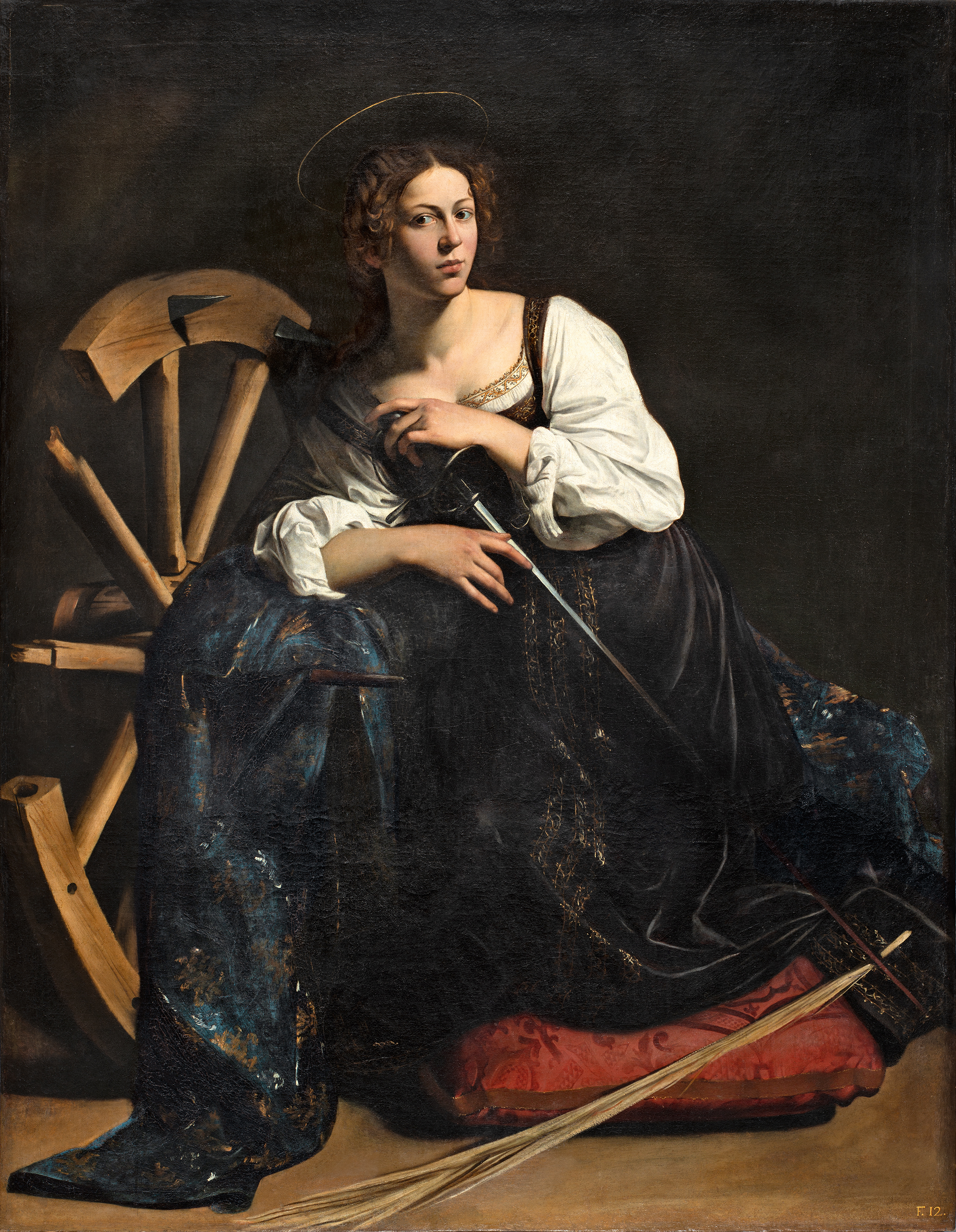
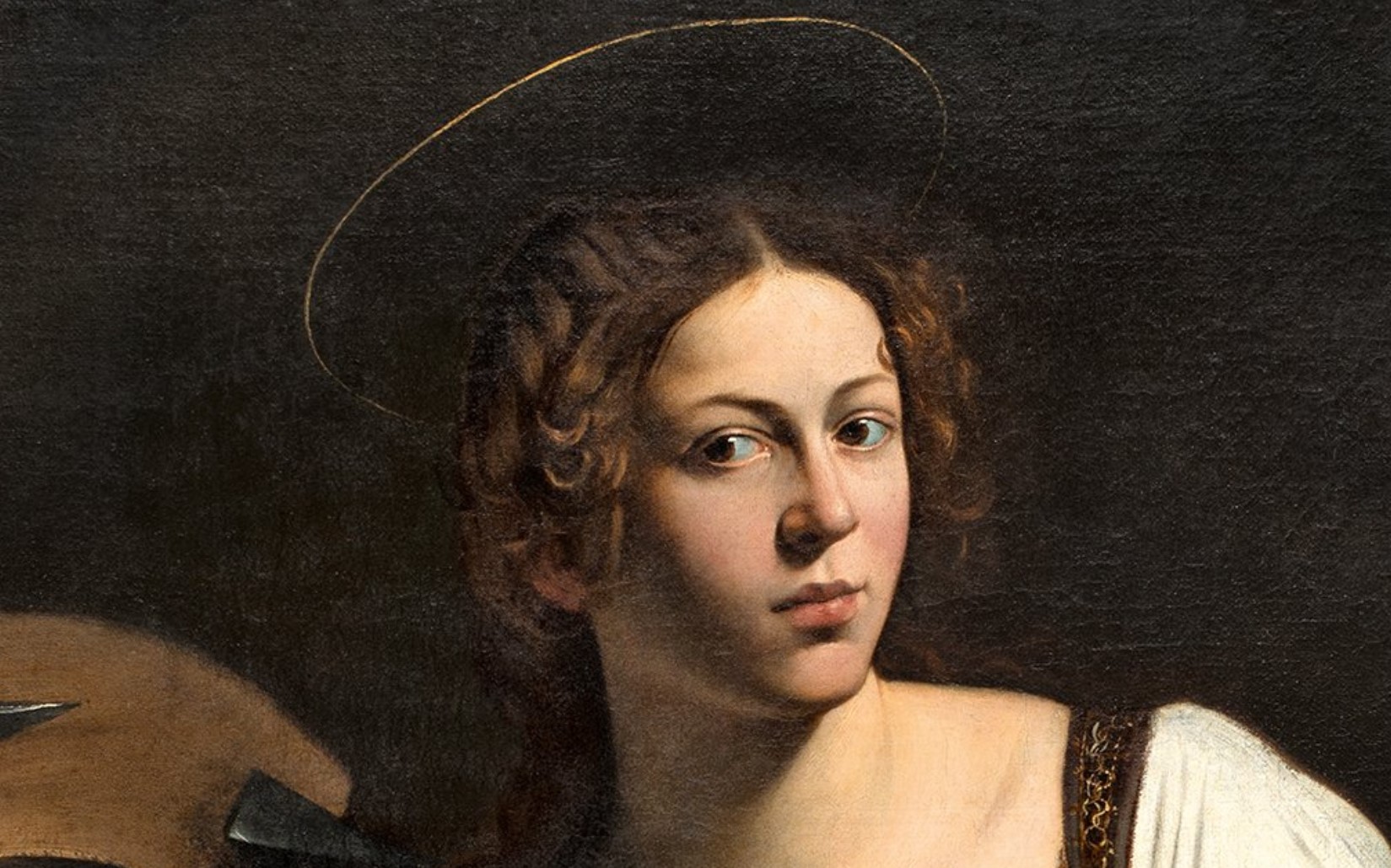
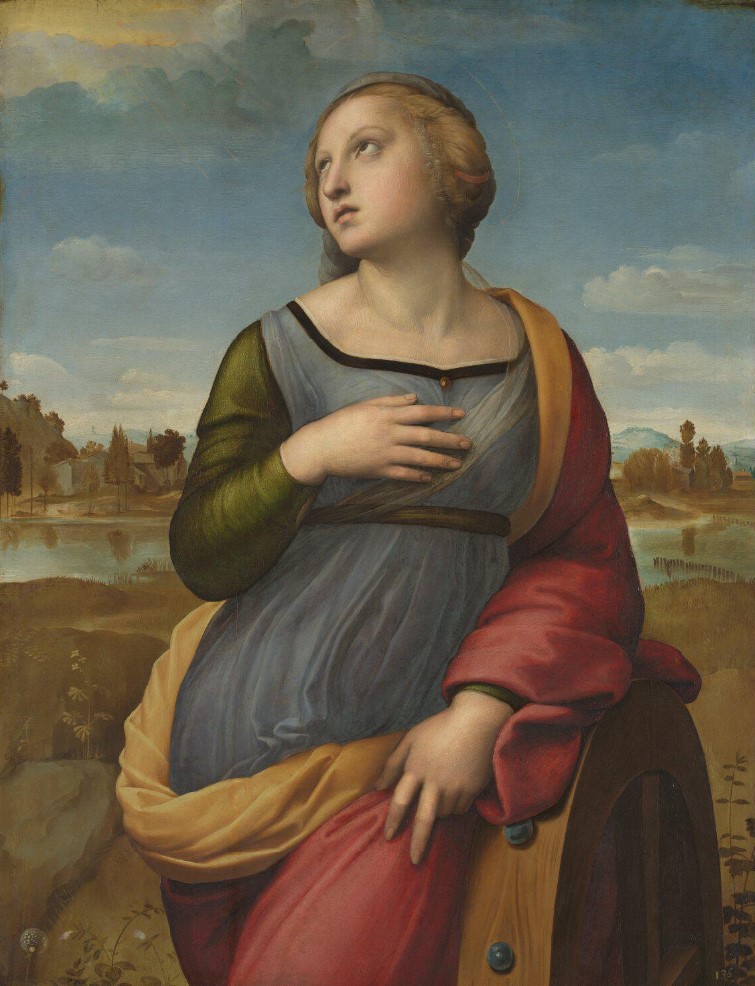
Commissioned by Cardinal Francesco Maria del Monte, the figure of St. Catherine of Alexandria (c. 287-c.305) is Fillide Melandroni, a Roman prostitute (or courtesan) who played a significant role in Caravaggio’s art and fortunes. Young artists turned to prostitutes as their models since other women in respectable society were unavailable to them in that role. Richly dressed in robes, and kneeling on a cushion with a palm frond, Catherine fills the picture as she poses naturally fondling a sword and leaning upon a breaking wheel — signs of the manner of her martyrdom — in a dramatically lit scene of chiaroscuro characteristic of Caravaggio. It is the qualities of a picture such as this one that had immense impact on European art in the 17th century.
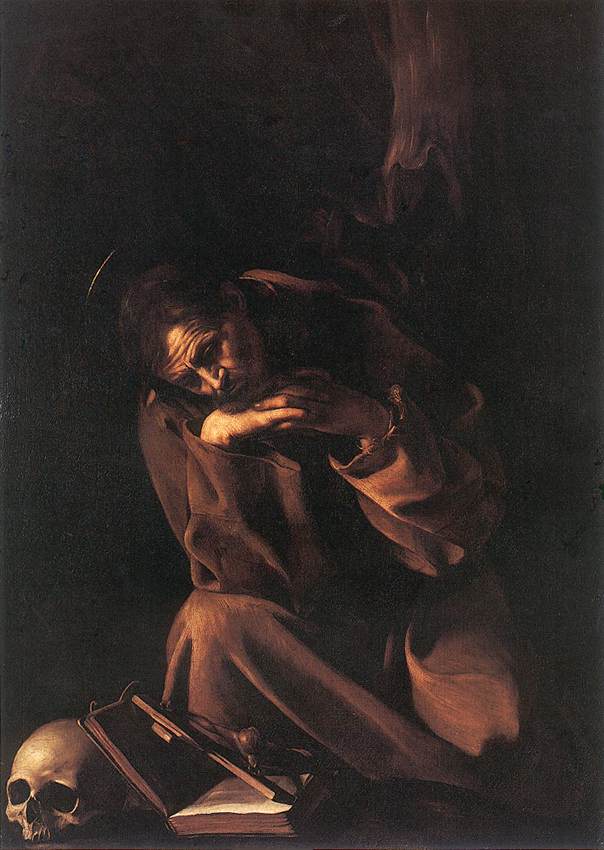
Saint Francis of Assisi in Ecstasy is Caravaggio’s first known religious composition. Acclaimed for his radical poverty and asceticism, Umbrian saint Francis of Assisi (1182-1226) would fast and pray in solitude for 40 days at a time carrying out literally the Bible’s examples of it. By imitating Jesus Christ in the Gospel simply Saint Francis, too, was ministered by angels. In the painting, shepherds sit in an obscured background as the angel and saint are bathed in light. The scene Caravaggio represents took place in September 1224 on Mount La Verna in central Italy. In that time and place St. Francis received the wounds of the crucified Christ, called the stigmata, one of a handful of saints to have received them. It is partially visible in Caravaggio’s artwork on the side of Francis’ tunic. Caravaggio painted Saint Francis of Assisi in Ecstasy in Rome for the Genoese banker and art collector Ottavio Costa (1554-1639). In 1943, this painting became the first Caravaggio to enter a public collection in the United States.
Caravaggio (Michelangelo Merisi), Rest on the Flight to Egypt, c, 1595/98, oil on canvas, 51 ¼ x 63” Galleria Doria- Pamphili, Rome.
La fête champêtre is a musical picnic whose tradition originated in Italy. Caravaggio’s composition is lyrical and complicated. As it is in the setting of the Holy Family’s flight to Egypt in Matthew’s Gospel, the characters are dressed humbly accompanied by the presence of an angel.
Caravaggio (Michelangelo Merisi), Boy Bitten By A Lizard, 1596/97, oil on cavas, 27 ½ 2 22 3/8”, The National Gallery, London.Detail of above.
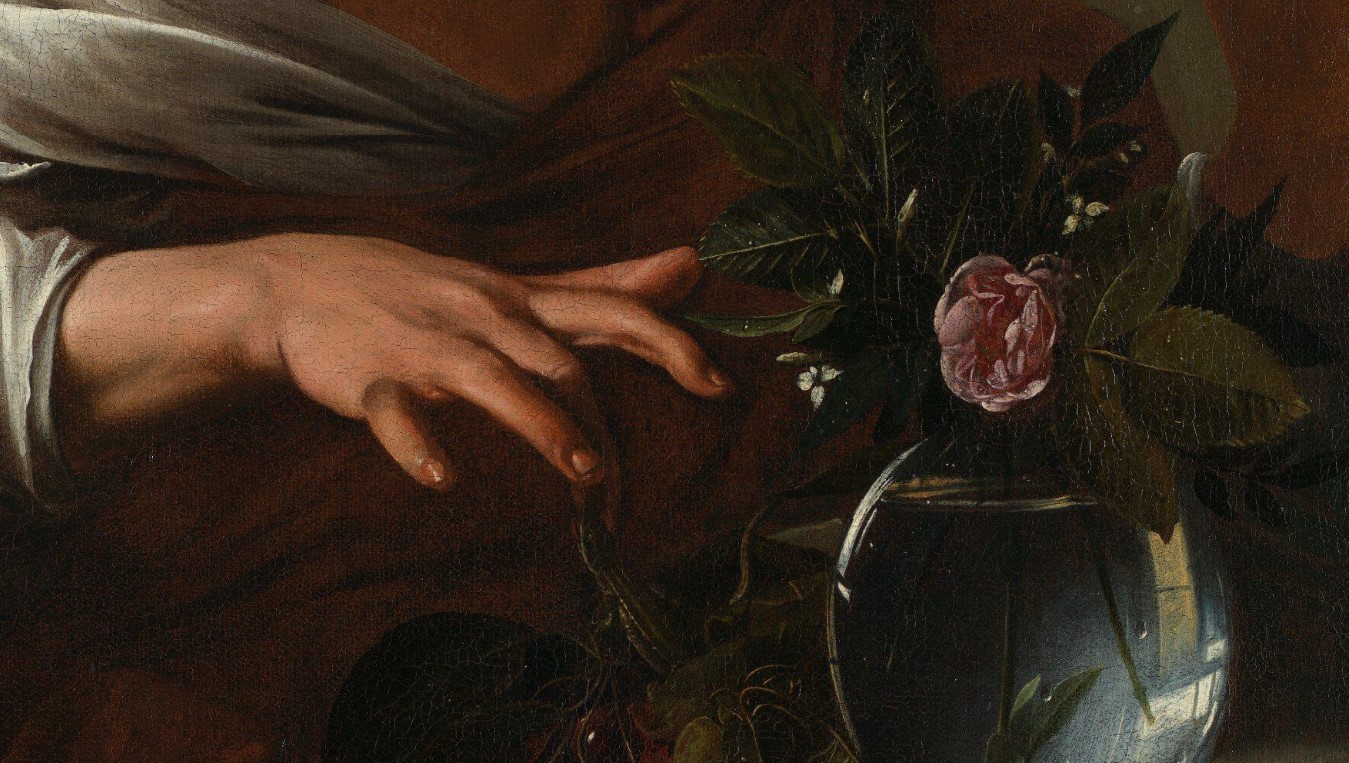
Mancini relates that Caravaggio painted the subject when staying with an old Catholic prelate named Pandolfo Pucci. By the end of his residence Caravaggio nicknamed his temporary benefactor Monsignor Insalata, or “Mister Salad,” for the pittance of solid food he served his artist boarder. The mock heroic painting may be allegorical with the lizard conveying its traditional meaning of lust or death joined to cherries symbolic of love and roses that of sexually transmitted disease — and warning of all three. see – https://www.britannica.com/biography/Caravaggio/First-apprenticeships-in-Rome-Pucci-Cesari-and-Petrigiani – retrieved October 15, 2024.
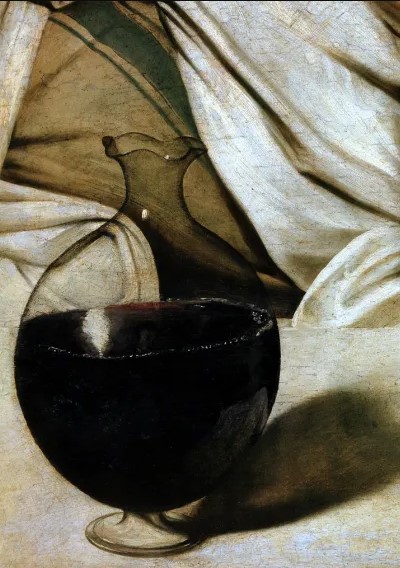
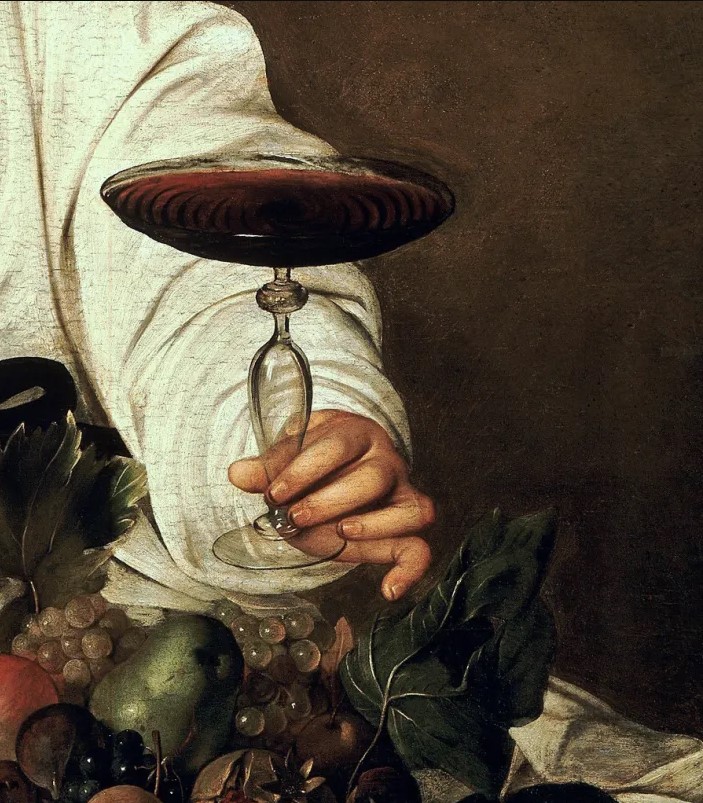
Caravaggio (Michelangelo Merisi), Bacchus, c. 1597, oil on canvas, 37 3/8 x 33 ½”, Uffizi, Florence.Detail of above. Detail of above.
Cardinal del Monte commissioned it from Caravaggio for a Medici. Caravaggio (Michelangelo Merisi), Jupiter, Neptune, and Pluto, 1597, oil on stucco, about 9/9”” x 5’11” Villa Ludovisi, Rome. https://villaludovisi.org/ – retrieved October 12, 2024.
The building and grounds of Villa Ludovisi in Rome, and their rich artwork, includes masterpiece frescoes by Guercino (1591-1666) and other leading lights of the 17th century Bolognese school. Caravaggio’s Jupiter, Neptune and Pluto is his only known oil painting on plaster. Cardinal de Monte purchased the villa and took up residence there in 1596. The cardinal sold it to the Ludovisi in 1621. Bellori relates that the subject matter for the fresco of these gods was to express the cardinal’s interest in medicinal chemistry (today’s pharmaceuticals).
Caravaggio (Michelangelo Merisi), Judith Beheading Holofernes, c. 1598, oil on canvas, 56 ¾ x 76 ¾” 145 x 195cm Galleria Nazionale d’Arte Antica, Rome. https://barberinicorsini.org/opera/giuditta-e-oloferne/ – retrieved October 12, 2024.
The painting was made for Ottavio Costa. It was later owned by a succession of Roman families until it was acquired by the Galleria Nazionale d’Arte Antica in 1970. It depicts a famous scene from the book of Judith in the Bible. Judith, a beautiful, highly respected, prayerful and eloquent widow, is able to enter the tent of an Assyrian general whose army had surrounded Judith’s home, the city of Bethulia, certain to destroy it. Because of Holofernes’ desire for her, he allows Judith to move about freely in his camp and has her join him at a banquet in his tent where he gets drunk. “Holofernes, charmed by her, drank a great quantity of wine, more than he had ever drunk on any day since he was born” (Judith 12:20). Overcome with drink, the fearsome general passes out and is decapitated by Judith, her heroic action saving her people. The Bible tells it this way: “When all had departed, and no one, small or great, was left in the bedchamber, Judith stood by Holofernes’ bed and prayed silently, “O Lord, God of all might, in this hour look graciously on the work of my hands for the exaltation of Jerusalem. Now is the time for aiding your heritage and for carrying out my design to shatter the enemies who have risen against us.” She went to the bedpost near the head of Holofernes, and taking his sword from it, she drew close to the bed, grasped the hair of his head, and said, “Strengthen me this day, Lord, God of Israel!” Then with all her might she struck his neck twice and cut off his head. She rolled his body off the bed and took the canopy from its posts. Soon afterward, she came out and handed over the head of Holofernes to her maid, who put it into her food bag” (Judith 13: 4-10). For Caravaggio, this is his first painting depicting violent action in dramatic and realistic detail. The moment is captured as if in an eternal frieze.
Caravaggio (Michelangelo Merisi), Portrait of Monsignor Maffeo Barberini, c. 1603, Private Collection, Firenze.
Maffeo Vincenzo Barberini (1568-1644) became the future Pope Urban VIII whose reign began in 1623.
Caravaggio (Michelangelo Merisi), The Calling of Saint Matthew, 1599-1600, oil on canvas, 10’7 1/2 “ x 11’ 2” Contarelli Chapel, Church of Luigi dei Francesi, Rome.Caravaggio (Michelangelo Merisi), The Martyrdom of Saint Matthew, 1599-1600, oil on canvas, 10’7 1/2 “ x 11’ 3” Contarelli Chapel, Church of Luigi dei Francesi, Rome.Caravaggio (Michelangelo Merisi), The Inspiration of Saint Matthew, 1602, oil on canvas, 9’8 1/2 “ x 6’ 2 ½” Contarelli Chapel, Church of Luigi dei Francesi, Rome.
This first version of The Inspiration of St. Matthew by Caravaggio was rejected because the evangelist was considered too crude and the angel too familiar. The painting was destroyed during the Fall of Berlin in 1945 and known by photographs. Caravaggio (Michelangelo Merisi), Medusa (detail), 1600/01, oil on canvas mounted on a convex poplar-wood shield, Uffizi, Florence.
Caravaggio’s Medusa is painted on an actual parade shield.
Caravaggio (Michelangelo Merisi), Basket of fruit (canestra di frutta), c. 1600/01, oil on canvas, 18 1/8 x 25 3/8, Biblioteca Ambrosiana, Milan. https://www.ambrosiana.it/opere/canestra-di-frutta/ – retrieved October 13, 2024.
This is Caravaggio’s only still life painting that has survived. Of course there are still life in his figure paintings as details. His paintings of fruit are completely diverse in terms of varieties and arrangements though sharing overall stylistic similarities. The painting was in the possession of Cardinal Federico Borromeo (1564-1631), cousin to Saint Charles Borromeo (d. 1564), and both cardinal archbishops of Milan. Archbishop Federico bequeathed it in his will to the Ambrosiana in Milan, a gallery he co-founded in 1618. The same sort arrangement in the same basket appears in Caravaggio’s Supper at Emmaus in the National Gallery London painted around the same time. Cdl. Borromeo lived in Rome from 1586 to 1601 and grew to become familiar with Caravaggio’s work. It is unclear whether the archbishop commissioned the painting or if it was a gift. Though the Counter-Reformation cardinal was a propagator of the faith using religious art, he also was an avid collector of still life.
Giulio Cesare Procaccini ((1574–1625), Cardinal-Archbishop Federico Borromeo, 1610, Museo diocesano di Milano.Caravaggio (Michelangelo Merisi), Supper At Emmaus, c. 1600/01, oil on canvas, 54 ¾ x 76 ¾” The National Gallery, London.
Caravaggio (Michelangelo Merisi), The Conversion of Saint Paul, 100/01, oil on canvas, 90 ½ x 70” Cerasi Chapel, Santa Maria de Popolo, Rome.Caravaggio (Michelangelo Merisi), The Crucifixion of St. Peter, 1600/01, oil on canvas, 90 ½ x70” Cerasi Chapel, Santa Maria de Popolo, Rome.
The chapel was purchased by Tiberio Cerasi (1544-1601) in 1600 who worked as Treasurer-General for Pope Clement VIII. Cerasi had the chapel redone by Carlo Maderno (1556-1629). In 1601 Cerasi hired Caravaggio to paint The Conversion of St. Paul and The Crucifixion of St. Paul. Notably, his paintings’ first versions were rejected. The final paintings were installed in 1605 and the chapel consecrated in 1506. The Assumption of Mary over the altar was painted at the same time by Annibale Caracci. See – https://en.wikipedia.org/wiki/Cerasi_Chapel– retrieved October 14, 2024.
Caravaggio (Michelangelo Merisi), The Incredulity of Saint Thomas, 1601/02, oil on canvas, 42 1/8 x 57 ½” 118 × 156.5 cm Neues Palais, Potsdam.
Caravaggio’s depiction of this encounter of a Resurrected Christ with doubting Thomas that is found in the New Testamant (John 20: 27-31) is naturalistic with dramatic chiaroscuro. It was purchased from a Paris art dealer in 1815 after its original owners, the Giustiniani, were forced to sell their collection due to financial distress. Prussian king Frederick William III (1770-1840) bought the collection of paintings with the intention of starting a public art museum in Berlin, though this painting ended up being sorted out as “lower quality” perhaps because it shows no signs of Christ’s divinity. Of the five paintings by Caravaggio the king acquired, three ultimately ended up in the museum, including Cupid as Victorious (Berlin, Gemäldegalerie). The Doubting Thomas was hung in the Berlin Palace and, finally, in 1856 hung in the picture gallery in Sanssouci. https://brandenburg.museum-digital.de/object/11898 – retrieved October 11, 2024.
Frederick William III ruled Prussia during the Napoleonic Wars and, while shy and quiet by nature, reluctantly participated in the coalition against Napoleon in the German campaign of 1813. After Napoleon’s defeat in 1815, he took part in the Congress of Vienna and helped established the new postwar order in Europe. For the remainder of his reign, Frederick William III set about reforming Prussian institutions and centralizing royal control.Detail of above. Caravaggio (Michelangelo Merisi), Victorious Amor, c. 1601/02, oil on canvas, 60 5/8 x 43 ¼”, Gemäldegalerie, Staatliche Museen, Berlin-Dahlem. https://recherche.smb.museum/detail/862322/amor-als-sieger?language=de&question=caravaggio&limit=15&sort=relevance&controls=none&collectionKey=GG*&objIdx=0 – retrieved October 11, 2024.
Caravaggio shows Eros prevailing over other human endeavors: war, music, science, government.
Youth With A Ram was painted for Ciriaco Mattei (d.1614), one of the foremost art collectors of his time, and given to Cardinal del Monte by his son before his death. Mattei also commissioned Caravaggio’s Supper at Emmaus and The Taking of Christ.
Caravaggio (Michelangelo Merisi), The Taking of Christ, 1602, oil on canvas, 133.5 cm × 169.5 cm (52.6 in × 66.7 in) National Gallery of Ireland. On loan from the Society of Jesus, Leeson Street., Dublin.
The painting includes a self portrait of Caravaggio. Caravaggio (Michelangelo Merisi), The Sacrifice of Isaac, 1603, oil on canvas, 41 x 53 1/8” Uffizi, Florence.https://www.uffizi.it/en/artworks/sacrifice-of-isaac – retrieved October 12, 2024.
The painting illustrates the Old Testament story in which God subjected Abraham to an extraordinary test of obedience by ordering him to sacrifice his only son Isaac (Genesis 22: 1-19). Caravaggio faithfully depicts the crucial moment of this dramatic story, when old Abraham, at the very moment he is about to immolate a screaming Isaac, is blocked by an angel sent by the Lord.
The Deposition, considered one of Caravaggio’s greatest masterpieces, was commissioned by Girolamo Vittrice for his family chapel in Santa Maria in Vallicella (Chiesa Nuova) in Rome. In 1797 it was included in the group of works transferred to Paris in execution of the Treaty of Tolentino. After its return in 1817 it became part of Pius VII’s Pinacoteca.
Michelangelo Merisi, called the Caravaggio, DETAIL The Madonna of Loreto (The Madonna of the Pilgrims), circa1603-1604, Oil on canvas, 8’ 8 ½ x 4’ 11”, Cavalletti Chapel, Church of Sant’ Agostino, Rome.Michelangelo Merisi, called the Caravaggio, The Madonna of Loreto (The Madonna of the Pilgrims), circa1603-1604, Oil on canvas, 8’ 8 ½ x 4’ 11”, Cavalletti Chapel, Church of Sant’ Agostino, Rome.
The painting has been in the Cavalletti chapel in Rome since it was installed at the end of 1604.
Michelangelo Merisi, called the Caravaggio, Ecce Homo, c. 1604-05, oil on canvas, 50 ½ x 40 ½” Civic Collection, Palazzo Rosso, Genoa.
The painting was made for a competition with Domenico Passignano (1559-1638) and Lodovico Cardi (“Il Cigoli”) (1559-1613) soon after Il Cigoli first arrived in Rome. Il Cigoli won the compettion and the whereabouts of Caravaggio’s painting until it arrived to Genoa is uncertain. It may be that Caravaggio himself took it to Genoa when he visited there in 1605.
Michelangelo Merisi, called the Caravaggio, Saint John the Baptist, c. 1605, oil on canvas, 68 1/4 x 52” Nelson-Atkins Museum of Art, Kansas City, Missouri.
The painting was made for Ottavio Costa who then had a copy made for his chapel in Liguria while the original was lost. It resurfaced in the mid 19th century in England and was acquired by the Nelson-Atkins Museum of Art in the 1950s. Caravaggio reveals the qualities of the saint by his expression and pose. He is sober and downcast with a tense energy as his pose manifests the monumentality of the prophets on the Sistine Chapel ceiling. With his staff he quietly and contemplatively conveys zeal, passion and vitality. There is a sense of his singleness of purpose, joined even to a little madness, as a man driven by making straight the paths of the Lord.
The painting was bought by King Charles I of England (1600-1649) in 1637. After the monarch’s defeat in the English Civil War (1642-1645), he was imprisoned and executed for high treason in 1649. During the Commonwealth (1649-1660), the painting was sold in 1651 and recovered at the Restoration. Caravaggio’s painting depicts the call of the very first disciples in the very first New Testament Gospel by Mark: “As he passed by the Sea of Galilee, he saw Simon and his brother Andrew casting their nets into the sea; they were fishermen. Jesus said to them, “Come after me, and I will make you fishers of men.” Then they abandoned their nets and followed him” (Mk 1:16-18). Caravaggio depicts Jesus without a beard as he turns back to invite them to follow him as he moves ahead. Fishermen, Simon Peter holds skewered fish on a stick while Andrew points to himself identifying the object of Jesus’s invitation.
As recently as 1987 this painting came to be attributed to Caravaggio and as the original of this painting’s subject matter. In varying copies of the work the furrow in Christ’s brow is painted faithfully though in this original it is not a painted feature but a canvas fold. There are other design features that, after recent cleaning and conservation, point to a later work of Caravaggio. Many small incisions are present in the artwork’s lower layers of paint that is an uncanny method used by the artist to lay out important points on the canvas for his design. Although the attribution can be argued to the contrary – such as the unusual use of the color blue which Caravaggio saw, according to Bellori, as the “poison of colors” – he did use the color and mostly softened as it is here. Blue, for instance, occurs in the Baptism of Christ (National Gallery of Ireland, c. 1603) and the Annunciation (Nancy, c. 1604). At the Supper at Emmaus (Brera, 1605-6) Christ also wears a robe of softened blue. In its telling broad brushwork, restrained colors, and minimal detail the painting was understood to be a Road to Emmaus painting as discussed by Giulio Mancini and Giovanni Baglione. But these early biographers’ references are likely to the Supper at Emmaus (National Gallery London, 1601). Dated stylistically by its economical, shadowed, and expressive manner, The Calling of Saints Peter and Andrew appears to be from the period of 1603-1606. This would be before Caravaggio killed Ranuccio Tomassoni (c. 1580-1606) in a brawl and fled Rome in May 1606. During the first years of the 17th century, the sensuous surface detail of Caravaggio’s art had become spare, dark and expressive. Further, The Calling of Saints Peter and Andrew places half-length figures interacting against a stark background, similar to such paintings as Doubting Thomas (Sanssouci, Potsdam) and the Betrayal of Christ (National Gallery of Ireland, Dublin), both of 1603. Before this painting reached England, there was a broadly interpreted copy of it that is today in a private collection by Bernardo Strozzi (1582-1644). Strozzi lived and worked in Rome, Genoa and Venice where he may have seen this painting by Caravaggio. When Charles I’s buying agent was later in Italy, he visited the same places as Strozzi had been, except Genoa.
The painting was commissioned in 1605 by members of the powerful archconfraternity of the Palafrenieri who, following the renovation of St. Peter’s Basilica, asked the painter for a new work intended to replace an old painting that decorated the altar of their chapel dedicated to St. Anne. Painted within a few months, in April 1606 the work was exhibited and shortly afterwards moved to the nearby church of Sant’Anna dei Palafrenieri where, seen by Scipione Borghese, it was bought by him. For whatever reason the painting was controversial – perhaps the cleavage of the Madonna or the rendering of the nudity of the child – but Scipione Borghese proudly hung it in his own picture gallery. The painting depicts Mary as she crushes a snake – a symbol of sin – at her feet with the help of Jesus and witnessed by Anna, mother of the Virgin.
Michelangelo Merisi, called the Caravaggio, Saint Jerome writing, 1605/06, oil on canvas, 116 cm x 153 cm, Borghese Gallery, Rome.
According to Bellori, the painting was made by Caravaggio for Cardinal Scipione Borghese. The cardinal was not only an avid and refined art collector but one of young Caravaggio’s earliest and greatest admirers recognizing the Lombard’s talent despite personality flaws or lack of connections in Rome. The painting depicts Saint Jerome (c. 340s-420), Doctor of the Church, best known for his translation of the Bible from Greek into Latin as well as his commentaries on the Bible. Caravaggio depicts the priest and confessor writing and studying the Holy Scriptures as a scholar, now in old age, who has dedicated his life as a humanist engaged in the complex translation and exegesis of the Church’s sacred text. The composition is divided into large fields of color in warm tones (the saint’s complexion and reddish mantle) and cold tones (the skull and shroud-like white cloth) with Jerome’s arm outstretched with writing instrument in hand across the picture to symbolically portray the unity of the scholar-saint’s dialogue with these opposites of nature including life and death, past and present. As there are many unfinished details in the painting, the artist’s style points to his rapid execution of the work. https://www.collezionegalleriaborghese.it/opere/san-girolamo – retrieved October 13, 2024.
DETAIL Caravaggio (Michelangelo Merisi), The Death of The Virgin, c. 1605-1606, oil on canvas, 12’1 ½” x8’, Louvre, Paris.
Caravaggio (Michelangelo Merisi), The Death of The Virgin, c. 1605-1606, oil on canvas, 12’1 ½” x8’, Louvre, Paris.
Caravaggio (Michelangelo Merisi), The Madonna of the Rosary, c. 1605-1607, oil on canvas, 11’11 ½” x8’ 4”, Kunsthistorisches Museum, Vienna.Caravaggio (Michelangelo Merisi), The Seven Acts of Mercy, 1606, Oil in canvas, 12’ 9 ½” x 8’ 6 ½” Pio Monte della Misericordia, Naples.
The Seven Acts of Mercy altarpiece was painted between September 23, 1606 and January 9, 1607 for which Caravaggio was paid 400 ducats. The commission required that the artist include the figure of the Madonna of the Misericordia and all the acts of mercy in one vertical canvas and whose overall achievement was a first in Italian art.
Caravaggio (Michelangelo Merisi), Salome, 1609/10, oil on canvas, 35 5/8 x 65 ¾” The National Gallery London.
Caravaggio (Michelangelo Merisi), The Flagellation, 1607, oil on canvas, 9’ 4 ½” x 6’2” Capodimonte Museum, Naples.
The dramatic play of light and shadow throws into relief the melancholic expression on David’s face and the hauntingly lifelike head of Goliath, creating a palpable sense of guilt and redemption that resonates deeply with the viewer.
The head of Goliath is Caravaggio’s self portrait.
In addition to developing a considerable name as an artist, Caravaggio was a reputably volatile, bad-tempered and violent man. On May 29, 1606 Caravaggio killed Ranuccio Tomassoni in a fight, the cause of which is disputed, though it may have been over a Roman prostitute, Fillide Melandroni who had posed for Caravaggio several times. The capital crime forced Caravaggio to flee to Naples. A report written by the local coroner declared that the male victim died by Caravaggio’s attempt to castrate him, the code on the Roman street meriting it for a man who insulting another man’s woman. Caravaggio became a fugitive from the law though he continued to paint (Supper at Emmaus) and fled to Naples by the end of 1606. In Naples he painted Flagellation and Seven Works of Mercy, among others. He fled further to Malta and then to Sicily where Caravaggio moved from town to town across the island fearing some unnamed retribution. It was presumed that 38-year-old Caravaggio died from syphilis or perhaps malaria or the Malta Fever though there is current speculation the artist may have been murdered in revenge for his crimes by perhaps members of the Tomassoni family or the Royal Knights. see – https://www.italianartsociety.org/2018/05/on-29-may-1606-the-great-italian-baroque-painter-caravaggio-killed-ranuccio-tommasoni-in-rome/ ; https://thecinemaholic.com/ranuccio-tomassoni-caravaggio/– retrieved October 15, 2024.
Caravaggio (Michelangelo Merisi), Portrait of a Courtesan (Fillide Melandroni), c, 1599. Destroyed Berlin 1945. Caravaggio (Michelangelo Merisi), Supper at Emmaus,1606, oil on canvas, 141 x 175 cm, Pinacoteca di Brera, Milan.Caravaggio (Michelangelo Merisi), The Beheading of St John, 1608, St John’s Co-Cathedral, Valetta, Malta.Caravaggio (Michelangelo Merisi), St. Francis of Assisi in Meditation, 1606/07, oil on canvas, Pinacoteca Civica Museo ala Ponzone Cremona.Caravaggio (Michelangelo Merisi), Portrait of Alof de Wignacourt with his Page, 1606/07, oil on canvas, 195 x 134 cm, Louvre.
The subject was the Grand Master of the Knights of Malta. In exchange for this grand portrait, according to Bellori and Baglione, Caravaggio became a Knight of Malta on an accelerated timetable though soon after the artist fled the island in disgrace.
Caravaggio (Michelangelo Merisi), The Burial of Saint Lucy, 1608/9, oil on canvas, 13′ 4 1/2″ x 9′ 10″ 408 x 300 cm, Church of Santa Lucia,Syracuse in deposit at the Galleria Regionale, Palazzo Bellomo, Syracuse, Sicily.
The famous Caravaggio painting depicting the burial of Santa Lucia once hung in the Church of Santa Lucia al Sepolcro, but today is in Siracusa’s Palazzo Bellomo museum. The original church, built as early as the 6th century, was on the site of Saint Lucy’s martyrdom in the early 4th century. Beneath the sanctuary is a vast labyrinth of dark catacombs dating from the 3rd century which have never been completely explored and are closed to the public. Once containing the tomb of the decapitated saint, her remains were relocated to Venice during the Crusades and where they can be found today. This painting was made by Caravaggio between October 1608 in Malta and early 1609 in Sicily in a commission arranged by his old friend painter Mario Minniti. Caravaggio was on the run in Sicily starting in late 1608 when he arrived into Siracusa, and then onto Messina followed by Palermo. In Sicily, the exile Caravaggio painted Resurrection of Lazarus, The Adoration of the Shepherds (Adorazione dei pastori) and Ecce Homo. In late 1609 he returned to Naples and continued painting, including another St. John the Baptist and, his final artwork, The Martyrdom of St. Ursula. In Naples the artist was attacked in the street by four armed men shortly after his arrival where Caravaggio was seriously injured. see – https://www.frommers.com/destinations/syracuse-and-ortygia-island/attractions/santa-lucia-al-sepolcro; https://www.great-sicily.com/post/the-byzantine-era-in-sicily – retrieved October 15, 2024.
Caravaggio (Michelangelo Merisi), Adorazione dei pastori (The Adoration of the The Shepherds), 1609, oil on canvas, 10′ 3 1/2 ” x 6′ 11″, Messina, Sicily, Museo regionale interdisciplinare.
Caravaggio (Michelangelo Merisi), La Resurrezione di Lazzaro (The Resurrection of Lazarus), 1609, oil on canvas, 10′ 3 1/2 ” x 6′ 11″, Messina, Sicily, Museo regionale interdisciplinare.
In Malta Caravaggio became a Knight of Malta but got into another violent group brawl where a knight was badly injured. With a warrant put out for his arrest Caravaggio managed to flee to Sicily in October 1608. By December 1608 Caravaggio was found guilty in abstentia and removed from the Maltese order. The commission for this painting came from Giovanni Battista de’ Lazzari, a merchant of Genoese origin who had obtained permission to be buried in the choir chapel of the church of Saints Peter and Paul de’ Pisani (demolished in 1880) in Messina where Camillo de’ Lellis’ religious order, founded in 1591 and dedicated to the care of the sick, had a house. De’Lazzari’s signed contract on December 6, 1608, declared that his new altarpiece would have the Madonna and St. John with saints as its subject. But that was changed to the resurrection of Lazarus (Gospel of John, chapter 11). It is very likely the change was made by De’Lazzari in agreement with the Camillians. According to Susinno, the artwork’s 13 figures were staff members of the hospital where Caravaggio did the painting. see – https://federica90.wixsite.com/emozionearte/post/caravaggio-in-sicilia-la-resurrezione-di-lazzaro – retrieved October 15, 2024.
Caravaggio (Michelangelo Merisi), The Denial of St. Peter,1609/10, oil on canvas, 94 x 125.4 cm, The Metropolitan Museum of Art, New York.
The Denial of Saint Peter is generally thought to be one of the last pair of artworks by Caravaggio, the other being The Martyrdom of Saint Ursula. It was probably finished at Naples in the summer of 1610.
Caravaggio (Michelangelo Merisi), St. John the Baptist, 1610, oil on canvas, 159 x 124.5 cm, Galleria Borghese, Rome.
Caravaggio carried this painting and others sailing from Naples to Rome hoping for a pardon from the pope. Instead, when the desperate artist landed he was arrested and the boat was sent back to Naples with the paintings. Caravaggio died on July 18, 1610 in Porto Ercole. The papal nuncio secured this painting for Cardinal Scipione Borghese. see – https://www.dailyartmagazine.com/caravaggios-martyrdom-of-saintt-ursula/ – retrieved October 15, 2024.
LAST PAINTING.
Caravaggio (Michelangelo Merisi), The Martyrdom of Saint Ursula, 1610, oil on canvas, 142 x180 cm, Naples, Galleria di Palazzo Zevallos Stigliano.
Caravaggio’s The Martyrdom of Saint Ursula was painted in the last month of his life. It contains his characteristic and revolutionary chiaroscuro, naturalism, and depiction of psychological and physical emotion. The Martyrdom of Saint Ursula was commissioned by Genoese art patron Marcantonio Doria. The painting was finished in May and arrived in Genoa in mid-June 1610. Ursula was a venerated but almost completely legendary figure. In typical fashion Caravaggio dispels traditional religious iconography associated with Ursula — a crown, halo, palm branch, the 11,000 virgin martyr companions — for the painful moment in her story when the Barbarian king shoots the arrow into Ursula’s chest that kills her.
Caravaggio’s The Martyrdom of Saint Ursula marked a watershed in European art. His revolutionary style inspired subsequent generations of painters, such as Artemisia Gentileschi (1593—1651), Giovanni Baglione (1566-1643), and Orazio Gentileschi (1563–1639), that became known as the Caravaggisti. He also influenced international Baroque artists including Spaniard Diego Velázquez (1599-1660) and Dutchman Rembrandt van Rijn (1606-1669). see – https://www.widewalls.ch/magazine/the-martyrdom-of-saint-ursula-caravaggio – retrieved October 15, 2024.
FEATURE Image: Raphael, Portraits of Agnolo Doni and Maddalena Doni, c. 1506, oil on panel, 24 ¾ x 17 ¾” Pitti Gallery, Florence.
Raphael, Self-portrait at 23 years old, 1504–1506. Tempera on panel, 47.5 cm × 33 cm (18.7 in × 13 in), Palazzo Pitti, Florence, Italy.
INTRODUCTION.
Born in Urbino in 1483, an environment rich in the arts and humanist learning, Raphael had a remarkable capacity for personal growth and branded new incarnations of his artistic style regularly. He moved to Florence toward the end of 1504. Giorgio Vasari in his chapter on Raphael describes an episode where the artist of Urbino, already in his thirties with a reputation as a master, went back to study the nude (male) form with Michelangelo as his guide. Vasari’s admiration in telling this story goes beyond Raphael’s humility in assuming the role of student again (he studied constantly anyway) but that his learning always improved his artistic output. In the study of nudes, however, artistic growth came perhaps not as the artist expected or intended. Whether Raphael entered the workshop of Perugino at that time or, as seems more likely, many years later when he was already an acknowledged artist, he quickly mastered Perugino’s delicate, ornamental style, with its open landscapes and gentle figures. It was said that contemporaries had trouble distinguishing Perugino’s work from Raphael’s, but Raphael’s compositions were more sophisticated even when he was a young artist. While Raphael mastered Michelangelo’s (and Leonardo’s) art forms convincingly, he also realized he was no match for the creator of the Sistine Chapel and other chiseled works insofar as the nude male forms.1 Yet Raphael consolidated his strengths by testing his limits. A major strength, Vasari believed, was Raphael’s ability to draw and compose a wide range of subjects, such as landscape, architecture, draperies, and the human figure. Up to that time that had been what the artist was doing and would now unflinchingly continue to do on a grander scale, for example, in the Stanzae. In 1508 the pope called Raphael to Rome. Influenced by the idealized, classical art of the city’s ancient past, Raphael’s work took on a new grandeur. He also responded to the more energetic and physical style of Michelangelo, whose works he had already begun to study in Florence. Vasari believed Raphael had the gift to congeal the “poetic moment” by depicting in his painting the most significant gesture and force of action. With the possible exception of Leonardo, he is probably the unparalleled master of excellent design.2 The precocious Raphael Sanzio also benefited from early opportunities given to him by his father to cultivate his talent. The artist’s own determination to succeed in his métier paid off when he was summoned to work at the Vatican by the Pope in 1509, arguably the greatest art patron in an age of art patrons. 3 The early sixteenth century was an age where patrons were as luminous as their artists and the coming together of Raphael and Julius II, and later Leo X, made for a celebrity team. While Vasari meticulously tells the reader of the artist’s “judicious” character – and that Raphael was extremely “amatory” and implying it aided in his death – the chronicler describes, often from memory, his preferences in Raphael’s art work. His collective response, for example, to all four frescos in the Camera d’Eliodoro is that he is most impressed by Raphael’s interesting decorative details, beautiful movements and gestures, the sheer number of figures portrayed, and his ability to express complex ideas and stories on a two-dimensional surface.4 With Leonardo da Vinci (1452-1519) and Michelangelo (1475-1564) Raphael is one of the great masters of the High Renaissance. Raphael and his large team of assistants left behind a large body of influential work, especially in the Vatican where the artist spent the last 12 years of his life, although Raphael died at 37 years old. For most of the history of Western art, the easy grace and harmonious balance of Raphael’s style has represented an ideal of perfection. His work became widely influential through the dissemination of prints. Raphael was also the city’s leading portraitist, creating penetrating psychological images that engaged viewer and sitter with a new intensity.
ARTWORKS.
Raphael, S. Niccolo Da Tolentino Altarpiece, 1501, oil on panel, 44 x45 ¼ in., Capodimonte Museum, Naples, Italy.
The Baronci Altarpiece is Raphael’s first recorded commission. It was made for the patron’s chapel in the church of Sant’Agostino in Città di Castello, a commune between Arezzo and Urbino, north of Perugia. In 1789 the artwork was badly damaged in an earthquake and surviving fragments were acquired by the Vatican until they mysteriously dispersed in the mid-19th century and found their way into different collections. Raphael’s commission of 1501 was to paint a large altarpiece dedicated to the Augustinian saint Nicholas of Tolentino (c. 1246– September 10, 1305). Nicholas was canonized by Augustinian Pope Eugene IV in 1446. While today’s saints require 1-2 miracles, St. Nicolas Tolentino was credited at his canonization with 300 miracles – including 3 resurrections. (see – Encyclopedia of the Middle Ages, Volume 2, André Vauchez, Richard Barrie Dobson, Michael Lapidge. Chicago: Fitzroy, Dearborn, 2000).
Raphael, angel, fragment Baronci altarpiece. Pinacoteca Tosio Martinengo, Brescia. Raphael, The Crucifixion, 1502-03, oil on polar, 283.3 × 167.3 cm, National Gallery, London.
The painting was done in 1503 for Domenico Gavari for his S. Domenico chapel in Città di Castello. Angels are poised on toes on a cloud as their cups catch Christ’s dripping blood. Mary Magdelene and St. Jerome (holding a rock) are on their knees while the Virgin Mary and St. John stand. The sun and moon in the sky was characteristic of Crucifixion paintings in Umbria (p. 13, Jones & Penny). It was bequeathed to the National Gallery in 1924. Gavari was a close friend of Andrea Baronci, for whom Raphael painted the Saint Nicholas of Tolentino Altarpiece for the church of S. Agostino, also in Città di Castello. Saint Jerome, of course, was not present at the Crucifixion but is included in this scene because the chapel was dedicated to him. The overall design is based on several versions of the crucified Christ in a landscape painted by Perugino in the late 1480s and 1490s, and is especially similar to his altarpiece of the Crucifixion for the convent of S. Francesco al Monte in Perugia, commissioned in 1502 and completed 1506. https://www.nationalgallery.org.uk/paintings/raphael-the-mond-crucifixion – retrieved September 5, 2024.
Raphael, Coronation of the Virgin (Oddi Altarpiece), 1503-1504, Oil on canvas, 8’9” x 5’4”, Pinacoteca, Vatican, Rome.Raphael, Coronation of the Virgin (Oddi Altarpiece), 1503-1504, Oil on canvas, 8’9” x 5’4”, Pinacoteca, Vatican, Rome. DETAIL.
Raphael painted altarpieces for the Augustinians and Dominicans and the Oddi altarpiece (above) was done for the Franciscans. It was commissioned by the Oddi family chapel in S. Francesco al Prato. The Oddi were in exile from Perugia since 1495 because of battles between families and returned in 1503. The altarpiece was part of honoring their family members. The painting is divided into an upper part depicting the coronation of the Virgin and, in the lower part, the Apostles at the time of the Assumption. In the center, the apostle Thomas holds the Virgin’s girdle that the Virgin lowered to him as a token of these supernatural events. This display of theology was precious to the Franciscans at the time who were promoting the Virgin Mary. They were likely very involved in directing the artist in its composition. (Roger & Jones, pp. 15-16).
Raphael, Spozalizio (The Engagement of the Virgin Mary), 1504, oil on panel, 67 x 46 ½” Brera Gallery, Milan.
The painting’s composition reflects the influence of Perugino, specifically the fresco done by him in the Sistine Chapel in 1484. In terms of its architectural setting, Raphael was influenced by Piero della Francesca (c.1416-1492) and Bramante (1444-1514). The painting’s architectural structure shares centrality in the painting with the foreground figures done in a perspectival arrangement. Within the figures are members of the party positioned in depth. Joseph places a ring on Mary’s finger whose positioning bisects the artwork. A tawny gold tone pervades the painting. It was commissioned by the Alberini family for a chapel in S. Francesco of the Friars Minor at Città di Castello in Perugia. (Brera Milan, p 34)
Raphael, The Madonna and Child Enthroned with Five Saints (Colonna Altarpiece), c. 1504-1505, oil on panel, 68 x 68” The Metropolitan Museum of Art, New York City.
Raphael painted this altarpiece for the Franciscan convent of Sant’Antonio in Perugia. It hung in a part of the church reserved for the nuns. The pair of voluminous saints straddling each side of the throne reflect the progressive style of Leonardo da Vinci and Fra Bartolomeo (1472-1517) that Raphael was studying in Florence. The lunette above the main panel depicts God the Father holding a globe and raising his right hand in blessing situated between two angels and two seraphim. https://www.metmuseum.org/art/collection/search/437372 – retrieved September 5, 2024.
Raphael, The Small Cowper Madonna, c. 1505 59.5 x 44 cm (23 7/16 x 17 5/16 in.), National Gallery of Art, Washington D.C.
The Cowper Madonna includes an agreeable background landscape. In a vertical painting, a haloed woman and nude child sit before an expansive grass field extending behind them to a group of trees and buildings on a hill in the distance among hazy blue hills beneath a blue sky.https://www.nga.gov/collection/art-object-page.1196.html – retrieved September 8, 2024.
Raphael, Saint Michael and The Dragon, c. 1505, oil on panel, 12 ¼” x 10 ¼” The Louvre Paris https://collections.louvre.fr/en/ark:/53355/cl010060773 – retrieved September 4, 2024Raphael, Saint Michael and The Dragon, c. 1505, oil on panel, 12 1/4 x 10 ¼” The Louvre, Paris https://collections.louvre.fr/en/ark:/53355/cl010060772 – retrieved September 4, 2024.Raphael, Saint George and the Dragon, c. 1506, National Gallery of Art, Washington, D.C.
These early works by the artist depict the popular subjects of St. Michael the Archangel vanquishing Satan and Saint George slaying the Dragon, each showing the martial subject of good combatting evil. These were early private commissions for the court of Urbino. Saint George was a Christian Roman soldier who, pious legend informs, subdued a dragon and, with the daughter of a pagan king, brought it to the city, where St. George killed it with his sword. These heroic actions witnessed by the king and his subjects led to their conversion to Christianity. The historic figure of Saint George was martyred around the year 290. https://www.nga.gov/collection/art-object-page.28.html – retrieved September 4, 2024.
Raphael, The Three Graces, 1505-1506, oil on panel, 6 ¾ x 6 ¾” Condé Museum, Chantilly.
The panel was recorded in the Borghese collection in 1650. It accompanied the Dream of Scipio, an oil on panel, today in the National Gallery of London. The figures were derived from ancient classical sculpture and depict, likely, Chastity, Beauty and Love. Chastity’s lower torso is veiled and an arm covers her breasts from view. Amor’s breasts, by contrast, are revealed. Chastity also wears no adornment as do Beauty and Amor. While the figures are modeled similarly, the space between them is disparate and Beauty blocks Chastity’s leg. (Jones & Penny, p. 8; Beck, pp. 62-63).
Raphael, Portrait of Agnolo Doni, c. 1506, oil on panel, 24 ¾ x 17 ¾” Pitti Gallery, Florence.Raphael, Portrait of Maddalena Doni, c. 1506, oil on panel, 24 ¾ x 17 ¾” Pitti Gallery, Florence.
Agnolo Doni is the only Florentine portrait in these first years mentioned by Vasari though paired with its companion portrait of Maddalena Doni. Doni was an art collector who married the daughter of Giovanni Strozzi in 1503. Agnolo was 10 years older than his wife who was in her teens. The portraits are painted on identically sized panel and are intended to hang next to one another. Raphael took great care in depicting the corporeal reality of his subjects, particularly appreciated in their faces and hands (though Agnolo Doni’s portrait is more detailed than his wife’s.) In both Doni portraits the sitters show-off their jewelry – such as rings and, in Maddalena’s portrait, a large pearl hanging around her neck. (Roger & Penny, p. 29-30)
Raphael, The Madonna of the Granduca, c. 1506, Oil on panel, 33 x 21 1/2 “ Pitti gallery, Florence.Raphael, Lady with a Unicorn, 1506, oil on panel, 65 cm × 51 cm (26 in × 20 in), Galleria Borghese, Rome, Italy.
The work was of uncertain attribution until recent times. In the 1760 inventory of the Gallery, the subject of the painting was identified as Saint Catherine of Alexandria and attributed to Perugino. A restoration of the painting in 1934 revealed a unicorn, the medieval symbol for chastity, and led to the pianting’s attribution to Raphael. In 1959 an x-ray revealed a small dog under the unicorn which symbolized conjugal fidelity.https://en.wikipedia.org/wiki/Young_Woman_with_Unicorn – retrieved September 7, 2024.
Raphael, The Holy Family With Saints Elizabeth and John (The Canigiani Holy Family), c. 1506-07, oil on panel, 51 ½ x 42 1/8” Alte Pinakothek, Munich.
Visible on the hem of the Madonna’s scarf is inscribed, “Rapahel Urbanas.” The fresco and easel painter was active mainly in Umbria, in Florence after 1504, and in Rome in 1509 until his death. It was painted for Domenico Canigiani where Vasari saw it later. It entered the Medici collection and when a Medici daughter married an Elector Palatine it accompanied her over the Alps to Germany. (Pinakothek Munich Great Museums of the World, Roberto Salvini, et. al., Newsweek NY 1969 pp. 126).
Raphael, Madonna del Cardellino, 1506-07, oil on panel, 42 1/8 x 30 ¼” Uffizi Gallery Florence.
The three figures are closely integrated as well as displaying a greater sense of volume. The painting is dated 1507, again on the hem of the Virgin’s garment. In the painting St. John the Baptist presents a goldfinch (cardellino) to the Christ child – a symbol of the Passion. (Roger & Penny, p. 33)
The Deposition, 1507, oil on panel, 72 ½ x 69 ¼” Borghese Gallery, Rome.The Deposition, 1507, oil on panel, 72 ½ x 69 ¼” Borghese Gallery, Rome. DETAIL.
Upon seeing Leonardo’s Battle of Anghiari and Michelangelo’s Battle of Cascia in Florence Raphael’s style applied its innovative principles immediately changing the trajectory of his artwork up to that point. Leonardo da Vinci and Michelangelo were in a pitched artistic battle for the future of modern art in the first decade of the 16th century in central Italy. Their artwork was for a fabled competition to decorate the Great Council Hall in Florence. Raphael studied closely these complex drawings of heroic violence. Though Raphael was familiar with violent combat in Perugia and elsewhere, it was its containment in these artworks in Florence that such dynamic convolutions appeared as in his own work such as The Deposition though he may have had in mind also Perugino’s work in 1495 of the Lamentation over the Dead Christ. In the finished painting the action takes place from right to left – a group of women attending to a swooning Virgin to the Magdalene grasping Christ’s hand to look into his face. (Roger & Penny, pp. 37-44).
Raphael, La Belle Jardinière, 1507-08, oil on panel, 48 x 31 ½” The Louvre, Paris.
In this painting John the Baptist kneels before the Christ child. The painting has an arched top. It was Leonardo da Vinci who formulated the pyramidal structure for the Holy Family and half-length portrait and it seems Raphael looked to explore his idea for his narrative of the Virgin Mary with cousins Jesus Christ and John the Baptist. (Roger & Penny, p. 33)
Raphael, The Madonna of the Baldacchino, 1508, oil on canvas, 9’ x7’4” Pitti Gallery Florence.
The painting was started by Raphael and finished after his death (Roger & Penny, p. 44). It was Raphael’s first major commission in Florence for the Dei family chapel in the Santo Spirito basilica (1487) and remained unfinished when the 25-year-old artist was summoned to Rome by Pope Julius II, nicknamed the Fearsome, who reigned on Peter’s chair from 1503 to 1513. Pope Julius, born Giuliano della Rovere in 1443, took his name specifically from Julius Caesar (d. 44 BCE). In 1508, this “Battle Pope” as he was also known, commissioned the Raphael Rooms and Michelangelo’s paintings in the Sistine Chapel at the Vatican. Raphael’s enthroned Madonna and Child is with, from left, Sts. Peter, Bernard of Clairvaux, James the Greater and St. Augustine of Hippo. The group is joined by two putti at the foot of the throne’s high pedestal steps. It is a large format painting whose size was increased when it was restored and “completed” at the end of the 17th century to meet the tastes of a Medici prince. Raphael is cited for being an imitator more than originator and this is exampled in the Christ Child playing with his toes whose pudgy type derives from the workshop of Florentine sculptor Luca Della Robbia (c. 1400-1482). The painting can be read right to left as St. Augustine, looking at the viewer, gestures, with St. James gazing in a similar direction, towards the throne and its occupants and then crosses to St. Bernard whose backward glance ends in conversation with St. Peter holding a book and large key. Once in Rome, Raphael continued these simple straight forward readings of his artworks’ often complex network of figures beginning in his famous frescoes in the Stanza della Segnatura (1508-1511) yet by then with greater refinement and heroism. In 1799 The Madonna of the Baldacchino was confiscated by French forces and taken to Paris only to be returned to Florence in 1813. (Beck, pp. 78-79).
Raphael, St. Catherine of Alexandria, oil on panel, c. 1507, 71 x 56 cm, National Gallery of Art, London.
Raphael’s saint, a 4TH century mystic and martyr, is not an object for devotion but dramatizes an example of devotion. The turned figure derives from Leonardo da Vinci and expresses an emotional animation that is one of the strongest depictions in Raphael’s oeuvre. (Roger & Penny, p. 44). The portrait is joined to a landscape as the saint leans on a spiked wheel which is her symbol as it was the manner of her death. Raphael looks to capture the mystical or visionary aspect of the saint as she places her hand over her heart and gazes upwards to a golden break in the sky. The figure is very dynamic moving beyond Perugino’s influence of angelic air and distant landscapes and towards Michelangelo and Leonardo da Vinci whose monumentality and detailed arrangements Raphael studied in Florence. It is unknown who commissioned the artwork and for exactly what purpose it served. https://www.nationalgallery.org.uk/paintings/raphael-saint-catherine-of-alexandria – retrieved September 6, 2024.
Raphael, The Niccolini-Cowper Madonna, 1508, oil on panel, 80.7 x 57.5 cm (31 3/4 x 22 5/8 in., National Gallery of Art, Washington, D.C. https://www.nga.gov/collection/art-object-page.27.html – retrieved September 8, 2024.Raphael, c. 1509, fresco, 47 ½ x 41 ½” Ceiling, Stanza della Segnatura, Vatican, Rome.Raphael, The Fall, c. 1509, fresco, 47 ½ x 41 ½” Ceiling, Stanza della Segnatura, Vatican, Rome.DETAIL.
At the time of the papal commission Raphael had little experience painting large frescos but would revolutionize the tradition. The basic scheme of the decoration presents four tondi of abstract ideas of Theology, Poetry, Philosophy and Law. The Fall – or Adam and Eve on the Brink of Disobedience along with the Judgment of Solomon on the ceiling relates to themes of Theology and Law as the ceiling’s admixture of pagan scenes including Urania and Apollo and Marsyas relate to Poetry and Philosophy. (Roger & Penny – pp 50-52).
Raphael, The Disputation over the Sacrament (Disputa), 1509-10, fresco, 25’3” at base, Stanza della Segnatura, Vatican, Rome.Raphael, The Disputation over the Sacrament (Disputa), 1509-10, fresco, 25’3” at base, Stanza della Segnatura, Vatican, Rome. DETAIL.
Raphael’s artwork has the effect of cinema in presenting nearly life-sized figures in space that, hoisted onto the wall like a massive theatre screen, fills the room’s field of vision. Further, as a modern-day film dispels incredulity to its medium and any message it conveys, absorbing the viewer, Raphael’s fresco makes intensely real the Catholic faith. Angels in the vault accompany God the Father as a white-robed God the Son sits enthroned before a golden disc displaying his sacrificial wounds of the Cross. On each side sit the Virgin Mary and St. John the Baptist while on the raised tier sits figures from the Bible. The Holy Spirit descends in the form of a dove on the monstrance holding the Eucharist. Many preparatory drawings survive for this fresco. (Roger & Penny, pp.57-58)
Raphael, The School of Athens, 1510-11, Fresco, 25’3” at base, Stanza della Segnatura, Vatican, Rome.Raphael, The School of Athens, 1510-11, Fresco, 25’3” at base, Stanza della Segnatura, Vatican, Rome. DETAIL.
Raphael creatively adapted figures or figural groupings from one fresco to another. Raphael also utilized Michaelangelo’s newly publicly accessible Sistine Chapel ceiling’s prophets and sibyls. Beyond Michaelangelo, Raphael was interested in foreshortening and also arranging numerous figures in a mathmatically constructed perspectival space. Compared to the architecture in his Spozalizio from 1504, Raphael’s architecture in The School of Athens is more massive and yet whose angular lines are softened by curvacious colossal statues in niches. One statue is Minerva above Jurisprudence while Apollo is on the left (and closest to the Parnassus fresco). The central figures below the arches, open sky behind them, are Plato with his Timaeus and Aristotle with his Ethics. Other recognizable figures include Socrates to the left of Plato and Pythagoras to the right of the door. Euclid bends down to use one of his compasses surrounded by students and disciples. (Roger & Penny p 74-78).
Raphael, Parnassus, c. 1511, fresco, 22’1 ½” at base. Stanza della Segnatura, Vatican, Rome.
Raphael painted a poet’s paradise where Apollo has the central place. The window which interupts the base of the artwork looked out onto a hill in Rome called Mons Vaticanus that was known since classical times as sacred to Apollo. This fact with the fresco’s other siting challenges (window glare) Raphael was well aware of. Apollo plays the fiddle surrounded by poets and gorgeous muses with a background of laurel trees. Mortals are below on either side of the window. (Roger & Penny, pp. 68-69)
Raphael was working on the frescos in the Vatican Palace when he painted this oil on panel portrait of a “Young Cardinal.” The sitter is not known though it likely is Cardinal Francesco Alidosi (1455-1511). Cdl. Alidosi was an influential diplomat and military leader and a favorite of Julius II (1503-1513). The sitter’s expression and pose of a resting arm on the edge of the painting’s base and the slight turn of the body seems to owe much to Leonardo da Vinci. The body is monumental compared to a placid and yet almost inscrutable slightly smaller head whose depiction, while directly observed, is somewhat idealized. When Della Rovere was elected as Pope Julius II in 1503, Alidosi became his secretary and primary collaborator. He was appointed papal chamberlain and then treasurer. Though labeled “unholy” by Venetian cardinal Pietro Bembo (1470-1547), Cld. Alidosi helped guide the vocation of Bl. Elena Duglioli dall’ Olio (1472-1520), an Italian aristocrat, who wanted to be a Poor Clare nun but was forced to marry by her family and for whose endowed chapel in Bologna Raphael painted an altar-piece. In 1504 Alidosi became a bishop whose sees ranged up and down all Italy – of Mileto in 1504 and of Pavia in 1505. He occupied the seat of Pavia until he was murdered in broad daylight in 1511. There were accusations traded back and forth that Cdl. Alidosi was a traitor in a time when the French occupied parts of Italy among its warring Italian families and an independently powerful pope who acted to protect his favorite as long as possible. About Alidosi, one historian noted, ”A favorite has no friends” and there were many unconcerned witnesses to the brutal crime whose attack included blows that split open his head. (Beck, pp. 92-93; Herbert M. Vaughan, B.A., The Medici Popes (Leo X and Clement VII), Methuen & Co., London, 1910, p. 64-65; “Alidosi, Francesco, detto il Cardinal di Pavia”. Dizionario Biografico degli Italiani – Volume 2 (in Italian). Treccani. 1960.)
Raphael, The Alba Madonna, c. 1511, oil on canvas (transferred from panel), diameter 37 ¼” National Gallery of Art, Washington, D.C.
For all his grandiose commissions for the pope and others, Raphael continued to paint Madonnas as he had in the past in Umbria and Florence and with all the creativity and variation in his powers. The Alba Madonna is clearly a Virgin of humility as she sits on the ground. The woman wears a rose-pink dress under a topaz-blue robe and a finger holds a page in a book she rests on her lap as her hair is twisted away from her face. The woman takes up most of the composition as she welcomes John the Baptist who, according to Christian theology, by his works in the desert and at the River Jordan is the figure who prepares and presents the Christ Child to the people with flowers from the fold of his loin cloth. The trio gazes at the cross held by the Christ Child, the Lamb of God, who takes away the sins of the world by his sacrifice as a proper offering to God, his Father. The rounded features of the Madonna figure are in harmony with the circular panel on which the scene is painted. Behind the figures is a wide plain of grass that edges to a body of water painted light turquoise with mountains in the distance painted a deeper shade of blue beneath a blue sky. (Roger & Penny, p. 88.) https://www.nga.gov/collection/art-object-page.26.html – retrieved September 4, 2024.
Raphael, Galatea, c. 1512, fresco, 9’8 1/8” x 7’4”, Villa farnesina, Rome.
Raphael took a poem by Florentine poet Poliziano (1454-1494) for inspiration for this fresco. The poet gives a detailed description of the Palace of Venus. Galatea is described as riding on the sea in a chariot pulled by a pair of dolphins whose reins she holds. Around her is her entourage playing amorously in the sea. In 2007, the bodies of Poliziano and philosopher Giovanni Pico della Mirandola (1463-1464) were exhumed from Florence’s Church of San Marco to determine the causes of their deaths. Forensic tests showed that both men of letters likely were poisoned but how and by whom are only speculation. (see – http://news.bbc.co.uk/2/hi/europe/6920443.stm – retrieved September 7, 2024). (Roger & Penny, p. 93).
Raphael, The Expulsion of Heliodoris From the Temple, 1512-13, Fresco, 24’7” at base. Stanza D’Eliodoro, Vatican, Rome.
The Stanza D’Eliodoro served as a Vatican audience chamber for the Pope. Each fresco depicts a story of divine intervention and the Pope felt impelled to record them like a civic authority would record an important battle scene in the town hall. The Pope had control over the message and even had himself inserted into these works and one of the best portraits of the pope by Raphael.5 Vasari believed that in the Expulsion of Heliodorus the message was clear: it was the Pope chasing avarice out of the church. Still others, more realistic perhaps, believed the theme to be the defense of the Church’s right to worldly possessions.6While Julius II kept the treasury full and spent lavishly on public works, he also formally condemned his predecessor’s self-enrichment as well as the Church practice of buying and selling its offices. Others impute Pope Julius II making a parallel between Heliodorus’ expulsion and the Pope’s battle to expel rebellious cardinals who supported the French king against Rome.7 The first fresco painted in the Stanza D’Eliodoro and the one the room is named for is also, in my opinion, the finest: The Expulsion of Heliodorus. Heinrich Wölfflin in his book Classic Art provides the most satisfying brief account of this fresco, although there are other observers who offer insight and detail. The painting is based on an account found in 2 Maccabees, a book that treats of the events in Jewish history from the time of the high priest Onias III and King Seleucus IV to the defeat of Nicanor’s army (around 170 B.C). The biblical account of Heliodorus’ attempt to profane the Temple is a rich one and, in terms of the painting’s iconography, can be synopsized as such:
“There was great distress throughout the city. Priests prostrated themselves in their priestly robes before the altar, and loudly begged him in heaven…to keep the deposits safe for those who had made them…(T)he changed color of the (high priest’s) face manifested the anguish of his soul. The terror and bodily trembling that had come over the man clearly showed…People rushed out…in crowds to make public supplication because the Place was in danger of being profaned…Women, girded…filled the streets…While they were imploring the almighty Lord to keep the deposits safe and secure… Heliodorus went on with his plan. But just as he was approaching the treasury with his bodyguards, the Lord of spirits… (struck). There appeared to them a richly caparisoned horse, mounted by a dreadful rider. Charging furiously the horse attacked Heliodorus with his front hoofs…Then two other young men, remarkably strong…beautiful…splendidly attired, appeared…they flogged (Heliodorus) unceasingly…Suddenly, he fell to the ground enveloped in a great darkness…The man who a moment ago had entered that treasury with a great retinue and his whole bodyguard was carried away helpless…” (2 Maccabees, Chapter 3:14-28)
Raphael followed the biblical text closely. He depicts the three major parties in the religious story: the divine rider, two youths and Heliodorus; the figure of the anguished priest; and the “girded” women. As he does in The Deliverance of Saint Peter, the Pope identifies with one of the major priestly characters in the art work if one detects, as some scholars do, the features of Julius II in the High Priest Onias III.8 The Stanza D’Eliodoro and its first fresco The Explusion of Heliodorus is a milestone for its scale, its composition, its form, its treatment of subject, its color, its narrative power, and its graceful draughtmanship.
Raphael, The Mass of Bolsena, c. 1512 Fresco 21’8” Stanza d’Eliodoro, Vatican, Rome.
The fresco depicts a 13th century miracle connected to the Eucharist when a traveling priest, doubting the Real Presence of Jesus in the consecrated host, is given proof of its reality when the altar cloth he uses for Mass becomes stained with blood from the Host. The cloth relic was revered by Julius II and housed in Orvieto Cathedral where it is today. From its inception, the five handsome youths in the bottom right section of the fresco have been admired for their sturdy monumentality perhaps influenced by Michelangelo as well as its colors and costumes showing Venetian influence. (Beck, pp. 100-101).
Raphael, The Mass of Bolsena, c. 1512 Fresco 21’8” Stanza d’Eliodoro, Vatican, Rome. DETAIL. Raphael, The Mass of Bolsena, c. 1512 Fresco 21’8” Stanza d’Eliodoro, Vatican, RomeDETAIL.
Giuliano della Rovere (1443-1513) was described by Machiavelli in his works as an ideal prince. Becoming pope in 1503, he took the name Julius II in honor of Julius Caesar and was nicknamed the Warrior Pope. In 1506 Julius II organized the famous Swiss Guard for his personal protection and established the Vatican Museums. He was also the pope who instigated the rebuilding of St. Peter’s Basilica that exists today. The pope increased the power of the Papal States and, in 1508, he commissioned the Raphael Rooms and Michelangelo’s paintings in the Sistine Chapel. It was Julius II who also established the first bishoprics in the New World. Although the Tomb of Pope Julius II with its famous sculpture of Moses by Michelangelo is in San Pietro in Vincoli in Rome, the ensemble, extensively abbreviated than originally planned, was not finished until 1545, long after Julius II’s death in 1520. In fact, Julius II is buried in St. Peter’s Basilica.
Raphael, The Liberation of Saint Peter From Prison, 1512-13, Fresco, 22’8” at base. Stanza d’Eliodoro, Vatican, Rome.
San Pietro in Vincoli in Rome (“St. Peter in Chains”) was Julius II’s titular church when he was a cardinal before becoming pope. It was also his uncle’s church before him, pope Sixtus IV (1471-1484). When pope, Julius II made pilgrimage to the church in 1512 after the French evacuated from Italy. The liberation in the title of Raphael’s concurrent fresco probably refers to that of the Papal States with St. Peter taking on the physical characteristics of Julius II. The fresco was being painted during the year when the pope was dying which took place in February 1513. Raphael’s use of light in this fresco is probably the boldest in art taking place at night in the whole of Renaissance art. (Beck, pp. 102-3).
Raphael, The Liberation of Saint Peter From Prison, 1512-13, Fresco, 22’8” at base. Stanza d’Eliodoro, Vatican, Rome.Raphael, The Sistine Madonna, 1512-13, oil on canvas, 8’8” x 6’5”Gemäldegalerie Alte Meister Staatliche Kunstsammlungen, Dresden.
Raphael’s painting was made for the high altar of a newly rebuilt church of Pope St. Sixtus (d. 257) in Piacenza, Italy. St. Sixtus kneels on a cloud before the Virgin and Christ Child with a hand over his heart. The saint is interceding for the worshippers of Piacenza to whom he gestures outward with his other hand. Opposite is St. Barbara, patron of soldiers, with the symbol of a tower behind her. (Roger & Penny p. 128)
The painting also includes Sts. Paul, John the Evangelist, Augustine and Mary Magdalene. It was an altarpiece for a chapel in S. Giovanni in Monte in Bologna founded by Elena Duglioli dall’ Olio (1472-1520). The Italian aristocrat wanted to become a Poor Clare nun but was forced to marry by her family. She persuaded her husband, however, not to consummate the marrage attributed to her devotion to St. John (patron of virginity) and St. Cecilia and of which Raphael was commissioned to execute the altarpiece. Elena’s benefactor in this enterprise of her religious vocation was the influential Cardinal Alidosi. Raphael depicts St. Cecilia with an organetto slipping from her hands as she looks skyward to the preferred sound of heavenly music. Elena died on September 23, 1520 and her remains are incorrupt in her church of San Giovanni in Monte. In 1828 she was beatified by Pope Leo XII (1760-1829). Her feast day is September 23. (Roger & Penny, pp. 144-146).
On St. Augustine of Hippo (354-430):
The phrase “When in Rome, do as the Romans do” is credited to St. Ambrose, bishop of Milan, from the 4th century. Their bishop said it to Saint Monica and her son, St. Augustine, on their visit to Rome after they discovered that Saturday was a seasonal “Ember” day of abstinence and prayer which was not the practice in Milan. Saint Ambrose’s answer was to be adaptable, thus: “When in Rome,…” After St. Augustine (354-430) and his successor Boethius (c. 470-c. 525) Europe entered the Dark Ages. There was no really important thinker until the 11th century. Even in 2025 It is said that after St. Paul, there is no greater legacy of Christian thought than that of St. Augustine of Hippo. Augustine died a new man on August 28, 430, a bishop by then himself, as he witnessed his city of Hippo succumb to hordes of invading Vandals as Rome fell. It was all over by the 7th century as the cities were a wasteland and any learning moved to monasteries. One leading aspect of learning was theology and philosophy – grappling with the problems of God’s existence and who He is in relation to man. Before Christianity, Augustine tried Manicheism that explained the world in purely rational and material terms. Finding it unsatisfactory he turned to Skepticism – an old idea in popular practice in the 21st century – which distrusted or denied objective truth for subjective conviction. Finally, Neoplatonism, which had a spiritual bent but, unlike Christianity, had no Supreme Creator and saw the material world as a block to spirituality’s end. Christianity had its philosophical problems also for Augustine and others: while creation was a matter of God’s will for his creature of actual being, where and how did God and man meet? Philosophically, this relationship of Creator and creature remained the central issue for Augustine before and after his becoming a Christian at 32 years old. His battles with the Berber schism of Donatists (who denied the objective value of the sacraments) and Pelagianism (Pelagius being an Irishman who denied original sin and man’s need for grace) led to Augustine’s Doctrine of Creation and Doctrine of Grace for which he is well-known. While fallen man is limited and cannot know God, the desire to know God is itself a sign of grace on a natural level. Augustine asserts one can know God only by faith and, though he offers no formal proof for the existence of God, Augustine reasoned that before one desires or seeks to know anything one must have some idea or believes in its existence. In his battle with Pelagius Augustine determined man needed grace from the beginning – even in the Garden of Eden before the fall. Grace is what led Adam and Eve to God. After the Fall (The LORD God then called to the man and asked him: Where are you? [Adam] answered, “I heard you in the garden; but I was afraid, because I was naked, so I hid.” Genesis 3: 9-10), grace is what heals man. Without grace man’s fallen nature cannot allow his free will to overcome his limitations. Grace is a way to freedom for man to give effect to his desires for good. From here Augustinianism moved beyond these things to self-knowledge and Universals; the Nature of God and the Trinity; Sin; and political philosophy (“City of God”), among other topics. One important characteristic of Augustine as bishop was his living a common “monastic” life with his clergy. Augustine believed strongly in the formation of religious communities for spiritual witness and support and material well-being among Christians.
Augustine was born in Algeria in North Africa. He was likely a Berber and grew up in a family where his mother, Monica, was a Christian and his father, Patricius, was a pagan. His father died in 371 after becoming a Christian and Monica did not remarry. St. Monica prayed for her pagan son to become a Christian and is the human being considered most responsible for that result. Augustine who loved the Latin-language Roman poet Virgil (he was less fond of Greek) followed a normal course of study for students at the time and was trained in rhetoric at Carthage. He lived with a woman for a time and had a son by her named Adeodatus with whom he had a lifelong fatherly relationship. Augustine in these early years was a Manichaean, a former major world religion that disappeared in Europe by the 6th century. To explain evil the Manicheans taught a dualistic cosmology where the spiritual world was good and the material world, uncreated by their concept of God, was bad. These beliefs made life in the world a prison to be escaped from by asceticism and intellectuality. It was directly contrary to Christianity which believed God, who created the material world, became flesh and blood man in Jesus Christ. The Manicheans rejected the Bible and taught that Christ could only be a spiritual being and not human. By the time Augustine traveled to Rome and then to Milan to teach rhetoric in 384, he gave up Manicheanism and entered a difficult period of searching. In Milan he met its great bishop St. Ambrose whose sermons showed him the unity of faith and reason in Christian teaching and an escape from skepticism as well as categorically rigid spiritualism and materialism. Augustine was baptized by St. Ambrose at 32 years old at the Easter Vigil, on April 24, 387 in Milan where he was joined by his son Adeodatus and his lifelong friend (and later bishop) Alypius of Thagaste who were also baptized. Though Augustine’s conversion was delayed when it occurred it was complete and complex insofar as integrating his many background experiences with Christianity. Augustine left teaching and went to Cassiciacum near Milan to become a writer. Adeodatus died prematurely in 390, and when Augustine returned to Africa, he was persuaded by Bishop Valerius of Hippo to become a priest. In 395 Augustine became auxiliary bishop to Valerius and soon succeeded him as bishop of Hippo. Augustine spent the next 35 years as a diocesan bishop and prolific and influential writer. He died in 430 in trying times: the Vandals had begun the destruction of the Roman Empire and invaded Africa in 429 including the sacking of Hippo. Taking it forward almost 1600 years, when Chicago-born Robert Prevost was elected as Pope Leo XIV in 2025, in addition to being a White Sox fan, he is an Augustinian friar, priest, bishop, and cardinal who takes inspiration from St. Augustine of Hippo, Leo XIV is the first Augustinianpope since Pope Eugene IV elected in 1431. see- https://dacb.org/stories/tunisia/adeodatus/ – retrieved August 28, 2025. The Saints: A Concise Biographical Dictionary, edited by John Coulson, Guild Press, New York, 1957. Medieval Thought, Gordon Leff, Humanities Press, Highland, New Jersey, 1958.
Santi, Raffaello, dit Raphaël Rencontre entre Léon Ier et Attila 1512/1513 LOUVRE https://collections.louvre.fr/en/ark:/53355/cl020101100 – retrieved September 4, 2024.Raphael, the Fire in the Borgo, 1514-15, fresco, 22’1″ at base, Stanza dell’ Incendio, Vatican, Rome.
The name of the room comes from this fresco which Raphael began work on in the summer of 1514. It depicts a newly imagined historical event from the mid-9th century when a fire broke out in Rome. The pope (Leo IV) is seen giving a blessing from the balcony of Old St. Peter’s which, the story goes, tamped down the flames. In the meantime Raphael depicted the event’s panic and drama among its foreground figures in its throes. Once more Raphael is re-inventing his art from only a couple of years earlier. As Raphael continued the practice of borrow ing certain figures and themes from previous frescos, the overall classical style of the Segnatura and Eliodoro frescos are remarkably more spatially complex and intriguing in The Fire in the Borgo. Raphael absorbed what Rome offered – from Michelangelo’s latest art to architecture, both contemporary and ancient, in the city. The Ionic columns of Old St. Peter’s are accurately rendered as are the building fragment of Corinthian columns. (Beck, p. 110).
Raphael, the Fire in the Borgo, 1514-15, fresco, 22’1″ at base, Stanza dell’ Incendio, Vatican, Rome. DETAIL.Raphael, Madonna della Sedia (The Madonna of the Chair), 1514-15, Oil on Panel, diameter 28” Pitti Gallery, Florence.Raphael, Portrait of a Nude woman (“Fornarina”), oil on panel, c. 1518, 85 x 80cm, galleria Nazionale ( Palazzo Barberini), Rome.Raphael, The Miraculous Draught of Fishes (Luke 5: 1-11), 1514-15, Tempera on paper, 11’10” x 13’2” Victoria and Albert Museum, London
The Raphael Cartoons are designs for tapestries and were commissioned from Raphael by Pope Leo X (1513-21) shortly after his election in 1513. The tapestries were intended to hang in the Sistine Chapel in Rome, built by Pope Sixtus IV (1471-84). The decoration of the chapel under Sixtus addressed the lives of Moses and Christ. The tapestries continued this theme, illustrating scenes from the lives of St. Peter and St. Paul.
Raphael, La Donna Velata, c. 1514, oil on canvas, 33 ½ x 25 ¼” Pitti Gallery, Florence. Portrait of Baldassare Castiglione, c. 1515, oil on canvas, 32 ¼” x 26” the Louvre Paris https://collections.louvre.fr/en/ark:/53355/cl010066418 – retrieved September 4, 2024.Raphael’s artwork inspired making copies by many later artists. This is “Etude d’après le portrait de Balthazar Castiglione par Raphaël” by Eugène Delacroix, c. 1818/1820 in the Louvre. https://collections.louvre.fr/en/ark:/53355/cl020142954 – retrieved September 4, 2024.
In La Donna Velata and Portrait of Baldassare Castiglione, Raphael, the master portraitist, present near ideal depictions. Both portraits are of almost identical dimensions. The model Raphael used for La Donna Velata he used in other artworks of this period, including The Sistine Madonna. These mid 1510s’ portraits have progressively become gentler in their modeling than a tight, detailed study of corporeal features done before. Raphael begins a display of a mastery of forms and colors that had great influence on future artists such as Rubens and Rembrandt. However, Raphael’s painting does not forgo his mastery of draughtmanship exampled in the female sitter’s sleeve or the overall nobility of the male sitter. (Beck, pp. 108-09; 116-17).
Raphael. Portrait of Bindo Altoviti c. 1515:Oil on panel 59,7 x 43,8 (24 in × 17 in), National Gallery of Art of Washington, D.C. https://www.nga.gov/collection/art-object-page.12131.html – retrieved September 5, 2024.Raphael, The Way to Calvary (Lo Spasimo), 1516-17, oil on canvas, 10 ½ x 7’ 6 1/2” The Prado Madrid.
Raphael, Portrait of Leo X and Two cardinals, 1517-18, oil on panel, 60 5/8 x 46 7/8” Uffizi Gallery Florence
This was an important group portrait commission for Raphael: the current Pope Leo X Medici (1513-1521) seated by his cousins, Cardinals Giulio de’ Medici on the left and Luigi de’ Rossi on the right. Giulio de’ Medici was soon to become the future pope Clement VII (1523-1534). Though highly individualized, Raphael captures a family resemblance between these three Medici – then the most powerful family in Italy – who are all about the same age. In 1517 Cardinal Giulio was an important art patron and already commissioned Raphael to do The Transfiguration, his last painting. Raphael demonstrates a wide range of artistic experience and skills so that he pulls from his tool-box whatever is required for a successful outcome of any commission. In Urbino Raphael had been exposed to Flemish art and deploys its detailed technique in the bell and manuscript which 42-year-old Leo X uses a magnifier to see. The setting of the monumental portrait, in a room in the Vatican, is subtly captured by way of Flemish art ingenuity. The doorknob in front of newly-made cardinal Luigi de’ Rossi shows the reflection of an open window while the cape and biretta of the pope are highly detailed by the artist in its natural light. The Portrait of Leo X and Two Cardinals is considered the greatest group portrait of the 16th century. (Beck, pp. 120-121)
This painting was commissioned by Giovanni Branconio, the Apostolic Protonotary, at the behest of his father, Marino Branconio, for the family chapel at the church of San Silvestre de Aquila. Marino´s choice of subject matter was undoubtedly guided by the fact that his wife was named Elizabeth and his son, John. In 1655, this work was acquired by Felipe IV (1605-1665), who deposited it at El Escorial. It entered the Prado Museum in 1837.
Raphael, The Holy Family of Francis I. 1518 Oil on canvas 81 ½ x 55 1/8” The Louvre Paris.Raphael, The Transfiguration, 1518-20, oil on panel, 13’3 ¾ x 9’1 ½” Pinacoteca, Vatican, Rome.
FOOTNOTES:
1. Giorgio Vasari, Lives of the Artists, translated by George Bull (Penguin Books, Harmondsworth, Middlesex, England, 1965) pages 316-18.
2. Ibid., page 318 and Edizioni Musei Vaticani, Michelangelo and Raphael in the Vatican, (Tipografia Vaticana, Città del Vaticano, 1995) page 169.
3. Vasari, Lives, pages 285 and 291.
4. Ibid., pages 299-302.
5. Roger Jones and Nicholas Penny, Raphael, Yale University Press, New Haven and London, 1983, page 113 and 17. Carlo Ludivico, Vatican Museums Rome, page 119
6. Roger Jones and Nicholas Penny, Raphael, Yale University Press, New Haven and London, 1983, page 117 and Vasari, Lives, page 301.
7. Frederick Hartt, History of Italian Renaissance Art: Painting, Sculpture, Architecture, Harry N. Abrams, Inc. New York, Third Edition, 1987, page 513.
8. New American Bible, (Catholic Book Publishing Company, New York) page 546 and 550; Beck, Raphael, page 98.
BIBLIOGRAPHY:
Brera Milan Great Museums of the World, Carlo Ludovico Ragghianti, Newsweek NY 1970 pp. 34
Pinakothek Munich Great Museums of the World, Roberto Salvini, et. al., Newsweek NY 1969 pp. 126
Lives of the Artists, Giorgio Vasari, translated by George Bull, Penguin Books, Harmondsworth, Middlesex, England, 1965, pages 316-18
Michelangelo and Raphael in the Vatican, Edizioni Musei Vaticani, Tipografia Vaticana, Città del Vaticano, 1995 p. 169
Raffaello. Franzese, Paolo (2008). Milano: Mondadori Arte.
Raphael, James H. Beck, harry N. Abrams, Inc., Publishers, New York, 1994.
Raphael, Roger Jones and Nicholas Penny, Yale University Press, New Haven and London, 1983.
Encyclopedia of the Middle Ages, Volume 2, André Vauchez, Richard Barrie Dobson, Michael Lapidge, Chicago: Fitzroy, Dearborn, 2000.
History of Italian Renaissance Art: Painting, Sculpture, Architecture, Frederick Hartt, Harry N. Abrams, Inc. New York, Third Edition, 1987.
Raphael, Beck, James H., Harry N. Abrams, Inc. Publishers, New York, 1994.
The Medici Popes (Leo X and Clement VII), Herbert M. Vaughan, B.A., Methuen & Co., London, 1908.
“Alidosi, Francesco, detto il Cardinal di Pavia”. Dizionario Biografico degli Italiani – Volume 2. Treccani. 1960.
This explanatory article may be periodically updated.
FEATURE IMAGE: Dedicated by Francis Cardinal George, O.M.I. on October 11, 2004, the three sacred bronze doors – East, West, and Central – at the Shrine of Our Lady of Pompeii in Chicago, IL, are by Italian artist Biagio Governali, native of Corleone, Italy, and depict the mysteries of the Rosary.CENTRAL Bronze Door: Sorrowful Mysteries panel (detail), The Shrine of Our Lady of Pompeii, Chicago. 12/2013 1.55 mb
INTRODUCTION.
Our Lady of Pompeii was originally established in Chicago in 1911 as an Italian national parish. The present church building at 1224 West Lexington Street in Chicago’s westside University Village/Little Italy neighborhood was constructed in 1923 and dedicated to Mary, Queen of the Rosary in 1924. The parish began under the Scalabrinian Missionaries, a religious institute founded in Italy in 1887 to aid and serve the Italian immigrants to America.
In 1994 Joseph Cardinal Bernardin proclaimed Our Lady of Pompeii church a Shrine, dedicated to honor Mary, the Mother of God and Queen of the Holy Rosary. Ten years later practically to the day, Francis Cardinal George, O.M.I. dedicated the Shrine’s bronze doors. On that same October day in 2004, Bishop Carlo Liberati, Pontifical Delegate to the Shrine of The Blessed Virgin of The Holy Rosary in Pompeii, Italy, established “a most fervent and fraternal link of communion” between the shrine in Pompeii, Italy, and that of Our Lady of Pompeii in Chicago.
Inspired by the main gate (“Porta del Paradiso”) of the Baptistry of Florence made by Florentine goldsmith and sculptor Lorenzo Ghiberti (1378-1455) between 1425 and 1452 and located in front of Florence’s cathedral, the bronze doors in Chicago were made by Biagio Governali, native of Corleone, Italy. The artist modeled each panel in wax which were then sent to Verona, Italy, to be cast in bronze and polished. These Veronese craftsmen came to Chicago on two occasions to mount and position the doors before they were dedicated and blessed by Cardinal George in 2004.
WEST Bronze Door: JOYFUL Mysteries.
WEST Bronze Door. Joyful Mysteries of the Rosary. The Shrine of Our Lady of Pompeii, Chicago. 12/2013 6.72 mb
The West Bronze Door, dedicated in 2004, depicts the five Joyful Mysteries of the Rosary at the Shrine of Our Lady of Pompeii (1923), 1224 West Lexington Street in Chicago. Clockwise from top left, the Annunciation (Luke 1:26-38), the Visitation (Luke 1:39-56), the Nativity of Jesus (Luke 2:1-20; Matthew 1:18-2:23), the Presentation of Jesus in the Temple (Luke 2:22-40) and Christ among the Doctors (Finding in the Temple) (Luke 2:41-52). The shrine is the oldest continuous Italian-American Catholic Church in Chicago and is today a place to pray for peace that embraces pilgrims of all faiths.
1. The Annunciation (top, left)
“In the sixth month the angel Gabriel was sent from God to a city of Galilee named Nazareth, to a virgin betrothed to a man whose name was Joseph, of the house of David; and the virgin’s name was Mary.” (Luke 1:26-27).
2. The Visitation (top, right)
“In those days Mary arose and went with haste into the hill country, to a city of Judah, and she entered the house of Zechariah and greeted Elizabeth. And when Elizabeth heard the greeting of Mary, the babe leaped in her womb; and Elizabeth was filled with the Holy Spirit and she exclaimed with a loud cry, ‘Blessed are you among women, and blessed is the fruit of your womb!”‘ (Luke 1:39-42).
3. The Nativity of Jesus (center)
“In those days a decree went out from Caesar Augustus that all the world should be enrolled. This was the first enrolment, when Quirinius was governor of Syria. And all went to be enrolled, each to his own city. And Joseph also went up from Galilee, from the city of Nazareth, to Judea, to the city of David, which is called Bethlehem, because he was of the house and lineage of David, to be enrolled with Mary, his betrothed, who was with child. And while they were there, the time came for her to be delivered. And she gave birth to her first-born son and wrapped him in swaddling clothes, and laid him in a manger, because there was no place for them in the inn.” (Luke 2:1-7).
Upper portion of WEST Bronze Door depicting Joyful Mysteries of the Rosary. The Annunciation (Luke 1:26-38); Visitation (Luke 1: 39-56), and Nativity (Luke 2:1-20; Matthew 1:18-2:23). The Shrine of Our Lady of Pompeii, Chicago. 12/2013 4.42 mb
4. The Presentation in the Temple (bottom, left)
“And at the end of eight days, when he was circumcised, he was called Jesus, the name given by the angel before he was conceived in the womb. And when the time came for their purification according to the law of Moses, they brought him up to Jerusalem to present him to the Lord (as it is written in the law of the Lord, ‘Every male that opens the womb shall be called holy to the Lord’) and to offer a sacrifice according to what is said in the law of the Lord, ‘a pair of turtledoves, or two young pigeons.”‘ (Luke 2:21-24).
5. The Finding of Jesus in the Temple (bottom, right)
“Now his parents went to Jerusalem every year at the feast of the Passover. And when he was twelve years old, they went up according to custom; and when the feast was ended, as they were returning, the boy Jesus stayed behind in Jerusalem. His parents did not know it … After three days they found him in the temple, sitting among the teachers, listening to them and asking them questions; and all who heard him were amazed at his understanding and his answers.” (Luke 2:41-47).
The exterior doors of the Shrine of Our Lady of Pompeii in Chicago visually narrate the twenty mysteries of the Rosary. These are the Joyful, Sorrowful, Glorious and Luminous mysteries. The faithful can use each door panel as a meditation to pray each decade of the Rosary.
In Europe, most of the complete works of art that have survived undamaged and unrestored from the Middle Ages and Renaissance to today are bronze doors, most of which are in Italy.
Even when the Shrine doors are closed, the sanctuary calls to all passersby to look, ponder, and personally experience the Gospel that these doors present in its fine artwork of the mysteries of the Rosary.
CENTRAL Bronze Door:SORROWFUL and GLORIOUS Mysteries.
The exterior doors of the Shrine of Our Lady of Pompeii in Chicago visually narrate the twenty mysteries of the Rosary – the Joyful, Sorrowful, Glorious and Luminous mysteries. The faithful can use each door panel as a meditation to pray each decade of the Rosary. In Europe, complete works of art that have survived undamaged and unrestored from the Middle Ages and Renaissance to today are bronze doors, with most in Italy. The Shrine doors are closed but the sanctuary calls to passersby to look and ponder on the Gospel that these doors present on the mysteries of the Rosary.
Sorrowful Mysteries.
1. The Agony in the Garden (top, left)
“Then Jesus went with them to a place called Gethsemane, and he said to his disciples, ‘Sit here, while I go yonder and pray.’ And taking with him Peter and the two sons of Zebedee, he began to be sorrowful and troubled. Then he said to them, ‘My soul is very sorrowful, even to death; remain here, and watch with me.’ And going a little farther he fell on his face and prayed, ‘My Father, if it be possible, let this cup pass from me; nevertheless, not as I will, but as you will.’” (Matthew 26:36-39).
2. The Scourging at the Pillar (top, right)
“Pilate released Barabbas to them, but after he had Jesus scourged, he handed him over to be crucified.” (Matthew 27:26).
3. The Crowning With Thorns (center, left)
“Then the soldiers of the governor took Jesus into the praetorium, and they gathered the whole battalion before him. And they stripped him and put a scarlet robe upon him, and plaiting a crown of thorns they put it on his head, and put a reed in his right hand. And kneeling before him they mocked him, saying, ‘Hail, King of the Jews!’” (Matthew 27:27-29).
4. The Carrying of the Cross (center, right)
“And they compelled a passer-by, Simon of Cyrene, who was coming in from the country, the father of Alexander and Rufus, to carry his cross. And they brought him to the place called Golgotha (which means the place of a skull).” (Mark 15:21-22).
5. The Crucifixion and Death of Jesus with Mary and John (center)
“And when they came to the place which is called The Skull, there they crucified him, and the criminals, one on the right and one on the left. And Jesus said, ‘Father, forgive them; for they know not what they do’ …It was now about the sixth hour, and there was darkness over the whole land until the ninth hour, while the sun’s light failed; and the curtain of the temple was torn in two. Then Jesus, crying with a loud voice, said, ‘Father, into thy hands I commit my spirit!’ And having said this he breathed his last” (Luke 23:33-46).
Upper portion of Central Bronze Door of Sorrowful Mysteries (left panel) and Glorious Mysteries (right panel) of the Rosary.
Glorious Mysteries.
1. The Resurrection of Jesus (center)
“But at daybreak on the first day of the week they took the spices they had prepared and went to the tomb. 2They found the stone rolled away from the tomb; 3but when they entered, they did not find the body of the Lord Jesus. 4While they were puzzling over this, behold, two men in dazzling garments appeared to them. 5They were terrified and bowed their faces to the ground. They said to them, “Why do you seek the living one among the dead? 6He is not here, but he has been raised. Remember what he said to you while he was still in Galilee, 7that the Son of Man must be handed over to sinners and be crucified, and rise on the third day.” 8And they remembered his words. 9 Then they returned from the tomb and announced all these things to the eleven and to all the others. 10The women were Mary Magdalene, Joanna, and Mary the mother of James; the others who accompanied them also told this to the apostles, 11but their story seemed like nonsense and they did not believe them. But Peter got up and ran to the tomb, bent down, and saw the burial cloths alone; then he went home amazed at what had happened.” (Luke 24: 1-12).
2. The Ascension of Our Lord into Heaven (top, left)
“So then the Lord Jesus, after he had spoken to them, was taken up into heaven, and sat down at the right hand of God.” (Mark 16:19).
3. TheHoly Spirit comes upon Mary and the Apostles (top, right)
“When the day of Pentecost had come, they were all together in one place. And suddenly a sound came from heaven like the rush of a mighty wind, and it filled all the house where they were sitting. And there appeared to them tongues as of fire, distributed and resting on each one of them. And they were all filled with the Holy Spirit and began to speak in other tongues, as the Spirit gave them utterance.” (Acts of the Apostles 2:1-4).
4. TheAssumption of Mary into Heaven (bottom, left)
“Henceforth all generations will call me blessed; for he who is mighty has done great things for me.” (Luke 1:48-49).
5. TheCoronation of Mary as Queen of Heaven (bottom, right)
“And a great portent appeared in heaven, a woman clothed with the sun, with the moon under her feet, and on her head a crown of twelve stars.” (Revelation12:1).
CENTRAL Bronze Door -Sorrowful Mysteries panel (detail), The Shrine of Our Lady of Pompeii, Chicago. 12/2013 1.55 mb
At the bottom of the Sorrowful Mysteries bronze door, the angels hold a tablet emblazoned with Latin text that contains statements on the rosary by two post-Vatican II modern popes. A translation of the text reveals the importance of the rosary to Pope Paul VI (1897-1978) and John Paul II (1920-2005), both canonized saints. Pope Paul VI: “Without contemplation, the Rosary is a body without a soul.” Pope John Paul II: “To meditate on the mysteries of the Rosary is to look into the face of Christ.”
EAST Bronze Door:LUMINOUS Mysteries.
EAST Bronze Door (complete exterior), Luminous Mysteries of the Rosary. The Shrine of Our Lady of Pompeii, Chicago. 12/2013 6.89 mb
Pope Saint John Paul II (1920-2005) established the Luminous Mysteries near the end of his almost 27-year pontificate in 2002. About the entire rosary itself the pope said, “To meditate on the mysteries of the Rosary is to look into the face of Christ.”
According to The Catholic Encyclopedia (“The Rosary,” Herbert Thurston and Andrew Shipman, volume 13, Robert Appleton Company), the structure of the rosary including its 15 mysteries (five each for Joyful, Sorrowful, and Glorious) had been officially unchanged for 500 years – from the 16th to 20th centuries.
In 2002, Pope John Paul II instituted the five Luminous Mysteries. In his Apostolic Letter, Rosarium Virginis Mariae, published on October 16, 2002, the pope marked out 4 broad areas as reasons to pray the rosary:
1. The rosary aids in contemplating Christ with Mary;
2. The rosary aids in contemplating the mysteries of Mary;
3. The rosary is a way of assimilating the mystery of “It is no longer I that live, but Christ lives in me” (Galatians 2:20); and,
4. The rosary is a way of praying for, and arriving at, peace in one’s life, family, neighborhood, and in the world.
In the same letter (Chapter 3), the pope observed that icons and other religious visual images can assist the human imagination to meditate and contemplate upon the mysteries of the Christian faith, particularly those of the rosary. Appealing to the Church’s traditional spirituality as well as that of St. Ignatius of Loyola (1491-1556) in The Spiritual Exercises, the pope’s exhortation to artistic representations as aiding mental prayer imbues Chicago’s great bronze portals depicting the mysteries of the rosary with the authenticity of standing at the threshold between time and eternity and the sacred and profane.
The pope acknowledged that although all the rosary’s 20 mysteries can be termed “luminous” – that is, pertaining to mysteries of light – the five new Luminous mysteries fill the gap between the infancy and hidden life of Christ (i.e., Joyful) and Holy Week from Palm Sunday to Resurrection Day (i.e., Sorrowful and Glorious).
“And when Jesus was baptized, he went up immediately from the water, and behold, the heavens were opened and he saw the Spirit of God descending like a dove, and alighting on him; and lo, a voice from heaven, saying, ‘This is my beloved Son, with whom I am well-pleased.”‘ (Matthew 3:16-17).
2. The Wedding Feast of Cana (top, right)
“On the third day there was a marriage at Cana in Galilee, and the mother of Jesus was there; Jesus also was invited to the marriage, with his disciples. When the wine failed, the mother of Jesus said to him, ‘They have no wine.’ And Jesus said to her, ‘O woman, what have you to do with me? My hour has not yet come.’ His mother said to the servants, ‘Do whatever he tells you.”‘ (John 2:1-5).
5. The Institution of the Eucharist (center)
“Now as they were eating, Jesus took bread, and blessed, and broke it, and gave it to the disciples and said, ‘Take, eat; this is my body.”‘ (Matthew 26:26).
EAST Bronze Door (detail, top), The Shrine of Our Lady of Pompeii, Chicago. Upper panels of East Bronze Door depict the Luminous Mysteries of the Rosary at the Shrine of Our Lady of Pompeii in Chicago’s Little Italy. The sculptor is Biagio Governali who was born in Palermo, Sicily, and is an award-winning artist active in Italy and internationally, participating in many art exhibitions. 12/2013 4 mb12/2013 3.60 mb
3. The Proclamation of the Kingdom of God (bottom, left)
“The time is fulfilled, and the kingdom of God is at hand; repent, and believe in the gospel.” (Mark 1:15).
4. The Transfiguration (bottom, right)
“And after six days Jesus took with him Peter and James and John his brother, and led them up a high mountain apart. And he was transfigured before them, and his face shone like the sun, and his garments became white as light.” (Matthew 17:1-2).
EAST Bronze Door (detail, bottom), The Shrine of Our Lady of Pompeii, Chicago.12/2013 3.48 mb
Duccio Di Buoninsegna (c.1255-c.1319), The Apparition of Jesus at the Closed Doors. The Museo dell’Opera del Duomo, Siena, Italy.
The artistic tradition of the Sienese master, Duccio di Buoninsegna (c. 1255-c. 1319) was based on older Greek painting. Duccio, however, was no less “modern” than Giotto (1266-1377). Giotto, who was trained by Cimabue (1240-1302), directed his creative artistry towards concrete reality whose perception derived from the artist’s thoughts and feelings of it. Duccio would achieve a similar but unique synthesis through and from a different direction.
Duccio modernized the older Greek style creating the painting styles of the Sienese school as well as all of early Renaissance painting. Duccio’s artwork is distinguished by his discriminating advance of the Byzantine Post-Hellenism tradition in Tuscany—and following his own encounter with Cimabue who gave the Sienese artist his first important commission in Florence in 1285 —in a masterly delicate way. This delicacy and discrimination are seen in Duccio’s elegant, often light and airy, compositions and rich colors.
Over the next almost 25 years Duccio learned and deployed the elements of various pictorial traditions that, by his constant intelligent blending, enriched them. Duccio’s style used the iconographic schemata of the ancient Oriental-Byzantine tradition including its glorious color and poetic composition along with the ultra-contemporary French and Gothic linear style. Duccio’s oeuvre epitomizes the artist’s temperament and taste as well as a lifetime of artistic education and culture.
Beyond its representation of an event in a scene, Duccio’s painting, not unlike Giotto’s histories, is raised to another level by some of its formal elements –- a figure, episode, or gesture -– into the artist’s magical world. This quality of Duccio’s art provides a textually clear and comprehensibly observed episode—such as of the Gospels— within a setting that is carefully observed and delineated—and with its totality imbued in finer artistic and aesthetic sensibilities.
The imminent drama manifested in Duccio’s iconography transcends its representational anecdote, even as figures or episodes of the Bible are easily recognizable. His artwork’s plasticity, with figures and surroundings in serene harmony, emanates a power whose message supersedes, or at least is contiguous to, the painting’s ostensible, usually religious, subject matter.
In the display of such a unique artistic quality, Duccio’s artwork functions in a dream-like and imaginatively timeless dimension—a unique poetical language—while it conveys an historical condition in any of his intentionally-varying episodes. Duccio’s carefully delineated religious scenes, softly and carefully conveyed, would characterize emerging Sienese painting and make religious painting exceedingly popular in Europe over the next 450 years. see – Giotto and His Contemporaries, Enzo Carli, trans. Susan Bellamy, New York: Crown Publishers, Inc., 1958.
Benozzo Gozzoli (c. 1421-October 4, 1497).
Benozzo Gozzoli (c. 1421-October 4, 1497), Saint Anthony of Padua, 1450, Santa Maria in Aracoeli, Rome, Italy. In art, the saint’s iconography often depicts him with one or more of the following: a book, a heart, a flame, a lily, or the child Jesus.
Anthony of Padua (1195-1231) had a cult in Italy that grew around him quickly and continues to today. He was born with the name Ferdinand in the last decade of the 12th century in Lisbon, Portugal. His father was a high financial official in the king’s court and a knight under Alfonso II of Aragon. Young Ferdinand was educated at the cathedral school in Lisbon and, at 15 years old, became an Augustinian Canon regular in Lisbon. After two years he transferred to a house in Coimbra in part to get away from his well-to-do relatives who were constantly seeking after their promising progeny who had decided to become a Catholic religious and priest. At Coimbra Ferdinand studied at the monastery’s renown biblical studies school for eight years. Steeped in the scriptures he became a theological and scripture scholar of unparalleled high caliber. One day the young Augustinian canon was serving as guest master for the house in Coimbra when 5 Franciscans sent out from Assisi in Italy by St. Francis (1181-1226)– the order had been founded in 1209 – stopped on their way to the missions in in Morocco. Not soon after Anthony learned that all 5 of these zealous Franciscans were butchered in Morocco as martyrs as soon as they arrived there. Their bodies brought back to Coimbra for their funeral deeply moved Anthony who wanted to emulate these Franciscans’ active witness and he decided to become a Franciscan himself in order to take their place. His family, who had been wary of his becoming a scholarly Augustinian following a venerable old rule in nearby Coimbra, grew even more upset as their son who threw away a knight’s career at court now joined a fly by night ragtag group in far flung Italy founded by another rich kid named Francesco who also renounced wealth to focus on evangelical poverty following his brand-new skeletal rule based on a few bible verses. Ferdinand was determined in his inspirations and took the difficult path of leaving the Augustinian canons for the Franciscans and then insisting on leaving Portugal for the missions in Morocco. But Ferdinand’s ambitions were stymied – he fell ill and was ordered home. But the ship he was traveling on was caught in a storm that drove Anthony off course to Sicily. From there he took the long journey to Assisi where he met St. Francis and was present at the famous Chapter of Mats in 1221 that drew, perhaps symbolically, 5,000 brethren of the new order. Though highly educated among a group of mendicants whose founder was suspicious of book learning, Anthony disappeared into menial duties in a small hospice in Forli. But the Franciscans, many of them former sons of the wealthy themselves, recognized Anthony’s brilliant abilities and he was ordered to preach to the whole of Italy. Anthony of Padua became this great preacher and, later, famous worker of miracles. In a time of heresy and controversy throughout Christendom Anthony, who was gentle, poised, charming, intelligent, thoughtful, and deeply well-versed in theology and scripture, served as a personable and effective counterweight. From that point forward until his death, Anthony was active and always on the road from Italy’s south to the north of France. Townspeople and rural folk were positively responsive to his efforts and wherever Anthony went next, churches, plazas and surrounding countryside would be packed with people to hear his sermons. Speaking events would be advertised by word of mouth so that towns often declared a holiday in anticipation of his arrival so that everyone could go out to listen to Anthony. Anthony’s preeminent issue was on the corruption of the secular clergy which scandalized the church, the faithful in the pews, and the wider world to the detriment of the faith. During a time of the rise of cities and the bourgeoisie, as the hierarchical church progressively attached themselves to the bankers and such, Anthony inveighed against the society’s greed, its lust for elite luxuriant living, with its necessary exploitation of labor to maintain themselves at such an unfair level. Anthony called such social behavior “tyrannical.” At a synod in Bourges, France, in the presence of the bishop, Anthony called him out – “as for you with the mitre on your head” and proceeded to denounce his abuses in the diocese before a petrified and perhaps also thrilled audience. Anthony happened to be in Padua when he preached his last sermons – and thus his nomenclature. Miracles and stories have a Franciscan flavor -such as preaching to the fishes or a giant walnut tree unexpectedly providing sustenance and shade to a tired evangelizing preacher. After 10 years of constant travel and preaching, like the Franciscan founder who died blind and naked on the ground outside the Portiuncula in 1226 at 44 years old, Anthony’s body had worn out at an early age. He was 36 years old. In the spring of 1231, his health deteriorated, he took a period of rest and prayer in a small hermitage in Camposampiero close to Padua. His health did not recover and he asked to return to St. Mary’s in Padua. As he was transported to the city in an ox cart he got as far Arcella, just opposite the city, where he died in a convent of Poor Clares. Though his cult hails him as a miracle worker — at his canonization 56 were recorded -– only one occurred in Anthony’s lifetime. Anthony‘s reputation, who was called the “hammer of the heretics” by his contemporaries, rests mainly on his persuasive preaching filled with the fire of the Holy Spirit. Pope Gregory IX (1227-1241) canonized Anthony less than a year after his death – faster than St. Francis himself – as this once rich kid with excellent theological and biblical training became the patron saint of losing things and the illiterate. On January 16, 1946, Pope Pius XII (1939-1958) declared Anthony a doctor of the church. In art, the saint’s iconography often depicts him with one or more of the following: a book, a heart, a flame, a lily, or the child Jesus. see – https://www.findagrave.com/memorial/5118/anthony_of_padua – retrieved June 13, 2025. The Saints: A Concise Biographical Dictionary, edited by John Coulson, Guild Press, New York, 1957, pp.73-76.
Dosso Dossi (c. 1489-1542)– whose actual name was Giovanni de Lutero–was an Italian Renaissance painter who belonged to the School of Ferrara. Among scores of artists who painted mainly in the Venetian style influenced by Giorgione (c. 1477-1510), Dosso Dossi dominated the school that maintained its tradition of painterly artificiality.
Melissa is Dosso Dossi’s masterpiece: a benign personage in the Italian epic poem Orlando Furioso (1516) of Ludovico Ariosto (1574-1533). The enchantress frees humans from the black arts of the wicked sorceress Alcina. The painting depicts Melissa at the moment she burns the seals and spells of Alcina and liberates two men from the tree trunks.
The realistic dog is certainly a human being under Alcina’s spell who will be liberated by Melissa and take up again the suit of armor he watches earnestly. The trees are stylized, artificially-lighted elements – that is, Giorgionesque – that provide a magical setting for the poem’s characters.
The figure of Melissa is draped in a fringed red-and-gold-brocaded robe and enriched by Titianesque glazes. She is particularly alluring in a sparkling gold and green setting moored by meticulously and softly portrayed meadows, background figures, and distant city towers.
SOURCE: History of Italian Renaissance Art: Painting, Sculpture, Architecture, Third Edition, Frederick Hartt, New York: Harry N. Abrams, Inc. 1987. A Dictionary of Art and Artists, Peter and Linda Murray, Penguin Books; Revised,1998. Italian Paintings of the Sixteenth Century, Allan Braham, The National Gallery, London (William Collins), 1985.
Giovanni Battista Tiepolo (1696-1770).
Giovanni Battista Tiepolo (1696-1770), The Immaculate Conception, 1767-1769, oil on canvas, 152x 279 cm, Prado, Madrid. 88% 7.88 mb
Tiepolo depicts Mary with proud, almost sculptural, beauty of a human being free from original sin from the moment of her conception. Mary stands as a fully mature woman who is triumphant over the tempter, the serpent, that slithers and writhes itself across the globe. Mary is surrounded by cherubim with her halo pictured as a circle of stars, usually 12 in number, though some here are implicitly hidden from view. In chapter 12 of the Book of Revelation in the New Testament, “a woman clothed with the sun, with the moon under her feet, and on her head a crown of twelve stars” (Rev. 12: 1) stands against the Dragon who is about “to devour her child when she gave birth” (Rev. 12: 4). That Biblical woman has been identified with Mary, particularly as The Immaculate Conception. The dove that hovers above her in the painting represents the Holy Spirit who emanates from the Father and the Son and rests on Mary fundamentally at her Annunciation (Luke 1) which leads to the birth of Jesus and at Pentecost (Acts 2) which is the birth of the Christian Church. Augmented by roses and lilies, Mary is clothed in her traditional symbolic colors representing her virginal purity (white) as she became pregnant by the Holy Spirit, her role as the sinless human Mother of God (red), her character of fidelity, truth and spiritual serenity (blue), and the glory of her birth as The Immaculate Conception and crowning as Queen of Heaven following her Assumption (gold). Though its dogma was not settled definitively until 1854 by Pope Pius IX (reign, 1846-1878), The Feast of the Immaculate Conception (December 8th) was on the Church calendar as early as 1708 and a popular subject for Catholic Church art throughout the 18th century. Tiepolo was invited to Madrid in 1762 by Charles III (1716-1788). The artist was accompanied to Spain by his sons, Domenico and Lorenzo, and immediately began the frescoes in the Royal Palace that he finished in 1766. His next commission was for altar paintings, seven in number, for the new Franciscan Convent of San Pascual in Aranjuez, a Royal seat, including The Immaculate Conception. As soon as the series of paintings were finished in 1769, they were considered passé as Tiepolo’s late Baroque Rococo style had given way to the rise of neo-classicism as the next new thing that took hold of Carlos III, Europe and beyond to the United States into the first quarter of the 19th century. Tiepolo, who died in 1770, wasn’t around to see his church paintings fragmented and stored away and replaced by neo-classical artwork of the same subjects by another artist. However, The Immaculate Conception survived intact as King Carlos III ‘s confessor, the powerful Franciscan bishop Joaquín de Eleta (1707-1788) who, holding sway over artistic commissions, favored depictions of The Immaculate Conception as one of his important subjects that shaped late 18th century Spain’s visual culture. Tiepolo’s emotional and elegant version, which he signed, was conserved as a masterful contrast to neo-classicism’s colder rationality. The painting has been in the Prado since 1828 – Mary not content with being relegated to a storage closet – while a preparatory drawing that exists for the artwork made its way into the picture collection of the Lords Kinnaird in London. See- A Basic Guide to The Prado, J. Rogelio Buendia, translated by Patricia S. Parrent, Silex, 1973, pp. 240-241.
Guercino (1591-1666).
Guercino (1591-1666), Christ and the Woman of Samaria, c. 1640–1641, Museo Nacional Thyssen-Bornemisza, Madrid.
FEATURE image: Peter Paul Rubens, Copy of Leonardo’s Battle of the Standard (from the Battle of Anghiari), 1603, Louvre.
Profile Portrait of Leonardo da Vinci, attributed to Francesco Melzi, circa 1515–1517, Royal Trust Collection.
On May 2, 2019,
the world remembered the day 500 years ago when Leonardo da Vinci (1452-1519),
Italian Renaissance artist and polymath, died. The 67-year-old applied the
spheres of the human brain to its many branches of knowledge and voraciously
fused his interests and studies into one lifetime that inspired universal
learning in Europe.
Leonardo da Vinci made original contributions as an inventor, draftsman, painter, sculptor, architect, scientist, musician, mathematician, engineer, writer, anatomist, geologist, astronomer, botanist, paleontologist and cartographer.1Leonardo was involved in military science, hydraulics, aerodynamics, and optics. Used by princes and admired by kings, charming and handsome Leonardo da Vinci could show in his notebooks that he was often misanthropic.2 A significant part of his important visionary achievements is that Leonardo da Vinci painted two of the most reproduced artistic masterpieces of all time: the Mona Lisa (1503, Louvre, Paris) and The Last Supper (1490s, Convent of Santa Maria delle Grazie, Milan). Leonardo, after a lifetime of adventure, curiosity, and solid achievement died in Amboise, France, following a short illness.
Italy, c. 1500.
In 1516 Leonardo left Italy for the first time to live in France under the protection of its most cultured young French king, François I (1494-1547). As a dedicated artist, Leonardo experienced a lifetime of disappointment from most of his would-be patrons starting with his father through to Lorenzo de’ Medici, the Magnificent (1449-1492), hapless Milanese duke Ludovico Sforza (1452-1508), Milanese governor Charles II d’Amboise (1473-1511), and Lorenzo’s son and a papal brother, Giuliano di Lorenzo de’ Medici (1479-1516), among others. As Leonardo was ahead of his times it can be said that only at the end of the artist’s life—in 1516, under the wing of François I—that the bulk of his times, that is, the temporarily powerful men in them, had failed him and mankind’s enduring greatness. François I was Leonardo’s first unconditional patron3—while the rest, relatively speaking, are history’s minor players.
François I, Jean Clouet, c. 1530. Louvre, Paris. Lorenzo the Magnificent, Agnolo Bronzino (1503-1572), Uffizi, Florence, Italy. Ludovico Sforza (detail), Master of the Pala Sforzesca, c.1495, Pinacoteca di Brera, Milan, Italy. Charles II d’Amboise, Andrea Solario, 1507. Giuliano de’ Medici, Raphael.
At Leonardo’s
death his reputation as an artist and man rested, as Giorgio Vasari (1511-1574)
relates, on his physical strength, generosity, and artistic innovations which
brought art and society out of its reliance on the past and its well-intentioned
model books into a future of science and art which characterized the best of
the Renaissance period. Because of Leonardo’s lifetime of study and work, mostly
in isolation from a majority of his fellow artists’ and other practitioners’
careers, he bore the fruit of innovation, including new and creative forms and
motifs for art. These emanated out of the imagination of the individual artist who
closely observed the workings of nature. Leonardo’s artistic innovations
included the subtle skill of sfumato
(shadowing) and, as a draughtsman, progressive chalk and cross-hatching
techniques. These inspired other great artists, like Michelangelo Buonarroti
(1475-1564), and only begins to account for the knowledge Leonardo gained from
the physical sciences, particularly anatomy.
Leonardo spent his final three years in Italy in the Vatican (1513-1516), effectively a refuge from petty Italian tyrants. He departed for France in 1516 under the protection of its warrior and cultured 21-year-old new king, François I, whom 64-year-old Leonardo first met in late 15154. Like his cousin and father-in-law predecessor King Louis XII of France (1462-1515) and his cultured mother Louise de Savoie (1476-1531), François I worked hard to recruit the Italian High Renaissance’s most inventive artist for the Gallic Kingdom. When Leonardo finally crossed the Alps he carried with him his recent paintings of the Mona Lisa, Saint John the Baptist, and the Virgin and Child with Saint Anne—all works in the Louvre in Paris today.5 In the second edition of Vasari’s Lives of the Artists6 he described Leonardo in his last months of life in France. In 1519, after a happy period in France at the Château de Cloux, Leonardo was a sick and bedridden man. At the very end, Vasari writes, Leonardo “could not stand [and had to be] supported by his friends and servants.”7. The King paid Leonardo “affectionate visits” in these last days. Vasari intimates that the dying artist consciously felt himself honored to be ministered to by François I Vasari and that Leonardo realized the distinct privilege to “[breathe] his last in [the king’s] arms.”8 This death bed scene, particularly Vasari’s tender detail, has been subsequently imagined in the artwork of artists, including Ingres’ famous painting dated 1818 in the collection of the Petit Palais in Paris.
Louis XII of France, Workshop of Jean Perréal, c. 1514. Cousin and father-in-law of François I Louis admired and collected Leonardo and passed down this admiration to France. Bemberg fondation Toulouse – Portrait de Louise de Savoie, mère de François Ier – École De Jean Clouet (1475;1485-1540) 22×17 Inv.1013
The mother of François I, Louise de Savoie (above), worked hard to convince Leonardo to leave Italy for France.
Leonardo carried with him over the Alps to France three of his recent paintings (above) – Mona Lisa (1503), Saint John the Baptist (1513), and the Virgin and Child with Saint Anne (1503). All are in the Louvre today.
Châteaux de Cloux (Clos Lucé), Amboise, France.Leonardo’s room, Châteaux de Cloux.Death of Leonardo, Cesare Mussini (1804-1888).Death of Leonardo, pencil, 11 x 8½ in. (28 x 21.8 cm.), Jean-Auguste-Dominique Ingres (1780-1867).Death Of Leonardo da Vinci, 1818, oil on canvas, Jean-Auguste-Dominique Ingres, Petit Palais, Paris.
Ink consecrated to the artistry of Leonardo da Vinci is vast. The Bible-like exhibition catalog for Leonardo da Vinci, Master Draftsman from the 2003 show at The Metropolitan Museum of Art in New York City is a 786-page testament. That tome presents and discusses about 100 drawings by the master. This article focuses on one image – Leonardo’s Battle of Anghiari, particularly its central section called the Battle of The Standard.
In October 1503 Leonardo’s commission by the Florentine Republic was to commemorate the military victory of the Florentines over the Milanese in 1440. It would be one of the major artworks in the newly-built Sala de Gran Consiglio (Grand Council Hall) by IL Cronaca (“The Chronicler”) to the rear of the Palazzo della Signoria, also known as the Palazzo Vecchio.9 The commission was given to Leonardo by Republican standard-bearer Piero Soderini (1450-1522) with one of Leonardo’s contracts signed by Niccolò Machiavelli (1469-1527)—and so entered into the annals of what became a fabled art competition (“concorrenza”).
Ink consecrated to Leonardo da Vinci’s art is vast.
View of Florence (detail, Arno River, Palazzo Vecchio, Duomo), c. 1561, Giorgio Vasari.Piero Soderini (1450-1522) by Ridolfo del Ghirlandaio.
Statesman Piero Soderini of the Florentine Republic awarded Leonardo the mural commission for the Battle of Anghiari in October 1503.
Today’s Salone dei Cinquecento by Giorgio Vasari, 1563-1572.
In the process of re-decorating this room with its coffered ceiling and walls with paintings of battle scenes dedicated to the exaltation of Cosimo I de’ Medici, Leonardo da Vinci’s innovative fresco of the Battle of Anghiari was lost or destroyed.
Battle of Marciano by Giorgio Vasari, 1571, Palazzo Vecchio, Florence, Italy.Peter Paul Rubens’ copy of 1603 of the lost Battle for the Standard.
Peter Paul Rubens’ copy of 1603 of the lost Battle for the Standard, the central section of the Battle of Anghiari fresco by Leonardo, 1503-06, in Palazzo della Signoria (also, Palazzo Vecchio) in Florence. While Rubens’ copy is the best known, there are copies of Leonardo’s work by other 16th century artists.
After Leonardo Da Vinci, Fight For the Standard (from the Battle of Anghiari), oil on canvas, 28.625 x 33.125 in. (72.8 x 84 cm).After Leonardo Da Vinci, Fight For the Standard (from the Battle of Anghiari) oil on canvas, 16th century, Museo Horne, Florence.
In 1503 Leonardo da Vinci was at the height of his artistic powers. The
Battle
of Anghiari was a commission for a large scale, complex and dramatic fresco mural
on one wall of the Sala de Gran Consiglio in Florence during
the short-lived restored Republic (c.1492-1512). Leonardo looked to paint the fresco
in dazzling oils and glazes but his complicated experimental techniques to
adhere the pigment to the wall largely failed.10 With the fresco’s ultimate destruction in the early 1560’s
under Vasari who redecorated the Great Council Hall with six of his own massive
battle scenes, he and his Medici rulers were faced with another of Leonardo’s
deteriorating frescos similar to the disastrous flaking of The Last Supper in Milan. The Battle of
Anghiari was not in an obscure
monastery refectory but the central hall of changing political power in
Florence.11
Leonardo’s Last Supper, Santa Maria delle Grazie, Milan.
Leonardo’s Last Supper fresco in Milan started flaking almost as soon as it was painted in the 1490’s. Leonardo’s experimental painting techniques for that project had largely failed.
Fragmentary remains by Leonardo of his Florentine project are his preparatory
drawings whose subjects include horses, riders, and combatants on the
battlefield in various stages of creative development. Some of these drawings
were made by Leonardo immediately upon receiving his commission in late 1503.12
Several copies and copies of copies made by other artists also survive. While
the preparatory drawings do not complete the full composition— though
contemporary written sources lend credence to books of sketches that are lost13—Leonardo
possibly did not even complete a cartoon before he started painting on the
wall.14 While copies by others
intrigue, they are problematic to envision Leonardo’s final fresco of the Battle
of Anghiari—yet each of these sources provide insights.
The Battle of Anghiari is arguably Leonardo’s most important
public commission.15 It manifested itself in the context of
impactful local history, civic pride, city government, and the artist’s own
vision and skills in its employ. Florence was Leonardo’s native city and he
wanted to make a strong impression. Sixty years after Leonardo left his
brilliant fresco on the west wall.16 Vasari,
whose redecoration of the Palazzo Vecchio included a fresco cycle of his own almost
certainly covered over all or part of Leonardo’s unfinished fresco. A desire
for new artwork to showcase the Medici restoration under Cosimo I de’ Medici
(1519-1574) naturally extended to the Grand Council Hall. The late-fifteenth-century
Republic had commissioned Leonard’s battle fresco—and that form of government
had ended in Florence in 1512.
Portrait of Cosimo I de’ Medici, 1535, Alessandro Allori (1536-1607), oil on poplar, 86 x 65 cm (34 x 25 5/8 in.), Florence.
Cosimo I de’ Medici (1519 -1574) ruled Florence from 1537 until his death.
Cosimo I de’ Medici (detail), c. 1564, by Giorgio Vasari, Palazzo Vecchio, Florence.
As Vasari
relates in his Lives of the Artists, Leonardo depicted a scene from the
life of Niccolò Piccinino (1386-1444), an Italian mercenary officer or “condottiere”
in the service of the politically brilliant and physically repulsive duke of
Milan, Filippo Maria Visconti (1392-1447). Fighting for Milan, Piccinino—aided
by two score of cavalry squadron, many foot soldiers17and
treacherous Florentine exiles—was defeated by a force led by the Republic of
Florence under Francesco I Sforza
(1401-1466). The victory at the Battle of Anghiari on June 29, 1440 handed the
Florentines domination of central Italy. At the turn of the sixteenth century
the new republic of Florence continued to face warring tyrants as neighbors
including Cesare Borgia (1475-1507). At the start of a new century and Republic
the timing was ripe to depict in its government hall valorous Florentine
warriors defeating political enemies. In 1503, Florentine officials gave
Leonardo an in-depth orientation of the 1440 battle using historical texts but
the artist brushed these aside as he conceived the scene to be depicted, a
virtually cinematic induction of the battle’s climax —the mortal contest by the
Florentines to capture the standard from the Milanese. Leonardo’s first sketches
for it are of a condensed melée full of the swirling movement and
stirring sensations of battle.18 The actual standards taken during
the battle had been kept in the Grand Council Hall as a trophy.19
Niccolò Piccinino. Defeated at the Battle of Anghiari, the Italian mercenary becomes the central protagonist of Leonardo’s fresco.
Front (Recto) of a medal of Duke of Milan, Filippo Maria Visconti, by Pisanello (1395-1455).
Local battles such as the Battle of Anghiari were usually
part of larger campaigns— in this instance, The Lombardy Wars of 1423-1454— and
fought by hired warriors. Mercenaries usually provided terms to competing foes
that protected the mercenary’s best interest. Following the Battle of Anghiari,
Piccinino, who had been captured, was soon after released. In the next battle
at Martinengo, he defeated and captured Sforza. Because of these endless war
games, Niccolò Machiavelli (1469-1527)
advised in The Prince that
a ruler should not be tempted to use these swords for hire – and cited Francesco
Sforza by example.20
Mercenary Francesco Sforza, Pinacoteca di Brera, Milan.Niccolò Machiavelli by Santi di Tito (1536-1603).
Machiavelli, author of The Prince, signed an order to commission Leonardo to create the fresco commemorating the Battle of Anghiari for Florence’s newly-built Sala de Gran Consiglio (Grand Council Hall).
Leonardo’s sketches of probably Cesare Borgia.
Cosimo I de’ Medici who ruled Florence starting in 1547 was interested in that which supports power— including art. Vasari’s new paintings of Cosimo I de’ Medici’s wartime exploits was partly a political act. By ridding the hall of Leonardo’s Battle of Anghiari — a Republican military victory from long ago — Vasari worked his political masters’ desires. The ultimate reasons and fate of Leonardo’s artwork is not known but if Vasari destroyed the mural he would not be the first Italian artist to destroy a competitor’s artwork as shall be seen.
In late 1503 Leonardo, installed in a temporary workshop at Santa Maria Novella, about a fifteen-minute walk to the Palazzo, was given a deadline for the mural’s completion of February 1505. Like the fabled competition between Leonardo and Michelangelo that was intentionally arranged by Florence’s political operatives, the deadline for completion was also a demand for Leonardo’s art outside the artist’s concerns. The first late winter deadline passed as did those in spring and summer. Setbacks included Leonardo’s meticulously slow work, other projects he took up that kept him away from the fresco, and even bad weather.21
Santa Maria Novella, Florence.
Leonardo’s designated workshop for the mural commission was the Dominican church built in 1420, Santa Maria Novella.
In early 1504
the wall painting of the Battle of Anghiari and its 51-year-old artist
was joined by Michelangelo Buonarroti who would paint his Battle of Cascina
in the same room and possibly on the same wall. Michelangelo, recently turned
28 years old, would depict the Florentine military victory over Pisa in 1364.
Neither this imposed rivalry or proximity encouraged their friendship.22
Michelangelo was intense, pious, and unwashed contrasting to Leonardo’s genial,
independent, and stylish manner.23 However, their professional
relationship temporarily influenced each other’s artmaking.
Michelangelo, Self-Portrait.Leonardo da Vinci, (Lucan) Self-Portrait.
In 1504 and
1505, Michelangelo learned to use Leonardo’s innovative stylus cross-hatching
technique along with the chalk technique that Leonardo was continuing to exploit
in the Battle of Anghiari. Inspired by Michelangelo, Leonardo did
masterful drawings of nude figures though he did not use them. In
Michelangelo’s preparatory drawings for the Battle of Cascina—that and
copies by others are what survive of the project– the younger artist used
Leonardo’s cross hatching technique for the pull of the skin. He experimented
with Leonardo’s chalk technique to display types and degrees of muscular
tension on figures.24 Yet, according
to Vasari, the two clashed at almost every turn. Michelangelo’s use of
Leonardo’s advanced techniques was restricted to the short period of their
common commission and Leonardo openly disparaged Michelangelo’s cartoon of male
nude bathers as coldly analytical.25
Two Michelangelo chalk studies. ABOVE: Male Nude Seen From the Back With a Flag Staff, c. 1504, The Albertina Museum, Vienna. BELOW: Life Study for a bathing soldier in the lost cartoon for theBattle of Cascina, black chalk, 404 x 258 cm, Teylers Museum, Haarlem, The Netherlands.
Leonardo da Vinci, Anatomical Studies of the Nude, connected with the Battle of Anghiari, c. 1504, Royal Library, Windsor. Though influenced by Michelangelo’s nude drawings in this time, Leonardo’s design and imagery for his battle scene looked to invention and unexpected drama rather than the nude.
In spring 1505
Michelangelo’s cartoon was finished but his painting barely started—and the
younger artist left Florence for Rome. Michelangelo accepted the commission to
build the tomb of Pope Julius II (1443-1513) although it would not be completed
until 1545 and on a much-reduced scale. He returned to Florence the following
spring but was soon back in Rome to paint, between 1508 and 1512, the Sistine
Chapel ceiling. In 1506 Leonardo’s gradual departure for Milan, complete by
1508, began. Leonardo stayed in Milan until 1513 when he was invited by the
pope to the Vatican. Leonardo and Michelangelo had in Florence shared a common
commission from the Republic. Their two battle scenes presented, each in their
own way, a tangle of intertwined figures. Otherwise, each artist created compositions of varying subject matter and
style which proved seminal for art-making schools of the future. Leonardo’s
swirling horsemen in the Battle of
Anghiari inspired the Baroque
style and Michelangelo’s bathers in the Battle of Cascina
displayed a perfect template for Classicism. These two great artists also
shared, despite their age difference or varying temperaments, the fact that
neither of them completed their commissioned work.
Michelangelo, The Tomb of Pope Julius II, completed 1545, San Pietro in Vincoli, Rome.Michelangelo, Sistine Chapel ceiling, 1508-1512, Rome (The Vatican).Michelangelo, David, 1501-1504, Galleria dell’ Accademia, Florence, Italy.
Michelangelo’s David had just been placed Florence’s central square when the painting competition (“concorrenza“) between himself and Leonardo da Vinci began. Leonardo had served on his native city’s committee which decided where to place Michelangelo’s 17-foot tall marble sculpture. Today a copy stands outside the Palazzo Vecchio.
At the time of the public commission in Florence, Leonardo had just finished his Mona Lisa (1503, Louvre, Paris) and Michelangelo had just installed, in the city square, his David (1501-1504, Accademia Gallery Museum, Florence). Leonardo had been part of the city committee to recommend where Michelangelo’s David should be placed.26 Over the next decade, until 1512, Leonardo’s and Michelangelo’s unfinished wall paintings—that they both had abandoned (a worthy reason for a later Medici to paint it over)—adorned the same room possibly side by side. Michelangelo’s work was mutilated first with the fall of the Republic. Young artists had flocked to study and copy these unfinished artworks, including a young Raphael.27 In 1512 one of these artists, a 24-year-old named Bartolommeo Bandinelli (1488-1560)—he had been obsessive in studying Michelangelo’s cartoon to the point of sneaking in to the Council Hall at night—in one moment grabbed the cartoon and cut it into pieces. The motivation for Bandinelli’s destruction is unclear. The center section of Leonardo’s Battle of Anghiari – namely, Battle of the Standard– remained intact on the wall and for decades saw copies and written descriptions made of it. After 1508, neither Michelangelo nor Leonardo were anywhere near Florence as both moved on to larger opportunities.28
Michelangelo, Battle of Cascina, 1504-6, destroyed copy by Aristotile da Sangallo, grisaille on panel, 30 x 52 in. The Courtauld Institute of Art, London.
Leonardo openly disparaged Michelangelo’s cartoon of male nude bathers as coldly analytical. Younger artists preferred the noble and expressive form of Michelangelo’s nudes to Leonardo’s messier constructions.
Focusing on
Leonardo’s Battle of Anghiari, and, particularly, the Battle of the
Standard, its central panel, one is impressed by Leonardo’s revolutionary
approach to drawing. Leonardo shattered
tradition, specifically in drawing. First, Leonardo was not tidy in his
drawing. Medieval tradition was fundamentally concerned with conserving the
controlled line. A draftsman’s artistic ability was judged by patrons and cultural
tastemakers by the accurate lines he created directly out of an existing
model-book. Leonardo’s early silverpoint
drawing of a Bust of a Warrior in the
British Museum demonstrates his ability to masterfully fulfill this Renaissance
expectation.29 As Leonardo the artist developed, by the end of the
fifteenth century he was attacking this long-held linear tradition in his
notebooks as a failed technique.30 The fiery scribbling of
Leonardo’s drawing style expresses his process of creative exploration but
equally his rebellion towards the old technique. In its place, Leonardo shows
himself in his drawings to be actively pushing outside the linear restraint of quattrocento drawing and formulating a
new artistic standard derived from orientation to the model. As an avant-garde
artist in this mode Leonardo practiced it alone for 25 years.31 The
profligacy of his drawings – often multiple images on the same page of paper
expressing his changing primo pensiero
(“first thoughts”) – indicates the brilliancy of Leonardo’s creativity. His
drawing technique points to the artist seeking to free the immaginativa to emphasize dramatic invention that included
individual details (such as heads) and unto an entire scene. Leonardo’s artistic practice worked to
overturn, or revolutionize, the tradition-bound formulas imposed on art. He replaced
it with a new and radical conception of nature ever-changing as the drawing
framework.
Leonardo da Vinci, Bust of a Warrior in profile, 28.7 x 21.1 cm, silverpoint, c.1478, The British Museum.Model-book page, 1390’s, pen and ink with wash and watercolors on parchment, workshop of Giovannino de’ Grassi (1350-1398).Giorgio Vasari, Self-portrait, 1560’s.
Vasari goes into admirable detail on Leonardo’s Battle of Anghiari in his Lives of the Artists in editions of 1550 and 1568. That Vasari destroyed or painted over this same work by Leonardo around the same time during a re-decoration of Florence’s Grand Council Hall is difficult to reconcile with his writings.
Invested
Quattrocento cultural taste-makers and practitioners found danger in
Leonardo’s new artistic direction. Art producers and patrons could not
understand why a single artist for his own personal exploration would forsake
generations of practiced skill and systematics. The challenge for Leonardo after
he discarded the model-book was difficult and clear– to invent figures and
forms to replace it. This monumental task helps explain some of the artist’s
motivation for working in many areas such as anatomy, mechanics, botany, and
geophysics. Wide study was certainly owing to Leonardo’s “unquenchable curiosity”32
but its practical application worked to fulfill his ambition to locate source
material to replace the model-book’s groupings, movements, and forms that he
had audaciously sacked. The culmination of his approach is manifest in the Battle of Anghiari. To discover some of Leonardo’s unfolding
revolutionary creative process makes this artwork exciting to consider as Vasari
describes it in detail in his Lives:
“The great achievements of this inspired artist so increased his prestige that everyone who loved art, or rather every single person in Florence, was anxious for him to leave the city some memorial; and it was being proposed everywhere that Leonardo should be commissioned to do some great and notable work which would enable the state to be honored and adorned by his discerning talent, grace, and judgement. As it happened the great hall of the council was being constructed under the architectural direction of Giuliano Sangallo, Simone Pollaiuolo (known as Cronaca), Michelangelo Buonarroti and Baccio d’ Agnolo, as I shall relate at greater length in the right place. It was finished in a hurry, after the head of the government and the chief citizens had conferred together, it was publicly announced that a splendid painting would be commissioned from Leonardo. And then he was asked by Piero Soderini, the Gonfalonier of Justice, to do a decorative painting for the council hall. As a start, therefore, Leonardo began work in the Hall of the Pope, in Santa Maria Novella, on a cartoon illustrating an incident in the life of Niccolò Piccinino, a commander of Duke Filippo of Milan. He showed a group of horsemen fighting for a standard, in a drawing which was regarded as very fine and successful because of the wonderful ideas he expressed in his interpretation of the battle. In the drawing, rage, fury, and vindictiveness are displayed both by the men and by the horses, two of which with their forelegs interlocked are battling with their teeth no less fiercely than their riders are struggling for the standard, the staff of which has been grasped by a soldier who, as he turns and spurs his horse to flight, is trying by the strength of his shoulders to wrest it by force from the hands of four others. Two of them are struggling for it with one hand and attempting with the other to cut the staff with their raised swords; and an old soldier in a red cap roars out as he grips the staff with one hand and with the other raises a scimitar and aims a furious blow to cut off both the hands of those who are gnashing their teeth and ferociously defending their standard. Besides this, on the ground between the legs of the horses there are two figures, foreshortened, shown fighting together; the one on the ground has over him a soldier who has raised his arm as high as possible to plunge his dagger with greater force into the throat of his enemy, who struggles frantically with his arms and legs to escape death.
It is impossible to convey the fine draughtsmanship with which Leonardo depicted the soldiers’ costumes, with their distinctive variations, or the helmet-crests and the other ornaments, not to speak of the incredible mastery that he displayed in the forms and lineaments of the horses which with their bold spirit and muscles and shapely beauty, Leonardo portrayed better than any other artist. It is said that to draw the cartoon Leonardo constructed an ingenious scaffolding that he could raise or lower by drawing it together or extending it. He also conceived the wish to paint the picture in oils, but to do this he mixed such a thick composition for laying on the wall that, as he continued his painting in the hall, it started to run and spoil what had been done, So shortly afterwards he abandoned the work.”33
It seems nearly
inconceivable that Vasari could write so appreciably of Leonardo’s fresco and
then destroy it. Yet its removal, whether wholly destroyed, or lost by being
painted over or misplaced, is a fact. Leonardo who no longer relied on the
model-book as his authority the artist answered with his own creative immaginativa and all of the facets of nature.
In this revolutionary creative process, Leonardo further anticipated the modern
era’s introduction of the psychological component into a drawing. The
psychological element that Leonardo introduced extended to the figures Leonardo
depicted in drawings but it benefited the individual artist’s ability to think
and dream creatively. To this end Leonardo consciously devised mental exercises
to produce psychological effects in himself.34
Leonardo da Vinci, Head of a Warrior in Profile, black chalk, 220 x 116 mm, Gallerie dell’Accademia, Venice.
Leonardo anticipated the modern era’s introduction of the psychological component into a drawing.
Leonardo da Vinci, Study of a Warrior’s Head for the Battle of Anghiari (Recto), Red chalk on prepared paper, 22.6 × 18.6 cm. Museum of Fine Arts, Budapest.
It is half life size from a live model. Over the years some scholars have doubted its authenticity as a Leonardo drawing.
Verso of Study of a Warrior’s Head for the Battle of Anghiari (above drawing).
Leonardo da Vinci, Study of Two Warriors’ Heads for Battle of Anghiari (c. 1504–5). Black chalk or charcoal, traces of red chalk on paper, Museum of Fine Arts, Budapest.
This is one of the most famous drawing studies by Leonardo da Vinci for the Battle of Anghiari fresco mural project.
Within wide
study in the physical sciences, Leonardo attempted everything̱– and did not
always finish. It was the immensity of his study and his loathing of the
finished quality of the model-book that allowed Leonardo to abandon projects and
pick up new and creative directions and methods. Leonardo’s world view as an
artist for his art was universal—indeed, he personified the popular definition
of “Renaissance Man.” In his artistic boldness and innovation, Leonardo’s
methods and objectives found him its sole practitioner for years—even decades.
Yet Leonardo was a man of his times. The era of the mid-to-late fifteenth
century was one of social awakening to the globe and its conquest by nations
and kingdoms. The historical period saw great changes in cultural perceptions
based on European cities achieving charters of economic and political freedom as
well as new scientific and other discoveries. These included the heliocentric
model of the solar system by astronomer and mathematician Nicolaus Copernicus
(1473-1543) and the international voyages of discovery by Christopher Columbus
(1451-1506). It was an age of revolutionary ideas and technology and Leonardo
da Vinci had no doubt it included art.
In Leonardo’s drawings there is the
untidy immaginativa quality in its hasty,
scribbled animations. Studies for the Battle
of Anghiari present a cacophony of images—drapery studies; grotesque heads;
armory; horses. For each area, Leonardo’s drawing between 1503 and 1506 had
reached mature stylistic development.35 Not since Leonardo’s The Adoration of the Magi in 1482 had he
created a composition achieving the cohesion of gestures and
inter-relationships among figures.
Nikolaus Copernicus (The Torun portrait), Anonymous, c. 1580.Leonardo da Vinci, Adoration of the Magi, 1482, oil on wood, 246 cm × 243 cm (97 in. × 96 in.), Uffizi, Florence.
There are
speculatively three panels or sections completed for the Battle of Anghiari. The
most recognizable is the large central panel or section known as the Battle for the Standard. It is known by its copies by other
artists. Leonardo’s central panel depicts four men, one partially hidden,
riding war horses. They are engaged in the heat of combat, frozen in a frame of
animated movement, for the capture of a standard during the battle. Other
sections of the Battle of Anghiari—derived
from Leonardo’s small preparatory sketches—depict a wild, galloping horse and a
pair of belligerents on horseback. These are briefly discussed below. The most
well-known copy of the central section of Leonardo’s fresco (the only section
he apparently painted) is by the great artist Peter Paul Rubens (1577-1640). In
the collection of the Louvre, Rubens’ copy dates from 1603 and is, in fact, a copy
of a copy. Rubens copies Lorenzo Zacchia’s (1524-c.1587) copy dating from 1553
which he possibly took directly from the fresco or a lost cartoon. There are
three extant copies by other artists of Ruben’s copy of a copy of the possibly
original artwork.36 These copies at various removes provide insight
into the impact for art through the centuries. The rest of Leonardo’s composition
is conjectured based on drawings.37 The left panel or section Leonardo
could have intended to be horsemen charging into battle while the right panel
or section could be the taking of the bridge over the Tiber on horseback which
was a key action for victory. The preparatory drawing sheets have images on top
and below and may be related as part of a narrative sequence that Leonardo
worked to clarify and simplify as a design until he started painting the
composition.38 Throughout the project
Leonardo had detail and atmospherics in mind though in its piece meal condition
today, a full aspect of his creative process is irretrievably lost.39
Peter Paul Rubens, Copy of Leonardo’s Battle of the Standard (from the Battle of Anghiari), 1603, Louvre.
Horses are one
of Leonardo’s favorite subjects. The Battle for the Standard portrays three
soldiers on three horses with swords brandished in the smoke and flame of
hand-to-hand combat. A fourth soldier on horseback is partially hidden. Two more
soldiers have fallen beneath the hooves of their reeling horses and attempt to
cover themselves with their shields. The weight of the horses is depicted in
their meaty haunches. The horses’ heads are ancient and noble. They crush,
bite, and plow into the heat of battle. The screaming head of Niccolò Piccinino
–the protagonist of the Battle for the Standard — and from whose hands
the standard is wrested away by Florentine soldiers (the profile on his
immediate right) wore a large red cap as described by Vasari.40
The overall
configuration of the scene is Leonardo’s Renaissance construction of the type
of dense figures discovered on ancient Greek and Roman sarcophagi. The
stylistic effect of Rubens’ copy of Leonardo’s Battle of the Standard
is, by virtue of its similarity, carried forward into the seventeenth century
as witnessed by Rubens’ The Hippopotamus Hunt (1616) and The Lion Hunt (1621) both in the Alte
Pinakoteck in Munich. The question can be posed: to what degree is Rubens’
stylistic effect, by virtue of his 1603 copy of a 1553 copy of Leonardo’s 1503
image, inferred into Leonardo’s Battle of the Standard? Yet Leonardo’s
battle, seen by thousands over decades before its demise, can be said to have
directly influenced battle scene depictions whose style continued into the
Romantic Period in mid19th century France.41
Fall of Phaeton, Greek marble Roman sarcophagus, 62 x 220 cm, c. 150 AD, Uffizi Gallery, Florence.Peter Paul Rubens, The Hippopotamus Hunt, 1616, Alte Pinakothek, Munich.Peter Paul Rubens, The Lion Hunt, 1621, Alte Pinakothek, Munich.Tintoretto, Saint George and the Dragon, oil on canvas, 157.5 x 110.3 cm, The National Gallery, London.Eugène Delacroix, The Combat of the Giaour and Hassan, 1826, The Art Institute of Chicago.Bronzino, Allegory of Venus and Cupid, c. 1560, The National Gallery, London.
The screaming head in the background on the left side of the painting is speculatively based on the head of Leonardo’s protagonist in the Battle of the Standard.
Along with
these artistic innovations and achievements by Leonardo in a long, lonely
process of exploration the hallmark achievement of the Battle of Anghiari
is its reckless artistic inspiration.
While historical construction of Leonardo’s drawing method requires speculation,
existing studies for the work, including those specific to the Battle of
Anghiari, provide insights. For instance, Leonardo deployed the pen as well
as chalk in preparatory drawings for the Battle of Anghiari. This
practice continued the spontaneous and dynamic plasticity of his drawing
technique from the 1490s42 and
contained psychophysical and temporal effects.43 Up to Leonardo, the
general practice for using a pen or stylus was by way of short parallel lines.
In the Battle of Anghiari Leonardo is the first Italian artist to
systematically use curvilinear hatching.44 A complementary contrast
to Leonardo’s inventiveness is that he valued and paid attention to his work
experiences. After the early 1480s he retained his sense of form and design and
continued to work through particular problems that interested him within a
general trend of development.45
Leonardo da Vinci, Study of Rearing Horse, light fine red chalk and hatching with traces pen and brown ink, 153 x 142 mm, Royal Library, Windsor.
The horse drawn from life shows a tense rider pivoting.
Leonardo’s
drawings, including his preparatory studies, convey a sensational appearance of
continuous movement. Formed into a triangle the figures of combatants in the
central section of the Battle of Anghiari and elsewhere move in a
swirling motion similar to the apocalyptic liquid cascades Leonardo would later
draw. Facial expressions, gnarled and strained on both man and beast, add their
distinctive vitality to the animated whole. The Battle of the Standard
works similarly to Leonardo’s mechanical drawings in their careful
construction. The “machine” operates as an expression of the physicality and
emotional and psychological intensity of men fighting to the death. Leonardo,
as discussed, based this key scene for the city-state commission on an episode
described in historical written texts.46
Leonardo in his
first draft of a drawing worked to establish this general sense of movement. In
first drafts he attempts the pictorial pitch that he will develop. In the
second stage (“per ripruova”) Leonardo begins to create major motifs.47
The two most important primi pensieri for the Battle of Anghiari
are pen and ink drawings from the Gallerie dell’ Accademia in Venice, Italy.
Scholarship’s quest to reconstruct Leonardo’s creation of the Battle of
Anghiari has been identified as “quixotic,”48 yet these drawings while no larger than the size of a
clenched fist give out significant clues.
Leonardo da Vinci, Battle Study, two skirmishes between horsemen and foot soldiers, c.1503, pen and brown ink, brush and brown wash, 147 x 154 mm (6 x 6 in.) Gallerie dell’ Accademia, Venice, Italy.Leonardo da Vinci, Battle Study, Skirmish between Horsemen, Foot soldiers and Foot soldiers Wielding Long Weapons, pen and brown ink over black chalk and stylus, c.1503, 147 x 154 mm (6 x 6 in.), Gallerie dell’ Accademia, Venice, Italy.
In one of the
preparatory drawings the horseman on the left is looking back over the horse’s
haunches, a dramatic image among the handful of fighters in close combat that
Leonardo will condense into a dominant motif in the Battle of the Standard.
The artist’s steady progression belies his reputation as a slow worker though
this inventive stage of drawing appealed to him most. For each stage,
Leonardo’s drawing is a fully animated artistic expression of his subject
matter. While the creative process of Leonardo’s drawing brings the image, as
Heinrich Wöfflin observed, to the “verge of the unclear,”49 it also
begins to reveal some of the inner workings of Leonardo’s brilliance. In exchange
for the free and kinetic character of drawing studies taken to the brink, the
later and final work becomes increasingly plastic and compact.50
Leonardo da Vinci, Fight for the Standard at the Bridge and Two Foot Soldiers, pen and brown ink, 99 x 141 mm, Gallerie dell’Accademia, Venice.
It is speculated that this preparatory drawing was for the right panel (or section) of the fresco. It depicted the taking of the bridge over the Tiber River that was a key historical action to military victory for the Florentines over the Milanese at the Battle of Anghiari on June 29, 1440.
Leonardo da Vinci, Study of charging horses and Soldiers, red chalk on paper, 167 x 240 mm, Royal Library, Windsor.
Anticipating Degas’s racehorses 350 years in the future, this drawing of horsemen charging to battle may represent the left panel (or section) of the Battle of Anghiari that Leonardo envisioned as a three-part narrative sequence.
Copy of a horseman from the Battle of Anghiari, pen and brown ink, brush and gray wash, white gouache on paper, 267 x 237 mm, The British Museum.
In the drawings
for the Battle of Anghiari he communicates in lively action and
engrossing drama the close physical contact of the horses and their riders
encircling and falling upon one another in the passion and violence of war.51
The fresco in the Florentine council chambers would remind leaders of war’s
brutality and, though a glorification of civic heroism and pride, the
wall-sized image served to show the fury of slaughter that military battles
cost. The Battle of the Standard was an image that conveyed the phrase
that typified the meaning of war for Leonardo: pazzia bestialissima (“beastly
madness.”)52Recalling
Bertoldo’s battle scene that originally decorated the Florentine palazzo of
Lorenzo de’ Medici (“the Magnificent’) and based on an ancient Roman
sarcophagus, proffered to the viewer no identifiable sides. War is not a
glorious narrative, but combatants falling into one another. In addition to its
classical and Renaissance allusions, its plastic form appealed to Leonardo’s
beliefs and attitudes about the intrinsic nature of combat that he then looked
to dramatize in the Battle of Anghiari.
Leonardo da Vinci, Study of horses for the Battle of Anghiari. Leonardo depicts horses displaying emotion.
Leonardo da Vinci, Study of group of riders in the Battle of Anghiari, c. 1503, charcoal and black chalk reworked with brush and brown wash, Royal Library, Windsor.
The left-handed hatching is for a drawing taken from a clay or wax model.
Bertoldo di Giovanni (ca. 1440–1491), Battle, c. 1480–85, Bronze, 17 3/4 × 39 1/8 in. (45 × 99.5 cm), Museo Nazionale del Bargello, Florence.
The artistic drawings that survive which reveal Leonardo’s artistic process are an invaluable piece of a final enterprise that ultimately failed to materialize on several levels despite Leonardo believing the high-level commission was vital to his reputation as an artist.53 In the end, Leonardo was viewed by the oligarchs as not only procrastinating but having not fulfilled his contract and they sued Leonardo for breach. Yet more enduring than a legal concern was the art project involving Leonardo da Vinci and Michelangelo Buonarroti. The work accomplished by these two giants of art reverberates through the centuries to today. Theirs is a legacy of the individual artist still being sought out—though by chairmen and presidents rather than popes and princes. A legacy that says artists are no longer craftsmen or tradesmen but artistic personalities in their own right with a unique and appealing style who are thus engaged for their singular brilliance.54 In the face of what was an incomplete, sometimes failed, and ultimately abandoned project—its competitive nature notwithstanding—all the variations of Leonardo’s creative activity funnels into a tremendous example for the mission of the artist –that is, to serve first neither patron nor purse nor artistic reputation —but the glory of making one’s art.
Leonardo, Self-Portrait, c. 1512, Royal Library of Turin, Italy.
BIBLIOGRAPHY:
Acidini Luchinat, Christina, Butters, Suzanne B., Chiarini,
Marco, Cox-Rearick, Janet, Darr, Alan P., Feinberg, Larry J., Giusti,
Annamaria, Goldthwaite, Richard A. , Meoni, Lucia, Piacenti, Kirsten
Aschengreen, Pizzorusso, Claudio, Testaverde, Anna Maria, The Medici,
Michelangelo, And The Art of Late Renaissance Florence, Yale University
Press in association with The Detroit Institute of Arts, New Haven and London,
2002.
Ames-Lewis, Francis, Drawing in Early Renaissance Italy,
Revised Edition, Yale University Press, New Haven & London, Second Edition,
2000 (originally published 1981).
Ames-Lewis, Francis, The Intellectual Life of the Early Renaissance
Artist, Yale University Press, New Haven & London, 2000.
Bambach, Carmen C., editor, Leonardo da Vinci, Master
Draftsman, The Metropolitan Museum of Art, New York, and Yale University
Press, New Haven and London, 2003.
Berenson, Bernard, The Italian Painters of the
Renaissance, Phaidon Press, London, 1959.
Braham, Allan, Italian Paintings of the Sixteenth Century,
The National Gallery, London in association with William Collins Sons & Co.
Ltd, London, 1985.
Braudel, Fernand, Out of Italy: 1450-1650, trans. Siân
Reynolds, Flammarion, Paris, 1991.
Clark, Kenneth, Selected Drawings from Windsor
Castle: Leonardo da Vinci, Phaidon
Press, London, 1954.
Durant, Will, The Renaissance: A History of Civilization
in Italy from 1304-1576 A.D., Simon and Schuster, New York, 1953.
Gombrich, E. H., Norm and Form: Studies in the Art of the
Renaissance, Phaidon Press, London, 1966.
Hartt, Frederick, History of Italian Renaissance
Art: Painting, Sculpture, Architecture,
Harry N. Abrams, Inc., New York, Third Edition, 1987.
Hohenstaat, Peter, Leonardo da Vinci, Könemann,
Köln,
1998.
Isaacson, Walter, Leonardo da Vinci, Simon &
Schuster, New York, 2017.
Machiavelli, Niccolò, trans. William J. Connell, The Prince,
Bedford/St. Martin’s, Boston and New York, Second Edition, 2016 (originally
published 2005).
Meiss, Millard, The Great Age of Fresco Discoveries, Recoveries
and Survivals, George Braziller, Inc. in association with The Metropolitan
Museum of Art, New York, 1970.
Popham, A.E., The Drawings of Leonardo da Vinci,
Jonathon Cape, London, 1977 (first published 1946
Saviotti, Franco, Florence, Edizione – SAFRA,
Firenze, 1981.
Steinberg, Leo, Leonardo’s Incessant Last Supper,
Zone Books, New York, 2001.
Turner, Jane, editor, Encyclopedia of Italian Renaissance
& Mannerist Art, Volume 1 and II, Grove Dictionaries, Inc., New
York, 2000.
Vasari, Giorgio, trans. George Bull, Lives of the Artists,
Penguin Books, Harmondsworth, Middlesex, England, 1965.
Wöfflin, Heinrich, Classic Art: An Introduction to the Italian Renaissance, Phaidon Press Limited, London, 1994 (first published 1952).
FEATURE image: Allegory of Venus and Cupid, c. 1600, Imitator of Titian (Tiziano Vecellio, Italian, c. 1485/90-1576), oil on canvas, 51 1/8 x 61 1/8 in. (129.9 x 155.3 cm). Charles H. and Mary F.S. Worcester Collection, 1943.90.
By John P. Walsh
The pleasant if heavily-restored late 16th century allegorical painting in the collection of The Art Institute of Chicago is today called Allegory of Venus and Cupid and dated to around 1600. Attributed to an “imitator” of Titian it remains in museum storage (“Not on Display”).
When this same painting was “rediscovered” around 1930 it was hailed as a Titian masterpiece and over the next 15 years was talked of that way in the general press and in some quarters of the art press. It delighted crowds who came to see it hang on the walls of The Art Institute of Chicago and The Cleveland Museum of Art. Called The Education of Cupid and dated to the 1550s, it was compared favorably with Titian’s famous allegorical subject paintings in Paris’s Louvre and in Rome’s Galleria Borghese.
The painting through the Great Depression and World War II was labeled “Titian,” but among expert connoisseurs there existed a longstanding dismissal of that attribution ever since its first known “resurfacing” in the mid1830s at Gosford House in Scotland.
Titian, Self portrait, c. 1550, Gemäldegalerie, Berlin.
In Italian his name is Tiziano Vecellio, but in English the artist is famously known as Titian (1485-1576)
Titian was part of a family of artists who had been civic leaders in 13th-century and 14th-century Italy, such as mayors, magistrates, and notaries. In the 15th century, two Vecellio brothers had children who became artists. Titian was the grandson of one of those brothers who was ambassador to Venice where the family had a timber trade. Titian became the leading painter in Venice and an influential artist throughout sixteenth-century Italy. His cousin Cesare Vecellio (1530-1601) was an engraver and painter who trained in Titian’s workshop. The Vecellio cousins and their sons became artists and were allowed to use the appellation “di Tiziano” which would bring them attention.
The painter of The Art Institute of Chicago’s allegory entitled Allegory of Venus and Cupid is only identified as an “imitator” of Titian. Its allegorical motifs share similarities with Titian’s and this is perhaps partly why this Old Master painting by an unknown follower of Titian was mistaken for the master himself when it resurfaced on the art market in 1927.
Called The Education of Cupid and dated to the 1550s, it traded back and forth to the dealer for almost a decade until it was bought in 1936 by a well-connected Chicago couple who collected sixteenth-century Venetian paintings. The Wemyss ‘Allegory’ (named for its former British owner, Lord Wemyss) came to Chicago out of what amounted to be a Scottish attic.
It gained ready acclaim as a rediscovered Titian and since its subject was reminiscent of Titian’s Allegory of Marriage (1533) in the Louvre and a Titian subject allegory in the Galleria Borghese, the Wemyss ‘Allegory’ in Chicago was hailed as completing a triumvirate of Titian’s greatest allegorical compositions.
The problem was that this Chicago Titian was not a Titian at all, although it took about 10 years for that fact to gain modern acceptance.
After the purchase, the new owners immediately lent their Titian to The Art Institute to mount on its gallery walls. It would hang next to the collector couple’s verifiable Tintoretto, Veronese, and G.-B. Moroni. The museum eventually acquired the Wemyss ‘Allegory’ in 1943, but not before it toured The Cleveland Museum of Art during their “Twentieth Anniversary Exhibition” in 1936 and viewed with enthusiasm as a Titian.
The collector purchase and subsequent loan to the Art Institute was front page news in Chicago. The director of the museum at the time, Robert Harshe, compared the work in importance to only two others in The Art Institute at that time – El Greco’s Assumption of the Virgin (1577-79) and Girl at the Open Half Door (1645) attributed to Rembrandt. Curiously, this painting first attributed to Rembrandt has been itself increasingly questioned in terms of its high authorship. One of the first historical European paintings to enter the museum’s permanent collection, Girl at the Open Half Door is today identified with the moniker “and Workshop” to indicate the possibility that it was created by a student under the master’s supervision.
Soon after its acquisition by The Art Institute, the Titian attribution was loudly critiqued in print and eventually dropped. The subject of the painting is of a girl who appears before Venus to be initiated into the mysteries of Love. At the girl’s right are Venus and the boy Cupid with an arrow. In the background two satyrs raise items such as a basket with two doves and a bundle of fruit.
Allegories were popular in Italian Renaissance art to convey social, political, economic and religious messages using historical and mythological figures. This painting’s figures, however, appear to be derivative of specific Titian works. Further, it possesses little of the technical brilliance or psychological revelations found in Titian’s work such as in Triple Mask or Allegory of Prudence (c. 1570, London, National Gallery). For example, Titian’s imitator gives the figure of the girl the same dramatic hand gesture found in Titian’s Venus with a Mirror (c. 1555, The National Gallery of Art, Washington, D.C. ). Insofar as the girl’s skyward gaze and flowing hair, the imitator cites The Penitent Magdalene (1531-33, Florence, Palazzo Pitti).
Titian, Venus with a Mirror, 1555, National Gallery of Art, Washington, D.C.Titian, Penitent Magdalen, 1533, Pitti Palace.
In addition to the painting’s derivative character of well-known Titian works, what most connoisseurs recognized by 1945 was what they called its “very modern” execution. This referred to its sharp color contrasts and figurative forms which developed only after Titian’s time. Connoisseurs also noted that Titian differentiated sharply between hair and ornament and that his female figures’s hair is neatly braided, whereas the hair is “in a mass” in the Wemyss ‘Allegory’.
These characteristics pointed to the picture being related less to authentic Titians in Paris and Rome and more to those attributed dubiously, even spuriously, to Titian in Munich and at the Durazzo Palace in Genoa. Though this inauthenticity of Chicago’s Wemyss “Allegory” could have been questioned at the start of its appearance in Chicago in 1936, the museum was not adhering closely to the historical connoisseurship.
Sir Joseph Archer Crowe by Louis Kolitz (German, 1845-1914), London, National Portrait Gallery.
Giovanni Battista Cavalcaselle, 19th century.
Sir Joseph Archer Crowe (British, 1825-1896) and Giovanni Battista Cavalcaselle (Italian, 1819-1897) had seen all three of the spuriously attributed Titians in Munich, Genoa, and at Gosford House which was now in Chicago. It was well known the pair excluded all three from their Titian catalog except to note that they were imitations which had been notably damaged and restored. Chicago museum research in the late 1930s was also aware of Crowe and Cavalcaselle’s attributive work for they cited them in official publications on the Wemyss ‘Allegory,’ but overlooked their conclusions.
With the museum’s acquisition of the Wemyss ‘Allegory’ in 1943 Crowe and Cavalcaselle’s negative attribution for it was no longer ignored or denied. About its reworking in England one tempting and likely wishful speculation was that the Wemyss ‘Allegory’ was restored by Sir Joshua Reynolds (1723-1792) but that claim remains unsubstantiated. Further facts contextualized in the deft historical hands of modern connoisseurship left the Wemyss ‘Allegory’ out in the Titianesque cold as an imitator. In the case of the Chicago painting it was by historical comparison with compositional arrangements in known Titians that the compositional arrangements in the Munich and Chicago paintings were deemed by Crowe and Cavalcaselle to be done by imitators. Historically for Titian it would be nonsensical or “unique” for Titian to have manipulated the figures in that way at that time.
By the mid1940s the Chicago painting was searching for a new name attribution, since Crowe and Cavalcaselle did not give it one. The notion that it was done by Damiano Mazza (active after 1573), an obscure 16th century artist and student of Titian, was proposed but later dismissed.
Chatsworth, Duke of Devonshire: Van Dyck, Sketchbook.Rome, Galleria Borghese: Venus and Cupid with Satyr Carrying a Basket with Fruit, attributed to Paolo Veronese.
Some of the confusion over the attribution to Titian of the Wemyss ‘Allegory’ is based on erring connections made using erring extant evidence. For example, the conjecture of Vienna School-trained art historian of Venetian art Hans Tietze (Czech, 1880-1954) that a sketch by Sir Anthony van Dyck (1599-1641)–which Tietze wrongly believed was made at Chatsworth House of a painting once attributed to Titian–shared similar motifs with the Wemyss ‘Allegory’ is a thin thread for possible attribution to Titian. It may be argued that the Wemyss ‘Allegory’ shares very little with the Van Dyck sketch except for the satyr lifting a basket. Further, the painting which Van Dyck sketched is no longer attributed to Titian and has long been in the Galleria Borghese in Rome as a minor Venus and Cupid with Satyr Carrying a Basket with Fruit now attributed to Paolo Veronese. It was in Rome where Van Dyck must have made his sketch, not England, and it was there he misidentified it as Titian. It is a tenous trail of misleading evidence that became the prompt to a connoisseur’s mistaken thought.
Paris, Louvre: Allegory of Marriage, Titian, 1533.
Nuptial paintings
One persuasive conclusion on attribution today for the Wemyss ‘Allegory’ was offered by Hans Tietze’s wife, the historian of Renaissance and Baroque art, Erika Tietze-Conrat (1883-1958). Tietze-Conrat believed that The Art Institute painting resides in a pool of works done by assistants and imitators who combined varied elements of Titian’s allegories as found in the Louvre’s Allegory of d’Avalos (the aforementioned Allegory of Marriage) and the Borghese’s Education of Cupid.
Erwin Panofsky (German, 1892-1968) postulated that those known Titians were nuptial paintings. Building on that premise, Tietze-Conrat postulated that numerous reproductions were made by Titian followers so to create nuptial paintings for their patrons to suit their needs. The derivative works shared the intimacy of a private format with a recognizable cast of 16th century depictions of mythological actors and the evocation of a Titianesque mood.
Today the Art Institute of Chicago has renamed their Wemyss “Allegory” as Allegory of Venus and Cupid and dated it to “around 1600.” The museum removed Titian and every other named attribution. Attribution has been returned to the term that connoisseurs Crowe and Cavalcaselle gave the painting in 1881, namely, “imitator.”
“The execution here is very modern,” the pair wrote in their Life and Times of Titian in 1881. “It is greatly injured, but was apparently executed by some imitator of Titian.” Their late 19th century judgment hold fast today.
On Titian and Vecellio family – Encyclopedia of Italian Renaissance & Mannerist Art, Volume II, edited by Jane Turner, Macmillan Reference Limited, 2000, p. 1695.
“ready acclaim as a rediscovered Titian…”; “lent their Titian to The Art Institute to mount……”; “Cleveland… ‘Twentieth Anniversary Exhibition’ in 1936…” – “A Great Titian,” Bulletin of the Art Institute of Chicago (1907-1951) Vol. 31, No. 1 (Jan., 1937), p. 8; “Famed Titian Work Acquired by Chicagoans,” Chicago Tribune, October 20, 1936, p. 28; “The Mr. and Mrs. Charles H. Worcester Gift,” Daniel Catton Rich, Bulletin of the Art Institute of Chicago, Vol. 24, No. 3 (Mar., 1930), pp. 29-31 and 40. The Chicago collectors were Mr. and Mrs. Charles H. Worcester, a museum Vice-President and lumber and paper manufacturer.
“…director of the museum… compared the work in importance to El Greco’s ‘Assumption of the Virgin’ and Rembrandt’s ‘Girl at the Open Half Door’” – “Famed Titian Work Acquired by Chicagoans,” Chicago Tribune, October 20, 1936, p. 28.
“little of the technical brilliance or psychological revelations found in…Triple Mask…” – H. E. Wethey, The Paintings of Titian: Complete Edition, vol. 2, The Portraits, Phaidon, New York, p. 50.
“its ‘very modern’ execution”; “in a mass” – The Wemyss Allegory in the Art Institute of Chicago, E. Tietze-Conrat. The Art Bulletin Vol. 27, No. 4 (Dec., 1945), p. 269.
“It was widely known the pair excluded all three from their Titian catalog…” – “A Great Titian Goes to Chicago,” Art News 35, 5 (1936), p.15 (ill.).
“Chicago museum research in the late 1930s was aware of Crowe and Cavalcaselle’s attributive work… overlooked their conclusions…” – Footnote #4, The Wemyss Allegory in the Art Institute of Chicago, E. Tietze-Conrat. The Art Bulletin Vol. 27, No. 4 (Dec., 1945), p. 269.
“…restored by Sir Joshua Reynolds…” – The Wemyss Allegory in the Art Institute of Chicago, E. Tietze-Conrat. The Art Bulletin Vol. 27, No. 4 (Dec., 1945), p. 269.
“done by Damiano Mazza…” Ibid., p. 270.
Conjecture of Hans Tietze; Erika Tietze-Conrat’s postulation – Ibid., p. 271.
“the execution here is very modern… It is greatly injured, but was apparently executed by some imitator of Titian.” – Crowe and Cavalcaselle, Life and Times of Titian, London, 1881, II, p. 468.