Category Archives: Theater/Theatre

My Architecture & Design Photography: VILLAGE “ART” THEATRE (1916), 1548-50 N. Clark Street, Chicago, Illinois, 60610. Designed by German-born Adolphe Woerner (1851- 1926) in Classical Revival/Renaissance Revival styles. One of Chicago’s oldest neighborhood movie palace chain theatres, it was demolished in 2018 for condos. Its decorative façade was saved. (9 Photos & Illustrations).

FEATURE Image: February 2018. Village “Art” Theatre, 1548-50 N. Clark Street, Chicago, Illinois 60610. The use of masks had been used in theatre since ancient times. They were usually tied to their dramatic source material and the inherent psychology of the characters. The Landmark Designation Report for the Village Theatre described this polychrome character head with musical instruments as “singing” in honor of the neighboring Germania Club, a German social club with its origins in men’s choral music. The head also wears a Baroque-style “wig” of oak leaves and acorns. In Germany, oak trees are revered, and acorns are a symbol of good luck. A decorative keystone on the theater’s round-arched window also has an acorn ornament. 88% 7.94mb DSC_4799 Author’s photograph.

Designed by architect Adolphe Woerner (born Stuttgart, Germany 1851- 1926), the Village (Art) Theatre opened as the Germania Theatre on July 29, 1916 and closed in its 91st year in March 2007. The building was erected by German-born Frank Schoeninger exclusively as a movie theater for $75,000 (about $2.2 million in 2025) and leased for an annual $7,000 rent (about $205,000 today) to Herman L. Gumbiner (Germany, 1879- 1952, Santa Monica, Calif.) in a 10-year contract with his company, The Villas Amusement Company (later Gumbiner Theatrical Enterprises). By 1910, buildings erected solely for the purpose to showcase motion pictures were becoming increasingly popular as the appetite to consume the latest silent motion pictures out of Hollywood was booming everywhere. These neighborhood movie houses, larger than dingy storefront nickelodeons and yet smaller than flamboyantly ornate vaudeville theatres, had movie “palace” touches while fitted conveniently into Chicago’s many local commercial strips. Nearly all of these first-generation movie theaters in Chicago have been demolished or remodeled for other purposes including those larger-scale theaters developed by major theater operators such as Balaban and Katz, Lubliner and Trinz, and the Marks Brothers. While those palatial theatres could hold between 2,000 and 4,000 movie-goers the Village Theatre, one of the last and best first generation movie houses to survive for so long, originally held 1,000 spectators. Originally named the Germania Theater because it was next door to the Germania Club, it looked to attract affluent club members to its flicks.

The Germania Theatre was built in 1916 on Frank Schoeninger’s open land pictured above between the Germania Club (completed in 1889) and his tavern and hotel on the corner of Clark Street and North Avenue. In 1986 the Germania Club, citing the dwindling numbers of members, finally disbanded. Public Domain.

Herman Gumbinger was a major film exhibitor who was busy in Chicago building his independent theatre chain in the 1910’s, with several new movie house projects and acquisitions throughout the city’s northside primarily. After building Chicago’s first independent movie house chain in the teens, Gumbinger relocated to Los Angeles, California, in 1921 where he built the famous Los Angeles Theatre in the Broadway Historic Theatre District of Downtown L.A. Erected at a cost of over $1.5 million ($31 million today) and designed by renowned movie theatre architect S. Charles Lee (1899-1990) Gumbinger’s theatre premiered Charlie Chaplin’s City Lights. Gumbinger Theatrical Enterprises finally dissolved in 1943.
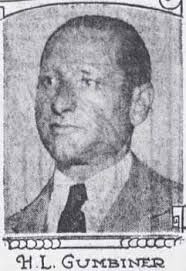
Herman Gumbinger (1879-1956), c. 1924, built Chicago’s first independent movie chain, including what became the Village Art Theatre. By the end of the 1920s, Chicago had more than thirty of these movie palace theaters. Among its holdings, Herman Gubinger and his brothers operated the New Blaine which was renamed and is today the Music Box Theatre. Public Domain.

The Germania was one of the first-generation movie theatres built at the intersection of three Chicago neighborhoods – Gold Coast to the south and east, Old Town to the north and west and Lincoln Park to the north. An architectural mix of styles including Classical Revival (triangle pediments, pilasters and cornice with dentils fashioned in terra cotta) and Renaissance Revival (rusticated exterior and round-arched windows with keystones), the movie house also incorporated Germanic symbolism in its details reflecting the area’s then prominent ethnic group. During World War One, in a wave of anti-German sentiment, The Germania Club renamed itself the Lincoln Club. It changed its name back in 1921. The Germania Theatre changed its name to the Parkside and never looked back. In 1931 until 1962 it was known as the Gold Coast theatre. Meanwhile, prohibition closed down Frank Schoeninger’s tavern and he left for Wisconsin. In the 1960’s the theatre was updated and renamed the Globe Theatre. In 1967 the building was renamed the Village Theatre after it survived being demolished by the nearby Sandburg Village development.

Sandburg Village is a Chicago urban renewal project consisting of eight high-rise buildings, a mid-rise building and 60 townhomes and artists’ lofts. The development was first occupied In 1963 and completed in 1971. In the early 1960’s the Village Theatre was to be incorporated into the project until its landowner refused to sell. PHOTO: “20190323 08 Carl Sandburg Village (49490506022)” by David Wilson from Oak Park, Illinois, USA is licensed under CC BY 2.0.
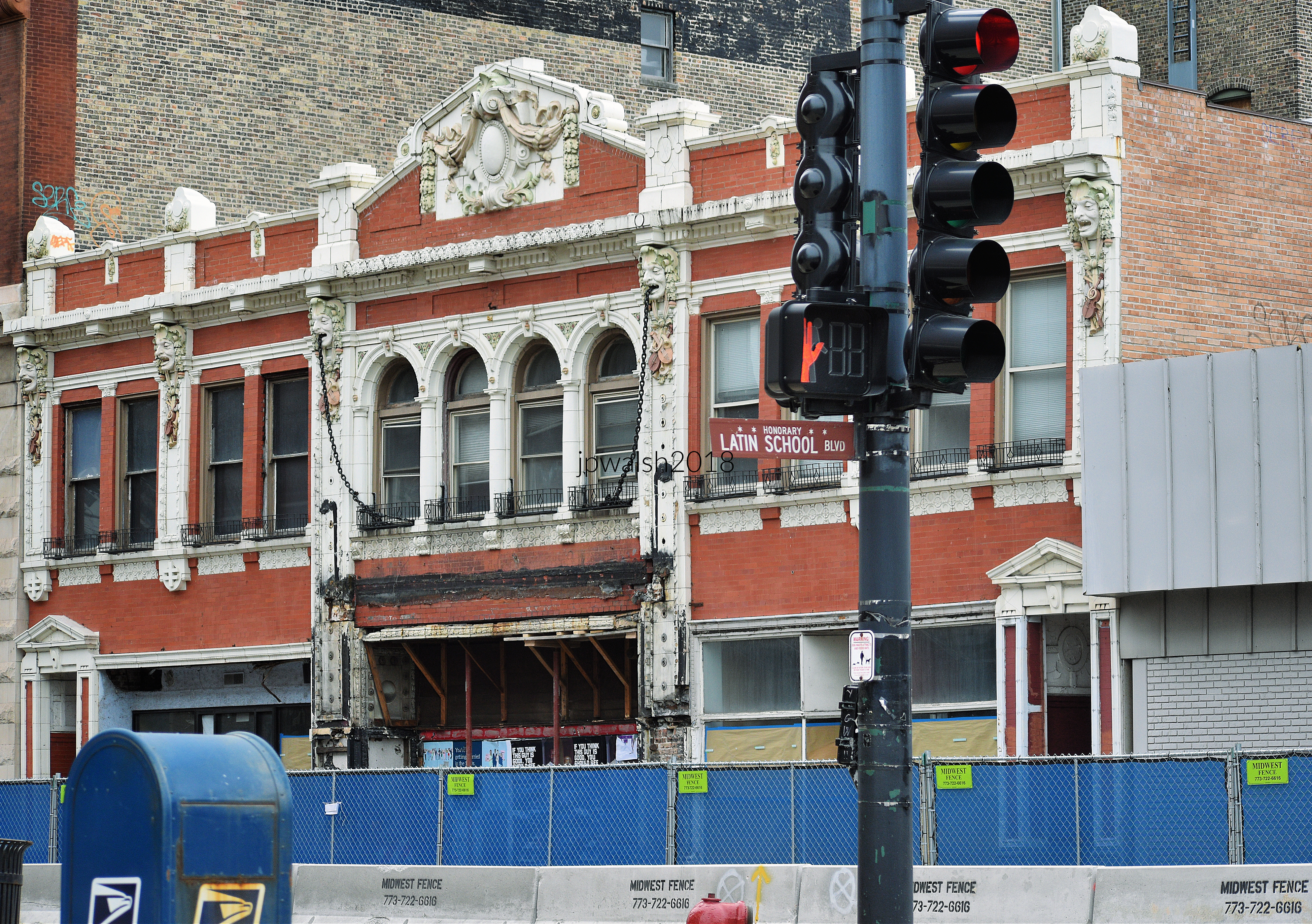
February 2018. The Village Theatre in the last days before its demolition. Its marquee from the 1960’s has been removed. The Village Theatre sat across the street from Latin School of Chicago at North and Clark Streets in Gold Coast/Old Town. In its Landmark Designation Report, the Village Theatre façade is described as having “a symmetrical arrangement, with a central theater entrance and separate entrances to the upstairs offices at opposite ends of the building. Each upper-story entrance has a deeply-recessed alcove lined with brick and white, carved-wood panels. A limestone slab step, inset with hexagonal tiles, is inside each alcove. Each alcove is framed with white terra cotta and brick pilasters on a base of gray terra cotta, made to imitate granite. The pilasters are topped with a triangular, white terra-cotta pediment.” 70% 7.93 mb DSC_4797. Author’s photograph.

The original two-story façade of red pressed brick and white beige glazed terra cotta decoration competed with a sizeable modern marquee that was removed before its demolition in 2018. Since after college I lived in Chicago for about 15 years, I recall seeing several films here. The ones I can remember seeing at the Village Theatre were Wall Street, House of Games, Fatal Attraction, Russia House, Michael Collins, and The Red Violin, among others of that period. In early 1991 the interior of the theater was divided into four screens and I didn’t stop going to movies there but just not as frequently as I did before. In April 2018, the Village Theatre and neighboring buildings along North Avenue were completely demolished to make way for construction of a condominium building. The ornate Clark Street frontage was stabilized as everything else crumbled to dust around it. The façade was repurposed to serve as the entrance for the new condo development known as Fifteen Fifty on the Park with units priced at opening at $1.625 to $5.85 million.
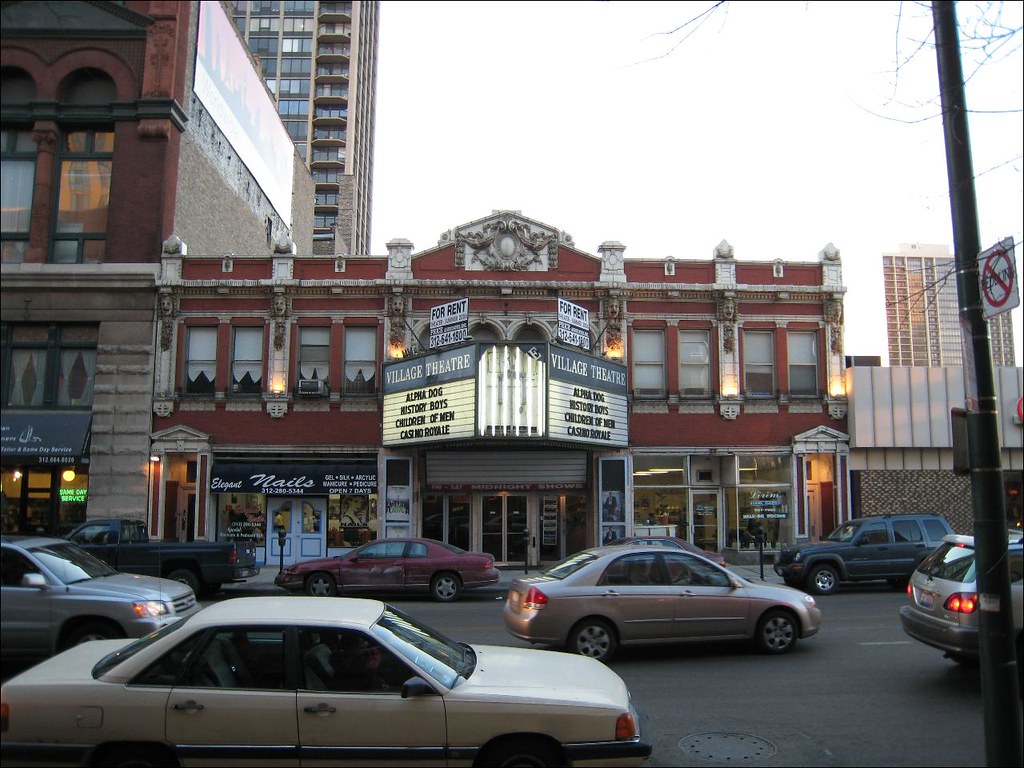
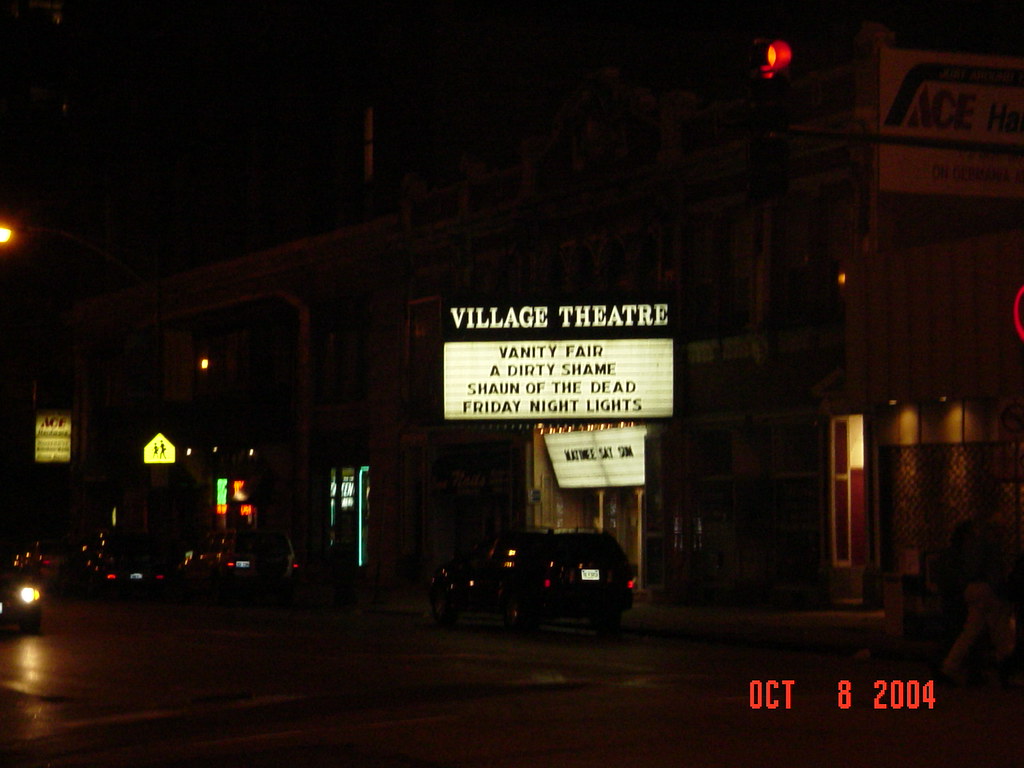
There had been at least three marquees for the Village Theatre: the original vertical Germania sign that was taken down almost as soon as it went up owing to anti-German sentiment in World War I; a horizontal, awning-style marquee like the one at the Biograph Theater (1914) at 2433 N. Lincoln Avenue in Chicago that was put up in conjunction with its existence as the Gold Coast theatre; and this prow-shaped marquee (pictured above) with steel-and glass doors believed to be part of the mid 1960s modifications when the movie house was the “Globe.” PHOTO: “Germania (Parkside, Gold Coast, Globe, Village) Theatre, Chicago, IL” by BWChicago is licensed under CC BY-NC 2.0.
The Village Theatre took the moniker Village Art Theatre after The Chicago International Film Festival used the Village Theatre as a venue to screen “art house” films starting in 1969. PHOTO: “Village Art Theatre” by BWChicago is licensed under CC BY-NC 2.0.
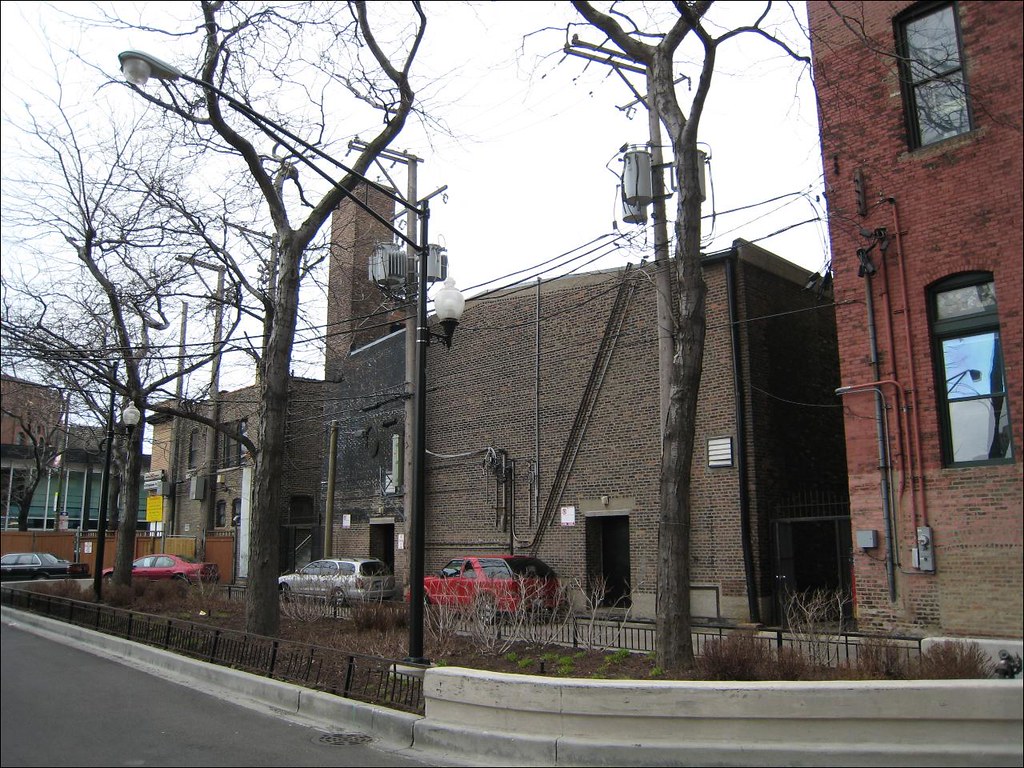
The rear of the 102-year-old Village Theatre before its impending destruction in 2018.  Germania (Parkside, Gold Coast, Globe, Village) Theatre, Chicago, IL” by BWChicago is licensed under CC BY-NC 2.0.
October 2018. Author’s collection.

This explanatory article may be periodically updated.

SOURCES:

https://www.chicago.gov/content/dam/city/depts/zlup/Historic_Preservation/Publications/Village_Theatre.pdf – retrieved May 3, 2025.

https://chicago.curbed.com/2019/2/28/18233421/condo-construction-village-theater-fifteen-fifty-park – retrieved May 3, 2025.

https://www.urbanremainschicago.com/news-and-events/2018/06/03/chicagos-historic-village-theater-reduced-to-facedectomy-after-auditorium-demolished?fbclid=IwAR1IIsjQszVYuZ2mMhNy5QD1LHLP4UcAW-SmxegKhc2xZ2BeTLJUAng4YmY – retrieved May 3, 2025.

https://cinematreasures.org/theaters/409 – retrieved May 3, 2025.

https://www.findagrave.com/memorial/107764067/adolf-woerner – retrieved May 3, 2025.

https://buildingupchicago.com/tag/avoda-group/ – retrieved May 3, 2025.

https://www.friedrich-verlag.de/friedrich-plus/sekundarstufe/schultheater/theatertheorie/maskerade-im-theater-und-im-alltag-3524 – retrieved May 3, 2025.

https://www.findagrave.com/memorial/23567141/herman_louis-gumbiner# – retrieved May 3, 2025.

https://www.chicagohistory.org/germania-club/ – retrieved May 5, 2025.

My Architecture & Design Photography: GRAHAM, ANDERSON, PROBST & WHITE, Civic Opera Building (1929), 20 N. Wacker Drive, Chicago, Illinois. (20 Photos & Illustrations).

FEATURE image: CIVIC OPERA BUILDING, 20 N. Wacker Drive, Chicago. The world famous Lyric Opera of Chicago mounts its productions in one of North America’s most beautiful opera houses, the Civic Opera House at 20 North Wacker Drive in downtown Chicago, Illinois. Author’s photograph.

Graham, Anderson, Probst & White was one of the largest architectural firms in the first half of the twentieth century. Founded in 1912, the firm was the successor to D. H. Burnham & Co. by way of partner, Ernest R. Graham (1868-1936), and Burnham’s sons, Hubert and Daniel Jr. Five years  later the Burnhams left to form their own firm (Burnham Brothers) and Graham partnered with others of the firm’s members: William Peirce Anderson (1870-1924), Edward Mathias Probst (1870-1942), and Howard Judson White (1870-1936). Pediment sculpture by Henry Hering (1874-1949).
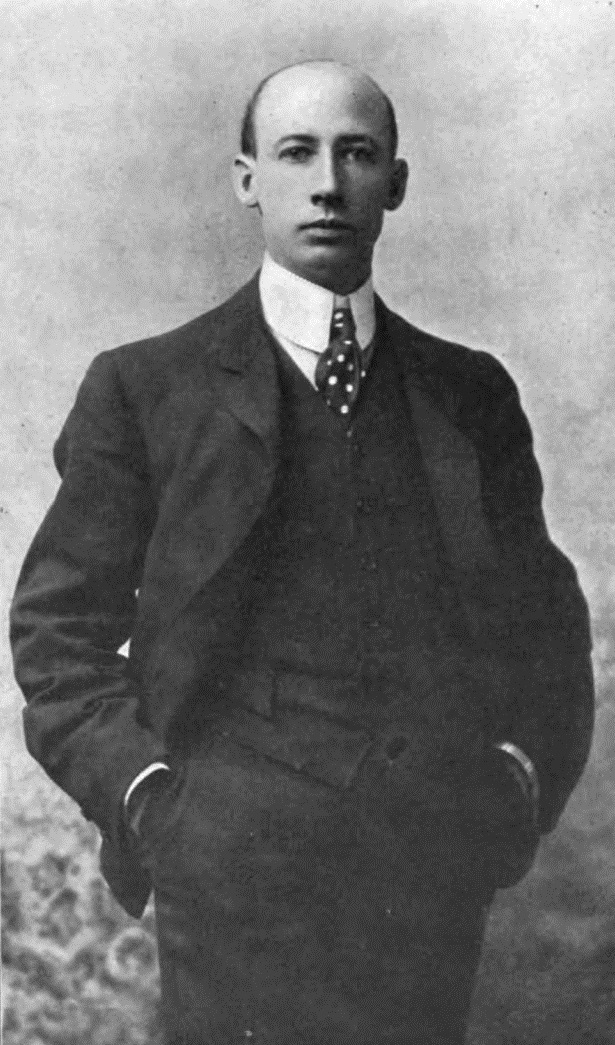
Ernest R. Graham (1868-1936)
William Peirce Anderson (1870-1924)
Edward Mathias Probst (1870-1942)
Howard Judson White (1870-1936)

Plan of Chicago Authors:

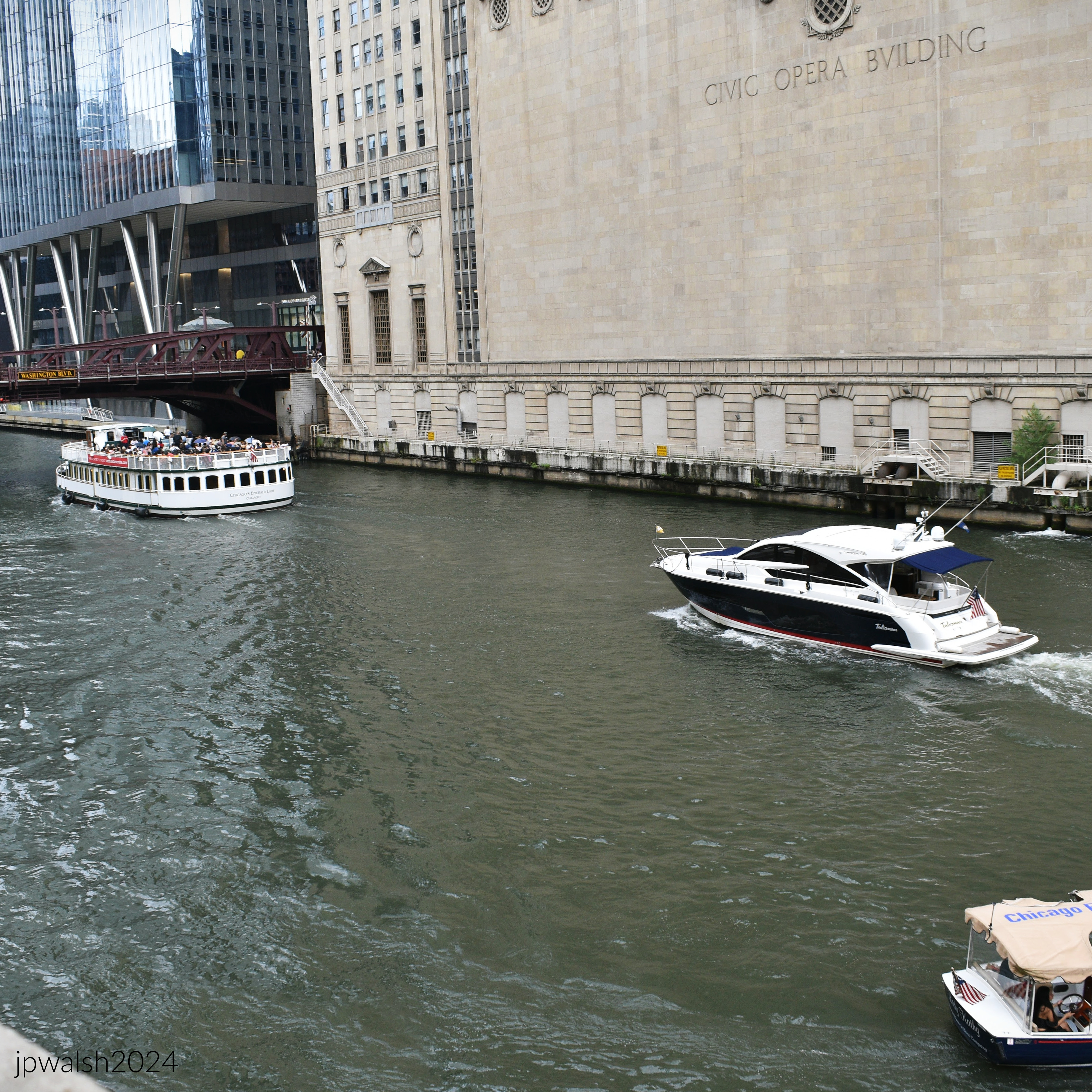
The Burnham Plan, co-authored by Daniel H. Burnham (1846-1912) and Edward H. Bennett (1874-1954) and published in 1909 encouraged making the Chicago River a focal point of building development. By 1929 massive projects including the Merchandise Mart, Chicago Daily News Building (2 N. Riverside Plaza) and Civic Opera Building (above) stood along the intersection of the three branches of the Chicago River that was part of the plan.

Daniel Hudson Burnham, c. 1890. Burnham was a great collaborator and invited architect Edward Bennett to move to Chicago to collaborate on the comprehensive plan for San Francisco, and afterwards, the Plan of Chicago. While Burnham raised money and visibility for the Chicago Plan, Bennett created the actual layouts and drawings which are so well known today. Public Domain.
The architect Edward Herbert Bennett (1874–1954) is best known as the co-author (with Daniel H. Burnham) of the Plan of Chicago, published in 1909. Bennett moved to Chicago from New York City in 1903 when he was 29 years old. Public Domain.

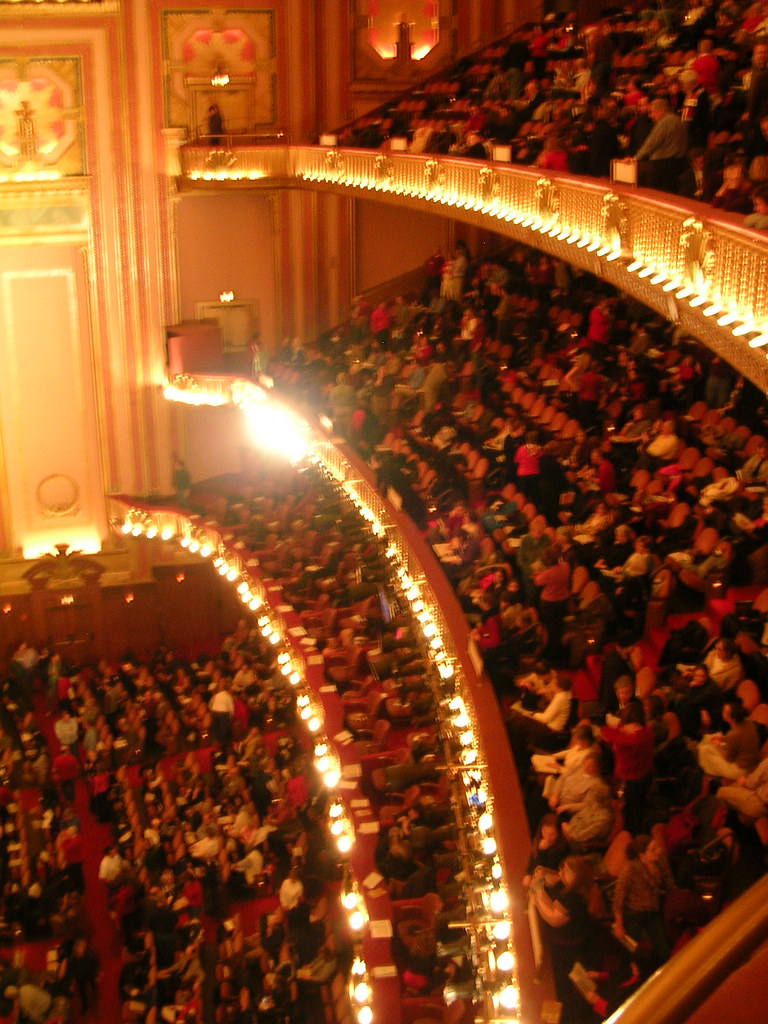
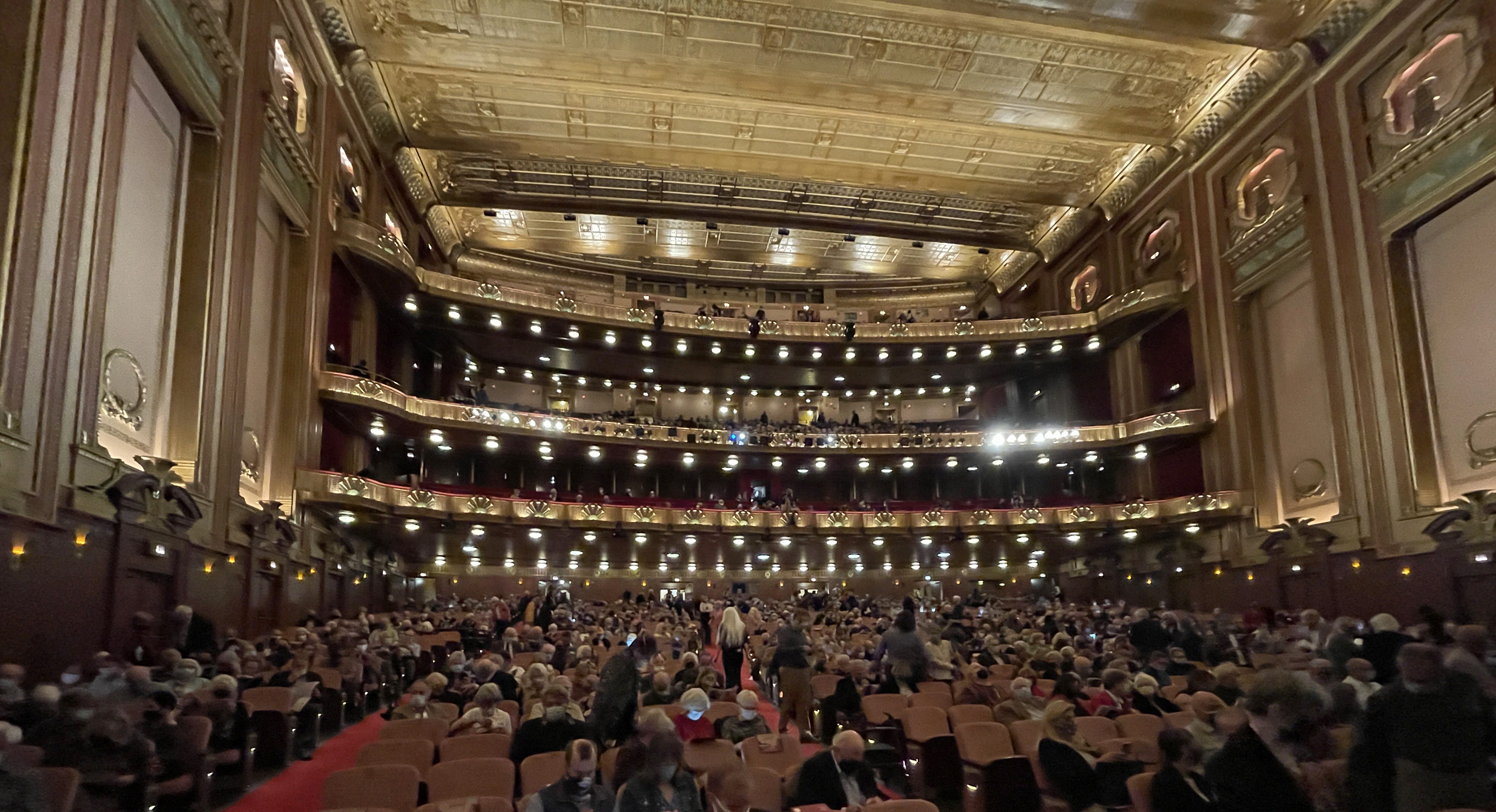
The Civic Opera Building is an office building wrapped around its theatres including a 3,563-seat opera house. It is the second-largest opera auditorium in North America after the Metropolitan Opera House in New York City. in 1996 the interior was named The Ardis Krainik Theatre in honor of Ardis Joan Krainik (1929-1997), an American mezzo-soprano opera singer and the former General Director for 15 years, who was responsible for its renovation after 1993.

The Ardis Krainik Theatre in the Civic Opera Building has 3,563 seats and is the second-largest opera auditorium in North America.Civic Opera House, Chicago” by notmargaret is licensed under CC BY-NC-ND 2.0.

Chicago opera companies have included the Chicago Grand Opera Company (1910-1914), Chicago Opera Association (1915-1921), Chicago Civic Opera (1922-1932), Chicago Grand Opera Company (1933-1935), Chicago City Opera (1935-1939), Chicago Opera Company (1940-1946), Lyric Theatre (1954-1955), Lyric Opera of Chicago (1956-). see – https://chicagology.com/opera/chicagooperahistory/ – retrieved September 20, 2024.

Masks of Comedy and Tragedy and motifs of music (lyre and trumpet) and poetry (palm leaf and laurel leaf) which appear in terra cotta on the exterior of the building are repeated in the auditorium. Jules Guérin (1966-1946) known for his watercolors of the Plan of Chicago and murals for other skyscrapers supervised the interior design. Civic Opera House (Chicago)” by Jeffrey Beall is licensed under CC BY 4.0.
Jules Guérin (1866-1946) in 1898. The artist was born in St Louis, Missouri and with his family moved to Chicago in 1880. The American muralist and interior designer was educated at the School of the Art Institute of Chicago and gained prominence for his architectural work such as his paintings for the Plan for Chicago in 1906. Guérin was noted for the large murals he painted for famous public structures such as for the Lincoln Memorial In Washington, D.C. For the Civic Opera Building Guérin supervised interior design. Public Domain.
Chicago. Civic Opera House (1929). The east elevation facting North Wacker Drive presents long and enormous covered colonnade. May 2014 2.79 mb Author’s photograph.
August 2021.The Civic Opera House main auditorium seats 3,563 and is the second largest opera house in the country after New York City’s Metropolitan Opera House that seats 3,850. 7.94 mb_9304 (1). Author’s photograph.

The impressive building and its ornamentation was the result of British-born business magnate and Chicago financier Samuel Insull (1859-1938) who was inspired by the concept of the Auditorium Building with its theatres and offices in a skyscraper-sized building designed by Adler & Sullivan in 1889 at 430 S. Michigan Avenue. Insull, the president of the Chicago Civic Opera Association, wanted to erect the new opera house as the new permanent home of the Chicago Civic Opera. The building itself is shaped like a chair and nicknamed “Insull’s Throne.”

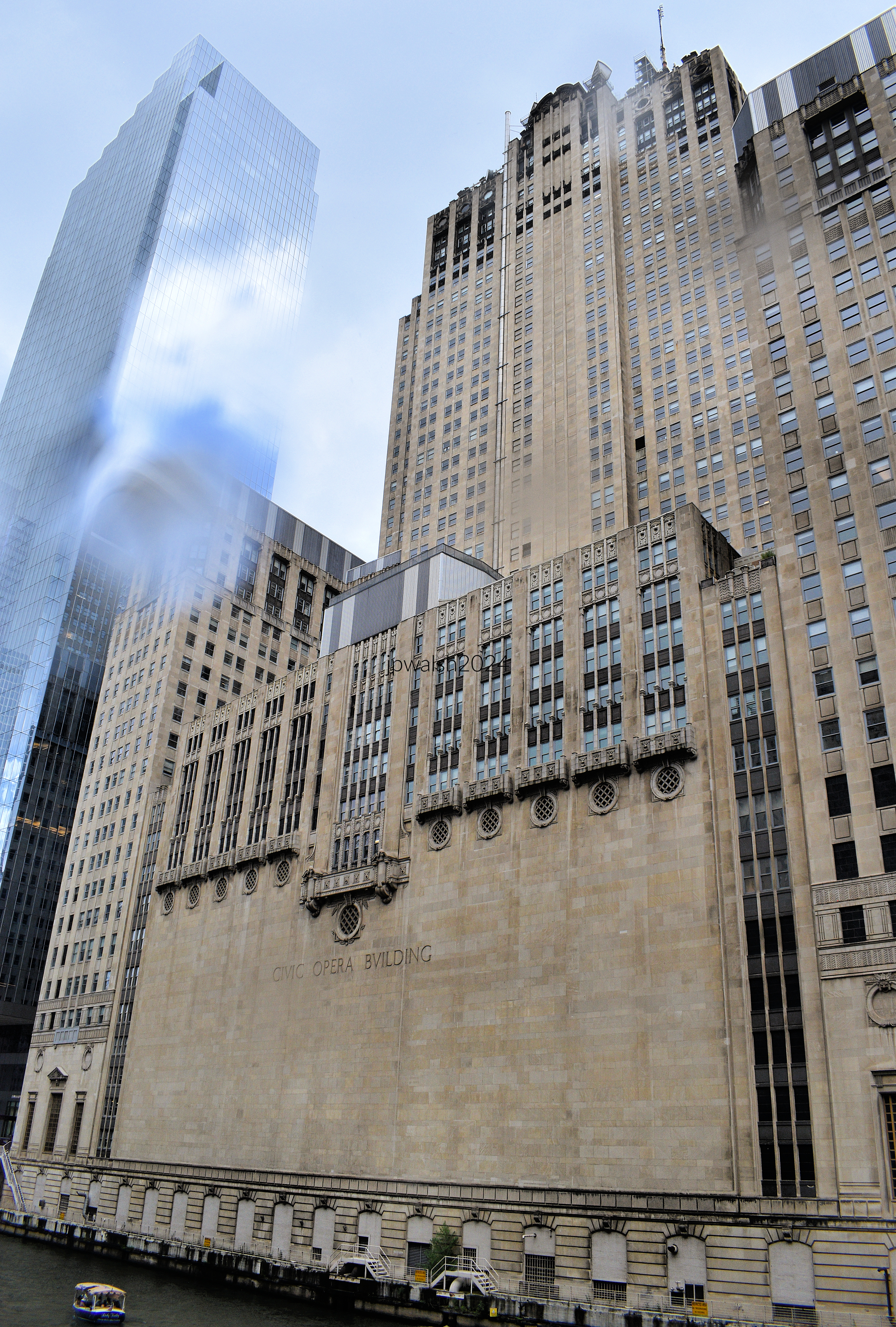
The Art Deco/Classical building’s ambition is multi-faceted – an opera house, a smaller theater, and enough office space to fill a skyscraper. The theatres are surmounted by a central tower 45 stories high flanked by two wings with the west elevation facing the Chicago River resembling a throne. August 2024 77% 7.81mb_1566. Author’s photograph.
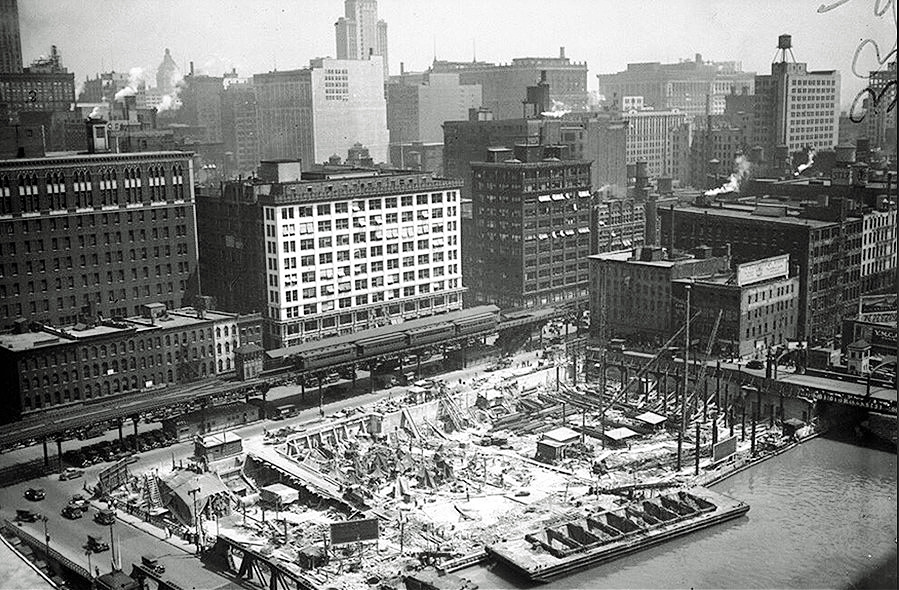
Civic Opera Building under construction in Chicago in 1928. Public Domain.
Samuel Insull was the founder of Commonwealth Edison Company in Chicago. The
Great Depression had a devastating effect on Insull’s utilities and transportation empire, due to what became an overly leveraged financial position of his main holding company (by one accounting Insull had less than a 1% cash stake). Insull’s fortunes as well as his shareholders’ were in ruins overnight and Insull quickly became a despised figure. Born in the U.K., Insull became a U.S. citizen in 1896 and now fled to France and then Greece. In October 1932 Insull was brought up on charges in the U.S. of financial malfeasance – bankruptcy, embezzlement, and using the mails to defraud investors. When he was returned to the U.S. to stand trial Insull was defended by Chicago criminal lawyer and former Illinois Supreme Court justice Floyd E. Thompson (1887-1960) and found not guilty on all counts. Insull ended his days living in Paris on a small pension from his business interests. On July 16, 1938, in the summer heat, 78-year-old Insull died of a heart attack after descending the stairs accompanied by his wife into the Place de la Concorde Métro station. Insull was buried in London eight days later. The once-populist multi-millionaire dubbed the “Prince of Electricity” who had been president of 11 power and transportation companies and sat on 65 boards was, at his death, worse than broke. According to his 1932 will, Insull held $1,000 in assets and $14,000,000 in debts.
See – “Fortune Shrank to $1,000, Samuel Insull Will Shows”. Reading Eagle. 12 August 1938 – retrieved June 29, 2024 and https://www.chicago-l.org/figures/insull/ – retrieved June 29, 2024.
Floyd E. Thompson was an Illinois lawyer and newspaper publisher who became an Illinois Supreme Court justice (term, 1919-1928) who defended Samuel Insull on charges of financial malfeasance in the 1930’s in a case that returned a verdict of “not guilty” on all counts.
August 2024. Civic Opera Building’s west elevation faces the Chicago River. 5.11 mb _1562 (1). Author’s photograph.
Civic Opera Building under construction, 1927. Public Domain.
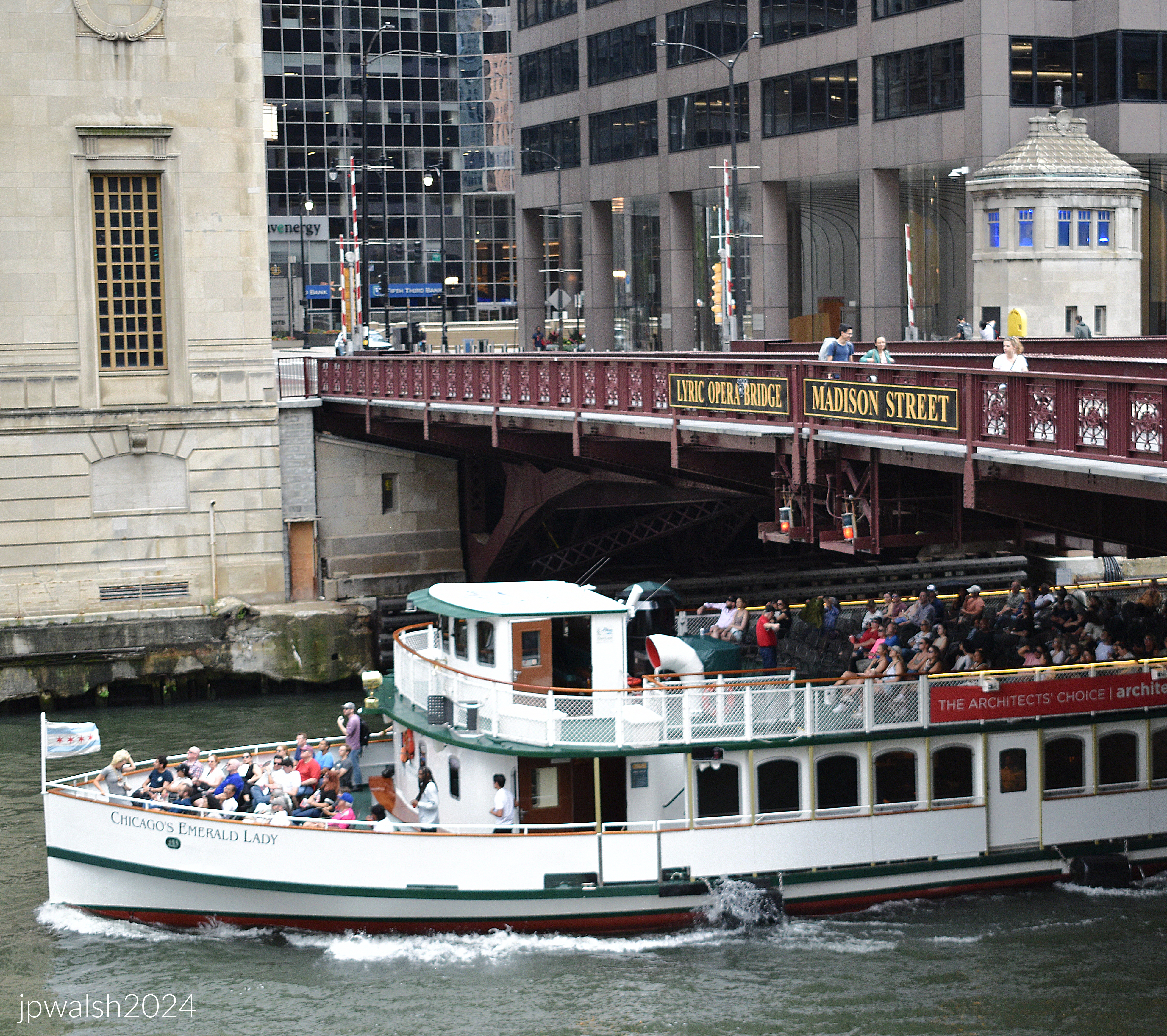
August 2021. The 1929 building occupies a block bounded by W. Madison Street (above), N. Wacker Drive, W. Washington Street and N. Wacker Drive. 99% 7.89 mb_9300. Author’s photograph.
The Civic Opera building’s Classical window casement is evident facing west at the Chicago River. The building rises 555 feet on hardpan caissons, a soil layer above bedrock. August 2024 87% 7.90mb_1560 (1). Author’s photograph.

SOURCES:

AIA Guide to Chicago, 2nd Edition, Alice Sinkevitch, Harcourt, Inc., Orlando, 2004, pages 14 and 90.

Chicago’s Famous Buildings, 5th Edition, Franze Schulze and Kevin Harrington, The University of Chicago Press, 2003, pp. 117-118.

History of Development of Building Construction in Chicago, Second Edition, Frank A. Randall, Revised and Expanded by John D. Randall, University of Illinois Press, Urbana and Chicago, 1999, p. 330-331.

Saliga, Pauline A., editor, The Sky’s The Limit A Century of Chicago Skyscrapers, Rizzoli New York, 1990, p. 152-153.

FURTHER READING: Forty Years of Opera in Chicago, Edward C. Moore, 1930.

Opera in Chicago, Ronald Davis, 1966.

My Architecture & Design Photography: R. HAROLD ZOOK AND WILLIAM F. MCCAUGHEY, The Pickwick Theatre Building, 1928, 3-11 South Prospect Avenue/6-12 South Northwest Highway, Park Ridge, Illinois. (10 Photos & Illustrations).

FEATURE Image: The Pickwick Theatre Building, an Art Deco movie palace, opened in 1928. Its marquee is one of the most recognized structures in Park Ridge, Illinois, a suburb of Chicago. The marquee became famous nationwide when it was featured in the opening sequence of the nationally syndicated television show, Gene Siskel & Roger Ebert’s At the Movies. Author’s photograph.

Pickwick architects’ rendering, exterior, 1927. Public Domain.

The Pickwick Theatre Building was designed by architectural partners R. Harold Zook (1889-1949) and younger engineer and architect William F. McCaughey (pronounced McCoy). The complex includes a movie auditorium, restaurant, storefronts and offices. Both architects apprenticed under Howard Van Doren Shaw (1869-1926), a leading Arts and Crafts architect and early colleague to Frank Lloyd Wright. Zook and McCaughey did significant work in other affluent Chicago suburbs and out of state. Zook designed homes in Iowa, Wisconsin, and Illinois, including his own quirky home in Hinsdale, Illinois, in 1924 where he resided until his death in 1949 (see –https://www.ourmidland.com/realestate/article/Designed-by-R-Harold-Zook-This-Quirky-Illinois-16056515.php – retrieved April 25, 2023). Zook’s public buildings included the St. Charles Municipal Building (1939) and the DuPage County Courthouse (1937). Zook and McCaughey had also partnered to design and build Maine East High School (1927). For a photograph of R. Harold Zook, see-http://www.zookhomeandstudio.org/r-harold-zook.html – retrieved April 25, 2023. McCaughey was born in Virginia and came to Illinois in 1916. He made his home in Park Ridge for many years and maintained an office in the new Pickwick Theater Building he designed.

The Pickwick Theater Building, 1928, floorplan. “Pickwick Floor Plan” by BWChicago is licensed under CC BY 2.0.

Originally, the theater had a seating capacity of 1,450. The tower is 100 feet tall with a decorative limestone sunburst carving and capped by an ornamental 15-foot iron lantern. The sunburst is filled by stained glass while on each side of the central tower are two shorter matching pedestals capped with their own lanterns. The building faces both Northwest Highway and Prospect Avenue in nearly equal dimensions (the Prospect side is about 12 feet longer).The building is capped by a cornice with dentils as its second-floor window bays are separated by art deco piers. Each façade meets at a rounded corner. The base of the tower is met by its massive cast-iron theatre marquee.

Pickwick Exterior, 1929 “Pickwick Exterior 1929” by BWChicago is licensed under CC BY 2.0.
The marquee became famous nationwide in 1983 when it was featured on syndicated television in the opening sequence for Siskel & Ebert’s “At the Movies.” It was restored to its original 1928 appearance in 2012. Author’s photograph.
Episode from 1983 of “At the Movies” reviewing XTRO, Octopussy, La Truite, Hollywood Outtakes & Angelo My Love.
Ticket Booth, Pickwick Theater.
Ticket Booth, Pickwick Theater” by anneinchicago is licensed under CC BY-NC-ND 2.0.

The Pickwick Theater Building was erected at a major intersection not far from today’s Metra Union Pacific line commuter railroad station. By 1930, when the theater building was new, the population of Park Ridge had grown to 10,000 residents. (In 2020 there were almost 40,000 residents).

Classic Art Deco

In addition to being on the National Register of Historic Places, The Pickwick Theater Building is noted for its Art Deco style of architecture. Art Deco is defined by its emphasis on geometric designs, bright colors, and a range of ornament and motifs. Zook and McCaughey’s romantic style demonstrates that they were as much artists as architects evident in their distinctive designs, use of natural materials, and quality of craftsmanship.

The marquee before its restoration to its original colors of 1928. “Pickwick Theatre” by swanksalot is licensed under CC BY-NC-SA 2.0.
Alfonso Iannelli and wife, 1916. The artist’s home and studio at 255 N. Northwest Highway was literally half a mile away from the new movie palace in Park Ridge. Public Domain.

Sculptor and designer Alfonso Iannelli (1888-1965), who maintained a studio and home in Park Ridge, contributed much to the Pickwick’s interior architecture and ornamentation. Iannelli ‘s decorative work for the building extended to the sculptures, murals, fire curtain, plaster panels, and even its Wurlitzer organ console as well as the cast-iron marquee outside. In 1990, the theater expanded the Pickwick’s screenings without altering the original auditorium while the marquee’s original 1928 red-and-gold color scheme and treatment was restored in 2012.

Pickwick Lobby 1929. “Pickwick Lobby 1929” by BWChicago is licensed under CC BY 2.0.
Pickwick Auditorium. “Pickwick SAIC 2 Auditorium copy” by BWChicago is licensed under CC BY 2.0.

On December 6, 2022 it was announced the Pickwick Theatre would be closed in January 2023. At the time of this post’s publishing, the theatre was still open and showing a roster of new films. See – https://www.pickwicktheatre.com/  – retrieved April 25, 2023.

SOURCES:

Alice Sinkevitch, AIA Guide to Chicago, 2nd Edition, Harcourt, Inc., Orlando, 2004, p. 417.

https://patch.com/illinois/niles/bp–an-architect-of-pickwick-theater-comes-alive-when6e80d3da3c – retrieved April 25, 2023

https://www.journal-topics.com/articles/history-behind-home-next-up-for-park-ridge-landmark-status/ – April 25, 2023.

https://www.parkridgehistorycenter.org/wp-content/uploads/2012-January-Lamppost.pdf – retrieved April 25, 2023.

http://cinematreasures.org/theaters/302 – retrieved April 25, 2023

https://www.chicagotribune.com/suburbs/park-ridge/ct-prh-pickwick-closing-tl-1208-20221206-efuvojzgxvasbov645x5ophedm-story.html – retrieved April 25, 2023.

https://maps.roadtrippers.com/us/park-ridge-il/entertainment/pickwick-theatre

Capitman, Barbara, et al. Rediscovering Art Deco U.S.A.: A Nationwide Tour of Architectural Delights.New York: Viking Studio Books, 1994.

http://www.zookhomeandstudio.org/r-harold-zook.html

Green, Betty. Zook: A Look at R. Harold Zook’s Unique Architecture. Chicago: Ampersand, Inc., 2010.

Jameson, David. Alfonso Iannelli: Modern by Design. Oak Park, IL: Top Five Books, 2013. Alfonso Iannelli: Modern by Design (Top-Five-Books, 2013) 

Preservation Real Estate Advisors. Pickwick Theater Building Nomination for Landmark Designation.Park Ridge, IL: Park Ridge Historic Preservation Commission, 2010.

https://www.ourmidland.com/realestate/article/Designed-by-R-Harold-Zook-This-Quirky-Illinois-16056515.php

Yanul, Thomas G., and Paul E. Sprague, “Pickwick Theater Building,” Cook County, Illinois. National Register of Historic Places Inventory–Nomination Form, 1974. National Park Service, U.S. Department of the Interior, Washington, D.C.

https://toomeyco.com/artist/alfonso-iannelli/

https://sah-archipedia.org/buildings/IL-01-031-0068

My Architecture & Design Photography: S. CHARLES LEE (1899-1990). The Loma Theatre (1944-46), 3150 Rosecrans Boulevard; San Diego, California. (4 Photos & Illustrations).

FEATURE image: The Loma Theatre with its vertical sign in San Diego, California. was opened in 1945. This is a true transitional/hybrid building for American architect S. Charles Lee. The architect retains the curves (in the sign) of his pre-war theatre buildings and moves to the angles (in the main structure) that increasingly marked his movie theatres post war. The Loma Theatre was built in the later part of Lee’s career and is one of the scores of movie theatres built by the architect between 1926 and 1950. It was operated by Mann Theatres from 1973 until it closed on December 17, 1987. In San Diego’s Midway District, the Loma Theatre had a reputation of being a friendly, classy place (see video below). Author’s photograph, October 1999 60%.

The Loma Theatre was designed by S. Charles Lee (1899-1990) and opened on May 5, 1945 with its first feature, 20th Century-Fox’s Technicolor musical film, Diamond Horseshoe, starring Betty Grable. While the year 1936 was the most prolific year for Lee’s building designs – no less than 32 individual structures in California – the years 1945-46 of which the Loma Theatre is a part were prolific with 17 new movie theatres erected in California as well as one each in Arizona (250 seats), Miami, Florida (2000 seats), and Managua, Nicaragua (2000 seats). The Loma Theatre was originally opened with 1,188 seats.

Betty Grable was a 1940’s musical star. The Loma Theatre opened their doors with “Diamond Horseshoe,” a Technicolor Fox musical that was very successful at its release.Betty Grable, 1940s musical star” by Movie-Fan is licensed under CC BY-NC-SA 2.0.

S. Charles Lee was one of the foremost mid20th-century architects of movie houses on the West Coast. Simeon Charles Levi was born and grew up in Chicago. There Lee worked for Rapp & Rapp, the renowned Chicago architectural firm that specialized in movie theatre design. Rapp & Rapp’s significant work in this period included State Street’s Chicago Theatre in 1921, and the Bismarck Hotel and Theatre, and the Oriental Theatre both in 1926.

S. Charles Lee was born in Chicago who had a prolific and successful career as a motion picture theatre archtitect and designer, particularly in the large state of California. Lee was a pilot who often flew to job sites for time efficiency. That it also impressed clients was not missed. Fair use.

The Loma Theatre’s architect was influenced by Louis Sullivan (1856-1924) and Frank Lloyd Wright (1867-1959). In 1922, before moving to Los Angeles, Lee was impressed by the Chicago Tribune building competition on North Michigan Avenue whose competitors juxtaposed historicism, such as the Beaux-Arts, with modernism. Lee considered himself a modernist, and his design career expressed the Beaux-Arts discipline and a modernist functionalism and freedom of form.

S. Charles Lee who developed his own style for his movie theatres in California was originally inspired by leading Chicago modern architects who he worked for and studied as a young architect.

Beginning his career in California in the 1920’s, by the 1930’s S. Charles Lee was the principal designer of motion picture theaters in Los Angeles. Throughout the 1930s and 1940s, Lee is credited with designing many hundreds of movie theaters in California, including San Diego’s Loma Theatre at 3150 Rosecrans Boulevard.

Mann Theatres operated it from 1973 to December 1987. Its last feature was Paramount Pictures’ Fatal Attraction, starring Michael Douglas and Glenn Close. The Loma ’s vintage signage is intact along with some of its movie-house interior although today it serves as a bookstore. For other interesting memories of this friendly and classy movie house, see – http://cinematreasures.org/theaters/1716– retrieved December 29, 2022.

Architect S. Charles Lee in the early 1920s. Public Domain.

My Architecture & Design Photography: RAPP & RAPP. Oriental Theatre (1926), 24 W. Randolph Street, Chicago, Illinois. (3 Photos).

FEATURE image: Oriental Theatre completed in 1926 and renamed the Ford Center for the Performing Arts in 1997. It became the Nederlander Theatre in 2019. Author’s photograph taken in December 2017.

Chicago. Ford Center For The Performing Arts/Oriental Theatre, 12/2017 5.0 mb

In Chicago’s Loop, the Oriental Theatre opened on May 8, 1926. In the first half of the 20th century, Randolph Street was one of the city’s most bustling entertainment districts.

Designed by the architectural firm of Rapp & Rapp—brothers Cornelius Ward (C.W.) Rapp (1861-1926) and George L(eslie) Rapp (1878-1941)—the Oriental Theatre was one of their many ornate movie palaces that they built. As its name implied, it was imagined in a style inspired by a Western fantasia of India and South Asian themes and motifs. Inspired by the architecture of India and the Far East, lights consisted of elephant heads with tusks, the walls were adorned with soft silk and regal velvets, and the ceiling was  garishly decorated with plasterwork elephants and other exotic beasts. 

James M. Nederlander Theatre. Originally the Oriental Theatre. George L. and Cornelius W. Rapp, 1926.James M. Nederlander Theatre interior” by Kenneth C. Zirkel is licensed under CC BY-SA 4.0.

Rapp & Rapp were alumni of the University of Illinois School of Architecture. The firm designed scores of theatres across the country in the first decades of the 20th century. The Rapp brothers were born in Carbondale in southern Illinois. Twenty-eight-year-old C.W. Rapp formed a partnership in 1889 with older architect, Canadian-born Cyrus P. Thomas (1933-1911) and they practiced together in Chicago until 1895. C.W. Rapp operated his own office for a decade until he formed a partnership with his brother G.L. Rapp in 1906. With stage entertainment and the boom of moving pictures after 1910, the firm of Rapp & Rapp quickly developed a reputation for their fantastic designs for silent film theatres in the Chicago area. Drawing on a large palette of architectural revival styles, Rapp & Rapp designed nearly four hundred theatres in the United States between 1906 and 1926.

In Chicago Rapp & Rapp designed notably State Street’s Chicago Theatre (1921) and the Bismarck Hotel and Theatre (1926). In New York City they built the since demolished Paramount Theatre (1926) in Times Square and the still-standing smaller-scaled Paramount Theatre (1931) in Aurora, Illinois.

In the mid1990s, after the Oriental Theatre had been closed and shuttered for over a decade, it underwent a multi-million-dollar restoration and expansion by Daniel P. Coffey & Associates. It reopened as the Ford Center for the Performing Arts in 1998. Following its expansion, the former Oriental Theatre seats over 2,000 patrons.

Entertainment legacy.

In the 1920s, the Oriental Theatre presented both movies and vaudeville acts. When talkies arrived, the Oriental Theatre became predominantly a movie house in the 1930s. Live stage, theatrical, and concert performances continued for mid20th century Chicago audiences during an era when Randolph Street was a mecca for crowds seeking out their favorite star performers. It also hosted smaller and vibrant live entertainment venues where one could seek out up-and-coming talents.

Duke Ellington and his orchestra made frequent appearances at the Oriental Theatre which welcomed patrons by way of an exotic ornate style. Some big names and legends in entertainment were seen at the Oriental Theatre including Judy Garland, George Jessel, Fanny Brice, George Burns and Gracie Allen, Cab Calloway, Eddie Cantor, Bing Crosby, Ella Fitzgerald, Jean Harlow, Billie Holiday, Bob Hope, Al Jolson, Danny Kaye, Jerry Lewis, The Marx Brothers, The Three Stooges, Frank Sinatra, Sophie Tucker, Sarah Vaughan, Henny Youngman, and a cast of thousands.

The Oriental Theatre closed in 1981 and remained shuttered for the rest of the 1980’s and into the early 1990’s depriving many young urban professionals from enjoying entertainment in a venue that, with its reopening in 1998, has operated continuously for nearly 100 years.

Ford Center for the Performing Arts in 1997 and the Nederlander Theatre in 2019.

In 1997 the Oriental Theatre was renamed the Ford Center for the Performing Arts and restored and expanded for its re-opening in 1998. In 2019 the theatre was renamed in honor of James M. Nederlander (1922-2016), Broadway theatre owner/producer and Broadway In Chicago founder.

Today’s James M. Nederlander Theatre hosts touring pre-Broadway and Broadway shows whose résumé included a long-running production of Billy Elliot: The Musical. From June 2005 through January 2009, the theater housed a full production of Wicked, making it the most popular stage production in Chicago history. In December 2017, when the feature photograph was taken, a traveling national tour of Wicked had started its Chicago run.

Chicago. Oriental Theatre sign. 7/2016 4.63 mb

SOURCES:
Alice Sinkevitch, AIA Guide to Chicago, 2nd Edition, Harcourt, Inc., Orlando, 2004, p. 54.

http://www.dictionaryofarchitectsincanada.org/node/1354 – retrieved November 1, 2023.

http://www.dictionaryofarchitectsincanada.org/node/541 – retrieved November 1, 2023.

https://www.sah.org/community/sah-blog/sah-blog/2013/07/17/the-revitalized-and-the-neglected-rapp-and-rapp’s-movie-palaces-in-chicago– retrieved November 1, 2023.

Photograph & Text: