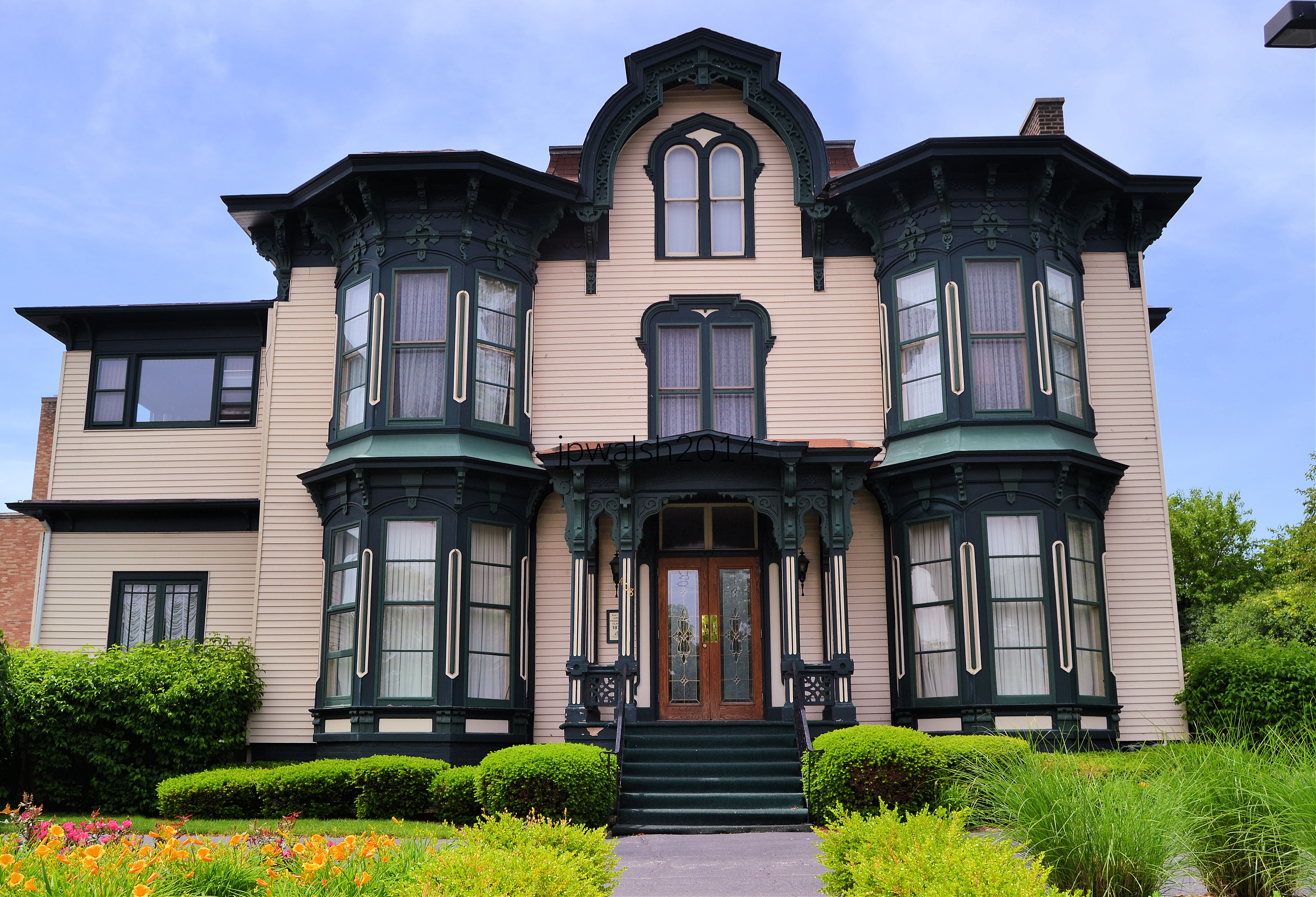
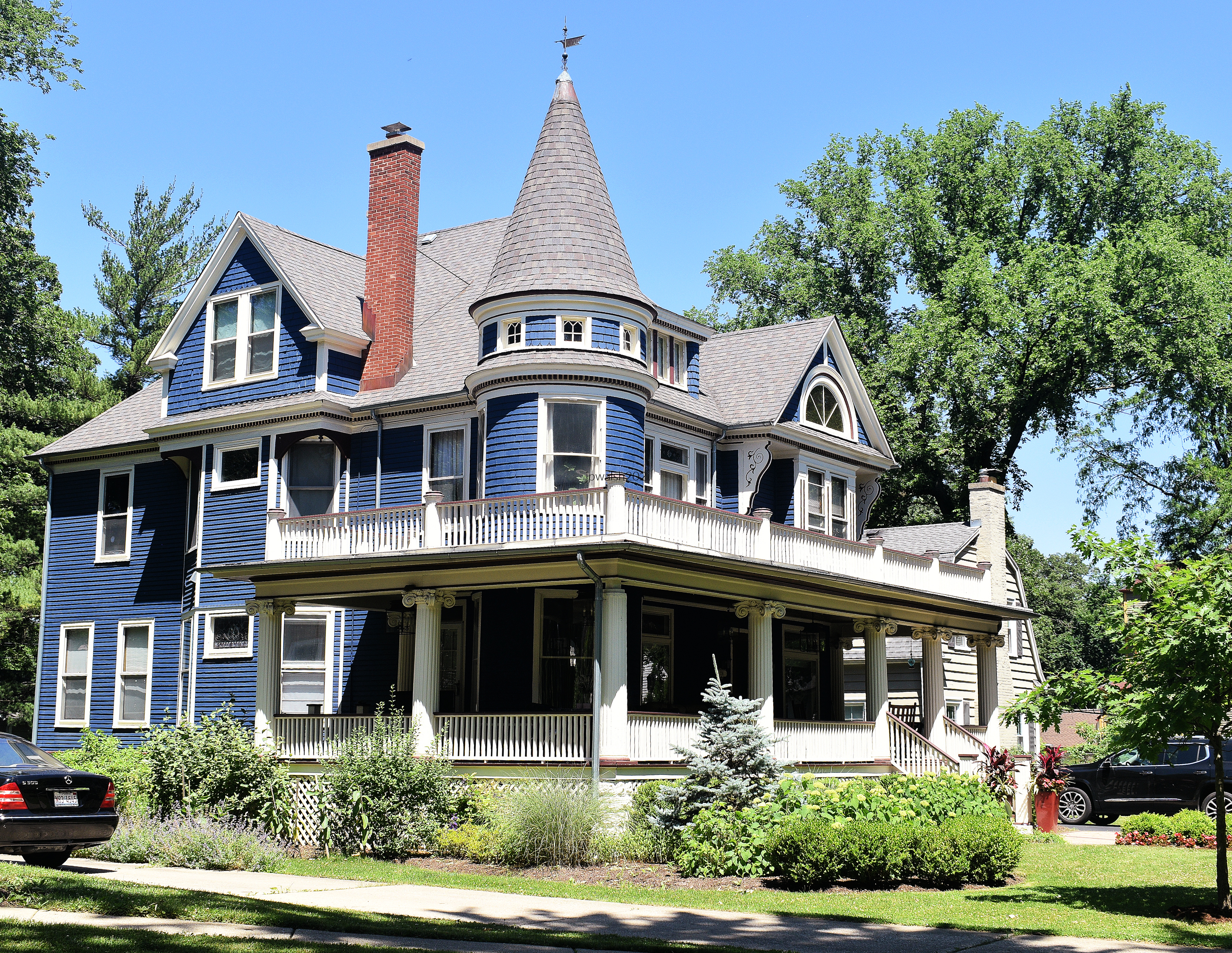
FEATURE Image: 1432 Forest Avenue, Evanston, IL, 1885. Stylish single family home, nearly 5,000 square feet, has 6 bedrooms and 3.5 bathrooms. Author’s photograph. 6/2022 7.7.mb 53%
Text & Photographs John P. Walsh.
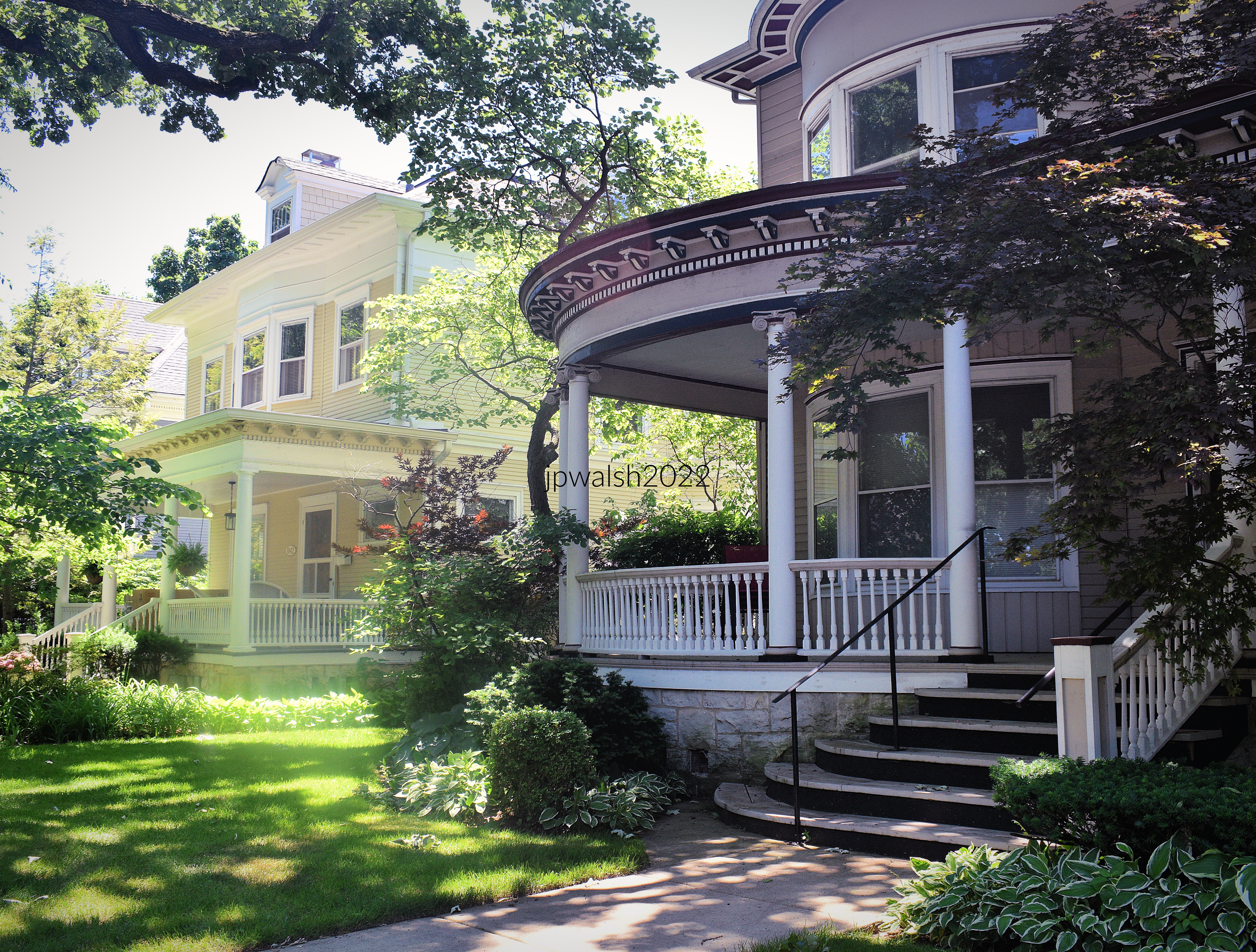
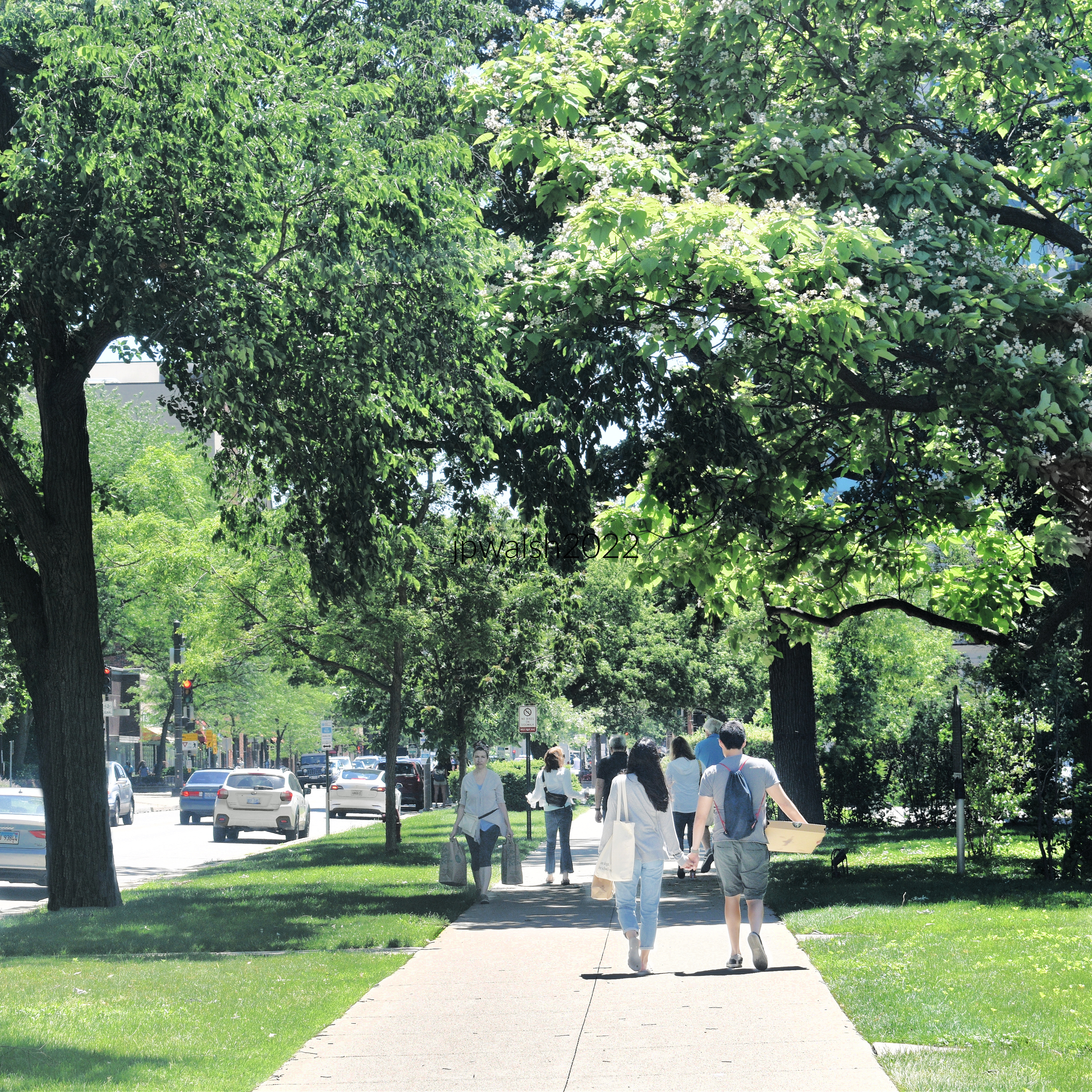
1032 and 1034 Michigan Avenue, 1899. Double house designed by Myron Hunt (1868-1952) shortly before he relocated his practice to Los Angeles, CA. Each shingled dwelling is given a distinctive design. The northern side has a projecting porch and two-story polygonal bay. The southern side has a recessed porch. The house is tied together by a single gable with a quartet of double-hung windows and a cornice part of which is integrated to the polygonal bay. 6/2022. 7.84mb 70%Myron Hunt (1868-1952) in February 1905. The American architect did numerous projects which are noted landmarks in Southern California and Evanston, Illinois. Born in Massachusetts he moved to Chicago and attended Northwestern University and later MIT where he graduated in 1893. Traveling and studying in Europe, he returned to Evanston where he worked as a draftsman in the local office of the Boston firm of Shepley, Rutan and Coolidge. In 1903 Hunt moved to Los Angeles, where he entered into a partnership with architect Elmer Grey (1871–1963). Opening an office in Pasadena, the firm of Hunt and Grey built houses for the wealthy. These included the summer ranch house for cereal magnate Will Keith Kellogg (1860-1951) in Pomona, CA, nearby to Los Angeles. Hunt and Grey also built hospitals, schools, churches and hotels. Public Domain.1026 Michigan Avenue, 1915. Prairie style house designed by John Van Bergen (1885-1969) in 1915. The Oak Park, IL-born American architect did numerous such stylish house projects from DeKalb, IL, to Winnetka, IL in the 1910’s. 6/2022 7.78mb 79%Architect John Van Bergen (above in c. 1927) was born and grew up in Oak Park, IL. He began his career as an apprentice draftsman working with Walter Burley Griffin (1867-1937) and for Frank Lloyd Wright (1867-1959) at his Oak Park Studio. Van Bergen’s early projects, mostly in Oak Park, were predominantly residential and largely in the Prairie School style, which he learned in Griffin’s and Wright’s studios. See- https://highlandparkhistory.com/highland-park-legends-program/john-van-bergen/ – retrieved December 5, 2023. Public Domain.1049 Michigan Avenue, 1910. The Prairie-style house was designed and built by C.H. Thompson, a local developer. It is a basic block with a hipped roof, albeit on a grand scale and with dormers and porch projects that emphasize horizontality along with typical Prairie hoods. There is stucco façade with brick detailing of varying geometric design patterns. 6/2022 7.95 mb 88%1010 Michigan Avenue, 1911. The Tudor style brick mansion was designed by Ernest Mayo (1864-1946). Once sitting on an even more expansive corner lot, Mayo designed the house and garden together. 6/2022. 7.91mb 65%Another view of 1010 Michigan Avenue. Built in 1911, it is one of Evanston’s most formal examples of the popular Tudor Revival style whose design takes inspiration from Elizabeth I manor houses and is imposing. It is a symmetrical and complex design of porches, bows, gables, chimneys and window groupings. Architect Ernest Mayo was born in Birmingham, England in 1864 and began his career in South Africa. Mayo immigrated to Chicago in 1891 where he established the firm of Mayo and Curry. The Chicago firm designed factories, hotels, and office buildings, and Mayo worked on administrative buildings for the 1893 World’s Columbian Exposition. Mayo split with Curry and worked independently until he partnered with his 24-year-old son Peter Mayo in 1919 to form Mayo and Mayo. While Ernest Mayo received his architectural apprentice training in England, Peter received his degree from Yale University and further design education at The Art Institute of Chicago. See – https://www.winnetkahistory.org/gazette/140-sheridan-road-2/ and https://prabook.com/web/ernest.mayo/1717173 – retrieved December 5, 2023. 6/2022. 7.63mb 66%Interior room, Dawes Mansion, 225 Greenwood Street, 1894. Designed by New York architect Henry Edwards Ficken (1852-1929), the house sits on a large lot overlooking Lake Michigan. The basic square block building is met by round tourelles on each corner with conical roofs that meet the same height of the main block’s hipped roof. The Châteauesque-style house was bought by Charles Gates Dawes (1865-1951) who was vice-president under Calvin Coolidge and, with its stunning cherry paneling, is furnished much as it was during Dawes’ residency. 10/2015 4.20mb“Charles Gates Dawes House, Evanston, Illinois” by StevenM_61 is licensed under CC BY-NC-ND 2.0.1037 Michigan Ave, Evanston, IL, 1895. 6/2022 7.52mb 99%940-950 Michigan Avenue, 1927. Michigan-Lee apartment building was erected by N.J Lareau and associates and sits on a 20,000 square foot lot on the southwest corner of Michigan and Lee. Georgian Colonial is the style of architecture for the new structure which is made of red brick and Bedford stone. The structure was built to house 24 total apartments: three 7-room, three 6-room, fifteen 5-room, and three 4-room apartments. https://www.archinform.net/arch/202206.htm and http://www.michiganleecondoassociation.com/history.html – retrieved November 28, 2023. The swanky apartment complex was designed by Frank William Cauley (1898-1984) architect and lawyer. 6/2022. 7.68mb 66% Frank Cauley, architect of the Michigan-Lee building (above) in 1927, graduated from the Armour Institute of Technology in 1922. Before he received his license to practice architecture, he designed the $2,000,000 three-hundred room (each with its own bath) Orrington Hotel in 1923 in Evanston, Illinois, for local developer Victor Ca[r]landrie Carlson. Carlson built the Carlson Building on Church Street in downtown Evanston as well as two landmark hotels, including The Library Plaza Hotel in 1922. Cauley went into business on his own, practicing until the 1929 crash. In the depression years he went to law school in Chicago and received his L.L.B. in 1938. In April 1969, the Illinois Institute of Technology awarded him a J.D. https://undereverytombstone.blogspot.com/2015/10/he-left-his-mark-on-downtown-evanston.html – retrieved November 28, 2023“The Hotel Orrington” by Mark Blevis is licensed under CC BY-NC-SA 2.0.Evanston front porches. 6/2022 7.80mb 79%1210 Michigan Avenue, 1880. Started as a simple clapboard farmhouse one block from Lake Michigan. there have been several expansive additions since that time The front exterior is marked by a simple veranda with grouped struts in the lintel which is supported by turned posts.6/2022 7.68mb 75%1332 Forest Avenue Evanston, IL, 1894, is a stylish home with several additions on an expansive corner lot. 6/2022 7.32mn 90%1005 Michigan Avenue, 1913. The light-colored brick house is Colonial Revival with modifications is by Howard Van Doren Shaw (1869-1926). The façade’s symmetry is prominently displayed in its 5 equal openings for its two main floors and topped by a shortened pitched roof with three flat-roofed dormers. A chimney protrudes at the roof line to the north. For the main mass there are aligned windows with a middle opening for both the first and second floor symmetrically displaying diverse residential functionality: a broad-arched porchway and genteel fanlight above a double door entry on the first floor and, at the second level. a wrought iron balcony providing a small, mainly decorative step landing. The great house is situated on the northeast corner lot of a leafy yet trafficked suburban residential intersection, with the main building’s symmetry broken to the south by the then-popular sun porch extension. It is a low, two-story flat-roofed projection with an enclosed porch on the first floor and an open porch originally on the upper level. 6/2022. 7.58mb 73% Howard Van Doren Shaw (1869-1926). Public Domain.Evanston fashion, c. 1918. Most Evanstonians used local dressmakers and tailors to have their clothes made. The white cotton summer dress with embroidery and lace insertions and natural waistline was typical for the era. 10.2015 4.24mb“Northwestern University Gate” by AcidFlask is licensed under CC BY-NC-SA 2.0.Chicago Avenue at Clark Street. Evanston is home to Northwestern University. 6/2022 7.84mb 87%“Fortress Northwestern: University Library and Norris University Center, June 1977” by A.Davey is licensed under CC BY 2.0. Divvy bike (with basket!) to get around campus and the neighborhood. 6/2022 7.77mb 83%The longtime Chicago-Main Newsstand at 860 Chicago Avenue in Evanston is open 7 days a week from 7:00a.m. – 10:00p.m. 6/2022 7.74mb 85%Left: 1730 Chicago Ave, Evanston, IL Built in 1865, it was the home of Frances Willard (1839-1898) and her family and was the headquarters of the Woman’s Christian Temperance Union. 6/2022 7.73mb 88%Grosse Point Lighthouse, 1873, is a tapering column to a catwalk supported by Italianate brackets built by the U.S. Government. The lighthouse marks the approach into Chicago. The promontory on which it stands was named Grosse Point in the 17th century by French explorers and the area was mapped in 1673 by Louis Jolliet and Father Jacques Marquette, a Jesuit missionary. The lighthouse is topped by a polygonal glass lantern containing the light and lens. See – http://www.grossepointlighthouse.net/history.html – retrieved December 5, 2023.6/2014 4.03mb
Sources:
A Guide to Chicago’s Historic Suburbs on Wheels and on Foot, Ira J. Bach, Swallow Press/Ohio University Press, 1981, pp. 499-530.
FEATURE image: 946 N. Sheridan Road, Waukegan, Illinois 1876. A fuller description of this house whose appearance is almost out of a 19th century novel is found in the post below. All text & photographs by author.
INTRODUCTION.
Waukegan, Illinois, is an historic community on Lake Michigan about 40 miles north of downtown Chicago. It is one of the oldest settlements in Illinois. The site of the city was visited by French explorers Louis Jolliet (1645-1700) and Père Jacques Marquette, S.J. (1637-1675) in 1673 where Waukegan began as a French trading post and Potawatomie village.
Inside the Kiva (c.1905-1912), oil on canvas. 20 in. x 30.25 in., Kate Cory (1861-1958), Waukegan Historical Society. Waukegan photographer, sculptor, painter and muralist Kate Cory moved to Newark, New Jersey, with her family as a child. Between 1905 and 1912 she lived among the Hopi of the Oraibi Mesa in Arizona where this painting was made. Public Domain.
Waukegan’s origins as “Little Fort.”
“Little Fort” was the first name for the environs of Waukegan. It started around 1700 as a log building overlooking the Waukegan River on its southwestern shore as it drained into Lake Michigan. This point marked the portage from the Lake to the Des Plaines River as it traveled west. The state of Illinois was established in 1818. Over the next quarter century, the Illinois volunteer army fought local native American tribes and forced them to sign treaties and migrate west of the Mississippi. The Potawatomie left Waukegan by 1829 as they ceded their land in this area and throughout northeastern Illinois to the U.S. Government. The 1830s brought vast changes to the area with opportunities for development. In addition to the land transfer, the building of the Erie Canal in 1830 brought boatloads of settlers from New England and New York State into the Illinois and the Midwest region.
Along with other communities which developed on Chicago portage routes, the history of Waukegan’s founding and development shares a similar time frame as well as personalities and activities. In 1835 Thomas Jenkins was the first settler at “Little Fort.” Jenkins was followed in quick succession by other enterprising and hard-working New Englanders who settled much of northern Illinois in the 1830s which was the edge of the Western wilderness. Like Marquette and Jolliet in the 17th century, these newcomers recognized the potential monumental impact that access to Lake Michigan had for transport of goods in and out of the region and what that commercial activity and subsequent settlement would have on the surrounding real estate. As more people arrived, the creation of a village emerged. The area was platted and streets designated, and in a contested election in 1841, “Little Fort,” became the governmental center for a recently formed Lake County.
Little Fort Becomes Waukegan.
Between 1844 and 1846 the town’s population multiplied from 150 to 750 persons. In 1849 the community changed its name from “Little Fort” to Waukegan. By 1859, when the town was incorporated as a city, Waukegan boasted a population of 2,500 people. Chicago, by comparison, had a population of 112,172 denizens in the 1860 census. Waukegan is an English alliteration that closely approximated the word for “fort” or “trading post” in the Algonquin language. In the 2020 census Waukegan reported a population of 89,321 people.
Growing population in the port city. Coming of the railroad.
Waukegan had a natural deep harbor and was a port city. This feature attracted merchants and farmers who could readily ship their goods, produce, and grain from Lake and McHenry County businesses and farms to Chicago –- and, from that point, to the Midwest and the world. Waukegan soon became one of the busiest ports on the lake. When the railroad came to Waukegan in 1855 (today’s Chicago and North Western Railway), it stimulated interest in Waukegan as a manufacturing town that included ship and wagon building, flour milling, sheep raising, pork packing, beer brewing and dairy farming (Hawthorne-Melody Farms). The railroads made it feasible for the establishment of larger industries which appeared in Waukegan at the end of the 19th century such as U.S. Sugar Refinery, Washburn and Moen Wire Mill (U.S. Steel Corporation), U.S. Starch Works, and Thomas Brass and Iron Works, among others. This mercantile and agricultural activity generated sufficient wealth for its citizens to build big houses along Waukegan’s main streets. These residences expressed the current tastes in residential styles from Greek revival and Italianate styles to the Victorian and Prairie School.
1890-1930: Population boom fueled by immigration.
Between 1890 and 1930 Waukegan experienced a population boom fueled by European immigrants and, in the 1920’s, Black Americans during the Great Migration. Waukegan thrived though by the end of the 20th century, the city suffered from an exodus of its population to farther west suburbs. This was accompanied by a shuttering of industries as management sought cheaper labor in other countries. At the same time, Waukegan was welcoming a new influx of immigrants from Latin America.
Famous residents.
A few of Waukegan’s most famous residents in history include comedian Jack Benny (1894-1974), science fiction writer Ray Bradbury (1920-2012), World War II combat photographer under Colonel Darryl F. Zanuck (Twentieth Century Fox) Albert Klein, the aforementioned fine artist Kate Cory and NFL quarterback for the Cleveland Browns Otto Graham (1921-2003).
Even after he became famous, Jack Benny never forgot his hometown of Waukegan.
Science Fiction writer Ray Bradbury said he had a sign over his typewriter for 25 years as advice to himself and other writers: “DON’T THINK.”
When Otto Graham played for the Cleveland Browns the team played in 10 consecutive title games, 4 all American Conference and 3 NFL championships. In Waukegan, Otto Graham’s father was a music teacher who taught Jack Benny to play the violin.
PHOTOGRAPHS:
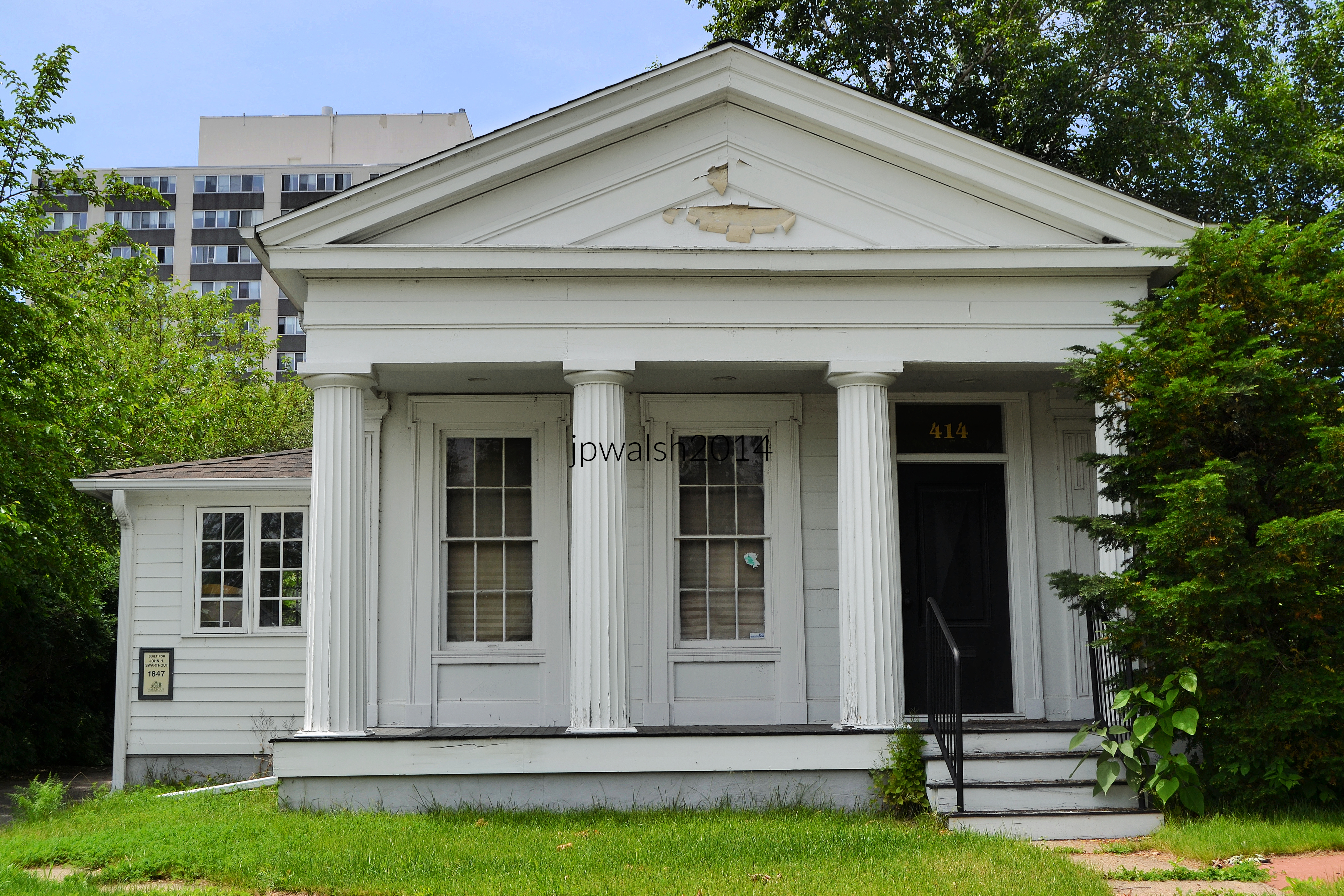
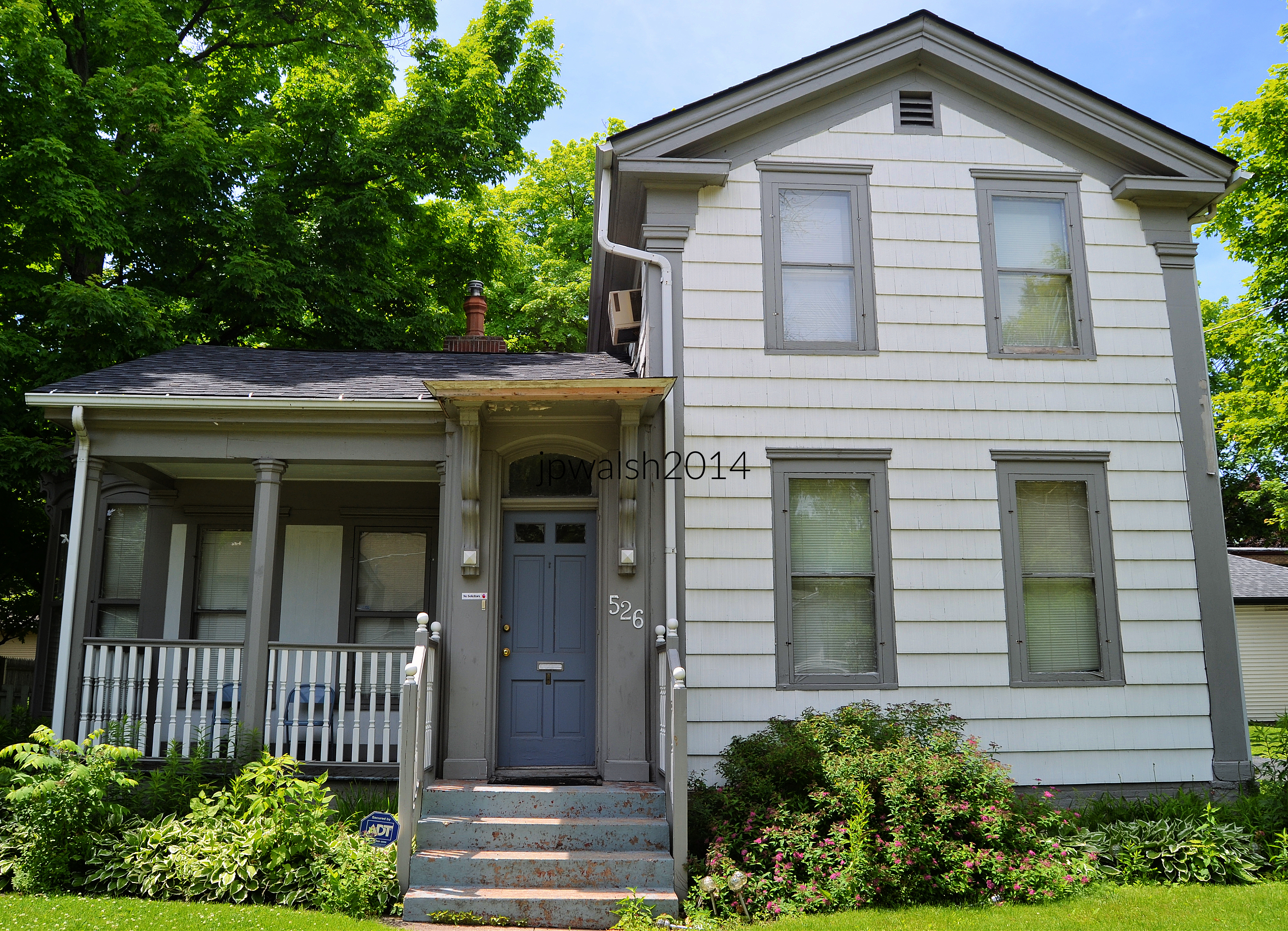
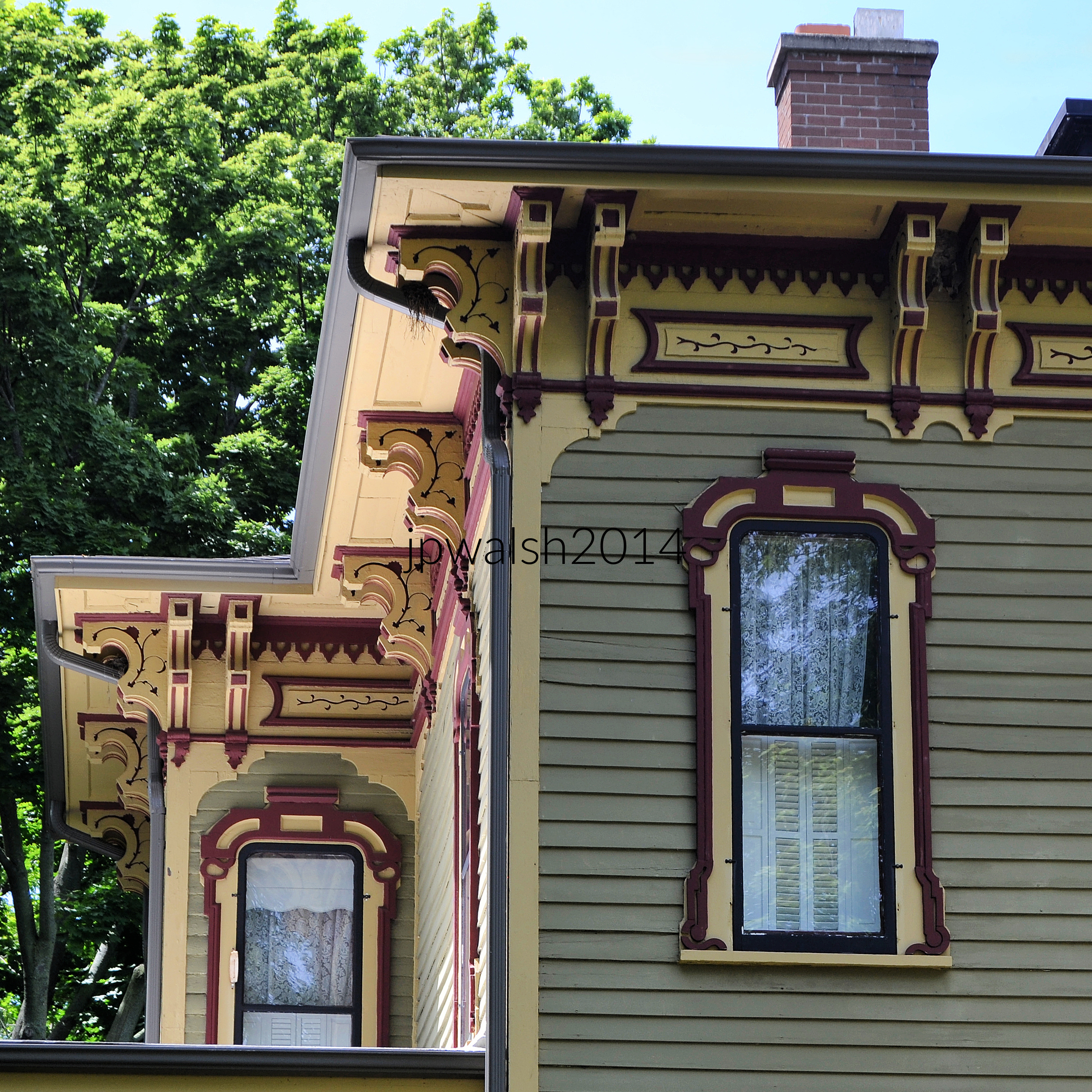
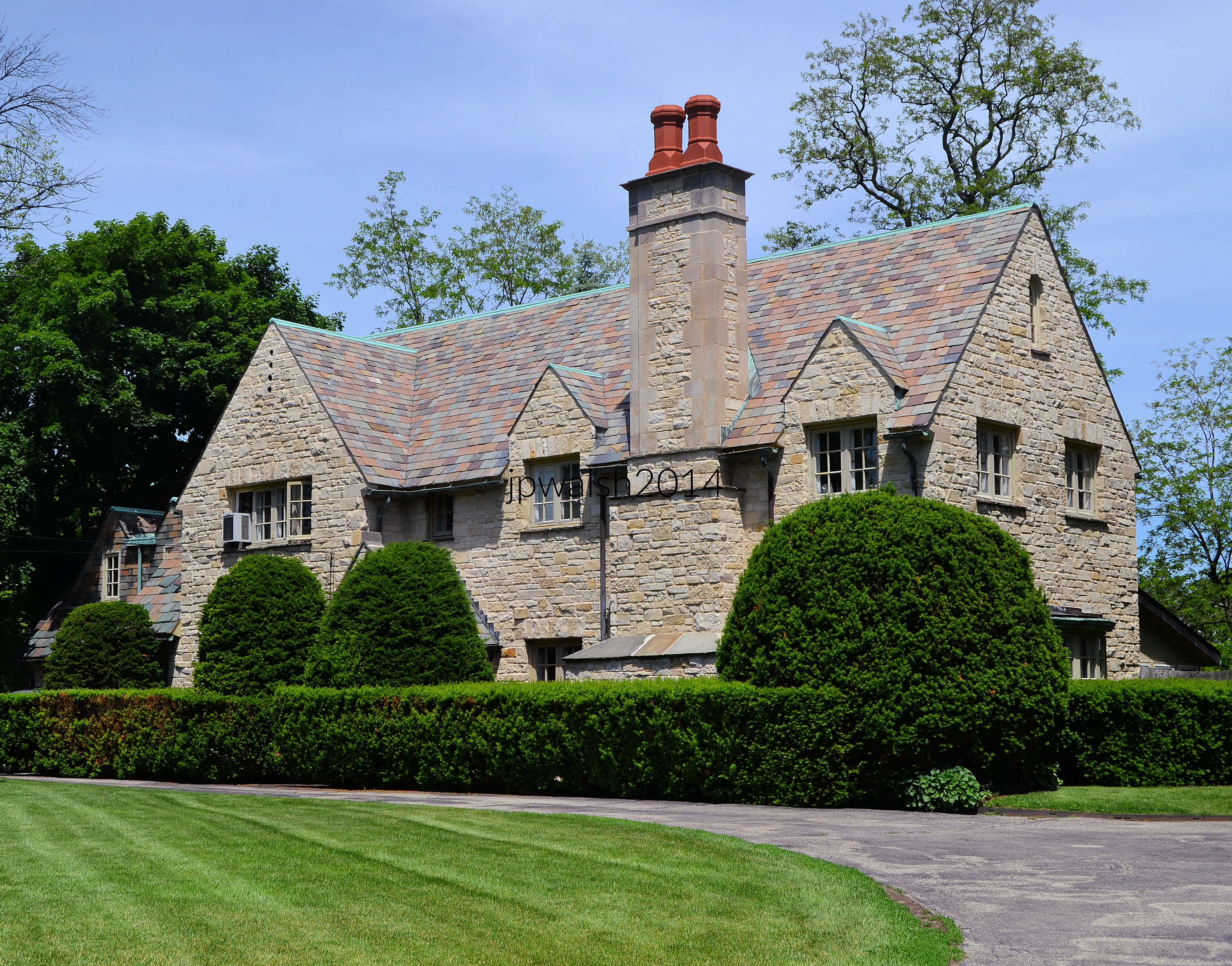
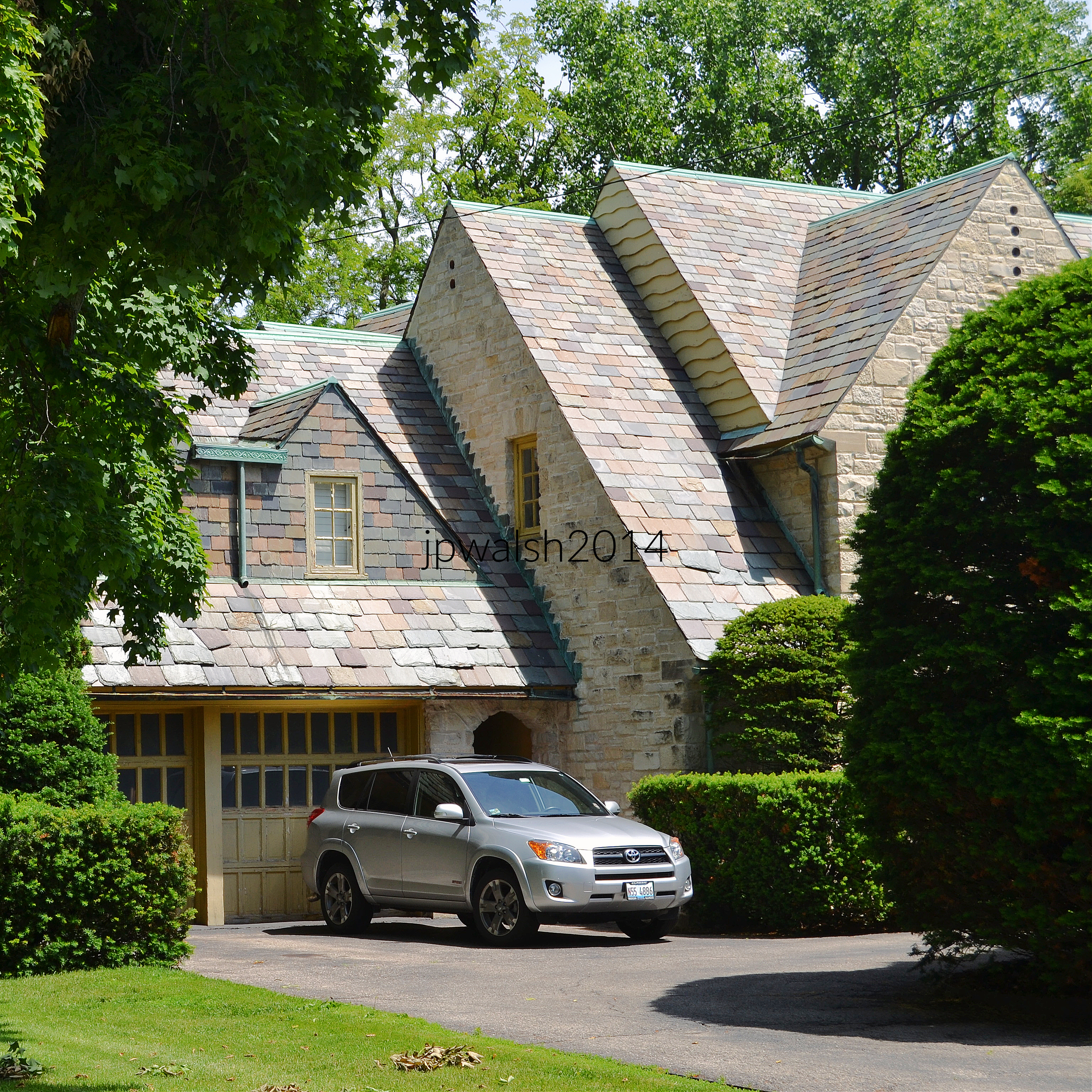
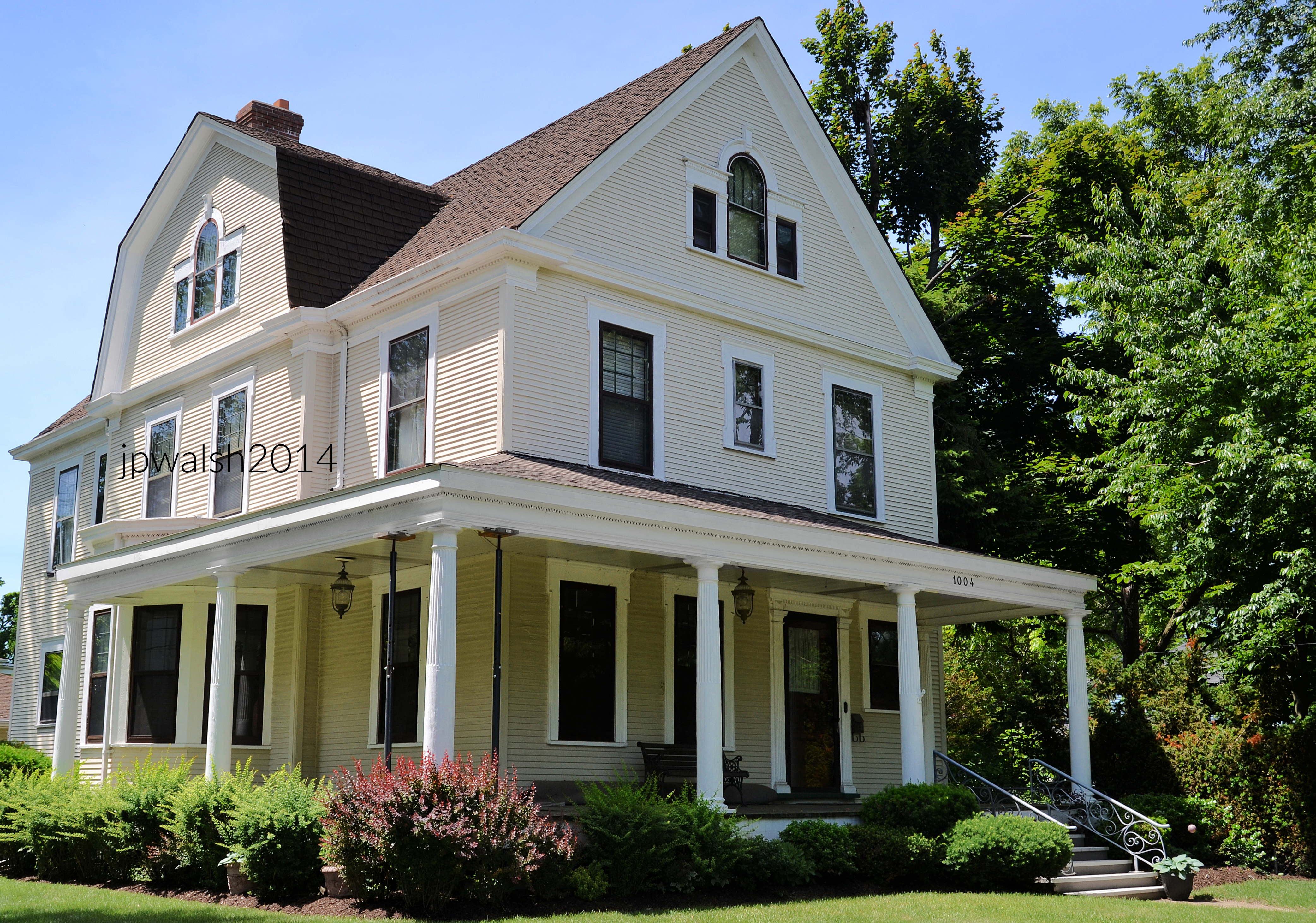
408 N. Sheridan Road, 1875. Built in the Italianate style in 1875. The set of four symmetrical bay windows on the first and second floors have 12 tall thin windows. The moldings have scroll cut, incised, and cut out brackets with heavy decorative surrounds with keystones. In the center above the canopied main entrance are a second floor and gable windows with heavy shoulders for its surrounds. Above the gable window is punched out, playfully decorative bargeboard. The two story porch to the south (left) while integrated to the Italianate building is a later turn-of-the-century addition.414 N. Sheridan Road, 1847. The strict Greek Revival-style modest building dates from 1847. Built by John H. Swartout, the frame house has a portico with a perfect classical pediment with Doric columns holding up a blank entablature. The façade hosts three identical openings – two being windows with shouldered moldings and a door with a transom. It is a simple and relatively small building that was in need of repair in 2014 when this photograph was taken by the author. 438 N. Sheridan Road, 1840s. The house was built up around a small 1840s Greek revival Style house. The Italian Villa style with its tall central tower, porch and columns, double brackets under the eaves and pediments above the windows, dates from the middle 1850s. the central door starts with the rope molding around the double doors and ascends to double arched windows on the second and third floors. 438 N. Sheridan Road, 1840s. Same house as above, southern exposure. The tower’s windows are replicated on each side at the same level as the front view. 505 N. Sheridan Road, 1850s. A central tower with a double window and a peaked arched pediment and a steep pitched roof marks this house from the 1850s as Greek Revival style. The door has heavy shoulders for its surrounds.526 N. Sheridan, late 1840s. A Greek revival style house prevalent in the state of Ohio. The Greek Revival gable has short returns with the second-floor windows extending into the gable area. This is a construction short cut for these upper story rooms. The porch with its octagonal columns and front door entry with its heavily bracketed canopy are later additions although no later than the mid1870s.619 N. Sheridan Road, 1840s. The present house was built around an earlier house erected in the 1840s. It is in the Victorian Gothic style. There are steep gables for the central tower and dormers. The central doors and windows have simple and neat surrounds.Detail of same house above, 619 N. Sheridan Road, 1840s.710 N. Sheridan Road, 1872. A restored Second Empire and Italianate Victorian mansion. The frame house features a double door entrance with glass panes and a veranda-like columnar front porch. A square-shaped second-floor porch is above the front entrance in the central section of the house and below its double bracketed cornice and Mansard roof.Detail of double bracketed cornice of restored 1872 Second Empire and Italianate Victorian mansion at 710 N. Sheridan Road in Waukegan, Illinois.837 N. Sheridan Road, 1858. The front porch and polygonal bay window were added to this late-1850s Italianate brick house more than 60 years later, around 1910.907 N. Sheridan Road, early 1930s. Made of Lannon stone from Wisconsin, the buff-colored, blocky, sedimentary dolomite rock house is designed in the English Tudor style. It has a slate roof. The tall wide chimney is integrated into the façade of the solid stone wall building flanked by casement windows in gabled wall dormers.Another view of same house above, 907 N. Sheridan Road, early 1930s. The well-designed monolithic stone and slate fortress was erected during the Great Depression.946 N. Sheridan Road, 1876. An Italianate house has a central tower with notable openings – a ground floor heavy doorway; above that, a pair of windows under a semi-circular pediment; and finally, at the top, a triplet of windows under a triangle pediment. The second floor carries the semi-circular pediment design across three more of its windows and there are double brackets under the eaves. The porch is likely an early 20th century addition.1004 N. Sheridan Road, late 1890s.
SOURCES:
A Guide to Chicago’s Historic Suburbs on Wheels and on Foot, Ira J. Bach, Swallow Press/Ohio University Press, 1981, pp. 97-111.
FEATURE Image: 124 Scottswood Road, Riverside, Illinois, 1871, by William LeBaron Jenney (1832-1907). There is a full description of this house in the post below.
Text & photographs by John P. Walsh.
INTRODUCTION.
The location of today’s Riverside, Illinois, has been an active and important historical area since before the 17th century. It was part of an active trading route and the center for Native American Indian settlements – The Green Bay, Barry Point, Portage Trails, and numerous smaller Indian trails, all passed through the area. It was only a couple of miles from the so-called Chicago Portage which connected Lake Michigan to the Mississippi River centuries prior to the building of the I&M Canal before 1850. French explorers Jacques Marquette and Louis Jolliet passed by Riverside in 1673 when they were shown the portage by Native Americans. The Chicago Portage is a National Historic Site because it opened the western continent to trade and settlement as well as became the key to the founding and development of Chicago, just 11 miles away.
Riverside was originally inhabited by the Illinois and Miami Indians. In the late 18th and early 19th centuries the Potawatomi became the dominant tribe together with the Chippewa and Ottawa and formed an alliance called the “Council of Three Fires.” These tribes lived on wild game and roots, but later adapted to farming, with fields of corn, beans, and squash.
During these many centuries, Indian burial grounds and encampments were located in Riverside on grounds besides the Des Plaines River and towards the east to today’s Fairbank Road.
The state of Illinois was founded in 1818. For the next 24 years, the Illinois volunteer army fought local native American tribes and forced them to sign treaties and migrate west of the Mississippi.
After the Indians were first forced off their land by treaty in the early 1800’s, brothers David and Barney Lawton (or Laughton) came to the area from Michigan and established an outpost in Riverside in 1827 or 1828. Into the 1840s Illinois was the edge of the wilderness. These fur traders chose the area for similar reasons that the Native Americans had – its proximity to the Chicago Portage and the convergence of established trails whose traffic made it conducive to a thriving trading business.
In July 1832 the U.S. Government sent General Winfield Scott (1786-1866) to help with the Black Hawk War that started in April of that year and ended in August. That short war also involved a young 23-year-old captain from New Salem, Illinois, named Abraham Lincoln. Upon leaving Chicago, Scott and his army camped in Riverside along the Des Plaines River for several days and then marched further west. Scottswood Road, one of Riverside’s primary residential arteries, is named after the general.
In 1831, the first white permanent settlers came to Lawtons’ Tavern in Aux Plaines (the name for Riverside then) and settled in the first houses west of Chicago. Once Gen. Scott’s military campaign was over, he returned to Chicago and dispersed the volunteers. Federal law required the state to have a standing army, so the state legislature passed a law requiring counties to form militia. In 1834, Cook County formed the first militia when Stephen Forbes, Cook County’s first sheriff, called up volunteers to Laughton Tavern. Over 1000 enterprising men assembled in Riverside and elected Jean Baptiste Beaubien (1787-1864) the first colonel of the Cook County Militia.
The first stage of modern transit development was the Southwest Plank Road (later Route 66) completed from Chicago to Riverside in 1849. The road, called Ogden Avenue today, was eventually extended to Naperville, Illinois. It was operated as a toll road whose proceeds went to the private concerns that built it. Toll amounts depended on whether the traveler was a four-horse vehicle or a single horse and rider. Since its installation, the plank road has been a successful endeavor as it was the only road through areas that were often inaccessible.
Commercial enterprises in this period included additional taverns that offered lodging and board for travelers and their horses. There was also a brewery and distillery.
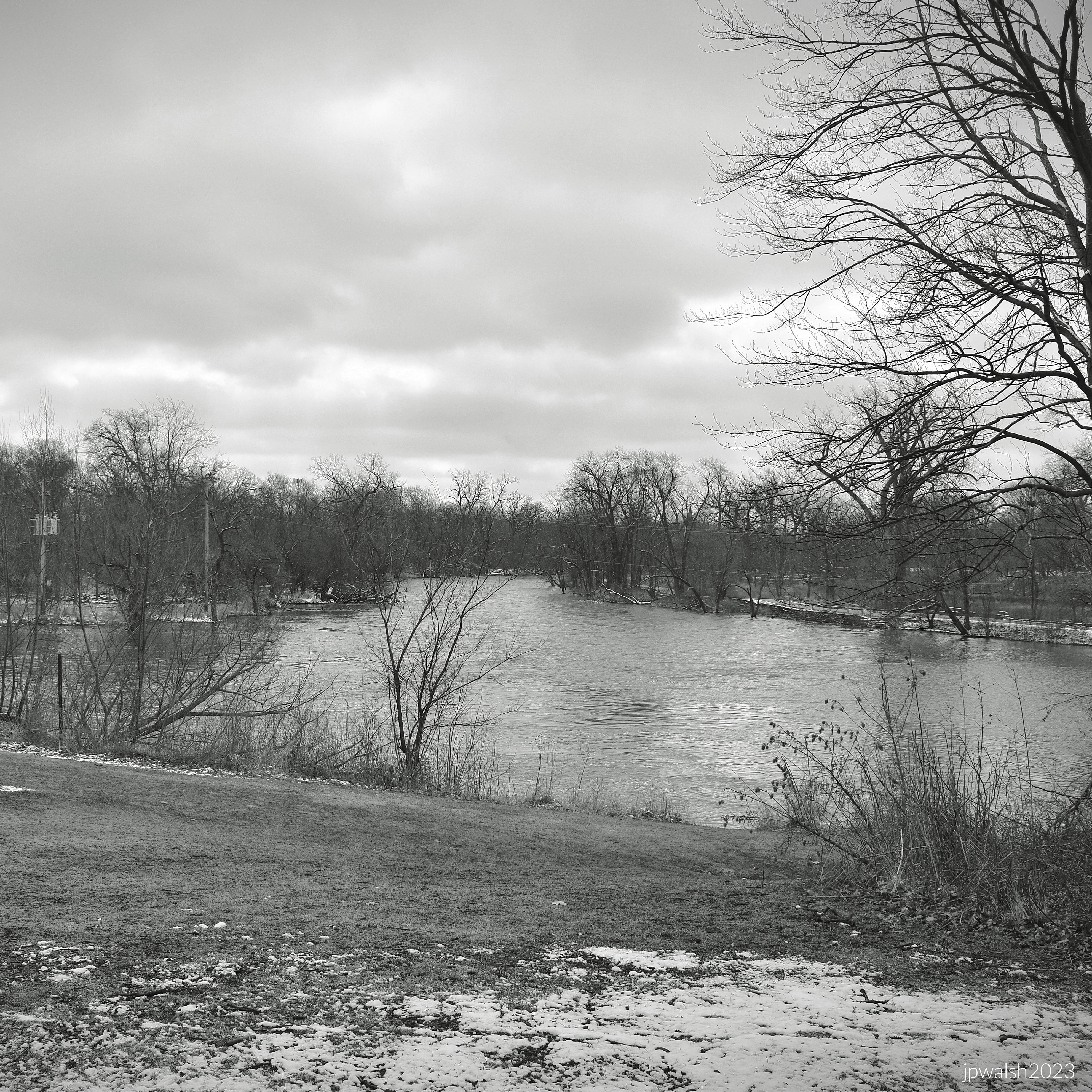
A bend of the Des Plaines River in Riverside, Illinois.
Riverside was mostly wooded tracts and farmland until the Civil War when the Chicago, Burlington & Quincy Railroad built a rail line through the area in 1863. With the rail a group of businessmen in 1869 formed the Riverside Improvement Company and set out to develop “a perfect village in a perfect setting.”
These Riverside businessmen hired landscape architects Frederick Law Olmsted (1822-1903) and Calvert Vaux (1824-1895), who had previously designed Manhattan’s Central Park, to design one of America’s first planned suburban communities. Their innovative plan set a template for suburban community planning such as curvilinear streets and modern amenities. Their vision was to design a mostly rural community with the conveniences of urban life such as utilities and broad streets. Whereas these curvilinear streets were utilized to fit an expansive community into limited open space it was also inspired by the community’s relationship to its natural environment, particularly the curves of the abutting Des Plaines River.
Portrait of Frederick Law Olmsted (1822-1903). Public Domain. Calvert Vaux (1824-1895). Public Domain.
The design of Riverside included important public spaces including a central square and park system that contained several large parks and scores of small triangular parks scattered through the village.
General Plan of Riverside · Olmsted, Vaux & Co. Landscape Architects 1869. Public Domain.
By 1871, Riverside had several larger homes, the water tower, and one of the country’s first multi-shop arcade buildings. There was a church, train depot, and grand hotel. Following the Chicago Fire in October 1871 there was a time of regional financial panic accompanied by frenzied renewed building. In the wake of Riverside Improvement Company going out of business, local Riverside residents came together to see Olmsted and Vaux’s design plan completed and built upon.
The Wesencraft residence is Riverside’s oldest home. It is located at 78 Pine Avenue on the north side of the railroad tracks. Public Domain.
Riverside grew slowly in its first decades but by the 1920s and 1930s had doubled and tripled its population of mostly middle class and upper middle Chicago commuters. This bedroom community grew steadily until its peak in 1970 (10,357 residents). Since then, Riverside’s population has dropped slightly and leveled off to a lower growth number so that by 2020 there were nearly 9,300 residents. (See – https://www.census.gov/programs-surveys/decennial-census.html – retrieved 3.3.23)
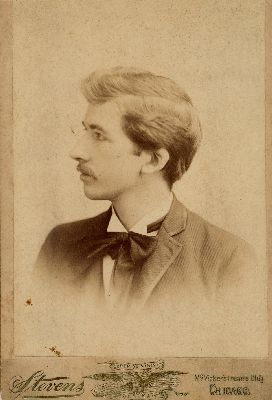
Since its incorporation as a village in 1875, Riverside also attracted increasing numbers of eminent architects to contribute to the diversity of Riverside’s historic architecture. These include Frank Lloyd Wright (1867-1959), William Le Baron Jenney (1832-1907), Charles Frederick Whittlesey (1867-1941), Joseph Lyman Silsbee (1848-1913), R. Harold Zook (1889-1949), Frederick Clarke Withers (1828-1901), Howard Van Doren Shaw (1869-1926), and William Eugene Drummond (1876-1948). Much of their work remains today evident in scores of historic landmark structures in Riverside.
Frank Lloyd Wright in 1903, likely a self-portrait. Public Domain.William Le Baron Jenney (1832-1907). Public Domain.Charles Frederick Whittlesey (1867-1941). Public Domain.Joseph Lyman Silsbee (1848-1913). Public Domain.
Frederick Clarke Withers (1828-1901). Public Domain.William Eugene Drummond (1876-1948). Public Domain.Howard Van Doren Shaw (1869-1926). Public Domain.OLD WATER TOWER, 1869, 10 Pine Avenue. Designed and built by William Le Baron Jenney of Jenney, Schermerhor & Bogart, Architects and Engineers.
The original Water Tower had a Gothic Revival wooden tank. The tower is accompanied by two round stone well houses built in 1898 and designed by George William Ashby. When the original tank was destroyed by fire in 1913, a steel tank was installed and the tower was raised 20 feet. It was topped by a canopy designed by William Mann.
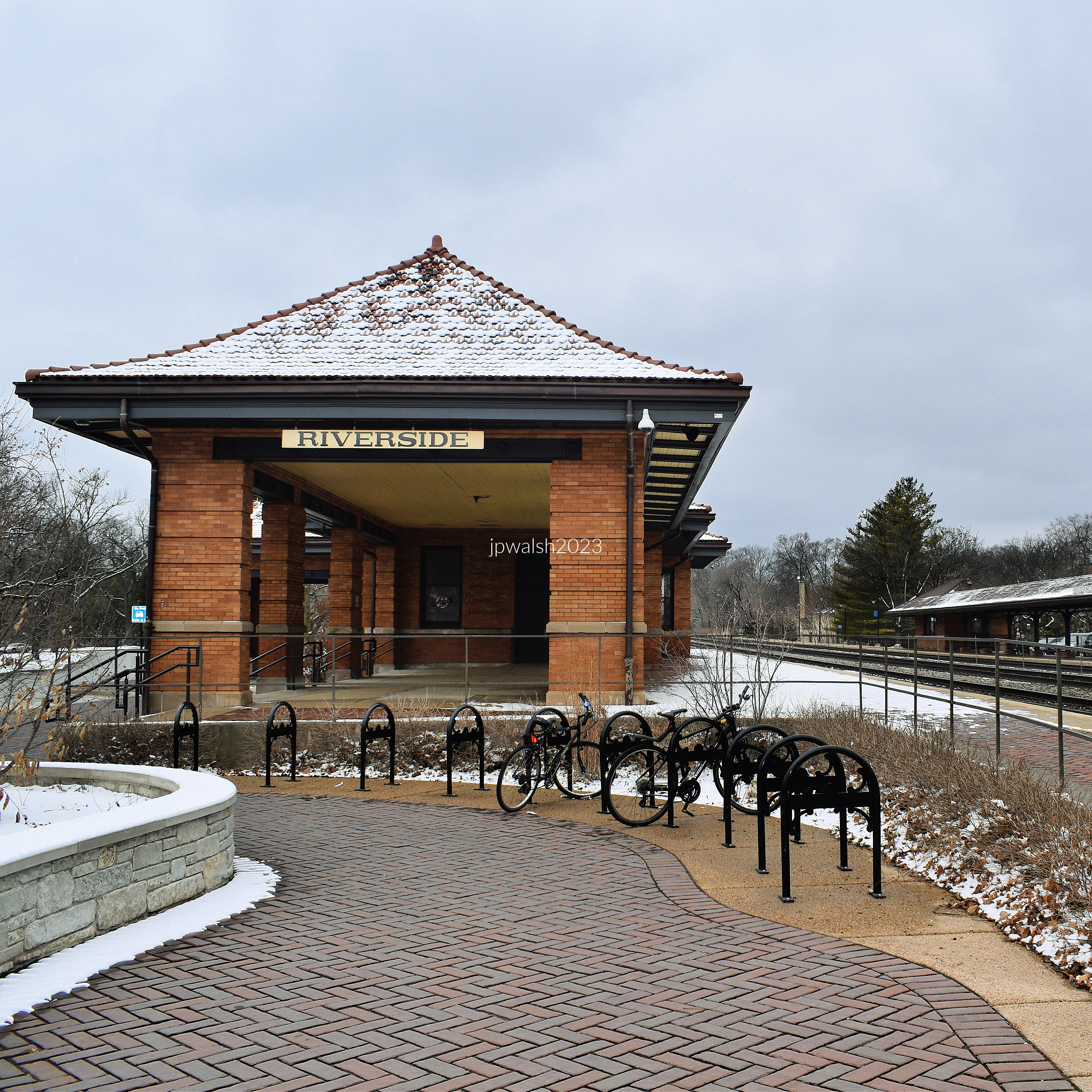
Riverside Railroad Depot, c. 1901, 90 Bloomingbank Road and 15 Pine Avenue. Designed and built by the Chicago, Burlington and Quincy Railroad.
A railroad through Riverside came in 1863, 6 years before the Olmsted/Vaux plan and 12 years before the village’s incorporation. William Le Baron Jenney designed the first depot in 1871. This main depot with open covered extensions on the south side of the tracks was connected by a tunnel to the north platform.
The view above shows the expansive tile roof-covered main entrance. The two large columns with variegated brick gives columns design and texture. There are many windows to allow natural light from its south exposure and a view of the tracks to the north.
Looking east, the orange-brick-colored main depot has open covered extensions for commuters to be protected from the elements during their wait outdoors for a train connection.
Looking west, a view of the train depot with one of its open covered extensions and peaked snow-covered tile roof. The northern platform is visible across the railroad tracks on the right. Author’s photograph taken in February 2023.
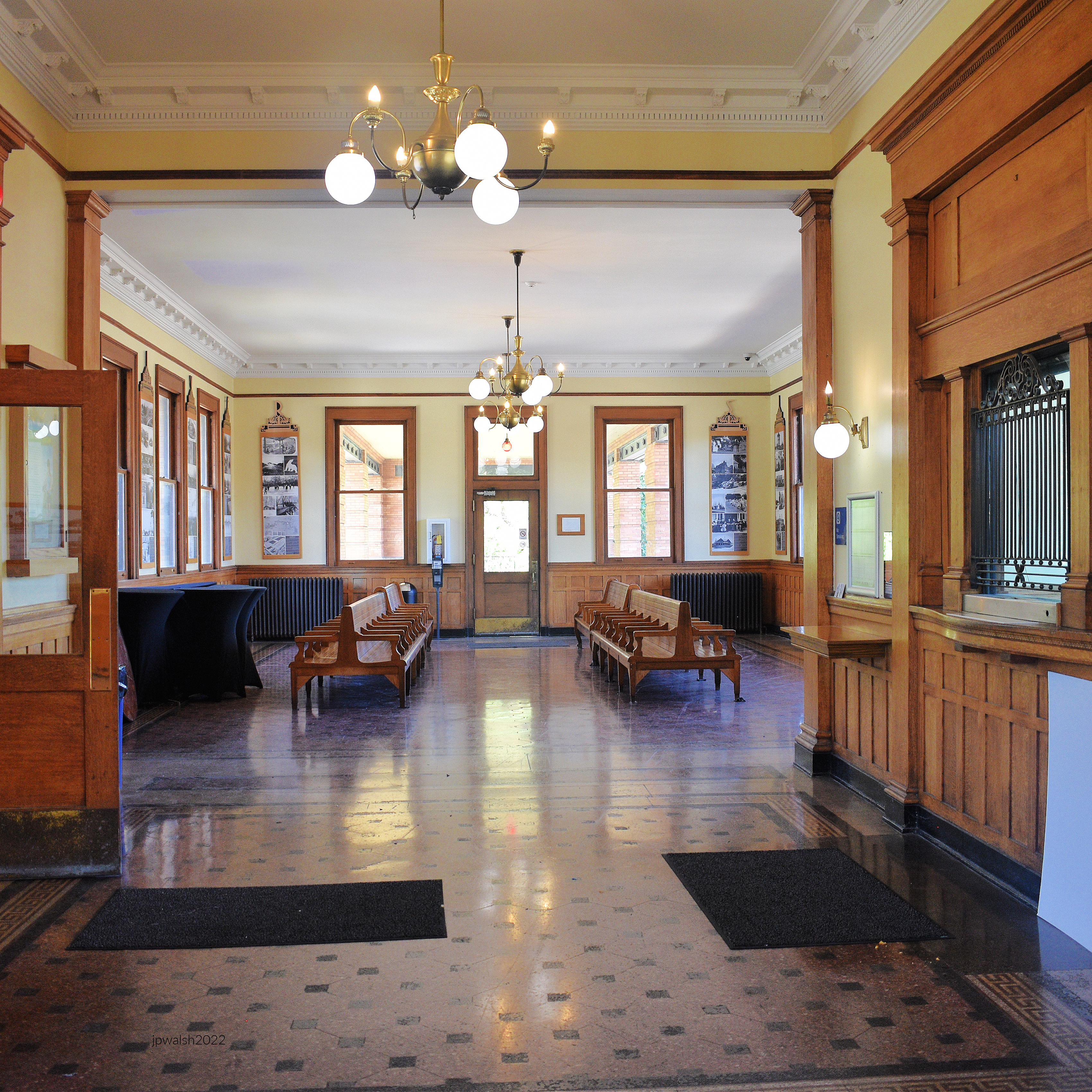
The same view as above over 100 years ago. Riverside Train Depot, 1919. Public Domain.Interior, Riverside Train Depot, c. 1901, includes a waiting room and, at right, ticket agent window. The ceiling has wainscotting and there are period light fixtures to accent the natural light pouring in from the series of encased large rectangular windows.On the brick-paved platform, another of the train depot’s open covered extensions.
The Lake House, a 2006 fantasy romance film from Warner Brothers, was shot in Riverside, Illinois. A doctor (Sandra Bullock) who occupied a lakeside home exchanges letters with its newest resident, an architect (Keanu Reeves). When they discover that they’re actually living two years apart, they must try to unravel the mystery behind their romance before it’s lost in the midst of time.Riverside Town Hall, 27 Riverside Road, Riverside, Illinois, 1895, designed by George Ashby.
In 1891, the Village of Riverside and Riverside Township reached an agreement so that the village donated the land for a town hall and the township paid for its construction.
In 1893 the township authorized $15,000 for construction (about $500,000 today) and this picturesque and stately building, designed by George Ashby, was completed in 1895. The clock was added to the main tower in 1941.
The building is Richardsonian Romanesque at a time when that style, very popular in the 1880’s, had begun to wane among contemporary architects in preference for the Beaux-Arts.
There is a steeply pitched hipped roof with brick for the top floor and rough faced stone for the ground floor. The turret is polygonal and the windows are of various sizes on all three floors. There are many delicate design elements such as copper cornices, colonettes, stringcourses and dressed stone.
Arcade Building, 1 Riverside Road, Designed and built c. 1871, Frederick C. Withers.
The Arcade Building is the first commercial building built in Riverside following Olmsted and Vaux’s plan and is associated with the village’s original developers, the Riverside Improvement Company.
The Arcade Building – a multi-color brick and limestone building with pointed arches and projecting cornices and stringcourses – is High Victorian Gothic. It was designed by architect Fredrick C. Withers, an associate of Olmsted and Vaux. With its mansard windows between tower pavilions, the simple building references the elaborate and decorative Second Empire architecture.
Riverside Presbyterian Church, 116 Barrypoint, 1872, Frederick C. Withers.
The church building was designed by Fredrick C. Withers who designed the Arcade Building at around the same time. Like that early commercial building the church is an amalgam of styles and forms, including Gothic Revival and Italianate.
The stone building has a series of pitched gable roofs that cover and form the transepts and chancel. The corner tower rises to a timber belfry with moldings and pointed arch openings whose original manual pull bell as well as modern chimes still mark the hours. Extensions to the left and right are mid-20th century additions done in harmony with the original design.
100 Fairbank Road, 1869, by Calvert Vaux.
This clapboard Carpenter Gothic style house was designed as a model home for the Riverside Plan by that plan’s designer, Calvert Vaux. It is an example of East Coast architecture transplanted into the heart of the Midwest. The ground floor is higher than the second floor. The low-pitched roof is punctuated by a projecting porch with Gothic Revival carpentry supported by struts and a gabled roof.
Two other second floor porches are on the short sides of the building extending across that width above a ground-floor projecting bay. The clapboard sheathings are meticulously and variedly cut for decorative effects throughout the building’s exterior.
Curved sidewalks do not always follow the streets but their own direction along and across a mostly wooded landscape.107 Bloomingbank Road and 111 Bloomingbank Road, both c. 1890.
This neighboring pair of Queen Anne style homes are variations of the same building design. The buildings’ design shares a porch across the entire front, arched enclosed second floor porch, and front-facing attic windows. Both share the same kind of clapboard and shingle sheathing.
Houses on Bloomingbank Road face the Des Plaines River.Des Plaines RIver.143 Bloomingbank Road, c. 1869.
This house is set back from the road and built in 1869 which was the year that Olmsted and Vaux were commissioned to design the suburb. The Italianate-style house has tall windows and large brackets with feet and shoulders for their jambs and segmental points. The second-floor windows are met by a first-floor transomed window. A steeped pitched roof and complex massing is Gothic Revival. A subdued color palette blends into the natural surroundings. The porch veranda is original.
201 Bloomingbank Road at Scottswood, c. 1870.
The above 1870 house is a T-shaped Gothic revival with the stem of the “T” facing the street. The stem is surrounded by a veranda whose porch columns are Italianate with Gothic style “carpenter” capitals. The tall windows and lintels are Italianate. The façade’s windows are under a hood molding and the attic has a small window with a pointed lintel. The T-stem’s pitched roof in the Gothic Revival style is slightly lower than the T-cross’s pitched roof behind it.
213 Bloomingbank Road, c. 1905.
A frame clapboard and shingled 4-square cube from 1905. There is a front porch held up by four huge piers with ornamental moldings that cover expansive first-floor polygonal bay windows. Below the hipped roof are two center windows with round heads. The painted dark green and yellow mix is stately and blends into the nature setting.
253 Bloomingbank Road, c.1890.
The Queen Anne house from 1890 has a lot of windows. It is a basic cube with a gambrel roof with a wing that also has a gambrel roof. The front porch is covered on one side with a flared roof and on the other side with a pitched gable roof. The second floor has an open porch that looks over the Des Plaines River. The original clapboard and shingles have been covered on the first floor by later stucco.
281 Bloomingbank Road, 1909.Avery Coonley House, 300 Scottswood Road, 281 Bloomingbank Road, Riverside (Cook County, Illinois), 1910. Public Domain.281 Bloomingbank Road, 1909. From the street.
What became the nationally-recognized Avery Coonley School was founded in 1906 to promote the progressive education theories of John Dewey (1859-1952). It was founded as The Cottage School by Queene Ferry Coonley (1874-1958) on her estate in Riverside, Illinois, for her 4-year-old daughter.
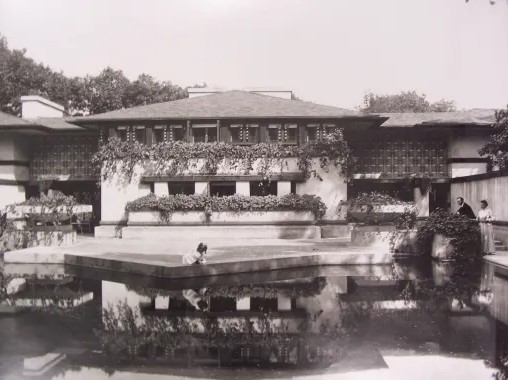
The school, which continues to thrive today, has occupied several structures in its history. This included a literal small cottage on the Coonley Estate in Riverside to larger buildings designed by Frank Lloyd Wright in 1909. The school moved to Downers Grove in 1916 and, on a 11-acre campus there designed by landscape architect Jens Jensen (1860-1951), became the Avery Coonley School in 1929.
This section of Wright’s 1909 design is set back well off the street and mostly hidden by trees. Behind an iron fence, it is difficult for the public to perceive the full extent of the estate. Wright’s design begins at the street with a low stone urn.
On June 11, 1978, the courtyard’s swimming pool heater exploded and started a fire. The fire destroyed the main house’s living room and a bedroom. The exterior was later meticulously restored to its original appearance which included the school’s stucco walls, simple board trim and multi-color tile façade, all beneath a broad, tiled, hipped roof. At the time of the restoration the swimming pool was re-converted to its original function as a lily pond.
A free-standing L-shaped domestic structure with a broad hipped roof, the house was added sometime after 1909. Within its setting in the highly-designed suburb of Riverside, this Prairie style house sets a template and direction for much of what would be 20th century suburban development across the country.
300 Scottswood Road, 1909.
This is the main block of the Avery Coonley estate. The house is the epitome of the Prairie School style of broad horizontals, here using stucco boards, tile and glass beneath a low hipped roof. Wright’s design starts at the street with the low stone urn.
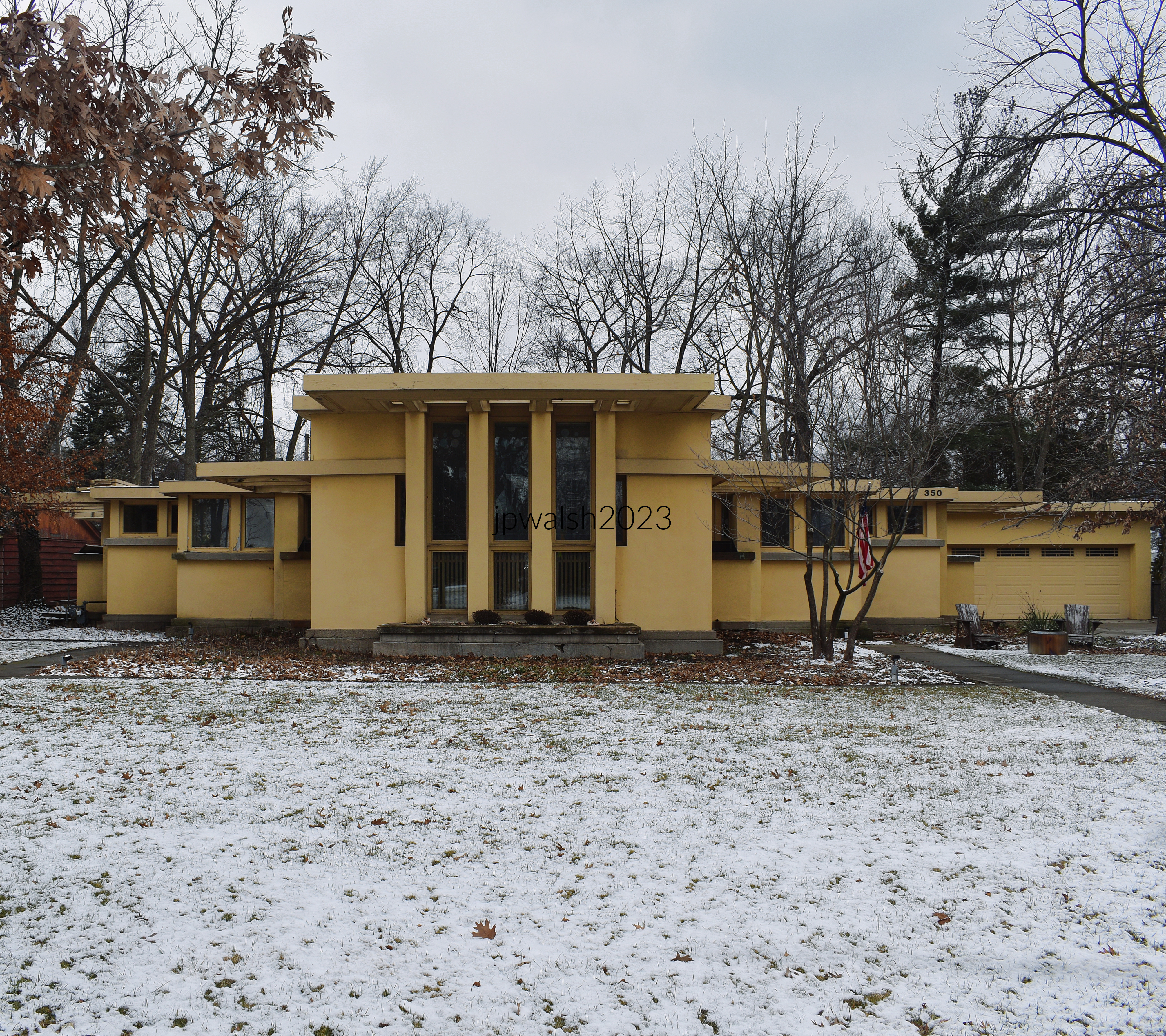
Avery Coonley Playhouse, 350 Fairbank Road, Riverside, Illinois, 1909, by Frank Lloyd Wright. Avery Coonley Playhouse, 350 Fairbank Road, 1909, by F. L. Wright in winter.
Basic plan of the playhouse (above) is a T-shaped building with higher T-stem to the street. A simple stucco structure, the playhouse’s flat roof and lower wings provide the Prairie style’s broad horizontality. Flat roof of the T-stem extends over three elongated windows while lower wings have clerestory windows.
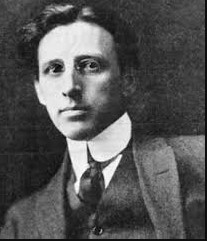
William E. Drummond (1876–1948).308 Fairbank Road, Riverside, Illinois, c. 1910, Guenzel and Drummond.
Drummond began his career working for architect Louis Sullivan (1856-1924). Later, working for Frank Lloyd Wright, Drummond became the chief draftsman for many of Wright’s well-known commissions. In 1912 Drummond went into partnership with Louis Guenzel who had been a draftsman for Dankmar Adler (1844-1900) and Louis Sullivan (1856-1924).
The house is a one story hipped roofed cube or block with a broad brow of stucco soffits with eaves. The original casement windows include three in the front for the living room with geometric Prairie patterns. The lower portion of the façade is board siding and the top section is stucco.
The simple stone house in an English country cottage style was built in 1897. It has diamond-patterned casement windows and a single half-timbered gable poking out of a gambrel roof. The timber entrance porch that abuts stone achieves an overall craftsman effect.
144 Scottswood Road, c. 1870, William LeBaron Jenney.
Attributed to William LeBaron Jenney, the house is an early building in Riverside. It is a fusion of two styles – the Stick Style and Gothic Revival. The carpentry is solidly masterful. The roof has a low pitch and is punctuated with a massive chimney, dormers and gables with filets, spars and kingposts. The spurs or brackets supporting the overhanging eaves rest on boards intersecting with the clapboard. There is a broad veranda with turned posts supporting a lintel that supports small pointed arches with struts. The porch railing has tightly aligned balusters extending to a below-porch skirt with complementary cut-out patterns. The veranda roof extends over the angled main entrance to become a porte-cochère for the driveway.
124 Scottswood Road, 1871, William LeBaron Jenney.
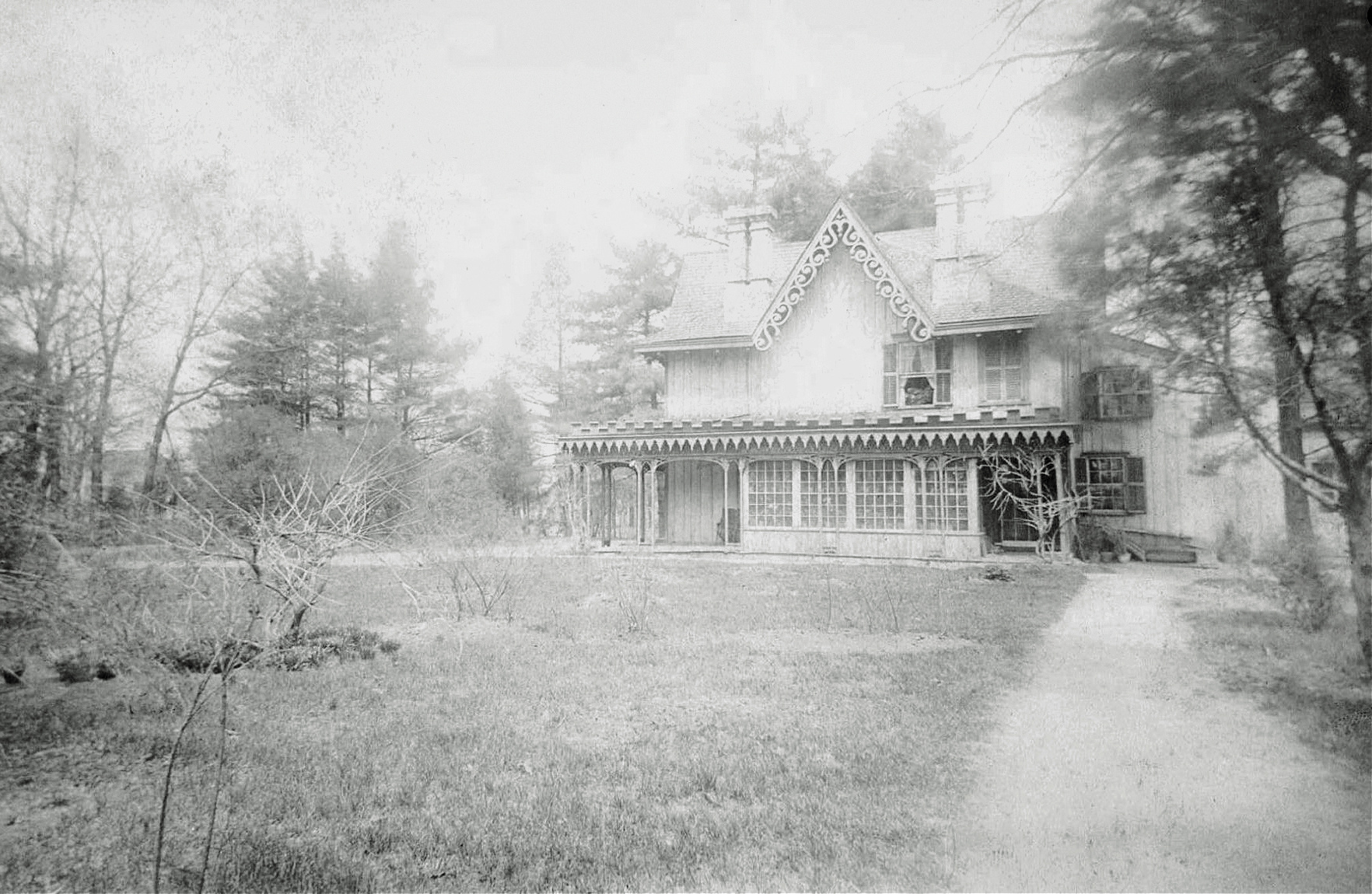
In the Gothic Revival style, the design and board-and-batten construction of the house is grand and appealing. With steeply pitched roofs, there are several gabled wings of varying distances and directional faces from the building’s core. Windows include long tabernacle windows and others with more elaborate extending jerkinhead roofs that are supported by boards incised with decorative cuts. There are pointed head windows on the second floor over the main entrance while the veranda stretches across two sides of the house supported by slope cut square posts with milled brackets. These and other rare trim and other details, including two massive chimneys, have survived in this house that is today over 150 years old.
FEATURE image: 562 Keystone Avenue, River Forest, Illinois, is a house designed by Frank Lloyd Wright in 1909. It is an excellent example of Wright’s mature Prairie style including its original Prairie-style glass.
River Forest, Illinois is a suburb of Chicago in Cook County. River Forest is perhaps best known for its diversity of 19th and early 20th century American residential architecture. House designs and styles include those by Frank Lloyd Wright (1867-1959) and others in the Prairie School. Nestled near the Des Plaines River to the west, along heritage lands of the Menominee, Chippewa and, later, Potowatomi Native American tribes, today River Forest is an affluent residential suburb closely tied to its adjacent neighbor to the east, the suburb of Oak Park, Illinois. These communities share several affinities including its high school, namely, Oak Park and River Forest High School that is in Oak Park and was founded in 1871. River Forest’s population today approaches 12,000 residents and the suburb is home of two universities, including Dominican University founded in 1848 and Concordia University Chicago founded in 1864. River Forest’s train station is on Metra’s Union Pacific/West Line with service into nearby downtown Chicago, about 12 miles away.
These are my photographs of some of the residential architectural highlights to be seen in River Forest and were taken in June 2022.
603 Edgewood Place, River Forest, Illinois, 1908, Frank Lloyd Wright. Known as the Isabel Roberts House, it was remodeled in the 1950s. 69% 7.99 mb
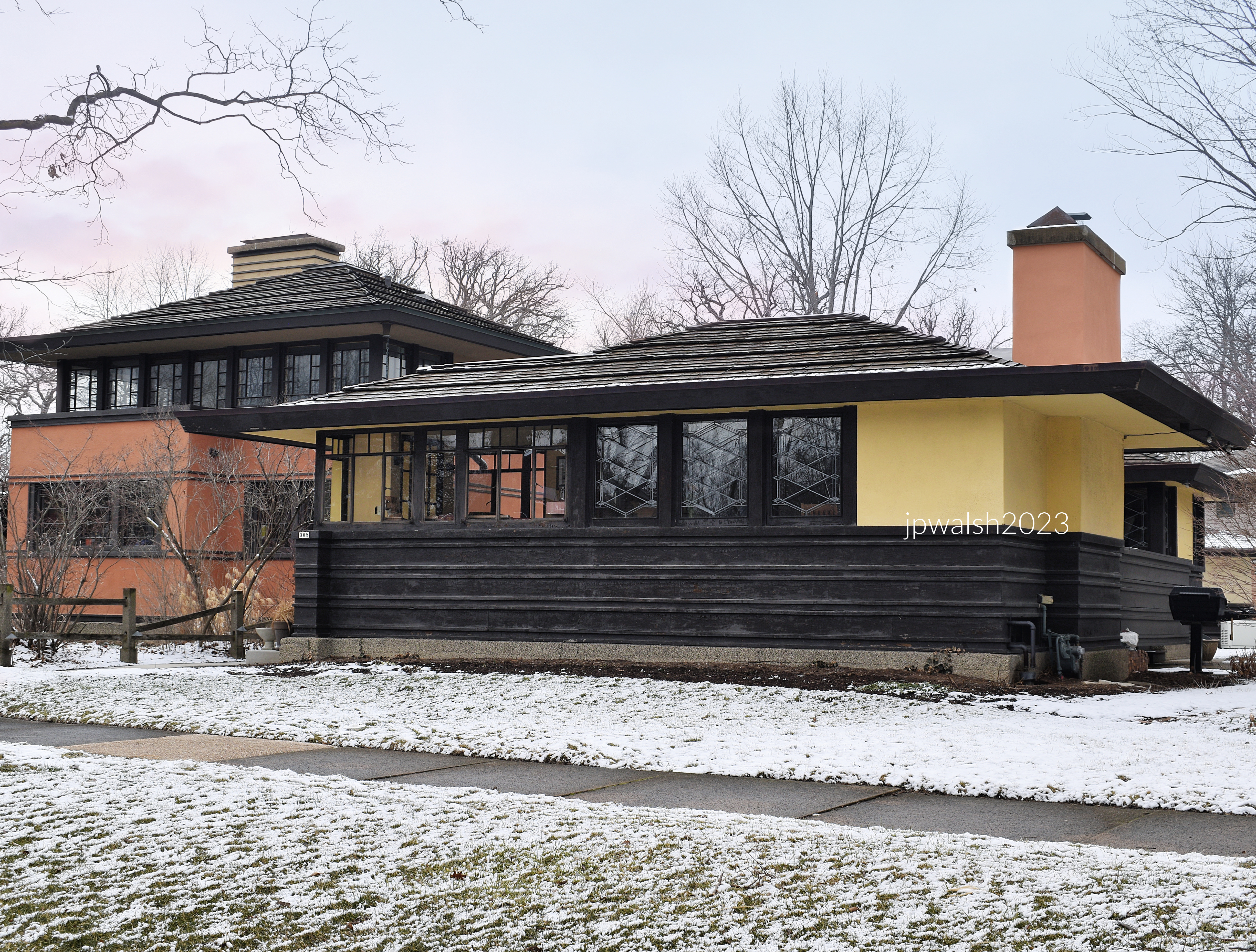
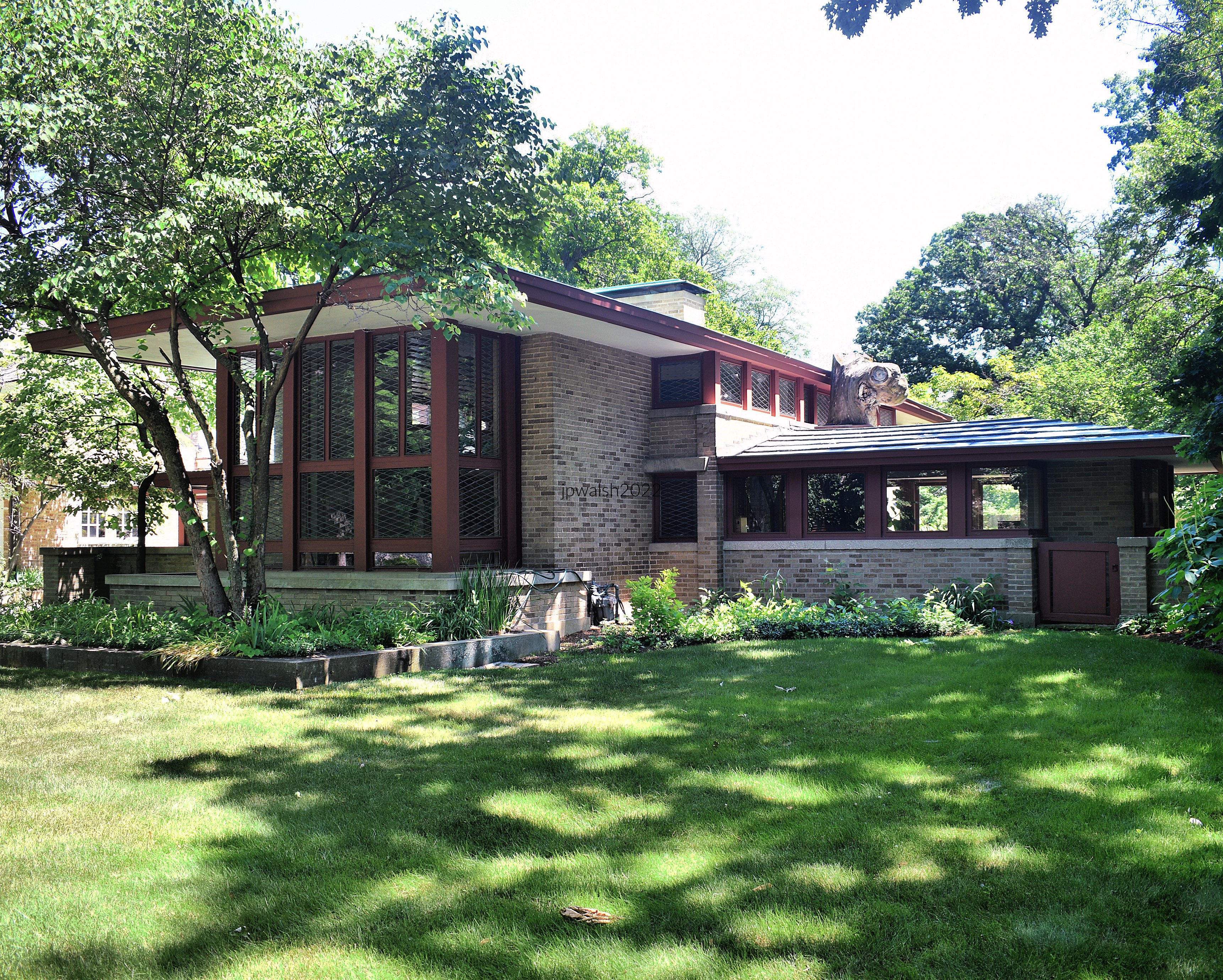
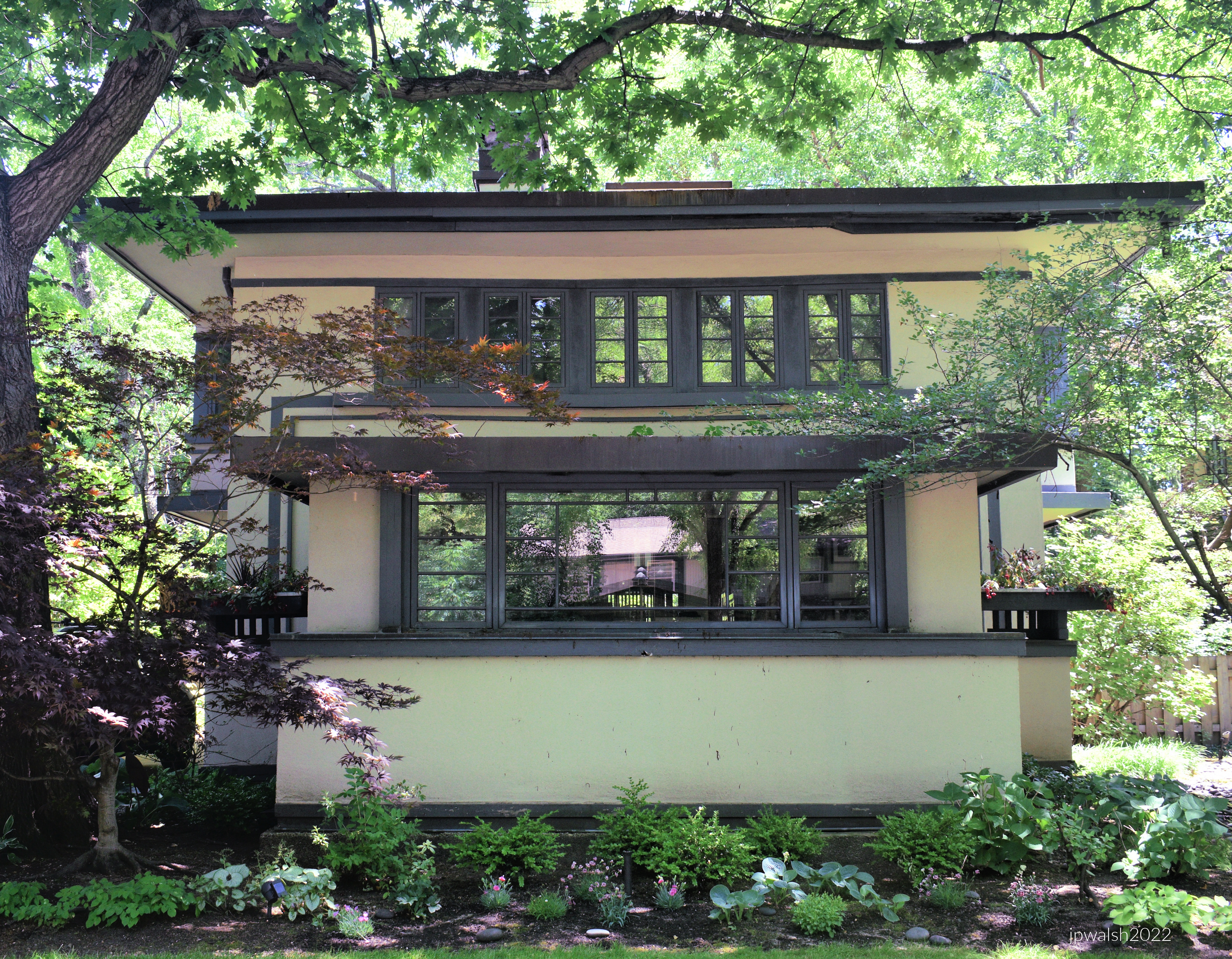
Frank Lloyd Wright in 1903, likely a self-portrait. Public Domain.559 Edgewood Place, River Forest, Illinois, 1911, William Drummond (1876-1948). Drummond began his career working for architect Louis Sullivan (1856-1924). Working for Frank Lloyd Wright, Drummond became the chief draftsman for many of Wright’s well-known commissions. 89% 7.92mb559 Edgewood Place, River Forest, Illinois, 1911, William Drummond. 560 Edgewood Place, River Forest, Illinois, 1910, William Drummond. 98% 7.89 mbWilliam Drummond about 1901. Drummond was born in New Jersey into a family in the building trades. He moved to Chicago as a boy and later studied architecture at the University of Illinois but didn’t finish. At 23 years old he joined Frank Lloyd Wright’s studio and became his chief draftsman. Drummond obtained his architect’s license in 1901 and, while working part time for Wright, worked full time for Richard E. Schmidt (1865-1958) in 1901 and 1902 and for Daniel H. Burnham (1846-1912) in 1903 to 1905. In 1905 Drummond returned to working full-time for Wright until 1909 when Drummond went into private practice. Public Domain. 511 Edgewood Place, River Forest, Illinois, 1858, architect unknown. This early Italianate house was moved to its present location in1880 from a few blocks away. 77% 7.86 mb515 Auvergne Place, River Forest, Illinois, 1893, Frank Lloyd Wright. Known as the William H. Winslow House, this residence for an important industrialist is one of Wright’s earliest mature expressions of the Prairie style. 66% 7.90 mb344 Keystone Avenue, River Forest, Illinois, 1870, architect unknown. Fine and grandiose example of the Italianate style. 95% 7.85 mb517 Keystone Avenue, River Forest, Illinois, 1915, William Drummond. A simplified version of the expansive basic square house with a pitched roof and elaborated in the Prairie style.530 Keystone Avenue, River Forest, Illinois, 1915, Robert Spencer (1864-1953). Robert Spencer was born in Milwaukee, studied engineering at the University of Wisconsin and architecture at M.I.T. He practiced in Boston, married, and studied in Europe. At his return he relocated to Chicago through Shepley, Rutan & Coolidge. In 1895 Spencer established his own firm and located in the Schiller Building next to Frank Lloyd Wright. In 1905 Spencer partnered with Chicagoan Horace S. Powers, who studied at today’s I.I.T. The partnership built this house in River Forest which is a fine brick example of the Prairie School within a traditional framework. 97% 7.85 mbRobert Spencer (1864-1953). Unlike his slightly younger competitor, Frank Lloyd Wright, Spencer was a trained mechanical engineer and architect. Public Domain.
INTERLUDE: OTHER PERIOD HOMES in RIVER FOREST, ILLINOIS.
306 Keystone Avenue, River Forest, Illinois. A smaller second floor porch is fitted above the main ground entrance. 70% 7.90 mb.236 Keystone Avenue, River Forest, Illinois. Corner tower, multi-level wrap-around front porch. 73% 7.92 mb Row of late 19th/early 20th century houses, River Forest, Illinois. 78% 7.78 mb136 Keystone Avenue, River Forest, Illinois. The facade’s design elements are complex with intricate details. 90% 7.80 mb146 Keystone Avenue, River Forest, Illinois. Two big chimneys and a front porch swing makes for a timeless scene on a nice day. 90% 7.83 mb558 Keystone Avenue, River Forest, Illinois, 1860, architect unknown, This is an excellent example of a large Victorian Gothic cottage. 82% 7.62 mbFrank Lloyd Wright. Public Domain. 562 Keystone Avenue, River Forest, Illinois, 1909, Frank Lloyd Wright. The house’s projecting second-floor balcony and Prairie glass in a stucco surface is in evidence. 83% 7.93 mb.562 Keystone Avenue, River Forest, Illinois, 1909, Frank Lloyd Wright. The house’s prominent hipped roof with its simple fascia and stuccoed soffits are evident. Wright’s house design is characterized by the early, mature restraint and discipline of the Prairie School. 75% 7.91 mb.
SOURCES:
A Guide to Chicago’s Historic Suburbs on Wheels and on Foot, Ira J. Bach, Swallow Press/Ohio University Press, 1981, pp. 605-622.