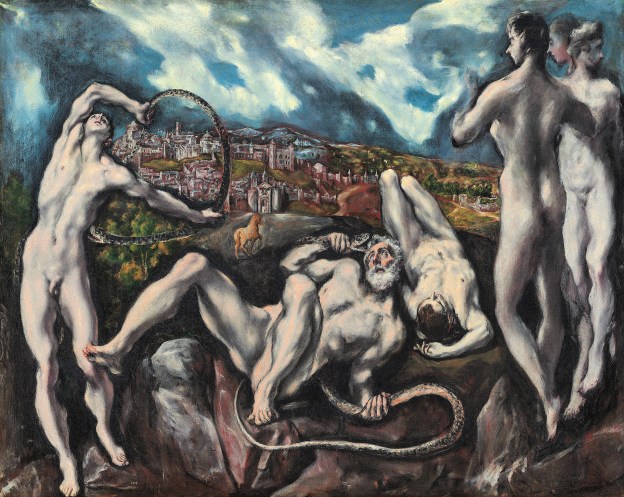
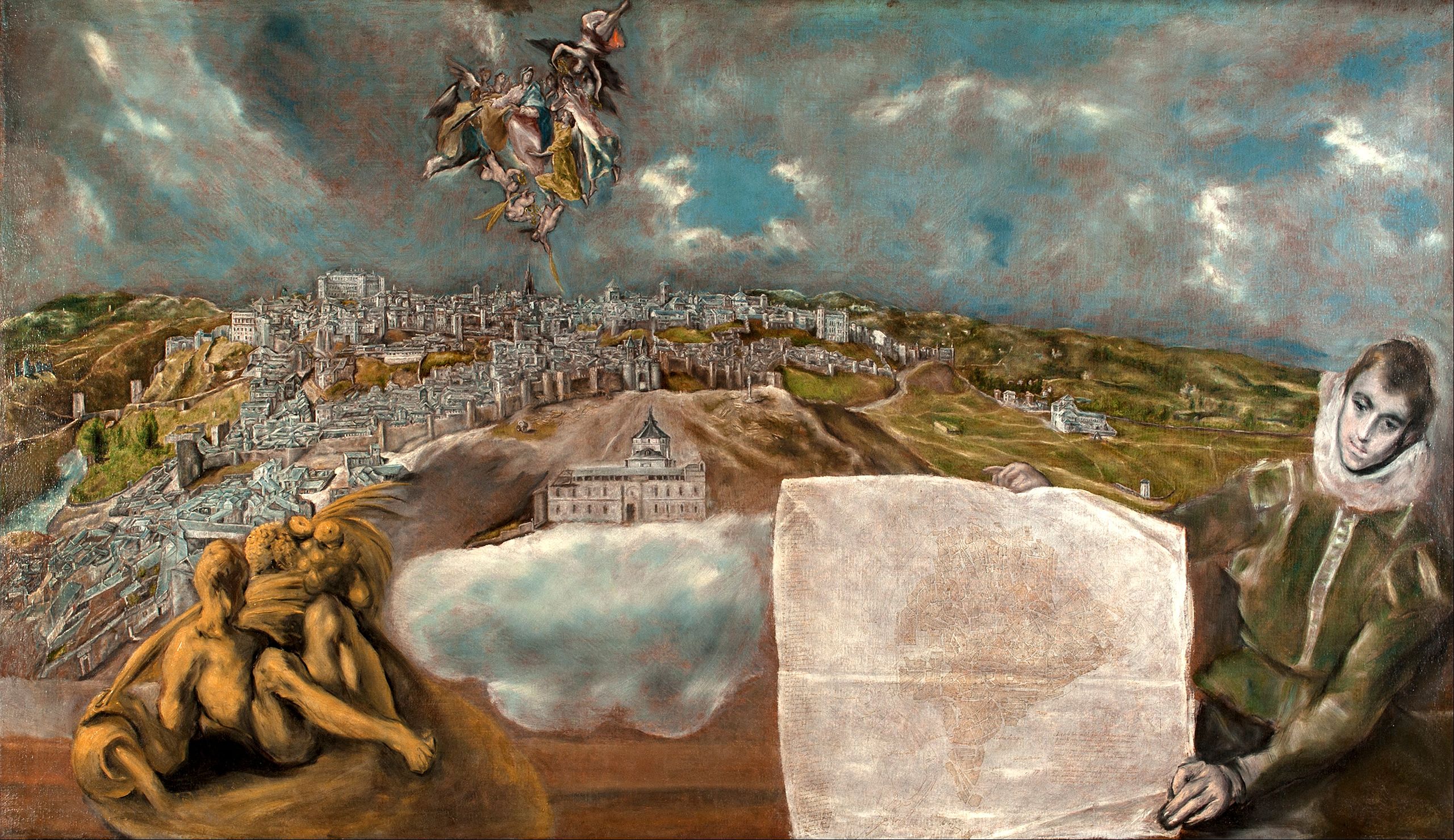
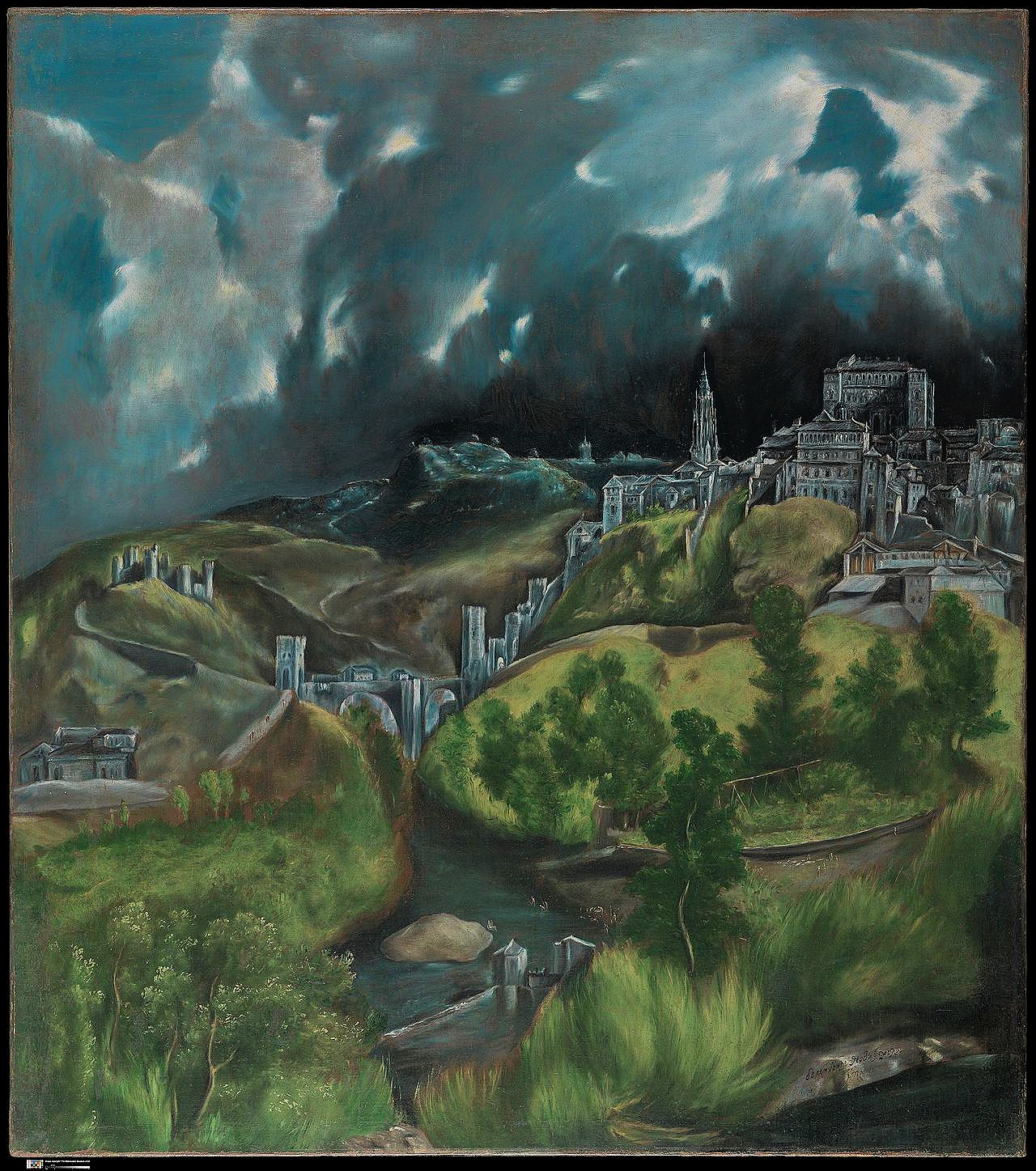
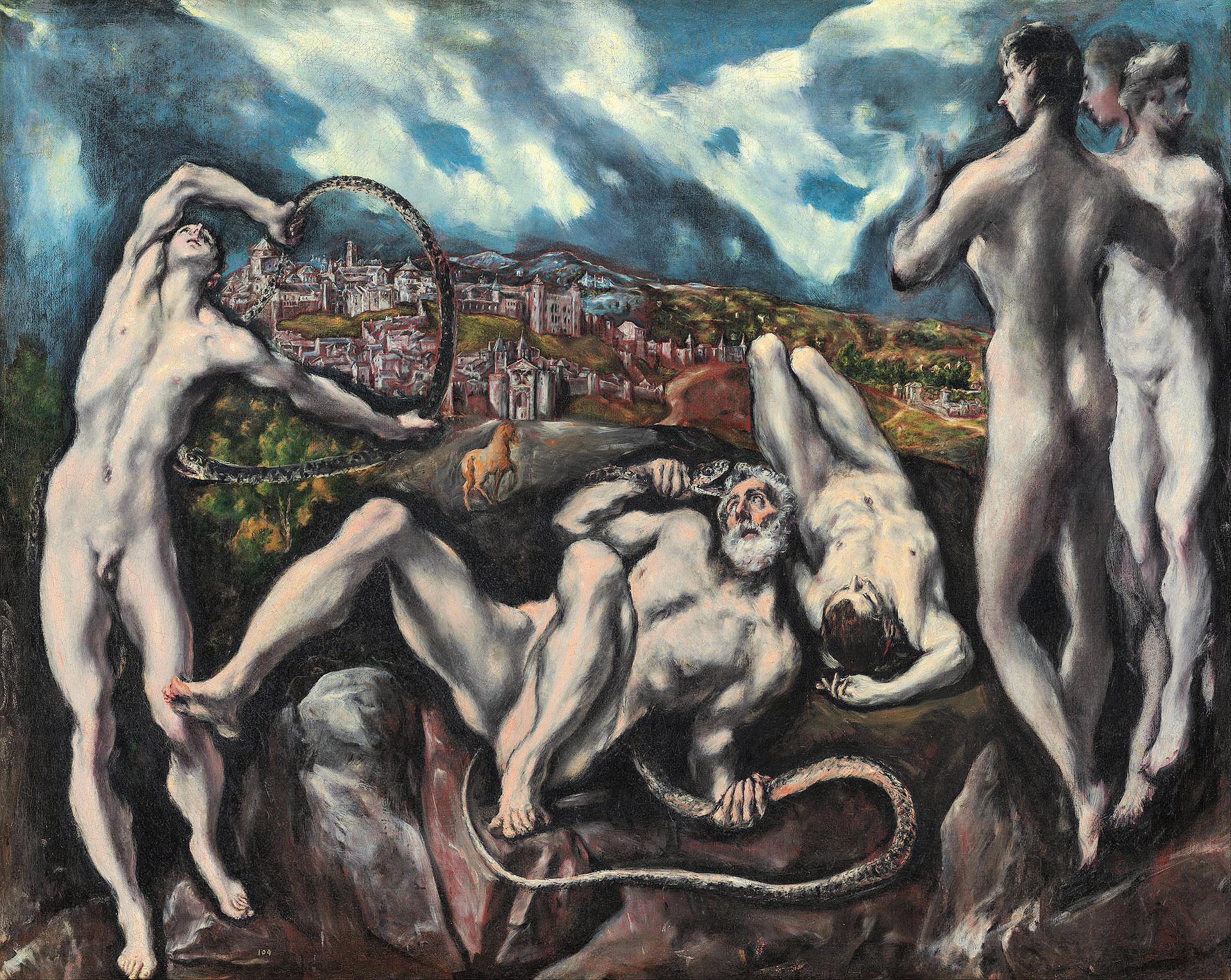
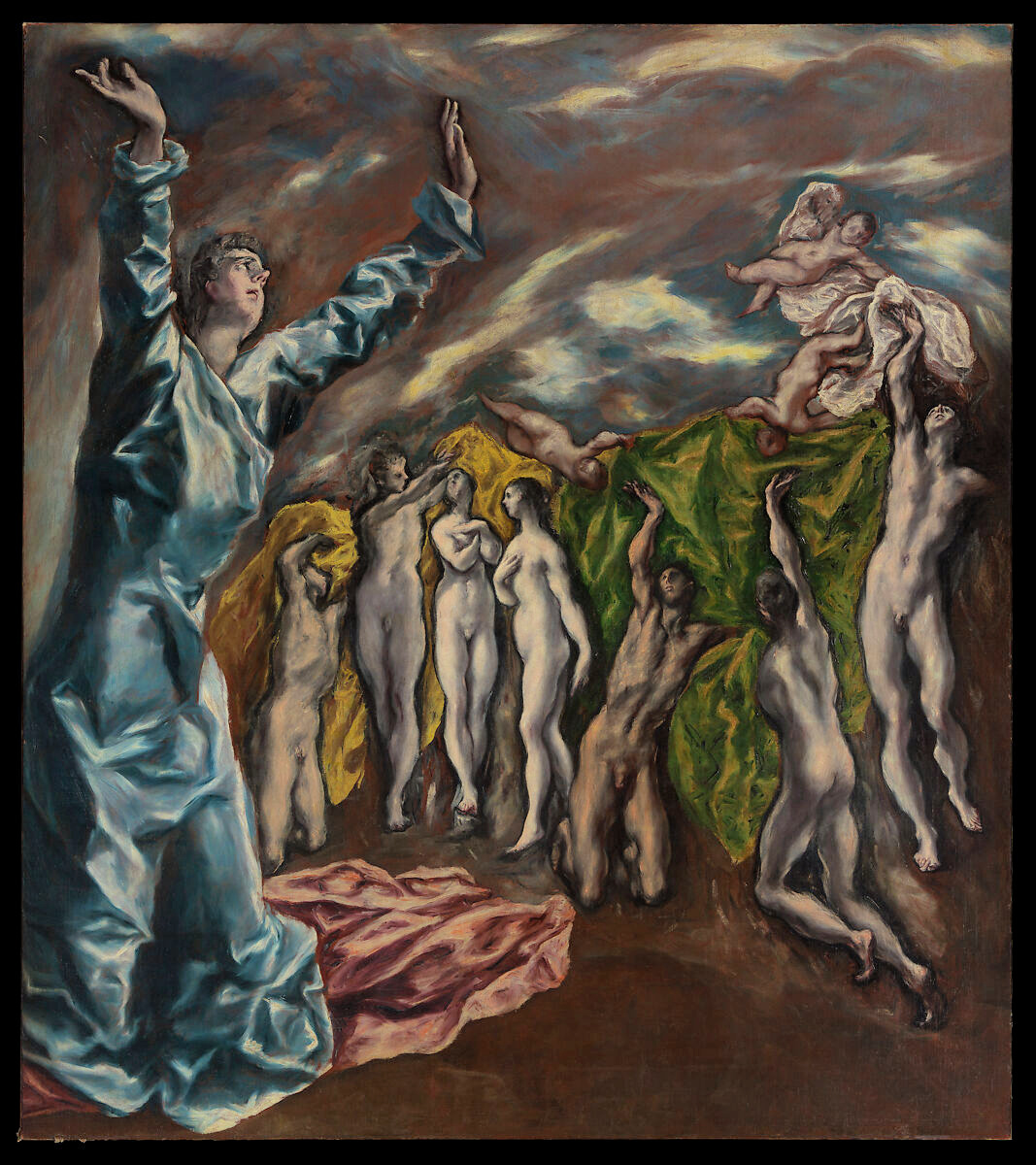
FEATURE Image: El Greco (Domenikos Theotokopoulos), Laocoön, oil on canvas, 1604-1614, 55 7/8 x 76″, National Gallery of Art, Washington, D.C. In Greek and Roman mythology, Laocoön is a Trojan priest who warned the Trojans to destroy the Trojan Horse sent by the Athenians and is punished with death by the gods for it. See the artwork again below for details about El Greco’s painting.
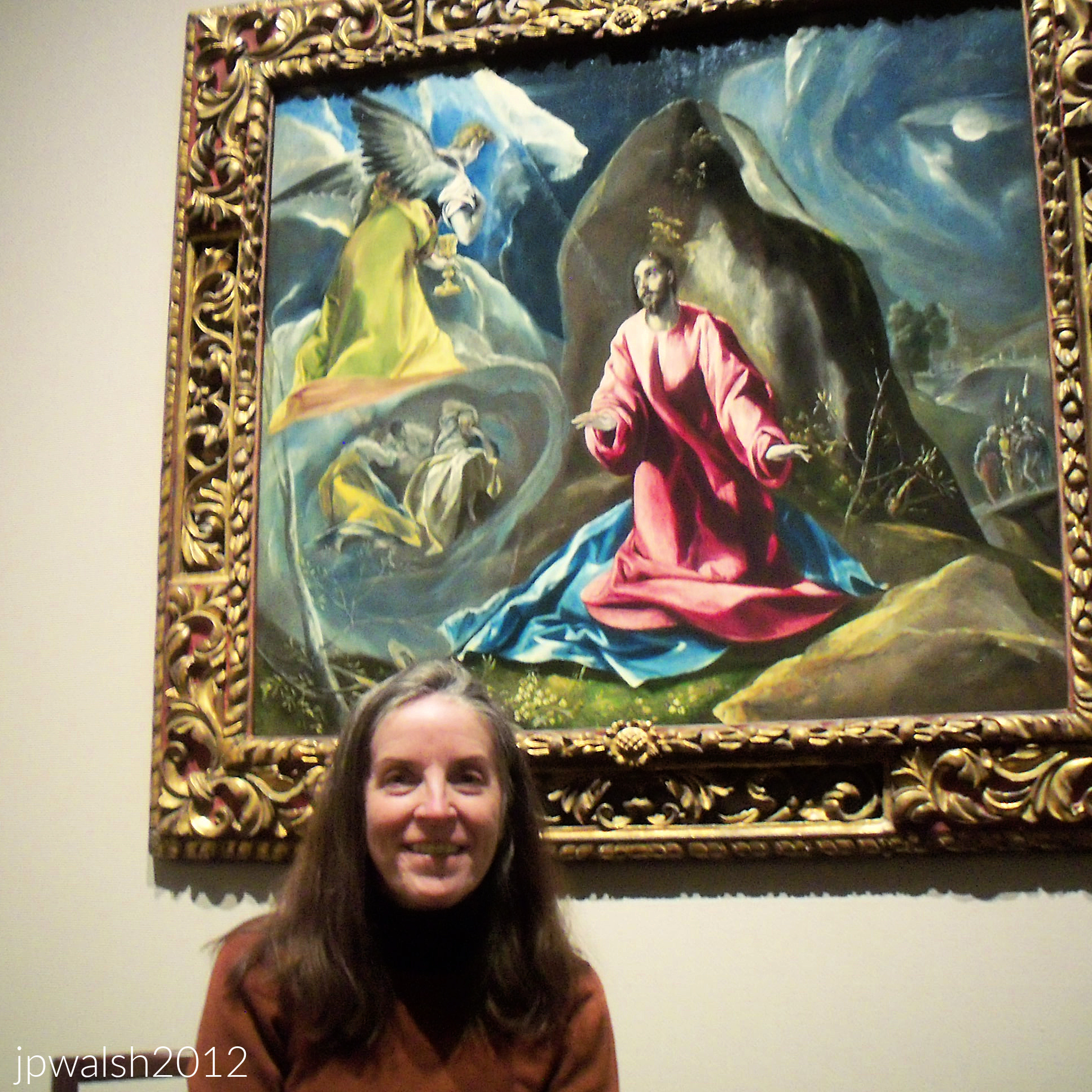
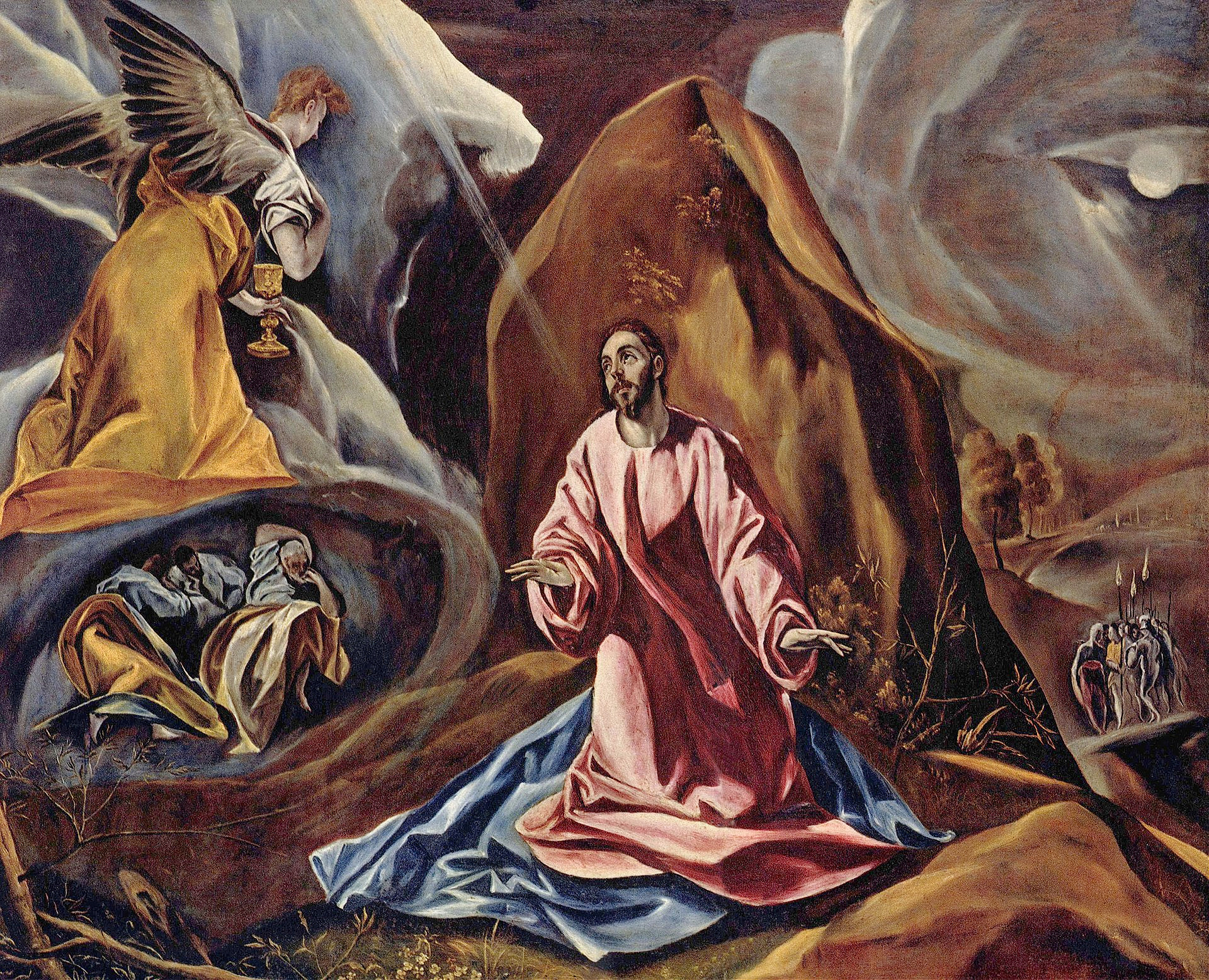
The Agony in the Garden, Domenikos Theotokopoulos, called El Greco, c. 1590-1595, oil on canvas, 40 1/4 x 44 3/4 in. (102.2 x 113.7 cm) Toledo Museum of Art, Gallery 15.November 2012 .1.32mb 101_0977.
From the museum label: With his intensely personal style, El Greco (“the Greek”) is one of the most original artistic visionaries of any era. Born Doménikos Theotókopoulos on the Greek island of Crete, he trained in Venice and Rome before settling in Toledo, Spain, where he painted this picture. Jesus is shown praying in the Garden of Gethsemane, outside Jerusalem, just before his arrest for his teachings (Judas and the Roman soldiers are approaching at the right). His disciples Peter, James, and John sleep at left. The consciously manipulated scale of the elongated figures, the intentionally jarring colors, and the deliberately confusing space (where exactly is the angel in relationship to the sleeping apostles?) add to the drama and emotion of the scene and capture Christ’s spiritual struggle as he agonizes over his coming crucifixion. Combining aspects from all four biblical accounts of the narrative for his own interpretation of the story, El Greco gives visual form to Christ’s metaphor in Matthew 26:42—”Oh my Father, if this cup may not pass away from me, except I drink it, thy will be done.” see – The Agony in the Garden – Search el greco (Objects) – Search – eMuseum – retrieved December 10, 2025.
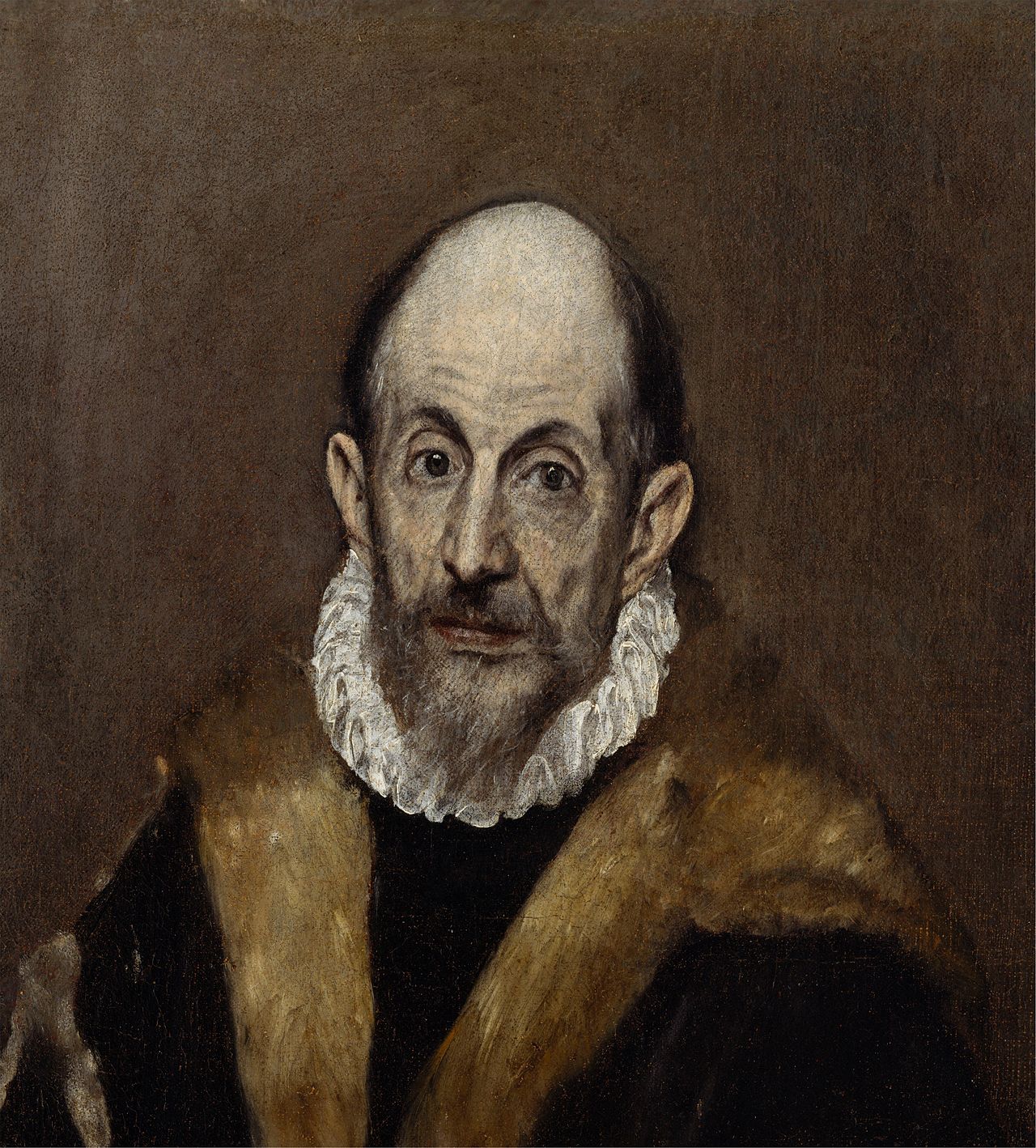
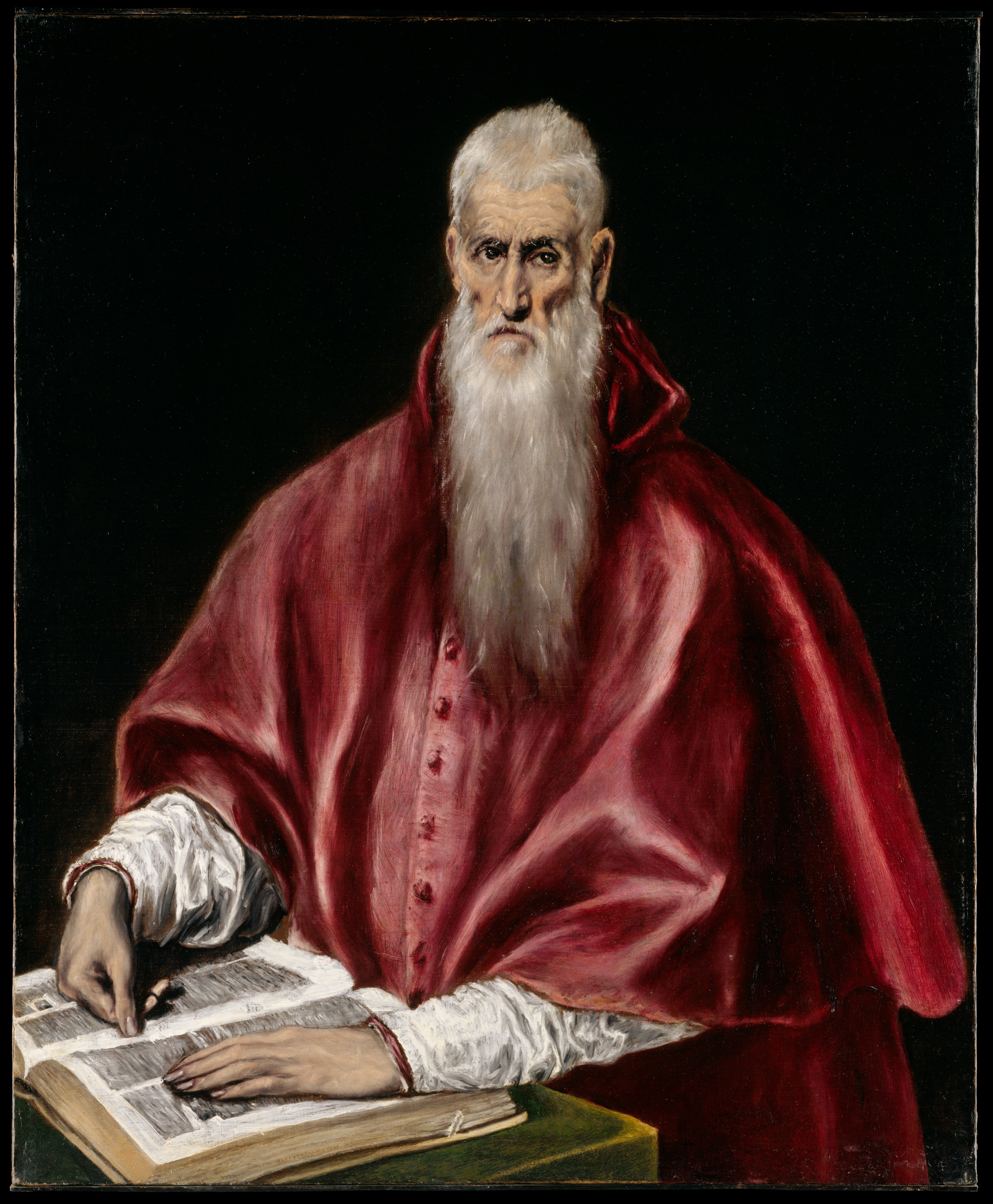
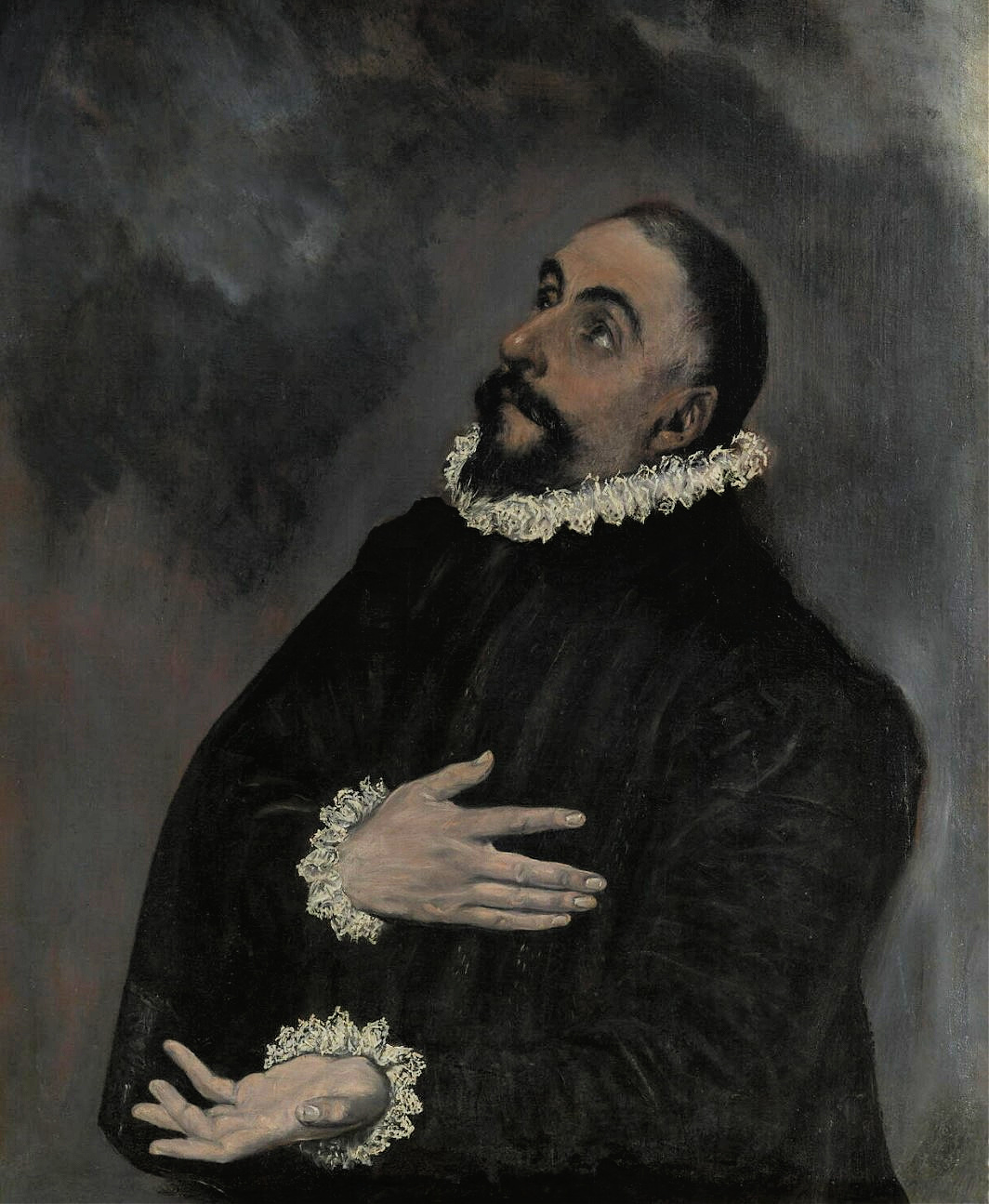
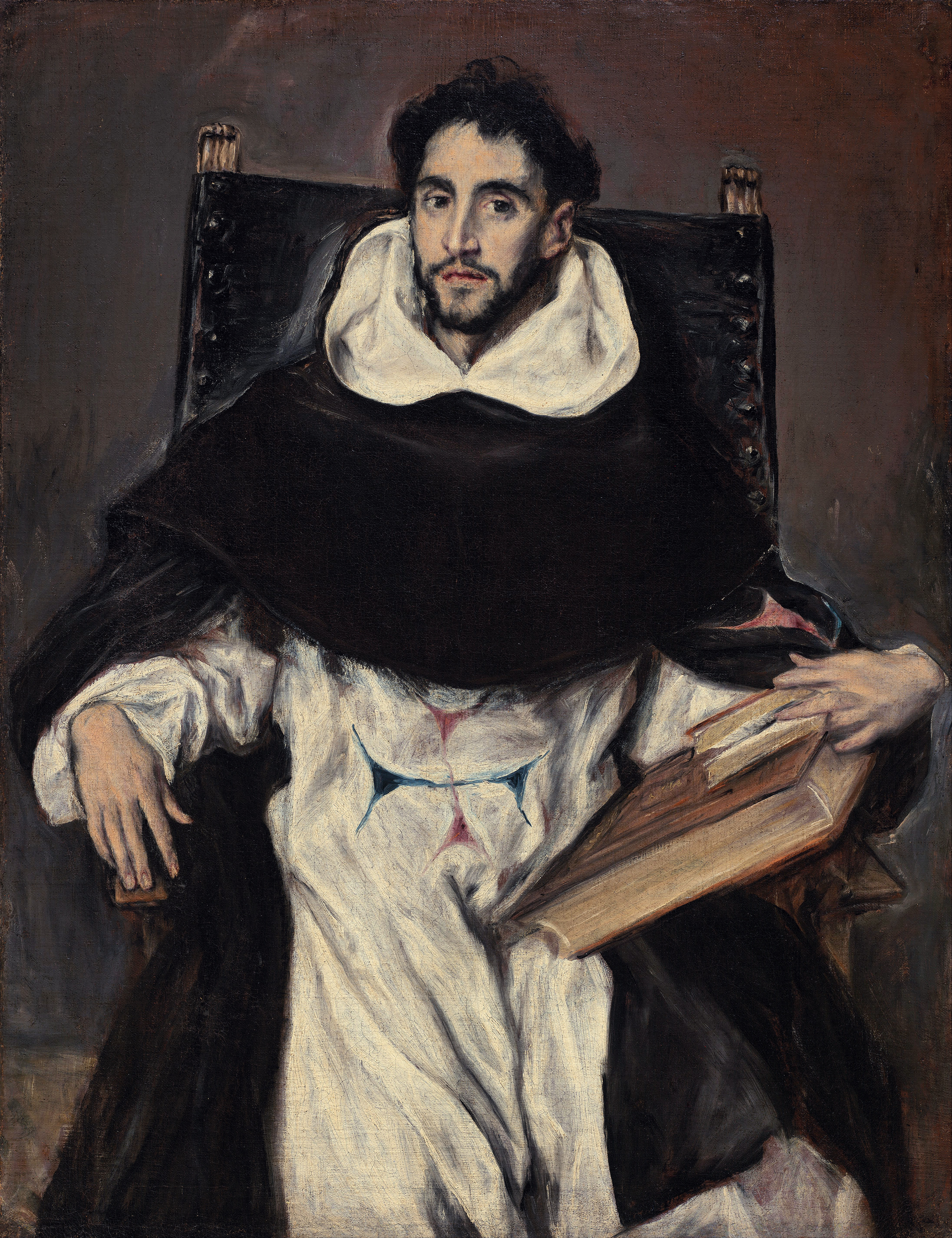
El Greco (Domenikos Theotokopoulos), Self-Portrait or Portrait of an Old Man, oil on canvas, 52.7 cm × 46.7 cm (20.7 in × 18.4 in), The Metropolitian Museum of Art, New York.
Usually identified as a self-portrait, it is supported by the fact that the same figure appears several times in El Greco’s oeuvre and ages alongside the artist. The portrait shows the influence of Titian (1489-1576) and Tintoretto (c.1518-1594) whose artwork El Greco saw in Venice.
THE ARTWORKS:
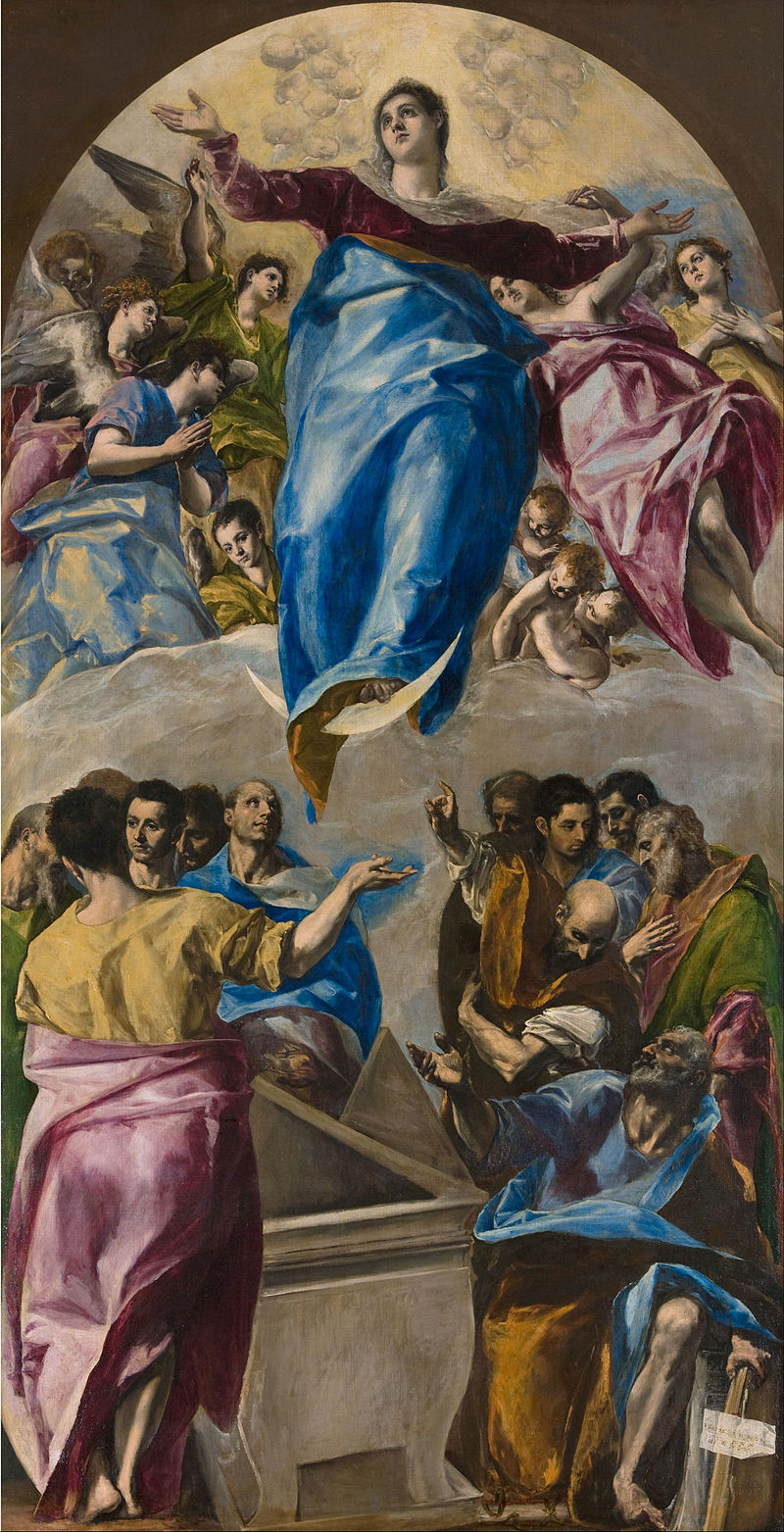
El Greco, The Assumption of the Virgin (Church of Santo Domingo el Antiguo, Toledo, Spain), 1577-79, The Art Institute of Chicago.
Part of an altar ensemble, Assumption of the Virgin is 13 feet high and 7 feet 6 inches wide. In the painting there are two principal groups – the Virgin and angels above and, below, the 12 apostles and an empty sarcophagus. It was the first major commission for El Greco for the Bernadine Convent Santo Domingo el Antiguo in Toledo, Spain. It was in the funerary chapel of Doña María de Silva. El Greco in Spain is first recorded on July 2, 1577 (Toledo Museum of Art, El Greco of Toledo, (exhibition catalog), Boston: Little, Brown and Company, 1982, p.16). On August 8, 1577 a contract was made for the main altar series which included The Assumption of the Virgin. El Greco agreed to complete the project in twenty months for a payment of 1500 ducats. The artist signed and dated The Assumption in 1577 and was paid in full in 1578. The painting was installed in September 1579 and remained in the church for the next almost 250 years. (Ibid., p 152; Wood, James, AIC – Essential Guide, Chicago, 2003, p.131). In 1827 The Assumption of the Virgin was purchased by Infante Don Sebastián Gabriel de Borbón (“S.G.”). An inventory of S.G.’s estate lists The Assumption as #26, one of only two sixteenth century Spanish paintings in his collection of more than 200 works. The listing reads: “Otro en id de 14 pies y 5 pulgadas de alto por 8 pies y 3 pulgadas de cnaho. Su asunto, la Ascension de la Virgen, y los Apóstoles, alrededor de Sepulcro. Esta restaurado por Bueno. Tiene marco tallado y dorado…Dominico Greco.” [“Another in dimension (ideación) of 14 feet and 5 inches high by 8 feet and 3 inches wide. Its subject, the Assumption of the Virgin, and the Apostles, around the sepulcher. It was restored on the up and up. It has carved and gilt markings.” – my translation.] (Agueda, Mercedes, “La colección de pinturas del infante Don Sebastián Gabriel,” Boletín del Museo de Prado, iii/8 (1982), pp.103 and 106; 102-17; American Art News, Jan. 7, 1905, Vol. III, p.1.; Toledo Museum of Art, El Greco of Toledo, p.153). In 1837 S.G.’s collection of paintings was confiscated because of his political (pro-Carlist) activities.Along with pictures acquired from the suppression of the religious orders during the Napoleonic occupation (1800-12) his collection of paintings (including presumably #26 in his 1835 inventory) was exhibited at the Museo de la Trinidad. (Boletín, p. 103; Groveart.com, “Borbón y Braganza, Don Infante Sebastián Gabriel.”) S.G.’s property was returned to him shortly before his death in 1875. The Prado describes events until 1902 like this: “La colección…a la muerte del Infante…fue nuevamente exhibida en publico por sus herederos con motivo de una venta realizada en Pau en 1876, añadiéndose al núcleo primitivo de la colección la parte correspondiente llevada al matrimonio por su segunda esposa, Ma Cristina de Borbón. En 1890, su hijo Pedro pone en venta en el Hotel Druot de Paris parte de la colección y unos años más tarde se hace lo mismo en Madrid, bajo el nombre de la Infanta Maria Cristina. De las tres ventas sucesivas 1876, 1890 y 1902 se desprende como los colecciónistas fueron despojando del conjunto todo lo que podriamos llamar grandes piezas…”[… the collection at the death of the Infante was exhibited anew in public in a sale held in Pau in 1876 for the benefit of his heirs. Adding itself to the primitive nucleus of the collection was that respective part brought to the marriage by his second wife, Mrs. Cristina de Borbón. In 1890, her son Pedro put up for sale at the Hotel Druot in Paris another part of the collection and some years later did the same thing in Madrid under the name of the Infanta Maria Cristina. From these three successive sales of 1876, 1890 and 1902 the collectors were divesting themselves of whatever would be called the great pieces…” – my translation]. It is not yet clear at which of these three sales if any The Assumption of the Virgin found itself. What remained after the final sale in 1902 stayed in the possession of Borbón heirs. (Boletín, p. 104). In January 1905 The Assumption of the Virgin was purchased by Durand-Ruel and exhibited in his Paris gallery. (American Art News, Jan. 7, 1905, vol. III, p.1). Durand-Ruel had purchased it from the Spanish Bourbon family into whose possession it came in 1811. The painting was being exhibited at the Prado when Durand-Ruel purchased it in January 1905. Durand-Ruel was dealing in other El Grecos around that time such as acquiring his Laocoön in 1910 and selling it to Paul Cassirer in Berlin by October 1915 (today it is in the National Gallery of Art in Washington, D.C.). On July 17, 1906, The Assumption of the Virgin was purchased by The Art Institute of Chicago for 200,000ff from Durand-Ruel in Paris. This purchase for an American museum reflected the daring and independent judgment of its purchasers. The painting had always been praised as the artist’s most beautiful and was considered a homage to Titian’s composition in the Church of Santa Maria Gloriosa dei Frari in Venice while also expressing Roman monumentality. (Horowitz, Helen L., Culture and the City: Cultural Philanthropy in Chicago from the 1880s to 1917, Lexington: The University Press of Kentucky, 1976, p. 101; The Art Institute Chicago 28th Annual Report, June 1, 1906-June 1, 1907, pp.20 and 59; Toledo Museum of Art, El Greco of Toledo, p.153). In February 1915 Mrs. Nancy Atwood Sprague, widow of Art Institute of Chicago Trustee Arnold Sprague, gave $50,000 to defray the artwork’s purchase expenses. From the very beginning this El Greco painting was considered the Museum’s most important acquisition of the year and called the greatest work of El Greco outside Spain. (Chicago Art Institute Bulletin, Mar. 1, 1915, p. 34).
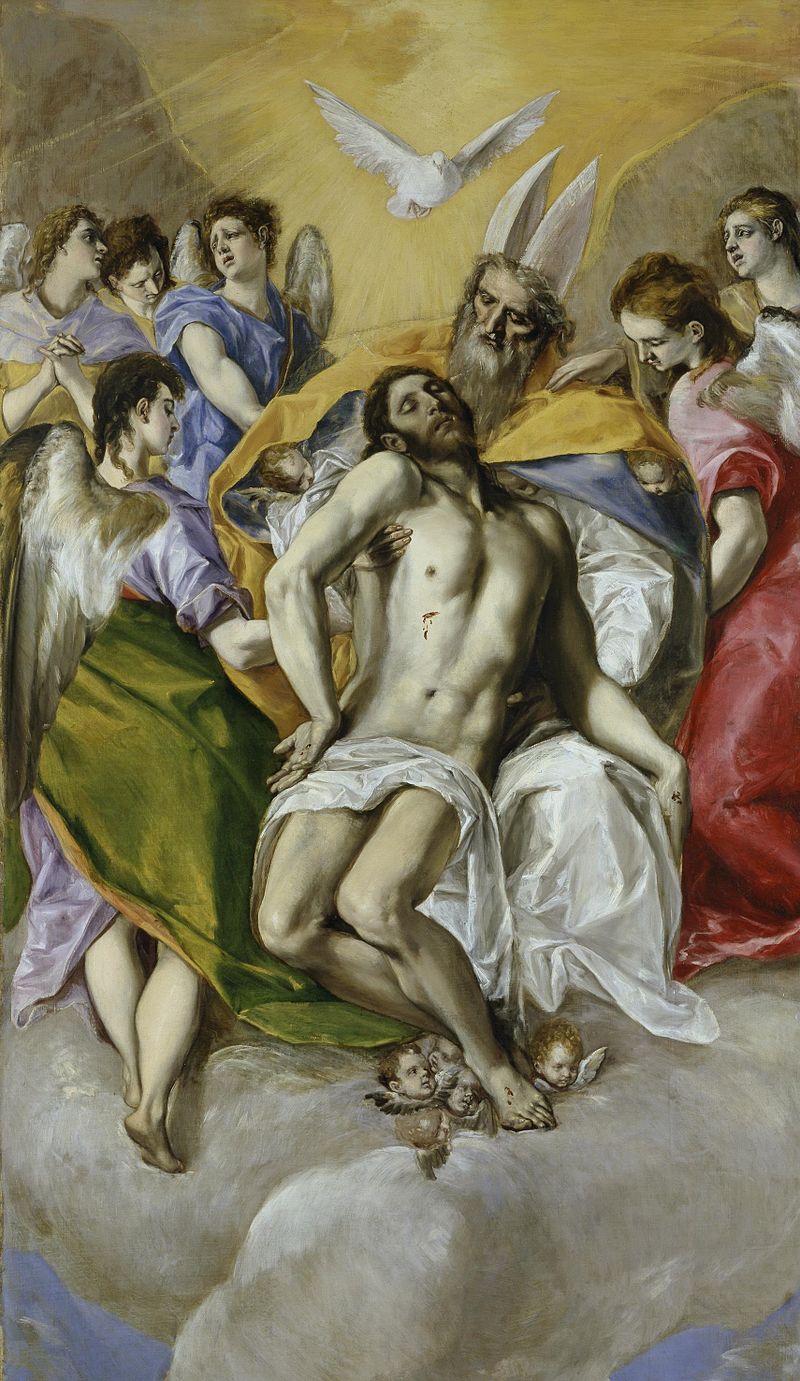
El Greco (Domenikos Theotokopoulos), The Holy Trinity,1577–1579, 300 x 178 cm, oil on canvas, Museo del Prado, Madrid, Spain.
The painting of the Holy Trinity was part of the altar ensemble for El Greco’s first major commission. It was above The Assumptionof the Virgin with God the Father holding the dead Christ surrounded by angels and a white dove hovering above signifying the Holy Spirit.
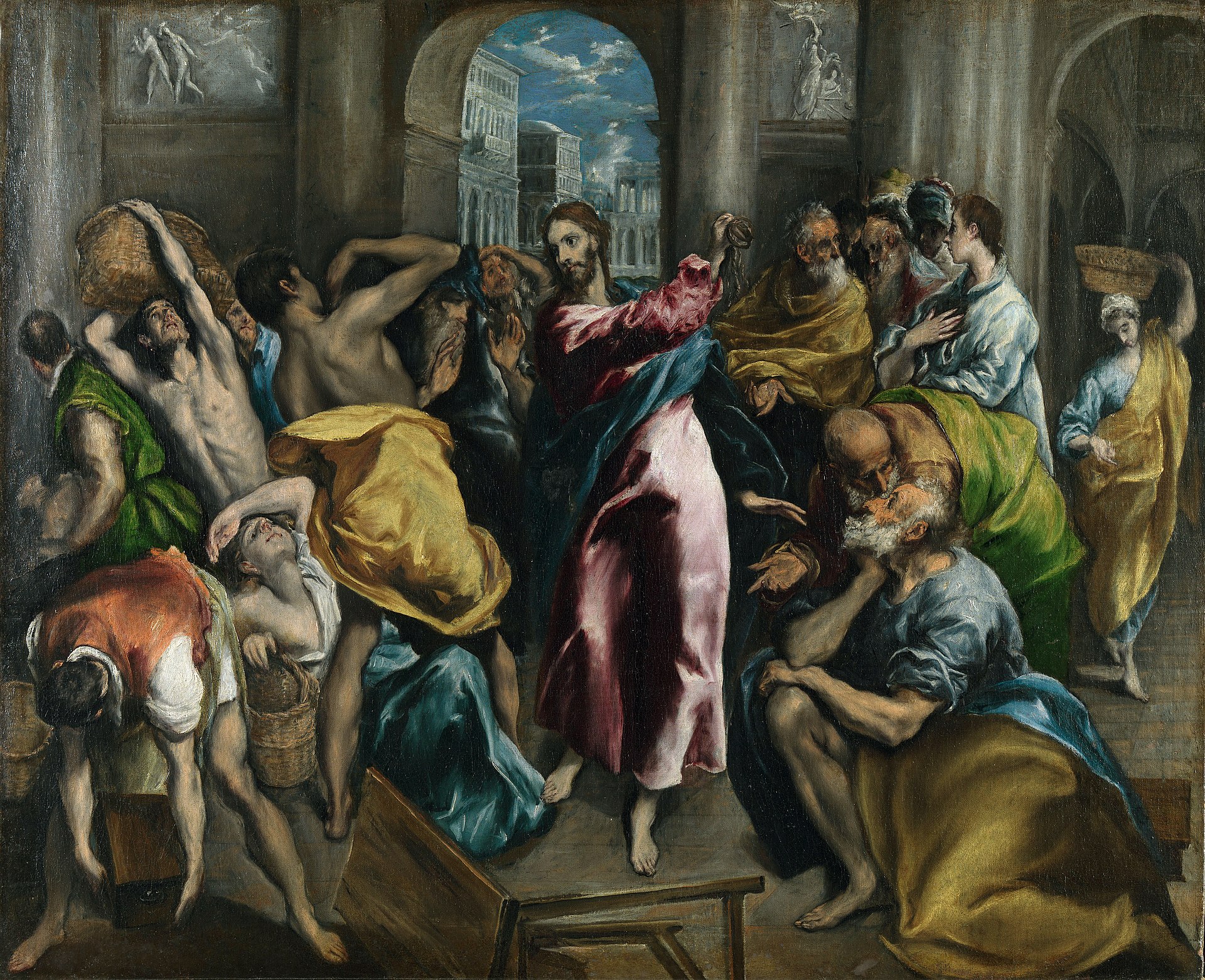
El Greco painted this episode of the Purification of the Temple many times, a story that appears in all four Gospels. The artist used intense colors and exaggerated gestures to express the chaos and disruption of the moment when Jesus Christ, angry that the temple was being used for sinful commerce and not prayer, makes a whip and uses it to drive out the traders selling animals for sacrifice. In the upper left corner is a painted sculpture of the expulsion of Adam and Eve from the Garden by the Angel of God reinforcing the message of sinfulness in the trader’s actions in the scene. At right in contrast, Christ’s apostles stand beneath a painted relief sculpture of faithful Abraham. The story of the Purification of the Temple told in Chapter 2 of John’s Gospel relates: “…Jesus went up to Jerusalem. He found in the temple area those who sold oxen, sheep, and doves, as well as the money-changers seated there. He made a whip out of cords and drove them all out of the temple area, with the sheep and oxen, and spilled the coins of the money-changers and overturned their tables, and to those who sold doves he said, ‘Take these out of here, and stop making my Father’s house a marketplace.'” El Greco painted Christ’s body energetically twisted with his right arm raised and ready to strike the man draped in yellow cloth he is gazing at. The man in yellow mirrors Christ’s pose as he recoils, arching his back and raising his hand to protect himself. The figures behind him lean in the same direction backwards to avoid being struck in the melée. The painting shows El Greco’s debt to Renaissance art such as Titian and Michelangelo (1475-1564) whose artwork El Greco studied during his travels to Venice and Rome. The figures behind Christ are much calmer. The gray-bearded man with his hand on his knee looking up in a yellow and blue costume is identified as Simon Peter. While the foreground setting suggests a grand columned one that is only partially seen, the buildings in the background with their arched arcades were likely inspired by architecture El Greco saw in Venice in 1568.
Cathedral, Toledo. Metropolitan. Philadelphia Museum of Art. Church of San Tomé, ToledoPrado. Museum of San Vicente, Toledo. National Gallery of Art, Washington, D.C.El Greco, Saint Martin of Tours and the Beggar, 1597-1599, oil on canvas, 193.5 × 103 cm (76 3/16 × 40 9/16 in.), National Gallery of Art, Washington, D.C. https://www.nga.gov/collection/art-object-page.1164.html – retrieved November 11, 2024.
The painting was commissioned by Martín Ramírez for the Chapel of San José in Toledo, Spain. El Greco painted miracles as matter of fact. St. Martin and The Beggar depicts a scene from a low vantage point looking up to a monumental knight sharing his cloak with an attenuated, nearly otherworldly figure of a naked beggar. St. Martin of Tours (d.397), part of the Imperial Calvary stationed near Amiens during the times of Roman Emperor Constantine, sits mounted on a magnificent white Arabian steed and is dressed in stylishly practical soldier regalia from head to foot signifying his noble role and power to survey this emerald green landscape that is Toledo and the Tagus river. Martin’s green cloak is one part of his regalia but, on a cold autumn or winter day, his heart burns to divide it with his sword so to share it with this naked bandaged stranger he meets on the road. The encounter and action are modest and profound simultaneously– a typical social setting yet not merely transactional within a rigidly conceived social order but a tender act of charity. Martin rode off with his half cloak and thought of his soldierly duties. Yet it afforded a miracle. That night, tradition relates, Christ appeared to Martin in a dream revealing that the beggar the knoght shared his cloak with was Him.
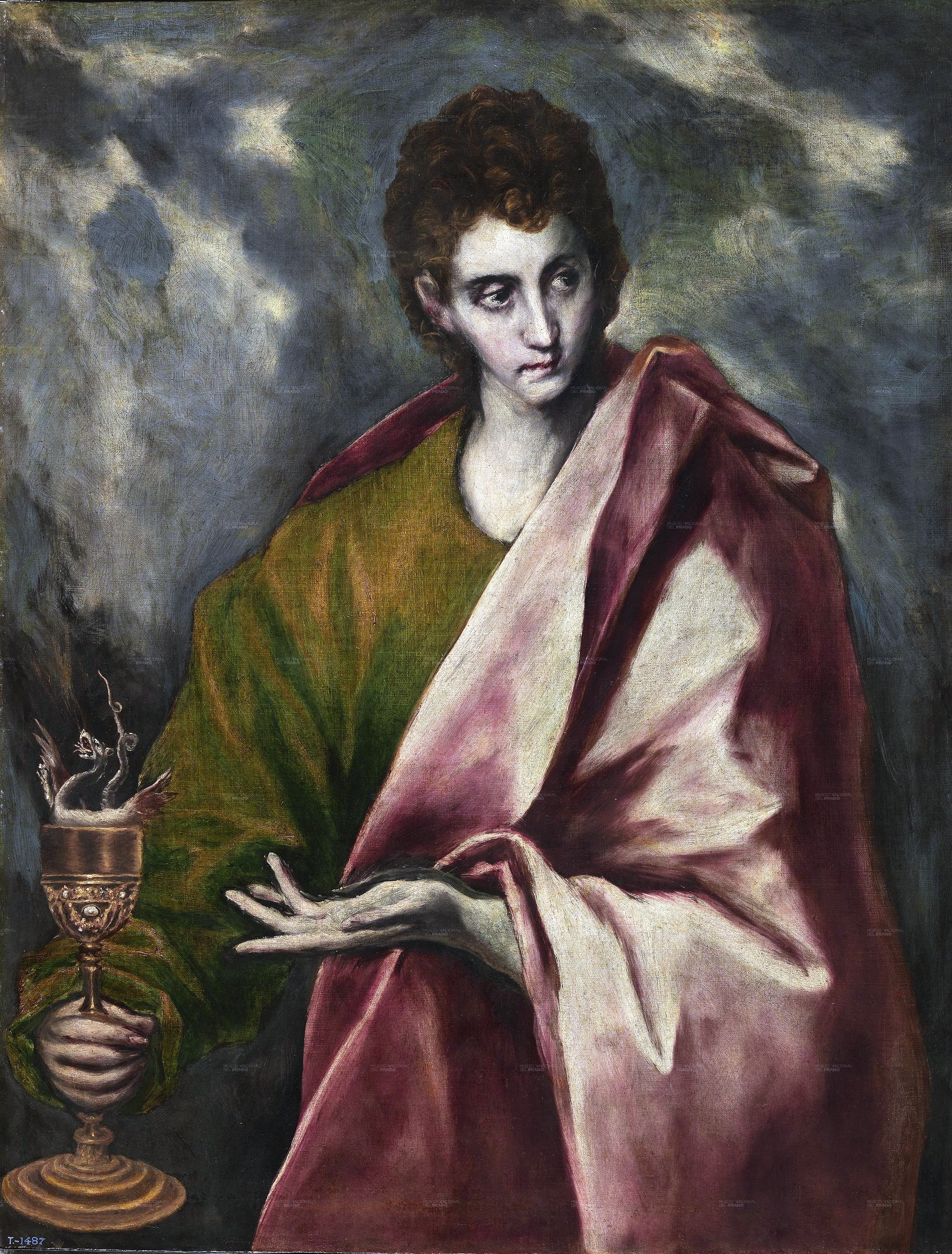
This painting shows St. John the Evangelist in a half-figure which has a clear precedent in the Venetian school where El Greco completed his training. Crete, where El Greco was born, was a Venetian possession. El Greco arrived to Venice as a teenager in the late 1550s or early 1560s where he worked with Titian (c. 1490-1576) but became the admirer and heir of Tintoretto (c. 1518-1594). El Greco, who studied icon painting in Crete, learned the medium of oil from its virtuoso Titian, but once in Venice, El Greco quite normally was attracted to Tintoretto, the city’s then-modern master. “The Greek” did not simply imitate Tintoretto’s exterior forms but very personally emulated his deeply spiritual and expressive Mannerism. In this later painting, El Greco depicts the tradition that John the Evangelist was in Rome when the Emperor Domitian (51-96) tried to assassinate Jesus of Nazareth’s young apostle by poisoning the wine in his Mass chalice. But the legend relates that the poison turned into a fabulous serpent tipping off John and his holy companions and doing them no harm. Like Lorenzo Lotto (c. 1480-1556), El Greco depicts this story’s externals surrounding John – be it the heavy chalice, poisonous serpent exorcised from it, or the expressive hands of the apostle holding the cup of sacrifice and motioning towards it – to scrutinize the inner conviction or character of the sitter, the young author of the Johannine corpus of a gospel, three letters, and the book of Revelation. On John’s Gospel Cornelius à Lapide (1567-1637) wrote that the Evangelist was indeed the eagle (inspired by a description in Ezekiel) who soars skyward and swoops down to earth for his prey. John wrote the last canonical gospel in 99 with combatting that day’s Christian heresies in mind, specifically those that denied Christ’s divinity – whom in his epistles he called “anti-Christs.” John conveys sacred ideas with a rusticity of style. The 17th century theologian and biblical scholar Cornelius à Lapide affirmed that “John was most like Christ” and that the disciple loved the master supremely and the master held the disciple most dear. Because of the relationship of Jesus and John, the biblical scholar claimed, “when you read and hear John [in his gospel, letters, and book of Revelation] think that you read and hear Christ.” He quotes St. Jerome who claimed that Christ transfused his own spirit and his own love including “the purest streams of Jesus Christ’s Doctrines” into Saint John. This relationship is signaled by John’s reclining on the breast of Christ at the Last Supper. John, now in old age, was pressed by all the bishops in Asia and many others to write a “breakthrough” account claiming of the deepest things of the Divinity of the savior. John agreed with the condition that the whole church fast before he embarked on the project and when the fast ended John began: “In the beginning was the Word, and the Word was with God, and the Word was God. 2He was in the beginning with God. 3All things came to be through him, and without him nothing came to be.” Nothing is stronger to attest to the origin, eternity, and generation of the divinity of the Christ. John wrote in the Greek language because he was addressing Greeks but, again according to Cornelius à Lapide, the gospel is filled with Hebrew phrases and idioms because St. John was a Hebrew who loved his native language. Though John relates Jesus’s miracles as proof that Christ was the Messiah, God as well as man – including the singular accounts of the changing water to wine at the wedding feast of Cana (chapter 2) and the raising of Lazarus from the dead (chapter 11) – John less relates actions of Christ as found in the synoptics Matthew, Mark, and L uke who focused on his humanity and much more of the discourses and disputations that Christ had with the Jews (mostly its rulers), again with none other than the same purpose to prove his theology meant for the whole world that Christ was “God as well as man.” In John’s gospel a careful examination of contexts needs to occur because Christ speaks sometimes as man and sometimes as God. Its high theology which dealt with the inspiration of the Holy Spirit, unity of the Godhead, and divine relations and attributes became that gospel in the next centuries that the bishops referenced to combat their day’s heresies such as Arianism (which denied Christ’s Divinity), the Docetists (who denied Christ’s humanity), and Nestorians (who denied Christ’s dual natures). John had favorite terms and ideas he repeated in his gospel – calling Christ “the Life” and “the Light.” Calling saints “the children of light.” Calling sin “darkness.”
Metropolitan.Museum of Fine Arts, Boston. Prado. Greco Museum, Toledo. Hospital of San Juan Bautista, ToledoGreco Museum, Toledo. Greco Museum Toledo.Metropolitan.National Gallery London.National Gallery of Art, Washington, D.C.
As mentioned in the feature image caption, Laocoön is a Trojan priest in Greek and Roman mythology who warned the Trojans to destroy the Trojan Horse sent by the Athenians by which they won the war. “I fear the Greeks even when they bear gifts,” he told them (see Edith Hamilton, Mythology, p. 285). Laocoön and his two sons are punished for revealing this truth by the gods. They are attacked by giant serpents sent out of the sea by Apollo and Artemis that bit and crushed them to death and then slithered away into Athena’s Temple in the city. The Trojans, instead of heeding their priest’s warning and seeing his death for what it was — the punishment for telling them the truth of the danger of the Trojan Horse — viewed it as warning not to question the entry of the monumental wooden horse into the city. They pulled it in, set it in front of Athena’s Temple, and went to their homes believing they had won a peace that had not happened in ten years. El Greco set the artwork outside Toledo giving the ancient tale a contemporary context and unique interpretation. Though Laocoön and his two sons’ fates are sealed, the artist captures a unified centrifugal movement with individualized figures in bare-faced struggle after exercising their prudential judgment that is witnessed by dispassionate onlookers as if in a dream.
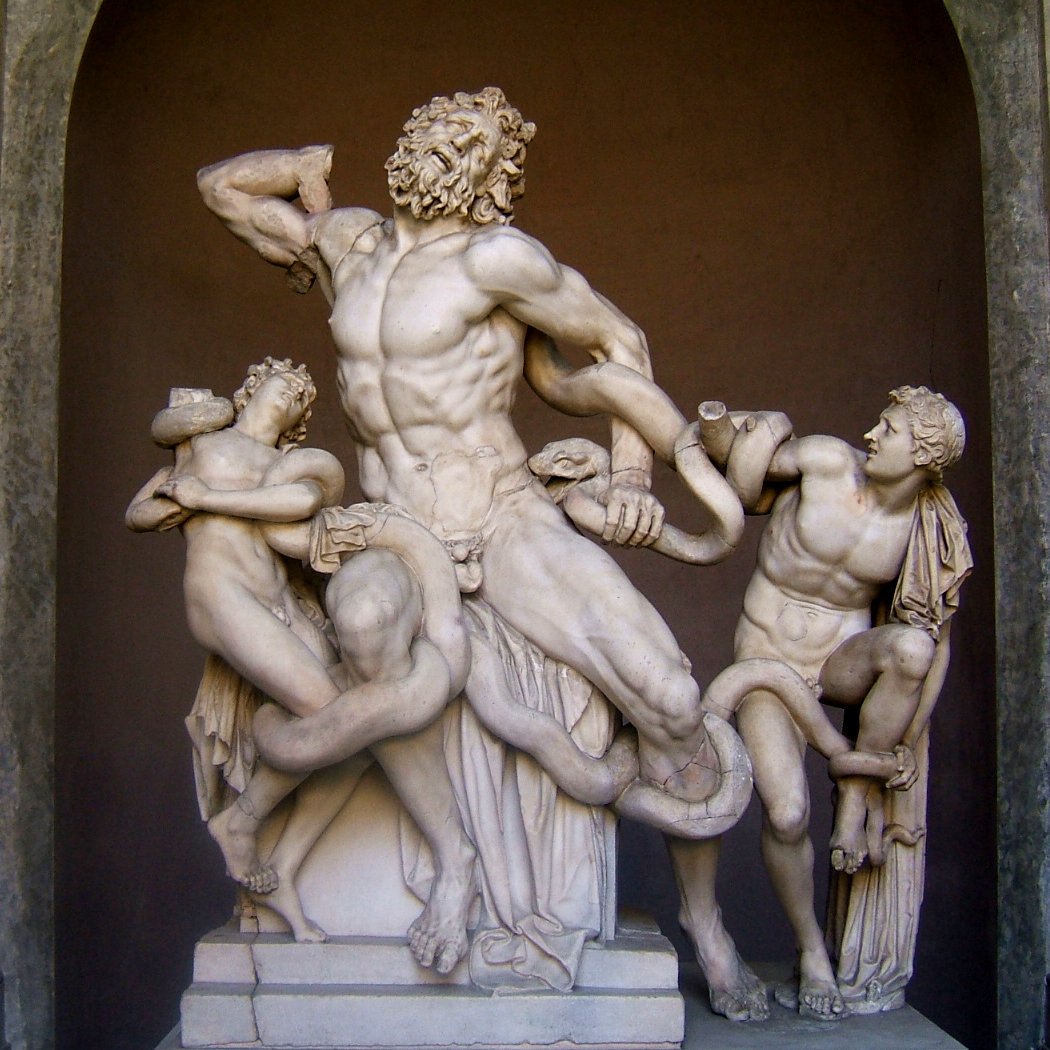
Laocoön and His Sons, 1st CE?, marble, 242 cm high, Vatican Museums, Vatican City. The classical marble sculpture was unearthed in 1506 and housed in the Belvedere in the Vatican. Its discovery aroused great excitement in the Renaissancce art world and numerous copies were made. El Greco’s painted extrapolation was taking this passion of classical suffering to the level of one’s own modern synthetic invention where the colorful sensation of upheaval is dynamic. “Laocoön and His Sons” by JuanMa is licensed under CC BY-SA 3.0.Metropolitan.
SOURCES:
El Greco, Leo Bronstein, Harry N. Abrams, Inc. New York, 1990. El Greco of Toledo, Jonathan Brown, William B. Jordan, Richard L. Kagan, Alfonso E. Perez Sanchez, Little, Brown, Boston. 1982. El Greco, David Davies, National Gallery Company, London, 2003. Mythology Timeless Tales of Gods and Heroes, Edith Hamilton, Grand Central Publishing, New York and Boston (originally published in 1942).
FEATURE IMAGE: Valentin de Boulogne (1591-1632), Allegory of Rome, 1628, oil on canvas, 330 x 245 cm, Villa Lante (Institutum Romanum Finlandiae Foundation). Villa Lante in Rome is an example of the work of the 16th century Raphael school in the reign of the Medici popes. The Renaissance villa, which was a residence for Roman aristocracy, was purchased in 1950 by the Finnish state. The Institutum Romanum Finlandiae Foundation started operating there in April 1954.
Ruins of the Coliseum in Rome, Circle of Willem van Nieuwlandt, II, c. 1600, Pen and brown ink, with brush and brown and gray wash, on pieced cream laid paper, 35.3 × 61.3 cm (13 15/16 × 24 3/16 in.) The Art Institute of Chicago. https://www.artic.edu/artworks/95904/ruins-of-the-coliseum-in-rome
INTRODUCTION.
Le Valentin de Boulogne (c.1591/1594-1632), sometimes called Jean Valentin, Jean de Boulogne Valentin, or simply Le Valentin, was a French painter. Born in Coulommiers-en-Brie about 35 miles east of Paris, Le Valentin may have been at least half Italian. His artwork was certainly influenced by Italian painting more than any other though he was familiar with Northern or Flemish painting. Le Valentin may have been in Rome as early as 1612 – German painter and art-historian Joachim von Sandrart (1606-1688) remarked in 1675 that Valentin reached Rome before Simon Vouet (1590-1649) who had arrived around 1614. Whether in 1612 or definitely by 1620 (Le Valentin appears in the census), Le Valentin spent the rest of his life In Rome. In the Eternal City Le Valentin was greatly influenced by Simon Vouet (French, 1590-1649) and Bartolomeo Manfredi (Italian, 1581-1622), a leading Caravaggiste or follower of Carravaggio (Italian, 1571-1610).
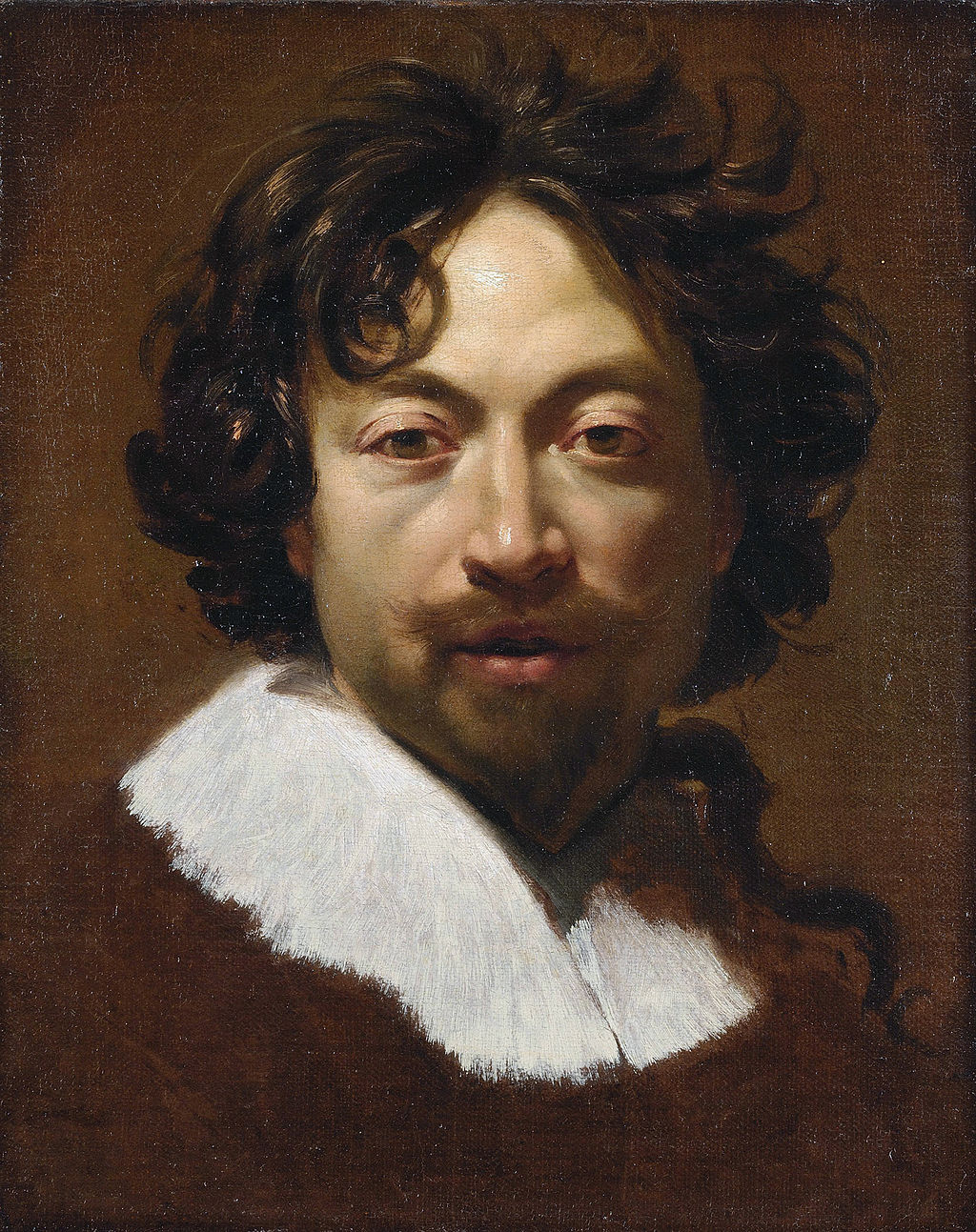
Joachim von Sandrart, Self Portrait, 1641.Bartolomeo Manfredi, The Martyrdom of St. Bartholomew (detail).Simon Vouet, Self-portrait, c. 1626–1627 Musée des Beaux-arts de Lyon.
Le Valentin’s oeuvre is today around 55-60 paintings, most of them identified by modern scholarship (i.e., Jacques Bousquet; Roberto Longhi). Le Valentin’s major commissions date from the last seven years of his life. Opportunities to acquire his artwork was rare, though avid collectors such as Cardinal Mazarin (1602-1661) and Louis XIV collected them.
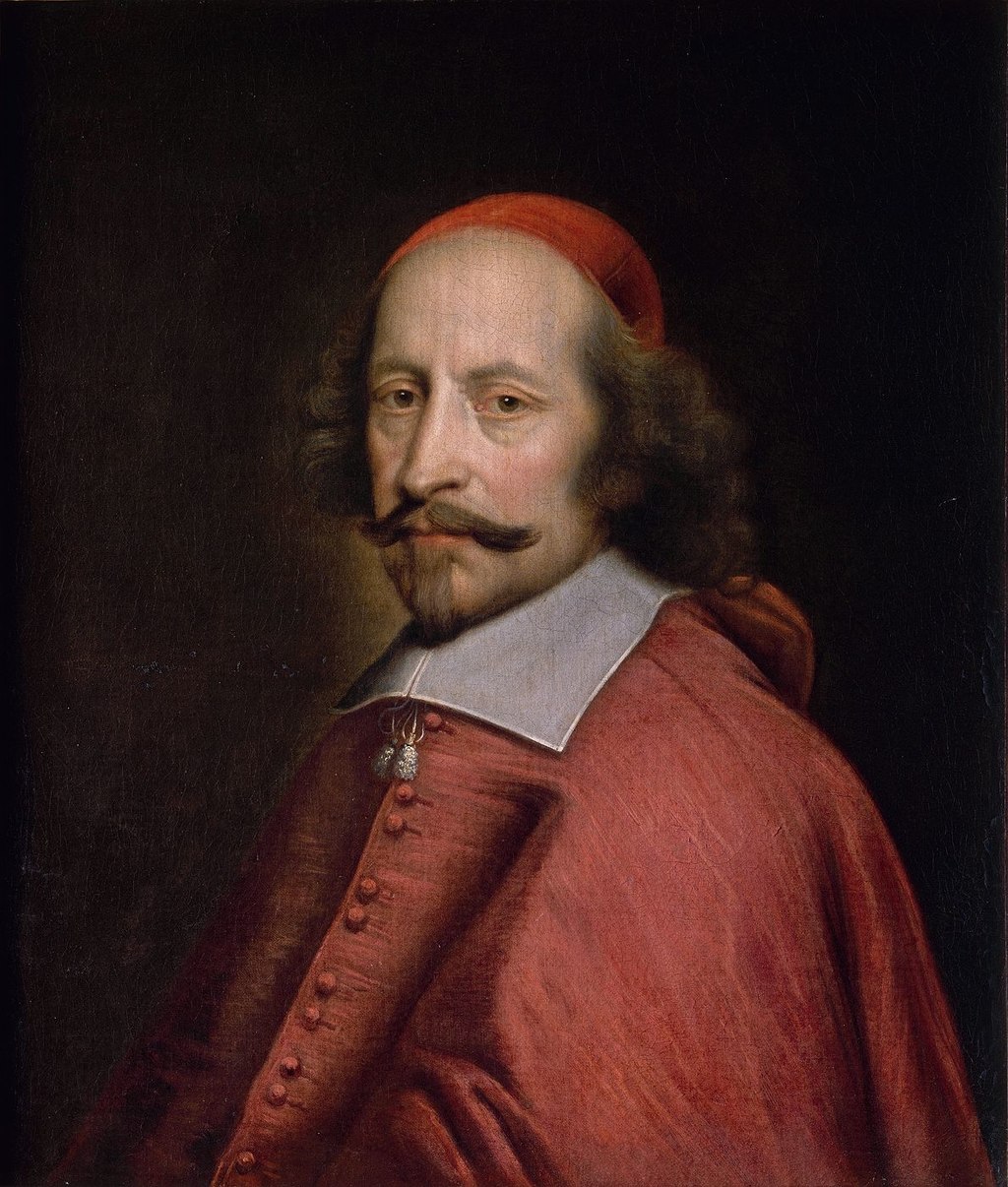
Cardinal Mazarin by Pierre Mignard, Musée Condé, Chantilly, France.Louis XIV, Charles Le Brun, Château de Versailles.Piazza del Popolo, Rome. “Piazza del Popolo.. Rome” by Nick Kenrick.. is licensed under CC BY 2.0
In Rome Le Valentin forged close ties with other French artists and lived with many of them in and around the Piazza del Popolo to the Piazza di Spagna. Most French painters born in the 1590s made a stay in Rome – and influenced art in France in the 17th century. Reasons young painters fled to Italy in the early 17th century included depletion of opportunity in Paris due to the professionalization of artistic practice in and outside the capital although establishment French art was no longer flourishing. Conversely, Roman art – and not only the schools of Michelangelo and Raphael but new horizons afforded by Annibale Carracci (1560-1609) and Caravaggio (1571-1610) -was at an apex. The Eternal City was drawing international artists from Paris and elsewhere and, between 1610 and 1630, the Roman style became internationalized. The dialogue among artists in Rome in this period was exciting – and its outcomes often unpredictable. The culture of Rome (and the papacy) could actually be liberating for foreign, usually destitute, often libertine talented young artists who had great ambitions for a prominent commission as they were exposed to Rome’s virtue and vice almost equally. Many of these young artists, even ones whose artworks survive, exist today virtually anonymously. Le Valentin de Boulogne is one of the better-known artists of the period, although his precise name is uncertain and his artwork requires connoisseurship based on modern scholarship.
Annibile Carracci, Self-portrait, 1604, Hermitage Museum, St. Petersburg, Russia.Caravaggio, David with the Head of Goliath, included a self portrait of the artist, 1610, oil on canvas, Borghese Gallery, Rome.
In 1626 Valentin, in Rome several years, was invited by Vouet to organize with Nicolas Poussin (1594-1665) the festival of the Accademia di San Luca ‘s patron saint. Around the same age, Vouet led the academy whose artists’ association was founded in 1593 by Federico Zuccari (1539-1609). This appointment signaled that Valentin was an active and respected rising French artist in Rome in these years. Though Caravaggio died in 1610 his influence was still felt very strongly in Rome in the 1620s.
Two of Caravaggio’s masterpieces—The Martyrdom of Saint Peter and The Conversion of Saint Paul—hung in the neighboring church of Santa Maria del Popolo which Le Valentin certainly had opportunity to study. In Italy, Valentin took swift, direct, and enduring inspiration from Caravaggio’s chiaroscuro and realistic depiction of characters drawn from Roman street life, including extensive use of half figures. As one of the young Caravaggisti, Valentin applies these elements to his artwork, whether genre or, later, Biblical subjects.
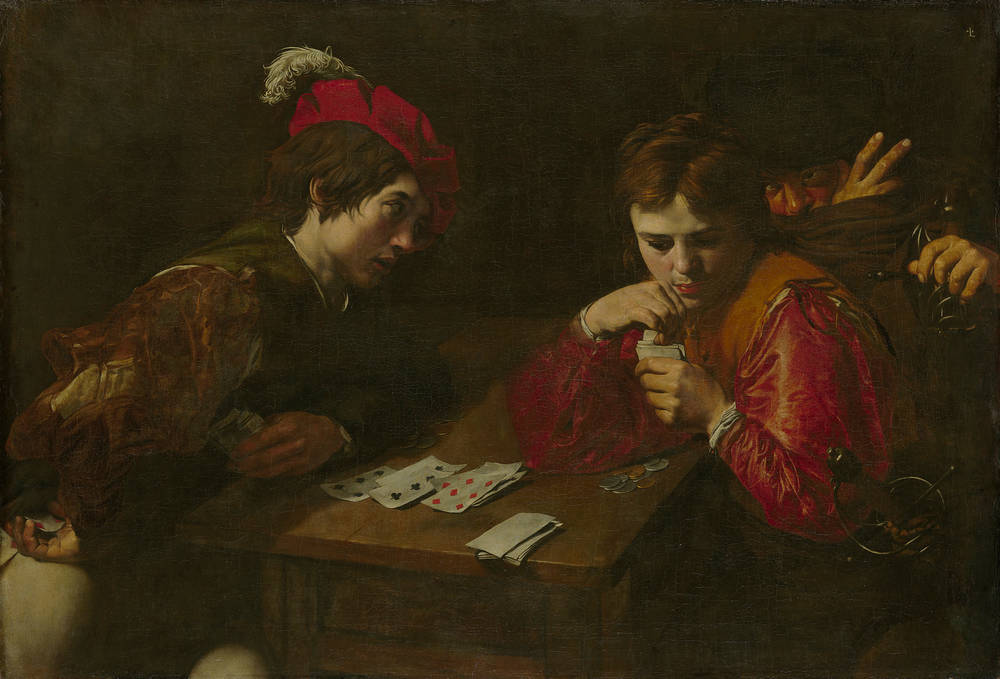
None of the works from Le Valentin’s earliest Roman years is documented, but it is believed he produced his Card Sharps (Dresden, Staatliche Kunstsammlungen), The Fortune Teller (Toledo Museum of Art), and Soldiers Playing Cards and Dice (The Cheats) (NGA) – and probably in this order – between 1615 and 1620.
In Le Valentin’s compositions which often contain several actors in a scene, the French artist’s realism and Caravaggio-inspired technique is often imbued with energetic rhythm in which diagonals and geometric concurrences play a role. This schematic suggests animation in the subject matter while retaining the human figures’ inner reserve and mystery. This creates a psychological quality in his artwork that is unique whichever drama is unfolding in the picture. Louis XIV who was an admirer of le Valentin acquired and hung several of his paintings in his bedroom at Versailles. Cardinal Mazarin, another art collector with a keen eye, acquired works by Valentin, some of which today are in the Louvre.
Andrea Sacci, Cardinal Francesco Barberini, Wallraf-Richartz-Museum, Cologne, Germany, oil on canvas, c. 1631-1633 (detail).
By way of Le Valentin’s important young patron, Cardinal Francesco Barberini (1597-1679) – made a cardinal in 1624 by his uncle, Pope Urban VIII (1568-1644) – Valentin became a competitor to his artist friend Nicholas Poussin. Le Valentin’s first documented work commissioned in May 1629 and completed in the spring of 1630 called Martyrdom of SS. Processus and Martinian is a compendium to a slightly earlier work by Poussin–both in the Vatican (Poussin’s was a different stylistic statement called Martyrdom of S. Erasmus). Valentin had further won the patronage of Cavaliere del Pozzo (1588-1657), the secretary of Cardinal Francesco Barberini and one of Rome’s leading art patrons. Paid the handsome sum of 350 crowns for Martyrdom of SS. Processus and Martinian , after 1630 Valentin’s artwork continued to command high prices and prestige.
Valentin de Boulogne, Martyrdom of Saints Processus and Martinian, 1629–30, Oil on canvas, 118 7/8 × 75 9/16 in. (302 × 192 cm), Vatican Museums, Vatican City/Jan van den Hoecke (Flemish, 1611-1651), Portrait of Cassiano dal Pozzo. Pozzo’s portrait was painted by Le Valentin though it is lost.
Though SS. Processus and Martinian is Le Valentin’s most important public work, he also produced many pictures for private commissions. There are several pictures by, or today attributed to, Le Valentin in many of the world’s leading art museums. Le Valentin produced artwork especially for the ruling Barberini family and their circle.
How Le Valentin died in 1632 is not certain though it was sudden and of natural causes. The professional artist who is admired in today’s major art institutions reportedly left no money to pay for a funeral. Identified as a “Pictor famosus” on his death certificate, Le Valentin was buried at Santa Maria de Popolo on August 20, 1632 paid for by Cassiano dal Pozzo (1588-1657).
One of the most moving and beautiful stories in the Bible is the judgment of King Solomon in the case involving two disputing harlots over who was the mother of a living child (I Kings).
Both had had a child, though one died and the other lived. To have an offspring was considered a blessing. One harlot claimed that her living child had been taken from her bosom at night by the other harlot. She replaced the child with her dead child after “she had smothered him by lying on him” (I Kings 3:19).
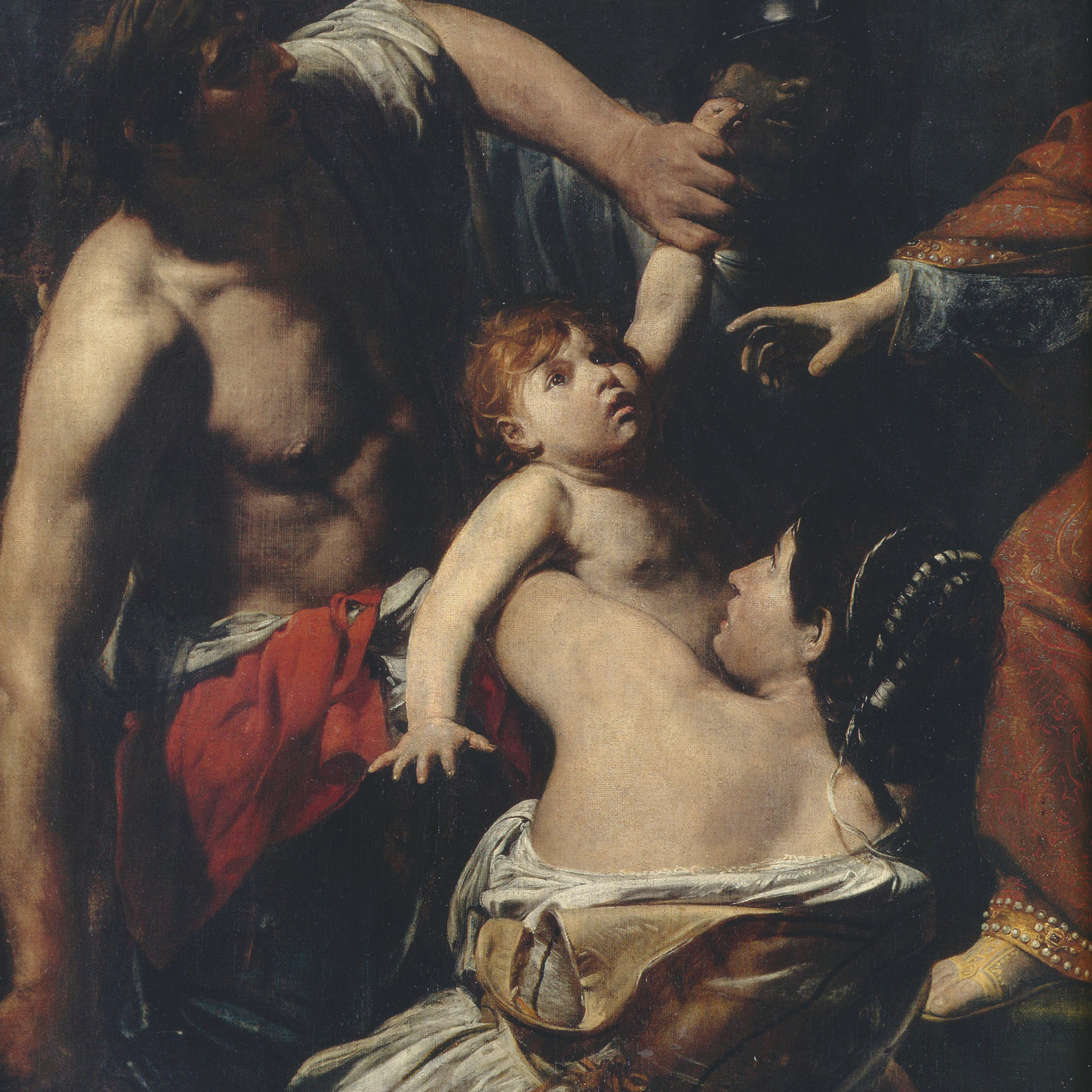
Since this was a case of one harlot’s word against another’s Solomon had no simple and fair resolution at hand. King Solomon said: “Cut the child in two and give half to one woman and half to the other” (I Kings 3:25). Le Valentin shows the viewer what is at stake – a real flesh and blood child. The import of Solomon’s judgment could not be missed. Le Valentin’s women are modeled on those mothers and others the artist observed along Via Margutta.
Detail. Judgment of Solomon. Le Valentin.
When one harlot said, “Divide it! it shall be neither mine nor yours!” and the other harlot said, “Please, my lord, give her the living child. Please do not kill it!”, the king’s judgement changed.
Solomon spoke again and said, “Give her the child alive, and let no one kill him, for she is his mother” (1 Kings 3: 16-28). Solomon knew a woman privileged to be a mother would seek to see the child live most of all.
It is this final pronouncement that Solomon appears to give in Le Valentin’s painting, as the complete biblical episode can be readily seen in the gestures and expressions of its characters.
Acquired by Louis XIV at Cardinal Mazarin’s death in 1661, The Judgment of Solomon has long been presented as a counterpart to The Judgment of Daniel. These canvases, which may actually be pendants, share the same format and show examples of just judgment in the Bible. The Judgment of Solomon is dated later than The Judgment of Daniel. There is a variant of it by Le Valentin in Rome at the Barberini Gallery in the same format and oil medium. The Louvre painting was restored in 1966.
The subject is taken from chapter 13 of the Book of Daniel, the book’s addendum. In Babylon, a pair of wicked elders covet Suzanne, “a very beautiful and God-fearing woman” who was the wife of the “very rich” and “most respected” Joachim. After these wicked elders surprised Suzanne in her bath, she refuses their advances and they denounce her for adultery with the intent to put her to death.
Daniel condemns these wicked elders for “growing evil with age” including their past sins of “passing unjust sentences, condemning the innocent, and freeing the guilty.” Daniel interrogates them and, by their own words, shows the assembly they are lying. The painting depicts that moment of judgment.
Detail. Judgment of Daniel. Le Valentin.
Le Valentin depicts Daniel in the painting instead of Suzanne in her bath which was a more popular subject. Suzanne is at right, her hands across her chest, “As she wept, she looked up to heaven, for she trusted in the Lord wholeheartedly” (Daniel 13:35). A guard seizes one of the wicked elders as the other shows surprise and incredulity. Young Daniel, at left, is seated on a throne under a red canopy and stretches out his hand in judgment over the scene for their sin. For each judgment by Le Valentin the artist was inspired in some of its details by Raphael’s artwork in Rome. Louis XIV acquired the painting in 1662.
Valentin de Boulogne, Martyrdom of Saints Processus and Martinian, 1629–30, Oil on canvas, 118 7/8 × 75 9/16 in. (302 × 192 cm), Vatican Museums, Vatican City.
Within iconography that is cyclonic, two Roman soldiers are placed on the rack to be tortured after they refused their commander’s orders to sacrifice to an idol. The soldiers had been converted to Christianity by Saints Peter and Paul when they guarded them in prison. The altar to Jupiter is on the upper left while, at right, the commander clutches his eye with his left hand after God blinded him in retribution for the idolatry. The foreground figures build on 16th century Franco Italian Mannerist style. One has his back to the viewer; another grinds the wheel of the rack; and, a third bends down with his arm outstretched. All are advanced expressions of realistic figural development and rendered in spatial perspective correctly.
Le Valentin’s powerful painting is an artwork with a psychological dimension. To the left, a hooded figure, Lucina, is a Christian woman who encourages the martyrs to be steadfast as an angel out of heaven extends a palm of martyrdom. To the right, realistically portrayed, is a Roman soldier indifferent to another brutal slaying by the authoritarian government in the face of nascent, meddling, heroic, and expanding Christians in their pagan global empire.
With his attention to detail, Le Valentin’s picture accomplishes an exciting imagined drama based on Renaissance-inspired natural world observation and by way of colorful contemporary 17th century formulations that give a viewer visionary immersion into a complex and significant Bible scene.
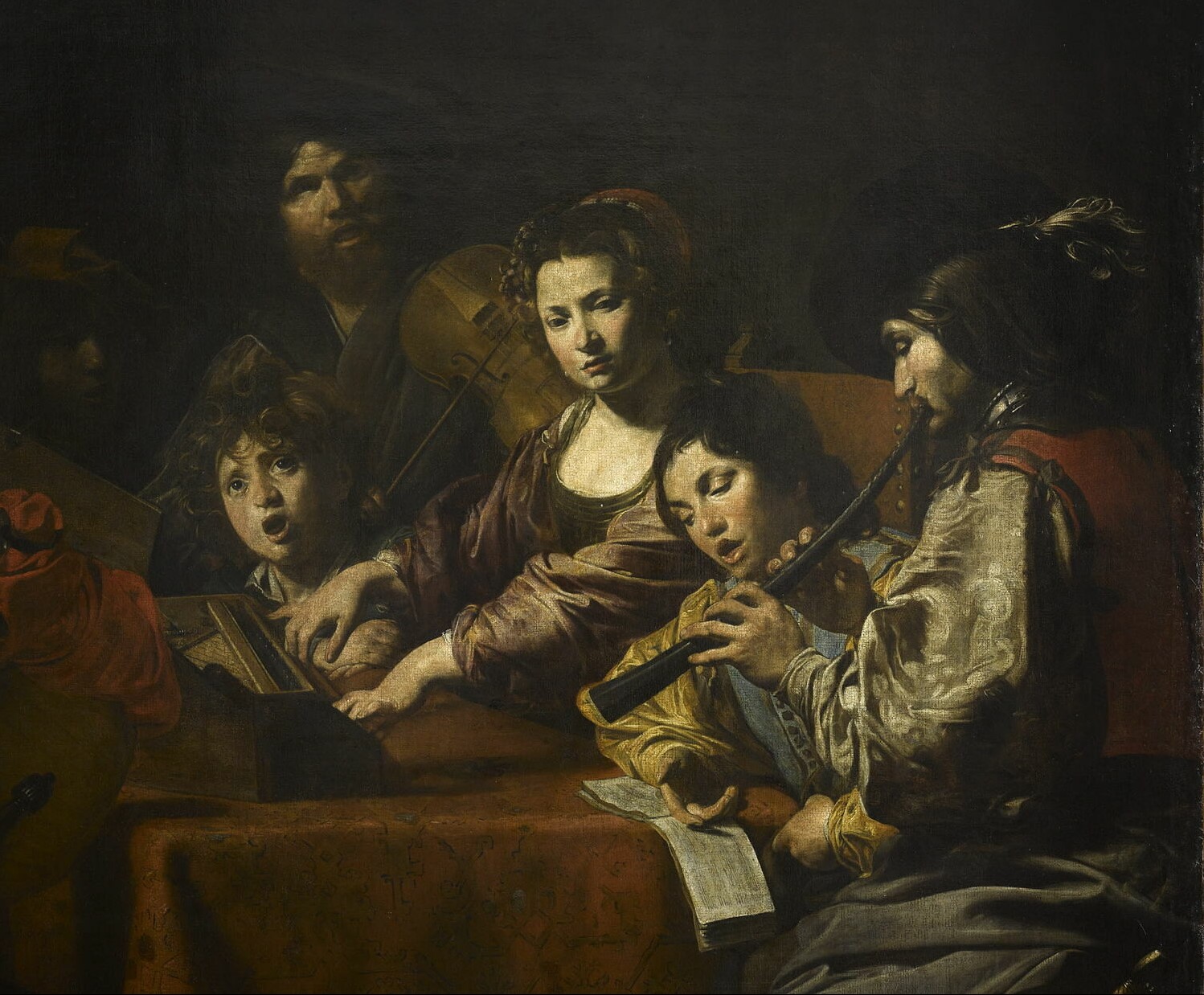
Some of Le Valentin’s great ambition as an artist is demonstrated by this large format canvas whose composition includes eight realistically delineated figures including 5 musicians and 3 singing youths. The five instruments are depicted accurately as well as the demeanors of the musicians and singers. Instruments have been identified by others as a polyphonic spinet, an alto, a chitarrone, a bass viol and a cornetto.
Detail. Concert in an Interior. Le Valentin.
The painting had been dated at around 1626, though more recent connoisseurship dates it to around 1628 or 1630. It was restored in 1940. It was owned by that avid art collector, Cardinal Mazarin.
Valentin de Boulogne (1591-1632), The Concert in bas-relief, 1624/26, oil on canvas, 1.73 m x 2.14m, Louvre.Detail. The Concert in bas relief. Le Valentin. Detail. The Concert in bas relief. Le Valentin.
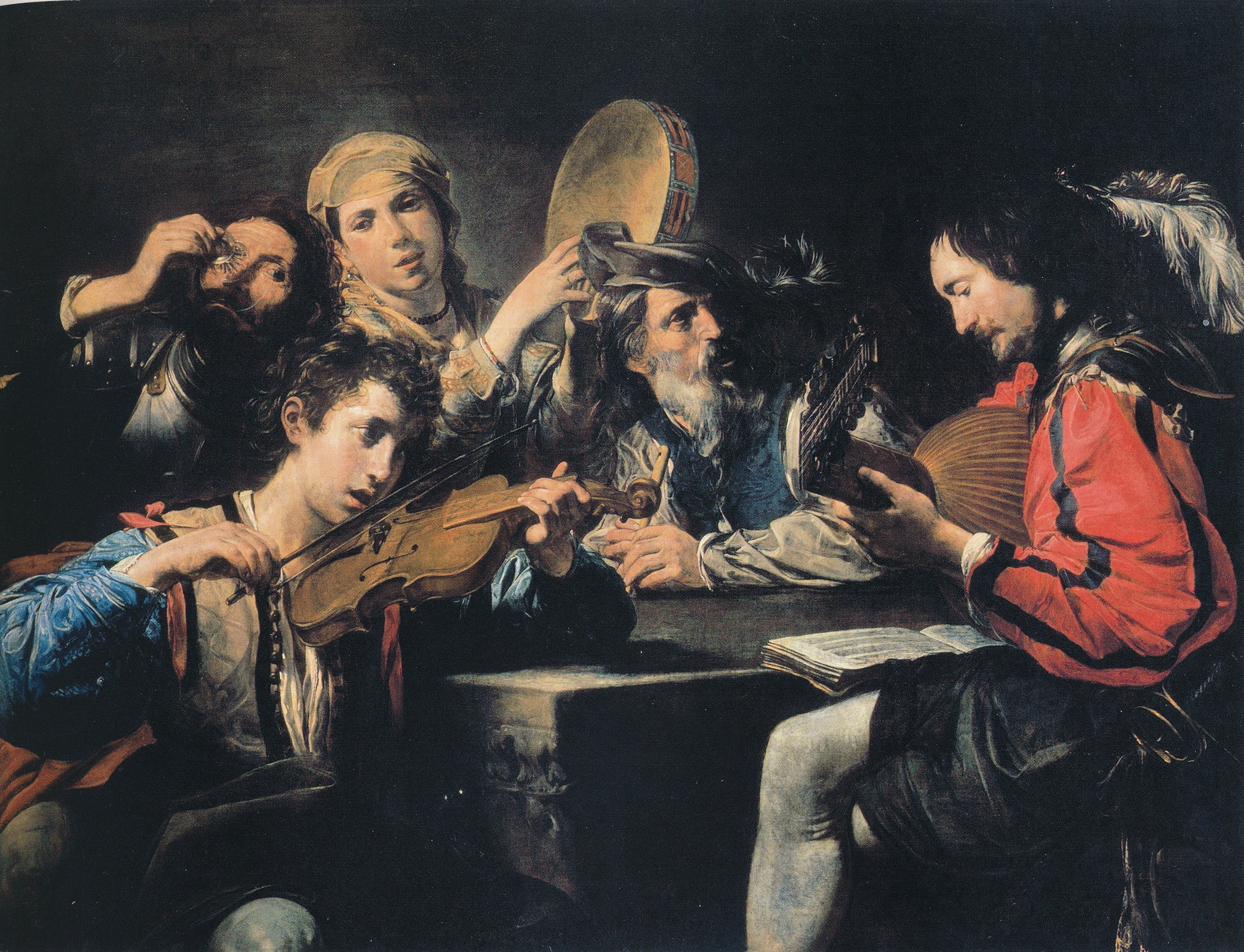
Le Valentin painted seven figures gathered around a classical bas-relief. There are a pair of drinkers, one in the foreground, the other in the background; two singers; and three musicians – a violinist, guitarist and lutenist.
The painting, filled with mystery and gravity, is Caravaggesque and not merely telling a story or depicting a genre scene of performance. The painting has been dated to as early as 1622 by some connoisseurs. It was owned by Cardinal Mazarin and restored in 1959. It entered the collection of the Louvre in 1742.
Valentin never ceased producing genre paintings as attested by Concert with Eight Figures and Fortune Teller (both Musée du Louvre, c. 1628), and what is thought to be his very last painting, the Gathering with a Fortune Teller (Vienna, Liechtenstein Collection) in 1632.
Valentin de Boulogne (1591-1632), Musicians and Soldiers, c. 1626, oil in canvas, 155 x 200 cm, Musée des Beaux-Arts, Strasbourg.
This is a tavern scene with impromptu music-making among transitory musicians. They are playing for a pair of drinking soldiers. Le Valentin’s painting is Caravaggesque with its interplay of shadows and light, dark palette, and depiction of realistic figures, and a psychological vivacity that is imbued by Le Valentin. It is by his passion and energy for Caravaggio that Le Valentin helped revolutionize art in 17th century Europe.
Valentin de Boulogne (1591-1632), Jesus and Caesar’s Coin, around 1624, oil on canvas, 1.11 m x 1.54m, Louvre.
In Matthew’s Gospel the Pharisees were plotting to entrap Jesus by his own words. They sent some of their followers along with local government types (“Herodians”) to flatter Jesus as a truthful and humble man. They asked him to reply to a question: “Is it lawful to pay the census tax to Caesar or not?” (Mt 22:17).
Jesus, knowing their motivation, responded hardly very nicely, by calling them “hypocrites.” He asked them to show the coin that paid Caesar’s tax.
Le Valentin’s painting depicts the moment when the Pharisee’s henchmen show Jesus the coin with Caesar’s image and inscription on it. Jesus tells them: ”Repay to Caesar what belongs to Caesar and to God what belongs to God” (Mt 22: 21).
Owned by Louis XIV it was put in his dressing room at Versailles in 1680. The Louvre acquired it during the French Revolution in 1793.
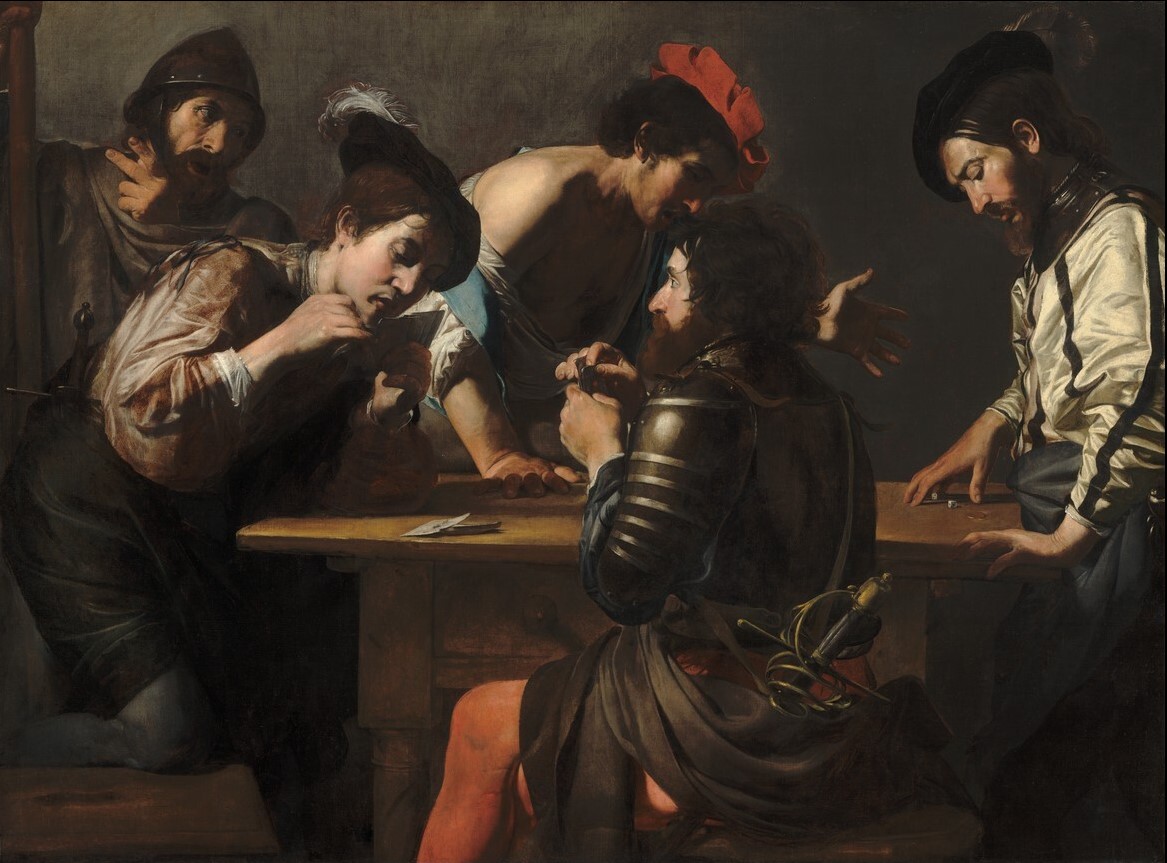
Valentin de Boulogne (1591-1632), Soldiers Playing Cards and Dice (The Cheats), c. 1618/1620, oil on canvas, 121 x 152 cm (47 5/8 x 59 13/16 in.), The National Gallery of Art, Washington DC. https://www.nga.gov/collection/art-object-page.107315.html
This painting is inspired by Caravaggio’s The Cheats in the Kimbell Art Museum in Fort Worth, Texas. Le Valentin’s painting, only discovered in 1989, shows a group of soldiers idling in Rome and identifiable by their piecemeal armor and other livery. The crowding of the figures into the picture space adds to the scene’s tension.
In this early painting in Rome, Le Valentin presents a scene of its contemporary street life. These figures are seriously gaming at a table where two players (center and right) roll dice and two others (left and center) play cards. A fifth figure in the background signals to his accomplice what is in the hand of the card player in a feathered hat. It is an early artwork that Le Valentin gives a psychological dimension.
As had been Caravaggio’s practice, the artwork is painted alla prima, that is, directly onto the prepared canvas without under-drawing or any preliminary work which works to give it greater spontaneity. The painting is indebted to Caravaggio not only for its subject, but for its vivid sense of actuality with which Le Valentin invested his protagonists as well as for the chiaroscuro, and a thinly and rapidly-applied brushed execution.
This painting is one of the first genre pictures Le Valentin painted in Rome. It is a pair of figures to which Le Valentin would soon numerically expand in his pictures. The composition is simple and sturdy.
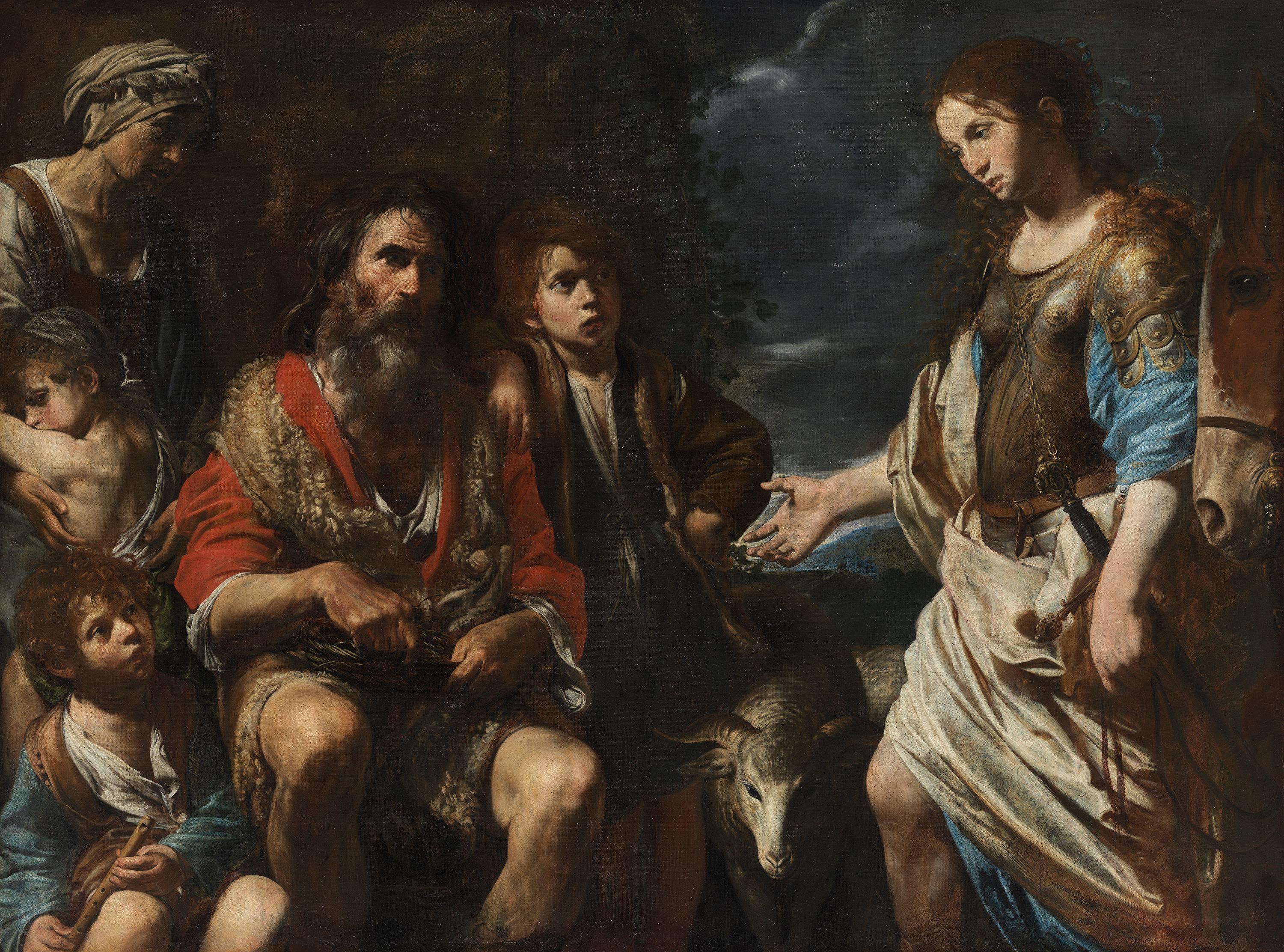
Valentin de Boulogne (1591-1632), Herminia among the Shepherds, c. 1630, oil on canvas, 134.6 x 185.6 cm (53 1/8 x 61 5/8”) Bayerische Staatsgemäldesammlungen – Alte Pinakothek München. https://www.sammlung.pinakothek.de/de/artwork/RQ4XPr8410
Erminia, the king’s daughter, escapes her persecutors and asks a peaceful shepherd family for shelter. The scene is based on a contemporary (1576) epic poem The Liberated Jerusalem by Torquato Tasso (1544-1595). The picture was a private commission whose patron was likely a Roman art collector and cognoscente. Valentin’s painting combines Caravaggesque chiaroscuro with exquisite coloring. In this realistic depiction of a human encounter between characters who represent contrasting social experiences, the subject matter is rendered psychologically sensitively.
Valentin de Boulogne (1591-1632), Crowning of thorns of Christ, around 1616/17, oil on canvas, 173 x 241 cm Bayerische Staatsgemäldesammlungen München-Alte Pinakothek, Munich https://www.sammlung.pinakothek.de/de/artwork/bwx0jkJGm8
One of the great artworks of Le Valentin’s early phase in Rome, biblical subjects painted before 1620 such as The Crowning of Thorns of Christ were interpreted in the street-life idiom, with expressive protagonists and bystanders resembling the cast of characters in his genre paintings. Although the painting was earlier believed to be by Caravaggio, it may have been a pendant to Le Valentin’s much-later Abraham Sacrificing Isaac (c. 1629) in The Montreal Museum of Fine Arts.
This is Le Valentin’s most ambitious of 3 such “crowning with thorns” pictures. The artist in horizontal-format depicts Jesus before his going to Calvary. Christ is mocked and tormented; a crown of thorns is pressed onto his head (Matthew 27: 27-31; Mark 15:16-21; Luke 23:11; John 19: 1-3). With its dramatic lighting and shadows, the naturalistic depiction of Christ’s body and soldiers in contemporary costume is Caravaggesque.
Le Valentin’s scene adheres to the Bible episode: a whole cohort of soldiers surrounded Jesus, stripped off his clothes and threw a scarlet military cloak on him. Henchmen have weaved a crown out of thorns and are placing it on Jesus’s head. Another puts a reed as a faux scepter into Jesus’s right hand. To mock him they kneel before him and say: “Hail, King of the Jews!” The soldiers spit on Jesus and then take the reed away and strike him repeatedly with it. When they were done with these violent actions, the soldiers stripped Jesus of the military cloak, dressed him in his own clothes and led him out to be crucified.
Le Valentin’s Passion theme is a later vertical-format picture of a subject he had painted masterly before. In these last years the subject matter had gained in classical beauty as well as psychological involvement compared to Le Valentin’s earlier artwork. The painting covers over a discarded portrait of Cardinal Barberini which suggests Valentin’s close relationship with the ecclesial prince, very likely being in his employ. What caused the artist to revisit the subject of a brutalized Christ is unclear though it may have been based on the artist’s own struggles or that of his employer whose portrait he painted over.
Valentin de Boulogne (French, 1591–1632), Noli me tangere c. 1620. Oil on canvas. Perugia, Galleria Nazionale dell’Umbria.Valentin de Boulogne (French, 1591–1632), Christ and the Samaritan Woman c. 1620. Oil on canvas. Perugia, Galleria Nazionale dell’Umbria.Valentin de Boulogne (1591-1632), Martyrdom of St. Lawrence, 1622/24, oil on canvas, 195 x 261 cm, Prado, Madrid. Spain.
St. Laurence (225-258)—Laurentius is Latin for ”laurelled”—became a popular early Roman martyr. Laurence has been continually highly honored by the church since the 4th century and is a patron of Rome.
In the mid 3rd century, Laurence was archdeacon to the new pope, Sixtus II (257-258). Sixtus II was martyred along with his seven deacons, including Laurence, during the persecution of Christians by Emperor Valerian (199-264). When Laurence met the pope, the pope was under arrest and Laurence expressed the desire to join him in his sufferings. Sixtus promised Laurence that martyrdom would soon be his but in the meantime asked his archdeacon to distribute the church property among the poor. Word of this planned dispersal reached the ears of the Emperor and Laurence was arrested.
Following the pope’s martyrdom by decapitation, Laurence, in prison, was ordered three days’ reprieve to collect and hand over the church treasures to the emperor. Instead, Laurence gathered and distributed these goods to Rome’s poor folk and presented the people to the emperor. These paupers appeared in Le Valentin’s painting to the left.
Infuriated, the emperor ordered the Catholic deacon to sacrifice to Rome’s gods which Laurence refused to do (in prison Laurence converted his guard) and was summarily condemned. After undergoing a series of tortures, the 32-year-old Laurence was martyred by the method of being roasted alive over a fire on a spit. The saint is famously quoted as telling his executioners: “One side is roasted, so you can turn me over and roast the other side.”
In the Prado Le Valentin gives orderly arrangement to a complex scene of 15 figures and a horse. It shows the saint during his martyrdom isolated in the center of the composition. As with Caravaggio’s figures, the soldiers are in modern costume, use of chiaroscuro is evident, and further drama is added by the use of diagonals whose construction suggest movement that add to the tension of the naturally rendered figures. However, Le Valentin uses these derived elements unconventionally.
St. Laurence is the patron saint of people whose occupation involves working with fire such as traditionally cooks, bakers, brewers, textile cleaners, and tanners and also those whose occupation values fire prevention such as traditionally librarians, archivists, miners, and poor people. St. Laurence of Rome is also, truly, the patron saint of comedians.
Valentin de Boulogne (1591-1632), St Luke, Evangelist, 1624/26, oil on canvas, 120 x 146 cm, Palace of Versailles, Versailles.Detail. St. Luke Evangelist. Le Valentin.
Dating from the years 1624-1626, le Valentin painted all four Evangelists (Matthew, Mark, Luke and John) for the same religious order in Rome whose name is unknown. They entered the collections of the Sun King in 1670.
Valentin de Boulogne (1591-1632), The Last Supper, c. 1625, oil on canvas, Galleria Nazionale d’Arte Antica, Palazzo Barberini, Rome.
For his The Last Supper, Le Valentin was, at least through engravings, aware of Leonardo da Vinci’s Last Supper (c. 1495–1498) in Milan and Raphael’s Last Supper (1518-1519) in Palazzi Pontifici, Vatican. Le Valentin explores the 12 apostles’ reactions. Commissioned by Asdrubale Mattei (d. 1638), one of Rome’s nobili, to decorate a gallery in his family’s palace, the picture depicts a central event presented in the gospels. The moment that is depicted in these Last Supper paintings is when Christ announces that one of his disciples will betray him. Judas, in the foreground left, was treasurer for Jesus’s disciples and betrayed Jesus for a bribe payment of 30 pieces of silver. The picture, with its simple and monumental composition, so impressed Jacques-Louis David (1748-1825) in 1779 that he copied it and sent it from Rome to Paris.
An Old Testament Judge, Samson was born in a miraculous fashion and with an angel telling his mother and father, “No razor shall touch his head” (Judges 13:5). Samson is often depicted with his locks unshorn. As a youth Samson displayed an incredible physical strength attributed to “the spirit of the Lord rushing upon him” (Judges 14:6).
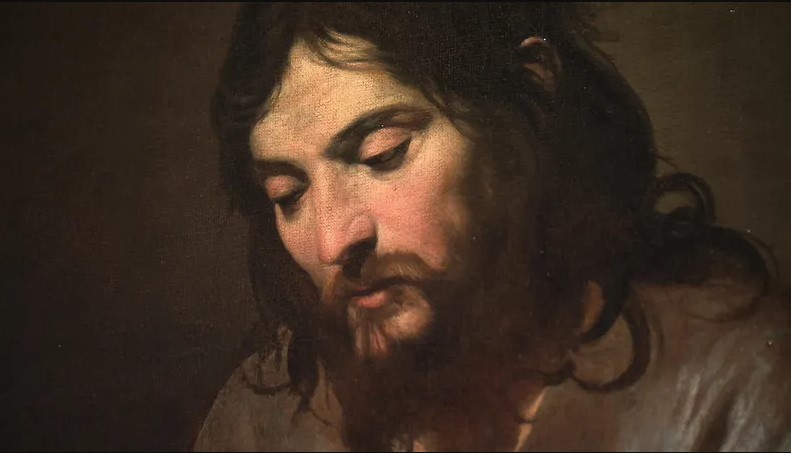
Le Valentin’s picture presents Samson’s legendary strength by showing the solid demeanor of his physical body as well as objects which hold symbolic value of his strength. These include that he killed a lion with his bare hands and liberated the Israelites by slaughtering a thousand Philistines with a donkey’s jawbone (Judges 15: 15-16). The strength of his arm is displayed as his fingers curl under his jaw as his wandering gaze looks off with intense interiority. One contemporary allusion in the painting is Samson’s breastplate which is joined at the shoulder by a clasp in the form of a bee which was the emblem of the Barberini family who commissioned the painting. It is speculated that the facial features of Samson in a picture before his fateful meeting with Delilah (Judges 16), may be a self-portrait of Le Valentin.
Valentin de Boulogne (1591–1632), Judith with the Head of Holofernes. c. 1626-27. Oil on canvas. Musée des Augustins, Toulouse.
The story of Judith in the Old Testament relates of a woman of great beauty and reverence to the God of Israel who is highly respected by her people and its leaders. The nation, desperate for survival, turns to Judith who is given the opportunity to kill their enemy’s military leader which she believes she can and must do and that all believed impossible as Israel’s military defeat by their enemies was a foregone conclusion.
The story has a femme fatale aspect as Holofernes was captivated by Judith’s physical appearance, but the Biblical episode of the execution, while a climax of her mission, pales in comparison with the relating of Judith’s overall dedication to her people and her God, a femme forte, which carries on into her long life of blessedness to her natural death. Le Valentin chooses that sacred element of the Bible book when he shows an iconic Judith, triumphant woman of Israel, holding in her hands the decapitated head of one of Israel’s once-formidable mortal enemies. Judith is shown as a heroic woman with her hand raised as she admonishes: “But the Almighty Lord hath disappointed them by the hand of a woman.”
For Le Valentin’s artwork, Judith is an icon of God’s justice to his obedient people. Purchased for French King Louis XIV from German banker Everhard Jabach, the picture was installed in the king’s bedroom at Versailles to be especially admired.
The picture belongs to Le Valentin’s period of maturity for it displays the artist’s full interpretation of the realism of Caravaggio and Manfredi though, as expressed here, with a new appreciation for colors. The pretext of a Judith who, according to the Bible, had adorned herself in her best finery so not to dissuade Holofernes’s gaze (Judith, 13, 14), allows le Valentin to illuminate the dress’s rich fabrics with monochrome refractions, while the jewels and hair are bathed in ethereal light.
The Four Ages of Man is a painting commissioned by Cardinal Barberini. It is an allegorical work whose human figures are painted by Le Valentin in natural poses. Groups of figures around a table were common in the work of Caravaggio and his northern followers. The allegory of the ages of man was a common subject for paintings during the sixteenth and seventeenth century, though its quantity of ages varied.
The allegory presents humanity in four categories of age – childhood (holding an empty bird trap); youth (playing a lute); adulthood (with a book and victor’s laurel); old age (with coins of wealth and delicate glassware).
The theme had its origin in classical literature: Ovid’s Metamorphoses and Dante’s Inferno acknowledged the stages of human life according to physical growth and decline. Contemporary poems were written on the subject that Le Valentin may have known.
In the 17th century, the painting was owned by Michel Particelli, seigneur d’Emery (1596–1650) in Paris. In the 18th century it was in the Orléans collection at the Palais Royal. During the French Revolution and the dispersal of the collection in 1791, the painting was brought to England where it is today.
Le Valentin painted many half- or three-quarter-length figures of saints, prophets and narrative scenes including this painting. The scene of Christ expelling the moneychangers from the Temple of Jerusalem is told in all four gospels of the New Testament. Le Valentin adapted the method of half-length, full size street figures depicted in dark, precisely lighted spaces and emerging in relief from the shadows from the Caravaggistes.
Gospel readers would recognize that the cleansing of the temple was prophesied in the Old Testament as a sign of the ushering in of the Messianic Age (Zechariah 14:21). In the synoptic gospels (Matthew, Mark and Luke) the episode appears at the close of Jesus’s public ministry and in John’s gospel at the start (2:13-17). The chronology of the episode in Jesus‘ ministry is generally not considered its most important element.
Le Valentin shows the “whip of cords” held by Christ, a detail mentioned only in John (Jn 2:15). There are overturned tables, a bench, and scattered coins. Le Valentin depicts the gestures, movements and emotions of the characters involved, focused on a wrathful Christ and fear of the unrighteous.
While in Synoptics the point of the episode appears to be the dishonesty of the Temple money changers, in John’s gospel Jesus’s wrath is directed to the Temple institution itself. In John’s Gospel Jesus declares the Temple is to be “My Father’s house.” Though not a term unique to John, he uses it more than any other Gospel writer (27 times).
Derived from Caravaggio are the types of ordinary people, distinct contrasts of light and shade and the natural plasticity of the figures involved in the composition.
The painting entered the Hermitage collection in 1772.
Valentin de Boulogne (French, 1591–1632), Expulsion of the Money Changers from the Temple. Oil on canvas, 195 x 260 cm (76 ¾ x 103 1/8 in.). Palazzo Corsini, Rome.
The painting’s structural asymmetry lends energy to the scene. With Christ’s raised arm, he is a menace to the money changers. Le Valentin, taking inspiration from Caravaggio, unabashedly renders a scene in grand format of violence in the gospels. The painting was rediscovered in Rome in the mid19th century.
The oil painting called Allegoria d’Italia by Le Valentin was originally called Historia d’Italia. Its massive volumes imbued with inner life are rendered using a brown palette and highlights that retained the Caravaggiste tradition. Le Valentin’s redoubling his commitment to Caravaggio in the late 1620s was on display in this painting as other leading painters, such as Vouet, Poussin, Giovanni Lanfranco (1582-1647) and Pietro da Cortona (1597-1669), were deploying brighter “modern” colors.
In March 1628 Cardinal Barberini gave Le Valentin the commission for the Extraordinary Jubilee of 1628 and paid 113 crowns for it. This major painting which renewed Caravaggio-inspired technique in the late 1620s attracted greater attention to Le Valentin’s artwork not only by Caravaggeschi but the broader Roman art circles.
A young Roman girl wears an emperor’s cuirass, holds a spear and shield, as the personification of Italy. At her feet are the fruit and nuts of the land’s bounty. Below her image are two male figures, naked and bearded, who represent the Tiber and the Arno, Italy’s great rivers. The figure of the Tiber is joined by Romulus and Remus and the suckling wolf who founded Rome and the later Papal States. The Arno that runs through Florence is joined by its symbol of the lion. In the top left corner, a tree stump with a bee swarm symbolizes the Barberini.
The gospel story that Le Valentin depicts using the typical Caravaggiste method (half-length, full size street figures in shadow and light) is from John 8. The story had been painted by the Flemish and the Venetians. The plump young woman in a torn garment exposing her shoulders and full-formed breasts is taken into custody by soldiers in armor to Jesus. According to the law the woman should be publicly stoned for adultery. The Pharisees lay verbal and other traps repeatedly in the gospels for Jesus to say or do something that is expungable. Jesus’s response moves past their premise. Whereas Jesus will soon be arrested, tried, and condemned by the authorities for his “transgressions,” the focus of le Valentin’s artwork is Jesus showing mercy to the sinful woman. From a theological viewpoint, Jesus’s innovative teaching is again based on the appeal to an extant biblical tradition of God’s anger towards, and forgiveness of, harlotry or unfaithfulness when such sin is repented (Hosea 5:4). Jesus tells her: “Go and sin no more” (John 8:11). While the woman’s disheveled look suggests the nature of her sin, she represents humankind and points to Christ, the God-Man and prophesied suffering servant (Isaiah 53). Christ takes the harlot’s place as the arrested agitator and manhandled by soldiers along the Via Dolorosa. In that episode, Christ goes to the cross to shed his blood in the new covenant whose outcome for “adulterous” humankind is eternal forgiveness of sins and rising to new life.
The image of a young soldier singing in armor breastplate a love madrigal is unique in Valentin’s oeuvre. The painting was part of the collection of Cardinal Mazarin, minister to Louis XIV.
Valentin de Boulogne (1591-1632), Return of the Prodigal Son, c. 1615–16, oil on canvas, 59 1/16 × 70 1/16 in. (150 × 178 cm), Museo della Venerabile Arciconfraternita della Misericordia, Florence.
One of Jesus’s most famous parables, The Prodigal Son tells the story of a young man who demanded his “full share of [his father’s] estate that should come to [him],” and departed to waste it “on a life of dissipation” (Luke 15). When the lost son falls on hard times, he seeks his father’s house though “only as a hired servant.” The forgiving father who has been on the look-out for his lost son (dressed in rags) since the day of his departure welcomes him back as a son “who was dead and has come back to life.” Which of the other figures may be the older brother who is unhappy about his dissolute brother’s return is not clear. Le Valentin treats the parable as a human story of repentance, forgiveness, and unconditional love.
The attribution to Le Valentin and its dating for this artwork is the result of modern scholarship. Art historians can thereby draw conclusions and make conjectures about the development of Le Valentin’s early artwork in Rome -he uses a larger format, growing complexity of compositional qualities and its subject matter, and the retention of low-life characters and stylistic indebtedness to Caravaggio as he moves beyond him.
A dark tavern filled with low-life characters provides the setting for a scene of fortune and deceit. As a gypsy fortuneteller reads the palm of a young soldier he is looking pensively as she speaks his fate, there are carousers and thieves in the scene. The picture is emblematic of Le Valentin – the techniques of a somber palette and dramatic lighting and tabletop groupings but also a mysterious mood and psychological depth to the complex interplay among its characters.
Valentin de Boulogne (French (active Rome), 1591-1632), Portrait of Roman Prelate, 128 x 94 cm, private collection.
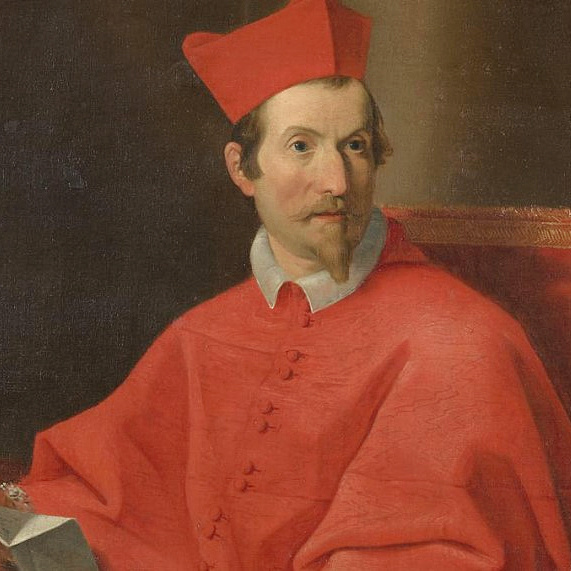
The prelate is dressed in the robes of a papal chamberlain. Modern scholarship has proposed various individuals as the sitter from cardinals to lawyers.
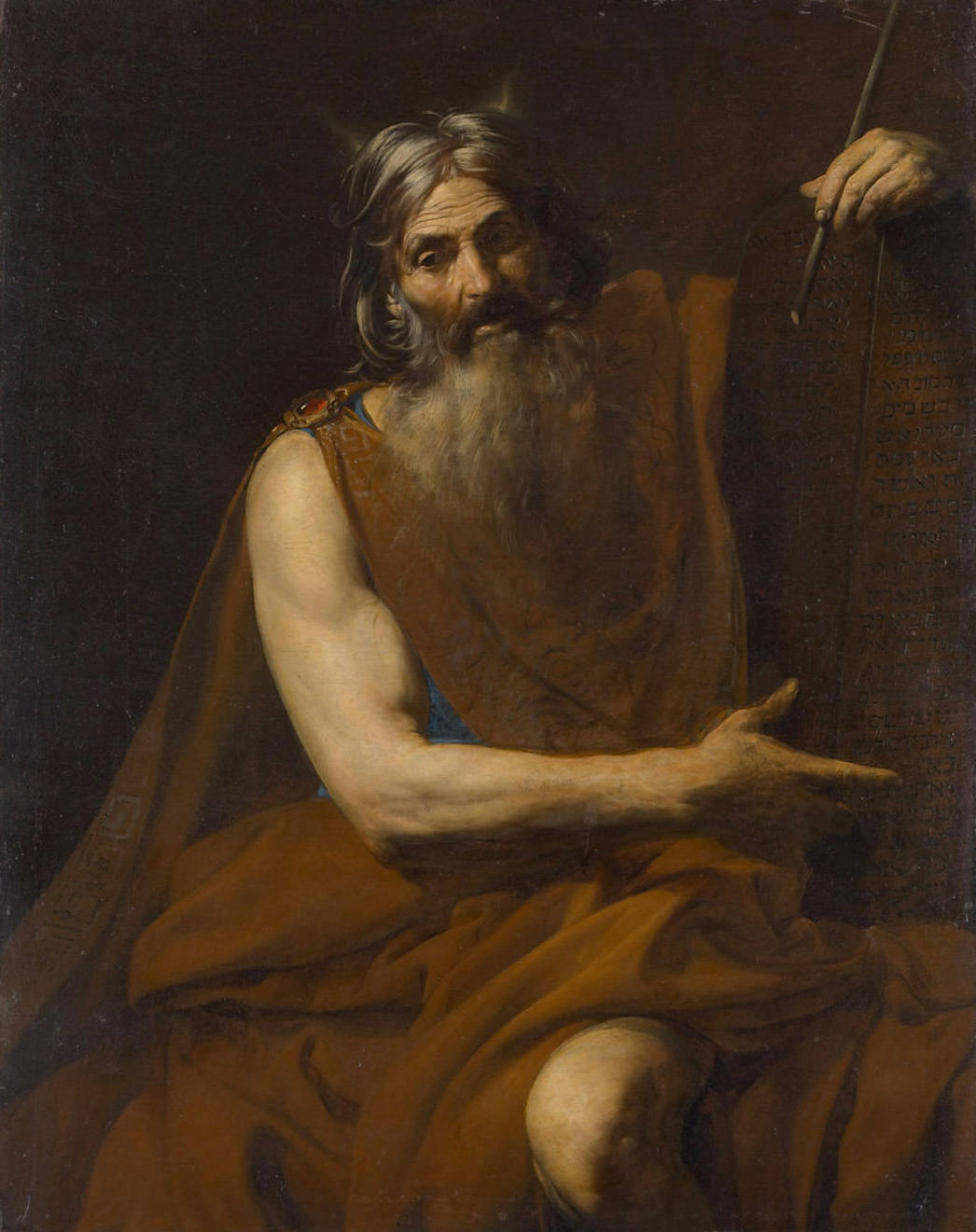
Moses led the Israelites out the slavery of Egypt into the freedom of the Promised Land during the Exodus. The event is told and retold in the Old Testament and Moses as Liberator and Law Giver is its most significant figure. Le Valentin shows him holding a miraculous rod that he used to open the Red Sea (Exodus 14), struck the rock to produce water (Numbers 20) and, after its transformation into an iron snake, healed the ill (Numbers 21). Moses points to the stone tablets of the Ten Commandments of God (Exodus 20; Deuteronomy 5). This late work by Valentin is characteristic in its dark and pensive tone that is reminiscent of Caravaggio.
The picture is one of Valentin’s last paintings before his death in 1632. Prince Hans Adam Il von und zu Liechtenstein (b. 1945) acquired the work in 2004. Throughout his painting career, Le Valentin never ceased producing genre paintings.
SOURCES:
A Dictionary of Art and Artists, Peter and Linda Murray, Penguin Books; Revised,1998.
French Paintings of the Fifteenth through the Eighteenth Century, The Collection of the National Gallery of Art Systematic Catalogue, Philip Conisbee and Frances Gage, Washington, D.C., 2009 pp, 413-414.
Art for the Nation, text by Philip Conisbee, National Gallery of Art exhibition catalogue, 2000.
French Painting From Fouquet to Poussin, Albert Chatâlet and Jacques Thuillier, trans. from French by Stuart Gilbert, Skira, 1963.
The Saints: A Concise Biographical Dictionary, edited by John Coulson, Guild Press, New York, 1957.
The New American Bible, Catholic Book Publishing Corp, New York, 1993.
Mannerism: The Painting and Style of The Late Renaissance, Jacques Bousquet, trans, by Simon Watson Taylor, Braziller, 1964.
The Liberation of Jerusalem, Torquato Tasso, trans by Max Wicker, Oxford World’s Classics, 2009.
Valentin de Boulogne: Beyond Caravaggio, Annick Lemoine, Keith Christiansen, Patrizia Cavazzini, Jean Pieere Cuzin, Gianni Pappi, Metropolitan Museum of Art; 2016.
Raymond E. Brown, Joseph A. Fitzmyer, S.J, and Roland E. Murphy, O. Carm.,The Jerome Biblical Commentary, Prentice Hall Englewood Cliffs, NJ, 1968.
Lehmbeck, Leah, editor. Gifts of European Art from The Ahmanson Foundation. Vol. 2, French Painting and Sculpture. Los Angeles: Los Angeles County Museum of Art, 2019.
Marandel, J. Patrice and Gianni Papi. 2012. Caravaggio and his Legacy. Los Angeles: Los Angeles County Museum of Art.
Fried, Michael. After Caravaggio. New Haven: Yale University Press, 2016.
Schmid, Vanessa I., with Julia Armstrong-Totten. The Orléans Collection. New Orleans: New Orleans Museum of Art; Lewes: In association with D. Giles, 2018.
Merle Du Bourg, Alexis. “L’omniprésence de la musique.” Dossier de L’Art no.246 (2017): 64-67.
FEATURE image: Ulysses and Penelope, Francesco Primaticcio called Le Primatice (1504-1570), Toledo Museum of Art, c. 1560, oil on canvas, 44 3/4 x 48 3/4 in. (113.6 x 123.8 cm).
Jean Perréal (1455-1529), Portrait Louis XII, c. 1514, Windsor collections de S.M. la Reine d’Angleterre.
Jean Perréal’s most important attribution is this portrait of Louis XII who was King of France from 1498 to 1515. Louis XII was married three times – the first annulled; the second leaving the king a widower, and, in his last three months of life, to Mary Tudor (1496-1533), the favorite sister of King Henry VIII of England. Despite these wives, the king had no living sons. The Salic Law prohibited his line to continue on the French throne through his daughters. When Louis died in 1515, his throne eventually passed to his cousin, Francis I.
Jean Perréal (c.1455-1530) was Court painter to the Bourbons and later worked for the kings of France starting with Charles VII. Perréal journeyed to Italy several times. In 1514 he went to London to paint Mary Tudor’s portrait and supervise her new dresses as Mary, aged 18 years, sister of the English king, married the 52-year-old King Louis XII of France.
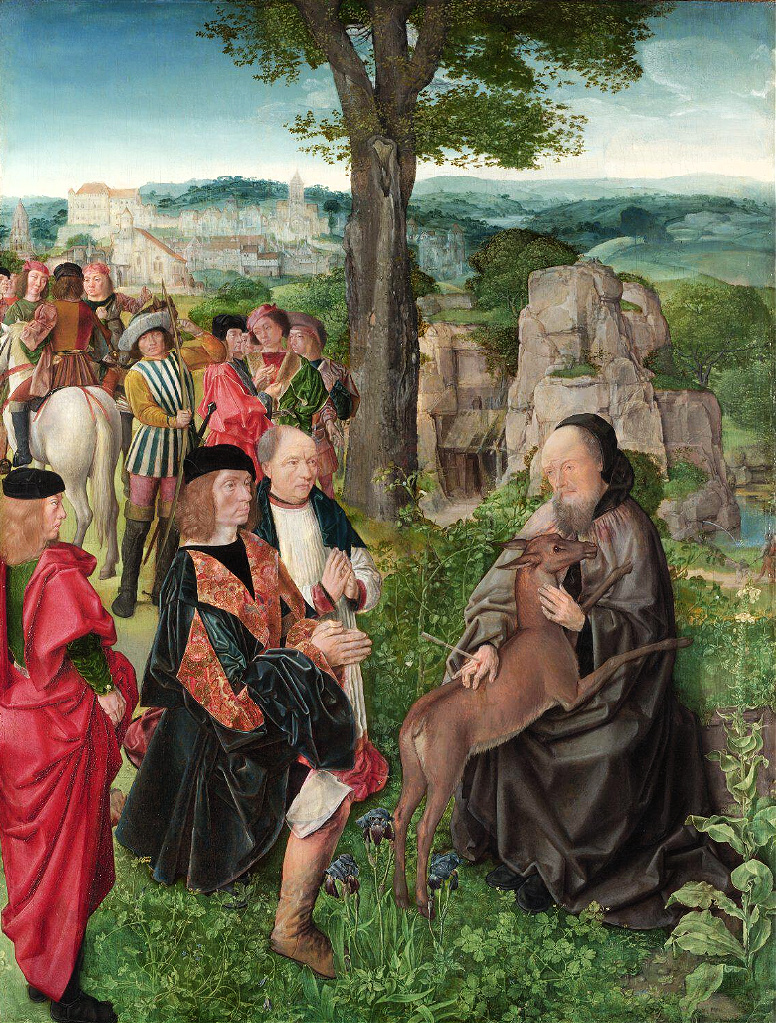
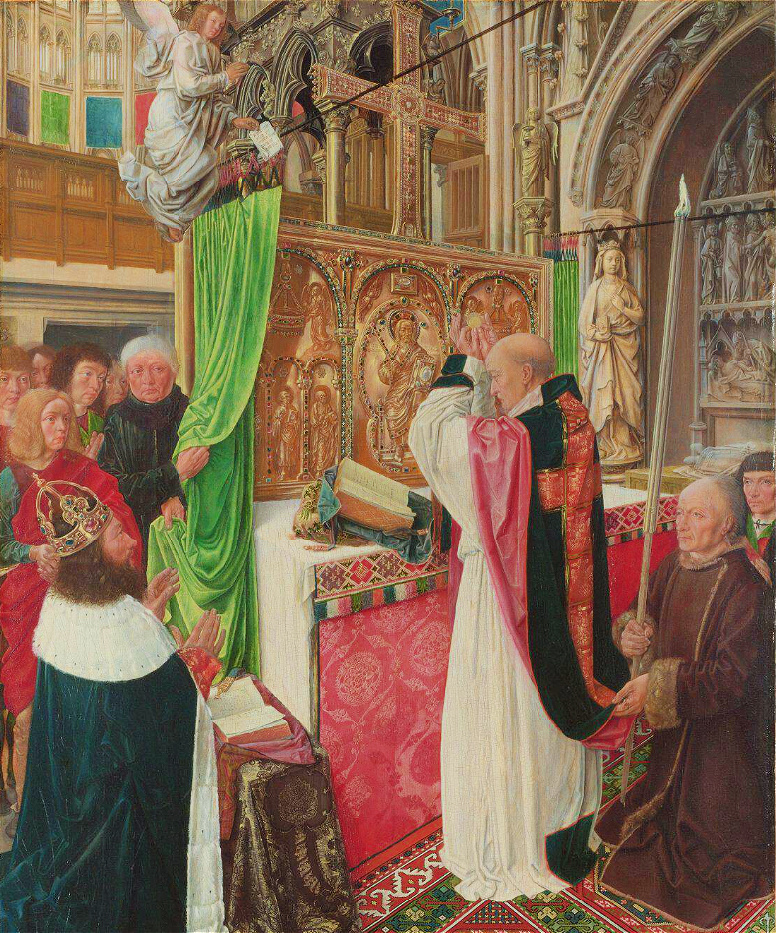
Master of Saint Giles (active 1490-1510), St. Giles protects a wounded deer for Charles Martel, c. 1500, National Gallery, London, oil on oak, 63.4 × 48.4 cm.Master of Saint Giles (active 1490-1510),Virgin with Child, c. 1500, Louvre.Master of Saint Giles (active 1490-1510), St. Giles’ Mass, c. 1500, National Gallery, London, oil on oak.
The Master of Saint Giles was a Flemish or Flemish-trained painter who was active in France. He is named after artworks in London attributed to the artist called Scenes from the Legend of St. Giles. As the artist’s identity is obscure, the saint depicted in his artwork is shrouded in legend.
St. Giles is possibly an 8th century hermit in France who became the patron saint of beggars, the handicapped, and blacksmiths which was an important trade in the Middle Ages. In one work, the artist depicts a famous story about St. Giles. Before King Flavius’s hunting party, he protected a deer from their bows and arrows. The king was apologetic and Giles persuaded him to establish a Provençal monastery in which St. Giles served as its first abbot.
Le Rosso (1494-1540), La Fontaine de Jouvence, c 1535, fresco, Chateau de Fontainebleau, Galerie Francois I.
France conducted wars in Italy starting in 1494 that continued into the 16th century. By this pugilistic means, many of the Italian Renaissance’s ideas and practices were brought back to France. It had been just the opposite in the 12th century when French ideas, particularly that of troubadours and chivalry, were brought back to Italy following trade expeditions by merchants.
After fighting ceased, King Francis I invited Italian artists into France, most famously Leonardo da Vinci (1452-1519) in 1516. Following more war in Spain, Francis I began in earnest a revolution in art in France in 1526. The king made the Château de Fontainebleau one of the most active artistic centers in Europe, attracting many Italian artists such as Le Rosso (1495-1540) and Primaticcio or Primatice (c. 1504-1570). The French Renaissance, under the influence of these Italian masters, synthesized French and Italian art whose style was later described as the School of Fontainebleau.
Le Rosso or Rosso Fiorentino was a friend of Pontormo (1494-1557) and worked under Andrea del Sarto (1486-1530), a founder of Italian Mannerism. He first worked in Florence (1513-1523) and then in Rome (1524-1527). With the sack of Rome in 1527 by German troops of the Holy Roman Emperor Charles V (1500-1558), Rosso wandered about Italy for a while. In 1530 he was in Venice and, in that same year, went to France.
Rosso arrived to Fontainebleau and, with Primaticcio, became one of the founders of the Fontainebleau style which had a tremendous influence on French painting. Reputedly a neurotic person, Rosso’s death was accounted a suicide by Vasari though that is unconfirmed. The classic style found in Rosso’s The Fountain of Youth was increasingly replaced by his later emotionally charged style.
Primaticcio (c.1504-1570) was a founder of the Fontainebleau School in France with his fellow Italian artist Le Rosso in the 1530s. Primaticcio was a talented artist of universal range – from painting and interior decoration to sculpture and architecture.
From the mid1520s to 1532 Primiticcio trained in Mantua under Giulio Romano (c. 1499-1546). He was called to France by King Francis I in 1532 where he worked at Fontainebleau with Le Rosso. Between 1540 and 1542 the artist represented the king in Italy on an art buying expedition. In that time when he was away Rosso died, and Primiticcio, upon his return to France, began working with Niccolò dell’Abbate (c. 1509-1571) at Fontainebleau. It was in this period that he produced decorations in the galerie d’Ulysses that have been lost. In 1546, and again in 1563, Primaticcio went to Italy where on one trip he made casts of Michelangelo’s sculpture and in the other met Vasari.
The style of the painting is Mannerist which predominated in the 16th century. Mannerists went beyond the depiction of nature to flights of imagination and invention. For a stylistic statement, forms were twisting and elongated giving them greater pliability. Mannerists rejected the High Renaissance’s reliance on strict perspective and symmetry and preferred to construct compressed spaces with shaded tones, harsh colors, and the overall feeling of dreaming while awake.
After battling the Trojans and other subsequent troubled adventures, Greek hero Odysseus (Ulysses) has returned home to his wife, the faithful Penelope. Into the night, the reunited lovers recount their lives apart from one another. While Penelope counts the number of suitors on her hands who she held at bay, Ulysses cradles her chin in a gesture of tenderness and compassion. The composition is based on one of 58 wall frescos of scenes from Homer’s Odyssey at the palace of Fontainebleau near Paris. Unfortunately, the Gallery of Ulysses, Primaticcio’s masterpiece, was destroyed in 1738 after it had been allowed to decay over 200 years.
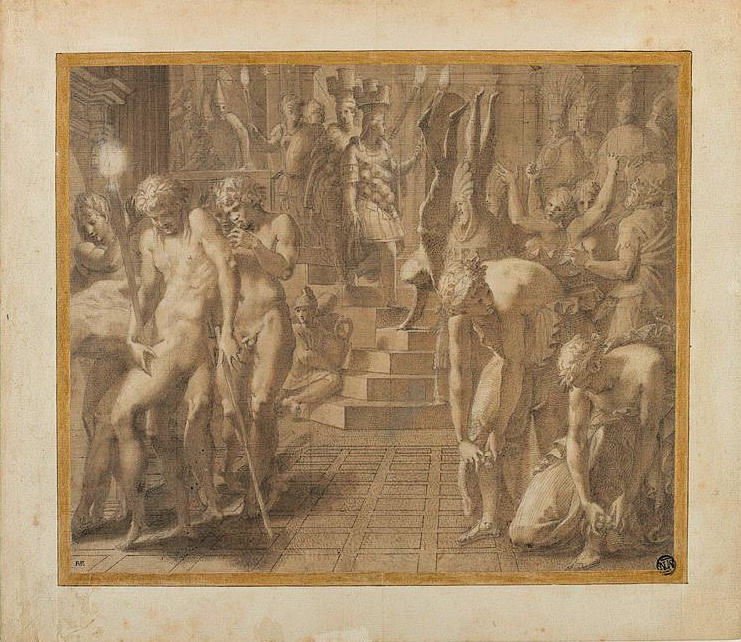
A preparatory drawing by Primaticcio in the Louvre for a lost composition of the cycle of L’Histoire d’Alexandre painted in the Room of the Duchess of Etampes in Fontainebleau. It was the masquerade that brought about the fire in Persepolis, an historic event that took place in 330 BCE when Alexander the Great conquered the Achaemenid Persian Empire following the battle of Guagamela the year before.
It is not disputed in history that after Alexander arrived to the Persian capital city of Persepolis it was looted and burned to the ground, destroying many great cultural treasures. Though recorded by several historians, accounts vary. The first century Roman historian Quintus Curtius Rufus wrote that while drunk during a large celebration with his companions, attendants and courtesans, Alexander himself started the fire as the rest joined in. (see – https://www.worldhistory.org/article/214/alexander-the-great–the-burning-of-persepolis/
Niccolò dell’Abbate (c. 1509-1571), The Death of Eurydice, c. 1550s-1560s, oil on canvas, 189.2 × 237.5 cm, National Gallery London.
Niccolò dell’Abbate was from Modena in Italy. He was influenced by the sculptural and optical illusion achieved in the artwork of Andrea Mantegna (1431-1506). He was also influenced by Correggio (1489-1534), a master of chiaroscuro. By 1552 dell’ Abbate was in France helping Primaticcio at Fontainebleau with the royal chateau’s interior decorations though most of his artwork has disappeared. The Death of Eurydice is a fine example of the Mannerist landscape which the artist is responsible for having introduced into France.
Le Maître de Flore (active 1540-1560), Le triomphe de Flore (The Triumph of Flora), private collection (Vicenza).
Le Maître de Flore is a French painter of the mid16th century Fontainebleau School. The use of the moniker Maître de Flore derives from this and another artwork.
The painting above by the Master of Flore in the Metropolitan Museum of Art in New York is seen as depicting the birth of Cupid, with attendants in the birthing room assisting Venus. The composition, which is animated and decorative, is an example of the School of Fontainebleau, the high art style developed in 16th century France by Italian artists under the sponsorship of the French king.
Perhaps the most famous artwork to come out of the School of Fontainebleau is an anonymous work in the Louvre entitled Diana the Hunter. With influences of both Le Rosso and dell’ Abbate, Italian masters of the school, it is believed to depict Diana de Poitiers, the legendary French beauty and mistress of Henry II.
School of Fontainebleau, Woman in her Toilet, c, 1550, Musée des Beaux-Arts, Dijon.
A recurring theme of the Italian masters and French artists in the 16th century is that of the naked woman, shown half-figure in her bath, or dressing. Some have an allegorical significance, others are combined with a portrait. This particular work which depicts some beauty of the day was so admired that there are known 16th century copies of it in Basel and in Massachusetts.
Jean Cousin the Elder (1490-1560), Saint Mammès coming to surrender to the court of the governor of Cappadocia, around 1541, tapestry, 440 × 450cm, Paris, Louvre Museum.
Jean Cousin was born in Sens and died in Paris. He was a French painter, engraver and sculptor.
St. Mammès was martyred under Emperor Aurelian in Cappadocia around 275. In Asia Minor he was highly revered by early Christians. In the 8th century his relics were taken to France and into Langres cathedral. Around 1540, eight tapestries were produced for the cathedral chancel depicting scenes from the saint’s life. Three of the tapestries survive: two in Langres and one in the Louvre.
In the Louvre tapestry, St. Mammès is accompanied by a lion to visit Aurelian who condemned him to death. In the background building the saint’s execution is already taking place. The tapestry’s elements point to the wave of influence that was the Italian Renaissance: its expansive landscape; its compositional use of perspective; and its classicizing architecture and buildings’ decoration, all of which came together in Francis I’s School of Fontainebleau. The tapestry’s varied and nuanced use of color lend a painterly appearance to the woven artwork.
Pseudo Félix Chrétien (active 1535-37), Three men lower barrels into the cave, Städel Museum Frankfort.
The picture displays a scene at one of the likely nearby hôtels that housed merchants, diplomats and others so to be close by the king. It is evident by Félix Chrétien ‘s artwork that creative activity went far beyond the confines of the royal chateaux. Many painters whose names and works are unknown flourished in 16th century France. Italian Renaissance techniques are used in the painting such as its correctly rendered spatial perspective, realistic figural development, and the typical gestures found in the latest Franco-Italian Mannerist style.
Jean Clouet (1485-1540), François Ier, 1524, Louvre.
Jean Clouet was the Court Painter to King Francis I. While Clouet was an influential artist in the establishment of Renaissance portraiture in France, his only documented painted portrait is that of Francis I’s librarian, Guillaume Budé (1467–1540).
A leading humanist of the sixteenth century, Budé’s fingers hold his page and a quill in the midst of writing. The words on the page in Greek presents an epigram: “While it seems to be good to get what one desires, the greatest good is not to desire what one does not need.”
Jean Clouet, Guillaume Budé, c. 1536, The Metropolitan Museum of Art, New York, oil on wood, 15 5/8 x 13 1/2 in. (39.7 x 34.3 cm).
Jean Clouet, also called Jean Clouet II and Janet, was probably the son of a Flemish painter who was the Court Painter to the Duke of Burgundy. Jean Clouet II made a number of portrait drawings of the Court that survive, most in Chantilly.
Jean Clouet, Portrait of Admiral Bonnivet, c. 1516. Musée Condé, Chantilly, France.French Anonymous, Head of a bearded man, capped with a hat, three-quarters to the right. End of 16th century. Louvre.Francois Clouet (before 1520-1572), Portrait of Pierre Quthe, 1562, Louvre.
François Clouet was the son of Jean Clouet II and succeeded him as Court Painter to the king in 1541. Like his father, he was also called Janet and specialized in portrait drawings, most of which are housed in Chantilly. Francois Clouet’s first signed painting was the 1562 portrait of Pierre Quthe in the Louvre. Its style was influenced by the Florentine artists, particularly Angelo Bronzino (1503-1572).
François Clouet, A Lady in Her Bath, c. 1571, oil on oak, 92.3 × 81.2 cm (36 5/16 × 31 15/16 in.), National Gallery of Art, Washington, D.C.
The identity of Clouet’s model has long been debated. She may have been Marie Touchet, the mistress of Charles IX, or possibly Diane de Poitiers, the legendary French beauty and mistress of Henry II. The painting is boldly composed as it evokes poses of Venus, the love goddess, found in Italian art but also in its presentation of fecundity such as the nurse suckling a child and a bowl of ripe fruit of the season. The raised curtain is a device used in royal portraiture though here it may be just decorative.
François Clouet, La reine Marguerite enfant, c. 1560, Chantilly. Workshop of François Clouet, Marie de Gaignon, marquise de Boissy (1524-1565), c. 1550-1565, Louvre.Corneille de Lyon (active 1533-1574), Portrait de Marot, c. 1540, Louvre.
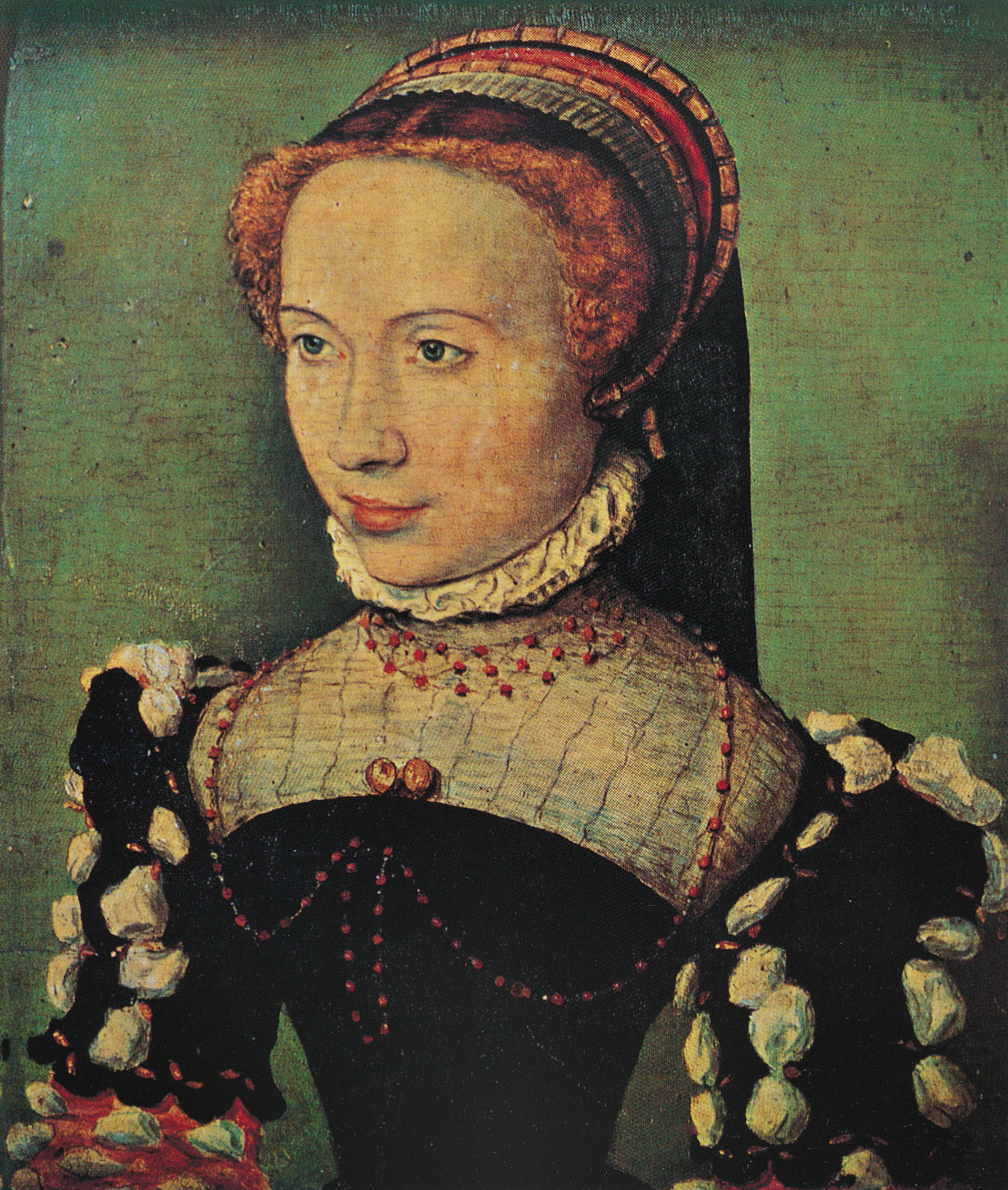
Corneille de Lyon (active 1533-1574) was born in The Hague and worked in Lyons, France for over 30 years starting around 1540. A contemporary and rival of François Clouet (c. 1520-1574), Corneille de Lyon is well documented as a popular leading painter in the French style. As the artist did not sign or date his works, it is virtually impossible to positively identify his artwork. It was only in 1962 that his first work –and nearly all of them are miniature in scale – was positively identified. The nature of his work was described by contemporaries. In 1551 the Venetian ambassador who visited the artist’s studio observed: “We paid a call to an excellent painter who…showed us the whole Court of France, both gentleman and ladies, depicted with the utmost likeness on a great many small panels.”
Working in oil on wood panel, Corneille de Lyon was Peintre et Valet de Chambre du Roi to Henry II (1519-1559) and Charles IX (1550-1574). Corneille likely did paint the entire court. Portraits usually show half-length figures dressed in dark colors against a neutral, somewhat iridescent and greenish background. Groups of such portraits are of uneven quality marking studio artists supervised by the master. The precise drawing of facial features with its smooth planes and enamel-like techniques conveys sitters of placid expression whether their gaze is distant or engaged. Costumes are portrayed with detailed realism yet in a rich, modulated and less definite form.
Painter to the king since 1551, Corneille became a landowner by gift of the king in 1564. In June 1564 one of the artist’s high-born visitors to his home was Catherine de‘ Medici (1519-1589), then regent. Before his death in 1574, the Netherlandish-born Corneille, with his family and household, became Roman Catholics after working in the French Court for nearly 35 years.
Corneille de Lyon (active 1533-1574), Portrait of Gabrielle de Rochechouart, c. 1574, Oil on wood, 16.5 x 14 cm, Musée Condé, Chantilly.Pierre Dumonstier “the Uncle” (c.1545-c.1610), Portrait of an Unknown Man, chalk drawing with watercolor, c. 1580, Musée Jacquemart-André.
Towards the close of the 16th century, there were two families of French artists who were active – namely, the Dumonstiers and the Quesnels.
The Dumonstiers were descendants of one of Le Rosso’s fellow workers at Fontainebleau in the 1530s. Pierre Dumonstier (c.1545-c.1610) was one of three brothers, all of whom were portrait painters. The brothers had close links to the royal house, particularly to Catherine de’ Medici. Pierre produced several drawings, many in color giving them a somewhat painted appearance. Portrait of an Unknown Man is a chalk drawing with watercolor.
In terms of style, what in the beginning of the 16th century produced precise drawing of facial features in portraiture gave way by the end of the century to greater modeling fluency so to achieve intense expression. Portraiture’s overall format, however, remained constant: a face isolated on a neutral background rendered with close analytic attention.
The Quesnel artistic dynasty began with a court painter to James V of Scotland (1513-1542). One of that painter’s sons, François Quesnel (1543-1619), produced many drawings. His painted portrait of Mary Ann Waltham is signed and dated by the artist. Quesnel concentrates on rendering the face with the rest of the body and costume handled perfunctorily. This dichotomy of attention to form was the case in the drawings as well. It may be that the master produced the face in these portraits and left the body and costume to studio assistants.
François Quesnel (1543-1619), Mary Ann Waltham, 1572. 22 x17.5 in., Private, UK.
SOURCES:
A Dictionary of Art and Artists, Peter and Linda Murray, Penguin Books; Revised,1998.
La Peinture Française: XVe et XVIe Siècles, Albert Châtelet, Skira, Genève Suisse, 1992.
French Painting: From Fouquet to Poussin, Albert Châtelet and Jacques Thuillier, Skira, 1963.
FEATURE image: May 2015. Michigan Avenue Main Lobby. The Art Institute of Chicago. 4.57mb DSC_0366 (1)
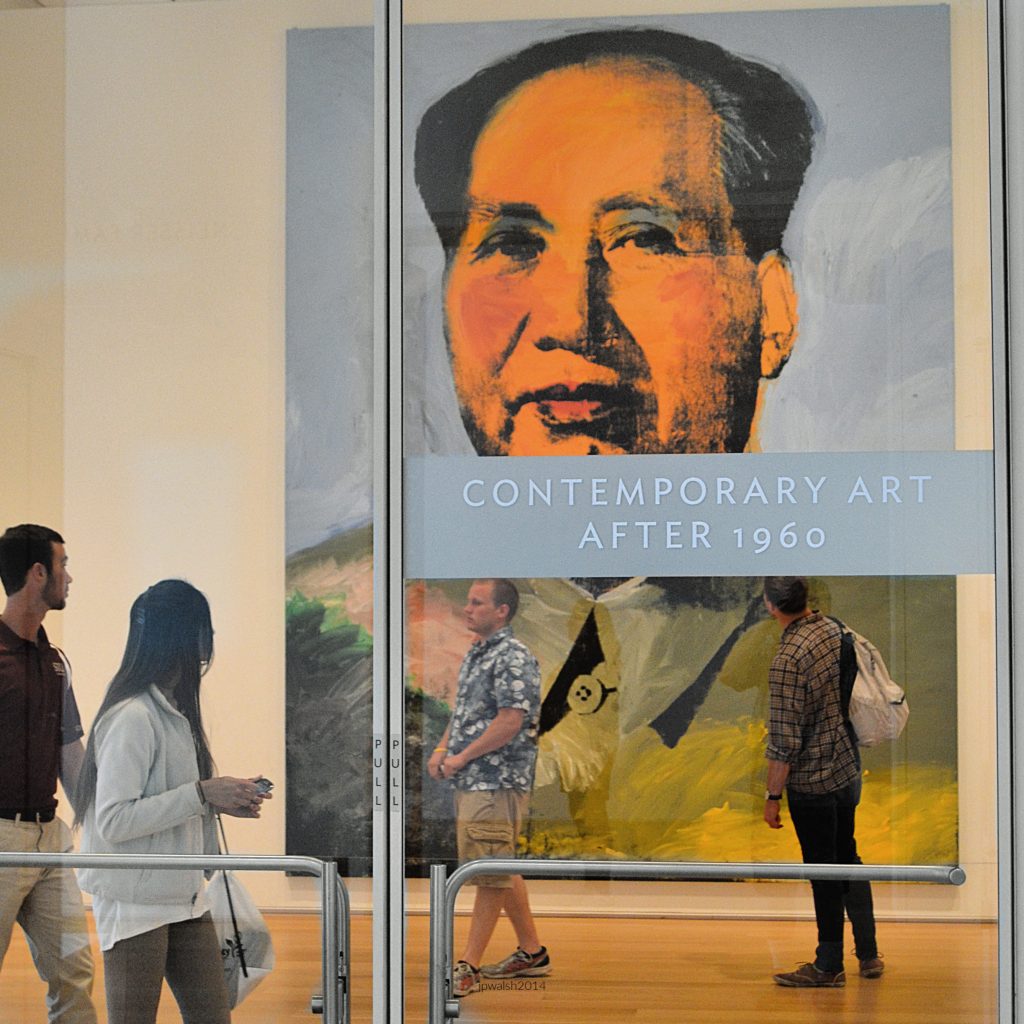
September 2015. Michigan Avenue entrance of The Art Institute of Chicago. 7.68 mb 99%May 2015. Sculpture Court, The Art Institute of Chicago. September 2015. Modern Wing, The Art Institute of Chicago. June 2014. Andy Warhol (1928-1987), Mao, 1972, Acrylic, silkscreen ink, and pencil on linen, 448.3 × 346.7 cm (176 1/2 × 136 1/2 in.). The Art Institute of Chicago. 20th Century. American. Pop. June 2014. The Art Institute of Chicago. 40%June 2014. Robert Irwin (1928-2023), Untitled, Acrylic lacquer on cast acrylic disk, 1969. The Art Institute of Chicago. Irwin was a pioneering figure in California Light and Space art. 5.59mbSeptember 2015. The Art Institute of Chicago. 6.25 mbAugust 2015. Frances Stark (1967-), from Intimism, 2015. The Art Institute of Chicago. 21st Century. American.
Speaking of his fountain (below) at the Art Institute of Chicago, Milles observed: “The great classicists knew that it was impossible to reproduce the appearance of flesh in marble, and they set themselves to create forms of pure beauty that would merely suggest and symbolize the living creature, and then to invest those forms with a meaning that mankind would feel intuitively to be universal and significant. This is what I have tried to do.“
August 2015. Alexander McKinlock Memorial Court. AIC. 20th Century. Nordic. Sculpture.
Carl Milles (1875-1955), Triton Fountain, 1926, bronze, Alexander McKinlock Memorial Court, The Art Institute of Chicago. Swedish sculptor Carl Milles (1875-1955) studied in Paris from 1897 to 1904, working in the studio of Auguste Rodin (1840-1917). Yet Milles departed from the prevailing naturalism that dominated sculpture in the Belle Époque era, and embraced ideas and forms that reflected the artist’s independent spirit, his knowledge and appreciation of classical and Gothic sculpture, and his Nordic roots.
May 2015. Lorado Taft (1860-1936), Fountain of the Great Lakes, 1913. South Garden. The Art Institute of Chicago. November 2017. North Garden, AIC. 20th Century. British. Modernism. Sculpture.
Henry Moore (1898-1986), Large Interior Form, bronze (ed. of 6), 1953/4, 16 ft. 9 in., North Garden, The Art Institute of Chicago. Henry Moore’s 16-foot sculpture was made when the 84-year-old British artist was concerned with the construction of three-dimensional space, internal forms within solid volumes, and placing his work in a natural setting. Moore had worked primarily in stone but as these formal concerns emerged, he shifted to modeling and bronze casting. Large Interior Form explores mass and void as well as gravity and growth within a nature-inspired artist-created form.
November 2017. North Garden, The Art Institute of Chicago. Partial view: Flying Dragon, Alexander Calder, 1975. November 2017. Alexander Calder (1898-1976), Flying Dragon, 1975, Steel plate and paint, 365 × 579 × 335 cm (120 × 228 × 132 in.), North Garden, The Art Institute of Chicago. 20th Century. American. Sculpture. Modernism. September 2015. Charles Ray (1953-), Young Man, 2012, Solid Stainless Steel. 21st Century. American. Sculpture. March 2010. Washington, D.C.
Aristide Maillol (1861-1944), Nymph—Central Figure for the Three Graces, 1930, The Hirshhorn Museum and Sculpture Garden, Washington D.C. Acquired by the museum in 1966, photographs show that the statue stood in an open location by a garden pool at the museum. In 1991 following a whirlwind of euphoria associated with the successful completion of Operation Desert Storm, a victory celebration at the Mall in June of that year involved hovering military jets and helicopters. Their downdraft sent gravel footpath debris flying in the air that scratched and cracked several statues in the sculpture garden. Though none appeared to sustain damage beyond some repair, the Nymph—Central Figure for the Three Graces suffered the most damage as the nude female statue had pitted indentations on her backside. In 2010 when this photograph was taken, the sculpture was located in front of a protective garden wall. See- https://www.baltimoresun.com/news/bs-xpm-1991-06-12-1991163158-story.html 20th Century. France. Sculpture. Modernism.
August 2015. The Art Institute of Chicago. 1.43 mbMay 2015. Indian and Islamic Art. Art Institute of Chicago. 3.34 mbSeptember 2015. The Art Institute of Chicago. 6.90 mbMay 2015. Frédéric Bazille, Self-portrait, 1865/6. The Art Institute of Chicago. 19th Century. France. Impressionism. (20)November 2012. Clodion (1738-1814). The See-Saw. 1775. Toledo Museum of Art.. Ohio. 18th Century. France. Terracotta. November 2012. Michel Anguier (1612-1686), Amphitrite, marble, 1684. Toledo Museum of Art, Ohio. 17th Century. France. Sculpture. November 2012. 2nd Century BCE. Roman. Venus, Asia Minor, marble, c.165 CE., Toledo Museum of Art, Ohio. September 1993. Bill Reid (1920-1998), Birth of the World or The Raven and the First Men/Humans, yellow cedar, 1980. Museum of Anthropology, UBC, Vancouver, B.C. 20th Century. Canada. August 2005. National Gallery of Art, Washington, D.C. September 2016. R to L: Kees van Dongen (1877-1968), Woman with Cat, 1908, and Quai, Venice, 1921; Gabriele Münter, Portrait Young Woman, 1909. Milwaukee Art Museum. 20th Century. Germany. France. Fauvism. Expressionism. August 2015. Mikazuki (male deity) Noh Mask, cypress wood, brass, colors. The Art Institute of Chicago. 16th Century. Japan. May 2014. Left to right: Pierre-Auguste Renoir (1841-1919), Chrysanthemums, 1881/2; Acrobats at the Cirque Fernando (Francisca and Angelina Wartenberg), 1879; Fruits of the Midi, 1881; Seascape, 1879; and, Lucie Berard (Child in White), 1883. The Art Institute of Chicago. 19th Century. French. Impressionism.September 2013. Berthe Morisot (1841-1895), Woman in a Garden, 1882/3, The Art Institute of Chicago. 19th Century. French. Impressionism. September 2012. William Glackens (1870-1938), The Dressing Table, c.1922, oil on canvas. Snite Museum of Art, Notre Dame, Indiana. 20th Century. American. Realism. (30)September 2016. Gabriele Münter (1877-1962), Kirche von Reidhausen, oil on canvas board, 1908 and Mädchen mit Puppe, oil on cardboard, 1908/9. August Macke (1887-1914), Geraniums Before Blue Mountain, oil on canvas, 1911. Milwaukee Art Museum. 20th Century. Germany. Expressionism. May 2015. Left to right: Bodhisattva; Diety; Buddha. The Art Institute of Chicago. 4th-6th Centuries. Afghanistan/Pakistan. Stucco. May 2015. Left to right: Diety; Bodhisattva; Buddha. The Art Institute of Chicago. 4th-6th Centuries. Afghanistan/Pakistan. Stucco. September 2015. Room 235, The Art Institute of Chicago. September 2015. The Art Institute of Chicago. August 2015. The Art Institute of Chicago.May 2015. Charles Collins (1680-1744), Still Life with Game, 1741. Private Collection. 18th Century. Ireland.May 2015. James C. Timbrell (1807-1850), Carolan the Irish Bard, c. 1844, oil on canvas. Private collection. 19th Century. Ireland. May 2015. The Art Institute of Chicago. 256 kb 25%May 2015. Museum of Fine Arts, Boston.
John Kelly, wire-strung Bunworth harp, 1734, Museum of Fine Arts, Boston, and Robert Fagan (c. 1761-1816), Portrait of Lady as Hibernia, c. 1798. Private collection. The Bunworth harp is inscribed: “made by Iohn Kelly for the Revd Charles Bworth Baltdaniel 1734″. The wire-string harp was made by Catholic instrument maker John Kelly for the Reverend Charles Bunworth, also of Baltdaniel, who was the Protestant rector of Buttevant, County Cork. The many aspects of the instrument—from soundbox, harmonic curve, fore-pillar, tuning pegs, and ornamentation and color— invite interest. Though it may be the female head at the top of the harmonic curve that at first most intrigues. (see – https://harp.fandom.com/wiki/Bunworth_Harp and http://www.earlygaelicharp.info/harpmakers/ – both retrieved October 14, 2021). Robert Fagan was an Irish painter who was born in London but spent most of his artistic career in Rome and Sicily (Fagan first arrived into Italy in 1781). Though an expatriate, Fagan’s oil on canvas depicts a woman who represents Ireland careessing the strings of the harp, the country’s national instrument and symbol. Seated next to an Irish wolfhound, she holds a scroll that reads: “Ireland Forever” (“Erin go bragh“). 18th century. Ireland.
August 2005. Yale Center for British Art, New Haven, CT. August 2015. 4th Century BCE. Greece. Italy (Apulia). Terracotta. Loutrophoros (Bath water vase), The Art Institute of Chicago. August 2015. Ancient Greek and Roman Art, The Art Institute of Chicago. October 2014. AIC. 6.64mb 35%
Black-figure painting was the primary technique for decorating Greek vases for over 200 years. The technique started in Corinth and expanded east to Athens in the mid first millennium BCE (700- 500 BCE). In this time period ancient Corinth was, with almost 100,000 people, one of the largest cities of Greece. In 146 BCE the Romans besieged, captured and demolished Corinth. The site lay deserted for almost 100 years until the Romans rebuilt it as a new city populated with around 50,000 Romans, Greeks and Jews. The Art Institute of Chicago.
August 2015. 5th Century BCE. Greece. Oil Jar, 450 BCE, Athens, terracotta. The Art Institute of Chicago. May 2015. Gustave Caillebotte (1848-1898), Paris Street; A Rainy Day (“Rue de Paris, Temps de pluie”), 1877. The Art Institute of Chicago. 19th Century. France. Impressionism. Abbott Handerson Thayer (1849-1921). Winged Figure, 1889, oil on canvas. 130.8 × 95.9 cm (51 1/2 × 37 3/4 in.). The Art Institute of Chicago. 19th Century. American. October 2014. James McNeill Whistler (1834-1903), The Artist in his Studio, c. 1865-66, oil on boarded mounted on panel, 62 × 46.5 cm (24 7/16 × 18 5/16 in.). The Art Institute of Chicago. 19th Century. American.May 2014. Auguste Rodin (1840-1917), Eternal Springtime, 1884. Bronze. Fonderie Alexis Rudier, Paris (20th century). The Art Institute of Chicago. 19th Century. France. Sculpture. Modernism. (50)May 2015. Edgar Degas (1834-1917), Spanish dance (c.1883), Arabesque (c.1885), and Woman seated in an armchair, (c.1901), bronze (cast later). The Art Institute of Chicago. 19th Century. France. Impressionism. Sculpture. May 2014. Auguste Rodin (1840-1917), Adam, 1881. Bronze. The Art Institute of Chicago. 19th Century. French. Sculpture. Modernism. September 2015. AIC.
Headdresses. 19th/20th Century. Africa. The Art Institute of Chicago. The headdresses at the right and at the left are Gelede headdresses. The headdress in the middle is perhaps a Gelde or Efe headdress. The headdress at the left is made of wood and the oldest of the headdresses. It was made in Nigeria or Benin by the Yoruba community in the late 19th/early 20th centuries. Gelede headdresses often portray women. The headdresses in the center and at right depict women. One is wearing a head tie and the other is showing a woman with a plaited hairstyle. These were made in Nigeria by the Yoruba community in the early 20th century. The Gelede festival of the Yoruba community in western Africa is a public spectacle which uses colorful masks that combines art and ritual dance to educate, entertain and inspire worship. Gelede includes the celebration of “Mothers,” a grouping that includes female ancestors and deities as well as the elderly women of the community whose power and spiritual capacity in society is convoked. The Efe is a nighttime public performance held the day before the Gelede.
May 2015. AIC. 7.05 mb
Mariano Fortuny (1838-1874), African Chief, 1870, oil on canvas, 41 × 32.9 cm (16 1/8 × 12 15/16 in.). The Art Institute of Chicago. African Chief in The Art Institute of Chicago was recently exhibited in a 2017-2018 monographic retrospective at the Prado in Madrid. The show, simply entitled “Fortuny (1838-1874),” reflected the Prado’s holdings of many of this artist’s masterpieces. The Prado’s collection is due to their own acquisitions but mainly the generous bequests of the artist’s oils, watercolors, and drawings by late 19th century Mexican collector Ramón de Errazu (1840-1904) as well as the painter’s son, Mariano Fortuny y Madrazo. Fortuny’s artwork is often Orientalist in style that reflects the many trips he made to North Africa. In his career, Fortuny was noted for his precision of anatomy and archaeological scrupulousness though African Chief tends to the modern broken brush style for which the Spanish artist was prescient following his many trips to Paris. 19th century. Spain. Romanticism.
October 2014. Left to right: Kramer Brothers Company (Dayton, Ohio), Settee, c. 1905/25; Cecilia Beaux (American, 1855-1942), Dorothea and Francesca, 1898, oil on canvas; Daniel Chester French (American, 1855- 1931), Truth, 1900, plaster. The Art Institute of Chicago. September 2015. Fragments, Dankmar Adler (1844-1900) and Louis Sullivan (1856-1924), The Art Institute of Chicago. 19th Century. American. Modernism. September 2015. The Art Institute of Chicago. 560kb 40%September 2015. Help desk, The Art Institute of Chicago. May 2021. AIC. 7.35 mb
Bisa Butler (1973-), The Safety Patrol, 2018, by Bisa Butler. Cotton, wool, and chiffon; appliquéd and quilted. The Safety Patrol considers the potential of a group of children as future caretakers of the world led by a boy in a sash with outstretched arms whose duty it is to protect the others. Bisa Butler uses the technique of appliqué quiltmaking to create her work. For the figures, the artist cuts, layers, and pins together fabrics and arranges them on the ground fabric. This comprises the quilt top. Between this quilt top and a backing fabric is a layer of fiber “batting” or stuffing. These layers are stitched to form the quilt with the thread lines part of the structure, texture and details of the image. Butler seeks to use fabric colors and patterns to contribute to the quilt’s subject and narrative. 21st Century. American.
May 2014. Hubert Robert (French, 1733-1808), The Fountains, 1787, oil on canvas, 255.3 × 221.2 cm (100 1/2 × 88 1/8 in.). The Art Institute of Chicago. 18th century. France. (60)Joseph Wilson (d. 1800), Adephi Club – Belfast, oil on canvas, 1783 7.73 mbThe State Ballroom, Saint Patrick’s Hall, Dublin Castle, oil on wood, c. 1845, signed and inscribed: F. J. Davis/Dublin. AIC 6.62 mb
The State Ballroom, Saint Patrick’s Hall, Dublin Castle, oil on wood, c. 1845, signed and inscribed: F. J. Davis/Dublin. St Patrick’s Hall had long been a key location for Ireland’s political, military and social elite to gather (B. Rooney, Creating History, Stories of Ireland in Art, 2016, p.179). These dance proceedings are overseen by the Lord Lieutenant of Ireland and his wife visible at the end of the hall. The 1840s was a period of fashion indulgence. The social ball with attendees in sumptuous costume took place during the period of the Irish famine (1845-1849) where approximately one million people died. Another one million or more emigrated out of the country at the same time, many to the United States. Court dress for gentleman allowed personal expression in fabric and style for the waistcoat. Military officers and political office holders wore court uniforms indicating their position and rank. For ladies, to signal their marital situation, unmarried women wore jewelry and fresh flowers in their hair. Conventionally-minded single ladies added two ostrich feathers behind one ear. Matrons sported a third ostrich feather in their hair and wore lace ribbons.
May 2021. El Greco (Doménikos Theotokópoulos) (1541-1614), Saint Francis Kneeling in Meditation, c. 1595, oil on canvas. 92 × 74 cm (36 3/16 × 24 1/8 in.). The Art Institute of Chicago. 16th Century. Spain.October 2014. Arthur Wesley Dow (1857-1922), Boats at Rest, c. 1895, oil on canvas, 66 × 91.4 cm (26 × 36 in.). The Art Institute of Chicago. 19th Century. American.October 2016. Ukrainian National Museum (2249 W. Superior Street), Chicago. 4.55 mbMay 2015. Aurora, IL. The David L. Pierce Art & History Center (20 East Downer Place). 4.15 mbMay 2014. AIC.
Pompeo Batoni (Italian, 1708-1787), Allegory of Peace and War, 1776, oil on canvas, 53 1/2 × 39 in. The Art Institute of Chicago. 5.73 mb Pompeo Batoni was a leading 18th-century Roman painter. The artist was known for his portraits and commissioned large format historical and religious paintings. The painting entitled “Allegory of Peace and War” represented the mythological figure of the god Mars being restrained by a semi-nude embodiment of peace. Peace lays her hand on War’s sword and bears to him an olive branch. The painting was the result of Batoni’s own invention – no one commissioned this artwork – and it stayed in the artist’s studio until at least the early 1780s.
December 2015. Chicago Cultural Center. 3.62 mb March 2002. Louvre, Paris. 312 kb
Statue of Aphrodite, called Venus de Milo because it was found on the Greek Island of Milos in the Aegean Sea. It dates from around 150 B.C. In the Louvre in Paris, the Venus de Milo is one of the most famous statues in the world. Its soft, sensual handling of the marble was characteristic of the late Hellenistic period. She is monumental – the topless, armless Venus de Milo stands, independent of her base and pedestal, six feet five inches in height. In the course of the second half of the 19th century, the Venus de Milo became a favorite statue of Parisians and its visitors. It was around 1875 that it was moved away from the wall which it stood against and placed in the middle of a 17th century room so that it could be viewed completely around. It was accorded this baroque effect first used at Versailles at the start of the 18th century so to isolate monumental sculpture for display to produce maximum impact and enjoyment of the artwork. SOURCES: Masterpieces of the Louvre, Marcel Brion, NY: Abrams; Creators Collectors and Connoisseurs, Niels Von Holst, NY: G.P. Putnam’s Sons.
November 2017. AIC. 74% 7.84mb DSC_3350
Fragment of a Funerary Monument, c. 330 BCE Greek; Athens, 152.4 × 111.8 × 33 cm (60 × 44 × 13 in.), The Art Institute of Chicago. see- https://www.artic.edu/artworks/55887/fragment-of-a-funerary-naiskos-monument-in-the-shape-of-a-temple – retrieved March 31, 2025. This is one of the fashionable burial markers, whether of Greek or Roman families, encountered by the public in ancient times. Made in all sorts of shapes and sizes, this large stone monument from the 4th century BCE shows three figures carved in very high relief so much so that they are nearly in the round. The two male figures’ gestures of parting indicate that it is a funerary scene. The standing man is likely the person who has died and this funerary marker depicts his sharing a final farewell with loved ones – their relationship, obviously close, after 2500 years, completely unknown.
November 2017. AIC. 69% 7.88mb DSC_3355
Cristoforo Stati (Italian, 1556–1619). Samson and the Lion, 1604-1607, marble, 210 × 112 × 84 cm (82 11/16 × 44 1/8 × 33 1/8 in.). The Art Institute of Chicago. see – https://www.artic.edu/artworks/146875/samson-and-the-lion – retrieved April 1, 2025. Stati studied in Florence under Giambologna (1529-1608). In 1601, Tuscany’s archduke, Ferdinando I de’ Medici (1549-1609), sent a sculpture of Samson by Giambologna to the palace of Spain’s prime minister in Valladolid as a gift. Later, Stati’s sculpture of Samson and the Lion was also sent to Spain as a complementary gift and installed in Madrid. The work was in a Swiss private collection before it was acquired by The Art Institute of Chicago in 1996.
November 2017. The Art Institute of Chicago. 80% 7.88mb DSC_3315December 2012. 1st century. Roman. AIC. .2.25mb 101_1469
Head of Hercules. Roman, First Century CE. The Art Institute of Chicago. The Romans adapted the stories of Hercules’ superhuman feats of strength from the Greeks. The earlier Greeks viewed him as a demigod, the later Romans saw him as one of their hero figures.
May 2016. Rodin AIC. 7.44mb DSCN2611 (1)
Head of Pierre de Wissant (1889) by Auguste Rodin, part of The Burghers of Calais (1884–89) in the collection of the Art Institute of Chicago, originates from the larger sculptural ensemble commemorating the six citizens of Calais who offered themselves as hostages to the English during the Hundred Years’ War. When displayed independently, the head emphasizes Rodin’s exploration of psychological intensity and human vulnerability. The sculpture conveys a moment of profound emotional anguish: the downward gaze, deeply furrowed brow, and partially opened mouth collectively articulate a state of acute despair and inner turmoil. Through these expressive distortions, Rodin captures not only the historical gravity of the subject’s sacrifice but also the universal experience of psychological suffering.
December 2025. Crèche, mid-18th century, Naples, Italy. The Art Institute of Chicago. Details of daily life are connected to the biblical narrative of the Nativity of Jesus Christ. 98% 7.84mb DSC_9937December 2025. The mid-18th century Neapolitan Crèche invites viewers to witness the miraculous among the mundane. The Art Institute of Chicago. 7.33mb DSC_9933 (1) see – Neapolitan Crèche | The Art Institute of Chicago – retrieved December 14, 2025. December 2025. AIC.7.66mb DSC_9896 (1)
Auguste Rodin (1840-1917), A Burgher of Calais (Jean d’Aire), modelled 1889, plaster, 82×26 in. The figure was exhibited in the 1893 World’s Columbian Exposition in Chicago and entered the Art Institute’s collection that same year. The monument includes six individualized figures on a heroic scale and was commissioned in France in 1884. Completed in 1889 by Rodin the monument was installed in Calais’s town hall square in 1895. Rodin depicts Jean d’Aire, one of the town fathers, in sackcloth with the keys of the city, surrendering to the English during the Hundred Years War, in exchange for their lifting a nearly year-long siege that led to the starvation of the city’s inhabitants.. see – Monument to The Burghers of Calais | Musée Rodin – retrieved December 15, 2025.
December 2025. Exhibition Strange Realities: The Symbolist Imagination (October 4, 2025- January 5, 2026). Over 85 works of major artists including Odilon Redon, Paul Gauguin, and Edvard Munch, drawn from the Museum’s collection of drawings and prints exploring the late 19th century pan-European Symbolist movement of art, literature and theatre.see – Strange Realities: The Symbolist Imagination | The Art Institute of Chicago – retrieved December 16, 2025. 73% 7.86mb DSC_9847December 2025. In the Chinese and Korean Art Galleries, The Art Institute of Chicago. 93% 7.89mb DSC_9889September 2014. Greyed Rainbow, 1953, Jackson Pollock, oil on linen, 182.9 × 244.2 cm (72 1/16 × 96 3/16 in.) and Streetcar, 1951, Alexander Calder, Brass, sheet metal, rod, wire, and paint, 9’8″ long, Art Institute of Chicago. See – Streetcar (1951) | Calder Foundation – retrieved Jan. 29, 2026 and Greyed Rainbow | The Art Institute of Chicago – retrieved Jan. 29, 2016. 3.55mb DSC_1038 (1)
POLLOCK: IF PEOPLE WOULD JUST LOOK AT THE PAINTINGS I DON’T THINK THEY’D HAVE ANY TROUBLE ENJOYING THEM. IT’S LIKE LOOKING AT A BED OF FLOWERS. YOU DON’T TEAR YOUR HAIR OUT OVER WHAT IT MEANS. In a year of Gladiator, Traffic, Almost Famous and Erin Brockovich, Marcia Gay Harden won the Academy Award for Best Supporting Actress in “Pollock” for her portrayal of Lee Krasner (1908-1984), pioneering American Abstract Expressionist painter and wife of American abstract painter Jackson Pollock (1912-1956), the biographical film’s title character. Hardin also won the Best Supporting Actress Award at the New York Film Critics Circle Awards. Ed Harris was nominated for an Academy Award for Best Actor for his portrayal of Jackson Pollock in a film that was also Harris’s directorial debut. An ensemble cast portrays real people of the mid-20th century modern art world including Jennifer Connelly as Ruth Kligman (1930-2010), American abstract artist and Pollock and Willem de Kooning lover, Val Kilmer as the Dutch-American abstract expressionist de Kooning (1904-1997), Bud Cort as writer/dealer Howard Putzel (1898-1945), Jeffrey Tambor as critic Clement Greenberg (1909-1994), John Heard as sculptor Tony Smith (1912-1980), Robert Knott as older brother Sande Pollock (1909-1963), Sada Thompson as Pollock’s mother Stella (1875-1958) and Amy Madigan as American art collector Peggy Guggenheim (1898-1979). Like its namesake’ artwork, the film made a splash when it came out in December 2000 and was a memorably fine effort.https://youtu.be/z0xiovbDML0?si=XupBbr5gZnhuTVqP – retrieved Jan. 30, 2026. September 2014. Modern Wing, Art Institute of Chicago. 3.49mb DSC_1061 (1)August 2015. Modern Wing, Art Institute of Chicago. 3.76mb DSC_0672 (1)August 2015. AIC. 3.14mb DSC_0068 (1)August 2015. AIC. 4.14 mbDSC_0181 (1)August 2015. AIC. 1.22mb DSC_0014 (1)October 2015. Art exhibit. Oak Park, IL. 4.72mb DSCN1739 (2)November 2015. Art Institute of Chicago. 3.77 mb DSC_0094 (1)November 2015. With the arm (detail) of Rodin’s Adam (1881). Bronze. Art Institute of Chicago. 6.38mb DSC_0352 (1)