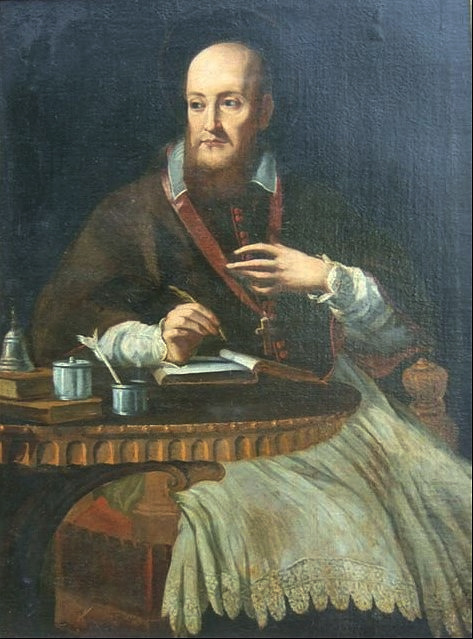
FEATURE Image: St. Francis de Sales, 18th c, Besançon, 96 x 131 cm. Public Domain.
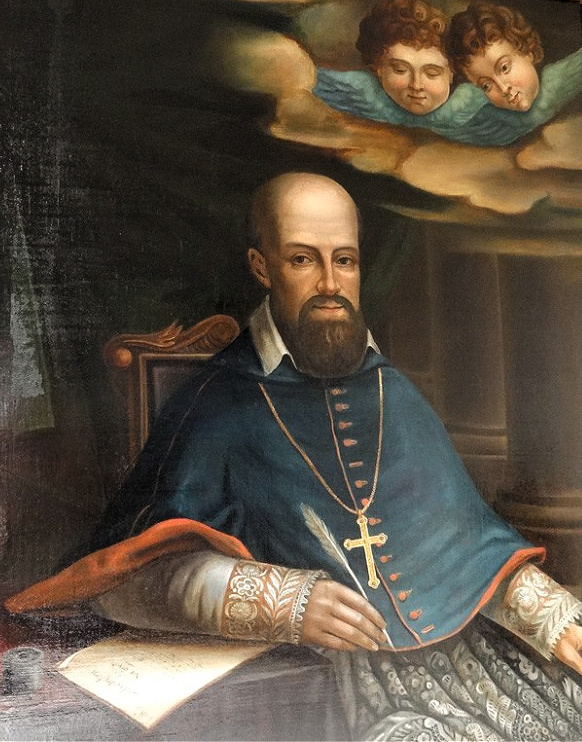
Saint Francis de Sales sitting in front of a copy of his work, “Introduction to the Devout Life,” oil on canvas, c.1790s, 77 cm x 99.5 cm, unknown artist. Hovering above the 17th century French Catholic bishop, saint, and Doctor of the Church are two cherubs who regard him with kindness. Public Domain. Francis de Sales became one of the most respected theologians in Christianity. A great preacher and writer, Francis de Sales ascended the seat of Bishop of Geneva, Switzerland, and, with widowed Baroness Jeanne de Chantal (1571-1641), founded the religious order of the Visitation. As a diplomat and man of prayer, Francis de Sales exerted a significant influence within the Catholic Church and among the temporal powers of the day. https://www.antiques-delaval.com/en/paintings/7068-hst-large-portrait-saint-francois-dirty-life-devote-cherubs-xviiieme.html -retrieved January 24, 2023. Public Domain.
CANONIZED ON APRIL 8, 1665, IN ROME BY POPE ALEXANDER VII, ST. FRANCIS DE SALES IS THE PATRON OF WRITERS, JOURNALISTS, THE CATHOLIC PRESS, CONFESSORS, THE DEAF AND EDUCATORS. ST. FRANCIS WAS DECLARED A DOCTOR OF THE CHURCH IN 1877 BY PIUS IX.
INTRODUCTION.
By all accounts, St. Francis de Sales (1567-1622), whose feast day is January 24, was a gracious and holy man. His writings were, similar to the Jesuits of whom Francis was a student, admirer and close friend, directed to society’s well-to-do and concerned with how, as society’s current elites, they can practice, most basically, Christian “noblesse oblige” within their privileged social station. St. Francis de Sales’ writing defended and explained Catholic doctrine to a Europe which, in an age of Renaissance and Reformation, was very much in revolt against it. To preserve and endorse (1) a social order and (2) perfect belief in doctrine, St. Francis de Sales communicated in everything that both were attainable simultaneously, and did so famously in his book, Introduction to the Devout Life (1608).
Like the sons of St. Ignatius of Loyola, St. Francis de Sales was active in the direction of souls. For Introduction to the Devout Life, Jesuit father Jean Fourier, S.J. strongly encouraged a noble lady around 1607 to prevail upon her local bishop (de Sales) to have his personal writings of spiritual direction to her and others printed to reach a wider audience at court and elsewhere among the ruling class. St. Francis de Sales was also eager to have his personal instructions in print for the advancement and perfection of individual souls. Introduction to the Devout Life became an instant international bestseller and, over 400 years later, remains a spiritual classic. As John K. Ryan, S.J. observed, “Its greatness lies in many things: in its originality, its completeness, its sincerity, its balance, its penetration and its style…(and) as such it is beyond adverse criticism in any important way.”1
Francis Bonaventure was born into nobility in August 1567 in Sales castle in Savoy, France, where there were tremendous social pressures to marry and settle into a life of wealth and prestige. Sent to Paris by his family, they wanted him to attend the prestigious College of Navarre in the fine hôtel de Navarre with its renowned library in rue Saint André des Arts, but Francis chose to attend the new Jesuit College of Clermont, which at that time was known for its religious and moral vision as much as its academic achievement.2 At the Jesuit school St. Francis de Sales came into contact with the post-Tridentine humanism taught by faculty such as Father Possevin, S.J. and Francis took to it like a duck to water so that he could express its intellectual tenets afterwards quite well.3 St. Francis de Sales worked out his spiritual life in prayer in Saint-Étienne-des-Grès in the Latin Quarter. The church (now demolished) on Rue Saint-Jacques was the center for Christianity among students. Another saintly Frenchman who later frequented Saint-Étienne-des-Grès was St. Vincent de Paul (1581-1660). Francis de Sales as a college-age layman was finding he had serious religious scruples and temptations to lust.4 it was in Saint-Étienne-des-Grès that St. Francis de Sales ultimately took a personal vow of chastity before a statue of the Virgin Mary which allowed him to pursue his spiritual desires.
After studying for five more years at the University of Padua, St. Francis de Sales emerged in 1591 with the equivalent of a J.D.- Ph.D. and was ordained a priest in 1593. In those years the young nobleman was surrounded by the Renaissance writings of philosophers and poets such as Marsiglio Ficino (1433-1499), Giovanni della Casa (1503-1556) and contemporary French theologian Pierre Charron (1541-1603).5 Now in his mid-20’s Francis was given by his bishop the nearly impossible task to reconvert John Calvin’s citizens of Geneva to Catholicism. Needless to say, Francis’s efforts failed. In fact, the Wars of Religion (1562-1598) were in full swing and made for impassioned attitudes on all sides and complicated factors in politics. An individual, Protestant or Catholic, had to practice their faith in a fragmented society.6
In 1602 St. Francis de Sales was sent to Paris to negotiate the condition of Catholics in reconverted territories in France. As a diplomat St. Francis de Sales was smooth – peaceful, positive, charitable and temperate in his words and persona. At meetings taking place at the court of French King Henry IV ( (1553-1610), St. Francis de Sales met some of the great figures of the religious and mystical revival occurring in France including Henri, Duc de Joyeuse (1563–1608), a General commander in the Wars of Religion and member of the Catholic League who became a Capuchin Franciscan after the death of his wife, Catherine de La Valette; Pierre de Bérulle (1575-1629), one of the most important mystics of 17th century France and, later, a Catholic cardinal; and Madame Acarie (1566-1618), mother of seven children, and foundress and lay sister of the Discalced Carmelites in France. She was perhaps the most widely respected religious person in Paris and certainly the go-to contact for the wealthy whenever they desired to help the poor because she made sure their alms got to the poor and not the professional charitable class. St. Francis de Sales, a respected theologian, also influenced the temporal powers – the dukes of Savoy, Charles Emmanuel I (1562-1630) and Victor Amadeus I (1587-1637), the regent of Savoy Christine de France and kings Henry IV and Louis XIII of France.

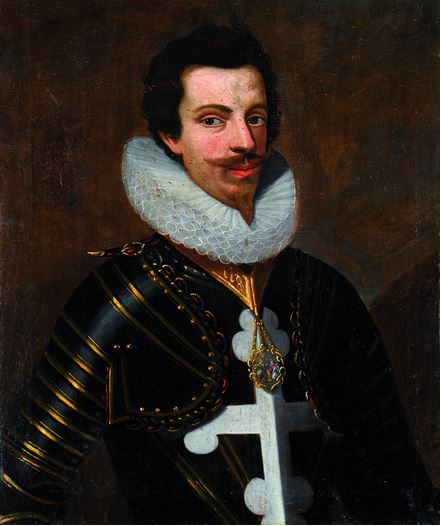
In July 1602 following the death of Bishop Grenier, St. Francis de Sales became Bishop of Geneva. Francis de Sales traveled ceaselessly around the diocese and beyond, preaching and hearing confessions, and the people quickly realized they had a holy bishop. It was by way of one of his penitents, St. Jeanne-Françoise de Chantal (1572-1641), that St. Francis de Sales worked his vision of the foundation of a new order, the Visitation, whose charism was to serve the sick and the poor with “the charity and gentleness of Jesus Christ.”7

It was in this first decade of the 17th century amidst this flurry of evangelizing and other activity that the 40-something bishop wrote the Introduction to the Devout Life (1608). The book, written in short chapters with titles on topical challenges, problems, and opportunities in the Christian life in the world, provides its responses based on practical counsels. The Introduction to the Devout Life much as his later work, On Love of God, are very reliant on the Bible for its teaching and sprang directly from the bishops’ care of souls that he was doing actively and sacramentally from his diocese in southeastern France. Francis’s generous range of literary sources reflected his education in Renaissance humanism and included classical authors, Montaigne, contemporary poets as well as medieval saints and spiritual writers such as Sts. Anselm, Bonaventure and Bernard. Francis was also familiar with the writings and religious vision of the 16th century Spanish mystics and saints such as Teresa of Avila and Ignatius of Loyola.8
The exceedingly practical St. Vincent de Paul observed about St. Francis de Sales’ On the Love of God: “A truly admirable book, which has as many admirers of the sweetness of its author as it has readers. I have carefully arranged that it shall be read throughout our Society [the Vincentians], as the universal remedy for all feeble ones, the good of slothful ones, the stimulus of love, and the ladder of those who are tending to perfection. Oh! that all would study it as it deserves! There should be no one to escape its heat.”9

St. Francis de Sales, now in his early 50s, visited Paris in 1618 where he preached sometimes twice each day. His great work was to show how ordinary daily life, particularly a busy and successful life, could be a path of holiness. No issue was too large or small for the saint to address – from parties, clothes, flirtations, daily life among marrieds – but all directed to the purpose of imitation of Christ and the love of God. St. Francis takes for granted one’s daily life in French society and proposes no maxim which involves any violent upheavals from it. Part of the saint’s genius is to see that there can be no dispute between the social order and the Christian life. At the same time, St. Francis is no easy teacher or grader – he asks that the Christian virtues be upheld and practiced. That insistence on Christian virtue informing one’s daily life is also the genius of his doctrine. While highly educated and imbued with the grace of mind of the Renaissance, St. Francis carried naturally within himself and conveyed the wisdom of the French soil of Savoy, its terroir. As Francis took one’s daily life in French society for granted, he took Catholic doctrine as if for granted. He then explained it with a highly cultivated mind and gracious spirit that expressed itself with a sweetness and gentleness of style that expounded it as “the universal remedy…the stimulus of love…the ladder …to perfection” as St. Vincent de Paul recognized to those with faith or not, or in trouble in day-to-day life.
St. Francis de Sales perhaps speaks to the 21st century most clearly by way of his theology that is presented without sentimentality or melodrama and is clearly explained and lived to be particularly possible and desirable. Francis said: “He who lives for God, frequently thinks of Him during all the occupations of life.”12
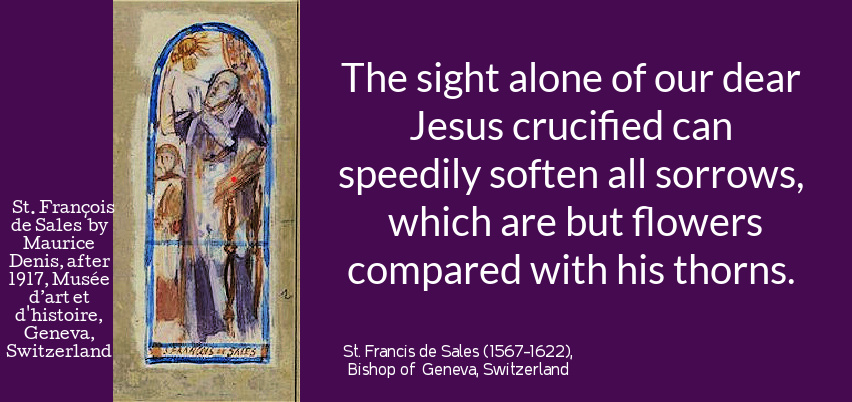
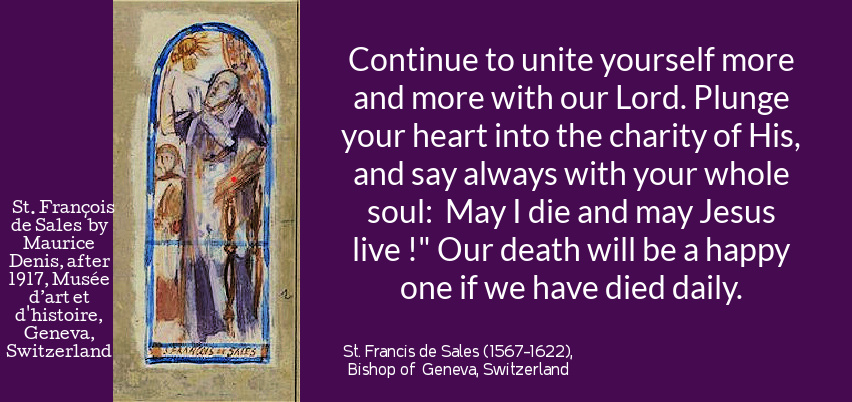
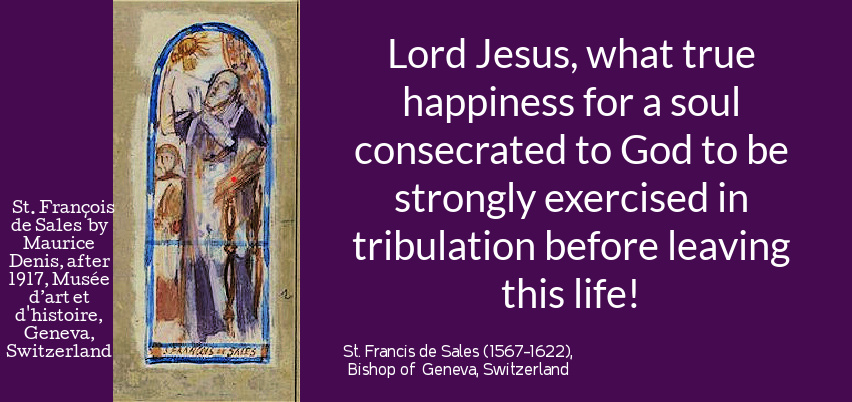
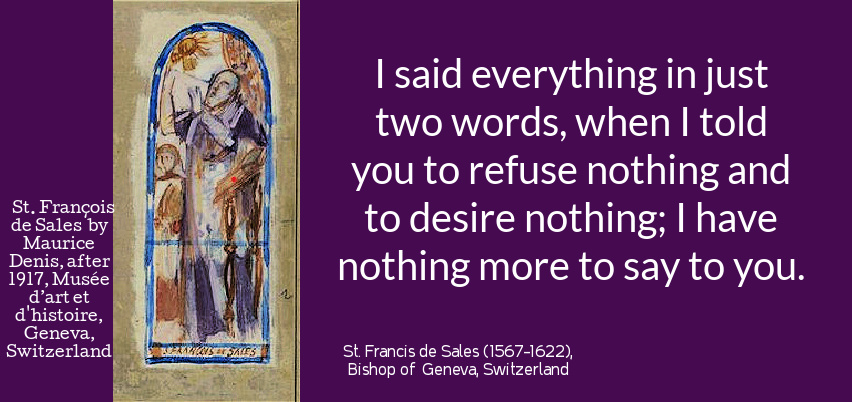
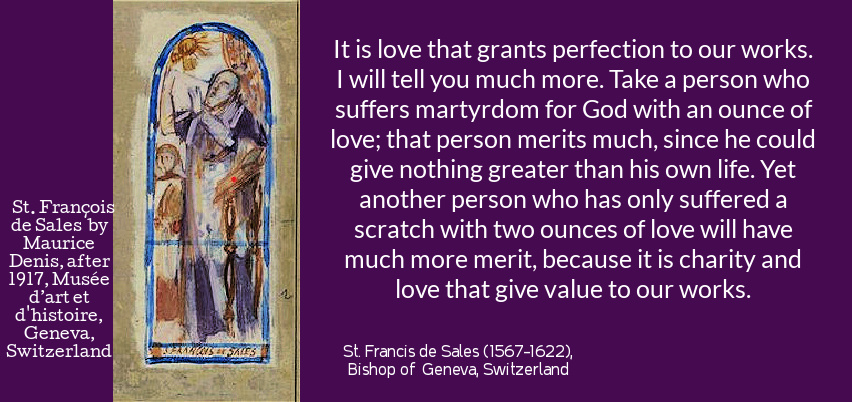
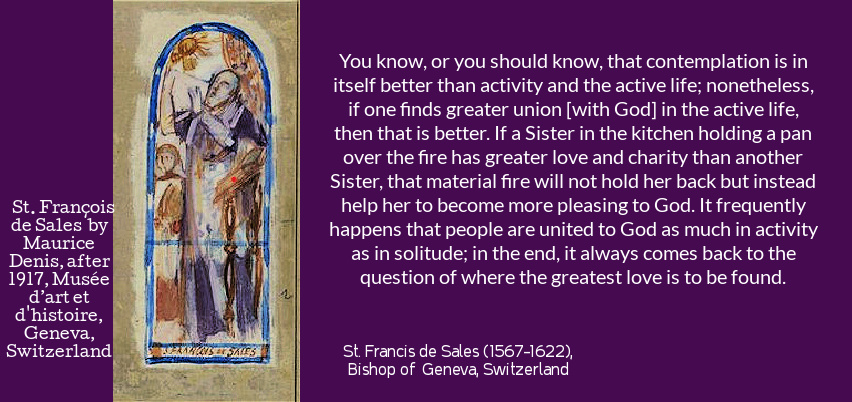
January 24 is the memorial feast day of St. Francis de Sales on the General Roman Calendar of 1969. St. Francis de Sales is the patron of writers, journalists, the Catholic press, confessors, the deaf and educators. He was proclaimed a saint and doctor of the Catholic Church. The following quotes are taken from his many published works of spiritual edification, counsel, exhortation, and solace.
NOTES:
- Introduction to the Devout Life, St. Francis de Sales, trans. and edited by John K. Ryan, Image books (Doubleday) Garden City New York, 1955, p.11.
- Francis de Sales and Jane de Chantal: Letters of Spiritual Direction, trans. by Péronne Marie Thibert, V.H.M. and selected and introduced by Wendy M. Wright and Joseph F. Power, O.S.F.S. Paulist Press New York, 1988 p.19.
- CF. Elisabeth Stopp, “St. Francis de Sales at Clermont College,” in Salesian Studies, 6 (Winter 1969). pp. 42-43.
- Wright & Power, p. 20.
- Wright & Power, p. 22.
- The Saints: A Concise Biographical Dictionary, edited by John Coulson, Guild Press, New York, 1957, p. 305.
- Ibid.
- Wright & Power, p. 28.
- https://www.ccel.org/ccel/desales/love.all.html – retrieved January 23, 2023.
- The Saints: A Concise Biographical Dictionary, edited by John Coulson, Guild Press, New York, 1957, p. 305.
- On the Love of God – https://www.ccel.org/ccel/desales/love.all.html – retrieved January 23, 2023.
- Maxims and counsels of St. Francis de Sales for every day in the year, Ella McMahon, M.H. Gill & Son, Dublin, 1884, p. 12.
QUOTATIONS.
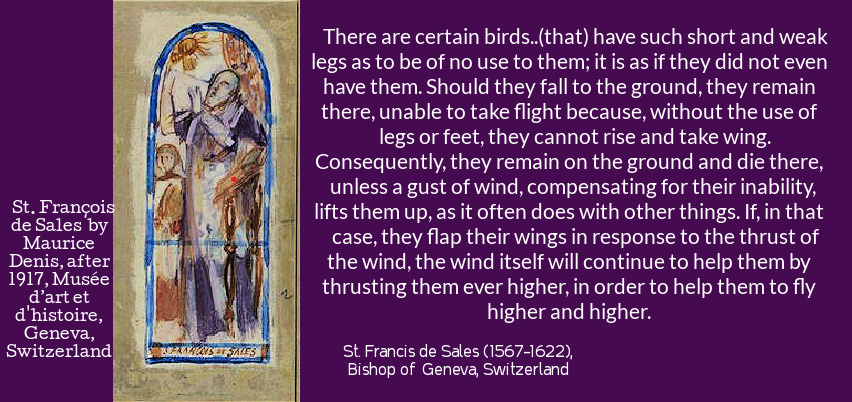


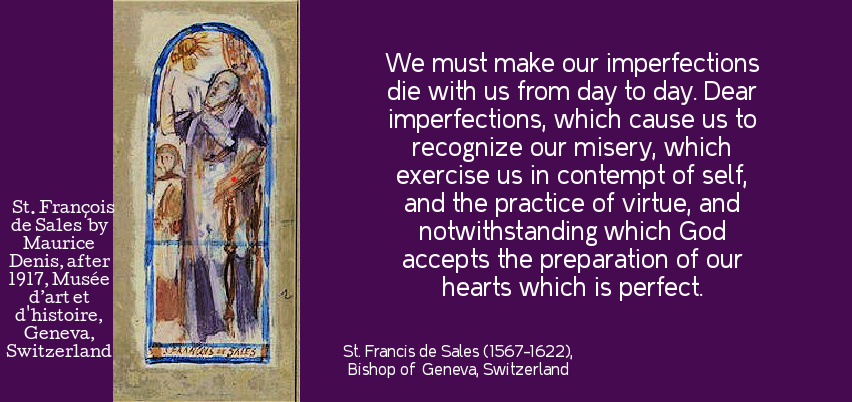


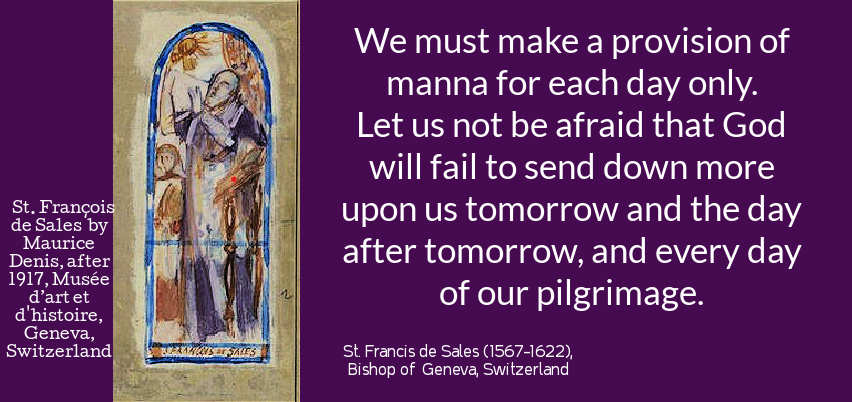


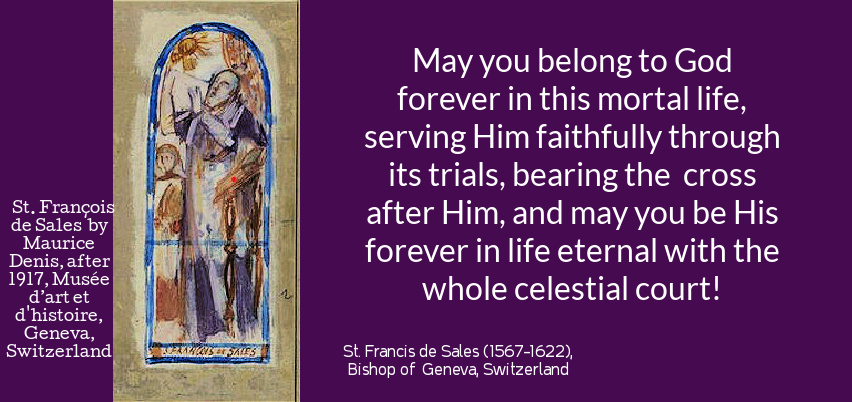
https://www.vatican.va/content/francesco/en/apost_letters/documents/20221228-totum-amoris-est.html – APOSTOLIC LETTER TOTUM AMORIS EST (it’s all about love)
OF THE HOLY FATHER FRANCIS ON THE FOURTH CENTENARY OF THE DEATH
OF SAINT FRANCIS DE SALES, dated December 28, 2022 – retrieved January 28, 2023.





XIXe siècle. Elie Delaunay (1828-1891), Musée d’Arts de Nantes. Public Domain.


XIXe siècle. Elie Delaunay (1828-1891), Musée d’Arts de Nantes. Public Domain.



XIXe siècle. Elie Delaunay (1828-1891), Musée d’Arts de Nantes. Public Domain.