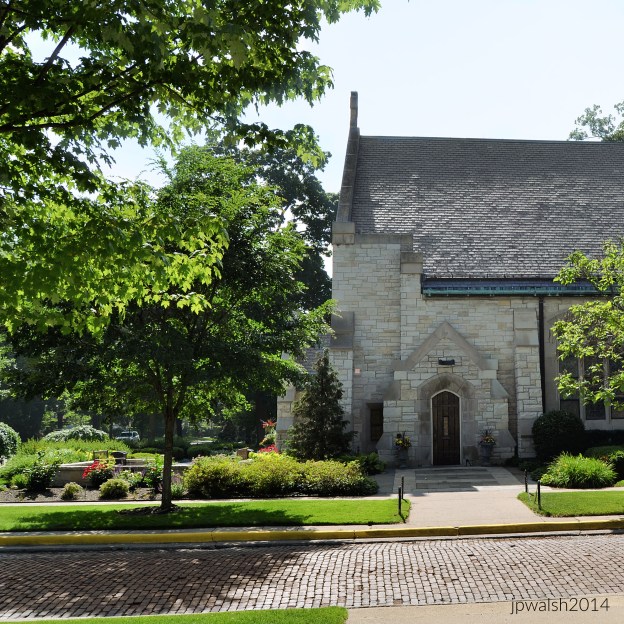
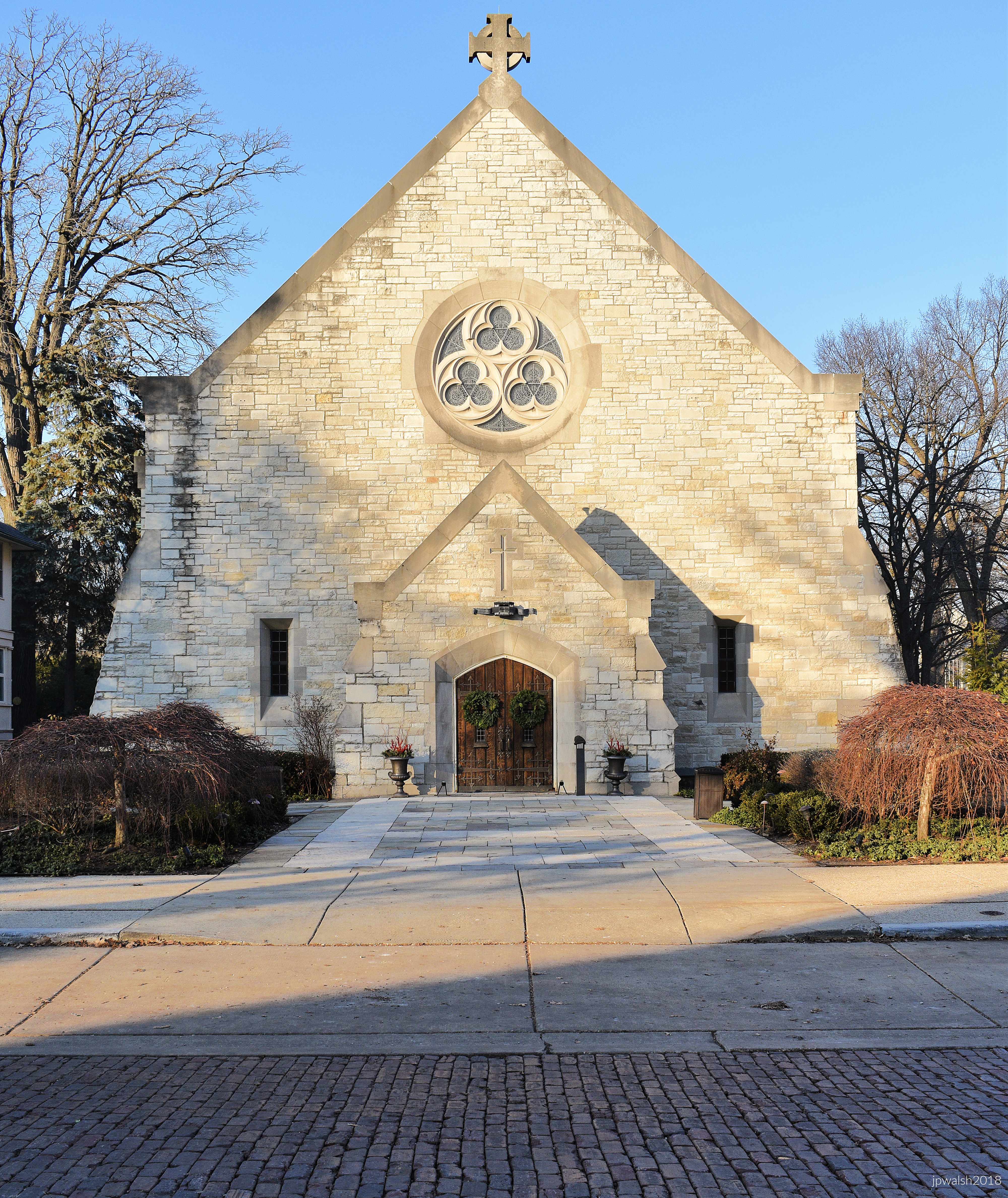
FEATURE Image: March 2016. Immanuel United Church of Christ, 1500 Old Church Road, Streamwood, Illinois. Built in 1868, it is the congregation’s second house of worship on the site and remains the congregation’s active sanctuary. 7.49mb _0979
IMMANUEL UCC in Streamwood, Illinois, has a unique history within the context of the similar histories of other early settlers in Northern Illinois beginning in the 1820’s. Though diverse settlement throughout this part of the state was feverish (Chicago incorporated as a city in 1837), the prairie landscape expanse remained sparsely populated into the 1830’s and 1840’s with its mixture of farms, industry, and trade. The Streamwood church and burial grounds were founded in 1852 when W.G. Hubbard donated its five acres of land for “the sole and exclusive use of erecting a house thereon for religious worship and a burying ground.”
It was a group of 13 farmers who organized the church and chose its name: Deutsche Vereingigte, Evangelische Lutherische Immanuael’s Germeinde. Apparently, as Illinois was the edge of the Western frontier, in those days there wasn’t anyone around, or very many, to enjoin them to state it in English. Of course, it translates as “United Evangelical Lutheran Immanuel Congregation.” Today, Streamwood is in Cook County and sits just on the other side of DuPage County to the south that broke off from Cook and was established in its own right in February 1839. The original relatively open site today is surrounded by tract housing and other modern development for as far as the eye can see or vehicle drives with Elgin about 9 miles to the west.
1851 map of Cook and Dupage Counties. Hanover is between Elgin and Schaumburg Townships. Public Domain.
Streamwood, incorporated in 1957, is one of three communities that comprise the so-called “Tri Village” area that includes Bartlett and Hanover Park. This part of Northern Illinois had served as a seasonal hunting and camping ground for the Cherokee, Miami, Potawatomi, and Ottawa Indians. In their turn, the land had been claimed by France, England, Spain, Virginia, and the Northwest Territory before it became part of the State of Illinois in 1818.
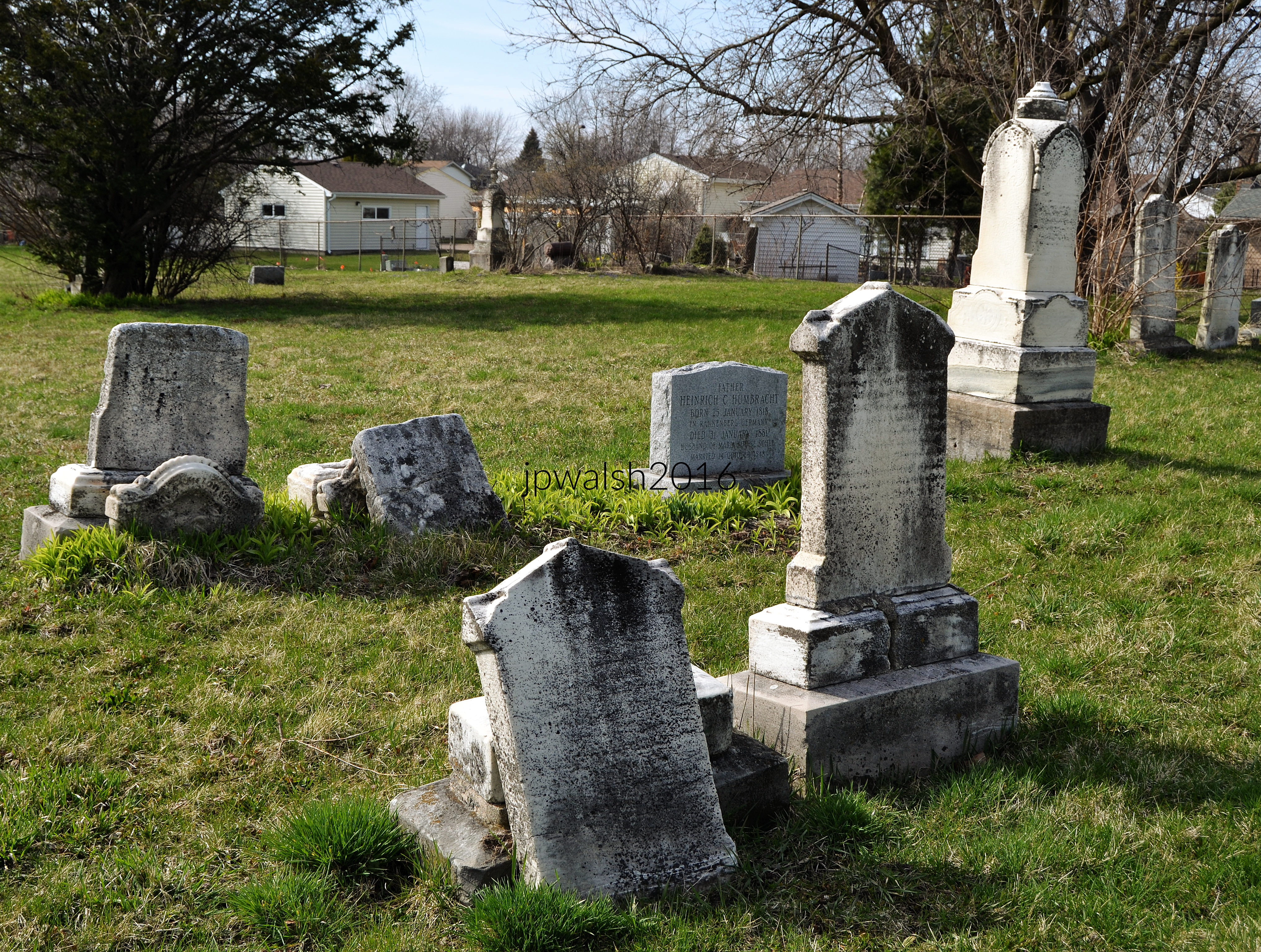
March 2016. The ImmanuelUCC church and burial ground were created in 1852 for German settlers in Hanover Township in today’s northwest DuPage/Cook Counties. Three U.S. Civil War veterans are buried here, including from the 127th Illinois Infantry; Volunteer 5th Calvary Illinois Regiment; and U.S. Calvary Co. H, 3rd Regiment. All three died and were buried in the cemetery decades after the war had ended. Author’s photograph.
While the church started out as Evangelical Lutheran, over time the congregation moved towards becoming part of the United Church of Christ. In 1959 the members changed its name to reflect that reality. The first church building that was completed in 1853 was replaced in 1868 and is the present one. Among other buildings added to the church complex, the same historic sanctuary remains this Chicago suburban congregation’s house of worship today.
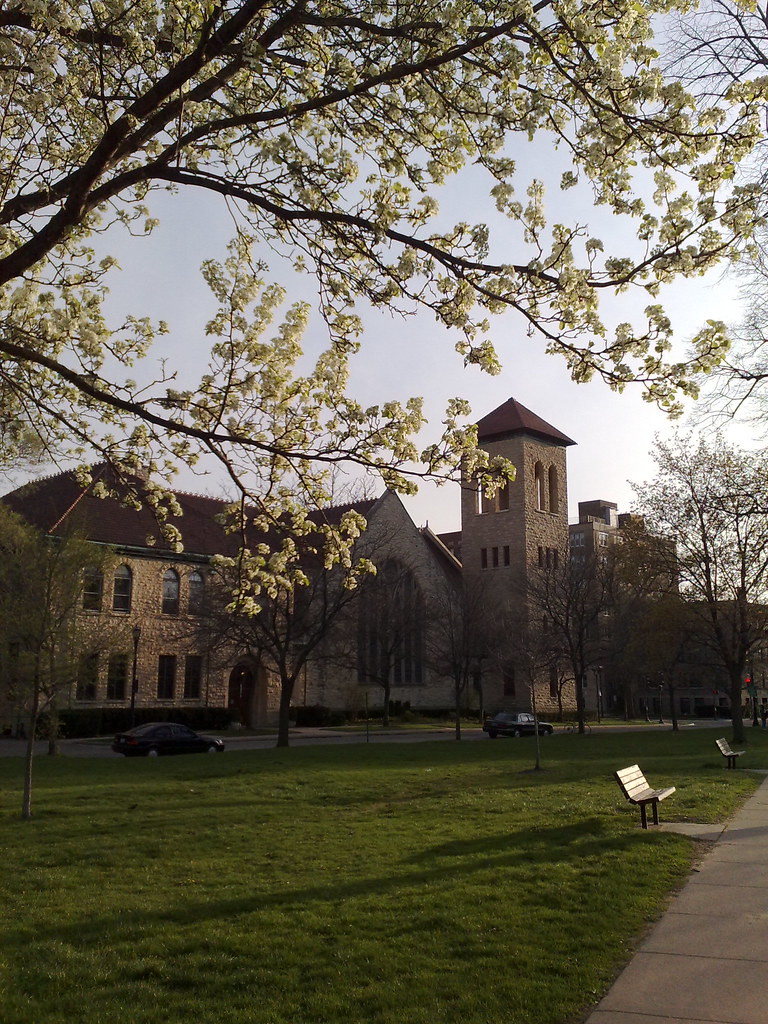
March 2016. Landscape and grounds near ImmanuelUCC church in Streamwood. Hanover Township was an expansive area of farmland settled by mid-19th century German settlers to Illinois. Author’s photograph.
Sources:
DuPage Roots, Richard A. Thompson, editor, DuPage County Historical Society, 1985.
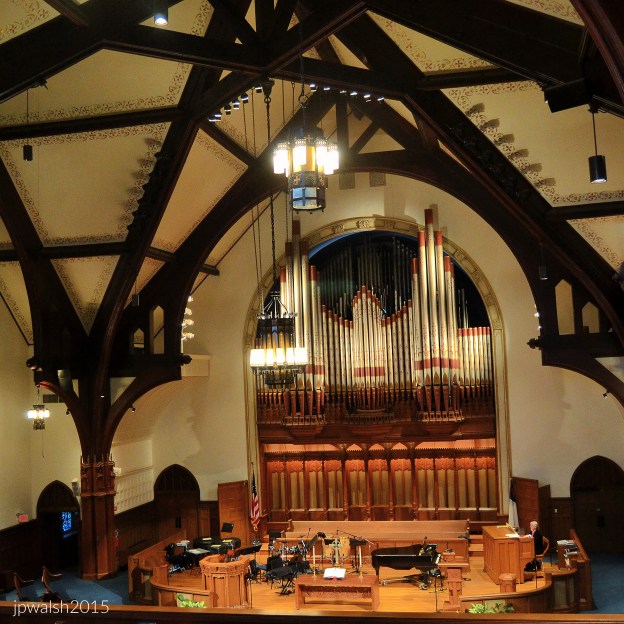
FEATURE image: Aeolian Skinner organ, sanctuary, 10/2015 6.27mb. Text and Photographs by John P. Walsh.
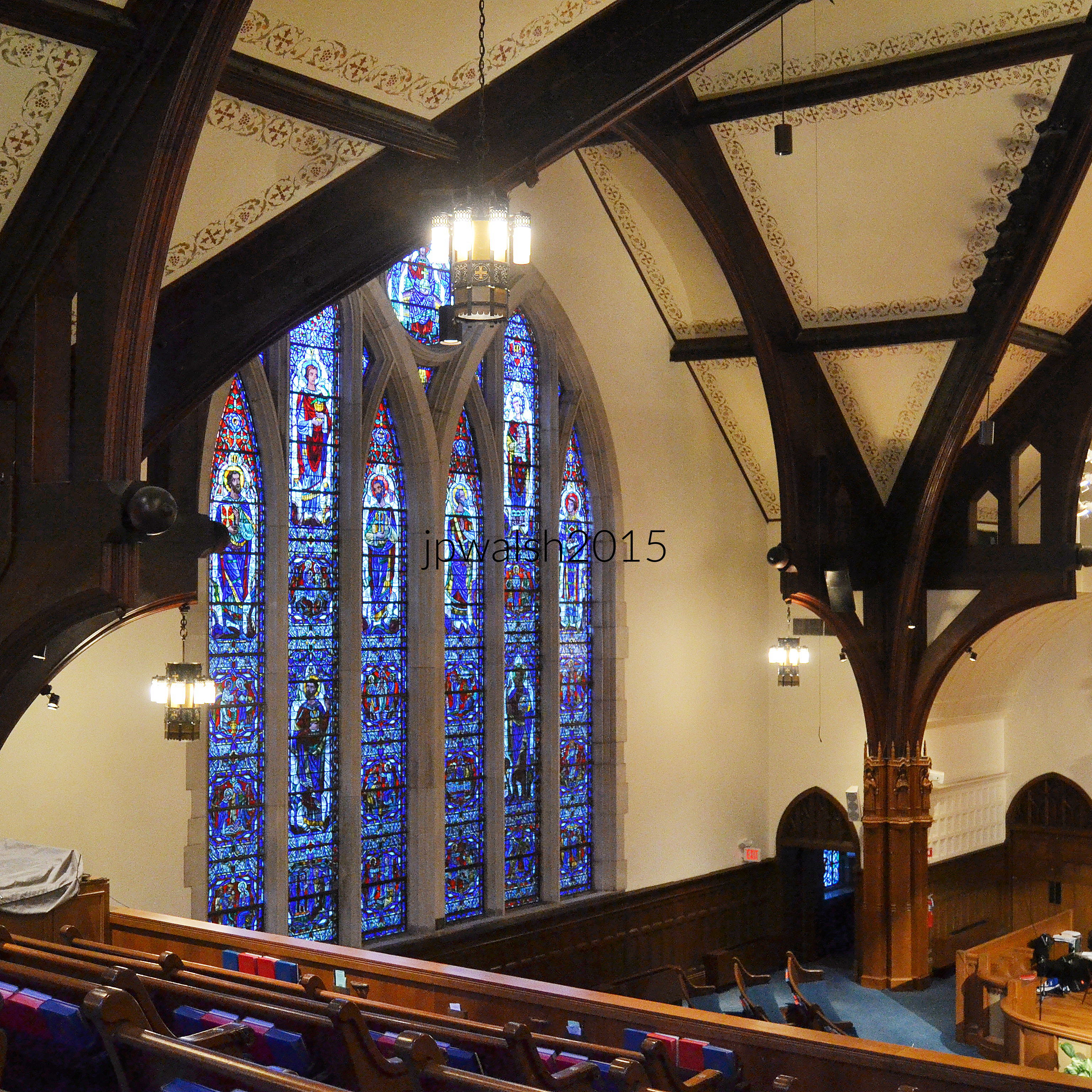
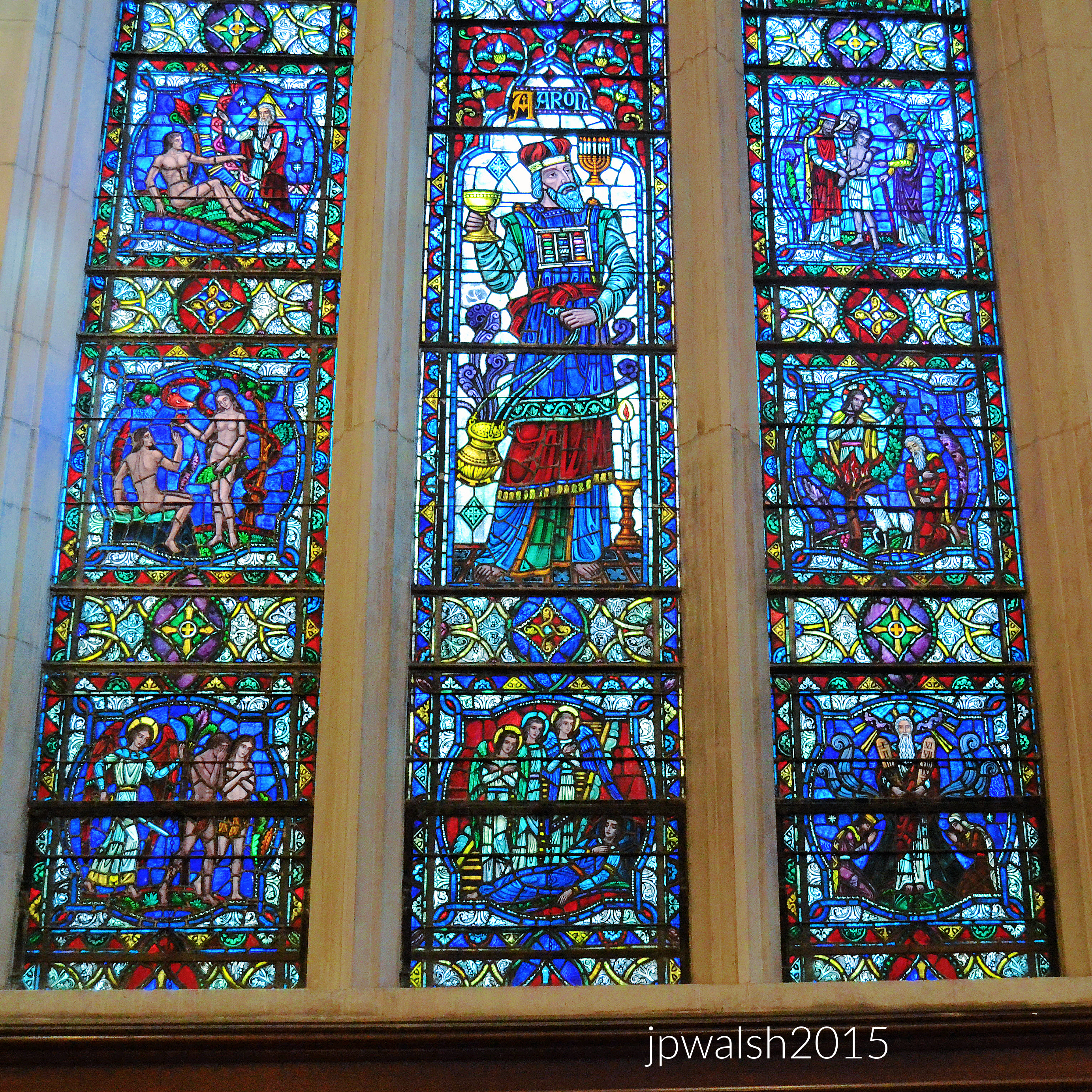
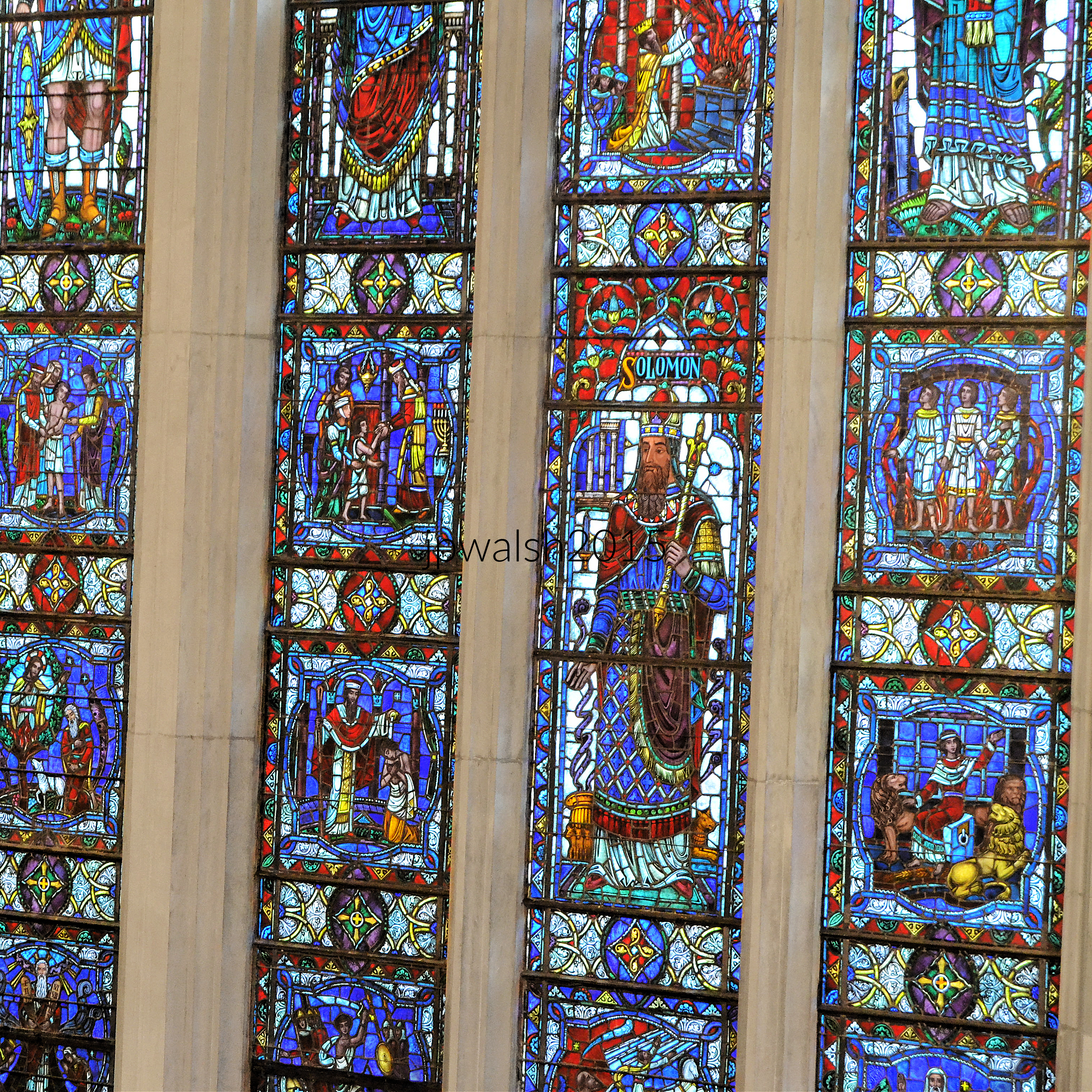
Daniel Hudson Burnham, c. 1890. The First Presbyterian of Evanston church building was designed in 1895 by architect Daniel Burnham (1846-1912) who lived in Evanston.The sanctuary seats over 1,000 worshippers. It has a vaulted roof with Nordic-style timber trusses for support instead of major columns that might obstruct views as well as retains an inclusive worship space. “PA02.2018 – 101” by Presbytery of Chicago is licensed under CC BY-NC-SA 2.0.Music is enhanced by First Presbyterian Church of Evanston’s Aeolian Skinner organ, portions of which date to the 1890s, and is one of Chicago’s finest organs. Wall-filling arched stained-glass windows tell Old and New Testament stories. 10/2015 6.81mbFirst Presbyterian Church, 1427 Chicago Ave, Evanston, IL One of the historic church’s dramatic wall-filling stained-glass windows.10/2015 7.79mb 80%Creation of Adam; Fall of Adam and Eve; Expulsion from the Garden; Priest Aaron and brother of Moses; three angelic visitors to Abraham; the story of Moses. 10/ 2015 7.87mb 90%Burt J. Denman, born in Toledo, Ohio, was an engineering graduate of the University of Michigan who was vice president and general manager of the United Light Power Company. Denman was for a while a leading Methodist layman and trustee of Northwestern University. 10/2015 2.76mbFrom Raymond Park, stained glass window and limestone walls. 10/2015 5.35 mbKing Solomon. 10/2015 7.81mb 98%Adjacent to Raymond Park, the 1895 Gothic Renaissance building is made of Lemont limestone with a tile roof and 120-foot-tall bell tower with open belfry. Raymond Park, which is part of the Evanston parks system, is named for Rev. Dr. Miner Raymond (1811-1897). Rev. Miner Raymond was born in New York City and began his career as a cobbler. Following his matriculation at Methodist Wesleyan Academy in Wilbraham, Massachusetts, Raymond became a teacher at the school starting in 1833 and its principal from 1848 to 1864. In 1837 he married Elizabeth Henderson in Webster, Massachusetts, and they had 8 children together. In 1864 Rev. Miner Raymond with his family relocated to Illinois where he became professor of systematic theology at Garrett Biblical Institute in Chicago. In 1884 he received his LL.D. from Northwestern University. Mrs. Raymond died in 1877 and the widower married Isabella (Hill) Binney in 1879 though she died after 1880. Dr. Rev. Miner Raymond died in 1897 and is buried in historic Rosehill Cemetery. “First Presbyterian Church of Evanston” by Marit & Toomas Hinnosaar is licensed under CC BY 2.0.
FEATURE Image: Alice Millar Chapel, 1962, Northwestern University, Evanston, IL.
Text & Photographs John P. Walsh.
The Purpose of the Alice Millar Chapel
Breaking ground on Easter, April 21, 1962, the Alice Millar Chapel is on the campus of Northwestern University in Evanston, Illinois. The large chapel structure displaced 5 houses for the site’s four buildings on the school`s Evanston campus. It is intended as a space for prayer and reflection based in individual and communal tranquility, solitude, and celebration. At the chapel’s dedication its donor said, “[It is] a place where the soul may find quiet and repose—may be stimulated—or may just meditate. One’s character and personality cannot be fully developed unless his soul finds a purpose.” The chapel can seat over 700 people on the main floor.1
Northwestern University was founded by Methodists in 1851. At the beginning, there was no specific denominational affiliation that the university had. Alice Millar became a formal congregation in May 1971, identifying as “the church in the chapel.”2
The buildings complex (there are 4 buildings total) was designed by Edward Grey Halstead (1909-1992) who was senior partner in the Chicago architectural firm of Jensen, McClurg & Halstead. Mr. Halstead, who lived in Riverside and Wheaton, Illinois, joined the firm in 1952. The builder was Gerhardt F. Meyne Company in Chicago. Mr. Halstead was a third-generation architect born in Minnesota who studied at the University of Minnesota and University of Michigan. Though Halstead thought of himself as a hospital architect – his design projects include Elmhurst Memorial Hospital, Berwyn Community Hospital, Oak Park Hospital and Edward Hospital in Naperville – his largest project was the Alice Millar Chapel.3
Foster G. McGaw, noted philanthropist and founder of a major medical supply company based in Evanston, established the chapel in honor of his mother. Fair Use.
The contemporary Gothic landmark was built as a gift of Mr. & Mrs. Foster McGaw. Foster G. McGaw (1897–1986) was a noted philanthropist who founded the American Hospital Supply Corporation in Chicago in 1922. In 1985 McGaw’s company was acquired by Baxter Travenol Laboratories for $3.8 billion – about $11 billion in today’s dollars. Based in Evanston, at its peak, AHSC was the largest medical supplier in the world and employed thousands of Evanstonians.4 In 1953 Foster G. McGaw donated to the construction of McGaw Memorial Hall (today’s Welsh-Ryan Arena) in tribute to his father, Francis A. McGaw. At the time of construction, it was one of the largest auditoriums in Chicago. At its opening it was used in August 1954 for the Second Assembly of World Council of Churches founded in 1948 which showcased the convocation address by newly-elected President Dwight D. Eisenhower.5
Foster McGaw’s vision for the chapel was to establish a house of prayer whose space inspired the visitor to pursue a spiritual quest. Music concerts regularly appear on the chapel schedule with the chapel choir performing with in-house and guest musical ensembles and symphony orchestras. There are regular organ concerts on the 5,000-pipe organ. The Choir welcomes members from all different religious backgrounds and Sunday services to which all are welcome are given in a Protestant tradition. More interfaith activities at Millar Chapel include various faith traditions, including Muslims, Buddhists and Hindus, who pray and study at the chapel. Inspired by the interfaith witness of Rev. Dr. Martin Luther King, Jr. (1929-1968), there is a candlelight ceremony each year to honor the slain Civil Rights leader.
Who is Alice Millar?
Alice Millar for whom the chapel is named. Public Domain.
The chapel is dedicated to McGaw’s mother, Mrs. Alice Millar McGaw (1859-1910). Millar was born in Alnwick in the north of England. She studied music and notably performed a piano recital for Queen Victoria. She moved to the U.S. with her father, a medical doctor, and met and married Reverend Francis A. McGaw at McCormick Theological Seminary in September 1888. All four of her children were present at the dedication ceremony for the chapel in 1962. Alice Millar had died over 50 years earlier at Augustana Hospital (Swedish Evangelical) in Chicago’s Old Town.6
CHAPEL’S MOST STRIKING FEATURE ARE THE STAINED-GLASS WINDOWS.
The wall-filling windows of abstract and modern design allow light and color to stream into the sanctuary from every side of the chapel building. The modern-designed windows bestow to the chapel a literally awesome ambiance. These magnificent works of art include the east windows that face the sunrise of Lake Michigan (representing healing, law, discovery, literature and the arts) and the west windows that face the sunset of the prairie (representing commerce, space, communication, the State, and the human race). These side windows are in dialogue with the single chancel window with its theological themes.
Across the breezeway and part of the chapel complex is the Jeanne Vail Meditation Chapel. Dedicated in 1963 it is a more traditional English style space built in memory of Mrs. Mary Vail McGaw’s daughter, Jeanne, who died in 1949 at 23 years old. The young woman died from complications of polio after having just given birth to a baby girl. Both the Alice Millar and Jeanne Vail Meditation Chapel are open daily and are very popular for weddings especially for Northwestern University alumni. The Vail Chapel seats 125 people. There is another adjacent building, Parkes Hall, that houses classrooms and the chaplain’s office and completes the complex.
Chancel window and side windows are in conversation with its subjects and themes. 6.78mb 10/2015. The Chancel Window behind the altar is a theological window exploring themes of Creation, Redemption, and Triumph using abstract motifs. The colors of these windows are spectacular and with sunlight penetrating make the space sparkle jewel-like yet airy. 7.71mb 10/2015
EAST SIDE WINDOWS: LAW
LAW: Images of a dove. a sword and scales, human figures refer to law and justice. All the windows while presenting various thematic iconography maintain a similar color scheme throughout. 7.53mb 10/2015
EAST SIDE WINDOWS: HEALING
HEALING: Honoring the physician among recognizable tools of the profession – microscope, test tubes, the caduceus (staff with intertwined serpents), among others as the viewer looks up at the long window. 6.07mb 10/2015
EAST SIDE WINDOWS: DISCOVERY
DISCOVERY: Human discovery of the natural world. A central figure is surrounded by elements of air, earth, fire and water. There is bird, balloon, fish, deep-sea submersible (bathysphere), orbits. Again, the window’s height coupled with its colors and design is impressive. 99% 7.93mb 10/2015
EAST SIDE WINDOWS: LITERATURE
LITERATURE: Dove at the top represents the Holy Spirit who guides the hand of the Bible writer. Recognizable images are a cross; skull; human figures carrying grapes. 6.37mb 10/2015
COMMUNICATIONS: Railroad crossing; filmstrip; the 5 senses; a telephone. THE STATE: Eagle with thunderbolts and olive branch; capitol dome; family; owl; cross, etc. RACES OF HUMANITY: lamb carrying cross; 5 hands; olive branch. 7.78mb 10/2015
WEST SIDE WINDOWS: COMMERCE
COMMERCE: Among abstracted symbols of commerce, wheat stack. 4.13mb 10/2015
WEST SIDE WINDOWS: SPACE
SPACE: Sun at top, planets, stars, constellations, a bull, astronaut. 4.59mb 10/2015
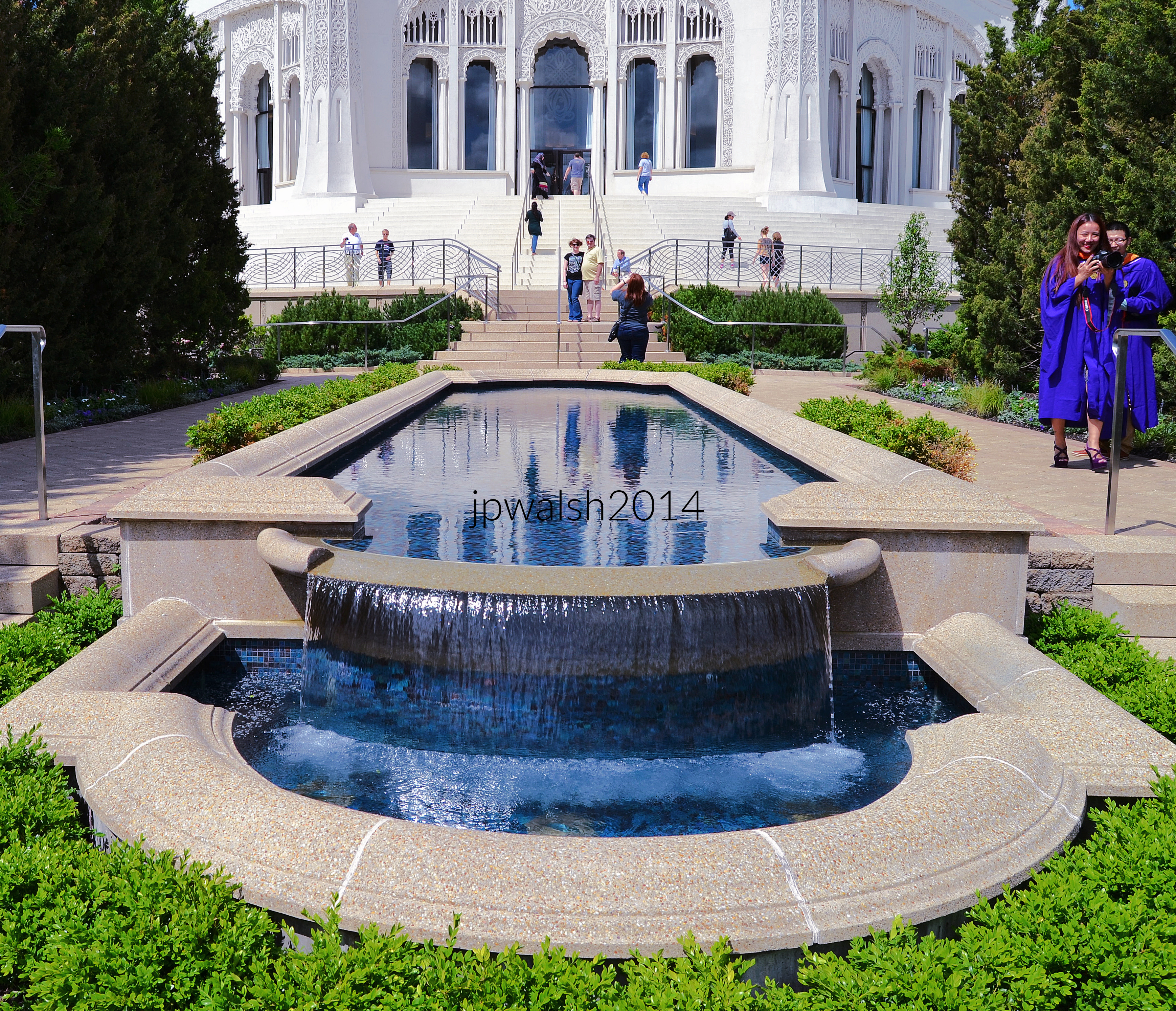
FEATURE image: To convey the Baháʼí principle of the unity of religion, architect Louis Bourgeois incorporated a variety of religious architecture and symbols including for Hindus, Buddhists, Native Americans, Jews, Christians and Muslims.
Text & Photographs by John P. Walsh.
The temple was designed by French-Canadian architect Louis Bourgeois (1856–1930). Bourgeois and his wife joined the Baháʼí faith by winter 1906. Photo c. 1922, Public Domain.
The Chicago Baháʼí Temple House of Worship is the second such house of worship constructed and the oldest one that is still standing. The popular destination along Lake Michigan on Chicago’s Northshore attracts visitors from around the world today for its amazing architecture, beautiful gardens, and message of religious unity in prayer and for peace.
The temple was designed by French-Canadian architect Louis Bourgeois (1856–1930). After studying and traveling in Paris, Italy, Greece, Egypt, and Iran, Bourgeois settled in Chicago in 1896 where he worked with Louis Sullivan. Bourgeois moved to Southern California and, in 1898, designed in Hollywood a landmark Mission Revival style house for painter Paul de Longpré (1855-1911) whose architecture and gardens became a tourist attraction.
The nine sides of the building represent the largest single digit number which stands fortheBaháʼí belief in the unity and oneness of humankind. 6/2014 6.55mb
The idea for the construction of the first Baháʼí Temple in the Western world began in Chicago in 1903. When there was a call for designs, Louis Bourgeois’ plans were the most promising. He worked on the complex design from 1909 to 1917. Before that time, Louis Bourgeois and his wife had joined the Baháʼí faith after having come into association with the Baha’i Faith through Boston’s Baháʼí community. In that time Bourgeois constructed a plaster model of his completed vision and in the 1920’s until his death in 1930 worked on the temple’s construction in Wilmette, Illinois.
While building activity was delayed though the Great Depression of the 1930’s and into World War II, temple construction began again in earnest in 1947 and the temple was dedicated in 1953.
Abdu’l-Bahá (1844-1921), eldest son of Baháʼu’lláh (1817-1892), the founder of the Baháʼí Faith, participated in the ground-breaking ceremony in 1912 of Baháʼí Temple. Construction began in earnest in the 1920s. It is four stories of reinforced concrete. 6/2014 4.11mbMoney for the building was raised entirely by the temple congregants as their gift to the people of the world. 6/2014 6.30mbThe temple rises 191 feet from its base to its ribbed dome’s peak. The main story pylons are 45 feet high each. The building’s surfaces are teeming with carved lacelike ornamentation. 6/2013 4.50mb The Baháʼí Temple has a highly traditional appearance whose architectural reputation in an age of orthodox modernism has only grown more positive with the years. 6/2013 4.85 mbInterior. “The forbidden temple.” by kern.justin is licensed under CC BY-NC-ND 2.0.The temple’s main prayer room seats 1,200 people. In the Baháʼí faith there are no clergy, no sermons and no rituals. Scriptures are read from various faith traditions with song provided by a cappella choir. 12/2017 5.31mb“The Source of All Learning is the Knowledge of God – Exalted Be His Glory.” There are an equal number of entrances each with a quotation above it by Baháʼu’lláh (1817-1892), founder of the Baháʼí faith. 6/2013 5.94mbThe Baháʼí temple is open year-round presenting its unique beauty through the seasons. 2/2021 7.97mb
SOURCES:
Chicago Churches and Synagogues: An Architectural Pilgrimage, George Lane, S.J., and Algimantas Kezys, Loyola University Press, Chicago, 1981, pp. 160-161.
Chicago’s Famous Buildings, Fifth Edition, Franz Schulze and Kevin Harrington, Chicago and London: University of Chicago Press, 2003, pp. 267-269.
A Guide to Chicago’s Historic Suburbs on Wheels and on Foot, Ira J. Bach, Swallow Press/Ohio University Press, 1981, p. 535.
The building is on the National Register of Historic Places situated on a broad, landscaped site that looks towards Lake Michigan. “Wilmette, 2015” by gregorywass is licensed under CC BY-NC-SA 2.0.
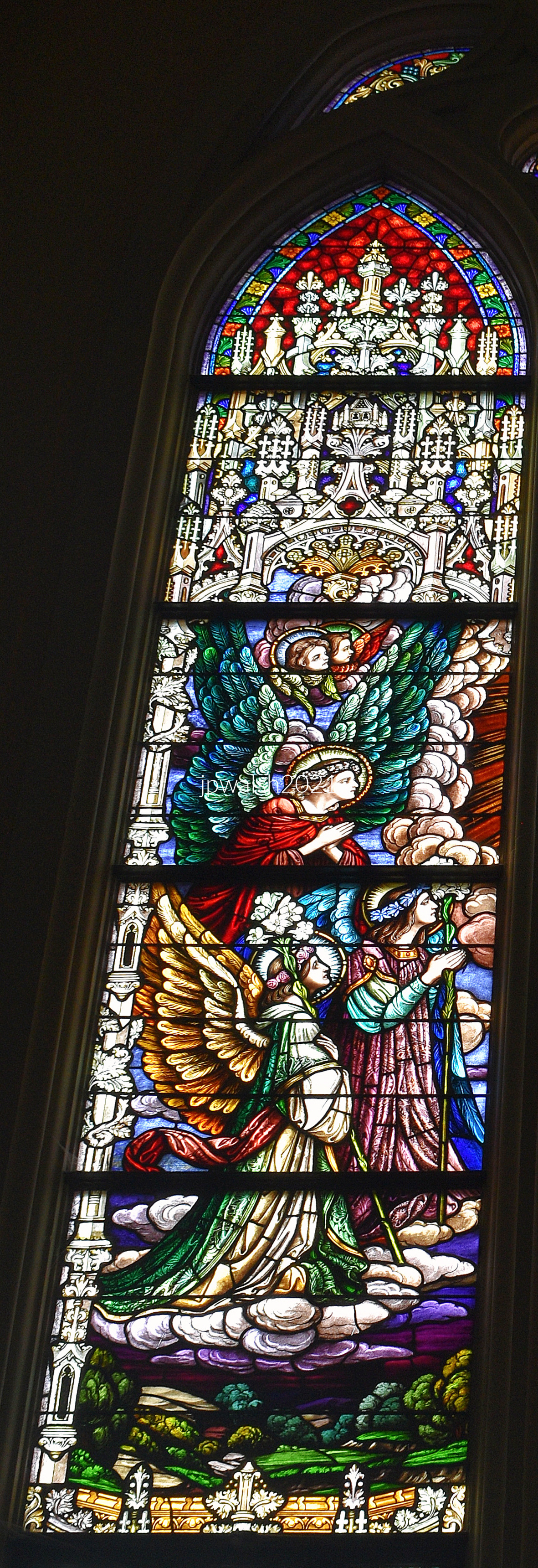
FEATURE Image: Old Testament prophets window, Mausoleum, Queen of Heaven Cemetery, Hillside, Illinois. This is one of scores of original stained glass and artifacts in the mausoleum in Chicago’s near western suburbs.
The Miraculous Crucifix in Hillside, Illinois.
The crucifix today is located in a southern section of Queen of Heaven cemetery in Hillside, Illinois. The cemetery is almost 500 acres that offers extensive in-ground burials as well as large indoor and outdoor mausoleum complexes where each year there are thousands of new burials. Since 1947, many notable Chicago-area figures from the world of politics, sports, religion, and business, including several gangland figures, are buried in these consecrated precincts. Overall, there are around 125,000 burials in the cemetery.
Queen of Heaven Mausoleum. This building alone houses more than 30,000 burials. St. Teresa of Avila window. Queen of Heaven Mausoleum, Hillside, Illinois.
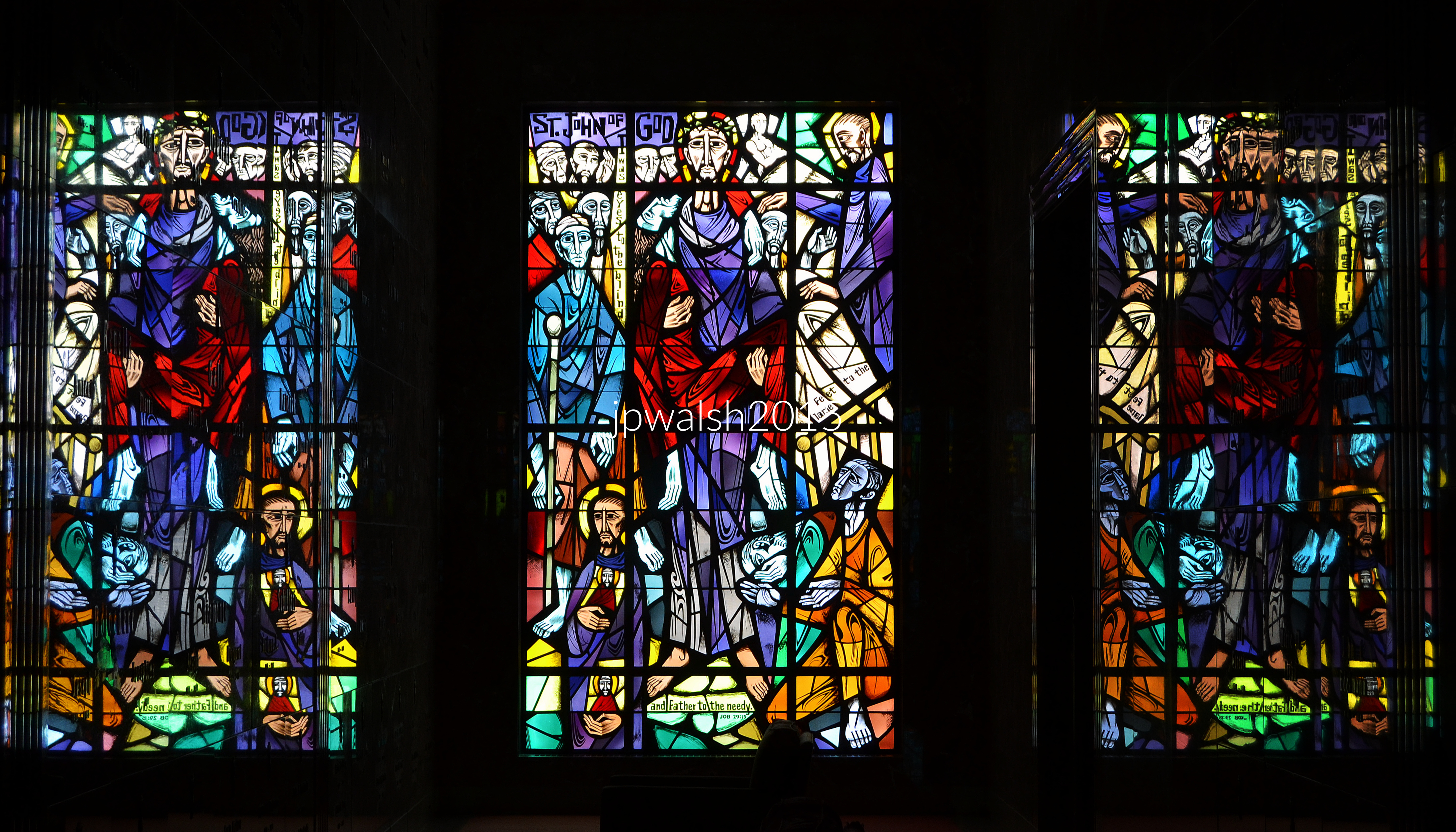
In the expansive mausoleum is a gallery of stained glass, statuary and carved wood and statuary in marble, bronze and mosaic. The art of the main building was created mostly by DaPrato Studios of Chicago, with an international array of artists and architectural designers.
St. John of God window. Queen of Heaven Mausoleum, Hillside, Illinois. 4.15 mb DSC_0350
The miraculous crucifix’s connection to Medjugorje visionaries.
That there is a “miraculous” crucifix on the grounds of Queen of Heaven cemetery gained noteriety starting around 1990.
The story is told about Joe Reinholtz, a retired railroad worker from neighboring Westchester, Illinois, who had lost his sight in the early 1980’s. Reinholtz, according to a report in the Chicago Tribune published in July 1991 (see – https://www.chicagotribune.com/news/ct-xpm-1991-07-24-9103220302-story.html), claimed to have been directed to the 15-foot-tall crucifix by one of the Medjugorje visionaries when he visited the Catholic pilgrimage site in Bosnia on two occasions in the late 1980’s.
After being directed by the Medjugorje visionary to pray before the crucifix in Queen of Heaven, Reinholtz (who died in 1996) and others reported that the figure of Christ on the cross bled. When more visitors reported that they too had seen the crucifix bleed, the cemetery staff investigated. They reported that they found nothing out of the ordinary at the crucifix site.
Cures and signs.
At the same time that the crucifix was seen to bleed, Joe Reinholtz was healed of his blindness. He also reported having seen the Blessed Virgin Mary who appeared at the crucifix site, accompanied by angels, including St. Michael the Archangel.
More of these many kinds of appearances continued to take place in the late 1980s and early 1990s. These were accompanied by other miraculous signs, many defying ready explanations. For example, some claimed the beads of ordinary rosaries had turned to gold after they prayed with them at the site.
Despite an incident of vandalism in 1994 where the feet of Jesus were broken off, inexplicable occurrences continued to be reported regularly at the crucifix into the mid1990s when they slacked off.
Sunday afternoon at Queen of Heaven cemetery in Hillside, Illinois, in October 2016.
Into the first quarter of the 21st century, people still slowly drive past the crucifix, while others are found at the foot of the crucifix sometimes alone, or with family or friend, or in larger groups. Many look to be praying at the “miraculous” crucifix, some certainly looking for a healing miracle like Joe Reinholtz experienced there in 1986.
FEATURE image: St. Francis Xavier Church was erected in 1939 in an established well-maintained residential neighborhood in Wilmette, Illinois, just blocks inland from Lake Michigan. The attempt was made by the area’s Roman Catholics to fit in unobtrusively and harmonize with its neighbors on Chicago’s Northshore. 6/2014 3.56mb
The English Gothic-style church is usually associated with establishment mainline Protestants. The church is built to be sophisticated and simple. 12/2018 11.6mb
Built by the firm of McCarthy, Smith & Eppig, St. Francis Xavier Church is built in the style of a sturdy country church. It is characterized by low walls, massive external buttresses, and a sloped, elongated roof. 6/2014 4.64mb
WHO IS ST. FRANCIS XAVIER (1506-1552), FIRST JESUIT MISSIONARY TO THE FAR EAST AND CO-PATRON OF CHURCH MISSIONS?
St. Francis Xavier. 6/2014 4.05 mb
Depicted in marble at the entrance to the sanctuary in Wilmette, Illinois, is St. Francis Xavier, S.J. (1506-1552), the parish church’s patron and namesake. Holding a crucifix, the Basque Jesuit priest is dressed in a black cassock draped by an alb and stole.
St. Francis Xavier’s feast day of December 3 marks his death day in 1552 at 46 years old on a lonely island off mainland China. In 1927 Pope Pius XI (1857-1939) named him co-patron with St. Thérèse of Lisieux of all foreign missions. (see – https://www.papalencyclicals.net/Pius11/P11APOST.htm). In life Francis Xavier came from a good family and had a naturally magnanimous personality. He was a student in Paris whose room-mate happened to be the older and wiser Ignatius of Loyola who patiently turned Francis’s thoughts and desires heavenward. Francis Xavier became the first Roman Catholic missionary to the Far East and as if by happenstance, since Ignatius’s first choice fell ill and was unavailable. When Francis set out for Asia, Loyola’s Jesuit Order had been officially approved by St. Pope Paul III (1468-1549) only a couple years before.
It was by sheer audacity that Francis Xavier established a template for the Jesuit missionary and evangelizer – prayerful, prepared to go where need was greatest, friendly, sincere, personally austere, hard-working, and joyful in the adventure of doing God’s will.
Leaving by ship from Lisbon, Portugal, in 1542 St. Francis Xavier became the first Jesuit missionary to India in 1545 and, in 1549, to Japan – 300 years before Commander Matthew Perry’s first American expedition to China and Japan in 1853. For one hundred years, the Jesuits were the only Roman Catholic missionaries in Asia. The long physical distances Francis Xavier traveled in the 1540s were remarkable. In his last days, on the return trip to India from Japan – almost 6000 km by air – St. Francis Xavier found his ship thrown off course in a sea storm and stopping at an island near Guangzhou, Guangdong, China.
Once back in India, St. Francis Xavier immediately wanted to return to China. After some delays, he reached Shangchuan Island, about 15 miles from the mainland and to which 46-year-old Francis Xavier had made arrangements to sail. While awaiting permission on the island to cross the inlet to enter mainland China, Francis died, without the benefit of the sacraments, of the fever. He was buried on Shangchuan in quicklime, a chemical compound normally used which worked to speedily consume the flesh so to leave just bones for health concerns and safer and easier transport. Francis was known on his journeys to live in a most austere manner insisting only on a good pair of boots for moving on foot over long distances in difficult terrain. Seeking the approval of local rulers, Francis occupied his days meeting the needs of the poor and sick, often in sweltering or frigid conditions. Over ten years Francis Xavier worked hard to bring the Christian faith to the greater part of the Far East.
Two months later, In February 1553, when the saint’s remains were exhumed, the witnesses were met by the body of Francis Xavier that, despite being buried in quicklime, had not rotted. His remains were taken to Portuguese Malacca and, a year after his death in December 1553, taken to Goa in India which had been the saint’s headquarters. In Goa, Francis received a hero’s welcome. Today St. Francis Xavier is still buried in Goa’s basilica. Reports of miracles were made in India and Japan following his death. Pope Paul V beatified St. Francis Xavier In 1619 and he was made saint on March 12, 1622, by Pope Gregory XV.
WHO IS ST. IGNATIUS OF LOYOLA (1491-1556), FOUNDER OF THE SOCIETY OF JESUS (JESUITS)?
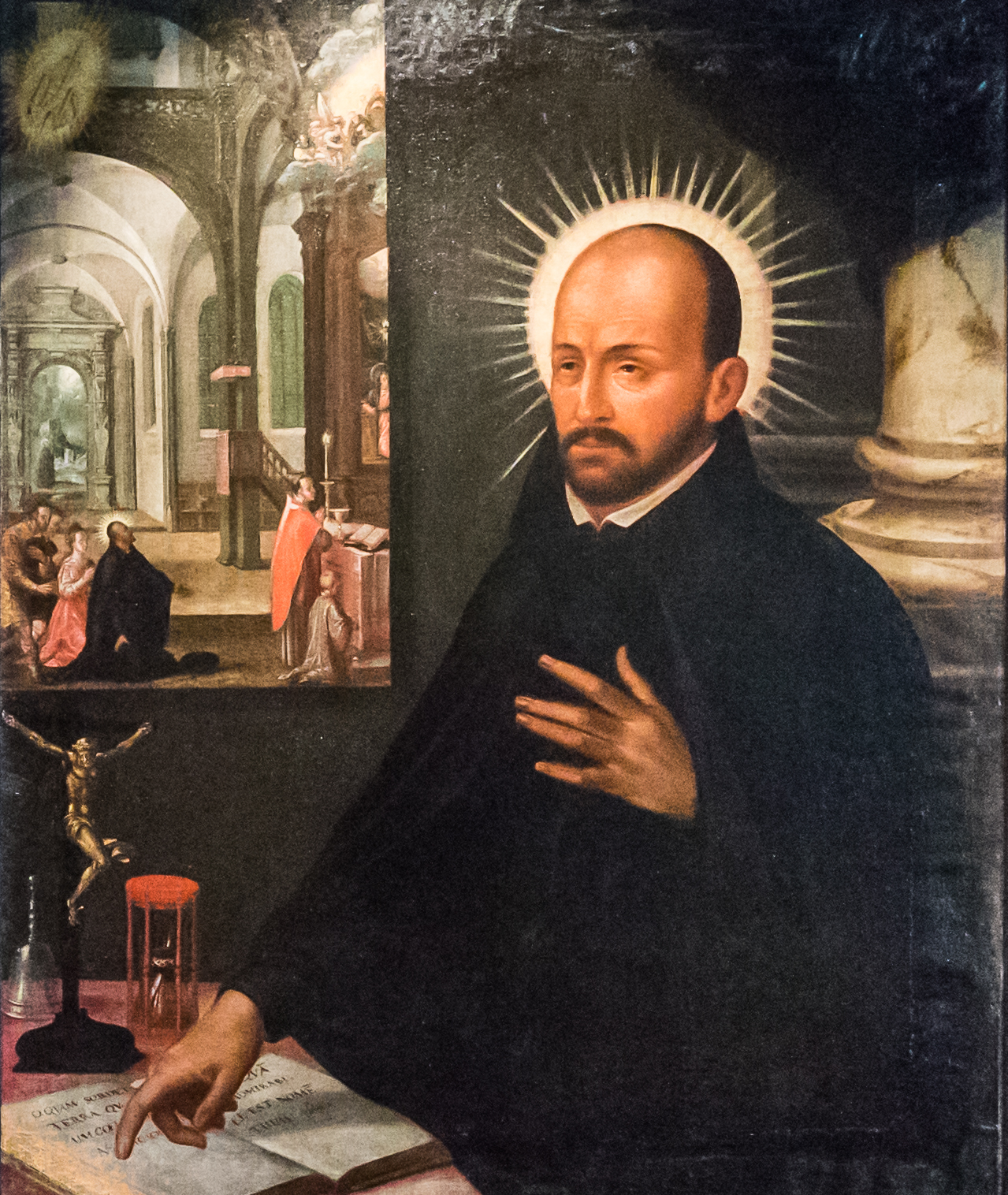
St. Ignatius of Loyola (1491-1556), after 1600, Jan Dammeszoon de Hoey (c.1545-1615), Stiftsmuseum Xanten (Germany). The artist was a Netherlandish painter who worked at the court of French king Henry IV (reign, 1589-1610) and is associated with the School of Fontainebleau. He is best known for his history paintings. St. Ignatius, before he became the founder of the Jesuits, was given a lives of saints when he was recovering from a bullet wound in the leg he received in 1521 during combat as a soldier in Pamplona in Spain. Though he naturally asked for “novels” to pass the time, it is sometimes related or implied that he may have had reason to be disappointed with the saints’ lives though it may actually have been a pleasant development for him since he took to the stories quite readily. As a knight from a prominent noble family in Spain, he latched onto and appreciated those various lives of peace and religious glory displayed in the Christian saints, and responded concretely to it. Where to trace this trail of grace to this point of life-changing conversion is of existential purpose. Ignatius, whether he knew it or not, learned now more fully how his soul desired to emulate the Christian heroes. The result was immediate and profound. Like St. Francis of Assisi (1182-1226) centuries earlier who the manly Ignatius deeply admired – Francis was another rich soldier boy who by experience in war of capture and prison moved from knight to penitent – Ignatius went and did the same. Ignatius would co-operate with God’s grace for whom he had met his match and hung up his sword in noble surrender. He started a pilgrimage from shrine to shrine. His natural self of elegant dress, excellent manners, and a measure of violent force in his personality, he channeled towards religion. As a youngster he had a mature bearing beyond his years so that the adult Ignatius continued to be a risk taker, as well as disciplined, prudent, despising greed, and persevering. The wonder of Ignatius is that he took his innate qualities and delivered them from the power of darkness and transferred them into the kingdom of God’s Light. Ignatius’s famous Spiritual Exercises (1548) were written early in the life of the Jesuit Order and communicated for others his own sublime ascetic character in action. Again, like the Poverello, Ignatius would be wrapped for days in prayer’s contemplative ecstasy. Also, like Francis in his early days as a pilgrim, he journeyed to the Holy Land in September 1523. Not yet a Jesuit as he had not founded them, he departed the Holy Land on September 23 and returned to Europe. He studied first in Barcelona and then in Paris where he met and gathered around him six companions: Spaniards Alfonso Salmeron (1515-1585), Diego Laynez (1512-1565), Francis Xavier (1506-1552) and Nicholas Bobadilla (c. 1509-1590), Portuguese Simão Rodrigues (1510-1579) and Savoyard Peter Faber (1506-1546). As the “Society of Jesus” the seven left for Rome in 1537 to obtain the pope’s approval for a new religious order. On the way there Christ, wrapped in His light and carrying his cross, said to Ignatius – in Latin – Ego vobis Romae propitious ero (“I will be good to you in Rome”) for which Jesuits then and now share that promise of accompanied mission in the Roman Catholic Church. It was while Pope Paul III (reign, 1534-1549) was on summer retreat from the heat of Rome at the Tivoli gardens that he further considered and ruminated over Ignatius’s group of six companions who had come to the Eternal City. One hot summer day the pope declared, reading Ignatius’s writings, – “The finger of God is here!” and then, in Latin, he said, “”Societatem hanc, id temporis…afflictis Ecclesiae rebus, non levi presidio atque ornamento fore.” (“This Society of Jesus [Jesuits] would prove an invaluable auxiliary and splendid ornament to the Church in these eventful times…”) The Jesuits were officially approved in 1540. Ignatius sent his companions across Europe and around the globe to create schools, colleges, seminaries and Christian missions that had an exhilaratingly mainly positive impact on society and culture.
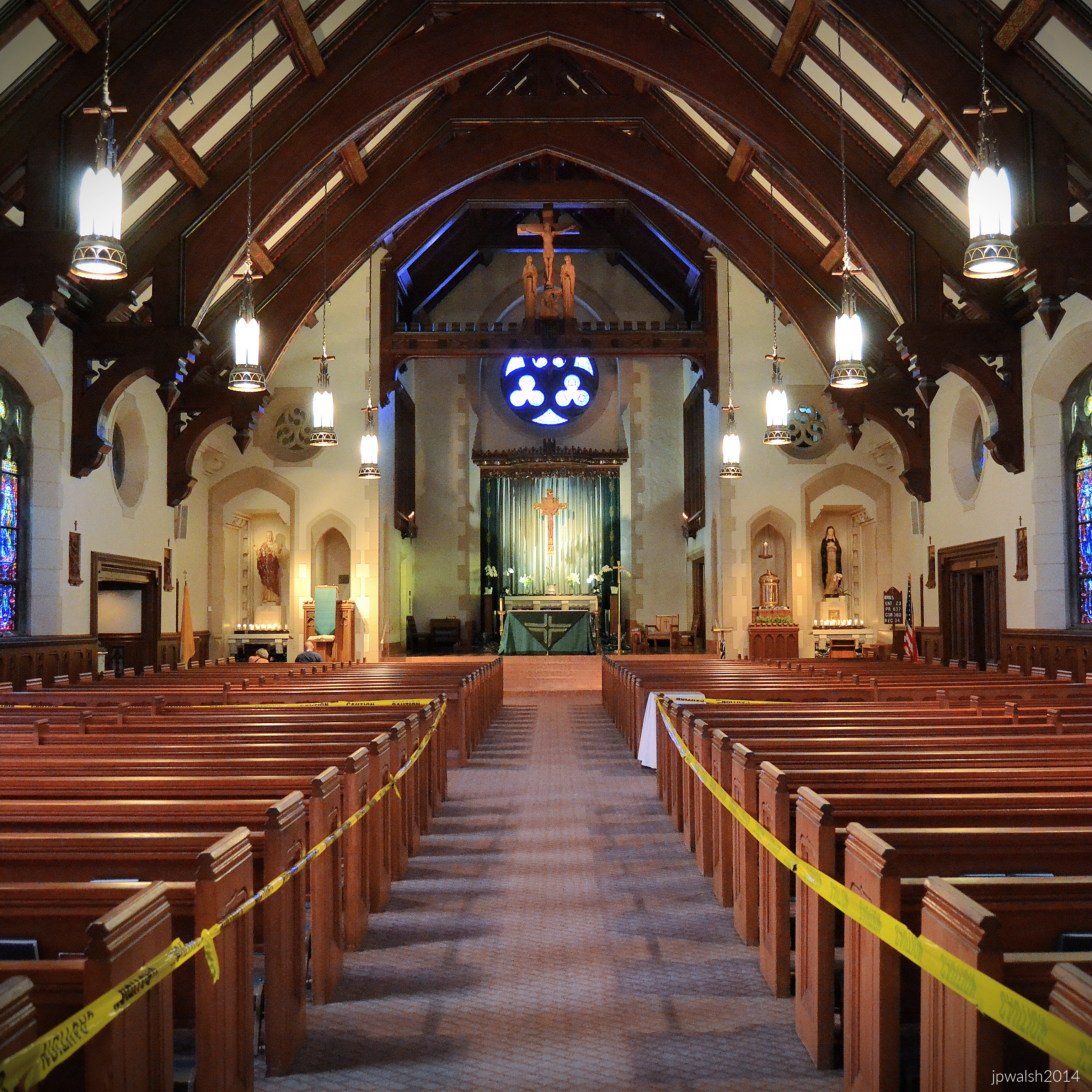
Nave looking to main altar. There are no columns to obstruct the view to the marble altar with a crucifix above. With Vatican II reforms, the tabernacle was set in a niche to the right. Originally the tabernacle was on the main altar below the crucifix. An extra-wide altar rail with cross legs whose form served as “being at table with Christ” for the communicant was also removed. Though St. Francis Xavier Church is traditional in its architecture, its design elements are modern, chic, and streamlined, which makes the sanctuary flexible and adaptable to change.The ceiling is constructed like an upside barque. This evokes the missionary journeys of St. Francis Xavier, by sea to and in the Far East. 6/2014 5.99 mb
July 2014. 5.85 mb Interior of St. Francis Xavier Church from the altar looking towards the main entrance. McCarthy, Smith & Eppig was a design firm that worked in the 1930’s extensively with Chicago Cardinal George Mundelein (1872-1939). Architect Joseph W. McCarthy (1884-1965), had been a young architect under Daniel Burnham (1846-1912), a major design force in Chicago. McCarthy built, under his own name and with various firms, churches and other church-related structures in the Chicago area from the 1910s to 1930s. In 1939, for instance, McCarthy built St. Francis Xavier Catholic Church and the more grandiose St. Joseph Catholic Church, both in Wilmette, about one mile apart. The design of St. Francis Xavier Church was handled by the firm’s younger partners, David Smith and Arthur Eppig (1909-1982). The church building’s simple architecture with its fine details cost $200,000 to construct in the waning years of the Great Depression – about $4 million in 2022 (see- https://www.dollartimes.com/inflation/). While the majority of McCarthy’s church buildings were built in the Chicago area, some of his important church projects included the cathedral church in Springfield, Illinois, (1928) and the parish church (1918) of what became the diocese of Joliet, Illinois.
December 2017. Organ loft. 7.90 mb 77%
There are 8 major stained-glass windows in St. Francis Xavier Church: four in the west wall and four in the east wall.
October 2015. detail of panels of three different windows.
Smaller stained-glass oculi and panels are scattered throughout the interior. These stained-glass windows were designed by Henry Schmidt, a parishioner. They are quite beautiful, scintillating in their pseudo-English Tudor style, illumined in usually soft eastern and tree-obscured western exposures, although their subject matter is somewhat chaotic and a hodge-podge in its traditional and idiosyncratic admixture of hagiography, scripture, and popular piety. One aspect of their enduring appeal is that the glass can be seen close up and at eye level.
ST. PETER WINDOW.
CENTER PANEL: Saint Peter, leader of the apostles, holds the keys of the kingdom of heaven (Matthew 16:19). Peter holds a book, a representation of St. Peter’s New Testament letters (1 and 2 Peter) and sermons (Acts). Below is St. Peter’s Basilica in Vatican City in Rome with its famous dome.
LEFT PANEL: Crowning of Mary as Queen of Heaven by Triune God (Father, Son and Holy Spirit). From the Council of Ephesus in 431, depicting the Blessed Virgin Mary wearing a regal crown was used in Christendom.
RIGHT PANEL: Assumption of Mary into Heaven is not in the New Testament though biblical texts point to the doctrine of Mary as Theotokos (Mother of God), taken (“assumed”) body and soul into heaven at death. Going “up” to heaven is imagery used to express the spiritual and related to Jesus’ Ascension (Acts 1:6-17 and Luke 24:50-53). The assumption phenomenon occurred in the Old Testament with Moses and Elijah who were also present at Christ’s Transfiguration (Matt 17:1-9; Mk 9:2-10: Lk 9:28-36; and 2 Peter 1:16-21). Below the panels are identical angel figures. 6/2014 4.98 mb
October 2015. Detail St Peter 4.81mb DSC_0504 (1)
ST. BONIFACE WINDOW.
CENTER PANEL: St. Boniface (675-754) is the St. Patrick of Germany. He was a bishop who lived during Europe’s Dark Ages. Boniface was responsible for organizing the church in western Germany and established the bishoprics of Cologne and Mainz. On direction by the Roman pope, Boniface anointed Pepin the Short (714-768) — son of Charles Martel (c. 688-741) and father of Charlemagne (747-814) — as king of the Franks. Pepin’s coronation became the model for future royal coronations and the beginning of the modern European state.
LEFT PANEL: Jesus meets his mother is the fourth station of the cross. The Holy Face, below, is a devotion proclaimed by Pope Leo XIII in 1885.
RIGHT PANEL: Jesus mocked and crowned with thorns (Luke 22:63-65 and John 19:2-3) is the sixth station of the cross and an important marker of the suffering of Jesus. 6/2014 3.93 mb
ST. PATRICK WINDOW.
CENTER PANEL: St. Patrick (418-493) is one of the patron saints of Ireland (St. Brigid (c. 451–525) and St. Columba (540-615) are the others). In Wilmette, IL, St. Joseph Church was established in 1847 for German immigrants and St. Francis Xavier Church for Irish. The depiction of Patrick as the archetypal Irish bearded bishop — dressed in green with miter and staff – emerged in late 1700’s. St. Patrick’s symbology includes a book, refering to the Holy Scriptures and his own writings: the Confessio and Epistola to Coroticus, both in Latin. Patrick holds the legendary 3-leafed clover which he used to teach the Irish about the Holy Trinity. Below is the harp which is Ireland’s national emblem and one of the world’s oldest musical instruments.
LEFT PANEL: Jesus Christ’s Resurrection from the dead is the cornerstone of the Christian faith (1 Corinthians 15:17). His empty tomb is proof of Christ’s deity (John 5:26; Romans 1:4). By rising from the dead, Jesus Christ saved us from our sins (Romans 4:24–25; Hebrews 7:25), gave hope for our future resurrection (John 14:19; 1 Corinthians 15:20–23), and provides believers with spiritual power (Romans 6:3–4; Ephesians 1:19–21). The window depicts the resurrected Jesus holding the banner of victory over death as a Roman guard cowers in the dazzling light of a Risen Christ with an angel in attendance. Christ’s cruciform halo (elaborated in three parts) usually contains three Greek letters that in translation spell out “I Am Who Am,” again, a reference to Christ’s Divinity. All four gospels contain passages pertaining to the resurrection, but none of them describe the moment or essence of resurrection itself.
RIGHT PANEL: Crucifixion of Jesus with his mother Mary and John the Apostle at the foot of the cross. Above Christ’s head are the letters INRI, an acronym for Jesus Nazarenus, rex Judæorum. This was the charge against jesus written in Latin by Pontius Pilate who condemned him to death. It translates as “Jesus Nazarene, King of the Jews.” The title appears in the Passion narrative of John’s Gospel (19:19). Below each side panel are identical angel figures. 7/2014 7.58 mb
The altar design includes tall candlesticks and compact, detailed baldacchino. 6/2014 4.61 mb
A depiction of the crucifixion in basswood stands atop a rood beam at the ceiling line above the main altar. The scene includes the figure of a crucified Jesus, half-naked, wearing a crown of thorns, and the INRI inscription overhead. Three figures at the foot of the cross are (at left) his mother Mary and (at right) John, the Apostle. The bowed middle figure could represent the other named and unnamed women present at the crucifixion (John 19:25; Luke 23:27 and 49). The artwork is by Fritz Mullhauser. 12/2018 8.47 mb
MARY QUEEN OF HEAVEN WITH INFANT JESUS WINDOW.
CENTER PANEL: The Queen of Heaven who reigns from the right hand of her son, is depicted in her role as mother of Jesus Christ. Below a crown hovers above what may be a heart-shaped letter “M” for Mary’s first initial and/or her sacred heart.
LEFT PANEL: Presentation of Jesus by Mary and Joseph in the Temple and meeting with Simeon, the “just and devout” man of Jerusalem (Luke 2:25–35). The Presentation is the Fourth Joyful Mystery of the Rosary. In Luke, 40 days after Jesus’s birth, Mary and Joseph took the baby to the Temple in Jerusalem to complete Mary’s ritual purification after childbirth, and to perform the redemption of the firstborn, as prescribed by Mosaic Law (Leviticus 12 and Exodus 13:12-15).
RIGHT PANEL: Nativity of Jesus in Bethlehem (Luke 2: 1-7 and Matthew 1: 18-25) is the Third Joyful Mystery of the Rosary. Below each side panel are identical Angel figures. 12/2018 12.5 mb
ST. ANNE AND THE CHILD VIRGIN MARY WINDOW.
CENTER PANEL: Child Mary with Saint Anne, her mother. Nothing is known about Mary’s mother though early apocryphal writings provide information for stories about Mary’s lineage and early life that have resulted in a legendary tradition.
LEFT PANEL: Visitation of the Blessed Virgin Mary to her cousin Elizabeth (Luke 1: 39-45). After the Annunciation, Mary set out into the hill country to stay in the house of Elizabeth and her husband Zechariah for three months. Both women were miraculously pregnant at the time–-Mary with Jesus by virgin birth and Elizabeth with John the Baptist in her old age. Depicted is the moment when John the Baptist leapt with joy in Elizabeth’s womb at hearing Mary’s voice (Luke 1:41). The Visitation is the Second Joyful Mystery of the Rosary. Below is an ark (or tabernacle). Luke structured his narrative passages of the Visitation on stories in 2 Samuel and 1 Kings about the ark of the Covenant in the Old Testament. The Catechism of the Catholic Church identifies Mary as the Ark of the New Covenant (2276): “Mary, in whom the Lord himself has just made his dwelling, is the daughter of Zion in person, the Ark of the Covenant, the place where the glory of the Lord dwells. She is ‘the dwelling of God . . . with men.”
RIGHT PANEL: Annunciation to Mary by the angel Gabriel aanouncing that she would bear the Son of God, Jesus Christ. “Hail Mary, full of grace, the Lord is with you!” It is by Mary’s joyful acceptance of God’s will – “Behold, I am the handmaid of the Lord; let it be to me according to your word” (Luke 1:26-38) – that the Incarnation takes place. The Annunciation is the First Joyful Mystery of the Rosary. Below, the two angel figures are distinct. 12/2018 16.24 mb
ST. JOSEPH WINDOW.
CENTER PANEL: St. Joseph was the foster father of Jesus and served as Jesus’ guardian protector. Jospeh’s symbology includes his holding a carpenter’s square (Mt 13:55) and holds a white lily to symbolize his faithfulness and chastity to Mary (MT 1: 25) as well as his holiness and obedience to God (Mt 1:24; Mt 2:14, 21, 22). An angel figure Is below St. Joseph.
LEFT PANEL: Holy Family in Nazareth. Jesus was obedient to Mary and Joseph and “progressed steadily in wisdom, age and grace before God and men” (Lk 2:52). Jesus was instructed by St. Joseph in the carpenter trade and holds a wooden cross on his knees. Flowering grass below is decorative and could indicate the flowering staff of St. Joseph which symbolized that he was specially chosen by God to be Mary’s husband. That imagery was drawn from the Old Testament when Aaron’s staff, placed before the Ten Commandments, sprouted with almond blossoms as a sign that he was chosen by God (Num 17:22-23).
RIGHT PANEL: Mary and St. Joseph find Jesus at 12 years old in the Temple with the doctors of the Law (Luke 2:41-52). It is the Fifth Joyful Mystery of the Rosary. The event is the only time in the New Testament where Jesus makes a public appearance before His baptism in the Jordan by John the Baptist and the start of his public ministry at 30 years old (Matthew 3:3-17, Mark 1:9-11; Luke 3:21-23; John 1:29-33). Below the scene are the tablets of the Ten Commandments with a symbol of the Trinity, including the sacred eye, hovering above. 12/2018 12.34 mb
ST. PAUL THE APOSTLE WINDOW.
CENTER PANEL: St. Paul is depicted holding a sword, a symbol for this Apostle to the Gentiles. Describing spiritual warfare in his letter to the Ephesians, Paul writes, “Take the sword of the Spirit, which is the word of God” (Ephesians 6:17). In symbology of martyrs, they are traditionally depicted with the instrument of their death. Paul is a known martyr (c. 64-68 CE), though its details are not. Early Christian writers said St. Paul was beheaded using a sword.
LEFT PANEL: The Pentecost (Acts 2: 1-13) followed the Ascension, It is where the 12 Apostles with Mary, the Mother of Jesus Christ, gathered together to receive the Holy Spirit symbolized by a dove from Heaven.
RIGHT PANEL: Ascension of Jesus into Heaven is mentioned many times in the New Testament and primarily in Luke and Acts (Luke 24:50-53, Acts 1: 6-12, John 3:13, John 6:62, John 20:17, Romans 8:34, Ephesians 1:19-20, Colossians 3:1, Philippians 2:9-11, 1 Timothy 3:16, and 1 Peter 3:21-22). The Ascension is where the Resurrected Christ physically departed from Earth by rising into Heaven which was witnessed by eleven of his apostles (Judas betrayed Jesus). Heaven incorporates the resurrected fleshly body of Christ as the divine humanity of Christ enters into the intimacy of the Father and becomes the perfect God-Man. 6/2014 4.28 mb
October 2015 detail St. Paul window. 4.48mb DSC_0505 (1).ST. PAUL THE APOSTLE WINDOW in situ on the east wall.
THE GOOD SHEPHERD WINDOW.
CENTER PANEL: Jesus called himself “the good shepherd” (John 10). In the Old Testament there is a prophecy about shepherds who are overseers for the sheep who are the people of God. Ezekiel prophesies of a shepherd to come who is the Messiah of Israel. Jesus is claiming to be the Messiah that the scriptures foretold. Christ’s cruciform halo (in three parts) contains three Greek letters that spell out “ I Am Who Am,” a reference to Christ’s Divinity. Jesus holds the shepherd’s staff and has a lamb slung over his shoulders referring to the people of God he cares for. A lamb in a bramble below refers to Jesus as “the lamb of God,” a title found in John’s Gospel (John 1:29; 1:36). It also alludes to the Old Testament when God sent a ram caught in a bramble to change places with Isaac who God called to be sacrificed as a burnt offering (Genesis 22:13). This Old Testament story foretold the sacrifice of the Son of God at Calvary.
LEFT PANEL: Scourging of Christ is the 4th Station of the Cross (John 19:1-3). It is part of the brutalities that Jesus endured in his Passion. Jesus was slapped, beaten, punctured by thorns, and whipped with a reed stick. Two of these torture instruments are depicted below the pillar. An angel figure is below that.
RIGHT PANEL: Jesus is depicted in the garden of Gethsemane following the Last Supper where, knowing of Judas’s betrayal, Jesus prayed: “Father, if you are willing, take this cup from me. Yet not my will, but yours be done” (Luke 22:42). With his prayer, “an angel from heaven appeared to him and strengthened him” (Luke 22:43). At the foot of the Mount of Olives outside Jerusalem all four Gospels relate that Jesus underwent an agony in the garden of Gethsemane where he was betrayed and arrested the night before his crucifixion. Below is an angel figure. 12/2018 12.6 mb
December 2018. Organ loft. St. Francis Xavier Church, Wilmette, IL. 446 kb 25%
SOURCES:
Heavenly City: The Architectural Tradition of Catholic Chicago, Denis Robert McNamara, James Morris, Liturgy Training Publications, Chicago, Illinois, 2005, pp. 138-140 Chicago Churches and Synagogues: An Architectural Pilgrimage, George Lane, S.J., and Algimantas Kezys, Loyola University Press, Chicago, 1981. Saint Ignatius and His First Companions, Chas. Constantine Pise, P.J. Kenedy & Sons, New York, 1892, pp.105-151. The Saints: A Concise Biographical Dictionary, edited by John Coulson, Guild Press, New York, 1957. The New American Bible, Catholic Book Publishing Corp, New York, 1993. Catechism of the Catholic Church, 2nd Edition, Doubleday, New York, 1997.
WINDOW DETAIL An angel figure graces one of the stained-glass windows in St. Francis Xavier Church. There are several different angel figures throughout the church’s stained glass panels.
Saints Peter and Paul Catholic Church in Naperville, Illinois, a western suburb of Chicago, in July 2021. Looking to the northeast from Central Park, the church building seats 1000 people and was dedicated in September 1927. In 2021 the parish marked its 175th anniversary. Founded in 1846, the parish is the oldest continuously operating Catholic parish in DuPage County. Down the decades its pastors (Frs. Rainaldi, Zuker, Wenker, Stenger, Lennon, Milota, and others) led Saints Peter and Paul adjacent to Naperville’s Historic District to where the parish with its school today serves 4,000 families. Photograph by author. A magnificent church building sits on Ellsworth Street in Naperville, Illinois, close by the Historic District. With an orientation out of the darkness of the west into the light of the east, Saints Peter and Paul greets worshippers with two soaring steeples. The neo-Gothic red brick and limestone structure was commissioned in 1922 by the parish’s 350 families and dedicated five years later. Today the parish in Chicago’s western suburb serves 4.000 families and contains historically significant bright colored traditional European painted stained-glass windows from Innsbruck, Austria. In this archival photograph, the view of the church building from around the time of its dedication is looking towards the southeast.
BETWEEN 1870 AND 1930, ART GLASS OF GERMANY AND AUSTRIA COMES TO AMERICA, PARTICULARLY TO CHICAGO’S CHURCHES
The colorful stained-glass windows in Saints Peter and Paul Catholic Church in Naperville, Illinois, a western suburb of Chicago, were ordered, produced, and installed towards the end of a 60-year-long run for the predominance of German and Austrian-made stained glass found in heritage Chicagoland churches today.
With only a couple of exceptions, the stained glass in Naperville’s historically pioneer and, later, German Catholic parish church was created in the mid1920s in Innsbruck, Austria. Innsbruck at the time was one of the European centers of stained-glass making. It is about 100 miles south of Munich, Germany, the home base of two other popular and well-regarded stained-glass studios – that of Franz Mayer & Company and F.X Zettler Company. These art glass manufacturers notably filled many Chicagoland Catholic churches starting in the 1870s. After the Great Chicago Fire in 1871, a building and population boom commenced in the city and its surrounding communities that went on for over a century unabated. In addition, from the 1870s to the 1920s, Chicago became the most influential center of Catholic culture in the United States.1
It was a unique period of history for Catholic churches in America whose state-of-the-art church design usually included brightly colored art (stained) glass windows. These windows often displayed action-packed scenes from the Bible, including episodes from the life of Christ, His Blessed Mother, or a patron saint.
This continuous appeal over multiple generations for the purchases of vast orders of Munich and Austrian style glass in U.S. Catholic churches declined greatly starting in the 1930’s with the onset of the Great Depression. The European traditional glass market did not recover its former popularity making its stained-glass windows from 1870 to 1930 in Chicagoland churches – including Saints Peter and Paul Church in Naperville – increasingly rare and valuable to preserve and appreciate.
Stained glass made by Tyrol Art Glass Company of Innsbruck, Austria, and Franz Mayer and F.X. Zettler of Munich, Germany, was characterized by its traditional painted stained glass. This style fit into the traditional-style church architecture that Catholic parishes, such as Saints Peter and Paul in Naperville, and many others, built between 1870 and 1930. By the mid20th century these European traditional glass makers faced competition from the rise of American glass manufacturers such as Louis Comfort Tiffany (1848-1933) which extended to quality, price, and style. Tiffany stained glass which frequently incorporated natural scenery elements, contained intricately cut opaque and opalescent glass, overlaid with wide varieties in thickness. This product became better fitted into modern worship spaces which were often smaller. Such modern art and architectural trends worked to displace traditional glass made in Europe used for grandiose classically styled houses of worship that were from an earlier historical period.
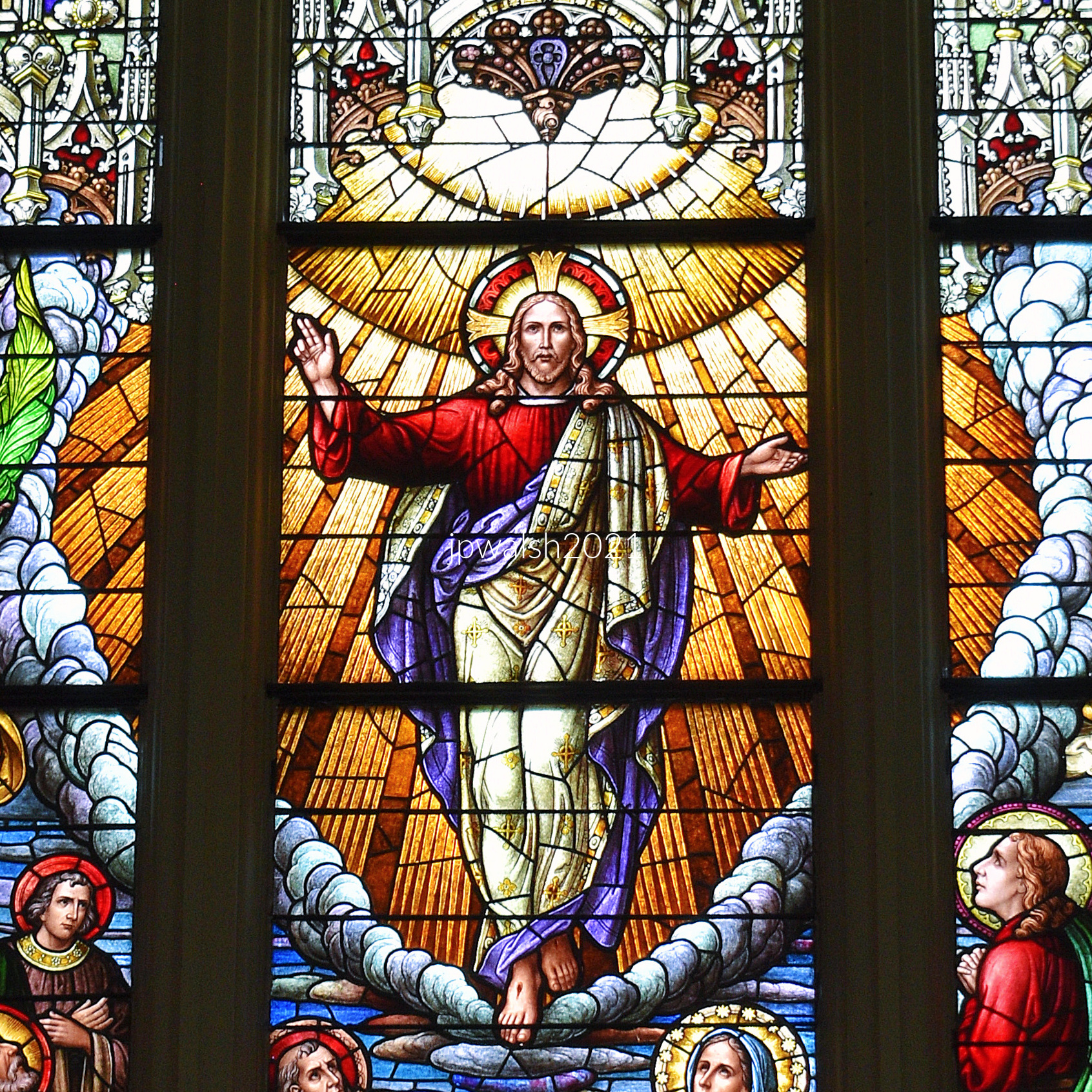
In the late 19th century, Tyrol Art Glass Company of Innsbruck, Austria, with the Munich studios of Franz Mayer and F.X. Zettler, began to send representatives to sell their new patterns for churches in Chicago and around the United States. These three studios often worked together and their style is basically interchangeable. In Saints Peter and Paul Church – as well as many other churches with classically-styled architecture – traditional painted stained glass was the stand-out choice, It is usually very colorful whose iconography often depicts highly recognizable religious, often biblical, scenes and religious symbolism. This is definitely the situation with the beautiful stained-glass windows of Saints Peter and Paul in Naperville, including the Ascension of Jesus into Heaven and the Assumption of Mary into Heaven windows.
HOW SAINTS PETER AND PAUL CATHOLIC CHURCH GOT STARTED AND GREW IN NAPERVILLE, ILLINOIS
Naperville, Illinois, a western suburb of Chicago, was founded in 1831 – the oldest town in DuPage County.2With its origins as a mixed settlement of Easterners and Hoosiers, Naperville’s strong religious character was established starting in the 1830s.3 Today it boasts a population of around 150,000 and is one of Illinois’s largest cities. The downtown area is bustling with shops and motor vehicle and foot traffic, yet Naperville’s 19th century origins can still be found in and around the DuPage River with its River Walk and its Historic District that maintain much of the suburb’s original charm and historic significance.
Saints Peter and Paul Catholic Church in Naperville was founded in 1846 and is the oldest continuously operating Catholic parish in DuPage County. The county was established in 1839 with Naperville originally as the county seat. This changed in 1867 when, by county referendum, Wheaton became the county seat which it remains today. Naperville’s first religious institutions were the East Branch Settlement, Congregationalist, Evangelical, and Baptist churches. These churches were all established in Naperville between 1833 and 1843.4
The Catholic parish was originally founded as a mission of the Joliet Catholic Church – Joliet, Illinois, about 20 miles to the south of Naperville is its Diocese headquarters today. In the 1840s, when Illinois was the edge of the frontier, a priest traveled the rigorous 20-mile journey – Naperville did not get a railroad for another 30 years (1864) – once a month to say mass in pioneers’ homes. The first church, named St. Raphael’s for Fr. Raphael Rainaldi, the first pastor, was a small frame structure with a lean-to across the street from today’s church building. In the 1840s the church served about 25 families – 175 years later it serves 4,000 families.5
The first official act at Saints Peter and Paul Church was a festive event – the wedding of Mr. Robert Le Beau to Miss Emily Beaubien, recorded on Tuesday, September 8, 1846. The parish also purchased an acre of land for a cemetery.
In 1852 the church was enlarged by a frame addition and Fr. Charles Zuker established a parish school in the lean-to with a lay headmaster. In 1855 the first school building was built. By 1864 the first frame church building was used for school purposes as the cornerstone was laid for a new stone church on the site of the present church building. By this time the parish was renamed to Saints Peter & Paul by Fr. Peter Fisher and the parish had grown to about 250 families. The stone had been obtained locally from the parish’s own quarry along the DuPage River. The new stone church building was dedicated in 1866 and the school now served around 100 students.6
Continual improvements were made to the parish church and grounds in the 1870s and 1880s so that by the start of the 1890s, following Naperville’s incorporation as a city, the parish launched significant building projects. In 1892, a year where it rained almost all that spring, a new brick school building for the parish’s 200 students was built that cost $30,000. Saints Peter and Paul also built a new rectory in anticipation of the new century.
c. 1874, looking west, the corner of Ellsworth Street and Benton Avenue. the complex of buildings of Saints Peter and Paul parish, Naperville, Illinois.
In the 1880’s Naperville, illinois, like much of the rest of the country, expanded its industrial base, grew its city services, such as the fire department and city hall, and established new utilities including the first public telephone service.
With its new wealth generated by industry, Naperville built some of its first impressive homes. Shops and stores were established to service them. While agrarian in flavor, by the end of the 1880’s and into the early 1890s Naperville was already a bustling, modern, forward-thinking city. In 1893 Naperville hosted its first “Bicycle Parade” – a big public affair whose purpose was to “show our citizens the increased interest lately in this comparatively new mode of locomotion.”
In the 1890s the area that included Saints Peter and Paul Church, other denominational churches, and Northwestern College (renamed North Central College in 1926) affiliated with the United Methodist Church, came to be known around town as “Piety Corners.”
With the appearance of the first cars in the 1900s, Naperville was well on its way to an era of accelerated expansion and growth that continues in the 21st century.7
Saints Peter and Paul’s old stone church is to the far right. In the background left is the belfry of the Main Building at North Western College built in 1870. North Western College was founded in 1861 as Plainfield College in Plainfield, Illinois. It was renamed to North Western College in 1864 and, with the enticement of 8 acres of donated land and $25,000 from Naperville, relocated to Naperville in 1870. In 1926 it was again renamed to today’s North Central College. For over 140 years the college has had a great deal of influence on the educational and cultural life of Naperville. In 2021, with an enrollment of 3,000 students and 700 employees, North Central College is one of Naperville’s top ten employers.8c. 1904, view of Sts. Peter and Paul stone church building from the belfry of the College’s Main Building.
In 1911 the school was badly damaged by fire. When a new school opened the next year, 250 students were enrolled.9
In the 1920’s Naperville boasted around 5,000 residents. In June 1922 (sources vary whether it was on June 4 or June 8) the old stone church quarried from the parish’s own quarry and dedicated in 1866 was destroyed by an arsonist’s fire. By this time, the parish’s 350 Naperville families were from mostly German-speaking countries in Europe. Naperville’s quarries had brought waves of German immigrants to the city since the 1850’s since they knew how to mine and cut stone. After the devastating 1922 fire, the parish chose to rebuild their church in a magnificent red brick traditional cruciform-shape. It was dedicated on Sunday, September 25, 1927. The half German, half Irish Cardinal-Archbishop of Chicago, George Mundelein (1872-1939), participated in the dedication ceremony. This remains the church building that exists today and which contains its lovely and historically significant stained glass from Innsbruck, Austria. In 1927 the cost of the church building was $407,785 – or about $6.5 million today.10
WHO WERE SAINTS PETER AND PAUL?
El Greco (1541-1641), Saint Peter in Tears, 1587-1596, oil on canvas, 109 cm (42.9 in) x 88 cm (34.6 in), Toledo, Spain.
St. Peter is the Rock, or “Cephas,” of Jesus Christ’s church. In Matthew 16 Jesus tells Simon, son of John, brother to Andrew the apostle and a married fisherman by trade: “I say to you, you are Peter, and upon this rock I will build my church, and the gates of the netherworld shall not prevail against it. I will give you the keys to the kingdom of heaven. Whatever you bind on earth shall be bound in heaven; and whatever you loose on earth shall be loosed in heaven” (Mt 16: 18-19). Peter denied Christ three times before the crucifixion that is described in all four New Testament Gospels.
After Jesus Christ’s Resurrection (Mark 16, Matthew 28, Luke 24, Acts 1, John 20 and 1 Corinthians 15) and Ascension into Heaven (Luke 24:50. Acts 1, John 3:13, John 6:62, John 20:17, Romans 8:34, Ephesians 1:19-20, Colossians 3:1, Philippians 2:9-11, 1 Timothy 3:16, and 1 Peter 3:21-22) and following the events of Pentecost (Acts 2), Peter led an important life as a Christian evangelist and Church leader.
Though St. Paul’s pastoral heritage in his 13 letters were highly influential for the early church where he writes on church structure, the theology of the Body of Christ, and the nature of the Holy Spirit, St. Peter also has an epistemological heritage which explores the People of God.11These best-known apostles also both died in the 60s. For the rest of that critical first century of Christianity – until when John’s Gospel was written in the 90s – the churches had to go without two of its greatest authoritative figures who had seen the risen Jesus.
St. Peter was martyred by crucifixion in 64 A.D. in Rome. He requested he be crucified upside down on an x-shaped cross, as witness to the apostle’s prolonged sorrow over his denial of Christ. On the church calendar, St. Peter’s feasts are June 29 and February 22.
Rembrandt, The Apostle Paul, oil on canvas, 1633.
St. Paul is one of Church history’s most significant figures. As Saul of Tarsus, the scholar, rabbi, and Roman citizen, zealously persecuted the first Christians and was personally present at the stoning of the first Christian martyr, Stephen (Acts 7: 54-60). On the road to Damascus making “murderous threats” towards Christians (Acts 9:1), Paul encounters the risen Jesus. The passage reads: “Suddenly a light from heaven flashed around him. He fell to the ground and heard a voice say to him, “Saul, Saul, why do you persecute me?” “Who are you, Lord?” Saul asked. “I am Jesus, whom you are persecuting,” he replied. “Now get up and go into the city, and you will be told what you must do.” (Acts 9:4-6).
The jolting event changed Paul’s life and outlook. More than anyone else in the Church’s first years, Paul realized Christianity’s universal message. Paul’s letters to various Christian communities in Corinth, Ephesus, and Rome, show him to be a solicitous and sometimes stern and exhorting pastor who had a deeply personal spiritual experience of the Lord. About half of the books of the New Testament are Paul’s writings that express his profound openness to humanity and its cultures which made him “Apostle of the Gentiles” and “Teacher of the Nations.”
Paul was martyred somewhere between 64 and 68 A. D. The circumstances of his death are not entirely known, although early Christian writers related that Paul was beheaded. St. Paul shares a feast with St. Peter on June 29.
THE WINDOWS
The Ascension of Jesus into Heaven.
North Transept, Ascension of Christ into Heaven, 1927, Tyrol Art Glass Company, Innsbruck, Austria. Sts. Peter and Paul Church, Naperville, Illinois.
The Ascension of Jesus is recounted twice in the New Testament – and both times by Luke the Evangelist. One account is in his Gospel (Luke 24:50-53) and a second is in his Book of Acts of the Apostles (Acts 1: 6-12).
One significant difference in Acts is that Luke sets a time frame of 40 days (1;3) for Jesus’s sustained manifold appearances to the apostles after the Resurrection until His Ascension. The account in Acts also situates the apostles and Christian community into salvation history’s imagery of Israel’s covenant.12Luke’s tradition would likely not have separated the Resurrection and Ascension events in time except that it was used to give clarity to a narrative purpose.13
The account of the Ascension in Acts 1:6-12 reads:
6 ”When they had gathered together they asked him, “Lord, are you at this time going to restore the kingdom to Israel?”
7 He answered them: “It is not for you to know the times or seasons that the Father has established by his own authority.
8 But you will receive power when the Holy Spirit comes upon you, and you will be my witnesses in Jerusalem, throughout Judea and Samaria, and to the ends of the earth.”
9 When he had said this, as they were looking on, he was lifted up, and a cloud took him from their sight.
10 While they were looking intently at the sky as he was going, suddenly two men dressed in white garments stood beside them.
11 They said, “Men of Galilee, why are you standing there looking at the sky? This Jesus who has been taken up from you into heaven will return in the same way as you have seen him going into heaven.”j
12 Then they returned to Jerusalem from the mount called Olivet, which is near Jerusalem, a sabbath day’s journey away. (New American Bible)
When Jesus rose from the dead it became clear to the disciples that he is the Messiah so it was not illogical that they would ask him in Acts when he will restore political self-rule to Israel. Since Luke was writing with future Christians in mind, Jesus‘s reply is indeterminate. Jesus tells them (Acts: 7-8) that the Second Coming (“parousia”) is not a question for them to be asking of God. Rather, it is important for them to bear witness to Him by ways of the power of the Holy Spirit that Jesus will send to them and for whom they should wait. Lastly, as Jerusalem is the Holy City and the place of Jesus’s Paschal Mystery this is the place where the Christian church will start their mission that will reach to the ends of the earth.14
Another important detail Luke includes in Acts is that when Jesus is lifted up into heaven a cloud has intervened to take him from the apostles’ sight. Further, the Ascension takes place on Mount Olivet, which had eschatological (“end times”) meaning. After Jesus is lifted up two figures appear in dazzling garments signaling angels who also appeared at the birth of Jesus (Luke 2:9) and at the Resurrection (Luke 24:4-7). The cloud image Luke uses is also linked to end times (Luke 21:27) or parousia so that Jesus who is bodily taken up to heaven in the Ascension “will come (again) in the same way that you saw him going” (Acts1:11).
detail, Christ, Ascension window, Sts. Peter and Paul, Naperville, IL
In the Ascension of Christ into Heaven window, Christ is surrounded by a band of clouds and yet remains in a golden area representing the fiery light of God. Christ wears a multi-colored robe – red representing his death by crucifixion; purple representing his Divinity; and white representing martyrdom emblazoned with four-lobed crosses representing the four Gospels or the four corners of the earth.
Christ’s halo is elaborated in three parts. There are usually three Greek letters found in Christ’s cruciform halo that in translation spell out “He Who is” or “ I Am Who Am.” These are absent, however, in this stained-glass window’s cruciform halo.
87% 7.5mb
Hierarchy of angels
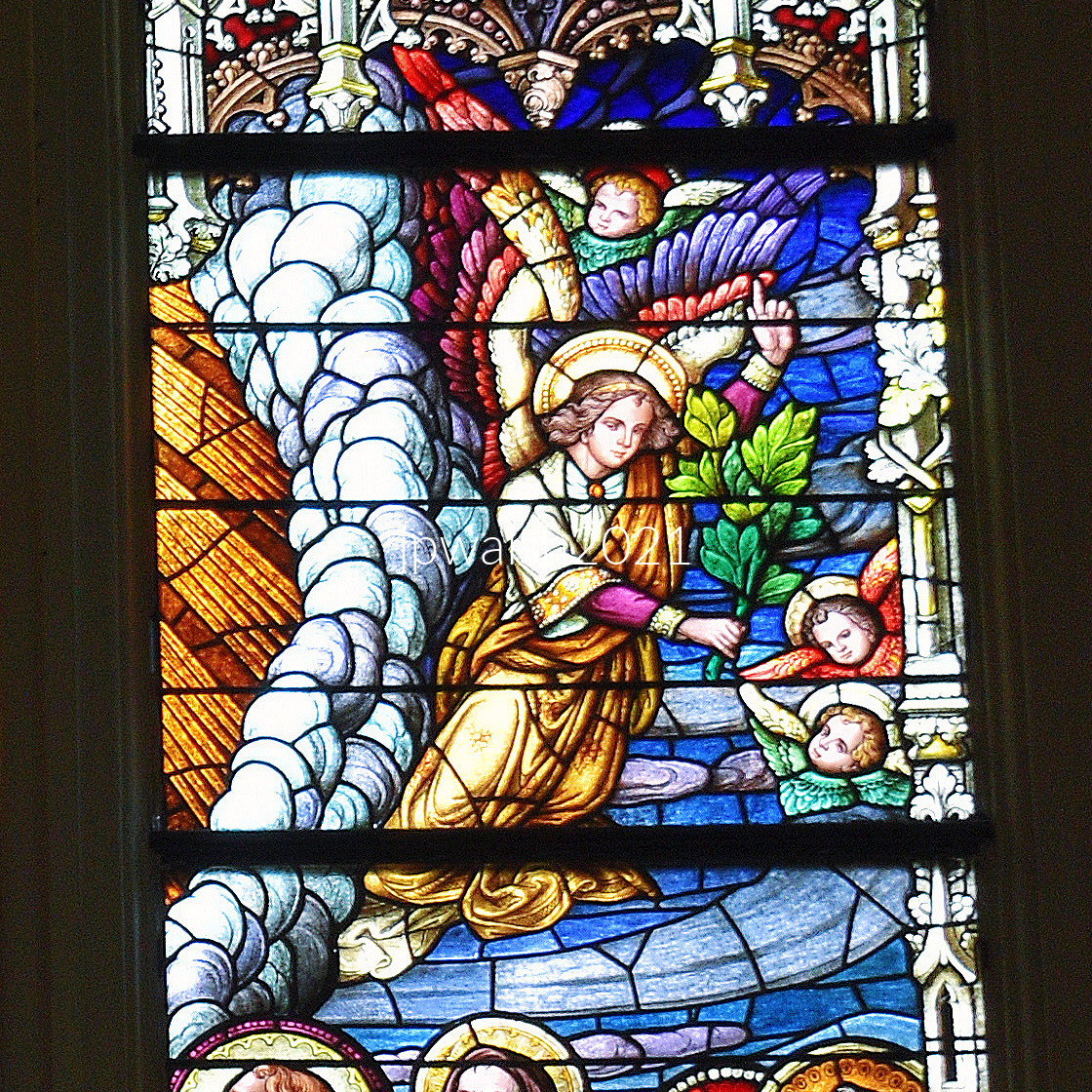
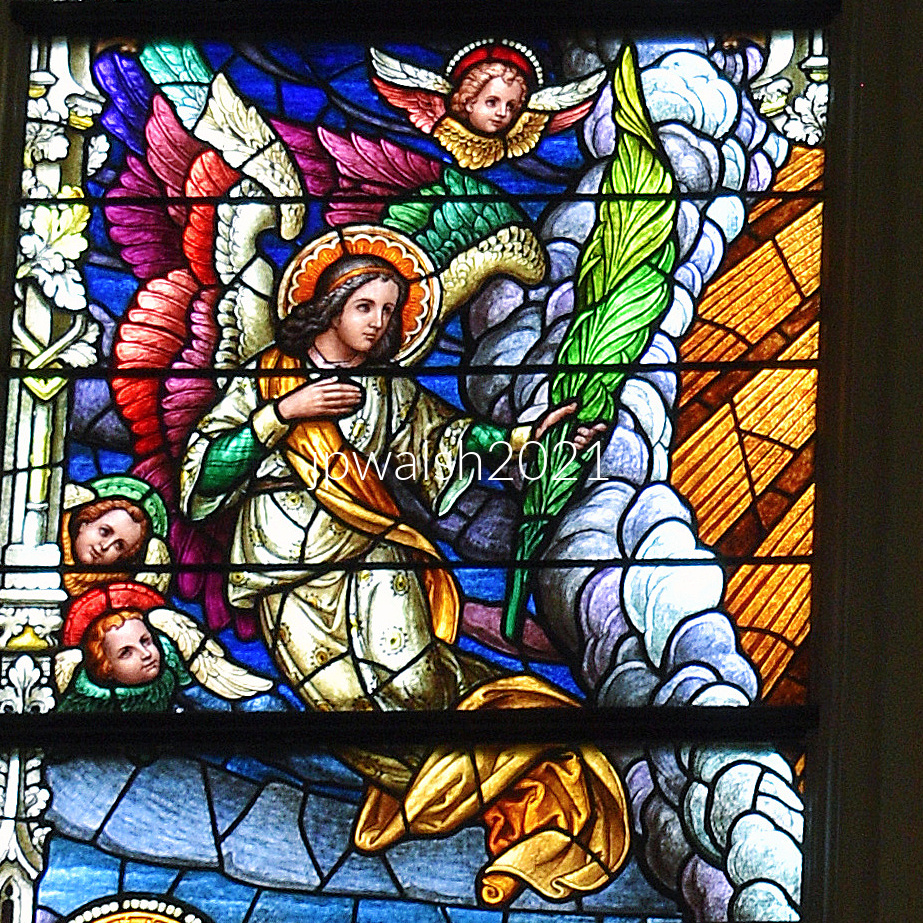
There are eight angels in the window representing the hierarchy of angels. The baby heads of the cherubim – the lowest tier of angels – are accompanied by seraphim, the highest order of angels. Their name “archangel” literally means “chief angel.” Traditionally these highest order of angels are warlike in appearance and bear a sword, This is especially the case with the iconography of St. Michael the Archangel who leads God’s angels in battle to cast Satan and his angels out of heaven as told in the New Testament Book of Revelation.
The seraphim in this stained-glass depiction, however, carry palm branches in place of swords. In the years following World War I when this stained glass was made, the Austrian art glass manufacturer may have sought to symbolize angelic power by ways of symbols of peace. The fact that the range of angels from lowest to highest is present in the window appears to signal the presence of the whole choir of angels present at the Ascension of Jesus into heaven.15
detail, angel, Ascension window, Sts. Peter and Paul, Naperville, IL. detail, angel, Ascension window, Sts. Peter and Paul, Naperville, IL.
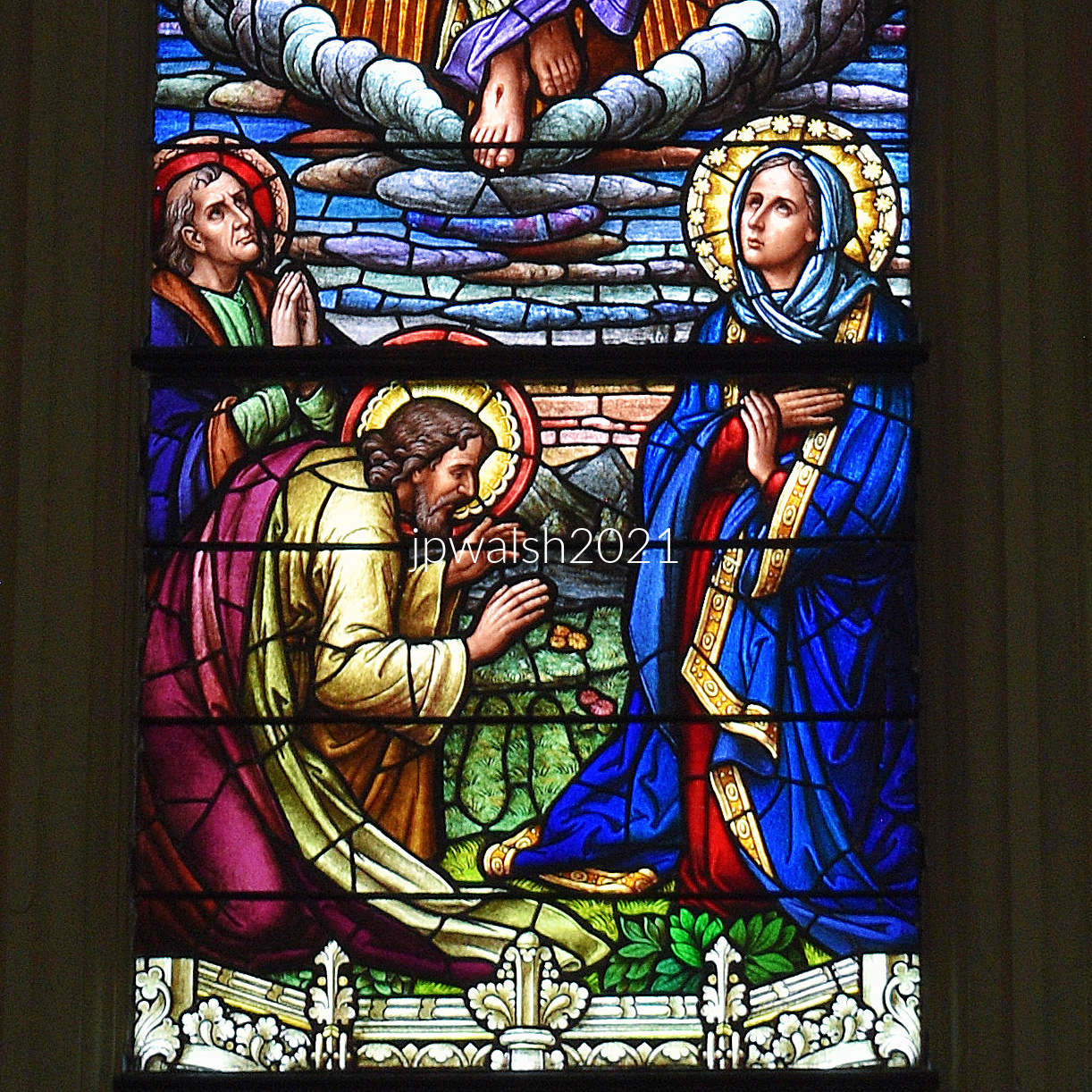
Depicted at the bottom of the window is Mary and the 12 apostles. This was not precisely accurate to the New Testament for at the Ascension there were only 11 apostles. However, the replacement of Judas by Matthias took place almost immediately following the Ascension narrative (Acts of the Apostles 1:21–26).
In the center of the window at the bottom between Mary and a kneeling apostle with his right arm stretched out is an interesting detail. It is the outline of Christ’s feet showing where his resurrected body stood and was lifted directly from earth into heaven. This is significant beyond a souvenir of Jesus’s earthly memory, in that Mount Olivet from which the resurrected Jesus was lifted into heaven is exact the place to which “the Son of Man coming in a cloud with power and great glory” (Luke 21:27) will return at the end of the world. In that way, the window is a depiction of the Ascension and one that points to the Second Coming of Christ.
detail, outline of jesus’s feet, Ascension window, Sts. Peter and Paul, Naperville, IL.
Each of the apostle’s halos are unique. Mary’s halo has 12 stars as she is often pictured with a circle of stars. The Zodiac is an ancient circle of stars where some are symbolically combined into 12-star signs or constellations.
detail, apostles, Ascension window, Sts. Peter and Paul, Naperville, IL. detail, apostles, Ascension window, Sts. Peter and Paul, Naperville, IL.
Jesus’ Ascension – his going “up” to heaven – is the same imagery used for the Assumption of Mary. It is figurative to express the spiritual. The biblical heaven is mysterious. It is the intimate reserve of God and as God is pure spirit (John 4:24), the question arises, how does Heaven incorporate the resurrected fleshly body of Christ at His Ascension?
It is explained starting with the Incarnation at the Annunciation to Mary (Luke 1:26-38) where the divine humanity of Jesus, the Word who was “with God, and…was God (John 1:1) begins. In the Ascension, the Person of Christ is fulfilled where the “new, saved man” enters heaven into the intimacy of the Father, and becomes the perfect God-Man. As “God is love” (I John 4:16), the manner of being of the body in Christ in heaven, the perfect God-man, is love.16
The Ascension is followed by Pentecost when the Apostles receive the Holy Spirit from Heaven and will speak thereafter of “Christ (in Heaven) in us.”
detail, rondelle, Christ the King, Ascension window, Sts. Peter and Paul, Naperville, IL.
The upper rondelle represents Christ the King. Christ’s crown obscures his elaborate three-part halo. The Greek letters on either side represent the “alpha” (“the beginning”) and the “omega” (“the ending”) which indicates Christ’s Godhead. Christ the King holds in his hands the symbols of the sacrament of the Holy Eucharist in the consecration of the Mass. in his right hand is the species of bread and wine that become the Body and Blood of Christ and in his left hand is the wood beam of the cross whose sacrifice on Calvary the Eucharist memorializes. Christ the King also reveals his Sacred Heart – a popular Catholic devotion- inside his chest. His heart is depicted as aflame encircled by a crown of thorns signifying his agape (or sacrificial) love. The entire Ascension window was the gift of Mr. and Mrs. William David Callender, parish members in the mid1920s.
detail, halo of stars, Ascension window, Sts. Peter and Paul, Naperville, IL.
In the New Testament, the Woman of the Apocalypse and the battle of St. Michael the Archangel against the Dragon are bound together in the same dramatic narrative in the Book of Revelation (Rev.12:1-9). The Woman with a crown of 12 stars who is against the Dragon in the Book of Revelation has been identified with Mary, particularly as the Immaculate Conception. This is how Mary is depicted in the Ascension of Christ into Heaven window at Sts. Peter and Paul.
The New Testament passage setting out these images is in Revelation 12:1-9:
1 A great sign appeared in the sky, a womanclothed with the sun, with the moon under her feet, and on her head a crown of twelve stars.
2 She was with child and wailed aloud in pain as she labored to give birth.
3 Then another sign appeared in the sky; it was a huge red dragon, with seven heads and ten horns, and on its heads were seven diadems.
4 Its tail swept away a third of the stars in the sky and hurled them down to the earth. Then the dragon stood before the woman about to give birth, to devour her child when she gave birth.
5 She gave birth to a son, a male child, destined to rule all the nations with an iron rod. Her child was caught up to God and his throne.
6 The woman herself fled into the desert where she had a place prepared by God, that there she might be taken care of for twelve hundred and sixty days.
7 Then war broke out in heaven; Michaeland his angels battled against the dragon. The dragon and its angels fought back,
8 but they did not prevail and there was no longer any place for them in heaven.
9 The huge dragon, the ancient serpent,who is called the Devil and Satan, who deceived the whole world, was thrown down to earth, and its angels were thrown down with it.
EXPLANATION OF IMAGERY IN THE NARRATIVE OF REVELATION 12-14
About the middle of the Book of Revelation (Chapters 12-14), the author portrays the power of evil as represented by the figure of the Dragon who is opposed to God and his people. This Dragon pursues the woman about to give birth to devour the child but the child is born. Then St. Michael and his angels expel the Dragon and the Dragon’s angels out of heaven (Rev. 12:5-9). Adorned with the Old Testament images of sun, moon, and stars (Genesis 37:9-10), the woman symbolizes God’s people. As Israel gave birth to the Messiah (Rev.12:5) and the church suffers persecution by the Dragon (Rev 12: 6, 13-17), the Woman corresponds to an archetype of a pregnant goddess bearing a savior who is pursued by a monster looking to destroy the offspring. But her offspring, a son, in his turn, destroys the monster.
The huge red Dragon is a symbol of the forces of evil – the Devil or Satan (Rev. 12:9, 20:2), or the mythical Leviathan (Ps, 74:13-14) or Rahab (Job 26:12-13; Ps 89:11). It is also the ancient serpent who seduced Eve, the mother of the whole world (Gen 3:1-6).17
The Assumption of Mary into Heaven.
South Transept, Assumption of Mary into Heaven, 1927, Tyrol Art Glass Company, Innsbruck, Austria. Sts. Peter and Paul Church, Naperville, Illinois.
There is no mention of the Assumption of Mary into Heaven in the New Testament. There are biblical texts used frequently to point to the doctrine whose imagery is related to the Ascension of Christ into Heaven.
The Assumption of Mary intheology is the doctrine that Mary as Theotokos, or Mother of God, was taken (“Assumed”) into heaven, body and soul, at the moment, or what would be the moment, of her death. This phenomenon is not unprecedented in the Bible. It occurred in the Old Testament to Moses and Elijah who were pivotally important as Old Testament figures and who were present at Christ’s Transfiguration in the New Testament (Matt 17:1-9; Mk 9:2-10: Lk 9:28-36; and 2 Peter 1:16-21).
There has been debate whether Mary was assumed into heaven at death or after death – that is, whether Mary, the Mother of the Savior, experienced death at all. It is a debate not resolved even with the doctrine of the Mary’s Assumption into Heaven declared a dogma of the faith by Pope Pius XII (1876-1958) on November 1, 1950 in the apostolic constitution Munificentissimus Deus.
What is depicted in the window is biblical in the sense that it is the dogmatic theology deduced from it. The Assumption as a theme in Christian art originated in western Europe during the late Middle Ages—starting in the 12th and 13th centuries – a period when devotion to the Virgin Mary was growing in importance. It would be renewed vigorously again in the 16th century during the Protestant Reformation. Before this Renaissance and Reformation period, Mary is represented surrounded by a mandorla, or almond-shaped aureole. But starting in the 16th century the mandorla was replaced by a cluster of clouds as depicted in the window.
detail. Mary, Assumption window, Sts. Peter and Paul Church, Naperville, Illinois.
The window depicts Mary standing upon a brightly-lit crescent moon reflected in imagery from Revelation 12.
Mary wears a blue cloak with a red shirt underneath as seen in the stained glass window by her right arm’s sleeve. The blue of her cloak is interpreted to represent the Virgin’s purity, symbolize the cosmos, and identify Mary as a Queen as blue was associated with royalty.
The red garment color signifies traits connected with motherhood as well as Mary’s presence on Calvary at her son’s crucifixion, particularly her traits of love and devotion.
These symbolic colors Mary wears expresses a universal definition of motherhood for her.
The Virgin Mary is mother to Jesus which expands to the whole of humanity. On Calvary, standing by the cross of Jesus were three Marys – Mary, his mother, Mary, the wife of Clopas, and Mary of Magdala. From the cross, Jesus said in John 19:
26 When Jesus saw his mother and the disciple there whom he loved, he said to his mother, “Woman, behold, your son.”
27 Then he said to the disciple, “Behold, your mother.” And from that hour the disciple took her into his home. (New American Bible)
Mary wears a white robe representing her purity. Her halo has seven eight-pointed stars. In numerology the number 7 represents “perfection” and the number 8 represents “regeneration or rebirth.”
detail. angels, Assumption window, Sts. Peter and Paul Church, Naperville, Illinois. detail. angels, Assumption window, Sts. Peter and Paul Church, Naperville, Illinois.
There are 12 angels, some carrying palms representing peace and victory, others carry lilies representing Mary’s virginity. Angels wear laurels of hyacinths (prudence, peace, and desire for heaven) and of roses (heavenly joy). Another angel holds out a bouquet of thornless roses signifying purity and the triumph of love. Mary will be crowned Queen of Heaven and the angels hold her crown.
detail. rondelle, The Trinity, Assumption window, Sts. Peter and Paul Church, Naperville, Illinois.
God the Father wears a triangular halo as He blesses the scene. The Holy Spirit in the symbol of the dove emanates.18
FEATURE image: (detail) Jesus Appears to Mary Magdalene, John 20:11-18.
INTRODUCTION
One hour’s drive (about 40 miles) south of downtown Chicago—and 90 minutes drive from the University of Notre Dame near South Bend, Indiana—is The Shrine of Christ’s Passion. Within a 30-acre site whose landscaped rocks, hills, and trees envelop the visitor, the shrine is located on busy U.S. 41 at 10630 Wicker Avenue in St. John, Indiana. A pioneer town settled in 1837, St. John still sits among farm fields though there is increasingly more development only minutes from the Indiana-Illinois state line.
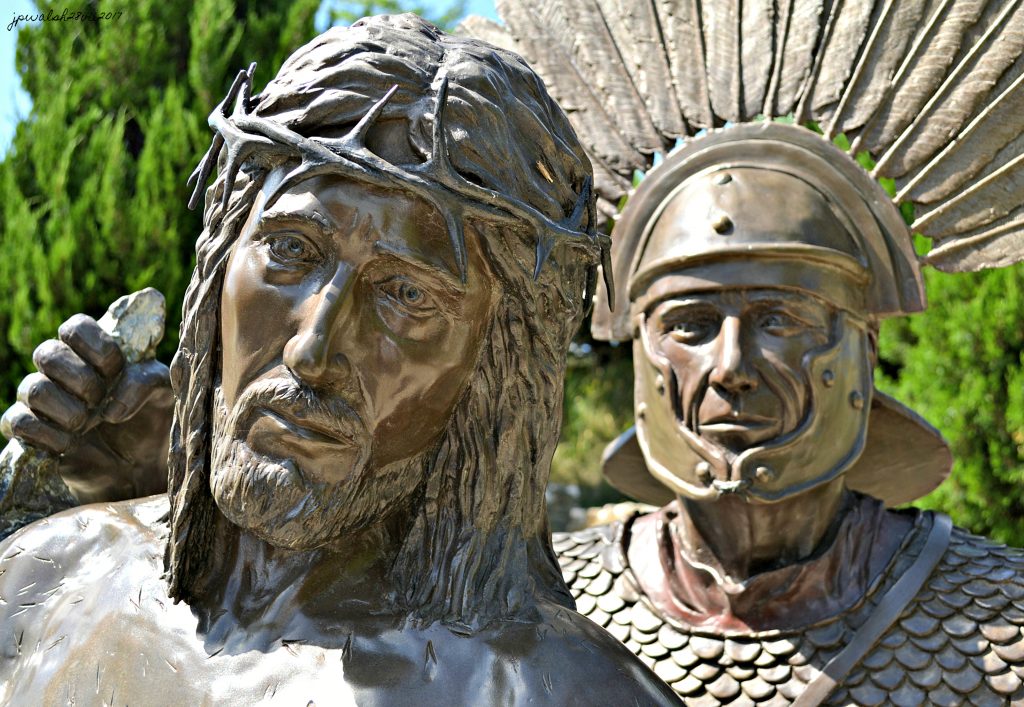
On the historic Wachter family farm, the level terrain is a perfect outdoor setting for an array of multi-media and interactive attractions. Most visitors, whether as individuals or in groups, come to the shrine to traverse the half-mile winding concrete pathway that contain over 40 life-sized bronze sculptures which dramatize the Passion of Jesus Christ in the Bible.
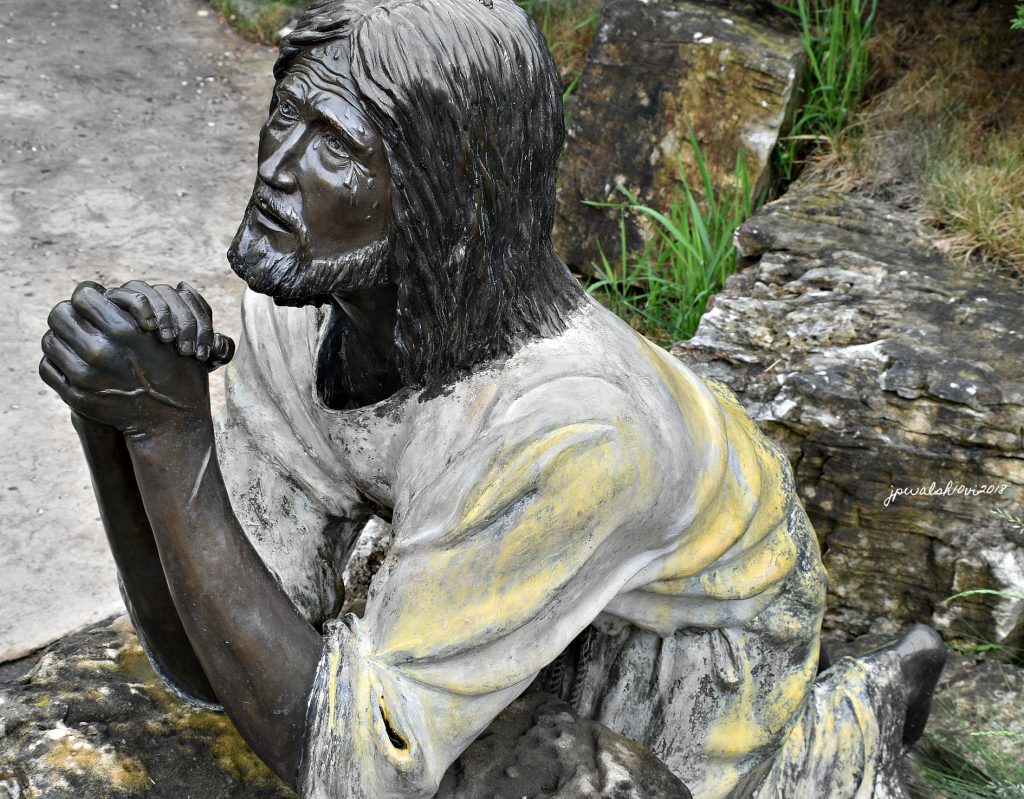
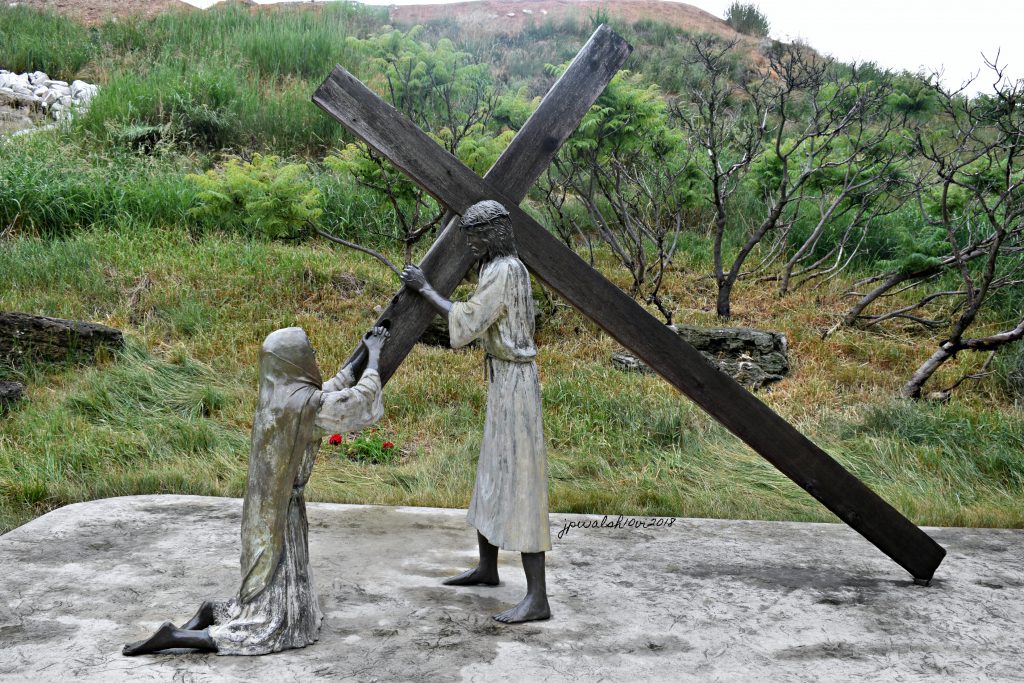
The visit to the shrine begins in the well-stocked gift shop and leads directly outdoors to the dramatization of Jesus at The Last Supper and into the Garden of Gethsemane where Jesus prays. This is followed by the 14 traditional Stations of the Cross. The visit ends at Jesus’s empty tomb and his appearance to Mary Magdalene. Finally there is the dramatic Ascension of the Risen Jesus into Heaven on Mount Olivet.
The shrine opened in 2011 and added its latest attraction– namely, a re-creation of the rock-filled path up Mount Sinai to where Moses has received the 10 Commandments –in 2017.
The Shrine of Christ’s Passion required a decade of planning and over $10 million dollars to build. Each setting or station for Christ’s passion has an orientation kiosk. Each features the well-known recorded voice of American television journalist Bill Kurtis. A push of a button has Mr. Kurtis’s voice over the kiosks’ speakers provide a clear and brief description in English of the sculptures’ scenes followed by a short meditation.
Along the broad concrete pathway the prayer trail is meditative and its easy progression from station to station lends itself to discovery. Formed hills, planted trees, bushes, and grasses as well as many large boulders, provide a complete landscape far from the outside world. The design creates a terrain that is self-contained and works to evoke the arid climate of the Holy Land where the last days of Christ can become vibrant today.
Upon exiting the gift shop with its walls and shelves of tempting religious articles and other items for purchase — all proceeds apparently go to the upkeep of the shrine– one steps into an outdoor pastoral setting which offers the immediate transition into the world of the Bible and following in the footsteps of Christ during his darkest moments. Visitors share the trail with others from around the nation and world. This is part of what makes each visit to the shrine unique and alive. Yet there is ample space and freedom to enjoy one’s own completely personal experience.
Whenever one may visit the shrine — it is open 361 days a year– the prayer trail has an atmosphere that is quiet and respectful. There is always a place to sit and drink in the sculpture art detailing the greatest story ever told. Among its flora, evocative rock and land formations, and realistically-rendered life-sized sculptures depicting Jesus Christ’s suffering –- one witnesses in a a new way Christ’s mission which triumphed over sin and death.
A large and impressive place, The Shrine of Christ’s Passion retains a human scale along with giving the visitor a sense of being serenely out in nature. Depending on how much time a visitor can spend, a visit to the shrine could possibly be accomplished in as little as 30 minutes though at least an hour should be allowed to see and begin to savor everything it has to offer.
In addition to the main prayer trail and gift shop, the shrine includes more attractions such as the Moses, Mount Sinai, and the 10 Commandments trail; The Sanctity of Life Shrine; and Our Lady of The New Millennium, a monumental three-story (34 feet) tall statue of the Virgin Mary constructed out of over 8,000 pounds of stainless steel.
The Shrine is operated by a non-denominational nonprofit, private foundation. Admission to all attractions at the shrine is free. The Shrine is open daily from 10:00 a.m. – 5:00 p.m., Thursdays until 8:00 p.m.The Prayer Trail is open year round, weather permitting.
Main Entrance on U.S. 41 at 10630 Wicker Avenue in St. John, Indiana, minutes from the Illinois-Indiana state line. Just 40 minutes from downtown Chicago, there is ample free parking and tour buses are welcome.
The Gift Shoppe.
The Last Supper Luke 22:19
“And he took bread, gave thanks and broke it, and gave it to them, saying, “This is my body given for you; do this in remembrance of me.”
Garden of Gethsemane Mark 14:34
“My
soul is overwhelmed with sorrow to the point of death,” Jesus said to
them. “Stay here and keep watch.”
THE 14 STATIONS OF THE CROSS AT THE SHRINE OF CHRIST’S PASSION, ST. JOHN, INDIANA.
1. Jesus is condemned to death Matthew 27: 19-26.
“When Pilate saw that he was not succeeding at all, but that a riot was breaking out instead, he took water and washed his hands in the sight of the crowd, saying, “I am innocent of this man’s blood. Look to it yourselves.”…Pilate had Jesus flogged, and handed him over to be crucified.”
2. Jesus carries His cross John 19:16-17
“Then Pilate handed him over to be crucified. The soldiers took charge of Jesus, who carried his own cross to a location called “The Place of a Skull,” known in Aramaic as Golgotha.”
3. Jesus falls for the first time Isaiah 53:1-3
“He was despised and rejected by mankind, a man of suffering, and familiar with pain. Like one from whom people hide their faces he was despised, and we held him in low esteem.”
4. Jesus meets His mother, Mary Lamentations 1:12
“Is it nothing to you, all you who pass by? Look around and see. Is any suffering like my suffering that was inflicted on me..?”
5. Simon of Cyrene helps Jesus carry the cross Luke 23:26
“They seized Simon from Cyrene, who was on his way in from the country, and put the cross on him and made him carry it behind Jesus.”
6. Veronica wipes the face of Jesus Psalm 17:15
“As for me, I will be vindicated and will see your face; when I awake, I will be satisfied with seeing your likeness.”
7. Jesus falls for the second time Isaiah 53:4-6
“Surely he took up our pain and bore our suffering, yet we considered him punished by God, stricken by him, and afflicted.”
8. Jesus meets the women of Jerusalem Luke 23:27-31
“A large number of people followed him, including women who mourned and wailed for him. 28 Jesus turned and said to them, “Daughters of Jerusalem, do not weep for me; weep for yourselves and for your children.”
9. Jesus falls for the third time Isaiah 53:10-11
“Yet it was the Lord’s will to crush him and cause him to suffer, and though the Lord makes his life an offering for sin, he will see his offspring and prolong his days, and the will of the Lord will prosper in his hand….”
10. Jesus is stripped of His clothes Matthew 27:27-31
“They stripped him and put a scarlet robe on him, and then twisted together a crown of thorns and set it on his head. They put a staff in his right hand. Then they knelt in front of him and mocked him.”
11. Jesus is nailed to the cross Luke 23:33-34
“When they came to the place called the Skull, they crucified him there, along with the criminals—one on his right, the other on his left.”
12. Jesus dies on the cross Luke 23:44-49
“Jesus called out with a loud voice, “Father, into your hands I commit my spirit.” When he had said this, he breathed his last.”
13. Jesus is taken down from the cross Mark 15:39
“When the centurion who stood facing him saw how Jesus breathed his last he said, ‘Truly this man was the Son of God!'”
14. Jesus is placed in the tomb Luke 23:50-53
“Going to Pilate, Joseph of Arimathea asked for Jesus’ body. Then he took it down, wrapped it in linen cloth and placed it in a tomb cut in the rock, one in which no one had yet been laid.”
The Resurrection of Jesus.Matthew 28.
1 After the sabbath, as the first day of the week was dawning,* Mary Magdalene and the other Mary came to see the tomb.
2 And behold, there was a great earthquake; for an angel of the Lord descended from heaven, approached, rolled back the stone, and sat upon it.
3 His appearance was like lightning and his clothing was white as snow.
4 The guards were shaken with fear of him and became like dead men.
5 Then the angel said to the women in reply, “Do not be afraid! I know that you are seeking Jesus the crucified.
6 He is not here, for he has been raised just as he said. Come and see the place where he lay.
Jesus Appears to Mary Magdalene John 20:16
“Jesus said to her, “Mary.” She turned
toward him and cried out in Aramaic, “Rabboni!”
MORE of the Prayer Trail
The Ascension Acts of the Apostles 1:9
“…Jesus was taken up before their very eyes,
and a cloud hid him from their sight.”