I first saw 1776 on an eighth‑grade field trip, and it hit perfectly. The music, the narrative, and the historical framing made it both fun and instructive. The year before, I had toured Washington, D.C.—the White House, Congress, the Library of Congress, the Supreme Court, the Washington Monument, the Lincoln and Jefferson Memorials, the National Archives, Arlington, Georgetown, Mount Vernon, Williamsburg, Patrick Henry’s Red Hill, Woodrow Wilson’s birthplace in Staunton, and Jefferson’s Monticello. My American‑history pump was primed, and 1776 met me at full readiness.
Philadelphia as the Stage of Independence
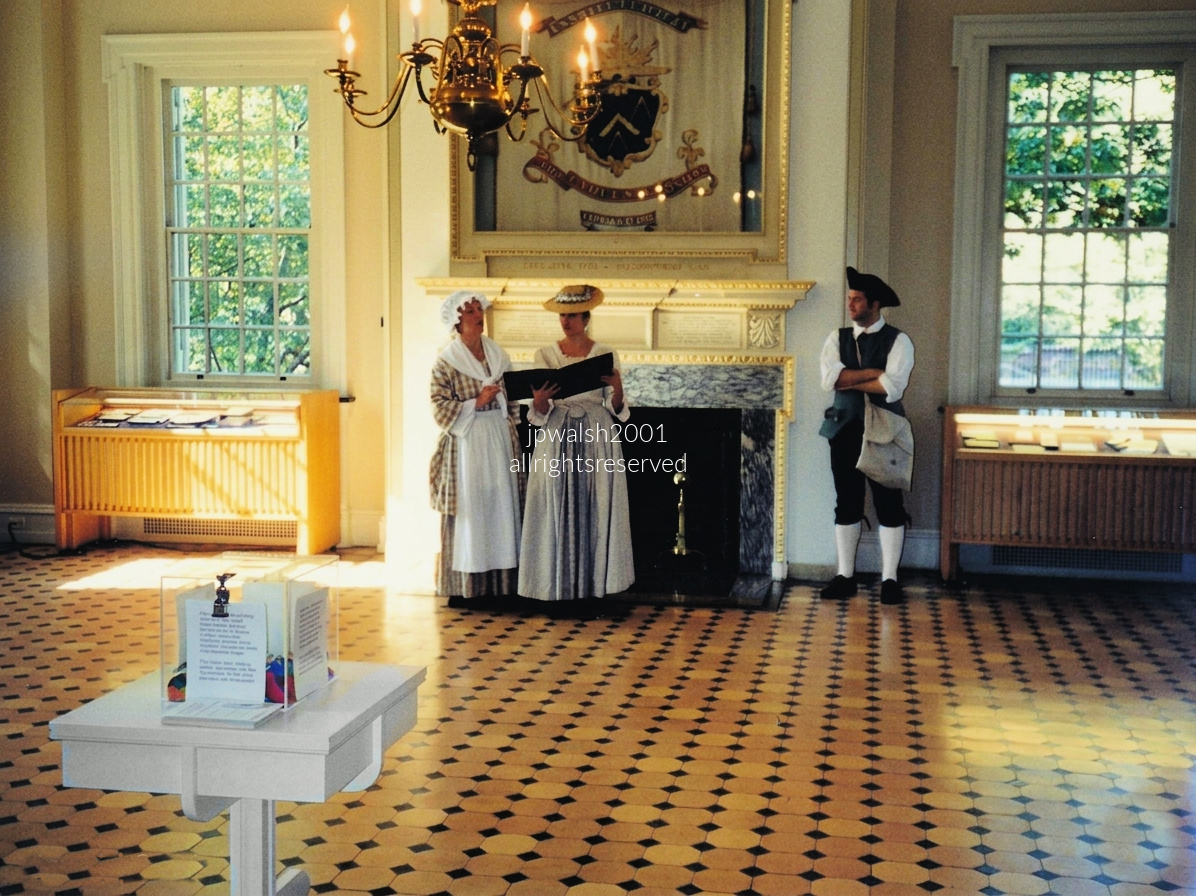
Set between May and July 1776, 1776 dramatizes the political struggle inside the Second Continental Congress as John Adams pushes the colonies toward independence. The film’s setting mirrors the real geography of the Revolution’s political machinery. Carpenters’ Hall, built between 1770 and 1774, hosted the First Continental Congress, bringing together delegates such as John Adams, Samuel Adams, George Washington, and Patrick Henry. The Second Continental Congress convened in Independence Hall beginning in May 1775.
Carpenter’s Hall, Philadelphia. The First Continental Congress met in Carpenters’ Hall precisely because it was not a royal space — a deliberate choice to avoid British‑controlled government buildings while delegates privately weighed trade boycotts and articulated colonial grievances.September 2001. Author’s photograph.
Abigail and John Adams exchanged more than 1,100 letters between 1762 and 1801, beginning in their courtship and continuing through John’s long absences in the Continental Congress and his diplomatic missions in Europe. Their correspondence essentially ended when John retired (from the U.S. presidency) in 1801 and the couple settled together in Quincy. Abigail died at 73 in 1818; John died at 90 on July 4, 1826—two centuries ago today. I’ve visited their graves at United First Parish Church in Quincy, along with all three Adams homesteads: the John Adams Birthplace (1681), the John Quincy Adams Birthplace (1717), Peacefield (the estate they purchased in 1788), and the Stone Library built in 1870 under J.Q. Adams’s will.
Author at Peacefield, July 1989. Purchased in 1787, Peacefield became the home and farm of John and Abigail Adams. It later housed their son John Quincy Adams and his wife Louisa Catherine, followed by their son Charles Francis Adams and his sons, historians Henry and Brooks Adams. Both John and Abigail died at Peacefield in Quincy, Massachusetts—Abigail on October 28, 1818, and John on July 4, 1826.
Abigail’s March–April 1776 letters blend political urgency with personal strain. She presses John toward independence, criticizes Virginia’s hierarchy and its contradictions on liberty, and pointedly demands legal protections for women—warning they will “foment a rebellion” if excluded. Her letters then turn to the epidemic sweeping Braintree, the pressure of household work, and her need for news from Congress. John’s reply is teasing but defensive, treating her call for women’s rights as one more uprising in a year already crowded with political unrest, insisting men will never surrender their “masculine systems” even though husbands are, in practice, “subjects” at home.
The musical 1776 draws heavily from these letters. “Piddle, Twiddle, and Resolve / Till Then” captures their longing, their humor, and the shortages created by wartime separation. Peter Stone and Sherman Edwards lifted phrases directly from the correspondence, including Abigail’s complaints about scarce pins and John’s demands for saltpeter—details documented repeatedly in their late 1775 and early 1776 letters. Even the repeated sign off “Yours, yours, yours” comes straight from John’s actual closings.
“Piddle, Twiddle, and Resolve / Till Then” near the beginning of the show pairs John Adams’s fast, exasperated critique of Congress with a quieter imagined exchange as he reads Abigail’s letter. The shift from political frustration to intimate connection mirrors the rhythm of their real correspondence: public crisis and private devotion intertwined in the founding of our country 250 years ago which we celebrate today.
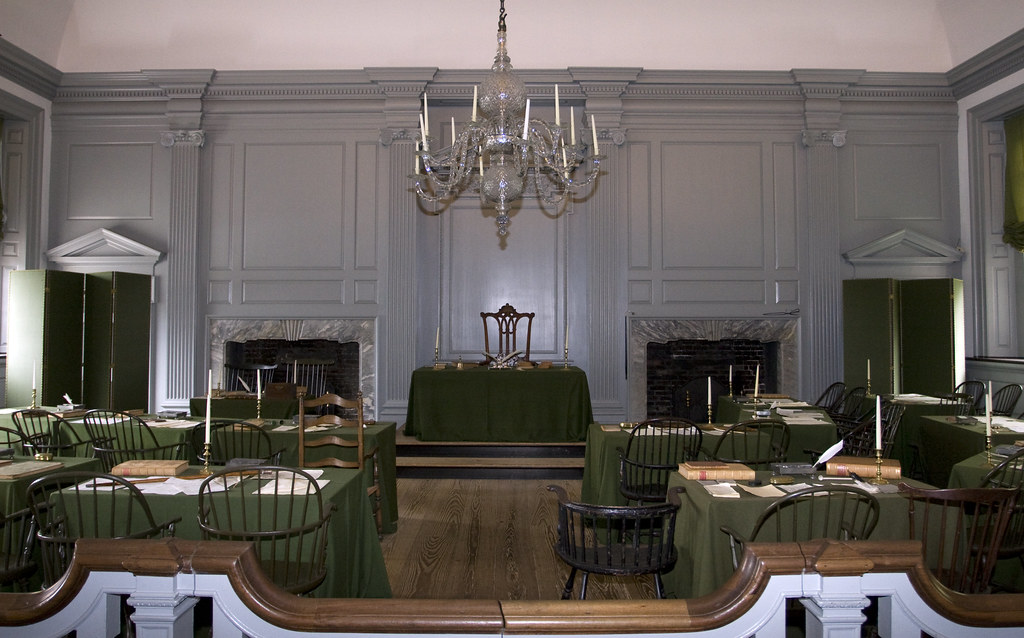
Independence Hall.Both historic sites sit within Independence National Historical Park in Philadelphia about 5 minutes apart on foot. In addition to the simple need for more space, by the time the Second Congress assembled, Lexington and Concord had already changed the stakes. The delegates were no longer a protest body; they were forced to operate as an emerging wartime government, making a formal legislative setting like the State House the appropriate venue. “Independence Hall” by michaelrighi is licensed under CC BY 2.0.
The Independence Debate
By late spring 1776, the question of independence could no longer be deferred. Benjamin Franklin and John Adams urged Richard Henry Lee to introduce a resolution severing ties with Britain and its mercantile system “that cheat and rob the colonies.” John Dickinson led the opposition, arguing independence was reckless. When Adams believed he had the votes, Dickinson countered with a motion requiring unanimity. The vote tied, and John Hancock unexpectedly sided with Dickinson. Adams and Franklin responded by proposing that Congress draft a Declaration before taking the final vote, shaping the political terrain and buying time.
Drafting the Declaration
On June 11, Congress appointed the Committee of Five—Adams, Franklin, Thomas Jefferson, Robert Livingston, and Roger Sherman. Jefferson drafted the Declaration in a rented room on High Street during a brutal heat wave. Adams wrote that the air felt like “the fierce Breath of a hot oven.” Horseflies swarmed the city out of its livery stables, biting delegates through stockings both wool and silk. Only in early July did the weather break; Jefferson recorded 68°F on the morning of July 4 and 76°F that afternoon.
War in Crisis
While Jefferson wrote, the war deteriorated. The failed invasion of Canada left the Continental Army retreating in disorder, ravaged by smallpox. Washington braced for a massive British fleet assembling off New York—the largest amphibious assault in British history. Inside Congress, delegates debated how to reinforce the army, secure gunpowder, procure ships, and recruit soldiers. Bounties rose from $4 to $10 to $20 across 1776, but payment came in Continental paper money, which rapidly inflated. By 1779, the currency was nearly worthless. Casualties in the Revolutionary War were severe: nearly 7,000 killed in combat, 9,000 wounded, roughly 19,000 dead from disease, and another12,000 who perished from horrific conditions and disease as prisoners of war aboard British prison ships.
Scaled to today’s United States population of roughly 343 million—up from about 2.5 million in 1776—the Revolutionary War casualty figures would rise by a factor of about 137. In modern‑day terms, the war’s human toll would equal nearly 960,000 killed in combat, about 1.23 million wounded, roughly 2.6 million dead from disease, and approximately 1.64 million prisoners of war who died, compared with the original totals of 7,000 killed, 9,000 wounded, 19,000 dead from disease, and 12,000 POW deaths.
The Musical and Its Moment
The film’s musical centerpiece, “The Egg,” performed by Ken Howard, Howard Da Silva, and William Daniels, captures the moment when Adams, Franklin, and Jefferson commit themselves to the Declaration. Sherman Edwards—who wrote the show’s book, music, and lyrics—had been a successful pop songwriter before deciding to create “the great American musical.” 1776 opened on Broadway in March 1969, ran for 1,217 performances, won the Tony Award for Best Musical, and brought much of its original cast into the 1972 film.
Slavery and the Declaration’s Deleted Passage
The show does not avoid the era’s darker realities. Jefferson’s original draft included a forceful denunciation of slavery, describing King George as having “waged cruel war against human nature itself.” Congress removed the passage to preserve unity. Jefferson’s use of “Men” explicitly recognized the humanity of enslaved people—an acknowledgment absent from the final Declaration. Jefferson remained a lifelong slaveholder, yet he pursued legislation against the transatlantic trade, including Virginia’s 1778 ban and the 1807 federal prohibition he signed as president.
The July 2 Vote
The vote for independence on July 2 could not be delayed. British forces were landing on Staten Island that very day. Any hesitation would signal weakness to the colonies—and to British intelligence. Delaware’s vote depended on Caesar Rodney’s overnight ride; had he missed the session, the colony’s vote would have been discarded. Congress needed a clear, unanimous decision.
Crisis and Recovery
By December 1776, Washington’s army had shrunk by nearly 90 percent. British forces had captured Manhattan, taken thousands of prisoners, and seized artillery and ammunition. Thomas Paine, serving in the army, wrote The American Crisis, beginning with the line: “These are the times that try men’s souls.” Washington wrote more soberly: “Our affairs are in a very bad way . . . the game is pretty near up.” His crossing of the Delaware on Christmas night reversed the momentum, but only barely.
Adams, Franklin, and the Diplomatic Front in France
A Young Nation Meets Old‑World Diplomacy
John Adams did not speak French, the dominant diplomatic language of the era. Benjamin Franklin was nearly thirty years older than Adams, while France’s new king, Louis XVI, was only twenty‑one. At his coronation, Marie Antoinette—just twenty—remarked, “God help us, for we reign too young.”
France Enters the Global Conflict
By late 1777, American finances were collapsing, and Philadelphia had fallen to the British. Many Americans believed trade ties with France were insufficient; military assistance was essential. The American victory at Saratoga convinced France to intervene. This decision launched the Anglo‑French (Bourbon) War, a global conflict (1778–1783) fought from the Caribbean to the Indian Ocean, overlapping almost entirely with the American Revolution.
Adams Arrives in France
Adams’s first diplomatic mission to France in 1778 produced little. He was largely ignored at Versailles. At forty‑two, he had been chosen partly for his vigor, while Franklin—now in his seventies—was seen as charming but indulgent. In one dramatized exchange, Louis XVI asks Franklin whether his fame in Paris comes from “science or the ladies,” to which Franklin replies, “Day and night, I am hard at work.”
A Fractured American Delegation
America’s other minister, Arthur Lee, was anti‑slavery but ineffective. Franklin and Lee led the delegation, while Adams worked behind the scenes. By late 1778, Congress promoted Franklin to minister plenipotentiary, leaving Adams sidelined and eventually sent home.
Adams Returns, Learns French, and Grows Frustrated
Adams returned to Paris in 1779 and this time learned French. After Lee was recalled, Adams joined Franklin in leading negotiations. But Adams believed the alliance had stalled. He wrote that the French intended “to keep their hands above our chin to prevent us from drowning—but not to lift our heads out of water.”
Confrontation with Vergennes
In March 1780, France’s foreign minister, Vergennes, summoned Adams to discuss American currency deflation. Adams instead aired grievances about French military inaction. The French had sent soldiers but few warships, diverting naval power to protect Caribbean interests. Adams insisted France must fully commit to the alliance. Vergennes bristled and declared he would deal only with Franklin going forward. Adams left France empty‑handed for the second time.
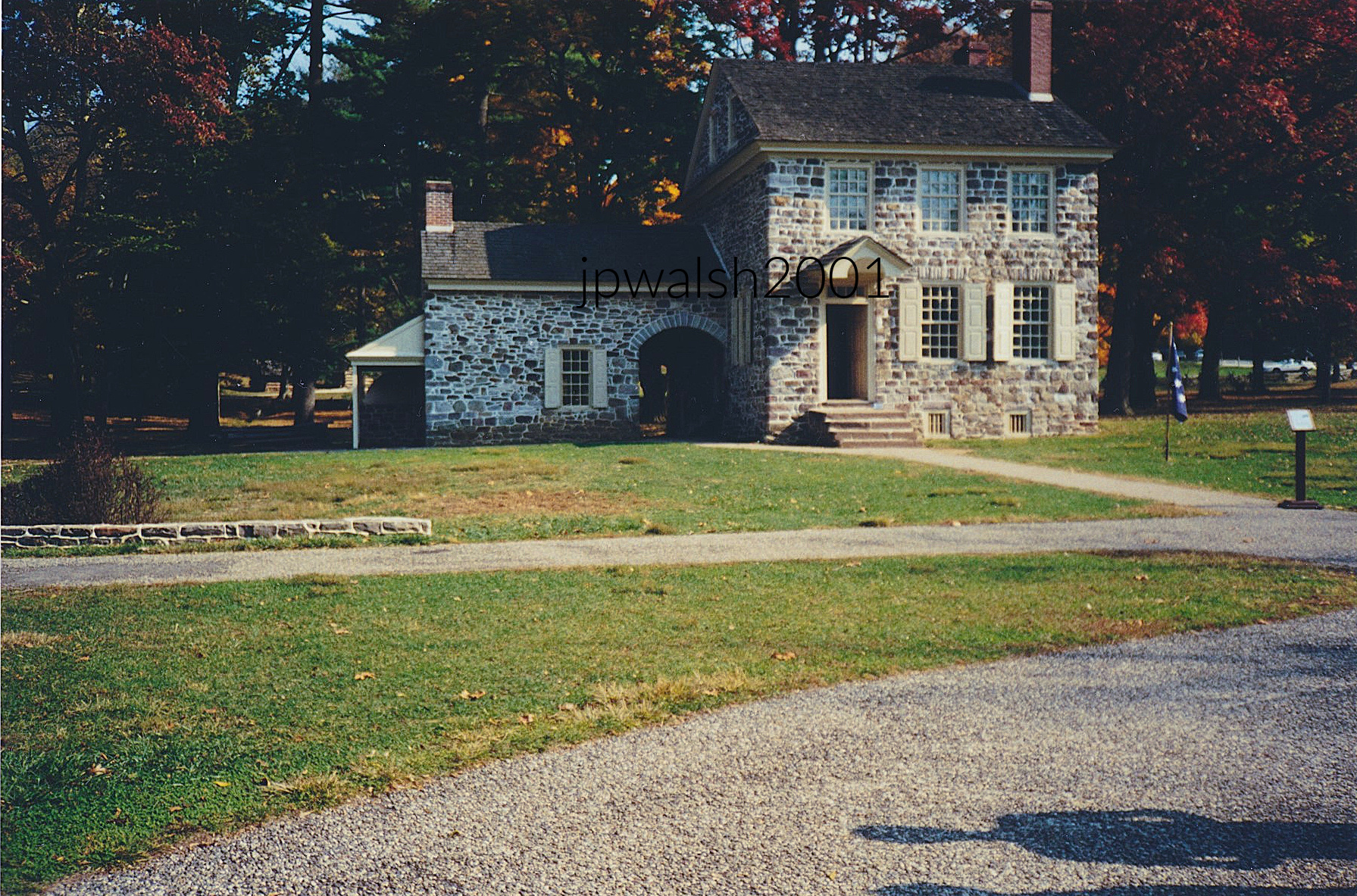
Valley Forge, Pennsylvania: General Washington’s Winter Encampment and Headquarters, 1777-1778.
During the American Revolutionary War, the Continental Army encamped at Valley Forge from December 1777 to June 1778. The stone house built between 1757 and 1773 by the family of Isaac Potts served as General George Washington’s headquarters.
Retreat After Brandywine and Collapse of Supply Lines
After Washington’s defeat at the Battle of Brandywine in September 1777, the Second Continental Congress fled Philadelphia, and Washington withdrew his force of roughly 12,000 soldiers to the strategically chosen high ground at Valley Forge, only a day’s march from the city. This third winter encampment quickly became defined by collapsing supply lines. On December 23, 1777, Washington wrote the President of Congress, then meeting 90 miles away in York, Pennsylvania, reporting that his officers had barely suppressed a “dangerous mutiny” driven by shortages of food, clothing, and basic provisions.
Washington’s Headquarters, Valley Forge Historical Park, Valley Forge, Pennsylvania. June 2001. Author’s photograph.
Human Cost of the Winter
Washington understood the consequences of these conditions: malnutrition, exposure, and disease would kill about 2,000 soldiers—more than fifteen percent of the army—over the course of the winter. He warned Congress that “unless some great and capital change suddenly takes place in that [supply] line, this Army must inevitably be reduced to one or other of these three things, Starve, dissolve, or disperse, in order to obtain subsistence in the best manner they can.”
Congressional Intervention and Administrative Reform
The crisis marked a low point for the Continental Army, but Washington’s blunt communications forced action. A congressional delegation visited Valley Forge in late January 1778, and in March Congress created the office of Quartermaster General, appointing Maj. Gen. Nathanael Greene to stabilize the army’s supply system—an administrative reform that proved vital to the war effort.
Washington’s First Inauguration, April 30, 1789: A Dramatized Moment in World History
This sequence is a dramatization of the first presidential inauguration from John Adams (2008). David Morse appears as Washington, while Paul Giamatti portrays the title character, anchoring the scene in the political and symbolic weight of the early republic.
George Washington was sworn in by New York Supreme Court Justice Robert Livingston (portrayed here by Alex Draper). Livingston was on the Committee of Five tasked with drafting the Declaration of Independence. Washington took the oath on Thursday, April 30, 1789, on the balcony of Federal Hall in New York City, which served as the nation’s capital at the time. It was a moment of global significance—the formal launch of the American presidency and the constitutional republic.
In 1790, the capital moved to Philadelphia, where Washington’s second inauguration took place on March 4, 1793, inside the Senate chamber of Congress Hall. Philadelphia remained the national capital until 1800, when the government relocated permanently to Washington, D.C.
Adams and Jefferson: A Final Chapter
Jefferson’s narrow victory in 1800 made Adams the first one‑term president and sent him home to Quincy, resentful after years of partisan attacks. Their correspondence resumed only in 1812, beginning with Adams’s New Year’s greeting. They wrote steadily until July 4, 1826—the day both men died, fifty years after the Declaration.
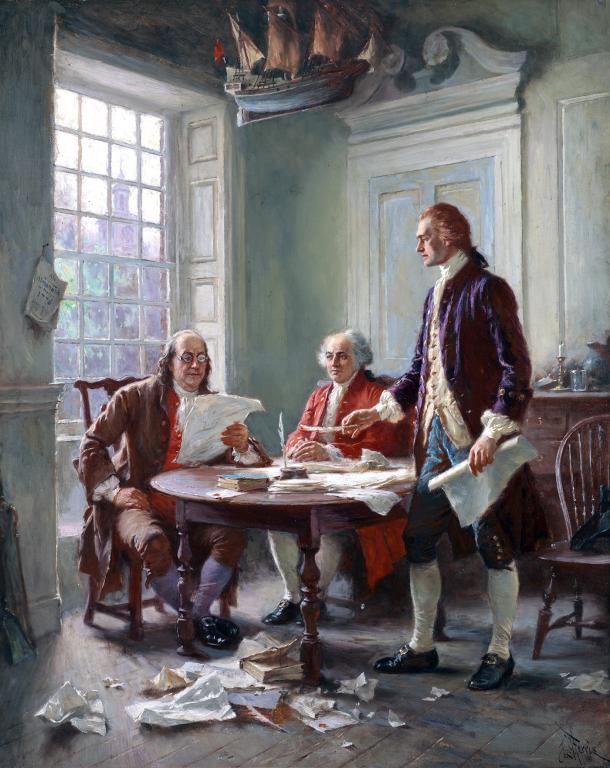
Writing the Declaration of Independence, 1776, J.L.G. Ferris, 1921, Virginia Museum of History & Culture, Richmond, Virginia. Part of the famous America Series, this iconic painting depicts Franklin, Adams and Jefferson congregated at a table inside Jefferson’s Philadelphia lodgings to carefully review and revise the draft he delivered to Congress on June 28, 1776. Public Domain.
This explanatory article may be periodically updated.
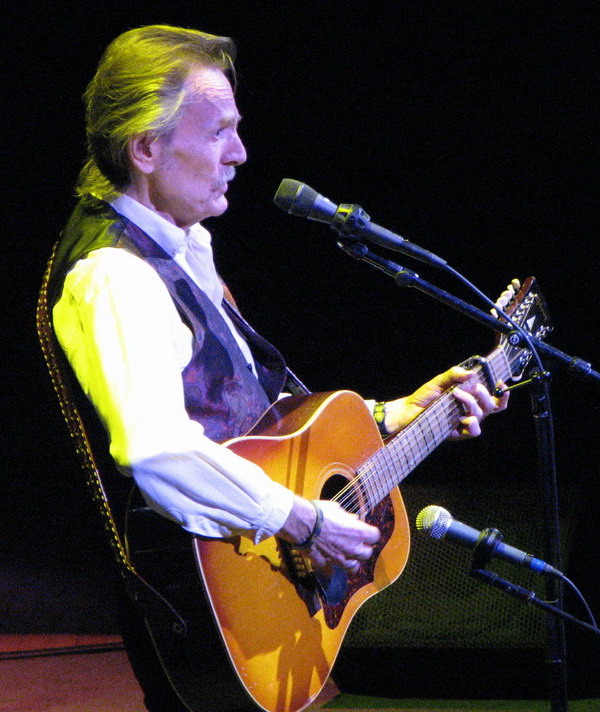
Canadian singer-songwriter Gordon Lightfoot began releasing solo albums in 1966. The first six were on United Artists label and sold moderately well (up to 200,000 copies). Switching to Reprise in 1969 his debut album with the label, Sit Down Young Stranger, coincided with his first U.S. hit, If You Could Read My Mind, in 1970 and became Lightfoot’s first Gold album. This was followed by Lightfoot’s second Gold album (Platinum today) and no.1 single both called Sundown in 1974. The Wreck of the Edmund Fitzgerald – a true story of an ore vessel named after a Milwaukee, Wisconsin, civic leader, that sank in a Lake Superior storm in November 1975 – was Lightfoot’s next big hit appearing on Summertime Dream, a 1976 album that has gone Platinum.1
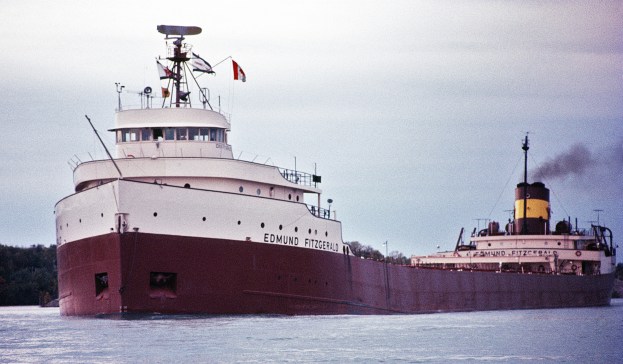
On November 10, 1975, during basically the colliding of two freshwater storms on Lake Superior, the largest of the five Great Lakes, the SS Edmund Fitzgerald, in service since 1958 and, when launched, the largest ship on the Great Lakes at over 700 feet long, went down into deep waters. For a cargo ship that should have normally expected more decades of service, the sinking caused the loss of its entire crew of 29 men. At 7 p.m. on November 10, 1975, the Fitzgerald radioed another cargo ship, the Anderson, telling them that, despite losing their radar, they were “holding their own.” Shortly thereafter the Fitzgerald was lost.
Location of the SS Edmund Fitzgerald wreck in Lake Superior approximately 17 miles (27 kilometers) north-northwest of Whitefish Point, Michigan. The ship now rests beneath about 535 feet (165 meters) of water and is considered a protected gravesite.2
Recovery Efforts involved the U.S. Navy and U.S. Coast Guard.
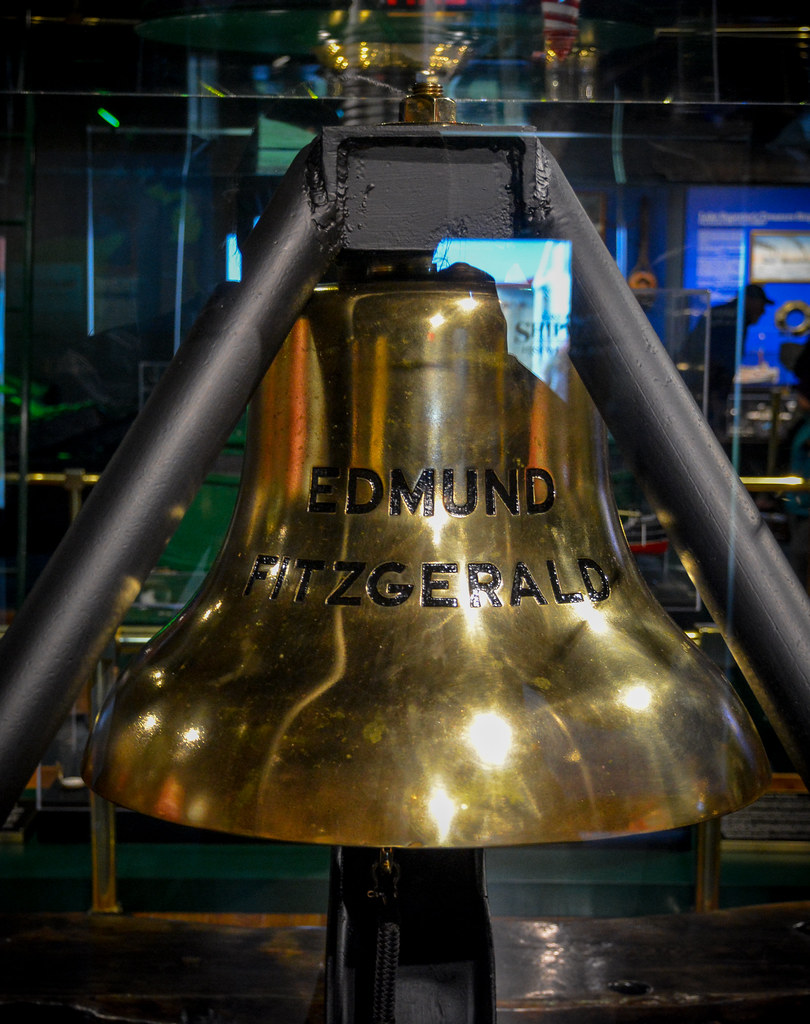
Whitefish Point, located on the southeastern shore of Lake Superior in Michigan, houses the Great Lakes Shipwreck Museum, which holds memorial events for the SS Edmund Fitzgerald each November. The wreck’s location, being 17 miles north-northwest of the point, places it beyond safe navigation lines, illustrating why the ship never reached shelter that fateful night. On a personal note, I have had the opportunity to visit the Great Lakes Shipwreck Museum in Whitefish Point, Michigan that contains the bell from the SS Edmund Fitzgerald recovered in 1995.3
The ultimate cause and circumstances of the wreck of the SS Edmund Fitzgerald in Lake Superior remain a mystery, weather conditions surrounding the sinking are well known – extraordinarily severe storm conditions, including 60 m.p.h. winds, towering waves of 25-30 feet, and heavy thick ice, which impacted possible structural vulnerabilities of the large, nearly 20-year-old cargo ship. The exact sequence of the events leading to the sinking are also unknown, as no distress signal detailing mechanical failure was received, so that the wreck has been attributed to adverse weather and lake conditions that impacted the vessel suddenly.4
The disaster, unlike the other hundreds of shipwrecks that have taken place on the Great Lakes, has entered into American mythology with Gordon Lightfoot’s ballad The Wreck of the Edmund Fitzgerald, written within a couple weeks after the disaster that same November 1975. Though the song by a bestselling recording artist about a recent shipwreck carried some risk where it was too early to know every fact, the verses are meticulously based on news stories of the basics that were known. By Lightfoot’s 7th studio album, Don Quixote, released in 1972, the Canadian singer-songwriter had begun in earnest to explore nautical themes. The Wreck of the Edmund Fitzgerald, released in June 1976 on Lightfoot’s 11th studio album, Summertime Dream, stayed on the same course.
Summertime Dream was released in June 1976 and peaked at no. 12 on the Billboard 200 (no. 1 on Canada Top Albums). The Wreck of the Edmund Fitzgerald was the album’s second track and, in August 1976, became its second single peaking at no. 2 in the U.S. and no. 1 in Canada.
The song was getting local airplay from the album in Minnesota, Wisconsin, and Michigan. Its popularity led to its release as a single in August 1976 and became Lightfoot’s biggest and most unlikely hit record commemorating the sinking of a transport cargo ship with its lives lost from less than a year before. The six-and-one-half minute folk rock song reached no. 1 in Canada and no. 2 in the U.S. where it was kept out of the top spot by Rod Stewart’s Tonight’s the Night. After the song’s release, Lightfoot never lost contact with the surviving family members of that shipwreck. Gordon Lightfoot, who was born in a town on Lake Simcoe in Ontario, Canada, died less than 90 miles away on Lake Ontario in Toronto in May 2023 at 84 years old.
The legend lives on from the Chippewa on down Of the big lake, they called Gitche Gumee The lake, it is said, never gives up her dead When the skies of November turn gloomy With a load of iron ore, twenty-six thousand tons more Than the Edmund Fitzgerald weighed empty That good ship and true was a bone to be chewed When the gales of November came early
The ship was the pride of the American side Coming back from some mill in Wisconsin As the big freighters go, it was bigger than most With a crew and good captain well seasoned Concluding some terms with a couple of steel firms When they left fully loaded for Cleveland And later that night when the ship’s bell rang Could it be the north wind they’d been feeling?
The wind in the wires made a tattle-tale sound And a wave broke over the railing And every man knew, as the captain did too ‘Twas the witch of November come stealing The dawn came late, and the breakfast had to wait When the gales of November came slashin’ When afternoon came, it was freezin’ rain In the face of a hurricane west wind
When suppertime came, the old cook came on deck sayin’ “Fellas, it’s too rough to feed ya” At seven p.m., a main hatchway caved in, he said “Fellas, it’s been good to know ya” The captain wired in he had water comin’ in And the good ship and crew was in peril And later that night when his lights went outta sight Came the wreck of the Edmund Fitzgerald
Does anyone know where the love of God goes When the waves turn the minutes to hours? The searchers all say they’d have made Whitefish Bay If they’d put 15 more miles behind her They might have split up or they might have capsized They may have broke deep and took water And all that remains is the faces and the names Of the wives and the sons and the daughters
Lake Huron rolls, Superior sings In the rooms of her ice-water mansion Old Michigan steams like a young man’s dreams The islands and bays are for sportsmen And farther below Lake Ontario Takes in what Lake Erie can send her And the iron boats go as the mariners all know With the gales of November remembered
In a musty old hall in Detroit, they prayed In the Maritime Sailors’ Cathedral The church bell chimed ’til it rang twenty-nine times For each man on the Edmund Fitzgerald The legend lives on from the Chippewa on down Of the big lake, they call Gitche Gumee Superior, they said, never gives up her dead When the gales of November come early
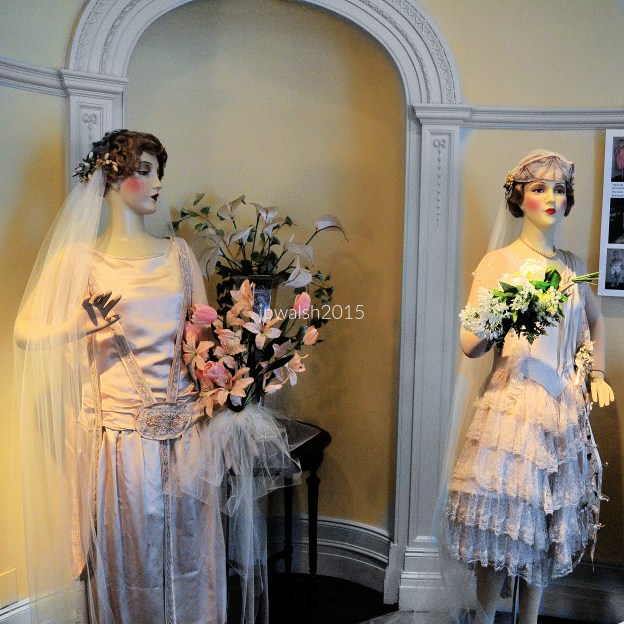
Feature Image: On Saturday, June 7, 1924, Ruth M. Anderson was married in this sleeveless wedding dress (left) to William Noling in Evanston, Illinois. The dress is now on display in the Charles Gates Dawes House in Evanston. Dawes was Vice President of the United States from 1925 to 1929 under President Calvin Coolidge. Author’s photograph (October 2015).
Wedding at the House of the Bride’s family
The Noling-Anderson wedding was held in the house of the bride and her parents, Isak and Jennie (née Johnson) Anderson, at 1035 Ridge Avenue in Evanston. Built in 1914, the house still stands as it did over 100 years ago.
Noling-Anderson Bridal Party Dresses, 1924. Charles Gates Dawes House, Evanston, Illinois. Author’s photograph, October 2015. 7.44 mb DSC_0893 (1)
The dress is made of silk satin in an egg shell color. It is accented by an oval medallion with bands also made of silk satin. The medallion is embroidered with faux pearl and other glass beads.
Thoroughly modern flapper style
While her wedding dress was very fashionable for the mid1920’s – sleeveless tops of all shapes and sizes were the rage in 1924 – it probably was not allowed in one of Evanston’s houses of worship. The fact that it was sleeveless and au courant would be deemed by many as risqué for showing too much bare skin inspired by a thoroughly modern flapper style. It was only in 1924, for instance, that the Methodist Episcopal General Conference first lifted its ban on going to the theater as well as dancing though dance music was the radio’s most popular programming.
The bridesmaid dress (right) was the height of women’s style in 1924 – a mainly straight, knee-length skirt gathered slightly or cut with front pleats. Short sleeve and sleeveless tops were the rage in 1924 reflected in Hollywood by the Mack Sennett girls who starred in movies where they pranced on the beach in a chorus line in not much more than bathing caps and short swim suits.
The fashionable bride and her court might have sported the latest style of facial make-up which is hinted at in the display– masklike with garish, even orange, lipstick and heavy red rouge on the cheeks. Popular fashion accessories from 1924 are also evident – pearls knotted at the neck and simple, though elegant, arm bracelets.
Father of the bride was an Evanston banker, local businessman, andSwedish immigrant
The bride’s father, Isak Anderson, was born in Sweden and came to the United States at 20 years old in 1890. In 1891 he married Jennie Johnson and they had Ruth and another child. Ruth’s father was a bank director and partner in a local tailoring business in downtown Evanston at 608 Davis that today is a noodle shop.
They served “Prohibition highballs”
With Prohibition starting in 1920, guests at the wedding may have been served the latest popular highball whose recipe called for fruit juice and raw eggs. Their morning might have started with a bowl of Wheaties at breakfast, since the cereal of champions made its first appearance in 1924.
Ruth Anderson married William Noling in this house wearing that dress at 1035 Ridge Avenue in Evanston, Illinois, on June 7, 1924. Author’s photograph, May 2024 92% 7.81 mb
SOURCES: Dawes House, Evanston Illinois; The Swedish Element in Illinois: Survey of the Past Seven Decades, Ernst Wilhelm Olson, p. 586; American Chronicle, Lois Gordon & Alan Gordon, Yale University Press, New Haven & London,1999, pp. 230-238; Chicago: The Glamour Years (1919-1941), Thomas G. Aylesworth & Virginia Aylesworth, Gallery Books, NY, 1986, p.14.
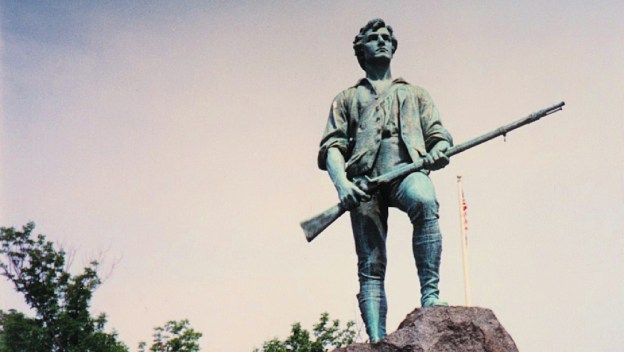
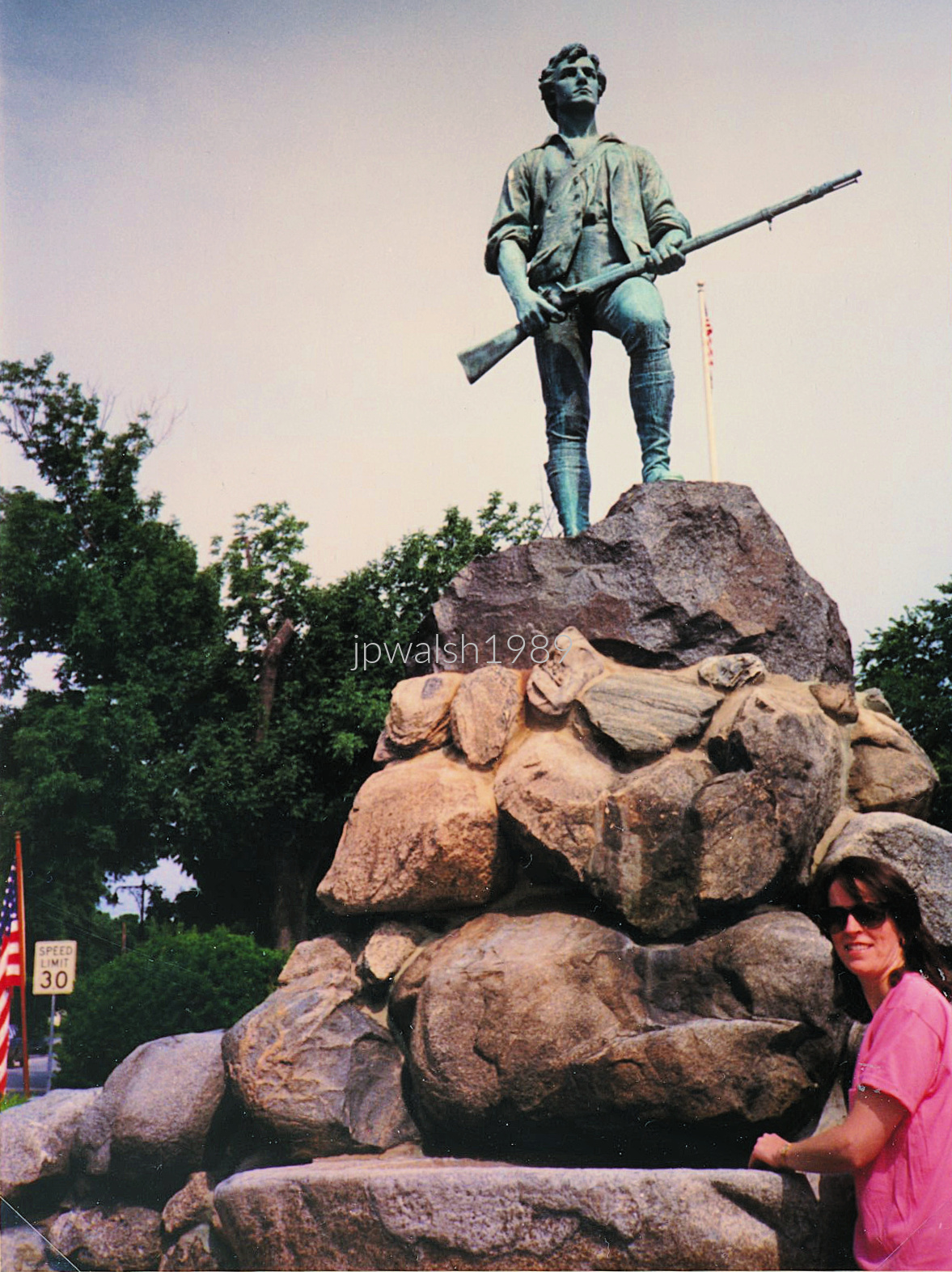
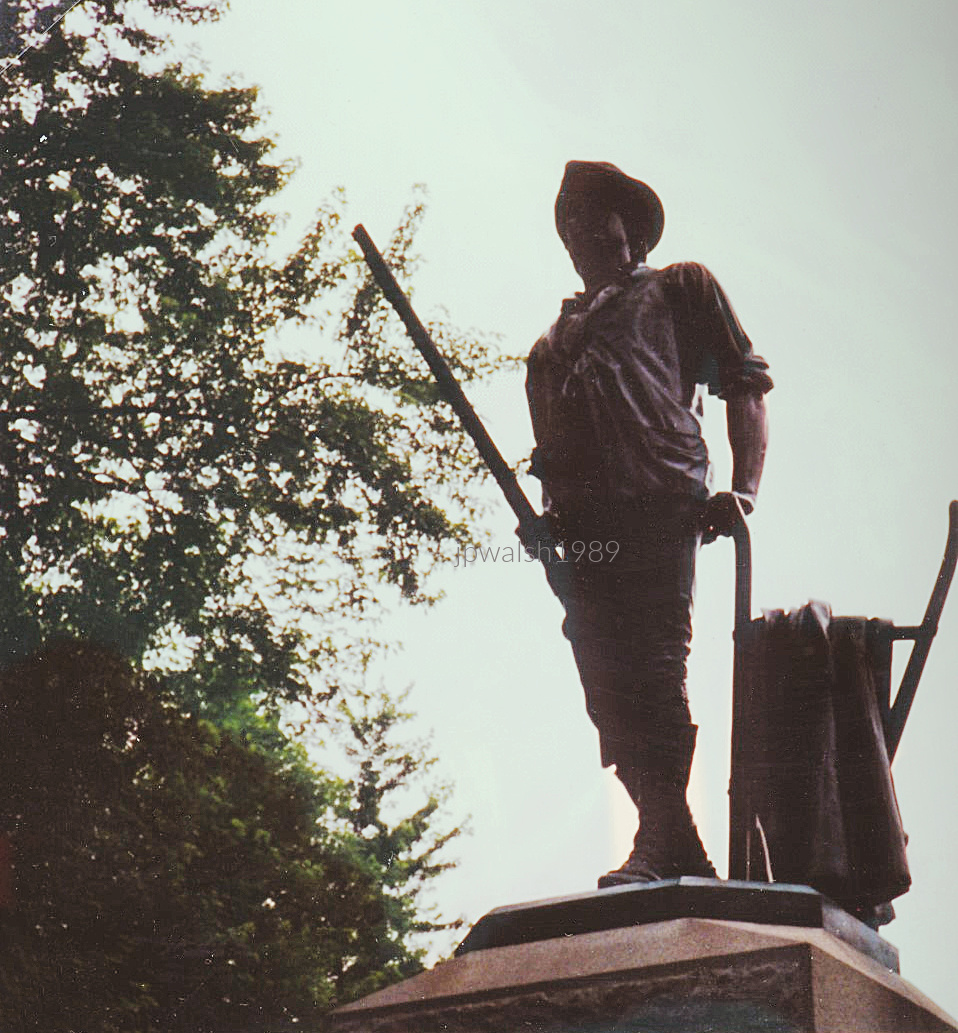
PUBLISHED APRIL 19, 2025 7pm CT. Feature image: Lexington Minute Man, 1899, by H. H. Kitson (c.1863-1947) stands in Lexington Green west of Boston, Massachusetts. Although called Minute Man, the statue is meant to represent the local Lexington militiaman, colonists of many ages and backgrounds, who volunteered to be first responders to military and other threats. The actual “minute men” was part of an elite subset of militia who were young and fit and able to respond to the greatest danger and challenge. Author’s photograph, July 1989.
At the foot of the minuteman monument, visitors arrive in a steady flow, drawn to this enduring chapter of early American history. The bronze figure, rifle held in the classic Revolutionary‑era stance, recalls the citizen‑soldiers who first stepped forward to defend their towns. According to the National Park Service, the Minute Man National Historical Park—which includes Battle Road and its surrounding historic sites—welcomes more than 1 million visitors each year. see – Tourism to Minute Man National Historical Park contributes $102 million to local economy – Minute Man National Historical Park (U.S. National Park Service) – retrieved April 19, 2025.
H.H. Kitson, sculptor of the famed Lexington Minuteman, was born in England and immigrated to the United States as a teenager. After studying art in Paris, he returned to New York in 1884 and moved to Boston two years later, where he established a studio, taught, married one of his students, and raised three children. The monument was commissioned in 1898 for $10,000 by railroad executive and U.S. Congressman Francis Brown Hayes, erected in 1899 facing the route of the British advance, and formally unveiled on April 19, 1900, for the 125th anniversary of the battle.Public Domain. see – https://monuments.freedomsway.org/monuments/minute-man-statue/ – retrieved April 19, 2025.
On April 19, 1775, local militiamen stepped out from Buckman Tavern beside the Lexington common and formed two lines to face the advancing British troops. Their stand resulted in the first casualties of the American Revolution. During our visit, we also learned that the phrase “sleep tight” comes from the rope‑laced frames that supported Colonial‑era mattresses. Author’s photograph, July 1989.
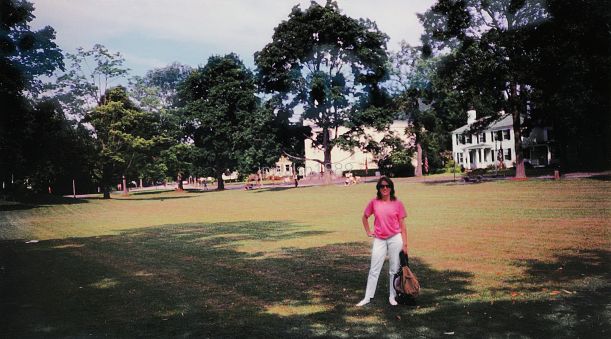
Author’s wife on Lexington Green where the first shots of the War of American Independence were fired on April 19, 1775. Author’s photograph, July 1989.
Also on April 19, 1775, the British approached the town of Concord where the American colonists sprang into action. After an alarm rider notified minutemen and militia, scouts were sent out to reconnoiter British movements. They heard the cackle of gunfire at Lexington Green and, learning of this martial situation, Concord prepared. The British advanced to Concord and the colonial militia strategically retreated past the North Bridge to watch what the British would do. Meanwhile the colonists were checking on the safety of their own military stores. With Concord effectively in British hands the Regulars moved out to take the town’s two bridges over the Concord River. The South Bridge was taken but the North Bridge proved more problematic. They crossed the bridge but encountered the colonists who had moved past it and into an elevated position. Loyalists in town informed the British where the colonists kept their military stores filled with supplies such as gun powder, cannon, shot, and flour. The colonists had their own intelligence network and had moved these stores to other hidden locations. At a farm where they thought the military supplies to be stored, the British forced a woman who lived there, one Rebecca Barrett, to make them breakfast as they searched the premises. But they found, as the colonists planned, nothing. Although there were kegs of gunpowder stored in the farm next door, the British didn’t go look.
DO NOT FIRE UNLESS FIRED UPON.
Meanwhile, the British held the two Concord bridges and waited for their search party to return. At the same time, the American colonists were getting a better look at their red-coat adversaries. As the Americans held a military council, their growing military presence forced the British who had crossed the bridge to retreat back to it. Armed militiamen were streaming in from several towns and formed a formidable front. As the British were setting fires in downtown Concord, the American colonists could see the flames rising from their position on the high ground. Because of these fires (the British were burning carriages) the Americans decided to march to the North Bridge so to cross into town to prevent the British from burning it down. Fully expecting a confrontation with the British, the militia companies loaded their weapons but were told not to fire unless fired upon. Approximately 400 militia men marched in order by company seniority down towards the North Bridge. There were less than 100 British guarding the bridge. With the coming American militia the British retreated around the bridge and considered this American action as an attack. There were a flurry of orders flying around the field of action to the point of chaos. The British debated marching into the field to meet the approaching Americans. They also debated ripping up the bridge so the Americans could not cross. They finally decided on a firing formation in the street at the base of the bridge.
SHOT HEARD ‘ROUND THE WORLD.
In the chaos the Americans arrived to the bridge. The British fired directly into the group and wounded and killed men. “The balls whistled well,” recalled a militia soldier. One American was shot through the throat. Another under and through the eye. One more through the heart. In a matter of seconds there were six total casualties. The Americans were then ordered: “Fire, for God’s sake fire!” A hail of bullets was shot into the British. Three were killed and nine wounded. Many of the British fled towards town. As the Americans chased the British, one militiaman struck a hatchet blow into the head of a wounded British soldier.
The British were quickly reinforced and ordered to march back to the bridge. But there was no more firing. The militia dispersed from the bridge though there was a huge influx of militia coming into Concord from several towns in all directions. The militiamen knew the terrain and its backroads and could converge quickly, directly and stealthily. Though the British asked for reinforcements (1,000 men) from Boston, nothing happened. The British retreated though Concord Bridge marked the beginning of a massive battle that raged over 16 miles along the Bay Road from Boston to Concord, and included some 1,700 British regulars and over 4,000 Colonial militia. see – https://www.nps.gov/mima/north-bridge-questions.htm – retrieved April 19, 2025.
The Minute Man statue of 1875, created by Daniel Chester French (1850–1931), was unveiled on April 19, 1875, during the centennial commemoration of the battles of Lexington and Concord. Set near the site where the first colonial militiamen fell in Concord, the seven‑foot bronze was cast from old Civil War cannons by the Ames Foundry of Chicopee, Massachusetts. Its stone pedestal bears the opening lines of Ralph Waldo Emerson’s Concord Hymn, honoring the “shot heard round the world.” BY THE RUDE BRIDGE THAT ARCHED THE FLOOD, THEIR FLAG TO APRIL’S BREEZE UNFURLED, HERE ONCE THE EMBATTLED FARMERS STOOD, AND FIRED THE SHOT HEARD ROUND THE WORLD. https://www.nps.gov/mima/learn/historyculture/the-minute-man-statue-by-daniel-chester-french.htm – retrieved April 19, 2025. Author’s photograph, July 1989.
Daniel Chester French (1850–1931) was born in New Hampshire and, at seventeen, moved to Concord to be near Ralph Waldo Emerson and the Alcott family, where he received his first art lessons. After further study in Boston, he was only twenty‑one when he received the commission for The Minute Man. The statue was unveiled to critical acclaim in 1875, though French himself was in Europe studying art at the time. Upon returning to the United States, he worked in studios in Washington, Boston, and eventually New York City. In 1897 he purchased the Stockbridge, Massachusetts estate that became Chesterwood, his longtime home and workspace. Over the following decades, French produced major public monuments in Boston, Cambridge, New York, Chicago, and Washington, D.C., and he is best known today for his Seated Lincoln in the Lincoln Memorial. He is buried in Sleepy Hollow Cemetery in Concord alongside Emerson, the Alcotts, and Henry David Thoreau. https://www.nps.gov/mima/learn/historyculture/sculptor-daniel-chester-french.htm – retrieved April 19, 2025.
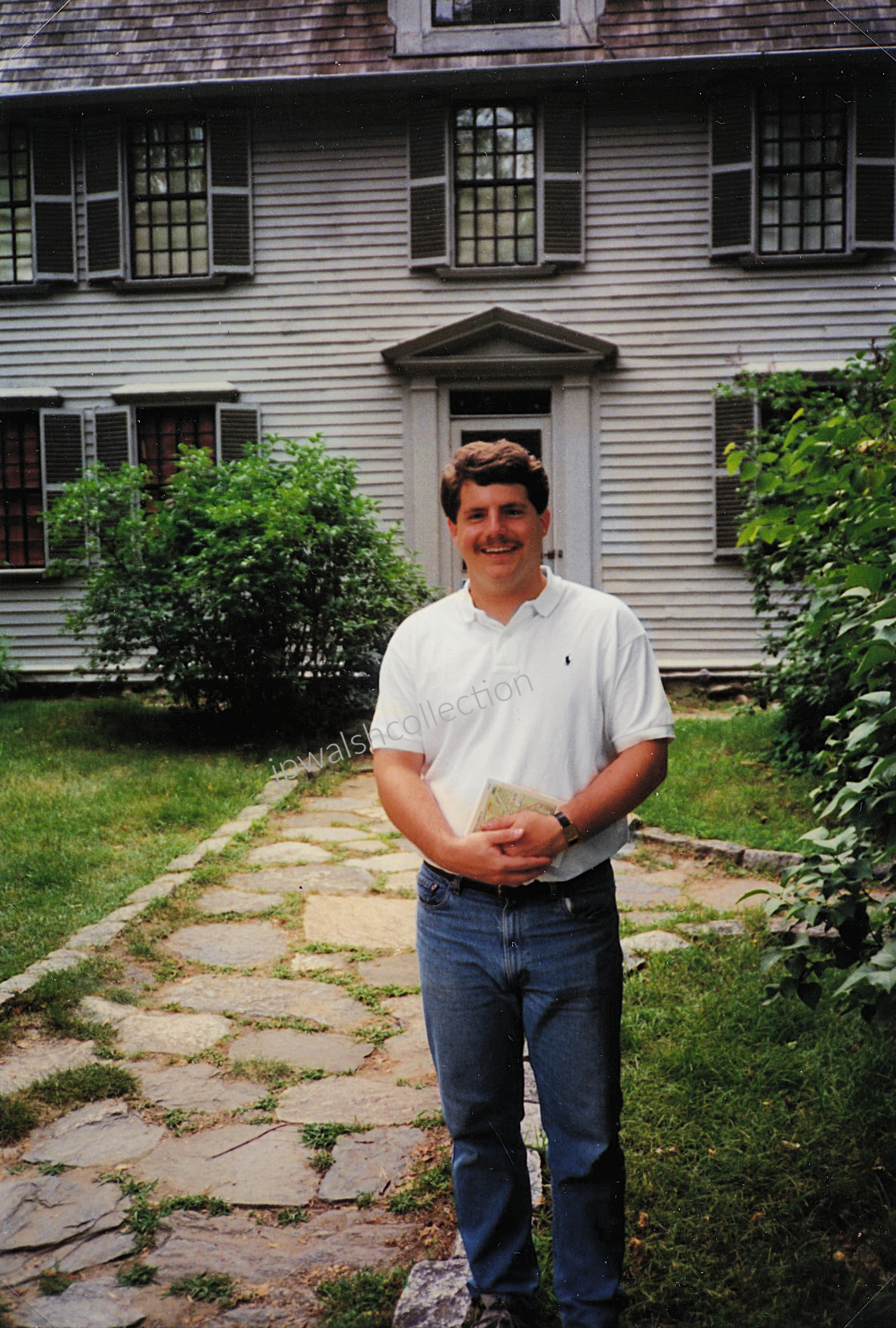
The author stands at the Old Manse in Concord, Massachusetts, a house on Monument Street with the Concord River just behind it and the North Bridge—now part of Minute Man National Historical Park—beside the property. Built in 1770 for Rev. William Emerson (1743–1776), the home later became central to the Emerson family line: William’s son, minister William Emerson, and his grandson, the transcendentalist Ralph Waldo Emerson. The elder Rev. Emerson served as Concord’s minister, chaplain to the Provincial Congress in 1774, and later chaplain to the Continental Army; he watched the fighting at the North Bridge from his fields while his family witnessed it from the upstairs windows. Decades later, Ralph Waldo Emerson drafted his foundational essay Nature here, and during his stay in the mid‑1830s he proposed to Lydia Jackson before the couple moved to what is now known as the Emerson House. Author’s collection, July 1989.
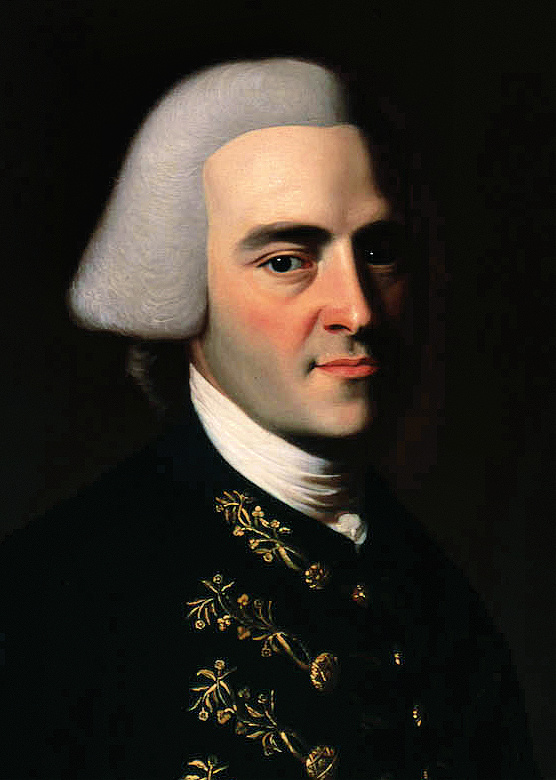
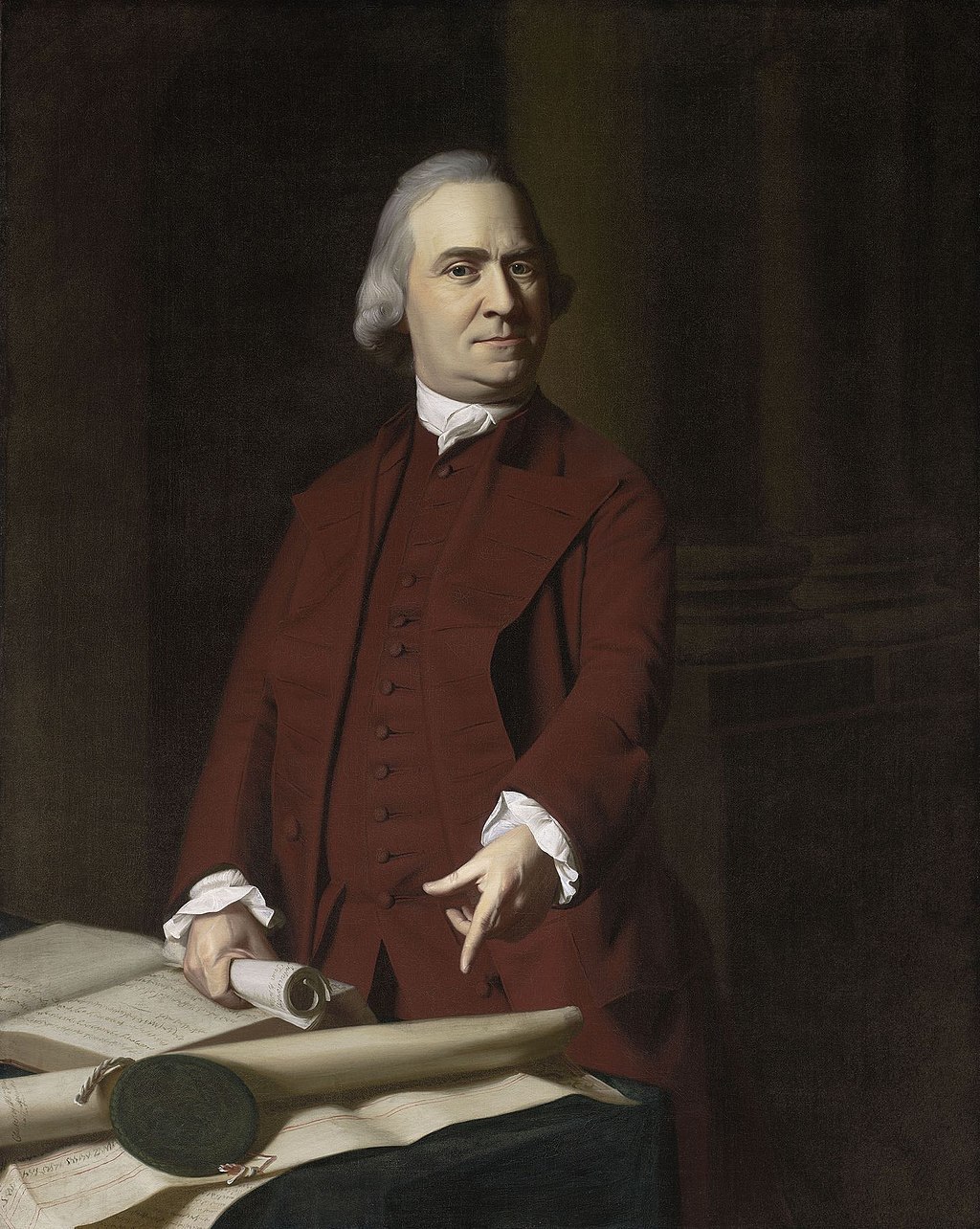
John Hancock, 1770, by John Singleton Copley (1738-1815) in the Massachusetts Historical Society. Public Domain.
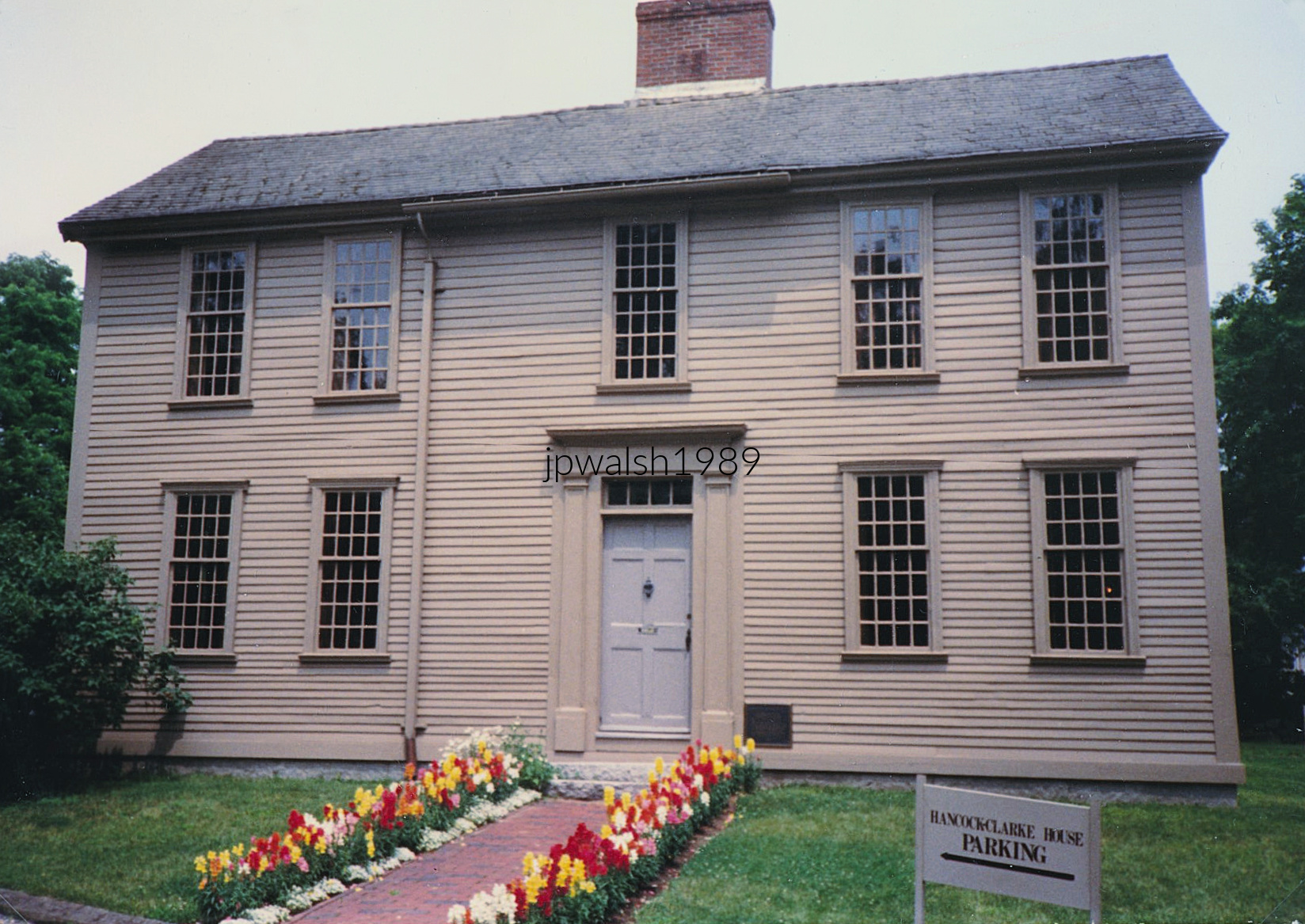
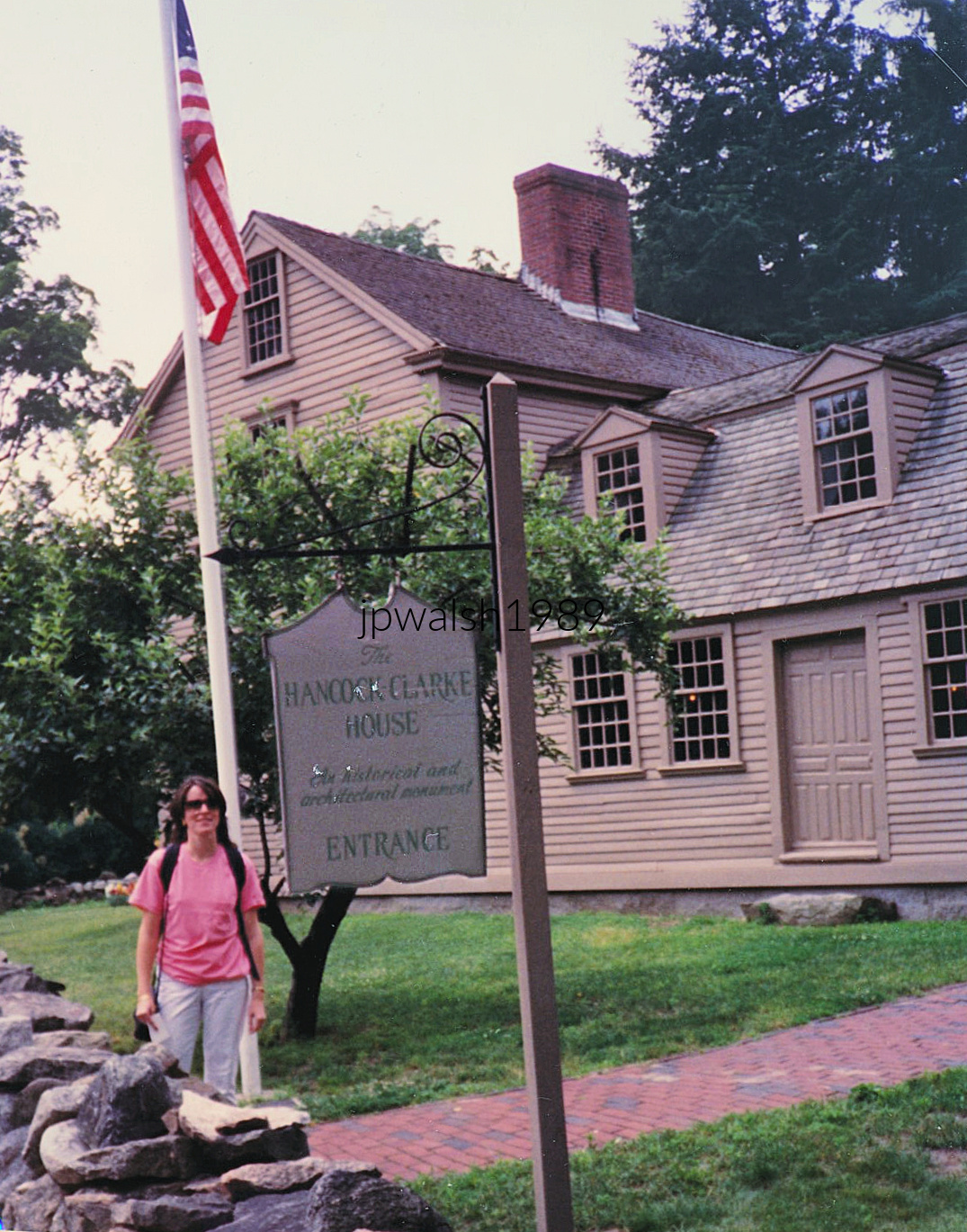
Built in 1738, the Hancock–Clarke House at 36 Hancock Street in Lexington, Massachusetts—less than half a mile from Lexington Green—is the historic residence where John Hancock (1737–1793) and Samuel Adams (1722–1803) were staying on the eve of the Battle of Lexington and Concord on April 19, 1775. Author’s photograph, July 1989.
John Hancock and Samuel Adams attended the Massachusetts Provincial Congress in Concord on the evening of April 18, 1775, and spent the night in Lexington as guests of Rev. Jonas Clarke (1730–1805). Clarke, a Harvard graduate and Lexington’s pastor since 1755, feared the two leaders might be seized by the advancing British. In Boston, Joseph Warren (1741–1775) dispatched William Dawes (1745–1799) and Paul Revere (1734–1818) to warn them; arriving separately at the Hancock–Clarke House around midnight, both riders delivered the alarm before continuing on toward Concord. Hancock and Adams then left for Burlington, about a half‑hour away by horseback, to ensure their safety. Author’s photograph, July 1989.
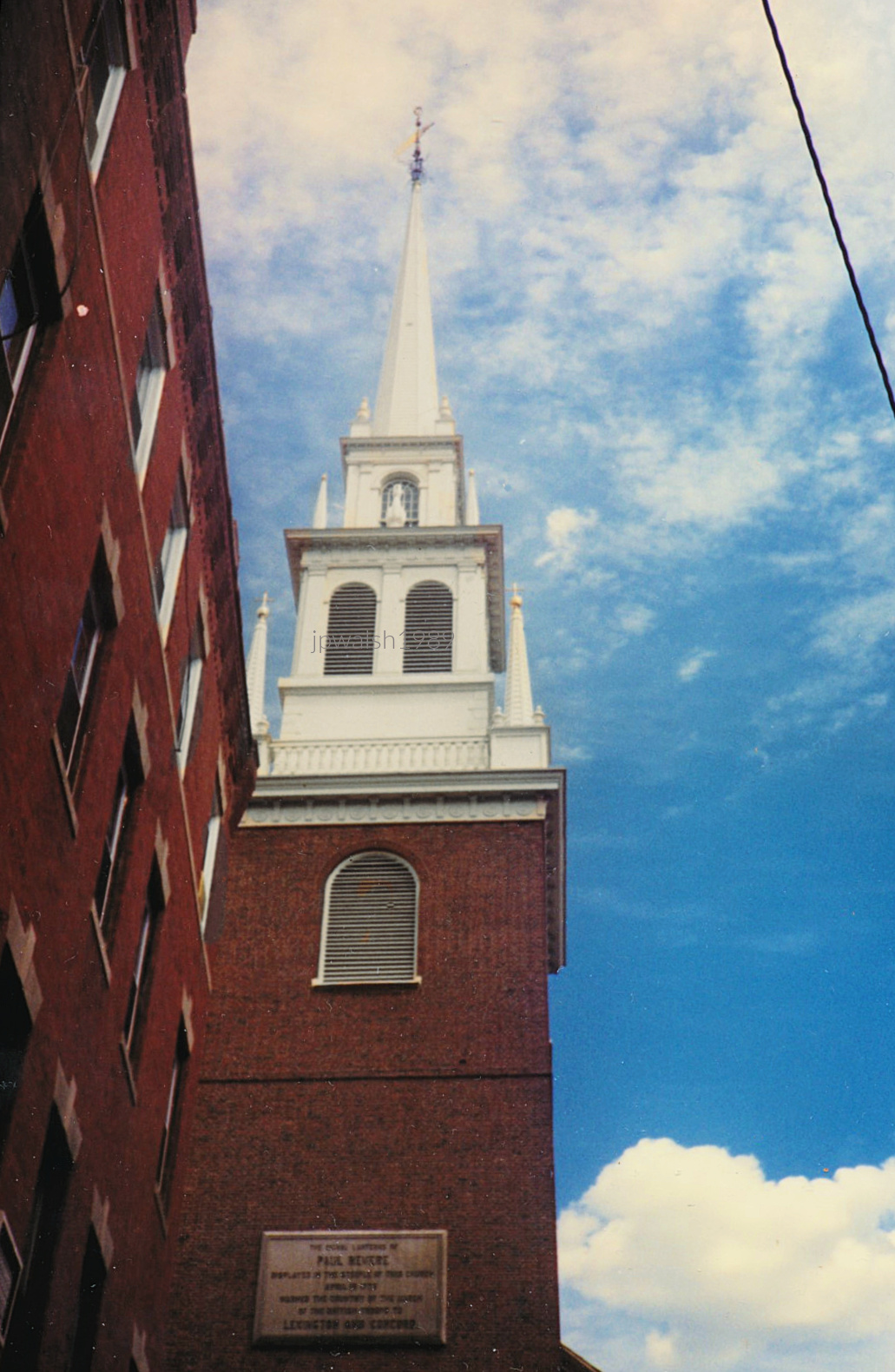
Old North Church, founded in 1723 as Christ Church, is best known for the night of April 18, 1775, when sexton Robert Newman and vestryman Capt. John Pulling Jr. climbed the steeple to display two lanterns. Their signal—alerting Paul Revere’s network that British troops were crossing the Charles River “by sea” toward Lexington and Concord—set in motion the opening moments of the American Revolution. see – https://www.oldnorth.com/ – retrieved April 19, 2025. Author’s photograph, July 1989.
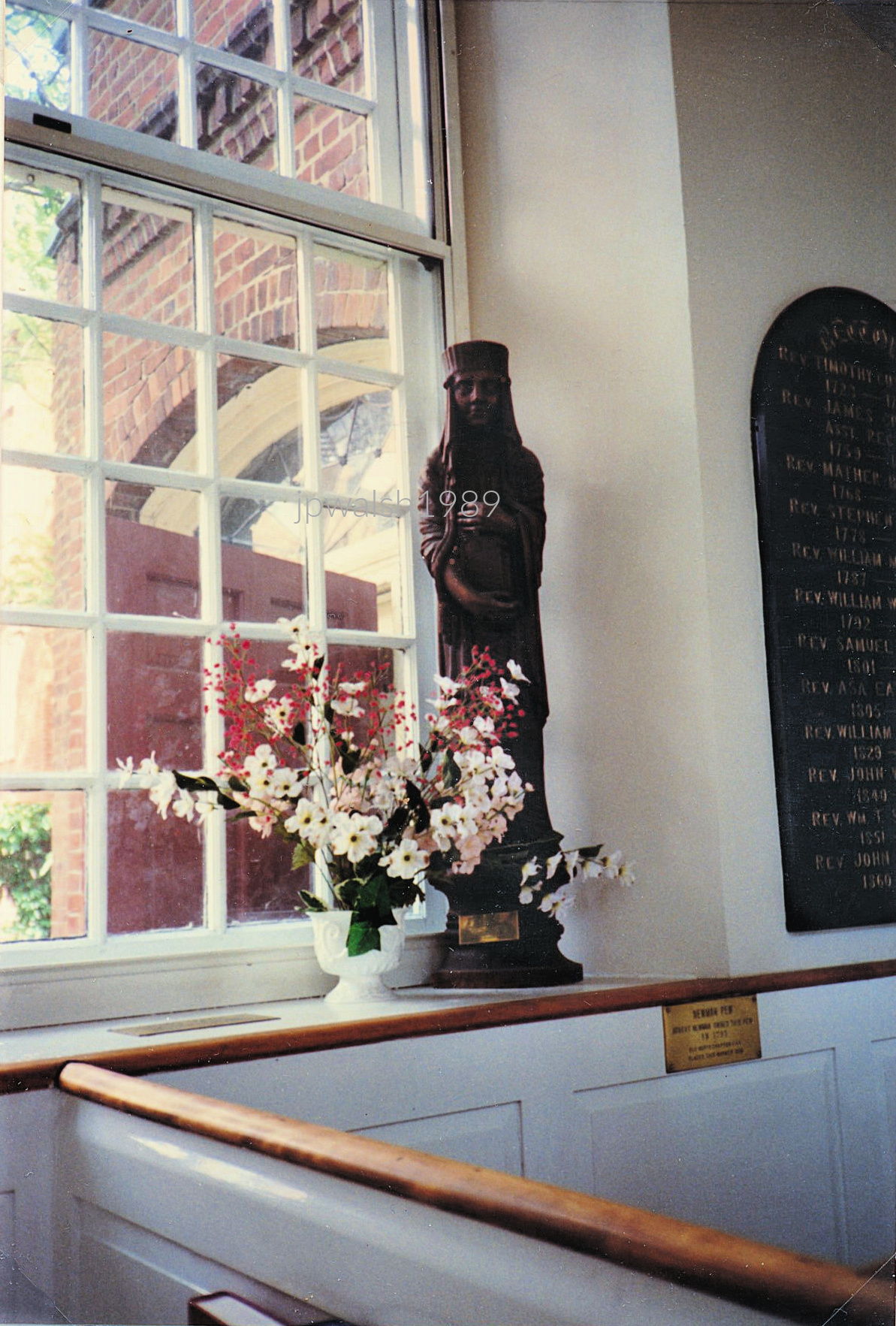
Inside Old North Church, visitors stand only a short walk from Copp’s Hill Burying Ground, where Increase Mather (1639–1723) and his son Cotton Mather (1663–1728) are buried. Both served as Puritan ministers whose era of leadership overlapped with the notorious Salem witch trials. Author’s photograph, July 1989.
Paul Revere, c. 1770, by John Singleton Copley (1738–1815), Museum of Fine Arts, Boston. Public Domain. Unlike Copley’s formal portraits of Samuel Adams and John Hancock—both displayed in Boston’s Faneuil Hall—Revere’s portrait was long kept in the Revere family attic, disliked for its informality. After Revere’s fame surged with Henry Wadsworth Longfellow’s 1861 poem Paul Revere’s Ride, the painting was restored in 1875, though it was not publicly exhibited until 1928. Revere’s descendants donated it to the Museum of Fine Arts in 1930.https://collections.mfa.org/objects/32401/paul-revere?ctx=00d797a8-0c5a-4d78-ba26-db22eb858902&idx=5 – retrieved April 19, 2025.
Author at the Paul Revere House in Boston with a work friend of my dad. March 1976. Author’s collection.
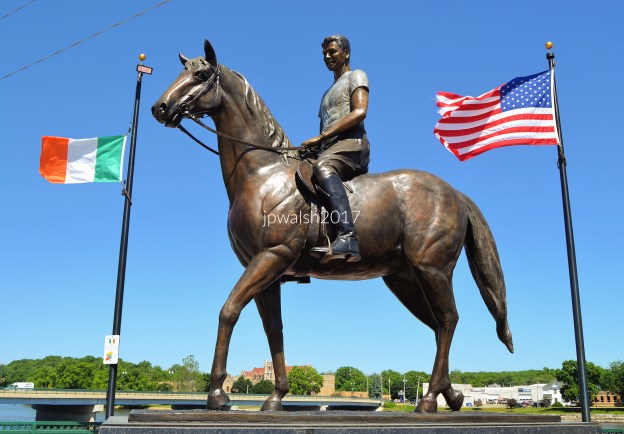
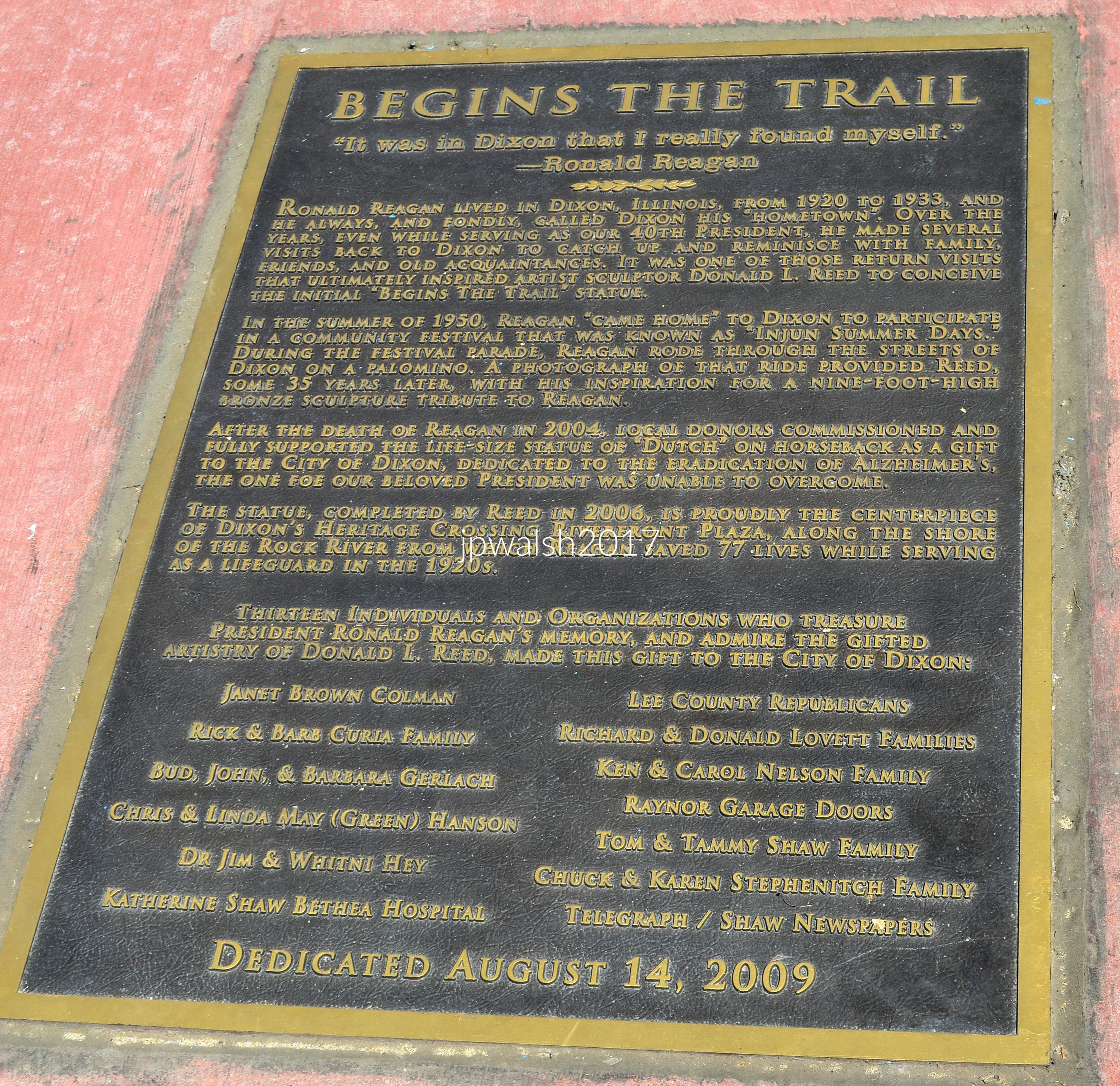
Feature Image: June 2017. 4.37mb DSC_0785. The statue of Ronald Reagan by American sculptor Donald L. Reed in DIxon, Illinois, was dedicated on August 14, 2009. It is based on a photograph of Reagan when he visited Dixon in 1950 and rode a horse through its streets in a parade.The statue itself is nine feet high on its pedestal and called Begins the Trail. It is the first of a series that includes a life-sized statue for the Reagan Foundation at the Ronald Reagan Presidential Library in Simi Valley, California, called Along the Trail. These artworks capture Reagan’s rugged amiable nature and his natural ability throughout life when riding. see – https://www.cowboysindians.com/2016/02/ronald-reagan-rides-again/ – retrieved April 13, 2025.
All text and photographs (except where noted) by John P. Walsh.
June 2017. 4.76mb DSC_0797.
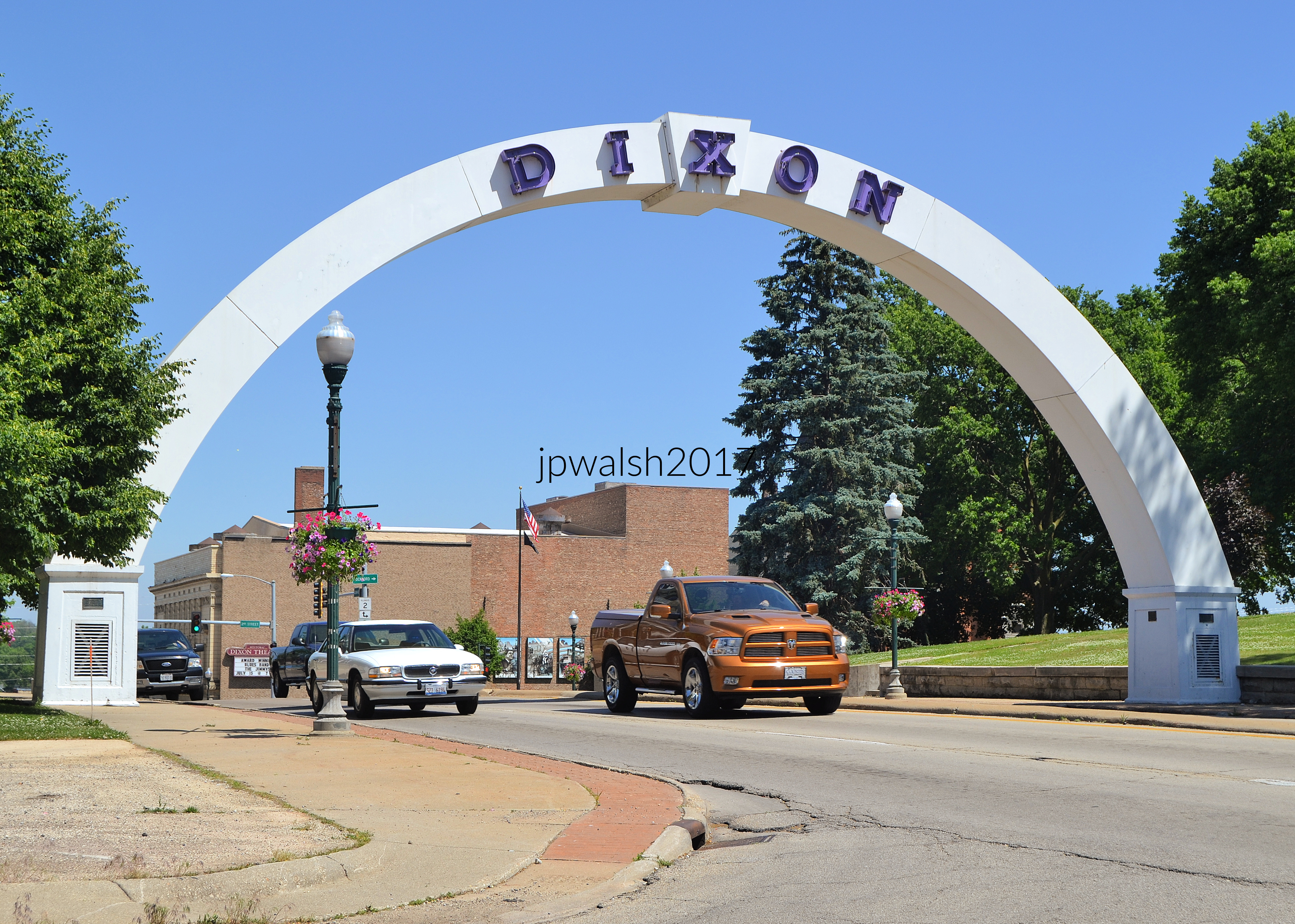
Considered the heart of Dixon, the memorial arch has been a landmark since the 1920s. The original arch, built in 1919, was made of beaver board and wood. It was built to celebrate the return of Dixon’s soldiers after World War One. In 1949, a new arch was constructed of wood. It was replaced in 1966 when Galena Avenue was widened. In 1985 the arch was replaced with this fiberglass one with the letters from the 1966 arch. In 2024 it went through a major restoration. See – https://www.wifr.com/2024/06/04/dixons-iconic-memorial-arch-facing-repairs/ – retrieved February 28, 2025.
June 2017. 5.41mb DSC_0822.
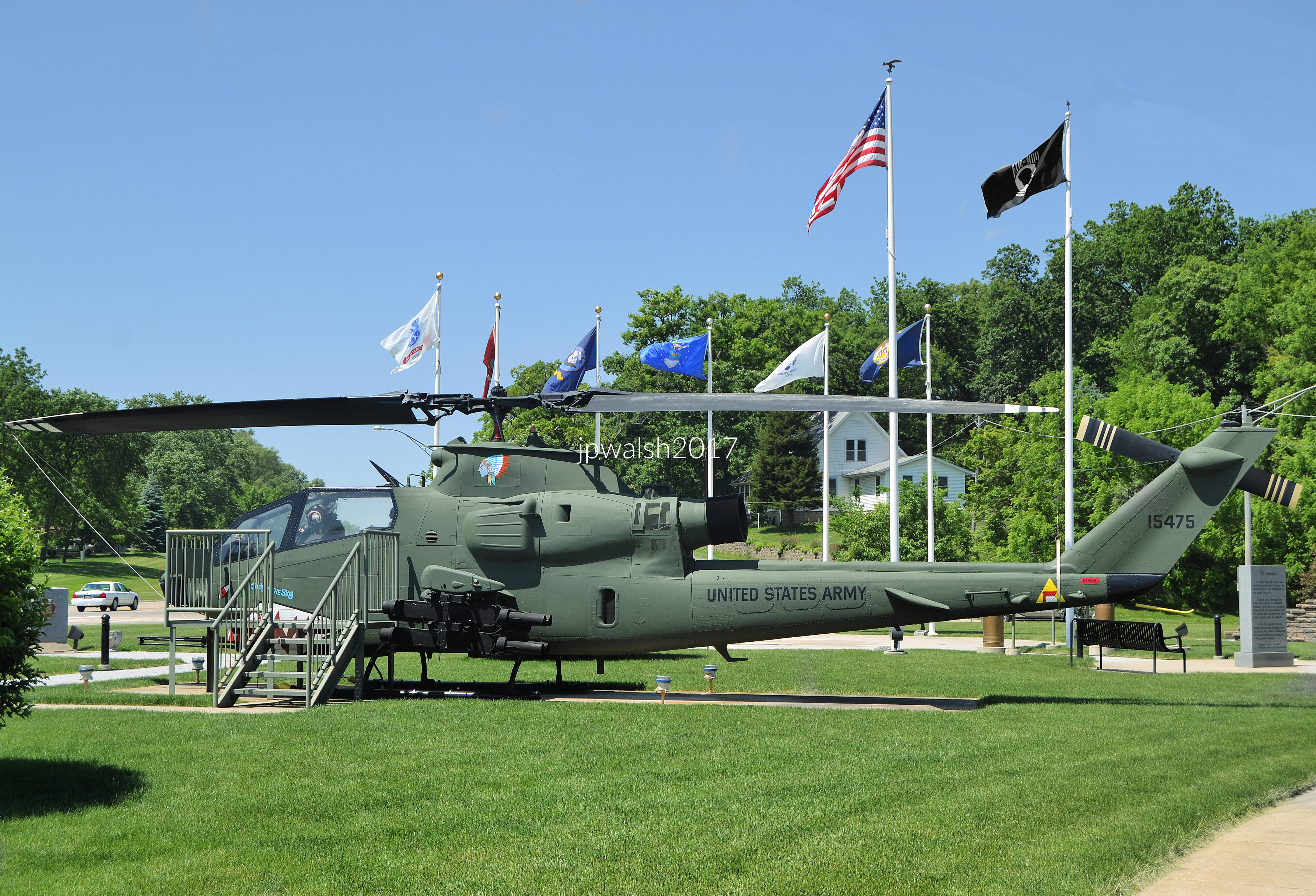
This helicopter (above and below) wears five Purple Hearts carved from enemy ground fire in Vietnam — battered, scorched, and shot to pieces, yet every time it clawed its way back through the smoke, it delivered its crew home alive. In Dixon’s (Illinois) Veterans Memorial Park founded in 2001 the 1967 AH-1F Cobra Attack Helicopter Gunship (serial #67-15475) was issued to the 7th Squadron of the First Calvary Divisions Aviation Group for its entire tour of duty. This helicopter arrived in Vietnam in March 1967. Following 1142 combat hours flown, the helicopter was damaged on July 27, 1969, because of a weapons malfunction. At 1792 hours flown it was shot down on February 6, 1970, by heavy enemy ground fire while providing armed escort to medivac helicopters with both crewmen wounded. On April 15, 1970, at 1954 hours flown, it was damaged while providing direct fire support to infantry. On July 13, 1970, it was shot down by small arms fire while providing escort at 2092 hours. At 2471 hours, on January 19, 1971, it was severely damaged by gunfire while providing direct escort protection to ground troops. On July 6, 1971, it was damaged by heavy ground fire on an armed escort mission at 2745 hours flown. see – Cobra Attack Helicopter – Veterans Memorial Park & Museum – retrieved April 13, 2025.
June 2017. 6.18mb DSC_0821 (2)June 2017. 3.12mb DSC_0751. Author’s photograph.
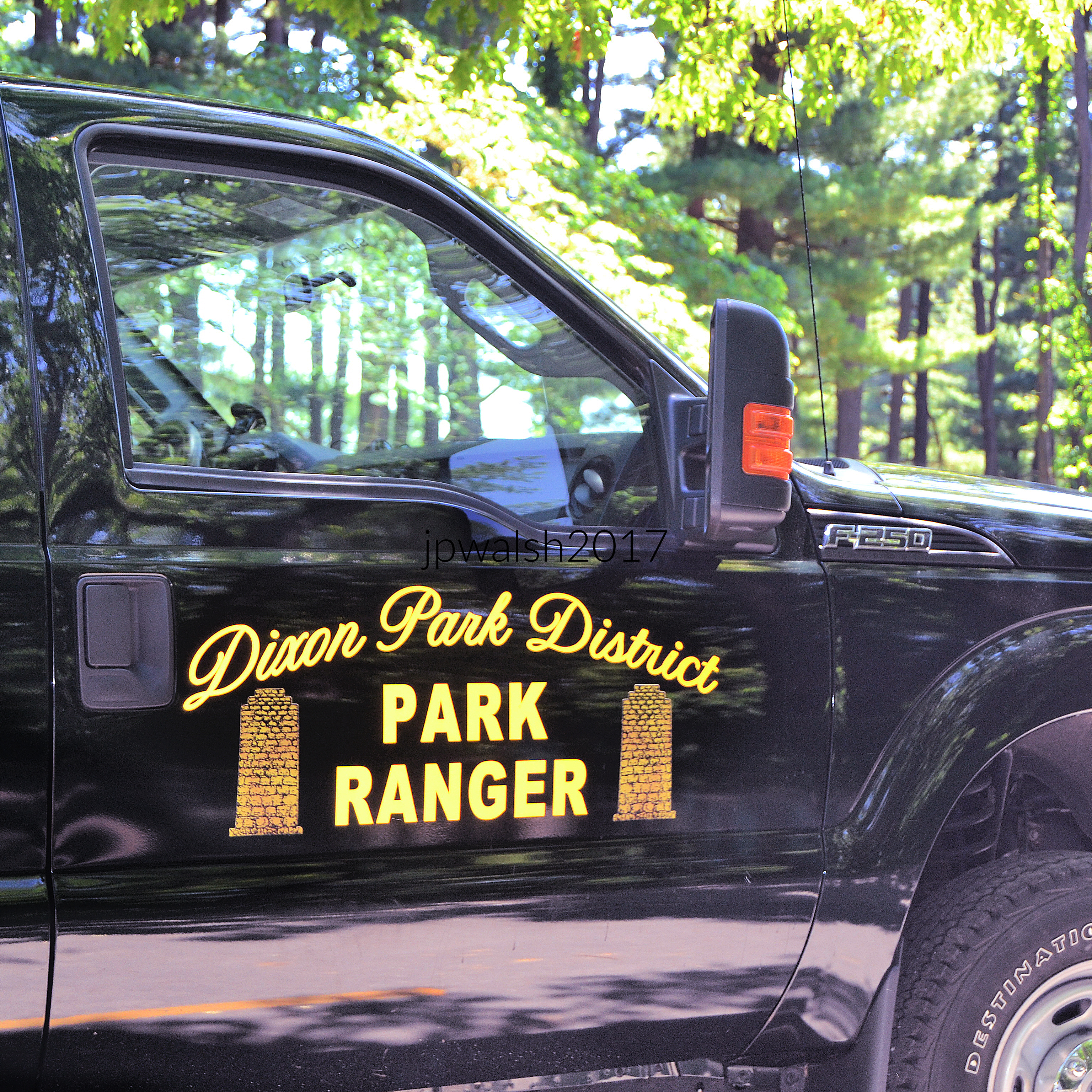
On June 5, Ronald Reagan’s death day, Honor Guard gather at the Reagan Boyhood Home in Dixon, Illinois.
June 2017. 4.13mb DSC_0845.
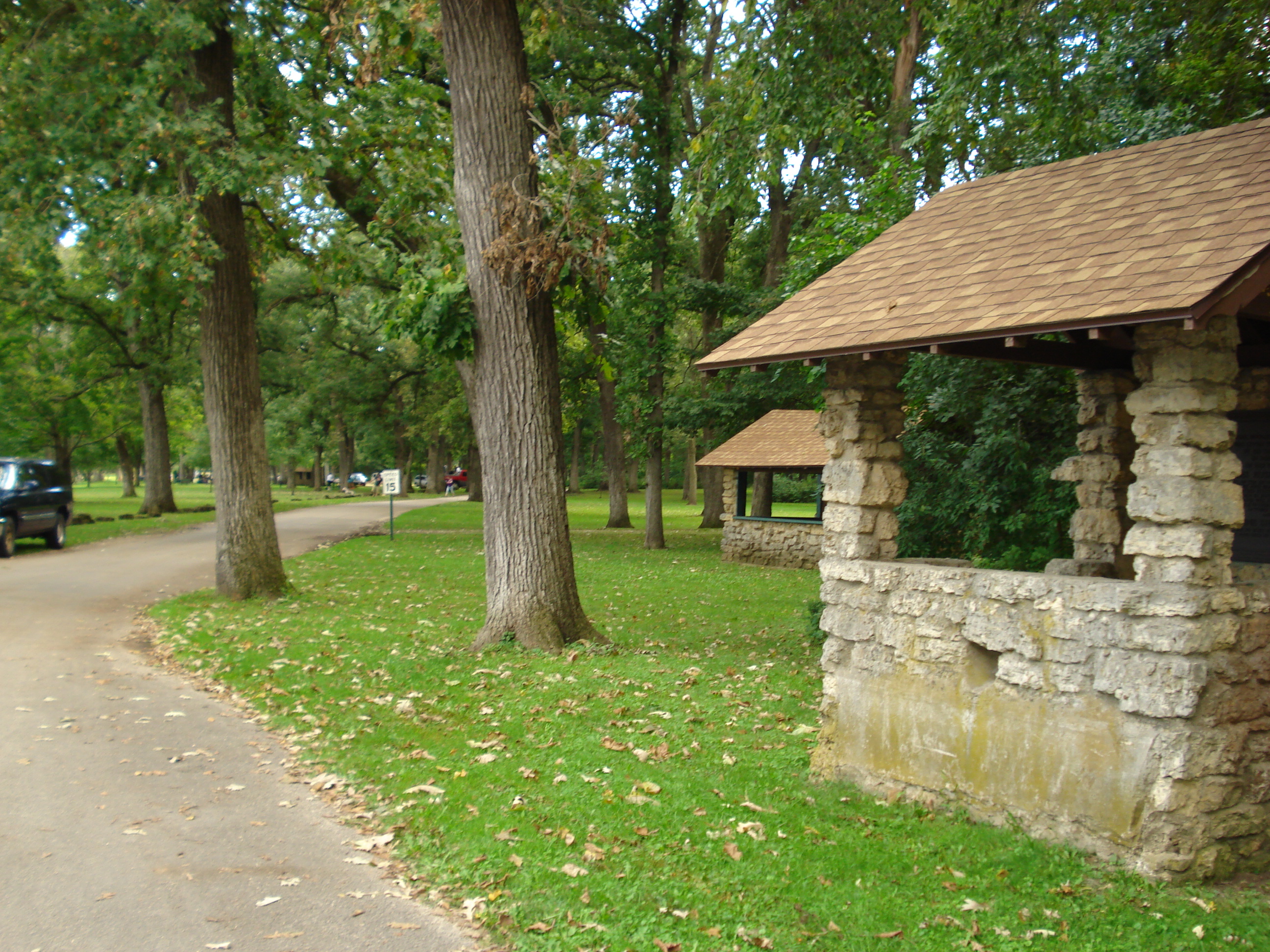
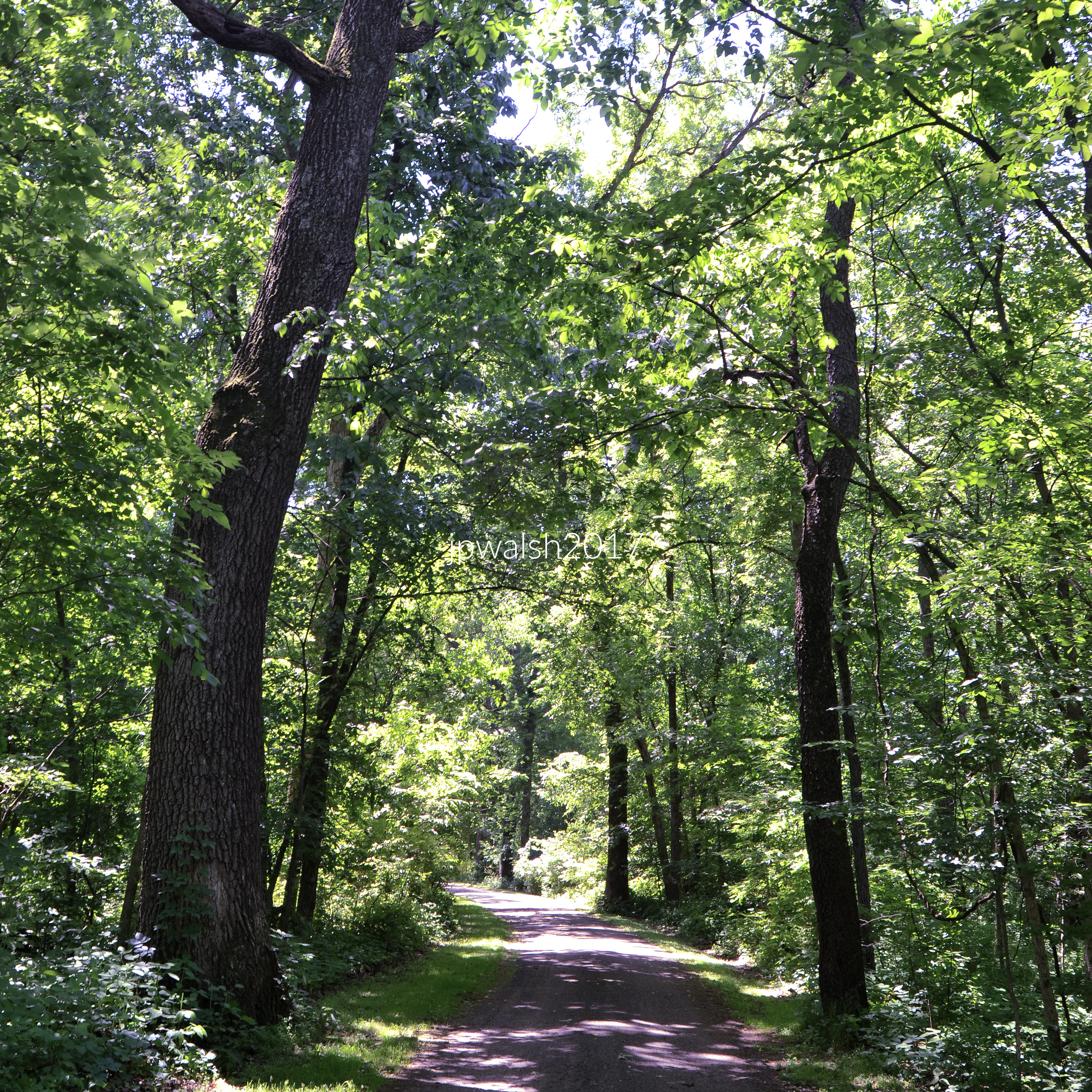
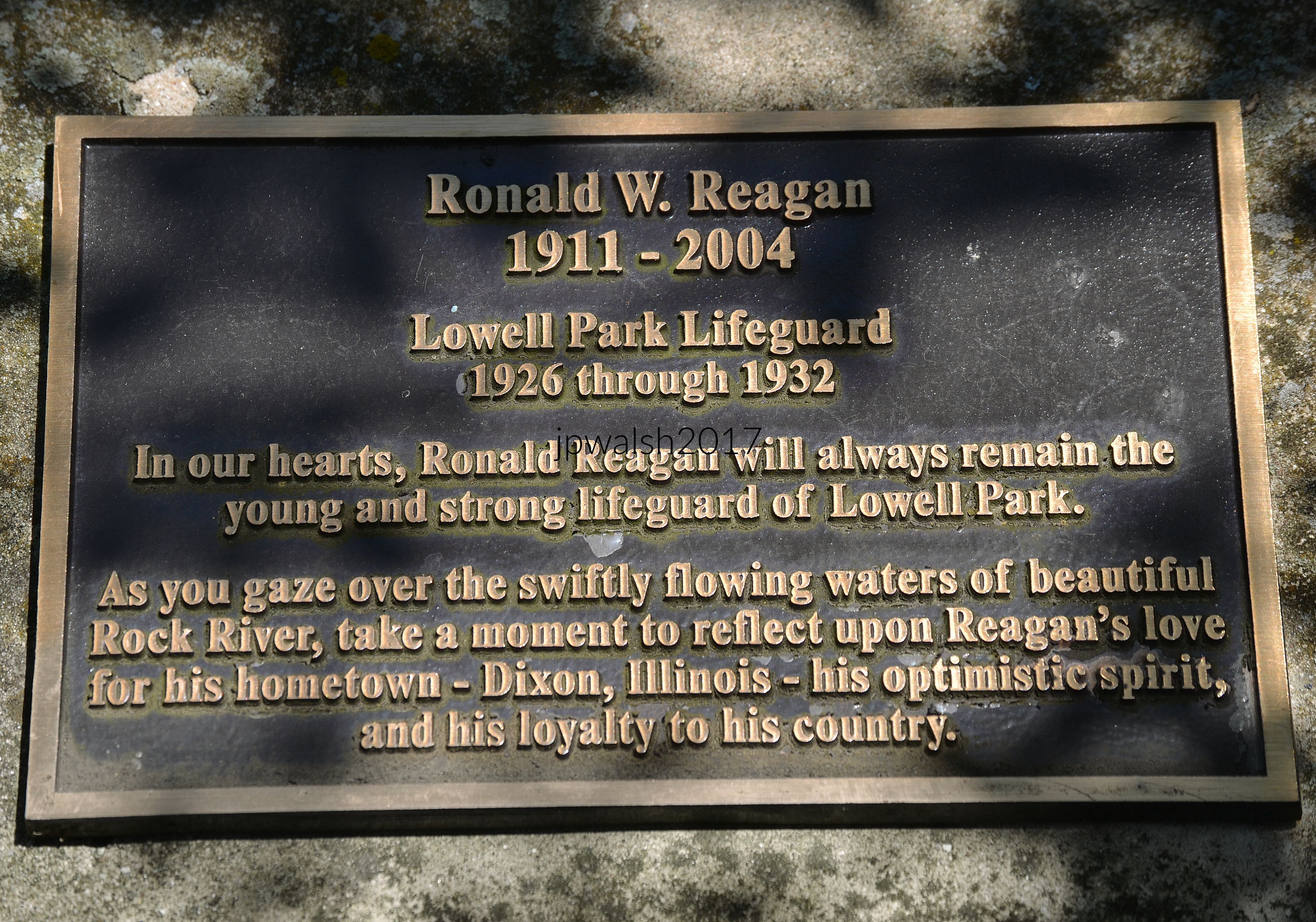
Reagan was a lifeguard at Lowell Park from 1926 to 1932. The original 200-acre public park opened in 1907 and began Dixon’s park system with the objective to preserve scenic beauty and establish civic beautification. From the start, Lowell Park attracted large numbers of people to its location along the Rock River. In this area, the valley of the Rock River contains bluffs and unique rock outcroppings that create a natural beauty. More than 100 years later, Lowell Park has maintained its distinctive scenic and natural recreational resources for free public use.
June 2017. 5.73mb DSC_0918.
Lowell Park predated the development of Illinois state parks in areas of outstanding natural attractions by many years. Lowell Park is the only public place in the Dixon area that preserves remnants of the Boles Trail established in 1826from Peoria, Illinois, to Galena, Illinois. The trail was replaced in popularity by the famous Kellogg Trail established in 1825 east of the Boles Trail route. See – https://historyillinois.org/boles-trail-the/ – retrieved March 3, 2025.
Lowell Park, Dixon’s first recreational park, was gifted in 1906 by Carlotta Lowell who was the niece of James Russell Lowell (1819-1891), a famous Boston (Cambridge) poet. The family came west on the invitation of Alexander Charters, a wealthy New York businessman, who purchased a large, wooded estate overlooking the river north of Dixon in 1837 and named it Hazelwood. His home later became the estate of Mr. & Mrs. Charles R. Walgreen, founder of the drug store chain that bears that name. Charles Lowell. a guest at Hazelwood, purchased the adjacent tract of land to live. Lowell married Josephine Shaw, also originally of Boston, and then of Staten Island in New York. When the Civil War broke out, Charles enlisted and was promoted to the rank of colonel and was killed in 1864 at the Battle of Cedar Creek in northern Virginia. Carlotta never knew her father as she was born after his death and the family never lived on their land in Dixon. In 1874, they moved to New York City and stayed there the rest of their lives. After her mother died, Carlotta offered the property in 1906 to the City of Dixon for a park in memory of her parents.
June 2017. 5.11mb DSC_0780.
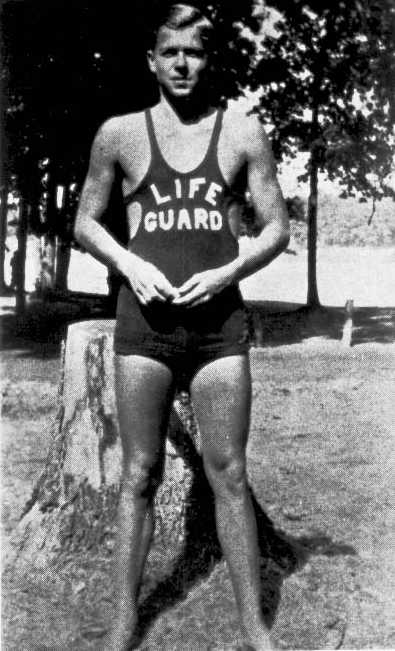
40th U.S. president Ronald Reagan visiting the Rock River in Lowell Park where he was an effective and beloved lifeguard for seven consecutive summers. In July 1921 a longer dock had been installed at the beach, extending 75 feet into the river with a springboard platform. The new bathhouse was built in 1922 that accommodated hundreds of bathers. Electricity was installed at the park in 1922 with lighting that allowed the beach to remain open until after dark. Over those summers, Reagan saved 77 swimmers from drowning. Obviously proud of his achievement, President Reagan often showed his Oval Office visitors a picture of the Rock River while telling them that his lifeguarding there was “one of the best jobs I ever had.”
The original 200 acres of Lowell Park opened to the public in 1907. The park was designed by the Olmsted Brothers, a nationally prominent architecture firm headed by the sons of Frederick Law Olmsted. Lowell Park was designed in the American Romantic style which is characterized by its emphasis on natural scenery, native plant materials, native building materials, curvilinear roads, and minimum formality. In 1959 the beach was finally closed after ten years of declining usage due to the opening of Memorial Pool in Vaile Park in the city of Dixon. The Lowell Park bathhouse was used for storage as its concession stand continued to operate until the late 1980s.
June 2017. Lowell Park was designed in the American Romantic style by the Olmsted Brothers. 7.24mb DSC_0916 (1)
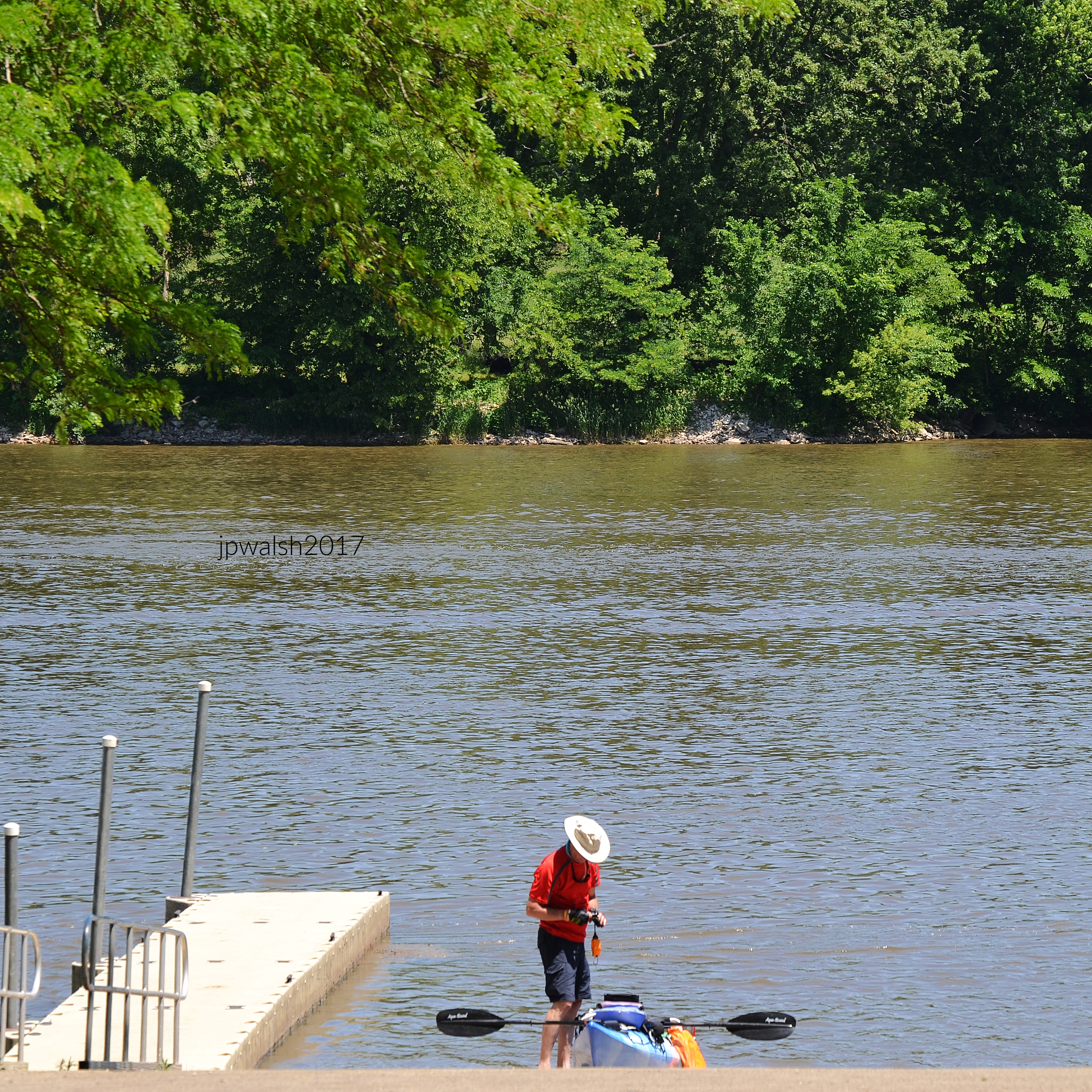
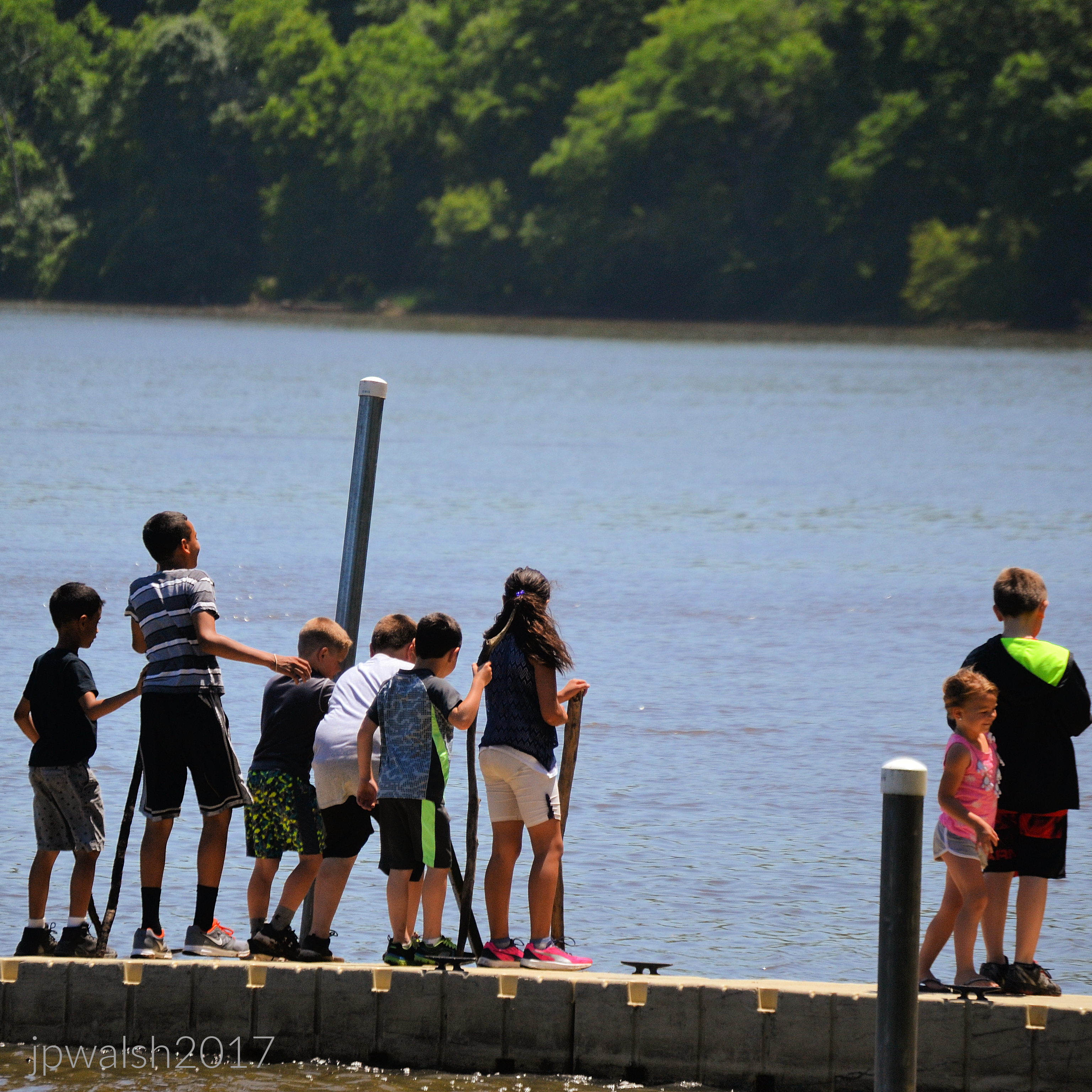
Rock River at Lowell Park is still the hub for recreational activities as it has been for over a century.
June 2017. 5.25mb DSC_0901.
President Reagan on his lifeguard years in Dixon: “One of the Best Jobs I Ever Had.”
Ronald Reagan as a lifeguard at Lowell Park in 1927. Public Domain.
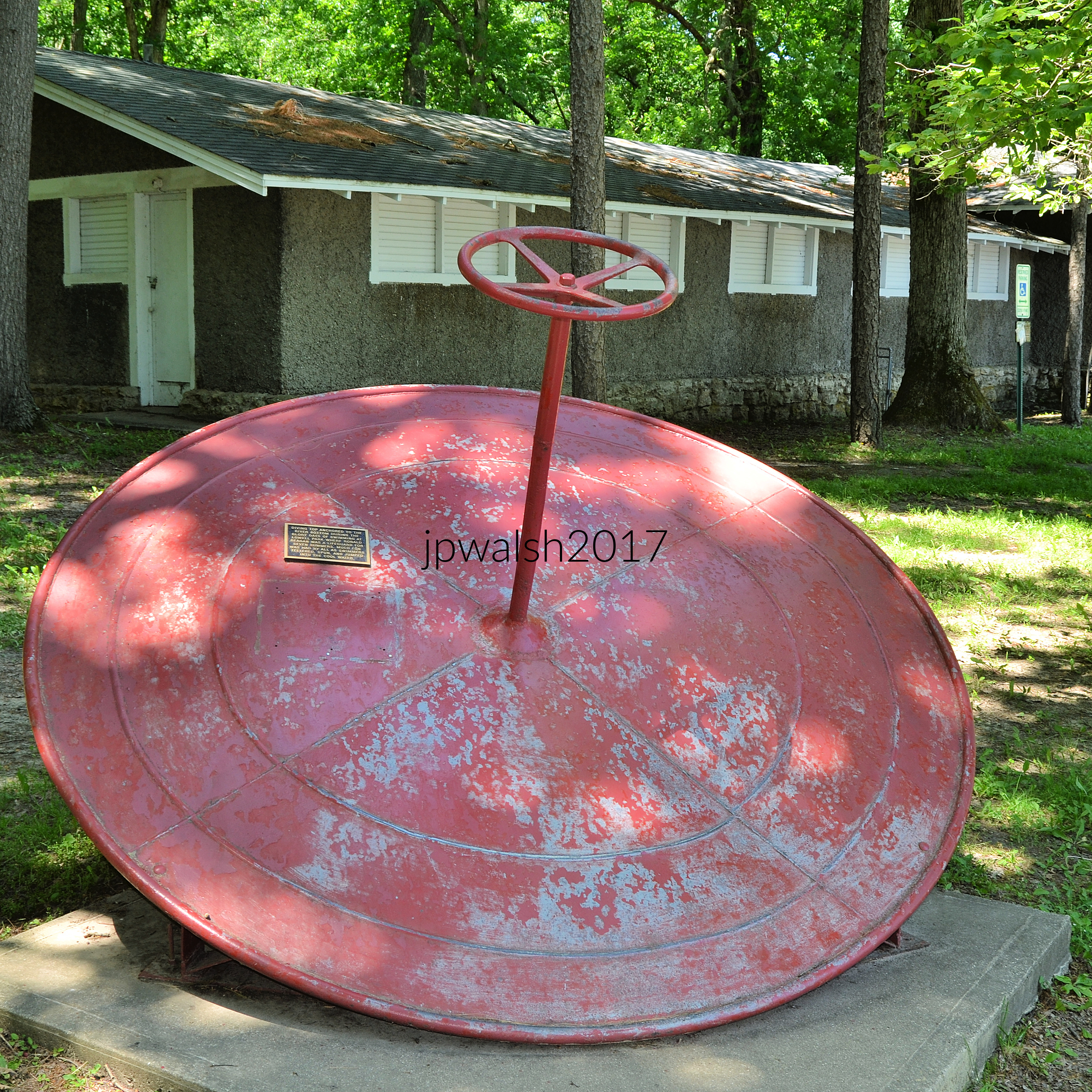
June 2017. Lowell Park, Dixon, IL. DSC_0882June 2017. Diving top with changing rooms and concession behind. Lowell Park, Dixon, IL. 5.38mb DSC_0896
Bus service from Dixon city to the park started in 1921. This diving top was anchored to the river bottom during its swimming hole glory days when Reagan was lifeguard. Swimmers teetered, spun and jumped into the water during hot Illinois summers which Reagan knew and loved. The one-story bathhouse behind it was designed and built in 1922. When Reagan was a lifeguard the building served as the concession stand and the check area for clothing baskets. Under a hipped roof, the men’s wing was to the south and women’s wing out of sight to the west. The architect of the bathhouse is unknown. Native stone was used from the ground to the height of the concession building’s serving counters and for the foundations of the two wings. Above that the walls were stucco on the exterior. All stonework was coursed and roughly squared. It was ventilated by raising the hinged board covers of the screened window openings. The steel-supported roof was covered originally with black-blue slate shingles that were replaced in 1934 with asphalt shingles. The overhang is broad with exposed rafters.
June 2017. Lowell Park, Dixon, Illinois. 3.53mb DSC_0877
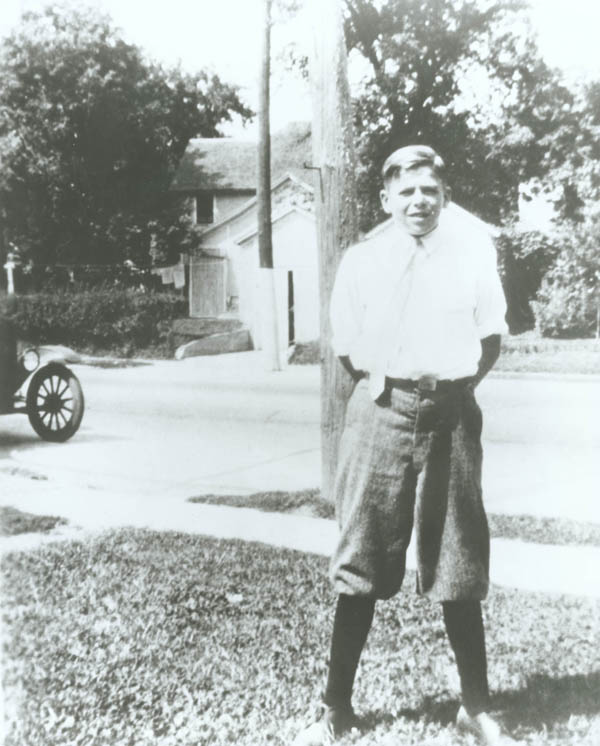
Ronald Reagan in Dixon, Illinois, in the early 1920’s. Public Domain.
June 2017. 5.93mb DSC_0774.
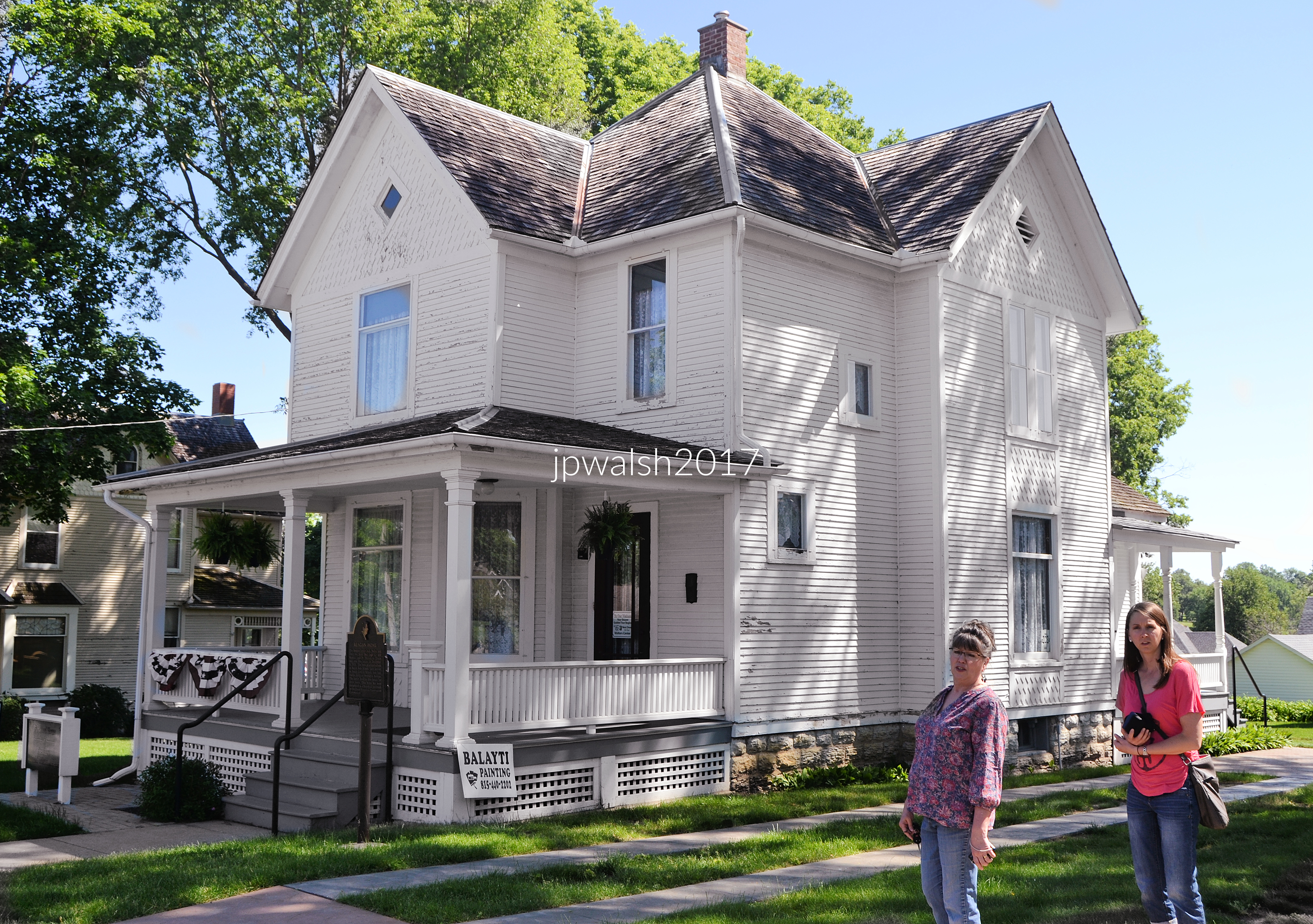
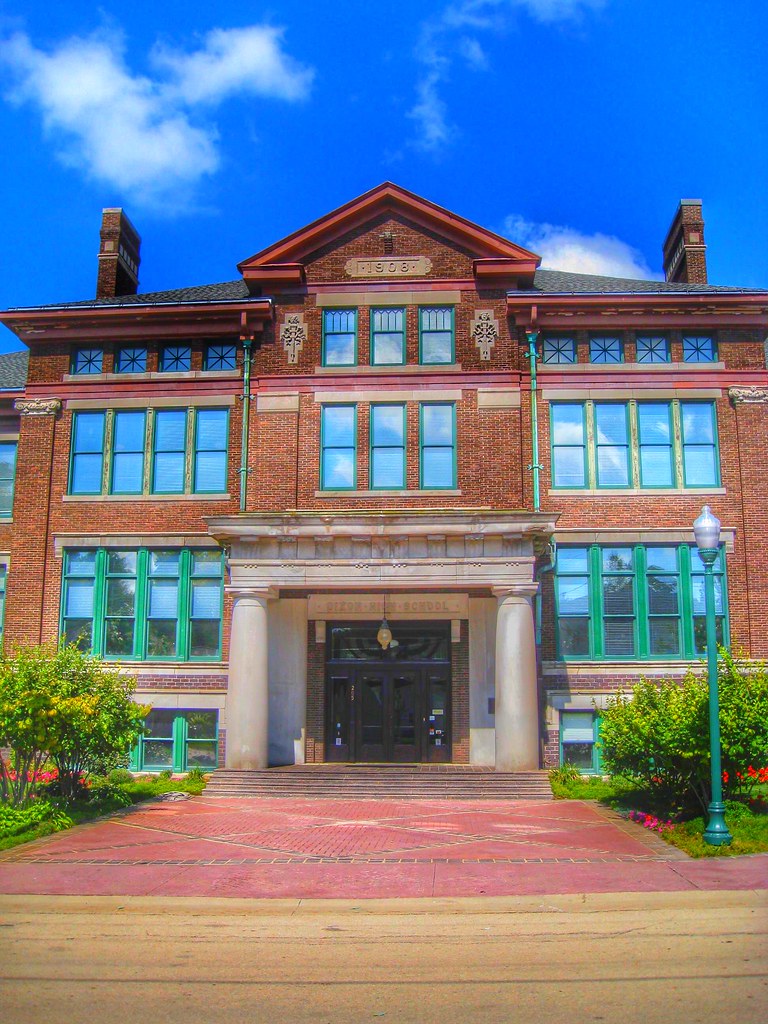
The Reagans settled in this rented house at 816 S. Hennepin Avenue in Dixon, Illinois, on December 6, 1920. The family of father Jack, mother Nelle, and 12-year-old Neil and 9-year-old Ronald lived here for three years. From 1921 to 1924, Neil and Ron attended South Side/Central School which still stands four blocks north of the house and is now the Dixon Historic Center. Reagan often walked along Hennepin Avenue going downtown to the Dixon Public Library at 221 South Hennepin Avenue and the First Christian Church at 123 South Hennepin Avenue where both Neil and Ron were baptized on June 1, 1922. Nelle taught Sunday school and sang in the church’s choir. Ronald and his mother were members of the Disciples of Christ church until 1937. Between 1924 and 1930, the Reagans lived in a rented house at 338 W. Everett Street in Dixon. Reagan lived in that house in Dixon when he was home from college after he began attending Eureka College in September 1928.
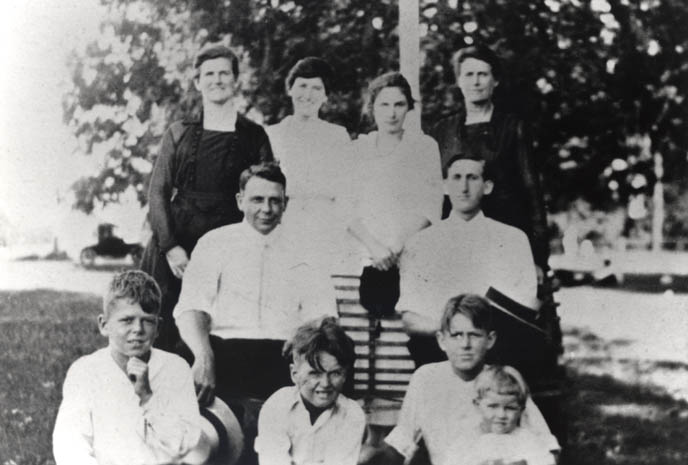
Reagan 1920s with family. Ronald Reagan sitting (hand on chin in front row) posing with other family members, Neil Reagan at far right (front row), Jack Reagan (middle row at left), Nelle Reagan (last row, second from left), Illinois. Public Domain.
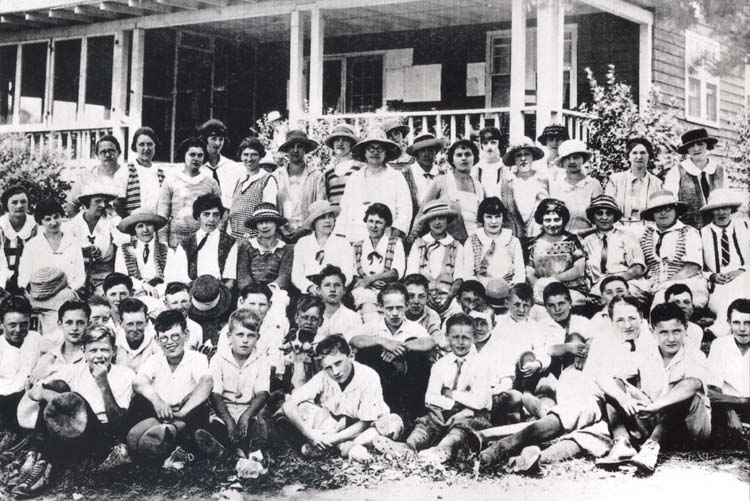
Ronald Reagan sitting (hand on chin in front row) with other golf caddies for the Lincoln Highway Ladies Golf Tournament in 1922 in DeKalb, Illinois. Public Domain.
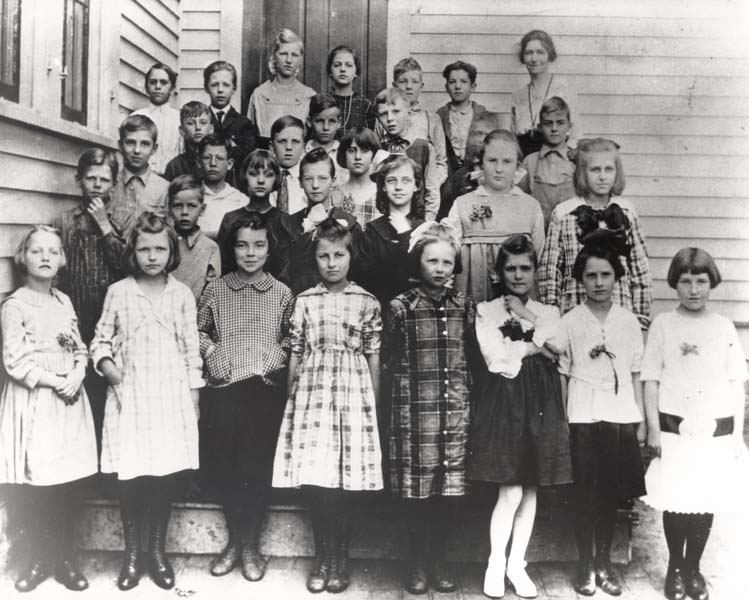
Reagan (second row, left) in 4th grade in Tampico, Illinois. Reagan was born in Tampico, Illinois, on February 6, 1911 in a second-floor apartment at 111 Main Street and, until 1914, at 104 W. Glassburn Street. Afterwards the family moved in sequence to Chicago, Galesburg, and Monmouth until they returned to Tampico in 1919-1920 and ultimately to Dixon in early December 1920. Reagan’s father was an alcoholic and they moved around a lot. As a young man Reagan became a lifesaver. Public Domain.
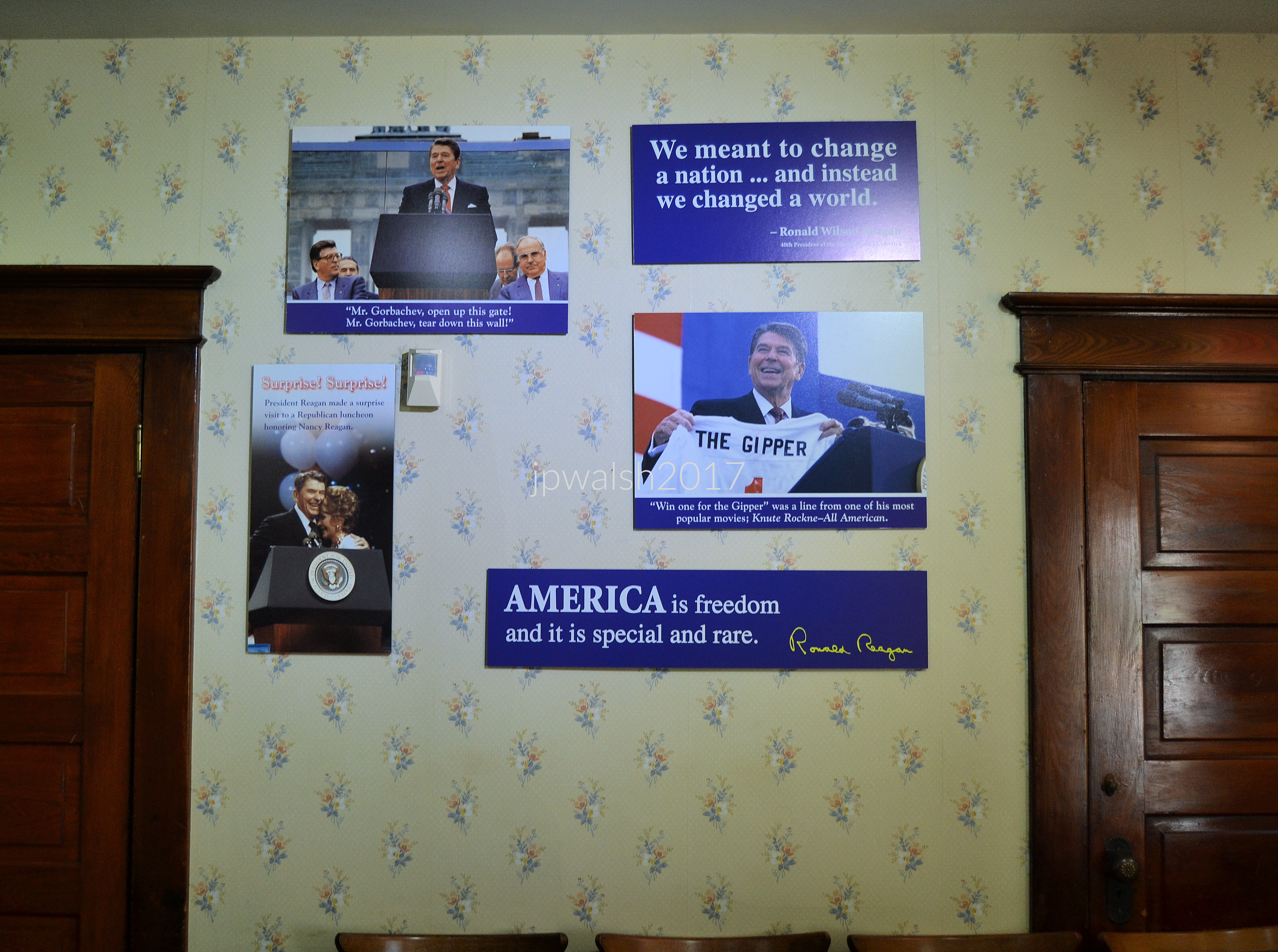
June 2017. Inside the Reagan Boyhood Home, Dixon, Illinois. 4.90mb DSC_0778 (1)
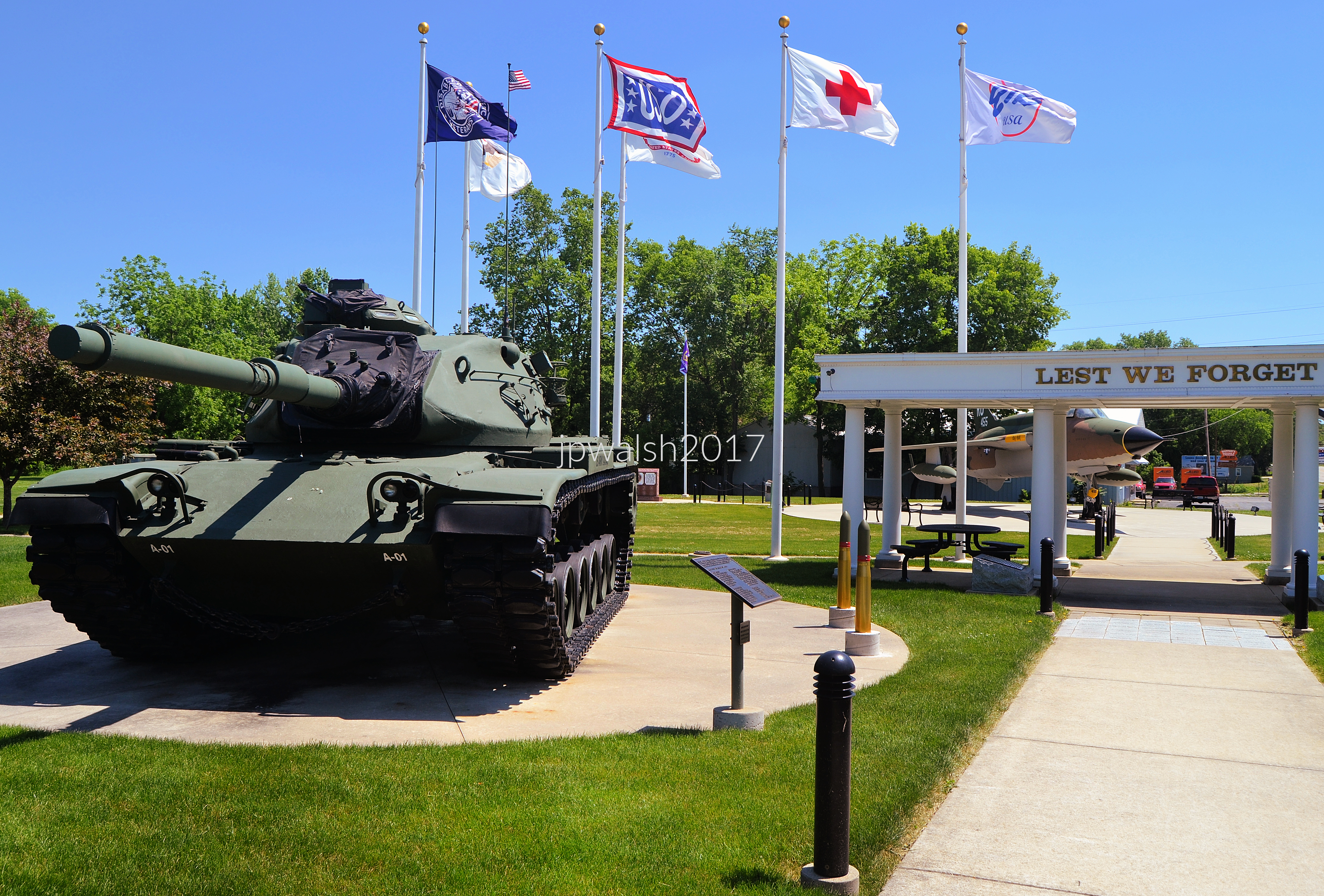
June 2017. Veterans Memorial Park, Dixon, Illinois. 6.41 mb DSC_0827.
The M60 tank is designed as one of the main assault vehicles of an Armor/Mechanized Infantry/ Infantry Division. It weighs about 105,000 pounds unloaded and has a 64,000 pound payload. The tank can travel at top speeds of 30 m.p.h. and can travel nearly 300 miles.
June 2017. Veterans Memorial Park, Dixon, Illinois. 7.05mb DSC_0831.
Republic F-105D Thunderchief (serial #60-455) was a new aircraft that served the U.S. Air Force from 1958 to 1984. This specific aircraft fought in Vietnam between 1968 and 1970. It was stationed at Takhli Airforce Base in Thailand with the 355 Tactical Fighter Wing that was established in April 1962 at George AFB in California and transferred to Thailand in 1965. This F-105D Thunderbird was one of 833 airplanes manufactured by Republic in Farmingdale, New York, with over half the fleet lost in combat or due to mechanical failures. With 610 built, this particular warbird was the definitive production model with all-weather capability because of advanced avionics, including AN/APN-131 navigational (Doppler) radar. This aircraft was retired with almost 6000 flying hours and two men who had flown it receiving the Medal of Honor. The plane’s maximum range is 2390 miles at a maximum ceiling of 48,500 feet and reached speeds of supersonic Mach 2 (1,534 m.p.h.) at over 36,000 feet. In addition to a Vulcan Gatling Gun the plane’s payload includes 750-pound conventional bombs (16 of them) or one nuclear bomb.
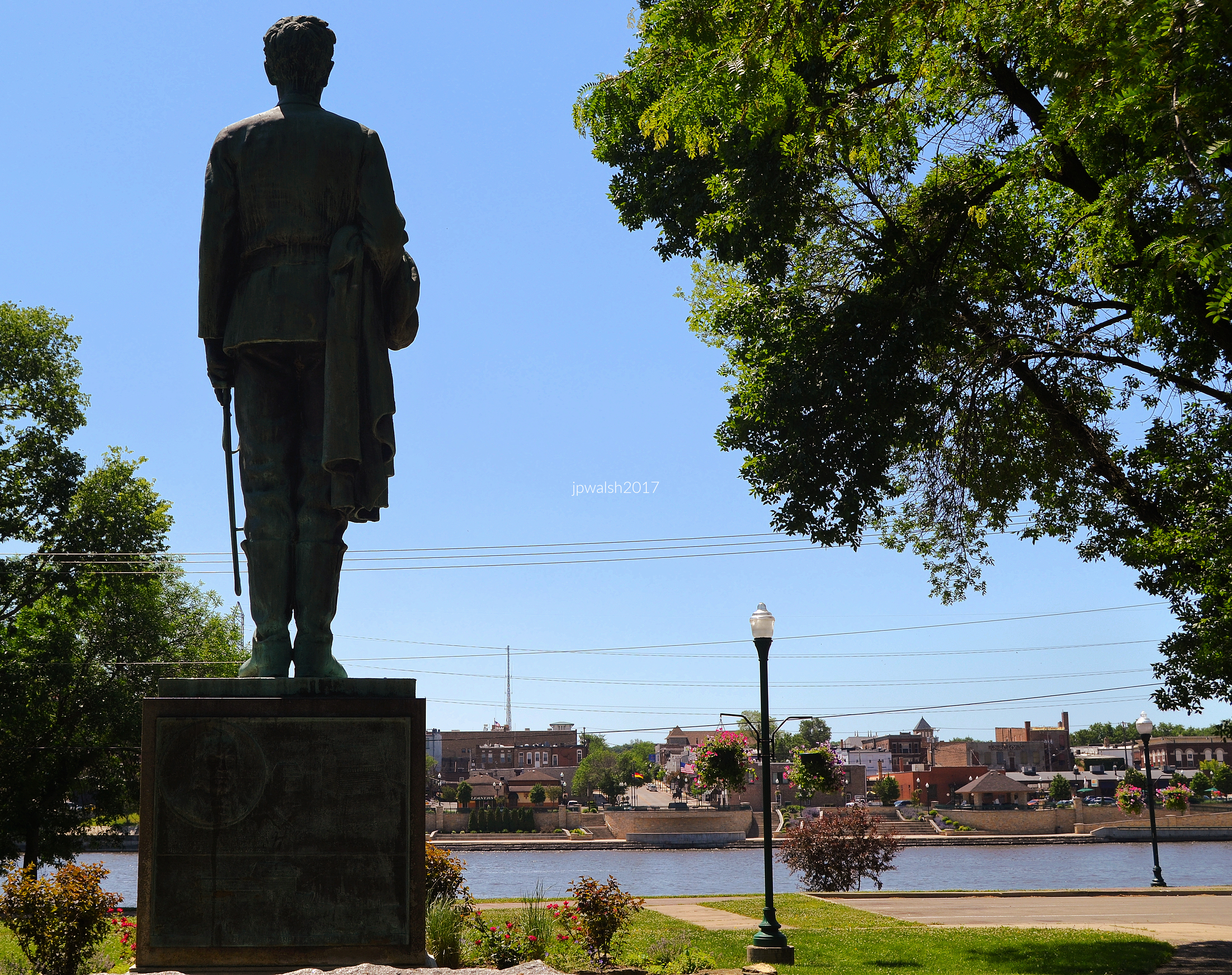
Capt. A. Lincoln, 16th president of the U.S., looking onto the Rock River in Dixon, Illinois, This 1930 statue by Leonard Crunelle (1872-1944) Reagan would have seen and known while living in Dixon. Young Lincoln enlisted in the Illinois Volunteers on April 21, 1832 and, following more enlistments, finally mustered out of military service on July 10, 1832. Across the Rock River is the modern Reagan statue.
June 2017. 4.37mb DSC_0785.
Ronald Reagan (1911-2004) lived in Dixon, Illinois from 1920 to 1933. Reagan always referred to Dixon as his “hometown.” Reagan made several visits to Dixon after he lived here, even when he was President of the United States. The statue is on the banks of the Rock River which is the same waterway where Reagan saved 77 lives as a lifeguard upstream at Lowell Park.
June 2017. 3.38mb DSC_0783.
After Reagan’s death in 2004 local donors commissioned this larger-than-life-sized statue of Dutch Reagan on a palomino horse and gifted it to the City of Dixon. It was dedicated to the eradication of Alzheimer’s that was a foe that President Reagan had to battle in last years.
June 2017. 5.28mb DSC_0786 (1)
Reagan in DIxon in the early 1920’s. Public Domain.
In 1982, President Reagan told the Eureka College audience, “Everything that has been good in my life began here.”
September 2016. Eureka College’s Burrus Dickinson Hall built in 1858. 3.87 mb
On campus at Eureka College in Eureka, Illinois, about 90 miles south of Dixon, where Reagan lived. The college, affiliated with the Disciples of Christ of which Ronald Reagan was a member, was founded in 1855. At the time of its founding Eureka was one of a handful of U.S. colleges that was co-ed. In 1856 Abraham Lincoln spoke on campus. After he graduated Reagan returned for campus visits at least a dozen times and served on its board of trustees. Reagan attended Eureka College from 1928 to June 10, 1932, when he graduated as the elected student body president with a degree in economics/sociology. Eureka College is the smallest college or university in American history to graduate a future U.S. president with a bachelor’s degree. The school is in Woodford County in Illinois.
On May 9, 1982, President Reagan announced the START treaty proposal in the Reagan Gym at Eureka’s commencement exercises. It resulted in a bilateral treaty signed in 1991 between the U.S. and U.S.S.R. on the reduction and the limitation of strategic offensive arms including nuclear warheads and intercontinental ballistic missiles and heavy bombers.
Ronald Reagan is the only U.S. president who was born, grew up and received his education in the state of Illinois.
September 2016. Part of the Berlin Wall. Eureka College. 2.40mb DSC_0493 (3)
Of Dixon the Gipper once said: “It was the place I really found myself.”
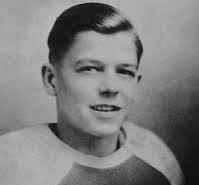
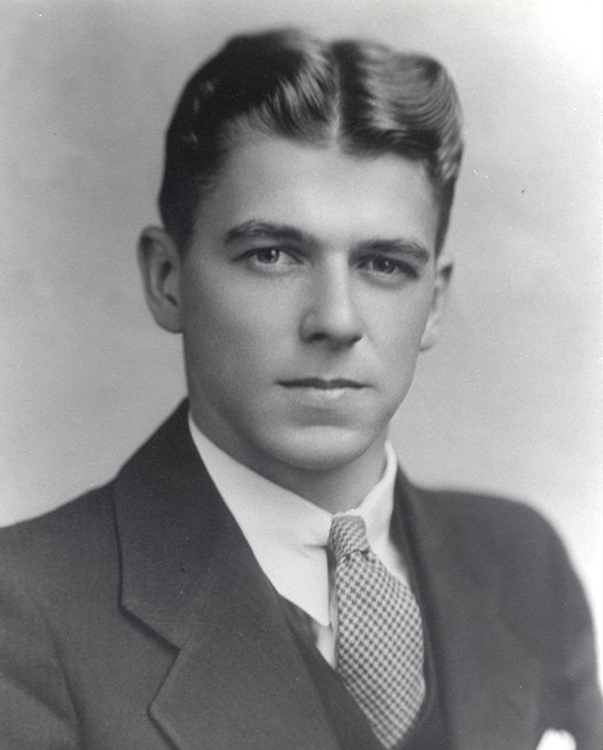
Portrait of Ronald Reagan in 1934 the year after he left Dixon, Illinois. His career led to Hollywood, California as a film actor and Screen Actors Guild president; to Sacramento, California as 33rd Governor of California (1967-1975); and to Washington, D.C., as 40th President of the United States of America (1981-1989). But it was to Dixon, Illinois, that Reagan always returned with its fond memories. Reagan graduated from Eureka College, a liberal arts school affiliated with the Disciples of Christ, in 1932 where he was active in sports and drama and elected student body president. Reagan’s first job was as a sports radio broadcaster in Davenport, Iowa, for Big Ten football games. Afterwards he was a sports announcer for Chicago Cubs’ baseball games on WHO-AM in Des Moines. Reagan arrived in Hollywood in 1937 and was cast in his first feature film Love is on the Air for Warner Bros. where he gets to play a newscaster. Fair use.
In Love is on the Air (1937) Ronald Reagan made his screen debut as a crusading radio reporter who takes on civic corruption.
This explanatory article may be periodically updated.
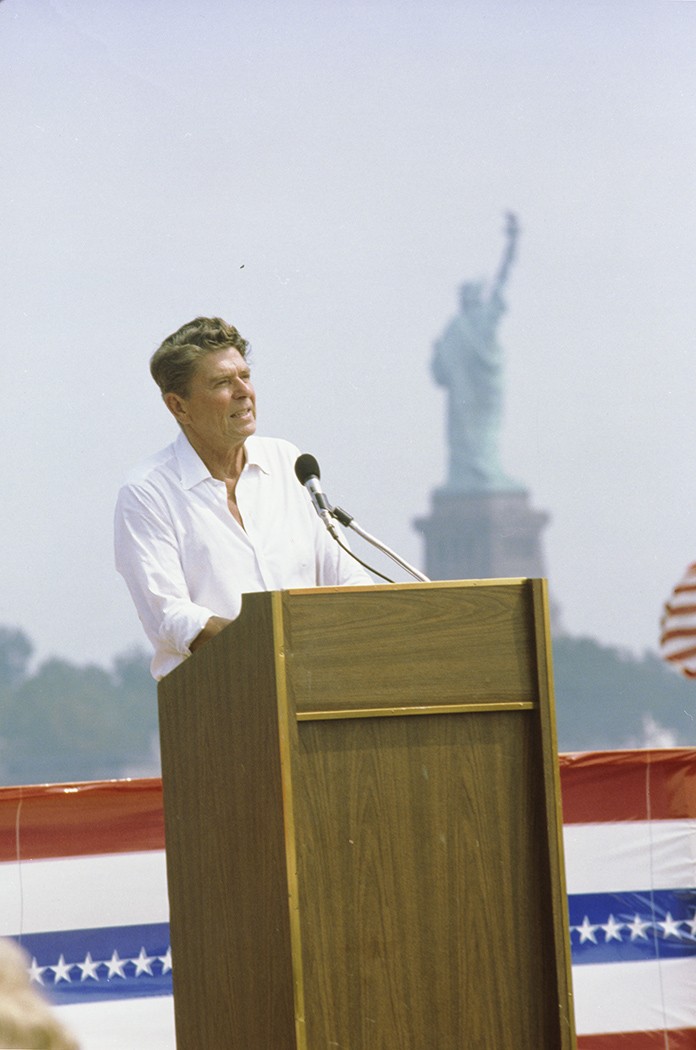
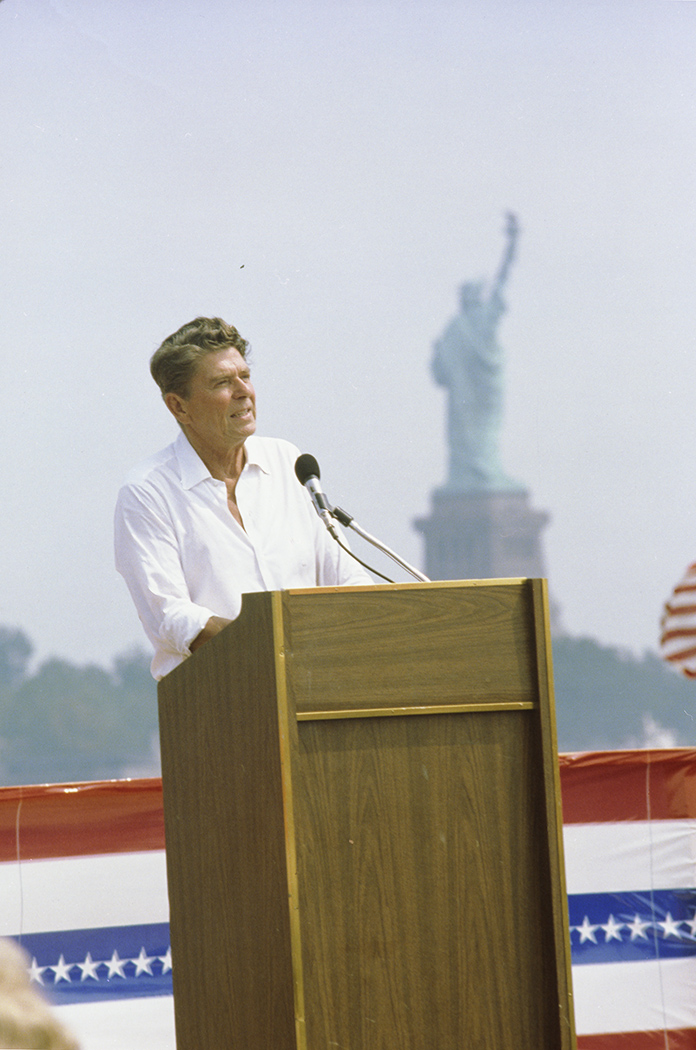
Reagan giving a speech in Liberty State Park in Jersey City, NJ on September 1, 1980. On a personal note, I met Ronald Reagan at the Palmer House in Chicago in June 1980 during a press conference. He was gracious and had movie star looks: tall and handsome. Reagan was elected the 40th U.S. president in a landslide over Jimmy Carter in November 1980 and re-elected in 1984. I later met Jimmy Carter in Chicago at a book signing in the 1990’s.
June 2017. 5.49 mb DSC_0776 (1)
Author and wife at Reagan Boyhood Home, Dixon, Illinois.
June 2017. 3.20mb DSC_0734 (2).
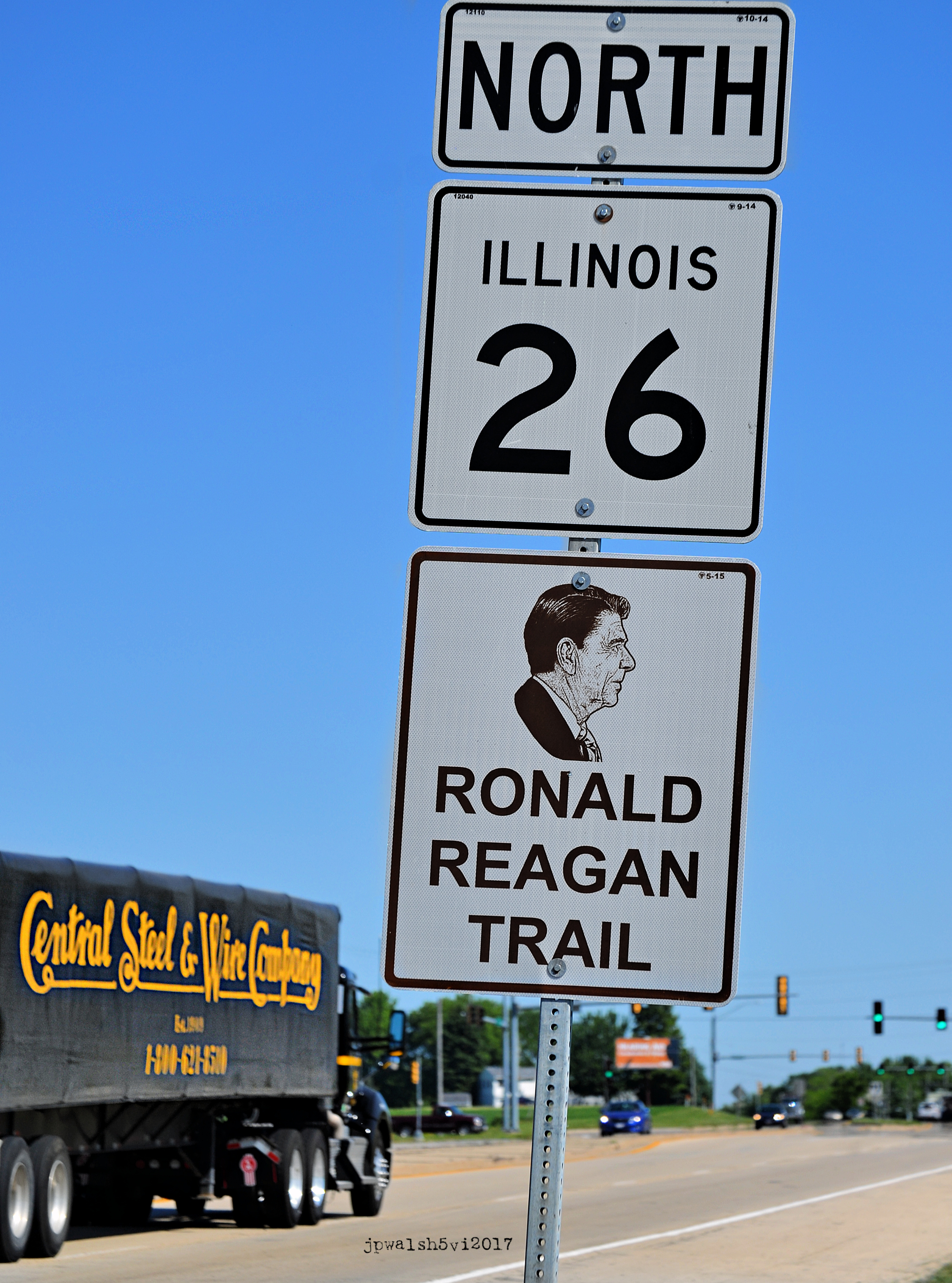
The Ronald Reagan Trail (IL-26) is a route in Illinois that follows sites of interest associated with the 40th president of the United States who was born in Tampico, Illinois and grew up in Dixon, Illinois. Route 26 originally ran north-to-south for about 25 miles from Freeport, Illinois to Polo, Illinois. In 1937, IL-26 was extended about 15 miles north to the Illinois-Wisconsin state line and about 15 miles south to Dixon, Illinois. In 1969, IL-26 was extended almost 100 miles south from Dixon to East Peoria, Illinois.
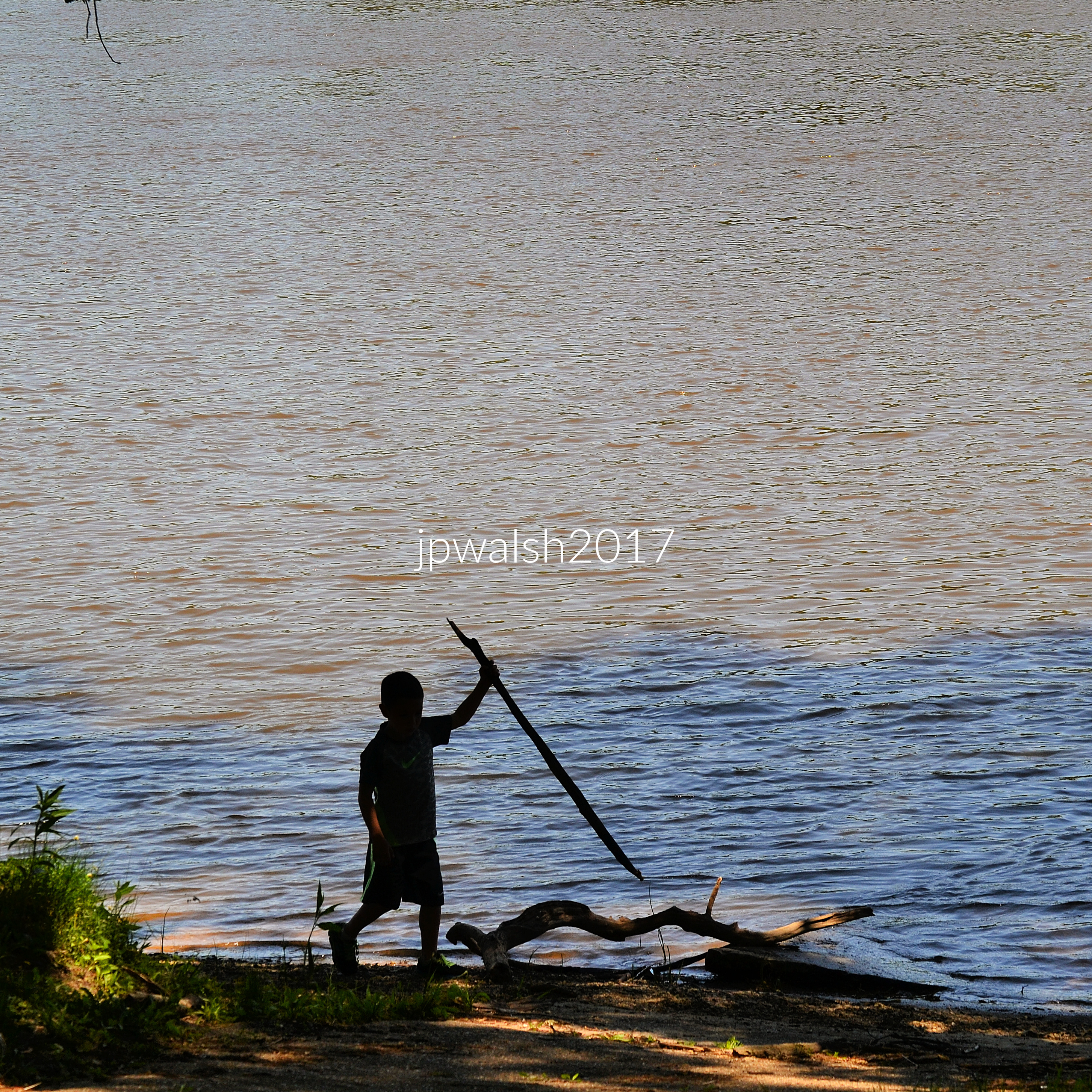
June 2017. Rock River at Lowell Park, Dixon, Illinois. 4.93 mb DSC_0865 (1). Author’s photograph.
January 3, 1960 — Announcement: One day after launching his campaign for the Democratic nomination, Kennedy immediately confronted a revived national anxiety: whether a Roman Catholic could serve as president without divided loyalties. As the first Catholic with a viable path to the White House, he faced sharp questioning over whether allegiance to the Pope might compromise his constitutional duties.
Religious Controversy: Kennedy moved quickly to defuse the issue. Kennedy, who happened to be Catholic, argued that religion should neither qualify nor disqualify a candidate. His position was deliberately universal. Though he made no excuses for his Catholic faith, he insisted that the presidency belongs to individuals, not categories. The controversy did not end there. In September 1960, before the Greater Houston Ministerial Association, he faced it down again, declaring that he was not the Catholic candidate for president, but the Democratic Party’s candidate who happened to be Catholic. The speech became the campaign’s clearest statement that personal identity must not become a political litmus test. He pledged to carry out the responsibilities of the presidency independent of any outside religious authority, rejecting both criticism and instruction. He argued for an uncompromising separation of church and state, stating that he would oppose a national church even if “99 percent” of Americans shared his faith.
Electoral Strategy: Beyond addressing religion, Kennedy used the NBC broadcast to outline his broader campaign logic. He rejected identity‑based ticket balancing, insisting that a major party’s presidential ticket should be shaped by geography and political experience rather than religious background.
Vice‑Presidential Speculation: He also dismissed rumors that he might accept the vice‑presidential slot, stating bluntly that he had no interest in “waiting for the president to die.” The unusually candid remark signaled his determination to run on his own terms and set the tone for the rest of his campaign.
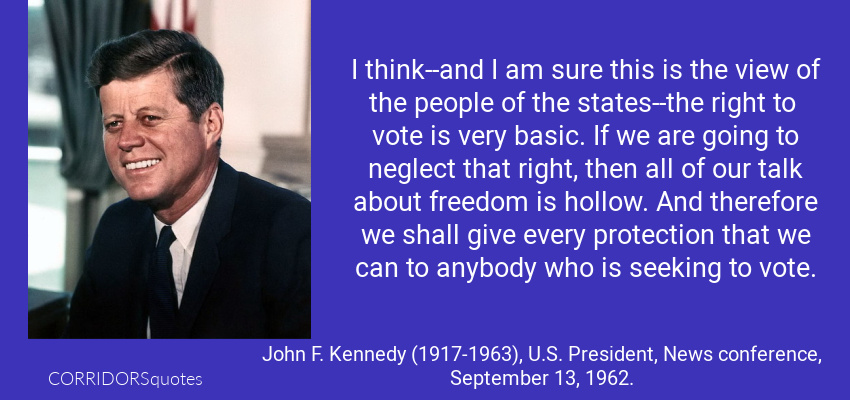
September 13, 1962 — News conference:
I think – and I am sure this is the view of the people and the states- the right to vote is very basic. If we are going to neglect that right, then all of our talk about freedom is hollow. And therefore we shall give every protection that we can to anybody who is seeking the vote.
October 26, 1963 — Remarks at Amherst College:
The men who create power make an indispensible contribution to the nation’s greatness. But the men who question power make a contribution just as indispensible for they determine whether we use power or power uses us.
September 13, 1960 — Kennedy-Johnson Joint Campaign Appearance, Grand Prairie, Texas:
Above: One of the rare joint appearances of Senators John F. Kennedy and Lyndon B. Johnson—the Democratic presidential ticket—in the 1960 campaign, which ultimately defeated the Republican ticket of Nixon–Lodge. During the second day of their Texas tour, the two men spoke to nearly 6,000 people in the parking lot of the Chance Vought Aircraft factory. It was at this stop that Kennedy was famously presented with a western cowboy hat, joking that he “didn’t have the guts to wear it” immediately. They also rode in a motorcade through the intersection of Main and Center streets in downtown Grand Prairie. Neither man was a natural campaigner: Kennedy’s hands often shook beneath a table or podium as he spoke, his voice growing hoarse, while Johnson, uneasy in crowds, frequently pushed himself into sick exhaustion on the trail.
Campaign Dynamics: Although both candidates wanted more joint appearances, their aides agreed such events mostly hurt the ticket’s image—especially Kennedy’s. Johnson was only nine years older, and both were the first U.S. presidents born in the 20th century, yet aides felt that when they stood together Kennedy looked almost like LBJ’s son. Still, the press and Johnson complained for weeks that the two men should campaign together more often, given the offices they sought.
Press Pressure: When reporters began hinting at a rift between the candidates as the reason for their limited joint schedule, the campaign arranged another appearance in November 1960, five days before Election Day. For that final joint even at the Biltmore in Los Angeles, Johnson flew out specifically to join Kennedy. The appearance received strong national print and television coverage, and on that Thursday before Americans went to the polls, both campaigns regarded it as a major success.
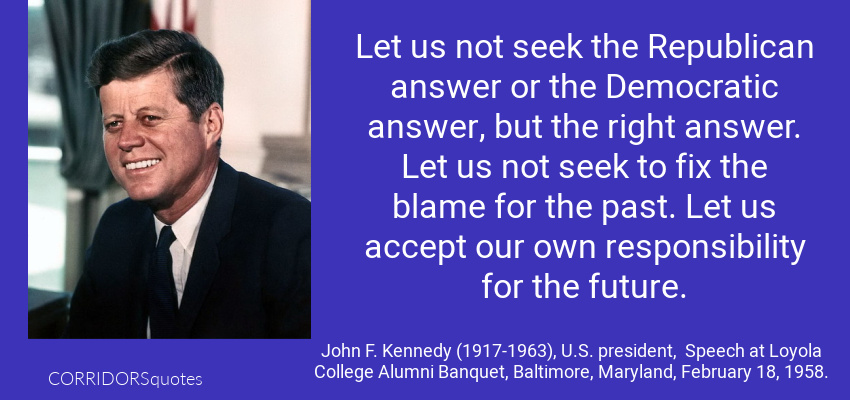
February 18, 1958 — Speech at Loyola College Alumni Banquet, Baltimore, Maryland:
Let us not seek the Republican answer or the Democratic answer, but the right answer. Let us not seek to fix the blame for the past. Let us accept our own responsibility for the future.
The Cuban Missile Crisis lasted from October 16 to October 28, 1962.Critical Milestones:
October 16: Kennedy was first shown U‑2 photographs revealing Soviet nuclear missile installations in Cuba.
October 22: Kennedy announced a naval “quarantine” of Cuba in a televised address to the nation.
October 24: Soviet ships approached the blockade line but stopped or turned back to avoid confrontation.
October 27 — “Black Saturday”: A U‑2 was shot down over Cuba, and a Soviet submarine was forced to surface by U.S. Navy signaling, marking the peak of the crisis.
October 28: Premier Nikita Khrushchev announced that the Soviet Union would dismantle and remove the missiles, ending the 13‑day standoff.
FROM 13 DAYS (2000). JFK: BOB, IS THERE ANY WAY TO AVOID STOPPING THE SUBMARINE FIRST? MCNAMARA: I’M AFRAID NOT MR. PRESIDENT. https://www.youtube.com/watch?v=gol-iCLcroY – retrieved April 20, 2026
In response to the rapid buildup of Soviet nuclear missiles in Cuba, President John F. Kennedy announced that the United States would impose a naval blockade—officially termed a “quarantine”—around the island. It went into effect on the morning of October 24, 1962, when American warships and aircraft tightened a ring around Cuba with orders to intercept any vessel suspected of carrying offensive military equipment.
Tension spiked almost immediately. Roughly 25 Soviet ships, some believed to be transporting nuclear missile components, continued steaming toward the quarantine line. U.S. commanders had standing instructions: any vessel refusing inspection could be stopped, diverted, and, if necessary, sunk. At 10:00 a.m., as the quarantine became active, Kennedy convened ExComm to assess the situation when new intelligence came in that made the situation immediately more precarious. Reports were that the approaching Soviet ships were joined by a Soviet sub armed with nuclear weapons, raising the risk of an existential, catastrophic confrontation. At the same time, aerial reconnaissance showed Soviet crews working feverishly in western Cuba to complete missile sites armed with nuclear warheads pointed at the U.S.—further evidence that the threat to U.S. national security, already considered imminent by the Kennedy Administration, was growing by the minute.
On the diplomatic front, the crisis was unresolved as it was debated by delegates at the U.N. whether Kennedy’s blockade was even legal under international law. Soviet leaders accused the United States of issuing an ultimatum and warned that force would be met with force. Meanwhile protests were organized on each side across the globe as political maneuvering accelerated.
By the end of October 24, 1962, the first signs of restraint appeared: several Soviet ships slowed or halted before reaching the quarantine line, suggesting Moscow might be reconsidering its next move. Even so, the world understood, some for the first time, that it stood on the precipice of nuclear war. The day ended with both superpowers locked in the most dangerous equilibrium of the crisis so far – both armed, alert, and waiting for the next move – with no one knowing whether diplomacy or confrontation would ultimately prevail.
October 31, 1962 — Three Days After the Cuban Missile Crisis, JFK Meets the Archbishop of Canterbury at the White House:
Above: Rev. Dr. Michael Ramsey (1904–1988), Archbishop of Canterbury, meets with President John F. Kennedy on Halloween, 1962—just three days after the Cuban Missile Crisis ended. The world was still exhaling in relief: armed confrontation between the superpowers had been narrowly avoided, and October 27 had been the crisis’s most perilous day. A U‑2 reconnaissance plane was shot down by Soviet‑supplied SAM missiles, killing the USAF pilot. Kennedy’s ExComm urged immediate military retaliation, but he resisted. That same night, Robert Kennedy met secretly with Soviet Ambassador Anatoly Dobrynin in Washington, where they reached a tentative understanding pending Moscow’s approval. By the next morning, October 28, Radio Moscow announced acceptance of Kennedy’s proposal, ending the 13‑day standoff.
Michael Ramsey had been appointed Archbishop of Canterbury on May 31, 1961, and installed the following month, serving until 1974. In 1962 he was also president of the World Council of Churches (1961–1968). During his archbishopric, the first woman Anglican priest—Chicago‑born high‑altitude balloonist Jeannette Piccard—was ordained in the United States in 1974.
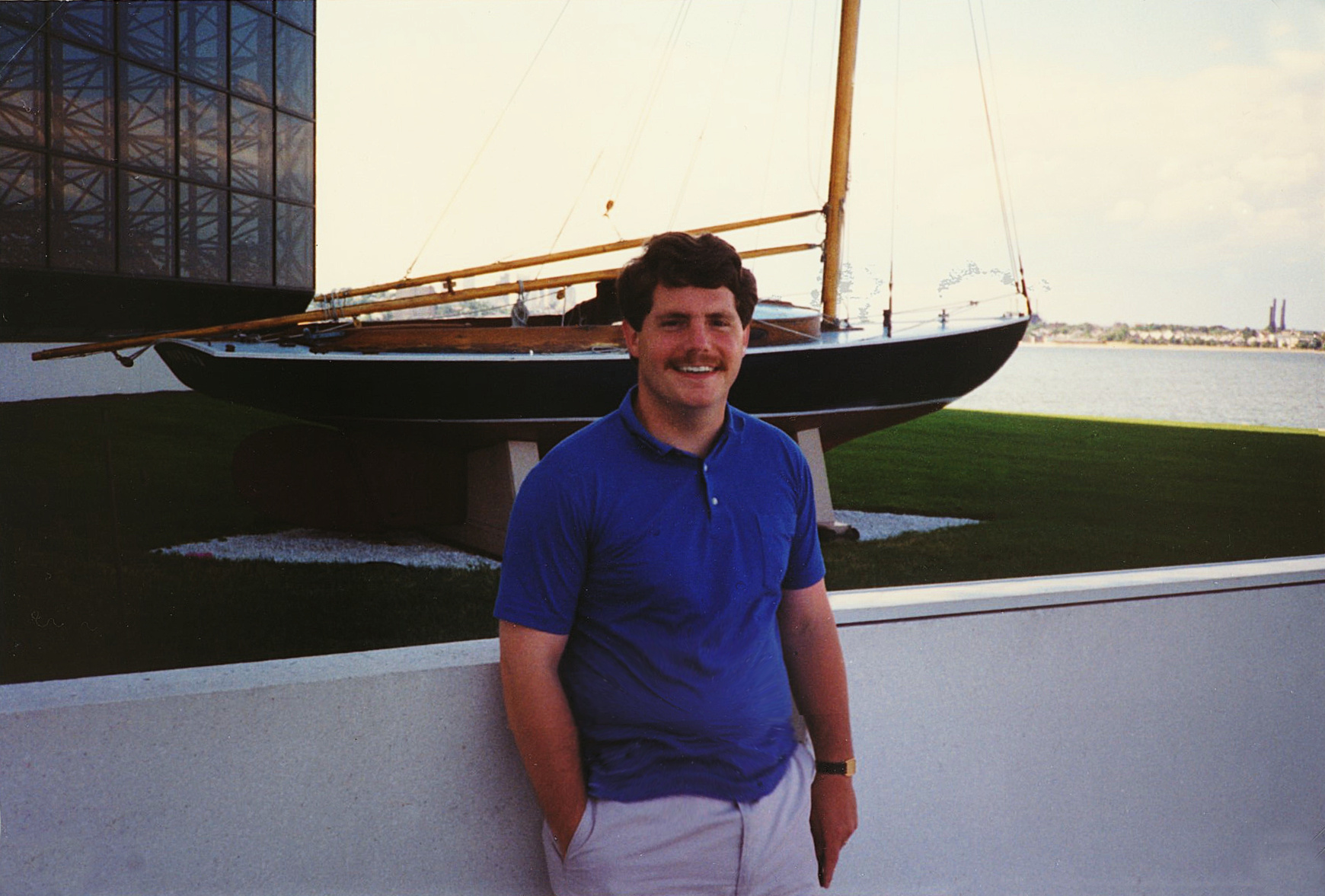
Massachusetts: John F. Kennedy Library, Columbia Point, Boston (June 1989):
July 1989 — The author at the John F. Kennedy Library, Columbia Point, Boston.
Standing near JFK’s iconic sailboat, 1989 marked the Library’s tenth anniversary, a moment when the institution shifted from a young presidential repository into a fully established center of civic education, political legacy, and architectural study. Its most enduring milestone of 1989 was the formal creation of the Profile in Courage Award by members of the Kennedy family. Just five weeks before this photograph, Columbia Point hosted a major family gathering on May 25, 1989, attended by Jacqueline Kennedy Onassis, Senator Ted Kennedy, Caroline Kennedy, and John F. Kennedy Jr., underscoring the Library’s growing national prominence a decade after its opening
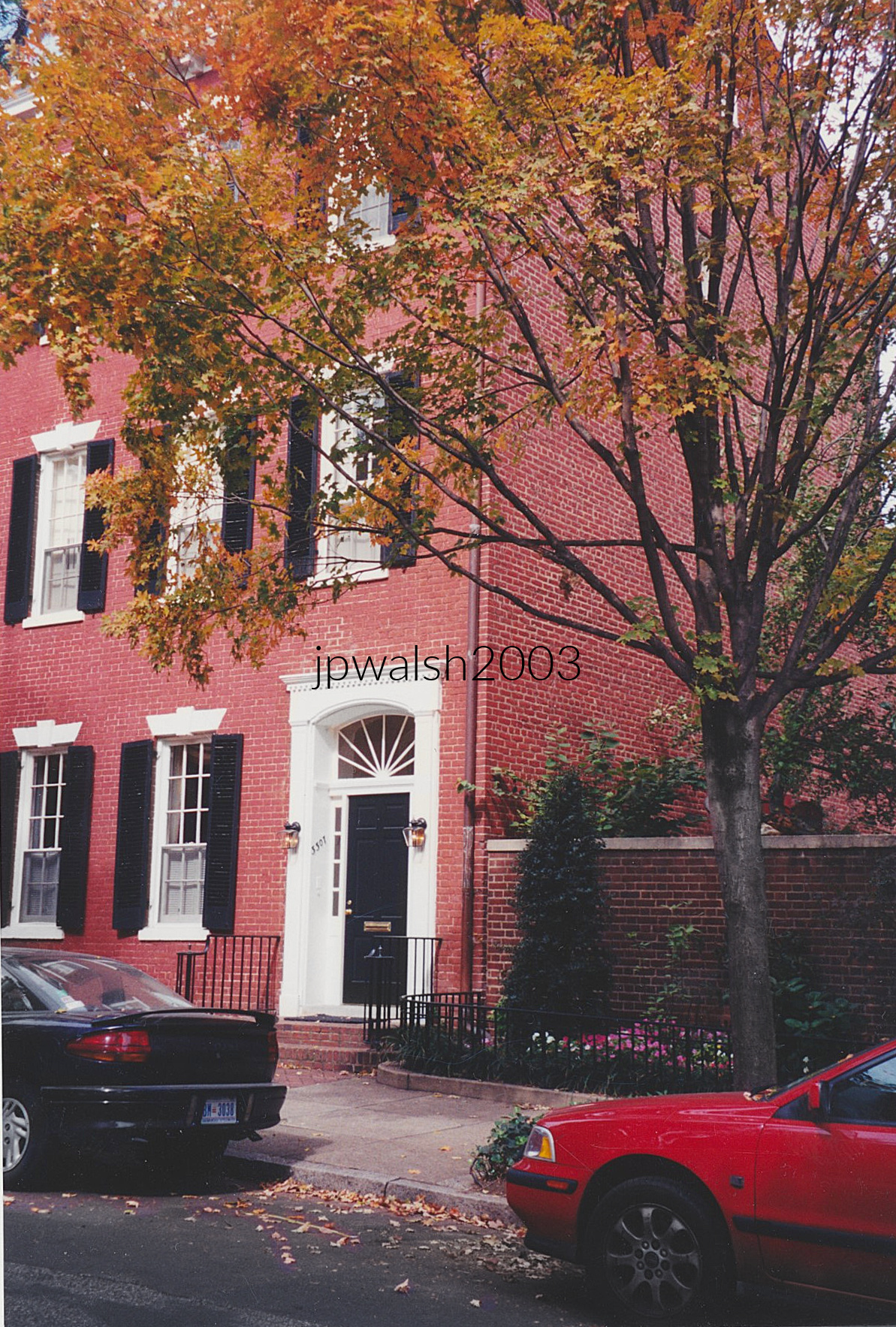
John F. Kennedy Family House (1957), 3307 N Street, Georgetown, Washington, D.C. (October 2003):
Author’s photograph.
June 1957 — A Georgetown Purchase In June 1957, Massachusetts Senator John F. Kennedy bought this three‑story Federal‑style house as a gift for his wife, Jacqueline Kennedy after the birth of their daughter, Caroline. Their son, John Jr., was also born while the family lived here.
Campaign Life at 3307 N Street During JFK’s 1958 Senate re‑election and the 1960 presidential campaign, Jackie hosted teas in the home’s double living room. The front entrance became nationally recognizable when President‑elect Kennedy stepped outside to announce major appointments — including naming his younger brother and campaign manager, Robert F. Kennedy as U.S. Attorney General.
President-Elect John F. Kennedy and Chester Bowles emerge from a breakfast conference at Kennedy’s Georgetown home in Washington, on Nov. 29, 1960. Bowles was appointed Under Secretary of State and later was Kennedy and Johnson’s ambassador to India.
January 20, 1961 — Departure for History On the morning of January 20, 1961, Kennedy famously left from this doorstep to travel to the U.S. Capitol for his swearing‑in as the 35th President of the United States. The house was sold later that year when the family moved into the White House.
Early 19th‑Century Origins Beyond its presidential associations, the home was originally built in 1811–12 for William Marbury (1762–1835), the financier and plaintiff in the landmark 1803 Supreme Court case Marbury v. Madison — the decision that established the foundational principle of judicial review.
The Garden Refuge The Kennedys used the brick‑walled garden at 3307 N Street as a quiet refuge, especially during the 1960 campaign. With JFK traveling constantly, he rarely found time for his painting hobby, though he did spend occasional Sunday afternoons in the garden with Jackie and Caroline, away from the public spotlight.
Aesthetic Balance Inside the home, Jackie’s classical European taste was balanced with historical maritime art and paintings of naval vessels — a nod to Kennedy’s U.S. Navy service and lifelong passion for the sea.
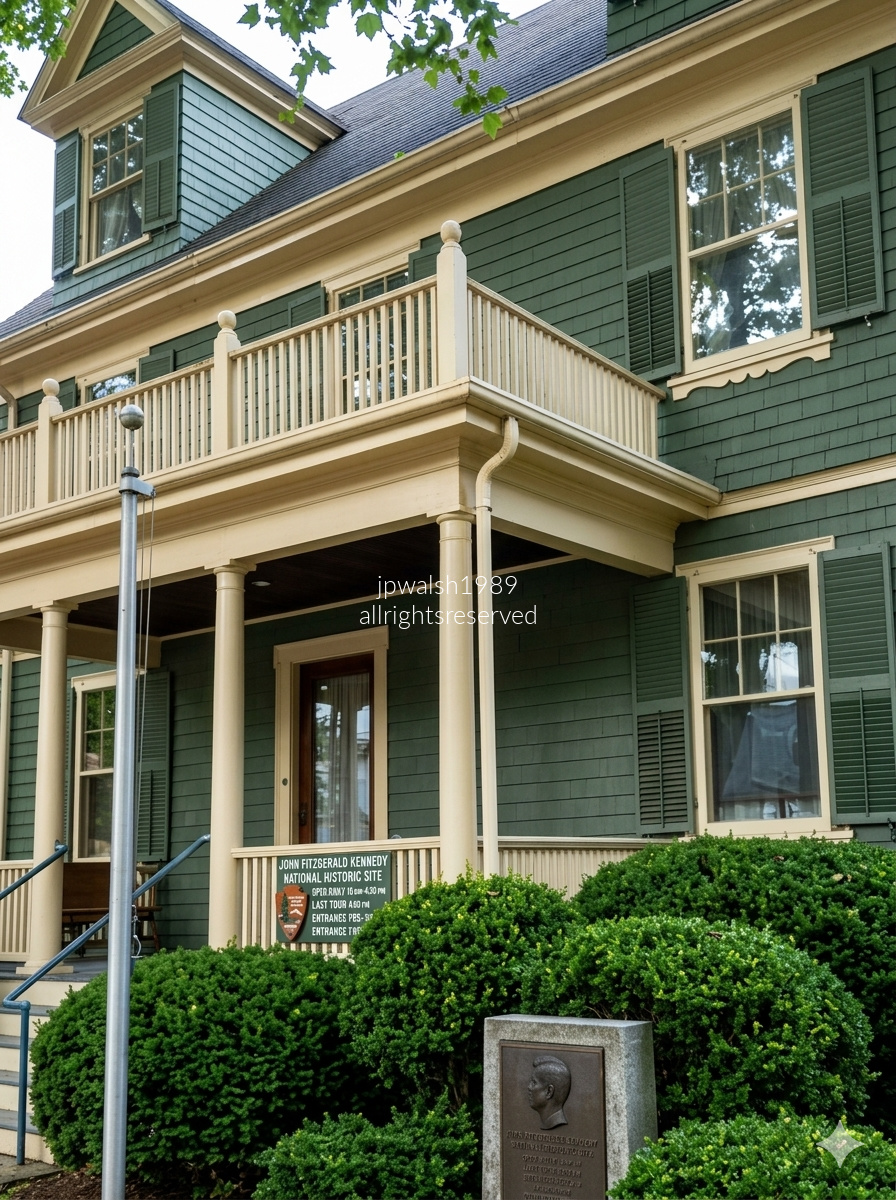
Massachusetts: The John Fitzgerald Kennedy National Historic Site (Birthplace, 1917), Brookline, Massachusetts (July 1989) (August 2005):
July 1989 — The John Fitzgerald Kennedy National Historic Site at 83 Beals Street preserves the birthplace and early childhood home of the 35th president. The house, built in 1909 by local architect‑builder Robert M. Goode, is a two‑and‑a‑half‑story Colonial Revival structure with a green‑shingled exterior, an asymmetric cross‑gabled roof, prominent dormers, and a front porch topped by an upper balustrade deck. It stands in Brookline’s Coolidge Corner neighborhood, a dense early‑20th‑century streetcar suburb of tree‑lined residential blocks bordering Boston.
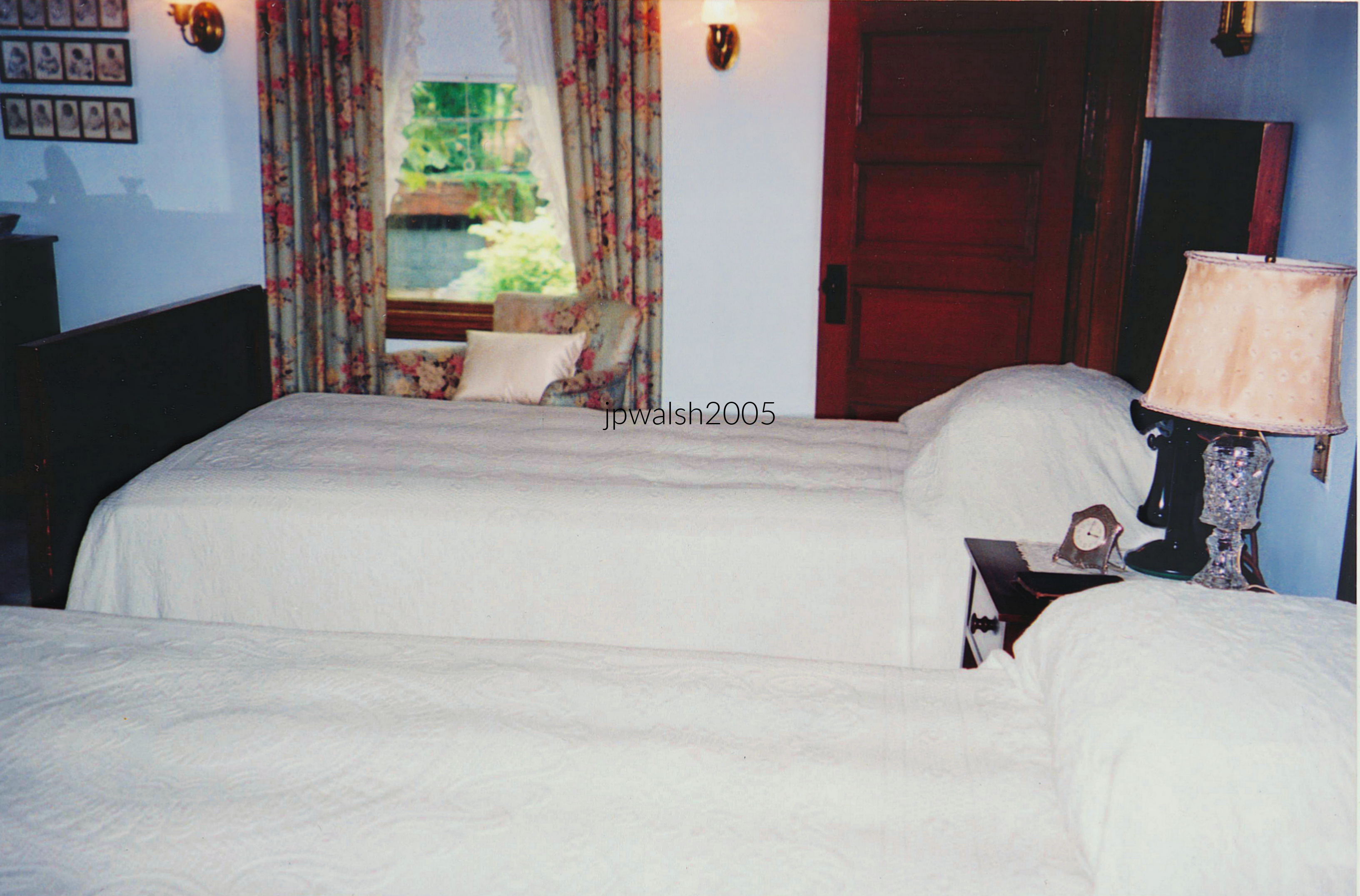
Three Kennedy children were born in the second‑floor master bedroom: John F. Kennedy on May 29, 1917; Rosemary Kennedy on September 13, 1918; and Kathleen Kennedy on February 20, 1920. Their older brother, Joseph P. Kennedy Jr., was born in Hull, and the later five siblings — including Bobby and Ted — were born around the corner in the larger family home on Abbottsford Road.
August 2005 — The John Fitzgerald Kennedy National Historic Site in Brookline, Massachusetts. Author’s photograph.
JFK’s birthplace and childhood home—stands on Beals Street in the Boston suburbs. Joseph Patrick Kennedy purchased the house in August 1914, just ahead of his October marriage to Rose Elizabeth Fitzgerald. A driven, opportunistic young bank president and businessman, he began building his fortune during World War I through shipbuilding contracts in the Quincy yards. In Brookline, Joe Kennedy was an affectionate father who fostered a spirited sense of competition among the Kennedy children, shaping the family ethos that would define their later public lives.
August 2005 — The John Fitzgerald Kennedy National Historic Site in Brookline, Massachusetts. Author’s photograph.
John F. Kennedy was born in this upstairs master bedroom of this Beals Street home in the mid-afternoon (3 p.m.) on Tuesday, May 29, 1917, an unseasonably cold (44 degrees), overcast, and rainy day. The family lived on Beals Street until 1920, then moved a short walk away to a larger house on Abbottsford Road, where they remained until 1927 before relocating to New York. Rose Fitzgerald—daughter of Boston’s first American‑born Irish mayor—had seven of her nine children in Brookline and was reluctant to leave. John F. Kennedy was her second child and son.
In Brookline, Joe Kennedy, son of a local pol and saloonkeeper, instilled a competitive spirit in his children, while Rose, who had studied in Europe, taught them an appreciation for the arts and history. A devout Catholic, Rose took her children on weekday walks to market and then to church, reinforcing their faith as part of daily life, not just Sundays.
After Joseph P. Kennedy sold the Beals Street house to family friend Edward Moore, the property passed through several owners over the next four decades. Following JFK’s assassination in 1963, thousands of mourners visited the home, turning it into an impromptu pilgrimage site. In 1966, the current owners agreed to sell the house back to the Kennedy family so it could be preserved as a permanent memorial.
Rose Fitzgerald Kennedy then led a full restoration of the interior, working from her own memories and period décor to recreate the exact appearance of the home as it looked on the day John F. Kennedy was born in 1917. When the project was complete, the Kennedy family donated the property to the National Park Service in 1969, establishing what is now the John Fitzgerald Kennedy National Historic Site. Rose Kennedy said she gave the house to the American people so that “future generations will be able to visit it and see how people lived in 1917 and thus get a better appreciation of the history of this wonderful country.” see – https://www.nps.gov/jofi/index.htm – retrieved May 29, 2025.
February 26, 1962 — Voice of America speech:
(56 seconds). “We are not afraid to entrust the American people with unpleasant facts, foreign ideas, alien philosophies, and competitive values. For a nation that is afraid to let its people judge the truth and falsehood in an open market is a nation that is afraid of its people.” -John F. Kennedy, Voice of America speech, February 26, 1962.
In a 1962 address to the Voice of America, President John F. Kennedy defined the organization’s mission as a duty to champion truth, transparency, and the free flow of information, even when revealing internal “blemishes and warts.” He emphasized that a free nation must not fear truth and that the “burden of truth” serves the cause of freedom.
SPEAKING OF FREEDOM OF INFORMATION IN A FREE COUNTRY TO THE ENTIRE WORLD: “The Voice of America speaks. Today America has been at war for 79 days. Daily at this time we shall speak to you about America and the war, and the news may be good or bad. We shall tell you the truth”… …We seek a free flow of information across national boundaries and oceans, across iron curtains and stone walls. We are not afraid to entrust the American people with unpleasant facts, foreign ideas, alien philosophies, and competitive values. For a nation that is afraid to let its people judge the truth and falsehood in an open market is a nation that is afraid of its people. The Voice of America thus carries a heavy responsibility. Its burden of truth is not easy to bear. …And as you tell it, it spreads. And as it spreads, not only is the security of the United States assisted, but the cause of freedom.” See – https://www.presidency.ucsb.edu/documents/remarks-the-20th-anniversary-the-voice-america – retrieved May 29, 2025.
November 22, 1963 — Fort Worth Remarks Before the Texas Hotel:
On a rainy morning in front of the Texas Hotel in Fort Worth, President John F. Kennedy delivered brief remarks at a citizen’s rally. He outlined three pillars of national security: military strength, economic prosperity, and superiority in space exploration, noting that Fort Worth would again “play its proper part.”
KENNEDY: “What we are trying to do in this country and what we are trying to do around the world, I believe, is quite simple: and that is to build a military structure which will defend the vital interests of the United States. And in that great cause, Fort Worth, as it did in World War II, as it did in developing the best bomber system in the world, the B‑58, and as it will now do in developing the best fighter system in the world, the TFX, Fort Worth will play its proper part. And that is why we have placed so much emphasis in the last 3 years in building a defense system second to none, until now the United States is stronger than it has ever been in its history. And secondly, we believe that the new environment, space, the new sea, is also an area where the United States should be second to none.”
November 22, 1963 — The Johnsons Telephone Their Condolences to Rose Kennedy in the Immediate Aftermath of the Assassination:
November 22, 1963 — Rose and Joe Kennedy at Hyannis Port
On a clear “bluebird” morning at the Hyannis Port compound, Rose Kennedy followed her usual routine, attending morning Mass before returning home for lunch with Joe, who remained severely impaired from his 1961 stroke. After a short drive together, Rose received a call from her son, Attorney General Robert Kennedy: the President—her son Jack—had been shot in Dallas. A second call soon followed, confirming he was dead.
Rose withdrew to grieve in solitude, walking the beach and sitting quietly in her room, later reflecting that she asked God how decades of preparing her children for service could be undone in seconds. At approximately 4:15 p.m., she took a call from the new president, Lyndon Johnson, speaking from Air Force One shortly after being sworn in and as he returned to Washington with President Kennedy’s body. Composed, Rose addressed him as “Mr. President.”
June 11, 1963 — Oval Office Report to the American People on Civil Rights:
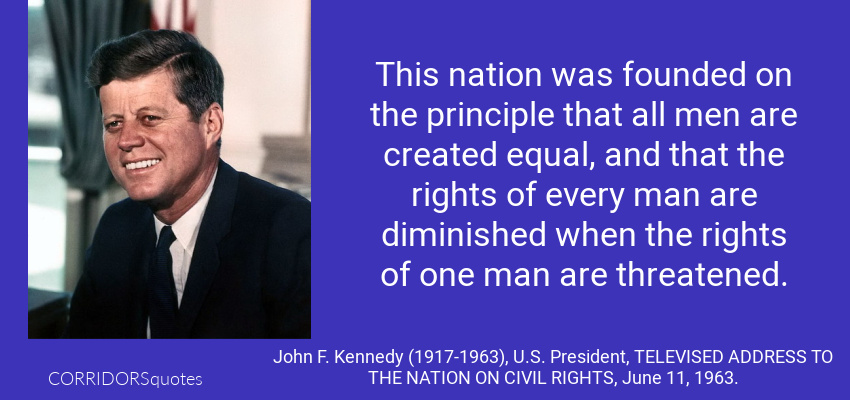
This nation was founded on the principle that all men are created equal, and that the rights of every man are diminished when the rights of one man are threatened.
May 27, 1963 — Supreme Court Signals an End to Evasion of Brown v. Board
On May 27, 1963, the Supreme Court declared that it would no longer tolerate evasions of its 1954 Brown v. Board of Education ruling. The statement came in another desegregation case involving public parks. When the Court issued Brown in 1954, it could not have foreseen the years of delay and resistance that followed.
June 5–10, 1963 — Federal Orders and Kennedy’s Warning to Wallace
On June 5, a federal court enjoined Alabama Governor George Wallace from obstructing the admission of two qualified Black students to the University of Alabama. President John F. Kennedy reinforced the order on June 10, writing to Wallace and urging him not to interfere.
June 11, 1963 — Wallace “Stands in the Schoolhouse Door”
On June 11, Wallace carried out his pledge to “stand in the schoolhouse door,” physically blocking the students from enrolling. When he refused to yield to federal marshals, Kennedy nationalized the Alabama National Guard. Guard troops arrived, Wallace stepped aside, and the students entered and registered for classes.
June 11, 1963 — Kennedy’s Civil Rights Address from the Oval Office
That evening, Kennedy delivered his “Report to the American People on Civil Rights” from the Oval Office. In a 13‑minute address, he set out the moral and legal issues surrounding civil rights and previewed legislation that would become the Civil Rights Act of 1964. After two cautious years, the speech marked a decisive shift: Kennedy gave a full‑throated endorsement of civil rights and federal action to secure them.
June 12–13, 1963 — The Murder of Medgar Evers and Local Repression
In the early hours of June 12, civil rights leader Medgar Evers, who had listened to Kennedy’s remarks, was assassinated outside his home in Jackson, Mississippi. On June 13, Jackson police arrested 82 Black marchers protesting Evers’s murder. Within a week, a white suspect was arrested and charged.
June 19, 1963 — Kennedy Sends His Civil Rights Bill to Congress
On June 19, Kennedy asked Congress to introduce his civil rights bill, seeking desegregation of public facilities, federal action to end job discrimination, and authority for the Attorney General to initiate desegregation suits.
Summer 1963 — Civil Rights Leaders Reject a Pause in Demonstrations
As Congressional debate and filibuster began, Kennedy asked civil rights leaders to suspend protests and marches. They refused. Instead, they announced a March for Jobs and Freedom in Washington, D.C., to take place in August 1963.
See- Kennedy and the Press, edit. Harold W. Chase and Allen H. Lerman, introduction by Pierre Salinger, Thomas Y. Crowell Company, New York, 1965, p. 452.
June 26, 1963 — Berlin speech at Rudolph Wilde Platz November 21, 1963 —Texas motorcade & remarks at the dedication of the Aerospace Medical Health Center, San Antonio August 1, 1963—color recording of remarks for “Seas Around Us” September 12, 1962—Moon speech, Rice University, Houston, Texas
(27 seconds).
April 27, 1961 — Address before the American Newspaper Publishers Association, Waldorf-Astoria Hotel, New York City:
On April 27, 1961, President John F. Kennedy delivered his 2400-word+ major speech known as “President and the Press” before the American Newspaper Publishers Association at the Waldorf-Astoria Hotel in New York City. In the speech delivered just days after the failed Bay of Pigs Invasion the new president made a plea for responsible journalism in the face of Cold War threats. The remarks remain relevant today on the topics of press freedom, misinformation, and national security.
I am not asking your newspapers to support the Administration, but I am asking your help in the tremendous task of informing and alerting the American people. For I have complete confidence in the response and dedication of our citizens whenever they are fully informed. see – https://www.jfklibrary.org/archives/other-resources/john-f-kennedy-speeches/american-newspaper-publishers-association-19610427#:~:text=This%20Administration%20intends%20to%20be,out%20when%20we%20miss%20them. – retrieved March 25, 2025.It was early in the 17th century that Francis Bacon [1561-1626] remarked on three recent inventions already transforming the world: the compass, gunpowder and the printing press. Now the links between the nations, first forged by THE COMPASS have made us all citizens of the world, the hopes and threats of one becoming the hopes and threats of us all. In that one world’s efforts to live together, the evolution of GUNPOWDER to its ultimate limit has warned mankind of the terrible consequences of failure. And, so, it is to the PRINTING PRESS–to the recorder of man’s deeds, the keeper of his conscience, the courier of his news–that we look for strength and assistance, confident that with your help man will be what he was born to be: free and independent. I not only could not stifle controversy among your readers–I welcome it. This Administration intends to be candid about its errors; for as a wise man once said: “An error does not become a mistake until you refuse to correct it.” We intend to accept full responsibility for our errors; and we expect you to point them out when we miss them.
John F. Kennedy 1960 Campaign Ad For Social Security:
When Franklin D. Roosevelt signed the Social Security Act on August 14, 1935, he called the new federal retirement program a “cornerstone.” It became one of the central pillars of the New Deal and a defining feature of modern American social policy.
A Personal Reflection from 1998
In 1998, at a Chicago book signing for The Virtues of Aging, I met former President Jimmy Carter and asked whether he believed Social Security was destined to disappear. Carter replied that he did not think so, a view reflecting the long‑standing bipartisan commitment to the program’s survival.
Social Security Under Strain in 2026
By 2026, Social Security faces unprecedented pressure. The aging population has surged: 75 million seniors now receive benefits—three times the number in 1975. Meanwhile, a smaller workforce contributes payroll taxes to support a rapidly growing pool of beneficiaries. Trust‑fund reserves are being depleted, and insolvency is projected for the mid‑2030s.
Kennedy’s 1960 Visit to Hyde Park
During the 1960 presidential campaign, Democratic nominee John F. Kennedy visited Hyde Park, New York, the national shrine home of Franklin D. Roosevelt. The occasion marked the 25th anniversary of the Social Security Act. Kennedy addressed 2,000 senior citizens gathered to honor Roosevelt and hear the young senator outline his vision for strengthening the program.
Kennedy’s Proposals for America’s Aging Population
In his remarks, Kennedy advanced a series of proposals aimed at improving the lives of older Americans and modernizing Social Security. Among them:
Federal medical care — a precursor to Medicare, which would be enacted in 1965.
Cost‑of‑living adjustments — automatic increases to keep pace with inflation, implemented in 1975.
Incentives for continued work — allowing older Americans to earn more without losing benefits.
Vocational guidance — support for retirees seeking new roles or training.
Adequate housing — expanding federal efforts to provide safe, affordable homes for seniors.
Medical research — increased study of diseases associated with aging.
Higher survivor benefits — expanded support for spouses caring for under‑age children.
A Continuity of Purpose
Kennedy’s 1960 message echoed Roosevelt’s original vision: Social Security was not merely a retirement program but a national commitment to dignity, security, and opportunity in old age. His proposals anticipated many reforms that would shape the program in the decades to come.
March 29, 1962—News Conference 29:
The Tax Cut Bill Advances in Congress
The press conference occurred the same week the House Ways and Means Committee approved President Kennedy’s tax cut bill. At the same time, Kennedy emphasized the need to close tax loopholes that permitted and encouraged American industries to invest overseas.
Revenue Neutrality as a Central Congressional Concern
Congress was focused on balancing the revenue lost from tax cuts with revenue gained through tax reforms, aiming to produce a revenue‑neutral bill. The effort was conceived as a targeted economic stimulus—not the broad‑brush solution tax cuts later became in national economic debates, nor the inverse approach of sweeping tax hikes.
Balancing Cuts and Reforms in the 1962 Legislation
The 1962 tax bill was modified and passed with this balancing principle in mind. Kennedy proposed significant reductions in tax rates for individuals and corporations, acknowledging that such cuts would initially reduce federal revenue. Broadly pro‑growth, the plan was not a modern‑style tax giveaway; policymakers believed the country could not afford such an approach. Instead, the goal was to offset revenue losses through reforms that generated compensating gains.
Sources of Revenue Gains
Revenue increases for the government came from several reforms, including:
Eliminating the dividend credit and exclusion
Introducing withholding taxes on dividends and interest
Restricting business expense deductions, particularly for entertainment and meals
Adjusting tax treatment for cooperatives and financial institutions
Revising taxation of gains from the sale of depreciable property
Short‑Term Losses and Long‑Term Contrast
Although the final Revenue Act of 1962 resulted in a short‑term net revenue loss, it still reflected Kennedy’s intent to pair tax cuts with offsetting reforms. Later economic approaches—particularly those associated with Reagan‑era tax policy—introduced large tax cuts skewed toward higher‑income earners without corresponding revenue‑generating reforms, relying exclusively on growth‑driven revenue effects to offset massive revenue losses. Combined with increased federal spending, this produced persistent deficit financing that Kennedy could not have imagined.
Kennedy’s Fiscal Aim in 1962
In 1962, Kennedy sought both a tax cut and a balanced budget, a pairing that underscores how different his fiscal strategy was from later eras of tax policy.
March 7, 1962—News Conference 26:
On February 22, 1962, Soviet Premier Khrushchev proposed that at the upcoming U.N.-sponsored Geneva Disarmament Conference on March 14 that the heads of government meet.
Kennedy rejected the offer, though he was afterwards pressured by European allies to reconsider and probed by the U.S. press if he would possibly attend and so backtrack on his statements. He maintained his firm position against attending the opening of the Geneva Disarmament Conference on March 14, 1962. Instead of traveling to Switzerland himself, Kennedy appointed Arthur H. Dean as the Chairman of the U.S. Delegation and sent Secretary of State Dean Rusk to handle the initial high-level negotiations.
Kennedy later outlined the manner of his going to any sort of summit conference in the near future— 1. to ratify an agreement 2. if there was a serious international crisis or the U.S. was on the brink of war 3. To aid the national interest.
The outcome to that spring’s lengthy Geneva talks was announced by Kennedy about 5 weeks after its opening: that negotiators had reached a broad outline for the objectives and principles, basic provisions and timings of a general treaty on nuclear disarmament.
Six months later the Cuban Missile Crisis took place.
April 30, 1963 — April 30, 1963 — Kennedy’s Remarks to Choate Alumni:
On May 4, 1963, President Kennedy broadcast taped remarks to the alumni of his alma mater, The Choate School, commemorating the unveiling of his official portrait on the campus in Wallingford, Connecticut.
The phrase most associated with John F. Kennedy’s 1961 Inaugural Address—“Ask not what your country can do for you; ask what you can do for your country”—endured as a defining call to civic action. Delivered by the nation’s first Catholic president, it urged Americans to see national progress as a shared personal duty rather than a service provided by government.
Echoes in Years of Lightning, Day of Drums (1965)
Its resonance appears again in the 1965 documentary Years of Lightning, Day of Drums, one of the earliest films to chronicle Kennedy’s presidency and assassination. Near the conclusion, narrator Gregory Peck reflects, “All this took place in the early 1960s, and someday the early 1960s will be a long time ago.” Hearing that line as a child, I felt its existential reminder: even the most vivid present moments eventually recede into memory and become history.
Possible Origins at Choate
Some historians have suggested that Kennedy’s inaugural exhortation may trace back to his years at Choate, the Connecticut boarding school he entered in 1931 as a ninth‑grade student. In his chapel addresses, headmaster George St. John frequently reminded students: “The youth who loves his alma mater will always ask not ‘what can she do for me?’ but ‘what can I do for her?’” Kennedy would have heard this refrain repeatedly during his formative years.
A Frail Student with a Mischievous Streak
Kennedy arrived at Choate following his older brother, Joe Jr., a standout athlete two years ahead of him. By contrast, Kennedy was frail, thin, and saddled with the nickname “rat face” among classmates. His early years were marked less by distinction than by mischief. He gathered around him a circle of friends he called “The Muckers Club,” a tongue‑in‑cheek embrace of St. John’s term for troublemakers. Their antics were largely harmless—witty pranks and playful irreverence—and the group included Kennedy’s roommate and lifelong friend, Lem Billings.
A Shift in Trajectory
Despite his unremarkable start, Kennedy’s trajectory at Choate changed. By the time he graduated in 1935, he was not valedictorian, but his peers voted him “Most Likely to Succeed,” a judgment that reflected what followed.
JFK, May 4, 1963: First, it is to make sure that our private schools are increasingly representative of the diversity of American life. These schools will not survive if they become the exclusive possession of a single class or creed or color. They will enlarge their influence only as they incorporate within themselves the variety which accounts for so much of the drive and the creativity of the American tradition. The second is to make sure that our private schools prepare young men and women for service to the community and to the Nation. The inheritance of wealth creates responsibilities; so does privilege in education.
May 19, 1962 — Birthday Party for President Kennedy at Madison Square Garden:
On May 19, 1962—ten days before President Kennedy turned 45—more than 15,000 people packed Madison Square Garden for his birthday celebration, a star‑studded night of politicians, entertainers, and Hollywood royalty. The evening became legendary when Marilyn Monroe stepped onto the main stage in a sheer, flesh‑colored gown studded with 2,500 rhinestones and delivered her breathy rendition of “Happy Birthday, Mr. President” as a giant cake was brought out.
Kennedy followed her to the microphone and quipped, “I can now retire from politics after having had Happy Birthday sung to me in such a sweet, wholesome way,” a wink at Monroe’s sultry delivery and famously skintight dress.
Monroe had flown to New York with jazz pianist Hank Jones, leaving the troubled production of Something’s Got to Give to make the cross‑country appearance. The decision cost her: 20th Century‑Fox fired her in June 1962 for violating her contract. Kennedy attended the event alone; Jackie Kennedy skipped the celebration entirely, spending the day at the Loudoun Benefit Horse Show in Virginia with Caroline and John Jr.
The Madison Square Garden performance would become one of Monroe’s final public appearances before her death that August.
February 26, 1962 — President John F. Kennedy presented astronaut John Glenn with the NASA Distinguished Service Medal at the White House:
Astronaut John Glenn, born July 18, 1921, was part of NASA’s first astronaut group and became the first American to orbit Earth three times on February 20, 1962. Six days later, on February 26, 1962, President John F. Kennedy presented him with the NASA Distinguished Service Medal at the White House—a ceremony meant both to honor Glenn and to bolster national confidence during the Space Race.
The color footage (no sound) shows Kennedy awarding the medal with Glenn’s wife, Annie, and their children, John David (16) and Carolyn “Lyn” Glenn (14), standing beside him.
Glenn visited the Kennedy White House at least four times. He returned on May 3, 1962, as JFK welcomed Glenn and Soviet cosmonaut Gherman Titov to the Oval Office to discuss their historic flights and encourage international space cooperation. About six weeks before Dallas, on October 10, 1963, Kennedy presented Glenn, joined by the rest of the Mercury Seven astronauts, with the National Aeronautic Association’s 1962 Robert J. Collier Trophy for pioneering American manned spaceflight.
Glenn retired from NASA in 1964 and became A US Senator from Ohio for a quarter of a century (1974-1999). As a sitting senator, 77-year-old Glenn returned to space in 1999 on shuttle Discovery. John Glenn died on December 8, 2016, at the age of 95
June 23-July 2, 1963 — President Kennedy’s 1963 European Tour:
In June and July 1963, President John F. Kennedy embarked on a historic ten-day European tour, beginning with a four-day visit to West Germany and West Berlin. During a stop in Hanau on June 25, Kennedy stepped out of his motorcade to personally shake hands with the German police motorcycle escort that had guided him through streets lined with dense cheering crowds. The following day, June 26, he traveled to Berlin to deliver his celebrated “Ich bin ein Berliner” address on the steps of Rathbone Schöneberg that was attended by a crowd of 500,000. The trip continued as a triumphal circuit through Western Europe. In Ireland, Kennedy visited his ancestral homestead in Wexford and addressed the Irish Parliament. Moving on to the United Kingdom, he attended Sunday Mass at a small parish church in East Sussex (“Our Lady, Help of Christians”) before meeting with Prime Minister Harold Macmillan. Finally, Kennedy concluded his journey in Italy on July 2 with a private audience with Pope Paul VI—securing a vital diplomatic meeting while carefully avoiding the new Pope’s formal installation ceremony just days prior.
Bessie Coleman, the first licensed Black female aviator, was born on January 26, 1892, in Texas. Her father, who was American Indian, left the family for Oklahoma when she was seven. Bessie stayed in Texas with her mother while her older siblings moved away. In the deeply segregated America of the late 19th and early 20th centuries, racism shaped nearly every aspect of life. Even so, Bessie’s mother encouraged her to excel in school, where Bessie became an avid reader.
Education and Early Work
At 18, Bessie attended what is now Langston University for one semester but lacked the funds to continue. She returned home to work alongside her mother, who labored as a maid and sharecropper.
At 23, ambitious and restless, Bessie moved to Chicago to live with her brothers. She worked menial jobs — manicurist, restaurant server — but found the city’s atmosphere freer than the Jim Crow South.
A New Possibility: France
During World War I, her brothers served in France and returned with stories of a society where women and Black people were treated with more dignity than in the United States. They told her that in France, women even flew airplanes — a revelation that electrified her.
In America, flying was largely a pastime for wealthy white men. Still, Bessie applied to U.S. flight schools and was rejected everywhere.
Support from Robert Abbott
Enter Robert Abbott, the influential Black Chicago newspaper owner of the Chicago Defender. Impressed by her determination, he urged her to go to France to earn her license. The French accepted her application, and Bessie crossed the Atlantic to begin training.
Training in a Dangerous Era
Flying in the 1910s was perilous. Open cockpits had no seat belts, aircraft were fragile, and accidents were common. Despite the risks, Bessie excelled. She became the first Black and American Indian woman to earn a pilot’s license.
She returned to the United States determined to build a career — but she lacked money and access.
Barnstorming Dreams and Barriers
To earn enough to buy her own plane and inspire other women and people of color, Bessie sought work as a stunt pilot. But once again, American flight schools refused to train a Black woman, even one already licensed.
Her dream would require the same persistence that had carried her from Texas to Chicago to France — and back again.
Bessie Coleman’s photo on her first pilot’s license, issued June 15, 1921. Public Domain.
Returning to France for Advanced Training
Bessie returned to France to get the specialized aviation training she still couldn’t access in the United States. Her determination — and the barriers she faced — had not gone unnoticed back home. By the time she returned to America for the second time, now a licensed pilot and trained stunt performer, the press greeted her with mostly positive attention.
1922: A Breakthrough Year
It was 1922, and Bessie was ready to take off. Her longtime supporter Robert Abbott arranged her first major air show in New York City, which immediately set reporters buzzing. Back in Chicago, her adopted home, Bessie began performing in more and more air shows, each one building her reputation.
A Rising Star of the Air Shows
To be a stunt pilot required absolute fearlessness, and Bessie’s daring routines — her figure eights, her loop‑the‑loops — made her a sensation across the country. She wanted to maintain and eventually own her own plane, but she didn’t yet have the money. So she borrowed whatever aircraft she could, determined to keep flying and to keep proving what a Black woman pilot could do.
“Queen Bess” Takes the Roaring Twenties by Storm
While some women performed wing‑walking stunts, none piloted the plane and performed aerial maneuvers the way Bessie did. Her skill, charisma, and courage made her a cultural phenomenon. Americans began calling her “Queen Bess” and “Brave Bess,” names that captured her place in the imagination of the roaring 1920s.
Bessie Coleman and airplane, 1922. Public Domain.
Aviation as Activism
As she was determined to do so, Bessie Coleman was making a difference in the nation. Of all these remarkable things in the air Bessie was known for, none was more significant than what she also achieved on the ground. Bessie Coleman told show promoters and managers that she would not perform at any show whose audience or performers were segregated by race or anything else. “Brave Bess” insisted that for all shows she performed in, there had to be just one gate for all people to walk through. At the time this was a profoundly radical request, particularly south of the Mason-Dixon line.
Speaking, Teaching, and Inspiring
Beyond stunt flying, Bessie lectured at schools and churches, urging young people — especially Black children — to pursue aviation. She saw flight not only as a career but as a path to dignity, opportunity, and pride.
Setbacks and Recovery
Still hoping to buy her own airplane, Bessie finally purchased one in 1923. But during a test flight, she crashed, breaking her leg and several ribs. She spent a year recovering in Chicago, grounded but not defeated.
A Return to the Skies
By 1926, Bessie was ready to fly again. She had no funds for a new aircraft, but a wealthy businessman donated a used plane. It was far from ideal — rickety, temperamental — and she hired a mechanic, William Wills, to get it into working shape.
Wills flew the plane from Texas to Florida for her next show, but along the way he had to make several emergency landings as the engine repeatedly failed. After repairs in Florida, he and Bessie took the plane up for a test flight on April 30, 1926, the day before the show.
The Fatal Flight
They tested the plane as Bessie hunted for locations for her stunts. During the practice run, Bessie leaned out of the open cockpit — without a seatbelt, standard for stunt pilots — to scout locations for her aerial maneuvers. Something went wrong mechanically. The plane lurched, and Bessie fell to her death. Moments later, the aircraft crashed, killing Wills as well. Bessie was 34. Wills was 24.
A Nation Mourns
By the time of her third memorial service in Chicago, more than 20,000 people had paid their respects. At the Chicago service alone, 15,000 mourners gathered as journalist Ida B. Wells read an essay honoring Bessie’s courage and legacy. Bessie Coleman was laid to rest at Lincoln Cemetery in Blue Island, among many of Chicago’s Black notables.
A Legacy That Took Flight
In 1929, Black engineer and aviator William J. Powell founded the Bessie Coleman Aero Club in Los Angeles, training Black men and women to fly. By the 1930s, groups of Black female stunt pilots — including the Blackbirds — carried her inspiration into the sky.
In 1940, Bessie’s early champion, millionaire newspaper publisher Robert Abbott, was also buried in Lincoln Cemetery, not far from the woman whose dreams he helped launch.
Bessie Coleman, first Black and American Indian licensed aviator, two days before her 31st birthday, January 24, 1923. Public Domain.
SOURCES:
Bessie Coleman Bold Pilot Who Gave Women Wings, Martha London, 2021, Capstone Press, North Mankato, MN.
On November 5, 1963, President John F. Kennedy reminded his fellow Americans of the detailed guarantees of individual liberty found in the Bill of Rights that “perhaps we take for granted but which we are guaranteed in the United States Constitution…” “President John F. Kennedy” by U.S. Embassy New Delhi is licensed under CC BY-ND 2.0.
In a letter dated September 24, 1963, Lawrence Speiser (1923-1991), Director of the Washington D.C. Office of the American Civil Liberties Union (ACLU) expressed his encouragement and support to the idea of the President of The United States addressing the nation in that auspicious time and place to commemorate that year’s U.S. Bill of Rights week. The Bill of Rights are the first ten amendments to the U.S. Constitution that were created on September 25, 1789 and ratified by the states on December 15, 1791. As the president listed in his remarks, they guarantee individual rights and liberties to every citizen including “freedom of speech, freedom of religion, freedom of the press, the right of assembly and petition, the right of trial by jury, the right to be secure in one’s own home, the protection of due process of law and private property and public trials, and many other things…” President Kennedy agreed to make a two-minute movie trailer for national showing on television and in theaters during “Bill of Rights Week” to be held that year from December 15 to 21.
In his letter, the ACLU Director in Washington, D.C. acknowledged the important relevance of the Bill of Rights in his day as it was when originally written and adopted. Just months since President Kennedy’s June 11, 1963 Civil Rights speech to the nation (https://www.jfklibrary.org/learn/about-jfk/historic-speeches/televised-address-to-the-nation-on-civil-rights – retrieved October 26, 2024) which advocated a fundamental support of the civil rights movement for Black Americans, and less than one month since the March on Washington and Martin Luther King Jr.’s “I Have A Dream” speech delivered from the steps of the Lincoln Memorial in the National Mall, ACLU Director Speiser pointed out to Kennedy’s Press Secretary in his letter the significance of the Bill of Rights to these actions: “Certainly the entire civil rights movement today for fair and equal treatment for Negroes has demonstrated the importance of basic freedoms of speech, press, religion and assembly as well as due process of law in attaining that ideal. The August 28th “March on Washington” was a massive demonstration in the time-honored tradition of a peaceable assembly to petition the government for a redress of grievance.”
On November 5, 1963, President John F. Kennedy recorded a short speech for Bill of Rights Day, which is celebrated on December 15. The speech was filmed at the request of the Council of Motion Picture Organizations and was distributed to theaters across the country.
President Kennedy’s remarks from the Oval Office were filmed on November 5, 1963. They were to be broadcast nationwide in December 1963. A little over two weeks after Kennedy made these remarks, the 46-year-old president was assassinated in Dallas, Texas. In President Kennedy’s remarks on Bill of Rights Day he related the history of how the document came to be created and formed: “After the Constitution was written it was felt that while this was an extraordinary document it did not provide the kind of guarantees for our individual liberties that a free country required. Therefore, under the leadership of James Madison, the first 10 amendments were adopted to the Constitution. We call them the Bill of Rights.“
James Madison (1751-1836), who became the 4th president of the U.S. for two terms starting in 1808, introduced the Bill of Rights on June 8, 1789. His amendments contained numerous restrictions on the federal government and would protect, among other things, freedom of religion, freedom of speech, and the right to peaceful assembly. While most of his proposed amendments were drawn from the ratifying conventions, Madison was largely responsible for proposals to guarantee freedom of the press, protect property from government seizure, and ensure jury trials. President John F. Kennedy, 35th president of the United States, cited Madison in his remarks to the nation on November 5, 1963. “4 James Madison” by US Department of State is marked with Public Domain Mark 1.0.
The U.S. Bill of Rights comprises the first ten amendments to the U.S. Constitution adopted in 1791. The Bill of Rights specifically adds to the Constitution specific and detailed guarantees of personal freedoms and rights, clear limitations on the government’s power in judicial and other proceedings, and explicit declarations that all powers not specifically granted to the federal government by the Constitution are reserved to the states or the people. “The Bill of Rights” by eugevon is licensed under CC BY-SA 2.0.
President Kennedy pointed to the document’s profound meaning and relevance in the life of the nation – “We, The People.” Despite, or because of, the many struggles in the nation’s history, the Bill of Rights had proved vital and inseparable to the people in America – and mankind – in their guarantee of the sort of life its citizens seek to live and lead. “My fellow American citizens,” Kennedy said, “…They are the most extraordinary and detailed guarantees of individual liberty that any people on earth now possess. Because of the Bill of Rights, we are guaranteed freedom of speech, freedom of religion, freedom of the press, the right of assembly and petition, the right of trial by jury, the right to be secure in one’s own home, the protection of due process of law and private property and public trials, and many other things that perhaps we take for granted but which we are guaranteed in the United States Constitution…”
Vice President and Democratic presidential nominee Kamala Harris supporter in 2024. Author’s photograph. Sept 2024 8.96mb
California as National Vanguard
San Francisco Democrat and longtime U.S. House Representative Nancy Pelosi recently told Bill Maher on Real Time With Bill Maher (HBO) that California “is always in the lead” and that it is up to the rest of the country whether they choose to “follow that lead.” What the former Speaker said on August 31, 2024 is, in my view, both insightful and essentially correct.
Vice President Kamala Harris, the 2024 Democratic nominee for president, is herself a California native and former state Attorney General and U.S. Senator. Their shared California sensibility—rooted in diversity, demographic change, and a forward‑leaning cultural posture—is not only the state’s history but increasingly the nation’s trajectory.
The California Pattern: A Country Becoming California
It is often said today that “every state is a border state.” One could just as easily say that every state is now a state of California. The demographic, cultural, and political patterns that defined California for more than a century are now unfolding nationwide, whether chosen or not.
This dynamic is not merely demographic. It is historical, psychological, and structural.
L.A. as Prototype: A City Without a Past
In The Big Goodbye: Chinatown and the Last Years of Hollywood (2020), author Sam Wasson cites educator Richard G. Lillard (1909–1990), who chronicled Los Angeles’s explosive development from the 1880s onward. Lillard observed that L.A. was essentially an open‑border town that grew too fast for its own infrastructure.
Wasson also quotes journalist Morrow Mayo (1896–1983), who wrote that Los Angeles had always been a commodity, a place marketed to outsiders as somewhere to come to. When Vice President Harris said “Don’t come, don’t come” in Guatemala in June 2021, the remark can be read through this California lens—a familiar, almost resigned plea from a state that has spent 150 years absorbing wave after wave of newcomers.
Because of this constant churn, Los Angeles—unlike older American cities, and even less so than San Francisco—rarely speaks of its past. It lives in a perpetual present, always turning the page. Where other cities experienced a boom and then settled into normalcy, L.A. is a boomtown permanently in boom mode, with all the visionary energy and strange side effects that come with it.
Migration as California’s Defining Engine
California drew migrants from across the United States in the late 19th and 20th centuries; today it draws them from around the world. Between 2021 and 2024, nearly two million new migrants arrived—roughly 500,000 people every year. With or without adequate infrastructure, this is a massive human boom unmatched by any other state.
Since the 1880s, California has imported people and exported ideas. Increasingly, it is exporting its people as well—along with its political culture, its social norms, and its worldview.
The Spread of the California Model
This is the phenomenon Pelosi alludes to: a California model spreading beyond the state’s borders. The question is not whether the model exists, but whether other states choose to adopt, resist, or adapt it.
The “Californication” of the United States is already underway. The only remaining variables are the degree of acquiescence and the pace at which it unfolds.
The Limits of Reversal
If Donald Trump believes he can halt this momentum by deporting California’s undocumented population—and the undocumented population dispersed across all 50 states, which collectively equals California’s entire population—he faces a monumental challenge. The California state of mind is already planted, already influential, and already attractive to many.
The demographic and cultural forces shaping the country now are the same ones that shaped California long before. The state is not merely a place; it is a template, and the nation is increasingly living inside it.
Republican nominee and former president Donald Trump supporter in 2024. Author’s photograph. Sept 2024 7.92 mb
L.A. as a Lens for the National Experience
It is instructive to look closely at Los Angeles, because its pattern of constant booms mirrors what is now happening across the country. The city’s cycles—rapid growth, sudden reinvention, and equally rapid forgetting—offer a preview of the national experiential trajectory emerging under what might be called California’s literal and cultural leadership.
Boom, Erasure, and the California Condition
As Sam Wasson notes, L.A.’s booms bring an influx of the new that inevitably produces what he calls “destructive erasures” of what came before. This is not an occasional disruption but a perpetual condition—the defining rhythm of a place that never stops remaking itself.
Increasingly, the nation is entering this same mode. The California pattern—constant arrival, constant reinvention, constant shedding of the past—is becoming a national operating system.
A Political Culture Shaped by Perpetual Reinvention
This is the California way that Nancy Pelosi alluded to in her conversation with Bill Maher: a model that other states may choose to follow, consciously or not. The election becomes, in part, a referendum on whether the country embraces this California‑style dynamism, with all its gains and losses.
Even the political “flip‑flops” for which Vice President Harris has been criticized since becoming the Democratic nominee can be read through this lens. They echo a long California tradition of boom and erasure, where rapid change is not an anomaly but a structural feature of the culture she comes from.
California’s Pattern as National Future
Seen this way, Harris’s shifts are not merely tactical or personal—they reflect the deeper California historical pattern of constant adaptation. In a political moment shaped by demographic churn, cultural flux, and rapid realignment, that pattern may be less a liability than a preview of the country’s emerging identity.
Vice President and Democratic presidential nominee Kamala Harris supporter in 2024. Author’s photograph. Sept 2024 7.23 mb
Leaving California, Only to Carry It Elsewhere
The irony of the moment is that many Californians who leave the state—seeking relief from its pressures, costs, or pace—may be doing so in vain. In moving to other states, they often bring with them the very cultural, political, and economic sensibilities they hoped to escape. In that sense, they become agents of Californication, extending the state’s influence rather than diminishing it.
A California State of Mind on the Move
This California state of mind—restless, forward‑tilting, boom‑driven—now appears in places far from the Pacific coast. The rapid arrival of newcomers in cities like Springfield, Ohio, or the dramatic demographic and real‑estate shifts in Aurora, Colorado, reflect a broader national pattern: communities experiencing sudden change, rapid growth, and the accompanying sense of disruption that Sam Wasson describes as “destructive erasures.”
These are not uniquely California events. They are California‑style events, unfolding elsewhere.
The Californication of Everywhere U.S.A.
If this pattern has not reached a particular town yet, the logic of national migration and cultural diffusion suggests that it eventually will. The California model—constant influx, constant reinvention, constant shedding of what came before—has become a portable operating system, carried by both longtime Californians and new arrivals who first encountered American life in California.
This is the Californication of Everywhere U.S.A.: a spreading cultural template rather than a geographic one.
A Culture Without a Rearview Mirror
For Angelenos—and for many Californians—the absence of a stable past is not a flaw but a condition of life. The state lives in a perpetual present, defined by booms and erasures so frequent that they rarely register as events. What disappears is forgotten; what arrives becomes temporarily the new normal.
As this sensibility spreads, more of the country begins to resemble California: forward‑leaning, memory‑light, and always in motion.
Feature Image: Richard Nixon flashes his double‑V salute as he boards the helicopter moments after his resignation on August 9, 1974. “RICHARD NIXON FAREWELL” by manhhai is licensed under CC BY 2.0.
I was on one of my backpacking canoe trips into Quetico Provincial Park in Canada during the week of Nixon’s resignation on August 9, 1974. Up to that point the political theatre in the nation had been stoked to climax. That summer I was one of the first to get and read a copy of Bernstein & Woodward’s All the President’s Men published in June 1974.
Carl Bernstein and Bob Woodward’s All the President’s Men traced the Watergate story from the June 17, 1972 break‑in through the cascading resignations of April 1973 — including Chief of Staff H. R. Haldeman and Domestic Affairs Advisor John Ehrlichman — and culminating in Alexander Butterfield’s July 1973 revelation of the White House taping system. The book reconstructs the political machinery behind the scandal, detailing how two relatively junior reporters uncovered a widening pattern of abuses inside the executive branch. It also pulls back the curtain on the reporting process itself, recounting the behind‑the‑scenes battles over major stories and Woodward’s clandestine meetings with his source, Deep Throat, who helped steer them through a landscape shaped by secrecy, institutional resistance, and the power of the presidency.
The film, All the President’s Men, released in April 1976, was directly based on the 1974 non-fiction book of the same name and starred Robert Redford as Bob Woodward and Dustin Hoffman as Carl Bernstein. “All the President’s Men, 1976” by thefoxling is licensed under CC BY-NC-SA 2.0.
In July 1972, Woodward and Bernstein searched the Library of Congress for evidence linking Watergate burglars to White House intelligence operations, yet found nothing after days of searching. Due to this lack of hard evidence, the story was kept off the front page, highlighting the initial lack of support for the investigation. The 1976 film All the President’s Men dramatizes this moment through a high-angle shot, visually emphasizing the pair’s isolation in exposing a massive, government-backed conspiracy.
Since it started in May 1974, I had been watching the congressional hearings as well as reading the newspapers mostly that summer on the fight over the White House tapes. On July 24, 1974 the U.S. Supreme Court in an unanimous decision said Nixon had to surrender the tapes and on July 27, 1974 the House Judiciary Committee voted for articles of impeachment of Nixon. This was coming to a head just days before I was getting ready to set out for a week in the wilderness by way of Madison, Wisconsin and Ely, Minnesota.
As we paddled, portaged, and set up and broke camp over a beautiful week in the wilderness, we were all aware that something extraordinary was unfolding in Washington. But with no radios or newspapers in the backcountry, we were cut off from the final act of Nixon’s presidency. Only when we returned to Ely, Minnesota for the trip home did we learn that Richard Nixon had resigned — the first, and so far only, U.S. president to do so. I’m standing at the center of the group, wearing the open‑collared green shirt. Author’s collection.
In an evening televised address on August 8, 1974, President Richard M. Nixon announced his resignation to be effective at noon on August 9, 1974. That day Nixon gave a farewell press conference in the East Room in mid morning before scores of White House staff and cabinet members joined by his wife, Pat, and two daughters, Julie and Tricia, with their husbands. Nixon was finally bowing to pressure from the public and Congress to leave the White House.
Portage, Quetico, August 1974: Between lakes and light, the work becomes its own kind of rhythm. Author’s photograph.
I didn’t see Nixon’s resignation speech when it happened. We were still on the canoe trip, deep in the woods, and the world felt very far away. But the next morning, back at the outfitter’s, a small television was on, and I caught his early‑morning press conference. Even then, I thought Nixon’s tone was maudlin and overwrought — a view I still hold, though with time it’s easier to see how skillfully he staged that final bit of melodrama.
In the days and weeks that followed, after years of political combat at the highest levels of government, the country felt both relieved and strangely unmoored, as if the ground had shifted and no one quite knew what came next. That sense of drifting didn’t last long. When President Ford pardoned Nixon on September 8, 1974, the national mood snapped back into focus. By then school had started again for me, and I was back on the football field, trying to keep track of plays and classes while the country tried to make sense of its own upheaval. Politics, like the season, regrouped quickly. The struggle resumed — loud, messy, determined — as if the nation needed that friction to feel like itself again so to make all right in the world by way of that struggle for it.
President Ford announcing his decision to pardon Nixon, September 8, 1974, in the Oval Office. Public Domain.
The author at the Richard Nixon Presidential Library in Yorba Linda, California, June 1994—nearly twenty years after Nixon’s resignation and just six weeks after his death on April 22, 1994, at age 81. Author’s collection.
June 1994. President Richard Nixon’s grave at the Nixon Library in Yorba Linda, California, set beside his childhood home. He is buried here alongside his wife, Pat. Author’s photograph.
Reporting work of Woodward and Bernstein has often been described as “maybe the single greatest reporting effort of all time” (Roy J. Harris Jr., Pulitzer’s Gold, 2007, p. 233). In 1976, the story they broke reached a mass audience through the hit film adaptation of All the President’s Men, with Robert Redford portraying Woodward and Dustin Hoffman as Bernstein. That same year, the two journalists published The Final Days, a sequel I read when it first appeared, which chronicled the collapse of Richard Nixon’s presidency — picking up where their earlier book ended and tracing the unraveling of the administration through its final, chaotic months.