
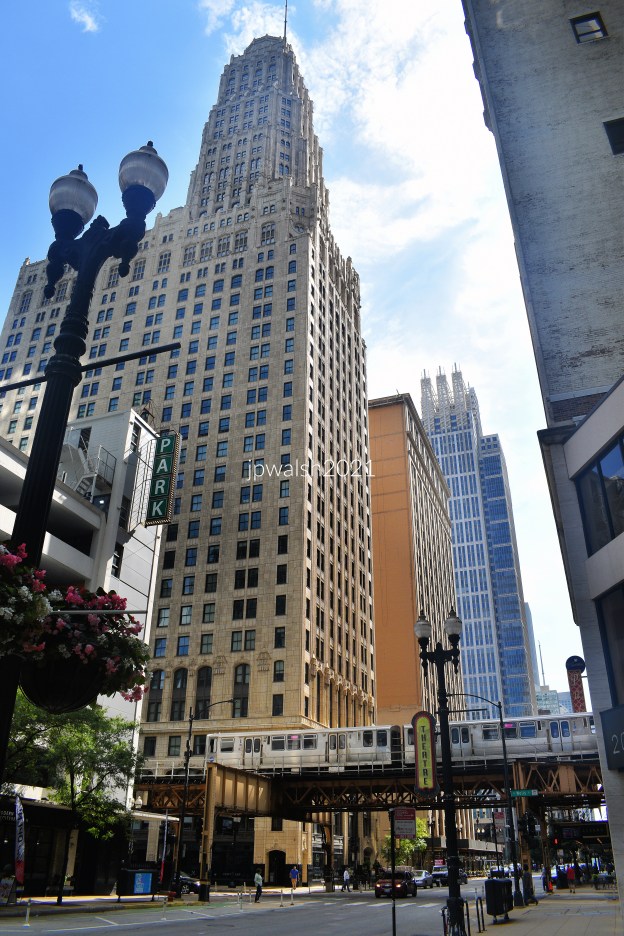

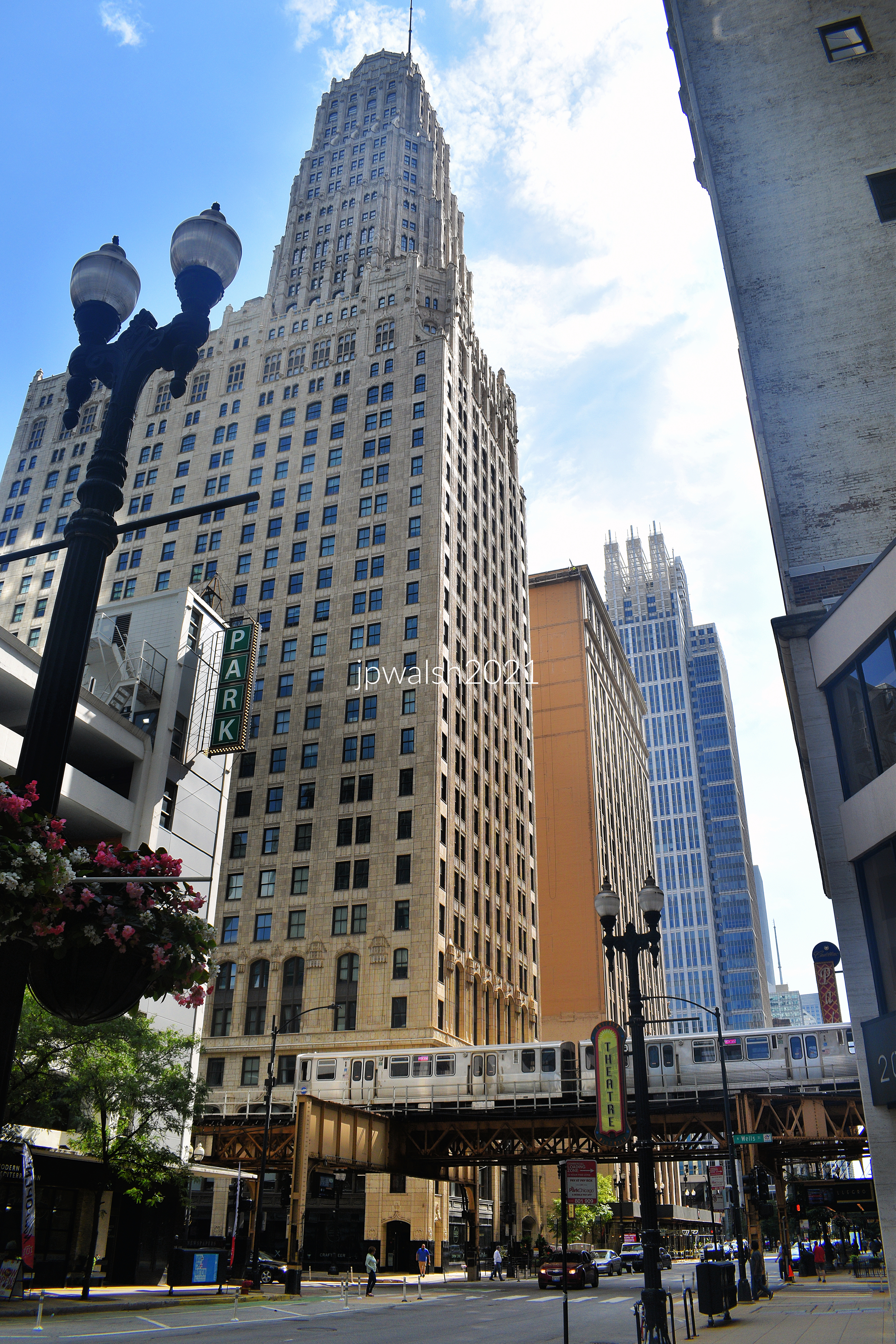
FEATURE Image: Steuben Club Building/Randolph Tower. 188 W. Randolph Street, Chicago. View from the west, August 2021. Author’s photograph. 12.72mb_9354 (1)
The 1929 limestone tower whose shape may be the last surviving skyscraper reflective of the 1923 zoning law with setbacks and a telescoping tower presages Vitzthum & Burns’ mighty 1 N. LaSalle Street Building in 1930. Randolph Tower was restored in 1993 by Stenbro, Ltd. and in 2013 opened as the residences of Randolph Tower City. In addition to its 15-story tower, the building is 27 stories tall and 465 feet high built on rock caissons. German-born Karl Martin Vitzthum (1880-1967) and John Joseph Burns (1886-1956) built some of Chicago’s best-known skyscrapers of the 1920s and 1930s. The firm also built, in 1953, St. Peter’s Church in the Loop at 110 W. Madison Street two doors down from the corner skyscraper of 1 N. LaSalle Street Building. Karl M. Vitzhum was architect on the Midland Hotel (then the Midland Club Building ). Built in 1927, it is 22 stories of roaring 1920’s Beaux-Arts architecture.


With each building the move from classicism to Modernism is clear as well as pure verticality. During the 1980s and 1990’s, I worked in one of Vitzthum & Burns’ mid1920s office buildings in Chicago – The Old Republic Building at 307 North Michigan Avenue built in 1925. My airy office on the 7th floor looked right onto Michigan Avenue where I could admire the Carbide and Carbon Building across the street built in 1929.
Vitzthum arrived in Chicago from Germany in 1914 and worked with architectural firms such as Graham Anderson Probst and White, Burnham & Co., and White, Jarvis & Hunt. He often worked with Fredrick J. Teich (1874- n.a) prior to establishing his own firm with John J. Burns in 1919. Vitzthum was a young architect on Burnham’s staff when he worked on some engineering details for the old Comiskey Park (1910-1990). The partnership of Vitzthum and Burns started in 1919 and ended with Burns’ death in 1956. Though known for eclectic styled bank buildings throughout the Midwest, the pair had built the one-screen 1,000 seat The Hollywood Theatre at Fullerton Avenue and Greenview Avenue in 1926. The theatre closed in 1957 after being renamed the Holly Theatre and was demolished soon afterwards. It is a parking lot today for a local Walgreens across the street from Facets movie theatre.
SOURCES:
Frank A. Randall, History of Development of Building Construction in Chicago, Second Edition, Revised and Expanded by John D. Randall, University of Illinois Press, Urbana and Chicago, 1999, pp. 331 and 319.
Saliga, Pauline A., editor, The Sky’s The Limit A Century of Chicago Skyscrapers, Rizzoli New York, 1990, p. 133.
Alice Sinkevitch, AIA Guide to Chicago, 2nd Edition, Harcourt, Inc., Orlando, 2004, p. 84.
https://www.thechicagoloop.org/arch.vbur.00000.html – retrieved September 20, 2024.
https://rpwrhs.org/w/index.php?title=Holly_Theatre – retrieved September 20, 2024.
https://rpwrhs.org/w/index.php?title=Vitzthum,_Karl_Martin – retrieved September 20, 2024.


