

FEATURE Image: Alexander Calder’s Flamingo successfully transforms Chicago’s Federal Center Plaza by humanizing, energizing, and completing Mies van der Rohe’s austere modernist architectural ensemble through color, scale, movement, and sculptural form. Author’s photograph. June 2022. 7.73 mb
Alexander Calder’s Flamingo was unveiled on October 25, 1974, in a dedication ceremony with the artist. Alongside Picasso and Cloud Gate, it is one of Chicago’s iconic outdoor public artworks.
In downtown Chicago’s Federal Center Plaza on South Dearborn Street between Adams Street and Jackson Boulevard is Alexander Calder’s 53-foot-tall painted steel plate “stabile object” entitled Flamingo. The Chicago Federal Center was completed in 1974 with Calder’s artwork. The design project began in 1958 and included three International-style government buildings by modernist architect Mies van der Rohe (1886-1969) within a public plaza design that was completed in 1974. Flamingo, commissioned after Mies’ death for $250,000 by the Government Services Administration, was unveiled on October 25, 1974 with the 76-year-old Calder present for its dedication ceremonies and festivities. With the commission Calder understood the significant impact of his artwork for the Federal Center Plaza in Chicago.
Calder’s prolific and impressive art career started in the early 1920s. Fifty years later, Flamingo (a.k.a., “the Calder”) in Chicago’s historic Federal Center Plaza is a later work, whose maquette Calder made before it was intended for Chicago.
During his artistic career’s many decades and years, Calder never stopped developing in his art. The 1974 steel sculpture painted red-orange is four stories tall and makes a powerful impact on the streetscape where it is an integral part. Along with Chicago’s Picasso in 1967 and Anish Kapoor’s Cloud Gate (“the Bean”) in 2004, Calder’s Flamingo in 1974 has taken its well-deserved place among Chicago’s most iconic outdoor public artworks.
From the inventor of the mobile, Calder turned later to the development of the stabile of which Flamingo is a masterwork. Starting in the mid1950s and into the 1970’s, Calder produced scores of stabiles in many shapes and sizes for display around the world.
“Most architects and city planners want to put my objects in front of trees or greenery. They make a huge error. My mobiles and stabiles ought to be placed in free spaces, like public squares, or in front of modern buildings, and that is true of all contemporary sculpture” – Alexander Calder. Quoted in Jed Perl, Calder: The Conquest of Space: The Later Years: 1940–1976 (New York: Alfred A. Knopf, 2020).

June 2022. Author’s photograph. 7.24 mb
Above: On the west side of Clark Street between Adams Street and Jackson Boulevard—visible directly behind Alexander Calder’s Flamingo sculpture—the prominent structures are from left to right: The Commercial Office Building located at 118 South Clark Street (directly tucked between the Bankers Building and Jackson Boulevard)—was completed in 1920 and designed by the prolific Chicago architectural firm Holabird & Roche, Willis Tower in the distance, The Bankers Building (105 West Adams Street, completed in 1927 by the Burnham Brothers, a 476-foot Art Deco masterpiece featuring characteristic deep light courts and upper-tier setbacks), and, on the other side of Adams Street, The Field Building at 140 S. Clark. Completed in 1934 by Graham, Anderson, Probst & White, it stands as one of the finest premier masterpieces of Art Deco skyscraper design in the entire United States. A corner slice of the Edison Building is also pictured.
Titled Flamingo, the towering abstracted “Calder red” painted stabile object can evoke reactions to it that are unexpected. Calder’s stabile masterwork was unveiled in October 1974 which was the same year the Sears Tower (in the background) was completed, and which was at that time the world’s tallest building (today it is ranked no. 26). From Federal Center Plaza, Chicago’s 20th century architectural history is readily on display in its downtown buildings in a range of shapes, sizes, textures and design styles.
The work’s vivid red color and sweeping curves contrast with Mies van der Rohe’s black steel-and-glass buildings.
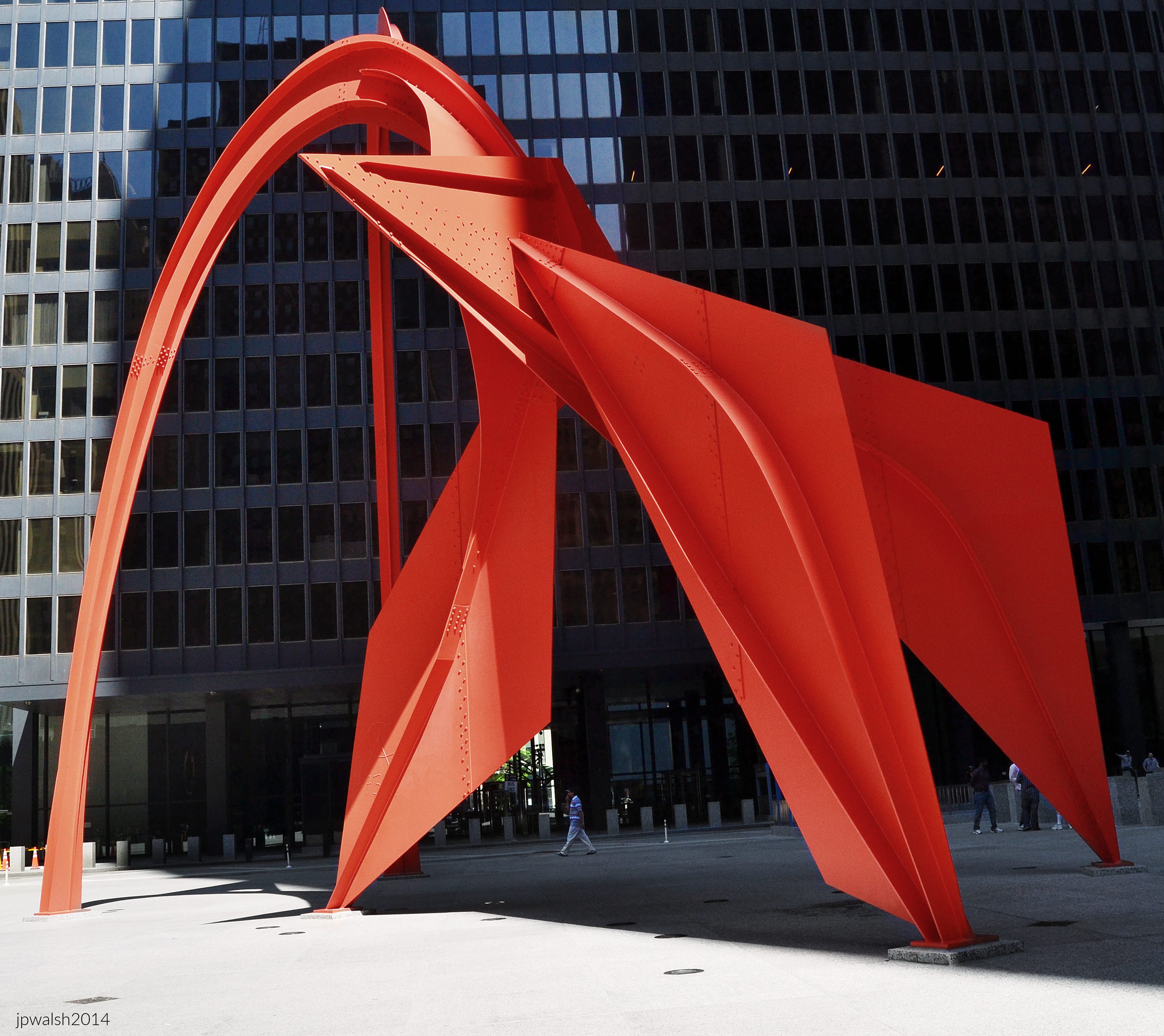
May 2014. Author’s photograph. 3.28 mb
Because of its monumental size, Flamingo can be intimidating. Actual flamingo shorebirds vary in size, but none are no more than 3 to 5 feet tall, and weigh about 5 to 7 pounds. At 53 feet tall, Calder’s immense stabile in Chicago is about the size of a giant sauropod dinosaur which would weigh around 60 tons.
“It’s really just for differentiation, but I love red so much that I almost want to paint everything red” – Alexander Calder. Katharine Kuh, The Artist’s Voice: Talks with Seventeen Artists (New York: Harper & Row, 1962).

November 2015. Author’s photograph. 260kb 25%
Alexander Calder trained and worked as a mechanical engineer before he became an artist. The graceful design and construction of Flamingo is expressed by nearly one-inch-thick steel plates buttressed by ribs and gussets joined overhead by lofty arches and resting on three legs as if it is nearly weightless. Even his largest stabiles (of which Flamingo is one) are made so they can be easily unbolted and taken apart to be transported and assembled at the place of destination.
Calder’s Flamingo demonstrates how monumental public sculpture can become an active architectural partner, transforming a formal modernist plaza into a more dynamic, accessible, and memorable civic space.

May 2014. Author’s photograph. 4.82 mb
In Federal Center Plaza is a complex of three buildings of varying scales by Mies van der Rohe: the broad 30-floor Everett McKinley Dirksen Building at 219 S. Dearborn Street completed in 1964 (at right), the lean 45-floor John C. Kluczynski Building at 230 S. Dearborn Street completed in 1974 (not pictured), and the single-story U.S. Post Office building at 219 S. Clark Street (not pictured). Calder’s Flamingo sits on its three pillars like a lunar lander that reflects the arcaded bases of Mies van der Rohe’s buildings that surround it as well as provide a sweeping contrast of curves and bright stand-out color against the surrounding modernist buildings’ monochrome glass-and-steel grid appearance. Calder’s artwork achieved more than the sum of these parts – it transformed Mies’ overall somber architectural trio into a more dramatic and complex quartet that included Calder’s art. The 30-story Dirksen Building is across Dearborn Street.
Flamingo by Alexander Calder is a masterwork stabile in Chicago’s downtown. Its monumental scale remains approachable because pedestrians can walk around, beneath, and through it.

May 2013. Author’s photograph. 3.60 mb 102_0480 (1)
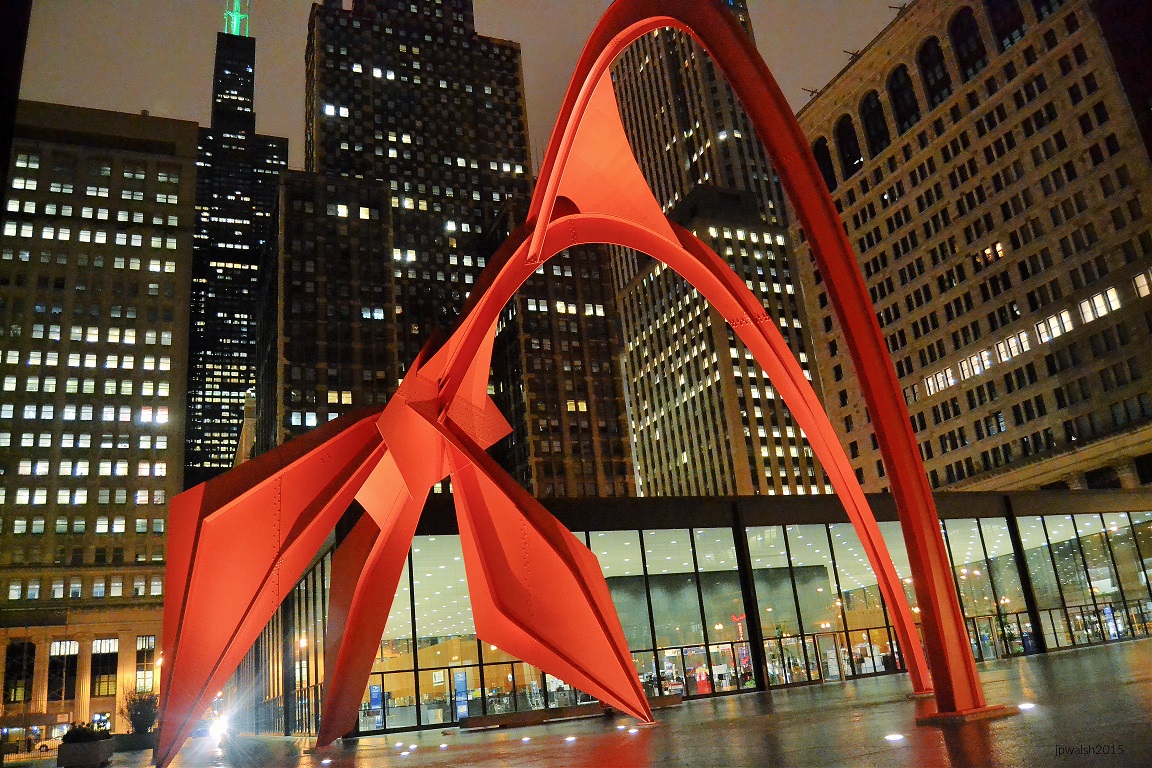
November 2015. Author’s photograph. 484 kb 25%
Above: Calder’s Flamingo after dark with the one-story Post Office illumined within behind it (above). Alexander Calder deliberately placed the sculpture in an open urban setting where contemporary sculpture could interact with modern architecture.

June 2022. Author’s photograph. 6.87mb
Above: Calder’s stabile is one of the most monumental public art commissions in Chicago. Flamingo’s height and breadth (it fills a space of about 1440 square feet) achieves a largesse that does not forgo a human scale as it allows pedestrians to freely walk around, under and through it. The 45-story Kluczynski Building is at left.

November 2015. Author’s photograph. 3.77mb
Above: Flamingo lighted at night in late November where there is already a snow pile on the sidewalk in Chicago’s Federal Center Plaza presaging the Chicago winter. In summer months there is a regular farmer’s market on the Federal Center Plaza. It is also the location for a variety of political gatherings year-round. The Kluczynski Building is behind.
Rather than functioning as an isolated object, the sculpture changes how viewers experience the entire Federal Center complex.

October 2015. Author’s photograph. 3.90mb.
Above: Alexander Calder’s Flamingo (1974) sits in Federal Plaza designed by modernist architect Mies Van Der Rohe. Behind it is Mies’ 45-floor John C. Kluczynski Building at 230 S. Dearborn Street and on a sunny east side of South Dearborn his 30-story Dirksen Federal Courthouse. Moving south across Jackson Boulevard is the 5-story 33 West Jackson Boulevard building built in 1910 (with additions/remodels stretching through 1917). Next to it is The Standard Club at 321 South Dearborn Street built in 1926 and designed by Albert Kahn. The Fisher Building (1896) at 343 South Dearborn Street and its annex is next further south. Designed by D.H. Burnham & Company, it was completed in 1896. The Old Colony building on the other side of the L tracks was built between 1893 and 1894, When it officially topped out, the 17-story, 215-foot high-rise briefly held the title of the tallest building in Chicago. It was designed by the legendary architectural firm of Holabird & Roche. The framework was engineered by Corydon T. Purdy who designed it with a highly advanced, pioneering skeletal steel-frame structure that carries the entirety of the building’s massive weight allowing the exterior features absolutely no self-supporting walls.
In October 1974 Alexander Calder was in Chicago for a “Calder Festival” where two of his major works were being dedicated – Flamingo for Federal Center Plaza (depicted above with the Kluczynski Building) and Universe, a motorized mural for the Sears Tower. Reflecting the artist’s lifetime interest in circuses, Calder joined in the city’s circus-themed parade in his honor. In another major cultural event in Chicago, the Museum of Contemporary Art held a large retrospective exhibition of Calder’s art from October to December of 1974.

June 2022. Author’s photograph. 6.20mb
Above: Flamingo sits within a classic Chicago Loop streetscape looking south down South Dearborn Street, framing a beautiful juxtaposition of the city’s architectural evolution. On the left side of the street sits the massive, dark steel-and-glass the Kluczynski Federal Building designed by Mies van der Rohe. On the immediate right foreground is the ornate, reddish-brown stone facade of the Marquette Building (1895). Directly past it rises the colossal, dark brick wall of the Monadnock Building (1891), showcasing its iconic, smooth masonry curves and deep-set bay windows stretching a full block south toward Van Buren Street. In the distant vista is the historic red brick tower of the Old Dearborn Station clock tower (1885) stands out against the sky, acting as a visual anchor at the very end of the street corridor.
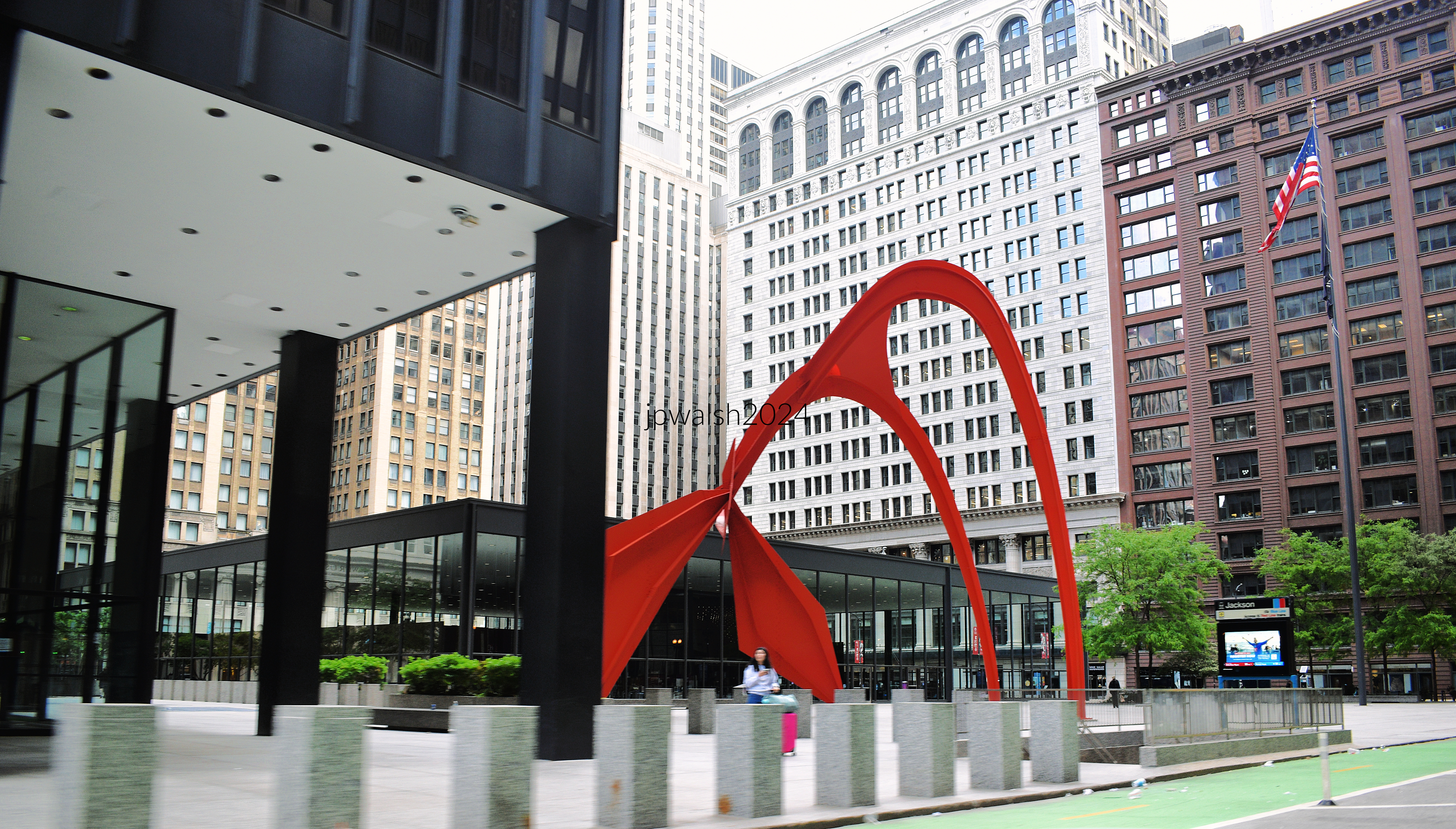
May 2024. Author’s photograph. 88% 7.78 mb
Above: This wide angle of federal Plaza frames several historic and modernist landmarks surrounding Alexander Calder’s Flamingo sculpture. These include a portion of John C. Kluczynski Federal Building, Loop Station Post Office, The Commonwealth Edison Building and The Marquette Building.
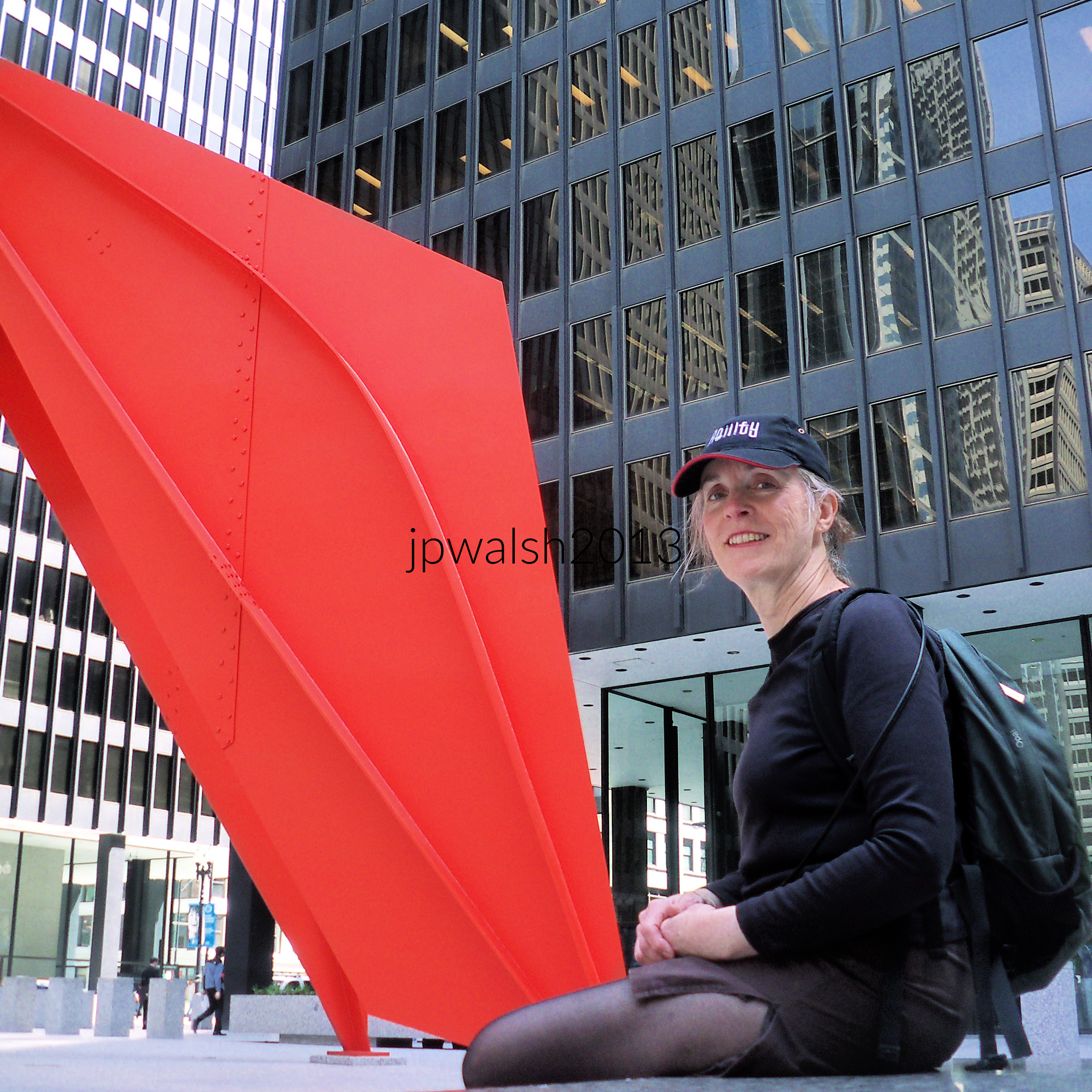
May 2013. Author’s photograph. 2.80 mb 102_0488 (1)

August 2021. Author’s photograph. 96% 7.91mb DSC_6798
Above: Looking east along West Quincy Street toward Federal Plaza, this view captures a striking convergence of Chicago’s historic and modernist architecture. Framing the corridor is, on the left, a slice of the Rookery Building, completed in 1888 by the firm Burnham & Root, and the Clark Adams Building originally known as the Bankers Building, completed by the Burnam Brothers in 1927. On the right is the Central Standard Building, originally the Continental Illinois National Bank Building, completed in 1924 by Graham, Anderson, Probst & White. Anchoring the vista is the sweeping red curve of Alexander Calder’s Flamingo. Just in front of it stands the transparent glass entrance to the single-story United States Post Office (1973), an integral element of Ludwig Mies van der Rohe’s original Federal Plaza design. Rising behind the plaza and dominating the upper half of the scene is the John C. Kluczynski Federal Building, Mies’s landmark expression of modernist architecture, creating a dramatic contrast with the richly detailed Art Deco and classical forms that line Quincy Street.
Sources:
Bach, Ira J., and Mary Lackritz Gray. A Guide to Chicago Public Sculpture. Chicago: The University of Chicago Press, 1983.
Chicago Architecture Center. “Federal Center.” Buildings of Chicago. Accessed September 30, 2022. https://www.architecture.org/learn/resources/buildings-of-chicago/building/federal-center/.
Lipman, Jean. Calder’s Universe. New York: The Viking Press and Whitney Museum of American Art, 1976.
Perl, Jed. Calder: The Conquest of Space: The Later Years: 1940–1976. New York: Alfred A. Knopf, 2020.
The Cultural Landscape Foundation. “Chicago Federal Center Plaza.” Designed Landscapes. Accessed September 30, 2022. https://www.tclf.org/landscapes/federal-plaza.

