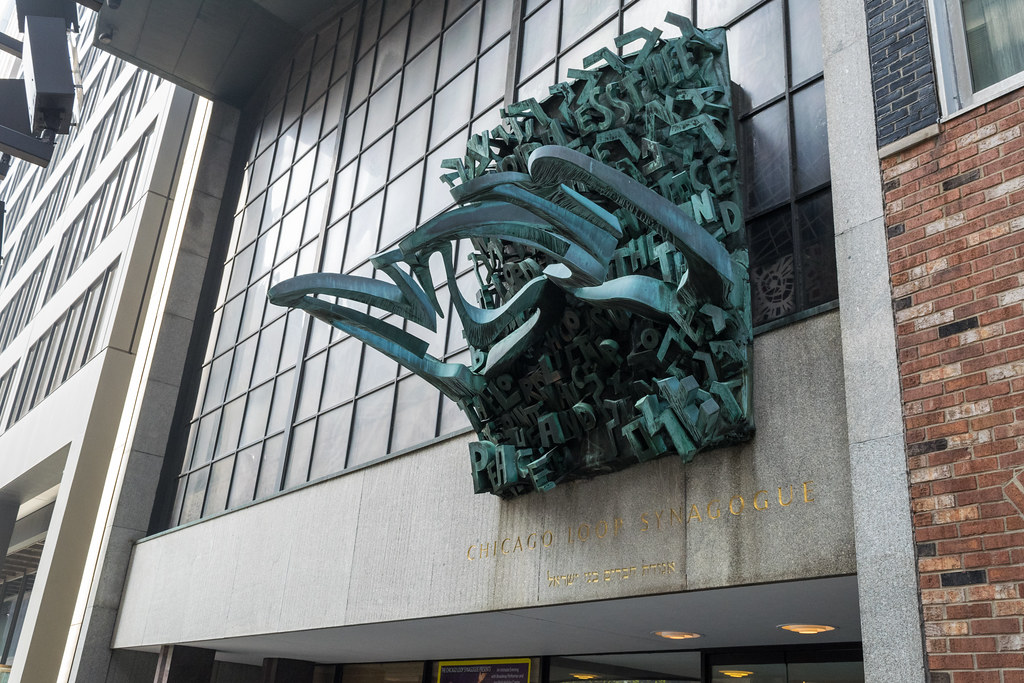
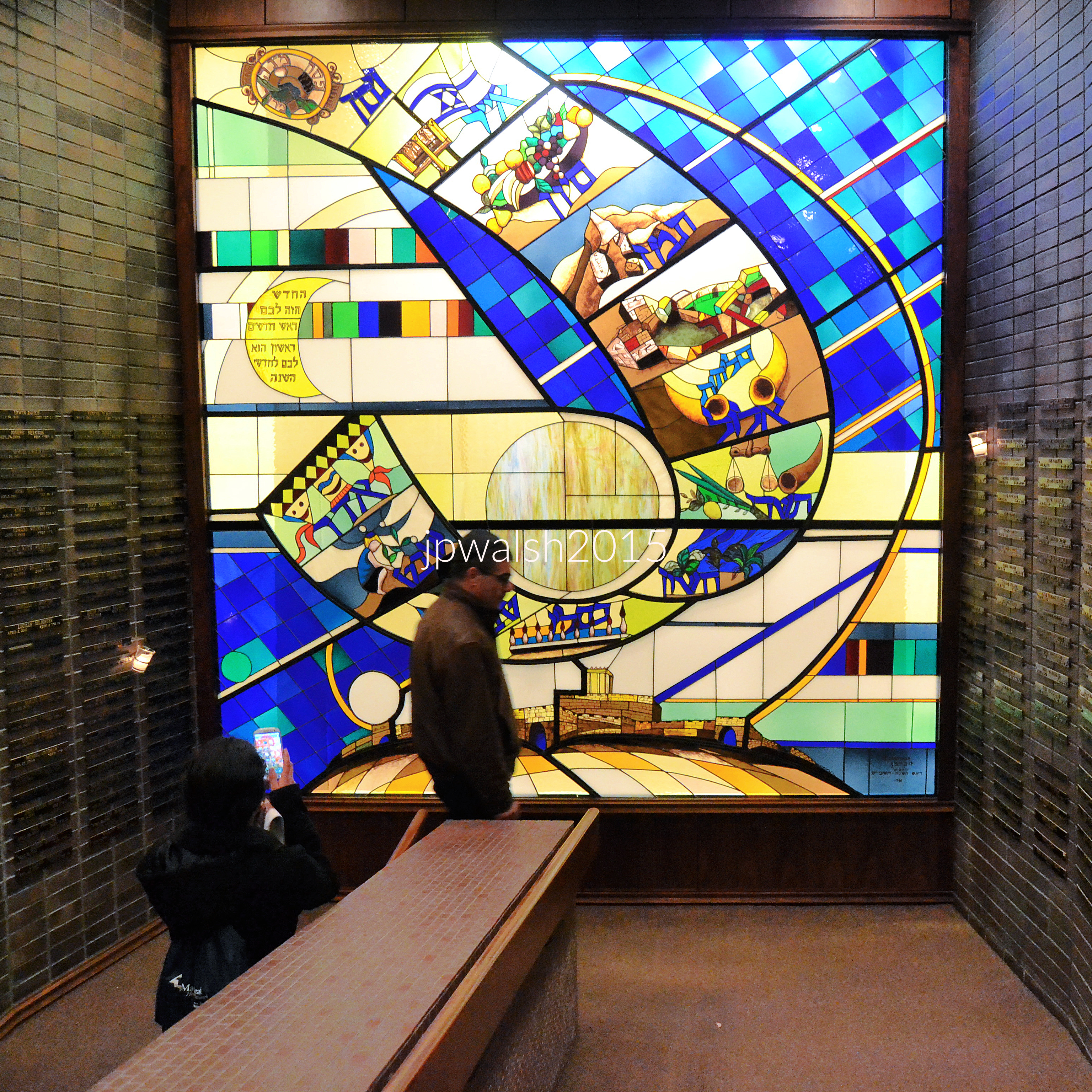
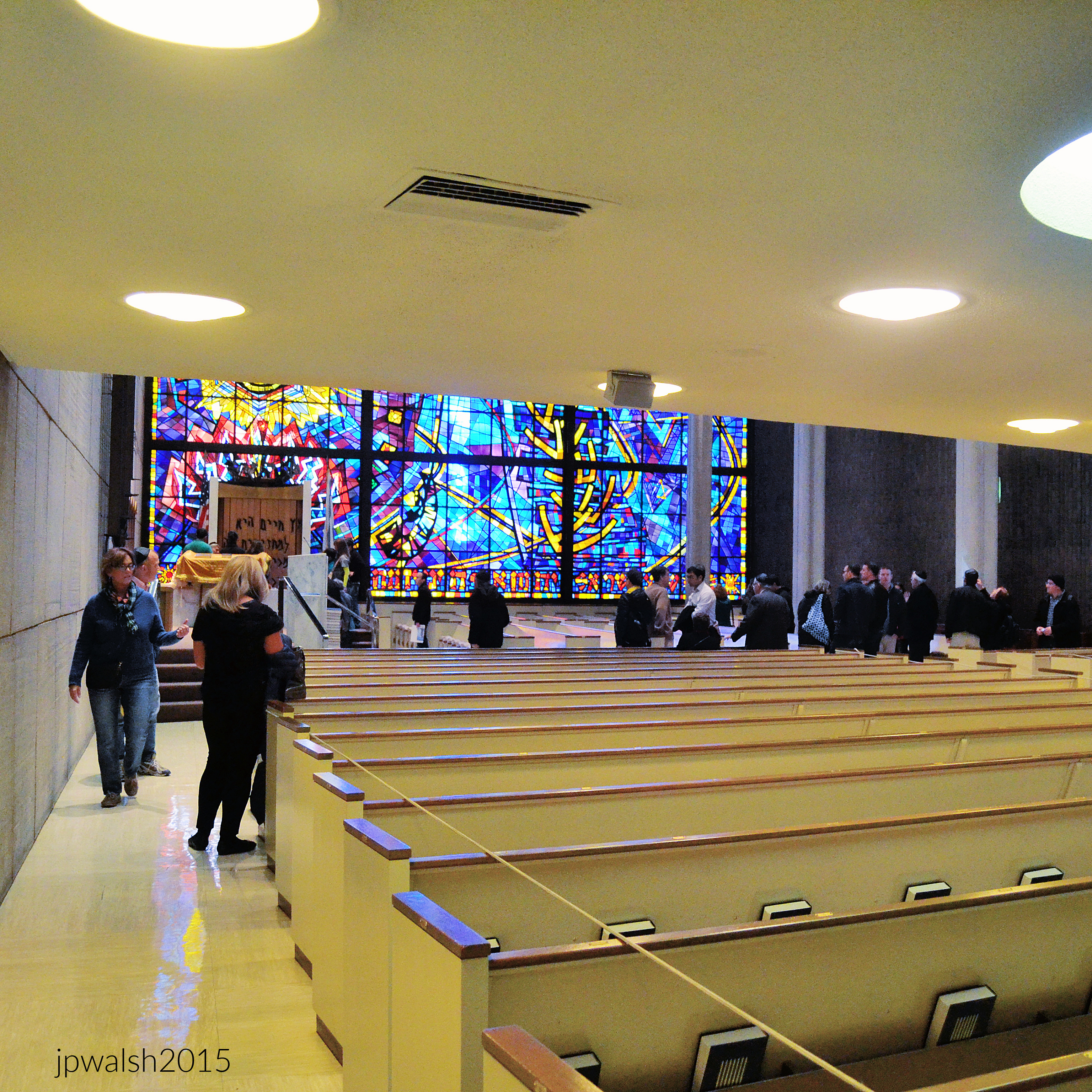
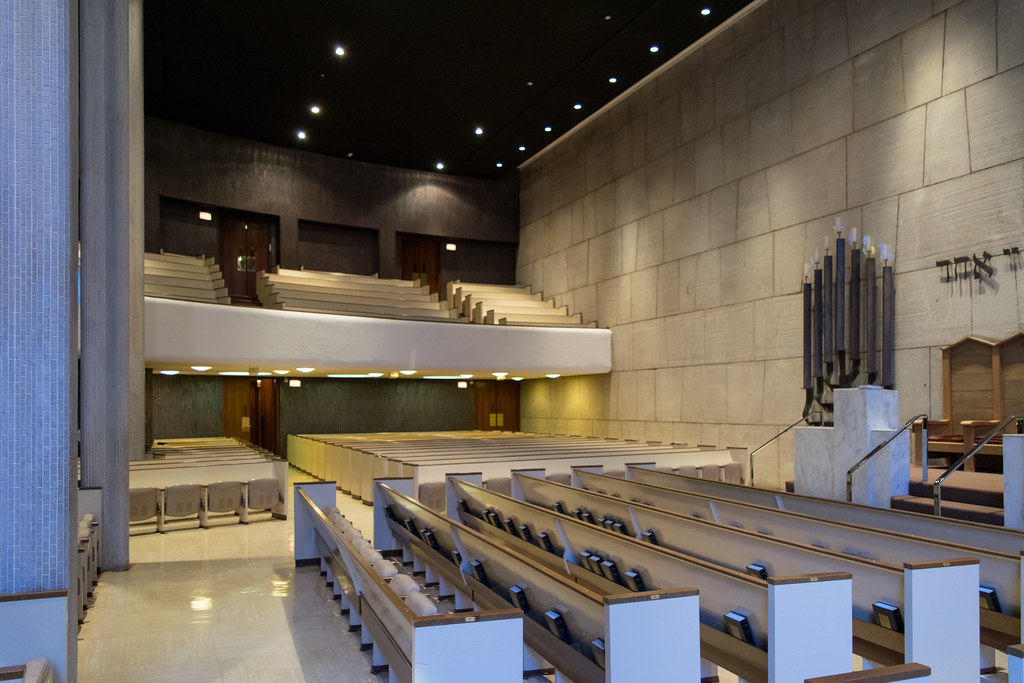
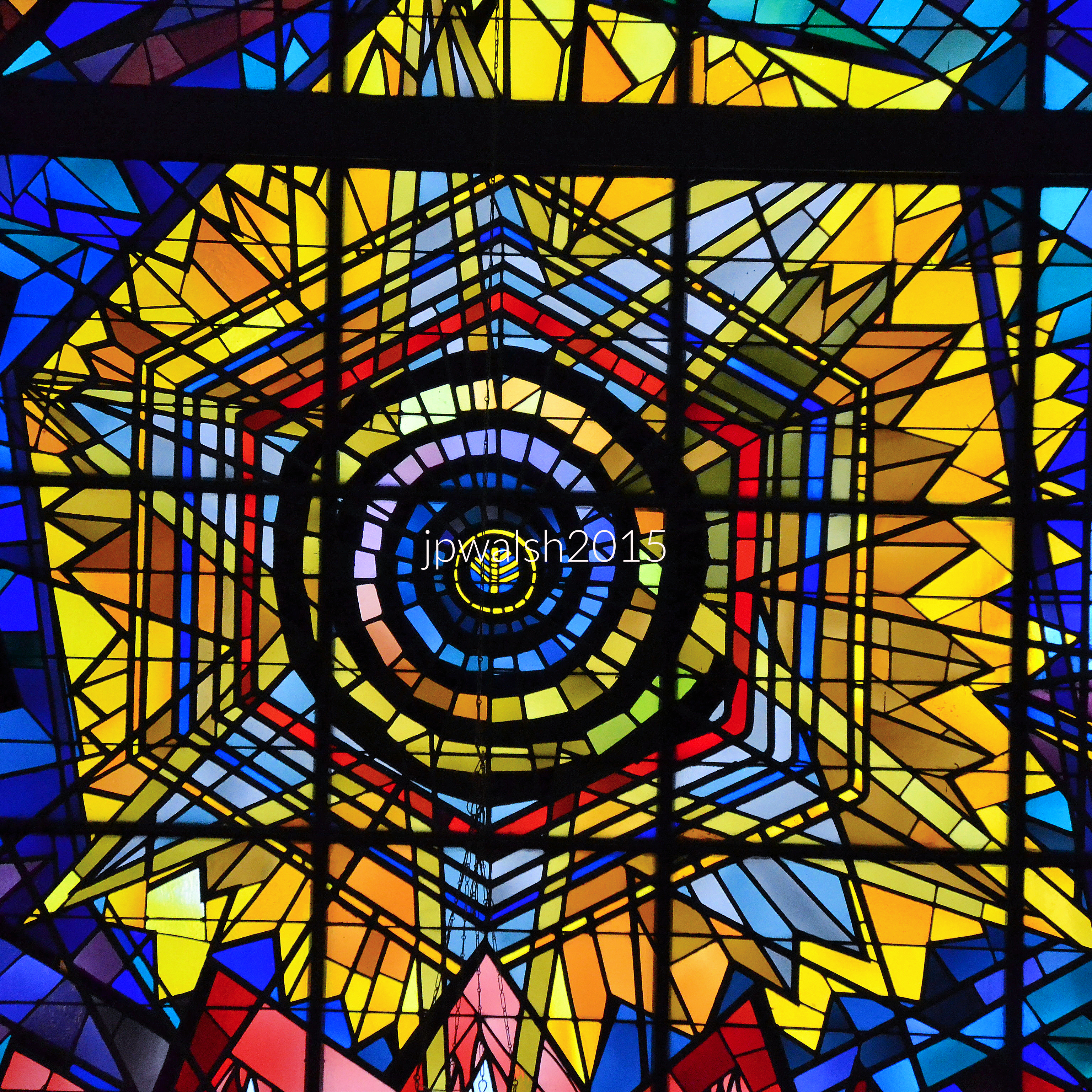
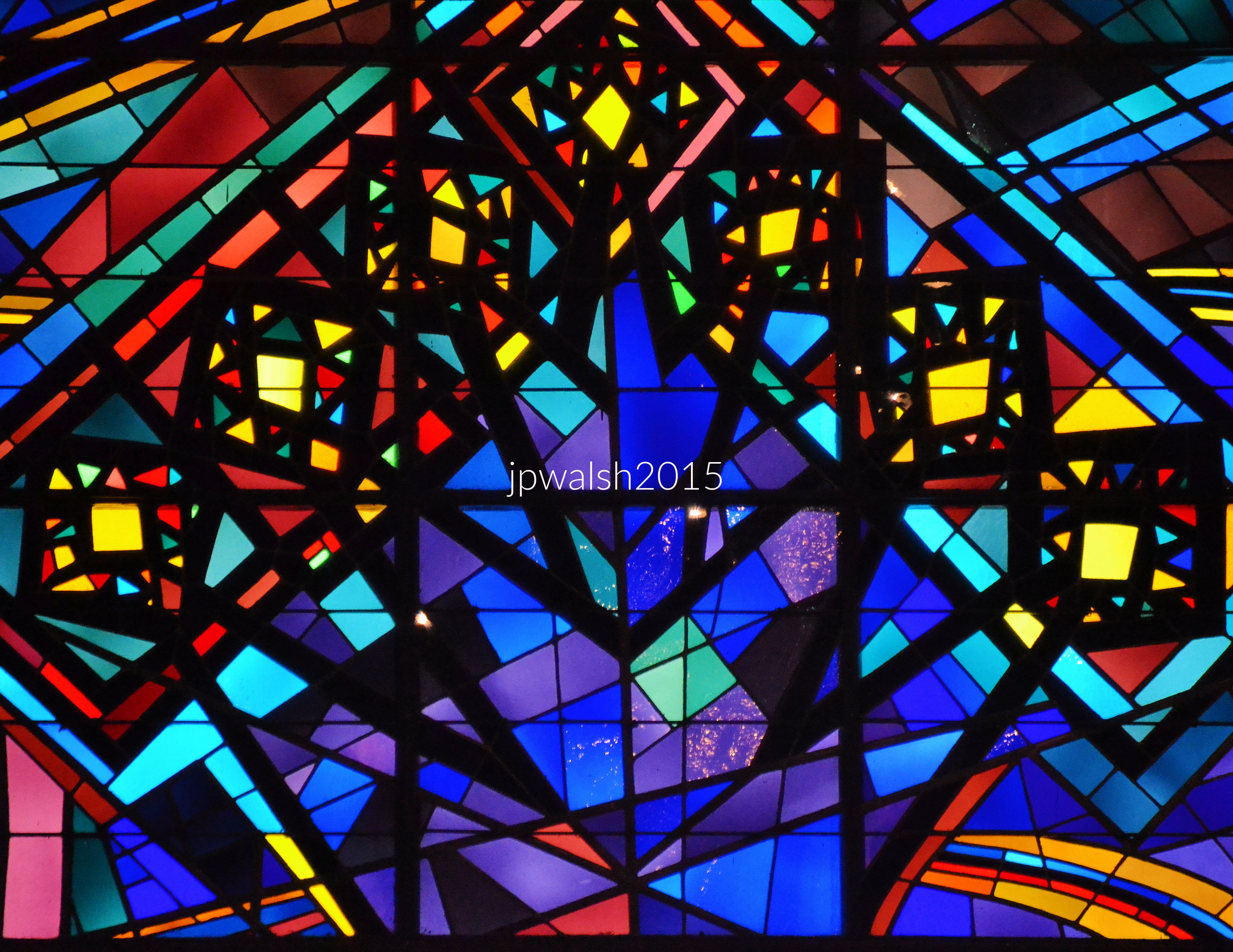
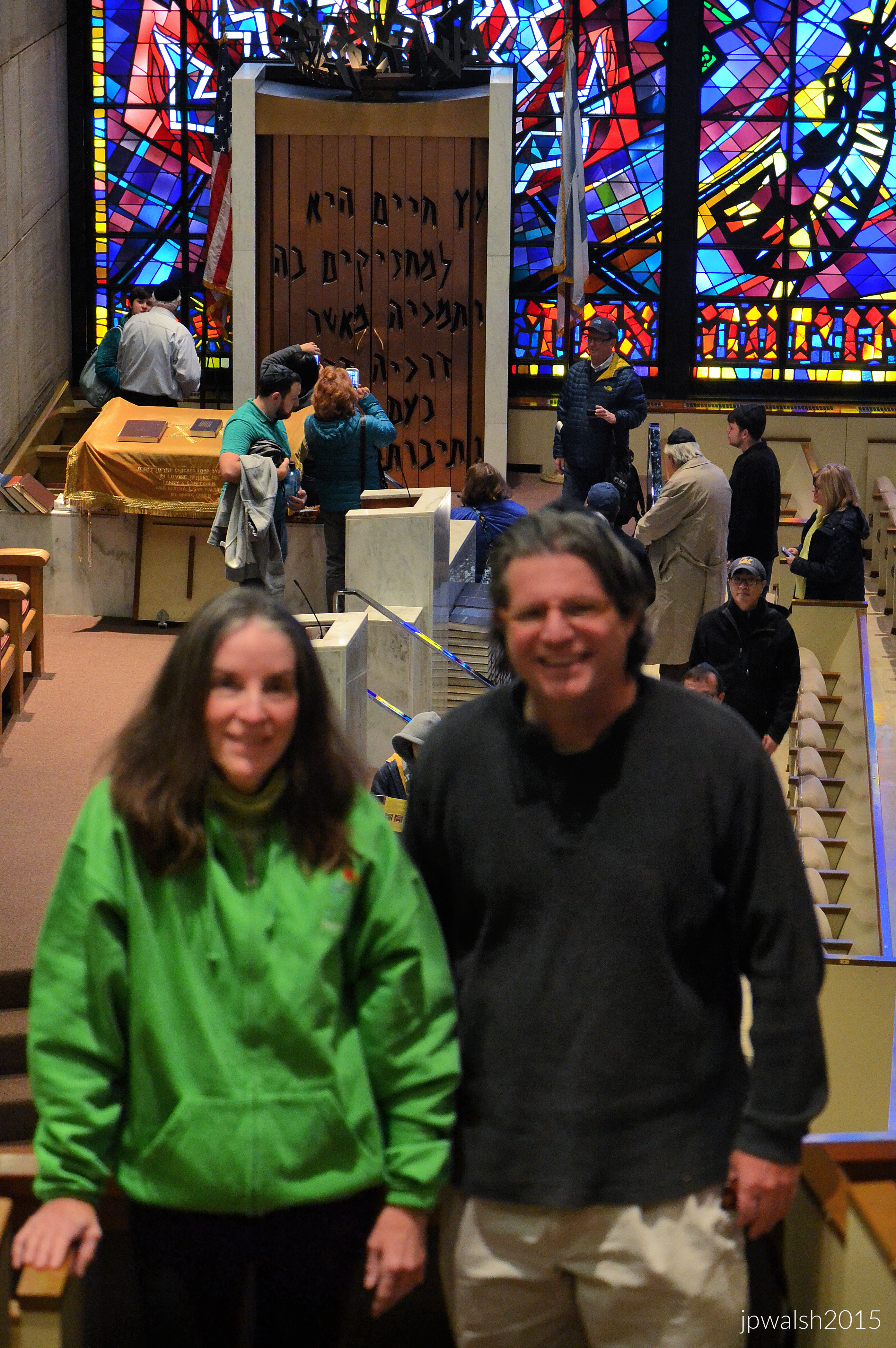
FEATURE image: Chicago Loop Synagogue with stained glass window, Let There Be Light (1960) by American Expressionist artist Abraham Rattner (1895-1978). The synagogue was built in 1957 with this wall of stained glass. The colorful and semi-abstract artwork contrasts and complements with the architectural minimalism of the rest of the sanctuary. Author’s photograph.
Text by John P. Walsh.
Chicago Loop Synagogue, exterior. May 2024 97% 7.89 mb Author’s photograph.Chicago Loop Synagogue on Clark Street in downtown Chicago, “Chicago Loop Synagogue” by _jjph is licensed under CC BY-NC-SA 2.0.
Chicago Loop Synagogue was a midcareer project for a pair of leading Chicago Jewish architects of Modernism — Jerrold Loebl (1899–1978) and Norman Schlossman (1901– 1990). Loeble was a son of Hungarian immigrants and Schlossman was the grandson of immigrants from Germany. Both graduated from the Armour Institute (today’s Illinois Institute of Technology) and became partners in 1925. The third partner changed over the decades and in 2024 the firm is Loebl, Schlossman, & Hackl. Following World War II, the firm was Loebl, Schlossman & Bennett and the team created influential examples of Chicago’s mid-century Modernism. Richard Marsh Bennett (1907-1996) had been chairman of the Yale Architecture Department and stayed with the firm until 1974 when he returned to teach at the Harvard Graduate School of Design. The architectural firm’s designs included Weiss Memorial Hospital (4646 N Marine Drive) and The Darien (3100 N. Lake Shore Drive ) also built in the 1950s.
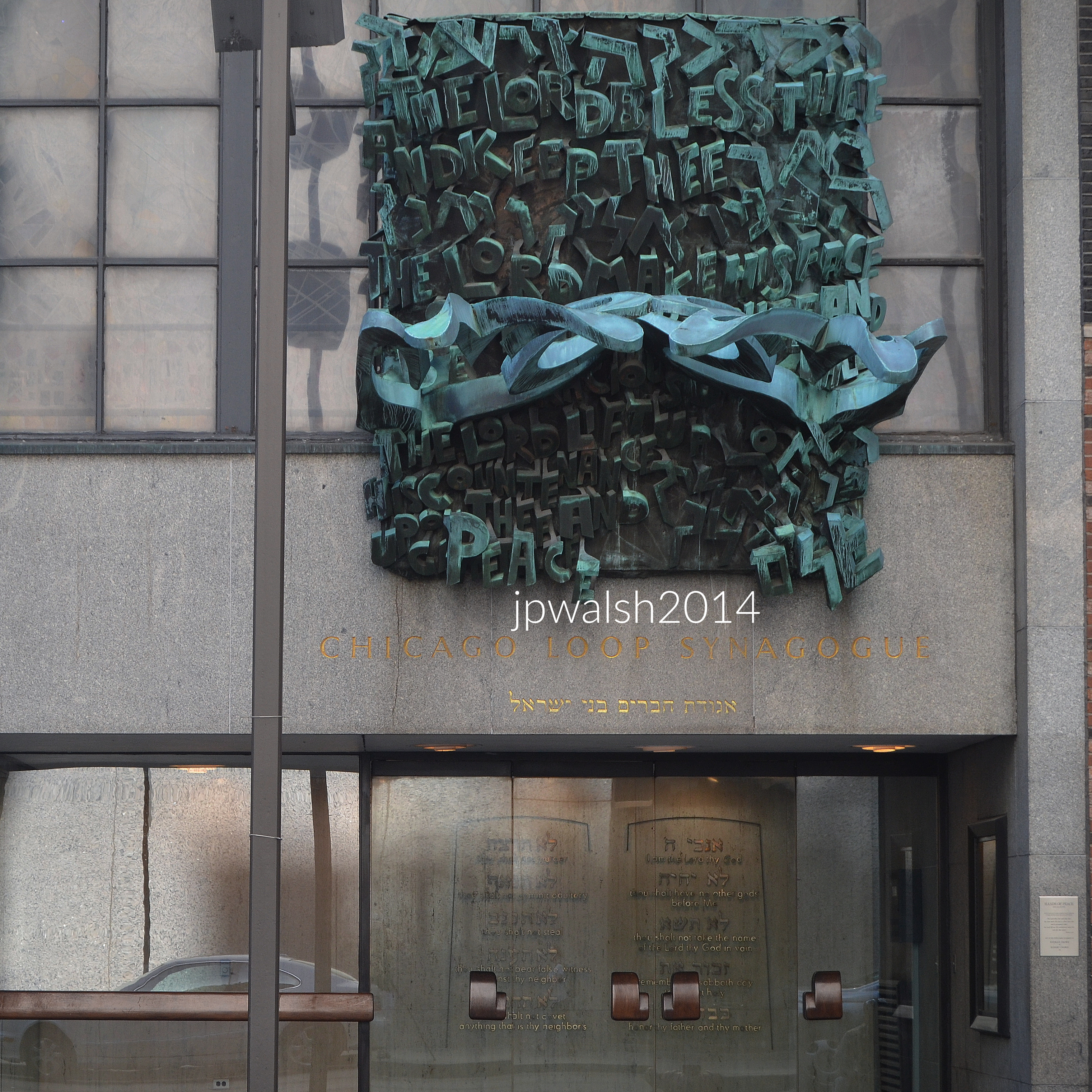
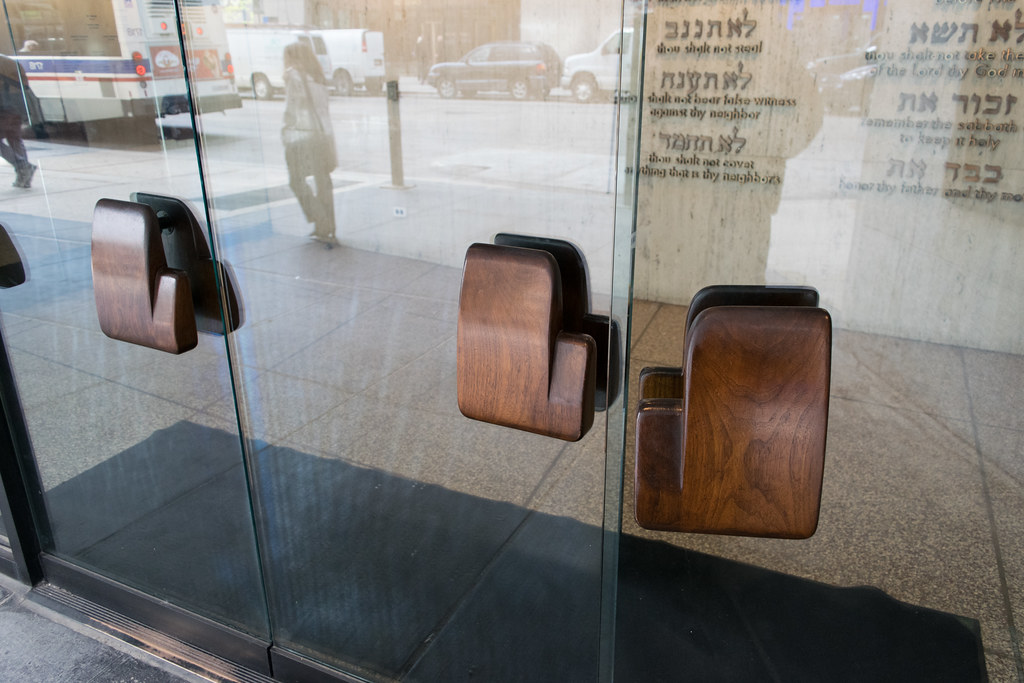
“Hands of Peace | Chicago Loop Synagogue” by _jjph is licensed under CC BY-NC-SA 2.0.May 2014. 4.28mb DSC_0055 (3). Author’s photograph. May 2014. 4.58mb DSC_0057 (1). Author’s photograph.Glass doors with wooden handles define the main entrance into Loop Synagogue off busy Clark Street. “Chicago Loop Synagogue” by _jjph is licensed under CC BY-NC-SA 2.0Ten Commandments. 9/2015 4.73 mb Author’s photograph.
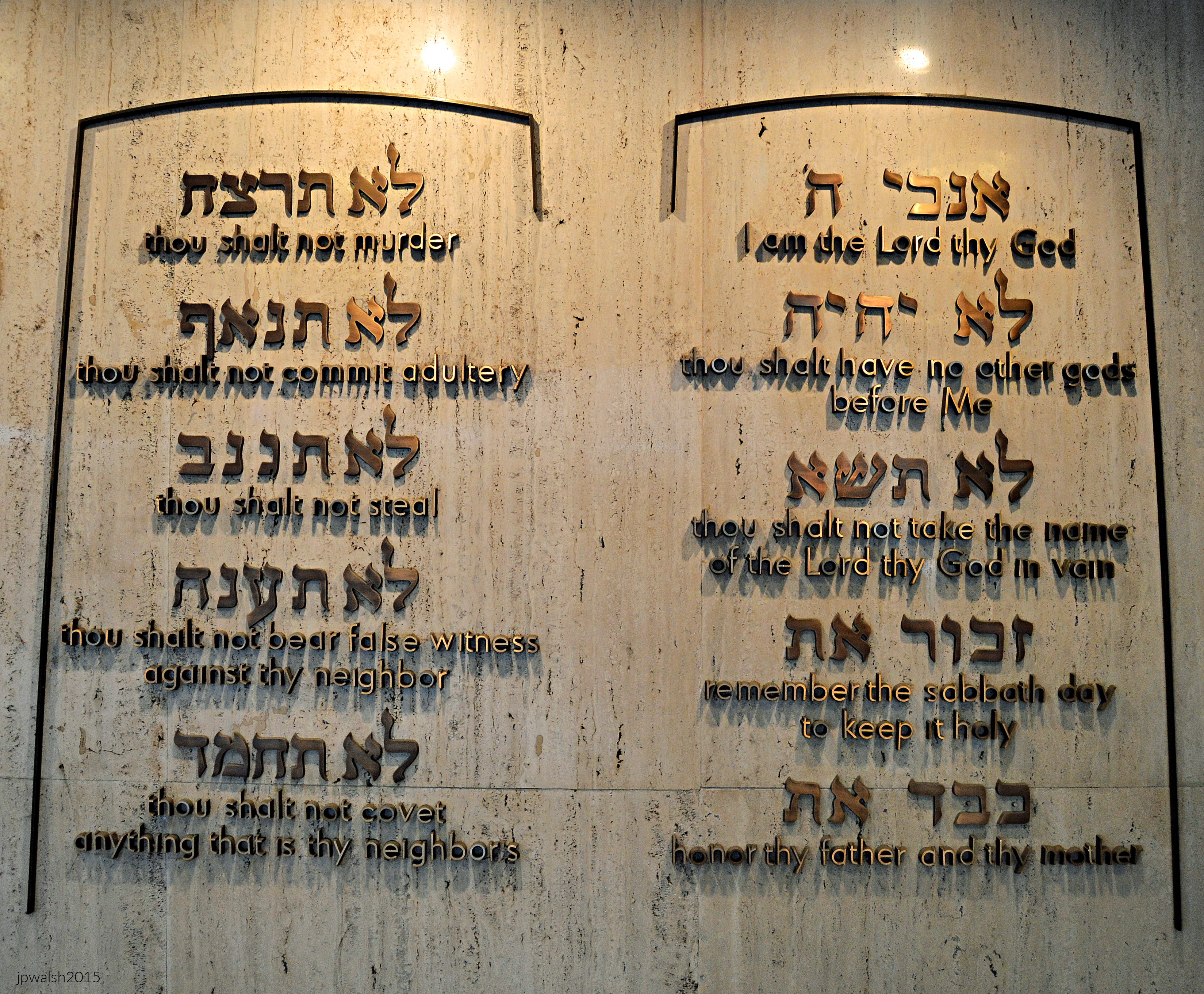
The Ten Commandments meet the visitors in the foyer upon entering synagogue. For the Jews, the Ten Commandments (found in the Bible in Exodus 20:2-17 and Deuteronomy 5: 6-21) are a special set of spiritual laws that the LORD Himself wrote on two stone tablets (luchot) that Moses brought down from Mount Sinai. In the Scriptures these laws are called the “Aseret Ha Devarim,” the “ten words” or “ten utterances.” In rabbinical writings, they are usually referred to as “Aseret Ha Dibrot,” and in Christian theological writings they are called the Decalogue which is derived from the Greek name “dekalogos” (“ten statements”) found in the Septuagint (Exodus 34:28 and Deuteronomy 10:4), which is the Greek translation of the Hebrew name. To the Jews the Torah has a total of 613 commandments which includes the ten from the Decalogue. See – https://www.the-ten-commandments.org/the-ten-commandments.html – retrieved December 4, 2023).
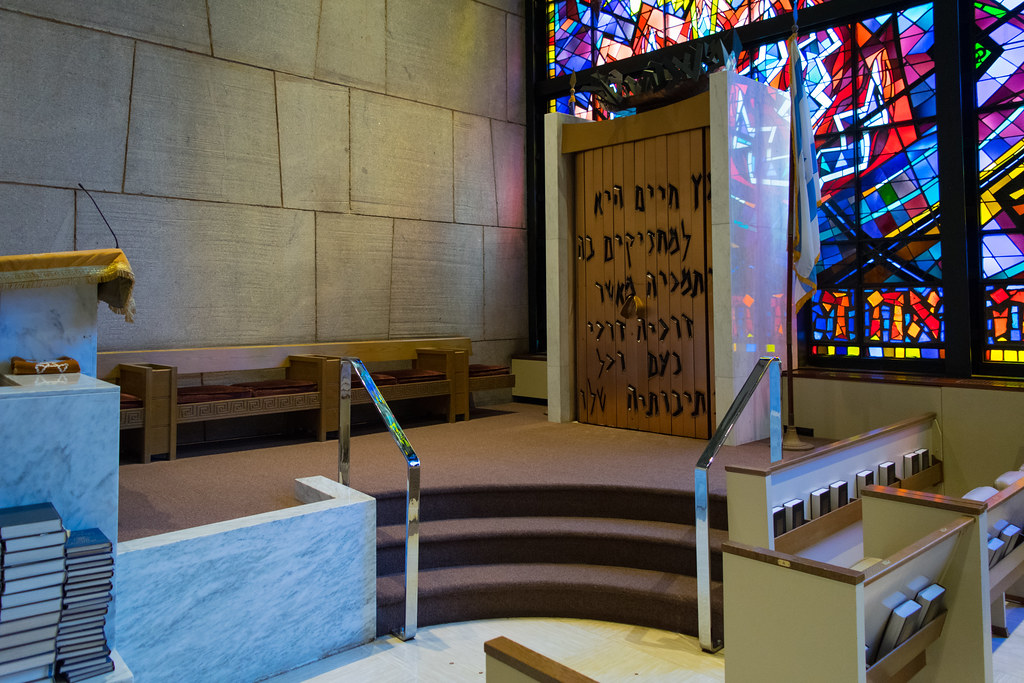
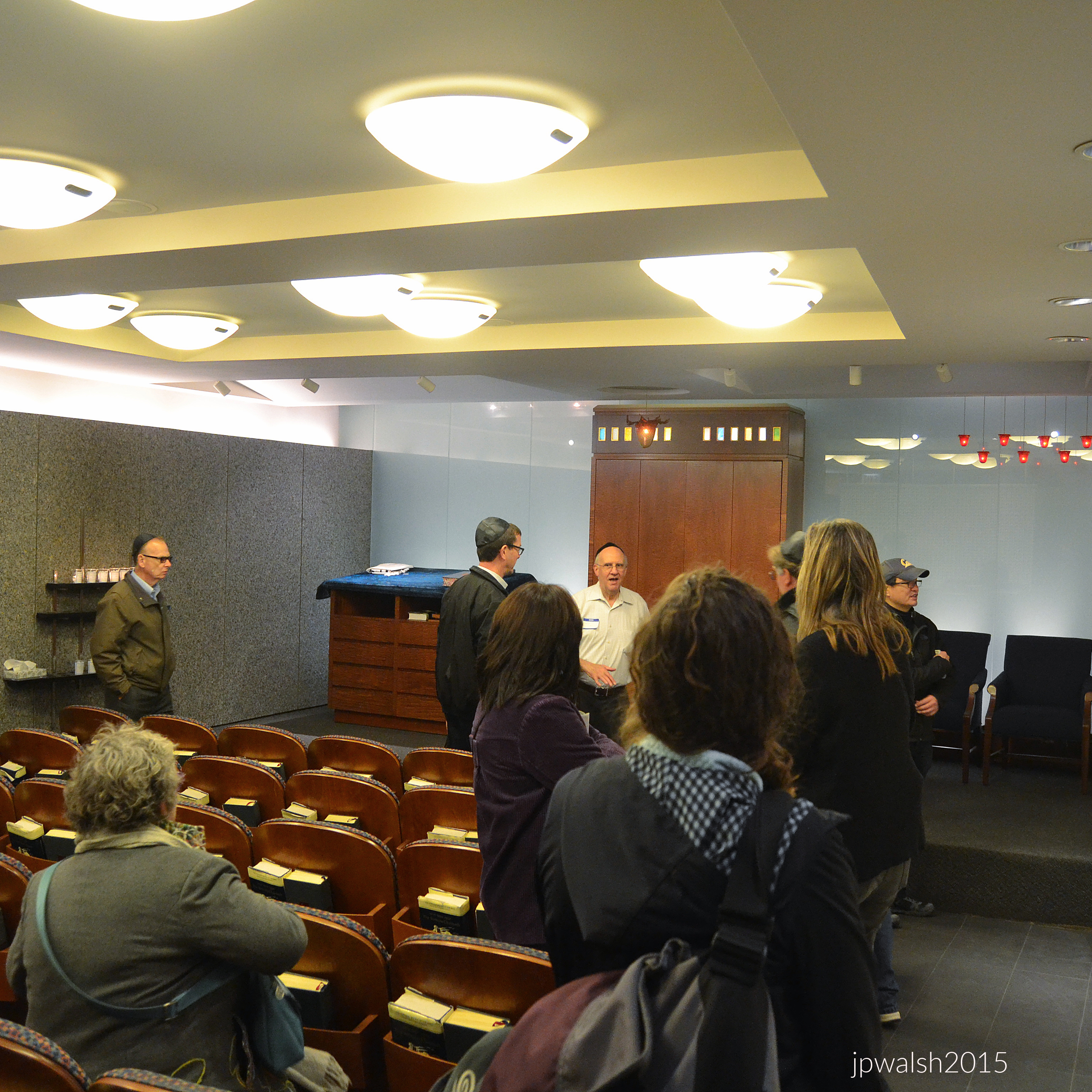
Chicago Loop Synagogue. Author’s photograph. Author’s photograph. “Chicago Loop Synagogue” by _jjph is licensed under CC BY-NC-SA 2.0.The limestone blocks of the North wall are cut at an angle to evoke the Western Wall of the Temple in Jerusalem.Author’s photograph. The Holy Ark is made by Israeli sculptor and ceramicist Henri Azaz (1923-2008). Jutting into the prayer space from the far-left corner of the window, Rattner incorporated the ark that would house the Torah scrolls. He surrounded it with flames – integrated into the glass – leaping up and out, drawing attention to the presence of God in the very heart of the sanctuary. “Chicago Loop Synagogue” by _jjph is licensed under CC BY-NC-SA 2.0.The House of Worship is 3 floors, 450 seats, 6 Torahs, and a 40-foot-tall stained-glass window that fills the Eastern façade and the congregation with filtered sunlight. Author’s photograph. The Chicago Loop Synagogue was founded in 1929 to serve the religious needs of those whose business activities brought them downtown.Author’s photograph. “Chicago Loop Synagogue” by _jjph is licensed under CC BY-NC-SA 2.0.Visitors to the Chicago Loop Synagogue are guided by one of its members. Author’s photograph. Author’s photograph.
Abraham Rattner, the Expressionist artist of the wall-filling colorful stained-glass window was born in Poughkeepsie, New York to a Russian-Jewish father and a Romanian-Jewish mother. Rattner studied to be architect, but turned to painting studying at the Corcoran School of Art in Washington D.C. and the Pennsylvania Academy of the Fine Arts in Philadelphia. Rattner served as a camouflage artist in France during World War I and, after the war, joined many of “the Lost Generation” that writer and critic Gertrude Stein spoke about when referencing the post- war Ernest Hemingway and many others who lived in Europe, mainly Paris, in the 1920s. Rattner lived in Paris for 20 years, from 1920 until late 1939 where, during that extensive time period, he met Claude Monet (1840-1926). To avoid the coming Nazi invasion of France, Rattner and his wife Bettina Bedwell (1889-1947), a journalist and fashion illustrator from Nebraska who studied at the School of the Art Institute of Chicago and who married in 1924, returned to America, where they lived in New York City. Rattner was known for his rich use of color and abstraction in his artwork and whose subject matter often had to do with religion. In the post-World War II era he taught at several schools, including New York’s The New School (1947–55) and at Yale University (1952-1953). In 1949 Rattner married Esther Gentle (1899 – 1991), an artist and art dealer, and was a friend of writer Henry Miller (1891-1980) who wrote about their friendship in 1968 in A Word About Abraham Rattner.
10/2015 7.77 mb 91%. Author’s photograph. .
The colors and design elements of this 31 x 40-foot glass artwork signify God’s relationship with the cosmos, humanity, and the Jewish people. After two years working on conceptual and design schemes, the artist Abraham Rattner spent a year fabricating the window – a presentation of cool blues and warm red and yellows studded with purples that take on shapes of planets, trees, Hebrew letters and the Israelite tribes. It was made in Paris’s 15th arrondissement at Atelier Barillet, the house and workshop of master glassmaker Louis Barillet (1880-1948). The artwork was the subject of a 1976 exhibition at the Smithsonian American Art Museum and a 1978 exhibit at the Skirball Cultural Center in Los Angeles. The window was made to fit inside the prayer space for which it was created. To create the stained glass work, Rattner drew inspiration from the opening passages of Genesis, honing in on the hidden meanings of the words “And there was light” to channel cosmic creative energies of the Divine.
Author’s photograph.
The Tree of Life (above) is also visaged as the Menorah and is identified with the light of innermost perception – the spirit; thought; ideas; life; and of knowledge. This Primal Light, God’s light, radiates outward, extending and expanding throughout the universe.
Author’s photograph.
The Menorah (above) poetically conceived as a tree of life and of light. The Menorah is the classic symbol of Judaism.
Author’s photograph.
The Star of David (above right) and the palm branch used on the Sukkot (Feast of Booths) harvest festival.
Author’s photograph.
The shofur or ram’s horn (above) is an ancient instrument used on High Holidays to call the people to repentance. In close proximity to the shofur is the etrog which is a fruit of the Holy Land which expresses earth’s bounty as well as the overflowing love of a human being’s heart for God.
A view of the sanctuary from its balcony. The near perfect beauty of the Chicago Loop Synagogue is self-evident. Author’s photograph. The prayer room on the first floor is used for daily prayer and other gatherings. Author’s photograph.
Chicago Churches and Synagogues: An Architectural Pilgrimage, George Lane, S.J., and Algimantas Kezys, Loyola University Press, Chicago, 1981,pp. 202-203.
AIA Guide to Chicago, 2nd Edition, Alice Sinkevitch, Harcourt, Inc., Orlando, 2004, p. 74.
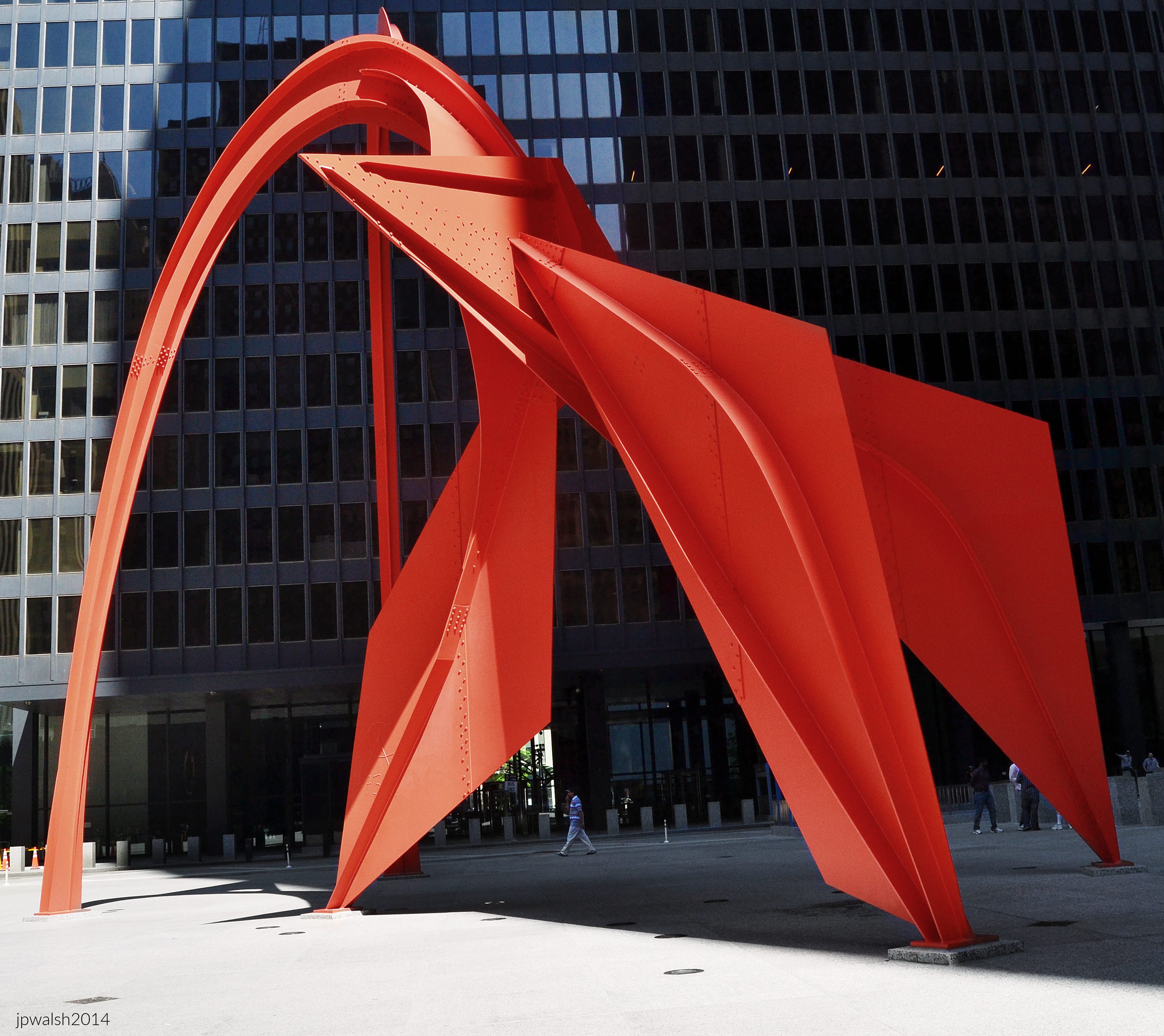
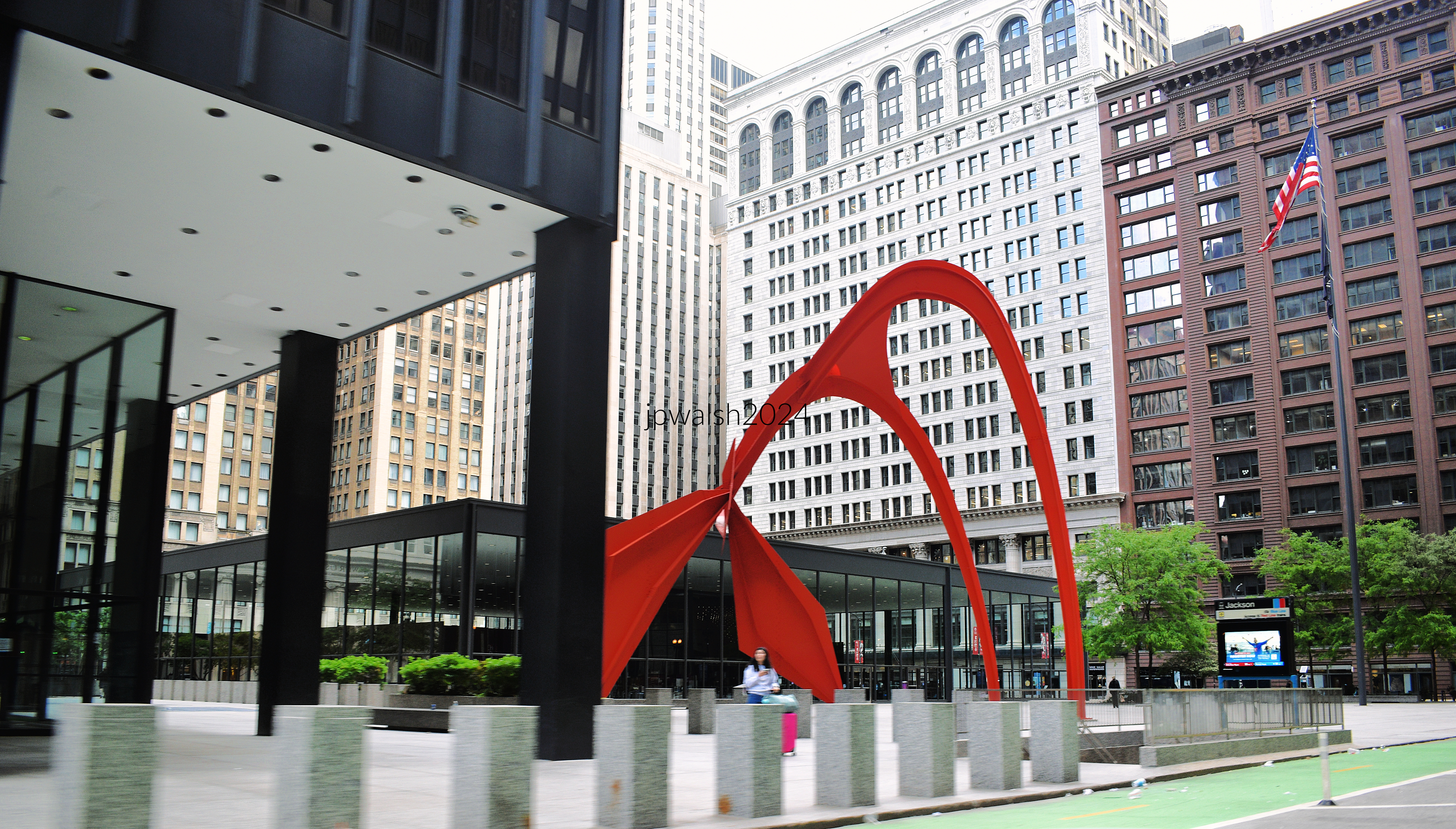
FEATURE Image: Flamingo by Alexander Calder is a masterwork stabile in Chicago’s downtown. It was unveiled on October 25, 1974 in a dedication ceremony with the artist. It is one of Chicago’s iconic outdoor public artworks. 6/2022 7.73 mb
In downtown Chicago’s Federal Center Plaza on South Dearborn Street between Adams Street and Jackson Boulevard is Alexander Calder’s 53-foot-tall painted steel plate “stabile object” entitled Flamingo. The Chicago Federal Center was completed in 1974 with Calder’s artwork. The design project began in 1958 and included three International-style government buildings by modernist architect Mies van der Rohe (1886-1969) within a public plaza design that was completed in 1974. Flamingo, commissioned after Mies’ death for $250,000 by the Government Services Administration, was unveiled on October 25, 1974 with the 76-year-old Calder present for its dedication ceremonies and festivities. With the commission Calder understood the significant impact of his artwork for the Federal Center Plaza in Chicago.
Calder’s prolific and impressive art career started in the early 1920s. Fifty years later, Flamingo (a.k.a., “the Calder”) in Chicago’s historic Federal Center Plaza is a later work, whose maquette Calder made before it was intended for Chicago.
During his artistic career’s many decades and years, Calder never stopped developing in his art. The 1974 steel sculpture painted red-orange is four stories tall and makes a powerful impact on the streetscape where it is an integral part. Along with Chicago’s Picasso in 1967 and Anish Kapoor’s Cloud Gate (“the Bean”) in 2004, Calder’s Flamingo in 1974 has taken its well-deserved place among Chicago’s most iconic outdoor public artworks.
From the inventor of the mobile, Calder turned later to the development of the stabile of which Flamingo is a masterwork. Starting in the mid1950s and into the 1970’s, Calder produced scores of stabiles in many shapes and sizes for display around the world.
“Most architects and city planners want to put my objects in front of trees or greenery. They make a huge error. My mobiles and stabiles ought to be placed in free spaces, like public squares, or in front of modern buildings, and that is true of all contemporary sculpture.” – Alexander Calder.
6/2022 7.24 mb
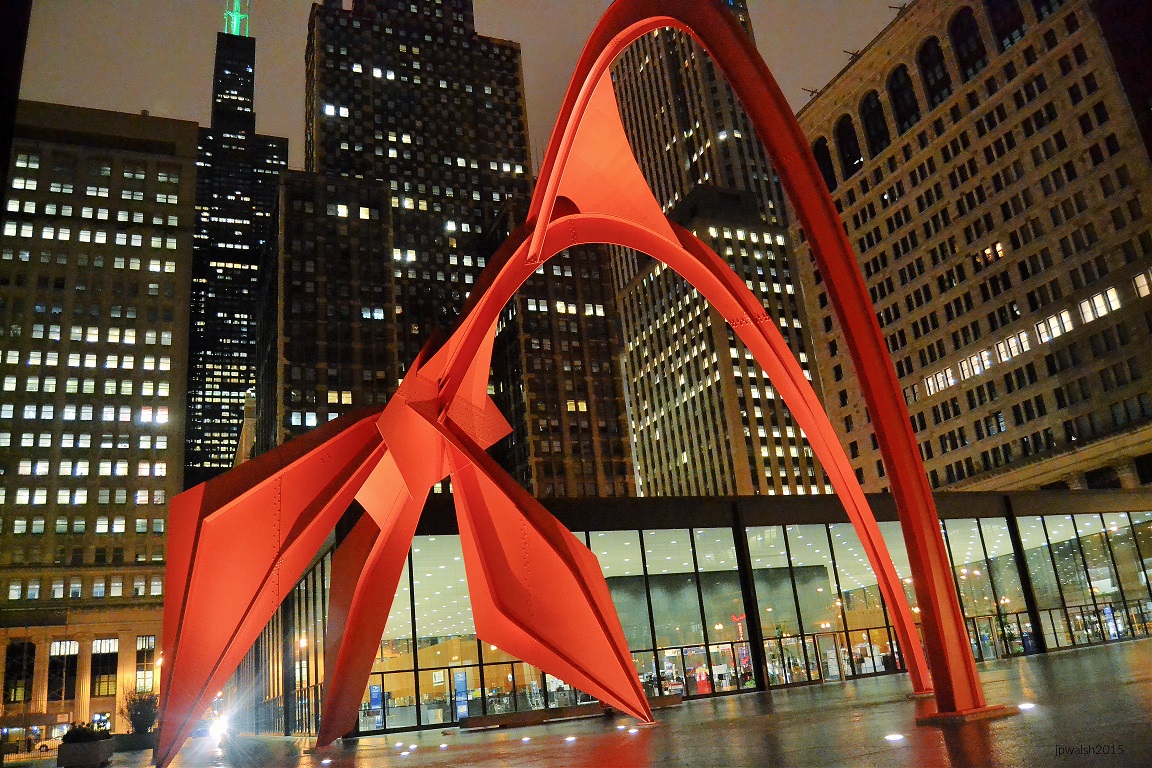
Titled Flamingo, the towering abstracted “Calder red” painted stabile object can evoke reactions to it that are unexpected. Calder’s stabile masterwork was unveiled in October 1974 which was the same year the Sears Tower (in the background) was completed and which was at that time the world’s tallest building (today it is ranked no. 26). From Federal Center Plaza, Chicago’s 20th century architectural history is readily on display in its downtown buildings in a range of shapes, sizes, textures and design styles.
5/2014 3.28 mb
Flamingo can be intimidating because of its monumental size. Actual flamingo shorebirds vary in size, but are usually no more than 3 to 5 feet tall, and weighing about 5 to 7 pounds. At 53 feet tall, Calder’s immense stabile in Chicago is about the size of a giant sauropod dinosaur which could weigh around 60 tons.
11/2015 260kb 25%
Alexander Calder trained and worked as a mechanical engineer before he became an artist. The graceful design and construction of Flamingo is expressed by nearly one-inch-thick steel plates buttressed by ribs and gussets joined overhead by lofty arches and resting on three legs as if it is nearly weightless. Even his largest stabiles (of which Flamingo is one) are made so they can be easily unbolted, and taken apart to be transported and assembled at the place of destination.
5/2014 4.82 mb
In Federal Center Plaza is a complex of three buildings of varying scales by Mies van der Rohe: the broad 30-floor Everett McKinley Dirksen Building at 219 S. Dearborn Street completed in 1964 (at right), the lean 45-floor John C. Kluczynski Building at 230 S. Dearborn Street completed in 1974 (not pictured), and the single-story U.S. Post Office building at 219 S. Clark Street (not pictured). Calder’s Flamingo sits on its three pillars like a lunar lander that reflects the arcaded bases of Mies van der Rohe’s buildings that surround it as well as provide a sweeping contrast of curves and bright stand-out color against the surrounding modernist buildings’ monochrome glass-and-steel grid appearance. Calder’s artwork achieved more than the sum of these parts – it transformed Mies’ overall somber architectural trio into a more dramatic and complex quartet that included Calder’s art. The 30-story Dirksen Building is across Dearborn Street.
11/2015 484 kb 25%
Calder’s Flamingo after dark with the one-story Post Office illumined within behind it.
6/2022 6.87mb
Calder’s stabile is one of the most monumental public art commissions in Chicago. Flamingo’s height and breadth (it fills a space of about 1440 square feet) achieves a largesse that does not forgo a human scale as it allows pedestrians to freely walk around, under and through it. The 45-story Kluczynski Building is at left.
11/2015 3.77mb
Flamingo lighted at night in late November where there is already a snow pile on the sidewalk in Chicago’s Federal Center Plaza presaging the Chicago winter. In summer months there is a regular farmer’s market on the Federal Center Plaza. It is also the location for a variety of political gatherings year-round.The Kluczynski Building is behind.
6/2022 6.20mb
In October 1974 Alexander Calder was in Chicago for a “Calder Festival” where two of his major works were being dedicated – Flamingo for Federal Center Plaza (depicted above with the Kluczynski Building) and Universe, a motorized mural for the Sears Tower. Reflecting the artist’s lifetime interest in circuses, Calder joined in the city’s circus-themed parade in his honor. In another major cultural event in Chicago, the Museum of Contemporary Art held a large retrospective exhibition of Calder’s art from October to December of 1974.
10/2015 3.90mb.
Looking from the Marquette Building south to Calder’s Flamingo in situ in Federal Center Plaza.
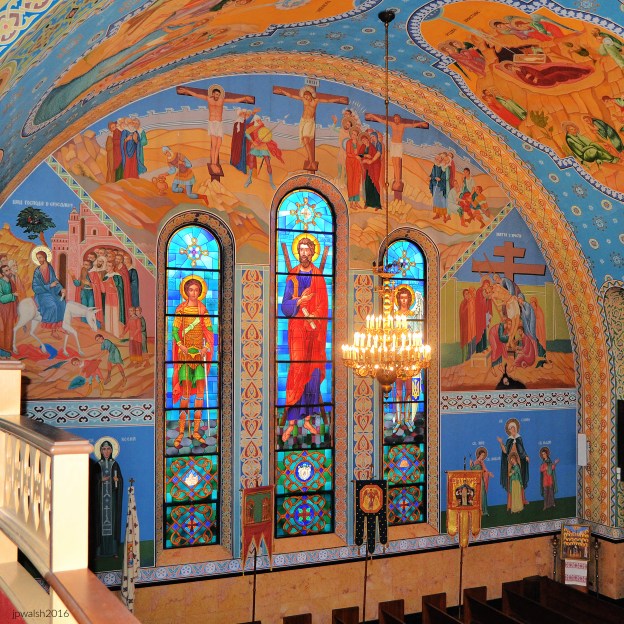
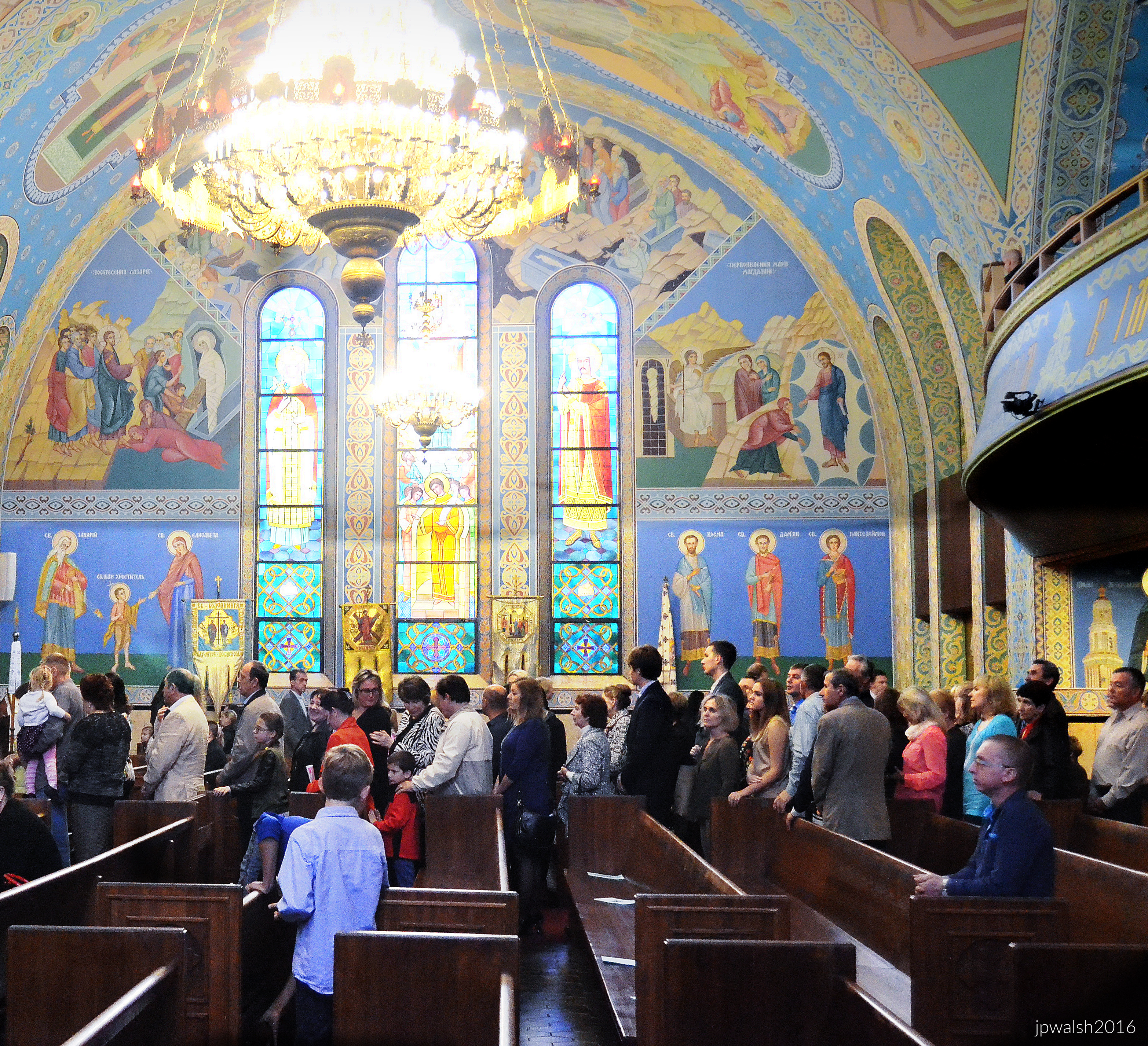
FEATURE image: Stained glass, paintings, banners, and chandelier blend together and provide a more complete picture of people and episodes of the faith. North wall and ceiling. Chicago. Sts. Volodymyr and Olha Church. October 2016 5.88 mb Author’s photograph.
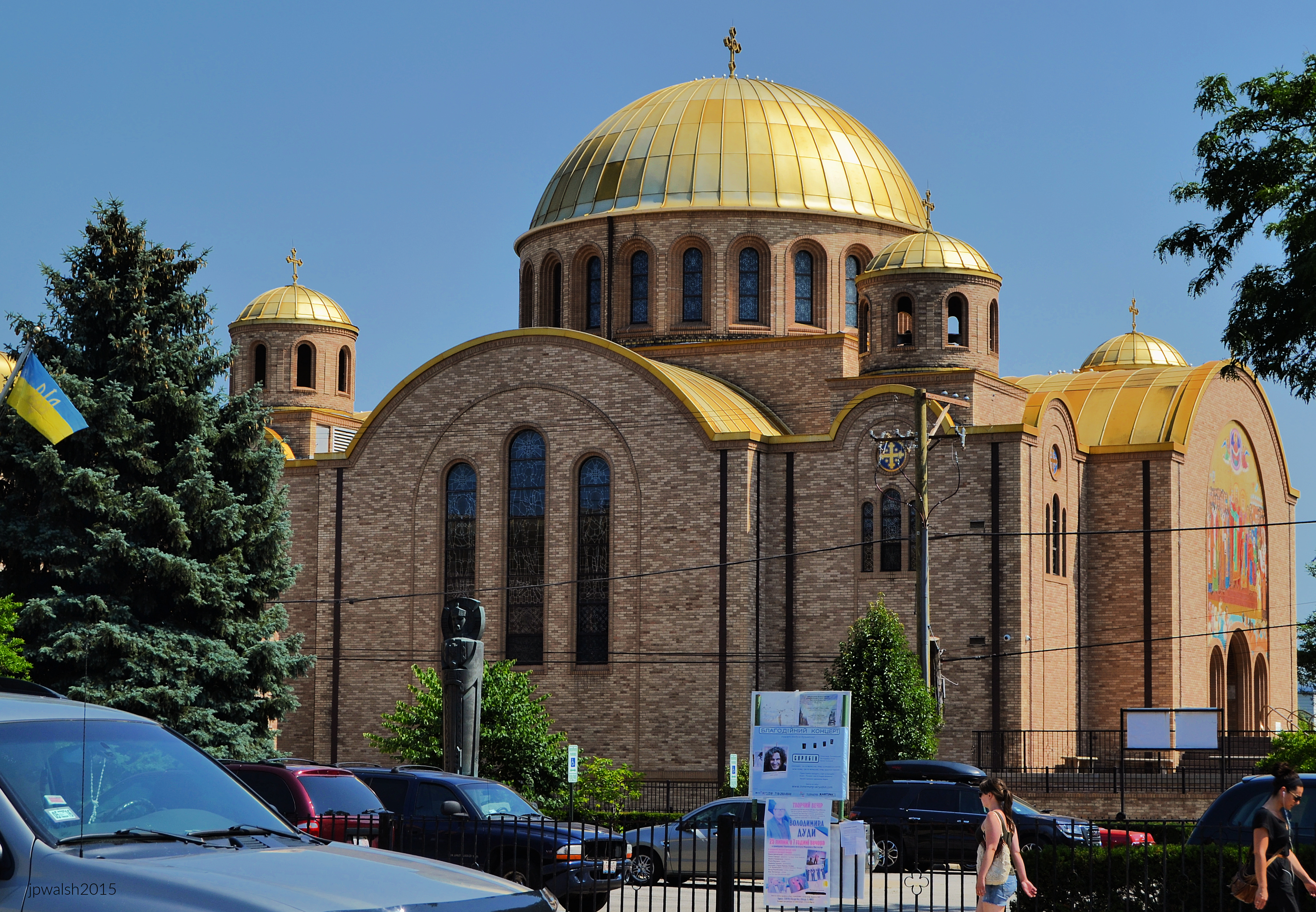
Exterior of Sts. Volodymyr and Olha Church with its gold domes. The tradition-minded parish, founded in early 1970s, serves a busy urban community.
Chicago. Sts. Volodymyr and Olha Church. 7/2015 7.68 mb The huge mosaic over the main entrance memorializes the conversion of the Ukrainians to Christianity in 988 by St. Volodymyr of Kyiv or Vladimir of Kiev (957-1015). The mosaic was executed by Hordynsky, Makarenko, and Baransky. The church is built in the modern Byzantine style.In addition to the colorful and bright mosaic, the upward angle and its perspective adds to the feeling of entering into a sacred space. Along with the archways and curve of the main golden dome, the eye focuses on the artwork’s bright figures.
WHO IS ST. VOLODYMYR?
Chicago. Sts. Volodymyr and Olha Church 7/2015 5.42 mb
St. Volodymyr is the apostle to proto-Russian and Russian Christianity. He was the great prince of Ukraine in Kiev. It was ruled by the Varangians, a barbarous Viking tribe from Scandinavia – and Volodymyr (or Vladimir) of Kiev was as barbarous as any of them.
In 988, when Volodymyr was about 31 years old, he was converted to Christianity. The missionaries came from the Byzantine world at Constantinople. The results were immediate: Ukraine was now in close contact with the Byzantine world to the south and its Christian church under the pope.
Volodymyr married the daughter of the Byzantine emperor, Basil II (957-1025). But it was Volodymyr’s personal embrace of the Christian faith that infused the Ukrainian people with their deep and abiding faith. Having received baptism, he set out to be a Christian and not corrupted by money and power that proved a serious temptation for many church and state leaders in the Dark Ages.
Volodymyr used his temporal powers to evangelize the people – his personal example his greatest asset to its success. Though he encouraged various activities and programs in the lives of the people – including the multi-faceted work of Greek missionaries – it was his sincere, transparent, and fundamental reform of his own life that by far had the greatest impact on the Ukrainian people. More than one thousand years after his rule, Volodymyr is still recalled as a generous, humble and devout soul.
As a Christian ruler Volodymyr had doubts about inflicting the death penalty. Though assured by his Byzantine church counselors that his Catholic faith allowed him to follow the law which allowed for it, Volodymyr corrected them and said that that sort of reasoning was not satisfactory to his faith.
Volodymyr, the great prince of Kiev, died a poor man – not only various from his origin but, again, that of many of the ecclesiastics now in the realm. Before his death, Volodymyr dispersed all his money and personal belongings to the poor and to his family and friends. St. Volodymyr’s feast day is July 15. He is patron of Ukrainian and Russian Catholics.
WHO IS ST. OLHA?
Saint Olha was the wife of the Kyivan Great Prince Igor. Igor signed a peace treaty with the Greeks in 944. The treaty of 944 was drawn up at Constantinople and allowed for Christianity in Ukraine. This toleration already indicates some sympathy for Christianity among the powerful in Kiev. Igor himself, however, in his official position did not embrace Christianity nor officially allow the presence of a structure of Church hierarchy. The treaty was drawn up to quietly allow co-existence of Christians in a pagan Viking culture.
Yet when the Byzantine emissaries arrived in Kyiv, pagan opposition had emerged from the Varangians. The Christians were thrown into abeyance and Igor was murdered in 945. Into this volatile situation the burden of government fell upon Igor’s widow — the Kyiv Great-Princess Olha, and her three-year-old son Svyatoslav (945-972). Her first act was to avenge Igor’s murder.
Olha belonged to one of the obscure ancient-Rus’ princely dynasties, whose Slavic line had intermarried with assimilating Varangian newcomers. Olha’s Varangian names includes Helga and Olga.
Though still a pagan, Olha’s revenge on the Varangians on behalf of her late husband was a victory for the realm’s Christians. Further, having weakened the influence of petty local princes in Rus’, Olha centralized the whole of state rule. She became a great builder of the civil life and culture of Kyivan Rus. Her centralization became an important network of the ethnic and cultural unification of the nation which, when Olha became a Christian, aided in the building of a network of churches. Her essential activities proved key in developing what is the modern Ukrainian national identity. At the same time, important trade with Poles, Swedes, Germans, and so forth, led to significantly expanding foreign connections. One noteworthy development was that wooden buildings were replaced with stone edifices.
Rus’ had become a great power. Only two European realms could compare with it in the tenth century – the Byzantine empire in the east, and the kingdom of Saxony in the west. Both these empires were Christianized and pointed the way to future greatness for Rus’. In 954 Great-princess Olha sailed to Constantinople. Though a display of Rus’ military might on the Black Sea, it was a spiritual mission. Olha’s might and the Byzantines’ wealth and beauty were mutually impressive.
Constantinople was the city of the Mother of God as dedicated by Constantine the Great in 330. Olha made the decision to become a Christian. She was baptized by Patriarch Theophylactus (917-956) with her godfather being the emperor Constantine Porphyrogenitos (905-959). She took the Christian name Helen for Constantine’s mother. Following the rite, the Patriarch said: “Blessed are you among the women of Rus’, for you have forsaken the darkness and have loved the Light. The Rus’ people shall bless you in all the future generations, from your grandson and great-grandson to your furthermost descendants.” Olha replied: “By your prayers, O Master, let me be preserved from the wiles of enemies”. It is precisely in this way, with a slightly bowed head, that Saint Olha is often depicted in religious artwork. During her state visit, and following her baptism, Great princess Olha of Rus’ was fêted throughout Constantinople
Saint Olha devoted herself to efforts of Christian evangelization among the pagans, and also church construction, including Saint Sophia Cathedral. Yet, many despised her new found Christianity and paganism became emboldened. They looked to the reign of Svyatoslav who angrily spurned his mother’s Christianity. Meanwhile Byzantine church and state leaders were not eager to promote Christianity in Rus’. In Olha’s lifetime, Kyiv favored paganism and had second thoughts about even accepting Christianity. By order of Svyatoslav, churches were destroyed and Christians murdered. Byzantine political interests found the church and state looking to undermine Olha’s influence and favored the Rus’ pagans.
Olha attempted to help Svyatoslav during a period of wartime, though Kyiv was a backwater to his imperial interests for the next 18 years. In the spring of 969 the Pechenegs besieged Kyiv and Olha headed the defense of the capital. Svyatoslav rode quickly to Kyiv, and routed the nomads. But the warrior prince wished to rule elsewhere than Kiev. Svyatoslav dreamed of uniting all Rus’, Bulgaria, Serbia, the near Black Sea region and Priazovia (Azov region), and extend his borders to Constantinople. Olha warned her son that his plans were bound to fail as the Byzantine Empire was united and strong.
On July 11, 969 Saint Olha died. In her final years, with the triumph of paganism, she had to secretly practice her faith. Before her death, she forbade the pagan celebration of the dead at her burial and was openly buried in accord with Orthodox ritual. A priest who accompanied her to Constantinople in 957 fulfilled her request.
Considered by Ukrainians the holy equal of Great Prince Volodymyr, St. Olha was invoked by St. Volodymyr on the day the people of Rus’ were baptized. Before his countrymen, St. Volodymr said of St. Olha: “The sons of Rus’ bless you, and also the generations of your descendants.”
Chicago. Sts. Volodymyr and Olha Church 7/2015 7.46 mb
A beautiful outdoor garden with the residential streets of Ukrainian Village as its background is the setting for the larger-than-life-sized statue of Major Archbishop Josyf Slipyj (1892-1984). He was made a cardinal by Pope Paul VI in 1965 and is a “Confessor of the Faith.” The Founder of the parish, Slipyj blessed the new church building’s cornerstone. Supporting the Ukrainian state and refusing to convert to Russian Orthodoxy, he was continously imprisoned by the Soviet authorities from 1945 to 1963. Through the intervention of St. Pope John XXIII and U.S. President John F. Kennedy, Josyf Slipj was released by Nikita Khrushchev in early 1963 and participated in the Second Vatican Council.Josyf Slipyj died in Rome in 1984 and his cause for canonization as a saint of the Catholic Church has been introduced at the Vatican.
Chicago. Sts. Volodymyr and Olha Church 10/2016 4.54 mb
Parishioners praying and going to Communion at Sunday Mass.
Chicago. Sts. Volodymyr and Olha Church 10/2016 6.15 mbChicago. Sts. Volodymyr and Olha Church 10/2016 5.40 mb
With the artists’ skills, the bright colors and evocative forms of the artwork surround churchgoers as they move toward the altar at Communion during the Divine Liturgy.
Chicago. Sts. Volodymyr and Olha Church 10/2016 6.18 mb
The colorful and vibrant decorations that include paintings, carvings, vestments, books, stained glass, and more, are integral to the parish’s liturgy and life.
Chicago. Sts. Volodymyr and Olha Church 10/2016 5.46 mbChicago. Sts. Volodymyr and Olha Church 10/2016 4.35 mb
Two women sit before icons of Sts. Volodymyr and Olha and the Blessed Virgin.
Chicago. Sts. Volodymyr and Olha Church 10/2016 4.47 mb
Every nook and cranny of the church is decorated with colorful images from religious and Catholic Ukrainian history. The natural light streaking down from the main dome’s windows adds a heavenly glow.
Chicago. Sts. Volodymyr and Olha Church 10/2016 6.15 mb
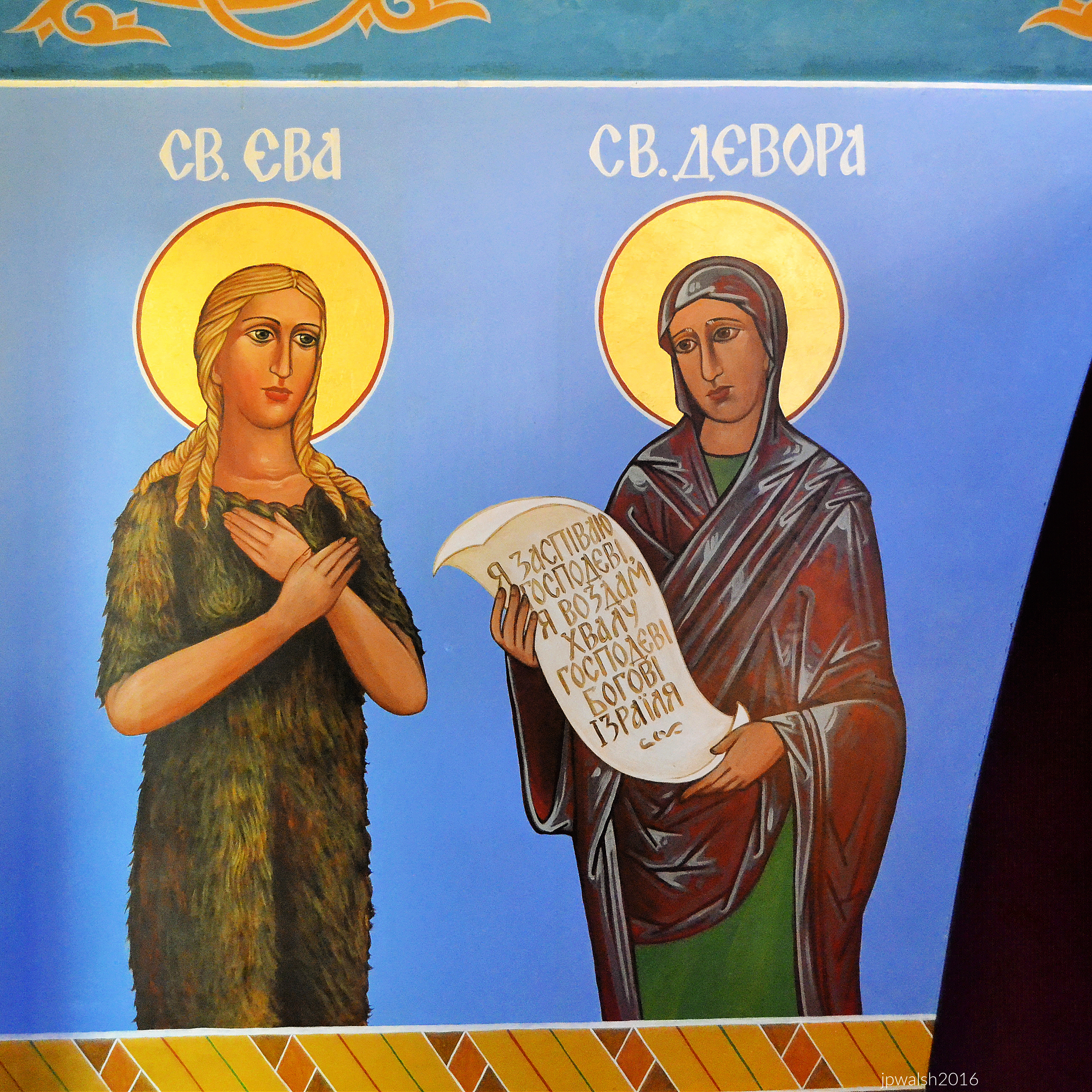
Two female haloed saints in a modern art style are marked by their unique attire as one holds an unfurled scroll with words in Ukrainian. Christianity arrived into Ukraine by way of the Greco-Byzantine world over 1000 years ago.
Chicago. Sts. Volodymyr and Olha Church 1/2016 4.90 mb
A painting of the dormition of Mary is emphasized by, above, an icon of Mary and the child Jesus. Colors, forms, and subject matter are very high quality and soft and peaceful making them pleasant to look at and pray with.
Chicago. Sts. Volodymyr and Olha Church 10/2016 6.18 mb
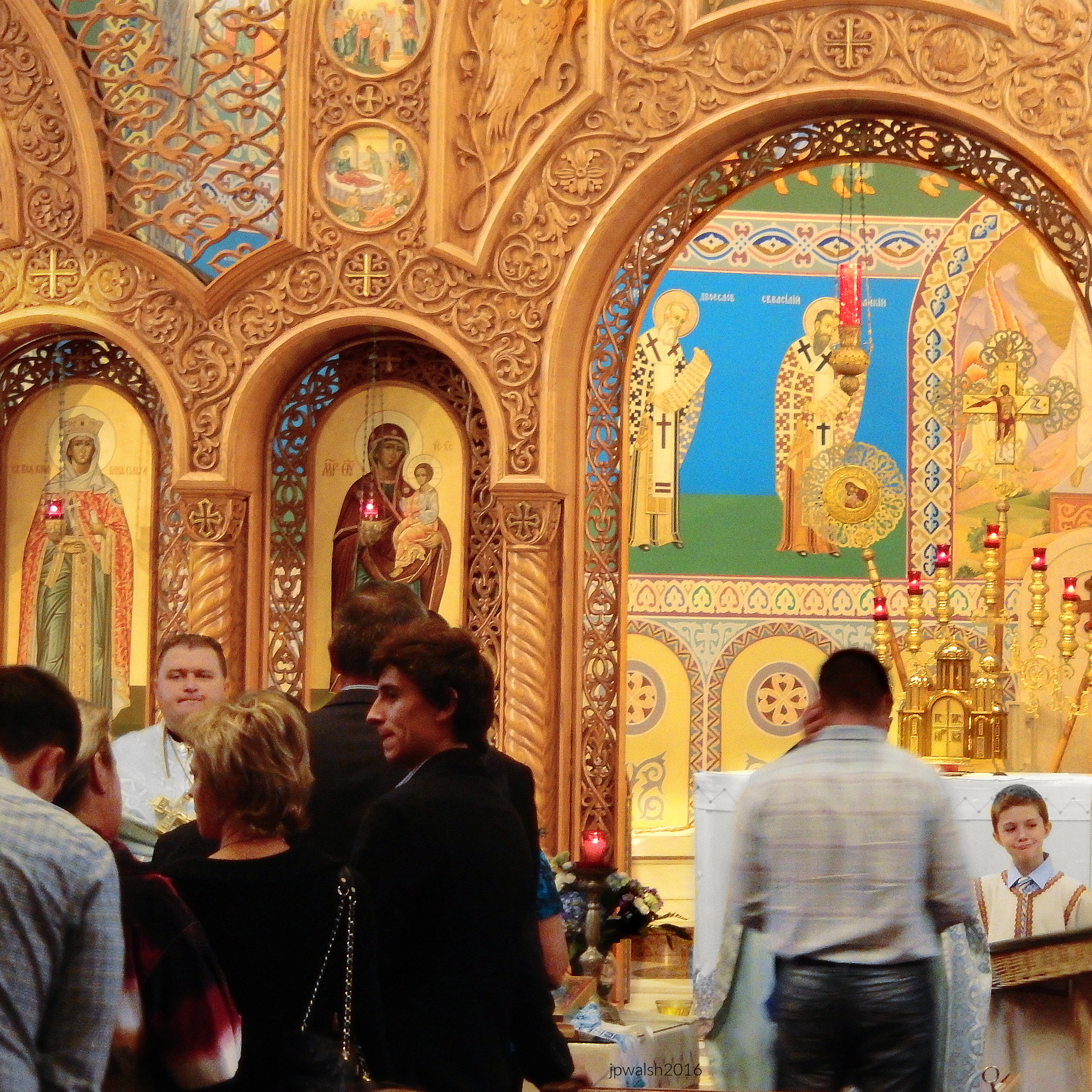
The wood carvings and full-length portrait icons are gorgeous. The fresh flower arrangements further brighten the scene.
Chicago. Sts. Volodymyr and Olha Church 10/2016 7.68 mb
Visitors are joined by worshippers lighting candles and praying before a large icon of Mary and the child Jesus.
Chicago. Sts. Volodymyr and Olha Church. 10/2016 10.68 mb
The main altar gate of carved wood with icons and gold curtain. The Last Supper in center above.
Chicago. Ukrainian Village. 10/2016 3.17 mb 30%
Residents and (below) a residence’s porch flower garden in Ukrainian Village near Sts. Volodymyr and Olha Church in Chicago.
Chicago. Ukrainian Village.10/2016 316 kb 20%Chicago. Sts. Volodymyr and Olha Church 10/2016 5.88 mbChicago. Sts. Volodymyr and Olha Church 10/2016 5.86 mb
High above the sanctuary is a magnificent view of the main dome painted in bright colors with the figure of Christ Pantocrator. Christ gives his blessing as he holds an open book with the first and last letters of the Greek alphabet: alpha and omega. It signifies one of Christ as the Son of God’s titles in the New Testament: “I am the beginning and the end” (Revelation, 21:6, 22:13).
Chicago Sts. Volodymyr and Olha Church 10/2016 7.84 mb
South Wall.
Chicago. Sts. Volodymyr and Olha Church 7/2015 2.52 mb
Ukrainian Village is a neighborhood first settled by Ukrainian immigrants in the 1890’s. It is about 4 miles to the northwest from downtown Chicago.
10/2016 544kb 30%
SOURCES:
Houses of Worship: An Identification Guide to the History and Styles of American Religious Architecture, Jeffrey Howe, Thunder Bay Press, San Diego, California, 2003.
AIA Guide to Chicago, 2nd Edition, Alice Sinkevitch, Harcourt, Inc., Orlando, 2004, p. 260.
The Saints: A Concise Biographical Dictionary, edited by John Coulson, Guild Press, New York, 1957, pp. 577; 760-761.
Chicago: City of Neighborhoods, Dominic A. Pacyga and Ellen Skerrett, Loyola University Press, Chicago, 1986, p. 193.
FEATURE Image: Chicago. Holy Trinity Orthodox Cathedral. The walls of the church building are load-bearing brick covered with stucco. The bell tower and octagonal belfry, dome, and roof are made of wood with metal trim and latticework. 7/2015 2.80 mb
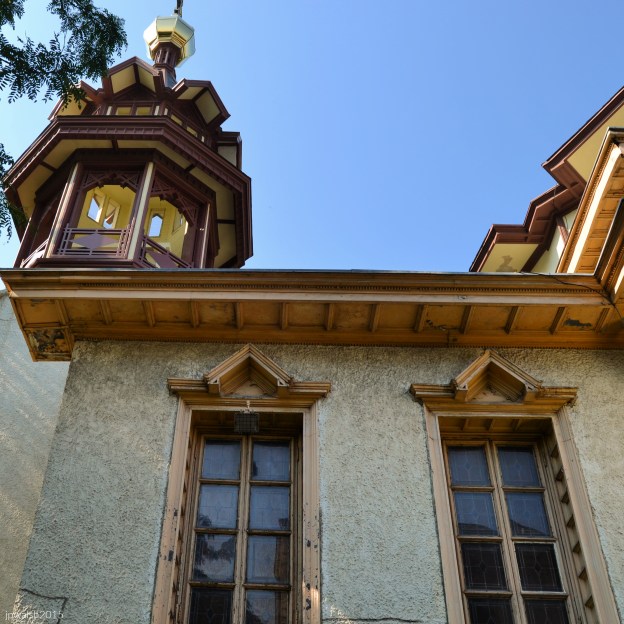
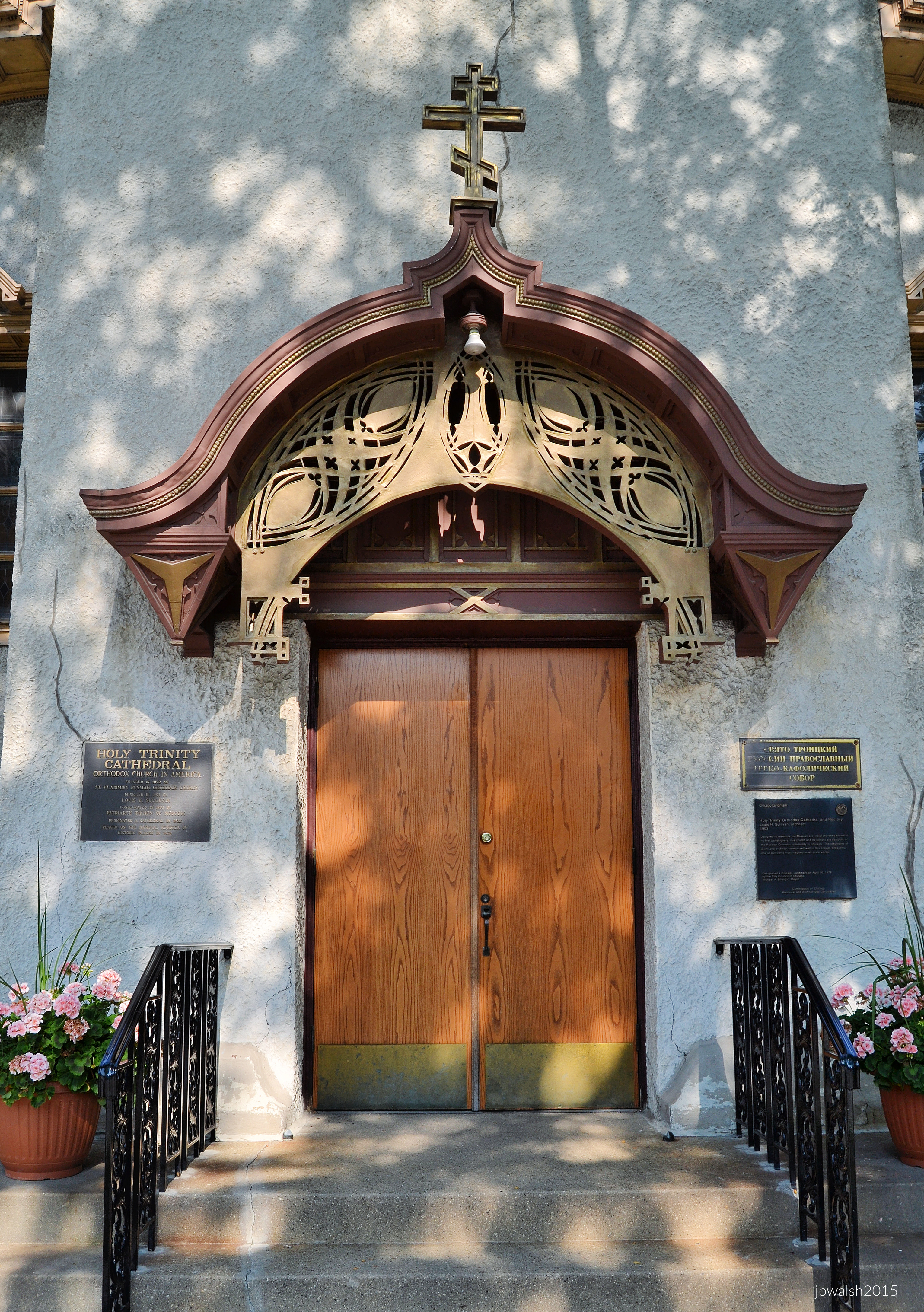
Louis H. Sullivan designed the bell tower (above and below) with its ornamentation and eaves and soffits for Holy Trinity Orthodox Cathedral in Chicago’s Ukrainian Village.
Louis H. Sullivan designed the portal canopy (above) and its ornamentation such as the fretwork. Sullivan also designed the window frames (example below).
Holy Trinity Cathedral was built on a limited budget. It is a small building at 47 x 98 feet situated on an east-west axis. The main body of the church is square with extensions and an octagonal dome above. The picturesque country-church entrance has a metal and wood canopy whose design and ornamentation were created by the architect, Louis H. Sullivan (1856-1924). Dedicated in 1903, the church was designated a cathedral in 1923.
The parishioners that built this church were rural people who had emigrated from southern Russia near the Ukraine as well as the area of the Carpathian Mountains.
The Eastern Orthodox central plan creates an interior where the congregation stands in a square space topped by an octagonal dome. For Easter services and the like, the cathedral is filled to capacity with parishioners and others spilling out the front door with its decorative canopy onto the public sidewalk.
The church building was completed for around $27,000 in 1903 (approximately $1 million in 2022) with Sullivan donating half his commission to the church project.
SOURCES:
Chicago Churches and Synagogues: An Architectural Pilgrimage, George Lane, S.J., and Algimantas Kezys, Loyola University Press, Chicago, 1981, p. 106-107.
Alice Sinkevitch, AIA Guide to Chicago, 2nd Edition, Harcourt, Inc., Orlando, 2004, p. 260.
FEATURE image: Fallingwater, Frank Lloyd Wright, Mill Run, Pennsylvania. March 2010. Author’s photograph.
Fallingwater is a house designed in 1935 by American architect Frank Lloyd Wright (1867-1959). It is in the Laurel Highlands of southwest Pennsylvania, about 70 miles away from downtown Pittsburgh.
The house was intended as a weekend retreat for the Edgar J. Kaufmann and family, owners of a Pittsburgh department store. The area of land had been a summer camp for the department store employees. Wright’s house, completed in 1937, is built partly over a waterfall on Bear Run, a tributary of the Youghiogheny River, in the Appalachians.
Approach to the house.
Bear Run is a tributary of the Youghiogheny River, in the Appalachians.
Fallingwater remained in the Kaufmann family until 1963. Inherited by Edgar Kaufmann Jr. in 1955 following his father’s death, he donated the home and its nearly 2,000 acres of surrounding natural habitat to a nonprofit trust called the Western Pennsylvania Conservancy. Since 1964, around 5 million visitors have made the pilgrimage to Fallingwater, one of America’s most famous modern homes. The house and grounds receive over 160,000 visitors each year.
Fallingwater. The post’s photographs and videos were taken in March 2010.
Fallingwater is over 5000 square feet. The walls are constructed from local sandstone. The rocky landscape is incorporated into the home itself such as its main fireplace. Each bedroom has an individual terrace and there are a sea of windows that open outwards to nature. A glass hatch on the main level finds a short stairway that descends to Bear Run below.
Wright designed Fallingwater’s furnishings, much of it built into the house, In 2002, Fallingwater’s foundation was reinforced to support the first floor’s concrete skeleton that began to sag. The 21st century reconstruction process prevented further collapse but the house had its first level’s original stone floor and built-in furniture taken out.