Category Archives: Chicago

UNITED STATES. My Architecture & Design Photography: WORTHMANN & STEINBACH; POINTEK. St. Nicholas Ukrainian Catholic Cathedral (1915); 2238 W. Rice Street; Chicago, Illinois (19 Photos).

FEATURE image: Chicago. St. Nicholas Ukrainian Catholic Cathedral.

Chicago. St. Nicholas Ukrainian Catholic Cathedral. 7/2015 7.16 mb

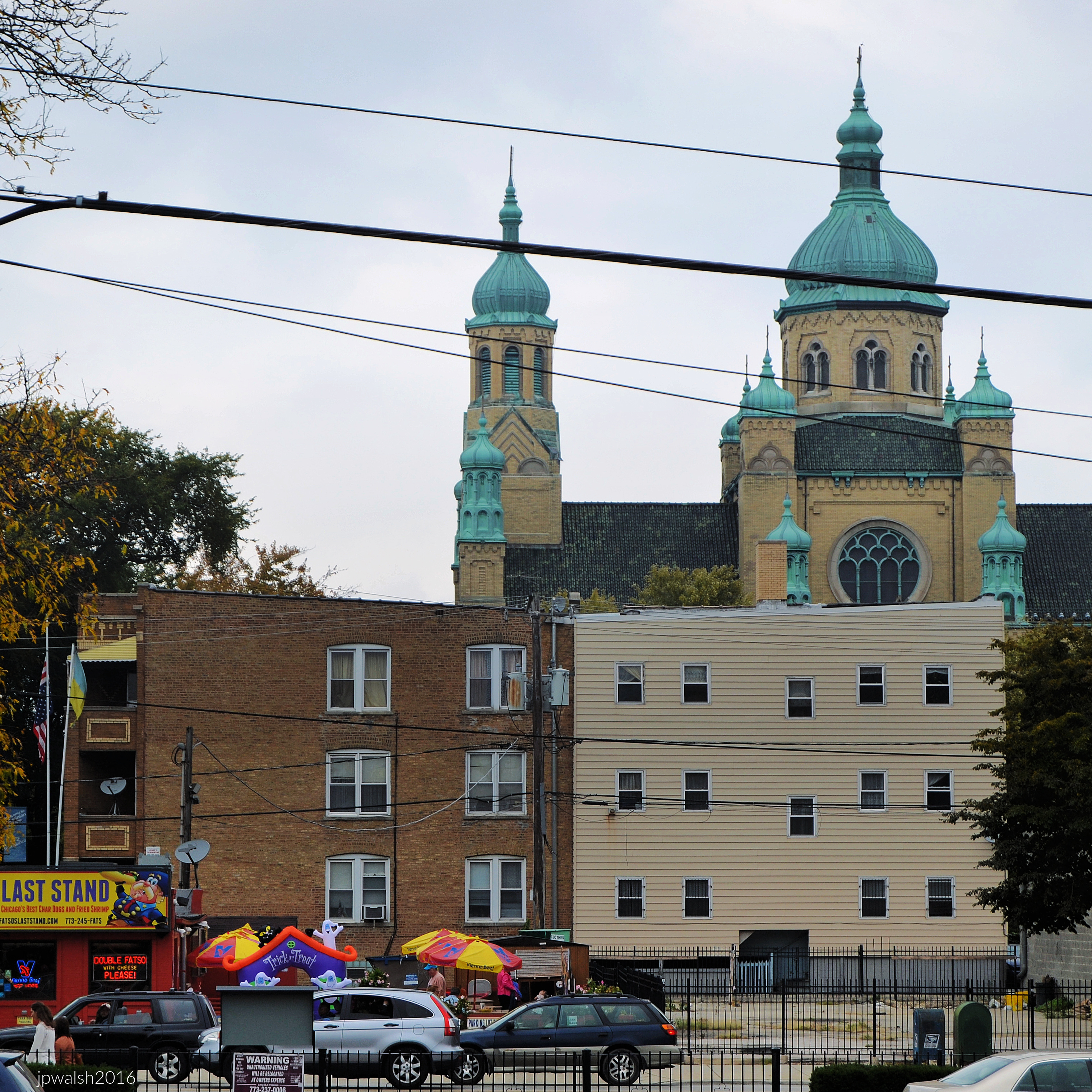
At the western main entrance are the stars and stripes of the U.S. flag and the blue and yellow Ukraine flag. An avenue of trees lines the south side of the cathedral building. With its huge size and detailed architecture, St. Nicholas stands prominently on its 20 city lots. Worthmann & Steinbach was a Chicago-based architectural firm active in the first three decades of the 20th century. It was a partnership of German-born Henry W. Worthmann (1857-1946) and John G. Steinbach. The firm, with offices in Chicago and Oak Park, Illinois, designed many of the great Polish cathedrals in Chicago and for Eastern Catholic and Lutheran clients. Clement L. Pointek collaborated with Worthmann & Steinbach until he formed his own architectural firm with principal Joseph A. Slupkowski (1884-1951). The church interior was renovated in the wake of Vatican II liturgical reforms in the mid 1970s by Ukrainian-American architect Zenon Mazurkevich (1939-2018).

The huge yellow brick church building in Chicago’s tree-lined Ukrainian Village neighborhood is 155 feet long and 85 feet wide. Among its details, the building is renowned for its frescos and mosaics. St. Nicholas Ukrainian Catholic Cathedral’s impressive design and footprint on the skyline of one of Chicago’s neighborhoods was built as a worthy emulation of the 11th century (former) St. Sophia Cathedral in Kyiv, Ukraine. The church on Chicago’s near West side was built by the firm of Worthmann and Steinbach which built many churches in Chicago in the 1910’s and 1920’s. In the mid1970s the church interior was completely renovated and restored by a Ukrainian artist. Ukrainian Catholics follow the Byzantine-Slavonic Eastern Rite and acknowledge the pope in Rome as their spiritual leader.

Who is St. Nicholas the Wonder Worker?
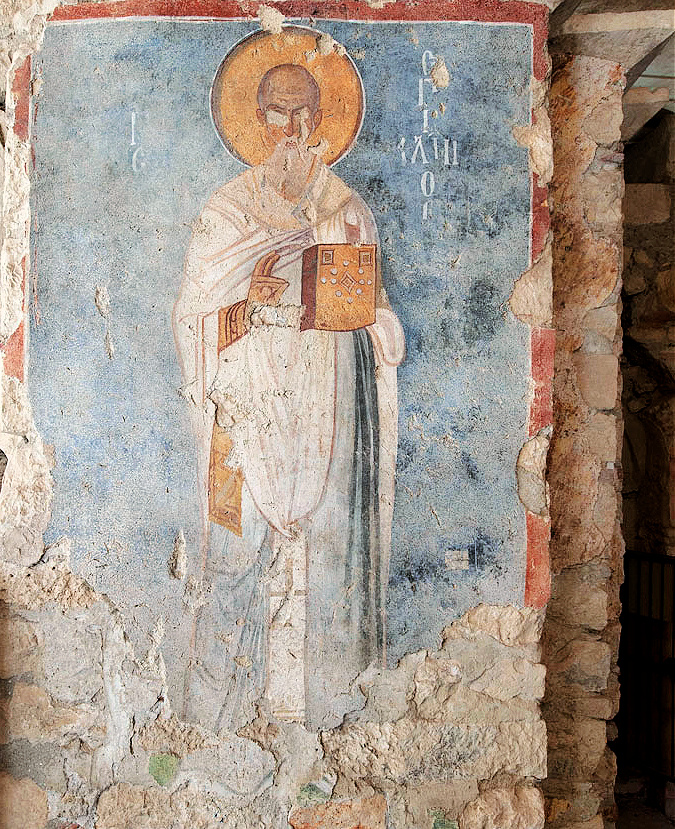
St. Nicholas, Demre, Turkey. St. Nicholas of Myra (270-340) is one of the church’s most popular and revered saints. St. Nicholas, who is the historical inspiration for Santa Claus, is the patron saint of children and those in dire need. St. Nicholas is an important religious figure for Latin and Eastern Rite Roman Catholics and Orthodox Christians. He was the bishop of the ancient Lycian town of Myra in the eastern Mediterranean which is today’s Demre in Turkey. He is patron saint of prisoners, the falsely accused and convicted, and travelers. Nicholas is also patron saint of Greece, Sicily, Apulia in Italy, and the Lorraine in France. The St. Nicholas Church that exists today in Demre (Myra) was built around 520 A.D over an older church where St. Nicholas was bishop and was the saint’s burial place. Remarkably, St. Nicholas’s corpse remained incorrupt and exuded a fragrant odor of myrrh. For centuries St. Nicholas’s relics were in the cathedral in Myra. In 1087 his relics were removed from Myra to Bari, Italy, where they are today. The sweet myrrh smell that exudes from the saint’s body is said to still take place today. Many miracles have been attributed to St. Nicholas during his lifetime and after his death so that he came to be called “The Miracle/Wonder Worker” of Myra.

History of the Cathedral parish

St. Nicholas Ukrainian Catholic parish was founded in 1905 by a group of 51 Ukrainian working immigrants. These Ukrainians arrived on Chicago’s northside in the late 1890’s from western and Carpathian Ukraine. Irish, Germans and Poles were already well established in Chicago by this time and built churches. The Ukrainians not only arrived later, but also were committed to their eastern-rite, Greek Catholic origins. They actively looked to fend off incorporation into the Latin rite under a mostly Irish Catholic hierarchy in the Chicago diocese. To this effect, the parish board adopted a resolution stating: “[T]hat all property of said church which may hereafter be acquired be held in the name of its incorporated name but under no conditions shall said church or its priests or pastors be ever under the jurisdiction of bishop or bishops except those of the same faith and rite.”

By 1911 it became clear that a new, larger church was needed for the growing Ukrainian community. Twenty lots were purchased on Rice Street between Oakley and Leavitt for $12,000 and building began. In 1913, Bishop Soter Ortynsky blessed the cornerstone of the new church. This Ukrainian Catholic church parish community relocated out of its original site and ventured about one mile directly west to build their new church under Fr. Nicholas Strutynsky. Fr. Nicholas had recently arrived from Ukraine and remained at St. Nicholas parish until 1921.

In 1941, St. Nicholas parish was host to the Eucharistic Congress for Eastern Rites. Twenty years later, in 1961, St. Nicholas Parish became St. Nicholas Ukrainian Catholic Cathedral when it became the seat of the Eparchy for much of the United States. Msgr. Jaroslaw Gabro, a native son of the parish, became the first bishop of the newly created Ukrainian Catholic eparchy.

Completed in 1915, the magnificent, Byzantine-Slavonic structure with thirteen onion domes representing Christ and His 12 apostles was erected. The first liturgy was celebrated on Christmas Day, January 7, 1915 (Julian calendar). A Ukrainian heritage school (Ridna Shkola) was also founded. By the early 1960s the school had over 1000 students. In 2022, St. Nicholas Elementary School has about 150 students.

When Bishop Gabro announced that churches in the eparchy would need to follow the Gregorian religious calendar that is used in the Latin west, some parishioners left St. Nicholas. In 1974 these parishioners, adhering to the ancient Julian religious calendar. erected Sts. Volodymyr and Olha Church three minutes away on foot across Chicago Avenue.

In 1980 Bishop Gabro who passed away was succeeded by Bishop Innocent Lotocky and a healing began between the estranged Ukrainian churches that continues today. In 1988, an ecumenical commemoration of the millennium of Christianity in Ukraine brought together Ukrainian churches in Chicagoland. Following the collapse of the Soviet Union in 1990, a new wave of immigrants from Ukraine began arriving in Chicago and joined St. Nicholas Cathedral. In 1993 Bishop Innocent Lotocky retired and was succeeded by Bishop Michael Wiwchar. In 2003 Bishop Michael Wiwchar was succeeded by Bishop Richard Stephen Seminack.

Chicago. St. Nicholas Ukrainian Catholic Cathedral. 10/2016 3.87 mb

The height of the cathedral building is appreciated looking up from its north side near its main entrance. Metal onion domes turned green by a century of oxidization cap the building’s 16 towers.

Chicago. St. Nicholas Ukrainian Catholic Cathedral. 10/2016 7.54 mb

The architecture, supported by columns, is curvaceous and spectacularly colorful.

The gold and blue fresco above the altar includes a pair of depictions of the former 11th century St. Sofia Cathedral in Kyiv on whose design and appearance St. Nicholas Ukrainian Cathedral is inspired. Kyiv is the capital city of the Ukraine  and its cathedral is one of the finest examples of East Russo-Byzantine architecture. Kyiv/Kiev, Ukraine became the first capital of proto-Russia in the mid9th century as Slavic lands were organized by Norsemen who, simultaneously, as the fierce Vikings were plundering through much of Europe as they transported their culture.

Before the 9th century was over, the first Christian missionaries had arrived from Constantinople to the south into Russia and Ukraine and many Slavs became Christian. From the 10th to 13th centuries Kyiv, like Moscow to its north centuries later, became the intellectual and religious center of the country, where there were established innumerable monasteries, churches, and convents.

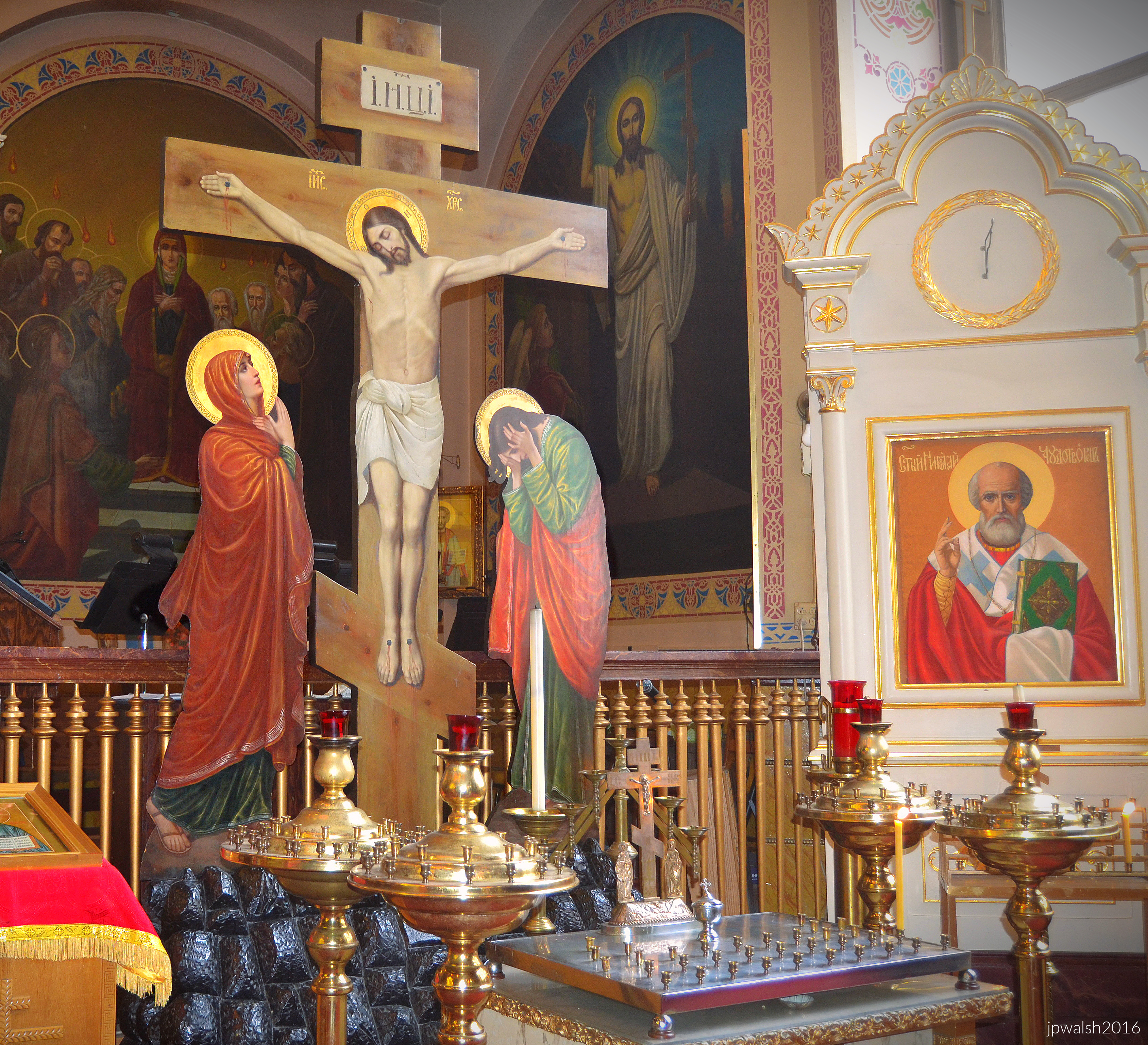
The entirety of murals and ornamentation are permanently affixed on interior surfaces by being painted directly on them. The only icon that was not renovated at this time was the one at the rear of the sanctuary depicting Christ with his apostles and Mother Mary. It was kept from 1928.

Chicago. St. Nicholas Ukrainian Catholic Cathedral. 10/2016 11.84 mb

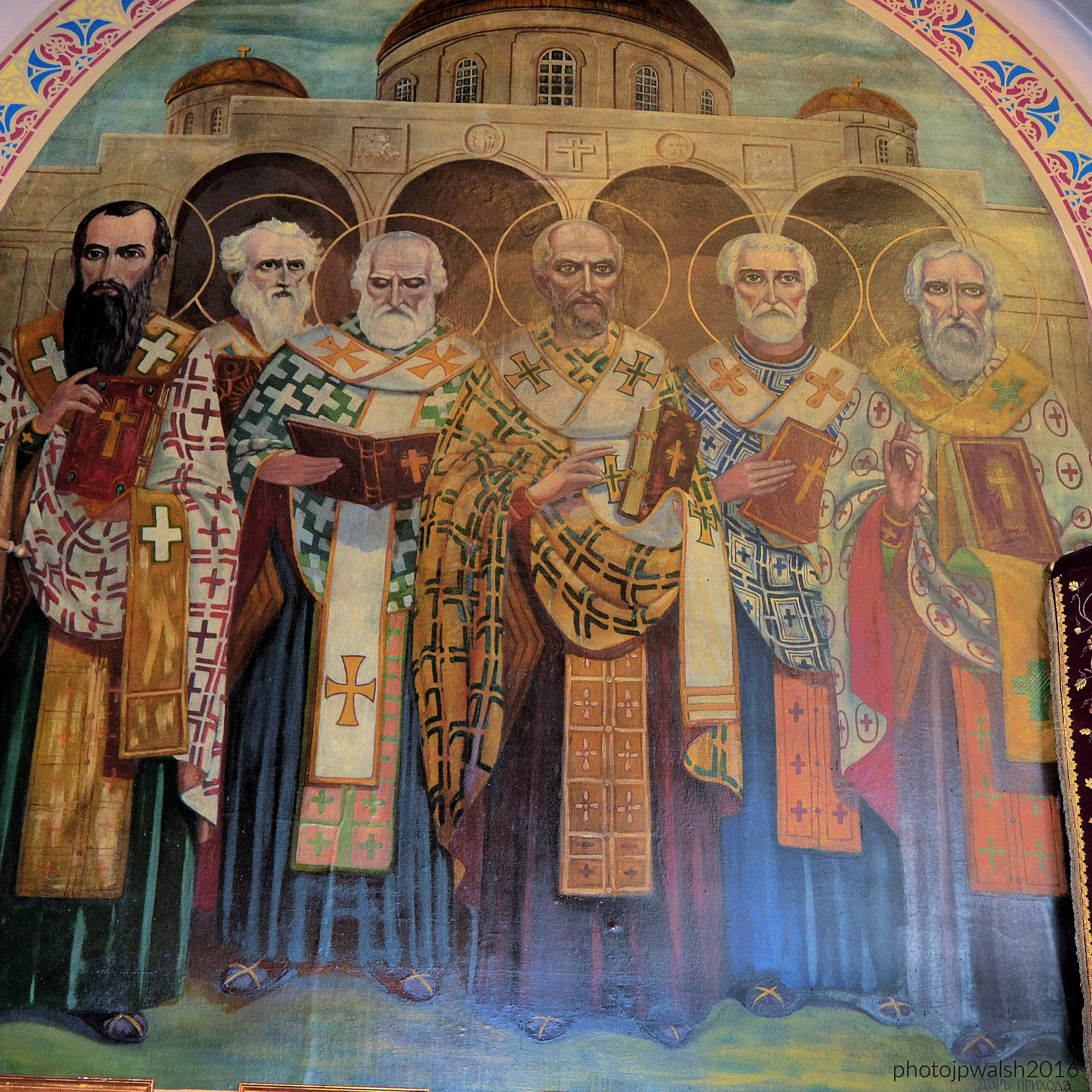
Hanging from the center highest dome of the church is a 9-tiered golden chandelier with 480 brilliant lights. The chandelier was made in Greece and is one the largest such chandeliers in North America. The ceiling is in gold leaf and wall decorations depict Christ and the Virgin with Old and New Testament figures such as saints, prophets, and patriarchs, all in bright colors.

Chicago. St. Nicholas Ukrainian Catholic Cathedral. 10/2016 5.96 mb

A propensity of brown and gold in a color scheme that works. The formidable dome is an integral aspect of the interior decoration.

Chicago. St. Nicholas Ukrainian Catholic Cathedral. 10/2016 7.22 mb

Hanging from the highest dome, a stunning chandelier of 9 tiers and 480 lights crafted in Greece sets aglow the church interior. The artwork depicts the Pentecost (Acts 2: 1-13). The 12 apostles with Mary, the mother of Jesus Christ, are seated in bright primary colors as they are gathered together to receive the Holy Spirit symbolized by a dove from Heaven. This event immediately followed the Resurrection and Ascension of Jesus into Heaven.

The subject matter and detailed application of artwork in St. Nicholas Ukrainian Cathedral is derived from the mosaics in the 11th century former Cathedral of St. Sophia in Kyiv, Ukraine. Renovated between 1974 and 1977, the Interior of St. Nicholas Ukrainian Catholic Cathedral was led by Boris Makarenko (1925-2008), a specialist of Ukrainian Byzantine artwork.

Boris Makarenko was born in the Poltava region of Ukraine between Karkiv and Kyiv. With the outbreak of World War II, Ukraine was thrown into turmoil and Boris was drafted into the Soviet Army. He deserted with a group of friends and joined the Ukrainian Resistance. Boris fought his way across Europe and was eventually recruited into the British Army. Unable to return to his homeland, Boris immigrated in 1950 to the United States. He worked under the famed Ukrainian sculptor Mykola Mukhyn and eventually in a German-based firm where he learned and mastered the techniques of interior ecclesiastical art, restoration, and design.  By the late 1950s, Makarenko founded his own studio in Philadelphia, Pennsylvania.

Using classical methods, mosaics are created by utilizing pieces of smalti and gold whether the mosaics are on the  exterior and or in the interior of the church building.

Typically, Italian smalti is poured thicker and cut into thinner pieces. Since they are cut from the inside of exposed molten glass they are more vibrant, consistent and reflective in colors. Italian smalti can provide a coarse or smooth surface depending on how they are laid into a working surface. To begin to understand the complexity and richness of the frescos and mosaic interior of St. Nicholas, the general rule is for each square foot of mosaic surface, about 600 pieces side to side are required. The amount of pieces for the cathedral are into the many tens of thousands.

Chicago. St. Nicholas Ukrainian Catholic Cathedral. 10/2016 6.02 mb

The altar was built to face ad orientem, properly, “to the east.” This was the tradition and practice of the Catholic Church for nearly 2,000 years. The gold and decorations are outstanding.

Chicago. St. Nicholas Ukrainian Catholic Cathedral. 10/2016 5.34 mb

Icons are visual symbols of eternal truth in the Christian Faith: the designs are based on archetypal images preserved and regenerated from the very beginnings of Christianity. Iconographers write icons in traditional media using egg yolk tempera and oil-based pigments. The predominance of the gold color that marks these interior paintings and decorations is gold leaf. Called “gilding,” the use of gold leaf pertains to iconography. plaster carvings, wood carvings, and metal.

Chicago. St. Nicholas Ukrainian Catholic Cathedral. 10/2016 6.87 mb

Stained Glass by Munich Studio of Chicago

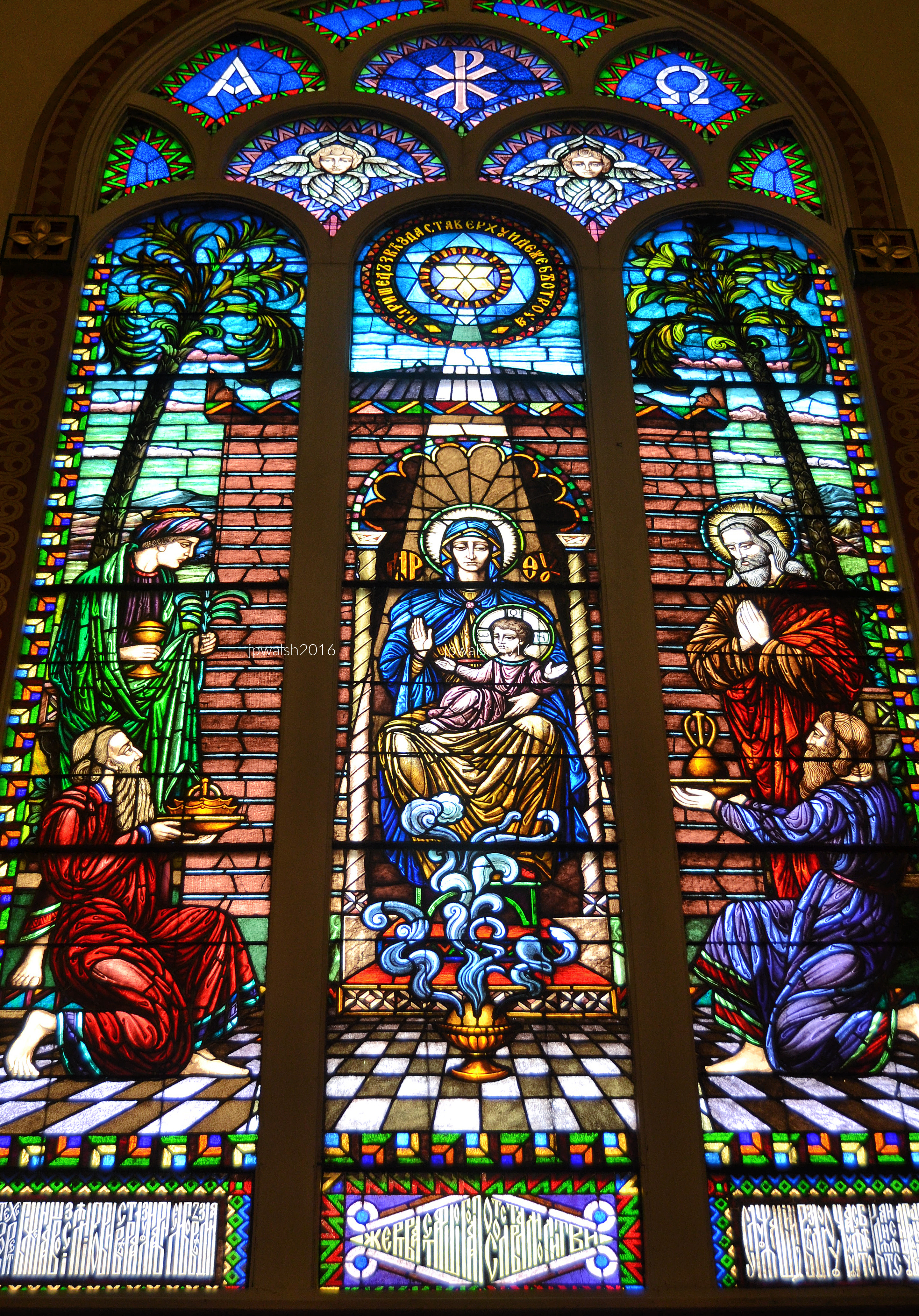
The colorful stained-glass is original to the 1915 church. They depict saints of the Catholic Church and were created by the Munich Studio of Chicago. The walls include tall, faceted windows displaying a hybrid of traditional and dalle-de-verre type glass techniques. Akin to mosaic, the latter stained-glass technique lends itself to abstract and highly stylized designs. The Munich Studio of Chicago was a major stained-glass studio in Chicago composed of skilled craftsmen and artists. In addition to the hagiography the windows depict, they also represent the artistic investment of the founding parishioners of St. Nicholas. While the term stained glass covers “colored, enameled, or painted glass”, Chicago’s pioneer “glass stainers” were primarily glass painters who used dark brown vitreous oxide and silver stain to paint designs on pieces of colored and/or opaque white glass. After the kiln firing the pieces were assembled like fragments of a puzzle and connected to each other with strips of malleable lead – called cames – which were fitted and soldered around each piece to create the full window.

The founder of The Munich Studio, Max Guler, was of middle-European extraction, as were the congregations of many of the churches who commissioned his firm for their windows. Guler came to Chicago about 1896 from the city of Munich, Germany where he had studied China painting. In 1898 his name appears in the Chicago city directory as an artist. Four years later the firm of Guler, Kugel and Holzchuh, presumably a small glass shop, is listed; and in 1903 the Chicago city directory first lists The Munich Studio, stained glass, 222 W. Madison, 5th f1r., with Guler as president. Catalog listings from 1910 to 1925 note thirty-two major church installations in Chicago and scores more elsewhere.

In 1913 the company moved from Madison Street to larger quarters at 300 West South Water Street (now Wacker Drive), and in 1923 to 111 West Austin Street (now Hubbard Street), at that time employing over 30 craftsmen, seven doing only glass painting. The Munich Studio imported most of its glass from France and Germany with domestically-made glass from firms in Indiana and West Virginia. As with European stained glass, they were painted with iron oxide and yellow stain and fired in ovens. The Munich Studio continued to prosper until 1930 when the Great Depression brought all building to a near standstill. Since it depended primarily upon the construction of new churches for its business, the economic downturn caused the company’s closing in 1932.
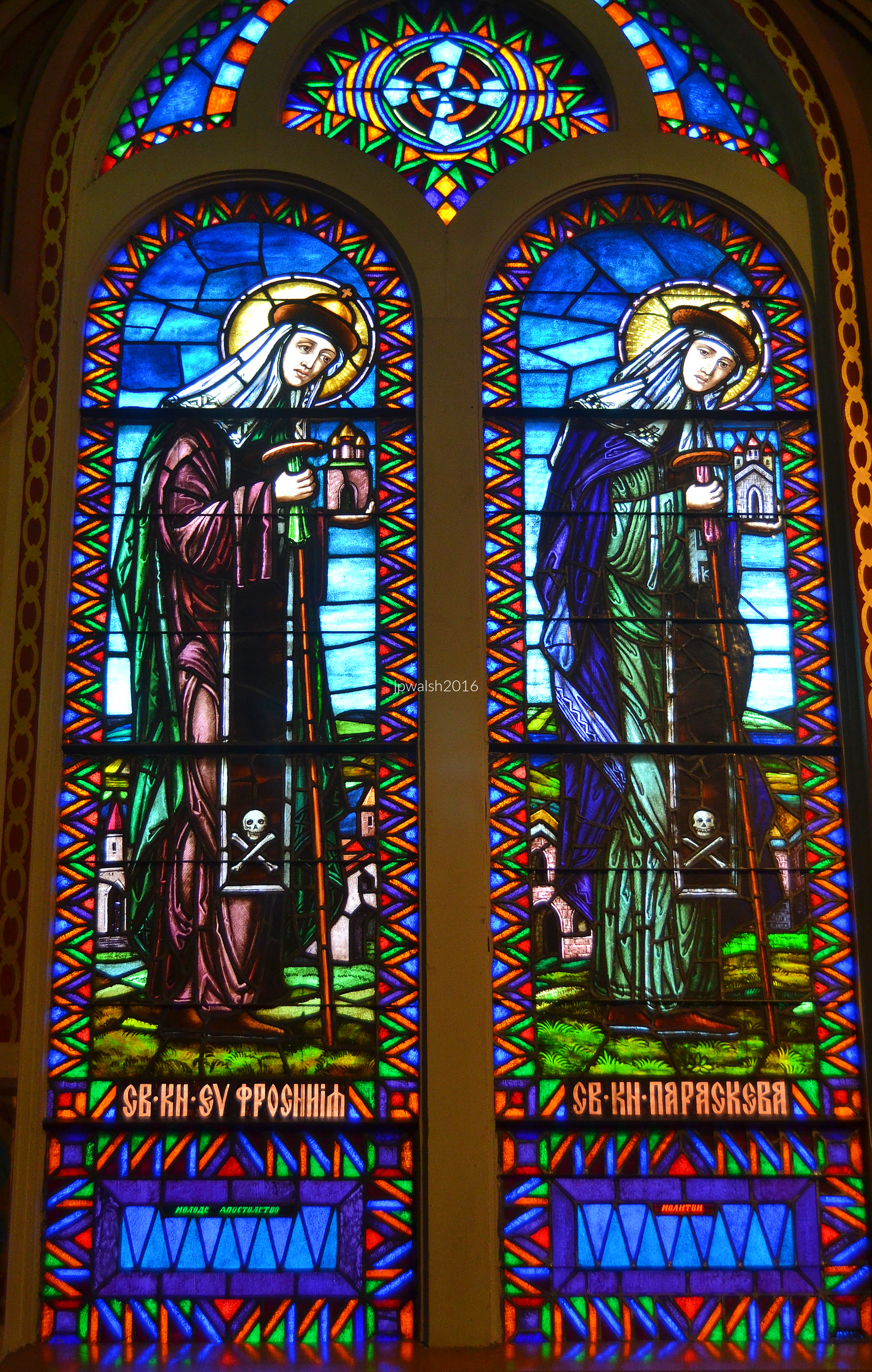
Chicago. St. Nicholas Ukrainian Catholic Cathedral. 10/2016 7.15 mb
Chicago. St. Nicholas Ukrainian Catholic Cathedral. 10/2016 5.92 kb 30%

Mosaics of the Stations of the Cross were created by Boris Makarenko.

Chicago. St. Nicholas Ukrainian Catholic Cathedral. 10/2016 5.65 mb
Chicago. St. Nicholas Ukrainian Catholic Cathedral. 10/2016 8.62 mb
Chicago. St. Nicholas Ukrainian Catholic Cathedral. 10/2016 7.22 mb
Chicago. St. Nicholas Ukrainian Catholic Cathedral. 10/2016 5.35 mb
Chicago. St. Nicholas Ukrainian Catholic Cathedral. 10/2016 3.78 mb
Chicago. St. Nicholas Ukrainian Catholic Cathedral. 10/2016 3.67 mb

St. Nicholas Ukrainian Catholic Cathedral’s regal appearance and design is inspired by the Cathedral of St. Sophia in Kyiv. This includes its 13 domes, symbolic of Christ and his 12 apostles. The Chicago cathedral is also similar to the Kyiv model in that it has 5 major domes.

Chicago. Author & wife on steps of St. Nicholas Ukrainian Catholic Cathedral. 7/2015 6.41 mb

Above these main entrance steps, the façade of the cathedral displays a treasured mosaic depicting “Our Lady of Pochaev.” Above that image is the icon of St. Nicholas the Wonder (or Miracle) Worker, the cathedral’s namesake.

Story of “Our Lady of Pochaev”

Ukraine had been Christianized for about 200 years when, in 1198, when St. Francis of Assisi was about 17 years old, a monk climbed Pochaiv mountain in western Ukraine in order to pray. A pillar of fire appeared to the monk and some nearby shepherds. When the flames subsided, the Blessed Virgin Mary appeared. The apparition left her footprint out of which a spring of water flowed. This supernatural event led to many others so that the region became dedicated to Mary.

In 1559, Metropolitan Neophit sent to Anna Hoyska an icon of our Lady of Pochaev. The icon shows our Lady wearing a crown and holding the infant Jesus. She holds the end of her veil in the other hand. It is an icon where the cheek of the baby Jesus touches Mary’s face as the infant gives a blessing with his hand. At approximately 11×9 inches in size, the original icon is small. Made from red-pitched cypress, the artist and circumstances of its creation are unknown.

The icon immediately worked a miracle as Anna Hoyska’s blind brother regained his sight. Following her death, the icon was donated to a Basilian Monastery and eventually placed in the Church of the Dormition of the Blessed Mother. Monastery chronicles record numerous miracles during the icon’s stay at their Church.

In 1773, the icon was crowned by Pope Clement XIV. In 1831 Russian Czar Nicholas I expelled the Basilians and gave the monastery to Orthodox monks. In 2001, the icon was moved from Pochaev to The Cathedra of the Trinity of The Danilov Monastery in Moscow.

Chicago. St. Nicholas Ukrainian Catholic Cathedral. 10/2016 3.96 mb
https://youtu.be/WdNdhirawKo?si=y0sw7BNq7XQqjfwU – retrieved April 1, 2022.

This is the apolytikion for the feast of St. Nicholas of Myra, December 6, an important saint in the Christian Church, East to West, since the 4th century. In the Eastern Orthodox Church, the term “apolytikion” refers to a hymn sung as an important part of the liturgy typically in honor of a saint’s feast day. It often summarizes in a few lines the significance of the saint’s spirituality celebrated that day. The “apolytikion” can also be sung in conjunction with the Divine Office, such as Matins or Vespers.
FROM THE GREEK: “A rule of faith and an image of meekness, a teacher of self-control, the truth of things has revealed you to your flock; therefore, I shall gain the heights through humility, the wealth through poverty. Father Hierarch Nicholas, pray to Christ our God that our souls may be saved.”

SOURCES:

https://www.chicagonow.com/look-back-chicago/2013/07/forgotten-chicagoans-henry-worthmann/#image/1

Heavenly City: The Architectural Tradition of Catholic Chicago, Denis Robert McNamara, James Morris, Liturgy Training Publications, Chicago, Illinois, 2005, pp. 114-115

Chicago Churches and Synagogues: An Architectural Pilgrimage, George Lane, S.J., and Algimantas Kezys, Loyola University Press, Chicago, 1981, p. 136-137.

Houses of Worship: An Identification Guide to the History and Styles of American Religious Architecture, Jeffrey Howe, Thunder Bay Press, San Diego, California, 2003.

AIA Guide to Chicago, 2nd Edition, Alice Sinkevitch, Harcourt, Inc., Orlando, 2004, p. 260.

Discovering Stained Glass in Detroit, Nola Huse Tutage with Lucy Hamilton, Wayne State University Press, Detroit, 1987.

The Saints: A Concise Biographical Dictionary, edited by John Coulson, Guild Press, New York, 1957, pp. 565-567.

https://udayton.edu/imri/mary/o/our-lady-of-pochaev.php

Chicago Ceramics & Glass: an Illustrated History from 1871 to 1933, Sharon S. Darling.

Erne R. and Florence Frueh, “Munich Studio Windows at Chicago’s SS. Cyril and Methodius Church,” Stained Glass, (Summer, 1979).

Stained Glass Ecclesiastical Art Figure Windows, catalog issued by The Munich Studio, circa 1915.

https://smalti.com/

https://www.ecclart.com/

http://stnicholaschicago.com/en-us/

http://www.slavicvillagehistory.org/PDF/CAPSULE_HISTORIES/munich_studio.pdf

My Architecture & Design Photography: LOUIS H. SULLIVAN (1856-1924). Holy Trinity Orthodox Cathedral (1903), 1121 N. Leavitt; Chicago, Illinois. (13 Photos).

FEATURE Image: Chicago. Holy Trinity Orthodox Cathedral. The walls of the church building are load-bearing brick covered with stucco. The bell tower and octagonal belfry, dome, and roof are made of wood with metal trim and latticework. 7/2015 2.80 mb

Chicago. Holy Trinity Orthodox Cathedral. 7/2015 6.48 mb

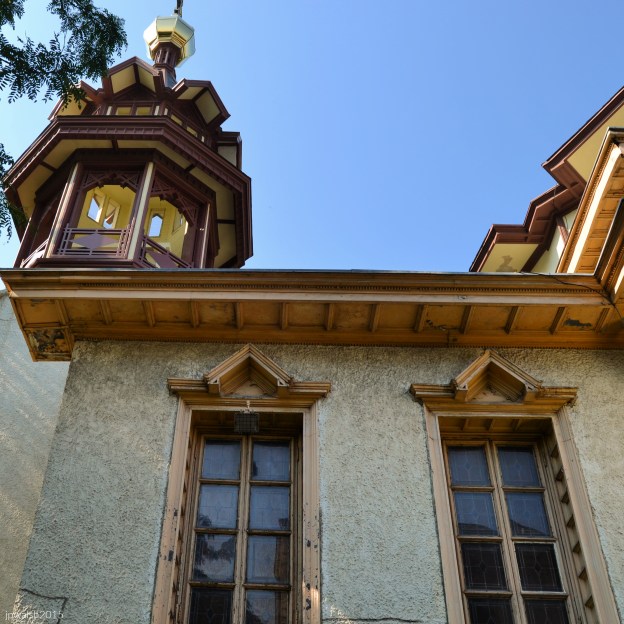
Louis H. Sullivan designed the bell tower (above and below) with its ornamentation and eaves and soffits for Holy Trinity Orthodox Cathedral in Chicago’s Ukrainian Village.

Chicago. Holy Trinity Orthodox Cathedral. 10/2016 4.16 mb
Chicago. Holy Trinity Orthodox Cathedral. 7/2015 6.24 mb

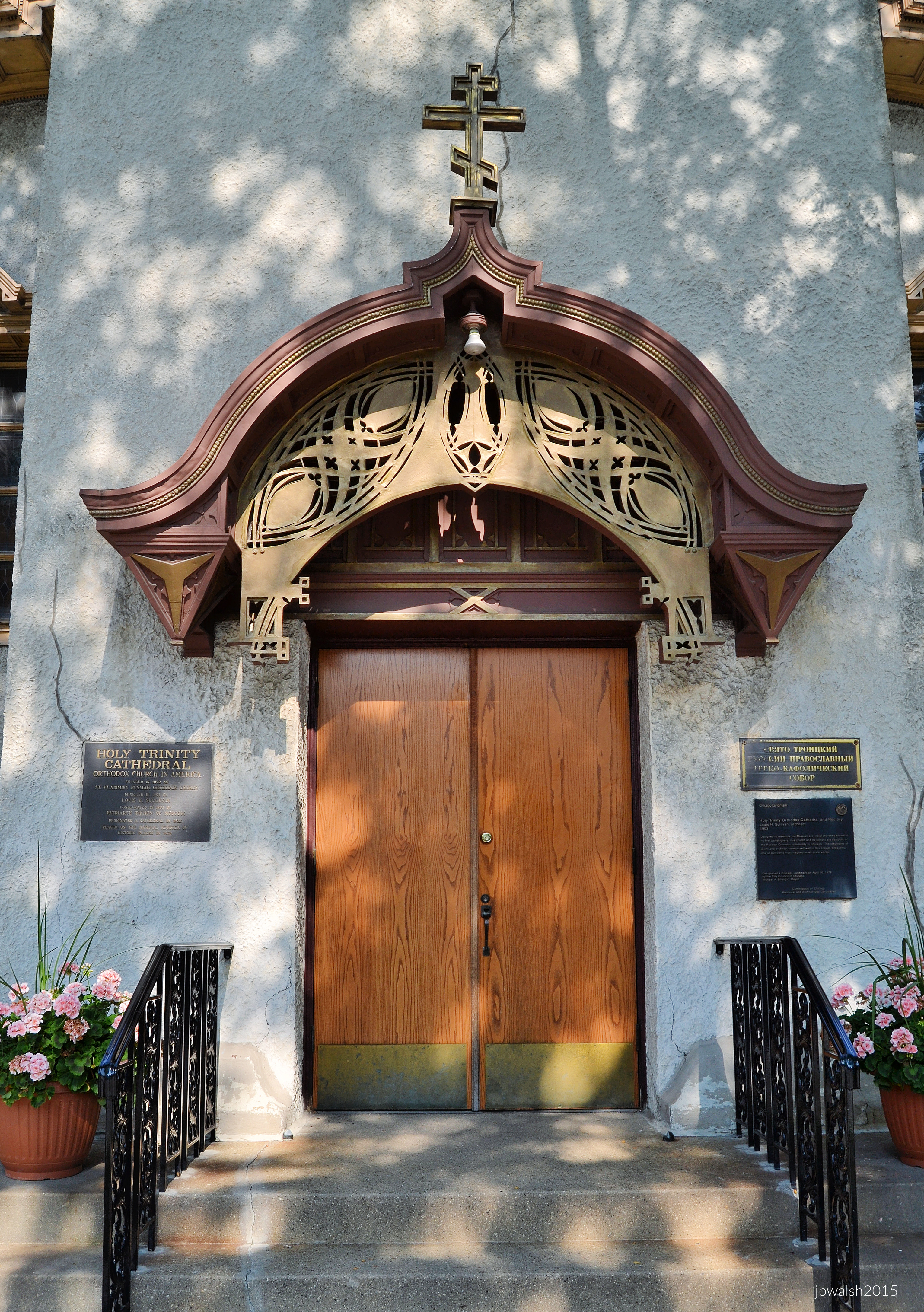
Louis H. Sullivan designed the portal canopy (above) and its ornamentation such as the fretwork. Sullivan also designed the window frames (example below).

Chicago. Holy Trinity Orthodox Cathedral. 7/2015 5.53 mb
Chicago. Holy Trinity Orthodox Cathedral. 10/2016 5.84 mb

Holy Trinity Cathedral was built on a limited budget. It is a small building at 47 x 98 feet situated on an east-west axis. The main body of the church is square with extensions and an octagonal dome above. The picturesque country-church entrance has a metal and wood canopy whose design and ornamentation were created by the architect, Louis H. Sullivan (1856-1924). Dedicated in 1903, the church was designated a cathedral in 1923.

Chicago. Holy Trinity Orthodox Cathedral. 7/2015 5.64 mb
Chicago. Holy Trinity Orthodox Cathedral. 10/2016 4.08 mb
Chicago. Holy Trinity Orthodox Cathedral. 10/2016 4.41 mb

The parishioners that built this church were rural people who had emigrated from southern Russia near the Ukraine as well as the area of the Carpathian Mountains.

Chicago. Holy Trinity Orthodox Cathedral. 10/2016 5.18 mb 99%
Chicago. Holy Trinity Orthodox Cathedral. 10/2016 6.95 mb

The Eastern Orthodox central plan creates an interior where the congregation stands in a square space topped by an octagonal dome. For Easter services and the like, the cathedral is filled to capacity with parishioners and others spilling out the front door with its decorative canopy onto the public sidewalk.

Chicago. Holy Trinity Orthodox Cathedral. 10/2016 8.26 mb
Chicago. Holy Trinity Orthodox Cathedral. 10/2016 6.27 mb

The stenciled artwork (above) is not by Louis H. Sullivan.

Chicago. Holy Trinity Orthodox Cathedral. 7/2015 2.80 mb

The church building was completed for around $27,000 in 1903 (approximately $1 million in 2022) with Sullivan donating half his commission to the church project.

SOURCES:

Chicago Churches and Synagogues: An Architectural Pilgrimage, George Lane, S.J., and Algimantas Kezys, Loyola University Press, Chicago, 1981, p. 106-107.

Alice Sinkevitch, AIA Guide to Chicago, 2nd Edition, Harcourt, Inc., Orlando, 2004, p. 260.

My Architecture & Design Photography: RAPP & RAPP. Oriental Theatre (1926), 24 W. Randolph Street, Chicago, Illinois.

FEATURE image: Oriental Theatre completed in 1926 and renamed the Ford Center for the Performing Arts in 1997. It became the Nederlander Theatre in 2019. Author’s photograph taken in December 2017. Author’s photograph.

December 2017. Chicago. Ford Center For the Performing Arts/Oriental Theatre. 5.0 mb Author’s photograph.

In Chicago’s Loop, the Oriental Theatre opened on May 8, 1926. In the first half of the 20th century, Randolph Street was one of the city’s most bustling entertainment districts.

Designed by the architectural firm of Rapp & Rapp—brothers Cornelius Ward (C.W.) Rapp (1861-1926) and George L(eslie) Rapp (1878-1941)—the Oriental Theatre was one of their many ornate movie palaces that they built. As its name implied, it was imagined in a style inspired by a Western fantasia of India and South Asian themes and motifs. Inspired by the architecture of India and the Far East, lights consisted of elephant heads with tusks, the walls were adorned with soft silk and regal velvets, and the ceiling was  garishly decorated with plasterwork elephants and other exotic beasts. 

James M. Nederlander Theatre. Originally the Oriental Theatre. George L. and Cornelius W. Rapp, 1926.James M. Nederlander Theatre interior” by Kenneth C. Zirkel is licensed under CC BY-SA 4.0.

Rapp & Rapp were alumni of the University of Illinois School of Architecture. The firm designed scores of theatres across the country in the first decades of the 20th century. The Rapp brothers were born in Carbondale in southern Illinois. Twenty-eight-year-old C.W. Rapp formed a partnership in 1889 with older architect, Canadian-born Cyrus P. Thomas (1933-1911) and they practiced together in Chicago until 1895. C.W. Rapp operated his own office for a decade until he formed a partnership with his brother G.L. Rapp in 1906. With stage entertainment and the boom of moving pictures after 1910, the firm of Rapp & Rapp quickly developed a reputation for their fantastic designs for silent film theatres in the Chicago area. Drawing on a large palette of architectural revival styles, Rapp & Rapp designed nearly four hundred theatres in the United States between 1906 and 1926.

In Chicago Rapp & Rapp designed notably State Street’s Chicago Theatre (1921) and the Bismarck Hotel and Theatre (1926). In New York City they built the since demolished Paramount Theatre (1926) in Times Square and the still-standing smaller-scaled Paramount Theatre (1931) in Aurora, Illinois.

In the mid1990s, after the Oriental Theatre had been closed and shuttered for over a decade, it underwent a multi-million-dollar restoration and expansion by Daniel P. Coffey & Associates. It reopened as the Ford Center for the Performing Arts in 1998. Following its expansion, the former Oriental Theatre seats over 2,000 patrons.

Entertainment legacy.

In the 1920s, the Oriental Theatre presented both movies and vaudeville acts. When talkies arrived, the Oriental Theatre became predominantly a movie house in the 1930s. Live stage, theatrical, and concert performances continued for mid20th century Chicago audiences during an era when Randolph Street was a mecca for crowds seeking out their favorite star performers. It also hosted smaller and vibrant live entertainment venues where one could seek out up-and-coming talents.

Duke Ellington and his orchestra made frequent appearances at the Oriental Theatre which welcomed patrons by way of an exotic ornate style. Some big names and legends in entertainment were seen at the Oriental Theatre including Judy Garland, George Jessel, Fanny Brice, George Burns and Gracie Allen, Cab Calloway, Eddie Cantor, Bing Crosby, Ella Fitzgerald, Jean Harlow, Billie Holiday, Bob Hope, Al Jolson, Danny Kaye, Jerry Lewis, The Marx Brothers, The Three Stooges, Frank Sinatra, Sophie Tucker, Sarah Vaughan, Henny Youngman, and a cast of thousands.

The Oriental Theatre closed in 1981 and remained shuttered for the rest of the 1980’s and into the early 1990’s depriving many young urban professionals from enjoying entertainment in a venue that, with its reopening in 1998, has operated continuously for nearly 100 years.

Ford Center for the Performing Arts in 1997 and the Nederlander Theatre in 2019.

In 1997 the Oriental Theatre was renamed the Ford Center for the Performing Arts and restored and expanded for its re-opening in 1998. In 2019 the theatre was renamed in honor of James M. Nederlander (1922-2016), Broadway theatre owner/producer and Broadway In Chicago founder.

Today’s James M. Nederlander Theatre hosts touring pre-Broadway and Broadway shows whose résumé included a long-running production of Billy Elliot: The Musical. From June 2005 through January 2009, the theater housed a full production of Wicked, making it the most popular stage production in Chicago history. In December 2017, when the feature photograph was taken, a traveling national tour of Wicked had started its Chicago run.

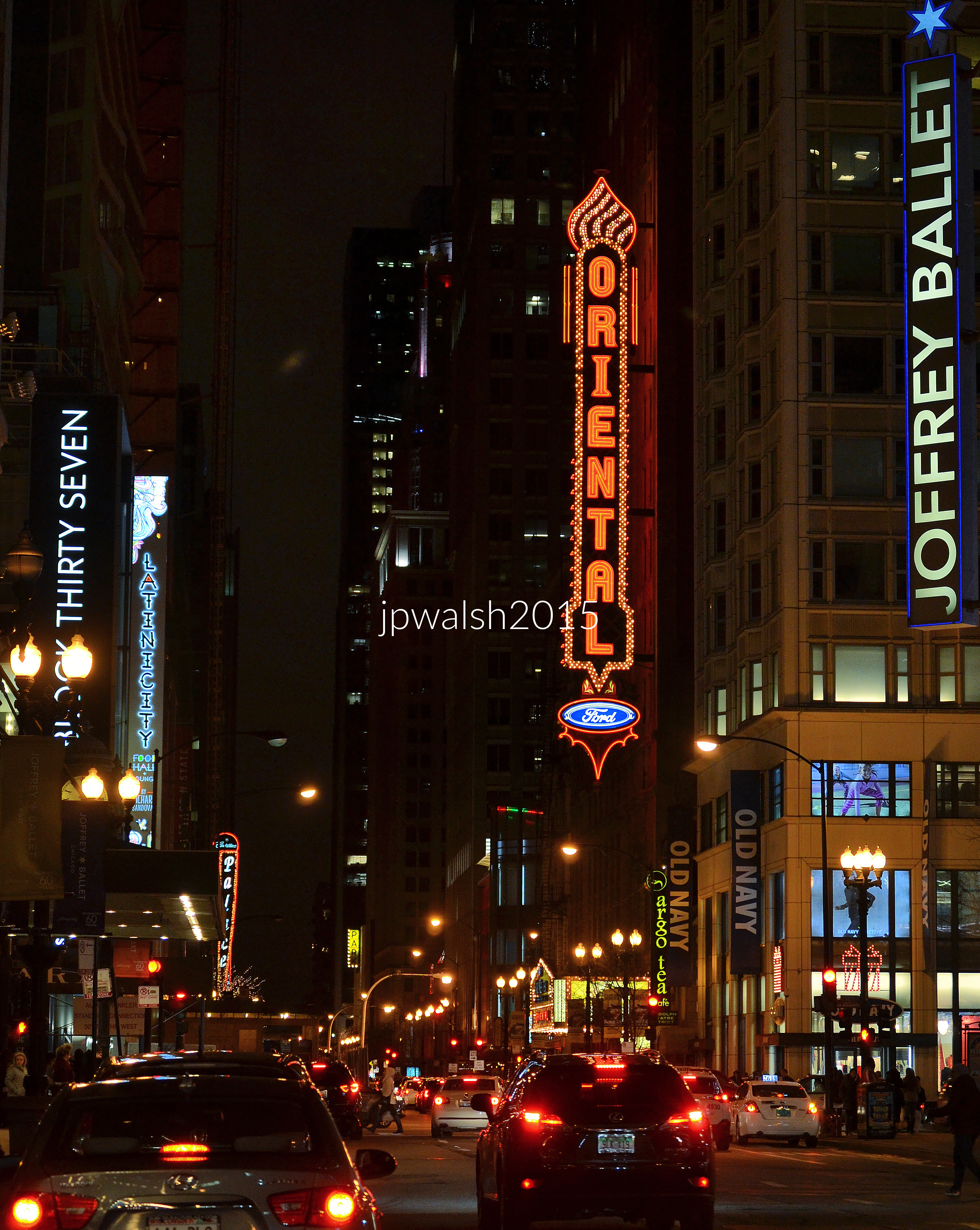
July 2016. Chicago. Oriental Theatre sign. 4.63 mb Author’s photograph.
December 2015. Chicago. Oriental sign at night. 6.51mb DSC_0866 (1). Author’s photograph.

SOURCES:
Alice Sinkevitch, AIA Guide to Chicago, 2nd Edition, Harcourt, Inc., Orlando, 2004, p. 54.

http://www.dictionaryofarchitectsincanada.org/node/1354 – retrieved November 1, 2023.

http://www.dictionaryofarchitectsincanada.org/node/541 – retrieved November 1, 2023.

https://www.sah.org/community/sah-blog/sah-blog/2013/07/17/the-revitalized-and-the-neglected-rapp-and-rapp’s-movie-palaces-in-chicago– retrieved November 1, 2023.

Photograph & Text:

UNITED STATES. My Art Photography: BIAGIO GOVERNALI, Bronze Doors, Mysteries of the Rosary (2004)—Shrine of Our Lady of Pompeii, Chicago, IL.

FEATURE IMAGE: Dedicated by Francis Cardinal George, O.M.I. on October 11, 2004, the three sacred bronze doors – East, West, and Central – at the Shrine of Our Lady of Pompeii in Chicago, IL, are by Italian artist Biagio Governali, native of Corleone, Italy, and depict the mysteries of the Rosary. CENTRAL Bronze Door: Sorrowful Mysteries panel (detail), The Shrine of Our Lady of Pompeii, Chicago. 12/2013 1.55 mb

INTRODUCTION.

Our Lady of Pompeii was originally established in Chicago in 1911 as an Italian national parish. The present church building at 1224 West Lexington Street in Chicago’s westside University Village/Little Italy neighborhood was constructed in 1923 and dedicated to Mary, Queen of the Rosary in 1924. The parish began under the Scalabrinian Missionaries, a religious institute founded in Italy in 1887 to aid and serve the Italian immigrants to America.

In 1994 Joseph Cardinal Bernardin proclaimed Our Lady of Pompeii church a Shrine, dedicated to honor Mary, the Mother of God and Queen of the Holy Rosary. Ten years later practically to the day, Francis Cardinal George, O.M.I. dedicated the Shrine’s bronze doors. On that same October day in 2004, Bishop Carlo Liberati, Pontifical Delegate to the Shrine of The Blessed Virgin of The Holy Rosary in Pompeii, Italy, established “a most fervent and fraternal link of communion” between the shrine in Pompeii, Italy, and that of Our Lady of Pompeii in Chicago.

Inspired by the main gate (“Porta del Paradiso”) of the Baptistry of Florence made by Florentine goldsmith and sculptor Lorenzo Ghiberti (1378-1455) between 1425 and 1452 and located in front of Florence’s cathedral, the bronze doors in Chicago were made by Biagio Governali, native of Corleone, Italy. The artist modeled each panel in wax which were then sent to Verona, Italy, to be cast in bronze and polished. These Veronese craftsmen came to Chicago on two occasions to mount and position the doors before they were dedicated and blessed by Cardinal George in 2004.

WEST Bronze Door: JOYFUL Mysteries.

WEST Bronze Door. Joyful Mysteries of the Rosary. The Shrine of Our Lady of Pompeii, Chicago. 12/2013 6.72 mb

The West Bronze Door, dedicated in 2004, depicts the five Joyful Mysteries of the Rosary at the Shrine of Our Lady of Pompeii (1923), 1224 West Lexington Street in Chicago. Clockwise from top left, the Annunciation (Luke 1:26-38), the Visitation (Luke 1:39-56), the Nativity of Jesus (Luke 2:1-20; Matthew 1:18-2:23), the Presentation of Jesus in the Temple (Luke 2:22-40) and Christ among the Doctors (Finding in the Temple) (Luke 2:41-52). The shrine is the oldest continuous Italian-American Catholic Church in Chicago and is today a place to pray for peace that embraces pilgrims of all faiths.

1. The Annunciation (top, left)

“In the sixth month the angel Gabriel was sent from God to a city of Galilee named Nazareth, to a virgin betrothed to a man whose name was Joseph, of the house of David; and the virgin’s name was Mary.” (Luke 1:26-27).

2. The Visitation (top, right)

“In those days Mary arose and went with haste into the hill country, to a city of Judah, and she entered the house of Zechariah and greeted Elizabeth. And when Elizabeth heard the greeting of Mary, the babe leaped in her womb; and Elizabeth was filled with the Holy Spirit and she exclaimed with a loud cry, ‘Blessed are you among women, and blessed is the fruit of your womb!”‘ (Luke 1:39-42).

3. The Nativity of Jesus (center)

“In those days a decree went out from Caesar Augustus that all the world should be enrolled. This was the first enrolment, when Quirinius was governor of Syria. And all went to be enrolled, each to his own city.
And Joseph also went up from Galilee, from the city of Nazareth, to Judea, to the city of David, which is called Bethlehem, because he was of the house and lineage of David, to be enrolled with Mary, his betrothed, who was with child. And while they were there, the time came for her to be delivered. And she gave birth to her first-born son and wrapped him in swaddling clothes, and laid him in a manger, because there was no place for them in the inn.” (Luke 2:1-7).

Upper portion of WEST Bronze Door depicting Joyful Mysteries of the Rosary. The Annunciation (Luke 1:26-38); Visitation (Luke 1: 39-56), and Nativity (Luke 2:1-20; Matthew 1:18-2:23). The Shrine of Our Lady of Pompeii, Chicago. 12/2013 4.42 mb

4. The Presentation in the Temple (bottom, left)

“And at the end of eight days, when he was circumcised, he was called Jesus, the name given by the angel before he was conceived in the womb. And when the time came for their purification according to the law of Moses, they brought him up to Jerusalem to present him to the Lord (as it is written in the law of the Lord, ‘Every male that opens the womb shall be called holy to the Lord’) and to offer a sacrifice according to what is said in the law of the Lord, ‘a pair of turtledoves, or two young pigeons.”‘ (Luke 2:21-24).

5. The Finding of Jesus in the Temple (bottom, right)

“Now his parents went to Jerusalem every year at the feast of the Passover. And when he was twelve years old, they went up according to custom; and when the feast was ended, as they were returning, the boy Jesus stayed behind in Jerusalem. His parents did not know it …
After three days they found him in the temple, sitting among the teachers, listening to them and asking them questions; and all who heard him were amazed at his understanding and his answers.” (Luke 2:41-47).

The exterior doors of the Shrine of Our Lady of Pompeii in Chicago visually narrate the twenty mysteries of the Rosary. These are the Joyful, Sorrowful, Glorious and Luminous mysteries. The faithful can use each door panel as a meditation to pray each decade of the Rosary.

In Europe, most of the complete works of art that have survived undamaged and unrestored from the Middle Ages and Renaissance to today are bronze doors, most of which are in Italy.

Even when the Shrine doors are closed, the sanctuary calls to all passersby to look, ponder, and personally experience the Gospel that these doors present in its fine artwork of the mysteries of the Rosary.

CENTRAL Bronze Door: SORROWFUL and GLORIOUS Mysteries.

The exterior doors of the Shrine of Our Lady of Pompeii in Chicago visually narrate the twenty mysteries of the Rosary – the Joyful, Sorrowful, Glorious and Luminous mysteries. The faithful can use each door panel as a meditation to pray each decade of the Rosary.
In Europe, complete works of art that have survived undamaged and unrestored from the Middle Ages and Renaissance to today are bronze doors, with most in Italy.
The Shrine doors are closed but the sanctuary calls to passersby to look and ponder on the Gospel that these doors present on the mysteries of the Rosary.

Sorrowful Mysteries.

1. The Agony in the Garden (top, left)

“Then Jesus went with them to a place called Gethsemane, and he said to his disciples, ‘Sit here, while I go yonder and pray.’ And taking with him Peter and the two sons of Zebedee, he began to be sorrowful and troubled. Then he said to them, ‘My soul is very sorrowful, even to death; remain here, and watch with me.’ And going a little farther he fell on his face and prayed, ‘My Father, if it be possible, let this cup pass from me; nevertheless, not as I will, but as you will.’” (Matthew 26:36-39).

2. The Scourging at the Pillar (top, right)

“Pilate released Barabbas to them, but after he had Jesus scourged, he handed him over to be crucified.” (Matthew 27:26).

3. The Crowning With Thorns (center, left)

“Then the soldiers of the governor took Jesus into the praetorium, and they gathered the whole battalion before him. And they stripped him and put a scarlet robe upon him, and plaiting a crown of thorns they put it on his head, and put a reed in his right hand. And kneeling before him they mocked him, saying, ‘Hail, King of the Jews!’” (Matthew 27:27-29).

4. The Carrying of the Cross (center, right)

“And they compelled a passer-by, Simon of Cyrene, who was coming in from the country, the father of Alexander and Rufus, to carry his cross. And they brought him to the place called Golgotha (which means the place of a skull).” (Mark 15:21-22).

5. The Crucifixion and Death of Jesus with Mary and John (center)

“And when they came to the place which is called The Skull, there they crucified him, and the criminals, one on the right and one on the left. And Jesus said, ‘Father, forgive them; for they know not what they do’ …It was now about the sixth hour, and there was darkness over the whole land until the ninth hour, while the sun’s light failed; and the curtain of the temple was torn in two. Then Jesus, crying with a loud voice, said, ‘Father, into thy hands I commit my spirit!’ And having said this he breathed his last” (Luke 23:33-46). 

Upper portion of Central Bronze Door of Sorrowful Mysteries (left panel) and Glorious Mysteries (right panel) of the Rosary.

Glorious Mysteries.

1. The Resurrection of Jesus (center)

“But at daybreak on the first day of the week they took the spices they had prepared and went to the tomb. 2They found the stone rolled away from the tomb; 3but when they entered, they did not find the body of the Lord Jesus. 4While they were puzzling over this, behold, two men in dazzling garments appeared to them.  5They were terrified and bowed their faces to the ground. They said to them, “Why do you seek the living one among the dead? 6He is not here, but he has been raised. Remember what he said to you while he was still in Galilee, 7that the Son of Man must be handed over to sinners and be crucified, and rise on the third day.” 8And they remembered his words. 9 Then they returned from the tomb and announced all these things to the eleven and to all the others. 10The women were Mary Magdalene, Joanna, and Mary the mother of James; the others who accompanied them also told this to the apostles, 11but their story seemed like nonsense and they did not believe them. But Peter got up and ran to the tomb, bent down, and saw the burial cloths alone; then he went home amazed at what had happened.” (Luke 24: 1-12).

2. The Ascension of Our Lord into Heaven (top, left)

“So then the Lord Jesus, after he had spoken to them, was taken up into heaven, and sat down at the right hand of God.” (Mark 16:19).

3. The Holy Spirit comes upon Mary and the Apostles (top, right)

“When the day of Pentecost had come, they were all together in one place. And suddenly a sound came from heaven like the rush of a mighty wind, and it filled all the house where they were sitting. And there appeared to them tongues as of fire, distributed and resting on each one of them. And they were all filled with the Holy Spirit and began to speak in other tongues, as the Spirit gave them utterance.” (Acts of the Apostles 2:1-4).

4. The Assumption of Mary into Heaven (bottom, left)

“Henceforth all generations will call me blessed; for he who is mighty has done great things for me.” (Luke 1:48-49).

5. The Coronation of Mary as Queen of Heaven (bottom, right)

“And a great portent appeared in heaven, a woman clothed with the sun, with the moon under her feet, and on her head a crown of twelve stars.” (Revelation12:1).

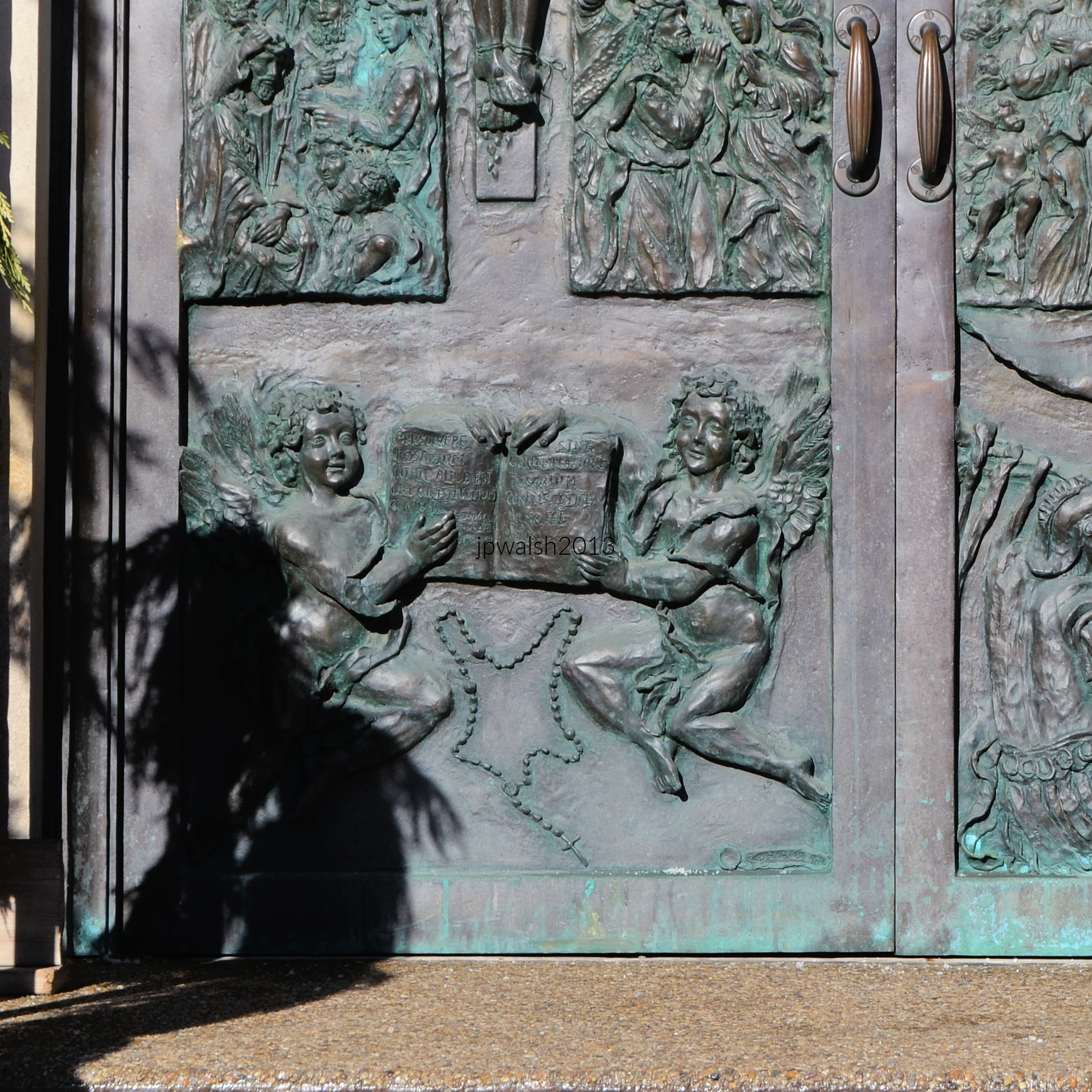
CENTRAL Bronze Door -Sorrowful Mysteries panel (detail), The Shrine of Our Lady of Pompeii, Chicago. 12/2013 1.55 mb

At the bottom of the Sorrowful Mysteries bronze door, the angels hold a tablet emblazoned with Latin text that contains statements on the rosary by two post-Vatican II modern popes. A translation of the text reveals the importance of the rosary to Pope Paul VI (1897-1978) and John Paul II (1920-2005), both canonized saints. Pope Paul VI: “Without contemplation, the Rosary is a body without a soul.” Pope John Paul II: “To meditate on the mysteries of the Rosary is to look into the face of Christ.”

EAST Bronze Door: LUMINOUS Mysteries.

EAST Bronze Door (complete exterior), Luminous Mysteries of the Rosary. The Shrine of Our Lady of Pompeii, Chicago. 12/2013 6.89 mb

Pope Saint John Paul II (1920-2005) established the Luminous Mysteries near the end of his almost 27-year pontificate in 2002. About the entire rosary itself the pope said, “To meditate on the mysteries of the Rosary is to look into the face of Christ.”

According to The Catholic Encyclopedia (“The Rosary,” Herbert Thurston and Andrew Shipman, volume 13, Robert Appleton Company), the structure of the rosary including its 15 mysteries (five each for Joyful, Sorrowful, and Glorious) had been officially unchanged for 500 years – from the 16th to 20th centuries.

In 2002, Pope John Paul II instituted the five Luminous Mysteries. In his Apostolic Letter, Rosarium Virginis Mariae, published on October 16, 2002, the pope marked out 4 broad areas as reasons to pray the rosary:

1. The rosary aids in contemplating Christ with Mary;

2. The rosary aids in contemplating the mysteries of Mary;

3. The rosary is a way of assimilating the mystery of “It is no longer I that live, but Christ lives in me” (Galatians 2:20); and,

4. The rosary is a way of praying for, and arriving at, peace in one’s life, family, neighborhood, and in the world.

In the same letter (Chapter 3), the pope observed that icons and other religious visual images can assist the human imagination to meditate and contemplate upon the mysteries of the Christian faith, particularly those of the rosary. Appealing to the Church’s traditional spirituality as well as that of St. Ignatius of Loyola (1491-1556) in The Spiritual Exercises, the pope’s exhortation to artistic representations as aiding mental prayer imbues Chicago’s great bronze portals depicting the mysteries of the rosary with the authenticity of standing at the threshold between time and eternity and the sacred and profane.

The pope acknowledged that although all the rosary’s 20 mysteries can be termed “luminous” – that is, pertaining to mysteries of light – the five new Luminous mysteries fill the gap between the infancy and hidden life of Christ (i.e., Joyful) and Holy Week from Palm Sunday to Resurrection Day (i.e., Sorrowful and Glorious).

The Luminous mysteries present five significant moments from Christ’s public ministry. Each of these mysteries, the pope writes, “is a revelation of the Kingdom now present in the very person of Jesus.” (For more see- https://www.vatican.va/content/john-paul-ii/en/apost_letters/2002/documents/hf_jp-ii_apl_20021016_rosarium-virginis-mariae.html).  

Luminous Mysteries

1. The Baptism in the Jordan (top, left)

“And when Jesus was baptized, he went up immediately from the water, and behold, the heavens were opened and he saw the Spirit of God descending like a dove, and alighting on him; and lo, a voice from heaven, saying, ‘This is my beloved Son, with whom I am well-pleased.”‘ (Matthew 3:16-17).

2. The Wedding Feast of Cana (top, right)

“On the third day there was a marriage at Cana in Galilee, and the mother of Jesus was there; Jesus also was invited to the marriage, with his disciples. When the wine failed, the mother of Jesus said to him, ‘They have no wine.’ And Jesus said to her, ‘O woman, what have you to do with me? My hour has not yet come.’ His mother said to the servants, ‘Do whatever he tells you.”‘ (John 2:1-5).

5. The Institution of the Eucharist (center)

“Now as they were eating, Jesus took bread, and blessed, and broke it, and gave it to the disciples and said, ‘Take, eat; this is my body.”‘ (Matthew 26:26).

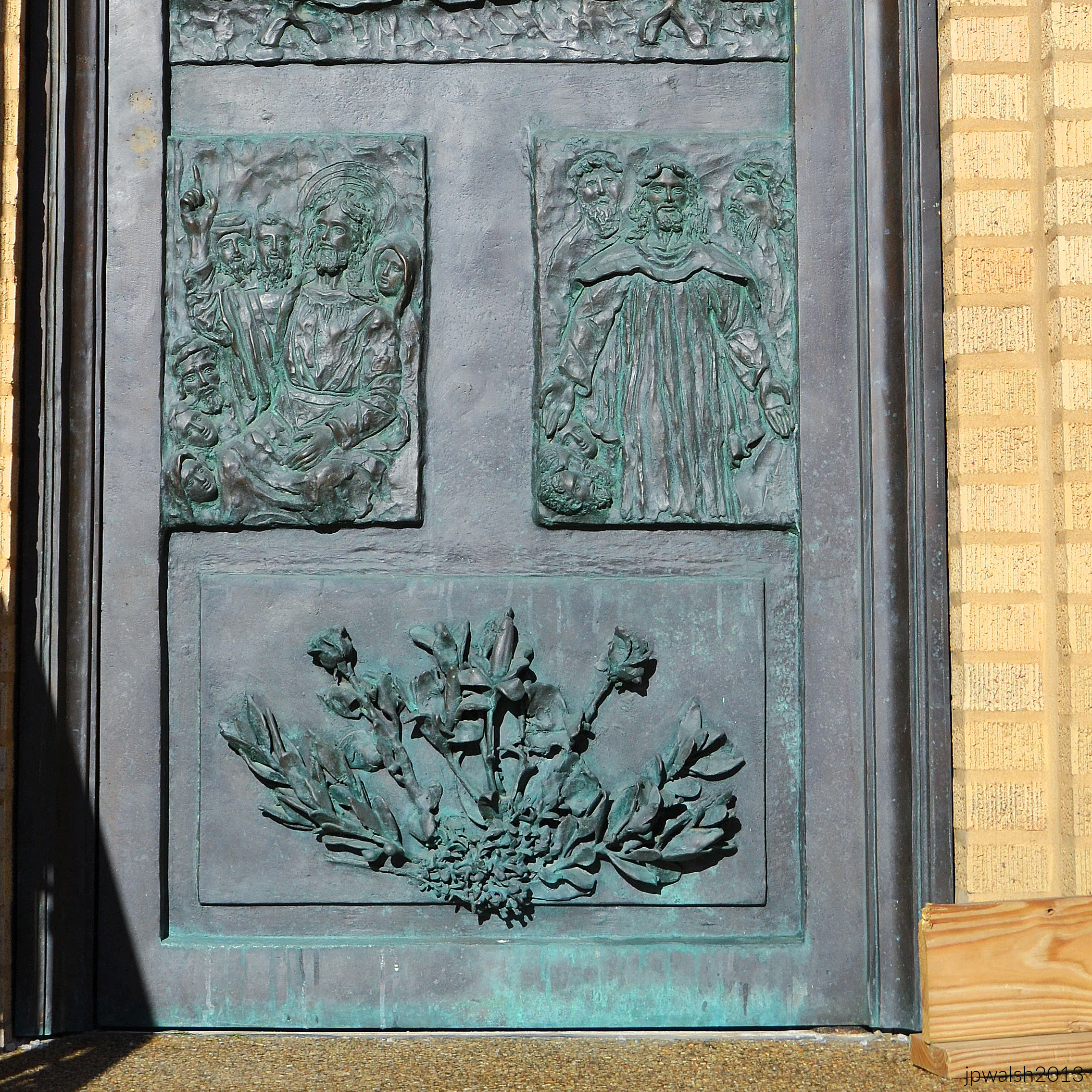
EAST Bronze Door (detail, top), The Shrine of Our Lady of Pompeii, Chicago. Upper panels of East Bronze Door depict the Luminous Mysteries of the Rosary at the Shrine of Our Lady of Pompeii in Chicago’s Little Italy. The sculptor is Biagio Governali who was born in Palermo, Sicily, and is an award-winning artist active in Italy and internationally, participating in many art exhibitions. 12/2013 4 mb 12/2013 3.60 mb

3. The Proclamation of the Kingdom of God (bottom, left)

“The time is fulfilled, and the kingdom of God is at hand; repent, and believe in the gospel.” (Mark 1:15).

4. The Transfiguration (bottom, right)

“And after six days Jesus took with him Peter and James and John his brother, and led them up a high mountain apart. And he was transfigured before them, and his face shone like the sun, and his garments became white as light.” (Matthew 17:1-2).

EAST Bronze Door (detail, bottom), The Shrine of Our Lady of Pompeii, Chicago.12/2013 3.48 mb

SOURCES:

-retrieved April 5, 2026.

photographs and text:

My Art Photography: Stained Glass, TYROL ART GLASS COMPANY OF INNSBRUCK, AUSTRIA. Ascension of Jesus and Assumption of Mary into Heaven (1927), Sts. Peter and Paul Church, Naperville, Illinois. (21 Photos & Illustrations).

Saints Peter and Paul Catholic Church in Naperville, Illinois, a western suburb of Chicago, in July 2021. Looking to the northeast from Central Park, the church building seats 1000 people and was dedicated in September 1927. In 2021 the parish marked its 175th anniversary. Founded in 1846, the parish is the oldest continuously operating Catholic parish in DuPage County. Down the decades its pastors (Frs. Rainaldi, Zuker, Wenker, Stenger, Lennon, Milota, and others) led Saints Peter and Paul adjacent to Naperville’s Historic District to where the parish with its school today serves 4,000 families. Photograph by author.

A magnificent church building sits on Ellsworth Street in Naperville, Illinois, close by the Historic District. With an orientation out of the darkness of the west into the light of the east, Saints Peter and Paul greets worshippers with two soaring steeples. The neo-Gothic red brick and limestone structure was commissioned in 1922 by the parish’s 350 families and dedicated five years later. Today the parish in Chicago’s western suburb serves 4.000 families and contains historically significant bright colored traditional European painted stained-glass windows from Innsbruck, Austria. In this archival photograph, the view of the church building from around the time of its dedication is looking towards the southeast.

BETWEEN 1870 AND 1930, ART GLASS OF GERMANY AND AUSTRIA COMES TO AMERICA, PARTICULARLY TO CHICAGO’S CHURCHES

The colorful stained-glass windows in Saints Peter and Paul Catholic Church in Naperville, Illinois, a western suburb of Chicago, were ordered, produced, and installed towards the end of a 60-year-long run for the predominance of German and Austrian-made stained glass found in heritage Chicagoland churches today.

With only a couple of exceptions, the stained glass in Naperville’s historically pioneer and, later, German Catholic parish church was created in the mid1920s in Innsbruck, Austria. Innsbruck at the time was one of the European centers of stained-glass making. It is about 100 miles south of Munich, Germany, the home base of two other popular and well-regarded stained-glass studios – that of Franz Mayer & Company and F.X Zettler Company. These art glass manufacturers notably filled many Chicagoland Catholic churches starting in the 1870s. After the Great Chicago Fire in 1871, a building and population boom commenced in the city and its surrounding communities that went on for over a century unabated. In addition, from the 1870s to the 1920s, Chicago became the most influential center of Catholic culture in the United States.1

It was a unique period of history for Catholic churches in America whose state-of-the-art church design usually included brightly colored art (stained) glass windows. These windows often displayed action-packed scenes from the Bible, including episodes from the life of Christ, His Blessed Mother, or a patron saint.

This continuous appeal over multiple generations for the purchases of vast orders of Munich and Austrian style glass in U.S. Catholic churches declined greatly starting in the 1930’s with the onset of the Great Depression. The European traditional glass market did not recover its former popularity making its stained-glass windows from 1870 to 1930 in Chicagoland churches – including Saints Peter and Paul Church in Naperville – increasingly rare and valuable to preserve and appreciate.

Stained glass made by Tyrol Art Glass Company of Innsbruck, Austria, and Franz Mayer and F.X. Zettler of Munich, Germany, was characterized by its traditional painted stained glass. This style fit into the traditional-style church architecture that Catholic parishes, such as Saints Peter and Paul in Naperville, and many others, built between 1870 and 1930. By the mid20th century these European traditional glass makers faced competition from the rise of American glass manufacturers such as Louis Comfort Tiffany (1848-1933) which extended to quality, price, and style. Tiffany stained glass which frequently incorporated natural scenery elements, contained intricately cut opaque and opalescent glass, overlaid with wide varieties in thickness. This product became better fitted into modern worship spaces which were often smaller. Such modern art and architectural trends worked to displace traditional glass made in Europe used for grandiose classically styled houses of worship that were from an earlier historical period.

In the late 19th century, Tyrol Art Glass Company of Innsbruck, Austria, with the Munich studios of Franz Mayer and F.X. Zettler, began to send representatives to sell their new patterns for churches in Chicago and around the United States. These three studios often worked together and their style is basically interchangeable. In Saints Peter and Paul Church – as well as many other churches with classically-styled  architecture – traditional painted stained glass was the stand-out choice, It is usually very colorful whose iconography often depicts highly recognizable religious, often biblical, scenes and religious symbolism. This is definitely the situation with the beautiful stained-glass windows of Saints Peter and Paul in Naperville, including the Ascension of Jesus into Heaven and the Assumption of Mary into Heaven windows.

HOW SAINTS PETER AND PAUL CATHOLIC CHURCH GOT STARTED AND GREW IN NAPERVILLE, ILLINOIS

Naperville, Illinois, a western suburb of Chicago, was founded in 1831 – the oldest town in DuPage County.2 With its origins as a mixed settlement of Easterners and Hoosiers, Naperville’s strong religious character was established starting in the 1830s.3 Today it boasts a population of around 150,000 and is one of Illinois’s largest cities. The downtown area is bustling with shops and motor vehicle and foot traffic, yet Naperville’s 19th century origins can still be found in and around the DuPage River with its River Walk and its Historic District that maintain much of the suburb’s original charm and historic significance.

Saints Peter and Paul Catholic Church in Naperville was founded in 1846 and is the oldest continuously operating Catholic parish in DuPage County. The county was established in 1839 with Naperville originally as the county seat. This changed in 1867 when, by county referendum, Wheaton became the county seat which it remains today. Naperville’s first religious institutions were the East Branch Settlement, Congregationalist, Evangelical, and Baptist churches. These churches were all established in Naperville between 1833 and 1843.4

The Catholic parish was originally founded as a mission of the Joliet Catholic Church – Joliet, Illinois, about 20 miles to the south of Naperville is its Diocese headquarters today. In the 1840s, when Illinois was the edge of the frontier, a priest traveled the rigorous 20-mile journey – Naperville did not get a railroad for another 30 years (1864) – once a month to say mass in pioneers’ homes. The first church, named St. Raphael’s for Fr. Raphael Rainaldi, the first pastor, was a small frame structure with a lean-to across the street from today’s church building. In the 1840s the church served about 25 families – 175 years later it serves 4,000 families.5

The first official act at Saints Peter and Paul Church was a festive event – the wedding of Mr. Robert Le Beau to Miss Emily Beaubien, recorded on Tuesday, September 8, 1846. The parish also purchased an acre of land for a cemetery.

In 1852 the church was enlarged by a frame addition and Fr. Charles Zuker established a parish school in the lean-to with a lay headmaster. In 1855 the first school building was built. By 1864 the first frame church building was used for school purposes as the cornerstone was laid for a new stone church on the site of the present church building. By this time the parish was renamed to Saints Peter & Paul by Fr. Peter Fisher and the parish had grown to about 250 families. The stone had been obtained locally from the parish’s own quarry along the DuPage River. The new stone church building was dedicated in 1866 and the school now served around 100 students.6

Continual improvements were made to the parish church and grounds in the 1870s and 1880s so that by the start of the 1890s, following Naperville’s incorporation as a city, the parish launched significant building projects. In 1892, a year where it rained almost all that spring, a new brick school building for the parish’s 200 students was built that cost $30,000. Saints Peter and Paul also built a new rectory in anticipation of the new century.

c. 1874, looking west, the corner of Ellsworth Street and Benton Avenue. the complex of buildings of Saints Peter and Paul parish, Naperville, Illinois.

In the 1880’s Naperville, illinois, like much of the rest of the country, expanded its industrial base, grew its city services, such as the fire department and city hall, and established new utilities including the first public telephone service.

With its new wealth generated by industry, Naperville built some of its first impressive homes. Shops and stores were established to service them. While agrarian in flavor, by the end of the 1880’s and into the early 1890s Naperville was already a bustling, modern, forward-thinking city. In 1893 Naperville hosted its first “Bicycle Parade” – a big public affair whose purpose was to “show our citizens the increased interest lately in this comparatively new mode of locomotion.”

In the 1890s the area that included Saints Peter and Paul Church, other denominational churches, and Northwestern College (renamed North Central College in 1926) affiliated with the United Methodist Church, came to be known around town as “Piety Corners.”

With the appearance of the first cars in the 1900s, Naperville was well on its way to an era of accelerated expansion and growth that continues in the 21st century.7

Saints Peter and Paul’s old stone church is to the far right. In the background left is the belfry of the Main Building at North Western College built in 1870. North Western College was founded in 1861 as Plainfield College in Plainfield, Illinois. It was renamed to North Western College in 1864 and, with the enticement of 8 acres of donated land and $25,000 from Naperville, relocated to Naperville in 1870. In 1926 it was again renamed to today’s North Central College. For over 140 years the college has had a great deal of influence on the educational and cultural life of Naperville. In 2021, with an enrollment of 3,000 students and 700 employees, North Central College is one of Naperville’s top ten employers.8
c. 1904, view of Sts. Peter and Paul stone church building from the belfry of the College’s Main Building.

In 1911 the school was badly damaged by fire. When a new school opened the next year, 250 students were enrolled.9

In the 1920’s Naperville boasted around 5,000 residents. In June 1922 (sources vary whether it was on June 4 or June 8) the old stone church quarried from the parish’s own quarry and dedicated in 1866 was destroyed by an arsonist’s fire. By this time, the parish’s 350 Naperville families were from mostly German-speaking countries in Europe. Naperville’s quarries had brought waves of German immigrants to the city since the 1850’s since they knew how to mine and cut stone. After the devastating 1922 fire, the parish chose to rebuild their church in a magnificent red brick traditional cruciform-shape. It was dedicated on Sunday, September 25, 1927. The half German, half Irish Cardinal-Archbishop of Chicago, George Mundelein (1872-1939), participated in the dedication ceremony. This remains the church building that exists today and which contains its lovely and historically significant stained glass from Innsbruck, Austria. In 1927 the cost of the church building was $407,785 – or about $6.5 million today.10

WHO WERE SAINTS PETER AND PAUL?

El Greco (1541-1641), Saint Peter in Tears, 1587-1596, oil on canvas, 109 cm (42.9 in) x 88 cm (34.6 in), Toledo, Spain.

St. Peter is the Rock, or “Cephas,” of Jesus Christ’s church. In Matthew 16 Jesus tells Simon, son of John, brother to Andrew the apostle and a married fisherman by trade: “I say to you, you are Peter, and upon this rock I will build my church, and the gates of the netherworld shall not prevail against it. I will give you the keys to the kingdom of heaven. Whatever you bind on earth shall be bound in heaven; and whatever you loose on earth shall be loosed in heaven” (Mt 16: 18-19). Peter denied Christ three times before the crucifixion that is described in all four New Testament Gospels.

After Jesus Christ’s Resurrection (Mark 16, Matthew 28, Luke 24, Acts 1, John 20 and 1 Corinthians 15) and Ascension into Heaven (Luke 24:50. Acts 1, John 3:13, John 6:62, John 20:17, Romans 8:34, Ephesians 1:19-20, Colossians 3:1, Philippians 2:9-11, 1 Timothy 3:16, and 1 Peter 3:21-22) and following the events of Pentecost (Acts 2), Peter led an important life as a Christian evangelist and Church leader.

Though St. Paul’s pastoral heritage in his 13 letters were highly influential for the early church where he writes on church structure, the theology of the Body of Christ, and the nature of the Holy Spirit, St. Peter also has an epistemological heritage which explores the People of God.11 These best-known apostles also both died in the 60s. For the rest of that critical first century of Christianity – until when John’s Gospel was written in the 90s – the churches had to go without two of its greatest authoritative figures who had seen the risen Jesus.

St. Peter was martyred by crucifixion in 64 A.D. in Rome. He requested he be crucified upside down on an x-shaped cross, as witness to the apostle’s prolonged sorrow over his denial of Christ. On the church calendar, St. Peter’s feasts are June 29 and February 22.


Rembrandt, The Apostle Paul, oil on canvas, 1633.

St. Paul is one of Church history’s most significant figures. As Saul of Tarsus, the scholar, rabbi, and Roman citizen, zealously persecuted the first Christians and was personally present at the stoning of the first Christian martyr, Stephen (Acts 7: 54-60). On the road to Damascus making “murderous threats” towards Christians (Acts 9:1), Paul encounters the risen Jesus. The passage reads: “Suddenly a light from heaven flashed around him. He fell to the ground and heard a voice say to him, “Saul, Saul, why do you persecute me?” “Who are you, Lord?” Saul asked. “I am Jesus, whom you are persecuting,” he replied. “Now get up and go into the city, and you will be told what you must do.” (Acts 9:4-6).

The jolting event changed Paul’s life and outlook. More than anyone else in the Church’s first years, Paul realized Christianity’s universal message. Paul’s letters to various Christian communities in Corinth, Ephesus, and Rome, show him to be a solicitous and sometimes stern and exhorting pastor who had a deeply personal spiritual experience of the Lord. About half of the books of the New Testament are Paul’s writings that  express his profound openness to humanity and its cultures which made him “Apostle of the Gentiles” and “Teacher of the Nations.”

Paul was martyred somewhere between 64 and 68 A. D. The circumstances of his death are not entirely known, although early Christian writers related that Paul was beheaded. St. Paul shares a feast with St. Peter on June 29.

THE WINDOWS

The Ascension of Jesus into Heaven.

North Transept, Ascension of Christ into Heaven, 1927, Tyrol Art Glass Company, Innsbruck, Austria. Sts. Peter and Paul Church, Naperville, Illinois.

The Ascension of Jesus is recounted twice in the New Testament  – and both times by Luke the Evangelist. One account is in his Gospel (Luke 24:50-53) and a second is in his Book of Acts of the Apostles (Acts 1: 6-12).

One significant difference in Acts is that Luke sets a time frame of 40 days (1;3) for Jesus’s sustained manifold appearances to the apostles after the Resurrection until His Ascension. The account in Acts also situates the apostles and Christian community into salvation history’s imagery of Israel’s covenant.12 Luke’s tradition would likely not have separated the Resurrection and Ascension events in time except that it was used to give clarity to a narrative purpose.13

The account of the Ascension in Acts 1:6-12 reads:

6 ”When they had gathered together they asked him, “Lord, are you at this time going to restore the kingdom to Israel?”

7 He answered them: “It is not for you to know the times or seasons that the Father has established by his own authority.

8 But you will receive power when the Holy Spirit comes upon you, and you will be my witnesses in Jerusalem, throughout Judea and Samaria, and to the ends of the earth.”

9 When he had said this, as they were looking on, he was lifted up, and a cloud took him from their sight.

10 While they were looking intently at the sky as he was going, suddenly two men dressed in white garments stood beside them.

11 They said, “Men of Galilee, why are you standing there looking at the sky? This Jesus who has been taken up from you into heaven will return in the same way as you have seen him going into heaven.”j

12 Then they returned to Jerusalem from the mount called Olivet, which is near Jerusalem, a sabbath day’s journey away. (New American Bible)

When Jesus rose from the dead it became clear to the disciples that he is the Messiah so it was not illogical that they would ask him in Acts when he will restore political self-rule to Israel. Since Luke was writing with future Christians in mind, Jesus‘s reply is indeterminate. Jesus tells them (Acts: 7-8) that the Second Coming (“parousia”) is not a question for them to be asking of God. Rather, it is important for them to bear witness to Him by ways of the power of the Holy Spirit that Jesus will send to them and for whom they should wait. Lastly, as Jerusalem is the Holy City and the place of Jesus’s Paschal Mystery this is the place where the Christian church will start their mission that will reach to the ends of the earth.14

Another important detail Luke includes in Acts is that when Jesus is lifted up into heaven a cloud has intervened to take him from the apostles’ sight. Further, the Ascension takes place on Mount Olivet, which had eschatological (“end times”) meaning. After Jesus is lifted up two figures appear in dazzling garments signaling angels who also appeared at the birth of Jesus (Luke 2:9) and at the Resurrection (Luke 24:4-7). The cloud image Luke uses is also linked to end times (Luke 21:27) or parousia so that Jesus who is bodily taken up to heaven in the Ascension “will come (again) in the same way that you saw him going” (Acts1:11).

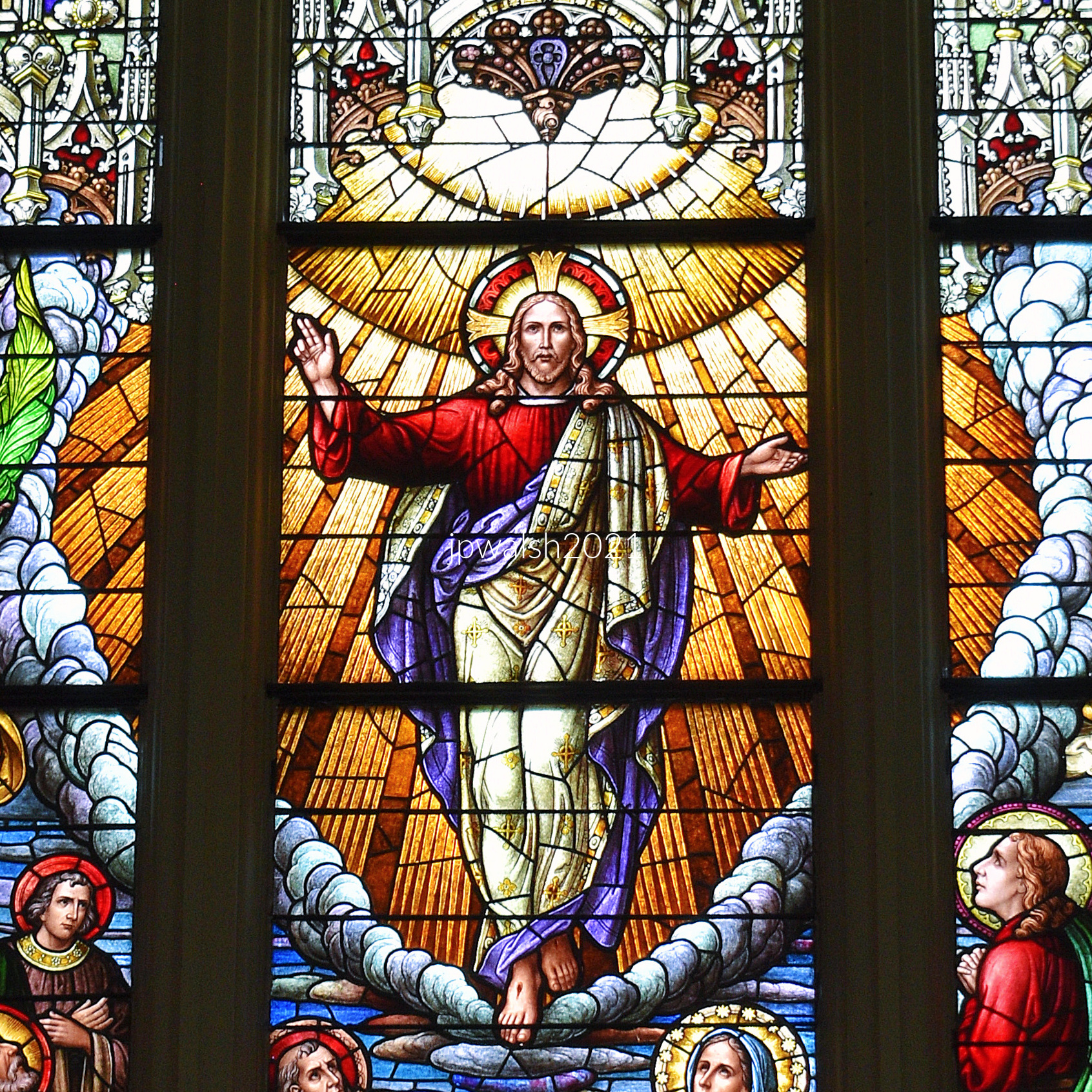
detail, Christ, Ascension window, Sts. Peter and Paul, Naperville, IL

In the Ascension of Christ into Heaven window, Christ is surrounded by a band of clouds and yet remains in a golden area representing the fiery light of God. Christ wears a multi-colored robe – red representing his death by crucifixion; purple representing his Divinity; and white representing martyrdom emblazoned with four-lobed crosses representing the four Gospels or the four corners of the earth.

Christ’s halo is elaborated in three parts. There are usually three Greek letters found in Christ’s cruciform halo that in translation spell out “He Who is” or “ I Am Who Am.” These are absent, however, in this stained-glass window’s cruciform halo.

87% 7.5mb

Hierarchy of angels

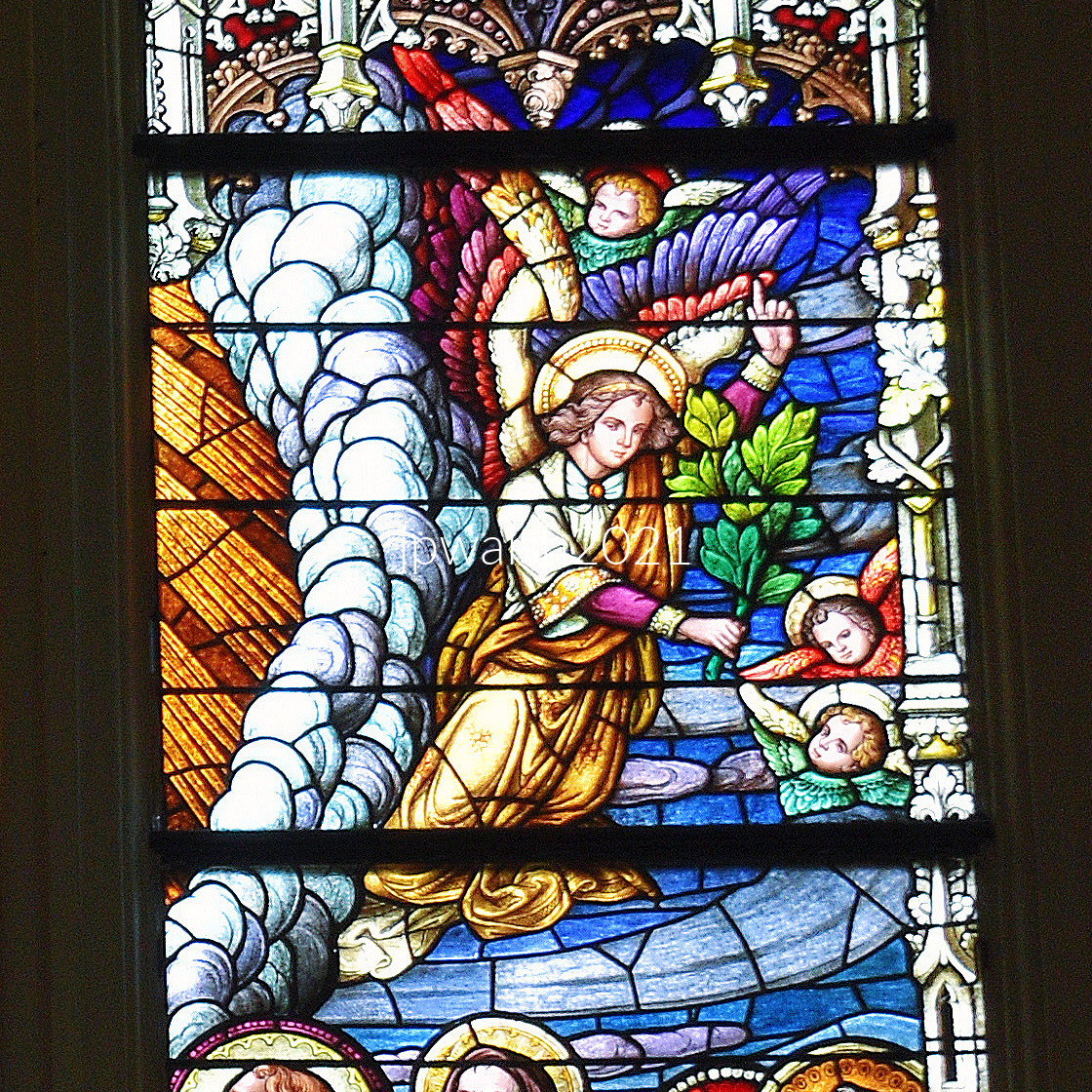
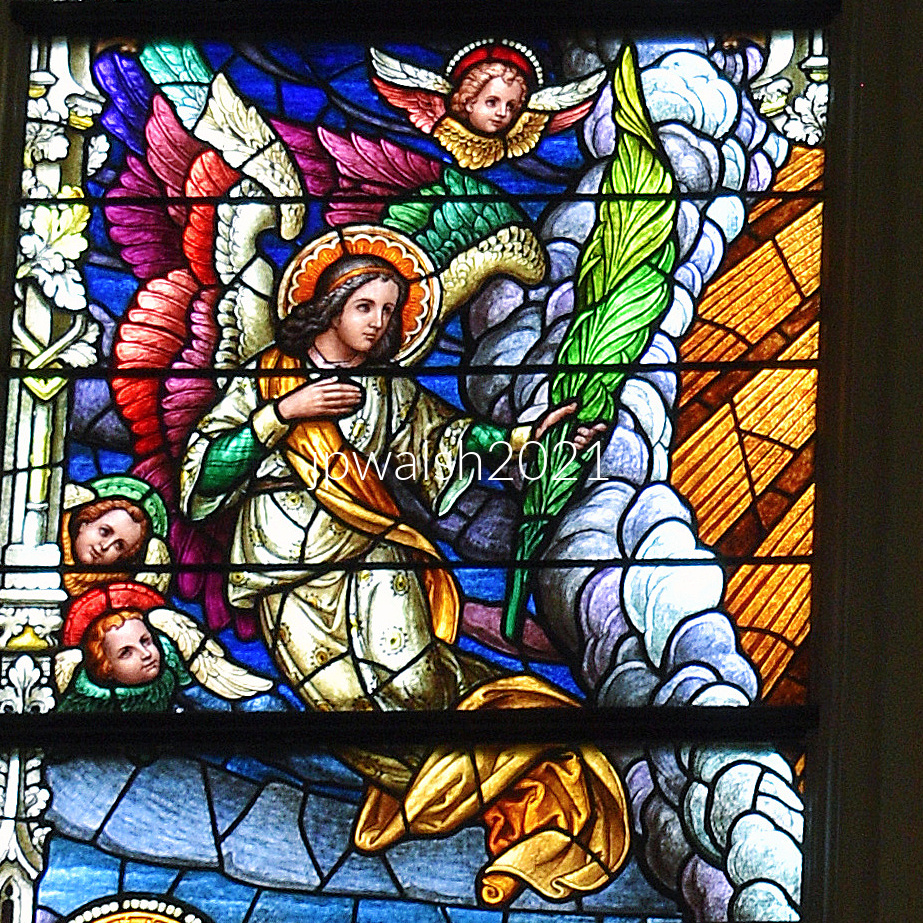
There are eight angels in the window representing the hierarchy of angels. The baby heads of the cherubim – the lowest tier of angels – are accompanied by seraphim, the highest order of angels. Their name “archangel” literally means “chief angel.” Traditionally these highest order of angels are warlike in appearance and bear a sword, This is especially the case with the iconography of St. Michael the Archangel who leads God’s angels in battle to cast Satan and his angels out of heaven as told in the New Testament Book of Revelation.

The seraphim in this stained-glass depiction, however, carry palm branches in place of swords. In the years following World War I when this stained glass was made, the Austrian art glass manufacturer may have sought to symbolize angelic power by ways of symbols of peace. The fact that the range of angels from lowest to highest is present in the window appears to signal the presence of the whole choir of angels present at the Ascension of Jesus into heaven.15

detail, angel, Ascension window, Sts. Peter and Paul, Naperville, IL.

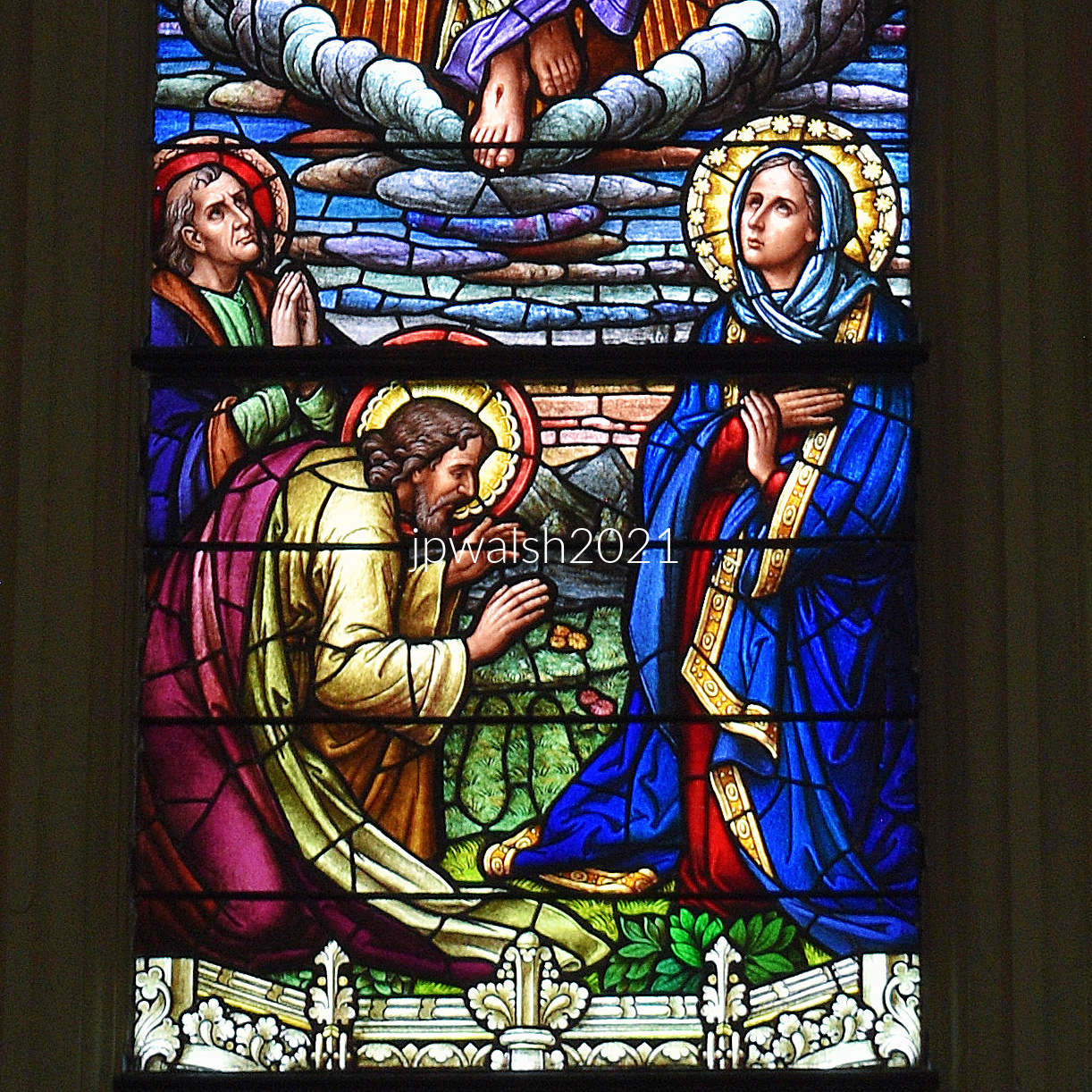
Depicted at the bottom of the window is Mary and the 12 apostles. This was not precisely accurate to the New Testament for at the Ascension there were only 11 apostles. However, the replacement of Judas by Matthias took place almost immediately following the Ascension narrative (Acts of the Apostles 1:21–26).

In the center of the window at the bottom between Mary and a kneeling apostle with his right arm stretched out is an interesting detail. It is the outline of Christ’s feet showing where his resurrected body stood and was lifted directly from earth into heaven. This is significant beyond a souvenir of Jesus’s earthly memory, in that Mount Olivet from which the resurrected Jesus was lifted into heaven is exact the place to which “the Son of Man coming in a cloud with power and great glory” (Luke 21:27) will return at the end of the world. In that way, the window is a depiction of the Ascension and one that points to the Second Coming of Christ.

detail, outline of jesus’s feet, Ascension window, Sts. Peter and Paul, Naperville, IL.

Each of the apostle’s halos are unique. Mary’s halo has 12 stars as she is often pictured with a circle of stars. The Zodiac is an ancient circle of stars where some are symbolically combined into 12-star signs or constellations.

detail, apostles, Ascension window, Sts. Peter and Paul, Naperville, IL.

Jesus’ Ascension – his going “up” to heaven – is the same imagery used for the Assumption of Mary. It is figurative to express the spiritual. The biblical heaven is mysterious. It is the intimate reserve of God and as God is pure spirit (John 4:24), the question arises, how does Heaven incorporate the resurrected fleshly body of Christ at His Ascension?

It is explained starting with the Incarnation at the Annunciation to Mary (Luke 1:26-38) where the divine humanity of Jesus, the Word who was “with God, and…was God (John 1:1) begins. In the Ascension, the Person of Christ is fulfilled where the “new, saved man” enters heaven into the intimacy of the Father, and becomes the perfect God-Man. As “God is love” (I John 4:16), the manner of being of the body in Christ in heaven, the perfect God-man, is love.16

The Ascension is followed by Pentecost when the Apostles receive the Holy Spirit from Heaven and will speak thereafter of “Christ (in Heaven) in us.”

detail, rondelle, Christ the King, Ascension window, Sts. Peter and Paul, Naperville, IL.

The upper rondelle represents Christ the King. Christ’s crown obscures his elaborate three-part halo. The Greek letters on either side represent the “alpha” (“the beginning”) and the “omega” (“the ending”) which indicates Christ’s Godhead. Christ the King holds in his hands the symbols of the sacrament of the Holy Eucharist in the consecration of the Mass. in his right hand is the species of bread and wine that become the Body and Blood of Christ and in his left hand is the wood beam of the cross whose sacrifice on Calvary the Eucharist memorializes. Christ the King also reveals his Sacred Heart – a popular Catholic devotion- inside his chest. His heart is depicted as aflame encircled by a crown of thorns signifying his agape (or sacrificial) love. The entire Ascension window was the gift of Mr. and Mrs. William David Callender, parish members in the mid1920s.

detail, halo of stars, Ascension window, Sts. Peter and Paul, Naperville, IL.

In the New Testament, the Woman of the Apocalypse and the battle of St. Michael the Archangel against the Dragon are bound together in the same dramatic narrative in the Book of Revelation (Rev.12:1-9). The Woman with a crown of 12 stars who is against the Dragon in the Book of Revelation has been identified with Mary, particularly as the Immaculate Conception. This is how Mary is depicted in the Ascension of Christ into Heaven window at Sts. Peter and Paul.

The New Testament passage setting out these images is in Revelation 12:1-9:

1 A great sign appeared in the sky, a woman clothed with the sun, with the moon under her feet, and on her head a crown of twelve stars.

2 She was with child and wailed aloud in pain as she labored to give birth.

3 Then another sign appeared in the sky; it was a huge red dragon, with seven heads and ten horns, and on its heads were seven diadems.

4 Its tail swept away a third of the stars in the sky and hurled them down to the earth. Then the dragon stood before the woman about to give birth, to devour her child when she gave birth.

5 She gave birth to a son, a male child, destined to rule all the nations with an iron rod. Her child was caught up to God and his throne.

6 The woman herself fled into the desert where she had a place prepared by God, that there she might be taken care of for twelve hundred and sixty days.

7 Then war broke out in heaven; Michael and his angels battled against the dragon. The dragon and its angels fought back,

8 but they did not prevail and there was no longer any place for them in heaven.

9 The huge dragon, the ancient serpent, who is called the Devil and Satan, who deceived the whole world, was thrown down to earth, and its angels were thrown down with it.

EXPLANATION OF IMAGERY IN THE NARRATIVE OF REVELATION 12-14

About the middle of the Book of Revelation (Chapters 12-14), the author portrays the power of evil as represented by the figure of the Dragon who is opposed to God and his people. This Dragon pursues the woman about to give birth to devour the child but the child is born. Then St. Michael and his angels expel the Dragon and the Dragon’s angels out of heaven (Rev. 12:5-9). Adorned with the Old Testament images of sun, moon, and stars (Genesis 37:9-10), the woman symbolizes God’s people. As Israel gave birth to the Messiah (Rev.12:5) and the church suffers persecution by the Dragon (Rev 12: 6, 13-17), the Woman corresponds to an archetype of a pregnant goddess bearing a savior who is pursued by a monster looking to destroy the offspring. But her offspring, a son, in his turn, destroys the monster.

The huge red Dragon is a symbol of the forces of evil – the Devil or Satan (Rev. 12:9, 20:2), or the mythical Leviathan (Ps, 74:13-14) or Rahab (Job 26:12-13; Ps 89:11). It is also the ancient serpent who seduced Eve, the mother of the whole world (Gen 3:1-6).17

The Assumption of Mary into Heaven.

South Transept, Assumption of Mary into Heaven, 1927, Tyrol Art Glass Company, Innsbruck, Austria. Sts. Peter and Paul Church, Naperville, Illinois.

There is no mention of the Assumption of Mary into Heaven in the New Testament. There are biblical texts used frequently to point to the doctrine whose imagery is related to the Ascension of Christ into Heaven.

The Assumption of Mary in theology is the doctrine that Mary as Theotokos, or Mother of God, was taken (“Assumed”) into heaven, body and soul, at the moment, or what would be the moment, of her death. This phenomenon is not unprecedented in the Bible. It occurred in the Old Testament to Moses and Elijah who were pivotally important as Old Testament figures and who were present at Christ’s Transfiguration in the New Testament (Matt 17:1-9; Mk 9:2-10: Lk 9:28-36; and 2 Peter 1:16-21).

There has been debate whether Mary was assumed into heaven at death or after death – that is, whether Mary, the Mother of the Savior, experienced death at all. It is a debate not resolved even with the doctrine of the Mary’s Assumption into Heaven declared a dogma of the faith by Pope Pius XII (1876-1958) on November 1, 1950 in the apostolic constitution Munificentissimus Deus.

What is depicted in the window is biblical in the sense that it is the dogmatic theology deduced from it. The Assumption as a theme in Christian art originated in western Europe during the late Middle Ages—starting in the 12th and 13th centuries – a period when devotion to the Virgin Mary was growing in importance. It would be renewed vigorously again in the 16th century during the Protestant Reformation. Before this Renaissance and Reformation period, Mary is represented surrounded by a mandorla, or almond-shaped aureole. But starting in the 16th century the mandorla was replaced by a cluster of clouds as depicted in the window.

detail. Mary, Assumption window, Sts. Peter and Paul Church, Naperville, Illinois.

The window depicts Mary standing upon a brightly-lit crescent moon reflected in imagery from Revelation 12.

Mary wears a blue cloak with a red shirt underneath as seen in the stained glass window by her right arm’s sleeve. The blue of her cloak is interpreted to represent the Virgin’s purity, symbolize the cosmos, and identify Mary as a Queen as blue was associated with royalty.

The red garment color signifies traits connected with motherhood as well as Mary’s presence on Calvary at her son’s crucifixion, particularly her traits of love and devotion.

These symbolic colors Mary wears expresses a universal definition of motherhood for her.

The Virgin Mary is mother to Jesus which expands to the whole of humanity. On Calvary, standing by the cross of Jesus were three Marys – Mary, his mother, Mary, the wife of Clopas, and Mary of Magdala. From the cross, Jesus said in John 19:

26 When Jesus saw his mother and the disciple there whom he loved, he said to his mother, “Woman, behold, your son.”

27 Then he said to the disciple, “Behold, your mother.” And from that hour the disciple took her into his home. (New American Bible)

Mary wears a white robe representing her purity. Her halo has seven eight-pointed stars. In numerology the number 7 represents “perfection” and the number 8 represents “regeneration or rebirth.”

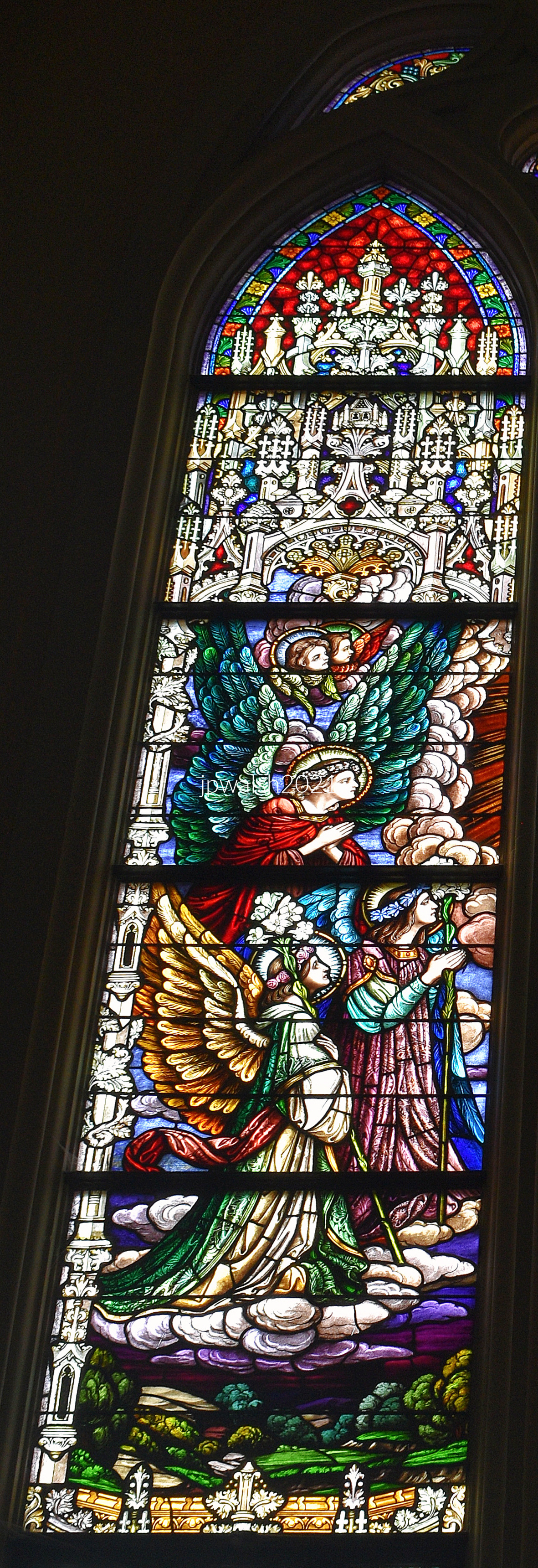
detail. angels, Assumption window, Sts. Peter and Paul Church, Naperville, Illinois.

There are 12 angels, some carrying palms representing peace and victory, others carry lilies representing Mary’s virginity. Angels wear laurels of hyacinths (prudence, peace, and desire for heaven) and of roses (heavenly joy). Another angel holds out a bouquet of thornless roses signifying purity and the triumph of love. Mary will be crowned Queen of Heaven and the angels hold her crown.

detail. rondelle, The Trinity, Assumption window, Sts. Peter and Paul Church, Naperville, Illinois.

God the Father wears a triangular halo as He blesses the scene. The Holy Spirit in the symbol of the dove emanates.18

FOOTNOTES:

1  https://www.kingrichards.com/news/Church-Stained-Glass/79/Historic-Stained-Glass-Companies/ – retrieved 12.7.21.  

2 DuPage Roots, Richard A. Thompson, et.al., DuPage County Historical Society, 1985, p. 200.

3 DuPage Roots, p.203.

4 DuPage Roots, p.203-4.

5 http://www.idaillinois.org/digital/collection/npl/id/7507/ – p. 18 retrieved 12.7.21.

https://sspeterandpaul.net/our-church -retrieved 12.7.21.

DuPage Roots, p.203.

6  http://www.idaillinois.org/digital/collection/npl/id/7507/ p.23 – retrieved 12.7.21.

https://sspeterandpaul.net/our-church – retrieved 12.9.21.

7 DuPage Roots, pp. 204-5.

http://www.idaillinois.org/digital/collection/npl/id/7507/ p. 38- retrieved 12.7.21.

8 https://en.wikipedia.org/wiki/Naperville,_Illinoisretrieved 12.9.21.
DuPage Roots p. 204.

9 https://sspeterandpaul.net/our-church – retrieved 12.9.21.

10 DuPage Roots p 205.

11 see Raymond E. Brown, The Churches The Apostles Left Behind, Paulist Press, NY, 1984.

12 Raymond E. Brown, A Risen Christ at Eastertime, The Liturgical Press, Collegeville, Minnesota, 1991, p. 60.

13 “Acts of the Apostle, “ Richard J. Dillon and Joseph A. Fitzmyer, S.J, The Jerome Biblical Commentary, Prentice Hall Englewood Cliffs, NJ, p.169.

14 https://bible.usccb.org/bible/acts/1 – . retrieved 11.17.21.

Raymond E. Brown, A Risen Christ at Eastertime, The Liturgical Press, Collegeville, Minnesota, 1991, p. 60.

15 see – https://www.beyondtheyalladog.com/2016/06/winged-heads-a-key-to-the-heirarchy-of-angels/ – retrieved 12.11.2021.

16 Romano Guardini, The Lord, Regnery Publishing, inc. Washington, D.C., pp. 501-503.

17 https://bible.usccb.org/bible/revelation/12 – Retrieved11.17.21.

Stained Glass Windows Tour at Saints Peter and Paul Church – Parts 1 and 2

18 Ibid.  

SOURCES:

http://www.idaillinois.org/digital/collection/npl/id/7507/

https://bible.usccb.org/bible/acts/1

https://bible.usccb.org/bible/revelation/12

https://en.wikipedia.org/wiki/Naperville,_Illinois

https://sspeterandpaul.net/our-church

https://www.britannica.com/topic/Assumption-Christianity

https://www.kingrichards.com/news/Church-Stained-Glass/79/Historic-Stained-Glass-Companies/

Raymond E. Brown, A Risen Christ at Eastertime, The Liturgical Press, Collegeville, Minnesota, 1991.

Raymond E. Brown, Joseph A. Fitzmyer, S.J,  and Roland E. Murphy, O. Carm.,The Jerome Biblical Commentary, Prentice Hall Englewood Cliffs, NJ, 1968.

Raymond E. Brown, The Churches The Apostles Left Behind, Paulist Press, NY, 1984.

Richard A. Thompson, et.al., DuPage Roots, DuPage County Historical Society, 1985.

Romano Guardini, The Lord, Regnery Publishing, inc. Washington, D.C.

Stained Glass Windows Tour at Saints Peter and Paul Church – Part 1 and 2 https://www.youtube.com/watch?v=L5mUrOH1Ze4

(Color) photographs and text:

UNITED STATES. My Art Photography: JACOB WATTS (b., American), Moose Bubblegum Bubble, 2014, 33 E. Congress (South Wall), Chicago, Illinois.

Jacob Watts, Moose Bubblegum Bubble, 2014, 33 E. Congress, Chicago,  11/2017 5.19 mb

Jacob Watts is a photographer and visual storyteller based in Chicago, Illinois. A graduate of Oswego (Illinois) High School (class of 2008), Watts received his B.F.A. from Columbia College Chicago in 2012. The photo-illustration of a moose blowing bubblegum hangs on a blue wall in the South Loop of Downtown Chicago at a size of 48′ by 43′.

Jacob Watts has been passionate about the medium of photography since before he was a teenager. From the start of his interest in photography, Watts was wholly intrigued by Photoshop. Today the artist creates illustrative and conceptual images with an emphasis on post production. Most of Watts’ work consists of graphic, imaginative, surreal, and composited works from his own images. His current headline work includes images in areas entitled Strangers, Recovery: Movie Posters, Some Time Alone. Portraits, Hvrbrd, Motion, Conceptual, Things are Strange, and Building A Universe.  

According to the artist’s website, he is passionate about collaboration and finding creative solutions to exceed expectations. Watts is represented by Catherine Edelman Gallery in Chicago.

In the spring of 2014, Columbia College Chicago’s Wabash Avenue Corridor (WAC) Campus Committee launched a student and alumni competition to install artwork in the heart of the South Loop. Watts’ Moose Bubblegum Bubble was selected as one of the winners.

The scores of educational and cultural projects and programs that WAC advances strengthen the ties between students, artists, curators, academic institutions, cultural organizations and local businesses. Artists and curators from around the world have participated in WAC projects and programs to create murals, performance, installations, actions and large-scale projections that are always free of charge and open to the public.

This public arts program brings together the visual, performing, and other arts and media which are expansive, diverse and accessible so to provide a transformative experience to the many tens of thousands of urbanites who live, work and play in the city on a daily basis.

Starting in 2016 WAC began a focus of “diversity, equity and inclusion,” and developed one of the largest street art and public art collections of women artists and artists of color. This effort continues in 2021.

SOURCES:

http://www.jacobwatts.net/

Jacob Watts

https://patch.com/illinois/oswego/former-oswego-grads-art-receives-prominent-downtown-chicago-placement-0

photograph and text:


UNITED STATES. My Art Photography: RUTH AIZUSS MIGDAL (b. 1932, American), Here, 2012, Chicago, Illinois.

Ruth Aizuss Migdal, Here, fabricated painted steel, 2012, Lincoln Park Zoo, Chicago. 5/2015 3.73 mb

Ruth Aizuss Migdal was born in Chicago. The artist was educated at the School of the Art Institute of Chicago (B.F.A.) and the University of Illinois at Urbana (M.F.A). Migdal was awarded an honorary doctorate from U of I, her alma mater, in 2019. Classically educated and trained in painting and printmaking, initially she created abstract paintings. Migdal turned to sculpture where, in 1971, she began exploring the female figure.

Her towering sculptures begin as a maquette and, then, as a wax mold, they are each pieced together section by section. Today the artist continues her work in bronze and steel, creating large abstracted figurative sculptures that have been installed in popular locations throughout Chicago and around the United States.

Here is a 14-foot-tall public sculpture, painted a shining bright red, that depicts a dancing female figure on the runway and poised for flight. Standing in Chicago’s Lincoln Park Zoo next to the Chilean pink flamingos pond, Migdal’s sensuous, voluptuous, and muscular female dancer sculpture (and others like it) are constructed and deconstructed with multiple body parts. It exemplifies a spirit of joyfulness, independence, and perseverance. Further, the artwork is an expression of strength and a lust for life.

Here is one of the major examples of Migdal’s red dancing figures – another, entitled Whirling Dervish is in Chicago’s Douglas Park. La Diva III at 2650 N. Clark Street in Chicago was Migdal’s first monumental red painted sculpture installed in a public space. The photograph is from May 2015.

Here is installed in Lincoln Park Zoo. Founded in 1868, Lincoln Park Zoo is one of the most historic zoos in North America (fourth oldest) and one of the only free admission zoos in the country. It attracts over 3.6 million visitors annually.

SOURCES:

https://sculpture.org/member/ruth_aizuss_migdal

wgntv.com/news/features/85-year-old-chicago-sculptor-has-no-plans-to-slow-down/

http://www.lincolnparkchamber.com/news-item/art-on-clark-ruth-aizuss-migdal/

https://ruthssculpture.com/

http://www.lpzoo.org/

Photograph and text:

My Architecture & Design Photography: ANONYMOUS/UNKNOWN. Row Houses (1873), 802-812 N. Dearborn Street, Chicago, Illinois. (2 Photos & Illustrations).

Row Houses, c. 1873, 802-812 N. Dearborn Street, Chicago, IL 6/2014

These early row houses were developed in Chicago’s Gold Coast/River North neighborhood in the early 1870s immediately following the Great Chicago Fire.

That tw-day conflagration began on October 8, 1871 at 137 DeKoven Street (around 1100 South) and blew its destruction north through Downtown and into the Gold Coast area. The fire petered out to the north of Fullerton Avenue (2400 North). The area of devastation was a swath of over ⁠four miles (see map below).

The fire’s aftermath sparked an intense period of rebuilding, especially in Downtown Chicago, less than one mile to the south of these row houses. This flurry of building activity, particularly of needed housing, may be partly why the architect is unknown for these three- and four-story Italianate buildings, all of which are well preserved.

The three-story row houses to the south have neo-Grec ornament which was in vogue by 1872. It included incised carved detail on window ledges and door frames.

The four-story row houses to the north (partially pictured) have more lavish Second Empire exterior decoration.

Like the Italianate style, the Neo-Grec–style row houses have a smooth brownstone front with a pronounced deep cornice, heavy entryway and window details. The contrast was in their ornamentation: Neo-Grec’s simple, precise lines and geometric Greek influence varied from Italianate ornamentation of curved and organic lines and forms.

Italianate curved window and door frames are replaced by Neo-Grec’s right-angles. Lintels are replaced by rectangular blocks. Entryway steps had baluster cast-iron railings that ended in squared-off linear and geometric incised ornament.

Vintage map of Chicago Great Fire (detail).

CHICAGO POPULATION GROWTH 1860-1980

Chicago was growing exponentially by 1870. In 1860 the city had a little over 112,000 residents and ranked 9th on the list of largest U.S. cities. By the time of the Great Fire in 1871, Chicago had grown to nearly 300,000 and ranked 5th on the largest U.S. cities list. Equally significant is that the city’s size also doubled in those same ten years from 17,492 square miles in 1860 to 35,172 square miles in 1870. Busy with rebuilding, the city did not expand again in square miles until the 1880’s, though its population continued to soar. When these Italianate row houses were built, Chicago was growing towards becoming the 4th largest U.S. city with a population of over 500,000. In the early 1870’s with rebuilding and augmenting population density the demand for housing was high. Chicago’s population would continue to grow with each decade until 1980.

OCCUPANTS TODAY INCLUDE A CONTEMPORARY ART GALLERY AND THE ALLIANCE FRANÇAISE DE CHICAGO FOUNDED IN 1897

Today, at 806 N. Dearborn is Alan Koppel Gallery which has, for over two decades, introduced contemporary international artists to Chicago audiences.

At 810 N. Dearborn is the main entrance to the Alliance Française de Chicago. Founded in Paris in 1883. the Alliance Française de Chicago is part of an international network of over 1,100 Alliances around the world which promotes French language and francophone culture. Chicago’s Alliance Française was founded in 1897. Offering French language classes and a full range of cultural events, the Alliance Française de Chicago is the second oldest Alliance in the U.S. and the second largest in the U.S. after the French Institute Alliance Française in New York City. The Alliance Française de Chicago is headquartered in two renovated architecturally historic buildings, including the 1870’s row house on Dearborn Street and, connected by an interior garden, a building on Chicago Avenue.

SOURCES:

Alice Sinkevitch, AIA Guide to Chicago, 2nd Edition, Harcourt, Inc., Orlando, 2004, p. 134.

Frank A. Randall, History of the Development of Building Construction in Chicago, Second Edition, Chicago and Urbana: University of Illinois Press, 1999, p. 5.

Jay Pridmore and George A. Larson, Chicago Architecture and Design, Abrams, New York, 2018, p. 42.

https://www.biggestuscities.com/city/chicago-illinois – retrieved October 30, 2021.

https://www.brownstoner.com/guides/%25guides%25/neo-grec/ – retrieved October 30, 2021.

https://www.af-chicago.org/ – retrieved October 30, 2021.

https://www.alankoppel.com – retrieved October 30, 2021.

https://thevintagemapshop.com/products/1871-mcdonalds-map-of-chicago-great-fire – retrieved October 30, 2021.

My Architecture & Design Photography: COBB & FROST. The Cobden (1892), 418-424 W. Belden Avenue, Chicago, Illinois. (2 Photos & Illustrations).

The Cobden, 1892, 418-424 W. Belden Ave., Chicago, IL. 6/2014

The Cobden is a Richardsonian-Romanesque flats-above-storefront building that has anchored the northwest corner of busy Clark Street and residential Belden Avenue since 1892. It was designed by architect Charles Sumner Frost (1856 –1931) of the firm of Henry Ives Cobb (1859-1931) and Frost.

Born in Maine and trained as an architect in Boston, Frost moved to Chicago in 1882. When The Cobden was built, Frost was 36 years old and at the beginning of a new stage in his early mid-career. Cobb and Frost designed and began construction of the Potter Palmer mansion (1882-1885) at 1350 N. Lake Shore Drive (demolished in 1951). The Cobden, two miles to the north in Lincoln Park by Lake Michigan, was built in a burgeoning residential area at 418-424 Belden Avenue.

The Cobden is greatly influenced by the Richardsonian-Romanesque style which was prevalent among young architects in the 1880’s and 1890’s before the onset of the Beaux-Arts revival. Adapted to a residential-commercial street in a middle class neighborhood outside Downtown Chicago, The Cobden shows the characteristics associated with the Richardsonian Romanesque style. These include clear, strong picturesque massing, round-headed arches, clusters of short squat columns, recessed entrances, richly varied rustication, blank stretches of walling contrasting with bands of windows, and cylindrical towers with conical caps embedded in the walling.

The Cobden, in its bays and a prominent central gable that breaks above the roofline, presented an attractive architectural variety on Belden Avenue.

In 1897 Charles S. Frost married Mary Hughitt, the daughter of New York railroad tycoon Marvin Hughitt (1837-1928), the president of the Chicago and North Western Railroad. When the partnership of Cobb and Frost ended in 1898, Frost partnered with Mary’s sister’s husband, Alfred Hoyt Granger (1867-1939). Granger came to Chicago also from Boston (he was born in Ohio) and designed The Art Institute Building on Michigan Avenue in 1893. Frost and Granger were known for their designs of train stations and terminals such as the LaSalle Street Station in 1903. In the first decade of the 20th century, Frost and Granger designed over 100 buildings for the Chicago and North Western Railroad, including the massive Renaissance-Revival style Chicago and North Western Terminal which opened in 1912 (and demolished in 1984 to make way for the Ogilvie Transportation Center in Downtown Chicago).

When the Frost and Granger partnership ended by 1912, Frost began to work independently and designed in 1916 the Navy Pier Auditorium. Following his father-in-law’s death in 1928, Frost retired from his architectural practice at the end of the same year. After designing hundreds of public, commercial, and residential buildings, mainly in Chicago, Charles S. Frost died in 1931 at 75 years old.

Charles S. Frost in 1920.

SOURCES:

Alice Sinkevitch, AIA Guide to Chicago, 2nd Edition, Harcourt, Inc., Orlando, 2004, p. 196.

The National Cyclopaedia of American Biography, Volume XVII, 1920, pp. 336–337.

UNITED STATES. My Art Photography: EDUARDO KOBRA (b. 1975, Brazil), Muddy Waters, King of the Blues (2017), 17 N. State Street, Chicago, Illinois.

FEATURE image: Muddy Waters, King of the Chicago Blues, by Brazilian artist Eduardo Kobra in a photograph taken in May 2021. The 10-story mural tribute was painted in 2017 and is located on State Street in Downtown Chicago.

5/2021. 4.37 mb.

This 100-foot-tall (10 stories) mural of legendary Chicago blues musician Muddy Waters (1913-1983) was dedicated in June 2017 on the north wall of the 19-story Stevens Building at 17 N. State Street in Downtown Chicago.

Painted by Brazilian street artist Eduardo Kobra (b. 1975), it took over two weeks to paint it. The new mural covered over a big, yellow “Go Do Good” painting. The Stevens Building itself is a notable early skyscraper on the east side of State Street near its intersection with Washington Street. When it was built in 1912 by Daniel H. Burnham (1846-1912), it was one of the most modern business structures In Chicago and filled with retail shops. The Charles A. Stevens & Bros. building is nineteen stories above ground and three below,

The colorful portrait mural of Muddy Waters is part of a campaign to beautify the walls of some tall buildings in Chicago as well as to mark the significance of Black music in Chicago. Specifically, Eduardo Kobra’s mural is a tribute to the legacy of Muddy Waters in the Chicago blues music scene. Among Muddy Waters’ many titles and accolades, he may be perhaps best known as the “King of Chicago Blues.”

Growing up in Mississippi, Muddy Waters was first exposed to music at the local Baptist church. During World War II, when Muddy Waters was still in his 20’s, he moved from Mississippi to Chicago. He came to Chicago because he wanted to be a professional musician and Chicago since the 1920’s had been a center for jazz and blues music production.

In 1951 when Muddy Waters recorded his song “Still A Fool” at newly-founded Chess Records on the southside of Chicago, he started the next decade making several blues classics. In 1951, the Chess brothers, Leonard and Phil, both around Waters’ age, wanted the new blues musician to record using the new label’s professional musicians instead of Waters’ own band.

By September 1953 Waters was recording with his own band which became one of the most acclaimed blues bands in history. It included Little Walter Jacobs (1930-1968), a Blues Hall of Fame and Rock and Roll Hall of Fame harmonica virtuoso; Jimmy Rogers (1924-1997), a Blues Hall of Fame musician on guitar who, with Little Walter and Muddy Waters, helped define the Chicago Blues sound; rural blues legend Elga Speed Edmonds (1909-1966) on drums; distinctive keyboard stylist and Blues Hall of Fame inductee Otis Spann (1930-1970) on piano—and, at times on bass, Willie Dixon (1915-1992), Grammy Award winner, and inductee in the Blues, Rock and Roll, and Songwriters Halls of Fame. The clarity of the clip of Muddy Waters’ electric guitar and his gravelly voice, deep and wide, were also distinctive features in a career that spanned 50 years and included 11 Grammy Award nominations with 6 wins.

Muddy Waters preforming live at the Newport Jazz Festival. “Rollin’ Stone” is a blues song first recorded by Muddy Water in 1950 and based on an older Delta blues song of the 1920s (“Catfish Blues”). “Rollin’ Stone” is listed as one of the 500 Songs that Shaped Rock and Roll by the Rock and Roll Hall of Fame. https://web.archive.org/web/20090209134210/http://rockhall.com/exhibithighlights/500-songs-wz

In June 2017 at the dedication of the mural at the busy intersection of State and Washington Streets in the heart of downtown Chicago’s business/shopping districts, Muddy Waters’ family was in attendance. Of Muddy Waters’ legacy, born in Mississippi and living and working in Chicagoland since the 1940’s, Rolling Stone wrote: “With him the blues came up from the Delta and went electric.”

Muddy Waters tribute mural, looking south on State Street, Chicago. 6/2022. 13.52 mb.

https://www.grammy.com/grammys/artists/muddy-waters/6890

http://www.encyclopedia.chicagohistory.org/pages/151.html#:~:text=The%20decline%20slowed%20the%20migration,resurgence%20of%20the%20record%20industry.

text&photo:

Photographs and text: