Brian Wilson was not simply a successful songwriter or Beach Boys leader, but a transformative musical innovator whose emotional songwriting, sophisticated studio experimentation, and groundbreaking harmonic arrangements expanded the artistic possibilities of pop music in the 1960’s and beyond.
Founding a Family Band
In 1961, Brian Wilson formed the Beach Boys with his brothers Carl and Dennis, their cousin Mike Love, and school friend Al Jardine. Brian, the eldest Wilson brother, quickly emerged as the group’s musical center of gravity. The family story would later carry deep shadows: Dennis drowned in 1983, and Carl died of cancer in 1998. But in the early 1960s, the band’s rise was swift and bright.
Chart Breakthrough and an American Peak
By December 1963, the Beach Boys had reached a national summit with “Surfin’ U.S.A.”, the number‑one song in America. Their sound—sun‑drenched, harmony‑driven, and unmistakably Californian—seemed to define the country’s musical mood. Brian’s melodic instincts and arranging talent were already pushing the group beyond surf‑rock formulas toward something more ambitious.
Wilson’s response to the Beatles and the British Invasion was artistic innovation rather than imitation.
The British Invasion Arrives
Everything changed two months later. On February 9, 1964, the Beatles appeared on The Ed Sullivan Show before an audience of 73 million Americans (see – https://www.edsullivan.com/the-beatles-on-the-ed-sullivan-show-on-february-9-1964/ – retrieved June 11, 2025). Overnight, the British Invasion reshaped the pop landscape. For Brian Wilson, the moment landed like a challenge. The Beach Boys—still riding high—suddenly found themselves in an informal, transatlantic competition with the Fab Four, especially Paul McCartney, for the artistic future of 1960s pop.
Rather than retreat, Brian accelerated. He began writing more original material, experimenting with new arrangements, unusual instrumentation, and increasingly sophisticated harmonic structures. His goal was not imitation but innovation—a new sound that could stand beside the Beatles’ evolving artistry and, at times, even inspire it.
A Remarkable Run of Hits
The result was one of the most productive bursts in American pop history. Between “Surfin’ U.S.A.” (1963) and “God Only Knows” (1966), the Beach Boys scored 15 top‑20 hits, including two number‑ones that held the top spot for multiple weeks. Brian’s studio experiments—lush textures, emotional directness, and fluid four‑part harmonies—reshaped what pop music could be and earned the admiration of McCartney himself.
A New Era of Studio Experimentation
Pet Sounds marked a turning point for rock and pop bands, ushering in an era of studio experimentation. It predated—and directly inspired—the Beatles’ Sgt. Pepper’s Lonely Hearts Club Band in 1967, one of pop’s first concept albums and a catalyst for the psychedelic imagery that shaped mainstream culture into the mid‑1970s.
God Only Knows exemplified Wilson’s blend of vulnerability, spirituality, orchestral ambition, and emotional depth.Wilson’s true significance lies in his artistic innovation and enduring influence, not merely his commercial success.
Though not fully recognized at the time, God Only Knows and Pet Sounds are some the clearest evidence of Wilson’s genius and his achievement and has since been acknowledged as trendsetting and profoundly influential.
Crafting the Sound of “God Only Knows”
For God Only Knows, the Beach Boys assembled a 15‑piece orchestra alongside a rock band of top Los Angeles session players to realize Brian Wilson’s “sophisticated soundscape.” The group’s 11th studio album represented a clear break from their earlier catalog—described not as rock and roll but as “futuristic, progressive and experimental.” (Stebbins, The Beach Boys FAQ, p. 74)
Writing a Song of Faith and Vulnerability
According to Brian Wilson, God Only Knows was written in about 45 minutes. For many listeners, it stands as the greatest Beach Boys song—and, for some, the greatest song of its era or perhaps of all time. Its lyrics revolve around faith, emotion, and the fear of losing a deep personal connection. The stakes are high throughout.
Carl Wilson’s Defining Vocal
Brian gave the lead vocal to his brother Carl, believing Carl could deliver the words with clarity and meaning—without the self‑consciousness Brian feared in his own voice. Carl’s performance became one of the defining moments of the Beach Boys’ recorded legacy.
A Private Vision of the Divine and Message of Feeling and Eternity
Wilson’s use of the word “God” was unusual in a pop context. But it was not the public God of church or country. For him, God was a private force who “helps a person control their hopes and doubts.” (I Am Brian Wilson, p. 180). Brian Wilson remained most proud of God Only Knows because he believed it carried a genuine message—one rooted in feeling, vulnerability, and a sense of eternity.
“God Only Knows” by andreboeni is licensed under CC BY 2.0. When Pet Sounds was released in May 1966, reviews In America were largely tepid and sales did not match previous albums. The album—featuring Brian Wilson and Tony Asher’s God Only Knows—would not be certified Gold for 30 years. At the time, critics were praising Dylan’s Blonde on Blonde, the Rolling Stones’ Aftermath, and the Beatles’ Revolver, artists whose roles as rock’s new masters were already clear. Brian Wilson, still reinventing himself, was instead seen as a poignant and possibly troubled pop figure. Later reevaluations of Pet Sounds, including God Only Knows, now regard the album as the trendsetting work of a genius.
Carl Wilson’s Voice and the Song’s Reception
Mike Love agreed that God Only Knows “became one of the album’s most celebrated numbers,” noting that Carl Wilson’s “dulcet voice” actually heightened the song’s “spiritual dimensions.” Love also believed it marked a moment when Carl—four and a half years younger than Brian—emerged as a talented leader within the Beach Boys. (Love, Good Vibrations, pp. 130–131)
Brian Wilson’s Studio Authority
During the Pet Sounds sessions, Brian acted as a virtual dictator in the studio, prompting Love to nickname him “General Patton,” a reference to the four‑star American general of World War II. Other nicknames were less patriotic. Love also confirmed Brian’s reluctance to use the word “God” in the song and, by inference, the courage and honesty required to include it.
With Carl Wilson on lead vocals, the lyrics of God Only Knows speak from the perspective of someone who believes that life without his lover can only be fathomed by God. Brian Wilson was married to Marilyn Rovell at the time, though in a 1976 radio interview he said the song was not written for anyone in particular, even if he had written other songs with specific girls in mind. Wilson and Rovell divorced amicably in 1979.
Brian Wilson on Love and Meaning
In 2016, Brian Wilson reflected on the emotional core that shaped so much of his writing: “I wasn’t in love often. I thought about girls, but if they didn’t think about me, how was that love? …When friends would tell me that they were seeing a new girl, I would ask them if they were really in love. That was important to me. It seemed like a real thing. Were they in love? Did something happen inside them that made them feel closer to that other person and closer to themselves? It’s why I wrote so many love songs, because it’s the real thing.” (I Am Brian Wilson, p. 124)
The initial commercial and critical underappreciation for Pet Sounds stands in stark contrast to its later recognition as a timeless masterpiece. At the heart of this legacy is “God Only Knows,” a track that perfectly captured Brian Wilson’s unique blend of vulnerability, spirituality, and orchestral ambition. This emotional depth was not lost on live audiences at the time, who famously fell into a hushed, captivated silence to listen closely whenever the song was performed.
Release and Chart Performance
God Only Knows was issued in the United States in July 1966 as the B‑side to “Wouldn’t It Be Nice,” peaking at no. 39 on the Billboard Hot 100. Abroad, the song fared far better, reaching no. 2 in the United Kingdom and entering the top ten in Canada and across Europe.
Bruce Johnston remembered squeezing into the tiny studio one Wednesday night as Brian Wilson recorded “God Only Knows.” A full ensemble jammed shoulder‑to‑shoulder — violinists perched on French horn players, Carl playing his guitar from a booth, and the room overflowing with bodies and sounds. It was, he said, “incredible.”
A Shared Session and a Distinctive Sound
Both God Only Knows and “Wouldn’t It Be Nice” were recorded during the same session on April 11, 1966. Brian Wilson worked on an 8‑track recorder at Columbia, and Terry Melcher—California producer and singer‑songwriter—was present to provide backup vocals for “God Only Knows.” The session reflected Wilson’s increasingly intricate studio methods during the Pet Sounds period.
A Song Written for Carl
Carl Wilson later said that Brian told him he had written God Only Knows for him to sing as recognition of his “beautiful spirit” (Badman, The Beach Boys: The Definitive Diary, Backbeat Books, 2004, p. 126). Carl’s vocal would become one of the defining performances in the Beach Boys’ catalog, carrying the emotional clarity Brian believed the song required.
A Closing Perspective
Taken together—the modest U.S. chart showing, the strong international reception, the shared April 11 session, Melcher’s presence, and Brian’s intention for Carl’s voice—God Only Knows stands as a carefully crafted work whose meaning was shaped as much by the people in the room as by the song on the page. It remains one of the most personal statements in Brian Wilson’s body of work, anchored in the bond between two brothers and the evolving artistry of the Beach Boys at their creative peak.
God Only Knows LYRICS I may not always love you But long as there are stars above you You never need to doubt it I’ll make you so sure about it God only knows what I’d be without you If you should ever leave me Though life would still go on, believe me The world could show nothing to me So what good would living do me? God only knows what I’d be without you God only knows what I’d be without you If you should ever leave me Though life would still go on, believe me The world could show nothing to me So what good would living do me? God only knows what I’d be without you God only knows what I’d be without you (God only knows what I’d be without you) God only knows what I’d be without you (ooh-ooh) (God only knows what I’d be without you) God only knows God only knows what I’d be without you (ooh-ooh) (God only knows what I’d be without you) God only knows God only knows what I’d be without you (ooh-ooh) (God only knows what I’d be without you) God only knows God only knows what I’d be without you (ooh-ooh) (God only knows what I’d be without you) God only knows God only knows what I’d be without you (ooh-ooh) (God only knows what I’d be without you) God only knows
SOURCES:
Badman, Keith. The Beach Boys: The Definitive Diary of America’s Greatest Band on Stage and in the Studio. 1st ed. New York: Backbeat Books, 2004, p. 126.
Love, Mike. Good Vibrations: My Life as a Beach Boy. New York: Penguin Publishing Group, 2016, pp. 130-131.
Morgan, Johnny. The Beach Boys: America’s Band. Illustrated ed. New York: Union Square & Co., 2015, pp. 108-109.
Stebbins, Jon. The Beach Boys FAQ: All That’s Left to Know about America’s Band. New York: Backbeat Books, 2011, p. 74.
Wilson, Brian, with Ben Greenman. I Am Brian Wilson: A Memoir. Boston: Da Capo Press, 2016, pp. 124 and 180.
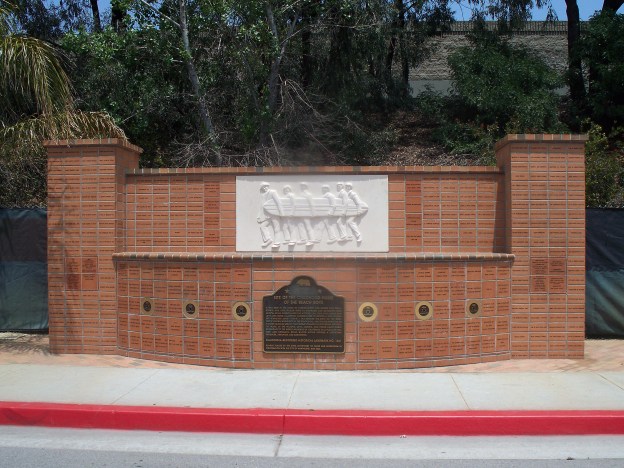
Feature image: The site of the Wilson family home in Hawthorne, California, at 3701 W. 119th Street where Brian Wilson composed Don’t Worry Baby with lyrics by Roger Christian (a DJ at KFWB in L.A.) over the course of a couple days in late 1963 or early 1964. With parents Murry and Audree Wilson, moved into the modest, single-story tract home in the 1940s where Brian, along with his brothers Carl and Dennis, lived throughout their entire childhood and teenage years. . In the mid-1980s, the property was demolished for the construction of the Century Freeway (I-105). The entire block was cleared, and the original address along with an important piece of music history, vanished overnight. PHOTO: “Beach Boys Landmark – Plano general I” by tkksummers is licensed under CC BY-SA 2.0.
“Don’t Worry Baby” was more than a hot-rod song or a B-side. It was Brian Wilson’s first fully realized emotional masterpiece, capturing vulnerability, romance, and sophisticated pop craftsmanship at the precise moment the Beatles and the British Invasion were transforming popular music.
Beach Boys in 1963. Brian Wilson, Carl Wilson, Dennis Wilson, David Marks, Mike Love. Since spring of 1963 they had 3 top-5 hits (and two more top-10 hits). “Surfin’ U.S.A.” peaked at no. 3 in May 1963 and became Billboard’s no.1 song for the year. “Little Saint Nick” released in December 1963 peaked at no. 3 on the Billboard Christmas Singles chart. It was in this time period that Brian Wilson with Roger Christian wrote “Don’t Worry Baby,” one of the Beach Boys’ finest songs pre-British Invasion about a guy who agrees to drag race but regrets it and, confiding his situation to his girlfriend, is tenderly consoled by her with the song’s title phrase. Public Domain.*
The Hawthorne House: Where the Beach Boys Began
The Wilson family home in Hawthorne was where Brian, Dennis, and Carl Wilson honed their musical skills and formed the Beach Boys in 1961 with cousin Mike Love and friend Al Jardine. It was within these walls that they created the group and famously recorded their first breakthrough single, Surfin’, in the living room over Labor Day weekend in 1961.
Brian Wilson lived at the family home into his early adulthood. By the time the Beach Boys became one of America’s most successful pop groups, the band’s success enabled family members to move on from the modest Hawthorne neighborhood where it had all started. Yet the house remained central to the Beach Boys story. It was there that Brian developed as a songwriter and, just a few years later, composed one of the group’s most enduring songs, Don’t Worry Baby.
Though the Beach Boys scored the No. 1 song of 1963 with Surfin’ U.S.A., the direction of popular music changed almost overnight following the Beatles’ first appearance on The Ed Sullivan Show on February 9, 1964. Seen by an estimated 73 million viewers, the broadcast launched the British Invasion and transformed rock and roll, challenging American artists such as the Beach Boys to evolve or risk being left behind.
Cars, California Youth, and Brian Wilson’s Imagination
Brian Wilson’s first car was a light burgundy Mercury passed down from his mother. He called it “the Merc.” After failing his first driver’s test, Wilson gained a reputation as an inattentive driver because his mind constantly wandered to other interests, especially music. His father eventually coached him through a second successful attempt.
Wilson later compared driving a car to playing a musical instrument. Both required touch, timing, and control to achieve the desired result. Yet he quickly realized that music offered infinitely more possibilities for creativity and self-expression. After a year behind the wheel of the Mercury, he purchased a used 1957 Ford Fairlane, a car he admired despite envying the more powerful machines driven by other Southern California teenagers.
The Fairlane became part of Beach Boys lore. Wilson later recalled hearing the group’s first single, Surfin’, on the radio while driving the car in 1962. He claimed he raced it enthusiastically, though few believed him. Cars, competition, and youthful bravado would soon become recurring themes in his songwriting.
Brian Wilson wrote “Don’t Worry Baby” as a response to the emotional power of the Ronettes’ “Be My Baby,” blending teenage themes with richer emotional depth.
From Be My Baby to Don’t Worry Baby
By 1963, Wilson had begun linking the imagery of cars and romance in his music while also developing a deeper understanding of how records could convey emotion. A crucial influence was Be My Baby by the Ronettes. Wilson became captivated by the song’s emotional impact, production, and vocal performance. He also admired how singers such as Aretha Franklin and Dionne Warwick could communicate profound feeling through the simplest vocal gestures.
Inspired by Be My Baby, Wilson wrote Don’t Worry Baby with Los Angeles disc jockey and lyricist Roger Christian. Initially intended for the Ronettes, the song was offered to the group but declined. The Beach Boys then recorded it themselves, producing what would become one of the defining tracks of their early career.
Written over several days at the Wilson family home in Hawthorne, Don’t Worry Baby borrowed the emotional spirit of Be My Baby while transforming it into something distinctly Wilson’s own. Ostensibly a story about a drag racer seeking reassurance from his girlfriend, the song elevated familiar hot-rod themes into a moving portrait of vulnerability, trust, and love. Looking back years later, Wilson described it simply: “It was a very simple and beautiful song. It’s a really heart and soul song. I really did feel that in my heart.”
At an August 1961 audition with Hite Morgan, a L.A. music publisher, Dennis Wilson said that Brian was working on a song about surfing. The truth was that no song existed. But the music publisher was intrigued and told the soon-to-be Beach Boys to come back when they had their new surfing song ready. “Surfin'” was recorded in October 1961 with Mike Love doing lead vocals, Brian on percussion/vocals, Carl Wilson on guitar/vocals, Al Jardine on acoustic bass/vocals and Dennis Wilson doing vocals. It was released in November 1961 on the independent label Candix. Though it peaked at no.75 on the Billboard Hot 100, its lyric which included the line”Surfin’ is the only life, the only way for me” capitivated listeners and was unique on the radio in late 1961.
LYRICS Surfin’ is the only life, the only way for me Now surf Surf with me I got up this mornin’, turned on my radio (Ooh, surfin’) I was checkin’ out the surfin’ scene to see if I would go (Ooh, surfin’) And when the DJ tells me that the surfin’ is fine (Ooh, surfin’) That’s when I know my baby and I will have a good time We’re goin’ surfin’, surfin’ Surfin’, surfin’, surfin’ Surfin’, surfin’, surfin’ Surfin’ is the only life, the only way for me Now surf Surf with me From the early mornin’ to the middle of the night (Ooh, surfin’) Any time the surf is up, the time is right (Ooh, surfin’) And when the surf is down to take its place (Ooh, surfin’) We’ll do the Surfer’s Stomp, it’s the latest dance craze We’re goin’ surfin’, surfin’ Surfin’, surfin’, surfin’ Surfin’, surfin’, surfin’ Surfin’ is the only life, the only way for me Now surf Surf with me Now the dawn is breaking and we really gotta go (Ooh, surfin’) But we’ll be back here very soon, that you better know (Ooh, surfin’) Yeah, my surfer knots are rising and my board is losing wax (Ooh, surfin’) But that won’t stop me, baby, ’cause you know I’m comin’ back We’re goin’ surfin’, surfin’ Surfin’, surfin’, surfin’ Surfin’, surfin’, surfin’ Surfin’ is the only life, the only way for me Now come on, pretty baby and surf with me, yeah
“Don’t Worry Baby” transformed a simple drag-racing narrative into a universal story about fear, reassurance, and love.
While the Beach Boys were known for cars, surfing, and California youth culture, Don’t Worry Baby revealed the deeper artistic direction that would soon define Brian Wilson’s greatness.
Feature Image: The Beach Boys in 1964; clockwise from left: Al Jardine, Mike Love, Brian Wilson, Carl Wilson, Dennis Wilson. Trade ad for The Beach Boys’s single “California Girls”/”Let Him Run Wild.” Public Domain.**
Although buried on a hot-rod-themed album and issued as the B-side to “I Get Around,” the song emerged as the album’s enduring masterpiece and a signpost toward Wilson’s later innovations.
The Masterpiece Hidden on Shut Down Volume 2
While the music industry was being transformed by the British Invasion, the Beach Boys were creating one of the defining pop records of the era. Recorded during sessions in early January and mid-February 1964, spanning the very weeks surrounding the Beatles’ landmark appearance on The Ed Sullivan Show, Shut Down Volume 2 introduced “Don’t Worry Baby.”
The track features one of Brian Wilson’s most tender and convincing lead vocal performances, supported by Mike Love’s resonant bass part and the rich harmonies of Al Jardine, Carl Wilson, and Dennis Wilson. Released on March 2, 1964, the Beach Boys’ fifth studio album followed the enormous success of Surfin’ U.S.A., Billboard’s No. 1 song of 1963 and the centerpiece of an album that reached No. 2 nationally. Although the hot-rod-themed Shut Down Volume 2 climbed only to No. 13 on the Billboard 200, “Don’t Worry Baby” quickly distinguished itself as the album’s emotional centerpiece.
A Hit in Its Own Right
Rather than retreating as Beatlemania swept America, Brian Wilson became even more determined to compete at the highest artistic level. Following the Top 5 success of “Fun, Fun, Fun” in March 1964, the Beach Boys released “I Get Around” in May with “Don’t Worry Baby” on the B-side.
The pairing proved remarkably strong. By July 4, 1964, “I Get Around” had become the Beach Boys’ first No. 1 hit on the Billboard Hot 100, while “Don’t Worry Baby” charted independently and reached the Top 30, peaking at No. 24. What began as a B-side had emerged as one of the group’s most beloved recordings.
The Beatles’ arrival forced nearly every American act to reconsider its future, and Brian Wilson was no exception. With the British group setting new standards for songwriting and innovation, Wilson began drawing on older musical influences while experimenting more boldly with arrangements, harmonies, and instrumentation. His goal was not merely to keep pace with the changing musical landscape but to push the Beach Boys into new artistic territory.
Wilson set about reinventing the Beach Boys just as he had succeeded in inventing them. By year’s end, the Beatles occupied the top two positions on Billboard’s year-end singles chart with “I Want to Hold Your Hand” and “She Loves You.” Yet amid the British wave, the Beach Boys remained firmly in the conversation, placing “I Get Around” among the year’s five biggest hits. “Don’t Worry Baby” stands today as an early sign of the creative ambitions that would soon produce some of Brian Wilson’s most celebrated work.
Released during the weeks surrounding the Beatles’ arrival in America, “Don’t Worry Baby” demonstrated that the Beach Boys could compete artistically in a rapidly changing musical landscape.
This Foxes and Fossils rendition of the Beach Boys’ 1964 top‑40 hit “Don’t Worry Baby” is a fine one — faithful yet fresh. The song has been covered countless times, but Brian Wilson would likely appreciate this version: his original was inspired by, and meant for, a girl group. He might also smile because the Beach Boys always loved seeing a new generation discover their music and claim it as their own.
LYRICS Well, its been building up inside of me For, oh, I don’t know how long I don’t know why, but I keep thinking Something’s bound to go wrong But she looks in my eyes And makes me realize And she says (now don’t) (don’t worry, baby) Don’t worry, baby (don’t you worry) (don’t worry, baby) Everything will turn out alright (now don’t) (don’t worry, baby) Don’t worry, baby (don’t you worry) (don’t worry, baby) I guess I should’ve kept my mouth shut When I started to brag about my car But I can’t back down now, because I pushed the other guys too far She makes me come alive And makes me wanna drive When she says (now don’t) (don’t worry, baby) Don’t worry, baby (don’t you worry) (don’t worry, baby) Everything will turn out alright (now don’t) (don’t worry, baby) Don’t worry baby (don’t you worry) (don’t worry, baby) She told me, “Baby, when you race today Just take along my love with you And if you knew how much I loved you Baby, nothing could go wrong with you” Oh, what she does to me When she makes love to me And she says (now don’t) (don’t worry, baby) Don’t worry, baby (don’t you worry) (don’t worry, baby) Everything will turn out alright (now don’t) (don’t worry, baby) Don’t worry, baby (don’t you worry) (don’t worry, baby) Everything will turn out alright (now don’t) (don’t worry, baby) Don’t worry, baby (don’t you worry) (don’t worry, baby)
*This is a publicity still taken and publicly distributed to promote the subject or a work relating to the subject. As stated by film production expert Eve Light Honathaner in The Complete Film Production Handbook (Focal Press, 2001, p. 211.): “Publicity photos (star headshots) have traditionally not been copyrighted. Since they are disseminated to the public, they are generally considered public domain, and therefore clearance by the studio that produced them is not necessary.” Nancy Wolff, in The Professional Photographer’s Legal Handbook (Allworth Communications, 2007, p. 55.), notes: “There is a vast body of photographs, including but not limited to publicity stills, that have no notice as to who may have created them.” Film industry author Gerald Mast, in Film Study and the Copyright Law (1989, p. 87), writes: “According to the old copyright act, such production stills were not automatically copyrighted as part of the film and required separate copyrights as photographic stills. The new copyright act similarly excludes the production still from automatic copyright but gives the film’s copyright owner a five-year period in which to copyright the stills. Most studios have never bothered to copyright these stills because they were happy to see them pass into the public domain, to be used by as many people in as many publications as possible.” Kristin Thompson, committee chairperson of the Society for Cinema and Media Studies writes in the conclusion of a 1993 conference of cinema scholars and editors[1], that: “[The conference] expressed the opinion that it is not necessary for authors to request permission to reproduce frame enlargements… [and] some trade presses that publish educational and scholarly film books also take the position that permission is not necessary for reproducing frame enlargements and publicity photographs.”
**Permission details The ad appeared in the 11 September 1965 issue of Billboard and can be dated from that publication; it is pre-1978. There are no copyright markings as can be seen at the full view link. The ad is not covered by any copyrights for Billboard. US Copyright Office page 3-magazines are collective works (PDF) “A notice for the collective work will not serve as the notice for advertisements inserted on behalf of persons other than the copyright owner of the collective work. These advertisements should each bear a separate notice in the name of the copyright owner of the advertisement.”
SOURCES:
Badman, Keith. The Beach Boys: The Definitive Diary of America’s Greatest Band on Stage and in the Studio. 1st ed. New York: Backbeat Books, 2004, p. 53.
Love, Mike. Good Vibrations: My Life as a Beach Boy. New York: Penguin Publishing Group, 2016, pp. 64-65, 96-97, and 248.
Morgan, Johnny. The Beach Boys: America’s Band. Illustrated ed. New York: Union Square & Co., 2015, p. 67.
Stebbins, Jon. The Beach Boys FAQ: All That’s Left to Know about America’s Band. New York: Backbeat Books, 2011, pp. 8, 25-26, and 49. Wilson, Brian, with Ben Greenman. I Am Brian Wilson: A Memoir. Boston: Da Capo Press, 2016. pp. 115-116.
Feature Image: The Beach Boys in 1964; clockwise from left: Al Jardine, Mike Love, Brian Wilson, Carl Wilson, Dennis Wilson. Trade ad for The Beach Boys’s single “California Girls”/”Let Him Run Wild.” Public Domain.*
1964 was the pivotal year in which the Beach Boys evolved from a surf-and-cars pop phenomenon into a more ambitious and mature artistic force, led by Brian Wilson’s growing musical sophistication and introspective songwriting. The song“When I Grow Up (To Be a Man)” serves as year’s key symbol of that transition.
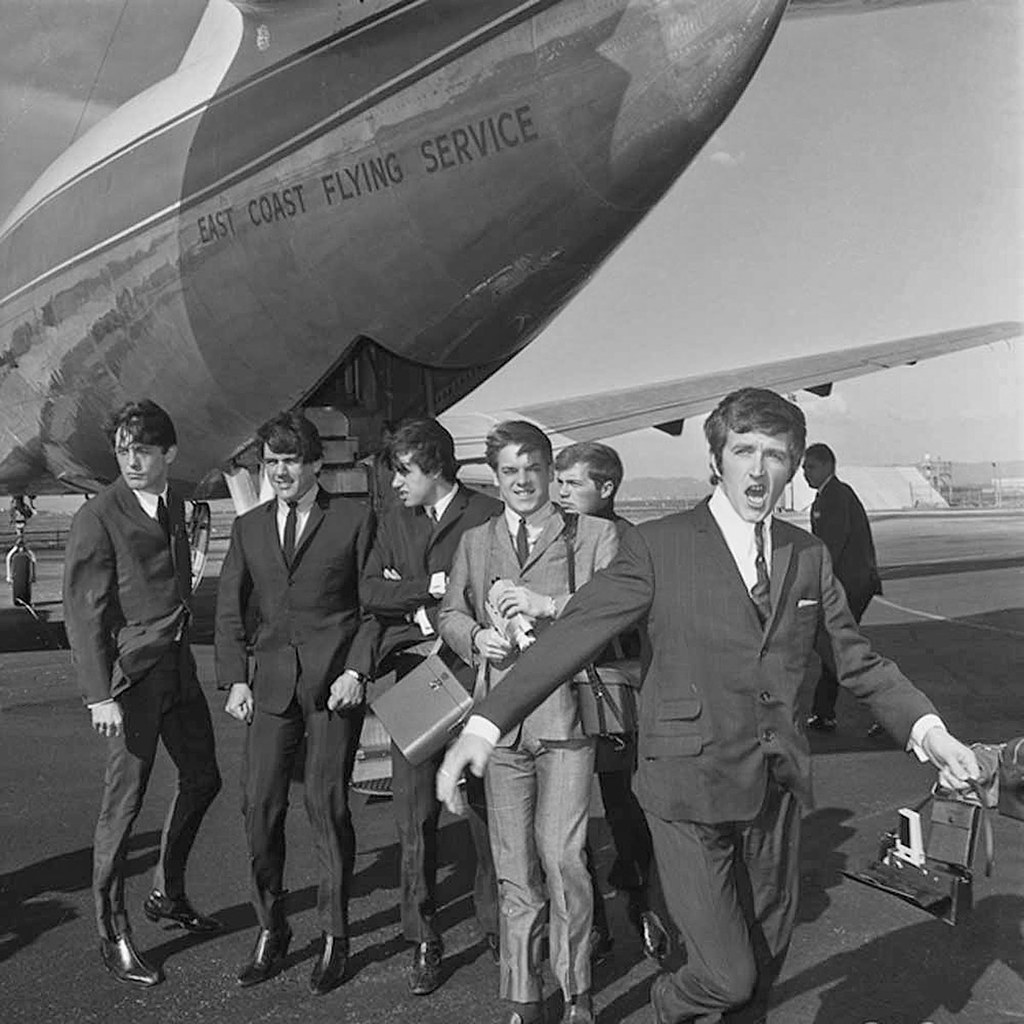
The Beach Boys in Europe in late 1964. The Beach Boys appearing in a Billboard magazine in 1964. Public Domain.
When the Beach Boys Grew Up: The Transformative Year of 1964
The American Invasion of Britain
On November 2, 1964, the Beach Boys landed in London for a television appearance and concert, arriving as one of America’s most successful rock bands. Their visit came just months after the Beatles had launched the British Invasion in the United States, making the Beach Boys’ trip something of a musical counteroffensive. At a London press conference, 22-year-old Brian Wilson spoke confidently about the group’s future and even expressed a desire to record in Europe someday. (Eventually in 1972 they did record in Holland.)
Yet Wilson was equally determined to redefine the band’s image. Frustrated by attempts to pigeonhole the group as a novelty act built on surfing and hot rods, he heatedly argued that the Beach Boys had not originated the genre and had moved beyond those subjects. Their music was just their sound that people liked to listen to. Their music, he insisted, was about the experiences and concerns of young people in the mid1960’s, not simply beaches and automobiles.
Mike Love and Brian Wilson wrote “When I Grow Up (To be a Man)” and most of “The Beach Boys Today!” released in March 1965 on which it appeared. Trade ad for The Beach Boys’s single “California Girls”/”Let Him Run Wild.” Public Domain.*
Beyond Surfboards and Hot Rods
The clearest example of that evolution was “When I Grow Up (To Be a Man),” released in August 1964 and written by Brian Wilson and Mike Love. Unlike the carefree themes that had dominated earlier Beach Boys records, the song confronted uncertainty about adulthood, identity, relationships, and the future. The song’s concerns about adulthood may have reflected Brian Wilson’s own life. During the Beach Boys’ January 1964 tour of Australia and New Zealand, Wilson repeatedly telephoned 16-year-old Marilyn Rovell to ask for her hand in marriage. Back in California, he continued working closely with Marilyn and her group, the Honeys, producing their single “He’s a Doll.” Mike Love later suggested that “When I Grow Up (To Be a Man)” reflected tensions surrounding Brian Wilson’s impending marriage to Marilyn Rovell as well as criticisms from Brian’s father, Murry Wilson, who frequently questioned his son’s maturity and masculinity in the “glitzy” music business. As his December 1964 wedding approached, Brian was navigating the pressures of fame, and questions about maturity, commitment, and the future that were no longer merely lyrical themes but real-life concerns.
Originally performing as the Rovell Sisters, the Los Angeles girl group was rechristened The Honeys in 1962 by Brian Wilson, who served as their primary songwriter and visionary record producer. Intended as a female vocal counterpart to the Beach Boys, the trio became an essential ingredient in crafting the sun-drenched “California Sound.” Their creative alliance quickly turned personal when Wilson married group member Marilyn Rovell in December 1964. Pictured from left are Marilyn Rovell, Diane Rovell, and Ginger Blake.
This 1964 Premier Gas Station marketing photo captures the hot-rod car culture The Beach Boys soundtracked that year. The open hood of the 1964 Chevrolet Impala embodies the automotive freedom of “I Get Around,” where status meant cruising to the hippest local spots; while the carefree youth contrasts some of the anxious vulnerability of “When I Grow Up (To Be a Man),” where Brian Wilson questioned if his idealized teenage dream world as he moved towards adulthood. PHOTO: “New gas station, Fort Worth, Texas 1964” by | El Caganer – Over 8.5 Million views! is licensed under CC BY 2.0.
The Beatles Challenge America
The Beach Boys entered 1964 as one of the hottest acts in music. Since 1963 they had piled up hit records, including “Surfin’ U.S.A.,” which became Billboard’s top song of the year. But everything changed in February 1964 when the Beatles appeared on The Ed Sullivan Show before an audience of 74 million viewers.
Brian Wilson later admitted that the impact of Beatlemania was profound. For a moment he considered giving up, stunned by how quickly the British quartet had captured the public imagination. Instead, he responded creatively. Wilson threw himself into songwriting, arranging, and studio experimentation, determined to push the Beach Boys into new musical territory. The result was not retrenchment but a period of artistic innovation that would soon be matched by profound changes in Wilson’s personal life.
Peaking at No. 3 in May 1963, The Beach Boys’ “Surfin’ U.S.A.” exploded into Billboard’s No. 1 song of the year, transforming a niche California counterculture into a global phenomenon. Capturing a burgeoning youth movement, the track became the definitive anthem for the “California Sound”—soundtracking a sun-drenched lifestyle found in popular feature films and magazines built on surfboards, loud print apparel, and a universal love for the ocean.
“I Get Around” and a New Maturity
That growth was already evident in “I Get Around,” the Beach Boys’ first No. 1 single, released in May 1964. More sophisticated than their early surf hits, the song reflected a band growing restless with fame and searching for new experiences.
Their sixth album, All Summer Long, released in July 1964 with “I Get Around” its first track, became the group’s first truly unified artistic statement. Songs that once celebrated youthful freedom increasingly revealed a deeper awareness of ambition, identity, and change. Critics and historians have often pointed to the album as the moment when the Beach Boys began their transition from wunderkind into serious artists. As Dennis Wilson biographer Jon Stebbins wrote about “I Get Around,” the song “is clearly ahead of its time, and it signals the speed at which Brian had developed. With its edgy guitar/sax bursts doubled with trebly reverbed Fender flicks, electric-organ fills, and an arrangement that stops, goes, accelerates, and then stops and goes a few more times, the song is nearly otherworldly in its inventiveness. Each band member’s voice is showcased, and this helps to make this single as good as any pop record ever made.”
By the time they arrived in Britain in November 1964, they were carrying considerable momentum: a No. 1 single, a string of Top 10 hits, successful albums, and a rapidly expanding international audience.
Released on May 11, 1964, the Brian Wilson-Mike Love composition “I Get Around” paired with the equally brilliant “Don’t Worry Baby” on its B-side. By mid-June, the single was racing up the Billboard Hot 100, reaching No. 1 for the first two weeks of July. Yet success brought little time for celebration. As Mike Love later recalled, every chart-topping hit simply increased the pressure to deliver the next one. In 1964, the Beach Boys were caught in a relentless cycle of writing, recording, and promoting new music, determined to keep their remarkable streak alive.
“Carl’s Big Chance,” the final surfer instrumental on a Beach Boys studio album, was recorded to showcase Carl Wilson’s guitar playing.
The End of One Era
Another sign of the band’s evolution could be found in Shut Down Volume Two, released in March 1964 (no. 13 on the Billboard 200). Although much of the material had been written before Beatlemania exploded, songs such as “The Warmth of the Sun” hinted at a new degree of emotional sophistication. The lead track, Fun, Fun, Fun was recorded in the first week of January 1964 and released as a single on February 3, 1964, less than a week before the Beatles’ first appearance on The Ed Sullivan Show.
Written by Brian Wilson and Mike Love on the night of President Kennedy’s assassination in November 1963, “The Warmth of the Sun” possessed a reflective melancholy rarely heard in early rock and roll. While the Beatles were helping usher in a new era of popular music, the Beach Boys freely admitted to the passing of their car and surfer craze and the carefree California themes that had first made them famous. Whether “The Warmth of the Sun” was written for JFK and Camelot, or not, it marked the era’s ending.
Written on the night of JFK’s assassination, “The Warmth of the Sun” became one of Brian Wilson’s most poignant early compositions. Released just a week before the Beatles’ historic debut on The Ed Sullivan Show, it stood at the crossroads of pop history, closing one chapter as the British Invasion opened another.
A creative rivalry was beginning to emerge as well. As the mid-1960s unfolded, Brian Wilson and Paul McCartney would become two of popular music’s most innovative young composers, each inspiring the other to reach new artistic heights. All Summer Long (I Get Around; Wendy) in July 1964 had anticipated The Beach Boys Today! (When I Grow Up (To Be a Man); Help Me, Rhonda) in March 1965. Both studio LPs (the Beach Boys’ sixth and eighth). grabbed back some of the rock pop critical and popular initiative they had prior to the Beatles.
Broadcast on April 18, 1964, the Beach Boys appeared on American Bandstand. They lip-synched “Don’t Worry Baby” and host Dick Clark interviewed them. The rest of the show was dedicated to the music of the Beatles. In 1964 the Beach Boys decided it was time to move past popular surfer and car songs.
Following the release of Shut Down Volume Two, the Beach Boys appeared on the Steve Allen Show. Allen in his introduction said, “I’m sure you’re familiar with them they’ve had so many big hit records this last year. Let’s welcome the Beach Boys with Fun, Fun, Fun.”
A Rock Song About Adulthood
“When I Grow Up (To Be a Man)” stands today as one of the most groundbreaking songs of 1964. Instead of celebrating cars, surfing, or romance, it explored the anxieties of present a teenager thinking in the first person about serious matters on future adulthood. The narrator wonders whether adulthood will change his tastes, his ambitions, or even his capacity to love. Questions such as “Will I love my wife for the rest of my life?” gave the song a level of personal introspection that was rare in Top 40 music. Number one Iin Canada and number nine in the U.S. it is one of the first to use the idiomatic term “turn on” as in “Will I dig the same things that turned me on as a kid?” It also asks an intelligent question, in Mike Love’s part, of what sort of woman he will pursue in the near future as a man. Because Brian Wilson himself was preparing for marriage, the lyrics carried an authenticity that resonated beyond simple teenage curiosity. The song managed to examine serious issues while maintaining an innocent optimism, making it one of the first genuinely mature statements in mainstream rock.
LYRICS When I grow up to be a man Will I dig the same things that turn me on as a kid? Will I look back and say that I wish I hadn’t done what I did? Will I joke around and still dig those sounds When I grow up to be a man? Will I look for the same things in a woman that I dig in a girl? (Fourteen fifteen) Will I settle down fast or will I first wanna travel the world? (Sixteen seventeen) Now I’m young and free, but how will it be When I grow up to be a man? Ooh ooh ooh Ooh ooh ooh Will my kids be proud or think their old man is really a square? (Eighteen nineteen) When they’re out having fun yeah, will I still wanna have my share? (Twenty twenty-one) Will I love my wife for the rest of my life, rest of my life When I grow up to be a man? What will I be when I grow up to be a man? (Twenty-two twenty-three) Won’t last forever (Twenty-four twenty-five) It’s kind of sad (Twenty-six twenty-seven) Won’t last forever (Twenty-eight twenty-nine) It’s kind of sad (Thirty thirty-one) Won’t last forever (Thirty-two)
The Beach Boys Today! was recorded starting in August 1964 and released in March 1965.It peaked at no. 4 on the Billboard 200 and was certified Gold. “beach boys- today!” by cdrummbks is licensed under CC BY 2.0.
Brian Wilson Takes Control
The year also marked a major turning point in Brian Wilson’s personal life. Before the March 1965 album, The Beach Boys Today!, was completed whose recording started with “When I Grow Up (To Be A Man)” in August 1964, Murry Wilson was fired by Brian and didn’t return. The band’s manager and Brian’s domineering father, Murry increasingly clashed with his son over creative and business matters. The move represented a declaration of independence and cemented Brian’s role as the group’s unquestioned creative leader.
Surrounded by the smell of cannabis that Brian started smoking regularly, new musical insight is heard in When I Grow Up (To Be A Man). It is one of the first Beach Boys’ songs featuring unusual chord changes, sophisticated harmonies, and a harpsichord arrangement that foreshadowed the innovations that would later define records such as Pet Sounds. The young producer also again deployed a harpsichord – it can be heard in I Get Around – which was a creative use of a 16th century Baroque instrument which was unusual for a mid-1960’s pop rock song. The Beach Boys’ example led to its use, and that of other classical music instruments, by other rock bands soon afterwards. The track also features, as Jon Stebbins maintains, “one of Dennis’s best studio drum performances.”
The Cost of Genius
The Beach Boys Today! started recording in August 1964 and was completed in January 1965. It was recorded at three different studios in Hollywood: United Western Recorders, Gold Star Studios, and RCA Studios and deployed over 30 session musicians. It was released on March 8, 1965. Creative breakthroughs came at a personal cost. During the recording of The Beach Boys Today!, Wilson found himself overwhelmed by constant touring, producing, arranging, songwriting, and performing. The relentless schedule eventually led to emotional and physical exhaustion. Even as his music reached new heights, Wilson struggled to balance artistic ambition with the demands of stardom. Said Brian Wlsion later: “I used to be Mr. Everything.” Mike Love attributed some of it to the psychedelic drug culture and Brian’s limited involvement. Murry stayed in Hawthorne at home where Carl Wilson was living and, in his room, listening intently to Introducing… The Beatles and Meet the Beatles!
In April and May 1964, members of the Beach Boys appeared in two films, while Brian Wilson’s songs surfaced in several others. In April, Wilson spent two days on the set of Girls on the Beach (released in 1965), performing “Lonely Sea” from Surfin’ U.S.A. for a group of teenagers. The film centers on a sorority house trying to book the Beatles for a benefit concert, only to settle for the Beach Boys. That era of corny, low-budget beach and surf movies was soon eclipsed when A Hard Day’s Night arrived in August 1964. The Beatles played themselves in a sharp, witty film that showcased both their music and personalities, a world away from the California surfer boys and girls who populated Beach Boys screen vehicles.
Yet the pressure also fueled some of Brian Wilson’s most important work. “When I Grow Up (To Be a Man)” became the first recording session for The Beach Boys Today! and signaled the band’s future direction. Rock critic Richard Meltzer would later write that the song marked the moment when the Beach Boys “abruptly ceased to be boys.”
In June 1964 they recorded The Beach Boys’ Christmas Album (released in November 1964) and since July had been in Hawaii and Arizona to begin their 33-day, 42-concert Surfin’ Safari tour. After Murry was fired the Beach Boys became more involved in their concert date strategy, such as playing nearby secondary and tertiary cities as well as playing in big ones (see Love, p. 98). In early August 1964, “When I Grow Up (To Be A Man)” was the first song recorded for The Beach Boys Today! and released as a single on August 24, 1964. It is a philosophical song whose music is an artistic progression for Brian Wilson and the Beach Boys with its rich and profound instrumental arrangement and 4-part vocal harmonies that are fluid and ethereal. In his 2016 memoir, Love wrote that the song was “probably influenced” by Murry Wilson who constantly challenged Brian’s manhood.
In May 1964, the Beach Boys were still on the rise when they appeared alongside Annette Funicello in the opening credits of Disney’s Monkey’s Uncle, released the following summer. Lip-synching a lively Sherman Brothers tune, the group provided the vocal spark for Funicello’s final Disney film. Looking back, she praised the Beach Boys’ remarkable harmonies and recalled how enjoyable they were to work with, both on the film and during appearances at Disneyland. At the time, they were simply a talented young band on the way up. Only later would it become clear that they were destined to become one of the biggest acts in popular music.
In September 1964 the Beach Boys picked up the Surfin Safari tour that they broke off in August 1964 to return to the studio to record and release When I Grow Up (To Be a Man). After touring up and down the East Coast from Florida to New York, they made an appearance on The Ed Sullivan Show on September 27, 1964. In front of screaming fans they performed “I Get Around,” their no.1 hit that year and what would become a top-5 Billboard song of the year.
Released October 19, 1964, the live album Beach Boys Concert was the first Beach Boys album to be no. 1 on the Billboard 200. The only other album to achieve the top spot is Endless Summer in 1974. Recorded in Sacramento, California, Beach Boys Concert was the first live album to top the pop music record charts (see – Moskowitz, David V., ed. (2015). The 100 Greatest Bands of All Time: A Guide to the Legends Who Rocked the World, p.42). It was on the charts for nearly a year and in the no. 1 spot for 4 consecutive weeks. Because Brian Wilson was not going to perform live with the group in the future, it is a relatively rare recording of the original line-up.
In October of 1964, the Beach Boys, crowd pleasers mostly wherever they went, played four songs at the T.A.M. I. (Teenage Awards Music International show) in Santa Monica, California. The Beach Boys played Surfin’ USA, I Get Around, Surfer Girl, Dance, Dance, Dance. Others in that show included Chuck Berry, James Brown, the Supremes, Smokey Robinson and the Rolling Stones who played right before the Beach Boys. According to Mike Love’s “Good Vibrations,” he met and made friends with Marvin Gaye at that show. “Surfin’ U.S.A.” peaked at no. 3 in May 1963 and became Billboard’s no.1 song for the year. The concert was held at the Santa Monica Civic Auditorium on October 28 and 29, 1964.
November 1964: A Band at the Crossroads
When the Beach Boys touched down in London, they were no longer simply America’s premier surf band. They had become serious competitors in a rapidly changing musical landscape dominated by the Beatles. There was an electricity in the air surrounding the Beach Boys in Europe. Since February they had a top 5 hit (“Fun, Fun, Fun”), no. 1 song (“I Get Around”), a no.1 album (“Beach Boys Concert”), and numerous TV and movie appearances and live concert tours. The band had two follow-up top 10 singles (“When I Grow Up (To Be Man)” and “Dance, Dance, Dance”) – and their leader, Brian Wilson, was getting married in December.
Their European visit capped an extraordinary year. Their arrival into Britain was greeted with screaming fans and lots of media attention. Yet even greater challenges lay ahead.
Brian Wilson married Marilyn Rovell on December 7, 1964, but only weeks later suffered a breakdown brought on by the pressures of maintaining the Beach Boys’ momentum. On December 23, 1964, Brian Wilson was on an airplane from L.A. to Houston, Texas, to start a 25-date concert tour when he announced he was stepping away from touring. Glen Campbell temporarily filled his place on the road. Brian returned to the vacant family homestead in Hawthorne and had a long talk with his mother who “sort of straightened me out,” the Beach Boys’ leader said (quoted in The Beach Boys’ America’s Band, Johnny Morgan, p.81).
The decision marked the end of one chapter and the beginning of another. As 1965 dawned, Brian Wilson would increasingly focus on studio creation, launching the Beach Boys toward their most innovative and influential period.
Five singles. Four albums. No slowdown in sight. While the Beatles ruled the charts, Brian Wilson faced relentless pressure to keep up, delivering hit after hit while transforming the Beach Boys into a world-class band.
In November 1964, after eight days of television and radio appearances in England, the Beach Boys embarked on their first major European tour, traveling through France, Italy, Germany, Denmark, and Sweden. During their first visit to Paris, the band played the role of wide-eyed American tourists, exploring Montmartre with cameras in hand before performing at the Olympia, where they were greeted by thousands of screaming French fans. The trip left a lasting impression on Mike Love, who later said that the experiences of seeing beautiful women across Europe, while also thinking fondly of home, helped inspire the lyrics to “California Girls” the following year.
Legacy
If “Surfin’ U.S.A.” defined who the Beach Boys were, “When I Grow Up (To Be a Man)” revealed who they were becoming. In 1964, Brian Wilson and his bandmates moved beyond carefree images of California youth and began exploring deeper emotional and musical territory. It was the year they stopped being America’s favorite boys and started becoming one of rock music’s most important artistic forces.
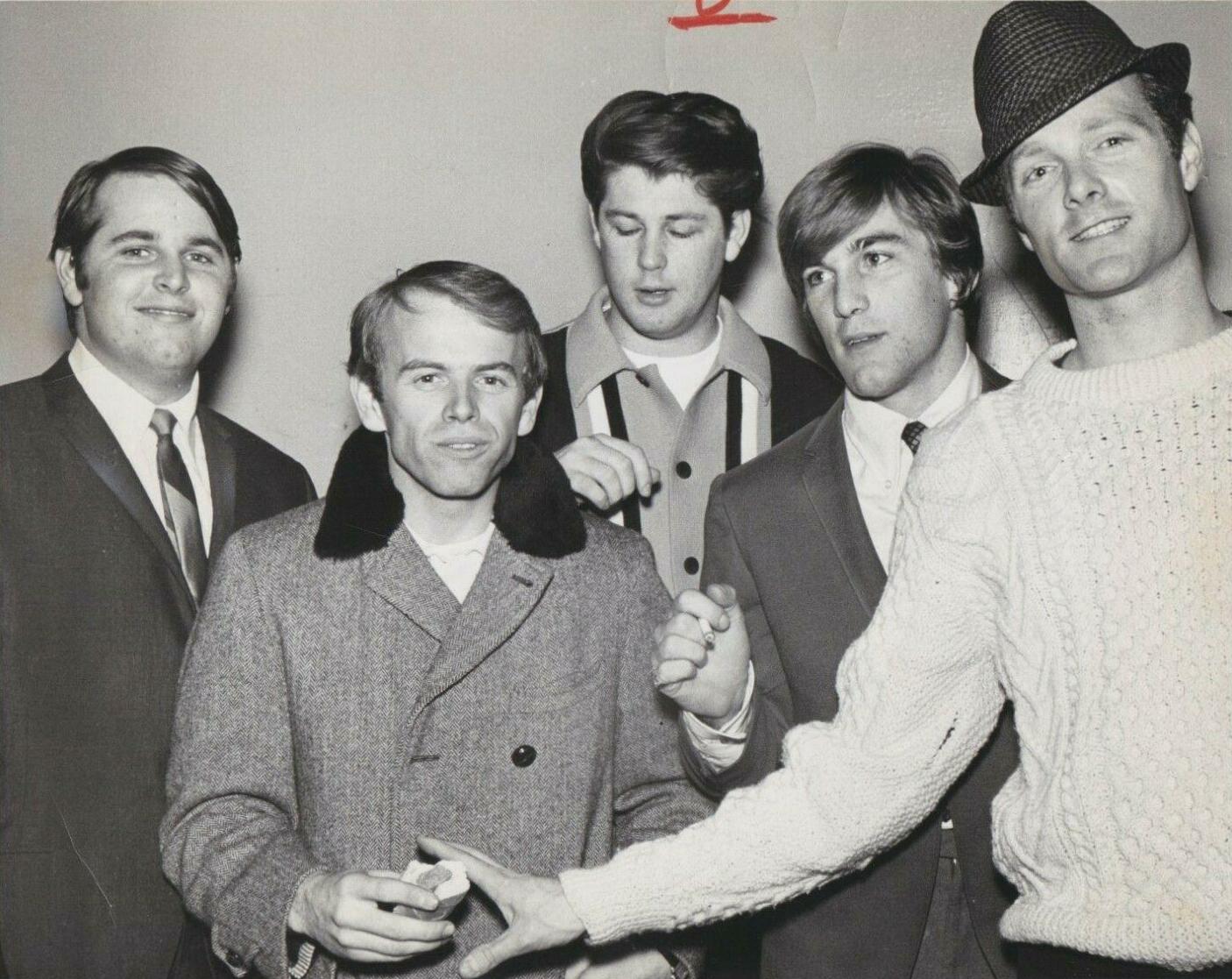
Beach Boys in 1965. Public Domain.
*Permission details The ad appeared in the 11 September 1965 issue of Billboard and can be dated from that publication; it is pre-1978. There are no copyright markings as can be seen at the full view link. The ad is not covered by any copyrights for Billboard. US Copyright Office page 3-magazines are collective works (PDF) “A notice for the collective work will not serve as the notice for advertisements inserted on behalf of persons other than the copyright owner of the collective work. These advertisements should each bear a separate notice in the name of the copyright owner of the advertisement.”
SOURCES:
Badman, Keith. The Beach Boys: The Definitive Diary of America’s Greatest Band on Stage and in the Studio. 1st ed. San Francisco: Backbeat Books, 2004.
Funicello, Annette, and Patricia Romanowski. A Dream Is a Wish Your Heart Makes: My Story. New York: Hyperion, 199, p.13.
Love, Mike. Good Vibrations: My Life as a Beach Boy. New York: Penguin Publishing Group, 2016, p. 97; pp. 159-160.
Morgan, Johnny. The Beach Boys: America’s Band. Illustrated ed. New York: Union Square & Co., 2015, pp. 63-81.
O’Regan, Jody. “When I Grow Up: The Development of the Beach Boys’ Sound (1962–1966).” PhD diss., Queensland Conservatorium, 2014.
Santoli, Lorraine. “Annette—As Ears Go By.” Disney News Magazine, Spring 1993.
Released in April 1970, Ride Captain Ride by Blues Image reached no.4 on Billboard charts in the U.S. and Canada. The song was no. 32 on the year-end Billboard chart for 1970. At 3:43 minutes, there was a shorter radio version.
Ride Captain Ride was a no. 4 hit in the U.S. and Canada in the spring and summer of 1970. It was written and performed by the Tampa, Florida-based rock band, Blues Image. The song is a fantasy about a captain and crew who, seeking laughter and freedom, take a trip on a mystery ship into an uncharted world.
Co-written by the band’s lead singer and guitarist Mike Pinera (b. 1948) and keyboardist “Skip” Konte (b. 1947), Ride Captain Ride sold over one million copies and was certified Gold in August 1970. Although best known for this song, Blues Image is much more than a one-hit wonder band.
Miami, Florida’s late 1960’s psych-rock music scene
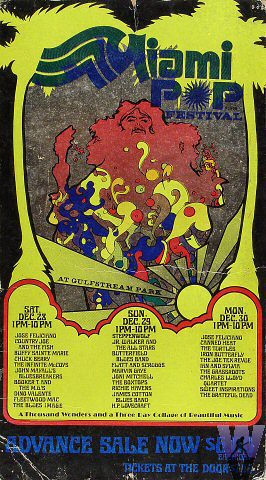
Concert poster for the Miami Pop Festival with the Grateful Dead, Gulfstream Park Race Track, Hallandale, Florida, December 28, 29, 30, 1968. “concert poster: Miami Pop Festival with the Grateful Dead, Gulfstream Park Race Track, Hallandale, Florida, December 28, 29, 30, 1968 [borrowed from http://www.wolfgangsvault.com]” by Zooomabooma is licensed under CC BY-NC-SA 2.0.
Formed in Tampa in 1966, Blues Image relocated to Miami in 1968. They were key in helping promoters establish a popular new music club in Sunny Isles Beach (in a former bowling alley) called “Thee Image.” It became South Florida’s go-to venue for newly emerging psychedelic rock and it drew huge crowds.
The club featured three stages along with a meditation room and a black-light room. It booked local bands as well as name acts such as Blood, Sweat, & Tears, Cream, The Doors, the Grateful Dead, Led Zeppelin, the Lovin’ Spoonful, and Frank Zappa.
The club was brain-child, construction project, and congregant spot for most of the area’s hippies. The hippies brought love, peace, and sister- and brotherhood to beachfront Miami.
Jam sessions and love ins in the nearby public parks included one incident which involved the Grateful Dead, Blues Image, and about 3,000 impromptu fans. Blues Image also became one of the first rock groups to experiment with Latin-infused rock which exploded onto the wider rock music scene in the 1970s.
Ride Captain Ride is the 6th track on Blues Image’s second album, Open, released in April 1970. Written by bandmates Mike Pinera and “Skip” Konte, the song is about joining a cruise into an uncharted world. “Mystery ship” by Guru Sno Studios is licensed under CC BY-ND 2.0.
The beginning of the end for Miami’s late 1960’s psych-rock music scene was The Doors’ concert appearance there in March 1969. Following the August 1968 Republican National Convention in Miami that nominated and elected Richard Nixon as U.S. president, local public opinion soured on the hippie subculture and Thee Image was shuttered.
That same year, in 1969, Blues Image moved to L.A., signed with Atco Records and released their debut album. Other bands relocated out of Miami – some to New York City. The cultural embers of Thee Image were transplanted to L.A. for a short time in another club – but South Florida’s psych-rock scene that featured rock’s greats had clearly ended.
In the summer of 1969, Blues Image drummer Manny Bertematti and Jimi Hendrix were seen jamming together at L.A.’s “Thee Experience,” the music club on the Sunset Strip evocative of Thee Image. In Melody Maker shortly before his death, Jimi Hendrix observed that Blues Image was “one of the best up and coming bands around.”
Then came April 1970 and Ride Captain Ride, Blues Image’s impromptu hit. Released as the 6th track on the band’s second album, Open, the main guitar solo and fills were provided by Kent Henry with the song’s final guitar solo played by Mike Pinera. Ride Captain Ride became the no.32 ranked single on 1970’s year-end Billboard chart. Since that era, the song has been covered many times, notably by Blood, Sweat, & Tears in 1975 and by Phish from 1987 to 2013.
When Pinera left Blues Image, the group quickly broke up in 1971. Skip Konte joined Three Dog Night. Others, including Pinera, played for memorable rock bands such as Iron Butterfly, Steppenwolf, Crosby, Stills, Nash and Young, Manassas, Jackson Browne, Joe Walsh, Alice Cooper and more.
RIDE CAPTAIN RIDE LYRICS: Seventy three men sailed up from the San Francisco Bay Rolled off of their ship, and here’s what they had to say We’re callin’ everyone to ride along to another shore We can laugh our lives away and be free once more
But no one heard them callin’, no one came at all ‘Cause they were too busy watchin’ those old raindrops fall As a storm was blowin’ out on the peaceful sea Seventy-three men sailin’ off to history
Ride Captain Ride upon your mystery ship Be amazed at the friends you have here on your trip Ride Captain Ride upon your mystery ship On your way to a world that others might have missed
Seventy-three men sailed up from the San Francisco Bay Got off the ship, and here’s what they had to say We’re callin’ everyone to ride along to another shore We can laugh our lives away and be free once more
Ride Captain Ride upon your mystery ship Be amazed at the friends you have here on your trip Ride Captain Ride upon your mystery ship On your way to a world that others might have missed
Ride Captain Ride upon your mystery ship Be amazed at the friends you have here on your trip
“Sail on, Sailor” was released in February 1973 as the album Holland’s lead single. It peaked at no. 79 on the Billboard Hot 100. When it was re-released two years later, in 1975, it jumped to no.49.
Following Blues Image’s demise, in the summer of 1972, the Beach Boys—Al Jardine, Dennis Wilson, Brian Wilson, Carl Wilson, and Mike Love—decided to relocate themselves and their families to the Netherlands to record.
Once there, not finding an adequate recording studio for their plans, they imported a studio that was constructed in a converted Dutch barn. Throughout that summer they recorded Holland, their 19th album. Warner Bros. assessed that the album lacked a hit single and started fishing around for one. The producers told the group without a definable hit, Holland, and the band’s latest creative work was not commercially releasable.
Brian Wilson and the brand-new head of Warner Bros.’ music video department, Van Dyke Parks, set out to work on a song. Van Dyke Parks was a collaborator on Good Vibrations and they came up with Sail On, Sailor.
A sailing song with deeper connotations of a searching journey that could be personal or professional, the music was remembered to have been drafted by Wilson in 1970 and, with Van Dyck Parks, to fuller form in 1971. At that point the song was headed to Three Dog Night and with lyrics by Ray Kennedy and Tandyn Almer.
“I sailed an ocean, unsettled ocean Through restful waters and deep commotion Often frightened, unenlightened Sail on, sail on sailor, “ is the opening line. The first-person narrator expounds on the individual and universal nature of the sail: “I wrest the waters, fight Neptune’s waters Sail through the sorrows of life’s marauders Unrepenting, often empty Sail on, sail on sailor.”
The richly harmonic upbeat tune with its unusual sharps and flats and backbeat can make it easy to listen to the words and melody as one aural musical pleasure cruise, but overlook the tangle of the sailor’s story: “Seldom stumble, never crumble Try to tumble, life’s a rumble Feel the stinging I’ve been given Never ending, unrelenting Heartbreak searing, always fearing Never caring, persevering Sail on, sail on, sailor.”
In 1972, Beach Boys’ manager Jack Rieley returned to L.A. and worked on the lyrics more. He was particularly proud of the line: ”lost like a sewer rat alone but I sail…” Officially, Sail on, Sailor listed Wilson, Almer, and Parks as composers and Rieley and Kennedy as lyricists. South African singer Blondie Chaplin, who had been working with the Beach Boys since 1971, was its lead vocal.
Composer Brian Wilson of the Beach Boys at the piano. At one point in the recording process, Wilson was barred from the studio for tinkering too much with “Sail On, Sailor,” the group’s intended hit song, “Rock Dreams: Brian Wilson” by Jim the Chin is licensed under CC BY-NC-SA 2.0.
By the end of 1972 – November 28, 1972 to be exact – Brian Wilson was banned from Village Recorders in L.A.. for tinkering endlessly with Sail On, Sailor and Carl Wilson was put in charge. Sail On, Sailor was released as a single in February 1973 and climbed to no.79 on the Billboard Hot 100. Holland released the month before (January 8, 1973) was a critical success reaching no.36 on the Billboard 200 and in the top 20 in the U.K. When Sail On, Sailor was re-released as a single in 1975, it rose to no. 49.
During the hit song’s extended and close collaboration, a strong dose of these artists’ struggles is readily displayed in its words: “Always needing, even bleeding Never feeding all my feelings Damn the thunder, must I blunder There’s no wonder all I’m under Stop the crying and the lying And the sighing and my dying.”
Without an apparent hit single on the new album “Holland,” Warner Bros. wasn’t going to release it. Already in a draft form by Wilson, “Sail on, Sailor” was finished to replace another song and released in February 1973 as the album’s first single. “beach boys- holland” by cdrummbks is licensed under CC BY 2.0.
Sail On, Sailor has been covered many times, including recently by Los Lobos on their 2022 Grammy-Award winning Native Sons album.
SAIL ON, SAILOR LYRICS: I sailed an ocean, unsettled ocean Through restful waters and deep commotion Often frightened, unenlightened Sail on, sail on sailor
I wrest the waters, fight Neptune’s waters Sail through the sorrows of life’s marauders Unrepenting, often empty Sail on, sail on sailor
Caught like a sewer rat alone but I sail Bought like a crust of bread, but oh do I wail
Seldom stumble, never crumble Try to tumble, life’s a rumble Feel the stinging I’ve been given Never ending, unrelenting Heartbreak searing, always fearing Never caring, persevering Sail on, sail on, sailor
I work the seaways, the gale-swept seaways Past shipwrecked daughters of wicked waters Uninspired, drenched and tired Wail on, wail on, sailor
Always needing, even bleeding Never feeding all my feelings Damn the thunder, must I blunder There’s no wonder all I’m under Stop the crying and the lying And the sighing and my dying
Sail on, sail on sailor Sail on, sail on sailor Sail on, sail on sailor Sail on, sail on sailor Sail on, sail on sailor Sail on, sail on sailor Sail on, sail on sailor
Rock ‘n roll has long shared a tuneful affinity with the seagoing life. Top rock artists followed Blues Image and the Beach Boys in their songs exploring sailing, sailors, and ships and, by turn, venturing into fantastic or rough waters.
There’s the Grateful Dead’s Lost Sailor (1980), Rod Stewart’s and Christopher Cross’s like-titled Sailing (1975 and 1980, respectively), and Crosby Stills & Nash’s Southern Cross (1981). In 1970 Van Morrison put out Into the Mystic and before that there’s Sloop John B, another Beach Boys’ performance from 1966.
Brian Wilson had adapted an actual Bahamian sea chanty for their rock version. Lyrics include “hoist[ing] up the [main] sail” and setting it. In the 21st century these classic songs still resonate on the lists of the “greatest songs of all time.”
Of the 25 or so notable covers since 1973 of the Beach Boys’ song, “Sail On, Sailor,” Jimmy Buffet’s came into port in 2003 on his compilation album, “Meet Me in Margaritaville: The Ultimate Collection.” The self-produced double album of 38 songs on MCA/Mailboat/UTV Records is, by one count, Buffet’s 37th of 50 albums in a music recording career that started in 1970. The 2003 album, certified 2x Platinum, included two brand new recordings of covers, “Sail on, Sailor,” being one of them (Harry Nilsson’s “Everybody’s Talkin'” being the other) and which Jimmy Buffet afterwards frequently performed as an encore on his live concert tours.
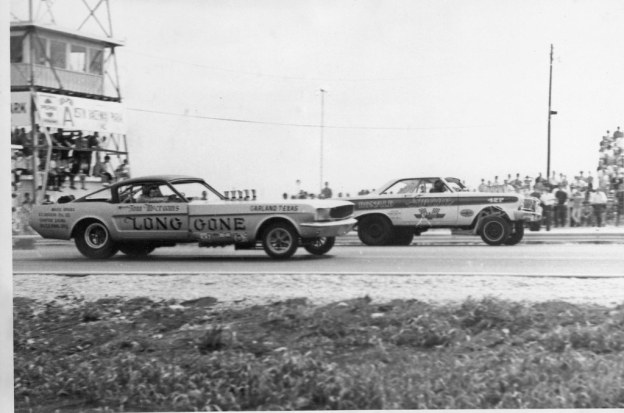
Shut Down is a song by Brian Wilson and Roger Christian that appeared on a pair of 1963 Beach Boys’ albums: Surfin’ U.S.A. in March 1963 and Little Deuce Coupe in October 1963. The song was first released in March 1963 on side B of the Surfin’ U.S.A. single that climbed to no.3 on the Billboard Hot 100 chart. Six months later, Shut Down was released as its own single and peaked at no.23.
The lyrics of Shut Down describe the dangerous activity of drag racing that is also illegal. Drag races were once popularly held on the public streets of southern California using muscle cars. As these races attracted many enthusiastic supporters, streets were sometimes closed off for the race cars and even had the cooperation of local police though unofficially.
The Beach Boys’ lyrics are filled with technical and slang terms for drag racing.
IT HAPPENED ON THE STRIP WHERE THE ROAD IS WIDE (Oooo rev it up now) TWO COOL SHORTS STANDING SIDE BY SIDE (Oooo rev it up now) YEAH, MY FUEL INJECTED STINGRAY AND A FOUR-THIRTEEN (Oooo rev it up now) REVVING UP OUR ENGINES AND IT SOUNDS REAL MEAN (Oooo rev it up now)
One dragstrip in the early 1960s was Glenoaks Boulevard in southern California between Glendale/Burbank and San Fernando/Sylmar. It is a major thoroughfare which stretches over 20 miles. Since a drag race caused disruption to public traffic’s normal flow as well as likely increased harm to law-abiding bystanders, drag races were usually held at night when traffic volume tapered off and was low.
“Two cool shorts” refer not to some spectators’ bermudas, but the truncated length of the race cars.
In 1963, a “fuel injected Stingray” was very much the latest cool car feature. While computerized fuel injection became standard on passenger cars it was, from 1963 to 1965, a specialized mechanical feature found only on the Stingray. What fuel injection accomplished was to optimize the air-to-fuel mixture that made for powerfully efficient engine performance.
TACH IT UP, TACH IT UP BUDDY GOING TO SHUT YOU DOWN
“Tach it up” refers to the moments before the start of the race when muscle cars revved their engines to achieve high rpms. This idling pedal-to-the-metal stores energy in the car’s flywheel so that when the car accelerates it literally jumps off the start line with extra power. Tach it up too much and the car accelerates and does a wheel stand or “wheelie.” While the car’s front wheels lifting off the ground is cool, it is also quite dangerous as the car could more easily lose control.
BUT THE FOUR-THIRTEEN’S REALLY DIGGING IN… SUPERSTOCK DART IS WINDING OUT IN LOW…
The Dart is the other car in the Beach Boys song’s drag race. The 413 is a super-sized engine in the body of the 1962 Dodge Dart. The 413, also called a “hemmie” for its hemispheric dual combustion chambers, started being made by Chrysler way back in 1951.
BUDDY, GOING TO SHUT YOU DOWN.
“Shut Down” is slang for beating the opponent in the race by any and all means. After a car crosses the finish line it enters the shut-down lane. The first car in and out of the shut down lane is the winner.
Since its release in 1963, Shut Down has generated controversy—that it glorifies drag racing, an illegal activity and using what Cash Box at the time identified as “top rock-a-teen sounds.” But some believe the song’s greater scandal is that it seems to imply that the 327 fuel-injected Stingray beat the 413 Super Stock Dodge.
Dodge fans who really know what’s under the hood understand that that outcome couldn’t possibly be real.