Feature image: Brian Wilson of the Beach Boys in West Los Angeles, 1990. PHOTO: “Brian Wilson of the Beach Boys in West Los Angeles 1990 photographed by Ithaka Darin Pappas” by IthakaDarinPappas is licensed under CC BY-SA 4.0.
Brian Wilson was not simply a successful songwriter or Beach Boys leader, but a transformative musical innovator whose emotional songwriting, sophisticated studio experimentation, and groundbreaking harmonic arrangements expanded the artistic possibilities of pop music in the 1960’s and beyond.
Founding a Family Band
In 1961, Brian Wilson formed the Beach Boys with his brothers Carl and Dennis, their cousin Mike Love, and school friend Al Jardine. Brian, the eldest Wilson brother, quickly emerged as the group’s musical center of gravity. The family story would later carry deep shadows: Dennis drowned in 1983, and Carl died of cancer in 1998. But in the early 1960s, the band’s rise was swift and bright.
Chart Breakthrough and an American Peak
By December 1963, the Beach Boys had reached a national summit with “Surfin’ U.S.A.”, the number‑one song in America. Their sound—sun‑drenched, harmony‑driven, and unmistakably Californian—seemed to define the country’s musical mood. Brian’s melodic instincts and arranging talent were already pushing the group beyond surf‑rock formulas toward something more ambitious.
Wilson’s response to the Beatles and the British Invasion was artistic innovation rather than imitation.
The British Invasion Arrives
Everything changed two months later. On February 9, 1964, the Beatles appeared on The Ed Sullivan Show before an audience of 73 million Americans (see – https://www.edsullivan.com/the-beatles-on-the-ed-sullivan-show-on-february-9-1964/ – retrieved June 11, 2025). Overnight, the British Invasion reshaped the pop landscape. For Brian Wilson, the moment landed like a challenge. The Beach Boys—still riding high—suddenly found themselves in an informal, transatlantic competition with the Fab Four, especially Paul McCartney, for the artistic future of 1960s pop.
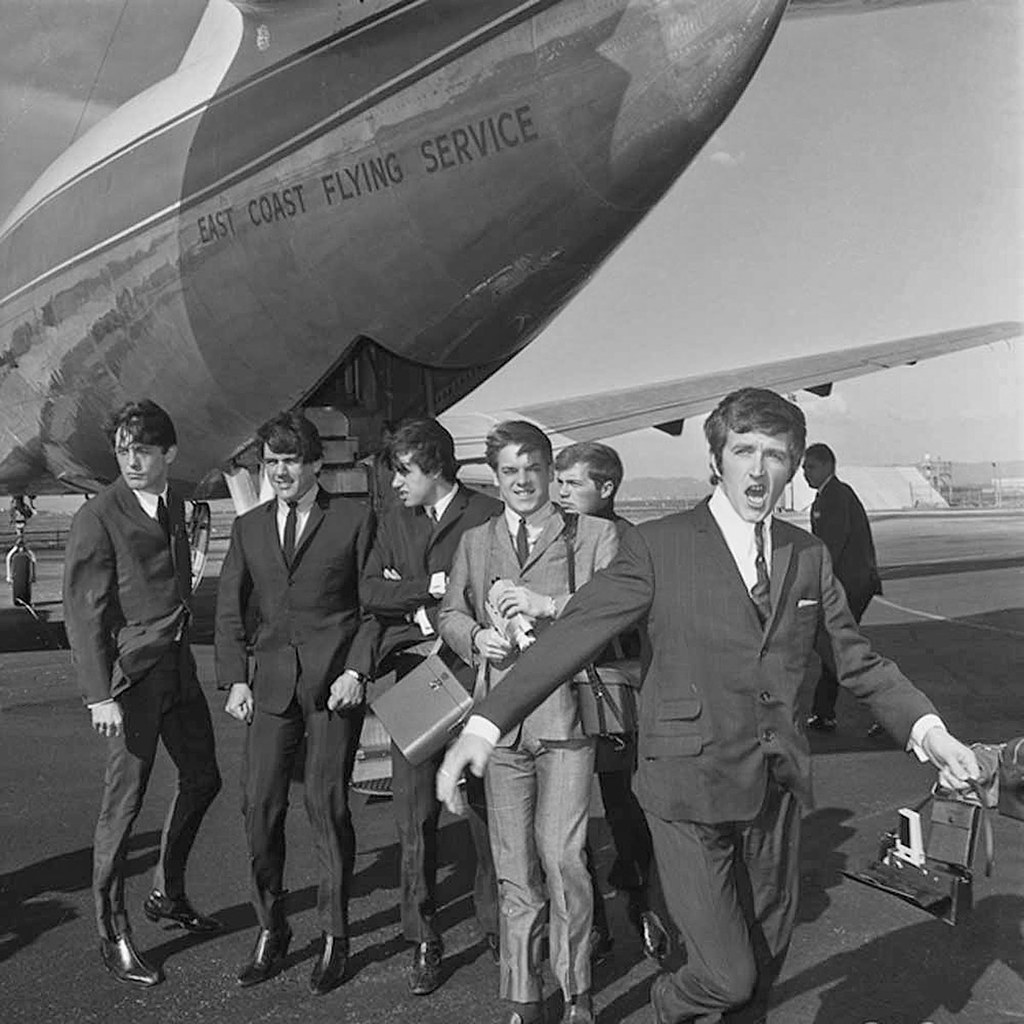
English rock band The Dave Clark Five disembarking a private charter aircraft operated by the East Coast Flying Service in May 1964. PHOTO: “1964 – ‘British invasion hits frigid weather’” by x-ray delta one is licensed under CC BY-NC-SA 2.0.
Brian Wilson’s Creative Response
Rather than retreat, Brian accelerated. He began writing more original material, experimenting with new arrangements, unusual instrumentation, and increasingly sophisticated harmonic structures. His goal was not imitation but innovation—a new sound that could stand beside the Beatles’ evolving artistry and, at times, even inspire it.
A Remarkable Run of Hits
The result was one of the most productive bursts in American pop history. Between “Surfin’ U.S.A.” (1963) and “God Only Knows” (1966), the Beach Boys scored 15 top‑20 hits, including two number‑ones that held the top spot for multiple weeks. Brian’s studio experiments—lush textures, emotional directness, and fluid four‑part harmonies—reshaped what pop music could be and earned the admiration of McCartney himself.
A New Era of Studio Experimentation
Pet Sounds marked a turning point for rock and pop bands, ushering in an era of studio experimentation. It predated—and directly inspired—the Beatles’ Sgt. Pepper’s Lonely Hearts Club Band in 1967, one of pop’s first concept albums and a catalyst for the psychedelic imagery that shaped mainstream culture into the mid‑1970s.
God Only Knows exemplified Wilson’s blend of vulnerability, spirituality, orchestral ambition, and emotional depth. Wilson’s true significance lies in his artistic innovation and enduring influence, not merely his commercial success.
Though not fully recognized at the time, God Only Knows and Pet Sounds are some the clearest evidence of Wilson’s genius and his achievement and has since been acknowledged as trendsetting and profoundly influential.
Crafting the Sound of “God Only Knows”
For God Only Knows, the Beach Boys assembled a 15‑piece orchestra alongside a rock band of top Los Angeles session players to realize Brian Wilson’s “sophisticated soundscape.” The group’s 11th studio album represented a clear break from their earlier catalog—described not as rock and roll but as “futuristic, progressive and experimental.” (Stebbins, The Beach Boys FAQ, p. 74)
Writing a Song of Faith and Vulnerability
According to Brian Wilson, God Only Knows was written in about 45 minutes. For many listeners, it stands as the greatest Beach Boys song—and, for some, the greatest song of its era or perhaps of all time. Its lyrics revolve around faith, emotion, and the fear of losing a deep personal connection. The stakes are high throughout.
Carl Wilson’s Defining Vocal
Brian gave the lead vocal to his brother Carl, believing Carl could deliver the words with clarity and meaning—without the self‑consciousness Brian feared in his own voice. Carl’s performance became one of the defining moments of the Beach Boys’ recorded legacy.
A Private Vision of the Divine and Message of Feeling and Eternity
Wilson’s use of the word “God” was unusual in a pop context. But it was not the public God of church or country. For him, God was a private force who “helps a person control their hopes and doubts.” (I Am Brian Wilson, p. 180). Brian Wilson remained most proud of God Only Knows because he believed it carried a genuine message—one rooted in feeling, vulnerability, and a sense of eternity.

“God Only Knows” by andreboeni is licensed under CC BY 2.0. When Pet Sounds was released in May 1966, reviews In America were largely tepid and sales did not match previous albums. The album—featuring Brian Wilson and Tony Asher’s God Only Knows—would not be certified Gold for 30 years. At the time, critics were praising Dylan’s Blonde on Blonde, the Rolling Stones’ Aftermath, and the Beatles’ Revolver, artists whose roles as rock’s new masters were already clear. Brian Wilson, still reinventing himself, was instead seen as a poignant and possibly troubled pop figure. Later reevaluations of Pet Sounds, including God Only Knows, now regard the album as the trendsetting work of a genius.
Carl Wilson’s Voice and the Song’s Reception
Mike Love agreed that God Only Knows “became one of the album’s most celebrated numbers,” noting that Carl Wilson’s “dulcet voice” actually heightened the song’s “spiritual dimensions.” Love also believed it marked a moment when Carl—four and a half years younger than Brian—emerged as a talented leader within the Beach Boys. (Love, Good Vibrations, pp. 130–131)
Brian Wilson’s Studio Authority
During the Pet Sounds sessions, Brian acted as a virtual dictator in the studio, prompting Love to nickname him “General Patton,” a reference to the four‑star American general of World War II. Other nicknames were less patriotic. Love also confirmed Brian’s reluctance to use the word “God” in the song and, by inference, the courage and honesty required to include it.

Brian Wilson (June 20, 1942 – June 11, 2025). PHOTO: “Tonight I got to watch Brian Wilson sing ‘God Only Knows’ in a tiny room. #swoons #dies” by LibraryatNight is licensed under CC BY-NC 2.0.
A Narrative of Devotion
With Carl Wilson on lead vocals, the lyrics of God Only Knows speak from the perspective of someone who believes that life without his lover can only be fathomed by God. Brian Wilson was married to Marilyn Rovell at the time, though in a 1976 radio interview he said the song was not written for anyone in particular, even if he had written other songs with specific girls in mind. Wilson and Rovell divorced amicably in 1979.
Brian Wilson on Love and Meaning
In 2016, Brian Wilson reflected on the emotional core that shaped so much of his writing: “I wasn’t in love often. I thought about girls, but if they didn’t think about me, how was that love? …When friends would tell me that they were seeing a new girl, I would ask them if they were really in love. That was important to me. It seemed like a real thing. Were they in love? Did something happen inside them that made them feel closer to that other person and closer to themselves? It’s why I wrote so many love songs, because it’s the real thing.” (I Am Brian Wilson, p. 124)
The initial commercial and critical underappreciation for Pet Sounds stands in stark contrast to its later recognition as a timeless masterpiece. At the heart of this legacy is “God Only Knows,” a track that perfectly captured Brian Wilson’s unique blend of vulnerability, spirituality, and orchestral ambition. This emotional depth was not lost on live audiences at the time, who famously fell into a hushed, captivated silence to listen closely whenever the song was performed.
Release and Chart Performance
God Only Knows was issued in the United States in July 1966 as the B‑side to “Wouldn’t It Be Nice,” peaking at no. 39 on the Billboard Hot 100. Abroad, the song fared far better, reaching no. 2 in the United Kingdom and entering the top ten in Canada and across Europe.
Bruce Johnston remembered squeezing into the tiny studio one Wednesday night as Brian Wilson recorded “God Only Knows.” A full ensemble jammed shoulder‑to‑shoulder — violinists perched on French horn players, Carl playing his guitar from a booth, and the room overflowing with bodies and sounds. It was, he said, “incredible.”
A Shared Session and a Distinctive Sound
Both God Only Knows and “Wouldn’t It Be Nice” were recorded during the same session on April 11, 1966. Brian Wilson worked on an 8‑track recorder at Columbia, and Terry Melcher—California producer and singer‑songwriter—was present to provide backup vocals for “God Only Knows.” The session reflected Wilson’s increasingly intricate studio methods during the Pet Sounds period.
A Song Written for Carl
Carl Wilson later said that Brian told him he had written God Only Knows for him to sing as recognition of his “beautiful spirit” (Badman, The Beach Boys: The Definitive Diary, Backbeat Books, 2004, p. 126). Carl’s vocal would become one of the defining performances in the Beach Boys’ catalog, carrying the emotional clarity Brian believed the song required.
A Closing Perspective
Taken together—the modest U.S. chart showing, the strong international reception, the shared April 11 session, Melcher’s presence, and Brian’s intention for Carl’s voice—God Only Knows stands as a carefully crafted work whose meaning was shaped as much by the people in the room as by the song on the page. It remains one of the most personal statements in Brian Wilson’s body of work, anchored in the bond between two brothers and the evolving artistry of the Beach Boys at their creative peak.
God Only Knows LYRICS
I may not always love you
But long as there are stars above you
You never need to doubt it
I’ll make you so sure about it
God only knows what I’d be without you
If you should ever leave me
Though life would still go on, believe me
The world could show nothing to me
So what good would living do me?
God only knows what I’d be without you
God only knows what I’d be without you
If you should ever leave me
Though life would still go on, believe me
The world could show nothing to me
So what good would living do me?
God only knows what I’d be without you
God only knows what I’d be without you
(God only knows what I’d be without you)
God only knows what I’d be without you (ooh-ooh)
(God only knows what I’d be without you) God only knows
God only knows what I’d be without you (ooh-ooh)
(God only knows what I’d be without you) God only knows
God only knows what I’d be without you (ooh-ooh)
(God only knows what I’d be without you) God only knows
God only knows what I’d be without you (ooh-ooh)
(God only knows what I’d be without you) God only knows
God only knows what I’d be without you (ooh-ooh)
(God only knows what I’d be without you) God only knows
SOURCES:
Badman, Keith. The Beach Boys: The Definitive Diary of America’s Greatest Band on Stage and in the Studio. 1st ed. New York: Backbeat Books, 2004, p. 126.
Love, Mike. Good Vibrations: My Life as a Beach Boy. New York: Penguin Publishing Group, 2016, pp. 130-131.
Morgan, Johnny. The Beach Boys: America’s Band. Illustrated ed. New York: Union Square & Co., 2015, pp. 108-109.
Stebbins, Jon. The Beach Boys FAQ: All That’s Left to Know about America’s Band. New York: Backbeat Books, 2011, p. 74.
Wilson, Brian, with Ben Greenman. I Am Brian Wilson: A Memoir. Boston: Da Capo Press, 2016, pp. 124 and 180.