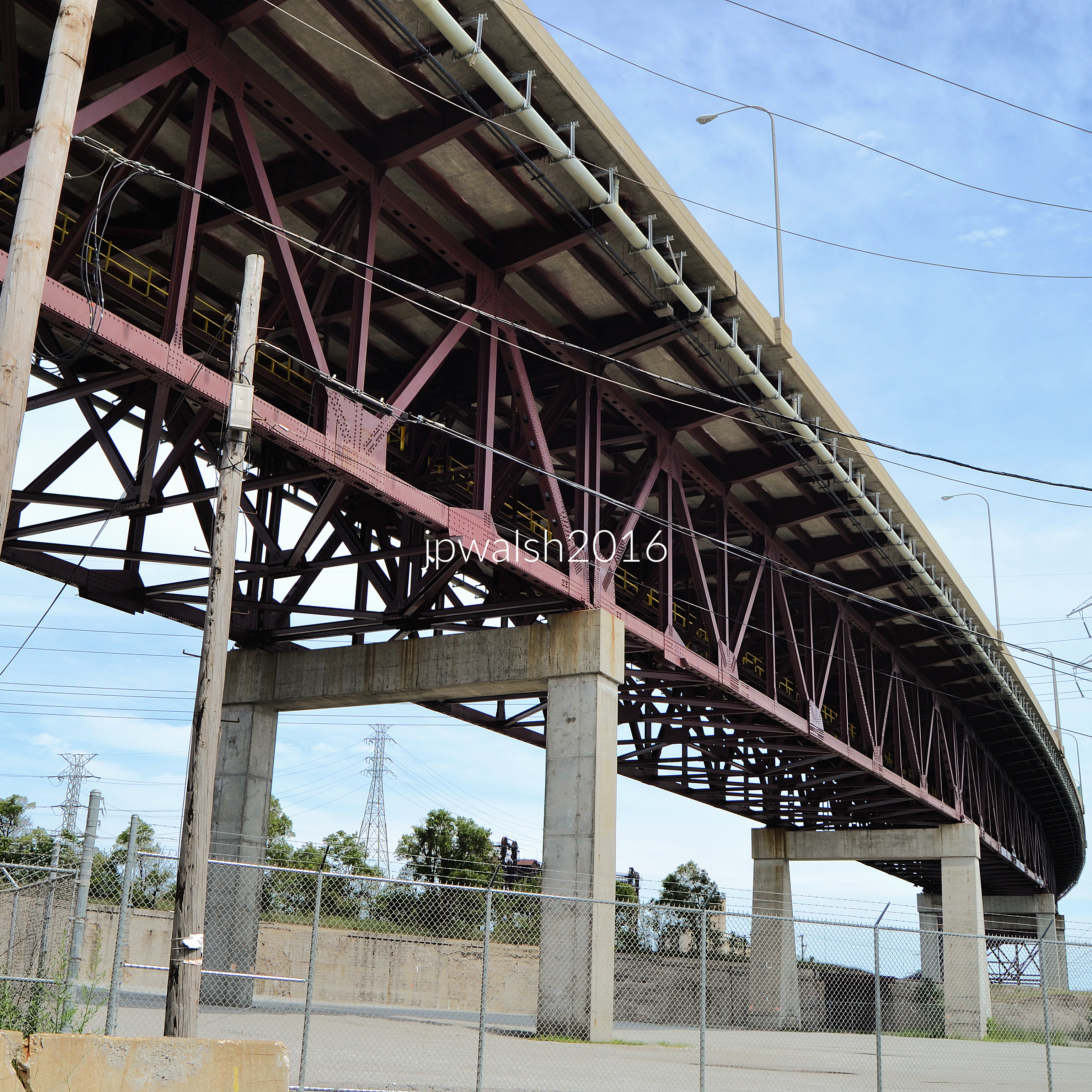
Feature image: Chicago Skyway Toll Bridge, 95th Street & S. Baltimore Avenue, Chicago. July 2016. Author’s photograph. 4.03mb DSC_0774 (1).
The massive steel infrastructure of the Chicago Skyway Toll Bridge (specifically the “High Bridge” at 95th Street and S. Baltimore Avenue) represents a monumental feat of mid-20th-century engineering, combining structural strength, durability, and commercial utility with a striking architectural aesthetic.
This photograph of the Chicago Skyway Toll Bridge (also known as the “Skyway”) is at the exact point where it spans the Calumet River and Calumet Harbor, a major harbor for industrial ships. Built by the City of Chicago in 1958 this massive steel undergirding is part of the 7.8 miles long expressway toll road that connects Chicago’s Dan Ryan freeway on the South Side to the Indiana Toll Road. The main feature of the Skyway is this half-mile long steel truss bridge known as the “High Bridge” whose maximum vertical clearance allowing ships and objects to pass safely underneath is 125 feet or about 10-12 building stories. The Chicago Skyway truss is primarily made of rolled and built-up steel beams for incredible weight-bearing strength, durability and functionality.
Chicago Skyway, 95th Street & Baltimore Avenue, Chicago. July 2016. Author’s photograph. 4.05 mb DSC_0772 (1)
This intersection is located on the city’s Far South Side in the South Chicago neighborhood. The area is heavily industrial, sitting just west of the Calumet River and directly underneath the massive steel framing of the Chicago Skyway High Bridge. The actual boundary of the city limits sits further east and south toward the Illinois-Indiana state line.
The Skyway was operated and maintained by the City of Chicago until January 2005 when Skyway Concession Company, LLC assumed its operations under a 99-year operating lease. The lease agreement between Skyway and the City of Chicago was the first privatization of an existing toll road in the United States. In February 2016, Skyway was purchased by three Canadian Pension Funds (OMERS Infrastructure, CPP Investment Board, and Ontario Teachers’ Pension Plan) and in December 2022 global toll road operator Atlas Arteria Group based in Australia, acquired 66.67% stake in the Skyway with OTPP retaining the rest. see – The Skyway – Chicago Skyway – retrieved December 19, 2025. While exact current figures go up and down, best estimates put daily vehicular traffic on the Chicago Skyway, both cars and trucks, at between 40,000 and 50,000 per day. see – FHWA – Center for Innovative Finance Support – Value Capture – Case Studies: Hays County, Texas Transportation Reinvestment Zones – retrieved December 19, 2025.
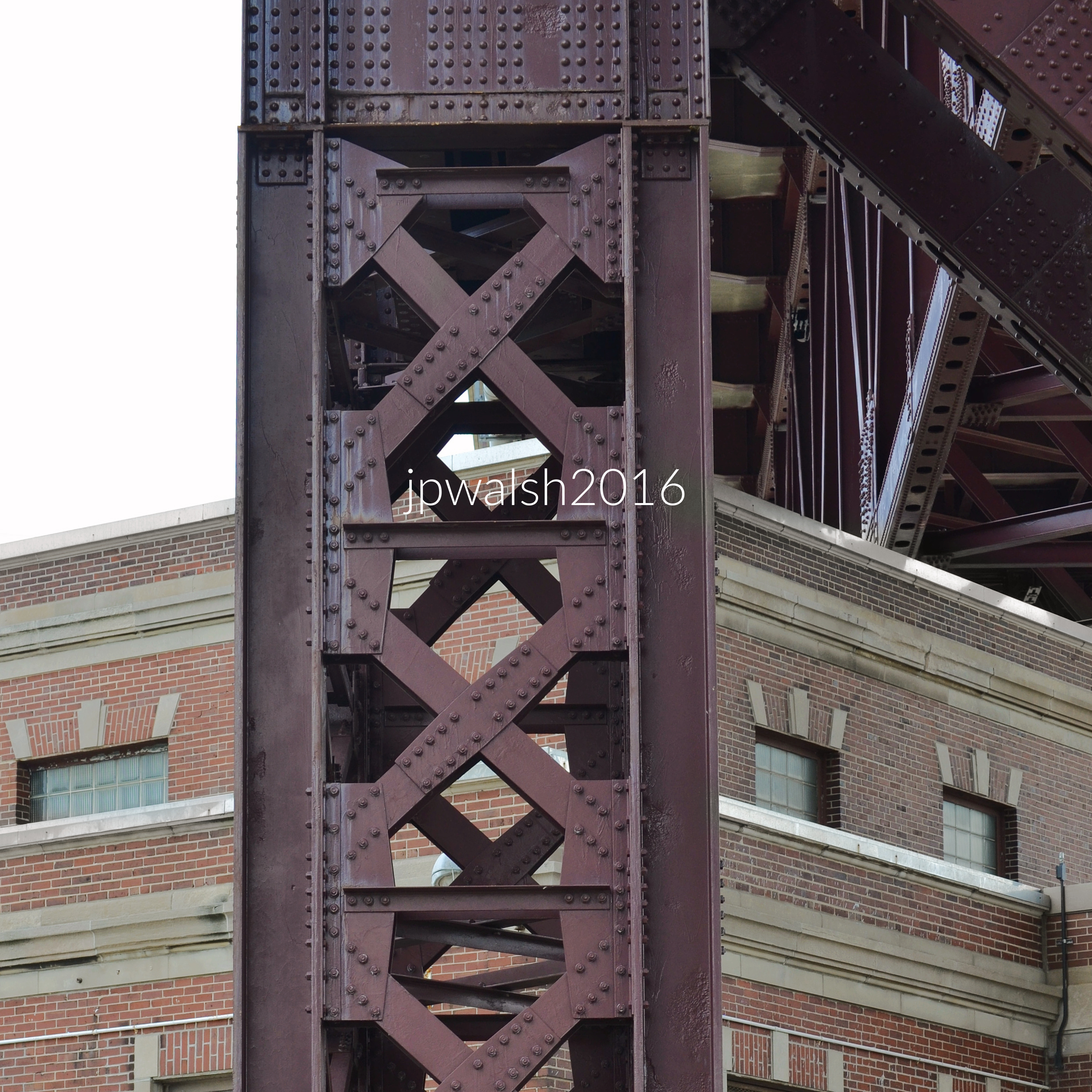
Chicago Skyway. 95th St. & Baltimore Ave. July 2016. Author’s photograph. 4.93mb DSC_0765 (1).
Chicago Skyway. 95th St. & Baltimore Ave. July 2016. Author’s photograph. 2.21mb DSC_0764 (1).
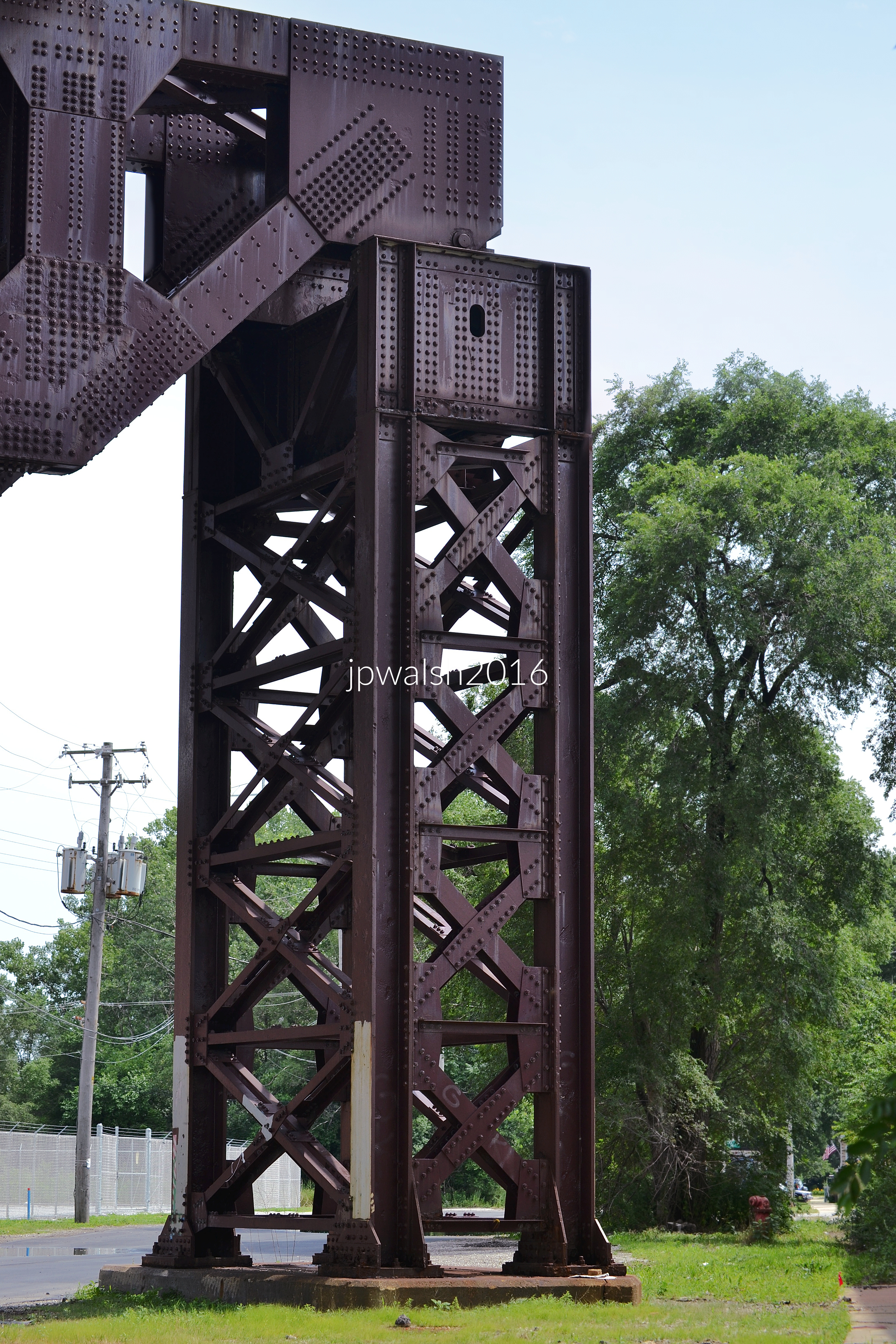
The 1958 steel truss undergirding serves a vital operational purpose—allowing massive industrial shipping to pass underneath into the Calumet River while carrying thousands of daily vehicles above—as it simultaneously serves as a compelling subject for architectural art.
Chicago Skyway. 95th St. & Baltimore Ave. July 2016. Author’s photograph. 5.13mb DSC_0769 (1).
In the 1950’s, American cars were noted for their V-8 engines, chrome, and tailfins of one kind or another. The late 1950’s was also marked by a recession which began in 1957 and continued into 1958 that led to a drop in car production in that period by nearly a third. “What is good for General Motors is good for America” could be true in 1950’s America when it was said, attributable to a 1953 Senate hearing, but its converse was also clearly the situation in the last years of that decade.
“From the Progress of the Past – the Promise of the Future.”
This was the tag line for General Motors that was celebrating its 50th anniversary in 1958. Many cars were painted golden to mark the “Golden Milestone.” It was the same year that the full-size Biscayne model made its first appearance. All Chevrolets in 1958 underwent an all-new “Sculptutamic Styling” that included the “gull wing” style fenders and twin taillights in the back of the Chevy Biscayne. The gull wing back extended along the body side to a “v” dip or gap. Another subtle styling addition was the quarter panel bulge between the rear wheel opening and the rear bumper. The Biscayne series replaced the Chevy 210 where the interior was made more colorful and instrumentation had a horizontal bias that, by 1959, was designed to be within easy sight of the driver. In 1958 Chevy introduced the X- shaped frame chassis and full coil suspension that provided greater stability that included 6-cylindar and V8 models, the 283 CID V8 replacing the 265 CID V8, with an optional 348 CID.
“Dollars never went further or bought longer lasting pride than in Chevrolet’s new Biscayneseries for ’59.”
In 1959 General Motors – emulating a Chrysler corporate revamp in 1957 – redesigned the bodies of its entire fleet line so that many interior parts and some exterior parts were interchangeable on cars. In the process Chevy reshuffled their brands so that the Impala, that was a luxury option on the Bel Air in its first year in 1958, became Chevy’s own top-of-the-line brand in 1959. The Bel Air took the place of the Biscayne and the Biscayne in 1959 replaced the budget-priced Delray that was discontinued. Chevy Biscayne was produced in its second generation over two model years (1959 and 1960) and would be produced in five generations whose last model year was 1975.
The 1959 Chevy: a.k.a. “Batmobile.”
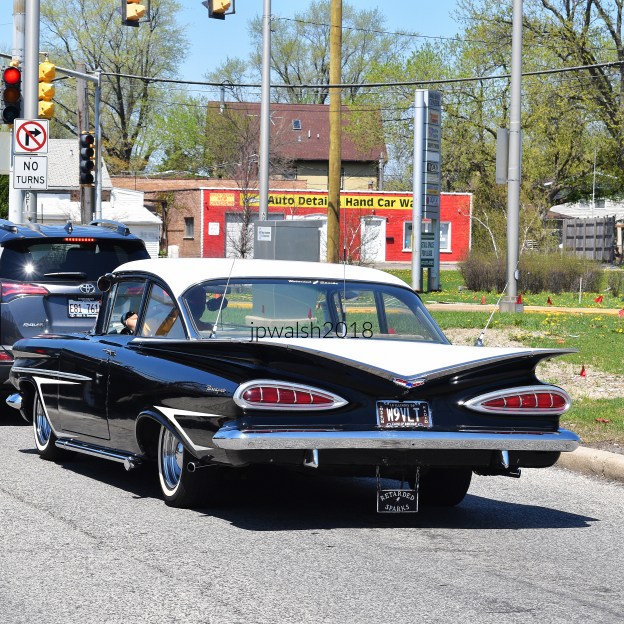
In 1959 the most remarkable design change was an enlarged windshield and rear window on all cars for greater driver visibility of the road and a “flat top roof.” The bodyside was characterized, at the front, by a slight crease at the turn signal which joined a gentle, sloping bodyside curve. The tail fin started at the rear of the front door that carried to the slightly higher back-end splaying in a “v” shape above the “teardrop”-shaped taillights. The design of the 1959 Chevrolet later came to be known as the “Batmobile” for its body design affinities, particularly the wing-shaped tailfins, and that was featured in the Caped Crusaders’ custom built “bat motif” vehicle during the popular ABC “Batman” TV series in 1966 to 1968.
Batmobile, rear view. With its ‘bat motif” wing-shaped tail fins, the 1959 Chevys, including the Biscayne, shared similarities with the Caped Crusaders’ custom built vehicle. PHOTO: “Batmobile, rear view” by KWH703 is licensed under CC BY-NC-SA 2.0.
Drag racing footage of what looks like a 1960 Chevy Biscayne. The Biscayne was introduced as a full-sized Chevrolet model in 1958 in tandem that year with the top-of-the-line luxury Impala. They joined the Bel Air which has been offered since 1950. These cars constituted about 85% of all Chevy sales in 1960. The Biscayne was the slightly lowest price model with a Biscayne 2-door hardtop like this one setting back the American consumer $2230 BASE MSRP (less than $25,000 in 2025) and weighing about 3500 pounds.https://youtube.com/shorts/7oJPm104q0Y?si=ytYL4v1ruWa2jDTx – retrieved November 30, 2025.
The Feature Image 1959 Biscayne represented over a quarter of all Chevy sales that year. Its main competition was the Ford Custom 300, Plymouth Savoy, and Rambler. The Biscayne featured nylon and vinyl upholstery, cloth headliner, dual sun visors, color-keyed floor coverings, two-spoke steering wheel, stainless steel trim on the windshield and rear window, tail fins, small hubcaps, and 7.50 x 14 BSW tires. In 1959 the average price of a Chevy Biscayne was $2, 383 ($26,597.88).
SOURCES:
J. “Kelly” Flory, Jr., American Cars, 1946-1959, McFarland & Company, Inc. pp. 855-857, 866-867, 870-871, 949.
J. “Kelly” Flory, Jr., American Cars, 1960-1965, McFarland & Company, Inc. pp. 23-24, 26.
This explanatory article may be periodically updated.
Chevrolet had a golden year in 1965. Sales had not been that stellar since 1955. What a difference one model year makes. In 1966 Chevrolet took a beating from Ford mainly from Ford’s new sporty Mustang for which Chevy had no direct competition yet. The closest was the Chevy II V-8 with its front engine rear-wheel drive but it wasn’t sporty and became competition for Ford’s Falcon. Further headaches for Chevy included negative publicity from consumer advocate Ralph Nadar’s book “Unsafe at Any Speed,” published in 1965 that criticized the automotive industry for its safety record, focusing on the Corvair, particularly driver handling concerns with the rear-engine economy car. As Nader’s work led to the passage of the National Traffic and Motor Vehicle Safety Act in 1966, which mandated federal safety standards for vehicles, it impacted Chevrolet sales in the short term adversely. In 1966 the Chevrolet Full Size whose model lines included the Bel Air (1950), Biscayne (1958), and Impala (1958) that represented more than 70% of Chevrolet’s sales volume now included the bumped-up Caprice in 1966 as the new top of the line model. The Caprice, which started in 1965 as a luxury option to the Impala 4 Door Hardtop, became popular as its own model and competed with the Plymouth VIP and new Ford Galaxie 500 LTD.
“The New Chevrolet. We Made It Right For the ‘80s.” – Ad tag line in 1980 for Impala and Caprice Classic.
The Chevrolet Caprice is a full-size car produced by Chevrolet in North America for the 1965 through 1996 model years. Full-size Chevys were touted as “The New Chevrolet.”
By 1980 the full-size Caprice Classic received with the Impala (1958-1985) an exterior makeover to be more aerodynamic for fuel economy with all new sheet metal as it retained the same chassis and basic interior and exterior design and appearance. In the pursuit of reducing drag, the front fenders and hood were lowered and the back trunk lid and rear quarter were raised. The roofline was formalized and body sides were smoothed. A new grille insert was “egg crate” style that was 4 rows high and five times as wide. On behalf of better fuel economy, the weight of this streamlined Chevy Caprice was reduced by 100-150 pounds.
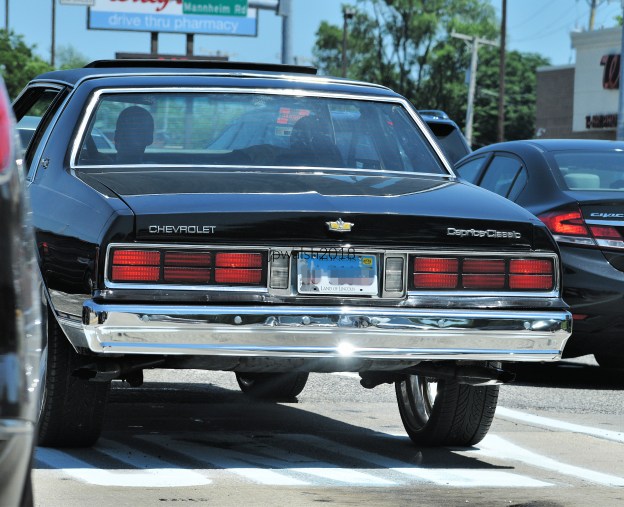
The 1982 model year was part of the Caprice’s Third Generation that went from 1977 to 1990. In 1982 the Caprice Landau Coupe was dropped with only the three-seat Caprice Wagon, Sports Coupe and Four-Door Sedan offered. Both the two-door six -passenger V6 Sports Coupe and Four Door Sedan had an optional V8 engine. The Sports Coupe listed for $8,221– $8,291 (about $27,479.52 today) while the Four Door Sedan listed for $8,367 – $8,437 (about $27,967 today). Fully loaded options inside and out could add over $3000 ($10,000 today). In 1980 the Impala and Caprice Classic amounted to over 25% of Chevy’s sales volume. Caprice featured specific triple unit taillights, bright roof trim moldings, stand up hood ornament, and full wheel covers along with an interior velvet-look knit cloth or all-vinyl front bench seat, fold down center armrest (4-doors only), front door pull straps and lower door panel carpeting, electric clock, and extra acoustical insulation and courtesy lights.
SOURCES:
See – https://www.capriceclassic.com/onamarie.geo/chevy1982.html – retrieved July 17, 2025. J. “Kelly” Flory, Jr., American Cars, 1966 to 1972, McFarland & Company, Inc. pp. 32-33; 38-39. J. “Kelly” Flory, Jr., American Cars, 1973 to 1980, McFarland & Company, Inc. pp. 798-800; 809-810.
This explanatory article may be periodically updated.
Canadian singer-songwriter Gordon Lightfoot began releasing solo albums in 1966. The first six were on United Artists label and sold moderately well (up to 200,000 copies). Switching to Reprise in 1969 his debut album with the label, Sit Down Young Stranger, coincided with his first U.S. hit, If You Could Read My Mind, in 1970 and became Lightfoot’s first Gold album. This was followed by Lightfoot’s second Gold album (Platinum today) and no.1 single both called Sundown in 1974. The Wreck of the Edmund Fitzgerald – a true story of an ore vessel named after a Milwaukee, Wisconsin, civic leader, that sank in a Lake Superior storm in November 1975 – was Lightfoot’s next big hit appearing on Summertime Dream, a 1976 album that has gone Platinum.1
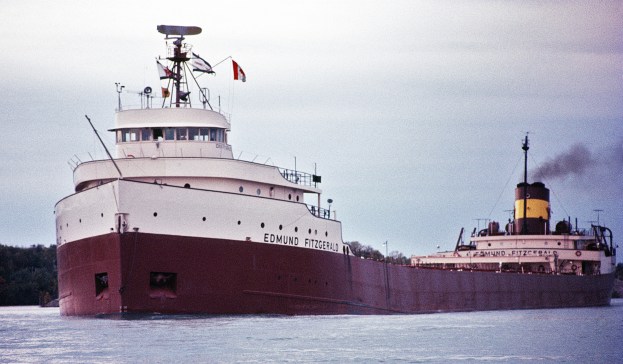
On November 10, 1975, during basically the colliding of two freshwater storms on Lake Superior, the largest of the five Great Lakes, the SS Edmund Fitzgerald, in service since 1958 and, when launched, the largest ship on the Great Lakes at over 700 feet long, went down into deep waters. For a cargo ship that should have normally expected more decades of service, the sinking caused the loss of its entire crew of 29 men. At 7 p.m. on November 10, 1975, the Fitzgerald radioed another cargo ship, the Anderson, telling them that, despite losing their radar, they were “holding their own.” Shortly thereafter the Fitzgerald was lost.
Location of the SS Edmund Fitzgerald wreck in Lake Superior approximately 17 miles (27 kilometers) north-northwest of Whitefish Point, Michigan. The ship now rests beneath about 535 feet (165 meters) of water and is considered a protected gravesite.2
Recovery Efforts involved the U.S. Navy and U.S. Coast Guard.
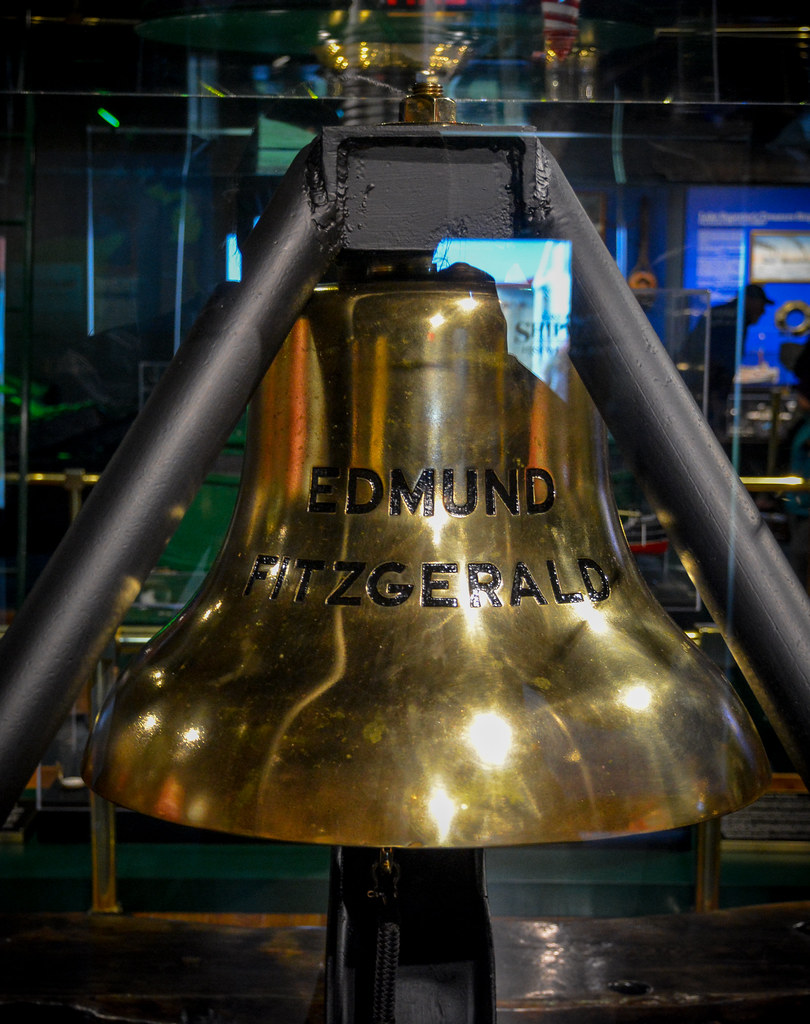
Whitefish Point, located on the southeastern shore of Lake Superior in Michigan, houses the Great Lakes Shipwreck Museum, which holds memorial events for the SS Edmund Fitzgerald each November. The wreck’s location, being 17 miles north-northwest of the point, places it beyond safe navigation lines, illustrating why the ship never reached shelter that fateful night. On a personal note, I have had the opportunity to visit the Great Lakes Shipwreck Museum in Whitefish Point, Michigan that contains the bell from the SS Edmund Fitzgerald recovered in 1995.3
The ultimate cause and circumstances of the wreck of the SS Edmund Fitzgerald in Lake Superior remain a mystery, weather conditions surrounding the sinking are well known – extraordinarily severe storm conditions, including 60 m.p.h. winds, towering waves of 25-30 feet, and heavy thick ice, which impacted possible structural vulnerabilities of the large, nearly 20-year-old cargo ship. The exact sequence of the events leading to the sinking are also unknown, as no distress signal detailing mechanical failure was received, so that the wreck has been attributed to adverse weather and lake conditions that impacted the vessel suddenly.4
The disaster, unlike the other hundreds of shipwrecks that have taken place on the Great Lakes, has entered into American mythology with Gordon Lightfoot’s ballad The Wreck of the Edmund Fitzgerald, written within a couple weeks after the disaster that same November 1975. Though the song by a bestselling recording artist about a recent shipwreck carried some risk where it was too early to know every fact, the verses are meticulously based on news stories of the basics that were known. By Lightfoot’s 7th studio album, Don Quixote, released in 1972, the Canadian singer-songwriter had begun in earnest to explore nautical themes. The Wreck of the Edmund Fitzgerald, released in June 1976 on Lightfoot’s 11th studio album, Summertime Dream, stayed on the same course.
Summertime Dream was released in June 1976 and peaked at no. 12 on the Billboard 200 (no. 1 on Canada Top Albums). The Wreck of the Edmund Fitzgerald was the album’s second track and, in August 1976, became its second single peaking at no. 2 in the U.S. and no. 1 in Canada.
The song was getting local airplay from the album in Minnesota, Wisconsin, and Michigan. Its popularity led to its release as a single in August 1976 and became Lightfoot’s biggest and most unlikely hit record commemorating the sinking of a transport cargo ship with its lives lost from less than a year before. The six-and-one-half minute folk rock song reached no. 1 in Canada and no. 2 in the U.S. where it was kept out of the top spot by Rod Stewart’s Tonight’s the Night. After the song’s release, Lightfoot never lost contact with the surviving family members of that shipwreck. Gordon Lightfoot, who was born in a town on Lake Simcoe in Ontario, Canada, died less than 90 miles away on Lake Ontario in Toronto in May 2023 at 84 years old.
The legend lives on from the Chippewa on down Of the big lake, they called Gitche Gumee The lake, it is said, never gives up her dead When the skies of November turn gloomy With a load of iron ore, twenty-six thousand tons more Than the Edmund Fitzgerald weighed empty That good ship and true was a bone to be chewed When the gales of November came early
The ship was the pride of the American side Coming back from some mill in Wisconsin As the big freighters go, it was bigger than most With a crew and good captain well seasoned Concluding some terms with a couple of steel firms When they left fully loaded for Cleveland And later that night when the ship’s bell rang Could it be the north wind they’d been feeling?
The wind in the wires made a tattle-tale sound And a wave broke over the railing And every man knew, as the captain did too ‘Twas the witch of November come stealing The dawn came late, and the breakfast had to wait When the gales of November came slashin’ When afternoon came, it was freezin’ rain In the face of a hurricane west wind
When suppertime came, the old cook came on deck sayin’ “Fellas, it’s too rough to feed ya” At seven p.m., a main hatchway caved in, he said “Fellas, it’s been good to know ya” The captain wired in he had water comin’ in And the good ship and crew was in peril And later that night when his lights went outta sight Came the wreck of the Edmund Fitzgerald
Does anyone know where the love of God goes When the waves turn the minutes to hours? The searchers all say they’d have made Whitefish Bay If they’d put 15 more miles behind her They might have split up or they might have capsized They may have broke deep and took water And all that remains is the faces and the names Of the wives and the sons and the daughters
Lake Huron rolls, Superior sings In the rooms of her ice-water mansion Old Michigan steams like a young man’s dreams The islands and bays are for sportsmen And farther below Lake Ontario Takes in what Lake Erie can send her And the iron boats go as the mariners all know With the gales of November remembered
In a musty old hall in Detroit, they prayed In the Maritime Sailors’ Cathedral The church bell chimed ’til it rang twenty-nine times For each man on the Edmund Fitzgerald The legend lives on from the Chippewa on down Of the big lake, they call Gitche Gumee Superior, they said, never gives up her dead When the gales of November come early
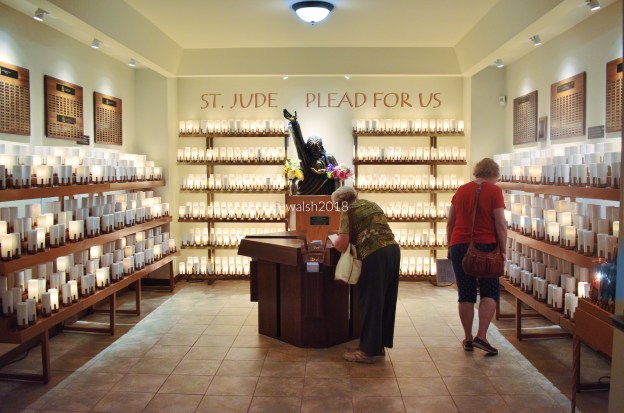
FEATURE Image: The many prayer intentions received at the National Shrine of St. Jude in Chicago are placed at the patron of hopeless cases’ devotional altar in the main sanctuary. These petitions are remembered at the National Shrine’s Masses and devotional prayers throughout the years. June 2018 80% 7.76mb DSC_9191. Author’s photograph.
Chicago’s National Shrine of St. Jude is more than a local religious landmark. It is a place where faith, devotion, and personal transformation intersect, most famously in the life of Danny Thomas, whose prayers to St. Jude here helped inspire a career that ultimately led to the founding of St. Jude Children’s Research Hospital. The shrine stands as a living testament to the powerful role that religious faith and pilgrimage can play in individual lives and broader humanitarian endeavors.
The National Shrine of St. Jude at 3208 E. 91st Street on Chicago’s far southeast side at Our Lady of Guadalupe parish church was canonically established in 1929. Its official decree was promulgated on November 15, 1929, by Chicago Cardinal Archbishop George Mundelein (1872-1939). June 2018 88% 7.72mb DSC_9173. Author’s photograph.
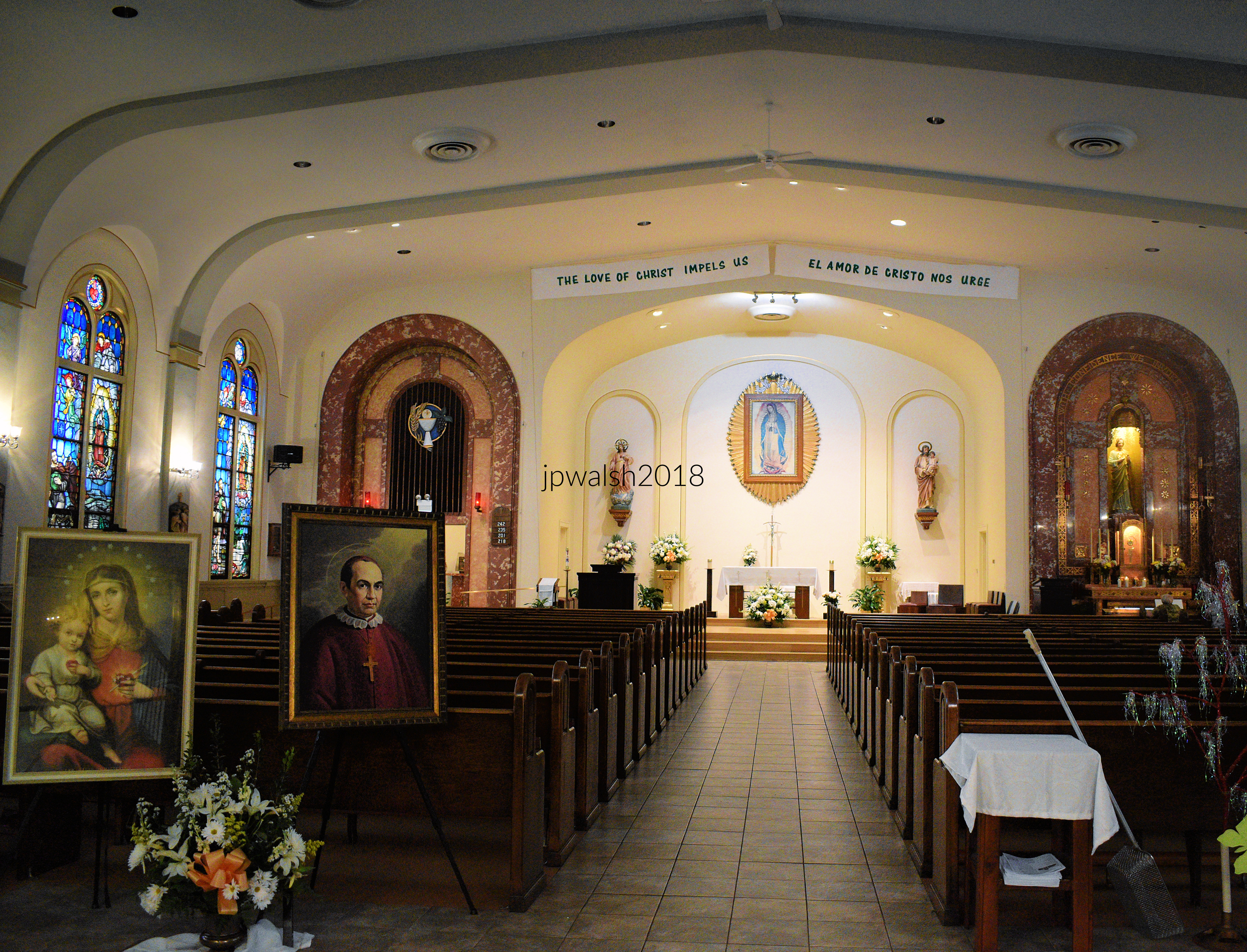
The pastor of the church at the time was Fr. James Tort, a Claretian missionary, who had a deep personal devotion to St. Jude, patron of hopeless cases and those that are almost despaired of. The saint, not to be confused with the traitor, Judas Iscariot, is honored by the church universally as the saint who brings visible and speedy help in most dire circumstances. A portrait of the founder of the Claretians, Spanish priest and bishop, St. Anthony Mary Claret (1807-1870), is one of the artworks that greet visitors into the main sanctuary. The image of Our Lady of Guadalupe is over the main altar. The devotional altar to St. Jude is right of the main altar. The altar to St. Jude contains a major relic of the saint: a piece of his bone. June 2018 84% 7.78 DSC_9177. Author’s photograph.
The shrine contains a major relic of St. Jude and serves as an active center of prayer and pilgrimage.
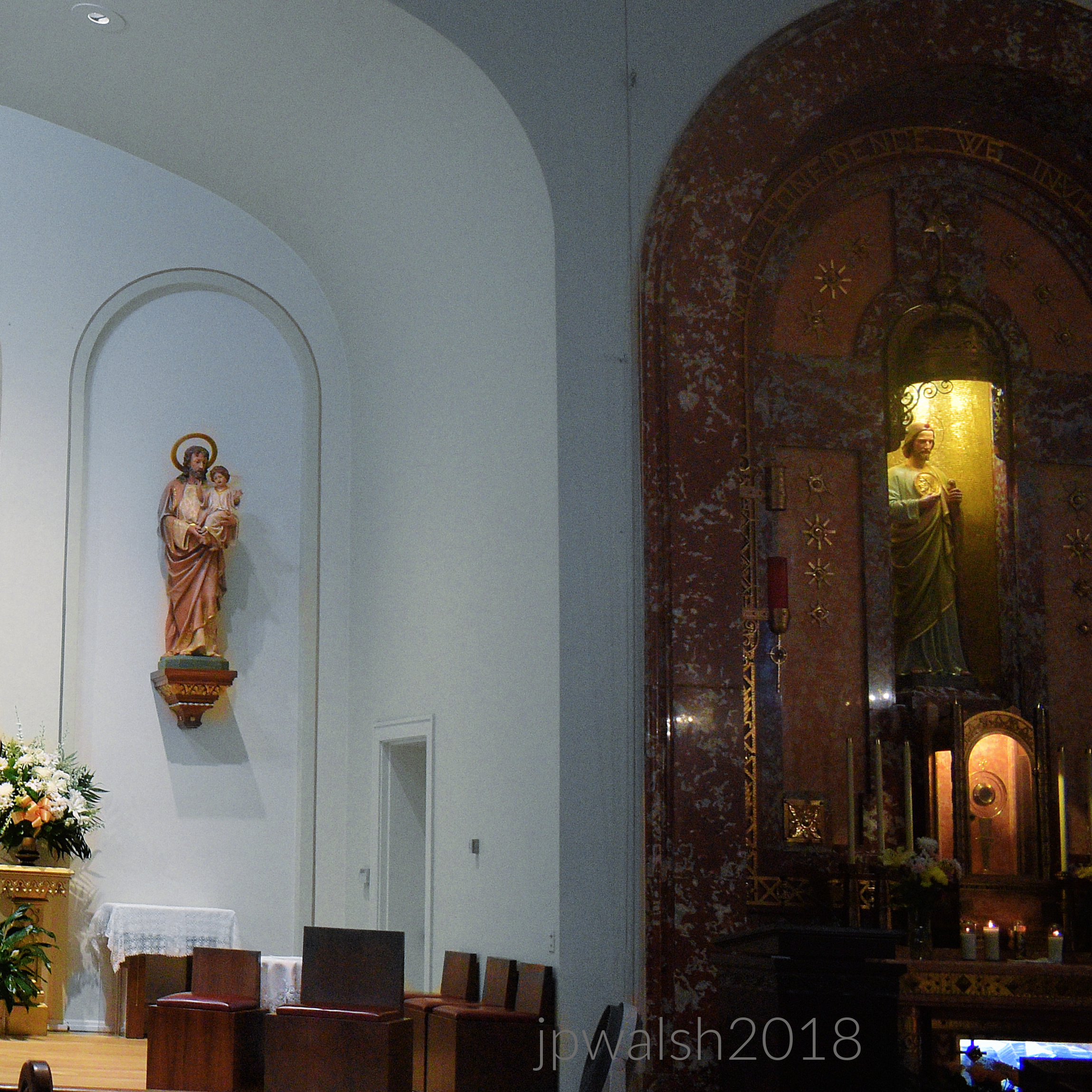
The shrine altar to St. Jude (right). In the darkest days of the Great Depression, Father Tort petitioned St. Jude with a request to help complete the parish church building for the people. In gratitude for the granting of this great favor. Fr. Tort promised to never cease to honor the saint, a true blood relative of Jesus and Mary, by dedicating a shrine altar to him in the church and to do all in his power to spread devotion to him. June 2018 2.29mb DSC_9186 (1). Author’s photograph.
This is one of the stained-glass windows in Chicago’s St. Jude Shrine. It depicts Jude preaching in Persia. Tradition holds that Saint Jude preached the Gospel in Judea, Samaria, Idumaea, Syria, Mesopotamia and Libya. He is also said to have visited Beirut. In addition to being patron of hopeless cases, Jude is patron of vegetarians. That Jude is portrayed holding an image of Jesus Christ has an interesting origin. During Jesus’s public ministry, a king had an incurable condition and was dying in Edessa. He sent a letter asking for Jesus to come. Instead of going himself, Jesus sent Jude. As Jude set out on this journey, Jesus pressed a cloth against His face, and when he gave it back to Jude, it had the Lord’s image on it. When St. Jude then went to the dying king in Edessa, and the king looked at the cloth with Christ’s miraculous impression, he was immediately healed. June 2018 6.47mbDSC_9184 (4). Author’s photograph.
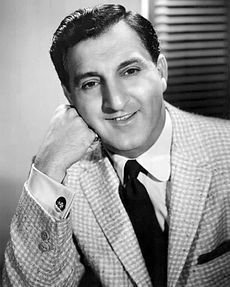
Danny Thomas, struggling to establish himself in show business, learned of the shrine while in Chicago and prayed to St. Jude for assistance. Soon afterward, Thomas received the career opportunity that launched him to national fame as a comedian, television star, and entertainer.
In 1940 when entertainer Danny Thomas (1912-1991) came to Chicago to do radio commercials, he found early success doing stand-up comedy in nightclubs. When work was finished, often around dawn, Thomas went to 6 a.m. Mass at St. Clement Church. There Thomas learned about Chicago’s National Shrine of St. Jude on the far southeast side. A couple of years earlier, Thomas, starting out in show business in Detroit— and with his first child, Marlo Thomas, on the way— had dedicated himself to St. Jude as the patron of hopeless cases. Soon after visiting and praying at the Chicago shrine, Thomas was offered a stand-up comedy job in New York City at La Martinique at 57 West 57th Street. This job launched his entertainment career into the big time. Following World War II, Thomas was performing for $3,750 a week at New York’s Roxy Theater just off Times Square and was performing in nightclubs across the country as well as offered film roles. In 1953 he starred in his own television show, Make Room for Daddy (later, The Danny Thomas Show). The sitcom ran for 11 consecutive seasons and became more popular with each year. By 1957 it was the no.2 show on television and, when the sitcom ended in 1964, it was in the top ten. PHOTO: “Danny thomas kayrouz” by Hany raymond rahme is licensed under CC BY-SA 4.0.
Remembering his promise to give back if he succeeded, Thomas founded St. Jude Children’s Research Hospital in Memphis in 1962, creating one of the world’s most respected pediatric medical institutions.
The National Shrine of St. Jude in Chicago was canonically established in 1929 and became one of the most important centers of devotion to St. Jude in the United States.
Altar of St. Jude, The National Shrine of St. Jude in Chicago. St. Jude Thaddeus was one of Jesus’ 12 apostles and. legend has it, that it was Jude who was the groom at the wedding feast of Cana where Jesus performed his first miracle of turning water into wine (John, chapter 2). Matthew states that Jude was one of the “brothers” of Jesus usually interpreted as a blood cousin. St. Jude, pray for us! June 2018 73% 7.89mb DSC_9182. Author’s photograph.
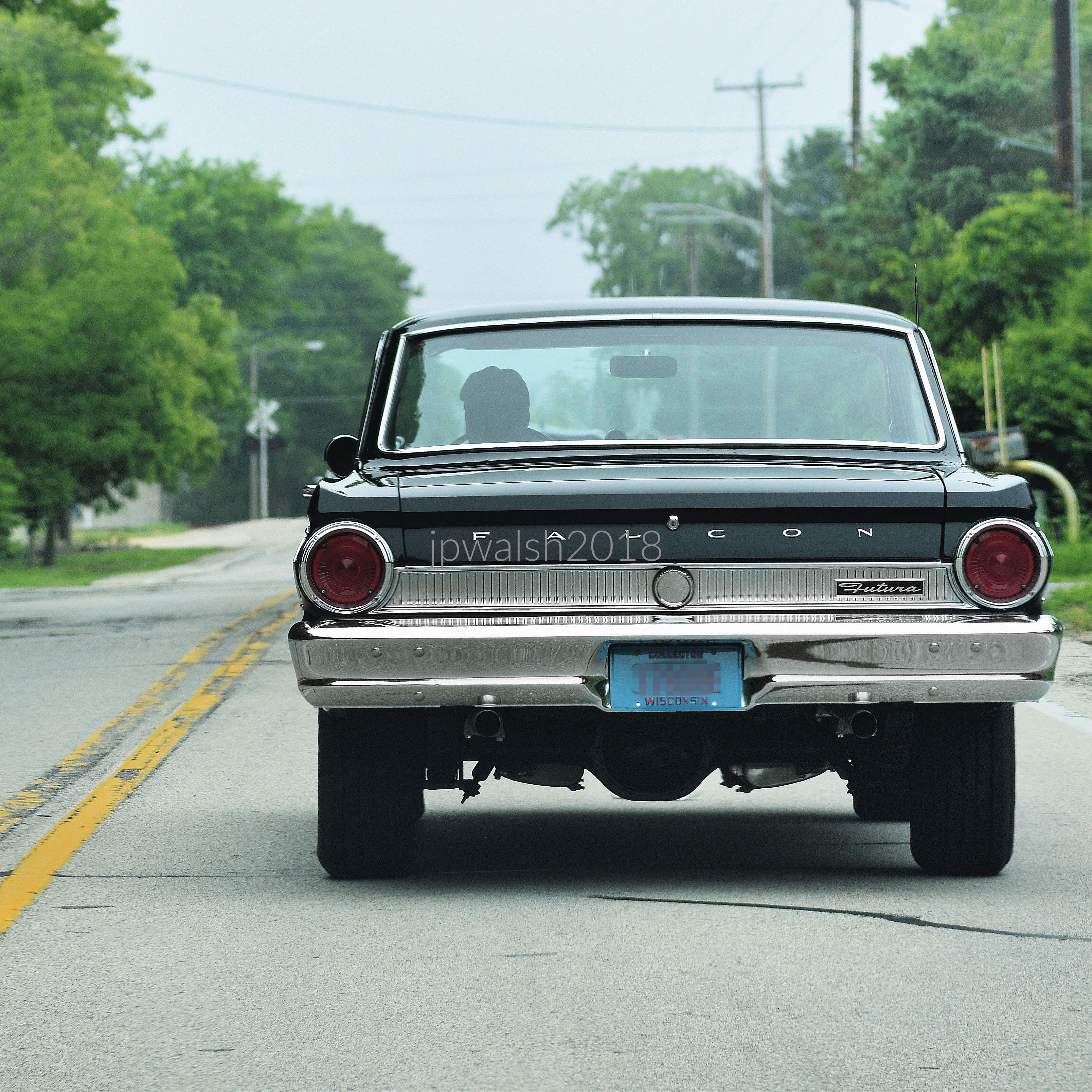
FEATURE image: 1964 Ford Futura Falcon. Author’s photograph. June 2018. 4.54 mb DSC_0136 (1).
In 1964, Falcon was included under Ford’s umbrella tag line of “The Total Performance Cars for 1964.”
In 1964 all of Ford’s models were given upgrades including under the hood, such as the 289 CID V8 engine for the Mustang and mid-sized cars. The renewal that year of all its models was so important that the entire Ford line was named “Car of the Year” by Motor Trend magazine. In 1964 Falcon received a major restyling that included an angular and modern appearance while retaining its original performance components. Falcon, along with the Fairlane, were big sellers comprising together more than a third of all Ford sales. But the biggest news in 1964 was the arrival of Ford’s brand-new pony car at the World’s Fair in New York: the Mustang. The sporty Mustang was an instant hit and had taken some of its enduring design inspiration from the Falcon in terms of its practicality.
In 1960, Ford’s ad tag line for the Falcon was “the easiest car in the world to own.”
The Ford Falcon was the product of Robert McNamara’s hard‑edged managerial style. After serving in the Army Air Forces during World War II, he joined Ford and quickly became one of the “Whiz Kids,” applying strict analytical methods to every corner of the company. By 1960, Ford entered the industry’s high‑stakes profitability contest with a new lineup that included an inexpensive compact aimed at ordinary Americans. Conventional wisdom held that compacts couldn’t make money, but the Falcon proved otherwise, becoming Ford’s best‑selling car of 1960 and the most successful model in the company’s history up to that point. Within a year, all three majors—Ford, Chevrolet, and Plymouth—offered basic compacts, but Ford’s head start, lowest price, and full range of body styles gave it a decisive lead. In the end, the only company positioned to unseat Ford from the top of the compact market was Ford itself.
Ford Futura Falcon. Author’s photograph. June 2018.7.36mb DSC_0122.
When it comes to their cars Americans like tradition and from its powertrain to exterior and interior styling Falcon was all that.
Standard equipment on the 1964 Falcon included cloth and vinyl interior trim, front door arm rests, chrome windshield and chrome rear window moldings, and hub caps. The FUTURA Falcon added features such as deluxe interior trim, side window moldings, hood ornament, full-length side trim molding, and full wheel covers. Further upgrades on Futura included bucket seats. SQUIRE included wood-grain exterior trim, power tailgate window and carpeted floors. SPRINT added bucket seats, a console, sports steering wheel, tachometer and wire wheel covers. The Falcon ranged from the Falcon 2-door sedan with a base MSRP of $1,996 ($20,859.87 in today’s dollars) all the way up to the Falcon Sprint 2-door convertible with a base MSRP of $2,671 ($27,914.19 in today’s dollars). The average price for a new Ford Falcon in 1964 for the American consumer was $2,345 ($24,507.22 in today’s dollars).
SOURCES: J. “Kelly” Flory, Jr., American Cars, 1960 to 1965, McFarland & Company, Inc. pp. 41-43; 269-70; 299-300.
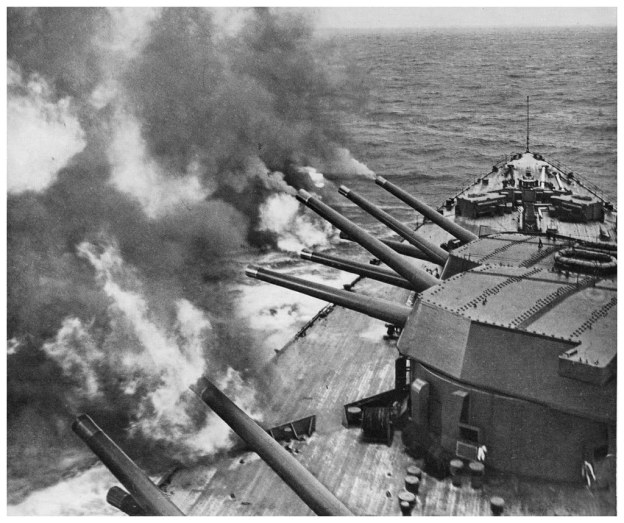
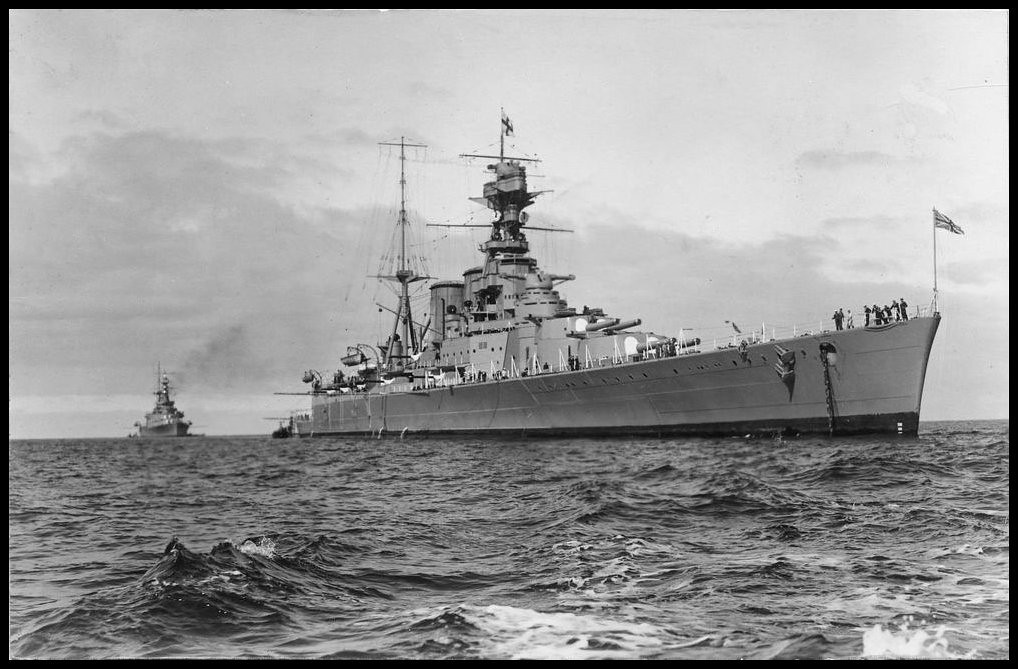
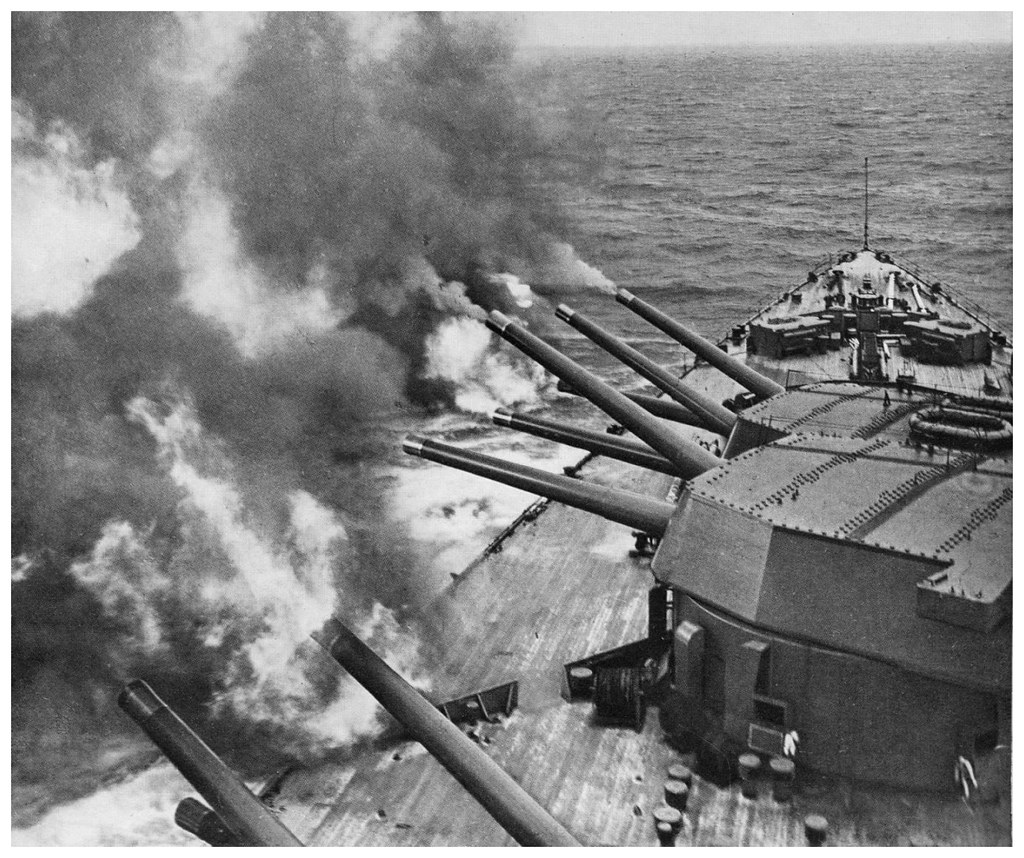
FEATURE image: HMS Rodney unloading her guns. HMS Rodney’s 16-inch guns played a pivotal role at the last battle with the Bismarck in the North Atlantic in May 1941. The British battleship’s powerful broadsides at the Bismarck caused significant structural damage that sunk the German warship. “HMS Rodney lightens her load sometime in the 1930’s.” by WWII in View is marked with Public Domain Mark 1.0.
In 1941 the Allies determined the war would need to be won in the Atlantic.1From 1939 to 1945 the Battle of the Atlantic was the longest continuous military campaign in World War II. It stemmed from the start of the war in Europe with Hitler’s invasion of Poland on September 1, 1939, and the declaration of war by France and Britain on the Third Reich. This was followed by the Battle of Britain and Fall of France in 1940 and the Allies’ declaration of war on Italy on June 10, 1941. The United States, as a non-belligerent and working through its neutrality laws, aided the Allies, namely Britain, through cash and carry and lend-lease purchases of large amounts of American-made armaments as well as providing reconnaissance to the British navy and air force who were in the fight against German U-boats and battleships aggressively attacking and sinking the merchant ships headed for Britain.
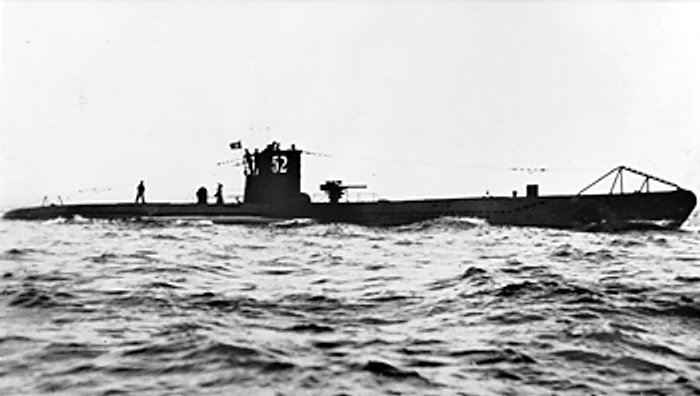
German submarine U-52. Public Domain.
A massive nearly square-shaped zone of conflict surrounded Great Britain and Iceland with its approximate boundaries from the southeast coast of Greenland across the Atlantic to France and north between Britain and Norway and back around Iceland towards Greenland. Since Denmark was occupied by German forces, the United States in April 1941 occupied their abandoned colony of Greenland and designated it as part of the Western hemisphere to categorize American non-belligerent military activity as self-defense. The Americans took the same approach with Iceland sending troops as a forward, if ostensibly defensive, posture.2
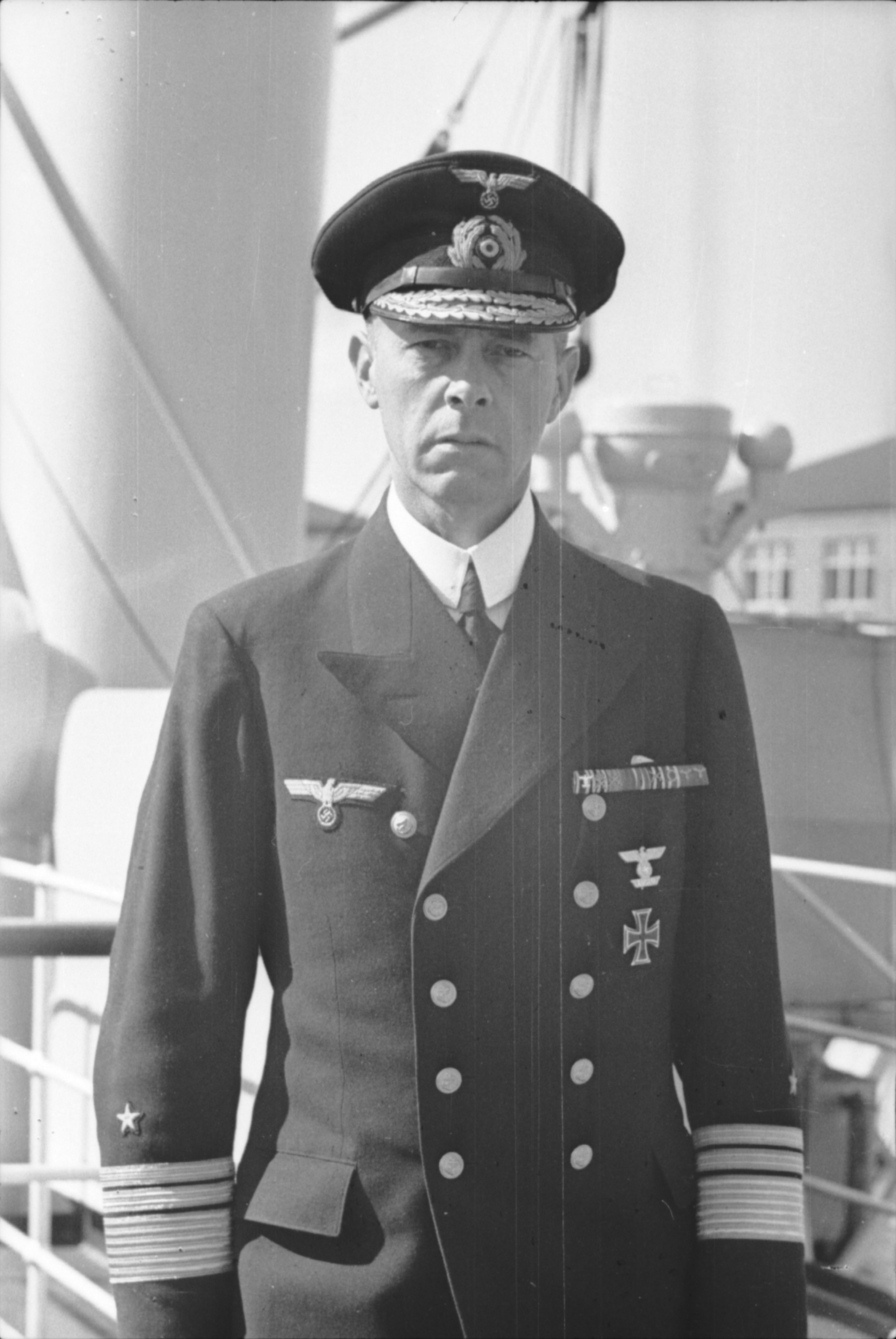
This situation brought the navies of the United States, Canada and Great Britain together as the Allies provided escort to the merchant ships into a combat zone with the German Kriegsmarine (navy), specifically U-boats (submarines) and warships, as well as the Luftwaffe (air force), who were severely disrupting the supply line. The commanders of the opposing forces were both World War I veterans. Vice-Admiral Gilbert O. Stephenson (1878-1972), a pioneer of anti-submarine techniques in the First World War, was training commander of the British escort groups while Admiral Karl Dönitz (1891-1980), whose navy career began before the Great War was the commander of the German U-boat fleet.
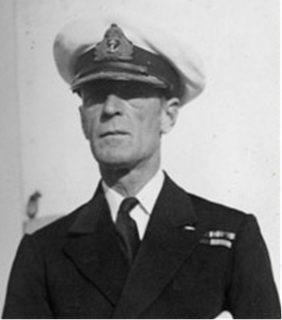
Vice-Admiral Gilbert O. Stephenson, 1929. Stephenson who served in World War I was recalled at the start of World War II and aided in the evacuation of Dunkirk. In 1940 Stephenson was tasked with setting up the training base at Tobermory on the Isle of Mull in the Scottish Inner Hebrides. Stephenson was a noteworthy disciplinarian, and his training vision and methods had an influence within the service after the war ended. The Vice-Admiral believed the most important priorities for trainees were, in order, (1) to instill the will to win; (2) to accept discipline; (3) to execute a highly competent administration; and, (4) to display technical proficiency. Public domain.
German officer Karl Dönitz on the U-39 during World War I. Public domain.
Until the attack on Pearl Harbor by Japan on December 7, 1941 the United States was a non-belligerent and Hitler wanted to keep it that way. Germany was mounting its invasion of Russia called Operation Barbarossa, which, involving almost 4 million troops, was the largest offensive operation in military history. For American internationalists looking for a way into the war in 1941, American neutrality and Lend-Lease laws along with public opinion complicated that desire. American opinion, markedly isolationist through the 1930’s and into the early 1940’s, was, in spring and summer 1941, split on whether the U.S. should escort merchant marine vessels while a large majority was against entering the war. Most Americans polled believed the United States had already been doing too much for Britain.3 In April 1941, after a year of the largest armament production program in U.S. history, President Roosevelt decided for American patrols comprised of ships and airplanes, rather than escorts or convoys, to insure the delivery of needed supplies to Britain and other Allied combatants. The mission, started without diplomatic or public fanfare, gave solely reconnaissance aid to Britain. This role in an expanding territory in the Atlantic was justified by FDR as hemispheric self-defense from the Nazis. This position was reinforced by Roosevelt in a fireside chat with the American people on May 27, 1941. By then the Bismarck was under attack and sunk. FDR’s rationale was based on the premise that the “supreme purpose” of the Axis powers was to achieve world domination by its control of the high seas and the capture of Great Britain was key to that endeavor.4
In 1941, before America’s entry as a belligerent into World War II, President Roosevelt aided the Allies with immense U.S. armament production sent to Britain and American patrols in the North Atlantic to provide intelligence to the British navy to assure their safe delivery to Britain. Further, FDR worked within the parameters of U.S. laws as well as listening to, and helping shape, the American people’s sentiments as to how much to aid Britain short of war.President Roosevelt with Microphones, September 11, 1941 (NARA). “Public Domain: President Roosevelt with Microphones, September 11, 1941 (NARA)” by pingnews.com is marked with Public Domain Mark 1.0.
In the face of these American patrols that FDR spoke of, Hitler was, after the fall of Denmark, Norway, the Low Countries, and France, looking east. The Germans were on the offensive from Yugoslavia to Greece to North Africa. Though the invasion of Britain was off, the Atlantic remained under siege. In April and May 1941 German wolfpacks (coordinated attacks by U-boats on convoys) took a heavy toll on British merchant shipping in the combat zone south of Iceland.5
May 24, 1941.
On May 24, 1941, the German battleship Bismarck, accompanied by the cruiser Prinz Eugen, left Norway for the Atlantic. The British intercepted the German ships in the Denmark Strait between Greenland and Iceland, but the Bismarck fought back and sank the HMS Hood, the biggest battlecruiser in the world at that time, which exploded with the loss of 1,415 of its crew. The sinking of the Hood marked what remains the single greatest loss of life in Royal Navy history.
The battle also damaged the Prince of Wales. The Bismarck,under the command of Günther Lütjens (1887-1941), continued its passage south to the convoy routes but had sustained battle damage to its fuel tanks which led to subsequent flooding. Pursued by the damaged Prince of Wales and cruisers Norfolk and Suffolk, the Bismarck, traveling more slowly and trailing oil, changed course to head to Brest for ship repairs. In short order, the Bismarck turned on the British pursuers to allow the Prinz Eugen to escape into the Atlantic.
British battleship Hood. The biggest battleship in the British navy, the Hood was sunk in the Denmark Strait by the German Bismarck on May 24, 1941, with a staggering British loss of 1,415 crew lives. “H.M.S. Hood 1924” by State Library of South Australia is licensed under CC BY 2.0.
The film is recorded from the Prinz Eugen with Bismarck firing.
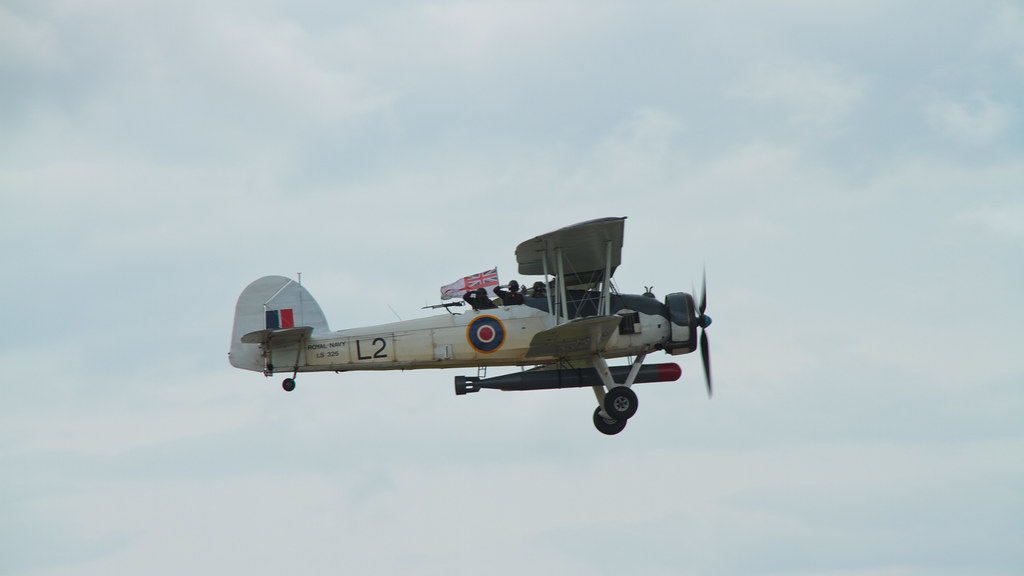
That evening, Fairey Swordfish planes— a resilient British torpedo bomber biplane that originated in the early 1930s —took off from the Home Fleet’s aircraft carrier Victorious for its first attack on the Bismarck. They engaged the warship but without important effect. For the next 31 hours, since the sinking of the Hood, the Bismarck eluded the English fleet which was looking for it further to the west.
Commander Lütjens was not aware that the British had lost him. In the early hours of May 25, 1941, he broke radio silence to send a coded message to Germany. Though its content was indecipherable, the British heard it and observed that the German commander had stopped communicating with Wilhelmhaven in Germany and began talking with Paris. This was a break that allowed the British to figure closely the actual vicinity of the enemy warship and that it was heading to France. British warships in search of the Bismarck were provided the new coordinates and the orders to pursue accordingly. This included King George V and Norfolk to be joined by a flotilla of 5 destroyers under the command of Captain Philip Vian (1894-1968).
British Captain Philip Vian in 1940. Taken before 1957, this work created by the United Kingdom Government is in the Public Domain.
May 26, 1941.
At 10 a.m. the Bismarck was spotted by an American pilot in one of the American-made Catalinas provided by Roosevelt to the British war effort. Flying out of a base in Northern Ireland, the plane was part of a squadron that had been assigned a specific search area for the Bismarck. It was piloted by American Ensign Leonard “Tuck” Smith (1915-2006) whose role was to familiarize RAF Pilot Officer, Dennis Briggs, with the plane’s controls. Though revealed long after the war’s end, Smith was credited with being the first person to spot the Bismarck before the final battle. He was awarded the Navy’s Distinguished Flying Cross for his role in the sinking of the Bismarck. Leaving in the middle of the night on May 26, 1941, the weather was bad with a ceiling of about 100 feet. According to Smith’s report, it took six hours to reach the search area. As soon as they spotted the Bismarck, they came under intense anti-aircraft fire from the warship and Smith had to take violent evasive action to escape getting blown out of the sky. Smith and the crew soon lost contact with the battleship, but their messages as to its precise location had been received. British ships and planes soon converged on an intercept course. Already the aircraft carrier Ark Royal had sent scouting planes and a pair of Swordfish spotted the enemy warship shortly after Smith did. When Smith landed his Catalina back in Northern Ireland at 9: 30 p.m., 18 hours after having taken off, it would be just 12 more hours that the 35,000-ton Bismarck would be at the bottom of the Atlantic Ocean.
After the Bismarck’s location was known, Captain Philip Vian’s flotilla that was to join King George V in the search for Bismarck, changed course and headed directly for the Bismarck. Three days earlier, on May 23, 1941, the British naval formation known as Force H had left Gibraltar for convoy duties that included the aircraft carrier HMS Ark Royal, battlecruiser Renown, and light cruiser Sheffield. On May 26, 1941, Force H set course to intercept the Bismarck.
Starting late on Monday, May 26, 1941, the last battle of the German battleship Bismarck started in the Atlantic Ocean The ship was sunk about 350 miles west of the port city of Brest in France. At 2:50 p.m. on May 26, 1941, fifteen Fairey Swordfish planes took off from the aircraft carrier HMS Ark Royal to attack the Bismarck.
The attack failed and the British cruiser Sheffield fell under friendly fire. The British staked everything on one more attack to stop the Bismarck before it could safely enter into Brest harbor the next day. At 7:10 p.m., a second sortie of 15 Swordfish planes took off from the HMS Ark Royal armed with conventional torpedoes. At 8:47 p.m., these Swordfish began their attack. The Bismarck received a direct hit but it was not mortal. A second torpedo hit the ship’s stern that jammed and disabled the battleship’s rudders crippling it. The King George V and HMS Rodney joined the fray from the northwest about 6.00 p.m. and, at 10:00 p.m., the Sheffield directed Captain Vian’s destroyers towards the target where they harassed an unmaneuverable Bismarck with torpedo attacks through the night.
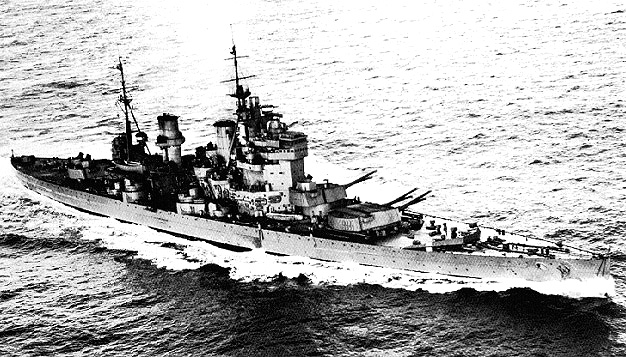
The battleship HMS King George V in 1941. Commanded by Admiral Sir John Tovey, it was one of the ships which sank the Bismarck. Public Domain.
May 27, 1941.
The next day, Tuesday, May 27, 1941, the Bismarck, unable to steer or repair the rudder, expected an attack from the British battleships. At 8:30 a.m., they readied battle stations. At 8:43 a.m. the HMS Rodney and HMS King George V, joined by cruisers and destroyers, including the HMS Norfolk and HMS Dorsetshire, spotted the Bismarck. At 8:47 a.m., from a distance of over 10 miles, the battleship HMS Rodney opened fire commencing the final battle. Though Bismarck returned fire, with its disabled rudder, its gun platforms were unstable due to uncontrollable movements on a rising sea in gale-force winds. At two minutes past 9 a.m. the HMS Rodney unloaded its 16-inch guns and hit the Bismarck’s forward superstructure, severely damaging the bridge, command facilities, fire control, and observation posts, as well as killing most of the warship’s senior officers. Both HMS Rodney and HMS King George V engaged Bismarck in heavy gunfire with increasing precision as British shells dismantled the ship’s command structure and gun turrets making the Bismarck a floating hulk. With Bismarck’s ability to return fire random and infrequent the British warships came into closer range for the German warship’s final neutralization. HMS Norfolk and HMS Dorsetshire joined HMS Rodney to fire on Bismarck with its 8 -inch guns and torpedoes. With its four main gun turrets inoperable, at 9.31 a.m., the Bismarck had lost the capacity to fight back with orders down the chain of German officers to scuttle and abandon the ship.
Nearly 3,000 projectiles were used against the Bismarck to achieve this outcome in the final battle. In the final stages of the battle the British ships surrounded the Bismarck in a crossfire that overpowered the German crew. In addition to significant structural damage, this intense continuous British gunfire set off fires on the Bismarck that caused secondary explosions.
Following the battle with the Bismarck, the HMS Rodney continued its service in World War II. In November 1942, the HMS Rodney provided naval gunfire support in Operation Torch for the Allied landings of North Africa. In 1943 during the Italian Campaign the HMS Rodney provided support for the Allied landing in Sicily (Operation Husky). In 1944, as part of Operation Neptune (the navy component of Operation Overlord), the HMS Rodney provided gunfire support during the D-Day Normandy beach landings. Following the war, in 1948, the HMS Rodney was sold for scrap. “HMS Rodney lightens her load sometime in the 1930’s.” by WWII in View is marked with Public Domain Mark 1.0.
The British kept firing, the HMS Rodney at point-blank range and the King George V from a greater distance to lob in shells. At 10:05 a.m., the Bismarck was sunk. In the battle’s last stage, the British torpedoes tore holes in the Bismarck’s hull hastening the ship’s decline into the sea. Of the Bismarck’s crew of 2, 200 men only 114 survived. The Luftwaffe that the Bismarck hoped would intervene was not able to fly in meaningful number due to bad weather. The British left the rescue mission with hundreds of German sailors still in the water as a German U-boat periscope had been spotted.
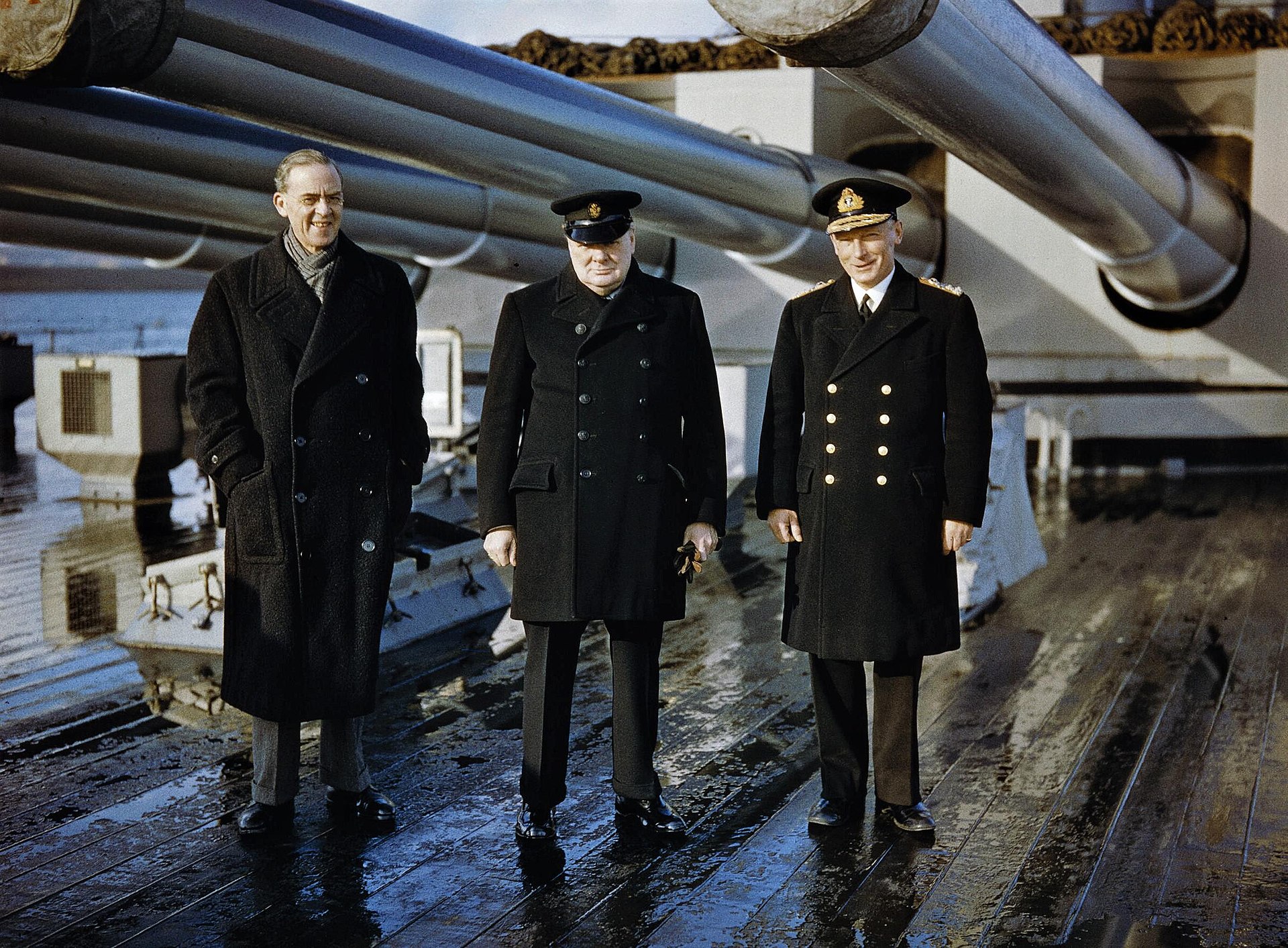
Winston Churchill with the Lord Privy Seal, Sir Stafford Cripps, and the Commander-in-Chief Home Fleet, Admiral Sir John Tovey, on the quarterdeck of HMS KING GEORGE V at Scapa Flow, 11 October 1942. Adm. Tovey who made the above observations about the Bismarck served as Commander in Chief of the Home Fleet from 1940 to 1943 and served as Commander in Chief, Nore from 1943 to 1946. Adm. Tovey was First and Principal Naval Aide de Campe to the King from January 1945. Public Domain.
After the sinking, Admiral John Tovey (1885-1971) said: “The Bismarck had put up a most gallant fight against impossible odds worthy of the old days of the Imperial German Navy, and she went down with her colours flying.”6
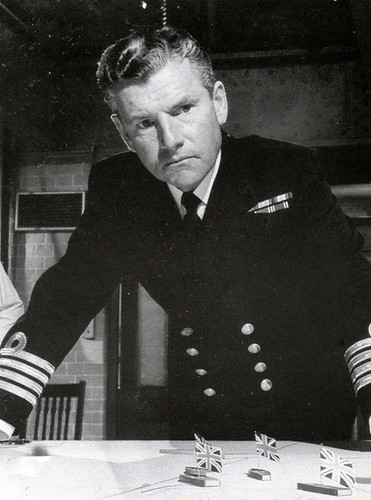
Sink the Bismarck! is a 1960 black-and-white CinemaScope British war film based on the 1959 book The Last Nine Days of the Bismarck by C. S. Forester. It stars Kenneth More and Dana Wynter and was directed by Lewis Gilbert. Norman Shelley was the uncredited voice of Winston Churchill: “I want to make it unmistakably clear that there is absolutely nothing as vital to the nation at this moment as the destruction of the Bismarck. You are authorized to employ any means at your disposal regardless of risk and regardless of the price that must be paid. This is a battle we cannot afford to lose. I don’t care how you do it, you must sink the Bismarck!“
In 1960 the British black-and-white film production, Sink the Bismarck!, was a hit in the United States and, after its first run, regularly broadcast on TV through the 1960’s and 1970’s in reruns. It co-starred Kenneth More as Captain Jonathan Shepard who coordinates the hunt for Bismarck aided by Women’s Royal Naval Service Second Officer Anne Davis (Dana Wynter). More had served as a Royal Navy lieutenant on HMS Victorious during World War II. “Kenneth More, ‘Sink the Bismarck’, 1960” by thefoxling is licensed under CC BY-NC-SA 2.0.
FOOTNOTES:
1. Freedom From Fear: The American People In Depression and War, 1929-1945, David M. Kennedy, NY: Oxford University Press, 1999, pp. 490 and 493.
2. Freedom from Fear, p. 492.
3. Operation Barbarossa – Freedom from Fear, p. 495; polls- Ibid., p. 491.
4. Freedom from Fear, pp. 492-493.
5. The Reluctant Belligerent: American Entry Into World War II, 2nd edition, Robert A. Divine, NY: John Wiley & Sons, 1979, p. 117.
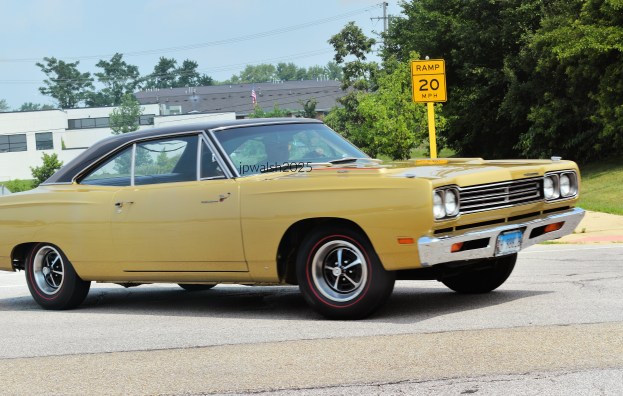
Since the Great Depression years Chrysler Plymouth was the number three budget brand car in America following Ford and Chevrolet. By the1960’s that number three position had been held by General Motors’ Pontiac though Chrysler Plymouth reached that third position on occasion. In the 1970’s Plymouth would be overshadowed by Oldsmobile but in the late 1960’s that was a near future not yet revealed and, starting in 1968, Plymouth had a couple of incredible end-of-decade model years. In 1969 the two-door pony car Plymouth Barracuda (1964-1974) continued to have its own identity in the Chrysler line up and received only a modest makeover that year that included a new grill, interior trim and optional ‘Cuda 340 package. The mid-sized Belvedere (1954-1970) in its seventh generation and Satellite (1965-1974) in its second generation returned in 1969 with slight new treatments as did the compact Plymouth Valiant (1960-1976) in its third generation with a new grill and taillights. In 1969, after four years, The Plymouth Fury (1955/1959-1989) entered a fifth generation with a totally redesigned model line.
In 1969 Plymouth’s advertising tag line was Look what Plymouth’s up to now and it was the new Plymouth Road Runner that captured the car world’s imagination. A Plymouth first, Motor Trend magazine selected the 2-door convertible and 2-door coupe Road Runner as their 1969 Car of the Year. A powerful engine with a spartan trim level, the Road Runner muscle car was introduced by Chrysler in 1968. In 1969 Plymouth added a new Road Runner Convertible. Initially based on the lower-priced Plymouth Belvedere, the sporty Road Runner was a mid-size, performance-focused car designed to itself be a lower-priced option compared to the upscale Plymouth GTX or Pontiac GTO. In its heyday the Chrysler Plymouth Road Runner was the spartan alternative to the highly equipped Plymouth (Belvedere) GTX. All these Plymouth mid-sized models (along with the Satellite) were sold in 1969 with the tag line: The name of the game this year is “sport.” In 1969, the base price for a Plymouth Road Runner coupe was approximately $2,945 ($25,888 in 2025 dollars). The hardtop version listed for around $3,083 ($27,099) and the convertible model was $3,313 ($29,121). The mid-size Road Runner was introduced as a 2-door pillared coupe whose spare interior belied an exclusive “Roadrunner” 383 cu in B-series V8 engine with a 4-barrel Carter Carburetor and high-performance camshaft under the hood.
“Beep, Beep.”
Plymouth paid $50,000 to Warner Bros.-Seven Arts (about $465,500 today) to use the Road Runner name and likeness including the “beep, beep” horn sound that Plymouth developed for its customers with an investment of around $100,000 in today’s money. Produced from 1968 to 1980, the Road Runner was built on the mid-sized B-Platform for three generations. Like most muscle cars, in the 1970’s its performance capabilities declined — and, with it, sales — as the car industry was mandated to focus on fuel economy and emission standards. In 1976 the Road Runner nameplate became a trim and graphics package for the new Plymouth F-body compact two-door Volaré platform until discontinued in 1980. Having no special performance capability and with car manufacturers actively downsizing their lineups, the Volaré was discontinued on the same day in 1980 the Dodge Main Assembly plant in Detroit, Michigan, closed after being in continuous operation since 1911.
SOURCES: See – J. “Kelly” Flory, Jr., American Cars, 1966 to 1972, McFarland & Company, Inc. pp. 297-303.
This explanatory article may be periodically updated.
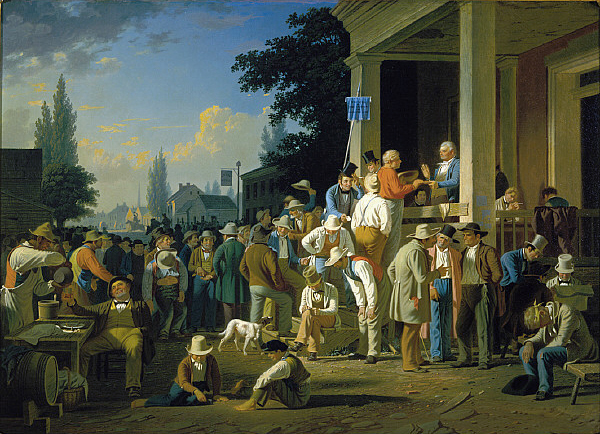
FEATURE IMAGE: George Caleb Bingham (1811-1879), Stump Speaking, 1854, oil on canvas, 42 1/2 x 58 in. (108 x 147.3 cm), St. Louis Museum of Art. The painting begun by Bingham in November 1853 was completed in February 1854 in Philadelphia. Stump Speaking is one of three paintings in a series representing to a national audience the idea of the American democratic process. Bingham exhibited Stump Speaking in a series with his The County Election and The Verdict of the People at the influential but short-lived (1856-1860) Washington Art Association, the Pennsylvania Academy of Art, and the Western Academy of Art in St. Louis. These election series paintings along with Bingham’s Jolly Flatboatmen in Port (see below) then went on view at the St. Louis Mercantile Library (founded 1846) until the 1930’s when the election series paintings were loaned to the City Art Museum (the future Saint Louis Art Museum). In 1941, The Mercantile Library sold Stump Speaking and The Verdict of the People to Boatmen’s National Bank of St. Louis (now Bank of America) and, in 2001, Bank of America gave Stump Speaking to the Saint Louis Art Museum. Public Domain. https://www.slam.org/collection/objects/29774/ – retrieved September 13, 2025.
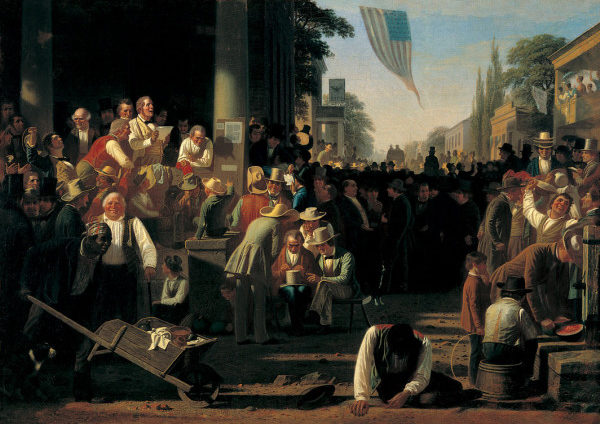
Bingham, The County Election, 1852, oil on canvas, 38 x 52 in. (96.5 x132 cm), St. Louis Art Museum. It depicts an election in 1850 in Saline County, Missouri, located between Columbia and Kansas City in central Missouri. Bingham’s paintings depict a dispassionate electorate before the Civil War reflecting the Founders’ ideals in challenging times. A staunch Unionist, George Caleb Bingham’s own political views rejected radical politics whether an unrestrained northern Abolitionist cause or that of Southern Fire-Eaters and strived toward negotiation and minimally Federal regulation of slavery. Bingham opposed the proslavery wing of Missouri politics represented by Gov. Clairborne Fox Jackson (1806-1862) who appears in Stump Speaking. Though Bingham’s election series is painted before the Lincoln-Douglas debates in 1858 in neighboring Illinois, Bingham, a Whig, tended towards Lincoln’s characterization of democracy that government should provide “a fair chance” to all. Though depicted at the periphery in service roles to whites, Bingham’s artwork presented slaves sympathetically encouraging his viewers to acknowledge the slaves’ existence and to recognize that they are being excluded from the noble American democratic process. Public Domain. See – https://www.nytimes.com/2025/09/15/books/review/born-equal-akhil-reed-amar.html – retrieved September 28, 2025.
Bingham, Verdict of the People, 1854, 74 cm × 93 cm (29 in × 36.5 in), St. Louis Art Museum. When Donald Trump was inaugurated as the 45th president of the United States on Jan. 20, 2017, The Verdict of the People was the chosen painting, hanging on a partition wall behind the ceremonial head table in the Capitol’s Statuary Hall. Public Domain.
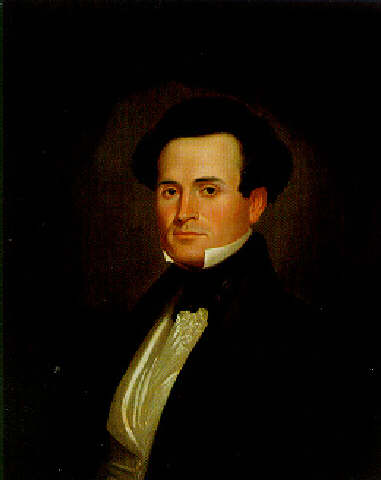
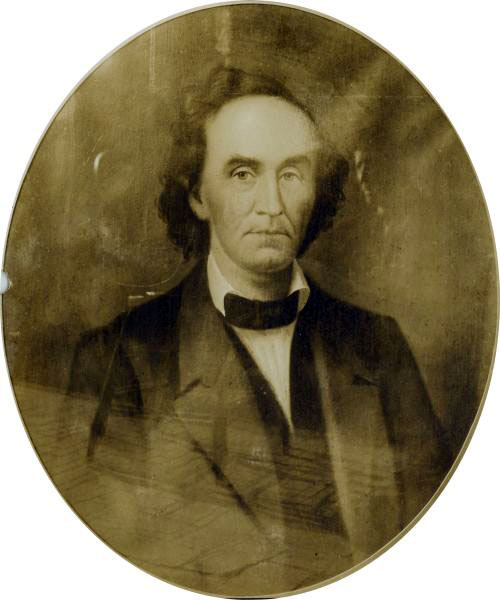
In Stump Speaking, Democrat Erasmus Darwin “E.D.” Sappington (1809-1858), born in Tennessee, is the main speaker shown leaning forward and pleading his case to a crowd of rural citizens. Behind him, with tablet in hand, sits his opponent taking notes in preparation for his turn at the make-shift podium. Candidate Sappington had married the eldest daughter of Kentucky Governor John Breathitt (1786-1834), Penelope Breathitt (1822/3-1904), and the couple had four children. Gov. Breathitt, a Jacksonian Democrat, had been elected as the Bluegrass State’s 11th Governor in 1832, serving until his death from tuberculosis at age 47. After his death, Breathitt County in Eastern Kentucky was created and named in his honor.
Bingham – portrait of Erasmus Darwin “E.D.” Sappington, 1844. Public Domain.
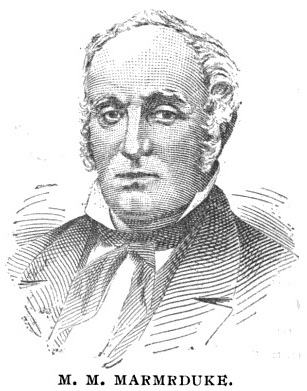
https://www.findagrave.com/memorial/86334793/penelope_c-sappington – retrieved September 26, 2025. https://www.findagrave.com/memorial/60353793/erasmus_darwin-sappington – retrieved September 26, 2025. The rotund man seated behind the speaker is Meredith Miles Marmaduke (1791-1864), part of the Missouri’s Democratic political machine. Born in Virginia, like Bingham, Marmaduke moved to Missouri in 1823 where he married Lavinia Sappington (1807-1885) whose mother, Jane Breathitt (1783-1852), was the older sister of Kentucky Governor Breathitt. The Marmadukes had 10 children together. Marmaduke was a trader on the Santa Fe Trail, surveyed and platted Arrow Rock in Saline County on the Missouri River where he had a plantation and was elected Lt. Governor of Missouri. When Governor Thomas Reynolds (1796-1844) died in office by suicide, Marmaduke assumed the Governorship from February 1844 until November 1844, finishing out the term. The Reynolds Administration was heavily criticized by conservative Whigs for championing the abolition of debtor’s prisons in the state which the Missouri General Assembly accomplished in February 1843. Reynolds whom Marmaduke succeeded also freed up voting requirements to provide greater voting access to the state’s residents, another issue opposed by Whigs. When the University of Missouri in Columbia was established in 1839 and became the first public university west of the Mississippi River, the Reynolds Administration achieved the education milestone of enrolling its first class. Meredith Miles Marmaduke, a former slaveholder, was a staunch Unionist during the U.S. Civil War, although four of his sons fought for the Confederacy which was a typical outcome of the conflict in the Border States. After the war, one of those sons, in 1885, became Missouri’s 25th governor.
“Historical, Pictorial and Biographical Record, of Chariton County, Missouri”, p. 30 (1896). Public Domain.
At right in Stump Speaking the man in the white coat and top hat is then-state senator Clairborne Fox Jackson (1806-1862) who became the secessionist governor of Missouri in 1861. Jackson was forced out by the Missouri General Assembly’s Unionist majority on July 30, 1861, and replaced by a former Chief Justice of the State Supreme Court as provisional governor for the rest of the war. During these contentious deliberations, Bingham was in the state capitol to dedicate portraits of Henry Clay and President Andrew Jackson. Asked to say a few words, Bingham praised the 7th president’s suppressing nullifiers in 1832-1833 and called secession treason which almost blew the roof off the Missouri House. See- https://archive.nytimes.com/opinionator.blogs.nytimes.com/2013/09/06/an-artists-revenge/– retrieved September 27, 2025. Removed Gov. Jackson did not recognize the assembly’s actions and issued a proclamation on August 5, 1861, declaring that Missouri would secede from the Union. Jackson then traveled to Richmond, Virginia, to meet Confederate President Jefferson Davis and seek support of local Confederate militia forces and recognition by the Confederate government, both of which the Confederacy did. Union forces, however, had occupied most of Missouri and the state’s Unionist versus Secessionist political impasse was basically moot. Jackson withdrew to Arkansas with Confederate militia but was defeated by Union forces at the Battle of Pea Ridge in March 1862. Violent skirmishes, often savage attacks, continued in Missouri as Confederate guerrillas, called bushwhackers, caused random fear and havoc. Missouri bushwhackers included outlaws Jesse James and his older brother Frank James. Quantrill’s raid on Lawrence, Kansas, in August 1863 killed no less than 150 men and boys and inflamed the border. Fleeing further south to regroup, Jackson died at 56 years old of pneumonia and stomach cancer. Claiborne Fox Jackson having, in 1831, married Jane Breathitt Sappington (1813-1831) and, in 1833, Louisa Catherine Sappington (1814-1838), sisters of Lavina Sappington Marmaduke, was brother-in-law to Meredith Miles Marmaduke. As “E.D.” Sappington was brother to these women, all three men in Bingham’s painting were brothers-in-law.
Bingham’s lively crowd evokes William Hogarth’s mid-18th century Election series, but with little to none of the British artist’s turbulent depictions. The American Bingham’s election series is orderly in its business. Bingham’s Stump Speaking depicts none of Hogarth’s corruption where the voter or politician is pictured as an idiot and fool whose election requires that he be bribed, threatened, conned, intoxicated, or generally pushed around. One of Hogarth’s voters has to be carried to the ballot box to cast his vote because he is already dead. By contrast, in mid-19th century America, the democratic process, while popularly engaging and verbally contentious, is a pictorial pantheon of virtue: calm, dignified, respectful, decent, honest, ethical, and incorruptible. The American people carry out their sacred duty of democratic self-governance accompanied by earnest and sober demeanor as all Americans, North and South, as Lincoln observed “pray to the same God.” See – https://www.nytimes.com/2025/09/15/books/review/born-equal-akhil-reed-amar.html – retrieved September 28, 2025. While depicting politicians in American art and illustration had been typical from the Republic’s earliest days, Bingham casts them in a context with their voters laboring together in a noble field of American politics and democracy. In a painting that depicts the nation’s spread of universal suffrage for adult white males in the pre-Civil War era and the mobilization by party organizations of popular politics, Bingham neither depicts an anonymous crowd nor one restricted in social type. It is a real, breathing American landscape attracting and engaging a variety of ages and occupations. One does not find a shouting match, let alone some kind of melée in Bingham’s American electorate. It is quite the opposite: the crowd is civilized. Though assembled haphazardly, they are seated in peaceable order where some, amused by the proceedings, can share their laughter good-naturedly. Bingham’s figures are stalwart and reliable who come to attentively learn and independently decide among candidates. For Americans, listening to and questioning what each candidate has to say, and then voting, is a sacred civic duty since 1789 that Bingham updates to his present day.
About the Artist.
George Caleb Bingham (1811-79), an artist and politician. Born in Virginia, Bingham grew up on the frontier land of the Missouri River, and he was largely self-taught. He is famous for his scenes of manly, everyday life, showing work and play, mostly along the Missouri and Mississippi Rivers. His most celebrated picture is Fur Traders Descending the Missouri. Public Domain.
After his first wife, Sarah Elizabeth Hutchinson Bingham, died in November 1848 at 28 years old following 12 years of marriage, she was buried in Sunset Hills Cemetery in Boonville, Missouri. The next year, on December 3, 1849, Bingham married Eliza Thomas of Columbia, Missouri. Bingham had one child each with both his first and second wife. In 1876, Eliza having developed mental health issues, Bingham was forced to commit her to a state mental institution in Fulton, Missouri. She died there later that same year. Eliza was buried next to her parents in Mount Washington Cemetery in Independence, Missouri. Now 55-year-old Bingham was a two-time widower with a 15-year-old son. Unfortunately, the artist, too, would not be long for this world.
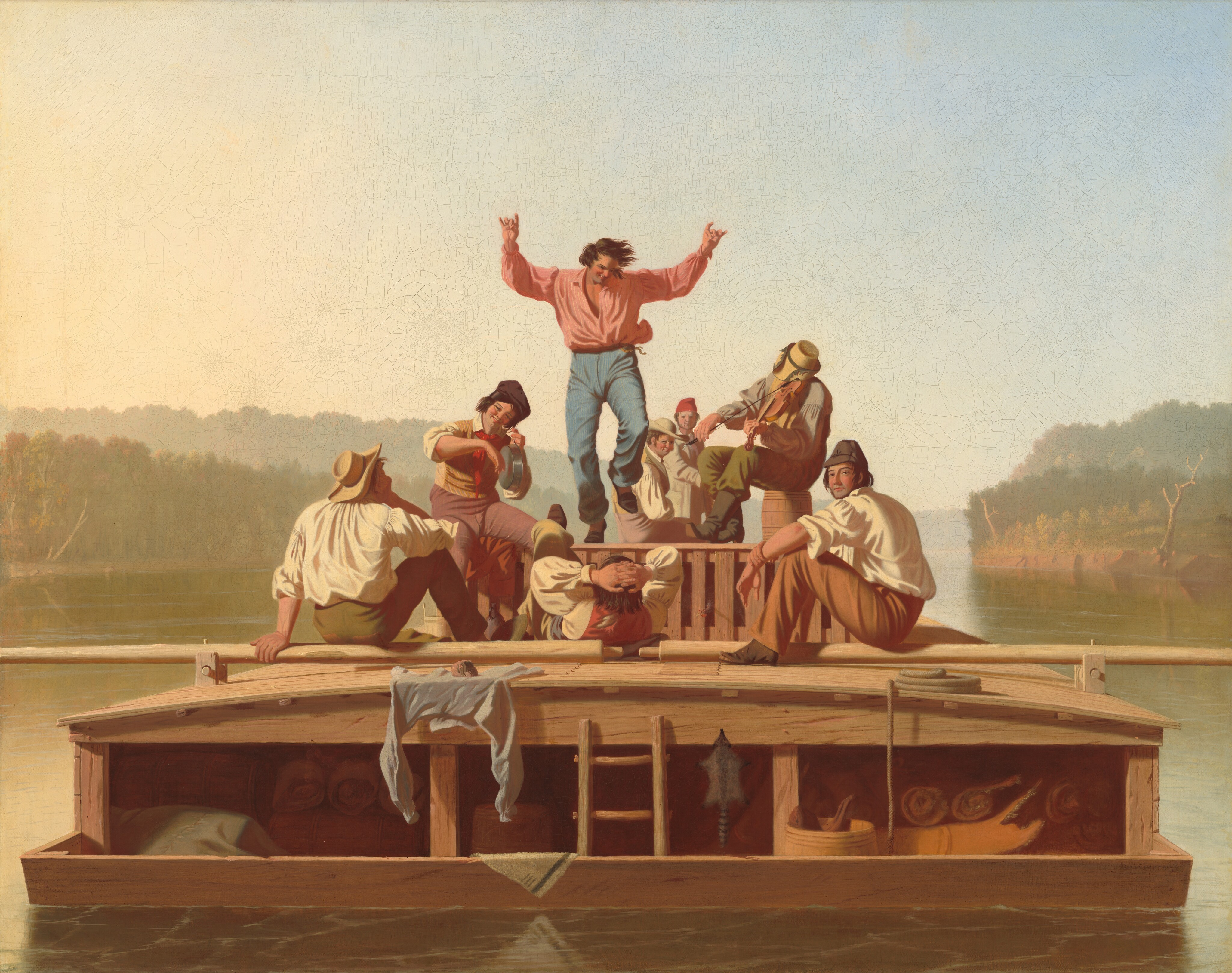
Bingham – The Jolly Flatboatmen, 1846, 96.8 x 123.2 cm (38 1/8 x 48 1/2 in.), National Gallery of Art, Washington, D.C. https://www.nga.gov/artworks/75206-jolly-flatboatmen – retrieved September 26, 2025. Scholars observe that Bingham’s paintings before the Civil War embody his partisan political views as a Whig Party politician with “his Western scenes a commentary on the importance of commerce and the need for federal funding for internal improvements.” Public Domain. See – https://archive.nytimes.com/opinionator.blogs.nytimes.com/2013/09/06/an-artists-revenge/ – retrieved September 27, 2025.
Bingham – Fur Traders Descending the Missouri, 1845, 29 x 36 1/2 in. (73.7 x 92.7 cm), The Metropolitan Museum of Art, New York, NY. The painting is Bingham’s most celebrated work. Public Domain.https://www.metmuseum.org/art/collection/search/10159 – retrieved September 26, 2025.
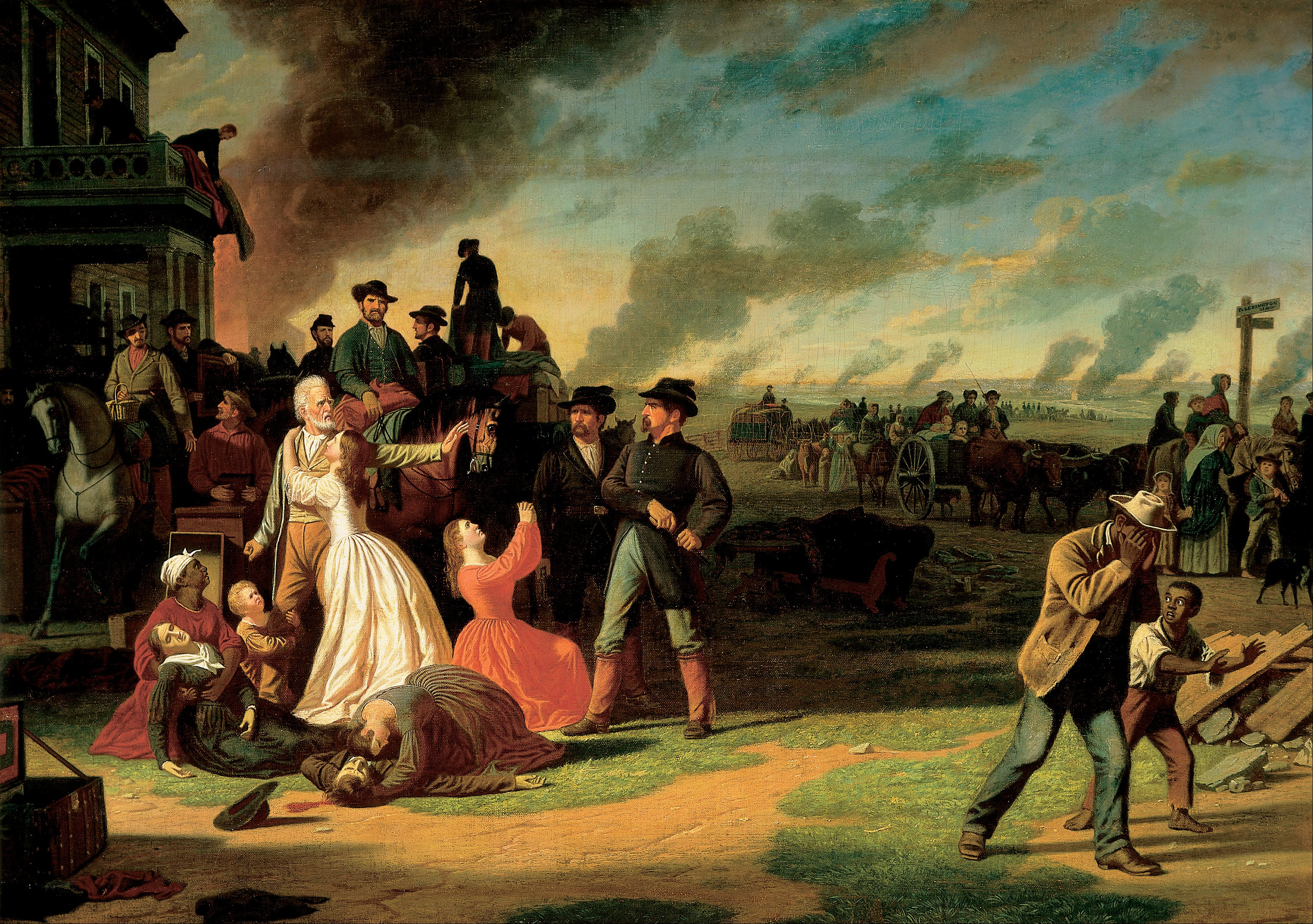
After the death of Eliza, Bingham married a third time in 1878. Martha Ann “Mattie” Livingston Lykins-Bingham (1824-1890) was a recent widow of one of Bingham’s friends in Kansas City. Mattie was a capable and dignified businesswoman with a big personality. Born in Kentucky and living In Lexington until she married Dr. Lykins, the Lykins’ were one of Kansas City’s power couples. At the outbreak of the Civil War, she and Dr. Lykins, along with a large swath of the local population in that part of western Missouri, were southern sympathizers. They and thousands more were expelled from the city by Order No. 11 of Brig. Gen. Thomas Ewing Jr., commander of the District of the Border, to rid Missouri of their political persuasion. The displacement caused tremendous suffering for Missouri civilians and Order No. 11 was very controversial. Bingham, then-state treasurer of Missouri who swore a loyalty oath to the Union, was appalled by the “military tyranny” of Order No. 11 where the refugees’ farms and fields were pillaged and burned. Many of its victims viewed the action as simply anti-American government retribution for the local population’s political beliefs. See – https://archive.nytimes.com/opinionator.blogs.nytimes.com/2013/09/06/an-artists-revenge/ – retrieved September 27, 2025.
Mattie and Dr. Lykins returned to Kansas City after the war and made a life there until Dr. Lykins’ death in 1876, the same year Eliza Bingham died. Two years later, Mattie married George Caleb Bingham. After Bingham’s death in 1879 from stomach flu, Mattie lived with his young son James Rollins Bingham (1861-1910) who never married. In 1890, following years of trouble with her health, Mattie died following surgery for a stomach tumor. Mrs. Lykins-Bingham was buried In Union Cemetery in Kansas City, Missouri, in the Bingham family plot.