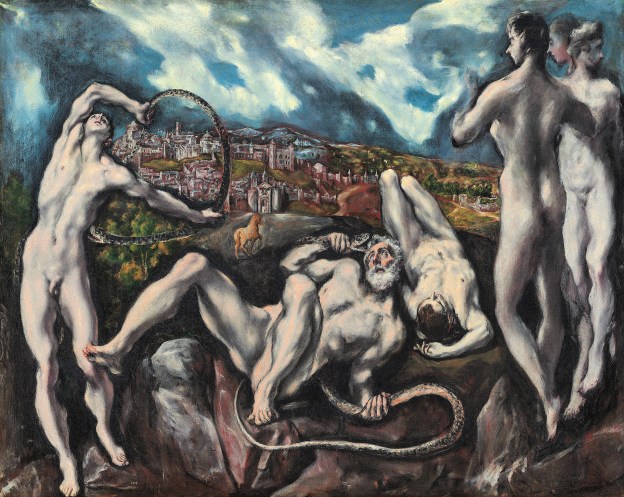
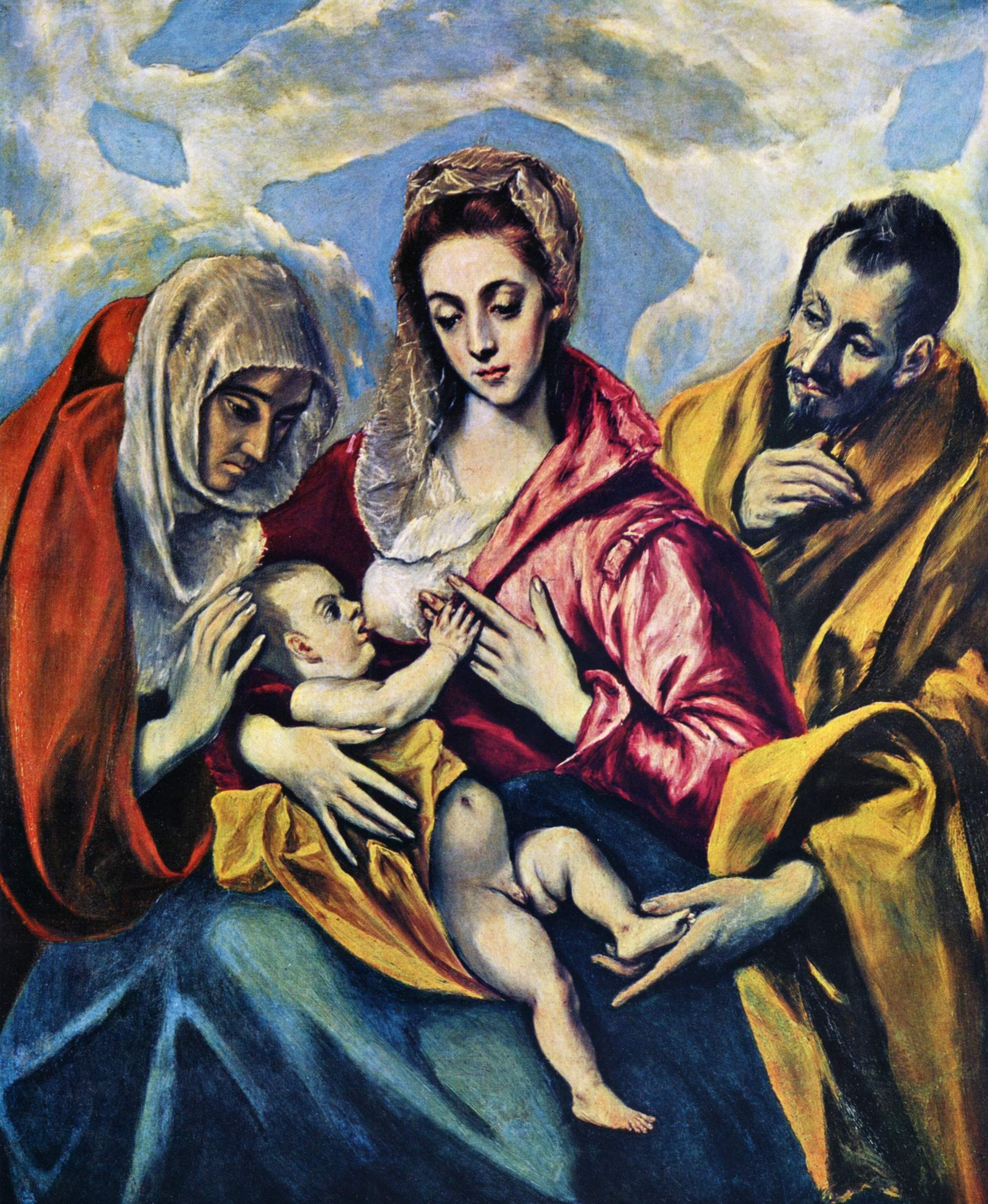
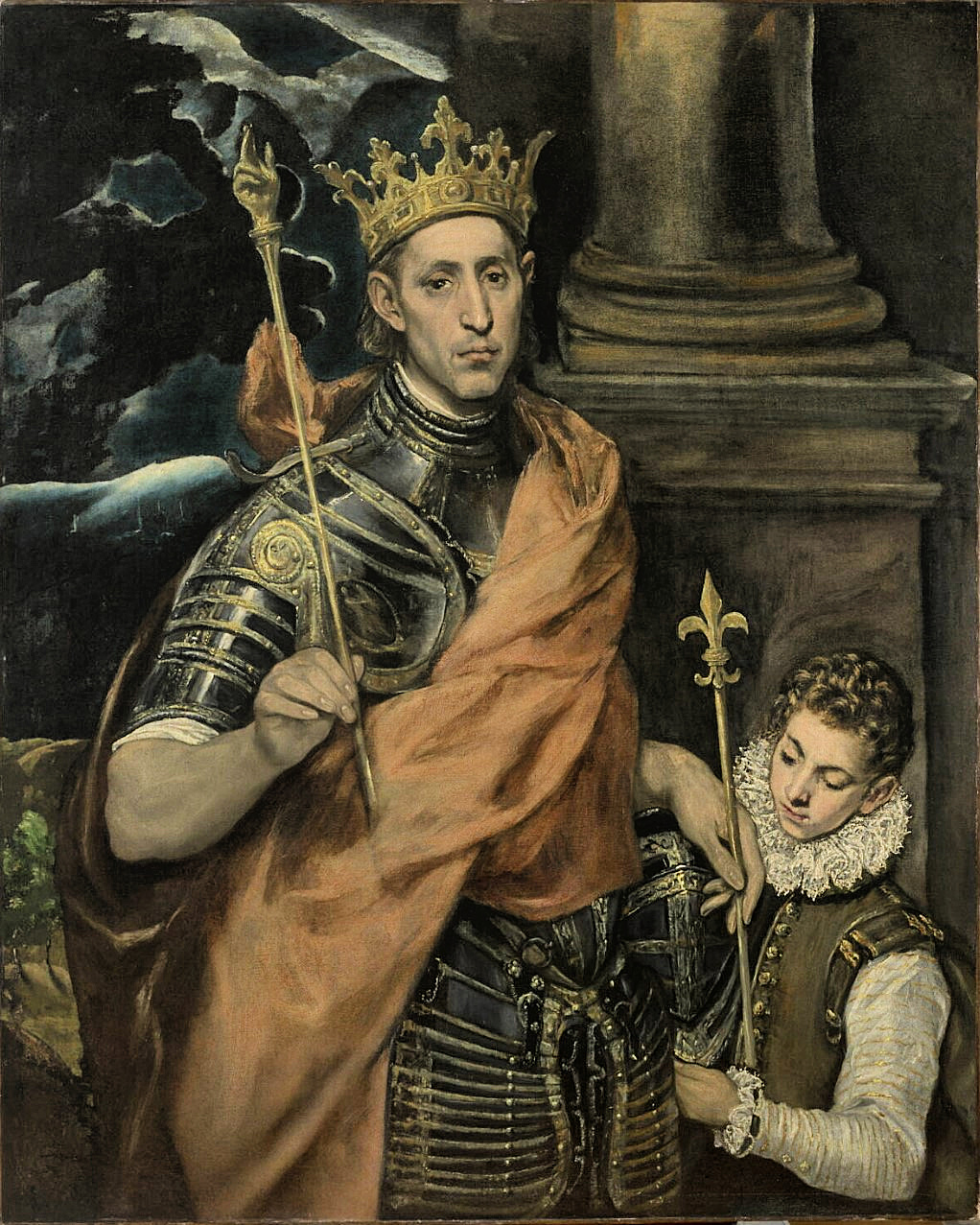
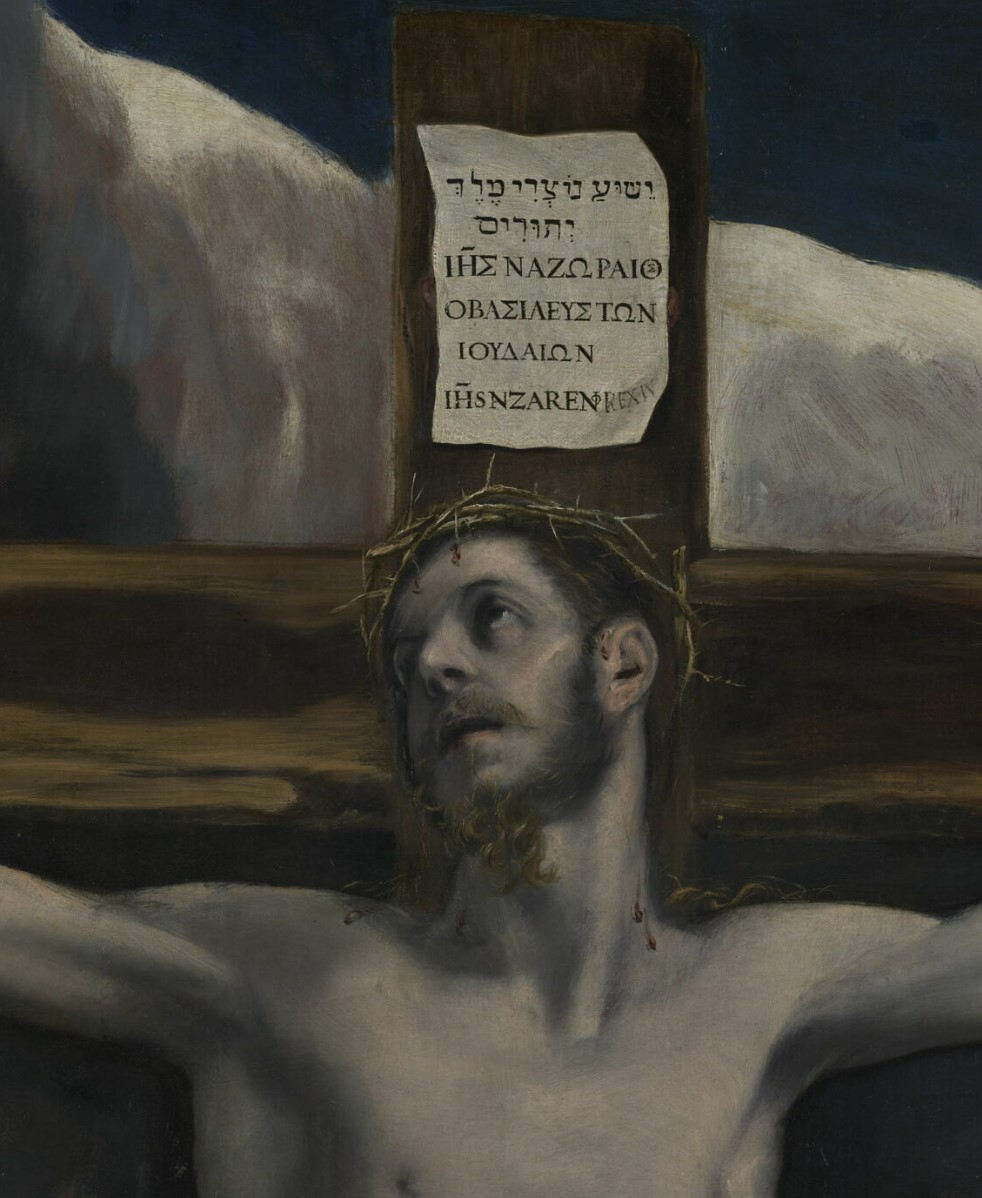
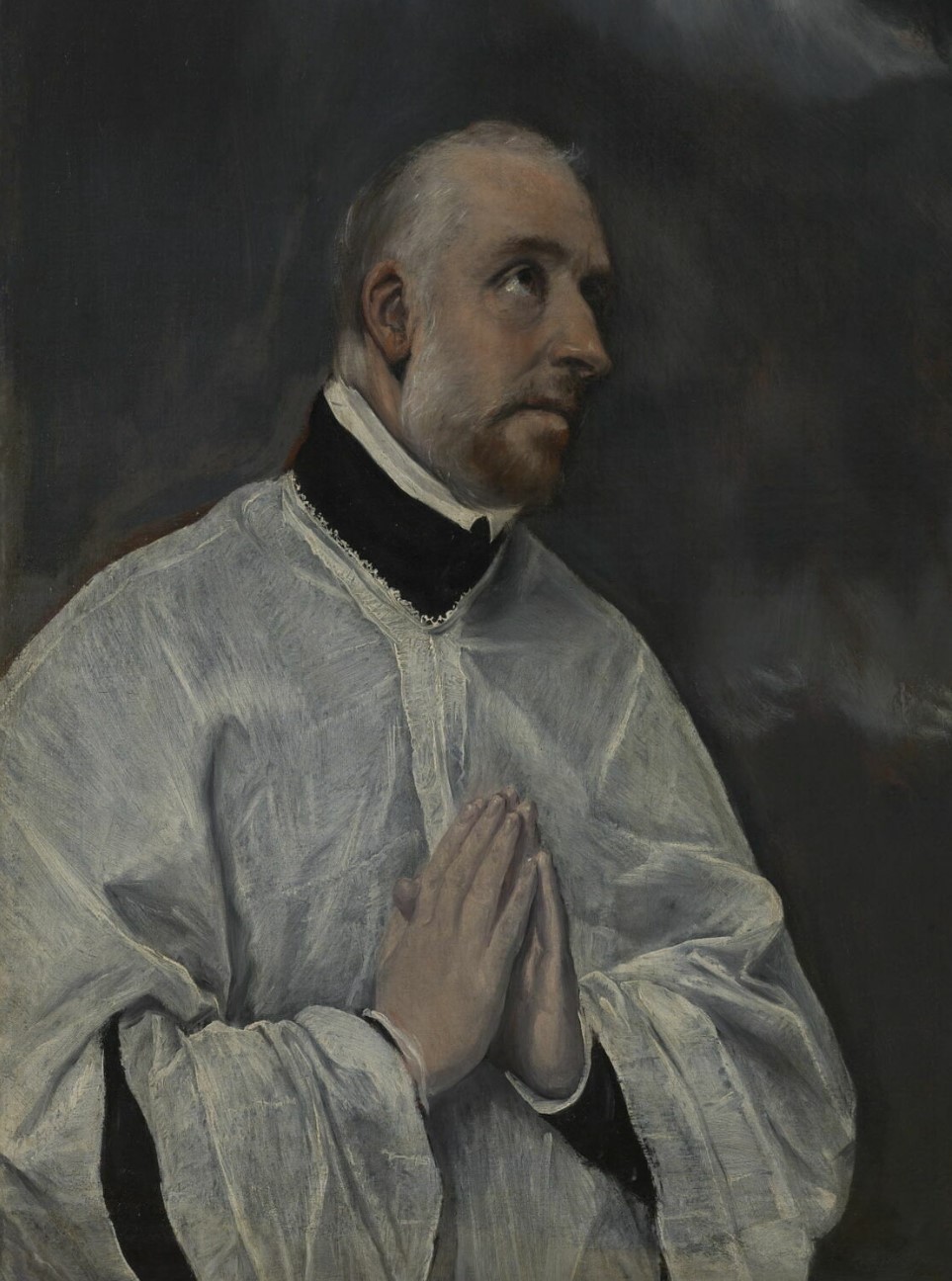
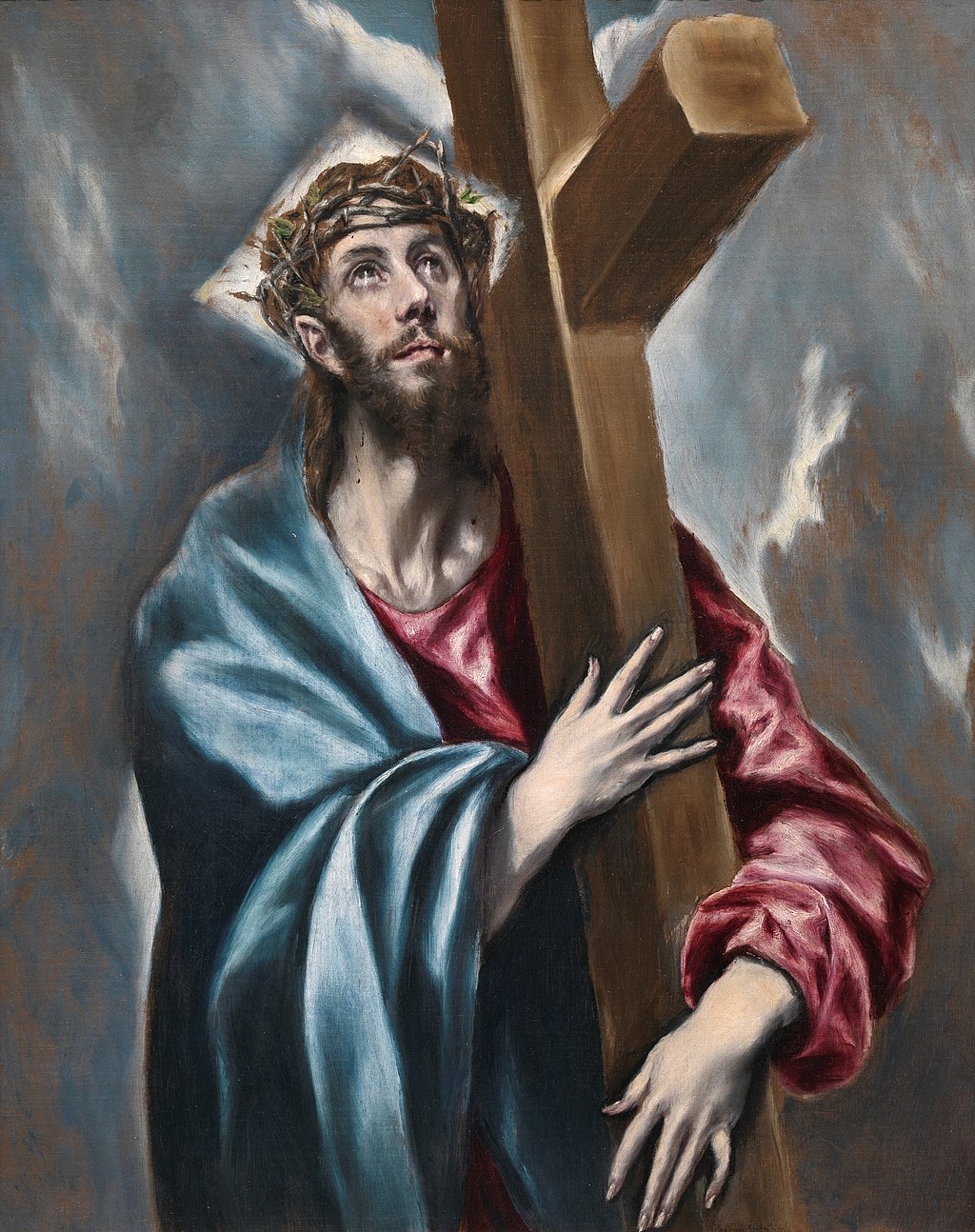
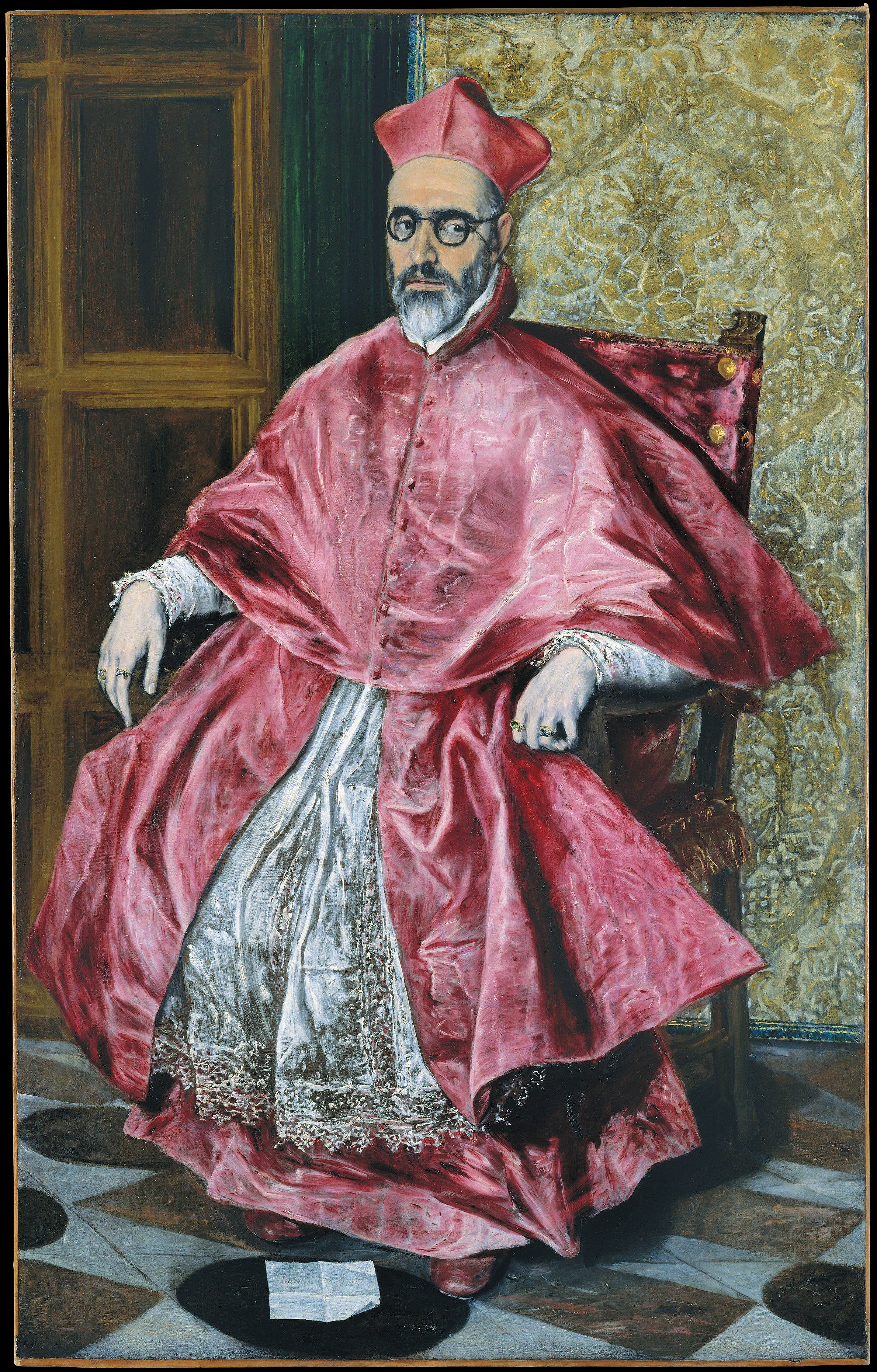
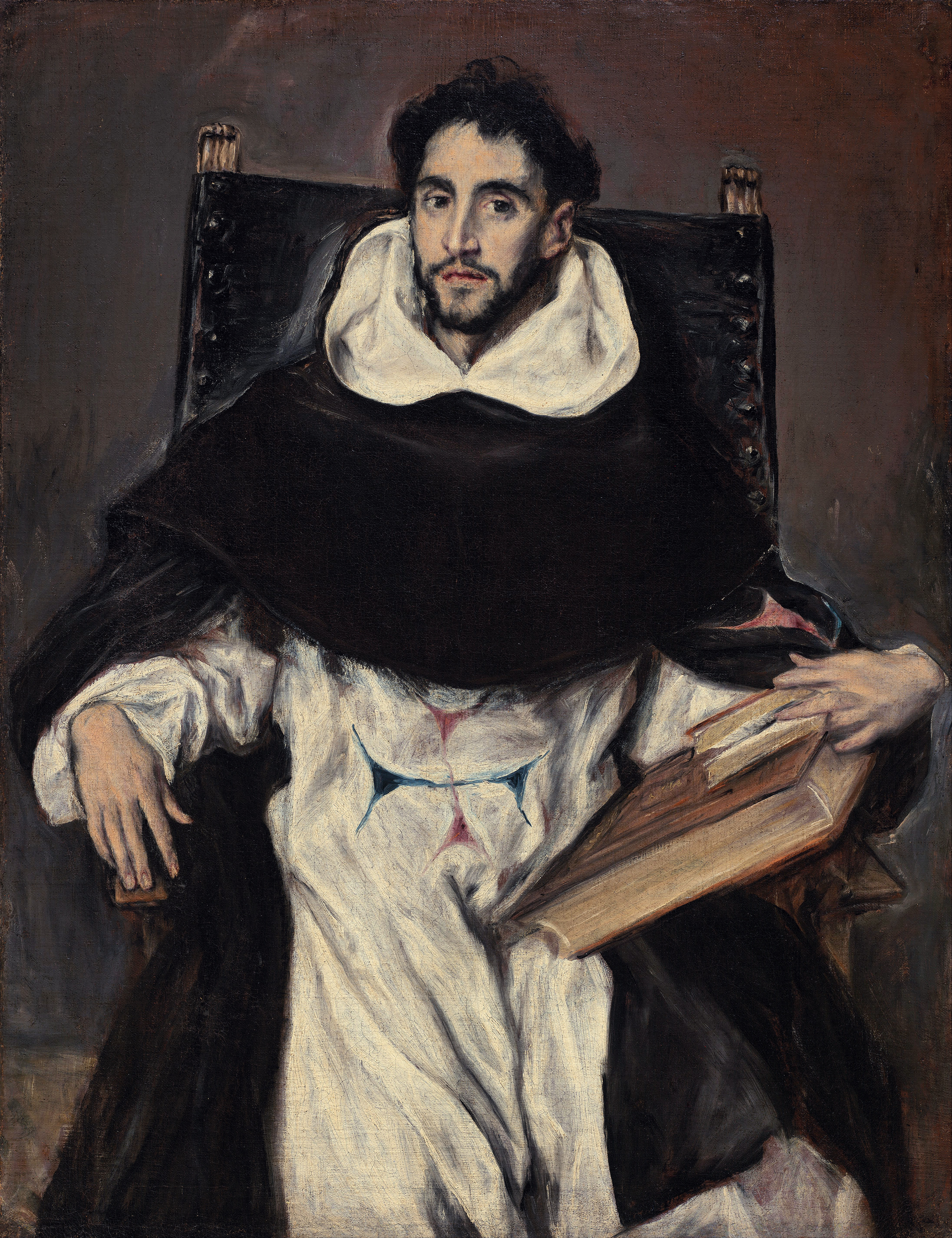
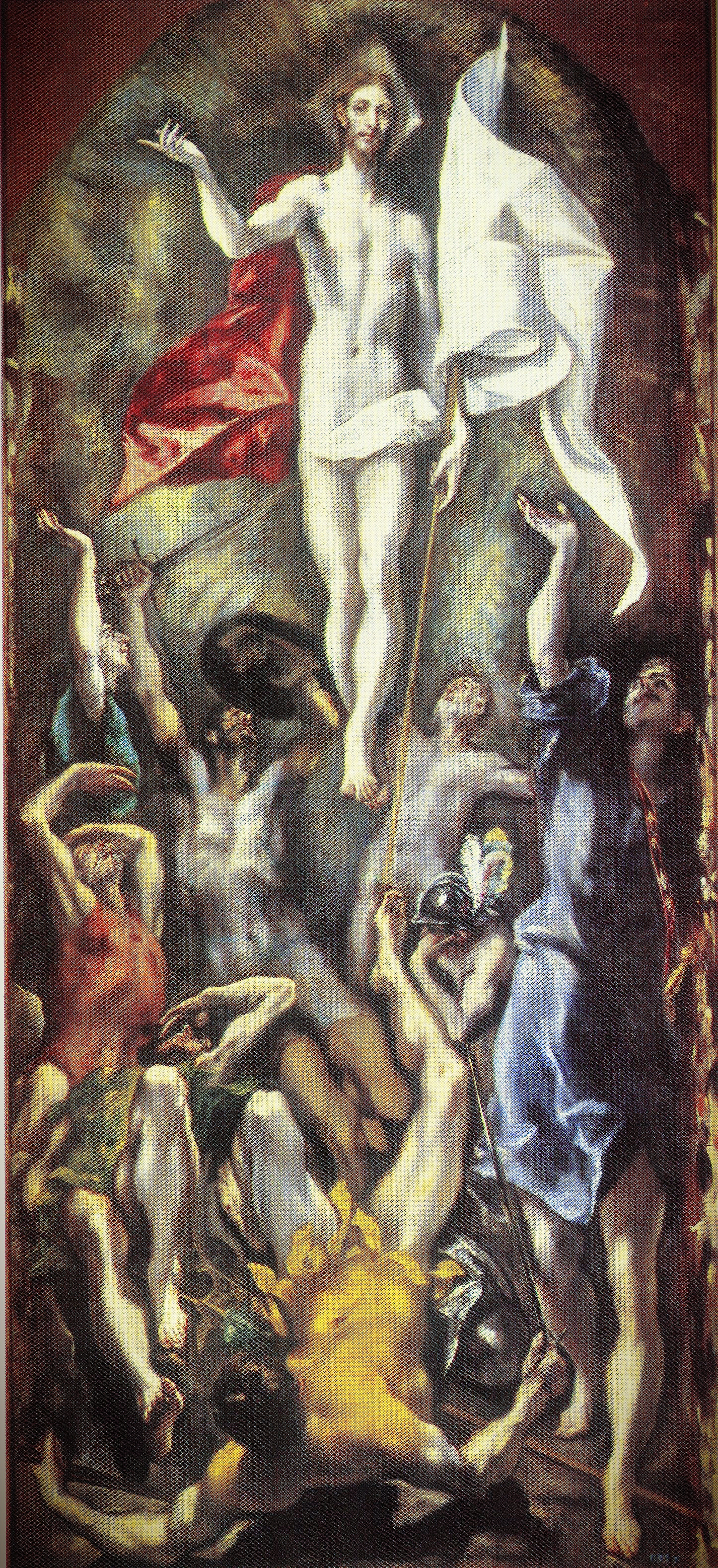
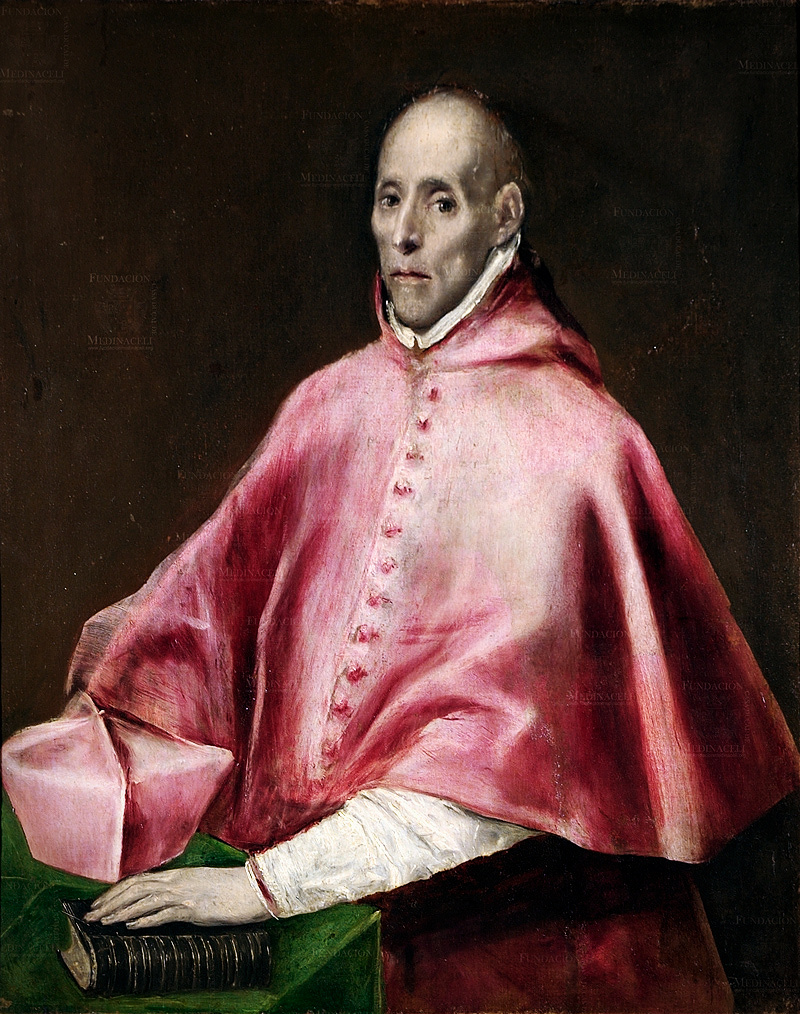
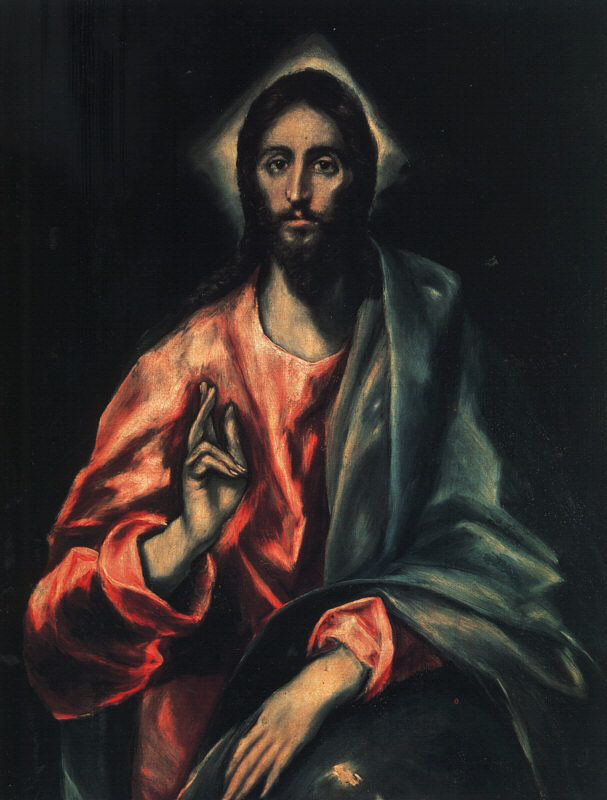
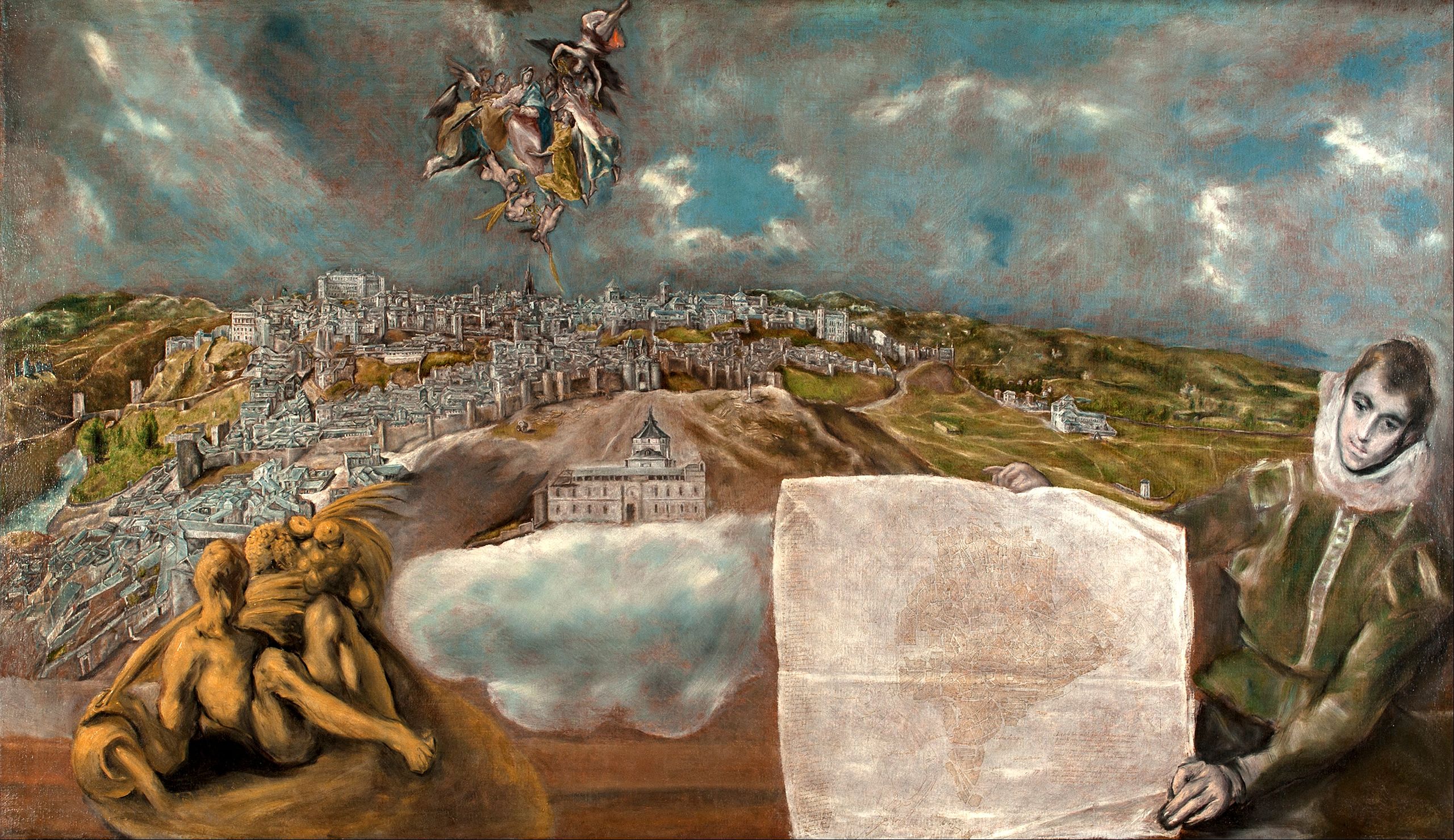
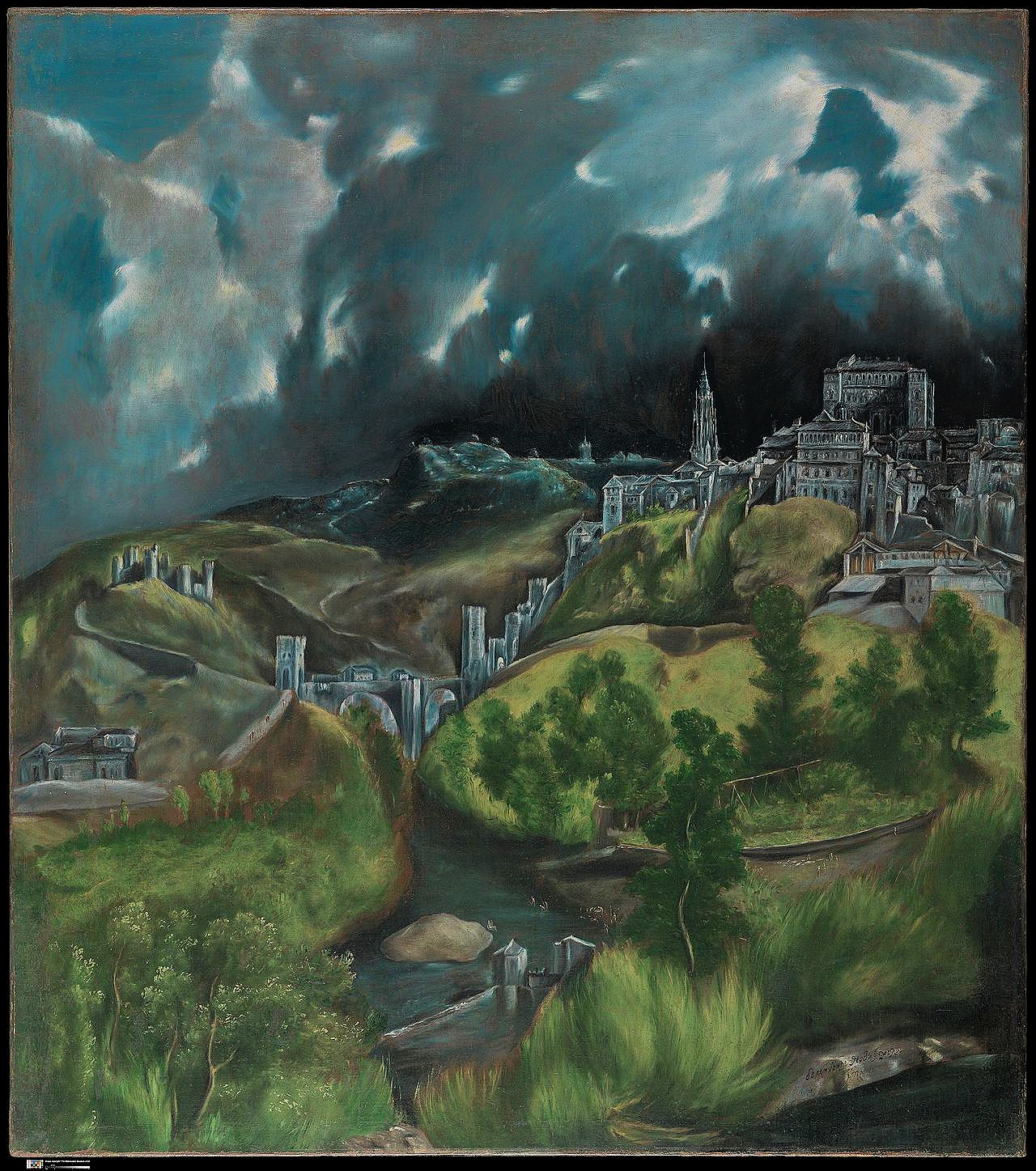
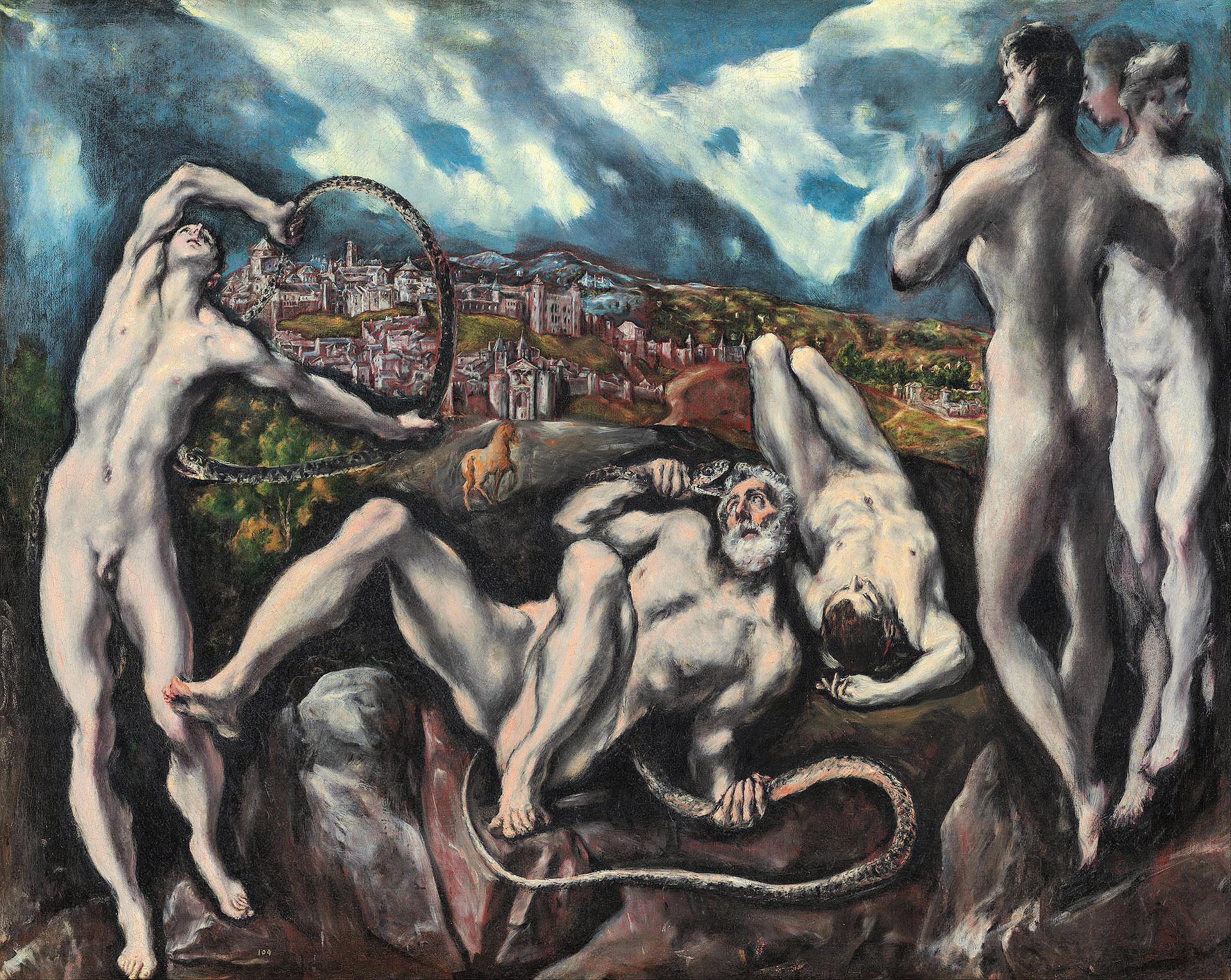
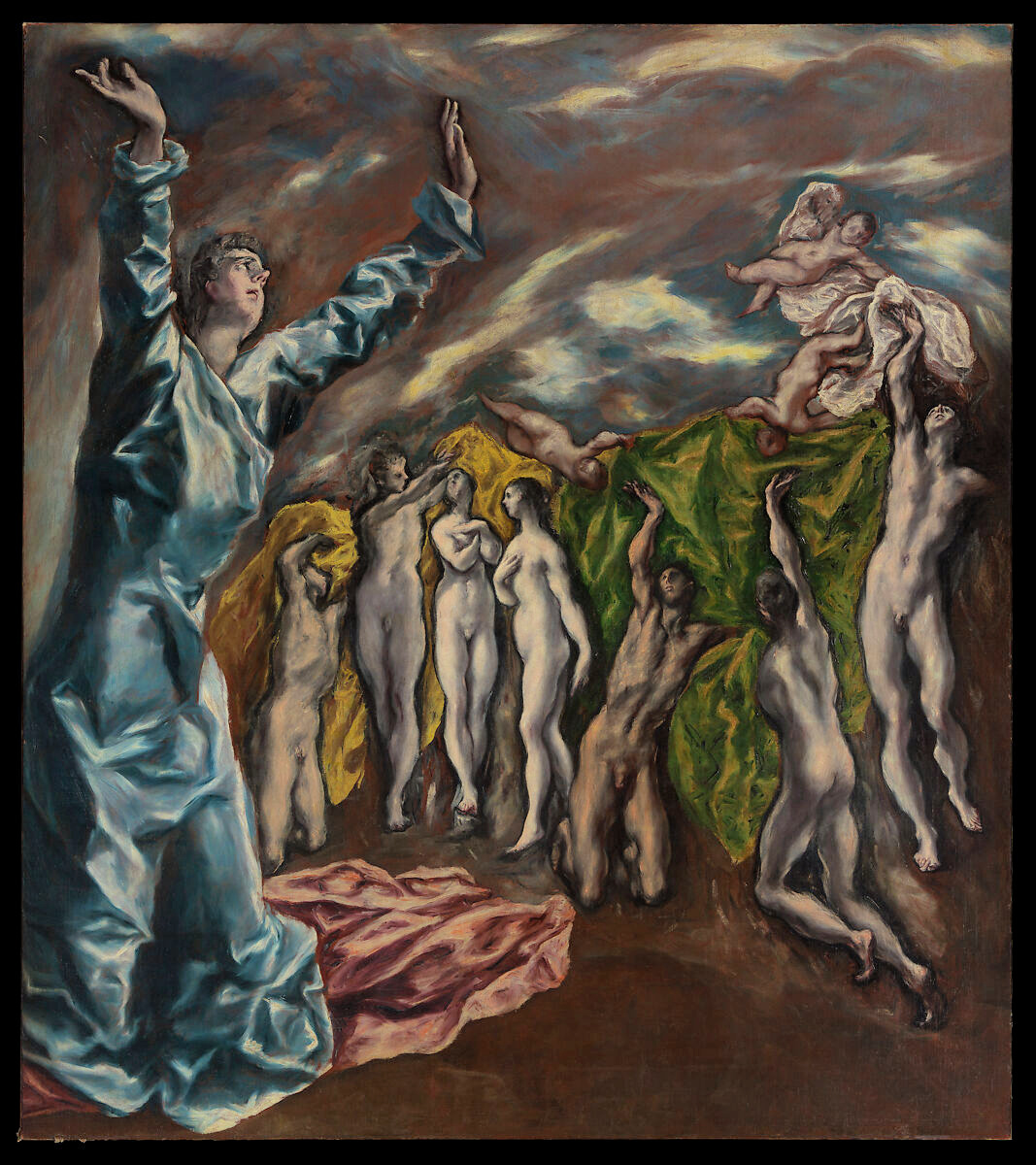
FEATURE Image: El Greco (Domenikos Theotokopoulos), Laocoön, oil on canvas, 1604-1614, 55 7/8 x 76″, National Gallery of Art, Washington, D.C. In Greek and Roman mythology, Laocoön is a Trojan priest who warned the Trojans to destroy the Trojan Horse sent by the Athenians and is punished with death by the gods for it. See the artwork again below for details about El Greco’s painting.
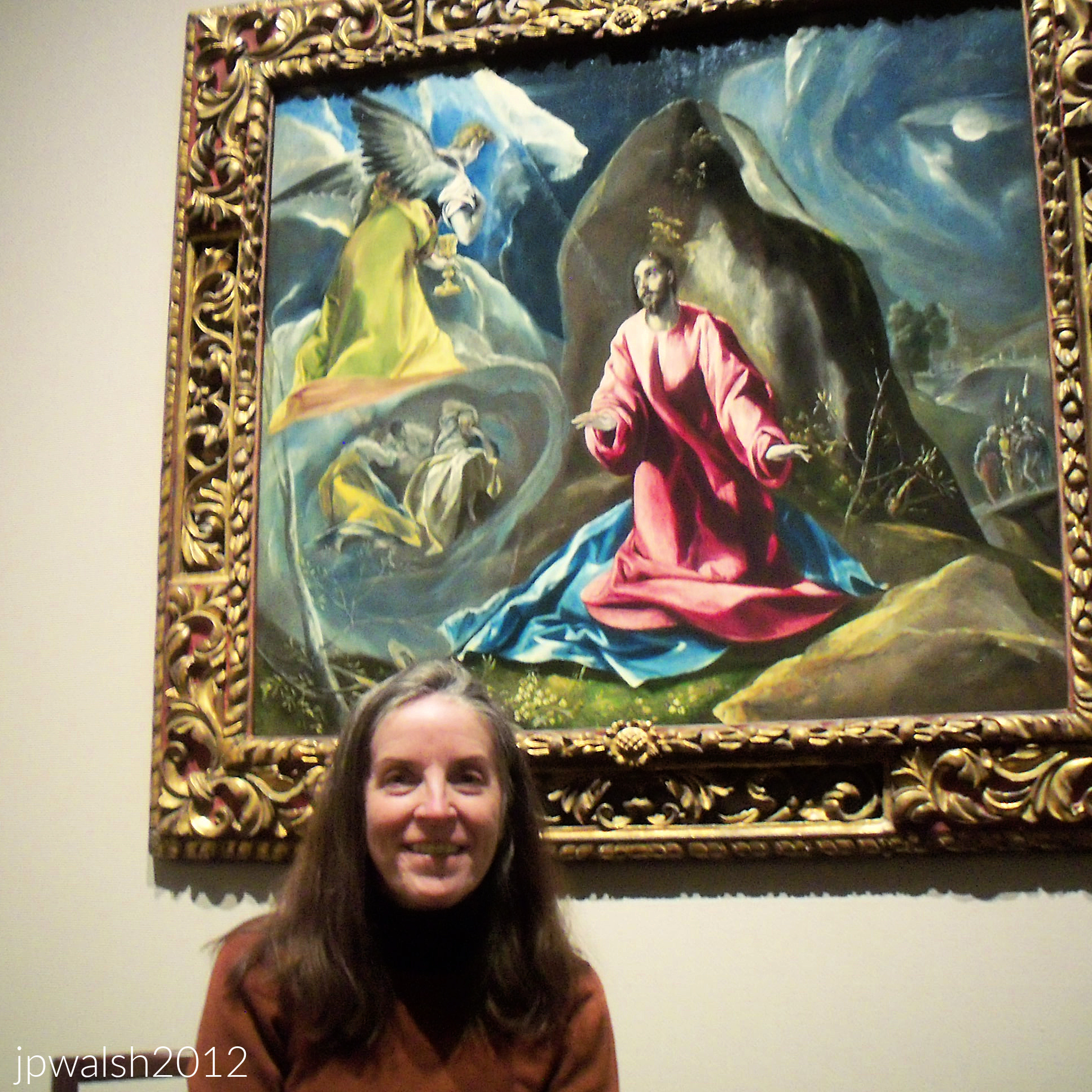
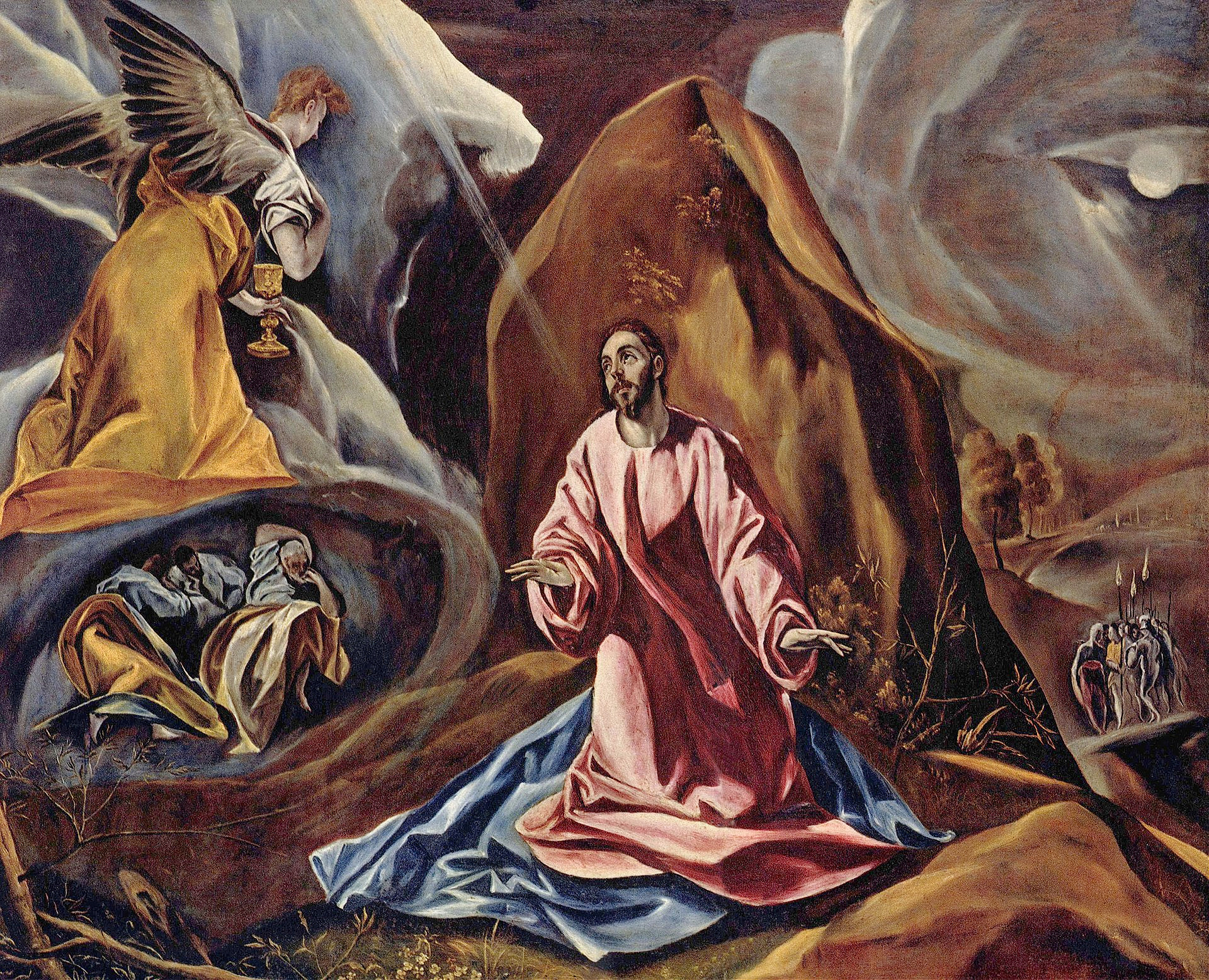
The Agony in the Garden, Domenikos Theotokopoulos, called El Greco, c. 1590-1595, oil on canvas, 40 1/4 x 44 3/4 in. (102.2 x 113.7 cm) Toledo Museum of Art, Gallery 15.November 2012 .1.32mb 101_0977.
From the museum label: With his intensely personal style, El Greco (“the Greek”) is one of the most original artistic visionaries of any era. Born Doménikos Theotókopoulos on the Greek island of Crete, he trained in Venice and Rome before settling in Toledo, Spain, where he painted this picture. Jesus is shown praying in the Garden of Gethsemane, outside Jerusalem, just before his arrest for his teachings (Judas and the Roman soldiers are approaching at the right). His disciples Peter, James, and John sleep at left. The consciously manipulated scale of the elongated figures, the intentionally jarring colors, and the deliberately confusing space (where exactly is the angel in relationship to the sleeping apostles?) add to the drama and emotion of the scene and capture Christ’s spiritual struggle as he agonizes over his coming crucifixion. Combining aspects from all four biblical accounts of the narrative for his own interpretation of the story, El Greco gives visual form to Christ’s metaphor in Matthew 26:42—”Oh my Father, if this cup may not pass away from me, except I drink it, thy will be done.” see – The Agony in the Garden – Search el greco (Objects) – Search – eMuseum – retrieved December 10, 2025.
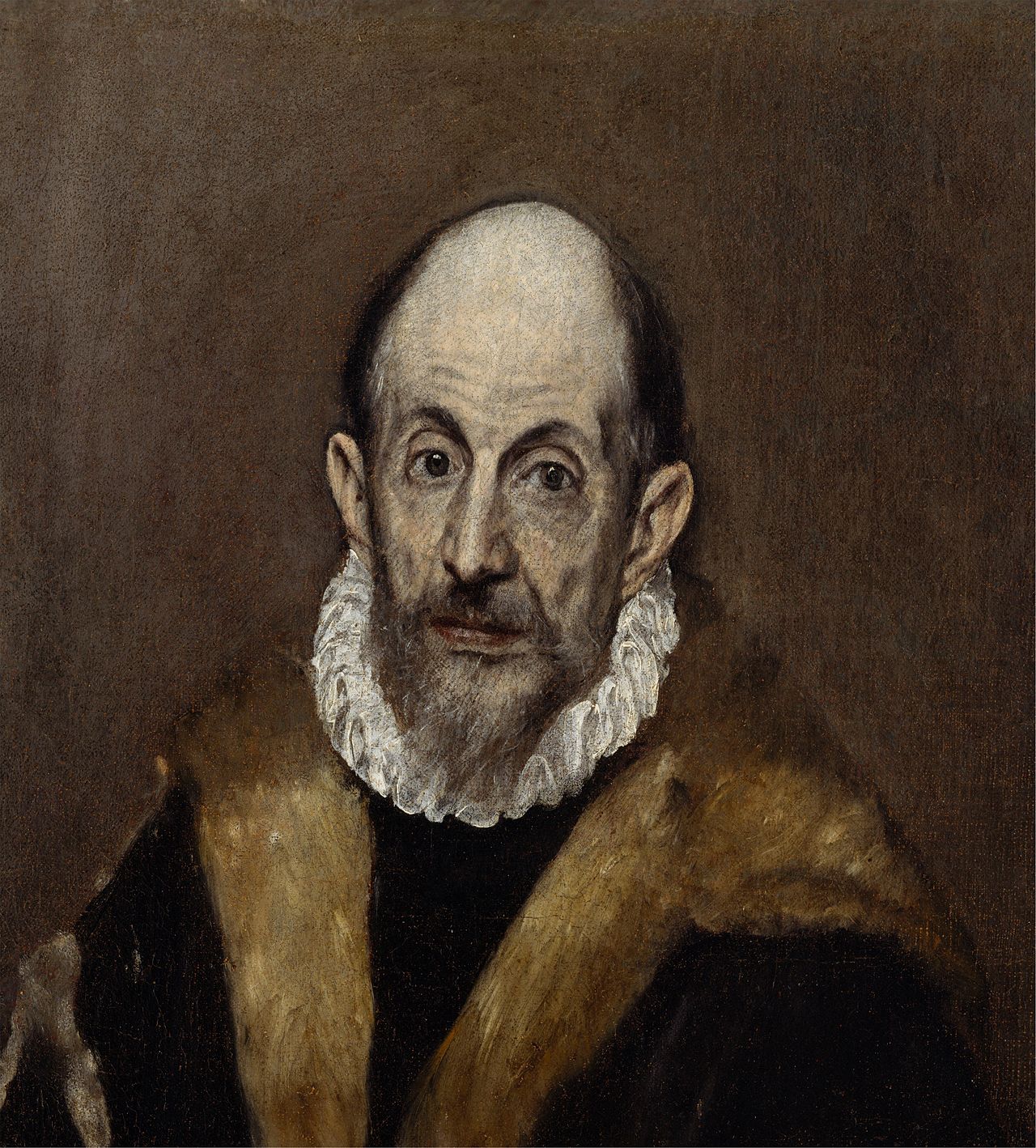
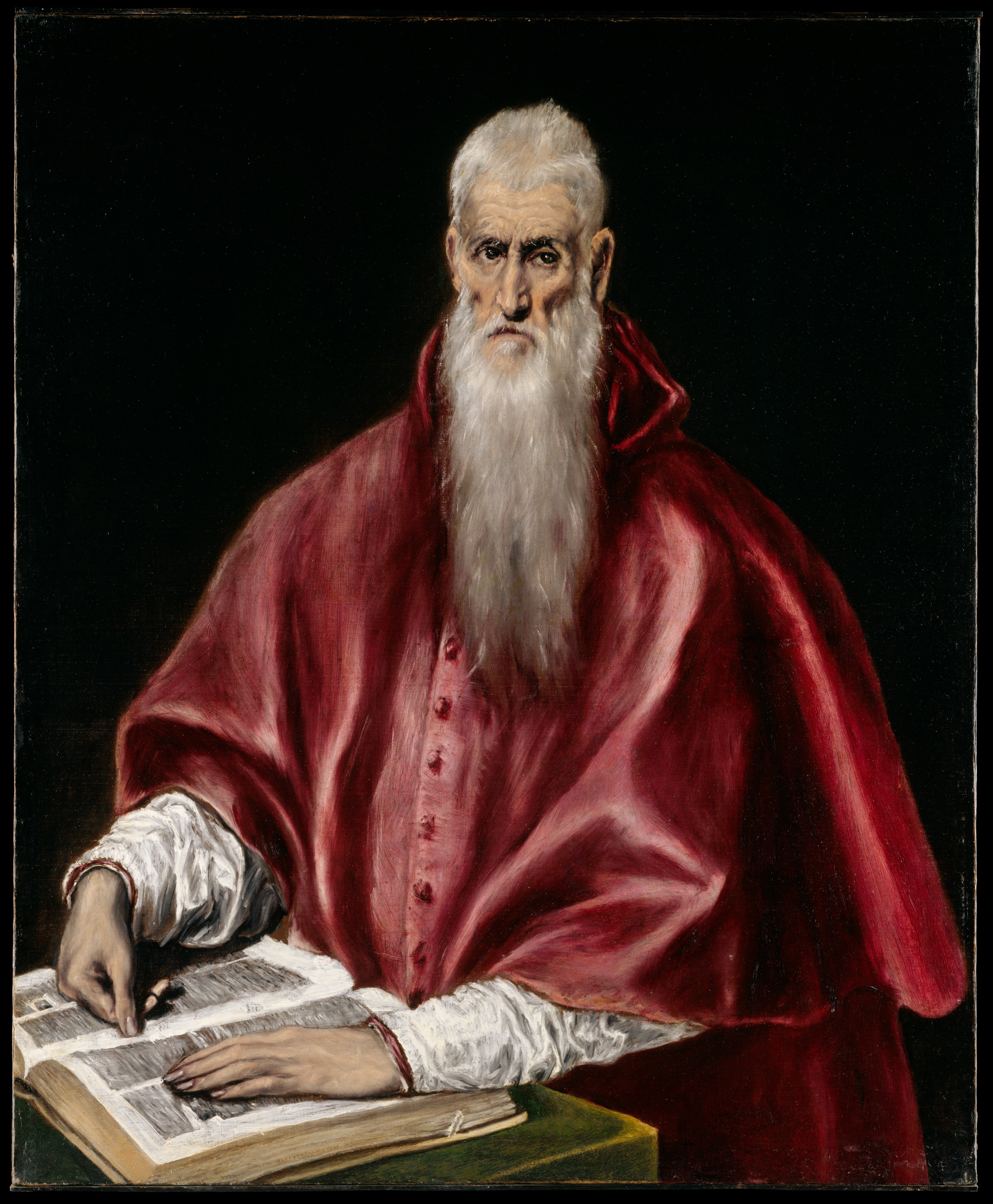
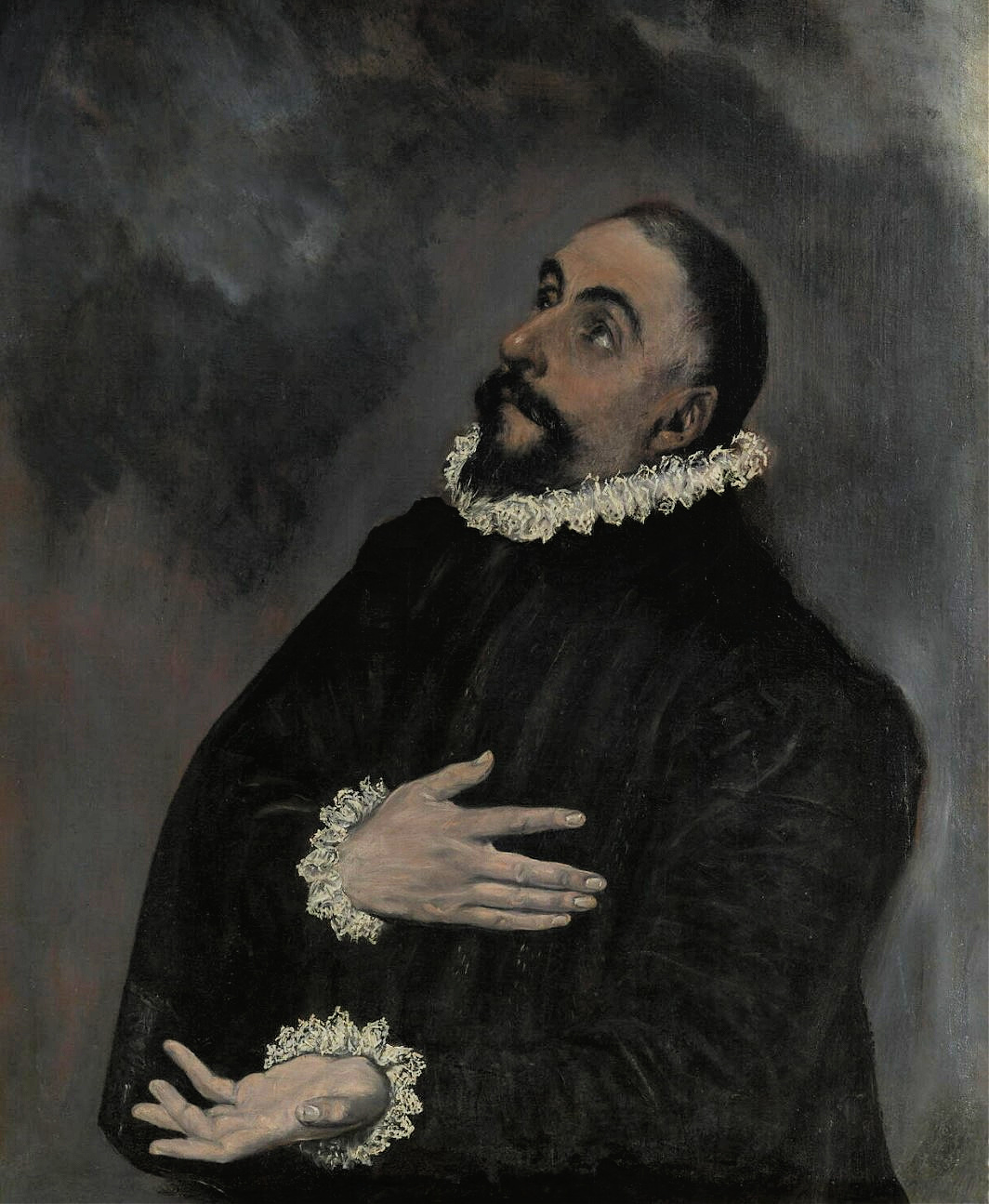
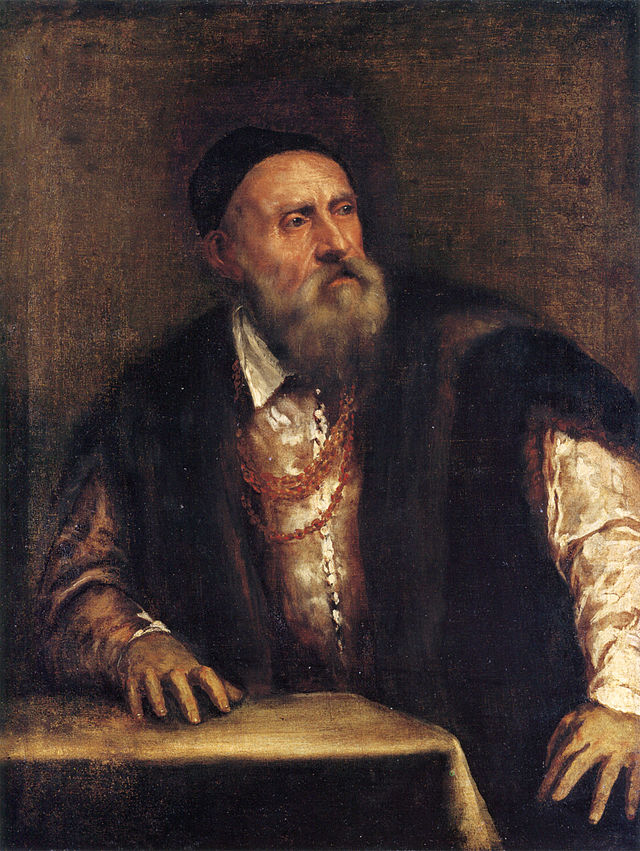
El Greco (Domenikos Theotokopoulos), Self-Portrait or Portrait of an Old Man, oil on canvas, 52.7 cm × 46.7 cm (20.7 in × 18.4 in), The Metropolitian Museum of Art, New York.
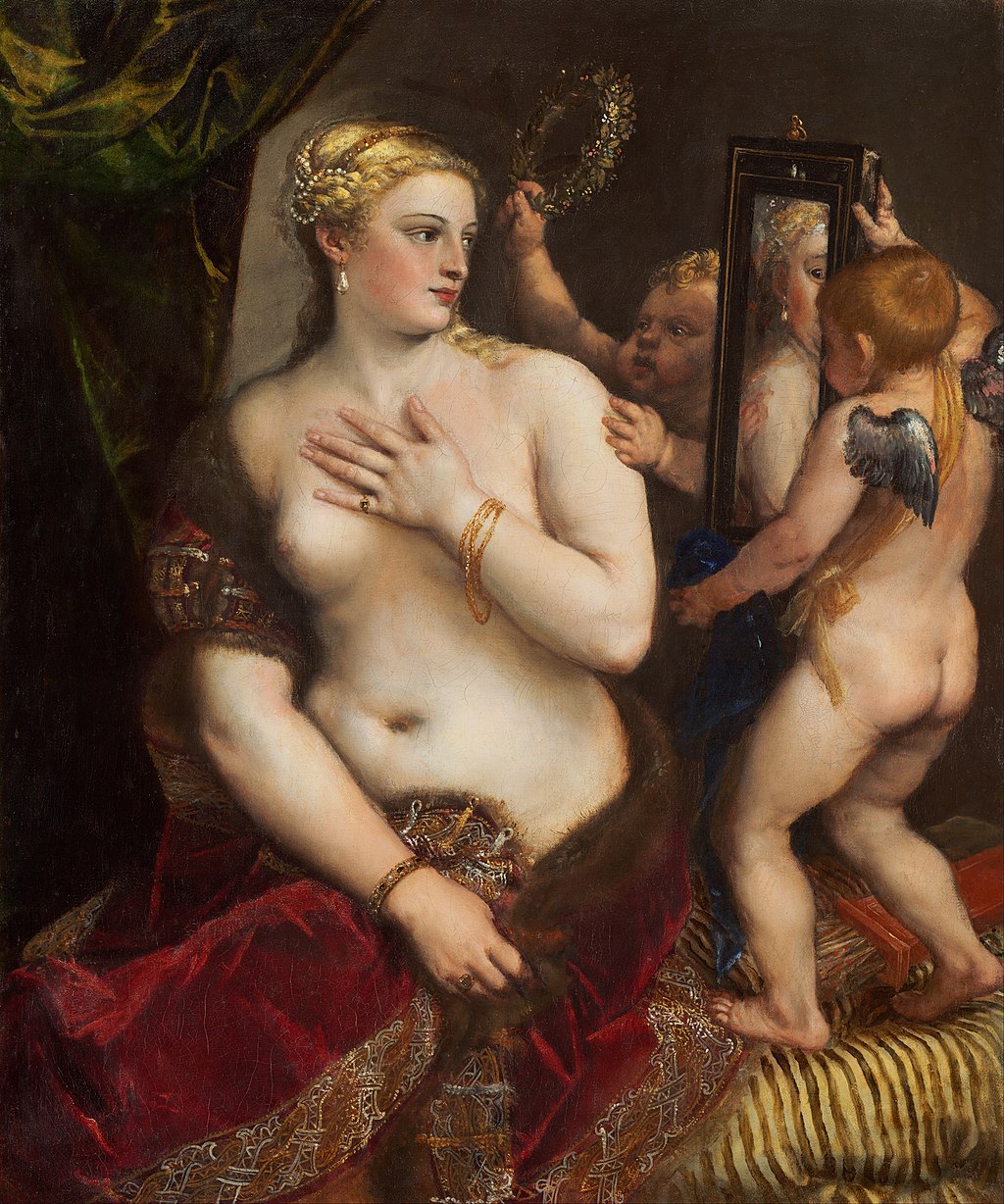
Usually identified as a self-portrait, it is supported by the fact that the same figure appears several times in El Greco’s oeuvre and ages alongside the artist. The portrait shows the influence of Titian (1489-1576) and Tintoretto (c.1518-1594) whose artwork El Greco saw in Venice.
THE ARTWORKS:
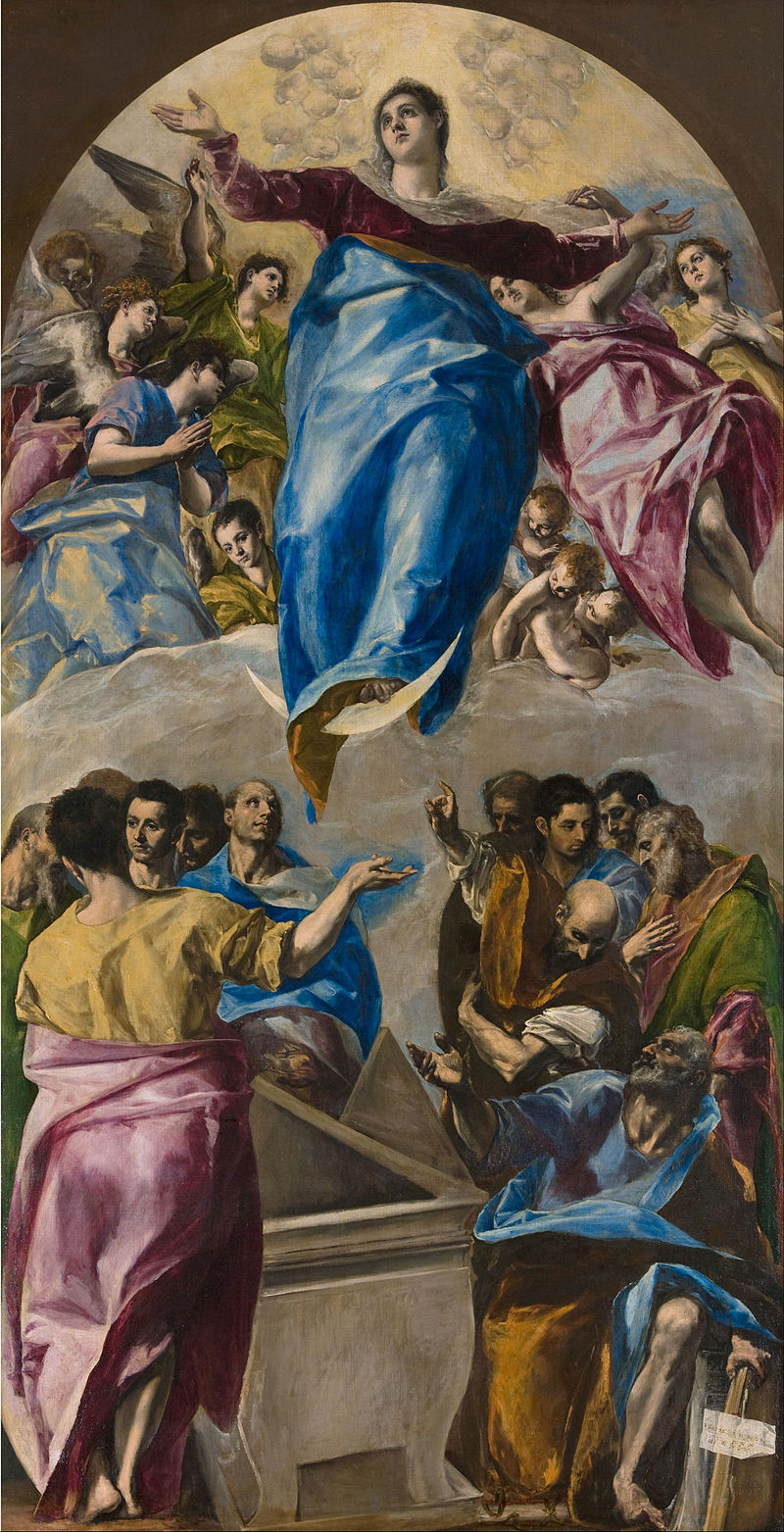
El Greco, The Assumption of the Virgin (Church of Santo Domingo el Antiguo, Toledo, Spain), 1577-79, The Art Institute of Chicago.
Part of an altar ensemble, Assumption of the Virgin is 13 feet high and 7 feet 6 inches wide. In the painting there are two principal groups – the Virgin and angels above and, below, the 12 apostles and an empty sarcophagus. It was the first major commission for El Greco for the Bernadine Convent Santo Domingo el Antiguo in Toledo, Spain. It was in the funerary chapel of Doña María de Silva. El Greco in Spain is first recorded on July 2, 1577 (Toledo Museum of Art, El Greco of Toledo, (exhibition catalog), Boston: Little, Brown and Company, 1982, p.16). On August 8, 1577 a contract was made for the main altar series which included The Assumption of the Virgin. El Greco agreed to complete the project in twenty months for a payment of 1500 ducats. The artist signed and dated The Assumption in 1577 and was paid in full in 1578. The painting was installed in September 1579 and remained in the church for the next almost 250 years. (Ibid., p 152; Wood, James, AIC – Essential Guide, Chicago, 2003, p.131). In 1827 The Assumption of the Virgin was purchased by Infante Don Sebastián Gabriel de Borbón (“S.G.”). An inventory of S.G.’s estate lists The Assumption as #26, one of only two sixteenth century Spanish paintings in his collection of more than 200 works. The listing reads: “Otro en id de 14 pies y 5 pulgadas de alto por 8 pies y 3 pulgadas de cnaho. Su asunto, la Ascension de la Virgen, y los Apóstoles, alrededor de Sepulcro. Esta restaurado por Bueno. Tiene marco tallado y dorado…Dominico Greco.” [“Another in dimension (ideación) of 14 feet and 5 inches high by 8 feet and 3 inches wide. Its subject, the Assumption of the Virgin, and the Apostles, around the sepulcher. It was restored on the up and up. It has carved and gilt markings.” – my translation.] (Agueda, Mercedes, “La colección de pinturas del infante Don Sebastián Gabriel,” Boletín del Museo de Prado, iii/8 (1982), pp.103 and 106; 102-17; American Art News, Jan. 7, 1905, Vol. III, p.1.; Toledo Museum of Art, El Greco of Toledo, p.153). In 1837 S.G.’s collection of paintings was confiscated because of his political (pro-Carlist) activities.Along with pictures acquired from the suppression of the religious orders during the Napoleonic occupation (1800-12) his collection of paintings (including presumably #26 in his 1835 inventory) was exhibited at the Museo de la Trinidad. (Boletín, p. 103; Groveart.com, “Borbón y Braganza, Don Infante Sebastián Gabriel.”) S.G.’s property was returned to him shortly before his death in 1875. The Prado describes events until 1902 like this: “La colección…a la muerte del Infante…fue nuevamente exhibida en publico por sus herederos con motivo de una venta realizada en Pau en 1876, añadiéndose al núcleo primitivo de la colección la parte correspondiente llevada al matrimonio por su segunda esposa, Ma Cristina de Borbón. En 1890, su hijo Pedro pone en venta en el Hotel Druot de Paris parte de la colección y unos años más tarde se hace lo mismo en Madrid, bajo el nombre de la Infanta Maria Cristina. De las tres ventas sucesivas 1876, 1890 y 1902 se desprende como los colecciónistas fueron despojando del conjunto todo lo que podriamos llamar grandes piezas…”[… the collection at the death of the Infante was exhibited anew in public in a sale held in Pau in 1876 for the benefit of his heirs. Adding itself to the primitive nucleus of the collection was that respective part brought to the marriage by his second wife, Mrs. Cristina de Borbón. In 1890, her son Pedro put up for sale at the Hotel Druot in Paris another part of the collection and some years later did the same thing in Madrid under the name of the Infanta Maria Cristina. From these three successive sales of 1876, 1890 and 1902 the collectors were divesting themselves of whatever would be called the great pieces…” – my translation]. It is not yet clear at which of these three sales if any The Assumption of the Virgin found itself. What remained after the final sale in 1902 stayed in the possession of Borbón heirs. (Boletín, p. 104). In January 1905 The Assumption of the Virgin was purchased by Durand-Ruel and exhibited in his Paris gallery. (American Art News, Jan. 7, 1905, vol. III, p.1). Durand-Ruel had purchased it from the Spanish Bourbon family into whose possession it came in 1811. The painting was being exhibited at the Prado when Durand-Ruel purchased it in January 1905. Durand-Ruel was dealing in other El Grecos around that time such as acquiring his Laocoön in 1910 and selling it to Paul Cassirer in Berlin by October 1915 (today it is in the National Gallery of Art in Washington, D.C.). On July 17, 1906, The Assumption of the Virgin was purchased by The Art Institute of Chicago for 200,000ff from Durand-Ruel in Paris. This purchase for an American museum reflected the daring and independent judgment of its purchasers. The painting had always been praised as the artist’s most beautiful and was considered a homage to Titian’s composition in the Church of Santa Maria Gloriosa dei Frari in Venice while also expressing Roman monumentality. (Horowitz, Helen L., Culture and the City: Cultural Philanthropy in Chicago from the 1880s to 1917, Lexington: The University Press of Kentucky, 1976, p. 101; The Art Institute Chicago 28th Annual Report, June 1, 1906-June 1, 1907, pp.20 and 59; Toledo Museum of Art, El Greco of Toledo, p.153). In February 1915 Mrs. Nancy Atwood Sprague, widow of Art Institute of Chicago Trustee Arnold Sprague, gave $50,000 to defray the artwork’s purchase expenses. From the very beginning this El Greco painting was considered the Museum’s most important acquisition of the year and called the greatest work of El Greco outside Spain. (Chicago Art Institute Bulletin, Mar. 1, 1915, p. 34).
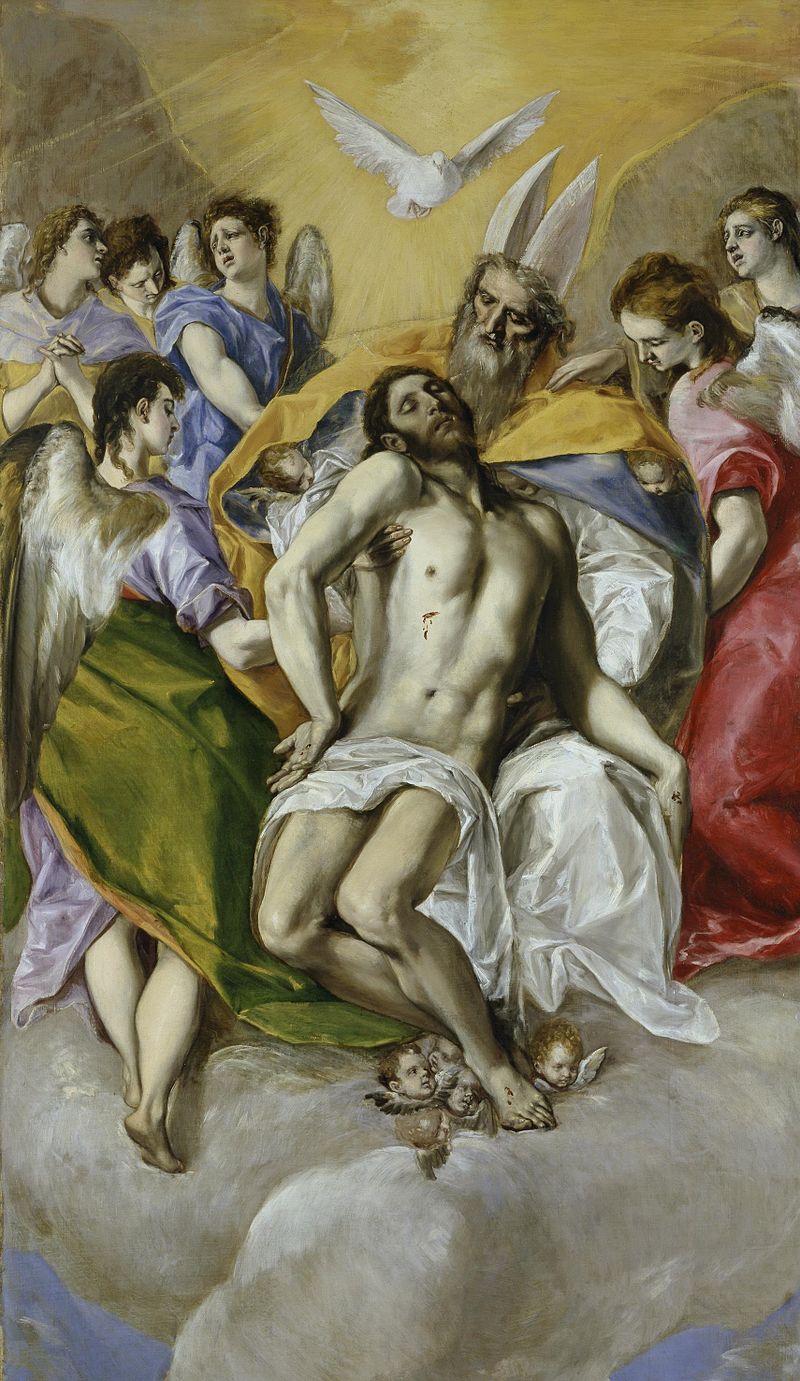
El Greco (Domenikos Theotokopoulos), The Holy Trinity,1577–1579, 300 x 178 cm, oil on canvas, Museo del Prado, Madrid, Spain.
The painting of the Holy Trinity was part of the altar ensemble for El Greco’s first major commission. It was above The Assumptionof the Virgin with God the Father holding the dead Christ surrounded by angels and a white dove hovering above signifying the Holy Spirit.
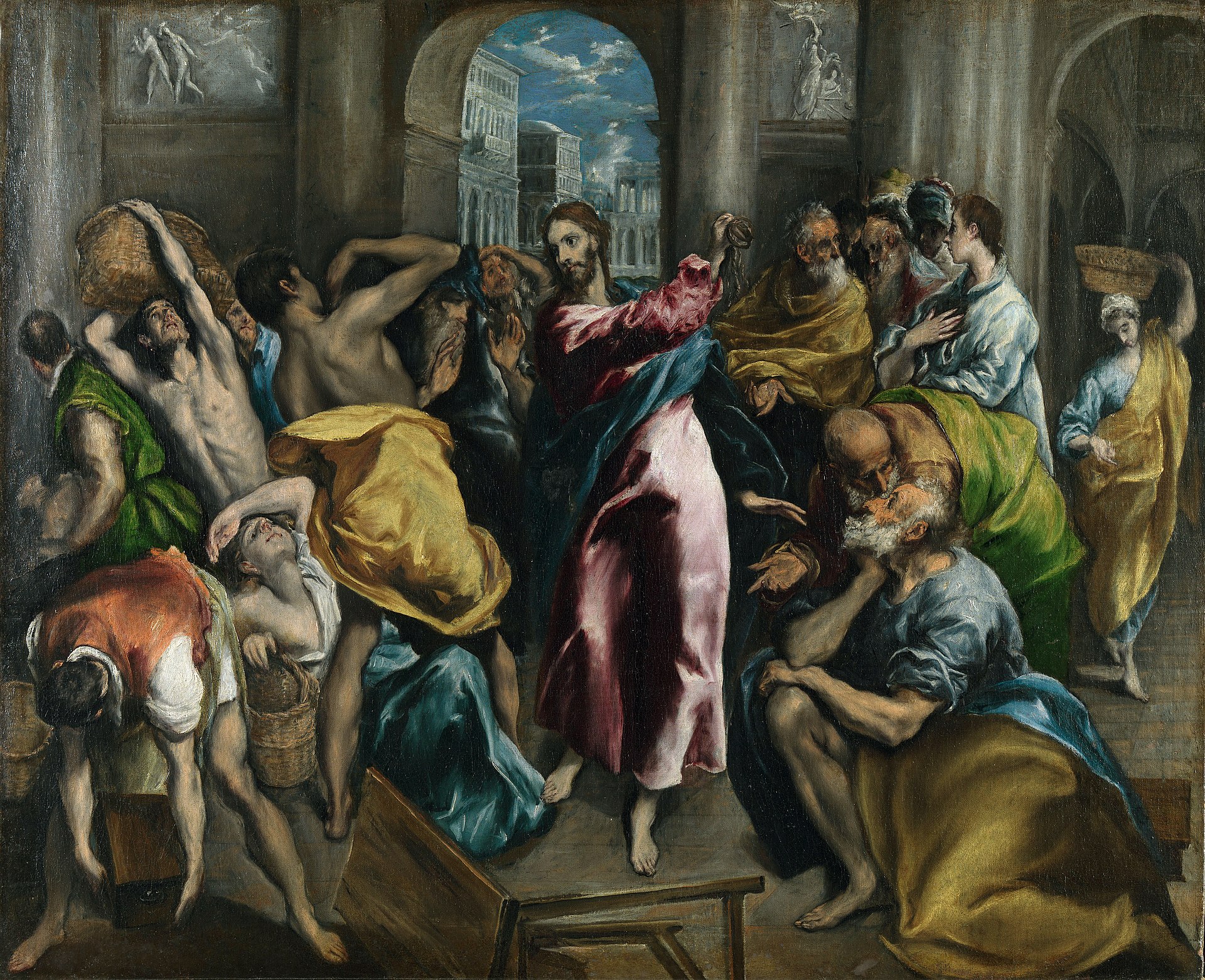
El Greco painted this episode of the Purification of the Temple many times, a story that appears in all four Gospels. The artist used intense colors and exaggerated gestures to express the chaos and disruption of the moment when Jesus Christ, angry that the temple was being used for sinful commerce and not prayer, makes a whip and uses it to drive out the traders selling animals for sacrifice. In the upper left corner is a painted sculpture of the expulsion of Adam and Eve from the Garden by the Angel of God reinforcing the message of sinfulness in the trader’s actions in the scene. At right in contrast, Christ’s apostles stand beneath a painted relief sculpture of faithful Abraham. The story of the Purification of the Temple told in Chapter 2 of John’s Gospel relates: “…Jesus went up to Jerusalem. He found in the temple area those who sold oxen, sheep, and doves, as well as the money-changers seated there. He made a whip out of cords and drove them all out of the temple area, with the sheep and oxen, and spilled the coins of the money-changers and overturned their tables, and to those who sold doves he said, ‘Take these out of here, and stop making my Father’s house a marketplace.'” El Greco painted Christ’s body energetically twisted with his right arm raised and ready to strike the man draped in yellow cloth he is gazing at. The man in yellow mirrors Christ’s pose as he recoils, arching his back and raising his hand to protect himself. The figures behind him lean in the same direction backwards to avoid being struck in the melée. The painting shows El Greco’s debt to Renaissance art such as Titian and Michelangelo (1475-1564) whose artwork El Greco studied during his travels to Venice and Rome. The figures behind Christ are much calmer. The gray-bearded man with his hand on his knee looking up in a yellow and blue costume is identified as Simon Peter. While the foreground setting suggests a grand columned one that is only partially seen, the buildings in the background with their arched arcades were likely inspired by architecture El Greco saw in Venice in 1568.
Cathedral, Toledo. Metropolitan. Philadelphia Museum of Art. Church of San Tomé, ToledoPrado. Museum of San Vicente, Toledo. National Gallery of Art, Washington, D.C.El Greco, Saint Martin of Tours and the Beggar, 1597-1599, oil on canvas, 193.5 × 103 cm (76 3/16 × 40 9/16 in.), National Gallery of Art, Washington, D.C. https://www.nga.gov/collection/art-object-page.1164.html – retrieved November 11, 2024.
The painting was commissioned by Martín Ramírez for the Chapel of San José in Toledo, Spain. El Greco painted miracles as matter of fact. St. Martin and The Beggar depicts a scene from a low vantage point looking up to a monumental knight sharing his cloak with an attenuated, nearly otherworldly figure of a naked beggar. St. Martin of Tours (d.397), part of the Imperial Calvary stationed near Amiens during the times of Roman Emperor Constantine, sits mounted on a magnificent white Arabian steed and is dressed in stylishly practical soldier regalia from head to foot signifying his noble role and power to survey this emerald green landscape that is Toledo and the Tagus river. Martin’s green cloak is one part of his regalia but, on a cold autumn or winter day, his heart burns to divide it with his sword so to share it with this naked bandaged stranger he meets on the road. The encounter and action are modest and profound simultaneously– a typical social setting yet not merely transactional within a rigidly conceived social order but a tender act of charity. Martin rode off with his half cloak and thought of his soldierly duties. Yet it afforded a miracle. That night, tradition relates, Christ appeared to Martin in a dream revealing that the beggar the knoght shared his cloak with was Him.
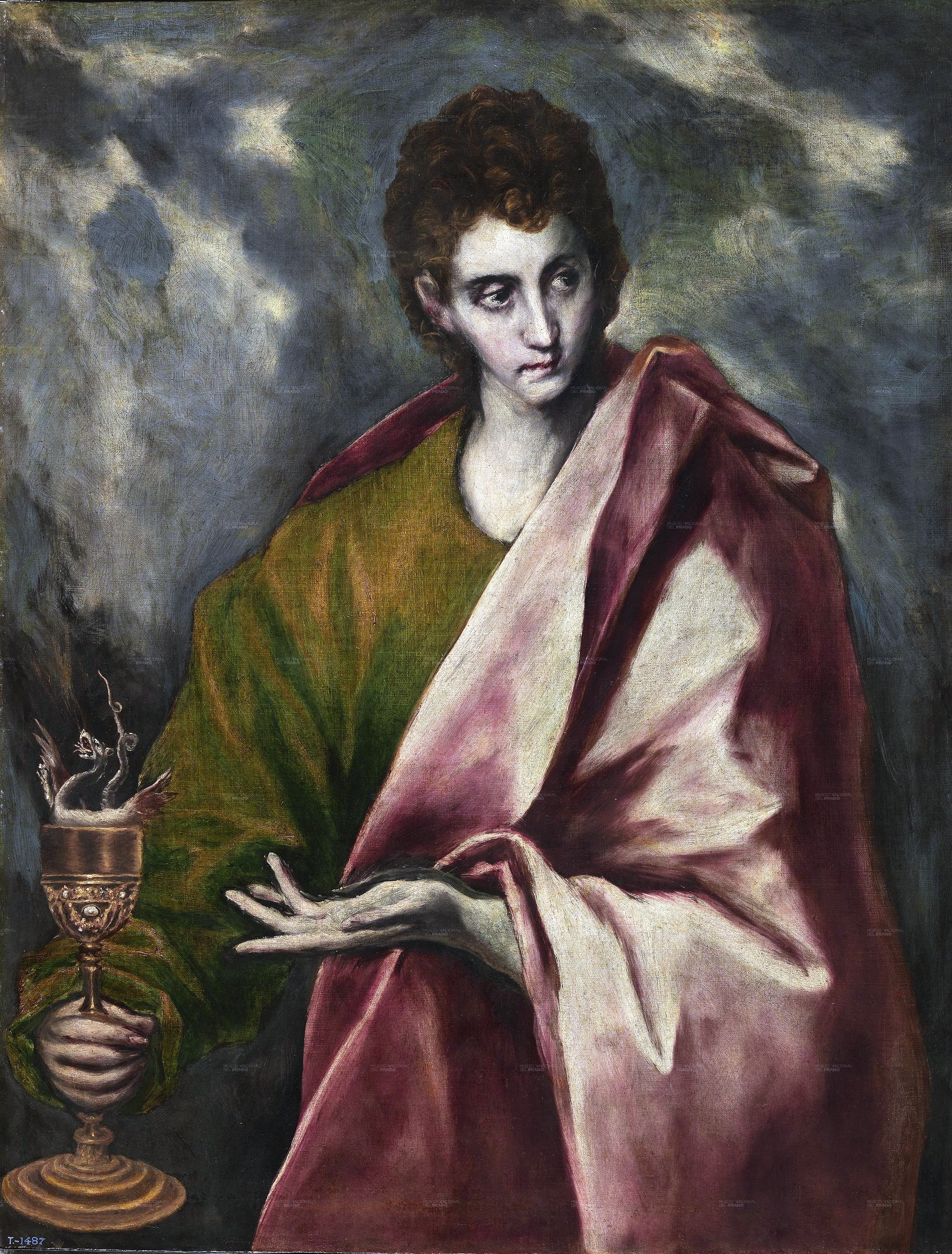
This painting shows St. John the Evangelist in a half-figure which has a clear precedent in the Venetian school where El Greco completed his training. Crete, where El Greco was born, was a Venetian possession. El Greco arrived to Venice as a teenager in the late 1550s or early 1560s where he worked with Titian (c. 1490-1576) but became the admirer and heir of Tintoretto (c. 1518-1594). El Greco, who studied icon painting in Crete, learned the medium of oil from its virtuoso Titian, but once in Venice, El Greco quite normally was attracted to Tintoretto, the city’s then-modern master. “The Greek” did not simply imitate Tintoretto’s exterior forms but very personally emulated his deeply spiritual and expressive Mannerism. In this later painting, El Greco depicts the tradition that John the Evangelist was in Rome when the Emperor Domitian (51-96) tried to assassinate Jesus of Nazareth’s young apostle by poisoning the wine in his Mass chalice. But the legend relates that the poison turned into a fabulous serpent tipping off John and his holy companions and doing them no harm. Like Lorenzo Lotto (c. 1480-1556), El Greco depicts this story’s externals surrounding John – be it the heavy chalice, poisonous serpent exorcised from it, or the expressive hands of the apostle holding the cup of sacrifice and motioning towards it – to scrutinize the inner conviction or character of the sitter, the young author of the Johannine corpus of a gospel, three letters, and the book of Revelation. On John’s Gospel Cornelius à Lapide (1567-1637) wrote that the Evangelist was indeed the eagle (inspired by a description in Ezekiel) who soars skyward and swoops down to earth for his prey. John wrote the last canonical gospel in 99 with combatting that day’s Christian heresies in mind, specifically those that denied Christ’s divinity – whom in his epistles he called “anti-Christs.” John conveys sacred ideas with a rusticity of style. The 17th century theologian and biblical scholar Cornelius à Lapide affirmed that “John was most like Christ” and that the disciple loved the master supremely and the master held the disciple most dear. Because of the relationship of Jesus and John, the biblical scholar claimed, “when you read and hear John [in his gospel, letters, and book of Revelation] think that you read and hear Christ.” He quotes St. Jerome who claimed that Christ transfused his own spirit and his own love including “the purest streams of Jesus Christ’s Doctrines” into Saint John. This relationship is signaled by John’s reclining on the breast of Christ at the Last Supper. John, now in old age, was pressed by all the bishops in Asia and many others to write a “breakthrough” account claiming of the deepest things of the Divinity of the savior. John agreed with the condition that the whole church fast before he embarked on the project and when the fast ended John began: “In the beginning was the Word, and the Word was with God, and the Word was God. 2He was in the beginning with God. 3All things came to be through him, and without him nothing came to be.” Nothing is stronger to attest to the origin, eternity, and generation of the divinity of the Christ. John wrote in the Greek language because he was addressing Greeks but, again according to Cornelius à Lapide, the gospel is filled with Hebrew phrases and idioms because St. John was a Hebrew who loved his native language. Though John relates Jesus’s miracles as proof that Christ was the Messiah, God as well as man – including the singular accounts of the changing water to wine at the wedding feast of Cana (chapter 2) and the raising of Lazarus from the dead (chapter 11) – John less relates actions of Christ as found in the synoptics Matthew, Mark, and L uke who focused on his humanity and much more of the discourses and disputations that Christ had with the Jews (mostly its rulers), again with none other than the same purpose to prove his theology meant for the whole world that Christ was “God as well as man.” In John’s gospel a careful examination of contexts needs to occur because Christ speaks sometimes as man and sometimes as God. Its high theology which dealt with the inspiration of the Holy Spirit, unity of the Godhead, and divine relations and attributes became that gospel in the next centuries that the bishops referenced to combat their day’s heresies such as Arianism (which denied Christ’s Divinity), the Docetists (who denied Christ’s humanity), and Nestorians (who denied Christ’s dual natures). John had favorite terms and ideas he repeated in his gospel – calling Christ “the Life” and “the Light.” Calling saints “the children of light.” Calling sin “darkness.”
Metropolitan.Museum of Fine Arts, Boston. Prado. Greco Museum, Toledo. Hospital of San Juan Bautista, ToledoGreco Museum, Toledo. Greco Museum Toledo.Metropolitan.National Gallery London.National Gallery of Art, Washington, D.C.
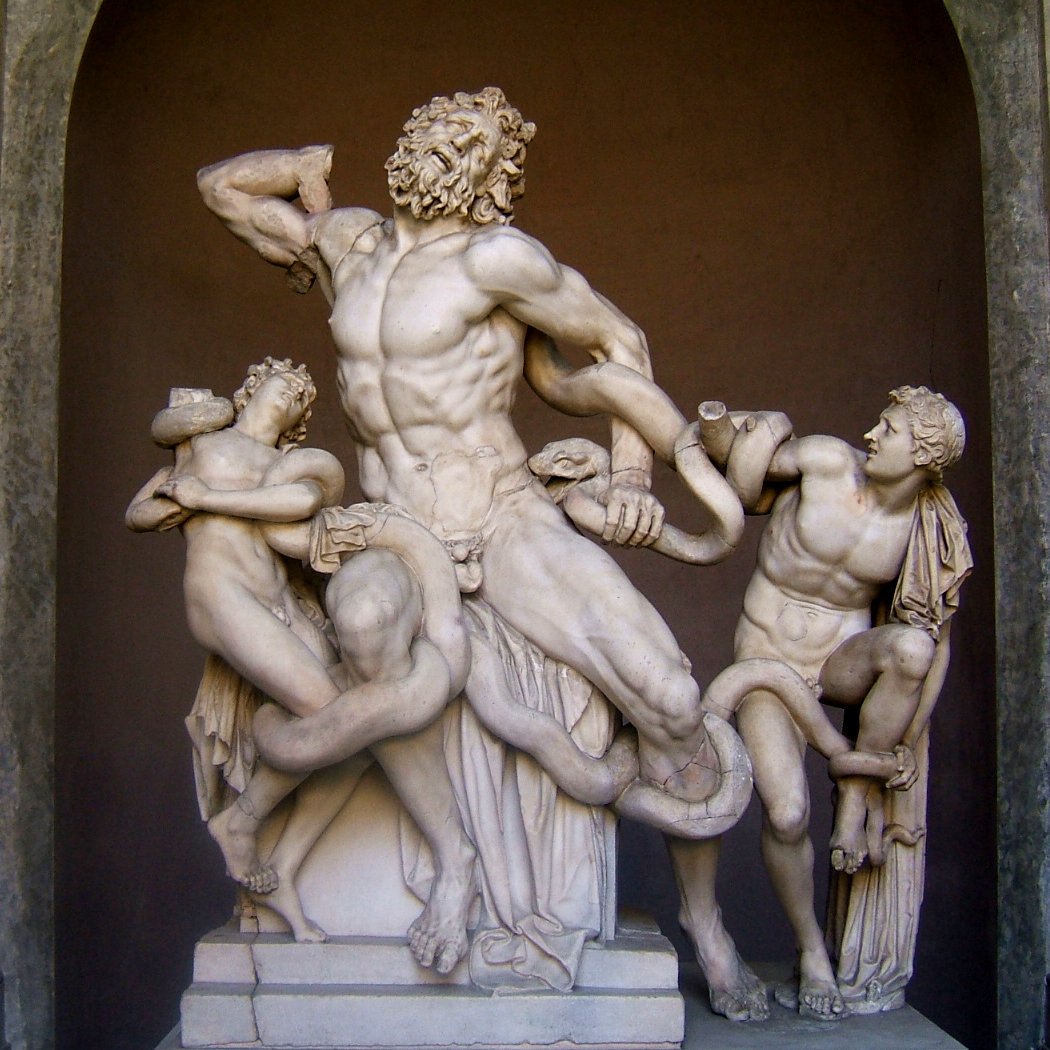
As mentioned in the feature image caption, Laocoön is a Trojan priest in Greek and Roman mythology who warned the Trojans to destroy the Trojan Horse sent by the Athenians by which they won the war. “I fear the Greeks even when they bear gifts,” he told them (see Edith Hamilton, Mythology, p. 285). Laocoön and his two sons are punished for revealing this truth by the gods. They are attacked by giant serpents sent out of the sea by Apollo and Artemis that bit and crushed them to death and then slithered away into Athena’s Temple in the city. The Trojans, instead of heeding their priest’s warning and seeing his death for what it was — the punishment for telling them the truth of the danger of the Trojan Horse — viewed it as warning not to question the entry of the monumental wooden horse into the city. They pulled it in, set it in front of Athena’s Temple, and went to their homes believing they had won a peace that had not happened in ten years. El Greco set the artwork outside Toledo giving the ancient tale a contemporary context and unique interpretation. Though Laocoön and his two sons’ fates are sealed, the artist captures a unified centrifugal movement with individualized figures in bare-faced struggle after exercising their prudential judgment that is witnessed by dispassionate onlookers as if in a dream.
Laocoön and His Sons, 1st CE?, marble, 242 cm high, Vatican Museums, Vatican City. The classical marble sculpture was unearthed in 1506 and housed in the Belvedere in the Vatican. Its discovery aroused great excitement in the Renaissancce art world and numerous copies were made. El Greco’s painted extrapolation was taking this passion of classical suffering to the level of one’s own modern synthetic invention where the colorful sensation of upheaval is dynamic. “Laocoön and His Sons” by JuanMa is licensed under CC BY-SA 3.0.Metropolitan.
SOURCES:
El Greco, Leo Bronstein, Harry N. Abrams, Inc. New York, 1990. El Greco of Toledo, Jonathan Brown, William B. Jordan, Richard L. Kagan, Alfonso E. Perez Sanchez, Little, Brown, Boston. 1982. El Greco, David Davies, National Gallery Company, London, 2003. Mythology Timeless Tales of Gods and Heroes, Edith Hamilton, Grand Central Publishing, New York and Boston (originally published in 1942).
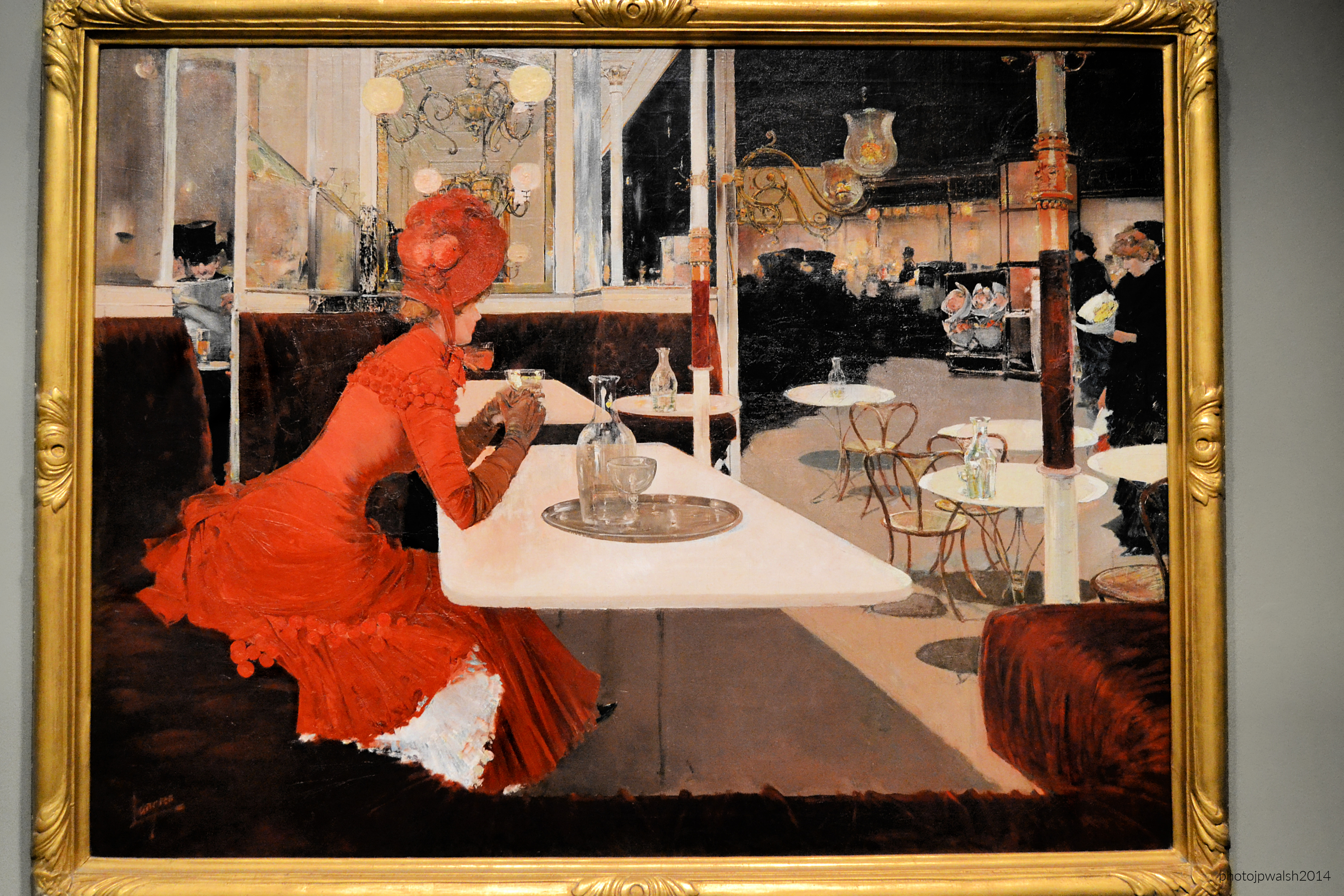
FEATURE Image: Fernand Harvey Lungren (1857-1932), The Café, 1882/84, oil on canvas. The Art Institute of Chicago. 9/2014.
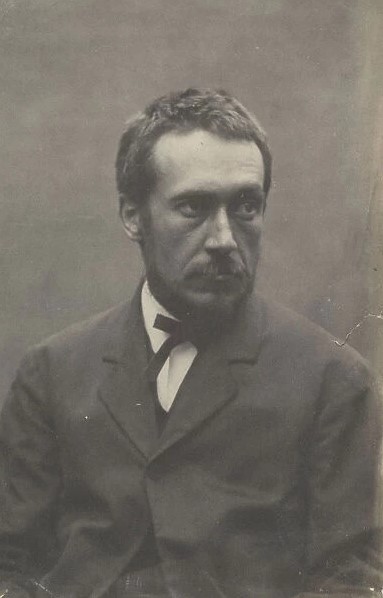
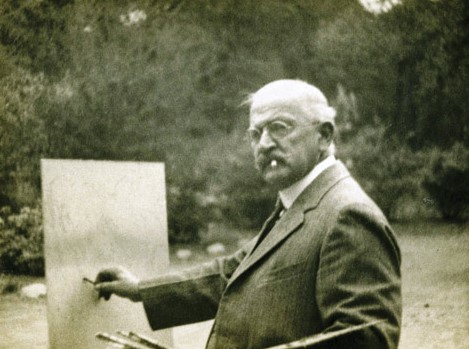
Fernand Lungren, not dated, c. 1900.
The artist, born in Sweden, moved with his family to Toledo, Ohio, as a child. Lungren wanted to be an artist but his father objected, wanting him to be a mining engineer. For a brief time, in 1874, Lungren attended the University of Michigan at Ann Arbor to study his father’s preferred subject. But after two years—Lungren’s father still opposed to his son being an artist— saw the younger Lungren rebel and prevail. In 1876 Lungren was able to study under Thomas Eakins (1844-1916) at the Pennsylvania Academy in Philadelphia and had Robert Frederick Blum (1857-1903), Alfred Laurens Brennan (1853-1921) and Joseph Pennell (1857-1926) as fellow students.
Thomas Eakins, self-portrait, c. 1880. The 19-year-old Lungren studied under Eakins at the Pennsyvania Academy in Philadelphia.
In winter 1877 the 20-year-old Lungren moved to New York City. With his first illustration published in 1879, he worked as an illustrator for Scribner’s Monthly (renamed Century in 1881) as well as for Nicholas (a children’s magazine) and as a contributor until 1903. He later worked for Harper’s Bazaar, McClure’s and The Outlook. Lungren’s illustrations included portraits, and social and street scenes.
Paris in the 1880’s. Lungren was largely disappointed by his visit to Paris from June 1882 to December 1883 when he returned to New York.
In June 1882 Lungren sailed to Paris via Antwerp with a group of artists. In an 18-month stay in Paris he studied informally for two months at the Académie Julian, and viewed the latest French Impressionist artworks. He found his artistic purpose in Paris in direct observation and spent the balance of his time studying Parisian street scenes in the manner of the “new painting.”
Fernand Harvey Lungren (1857-1932), The Café, 1882/84, Dixon Gallery and Gardens, Memphis, Tennessee. Lungren depicts two women sitting at a dining table. The models and dresses share affinities with The Café from the same period. The cafe setting offered a myriad of elements to express modernity. La France Élégante et Paris Élégant Réunis 1882. Fernand Harvey Lungren (1857-1932), The Café, 1882/84, oil on canvas. The Art Institute of Chicago. 9/2014. Lungren paid special attention to the image presented by a woman in the details of her fashion from her hat with pom-poms, the size of her bustle, and even her shawl. Further, the bright electric lights above the woman’s head illustrate the intense competition and innovation of the late 1870’s and 1880’s in developing and marketing functional incandescent lamps. The contrast they provide to the dimmer gaslamps also depicted in the painting by Lungren are remarkable. The Café, 1882/84, (detail). The architectural space of the café opens the street. The figure on the right holds a bouquet of yellow flowers while a coachman in the background is reflected by the light of a shop window with a carriage moving to the left.
Lungren returned to New York City in 1883 and, soon afterwards, established a studio in Cincinnati, Ohio. Sponsored by the Santa Fe Railroad which wished to commission images of the Southwest to entice eastern tourists, Lungren made his first excursions west in the early 1890s. In 1892 he visited Santa Fe, New Mexico for the first time and, in the following years painted artworks inspired by his contact with American Indian culture and the desert landscape. This was the start of his lifelong association with American West and Southwest. In 1899 he showed these American desert works at the American Art Galleries in New York and afterwards at the Royal Academy in London and the Walker Art Gallery in Liverpool.
Fernand Harvey Lungren (1857-1932), Canyon de Chelly oil on canvas 18 3 /16 x 36″, c. 1903-1906. AD&A Museum, Santa Barbara, CA.
When Lungren was in London he made pictures of street life and met several artists, including James Abbott McNeill Whistler (1834-1903). In late 1900 Lungren traveled to Egypt with American pharmaceutical entrepreneur Henry Solomon Wellcome (1853-1936) and returned to New York via London in the next year. Lungren had married Henrietta Whipple in 1898 and they eventually moved to California in 1903, settling in Mission Canyon above Santa Barbara in 1906.
Theodore Roosevelt in 1906. The U.S. president and conservationist was one of the admirers of Lungren’s artwork. Fernand Harvey Lungren (1857-1932), Afterglow: Painted Desert oil on canvas 25 1/4 x 45 in.; framed: 29 3/4 x 49 3/4 x 2 in. AD&A Museum
Lungren lived and work in California—including several notable trips to Death Valley starting in 1909 —until his death in 1932. After Lungren’s wife died in 1917, the artist helped found the Santa Barbara School of the Arts in 1920 and remained on its board until his death in 1932. He became a charter member of the Santa Barbara Art League and executed two works for dioramas at the Santa Barbara Museum of Natural History. Most of Lungren’s artwork, including hundreds of his paintings (some 300 works), were bestowed to Santa Barbara State Teachers College, which became the University of California, Santa Barbara, and are part of the University Art Museum
Lungren in later life.
SOURCES:
J.A. Berger, Fernand Lungren: A Biography, Santa Barbara, 1936.
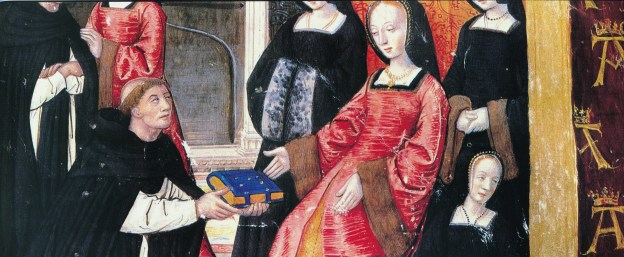
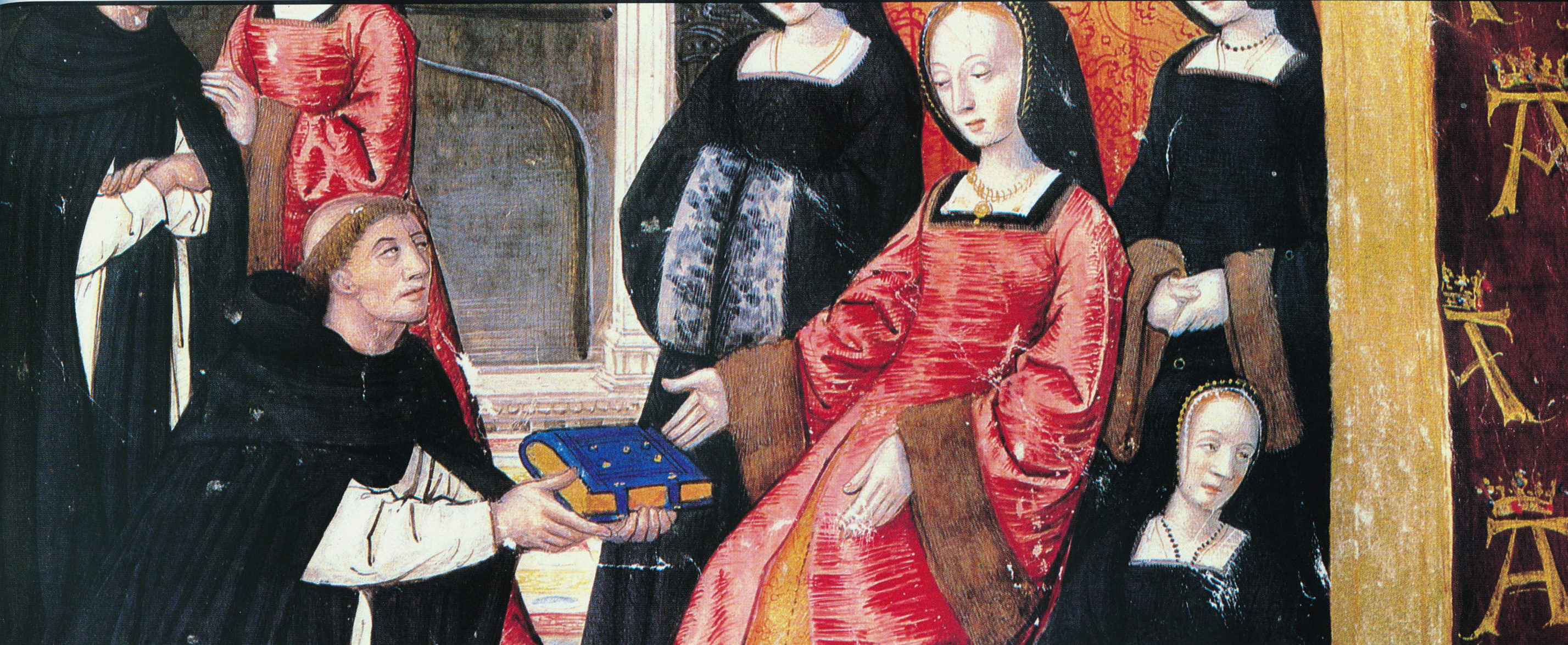
FEATURED image: Manuscript 16th century (detail): Queen consort Anne of Brittany (1477-1514) receiving a Book of Hours from her Dominican confessor, Antoine Dufour (d.1509). Montfort L’Amaury returned to the crown of France after Anne of Brittany married Charles VIII “the Affable” (1470-1498) in 1491.
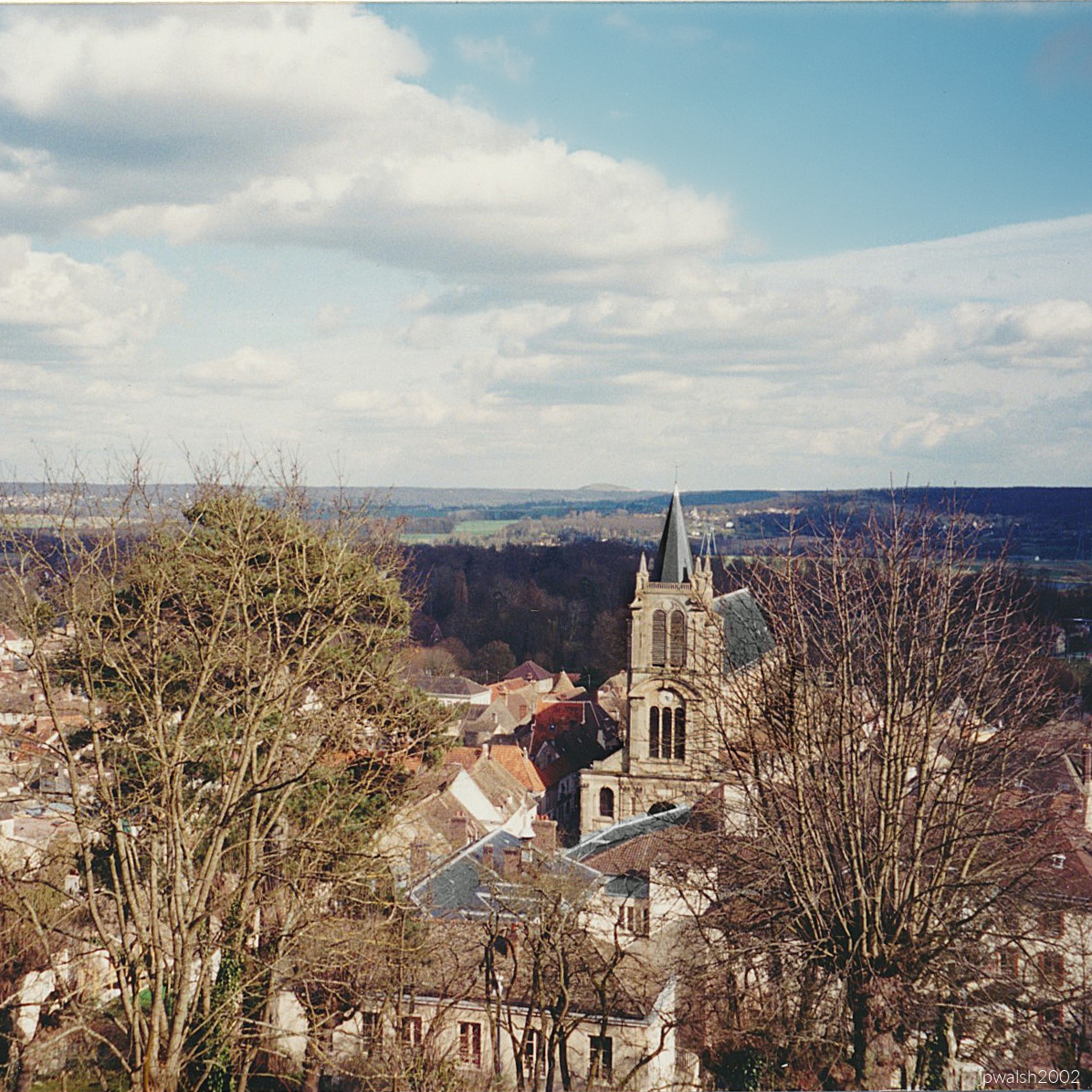
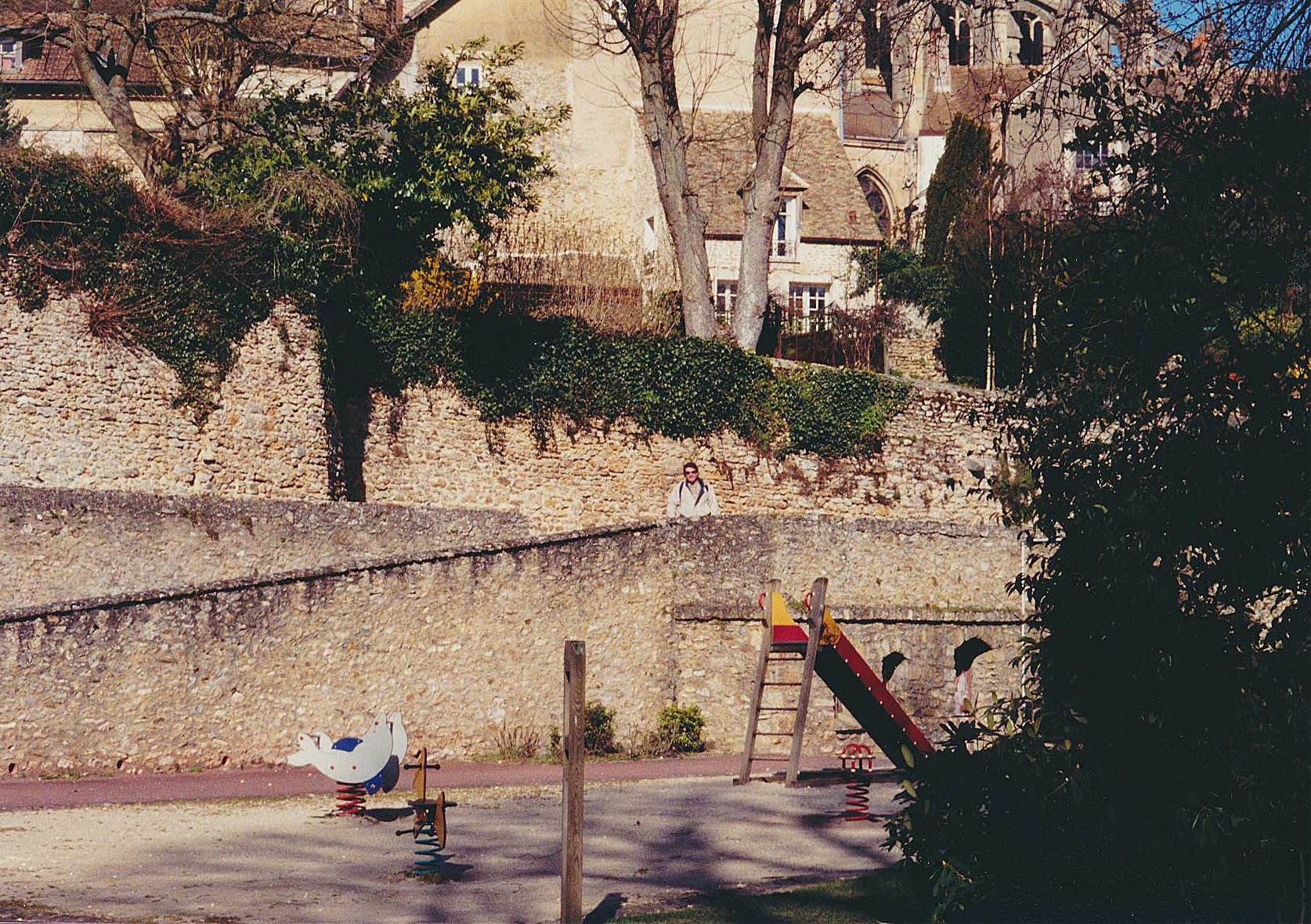
Started in the 11th century, L’Église St. Pierre anchors part of the centre ville of Montfort L’Amaury, a town in France about 30 miles west of Paris. The photograph is taken from the ruins of the chateau on the town’s heights. The late 10th century Frankish king Robert II built a castle in the hills of Montfort. From the start of the 11th century, Montfort-l’Amaury was the stronghold of the Montfort family. Author’s photograph.
At the north edge of the Rambouillet forest the city of Montfort L’Amaury spreads along the restored ruins of its ancient fortified castle. Founded under the Capetian kings, the city owes its fame to Simon de Montfort (1208-1265), Anne de Bretagne (1477-1514), the Valois royal dynasty, and Henry IV (1553-1610). Its monuments begin in the 11th century, stretch towards exceptional Renaissance stained-glass windows and half-timbered houses as its civilization has attracted writers, artists, and musicians to live there. This would include the house of Maurice Ravel (1875-1937) called Le Belvédère where he lived from 1921 until his death and where we were invited to sit at, and play, the piano where Ravel composed Boléro. It was in March 2002 during a visit to Paris and the Île-de France that we ventured through Yvelines by train to Montfort-L’Amaury for a day trip which included a memorable déjeuner in a restaurant that has since disappeared.
Interior, L’Église Saint-Pierre (Church of St. Peter), late 15th century, Montfort L’Amaury, France. Author’s photograph.
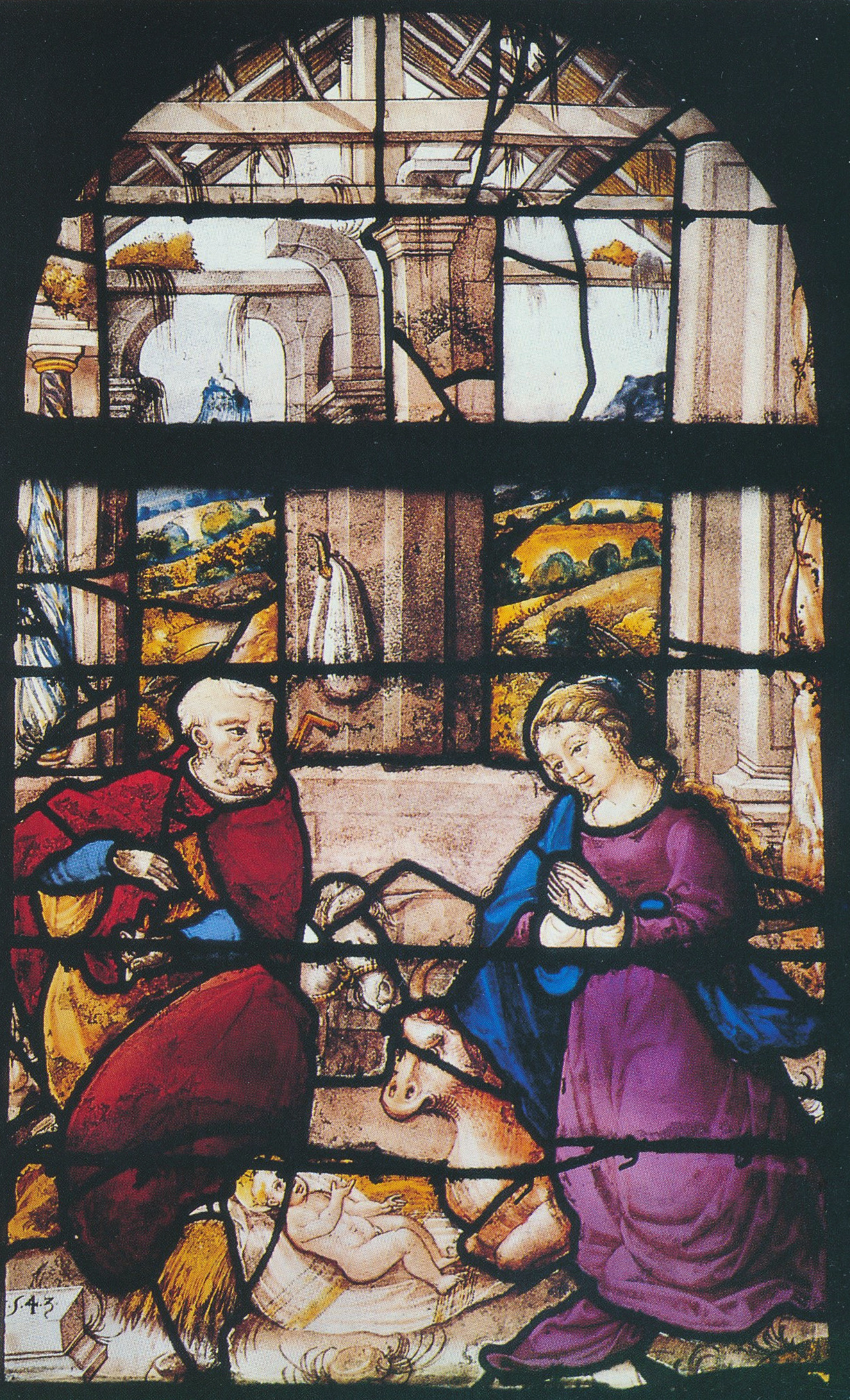
The interior of Saint Pierre church is bright and intimate. Like other French monuments, today’s Saint-Pierre was completed over many centuries. Its origin is in the 11th century. A notable reconstruction of the edifice began in the late 15th century by initiative of Queen Consort, Anne of Bretagne. There is a vast ambulatory around both sides of the nave. Since 1840, the church has been an historic monument because of its unique ensemble of 37 stained glass windows. The oldest date from the 1540s and 1570s. The others were installed in the late16th century. That ecclesial project was started by Catherine de Medicis (1519-1589) in 1562. The windows were installed during the time of the Council of Trent (1545-1563) and some of the glass commemorates that event. As none of the glasswork is signed, it is not known whether its painters are from Montfort L’Amaury or elsewhere.
St. Peter Window. L’Église Saint-Pierre, Montfort L’Amaury, France. Throughout France starting in the 1540s there was a growing taste and demand for stained glass windows in their local churches. The experimentation in glasswork and painting by the middle of the 16th century allowed for the iconography in these stained glass windows to express numerous details and refined techniques. Public Domain.Detail. St. Peter Window. Public Domain.Detail. Nativity Window. Public Domain.The south exterior of L’Église Saint-Pierre along Rue de Dion in Montfort L’Amaury. The exterior wall shows flying buttresses designed in the French Renaissance style as well as gargoyles that were sculpted in the late 15th century. The building is constructed of calcified stone that came from towns to the north, precisely, Maule, and a more distant Vernon on the Seine. The interior ambulatory that surrounds the nave on both sides and ends at the chevet expresses the building’s gothic aspect. Street lamps and a narrow street with tight parking has room for a small tree next to the church. Author’s photograph.Montfort L’Amaury has half-timbered houses dating to the 16th century. This is no. 16, Place de la Libération, just steps from the front entrance of Église St. Pierre. At the beginning of October 1825 young Victor Hugo (1802-1885) lived in Montfort L’Amaury for a few days. He wrote a letter to his father in Paris and described it as “a charming little town ten leagues from Paris, where there are ruins, woods, and one of my friends…” Author’s photograph.Portrait de Victor Hugo sur fond de Notre-Dame de Reims, Jean Alaux, 1825, Maison de Victor Hugo – Hauteville House, oil on cardboard. Public Domain. https://www.parismuseescollections.paris.fr/fr/maison-de-victor-hugo/oeuvres/portrait-de-victor-hugo-sur-fond-de-notre-dame-de-reimsView of the church from the east. The church of Saint Pierre is of late gothic origin. It was rebuilt and decorated in the 15th, 16th, and early 17th centuries. Following the French Revolution and its aftermath, the church building received an extensive restoration in the mid19th century, including a new steeple. Except for one stained glass window that was restored in situ, all the 16th-century stained glass windows were taken out, restored, and reinstalled by a master painter in Metz between 1851 and 1857. Author’s photograph.Chevet. L’Église Saint-Pierre. Public Domain.On Saint Pierre’s front stoop is busy Place de la Libération and with Rue de la Libération just beyond. At the end of the street is the rounded 16th century La Porte Bardoul, one of gateways to the chateau. It was named in the 16th century for the Captain who built the ramparts of Montfort L’Amaury in the 11th century (Hugues Bardoul). Author’s photograph.“Charles Aznavour – Disque D’Or” by Piano Piano! is licensed under CC BY 2.0. Charles Aznavour (1924-2018), dubbed France’s Frank Sinatra, never lived in Montfort L’Amaury. For 60 years, the singer lived in Galluis, a neighboring town just 5 minutes by car up the road. Yet, in those many years, Aznavour frequently came to Montfort L’Amaury, sometimes to go shopping or visit friends or eat at one of its excellent restaurants. In 2018 Aznavour was buried in the cemetery in Montfort L’Amaury and has become a pilgrimage site for his many fans.The cemetery at Montfort L’Amaury dates from the sixteenth century and is an interesting site to visit for its history, architecture, and people buried within. As dead bodies were originally buried in the ground as they are today, over the many centuries the bones were later exhumed and deposited in ossuaries. This was essential during epidemics that occurred regularly when ground-space for burials was at a premium for the bodies of the newly dead. Built to give the appearance of a cloister, these galleries are actually a mass grave. Its architecture is charming and conveys the aspect of a Romantic bone-yard. Fair Use. Ruins of the castle of Montfort-l’Amaury. In the foreground is Le Belvédère, the house of Maurice Ravel. Montfort-l’Amaury Donjon by ℍenry Salomé(Jaser !) 08:12, 21 November 2006 (UTC) – Cliché personnel, own work is licensed under CC BY-SA 3.0
The role of Montfort l’Amaury as a town began to develop in the High Middle Ages when Capetian king, Robert II (976-1031), built a castle there in the forest of Yvelines which was then a royal prerogative. William of Hainaut built the castle whose walls were finished around 1050. Hugues Bardoule was captain of the castle and thus a later 16th century gateway is named after him. It is in the 11th century that L’Église Saint-Pierre and L’Église Saint Laurent begin to be built. Robert II was married three times, and excommunicated by the Catholic Church – one of the early examples of French royals who married as they wished.
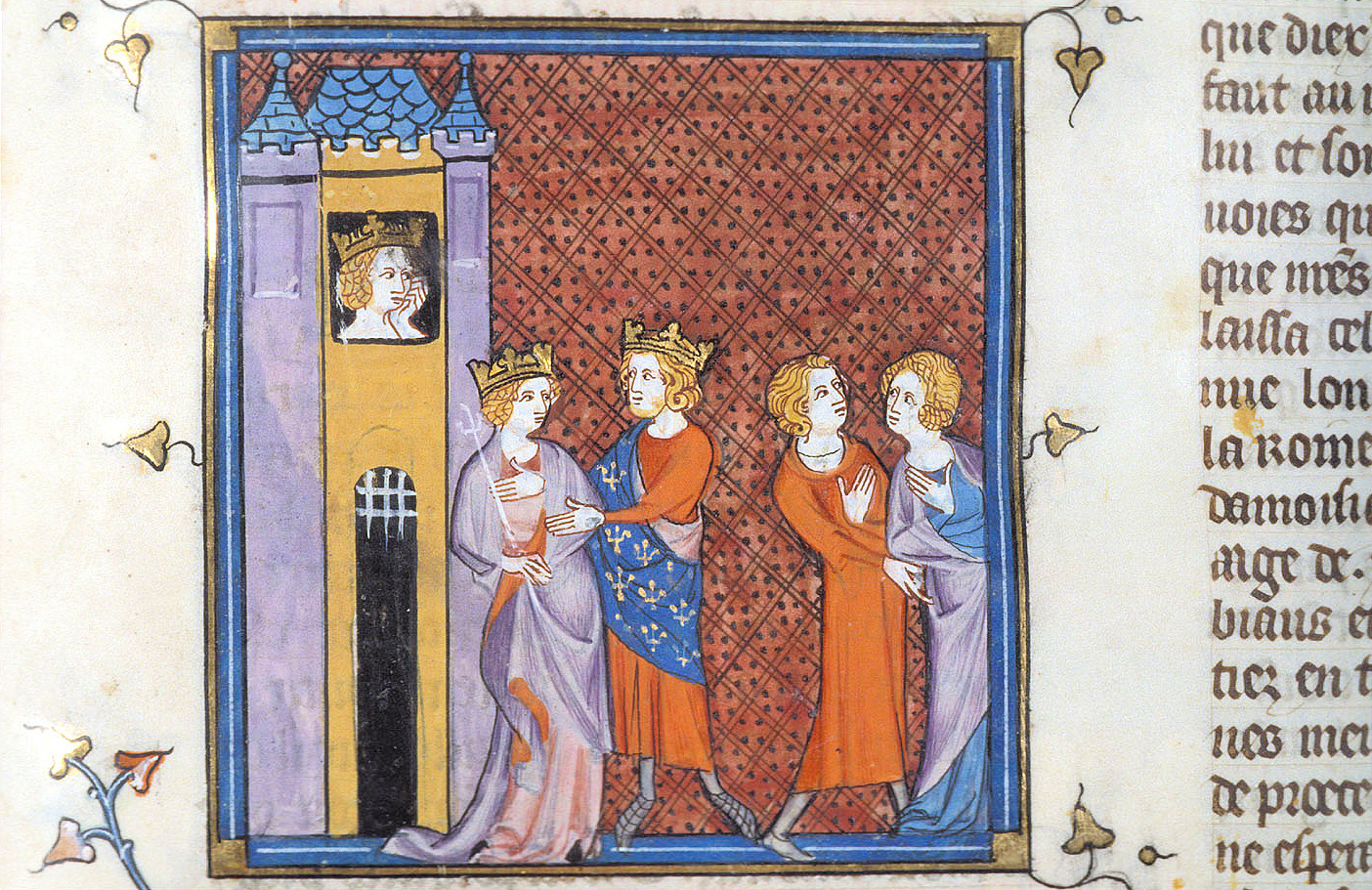
In the twelfth century, Bertrade de Montfort (1070-1117), after giving birth to a boy who would become King of Jerusalem, left her husband, the Duke of Anjou, Fulk IV (1043-1109) in 1092. She married the king of France, Philip I “the Amorous” whose spouse, Bertha of Holland, was also still living.
Philip was so in love with Bertrade that he refused to leave her even when threatened and finally excommunicated by Pope Urban II (1035-1099) in 1095. Because of his excommunication Philip was prevented from taking part in the First Crusade (1096-1099).
Bertrade de Montfort and King Philip I “the Amorous.” Chroniques de Saint-Denis (ou de France), British Library, Royal 16 G VI f. 271. 14th Century (1332-1350). https://www.bl.uk/IllImages/Kslides%5Cbig/K137/K137596.jpgThe ramparts and castle. Author’s photograph.
The ramparts and castle were destroyed by the English during the Hundred Years’ War in the 15th century. After the battle of Agincourt in 1419, the English occupied the French domain and it was during this time that the castle at Montfort was destroyed. The two rebuilt towers were named for Anne of Brittany after she assisted in the castle’s restoration. From this height, the fort overlooked the old Roman road from Beauvais to Chartres.
Also from this place, troops assembled at Montfort L’Amaury in the 12th century as Amaury III raised lords and knights to fight alongside Louis VI (1081-1137) against the Emperor of Germany. Simon IV fought alongside Philippe II Auguste (1165-1223) against the English as well as to the Crusades in the Middle East and the Albigensian Crusade in southern France. The Montforts distinguished themselves especially in this crusade against the Cathars.
At the beginning of the Third Crusade (1189-1192), not wanted by King Philippe Auguste (1165-1223), the future Louis VIII “the Lion” (1187-1226) was looking for companions. Simon IV, Lord of Montfort (1175-1218), embarked on the crusade where victory was equalled by its terror.
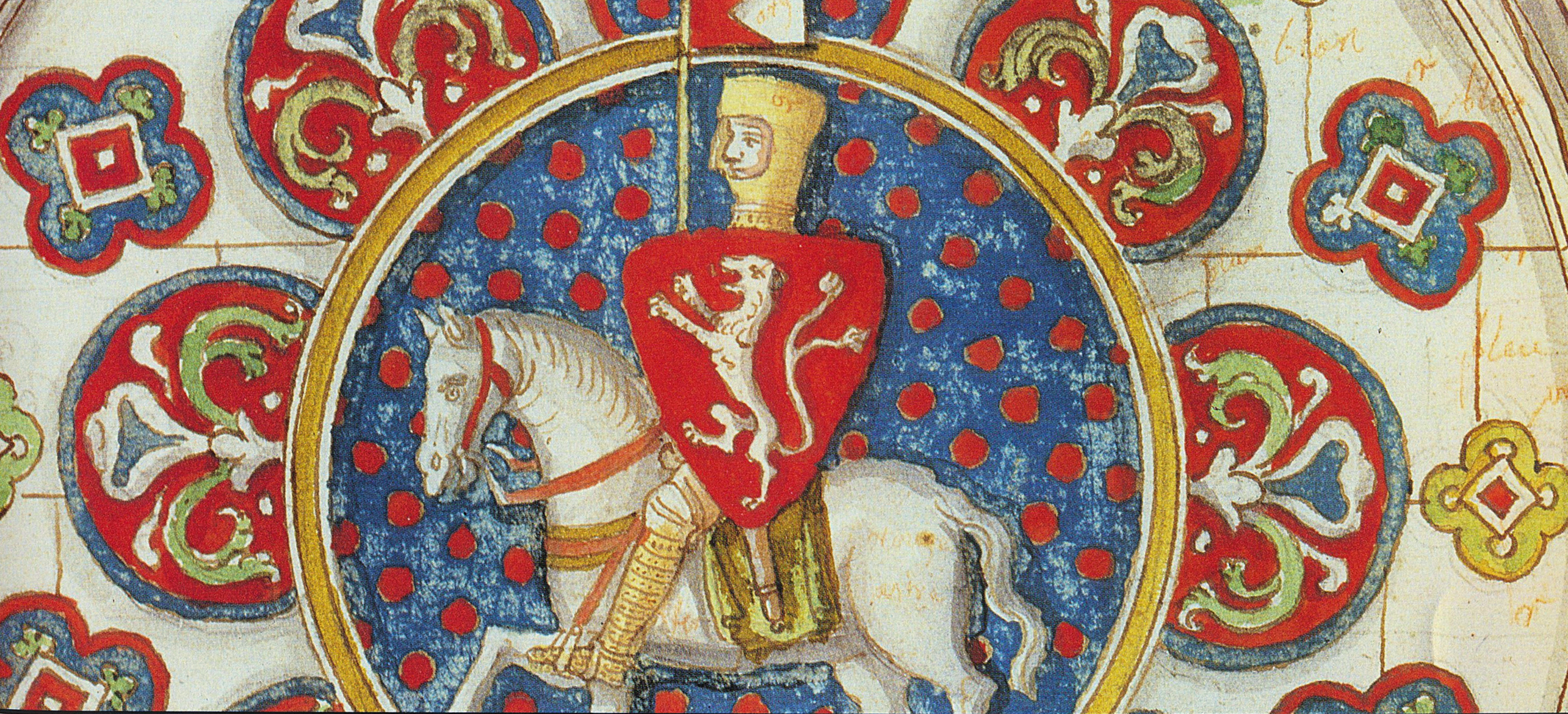
Stained glass (detail) Chartres cathedral: Simon de Montfort V (1208-1265). Simon was born in the chateau in 1208. Whereas his brother Amaury V (1191-1241) inherited his father’s French properties, including in the south of France owing to his father’s Cathar crusade, Simon V is known to history as having a major role in the constitutional development of England where he successfully led the barons’ opposition to the absolute rule of King Henry III (1207-1272) of England. During his rule of England Simon de Montfort V called two famous parliaments, one of which recognized the voices of ordinary town citizens in the affairs of government making him one of the progenitors of modern parliamentary democracy. Public Domain.
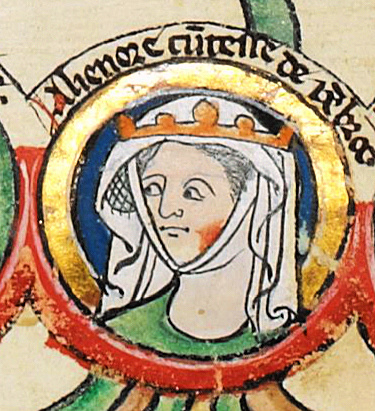
In January 1238, Montfort married Eleanor of England, daughter of King John and Isabella of Angoulême and sister of English King Henry III. While this marriage took place with the king’s approval, the act itself was performed secretly and without consulting the great barons. Eleanor had previously been married and swore a vow of perpetual widowhood after her husband died. This vow was broken when she married Montfort and, for that reason, the Archbishop of Canterbury condemned it. The English nobles protested the marriage of the king’s sister to a foreigner who was only of modest rank. Most notably, Richard, 1st Earl of Cornwell, the king’s and Eleanor’s brother, rose up in revolt over the marriage. King Henry III eventually bought off his brother and peace was restored. The marriage brought property to Montfort and when a child was born of the union in late 1238, he was baptized Henry, in honor of his uncle, the king. In February 1239, Montfort was finally invested as Earl of Leicester where he acted as the king’s advisor and became godfather to Henry’s eldest son, Edward, who became King Edward I (“Longshanks”).
Eleanor of England who married Simon de Montfort V in 1238 in an early-fourteenth-century Genealogical Roll of the Kings of England. Public Domain.The author at the ramparts. These fortifications were originally built over 1000 years ago in the early 11th century by Amaury I. The walls run from east to west creating a superficial size of Montfort at about 4 to 5 hectares (one hectare equals about two and a half acres). Portions of the wall were dismantled during the 100 Years War but rebuilt during the Wars of Religion (1562-1598) as well as Montfort’s reception of a royal charter by Charles IX in the mid16th century. The rebuilt wall had to expand to meet the development of Montfort under Anne de Bretagne a half a century before, though substantial portions of the original 11th century wall were incorporated into the construction. Author’s collection.Manuscript 16th century (detail): Queen consort Anne of Brittany (1477-1514) receiving a Book of Hours from her Dominican confessor, Antoine Dufour (d.1509). Montfort L’Amaury returned to the crown of France after Anne of Brittany married Charles VIII “the Affable” (1470-1498) in 1491.
From Montfort L’Amaury, the lords continued to assist the French kings in the crusades. After John I, only a daughter allowed the continuity of the Montfort family. Beatrice d’Albidon married Robert, Count of Dreux. The Comté de Montfort was related to the Duchy of Brittany following the marriage of Yolande de Dreux-Montfort (1263-1330) with Arthur II of Brittany (1261-1312) in 1294. With their marriage in February 1492, Anne of Brittany became the first Queen of France crowned in St. Denis basilica. The marriage contract of Anne to Charles VIII “the Affable” stipulated a union of France and Brittany though the ruthless Charles forbade her to reign with her title, “Duchess of Brittany.” The contract also stated that if the queen were to die first and was childless, the king would inherit all her property. In this pre-nuptial agreement, it further stipulated that if Charles VIII died first Anne must marry his successor. This would be his cousin and brother-in-law, the handsome and seductive Louis II of Orléans, later, Louis XII (1462-1515). Though Charles and Anne often lived apart, she was pregnant for most of her married life with a child on average every fourteen months that produced two sons who died and two daughters who lived. After the accidental death of warring Charles in April 1498 (he hit his head on a door lintel), there was no male heir and 22-year-old Anne duly married Louis. Before she married French kings, Anne was engaged 8 times and briefly was married in 1490 to the Holy Roman Emperor, Maximilian, which the French did not like. Anne was still a married woman when she and Charles the Affable exchanged vows in December 1491. To prevent scandal the marriage had to be regularized by the pope who annulled Anne’s marriage to Maximilian in February 1492 and granted the royal couple a dispensation for each marrying their relative. Before new king Louis XII could marry Anne he had his 22-year marriage to Joan of France – a marriage of longer duration than Anne was then alive – annulled. In 1476 Louis believed he had had Joan forced on him by Louis XI (“The Universal Spider”) and never really cared for her. In what has been described as one of the seamiest lawsuits of the Middle Ages, Joan went on childless from her disappeared marriage to die in a nunnery. In 1499 it was the king’s second marriage and Anne’s third. Anne was quite aware that she was no longer a child but a 33-year-old woman, divorced and widowed with two children. She proceeded to actively insist at court on her rights and prerogatives. Though King Louis XII ruled Brittany, he officially recognized Anne’s title Charles had forbade and Louis promulgated decisions in her name. Their contract stipulated that Anne’s second child with Louis XII would rule Brittany. But with Anne’s death at 36 years old in 1514 this was not honored. Anne was coronated again in St. Denis basilica in 1504. She lived mostly at Blois and was an important patron of the Italian and French fine arts. Louis XII died the next year without a legitimate heir and his cousin and son-in-law Francis I mounted the throne. The couple were buried in St. Denis basilica. During the French Revolution in the wake of the frenzy of having decapitated the king in January 1793, revolutionaries made their way to St. Denis basilica and desecrated the graves of Anne of Brittany and Louis XII and threw their remains into a mass grave. This 15-16th century union of Brittany and France brought increased benefits to Montfort L’ Amaury compared to a union with Brittany alone. The new period saw the town’s castle ruins restored and there was new construction everywhere. The cemetery was relocated outside city walls. Churches were rebuilt and enhanced with that day’s art. While reaping these material improvements from its royal benefactors, Montfort maintained a semi-autonomy from the crown of France that would not be changed until 1550 when Brittany and the French Crown finally united under a single sovereign, Henry II (1519-1559).
Jean Perréal (1455-1529), Portrait Louis XII, c. 1514, Windsor collections de S.M. la Reine d’Angleterre. Jean Perréal’s most important attribution is this portrait of Louis XII who was King of France from 1498 to 1515. Louis XII was married three times – the first annulled; the second leaving the king a widower, and, in his last three months of life, to Mary Tudor (1496-1533), the favorite sister of King Henry VIII of England. Despite these wives, the king had no living sons. The Salic Law prohibited his line to continue on the French throne through his daughters. When Louis died in 1515, his throne eventually passed to his cousin, Francis I.
Under the Valois the Yvelines region of which Montfort is a central part received royal favor. Catherine de Medici (1519-1589) was named the Lady of Montfort in 1561. When the Wars of Religion broke out (1562-1598), the king, Charles IX (1550-1574), offered to the city home-rule in exchange for the reconstruction of its medieval ramparts at his expense. At the end of these wars, the passage of the future king, Henry IV (1553-1610) on the road that led him to Paris to take power, allowed Montfort L’Amaury to prove its loyalty to the new king. Montfort provided Henry Navarre with weapons and later obtained special rights in exchange. During the reigns of the first two Bourbon kings of France, Henry IV and Louis XIII (1601-1643), there are frequent royal visits to Montfort L’Amaury.
A canonized Catholic saint among the Valois- Joan of Valois (1464 – 1505), sister of Charles VIII, and betrothed of Louis XII.
Portrait of Joan of Valois as abbess by Jean Perréal (1455-1530).
The second daughter of Louis XI (1423-1483) and Charlotte of Savoy (1411-1483), Joan of Valois was a fleeting Queen of France as the wife of King Louis XII following the death of her brother, King Charles VIII. Her marriage was soon annulled so that Louis could, as pre-arranged by contract, marry Charles VIII’s widow, Anne of Brittany.
Joan’s demeanor was characterized by an accepting and placid countenance. When she retired from court politics to become Duchess of Berry, the former Queen of France remarked: “If so it is to be, praised be the Lord.”
In Bourges, Joan of Valois founded a monastic order of sisters and served them as their abbess. In terms of her personality, Joan could be autocratic as an administrator of her nuns, which may have been a vestige of her former high-born role. Joan was canonized in May 1950, almost 450 years after her death.
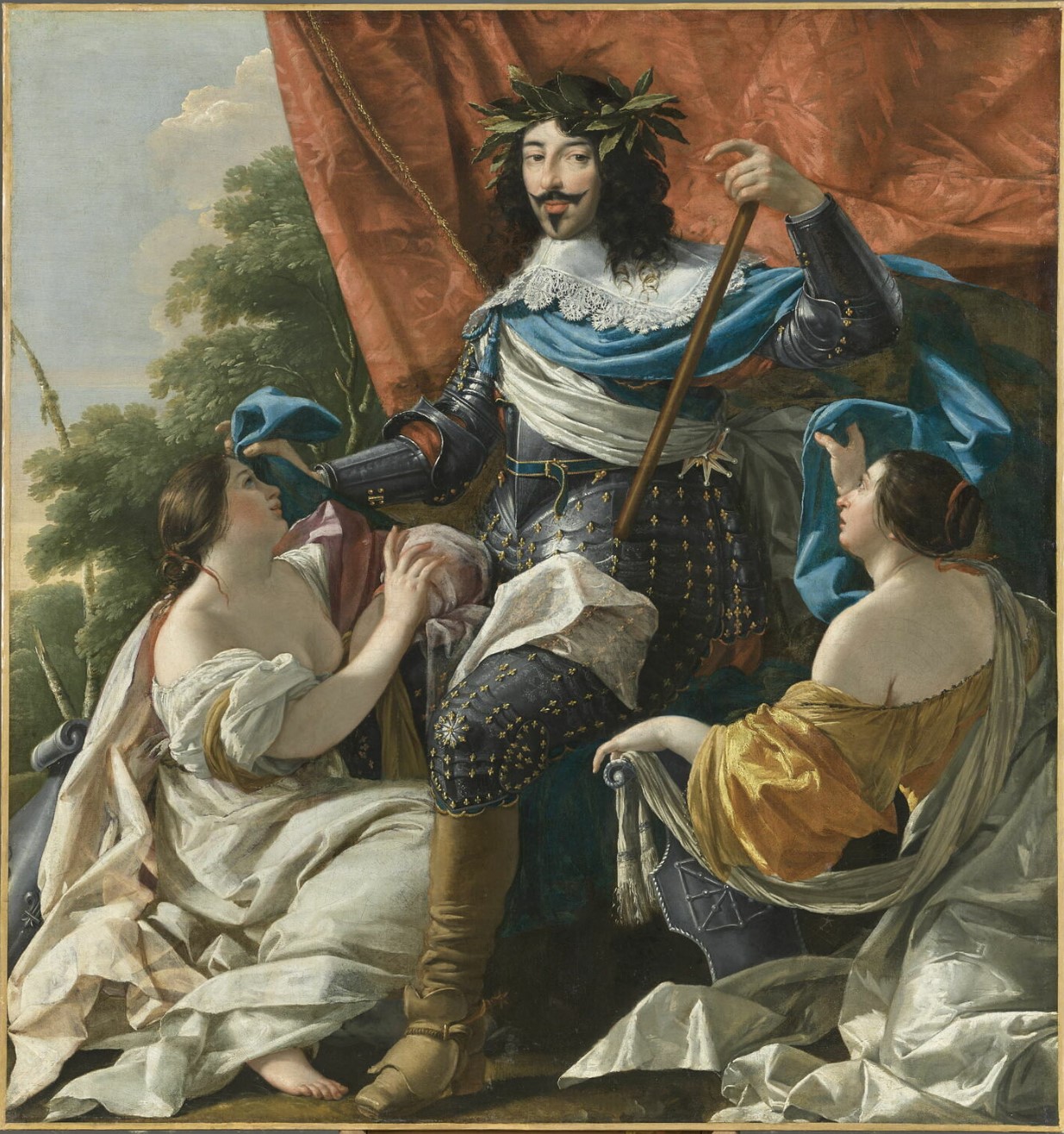
Workshop of François Clouet. Catherine de’ Medici wears the black cap and veil of widow, after 1559. Upon seeing Catherine in the flesh, an Italian diplomat noted that “her mouth is too large and her eyes too prominent and colorless for beauty. But she is very distinguished-looking, has beautiful skin, a shapely figure, and exquisitely made hands.”Portrait de Henri IV, roi de France et de Navarre (1553-1610) 1600 / 1700 (XVIIe siècle), Atelelier de Frans Pourbus II Louvre. Hung in Versailles chateau. https://collections.louvre.fr/en/ark:/53355/cl010057776Marie de’ Medici, 1616, Frans Pourbus the Younger (Flemish, 1569-1622), oil on canvas, The Art Institute of Chicago. Marie de Medici (1575-1642) married Henry IV of France in 1600. After the king was assassinated in Paris in 1610, Marie de Medici served as the regent for their young son, Louis XIII. Marie de Medici brought Frans Pourbus to the French court to make regal portraits of the royal family.Louis XIII between the figures of two young women symbolizing France and Navarre. 1636/38, School of Simon Vouet (1590-1649). Louvre, Paris. https://collections.louvre.fr/en/ark:/53355/cl010062003
Le Belvédère: the House of Maurice Ravel from 1921 to his death in 1937 at Montfort L’Amaury.
The author in front of Le Belvédère, the house of Maurice Ravel, and ready to go inside for a visit. Author’s collection.Pianist Jacques Février with Maurice Ravel in 1925 in Le Belvédère, the house of the composer in Montfort-l’Amaury. Public Domain.The salon of the Ravel house. Author’s photograph.
Ravel’s house sits on an ascent from the centre ville where Ravel could look out his garden-side window to back towards town and south and east to the green countryside between Montfort and Paris. Author’s photograph.
Jean Anouilh (1910-1987) was a French dramatist who lived in Montfort-L’Amaury in France. Anouilh’s 1944 play, Antigone, was an adaptation play of Sophocles’ play of the same name. The 34-year-old Anouilh’s work was seen as an attack on the Vichy government of Marshal Pétain (1856-1951) in World War II.
Anouiih also wrote Becket. The original French play is titled Becket ou l‘Honneur de Dieu. It was staged in Paris at the Théâtre Montparnasse-Gaston Baty in October 1959 and directed by Anouilh. The play dramatizes historical martyr and Catholic saint Thomas Becket (1120-1170), the Archbishop of Canterbury In England, whose feast day is December 29.
Becket was the best friend to younger King Henry II of England. Cunning and proud, vulnerable and lonely, pent-up King Henry is interested in hunting and women, and not necessarily in that order. Henry is bored with political affairs and as king has his one friend, Thomas Becket, who is his companion in vice and debauchery.
Becket serves his king loyally, without compromise. Wanting to strengthen his power over the Church in England and believing his idea to be an excellent one, Henry appoints Becket as chancellor of England and he later becomes Archbishop of Canterbury. But nothing goes as planned. Becket, on his path to sainthood, finds he cannot serve both king and God.
For Henry the arrangement is one of disillusionment, resentment, hatred, and torn friendship – and, later, repentance. For Becket it is a tale of courage, renunciation, and honor as the archbishop seeks to defend church freedom in England against an ambitious secular power. Such conflict provokes Becket’s murder by the king’s knights in the archbishop’s own cathedral.
Anouilh’s Becket became an international sensation. Successive productions in English translation were mounted in London (starring Christopher Plummer and Eric Porter) and in New York City (starring Laurence Olivier and Anthony Quinn). In 1964 Becket became a major motion picture starring Richard Burton and Peter O’Toole which won the Academy Award for Best Screenplay.
SOURCES:
Montfort L’Amaury de l’an mil à nos jours, Marie-Huguette Hadrot, Paris: Somogy Editions d’Art, 2002.
Montfort-L’Amaury, Le Syndicat d’Initiative des Fêtes et des Arts de Montfort-L’Amaury et ses Environs, 1972.
Montfort-L’Amaury Les Verrières de L’Eglise Paroissiale Saint-Pierre(Yvelines), Laurence de Finance and Marie-Huguette Hadrot, Paris: Centre de Documentation du Patrimoine, 1994.
FEATURE IMAGE: Valentin de Boulogne (1591-1632), Allegory of Rome, 1628, oil on canvas, 330 x 245 cm, Villa Lante (Institutum Romanum Finlandiae Foundation). Villa Lante in Rome is an example of the work of the 16th century Raphael school in the reign of the Medici popes. The Renaissance villa, which was a residence for Roman aristocracy, was purchased in 1950 by the Finnish state. The Institutum Romanum Finlandiae Foundation started operating there in April 1954.
Ruins of the Coliseum in Rome, Circle of Willem van Nieuwlandt, II, c. 1600, Pen and brown ink, with brush and brown and gray wash, on pieced cream laid paper, 35.3 × 61.3 cm (13 15/16 × 24 3/16 in.) The Art Institute of Chicago. https://www.artic.edu/artworks/95904/ruins-of-the-coliseum-in-rome
INTRODUCTION.
Le Valentin de Boulogne (c.1591/1594-1632), sometimes called Jean Valentin, Jean de Boulogne Valentin, or simply Le Valentin, was a French painter. Born in Coulommiers-en-Brie about 35 miles east of Paris, Le Valentin may have been at least half Italian. His artwork was certainly influenced by Italian painting more than any other though he was familiar with Northern or Flemish painting. Le Valentin may have been in Rome as early as 1612 – German painter and art-historian Joachim von Sandrart (1606-1688) remarked in 1675 that Valentin reached Rome before Simon Vouet (1590-1649) who had arrived around 1614. Whether in 1612 or definitely by 1620 (Le Valentin appears in the census), Le Valentin spent the rest of his life In Rome. In the Eternal City Le Valentin was greatly influenced by Simon Vouet (French, 1590-1649) and Bartolomeo Manfredi (Italian, 1581-1622), a leading Caravaggiste or follower of Carravaggio (Italian, 1571-1610).
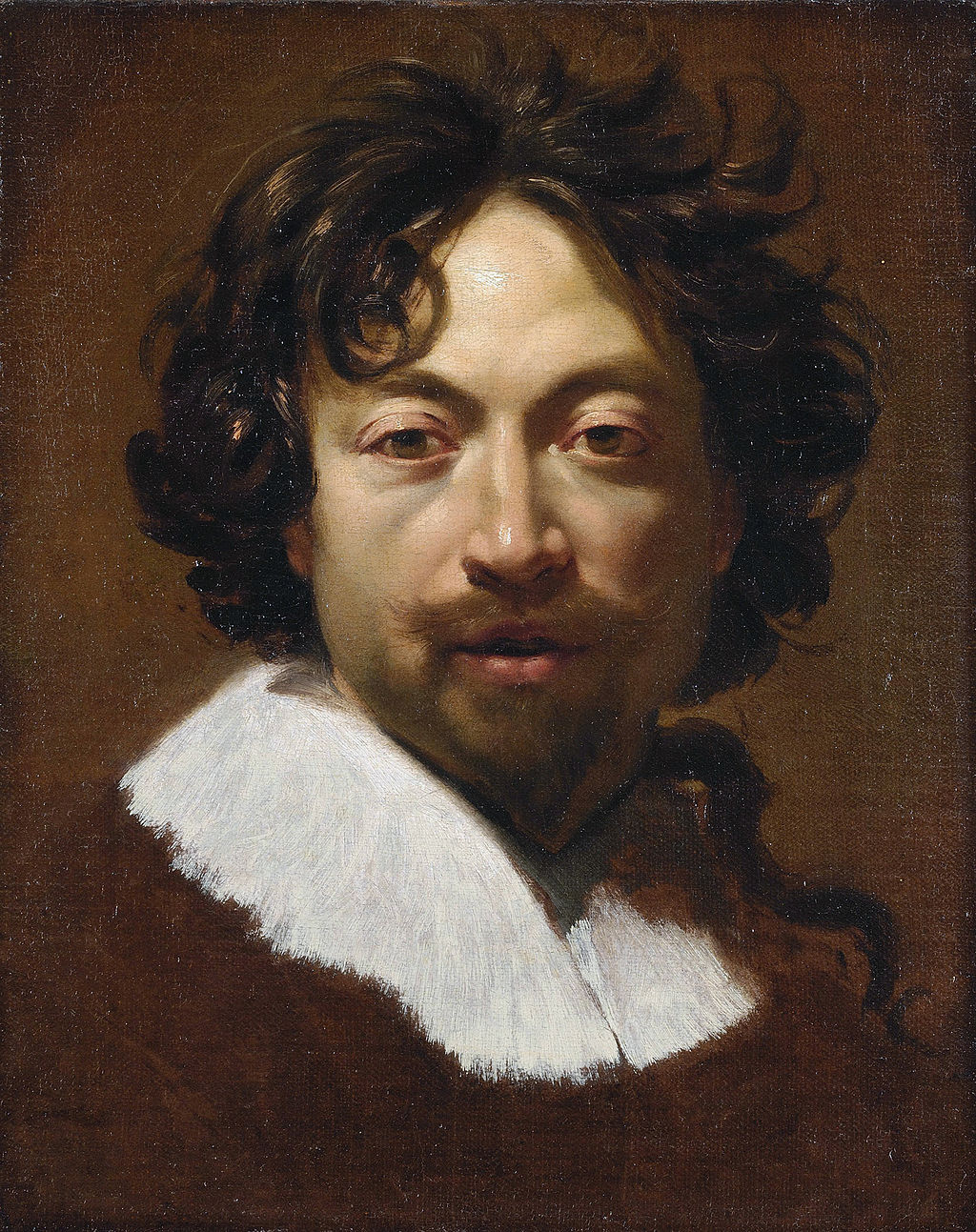
Joachim von Sandrart, Self Portrait, 1641.Bartolomeo Manfredi, The Martyrdom of St. Bartholomew (detail).Simon Vouet, Self-portrait, c. 1626–1627 Musée des Beaux-arts de Lyon.
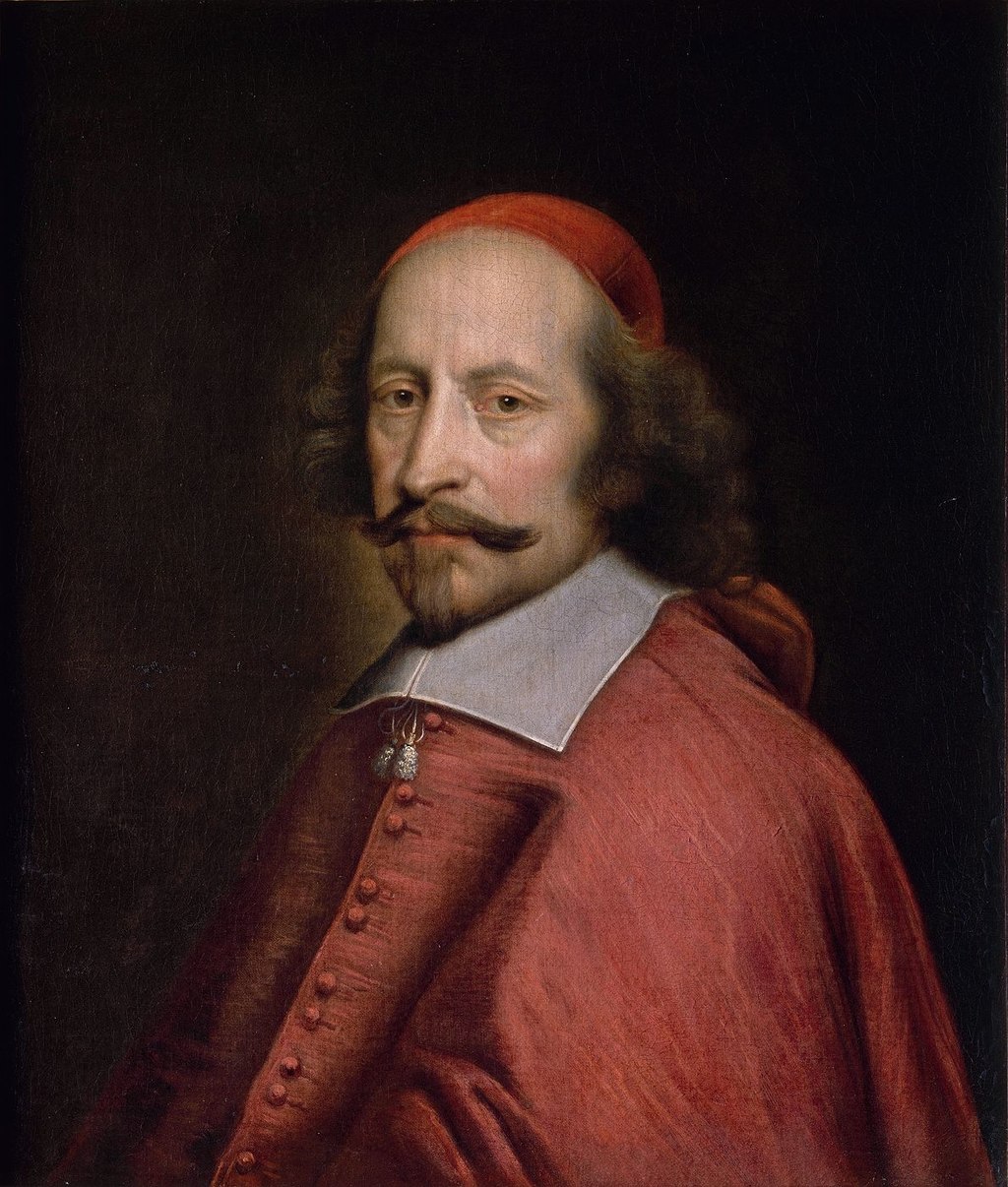
Le Valentin’s oeuvre is today around 55-60 paintings, most of them identified by modern scholarship (i.e., Jacques Bousquet; Roberto Longhi). Le Valentin’s major commissions date from the last seven years of his life. Opportunities to acquire his artwork was rare, though avid collectors such as Cardinal Mazarin (1602-1661) and Louis XIV collected them.
Cardinal Mazarin by Pierre Mignard, Musée Condé, Chantilly, France.Louis XIV, Charles Le Brun, Château de Versailles.Piazza del Popolo, Rome. “Piazza del Popolo.. Rome” by Nick Kenrick.. is licensed under CC BY 2.0
In Rome Le Valentin forged close ties with other French artists and lived with many of them in and around the Piazza del Popolo to the Piazza di Spagna. Most French painters born in the 1590s made a stay in Rome – and influenced art in France in the 17th century. Reasons young painters fled to Italy in the early 17th century included depletion of opportunity in Paris due to the professionalization of artistic practice in and outside the capital although establishment French art was no longer flourishing. Conversely, Roman art – and not only the schools of Michelangelo and Raphael but new horizons afforded by Annibale Carracci (1560-1609) and Caravaggio (1571-1610) -was at an apex. The Eternal City was drawing international artists from Paris and elsewhere and, between 1610 and 1630, the Roman style became internationalized. The dialogue among artists in Rome in this period was exciting – and its outcomes often unpredictable. The culture of Rome (and the papacy) could actually be liberating for foreign, usually destitute, often libertine talented young artists who had great ambitions for a prominent commission as they were exposed to Rome’s virtue and vice almost equally. Many of these young artists, even ones whose artworks survive, exist today virtually anonymously. Le Valentin de Boulogne is one of the better-known artists of the period, although his precise name is uncertain and his artwork requires connoisseurship based on modern scholarship.
Annibile Carracci, Self-portrait, 1604, Hermitage Museum, St. Petersburg, Russia.Caravaggio, David with the Head of Goliath, included a self portrait of the artist, 1610, oil on canvas, Borghese Gallery, Rome.
In 1626 Valentin, in Rome several years, was invited by Vouet to organize with Nicolas Poussin (1594-1665) the festival of the Accademia di San Luca ‘s patron saint. Around the same age, Vouet led the academy whose artists’ association was founded in 1593 by Federico Zuccari (1539-1609). This appointment signaled that Valentin was an active and respected rising French artist in Rome in these years. Though Caravaggio died in 1610 his influence was still felt very strongly in Rome in the 1620s.
Two of Caravaggio’s masterpieces—The Martyrdom of Saint Peter and The Conversion of Saint Paul—hung in the neighboring church of Santa Maria del Popolo which Le Valentin certainly had opportunity to study. In Italy, Valentin took swift, direct, and enduring inspiration from Caravaggio’s chiaroscuro and realistic depiction of characters drawn from Roman street life, including extensive use of half figures. As one of the young Caravaggisti, Valentin applies these elements to his artwork, whether genre or, later, Biblical subjects.
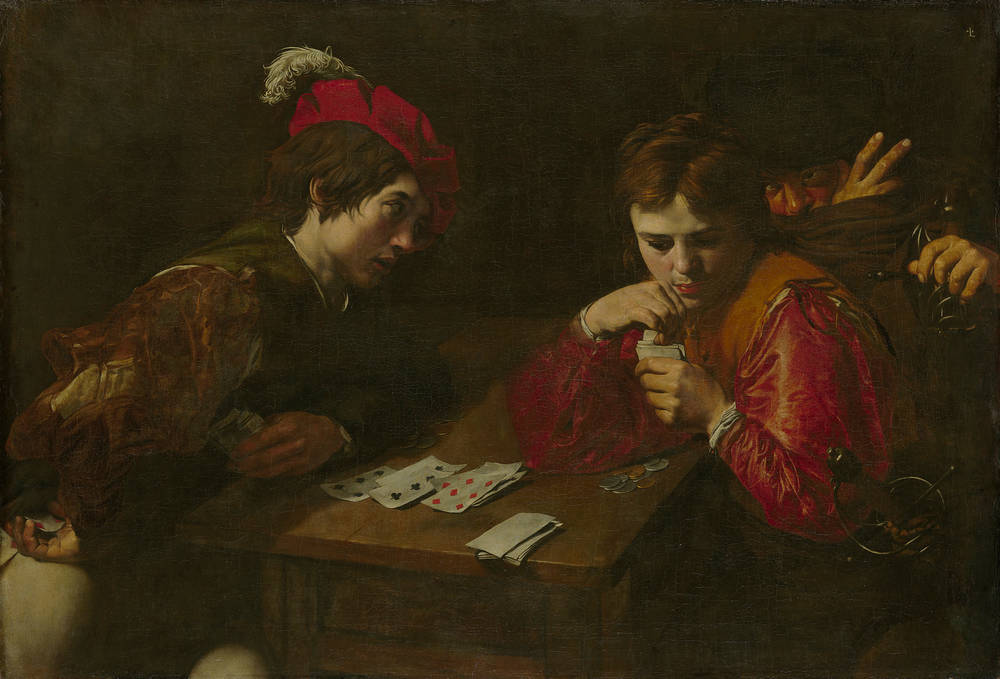
None of the works from Le Valentin’s earliest Roman years is documented, but it is believed he produced his Card Sharps (Dresden, Staatliche Kunstsammlungen), The Fortune Teller (Toledo Museum of Art), and Soldiers Playing Cards and Dice (The Cheats) (NGA) – and probably in this order – between 1615 and 1620.
In Le Valentin’s compositions which often contain several actors in a scene, the French artist’s realism and Caravaggio-inspired technique is often imbued with energetic rhythm in which diagonals and geometric concurrences play a role. This schematic suggests animation in the subject matter while retaining the human figures’ inner reserve and mystery. This creates a psychological quality in his artwork that is unique whichever drama is unfolding in the picture. Louis XIV who was an admirer of le Valentin acquired and hung several of his paintings in his bedroom at Versailles. Cardinal Mazarin, another art collector with a keen eye, acquired works by Valentin, some of which today are in the Louvre.
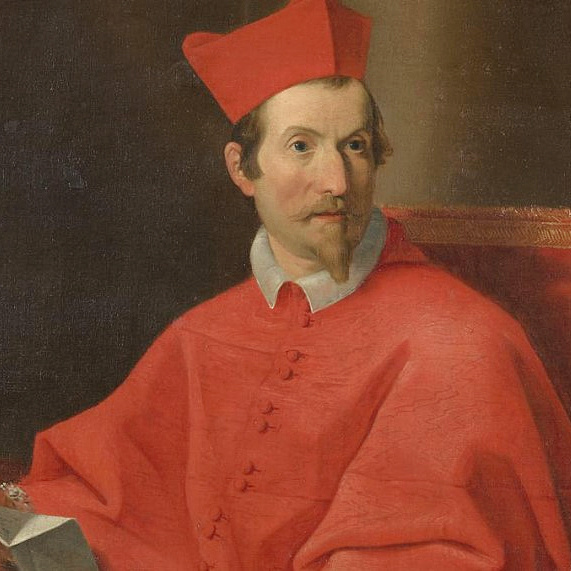
Andrea Sacci, Cardinal Francesco Barberini, Wallraf-Richartz-Museum, Cologne, Germany, oil on canvas, c. 1631-1633 (detail).
By way of Le Valentin’s important young patron, Cardinal Francesco Barberini (1597-1679) – made a cardinal in 1624 by his uncle, Pope Urban VIII (1568-1644) – Valentin became a competitor to his artist friend Nicholas Poussin. Le Valentin’s first documented work commissioned in May 1629 and completed in the spring of 1630 called Martyrdom of SS. Processus and Martinian is a compendium to a slightly earlier work by Poussin–both in the Vatican (Poussin’s was a different stylistic statement called Martyrdom of S. Erasmus). Valentin had further won the patronage of Cavaliere del Pozzo (1588-1657), the secretary of Cardinal Francesco Barberini and one of Rome’s leading art patrons. Paid the handsome sum of 350 crowns for Martyrdom of SS. Processus and Martinian , after 1630 Valentin’s artwork continued to command high prices and prestige.
Valentin de Boulogne, Martyrdom of Saints Processus and Martinian, 1629–30, Oil on canvas, 118 7/8 × 75 9/16 in. (302 × 192 cm), Vatican Museums, Vatican City/Jan van den Hoecke (Flemish, 1611-1651), Portrait of Cassiano dal Pozzo. Pozzo’s portrait was painted by Le Valentin though it is lost.
Though SS. Processus and Martinian is Le Valentin’s most important public work, he also produced many pictures for private commissions. There are several pictures by, or today attributed to, Le Valentin in many of the world’s leading art museums. Le Valentin produced artwork especially for the ruling Barberini family and their circle.
How Le Valentin died in 1632 is not certain though it was sudden and of natural causes. The professional artist who is admired in today’s major art institutions reportedly left no money to pay for a funeral. Identified as a “Pictor famosus” on his death certificate, Le Valentin was buried at Santa Maria de Popolo on August 20, 1632 paid for by Cassiano dal Pozzo (1588-1657).
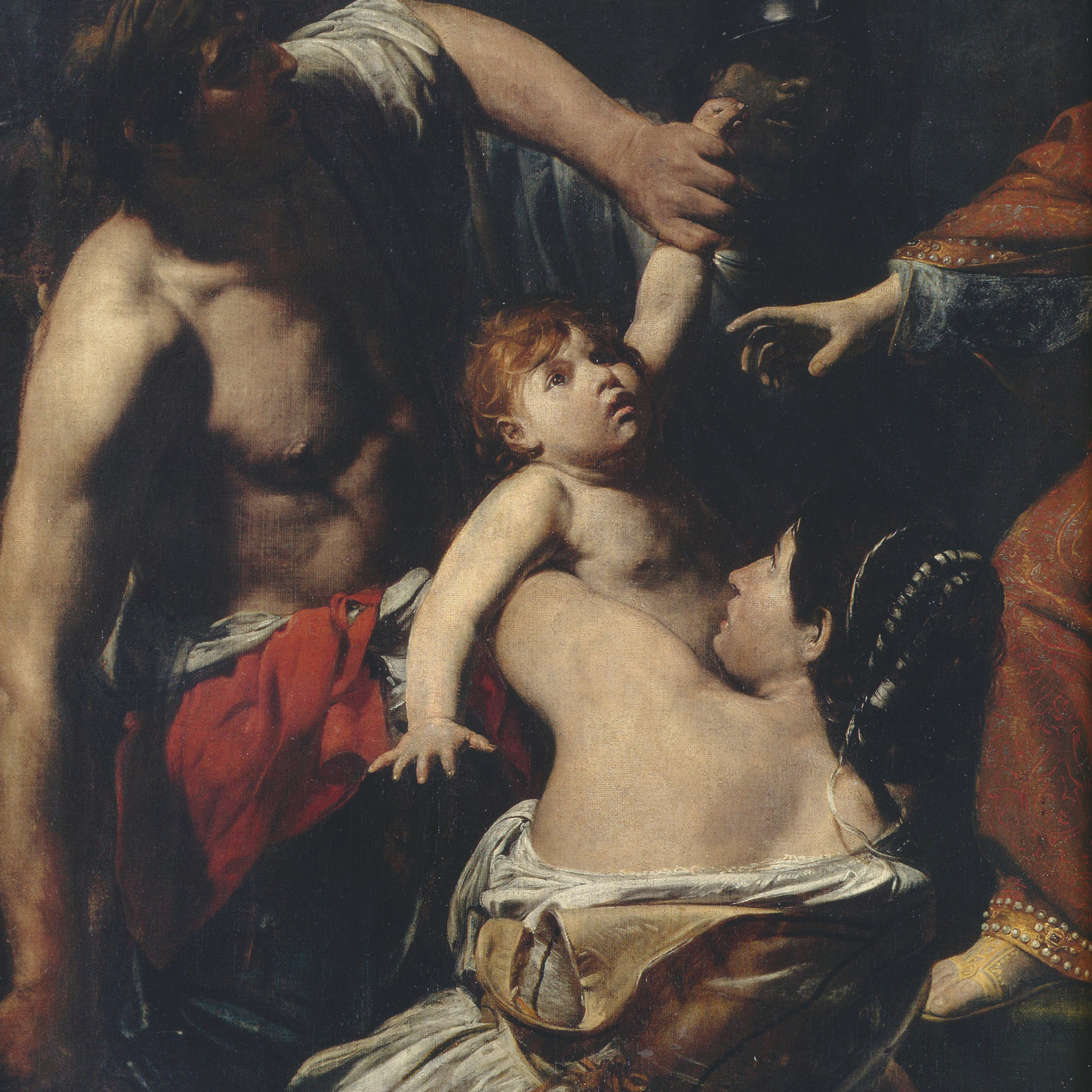
One of the most moving and beautiful stories in the Bible is the judgment of King Solomon in the case involving two disputing harlots over who was the mother of a living child (I Kings).
Both had had a child, though one died and the other lived. To have an offspring was considered a blessing. One harlot claimed that her living child had been taken from her bosom at night by the other harlot. She replaced the child with her dead child after “she had smothered him by lying on him” (I Kings 3:19).
Since this was a case of one harlot’s word against another’s Solomon had no simple and fair resolution at hand. King Solomon said: “Cut the child in two and give half to one woman and half to the other” (I Kings 3:25). Le Valentin shows the viewer what is at stake – a real flesh and blood child. The import of Solomon’s judgment could not be missed. Le Valentin’s women are modeled on those mothers and others the artist observed along Via Margutta.
Detail. Judgment of Solomon. Le Valentin.
When one harlot said, “Divide it! it shall be neither mine nor yours!” and the other harlot said, “Please, my lord, give her the living child. Please do not kill it!”, the king’s judgement changed.
Solomon spoke again and said, “Give her the child alive, and let no one kill him, for she is his mother” (1 Kings 3: 16-28). Solomon knew a woman privileged to be a mother would seek to see the child live most of all.
It is this final pronouncement that Solomon appears to give in Le Valentin’s painting, as the complete biblical episode can be readily seen in the gestures and expressions of its characters.
Acquired by Louis XIV at Cardinal Mazarin’s death in 1661, The Judgment of Solomon has long been presented as a counterpart to The Judgment of Daniel. These canvases, which may actually be pendants, share the same format and show examples of just judgment in the Bible. The Judgment of Solomon is dated later than The Judgment of Daniel. There is a variant of it by Le Valentin in Rome at the Barberini Gallery in the same format and oil medium. The Louvre painting was restored in 1966.
The subject is taken from chapter 13 of the Book of Daniel, the book’s addendum. In Babylon, a pair of wicked elders covet Suzanne, “a very beautiful and God-fearing woman” who was the wife of the “very rich” and “most respected” Joachim. After these wicked elders surprised Suzanne in her bath, she refuses their advances and they denounce her for adultery with the intent to put her to death.
Daniel condemns these wicked elders for “growing evil with age” including their past sins of “passing unjust sentences, condemning the innocent, and freeing the guilty.” Daniel interrogates them and, by their own words, shows the assembly they are lying. The painting depicts that moment of judgment.
Detail. Judgment of Daniel. Le Valentin.
Le Valentin depicts Daniel in the painting instead of Suzanne in her bath which was a more popular subject. Suzanne is at right, her hands across her chest, “As she wept, she looked up to heaven, for she trusted in the Lord wholeheartedly” (Daniel 13:35). A guard seizes one of the wicked elders as the other shows surprise and incredulity. Young Daniel, at left, is seated on a throne under a red canopy and stretches out his hand in judgment over the scene for their sin. For each judgment by Le Valentin the artist was inspired in some of its details by Raphael’s artwork in Rome. Louis XIV acquired the painting in 1662.
Valentin de Boulogne, Martyrdom of Saints Processus and Martinian, 1629–30, Oil on canvas, 118 7/8 × 75 9/16 in. (302 × 192 cm), Vatican Museums, Vatican City.
Within iconography that is cyclonic, two Roman soldiers are placed on the rack to be tortured after they refused their commander’s orders to sacrifice to an idol. The soldiers had been converted to Christianity by Saints Peter and Paul when they guarded them in prison. The altar to Jupiter is on the upper left while, at right, the commander clutches his eye with his left hand after God blinded him in retribution for the idolatry. The foreground figures build on 16th century Franco Italian Mannerist style. One has his back to the viewer; another grinds the wheel of the rack; and, a third bends down with his arm outstretched. All are advanced expressions of realistic figural development and rendered in spatial perspective correctly.
Le Valentin’s powerful painting is an artwork with a psychological dimension. To the left, a hooded figure, Lucina, is a Christian woman who encourages the martyrs to be steadfast as an angel out of heaven extends a palm of martyrdom. To the right, realistically portrayed, is a Roman soldier indifferent to another brutal slaying by the authoritarian government in the face of nascent, meddling, heroic, and expanding Christians in their pagan global empire.
With his attention to detail, Le Valentin’s picture accomplishes an exciting imagined drama based on Renaissance-inspired natural world observation and by way of colorful contemporary 17th century formulations that give a viewer visionary immersion into a complex and significant Bible scene.
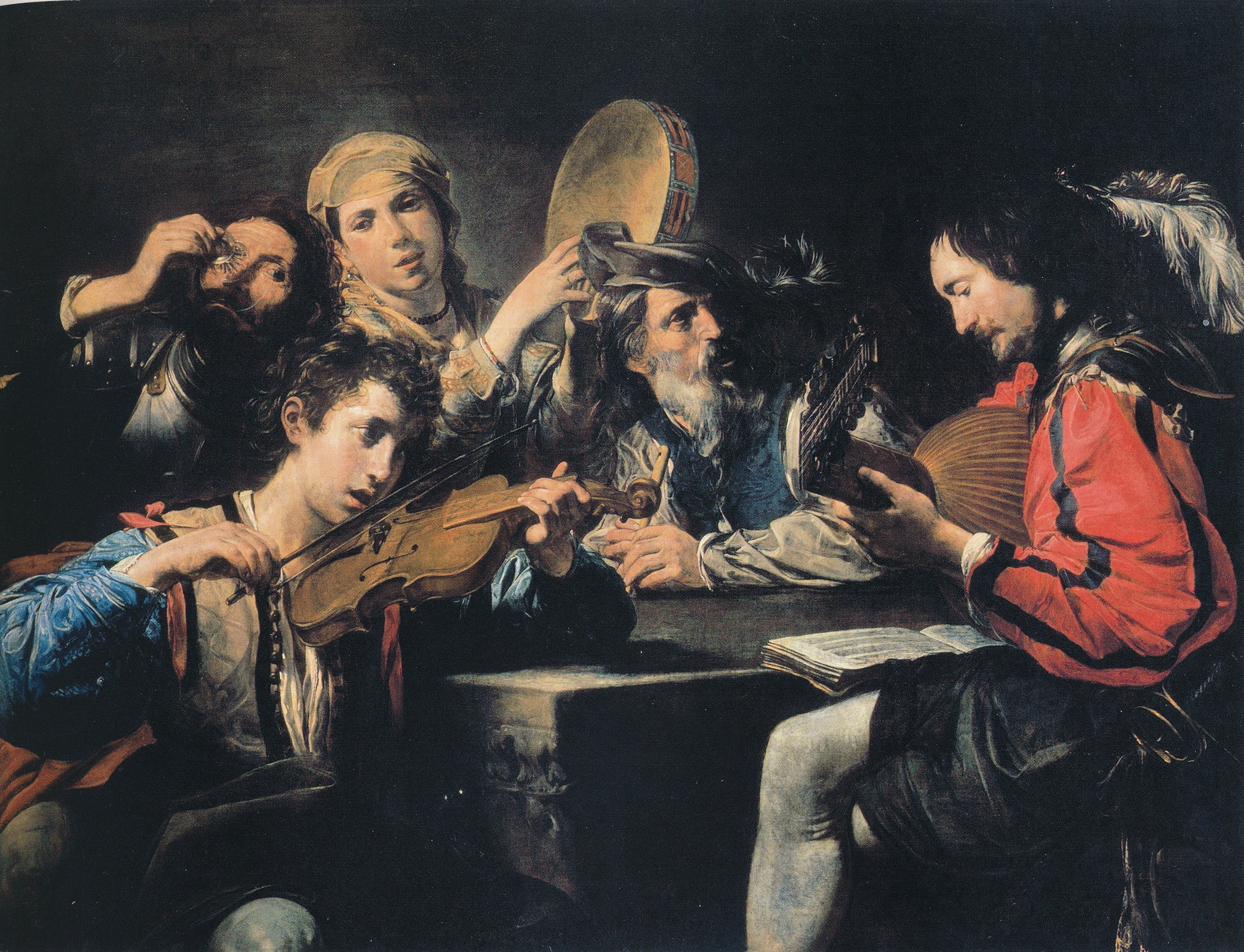
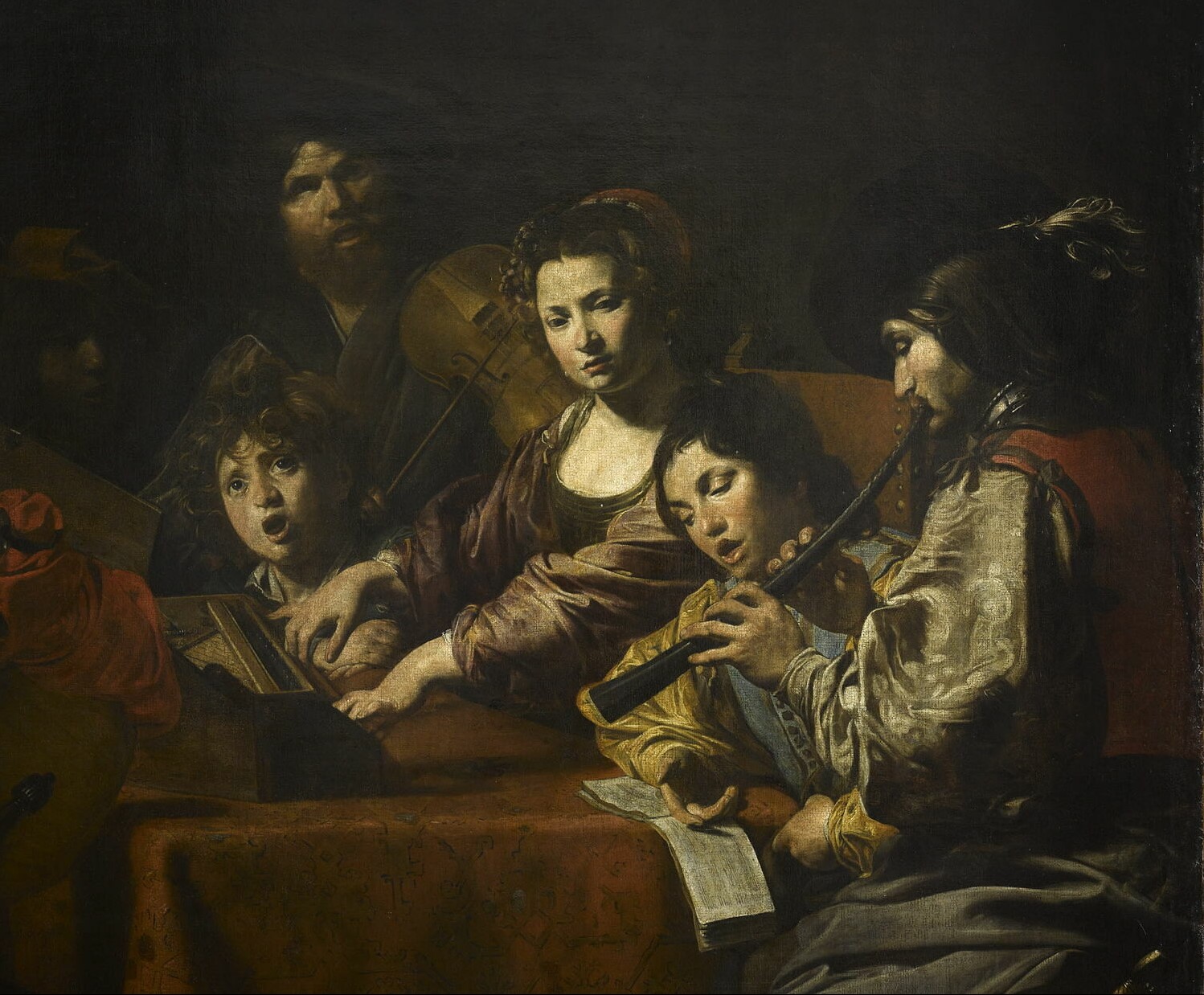
Some of Le Valentin’s great ambition as an artist is demonstrated by this large format canvas whose composition includes eight realistically delineated figures including 5 musicians and 3 singing youths. The five instruments are depicted accurately as well as the demeanors of the musicians and singers. Instruments have been identified by others as a polyphonic spinet, an alto, a chitarrone, a bass viol and a cornetto.
Detail. Concert in an Interior. Le Valentin.
The painting had been dated at around 1626, though more recent connoisseurship dates it to around 1628 or 1630. It was restored in 1940. It was owned by that avid art collector, Cardinal Mazarin.
Valentin de Boulogne (1591-1632), The Concert in bas-relief, 1624/26, oil on canvas, 1.73 m x 2.14m, Louvre.Detail. The Concert in bas relief. Le Valentin. Detail. The Concert in bas relief. Le Valentin.
Le Valentin painted seven figures gathered around a classical bas-relief. There are a pair of drinkers, one in the foreground, the other in the background; two singers; and three musicians – a violinist, guitarist and lutenist.
The painting, filled with mystery and gravity, is Caravaggesque and not merely telling a story or depicting a genre scene of performance. The painting has been dated to as early as 1622 by some connoisseurs. It was owned by Cardinal Mazarin and restored in 1959. It entered the collection of the Louvre in 1742.
Valentin never ceased producing genre paintings as attested by Concert with Eight Figures and Fortune Teller (both Musée du Louvre, c. 1628), and what is thought to be his very last painting, the Gathering with a Fortune Teller (Vienna, Liechtenstein Collection) in 1632.
Valentin de Boulogne (1591-1632), Musicians and Soldiers, c. 1626, oil in canvas, 155 x 200 cm, Musée des Beaux-Arts, Strasbourg.
This is a tavern scene with impromptu music-making among transitory musicians. They are playing for a pair of drinking soldiers. Le Valentin’s painting is Caravaggesque with its interplay of shadows and light, dark palette, and depiction of realistic figures, and a psychological vivacity that is imbued by Le Valentin. It is by his passion and energy for Caravaggio that Le Valentin helped revolutionize art in 17th century Europe.
Valentin de Boulogne (1591-1632), Jesus and Caesar’s Coin, around 1624, oil on canvas, 1.11 m x 1.54m, Louvre.
In Matthew’s Gospel the Pharisees were plotting to entrap Jesus by his own words. They sent some of their followers along with local government types (“Herodians”) to flatter Jesus as a truthful and humble man. They asked him to reply to a question: “Is it lawful to pay the census tax to Caesar or not?” (Mt 22:17).
Jesus, knowing their motivation, responded hardly very nicely, by calling them “hypocrites.” He asked them to show the coin that paid Caesar’s tax.
Le Valentin’s painting depicts the moment when the Pharisee’s henchmen show Jesus the coin with Caesar’s image and inscription on it. Jesus tells them: ”Repay to Caesar what belongs to Caesar and to God what belongs to God” (Mt 22: 21).
Owned by Louis XIV it was put in his dressing room at Versailles in 1680. The Louvre acquired it during the French Revolution in 1793.
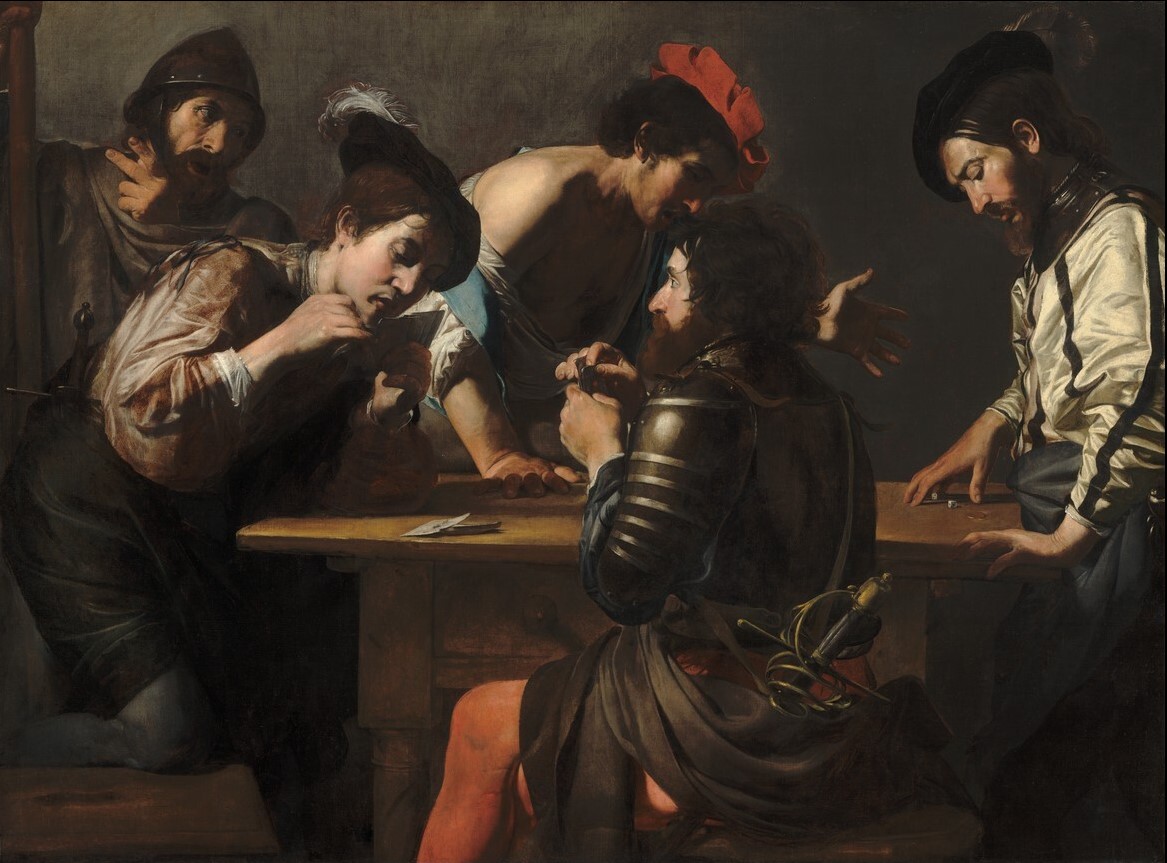
Valentin de Boulogne (1591-1632), Soldiers Playing Cards and Dice (The Cheats), c. 1618/1620, oil on canvas, 121 x 152 cm (47 5/8 x 59 13/16 in.), The National Gallery of Art, Washington DC. https://www.nga.gov/collection/art-object-page.107315.html
This painting is inspired by Caravaggio’s The Cheats in the Kimbell Art Museum in Fort Worth, Texas. Le Valentin’s painting, only discovered in 1989, shows a group of soldiers idling in Rome and identifiable by their piecemeal armor and other livery. The crowding of the figures into the picture space adds to the scene’s tension.
In this early painting in Rome, Le Valentin presents a scene of its contemporary street life. These figures are seriously gaming at a table where two players (center and right) roll dice and two others (left and center) play cards. A fifth figure in the background signals to his accomplice what is in the hand of the card player in a feathered hat. It is an early artwork that Le Valentin gives a psychological dimension.
As had been Caravaggio’s practice, the artwork is painted alla prima, that is, directly onto the prepared canvas without under-drawing or any preliminary work which works to give it greater spontaneity. The painting is indebted to Caravaggio not only for its subject, but for its vivid sense of actuality with which Le Valentin invested his protagonists as well as for the chiaroscuro, and a thinly and rapidly-applied brushed execution.
This painting is one of the first genre pictures Le Valentin painted in Rome. It is a pair of figures to which Le Valentin would soon numerically expand in his pictures. The composition is simple and sturdy.
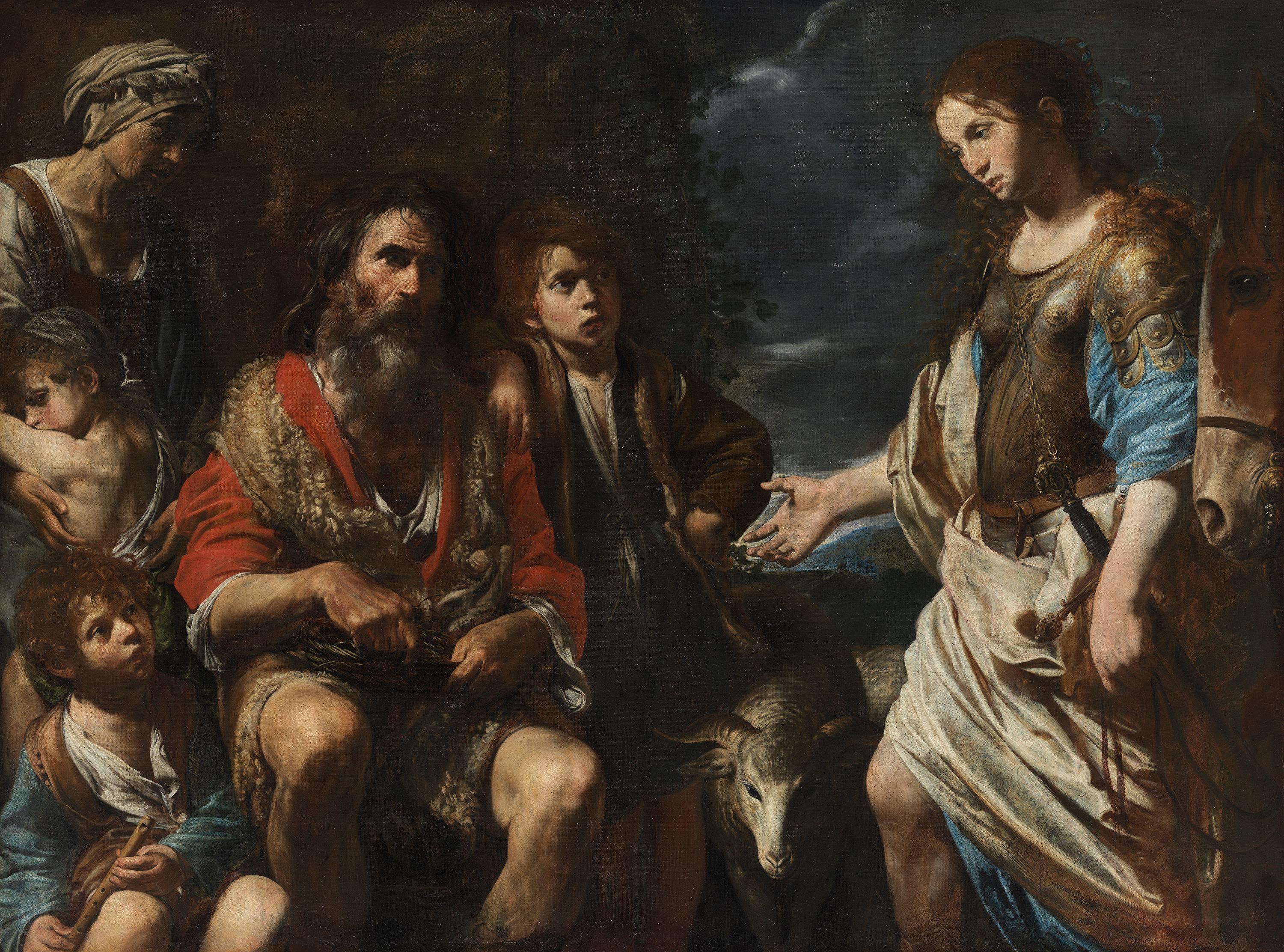
Valentin de Boulogne (1591-1632), Herminia among the Shepherds, c. 1630, oil on canvas, 134.6 x 185.6 cm (53 1/8 x 61 5/8”) Bayerische Staatsgemäldesammlungen – Alte Pinakothek München. https://www.sammlung.pinakothek.de/de/artwork/RQ4XPr8410
Erminia, the king’s daughter, escapes her persecutors and asks a peaceful shepherd family for shelter. The scene is based on a contemporary (1576) epic poem The Liberated Jerusalem by Torquato Tasso (1544-1595). The picture was a private commission whose patron was likely a Roman art collector and cognoscente. Valentin’s painting combines Caravaggesque chiaroscuro with exquisite coloring. In this realistic depiction of a human encounter between characters who represent contrasting social experiences, the subject matter is rendered psychologically sensitively.
Valentin de Boulogne (1591-1632), Crowning of thorns of Christ, around 1616/17, oil on canvas, 173 x 241 cm Bayerische Staatsgemäldesammlungen München-Alte Pinakothek, Munich https://www.sammlung.pinakothek.de/de/artwork/bwx0jkJGm8
One of the great artworks of Le Valentin’s early phase in Rome, biblical subjects painted before 1620 such as The Crowning of Thorns of Christ were interpreted in the street-life idiom, with expressive protagonists and bystanders resembling the cast of characters in his genre paintings. Although the painting was earlier believed to be by Caravaggio, it may have been a pendant to Le Valentin’s much-later Abraham Sacrificing Isaac (c. 1629) in The Montreal Museum of Fine Arts.
This is Le Valentin’s most ambitious of 3 such “crowning with thorns” pictures. The artist in horizontal-format depicts Jesus before his going to Calvary. Christ is mocked and tormented; a crown of thorns is pressed onto his head (Matthew 27: 27-31; Mark 15:16-21; Luke 23:11; John 19: 1-3). With its dramatic lighting and shadows, the naturalistic depiction of Christ’s body and soldiers in contemporary costume is Caravaggesque.
Le Valentin’s scene adheres to the Bible episode: a whole cohort of soldiers surrounded Jesus, stripped off his clothes and threw a scarlet military cloak on him. Henchmen have weaved a crown out of thorns and are placing it on Jesus’s head. Another puts a reed as a faux scepter into Jesus’s right hand. To mock him they kneel before him and say: “Hail, King of the Jews!” The soldiers spit on Jesus and then take the reed away and strike him repeatedly with it. When they were done with these violent actions, the soldiers stripped Jesus of the military cloak, dressed him in his own clothes and led him out to be crucified.
Le Valentin’s Passion theme is a later vertical-format picture of a subject he had painted masterly before. In these last years the subject matter had gained in classical beauty as well as psychological involvement compared to Le Valentin’s earlier artwork. The painting covers over a discarded portrait of Cardinal Barberini which suggests Valentin’s close relationship with the ecclesial prince, very likely being in his employ. What caused the artist to revisit the subject of a brutalized Christ is unclear though it may have been based on the artist’s own struggles or that of his employer whose portrait he painted over.
Valentin de Boulogne (French, 1591–1632), Noli me tangere c. 1620. Oil on canvas. Perugia, Galleria Nazionale dell’Umbria.Valentin de Boulogne (French, 1591–1632), Christ and the Samaritan Woman c. 1620. Oil on canvas. Perugia, Galleria Nazionale dell’Umbria.Valentin de Boulogne (1591-1632), Martyrdom of St. Lawrence, 1622/24, oil on canvas, 195 x 261 cm, Prado, Madrid. Spain.
St. Laurence (225-258)—Laurentius is Latin for ”laurelled”—became a popular early Roman martyr. Laurence has been continually highly honored by the church since the 4th century and is a patron of Rome.
In the mid 3rd century, Laurence was archdeacon to the new pope, Sixtus II (257-258). Sixtus II was martyred along with his seven deacons, including Laurence, during the persecution of Christians by Emperor Valerian (199-264). When Laurence met the pope, the pope was under arrest and Laurence expressed the desire to join him in his sufferings. Sixtus promised Laurence that martyrdom would soon be his but in the meantime asked his archdeacon to distribute the church property among the poor. Word of this planned dispersal reached the ears of the Emperor and Laurence was arrested.
Following the pope’s martyrdom by decapitation, Laurence, in prison, was ordered three days’ reprieve to collect and hand over the church treasures to the emperor. Instead, Laurence gathered and distributed these goods to Rome’s poor folk and presented the people to the emperor. These paupers appeared in Le Valentin’s painting to the left.
Infuriated, the emperor ordered the Catholic deacon to sacrifice to Rome’s gods which Laurence refused to do (in prison Laurence converted his guard) and was summarily condemned. After undergoing a series of tortures, the 32-year-old Laurence was martyred by the method of being roasted alive over a fire on a spit. The saint is famously quoted as telling his executioners: “One side is roasted, so you can turn me over and roast the other side.”
In the Prado Le Valentin gives orderly arrangement to a complex scene of 15 figures and a horse. It shows the saint during his martyrdom isolated in the center of the composition. As with Caravaggio’s figures, the soldiers are in modern costume, use of chiaroscuro is evident, and further drama is added by the use of diagonals whose construction suggest movement that add to the tension of the naturally rendered figures. However, Le Valentin uses these derived elements unconventionally.
St. Laurence is the patron saint of people whose occupation involves working with fire such as traditionally cooks, bakers, brewers, textile cleaners, and tanners and also those whose occupation values fire prevention such as traditionally librarians, archivists, miners, and poor people. St. Laurence of Rome is also, truly, the patron saint of comedians.
Valentin de Boulogne (1591-1632), St Luke, Evangelist, 1624/26, oil on canvas, 120 x 146 cm, Palace of Versailles, Versailles.Detail. St. Luke Evangelist. Le Valentin.
Dating from the years 1624-1626, le Valentin painted all four Evangelists (Matthew, Mark, Luke and John) for the same religious order in Rome whose name is unknown. They entered the collections of the Sun King in 1670.
Valentin de Boulogne (1591-1632), The Last Supper, c. 1625, oil on canvas, Galleria Nazionale d’Arte Antica, Palazzo Barberini, Rome.
For his The Last Supper, Le Valentin was, at least through engravings, aware of Leonardo da Vinci’s Last Supper (c. 1495–1498) in Milan and Raphael’s Last Supper (1518-1519) in Palazzi Pontifici, Vatican. Le Valentin explores the 12 apostles’ reactions. Commissioned by Asdrubale Mattei (d. 1638), one of Rome’s nobili, to decorate a gallery in his family’s palace, the picture depicts a central event presented in the gospels. The moment that is depicted in these Last Supper paintings is when Christ announces that one of his disciples will betray him. Judas, in the foreground left, was treasurer for Jesus’s disciples and betrayed Jesus for a bribe payment of 30 pieces of silver. The picture, with its simple and monumental composition, so impressed Jacques-Louis David (1748-1825) in 1779 that he copied it and sent it from Rome to Paris.
An Old Testament Judge, Samson was born in a miraculous fashion and with an angel telling his mother and father, “No razor shall touch his head” (Judges 13:5). Samson is often depicted with his locks unshorn. As a youth Samson displayed an incredible physical strength attributed to “the spirit of the Lord rushing upon him” (Judges 14:6).
Le Valentin’s picture presents Samson’s legendary strength by showing the solid demeanor of his physical body as well as objects which hold symbolic value of his strength. These include that he killed a lion with his bare hands and liberated the Israelites by slaughtering a thousand Philistines with a donkey’s jawbone (Judges 15: 15-16). The strength of his arm is displayed as his fingers curl under his jaw as his wandering gaze looks off with intense interiority. One contemporary allusion in the painting is Samson’s breastplate which is joined at the shoulder by a clasp in the form of a bee which was the emblem of the Barberini family who commissioned the painting. It is speculated that the facial features of Samson in a picture before his fateful meeting with Delilah (Judges 16), may be a self-portrait of Le Valentin.
Valentin de Boulogne (1591–1632), Judith with the Head of Holofernes. c. 1626-27. Oil on canvas. Musée des Augustins, Toulouse.
The story of Judith in the Old Testament relates of a woman of great beauty and reverence to the God of Israel who is highly respected by her people and its leaders. The nation, desperate for survival, turns to Judith who is given the opportunity to kill their enemy’s military leader which she believes she can and must do and that all believed impossible as Israel’s military defeat by their enemies was a foregone conclusion.
The story has a femme fatale aspect as Holofernes was captivated by Judith’s physical appearance, but the Biblical episode of the execution, while a climax of her mission, pales in comparison with the relating of Judith’s overall dedication to her people and her God, a femme forte, which carries on into her long life of blessedness to her natural death. Le Valentin chooses that sacred element of the Bible book when he shows an iconic Judith, triumphant woman of Israel, holding in her hands the decapitated head of one of Israel’s once-formidable mortal enemies. Judith is shown as a heroic woman with her hand raised as she admonishes: “But the Almighty Lord hath disappointed them by the hand of a woman.”
For Le Valentin’s artwork, Judith is an icon of God’s justice to his obedient people. Purchased for French King Louis XIV from German banker Everhard Jabach, the picture was installed in the king’s bedroom at Versailles to be especially admired.
The picture belongs to Le Valentin’s period of maturity for it displays the artist’s full interpretation of the realism of Caravaggio and Manfredi though, as expressed here, with a new appreciation for colors. The pretext of a Judith who, according to the Bible, had adorned herself in her best finery so not to dissuade Holofernes’s gaze (Judith, 13, 14), allows le Valentin to illuminate the dress’s rich fabrics with monochrome refractions, while the jewels and hair are bathed in ethereal light.
The Four Ages of Man is a painting commissioned by Cardinal Barberini. It is an allegorical work whose human figures are painted by Le Valentin in natural poses. Groups of figures around a table were common in the work of Caravaggio and his northern followers. The allegory of the ages of man was a common subject for paintings during the sixteenth and seventeenth century, though its quantity of ages varied.
The allegory presents humanity in four categories of age – childhood (holding an empty bird trap); youth (playing a lute); adulthood (with a book and victor’s laurel); old age (with coins of wealth and delicate glassware).
The theme had its origin in classical literature: Ovid’s Metamorphoses and Dante’s Inferno acknowledged the stages of human life according to physical growth and decline. Contemporary poems were written on the subject that Le Valentin may have known.
In the 17th century, the painting was owned by Michel Particelli, seigneur d’Emery (1596–1650) in Paris. In the 18th century it was in the Orléans collection at the Palais Royal. During the French Revolution and the dispersal of the collection in 1791, the painting was brought to England where it is today.
Le Valentin painted many half- or three-quarter-length figures of saints, prophets and narrative scenes including this painting. The scene of Christ expelling the moneychangers from the Temple of Jerusalem is told in all four gospels of the New Testament. Le Valentin adapted the method of half-length, full size street figures depicted in dark, precisely lighted spaces and emerging in relief from the shadows from the Caravaggistes.
Gospel readers would recognize that the cleansing of the temple was prophesied in the Old Testament as a sign of the ushering in of the Messianic Age (Zechariah 14:21). In the synoptic gospels (Matthew, Mark and Luke) the episode appears at the close of Jesus’s public ministry and in John’s gospel at the start (2:13-17). The chronology of the episode in Jesus‘ ministry is generally not considered its most important element.
Le Valentin shows the “whip of cords” held by Christ, a detail mentioned only in John (Jn 2:15). There are overturned tables, a bench, and scattered coins. Le Valentin depicts the gestures, movements and emotions of the characters involved, focused on a wrathful Christ and fear of the unrighteous.
While in Synoptics the point of the episode appears to be the dishonesty of the Temple money changers, in John’s gospel Jesus’s wrath is directed to the Temple institution itself. In John’s Gospel Jesus declares the Temple is to be “My Father’s house.” Though not a term unique to John, he uses it more than any other Gospel writer (27 times).
Derived from Caravaggio are the types of ordinary people, distinct contrasts of light and shade and the natural plasticity of the figures involved in the composition.
The painting entered the Hermitage collection in 1772.
Valentin de Boulogne (French, 1591–1632), Expulsion of the Money Changers from the Temple. Oil on canvas, 195 x 260 cm (76 ¾ x 103 1/8 in.). Palazzo Corsini, Rome.
The painting’s structural asymmetry lends energy to the scene. With Christ’s raised arm, he is a menace to the money changers. Le Valentin, taking inspiration from Caravaggio, unabashedly renders a scene in grand format of violence in the gospels. The painting was rediscovered in Rome in the mid19th century.
The oil painting called Allegoria d’Italia by Le Valentin was originally called Historia d’Italia. Its massive volumes imbued with inner life are rendered using a brown palette and highlights that retained the Caravaggiste tradition. Le Valentin’s redoubling his commitment to Caravaggio in the late 1620s was on display in this painting as other leading painters, such as Vouet, Poussin, Giovanni Lanfranco (1582-1647) and Pietro da Cortona (1597-1669), were deploying brighter “modern” colors.
In March 1628 Cardinal Barberini gave Le Valentin the commission for the Extraordinary Jubilee of 1628 and paid 113 crowns for it. This major painting which renewed Caravaggio-inspired technique in the late 1620s attracted greater attention to Le Valentin’s artwork not only by Caravaggeschi but the broader Roman art circles.
A young Roman girl wears an emperor’s cuirass, holds a spear and shield, as the personification of Italy. At her feet are the fruit and nuts of the land’s bounty. Below her image are two male figures, naked and bearded, who represent the Tiber and the Arno, Italy’s great rivers. The figure of the Tiber is joined by Romulus and Remus and the suckling wolf who founded Rome and the later Papal States. The Arno that runs through Florence is joined by its symbol of the lion. In the top left corner, a tree stump with a bee swarm symbolizes the Barberini.
The gospel story that Le Valentin depicts using the typical Caravaggiste method (half-length, full size street figures in shadow and light) is from John 8. The story had been painted by the Flemish and the Venetians. The plump young woman in a torn garment exposing her shoulders and full-formed breasts is taken into custody by soldiers in armor to Jesus. According to the law the woman should be publicly stoned for adultery. The Pharisees lay verbal and other traps repeatedly in the gospels for Jesus to say or do something that is expungable. Jesus’s response moves past their premise. Whereas Jesus will soon be arrested, tried, and condemned by the authorities for his “transgressions,” the focus of le Valentin’s artwork is Jesus showing mercy to the sinful woman. From a theological viewpoint, Jesus’s innovative teaching is again based on the appeal to an extant biblical tradition of God’s anger towards, and forgiveness of, harlotry or unfaithfulness when such sin is repented (Hosea 5:4). Jesus tells her: “Go and sin no more” (John 8:11). While the woman’s disheveled look suggests the nature of her sin, she represents humankind and points to Christ, the God-Man and prophesied suffering servant (Isaiah 53). Christ takes the harlot’s place as the arrested agitator and manhandled by soldiers along the Via Dolorosa. In that episode, Christ goes to the cross to shed his blood in the new covenant whose outcome for “adulterous” humankind is eternal forgiveness of sins and rising to new life.
The image of a young soldier singing in armor breastplate a love madrigal is unique in Valentin’s oeuvre. The painting was part of the collection of Cardinal Mazarin, minister to Louis XIV.
Valentin de Boulogne (1591-1632), Return of the Prodigal Son, c. 1615–16, oil on canvas, 59 1/16 × 70 1/16 in. (150 × 178 cm), Museo della Venerabile Arciconfraternita della Misericordia, Florence.
One of Jesus’s most famous parables, The Prodigal Son tells the story of a young man who demanded his “full share of [his father’s] estate that should come to [him],” and departed to waste it “on a life of dissipation” (Luke 15). When the lost son falls on hard times, he seeks his father’s house though “only as a hired servant.” The forgiving father who has been on the look-out for his lost son (dressed in rags) since the day of his departure welcomes him back as a son “who was dead and has come back to life.” Which of the other figures may be the older brother who is unhappy about his dissolute brother’s return is not clear. Le Valentin treats the parable as a human story of repentance, forgiveness, and unconditional love.
The attribution to Le Valentin and its dating for this artwork is the result of modern scholarship. Art historians can thereby draw conclusions and make conjectures about the development of Le Valentin’s early artwork in Rome -he uses a larger format, growing complexity of compositional qualities and its subject matter, and the retention of low-life characters and stylistic indebtedness to Caravaggio as he moves beyond him.
A dark tavern filled with low-life characters provides the setting for a scene of fortune and deceit. As a gypsy fortuneteller reads the palm of a young soldier he is looking pensively as she speaks his fate, there are carousers and thieves in the scene. The picture is emblematic of Le Valentin – the techniques of a somber palette and dramatic lighting and tabletop groupings but also a mysterious mood and psychological depth to the complex interplay among its characters.
Valentin de Boulogne (French (active Rome), 1591-1632), Portrait of Roman Prelate, 128 x 94 cm, private collection.
The prelate is dressed in the robes of a papal chamberlain. Modern scholarship has proposed various individuals as the sitter from cardinals to lawyers.
Moses led the Israelites out the slavery of Egypt into the freedom of the Promised Land during the Exodus. The event is told and retold in the Old Testament and Moses as Liberator and Law Giver is its most significant figure. Le Valentin shows him holding a miraculous rod that he used to open the Red Sea (Exodus 14), struck the rock to produce water (Numbers 20) and, after its transformation into an iron snake, healed the ill (Numbers 21). Moses points to the stone tablets of the Ten Commandments of God (Exodus 20; Deuteronomy 5). This late work by Valentin is characteristic in its dark and pensive tone that is reminiscent of Caravaggio.
The picture is one of Valentin’s last paintings before his death in 1632. Prince Hans Adam Il von und zu Liechtenstein (b. 1945) acquired the work in 2004. Throughout his painting career, Le Valentin never ceased producing genre paintings.
SOURCES:
A Dictionary of Art and Artists, Peter and Linda Murray, Penguin Books; Revised,1998.
French Paintings of the Fifteenth through the Eighteenth Century, The Collection of the National Gallery of Art Systematic Catalogue, Philip Conisbee and Frances Gage, Washington, D.C., 2009 pp, 413-414.
Art for the Nation, text by Philip Conisbee, National Gallery of Art exhibition catalogue, 2000.
French Painting From Fouquet to Poussin, Albert Chatâlet and Jacques Thuillier, trans. from French by Stuart Gilbert, Skira, 1963.
The Saints: A Concise Biographical Dictionary, edited by John Coulson, Guild Press, New York, 1957.
The New American Bible, Catholic Book Publishing Corp, New York, 1993.
Mannerism: The Painting and Style of The Late Renaissance, Jacques Bousquet, trans, by Simon Watson Taylor, Braziller, 1964.
The Liberation of Jerusalem, Torquato Tasso, trans by Max Wicker, Oxford World’s Classics, 2009.
Valentin de Boulogne: Beyond Caravaggio, Annick Lemoine, Keith Christiansen, Patrizia Cavazzini, Jean Pieere Cuzin, Gianni Pappi, Metropolitan Museum of Art; 2016.
Raymond E. Brown, Joseph A. Fitzmyer, S.J, and Roland E. Murphy, O. Carm.,The Jerome Biblical Commentary, Prentice Hall Englewood Cliffs, NJ, 1968.
Lehmbeck, Leah, editor. Gifts of European Art from The Ahmanson Foundation. Vol. 2, French Painting and Sculpture. Los Angeles: Los Angeles County Museum of Art, 2019.
Marandel, J. Patrice and Gianni Papi. 2012. Caravaggio and his Legacy. Los Angeles: Los Angeles County Museum of Art.
Fried, Michael. After Caravaggio. New Haven: Yale University Press, 2016.
Schmid, Vanessa I., with Julia Armstrong-Totten. The Orléans Collection. New Orleans: New Orleans Museum of Art; Lewes: In association with D. Giles, 2018.
Merle Du Bourg, Alexis. “L’omniprésence de la musique.” Dossier de L’Art no.246 (2017): 64-67.
FEATURE image: May 2015. Michigan Avenue Main Lobby. The Art Institute of Chicago. 4.57mb DSC_0366 (1)
September 2015. Michigan Avenue entrance of The Art Institute of Chicago. 7.68 mb 99%May 2015. Sculpture Court, The Art Institute of Chicago. September 2015. Modern Wing, The Art Institute of Chicago. June 2014. Andy Warhol (1928-1987), Mao, 1972, Acrylic, silkscreen ink, and pencil on linen, 448.3 × 346.7 cm (176 1/2 × 136 1/2 in.). The Art Institute of Chicago. 20th Century. American. Pop. June 2014. The Art Institute of Chicago. 40%June 2014. Robert Irwin (1928-2023), Untitled, Acrylic lacquer on cast acrylic disk, 1969. The Art Institute of Chicago. Irwin was a pioneering figure in California Light and Space art. 5.59mbSeptember 2015. The Art Institute of Chicago. 6.25 mbAugust 2015. Frances Stark (1967-), from Intimism, 2015. The Art Institute of Chicago. 21st Century. American.
Speaking of his fountain (below) at the Art Institute of Chicago, Milles observed: “The great classicists knew that it was impossible to reproduce the appearance of flesh in marble, and they set themselves to create forms of pure beauty that would merely suggest and symbolize the living creature, and then to invest those forms with a meaning that mankind would feel intuitively to be universal and significant. This is what I have tried to do.“
August 2015. Alexander McKinlock Memorial Court. AIC. 20th Century. Nordic. Sculpture.
Carl Milles (1875-1955), Triton Fountain, 1926, bronze, Alexander McKinlock Memorial Court, The Art Institute of Chicago. Swedish sculptor Carl Milles (1875-1955) studied in Paris from 1897 to 1904, working in the studio of Auguste Rodin (1840-1917). Yet Milles departed from the prevailing naturalism that dominated sculpture in the Belle Époque era, and embraced ideas and forms that reflected the artist’s independent spirit, his knowledge and appreciation of classical and Gothic sculpture, and his Nordic roots.
May 2015. Lorado Taft (1860-1936), Fountain of the Great Lakes, 1913. South Garden. The Art Institute of Chicago. November 2017. North Garden, AIC. 20th Century. British. Modernism. Sculpture.
Henry Moore (1898-1986), Large Interior Form, bronze (ed. of 6), 1953/4, 16 ft. 9 in., North Garden, The Art Institute of Chicago. Henry Moore’s 16-foot sculpture was made when the 84-year-old British artist was concerned with the construction of three-dimensional space, internal forms within solid volumes, and placing his work in a natural setting. Moore had worked primarily in stone but as these formal concerns emerged, he shifted to modeling and bronze casting. Large Interior Form explores mass and void as well as gravity and growth within a nature-inspired artist-created form.
November 2017. North Garden, The Art Institute of Chicago. Partial view: Flying Dragon, Alexander Calder, 1975. November 2017. Alexander Calder (1898-1976), Flying Dragon, 1975, Steel plate and paint, 365 × 579 × 335 cm (120 × 228 × 132 in.), North Garden, The Art Institute of Chicago. 20th Century. American. Sculpture. Modernism. September 2015. Charles Ray (1953-), Young Man, 2012, Solid Stainless Steel. 21st Century. American. Sculpture. March 2010. Washington, D.C.
Aristide Maillol (1861-1944), Nymph—Central Figure for the Three Graces, 1930, The Hirshhorn Museum and Sculpture Garden, Washington D.C. Acquired by the museum in 1966, photographs show that the statue stood in an open location by a garden pool at the museum. In 1991 following a whirlwind of euphoria associated with the successful completion of Operation Desert Storm, a victory celebration at the Mall in June of that year involved hovering military jets and helicopters. Their downdraft sent gravel footpath debris flying in the air that scratched and cracked several statues in the sculpture garden. Though none appeared to sustain damage beyond some repair, the Nymph—Central Figure for the Three Graces suffered the most damage as the nude female statue had pitted indentations on her backside. In 2010 when this photograph was taken, the sculpture was located in front of a protective garden wall. See- https://www.baltimoresun.com/news/bs-xpm-1991-06-12-1991163158-story.html 20th Century. France. Sculpture. Modernism.
August 2015. The Art Institute of Chicago. 1.43 mbMay 2015. Indian and Islamic Art. Art Institute of Chicago. 3.34 mbSeptember 2015. The Art Institute of Chicago. 6.90 mbMay 2015. Frédéric Bazille, Self-portrait, 1865/6. The Art Institute of Chicago. 19th Century. France. Impressionism. (20)November 2012. Clodion (1738-1814). The See-Saw. 1775. Toledo Museum of Art.. Ohio. 18th Century. France. Terracotta. November 2012. Michel Anguier (1612-1686), Amphitrite, marble, 1684. Toledo Museum of Art, Ohio. 17th Century. France. Sculpture. November 2012. 2nd Century BCE. Roman. Venus, Asia Minor, marble, c.165 CE., Toledo Museum of Art, Ohio. September 1993. Bill Reid (1920-1998), Birth of the World or The Raven and the First Men/Humans, yellow cedar, 1980. Museum of Anthropology, UBC, Vancouver, B.C. 20th Century. Canada. August 2005. National Gallery of Art, Washington, D.C. September 2016. R to L: Kees van Dongen (1877-1968), Woman with Cat, 1908, and Quai, Venice, 1921; Gabriele Münter, Portrait Young Woman, 1909. Milwaukee Art Museum. 20th Century. Germany. France. Fauvism. Expressionism. August 2015. Mikazuki (male deity) Noh Mask, cypress wood, brass, colors. The Art Institute of Chicago. 16th Century. Japan. May 2014. Left to right: Pierre-Auguste Renoir (1841-1919), Chrysanthemums, 1881/2; Acrobats at the Cirque Fernando (Francisca and Angelina Wartenberg), 1879; Fruits of the Midi, 1881; Seascape, 1879; and, Lucie Berard (Child in White), 1883. The Art Institute of Chicago. 19th Century. French. Impressionism.September 2013. Berthe Morisot (1841-1895), Woman in a Garden, 1882/3, The Art Institute of Chicago. 19th Century. French. Impressionism. September 2012. William Glackens (1870-1938), The Dressing Table, c.1922, oil on canvas. Snite Museum of Art, Notre Dame, Indiana. 20th Century. American. Realism. (30)September 2016. Gabriele Münter (1877-1962), Kirche von Reidhausen, oil on canvas board, 1908 and Mädchen mit Puppe, oil on cardboard, 1908/9. August Macke (1887-1914), Geraniums Before Blue Mountain, oil on canvas, 1911. Milwaukee Art Museum. 20th Century. Germany. Expressionism. May 2015. Left to right: Bodhisattva; Diety; Buddha. The Art Institute of Chicago. 4th-6th Centuries. Afghanistan/Pakistan. Stucco. May 2015. Left to right: Diety; Bodhisattva; Buddha. The Art Institute of Chicago. 4th-6th Centuries. Afghanistan/Pakistan. Stucco. September 2015. Room 235, The Art Institute of Chicago. September 2015. The Art Institute of Chicago. August 2015. The Art Institute of Chicago.May 2015. Charles Collins (1680-1744), Still Life with Game, 1741. Private Collection. 18th Century. Ireland.May 2015. James C. Timbrell (1807-1850), Carolan the Irish Bard, c. 1844, oil on canvas. Private collection. 19th Century. Ireland. May 2015. The Art Institute of Chicago. 256 kb 25%May 2015. Museum of Fine Arts, Boston.
John Kelly, wire-strung Bunworth harp, 1734, Museum of Fine Arts, Boston, and Robert Fagan (c. 1761-1816), Portrait of Lady as Hibernia, c. 1798. Private collection. The Bunworth harp is inscribed: “made by Iohn Kelly for the Revd Charles Bworth Baltdaniel 1734″. The wire-string harp was made by Catholic instrument maker John Kelly for the Reverend Charles Bunworth, also of Baltdaniel, who was the Protestant rector of Buttevant, County Cork. The many aspects of the instrument—from soundbox, harmonic curve, fore-pillar, tuning pegs, and ornamentation and color— invite interest. Though it may be the female head at the top of the harmonic curve that at first most intrigues. (see – https://harp.fandom.com/wiki/Bunworth_Harp and http://www.earlygaelicharp.info/harpmakers/ – both retrieved October 14, 2021). Robert Fagan was an Irish painter who was born in London but spent most of his artistic career in Rome and Sicily (Fagan first arrived into Italy in 1781). Though an expatriate, Fagan’s oil on canvas depicts a woman who represents Ireland careessing the strings of the harp, the country’s national instrument and symbol. Seated next to an Irish wolfhound, she holds a scroll that reads: “Ireland Forever” (“Erin go bragh“). 18th century. Ireland.
August 2005. Yale Center for British Art, New Haven, CT. August 2015. 4th Century BCE. Greece. Italy (Apulia). Terracotta. Loutrophoros (Bath water vase), The Art Institute of Chicago. August 2015. Ancient Greek and Roman Art, The Art Institute of Chicago. October 2014. AIC. 6.64mb 35%
Black-figure painting was the primary technique for decorating Greek vases for over 200 years. The technique started in Corinth and expanded east to Athens in the mid first millennium BCE (700- 500 BCE). In this time period ancient Corinth was, with almost 100,000 people, one of the largest cities of Greece. In 146 BCE the Romans besieged, captured and demolished Corinth. The site lay deserted for almost 100 years until the Romans rebuilt it as a new city populated with around 50,000 Romans, Greeks and Jews. The Art Institute of Chicago.
August 2015. 5th Century BCE. Greece. Oil Jar, 450 BCE, Athens, terracotta. The Art Institute of Chicago. May 2015. Gustave Caillebotte (1848-1898), Paris Street; A Rainy Day (“Rue de Paris, Temps de pluie”), 1877. The Art Institute of Chicago. 19th Century. France. Impressionism. Abbott Handerson Thayer (1849-1921). Winged Figure, 1889, oil on canvas. 130.8 × 95.9 cm (51 1/2 × 37 3/4 in.). The Art Institute of Chicago. 19th Century. American. October 2014. James McNeill Whistler (1834-1903), The Artist in his Studio, c. 1865-66, oil on boarded mounted on panel, 62 × 46.5 cm (24 7/16 × 18 5/16 in.). The Art Institute of Chicago. 19th Century. American.May 2014. Auguste Rodin (1840-1917), Eternal Springtime, 1884. Bronze. Fonderie Alexis Rudier, Paris (20th century). The Art Institute of Chicago. 19th Century. France. Sculpture. Modernism. (50)May 2015. Edgar Degas (1834-1917), Spanish dance (c.1883), Arabesque (c.1885), and Woman seated in an armchair, (c.1901), bronze (cast later). The Art Institute of Chicago. 19th Century. France. Impressionism. Sculpture. May 2014. Auguste Rodin (1840-1917), Adam, 1881. Bronze. The Art Institute of Chicago. 19th Century. French. Sculpture. Modernism. September 2015. AIC.
Headdresses. 19th/20th Century. Africa. The Art Institute of Chicago. The headdresses at the right and at the left are Gelede headdresses. The headdress in the middle is perhaps a Gelde or Efe headdress. The headdress at the left is made of wood and the oldest of the headdresses. It was made in Nigeria or Benin by the Yoruba community in the late 19th/early 20th centuries. Gelede headdresses often portray women. The headdresses in the center and at right depict women. One is wearing a head tie and the other is showing a woman with a plaited hairstyle. These were made in Nigeria by the Yoruba community in the early 20th century. The Gelede festival of the Yoruba community in western Africa is a public spectacle which uses colorful masks that combines art and ritual dance to educate, entertain and inspire worship. Gelede includes the celebration of “Mothers,” a grouping that includes female ancestors and deities as well as the elderly women of the community whose power and spiritual capacity in society is convoked. The Efe is a nighttime public performance held the day before the Gelede.
May 2015. AIC. 7.05 mb
Mariano Fortuny (1838-1874), African Chief, 1870, oil on canvas, 41 × 32.9 cm (16 1/8 × 12 15/16 in.). The Art Institute of Chicago. African Chief in The Art Institute of Chicago was recently exhibited in a 2017-2018 monographic retrospective at the Prado in Madrid. The show, simply entitled “Fortuny (1838-1874),” reflected the Prado’s holdings of many of this artist’s masterpieces. The Prado’s collection is due to their own acquisitions but mainly the generous bequests of the artist’s oils, watercolors, and drawings by late 19th century Mexican collector Ramón de Errazu (1840-1904) as well as the painter’s son, Mariano Fortuny y Madrazo. Fortuny’s artwork is often Orientalist in style that reflects the many trips he made to North Africa. In his career, Fortuny was noted for his precision of anatomy and archaeological scrupulousness though African Chief tends to the modern broken brush style for which the Spanish artist was prescient following his many trips to Paris. 19th century. Spain. Romanticism.
October 2014. Left to right: Kramer Brothers Company (Dayton, Ohio), Settee, c. 1905/25; Cecilia Beaux (American, 1855-1942), Dorothea and Francesca, 1898, oil on canvas; Daniel Chester French (American, 1855- 1931), Truth, 1900, plaster. The Art Institute of Chicago. September 2015. Fragments, Dankmar Adler (1844-1900) and Louis Sullivan (1856-1924), The Art Institute of Chicago. 19th Century. American. Modernism. September 2015. The Art Institute of Chicago. 560kb 40%September 2015. Help desk, The Art Institute of Chicago. May 2021. AIC. 7.35 mb
Bisa Butler (1973-), The Safety Patrol, 2018, by Bisa Butler. Cotton, wool, and chiffon; appliquéd and quilted. The Safety Patrol considers the potential of a group of children as future caretakers of the world led by a boy in a sash with outstretched arms whose duty it is to protect the others. Bisa Butler uses the technique of appliqué quiltmaking to create her work. For the figures, the artist cuts, layers, and pins together fabrics and arranges them on the ground fabric. This comprises the quilt top. Between this quilt top and a backing fabric is a layer of fiber “batting” or stuffing. These layers are stitched to form the quilt with the thread lines part of the structure, texture and details of the image. Butler seeks to use fabric colors and patterns to contribute to the quilt’s subject and narrative. 21st Century. American.
May 2014. Hubert Robert (French, 1733-1808), The Fountains, 1787, oil on canvas, 255.3 × 221.2 cm (100 1/2 × 88 1/8 in.). The Art Institute of Chicago. 18th century. France. (60)Joseph Wilson (d. 1800), Adephi Club – Belfast, oil on canvas, 1783 7.73 mbThe State Ballroom, Saint Patrick’s Hall, Dublin Castle, oil on wood, c. 1845, signed and inscribed: F. J. Davis/Dublin. AIC 6.62 mb
The State Ballroom, Saint Patrick’s Hall, Dublin Castle, oil on wood, c. 1845, signed and inscribed: F. J. Davis/Dublin. St Patrick’s Hall had long been a key location for Ireland’s political, military and social elite to gather (B. Rooney, Creating History, Stories of Ireland in Art, 2016, p.179). These dance proceedings are overseen by the Lord Lieutenant of Ireland and his wife visible at the end of the hall. The 1840s was a period of fashion indulgence. The social ball with attendees in sumptuous costume took place during the period of the Irish famine (1845-1849) where approximately one million people died. Another one million or more emigrated out of the country at the same time, many to the United States. Court dress for gentleman allowed personal expression in fabric and style for the waistcoat. Military officers and political office holders wore court uniforms indicating their position and rank. For ladies, to signal their marital situation, unmarried women wore jewelry and fresh flowers in their hair. Conventionally-minded single ladies added two ostrich feathers behind one ear. Matrons sported a third ostrich feather in their hair and wore lace ribbons.
May 2021. El Greco (Doménikos Theotokópoulos) (1541-1614), Saint Francis Kneeling in Meditation, c. 1595, oil on canvas. 92 × 74 cm (36 3/16 × 24 1/8 in.). The Art Institute of Chicago. 16th Century. Spain.October 2014. Arthur Wesley Dow (1857-1922), Boats at Rest, c. 1895, oil on canvas, 66 × 91.4 cm (26 × 36 in.). The Art Institute of Chicago. 19th Century. American.October 2016. Ukrainian National Museum (2249 W. Superior Street), Chicago. 4.55 mbMay 2015. Aurora, IL. The David L. Pierce Art & History Center (20 East Downer Place). 4.15 mbMay 2014. AIC.
Pompeo Batoni (Italian, 1708-1787), Allegory of Peace and War, 1776, oil on canvas, 53 1/2 × 39 in. The Art Institute of Chicago. 5.73 mb Pompeo Batoni was a leading 18th-century Roman painter. The artist was known for his portraits and commissioned large format historical and religious paintings. The painting entitled “Allegory of Peace and War” represented the mythological figure of the god Mars being restrained by a semi-nude embodiment of peace. Peace lays her hand on War’s sword and bears to him an olive branch. The painting was the result of Batoni’s own invention – no one commissioned this artwork – and it stayed in the artist’s studio until at least the early 1780s.
December 2015. Chicago Cultural Center. 3.62 mb March 2002. Louvre, Paris. 312 kb
Statue of Aphrodite, called Venus de Milo because it was found on the Greek Island of Milos in the Aegean Sea. It dates from around 150 B.C. In the Louvre in Paris, the Venus de Milo is one of the most famous statues in the world. Its soft, sensual handling of the marble was characteristic of the late Hellenistic period. She is monumental – the topless, armless Venus de Milo stands, independent of her base and pedestal, six feet five inches in height. In the course of the second half of the 19th century, the Venus de Milo became a favorite statue of Parisians and its visitors. It was around 1875 that it was moved away from the wall which it stood against and placed in the middle of a 17th century room so that it could be viewed completely around. It was accorded this baroque effect first used at Versailles at the start of the 18th century so to isolate monumental sculpture for display to produce maximum impact and enjoyment of the artwork. SOURCES: Masterpieces of the Louvre, Marcel Brion, NY: Abrams; Creators Collectors and Connoisseurs, Niels Von Holst, NY: G.P. Putnam’s Sons.
November 2017. AIC. 74% 7.84mb DSC_3350
Fragment of a Funerary Monument, c. 330 BCE Greek; Athens, 152.4 × 111.8 × 33 cm (60 × 44 × 13 in.), The Art Institute of Chicago. see- https://www.artic.edu/artworks/55887/fragment-of-a-funerary-naiskos-monument-in-the-shape-of-a-temple – retrieved March 31, 2025. This is one of the fashionable burial markers, whether of Greek or Roman families, encountered by the public in ancient times. Made in all sorts of shapes and sizes, this large stone monument from the 4th century BCE shows three figures carved in very high relief so much so that they are nearly in the round. The two male figures’ gestures of parting indicate that it is a funerary scene. The standing man is likely the person who has died and this funerary marker depicts his sharing a final farewell with loved ones – their relationship, obviously close, after 2500 years, completely unknown.
November 2017. AIC. 69% 7.88mb DSC_3355
Cristoforo Stati (Italian, 1556–1619). Samson and the Lion, 1604-1607, marble, 210 × 112 × 84 cm (82 11/16 × 44 1/8 × 33 1/8 in.). The Art Institute of Chicago. see – https://www.artic.edu/artworks/146875/samson-and-the-lion – retrieved April 1, 2025. Stati studied in Florence under Giambologna (1529-1608). In 1601, Tuscany’s archduke, Ferdinando I de’ Medici (1549-1609), sent a sculpture of Samson by Giambologna to the palace of Spain’s prime minister in Valladolid as a gift. Later, Stati’s sculpture of Samson and the Lion was also sent to Spain as a complementary gift and installed in Madrid. The work was in a Swiss private collection before it was acquired by The Art Institute of Chicago in 1996.
November 2017. The Art Institute of Chicago. 80% 7.88mb DSC_3315December 2012. 1st century. Roman. AIC. .2.25mb 101_1469
Head of Hercules. Roman, First Century CE. The Art Institute of Chicago. The Romans adapted the stories of Hercules’ superhuman feats of strength from the Greeks. The earlier Greeks viewed him as a demigod, the later Romans saw him as one of their hero figures.
May 2016. Rodin AIC. 7.44mb DSCN2611 (1)
Head of Pierre de Wissant (1889) by Auguste Rodin, part of The Burghers of Calais (1884–89) in the collection of the Art Institute of Chicago, originates from the larger sculptural ensemble commemorating the six citizens of Calais who offered themselves as hostages to the English during the Hundred Years’ War. When displayed independently, the head emphasizes Rodin’s exploration of psychological intensity and human vulnerability. The sculpture conveys a moment of profound emotional anguish: the downward gaze, deeply furrowed brow, and partially opened mouth collectively articulate a state of acute despair and inner turmoil. Through these expressive distortions, Rodin captures not only the historical gravity of the subject’s sacrifice but also the universal experience of psychological suffering.
December 2025. Crèche, mid-18th century, Naples, Italy. The Art Institute of Chicago. Details of daily life are connected to the biblical narrative of the Nativity of Jesus Christ. 98% 7.84mb DSC_9937December 2025. The mid-18th century Neapolitan Crèche invites viewers to witness the miraculous among the mundane. The Art Institute of Chicago. 7.33mb DSC_9933 (1) see – Neapolitan Crèche | The Art Institute of Chicago – retrieved December 14, 2025. December 2025. AIC.7.66mb DSC_9896 (1)
Auguste Rodin (1840-1917), A Burgher of Calais (Jean d’Aire), modelled 1889, plaster, 82×26 in. The figure was exhibited in the 1893 World’s Columbian Exposition in Chicago and entered the Art Institute’s collection that same year. The monument includes six individualized figures on a heroic scale and was commissioned in France in 1884. Completed in 1889 by Rodin the monument was installed in Calais’s town hall square in 1895. Rodin depicts Jean d’Aire, one of the town fathers, in sackcloth with the keys of the city, surrendering to the English during the Hundred Years War, in exchange for their lifting a nearly year-long siege that led to the starvation of the city’s inhabitants.. see – Monument to The Burghers of Calais | Musée Rodin – retrieved December 15, 2025.
December 2025. Exhibition Strange Realities: The Symbolist Imagination (October 4, 2025- January 5, 2026). Over 85 works of major artists including Odilon Redon, Paul Gauguin, and Edvard Munch, drawn from the Museum’s collection of drawings and prints exploring the late 19th century pan-European Symbolist movement of art, literature and theatre.see – Strange Realities: The Symbolist Imagination | The Art Institute of Chicago – retrieved December 16, 2025. 73% 7.86mb DSC_9847December 2025. In the Chinese and Korean Art Galleries, The Art Institute of Chicago. 93% 7.89mb DSC_9889September 2014. Greyed Rainbow, 1953, Jackson Pollock, oil on linen, 182.9 × 244.2 cm (72 1/16 × 96 3/16 in.) and Streetcar, 1951, Alexander Calder, Brass, sheet metal, rod, wire, and paint, 9’8″ long, Art Institute of Chicago. See – Streetcar (1951) | Calder Foundation – retrieved Jan. 29, 2026 and Greyed Rainbow | The Art Institute of Chicago – retrieved Jan. 29, 2016. 3.55mb DSC_1038 (1)
POLLOCK: IF PEOPLE WOULD JUST LOOK AT THE PAINTINGS I DON’T THINK THEY’D HAVE ANY TROUBLE ENJOYING THEM. IT’S LIKE LOOKING AT A BED OF FLOWERS. YOU DON’T TEAR YOUR HAIR OUT OVER WHAT IT MEANS. In a year of Gladiator, Traffic, Almost Famous and Erin Brockovich, Marcia Gay Harden won the Academy Award for Best Supporting Actress in “Pollock” for her portrayal of Lee Krasner (1908-1984), pioneering American Abstract Expressionist painter and wife of American abstract painter Jackson Pollock (1912-1956), the biographical film’s title character. Hardin also won the Best Supporting Actress Award at the New York Film Critics Circle Awards. Ed Harris was nominated for an Academy Award for Best Actor for his portrayal of Jackson Pollock in a film that was also Harris’s directorial debut. An ensemble cast portrays real people of the mid-20th century modern art world including Jennifer Connelly as Ruth Kligman (1930-2010), American abstract artist and Pollock and Willem de Kooning lover, Val Kilmer as the Dutch-American abstract expressionist de Kooning (1904-1997), Bud Cort as writer/dealer Howard Putzel (1898-1945), Jeffrey Tambor as critic Clement Greenberg (1909-1994), John Heard as sculptor Tony Smith (1912-1980), Robert Knott as older brother Sande Pollock (1909-1963), Sada Thompson as Pollock’s mother Stella (1875-1958) and Amy Madigan as American art collector Peggy Guggenheim (1898-1979). Like its namesake’ artwork, the film made a splash when it came out in December 2000 and was a memorably fine effort.https://youtu.be/z0xiovbDML0?si=XupBbr5gZnhuTVqP – retrieved Jan. 30, 2026. September 2014. Modern Wing, Art Institute of Chicago. 3.49mb DSC_1061 (1)August 2015. Modern Wing, Art Institute of Chicago. 3.76mb DSC_0672 (1)August 2015. AIC. 3.14mb DSC_0068 (1)August 2015. AIC. 4.14 mbDSC_0181 (1)August 2015. AIC. 1.22mb DSC_0014 (1)October 2015. Art exhibit. Oak Park, IL. 4.72mb DSCN1739 (2)November 2015. Art Institute of Chicago. 3.77 mb DSC_0094 (1)November 2015. With the arm (detail) of Rodin’s Adam (1881). Bronze. Art Institute of Chicago. 6.38mb DSC_0352 (1)
N.B. When this post was published in July 2016, Aristide Maillol’s Enchained Action — a torso cast in bronze and created in 1905 in France — enjoyed a lengthy time on the Women’s Board Grand Staircase at the Chicago art museum. In 2017 the torso was removed by museum curators and placed in an undisclosed location out of public view (see – https://www.artic.edu/artworks/82594/enchained-action). It was replaced by Richard Hunt’s Hero Construction (1958) (see – https://www.artic.edu/artworks/8633/hero-construction).
September 2015. 20th Century. France. Aristide Maillol (1861-1944), Enchained Action, c. 1906, Bronze. 47 1/2 × 28 × 21 in. (121.2 × 71 × 53.3 cm). The Art Institute of Chicago. August 2015. 20th Century. France. Aristide Maillol (1861-1944), Enchained Action, c. 1906, Bronze. 47 1/2 × 28 × 21 in. (121.2 × 71 × 53.3 cm). The Art Institute of Chicago.
Text and photographs by John P. Walsh.
In September 2016 the Musée Maillol re-opens in Paris following its unfortunate closure due to poor finances earlier in the year. Under the new management team of M. Olivier Lorquin, president of the Maillol Museum, and M. Bruno Monnier, chairman of Culturespaces, the museum’s new schedule calls for two major exhibitions each year which will look to honor the modernist legacy of the artist, Aristide Maillol (French, 1861-1944) and the museum’s founder, Maillol’s muse, Dina Vierny (1919-2009).
This photographic essay called “Encountering Maillol” is constituted by 34 photographs taken by the author in The Art Institute of Chicago from 2013 to 2016 of the artistically splendid and historically notable sculpture Enchained Action by Maillol and random museum patrons’ reactions when viewing it. The impressive bronze female nude from 1905 stands almost four feet tall atop a plain pedestal which greets every visitor who ascends the Grand Staircase from the Michigan Avenue entrance. Enchained Action is one of Maillol’s earliest modernist sculptures and is doubtless filled by a dynamism not encountered anywhere else in his oeuvre.1
Modelled in France in 1905 by a 44-year-old Maillol who by 1900 had abandoned Impressionist painting for sculpture (first in wood, then in bronze) Enchained Action is one of the artist’s most impressive early sculptures. From the start of his sculptural work around 1898 until his death in 1944, the female body, chaste but sensual, is Maillol’s central theme. What can be seen in Enchained Action expresses the intensity in his early sculptural work which is not found later on—particularly the artist’s natural dialogue among his experimental works in terracotta, lead, and bronze each of which is marked by an attitude of robust energy expressed in classical restraint and modernist simplicity. Enchained Action exhibits Maillol’s early facility for perfection of form within a forceful tactile expression which deeply impressed his first admirers such as Maurice Denis (1870-1943), Octave Mirbeau (1848-1917) and André Gide (1869-1951) and cannot fail to impress the museum goer today.2 By force of this new work in the first decade of the twentieth century, Maillol started on the path of becoming an alternative to and, dissonant heir of Auguste Rodin (1840-1917).3
Maillol’s early sculptural work is important for what it is—and is not. Modeled around three years after he completed his first version of La Méditerranée in 1902 in terracotta and for which his wife posed—a major modernist achievement of a seated woman in an attitude of concentration—and whose radically revised second version was exhibited at the 1905 Salon d’Automne, Enchained Action forms part of Maillol’s revolution for sculpture starting around 1900. Maillol made a radical break with neoclassicism and stifling academicism with its strange blend of realism and mythological forms—and with a rising generation of young sculptors such as Joseph Bernard (1866-1931), Charles Despiau (1874-1946) and Antoine Bourdelle (1861-1929)—blazed a new path for sculpture. Except for Maillol, all these young sculptors worked in menial jobs for Rodin. Because of Maillol’s chosen artistic distance from Rodin’s work, Maillol did not need to react to it and so rapidly achieved his own new style as soon as 1905, the year of Enchained Action.
Maillol’s concept and primary approach to the beauty of the human body was to simplify and subdue forms. This pursuit began in early 1900 and advanced until the artist’s first time outside France on his trip to Greece in 1908 with Count Kessler (1868-1937). An important early sculpture—Recumbent Nude, 1900—was cast with the help of his lifelong friend Henri Matisse (1869-1954). This friendship had ramifications for the Art Institute’s Enchained Action in that it was purchased from Henri Matisse’s son, art dealer Pierre Matisse in 1955 right after his father’s death. While it would prove quaint for The Art Institute of Chicago to install Maillol’s limbless torso of Enchained Action on The Grand Staircase to pay homage or evoke the Louvre’s Winged Victory or Venus de Milo, it is historically significant so to embody Maillol’s artistic outlook in 1905 for his new sculpture, of which Enchained Action is an example. In the years between 1900 and 1908, Maillol searched beyond realism and naturalism to create sculpture with an abstract anatomical structure that jettisoned the sign language of physical gestures which are emotional and where limbs could be problematic for Maillol’s end design. The human torso of Enchained Action foregoes limbs and head to alone embody and convey the artist’s import for it.4
On The Art Institute of Chicago’s Grand Staircase Enchained Action displays Maillol’s sensitive surface modeling capturing human flesh’s animation and sensual power more than its suppleness as found in Italian masters such as Bernini –such difference serves Maillol’s purpose for his subject matter. The torso is differently pliant—toned, muscular, and strident. It displays the humana ex machina whose stance and posture express the modern hero’s defiance and whose nakedness retains the beauty uniquely imbued in the female human body. Enchained Action is a different work altogether than every work Maillol modeled and cast up to 1905. His art progresses in experimentation by its direct interface with politics. Enchained Action is not only an artwork but a political artwork where Maillol empowers both spheres. For today’s viewer who reacts to nudity in art with the shame of eroticism, they may see (or avoid seeing) its sprightly breasts, taut stomach, and large buttocks of Enchained Action only in that mode. The museum limits such visitors to this narrow viewpoint because they do not explain to them Maillol’s artful technique, conceptual artistic revolution by 1905, or unique political and socioeconomic purpose for this imposing artwork in plain view.
With an aesthetic interest established for Enchained Action—for it signals a break with the artistic past and the birth of modern sculpture in its abstraction – a question is posed: what are the political and socioeconomic purposes for this work? Its original and full title reveals a radical social implication: Torso of the Monument to Blanqui ([En] Chained Action). Abbreviated titles—and such appear at The Art Institute of Chicago, The Metropolitan Museum of Art (Torso of Chained Action) and in the Jardin des Tuileries in Paris (L’Action enchaînée)—neatly avoids or even voids the sculpture’s original radical social message. Maillol’s Enchained Action is dedicated it to the French socialist revolutionary Louis Auguste Blanqui (1805-1881).
In 1905 Maillol’s Enchained Action was a public monument honoring the centenary of Blanqui’s birth and consolidation of the French socialist movement that same year into the Section Française de l’Internationale Ouvrière (SFIO), a single leftist political party that was replaced by the current Socialist Party (PS) in 1969. Given this background a visitor may simply stare at or bypass the torso but perhaps for reasons of politics rather than eroticism. The title omission—first promoted by André Malraux in 1964 for the Tuileries’ copy—does disservice to Maillol’s accomplishment and its full title should be restored. The Metropolitan has an incomplete title but on thee label includes information on Blanqui and clearly states their version was cast in 1929. The Art Institute of Chicago’s casting date for the torso is obscure. For a better appreciation of the artwork, familiarity with its social and political historical context is important to locate the intended nature of the energy expressed in it. Torso of the Monument to Blanqui ([En] Chained Action) is a figure study of a strident naked female torso and an expression of radical politics in France at the turn of the last century.
By 1905 Maillol’s new sculptural work attracted important collectors. Rodin introduced Maillol that year to Count Kessler at the Paris gallery of Ambroise Vollard (1866-1939) and to other progressive writers, art critics, and painters. Maillol’s work was a new art form for a new century. It was in 1905 that Paris friends, among them Anatole France (1844-1924), Georges Clemenceau (1841-1929), Gustave Geffroy (1855-1926), Jean Jaurès (1859-1914) and Octave Mirbeau, approached Maillol to persuade the avant-garde artist to accept a commission for the politically sectarian Blanqui monument. It would be a tribute très moderne to a fierce socialist revolutionary but and the entire Blanqui family tradition which had voted to guillotine Louis XVI in the French Revolution and plotted against each ruling regime in France afterwards. Immense confidence was placed in Maillol by these bold turn-of-the-century intelligentsia and by the artist himself who came from a generation that came to believe they were the torchbearers of a new art.
In France public opinion was frequently divided on art matters. When Rodin agreed to Maillol’s commission—he wanted Camille Claudel to do it, but she had become seriously psychotic by 1905—the older sculptor admired and purchased Maillol’s new sculpture—in addition to experiencing his own deep familiarity with the vagaries of creating public monuments. Committee members, by and large left-wing sympathizers, made a favorable impression on Maillol who agreed to do the work. On July 10, 1905, Maillol promised Georges Clemenceau, “I’ll make you a nice big woman’s ass and I’ll call it Liberty in Chains.”5 After that, Maillol’s new sculpture—a symbolic monument to a political revolutionary erected in October 1908 under protest of town leaders on the main square of Blanqui’s native village of Puget-Théniers in the south of France—became the subject of unending intense scrutiny. How to respond to a large and powerful standing figure, tense and in motion where human struggling is borne to the edge of absorbing mute serenity by restraint of chains symbolizing Blanqui’s thirty years in jails by successive French governments?6 In the first ten days of working on the new commission, Maillol made three small sketches and two maquettes of an armless torso followed by other preliminary work. He finished a final clay version in 1905 whose contemplative intimacy reflected socialist Jean Jaurès’sagenda for political life: “We are inclined to neglect the search for the real meaning of life, to ignore the real goals—serenity of the spirit and sublimity of the heart … To reach them—that is the revolution.”7 Sixty-five-year-old Rodin whose critical judgment of the new sculpture which undertook to streamline art forms to the point of austerity against Rodin’s “monstrous subjects, filled with pathos” remarked tersely on Enchained Action.8 Although Maillol saw this public monument as more reliant than ever on Rodin’s concepts, M. Rodin after seeing it was reported to ambiguously mutter: “It needs looking at again.”9
It may be better to judge Enchained Action inside its historical moment. Former Metropolitan curator Preston Remington (1897-1958) praised his museum’s copy of the torso calling it “splendid” and “impeccable” in its observation of the human form. Yet he concludes that it is “essentially typical” of the sculptor for it “transcends the realm of visual reality.”10Enchained Action displays none of the delicacy, awkwardness, luminosity, or calm of the artist’s earlier sculptures and predates major developments in Maillol’s oeuvre after 1909 which differs extensively from that of Enchained Action11 and for which is based much of the artist’s legacy, even by 1929 when Remington is writing. Is it fair to identify Enchained Action as “essentially typical” even as it sublimates form? Viewed in 1905—a watershed year for modern art, including an exhibition of Henri-Matisse’s first Fauvist canvases at the Salon des Indépendents and at the Salon d’Automne—Enchained Action became that year Maillol’s largest sculptural statement to date. The commission, while relying on Rodin’s concepts in its depiction of strenuous physical activity—a quality Preston Remington recognized as “exceptional” in the torso and yet as a critical judgment ambiguous as to whether it refers to Maillol’s reliance on Rodin—afforded Maillol further confidence to execute his monumental art after 1905 for which today he is famous. While for Mr. Remington the representative quality of Enchained Action was what he sought for a museum collection, its exceptional qualities in values that are literally not “essentially typical” for the sculptor.
The complete final figure of Monument to Blanqui([En] Chained Action)—and not only the torso that is displayed on the Grand Staircase of The Art Institute of Chicago—depicts a mighty and heroic woman struggling to free herself from chains binding her hands from behind. Both of these “complete” versions are in Paris and found in the Jardin des Tuileries and in the Musée Cognacq-Jay. Maillol’s later studies for Enchained Action commenced without its head and legs that expressed a heightened anatomical intensity in place of Rodin-like strife.12 Chicago and New York each have a bronze replica of the torso. The Tate Britain has one in lead. Following the Great War, Maillol’s Monument to Blanqui ([En] Chained Action) standing for 14 years in Puget-Théniers’ town square was taken down in 1922 so to erect a monument aux morts. During World War II fearing that the extant original sculpture would be melted down for Nazi bullets, Henri Matisse purchased it from Puget-Théniers and gave it to the city of Nice. The original bronze was saved and now stands in the Tuileries Gardens in Paris.13
NOTES
Dynamism not anywhere else in his oeuvre – “Maillol/Derré,” Sidney Geist, Art Journal, v.36, n.1 (Autumn 1976), p.14.
In 1964-65, 18 large bronzes were placed in the Jardins du Carrousel, Paris, owing to André Malraux and Dina Vierny, Maillol’s last model-http://www.sculpturenature.com/en/maillol-at-the-jardin-tuileries/ – retrieved July 26, 2016; Metropolitan copy cast in 1929 –http://www.metmuseum.org/collection/the-collection-online/search/196526; AIC cast date obscure- http://www.artic.edu/aic/collections/artwork/82594?search_no=6&index=12 – retrieved September 8, 2015; Maillol meets Count Kessler – http://www.metmuseum.org/art/collection/search/204794-retrieved May 25, 2016; torchbearers – Rodin: The Shape of Genius, Ruth Butler, Yale University Press, 1993, p.284; Rodin admired Maillol’s new sculpture- Lorquin, p.52; Rodin wanted Camille Claudel for commission– Lorquin, p. 55; “make you a nice big woman’s ass…”- quoted in Lorquin, p 56.
Sketches, maquettes, final version – Lorquin, p. 57-58.; Jaurès quoted in Uncertain Victory: Social Democracy and Progressivism in European and American Thought, 1870-1920, James T. Kloppenberg, Oxford University Press, New York & Oxford, 1986, p. 297.
“A Newly Acquired Sculpture by Maillol,” Preston Remington, The Metropolitan Museum of Art Bulletin, Vol. 24, No. 11, Part 1 (Nov., 1929), pp. 280-283.
Such works as Night (1909), Flora and Summer (1911), Ile de France (1910–25), Venus (1918–28), Nymphs of the Meadow (1930–37), Memorial to Debussy (marble, 1930–33; Saint-Germain-en-Laye) and Harmony (1944) which are composed, harmonious, and monumental nude female figures often labeled “silent” by critics.
Enchained Action was first modeled with arms. The story of how the first limbless final version came about involving Henri Matisse – see Lorquin, p.58.
May 2016. September 2015.May 2015. August 2015. August 2015. August 2015. July 2015.November 2015.September 2015.August 2015. September 2015.September 2015.August 2015.August 2015.May 2015. July 2015. May 2016. August 2015.September 2015. August 2015.July 2015. November 2015.September 2015. May 2015. September 2015. May 2016. August 2015. August 2015. July 2015. 20th Century. France. Aristide Maillol (1861-1944), Enchained Action, c. 1906, Bronze. 47 1/2 × 28 × 21 in. (121.2 × 71 × 53.3 cm). The Art Institute of Chicago.
In situ: Aristide Maillol’s Enchained Action. The torso is cast in bronze and created in France in 1905. It sits on the landing of the Grand Staircase (main entrance) of The Art Institute of Chicago.
August 2015. August 2015. August 2015. August 2015. September 2015. September 2015. September 2015. September 2015. 624kb 35%September 2015. 5.66 mbSeptember 2015. 6.70 mbSeptember 2015. 4.88 mbSeptember 2015. 668kb 30%September 2015. 30%May 2016. 3.67mb DSCN2516July 2015. 5.01 mb DSC_0539 (1)August 2015. 2.87mb DSC_0641 (2)August 2015. 2.01mb DSC_0964 (1)August 2015. 2.75mb DSC_0975 (1)August 2015. 2.75mb DSC_0976 (1)August 2015. 2.77mb DSC_0972 (1)August 2015. 3.28mb DSC_0983 (1)August 2015. 3.31mb DSC_0088 (1)November 2015. 3.64mb DSC_0314 (2)Maillol in 1925. Photograph by Alfred Kuhn. (Public Domain)https://www.academia.edu/27662632/ENCOUNTERING_MAILLOL_A_CONTEMPORARY_PHOTOGRAPHIC_ESSAY_OF_ARISTIDE_MAILLOLS_ENCHAINED_ACTION_ON_THE_GRAND_STAIRCASE_OF_THE_ART_INSTITUTE_OF_CHICAGO
All three versions of Van Gogh’s “The Bedroom” at The Art Institute of Chicago, February 14 to May 10, 2016. Author’s photograph.
The photograph above depicts the three versions of Van Gogh’s “Bedroom” in Arles, France, in this blockbuster exhibition’s penultimate gallery.
From the collections (left to right) of the Musée d’Orsay, Paris (1889), The Art Institute of Chicago (1889), and the Van Gogh Museum, Amsterdam (1888).
The three masterworks were gathered together side by side in North America for the first time in art history.
By John P. Walsh. May 6, 2016.
I saw the Van Gogh’s Bedrooms exhibition at The Art Institute of Chicago (February 14-May 10, 2016) on the last Friday afternoon before the show closed. The museum that day was drawing a large crowd and it was challenging to navigate through the multi-room art show in a mass of frequently immobile art lovers. Exactly for what cause some stationary patrons might be transfixed could only be speculated upon but often no art was present. No one I think comes to art shows to be caught in a logjam of people yet that recurrent phenomenon in Van Gogh’s Bedrooms soon became one of its unpleasant features. The expansive exhibition space—striking for its illogical reasoning to display three relatively small masterpieces—proved impractical, or at least a two-edged sword, in terms of containing its throngs.
Those three featured paintings are this show’s raison d’être and prove a marvelous highlight after reaching them by way of a dozen or so high-ceiling galleries. Once arrived to the show’s penultimate room, my eyes settled on the Van Gogh Museum, Amsterdam’s version as the most intriguing of the three superficially identical works. The other two versions are from the collections of The Art Institute of Chicago and the Musée d’Orsay in Paris.
When 35-year-old Van Gogh painted his The Bedroom series starting in October 1888, the Dutchman had been an artist only a short while: about 7 years. This had followed a variety of other occupations, although Van Gogh began his professional life as an art dealer. By late 1888—less than two years before his death by self-inflicted gunshot in Auvers-sur-Oise in July 1890—Van Gogh had traveled long and far from his beginnings in North Brabant. He arrived into Paris in 1885 to paint and join his brother Theo who was an avant-garde art dealer in the Rue Montmartre. Looking to sell more of his artwork, he began painting in the bright Impressionist style for which Van Gogh is probably most famous today. By February 1888 Van Gogh relocated to Arles in the South of France on account of his health and to possibly start an art colony. Still quite poor and alone, this roughly 15-month period in Arles proved to be prolific for the artist’s production when Van Gogh completed 200 paintings, and over 100 drawings and watercolors. Many of Van Gogh’s most famous works were created in this fecund period—for example, his portraits of Eugène Boch (Musée d’Orsay), Postman Joseph Roulin and Augustine Roulin (both Museum of Fine Arts, Boston) and Madame Ginoux (Metropolitan Museum of Art, New York) among several others; sunflowers and irises such as Still Life: Vase with Fourteen Sunflowers (National Gallery, London), Still Life: Vase with Fourteen Sunflowers (Neue Pinakothek, Munich) and Irises (Getty Museum, Los Angeles); 15 canvases of cypresses; and his iconic Self-Portrait Dedicated to Paul Gauguin in the Harvard Art Museums.
None of these contextual artworks were in the Chicago show but demonstrate the range and depth of Van Gogh’s artistic vision in the same time period that The Bedrooms—which shared his body of work’s intoxication with color and decorative strategies—were painted.Despite its title—Van Gogh’s Bedrooms—this show is not content to let their presence in Chicago suffice. Instead, much of the other parts of this massive show were from the Art Institute’s permanent collection of mostly Barbizon and Impressionist artwork. Perhaps if they had been left on whatever museum walls from which they had come, these fine artworks might have maintained an even greater impact for themselves and this show’s ultimate purpose than crowding them onto walls into this special exhibition space. That said, the condensed interpretive curatorial exercise of parts of the permanent collection in this show could prove interesting for visitors who are not willing or able to visit other parts of the museum. In a show that took on the formula of a typical Regenstein Hall blockbuster, its propensity for Impressionist rehash (“delve” was the museum’s word) had a boring art textbook’s sensibility. That the show dipped into the museum storehouse to retrieve the life-size maquette of the Yellow House from AIC’s vastly superior exhibition Van Gogh and Gauguin: The Studio of the South in 2001, produced a dispiriting effect on at least one viewer who recognized it.But so far I am quibbling: this AIC exhibition brings together the powerful canon of all three versions of Van Gogh’s The Bedroom for the first time in North America which is very special and undoubtedly sufficient to any museum goer’s time and interest. I don’t believe, however, that their full artistic power was best served by being able to see these objects intensely advertised in the media markets and then only hung at the show’s virtual end following a cacophony of mostly extraneous art historical resources however severely earnestly presented. Instead, a surfeit of front-loaded artistic riches labors to obscure these significant Van Goghs that finally appear in the second to last gallery, all of which are jam-packed with art, people, various filmic explorations, somewhat bloviating wall texts, whole house reconstructions, etc.
Van Gogh Museum Amsterdam, October 1888. 72.4 x 91.3 cm.
Chicago, 1889. 72.4 x 91.3 cm. Version Van Gogh painted in the asylum at St. Rémy.
Paris, 1889. 57.5 x 74 cm. Destitute bachelor artist Van Gogh gave this version to his mother and sister to assure them in part that he was working..
It is certainly obvious that Van Gogh’s Bedrooms possibly could have benefited by not pulling out all the stops (AIC: “in-depth study”) but to focus on the three colorful masterpieces uniquely gathered in their essential power. If one wants to read blow by blow explanations of virtually every curatorial application in the show, one might turn to other reviews cited in “Further Reading” below. The equitably in-depth appreciation of this trio of Van Gogh works—and minus the Disney World trappings—might be advanced using timed tickets (as done for Van Gogh and Gauguin: The Studio of the South) and within a pared down and simpler exhibition scope. The way things are constructed by the show’s curator Gloria Groom, Chair of European Painting and Sculpture at The Art Institute of Chicago, the exhibition transmits encyclopedic knowledge while largely missing a tangible evocation of bachelor Van Gogh’s humble petit boulevard persona who produced in Arles in 1888 and in Saint-Rémy in 1889 these bold canvases of his simple bedroom and even gifting one of the versions (the one now in Paris) to his aged mother and sister to reassure them in his destitution. For Van Gogh the motif of his private and hard-featured bedroom in Arles continued his bold self-expression in a tightly woven and complex painting composed in broad outlines using a many-hued post-impressionistic palette in thick impasto. Despite Van Gogh’s reputation as mad—he mutilated his ear in this bedroom in December 1888—he soon carried on painting two more versions of The Bedroom (the last one slightly reduced) with the apparent added intention to express to his family and friends that the artist was as stable and restful as his artistic subject.
What should an exhibition advertised as Van Gogh’s Three Bedrooms wish to have its spectators looking for and come away with? By the time a visitor reaches Van Gogh’s three paintings after plowing through the aforesaid gauntlet of people and well-known Chicago art resources, the exhibition almost runs the danger of displaying these highly-prized artworks not as denouement but incidental. These Van Gogh paintings are hardly allowed to speak freely for themselves. Of course they have a fascinating history but to what degree should these particular artworks’ written history be simultaneous to their exhibition? Thinking of the viewer, does the display of three paintings of an artist’s bedroom (albeit Vincent Van Gogh’s) that when placed side by side measures the whole of about ten feet across merit thousands of cubic feet of mostly academic groundwork before a viewer can even see them? To what degree are artistic exhibition and their intellectual exposition necessarily complementary since many museum art shows follow this tactic?
The final gallery after the display of the three bedrooms continued Van Gogh’s Bedrooms’ devotion to comprehensive information and theatricality—although a side-by-side blow-up of the bedrooms’ diverging painterly details was perhaps the most useful techie display so to appreciate the artist’s handling of the individual paintings. Yet it begged a question: could this orientation to detail, to seeing the painting, somehow serve as the exhibition’s primary or sole introduction, such as in a film theater? This last gallery then led directly to the ubiquitous and depressing gift shop hosting the galleries’ multitude disporting themselves basically as they did in and among the art. Hearing its timbre I wondered if a unique opportunity to view together these three Van Gogh bedroom paintings—“the first time in North America”—had under- or overplayed its hand? As its elemental objective, had the exhibition Van Gogh’s Bedrooms rightly oriented and imparted to its viewers an intimate and perhaps personally revealing look into these three sensitive treasures of Van Gogh’s oeuvre? Or had the artist Van Gogh merely omitted to paint into his own scene the proverbial kitchen sink?
FEATURE image: Paul Gauguin, Oviri (Savage),1894, stone, 75 x 19 x 27 cm, Musée d’Orsay, Paris. Public Domain.
By John P. Walsh
By 1887 French Post-Impressionist artist Paul Gauguin (1848-1903) had created over 50 ceramic sculptures and carved several decorative panels. So it may be expected that during his interlude in Paris between 1893 and 1895 that he would create a woodcut based on his most recent and important discovery of this Paris interval—the hideous Oviri.
Gauguin made a large ceramic of Oviri (fig. 13) in the winter of 1894-1895. The Tahitian name translates as “wild” or “savage” and, a more recent interpretation, “turned into oneself.” The artist submitted it to the annual exhibition of the Société Nationale des Beaux-Arts for April 1895.
fig.12. Paul Gauguin, Oviri (Savage), 1894 – woodcut printed in black on cream Japan laid paper, 8.03 x 4.56 inches (204 x 116 mm). The Art Institute of Chicago, Clarence Buckingham Collection.
Submitted, Rejected, Overridden
The ceramic, envisioned by the artist as a modern, savage funerary monument (fig.14), was rejected by the judges for inclusion into the salon of the Société Nationale des Beaux-Arts. Gauguin’s latest Tahiti-inspired art was deemed too ugly even by an organization of artists that, since its renewed inception in 1890, is seen as Europe’s first Secessionist movement. Although Auguste Rodin (1840-1917) was a founding member of the group and since 1891 working on his commission from the Société de Gens Lettres for a Paris Balzac statue (that “obese monstrosity”), it was ceramist Ernst Chaplet who insisted on Gauguin’s admittance.56
When Gauguin discovered this mysterious figure who holds a blunted she-wolf, crushing the life out of her cub — occasionally understood as a symbol of female sexual potency — he did not let her go.55 In the print impression — and he made 19 prints from the same wood block, none of which are exactly alike — Gauguin’s Oviri is encountered in the primeval forest as inky blackness.
Paul Marsan, called Dornac (1858-1941), photograph of Ernest Chaplet (Sèvres, 1836 – Choisy-le-Roi, 1909), octobre 21, 1904.fig. 14. Bronze Oviri on the grave of Paul Gauguin on the Marquesan island of Hiva Oa.
Where exactly the ceramic Oviri was displayed in the salon is unclear, but its subsequent route into the collection of the Musée d’Orsay in 1987 is highly circuitous.57 Gauguin often exploited favorite images by repeating them in various media — and the ceramic transposed to the print depicts his idol showering a black light that blots out most of the natural reality around her.
In another Gauguin print from the time period that can fit in the palm of the hand, the artist offers a splendor of darkness, the mystery of a palm frond forest, and a stark confrontation with Oviri who is, as Gauguin described to Stéphane Mallarmé on the poet’s version of the print, “a strange figure, cruel enigma.”58
Société Nationale des Beaux-Arts in 1898.
NOTES:
“turned into oneself” – Anne Pingeot, “Oviri,” in Gauguin Tahiti, George T.M. Shackelford and Claire Frèches-Thory, MFA Publications, 2004, p. 140; “symbol of female sexual potency” – Mathews, p. 203; Gauguin’s ceramic and carved panel output -Barbara Stern Shapiro, “Shapes and Harmonies of Another World,” in Gauguin Tahiti, George T.M. Shackelford and Claire Frèches-Thory, MFA Publications, 2004, pp. 117 and 126.
19 prints from one wood block – Shapiro, p. 126; savage, modern funerary monument – Mathews, p.208; first secessionist movement – Hans-Ulrich Simon, Sezessionismus. Kunstgewerbe in literarischer und bildender Kunst,: J. B. Metzlersche Verlagsbuchhandlung, Stuttgart ,1976, p. 47; Gauguin and the 1895 Société Nationale des Beaux-Arts salon – Mathews, p. 208; “obese monstrosity” – Grunfeld, Frederic V., Rodin:A Biography, Henry Holt and Company, New York, 1987, p. 374.
Anne Pingeot, “Oviri,” in Gauguin Tahiti, George T.M. Shackelford and Claire Frèches-Thory, MFA Publications, 2004, pp. 136-138.
FEATURE Image: Paul Gauguin, Tahitian Idol-The Goddess Hina, 1894/95 – woodcut in black ink, over ochre and red, with touches of white and green inks, on tan wove paper, 5.78 x 4.72 inches (147 x 120 mm). The Art Institute of Chicago, Edward McCormick Blair collection.
Produced in Paris inspired by Tahiti: Tahitians Fishing – Tahitian Landscape – Tahitian Idol the Goddess Hina.
By John P. Walsh
To take a look at a selection of three prints produced in Paris by Paul Gauguin (1848-1903) that were inspired by his long trip to Tahiti from 1891 to 1893—and followed by his return there in 1895 until his death in 1903— elucidates both his artistic ideas and methods and techniques he used to produce them in this time period unique to his career.
Ever the consummate craftsman—even Gauguin’s modern art critics largely conceded his graphic arts expertise—his traced monotypes (also called watercolor transfer drawings or printed drawings) employed a simple but creatively unique process to offset his watercolor or gouache designs onto paper.
The first step in Gauguin’s process was to place slightly damp paper over his hand-drawn design and with the pressure he exerted from the back of an ordinary spoon the moisture in the paper and the water-based medium worked to transfer the reverse image of the design onto the paper. Gauguin could then reprint his design so that each would be variable images, imparting a pale, soft value to the work — outcomes that the artist sought for these Tahitian pieces.
By 1898, having returned to Tahiti, Gauguin created a new print medium which was essentially a reversal of early Renaissance silverpoint. His new technique required Gauguin to apply a coat of ink to one sheet of paper, place a second sheet over it, and draw on the top sheet with pencil or crayon. The pressure of the drawing instrument transferred the ink from the first sheet of paper onto the back or verso side of the top sheet. Gauguin greatly admired his technical discovery and considered it an expression of “childlike simplicity.”
Fig.1 . Tahitians Fishing, 1893/5 – watercolor and black ink, over pen and brown ink, on vellum laid down on brown wove paper, 9.84 x 12.48 inches (250 x 317 mm). The Art Institute of Chicago, Edward McCormick Blair collection.
1-Tahitians Fishing
In the first print to be seen, Tahitians Fishing is a small work (fig. 1). Its figures are flat, with little modeling or detail. The impact created is one of a dream. Gauguin presents a primitive world that is half-naked and childlike. In its Synthetist elements, it is reminiscent of a major painting he completed the year before, Fatata te Miti (By the Sea) (fig.2). It shares its flat colors, abstract shapes, and unbroken curves uniting to make an integrated decorative pattern.
Fig. 2. Gauguin, Fatata te Miti (By the Sea), 1892, oil on canvas, 67.9 x 91.5 cm (26 3/4 x 36 in.), The National Gallery of Art, Washington, D.C.
Yet Tahitians Fishing is a sketch. It is divided into distinct zones like Day of the Gods (Mahana No Atua) (fig.3) created by Gauguin in the same years in Paris. The print shows a grassy foreground and sea/vegetation/sandy shore that creates two horizontal zones. These are bisected by a dominant vertical (a tree) that divides the piece into informal quadrants. The tree, a powerful element, is a void―a space of black ink―while its branches and roots are delineated with the same facile modeling as the rest of the composition. The pair of main roots and twelve or so ancillary roots sit ambiguously atop the grassy foreground with its childlike delineation of blades and sinks into sandy soil. The tree surrounds a naked squatting female, her bare breasts exposed. Is she hiding herself from a second woman working with a net in the area of sand and sea? This second worker is aided by three others who are perhaps completely nude figures that stand waist deep in water. Two are male but the third figure’s sex is uncertain as s/he is turned so the viewer sees only a naked back. There is very little personality to the figures. They are, instead, composition elements like cartoons.
Fig.3. Gauguin, Day of the Gods (Mahana No Atua), 1894,
oil on canvas, 26 7/8 x 36 in. (68.3 x 91.5 cm), The Art Institute of Chicago.
Gauguin’s visual image and text searches and reflects European Symbolism and Tahiti to create a new hybrid
In the time Gauguin was making Tahitians Fishing, he was working on the text and suite of ten wood block prints for his book Noa Noa. Tahitians Fishing also involves text and the visual image. Gauguin places a verse by living French Symbolist poet Paul Verlaine (1844-1896) into a visual work about Tahiti. This artistic admixture could be part of Gauguin’s reaction to one of Symbolist art’s major indictments by naturalist modern art critics ― that it is preoccupied with ideas and should be subsumed exclusively into the domain of literature.41
Gauguin’s literary career began in the midst of this critical argument that predated his first departure to Tahiti and maintained itself at his return. From an artist who confronted disparate parts to create something new, Tahitians Fishing is a hybrid piece of Symbolist literary and visual elements using Gauguin’s obsession with Tahiti as its unifying theme. It indicates that the artist was reflecting on his Tahitian art, if not searching for more. Many Paris critics believed his art confused East and West. Gauguin gives validity to that belief by putting a poem at the top of the sheet in its own artistic “zone” and not straying into the visual image itself or making letters into art. While his pillaging from the Western world could set Gauguin’s critics alight, sympathizers saw his juxtapositions as a productive and creative artistic strategy.42 Verlaine’s nature poem ― “Qu’as-tu fait, ô toi que voilà/Pleurant sans cesse./Dis, qu’as tu fait, toi que voilà/De ta jeunesse?”43 ―provides another facet to Gauguin’s imposition of the Edenic dimension of good and evil onto the image.
Tahitians Fishing tested Gauguin’s powers to illustrate text which he was working on for Noa Noa, a phrase that means “perfume.” The Man with the Ax (fig.4), a print from this Paris period (1892/94) is a complex of thinned gouache and pen and black ink over pen and brown ink on dark tan wove paper and laid down on cream Japanese paper. At approximately 12 x 9 inches it is – by virtue of its tripartite landscape, stooping figure and monumental and vertical figure enclosed in Cloisonnist dark contour – a retrospective of work done in Tahiti between 1891 and 1893.
Fig. 4. Gauguin, Man with an Ax, 1891/93, thinned gouache with pen and black ink, over pen and brown ink on cream wove paper (discolored to tan), laid down on cream Japanese paper, 317 x 228 mm, The Art Institute of Chicago.
Tahitians Fishing is new as it reflects Tahiti and adds a contemporary French Symbolist text. It contains similarities in composition, theme, and figures to the forward-looking painting Day of the Gods. Both share the image of a “Savage Eve” figure which obsessed Gauguin throughout 1893 to 189544 and both have a dominant central vertical―a tree in Tahitians Fishing and an idol in Day of the Gods. Each has distinct horizontal zones and ground-and-water block-like forms. Even the amoeba-shaped waters in Day of the Gods are reflected in the steeply pitched water-as-sky in Tahitians Fishing. Maurice Denis identified Gauguin by his bright, unnatural colors45, but this exercise piece is more than that. It explores compositional forms and themes of his Tahitian and Synthetist works and includes avant-gardist French Symbolist verse. Gauguin’s work in these pieces is not always simply, as Julien Leclerq wrote in December 1894, “(the) transposing into another medium motifs from his Tahitian works.”46 Gauguin may have used this particular Verlaine poem if he was anywhere outside Paris, but it seems less likely. He continued to experiment with mixing text and visual image, a courageous act in the face of conservative critics who, with artists Edgar Degas and Paul Cézanne, castigated Gauguin for the repetitive elaboration and recombination of pictorial ideas. On the recto side of this work no signature of any sort is detectable.
2-Tahitian Landscape
As Belgian critic Emile Verhaeren saw him, Paul Gauguin (French, 1848-1903) produces “child art.”47 The artist’s anagram “P.Go.” looms large in the lower left hand corner making it plain that the 46-year-old Gauguin made this print. Gauguin’s use of color and form are significant as they build up the image of five women in a landscape―two foreground figures more fully defined than the three figures merging into the background. It is ambiguous whether it is a channel of water or grass that separates the two foreground women who appear to perform a rite of worship and a trio in conversation or, as Richard Brettell interprets, dancing.48 As the Seine flows through Paris where Gauguin created this print, there exists in Tahitian Landscape (fig. 5) a commentariat on the Right Bank and artisans spilling blood in their offerings on the Left Bank. Modeling of the three women has affinities with Ta Matete of 1892 (fig.6) as Gauguin uses the same flat, static figures that have been traced to Egyptian painting with the ethnological implication that the Polynesians’ origins are in mankind’s oldest civilizations.49
Fig. 5. Paul Gauguin, Tahitian Landscape, 1894 – watercolor monotype, with brush and watercolor, on cream wove paper, 8.66 x 9.72 inches (220 x 247 mm). The Art Institute of Chicago, Edward McCormick Blair collection.Fig. 6. Gauguin, Ta Matete (The Market), 1892, 28.7 x 36.2″ (73 x 92 cm), Öffentliche Kunstsammlung, Basel.
Continual rhythm or “musicality” of bodily contours with intervening empty space gives Tahitian Landscape a Synthetist sensibility to the figures while its overall Symbolist ambiguity is a result of pale color and de-emphasized form. The figure of the woman on her knees to the right is engaged in a ritual bathing as Brettell believes or may be bowing before a vague natural stone construct (Brettel, however, denies any hint of religion).A pool of red flows at, or under, her chest that may represent bathing water as Brettell offers or perhaps a hint of light or shadow or, more intensely, the figure’s blood. Red appears again in one of the three dancing figures. In this landscape Gauguin allows for several possible interpretations.
Gauguin presents a scene of bewilderment, ambiguity, and mystery
Under close examination the artist seems to encourage bewilderment by producing a scene of ambiguity and mystery. If Gauguin acted as an ethnologist―as art critic and historian Roger Marx compared him in November 1893 – it would be impossible for the artist to depict an authentic blood sacrifice in Tahiti since, in the 1890s, it was prohibited by French law. The artist then dreams a scene in a Tahitian setting of a woman and her associates offering a savage blood sacrifice to a stone god. This piece asks questions about Gauguin’s attitude for Tahiti and sheds light on some of his deepest desires in Paris. The formulation of the sky, waters, and ground create a Synthetist landscape but it is the Symbolist figures and the mystery surrounding their presence that is the central power of the work. This use of mysterious figures in a landscape is found in Gauguin’s previous work in Martinique (“the land of the Creole gods”50 he wrote in a letter) and in Brittany (figs. 7 and 8).
fig. 7. Gauguin, By the Sea, oil on canvas, signed and dated at lower left, P. Gauguin 87, 18 1/8 x 24 in. (46 x 61 cm), private collection, Paris. Fig. 8. Gauguin, Be Mysterious, 1890, low relief, polychrome lime tree wood 73 x 95 x 5 cm., Musée d’Orsay, Paris.
In Tahitian Landscape, on the other side of the green, blue, and peach-color chasm heavily outlined on the right and halted by a built-up “shore,” the three dancing women who are barely modeled or detailed appear to be observed by an idol figure. It lies in blue shadow in dense foliage and is nearly invisible. As in Tahitians Fishing (see part 2 of “Savagery in Civilization…” ) it is by way of foliage, boulders, and rounded forms of the landscape that there emerges a similarity with the jigsaw puzzle-like lagoon in that same year’s Day of the Gods. However, the forms in Tahitian Landscape are flatter and less organic-looking. As popular graphic art methods could not produce the deliberately pale character of the surface Brettell proposes that this image was made as a transfer or counterproof on wetted paper from a now lost watercolor matrix.51
3- Tahitian Idol-The Goddess Hina
For some pieces of graphic art Paul Gauguin (French, 1848-1903) uses the moniker “P.Go.” to sign them.52 In Tahitian Idol-The Goddess Hina (fig.9, at top of the blog post), the moniker is present in the lower left corner slightly on its side. While Day of the Gods, painted in Paris in 1894 at the same time as the woodcut, received a simple signature of “Gauguin” (the painting was not exhibited in the artist’s lifetime), Gauguin sometimes used these new graphic art works as “image translations” to explain his Tahitian art to the Parisian public. This may explain the pretension of the anagram here.53
fig.10. Gauguin, Parau na te Varua ino (Words of the Devil), 1892, oil on canvas, 91.7 × 68.5 cm (36 1/8 × 25 15/16 in.), National Gallery of Art, Washington, D.C.
Artist’s obsession with representations of the primitive and “savage”
Gauguin’s obsession with the primitive, the savage, is evident in this work. The small woodcut is an image of a Tahitian goddess where the composition’s diverse elements congeal to a single mask to be held in the palm of one’s hand. Goddess Hina, immobile and august, is fitted into the composition as a first among equals. A tree fills the left border like a totem with a V-formed sprout. At the woodcut’s top border – and peering out of a branch at the tree trunk’s crux – is a profile of an evil spirit represented by a head. The grassy hair of the goddess fills about half the background and falls to nestle by her left arm. Gauguin uses several stock elements in different attitudes or positions. For example, he used the evil head in the 1892 painting Parau na te Varua ino (Words of the Devil) (fig.10) and this woodcut’s symbolism likewise remains complex. In the woodcut, to Goddess Hina’s right and immediately below the malevolent spirit who materializes in strange and frightening humanoid forms, appear abstracted forms of a coiled snake and other ceremonial visages. Goddess Hina is primitive and statuesque whereas the evil head possesses a sinister aspect with circles that serve as open eyes.
When Gauguin wrote from Tahiti in March 1899 to Belgian Symbolist poet and critic André Fontainas with reflections on the South Seas, he expressed strong feelings of awe, personal vigil, and dream-like vision. Such qualities must have been experienced on his first Tahiti trip for they permeate a work like Tahitian Idol – The Goddess Hina:
“Here near my hut, in utter silence, I dream of violent harmonies in the natural fragrances that exhilarate me. A pleasure heightened by an indefinable sacred awe which I divine towards the immemorial. In bygone days, an odor of joy that I breathe in the present. Animal figures in statuesque rigidity: something inexpressibly old, august, religious in the rhythm of their gesture, in their rare immobility. In dreaming eyes, the cloudy surface of an unfathomable enigma. And here is nightfall – everything is at rest. My eyes close in order to see without understanding the dream in the infinite space that recedes before me, and I have a sense of the doleful march of my hopes.”54
Paul Gauguin’s hut in Tahiti – Jules Agostini (1859-1930), December 31, 1904. Bibliothèque nationale de France.
In a work of approximately 5 x 4 inches―and its small size in no way diminishes its artistic force―Gauguin achieves in Tahitian Idol-The Goddess Hina a craftsman’s unity of good and evil in nature. Before his first visit to Tahiti Gauguin already had familiarity with this theme of nature’s duality for he uses it in his 1889 painting Self-Portrait (fig. 11) where halo and snake vie within and for creation.
fig.11. Gauguin, Self-Portrait, 1889, oil on wood, 79.2 x 51.3 cm (31 3/16 x 20 3/16 in.), National Gallery of Art, Washington, D.C.PAUL GAUGUIN, Tahitian Woman, 1894?, irregularly shaped; charcoal and pastel, selectively stumped, and worked with brush and water on wove “pasted” paper, glued to secondary support of yellow wove paper mounted on gray millboard. The Brooklyn Museum. A pastel where Gauguin subverted the medium.PAUL GAUGUIN The Young Christian Girl, 15 3/8 x 18 inches, oil on canvas, Clark Institute Art Institute, Massachusetts. Gauguin painted this work in Northern France fusing imagery from his recent experiences in Tahiti. She is shown in a dress similar to those brought by Christian missionaries to the South Sea Islands.
NOTES:
Marlais, p.99.
Salvesen, p. 51.
“What have you done – you who are Forever crying? Speak! What have you done – you who are so young?” – my translation.
quoted in Barbara Stern Shapiro, “Shapes and Harmonies of Another World,” in Gauguin Tahiti, George T.M. Shackelford and Claire Frèches-Thory, MFA Publications, 2004, p.131.
Thomson, Gauguin, p. 130.
Brettell, p. 359.
Thomson, Gauguin, p. 152.
Brettell, p. 80; “denies any hint of religion” and “bathing water”- Brettell, p. 359. Brettell’s denial here of Tahitian religion does not preclude his proposing that the bowing figure may be an adaptation of the naked and penitent Magdalen at the foot of the cross, which is part of Catholic tradition.
Ibid., p. 359.
Brettell., p. 330.
Ibid., p. 330.
Delevoy, Robert L., Symbolists and Symbolism, Rizzoli International Publications, Inc., New York, 1982, page 54.
FEATURE image: Allegory of Venus and Cupid, c. 1600, Imitator of Titian (Tiziano Vecellio, Italian, c. 1485/90-1576), oil on canvas, 51 1/8 x 61 1/8 in. (129.9 x 155.3 cm). Charles H. and Mary F.S. Worcester Collection, 1943.90.
By John P. Walsh
The pleasant if heavily-restored late 16th century allegorical painting in the collection of The Art Institute of Chicago is today called Allegory of Venus and Cupid and dated to around 1600. Attributed to an “imitator” of Titian it remains in museum storage (“Not on Display”).
When this same painting was “rediscovered” around 1930 it was hailed as a Titian masterpiece and over the next 15 years was talked of that way in the general press and in some quarters of the art press. It delighted crowds who came to see it hang on the walls of The Art Institute of Chicago and The Cleveland Museum of Art. Called The Education of Cupid and dated to the 1550s, it was compared favorably with Titian’s famous allegorical subject paintings in Paris’s Louvre and in Rome’s Galleria Borghese.
The painting through the Great Depression and World War II was labeled “Titian,” but among expert connoisseurs there existed a longstanding dismissal of that attribution ever since its first known “resurfacing” in the mid1830s at Gosford House in Scotland.
Titian, Self portrait, c. 1550, Gemäldegalerie, Berlin.
In Italian his name is Tiziano Vecellio, but in English the artist is famously known as Titian (1485-1576)
Titian was part of a family of artists who had been civic leaders in 13th-century and 14th-century Italy, such as mayors, magistrates, and notaries. In the 15th century, two Vecellio brothers had children who became artists. Titian was the grandson of one of those brothers who was ambassador to Venice where the family had a timber trade. Titian became the leading painter in Venice and an influential artist throughout sixteenth-century Italy. His cousin Cesare Vecellio (1530-1601) was an engraver and painter who trained in Titian’s workshop. The Vecellio cousins and their sons became artists and were allowed to use the appellation “di Tiziano” which would bring them attention.
The painter of The Art Institute of Chicago’s allegory entitled Allegory of Venus and Cupid is only identified as an “imitator” of Titian. Its allegorical motifs share similarities with Titian’s and this is perhaps partly why this Old Master painting by an unknown follower of Titian was mistaken for the master himself when it resurfaced on the art market in 1927.
Called The Education of Cupid and dated to the 1550s, it traded back and forth to the dealer for almost a decade until it was bought in 1936 by a well-connected Chicago couple who collected sixteenth-century Venetian paintings. The Wemyss ‘Allegory’ (named for its former British owner, Lord Wemyss) came to Chicago out of what amounted to be a Scottish attic.
It gained ready acclaim as a rediscovered Titian and since its subject was reminiscent of Titian’s Allegory of Marriage (1533) in the Louvre and a Titian subject allegory in the Galleria Borghese, the Wemyss ‘Allegory’ in Chicago was hailed as completing a triumvirate of Titian’s greatest allegorical compositions.
The problem was that this Chicago Titian was not a Titian at all, although it took about 10 years for that fact to gain modern acceptance.
After the purchase, the new owners immediately lent their Titian to The Art Institute to mount on its gallery walls. It would hang next to the collector couple’s verifiable Tintoretto, Veronese, and G.-B. Moroni. The museum eventually acquired the Wemyss ‘Allegory’ in 1943, but not before it toured The Cleveland Museum of Art during their “Twentieth Anniversary Exhibition” in 1936 and viewed with enthusiasm as a Titian.
The collector purchase and subsequent loan to the Art Institute was front page news in Chicago. The director of the museum at the time, Robert Harshe, compared the work in importance to only two others in The Art Institute at that time – El Greco’s Assumption of the Virgin (1577-79) and Girl at the Open Half Door (1645) attributed to Rembrandt. Curiously, this painting first attributed to Rembrandt has been itself increasingly questioned in terms of its high authorship. One of the first historical European paintings to enter the museum’s permanent collection, Girl at the Open Half Door is today identified with the moniker “and Workshop” to indicate the possibility that it was created by a student under the master’s supervision.
Soon after its acquisition by The Art Institute, the Titian attribution was loudly critiqued in print and eventually dropped. The subject of the painting is of a girl who appears before Venus to be initiated into the mysteries of Love. At the girl’s right are Venus and the boy Cupid with an arrow. In the background two satyrs raise items such as a basket with two doves and a bundle of fruit.
Allegories were popular in Italian Renaissance art to convey social, political, economic and religious messages using historical and mythological figures. This painting’s figures, however, appear to be derivative of specific Titian works. Further, it possesses little of the technical brilliance or psychological revelations found in Titian’s work such as in Triple Mask or Allegory of Prudence (c. 1570, London, National Gallery). For example, Titian’s imitator gives the figure of the girl the same dramatic hand gesture found in Titian’s Venus with a Mirror (c. 1555, The National Gallery of Art, Washington, D.C. ). Insofar as the girl’s skyward gaze and flowing hair, the imitator cites The Penitent Magdalene (1531-33, Florence, Palazzo Pitti).
Titian, Venus with a Mirror, 1555, National Gallery of Art, Washington, D.C.Titian, Penitent Magdalen, 1533, Pitti Palace.
In addition to the painting’s derivative character of well-known Titian works, what most connoisseurs recognized by 1945 was what they called its “very modern” execution. This referred to its sharp color contrasts and figurative forms which developed only after Titian’s time. Connoisseurs also noted that Titian differentiated sharply between hair and ornament and that his female figures’s hair is neatly braided, whereas the hair is “in a mass” in the Wemyss ‘Allegory’.
These characteristics pointed to the picture being related less to authentic Titians in Paris and Rome and more to those attributed dubiously, even spuriously, to Titian in Munich and at the Durazzo Palace in Genoa. Though this inauthenticity of Chicago’s Wemyss “Allegory” could have been questioned at the start of its appearance in Chicago in 1936, the museum was not adhering closely to the historical connoisseurship.
Sir Joseph Archer Crowe by Louis Kolitz (German, 1845-1914), London, National Portrait Gallery.
Giovanni Battista Cavalcaselle, 19th century.
Sir Joseph Archer Crowe (British, 1825-1896) and Giovanni Battista Cavalcaselle (Italian, 1819-1897) had seen all three of the spuriously attributed Titians in Munich, Genoa, and at Gosford House which was now in Chicago. It was well known the pair excluded all three from their Titian catalog except to note that they were imitations which had been notably damaged and restored. Chicago museum research in the late 1930s was also aware of Crowe and Cavalcaselle’s attributive work for they cited them in official publications on the Wemyss ‘Allegory,’ but overlooked their conclusions.
With the museum’s acquisition of the Wemyss ‘Allegory’ in 1943 Crowe and Cavalcaselle’s negative attribution for it was no longer ignored or denied. About its reworking in England one tempting and likely wishful speculation was that the Wemyss ‘Allegory’ was restored by Sir Joshua Reynolds (1723-1792) but that claim remains unsubstantiated. Further facts contextualized in the deft historical hands of modern connoisseurship left the Wemyss ‘Allegory’ out in the Titianesque cold as an imitator. In the case of the Chicago painting it was by historical comparison with compositional arrangements in known Titians that the compositional arrangements in the Munich and Chicago paintings were deemed by Crowe and Cavalcaselle to be done by imitators. Historically for Titian it would be nonsensical or “unique” for Titian to have manipulated the figures in that way at that time.
By the mid1940s the Chicago painting was searching for a new name attribution, since Crowe and Cavalcaselle did not give it one. The notion that it was done by Damiano Mazza (active after 1573), an obscure 16th century artist and student of Titian, was proposed but later dismissed.
Chatsworth, Duke of Devonshire: Van Dyck, Sketchbook.Rome, Galleria Borghese: Venus and Cupid with Satyr Carrying a Basket with Fruit, attributed to Paolo Veronese.
Some of the confusion over the attribution to Titian of the Wemyss ‘Allegory’ is based on erring connections made using erring extant evidence. For example, the conjecture of Vienna School-trained art historian of Venetian art Hans Tietze (Czech, 1880-1954) that a sketch by Sir Anthony van Dyck (1599-1641)–which Tietze wrongly believed was made at Chatsworth House of a painting once attributed to Titian–shared similar motifs with the Wemyss ‘Allegory’ is a thin thread for possible attribution to Titian. It may be argued that the Wemyss ‘Allegory’ shares very little with the Van Dyck sketch except for the satyr lifting a basket. Further, the painting which Van Dyck sketched is no longer attributed to Titian and has long been in the Galleria Borghese in Rome as a minor Venus and Cupid with Satyr Carrying a Basket with Fruit now attributed to Paolo Veronese. It was in Rome where Van Dyck must have made his sketch, not England, and it was there he misidentified it as Titian. It is a tenous trail of misleading evidence that became the prompt to a connoisseur’s mistaken thought.
Paris, Louvre: Allegory of Marriage, Titian, 1533.
Nuptial paintings
One persuasive conclusion on attribution today for the Wemyss ‘Allegory’ was offered by Hans Tietze’s wife, the historian of Renaissance and Baroque art, Erika Tietze-Conrat (1883-1958). Tietze-Conrat believed that The Art Institute painting resides in a pool of works done by assistants and imitators who combined varied elements of Titian’s allegories as found in the Louvre’s Allegory of d’Avalos (the aforementioned Allegory of Marriage) and the Borghese’s Education of Cupid.
Erwin Panofsky (German, 1892-1968) postulated that those known Titians were nuptial paintings. Building on that premise, Tietze-Conrat postulated that numerous reproductions were made by Titian followers so to create nuptial paintings for their patrons to suit their needs. The derivative works shared the intimacy of a private format with a recognizable cast of 16th century depictions of mythological actors and the evocation of a Titianesque mood.
Today the Art Institute of Chicago has renamed their Wemyss “Allegory” as Allegory of Venus and Cupid and dated it to “around 1600.” The museum removed Titian and every other named attribution. Attribution has been returned to the term that connoisseurs Crowe and Cavalcaselle gave the painting in 1881, namely, “imitator.”
“The execution here is very modern,” the pair wrote in their Life and Times of Titian in 1881. “It is greatly injured, but was apparently executed by some imitator of Titian.” Their late 19th century judgment hold fast today.
On Titian and Vecellio family – Encyclopedia of Italian Renaissance & Mannerist Art, Volume II, edited by Jane Turner, Macmillan Reference Limited, 2000, p. 1695.
“ready acclaim as a rediscovered Titian…”; “lent their Titian to The Art Institute to mount……”; “Cleveland… ‘Twentieth Anniversary Exhibition’ in 1936…” – “A Great Titian,” Bulletin of the Art Institute of Chicago (1907-1951) Vol. 31, No. 1 (Jan., 1937), p. 8; “Famed Titian Work Acquired by Chicagoans,” Chicago Tribune, October 20, 1936, p. 28; “The Mr. and Mrs. Charles H. Worcester Gift,” Daniel Catton Rich, Bulletin of the Art Institute of Chicago, Vol. 24, No. 3 (Mar., 1930), pp. 29-31 and 40. The Chicago collectors were Mr. and Mrs. Charles H. Worcester, a museum Vice-President and lumber and paper manufacturer.
“…director of the museum… compared the work in importance to El Greco’s ‘Assumption of the Virgin’ and Rembrandt’s ‘Girl at the Open Half Door’” – “Famed Titian Work Acquired by Chicagoans,” Chicago Tribune, October 20, 1936, p. 28.
“little of the technical brilliance or psychological revelations found in…Triple Mask…” – H. E. Wethey, The Paintings of Titian: Complete Edition, vol. 2, The Portraits, Phaidon, New York, p. 50.
“its ‘very modern’ execution”; “in a mass” – The Wemyss Allegory in the Art Institute of Chicago, E. Tietze-Conrat. The Art Bulletin Vol. 27, No. 4 (Dec., 1945), p. 269.
“It was widely known the pair excluded all three from their Titian catalog…” – “A Great Titian Goes to Chicago,” Art News 35, 5 (1936), p.15 (ill.).
“Chicago museum research in the late 1930s was aware of Crowe and Cavalcaselle’s attributive work… overlooked their conclusions…” – Footnote #4, The Wemyss Allegory in the Art Institute of Chicago, E. Tietze-Conrat. The Art Bulletin Vol. 27, No. 4 (Dec., 1945), p. 269.
“…restored by Sir Joshua Reynolds…” – The Wemyss Allegory in the Art Institute of Chicago, E. Tietze-Conrat. The Art Bulletin Vol. 27, No. 4 (Dec., 1945), p. 269.
“done by Damiano Mazza…” Ibid., p. 270.
Conjecture of Hans Tietze; Erika Tietze-Conrat’s postulation – Ibid., p. 271.
“the execution here is very modern… It is greatly injured, but was apparently executed by some imitator of Titian.” – Crowe and Cavalcaselle, Life and Times of Titian, London, 1881, II, p. 468.