Category Archives: Chicago

SPAIN. My Art Photography: PABLO PICASSO (1881-1973, Spanish). Gift to the People – The Chicago Picasso in Daley Plaza (1967).

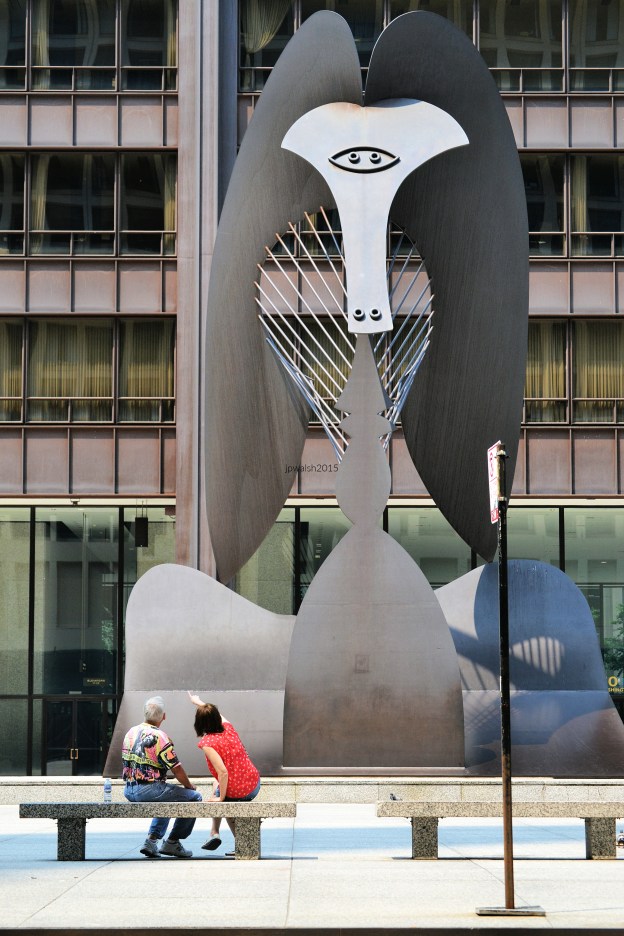
FEATURE image: Chicago’s Picasso in Daley Plaza. Author’s photograph (July 2015).
Chicago’s Picasso in Daley Plaza. Author’s photo (July 2015).

Chicago’s “Picasso” in today’s downtown Daley Plaza was officially unveiled on Tuesday, August 15, 1967 at 12 noon.

Weeks before the public event excitement (and some dread) swirled among Chicagoans and others as to what Pablo Picasso’s monumental outdoor sculpture would be like.

In the photograph on the wall, Mayor Daley and others pull the cord on August 15, 1967 unveiling Chicago’s iconic Picasso.

The famous Andulsian-born artist was first approached by Chicago leaders in May 1963. This encounter led more than four years later to the Cor-Ten steel sculpture’s installation and unveiling on a beautiful Tuesday summer’s afternoon in the Chicago Civic Center Plaza. Many in the crowd of thousands who had gathered to witness the historic event gasped and jeered at the modernist art work when the fabric cover was taken off. Local newspaperman Mike Royko wrote in The Daily News that the art work looked like a “giant insect.” Photo Credit: “Picasso in Chicago” by Emily Barney is licensed under CC BY-NC 2.0

Chicago’s Picasso in Daley Plaza. Author’s photo (October 2011).

Chicago’s first major public outdoor sculpture started a long term national trend to display massive outdoor contemporary art for the public

The now-iconic Picasso unveiled in 1967 is credited with being the first public outdoor sculpture installed in Chicago that put Chicago on the map as one of America’s first major cities to display massive outdoor contemporary art for the public.

In 1958 there was an untitled art work by Richard Lippold (1915-2002) constructed in the lobby of the Inland Steel Building (1954-58) by Skidmore, Owings & Merrill in downtown Chicago. It is four blocks from City Hall and the new Civic Center Plaza that the same architectural firm was helping to design and build in the early 1960’s.

Untitled (known today as The Radiant One), Richard Lippold, commissioned in 1957, Inland Steel Building, Chicago. Author’s photo (December 2017).

This was followed in 1964 by a large modernist work unveiled at the University of Chicago Law School entitled, Construction in Space and in the Third and Fourth Dimensions. It was made in 1959 by Russian Constructionist Antoine Pevsner (1886-1962).

The reputation and fame of Pablo Picasso (1881-1973) in 1967 helped catapult the idea and cultural practice of the installation of modern art, often monumental, in high-profile public spaces across the country, and starting in large measure, in Chicago.

In the following years and decades installation of public art that had broadened beyond the commemorative extended to established artists, many with international reputations, as well as more recent and sometimes emerging artists. In 2021, one online list of public art on campus at the University of Chicago demonstrates its extensive practice that was largely ushered in with Chicago’s Picasso (Ira J. Bach and Mary Lackritz Gray, A Guide to Chicago’s Public Sculpture, University of Chicago Press, 1983, p. xiii; https://arts.uchicago.edu/public-art-campus/public-art-campus#Antoine_Pevsner – retrieved June 9, 2021).

Since before the mid-20th century, public art in America has been often characterized by Modernism (i.e., MoMA’s modernist sculpture garden dated from the 1940’s). Modernism began as a cultural rebellion against prevailing classical-romantic art work. Until around Rodin’s Balzac in 1898, art work in the classical and romantic style filled parks and plazas throughout the 19th century and afterwards that memorialized people, places, and events. Modernists identified the classical-romantic style as old, trite, exhausted, and artistically bankrupt in rapidly changing times. Instead, Modernism offered artistic forms and creative responses that met and expressed an increasingly global and machine age – and not by grand depictions and tired motifs of old Romans standing (or lying) on privileged porticos in togas (i.e., Thomas Couture (1815-1879) Romans during the Decadence, 1847, oil on canvas, Musée d’Orsay).

Thomas Couture (1815-1879), Romans during the Decadence, 1847, oil on canvas, Musée d’Orsay. Starting no later than 1900, contemporary society was increasingly artistically influenced by Modernism. Characterized by the rejection of centuries-old literary and historical subjects and forms, it turned to abstraction and imaginative artistic responses as more fitting expression for a rapidly changing modern society.

Pablo Picasso had dominated the modern art scene for most of the 20th century, starting and particularly as the innovator of Cubism with French painter Georges Braque (1882-1963). Picasso was one of several artists who, as Harper’s Bazaar observed about the magazine’s engagement with modern artists, “broke new ground, challenged established thinking, and signaled seismic shifts in the culture” (Harper’s Bazaar, March 2021, p. 236).
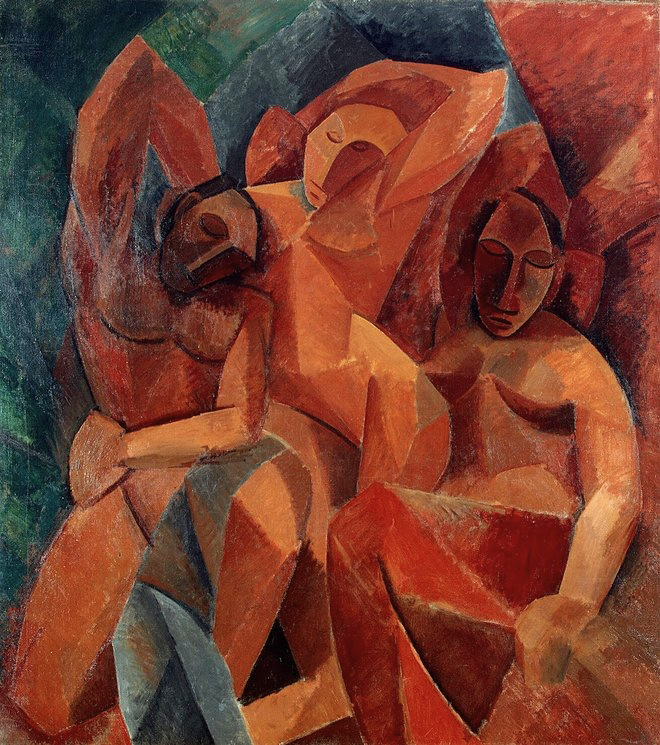
Pablo Picasso, Three Women, 1908, oil on canvas, 200x 178 cm, The Hermitage Museum, St. Petersburg, Russia.

Picasso, Student with a pipe, Paris, 1913, Oil, gouache, cut-and-pasted paper, gesso, sand, and charcoal on canvas, 28 ¾ x 23 1/8 inches, The Museum of Modern Art, New York.

Chicago’s Picasso in Daley Plaza from the side looking to the southeast. Author’s photo (July 2015).

On a representational level, a woman’s facial profile (eye, nose, lips, chin) followed by two “wings” of flowing hair, and rounded shoulders are in plain sight. Yet other interpretations for the sculpture are also reasonably feasible. For example, from the back, are the top symmetrical curves of the wings reflective of the curves of a woman’s buttocks with legs constituting the rest? Are the cut-out shapes like a head and neck in this context possibly a phallus? Picasso famously did many pieces of art that were highly sexualized. In 1932 Pablo Picasso produced an entire series of what would become iconic paintings of Marie-Thérèse Walter, his young, blonde-haired mistress, in the most lascivious and sensual positions imaginable. Picasso’s Minotaur and Wounded Horse is one example of it produced in Boisgeloup (outside Paris) on April 17, 1935 and today in the permanent collection of The Art Institute of Chicago. (See – https://johnpwalshblog.com/2013/05/15/picasso-and-chicago-the-show-may-be-over-but-its-best-parts-stay-on-display-its-called-the-art-institute-of-chicagos-permanent-collection/).

Picasso narrowed the central plane of the head toward the top, and indicated its slight tilt backward. Using Student with Pipe as a guide, what is usually interpreted as flowing hair past a woman’s head and body, these immense curved symmetrical “wings” in Chicago’s Picasso may be conceived as the shadow or shadows of a head and body. If the rods are not representative of something specific – i.e., guitar strings – but, as Picasso alluded in the LOOK interview of November 1967, an aesthetical connection, then this interpretation of a figural foreground and shadowed background that makes for a sculptural whole is also feasible.

The Chicago sculpture’s circular eyes and long flat nose are typical of Picasso heads of the 1913-1914 period which were translations of the features of African, specifically Wobé, masks. Picasso used their economy and schema to transform them into his personal and whimsical art work. (William Rubin, Picasso in the Collection of the Museum of Modern Art, MoMA, New York, 1972, pp. 88-89).

Chicago’s Picasso in Daley Plaza, Author’s photo. (December 2017).

Mask (Kifwebe), Songye, late 19th or early 20th century. Wood, pigment, 12 x 7 1/8 x 6 1/8 in. (30.5 x 18.1 x 15.6 cm). Brooklyn Museum. The object is a female mask with projecting mouth, triangular nose, pierced eyes, overall concentric linear carving, and polychrome pigment.

The mask type that was shared by other African societies is characterized by angular and thrusting forms, and the entire face is covered in unique patterns of geometric grooves. Female masks, such as this one, are distinguished by the predominant use of white clay and, in a feature shared by Chicago’s Picasso, the rounded form of the head crest. (See – https://www.brooklynmuseum.org/opencollection/objects/169088– retrieved June 9, 2021).

Picasso with wife, Jacqueline. Photo credit: “picasso” by ombrelle is licensed under CC BY-NC-SA 2.0.

Picasso was 72 years old and  Jacqueline Roque was 26 years old when they met in 1953. Picasso’s first wife, Olga Khokhlova, died in 1955. Picasso romanced Jacqueline until she agreed to date him and they married in 1961. During their courtship and marriage of 20 years, Picasso created over 400 portraits of Jacqueline, more than any of his other muses.

Picasso’s widow, Jacqueline Roque Picasso (1927-1986), gave her portrait to the president of Iceland and the bust was consigned in 1988 to the National Gallery of Iceland. A more realistic figure, Picasso’s slightly earlier art work evokes features and forms found in the abstracted sculpture for Chicago done a little later, such as the wing-shaped curves of the flowing hair that comes to a point at the bottom. https://www.listasafn.is/english/exhibitions/nr/476

Pablo Picasso, Jacqueline with a Yellow Ribbon, 1962, sheet metal, cut-out, bent, and painted, 19 5/8 inches, National Gallery of Iceland, Reykjavik.

Chicago’s Picasso in Daley Plaza. Completed no later than 5 years after Jacqueline with a Yellow Ribbon in 1962 the dramatic shapes and formulations of the monumental sculpture share recognizable affinities. Author’s photo (July 2015).

Perfect Summer’s Day for Unveiling Ceremony

August 15, 1967 was a perfect summer’s day with temperatures in the low 80s and no rain to worry about in the forecast. The Woods Theater across the Plaza on Dearborn was playing Jack Nicholson’s new film, Hells Angels On Wheels. Before the unveiling, Mayor Richard J. Daley (1902-1976) spoke before the crowd. The mayor told the crowd that he was “very happy” that they had “come to share” in the dedication of what was “a great gift to our city” by Picasso. That Mayor Daley and Pablo Picasso, both Roman Catholics, unveiled Picasso’s gift on August 15 would be coincidental to the significant Catholic religious holiday of the Assumption of the Virgin Mary that also falls on the date.

A lunch-time crowd packed the new Civic Center Plaza on the day of the unveiling. The new plaza fronted a new modernist courthouse skyscraper and a modern outdoor sculpture – Chicago’s Picasso – as the major components of architectural plans virtually from its start.

In 1963, the Public Building Commission of Chicago decided to build a new modernist 31-story civic center fronted by a public plaza. The new complex would complement and contrast with the 10-story City Hall across Clark Street that opened in 1911. The new courthouse and plaza development was part of Mayor Daley’s overall downtown development that by 1963 was in high gear and would remain so past his unexpected death 5 days before Christmas in 1976 at 74 years old.

Skidmore, Owings & Merrill, the architectural firm associated with the project, wanted the art work to be by Pablo Picasso. When the project’s coordinator, architect William E. Hartmann (1916-2003), told Mayor Daley of these plans, the mayor quickly supported the choice. The challenge now was to convince Picasso.

Chicago Civic Center, 1963. (see- https://www.artic.edu/artworks/107284/chicago-civic-center-perspective-view-of-plaza– retrieved June 9, 2021).

The Chicago Civic Center’s supervising architects was C.F. Murphy led by the Aurora, Illinois-born architect Jacques Brownson (1924-2012). Skidmore, Owings & Merrill and Loebl, Schlossman, Bennett & Dart were associated architects. Al Francik was this drawing’s delineator.

The Chicago Civic Center was the first of several important new public buildings constructed in Chicago from the late 1950s to the 1980s as part of Mayor Richard J. Daley’s development of municipal government. The glass-and-steel modernist building held over 100 courtrooms, office space and a large law library. It boasted wide spans between weight bearing columns and 18-foot-tall floor to floor heights. Though the plan included a sculpture in the public plaza, Picasso’s sculpture came later after he was persuaded by William Hartmann of Skidmore, Owings & Merrill to make the artwork. Chicago’s Picasso continues to draw Chicagoans and visitors from all over the world to the plaza. 

On August 15, 1967, Mayor Daley continued his remarks to the assembled crowd: “Today, with its unveiling, it becomes a permanent part of the Chicago scene. As mayor, I dedicate this gift, in the name of the people of Chicago, confident that it will have an abiding and happy place in the city’s heart.”

The Deed of Gift, dated August 21, 1966, was signed by Picasso with one of its witnesses being, Jacqueline, his wife and written in both English and French. The entirety of the Deed of Gift in English reads: “The Monumental sculpture portrayed by the maquette pictured above has been expressly created by me, Pablo Picasso, for installation on the plaza of the Civic Center in the City of Chicago, State of Illinois, United States of America. This sculpture was undertaken by me for the Public Building Commission of Chicago at the request of William E. Hartmann, acting on behalf of the Chicago Civic Center Architects. I hereby give this work and the right to reproduce it to the Public Building Commission, and I give the maquette to The Art Institute of Chicago. Desiring that these gifts shall, through them, belong to the people of Chicago” (Balton-Stratton, The Chicago Picasso, p. 33).
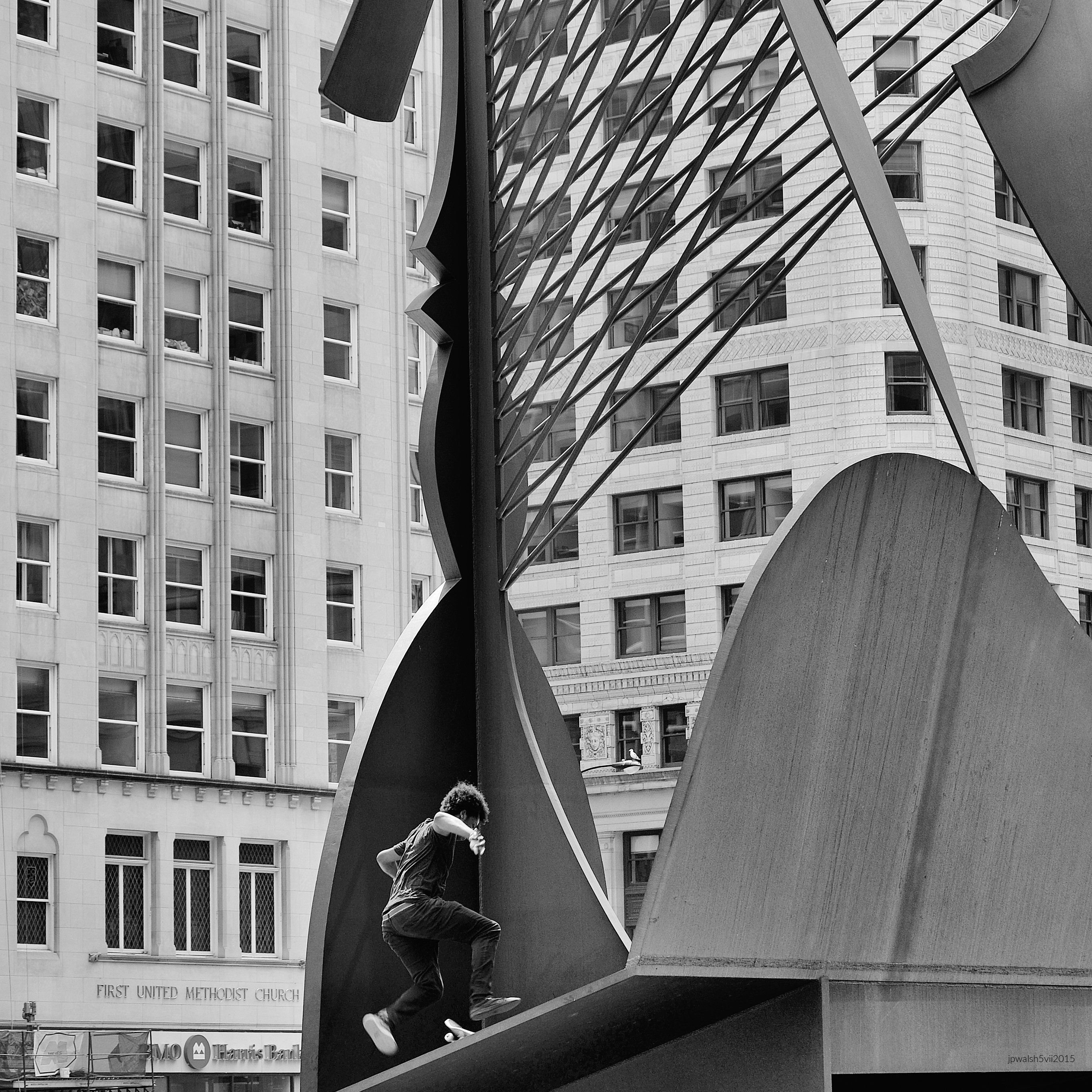
Picasso donated his sculpture to the people of Chicago in 1967. Skateboarder on Chicago’s Picasso in Daley Plaza. Author’s photo (July 2015).
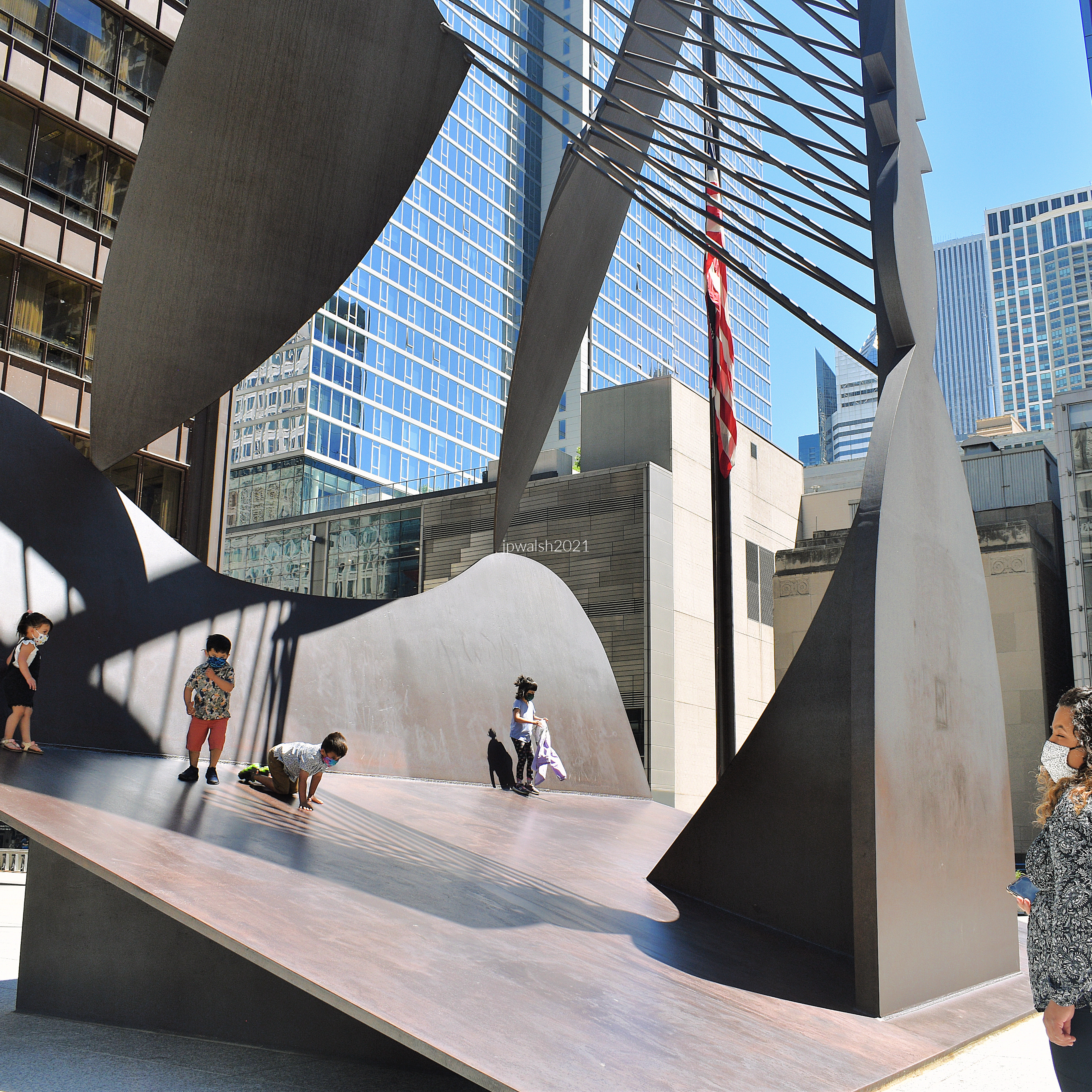
Children’s slide on Chicago’s Picasso in Daley Plaza. Author’s photo (May 2021).

Picasso’s “gift” cost $300,000 to fabricate–or around $2 million today

Picasso donated his sculpture to the people of Chicago in 1967. The artist’s gift constituted the 42-inch maquette and the rights and privileges surrounding it. The monumental sculpture based on Picasso’s “gift” of the maquette cost $300,000 to fabricate–or around $2 million today – and paid for by private monies (Bach, p. 76).

The Picasso sculpture could not be completely a matter of artist largesse (though he did not accept a fee). Gertrude Stein in Picasso, her memoir of the artist written in 1938, writes of the young and then-impoverished Picasso who gave a prominent collector one of his desirable art works when he might have paid for it. Picasso told Stein about the collector: “He doesn’t understand that at that time the difference between a sale and gift was negligible” (Stein, Picasso, p. 8). Fast forward about fifty years and something similar might have applied for Picasso in 1967 in terms of acknowledging the people (and collectors) of Chicago.
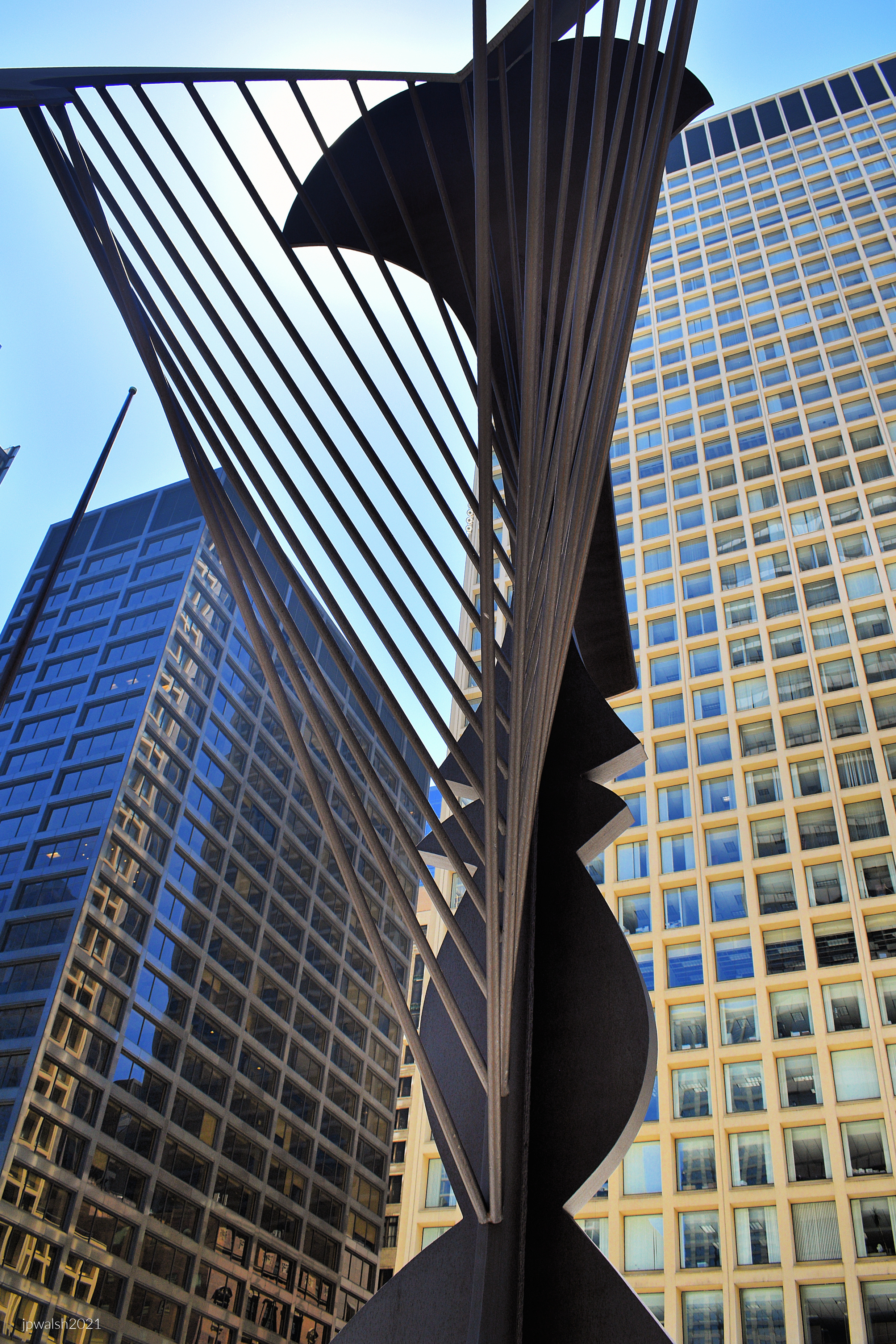
Chicago’s Picasso in Daley Plaza. Author’s photo (May 2021) .
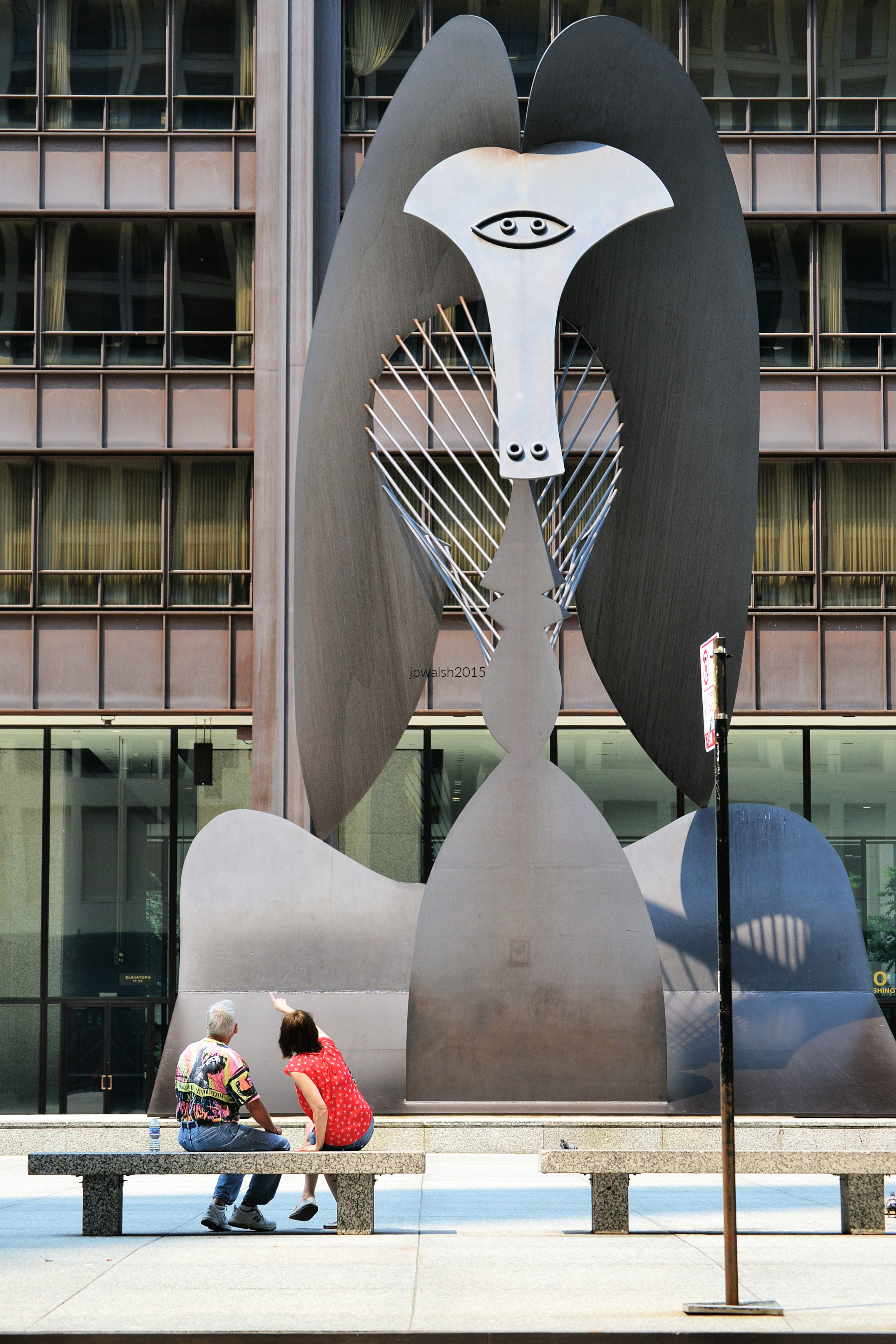
Chicago’s Picasso in Daley Plaza. Author’s photo (July 2015) .

Not everyone who gathered at Daley Plaza in August 1967 during the “Summer of Love” and then-escalating Vietnam War was there to welcome Picasso’s sculpture. Though Chicago had a long and venerable history with Picasso’s art – The Art Institute of Chicago began collecting it in 1923 and the first Picasso exhibition was at The Arts Club of Chicago that same year—protesters held signs at the unveiling, some of which read: “Let’s give it back now!!!,” “The Colossal Boo Boo,” and “It’s a Monsterment.” To what degree connoisseurship influenced protesters in August 1967 would appear to lie in the outright rejection of Modernism though more nuanced criticism could include crass commercialization of Picasso’s art work.

From its unveiling in August 1967 until today, Chicagoans have been mystified by their publicly owned “Picasso.” Picasso’s untitled artwork has had its boosters and detractors. Over the years, it appears public opinion has mellowed about the 50-foot-tall, 162-ton Cor-Ten (self-weathering) steel sculpture, even turning mostly in favor of the enigmatic work of art.

In more than 50 years of debate, Chicagoans have come to accept that they probably will never know exactly what it is that Picasso gave “to the people of Chicago.”

Though mysterious – is it a butterfly or bird? or, as Sir Roland Penrose (1900-1984) interpreted it, the abstracted head of a woman with ample flowing hair – many seek it out or find it as they cross the plaza. It adds grace, beauty, personality, proportionality and perspective to the urban space between Dearborn and Clark Streets at Washington Street.
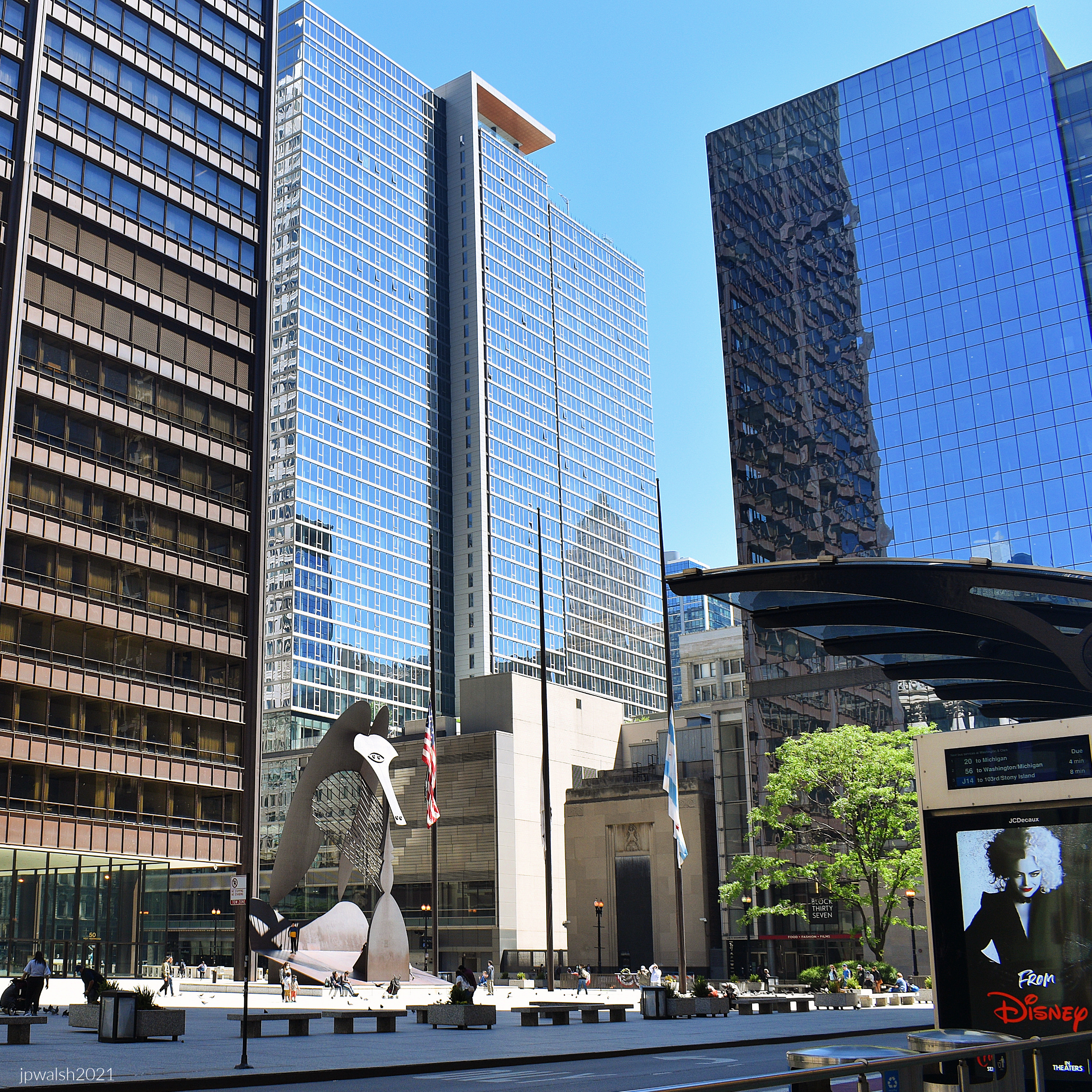
Chicago’s Picasso in Daley Plaza looking to the northeast. Author’s photo (May 2021).

The sculpture’s rods have been compared to the strings of a guitar (Bach, pp.75-76). Always in the public domain, it is a popular icon for Chicago.

The Picasso bestows international and modernist value to the “City of the (19th) Century” which in 1911 – the year City Hall was erected – poet Carl Sandburg (1878-1967) called “hog butcher for the world” in his poem, Chicago. Though Sandburg wrote these literary images in and of another era, the famous poet was just 3 years older than Picasso and died in July 1967, only weeks before the official unveiling of the Picasso that ushed in a new age for the city.

In May 1963, Picasso was a vigorous 81 years old and living in Mougins, France. By way of literary and artistic contacts in Chicago and Europe, William Hartmann was helped on his mission to visit Picasso as the young American architect headed to the south of France to await the outcome of his request to meet the aging Spanish artist.

Picasso was 81 years old and living in the south of France when Chicago architect William Hartmann tracked the artist down to ask him to consider creating a sculpture on a monumental scale for Chicago’s new modernist Civic Center development project.  Photo credit: “PABLO PICASSO” by marsupilami92 is licensed under CC BY 2.0.

William Hartmann, 47 years old in 1963, was born in New Jersey and started his architectural career in Boston after attending MIT. He joined Skidmore, Owings & Merrill in New York City following World War II and was working in its Chicago office since 1947. Hartmann, elected to the College of Fellows of the American Institute of Architects (AIA) in 1963, is credited for personally enticing Picasso to design a sculpture for Daley Center Plaza in Chicago. In 1968, the year after the installation of the Picasso sculpture in Chicago, Hartmann was awarded an honorary Doctorate of Humane Letters from Lake Forest College. (For Hartmann biographical information and interviews, see the Ryerson & Burnham art and architecture archive – https://digital-libraries.artic.edu/digital/collection/caohp/id/26834/rec/1– retrieved June 9, 2021).

At their meeting Hartmann looked to familiarize the artist with the downtown Chicago project: he brought photographs of Chicago, the building site, and its people. Hartmann included photographs of the many Picasso works owned by Chicagoans and its institutions to show him this city’s longstanding regard and love for him.

Picasso told Hartmann he would think about it.

Hartmann continued to visit over the next months and years bringing various Americana and Chicago-related items as gifts, such as major sports team paraphernalia. Hartmann also updated the artist on the modernist Civic Center construction project.

Picasso produced a draft.

Before starting his maquette, Picasso asked Chicago leaders to keep the art project “relatively confidential” and out of the public eye

Hartmann told him, “We want to commission you so that I end up with a study I can take back.” Maintaining his flexibility, Picasso told Hartmann, “I may not produce anything—or produce something that you don’t like. It’s best that we keep this low-key from start to finish, calm, and relatively confidential.”

Thus, out of “relative confidentiality” was born much of the mystery and intriguing quality of the “Picasso” at its unveiling in Chicago in August 1967.

Maquette for Richard J. Daley Center Sculpture,1964. The Art Institute of Chicago. Maquette for Richard J. Daley Center Monument, 1965. Welded steel (simulated and oxidized) 41 ¼ x 27 ½ x 19 inches, The Art Institute of Chicago. The artist; given to The Art Institute of Chicago, 1966. See – https://www.artic.edu/artworks/25809/maquette-for-richard-j-daley-center-sculpture — June 6, 2021.

In 1963 Mayor Daley looked to persuade Picasso to do a monument. In 1965, Picasso looked to persuade Mayor Daley to accept his foremost Cubist original work that would be seen and interpreted each day by thousands in the heart of Chicago’s downtown government, business and shopping district.

Chicago’s collection of public art was initiated on August 15, 1967, when Mayor Richard J. Daley dedicated an untitled sculpture commonly known as “The Picasso” in Chicago’s new Civic Center (now the Richard J. Daley Center). Four years earlier, architect William Hartmann of Skidmore, Owings & Merrill had approached Pablo Picasso with the commission. The artist accepted and crafted two steel maquettes: one he kept in his studio at Mougins and gave the other to the architect to use in planning the potential fabrication of the sculpture. With the Picasso sculpture’s unveiling in 1967, its presence inspired private and public investment in many more artworks throughout the cityscape, including Anish Kapoor’s Cloud Gate (“The Bean”) completed in 2006 at Millennium Park.

Cloud Gate (“The Bean”), Anish Kapoor, 2006, Millennium Park, Chicago. Chicago’s Picasso in 1967 inspired private and public investment in art works throughout the cityscape well into the future. Author’s photo (May 2021).

When Picasso produced a 42-inch maquette of the sculpture, the board of the Public Building Commission of Chicago was given a private viewing of it. Afterwards, they passed a resolution authorizing the payment of $100,000 to Picasso (about $850,000 today) with the sum to include the purchase price for the right, title and interest in and to the maquette as well as copyright and copyright renewals. When Hartmann offered the $100,000 check to Picasso, he asked the artist to sign the “Formal Acknowledgment and Receipt.”

Picasso refused to accept the money or to sign the document.

Rather it was Picasso’s wish that a “Deed of Gift” be prepared and which Picasso signed on August 21, 1966. (see- https://en.wikisource.org/wiki/Letter_Edged_in_Black_Press,_Inc._v._Public_Building_Commission_of_Chicago – retrieved June 4, 2021).
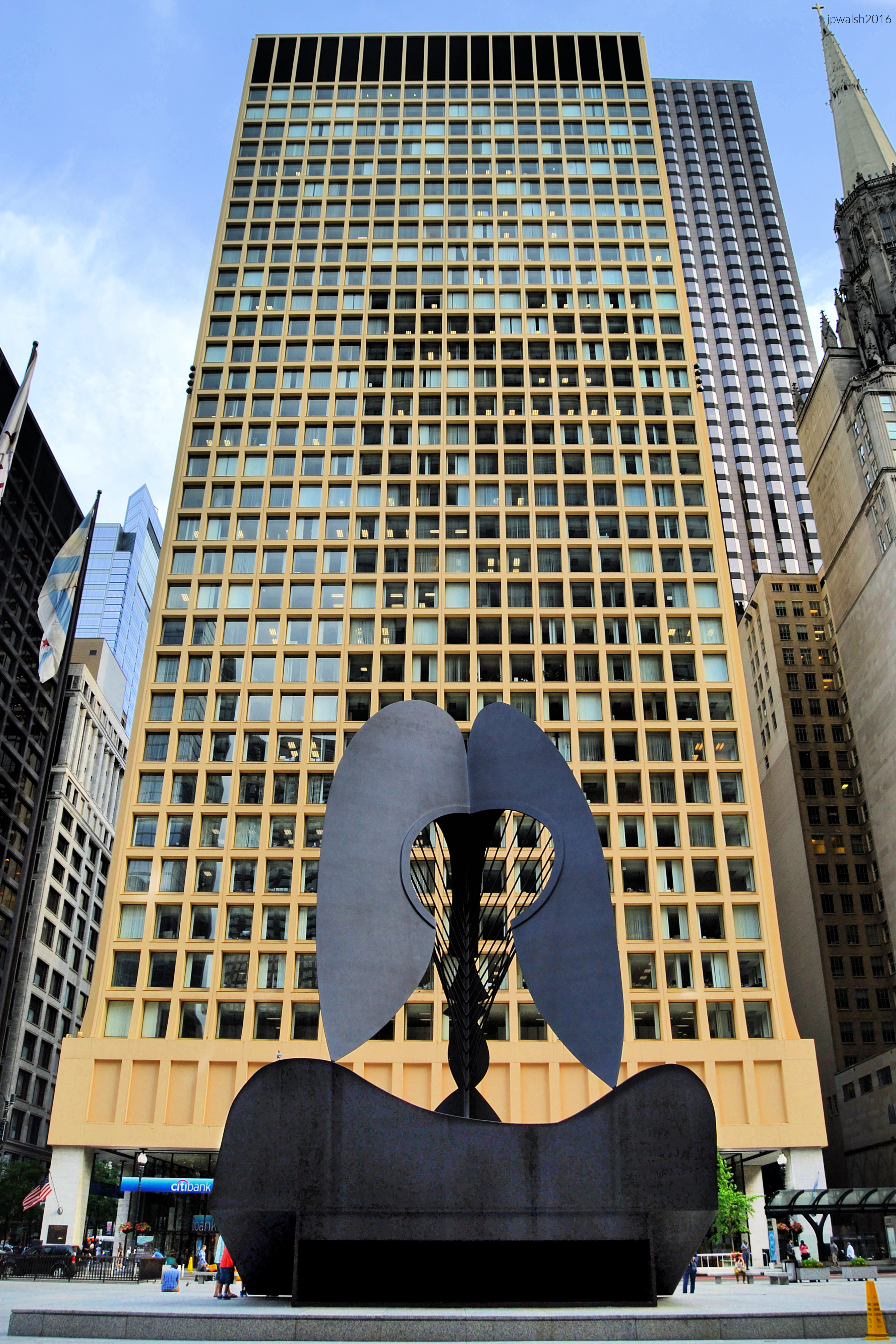
Chicago’s Picasso in Daley Plaza from the back looking to the south. As in every cubist art work, a visit to the sculpture provides multiple viewpoints. Author’s photo (July 2016).

Richard J. Daley Center Sculpture, 1967, White chalk on plywood, 100 x 81 cm, Signed recto, upper right, in magenta pastel: “Picasso” (underlined); The artist; given to The Art Institute of Chicago, 1967. – https://www.artic.edu/artworks/28019/richard-j-daley-center-sculpture– retrieved June 9, 2021.

In the chalk drawing (above) the importance of the sculpture’s forms, both empty of steel and fabricated thereof, carry greater significance to the outcome of the piece. In the drawing Picasso does not include the rods of which much representational conjecture has been made (i.e., guitar strings) as the artist himself admits adds value for structural stability of the modernist monument.

Based on Picasso’s design and the 42-inch maquette he made, the monumental statue was built by U.S. Steel in Gary, Indiana. Anatol Rychalski was the engineer in charge of the design and construction.

Rods of the Chicago Picasso in Daley Plaza, Author’s photo (July 2015).

“My job was to make an exact but giant likeness of Picasso’s 42-inch original. Being a follower of Picasso’s works, I knew that no snap judgement of this one would suffice. But those of us who built it accepted the challenge of its interpretation with as much enthusiasm as the challenge of its construction” (Chicago Tribune, August 20, 1967). Rychalski, a Polish immigrant to the U.S. in 1950 and, in 1967, senior designer in the American Bridge Division of U.S. Steel corporation, observed, “We had to roll steel to sizes which never have been rolled which means that the whole technology had to be to some extent improvised at the time.” Nearly 50 years later, in 2016, the 91-year-old Rychalski, said about the sculpture, “It defines the city as ‘spirit in flight.’ You look at the wings and the profile of an overwhelmingly powerful lady…the value of it is enormous.” (quoted in https://www.shawlocal.com/2016/07/28/shorewood-man-expresses-the-profound-through-his-acrylic-paintings/askc2p1/-retrieved June 9, 2021.)

Pablo Picasso and William E. Hartmann with the maquette in the artist’s Mougins studio in August 1966. This image appeared in the 1967 program pamphlet. Picasso made two maquettes – one he kept in his studio and the other he gave to The Art Institute of Chicago for the behalf of the people of Chicago.

Daley pulled the cord on the multi-color fabric that hid Picasso’s gift to the people of Chicago. Chicago poet Gweldolyn Brooks (1917-2000) read remarks and members of the Chicago Symphony Orchestra played music.

Collective gasp from the crowd followed by jeers at unveiling

With the veil removed, the crowd let out a collective gasp and began to shout negative comments about the art work. In its first public appearance, the crowd of potential Picasso admirers turned into a Picasso peanut gallery – an unintended, unwanted but not wholly unforeseen consequence by city authorities. Bemused criticisms of the Picasso were also part of what became – in the mayor’s words at the sculpture’s unveiling – “a permanent part of the Chicago scene.”

The Chicago Picasso at the dedication ceremony before the unveiling on August 15, 1967. Photo credit: case 69C353: The Letter Edged in Black Press, Inc. vs. Public Building Commission of Chicago in records of the U.S. District Court, Northern District of Illinois, Eastern Division, RG 21.

Controversial reaction better than “no reaction at all”

For William Hartmann and others responsible for bringing the Picasso to Chicago the local crowd’s visceral and negative reaction to the monumental public art work in the downtown location was better than no reaction at all.

“Picasso’s work, frequently, if not always has been the center of controversy,” Hartmann philosophically observed, “So it all fit into that pattern beautifully.”

Mayor Richard J. Daley (right), c. 1971. Photo credit: “File:Chicago Mayor Daley and Keith Kingbay.jpg” by Chester R. Kropidlowski P.E. is licensed under CC BY-SA 2.5.

A few days after the unveiling, Mayor Daley offers his thoughts at a press conference about the Picasso

A couple of days after the unveiling ceremony, Mayor Daley at a press conference offered what he thought about the Picasso sculpture. Though it was “wonderful,” Daley admitted like the rest of Chicago that he did not know what the sculpture really represents.

One idea the mayor floated was that it was a woman as some believed and that it was very appropriate that she stood in front of the courthouse.

“We’ve always looked at justice as a woman and it is outside a hall of justice,“ the 65-year-old Big-City Irish Democratic mayor said. He speculated further: “But it could also be a Phoenix. It would symbolize the rise of Chicago as a city of vitality out of the ashes caused by [the Great Chicago Fire]” (Chicago Tribune, August 19, 1967).

Considering the many conversations that were held over four years with city planners and the Spanish artist through William Hartmann about Chicago’s Picasso it is fair to say that the mayor – the city’s biggest booster – would state his interpretation on the art work based on what he believed he saw after talking to the experts.

Chicago’s Picasso in Daley Plaza, made from a 42-inch maquette in Mougins, France into a 50-foot-tall, 162-ton Cor-Ten steel sculpture in Gary, Indiana, is an engineering marvel. Author’s photo (July 2015).

From 42-inch maquette in Mougins, France, to 50-foot-tall, 162-ton Cor-Ten steel sculpture in Gary, Indiana

In those same days, Anatol Rychalski (b. 1925) was open-minded about the Picasso’s precise artistic representation. “It doesn’t really matter how you personally interpret the sculpture,“ he told the Chicago Tribune on August 20, 1967, “as long as you not ridicule for the sake of ridicule.” He then shared his interpretation: “To me it represents the winged spirit of justice, with the serenity and compassion of a woman. It is a benevolent but stern and powerful justice.”

LOOK magazine interviews Pablo and Jacqueline Picasso and they talk about Chicago’s Picasso

In November 1967, LOOK magazine interviewed Picasso and Jacqueline and the Chicago sculpture came up. They were both amused by the baffled reaction of Chicagoans to the art work. Jacqueline offered that it was obviously “a woman’s head” and shoulders but “no more.” Picasso observed that the “cage” of steel rods was more an aesthetic than a representation. In the LOOK interview Picasso observed: “I am touched that the [Chicago] public could mysteriously share my joy over the results of many years work in sculpture. In a way, my sculptures are more my children than my paintings. I am caught up in shaping my vision of the world. In sculpture, I cut through appearances to the marrow, and rebuild the essentials from there. I cannot invent a detail that has not been carefully planned and my wish is that the public, through thinking and meditation, may retrace my intentions” (LOOK, November 28, 1967). Picasso’s challenge to the viewer to discover an objective answer to his artistic intentions makes the sculpture’s meaning more intriguing.

Chicago’s Picasso in Daley Plaza. In a November 1967 LOOK magazine interview, Picasso and Jacqueline expressed amusement at Chicagoans’ reaction to the art work. Jacqueline said it was obviously “a woman’s head” and shoulders but “no more.” Author’s photo (July 2015).

“Eyes that are pitiless, cold, mean…”

Probing the artist’s intentions was met soon with succinct anecdotal insight from Chicago’s newspaperman, Mike Royko (1932-1997). Royko wrote creatively and personally about the significance of the art work for Chicago in 1967. The columnist’s cynical eye on the possible relationship of the modernist steel art work and the city he loved was published in the afternoon newspaper, the Chicago Daily News:

“That is all there is to it. Some soaring lines, yes. Interesting design, I’m sure. But the fact is, it has a long stupid face and looks like some giant insect that is about to eat a smaller, weaker insect. It has eyes that are pitiless, cold, mean.

But why not? Everybody said it had the spirit of Chicago. And from thousands of miles away, accidentally or on purpose, Picasso captured it.

Up there in that ugly face is the spirit of Al Capone, the Summerdale scandal cops, the settlers who took the Indians but good.

ITS EYES ARE LIKE the eyes of every slum owner who made a buck off the small and weak. And of every building inspector who took a wad from a slum owner to make it all possible.

It has the look of the dope pusher and of the syndicate technician as he looks for just the right wire to splice the bomb to.

Any bigtime real estate operator will be able to look into the face of the Picasso and see the spirit that makes the city’s rebuilding possible and profitable.

It has the look of the big corporate executive who comes face to face with the reality of how much water pollution his company is responsible for – and then thinks of the profit and loss and of his salary.

IT IS ALL THERE in that Picasso thing – the I will spirit. The I will get you before you will get me spirit.

Picasso has never been here, they say. You’d think he’s been riding the L all his life.”

Soft Version of Maquette for a Monument Donated to the City of Chicago by Pablo Picasso, Claes Oldenburg (b. 1929), 1969. Canvas and rope, painted with synthetic polymer, dimensions variable (38 x 28¾ x 21 inches, full height), Musée National d’Art Moderne, Centre Georges Pompidou, Paris.

What could be seen as an early parody of the Picasso sculpture by Claes Oldenburg is, in fact, the artist’s homage to the art work as well as conversation with it on aesthetics.

In Oldenburg’s version Picasso’s steel becomes soft cloth; straight rods become limp ropes. More malleable than the original, Oldenburg dubbed his work “Super-Cubism” in that where a Cubist work offers the viewer multiple viewpoints, Oldenburg’s piece offers viewpoints that are unlimited (Picasso and American Art, Michael FitzGerald, Whitney Museum of American Art, New York, 2006, p. 259).

Gertrude Stein by Pablo Picasso, 1905–6, The Metropolitan Museum of Art, New York. The Met writes about this work: “[Picasso] reduces her body to simple masses—a foreshadowing of his adoption of Cubism—and portrays her face like a mask with heavy lidded eyes, reflecting his recent encounter with Iberian sculpture.” see- https://www.metmuseum.org/art/collection/search/488221 – retrieved June 4, 2021.

Reaching farther back in Picasso’s career at the start of the 20th century, American writer Gertrude Stein (1874-1946) knew Picasso in Paris and later wrote about him. Stein observed that Picasso was “the only one in painting who saw the twentieth century with his eyes and saw its reality and consequently his struggle was terrifying …for himself and for the others, because he had nothing to help him…he had to do it all alone and, as in spite of much strength he is often very weak…” (Stein, Picasso, p. 22).

In 1906 when Picasso was 25 years old, he painted Gertrude Stein’s portrait. According to Stein, she posed for him in Paris “eighty times” but, finally, he “painted out the head” and, following a break in Spain, painted in a new head without seeing her again beforehand (see G. Stein, Picasso, 1938, p. 8). Though Stein was “satisfied” with the portrait and remained so over 30 years later, Picasso was criticized in 1906 for the depiction. The artist responded with a remark now considered famous and certainly, as Stein and the world discovered, prescient: “Everybody says that she does not look like it but that does not make any difference, she will.” (See G. Stein, The Autobiography of Alice B. Toklas).

The bold creative vision of the Cubist artist is very much in evidence in Picasso’s gift to the people of Chicago that stands in Daley Plaza. It may be that Picasso’s intentions for the iconic untitled sculpture may only be known in future days. For, at first, they said it did not look like Chicago, but it didn’t make any difference – because it will.

Chicago’s Picasso in Daley Plaza from the back looking to the southwest. Author’s photo (October 2015).

6/2022 5.98 mb 99%

Chicago’s Picasso (June 2022).

SOURCES:

Bach, Ira J. and Mary Lackritz Gray, A Guide to Chicago’s Public Sculpture, University of Chicago Press, 1983.

FitzGerald, Michael, Picasso and American Art, Exh. Cat. Whitney Museum of American Art/Yale University press, New York, 2006.

Rubin, William, Picasso in the Collection of the Modern of Modern Art, , MoMA, New York, 1972.

Stein, Gertrude, Picasso, B.T. Batsford, Ltd. London, 1938.

Stein, Gertrude, The Autobiography of Alice B. Toklas, Illustrated (PENGUIN PRESS). 2020.

Stratton, Patricia Balton, The Chicago Picasso: A Point of Departure, Ampersand Inc. Chicago New Orleans, 2017.

https://arts.uchicago.edu/public-art-campus/public-art-campus#Antoine_Pevsner

Harper’s Bazaar, March 2021.

https://www.brooklynmuseum.org/opencollection/objects/169088

https://www.listasafn.is/english/exhibitions/nr/476

https://www.artic.edu/artworks/107284/chicago-civic-center-perspective-view-of-plaza

https://digital-libraries.artic.edu/digital/collection/caohp/id/26834/rec/1

https://en.wikisource.org/wiki/Letter_Edged_in_Black_Press,_Inc._v._Public_Building_Commission_of_Chicago – retrieved June 4, 2021.
https://interactive.wttw.com/playlist/2017/08/02/colossal-booboo-incredible-story-chicago-picasso – retrieved June 1, 2021

https://www.artic.edu/artworks/28019/richard-j-daley-center-sculpture

https://www.shawlocal.com/2016/07/28/shorewood-man-expresses-the-profound-through-his-acrylic-paintings/askc2p1/)

Chicago Tribune, August 19, 1967.

Chicago Tribune, August 20, 1967.

https://www.metmuseum.org/art/collection/search/488221 – retrieved June 4, 2021.

LOOK, November 28, 1967.

FURTHER READING (see – https://www.artic.edu/artworks/25809/maquette-for-richard-j-daley-center-sculpture – retrieved June 5, 2021):

“The Chicago Picasso,” Progressive Architecture (November 1966), p. 66 (ill.).

The Art Institute of Chicago, Annual Report (1966–1967), pp. 26–27 (ill.).

Chicago Picasso Dedication program (August 15, 1967) (ill.).

Lael Wertenbaker, The World of Picasso (New York: Time-Life Books, 1967), p. 153 (ill.).

“A Picasso Statue for Chicago,” The Burlington Magazine 109:766 (January 1967), pp. 34–36, figs. 68 and 70.

Burton Wasserman, “Picasso: The Touch of Magic,” Art Education 21:4 (April 1968), p. 29 (ill.).

Clarence Page, “Giant Iron Sculpture: Picasso Leaves His Mark on the City,” Chicago Tribune (April 9, 1973), section 1, p. 6.

Roberto Otero, Forever Picasso: An Intimate Look at his Last Years (New York: Harry N. Abrams, 1974), pp. 46, 50, 52–55 (ill.).

Roberto Otero, “It’s more charming this way: How the master made us a gift,” Chicago Guide, vol. 23, no. 10 (October 1974), pp. 86–87.

Marilyn McCully, A Picasso Anthology: Documents, Criticism, Reminiscences (London: Arts Council of Great Britain, 1981), pp. 266–267 (ill.).

Sally Fairweather, Picasso’s Concrete Sculptures (New York: Hudson Hills Press, 1982), p. 85.

The Picasso Project, Picasso’s Paintings, Watercolors, Drawings, and Sculpture: A Comprehensive Illustrated Catalogue 1885–1973, The Sixties II 1964–1967 (San Francisco: Alan Wofsy Fine Arts, 2002), p. 133, no. 64–373 (ill.).

Gary Tinterow, Master Drawings by Picasso, exh. cat. (Cambridge, Mass., 1981), p. 255, no. 27.

Stephanie d’Alessandro, “Picasso and Chicago,” (Art Institute of Chicago, 2013), p.26, cat 245 (ill.)

https://www.academia.edu/49215007/A_GIFT_TO_THE_PEOPLE_THE_CHICAGO_PICASSO_1967



My Architecture & Design Photography: JEAN-PAUL VIGUIER. Sofitel Chicago Magnificent Mile (2002), 20 East Chestnut Street; Chicago, Illinois.

FEATURE image: Sofitel Chicago Magnificent Mile, Chicago, Illinois. architect: Jean-Paul Viguier. 6/2014 4.66mb Author’s photograph.

Sofitel Chicago Magnificent Mile, Chicago, Illinois, Jean-Paul Viguier. At its opening the Chicago chapter of the American Institute of Architects (AIA) selected today’s Sofitel Chicago Magnificent Mile as the decade’s “best new building” in Chicago. The hotel opened in May 2002 with 415 rooms.

Jean-Paul Viguier (b.1946) is a leading modern Paris-based French architect. In 2003 his Sofitel Chicago Water Tower (renamed the Sofitel Chicago Magnificent Mile) was chosen by the Chicago chapter of the American Institute of Architects (AIA) as the “best new building in Chicago in the last ten years.” The hotel opened in May 2002 with 415 rooms. Its dramatic architecture made an immediate impression not only on the city’s denizens and visitors but much of the world.

The glass triangular tower ascends and thrusts over the intersection of Chestnut and Wabash Streets. Narrowing as it rises, the shape could evoke a ship’s prow—or a geometer’s trapezoid. 6/2014 5.49mb

The prism-shaped, 350,000-square-foot structure was chosen by nearly 350 established Chicago-based architects as one of the city’s most outstanding achievements in architecture. The glass triangular tower ascends and thrusts over the intersection of Chestnut and Wabash Streets. Narrowing as it rises, the shape could evoke a ship’s prow—or a geometer’s trapezoid. Its expansive façades allow generous exposures of natural light as it faces east to capture sunrise over the incredible natural backdrop of Lake Michigan and southwest towards the timeless Midwestern prairie. Adding to the building’s drama and welcome grace is its exterior of horizontal cladding of visible and opaque glass in synergy with the verticality of the building’s wedge and curve. Inside, the lobby continues this building’s dramatic modernity presenting a steely structural space that is airy, sleek, and soaring.

Mr. Viguier was selected to design Sofitel Chicago Magnificent Mile during a design competition in 1998 judged by Accor hotels leadership and others. Mr. Viguier is a member of the International Academy of Architecture (IAA) and was president of AFEX (French Architects Overseas) from 1999 to 2002.

Jean-Paul Viguier.

Photo Credit: “File:Jean-Paul Viguier Wiki.jpg” by JPVAParis is licensed under CC BY-SA 4.0

Mr. Viguier’s other internationally recognized projects include the France Televisions headquarters in Paris as well as the Cœur Défense in 2001 and the Tour Majunja in 2014 both in La Défense, France. The French architect built a two story expansion at the McNay Museum of Modern Art in San Antonio, Texas. Mr. Viguier is also architect for the Maroc Telecom Tower in Rabat, Morocco in 2013, and, in 2015, the SFR Campus in Saint-Denis, France. Another highly regarded project is, in 2013, the Cancer University Institute in Toulouse, France.

The Sofitel Chicago Magnificent Mile is also listed at no. 82 in a public poll of 150 buildings of “America’s Favorite Architecture.” The poll was conducted by The American Institute of Architects (AIA) and Harris Interactive and in conjunction with the AIA’s 150th anniversary in 2007.  

In 2005, Sofitel Chicago Magnificent Mile received the MIPIM Award at their international meeting of property market sector leaders gathering in Cannes, France. Created in 1991, the MIPIM Awards is an internationally-renowned real estate competition at MIPIM, the world’s property market. It honors the most outstanding and accomplished projects, completed or yet to be built, around the world, the very best of the real estate industry.

SOURCES: https://www.hospitalitynet.org/news/4019734.html – retrieved May 24, 2021; AIA Guide To Chicago, 2nd edition, edited by Alice Sinkevitch, 2004, p. 130; https://legacy.npr.org/documents/2007/feb/buildings/150buildings.pdf – retrieved May 24, 2021; https://www.floordaily.net/floorfocus/aia-poll-of-americas-favorite-buildings-released – retrieved May 24, 2021; https://iaa-ngo.com/portfolio-posts/jean-paul-viguier/ – retrieved May 24, 2021; https://www.architecturaldigest.com/story/chicago-architecture-boom – retrieved May 24, 2021; https://www.viguier.com/en – retrieved May 24, 2021; https://archello.com/project/campus-sfr-sfr-headquarters – retrieved May 24, 2021; https://archello.com/project/cancer-university-institute – retrieved May 24, 2021; https://www.viguier.com/en/projets/mcnay-museum-san-antonio-texas – retrieved May 24, 2021; https://www.viguier.com/en/projets/tour-maroc-telecom-rabat – retrieved May 24, 2021.

Author’s photograph of the Sofitel’s west flank was taken on June 14, 2014 at State and Chestnut Streets.

My Architecture & Design Photography: HELMUT JAHN (1940-2021) Highlights in Chicago, Illinois.

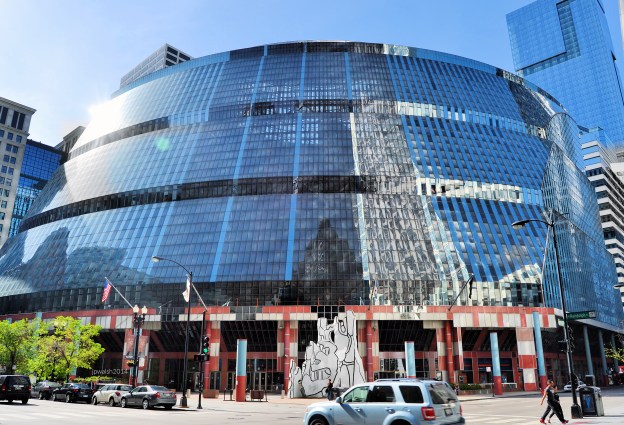
FEATURE image: Helmut Jahn, State of Illinois (Thompson) Center, 100 W. Randolph, Chicago, Illinois, 1979-1985. The Thompson Center was officially bought by Google in 2022 for a reported $105 million. Author’s photograph. 5/2014 4.75 mb

Helmut Jahn (1940-2021) is a leading postmodern architect responsible for scores of projects internationally. “Final weekend of the Helmut Jahn exhibit at @chiarchitecture” by reallyboring is licensed under CC BY-NC-ND 2.0.

Introduction.

Helmut Jahn was famous in Chicago and around the world for his prolific postmodern architecture particularly his work in steel and glass.

Born in Germany near Nuremberg, in 1940, Jahn graduated from Technische Hochschule in Munich and moved to Chicago in 1966. Jahn arrived in Chicago just as “downtown development” during the administration of Mayor Richard J. Daley (1902-1976) was finding its greatest momentum. Jahn began to study under Ludwig Mies van der Rohe (1886-1969) at the Illinois Institute of Technology (IIT) and, in 1967, joined Charles (C.F.) Murphy Associates which later became Murphy/Jahn. The younger man would carry on the powerful influence and energy of these Chicago personalities for building big, creatively, and prolifically for the next fifty years into the first quarter of the 21st century. Jahn would add his own significant contribution and footprint in Chicago and around the nation and world in those same long years of his activity.

One of Jahn’s early projects in his first years in Chicago was McCormick Place. The original concrete and steel permanent exposition hall on the lakefront that opened in 1960 was destroyed in a fire in January 1967, just as Jahn was starting to work as a professional architect. Named for Col. McCormick of the Chicago Tribune, the newspaper owner and publisher had boosted the idea of a permanent exposition hall on Chicago’s lakefront for years prior to his death in 1955.

Jahn had come to Chicago at an exciting time to be building there — during Jahn’s first years in Chicago the John Hancock Building was completed in 1969 and the Sears Tower, the tallest building in the world for the next 24 years, was completed in 1974. In 1971, C.F. Murphy completed the new and massive McCormick Place, a powerful steel and glass structure with enormous cantilever eaves, on the same lakefront site as the old exposition hall. Out of that single successful building project, Helmut Jahn and the rest of the world saw the significant development in Chicago that would blossom around this important and functional modern architecture over ensuing decades — including the North building constructed across Lake Shore Drive in 1986; the South building built in 1996; a hotel built in 1998; the massive West building built in 2007; and, in 2017, the Wintrust Arena.

In the mid 1980’s one of Jahn’s most significant creations was the James R. Thompson Center in Chicago. Aesthetically grandiose and controversial, the “State of Illinois Building” was put up for sale in 2021 by the administration of Governor J.B. Pritzker, citing its historically high operating and maintenance costs.

Jahn designed the 23-story addition to the Chicago Board of Trade in 1980 and Accenture Tower at 500 W. Madison in the West Loop which opened in 1987. Across the nation and world Helmut Jahn’s fresh, grand, and innovative designs have made their way into the annals of postmodern architecture. Any complete list of Helmut Jahn’s active and completed projects extends necessarily into the many scores. A list of notable buildings could include the 1999 K St. NW, a 12-story structure, in Washington D.C. completed in 2009; the twin 37-story Veers Towers in Las Vegas, Nevada opened in 2010; and, in his native Germany, the 63-story Messeturm in Frankfurt opened in 1990 and the Sony Center, a complex of eight buildings, in Potsdamer Platz in Berlin completed in 2000. The hard-driving list goes on…and on.

In Chicago Jahn designed the exposed steel frame United Airlines Terminal 1 at O’Hare International Airport between 1985 and 1988. Air travelers for decades have enjoyably traversed its entertaining walkway connecting concourses that include moving sidewalks, colorful lighting and futuristic sounds.

At the time of his death at 81 years old on May 8, 2021 in a bike road accident in the far western suburbs of Chicago, Helmut Jahn was working on a 74-story residential building in Chicago at 1000 S. Michigan. It was scheduled to be opened in 2022 but its construction was already delayed because of the Covid-19 pandemic that postponed construction. Helmut Jahn taught at IIT, the University of Illinois-Chicago, Harvard University, and Yale University. In 2012 Murphy/Jahn became JAHN and, according to a recent report from Dun & Bradstreet, the firm had a total of 55 employees and generated a little over $6 million in annual sales.

Xerox Center, 55 West Monroe, Chicago, 1977-1980.

In what was one of Helmut Jahn’s first great urban achievements, the 40-story office tower on an important corner in downtown Chicago was built on speculation and soon took the name of its major tenant (Xerox). The sleek and simple curtain wall of enameled off-white fluoropolymer aluminum panels and reflective glass slide over a reinforced concrete structure and around its soft postmodern corners in contrast to the modernist box.

The tower is fitted to its site where the building’s corner is exaggerated at street level with varying glaze percentages, and the white-black-silver palette of the lobby follows a diagonal pattern (also on the roof) in contrast to the exterior curvilinear design.

Silver double-glazed reflective glass pays homage to 1950’s and 1960’s Chicago modernism and the Xerox building’s closest neighbors: the kitty-corner Inland Steel Building (1954-1958, Skidmore, Owings and Merrill) and, directly across to the north, the First National (today, Chase) Bank building (1964-1969, C.F. Murphy Associates with Perkins and Will).

Helmut Jahn (C.F. Murphy Associates)/Murphy Jahn. Xerox Center, 55 West Monroe, Chicago, 1977-1980. 12/2014 5.60 mb 99%

Some have observed that Jahn’s curving tower may have been inspired by Louis Sullivan’s 1899 Schlesinger and Mayer department store building on State Street (what became in 1904 Carson, Pirie, Scott and Company Building and today is The Sullivan Center). The 1980 project’s original conception was for two curvilinear towers though obviously only one was constructed obfuscating and negating the original design’s uniquely bold impacts.

The glass and aluminum are arranged to alternate in horizontal bands which have modernist predecessors in Chicago and Europe. Hidden from the street view are more diagonals that cut a pattern across the roof. The building is a major transition for Jahn who, steeped in mid-20th century Modernism, harkened back to earlier 1920s modernist sources for the 55 W. Monroe (Xerox) building. The author’s photograph was taken on December 24, 2014.

SOURCES for 55 W. Monroe:
Building Chicago: The Architectural Masterworks, John Zukowsky, New York: Rizzoli with Chicago History Museum, 2016, p. 237.

AIA Guide to Chicago, 2nd Edition, Alice Sinkevitch, Harcourt, Inc., Orlando, 2004, p. 67.

The Sky’s The Limit: A Century of Chicago Skyscrapers, Jane H. Clarke, Pauline A. Saliga, John Zukowsky, New York: Rizzoli, 1990, p. 233.

Chicago Architecture and Design, 3rd Edition, Jay Pridmore and George A. Larson. New York: Abrams, 2018, pp. 210-211.

Helmut Jahn, Nory Miller, New York: Rizzoli, 1986, pp. 76-81.

Thompson Center, 100 W. Randolph, Chicago, 1979-1985.

N.B. Following a massive $280 million redevelopment that kicked off in 2024, the building that was sold for $30 million in 2022 will become Google’s Chicago headquarters for its 2,000 Chicago-based employees. Google is scheduled to occupy the iconic Helmut Jahn downtown building by 2026. see – https://chicago.suntimes.com/real-estate/2024/05/06/thompson-center-google-prime-capri-redevelopment-loop-headquarters – retrieved September 19, 2024.

May 2014. Helmut Jahn, State of Illinois (Thompson) Center, 100 W. Randolph, Chicago, Illinois, 1979-1985. The building is massive at 1.15 million square feet. The rounded facade was intended to embody the traditional architectural history of monumental rotundas and domes. When it was built in the early 1980s it was one of the most exciting projects taking place downtown. Sitting across the street from a classical revival City Hall (1911) and a modernist Daley Center (1965), the postmodern 1980’s monstrosity by Murphy/Jahn was criticized for being out of context in the neighborhood. Yet, over the following decades, that criticism increasingly faded. 4.75 mb

There were mixed reviews for Helmut Jahn’s massive semi-circular Thompson Center at 100 W. Randolph completed in 1985. The criticism begins at its entrance where Jahn saw placed “Outsider” French artist Jean Dubuffet’s fiberglass Monument with Standing Beast. During the building’s planning and construction some of the architect’s dazzling concepts met with resistance from contractors. For example, the contractors prevailed over Jahn’s idea for a completely locked-down outer skin using silicone glazing. In the final construction the appearance of red, white, and blue locked-down skin belies the several places throughout the design where windows are made to be opened. Inside, though its soaring 17-story atrium is airy and impressive exposing floors that hold various state bureaucracy—and signaling the idea of state government’s day-to-day practice towards transparency — the practicalities of the new building’s heating and cooling design proved seriously problematic during Chicago’s summer heat and winter cold though that major issue appeared to be eventually resolved. In 2021 Jahn’s mega-structure has been put up for sale by Illinois Gov. J.B. Pritzker from Chicago citing that the building costs hundreds of millions of dollars to operate and maintain. The photograph was taken by the author on May 25, 2014.

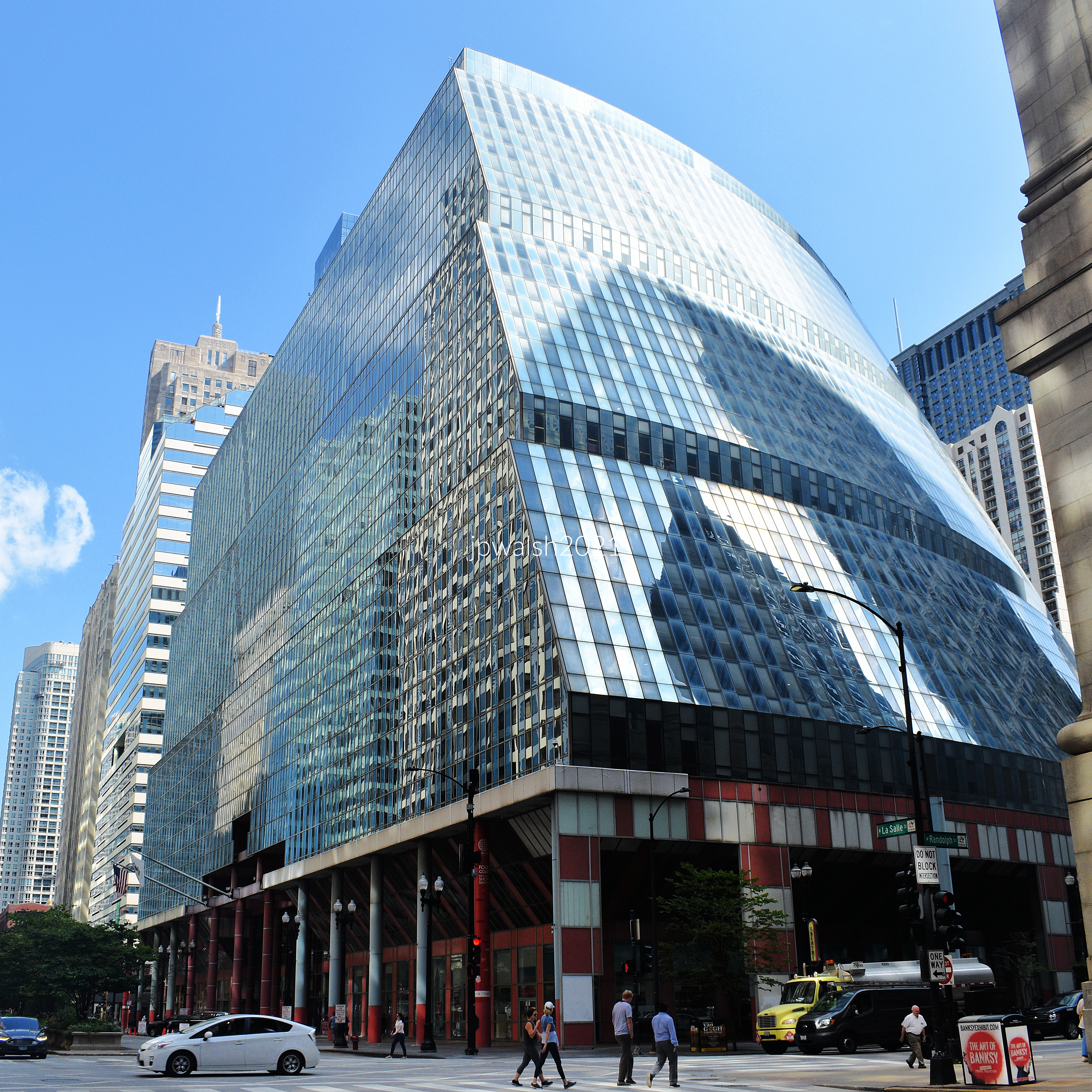
August 2021. The State of Illinois Center from the southwest Randolph and LaSalle Streets. Setbacks divide the building into three tiers seen here 99% 7.65mb _9369
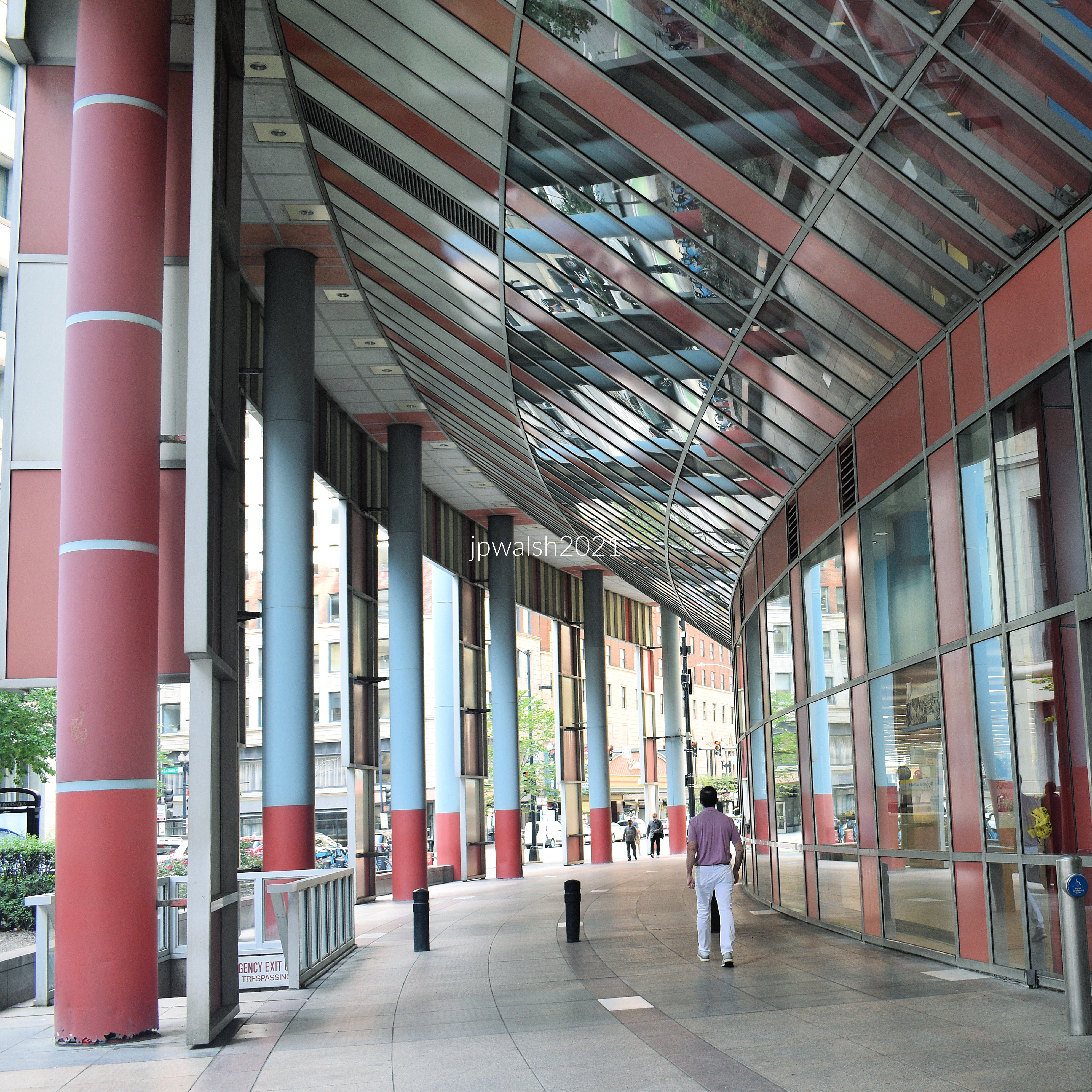
August 2021. The pink and gray granite arcade at street level is a contrast to the silver and opaque blue ornamental glass and provides a covered passageway. 99% 7.22mb_9380
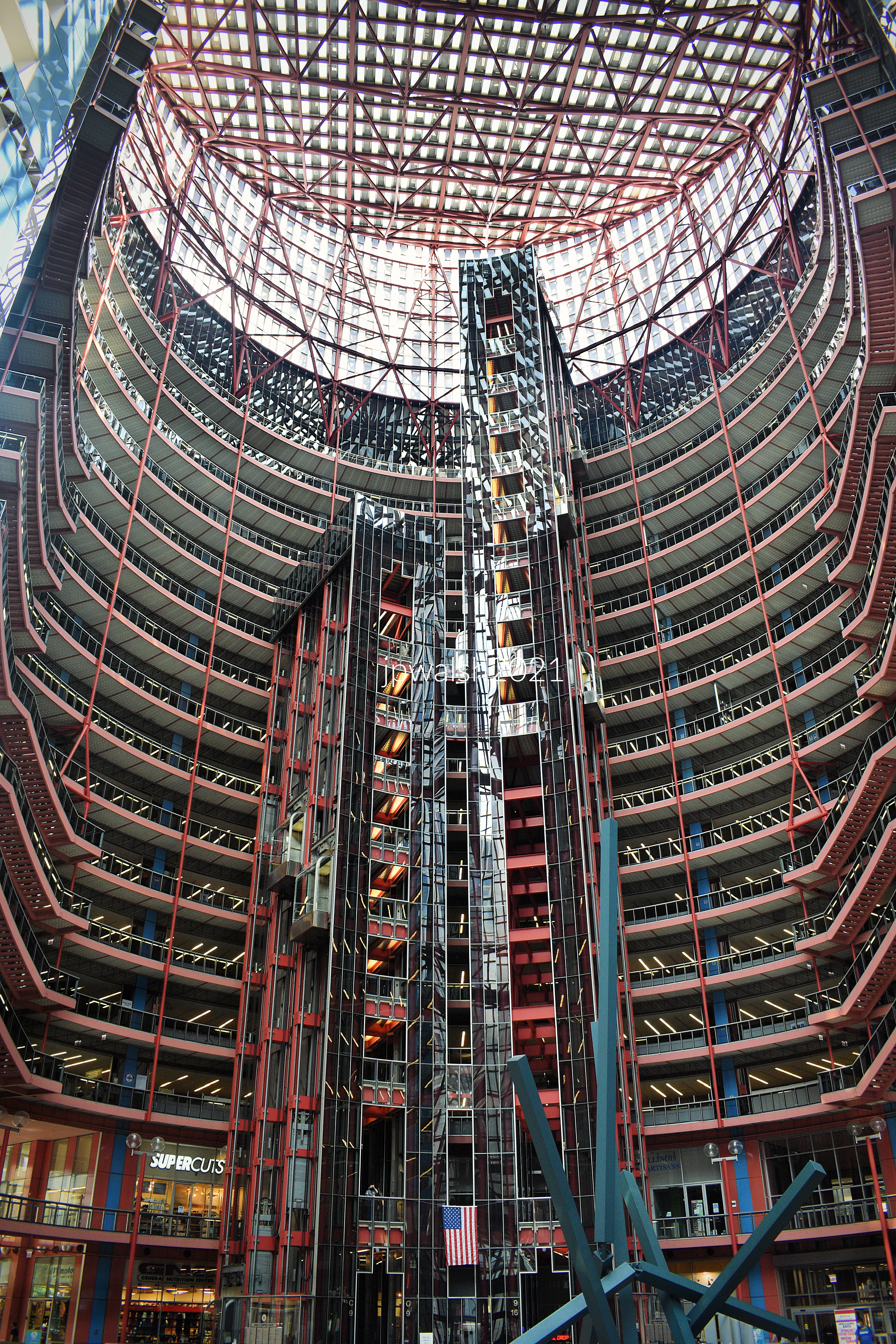
August 2021. The rotunda with its skylit atrium is 160 feet in diameter. The massive airy space is met by circular walkways and freestanding bank of glass elevators. 70% 7.87 mb_9381
August 2021.The rotunda has an elaborately paved granite floor with tens of thosand of square feet of retail space. 99% 6.87 mb_9384

1 S. Wacker Drive, Chicago, 1982.

May 2014. Helmut Jahn, One South Wacker Drive, Chicago, Illinois, 1979-1982. On a corner site, Jahn’s design is a freely translated interpretation of a 1920s stepped back tower with the building’s skin a stylized exaggeration of vertical windows and stone facades of the same 1920s’ period structures. 4.45 mb

To the left is UBS Tower (1 N. Wacker) built in 2001 and to the right is Hyatt Center ( 71 S. Wacker) built in 2005. At 42 years old, Jahn spoke of his building at 1 S. Wacker as a synthesis of two major Chicago architectural styles—that of Louis Sullivan (1856-1924) and, Jahn’s mentor and fellow German, Mies van der Rohe (1886-1969). The building is a concrete stepped-back 50-story building with a curtain wall of dark glass defining the vertical bands of windows. Its vision remains fresh and stunning as it sits majestically between two postmodern buildings built in Chicago a generation later. The author’s photograph was taken on May 25, 2014.

August 2021. Floors in each section of the stepped back tower are of three different sizes, each 6,000 square feet less as the building ascends. The setbacks’ atria allow in natural daylight. 78% 7.77mb _9293
December 2017. 6.27mb DSC_0567 (1)

IIT’s Rowe Village, Chicago, 2005.

Helmut Jahn, Jeanne and John Rowe Village at the Illinois Institute of Technology (IIT), Chicago, Illinois, 2003. 8/2015 3.67 mb

Originally called the State Street Village Dormitories, Jahn’s postmodern structure that anchors the campus to the east, consists of three five-story buildings. Jahn’s design was the first major architectural addition to the IIT campus since the early 1960’s. U.S. News & World Report called it one of the “coolest dorms in the nation.” Stretching one city block along busy State Street from 33rd to 34th Streets, Rowe Village is next to the El tracks whose Green Line zips back and forth to Chicago’s Loop. Each dorm building consists of two wings that flank an interior courtyard. The building is finished at the rear on 34th street by an insulated five-story glass wall. Entry is through the courtyard which leads into a corridor that connects the two wings. It is built of reinforced concrete with the front elevations and roof dressed in custom corrugated stainless steel panels and tinted glass framed in aluminum. The building’s sleek curvature, three compartments and chained block-long length, reflects and evokes the image of a streamlined train making for a building as Art Moderne object in the Miesian tradition. From its rooftop the Rowe Village looks north for views of Chicago’s downtown skyline while the dorm offers suite-style living in a modern setting surrounded by the mind, serious and playful, of Helmut Jahn. The photograph was taken by the author on August 21, 2015.

SOURCES for above:

https://web.iit.edu/housing/jeanne-john-rowe-village – retrieved May 9, 2021.

AIA Guide To Chicago, 2nd edition, edited by Alice Sinkevitch, 2004, pp.73 and 91.

Illinois Institute of Technology: the campus guide: an architectural tour, Franz Schulze, 2005, pp.83-4.

Chicago’s Lakefront McCormick Place, https://www.youtube.com/watch?v=Z4Vs5VZprFE – retrieved May 9, 2021.

Chicago’s Famous Buildings, 5th edition, Franze Schulze and Kevin Harrington, The University of Chicago Press, 2003, pp. 104-105.

https://www.architecture.org/learn/resources/architecture-dictionary/entry/helmut-jahn/

https://www.dnb.com/business-directory/company-profiles.murphy-jahn_inc.5e1fc35946048f1332755d271c944303.html – retrieved May 10, 2021

https://www.jahn-us.com/ – retrieved May 10, 2021.

http://www.greatbuildings.com/buildings/UA_Terminal-O_Hare.html– retrieved May 10, 2021.

https://www.aviationpros.com/airports/consultants/architecture/news/21222012/helmut-jahn-chicagos-starchitect-to-the-world-was-the-visionary-behind-uniteds-ohare-terminal – retrieved May 10, 2021.

https://www.architectmagazine.com/technology/lighting/1999-k-st-nw_o – retrieved May 10, 2021.

Helmut Jahn, Nory Miller, New York: Rizzoli, 1986, pp. 76-81.

My Architecture & Design Photography: HOWARD VAN DOREN SHAW (1869-1926). The Mentor Building (1906), Chicago, Illinois. (1 Photo).

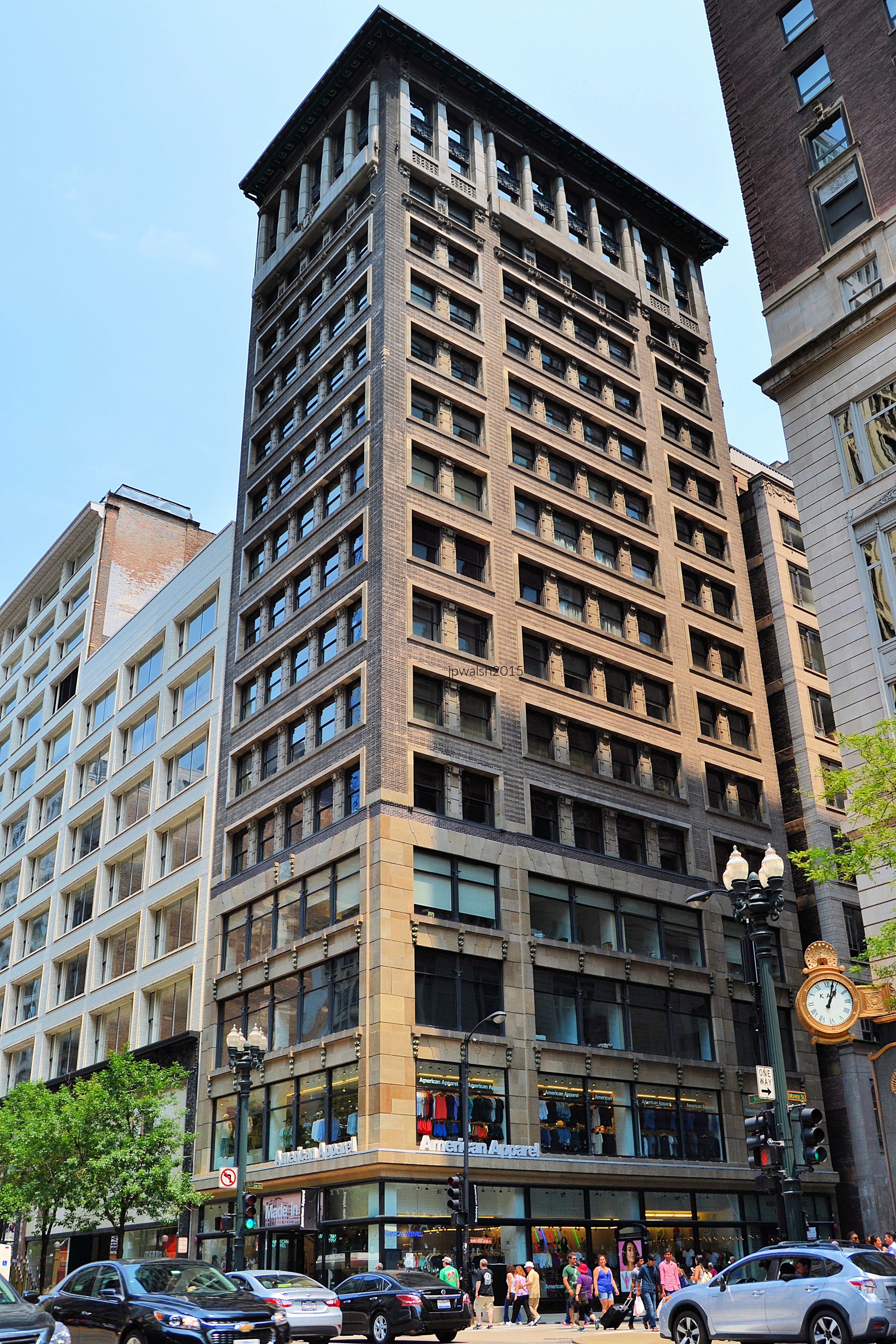
Howard Van Doren Shaw (1869-1926), 1906, THE MENTOR BUILDING, 39 S. State Street (6 E. Monroe Street), Chicago, from the southwest. Author’s photograph, 7/2015.

A Mentor building has stood on the northeast corner of State and Monroe Streets since 1873. Until 1906, a 7-story building was erected here.1

The 1906 building by Howard Van Doren Shaw (1869-1926) is 17 stories high with two basements on rock caissons.2  Shaw’s only skyscraper presents an unusual mixture of styles, a talent for which Shaw built his practice’s reputation starting in 1897. The building was designed as a mixed use skyscaper, including retail sales and commercial business.3

Inspired by the Prairie style, there are windows grouped in horizontal bands between a four-level base of large showroom windows. The top is classically inspired with details that are strong and idiosyncratic. The brown brick and terra cotta building retains the character of its classical sources though they are used as large-scale motifs.4

Howard Van Doren Shaw (1869-1926). Public Domain.

Shaw studied architecture at Yale University and apprenticed in Chicago for William Le Baron Jenney (1832-1907). In Chicago and its northern suburbs Shaw had an illustrious career designing major commercial, church, and museum buildings and projects as well as mansions for the area’s elites.5

1 Frank A. Randall, History of Development of Building Construction in Chicago, Second Edition, Revised and Expanded by John D. Randall, University of Illinois Press, Urbana and Chicago, 1999, p. 196.

2 Ibid., p. 265.

3 Saliga, Pauline A., editor, The Sky’s The Limit A Century of Chicago Skyscrapers, Rizzoli New York, 1990, p. 73.

4 Alice Sinkevitch, AIA Guide to Chicago, 2nd Edition, Harcourt, Inc., Orlando, 2004, p. 59.

5 Saliga, p.73.

My Architecture & Design Photography: ANONYMOUS/UNKNOWN. Chicago Harbor Lighthouse (1893). Active lighthouse on Lake Michigan played a vital role in Chicago’s economic development and the U.S. Midwest.

FEATURE image: Chicago Harbor Lighthouse (1893), Chicago, Illinois, 2017. Author’s photograph.

Known as the “Chicago Light,” the Chicago Harbor Lighthouse is an active automated lighthouse dating from 1893.

About one-half mile beyond Navy Pier, the lighthouse stands at the north of the main entrance of the Chicago Harbor in Lake Michigan. The lighthouse has had a significant role in the development of Chicago and the American Midwest and remains an active aid to nautical navigation today.

For more than a century, the U.S. Coast Guard has staffed this lighthouse at the breakwater outside the Chicago Harbor Lock. The lock separates Lake Michigan from the mouth of the Chicago River.

The lock was built in the mid-1930’s and is operated by the U.S. Army Corps of Engineers. The lock is one of the entrances into the Illinois Waterway system at the Great Lakes. The waterway system is a commercial and recreational shipping connection to the Gulf of Mexico by way of the Illinois and Mississippi rivers.

The “Chicago Light” is at that waterway system’s headwaters as it stands in the outer harbor constructed in 1880. The Chicago Light’s conical tower dates from 1893. Twenty-five years later, in 1918, the tower was reconstructed and the base building which contains a fog-signal room and boathouse was added. The architects are not identified.

Through its breakwaters, the main entrance into Chicago Harbor is 580 feet wide. The Chicago Harbor Lighthouse was designated a Chicago Landmark on April 9, 2003. It is the only surviving lighthouse in Chicago and one of two remaining examples in the state of Illinois.

Looking east from Chicago towards Lake Michigan, the mouth of the Chicago River.

About one mile ahead from this photograph’s location is the Chicago Harbor Lock. Built in the 1930’s, it provides the entrance/exit to the Illinois Waterway system at the Great Lakes. The waterway system is a commercial and recreational shipping connection from the Great Lakes to the Gulf of Mexico by way of the Illinois and Mississippi rivers.

PHOTO Credits:

Chicago Light–by John P. Walsh.

Chicago River —“chicago river.” by alyssaBLACK. is licensed under CC BY-SA 2.0

SOURCES:

The Chicago River: an illustrated history and guide to the river and its waterways, David M. Solzman, Wild Onion Books, Chicago, 1998, pp.126-128.
Chicago Landmarks Map [brochure], City of Chicago, 2006.
https://web.archive.org/web/20070410173708/http://www.ci.chi.il.us/Landmarks/C/ChicagoHarborLighthouse.html – retrieved December 2, 2017.

What a view from the frozen waters of Lake Michigan! CBS 2 photojournalist Alfredo Roman shot this drone video of the Chicago Harbor Lighthouse, which has endured a lot of icy weather since it was built.

My Architecture & Design Photography: SOLOMON, CORDWELL, BUENZ (SBD). Park Tower Condominium (1973), 5414 N. Sheridan Road; Chicago, Illinois. (2 Photos).

Chicago. Modern. Park Tower Condominium (1973). SCB. 8/2015. 3.15 mb

Park Tower Condominium is on the lakefront next to north Lake Shore Drive and across from Foster Beach in Lincoln Park. Its address is 5414 N. Sheridan Road, Chicago

Constructed in 1973 by Solomon, Cordwell, Buenz (SCB), a Chicago architectural firm founded in 1931, the tower was planned as the first of three towers in a triangular formation but the others did not materialize.

Tallest building outside Downtown Chicago for 8 miles north to Foster Beach

At 55 stories tall (513 feet high), Park Tower Condominium is the tallest structure between downtown and Foster Beach and one of the tallest structures in Chicago outside the downtown area.

Park Tower Condominiumis one of the largest all-residential buildings in the city.It was originally built as luxury rental apartments, though the building became condos in 1979.

In the Edgewater neighborhood, Park Tower Condominium is one of three residential towers in Chicago with black Miesian windows and three rounded lobes. The others are Lake Point Tower (505 North Lake Shore Drive) and Harbor Point (155 North Harbor Drive).

Chicago. Modern. Park Tower Condominium (1973). SCB. 8/2015. 3.04 mb

View from northeast looking southwest. The curtain wall of the Park Tower Condominium is beautifully detailed and proportioned.

Photographs were taken by the author on August 7, 2015.

SOURCES:

https://www.architectmagazine.com/firms/solomon-cordwell-buenz

https://www.emporis.com/buildings/117420/park-tower-condominiums-chicago-il-usa

AIA Guide to Chicago, 2nd Edition, Alice Sinkevitch, Harcourt, Inc., Orlando, 2004, p. 241.

Photographs & text:

My Architecture & Design Photography: KETLER-ELLIOT. The Chicago Avenue Bridge (1914), Chicago, Illinois. Demolished in 2018. (13 Photos & Illustrations).

FEATURE image: Portion of the open-grate pony-truss bascule Chicago Avenue Bridge and concrete house, erected in 1914, as it was in its last years of operation. Pointing to increased high traffic volume and load-bearing capacity issues, the 104-year-old bridge was demolished and replaced in 2018. Author’s photograph taken in May 2016.

The expanse of the Chicago Avenue Bridge over the North Branch of the Chicago River near Goose Island. The bridge with its steel beam pony truss was built in 1914 and demolished in 2018. The bridge was replaced by a temporary crossing in 2019. “Chicago Avenue Bridge” by swanksalot is licensed under CC BY-NC-SA 2.0
“File:Architecture Tour 25 Chicago Avenue Bridge (185544768).jpg” by discosour is licensed under CC BY-SA 2.0

Built in 1914 by Ketler-Elliot Erection Company of Chicago, the original Chicago Avenue Bridge was one of the oldest pony truss bascule bridges in Chicago. Connecting River North and River West, the steel bridge was, after 104 years, demolished in November 2018 and replaced five months later, in 2019, by a temporary fixed bridge. Since this portion of the river is now used mostly for recreational purposes, a new, permanent immovable concrete bridge was expected to open over the Chicago River in this location starting in 2021, delayed by the pandemic, and that will not be a bascule bridge.

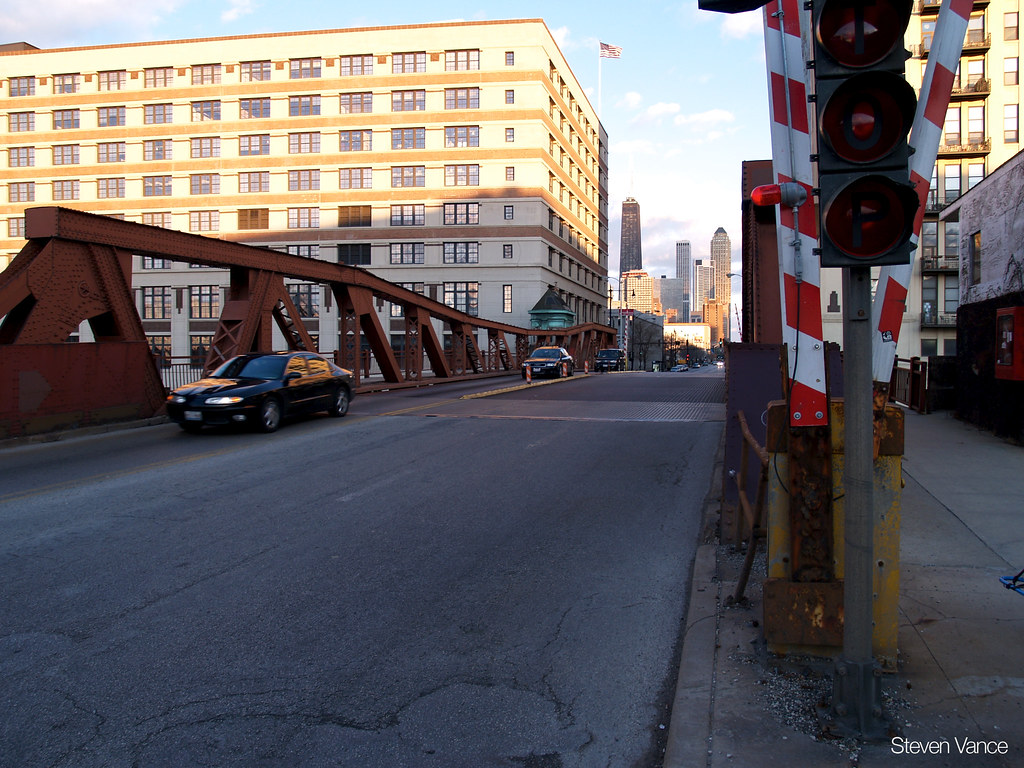
Looking west from the old Chicago Avenue Bridge. A pony truss bridge is a steel truss bridge that allows traffic over and through the truss, but with no cross brace across the top connecting its two sides. “Looking west on Chicago Avenue bridge” by Steven Vance is licensed under CC BY-NC-SA 2.0

A pony truss bridge is a steel truss bridge that allows traffic over and through the truss, but with no cross brace across the top connecting its two sides. The truss bridge assembly of the Chicago Avenue Bridge was made of riveted steel beams—and a witness to Chicago’s early 20th century industrial manufacturing might.

As well as being “Hog Butcher For The World, Tool Maker, Stacker of Wheat, Player with Railroads and the Nation’s Freight Handler” as Carl Sandberg wrote in his 1914 poem, Chicago, published in the new (1912) Poetry magazine, Chicago was also at that time a world leader in steel production and bridge design.

Looking east in November 1914 at Chicago Avenue Bridge. Public Domain.

The basic design of any bascule bridge is similar to a medieval castle drawbridge. A leaf or span rises and descends that permits traffic upon it and— for the Chicago Avenue Bridge— also traffic below it on the Chicago River.

Chicago boasts more than 50 movable bridges. Single-leaf (truss) bascule bridges were constructed where the river was not very wide and a single bridge deck goes up and down between abutments. This was often used for train traffic which was convenient since Chicago was and still remains the railroad capital of the United States.

The more common double-leaf (truss) bascule bridge— including the Chicago Avenue Bridge—consists of two leaves or spans which meet in the middle over the river. Counterweights on each side of the bridge beneath it in a river pit (or pits) balances, stabilizes and fortifies the vertical movement of the bridge deck.

If the bridge deck is single leaf, the “Chicago Style” bridge rises in a piece vertically to one side of the river. If the bridge deck is two leaves, each rise to their side of the river and descend to close again by meeting in the middle of the bridge deck.

Structural View of a bascule leaf, Chicago Avenue Bridge. https://tile.loc.gov/storage-services/service/pnp/habshaer/il/il0800/il0823/photos/318219pr.jpg Fair Use.

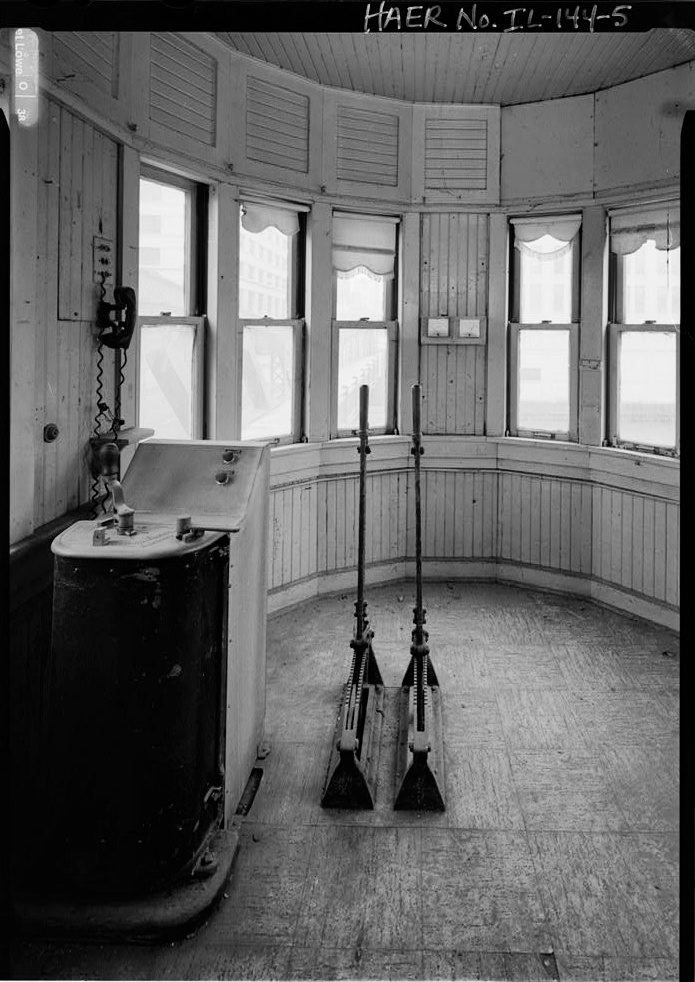
Bascule bridges are the most commonly found moveable bridges in the world because they operate quickly and efficiently. The Chicago Avenue Bridge was operated from a companion pitched-roof bridge house with rounded corners and rows of windows clad in decorative (today oxidized green) copper.  The foundational portions of the bridge house were constructed of concrete. Upper portions were made of wood with roofing of vitrified tile. So far, the bridge house portion of the structure has not been demolished.

In 1914, the new Chicago Avenue Bridge across a jag of Chicago River abutting the national headquarters of Montgomery Ward whose complex was first built in 1907, made for a sleek, powerful, modern and elegant statement about industry and urban commerce in early 20th century Middle America.

The Chicago Avenue Bridge’s pitched-roof bridge house with its design of rounded corners and rows of windows clad in decorative (and today green oxidized) copper. “Offering a historic bridge for sale is a meaningless and empty gesture. RIP Chicago Avenue bridge.” by reallyboring is licensed under CC BY-NC-ND 2.0
Interior of the concrete bridge house, 1914. Chicago Avenue Bridge. This was one of the first permanent abd decorative bridge houses constructed for Chicago. By 2020 the then-state-of-the-art early 20th century designed house had been left mostly to rot. https://www.loc.gov/pictures/item/il0823.photos.318222p/resource/ Fair use.
When the Chicago Avenue Bridge was first opened in 1914, Chicago was a world leader in steel production and bridge design. Then-Chicago Mayor Carter H. Harrison, Jr. (1860-1953) whose name appears on the dedication plaque was a five-term Democrat incumbant from 1897 to 1905 and from 1911 to 1915. “Carter H Harrison Mayor marker – Chicago Avenue Bridge” by swanksalot is licensed under CC BY-NC-SA 2.0

There are numerous variations and designs of the bascule bridge which in Chicago includes the trunnion (“pivot point”) bascule (“seesaw”) bridge. The nation’s first such bridge started operation in Chicago in 1902 over the north branch of the Chicago River at Cortland Street which can still be seen in operation today. The bridge design became known as the “Chicago Style” as its leaf or leaves, suspended on axles (trunnions) with massive concrete counterweights located below the bridge in the riverbank pit, opens and lifts a single or dual bridge deck to clear the river for traffic without blocking the waterway with a central pier.

Counterweight trunnion rack and pinion and counterweight, Chicago Avenue Bridge, https://www.loc.gov/pictures/item/il0823.photos.318218p/resource/ Fair use.

Chicago’s bascule bridges—and the Chicago Avenue Bridge was one of them—were designed to its specific location. Each was designed to take on heavy loads and the attendant vibration which included the ice and snow pack of Chicago’s typically harsh winters. The design and construction into bedrock took into account wind resistance, whether the bridge leaves were open or closed, and to wind speeds of 100 miles per hour in any and all directions.

Looking east more recently at Chicago Avenue Bridge. “Looking east on Chicago Avenue bridge” by Steven Vance is licensed under CC BY-NC-SA 2.0

By 1920, improvements in bascule bridge design allowed for the construction of a double deck trunnion bascule bridge where car, truck and foot traffic could be carried simultaneously on its upper and lower decks. The first such double deck trunnion bascule bridge in Chicago was near the site of the old Fort Dearborn on the Chicago River at Michigan Avenue—today’s busy DuSable Bridge, formerly Michigan Avenue Bridge which opened in May 1920.

The Chicago Avenue Bridge is also significant as it belonged to a set of Chicago city bridges built between 1910 and 1915 whose designs looked to go beyond their utilitarian function to incorporate artistic and other aesthetic elements. Beginning with the Chicago Avenue Bridge in 1913, the Chicago Planning Commission worked with the city’s Bridge Division at the bascule bridge’s design stage.

Engineer’s drawing of the Chicago Avenue Bridge, 1914. Public Domain.

Following the demolition of the Chicago Avenue Bridge in 2018, an immoveable temporary steel girder bridge was installed in 2019 over this span of the Chicago River. For the moment, bridge design has returned to utilitarian functionality alone with little or no artistic or aesthetic program which had been one of the progressive features of the Chicago Avenue Bridge over a century ago.

Temporary replacement bridge, Chicago Avenue at the Chicago River, 2019. “Chicago – Chicago Avenue bridge, north branch of Chicago river” by ukdamian is licensed under CC BY-NC 2.0

SOURCES:

Solzman, David M., The Chicago River: An Illustrated History and Guide to the River and Its Waterways, Wild Onion Books, Chicago, 1998.

http://chicagoloopbridges.com/Ctype.html

https://preservationchicago.org/newsletter_posts/threatened-historic-chicago-avenue-bridge-targeted-for-demolition/

https://chicago.curbed.com/2018/10/29/18038134/construction-chicago-avenue-bridge-traffic

https://www.archpaper.com/2018/06/chicago-offers-historic-chicago-avenue-bridge-free/

https://loc.gov/pictures/item/IL0823/

https://historicbridges.org/bridges/browser/?bridgebrowser=illinois/chicago/

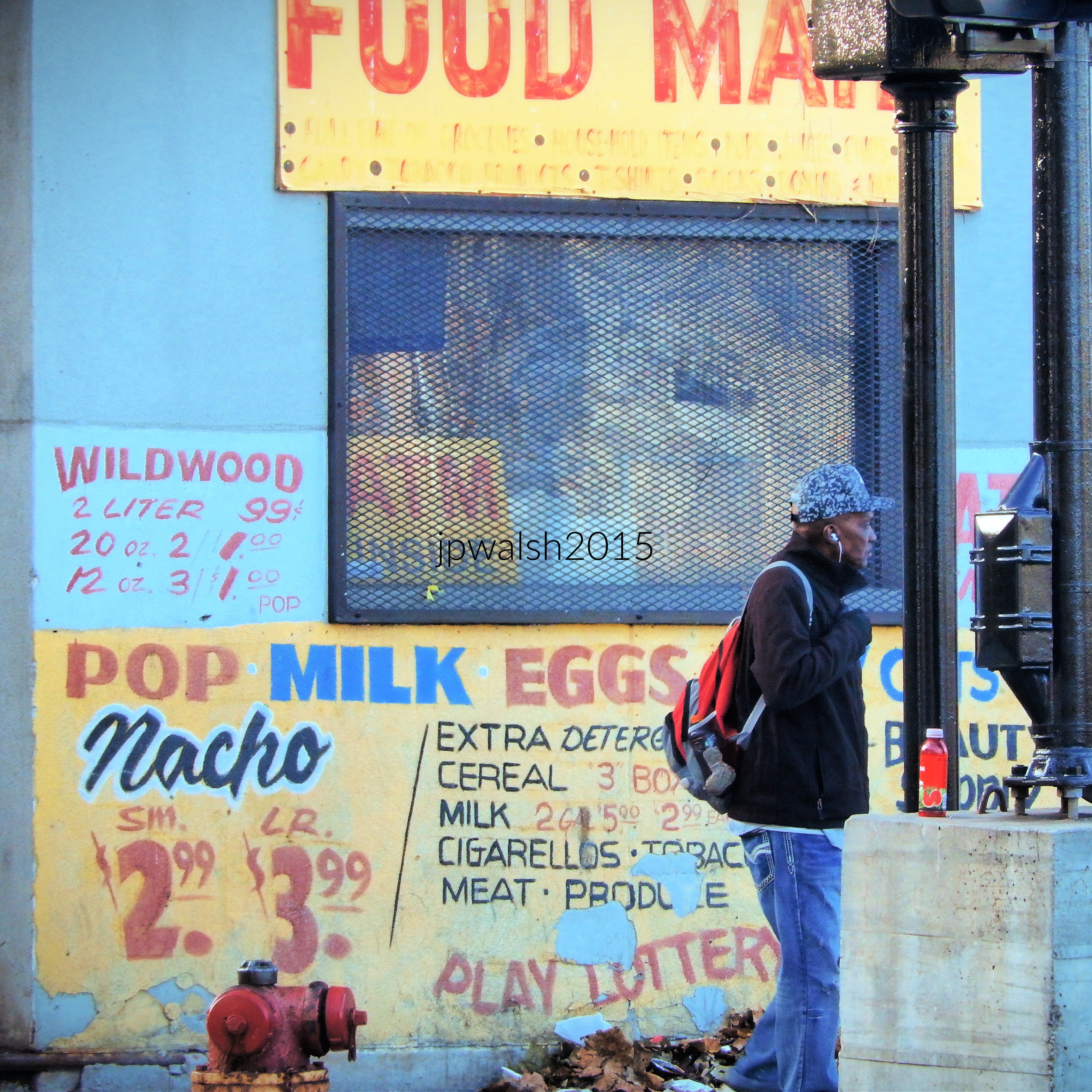
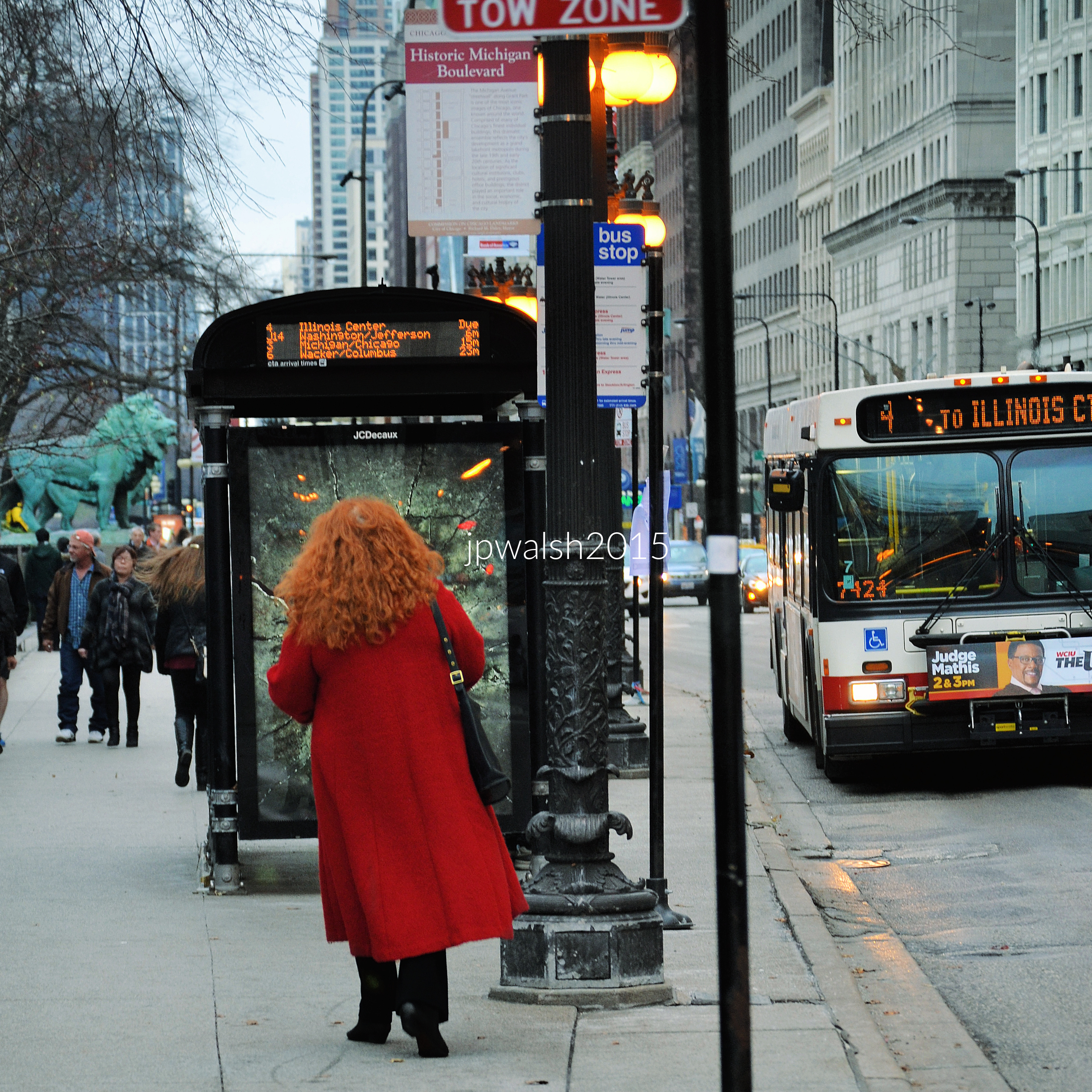
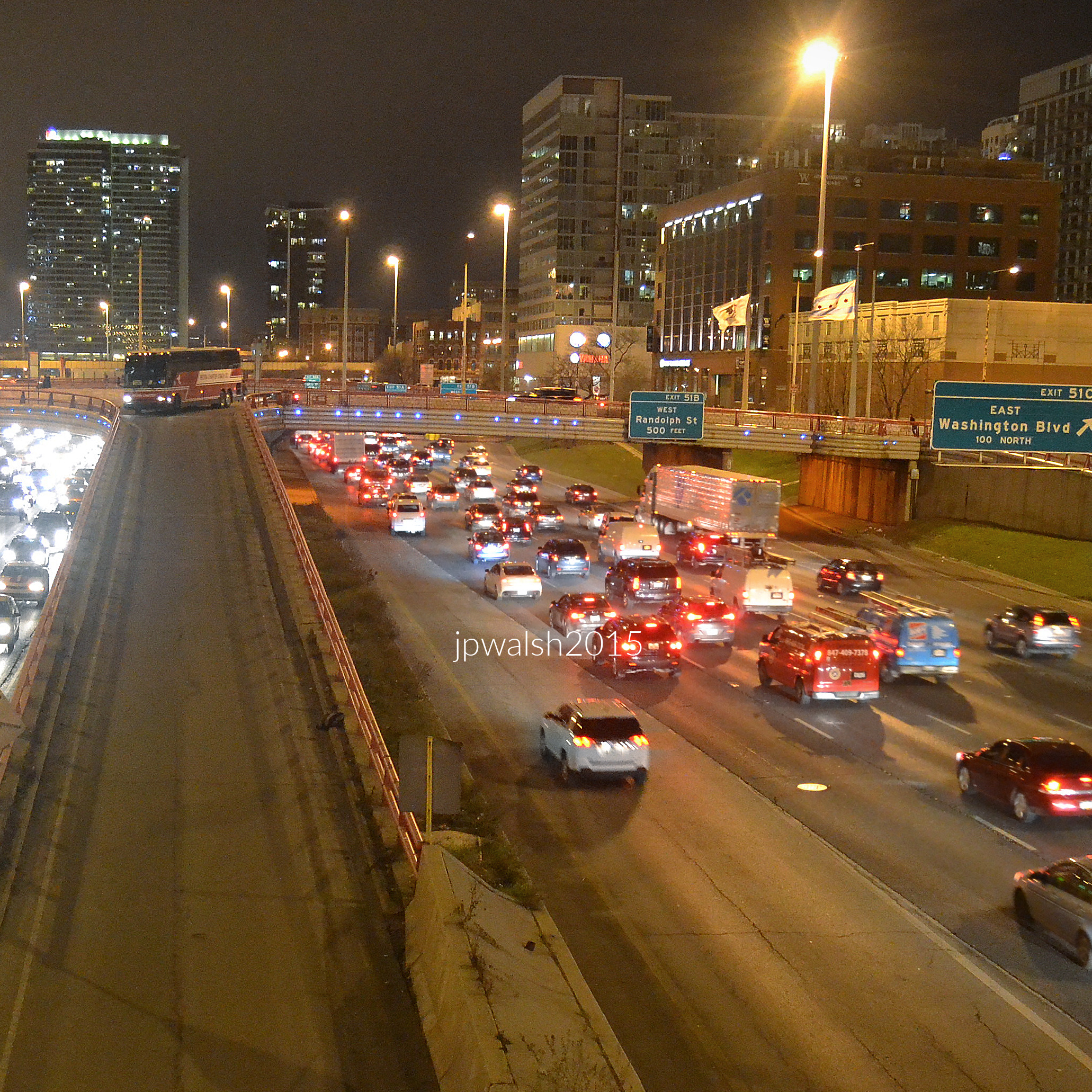
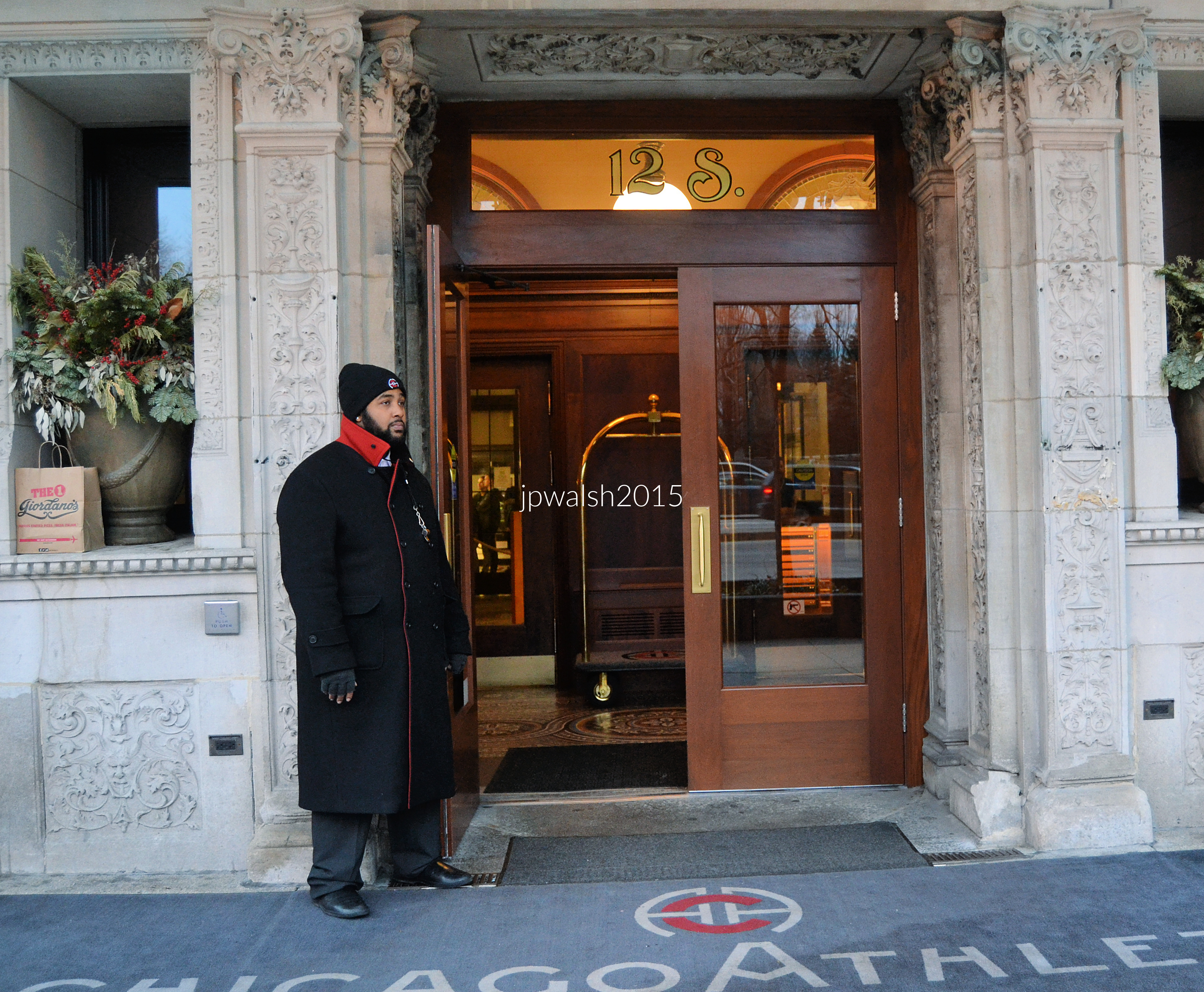
My Street Photography: STREET 3 (100 Photos).

FEATURE Image: November 2017. Michigan-based Saints basketball team visiting in downtown Chicago.

August 2021.
July 2016. Chicago.
September 2015. Chicago. Michigan Avenue.
July 2019. Oakbrook, IL.
November 2017. Chicago.
June 2022. Chicago. 948 kb 30%
July 2018. Downers Grove, Illinois.
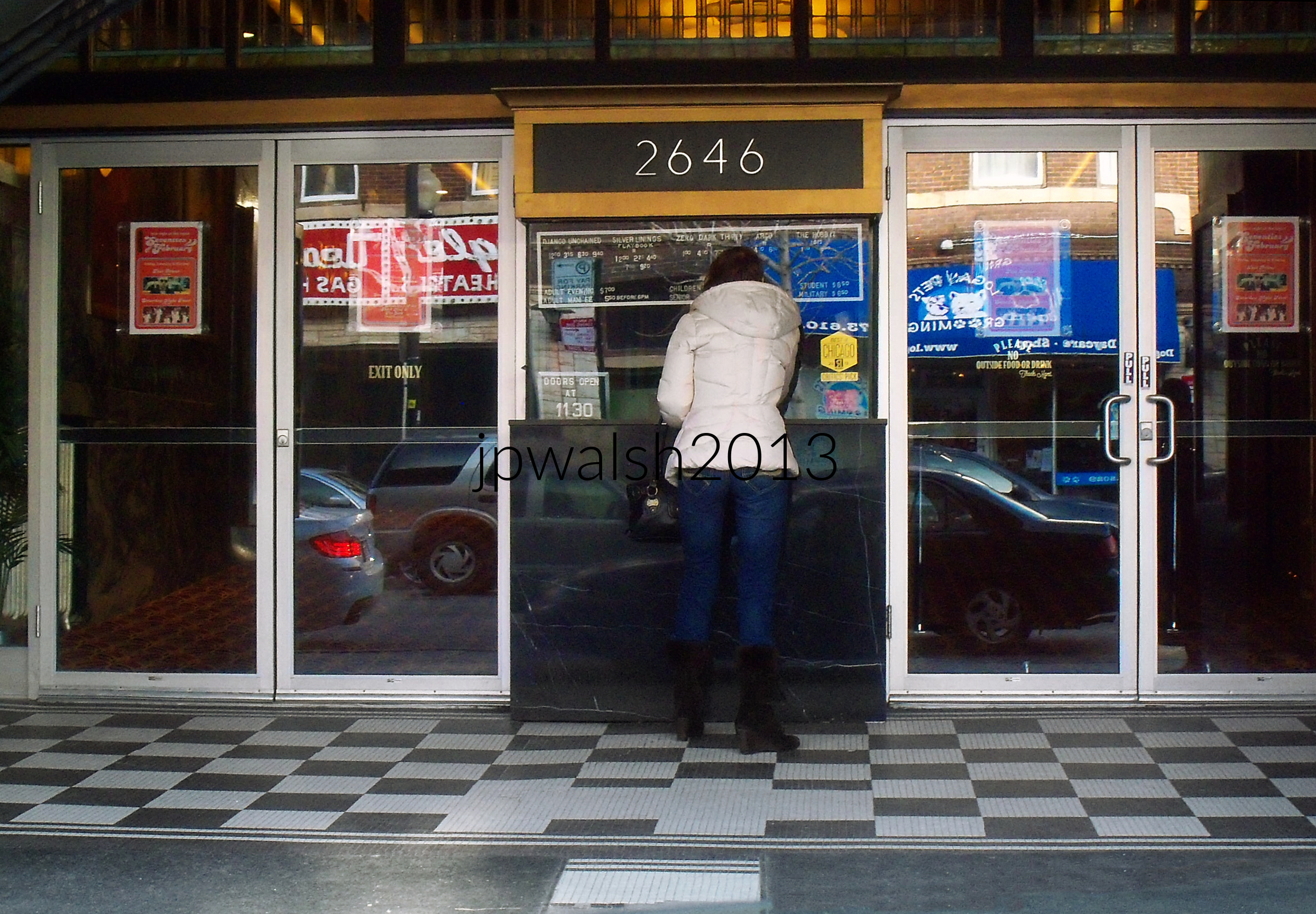
February 2013. 1.70mb 101_6378 (1)

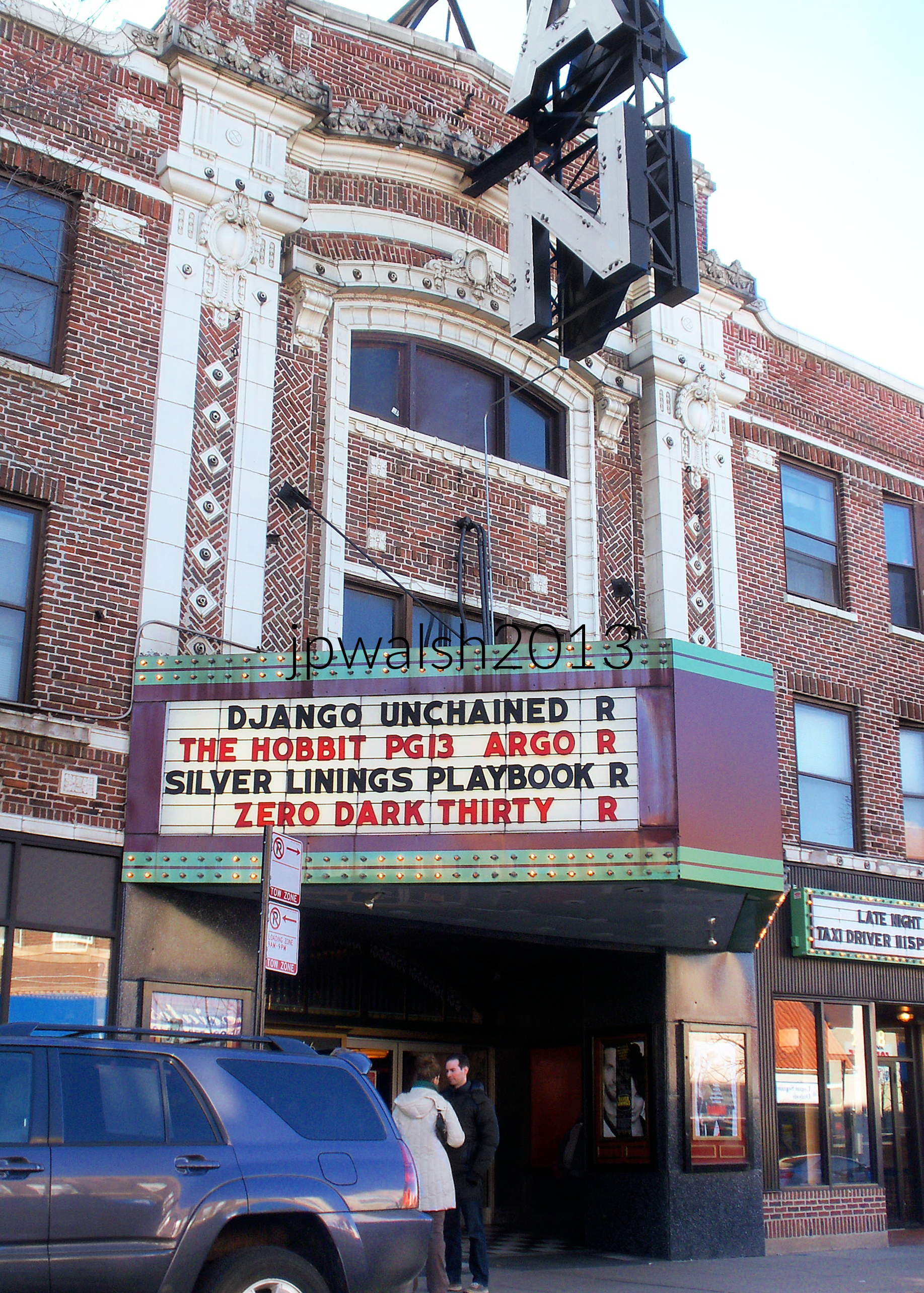
The Logan Theatre at 2646 N. Milwaukee in Chicago opened in November 1915 as The Paramount Theatre. It was operated by Lubliner & Trinz that started operating movie theaters in Chicago around 1914. At their peak, Lubliner & Trinz operated about nineteen theaters and leased or built about 36 theaters until 1934. The Paramount had seating for 988 in orchestra level and was equipped with a Weickhardt organ, based in Milwaukee, Wisconsin. It was renamed the Logan Theatre in 1929 when it was taken over by Essaness, a Chicago-based movie theater chain. The company owned and operated 33 theaters in the Chicago area, including the Pantheon and Biograph theaters. see – Lubliner & Trinz Theater History – The Clark Theater ; Logan Theatre in Chicago, IL – Cinema Treasures – retrieved January 18, 2026.

February 2013. 2.48mb 101_6324 (1)
October 2017. Chicago. 315kb 20%
December 2017 Chicago Downtown. 3.79 mb
May 2014. Chicago. Michigan Avenue.
July 2016. Chicago.
July 2016. Chicago.
July 2016. Chicago.
July 2015, Chicago.
September 2016. Chicago. Navy Pier.
October 2016. Chicago. West Loop/East Garfield Park.
September 2016. Chicago. Millennium Park. (20)
September 2016. Chicago (Grand Boulevard/Bronzeville).  Mount Pisgah Missionary Baptist Church, 4600 S. King Drive. Built by German Jewish immigrants whose synagogue was founded in 1861, the neo-Classical building was home to Chicago Sinai Congregation from 1912 until the 1940s. The church moved into the building in 1961. With a commitment to social justice, the church played an instrumental role in bringing Dr. Martin Luther King Jr.’s Southern Christian Leadership Conference to Chicago in the 1960’s.
September 2015. Chicago. Navy Pier.
May 2019. Downers Grove, IL.
June 2020. Downers Grove, IL.
June 2018. Milwaukee, WI.
June 2014. Chicago.
July 2019 Oakbrook, IL.
May 2016. Chicago. Magnificent Mile.
June 2014. Chicago. North Rush Street.
August 2017. Chicago.
September 2015. Chicago. 30%
September 2015. Chicago.
August 2017. Chicago. Old Town.
August 2017. Chicago. Downtown.
September 2015. Chicago. Downtown.
August 2015. Chicago. (40)
September 2015. Chicago.1.88 mb
June 2016. Wilmette, IL.
June 2019. Oakbrook, IL.
October 2017 Chicago. 6.39 mb
October 2017. Chicago. 3.93 mb
December 2017. Chicago. 5.87 mb
July 2016. Chicago. 3.86 mb (50)
October 2016. Chicago. Ukrainian Village. 332 kb 27%
September 2015. Chicago. 5.02 mb
January 2016. Chicago. 4.74 mb
July 2016. Chicago. 2.60 mb
August 2021. Chicago. 6.75 mb
October 2021. Chicago. 3.99mb
December 2015. Chicago. 1.52 mb 35%
October 2015. Chicago. 6.53 mb (70)
October 2015. Chicago. 1.21 mb 35%
October 2015. Chicago. 1.18 mb 35%
October 2015. Chicago. 7.81 mb
October 2015. Chicago. 6.25 mb
May 2021. Chicago. 7.82 mb
June 2022. Chicago. 4.13 mb
July 2016. Chicago. 2.23 mb
October 2015. Chicago. 5.59 mb
July 2021. Wheaton, IL. 3.92mb
May 2013 4.06mb
October 2015. Chicago. 5.90 mb
July 2022. Chicago. 4.17 mb
September 2015. Chicago. 25%
August 2016. Chicago. 5.07 mb
May 2024. Chicago. 5.82 mb
May 2024 Chicago. 99% 7.12 mb
May 2024. Chicago. 5.75 mb
June 2018 852 kb
October 2015. Chicago (Garfield Park). 6.80 mb N1733 (1) (2)
August 2016. Chicago. 6.21 mb DSC_0507
August 2016. Chicago (Logan Square). 6.63 mb DSC_0482 (1)
August 2016. Chicago (Pilsen). 3.91mb DSC_0684
February 2018. Goodman Theatre, Chicago. Opened in 1922 by New York theatrical producer Sam H. Harris and brothers Archie and Edgar Selwyn, the Harris and Selwyn Theatres were the Chicago home to some of the most famous plays and performers of the Broadway stage. 4.25mb DSC_0897
January 2016. Chicago Lawn (Marquette Park). 7.99mb DSCN2030
February 2013. Chicago (Logan Square). 2.85mb101_6385 (1)
April 2013. Chicago (Pilsen). 3.58mb 102_0007 (1)
April 2013. Chicago (Pilsen). 4.48mb 102_0042 (1)
August 2015. Chicago (Edgewater). 2.76mb DSC_0042 (2)
August 2015. Chicago. 2.01 mb DSC_0576 (2)
August 2015. 3.87mb DSC_0732 (1)
June 2014. Chicago. 3.65mb DSC_0407 (1)
May 2015. Chicago. 3.67mb DSC_0454 (1)
August 2015. Chicago.1.85mb DSC_0958 (1)
August 2015. Chicago. 4.32mb DSC_0955 (1)
August 2015. Chicago. 7.03mb DSC_0950 (1)
August 2015. Chicago. 2.08mb DSC_0526 (3)
August 2015. Chicago. 5.71 mb DSC_0479 (1)
September 2015. Chicago 3.35mb DSCN1222 (1)
October 2015. Chicago. 2.87mb tDSCN1443 (1)
October 2015. Chicago. 4.62mb DSC_0117 (2)
October 2015. Chicago. 5.81 mb DSCN1680 (1)
November 2015. Chicago. DSC_0060 (1)
November 2025. Chicago. 2.75mb DSC_0425 (1)
December 2015. Chicago. 12 S. Michigan. 4.11mb DSC_0696 (1)

The Chicago Athletic Association (CAA) was a historic men’s club and athletic team based in Chicago, Illinois, formed in 1890 and closed in 2007. The 1893 building was designed by prolific architect Henry Ives Cobb (1859-1931). Transformed into the Chicago Athletic Association Hotel, it opened as a boutique hotel, welcoming the public and preserving its rich history.

December 2015. Chicago. 1.91mb DSC_0689 (1)

Van Buren Street Station is a commuter rail station in downtown Chicago that serves the Metra Electric Line to University Park, Blue Island, and South Chicago neighborhood and the South Shore Line to Gary and South Bend, Indiana.

December 2015. Chicago. Millennium Park. 4.01mb DSC_0701 (1)
December 2015. Chicago. 3.62mb DSC_0867 (3)
December 2015. Chicago. 5.71mb DSC_0970
December 2015. Chicago. 2.82mb DSC_0994 (2)
January 2016. Chicago (Marquette Park). 5.28mb DSCN1998 (2)
May 2016. Chicago (Old Town). 6.03mb DSCN2369 (1)
June 2016. Wilmette IL. 6.07mb DSCN3158 (1)
July 2016. 5.5mb DSCN3275 (1)

FRANCE. My Art Photography: MARC CHAGALL (1887-1985, Belarusian-French), Four Seasons, 1974, Chase Tower Plaza, Chicago, Illinois.

Feature Image: East side (detail), Marc Chagall, Four Seasons, 1972, Chase Tower Plaza, Chicago. May 2014. 7.44 mb 92%. Author’s photograph.

Composed of thousands of inlaid chips in over 250 colors, The Four Seasons (1972) mosaic in Chase Tower Plaza, Chicago, by Marc Chagall (1887-1985) portrays scenes of Chicago. It features Chagall’s modernist art informed by this Russian-Jewish artist’s heritage and images found in his paintings, including birds, fish, flowers, suns and human figures. Chagall observed that “the seasons represent human life, both physical and spiritual, at its different ages.” 

May 2014. East side (detail). 5.19 mb. Author’s photograph.
December 2017. East side (detail). 1.35 mb. Author’s photograph.
December 2015. West side. 4.16mb DSC_0967 (2). Author’s photograph.

Photographs:

My Art Photography: EXPO CHICAGO 2018, Festival Hall, Navy Pier. 7th Annual International Exposition of Contemporary & Modern Art, September 27-30, 2018. (58 Photos).

FEATURE image: EXPO CHICAGO 2018, Festival Hall, Navy Pier.

EXPO CHICAGO 2018 is the 7th annual exhibition of international contemporary and modern art held in Chicago at Navy Pier’s Festival Hall. It took place September 27-30, 2018. Expo Chicago/2018 presented 135 galleries and exhibitors representing 27 countries and 63 cities from around the world. This post’s 60 photographs are of that event.
EXPO CHICAGO 2018 includes exhibitors four sections categorized to a specific aim:
Exposure are galleries founded since 2010 featuring one or two artists;
Profile are international galleries featuring solo or collective artists with focused installations, exhibitions and projects;
Editions + Books highlight artist books, editions, prints, collectibles, photography, collage, drawing, etc.;
Special Exhibitions” feature site specific work.

More EXPO CHICAGO 2018 sections include:
IN/SITU highlighting curated large-scale installations (a second, outside version features large-scale sculptures in various Chicago locations);
EXPO VIDEO highlighting curated film, video and new media work;
EXPO SOUND highlighting curated sound installations and projects.

EXPO CHICAGO 2018 was held in Festival Hall on Navy Pier in Chicago. The annual event, held since 2012, is in its seventh year.

EXPO CHICAGO 2018 attracts thousands of attendees to visit with hundreds of gallery owners and artists from all over the world.
Expo Chicago is a major modern and contemporary art event held each year to open the Fall art season. It is held nearby to downtown Chicago and the Magnificent Mile on historic Navy Pier which is one of Chicago’s most popular tourist magnets.
One of the information desks at EXPO CHICAGO 2018.
EXPO CHICAGO 2018 welcomed 135 international art galleries from 27 countries and 63 cities.
Georgia Scherman Projects, Toronto. Within the framework of the show’s sections, each booth showcases the artwork of their choosing .
Artwork of Marcus Jansen was featured at Casterline/ Goodman Gallery, Aspen, CO, Chicago, and Nantucket, MA.
Artist Gina Pellón (center) at Cerunda Arte, Coral Gables, FL.
Surrealist painter Fred Stonehouse, Night King, 2018, acrylic on canvas, Tory Folliard Gallery, Milwaukee, WI.
Richard Hughes, Hot Step, 2017, cast polyester resin and enamel paint, Anton Kern Gallery, New York.
Ridley Howard, Blue Dress, Blue Sky, 2016, acrylic on linen, Frederic Snitzer Gallery, Miami, FL.
admissions.
Library Street Collective, Detroit, MI.         
Artist Francesco Clemente, 2018, oil on canvas at Maruani Mercier Gallery, Brussels, Belgium.
Artwork of Larry Poons, Yares Art, New York, Palm Springs, Santa Fe.
Artwork of Austin White, 2018, Jenkins Johnson Gallery, San Francisco and New York.
In/Situ: Postcommodity, Repellent Fence, 2015, Bockley Gallery, Minneapolis, Minnesota.
Peter Blake Gallery, Laguna Beach, CA.
Artwork by Asmund Havsteen Mikkelsen at the booth shared by Fold Gallery, London, and Galleri Kant, Copenhagen.
Prune Nourry, River Man (detail), 2018, patinated copper tubes, Galerie Templon, Paris.
Gérard Garouste, The Eagle Owl and the One-Eared Woman, 2016, Galerie Templon, Paris.
Jaume Plensa’s Laura Asia in White, 2017, polyester resin and marble dust, at Richard Gray Gallery, Chicago.
William Kentridge, Blue Rubrics, 2018, lapis lazuli pigment on thesaurus pages, NFP Field Tate Editions, Royal Academy of Arts, London.
Frances Stark, According to This…, 2018, Silk screen on linen on panel, Gavin Brown’s Enterprise, New York and Rome.
David Driskell (b. 1931), Jazz Singer (Lady of Leisure, Fox), 1974, oil and collage on canvas, 52 x 44 in., DC MooreGallery, New York City.
Jansson Stegner, Swordswoman, 2018, oil on linen, Nino Mier Gallery, Los Angeles.
Brian Calvin, Eternal Return, 2009, acrylic on canvas, Anton Kern Gallery, New York.
Margot Bergman, Gloria, 2014, acrylic on linen, Corbett vs. Dempsey, Chicago.
Ceysson & Bénétière, New York Luxembourg Paris Saint-Étienne.
Julie Heffernan, Self-Portrait with Nuala, 2018, oil on canvas, Zolla/Lieberman Chicago.
Chloe Wise, You would have been a castle for a moment, 2016, Galerie Division, Montreal and Toronto.
EXPO CHICAGO 2018.
EXPO CHICAGO 2018.
Artwork of Devan Shimoyama, De Buck Gallery New York City.
EXPO CHICAGO 2018.
Chie Fueki, Kyle, 2017, DC Moore Gallery, New York City.
Naudline Pierre, Deal Kindly and Truly With Me, 2018, oil on canvas, 56 x 52 inches, Shulamit Nazarian, Los Angeles.
Clare Sherman, Sea Cave, 2017, oil on canvas, 84 x 66 in., DC Moore Gallery, New York City.
Roberto Fabelo, Gothic Habanero, n.d., oil on canvas, Cerunda Arte, Coral Gables, FL.
EXPO CHICAGO 2018 brings the world of modern and contemporary art to Chicago for the collector.
EXPO CHICAGO 2018 offers the art lover opportunities to encounter the latest in modern and contemporary art from around the world.
EXPO CHICAGO 2018 covers tens of thousands of square feet with modern and contemporary art of many kinds from 27 countries and 63 global cities.
EXPO CHICAGO 2018
Sculpture, painting, and other visual art forms were in evidence at Expo Chicago/2018. There is a popular on-site cafe that serves snacks and beverages.
EXPO CHICAGO 2018
EXPO CHICAGO 2018
EXPO CHICAGO 2018
Juan Roberto Diago, Grito, 1997. The artist talks about his artistic debt to Jean-Michel Basquiat.
Fort Gansevoort, New York City.
Artwork of Nick Dawes, 2018, Galerie Kornfeld, Berlin.
Tsailing Tseng, Black Moor, Spring/ Sun/ Winter/ Dread/ Everything Everything, 2018, oil on linen, SAIC Booth (Tuttle Fellowship).
Roberto Lugo, porcelain china, paint, luster, 2018, Wexler Gallery, Philadelphia. PA.
Lavar Munroe, Spy Boy, 2018, acrylic and earring stud on canvas, Jenkins Johnson Gallery San Francisco New York.
In/Situ: Ivan Argote, Among Us — Across History…, 2017.
Richard Hudson, Tear, 2016, polished mirrored steel, Michael Goedhuis London Beijing New York.

Aniela Sobieksi,  Girl with a Garden, 2018, oil on panel, Tory Folliard Gallery, Milwaukee. The painting next to it sold just before I took this photograph.
The Hole NYC.
Barnaby Barford (b. 1977), Celebrity, 2018, Giclée Print, David Gill Gallery, London.

Photographs: