John P. Walsh is an art historian, writer and photographer. He has an M.A. in Modern Art History, Theory and Criticism from The School of the Art Institute of Chicago and taught Modern Art History at Northwestern University.
Follow his work @ http://johnpwalshblog.com/
Pinterest @ http://www.pinterest.com/lang52tr/
Facebook @ https://www.facebook.com/john.p.walshiii.
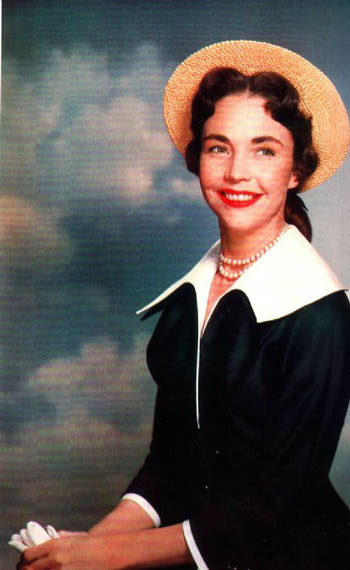
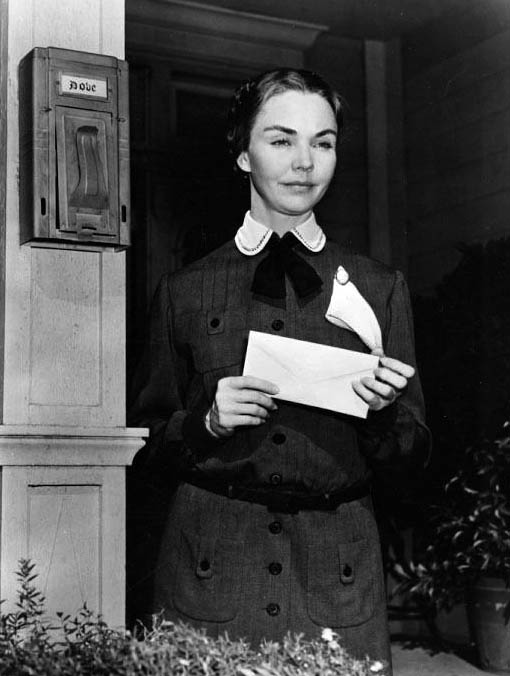
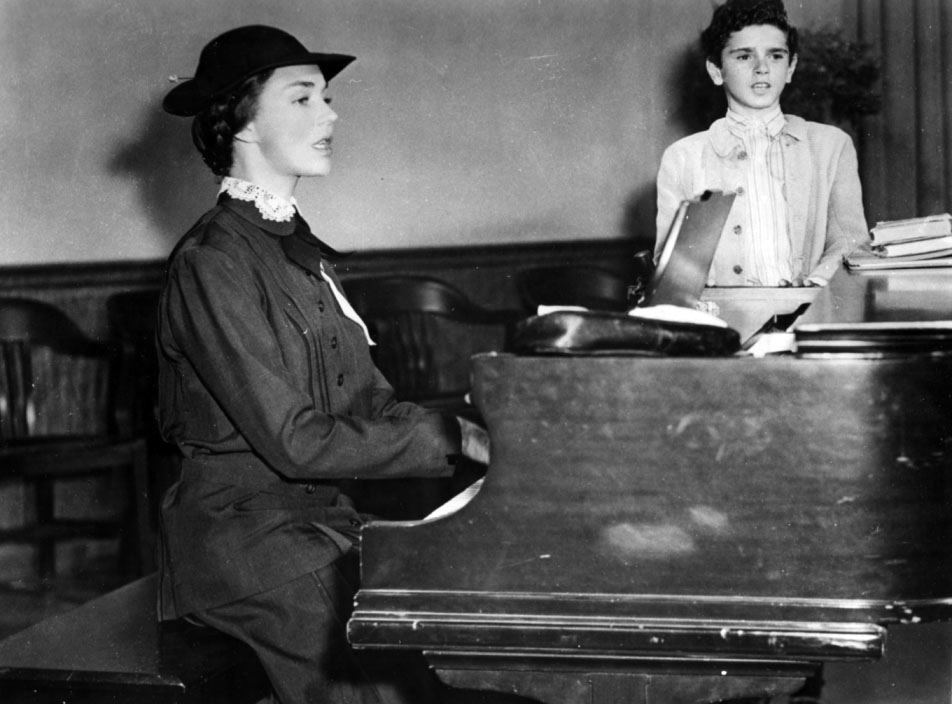
FEATURE image: Jennifer Jones in Good Morning, Miss Dove! (1955).
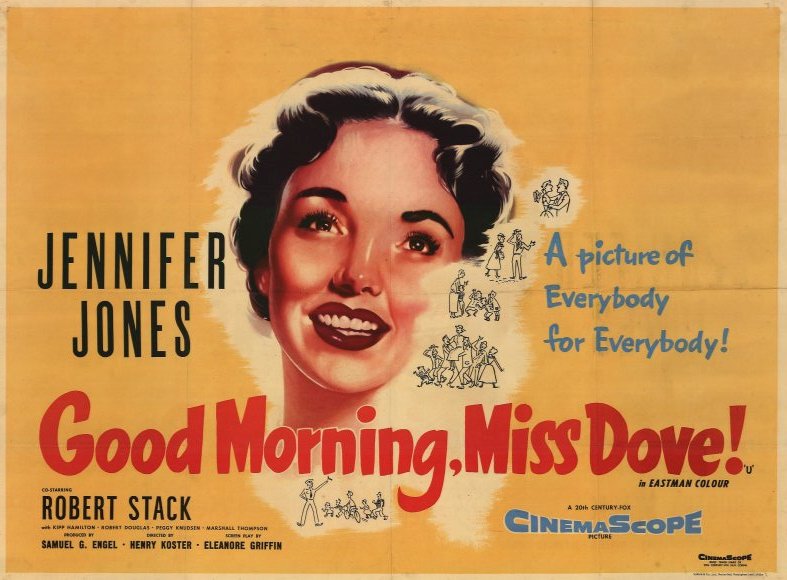
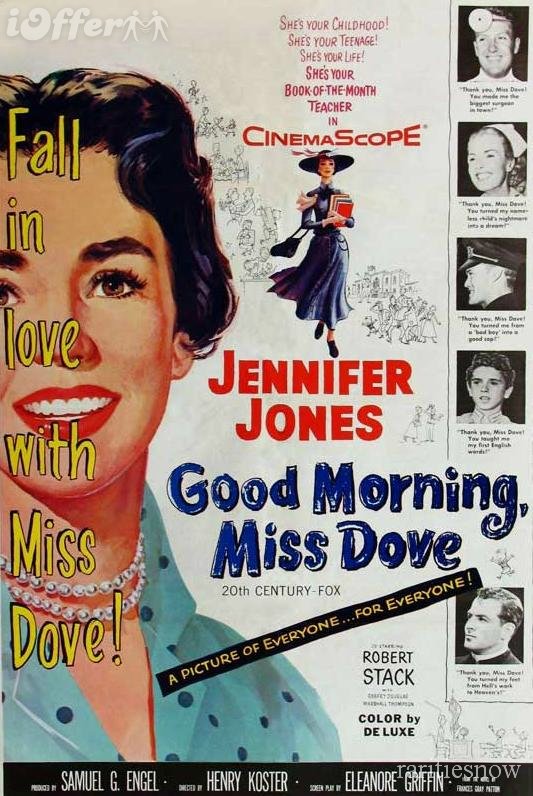
Movie poster for Henry Koster’s Good Morning, Miss Dove! Starring Jennifer Jones, it was released by 20th Century-Fox the day before Thanksgiving in 1955.
Jennifer Jones in Good Morning, Miss Dove! (1955). The 36-year-old actress plays an elderly teacher taken ill at school who, in flashbacks reviewing her life, as a young woman had been about to marry the man she loved when her father died unexpectedly and was secretly heavily in debt. Miss Dove decides not to marry but to repay the debt by becoming the town’s teacher.
The film stars Jennifer Jones, Robert Stack, Kipp Hamilton, Robert Douglas, Peggy Knudsen, Marshall Thompson, Chuck Connors, and Mary Wickes. The film opened to good reviews and was popular at the box office. A New York Times review observed: “Since it is unashamedly sentimental without being excessively maudlin about its heroine, ‘Good Morning, Miss Dove’ deserves credit for being honest and entertaining.”
By John P. Walsh
Good Morning, Miss Dove! is Frances Gray Patton’s contemporary tale of a middle-aged spinster elementary school geography teacher in Liberty Hill who, when suddenly taken ill, sees the entire small town rally to her side.
It is a mythical period piece from the mid-1950’s. It depicts an unchanging town whose students obey their beloved teacher. Though directed by Henry Koster in a stagey way, the film boasts progressive casting. One year after the milestone 1954 Supreme Court decision in Brown v. Topeka Board of Education establishing racial segregation in public schools as unconstitutional, Good Morning, Miss Dove! presents a newly-integrated public school classroom in Cinemascope and De Luxe color.
Film-going audiences in 1955 loved the film.
Awaiting a risky operation, Miss Dove (Jennifer Jones) thinks back on her life and those of her prized grown-up former students. They included Robert Stack (a surgeon), Chuck Connors (a policeman), and Jerry Paris (a playwright). All of these students overcame difficult childhoods and found worldly achievement with the help of Miss Dove.
Based on popular Book of the Month Club novel.
Patton’s novel had enjoyed success in 1954 as a Book of the Month Club and Reader’s Digest selection. Its release as a major motion picture by 20th Century-Fox continued the novel heroine’s popularity.
Release of the film during the Thanksgiving weekend 1955 was in the same year that Jennifer Jones starred in another Deluxe color film, the American drama-romance Love is a Many-Splendored Thing.
For the Academy-Award winning actress to play an elderly spinster (many early scenes feature the naturally dark-haired Miss Jones without her older character’s make-up), she moves beyond type. In the mid-1950’s as America settled into the Eisenhower years, Good Morning, Miss Dove! showed a lead film character -– the “terrible” Miss Dove played by Jennifer Jones — as an unflinching and beloved disciplinarian. Yet in the 1950’s the American public education system was undergoing copious and difficult change. In that way, the character of Miss Dove is further complicated by becoming a popular icon in the American culture by being mostly a nostalgic figure.
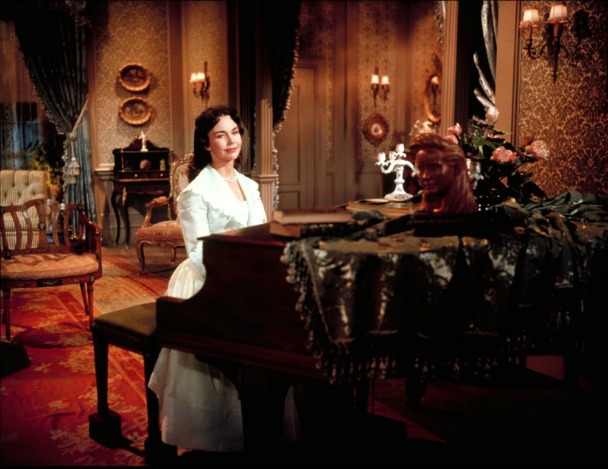
A flashback scene from Good Morning, Miss Dove! Jennifer Jones as young Miss Dove with her father, Alonso Dove (Leslie Bradley). When he dies unexpectedly and in debt, Miss Dove resolves to pay it back and upends her own life’s plans to do so. Costumes by Mary Wills.
In 1955 Jennifer Jones was a 36-year-old beauty. Through the magic of Hollywood make-up (Ben Nye) and hair styling (Helen Turpin), she was transformed into the elderly Miss Dove for Good Morning, Miss Dove! In 1954 after Grace Kelly wore make-up for The Country Girl that hid her good looks and went against her youthful image (Kelly was 24 years old), she won the Academy Award for Best Actress for that year.
Young Miss Dove played by Jennifer Jones gives up marriage to the man she loves for a future as a spinster teacher so to pay back her late father’s debt. The story is based on a book by Frances Gray Patton that was itself based on her short stories. When 20th-Century Fox bought the rights for $52,000, it was the equivalent of about half a million dollars today.
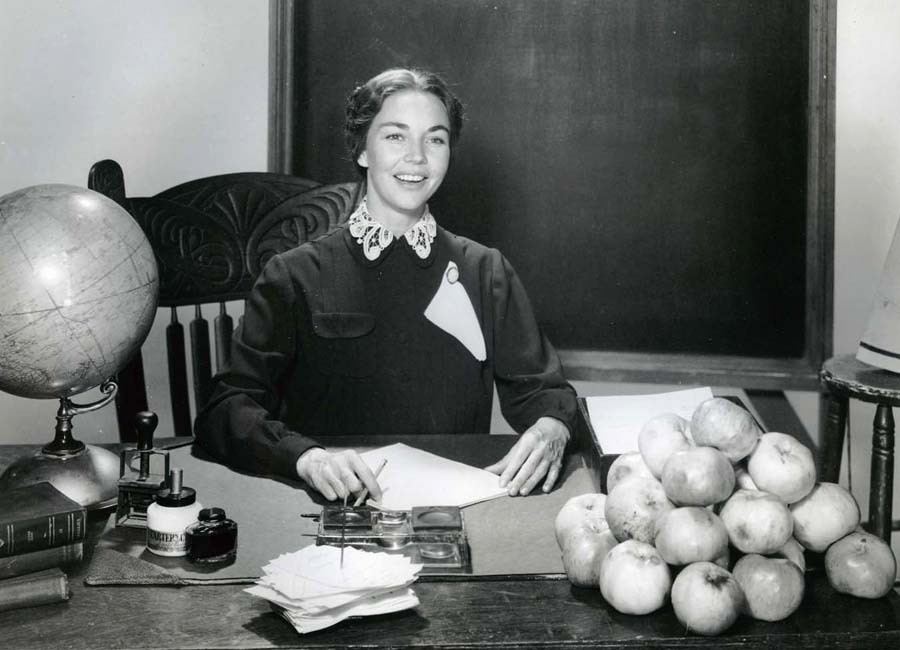
Jennifer Jones as the elderly teacher in Good Morning, Miss Dove! set in the fictional Midwest town of Liberty Hill. Before filming began in July 1955, director Henry Koster wanted Olivia deHavillandfor the role and have it set in England. Though set in contemporary America, critics saw Miss Dove as a character out of Charles Dickens.
The audience meets the elder Miss Dove at the movie’s start—make-up and hair-styling artists Ben Nye and Helen Turpin transformed the 35-year-old Jennifer Jones into the 55-year-old Miss Dove—and by flashbacks.
The film dramatizes her youth as she is about to marry. But she receives the unexpected news that her father has died suddenly and that he has debts. To pay them back, she steels herself to remain single and take a teaching post. Her chilly veneer is part of her honor to do the proper thing along with the sober accommodation to life’s necessary sacrifices.
While those who did not know Miss Dove mock her behind her back and say she couldn’t have had much of a life—never married, no family, no kids, never traveled anywhere—her army of students judge her differently.
Beyond any possibly wider cultural meaning, the film presents a unique person who by the logic of her experience or the experience of her logic enters into a series of social interactions that are amusing and honest. These include the film’s penultimate scene. Miss Dove is on her sick bed when she tells her pastor, Reverend Burnham (Biff Elliot): “Life, whatever others may think, has been for me…I have been happy. I have made many mistakes. Perhaps even sinned. I admit my human limitations but I do not in all honesty find the burden of my sins intolerable. Nor have I strayed like a sheep. I have never been AWOL. I have never spoken hypocrisy to my Maker and now is scarcely a propitious moment to begin.”
While these thoughts may be judged from different perspectives, they are expressive of a woman’s life completely dedicated to her profession and students at Cedar Grove Elementary School. The film’s denouement starting at around 1:39:00 is powerful. Accompanied by Leigh Harline’s memorable soundtrack, it is a sentimental tribute to Miss Dove’s life which benefited through the years many different people because of nothing less than her good character. (1:47:16).
THE MOVIE:
Mary Wills: Oscar-winning costume designer.
The costume designer for Good Morning, Miss Dove! (1955) is Mary Wills (1914-1997). She worked mainly for Samuel Goldwyn productions and Twentieth Century-Fox, breaking into the movie business as a sketch artist for Gone With The Wind (1939). In her nearly 40-year career Mary Wills was nominated for an Oscar seven times and won the Academy Award in 1962 for her colorful designs for The Wonderful World of the Brothers Grimm.
First woman admitted to Yale Art and Drama program.“The Fabulous Miss Wills.”
Born in Prescott, Arizona, Wills moved to Los Angeles after receiving her Master’s degree from the Yale Art and Drama School. She was the first woman admitted into that program.
Wills started designing costumes in 1944 at RKO withBelle of the Yukon and soon after designed costumes for Disney’s Song of the South (1946). She started working for Samuel Goldwyn in 1948 where she designed costumes for Enchantment. For the next six years at Goldwyn Studio the costume designer was referred to as “The Fabulous Miss Wills.”
She was regularly nominated for her costume design in the 1950’s when she designed the costumes for Good Morning, Miss Dove! including Hans Christian Anderson (1952), The Virgin Queen (1954), Teenage Rebel (1956), A Certain Smile (1958), The Diary of Anne Frank (1959), The Passover Plot (1976) and the film for which she won the Academy Award in 1962. Mary Wills also designed the Rogers and Hammerstein musical film Carouselin 1956.
Ice Follies. Camelot and Funny Girl.
Mary Wills demonstrated a special talent for designing historical costumes, especially after she moved to 20th-Century Fox in 1954 to make The Virgin Queen starring Bette Davis. Later she showed great aptitude for designing dance and folk costumes. A collection of her original sketches are online at the Los Angeles County Museum for live productions including theShipstad & JohnsonIce Follies, now known as the Ice Follies. Mary Wills worked on two major films that she did not get film credit for — namely, Camelot (1967) and Funny Girl (1968). ForFunny Girl,she designed the Ziegfeld show-girl brides costumes as well as the costumes for Omar Sharif.
Academy-Award winning costume designer Mary Wills at the Samuel Goldwyn Studio (c. 1948). The Oscar-winning costume designer worked mainly for Samuel Goldwyn Productions and Twentieth Century-Fox.
Miss Dove (Jennifer Jones) in a costume by Mary Wills. In the 1950’s Mary Wills was nominated for an Academy Award four times.
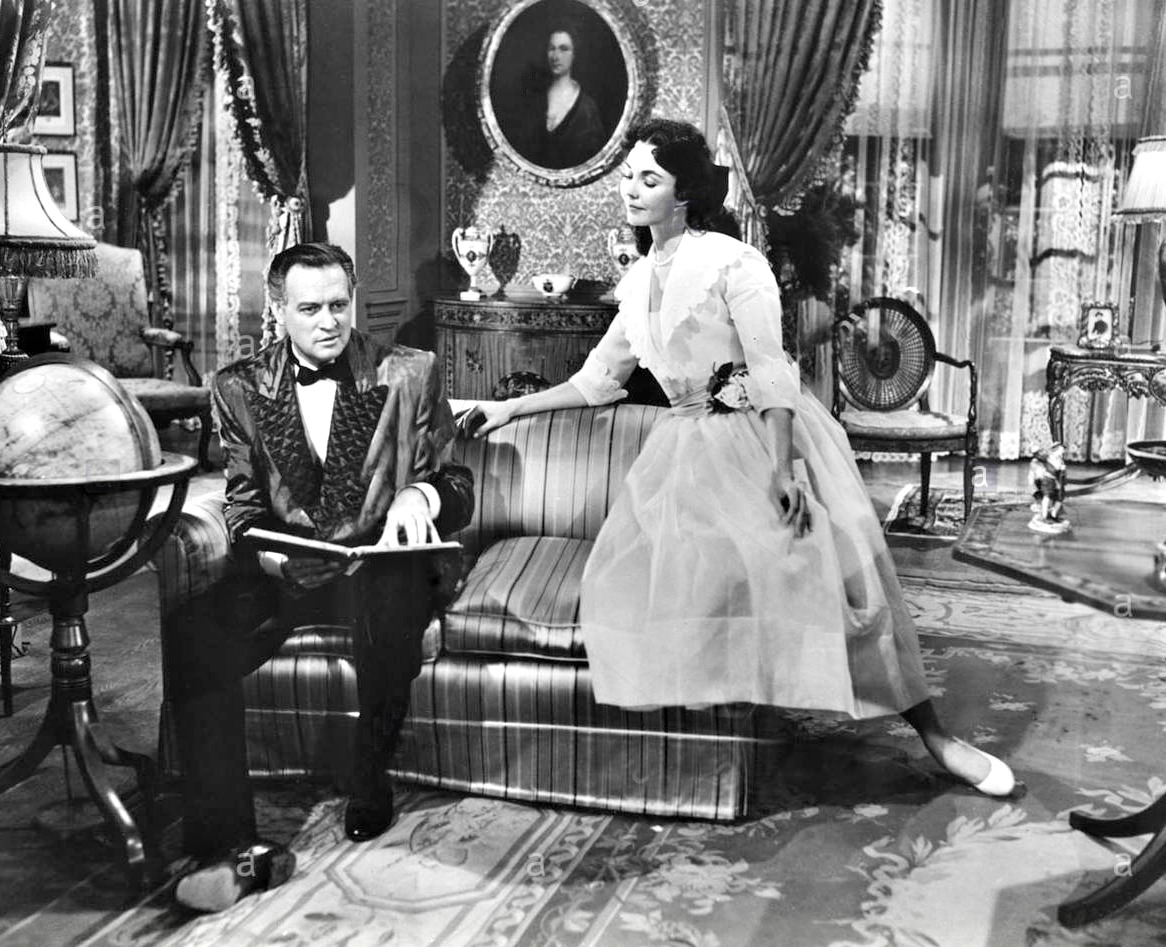
Jincey Baker (Kipp Hamilton), Miss Dove (Jennifer Jones), and Dr. Tom Baker (Robert Stack). Promotion for the film included advertising that encouraged moviegoers to see it for its portrayal of the state of education in the country at the time. Costumes by Mary Wills.
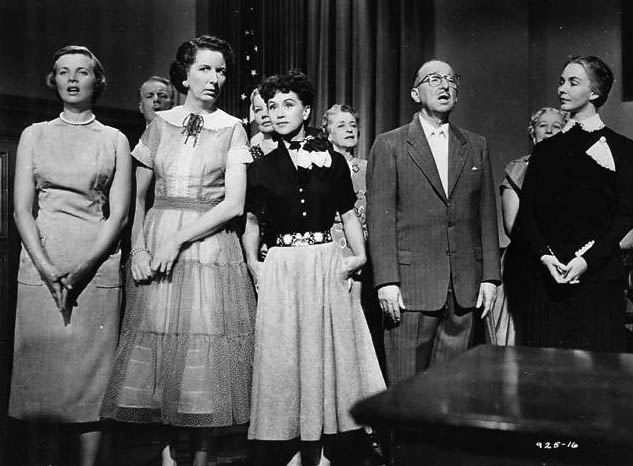
A 1955 drama that is both contemporary and nostalgic. Mary Wickes plays Miss Ellwood (second from left). Costumes by Mary Wills.
Jennifer Jones as a small town spinster teacher who falls ill in the film Good Morning, Miss Dove! Her stern and upright demeanor masks her personal sacrifices and devotion to her students. Tha world is thrown into chaos when Miss Dove experiences an acute pain and grows numb in her leg. It is while she is in her hospital bed awaiting risky surgery that she relates her life in flashbacks.
In Good Morning, Miss Dove! Jennifer Jones is a beautiful young woman who rejects a marriage proposal to become the town’s grade school teacher to repay her late father’s debts. Costumes by Academy Award nominated costume designer Mary Wills.
In the hospital Miss Dove is cared for by Nurse Billie Jean Green (Peggy Knudsen). Billie Jean is one of Miss Dove’s former student who left Liberty Hill and had a child out of wedlock. Back in her hometown, Billie Jean is infatuated with the local policeman, Bill Holloway (Chuck Connors). Bill is another of Miss Dove’s former students and one of her best pupils. Later, in the 1970’s, when actress Peggy Knudsen was suffering from a debilitating illness (she died in 1980 at 57 years old), she was in real life cared for by her close friend, Jennifer Jones.
Miss Dove with former student and Liberty Hill policeman Bill Holloway (Chuck Connors). Miss Dove tells nurse Billie Jean Green how Bill first arrived to her classroom– a poor, unkempt boy being raised by his alcoholic grandmother. Over the years, Miss Dove gave Bill odd jobs and bought him a suit for his grammar school graduation. After Bill entered the Marines, he wrote to Miss Dove often, and when he returned to Liberty Hill, she was the first person he came to for career advice.
On the day of Miss Dove’s surgery, classes are dismissed and the townspeople of Liberty Hill wait outside the hospital for news of the operation’s outcome. The film provides a sentimental picture of mid-20th century America that is of Norman Rockwell proportions. Yet the film’s crisp dialogue and sharp character development by Jennifer Jones and the supporting cast engages the moviegoer. By the end of the film the outcome of Miss Dove’s surgery is as affecting to the audience as it is the fictional townspeople of Liberty Hill.
*The photograph copyright may be believed to belong to the distributor of the film, 20th Century Fox, the publisher of the film or the graphic artist. The copy is of sufficient resolution for commentary and identification but lower resolution than the original photograph. Copies made from it will be of inferior quality, unsuitable as counterfeit artwork, pirate versions or for uses that would compete with the commercial purpose of the original artwork. The image is used for identification in the context of critical commentary of the work, product or service for which it serves as poster art. It makes a significant contribution to the user’s understanding of the article, which could not practically be conveyed by words alone. As this is a publicity photo (star headshot) taken to promote an actress, these have traditionally not been copyrighted. Since they are disseminated to the public, they are generally considered public domain, and therefore clearance by the studio that produced them is not necessary. (See- Eve Light Honthaner, film production expert, in The Complete Film Production Handbook, Focal Press, 2001 p. 211.) Gerald Mast, further, film industry author, in Film Study and the Copyright Law (1989) p. 87, writes: “According to the old copyright act, such production stills were not automatically copyrighted as part of the film and required separate copyrights as photographic stills. The new copyright act similarly excludes the production still from automatic copyright but gives the film’s copyright owner a five-year period in which to copyright the stills. Most studios have never bothered to copyright these stills because they were happy to see them pass into the public domain, to be used by as many people in as many publications as possible.” Kristin Thompson, committee chairperson of the Society for Cinema and Media Studies writes in the conclusion of a 1993 conference with cinema scholars and editors, that they “expressed the opinion that it is not necessary for authors to request permission to reproduce frame enlargements … [and] some trade presses that publish educational and scholarly film books also take the position that permission is not necessary for reproducing frame enlargements and publicity photographs.”(“Fair Usage Publication of Film Stills,” Kristin Thompson, Society for Cinema and Media Studies.)
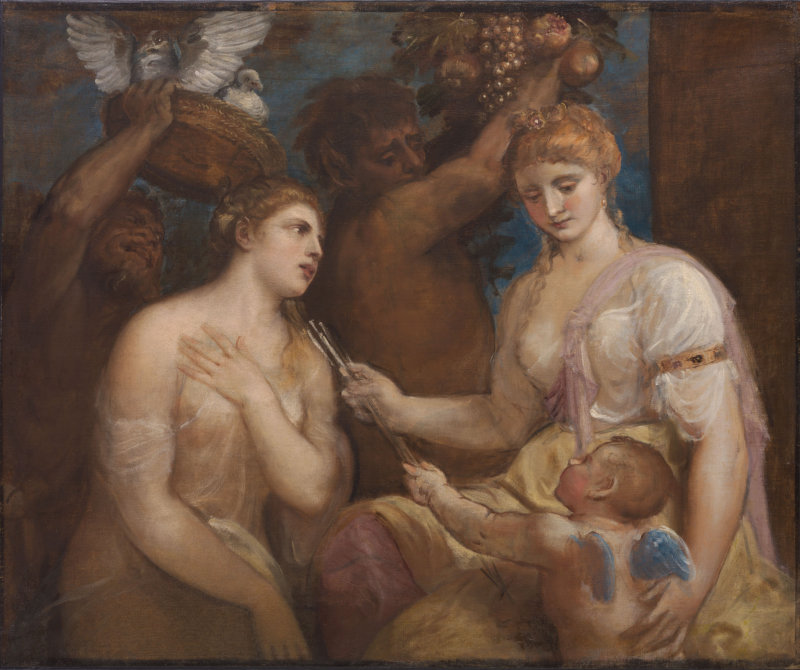
FEATURE image: Allegory of Venus and Cupid, c. 1600, Imitator of Titian (Tiziano Vecellio, Italian, c. 1485/90-1576), oil on canvas, 51 1/8 x 61 1/8 in. (129.9 x 155.3 cm). Charles H. and Mary F.S. Worcester Collection, 1943.90.
By John P. Walsh
The pleasant if heavily-restored late 16th century allegorical painting in the collection of The Art Institute of Chicago is today called Allegory of Venus and Cupid and dated to around 1600. Attributed to an “imitator” of Titian it remains in museum storage (“Not on Display”).
When this same painting was “rediscovered” around 1930 it was hailed as a Titian masterpiece and over the next 15 years was talked of that way in the general press and in some quarters of the art press. It delighted crowds who came to see it hang on the walls of The Art Institute of Chicago and The Cleveland Museum of Art. Called The Education of Cupid and dated to the 1550s, it was compared favorably with Titian’s famous allegorical subject paintings in Paris’s Louvre and in Rome’s Galleria Borghese.
The painting through the Great Depression and World War II was labeled “Titian,” but among expert connoisseurs there existed a longstanding dismissal of that attribution ever since its first known “resurfacing” in the mid1830s at Gosford House in Scotland.
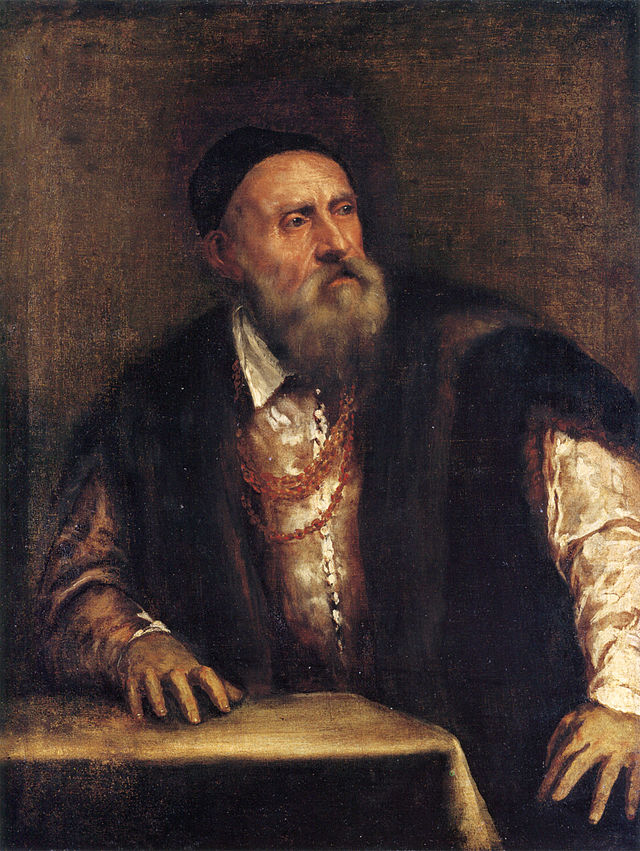
Titian, Self portrait, c. 1550, Gemäldegalerie, Berlin.
In Italian his name is Tiziano Vecellio, but in English the artist is famously known as Titian (1485-1576)
Titian was part of a family of artists who had been civic leaders in 13th-century and 14th-century Italy, such as mayors, magistrates, and notaries. In the 15th century, two Vecellio brothers had children who became artists. Titian was the grandson of one of those brothers who was ambassador to Venice where the family had a timber trade. Titian became the leading painter in Venice and an influential artist throughout sixteenth-century Italy. His cousin Cesare Vecellio (1530-1601) was an engraver and painter who trained in Titian’s workshop. The Vecellio cousins and their sons became artists and were allowed to use the appellation “di Tiziano” which would bring them attention.
The painter of The Art Institute of Chicago’s allegory entitled Allegory of Venus and Cupid is only identified as an “imitator” of Titian. Its allegorical motifs share similarities with Titian’s and this is perhaps partly why this Old Master painting by an unknown follower of Titian was mistaken for the master himself when it resurfaced on the art market in 1927.
Called The Education of Cupid and dated to the 1550s, it traded back and forth to the dealer for almost a decade until it was bought in 1936 by a well-connected Chicago couple who collected sixteenth-century Venetian paintings. The Wemyss ‘Allegory’ (named for its former British owner, Lord Wemyss) came to Chicago out of what amounted to be a Scottish attic.
It gained ready acclaim as a rediscovered Titian and since its subject was reminiscent of Titian’s Allegory of Marriage (1533) in the Louvre and a Titian subject allegory in the Galleria Borghese, the Wemyss ‘Allegory’ in Chicago was hailed as completing a triumvirate of Titian’s greatest allegorical compositions.
The problem was that this Chicago Titian was not a Titian at all, although it took about 10 years for that fact to gain modern acceptance.
After the purchase, the new owners immediately lent their Titian to The Art Institute to mount on its gallery walls. It would hang next to the collector couple’s verifiable Tintoretto, Veronese, and G.-B. Moroni. The museum eventually acquired the Wemyss ‘Allegory’ in 1943, but not before it toured The Cleveland Museum of Art during their “Twentieth Anniversary Exhibition” in 1936 and viewed with enthusiasm as a Titian.
The collector purchase and subsequent loan to the Art Institute was front page news in Chicago. The director of the museum at the time, Robert Harshe, compared the work in importance to only two others in The Art Institute at that time – El Greco’s Assumption of the Virgin (1577-79) and Girl at the Open Half Door (1645) attributed to Rembrandt. Curiously, this painting first attributed to Rembrandt has been itself increasingly questioned in terms of its high authorship. One of the first historical European paintings to enter the museum’s permanent collection, Girl at the Open Half Door is today identified with the moniker “and Workshop” to indicate the possibility that it was created by a student under the master’s supervision.
Soon after its acquisition by The Art Institute, the Titian attribution was loudly critiqued in print and eventually dropped. The subject of the painting is of a girl who appears before Venus to be initiated into the mysteries of Love. At the girl’s right are Venus and the boy Cupid with an arrow. In the background two satyrs raise items such as a basket with two doves and a bundle of fruit.
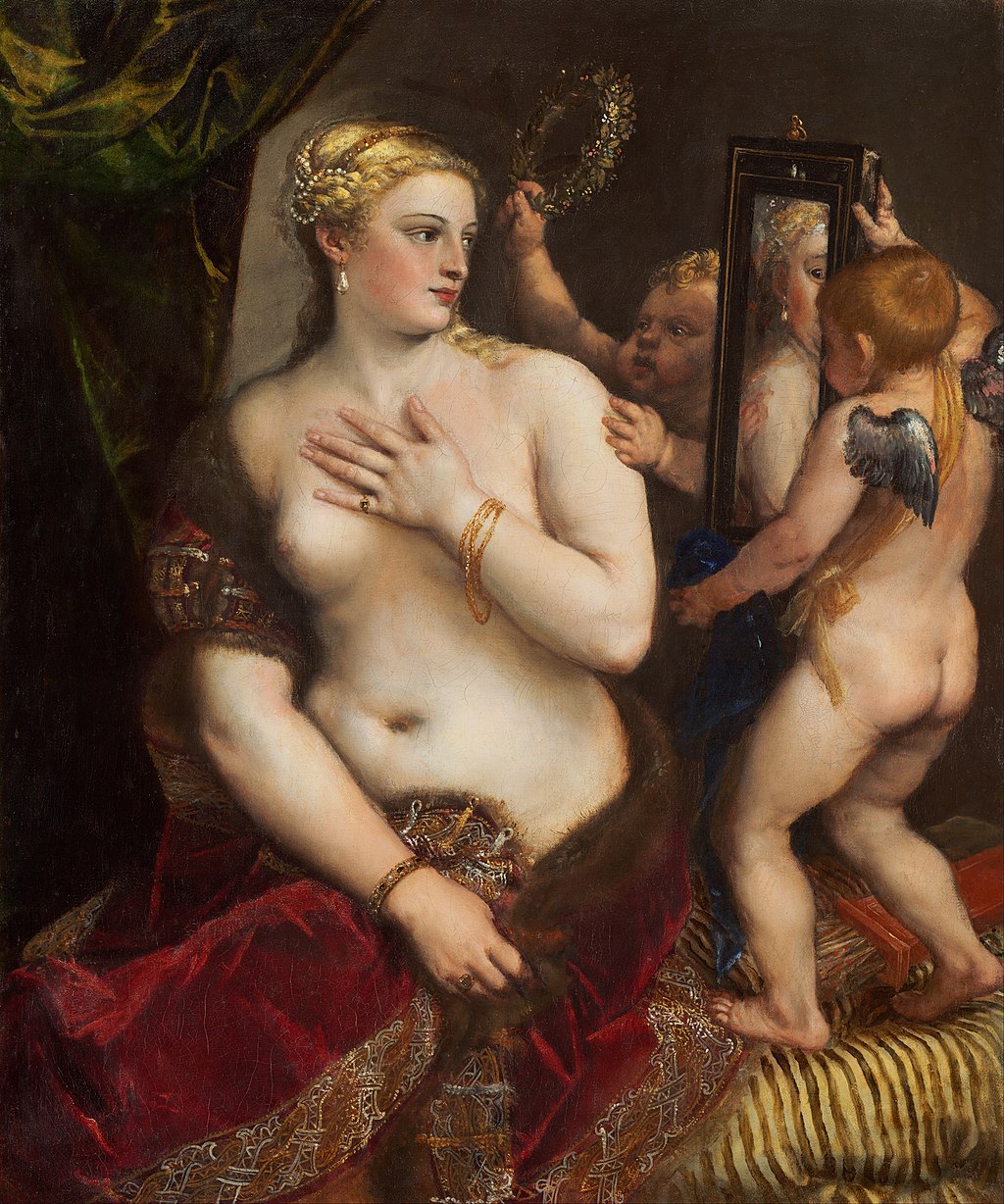
Allegories were popular in Italian Renaissance art to convey social, political, economic and religious messages using historical and mythological figures. This painting’s figures, however, appear to be derivative of specific Titian works. Further, it possesses little of the technical brilliance or psychological revelations found in Titian’s work such as in Triple Mask or Allegory of Prudence (c. 1570, London, National Gallery). For example, Titian’s imitator gives the figure of the girl the same dramatic hand gesture found in Titian’s Venus with a Mirror (c. 1555, The National Gallery of Art, Washington, D.C. ). Insofar as the girl’s skyward gaze and flowing hair, the imitator cites The Penitent Magdalene (1531-33, Florence, Palazzo Pitti).
Titian, Venus with a Mirror, 1555, National Gallery of Art, Washington, D.C.Titian, Penitent Magdalen, 1533, Pitti Palace.
In addition to the painting’s derivative character of well-known Titian works, what most connoisseurs recognized by 1945 was what they called its “very modern” execution. This referred to its sharp color contrasts and figurative forms which developed only after Titian’s time. Connoisseurs also noted that Titian differentiated sharply between hair and ornament and that his female figures’s hair is neatly braided, whereas the hair is “in a mass” in the Wemyss ‘Allegory’.
These characteristics pointed to the picture being related less to authentic Titians in Paris and Rome and more to those attributed dubiously, even spuriously, to Titian in Munich and at the Durazzo Palace in Genoa. Though this inauthenticity of Chicago’s Wemyss “Allegory” could have been questioned at the start of its appearance in Chicago in 1936, the museum was not adhering closely to the historical connoisseurship.
Sir Joseph Archer Crowe by Louis Kolitz (German, 1845-1914), London, National Portrait Gallery.
Giovanni Battista Cavalcaselle, 19th century.
Sir Joseph Archer Crowe (British, 1825-1896) and Giovanni Battista Cavalcaselle (Italian, 1819-1897) had seen all three of the spuriously attributed Titians in Munich, Genoa, and at Gosford House which was now in Chicago. It was well known the pair excluded all three from their Titian catalog except to note that they were imitations which had been notably damaged and restored. Chicago museum research in the late 1930s was also aware of Crowe and Cavalcaselle’s attributive work for they cited them in official publications on the Wemyss ‘Allegory,’ but overlooked their conclusions.
With the museum’s acquisition of the Wemyss ‘Allegory’ in 1943 Crowe and Cavalcaselle’s negative attribution for it was no longer ignored or denied. About its reworking in England one tempting and likely wishful speculation was that the Wemyss ‘Allegory’ was restored by Sir Joshua Reynolds (1723-1792) but that claim remains unsubstantiated. Further facts contextualized in the deft historical hands of modern connoisseurship left the Wemyss ‘Allegory’ out in the Titianesque cold as an imitator. In the case of the Chicago painting it was by historical comparison with compositional arrangements in known Titians that the compositional arrangements in the Munich and Chicago paintings were deemed by Crowe and Cavalcaselle to be done by imitators. Historically for Titian it would be nonsensical or “unique” for Titian to have manipulated the figures in that way at that time.
By the mid1940s the Chicago painting was searching for a new name attribution, since Crowe and Cavalcaselle did not give it one. The notion that it was done by Damiano Mazza (active after 1573), an obscure 16th century artist and student of Titian, was proposed but later dismissed.
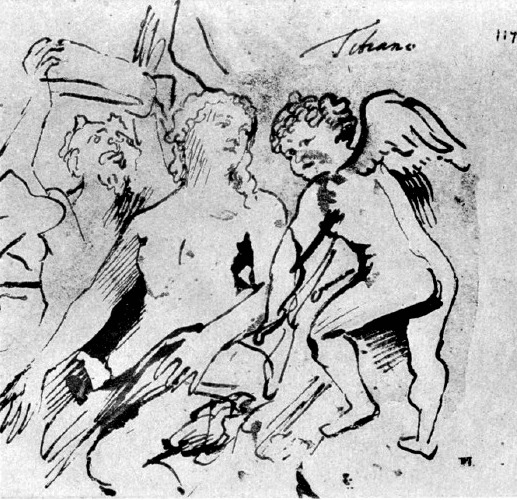
Chatsworth, Duke of Devonshire: Van Dyck, Sketchbook.Rome, Galleria Borghese: Venus and Cupid with Satyr Carrying a Basket with Fruit, attributed to Paolo Veronese.
Some of the confusion over the attribution to Titian of the Wemyss ‘Allegory’ is based on erring connections made using erring extant evidence. For example, the conjecture of Vienna School-trained art historian of Venetian art Hans Tietze (Czech, 1880-1954) that a sketch by Sir Anthony van Dyck (1599-1641)–which Tietze wrongly believed was made at Chatsworth House of a painting once attributed to Titian–shared similar motifs with the Wemyss ‘Allegory’ is a thin thread for possible attribution to Titian. It may be argued that the Wemyss ‘Allegory’ shares very little with the Van Dyck sketch except for the satyr lifting a basket. Further, the painting which Van Dyck sketched is no longer attributed to Titian and has long been in the Galleria Borghese in Rome as a minor Venus and Cupid with Satyr Carrying a Basket with Fruit now attributed to Paolo Veronese. It was in Rome where Van Dyck must have made his sketch, not England, and it was there he misidentified it as Titian. It is a tenous trail of misleading evidence that became the prompt to a connoisseur’s mistaken thought.
Paris, Louvre: Allegory of Marriage, Titian, 1533.
Nuptial paintings
One persuasive conclusion on attribution today for the Wemyss ‘Allegory’ was offered by Hans Tietze’s wife, the historian of Renaissance and Baroque art, Erika Tietze-Conrat (1883-1958). Tietze-Conrat believed that The Art Institute painting resides in a pool of works done by assistants and imitators who combined varied elements of Titian’s allegories as found in the Louvre’s Allegory of d’Avalos (the aforementioned Allegory of Marriage) and the Borghese’s Education of Cupid.
Erwin Panofsky (German, 1892-1968) postulated that those known Titians were nuptial paintings. Building on that premise, Tietze-Conrat postulated that numerous reproductions were made by Titian followers so to create nuptial paintings for their patrons to suit their needs. The derivative works shared the intimacy of a private format with a recognizable cast of 16th century depictions of mythological actors and the evocation of a Titianesque mood.
Today the Art Institute of Chicago has renamed their Wemyss “Allegory” as Allegory of Venus and Cupid and dated it to “around 1600.” The museum removed Titian and every other named attribution. Attribution has been returned to the term that connoisseurs Crowe and Cavalcaselle gave the painting in 1881, namely, “imitator.”
“The execution here is very modern,” the pair wrote in their Life and Times of Titian in 1881. “It is greatly injured, but was apparently executed by some imitator of Titian.” Their late 19th century judgment hold fast today.
On Titian and Vecellio family – Encyclopedia of Italian Renaissance & Mannerist Art, Volume II, edited by Jane Turner, Macmillan Reference Limited, 2000, p. 1695.
“ready acclaim as a rediscovered Titian…”; “lent their Titian to The Art Institute to mount……”; “Cleveland… ‘Twentieth Anniversary Exhibition’ in 1936…” – “A Great Titian,” Bulletin of the Art Institute of Chicago (1907-1951) Vol. 31, No. 1 (Jan., 1937), p. 8; “Famed Titian Work Acquired by Chicagoans,” Chicago Tribune, October 20, 1936, p. 28; “The Mr. and Mrs. Charles H. Worcester Gift,” Daniel Catton Rich, Bulletin of the Art Institute of Chicago, Vol. 24, No. 3 (Mar., 1930), pp. 29-31 and 40. The Chicago collectors were Mr. and Mrs. Charles H. Worcester, a museum Vice-President and lumber and paper manufacturer.
“…director of the museum… compared the work in importance to El Greco’s ‘Assumption of the Virgin’ and Rembrandt’s ‘Girl at the Open Half Door’” – “Famed Titian Work Acquired by Chicagoans,” Chicago Tribune, October 20, 1936, p. 28.
“little of the technical brilliance or psychological revelations found in…Triple Mask…” – H. E. Wethey, The Paintings of Titian: Complete Edition, vol. 2, The Portraits, Phaidon, New York, p. 50.
“its ‘very modern’ execution”; “in a mass” – The Wemyss Allegory in the Art Institute of Chicago, E. Tietze-Conrat. The Art Bulletin Vol. 27, No. 4 (Dec., 1945), p. 269.
“It was widely known the pair excluded all three from their Titian catalog…” – “A Great Titian Goes to Chicago,” Art News 35, 5 (1936), p.15 (ill.).
“Chicago museum research in the late 1930s was aware of Crowe and Cavalcaselle’s attributive work… overlooked their conclusions…” – Footnote #4, The Wemyss Allegory in the Art Institute of Chicago, E. Tietze-Conrat. The Art Bulletin Vol. 27, No. 4 (Dec., 1945), p. 269.
“…restored by Sir Joshua Reynolds…” – The Wemyss Allegory in the Art Institute of Chicago, E. Tietze-Conrat. The Art Bulletin Vol. 27, No. 4 (Dec., 1945), p. 269.
“done by Damiano Mazza…” Ibid., p. 270.
Conjecture of Hans Tietze; Erika Tietze-Conrat’s postulation – Ibid., p. 271.
“the execution here is very modern… It is greatly injured, but was apparently executed by some imitator of Titian.” – Crowe and Cavalcaselle, Life and Times of Titian, London, 1881, II, p. 468.
By John P. Walsh Posted December 6, 2014. updated: October 2, 2015; updated: February 14, 2018 (Parkland high school shooting — at least 17 killed, suspect in custody, Florida sheriff says).
On a typical day in the United States, not all firearms (a.k.a. guns) are used for “hunting,” “sport” or to “protect one’s family” as stated by President Obama in his press conference on October 1, 2015 at the White House in the wake of the mass shooting at Umpqua College in Roseburg, Oregon.
At last report, 10 people were killed (including the gunman) and 7 others critically wounded in that recent school shooting. It is the 44th mass killing incident in the U.S. in 2015 with three months to go.
Since the tragic and disturbing Columbine massacre in 1999 (13 killed; 21 wounded) there have cropped up in intervals of about one per week mass shootings in the U.S., not all of them school shootings, that have gained intense media attention: the Fort Hood shooting (November 5, 2009), the Gabby Giffords shooting (January 8, 2011), the Aurora movie theater shooting (July 20, 2012),the Wisconsin Sikh temple shooting (Aug. 6, 2012), the Sandy Hook elementary school shooting (Dec. 14, 2012), the Navy Yard shooting (Sept. 16, 2013), the Kansas Jewish Community Center shooting (April 14, 2014), the Charleston Church shooting (June 18, 2015), the Chattanooga recruiting center shooting (July 16, 2015) and now the Roseburg community college shooting.
A 2013 report cited 547 lives were taken between 1983 and 2012 in 78 public mass shootings. From 2013 into 2015 there were an additional 142 mass shootings (25 of them suicides or attempted suicides) in schools.
Everyday in America guns are used to kill about 80 people and wound 300 more. For accidental gun shootings, 3 people die and another 30 are wounded everyday.
Media Coverage
In the wake of this carnage, the mainstream media coverage felt a bit different this time — almost as if this kind of thing could have been happening for the first time — or that they were somehow having to start over in their approach.
Reporters seemed to embody a deeper scrutiny of, or despair at, this latest school massacre only four weeks since the murder by gunfire of TV reporter 24-year-old Alison Parker and TV cameraman 27-year-old Adam Ward In Virginia.
A shot from the shooting of Alison Parker and Adam Ward on August 26, 2015. Fair Use.
Popular support for “Gun Control”?
A Pew Research Center study released on August 13, 2015, shows a large majority of Americans in support of several specific gun policy proposals: ˙79% favor laws to prevent people with mental illness from purchasing guns. ˙70% support the creation of a federal database to track all gun sales. ˙57% support a ban on assault-style weapons. ˙85% of Americans favor expanded background checks (88% of Democrats and 79% of Republicans).
President Obama hinted in his press conference at another finding in the August Pew Research study when he said, “I would particularly ask America’s gun owners — who are using those guns properly, safely, to hunt, for sport, for protecting their families — to think about whether your views are properly being represented by the organization that suggests it’s speaking for you.”
His comment was a not-too-subtle reference to the National Rifle Association (NRA) which the Pew Study finds the public has some shifting opinions about.
While mass shooting crimes are, statistically, a snippet of America’s real field of action for gun violence, they are an especially destructive form in itself and its repercussions for the wider community. In addition to a national discussion about the mind or “profile” of a mass murderer (usually devolving into mental health concerns and/or ignorance about a reliable profile), the impact on the local or national community is less explored.
At his press conference, President Obama predicted a routine counter-punch to his gun control comments and it came swiftly. Reported by media outlets including WGN Chicago as a top story, gun-rights advocate Mike Huckabee stated the president was wrong for trying to “exploit” the Oregon shooting and that another mass killing should have no serious effect on the public debate about gun ownership in the U.S.
Yet impacts of a mass shooting are never as simple as its politics. Deleterious effects from gun violence extend to the victims and their families, and into the wider community.
Active Shooter Drills
Even extremely realistic school-shooting simulations known as “active-shooter” drills staged by local law enforcement agencies using school grounds, staff and students as actors are censured as counterproductive by psychologists and security specialists. Although the best way to help first responders prepare for gun-related violence on campus, the mere simulation of gun violence causes psychological distress among students and their families and work to make death tolls worse.
A student actor participating in the extremely realistic “active shooter drills” staged by law enforcement on campus grounds around the nation. Advocates say it helps first responders better prepare. Critics claim it could actually make death tolls worse. Fair Use.
Gun crime: homicides, suicides, and mass shootings
In 2011, 68% of homicides in the U.S. were gun crimes, even though these and all other crimes have dropped by almost 40% since 1993. Americans, however, continue to view gun crime as a pervasive and even worsening problem.
In 2011, 11,068 people died in gun homicides in the U.S. That number reflects a steep decline in gun homicides since the 1980’s. Yet statistics support the conclusion that more guns and access to them results in more gun violence, including murder crimes.
Media coverage of gun homicides is found mainly in densely-populated urban areas where there is, presumably, a higher concentration of guns. Mass shootings, however, frequently occur in rural or suburban settings.
Based on the level of shock associated with shootings, Post Traumatic Stress Disorder (PTSD) are the long-lasting psychological consequences of all those directly experiencing or witnessing any part of a mass shooting. This especially pertains to children.
Does gun access cause more suicide?
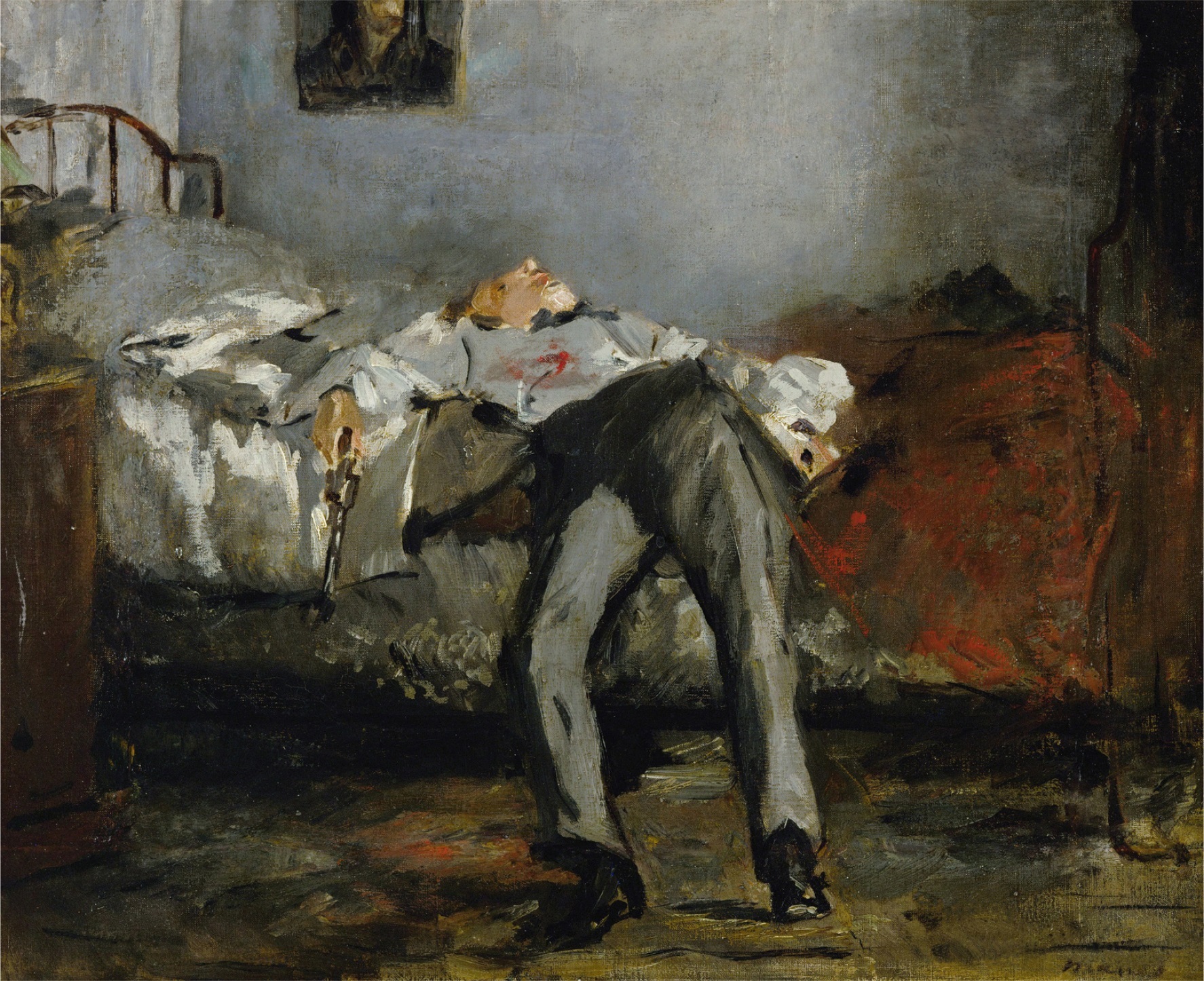
The most annual gun deaths in the U.S. are neither homicides, mass shootings or accidents. They are suicides.
In 2011, according to the Centers for Disease Control and Prevention (CDC), 19,990 people died by suicide with a firearm. Those yearly numbers are consistent at least since the 1990’s.
The Suicide by Édouard Manet, c. 1880, Foundation E.G. Bührle, Zurich, Switzerland. Public Domain.
Does gun access lead to more suicides? That gun suicides are less common in states where gun ownership requires criminal and mental illness background checks point to that link.
It is obvious that by having access to a gun, the risk of having an accident increases -– but is that true for homicide and suicide?
Suicide attempts by guns are almost always fatal while suicide attempts using other methods result in death about 6% of the time. That data confirms that a firearm’s effectiveness as a lethal weapon is undeniable. It precludes the desperate person any second thoughts.
Males arrested for 75% of all crimes
Arrest statistics make clear that it is not the criminal’s age or race but gender that the law-abiding citizen should fear. Males are arrested for 75% of all crimes. These criminal acyvities fall into three braod categories, including violent crime; property crime; and, assault.
Access to guns aids this criminal facility.
Guns and domestic abuse
For example, in a survey of battered women nearly 72% reported that guns had been used against them and to threaten to kill them.
For women who are abused (and not killed) 16% live in homes with a gun.
Abused women that were killed, about 50% lived in a home with a gun.
Statistics suggest that access to a gun is a risk factor for homicide in abusive relationships. This situation is beginning to be taken up by law enforcement in police interviews with battered women.
Mass shootings are a tiny percentage of all gun homicide. Further, the frequency and impact of mass shootings has not increased in the last 35 years at least.
Should focus be on the mentally ill to reduce most gun crime?
To focus public safety on the mentally ill in reaction to these horrific gun crimes is likely to produce small effect on their recurrence.
Several studies have shown that the mentally ill require good health care, though its funding is relatively scarce. During the Great Recession of 2008, budget cuts for mental health amounted to almost $2 billion. Despite the lack of resources and high profile political and media focus, the mentally ill are responsible for only about 5% of all crimes and even less for those involving guns.
Each week 30% of all gun deaths in the U.S. are children
Drug and alcohol abusers engage in violent acts seven times more than the mentally ill. Funding for substance abuse programs should be even more important to gun safety advocates based on those statistics.
The link between gun violence and domestic batterers is far greater than with the mentally ill. Of those 80 people killed by guns in a typical week in the U.S., 30% are children.
After non-gun accidents, gun shootings are the leading cause of death of children in the U.S.
In 2009 there existed an estimated 310 million civilian guns (handguns, rifles, shotguns) in the U.S. and 2012 sales added $6 billion more.
Increased buying has hiked up privately-owned firearms by about 40% since 1994 when there were 192 million guns.
The exact number of concentrations of firearms in the U.S. is unknown. About 50% of Americans report at least one gun in the home. Gun ownership in the U.S. is heavily skewed to older white men.
The U.S. has more guns per capita than any land mass in the world. Poor countries in Central America, for example, record higher gun homicide rates than in the U.S.. But among developed nations, no country has more guns per person in private hands– nor a higher gun homicide rate– than in the United States.
The gun industry is prospering today. To paraphrase Charles Erwin Wilson, the Defense Secretary under President Eisenhower: “What is good for Sturm, Ruger & Co. is good for the nation.” There is some truth to it.
In 2012, the gun industry added $31.6 billion to the U.S. economy due to job creation and new sales taxes. The gun industry employs about 98,750 workers and 111,000 more workers as suppliers and retailers, such as Walmart.
While recreational use seems to be driving record sales, there is a darker side to the proliferation of gun ownership. As one gun advocate’s recent proclamation alludes– that “the (gun) industry has entered a golden era, a renaissance of gun ownership that transcends a dedicated segment of Americans who consider firearms a natural part of their lives”– it often equally ends those natural lives sooner than nature intends.
Despite guns crimes, the prospect for meaningful gun control in the U.S. is bleak.
Fewer than half of Americans think that gun laws should be stricter. Another half believes they are already too strict or just about right.
In a culture where money defines free speech and guns rights are enshrined in the U.S. Constitution’s second amendment, the prosperous gun industry and its supporters which is no less than half of the U.S. population will not be surrendering its arms soon.
Gun safety measures may have a more receptive audience than attempts at gun control. These include background checks.
The mindset of some gun-rights advocates may work to divide gun owners’ attitudes about select gun control measures. That may be part of President Obama’s comments for law-abiding gun owners to reflect on “the organization that suggests it’s speaking for you.”
Controversial ideologies and opinion polls on guns
A controversial example of a mindset is the so-called NRA embrace of “insurrectionist ideology.” This asserts that the intent of the second amendment is to permit American citizens to shoot and kill federal agents and law enforcement officers in the event that they believe those agents are attempting to facilitate or impose some form of government tyranny.
Regarding the NRA specifically, Americans are divided on the organization: ˙40% think the organization is too influential over gun laws. ˙52% say it has too little or the right amount of influence.
While opinions on the NRA are entrenched and polarized, there is slight but significant movement on another issue pertaining to guns.
In 2015 Americans did an about face on the question as to whether it was more important to control gun ownership (50%) or protect the right of Americans to own guns (47%). ˙57% of whites favor gun rights over gun control. ˙75% of blacks favor gun control over gun rights. ˙72% of Hispanics favor gun control over gun rights.
Changing demographics and marginally shifting American opinion on gun control may be the sliver of hope President Obama perceived when he said in his October 1 news conference: “It will require that the American people, individually, whether you are a Democrat or a Republican or an independent, when you decide to vote for somebody, are making a determination as to whether this cause of continuing death for innocent people should be a relevant factor in your decision. If you think this is a problem, then you should expect your elected officials to reflect your views.”
President Barack Obama speaks at his press conference, Oct. 1, 2015. White House photo-Public Domain.
While polls find that over 60% of the public thinks background checks are a good idea, neither the gun industry nor gun owners want the extra burden. In an almost $32 billion-a-year industry ($6 billion in sales), background checks would be a major government intrusion.
As long as the number of gun fatalities is status quo, there likely will be no new impetus for gun control. In places like Arizona, Colorado, the District of Columbia, Michigan, Nevada and Oregon, the rate of gun deaths has exceeded traffic fatalities and they are on par with each other in Ohio and Pennsylvania. It is the choice of individuals and society–50% of which are gun owners and 95% of which own cars -–as to whether around 30,000 fatalities for each category of combustibles is a fair and acceptable human cost for their unbridled use.
Even if, as Russ Thurman writes, “Gun ownership has gone mainstream…It’s the fun factor of firearms that has been restored to the culture,” this cannot be the responsible gun owner’s sole matter of importance when discussing this uniquely American issue.
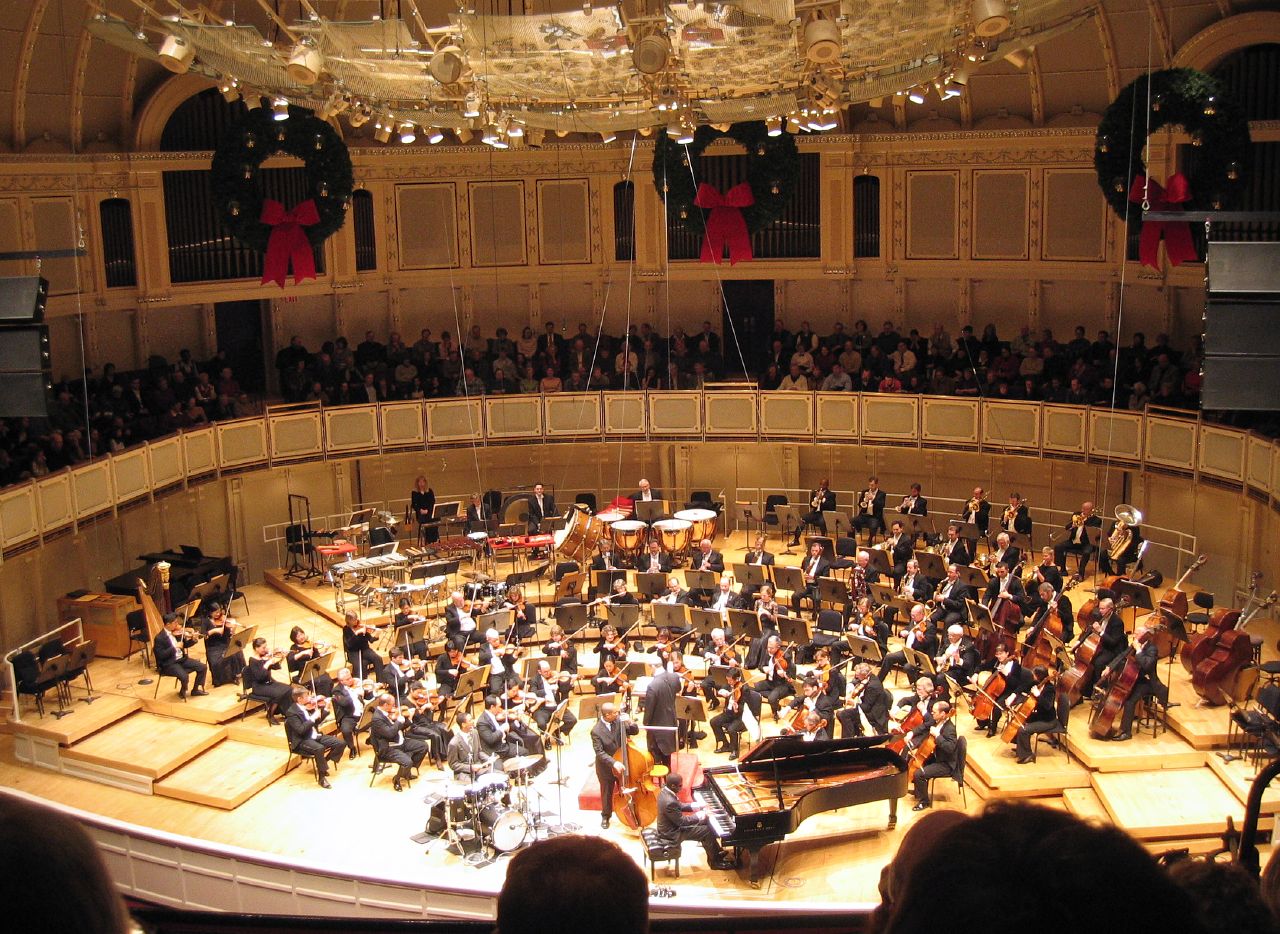
FEATURE image: Sir Georg Solti conducting the CSO in Orchestra Hall in November 1971.
By John P. Walsh
PART I: Fritz Reiner, Jean Martinon, & Georg Solti.
In 2013 just ahead of Game Four of the Stanley Cup Finals the principal conductor and music director of the Chicago Symphony Orchestra dressed up in a Chicago Blackhawk’s sweater to conduct his orchestral version of their pep rally song.1 Riccardo Muti (Italian, born 1941) has worn many hats as opera and classical music conductor in a forty-year career but perhaps none with such hometown flair.
In the decades before his 2010 CSO appointment Riccardo Muti appeared to have had a knack for getting into all sorts of fine arts trouble – his resignation as music director from La Scala in summer 2005 is recent although early in his career Muti walked away from productions in Florence, Milan, and Paris because of irreconcilable differences over artistic questions. Despite these encounters, Muti continues to be one of today’s celebrated Mozart and Verdi specialists while unconventionally asserting his prestige by mounting major productions of lesser known composers. From his earliest days as principal conductor of the opera festival Maggio Musicale Fiorentino in 1968 to his appointment as chief conductor of the London Philharmonia in 1972 – both posts held into the early 1980s – as well as a longstanding association with the Salzburg Festival starting in 1971, Muti is only recently being acclaimed in America for what he has long been famous for in Europe – as a first order musical firebrand who makes opera scores spring to vivid life.2
When Riccardo Muti was made music director of the Philadelphia Orchestra in 1980 – a prestigious post with an American orchestra which had had only two previous music directors since 1912 (namely, Leopold Stokowski and Eugene Ormandy) – Muti almost immediately stepped into the annals of controversy as a conductor in America. Classical music lovers bred on the Philadelphia Orchestra’s broad, brilliant live and recorded performances under Stokowski and Ormandy found a nemesis in Muti. Verging on his 40s, the new conductor’s ideas for this venerable orchestra with a traditionally lush and enveloping string sound were received by Philadelphia audiences with dismay. It seemed that Muti strictly observed notated musical scores and shaped distinctive interpretations from them which altered a 75-year-old sound brand. Still touting its “distinctive sound”3 today as well as other past glories, the Philadelphia Orchestra under the 44-year reign of Eugene Ormandy (1936–1980) earned 3 Gold records and 2 Grammy Awards.4 In 2014, more than 20 years after Muti’s resignation from Philadelphia, critics continue to weigh in on his enduring influence. One hears the heaving sigh of relief that Muti revolutionized less than they feared.5 Musical idealism remains Muti’s calling card coming into Chicago. Do his efforts at parceling annotated music merit negative criticism? The “very clean sound” which CSO musical director Fritz Reiner (1953-1963) brought to Chicago at a time when the orchestra was looking for stable leadership is praised; the “lean sound” which Muti brought to Philadelphia following 70 years of stable leadership produced misgivings.6 At the October 3, 2014 CSO matinée performance of Polish-themed music (Panufnik, Stravinsky, and Tchaikovsky’s Third Symphony) it is evident that Chicago’s premier group of players is subjected to a similar set of permuted articulations under Muti’s command. Yet these CSO musicians are mindful of their musical worth and perform at a high level whoever appears on the podium responding to what is asked of them.
Music Director of the Philadelphia Orchestra Eugene Ormandy (Hungary, 1899-1985) with orchestra members in the 1960s.
Riccardo Muti (Italy, born 1941) rehearsing the Philadelphia Orchestra for his 1972 guest conductor debut with the ensemble.
Under music director Fritz Reiner the CSO’s celebrated brass section was born; later, Sir Georg Solti (1969-1991) gave it luster and clarity while Daniel Barenboim (1991-2006) added richness and depth. What is Muti doing?7 Since its founding in 1891 Riccardo Muti is the CSO’s tenth music director. Each of his predecessors had their own style but not all had the same impact or influence on the orchestra which harbors its own strong personality.8 I began my CSO concert subscription when today’s Symphony Center was Orchestra Hall and Sir Georg Solti was its music director. Like most everyone else in Chicago I was in awe of Solti. By 1985 he had with the CSO and chorus won 7 Grammy Awards for a succession of Mahler symphonic recordings plus 15 more Grammys for his Verdi, Puccini, Schoenberg, Berlioz, Mozart, Haydn, Bruckner, and Brahms. Over the next six years when I was regularly in the Hall Solti’s CSO won another 6 Grammy Awards – for his Liszt, Beethoven, Bartók, Wagner, Bach and Richard Strauss. Solti’s accomplishment in this area is wonderfully mind boggling.9 Both music director Fritz Reiner and Jean Martinon (1963-1968) wished to heighten the orchestra’s national and international profile by recordings and tours but it was maestro Solti who fulfilled and then surpassed these earlier objectives. When Solti finally left his post as music director in 1991 after 22 years at its helm he had the legacy of having established Chicago as one of the very best orchestras in the world.
Fritz Reiner (Hungary, 1888-1963) was the sixth music director of the CSO from 1953 to 1963. Russian composer Igor Stravinsky (1882-1971) said that Reiner “made the Chicago Symphony into the most precise and flexible orchestra in the world.”
The CSO’s seventh music director (1963-1968) was talented composer Jean Martinon (French, 1910-1976). Never gaining the complete acceptance of orchestra members, Martinon improved the musicians’ work conditions and introduced the CSO to a new repertoire of French and contemporary classical music.
While music director in the early 1960s at Covent Garden Georg Solti (Hungary, 1912-1997) was known as “the screaming skull” for his outbursts in rehearsals.
As music director at Covent Garden for ten years starting in 1961 Solti generated a reputation for being “the screaming skull”10 because of his intense and at times bruising style. But musicians not much later in Chicago saw a different and more complex man. Solti did not bait or act harshly toward them as Reiner had done in the mode of Arturo Toscanini (Italy, 1867-1957). Reiner, in the first hour of the first rehearsal as music director, fired one of the musicians. He worked constantly after that to instill fear into his orchestra. He insisted on being called “Dr. Reiner” and inflicted cruel verbal tests onto his men to test, to his mind, their character. While believed to be utterly lacking in ready wit or sensitivity as sometimes displayed by the combustible Reiner, Solti was seen by his musicians to turn inwards into a private world.11 Unlike Leonard Bernstein, Solti could appear fashion challenged – he showed up at rehearsal in baggy pants and a simple coat thrown over a rumpled shirt. Nor did Solti drive a flashy sports car à la von Karajan or act podium showman like Stokowski. While Martinon and Solti were “late starters” to music, a 53-year-old Martinon came to the orchestra fully formed while 57-year-old Solti continued an intense drive to advance.12
The 1970s underway, Solti proved to be not the terror in rehearsal Reiner had been nor seeking anyone’s approval like Martinon. And while Solti was accessible and sometimes sought to be an intermediary to certain first-rank players’ intramural conflicts, he remained markedly tense. Solti did admit to “gentle bullying”13 in Chicago but only to get his way with the music. Respect for the CSO is high among its music directors while at Covent Garden Solti admiited he had been “a narrow-minded little dictator.”14 Under Solti’s leadership the CSO’s technical brilliance produced clear, lustrous, and notably loud sound – known as “Der Solti-Klang.” With Solti the CSO’s 1970 appearance at Carnegie Hall was a rousing success and for its first European tour in 1971 the orchestra basked in stellar reviews. In six weeks they played in Scotland, Belgium, Finland, Sweden, Germany, Austria, Italy, France and England. By 1972 the CSO won its first Grammy Awards under Solti for Mahler Symphonies 7 and 8, whose music was first suggested to Solti to conduct by Theodor Adorno. Sir Georg Solti and Chicago made for a winning team and the city shared in its glory.15
Louis Sudler (1903-1992) president of the Orchestral Association from 1966 to 1971, chairman from 1971 to 1977 and chairman emeritus from 1977 until 1992 announces that Georg Solti will become the CSO’s eighth music director beginning with the 1969-70 season.
Sir Georg Solti conducting the CSO in Orchestra Hall for the three-act opera (third act unfinished) “Moses and Aaron” by Arnold Schoenberg (Austrian, 1874-1951) on November 13, 1971.
Ticker tape parade turns north onto LaSalle Street in Chicago’s downtown financial district following the CSO musicians return from their autumn 1971 European concert tour. It was first such international event for the orchestra in its history.
In performance Solti’s large conducting gestures could appear stiff and stylized – one more aspect of the Toscanini temperament he dismissed. As Solti espoused Toscanini’s belief that music cannot be chopped up and must relax and flow Solti did not follow Toscanini’s lead – as Riccardo Muti, a Toscanini admirer, does not- to forego the written musical score on the conductor’s podium during a concert. If Muti’s reason is to read and interpret a score’s annotations, Solti’s was a psychological one. Like Toscanini Solti committed the music to memory but kept the annotated score ever-present to serve as an insurance policy for musicians, especially singers, who Solti believed needed reassurance that the conductor had everything under control during a performance. Despite this careful preparation, a recurring criticism of Solti’s work is that it “lack[ed] refinement…finesse and, above all, attention to detail.” 16 For the keen musical mind of Daniel Barenboim who brought neither Solti’s or Muti’s purpose to the podium he nearly always conducted like Toscanini with no score.
Arturo Toscanini (1867-1957) demonstrating conducting gestures for a crescendo.
Sir Georg Solti in rehearsal with mezzo-soprano Josephine Veasey (British, born 1930) in Covent Garden, 1966.
Daniel Barenboim in a typical conducting stance at the Veranos de la Villa Festival in Madrid.
Riccardo Muti conducts the CSO in an October 4, 2012 performance at Carnegie Hall.
When Sir Georg Solti died suddenly in September 1997 there was the critical reaction linking him to the passing of an era – an erstwhile time of “old school toughness” when a conductor was a “super-hero” who did not negotiate musical interpretation but demanded it and never shared credit or fame with any musician. But this, of course, is largely myth. The era of “democratic playing” which is criticized as today’s musical model – that is, one of dialogue and partnership between conductor and ensemble – is in fact something that started in the United States and elsewhere around 1960 when Solti was embarking on the next four decades of his best work.17 In what ways is Muti’s directorship affecting “the Chicago sound”? How is this new and highly experienced, talented and forceful conductor – conducting Stravinsky’s “The Firebird” on October 3, 2014 Muti jabbed the air like a boxer – an old Solti gesture – changing this vital orchestra? CSO’s future lies in Muti’s head, heart and hands and while players are incredibly talented (no orchestra plays Strauss and Mahler better) Muti keeps them on a tight leash. How do the musicians respond to his direction? Results from such control and semiotic interpolation of a composer’s intention in the score should be the grounds on which the public will judge Riccardo Muti over time. The CSO strives to play to its Chicago audience, not to one in Asia or Europe, and so the case for Muti’s rise or fall will essentially be local.
1 Huff post Chicago, “Chicago Symphony Orchestra Plays ‘Chelsea Dagger’ In A Classy Show Of Support For The Hawks,” 06/20/2013. Retrieved October 2014.
2 irreconcilable differences – http://www.encyclopedia.com/topic/Riccardo_Muti.aspx. Retrieved October 2014; makes opera scores spring to vivid life – Peter G. Davis, “The Purist,” Opera News, October 2014, vol. 79, no. 4. Retrieved October 2014.
5James R. Oestreich, “The Big Five Orchestras No Longer Add Up,” New York Times, June 14, 2013. Retrieved October 2014.
6 William Barry Furlong, Season With Solti: A Year in the Life of the Chicago Symphony, Macmillan Publishing Co., 1974, p. 52.
7 whatever is asked of them – Donald Peck, The Right Place, the Right Time: Tales of Chicago Symphony Days, Indiana University Press, Bloomington and Indianapolis, 2007, p. 6; brass born under Reiner – Oestreich; luster and clarity – Furlong, p. 84; richness and depth – Emanuel Ax, http://www.gramophone.co.uk/editorial/the-world%E2%80%99s-greatest-orchestras.
11 insisted on being called “Dr. Reiner” – Peck, p. 2; private world – Furlong, p. 52.
12 flashy sports car – Furlong, p.79; podium showman – Furlong, p.81; “late starters” – Furlong, pp. 58 and 87; fully formed – Furlong, p.60; intensely driven – Furlong, p. 83, 141.
13 Furlong, p.86.
14 Furlong, p. 88.
15 technical brilliance – Furlong p.81; “Der Solti-Klang” – Furlong, p. 85; “stellar reviews” – Review of ”The Chicago Symphony Orchestra by Robert M. Lightfoot; Thomas Willis,” by M. L. M., Music Educators Journal, Vol. 61, No. 4 (Dec., 1974), pp. 87-88; European itinerary – http://csoarchives.wordpress.com/2012/08/18/solti-26-1971-tour-to-europe/. Retrieved October 2014; suggested to Solti by Theodor Adorno – Sir Georg Solti, Memoirs, Knopf, NY 1997, p. 100.
16 On Solti’s and Toscanini’s relationship – see Furlong, pp. 86; 93-94, 141; for quote “lack[ed] refinement…” – Furlong, p. 85. Solti first worked with Arturo Toscanini (1867-1957) at the Salzburg Festival in 1936 and was invited by him to New York in 1939.
17 Old school toughness – Review of “The Right Place, the Right Time! Tales of the Chicago Symphony Days by Donald Peck,” by Lauren Baker Murray, Music Educators Journal, Vol. 95, No. 1 (Sep., 2008), pp. 21-22; “super hero” – “Editorial: Leading from the Front,” The Musical Times, Vol. 138, No. 1857 (Nov., 1997), p. 3; dialogue and partnership… started in…1960 – Furlong, p.110.
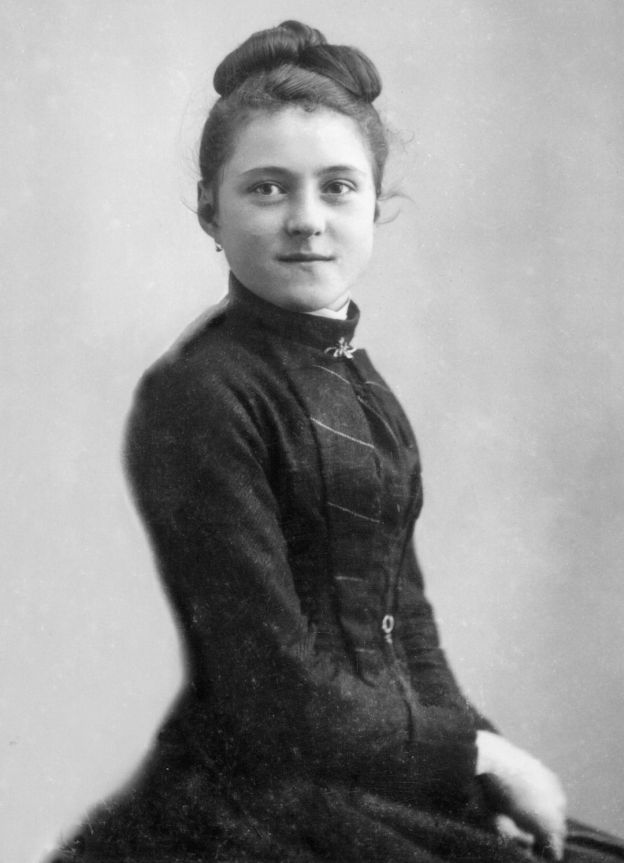
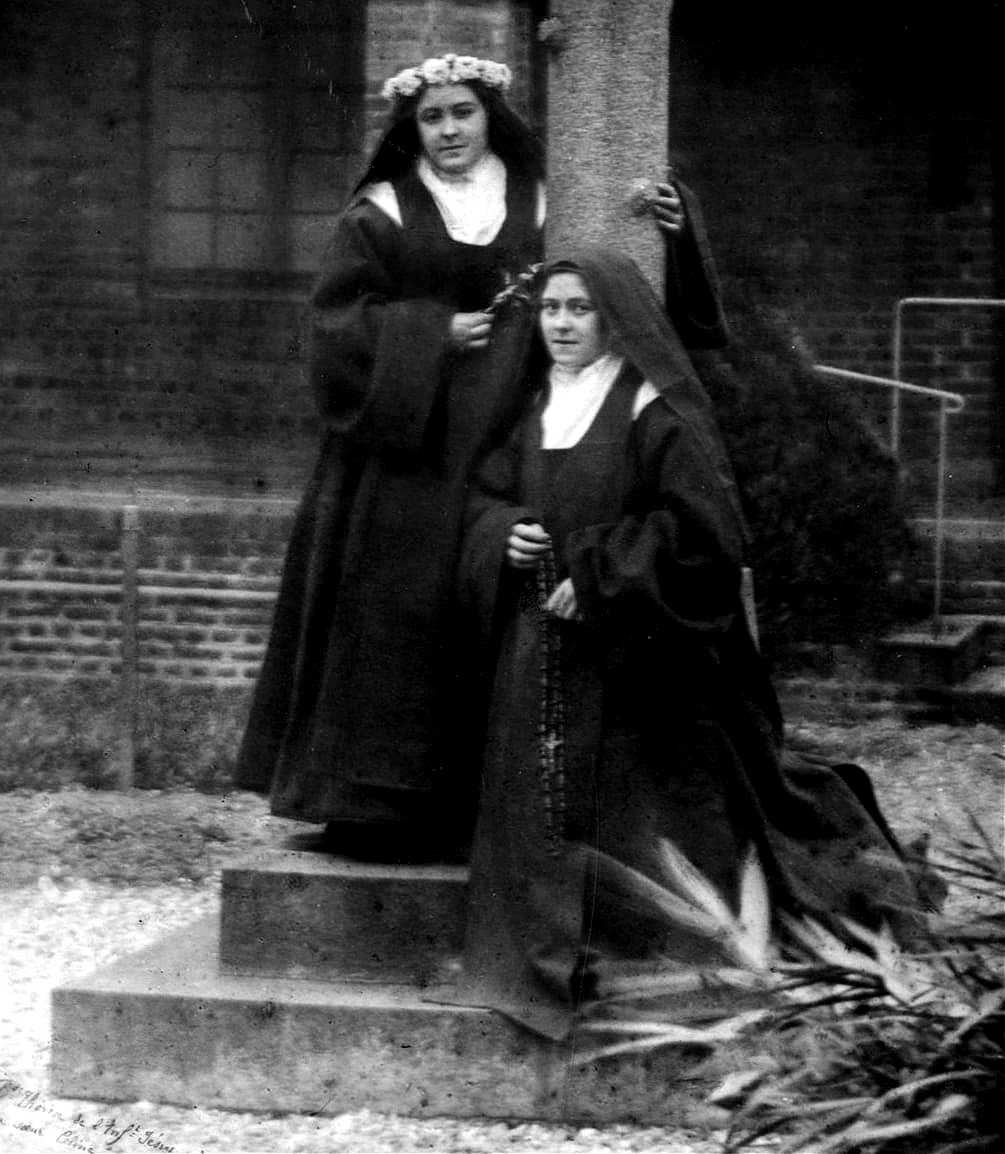
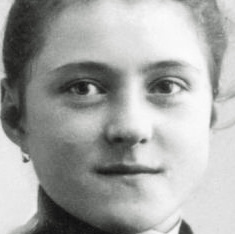
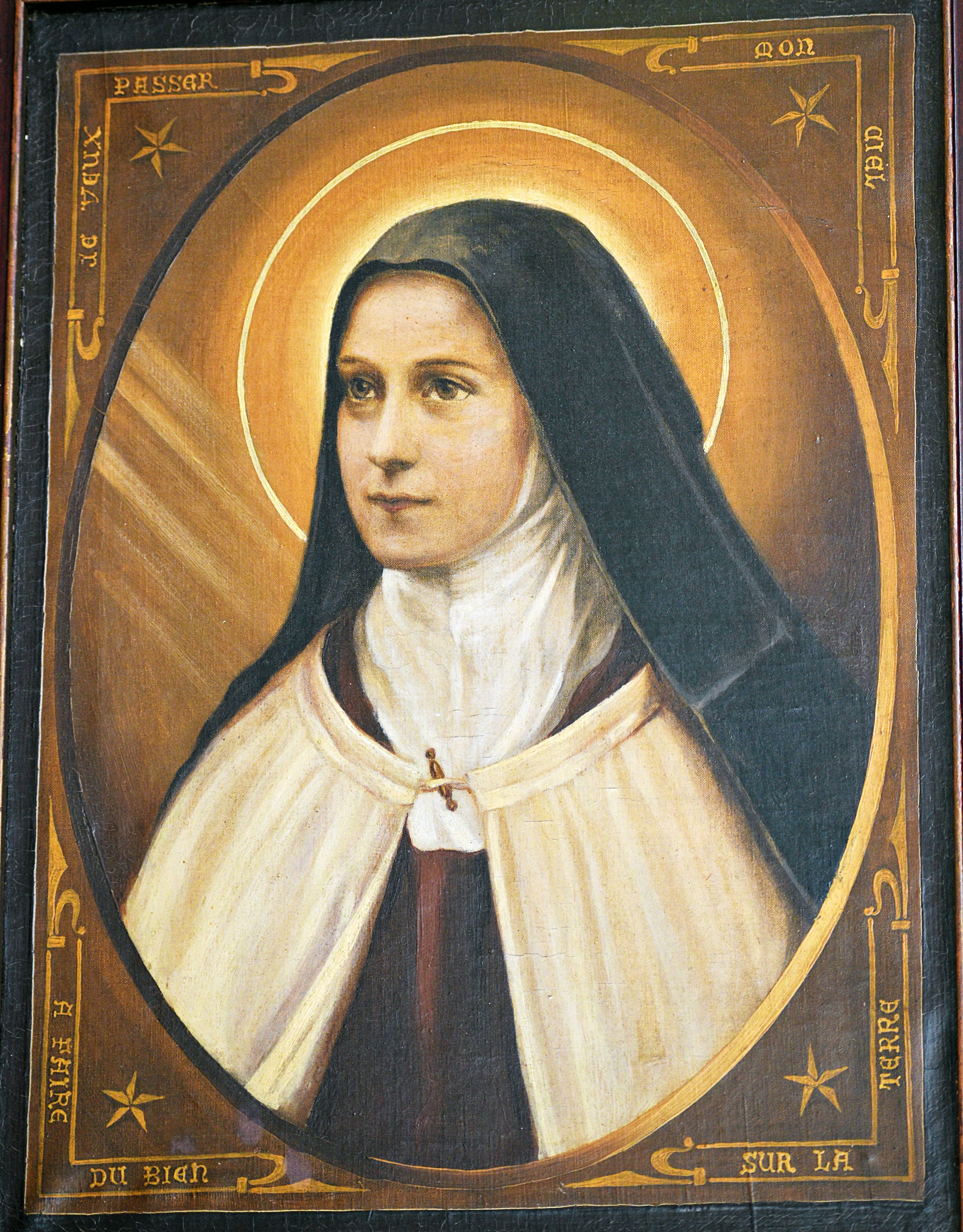
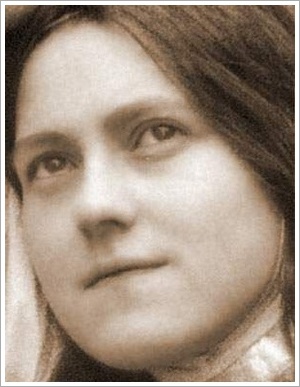
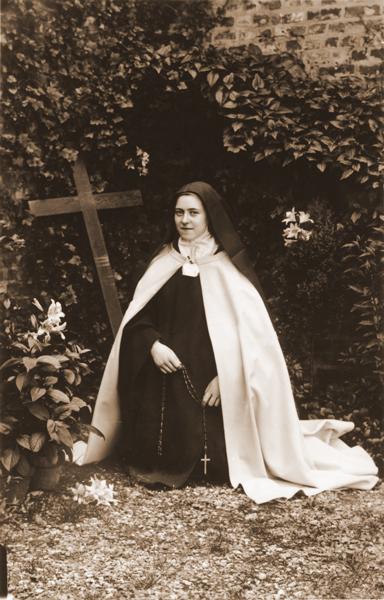
FEATURE image: Thérèse Martin (St. Thérèse of Lisieux) at 15 years old in a photograph taken in October 1887.
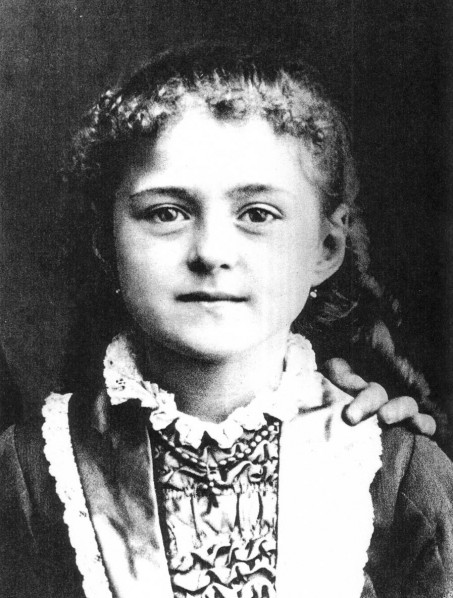
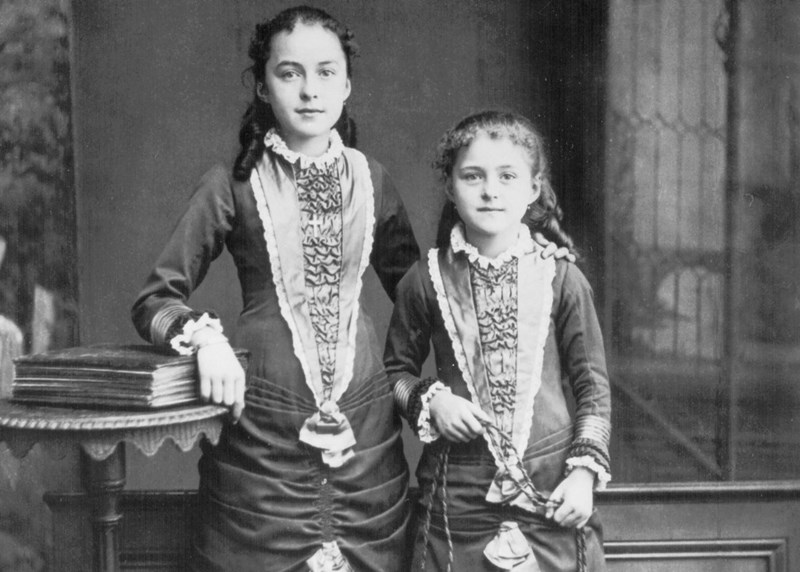
Thérèse Martin at 8 years old in 1881.Thérèse Martin at 8 years old in 1881 with her sister Céline. The Martin family had moved from Alençon to Lisieux to be with the Guerin relatives. Zélie Martin had died four years before.
By John P. Walsh
October 1 is the feast day of Saint Thérèse of Lisieux (French, 1873-1897), one of only four women “doctors” in the Roman Catholic Church, and popularly known as The Little Flower of Jesus. Her religious name is Thérèse of the Child Jesus and the Holy Face and, with St. Francis of Assisi, she is one of today’s most popular saints. For a young Norman woman who died at 24 years old in an obscure convent in northern France that is a surprisingly solid list of titles and accolades.
Yet, when she died on September 30, 1897, the Carmelite nuns in her community at the Carmel in Lisieux didn’t think they had any accomplishments to cite for her obituary. Her sister Céline (1869-1959), a nun in the same convent as Thérèse, observed: “In general, even in the last years, she continued to lead a hidden life, the sublimity of which was known more to God than to the Sisters around her.”1
Born Marie-Françoise-Thérèse Martin in 1873, she was the youngest of five sisters and lively and precocious. She lost her mother Zélie Martin (née Guérin, 1831-1877) to breast cancer as a four-year-old. The next decade – according to Thérèse’s journal (The Story of a Soul, begun in 1895) – was the most “distressing” years of her life.2
Thérèse’s mother was the breadwinner in the Martin house and after she died little Thérèse naturally turned to her father Louis (1823-1894) for nurturing along with her four older sisters — especially the second eldest, Pauline.
For the rest of the 1870s and into the 1880s, Thérèse was the high-spirited baby sister in the family home called Les Buissonnets in the Normandy town of Lisieux.
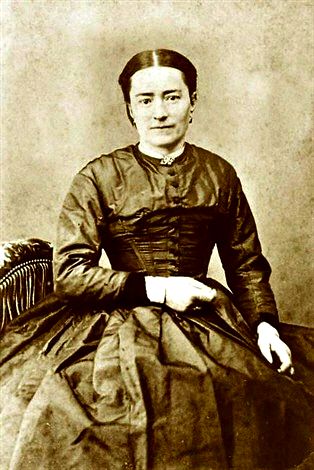
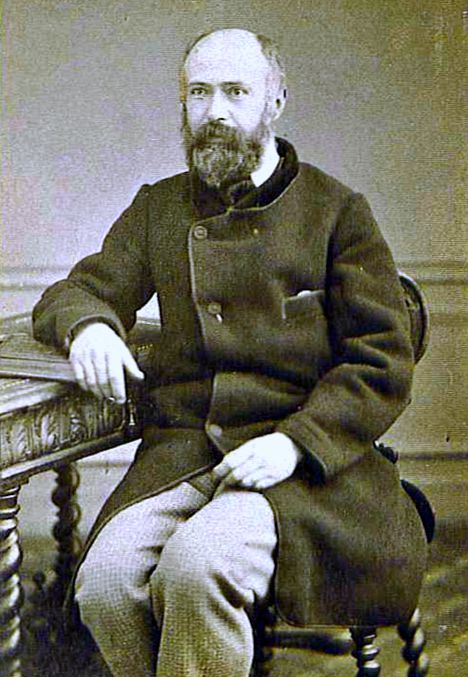
St. Azélie-Marie “Zélie” Martin née Guérin (1831 -1877) and St. Louis Martin (1823 –1894), the mother and father of Saint Thérèse of Lisieux. The married couple were canonized together in the Catholic Church by Pope Francis on October 18, 2015.
As three of Thérèse’s sisters left the family homestead to enter convents -– two of them to a Carmelite convent (“Carmel”) in Lisieux and another later to a Visitation convent in Caen– the two youngest sisters, Céline and Thérèse, remained at home with their father.
Although Louis adored Thérèse and called her his “little flower,” Thérèse was headstrong and obstinate and she seemed to do chores with the attitude like she was doing the household a big favor. The young child also began to have panic attacks. Though intelligent and educated, at ten years old Thérèse believed she saw a statue of the Blessed Virgin given to her by her mother in her bedroom smile at her. While unusual, from that point forward, the girl’s nerves calmed. These early tantrums left a mark on her reputation. They, along with some of her later writings in journals, letters, and poems, left the future saint prey for others in her lifetime and after her death to be called “immature” and “sentimental,” even “neurotic.”3
Doubtless some of Thérèse’s thoughts sound naïve, though she writes profoundly: “At times when I am reading certain spiritual treatises in which perfection is shown through a thousand obstacles…my poor little mind quickly tires; I close the learned book that is breaking my head and drying up my heart and I take up Holy Scripture. Then all seems luminous to me; a single word uncovers for my soul infinite horizons, perfection seems simple to me, I see it is sufficient to recognize one’s nothingness and to abandon oneself as a child into God’s arms.”4
Marie (1860-1940), the eldest Martin sister. After she entered the Carmel in Lisieux, she was called Sister Marie of the Sacred Heart.Pauline (1861- 1951). Thérèse’s “favorite” sister. When she entered the Carmel in Lisieux her name was Mother Agnes of Jesus.Léonie (1863-1941). She entered the Visitation Sisters in Caen and took the name Sister Françoise-Thérèse.Céline (1869-1959) was four years older than Thérèse and closest in age. She entered the Carmel in Lisieux after Thérèse and took the name Sister Geneviève of the Holy Face.
On April 9, 1888, a 15-year-old Thérèse entered the Carmel de Lisieux on Rue du Carmel, less than a one-half mile walk from Les Buissonnets. Younger than a typical postulant, exceptions had to be made. She received the habit after some delay mostly because of her father’s declining health in January 1890. Although her profession was also postponed, Thérèse’s spiritual life was deepening through her reading of another Carmelite, St. John of the Cross (1542-1591).
St. Thérèse of Lisieux as a young nun read deeply of Saint John of the Cross who said many beautiful things about having a close relationship with Jesus.
In due time, despite difficulty in prayer and doubts about becoming a nun, Thérèse received the black veil in September 1890. In early 1891 the 18-year-old Thérèse was made sacristan’s aide, a duty she carried into 1892 as her father lay slowly dying. During this time her reading and prayer transitioned to the Gospels and she began to write poems for which she had talent. Founded in 1838 as a “progressive” convent so that by the 1890’s the nuns were allowed to practice photography within its walls, the Carmel was also a working-class foundation comprised of daughters of shop-keepers and craftspeople brought up to expect a day’s work for a day’s wage. Thérèse, like another young French mystic saint, St. Bernadette Soubirous, sought to be useful.
When Thérèse’s favorite sister Pauline was elected prioress in early 1893, Thérèse was appointed novice master (though a novice herself) and embarked on her artistic avocation of picture painting. Scheduled to graduate from the novitiate in September 1893 it was postponed in part due to convent politics. The duty of doorkeeper’s aide was added to Thérèse’s tasks.
In the spring of 1894 Thérèse began to experience chest pains and a hoarse throat that grew worse by that summer. After her father died in July 1894, Céline entered the Carmel six weeks later. It was at that time that Thérèse began to seriously formulate her “little way” of seeking holiness of life based on scripture passages. Before 1894 had ended, her sister Pauline (Mother Agnes Of Jesus) ordered her to begin to record her life story in a journal (The Story of a Soul). The novice composed her journal in segments in her free time over the next two and a half years.
Early in 1895 Thérèse voiced the first prediction of her death as her prayer life was working out an idea for what she would dedicate her life to. It would be a life with God whom she called Merciful Love. On June 9, 1895, the Feast of the Holy Trinity, during Mass, Thérèse decided to offer herself to Merciful Love who is the Lord. Thérèse confided these spiritual developments to Céline so that by summer 1895 Thérèse recommended the same devotion to more nuns in the community.
Sister Geneviève recounted later in her memoirs: “Coming out of Mass, eyes all on fire, breathing holy enthusiasm, Thérèse dragged me without saying a word to follow our Mother who was then Mother Agnes of Jesus. She told him in front of me how she had just offered herself as a Holocaust Victim to Merciful Love, asking her permission to deliver us together. Our Mother, in a great hurry at the moment, allowed everything without really understanding what it was about. Once alone, Thérèse confided in me the grace she had received and began to compose an act of offering.” (”Au sortir de la messe, l’œil tout enflammé, respirant un saint enthousiasme, Thérèse m’entraîna sans mot dire à la suite de notre Mère qui était alors Mère Agnès de Jésus. Elle lui raconta devant moi comment elle venait de s’offrir en Victime d’Holocauste à l’Amour Miséricordieux, lui demandant la permission de nous livrer ensemble. Notre Mère, très pressée en ce moment, permit tout sans trop comprendre de quoi il s’agissait. Une fois seule, Thérèse me confia la grâce qu’elle avait reçue et se mit à composer un acte d’offrande.”)
Céline (Sister Geneviève) and Thérèse, June 11, 1895.
Throughout 1895 Thérèse continued to write–composing poems and giving them as gifts on special occasions, writing plays and painting pictures. Her spirit was characterized by humility.
Thérèse wrote: “How shall she prove her lovesince love is proved by works? Well, the little child will strew flowers, she will perfume the royal throne with their sweet scents, and she will sing in her silvery tones the canticle of Love.”5 (the emphases are Thérèse’s).
Taken in the first part of July 1876, Thérèse is 3 1/2 years old. As a child she was stubborn and headstrong. For this photography sitting, Thérèse was fidgety and ill at ease. Looking as if she might cry, the photographer had to take her photograph several times so to achieve this image of Thérèse with a pouting look. Thérèse’s mother, Zélie Martin, accompanied her youngest child during the photography session and had to reassure her throughout.Thérèse was 13 years old in this photograph taken in February 1886. Just months later, at Christmas 1886, Thérèse made her first Holy Communion and at once her nervous childhood sensitivity stopped. That December 1886 she wrote about these occurrences, stating: “I felt love enter my soul, and the need to forget myself and please others, and since then I have been happy.”Pretty and well-dressed Thérèse at 15 years old in a photograph taken in October 1887. At the time this photograph was taken Thérèse was seeking the permission of Bishop at Bayeux, Flavien-Abel-Antoinin Hugonin (1823-1898), to enter the convent of Carmel. She entered on April 9, 1888. Thérèse 1887.
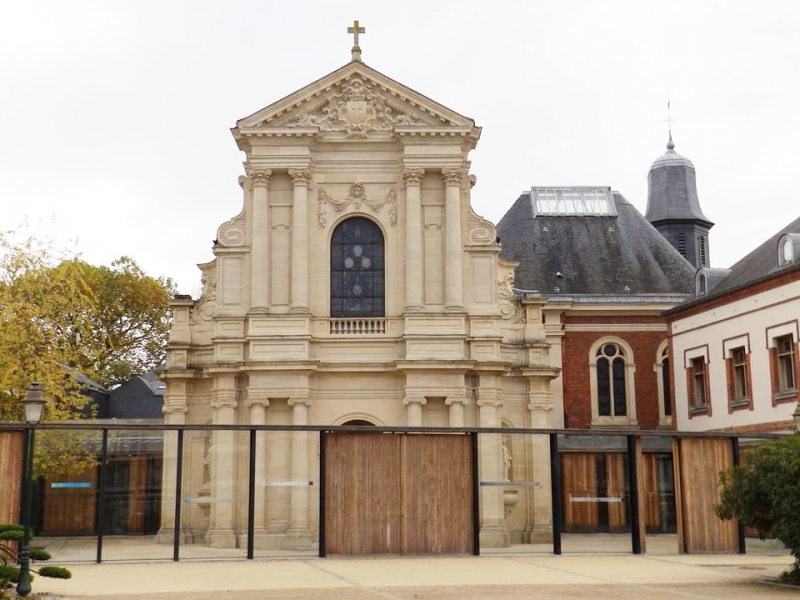
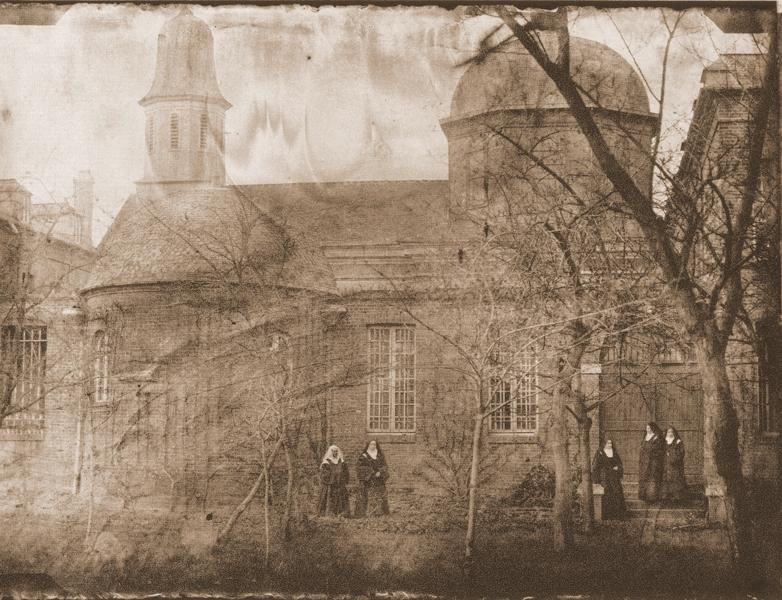
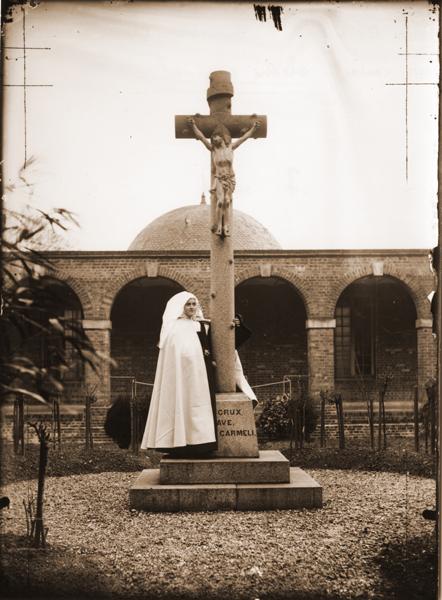
Above: Recent photograph of the Carmelite convent (Carmel) where Thérèse Martin entered at Lisieux in April 1888. Photograph of Carmel taken by Céline in September 1894 where Thérèse stands on the steps, third from the right.
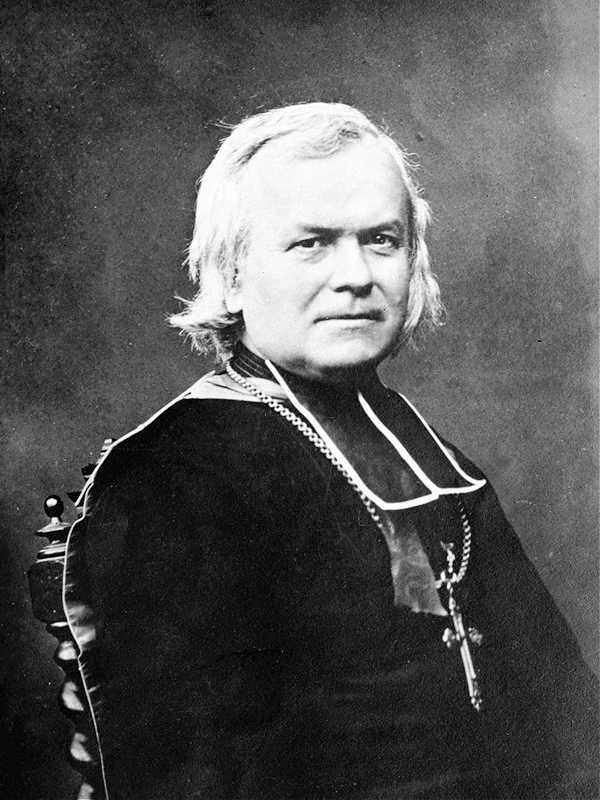
Bishop Flavien-Abel-Antoine Hugonin (July 3, 1823 – May 2, 1898).
Bishop Hugonin of Bayeux and Lisieux had confirmed Thérèse on June 14, 1884. Nearly four years later, he authorized, with some reluctance on account of her young age, Thérèse’s entrance in Carmel at 15 years old. Soon after, Bishop Hugonin presided over her clothing on January 10, 1889 as he showed continued solicitude for the young Carmelite novice he had specially approved. Less than two months before his own death in May 1898, Bishop Hugonin, on March 7, 1898, gave his verbal imprimatur to Thérèse’s Story of a Soul.
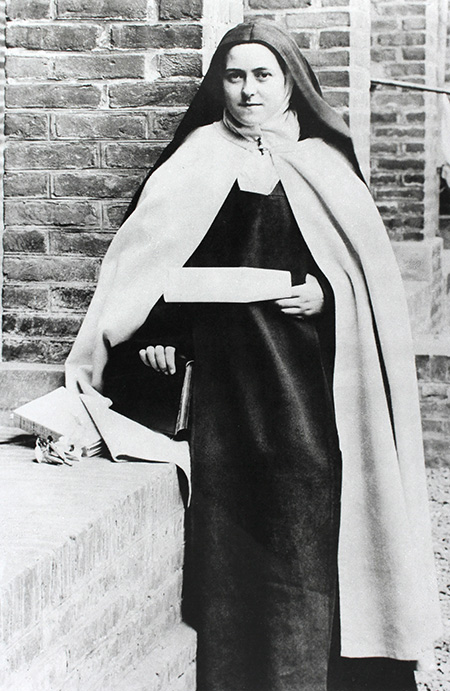
Two photographs above and one below: Thérèse as a novice in Carmel in a photograph taken in January 1889. She was 16 years old and in the convent nine months. The photographs were taken by Fr. Gombault, the bursar of the minor seminary.
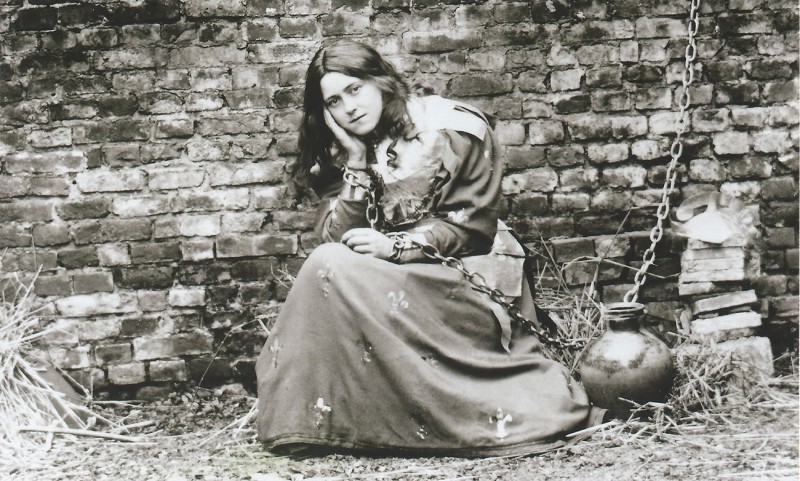
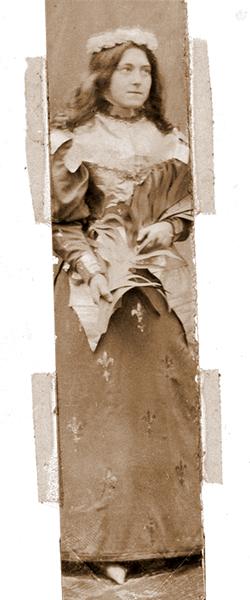
Thérèse January 1889. Late 1894. Thérèse (right) was one of five Martin sisters who became religious nuns. The photograph was taken by Céline in late 1894 or early 1895.Detail of a photograph of Thérèse taken by Céline in late 1894 or early 1895. The photographic image was the basis for an oval portrait painting done by Céline (below) in the same time period.Original oil oval portrait painting of Thérèse by Céline based on her photograph of Thérèse around Christmas 1894. Céline later claimed that this image captured the real Thérèse. Photograph by author. Thérèse dressed as Joan of Arc in winter 1895.
A series of photographs taken by Céline from January 21 to March 25, 1895, in the convent courtyard. Thérèse is dressed as Joan of Arc who did not become a canonized saint until 1920. Thérèse played the part of La Pucelle in a play Thérèse had written called Joan of Arc Accomplishing Her Mission.
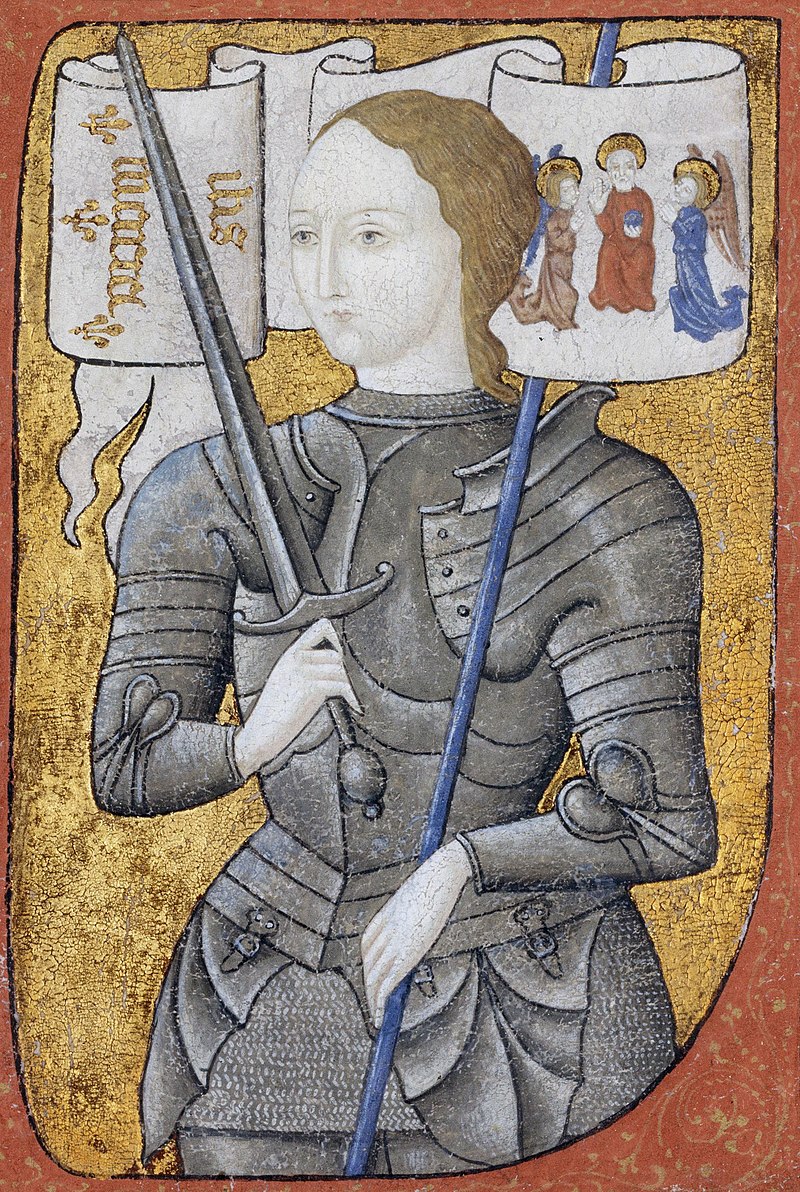
Joan of Arc in a suit of armor with sword.
A longtime revered figure in France Joan of Arc was not yet a canonized saint in late winter 1895 when 22-year-old Thérèse dressed as her for a play within the convent walls and was photographed by her older sister Céline. Joan of Arc became a canonized saint following World War I on May 16, 1920.
Between January and March 1895 Thérèse chose to dramatize Joan of Arc who is today one of the patron saints of France. In the 15th century Joan became an unrelenting vessel of combat and action for the French King—and was burned at the stake by her enemies in Rouen, France, at the incredibly young age of 19 years old. Joan’s mission on earth always was driven by a spiritual dimension (her “voices”). About her dressing in armor, Joan said: “What concerns this dress is a small thing – less than nothing. I did not take it by the advice of any man in the world. I did not take this dress or do anything but by the command of Our Lord and of the Angels.”
In March 1895 Thérèse was 22 years old. In a little over a year Thérèse’s symptoms of tuberculosis indicated a serious turn for the worse in her health. Over the next two years, her health continued to decline so that by summer 1897 Thérèse was on her death bed.
Thérèse knew her great desire to be a missionary to Vietnam was now impractical. In June 1895 Thérèse decided to have an earthly mission within convent walls of “merciful love” and the “little way.” Like young Joan of Arc, Thérèse’s spiritual mission began on earth and would continue in heaven. So that a little over 6 months before her early death at 24 years old, Thérèse implored the favor by the command of Our Lord and of the Angels of “spending her heaven doing good on earth.”
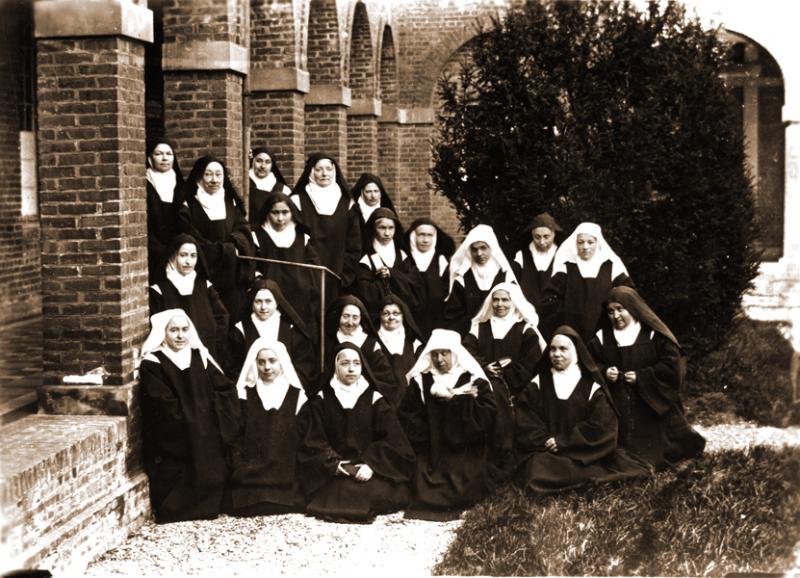
Close up of a photograph taken by Céline of Thérèse dressed as Joan of Arc in 1895.Community of 22 Carmelite nuns in a photograph taken by Céline on Easter Monday, April 15th, 1895. First row left to right: Geneviève of the Holy Face (Céline). Second row left to right: Mother Agnès of Jesus (Pauline) and Thérèse of the Child Jesus.
Easter Monday, April 15, 1895.
Photograph taken by Céline for the feast of the Good Shepherd, April 27 or 28, 1895. Thérèse is at right between two of her white-veiled novices.
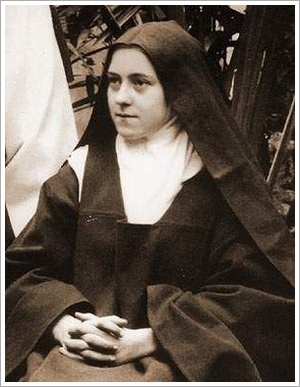
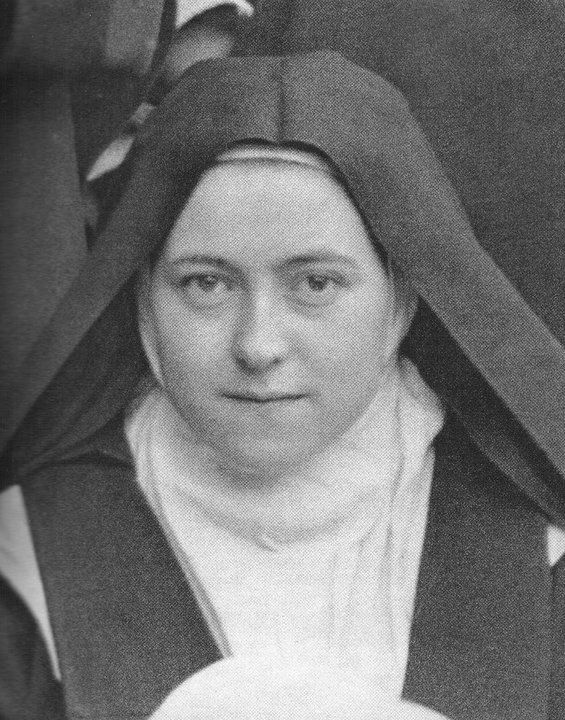
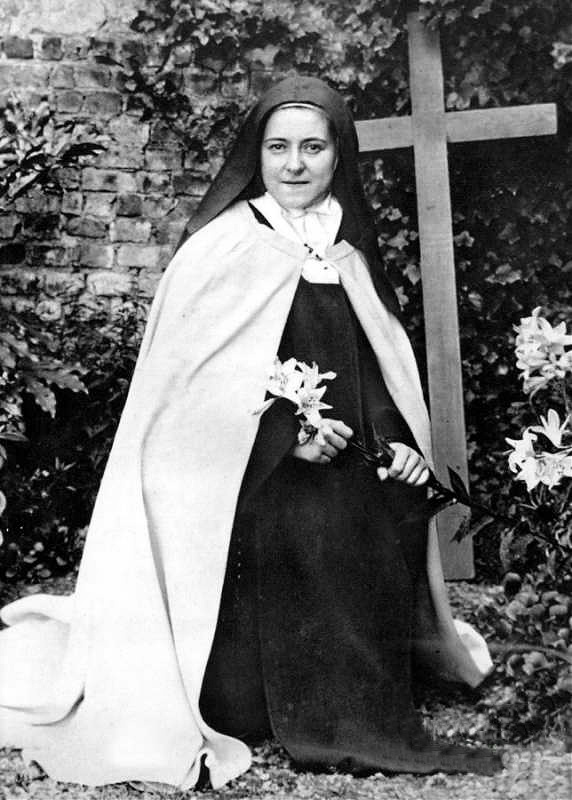
Above photograph (including close-up) was taken by Céline in July 1896. Thérèse had been ill for several months.
After July 3, 1896, photograph taken by Céline.
Thérèse 1896.
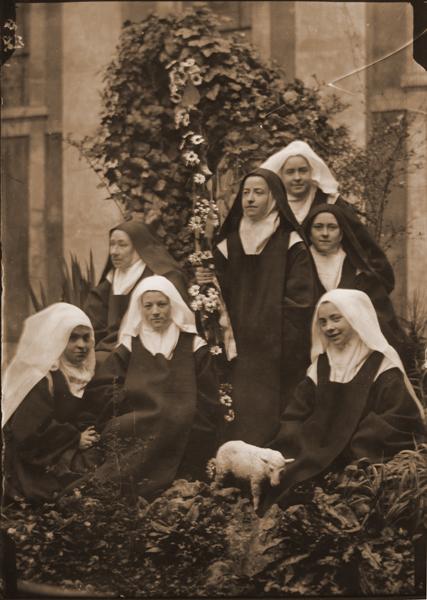
Thérèse holds a lily in a photograph taken by Céline in the convent garden in July 1896.
Carmel, July 1896.
Photograph of the community taken by Céline. July 1896.
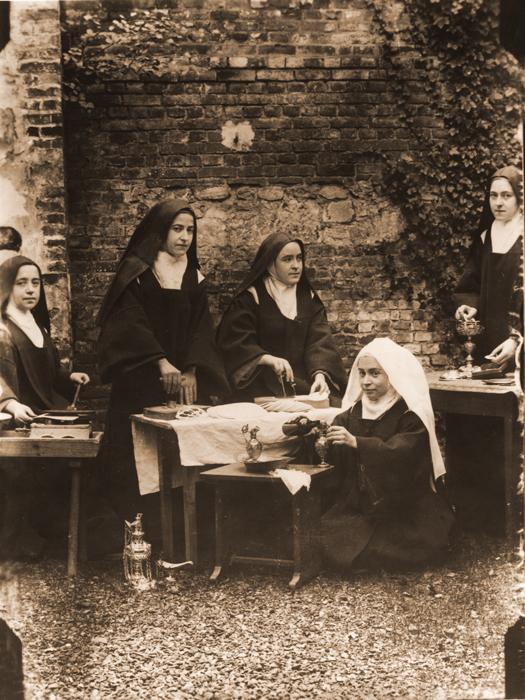
Photograph taken by Céline in early-mid November 1896 of her sisters and cousin showing the work of the sacristan. Thérèse stands at right. In September 1896 Thérèse wrote a letter to her sister Marie whose text called Manuscript B became part of The Story of a Soul.
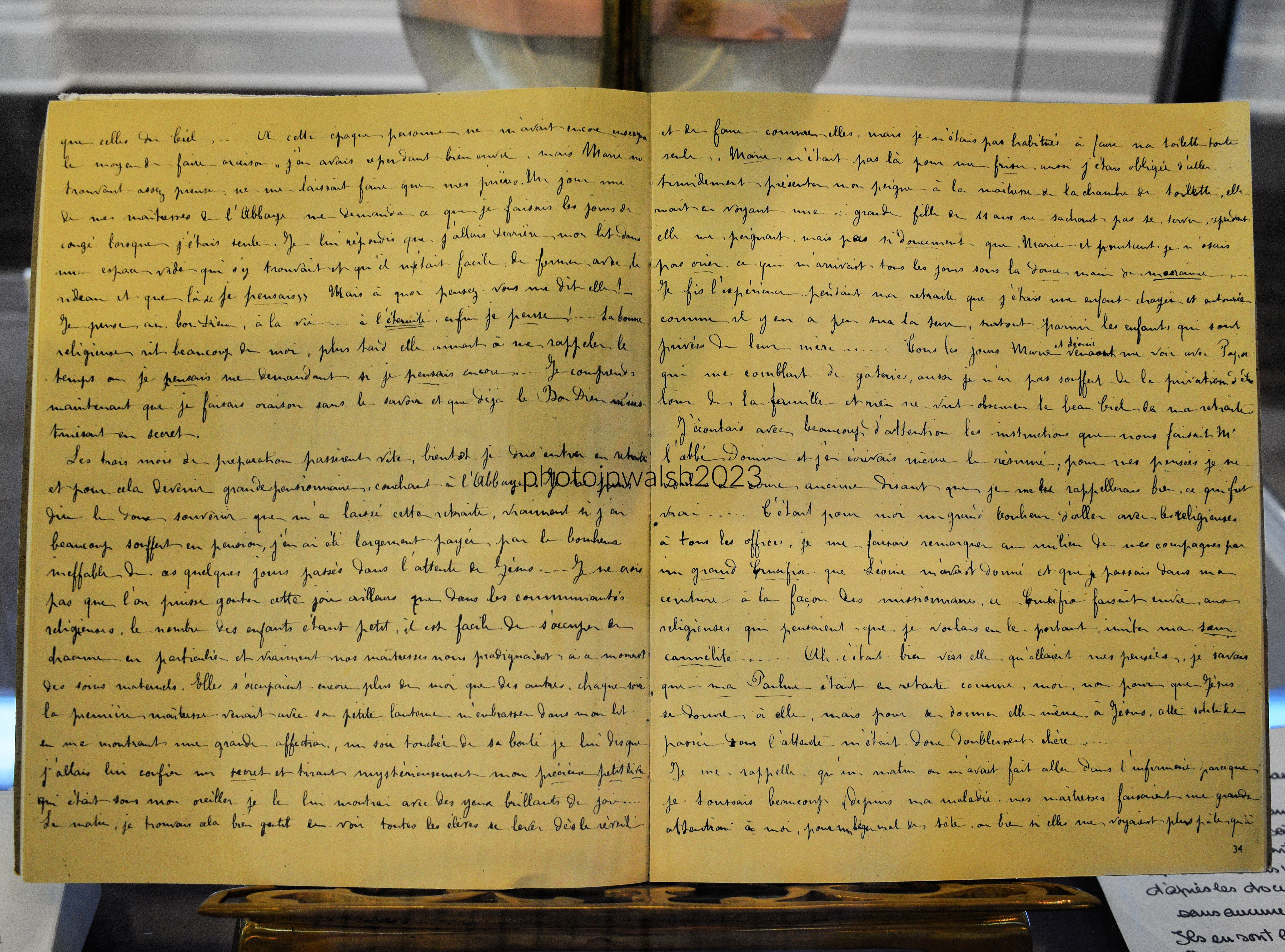
Published transcriptions of The Story of a Soul (“HISTOIRE D’UNE AME”) have varied over the years by way of editorial additions, omissions or consolidations that have taken liberties with Thérèse’s original notebook entries whose form can be like a shower of roses of her memory. One version of the spiritual classic that was updated to 1911 had followed her second exhumation in 1910 in the presence of the bishop of Bayeux which led to the start of her canonization process in 1914 (Thérèse of Lisieux was canonized in Rome on May 17, 1925). The text provides in French the following transcription of these photocopied pages in Thérèse’s own handwriting. They appear in chapter 4 (“CHAPITRE IV”) of the 1911 publication where Thérèse discusses her life in the mid-1880s as a child and teenager which includes her first Communion, Confirmation, and her personal experiences of light and darkness. Thérèse relates her deliverance from her interior pains which left her with an indescribably deep sweet peace that followed her into the convent of Carmel in Lisieux in 1888 and stayed with her in that place amid the greatest trials until her death there in 1897. These pages are part of the display at the National Shrine and Museum of St. Therese in Darien, Illinois.
French:
A cette époque, il m’eût été bien doux de faire oraison; mais Marie, me trouvant assez pieuse, ne me permettait que mes seules prières vocales. Un jour, à l’Abbaye, une de mes maîtresses me demanda quelles étaient mes occupations les jours de congé, quand je restais aux Buissonnets. Je répondis timidement: «Madame, je vais bien souvent me cacher dans un petit espace vide de ma chambre, qu’il m’est facile de fermer avec les rideaux de mon lit, et là, je pense…—Mais à quoi pensez-vous? me dit en riant la bonne religieuse.—Je pense au bon Dieu, à la rapidité de la vie, à l’éternité; enfin, je pense!» Cette réflexion ne fut pas perdue, et plus tard ma maîtresse aimait à me rappeler le temps où je pensais, me demandant si je pensais encore… Je comprends aujourd’hui que je faisais alors une véritable oraison, dans laquelle le divin Maître instruisait doucement mon cœur. Les trois mois de préparation à ma première communion passèrent vite; bientôt je dus entrer en retraite et pendant ce temps devenir grande pensionnaire. Ah! quelle retraite bénie! Je ne crois pas que l’on puisse goûter une semblable joie ailleurs que dans les communautés religieuses: le nombre des enfants étant petit, il est d’autant plus facile de s’occuper de chacune. Oui, je l’écris avec une reconnaissance filiale: nos maîtresses de l’Abbaye nous prodiguaient alors des soins vraiment maternels. Je ne sais pour quel motif, mais je m’apercevais bien qu’elles veillaient plus encore sur moi que sur mes compagnes. Chaque soir, la première maîtresse venait avec sa petite lanterne ouvrir doucement les rideaux de mon lit, et déposait sur mon front un tendre baiser. Elle me témoignait tant d’affection, que, touchée de sa bonté, je lui dis un soir: «O Madame, je vous aime bien, aussi je vais vous confier un grand secret.» Tirant alors mystérieusement le précieux petit livre du Carmel, caché sous mon oreiller, je le lui montrai avec des yeux brillants de joie. Elle l’ouvrit bien délicatement, le feuilleta avec attention et me fit remarquer combien j’étais privilégiée. Plusieurs fois, en effet, pendant ma retraite, je fis l’expérience que bien peu d’enfants, comme moi privées de leur mère, sont aussi choyées que je l’étais à cet âge. J’écoutais avec beaucoup d’attention les instructions données par M. l’abbé Domin, et j’en faisais soigneusement le résumé. Pour mes pensées, je ne voulus en écrire aucune, disant que je me les rappellerais bien; ce qui fut vrai. Avec quel bonheur je me rendais à tous les offices comme les religieuses! Je me faisais remarquer au milieu de mes petites compagnes par un grand crucifix donné par ma chère Léonie; je le passais dans ma ceinture à la façon des missionnaires, et l’on crut que je voulais imiter ainsi ma sœur carmélite. C’était bien vers elle, en effet, que s’envolaient souvent mes pensées et mon cœur! Je la savais en retraite aussi; non pas, il est vrai, pour que Jésus se donnât à elle, mais pour se donner elle-même tout entière à Jésus, et cela le jour même de ma première communion. Cette solitude passée dans l’attente me fut donc doublement chère. Enfin le beau jour entre tous les jours de la vie se leva pour moi! Quels ineffables souvenirs laissèrent dans mon âme les moindres détails de ces heures du ciel! Le joyeux réveil de l’aurore, les baisers respectueux et tendres des maîtresses et des grandes compagnes, la chambre de toilette remplie de flocons neigeux, dont chaque enfant se voyait revêtue à son tour; surtout l’entrée à la chapelle et le chant du cantique matinal: O saint autel qu’environnent les anges!*
At that time, it would have been very sweet for me to make prayers; but Mary, finding me quite pious, allowed me only my vocal prayers. One day, at the Abbey, one of my mistresses asked me what my occupations were on my days off, when I stayed at Les Buissonnets. I replied timidly: “Madam, I often go to hide in a small empty space in my room, which it is easy for me to close with the curtains of my bed, and there, I think…—But what are you thinking? said the good nun, laughing.—I think of God, of the rapidity of life, of eternity; well, I think!” This reflection was not lost, and later my mistress liked to remind me of the time when I thought, asking me if I still thought… I understand today that I was then making a true prayer, in which the divine Master gently instructed my heart. The three months of preparation for my First Communion passed quickly; Soon I had to retire and during this time become a boarder. Ah! What a blessed retreat! I do not believe that one can taste such joy anywhere else than in religious communities: the number of children being small, it is all the easier to take care of each one. Yes, I write it with filial gratitude: our mistresses of the Abbey then provided us with truly maternal care. I do not know for what reason, but I could see that they watched over me even more than my companions. Every evening, the first mistress came with her little lantern gently to open the curtains of my bed, and placed on my forehead a tender kiss. I listened very carefully to the instructions given by Father Domin, and I carefully summarized them. For my thoughts, I would not write any, saying that I would remember them well; which was true. With what happiness I went to all the services like the nuns! I was noticed in the midst of my little companions by a large crucifix given by my dear Léonie; I put it in my belt like missionaries, and it was thought that I wanted to imitate my Carmelite sister in this way. It was to her, indeed, that my thoughts and my heart often flew away! I knew she was retired too; not, it is true, so that Jesus might give himself to her, but to give herself entirely to Jesus, and that on the very day of my First Communion. This solitude spent waiting was therefore doubly dear to me. At last the beautiful day between all the days of life dawned for me! What ineffable memories left in my soul the smallest details of those hours of heaven! The joyful awakening of dawn, the respectful and tender kisses of mistresses and great companions, the washroom filled with snowflakes, with which each child saw himself clothed in turn; especially the entrance to the chapel and the singing of the morning hymn: O holy altar that surrounds the angels!
The second pose of three posed photographs taken by Céline in the sacristy courtyard on June 7th, 1897. It was taken 4 days after Thérèse had been asked to complete the last section of A Story of a Soul. Thérèse, who holds the image of the “Holy Face” of Jesus, was in the midst of her 18-month “dark night” of faith. She knew she would die soon and Céline made these photographs intentionally as a “final remembrance” of her 24-year-old sister. After many months of sickness and suffering, Thérèse died on Thursday, September 30, 1897.
Circumstances were growing more difficult for Thérèse in terms of her health and spirituality. In 1896 a new prioress of Carmel confirmed Thérèse’s role in the novitiate where she could continue to teach her “little way” and work in the sacristy and the laundry room. In addition to finding it difficult to pray, in April 1896 she began to spit blood, a sure sign of the seriousness of her illness. These last eighteen months of her life proved a dark period for the normally vivacious five-foot three-inch Norman young woman. Her physical pain was often unrelenting and the dreams she had of becoming a foreign missionary to Vietnam had to be abandoned. Yet, the priest in charge of foreign missions, Father Adolphe Roulland (1870–1934) whom Thérèse had met in July 1896 as he was going to China, asked her to be a “spiritual sister” to the mission priests. This charge meant not only to pray for the priests but in her correspondence with them to “console and warn, encourage and praise, answer questions, offer corroboration, and instruct them in the meaning of her little way.”6
In 1896 Father Adolphe Roulland (1870-1934) of the Society of Foreign Missions asked the Carmel of Lisieux for a “spiritual sister.”
In a letter from Thérèse to Fr. Roulland she wrote: “Reverend Father… I feel very unworthy to be associated in a special way with one of the missionaries of our adorable Jesus, but since obedience entrusts me with this sweet task, I am assured my heavenly Spouse will make up for my feeble merits (upon which I in no way rely), and that He will listen to the desires of my soul by rendering fruitful your apostolate. I shall be truly happy to work with you for the salvation of souls. It is for this purpose I became a Carmelite nun; being unable to be an active missionary, I wanted to be one through love and penance just like Saint Teresa, my seraphic Mother….I beg you, Reverend Father, ask for me from Jesus, on the day He deigns for the first time to descend from heaven at your voice, ask Him to set me on fire with His Love so that I may enkindle it in hearts. For a long time I wanted to know an Apostle who would pronounce my name at the holy altar on the day of his first Mass….I wanted to prepare for him the sacred linens and the white host destined to veil the King of heaven…The God of Goodness has willed to realize my dream and to show me once again how pleased He is to grant the desires of souls who love Him alone.”7
The year 1897 was defined on the one hand by Thérèse’s physical decline because of tuberculosis and, on the other hand, her personal joy expressed in her conversations and poems. It was on the feast day of St. Joseph, March 19, 1897, during a personal novena to St. Francis Xavier (1506-1552), that Thérèse asked St. Joseph to obtain from God the favor of “spending her heaven doing good on earth.” She asked St. Francis Xavier for the same intercession.8
Bartolomé Esteban Murillo (1617-1682), St. Joseph and the Child Jesus, Glasgow.
By April 1897 Thérèse was gravely ill and in May 1897 was relieved of all work duties and community prayer. Thérèse continued to write in her journal but abadoned it, too weak to write. In August 1897 Thérèse’s suffering was so great she confessed to the temptation of suicide. After August 19, 1897 Thérèse was too physically weak to even ingest the consecrated communion wafer. On September 30, 1897, Thérèse died in the convent infirmary. She was 24 years old.
In her last hours Thérèse said: “Oh! It is pure suffering because there are no consolations. No, not one! O my God…Good Blessed Virgin, come to my aid! My God…have pity on me! I can’t take it anymore! I can’t take it anymore!…I am reduced…No, I would never have believed one could suffer so much…never! never!…I no longer believe in death for me…I believe in suffering…O I love Him. My God I love you…”9 These last words of the dying nun were reported by more than one witness.
At the centenary of her death in 1997, St. Pope John Paul II (1920-2005) made Thérèse a “Doctor of the Church,” one of only thirty-three such credentialed. By elevating Thérèse’s example of simple love, the Polish pope, himself called out from behind an Iron Curtain and lived to see it fall, clarified what may constitute a Church Doctor’s character and purpose.
Sick Thérèse one month before her death, August 30, 1897. she promised, “After my death, I will let fall a shower of roses,” which is a sign of her own crucifixion and martyrdom in union with the crucifixion and resurrection of her mystically beloved Jesus Christ. The rose is an expression of the divine love linked to this faith-filled action of oblation that is shared with others in the Holy Spirit who ask for it.
St. Thérèse of Lisieux was beatified on April 29, 1923 and canonized on May 17, 1925. She is co-patron saint of all church missions with St. Francis Xavier and co-patron saint of France with St. Jeanne d’Arc (1412-1431). Thérèse is patron saint of AIDS sufferers, pilots, florists, bodily ills (particularly tuberculosis), and the loss of parents.
Saint Thérèse of Lisieux’s obituary was written by the nuns of her community and printed in Le Normand. In an English translation it reads:
“It is with a spirited feeling of sadness that we learned Thursday evening of the death at the Monastery of Our Lady of Mount Carmel of a young person who gave the most beautiful years of youth to a life of prayer and sacrifice. Miss Marie-Francoise-Thérèse Martin, renounced the world at fifteen years of age and consecrated herself to God as Sister Thérèse of the Child Jesus. She departed after ten years of angelic life in the shadow of the cloister, and we have sweet confidence that death which put an end to long and cruel sufferings has come to take this youth in her bloom and already placed on her head the immortal crown, the goal of all our earthly aspirations. The funeral will be celebrated Monday morning at 9 o’clock in the Carmel chapel. Le Normand offers to the family of Sister Thérèse of the Child Jesus and to the Prioress and all the Carmelite sisters the tribute of its respectful condolences.”
Thérèse in death, October 1, 1897.
Thérèse died in the evening of September 30, 1897. The next morning, October 1, 1897, before her body left the infirmary where she died, Céline (Sister Geneviève), deeply impressed by Thérèse’s peaceful countenance in death, took one final photograph of her sister.
Sister Thérèse of the Child Jesus was buried in the Carmelite section at the municipal cemetery at Lisieux on the morning of October 4, 1897 after a funeral Mass at the Carmel. An obscure figure at the time of her death, the funeral procession which followed her body to the cemetery was small that day. It was to this municipal cemetery grave that pilgrims first came. Miracles began to be reported to have taken place at her tomb through her intercession. One notable miracle was that of Reine Fauquet, a four-year-old girl from Lisieux, who was blind. On May 25, 1908, the child was brought by her mother to the tomb of Sister Thérèse of the Child Jesus where the child’s sight was suddenly restored. A medical doctor who was not in favor of making Sister Thérèse of the Child Jesus a saint, signed the medical documents attesting to the cure.10
Because of these events, a tribunal was convened by the bishop of Bayeux in August 1910 to interview witnesses at Lisieux. To investigate the corporeal remains of Sister Thérèse of the Child Jesus for its condition, the body was exhumed on September 6, 1910. The exhumation took place in the presence of the bishop of Bayeux, Thomas-Paul-Henri Lemonnier (1853-1927) and scores of others. The doctors who treated Thérèse before her death confirmed that the body decayed in the usual manner, finding only bones and bits of clothes.
The site of Therese’s first grave from 1897 to 1910 continues to be marked by the same cross. The site of her second grave in the same Carmelite section of the municipal cemetery is also marked. The second grave held her bodily remains in a cemented vault from 1910 until 1923. When Sister Thérèse of the Child Jesus was declared a “servant of God,” the first step on the road to sainthood, there was a second exhumation. It was to the second grave site that large and growing numbers of pilgrims came to implore the Little Flower’s intercessions. The cross that marked the second grave was completely covered by prayers and tributes to Sister Thérèse of the Child Jesus by pilgrims.
Second exhumation of Thérèse of the Child Jesus, August 1917.
On the occasion of her beatification, Sister Thérèse of the Child Jesus’s remains were transferred for a third time on March 26, 1923 to the Carmelite Chapel at Lisieux. Saint Thérèse was canonized on May 17, 1925 by Pope Pius XI (1922-1939) and declared Doctor of the Church by Pope John Paul II (1978-2005) in 1997. Her feast day is October 1.
Reine Fauquet was 4 years old when she visited Thérèse’s grave in Lisieux and her eyesight was cured.
It is recorded that on May 26, 1908, Reine Fauquet who lived in Lisieux was cured of an eye disease following her visit to Thérèse’s grave in Lisieux. The 4-year-old child explained to her sister that she had an apparition of Thérèse: “I saw little Thérèse, right next to my bed, she took my hand, she laughed at me, she was beautiful, she had a veil, and it was all lit around her head” (“J’ai vu la petite Thérèse, là, tout près de mon lit, elle m’a pris la main, elle me riait, elle était belle, elle avait un voile, et c’était tout allumé autour de sa tête“). When Reine Fauquet met Thérèse’s sisters at the Carmel they asked her how Thérèse had been dressed in the vision. The child replied: “The same as you!′′ (“Pareille à vous!“).
Thérèse hand-made costumes for Christmas crèche.
On the evening of December 25, 1895, Thérèse created a ceremony for her community of sisters that celebrated the birthday of the Christ Child.
During the celebration each sister selected a folded note from a basket and handed it to an “angel” (one of the other sisters). The “angel” opened the note and sang its prayerful verse.
Each sister was then asked to offer to Jesus her best self in the coming year. Thérèse’s ceremony included a crib and wax figure of the infant Jesus for which Thérèse and her novice designed these hand-made costumes. A light-blue dress with lace trim was on display at the National Shrine of St. Thérèse in Darien, Illinois, in spring 2018. Photograph by the author.
Papal decree, August 14, 1921.
The papal decree of August 14, 1921 declaring Thérèse of the Child Jesus a “Venerable” of the Church. It was promulgated by Benedict XV.
Saint Thérèse of Lisieux (1873-1897) was beatified in 1923 and canonized in 1925 by Pope Pius XI (1857-1939). The bishop of Bayeux, Thomas-Paul-Henri Lemonnier (1853-1927) decided to build a large basilica dedicated to her in Lisieux, France. The cornerstone was laid after his death in 1929 by then-bishop of Bayeux-Lisieux, Emmanuel Célestin Suhard (1874-1949), soon to be named cardinal archbishop of Reims, both appointments by Pope Pius XI. The basilica project had the full support of that indomitable Roman pontiff who had placed his pontificate which began in 1922 under the sign of Saint Thérèse of Lisieux. Funded completely by private donations received worldwide, construction started in 1929 and continued unto its dedication in 1954.https://youtu.be/4uCfaHOy4KE?si=LsFactM78MBy8euY – retrieved January 27, 2026. Stained glass.
ENDNOTES:
St. Thérèse of Lisieux: her last conversations, translated by John Clarke O.C.D., ICS Publications, Institute of Carmelite Studies, Washington, D.C., 1977, pp. 18-19. Her complete obituary printed in Le Normand reads: “It is with a spirited feeling of sadness that we learned Thursday evening of the death at the Monastery of Our Lady of Mount Carmel of a young person who gave the most beautiful years of youth to a life of prayer and sacrifice. Miss Marie-Francoise-Thérèse Martin, renounced the world at fifteen years of age and consecrated herself to God as Sister Thérèse of the Child Jesus. She departed after ten years of angelic life in the shadow of the cloister, and we have sweet confidence that death which put an end to long and cruel sufferings has come to take this youth in her bloom and already placed on her head the immortal crown, the goal of all our earthly aspirations. The funeral will be celebrated Monday morning at 9 o’clock in the Carmel chapel. Le Normand offers to the family of Sister Thérèse of the Child Jesus and to the Prioress and all the Carmelite sisters the tribute of its respectful condolences.”
see Story of a Soul: the Autobiography of St. Thérèse of Lisieux, translated by John Clarke O.C.D., ICS Publications, Institute of Carmelite Studies, Washington, D.C., 1996, pp. 51-67.
The Hidden Face: A Study of St. Thérèse of Lisieux, Ida Friederike Görres, London, 2003, p. 83.
Letter from Thérèse to Father Roulland, LT 226, dated May 9, 1897, Letters of St. Thérèse of Lisieux, Volume II, translated by John Clarke O.C.D., ICS Publications, Institute of Carmelite Studies, Washington, D.C., 1974, p. 1094.
Story of a Soul, p. 196. For this paragraph’s chronology see Letters of St. Thérèse of Lisieux, Volume II, 1297-1329.
Görres, p.189.
Letter from Thérèse to Father Roulland, LT 189, dated June 23, 1896, Letters of St. Thérèse of Lisieux, Volume II, translated by John Clarke O.C.D., ICS Publications, Institute of Carmelite Studies, Washington, D.C., 1974, pp. 956-957.
see footnote 11 in Letters of St. Thérèse of Lisieux, Volume II, p. 1074.
Last conversations, pp. 204-205; 230; 243.
Thérèse and Lisieux, Pierre Descouvement and Helmut-Nils Loose, Toronto: Novalis, 1996, p. 316.
BIBLIOGRAPHY:
Story of a Soul: the Autobiography of St. Thérèse of Lisieux, translated by John Clarke O.C.D., ICS Publications, Institute of Carmelite Studies, Washington, D.C., 1996;
Light of the Night: The Last Eighteen Months in the Life of Thérèse of Lisieux, Jean-François Six, University of Notre Dame Press, South Bend, Indiana, 1996;
St. Thérèse of Lisieux: her last conversations, translated by John Clarke O.C.D., ICS Publications, Institute of Carmelite Studies, Washington, D.C., 1977;
Letters of St. Thérèse of Lisieux,Volumes I and II, translated by John Clarke O.C.D., ICS Publications, Institute of Carmelite Studies, Washington, D.C., 1974;
The Hidden Face: A Study of St. Thérèse of Lisieux, Ida Friederike Görres, London, 2003;
FEATURE image: Portrait of James IV, after 1578, artist unknown, 41.2 x 33 cm, National Galleries Scotland. Public Domain.
Detail of The Flodden Window, showing sixteen named archers who fought at the battle, St. Leonard Middleton, England.
The earliest Middleton church was dedicated to Saint Cuthbert around 880 as pagan Danes were then attacking the north of England. Following William the Conquerorin 1066, the Normans built a larger church dedicated to Saint Leonard, a French saint and patron of prisoners. In 1412, Thomas Langley (1363-1437), Prince Bishop of Durham and Lord Chancellor of England under kings Henry IV, V and VI, built a new Gothic style church though incorporating parts of the old Norman building. In 1513, Sir Richard Assheton, Lord of the Manor and member of an illustrious military and religious family, spear-headed further changes. Completed in 1524 today’s St. Leonard was built on the previous church buildings so to celebrate Sir Richard’s knighthood by King Henry VIII for his part in the Battle of Flodden Field in 1513. The stained-glass window memorializes archers from Middleton who joined the battle on the side of the English. The battle took place in England only a few miles south of the Scottish border near Branxton and about 200 miles north of Middleton.
“The Flodden Window,” c. 1524, Parish Church of St. Leonard in Middleton near Manchester in England.
Not yet 40 years old, the reign of charismatic Scottish King James IV (1473-1513) came to an abrupt halt on September 9, 1513 when he was instantly killed in battle fighting against an English army in northernmost England.
Continental politics with its entangling alliances put Scotland in armed conflict against its neighbor for which it had signed a peace treaty only 11 years earlier.
In 1502 a treaty was signed pledging everlasting peace between the kingdoms of Scotland and England. The political settlement was sealed in the sacrament of marriage between ambitious (and religious) James IV to Margaret Tudor (1489-1541), the sister of future English King Henry VIII (1491-1547).
The Scots also had a treaty with France, their traditional ally. When the Pope in Italy excluded France from political gain in Italy—and England endorsed the pope’s action—France called on Scotland for help. In the summer of 1513, James invaded England.1
Much later in 1534 in England, papal interference in English political affairs where the pope denied the English King Henry the annulment he sought from Catherine of Aragon (1485-1536), led to England breaking with Rome and the formation of the Church of England.
After his father, James III of Scotland (1451-1488), was killed in battle in 1488, James IV became king at 15 years old
James IV of Scotland (1473-1513). Published by Peter Stent, line engraving, c.1643-1667. 6 7/8 in. x 4 3/4 in. (17.6 mm x 12.2 cm) paper size. Given to the National Portrait Gallery, London, by Sir Herbert Henry Raphael, 1st Bt, 1916.Portrait of James IV, after 1578, artist unknown, 41.2 x 33 cm, National Galleries Scotland.
When James III was killed on June 11, 1488 at The Battle of Sauchieburn in Scotland, his 15-year-old son James IV succeeded him. He had been the rebels’ assumed figurehead, and for his indirect role in his father’s death James decided to wear a heavy iron belt for the rest of his life. A highly intelligent man, James IV proved an effective ruler. He spoke several languages and took an interest in literature, science, and law. Determined to establish strong central leadership he suppressed The Lord of the Isles and created a powerful navy. In 1503 he married the English king’s daughter, Margaret Tudor, in an attempt to create peace between the two countries. When England invaded France, James felt obliged to assist his old Continental ally. In 1513 he confronted the English army but was killed in the disastrous Battle of Flodden Field.
James IV, 1473 – 1513. King of Scots, 17th century, artist unknown, work on paper, 13.33 x 10.16 cm, Scottish National Portrait Gallery (Print Room).
James IV married Margaret Tudor (1489-1541), the sister of future English King Henry VIII (1491-1547). While their marriage was an important part of the Truce of Perpetual Peace which was signed between Scotland and England in 1502, it did not prevent the Battle of Flodden Field over a decade later.
The Battle of Flodden Field was fought in the county of Northumberland in northern England on September 9, 1513. The battle was between the invading Scots army under King James IV and the English army commanded by the Earl of Surrey.
Thomas Howard, 2nd Duke of Norfolk, Earl of Surrey (1443-1524).
Battle strength and casualties are disputed but the Scots likely numbered more than 30,000 men and, after some delay, engaged an English force of around 20,000 men under Lieutenant-General Thomas Howard, 2nd Duke of Norfolk, Earl of Surrey (1443-1524). Howard would become the grandfather of future queens Anne Boleyn (1501-1536) and Catherine Howard (1521-1542).²
Battlefield today.
The Battle begins with an artillery duel and the Scot king is quickly killed in action. Bogged down, a third of the Scot army is destroyed
On September 9, 1513 the two armies clashed at Flodden Field in the far north of England. The battle proved a disaster for the Scots. Scotland’s inspiring king was quickly killed in action with a third of his army, including many officers. English losses were but a small fraction of their total.³
The battle started with an artillery duel. The Scots brought heavy guns and had difficulty aiming at the English army at close range below them. Lighter English guns were able to target and pick off the Scots’ guns. In response, the Scottish left wing advanced downhill and wreaked havoc on the English right wing. The rest of the Scottish army then advanced. But a marshy valley floor bogged the army down. The Scottish pikemen became easy targets for the English infantry. The end result was that a third of the Scottish army was destroyed.
New Scot King, James V, is 17 months old, in 1513. When he dies prematurely in 1542, Mary, Queen of Scots, his daughter and successor, is 6 days old
One immediate consequence of The Battle of Flodden Field was to put James V on the Scottish throne. James was born in April 1512 and not yet two years old.
The Scots were made to wait a generation for kingly leadership in very trying times. Thirty years later, in 1542, James V would die prematurely and was succeeded on the throne by his only legitimate daughter, Mary, Queen of Scots, who was only six days old.
Posthumous portrait of James V, 1512 – 1542, artist unknown, c. 1579, 41.30 x 33.00 cm, National Galleries Scotland.
James V (reigned 1513 – 1542), father of Mary, Queen of Scots, became king at one-year old when his father, James IV, was killed at Flodden, fighting the English. Ignoring the advice of English King Henry VIII, his uncle, to become a Protestant, James V strengthened Scotland’s alliance with its traditional ally, France. He married the French king, Francis I ‘s daughter, Madeleine of Valois (1520 –1537). When she died, he married Mary of Guise (1515-1560), another high-born Catholic French woman. James V died at Falkland Palace, soon after his army’s defeat by the English at Solway Moss, on November 24, 1542. His six-day-old daughter Mary succeeded to his throne.
Madeleine of Valois (1520 –1537), Corneille de Lyon (1500/1510–1575), Musée des Beaux-arts de Blois.
First wife of James V of Scotland. They married on New Year’s Day 1537 at Notre Dame Cathedral in Paris. Of delicate health from birth, Madeleine died in July 1537 at 17 years old.
Portrait of Mary of Guise (1515 – 1560), Corneille de Lyon, c. 1579, 41.3 x 33 cm, Scottish National Portrait Gallery.
Queen of James V of Scotland and mother of Mary, Queen of Scots. The daughter of a French duke, Mary of Guise had just been widowed when she married James V to strengthen the alliance between France and Scotland. Their two sons died in infancy and James died a few days after their daughter, Mary, was born in 1542. Mary of Guise chose to stay in Scotland, ruling as Regent to protect her daughter’s interests. Courageous and determined, her effort to keep Scotland in the French Roman Catholic sphere was unsuccessful in the rising tide of Protestantism on the British Isles.
Mary, Queen of Scots, 1542 – 1587, artist unknown (after Francois Clouet, c. 1510 – 1572), 32.90 x 27.40 cm, National Galleries Scotland.
This is probably a 19th century replica after an image made around 1561. Within eighteen months Mary, Queen of Scots, lost three members of her closest family — her father-in-law (Henry II of France), mother (Mary of Guise) and, on December 5, 1560, her husband, Francois II of France. Mary is depicted here in mourning, wearing a white hood and veil. According to the Venetian Ambassador to the French court, Mary was inconsolable. Her “tears and lamentations inspired a great pity” in everyone, the diplomat observed. Eight months later, having lost her position as Queen of France, Mary landed at Leith to take up her duties as Queen of Scotland.
Over two hundred years later Scottish poet Jane (or Jean) Elliot (1727-1805) wrote a poetic lamentation to an ancient Scottish tune about Flodden’s martial calamity. Published in 1776, it is called The Flowers of The Forest and is Elliot’s only surviving work.
Dule and wae for the order sent our lads to the Border; The English for ance, by guile wan the day; The Flowers of the Forest, that foucht aye the foremost, The prime o’ our land are cauld in the clay.
We’ll hear nae mair lilting at our yowe-milking, Women and bairns are heartless and wae; Sighing and moaning on ilka green loaning: ‘The Flowers of the Forest are a’ wede away.4
King James IV corpse riddled with arrows on the battlefield
King James IV died at Flodden on September 9, 1513. His corpse was disfigured by arrows. The bow and arrow is an ancient weapon. Arrows inflicted some of medieval battle’s worst wounds when the victim was struck. Though guns and cannonade take pride of place in terms of firepower, arrows caused wounds that could be more fatal than those produced by other weapons.
Battle of Flodden Field weapons: guns, cannon, pikes, and arrows
The heavier the arrowhead, usually made of metal, the larger the feathers needed to spin it towards its target. Victims did not die usually in battle from a single arrow wound. Expert bowman could shoot one arrow every 5 to 10 seconds.
Complicating multiple wounds was that each arrowhead had to be removed. Since the arrow was constructed to have the arrowhead dislodge in the body, it made its location and removal highly dangerous and difficult. Arrowheads could not remain in the body. They were too large, sharp, and angular for bodily tissue to heal around it. They could easily become infected and caused intense pain with the slightest of bodily movement. A general medical procedure was to cut off limbs with arrow wounds. If the arrowhead was lodged into bone, it made its removal even more painful and difficult. Lodged arrows could cause nerve damage or intense muscle contractions. Arrows to the head might not penetrate the skull but could cause cerebral compression whose pressure would be alleviated by surgery. Bowmen knew to hit the trunk of the body was going to be likely fatal and this is where most combatant injuries by arrows are found.5
Taken to England after battle, the fate of the Scottish king’s disfigured corpse
After the battle, James IV’s corpse was identified and taken to Berwick-upon-Tweed where it was cleaned up and embalmed. Placed in a lead coffin, the body was transported to London.
The body was received by Catherine of Aragon (1486-1536), the wife of King Henry VIII of England who was fighting in France. The body remained in Richmond upon Thames with a monastery. James IV might have been buried at the monastery except that the Scottish king had been excommunicated for breaking the Truce signed between Scotland and England in 1502. Although the pope granted permission for burial, the corpse was left in a monastery shed to, quite literally, rot.
In England the body of the Scottish king was soon forgotten about. It is conjectured someone stole the head and, after a time, that detached body part was thrown into a popular London charnel pit. The body presumably stayed at the monastery. When the monastery was demolished during the Dissolution in the 1530’s, the headless body of James IV was lost with it.
NOTES:
1 Trevor Royle, Precipitous City: The Story of Literary Edinburgh, Mainstream Publishing, Edinburgh, 1980. pp. 16-17.
2 Stanford E. Lehmberg, “The Life of Thomas Howard, Earl of Surrey and Second Duke of Norfolk, 1443-1524 by Melvin J. Tucker,” The American Historical Review, Vol. 71, No. 1 (Oct., 1965), p. 158.
3 “The Flodden Death-Roll,” The Scottish Antiquary, or, Northern Notes and Queries, Vol. 13, No. 51 (Jan., 1899), Edinburgh University Press, p. 102.
The Italian early Baroque ensemble “Ensemble Accordone” was founded in 1984 by two musicologists—composer Guido Morini (b. 1959) and tenor Marco Beasley (Italian-English, b. 1957). In the last decade the duo, in collaboration with other musical artists, has recorded and released 10 albums.
The 45-minute opera called Vivifice Spiritus Vitae Vis (Revive the Life Force Spirit) is composed by Moroni and appeared in 2009. It is divided into three parts with thirteen chapters and includes a prelude and interlude in Gregorian chant.
While Ensemble Accordone’s main focus is arranging and performing musical literature mainly of the fifteenth and sixteenth centuries, Vivifice Spiritus Vitae Vis is one of two recent albums by the group conceived from original compositions by Morini.
In their interpretations, Ensemble Accordone often seeks collaboration with outside musical artists. This is also the case for Vivifice Spiritus Vitae Vis, an opera for three soloists, three choirs, organ and basso continuo concertante. With texts drawn from the the Old Testament, the first part is called Effuderunt Aquas Nubila (Poured out of murky waters).
Featured are the Helicon and Euterpe choirs as well as soloists Elisabetta de Mircovich and Claudia Caffagni. Special guest musicians include Karen Peeters, Jaap Kruithof, Edwin Derde, and Guido Morini. The opera’s conductor is Geert Hendrix.
While Vivifice Spiritus Vitae Vis is imbued with the monophonic structure of sixth century Gregorian chant as well as Baroque polyphony of one thousand years later, Ensemble Accordone consciously strives in this album to have early music be easier for today’s listener to enjoy.
While today’s listener may not recognize or be able to identify this melodious music’s traditional backbone, the manifestation of a “rigorous lyricism” demonstrates Ensemble Accordone’s creative confidence in bringing early music into relevant practice for the 21st century.
Vivifice Spiritus Vitae Vis is the first part of a trilogy of compositions dedicated to the Christian Trinity—Father, Son, and Spirit. By design, the new commission by the Basilica Cattedrale della Vergine Assunta (Lodi Cathedral in northern Italy) is to counter today’s materialism by configuring the great religious traditions in a new way through contemporary music and words. Of course, the musical heritage, careful and creative arrangment, powerful lyricism and performative precision are intended to have universal appeal regardless of the listener’s ethical or religious convictions.
The opera describes the presence, vital breath, and action of the Spirit in the life of the individual and community. It’s libretto of Old Testament verses is a new Latin translation by Ettore Garioni.
Le Concert des Nations is an orchestra created in 1989 that performs orchestral, choral, and symphonic music with period instruments. Founded by Catalan maestro and viola de gamba virtuoso, Jordi Savall (b. 1941), Le Concert de Nations performs a wide ranging repertoire from the Baroque period (16th-17th centuries) to the Age of Enlightenment (18th century) and into the Romantic period (19th century). Their name, Le Concert des Nations, refers to a musical work by French Baroque composer and musician, François Couperin (1668-1733).
Messe et Motets pour la Vierge by Marc-Antoine Charpentier (1702): Canticum in honorem Beate Virginis Mariae inter hominess et angelos (H.400) In Nativitatem Domini Canticum: nuit (H.416) Stabat Mater pour des religieuses (H.15) Litanies de la Vierge a 6 voix et 2 dessus de violes (H.83) Missa Assumpta Est Maria (H.11a)
Jordi Savall and Le Concert des Nation’s performance of Messe et Motets pour la Vierge (1698) by Charpentier.
What is Charpentier’s Messe et Motets Pour La Vierge about?
Marc-Antoine Charpentier (French, 1643-1704) was a prolific composer who had a diverse list of clients in Paris and the composer continually adapted his work. His religious music is complex for its musical relationships and its theological structures.
Starting in the sixteenth century one of the Catholic Church’s responses to Protestant reformers during the so-called “Catholic Counter Reformation” was the renewal of its devotion to the Virgin Mary.
Charpentier’s composition of Messe et Motets Pour La Vierge is not trivial. It supports varied and comprehensive expressions of Marian devotion. This includes a didactic dialogue in her honor (Canticum in honorem Virginis Mariae Beatae homines…); a sorrowful Virgin at the foot of the Cross (Stabat mater dolorosa); a litany of the Virgin; and a great Mass in her honor for God’s glory (Assumpta est Maria…).
Added to the theological variety of musical forms are its different musical styles for soloists, chorus and orchestra.
Charpentier’s final product is sublime and leads directly to the Mass worship on the Feast of Mary’s assumption into heaven which is August 15.
Louis XIV with his mother and brother, 1643, Philippe de Champaigne (1602-1674), Kunsthalle Hamburg. The crown of France being offered to the young Louis (future King Louis XIV) by the Virgin Mary while his mother (Anne of Austria) and brother (Philippe, Duke of Anjou) attend. Public Domain.
Charpentier’s Messe and the Palace of Versailles
Intriguing facts coincide in this live early music performance of the Messe et Motets Pour La Vierge (Mass and Motets for the Virgin) by Charpentier and the Palace of Versailles in whose Royal Chapel it was recorded in 2007. The ninety-one-minute music video in this post is directed by Olivier Simonnet and broadcast by MEZZO.
In the Jules Hardouin-Mansart-designed chapel of 1699 (completed in 1710) is performed some of the greatest music ever composed by early music ensemble Hespèrion XXI and period instrument orchestra Le Concert des Nations led by Jordi Savall.
Fourteen miles west of Paris, there are many ways to visit Versailles’ château and grounds as it is very big and expansive. The château has over two thousand windows (exact count: 2,153).
Square feet of Versailles compared to Michael Jordan’s Chicagoland mansion
In 2012 when former Chicago Bulls superstar Michael Jordan sold his house he listed it at $29 million. For that price the residence boasted 32,683 square feet on seven acres near Chicago.
What about Louis XIV’s Versailles? The royal château is over 720,000 square feet on two thousand acres. The visitor who wanders the 30 rooms of Jordan’s house could wander Versailles’ twenty-three hundred rooms.
Chateau de Versailles – Galerie des Glaces. “File:Chateau Versailles Galerie des Glaces.jpg” by Myrabella is licensed under CC BY-SA 3.0[/caption]Print (c. 1680’s) of M. Charpentier in the lower left corner with two ladies displaying a sheet of musical notations. Public Domain.
Versailles has over 6000 paintings and 5000 pieces of furniture
To be expected, there is much to see inside the château: by one count, 6,123 paintings, 1,500 drawings, 15,000 engravings, 2,000 sculptures and 5,000 pieces of furniture.
Most of the palace was built in the 1670s. It is interesting that Charpentier’s Messe et Motets Pour La Vierge is performed in its Royal Chapel. Composed in 1702, this brilliant new liturgical music of the time is hosted in a architectural space that at the time was also brand new. It was completed in 1710 by the First Architect to the King’s brother-in-law because Mansart died in 1708 at nearby Marley-le-Roi.
Portrait of Jules Hardouin-Mansart (1646-1708), Premier architecte du Roi by François de Troy (9 January 1645 – 21 November 1730), 1699. Palace of Versailles. see – http://collections.chateauversailles.fr/#14206cd6-00df-409f-8ae8-600784935955The vaulted ceiling in the Royal Chapel at Versailles (1699-1710). Hardouin-Mansart (1646-1708) designed it without transverse ribs so to create a unified surface, It is dedicated to the Holy Trinity: iGod the Father in his Glory by Antoine Coypel (1661-1722) is in the center. In the apse is The Resurrection by Charles de La Fosse (1636 – 1716). Above the Royal tribune is The Descent of the Holy Ghost by Jean-Baptiste Jouvenet (1644– 1717).
Jordi Savall, pardessus de viole Guido Balestracci, bass viol Bruno Cocset, bass violin Imke David, haute-contre de viole Xavier Diaz-Latorre, theorbo Luca Guglielmi, organ and harpsichord Marc Hantai and Charles Zebley, transverse flutes Xavier Puertas, violone Joanna Valencia, tenor viol
FEATURE image: Ludwig van Beethoven, 1804/05, Joseph Willibrord Mähler (German, 1778-1860), Wien (Vienna) Museum.
Beethoven as a young man, c. 1800. Nineteenth century painting after an engraving by Karl Traugott Riedel (1769–c.1832).
December 16 is the birthday of Classical-Romantic German composer Ludwig van Beethoven (1770-1827).
Throughout the 1790’s young Beethoven composed in the drawing-room tradition.
In 1800, around his 30th birthday, Beethoven was telling friends that he was determined to “open a new path” for music.
Resistance to the young, gruff composer and his new music’s coarse vibrancy—a “music of man” that expressed every aspect of human living with its intrinsic engagement in the world—frequently came from the established style galant musicians. For the previous 50 years they were used to playing the shiny, cool classical music of the Bachs, Mozart, and Haydn. Haydn, though an old man in 1800, was still living and leading the old-school classical tradition as the 30-year-old Beethoven was working his musical revolution.
When Beethoven’s new music was first written and performed it was characterized as “furious.” It was mainly the new century’s young people who had a taste for the revolutionary sound.
What was the level of defiance in Beethoven’s “new” music? The answer varies based in part on the point in time when it was first heard.
Beethoven’s work is famously divided into three epochs: his own twenties (before 1800); his thirties to mid-forties (the so-called Middle Period of around 1805 to 1818); and the final decade to his death.
Towards the end of Beethoven’s career (he died at 56 years old in 1827), his same earlier new music had become the object for critical nuance. Profound changes in society and culture directly affected his art over the next 20 to 25 years leading to the creation of his greatest music. His mature musical works changed the perception of his first “new” music after 1800. With the development of Beethoven’s music an interesting critical question arises—in what manner and to what degree is Beethoven’s earlier music a more tempered musical revolution than his young auditors first recognized?
Early Middle Period works like the Fourth Symphony which had been first received with gusto became for later auditors a source for “astounding confusion.” What had been clearly “revolutionary” at the start of the nineteenth century showed itself by the middle of the 1820’s and after Beethoven’s death to be more of a steady bridge between the classical and romantic worlds and especially more than first supposed.
One fine example of Beethoven’s critically contentious early “new” music is the Fourth Symphony in B Flat Major written in 1806. The first movement Adagio – Allegro vivaceis performed by the Royal Concertgebouw Orchestra led by Carlos Kleiber.
Beethoven’s Sonata No. 5 for Piano and Violin in F major, Opus 24, Frühlings-Sonate (Spring), is in 4 movements and dedicated to Count Moritz von Fries, the son of one of the richest men in the Austrian Empire. In 1800 the 23-year-old Count had married Maria Theresia zu Hohenlohe-Waldenburg-Schillingsfürst. Written in 1800, the first movement, Allegro, begins the piece’s delicious melodic evolution. These melodies recur throughout the work down to the final page and its many designs were used by Beethoven later for parts of other works.
Since about 1800 Beethoven was a frequent guest in the Count’s house and dedicated various works to him, for example the two sonatas for piano and violin op. 23 and op. 24 as well as the string quartet op. 29 and his Seventh Symphony in 1811-1812. Between 1809 and 1810 the bank supported Beethoven in certain of his international business dealings regarding musical commissions.
Count Moritz Christian von Fries with his wife Maria Theresia Josepha, Princess Hohenlohe-Waldenburg-Schillingsfürst (1779-1819), and their son Moritz, c. 1805, by prominent French painter François Gérard.
Count Moritz Christian von Fries (1777-1826) led an affluent life. With the inheritance of his brother Count Joseph von Fries’s art collection and business in 1788, the Viennese banker was well on his way to becoming a great collector of prints and drawings. His curator was F. Rechberger, whose signature is found on the verso of many of Fries’ prints mounted on a yellowish paper. In 1825, he married his second wife, Fanny Münzenberg (1795-1869).
The firm fell into difficulties after 1815 and, declining further in the early 1820’s, the Count was forced to sell piecemeal his collections. A huge lot of prints and books went up for sale in 1824 in Amsterdam while the rest of it was sold after Fries’ premature death. In 1826 the bank in Vienna filed for bankruptcy. Moritz Christian von Fries and his wife Fanny then moved to Paris where the once extravagantly wealthy Count died only a couple of months later. He was 49 years old.
The violin sonata called the Spring, along with other of Beethoven’s works at the turn of the nineteenth century—notably the Violin Sonata No. 4, Opus 23 for which Beethoven intended to pair the pieces—retain a character of the salon, the theatre. Yet they are increasing free and happy in the play of musical faculties. The violin sonatas appeared in 1800/01 which is a year of tremendous growth for Beethoven and of which the 30-year-old composer was well aware.
Beethoven, 1802/3, engraving by Johann Joseph Neidl.
In 1800 Beethoven was also busy writing his Sonata for Piano & French Horn in F major, Opus 17 for Baroness Josephine von Braun, wife of the future head of the Vienna Opera. It premiered in Vienna on April 18, 1800 with Bohemian (Czech) virtuoso horn player Jan Václav Stich, better known as Giovanni Punto (1746-1803), as the soloist and accompanied on the piano by Beethoven himself who, at 29 years old, was highly productive but unknown outside Vienna. When Beethoven and Punto performed this piece in Budapest, a local critic argued in the press: “Punto, yes, of course, is well known. But who is this Beethoven?”
Beethoven, Sonata for Piano & French Horn in F major, Opus 17, composed in 1800 for Baroness Josephine von Braun.
In 1800 Beethoven completed the six string quartets, Opus 18, for Bohemian Prince Ferdinand Lobkowitz (1772-1816).
Beethoven, Opus 18, String Quartet No.4, first movement is part of six string quartets composed in 1800 for Bohemian Prince Ferdinand Lobkowitz (1772-1816). The prince was born in Vienna, the son of Ferdinand Philipp Joseph, 6th Prince Lobkowicz (1724–1784) and Maria Gabriella di Savoia-Carignano (1748–1828). In 1786 Emperor Joseph II (1741-1790) made him Duke of Roudnice/Herzog von Raudnitz/Vévoda roudnický. In 1792 he married Maria Karolina von Schwarzenberg, daughter of Johann I, Prince of Schwarzenberg. They had twelve children. Lobkowitz had a private orchestra at Palais Lobkowitz in Vienna. In 1804, in the palace hall, this royal and amateur musician’s orchestra performed on June 9, 1804 vagrant genius Beethoven’s Symphony No. 3 which was dedicated to the Prince in anticipation of its first public performance in April 1805.
Completed in 1801, Beethoven dedicated his Piano Sonata No. 14 in C sharp minor, Sonata quasi una Fantasia, or, named by Ludwig Rellstab, Mondschein-Sonate (Moonlight Sonata) to one of his piano students: 18-year-old Austrian Countess Giulietta (Julie) Guicciardi. This miniature found in Beethoven’s personal belongings after his death in 1827 may be her.
Beethoven, Piano Sonata No. 14 in C sharp minor, “Moonlight,” first movement. Completed in 1801, the 31-year-old Beethoven dedicated it to one of his piano students, 18-year-old Giulietta (Julie) Guicciardi.
In this turn-of-the-nineteenth-century period, the piano sonatas 12, 13, and 15 Beethoven wrote for, respectively, Prince Karl von Lichnowsky at the Imperial Austrian court; Landgravine Josepha of Fürstenberg-Weitra, her Serene Highness, the Princess of Liechtenstein; and Austro-German lawyer-writer Joseph Sonnenfels.
In 1800-1801, Beethoven wrote Piano Sonata No. 12 in A flat major, Opus 26, for Prince Karl von Lichnowsky (1761-1814). Way back in 1792 Beethoven wrote his first opus, Piano Trio No. 1 in E flat major for the same prince.
It was at the time of Piano Sonata no. 12, that Beethoven had completed his Symphony No. 1 in C major, Opus 21, dedicated to Baron Gottfried van Swieten (1833-1803), a Dutch-born Austrian diplomat.
Beethoven, Piano Sonata No. 12 in A flat major, Opus 26, completed in 1801 for Prince Karl von Lichnowsky (1761-1814).
Baron Gottfried van Swieten served as the court library’s director prefect from 1777 to 1803. During his tenure, around 300 manuscripts, 3,000 printed works, and 5,000 diplomata came into the court library’s possession as a result of the dissolution of monasteries under Joseph II, Holy Roman Emperor (1741-1790). Gottfried van Swieten is also remembered for the organizational development of the court library and libraries wordwide. He oversaw the compilation of the first library card catalog. (see–https://www.onb.ac.at/en/about-us/650th-anniversary/timeline/1780-the-oldest-card-catalogue)
Beethoven, Symphony No. 1 in C major, Opus 21, dedicated to Baron Gottfried van Swieten (1833-1803), a Dutch-born Austrian diplomat.
For Landgravine Josepha of Fürstenberg-Weitra (1776-1848), Serene Highness, the Princess of Liechtenstein, Beethoven wrote Piano Sonata No. 13 in E flat major: “Sonata quasi una Fantasia,” Opus 27, in 1801.
Beethoven, Piano Sonata No. 13 in E flat major, Opus 27, was written in 1801 for the Princess of Liechtenstein.
Austro-German lawyer-writer Joseph von Sonnenfels (1732-1817) had the Piano Sonata No. 15 in D major: “Pastorale,” Opus 28 written for him by Beethoven in 1801. The patron’s depiction is by artist Franz Messmer and engraved by Johann Alexander Gottfried Jacobé. (see —http://www.virtuelles-kupferstichkabinett.de/de/detail-view)
Written by Beethoven for Joseph von Sonnenfels (1732-1817) in1801, Piano Sonata No. 15 in D major. “Pastorale,” Opus 28, includes 4 movements.
Portrait of Grand Duke Alexander Pavlovich, 1800, by Vladimir Borovikovsky. The 23-year-old Alexander became Emperor of Russia when his father was assassinated on March 23, 1801. Beethoven wrote Sonata for Piano and Violin no. 6, no. 7. and no. 8, Opus 30 for the new czar in 1801-02.
Beethoven, Sonata for Piano and Violin no. 6, no. 7. and no. 8, Opus 30, 1802, was written for the new czar of Russia.
In 1801, Beethoven was writing another symphony, his second, in D major—along with its derivative piano trio in D Major—for Prince Karl von Lichnowsky (1761-1814) at the Austrian Imperial Court. Beethoven also composed songs, concertos and bagatelles in this period for various other arts patrons. In those first years of the 1800’s, contemporaries described Beethoven, just turned 30 years old in mid-December 1800, as a small and inconspicuous person with an ugly face riddled with pockmarks. Carl Czerny (1791-1857), just a child in 1800 and a Beethoven music student, compared Beethoven to Robinson Crusoe, Daniel Defoe’s fictitious castaway. Beethoven, who proved a lifelong bachelor by choice so to dedicate himself to his music more fully, had an unruly mess of pitch-black hair and an overall neglectful personal appearance so much so that the great composer walking down the public street was sometimes mistaken for a vagrant. Yet in these first years of the nineteenth century, namely, in 1800, 1801, and 1802, Beethoven was literally working around the clock on his music for wealthy and powerful patrons and others and planning for greater accomplishments in the years ahead.
Beethoven, Symphony No. 2 in D major, Opus 36, was written for Prince Karl von Lichnowsky in 1801-1802.
SOURCES: Romain Rolland, Beethoven the Creator, Garden City Publishing, Garden City, NY, 1937. Peter Watson, The German Genius: Europe’s Third Renaissance, the Second Scientific Revolution, and the Twentieth Century, HarperCollins, 2010.
FEATURE image: Pablo Picasso IN STUDIO, c. 1915. Public Domain.
Armory Show, International Exhibition of Modern Art. The Cubist room, Gallery 53 (northeast view), Art Institute of Chicago, March 24–April 16, 1913. On the long wall are three of seven Picasso artworks included in that landmark exhibition. None are in “Picasso and Chicago” in 2013.
By John P. Walsh.
Almost as long as Pablo Picasso (1881-1973) was making his art, there have been bragging rights on the Catalan artist that have come from others. Even 40 years after the artist’s death at 91 years old, media talk in 2013 for Picasso and Chicago, a large art exhibition at The Art Institute of Chicago from February 20 to May 12, 2013, revolves around American collector “firsts” associated with Picasso.
Which institution collected Picasso first? The Art Institute of Chicago in 1923.
Which institution collected Picasso most? The Chicago Renaissance Society by 1930.
Which institution had the first Picasso exhibition? The Arts Club of Chicago in 1923.
Which institution had the first Picasso retrospective? The Wadsworth Atheneumin Hartford, Connecticut in 1934.
The Art Institute of Chicago is able to put imagination aside and quote itself in Picasso and Chicago. Nearly all of the same inventory of Picasso artwork in this 2013 show were assembled and displayed in the exact same order in a previous exhibition at the museum called Picasso in Chicago held from February 3 to March 31, 1968. According to the museum director writing at that time, that exhibition had been inspired by the dedication of the Picasso sculpture on August 15, 1967, a five-story Cor-10 steel Chicago icon that still stands enigimatically in Daley Plaza. If public attention is what Pablo Picasso craves, then he should have no worries.
Pablo Picasso, Nude with a Pitcher, Gósol, summer 1906, oil on canvas, 39 5/8 x 31 7/8 in. (100.6 x 81 cm), Signed, l.r.: “Picasso.” The Art Institute of Chicago.
In the summer of 1906, during a working sojourn to Gósol in the Spanish Pyrenees, Picasso painted his mistress and muse, Fernande Olivier (French, 1881-1966).
Image above and below: Pablo Picasso, Nude with a Pitcher (detail).
Fernande Olivier and Pablo Picasso in 1905 in Paris.
Pablo Picasso, Fernande Olivier, summer 1906. Charcoal, with stumping, on cream laid paper, 610 x 458 mm. Signed recto, lower right, in graphite: “Picasso” (underlined), The art Insitute of Chicago.Pablo Picasso, The Two Saltimbanques, 1905, printed and published 1913. Drypoint on ivory wove paper 120 x 91 mm (image/plate); 193 x 129 mm (sheet) The Art Institute of Chicago.Picasso, Study for “La Coiffure,” 1905-1906. Pen and brown ink, with colored crayons and charcoal applied with stump, over graphite, on blue-gray laid paper 184 x 307 m. Signed recto, upper right, in graphite: “Picasso.” The Art Institute of Chicago.
The pairs of figures are related by both being involved in intimate activities, but represent two different subjects Picasso studied months apart. One dates from 1905 and the other from 1906. The pair on the right is a study for a major painting, La Coiffure, in The Metropolitan Museum of Art in New York.
There are several excellent reasons to see Picasso and Chicago in 2013 and they don’t always revolve around his art. It is a matter for city pride to know that Chicago possesses within its own collections the breadth of art resources to showcase, in chronological order, this Picasso show comprehensive of every major period. In these tight economic times kudos goes out to museum curators who have effectively displayed a vast amount and range of artwork by Pablo Picasso to produce a blockbuster show. The chronological exhibition of Picasso’s art includes works from The Art Institute of Chicago, The Arts Club of Chicago and The Renaissance Society and is front loaded providing for immediate pleasures.
The visitor is greeted nearly at the door by The Old Guitarist painted by Picasso in 1903-1904—a revered Blue Period painting in the Art Institute—and for the viewer to be edified by its presence is worth any exhibition’s admission price though there was no special exhibition fee beyond the price of general admission to the museum.
Picasso, The Old Guitarist, 1903–1904, oil on panel, 48 3/8 x 32 1/2 in. signed, l.r.: “Picasso.” The Art Institute of Chicago.
If front-loaded, does the rest of the show retain the same high interest? The answer is: yes and no. For all future Picasso shows in Chicago, curators can find several avenues to whittle away at the volume of artwork on display for Picasso and Chicago to present its most interesting parts. That downsizing opportunity intimates this show’s arguable shortcoming: as it displays the Spanish master’s later, increasingly commercial artwork, the Art Institute of Chicago’s 500 Picasso works in all mediums begins to reveal the challenges of building a seamlessly qualitative collection of contemporary art even when the artist is Picasso.
Picasso, Woman with her hair up, 1904, Gouache on tan wood pulp board, 427 x 313 mm, Signed and dated recto, upper left, in blue gouache: “Picasso / 1904.” The Art Institute of Chicago.Images above and below (detail): Pablo Picasso, Beggar with Crutch, Barcelona 1904, pen, brown ink and colored crayon on paper. The Art Institute of Chicago.
Crazy Woman with Cats, 1901. Oil on pulp board 17 7/16 x 16 1/16 in. (44.3 x 40.8 cm). Signed. l.r.: “Picasso.” Amy McCormick Memorial Collection, 1942. The Art Institute of Chicago.
In late May 1901 Picasso came to Paris with three weeks to prepare for an exhibition at Vollard’s gallery. The exhibition was arranged by a Catalan dealer who roomed with the 19-year-old Picasso on the Boulevard de Clichy. Crazy Woman with Cats is one of the 64 paintings and several drawings Picasso prepared for the show.
Picasso, Sketch of a young woman (detail), pen and brush and black ink on paper, Paris 1904, gift of Robert Allerton, 1924, The Art Institute of Chicago.
Robert Allerton, a museum trustee since 1918, began to acquire Picasso drawings in 1923 with the sole purpose of donating them to the museum. Sketch of a young woman was Allerton’s first Picasso drawing purchase and museum donation in 1923 purchased in Chicago from Albert Roullier Galleries.
Pablo Picasso. Salomé from the Saltimbanques series. 1905 102B0518 (1)Picasso, Portrait of a Seated Man, 1905. Black chalk on cream wove paper, laid down on cream Japanese paper, 329 x 216 mm, Signed recto, lower left, in graphite: “Picasso.”Gift of Robert Allerton, 1924. The Art Institute of Chicago.Picasso, Study of Four Nudes, Paris, 1906-07, black crayon paper, Johnson Family collection.
By the end of 1906 Picasso stopped painting and instead started to fill sketchbooks for a new major composition: Les Demoiselles d’Avignon (1907) today in The Metropolitan Museum of Art in New York.
Picasso, Female Nude, 1906. Fabricated Black chalk with graphite and smudging on paper, 31.8 x 23.5 cm. Gray Collection Trust. The Art Institute of Chicago.Picasso, Two Nudes, Standing (detail), fall 1906 Graphite, with stumping, on cream laid paper (detail).
Picasso, Two Nudes, Standing, fall 1906 Graphite, with stumping, on cream laid paper (detail).
Picasso, Two Nudes, Standing, fall 1906 Graphite, with stumping, on cream laid paper 630 x 469 mm Signed verso, upper left, in graphite: “Picasso.” Gift of Mrs. Potter Palmer, 1944. The Art Institute of Chicago .
In the early 1920’s as Chicago started a buying frenzy of Picasso, another young Spanish painter twelve years younger than Picasso arrived into Paris and was immediately overtly critical of the great Picasso’s work at that time. That younger painter was Joan Miró (1893-1983).
Miró’s criticism of Picasso as well as of Henri Matisse (1869-1954)— it was more a kind of disgust—was basically that the pair, once young avant-gardists, were making all their art for their dealer. In other words, the older artists were making contemporary art mainly for the money. Such may be an inherent risk in making art that meets a market demand in that the artist is tempted to, after a fashion, sell-out. Miró knew at first look—and history has proven him basically correct—that the future of contemporary painting no longer rested in Picasso’s hands after about 1920. This is partly the reason why Miró turned to the “nonsense” art of the Dadaists for the future of his own painting.
Keeping Miro’s judgment in one’s mind at Picasso and Chicago one sees that, notable exceptions made, an earlier Picasso painting—from the Blue Period after 1901 to Picasso’s period of synthetic cubism until around 1920—offers cohesive artwork that contains a germ or seed of progress. The art collection in Picasso and Chicago, much of it produced following Miró’s critical judgment of Picasso, shares his problematic.
The Red Armchair of 1931 is hung at what is about the show’s halfway point. At this point, I might have exited. Yet where Miró’s critical judgment lags for me is that Picasso’s art is never incompetent or boring. His art is perceptibly linear and, despite its erotic themes, often contains qualities which satisfy and cleanse an art-hungry eye. Picasso’s art is ever ancient and ever new, and distinctly European. For me, seeing a Picasso connotes a stroll in Paris or feeling a sunburn on the face after revelry and reverie along some Mediterranean coast. Quite readily the show produced these kinds of vicarious experiences for me as i soaked up a plethora of Picasso’s later, lesser work in utilitarian Regenstein Hall.
Nessus and Deianira, September 22, 1920, Graphite on tan wove paper, prepared with a white ground, signed recto, upper left, in pen and blue ink: “Picasso” (underlined); inscribed upper left, in graphite: “22-9-20.”
Just before leaving Paris in September 1920, Picasso made a series of drawings of the Greek myth of the abduction of Hercules’ bride Deianira by the centaur Nessus. With this, Picasso became fascinated with Greek mythology and continued to make artwork using its themes.
Picasso, Head of A Woman (Fernande), Paris winter 1909-10, brush and gray wash on paper. Private Collection.
Paintings and drawings by Picasso in winter 1909-10 continued to explore Cubism as it related to the human face and figure and its surroundings.
Picasso’s studio at Horta de Ebro (now Horta de San Juan) in Spain between May and September 1909.
The painting (at left) of a Head of a Woman is one of the early Cubist artworks in “Picasso and Chicago.”
Picasso, Head of a Woman, summer 1909, Oil on canvas 23 3/4 x 20 1/8 in. (60.3 x 51.1 cm), Winterbotham Collection, 1940.
The painting above dates to one of the most productive and inventive periods of Pablo Picasso’s career, a summer stay in the town of Horta de Ebro (now Horta de San Juan) in Spain, which lasted, with minor interruptions, from May to September of 1909. In these months, Picasso produced a series of landscapes, heads, and still lifes that are among the most highly acclaimed achievements of early Cubism. Fernande Olivier, Picasso’s mistress, was the model for the series of heads that the artist produced at this time.
Picasso, Bust of a Woman, late 1909, Watercolor and gouache on cream laid paper, laid down on buff laid paper, 363 x 278 mm overall; signed recto, lower left, in graphite: “Picasso (underlined)/ 09” Gift of Mr. and Mrs. Roy J. Friedman, 1964. The Art Institute of Chicago.Head of a Woman (Fernande), fall 1909, bronze, 16 1/8 x 9 7/8 x 10 9/16 in. (40.7 x 20.1 x 26.9 cm), cast 1910, Alfred Stieglitz Collection, 1949.
This work is Pablo Picasso’s first large Cubist sculpture and represents the distinctive physiognomy of Fernande Olivier, who was the artist’s model and mistress from 1905 to 1912. Before making the bust, Picasso produced countless drawings and gouaches to explore the specific form and structure of his subject’s facial features. Her hair is in a coil and a topknot; her bulging jaw; her well-defined depression in the center of her upper lip. The Fernande series’ evolved from an agility of facial expression to fixed signs of its individual features.
Pablo Picasso (1881-1973), Artist and Model, Cannes, July 24, 1933, watercolor and pen and black ink on paper. Gray Collection trust.Picasso, Daniel-Henry Kahnweiler, autumn 1910, Oil on canvas, 39 9/16 x 28 9/16 in. (100.4 x 72.4 cm) Gift of Mrs. Gilbert W. Chapman in memory of Charles B. Goodspeed, 1948. The Art Institute of Chicago.
German-born Daniel-Henry Kahnweiler (1884-1979) opened an art gallery in Paris in 1907. In 1908 Kahnweiler began representing Pablo Picasso (1881-1973) and introduced him to Georges Braque (1882-1963). Kahnweiler championed these artists’ revolutionary experiment with Cubism and purchased most of their paintings between 1908 and 1915. Kahnweiler sat for Picasso up to thirty times for this portrait.
Portrait photograph of Pablo Picasso, 1908.
Picasso, Head of Harlequin, 1916, The Art Institute of Chicagio. Photograph by author. Picasso, Harlequin Playing the Guitar, c. 1916, Elden collection. Picasso, Head of a Woman, 1922, The Arts Club of Chicago, purchased 1926.
Olga Khokhlova (1891-1955) in Picasso’s Montrouge studio, spring 1918. Olga married Picasso on July 12, 1918, at the Russian Orthodox Cathedral in Paris. On February 4, 1921, she gave birth to their son Paulo (1921-1975). After that, Olga and Picasso’s relationship deteriorated though they never divorced. Olga died in Cannes in 1955.
Picasso, Still Life, February 4, 1922, Oil on canvas 32 1/8 x 39 5/8 in. (81.6 x 100.3 cm), Dated, u.l.: “4-2-22-.” Ada Turnbull Hertle Endowment, 1953. Picasso produced a series of Cubist still lifes in 1922 that are simplified to flat planes in a patterned framework. Gertrude Stein (1874-1946) bought this canvas in 1923 to add to her collection of more than 30 Picasso paintings and even more of his drawings and watercolors. This still life was Stein’s last purchase of a painting by Picasso.
Above: Picasso, Double Flute Player and Reclining Nude, October 22, 1932, pen and ink with brush and black wash and scraping on paper, Shapiro collection, 1992. The Art Institute of Chicago.
In late summer and fall of 1932, Picasso and Marie-Thérèse Walter (French, 1909-1977), the artist’s mistress from 1927 to 1935, were together in Boisgeloup. Picasso made three drawings on the same day on a theme of lovers serenading one another.
Marie-Thérèse Walter and Pablo Picasso. Their relationship began when she was seventeen and Picasso was 45 years old and married to Olga Khokhlova.
Picasso transforms the bullfighting theme where the half-man and half-bull Minotaur is the aggressor in the ring terrorizing a horse.
Images above and below: Picasso, Minotaur and Wounded Horse, Boisgeloup, April 17, 1935, Pen and brush and black inks, graphite, and colored crayons, with smudging, over incising, on cream laid paper, 343 x 515 mm Signed recto, lower right, in graphite: “Picasso” (underlined); inscribed upper right, in graphite: “Boisgeloup–17 Avril XXXV” The Art Institute of Chicago.Picasso, The Red Armchair, and detail below, oil and ripolin on panel; signed, u.r.: “Picasso,” oil and ripolin on panel, The Art Institute of Chicago.Picasso, Head of Woman (Dora Maar), Paris, April 1, 1939, oil on canvas, 92 x 73 cm. Private collection.
Dora Maar (French, 1907-1997) met Picasso in 1936 at the Café des Deux Magots in Paris. Her liaison with Picasso ended in 1943.
Weeping Woman I, July 1, 1937. Drypoint, aquatint, and etching, with scraping on copper in black on ivory laid paper, 695 x 497 mm (plate); 774 x 568 mm (sheet). The Art Institute of Chicago.
About making portraits of his mistress Dora Maar weeping, Picasso explained: “For years, I’ve painted her in tortured forms, not through sadism and not through pleasure either – just obeying a vision that forced himself on me.” At the end of their relationship Picasso confessed, “I can only see her weeping.”
From left: Dora Maar, Picasso, Lee Miller in 1937.Picasso, Villa in Vallauris, Vallauris, Feb., 4, 1951, oil on panel. 88.9 x 116.2 cm, The Art Institute of Chicago.Picasso, large vase with dancers, Vallauris, 1950, red earthenware clay, ground painted in white engobe, 71.2 cm Crown collection. Picasso and Françoise Gilot (b. 1921) at Madoura pottery, Vallauris, 1953.
Gilot was lover and muse to Picasso from 1943 to 1953. In the early 1990s I met Françoise Gilot accompanied by her husband, Jonas Sauk (1914-1995), when she was the featured speaker at the Alliance Française in Chicago. That evening Gilot made it perfectly clear upfront that she was not going to talk about Picasso.
Picasso, Portrait of Jacqueline, Mougins, Dec. 28, 1962, graphite with smudging and black ballpoint pen on paper. 34.9 x 25 cm., Gray Collection Trust.Picasso, Jacqueline, Cannes or Vauvenargues, October 17, 1959, Linocut in colors on paper, 63.8 x 53 cm., Crown collection.
Jacqueline Roque was muse and second wife of Pablo Picasso. Their marriage lasted 11 years until his death, during which time he created over 400 portraits of her, more than any of Picasso’s other loves.
Picasso and Jacqueline, his second wife. Pablo Picasso met Jacqueline Roque (1927-1986) in 1953 when she was 26 years old and he was 72. He romanced her until she agreed to date him. Only in 1955, when Picasso’s first wife Olga Khokhlova died, did Picasso decide to marry Jacqueline in Vallauris in 1961. They were married until Picasso’s death in 1973.
The Chicago Picasso, 1967. In situ in Daley Plaza in Downtown Chicago, July 2015. Photograph by author.
There are 250 items on display in Picasso and Chicago—including paintings, prints, drawings, sculptures, and ceramics—and only begins to manifest the prodigious genius of Pablo Picasso.
Picasso and Chicago may have closed, but many, if not most, of these works in Chicago’s cultural institutions and private collections can be savored with the simplicity of a museum visit. A visitor can do no better than visit The Art Institute of Chicago and see Picasso’s The Old Guitarist and The Red Armchair. By that begins one’s own new adventure of absorption of the Spanish master’s artwork whose home is Chicago. The 2013 show is over but more than a few of its best parts are on display right now in these institutions’ permanent collections.