John P. Walsh is an art historian, writer and photographer. He has an M.A. in Modern Art History, Theory and Criticism from The School of the Art Institute of Chicago and taught Modern Art History at Northwestern University.
Follow his work @ http://johnpwalshblog.com/
Pinterest @ http://www.pinterest.com/lang52tr/
Facebook @ https://www.facebook.com/john.p.walshiii.
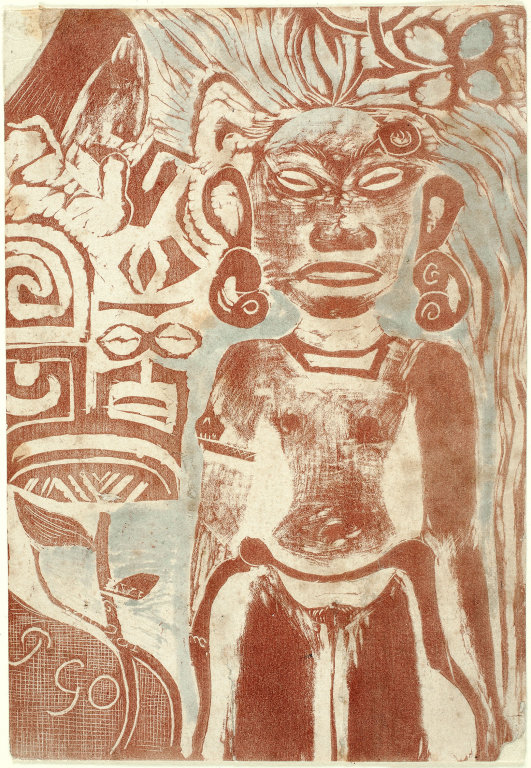
FEATURE Image: Paul Gauguin, Tahitian Idol-The Goddess Hina, 1894/95 – woodcut in black ink, over ochre and red, with touches of white and green inks, on tan wove paper, 5.78 x 4.72 inches (147 x 120 mm). The Art Institute of Chicago, Edward McCormick Blair collection.
Produced in Paris inspired by Tahiti: Tahitians Fishing – Tahitian Landscape – Tahitian Idol the Goddess Hina.
By John P. Walsh
To take a look at a selection of three prints produced in Paris by Paul Gauguin (1848-1903) that were inspired by his long trip to Tahiti from 1891 to 1893—and followed by his return there in 1895 until his death in 1903— elucidates both his artistic ideas and methods and techniques he used to produce them in this time period unique to his career.
Ever the consummate craftsman—even Gauguin’s modern art critics largely conceded his graphic arts expertise—his traced monotypes (also called watercolor transfer drawings or printed drawings) employed a simple but creatively unique process to offset his watercolor or gouache designs onto paper.
The first step in Gauguin’s process was to place slightly damp paper over his hand-drawn design and with the pressure he exerted from the back of an ordinary spoon the moisture in the paper and the water-based medium worked to transfer the reverse image of the design onto the paper. Gauguin could then reprint his design so that each would be variable images, imparting a pale, soft value to the work — outcomes that the artist sought for these Tahitian pieces.
By 1898, having returned to Tahiti, Gauguin created a new print medium which was essentially a reversal of early Renaissance silverpoint. His new technique required Gauguin to apply a coat of ink to one sheet of paper, place a second sheet over it, and draw on the top sheet with pencil or crayon. The pressure of the drawing instrument transferred the ink from the first sheet of paper onto the back or verso side of the top sheet. Gauguin greatly admired his technical discovery and considered it an expression of “childlike simplicity.”
Fig.1 . Tahitians Fishing, 1893/5 – watercolor and black ink, over pen and brown ink, on vellum laid down on brown wove paper, 9.84 x 12.48 inches (250 x 317 mm). The Art Institute of Chicago, Edward McCormick Blair collection.
1-Tahitians Fishing
In the first print to be seen, Tahitians Fishing is a small work (fig. 1). Its figures are flat, with little modeling or detail. The impact created is one of a dream. Gauguin presents a primitive world that is half-naked and childlike. In its Synthetist elements, it is reminiscent of a major painting he completed the year before, Fatata te Miti (By the Sea) (fig.2). It shares its flat colors, abstract shapes, and unbroken curves uniting to make an integrated decorative pattern.
Fig. 2. Gauguin, Fatata te Miti (By the Sea), 1892, oil on canvas, 67.9 x 91.5 cm (26 3/4 x 36 in.), The National Gallery of Art, Washington, D.C.
Yet Tahitians Fishing is a sketch. It is divided into distinct zones like Day of the Gods (Mahana No Atua) (fig.3) created by Gauguin in the same years in Paris. The print shows a grassy foreground and sea/vegetation/sandy shore that creates two horizontal zones. These are bisected by a dominant vertical (a tree) that divides the piece into informal quadrants. The tree, a powerful element, is a void―a space of black ink―while its branches and roots are delineated with the same facile modeling as the rest of the composition. The pair of main roots and twelve or so ancillary roots sit ambiguously atop the grassy foreground with its childlike delineation of blades and sinks into sandy soil. The tree surrounds a naked squatting female, her bare breasts exposed. Is she hiding herself from a second woman working with a net in the area of sand and sea? This second worker is aided by three others who are perhaps completely nude figures that stand waist deep in water. Two are male but the third figure’s sex is uncertain as s/he is turned so the viewer sees only a naked back. There is very little personality to the figures. They are, instead, composition elements like cartoons.
Fig.3. Gauguin, Day of the Gods (Mahana No Atua), 1894,
oil on canvas, 26 7/8 x 36 in. (68.3 x 91.5 cm), The Art Institute of Chicago.
Gauguin’s visual image and text searches and reflects European Symbolism and Tahiti to create a new hybrid
In the time Gauguin was making Tahitians Fishing, he was working on the text and suite of ten wood block prints for his book Noa Noa. Tahitians Fishing also involves text and the visual image. Gauguin places a verse by living French Symbolist poet Paul Verlaine (1844-1896) into a visual work about Tahiti. This artistic admixture could be part of Gauguin’s reaction to one of Symbolist art’s major indictments by naturalist modern art critics ― that it is preoccupied with ideas and should be subsumed exclusively into the domain of literature.41
Gauguin’s literary career began in the midst of this critical argument that predated his first departure to Tahiti and maintained itself at his return. From an artist who confronted disparate parts to create something new, Tahitians Fishing is a hybrid piece of Symbolist literary and visual elements using Gauguin’s obsession with Tahiti as its unifying theme. It indicates that the artist was reflecting on his Tahitian art, if not searching for more. Many Paris critics believed his art confused East and West. Gauguin gives validity to that belief by putting a poem at the top of the sheet in its own artistic “zone” and not straying into the visual image itself or making letters into art. While his pillaging from the Western world could set Gauguin’s critics alight, sympathizers saw his juxtapositions as a productive and creative artistic strategy.42 Verlaine’s nature poem ― “Qu’as-tu fait, ô toi que voilà/Pleurant sans cesse./Dis, qu’as tu fait, toi que voilà/De ta jeunesse?”43 ―provides another facet to Gauguin’s imposition of the Edenic dimension of good and evil onto the image.
Tahitians Fishing tested Gauguin’s powers to illustrate text which he was working on for Noa Noa, a phrase that means “perfume.” The Man with the Ax (fig.4), a print from this Paris period (1892/94) is a complex of thinned gouache and pen and black ink over pen and brown ink on dark tan wove paper and laid down on cream Japanese paper. At approximately 12 x 9 inches it is – by virtue of its tripartite landscape, stooping figure and monumental and vertical figure enclosed in Cloisonnist dark contour – a retrospective of work done in Tahiti between 1891 and 1893.
Fig. 4. Gauguin, Man with an Ax, 1891/93, thinned gouache with pen and black ink, over pen and brown ink on cream wove paper (discolored to tan), laid down on cream Japanese paper, 317 x 228 mm, The Art Institute of Chicago.
Tahitians Fishing is new as it reflects Tahiti and adds a contemporary French Symbolist text. It contains similarities in composition, theme, and figures to the forward-looking painting Day of the Gods. Both share the image of a “Savage Eve” figure which obsessed Gauguin throughout 1893 to 189544 and both have a dominant central vertical―a tree in Tahitians Fishing and an idol in Day of the Gods. Each has distinct horizontal zones and ground-and-water block-like forms. Even the amoeba-shaped waters in Day of the Gods are reflected in the steeply pitched water-as-sky in Tahitians Fishing. Maurice Denis identified Gauguin by his bright, unnatural colors45, but this exercise piece is more than that. It explores compositional forms and themes of his Tahitian and Synthetist works and includes avant-gardist French Symbolist verse. Gauguin’s work in these pieces is not always simply, as Julien Leclerq wrote in December 1894, “(the) transposing into another medium motifs from his Tahitian works.”46 Gauguin may have used this particular Verlaine poem if he was anywhere outside Paris, but it seems less likely. He continued to experiment with mixing text and visual image, a courageous act in the face of conservative critics who, with artists Edgar Degas and Paul Cézanne, castigated Gauguin for the repetitive elaboration and recombination of pictorial ideas. On the recto side of this work no signature of any sort is detectable.
2-Tahitian Landscape
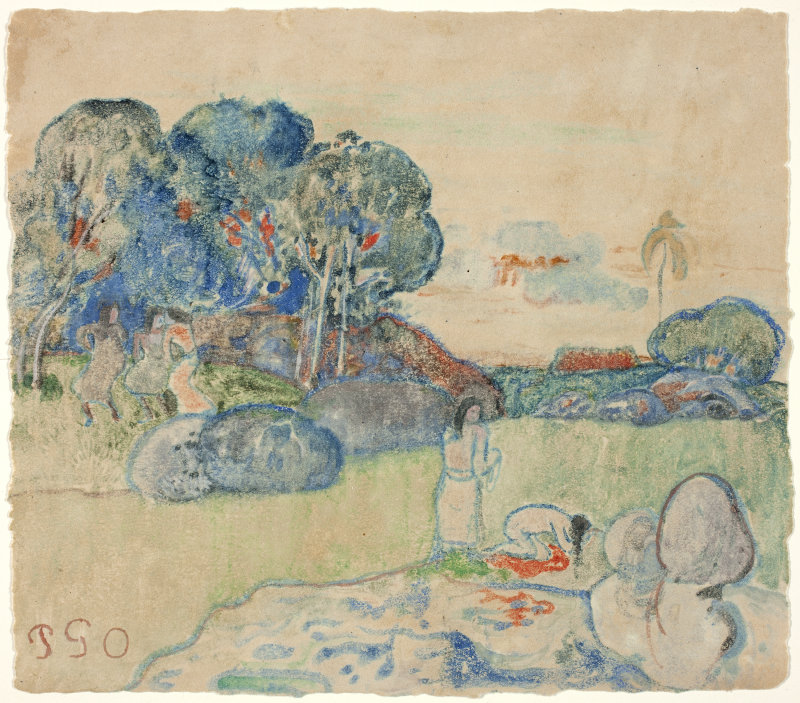
As Belgian critic Emile Verhaeren saw him, Paul Gauguin (French, 1848-1903) produces “child art.”47 The artist’s anagram “P.Go.” looms large in the lower left hand corner making it plain that the 46-year-old Gauguin made this print. Gauguin’s use of color and form are significant as they build up the image of five women in a landscape―two foreground figures more fully defined than the three figures merging into the background. It is ambiguous whether it is a channel of water or grass that separates the two foreground women who appear to perform a rite of worship and a trio in conversation or, as Richard Brettell interprets, dancing.48 As the Seine flows through Paris where Gauguin created this print, there exists in Tahitian Landscape (fig. 5) a commentariat on the Right Bank and artisans spilling blood in their offerings on the Left Bank. Modeling of the three women has affinities with Ta Matete of 1892 (fig.6) as Gauguin uses the same flat, static figures that have been traced to Egyptian painting with the ethnological implication that the Polynesians’ origins are in mankind’s oldest civilizations.49
Fig. 5. Paul Gauguin, Tahitian Landscape, 1894 – watercolor monotype, with brush and watercolor, on cream wove paper, 8.66 x 9.72 inches (220 x 247 mm). The Art Institute of Chicago, Edward McCormick Blair collection.Fig. 6. Gauguin, Ta Matete (The Market), 1892, 28.7 x 36.2″ (73 x 92 cm), Öffentliche Kunstsammlung, Basel.
Continual rhythm or “musicality” of bodily contours with intervening empty space gives Tahitian Landscape a Synthetist sensibility to the figures while its overall Symbolist ambiguity is a result of pale color and de-emphasized form. The figure of the woman on her knees to the right is engaged in a ritual bathing as Brettell believes or may be bowing before a vague natural stone construct (Brettel, however, denies any hint of religion).A pool of red flows at, or under, her chest that may represent bathing water as Brettell offers or perhaps a hint of light or shadow or, more intensely, the figure’s blood. Red appears again in one of the three dancing figures. In this landscape Gauguin allows for several possible interpretations.
Gauguin presents a scene of bewilderment, ambiguity, and mystery
Under close examination the artist seems to encourage bewilderment by producing a scene of ambiguity and mystery. If Gauguin acted as an ethnologist―as art critic and historian Roger Marx compared him in November 1893 – it would be impossible for the artist to depict an authentic blood sacrifice in Tahiti since, in the 1890s, it was prohibited by French law. The artist then dreams a scene in a Tahitian setting of a woman and her associates offering a savage blood sacrifice to a stone god. This piece asks questions about Gauguin’s attitude for Tahiti and sheds light on some of his deepest desires in Paris. The formulation of the sky, waters, and ground create a Synthetist landscape but it is the Symbolist figures and the mystery surrounding their presence that is the central power of the work. This use of mysterious figures in a landscape is found in Gauguin’s previous work in Martinique (“the land of the Creole gods”50 he wrote in a letter) and in Brittany (figs. 7 and 8).
fig. 7. Gauguin, By the Sea, oil on canvas, signed and dated at lower left, P. Gauguin 87, 18 1/8 x 24 in. (46 x 61 cm), private collection, Paris. Fig. 8. Gauguin, Be Mysterious, 1890, low relief, polychrome lime tree wood 73 x 95 x 5 cm., Musée d’Orsay, Paris.
In Tahitian Landscape, on the other side of the green, blue, and peach-color chasm heavily outlined on the right and halted by a built-up “shore,” the three dancing women who are barely modeled or detailed appear to be observed by an idol figure. It lies in blue shadow in dense foliage and is nearly invisible. As in Tahitians Fishing (see part 2 of “Savagery in Civilization…” ) it is by way of foliage, boulders, and rounded forms of the landscape that there emerges a similarity with the jigsaw puzzle-like lagoon in that same year’s Day of the Gods. However, the forms in Tahitian Landscape are flatter and less organic-looking. As popular graphic art methods could not produce the deliberately pale character of the surface Brettell proposes that this image was made as a transfer or counterproof on wetted paper from a now lost watercolor matrix.51
3- Tahitian Idol-The Goddess Hina
For some pieces of graphic art Paul Gauguin (French, 1848-1903) uses the moniker “P.Go.” to sign them.52 In Tahitian Idol-The Goddess Hina (fig.9, at top of the blog post), the moniker is present in the lower left corner slightly on its side. While Day of the Gods, painted in Paris in 1894 at the same time as the woodcut, received a simple signature of “Gauguin” (the painting was not exhibited in the artist’s lifetime), Gauguin sometimes used these new graphic art works as “image translations” to explain his Tahitian art to the Parisian public. This may explain the pretension of the anagram here.53
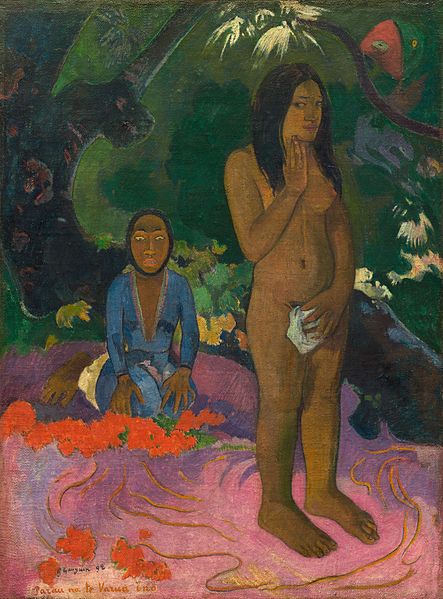
fig.10. Gauguin, Parau na te Varua ino (Words of the Devil), 1892, oil on canvas, 91.7 × 68.5 cm (36 1/8 × 25 15/16 in.), National Gallery of Art, Washington, D.C.
Artist’s obsession with representations of the primitive and “savage”
Gauguin’s obsession with the primitive, the savage, is evident in this work. The small woodcut is an image of a Tahitian goddess where the composition’s diverse elements congeal to a single mask to be held in the palm of one’s hand. Goddess Hina, immobile and august, is fitted into the composition as a first among equals. A tree fills the left border like a totem with a V-formed sprout. At the woodcut’s top border – and peering out of a branch at the tree trunk’s crux – is a profile of an evil spirit represented by a head. The grassy hair of the goddess fills about half the background and falls to nestle by her left arm. Gauguin uses several stock elements in different attitudes or positions. For example, he used the evil head in the 1892 painting Parau na te Varua ino (Words of the Devil) (fig.10) and this woodcut’s symbolism likewise remains complex. In the woodcut, to Goddess Hina’s right and immediately below the malevolent spirit who materializes in strange and frightening humanoid forms, appear abstracted forms of a coiled snake and other ceremonial visages. Goddess Hina is primitive and statuesque whereas the evil head possesses a sinister aspect with circles that serve as open eyes.
When Gauguin wrote from Tahiti in March 1899 to Belgian Symbolist poet and critic André Fontainas with reflections on the South Seas, he expressed strong feelings of awe, personal vigil, and dream-like vision. Such qualities must have been experienced on his first Tahiti trip for they permeate a work like Tahitian Idol – The Goddess Hina:
“Here near my hut, in utter silence, I dream of violent harmonies in the natural fragrances that exhilarate me. A pleasure heightened by an indefinable sacred awe which I divine towards the immemorial. In bygone days, an odor of joy that I breathe in the present. Animal figures in statuesque rigidity: something inexpressibly old, august, religious in the rhythm of their gesture, in their rare immobility. In dreaming eyes, the cloudy surface of an unfathomable enigma. And here is nightfall – everything is at rest. My eyes close in order to see without understanding the dream in the infinite space that recedes before me, and I have a sense of the doleful march of my hopes.”54
Paul Gauguin’s hut in Tahiti – Jules Agostini (1859-1930), December 31, 1904. Bibliothèque nationale de France.
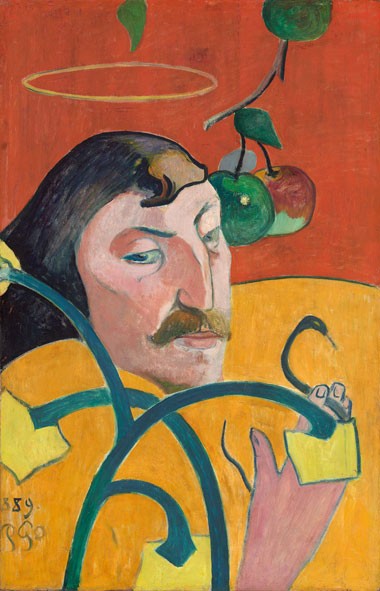
In a work of approximately 5 x 4 inches―and its small size in no way diminishes its artistic force―Gauguin achieves in Tahitian Idol-The Goddess Hina a craftsman’s unity of good and evil in nature. Before his first visit to Tahiti Gauguin already had familiarity with this theme of nature’s duality for he uses it in his 1889 painting Self-Portrait (fig. 11) where halo and snake vie within and for creation.
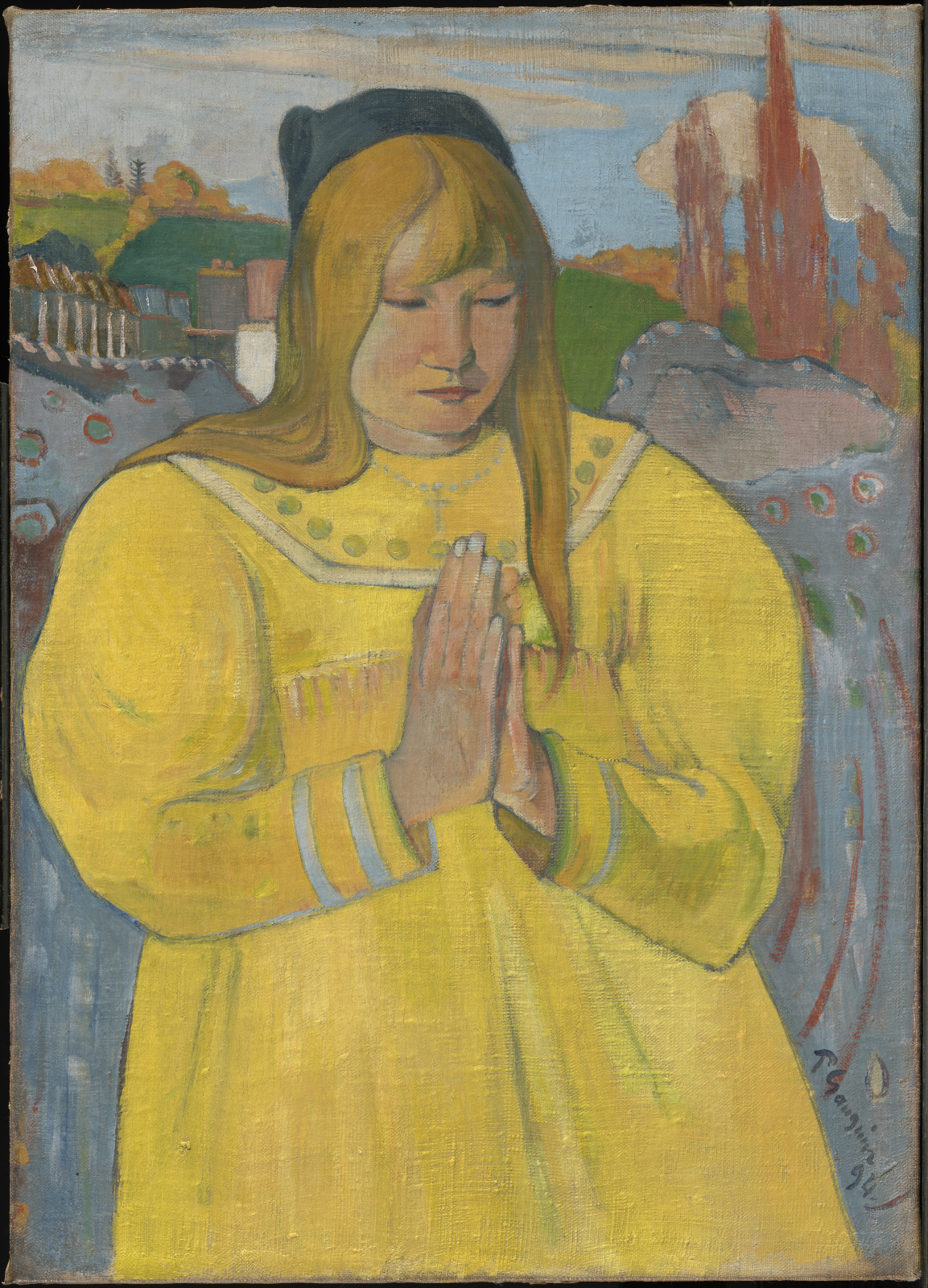
fig.11. Gauguin, Self-Portrait, 1889, oil on wood, 79.2 x 51.3 cm (31 3/16 x 20 3/16 in.), National Gallery of Art, Washington, D.C.PAUL GAUGUIN, Tahitian Woman, 1894?, irregularly shaped; charcoal and pastel, selectively stumped, and worked with brush and water on wove “pasted” paper, glued to secondary support of yellow wove paper mounted on gray millboard. The Brooklyn Museum. A pastel where Gauguin subverted the medium.PAUL GAUGUIN The Young Christian Girl, 15 3/8 x 18 inches, oil on canvas, Clark Institute Art Institute, Massachusetts. Gauguin painted this work in Northern France fusing imagery from his recent experiences in Tahiti. She is shown in a dress similar to those brought by Christian missionaries to the South Sea Islands.
NOTES:
Marlais, p.99.
Salvesen, p. 51.
“What have you done – you who are Forever crying? Speak! What have you done – you who are so young?” – my translation.
quoted in Barbara Stern Shapiro, “Shapes and Harmonies of Another World,” in Gauguin Tahiti, George T.M. Shackelford and Claire Frèches-Thory, MFA Publications, 2004, p.131.
Thomson, Gauguin, p. 130.
Brettell, p. 359.
Thomson, Gauguin, p. 152.
Brettell, p. 80; “denies any hint of religion” and “bathing water”- Brettell, p. 359. Brettell’s denial here of Tahitian religion does not preclude his proposing that the bowing figure may be an adaptation of the naked and penitent Magdalen at the foot of the cross, which is part of Catholic tradition.
Ibid., p. 359.
Brettell., p. 330.
Ibid., p. 330.
Delevoy, Robert L., Symbolists and Symbolism, Rizzoli International Publications, Inc., New York, 1982, page 54.
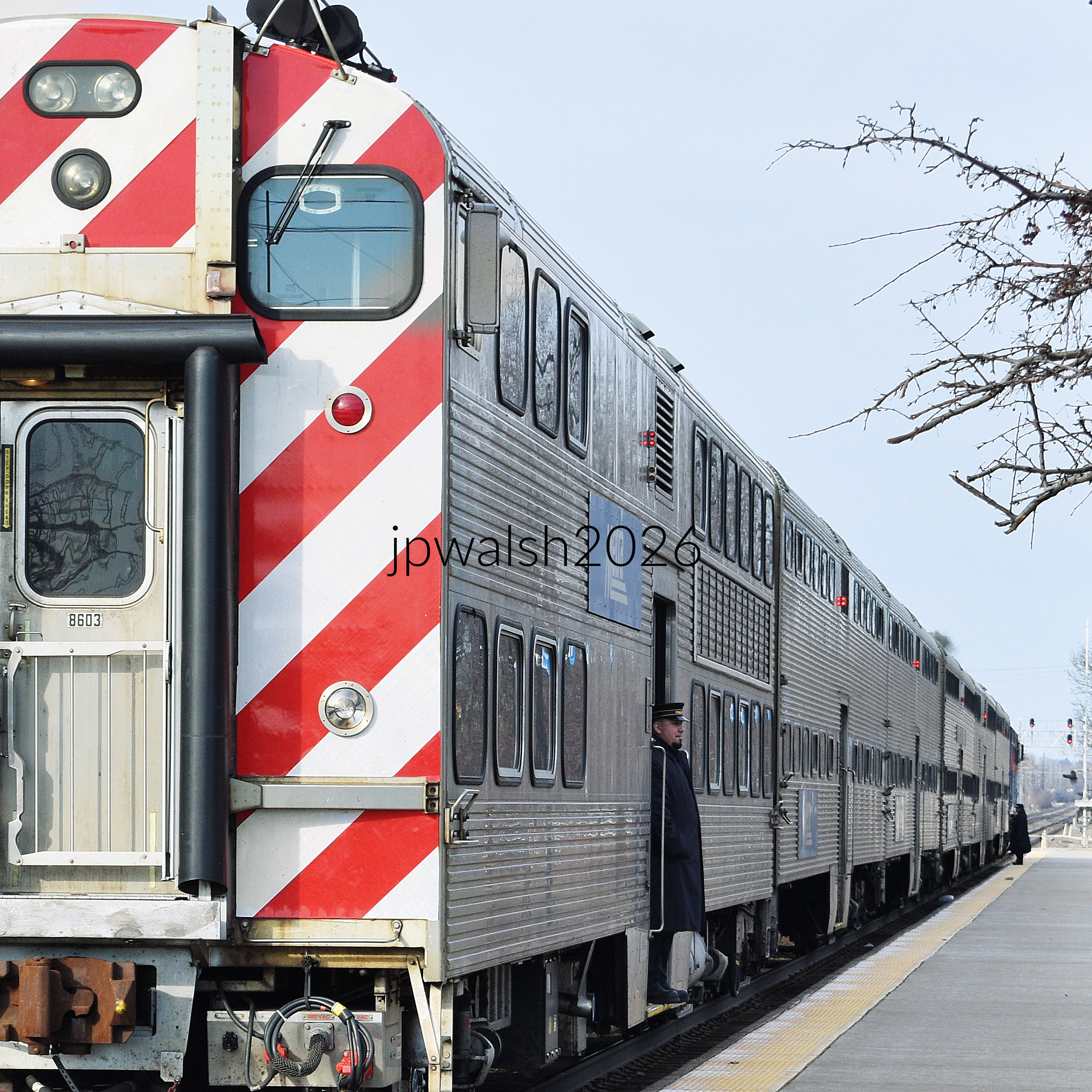
Video of same run of Metra Locomotive 185 (above), westbound BSNF Railway Line, August 2022.
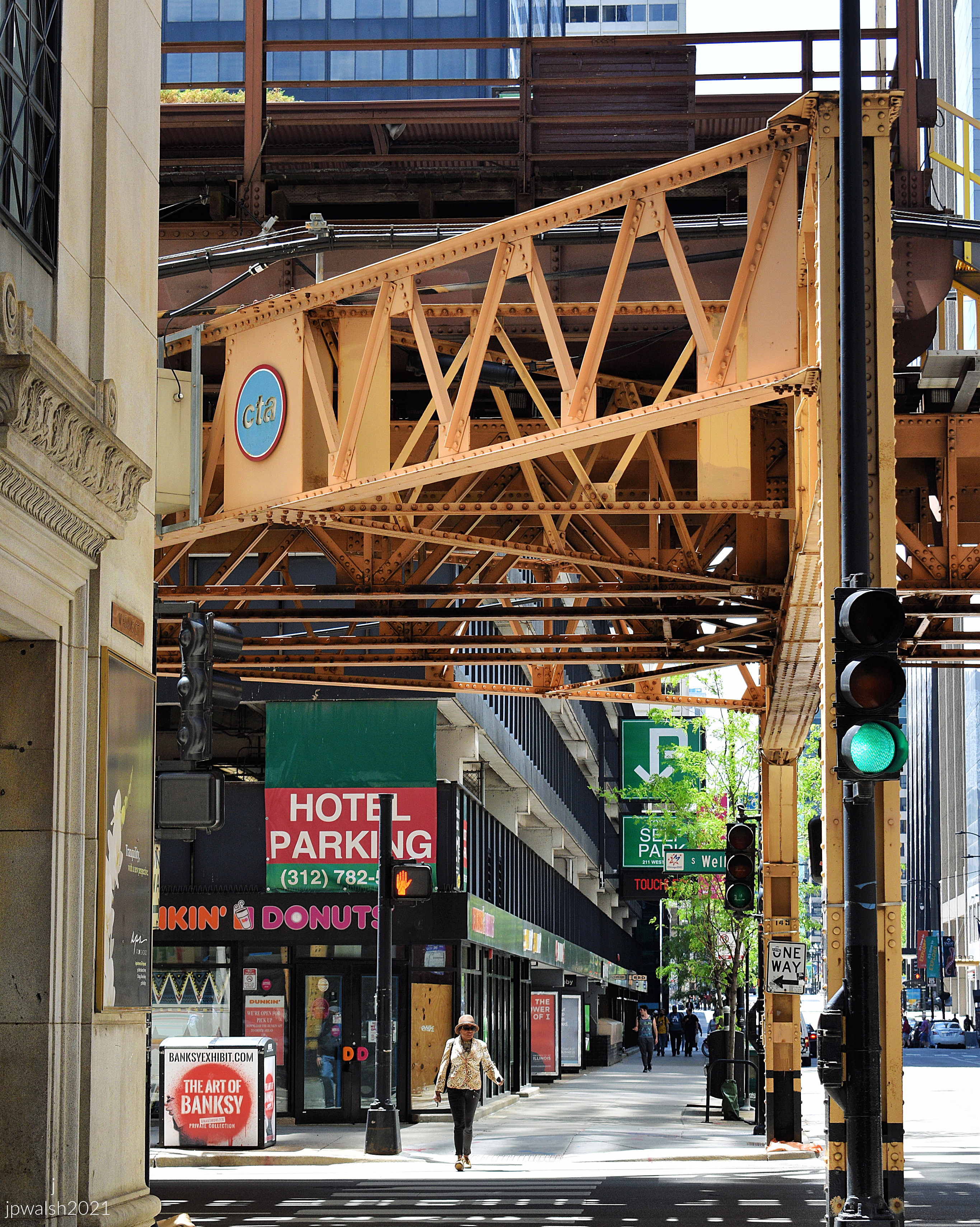
November 2017. Downtown Chicago. October 2017. Chicago. Brown Line.
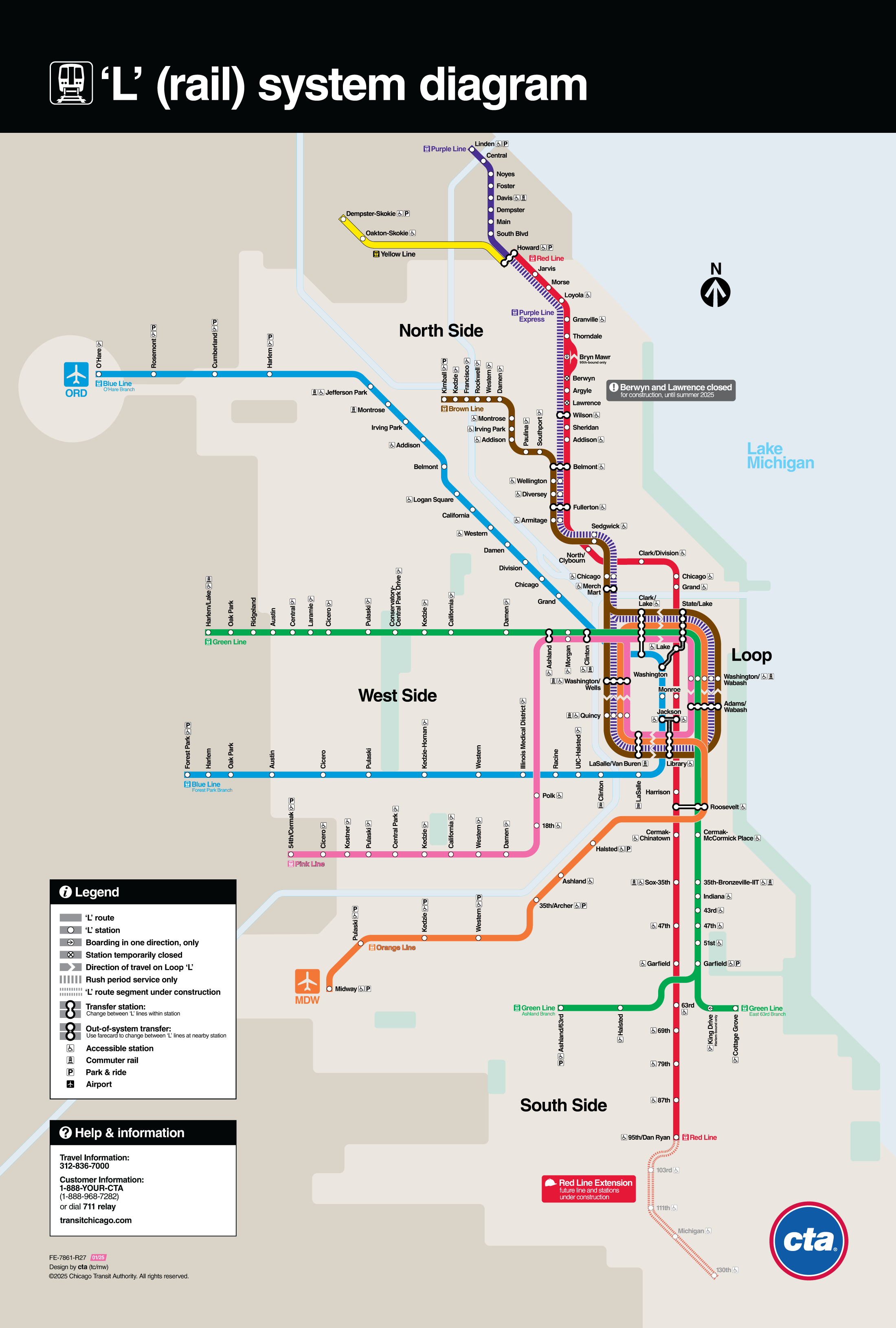
The Brown Line (also known as the Ravenswood Line) is part of the Chicago “El” or “L” rapid transit system. The Chicago public transportation train system offers a total of 8 color-named lines (Yellow, Red, Blue, Pink, Orange, Green, Purple, and Brown). All the lines begin in the downtown “Loop” and branch out from there in different directions throughout the city (except, of course, east into Lake Michigan).
The popular Brown Line travels over 11 miles from downtown Chicago to the north and west to the “Kimball” station in Chicago’s Albany Park. There are 27 stations on the Brown Line and the train runs entirely above ground. The Brown Line first opened in 1907.
July 2021. METX 183, EMD F40PH-2. BSNF Railway Line.
Locomotive METX 183, EMD F40PH-2 was originally built for Metra by General Motors in September 1989 at their Electro-Motive Division (EMD) plant (now closed) in LaGrange, Illinois. see – http://www.rrpicturearchives.net/Locopicture.aspx?id=2727 – retrieved July 1, 2021.
June 2023. Locomotive 183. BSNF Rail Line. 7.77mb 91%
Video of same run of Locomotive 183 (above). BSNF Rail Line, westbound. June 9, 2023.
June 2021. Locomotive 194. BNSF Railway Line.
Locomotive 194 was the first Metra locomotive after 2015 to be completely rebuilt and repainted just outside Patterson, Georgia at the Progress Rail plant. The first F40(PHM) rebuilt “like new” engines were returned to Metra service in September 2016.
The F40PHM locomotives were originally built for Metra by General Motors in 1991 at their Electro-Motive Division plant (now closed) in LaGrange, Illinois.
This locomotive features a short nose and sloped cab improving engineer safety in the event of a crash. These rebuilt locomotives are essentially a brand-new locomotive in their original 1991 frame.
The paint scheme for the F40 was developed by a Metra engineer for earlier rebuilds of Metra F59PH and MP36PH locomotives with slight variations.
These rebuilds offer internal systems that are an improvement over the original—this includes better emissions. Locomotive 194 and the 40 other F40PH-2 and F40PHM-2 locomotives that were under contract to be rebuilt for Metra in 2015 are expected to be in service until around 2030.
The total cost for these 41 rebuilt locomotives was $91 million—that is, about $2.2 million for each locomotive. That is contrasted to the cost of a brand new locomotive (about $7 million each). These F40 rebuilds, which serve mainly on the BSNF line, are familiarly called “Winnebagos” for their sleek style reminiscent of the recreational vehicles of that well-known manufacturer.
FEATURE image: Gauguin, Self-Portrait with Palette, winter 1893-94 or 1894-95, 92 x 73 cm (35 7/8 x 28 1/2 in.), private collection.
Paul Gauguin, Self-Portrait, 1893-1894. Oil on canvas, 18 x 15 in. (46 x 38 cm), Musée D’Orsay, Paris. The artist portrays himself in his new studio in Paris painted in bright colors with exotic decor including a blue and yellow sarong at the lower right. Behind him is his Manau Tupapau (The Spirit of the Dead Keeps Watch, Buffalo, Albright-Knox Art Gallery) painted in the South Pacific in 1892.
By John P. Walsh
In May 1894 during a working visit to Brittany filled with nostalgia, a 45-year-old Paul Gauguin broke his leg above the ankle in a scuffle with sailors in broad daylight. In France just nine months after being away in French Polynesia for over two years, Gauguin was spotted playing the role of bohemian artist in Concarneau, an old fishing port which had become a busy international art colony. Gauguin made an attractive target in his outlandish attire and shoulder-length hair huddled with a coterie of young art disciples, a pet monkey, and a Ceylonese child mistress whose dark skin offended late-nineteenth-century social norms as much as her age.1
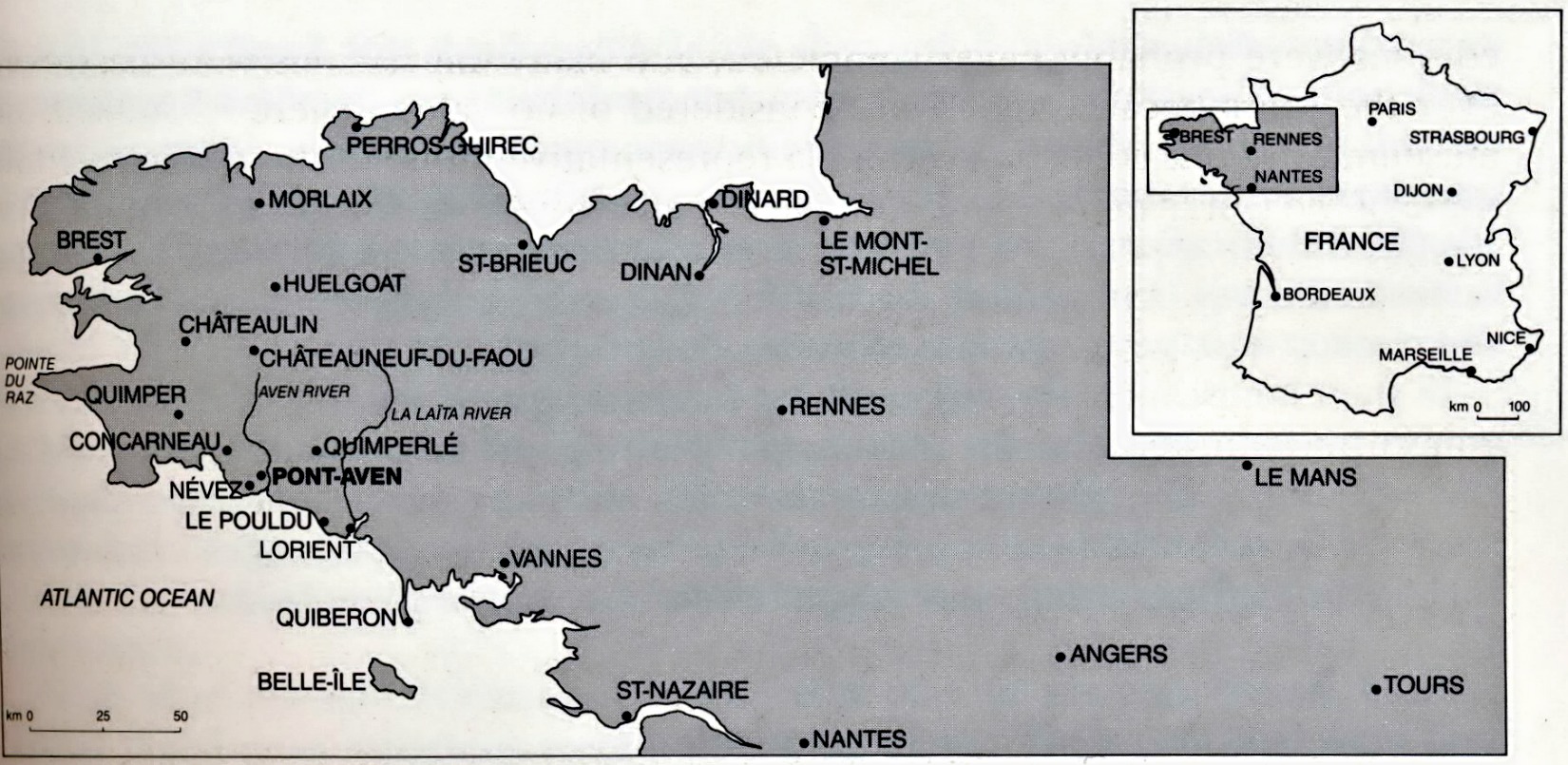
Map of Brittany in northwestern France showing the principal sites where Gauguin and other avant-garde artists lived and worked in the late 1880s and 1890s.
Exhibiting his penchant for questioning prevailing assumptions and bringing to Brittany the easy sexual standards he experienced in Tahiti, a dissolute Gauguin now paid for his personal freedom with serious bodily harm. The violent incident added to the changed relations Gauguin found for himself in France since his return to his homeland in late August 1893. After his 27-month artistic exile in the middle of the South Pacific starting in April 1891, the midcareer artist strove to re-establish ties among dealers, critics, collectors and artists in Paris. He had a misguided anticipation for sales of his new Tahitian paintings based on his past artistic triumphs and the handful of new Tahiti work he sent ahead of his arrival into France for exhibition in Paris to carry his objectives forward.2 In Brittany Gauguin’s injury required him to be hospitalized and put on morphine and alcohol as pain killers for a two-month recuperation. By late August 1894 Gauguin’s leg had healed where he traveled to nearby Quimper for his assailants’ trial. The artist had sued the ruffians for 3,000 francs, but local justice meted out a small fine.3
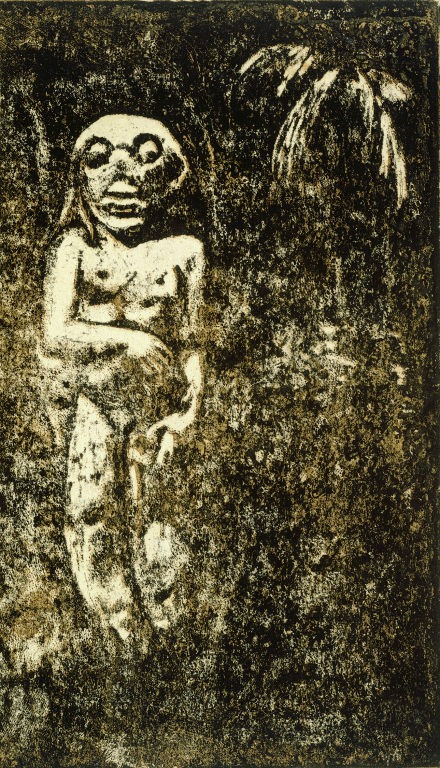
Gauguin did not rest on his laurels or his recent injury. Rather, since his return to France, Gauguin engaged himself almost nonstop in self-promotion on behalf of his new Tahitian art portfolio. During his recuperation Gauguin found he was unable to paint in his first full summer back in France in 1894. This was a hard irony since in his Tahitian work between 1892 and 1893 Gauguin was primarily a painter. In summer 1894 he turned to work exclusively on wood cuts and monotypes (the latter art form also called transfer drawings, watercolor transfer drawings, printed drawings, and traced monotypes). Working alone and with other artists from the Pont-Aven group, Gauguin experimented with new images, new arrangements and new applications without committing anything to oil. These print techniques ―different from etching which Gauguin found too dainty― afforded him the painterly effects, unusual textures and distorted forms that he sought and which his opponents in the modern art world vocally despised. For the sake of this post’s length and logic, a fuller presentation of four of these “savage” prints which Gauguin finished in Paris between 1893 and 1895 (among scores of others) can be discovered in a separate blog post. Excluding the collective power of his ten large and earliest woodcuts made for Noa Noa, no works of graphic art by Gauguin in this Paris period are more mysterious than the ones this article will consider – namely, Tahitians Fishing (involving Savage Eves), Tahitian Landscape (blood sacrifices), Tahitian Idol – The Goddess Hina (vying spirits in the natural world) and Oviri based on Gauguin’s ceramic sculpture.
TAHITIANS FISHING, 1893/5 – watercolor and black ink, over pen and brown ink, on vellum laid down on brown wove paper, 9.84 x 12.48 inches (250 x 317 mm). The Art Institute of Chicago, Edward McCormick Blair collection.TAHITIAN LANDSCAPE, 1894 – watercolor monotype, with brush and watercolor, on cream wove paper, 8.66 x 9.72 inches (220 x 247 mm). The Art Institute of Chicago, Edward McCormick Blair collection.TAHITIAN IDOL – THE GODDESS HINA, 1894-95 – woodcut in black ink, over ochre and red, with touches of white and green inks, on tan wove paper, 5.78 x 4.72 inches (147 x 120 mm). The Art Institute of Chicago, Edward McCormick Blair collection.OVIRI (SAVAGE), 1894 – woodcut printed in black on cream Japan laid paper, 8.03 x 4.56 inches (204 x 116 mm). The Art Institute of Chicago, Clarence Buckingham Collection.
In November 1894 when Gauguin was able to return from Brittany to Paris he opened the door to his studio to find that its two rooms had been ransacked save for own art work. It had been the undertaking of Gauguin’s Ceylonese mistress, called Annah la Javanaise, who had exacted her sense of savage justice on the man from France for her services.4
Gauguin’s Studio at 6 rue Vercingétorix in Paris. Gauguin is seated at left in the broad brimmed hat. Behind him is artist Paul Sérusier with Annah la Javanaise. Standing in the black hat is painter Georges Lacombe. The two musicians are Fritz Schnedklud (center) and Larrivel (right). Photograph: Musée Gauguin, Papeari.
Following his passage from Tahiti into France on August 30, 18935, Paul Gauguin, virtually penniless, stayed in Paris with art historian Émile Schuffenecker with whom he had been estranged and by more than the High Seas.6 From fall 1892 into early spring 1893 Gauguin had been sending to Paris his new work from Tahiti ―nine canvases in total – including his first portrait of a Tahitienne, namely, Vahine no te Tiare of 1892 which today hangs in Copenhagen. Displayed in the Boulevard Montmartre gallery of Boussod, Valadon & Cie (the former Goupil & Cie),7 critical reaction to the portrait which was so important to Gauguin turned out to be mixed.8 The portrait might have served as a bellwether to Gauguin and those who paid attention to his work. Its tepid, divided response would mark the reception he received for his much larger Tahitian oeuvre in Paris between 1893 and 1895.
Gauguin, Vahine No te Tiare (Woman with Flower), 1891. Oil on canvas, 70 x 46 cm, Ny Carlsberg Glyptotek, Copenhagen.
While Edgar Degas spoke well of and invested in Gauguin’s work, the two were not personally close.9 It was in conversation with younger artists and one older artist, Odilon Redon, that in January or February 1890 Gauguin was inspired to pursue the idea of a “Studio of the Tropics.” Although Redon by late summer of 1890 told Gauguin he was against his leaving France – whether to Madagascar, as first entertained, or as it happened, to Tahiti in April 1891, Gauguin was clearly not persuaded. Redon was convinced that Gauguin’s artistic development in Europe would be significant and appealed to Gauguin to reconsider.10 Gauguin wrote to Redon from Le Pouldu in September of 1890:
“…The reasons you give me for staying in Europe are more flattering than they are likely to convince me. My mind is made up…I judge that my art, which you like, is only a seedling thus far, and out there I hope to cultivate it…Here, Gauguin is finished, and nothing more will be seen of him…”11
In Tahiti Gauguin made his home in Papeete and soon after in Mataiea before he returned to Paris two years and three months later in August 1893. He stayed in the French capital for twenty-two months until a second departure for Tahiti in June 1895 when this time, indeed, nothing more would be seen of him (“My design, Gauguin wrote, “(is) to bury myself in the South Sea Islands.”)12 It could not be known until December 1894 that Gauguin had decided to return to Tahiti – although in 1894 his letters expressed longing for it.13 His time in Paris possessed a “liminal” quality in that he occupied a position at or on both sides of a boundary or threshold of Tahiti. From 1893 to 1895 in Paris Gauguin had two distinct worlds to draw on and consider for his art – one, an echo of Redon’s advice in 1890 to develop artistically in Europe and two, his memory of Tahiti from 1891 to 1893. The South Seas had imparted to Gauguin new images for him to paint that he could not find in France – and he worked to promote these discoveries and ruminate on them in current work. Unlike Brittany of which the artist was fond, Tahiti surrounded Gauguin with a strangeness that allowed his imagination to take greater hold of the mystery, savagery, and otherness that he increasingly sought to express in his artistic work. Both worlds can be found in Gauguin’s art of this Paris period – Tahiti in the new images based on primitiveness and savagery and France in the forms of Symbolism and Synthetism that Gauguin learned and helped lead after 1888. Each of these worlds – one definitely savage and the other civilized or also savage based on one’s art critical perspective in early 1890s Paris – informed the other in formal terms and the impressions inspired by the artist’s dreams, exaggerations and inventions.
Paul Gauguin had come back to France actually intending to stay14 but as time passed his connection to the faraway islands became too strong to forsake. At Café Escoffier in Paris on December 7, 1894, Gauguin announced his return to Tahiti and left France forever the following year. In those 660 days in France Gauguin worked to force rapid public acceptance of his work and ended up being all but shunned by the French public. Gauguin brought to Tahiti in 1891 the experience of all the art he had made in the late 1880s with Vincent Van Gogh in Arles and with Émile Bernard and Paul Sérusier in Brittany as well as his deep admiration for Redon’s noirs. Primitive culture in Polynesia, while truncated and absorbed into French rule, appealed to him and in the Paris interlude Gauguin obsessed about the island in his literature and art.15
Gauguin. Manao Tupapau (Spirit of the Dead Watching), 1892. Oil on canvas. 28 1/2 x 36 3/8 in. (72.5 x 92.5 cm), Albright-Knox Art Gallery, Buffalo, NY.
Gauguin took the initiative to woo the French art-buying public and even the State to embrace the sixty-six paintings that comprised his Tahitian portfolio. His failure to take Paris by storm in this period― book-ended by a two-week commercial exhibition at Durand-Ruel’s in November 1893 and a Drouot auction on February 18, 1895 ―is blamed for his leaving for Tahiti the second and final time. These disappointments had a financial bearing – he sold only eleven of forty-one paintings from Tahiti at Durand-Ruel’s and just nine out of forty seven works at the Hôtel Drouot – but their apathetic reception affected more than a mercantile Gauguin. It is a historical irony that one of Gauguin’s unsold Tahitian paintings from this period – his 1892 double portrait “Nafea Faa Ipoipo” (When Will You Marry?)” – was sold in February 2015 by a Swiss family foundation to a group of state museums in Qatar for a record nearly $300 million. In 1893 the artist priced it at no higher than 3,000 francs or about $15,000 in 2015 dollars.
Gauguin, Nafea faa ipoipo (When Will You Marry Me?), oil on canvas, 101 by 77 cm (40 in × 30 in.).
In art work Gauguin was preparing for the public and for his private rumination he continued his “searching deep within himself”16 begun in Tahiti with its exotic theme being paramount. Throughout the period of 1893 to 1895, in Paris and in Brittany, Gauguin escaped into a Tahitian world of his own imaginings by way of his highly experimental graphic work.17 Gauguin brought to Paris with him his notes and sketch books from Tahiti and meditated on them during the course of his Paris sojourn. He thought of these mementos as “my letters, my secrets”18 and one wonders about his intention to commercially exhibit these trial works. In summer 1894 Gauguin gave away some of his watercolors19 and while this action may serve as a memento or payment to a friend, it points to a tentativeness with which Gauguin viewed these first works. “The world I am discovering,” Gauguin wrote in a letter months later, “is a Paradise the outlines of which I shall have merely sketched out and between the sketch and the realization of the vision there is a long way to go.”20
Aside from around fifteen paintings he did in France from 1893 to 1895, Gauguin’s work is mainly (with some overlap in art forms) in the graphic arts and literature, including Noa Noa, Ancien Culte Mahorie, and Cahier Pour Aline. Starting in Paris during this period and until his death in May 1903, Gauguin worked to transform himself from an artist to an artist and writer. The general idea for this effort was not original to Gauguin; it may even be a reaction to his critics who derided him as a “writer’s painter” – that is, one who obscured his instinctive painterly talent with literary or ideal concerns. Criticism of Gauguin’s art for this specific reason was deep and extensive in 1890s France by many leading intellectuals who favored the prevailing Impressionist and Neo-Impressionist art forms which promoted a naturalist and modernist art and that Gauguin had abandoned in the late 1880s. Gauguin angered and annoyed artists and critics and they derided his current work forcefully. According to Félix Fénéon Gauguin’s art was unnatural, irrational and illogical and constituted a step backwards for modern art which had staked a secular, democratic, and progressive course. For Camille Pissarro and Impressionist artists such as Paul Signac – Gauguin’s Synthetist and Symbolist styles and forms were retrograde and should be actively resisted. “Let us study Delacroix, Corot, Puvis, Manet and leave those (other) humbugs to their own devices,”21 wrote Signac in 1895 about Monsieur Gauguin.
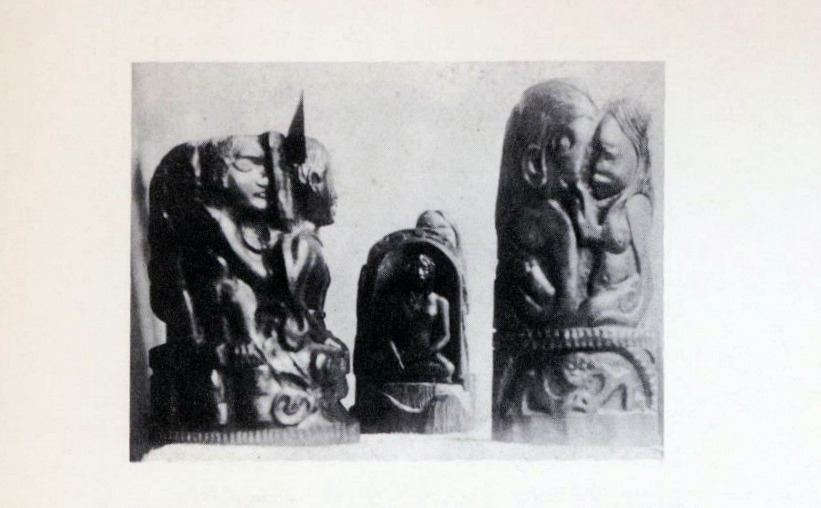
Gauguin, three wooden sculptures exhibited at Durand Ruel’s in November 1893. Photography Georges Chaudet. Gauguin’s commercial exhibition at Durand-Ruel’s included 41 Tahitian paintings, 3 Brittany paintings, 1 ceramic and wood sculptures called “tiis.”
Although brief and contentious, Paris turned out to be a productive time for Gauguin’s art.22 In December 1893 following decent sales after his exhibition at Durand-Ruel’s, Gauguin wrote from Paris to his wife Mette in Copenhagen and pointedly did not discuss his earnings which likely netted him about 10,000 francs – or $50,000 in 2015 dollars.23 Gauguin talked around the money issue to reflect on his attitude for any future art world gambit which would likely be undertaken immediately. “My show,” Gauguin wrote to his faraway spouse, “has not in fact given the results that might have been expected but we must look facts in the face…The most important thing is that my exhibition had a very great artistic success, has even provoked passion and jealousy. The press has treated me …rationally, with words of praise. For the moment I am considered by many people to be the greatest modern painter.”24
Many viewers, however, were perplexed by the artist’s refusal to translate into French the Tahitian titles found in scores of his paintings. Others were amused by the bohemian role he had assumed for himself in astrakhan hat and gilet. Gauguin was obsessed with exhibiting his major Tahitian paintings, continuing to produce that kind of work in Paris and trying to explain this portfolio to the public through his studio invitations, writings, and “image translations.” He wanted to see his Tahitian work conquer the Paris art world.25 While many Parisians did not accept or understand Gauguin’s Tahiti art they were fascinated by it. The World’s Columbian Exposition in Chicago opened in May 1893 and closed just ten days before Gauguin’s Tahiti show opened at Durand-Ruel’s. The Chicago Fair, inspired by the 1889 Paris Universal Exposition, showcased ethnological “villages” that attracted nearly thirty million people. Despite a set course for Impressionism as the parameter for modern art, Gauguin’s cutting-edge Tahiti art could not be ignored completely by Parisians who felt an intense curiosity about exotic locales, especially French Polynesia.26 In Paris Gauguin showed himself to be tireless to capitalize on this current passion. In his letters he ceaselessly complains, justifies his every action, demands extraordinary things of others and lays grand plans for himself because he believed his artistic career was on the verge of greatness but frustratingly incomplete. He poured his energy into his several artistic exhibitions in Paris and elsewhere, produced critical articles and letters for journals, and began to pull together his Tahiti adventures to write Noa Noa with his occasional friend Charles Morice. Morice added a preface, a chapter entitled “Songeries,” as well as the poems. Portions of Noa Noa (“pleasing fragrance”) appeared for the first time in La Revue Blanche, between October 15 and November 1, 1897, more than two years after Gauguin returned to Tahiti. Yet Gauguin used the writing project in late 1893 to excuse himself from traveling to Copenhagen to see his wife Mette.27
Eugène Carrière, Portrait of Charles Morice, 1893 Oil on canvas, 46.5 x 38.5 cm, Clemens Sels Museum, Neuss, Germany.
Gauguin, Portrait of Mette, 1877, The Courtauld Gallery, London.
In Paris Gauguin produced a slew of graphic work and some painting and sculpture. His message from the French capital to his far off wife was interchangeable with what it had been from Tahiti: “I am up to my neck in work!” and that he needed money.28 Regardless of his committed efforts at self-promotion and artistic expansion in Paris – including all aspects of publicity, catalog production, and stock preparation for his Tahiti exhibitions as well as mending fences with old friends and rejoining social networks such as Stéphane Mallarmé’s “les jeudis”29 – criticism and sales receipts did not fulfill the artist’s hopes for his new art. Following Durand-Ruel’s, Gauguin in January 1894 rented a two-room studio on Rue Vercingétorix and fills it with his unsold art that amounted to dozens of paintings and sculptures as well as his current work, some flea-market exotica, and an ethnographic collection. He famously decorated the walls in chrome yellow and olive green―reminiscent of Pierre Loti’s residence in western France with its valuable Far Eastern art collection30― and invited friends to share in his les mardis where they played music, told travel stories, and the host read from his work-in-progress, Noa Noa. 31
Courtyard apartment, 6 rue Vercingétorix, in the Montparnasse section of Paris, around the time of Gauguin’s residence. The location is difficult to imagine in modern Paris today.
One question asked about Gauguin’s Tahitian and Tahitian-inspired oeuvre was which of it is strictly Tahitian and which is western influenced – or, what is direct observation and what is artifice? Exceptional global coordinates did not prevent Gauguin’s first Tahitian experience from 1891 to 1893 to have a European and specifically French flavor. At Durand-Ruel’s exhibition one critic traced the origins of Gauguin’s Ia Orana Maria of 1891, now in the Metropolitan Museum of Art in New York, to a late-1870s work by Jules Bastien-Lepage. In the French press he scoffed at Gauguin’s canvas as “nothing but a Bastien-Lepage done Tahitian style.”32 This sort of critical charge underscores the ground-breaking nature of Gauguin’s art as it introduced primitivism into the European cosmopolitan avant-garde at the turn of the century. Tahiti was an official French colony since 1880 and like most Frenchmen Gauguin had little to no knowledge of its indigenous beliefs and customs. Further, he found no indigenous cultural artifacts during his first stay although he did late in his stay discover published sources for indigenous objects and practices that influenced his art by way of a Belgian scholar.33 In addition to Gauguin’s main artistic threat at “terrorizing reality” and creating ugly art as Fénéon and others strongly postulated, the challenge to Gauguin’s lack of direct observation of Tahitian subject matter or overall Tahitian expertise helped to dismiss his new art as “inauthentic.” Gauguin’s personal life was also fodder for criticism by his artistic enemies. For instance, that it was discovered that Gauguin procured his exotic mistress, Annah la Javanaise, only after his return to Paris stealing her from a French singer after meeting her possibly through art dealer Ambroise Vollard lent an almost boorish air to his art-world bearing. That after1895 Annah la Javanaise became Alphonse Mucha’s mistress in the same building in which she ransacked Gauguin’s studio in August or September 1894, was a further curiosity.34
Perhaps to be expected from leading Impressionists such as Claude Monet, Pierre-Auguste Renoir, Camille Pissarro and Paul Signac, each balked before Gauguin’s forty-one Tahitian canvases during his one-man show at Durand-Ruel’s in November 1893. Two days before the show closed Pissarro wrote to his cher Lucien: “I saw Gauguin; he told me his theories about art and assured me that the young would find salvation by replenishing themselves at remote and savage sources. I told him that this art did not belong to him, that he was a civilized man and hence it was his function to show us harmonious things. We parted, each unconvinced. Gauguin is certainly not without talent, but how difficult it is for him to find his own way! He is always poaching on someone’s ground; now he is stealing from the savages of Oceania.”35 Yet during that two-week show Gauguin received a complimentary review from Octave Mirbeau, his old champion, and a reported verbal endorsement from major Symbolist poet Stéphane Mallarmé. While some new paintings done by Gauguin in Paris are clear aesthetic hybrids of Europe and Polynesia―such as Portrait de Upaupa Schneklud and Aita Parari te Tamari Vahine Judith, both from 1894―Vaïraumati tei oa (Her Name is Vairaumati), a painting he started in Tahiti in 1892 based on his new-found knowledge of indigenous gods, received its mystery and savagery out of French Symbolism and this trend of inculcating his Tahitian iconography with contemporary if controversial European influences would significantly deepen in Paris.
Gauguin, Upaupa Schneklud, 1894, oil on canvas, 92.5 x 73.5 cm (36 x 28 5/8 in.), The Baltimore Museum of Art.Gauguin, Aita Tamari Vahine Judith Te Parari, 1893-1894, oil on canvas, 116 x 81 cm (45 1/4 x 31 1/2 in.), private collection.
The argument over whether Gauguin’s Tahitian oeuvre was either authentic, exploitative colonialism or the condition for an artistic sham continued during his Paris stay. After it was revealed that Gauguin was returning to Tahiti in spring 1895, the regular art critic for Mercure de France ridiculed his decision based on the artist’s published contention that his rendering of the unnatural and the ideal were his muses. “Why must he leave his Breton digs,” Camille Mauclair wrote, “and exile himself in Tahiti to execute his painting which could, as Gauguin himself said, be done without leaving his room?” Even the artist traveling to Tahiti could be viewed, under certain critical conditions, as inauthentic to Gauguin’s own Tahitian-inspired modern art.36
Gauguin. Vaïraumati tei oa (Her Name is Vairaumati). 1892. Oil on canvas. The Pushkin Museum of Fine Art, Moscow, Russia.
Lagging sales in Paris and in Copenhagen of Gauguin’s Tahitian art portfolio remained a sore point for the artist. Whatever the date or venue― Durand-Ruel’s from November 10-25, 1893; an auction of Père Tanguy’s art collection with six works by Gauguin on June 2, 1894; a sales-exhibition in his atelier of Gauguin’s woodcuts, monotypes, wood sculptures and Tahitian paintings from December 2-9, 1894; or a February 18, 1895 Drouot auction of 47 works of art – sales performance for the “greatest modern painter” consistently underwhelmed. Such headwinds pushed Gauguin to “face facts” in a changed manner. In December 1893 he had bragged to Mette about bidders at Durand-Ruel’s going as high as 1,500 francs on his asking price of 2,000 to 3,000 francs for a Tahitian canvas and he conceiving a potential fallback price of 1,000 francs for each of his paintings. A year later, hungry for cash and wanting to unload his 4-year-old stock, Gauguin offered the same dealer thirty-five Tahitian canvases for 600 francs each.37
What might have occurred for Gauguin if he had stayed in Paris instead of going back to Tahiti, while impossibly speculative, is hinted at by his choice of Swede August Strindberg to write his catalog introduction for the February 1895 Drouot auction. While Strindberg could be simply viewed as another national hybrid – that of the Nordic lands and France – by the mid 1890s there could be no more propitious moment for Gauguin to interact with this avant-garde literary figure. About Gauguin’s age, Strindberg had also broke with naturalism around 1890 and subsequently was in personal and artistic crisis as he sought new arts forms in an emerging Symbolism. For his proposed catalog introduction Strindberg recognized Gauguin to be a savage and what defined a savage, according to the playwright, novelist and poet, is that he created art work that is neither beautiful nor harmonious but original and unique.
August Strindberg, Self Portrait in Berlin, 1892, National Library of Sweden.
In mid1890s Paris the city was in the midst of a technological revolution. It was in color lithography and that mechanical art form proliferated among artists like wildfire which a competitive Gauguin could not have failed to notice. His reaction to the popular modern modality was to remain undeterred in his pursuit of the low-tech woodcut. The savage, Strindberg wrote, is independent and uncompromising. In the rush to technology, Gauguin’s defiance – or what Mette called his “most monstrously brutal egoism” –contributed to the woodcut’s revival at this time. More important, in the graphic arts no contemporary French artist could approach Gauguin’s power and vitality.38 In the Paris period from 1893 to 1895 – and extending to 1900 – Gauguin had no dealer representation. Gauguin broke and then drifted away from the security of Impressionism that Degas, Monet, Renoir and Cassatt enjoyed.39 Strindberg, an artistic visionary, could bring little to Gauguin by way of collectors or patrons. Like Gauguin, he brought the integrity of his artistic experience which around that time was regrettably bordering on insanity. Three months before leaving France, Gauguin, resigned or relishing his social and artistic isolation, wrote to writer-artist Maurice Denis in March 1895. Gauguin wrote to congratulate the younger artist on an article he published on Armand Séguin, Gauguin’s print-making comrade in Brittany in summer 1894―and includes this short line on a modern artist’s role that might serve as Gauguin’s epitaph in France:
“What prompts me to write you is the pleasure it gives me to see painters looking after their own business….Go on all of you fighting with the brush as well as the pen, and in my retreat (in the South Seas) I shall cherish this fervent hope.”40
Gauguin, Self-Portrait with Palette, winter 1893-94 or 1894-95, 92 x 73 cm (35 7/8 x 28 1/2 in.), private collection. His new friend Armand Séguin (1869–1903) described the older Gauguin at this time with “his astrakhan hat and his huge dark blue overcoat buttoned with a precious buckle, in which he looked to the Parisians like a sumptuous, gigantic Magyar, or like Rembrandt in 1635.” (Séguin 1903a, 160).
The Paris interlude for Gauguin was about reworking and reinterpreting his first Tahitian experience. Whether Breton coifs or Tahitian pareos, Gauguin uses them to express his themes of distant memory, savagery, mystery, darkness, androgyny, sensual melancholy, exoticism, and the hieratic. His art united disparate objects and themes but under a veil of mystery and ambiguity. As a craftsman he uses symbolical objects to express a deeper idea than the surface meaning of the artifacts that a viewer can identify. Along with his unsold canvases Gauguin filled his Paris studio with Tahitian fabrics, wooden sculptures, weapons, trophies, and photographs and then advertised for collectors to come and steep themselves in the new language of modern art.41 Through hard work and artistic vision in France involving Synthetism, Symbolism, and from 1893 to 1895, Tahitianism, Gauguin remained an avant-garde leader. Gauguin’s art divided critical opinion but ever the passionate individualist who possessed an optimistic expectation for himself he saw much of his ambition realized in Paris in those short months. His wife Mette was responsive to his interests and he received his share of critical praise and sales for his exhibitions. In his art Gauguin combined fact and fantasy, reality and imagination and used a variety of artistic media and innovative techniques.42 In Paris by way of his re-workings of his Tahitian experience Gauguin deepened his vision of the islands and served his appetite to be, as Gustave Flaubert might arrange, “violent and revolutionary” in his work. Between 1893 and 1895 Impressionist Paris is artistically lost in the background to Paul Gauguin: there is no more than one canvas of its snow-covered roofs out of a courtyard window that was painted by him. The importance of Tahiti in Gauguin’s psyche in this Paris interlude cannot be overstated – and it becomes increasingly evident after his return there which soon resulted in his second (and final) Polynesian sojourn.
Mathews, Nancy Mowll, Paul Gauguin: An Erotic Life, Yale University Press, New Haven, 2001, p. 205.
Ibid. p.193.
Malingue, Maurice, Paul Gauguin: Letters to his Wife and Friends, The World Publishing Company, Cleveland and New York, 1949 (Letter 150, Gauguin to William Molard), p. 193.
“First Tahitian period Gauguin primarily painter…” Brettell, Richard, et.al., The Art of Paul Gauguin, National Gallery of Art, Washington, D.C. and The Art Institute of Chicago, 1988, p. 297; “exclusively on watercolor transfers and woodcuts” – Ibid., p. 293; “print techniques” – Boyle-Tuner, Caroline, in collaboration with Samuel Josefowitz, foreward by Douglas Druick, The Prints of the Pont-Aven School: Gauguin and His Circle in Brittany, Abbeville Press, New York, 1986, p.106; “atelier…plundered…”, Bretell, p. 294.
For Gauguin’s return date, August 30, 1893 according to Gloria Groom in Brettell, p. 291 and August 23, 1893 according to Nancy Mowll Mathews in Mathews, p. 193.
Mathews, p. 194.
Mathews, p. 300; Thomson, Belinda, Gauguin, Thames and Hudson, New York, 1897 (reprinted 1997), p 138.
Thomson, p 138.
Mathews, p.195.
Rewald, John, Post-Impressionism: From Van Gogh to Gauguin, The Museum of Modern Art, New York, Third Edition, 1978, p. 414.
Malingue, (Letter 157, Gauguin to Maurice Denis), p. 200.
Mathews, p. 207.
Salvesen, Britt, Gauguin, Harry N. Abrams, Inc., Publishers, New York, 2001, p. 57.
Thomson, Gauguin, p.156.
Ibid., p.140.
Brettell, p. 300.
Exhibition Pamphlet, “Intimate Encounters Paul Gauguin and the South Pacific,” The Edward McCormick Blair Collection, September 6, 2003 to January 11, 2004, the Art Institute of Chicago.
Mathews, p. 203.
Malingue, (Letter 154, Gauguin to August Strindberg), February 5, 1895, p.197.
see Georges Lecomte (1867-1958), “Salon XX, conférence de M. Georges Lecomte,” L’Art moderne, 28 February 1892, p. 67 and Francois Thiébault-Sisson (1856-1944), “Les Petits Salons” in Le Temps, December 2, 1893. “What artist would be more gifted if exclusively literary friendships did not cloud his judgment and paralyze the instinctive sense of painting that he has?” -quoted in Mathews, p. 203. For Félix Fénéon, Camille Pissarro and Paul Signac quote, see Marlais, Michael, Conservative Echoes in Fin-de-Siècle Parisian Art Criticism, The Pennsylvania State University Press, University Park, PA, 1992, pp. 98-101.
see Brettell, p. 297; Delevoy, Robert L., Symbolists and Symbolism, Rizzoli International Publications, Inc., New York, 1982, p. 159; Stevenson, Lesley, Gauguin, Gallery Books/W.H. Smith Publishers, Inc., New York, 1990, p. 56; Crepaldi, Gabriele, trans. Sylvia Tombesi-Walton, Gauguin, Dorling Kindersley, London, 1998, p. 92.
Mathews, p. 197.
Malingue, (Letter 145, Gauguin to Mette), pp. 187-88.
“image translations” –Brettell, p. 330; Druick, Douglas W. and Zegers, Peter Kort, Van Gogh and Gauguin: The Studio of the South, Thames & Hudson, New York 2001, p. 342.
Malingue, letter 142, Gauguin to his wife, September 1893, p.186.
Mathews, p. 195-196.
Ibid., p. 197.
Brettell, p. 301.
Thomson, Gauguin, p.146.
“European sources” – Ibid., p. 143; “little knowledge of indigenous beliefs and customs” and “by way of a Belgian” – Ibid., p.156; “found no indigenous cultural artefacts” – Ibid., p. 161.
Salvesen, pps. 50-51.
Pissarro, Camille, Letters to his Son Lucien, edited by John Rewald, Peregrine Smith, Inc., Santa Barbara and Salt Lake City, 1981, p. 280.
Mirbeau – Mathews, p.197; Mallarmé reportedly said: “It is extraordinary that one should be able to put so much mystery into so much splendor.” – Dorra, Henri, Symbolist Art Theories: A Critical Anthology, University of California press, 1994, p.209; Mauclair – Mathews, p.210.
“bragged about bidders..” Malingue (Letter 145, Gauguin to Mette), p. 187-88; “thirty-five canvases for 600 francs each…” -Brettell, p. 294.
Strindberg –Mathews, p. 207; color lithography and woodcuts revival – Shapiro, p. 133; “brutal egoism”-quoted in Claire Frèches-Thory, “The Exhibition at Durand-Ruel,” in Gauguin Tahiti, George T.M. Shackelford and Claire Frèches-Thory, MFA Publications, 2004, p. 84.
Ibid., p. 200.
Malingue, (Letter 157, Gauguin to Maurice Denis), pp. 200-201.
FEATURE image: Reginald Pole, 1743-44, 76 x 86.5 cm, Trustees of the Carew Pole Family Trusts, Antony House, Cornwall. See no. 2 below for the painting’s story.
Notes by John P. Walsh
1- REVEREND MR. THOMAS SMART, portrait after Reynolds (1735, private collection), 1822, mezzotint with scratching, 22.6 x 16.3 cm, British Museum, London.
Reverend Mr. Thomas Smart was Vicar of Maker when, in 1735, 11-year-old Joshua Reynolds painted his portrait. It was the same year the sitter died. This print is a much later derivation of the oil on canvas in a private collection. With art materials provided by George, 1st Earl of Mount Edgcumbe (1720-1795), it is traditionally believed to be Reynolds’s first painting.
2 – Reginald Pole, 1743-44, 76 x 86.5 cm, Trustees of the Carew Pole Family Trusts, Antony House, Cornwall.
Reginald Pole (1717-1769), son of a Devon clergyman and his wife, married a woman whose brother was painted by Reynolds. The 26-year-old sitter wears a blue velvet coat.
3 – Charles Cutcliffe, c. 1743, City Art Gallery, Plymouth, 28 x 22 cm (oval).
The sitter was an attorney in north Devon at Bideford who helped Reynolds secure an apprenticeship to English portrait painter Thomas Hudson (1701-1779). This picture is identified as a young Reynolds’s work based on an August 1743 letter from his father to Cutcliffe.
4- Richard Eliot (1733-1746), 1743-44, 48.2 x 43 cm, Private Collection.
The attentive young subject is a midshipman in the British navy.
5 – Richard Edgcumbe, 1st Baron of Mount Edgcumbe (1680-1758), 1740, 127 x 101 cm. Destroyed.
Richard Edgcumbe, son of Sir Richard Edgcumbe, became at 22 years old MP from Plympton where he served for 32 years. He was a reliable ally to long-serving British prime minister Sir Robert Walpole (1676-1745). Edgcumbe married in 1715 but six years later was a widower. Reynolds’ painting was destroyed by bombing in World War II.
Mrs. Elizabeth Field, 1744, 76 x 63 cm, Private Collection.
Reynolds’ blood uncle’s wife’s sister. Though called “Mrs.,” the sitter never married.
7 – Mrs. Mary Kendall, 1744, 76.3 x 63.5 cm, Private Collection.
An early example of the artist’s use of the profile. Mary Fletcher married Walter Kendall of Cornwall in 1740.
8- known as Miss Mary Kendall, 1744, location unknown.
The identity of the sitter in a blue dress is uncertain. She may be an in-law of Walter Kendall.
9- Master Nicholas Kendall, 1744, 75 x 62.2 cm, Private Collection.
Part of a collection of 6 or 7 Kendall family portraits painted in 1744 when Reynolds was 21 years old.
10 – Walter Kendall (born 1689), 1744, 72.5 x 59.7 cm, Fraunces Tavern Museum, NY.
Walter Kendall was Plymouth Dock’s town clerk.
11-Mrs. Kerley, 1744.
Elizabeth Murray married John Kerley, a town official of Plymouth. Their son became a captain in the Royal Navy.
12-Edward Eliot, 1st Lord (1727-1804), 1744-45, 76 x 63 cm, Trustees of the St Germans Estate, Port Eliot, Cornwall.
Edward Eliot was MP for Cornwall and a life-long friend of Reynolds. Described as lively, very clever and most agreeable, 50 years later he was a pall-bearer at Reynolds’ funeral.
13- Mrs. Foote, 1744-45, 76 x 63.3 cm, private collection.
Wife to Rev. Josiah Foote, Rector of Antony and Kingsteignton in South Devon, the sitter is also the mother of Captain John Foote.
14-Richard Parsons, 2nd Earl of Rosse (c.1718-1764), 1744-46, 127 x 102 cm, private collection.
Rosse was an Irish peer whose portrait was painted in London likely. He married Olivia Edwards in 1754. The composition is derived from a portrait of James Stuart, Duke of Richmond and Lennox, c. 1634–35 by Anthony van Dyck (Flemish, 1599–1641). The van Dyck hangs today in The Metropolitan Museum of Art in New York.
15- Clotworth Skeffington, later 1st Earl of Massereene (1714-1757), 1744-46, 121.3 x 96.5 cm, Private Collection.
Clotworth Skeffington’s portrait was painted in London perhaps. It was Reynolds’ most ambitious painting to date.
16-Sir William Morice, 3rd Bt (c.1707-1750) 1745, 123 x 99 cm, St. Michael’s Mount, Cornwall.
Sir William had his portrait painted other artists. In Italy in 1729 and 1730 he collected Canalettos. In 1731 he married Lady Lucy Wharton. They divorced in 1738. In 1741 he married Anna Bury. In 1745 Reynolds painted Sir William wearing a brownish silk tunic and grey cloak with a red velvet hat lined in fur.
17 – “Amelia Watts,” 1745, 155 x 102 cm, Private Collection.
Family tradition identifies this as a young girl who married in 1769 and died in childbirth soon after.
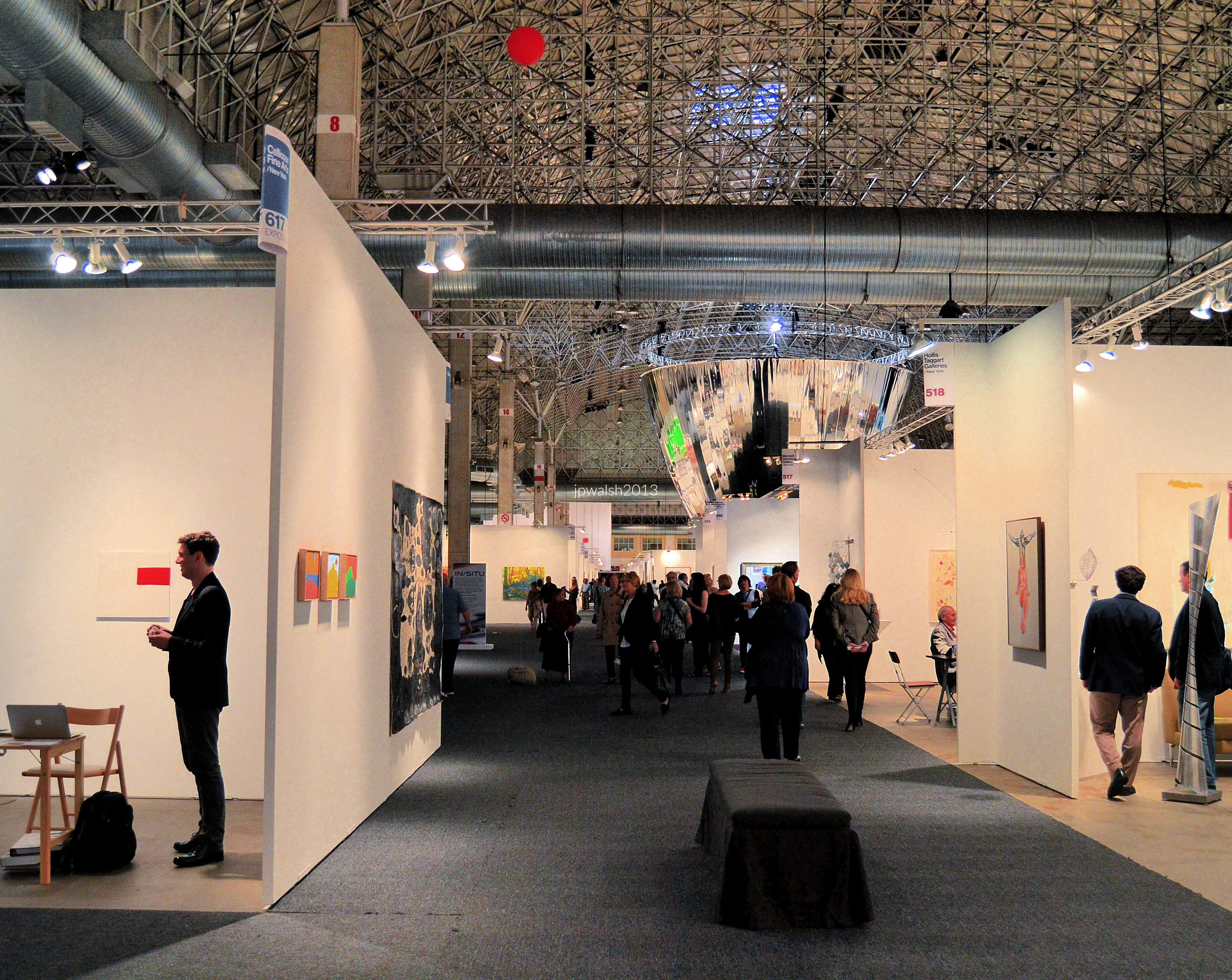
FEATURE image: EXPO CHICAGO 2014, Festival Hall, Navy Pier.
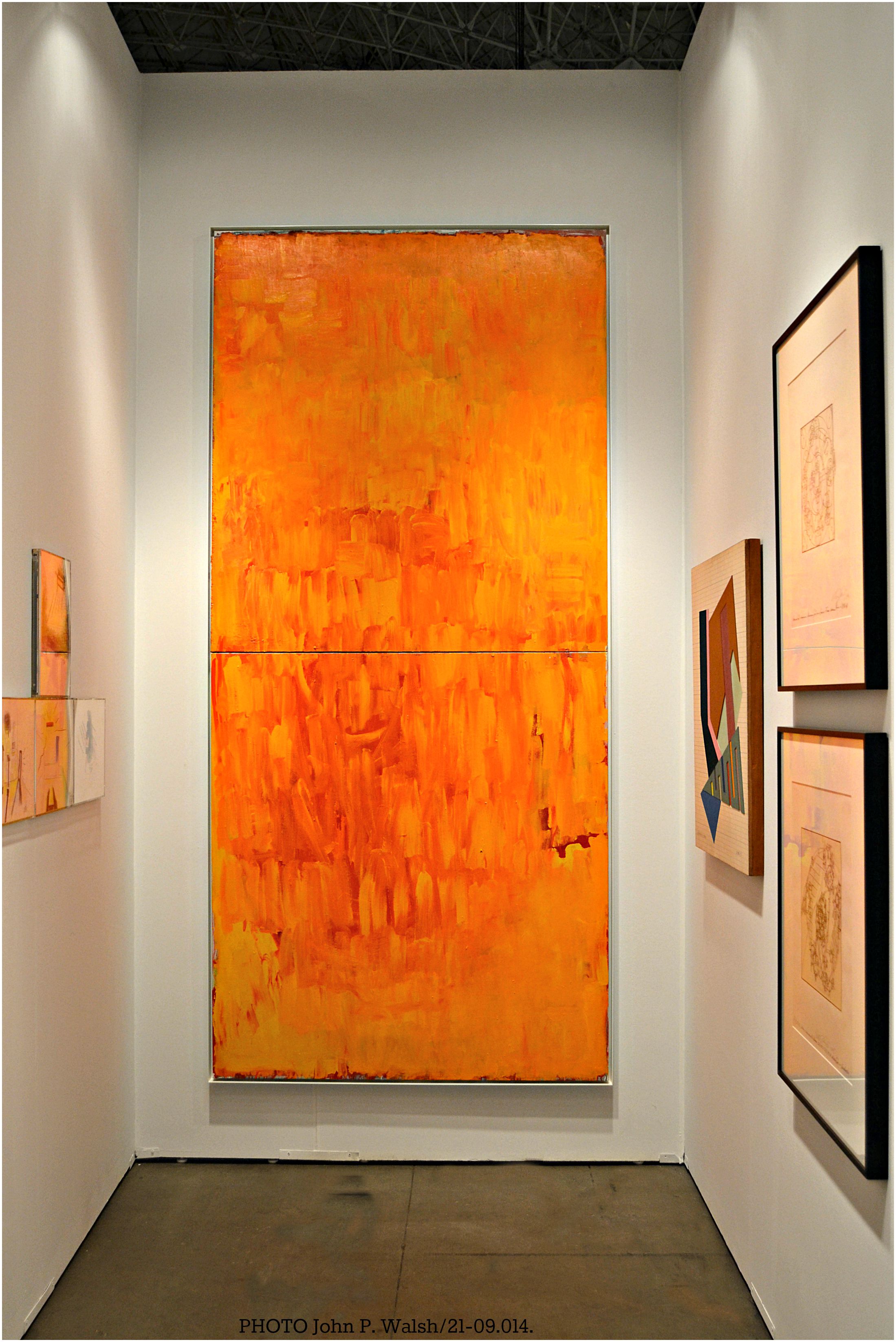
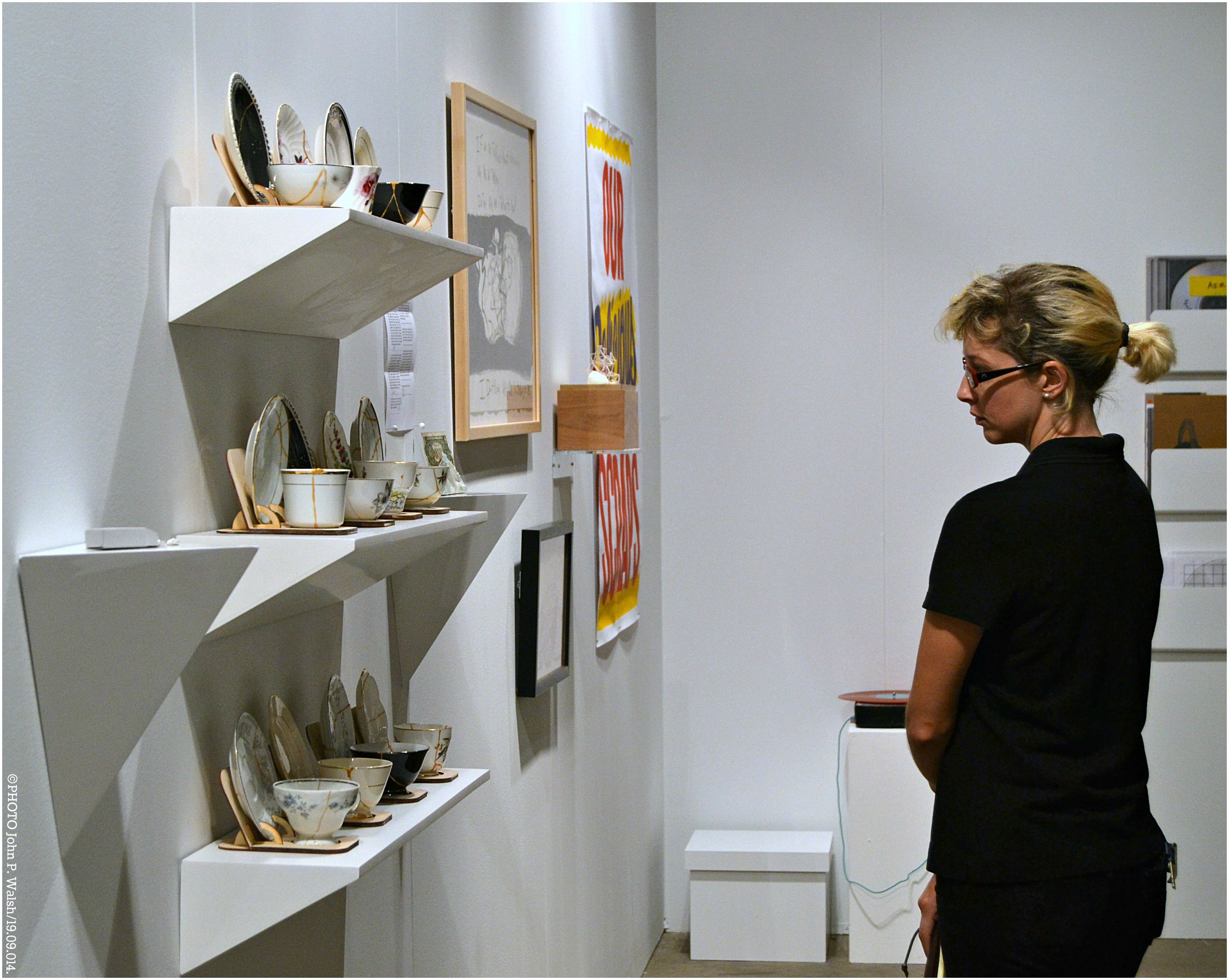
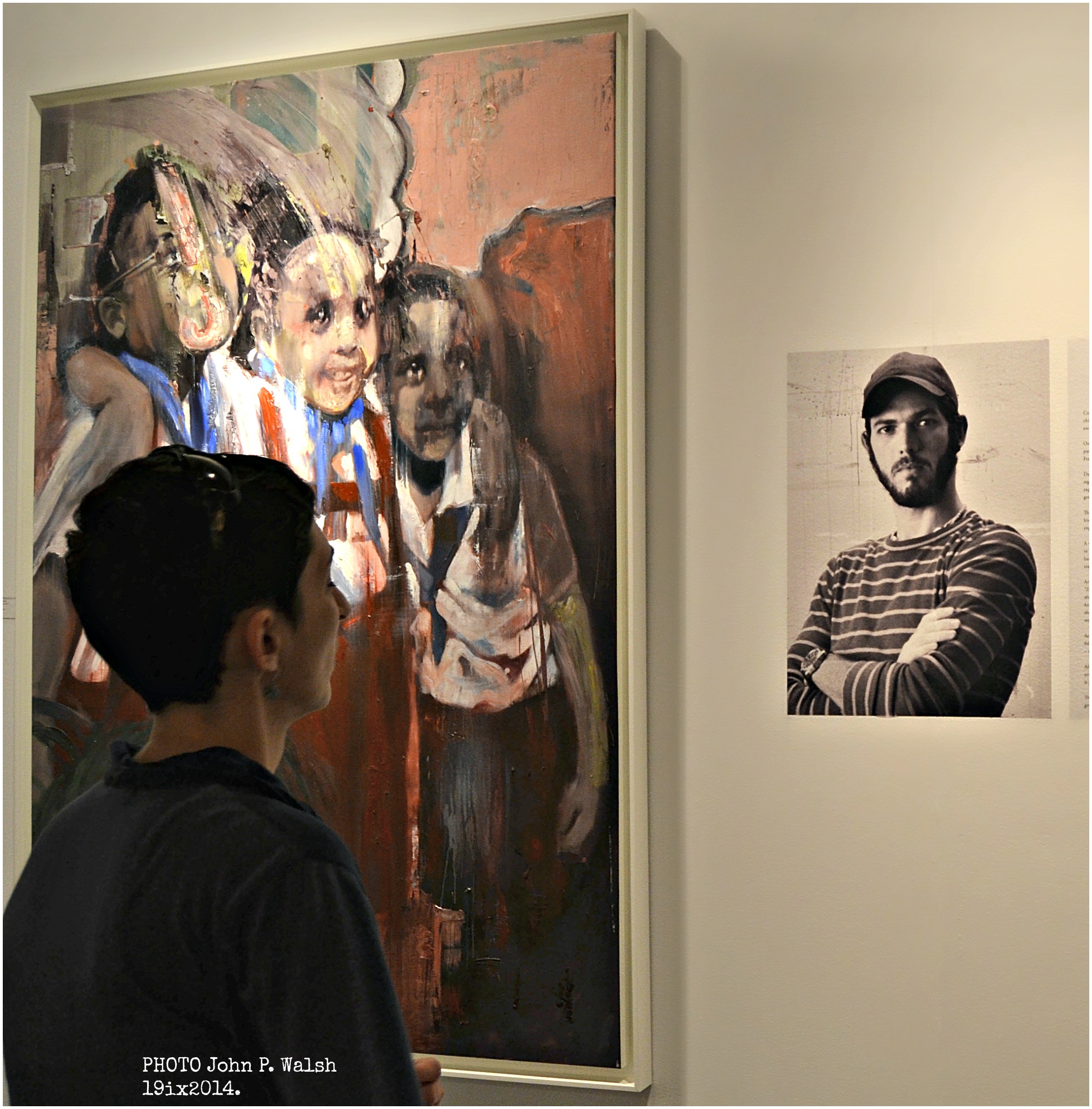
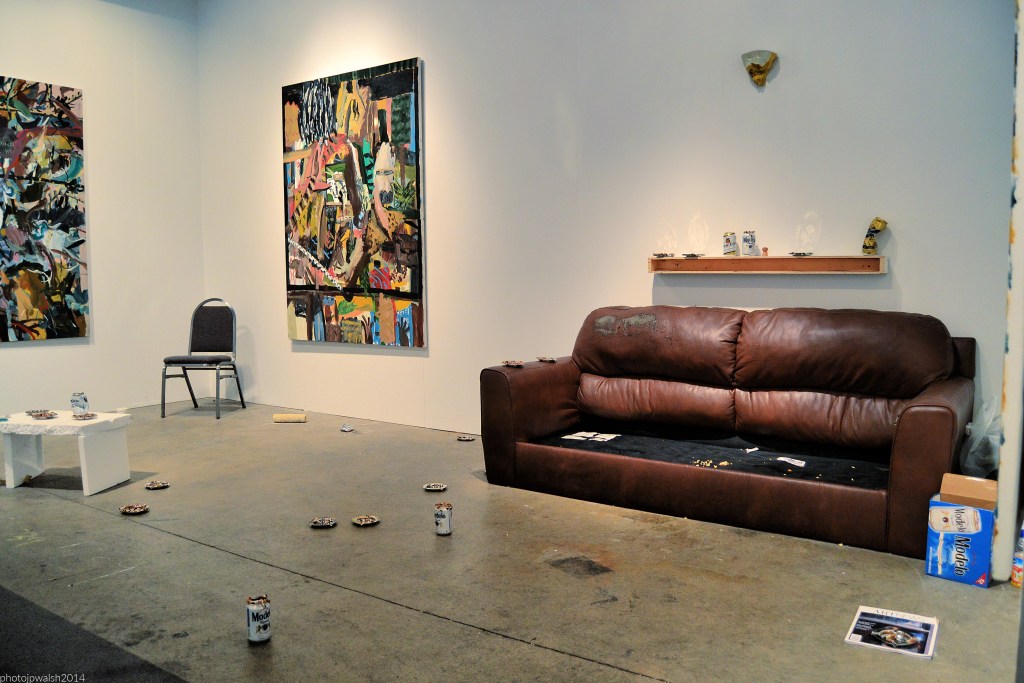
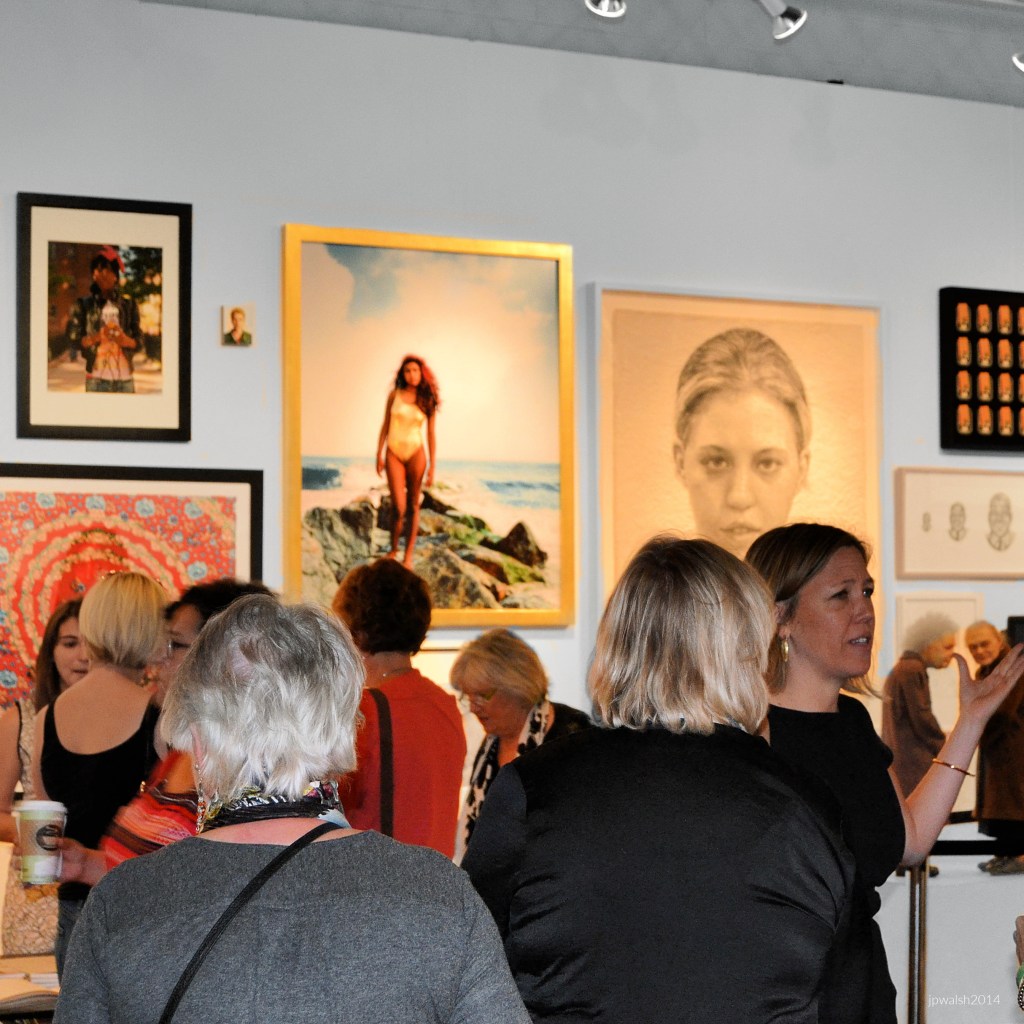
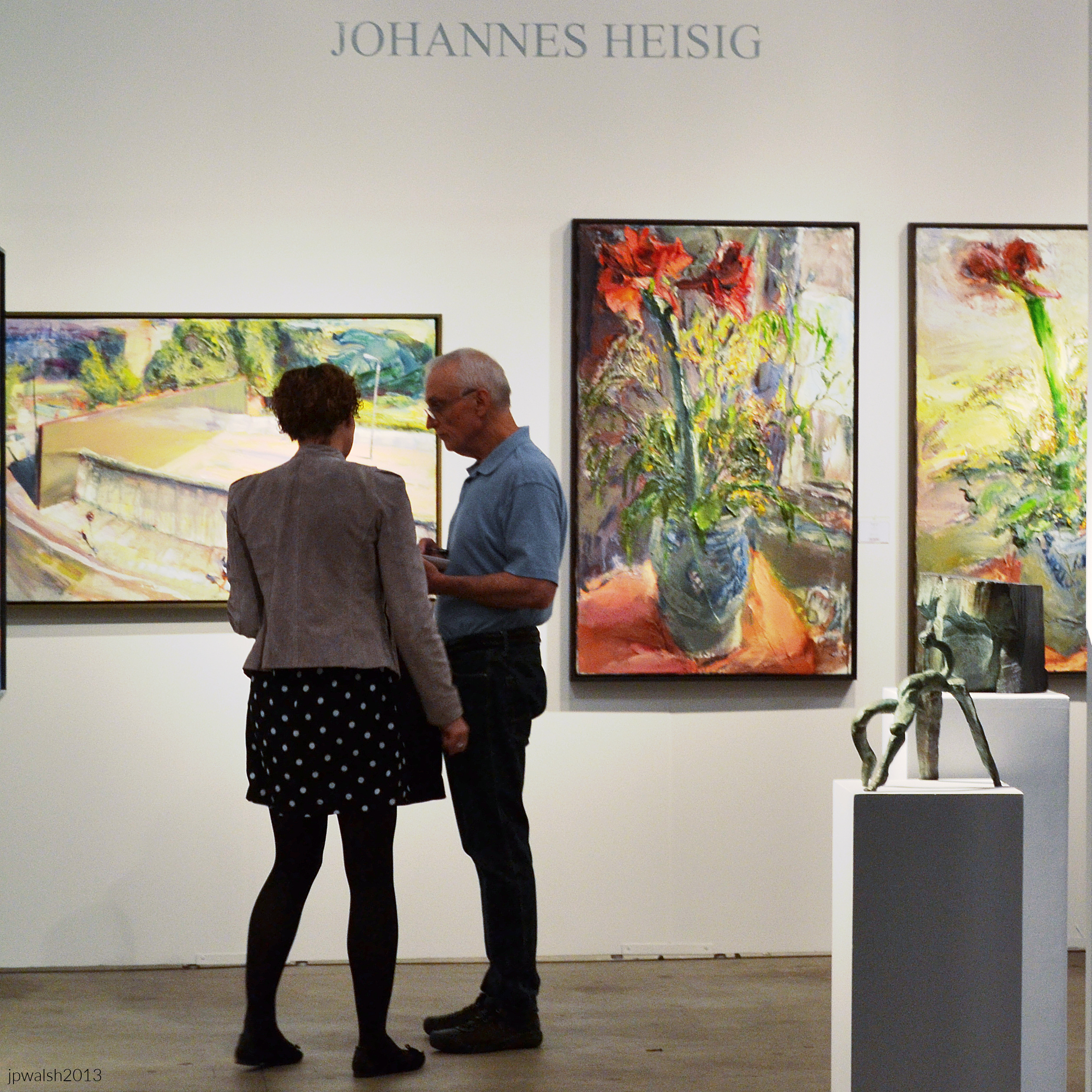
EXPO CHICAGO 2014 is the 3rd annual exhibition of international contemporary and modern art held in Chicago at Navy Pier’s Festival Hall on September 18 – 21, 2014. Photographs by John P. Walsh.
Mylar Cone designed by Studio Gang.
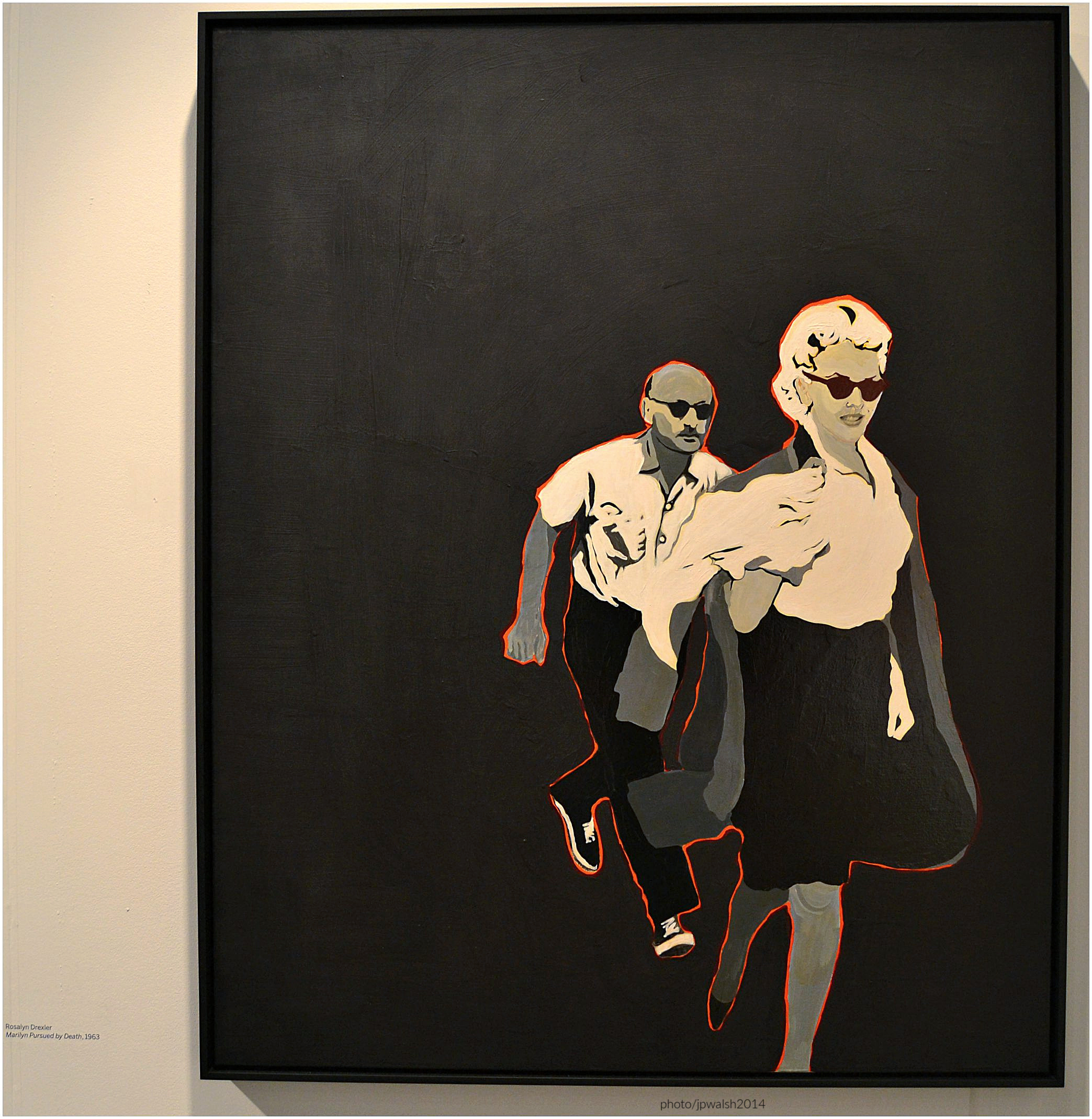
Rosalyn Drexler, Marilyn Pursued By Death, 1963, Fredericks & Freiser and Garth Greenan Gallery, New York City. This is based on a historical photograph of Marilyn as she was escaping the press.
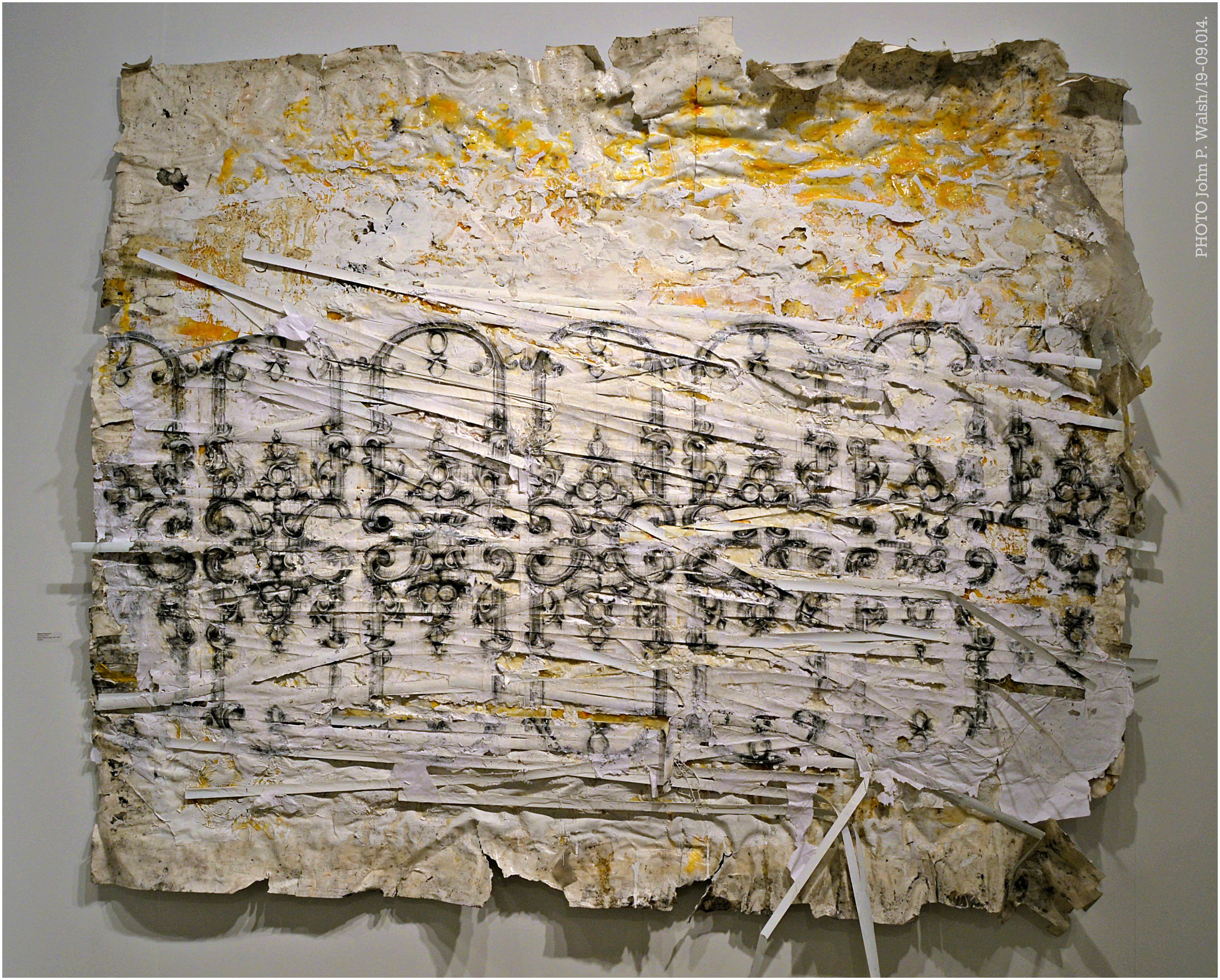
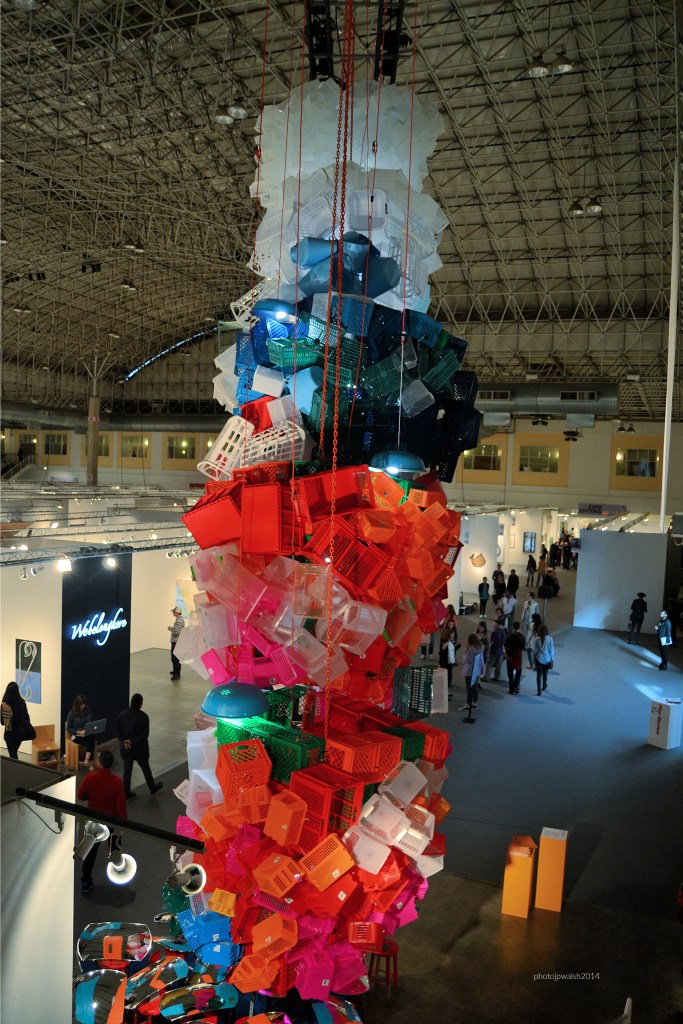
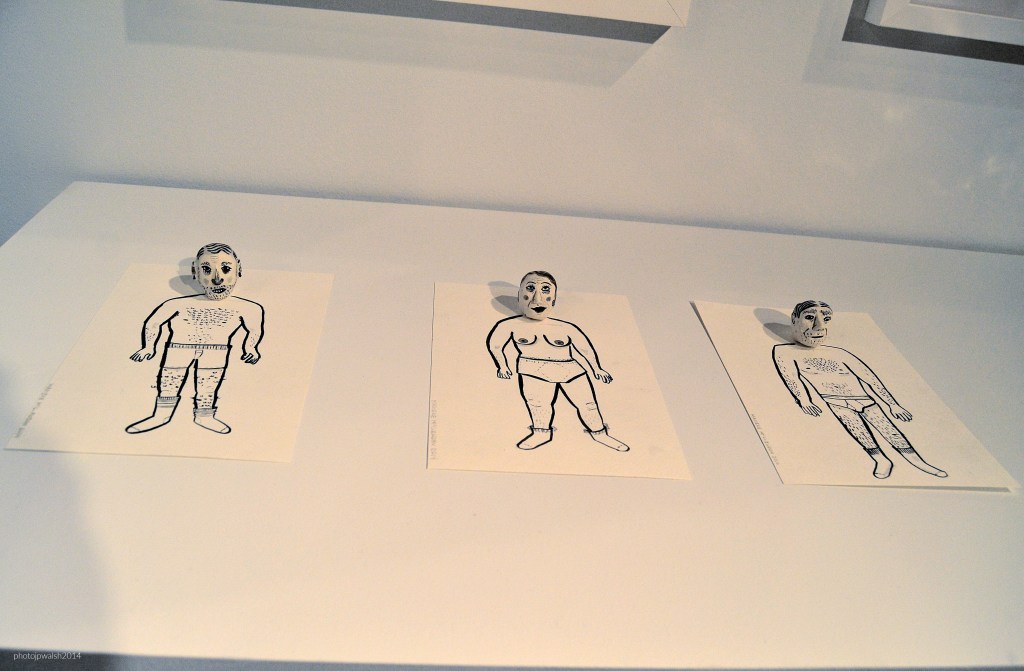
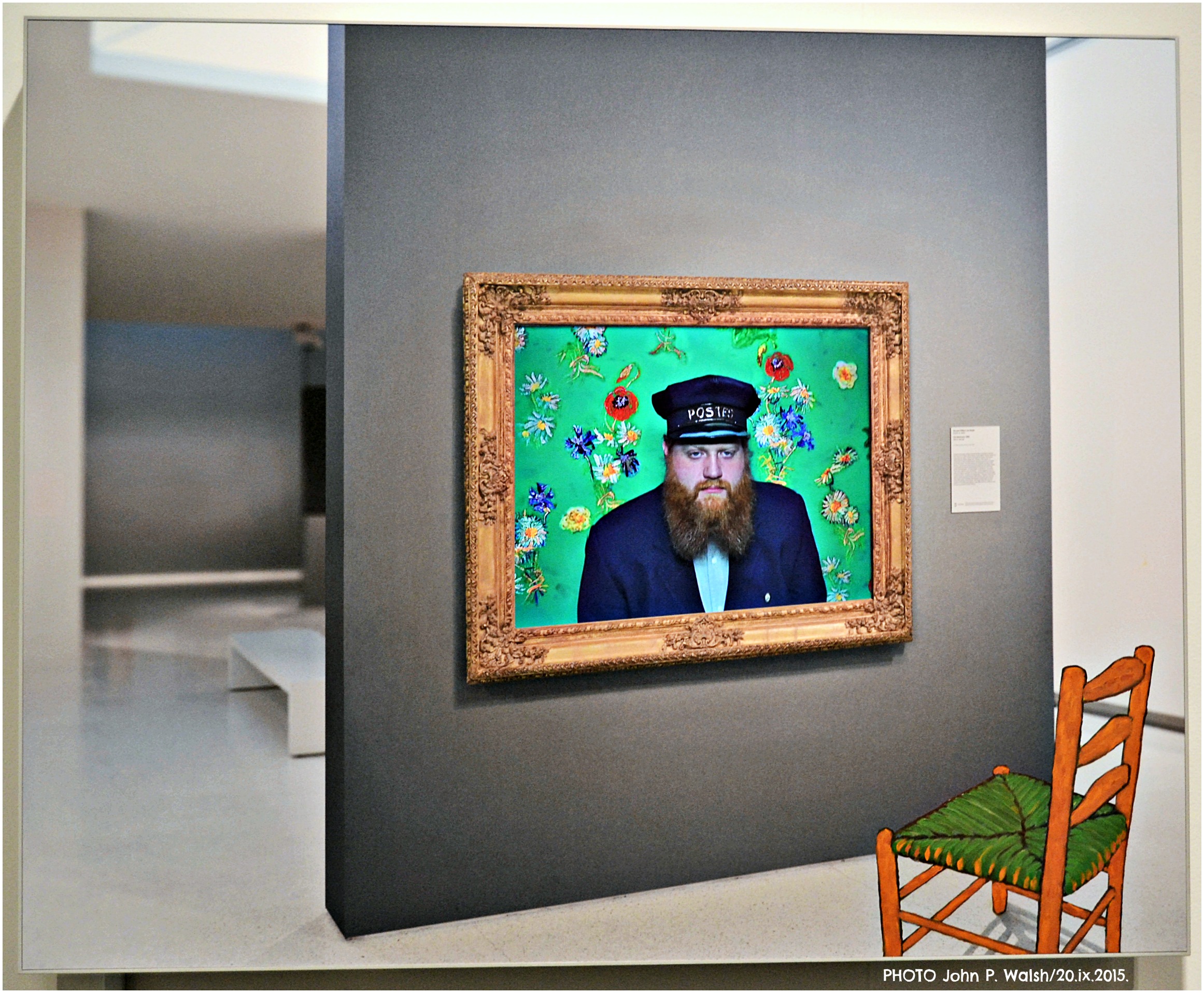
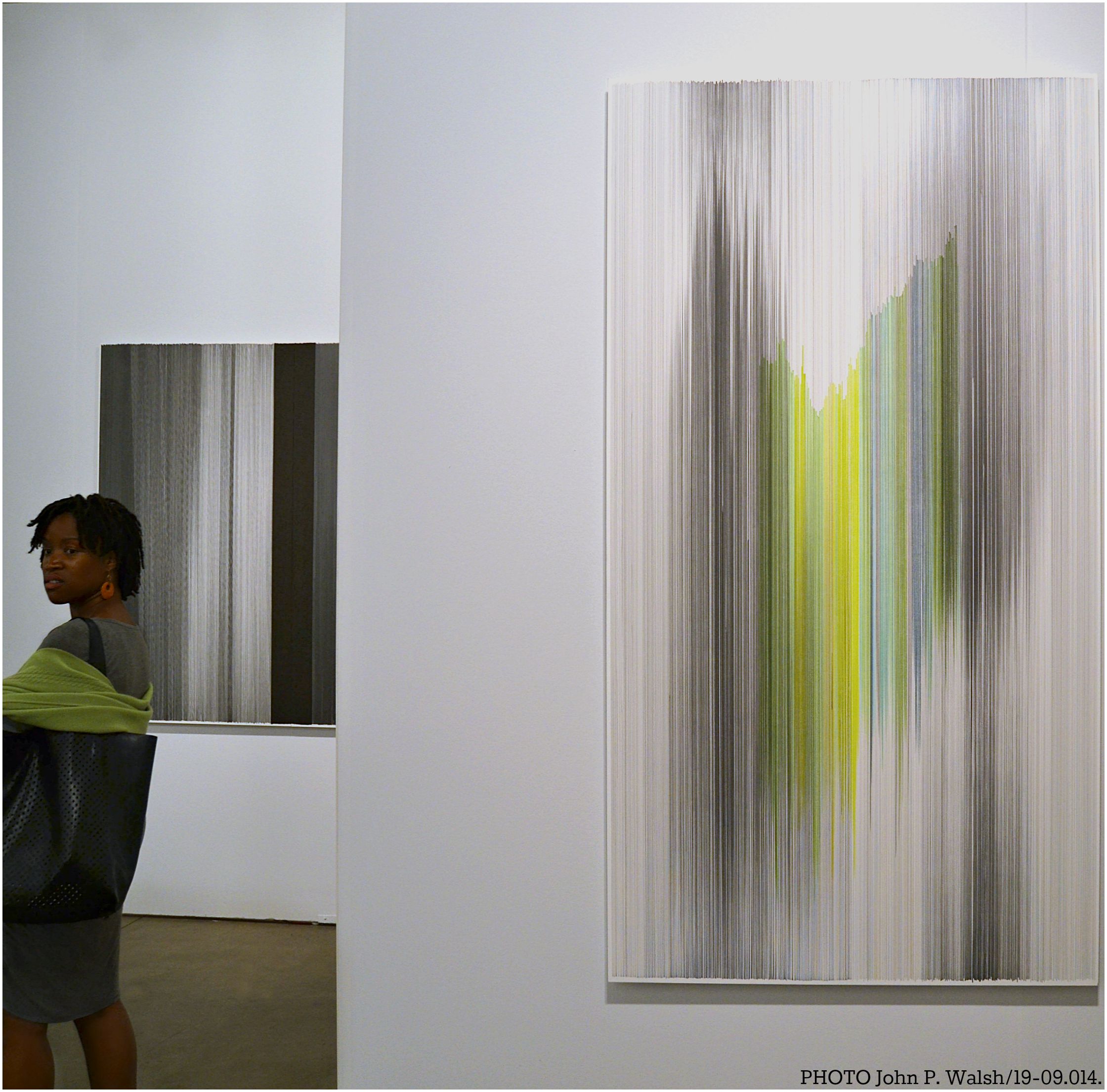
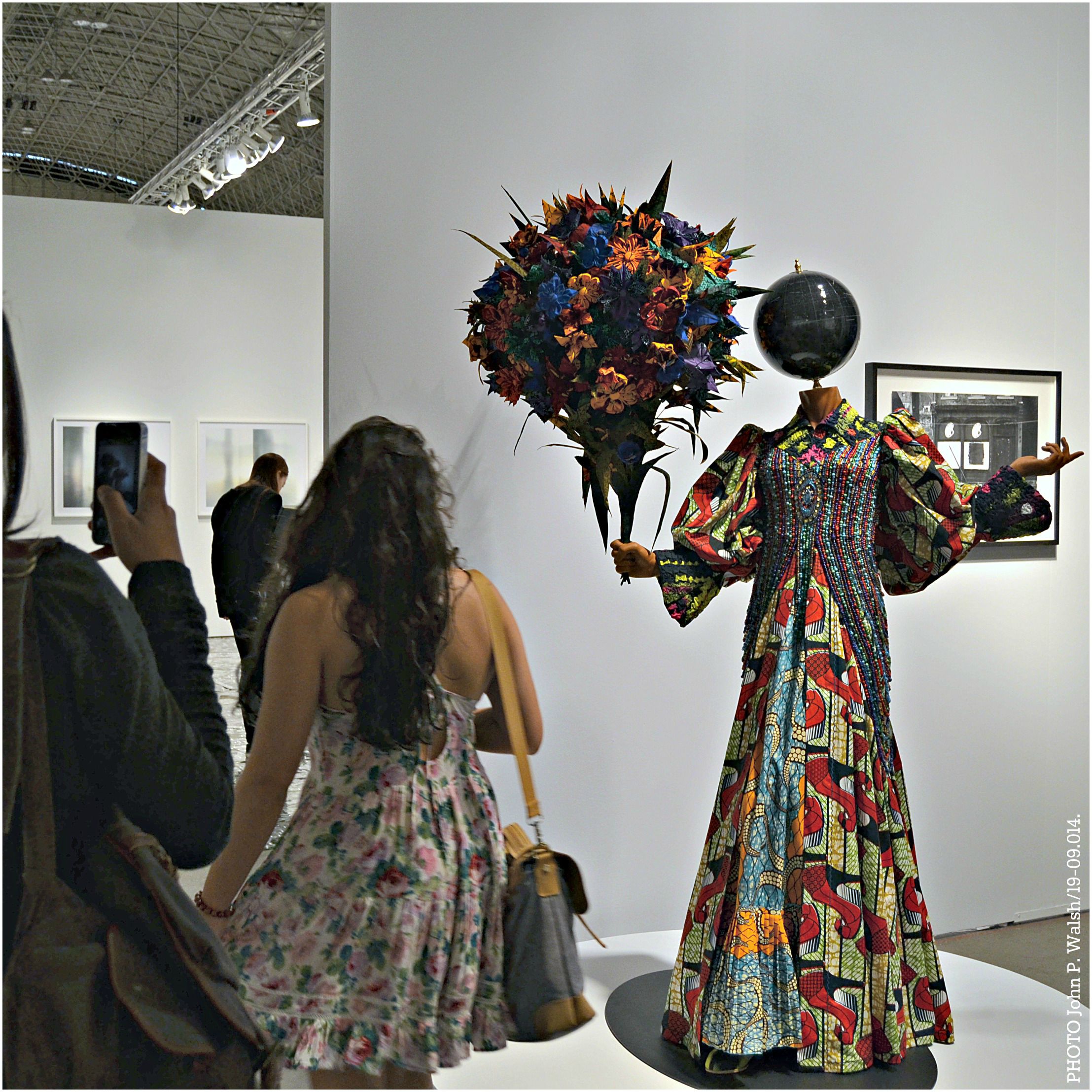
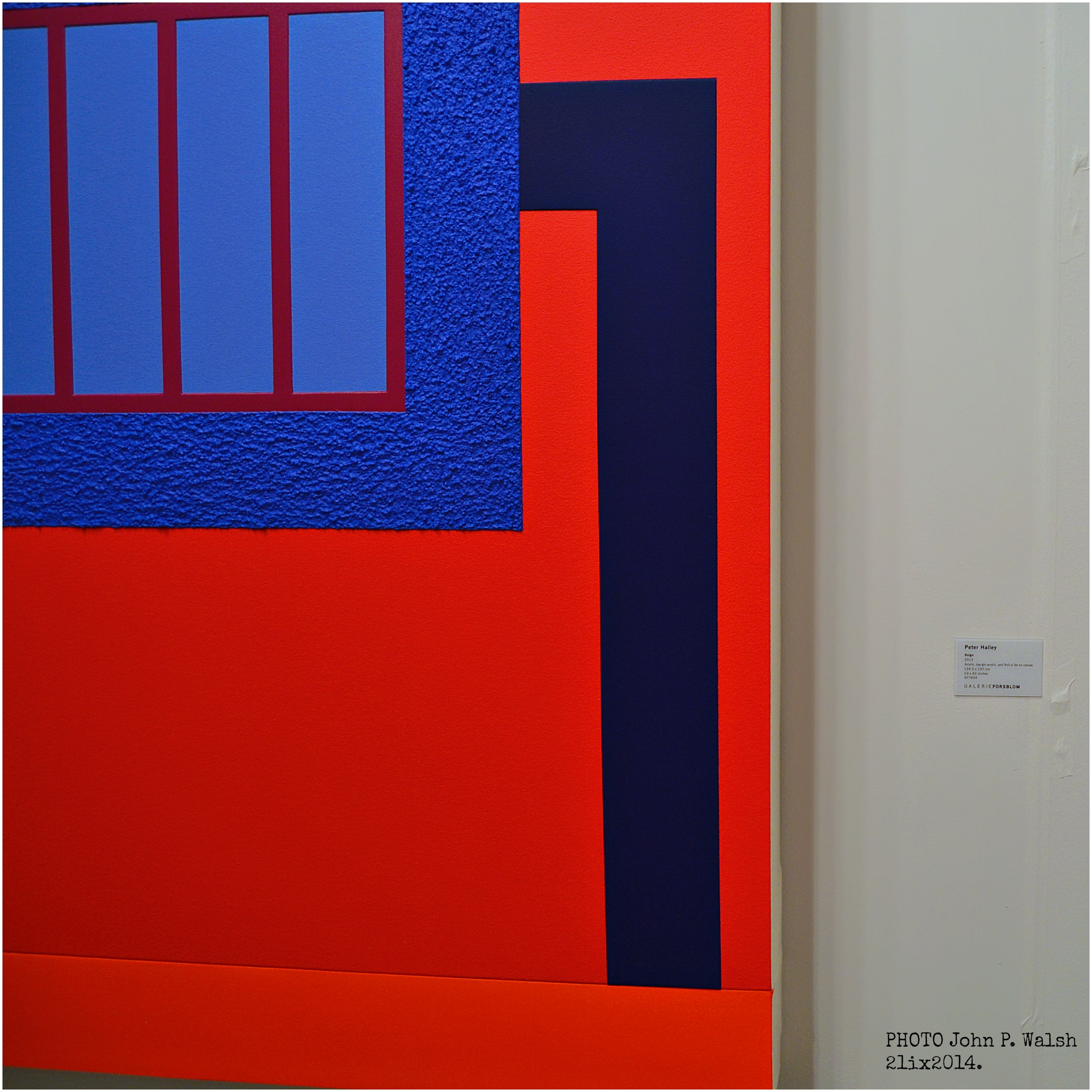
Christopher Le Brun (British, b. 1951), Friedman Benda, New York.Cernude Arte, Coral Gables, Florida. Michiko Itatani, Cosmic Kaleidoscope From the Pattern-Recognition 12 D 9, 2013, oil on canvas, 42 x 34 inches. Linda Warren Projects Chicago.Matthew Woodward, Polk Street, 2014, mixed media on paper, 101 x 96 in., Linda Warren Projects Chicago.Ramiro Gomez (American, b. 1986), American Gardeners, 2014, acrylic on canvas, 84 x 120 in., Charlie James Gallery, Los Angeles.Jessica Stockholder (American, b. 1959), Once Upon A Time, 2014, plastic, paint, mirrors, stools, carpet, chain, cables, staircase, resin, cords, light, bowls, lamp shade. Kavi Gupta Gallery Chicago/Berlin.Marieke McClendon, Clay Heads, ink on bristol board, ceramic, ShopColumbia Chicago.Works by Gideon Rubin (b. Israel,1973, works in London). Oil on canvas/linen/wood, 2009-14, and gouache on cardboard, 2012-14, Galerie Karsten Greve AG St Moritz.Nicholas Krushenick (1929-1999), Grill, 1977, Garth Greenan Gallery New York and Fredericks & Freiser New York.Expo video/2014.Gregory Scott, Van Gogh’s Bedroom, 2015, pigment print, oil on panel, HD video, Catherine Edelman Gallery, Chicago.Antonio Murado, Gardens, 2014, oil on canvas. Galeria Àlvaro Alcázar, Madrid.Three Walls Chicago.Elijah Burgher, Untitled, 2012-2014, paintings on unstretched canvas, Western Exhibitions, Chicago and Zieher Smith & Horton, New York. Anne Lindberg, Parallel 42, 2014, Graphite and colored pencil on mat board, 59 x 34 in., Carrie Secrist Gallery Chicago.Rene Portocarrero (1912-1985), Ornamental Figure in Brown Background, 1968, mixed media on paper laid down on board, 28 3/8 x 20 in., Cernuda Arte, Coral Gables, Florida.Alan Reid (American, b. 1976), Lisa Cooley Gallery New York.Henri Matisse, Marlborough Gallery New York Madrid Monaco Barcelona.Yinka Shonibare (British-Nigerian, b. 1962), Ms. Utopia, 2013, mannequin, dutch wax cotton textile, fiberglass, wire, globe, and steel baseplate. BlainSouthern, London, Berlin.. Lynn Chadwick (1914-2003), Rad Lad IV, 1962, ed. 2 of 8; Beast XX, 1956, ed. 6 of 9; Boy and Girl III, 1959, ed. 2 of 9. Bronze. BlainSouthern.John Wesley (American, b. 1928), Untitled, 2012 and Nicholas Krushenick (American,1929-1999), Wire Mill Road, 1972. Garth Greenan Gallery New York and Fredericks & Freiser New York.Alex Katz, Ena and Roberto, 1988, oil on linen, 41 x 62 in., Richard Gray Gallery, Chicago.Philip Pearlstein, Two Models with Four Geese Decoys, 1993, Watercolor on paper, Hill Gallery, Birmingham, Michigan.Tony Oursler (American, b. 1957), Galerie Forsblom, Helsinki.Aimé Mpane (b Kinshasa, 1968), Nude, wood and glue, 2008, Haines Gallery, San Francisco.Peter Halley, Reign, 2013, acrylic, day-glo acrylic, roll-a-tex on canvas, 53 x 62 in., Galerie Forsblom, Helsinki.Sandro Miller (b. 1958), Andy Warhol/Green Marilyn (1962), 2014, 29 x 29 in., Edelman Gallery, Chicago.Leonardo Drew (American, b. 1961), Number 34S, 2014, 31 x 41 x 11 inches, wood, Anthony Meier Fine Arts, San Francisco.Dayron González, Cernuda Arte, Coral Gables, Florida.Michelangelo Pistoletto (b. 1933), Golden Buddha and Mirror, 2008, Hollis Taggart Galleries, New York.Fernand Léger, Paysage Animé, 1937, oil on canvas, 35 7/8 x 23 1/4 in., Marlborough New York.Jina Park, A Genius, 2000, acrylic on linen, One And J. Gallery, Seoul.Tristian Koenig, Installation, Melbourne.
Minako Abe, Scene 29, 2011, oil on canvas, 35.8 x 92 in., Base Gallery, Tokyo.
David Hockney, Montcalm Pool, LA, 1980, oil on canvas, 12 x 16 in., Richard Gray Gallery Chicago.The Flag Art Foundation, New York, curated by Shaquille O’Neal.Mel Bochner, Money/Nothing, 2006, McCormick Gallery Chicago/Vallarino Fine Art New York.Sanford Biggers, David Castillo Gallery, Miami, Florida.Simon Edmondson, The Reader, oil on paper, 48 x 59.9 inches.
Manolo Valdés (Spanish, b. 1942, works New York City), Hojas II, 2014, Marlborough.
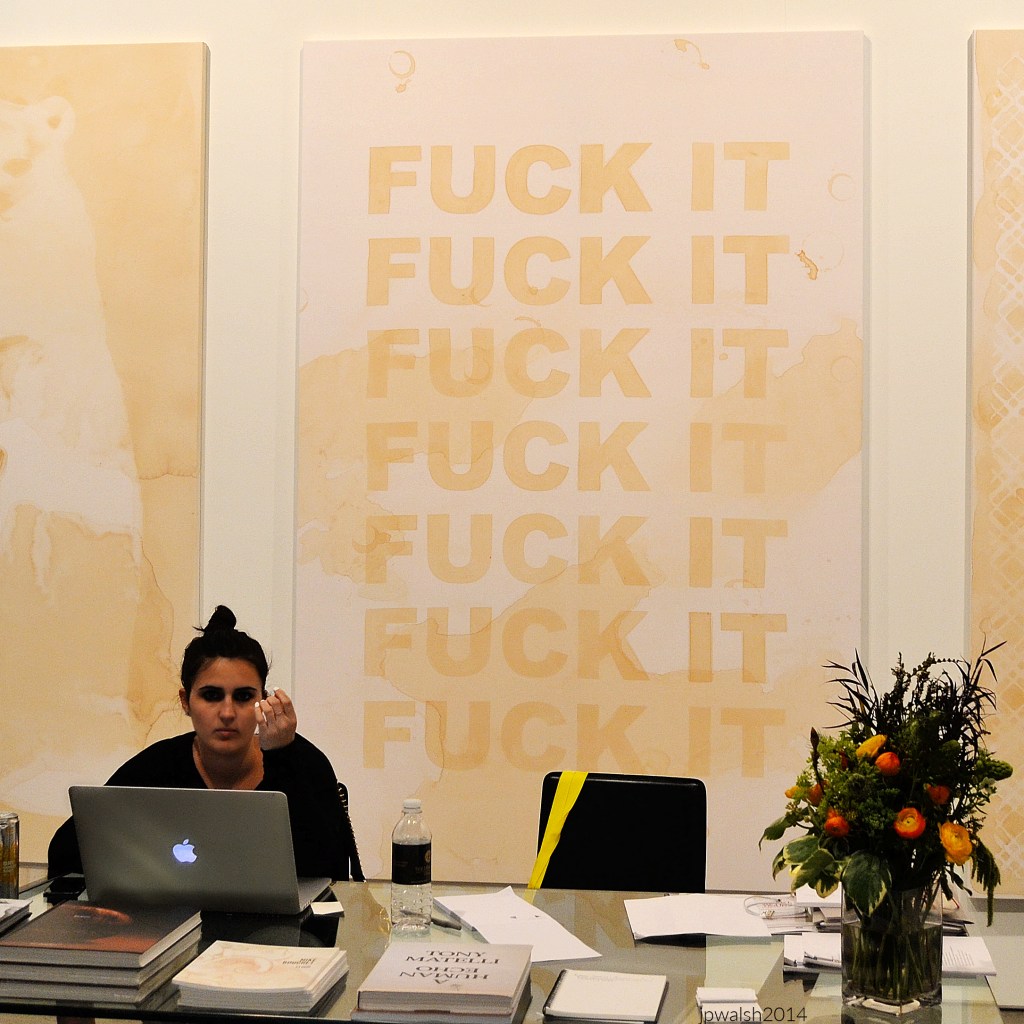
Manolo Valdés, Yvette, 2014, oil on burlap, Marlborough.Mike Bouchet, Fuck It, 2013, Marlborough Chelsea, New York.
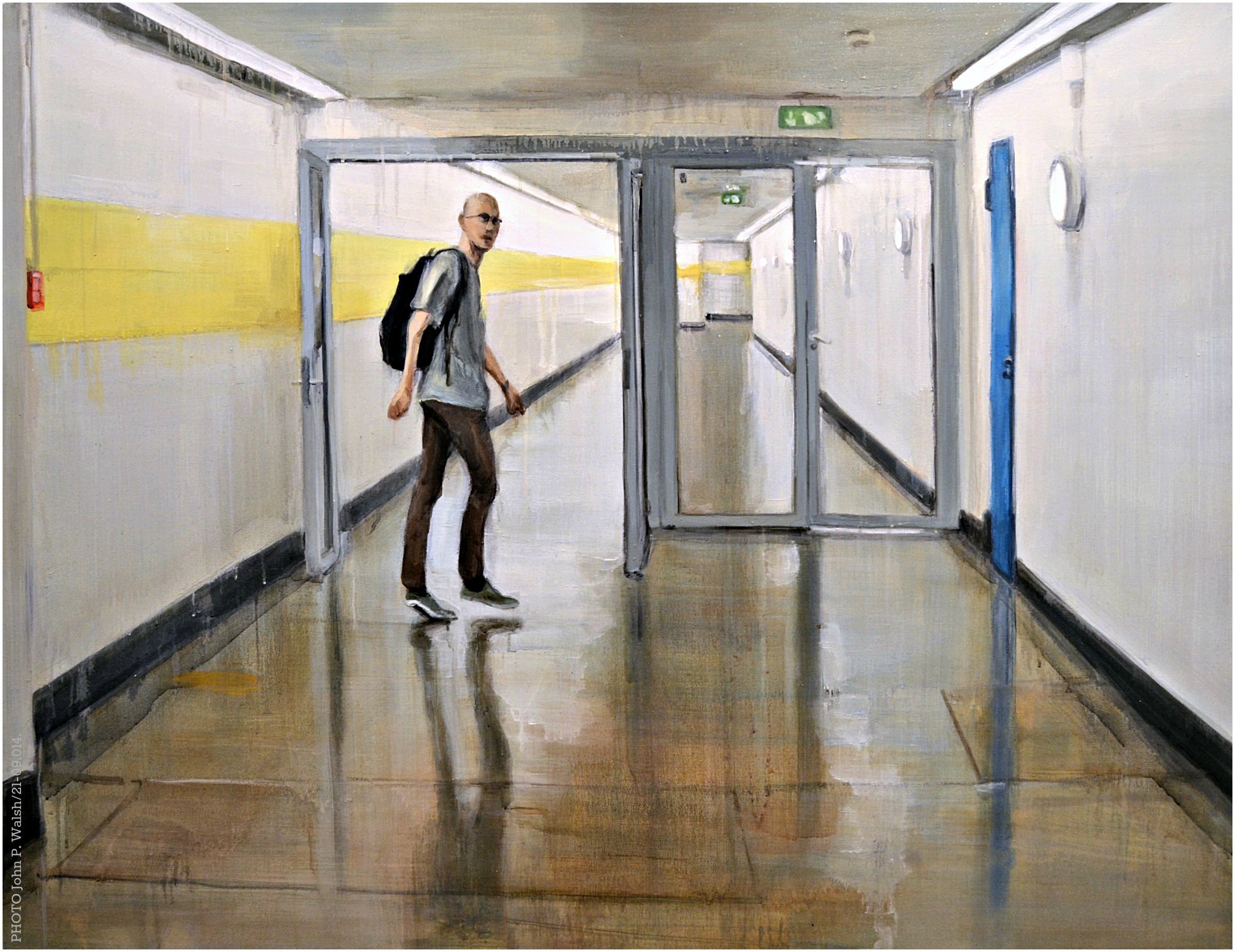
Jina Park, Automatic Door Follow Me, 2014, oil on canvas, 100 x 130 cm, One and J. Gallery, Seoul.
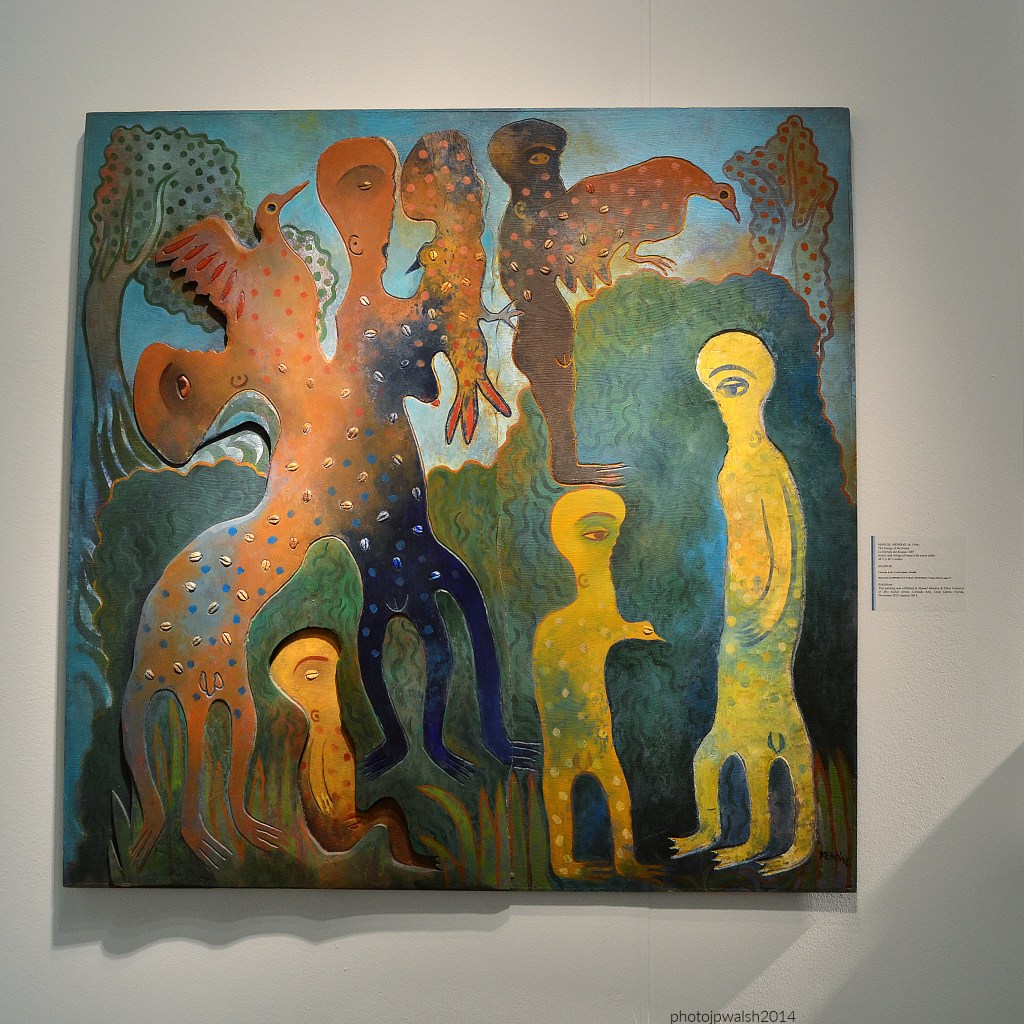
Manuel Mendive, La Energia del Bosque (The Energy of the Forest), acrylic and collage of wood with cowry shells, 2007. Cernuda Arte, Coral Gables, Florida.Alfred Leslie, Afternoon Soaps, 1983, oil on canvas. Hill Gallery, Birmingham, MI.
FEATURE Image: Glenn Kaino, Bridge, 2013. A section of a 100-foot long construction that features 200 gold casts of Tommie Smith’s arm in a raised fist salute that occured in the 1968 Summer Olympics on the medal podium during the national anthem after Smith broke a sprinting record to take gold.
EXPO CHICAGO 2013 is the 2rd annual exhibition of international contemporary and modern art held in Chicago at Navy Pier’s Festival Hall on September 19-22, 2013.
Tommie Smith at Expo Chicago 2013.
Tommie Smith is an American former track and field athlete and American Football League wide receiver. On October 16, 1968, the 24-year-old Smith won the 200-meter sprint finals and gold medal in 19.83 seconds at the 1968 Summer Olympics in Mexico City.
It was the first time the 20-second barrier was officially broken in competitive sports history. Atop the medal podium and with heads bowed, Smith’s Black Power salute with silver-medal-winner John Carlos protested racism and injustice against African-Americans in the United States.
Smith’s raised fist as the national anthem played is seen as one of the most overtly political statements in the history of the modern Olympics and caused memorable admiration and criticism.
In Silent Gesture: The Autobiography of Tommie Smith (Temple University Press, 2008), Smith maintained that the gesture was not solely a “Black Power” salute but a “Human Rights” salute.
In any event, Smith’s raised fist salute in 1968 became one of the most iconic moments in the Olympic games and the history of the Black Power movement.
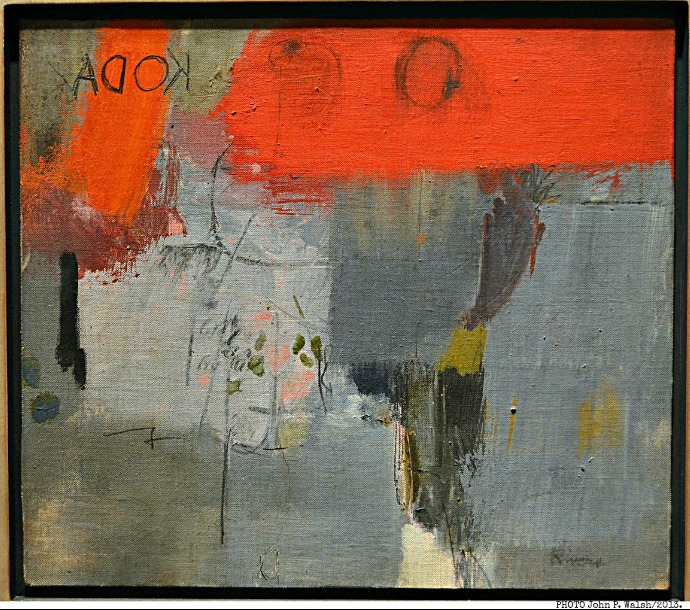
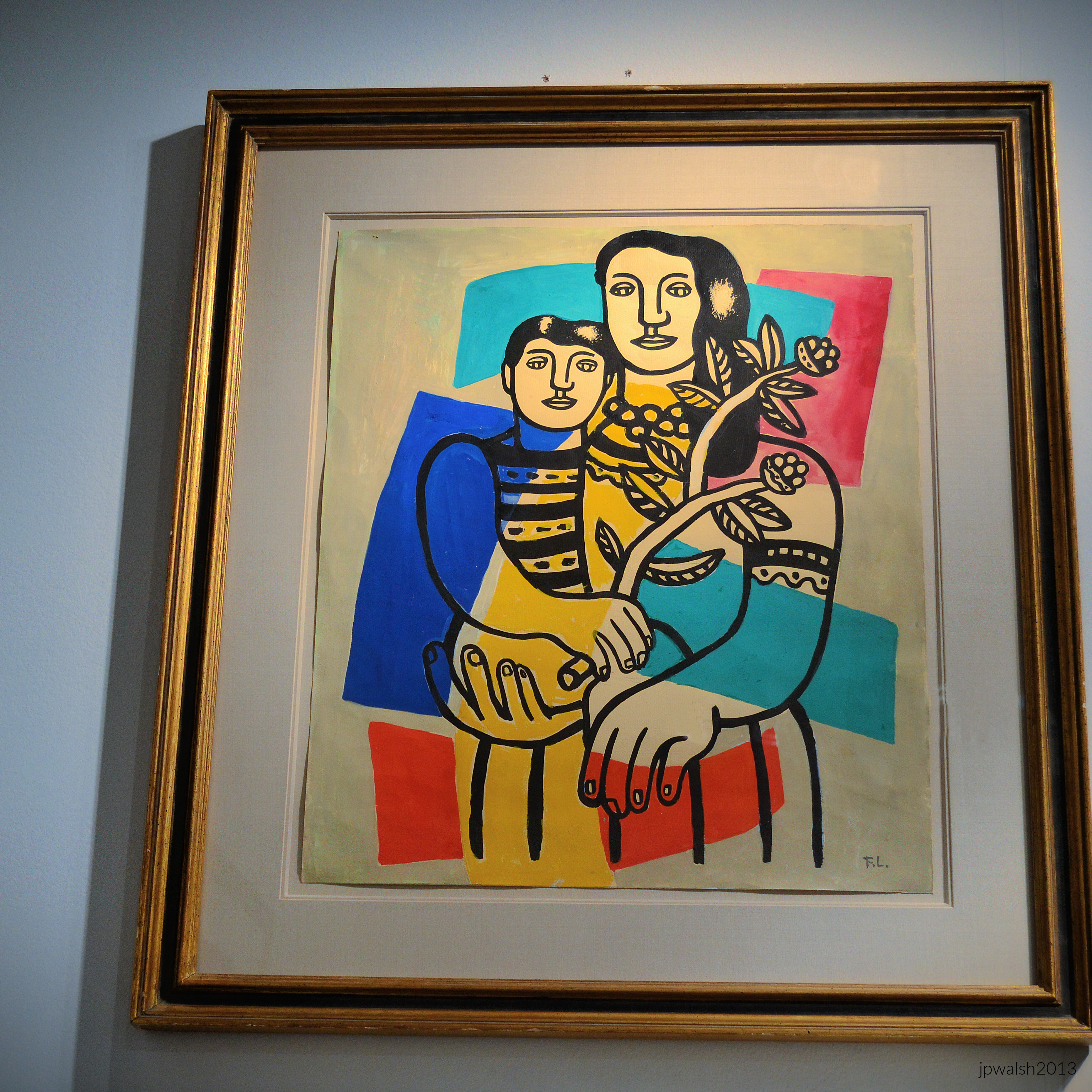
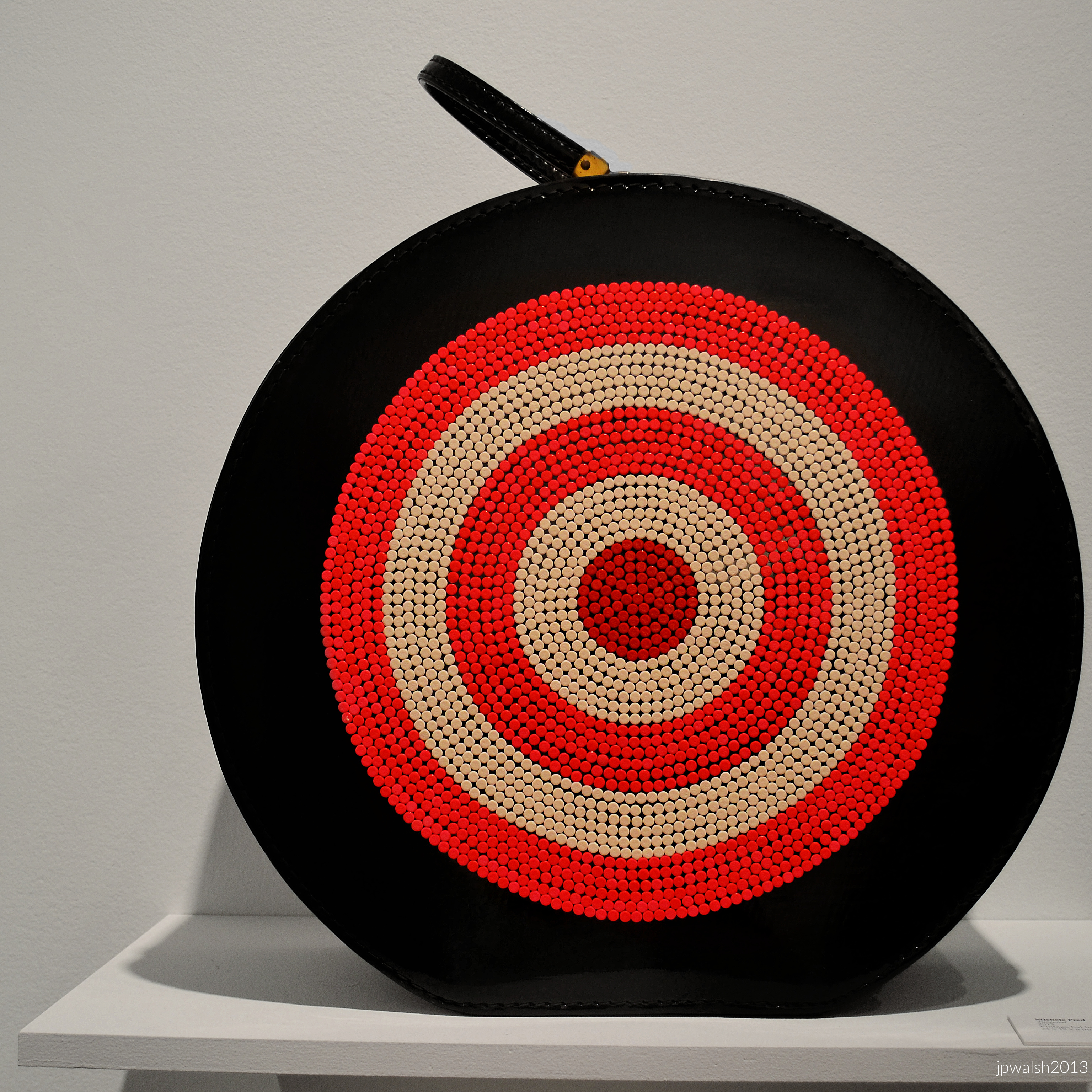
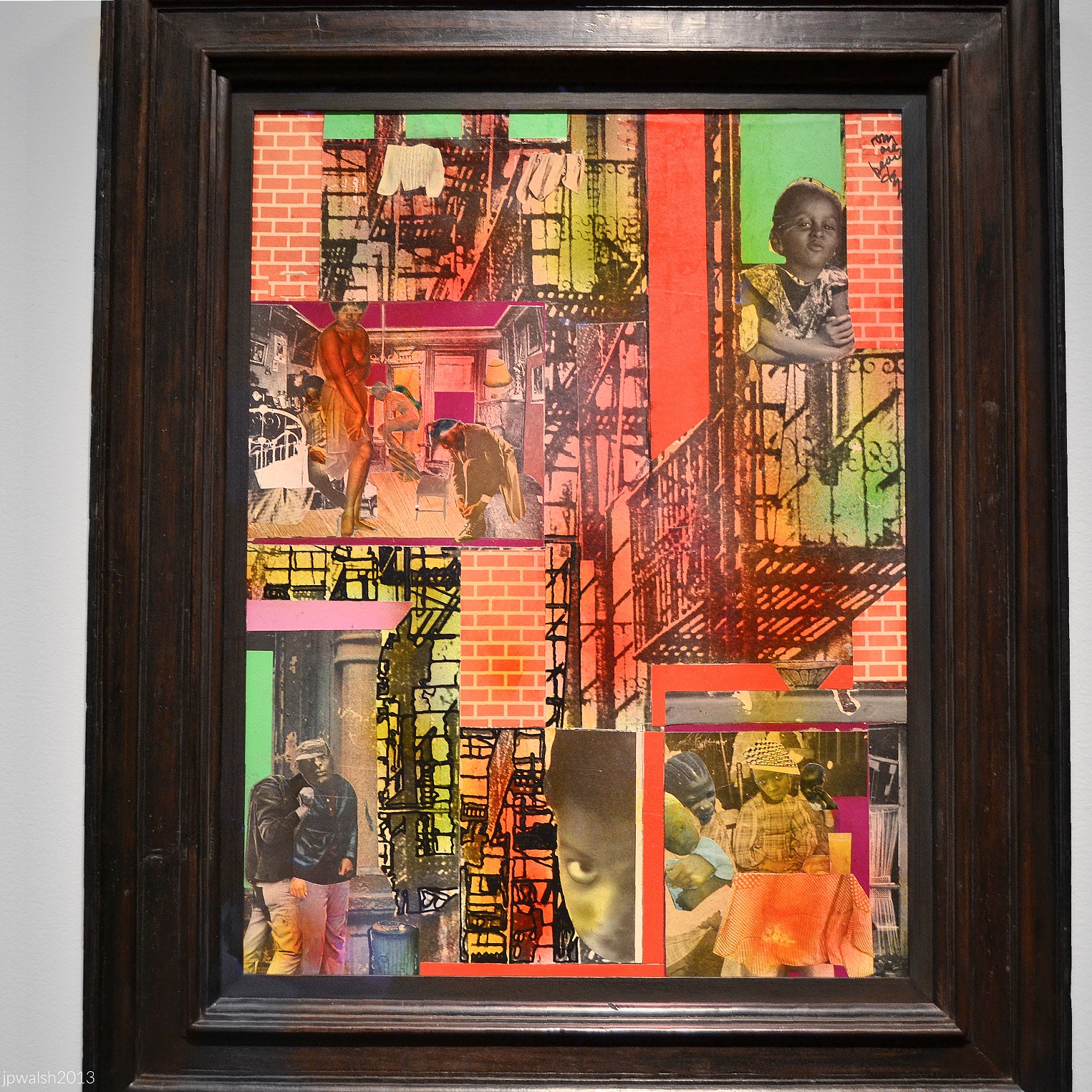
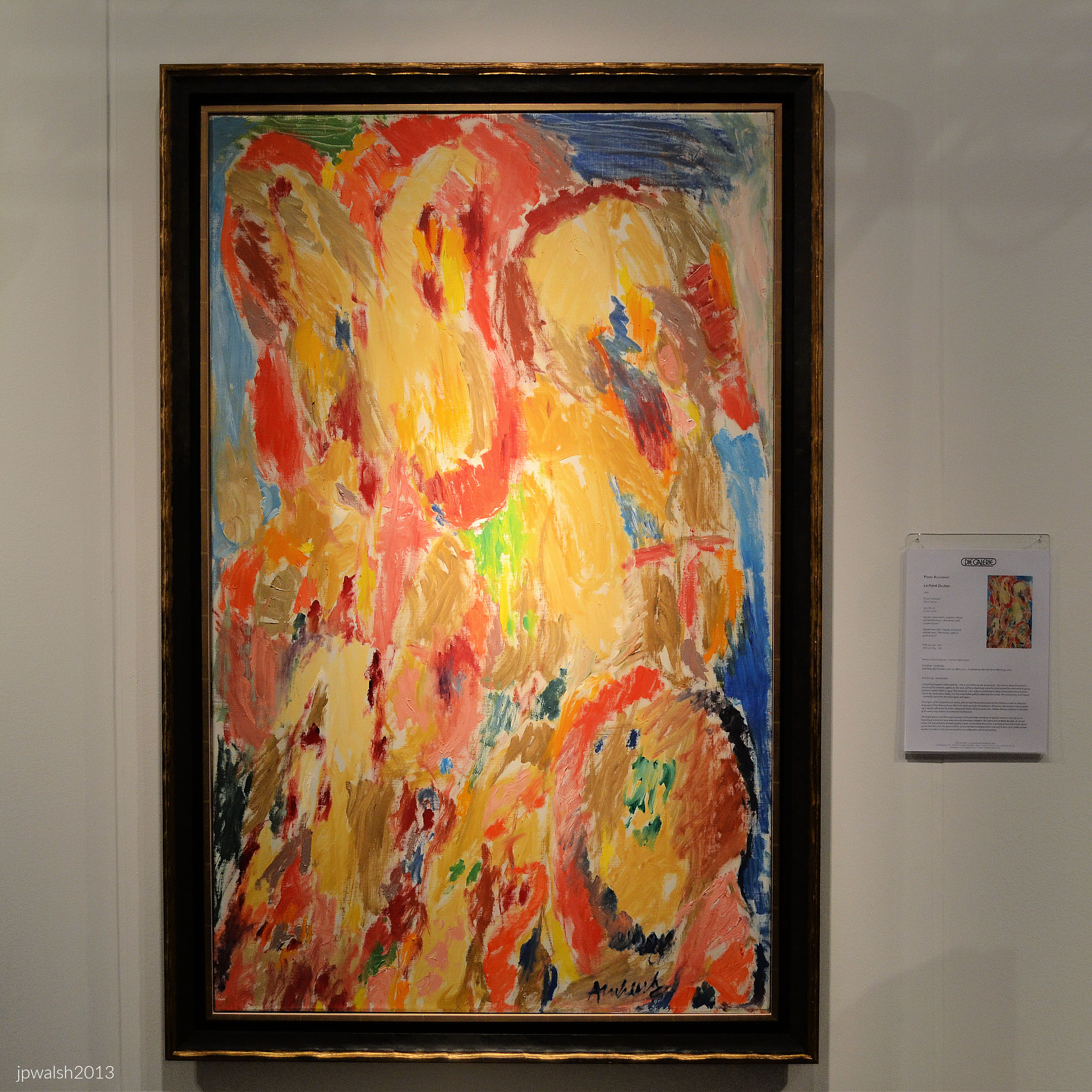
“1968 Black Power Salute” by urcameras is marked with Public Domain Mark 1.0.Robert Natkin (American, 1930-2010), Untitled, 1957, McCormick Gallery Chicago & Vallarino Fine Art New York.Hung Liu (American, Chinese, 1948-2021), Da Fa Che II, 2013, mixed media, 82 x 82 in., Nancy Hoffman Gallery, NY.Jack Roth (1927-2004), Metafour II, acrylic on canvas, 57 x 54 inches, 1980, McCormick Gallery, Chicago and Vallarino Fine Art, New York.Bruce Dorow (b. 1959), Black Shape Space, oil on canvas, 38 x 65 inches, 2012-2013. R.S. Johnson Fine Art, Chicago.Patrick Strzelec, American sculptor. Garth Greenan Gallery, Chicago.William T. Kennedy, Warhol Holding Marilyn Acetate 1, executed 1964, 2010. The photograph was made when Warhol wasn’t yet famous but at the center in a shift in the culture of the art world.Aimé Mpane (Congo, born 1968), IC Cont Series, 2011-2013, acrylic and mixed media on wood panel, 12.5 x 12 x 2 in., Haines Gallery, San Francisco.Larry Rivers (American, 1923-2002), Small Drugstore, 13.5.x.15.25 inches, oil on canvas mounted on board, 1959. Techniques of color-field painting, gestural abstraction, and calligraphy come together in a picture that is objective and abstract.Jonathan Boos, LLC, New York.Fernand Léger (1881-1955) – Mother and Child, c. 1949, gouache, signed with initials. R.S. Johnson Fine Art Chicago R.S. Johnson Fine Art, Chicago. Top left: Fernand Léger (1881-1955), Mère et Enfant, 1949, gouache; right: André Lhote (1885-1962), Les Acacias, 1959, oil on canvas. Michele Pred, Targeted, 2012, Vintage hat bag, birth control pills, 24x1x6 inches. Nancy Hoffman Gallery, New York. Michele Pred incorporates aspects of contemporary culture and politics in her art. The Berkeley, California, artist uses unconventional materials that serve as cultural artifacts for her conceptual approach.Romare Bearden (American, 1911-1988), Manhattan Suite, 1975, collage and mixed media on board, 24 x 18 inches, Jonathan Boos, LLC.50%. Elizabeth Catlett (American, 1915-2012), Star Gazer, 1997, black marble, 14.5 x 32 x 11 in., signed. Jonathan Boos LLC. Catlett is known for depictions of African-American and Latin American working-class women using simple, solid shapes in wood, stone, bronze or clay.Haines Gallery, San Francisco.Siebren Versteeg (American, b. 1971), Good Times_1081_2003_05_09, 2012, Algorithmically generated archive inkjet output to paper, tape. 92 x 56 inches, Rhona Hoffman Gallery, Chicago. The New York-based artist was educated at the SAIC and UIC. Mined digital content is presented as painterly abstractions or monitor displays.Die Galerie, Frankfurt am Main.Long–Bin Chen (Taiwan, born 1964), Edvard Grieg, 28x29x15 inches. New York-based Long-Bin Chen transforms paper products into sculpture. Books are constructed so that relevant subject parts and often titles fit together seamlessly.Mary Ellen Mark, John Belushi “Blues Brothers” Chicago IL, 1979 Gelatin silver print, 16 x 20 in. each, signed dated numbered (verso).Pierre Alechinsky, Le Point du Jour, 1966, oil on canvas, 130×81 cm, signed lower right and signed dated entitled (verso). David Park (1911-1960), Head of Lydia, 25×24 in., oil on canvas. 1953. In the late summer of 1949 David Park rejected abstraction and started the pusruit of objective subjet matter, including the mother of Helen Park Bigelow.
FEATURE image: Rev. Dr. Martin Luther King Jr. is joined (from left) by Rev. Ralph D. Abernathy, James Forman, Rev. Jesse L. Douglas, and John Lewis at a march for voting rights in Alabama in 1965. King would come to Chicago in January 1966. Fair Use.
By John P. Walsh
The first nonviolent civil rights campaign in the North led by the Southern Christian Leadership Conference (SCLC) started in Chicago, Illinois, on January 5, 1966—50 years ago this month.
The multi-pronged campaign was Rev. Dr. Martin Luther King Jr.’s first major effort outside the South and the first following the Civil Rights Act of 1964 and Voting Rights Act of 1965. King’s coming to Chicago was greatly influenced by the Watts riots in August 1965 where those deadly six days demonstrated to King and the nation the high cost in human lives and property associated with deep discontentment in the black community over isolating and chronic high unemployment, substandard housing, and inadequate schools.
King’s consideration to come to Chicago in 1966 was further energized by national issues activated by a local focus: in this case, King’s broad support for recent Federal complaints brought by the Chicago Coordinating Council of Community Organizations (CCCO) alleging segregation in the Chicago public schools. As there was a huge new Federal aid package for those public schools in the nation which desegregated by the start of the 1965-1966 school year, a charge of segregation in a state in the north and in the nation’s second largest city was unexpected, provocative, and dangerous to the natural progression of the status quo.
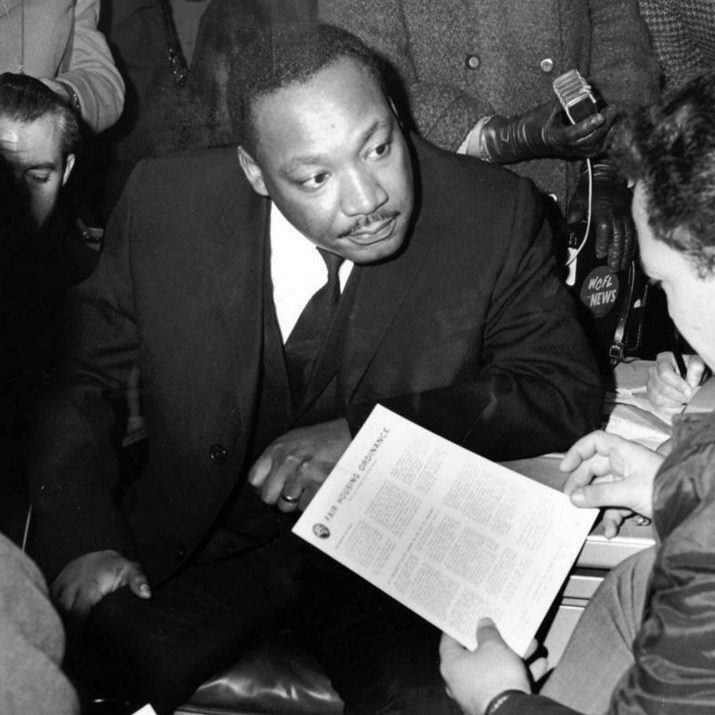
Led by former school teacher Albert Raby (on KIng’s right), the CCCO was a coalition of a number of disparate and sometimes contentious groups including the local branches of CORE, the Catholic Interracial Council, and the Urban League, among others. Here, King and Raby meet the Chicago press along with SCLC leader Bayard Rustin (on King’s left).
The status quo in Chicago, at least in terms of its politics, was embodied in one man: Mayor Richard J. Daley (1902-1976). King’s intention to come to Chicago instead of to another big northern city was that he figured to find in Mayor Daley a powerful ally to his civil rights movement. Already Daley vocalized agreement in principle with King’s message of open housing and racial justice, but King’s potential challenge to any aspect of the mayor’s absolute political power never gained Daley’s sympathy or recognition.
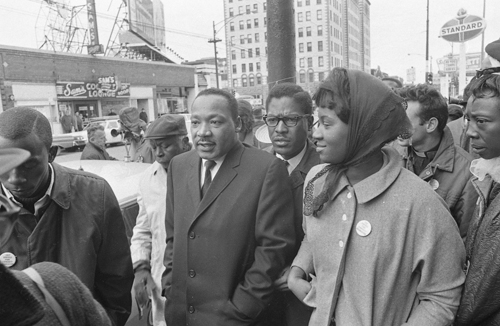
Many in Chicago’s local civil rights community, however, welcomed Dr. King’s presence in Chicago in 1966. Activists like Dick Gregory (1932-2017) had marched on City Hall — and into the Bridgeport neighborhood to Daley’s home — dozens of times but to no avail in terms of tangible policy changes for blacks in a city where blacks constituted 25% of its population. Perhaps the efforts of Dr.King in Chicago could break the deadlock.
The U.S. Commission on Civil Rights had recently labeled Chicago “the most residentially segregated city in the nation” but Daley chose to see it differently. There was no legal segregation in Chicago and Daley believed it was simply a “city of neighborhoods.” The 63-year-old Daley also felt that if government handouts were not downright un-American then, by 1965, big Federal programs should be administered at the local or city level and not from Washington. Daley’s calculation, a lawyer since 1934, always included his concern for the augmentation and not diminishment of his political power.
Stevie Wonder’s single “Uptight (Everything’s Alright)” was released in late November 1965 and peaked at no. 3 on the Billboard Hot 100 in early 1966 and was no. 1 on the Billboard R&B Singles chart for 5 weeks. Co-written by 15-year-old Stevie Wonder, the song was a watershed for his career. It was one of three singles in the early-mid1960’s that peaked in the top 40 on both charts and “Uptight (Everything’s Alright)” also launched the next stage of Wonder’s recording career into the second half of the 1960’s.1920’s flats in Bridgeport in 2015, the Chicago neighborhood of Mayor Richard J. Daley.Chicago slums, 1950.
While Daley’s home rule views appealed to some Chicagoans, other Chicago neighborhoods stayed in flux. There had been a longstanding mistrust, for example, between poor West Side residents—most of whom were black and concentrated by the mid1960’s into a vast ghetto—and a largely white Chicago police and fire departments. In the summer of 1965 street riots in West Garfield Park effectively produced the integration of 40 of 132 firehouses where calls for integration had been resisted since the early 1950’s.
The City of Chicago’s contrariness to aspects of President Johnson’s Great Society carried into the office of Chicago’s Education chief Benjamin C. Willis (1901-1988). In October 1965 Willis defied federal mandates for the release of requested materials as well as blocked the use of new national achievement tests in city public schools. This led to Chicago being temporarily denied their part of the massive $1.3 billion federal aid to schools program.
Benjamin C. Willis in 1963.
The overall alliance of Mayor Daley and President Johnson was strong in late 1965 so that the federal aid money called into question was restored within the week. Further, the federal official who had challenged the political power structure by citing Daley’s public schools for contempt of Federal segregation mandates was swiftly punished with a demotion.
President Lyndon B. Johnson (r.) meets with Chicago Mayor Richard J. Daley in the White House, April 21, 1966. Photograph by Yoichi Okamoto (1915-1985).
It was into this political hothouse that Dr. King decided to build a civil rights campaign for open housing, jobs, and educational opportunity for African-Americans which in October 1965 Daley announced he welcomed with open arms.
Meanwhile Daley was also mobilizing local black and other elected officials in Chicago to establish their own community action programs to co-opt or sideline any of King’s anticipated civil rights initiatives and efforts. This important time when Dr. King came to live and work in Chicago from January to August 1966 and its immediate legacy came to be called the “Chicago Freedom Movement.”
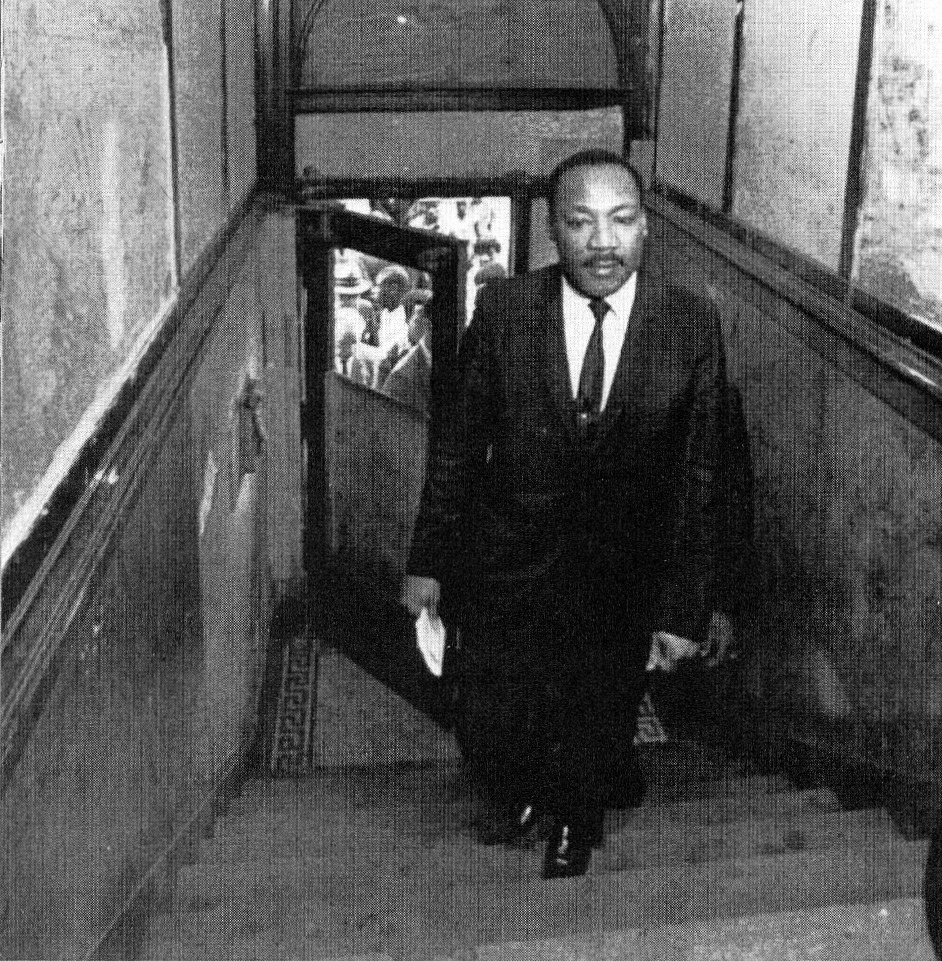
In January of 1966, Martin Luther King, Jr., arrives into the tenement apartment on the West Side to begin the Chicago Campaign. The nine-month campaign gave birth to bringing before the nation its widespread issues of poverty and racial injustice. As King mounted these steps into the cold, rundown set of rooms, he was equally walking into the complex politics, problems and hurdles associated with this big northern city whose Democratic mayor, Richard J. Daley, was known as “Boss.”
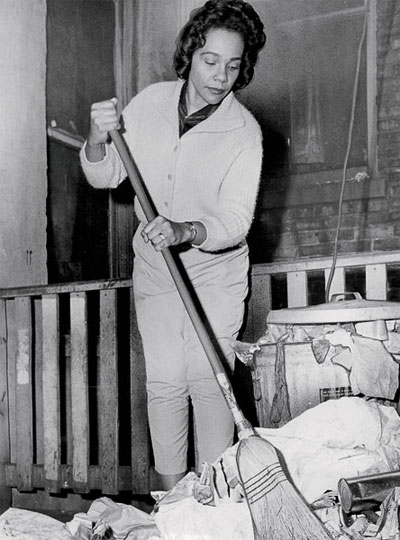
It was on Wednesday, January 26, 1966, that Martin Luther King, Jr. and Coretta Scott King (1927-2006) installed themselves into a West Side apartment in a low-income Chicago neighborhood on the West Side.
At the outset the SCLC and their allies were political outsiders in Chicago and mainly sought an amenable agreement with the established political powers in a city embodied by 63-year-old Richard J. Daley, its mayor since 1955.
In the middle of the cold and brutal Chicago winter King humbly began his campaign by stating that he was looking to study the city’s social conditions.
King wanted to know which nonviolent campaign tactics—whether it was street marches, voter registration drives, rallies, fund raisers, or something else—would be effective to progress the objectives of job creation, open housing, educational opportunity for African-Americans and, by summer of 1966, slum clean-up and a citizen’s review board for police brutality and misconduct.
Martin Luther King Jr. and wife Coretta Scott King after moving into an apartment at 1550 S. Hamlin Avenue in Chicago on January 26, 1966. King moved into the tenement apartment to highlight segregated housing conditions in Chicago and launch a campaign to end slums in the city. — Chicago Tribune, Feb. 24, 1966.With furniture provided from local second-hand stores, Martin and Coretta Scott King are pictured on the first day in their Chicago Lawndale apartment on 1550 S. Hamlin Avenue. King’s first act in Chicago in January 1966 gained national media attention which helped to publicize the conditions of Chicago slum apartments. Photograph by John Tweedle. Martin Luther King Jr. helps remove a window frame while renovating an apartment at 1321 S. Loman Ave., in Chicago in 1966. King moved into a West Side apartment to highlight housing segregation issues in Chicago. — Luigi Mendicino, Chicago Tribune, Feb. 24, 1966. he SCLC and CCCO together with the Westside Federation became extralegal ‘trustees’ of the building with the tenants paying their rent to the SCLC, which used the money to make repairs. Male tenants of the building were hired as laborers and paid King’s proposed new minimum wage, $2.00 per hour. (The minimum wage in 1966 was $1.25.) King told Betty Washington, a reporter for the Defender, that the experiment of taking over that building would give Movement leaders insight into “the kind of social planning that might reverse this trend of degradation of our nation’s cities and contribute to the kind of community awareness that will bring new life and new hope to the slums of this city.” Photograph by Luigi Mendicino, Chicago Tribune, February 24, 1966. Coretta Scott King at the Homan Avenue tenement in Chicago in 1966 tenement her husband’s campaign had taken control of and worked to repair. It was about 5 minutes by car from the King home on Hamlin. In 1966 when Dr. Martin Luther King, Jr. and Coretta Scott King lived in Chicago on the West Side at 1550 S. Hamlin Avenue Dr. King preached at Stone Temple Baptist Church at 3622 W. Douglas Boulevard, a ten-minute walk away. Built in 1926 as a synagogue in the North Lawndale neighborhood the building became a Baptist church in 1954. Already in the 1950’s and early 1960’s Dr. King had delivered several speeches at Stone Temple MB Church in his civil rights efforts and used the church during his 1966 Chicago residency as a base for his civil rights and fair housing advocacy. His efforts led to the signing of the 1968 Fair Housing Act on April 11, 1968, a week after his assassination. Today, Stone Temple is led by Bishop Derrick M. Fitzpatrick, the grandson of Rev. James Marcellus, the church’s founder. PHOTO: “Stone Temple MB Church” by reallyboring is licensed under CC BY-NC-ND 2.0. see – https://stonetemplegreenteam.org/stone-temple-church – retrieved September 2, 2025.
“Baby Scratch My Back” written and performed by “swamp blues” singer Slim Harpo (1924-1970) was a number one hit playing on the radio in 1966.
As King spoke about a “closed society” in Chicago, the elected political power structure out of the Mayor’s office maintained an omnipotent grip on city services as a vicious circle of poverty in some black neighborhoods was permitted to exist. It was complicated by the Mayor’s public assertions that there “were no ghettos” in Chicago though Black citizens were de facto restricted to living in only certain of Daley’s “city of neighborhoods.”
King’s outsider status—which at first was understood as a mostly useful factor among Chicago’s civil rights activists—also worked to undermine King’s effectiveness in Chicago throughout 1966.
King and his circle were unfamiliar with Chicago’s vast size and complicated demographics. Also, perhaps unexpectedly, opposition to King’s efforts didn’t always fall cleanly along racial lines.
Whether coming from whites or Blacks, resentment to the Atlanta-based minister in Chicago usually always revolved around his being viewed as an interloper and potential power rival.
Dr. Joseph H. Jackson (1905-1990), president of the National Baptist Convention, U.S.A., Inc., and pastor of Olivet Baptist Church in Chicago was bitterly opposed to the Chicago Freedom Movement and made rancorous attacks against Dr. King while he was in Chicago. In 1963 Dr. Jackson was booed off the stage with Mayor Daley at an NAACP rally in Grant Park in 1963.
Support from Chicago Black ministers, a natural political base for King, was frequently blunted in 1966 by intimidating reminders from City Hall that this or that certain church would be having its building or fire code inspection coming up.
Moreover, big cities across the nation, including Chicago, were looking to receive a huge influx of money out of Washington, D.C. including part of a new $2.3 billion anti-slum program (about 17 billion in 2015 dollars). This huge infusion of money to Chicago was part of programs for infrastructure and social services marking President Lyndon B. Johnson’s “Great Society.”
King was politely pressured by city officals to forego what could only be seen as futile and time-wasting efforts of trash drives and meetings so to allow the Chicago mayor and his allies to get down to the serious work of eliminating city slums by, as Daley announced, no later than the end of 1967.
Daley’s home-court advantage and enormous financial support from the Democratic U.S. president and Congress gave Dr. King’s civil rights operation among the poor and dispossessed an appearance of superfluity, if not outright meddling.
Tactically, on every front, Daley tried to match King’s organizational efforts often by simply buying off King’s allies.
When King filled the International Amphitheatre on South Halsted Street with 12,000 Black celebrities and supporters on March 12, 1966 for a rally, Daley led 70,000 marchers and 350,000 spectators down State Street in the St. Patrick’s Day parade a few days later.
Mayor Richard Daley leading the St. Patrick’s Day Parade on State Street in 1963.
After the SCLC took a supra-legal action to seize a dilapidated tenement building, Daley limited his response which left King to deal with all the legal and public relations headaches.
King was not naïve about his own position. He did not want the Chicago Freedom Movement to become politicized. Daley had a mayoral primary in February 1967— he was running unopposed for a fourth four-year term. Some King allies in Chicago wanted an opposition candidate to Boss Daley, something that had never materialized to that point, and coalesce around the Chicago Freedom Movement to run against the mayor.
King refused the idea. Despite the political leeway, Daley worked continuously in 1966 to limit and even sideline King’s efforts in Chicago. King’s hope that the Irish-American big city northern mayor would risk or trade political power for King’s agenda of social justice and civil rights on behalf of the city’s African-Americans —historically a full third of the population —was mostly dashed in 1966.
Daley’s selective embraces of King never offset the mayor’s overall strategy to restrain the civil rights leader’s efficacy in Chicago. At the same time Daley did not want his restraint of King to impact or curb the broad voter support that the Daley administration had.
Civil rights leader Rev. Martin Luther King Jr. discusses fair housing with Gilbert Balin, of G. Balin Inc. real estate agents in Chicago. King and the Southern Christian Leadership Conference launched a campaign to end slums in the city, which would become known as the Chicago Freedom Movement. — Jack Mulcahy, Chicago Tribune, Nov. 3, 1966.
Regardless of Daley’s defensive efforts, King did not lose sight of his message of improved housing, education and economic development for African-Americans in Chicago. At this still early juncture of his time in Chicago, KIng carried on with his own civil rights campaign leaving any direct confrontation with Mayor Daley possibly for the future.
One SCLC initiative that scored quick success was a project started in February 1966 headed by Rev. Jesse Jackson (1941-2026) called Operation Breadbasket (renamed by Jackson Operation PUSH after King’s death). Within months there were several hundred new Black hires in Chicago-area businesses by way of this action.
Rev. Jackson at an Operation Breadbasket event, May 9, 1970. Photo by Chris Holmes.Dr. King and his wife, Coretta Scott King, lived and worked in Chicago for about 9 months in 1966 which gave birth to the Chicago Freedom Movement. King spent those first late winter into early spring months in Chicago getting to know the city and formulating a plan. In addition to the Hamlin (apartment building) “trusteeship” and Operation Breadbasket, King visited with Black and white leaders including the powerful mayor, Richard M. Daley (1902-1976), and the leader of the Nation of Islam, Elijah Muhammad (1897-1975). He also worked to convert gang members to the philosophy of non-violence and met with a large variety of community groups. Here he walks with members of the East Garfield Park Community Organization. Photograph by John Tweedle. Fair Use.
King’s months-long presence in Chicago in 1966 could also be credited for prompting Mayor Daley to establish new city programs. Daley also hosted various “summits” with clergy, labor and business leaders with the agenda to combat poverty and racism in Chicago.
In August 1966, Daley, with the support of the Chicago Freedom Movement, accepted the departure of public schools Chief Benjamin Willis and the appointment of James F. Redmond, a racial progressive, who served in that capacity until 1975. Still, Daley considered only white men for the post and overlooked two qualified Black candidates.
One thing Dr. King considered a key effort to improve African-American lives in the ghetto was to transform gang members into nonviolent civil rights activists. When a gunfight at a SCLC meeting in May 1966 broke out between Blackstone Rangers and East Side Disciples that ended King’s official initiative in this direction for the present.
Meanwhile, Richard J. Daley continued his downtown redevelopment. In March 1966 Daley announced a $200 million package for mass transit and made sure the Civic Federation — a good government watchdog group — was there to endorse it. In addition to Loop and North Michigan Avenue redevelopment, Daley dedicated in May 1966 the Civic Center, soon to be graced by the iconic Picasso sculpture in 1967.
Now the long, hot days of the Chicago summer were on the doorstep. Many in the city wondered at the start of summer 1966 to what extent Dr. King’s plans might add to the heat.
King’s apartment during 1966 in Chicago at 1550 South Hamlin Avenue was damaged during the riots that followed his assassination on April 4, 1968 and eventually demolished. The site was a vacant lot until the construction in 2011 of Dr. King Legacy Apartments designed by the architecture firm Johnson + Lee. the $18 million, 45-apartment complex also features commercial spaces along its 16th Street frontage, including the new home of the Fair Housing Exhibit Center.Painted mural of the image of Dr. Martin Luther King, Jr. and his tenement apartment in Chicago’s North Lawndale by nationally-renowned Afro-Indian muralist, Paul Collins. It is the centerpiece of the Fair Housing Exhibit Center.
I came to see that so many people who supported, morally and even financially, what we were doing in Birmingham and Selma were really outraged against the extremist behavior of Bull Connor and Jim Clark toward Negroes rather than believing in genuine equality for Negroes. And I think this is what we’ve gotta see now, and this is what makes the struggle much more difficult. Rev. Dr. Martin Luther King, Jr. (1929-1968), “The Other America” speech, Stanford University, April 14, 1967.We who engage in nonviolent direct action are not the creators of the tension. We merely bring to the surface the hidden tension that is already alive. Rev. Dr. Martin Luther King, Jr. (1929-1968), Letter From Birmingham Jail, 1963.I have earnestly opposed violent tension, but there is a type of constructive, nonviolent tension which is necessary for growth. Rev. Dr. Martin Luther King, Jr. (1929-1968), Letter From Birmingham Jail, 1963.
(29.52 minutes) On Christmas Eve, December 24, 1967, the Rev. Dr. Martin Luther King, Jr. delivered his Christmas Sermon on Peace and Nonviolence in his pastorate, Ebenezer Baptist Church in Atlanta, Georgia. It is also known as A Christmas Sermon on Peace and Peace on Earth Sermon.
For many people this is their very favorite of Dr. King’s sermons. It was broadcast by the Canadian Broadcasting Corporation as the fifth and final part of the 1967 Massey Lecture Series. In the sermon, Dr. King articulates the values and tactics of his broad and long-term vision of nonviolence as the path to world peace. At one point Dr. King states: “In 1963, on a sweltering August afternoon, we stood in Washington, D.C. and talked to the nation about many things. Toward the end of that afternoon, I tried to talk to the nation about a dream that I had had, and I must confess to you today that not long after talking about that dream I started seeing it turn into a nightmare. I remember the first time I saw that dream turn into a nightmare, just a few weeks after I had talked about it. It was when four beautiful, unoffending, innocent Negro girls were murdered in a church in Birmingham, Alabama. I watched that dream turn into a nightmare as I moved through the ghettos of the nation and saw my black brothers and sisters perishing on a lonely island of poverty in the midst of a vast ocean of material prosperity and saw the nation doing nothing to grapple with the Negroes’ problem of poverty. I saw that dream turn into a nightmare as I watched my black brothers and sisters in the midst of anger and understandable outrage, in the midst of their hurt, in the midst of their disappointment, turn to misguided riots to try to solve that problem. I saw that dream turn into a nightmare as I watched the war in Vietnam escalating, and as I saw so-called military advisors, 16,000 strong, turn into fighting soldiers until today over 500,000 American boys are fighting on Asian soil. Yes, I am personally the victim of deferred dreams, of blasted hopes, but in spite of that I close today by saying I still have a dream, because, you know, you can’t give up in life. If you lose hope, somehow you lose that vitality that keeps life moving, you lose that courage to be, that quality that helps you go on in spite of all. And so today I still have a dream.”
Martin Luther King, Jr., San Francisco, June 30, 1964. “Martin Luther King, Jr. San Francisco June 30 1964” by geoconklin2001 is licensed under CC BY-NC-ND 2.0.I hope that the president didn’t mean to equate nonviolent demonstrations with a riot, and I think it is time for this country to see the distinction between the two…I think demonstrations must continue, but I think riots must end. Rev. Dr. Martin Luther King, Jr. (1929-1968), interview from Chicago with Meet The Press, August 21, 1966. Cited in The Eclipse of Equality: Arguing America on Meet the Press, Solon Simmons, Stanford University Press, 2013, p. 160-61.I contend that we are not doing more harm than good in demonstrations, because I think demonstrations serve the purpose of bringing the issues out in the open. I have never felt that demonstrations could actually solve the problem. They dramatize the existence of certain social ills that could very easily be ignored if you did not have demonstrations. I think the initial reaction to demonstrations is always negative….Ultimately society must condemn the robber and not the robbed. It must protect the robbed, and this is where we are in these demonstrations, and I am still convinced that there is nothing more powerful to dramatize a social evil than the tramp, tramp of marching feet. Rev. Dr. Martin Luther King, Jr. (1929-1968), interview from Chicago with Richard Valeriani (NBC News), August 9, 1966. Cited in The Eclipse of Equality: Arguing America on Meet the Press, Solon Simmons, Stanford University Press, 2013, p. 161.The toughminded person always examines the facts before he reaches conclusions; in short, he postjudges. The softminded person reaches a conclusion before he has examined the first fact; in short, he prejudges and is prejudiced. Rev. Dr. Martin Luther King, Jr. (1929-1968), “A tough mind and a tender heart,” Strength to Love (1963).Softminded individuals among us feel that the only way to deal with oppression is by adjusting to it. Softminded acquiescence is cowardly. Rev. Dr. Martin Luther King, Jr. (1929-1968), “A tough mind and a tender heart,” Strength to Love (1963).We do not need to look far to detect the dangers of softmindedness. Dictators, capitalizing on softmindedness, have led men to acts of barbarity and terror that are unthinkable in civilized society. Rev. Dr. Martin Luther King, Jr. (1929-1968), “A tough mind and a tender heart,” Strength to Love (1963).There is little hope for us until we become toughminded enough to break loose from the shackles of prejudice, half truths, and downright ignorance….A nation or a civilization that continues to produce softminded men purchases its own spiritual death on an installment plan. Rev. Dr. Martin Luther King, Jr. (1929-1968), “A tough mind and a tender heart,” Strength to Love (1963).This undue gullibility is also seen in the tendency of many readers to accept the printed word of the press as final truth. Few people realize that even our authentic channels of information – the press, the platform, and in many instances the pulpit – do not give us objective and unbiased truth. Rev. Dr. Martin Luther King, Jr. (1929-1968), “A tough mind and a tender heart,” Strength to Love (1963).This undue gullibility is also seen in the tendency of many readers to accept the printed word of the press as final truth. Few people realize that even our authentic channels of information – the press, the platform, and in many instances the pulpit – do not give us objective and unbiased truth. Rev. Dr. Martin Luther King, Jr. (1929-1968), “A tough mind and a tender heart,” Strength to Love (1963).Somewhere, we must come to see that social progress never rolls in on the wheels of inevitability. It comes through the tireless efforts and the persistent work of dedicated individuals. And without this hard work, time itself becomes an ally of the primitive forces of social stagnation. And so we must help time and we must realize THAT THE TIME IS ALWAYS RIGHT TO DO RIGHT. “The Other America” speech at Stanford University on April 14, 1967.
In “The Other America” speech Dr. King presents “two Americas” – one that is “beautiful” and the “other America ” that is an “arena of blasted hopes and dreams.” In these remarks on racism and civil rights in American society, Dr. King explains that his campaign is about people who “are seeking to make America one nation.”“Tribute to Martin Luther King, Jr.” by U.S. Embassy New Delhi is licensed under CC BY-ND 2.0.Open to our quest for freedom [is] nonviolent resistance, that combines toughmindedness and tenderheartedness and avoids the complacency and do-nothingness of the softminded and the violence and bitterness of the hardhearted. Rev. Dr. Martin Luther King, Jr. (1929-1968), “A tough mind and a tender heart,” Strength to Love (1963).God is neither hardhearted nor softminded. He is toughminded enough to transcend the world; he is tenderhearted enough to live in it. Rev. Dr. Martin Luther King, Jr. (1929-1968), “A tough mind and a tender heart,” Strength to Love (1963).I have a dream that my four little children will one day live in a nation where they will not be judged by the color of their skin but by the content of their character. I have a dream today! Rev. Dr. Martin Luther King, Jr. (1929-1968), “I Have a Dream” speech, August 28, 1963, at the Lincoln Memorial, Washington D.C.We cannot walk alone. And as we walk, we must make the pledge that we shall always march ahead. We cannot turn back. Rev. Dr. Martin Luther King, Jr. (1929-1968), “I Have a Dream” speech, August 28, 1963, at the Lincoln Memorial, Washington D.C.
FEATURE image: The Brooklyn Bridge (looking westward), August 2005. Author’s photograph.
The Brooklyn Bridge over the East River is the oldest extant bridge in New York City—a city of bridges—and is also the city’s most architecturally famous. The opening of the hybrid cable-stayed and suspension bridge in May 1883 has been called “the Dawn of Modern New York” as it is the world’s first steel-wire suspension bridge.
Spanning the East River between the boroughs of Manhattan and Brooklyn, it was designed and built by a father-son team. Construction began in January 1870 after being approved by Congress in 1869 whose concern was that the bridge project would in no way impede free and open navigation. Over the next over 13 years, an estimated 27 men died during the bridge’s construction. The New York terminus rests on bedrock while the Brooklyn terminus rests on clay. Following its opening in 1883 by the end of that year more than one million passengers crossed the bridge.
Brooklyn Bridge in 1903. Public Domain.
The total length of the bridge is 6,537 feet—nearly one-and-one-quarter miles. From the middle of the span, it is about 135 feet above the river with the span’s weight around 7,000 tons. The railroad on the Brooklyn Bridge opened in 1888. The cables on the bridge are over one foot wide (16 inches) and took almost a year and a half (15 months) to string. Their calibration had to include calculations for variables such as wind and expansion and contraction due to temperature. The height of the Gothic-inspired towers are 159 feet above the roadway.
SOURCES: The Sun, New York, New York, June 11, 1891.