FEATURE image: Flanders House (1841), 24044 Main Street, Plainfield, Illinois. See a fuller description below.
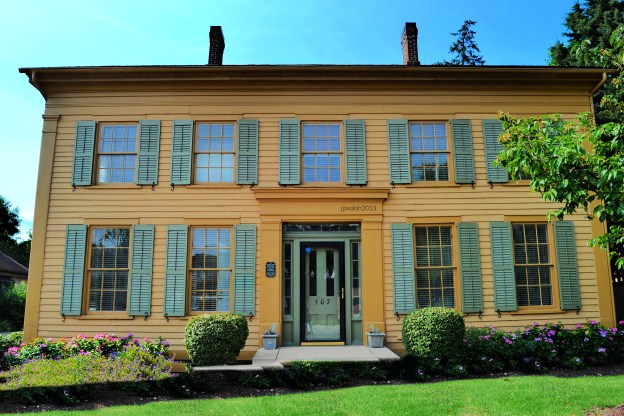
Jason and Lucy Flanders House, 1841, Plainfield, Illinois.
Jason and Lucy Flanders House, 1841, 24044 Main Street, Plainfield, Illinois. Author’s photograph (August 11, 2013).
Plainfield was settled at the end of the 1820’s when James Walker constructed a sawmill on the DuPage River. The mill attracted settlers to the region and created Will County’s first permanent community. Located about halfway on the Chicago-Ottawa stagecoach line, Plainfield developed commercially, including a booming lumber trade. Jason and Lucy Flanders married in Lowell, Massachusetts, in 1833 (they were both 23 years old). Jason Flanders, born in Vermont, had worked in Boston, Massachusetts since 1830. Lucy Ann Clark Flanders was born in New Hampshire. The Flanders arrived into Will County in 1833 and after seven years of farming, moved to Plainfield in 1840. The Flanders had six children.
Built in 1841, Flanders House exhibits characteristics of both the Federal and Greek revival styles. This includes symmetrically arranged windows and a central entrance overlaid by a porch of the 1920’s. Also known as Mapleview Farm and Bragaw-Klomhaus House, The Flanders’ Place has had only a handful of owners in its 180-year history. There is no record of the house ever being used for any non-residential purpose though it may have served in a commercial capacity, perhaps serving travelers on the Dr. Temple Stage Line Chicago-Ottawa route.
The two-story, side gabled rectangular building is approximately 30 x 40 feet in dimension and with later additions. Jason Flanders built the house with hewn logs and sided it with walnut, its original siding hidden by later exterior finishes. The house was finished on the inside also with walnut. Walnut was abundant in the Plainfield area which may explain partly why the Flanders did not hesitate to whitewash the house exterior.
Jason Flanders was the town constable (Plainfield’s first) and at his death had amassed many hundreds of acres of land. The Flanders and their descendants retained control of the property until 1974. While it is recorded that Jason Flanders was a Methodist, his late-20th-century descendant sold the house to a Lutheran church for use as a parsonage. It was sold again in the early 1990s and restored to emulate its original appearance. Flanders House remains one the oldest extant houses in Plainfield, Illinois, today.
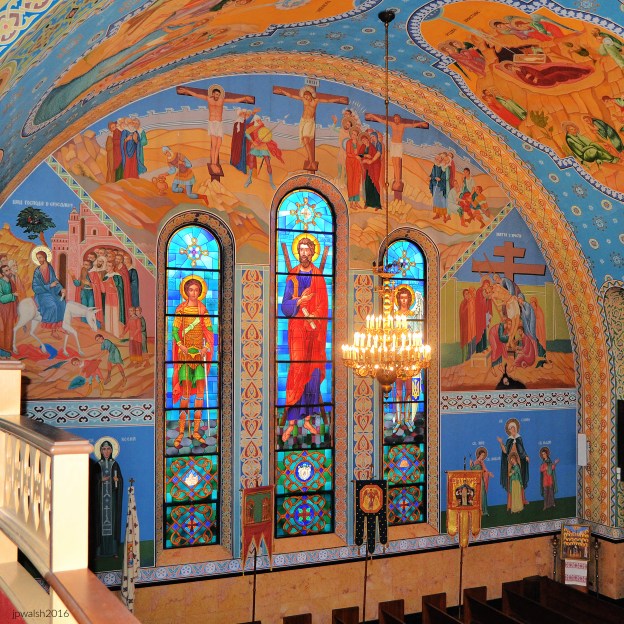
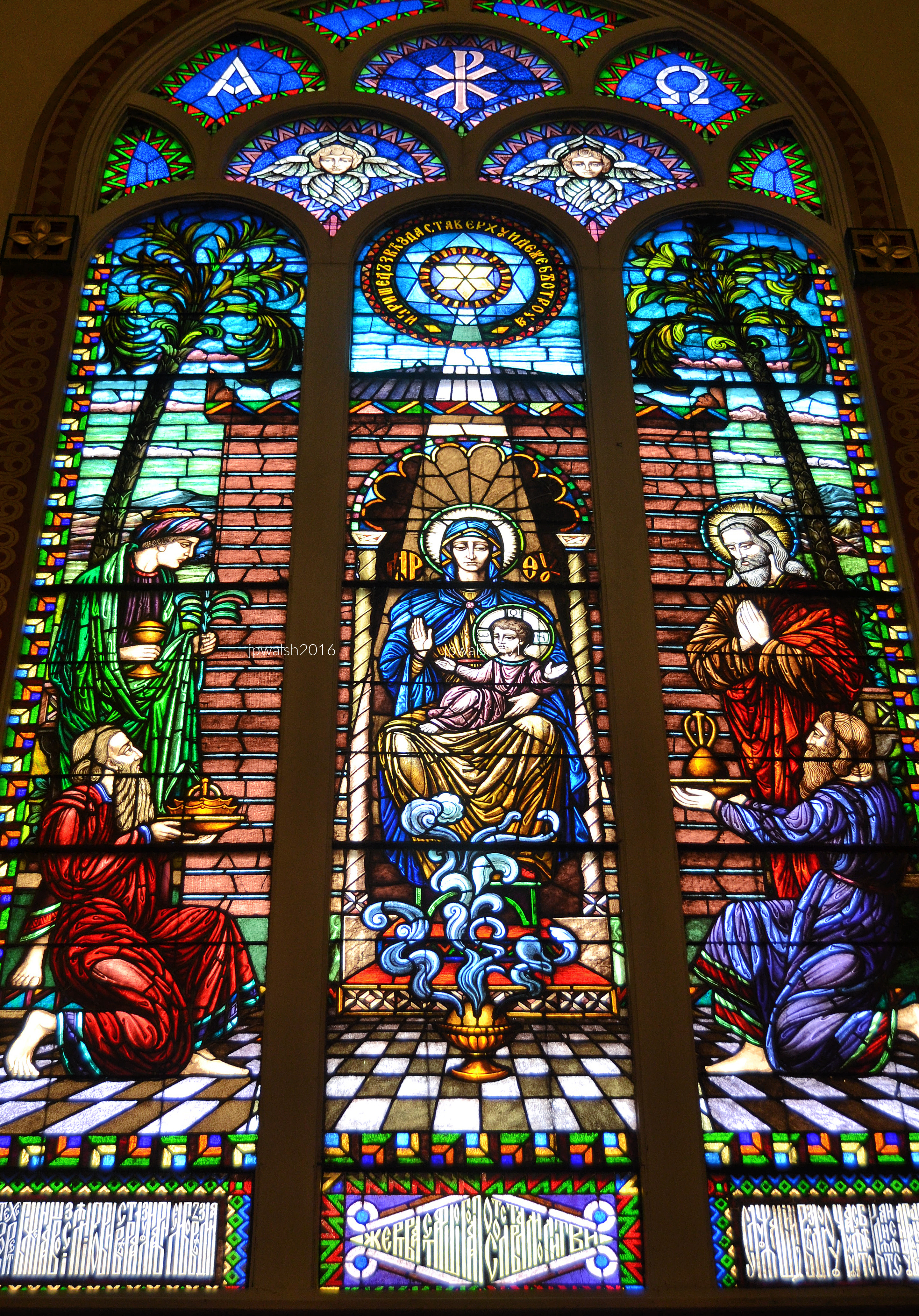
FEATURE image: Stained glass, paintings, banners, and chandelier blend together and provide a more complete picture of people and episodes of the faith. North wall and ceiling. Chicago. Sts. Volodymyr and Olha Church. October 2016 5.88 mb Author’s photograph.
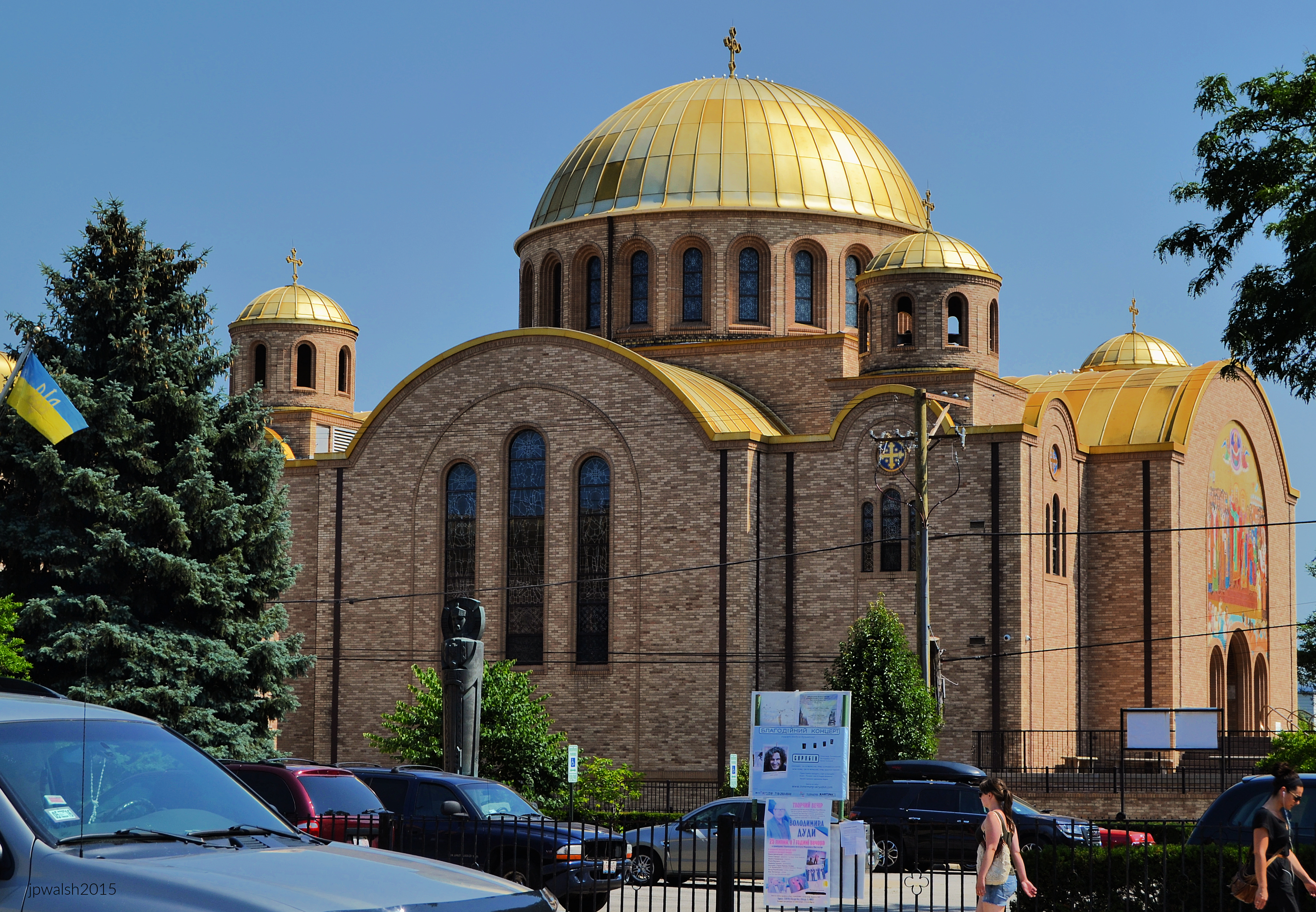
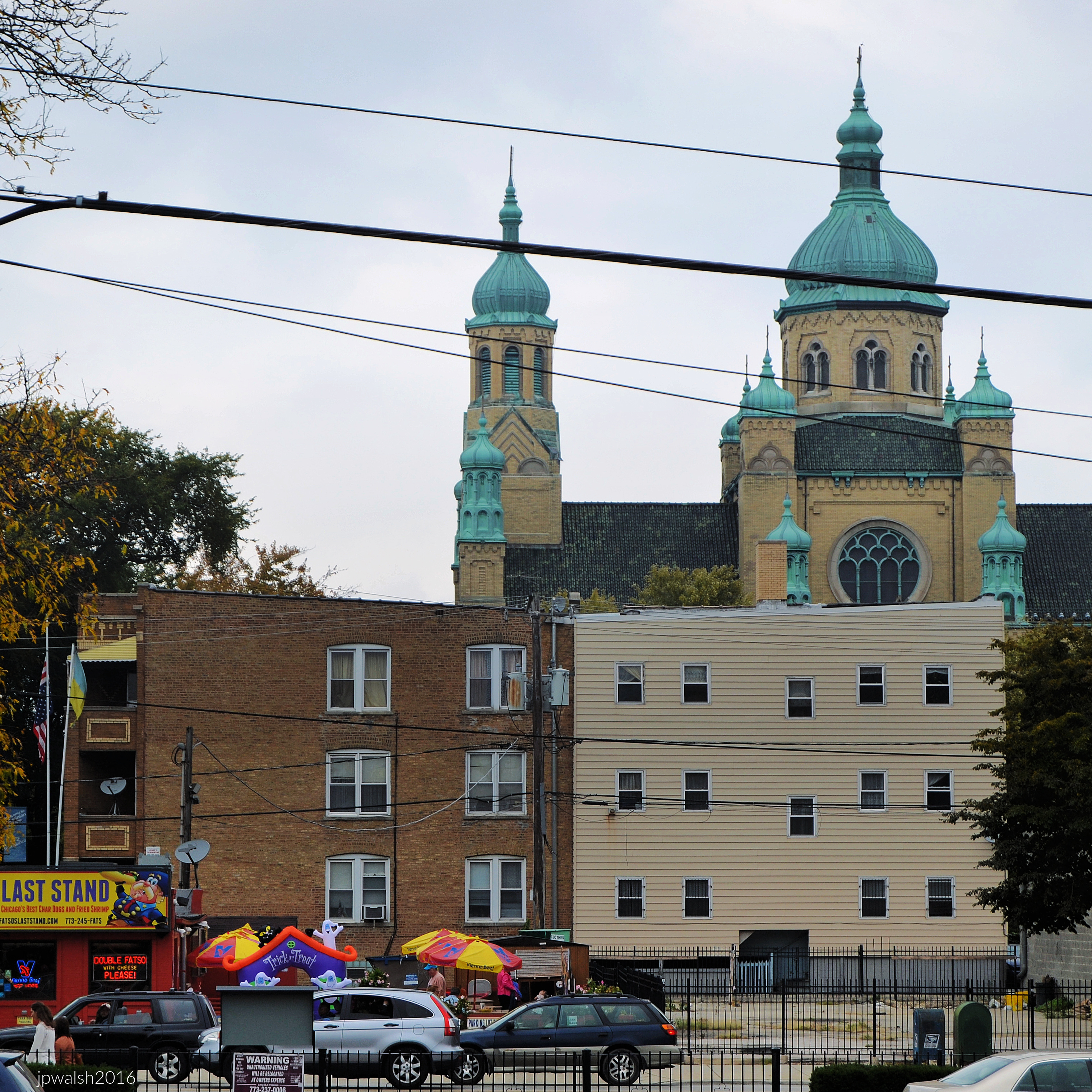
Exterior of Sts. Volodymyr and Olha Church with its gold domes. The tradition-minded parish, founded in early 1970s, serves a busy urban community.
Chicago. Sts. Volodymyr and Olha Church. 7/2015 7.68 mb The huge mosaic over the main entrance memorializes the conversion of the Ukrainians to Christianity in 988 by St. Volodymyr of Kyiv or Vladimir of Kiev (957-1015). The mosaic was executed by Hordynsky, Makarenko, and Baransky. The church is built in the modern Byzantine style.In addition to the colorful and bright mosaic, the upward angle and its perspective adds to the feeling of entering into a sacred space. Along with the archways and curve of the main golden dome, the eye focuses on the artwork’s bright figures.
WHO IS ST. VOLODYMYR?
Chicago. Sts. Volodymyr and Olha Church 7/2015 5.42 mb
St. Volodymyr is the apostle to proto-Russian and Russian Christianity. He was the great prince of Ukraine in Kiev. It was ruled by the Varangians, a barbarous Viking tribe from Scandinavia – and Volodymyr (or Vladimir) of Kiev was as barbarous as any of them.
In 988, when Volodymyr was about 31 years old, he was converted to Christianity. The missionaries came from the Byzantine world at Constantinople. The results were immediate: Ukraine was now in close contact with the Byzantine world to the south and its Christian church under the pope.
Volodymyr married the daughter of the Byzantine emperor, Basil II (957-1025). But it was Volodymyr’s personal embrace of the Christian faith that infused the Ukrainian people with their deep and abiding faith. Having received baptism, he set out to be a Christian and not corrupted by money and power that proved a serious temptation for many church and state leaders in the Dark Ages.
Volodymyr used his temporal powers to evangelize the people – his personal example his greatest asset to its success. Though he encouraged various activities and programs in the lives of the people – including the multi-faceted work of Greek missionaries – it was his sincere, transparent, and fundamental reform of his own life that by far had the greatest impact on the Ukrainian people. More than one thousand years after his rule, Volodymyr is still recalled as a generous, humble and devout soul.
As a Christian ruler Volodymyr had doubts about inflicting the death penalty. Though assured by his Byzantine church counselors that his Catholic faith allowed him to follow the law which allowed for it, Volodymyr corrected them and said that that sort of reasoning was not satisfactory to his faith.
Volodymyr, the great prince of Kiev, died a poor man – not only various from his origin but, again, that of many of the ecclesiastics now in the realm. Before his death, Volodymyr dispersed all his money and personal belongings to the poor and to his family and friends. St. Volodymyr’s feast day is July 15. He is patron of Ukrainian and Russian Catholics.
WHO IS ST. OLHA?
Saint Olha was the wife of the Kyivan Great Prince Igor. Igor signed a peace treaty with the Greeks in 944. The treaty of 944 was drawn up at Constantinople and allowed for Christianity in Ukraine. This toleration already indicates some sympathy for Christianity among the powerful in Kiev. Igor himself, however, in his official position did not embrace Christianity nor officially allow the presence of a structure of Church hierarchy. The treaty was drawn up to quietly allow co-existence of Christians in a pagan Viking culture.
Yet when the Byzantine emissaries arrived in Kyiv, pagan opposition had emerged from the Varangians. The Christians were thrown into abeyance and Igor was murdered in 945. Into this volatile situation the burden of government fell upon Igor’s widow — the Kyiv Great-Princess Olha, and her three-year-old son Svyatoslav (945-972). Her first act was to avenge Igor’s murder.
Olha belonged to one of the obscure ancient-Rus’ princely dynasties, whose Slavic line had intermarried with assimilating Varangian newcomers. Olha’s Varangian names includes Helga and Olga.
Though still a pagan, Olha’s revenge on the Varangians on behalf of her late husband was a victory for the realm’s Christians. Further, having weakened the influence of petty local princes in Rus’, Olha centralized the whole of state rule. She became a great builder of the civil life and culture of Kyivan Rus. Her centralization became an important network of the ethnic and cultural unification of the nation which, when Olha became a Christian, aided in the building of a network of churches. Her essential activities proved key in developing what is the modern Ukrainian national identity. At the same time, important trade with Poles, Swedes, Germans, and so forth, led to significantly expanding foreign connections. One noteworthy development was that wooden buildings were replaced with stone edifices.
Rus’ had become a great power. Only two European realms could compare with it in the tenth century – the Byzantine empire in the east, and the kingdom of Saxony in the west. Both these empires were Christianized and pointed the way to future greatness for Rus’. In 954 Great-princess Olha sailed to Constantinople. Though a display of Rus’ military might on the Black Sea, it was a spiritual mission. Olha’s might and the Byzantines’ wealth and beauty were mutually impressive.
Constantinople was the city of the Mother of God as dedicated by Constantine the Great in 330. Olha made the decision to become a Christian. She was baptized by Patriarch Theophylactus (917-956) with her godfather being the emperor Constantine Porphyrogenitos (905-959). She took the Christian name Helen for Constantine’s mother. Following the rite, the Patriarch said: “Blessed are you among the women of Rus’, for you have forsaken the darkness and have loved the Light. The Rus’ people shall bless you in all the future generations, from your grandson and great-grandson to your furthermost descendants.” Olha replied: “By your prayers, O Master, let me be preserved from the wiles of enemies”. It is precisely in this way, with a slightly bowed head, that Saint Olha is often depicted in religious artwork. During her state visit, and following her baptism, Great princess Olha of Rus’ was fêted throughout Constantinople
Saint Olha devoted herself to efforts of Christian evangelization among the pagans, and also church construction, including Saint Sophia Cathedral. Yet, many despised her new found Christianity and paganism became emboldened. They looked to the reign of Svyatoslav who angrily spurned his mother’s Christianity. Meanwhile Byzantine church and state leaders were not eager to promote Christianity in Rus’. In Olha’s lifetime, Kyiv favored paganism and had second thoughts about even accepting Christianity. By order of Svyatoslav, churches were destroyed and Christians murdered. Byzantine political interests found the church and state looking to undermine Olha’s influence and favored the Rus’ pagans.
Olha attempted to help Svyatoslav during a period of wartime, though Kyiv was a backwater to his imperial interests for the next 18 years. In the spring of 969 the Pechenegs besieged Kyiv and Olha headed the defense of the capital. Svyatoslav rode quickly to Kyiv, and routed the nomads. But the warrior prince wished to rule elsewhere than Kiev. Svyatoslav dreamed of uniting all Rus’, Bulgaria, Serbia, the near Black Sea region and Priazovia (Azov region), and extend his borders to Constantinople. Olha warned her son that his plans were bound to fail as the Byzantine Empire was united and strong.
On July 11, 969 Saint Olha died. In her final years, with the triumph of paganism, she had to secretly practice her faith. Before her death, she forbade the pagan celebration of the dead at her burial and was openly buried in accord with Orthodox ritual. A priest who accompanied her to Constantinople in 957 fulfilled her request.
Considered by Ukrainians the holy equal of Great Prince Volodymyr, St. Olha was invoked by St. Volodymyr on the day the people of Rus’ were baptized. Before his countrymen, St. Volodymr said of St. Olha: “The sons of Rus’ bless you, and also the generations of your descendants.”
Chicago. Sts. Volodymyr and Olha Church 7/2015 7.46 mb
A beautiful outdoor garden with the residential streets of Ukrainian Village as its background is the setting for the larger-than-life-sized statue of Major Archbishop Josyf Slipyj (1892-1984). He was made a cardinal by Pope Paul VI in 1965 and is a “Confessor of the Faith.” The Founder of the parish, Slipyj blessed the new church building’s cornerstone. Supporting the Ukrainian state and refusing to convert to Russian Orthodoxy, he was continously imprisoned by the Soviet authorities from 1945 to 1963. Through the intervention of St. Pope John XXIII and U.S. President John F. Kennedy, Josyf Slipj was released by Nikita Khrushchev in early 1963 and participated in the Second Vatican Council.Josyf Slipyj died in Rome in 1984 and his cause for canonization as a saint of the Catholic Church has been introduced at the Vatican.
Chicago. Sts. Volodymyr and Olha Church 10/2016 4.54 mb
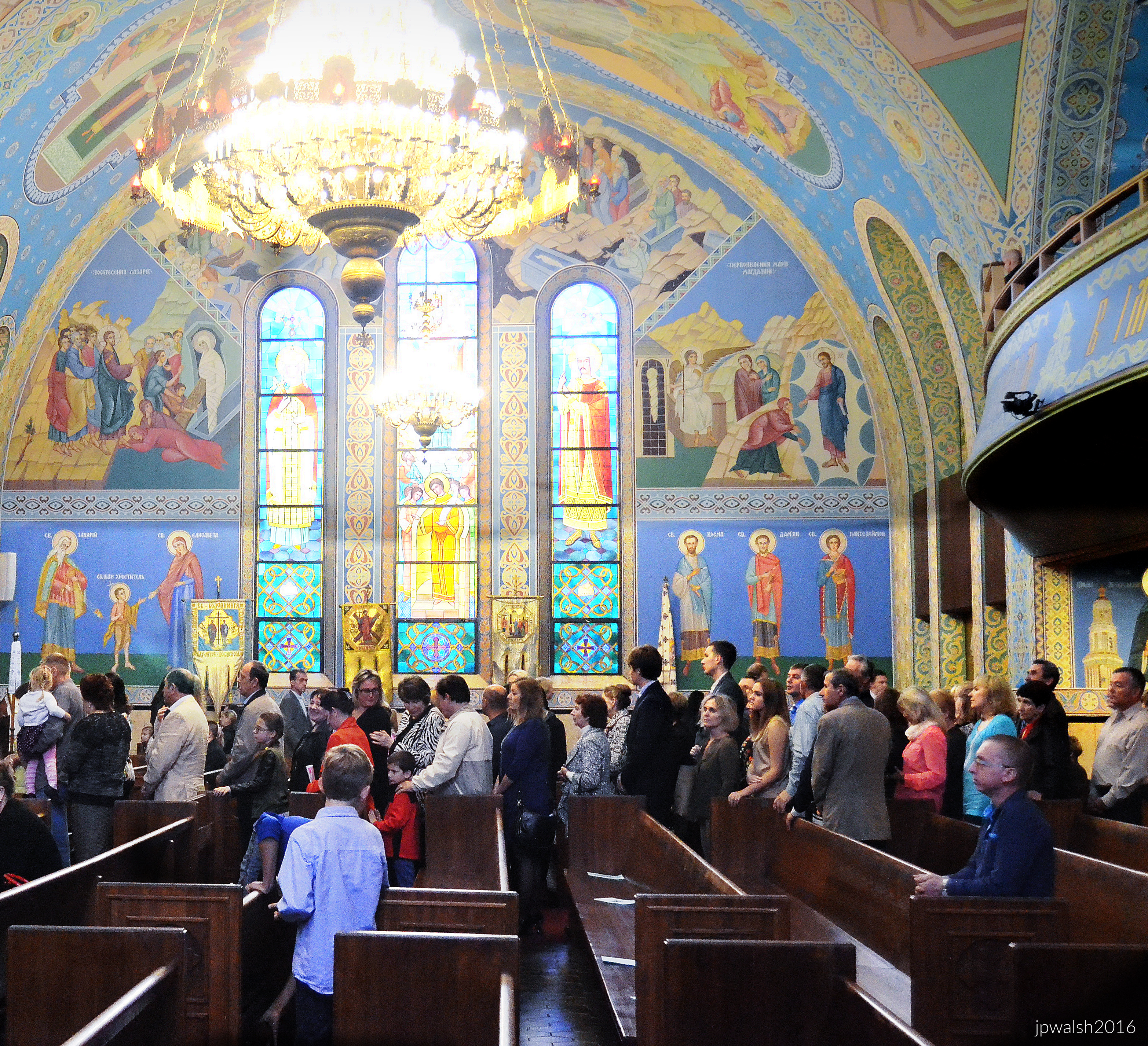
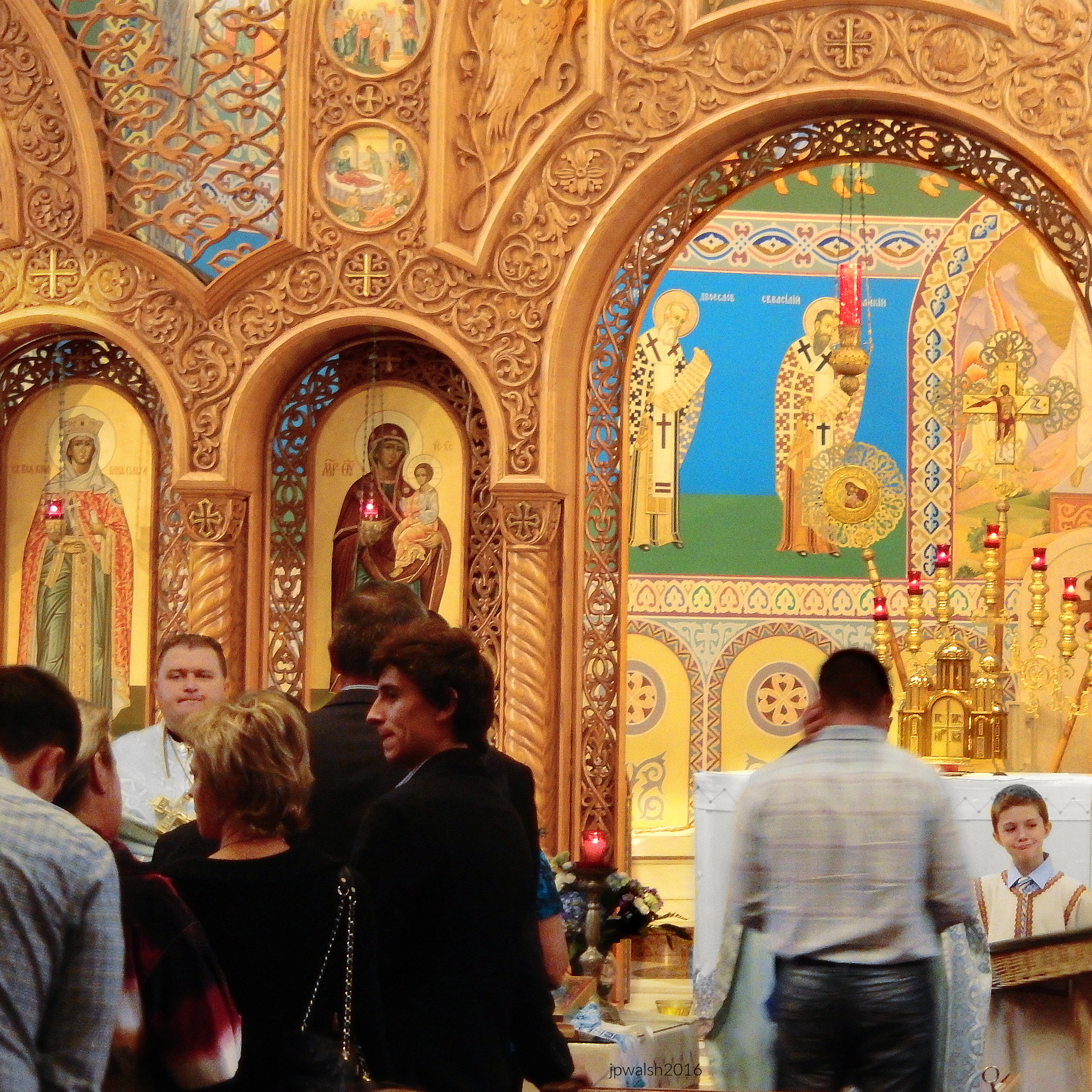
Parishioners praying and going to Communion at Sunday Mass.
Chicago. Sts. Volodymyr and Olha Church 10/2016 6.15 mbChicago. Sts. Volodymyr and Olha Church 10/2016 5.40 mb
With the artists’ skills, the bright colors and evocative forms of the artwork surround churchgoers as they move toward the altar at Communion during the Divine Liturgy.
Chicago. Sts. Volodymyr and Olha Church 10/2016 6.18 mb
The colorful and vibrant decorations that include paintings, carvings, vestments, books, stained glass, and more, are integral to the parish’s liturgy and life.
Chicago. Sts. Volodymyr and Olha Church 10/2016 5.46 mbChicago. Sts. Volodymyr and Olha Church 10/2016 4.35 mb
Two women sit before icons of Sts. Volodymyr and Olha and the Blessed Virgin.
Chicago. Sts. Volodymyr and Olha Church 10/2016 4.47 mb
Every nook and cranny of the church is decorated with colorful images from religious and Catholic Ukrainian history. The natural light streaking down from the main dome’s windows adds a heavenly glow.
Chicago. Sts. Volodymyr and Olha Church 10/2016 6.15 mb
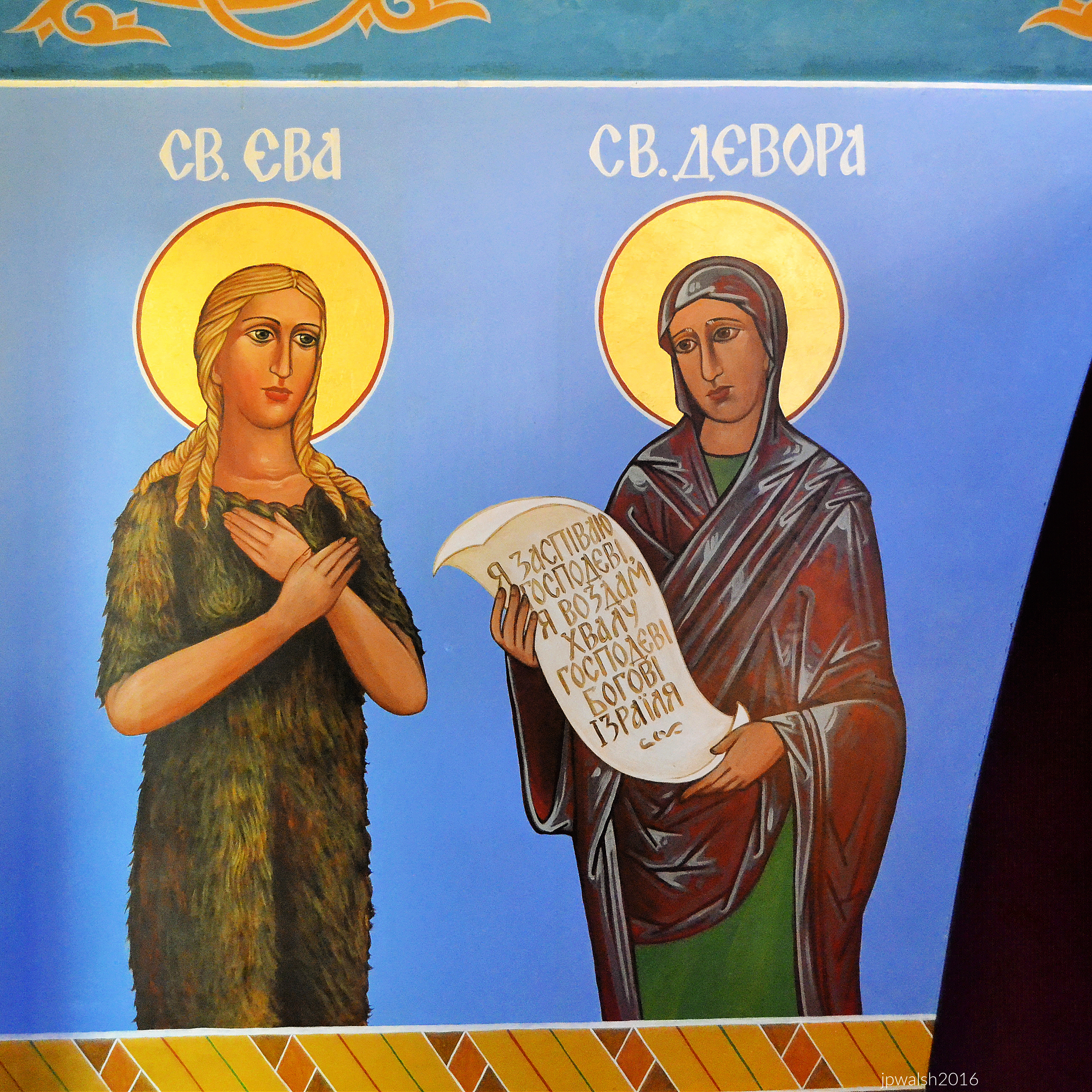
Two female haloed saints in a modern art style are marked by their unique attire as one holds an unfurled scroll with words in Ukrainian. Christianity arrived into Ukraine by way of the Greco-Byzantine world over 1000 years ago.
Chicago. Sts. Volodymyr and Olha Church 1/2016 4.90 mb
A painting of the dormition of Mary is emphasized by, above, an icon of Mary and the child Jesus. Colors, forms, and subject matter are very high quality and soft and peaceful making them pleasant to look at and pray with.
Chicago. Sts. Volodymyr and Olha Church 10/2016 6.18 mb
The wood carvings and full-length portrait icons are gorgeous. The fresh flower arrangements further brighten the scene.
Chicago. Sts. Volodymyr and Olha Church 10/2016 7.68 mb
Visitors are joined by worshippers lighting candles and praying before a large icon of Mary and the child Jesus.
Chicago. Sts. Volodymyr and Olha Church. 10/2016 10.68 mb
The main altar gate of carved wood with icons and gold curtain. The Last Supper in center above.
Chicago. Ukrainian Village. 10/2016 3.17 mb 30%
Residents and (below) a residence’s porch flower garden in Ukrainian Village near Sts. Volodymyr and Olha Church in Chicago.
Chicago. Ukrainian Village.10/2016 316 kb 20%Chicago. Sts. Volodymyr and Olha Church 10/2016 5.88 mbChicago. Sts. Volodymyr and Olha Church 10/2016 5.86 mb
High above the sanctuary is a magnificent view of the main dome painted in bright colors with the figure of Christ Pantocrator. Christ gives his blessing as he holds an open book with the first and last letters of the Greek alphabet: alpha and omega. It signifies one of Christ as the Son of God’s titles in the New Testament: “I am the beginning and the end” (Revelation, 21:6, 22:13).
Chicago Sts. Volodymyr and Olha Church 10/2016 7.84 mb
South Wall.
Chicago. Sts. Volodymyr and Olha Church 7/2015 2.52 mb
Ukrainian Village is a neighborhood first settled by Ukrainian immigrants in the 1890’s. It is about 4 miles to the northwest from downtown Chicago.
10/2016 544kb 30%
SOURCES:
Houses of Worship: An Identification Guide to the History and Styles of American Religious Architecture, Jeffrey Howe, Thunder Bay Press, San Diego, California, 2003.
AIA Guide to Chicago, 2nd Edition, Alice Sinkevitch, Harcourt, Inc., Orlando, 2004, p. 260.
The Saints: A Concise Biographical Dictionary, edited by John Coulson, Guild Press, New York, 1957, pp. 577; 760-761.
Chicago: City of Neighborhoods, Dominic A. Pacyga and Ellen Skerrett, Loyola University Press, Chicago, 1986, p. 193.
FEATURE image: Chicago. St. Nicholas Ukrainian Catholic Cathedral.
Chicago. St. Nicholas Ukrainian Catholic Cathedral. 7/2015 7.16 mb
At the western main entrance are the stars and stripes of the U.S. flag and the blue and yellow Ukraine flag. An avenue of trees lines the south side of the cathedral building. With its huge size and detailed architecture, St. Nicholas stands prominently on its 20 city lots. Worthmann & Steinbach was a Chicago-based architectural firm active in the first three decades of the 20th century. It was a partnership of German-born Henry W. Worthmann (1857-1946) and John G. Steinbach. The firm, with offices in Chicago and Oak Park, Illinois, designed many of the great Polish cathedrals in Chicago and for Eastern Catholic and Lutheran clients. Clement L. Pointek collaborated with Worthmann & Steinbach until he formed his own architectural firm with principal Joseph A. Slupkowski (1884-1951). The church interior was renovated in the wake of Vatican II liturgical reforms in the mid 1970s by Ukrainian-American architect Zenon Mazurkevich (1939-2018).
The huge yellow brick church building in Chicago’s tree-lined Ukrainian Village neighborhood is 155 feet long and 85 feet wide. Among its details, the building is renowned for its frescos and mosaics. St. Nicholas Ukrainian Catholic Cathedral’s impressive design and footprint on the skyline of one of Chicago’s neighborhoods was built as a worthy emulation of the 11th century (former) St. Sophia Cathedral in Kyiv, Ukraine. The church on Chicago’s near West side was built by the firm of Worthmann and Steinbach which built many churches in Chicago in the 1910’s and 1920’s. In the mid1970s the church interior was completely renovated and restored by a Ukrainian artist. Ukrainian Catholics follow the Byzantine-Slavonic Eastern Rite and acknowledge the pope in Rome as their spiritual leader.
Who is St. Nicholas the Wonder Worker?
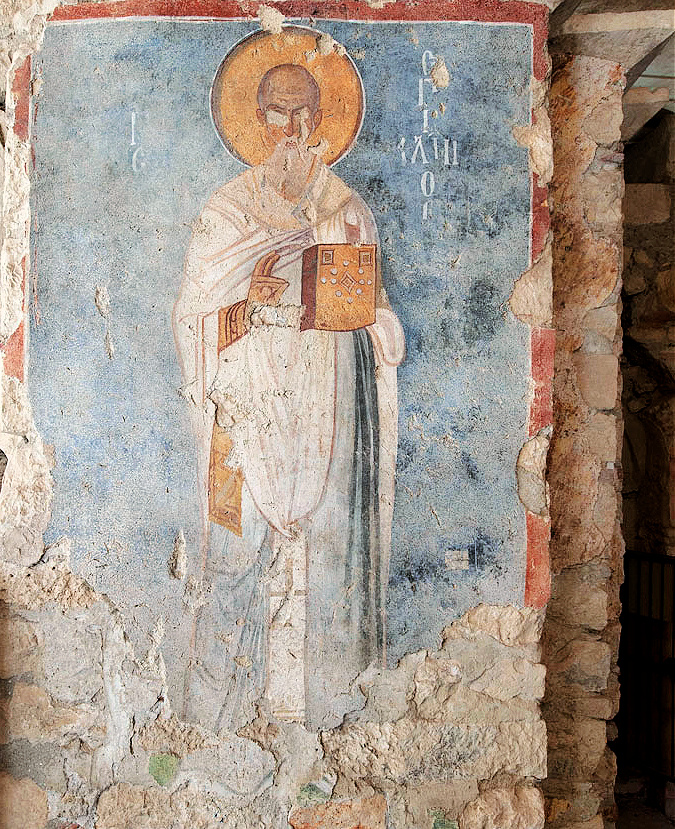
St. Nicholas, Demre, Turkey. St. Nicholas of Myra (270-340) is one of the church’s most popular and revered saints. St. Nicholas, who is the historical inspiration for Santa Claus, is the patron saint of children and those in dire need. St. Nicholas is an important religious figure for Latin and Eastern Rite Roman Catholics and Orthodox Christians. He was the bishop of the ancient Lycian town of Myra in the eastern Mediterranean which is today’s Demre in Turkey. He is patron saint of prisoners, the falsely accused and convicted, and travelers. Nicholas is also patron saint of Greece, Sicily, Apulia in Italy, and the Lorraine in France. The St. Nicholas Church that exists today in Demre (Myra) was built around 520 A.D over an older church where St. Nicholas was bishop and was the saint’s burial place. Remarkably, St. Nicholas’s corpse remained incorrupt and exuded a fragrant odor of myrrh. For centuries St. Nicholas’s relics were in the cathedral in Myra. In 1087 his relics were removed from Myra to Bari, Italy, where they are today. The sweet myrrh smell that exudes from the saint’s body is said to still take place today. Many miracles have been attributed to St. Nicholas during his lifetime and after his death so that he came to be called “The Miracle/Wonder Worker” of Myra.
History of the Cathedral parish
St. Nicholas Ukrainian Catholic parish was founded in 1905 by a group of 51 Ukrainian working immigrants. These Ukrainians arrived on Chicago’s northside in the late 1890’s from western and Carpathian Ukraine. Irish, Germans and Poles were already well established in Chicago by this time and built churches. The Ukrainians not only arrived later, but also were committed to their eastern-rite, Greek Catholic origins. They actively looked to fend off incorporation into the Latin rite under a mostly Irish Catholic hierarchy in the Chicago diocese. To this effect, the parish board adopted a resolution stating: “[T]hat all property of said church which may hereafter be acquired be held in the name of its incorporated name but under no conditions shall said church or its priests or pastors be ever under the jurisdiction of bishop or bishops except those of the same faith and rite.”
By 1911 it became clear that a new, larger church was needed for the growing Ukrainian community. Twenty lots were purchased on Rice Street between Oakley and Leavitt for $12,000 and building began. In 1913, Bishop Soter Ortynsky blessed the cornerstone of the new church. This Ukrainian Catholic church parish community relocated out of its original site and ventured about one mile directly west to build their new church under Fr. Nicholas Strutynsky. Fr. Nicholas had recently arrived from Ukraine and remained at St. Nicholas parish until 1921.
In 1941, St. Nicholas parish was host to the Eucharistic Congress for Eastern Rites. Twenty years later, in 1961, St. Nicholas Parish became St. Nicholas Ukrainian Catholic Cathedral when it became the seat of the Eparchy for much of the United States. Msgr. Jaroslaw Gabro, a native son of the parish, became the first bishop of the newly created Ukrainian Catholic eparchy.
Completed in 1915, the magnificent, Byzantine-Slavonic structure with thirteen onion domes representing Christ and His 12 apostles was erected. The first liturgy was celebrated on Christmas Day, January 7, 1915 (Julian calendar). A Ukrainian heritage school (Ridna Shkola) was also founded. By the early 1960s the school had over 1000 students. In 2022, St. Nicholas Elementary School has about 150 students.
When Bishop Gabro announced that churches in the eparchy would need to follow the Gregorian religious calendar that is used in the Latin west, some parishioners left St. Nicholas. In 1974 these parishioners, adhering to the ancient Julian religious calendar. erected Sts. Volodymyr and Olha Church three minutes away on foot across Chicago Avenue.
In 1980 Bishop Gabro who passed away was succeeded by Bishop Innocent Lotocky and a healing began between the estranged Ukrainian churches that continues today. In 1988, an ecumenical commemoration of the millennium of Christianity in Ukraine brought together Ukrainian churches in Chicagoland. Following the collapse of the Soviet Union in 1990, a new wave of immigrants from Ukraine began arriving in Chicago and joined St. Nicholas Cathedral. In 1993 Bishop Innocent Lotocky retired and was succeeded by Bishop Michael Wiwchar. In 2003 Bishop Michael Wiwchar was succeeded by Bishop Richard Stephen Seminack.
Chicago. St. Nicholas Ukrainian Catholic Cathedral. 10/2016 3.87 mb
The height of the cathedral building is appreciated looking up from its north side near its main entrance. Metal onion domes turned green by a century of oxidization cap the building’s 16 towers.
Chicago. St. Nicholas Ukrainian Catholic Cathedral. 10/2016 7.54 mb
The architecture, supported by columns, is curvaceous and spectacularly colorful.
The gold and blue fresco above the altar includes a pair of depictions of the former 11th century St. Sofia Cathedral in Kyiv on whose design and appearance St. Nicholas Ukrainian Cathedral is inspired. Kyiv is the capital city of the Ukraine and its cathedral is one of the finest examples of East Russo-Byzantine architecture. Kyiv/Kiev, Ukraine became the first capital of proto-Russia in the mid9th century as Slavic lands were organized by Norsemen who, simultaneously, as the fierce Vikings were plundering through much of Europe as they transported their culture.
Before the 9th century was over, the first Christian missionaries had arrived from Constantinople to the south into Russia and Ukraine and many Slavs became Christian. From the 10th to 13th centuries Kyiv, like Moscow to its north centuries later, became the intellectual and religious center of the country, where there were established innumerable monasteries, churches, and convents.
The entirety of murals and ornamentation are permanently affixed on interior surfaces by being painted directly on them. The only icon that was not renovated at this time was the one at the rear of the sanctuary depicting Christ with his apostles and Mother Mary. It was kept from 1928.
Chicago. St. Nicholas Ukrainian Catholic Cathedral. 10/2016 11.84 mb
Hanging from the center highest dome of the church is a 9-tiered golden chandelier with 480 brilliant lights. The chandelier was made in Greece and is one the largest such chandeliers in North America. The ceiling is in gold leaf and wall decorations depict Christ and the Virgin with Old and New Testament figures such as saints, prophets, and patriarchs, all in bright colors.
Chicago. St. Nicholas Ukrainian Catholic Cathedral. 10/2016 5.96 mb
A propensity of brown and gold in a color scheme that works. The formidable dome is an integral aspect of the interior decoration.
Chicago. St. Nicholas Ukrainian Catholic Cathedral. 10/2016 7.22 mb
Hanging from the highest dome, a stunning chandelier of 9 tiers and 480 lights crafted in Greece sets aglow the church interior. The artwork depicts the Pentecost (Acts 2: 1-13). The 12 apostles with Mary, the mother of Jesus Christ, are seated in bright primary colors as they are gathered together to receive the Holy Spirit symbolized by a dove from Heaven. This event immediately followed the Resurrection and Ascension of Jesus into Heaven.
The subject matter and detailed application of artwork in St. Nicholas Ukrainian Cathedral is derived from the mosaics in the 11th century former Cathedral of St. Sophia in Kyiv, Ukraine. Renovated between 1974 and 1977, the Interior of St. Nicholas Ukrainian Catholic Cathedral was led by Boris Makarenko (1925-2008), a specialist of Ukrainian Byzantine artwork.
Boris Makarenko was born in the Poltava region of Ukraine between Karkiv and Kyiv. With the outbreak of World War II, Ukraine was thrown into turmoil and Boris was drafted into the Soviet Army. He deserted with a group of friends and joined the Ukrainian Resistance. Boris fought his way across Europe and was eventually recruited into the British Army. Unable to return to his homeland, Boris immigrated in 1950 to the United States. He worked under the famed Ukrainian sculptor Mykola Mukhyn and eventually in a German-based firm where he learned and mastered the techniques of interior ecclesiastical art, restoration, and design. By the late 1950s, Makarenko founded his own studio in Philadelphia, Pennsylvania.
Using classical methods, mosaics are created by utilizing pieces of smalti and gold whether the mosaics are on the exterior and or in the interior of the church building.
Typically, Italian smalti is poured thicker and cut into thinner pieces. Since they are cut from the inside of exposed molten glass they are more vibrant, consistent and reflective in colors. Italian smalti can provide a coarse or smooth surface depending on how they are laid into a working surface. To begin to understand the complexity and richness of the frescos and mosaic interior of St. Nicholas, the general rule is for each square foot of mosaic surface, about 600 pieces side to side are required. The amount of pieces for the cathedral are into the many tens of thousands.
Chicago. St. Nicholas Ukrainian Catholic Cathedral. 10/2016 6.02 mb
The altar was built to face ad orientem, properly, “to the east.” This was the tradition and practice of the Catholic Church for nearly 2,000 years. The gold and decorations are outstanding.
Chicago. St. Nicholas Ukrainian Catholic Cathedral. 10/2016 5.34 mb
Icons are visual symbols of eternal truth in the Christian Faith: the designs are based on archetypal images preserved and regenerated from the very beginnings of Christianity. Iconographers write icons in traditional media using egg yolk tempera and oil-based pigments. The predominance of the gold color that marks these interior paintings and decorations is gold leaf. Called “gilding,” the use of gold leaf pertains to iconography. plaster carvings, wood carvings, and metal.
Chicago. St. Nicholas Ukrainian Catholic Cathedral. 10/2016 6.87 mb
Stained Glass by Munich Studio of Chicago
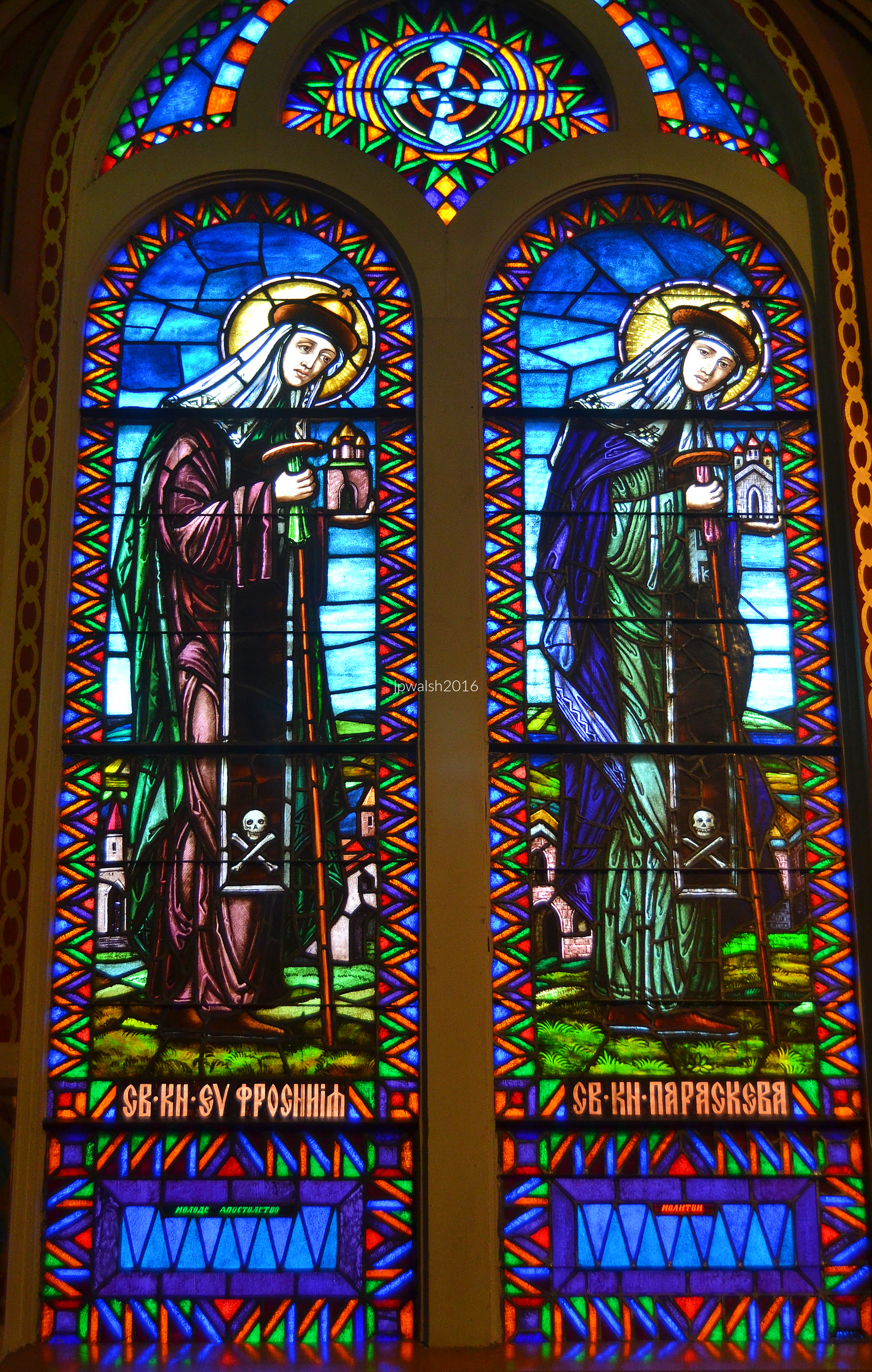
The colorful stained-glass is original to the 1915 church. They depict saints of the Catholic Church and were created by the Munich Studio of Chicago. The walls include tall, faceted windows displaying a hybrid of traditional and dalle-de-verre type glass techniques. Akin to mosaic, the latter stained-glass technique lends itself to abstract and highly stylized designs. The Munich Studio of Chicago was a major stained-glass studio in Chicago composed of skilled craftsmen and artists. In addition to the hagiography the windows depict, they also represent the artistic investment of the founding parishioners of St. Nicholas. While the term stained glass covers “colored, enameled, or painted glass”, Chicago’s pioneer “glass stainers” were primarily glass painters who used dark brown vitreous oxide and silver stain to paint designs on pieces of colored and/or opaque white glass. After the kiln firing the pieces were assembled like fragments of a puzzle and connected to each other with strips of malleable lead – called cames – which were fitted and soldered around each piece to create the full window.
The founder of The Munich Studio, Max Guler, was of middle-European extraction, as were the congregations of many of the churches who commissioned his firm for their windows. Guler came to Chicago about 1896 from the city of Munich, Germany where he had studied China painting. In 1898 his name appears in the Chicago city directory as an artist. Four years later the firm of Guler, Kugel and Holzchuh, presumably a small glass shop, is listed; and in 1903 the Chicago city directory first lists The Munich Studio, stained glass, 222 W. Madison, 5th f1r., with Guler as president. Catalog listings from 1910 to 1925 note thirty-two major church installations in Chicago and scores more elsewhere.
In 1913 the company moved from Madison Street to larger quarters at 300 West South Water Street (now Wacker Drive), and in 1923 to 111 West Austin Street (now Hubbard Street), at that time employing over 30 craftsmen, seven doing only glass painting. The Munich Studio imported most of its glass from France and Germany with domestically-made glass from firms in Indiana and West Virginia. As with European stained glass, they were painted with iron oxide and yellow stain and fired in ovens. The Munich Studio continued to prosper until 1930 when the Great Depression brought all building to a near standstill. Since it depended primarily upon the construction of new churches for its business, the economic downturn caused the company’s closing in 1932.
Chicago. St. Nicholas Ukrainian Catholic Cathedral. 10/2016 7.15 mb Chicago. St. Nicholas Ukrainian Catholic Cathedral. 10/2016 5.92 kb 30%
Mosaics of the Stations of the Cross were created by Boris Makarenko.
Chicago. St. Nicholas Ukrainian Catholic Cathedral. 10/2016 5.65 mbChicago. St. Nicholas Ukrainian Catholic Cathedral. 10/2016 8.62 mbChicago. St. Nicholas Ukrainian Catholic Cathedral. 10/2016 7.22 mbChicago. St. Nicholas Ukrainian Catholic Cathedral. 10/2016 5.35 mbChicago. St. Nicholas Ukrainian Catholic Cathedral. 10/2016 3.78 mb
Chicago. St. Nicholas Ukrainian Catholic Cathedral. 10/2016 3.67 mb
St. Nicholas Ukrainian Catholic Cathedral’s regal appearance and design is inspired by the Cathedral of St. Sophia in Kyiv. This includes its 13 domes, symbolic of Christ and his 12 apostles. The Chicago cathedral is also similar to the Kyiv model in that it has 5 major domes.
Chicago. Author & wife on steps of St. Nicholas Ukrainian Catholic Cathedral. 7/2015 6.41 mb
Above these main entrance steps, the façade of the cathedral displays a treasured mosaic depicting “Our Lady of Pochaev.” Above that image is the icon of St. Nicholas the Wonder (or Miracle) Worker, the cathedral’s namesake.
Story of “Our Lady of Pochaev”
Ukraine had been Christianized for about 200 years when, in 1198, when St. Francis of Assisi was about 17 years old, a monk climbed Pochaiv mountain in western Ukraine in order to pray. A pillar of fire appeared to the monk and some nearby shepherds. When the flames subsided, the Blessed Virgin Mary appeared. The apparition left her footprint out of which a spring of water flowed. This supernatural event led to many others so that the region became dedicated to Mary.
In 1559, Metropolitan Neophit sent to Anna Hoyska an icon of our Lady of Pochaev. The icon shows our Lady wearing a crown and holding the infant Jesus. She holds the end of her veil in the other hand. It is an icon where the cheek of the baby Jesus touches Mary’s face as the infant gives a blessing with his hand. At approximately 11×9 inches in size, the original icon is small. Made from red-pitched cypress, the artist and circumstances of its creation are unknown.
The icon immediately worked a miracle as Anna Hoyska’s blind brother regained his sight. Following her death, the icon was donated to a Basilian Monastery and eventually placed in the Church of the Dormition of the Blessed Mother. Monastery chronicles record numerous miracles during the icon’s stay at their Church.
In 1773, the icon was crowned by Pope Clement XIV. In 1831 Russian Czar Nicholas I expelled the Basilians and gave the monastery to Orthodox monks. In 2001, the icon was moved from Pochaev to The Cathedra of the Trinity of The Danilov Monastery in Moscow.
Chicago. St. Nicholas Ukrainian Catholic Cathedral. 10/2016 3.96 mb
This is the apolytikion for the feast of St. Nicholas of Myra, December 6, an important saint in the Christian Church, East to West, since the 4th century. In the Eastern Orthodox Church, the term “apolytikion” refers to a hymn sung as an important part of the liturgy typically in honor of a saint’s feast day. It often summarizes in a few lines the significance of the saint’s spirituality celebrated that day. The “apolytikion” can also be sung in conjunction with the Divine Office, such as Matins or Vespers. FROM THE GREEK: “A rule of faith and an image of meekness, a teacher of self-control, the truth of things has revealed you to your flock; therefore, I shall gain the heights through humility, the wealth through poverty. Father Hierarch Nicholas, pray to Christ our God that our souls may be saved.”
Heavenly City: The Architectural Tradition of Catholic Chicago, Denis Robert McNamara, James Morris, Liturgy Training Publications, Chicago, Illinois, 2005, pp. 114-115
Chicago Churches and Synagogues: An Architectural Pilgrimage, George Lane, S.J., and Algimantas Kezys, Loyola University Press, Chicago, 1981, p. 136-137.
Houses of Worship: An Identification Guide to the History and Styles of American Religious Architecture, Jeffrey Howe, Thunder Bay Press, San Diego, California, 2003.
AIA Guide to Chicago, 2nd Edition, Alice Sinkevitch, Harcourt, Inc., Orlando, 2004, p. 260.
Discovering Stained Glass in Detroit, Nola Huse Tutage with Lucy Hamilton, Wayne State University Press, Detroit, 1987.
The Saints: A Concise Biographical Dictionary, edited by John Coulson, Guild Press, New York, 1957, pp. 565-567.
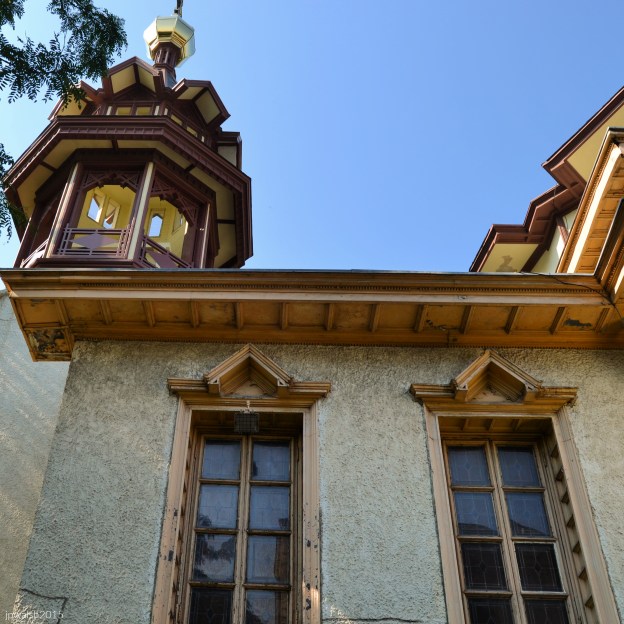
FEATURE Image: Chicago. Holy Trinity Orthodox Cathedral. The walls of the church building are load-bearing brick covered with stucco. The bell tower and octagonal belfry, dome, and roof are made of wood with metal trim and latticework. 7/2015 2.80 mb
Louis H. Sullivan designed the bell tower (above and below) with its ornamentation and eaves and soffits for Holy Trinity Orthodox Cathedral in Chicago’s Ukrainian Village.
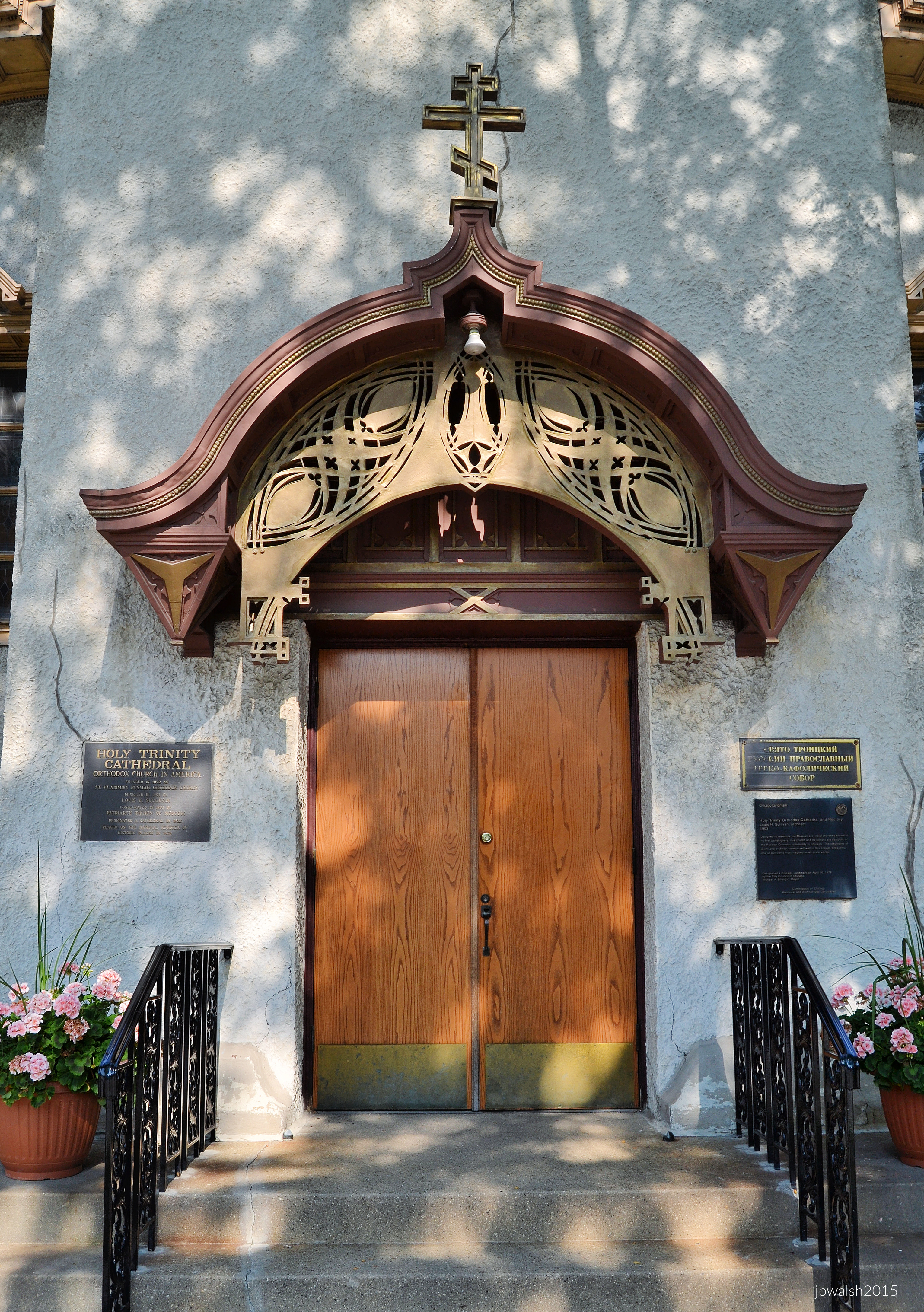
Louis H. Sullivan designed the portal canopy (above) and its ornamentation such as the fretwork. Sullivan also designed the window frames (example below).
Holy Trinity Cathedral was built on a limited budget. It is a small building at 47 x 98 feet situated on an east-west axis. The main body of the church is square with extensions and an octagonal dome above. The picturesque country-church entrance has a metal and wood canopy whose design and ornamentation were created by the architect, Louis H. Sullivan (1856-1924). Dedicated in 1903, the church was designated a cathedral in 1923.
The parishioners that built this church were rural people who had emigrated from southern Russia near the Ukraine as well as the area of the Carpathian Mountains.
The Eastern Orthodox central plan creates an interior where the congregation stands in a square space topped by an octagonal dome. For Easter services and the like, the cathedral is filled to capacity with parishioners and others spilling out the front door with its decorative canopy onto the public sidewalk.
The church building was completed for around $27,000 in 1903 (approximately $1 million in 2022) with Sullivan donating half his commission to the church project.
SOURCES:
Chicago Churches and Synagogues: An Architectural Pilgrimage, George Lane, S.J., and Algimantas Kezys, Loyola University Press, Chicago, 1981, p. 106-107.
Alice Sinkevitch, AIA Guide to Chicago, 2nd Edition, Harcourt, Inc., Orlando, 2004, p. 260.
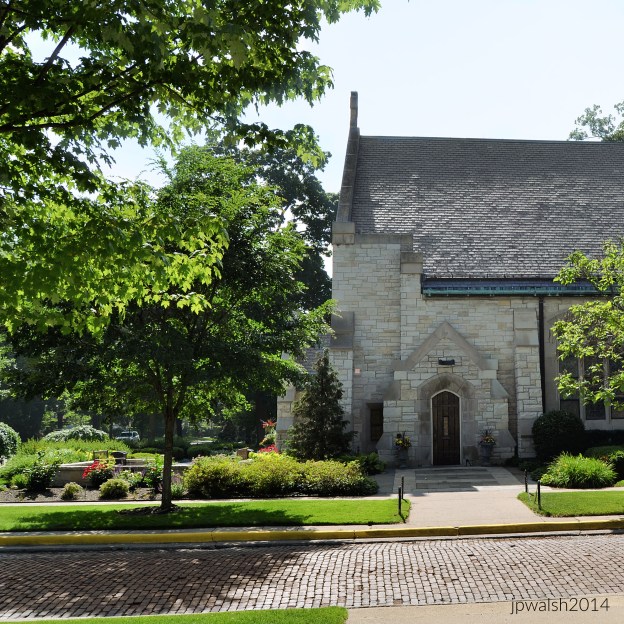
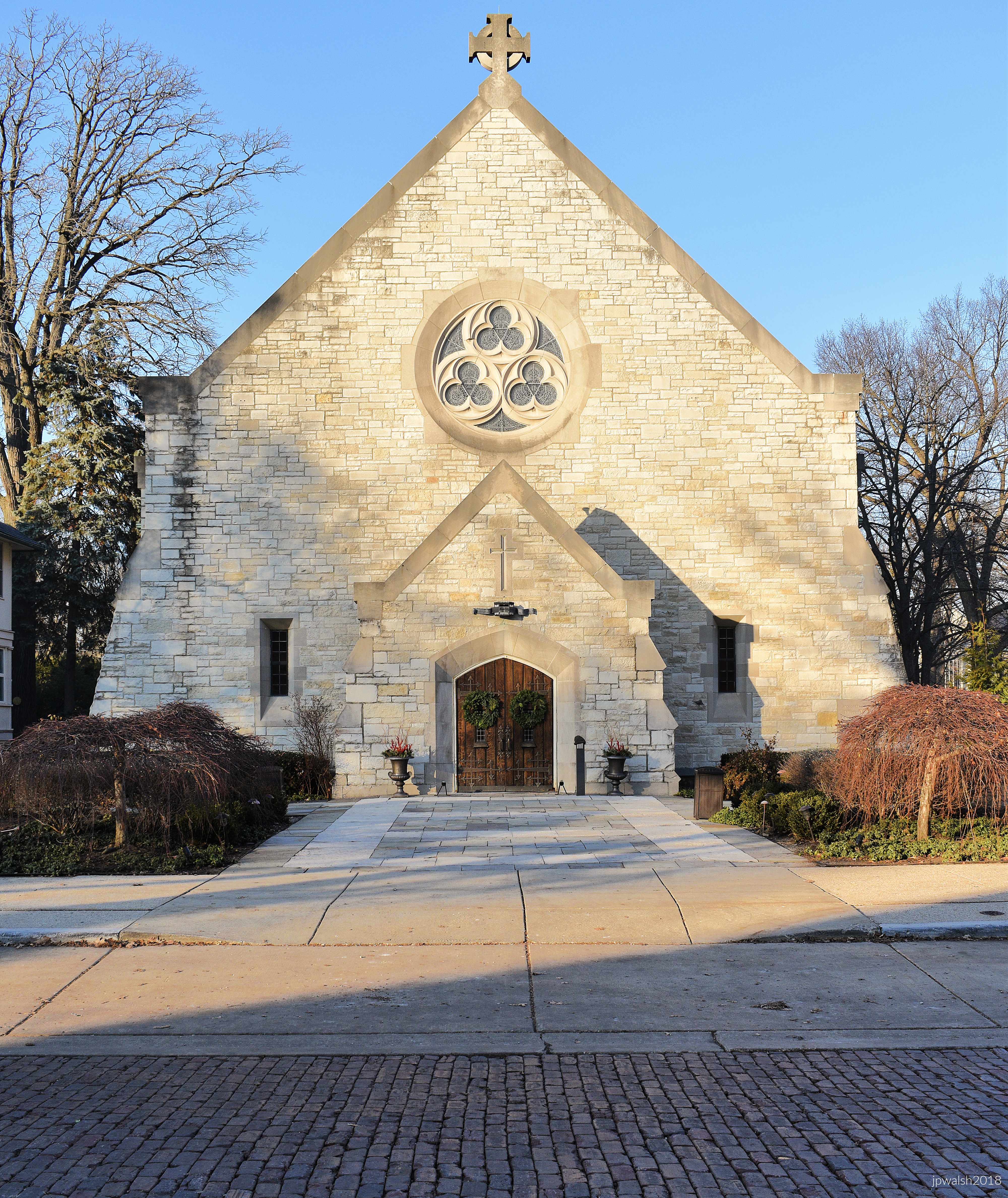
FEATURE image: St. Francis Xavier Church was erected in 1939 in an established well-maintained residential neighborhood in Wilmette, Illinois, just blocks inland from Lake Michigan. The attempt was made by the area’s Roman Catholics to fit in unobtrusively and harmonize with its neighbors on Chicago’s Northshore. 6/2014 3.56mb
The English Gothic-style church is usually associated with establishment mainline Protestants. The church is built to be sophisticated and simple. 12/2018 11.6mb
Built by the firm of McCarthy, Smith & Eppig, St. Francis Xavier Church is built in the style of a sturdy country church. It is characterized by low walls, massive external buttresses, and a sloped, elongated roof. 6/2014 4.64mb
WHO IS ST. FRANCIS XAVIER (1506-1552), FIRST JESUIT MISSIONARY TO THE FAR EAST AND CO-PATRON OF CHURCH MISSIONS?
St. Francis Xavier. 6/2014 4.05 mb
Depicted in marble at the entrance to the sanctuary in Wilmette, Illinois, is St. Francis Xavier, S.J. (1506-1552), the parish church’s patron and namesake. Holding a crucifix, the Basque Jesuit priest is dressed in a black cassock draped by an alb and stole.
St. Francis Xavier’s feast day of December 3 marks his death day in 1552 at 46 years old on a lonely island off mainland China. In 1927 Pope Pius XI (1857-1939) named him co-patron with St. Thérèse of Lisieux of all foreign missions. (see – https://www.papalencyclicals.net/Pius11/P11APOST.htm). In life Francis Xavier came from a good family and had a naturally magnanimous personality. He was a student in Paris whose room-mate happened to be the older and wiser Ignatius of Loyola who patiently turned Francis’s thoughts and desires heavenward. Francis Xavier became the first Roman Catholic missionary to the Far East and as if by happenstance, since Ignatius’s first choice fell ill and was unavailable. When Francis set out for Asia, Loyola’s Jesuit Order had been officially approved by St. Pope Paul III (1468-1549) only a couple years before.
It was by sheer audacity that Francis Xavier established a template for the Jesuit missionary and evangelizer – prayerful, prepared to go where need was greatest, friendly, sincere, personally austere, hard-working, and joyful in the adventure of doing God’s will.
Leaving by ship from Lisbon, Portugal, in 1542 St. Francis Xavier became the first Jesuit missionary to India in 1545 and, in 1549, to Japan – 300 years before Commander Matthew Perry’s first American expedition to China and Japan in 1853. For one hundred years, the Jesuits were the only Roman Catholic missionaries in Asia. The long physical distances Francis Xavier traveled in the 1540s were remarkable. In his last days, on the return trip to India from Japan – almost 6000 km by air – St. Francis Xavier found his ship thrown off course in a sea storm and stopping at an island near Guangzhou, Guangdong, China.
Once back in India, St. Francis Xavier immediately wanted to return to China. After some delays, he reached Shangchuan Island, about 15 miles from the mainland and to which 46-year-old Francis Xavier had made arrangements to sail. While awaiting permission on the island to cross the inlet to enter mainland China, Francis died, without the benefit of the sacraments, of the fever. He was buried on Shangchuan in quicklime, a chemical compound normally used which worked to speedily consume the flesh so to leave just bones for health concerns and safer and easier transport. Francis was known on his journeys to live in a most austere manner insisting only on a good pair of boots for moving on foot over long distances in difficult terrain. Seeking the approval of local rulers, Francis occupied his days meeting the needs of the poor and sick, often in sweltering or frigid conditions. Over ten years Francis Xavier worked hard to bring the Christian faith to the greater part of the Far East.
Two months later, In February 1553, when the saint’s remains were exhumed, the witnesses were met by the body of Francis Xavier that, despite being buried in quicklime, had not rotted. His remains were taken to Portuguese Malacca and, a year after his death in December 1553, taken to Goa in India which had been the saint’s headquarters. In Goa, Francis received a hero’s welcome. Today St. Francis Xavier is still buried in Goa’s basilica. Reports of miracles were made in India and Japan following his death. Pope Paul V beatified St. Francis Xavier In 1619 and he was made saint on March 12, 1622, by Pope Gregory XV.
WHO IS ST. IGNATIUS OF LOYOLA (1491-1556), FOUNDER OF THE SOCIETY OF JESUS (JESUITS)?
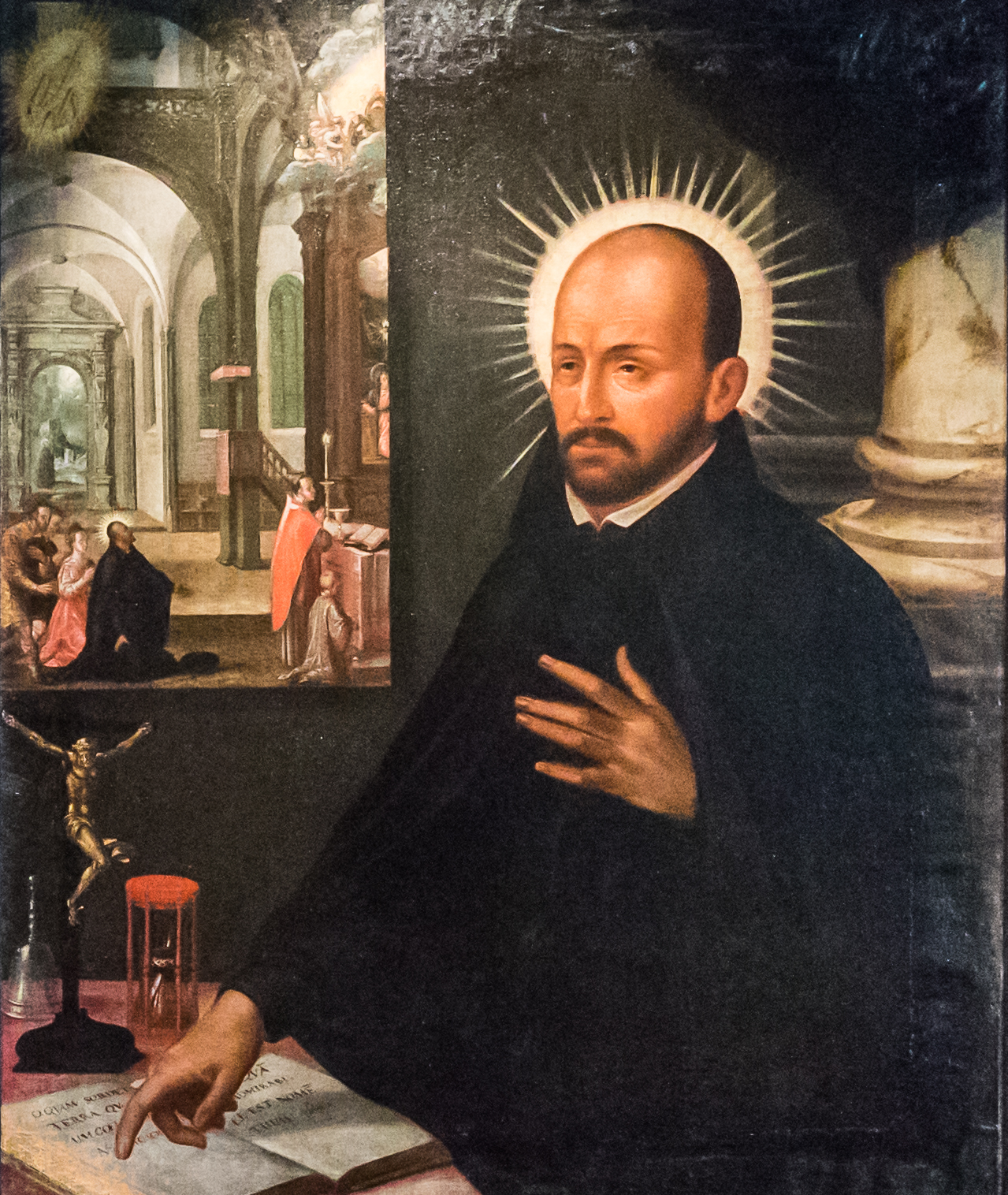
St. Ignatius of Loyola (1491-1556), after 1600, Jan Dammeszoon de Hoey (c.1545-1615), Stiftsmuseum Xanten (Germany). The artist was a Netherlandish painter who worked at the court of French king Henry IV (reign, 1589-1610) and is associated with the School of Fontainebleau. He is best known for his history paintings. St. Ignatius, before he became the founder of the Jesuits, was given a lives of saints when he was recovering from a bullet wound in the leg he received in 1521 during combat as a soldier in Pamplona in Spain. Though he naturally asked for “novels” to pass the time, it is sometimes related or implied that he may have had reason to be disappointed with the saints’ lives though it may actually have been a pleasant development for him since he took to the stories quite readily. As a knight from a prominent noble family in Spain, he latched onto and appreciated those various lives of peace and religious glory displayed in the Christian saints, and responded concretely to it. Where to trace this trail of grace to this point of life-changing conversion is of existential purpose. Ignatius, whether he knew it or not, learned now more fully how his soul desired to emulate the Christian heroes. The result was immediate and profound. Like St. Francis of Assisi (1182-1226) centuries earlier who the manly Ignatius deeply admired – Francis was another rich soldier boy who by experience in war of capture and prison moved from knight to penitent – Ignatius went and did the same. Ignatius would co-operate with God’s grace for whom he had met his match and hung up his sword in noble surrender. He started a pilgrimage from shrine to shrine. His natural self of elegant dress, excellent manners, and a measure of violent force in his personality, he channeled towards religion. As a youngster he had a mature bearing beyond his years so that the adult Ignatius continued to be a risk taker, as well as disciplined, prudent, despising greed, and persevering. The wonder of Ignatius is that he took his innate qualities and delivered them from the power of darkness and transferred them into the kingdom of God’s Light. Ignatius’s famous Spiritual Exercises (1548) were written early in the life of the Jesuit Order and communicated for others his own sublime ascetic character in action. Again, like the Poverello, Ignatius would be wrapped for days in prayer’s contemplative ecstasy. Also, like Francis in his early days as a pilgrim, he journeyed to the Holy Land in September 1523. Not yet a Jesuit as he had not founded them, he departed the Holy Land on September 23 and returned to Europe. He studied first in Barcelona and then in Paris where he met and gathered around him six companions: Spaniards Alfonso Salmeron (1515-1585), Diego Laynez (1512-1565), Francis Xavier (1506-1552) and Nicholas Bobadilla (c. 1509-1590), Portuguese Simão Rodrigues (1510-1579) and Savoyard Peter Faber (1506-1546). As the “Society of Jesus” the seven left for Rome in 1537 to obtain the pope’s approval for a new religious order. On the way there Christ, wrapped in His light and carrying his cross, said to Ignatius – in Latin – Ego vobis Romae propitious ero (“I will be good to you in Rome”) for which Jesuits then and now share that promise of accompanied mission in the Roman Catholic Church. It was while Pope Paul III (reign, 1534-1549) was on summer retreat from the heat of Rome at the Tivoli gardens that he further considered and ruminated over Ignatius’s group of six companions who had come to the Eternal City. One hot summer day the pope declared, reading Ignatius’s writings, – “The finger of God is here!” and then, in Latin, he said, “”Societatem hanc, id temporis…afflictis Ecclesiae rebus, non levi presidio atque ornamento fore.” (“This Society of Jesus [Jesuits] would prove an invaluable auxiliary and splendid ornament to the Church in these eventful times…”) The Jesuits were officially approved in 1540. Ignatius sent his companions across Europe and around the globe to create schools, colleges, seminaries and Christian missions that had an exhilaratingly mainly positive impact on society and culture.
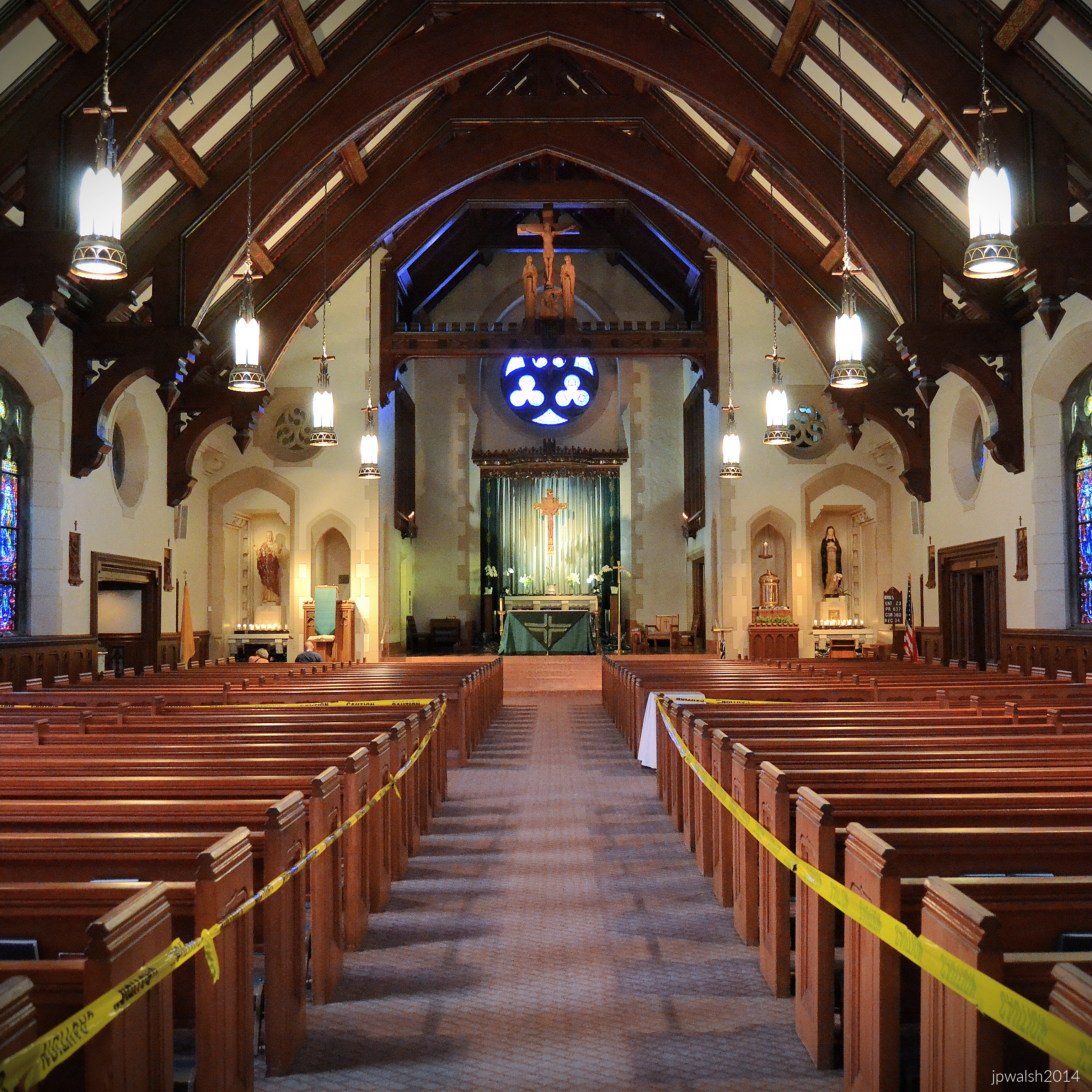
Nave looking to main altar. There are no columns to obstruct the view to the marble altar with a crucifix above. With Vatican II reforms, the tabernacle was set in a niche to the right. Originally the tabernacle was on the main altar below the crucifix. An extra-wide altar rail with cross legs whose form served as “being at table with Christ” for the communicant was also removed. Though St. Francis Xavier Church is traditional in its architecture, its design elements are modern, chic, and streamlined, which makes the sanctuary flexible and adaptable to change.The ceiling is constructed like an upside barque. This evokes the missionary journeys of St. Francis Xavier, by sea to and in the Far East. 6/2014 5.99 mb
July 2014. 5.85 mb Interior of St. Francis Xavier Church from the altar looking towards the main entrance. McCarthy, Smith & Eppig was a design firm that worked in the 1930’s extensively with Chicago Cardinal George Mundelein (1872-1939). Architect Joseph W. McCarthy (1884-1965), had been a young architect under Daniel Burnham (1846-1912), a major design force in Chicago. McCarthy built, under his own name and with various firms, churches and other church-related structures in the Chicago area from the 1910s to 1930s. In 1939, for instance, McCarthy built St. Francis Xavier Catholic Church and the more grandiose St. Joseph Catholic Church, both in Wilmette, about one mile apart. The design of St. Francis Xavier Church was handled by the firm’s younger partners, David Smith and Arthur Eppig (1909-1982). The church building’s simple architecture with its fine details cost $200,000 to construct in the waning years of the Great Depression – about $4 million in 2022 (see- https://www.dollartimes.com/inflation/). While the majority of McCarthy’s church buildings were built in the Chicago area, some of his important church projects included the cathedral church in Springfield, Illinois, (1928) and the parish church (1918) of what became the diocese of Joliet, Illinois.
December 2017. Organ loft. 7.90 mb 77%
There are 8 major stained-glass windows in St. Francis Xavier Church: four in the west wall and four in the east wall.
October 2015. detail of panels of three different windows.
Smaller stained-glass oculi and panels are scattered throughout the interior. These stained-glass windows were designed by Henry Schmidt, a parishioner. They are quite beautiful, scintillating in their pseudo-English Tudor style, illumined in usually soft eastern and tree-obscured western exposures, although their subject matter is somewhat chaotic and a hodge-podge in its traditional and idiosyncratic admixture of hagiography, scripture, and popular piety. One aspect of their enduring appeal is that the glass can be seen close up and at eye level.
ST. PETER WINDOW.
CENTER PANEL: Saint Peter, leader of the apostles, holds the keys of the kingdom of heaven (Matthew 16:19). Peter holds a book, a representation of St. Peter’s New Testament letters (1 and 2 Peter) and sermons (Acts). Below is St. Peter’s Basilica in Vatican City in Rome with its famous dome.
LEFT PANEL: Crowning of Mary as Queen of Heaven by Triune God (Father, Son and Holy Spirit). From the Council of Ephesus in 431, depicting the Blessed Virgin Mary wearing a regal crown was used in Christendom.
RIGHT PANEL: Assumption of Mary into Heaven is not in the New Testament though biblical texts point to the doctrine of Mary as Theotokos (Mother of God), taken (“assumed”) body and soul into heaven at death. Going “up” to heaven is imagery used to express the spiritual and related to Jesus’ Ascension (Acts 1:6-17 and Luke 24:50-53). The assumption phenomenon occurred in the Old Testament with Moses and Elijah who were also present at Christ’s Transfiguration (Matt 17:1-9; Mk 9:2-10: Lk 9:28-36; and 2 Peter 1:16-21). Below the panels are identical angel figures. 6/2014 4.98 mb
October 2015. Detail St Peter 4.81mb DSC_0504 (1)
ST. BONIFACE WINDOW.
CENTER PANEL: St. Boniface (675-754) is the St. Patrick of Germany. He was a bishop who lived during Europe’s Dark Ages. Boniface was responsible for organizing the church in western Germany and established the bishoprics of Cologne and Mainz. On direction by the Roman pope, Boniface anointed Pepin the Short (714-768) — son of Charles Martel (c. 688-741) and father of Charlemagne (747-814) — as king of the Franks. Pepin’s coronation became the model for future royal coronations and the beginning of the modern European state.
LEFT PANEL: Jesus meets his mother is the fourth station of the cross. The Holy Face, below, is a devotion proclaimed by Pope Leo XIII in 1885.
RIGHT PANEL: Jesus mocked and crowned with thorns (Luke 22:63-65 and John 19:2-3) is the sixth station of the cross and an important marker of the suffering of Jesus. 6/2014 3.93 mb
ST. PATRICK WINDOW.
CENTER PANEL: St. Patrick (418-493) is one of the patron saints of Ireland (St. Brigid (c. 451–525) and St. Columba (540-615) are the others). In Wilmette, IL, St. Joseph Church was established in 1847 for German immigrants and St. Francis Xavier Church for Irish. The depiction of Patrick as the archetypal Irish bearded bishop — dressed in green with miter and staff – emerged in late 1700’s. St. Patrick’s symbology includes a book, refering to the Holy Scriptures and his own writings: the Confessio and Epistola to Coroticus, both in Latin. Patrick holds the legendary 3-leafed clover which he used to teach the Irish about the Holy Trinity. Below is the harp which is Ireland’s national emblem and one of the world’s oldest musical instruments.
LEFT PANEL: Jesus Christ’s Resurrection from the dead is the cornerstone of the Christian faith (1 Corinthians 15:17). His empty tomb is proof of Christ’s deity (John 5:26; Romans 1:4). By rising from the dead, Jesus Christ saved us from our sins (Romans 4:24–25; Hebrews 7:25), gave hope for our future resurrection (John 14:19; 1 Corinthians 15:20–23), and provides believers with spiritual power (Romans 6:3–4; Ephesians 1:19–21). The window depicts the resurrected Jesus holding the banner of victory over death as a Roman guard cowers in the dazzling light of a Risen Christ with an angel in attendance. Christ’s cruciform halo (elaborated in three parts) usually contains three Greek letters that in translation spell out “I Am Who Am,” again, a reference to Christ’s Divinity. All four gospels contain passages pertaining to the resurrection, but none of them describe the moment or essence of resurrection itself.
RIGHT PANEL: Crucifixion of Jesus with his mother Mary and John the Apostle at the foot of the cross. Above Christ’s head are the letters INRI, an acronym for Jesus Nazarenus, rex Judæorum. This was the charge against jesus written in Latin by Pontius Pilate who condemned him to death. It translates as “Jesus Nazarene, King of the Jews.” The title appears in the Passion narrative of John’s Gospel (19:19). Below each side panel are identical angel figures. 7/2014 7.58 mb
The altar design includes tall candlesticks and compact, detailed baldacchino. 6/2014 4.61 mb
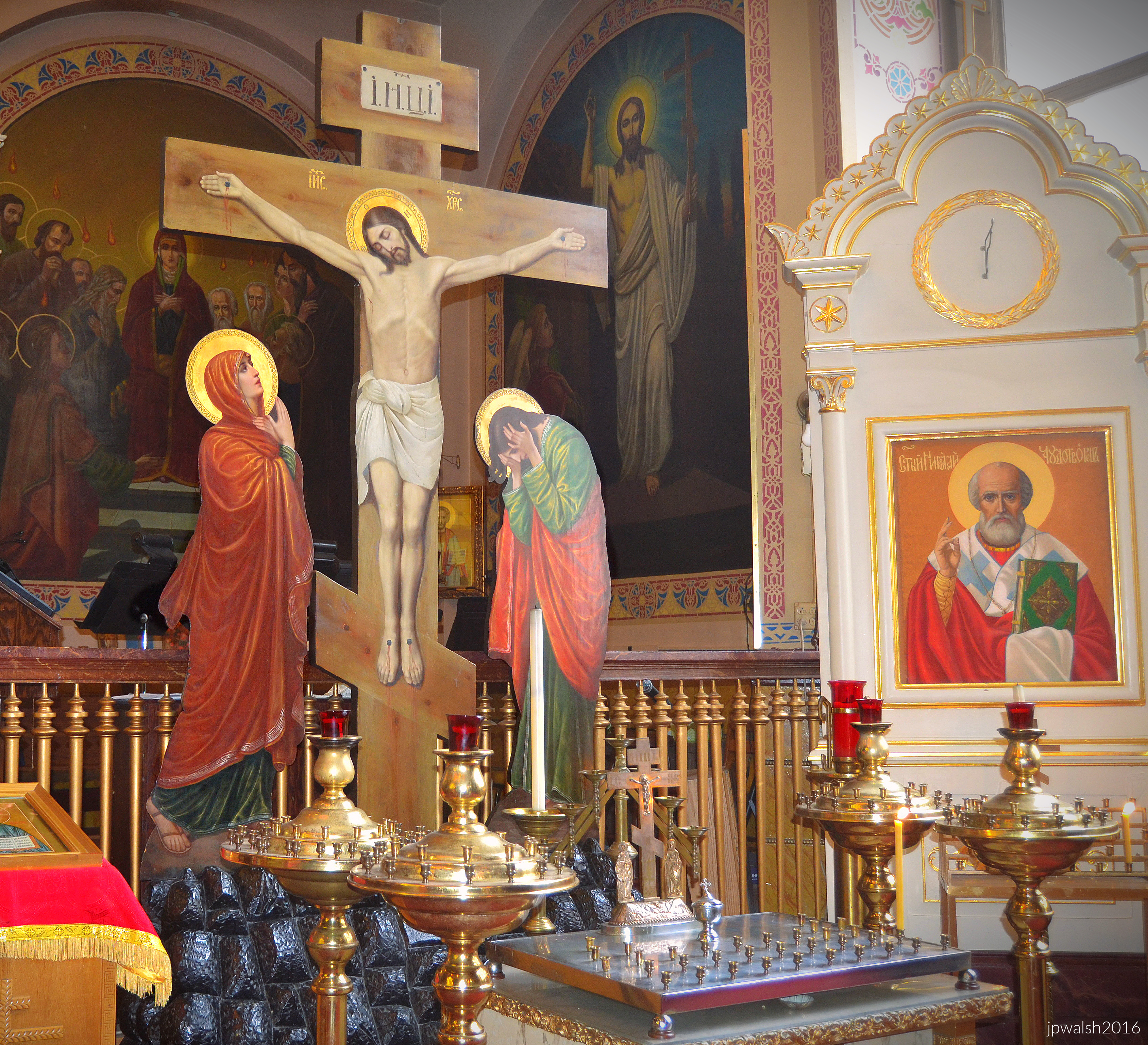
A depiction of the crucifixion in basswood stands atop a rood beam at the ceiling line above the main altar. The scene includes the figure of a crucified Jesus, half-naked, wearing a crown of thorns, and the INRI inscription overhead. Three figures at the foot of the cross are (at left) his mother Mary and (at right) John, the Apostle. The bowed middle figure could represent the other named and unnamed women present at the crucifixion (John 19:25; Luke 23:27 and 49). The artwork is by Fritz Mullhauser. 12/2018 8.47 mb
MARY QUEEN OF HEAVEN WITH INFANT JESUS WINDOW.
CENTER PANEL: The Queen of Heaven who reigns from the right hand of her son, is depicted in her role as mother of Jesus Christ. Below a crown hovers above what may be a heart-shaped letter “M” for Mary’s first initial and/or her sacred heart.
LEFT PANEL: Presentation of Jesus by Mary and Joseph in the Temple and meeting with Simeon, the “just and devout” man of Jerusalem (Luke 2:25–35). The Presentation is the Fourth Joyful Mystery of the Rosary. In Luke, 40 days after Jesus’s birth, Mary and Joseph took the baby to the Temple in Jerusalem to complete Mary’s ritual purification after childbirth, and to perform the redemption of the firstborn, as prescribed by Mosaic Law (Leviticus 12 and Exodus 13:12-15).
RIGHT PANEL: Nativity of Jesus in Bethlehem (Luke 2: 1-7 and Matthew 1: 18-25) is the Third Joyful Mystery of the Rosary. Below each side panel are identical Angel figures. 12/2018 12.5 mb
ST. ANNE AND THE CHILD VIRGIN MARY WINDOW.
CENTER PANEL: Child Mary with Saint Anne, her mother. Nothing is known about Mary’s mother though early apocryphal writings provide information for stories about Mary’s lineage and early life that have resulted in a legendary tradition.
LEFT PANEL: Visitation of the Blessed Virgin Mary to her cousin Elizabeth (Luke 1: 39-45). After the Annunciation, Mary set out into the hill country to stay in the house of Elizabeth and her husband Zechariah for three months. Both women were miraculously pregnant at the time–-Mary with Jesus by virgin birth and Elizabeth with John the Baptist in her old age. Depicted is the moment when John the Baptist leapt with joy in Elizabeth’s womb at hearing Mary’s voice (Luke 1:41). The Visitation is the Second Joyful Mystery of the Rosary. Below is an ark (or tabernacle). Luke structured his narrative passages of the Visitation on stories in 2 Samuel and 1 Kings about the ark of the Covenant in the Old Testament. The Catechism of the Catholic Church identifies Mary as the Ark of the New Covenant (2276): “Mary, in whom the Lord himself has just made his dwelling, is the daughter of Zion in person, the Ark of the Covenant, the place where the glory of the Lord dwells. She is ‘the dwelling of God . . . with men.”
RIGHT PANEL: Annunciation to Mary by the angel Gabriel aanouncing that she would bear the Son of God, Jesus Christ. “Hail Mary, full of grace, the Lord is with you!” It is by Mary’s joyful acceptance of God’s will – “Behold, I am the handmaid of the Lord; let it be to me according to your word” (Luke 1:26-38) – that the Incarnation takes place. The Annunciation is the First Joyful Mystery of the Rosary. Below, the two angel figures are distinct. 12/2018 16.24 mb
ST. JOSEPH WINDOW.
CENTER PANEL: St. Joseph was the foster father of Jesus and served as Jesus’ guardian protector. Jospeh’s symbology includes his holding a carpenter’s square (Mt 13:55) and holds a white lily to symbolize his faithfulness and chastity to Mary (MT 1: 25) as well as his holiness and obedience to God (Mt 1:24; Mt 2:14, 21, 22). An angel figure Is below St. Joseph.
LEFT PANEL: Holy Family in Nazareth. Jesus was obedient to Mary and Joseph and “progressed steadily in wisdom, age and grace before God and men” (Lk 2:52). Jesus was instructed by St. Joseph in the carpenter trade and holds a wooden cross on his knees. Flowering grass below is decorative and could indicate the flowering staff of St. Joseph which symbolized that he was specially chosen by God to be Mary’s husband. That imagery was drawn from the Old Testament when Aaron’s staff, placed before the Ten Commandments, sprouted with almond blossoms as a sign that he was chosen by God (Num 17:22-23).
RIGHT PANEL: Mary and St. Joseph find Jesus at 12 years old in the Temple with the doctors of the Law (Luke 2:41-52). It is the Fifth Joyful Mystery of the Rosary. The event is the only time in the New Testament where Jesus makes a public appearance before His baptism in the Jordan by John the Baptist and the start of his public ministry at 30 years old (Matthew 3:3-17, Mark 1:9-11; Luke 3:21-23; John 1:29-33). Below the scene are the tablets of the Ten Commandments with a symbol of the Trinity, including the sacred eye, hovering above. 12/2018 12.34 mb
ST. PAUL THE APOSTLE WINDOW.
CENTER PANEL: St. Paul is depicted holding a sword, a symbol for this Apostle to the Gentiles. Describing spiritual warfare in his letter to the Ephesians, Paul writes, “Take the sword of the Spirit, which is the word of God” (Ephesians 6:17). In symbology of martyrs, they are traditionally depicted with the instrument of their death. Paul is a known martyr (c. 64-68 CE), though its details are not. Early Christian writers said St. Paul was beheaded using a sword.
LEFT PANEL: The Pentecost (Acts 2: 1-13) followed the Ascension, It is where the 12 Apostles with Mary, the Mother of Jesus Christ, gathered together to receive the Holy Spirit symbolized by a dove from Heaven.
RIGHT PANEL: Ascension of Jesus into Heaven is mentioned many times in the New Testament and primarily in Luke and Acts (Luke 24:50-53, Acts 1: 6-12, John 3:13, John 6:62, John 20:17, Romans 8:34, Ephesians 1:19-20, Colossians 3:1, Philippians 2:9-11, 1 Timothy 3:16, and 1 Peter 3:21-22). The Ascension is where the Resurrected Christ physically departed from Earth by rising into Heaven which was witnessed by eleven of his apostles (Judas betrayed Jesus). Heaven incorporates the resurrected fleshly body of Christ as the divine humanity of Christ enters into the intimacy of the Father and becomes the perfect God-Man. 6/2014 4.28 mb
October 2015 detail St. Paul window. 4.48mb DSC_0505 (1).ST. PAUL THE APOSTLE WINDOW in situ on the east wall.
THE GOOD SHEPHERD WINDOW.
CENTER PANEL: Jesus called himself “the good shepherd” (John 10). In the Old Testament there is a prophecy about shepherds who are overseers for the sheep who are the people of God. Ezekiel prophesies of a shepherd to come who is the Messiah of Israel (Ezekiel 34:23-24 and 37:24-25). Jesus is claiming to be the Messiah that the scriptures foretold. Christ’s cruciform halo (in three parts) contains three Greek letters that spell out “I Am Who Am,” a reference to Christ’s Divinity. Jesus holds the shepherd’s staff and has a lamb slung over his shoulders referring to the people of God he cares for. A lamb in a bramble below refers to Jesus as “the lamb of God,” a title found in John’s Gospel (John 1:29; 36). It also alludes to the Old Testament when God sent a ram caught in a bramble to change places with Isaac who God called to be sacrificed as a burnt offering (Genesis 22:13). This Old Testament story foretold the sacrifice of the Son of God at Calvary.
LEFT PANEL: Scourging of Christ is the 4th Station of the Cross (John 19:1-3). It is part of the brutalities that Jesus endured in his Passion. Jesus was slapped, beaten, punctured by thorns, and whipped with a reed stick. Two of these torture instruments are depicted below the pillar. An angel figure is below that.
RIGHT PANEL: Jesus is depicted in the garden of Gethsemane being consoled by an angel (Luke 22:43). It followed the Last Supper where, knowing of Judas’s betrayal, Jesus in the garden prayed: “Father, if you are willing, take this cup from me. Yet not my will, but yours be done” (Luke 22:42). With his prayer, “an angel from heaven appeared to him and strengthened him” (Luke 22:43). At the foot of the Mount of Olives outside Jerusalem all four Gospels relate that Jesus underwent an agony in the garden of Gethsemane where he was betrayed and arrested the night before his crucifixion. Below is an angel figure. 12/2018 12.6 mb
December 2018. Organ loft. St. Francis Xavier Church, Wilmette, IL. 446 kb 25%
SOURCES:
Heavenly City: The Architectural Tradition of Catholic Chicago, Denis Robert McNamara, James Morris, Liturgy Training Publications, Chicago, Illinois, 2005, pp. 138-140 Chicago Churches and Synagogues: An Architectural Pilgrimage, George Lane, S.J., and Algimantas Kezys, Loyola University Press, Chicago, 1981. Saint Ignatius and His First Companions, Chas. Constantine Pise, P.J. Kenedy & Sons, New York, 1892, pp.105-151. The Saints: A Concise Biographical Dictionary, edited by John Coulson, Guild Press, New York, 1957. The New American Bible, Catholic Book Publishing Corp, New York, 1993. Catechism of the Catholic Church, 2nd Edition, Doubleday, New York, 1997.
WINDOW DETAIL An angel figure graces one of the stained-glass windows in St. Francis Xavier Church. There are several different angel figures throughout the church’s stained glass panels.
FEATURE image: Iron Block, Milwaukee, Wisconsin, following its extensive restoration in 2014. Photograph by author taken in September 2016.
Milwaukee. Iron Block building. 1861 and 1899. 9/2016 6.21 mb
The Iron Block at 205 East Wisconsin Avenue on the corner of busy Water and Wisconsin in downtown Milwaukee, Wisconsin, was erected in 1861. The architect was George H. Johnson (1830-1879) of New York City and is a landmark of special architectural significance.
The Iron Block building was financed and built by James B. Martin (1814-1878), a businessman and Baltimore native, who relocated to Milwaukee in the mid1840s. Martin established an early mill, for a short time a successful bank, traded on the grain and livestock futures markets, and bought and sold real estate. In 1849 Martin constructed “Martin’s Block” and, on the downtown real estate Martin purchased in 1860, built Iron Block.
James B. Martin mansion where the businessman and prominent builder of the Iron Block lived from 1852 to 1858 in downtown Milwaukee. The residence was demolished in 1963 and the block has been redeveloped with modern steel-and-glass corporate structures. (Fair Use).
The Iron Block building sat less than a half mile from Martin’s former downtown mansion at 742 N. Jackson where the proprietor of the Reliance Flouring Mills (1869-1878) and president of the Wisconsin State Bank in Milwaukee (1866-1868) is recorded to have once lived from 1852 to 1858.
Some of the Iron Block’s first commercial tenants were a bank, several stores, numerous offices, and a legal library. Cast-iron structures proved quintessentially functional for manufacturers, warehouses and office use.
ARCHITECTURAL IRON WORKS, NEW YORK CITY, WAS BUILDING DESIGNER AND MANUFACTURER
George H. Johnson was the chief designer for the foundry, metallurgy, and iron construction business of Daniel D. Badger (1806-1884) who had relocated from Boston to New York City in 1848. Badger established Architectural Iron Works, on Manhattan’s East 14th Street. With James Bogardus (1800-1874), Badger was a pioneer in the prefabrication and use of cast-iron building technology. In 1848 James Bogardus had built the world’s first prefabricated cast iron building in Manhattan. George H. Johnson had emigrated from England in 1852 and went on in the 1850s and 1860s to design iron-fronted buildings in Chicago, Memphis, New Orleans, and elsewhere, including Milwaukee’s Iron Block.
Daniel D. Badger (1806–1884) was an American foundry innovator, working in New York City under the name Architectural Iron Works. With James Bogardus, Badger was one of the major forces in creating a cast-iron architecture in the U.S. in the mid-to-late-19th century. Badger’s chief designer for his foundry, metallurgy, and iron construction business was George H. Johnson, the architect for the Iron Block in Milwaukee. James Bogardus (1800-1874). Bogardus was an American inventor and architect who was a pioneer of American cast-iron architecture for which he took out a patent in 1850.
ENTIRE EXTERIOR MADE OF MASS-PRODUCED, PRE-FAB CAST IRON
The Iron Block’s entire façade is composed of cast iron and is a direct connection to the age of mass production and prefabrication, and high-end craftsmanship that characterized mid19th century industry from the railroad to the skyscraper. Erected during the first shots of the U.S. Civil War, the Iron Block is an integral part of the mechanized culture which the Industrial Revolution had thrust upon all aspects of modern society – from the workplace to the battlefield – to increasingly mark the age.
The Iron Block’s neo-Renaissance decoration is superbly delineated so to make for a cutting-edge Civil War-era grandiose building that is stylistically stunning and that has been renewed in and for the 21st century. The Northern Italian mode of the Renaissance Revival style first appeared in the United States around 1850 and is markedly displayed in the Iron Block’s sculptural ornament of lion heads and serpentine vines manifested in powerful contrasts of natural light and shadow.
The Iron Block in its first decade. The building was owned by its original Milwaukee builder’s family for 100 years.
When the Iron Block (originally Excelsior Building) was built in mid19th-century Milwaukee, it was the largest office building in the city. Today’s Iron Block is actually two buildings built next to one another about 40 years apart. Faced in brick, the southern annex was completed in 1899 and brought under one roof with the original 1861 building. Where the addition to the south meets the original 1861 building, there is an atrium with a skylight. A glass floor in the lobby which once allowed natural light into the basement is now gone.
IRON BLOCK LIKELY LAST SURVIVING CAST IRON BUILDING IN WISCONSIN
The Iron Block is Milwaukee’s only surviving cast-iron-fronted building and may be the last surviving example of this construction type in Wisconsin. In New York City—the origin of cast iron materials that came to Milwaukee—there remain about 250 such building types in Manhattan alone. More specific to the Iron Block, the Cary Building in Lower Manhattan (105–107 Chambers Street) designed by King & Kellum and completed in 1857 could have been an inspiration for the Milwaukee building’s own design and appearance.
Iron Block building in the 1970’s. (Fair Use).
CONSTRUCTION PROCESS
The interior of the building is made of brick and timber with three-foot thick load-bearing walls. The façade is made of entirely prefabricated cast-iron modules that were bolted together to give the appearance of a sixteenth-century Venetian palazzo. Piers, columns, beams, and spandrels were all cast in a foundry. During various renovations, the original ground floor had been removed and the cornice diminished. The elevator installed in 1879 is still in use. The relatively lighter interior supporting columns allowed for spacious rooms and floorplans and for optimum daylight through expansive window openings. While possibly more fireproof than other materials, in a serious fire cast iron warped and even collapsed.
After the building’s timber and brick underlying structure was in place—the foundation is composed of inverted semi-circular arches of brick between courses of stone whose function worked to reinforce walls and distribute vertical load over a greater area—its prefab iron modules— numbered and ordered to their location on the building’s façade—were bolted into place following transport to the site by horse and wagon. Starting at the ground floor and going up its five floors, the assembly of the façade (painted creamy white) was erected quickly compared to the construction of the underlying structure.
Decoration included fluted Corinthian columns, pediments, dentils, balustrades, and series of bas-relief ovals alternating with narrow, pointed carvings. Spandrels and piers were made to look like stone blocks with lion heads glaring downwards. Since cast iron was easier to install and maintain than stone facing, owners and builders could create their own façade designs by selecting from catalogs of cast iron architectural elements.
SPECTACULAR RENOVATION COMPLETED IN 2014
In consultation with historical design experts, patterns and molds were created from historic photographs and pieces of the original building. Over 4,200 new pieces were cast in Wisconsin foundries. Some weighed ounces; others, such as columns at the original entrance on Water Street, weighed over 1,200 pounds. The entire iron façade was sandblasted down to raw steel and a paint system was used to chemically bond with the iron surfaces. A new cornice and pediments were molded from fiberglass-reinforced polyester to match originals. The 1899 south addition was stripped of its paint to reveal the Cream City brick. The renovated building was unveiled on June 17, 2013 and completely finished in 2014.
The Iron Block has been on the National Register of Historic Places since 1973. Dental Associates purchased the building as its Wisconsin headquarters in January 2012. Using private funds, the building underwent extensive and detailed reconstructive work that was completed in 2014. This multi-year restoration earned Dental Associates the 2014 “Cream of the Cream City” award from the City of Milwaukee’s Historic Preservation Commission, the Common Council and the Mayor. Although the Iron Block had local designation and National Register status, the building had begun to rust and its architectural details, replicated in substitute materials during a 1983 renovation, were deteriorated with its ornament falling off the building. The 2014 renovation accurately recreated the heritage building’s missing details.
SOURCES: Milwaukee Architecture: A Guide to Notable Buildings, Joseph Korom, Madison, WI: Prairie Oak Press, 1995.
The Heritage Guidebook (Landmarks and Historical Sites in Southeastern Wisconsin), Russell Zimmermann, Heritage Banks, Inland Heritage Corp., 1976.
Source book of American architecture: 500 notable buildings, G.E. Kidder Smith, New York: Princeton Architectural Press, 1996.
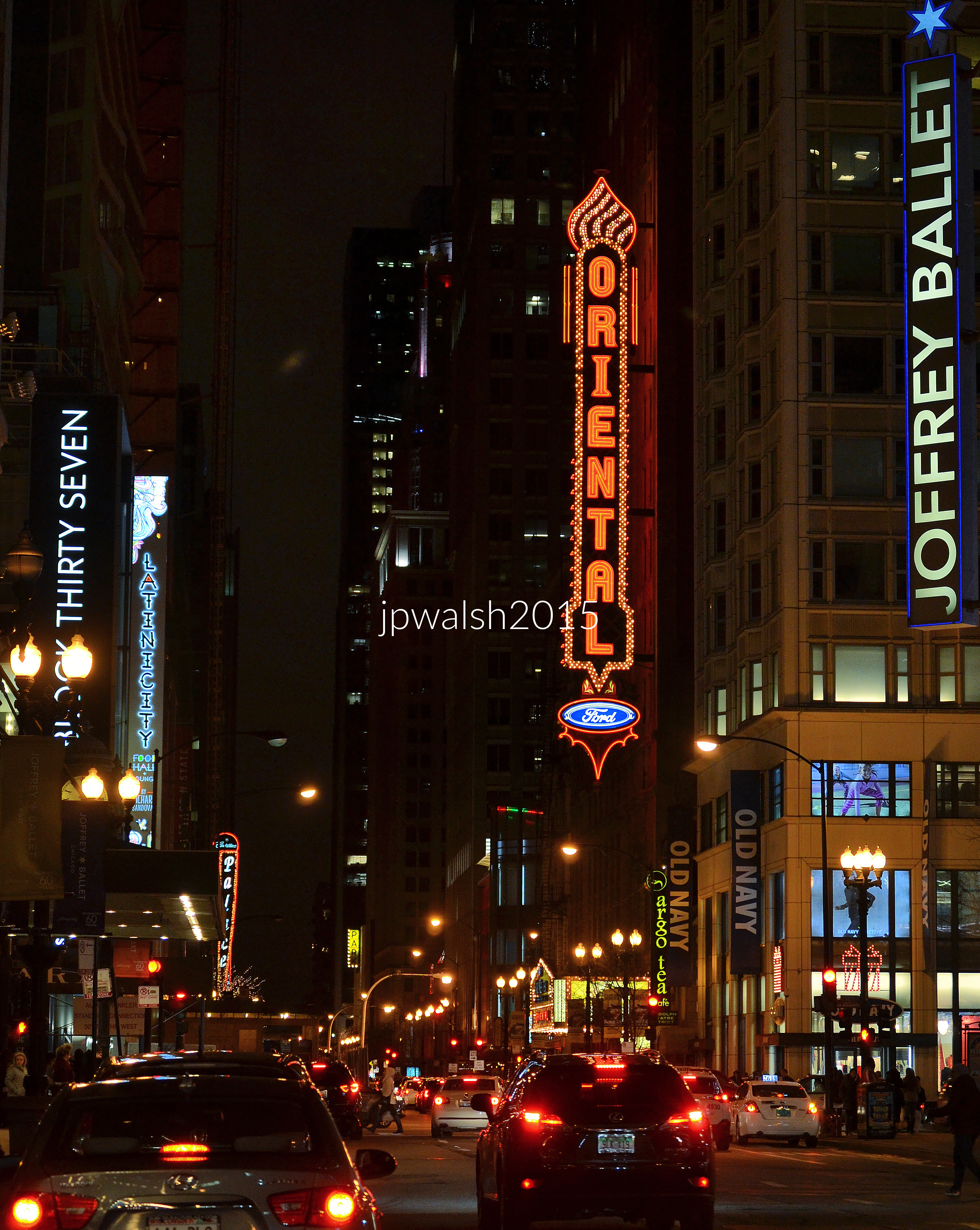
FEATURE image: Oriental Theatre completed in 1926 and renamed the Ford Center for the Performing Arts in 1997. It became the Nederlander Theatre in 2019. Author’s photograph taken in December 2017. Author’s photograph.
December 2017. Chicago. Ford Center For the Performing Arts/Oriental Theatre. 5.0 mbAuthor’s photograph.
In Chicago’s Loop, the Oriental Theatre opened on May 8, 1926. In the first half of the 20th century, Randolph Street was one of the city’s most bustling entertainment districts.
Designed by the architectural firm of Rapp & Rapp—brothers Cornelius Ward (C.W.) Rapp (1861-1926) and George L(eslie) Rapp (1878-1941)—the Oriental Theatre was one of their many ornate movie palaces that they built. As its name implied, it was imagined in a style inspired by a Western fantasia of India and South Asian themes and motifs. Inspired by the architecture of India and the Far East, lights consisted of elephant heads with tusks, the walls were adorned with soft silk and regal velvets, and the ceiling was garishly decorated with plasterwork elephants and other exotic beasts.
Rapp & Rapp were alumni of the University of Illinois School of Architecture. The firm designed scores of theatres across the country in the first decades of the 20th century. The Rapp brothers were born in Carbondale in southern Illinois. Twenty-eight-year-old C.W. Rapp formed a partnership in 1889 with older architect, Canadian-born Cyrus P. Thomas (1933-1911) and they practiced together in Chicago until 1895. C.W. Rapp operated his own office for a decade until he formed a partnership with his brother G.L. Rapp in 1906. With stage entertainment and the boom of moving pictures after 1910, the firm of Rapp & Rapp quickly developed a reputation for their fantastic designs for silent film theatres in the Chicago area. Drawing on a large palette of architectural revival styles, Rapp & Rapp designed nearly four hundred theatres in the United States between 1906 and 1926.
In Chicago Rapp & Rapp designed notably State Street’s Chicago Theatre (1921) and the Bismarck Hotel and Theatre (1926). In New York City they built the since demolished Paramount Theatre (1926) in Times Square and the still-standing smaller-scaled Paramount Theatre (1931) in Aurora, Illinois.
In the mid1990s, after the Oriental Theatre had been closed and shuttered for over a decade, it underwent a multi-million-dollar restoration and expansion by Daniel P. Coffey & Associates. It reopened as the Ford Center for the Performing Arts in 1998. Following its expansion, the former Oriental Theatre seats over 2,000 patrons.
Entertainment legacy.
In the 1920s, the Oriental Theatre presented both movies and vaudeville acts. When talkies arrived, the Oriental Theatre became predominantly a movie house in the 1930s. Live stage, theatrical, and concert performances continued for mid20th century Chicago audiences during an era when Randolph Street was a mecca for crowds seeking out their favorite star performers. It also hosted smaller and vibrant live entertainment venues where one could seek out up-and-coming talents.
Duke Ellington and his orchestra made frequent appearances at the Oriental Theatre which welcomed patrons by way of an exotic ornate style. Some big names and legends in entertainment were seen at the Oriental Theatre including Judy Garland, George Jessel, Fanny Brice, George Burns and Gracie Allen, Cab Calloway, Eddie Cantor, Bing Crosby, Ella Fitzgerald, Jean Harlow, Billie Holiday, Bob Hope, Al Jolson, Danny Kaye, Jerry Lewis, The Marx Brothers, The Three Stooges, Frank Sinatra, Sophie Tucker, Sarah Vaughan, Henny Youngman, and a cast of thousands.
The Oriental Theatre closed in 1981 and remained shuttered for the rest of the 1980’s and into the early 1990’s depriving many young urban professionals from enjoying entertainment in a venue that, with its reopening in 1998, has operated continuously for nearly 100 years.
Ford Center for the Performing Arts in 1997 and the Nederlander Theatre in 2019.
In 1997 the Oriental Theatre was renamed the Ford Center for the Performing Arts and restored and expanded for its re-opening in 1998. In 2019 the theatre was renamed in honor of James M. Nederlander (1922-2016), Broadway theatre owner/producer and Broadway In Chicago founder.
Today’s James M. Nederlander Theatre hosts touring pre-Broadway and Broadway shows whose résumé included a long-running production of Billy Elliot: The Musical. From June 2005 through January 2009, the theater housed a full production of Wicked, making it the most popular stage production in Chicago history. In December 2017, when the feature photograph was taken, a traveling national tour of Wicked had started its Chicago run.
July 2016. Chicago. Oriental Theatre sign. 4.63 mb Author’s photograph. December 2015. Chicago. Oriental sign at night. 6.51mb DSC_0866 (1). Author’s photograph.
SOURCES: Alice Sinkevitch, AIA Guide to Chicago, 2nd Edition, Harcourt, Inc., Orlando, 2004, p. 54.
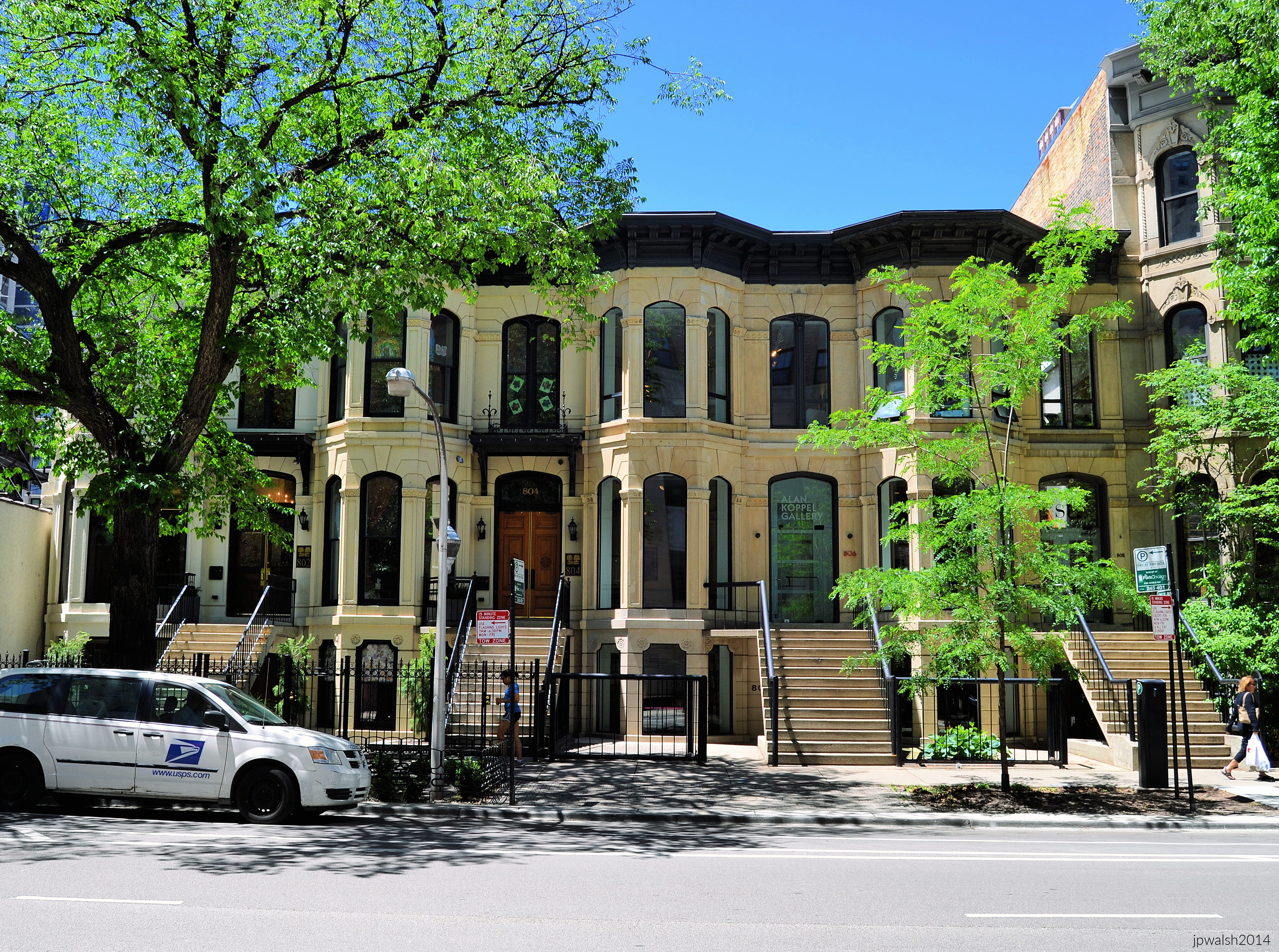
Row Houses, c. 1873, 802-812 N. Dearborn Street, Chicago, IL 6/2014
These early row houses were developed in Chicago’s Gold Coast/River North neighborhood in the early 1870s immediately following the Great Chicago Fire.
That tw-day conflagration began on October 8, 1871 at 137 DeKoven Street (around 1100 South) and blew its destruction north through Downtown and into the Gold Coast area. The fire petered out to the north of Fullerton Avenue (2400 North). The area of devastation was a swath of over four miles (see map below).
The fire’s aftermath sparked an intense period of rebuilding, especially in Downtown Chicago, less than one mile to the south of these row houses. This flurry of building activity, particularly of needed housing, may be partly why the architect is unknown for these three- and four-story Italianate buildings, all of which are well preserved.
The three-story row houses to the south have neo-Grec ornament which was in vogue by 1872. It included incised carved detail on window ledges and door frames.
The four-story row houses to the north (partially pictured) have more lavish Second Empire exterior decoration.
Like the Italianate style, the Neo-Grec–style row houses have a smooth brownstone front with a pronounced deep cornice, heavy entryway and window details. The contrast was in their ornamentation: Neo-Grec’s simple, precise lines and geometric Greek influence varied from Italianate ornamentation of curved and organic lines and forms.
Italianate curved window and door frames are replaced by Neo-Grec’s right-angles. Lintels are replaced by rectangular blocks. Entryway steps had baluster cast-iron railings that ended in squared-off linear and geometric incised ornament.
Vintage map of Chicago Great Fire (detail).
CHICAGO POPULATION GROWTH 1860-1980
Chicago was growing exponentially by 1870. In 1860 the city had a little over 112,000 residents and ranked 9th on the list of largest U.S. cities. By the time of the Great Fire in 1871, Chicago had grown to nearly 300,000 and ranked 5th on the largest U.S. cities list. Equally significant is that the city’s size also doubled in those same ten years from 17,492 square miles in 1860 to 35,172 square miles in 1870. Busy with rebuilding, the city did not expand again in square miles until the 1880’s, though its population continued to soar. When these Italianate row houses were built, Chicago was growing towards becoming the 4th largest U.S. city with a population of over 500,000. In the early 1870’s with rebuilding and augmenting population density the demand for housing was high. Chicago’s population would continue to grow with each decade until 1980.
OCCUPANTS TODAY INCLUDE A CONTEMPORARY ART GALLERY AND THE ALLIANCE FRANÇAISE DE CHICAGO FOUNDED IN 1897
Today, at 806 N. Dearborn is Alan Koppel Gallery which has, for over two decades, introduced contemporary international artists to Chicago audiences.
At 810 N. Dearborn is the main entrance to the Alliance Française de Chicago. Founded in Paris in 1883. the Alliance Française de Chicago is part of an international network of over 1,100 Alliances around the world which promotes French language and francophone culture. Chicago’s Alliance Française was founded in 1897. Offering French language classes and a full range of cultural events, the Alliance Française de Chicago is the second oldest Alliance in the U.S. and the second largest in the U.S. after the French Institute Alliance Française in New York City. The Alliance Française de Chicago is headquartered in two renovated architecturally historic buildings, including the 1870’s row house on Dearborn Street and, connected by an interior garden, a building on Chicago Avenue.
SOURCES:
Alice Sinkevitch, AIA Guide to Chicago, 2nd Edition, Harcourt, Inc., Orlando, 2004, p. 134.
Frank A. Randall, History of the Development of Building Construction in Chicago, Second Edition, Chicago and Urbana: University of Illinois Press, 1999, p. 5.
Jay Pridmore and George A. Larson, Chicago Architecture and Design, Abrams, New York, 2018, p. 42.
The Cobden, 1892, 418-424 W. Belden Ave., Chicago, IL. 6/2014
The Cobden is a Richardsonian-Romanesque flats-above-storefront building that has anchored the northwest corner of busy Clark Street and residential Belden Avenue since 1892. It was designed by architect Charles Sumner Frost (1856 –1931) of the firm of Henry Ives Cobb (1859-1931) and Frost.
Born in Maine and trained as an architect in Boston, Frost moved to Chicago in 1882. When The Cobden was built, Frost was 36 years old and at the beginning of a new stage in his early mid-career. Cobb and Frost designed and began construction of the Potter Palmer mansion (1882-1885) at 1350 N. Lake Shore Drive (demolished in 1951). The Cobden, two miles to the north in Lincoln Park by Lake Michigan, was built in a burgeoning residential area at 418-424 Belden Avenue.
The Cobden is greatly influenced by the Richardsonian-Romanesque style which was prevalent among young architects in the 1880’s and 1890’s before the onset of the Beaux-Arts revival. Adapted to a residential-commercial street in a middle class neighborhood outside Downtown Chicago, The Cobden shows the characteristics associated with the Richardsonian Romanesque style. These include clear, strong picturesque massing, round-headed arches, clusters of short squat columns, recessed entrances, richly varied rustication, blank stretches of walling contrasting with bands of windows, and cylindrical towers with conical caps embedded in the walling.
The Cobden, in its bays and a prominent central gable that breaks above the roofline, presented an attractive architectural variety on Belden Avenue.
In 1897 Charles S. Frost married Mary Hughitt, the daughter of New York railroad tycoon Marvin Hughitt (1837-1928), the president of the Chicago and North Western Railroad. When the partnership of Cobb and Frost ended in 1898, Frost partnered with Mary’s sister’s husband, Alfred Hoyt Granger (1867-1939). Granger came to Chicago also from Boston (he was born in Ohio) and designed The Art Institute Building on Michigan Avenue in 1893. Frost and Granger were known for their designs of train stations and terminals such as the LaSalle Street Station in 1903. In the first decade of the 20th century, Frost and Granger designed over 100 buildings for the Chicago and North Western Railroad, including the massive Renaissance-Revival style Chicago and North Western Terminal which opened in 1912 (and demolished in 1984 to make way for the Ogilvie Transportation Center in Downtown Chicago).
When the Frost and Granger partnership ended by 1912, Frost began to work independently and designed in 1916 the Navy Pier Auditorium. Following his father-in-law’s death in 1928, Frost retired from his architectural practice at the end of the same year. After designing hundreds of public, commercial, and residential buildings, mainly in Chicago, Charles S. Frost died in 1931 at 75 years old.
Charles S. Frost in 1920.
SOURCES:
Alice Sinkevitch, AIA Guide to Chicago, 2nd Edition, Harcourt, Inc., Orlando, 2004, p. 196.
The National Cyclopaedia of American Biography, Volume XVII, 1920, pp. 336–337.
Sofitel Chicago Magnificent Mile, Chicago, Illinois, Jean-Paul Viguier. At its opening the Chicago chapter of the American Institute of Architects (AIA) selected today’s Sofitel Chicago Magnificent Mile as the decade’s “best new building” in Chicago. The hotel opened in May 2002 with 415 rooms.
Jean-Paul Viguier (b.1946) is a leading modern Paris-based French architect. In 2003 his Sofitel Chicago Water Tower (renamed the Sofitel Chicago Magnificent Mile) was chosen by the Chicago chapter of the American Institute of Architects (AIA) as the “best new building in Chicago in the last ten years.” The hotel opened in May 2002 with 415 rooms. Its dramatic architecture made an immediate impression not only on the city’s denizens and visitors but much of the world.
The glass triangular tower ascends and thrusts over the intersection of Chestnut and Wabash Streets. Narrowing as it rises, the shape could evoke a ship’s prow—or a geometer’s trapezoid. 6/2014 5.49mb
The prism-shaped, 350,000-square-foot structure was chosen by nearly 350 established Chicago-based architects as one of the city’s most outstanding achievements in architecture. The glass triangular tower ascends and thrusts over the intersection of Chestnut and Wabash Streets. Narrowing as it rises, the shape could evoke a ship’s prow—or a geometer’s trapezoid. Its expansive façades allow generous exposures of natural light as it faces east to capture sunrise over the incredible natural backdrop of Lake Michigan and southwest towards the timeless Midwestern prairie. Adding to the building’s drama and welcome grace is its exterior of horizontal cladding of visible and opaque glass in synergy with the verticality of the building’s wedge and curve. Inside, the lobby continues this building’s dramatic modernity presenting a steely structural space that is airy, sleek, and soaring.
Mr. Viguier was selected to design Sofitel Chicago Magnificent Mile during a design competition in 1998 judged by Accor hotels leadership and others. Mr. Viguier is a member of the International Academy of Architecture (IAA) and was president of AFEX (French Architects Overseas) from 1999 to 2002.
Mr. Viguier’s other internationally recognized projects include the France Televisions headquarters in Paris as well as the Cœur Défense in 2001 and the Tour Majunja in 2014 both in La Défense, France. The French architect built a two story expansion at the McNay Museum of Modern Art in San Antonio, Texas. Mr. Viguier is also architect for the Maroc Telecom Tower in Rabat, Morocco in 2013, and, in 2015, the SFR Campus in Saint-Denis, France. Another highly regarded project is, in 2013, the Cancer University Institute in Toulouse, France.
The Sofitel Chicago Magnificent Mile is also listed at no. 82 in a public poll of 150 buildings of “America’s Favorite Architecture.” The poll was conducted by The American Institute of Architects (AIA) and Harris Interactive and in conjunction with the AIA’s 150th anniversary in 2007.
In 2005, Sofitel Chicago Magnificent Mile received the MIPIM Award at their international meeting of property market sector leaders gathering in Cannes, France. Created in 1991, the MIPIM Awards is an internationally-renowned real estate competition at MIPIM, the world’s property market. It honors the most outstanding and accomplished projects, completed or yet to be built, around the world, the very best of the real estate industry.