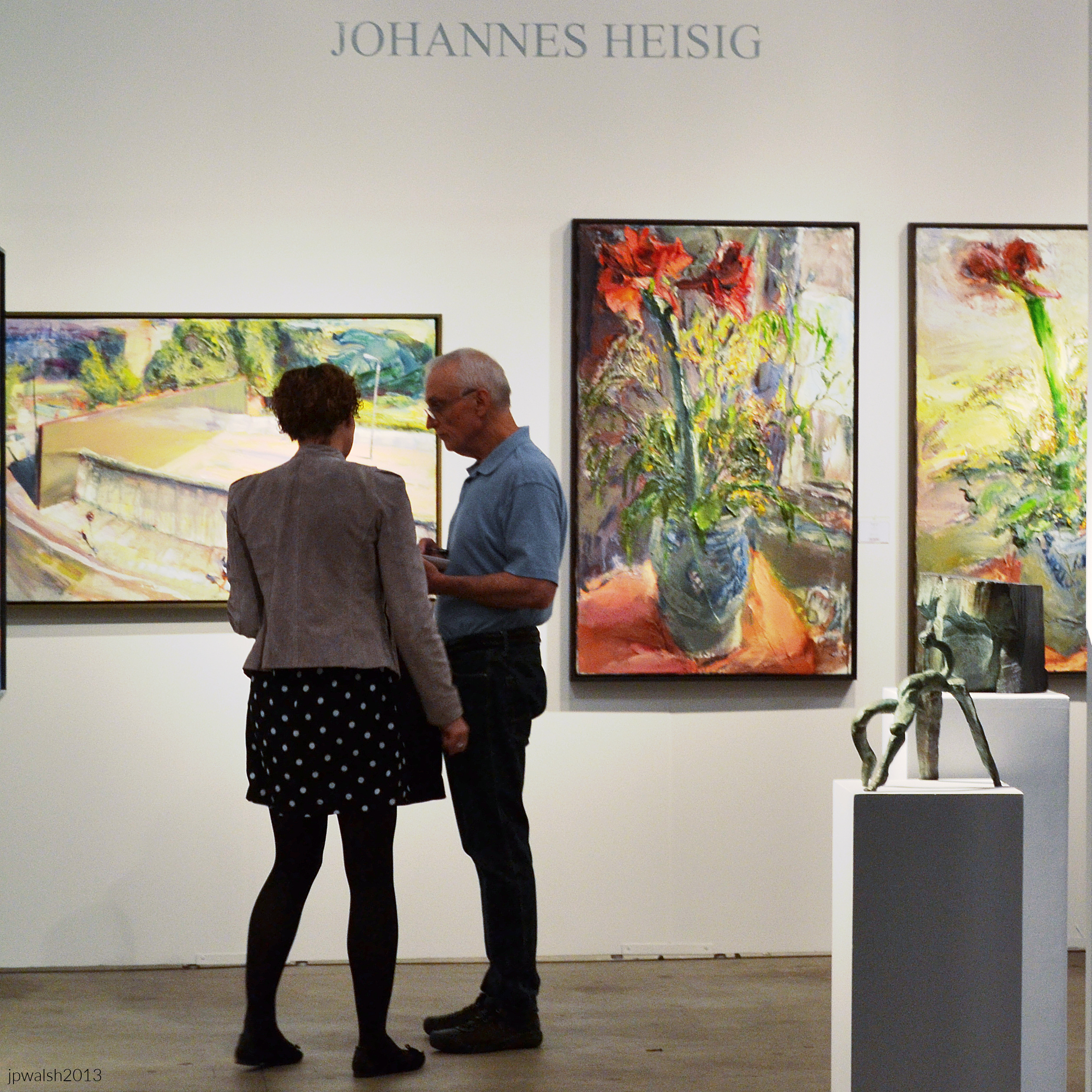
FEATURE image: EXPO CHICAGO 2014, Festival Hall, Navy Pier.
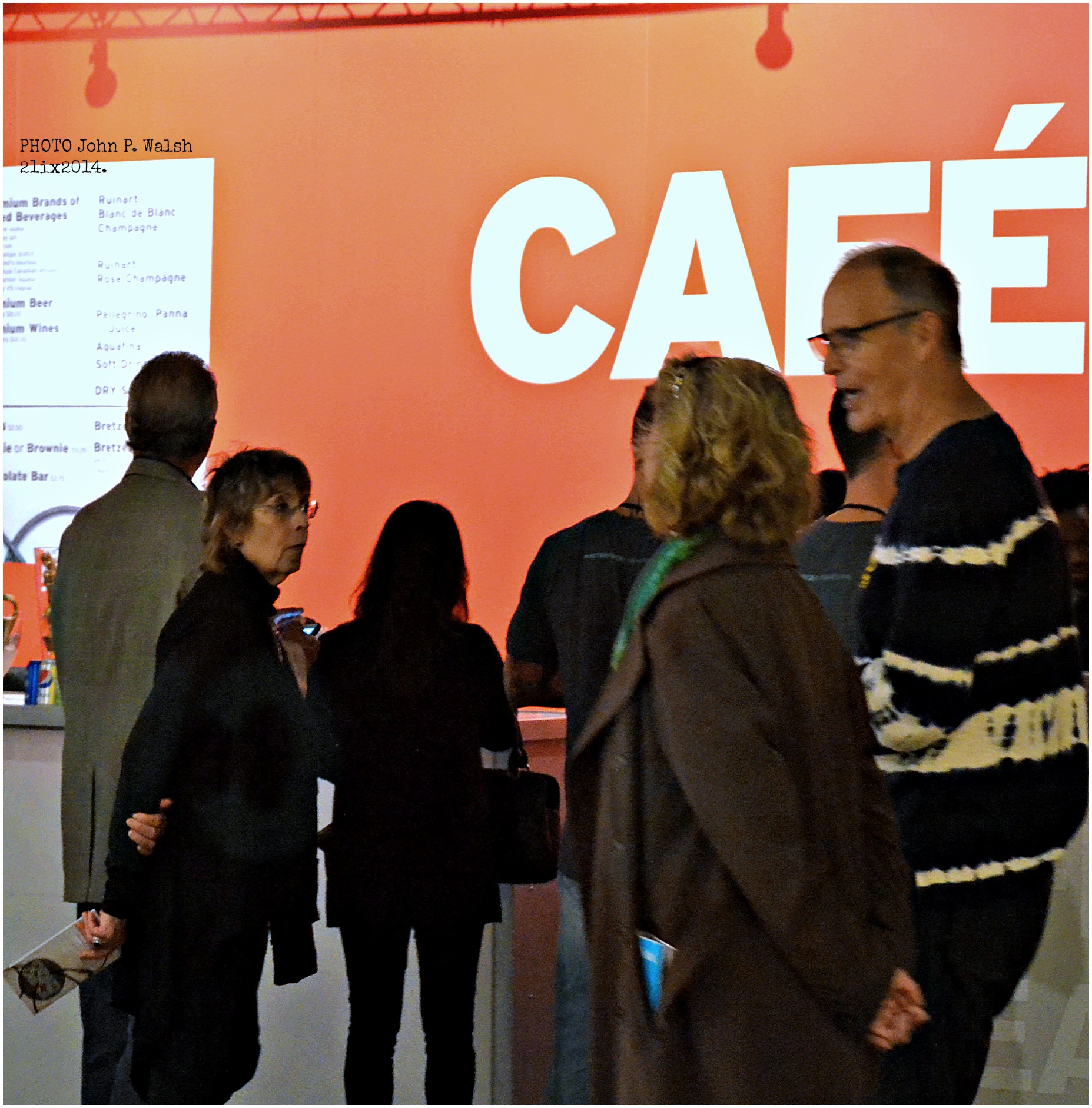
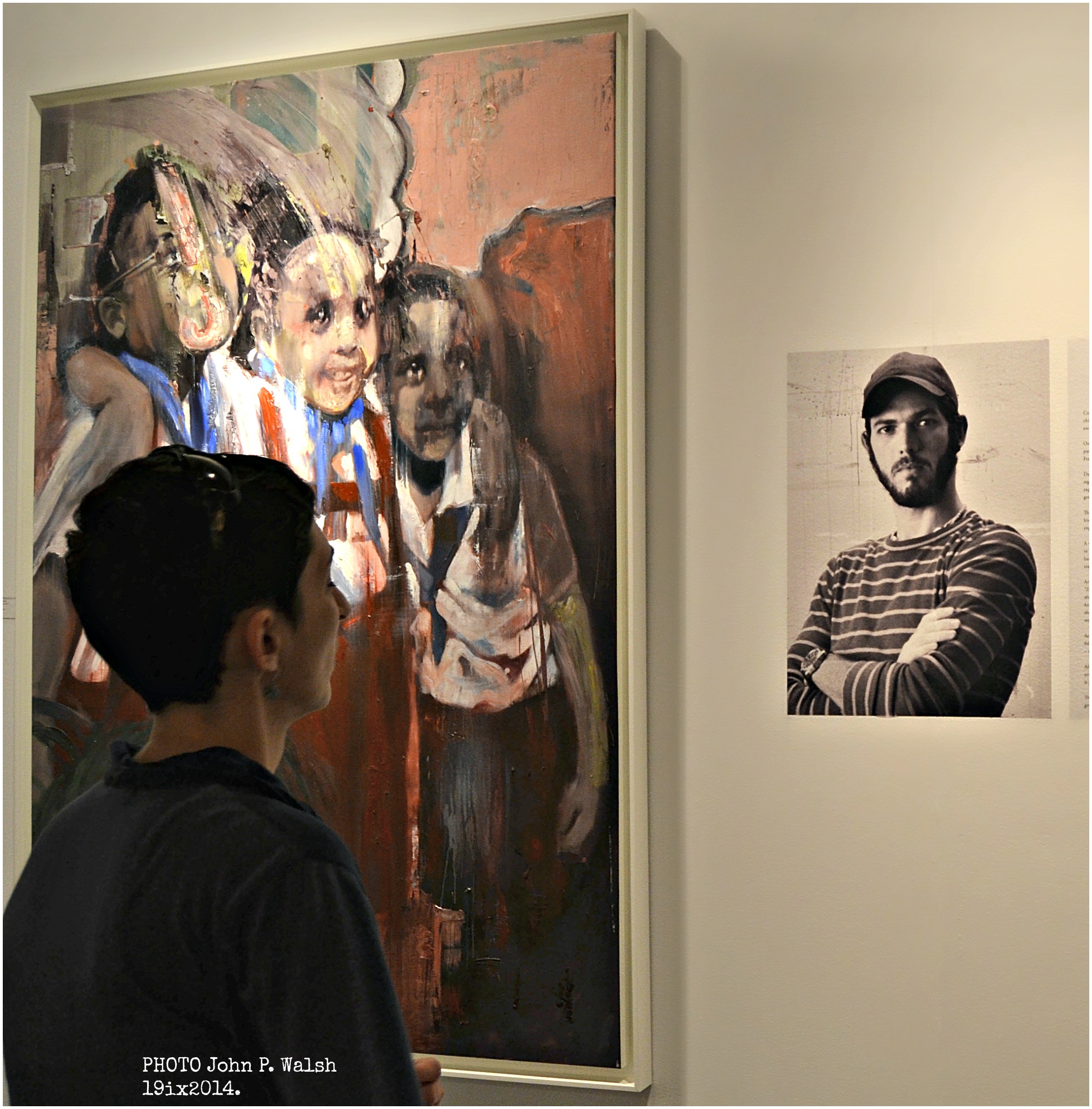
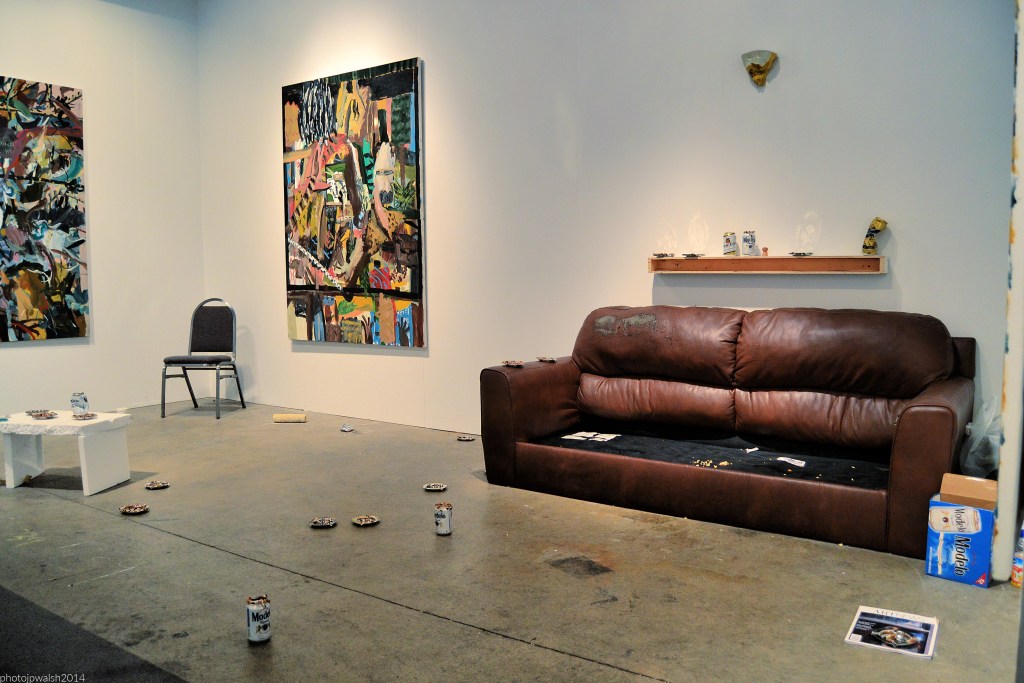
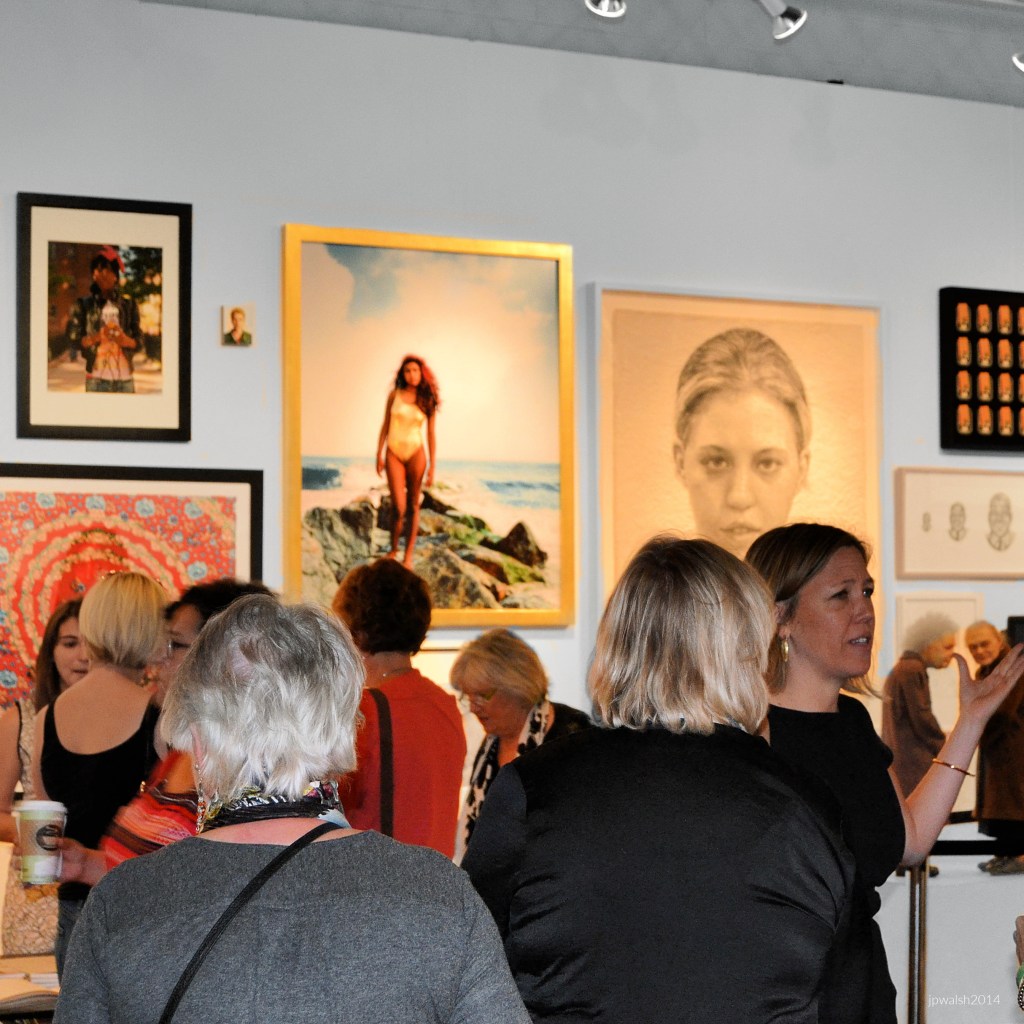
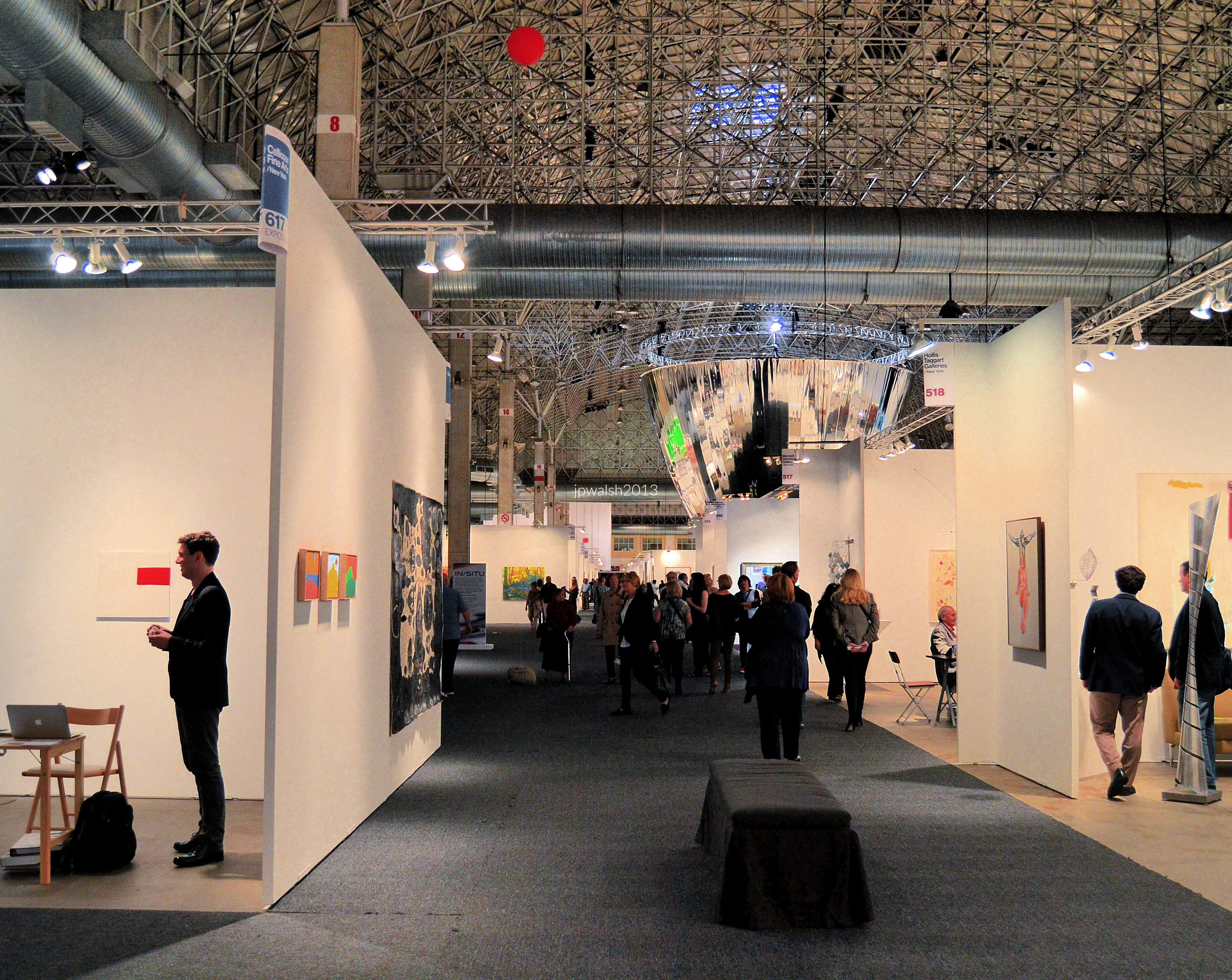
EXPO CHICAGO 2014 is the 3rd annual exhibition of international contemporary and modern art held in Chicago at Navy Pier’s Festival Hall on September 18 – 21, 2014. Photographs by John P. Walsh.
Mylar Cone designed by Studio Gang.
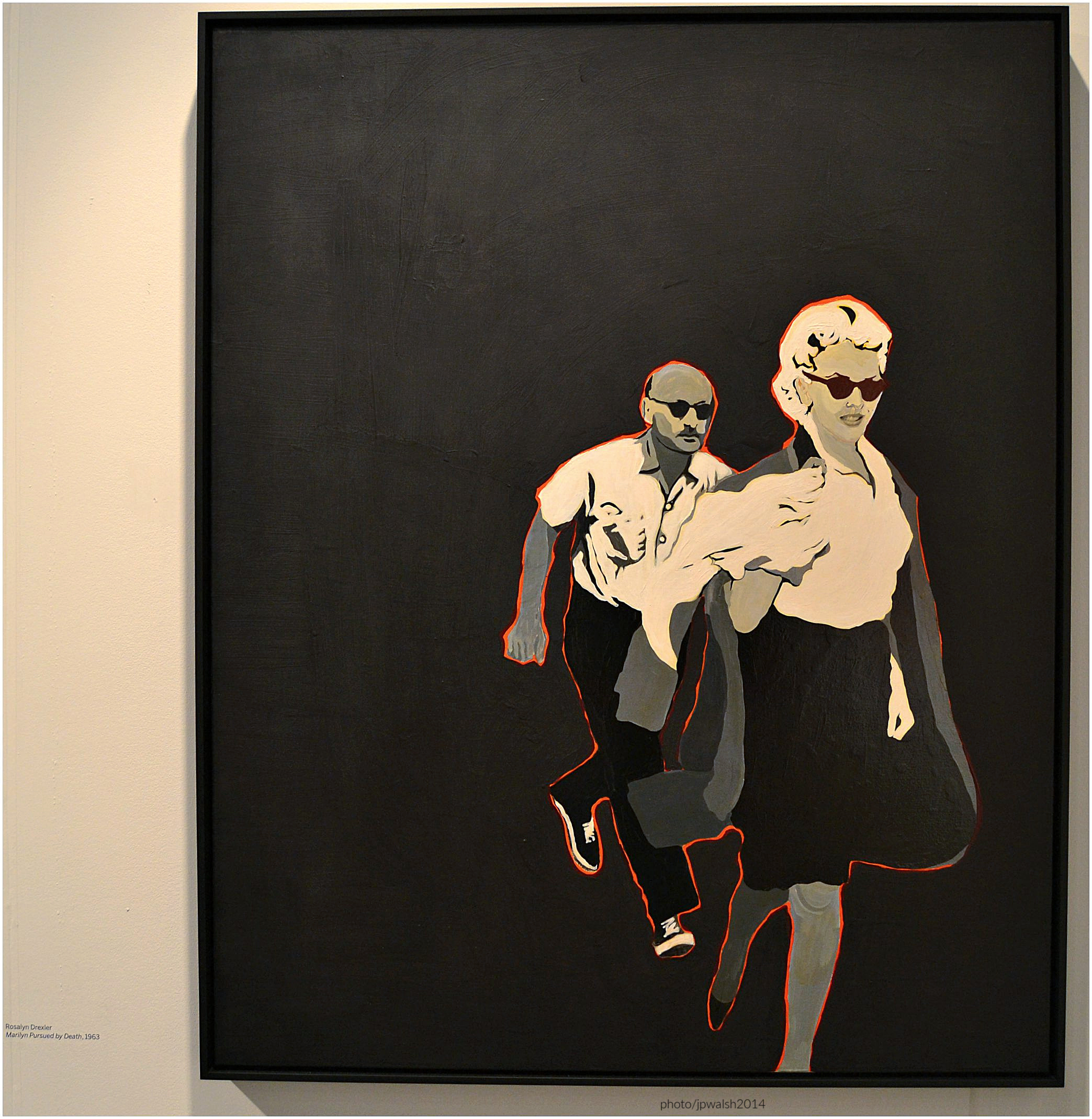
Rosalyn Drexler, Marilyn Pursued By Death, 1963, Fredericks & Freiser and Garth Greenan Gallery, New York City. This is based on a historical photograph of Marilyn as she was escaping the press.
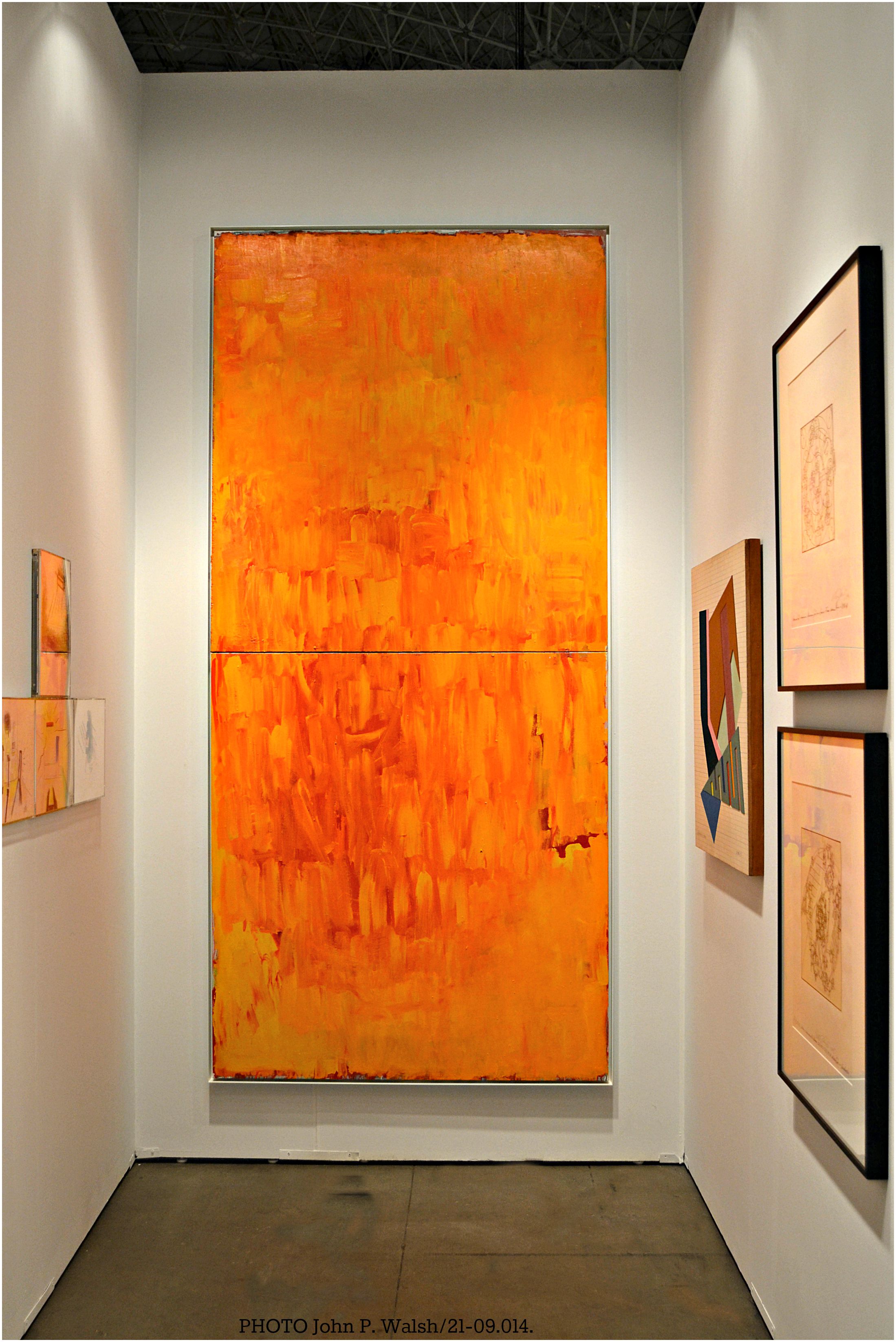
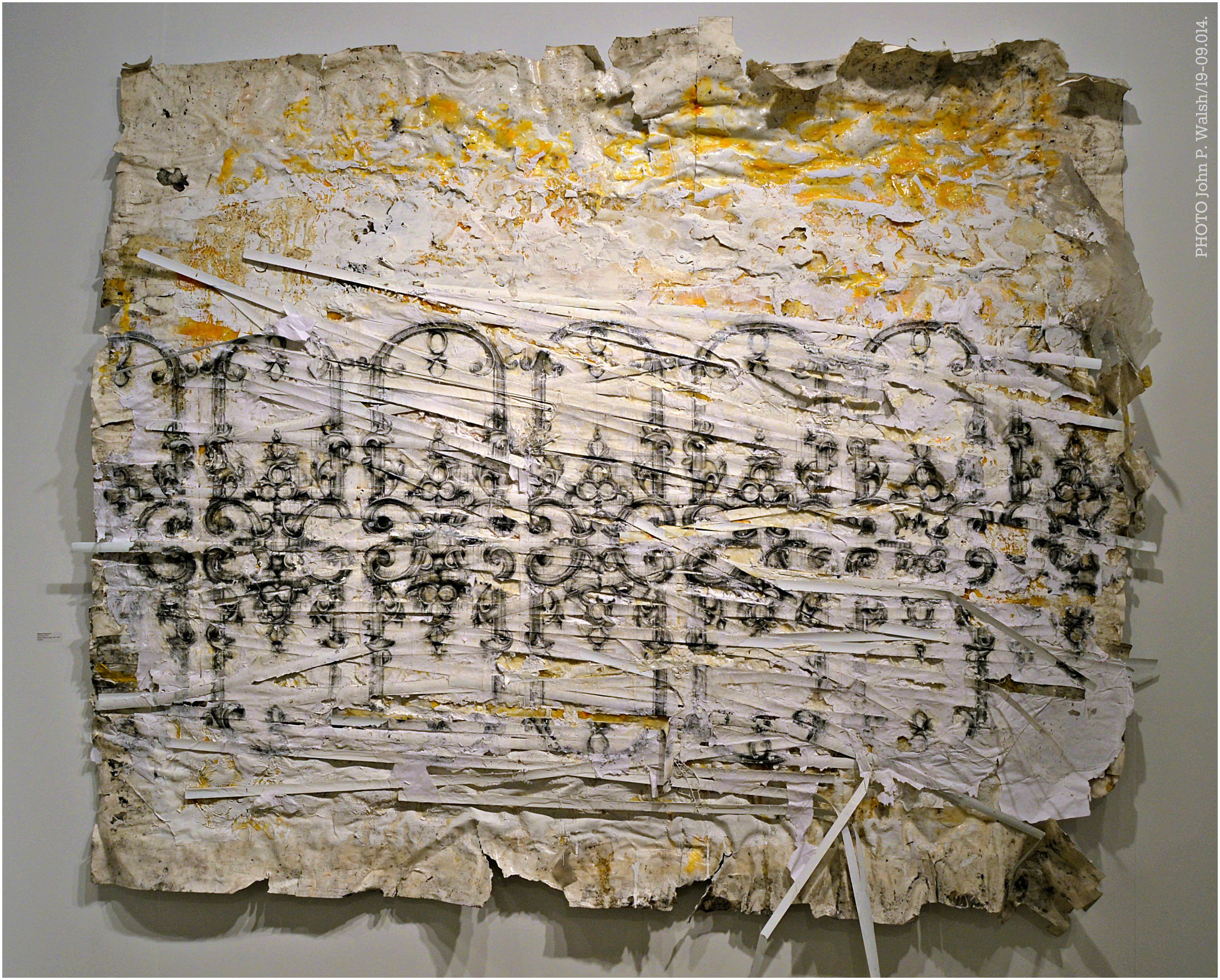
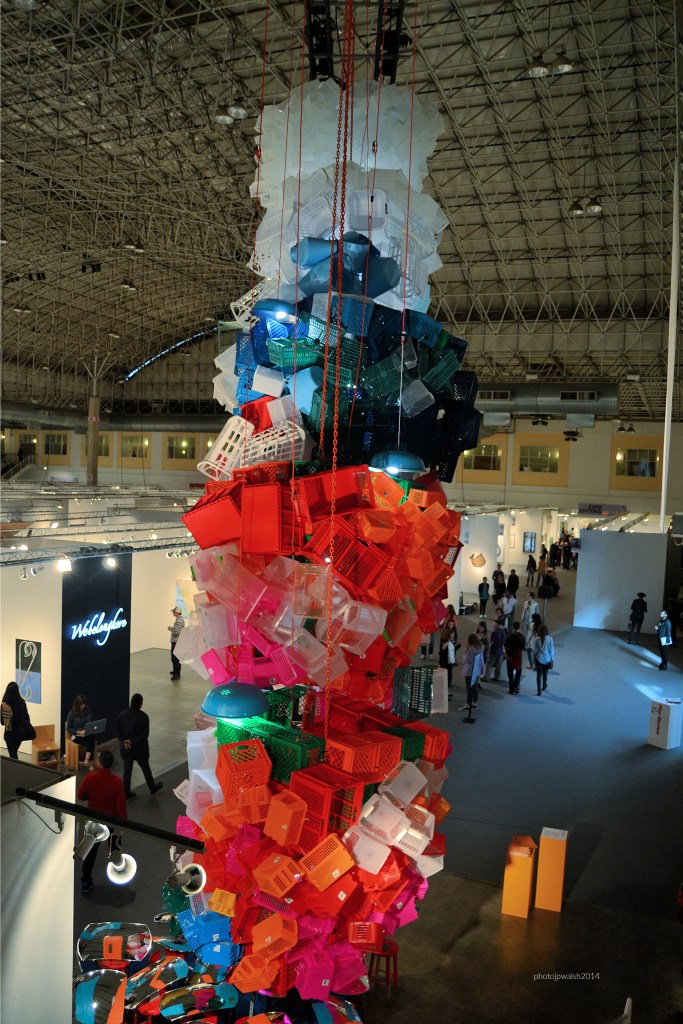
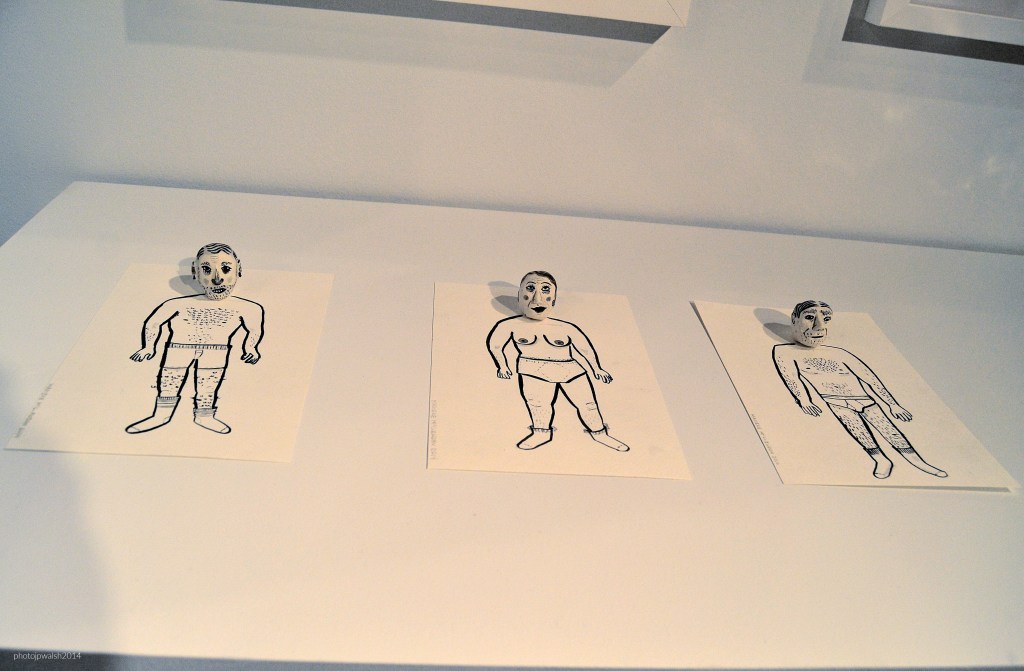
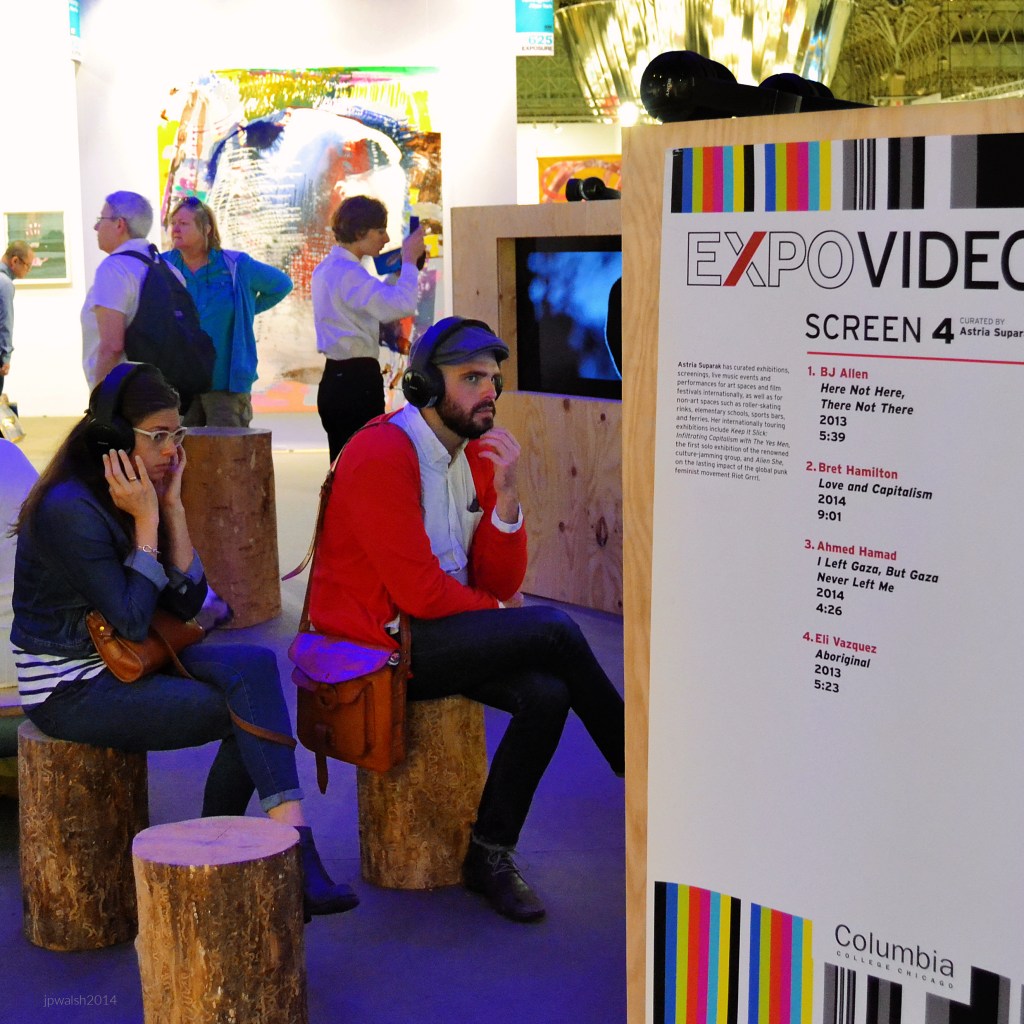
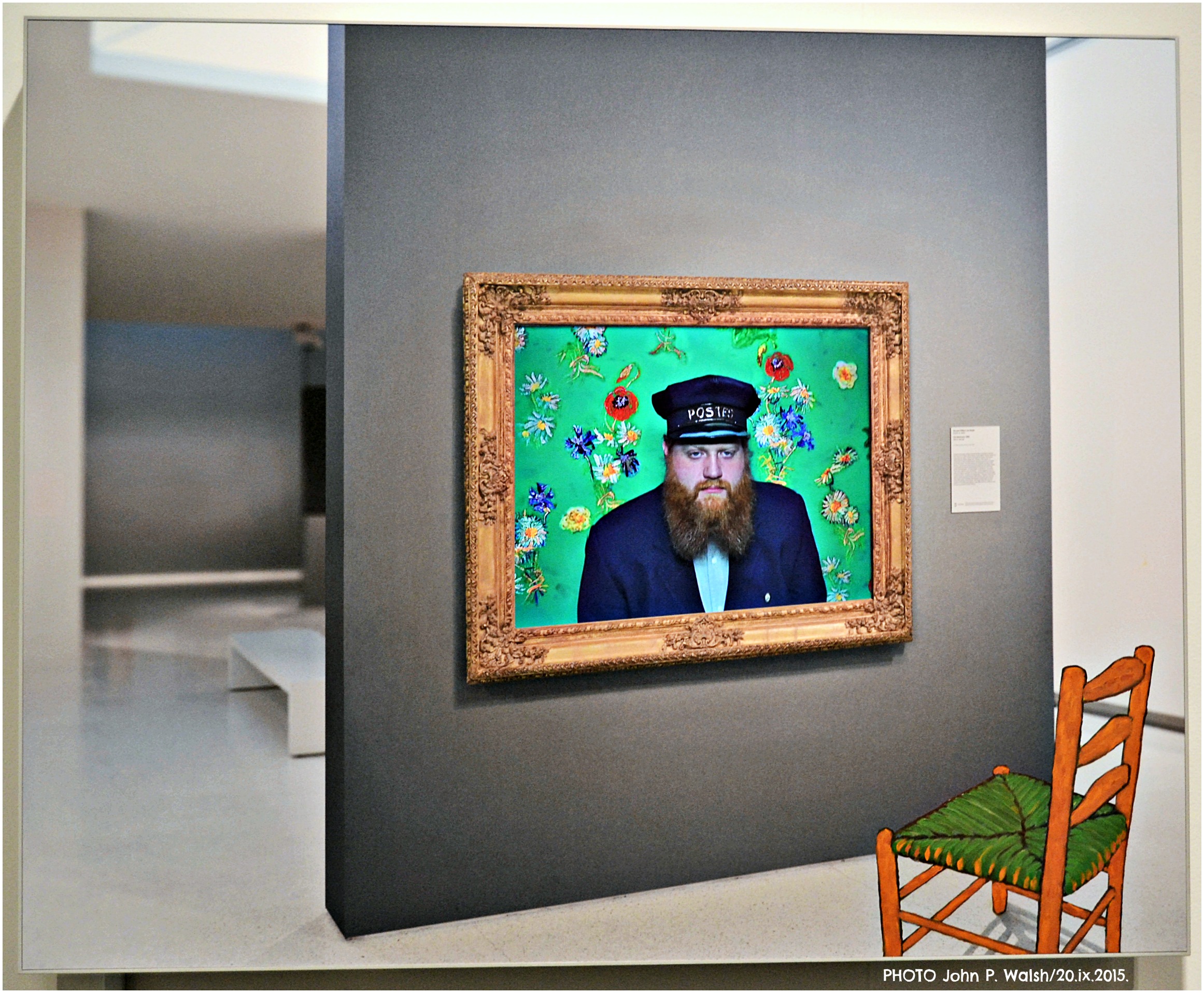
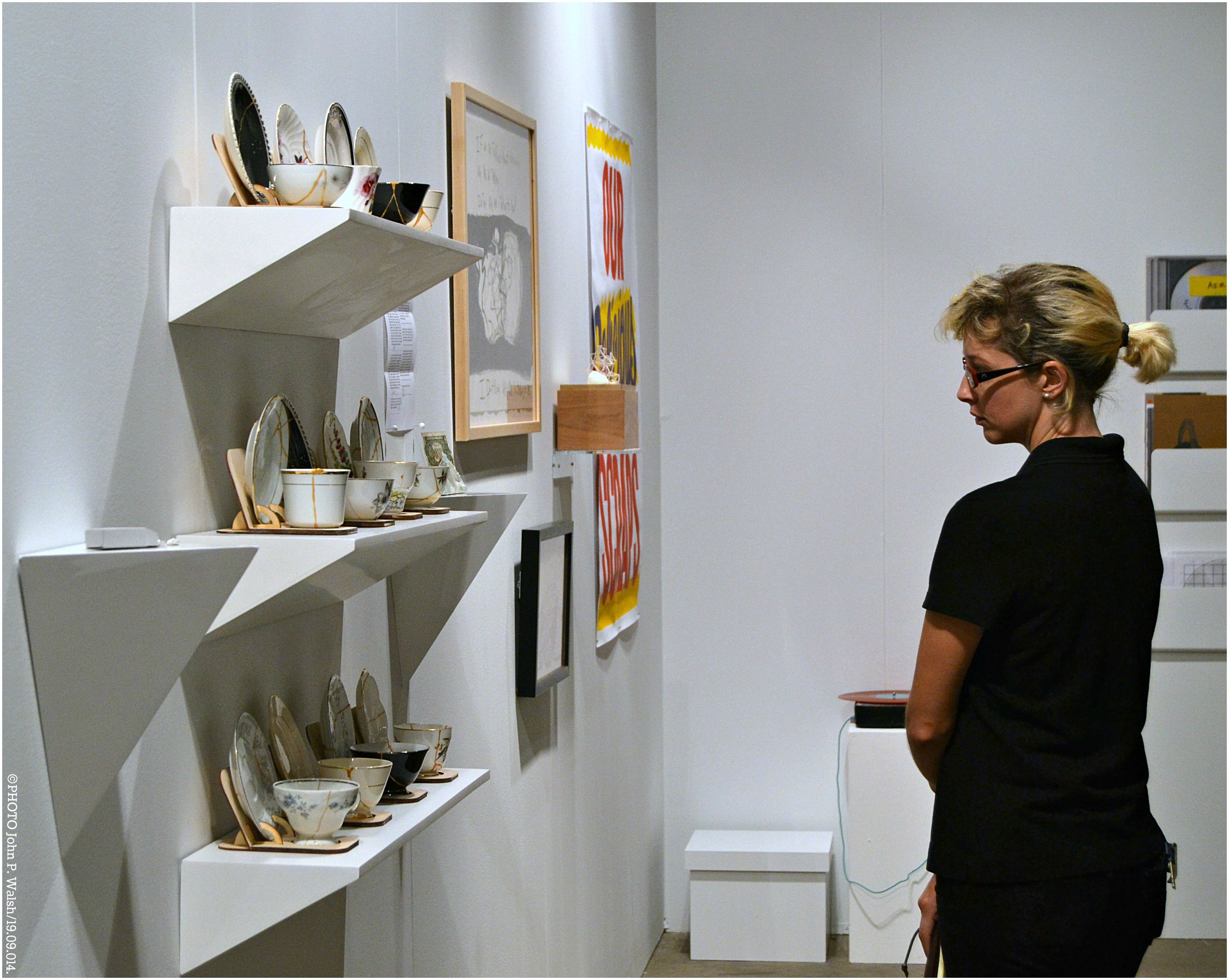
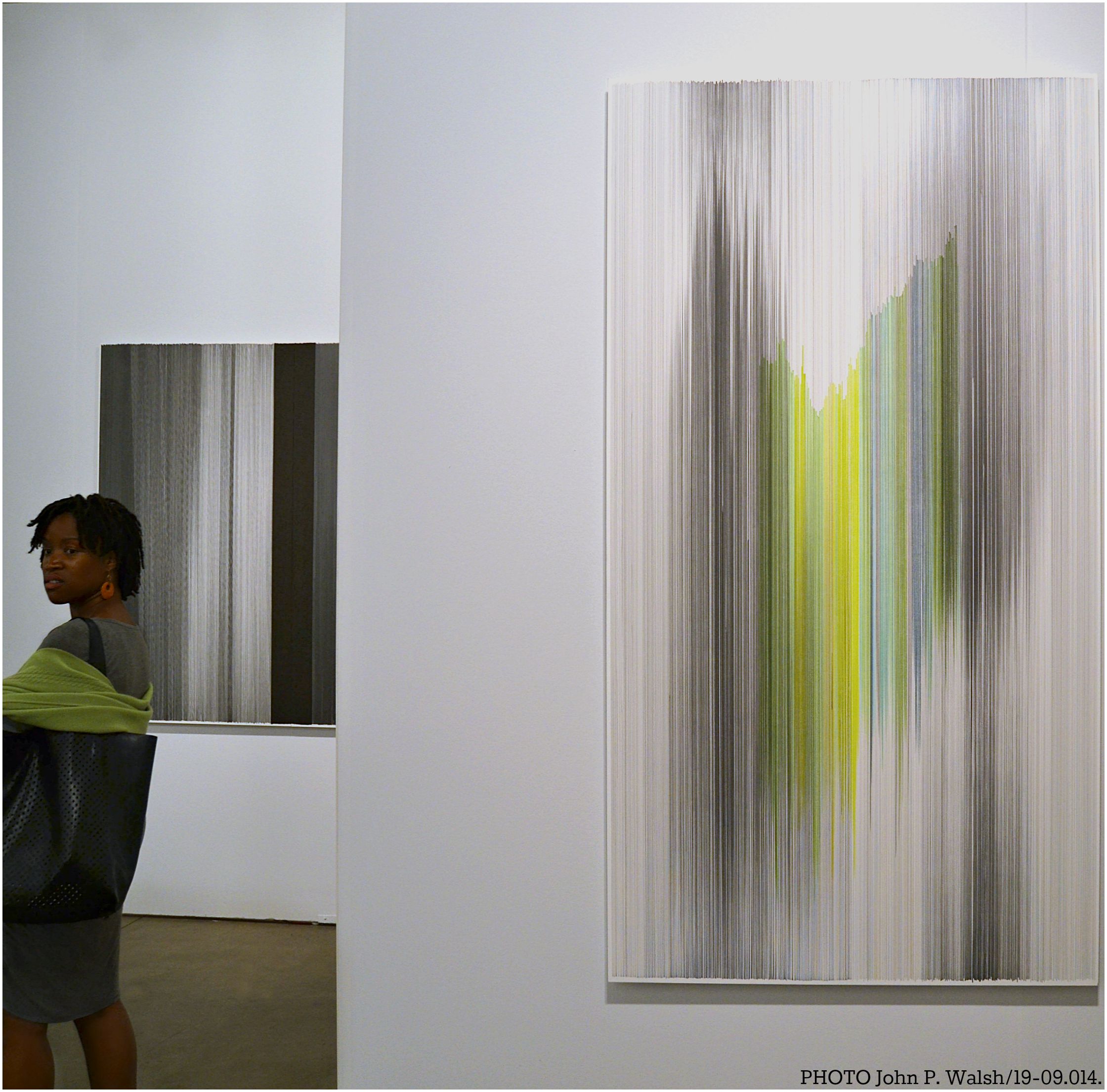
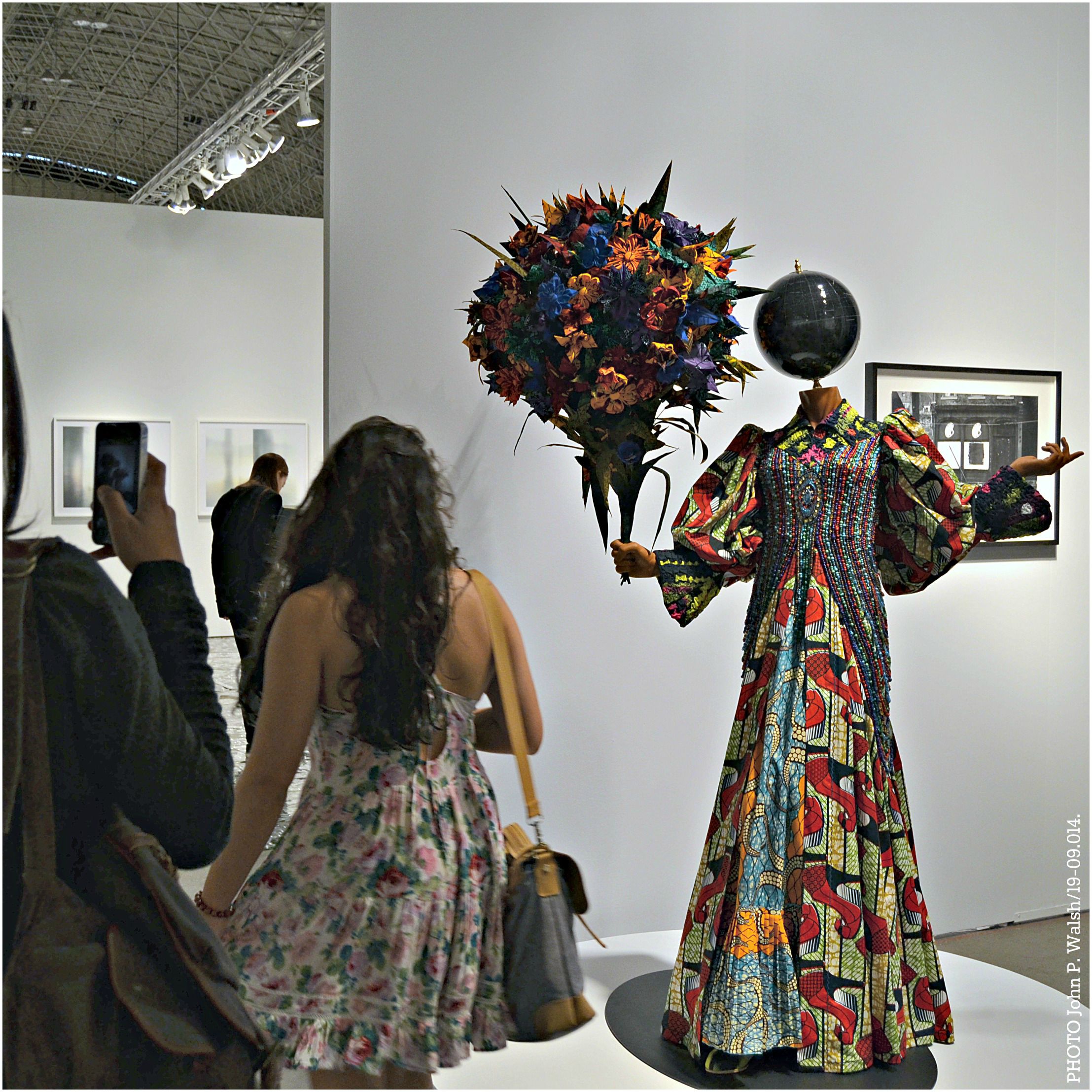
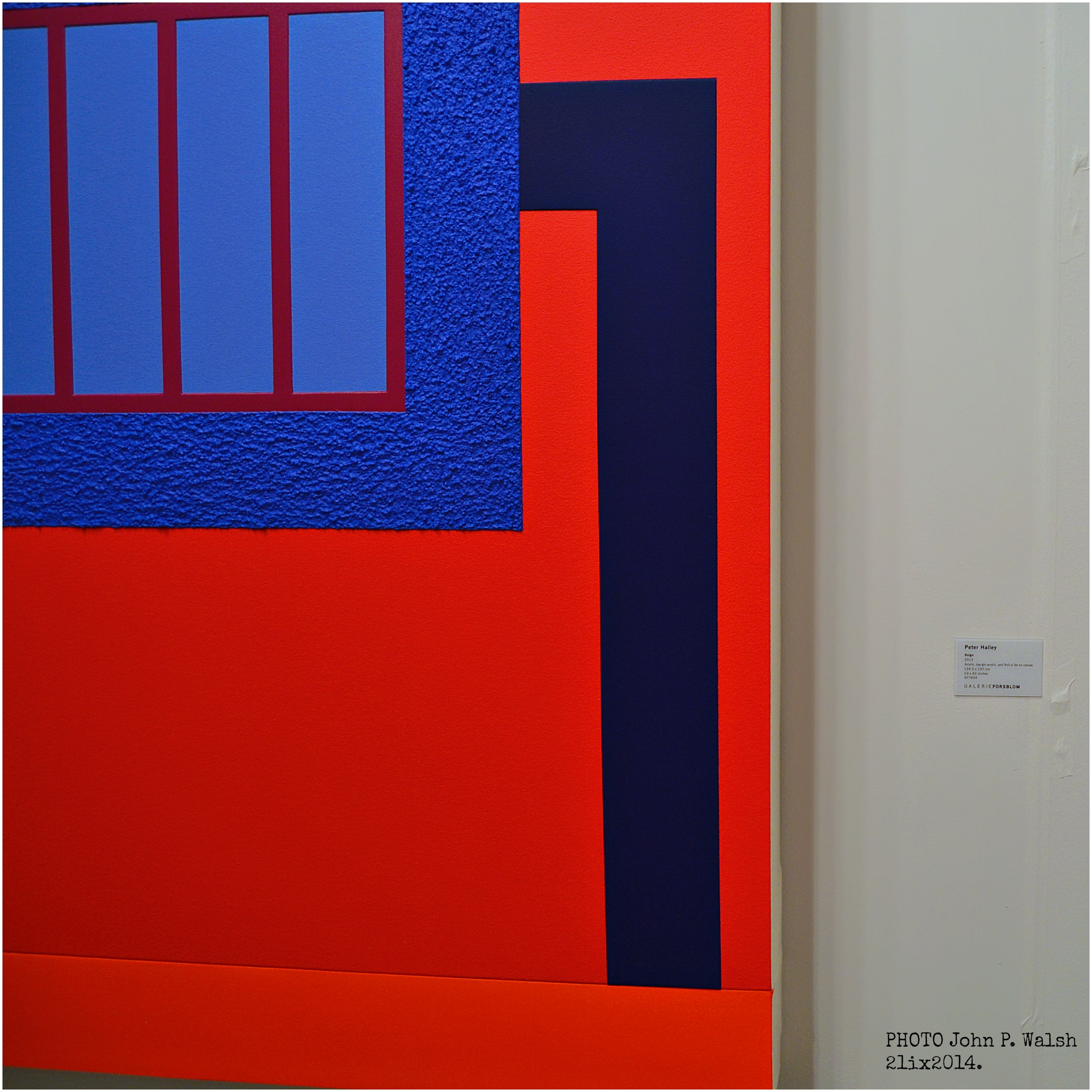
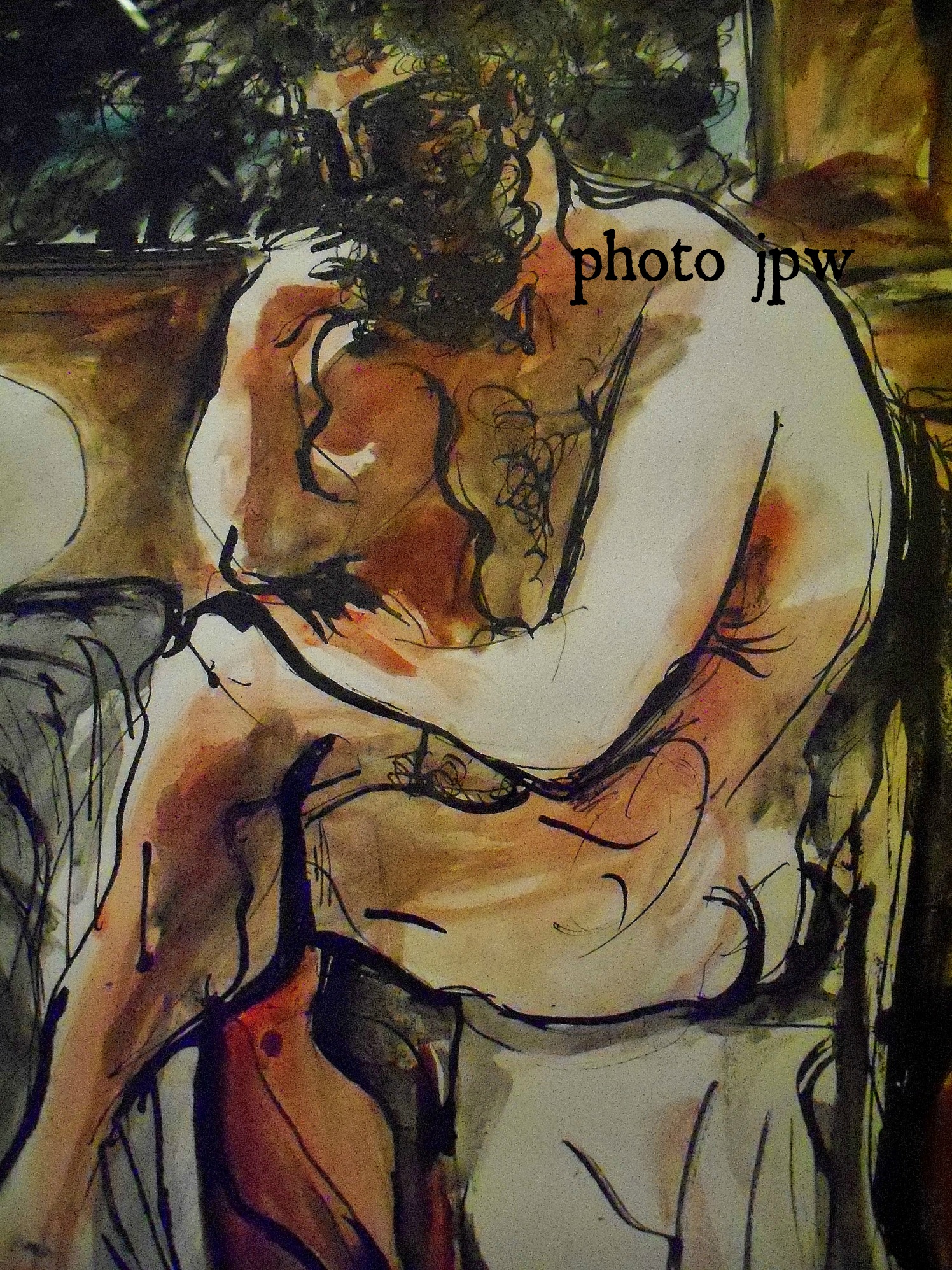
Christopher Le Brun (British, b. 1951), Friedman Benda, New York.Cernude Arte, Coral Gables, Florida. Michiko Itatani, Cosmic Kaleidoscope From the Pattern-Recognition 12 D 9, 2013, oil on canvas, 42 x 34 inches. Linda Warren Projects Chicago.Matthew Woodward, Polk Street, 2014, mixed media on paper, 101 x 96 in., Linda Warren Projects Chicago.Ramiro Gomez (American, b. 1986), American Gardeners, 2014, acrylic on canvas, 84 x 120 in., Charlie James Gallery, Los Angeles.Jessica Stockholder (American, b. 1959), Once Upon A Time, 2014, plastic, paint, mirrors, stools, carpet, chain, cables, staircase, resin, cords, light, bowls, lamp shade. Kavi Gupta Gallery Chicago/Berlin.Marieke McClendon, Clay Heads, ink on bristol board, ceramic, ShopColumbia Chicago.Works by Gideon Rubin (b. Israel,1973, works in London). Oil on canvas/linen/wood, 2009-14, and gouache on cardboard, 2012-14, Galerie Karsten Greve AG St Moritz.Nicholas Krushenick (1929-1999), Grill, 1977, Garth Greenan Gallery New York and Fredericks & Freiser New York.Expo video/2014.Gregory Scott, Van Gogh’s Bedroom, 2015, pigment print, oil on panel, HD video, Catherine Edelman Gallery, Chicago.Antonio Murado, Gardens, 2014, oil on canvas. Galeria Àlvaro Alcázar, Madrid.Three Walls Chicago.Elijah Burgher, Untitled, 2012-2014, paintings on unstretched canvas, Western Exhibitions, Chicago and Zieher Smith & Horton, New York. Anne Lindberg, Parallel 42, 2014, Graphite and colored pencil on mat board, 59 x 34 in., Carrie Secrist Gallery Chicago.Rene Portocarrero (1912-1985), Ornamental Figure in Brown Background, 1968, mixed media on paper laid down on board, 28 3/8 x 20 in., Cernuda Arte, Coral Gables, Florida.Alan Reid (American, b. 1976), Lisa Cooley Gallery New York.Henri Matisse, Marlborough Gallery New York Madrid Monaco Barcelona.Yinka Shonibare (British-Nigerian, b. 1962), Ms. Utopia, 2013, mannequin, dutch wax cotton textile, fiberglass, wire, globe, and steel baseplate. BlainSouthern, London, Berlin.. Lynn Chadwick (1914-2003), Rad Lad IV, 1962, ed. 2 of 8; Beast XX, 1956, ed. 6 of 9; Boy and Girl III, 1959, ed. 2 of 9. Bronze. BlainSouthern.John Wesley (American, b. 1928), Untitled, 2012 and Nicholas Krushenick (American,1929-1999), Wire Mill Road, 1972. Garth Greenan Gallery New York and Fredericks & Freiser New York.Alex Katz, Ena and Roberto, 1988, oil on linen, 41 x 62 in., Richard Gray Gallery, Chicago.Philip Pearlstein, Two Models with Four Geese Decoys, 1993, Watercolor on paper, Hill Gallery, Birmingham, Michigan.Tony Oursler (American, b. 1957), Galerie Forsblom, Helsinki.Aimé Mpane (b Kinshasa, 1968), Nude, wood and glue, 2008, Haines Gallery, San Francisco.Peter Halley, Reign, 2013, acrylic, day-glo acrylic, roll-a-tex on canvas, 53 x 62 in., Galerie Forsblom, Helsinki.Sandro Miller (b. 1958), Andy Warhol/Green Marilyn (1962), 2014, 29 x 29 in., Edelman Gallery, Chicago.Leonardo Drew (American, b. 1961), Number 34S, 2014, 31 x 41 x 11 inches, wood, Anthony Meier Fine Arts, San Francisco.Dayron González, Cernuda Arte, Coral Gables, Florida.Michelangelo Pistoletto (b. 1933), Golden Buddha and Mirror, 2008, Hollis Taggart Galleries, New York.Fernand Léger, Paysage Animé, 1937, oil on canvas, 35 7/8 x 23 1/4 in., Marlborough New York.Jina Park, A Genius, 2000, acrylic on linen, One And J. Gallery, Seoul.Tristian Koenig, Installation, Melbourne.
Minako Abe, Scene 29, 2011, oil on canvas, 35.8 x 92 in., Base Gallery, Tokyo.
David Hockney, Montcalm Pool, LA, 1980, oil on canvas, 12 x 16 in., Richard Gray Gallery Chicago.The Flag Art Foundation, New York, curated by Shaquille O’Neal.Mel Bochner, Money/Nothing, 2006, McCormick Gallery Chicago/Vallarino Fine Art New York.Sanford Biggers, David Castillo Gallery, Miami, Florida.Simon Edmondson, The Reader, oil on paper, 48 x 59.9 inches.
Manolo Valdés (Spanish, b. 1942, works New York City), Hojas II, 2014, Marlborough.
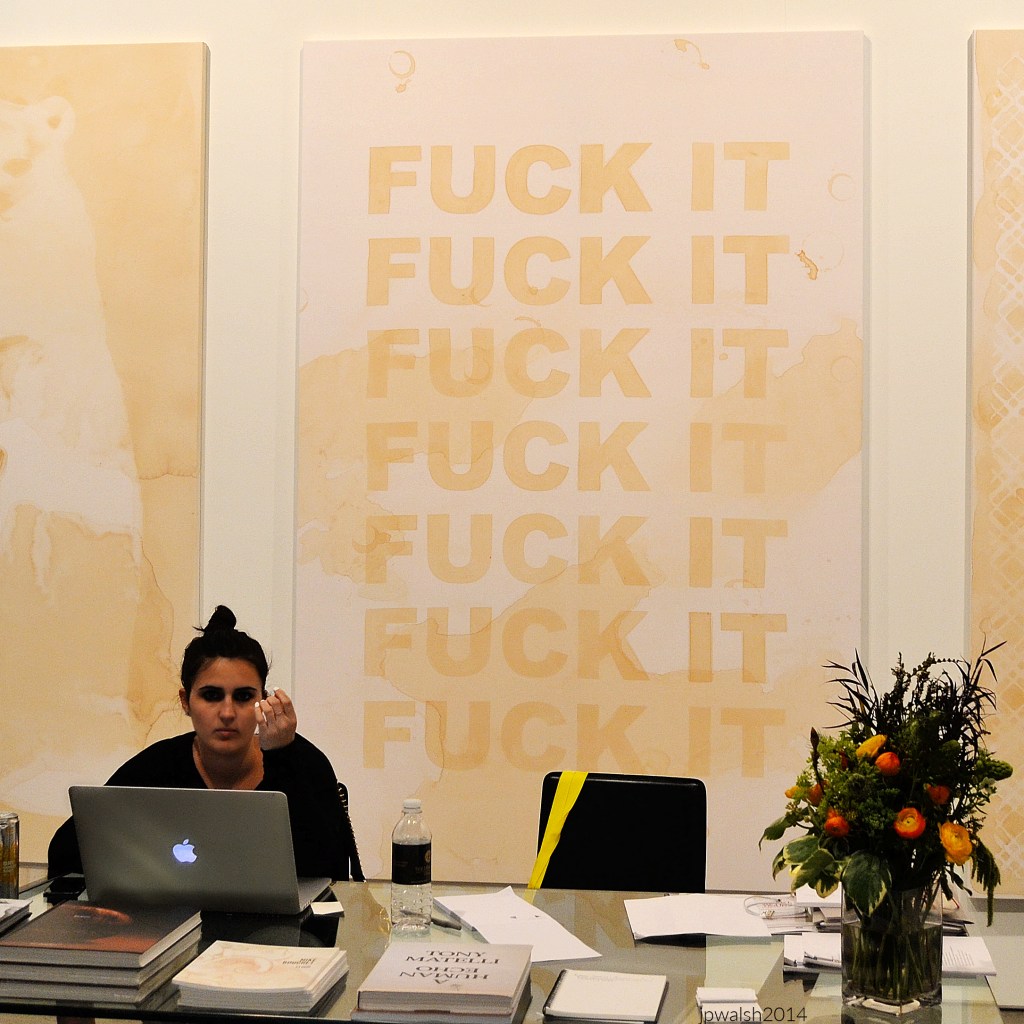
Manolo Valdés, Yvette, 2014, oil on burlap, Marlborough.Mike Bouchet, Fuck It, 2013, Marlborough Chelsea, New York.
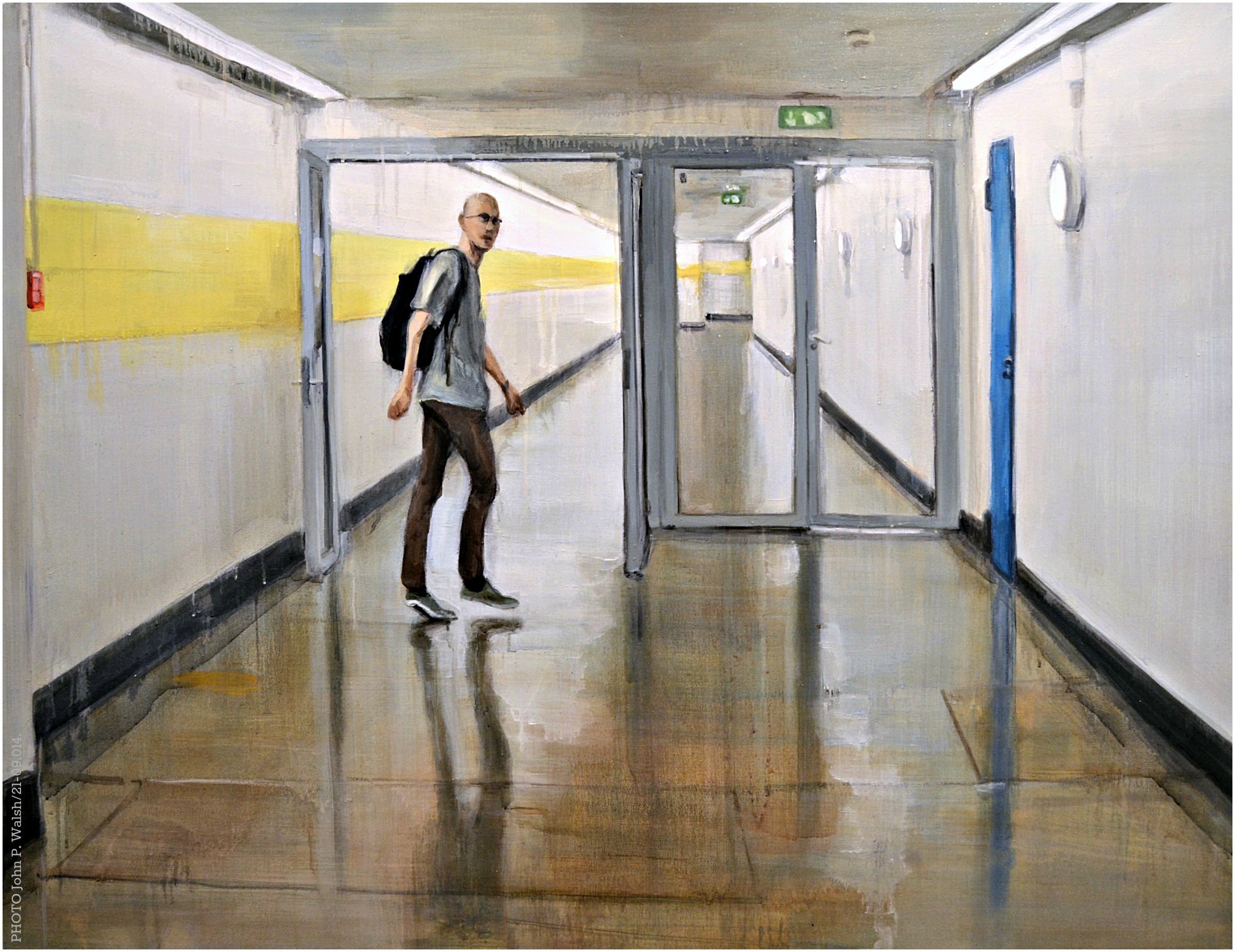
Jina Park, Automatic Door Follow Me, 2014, oil on canvas, 100 x 130 cm, One and J. Gallery, Seoul.
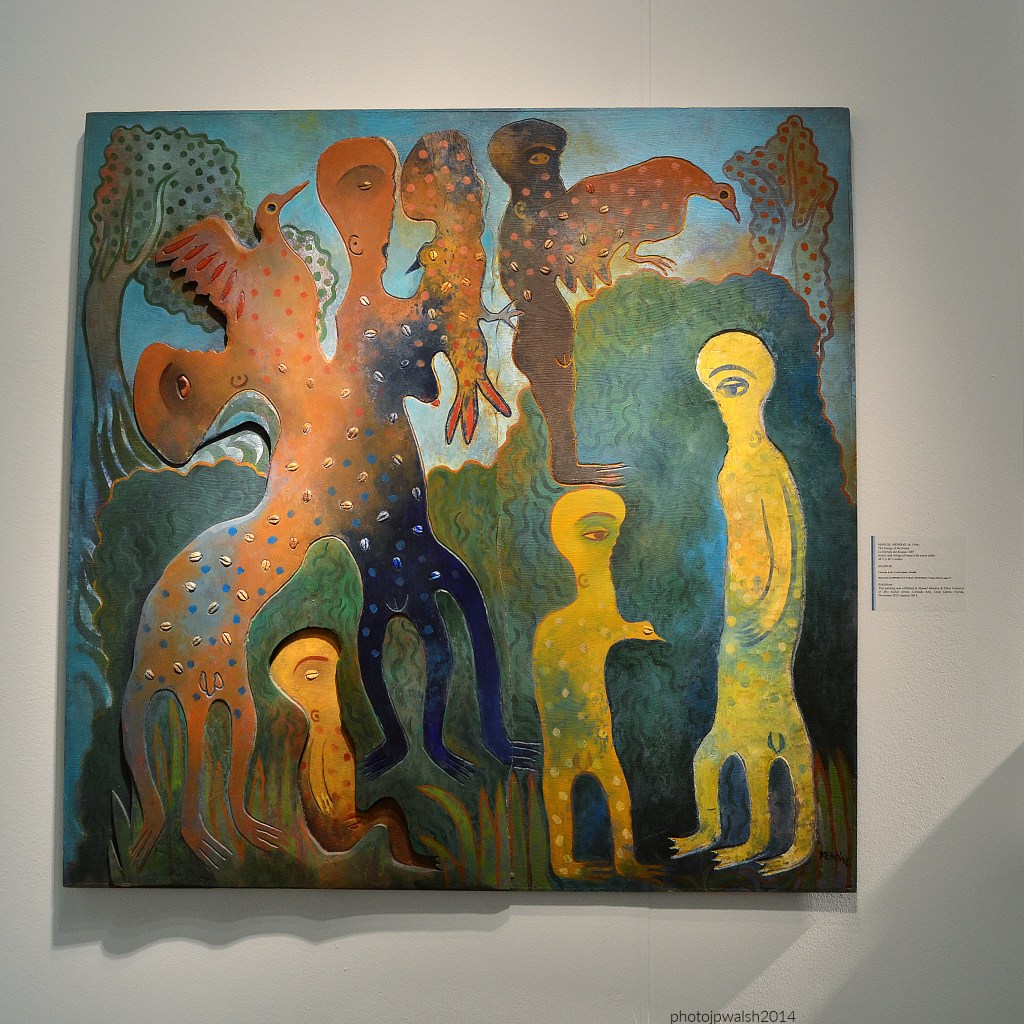
Manuel Mendive, La Energia del Bosque (The Energy of the Forest), acrylic and collage of wood with cowry shells, 2007. Cernuda Arte, Coral Gables, Florida.Alfred Leslie, Afternoon Soaps, 1983, oil on canvas. Hill Gallery, Birmingham, MI.
FEATURE Image: Glenn Kaino, Bridge, 2013. A section of a 100-foot long construction that features 200 gold casts of Tommie Smith’s arm in a raised fist salute that occured in the 1968 Summer Olympics on the medal podium during the national anthem after Smith broke a sprinting record to take gold.
EXPO CHICAGO 2013 is the 2rd annual exhibition of international contemporary and modern art held in Chicago at Navy Pier’s Festival Hall on September 19-22, 2013.
Tommie Smith at Expo Chicago 2013.
Tommie Smith is an American former track and field athlete and American Football League wide receiver. On October 16, 1968, the 24-year-old Smith won the 200-meter sprint finals and gold medal in 19.83 seconds at the 1968 Summer Olympics in Mexico City.
It was the first time the 20-second barrier was officially broken in competitive sports history. Atop the medal podium and with heads bowed, Smith’s Black Power salute with silver-medal-winner John Carlos protested racism and injustice against African-Americans in the United States.
Smith’s raised fist as the national anthem played is seen as one of the most overtly political statements in the history of the modern Olympics and caused memorable admiration and criticism.
In Silent Gesture: The Autobiography of Tommie Smith (Temple University Press, 2008), Smith maintained that the gesture was not solely a “Black Power” salute but a “Human Rights” salute.
In any event, Smith’s raised fist salute in 1968 became one of the most iconic moments in the Olympic games and the history of the Black Power movement.
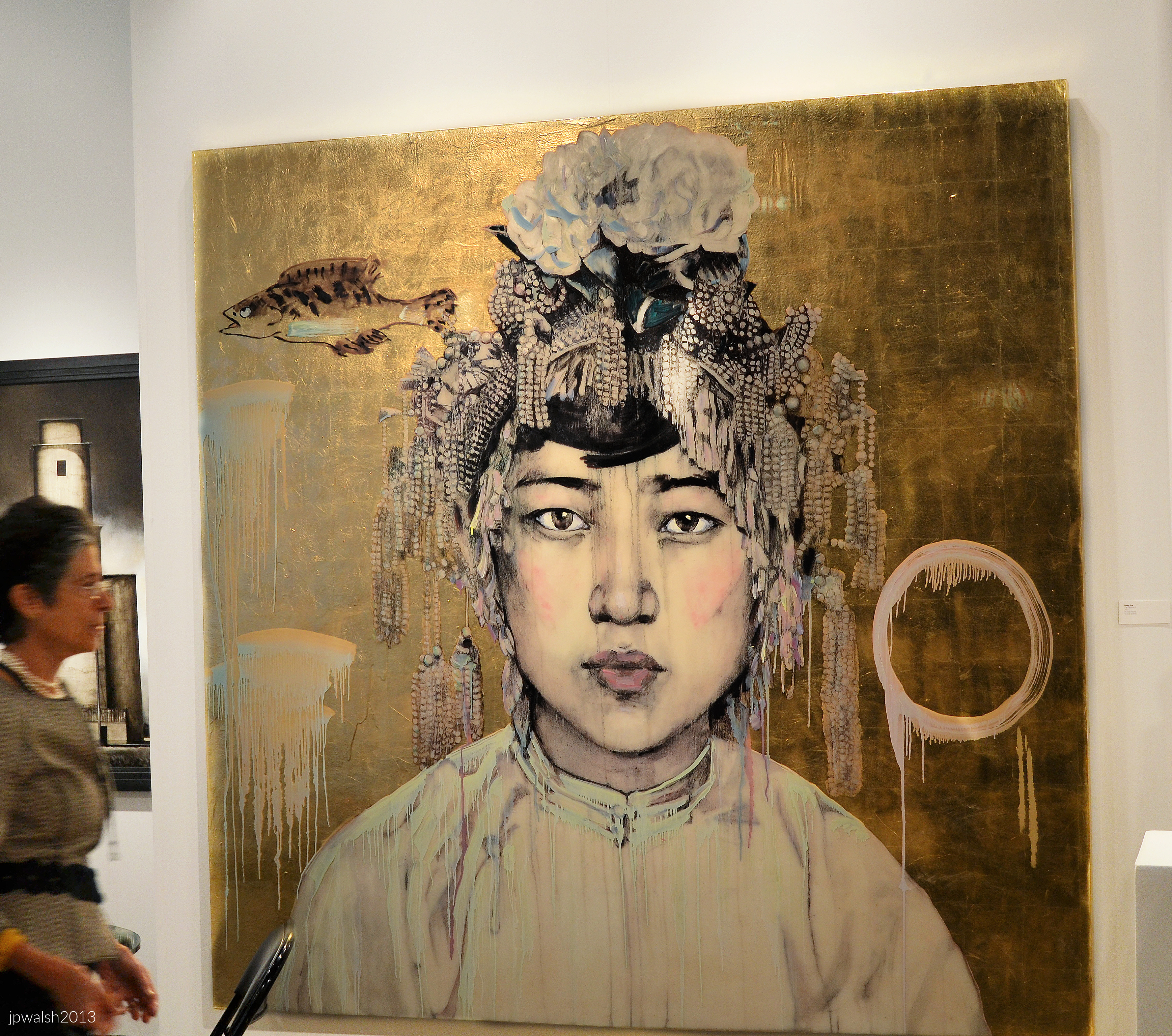
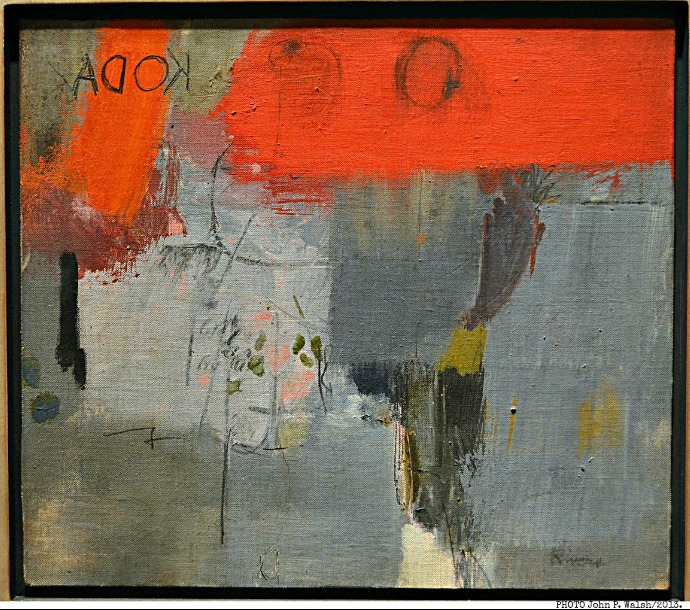
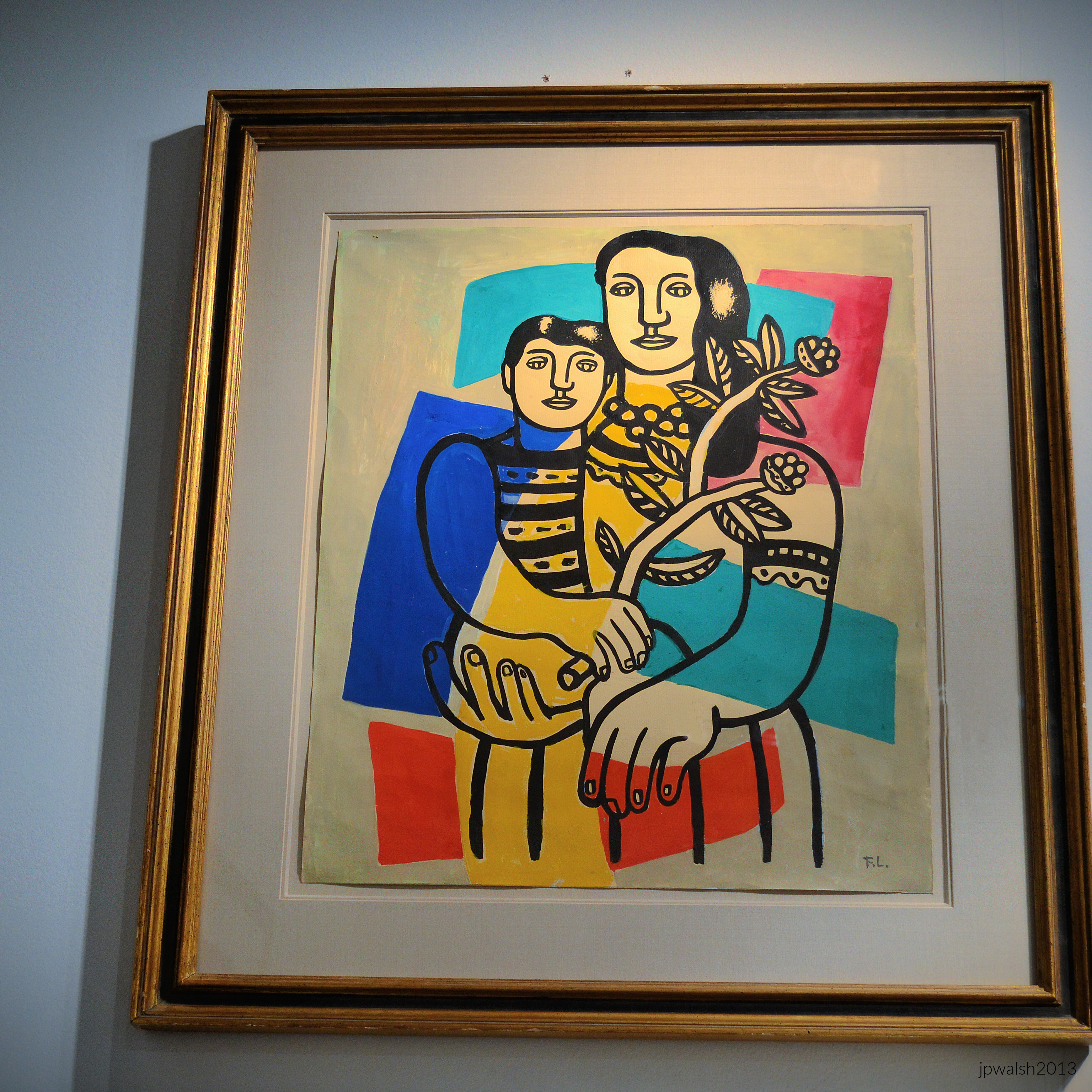
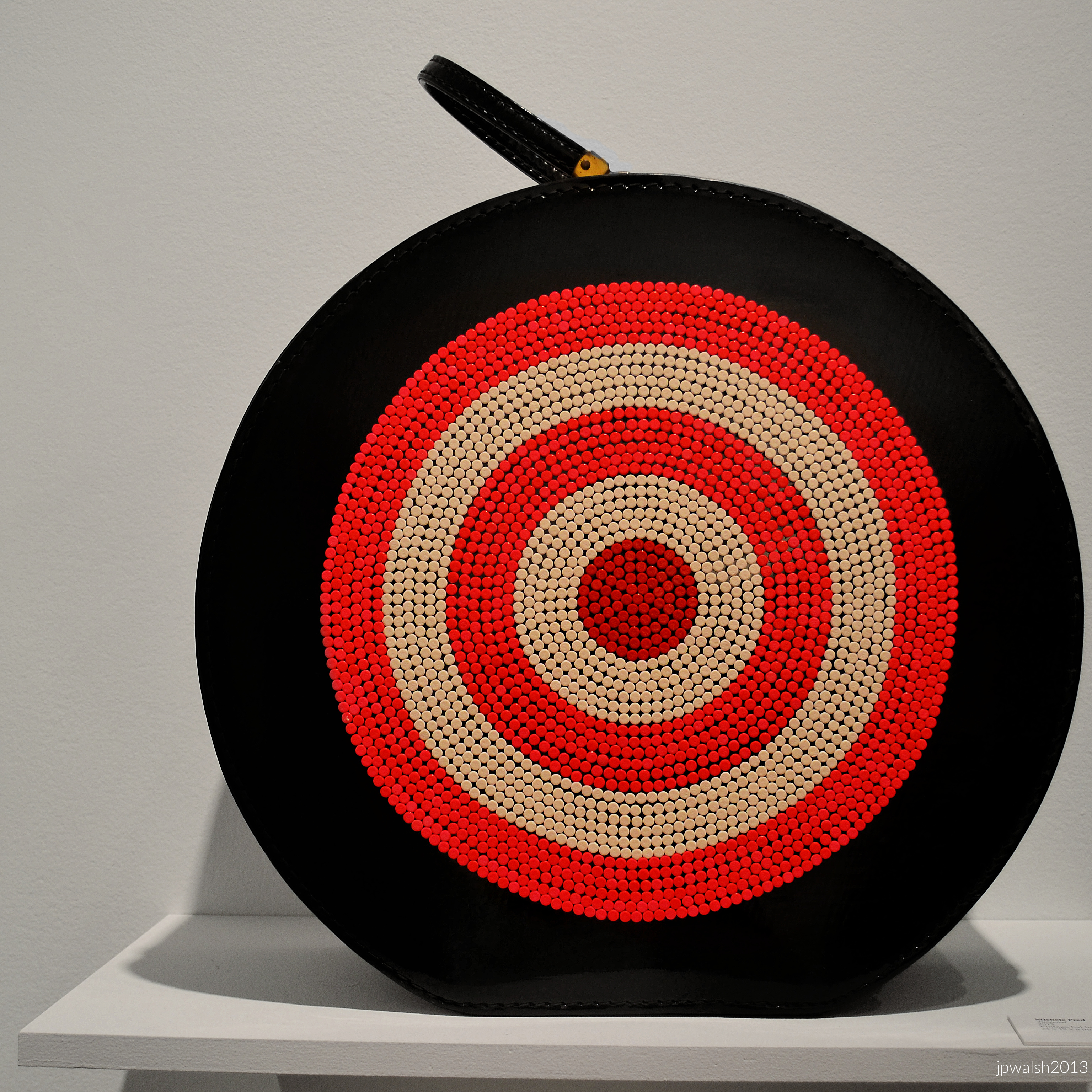
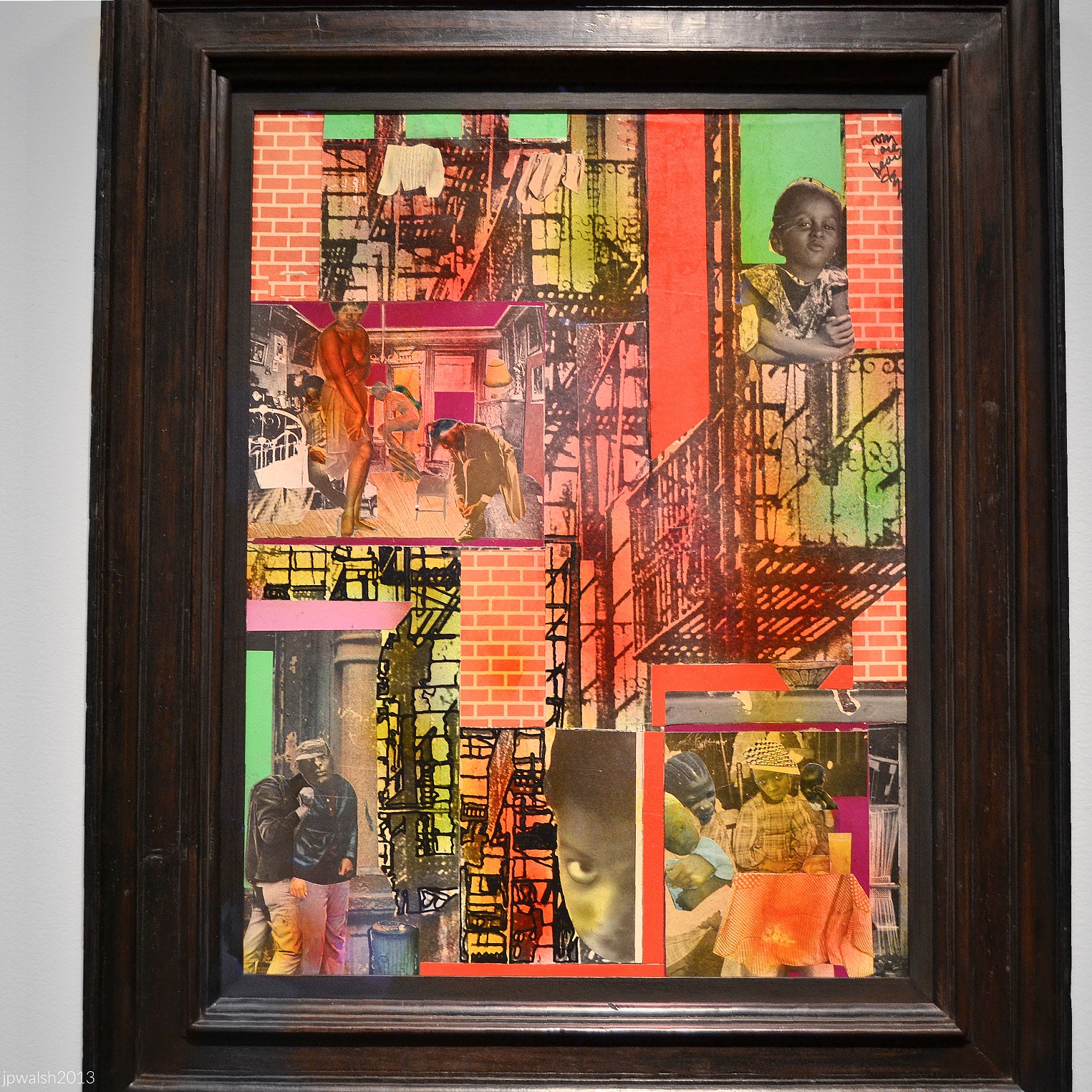
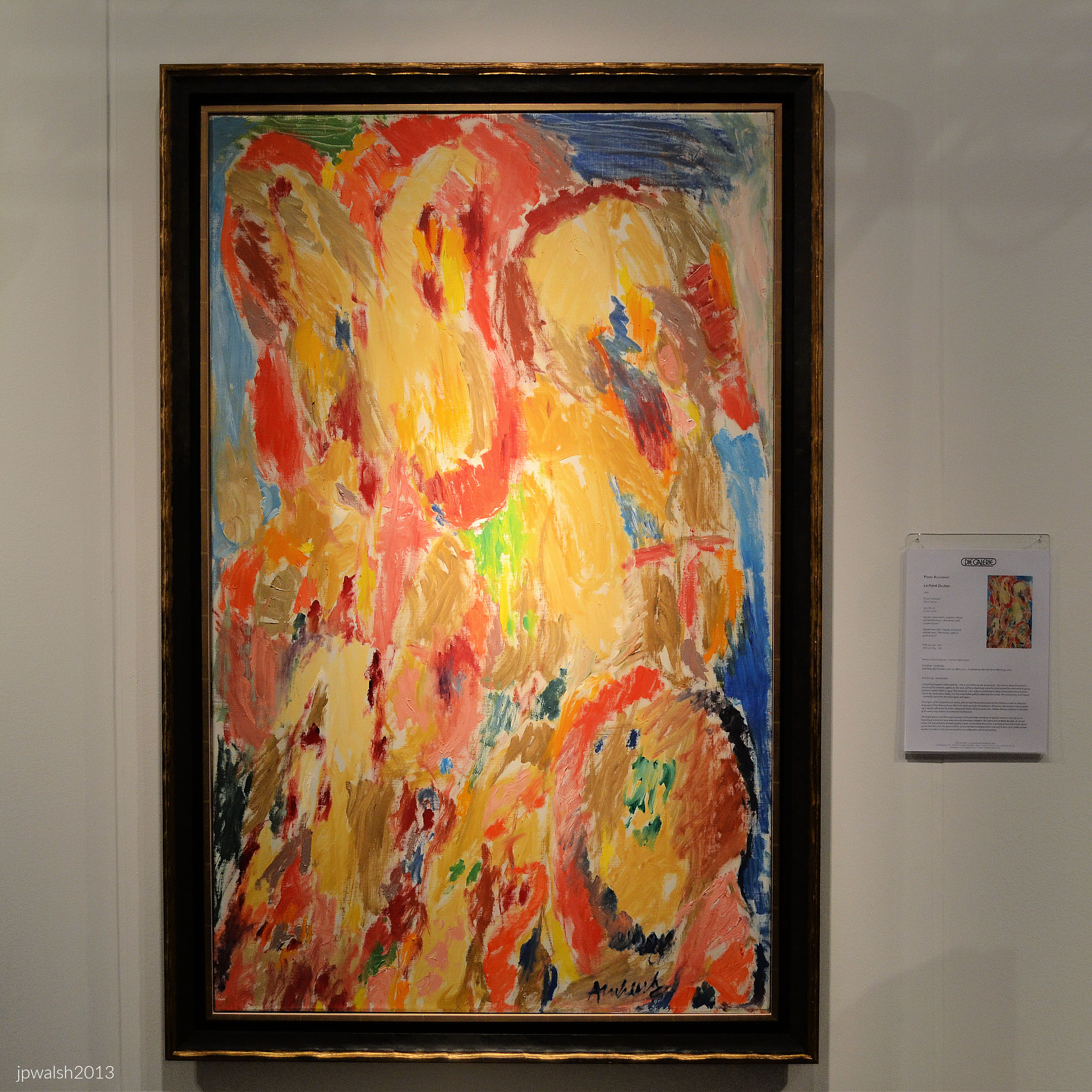
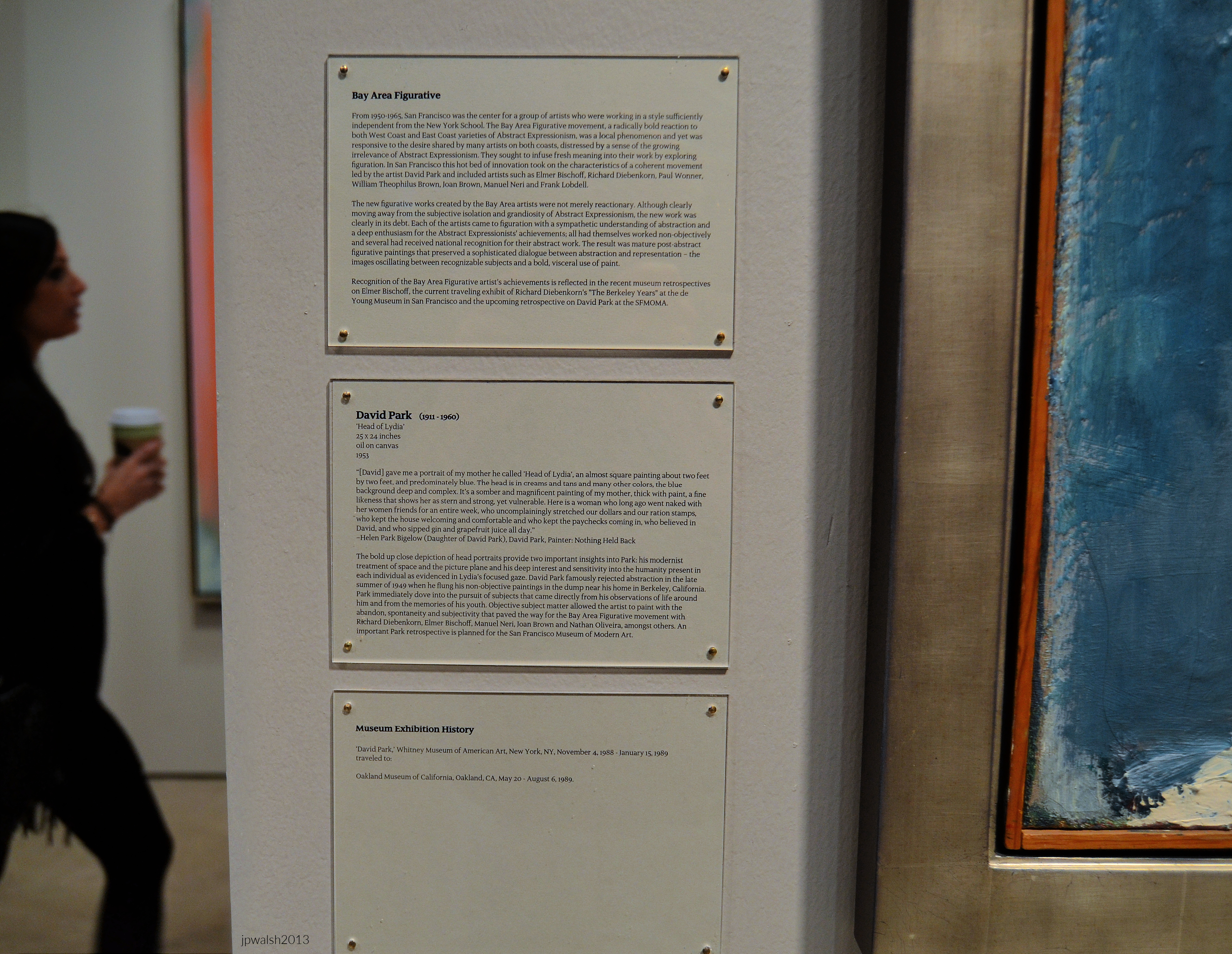
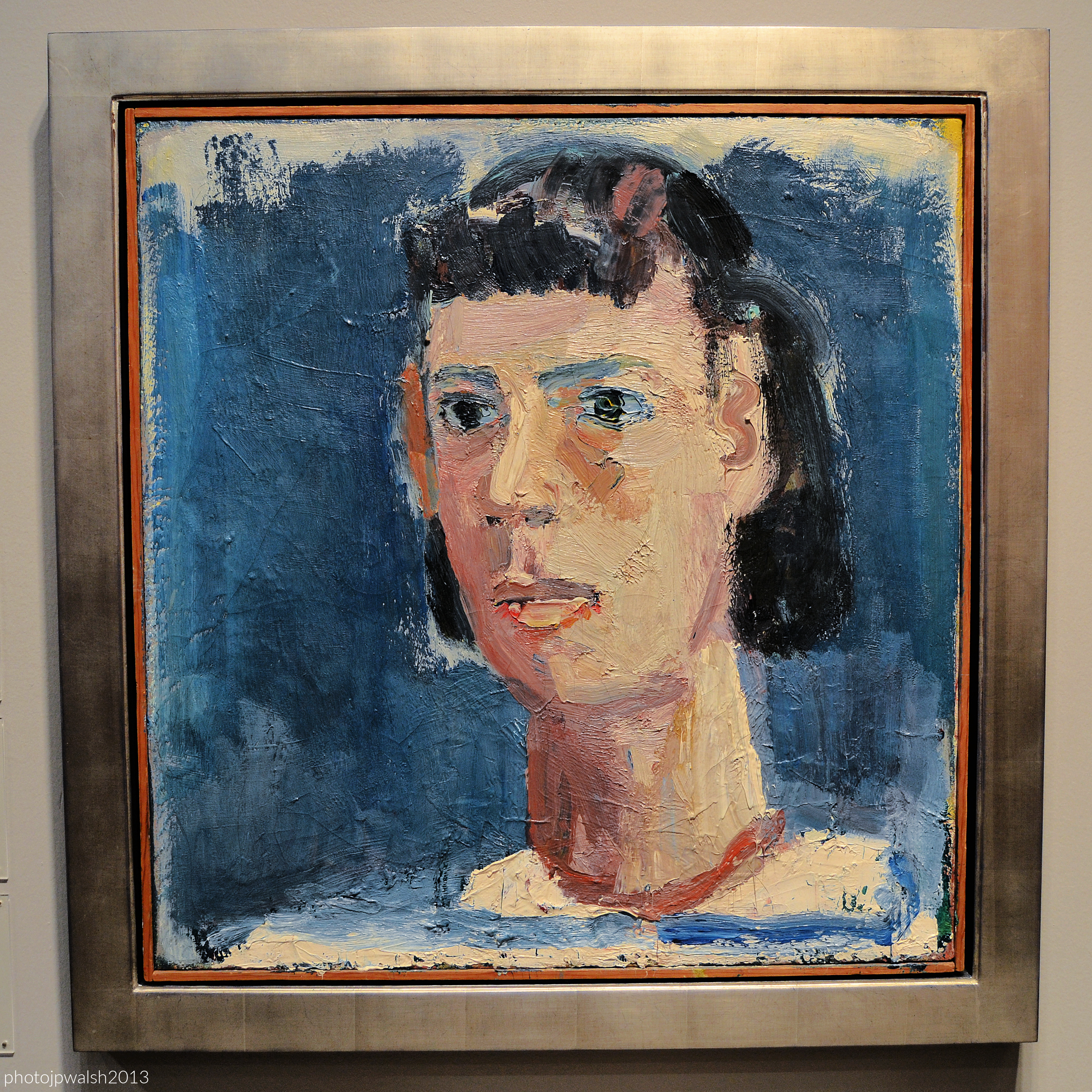
“1968 Black Power Salute” by urcameras is marked with Public Domain Mark 1.0.Robert Natkin (American, 1930-2010), Untitled, 1957, McCormick Gallery Chicago & Vallarino Fine Art New York.Hung Liu (American, Chinese, 1948-2021), Da Fa Che II, 2013, mixed media, 82 x 82 in., Nancy Hoffman Gallery, NY.Jack Roth (1927-2004), Metafour II, acrylic on canvas, 57 x 54 inches, 1980, McCormick Gallery, Chicago and Vallarino Fine Art, New York.Bruce Dorow (b. 1959), Black Shape Space, oil on canvas, 38 x 65 inches, 2012-2013. R.S. Johnson Fine Art, Chicago.Patrick Strzelec, American sculptor. Garth Greenan Gallery, Chicago.William T. Kennedy, Warhol Holding Marilyn Acetate 1, executed 1964, 2010. The photograph was made when Warhol wasn’t yet famous but at the center in a shift in the culture of the art world.Aimé Mpane (Congo, born 1968), IC Cont Series, 2011-2013, acrylic and mixed media on wood panel, 12.5 x 12 x 2 in., Haines Gallery, San Francisco.Larry Rivers (American, 1923-2002), Small Drugstore, 13.5.x.15.25 inches, oil on canvas mounted on board, 1959. Techniques of color-field painting, gestural abstraction, and calligraphy come together in a picture that is objective and abstract.Jonathan Boos, LLC, New York.Fernand Léger (1881-1955) – Mother and Child, c. 1949, gouache, signed with initials. R.S. Johnson Fine Art Chicago R.S. Johnson Fine Art, Chicago. Top left: Fernand Léger (1881-1955), Mère et Enfant, 1949, gouache; right: André Lhote (1885-1962), Les Acacias, 1959, oil on canvas. Michele Pred, Targeted, 2012, Vintage hat bag, birth control pills, 24x1x6 inches. Nancy Hoffman Gallery, New York. Michele Pred incorporates aspects of contemporary culture and politics in her art. The Berkeley, California, artist uses unconventional materials that serve as cultural artifacts for her conceptual approach.Romare Bearden (American, 1911-1988), Manhattan Suite, 1975, collage and mixed media on board, 24 x 18 inches, Jonathan Boos, LLC.50%. Elizabeth Catlett (American, 1915-2012), Star Gazer, 1997, black marble, 14.5 x 32 x 11 in., signed. Jonathan Boos LLC. Catlett is known for depictions of African-American and Latin American working-class women using simple, solid shapes in wood, stone, bronze or clay.Haines Gallery, San Francisco.Siebren Versteeg (American, b. 1971), Good Times_1081_2003_05_09, 2012, Algorithmically generated archive inkjet output to paper, tape. 92 x 56 inches, Rhona Hoffman Gallery, Chicago. The New York-based artist was educated at the SAIC and UIC. Mined digital content is presented as painterly abstractions or monitor displays.Die Galerie, Frankfurt am Main.Long–Bin Chen (Taiwan, born 1964), Edvard Grieg, 28x29x15 inches. New York-based Long-Bin Chen transforms paper products into sculpture. Books are constructed so that relevant subject parts and often titles fit together seamlessly.Mary Ellen Mark, John Belushi “Blues Brothers” Chicago IL, 1979 Gelatin silver print, 16 x 20 in. each, signed dated numbered (verso).Pierre Alechinsky, Le Point du Jour, 1966, oil on canvas, 130×81 cm, signed lower right and signed dated entitled (verso). David Park (1911-1960), Head of Lydia, 25×24 in., oil on canvas. 1953. In the late summer of 1949 David Park rejected abstraction and started the pusruit of objective subjet matter, including the mother of Helen Park Bigelow.
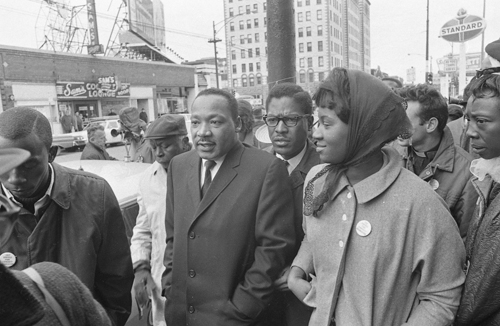
FEATURE image: Rev. Dr. Martin Luther King Jr. is joined (from left) by Rev. Ralph D. Abernathy, James Forman, Rev. Jesse L. Douglas, and John Lewis at a march for voting rights in Alabama in 1965. King would come to Chicago in January 1966. Fair Use.
By John P. Walsh
The first nonviolent civil rights campaign in the North led by the Southern Christian Leadership Conference (SCLC) started in Chicago, Illinois, on January 5, 1966—50 years ago this month.
The multi-pronged campaign was Rev. Dr. Martin Luther King Jr.’s first major effort outside the South and the first following the Civil Rights Act of 1964 and Voting Rights Act of 1965. King’s coming to Chicago was greatly influenced by the Watts riots in August 1965 where those deadly six days demonstrated to King and the nation the high cost in human lives and property associated with deep discontentment in the black community over isolating and chronic high unemployment, substandard housing, and inadequate schools.
King’s consideration to come to Chicago in 1966 was further energized by national issues activated by a local focus: in this case, King’s broad support for recent Federal complaints brought by the Chicago Coordinating Council of Community Organizations (CCCO) alleging segregation in the Chicago public schools. As there was a huge new Federal aid package for those public schools in the nation which desegregated by the start of the 1965-1966 school year, a charge of segregation in a state in the north and in the nation’s second largest city was unexpected, provocative, and dangerous to the natural progression of the status quo.
Led by former school teacher Albert Raby (on KIng’s right), the CCCO was a coalition of a number of disparate and sometimes contentious groups including the local branches of CORE, the Catholic Interracial Council, and the Urban League, among others. Here, King and Raby meet the Chicago press along with SCLC leader Bayard Rustin (on King’s left).
The status quo in Chicago, at least in terms of its politics, was embodied in one man: Mayor Richard J. Daley (1902-1976). King’s intention to come to Chicago instead of to another big northern city was that he figured to find in Mayor Daley a powerful ally to his civil rights movement. Already Daley vocalized agreement in principle with King’s message of open housing and racial justice, but King’s potential challenge to any aspect of the mayor’s absolute political power never gained Daley’s sympathy or recognition.
Many in Chicago’s local civil rights community, however, welcomed Dr. King’s presence in Chicago in 1966. Activists like Dick Gregory (1932-2017) had marched on City Hall — and into the Bridgeport neighborhood to Daley’s home — dozens of times but to no avail in terms of tangible policy changes for blacks in a city where blacks constituted 25% of its population. Perhaps the efforts of Dr.King in Chicago could break the deadlock.
The U.S. Commission on Civil Rights had recently labeled Chicago “the most residentially segregated city in the nation” but Daley chose to see it differently. There was no legal segregation in Chicago and Daley believed it was simply a “city of neighborhoods.” The 63-year-old Daley also felt that if government handouts were not downright un-American then, by 1965, big Federal programs should be administered at the local or city level and not from Washington. Daley’s calculation, a lawyer since 1934, always included his concern for the augmentation and not diminishment of his political power.
Stevie Wonder’s single “Uptight (Everything’s Alright)” was released in late November 1965 and peaked at no. 3 on the Billboard Hot 100 in early 1966 and was no. 1 on the Billboard R&B Singles chart for 5 weeks. Co-written by 15-year-old Stevie Wonder, the song was a watershed for his career. It was one of three singles in the early-mid1960’s that peaked in the top 40 on both charts and “Uptight (Everything’s Alright)” also launched the next stage of Wonder’s recording career into the second half of the 1960’s.1920’s flats in Bridgeport in 2015, the Chicago neighborhood of Mayor Richard J. Daley.Chicago slums, 1950.
While Daley’s home rule views appealed to some Chicagoans, other Chicago neighborhoods stayed in flux. There had been a longstanding mistrust, for example, between poor West Side residents—most of whom were black and concentrated by the mid1960’s into a vast ghetto—and a largely white Chicago police and fire departments. In the summer of 1965 street riots in West Garfield Park effectively produced the integration of 40 of 132 firehouses where calls for integration had been resisted since the early 1950’s.
The City of Chicago’s contrariness to aspects of President Johnson’s Great Society carried into the office of Chicago’s Education chief Benjamin C. Willis (1901-1988). In October 1965 Willis defied federal mandates for the release of requested materials as well as blocked the use of new national achievement tests in city public schools. This led to Chicago being temporarily denied their part of the massive $1.3 billion federal aid to schools program.
Benjamin C. Willis in 1963.
The overall alliance of Mayor Daley and President Johnson was strong in late 1965 so that the federal aid money called into question was restored within the week. Further, the federal official who had challenged the political power structure by citing Daley’s public schools for contempt of Federal segregation mandates was swiftly punished with a demotion.
President Lyndon B. Johnson (r.) meets with Chicago Mayor Richard J. Daley in the White House, April 21, 1966. Photograph by Yoichi Okamoto (1915-1985).
It was into this political hothouse that Dr. King decided to build a civil rights campaign for open housing, jobs, and educational opportunity for African-Americans which in October 1965 Daley announced he welcomed with open arms.
Meanwhile Daley was also mobilizing local black and other elected officials in Chicago to establish their own community action programs to co-opt or sideline any of King’s anticipated civil rights initiatives and efforts. This important time when Dr. King came to live and work in Chicago from January to August 1966 and its immediate legacy came to be called the “Chicago Freedom Movement.”
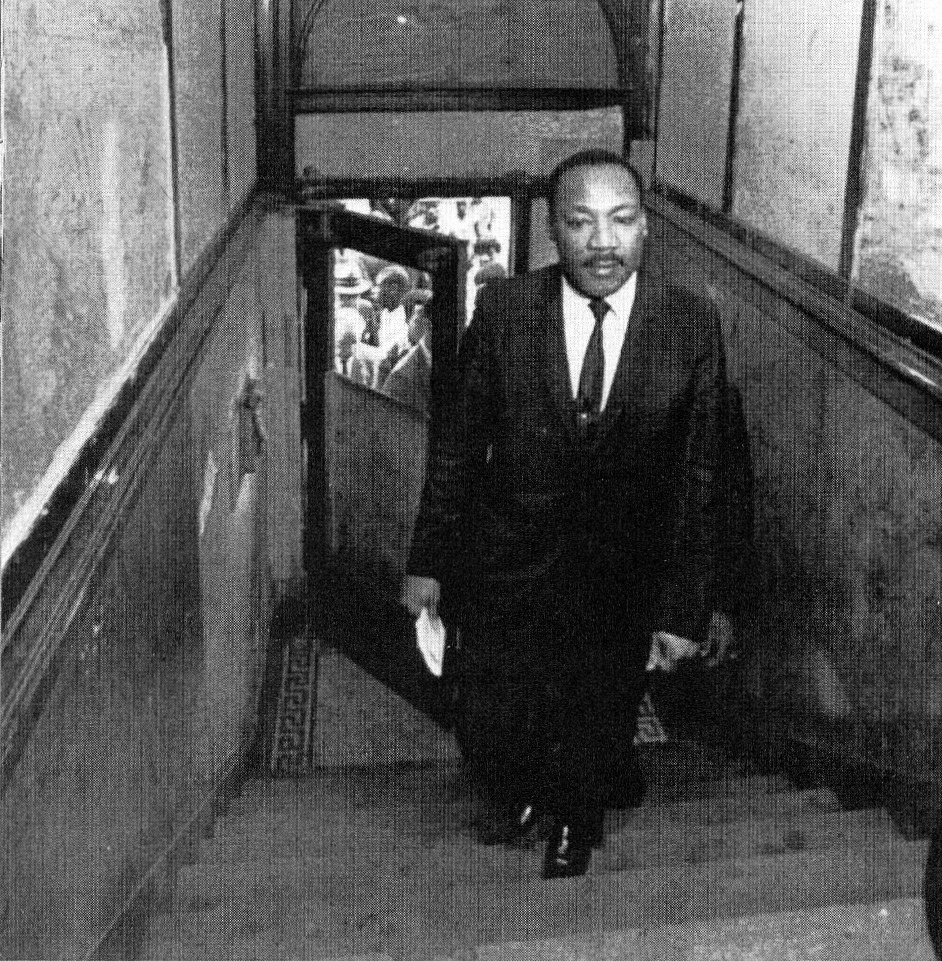
In January of 1966, Martin Luther King, Jr., arrives into the tenement apartment on the West Side to begin the Chicago Campaign. The nine-month campaign gave birth to bringing before the nation its widespread issues of poverty and racial injustice. As King mounted these steps into the cold, rundown set of rooms, he was equally walking into the complex politics, problems and hurdles associated with this big northern city whose Democratic mayor, Richard J. Daley, was known as “Boss.”
It was on Wednesday, January 26, 1966, that Martin Luther King, Jr. and Coretta Scott King (1927-2006) installed themselves into a West Side apartment in a low-income Chicago neighborhood on the West Side.
At the outset the SCLC and their allies were political outsiders in Chicago and mainly sought an amenable agreement with the established political powers in a city embodied by 63-year-old Richard J. Daley, its mayor since 1955.
In the middle of the cold and brutal Chicago winter King humbly began his campaign by stating that he was looking to study the city’s social conditions.
King wanted to know which nonviolent campaign tactics—whether it was street marches, voter registration drives, rallies, fund raisers, or something else—would be effective to progress the objectives of job creation, open housing, educational opportunity for African-Americans and, by summer of 1966, slum clean-up and a citizen’s review board for police brutality and misconduct.
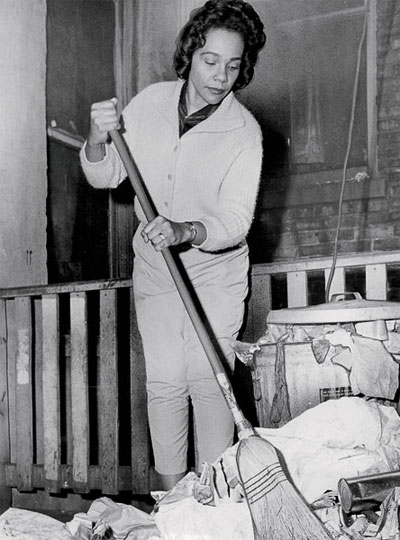
Martin Luther King Jr. and wife Coretta Scott King after moving into an apartment at 1550 S. Hamlin Avenue in Chicago on January 26, 1966. King moved into the tenement apartment to highlight segregated housing conditions in Chicago and launch a campaign to end slums in the city. — Chicago Tribune, Feb. 24, 1966.With furniture provided from local second-hand stores, Martin and Coretta Scott King are pictured on the first day in their Chicago Lawndale apartment on 1550 S. Hamlin Avenue. King’s first act in Chicago in January 1966 gained national media attention which helped to publicize the conditions of Chicago slum apartments. Photograph by John Tweedle. Martin Luther King Jr. helps remove a window frame while renovating an apartment at 1321 S. Loman Ave., in Chicago in 1966. King moved into a West Side apartment to highlight housing segregation issues in Chicago. — Luigi Mendicino, Chicago Tribune, Feb. 24, 1966. he SCLC and CCCO together with the Westside Federation became extralegal ‘trustees’ of the building with the tenants paying their rent to the SCLC, which used the money to make repairs. Male tenants of the building were hired as laborers and paid King’s proposed new minimum wage, $2.00 per hour. (The minimum wage in 1966 was $1.25.) King told Betty Washington, a reporter for the Defender, that the experiment of taking over that building would give Movement leaders insight into “the kind of social planning that might reverse this trend of degradation of our nation’s cities and contribute to the kind of community awareness that will bring new life and new hope to the slums of this city.” Photograph by Luigi Mendicino, Chicago Tribune, February 24, 1966. Coretta Scott King at the Homan Avenue tenement in Chicago in 1966 tenement her husband’s campaign had taken control of and worked to repair. It was about 5 minutes by car from the King home on Hamlin. In 1966 when Dr. Martin Luther King, Jr. and Coretta Scott King lived in Chicago on the West Side at 1550 S. Hamlin Avenue Dr. King preached at Stone Temple Baptist Church at 3622 W. Douglas Boulevard, a ten-minute walk away. Built in 1926 as a synagogue in the North Lawndale neighborhood the building became a Baptist church in 1954. Already in the 1950’s and early 1960’s Dr. King had delivered several speeches at Stone Temple MB Church in his civil rights efforts and used the church during his 1966 Chicago residency as a base for his civil rights and fair housing advocacy. His efforts led to the signing of the 1968 Fair Housing Act on April 11, 1968, a week after his assassination. Today, Stone Temple is led by Bishop Derrick M. Fitzpatrick, the grandson of Rev. James Marcellus, the church’s founder. PHOTO: “Stone Temple MB Church” by reallyboring is licensed under CC BY-NC-ND 2.0. see – https://stonetemplegreenteam.org/stone-temple-church – retrieved September 2, 2025.
“Baby Scratch My Back” written and performed by “swamp blues” singer Slim Harpo (1924-1970) was a number one hit playing on the radio in 1966.
As King spoke about a “closed society” in Chicago, the elected political power structure out of the Mayor’s office maintained an omnipotent grip on city services as a vicious circle of poverty in some black neighborhoods was permitted to exist. It was complicated by the Mayor’s public assertions that there “were no ghettos” in Chicago though Black citizens were de facto restricted to living in only certain of Daley’s “city of neighborhoods.”
King’s outsider status—which at first was understood as a mostly useful factor among Chicago’s civil rights activists—also worked to undermine King’s effectiveness in Chicago throughout 1966.
King and his circle were unfamiliar with Chicago’s vast size and complicated demographics. Also, perhaps unexpectedly, opposition to King’s efforts didn’t always fall cleanly along racial lines.
Whether coming from whites or Blacks, resentment to the Atlanta-based minister in Chicago usually always revolved around his being viewed as an interloper and potential power rival.
Dr. Joseph H. Jackson (1905-1990), president of the National Baptist Convention, U.S.A., Inc., and pastor of Olivet Baptist Church in Chicago was bitterly opposed to the Chicago Freedom Movement and made rancorous attacks against Dr. King while he was in Chicago. In 1963 Dr. Jackson was booed off the stage with Mayor Daley at an NAACP rally in Grant Park in 1963.
Support from Chicago Black ministers, a natural political base for King, was frequently blunted in 1966 by intimidating reminders from City Hall that this or that certain church would be having its building or fire code inspection coming up.
Moreover, big cities across the nation, including Chicago, were looking to receive a huge influx of money out of Washington, D.C. including part of a new $2.3 billion anti-slum program (about 17 billion in 2015 dollars). This huge infusion of money to Chicago was part of programs for infrastructure and social services marking President Lyndon B. Johnson’s “Great Society.”
King was politely pressured by city officals to forego what could only be seen as futile and time-wasting efforts of trash drives and meetings so to allow the Chicago mayor and his allies to get down to the serious work of eliminating city slums by, as Daley announced, no later than the end of 1967.
Daley’s home-court advantage and enormous financial support from the Democratic U.S. president and Congress gave Dr. King’s civil rights operation among the poor and dispossessed an appearance of superfluity, if not outright meddling.
Tactically, on every front, Daley tried to match King’s organizational efforts often by simply buying off King’s allies.
When King filled the International Amphitheatre on South Halsted Street with 12,000 Black celebrities and supporters on March 12, 1966 for a rally, Daley led 70,000 marchers and 350,000 spectators down State Street in the St. Patrick’s Day parade a few days later.
Mayor Richard Daley leading the St. Patrick’s Day Parade on State Street in 1963.
After the SCLC took a supra-legal action to seize a dilapidated tenement building, Daley limited his response which left King to deal with all the legal and public relations headaches.
King was not naïve about his own position. He did not want the Chicago Freedom Movement to become politicized. Daley had a mayoral primary in February 1967— he was running unopposed for a fourth four-year term. Some King allies in Chicago wanted an opposition candidate to Boss Daley, something that had never materialized to that point, and coalesce around the Chicago Freedom Movement to run against the mayor.
King refused the idea. Despite the political leeway, Daley worked continuously in 1966 to limit and even sideline King’s efforts in Chicago. King’s hope that the Irish-American big city northern mayor would risk or trade political power for King’s agenda of social justice and civil rights on behalf of the city’s African-Americans —historically a full third of the population —was mostly dashed in 1966.
Daley’s selective embraces of King never offset the mayor’s overall strategy to restrain the civil rights leader’s efficacy in Chicago. At the same time Daley did not want his restraint of King to impact or curb the broad voter support that the Daley administration had.
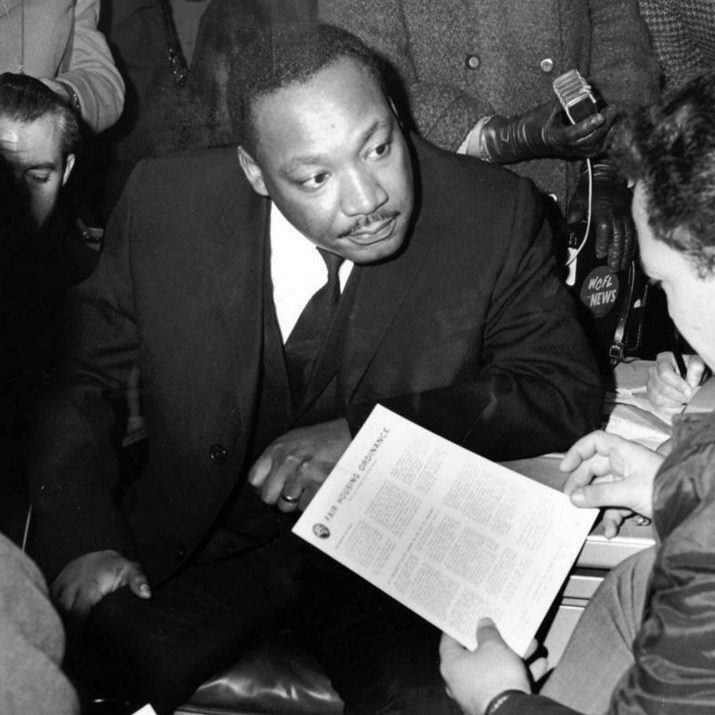
Civil rights leader Rev. Martin Luther King Jr. discusses fair housing with Gilbert Balin, of G. Balin Inc. real estate agents in Chicago. King and the Southern Christian Leadership Conference launched a campaign to end slums in the city, which would become known as the Chicago Freedom Movement. — Jack Mulcahy, Chicago Tribune, Nov. 3, 1966.
Regardless of Daley’s defensive efforts, King did not lose sight of his message of improved housing, education and economic development for African-Americans in Chicago. At this still early juncture of his time in Chicago, KIng carried on with his own civil rights campaign leaving any direct confrontation with Mayor Daley possibly for the future.
One SCLC initiative that scored quick success was a project started in February 1966 headed by Rev. Jesse Jackson (1941-2026) called Operation Breadbasket (renamed by Jackson Operation PUSH after King’s death). Within months there were several hundred new Black hires in Chicago-area businesses by way of this action.
Rev. Jackson at an Operation Breadbasket event, May 9, 1970. Photo by Chris Holmes.Dr. King and his wife, Coretta Scott King, lived and worked in Chicago for about 9 months in 1966 which gave birth to the Chicago Freedom Movement. King spent those first late winter into early spring months in Chicago getting to know the city and formulating a plan. In addition to the Hamlin (apartment building) “trusteeship” and Operation Breadbasket, King visited with Black and white leaders including the powerful mayor, Richard M. Daley (1902-1976), and the leader of the Nation of Islam, Elijah Muhammad (1897-1975). He also worked to convert gang members to the philosophy of non-violence and met with a large variety of community groups. Here he walks with members of the East Garfield Park Community Organization. Photograph by John Tweedle. Fair Use.
King’s months-long presence in Chicago in 1966 could also be credited for prompting Mayor Daley to establish new city programs. Daley also hosted various “summits” with clergy, labor and business leaders with the agenda to combat poverty and racism in Chicago.
In August 1966, Daley, with the support of the Chicago Freedom Movement, accepted the departure of public schools Chief Benjamin Willis and the appointment of James F. Redmond, a racial progressive, who served in that capacity until 1975. Still, Daley considered only white men for the post and overlooked two qualified Black candidates.
One thing Dr. King considered a key effort to improve African-American lives in the ghetto was to transform gang members into nonviolent civil rights activists. When a gunfight at a SCLC meeting in May 1966 broke out between Blackstone Rangers and East Side Disciples that ended King’s official initiative in this direction for the present.
Meanwhile, Richard J. Daley continued his downtown redevelopment. In March 1966 Daley announced a $200 million package for mass transit and made sure the Civic Federation — a good government watchdog group — was there to endorse it. In addition to Loop and North Michigan Avenue redevelopment, Daley dedicated in May 1966 the Civic Center, soon to be graced by the iconic Picasso sculpture in 1967.
Now the long, hot days of the Chicago summer were on the doorstep. Many in the city wondered at the start of summer 1966 to what extent Dr. King’s plans might add to the heat.
King’s apartment during 1966 in Chicago at 1550 South Hamlin Avenue was damaged during the riots that followed his assassination on April 4, 1968 and eventually demolished. The site was a vacant lot until the construction in 2011 of Dr. King Legacy Apartments designed by the architecture firm Johnson + Lee. the $18 million, 45-apartment complex also features commercial spaces along its 16th Street frontage, including the new home of the Fair Housing Exhibit Center.Painted mural of the image of Dr. Martin Luther King, Jr. and his tenement apartment in Chicago’s North Lawndale by nationally-renowned Afro-Indian muralist, Paul Collins. It is the centerpiece of the Fair Housing Exhibit Center.
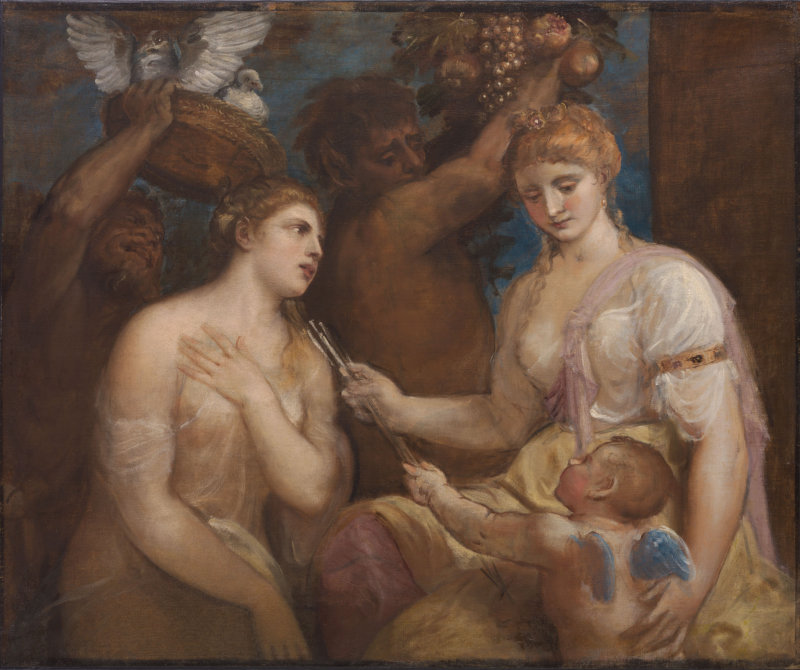
FEATURE image: Allegory of Venus and Cupid, c. 1600, Imitator of Titian (Tiziano Vecellio, Italian, c. 1485/90-1576), oil on canvas, 51 1/8 x 61 1/8 in. (129.9 x 155.3 cm). Charles H. and Mary F.S. Worcester Collection, 1943.90.
By John P. Walsh
The pleasant if heavily-restored late 16th century allegorical painting in the collection of The Art Institute of Chicago is today called Allegory of Venus and Cupid and dated to around 1600. Attributed to an “imitator” of Titian it remains in museum storage (“Not on Display”).
When this same painting was “rediscovered” around 1930 it was hailed as a Titian masterpiece and over the next 15 years was talked of that way in the general press and in some quarters of the art press. It delighted crowds who came to see it hang on the walls of The Art Institute of Chicago and The Cleveland Museum of Art. Called The Education of Cupid and dated to the 1550s, it was compared favorably with Titian’s famous allegorical subject paintings in Paris’s Louvre and in Rome’s Galleria Borghese.
The painting through the Great Depression and World War II was labeled “Titian,” but among expert connoisseurs there existed a longstanding dismissal of that attribution ever since its first known “resurfacing” in the mid1830s at Gosford House in Scotland.
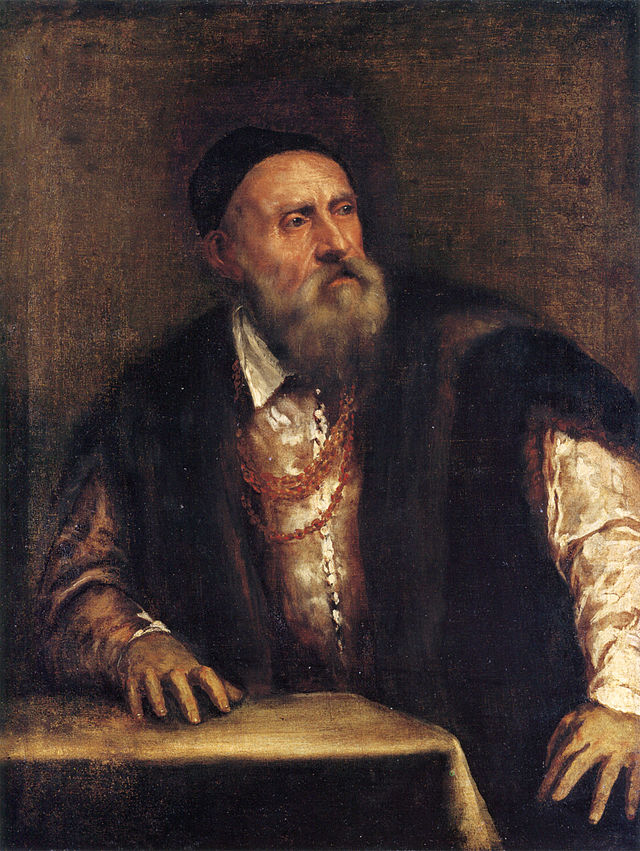
Titian, Self portrait, c. 1550, Gemäldegalerie, Berlin.
In Italian his name is Tiziano Vecellio, but in English the artist is famously known as Titian (1485-1576)
Titian was part of a family of artists who had been civic leaders in 13th-century and 14th-century Italy, such as mayors, magistrates, and notaries. In the 15th century, two Vecellio brothers had children who became artists. Titian was the grandson of one of those brothers who was ambassador to Venice where the family had a timber trade. Titian became the leading painter in Venice and an influential artist throughout sixteenth-century Italy. His cousin Cesare Vecellio (1530-1601) was an engraver and painter who trained in Titian’s workshop. The Vecellio cousins and their sons became artists and were allowed to use the appellation “di Tiziano” which would bring them attention.
The painter of The Art Institute of Chicago’s allegory entitled Allegory of Venus and Cupid is only identified as an “imitator” of Titian. Its allegorical motifs share similarities with Titian’s and this is perhaps partly why this Old Master painting by an unknown follower of Titian was mistaken for the master himself when it resurfaced on the art market in 1927.
Called The Education of Cupid and dated to the 1550s, it traded back and forth to the dealer for almost a decade until it was bought in 1936 by a well-connected Chicago couple who collected sixteenth-century Venetian paintings. The Wemyss ‘Allegory’ (named for its former British owner, Lord Wemyss) came to Chicago out of what amounted to be a Scottish attic.
It gained ready acclaim as a rediscovered Titian and since its subject was reminiscent of Titian’s Allegory of Marriage (1533) in the Louvre and a Titian subject allegory in the Galleria Borghese, the Wemyss ‘Allegory’ in Chicago was hailed as completing a triumvirate of Titian’s greatest allegorical compositions.
The problem was that this Chicago Titian was not a Titian at all, although it took about 10 years for that fact to gain modern acceptance.
After the purchase, the new owners immediately lent their Titian to The Art Institute to mount on its gallery walls. It would hang next to the collector couple’s verifiable Tintoretto, Veronese, and G.-B. Moroni. The museum eventually acquired the Wemyss ‘Allegory’ in 1943, but not before it toured The Cleveland Museum of Art during their “Twentieth Anniversary Exhibition” in 1936 and viewed with enthusiasm as a Titian.
The collector purchase and subsequent loan to the Art Institute was front page news in Chicago. The director of the museum at the time, Robert Harshe, compared the work in importance to only two others in The Art Institute at that time – El Greco’s Assumption of the Virgin (1577-79) and Girl at the Open Half Door (1645) attributed to Rembrandt. Curiously, this painting first attributed to Rembrandt has been itself increasingly questioned in terms of its high authorship. One of the first historical European paintings to enter the museum’s permanent collection, Girl at the Open Half Door is today identified with the moniker “and Workshop” to indicate the possibility that it was created by a student under the master’s supervision.
Soon after its acquisition by The Art Institute, the Titian attribution was loudly critiqued in print and eventually dropped. The subject of the painting is of a girl who appears before Venus to be initiated into the mysteries of Love. At the girl’s right are Venus and the boy Cupid with an arrow. In the background two satyrs raise items such as a basket with two doves and a bundle of fruit.
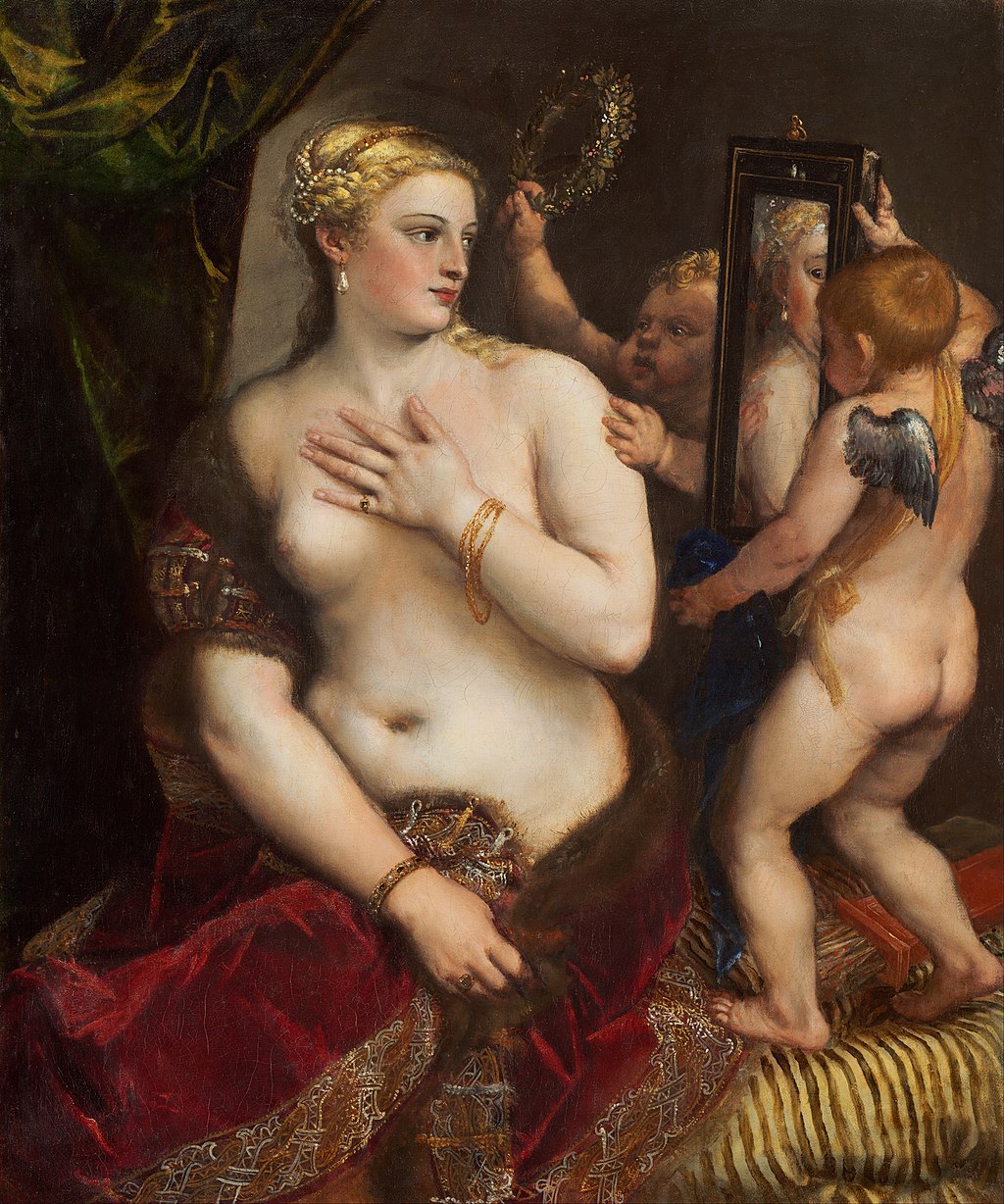
Allegories were popular in Italian Renaissance art to convey social, political, economic and religious messages using historical and mythological figures. This painting’s figures, however, appear to be derivative of specific Titian works. Further, it possesses little of the technical brilliance or psychological revelations found in Titian’s work such as in Triple Mask or Allegory of Prudence (c. 1570, London, National Gallery). For example, Titian’s imitator gives the figure of the girl the same dramatic hand gesture found in Titian’s Venus with a Mirror (c. 1555, The National Gallery of Art, Washington, D.C. ). Insofar as the girl’s skyward gaze and flowing hair, the imitator cites The Penitent Magdalene (1531-33, Florence, Palazzo Pitti).
Titian, Venus with a Mirror, 1555, National Gallery of Art, Washington, D.C.Titian, Penitent Magdalen, 1533, Pitti Palace.
In addition to the painting’s derivative character of well-known Titian works, what most connoisseurs recognized by 1945 was what they called its “very modern” execution. This referred to its sharp color contrasts and figurative forms which developed only after Titian’s time. Connoisseurs also noted that Titian differentiated sharply between hair and ornament and that his female figures’s hair is neatly braided, whereas the hair is “in a mass” in the Wemyss ‘Allegory’.
These characteristics pointed to the picture being related less to authentic Titians in Paris and Rome and more to those attributed dubiously, even spuriously, to Titian in Munich and at the Durazzo Palace in Genoa. Though this inauthenticity of Chicago’s Wemyss “Allegory” could have been questioned at the start of its appearance in Chicago in 1936, the museum was not adhering closely to the historical connoisseurship.
Sir Joseph Archer Crowe by Louis Kolitz (German, 1845-1914), London, National Portrait Gallery.
Giovanni Battista Cavalcaselle, 19th century.
Sir Joseph Archer Crowe (British, 1825-1896) and Giovanni Battista Cavalcaselle (Italian, 1819-1897) had seen all three of the spuriously attributed Titians in Munich, Genoa, and at Gosford House which was now in Chicago. It was well known the pair excluded all three from their Titian catalog except to note that they were imitations which had been notably damaged and restored. Chicago museum research in the late 1930s was also aware of Crowe and Cavalcaselle’s attributive work for they cited them in official publications on the Wemyss ‘Allegory,’ but overlooked their conclusions.
With the museum’s acquisition of the Wemyss ‘Allegory’ in 1943 Crowe and Cavalcaselle’s negative attribution for it was no longer ignored or denied. About its reworking in England one tempting and likely wishful speculation was that the Wemyss ‘Allegory’ was restored by Sir Joshua Reynolds (1723-1792) but that claim remains unsubstantiated. Further facts contextualized in the deft historical hands of modern connoisseurship left the Wemyss ‘Allegory’ out in the Titianesque cold as an imitator. In the case of the Chicago painting it was by historical comparison with compositional arrangements in known Titians that the compositional arrangements in the Munich and Chicago paintings were deemed by Crowe and Cavalcaselle to be done by imitators. Historically for Titian it would be nonsensical or “unique” for Titian to have manipulated the figures in that way at that time.
By the mid1940s the Chicago painting was searching for a new name attribution, since Crowe and Cavalcaselle did not give it one. The notion that it was done by Damiano Mazza (active after 1573), an obscure 16th century artist and student of Titian, was proposed but later dismissed.
Chatsworth, Duke of Devonshire: Van Dyck, Sketchbook.Rome, Galleria Borghese: Venus and Cupid with Satyr Carrying a Basket with Fruit, attributed to Paolo Veronese.
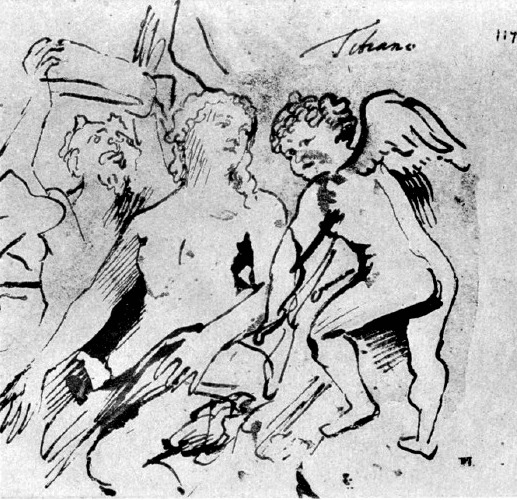
Some of the confusion over the attribution to Titian of the Wemyss ‘Allegory’ is based on erring connections made using erring extant evidence. For example, the conjecture of Vienna School-trained art historian of Venetian art Hans Tietze (Czech, 1880-1954) that a sketch by Sir Anthony van Dyck (1599-1641)–which Tietze wrongly believed was made at Chatsworth House of a painting once attributed to Titian–shared similar motifs with the Wemyss ‘Allegory’ is a thin thread for possible attribution to Titian. It may be argued that the Wemyss ‘Allegory’ shares very little with the Van Dyck sketch except for the satyr lifting a basket. Further, the painting which Van Dyck sketched is no longer attributed to Titian and has long been in the Galleria Borghese in Rome as a minor Venus and Cupid with Satyr Carrying a Basket with Fruit now attributed to Paolo Veronese. It was in Rome where Van Dyck must have made his sketch, not England, and it was there he misidentified it as Titian. It is a tenous trail of misleading evidence that became the prompt to a connoisseur’s mistaken thought.
Paris, Louvre: Allegory of Marriage, Titian, 1533.
Nuptial paintings
One persuasive conclusion on attribution today for the Wemyss ‘Allegory’ was offered by Hans Tietze’s wife, the historian of Renaissance and Baroque art, Erika Tietze-Conrat (1883-1958). Tietze-Conrat believed that The Art Institute painting resides in a pool of works done by assistants and imitators who combined varied elements of Titian’s allegories as found in the Louvre’s Allegory of d’Avalos (the aforementioned Allegory of Marriage) and the Borghese’s Education of Cupid.
Erwin Panofsky (German, 1892-1968) postulated that those known Titians were nuptial paintings. Building on that premise, Tietze-Conrat postulated that numerous reproductions were made by Titian followers so to create nuptial paintings for their patrons to suit their needs. The derivative works shared the intimacy of a private format with a recognizable cast of 16th century depictions of mythological actors and the evocation of a Titianesque mood.
Today the Art Institute of Chicago has renamed their Wemyss “Allegory” as Allegory of Venus and Cupid and dated it to “around 1600.” The museum removed Titian and every other named attribution. Attribution has been returned to the term that connoisseurs Crowe and Cavalcaselle gave the painting in 1881, namely, “imitator.”
“The execution here is very modern,” the pair wrote in their Life and Times of Titian in 1881. “It is greatly injured, but was apparently executed by some imitator of Titian.” Their late 19th century judgment hold fast today.
On Titian and Vecellio family – Encyclopedia of Italian Renaissance & Mannerist Art, Volume II, edited by Jane Turner, Macmillan Reference Limited, 2000, p. 1695.
“ready acclaim as a rediscovered Titian…”; “lent their Titian to The Art Institute to mount……”; “Cleveland… ‘Twentieth Anniversary Exhibition’ in 1936…” – “A Great Titian,” Bulletin of the Art Institute of Chicago (1907-1951) Vol. 31, No. 1 (Jan., 1937), p. 8; “Famed Titian Work Acquired by Chicagoans,” Chicago Tribune, October 20, 1936, p. 28; “The Mr. and Mrs. Charles H. Worcester Gift,” Daniel Catton Rich, Bulletin of the Art Institute of Chicago, Vol. 24, No. 3 (Mar., 1930), pp. 29-31 and 40. The Chicago collectors were Mr. and Mrs. Charles H. Worcester, a museum Vice-President and lumber and paper manufacturer.
“…director of the museum… compared the work in importance to El Greco’s ‘Assumption of the Virgin’ and Rembrandt’s ‘Girl at the Open Half Door’” – “Famed Titian Work Acquired by Chicagoans,” Chicago Tribune, October 20, 1936, p. 28.
“little of the technical brilliance or psychological revelations found in…Triple Mask…” – H. E. Wethey, The Paintings of Titian: Complete Edition, vol. 2, The Portraits, Phaidon, New York, p. 50.
“its ‘very modern’ execution”; “in a mass” – The Wemyss Allegory in the Art Institute of Chicago, E. Tietze-Conrat. The Art Bulletin Vol. 27, No. 4 (Dec., 1945), p. 269.
“It was widely known the pair excluded all three from their Titian catalog…” – “A Great Titian Goes to Chicago,” Art News 35, 5 (1936), p.15 (ill.).
“Chicago museum research in the late 1930s was aware of Crowe and Cavalcaselle’s attributive work… overlooked their conclusions…” – Footnote #4, The Wemyss Allegory in the Art Institute of Chicago, E. Tietze-Conrat. The Art Bulletin Vol. 27, No. 4 (Dec., 1945), p. 269.
“…restored by Sir Joshua Reynolds…” – The Wemyss Allegory in the Art Institute of Chicago, E. Tietze-Conrat. The Art Bulletin Vol. 27, No. 4 (Dec., 1945), p. 269.
“done by Damiano Mazza…” Ibid., p. 270.
Conjecture of Hans Tietze; Erika Tietze-Conrat’s postulation – Ibid., p. 271.
“the execution here is very modern… It is greatly injured, but was apparently executed by some imitator of Titian.” – Crowe and Cavalcaselle, Life and Times of Titian, London, 1881, II, p. 468.
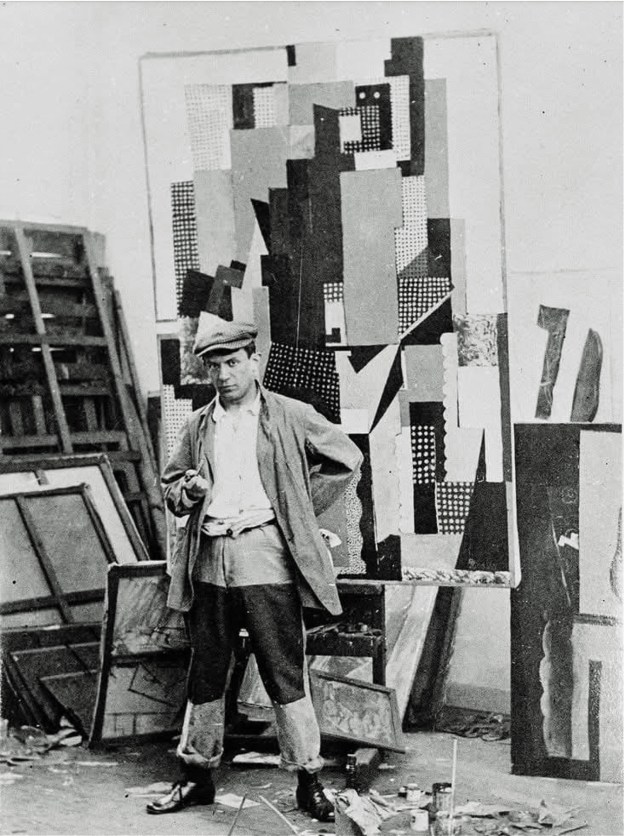
FEATURE image: Pablo Picasso IN STUDIO, c. 1915. Public Domain.
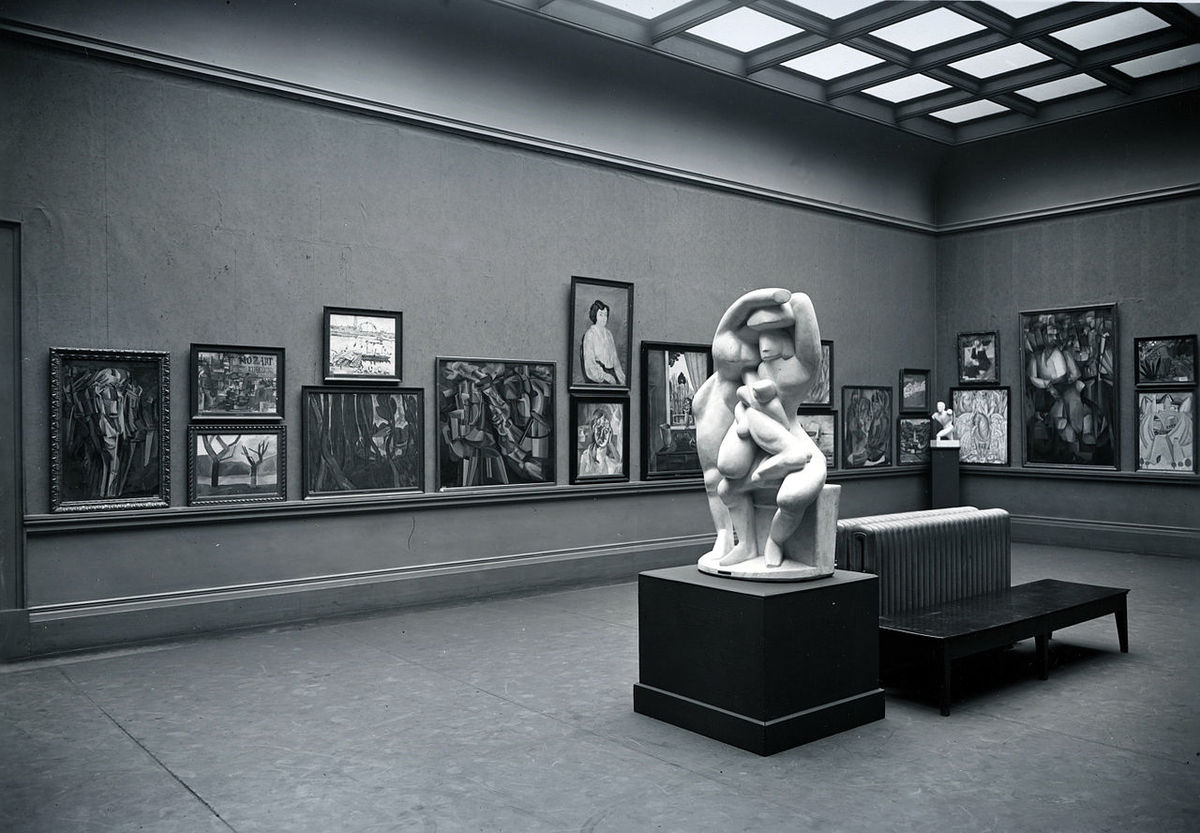
Armory Show, International Exhibition of Modern Art. The Cubist room, Gallery 53 (northeast view), Art Institute of Chicago, March 24–April 16, 1913. On the long wall are three of seven Picasso artworks included in that landmark exhibition. None are in “Picasso and Chicago” in 2013.
By John P. Walsh.
Almost as long as Pablo Picasso (1881-1973) was making his art, there have been bragging rights on the Catalan artist that have come from others. Even 40 years after the artist’s death at 91 years old, media talk in 2013 for Picasso and Chicago, a large art exhibition at The Art Institute of Chicago from February 20 to May 12, 2013, revolves around American collector “firsts” associated with Picasso.
Which institution collected Picasso first? The Art Institute of Chicago in 1923.
Which institution collected Picasso most? The Chicago Renaissance Society by 1930.
Which institution had the first Picasso exhibition? The Arts Club of Chicago in 1923.
Which institution had the first Picasso retrospective? The Wadsworth Atheneumin Hartford, Connecticut in 1934.
The Art Institute of Chicago is able to put imagination aside and quote itself in Picasso and Chicago. Nearly all of the same inventory of Picasso artwork in this 2013 show were assembled and displayed in the exact same order in a previous exhibition at the museum called Picasso in Chicago held from February 3 to March 31, 1968. According to the museum director writing at that time, that exhibition had been inspired by the dedication of the Picasso sculpture on August 15, 1967, a five-story Cor-10 steel Chicago icon that still stands enigimatically in Daley Plaza. If public attention is what Pablo Picasso craves, then he should have no worries.
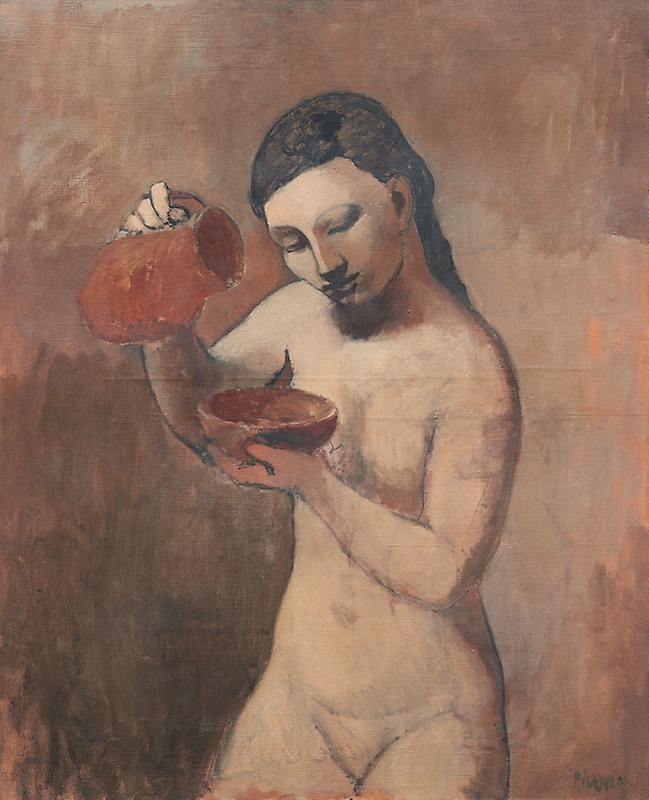
Pablo Picasso, Nude with a Pitcher, Gósol, summer 1906, oil on canvas, 39 5/8 x 31 7/8 in. (100.6 x 81 cm), Signed, l.r.: “Picasso.” The Art Institute of Chicago.
In the summer of 1906, during a working sojourn to Gósol in the Spanish Pyrenees, Picasso painted his mistress and muse, Fernande Olivier (French, 1881-1966).
Image above and below: Pablo Picasso, Nude with a Pitcher (detail).
Fernande Olivier and Pablo Picasso in 1905 in Paris.
Pablo Picasso, Fernande Olivier, summer 1906. Charcoal, with stumping, on cream laid paper, 610 x 458 mm. Signed recto, lower right, in graphite: “Picasso” (underlined), The art Insitute of Chicago.Pablo Picasso, The Two Saltimbanques, 1905, printed and published 1913. Drypoint on ivory wove paper 120 x 91 mm (image/plate); 193 x 129 mm (sheet) The Art Institute of Chicago.Picasso, Study for “La Coiffure,” 1905-1906. Pen and brown ink, with colored crayons and charcoal applied with stump, over graphite, on blue-gray laid paper 184 x 307 m. Signed recto, upper right, in graphite: “Picasso.” The Art Institute of Chicago.
The pairs of figures are related by both being involved in intimate activities, but represent two different subjects Picasso studied months apart. One dates from 1905 and the other from 1906. The pair on the right is a study for a major painting, La Coiffure, in The Metropolitan Museum of Art in New York.
There are several excellent reasons to see Picasso and Chicago in 2013 and they don’t always revolve around his art. It is a matter for city pride to know that Chicago possesses within its own collections the breadth of art resources to showcase, in chronological order, this Picasso show comprehensive of every major period. In these tight economic times kudos goes out to museum curators who have effectively displayed a vast amount and range of artwork by Pablo Picasso to produce a blockbuster show. The chronological exhibition of Picasso’s art includes works from The Art Institute of Chicago, The Arts Club of Chicago and The Renaissance Society and is front loaded providing for immediate pleasures.
The visitor is greeted nearly at the door by The Old Guitarist painted by Picasso in 1903-1904—a revered Blue Period painting in the Art Institute—and for the viewer to be edified by its presence is worth any exhibition’s admission price though there was no special exhibition fee beyond the price of general admission to the museum.
Picasso, The Old Guitarist, 1903–1904, oil on panel, 48 3/8 x 32 1/2 in. signed, l.r.: “Picasso.” The Art Institute of Chicago.
If front-loaded, does the rest of the show retain the same high interest? The answer is: yes and no. For all future Picasso shows in Chicago, curators can find several avenues to whittle away at the volume of artwork on display for Picasso and Chicago to present its most interesting parts. That downsizing opportunity intimates this show’s arguable shortcoming: as it displays the Spanish master’s later, increasingly commercial artwork, the Art Institute of Chicago’s 500 Picasso works in all mediums begins to reveal the challenges of building a seamlessly qualitative collection of contemporary art even when the artist is Picasso.
Picasso, Woman with her hair up, 1904, Gouache on tan wood pulp board, 427 x 313 mm, Signed and dated recto, upper left, in blue gouache: “Picasso / 1904.” The Art Institute of Chicago.Images above and below (detail): Pablo Picasso, Beggar with Crutch, Barcelona 1904, pen, brown ink and colored crayon on paper. The Art Institute of Chicago.
Crazy Woman with Cats, 1901. Oil on pulp board 17 7/16 x 16 1/16 in. (44.3 x 40.8 cm). Signed. l.r.: “Picasso.” Amy McCormick Memorial Collection, 1942. The Art Institute of Chicago.
In late May 1901 Picasso came to Paris with three weeks to prepare for an exhibition at Vollard’s gallery. The exhibition was arranged by a Catalan dealer who roomed with the 19-year-old Picasso on the Boulevard de Clichy. Crazy Woman with Cats is one of the 64 paintings and several drawings Picasso prepared for the show.
Picasso, Sketch of a young woman (detail), pen and brush and black ink on paper, Paris 1904, gift of Robert Allerton, 1924, The Art Institute of Chicago.
Robert Allerton, a museum trustee since 1918, began to acquire Picasso drawings in 1923 with the sole purpose of donating them to the museum. Sketch of a young woman was Allerton’s first Picasso drawing purchase and museum donation in 1923 purchased in Chicago from Albert Roullier Galleries.
Pablo Picasso. Salomé from the Saltimbanques series. 1905 102B0518 (1)Picasso, Portrait of a Seated Man, 1905. Black chalk on cream wove paper, laid down on cream Japanese paper, 329 x 216 mm, Signed recto, lower left, in graphite: “Picasso.”Gift of Robert Allerton, 1924. The Art Institute of Chicago.Picasso, Study of Four Nudes, Paris, 1906-07, black crayon paper, Johnson Family collection.
By the end of 1906 Picasso stopped painting and instead started to fill sketchbooks for a new major composition: Les Demoiselles d’Avignon (1907) today in The Metropolitan Museum of Art in New York.
Picasso, Female Nude, 1906. Fabricated Black chalk with graphite and smudging on paper, 31.8 x 23.5 cm. Gray Collection Trust. The Art Institute of Chicago.Picasso, Two Nudes, Standing (detail), fall 1906 Graphite, with stumping, on cream laid paper (detail).
Picasso, Two Nudes, Standing, fall 1906 Graphite, with stumping, on cream laid paper (detail).
Picasso, Two Nudes, Standing, fall 1906 Graphite, with stumping, on cream laid paper 630 x 469 mm Signed verso, upper left, in graphite: “Picasso.” Gift of Mrs. Potter Palmer, 1944. The Art Institute of Chicago .
In the early 1920’s as Chicago started a buying frenzy of Picasso, another young Spanish painter twelve years younger than Picasso arrived into Paris and was immediately overtly critical of the great Picasso’s work at that time. That younger painter was Joan Miró (1893-1983).
Miró’s criticism of Picasso as well as of Henri Matisse (1869-1954)— it was more a kind of disgust—was basically that the pair, once young avant-gardists, were making all their art for their dealer. In other words, the older artists were making contemporary art mainly for the money. Such may be an inherent risk in making art that meets a market demand in that the artist is tempted to, after a fashion, sell-out. Miró knew at first look—and history has proven him basically correct—that the future of contemporary painting no longer rested in Picasso’s hands after about 1920. This is partly the reason why Miró turned to the “nonsense” art of the Dadaists for the future of his own painting.
Keeping Miro’s judgment in one’s mind at Picasso and Chicago one sees that, notable exceptions made, an earlier Picasso painting—from the Blue Period after 1901 to Picasso’s period of synthetic cubism until around 1920—offers cohesive artwork that contains a germ or seed of progress. The art collection in Picasso and Chicago, much of it produced following Miró’s critical judgment of Picasso, shares his problematic.
The Red Armchair of 1931 is hung at what is about the show’s halfway point. At this point, I might have exited. Yet where Miró’s critical judgment lags for me is that Picasso’s art is never incompetent or boring. His art is perceptibly linear and, despite its erotic themes, often contains qualities which satisfy and cleanse an art-hungry eye. Picasso’s art is ever ancient and ever new, and distinctly European. For me, seeing a Picasso connotes a stroll in Paris or feeling a sunburn on the face after revelry and reverie along some Mediterranean coast. Quite readily the show produced these kinds of vicarious experiences for me as i soaked up a plethora of Picasso’s later, lesser work in utilitarian Regenstein Hall.
Nessus and Deianira, September 22, 1920, Graphite on tan wove paper, prepared with a white ground, signed recto, upper left, in pen and blue ink: “Picasso” (underlined); inscribed upper left, in graphite: “22-9-20.”
Just before leaving Paris in September 1920, Picasso made a series of drawings of the Greek myth of the abduction of Hercules’ bride Deianira by the centaur Nessus. With this, Picasso became fascinated with Greek mythology and continued to make artwork using its themes.
Picasso, Head of A Woman (Fernande), Paris winter 1909-10, brush and gray wash on paper. Private Collection.
Paintings and drawings by Picasso in winter 1909-10 continued to explore Cubism as it related to the human face and figure and its surroundings.
Picasso’s studio at Horta de Ebro (now Horta de San Juan) in Spain between May and September 1909.
The painting (at left) of a Head of a Woman is one of the early Cubist artworks in “Picasso and Chicago.”
Picasso, Head of a Woman, summer 1909, Oil on canvas 23 3/4 x 20 1/8 in. (60.3 x 51.1 cm), Winterbotham Collection, 1940.
The painting above dates to one of the most productive and inventive periods of Pablo Picasso’s career, a summer stay in the town of Horta de Ebro (now Horta de San Juan) in Spain, which lasted, with minor interruptions, from May to September of 1909. In these months, Picasso produced a series of landscapes, heads, and still lifes that are among the most highly acclaimed achievements of early Cubism. Fernande Olivier, Picasso’s mistress, was the model for the series of heads that the artist produced at this time.
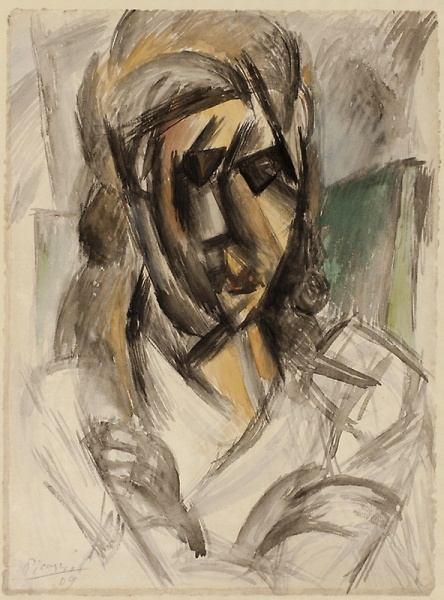
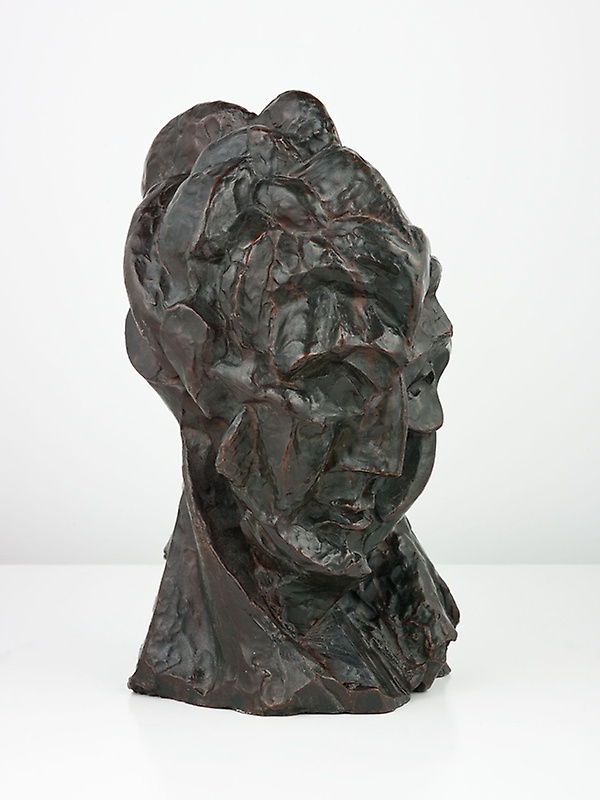
Picasso, Bust of a Woman, late 1909, Watercolor and gouache on cream laid paper, laid down on buff laid paper, 363 x 278 mm overall; signed recto, lower left, in graphite: “Picasso (underlined)/ 09” Gift of Mr. and Mrs. Roy J. Friedman, 1964. The Art Institute of Chicago.Head of a Woman (Fernande), fall 1909, bronze, 16 1/8 x 9 7/8 x 10 9/16 in. (40.7 x 20.1 x 26.9 cm), cast 1910, Alfred Stieglitz Collection, 1949.
This work is Pablo Picasso’s first large Cubist sculpture and represents the distinctive physiognomy of Fernande Olivier, who was the artist’s model and mistress from 1905 to 1912. Before making the bust, Picasso produced countless drawings and gouaches to explore the specific form and structure of his subject’s facial features. Her hair is in a coil and a topknot; her bulging jaw; her well-defined depression in the center of her upper lip. The Fernande series’ evolved from an agility of facial expression to fixed signs of its individual features.
Pablo Picasso (1881-1973), Artist and Model, Cannes, July 24, 1933, watercolor and pen and black ink on paper. Gray Collection trust.Picasso, Daniel-Henry Kahnweiler, autumn 1910, Oil on canvas, 39 9/16 x 28 9/16 in. (100.4 x 72.4 cm) Gift of Mrs. Gilbert W. Chapman in memory of Charles B. Goodspeed, 1948. The Art Institute of Chicago.
German-born Daniel-Henry Kahnweiler (1884-1979) opened an art gallery in Paris in 1907. In 1908 Kahnweiler began representing Pablo Picasso (1881-1973) and introduced him to Georges Braque (1882-1963). Kahnweiler championed these artists’ revolutionary experiment with Cubism and purchased most of their paintings between 1908 and 1915. Kahnweiler sat for Picasso up to thirty times for this portrait.
Portrait photograph of Pablo Picasso, 1908.
Picasso, Head of Harlequin, 1916, The Art Institute of Chicagio. Photograph by author. Picasso, Harlequin Playing the Guitar, c. 1916, Elden collection. Picasso, Head of a Woman, 1922, The Arts Club of Chicago, purchased 1926.
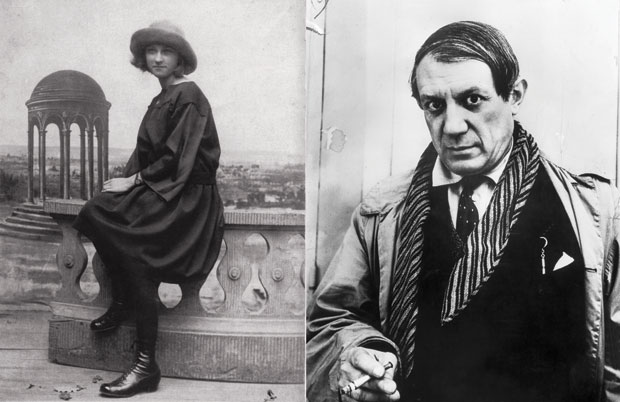
Olga Khokhlova (1891-1955) in Picasso’s Montrouge studio, spring 1918. Olga married Picasso on July 12, 1918, at the Russian Orthodox Cathedral in Paris. On February 4, 1921, she gave birth to their son Paulo (1921-1975). After that, Olga and Picasso’s relationship deteriorated though they never divorced. Olga died in Cannes in 1955.
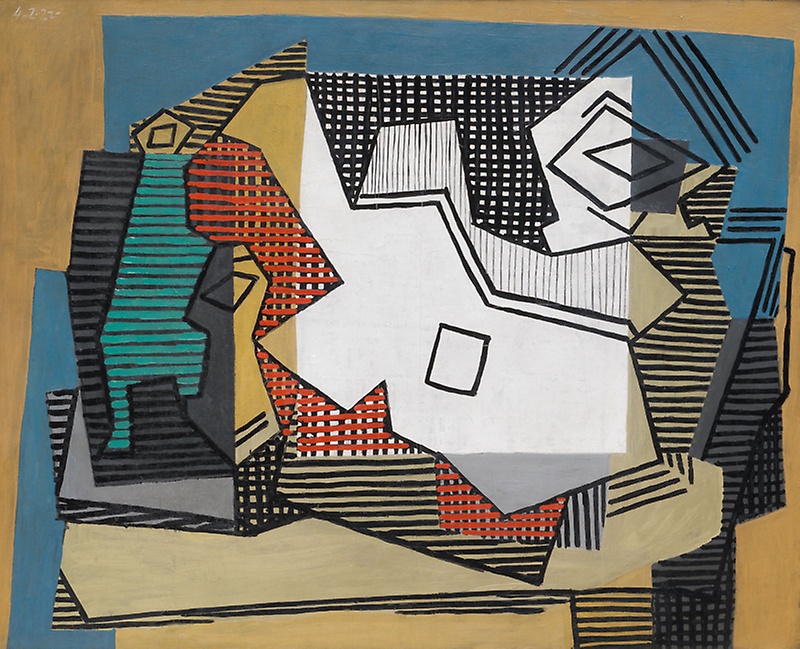
Picasso, Still Life, February 4, 1922, Oil on canvas 32 1/8 x 39 5/8 in. (81.6 x 100.3 cm), Dated, u.l.: “4-2-22-.” Ada Turnbull Hertle Endowment, 1953. Picasso produced a series of Cubist still lifes in 1922 that are simplified to flat planes in a patterned framework. Gertrude Stein (1874-1946) bought this canvas in 1923 to add to her collection of more than 30 Picasso paintings and even more of his drawings and watercolors. This still life was Stein’s last purchase of a painting by Picasso.
Above: Picasso, Double Flute Player and Reclining Nude, October 22, 1932, pen and ink with brush and black wash and scraping on paper, Shapiro collection, 1992. The Art Institute of Chicago.
In late summer and fall of 1932, Picasso and Marie-Thérèse Walter (French, 1909-1977), the artist’s mistress from 1927 to 1935, were together in Boisgeloup. Picasso made three drawings on the same day on a theme of lovers serenading one another.
Marie-Thérèse Walter and Pablo Picasso. Their relationship began when she was seventeen and Picasso was 45 years old and married to Olga Khokhlova.
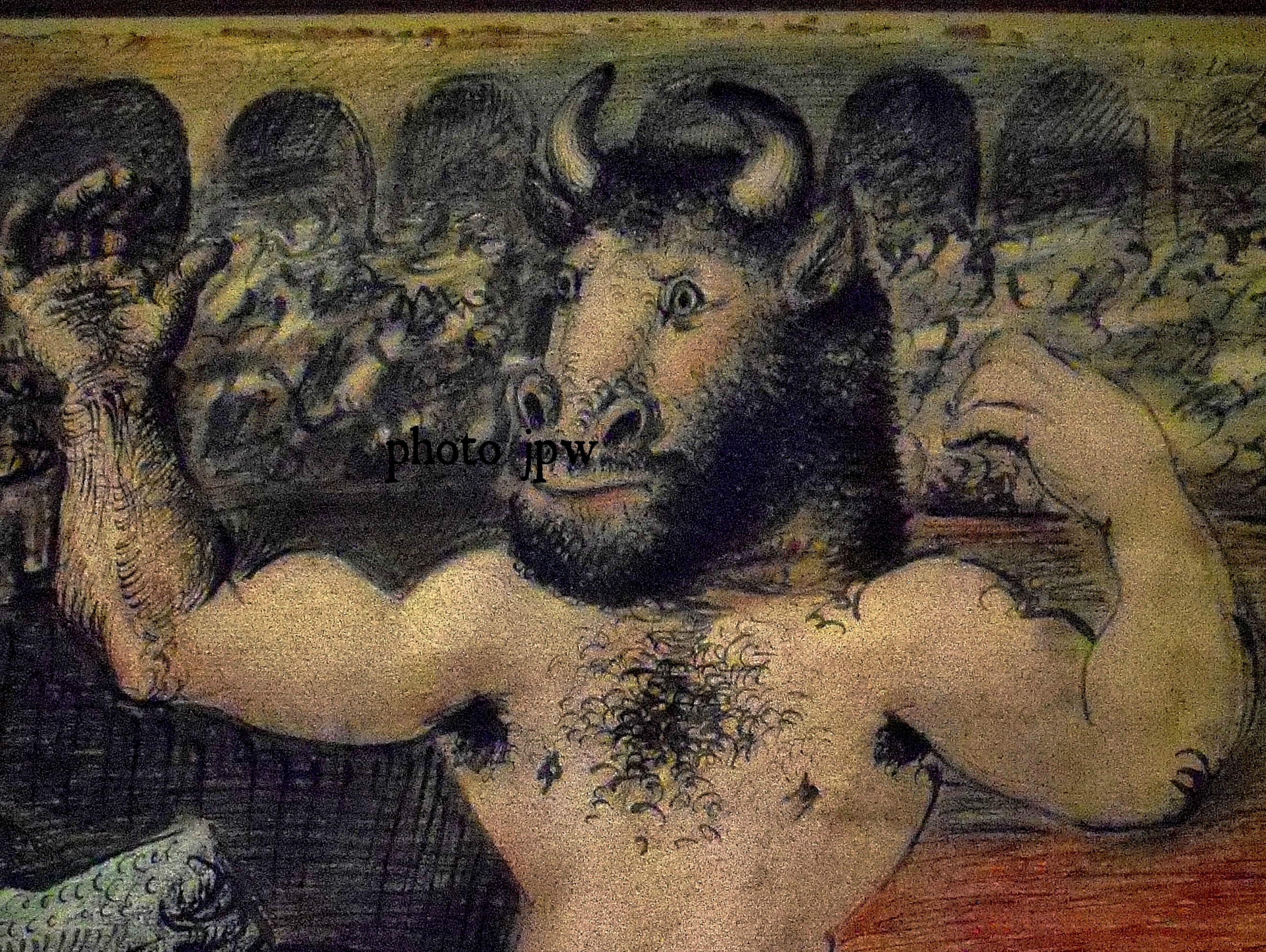
Picasso transforms the bullfighting theme where the half-man and half-bull Minotaur is the aggressor in the ring terrorizing a horse.
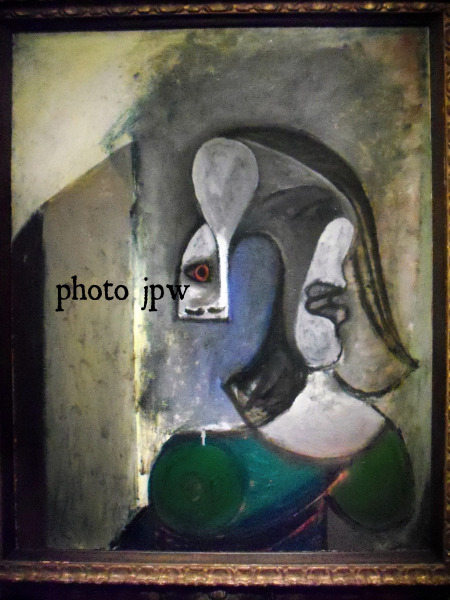
Images above and below: Picasso, Minotaur and Wounded Horse, Boisgeloup, April 17, 1935, Pen and brush and black inks, graphite, and colored crayons, with smudging, over incising, on cream laid paper, 343 x 515 mm Signed recto, lower right, in graphite: “Picasso” (underlined); inscribed upper right, in graphite: “Boisgeloup–17 Avril XXXV” The Art Institute of Chicago.Picasso, The Red Armchair, and detail below, oil and ripolin on panel; signed, u.r.: “Picasso,” oil and ripolin on panel, The Art Institute of Chicago.Picasso, Head of Woman (Dora Maar), Paris, April 1, 1939, oil on canvas, 92 x 73 cm. Private collection.
Dora Maar (French, 1907-1997) met Picasso in 1936 at the Café des Deux Magots in Paris. Her liaison with Picasso ended in 1943.
Weeping Woman I, July 1, 1937. Drypoint, aquatint, and etching, with scraping on copper in black on ivory laid paper, 695 x 497 mm (plate); 774 x 568 mm (sheet). The Art Institute of Chicago.
About making portraits of his mistress Dora Maar weeping, Picasso explained: “For years, I’ve painted her in tortured forms, not through sadism and not through pleasure either – just obeying a vision that forced himself on me.” At the end of their relationship Picasso confessed, “I can only see her weeping.”
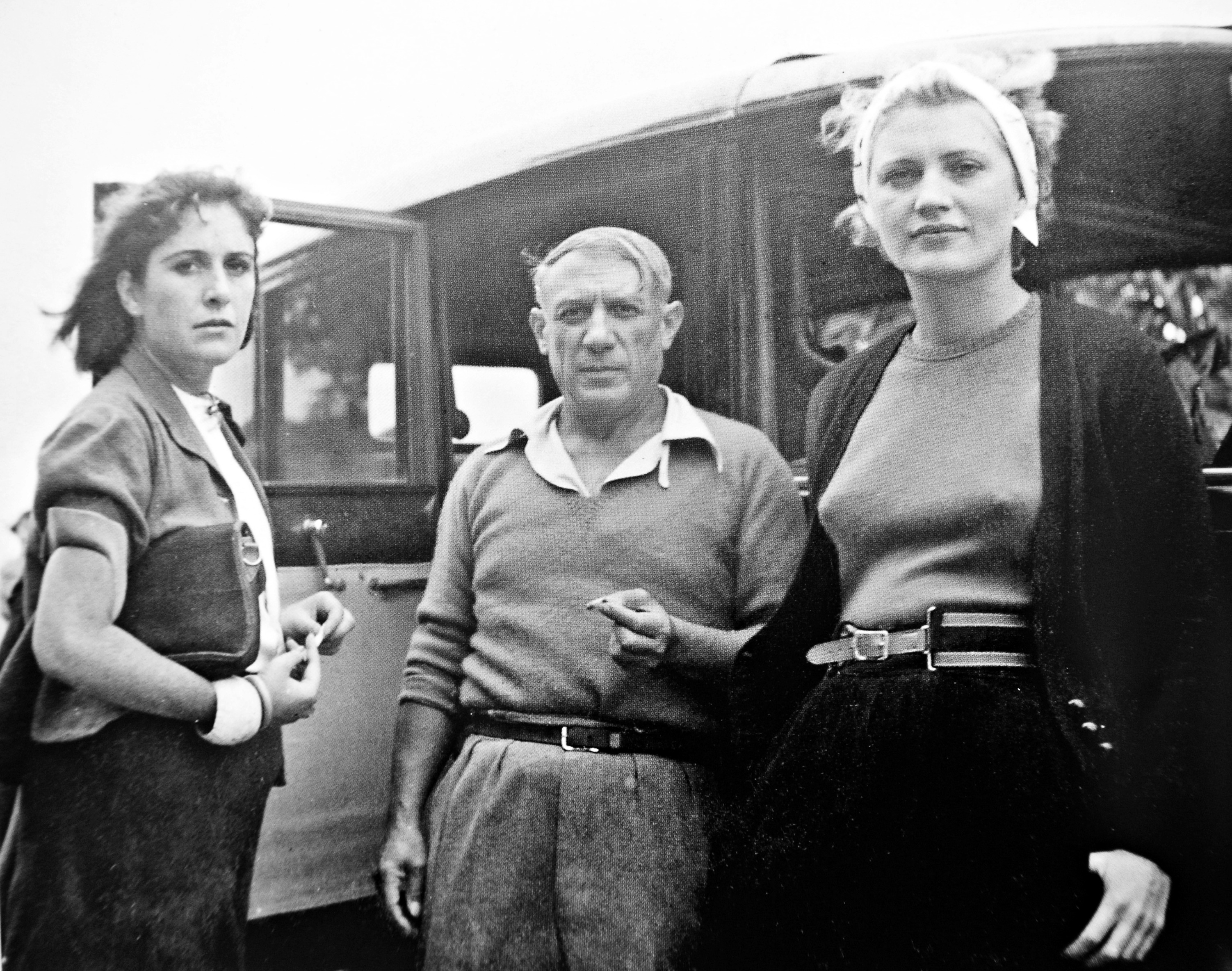
From left: Dora Maar, Picasso, Lee Miller in 1937.Picasso, Villa in Vallauris, Vallauris, Feb., 4, 1951, oil on panel. 88.9 x 116.2 cm, The Art Institute of Chicago.Picasso, large vase with dancers, Vallauris, 1950, red earthenware clay, ground painted in white engobe, 71.2 cm Crown collection. Picasso and Françoise Gilot (b. 1921) at Madoura pottery, Vallauris, 1953.
Gilot was lover and muse to Picasso from 1943 to 1953. In the early 1990s I met Françoise Gilot accompanied by her husband, Jonas Sauk (1914-1995), when she was the featured speaker at the Alliance Française in Chicago. That evening Gilot made it perfectly clear upfront that she was not going to talk about Picasso.
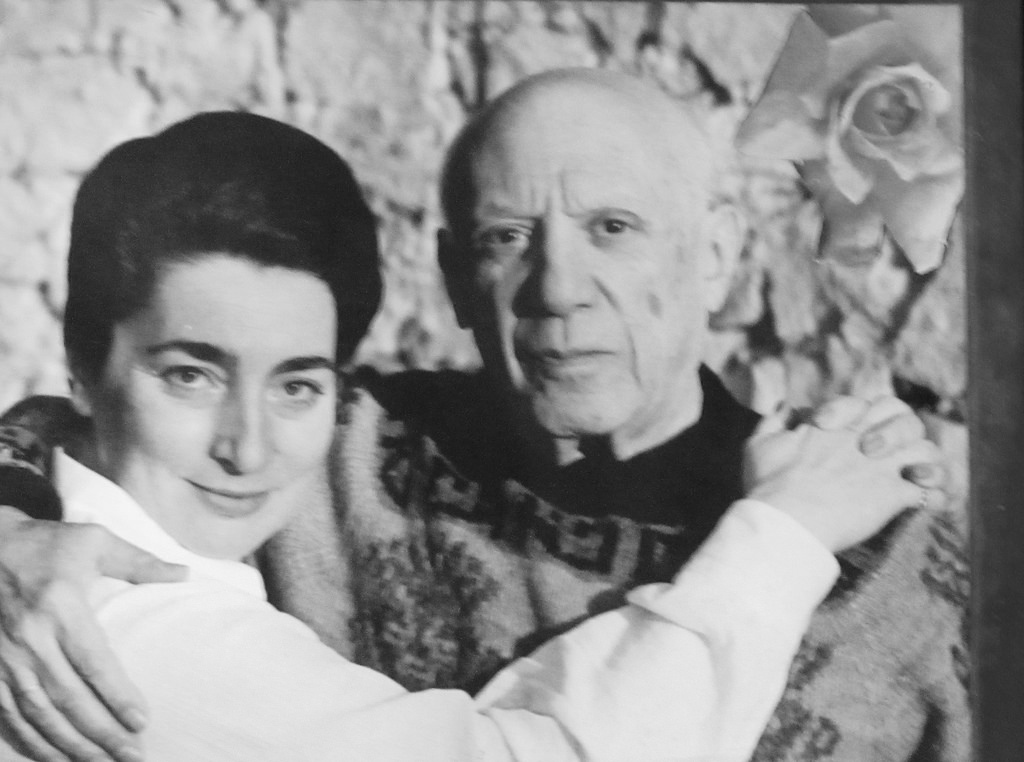
Picasso, Portrait of Jacqueline, Mougins, Dec. 28, 1962, graphite with smudging and black ballpoint pen on paper. 34.9 x 25 cm., Gray Collection Trust.Picasso, Jacqueline, Cannes or Vauvenargues, October 17, 1959, Linocut in colors on paper, 63.8 x 53 cm., Crown collection.
Jacqueline Roque was muse and second wife of Pablo Picasso. Their marriage lasted 11 years until his death, during which time he created over 400 portraits of her, more than any of Picasso’s other loves.
Picasso and Jacqueline, his second wife. Pablo Picasso met Jacqueline Roque (1927-1986) in 1953 when she was 26 years old and he was 72. He romanced her until she agreed to date him. Only in 1955, when Picasso’s first wife Olga Khokhlova died, did Picasso decide to marry Jacqueline in Vallauris in 1961. They were married until Picasso’s death in 1973.
The Chicago Picasso, 1967. In situ in Daley Plaza in Downtown Chicago, July 2015. Photograph by author.
There are 250 items on display in Picasso and Chicago—including paintings, prints, drawings, sculptures, and ceramics—and only begins to manifest the prodigious genius of Pablo Picasso.
Picasso and Chicago may have closed, but many, if not most, of these works in Chicago’s cultural institutions and private collections can be savored with the simplicity of a museum visit. A visitor can do no better than visit The Art Institute of Chicago and see Picasso’s The Old Guitarist and The Red Armchair. By that begins one’s own new adventure of absorption of the Spanish master’s artwork whose home is Chicago. The 2013 show is over but more than a few of its best parts are on display right now in these institutions’ permanent collections.
FEATURE image: At the top of the high altar’s retable in St. Michael Church in Chicago’s Old Town is the figure of St. Michael the Archangel, the parish church’s patron. St. Michael is mentioned in several places in both the Hebrew and Christian scriptures. The near northside Chicago parish has been administered by the Redemptorist Order since 1860.
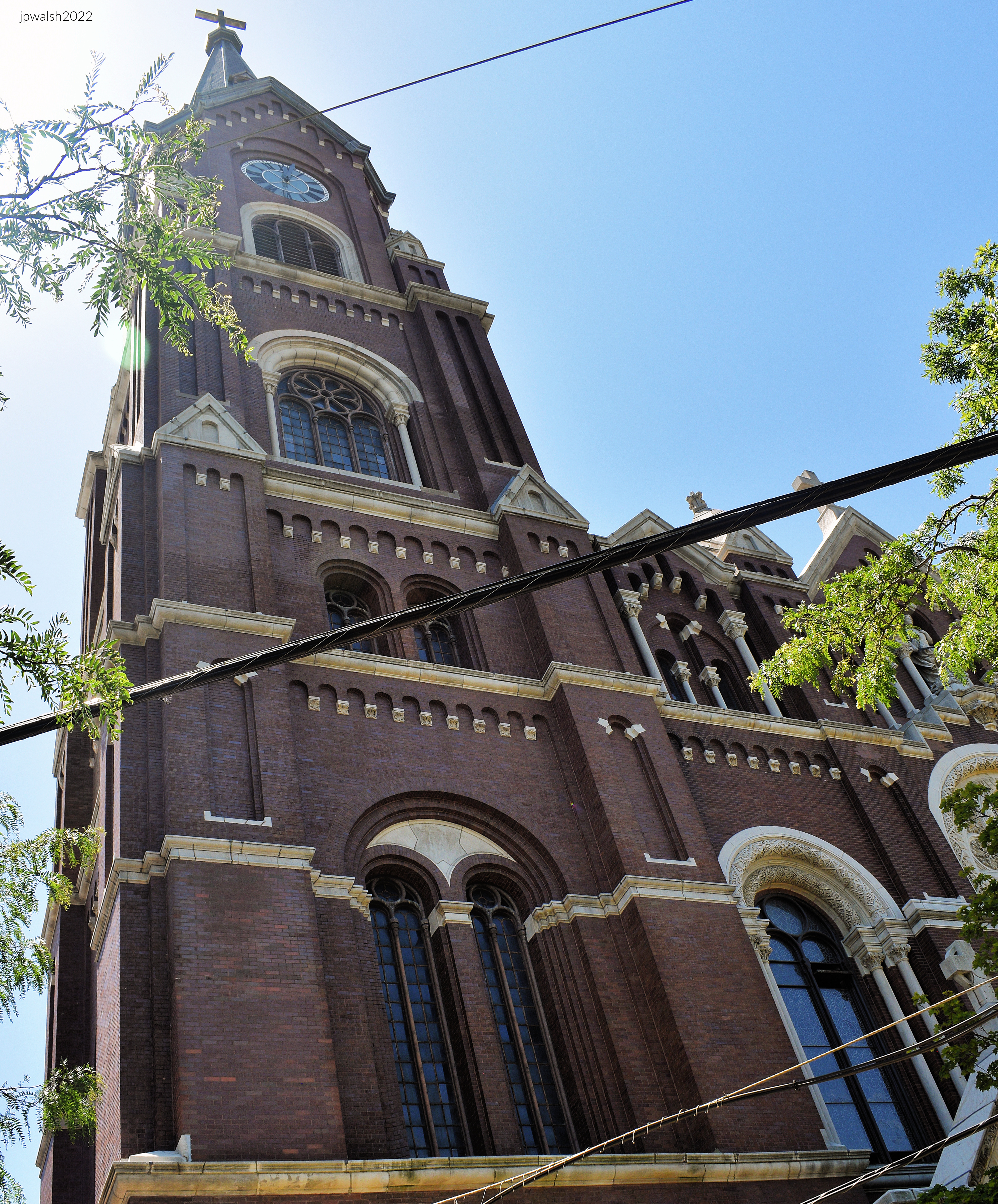
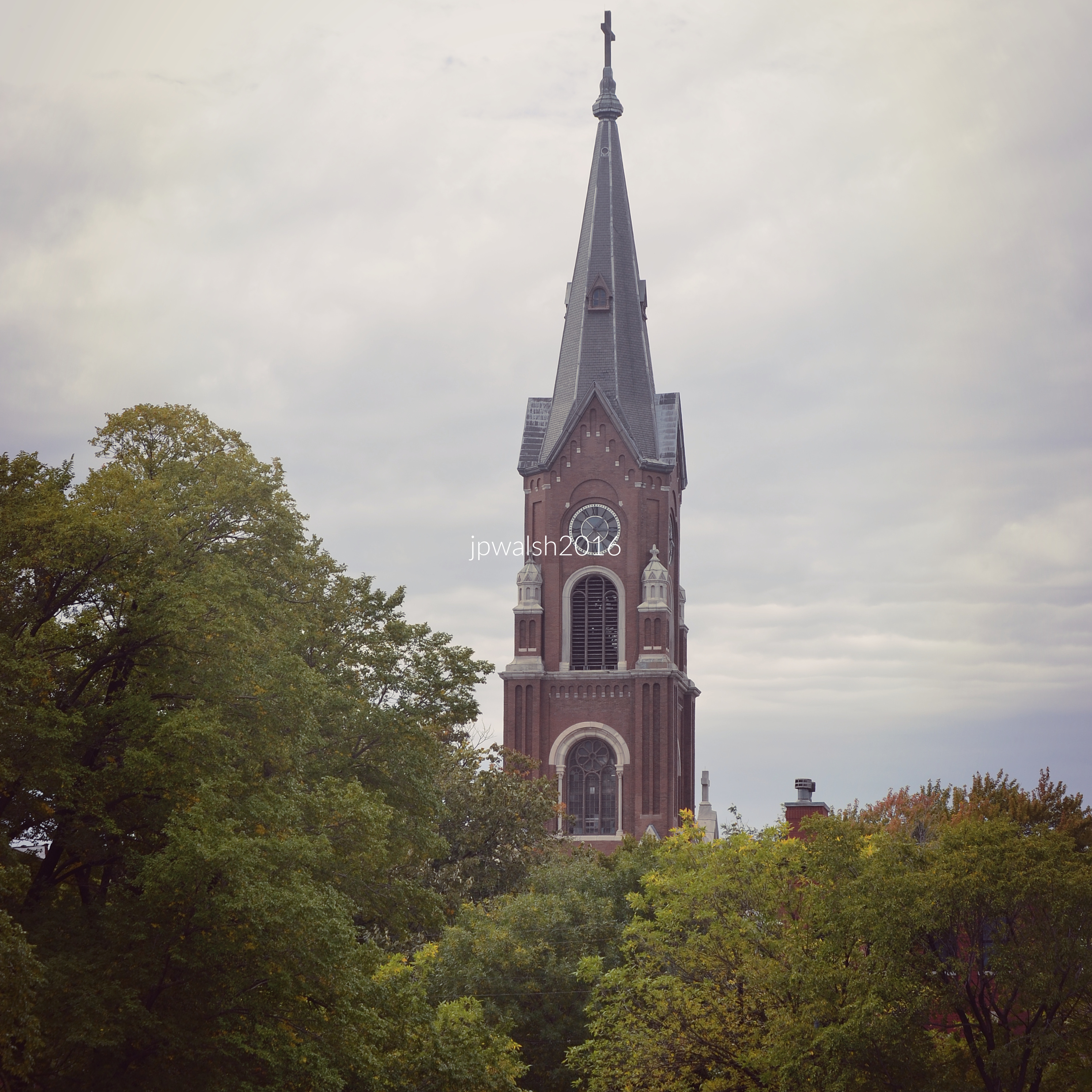
June 2022. The great tower of St. Michael Church on the Near North Side of Chicago identifies the Old Town Triangle historic district. St. Michael Old Town Chicago. 8.03mb
The bell tower of St. Michael Church in Chicago’s Old Town at 1633 N. Cleveland Avenue. From 1869 to 1885, this church tower was the tallest building in Chicago. It was surpassed by the old Board of Trade Building.
In 1876, five years after the Great Chicago Fire of 1871 that ravaged the city, the rebuilt St. Michael Church raised five new bells into the tower. They were cast by McShane Company. The tower’s four-sided clock was installed in 1888. Atop the steeple, the twenty-four-foot tall cross weighs over a ton.
Photographs taken by author in February 2013; May and October 2016; June 2022.
By John P. Walsh
The story is told that if you can hear the five 2-to-6-ton bells peel from the 290-feet-tall tower of St. Michael Church you live in Chicago’s Old Town. Yet it depends on which way the wind is blowing.
St. Michael Church is one of Chicago’s oldest parishes and church buildings. It was founded by German Catholics in 1852. From their arrival in the 1830s and 1840s until World War I, German immigrants of all faiths made up Chicago’s most numerous nationality.
October 2016. Saint Michael Old Town Chicago. 2.31mb DSC_0941 (1)
German immigrants soon migrated out of downtown Chicago and about two miles north to North Avenue. The east-west thoroughfare became known as “German Broadway.”
This European immigrant community expanded to eventually settle a four-mile square area that was called “North Town.” St. Michael Church was situated in the virtual center of North Town on land donated by successful German-born Chicago businessman and brewer Michael Diversey (1810-1869). Diversey had immigrated to the United States in the 1830s from Saarland in western Germany.
St. Michael Church stands on land donated expressly for the purpose of building it by successful German-American brewer Michael Diversey (1810-1869). Diversey emigrated from Germany in 1830, and by 1844 he was a Chicago alderman. The church is named after the wealthy beer maker’s patron saint, St Michael the Archangel, whose limestone figure stands in the high niche on the façade (see photograph below). Diversey’s so-called Chicago Brewery, first established in Chicago in 1839, grew to become one of the most extensive establishments of its kind in the West.
June 2022. St. Michael Old Town Chicago 18.70mb
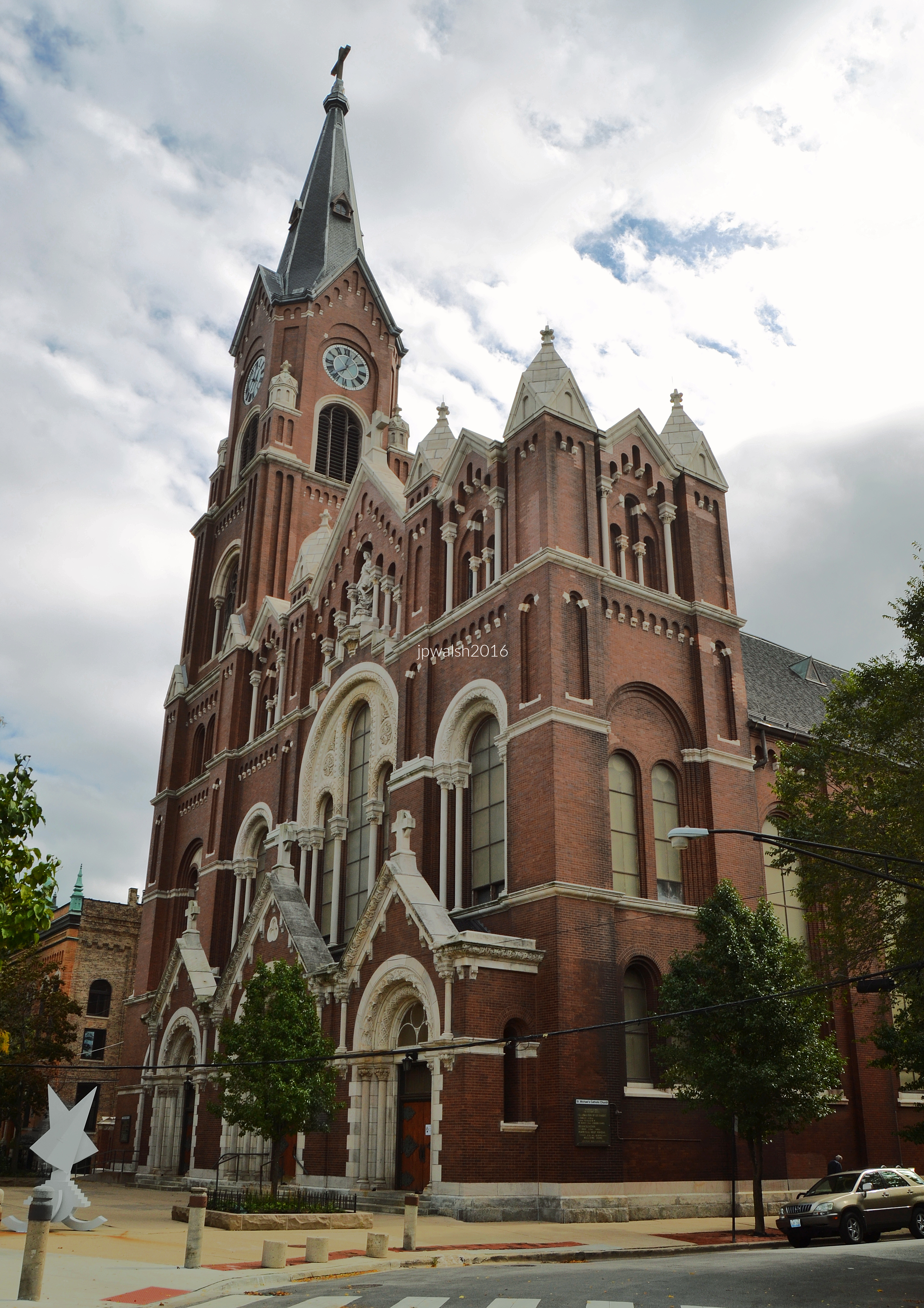
The church building is built of red brick with limestone trim in the Romanesque style. Construction started in 1866 and was finished three years later. In 1871 the new building was virtually destroyed in the Great Chicago Fire along with its North Town neighborhood. Only the church’s exterior walls remained. Using these existing walls, the fire-gutted St. Michael Church was rebuilt and rededicated in 1873. Ashes from that infamous conflagration can still be seen in the church’s basement.
June 2022. St. Michael Old Town Chicago 11.43 mb
Gabled three-portal main entrance (above) was added to the façade in 1913 by a Chicago architect. The architectural design harkens back to the cathedrals of Europe.
St. Michael Old Town Chicago 6/2022 10.01 mb
Main altar (above) at one end of a 190-foot central nave.
February 2013. St. Michael Church, Chicago.February 2013. Main altar.
Dating from 1902, the Main Altar of the Angels (above) is a cacophony of German-style wood carving.
In 1851 when St Michael was founded, Chicago’s total population was around 30,000 making it the twenty-fourth largest city in the United States.
Ten years later, in 1860, right before the outbreak of the American Civil War, Chicago’s population had nearly quadrupled and ranked in the nation’s top ten largest cities.
Chicago’s Catholic Church hierarchy in the middle of the nineteenth century was mostly Irish. These English-speaking bishops relied on religious orders to handle a tidal wave of non-English-speaking immigrants to Chicago, including the Germans.
In 1860, the St. Michael Church parish was entrusted to the Redemptorists, a religious order founded in 1748 in Italy. The Redemptorists with their German congregation built the St. Michael Church in Old Town that stands today. Over 170 years later, the Redemptorist order continues to shepherd the parish.
June 2022. St. Michael Old Town Chicago 14.16 mbJune 2022. St. Michael Old Town Chicago 12.62 mb
A mosaic of Saint Michael the Archangel (above) in the floor at the entrance of the church. “Archangel” is a title that signifies he is the leader of all God’s angels.
The mosaic of the patron angel in the floor starts the church’s 190-foot-long nave. It is one of the many religious images—others in stone, wood and paint—that constitutes the interior and exterior decoration of St. Michael Church.
St. Michael the Archangel is mentioned four times in the Bible: twice in the Book of Daniel and in the Epistle of Jude and the Book of Revelation. In the Book of Daniel, St. Michael the archangel helps the prophet Daniel and is linked to the “end times” of the world. In the Epistle of Jude, St. Michael the archangel guards the tombs of Eve and Moses and combats Satan to protect these holy sites.
In the Book of Revelation St. Michael and his angels do battle with the “dragon.” In addition to being charged with expelling Satan from Heaven (as depicted in the retable), St. Michael is charged with the care of all departed souls to introduce them to the holy light. St. Michael the Archangel is the patron saint of soldiers, police, and doctors.
June 2022. St. Michael Old Town Chicago 20%
Detail of the Main Altar retable depicts St. Michael the archangel (above) in the traditional iconography of armor with sword and shield casting Satan out of Heaven by God’s command. St. Michael the Archangel is the patron saint of soldiers, police, and doctors.
The spacious, airy, and dramatic church sanctuary today looks basically as it did by 1902. The motivation for the church’s extensive redecoration in 1902 was its Golden Jubilee as well as one expression of the parishioners’ decided prosperity by the later 1890s.
Some Stained Glass –
Created and installed by Mayer & Company of Munich for St. Michael Church’s Golden Jubilee in 1902, the tall and thin stained glass windows —the fourth set of windows to be installed into architect August Walbaum’s original design— depicted Biblical and other scenes. The window’s artistic technique drew upon centuries of European craft and design – and were recently cleaned in 2012.
June 2022. Annunciation to Mary Window (Luke 1: 26-38. St. Michael Old Town Chicago 10.71 mb
Annunciation to Mary Window (Luke 1: 26-38). Mary’s virginal conception of Jesus is stated explicitly in verses 34-35. In Hebrew her name, Miryām, means “exalted one.”
In that Jubilee year, the stained glass was installed along with the 56-foot-high carved wood retable of the High (or main) Altar of the Angels. Though there are five altars in St. Michael Church, the main altar is the most spectacular, drawing the eye forward and upward from practically anywhere in the church. Crowning this painted construct—which is so heavy that it required a new local foundation to be dug for it—is the figure of St. Michael the Archangel described in the Book of Revelation. The angel is garbed in his panzer (“armor”) running rebellious angels out of heaven. St. Michael is flanked by the archangels Gabriel and Raphael. Nine choirs of angels and the saints Peter and Paul are also depicted in wood. Smaller human figures depict the four evangelists identified by their Christian symbols—specifically, the Winged Man (Matthew), Winged Lion (Mark), Winged Ox (Luke) and Eagle (John). All five altars were made by E. Hackner Company of La Crosse, Wisconsin, an early twentieth century designer, manufacturer and importer of artistic ecclesiastic furnishings.
February 2013. Annunciation window (detail), 1902, Franz Mayer & Co. of Munich. St. Michael Church, Chicago.
Annunciation Window, detail (above). The angel Gabriel’s greeting, “Hail, full of grace,” is a greeting that is full of peace, joy and wisdom. Mary is the object of God’s grace and favor and is shown to be chosen for a long time past. The depiction of lilies, whether in the angel’s hand or arranged into a bouquet by Mary’s side, is traditional imagery for purity.
In 1869 the St. Michael Church building cost over $130,000 to build which is approximately $2.65 million today. After the fire the repairs in 1872 cost an additional $40,000 plus unknown amounts of insurance money–or upwards of $700,000 today. Reconstruction did not include the stained glass windows which were installed in 1902. For a history of the stained glass in St. Michael church go to: https://johnpwalshblog.com/2016/05/10/angels-in-stained-glass-1902-complete-st-michael-church-in-old-town-chicago/.
May 2016. Anointing of Jesus by Mary Magdalene (detail), 1902, Franz Mayer & Co. of Munich. St. Michael Church, Chicago.
Anointing of Jesus by Mary Magdalene at Bethany Window. The anointing of Jesus in Bethany by the sinful woman, traditionally the Magdalene. Though the story varies in certain details, all four gospels relate the anointing set in a house for a meal and a woman who pours expensive ointment on Jesus to which someone objects. In regard to the ointment, Mark’s account (Mark 14:3) records that it is the purest of spikenard which was very expensive costing over a year’s wages (Mark 14:5). Luke’s gospel speaks of Jesus’ feet being anointed by a woman who had been sinful all her life and who was crying (Luke 7:38). As her tears fall on the feet of Jesus, she kissed and wiped his feet with her hair. The iconography of the woman’s actions in the Gospels has traditionally been associated with Mary Magdalene though none of the biblical texts specify her as the story’s subject.
In 2020, the spikenard plant is part of Pope Francis’s coat of arms. He uses the image of the plant as does the Latin American church, as a symbol for St. Joseph.
Spikenard was grown in India, China, and Nepal and known in ancient Rome where it was used as a cooking agent. By the time of Jesus, in the early Roman Empire, spikenard was used primarily in perfume.
Coat of Arms of Pope Francis (2013-2025). According to the Vatican, the image of the plant to the right of the star on the blue background is spikenard and represents St. Joseph.
As with other American church building adaptations of earlier European architectural styles, the use of Romanesque rounded arches and corbels accentuated the use of Gothic-style glass in Chicago’s Old Town Roman Catholic church.
Let the Little Children Come to Me Window (above). In Jesus’s public ministry, crowds often followed and pressed in upon him and his disciples. Jesus’s famous words, “Let the little children come to me,” are cited in all three synoptic gospels: Matthew 19:14, Mark 10:14 and Luke 18:16. When the people’s children were brought to the miracle worker and teacher -even their infants- they wanted him to lay his hands on them and bless them. The disciples rebuked them and Jesus became “indiginant” as he said to them, “Let the children come to me; do not prevent them, for the kingdom of God belongs to such as these. Amen, I say to you, whoever does not accept the kingdom of God like a child will not enter it” (Mark 10:14-15).
June 2022. St. Michael Old Town Chicago 12.82 mb
Sacred Heart Window (above). The first of four great visions in which Jesus Christ revealed his Sacred Heart to French nun St. Margaret Mary Alacoque (1647-1690) took place on December 27, 1673 in her Visitation convent in Paray-le-Monial in Burgundy France. In each of these visions Christ revealed messages that the young saint was to communicate. The greatest of all the visions took place in 1676. Before the Tabernacle on the altar that exposed the Eucharist, Jesus said: “Behold this Heart which has so loved mankind, that it has spared nothing, even to exhausting and consuming itself in order to demonstrate and prove its love for them.” St. Margaret Mary was ordered by her confessor, St. Claude de la Colombière, a Jesuit priest, to write down all her visions. Afterwards, the saint suffered great persecutions from the Church and others for these visions until she fell ill and died in 1690 at 43 years old. She was beatified in 1864 and canonized in 1920.
June 2022. St. Michael Old Town Chicago 15.27 mb
Original Pulpit (above).
February 2023. Ceiling mural. St. Michael Church, Chicago.
Central nave ceiling mural (above) includes symbolic depictions of the four evangelists: the Winged Man (Matthew); Winged Lion (Mark); Winged Ox (Luke); Eagle (John).
Its filigree evokes medieval illuminated manuscripts and perhaps is inspired by a scene painted in the 15th century in the dome of The Basilica of St Mark in Venice.
June 2022. St. Michael Old Town Chicago 19.11 mbJune 2022. St. Michael Old Town Chicago 20%June 2022. St. Michael Old Town Chicago 7.8mb 70%.
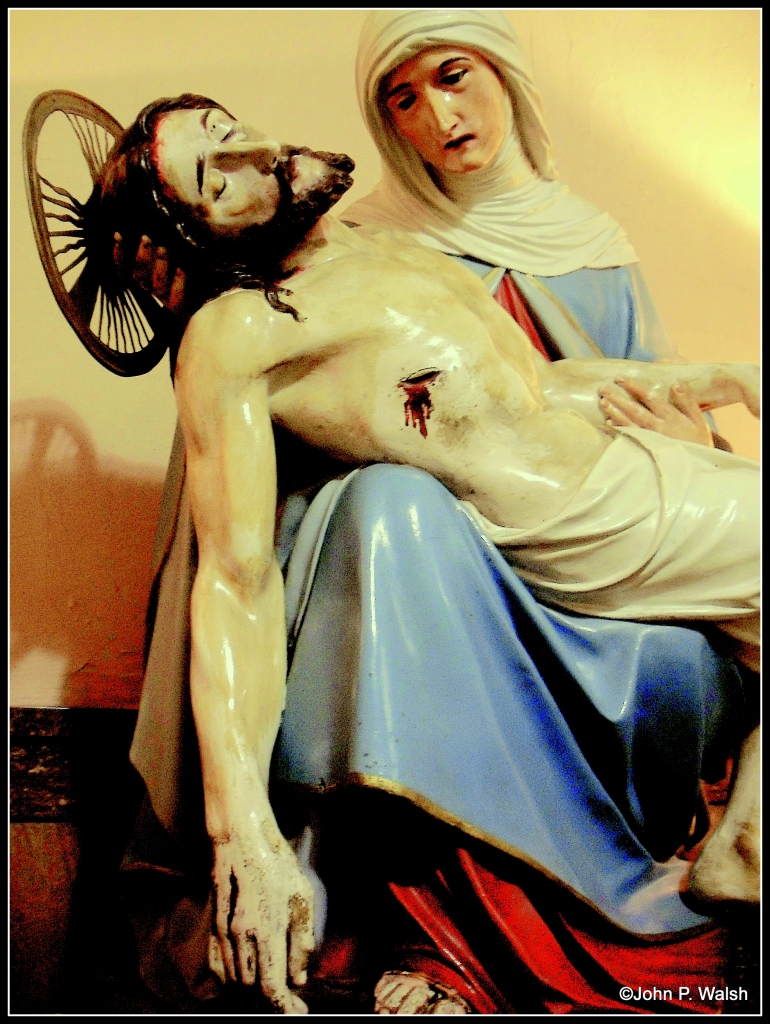
Pietà, copy of a 16th-century Swabian-style artwork made around 1913.
February 2013. Pieta. St. Michael Church, Chicago.February 2013. Sacred Heart side altar.
The Sacred Heart side altar (east nave). In addition to the central statue of Christ are those depicting Redemptorist Order founder, St. Alphonsus Liguori (Italian, 1696-1787) and Discalced Carmelite Order founder, St. Teresa of Avila (Spanish, 1515-1582).
June 2022. St. Michael Old Town Chicago 25%
St. Joseph altar (west nave) with a mural above it of Redemptorists before Christ’s Heavenly throne. In this photograph’s foreground at right is a wood confessional box. Italian-born St. Alphonsus Liguori, founder of the Redemptorists, was highly educated and spent much of his life hearing the confessions of the ordinary peopleas a home missionary in his city of Naples, Italy.
June 2022. St. Michael Old Town Chicago 12.53 mb
Side altar honors Mary, Mother of Perpetual Help. This image was important to St. Alphonsus Liguori, founder of the Redemptorists, who have led St. Michael Church since 1860. In 1865 Pope Pius IX (1792–1878) gave this specific icon to the Chicago Redemptorists. After the Great Fire, the image was picked out of the charred embers, having survived intact in the rubble. It was taken as a sign to rebuild the church building and later set the icon into this German Baroque-style retable.
June 2022. St. Michael Old Town Chicago 12.60 mb
The 14 traditional Stations of the Cross whose ubiquitous artistic display are in church-wide use today were composed by St. Alphonsus Liguori (1696-1787) in 1761. A proverbial Renaissance Man, Bishop Liguori, whose feast day is August 1, was a highly educated Italian saint who was made a bishop in 1762 and Doctor of the Church in 1871. Bishop Liguori laid claim to many roles including being a pastor, spiritual writer, composer, musician, artist, poet, lawyer, scholastic philosopher, and theologian. In November 1732 he founded the Congregation of the Most Holy Redeemer, known as the Redemptorists. In Chicago St. Michael Church parish was entrusted to the Redemptorists in 1860. With their German congregation they built St. Michael Church in Old Town in 1869 that stands today having endured and survived the Great Fire of 1871. Over 165 years later, the Redemptorists still continue to lead the parish. Liguori’s stations of the cross were taken from the Gospels that chronicles Christ’s passion and are classic for their ability to stir the heart towards prayer, humility, and repentance. St. Alphonsus was born in 1696 in Naples, Italy and he lived to be 90 years old. After an early career in law, St. Alphonsus became a priest in 1726. His parents were devout Catholics but not pleased by their lawyer son’s decision mainly because the clergy at the time was notoriously corrupt. In 1748 he published his Moral Theology that received papal approbation (approval). Bishop Liguori was beloved by ordinary people in large part because he spent so much time among them, particularly in the confessional as a home missionary to his city of Naples, Italy.
The history of St. Michael Church is a study in the rise of the German population to a dominant position in a new American city that was itself rising as the City of the Century. Chicago in less than 50 years developed out of an onion swamp into the second most populated city in the United States.
Between 1874 and following World War I, Chicago’s rapid emergence on the world stage was accompanied by Deutschtum (or “Germanness”) in its culture.
While Deutschtum appeared to be invincible, the Kaiser’s defeat in 1918 in the European war signaled the beginning of the end for German cultural dominance in Chicago. Their cultural hegemony in Chicago was virtually completely dismantled by the start of World War II.
Sources: G. Lane and A. Kezys, Chicago Churches and Synogogues. P. d’A Jones and M.G. Holli, Ethnic Chicago. D.A. Pacyga and E. Skerrett, Chicago, City of Neighborhoods. D. McNamara, Heavenly City. The Saints: A Concise Biographical Dictionary, edited by John Coulson, Guild Press, New York, 1957. The New American Bible, Catholic Book Publishing Corp, New York, 1993. Catechism of the Catholic Church, 2nd Edition, Doubleday, New York, 1997. The Jerome Biblical Commentary, edited by Raymond E. Brown, S.S., Joseph a Fitzmyer, S.J., and Roland E. Murphy, O. Carm., 1982. St. Michael Church website. https://iamjesus.net/traditional-stations-of-the-cross/https://www.emporis.com/buildings/136851/st-michael-church-chicago-il-usa
October 2016. Saint Michael Old Town Chicago. 4.52mb DSC_0836 (5)
This explanatory article may be periodically updated.
More of St. Michael Church in Old Town, Chicago? Please see: