Nicholas Conservatory & Gardens along the Rock River in Rockford, Illinois. opened in October 2011. It offers a main exhibition house, greenhouses, classrooms, a roof garden, a lagoon, walking trails, outdoor gardens, and more.
The 20-foot painted aluminum sculpture called Wildflower in a fountain setting stands near the entrance of the conservatory & gardens.
Jerry Peart (b. 1948, American), Wildflower, Sinnissippi Gardens, Rockford, Illinois, in July 2017.
Jerry Peart is a Chicago-based artist who, according to his website https://www.sedgwickstudiochicago.com/jerry-peart, has created over 35 large-scale public sculptures. The artist created Wildflower in part because he was inspired by this place in the Midwest dedicated to all things clean and green.
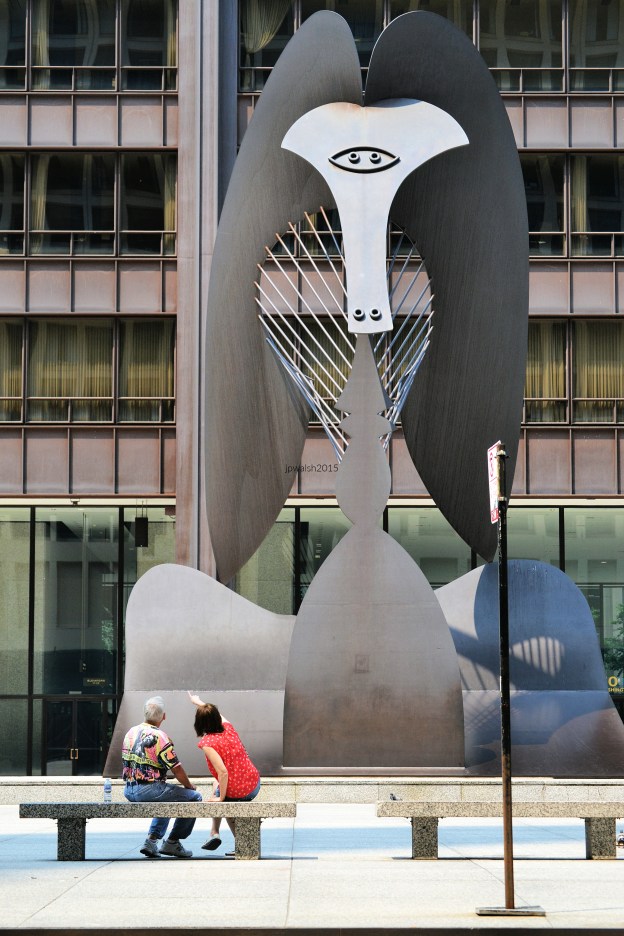
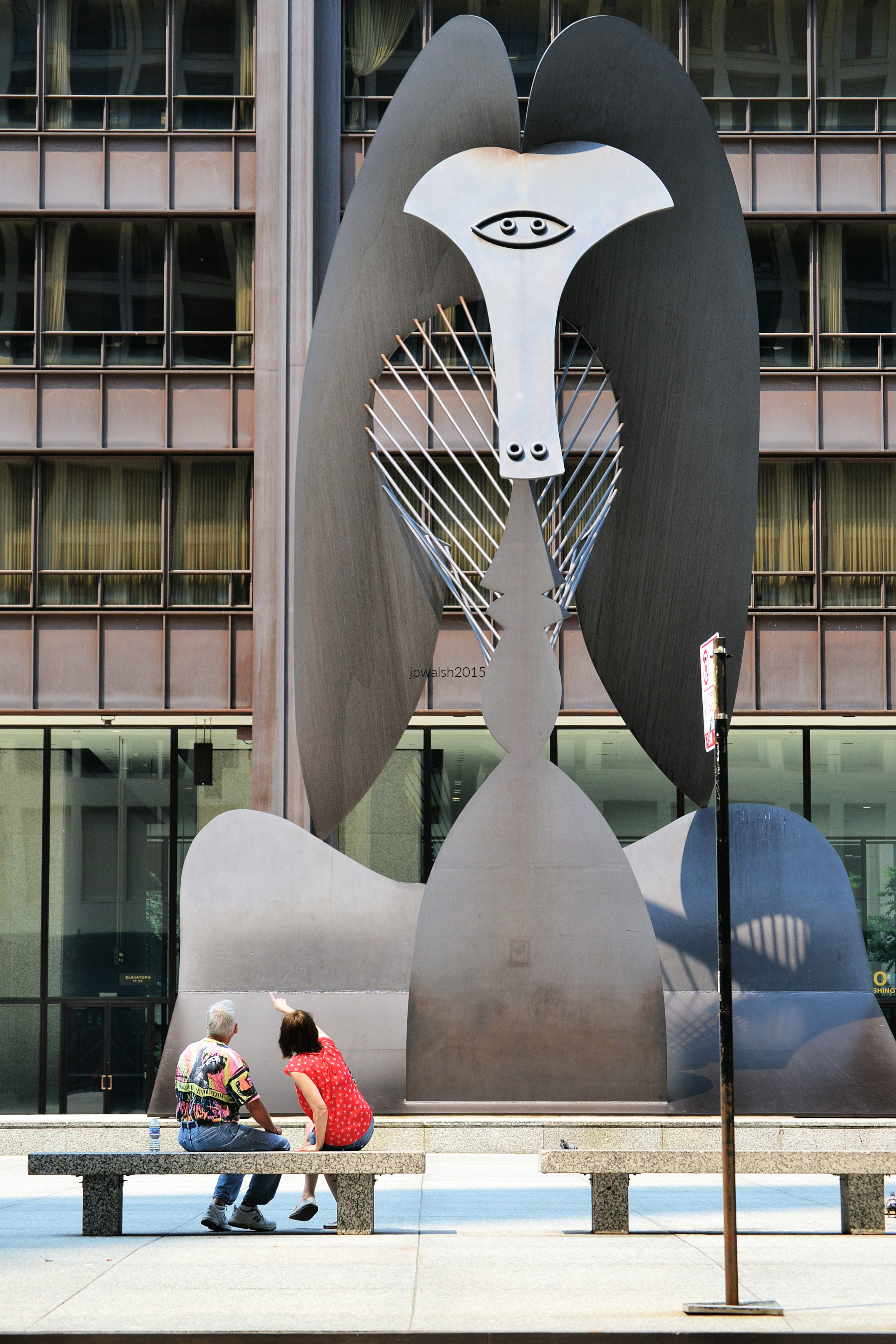
Chicago’s Picasso in Daley Plaza. Author’s photo (July 2015).
Chicago’s “Picasso” in today’s downtown Daley Plaza was officially unveiled on Tuesday, August 15, 1967 at 12 noon.
Weeks before the public event excitement (and some dread) swirled among Chicagoans and others as to what Pablo Picasso’s monumental outdoor sculpture would be like.
In the photograph on the wall, Mayor Daley and others pull the cord on August 15, 1967 unveiling Chicago’s iconic Picasso.
The famous Andulsian-born artist was first approached by Chicago leaders in May 1963. This encounter led more than four years later to the Cor-Ten steel sculpture’s installation and unveiling on a beautiful Tuesday summer’s afternoon in the Chicago Civic Center Plaza. Many in the crowd of thousands who had gathered to witness the historic event gasped and jeered at the modernist art work when the fabric cover was taken off. Local newspaperman Mike Royko wrote in The Daily News that the art work looked like a “giant insect.” Photo Credit: “Picasso in Chicago” by Emily Barney is licensed under CC BY-NC 2.0
Chicago’s Picasso in Daley Plaza. Author’s photo (October 2011).
Chicago’s first major public outdoor sculpture started a long term national trend to display massive outdoor contemporary art for the public
The now-iconic Picasso unveiled in 1967 is credited with being the first public outdoor sculpture installed in Chicago that put Chicago on the map as one of America’s first major cities to display massive outdoor contemporary art for the public.
In 1958 there was an untitled art work by Richard Lippold (1915-2002) constructed in the lobby of the Inland Steel Building (1954-58) by Skidmore, Owings & Merrill in downtown Chicago. It is four blocks from City Hall and the new Civic Center Plaza that the same architectural firm was helping to design and build in the early 1960’s.
Untitled (known today as The Radiant One), Richard Lippold, commissioned in 1957, Inland Steel Building, Chicago. Author’s photo (December 2017).
This was followed in 1964 by a large modernist work unveiled at the University of Chicago Law School entitled, Construction in Space and in the Third and Fourth Dimensions. It was made in 1959 by Russian Constructionist Antoine Pevsner (1886-1962).
The reputation and fame of Pablo Picasso (1881-1973) in 1967 helped catapult the idea and cultural practice of the installation of modern art, often monumental, in high-profile public spaces across the country, and starting in large measure, in Chicago.
In the following years and decades installation of public art that had broadened beyond the commemorative extended to established artists, many with international reputations, as well as more recent and sometimes emerging artists. In 2021, one online list of public art on campus at the University of Chicago demonstrates its extensive practice that was largely ushered in with Chicago’s Picasso (Ira J. Bach and Mary Lackritz Gray, A Guide to Chicago’s Public Sculpture, University of Chicago Press, 1983, p. xiii; https://arts.uchicago.edu/public-art-campus/public-art-campus#Antoine_Pevsner – retrieved June 9, 2021).
Since before the mid-20th century, public art in America has been often characterized by Modernism (i.e., MoMA’s modernist sculpture garden dated from the 1940’s). Modernism began as a cultural rebellion against prevailing classical-romantic art work. Until around Rodin’s Balzac in 1898, art work in the classical and romantic style filled parks and plazas throughout the 19th century and afterwards that memorialized people, places, and events. Modernists identified the classical-romantic style as old, trite, exhausted, and artistically bankrupt in rapidly changing times. Instead, Modernism offered artistic forms and creative responses that met and expressed an increasingly global and machine age – and not by grand depictions and tired motifs of old Romans standing (or lying) on privileged porticos in togas (i.e., Thomas Couture (1815-1879) Romans during the Decadence, 1847, oil on canvas, Musée d’Orsay).
Thomas Couture (1815-1879), Romans during the Decadence, 1847, oil on canvas, Musée d’Orsay. Starting no later than 1900, contemporary society was increasingly artistically influenced by Modernism. Characterized by the rejection of centuries-old literary and historical subjects and forms, it turned to abstraction and imaginative artistic responses as more fitting expression for a rapidly changing modern society.
Pablo Picasso had dominated the modern art scene for most of the 20th century, starting and particularly as the innovator of Cubism with French painter Georges Braque (1882-1963). Picasso was one of several artists who, as Harper’s Bazaar observed about the magazine’s engagement with modern artists, “broke new ground, challenged established thinking, and signaled seismic shifts in the culture” (Harper’s Bazaar, March 2021, p. 236).
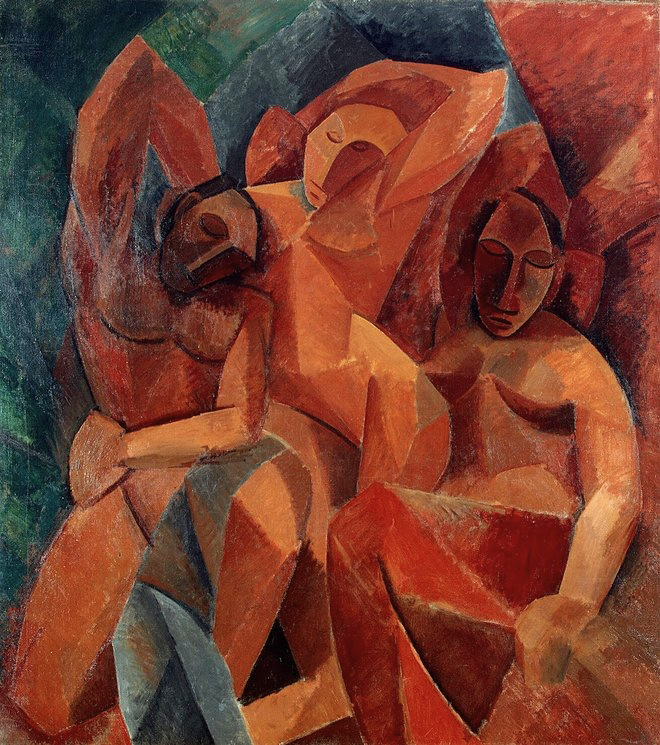
Pablo Picasso, Three Women, 1908, oil on canvas, 200x 178 cm, The Hermitage Museum, St. Petersburg, Russia.
Picasso, Student with a pipe, Paris, 1913, Oil, gouache, cut-and-pasted paper, gesso, sand, and charcoal on canvas, 28 ¾ x 23 1/8 inches, The Museum of Modern Art, New York.
Chicago’s Picasso in Daley Plaza from the side looking to the southeast. Author’s photo (July 2015).
On a representational level, a woman’s facial profile (eye, nose, lips, chin) followed by two “wings” of flowing hair, and rounded shoulders are in plain sight. Yet other interpretations for the sculpture are also reasonably feasible. For example, from the back, are the top symmetrical curves of the wings reflective of the curves of a woman’s buttocks with legs constituting the rest? Are the cut-out shapes like a head and neck in this context possibly a phallus? Picasso famously did many pieces of art that were highly sexualized. In 1932 Pablo Picasso produced an entire series of what would become iconic paintings of Marie-Thérèse Walter, his young, blonde-haired mistress, in the most lascivious and sensual positions imaginable. Picasso’s Minotaur and Wounded Horse is one example of it produced in Boisgeloup (outside Paris) on April 17, 1935 and today in the permanent collection of The Art Institute of Chicago. (See – https://johnpwalshblog.com/2013/05/15/picasso-and-chicago-the-show-may-be-over-but-its-best-parts-stay-on-display-its-called-the-art-institute-of-chicagos-permanent-collection/).
Picasso narrowed the central plane of the head toward the top, and indicated its slight tilt backward. Using Student with Pipe as a guide, what is usually interpreted as flowing hair past a woman’s head and body, these immense curved symmetrical “wings” in Chicago’s Picasso may be conceived as the shadow or shadows of a head and body. If the rods are not representative of something specific – i.e., guitar strings – but, as Picasso alluded in the LOOK interview of November 1967, an aesthetical connection, then this interpretation of a figural foreground and shadowed background that makes for a sculptural whole is also feasible.
The Chicago sculpture’s circular eyes and long flat nose are typical of Picasso heads of the 1913-1914 period which were translations of the features of African, specifically Wobé, masks. Picasso used their economy and schema to transform them into his personal and whimsical art work. (William Rubin, Picasso in the Collection of the Museum of Modern Art, MoMA, New York, 1972, pp. 88-89).
Chicago’s Picasso in Daley Plaza, Author’s photo. (December 2017).
Mask (Kifwebe), Songye, late 19th or early 20th century. Wood, pigment, 12 x 7 1/8 x 6 1/8 in. (30.5 x 18.1 x 15.6 cm). Brooklyn Museum. The object is a female mask with projecting mouth, triangular nose, pierced eyes, overall concentric linear carving, and polychrome pigment.
The mask type that was shared by other African societies is characterized by angular and thrusting forms, and the entire face is covered in unique patterns of geometric grooves. Female masks, such as this one, are distinguished by the predominant use of white clay and, in a feature shared by Chicago’s Picasso, the rounded form of the head crest. (See – https://www.brooklynmuseum.org/opencollection/objects/169088– retrieved June 9, 2021).
Picasso was 72 years old and Jacqueline Roque was 26 years old when they met in 1953. Picasso’s first wife, Olga Khokhlova, died in 1955. Picasso romanced Jacqueline until she agreed to date him and they married in 1961. During their courtship and marriage of 20 years, Picasso created over 400 portraits of Jacqueline, more than any of his other muses.
Picasso’s widow, Jacqueline Roque Picasso (1927-1986), gave her portrait to the president of Iceland and the bust was consigned in 1988 to the National Gallery of Iceland. A more realistic figure, Picasso’s slightly earlier art work evokes features and forms found in the abstracted sculpture for Chicago done a little later, such as the wing-shaped curves of the flowing hair that comes to a point at the bottom. https://www.listasafn.is/english/exhibitions/nr/476
Pablo Picasso, Jacqueline with a Yellow Ribbon, 1962, sheet metal, cut-out, bent, and painted, 19 5/8 inches, National Gallery of Iceland, Reykjavik.
Chicago’s Picasso in Daley Plaza. Completed no later than 5 years after Jacqueline with a Yellow Ribbon in 1962 the dramatic shapes and formulations of the monumental sculpture share recognizable affinities. Author’s photo (July 2015).
Perfect Summer’s Day for Unveiling Ceremony
August 15, 1967 was a perfect summer’s day with temperatures in the low 80s and no rain to worry about in the forecast. The Woods Theater across the Plaza on Dearborn was playing Jack Nicholson’s new film, Hells Angels On Wheels. Before the unveiling, Mayor Richard J. Daley (1902-1976) spoke before the crowd. The mayor told the crowd that he was “very happy” that they had “come to share” in the dedication of what was “a great gift to our city” by Picasso. That Mayor Daley and Pablo Picasso, both Roman Catholics, unveiled Picasso’s gift on August 15 would be coincidental to the significant Catholic religious holiday of the Assumption of the Virgin Mary that also falls on the date.
A lunch-time crowd packed the new Civic Center Plaza on the day of the unveiling. The new plaza fronted a new modernist courthouse skyscraper and a modern outdoor sculpture – Chicago’s Picasso – as the major components of architectural plans virtually from its start.
In 1963, the Public Building Commission of Chicago decided to build a new modernist 31-story civic center fronted by a public plaza. The new complex would complement and contrast with the 10-story City Hall across Clark Street that opened in 1911. The new courthouse and plaza development was part of Mayor Daley’s overall downtown development that by 1963 was in high gear and would remain so past his unexpected death 5 days before Christmas in 1976 at 74 years old.
Skidmore, Owings & Merrill, the architectural firm associated with the project, wanted the art work to be by Pablo Picasso. When the project’s coordinator, architect William E. Hartmann (1916-2003), told Mayor Daley of these plans, the mayor quickly supported the choice. The challenge now was to convince Picasso.
The Chicago Civic Center’s supervising architects was C.F. Murphy led by the Aurora, Illinois-born architect Jacques Brownson (1924-2012). Skidmore, Owings & Merrill and Loebl, Schlossman, Bennett & Dart were associated architects. Al Francik was this drawing’s delineator.
The Chicago Civic Center was the first of several important new public buildings constructed in Chicago from the late 1950s to the 1980s as part of Mayor Richard J. Daley’s development of municipal government. The glass-and-steel modernist building held over 100 courtrooms, office space and a large law library. It boasted wide spans between weight bearing columns and 18-foot-tall floor to floor heights. Though the plan included a sculpture in the public plaza, Picasso’s sculpture came later after he was persuaded by William Hartmann of Skidmore, Owings & Merrill to make the artwork. Chicago’s Picasso continues to draw Chicagoans and visitors from all over the world to the plaza.
On August 15, 1967, Mayor Daley continued his remarks to the assembled crowd: “Today, with its unveiling, it becomes a permanent part of the Chicago scene. As mayor, I dedicate this gift, in the name of the people of Chicago, confident that it will have an abiding and happy place in the city’s heart.”
The Deed of Gift, dated August 21, 1966, was signed by Picasso with one of its witnesses being, Jacqueline, his wife and written in both English and French. The entirety of the Deed of Gift in English reads: “The Monumental sculpture portrayed by the maquette pictured above has been expressly created by me, Pablo Picasso, for installation on the plaza of the Civic Center in the City of Chicago, State of Illinois, United States of America. This sculpture was undertaken by me for the Public Building Commission of Chicago at the request of William E. Hartmann, acting on behalf of the Chicago Civic Center Architects. I hereby give this work and the right to reproduce it to the Public Building Commission, and I give the maquette to The Art Institute of Chicago. Desiring that these gifts shall, through them, belong to the people of Chicago” (Balton-Stratton, The Chicago Picasso, p. 33).
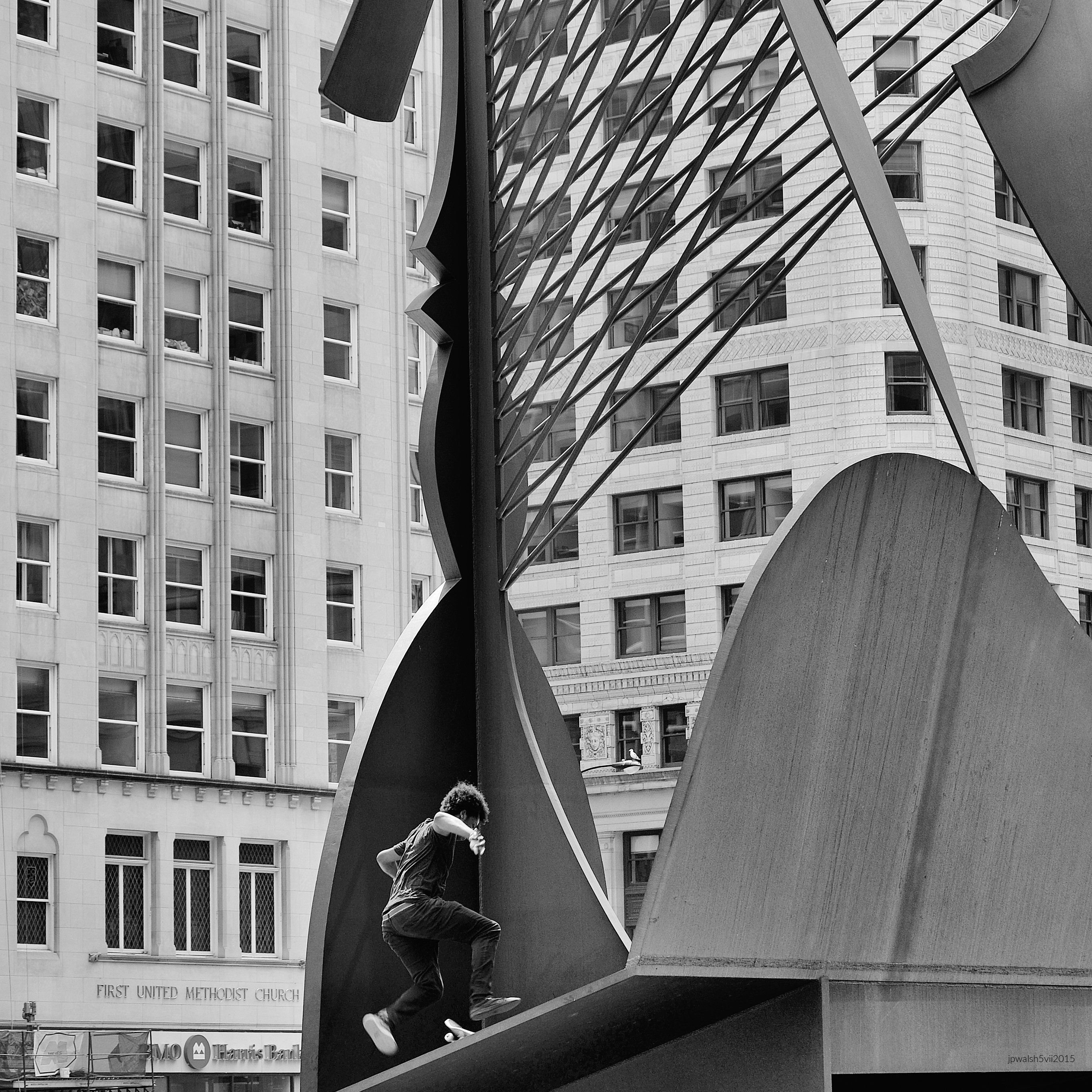
Picasso donated his sculpture to the people of Chicago in 1967. Skateboarder on Chicago’s Picasso in Daley Plaza. Author’s photo (July 2015).
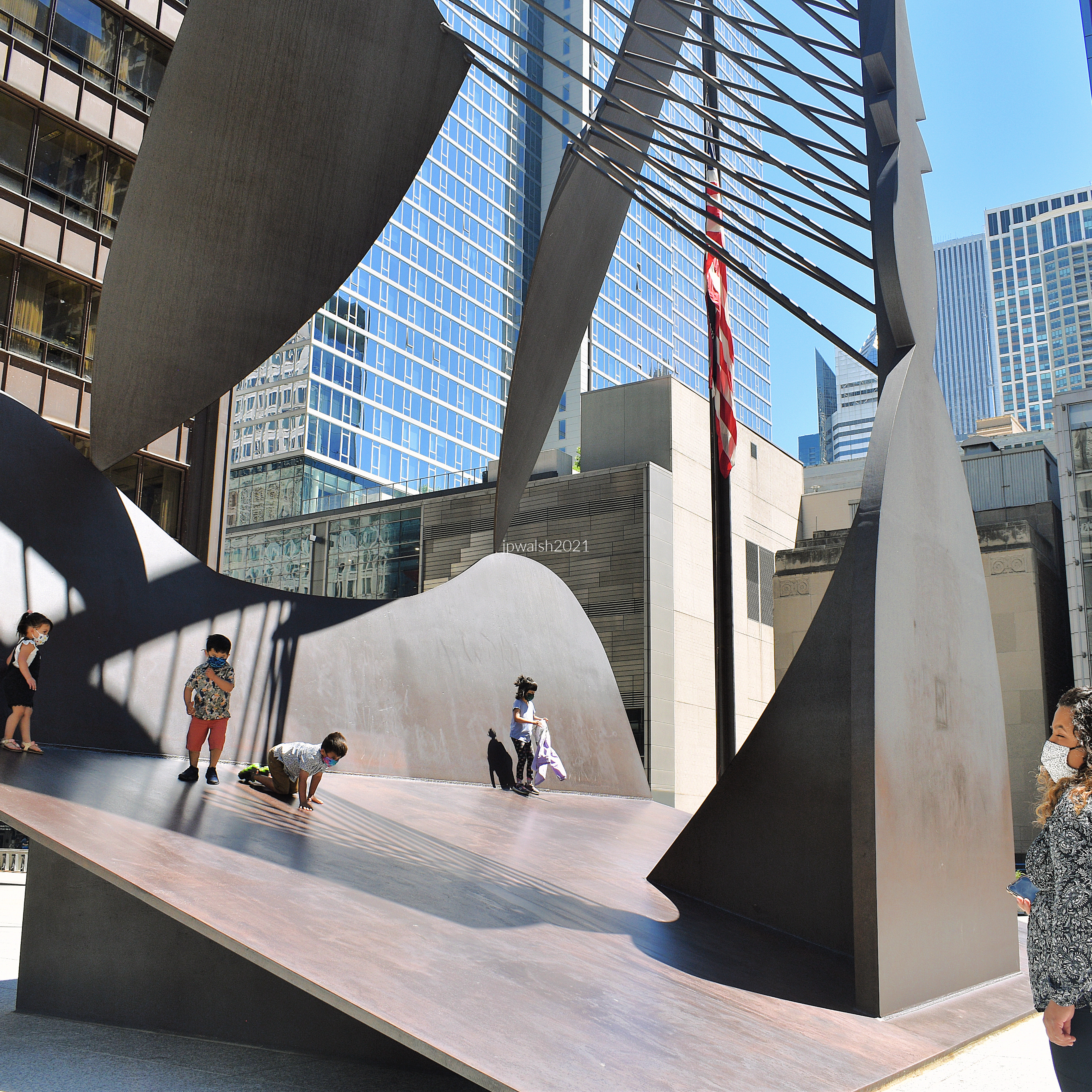
Children’s slide on Chicago’s Picasso in Daley Plaza. Author’s photo (May 2021).
Picasso’s “gift” cost $300,000 to fabricate–or around $2 million today
Picasso donated his sculpture to the people of Chicago in 1967. The artist’s gift constituted the 42-inch maquette and the rights and privileges surrounding it. The monumental sculpture based on Picasso’s “gift” of the maquette cost $300,000 to fabricate–or around $2 million today – and paid for by private monies (Bach, p. 76).
The Picasso sculpture could not be completely a matter of artist largesse (though he did not accept a fee). Gertrude Stein in Picasso, her memoir of the artist written in 1938, writes of the young and then-impoverished Picasso who gave a prominent collector one of his desirable art works when he might have paid for it. Picasso told Stein about the collector: “He doesn’t understand that at that time the difference between a sale and gift was negligible” (Stein, Picasso, p. 8). Fast forward about fifty years and something similar might have applied for Picasso in 1967 in terms of acknowledging the people (and collectors) of Chicago.
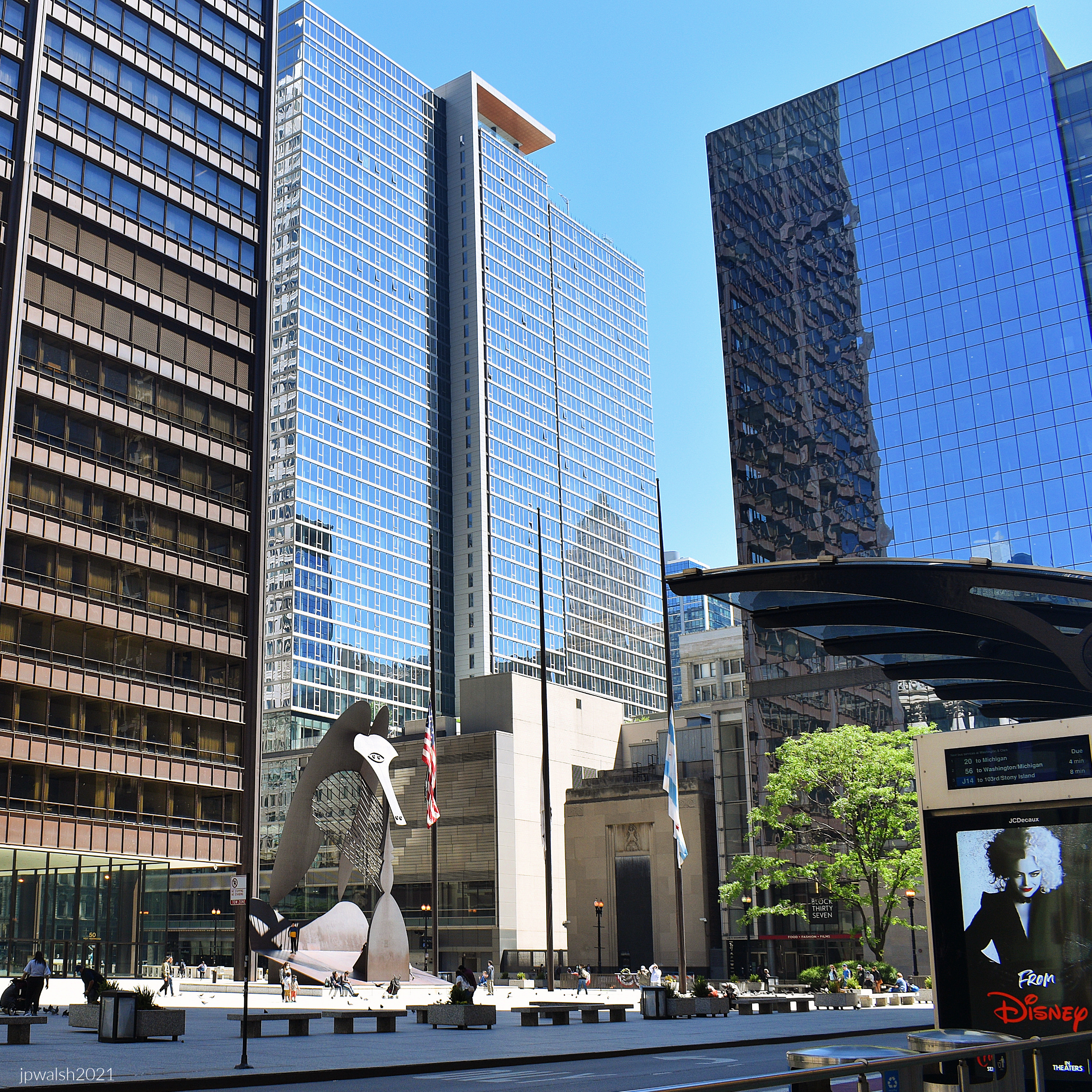
Chicago’s Picasso in Daley Plaza. Author’s photo (May 2021) .
Chicago’s Picasso in Daley Plaza. Author’s photo (July 2015) .
Not everyone who gathered at Daley Plaza in August 1967 during the “Summer of Love” and then-escalating Vietnam War was there to welcome Picasso’s sculpture. Though Chicago had a long and venerable history with Picasso’s art – The Art Institute of Chicago began collecting it in 1923 and the first Picasso exhibition was at The Arts Club of Chicago that same year—protesters held signs at the unveiling, some of which read: “Let’s give it back now!!!,” “The Colossal Boo Boo,” and “It’s a Monsterment.” To what degree connoisseurship influenced protesters in August 1967 would appear to lie in the outright rejection of Modernism though more nuanced criticism could include crass commercialization of Picasso’s art work.
From its unveiling in August 1967 until today, Chicagoans have been mystified by their publicly owned “Picasso.” Picasso’s untitled artwork has had its boosters and detractors. Over the years, it appears public opinion has mellowed about the 50-foot-tall, 162-ton Cor-Ten (self-weathering) steel sculpture, even turning mostly in favor of the enigmatic work of art.
In more than 50 years of debate, Chicagoans have come to accept that they probably will never know exactly what it is that Picasso gave “to the people of Chicago.”
Though mysterious – is it a butterfly or bird? or, as Sir Roland Penrose (1900-1984) interpreted it, the abstracted head of a woman with ample flowing hair – many seek it out or find it as they cross the plaza. It adds grace, beauty, personality, proportionality and perspective to the urban space between Dearborn and Clark Streets at Washington Street.
Chicago’s Picasso in Daley Plaza looking to the northeast. Author’s photo (May 2021).
The sculpture’s rods have been compared to the strings of a guitar (Bach, pp.75-76). Always in the public domain, it is a popular icon for Chicago.
The Picasso bestows international and modernist value to the “City of the (19th) Century” which in 1911 – the year City Hall was erected – poet Carl Sandburg (1878-1967) called “hog butcher for the world” in his poem, Chicago. Though Sandburg wrote these literary images in and of another era, the famous poet was just 3 years older than Picasso and died in July 1967, only weeks before the official unveiling of the Picasso that ushed in a new age for the city.
In May 1963, Picasso was a vigorous 81 years old and living in Mougins, France. By way of literary and artistic contacts in Chicago and Europe, William Hartmann was helped on his mission to visit Picasso as the young American architect headed to the south of France to await the outcome of his request to meet the aging Spanish artist.
Picasso was 81 years old and living in the south of France when Chicago architect William Hartmann tracked the artist down to ask him to consider creating a sculpture on a monumental scale for Chicago’s new modernist Civic Center development project. Photo credit: “PABLO PICASSO” by marsupilami92 is licensed under CC BY 2.0.
William Hartmann, 47 years old in 1963, was born in New Jersey and started his architectural career in Boston after attending MIT. He joined Skidmore, Owings & Merrill in New York City following World War II and was working in its Chicago office since 1947. Hartmann, elected to the College of Fellows of the American Institute of Architects (AIA) in 1963, is credited for personally enticing Picasso to design a sculpture for Daley Center Plaza in Chicago. In 1968, the year after the installation of the Picasso sculpture in Chicago, Hartmann was awarded an honorary Doctorate of Humane Letters from Lake Forest College. (For Hartmann biographical information and interviews, see the Ryerson & Burnham art and architecture archive – https://digital-libraries.artic.edu/digital/collection/caohp/id/26834/rec/1– retrieved June 9, 2021).
At their meeting Hartmann looked to familiarize the artist with the downtown Chicago project: he brought photographs of Chicago, the building site, and its people. Hartmann included photographs of the many Picasso works owned by Chicagoans and its institutions to show him this city’s longstanding regard and love for him.
Picasso told Hartmann he would think about it.
Hartmann continued to visit over the next months and years bringing various Americana and Chicago-related items as gifts, such as major sports team paraphernalia. Hartmann also updated the artist on the modernist Civic Center construction project.
Picasso produced a draft.
Before starting his maquette, Picasso asked Chicago leaders to keep the art project “relatively confidential” and out of the public eye
Hartmann told him, “We want to commission you so that I end up with a study I can take back.” Maintaining his flexibility, Picasso told Hartmann, “I may not produce anything—or produce something that you don’t like. It’s best that we keep this low-key from start to finish, calm, and relatively confidential.”
Thus, out of “relative confidentiality” was born much of the mystery and intriguing quality of the “Picasso” at its unveiling in Chicago in August 1967.
Maquette for Richard J. Daley Center Sculpture,1964. The Art Institute of Chicago. Maquette for Richard J. Daley Center Monument, 1965. Welded steel (simulated and oxidized) 41 ¼ x 27 ½ x 19 inches, The Art Institute of Chicago. The artist; given to The Art Institute of Chicago, 1966. See – https://www.artic.edu/artworks/25809/maquette-for-richard-j-daley-center-sculpture — June 6, 2021.
In 1963 Mayor Daley looked to persuade Picasso to do a monument. In 1965, Picasso looked to persuade Mayor Daley to accept his foremost Cubist original work that would be seen and interpreted each day by thousands in the heart of Chicago’s downtown government, business and shopping district.
Chicago’s collection of public art was initiated on August 15, 1967, when Mayor Richard J. Daley dedicated an untitled sculpture commonly known as “The Picasso” in Chicago’s new Civic Center (now the Richard J. Daley Center). Four years earlier, architect William Hartmann of Skidmore, Owings & Merrill had approached Pablo Picasso with the commission. The artist accepted and crafted two steel maquettes: one he kept in his studio at Mougins and gave the other to the architect to use in planning the potential fabrication of the sculpture. With the Picasso sculpture’s unveiling in 1967, its presence inspired private and public investment in many more artworks throughout the cityscape, including Anish Kapoor’s Cloud Gate (“The Bean”) completed in 2006 at Millennium Park.
Cloud Gate (“The Bean”), Anish Kapoor, 2006, Millennium Park, Chicago. Chicago’s Picasso in 1967 inspired private and public investment in art works throughout the cityscape well into the future. Author’s photo (May 2021).
When Picasso produced a 42-inch maquette of the sculpture, the board of the Public Building Commission of Chicago was given a private viewing of it. Afterwards, they passed a resolution authorizing the payment of $100,000 to Picasso (about $850,000 today) with the sum to include the purchase price for the right, title and interest in and to the maquette as well as copyright and copyright renewals. When Hartmann offered the $100,000 check to Picasso, he asked the artist to sign the “Formal Acknowledgment and Receipt.”
Picasso refused to accept the money or to sign the document.
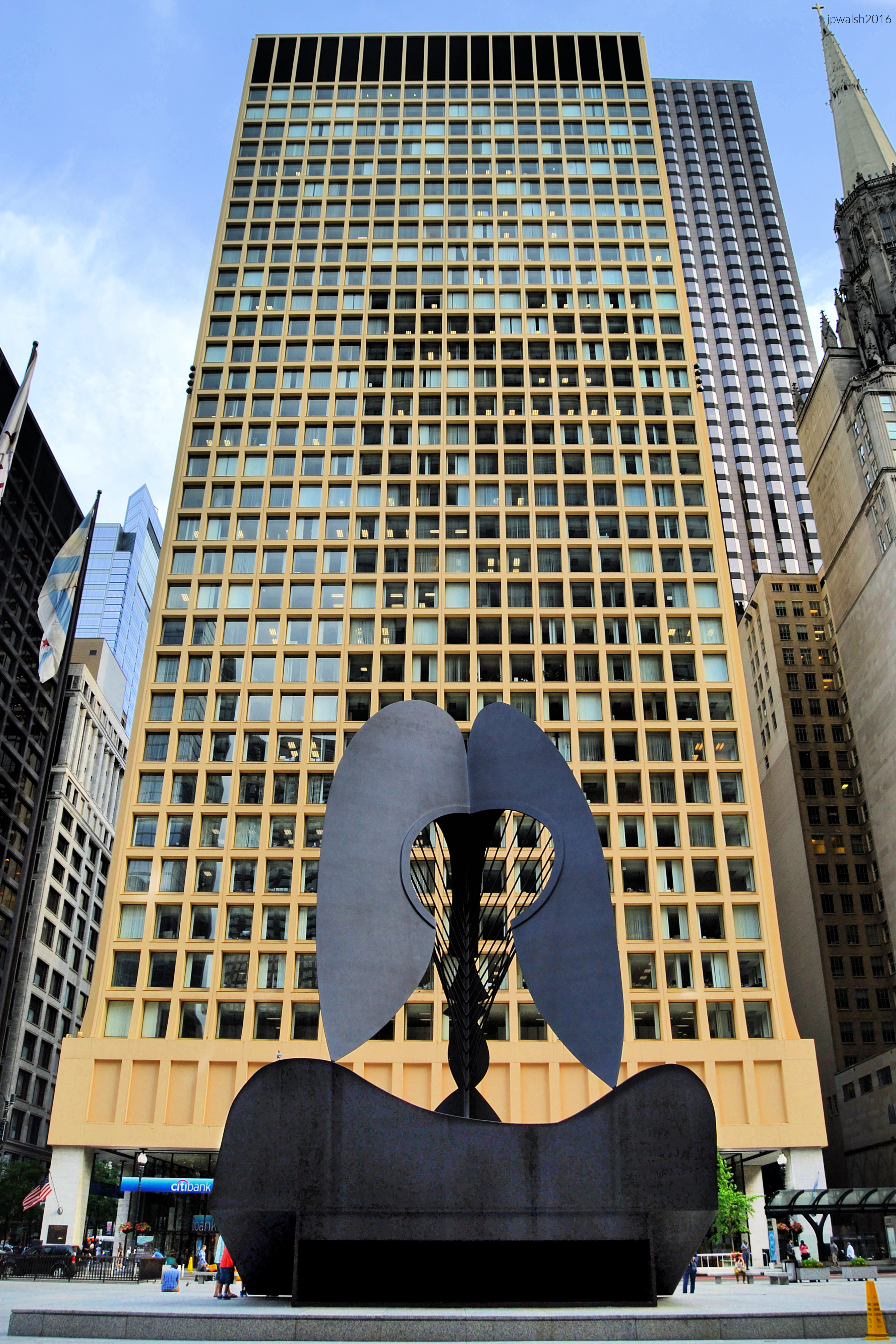
Chicago’s Picasso in Daley Plaza from the back looking to the south. As in every cubist art work, a visit to the sculpture provides multiple viewpoints. Author’s photo (July 2016).
Richard J. Daley Center Sculpture, 1967, White chalk on plywood, 100 x 81 cm, Signed recto, upper right, in magenta pastel: “Picasso” (underlined); The artist; given to The Art Institute of Chicago, 1967. – https://www.artic.edu/artworks/28019/richard-j-daley-center-sculpture– retrieved June 9, 2021.
In the chalk drawing (above) the importance of the sculpture’s forms, both empty of steel and fabricated thereof, carry greater significance to the outcome of the piece. In the drawing Picasso does not include the rods of which much representational conjecture has been made (i.e., guitar strings) as the artist himself admits adds value for structural stability of the modernist monument.
Based on Picasso’s design and the 42-inch maquette he made, the monumental statue was built by U.S. Steel in Gary, Indiana. Anatol Rychalski was the engineer in charge of the design and construction.
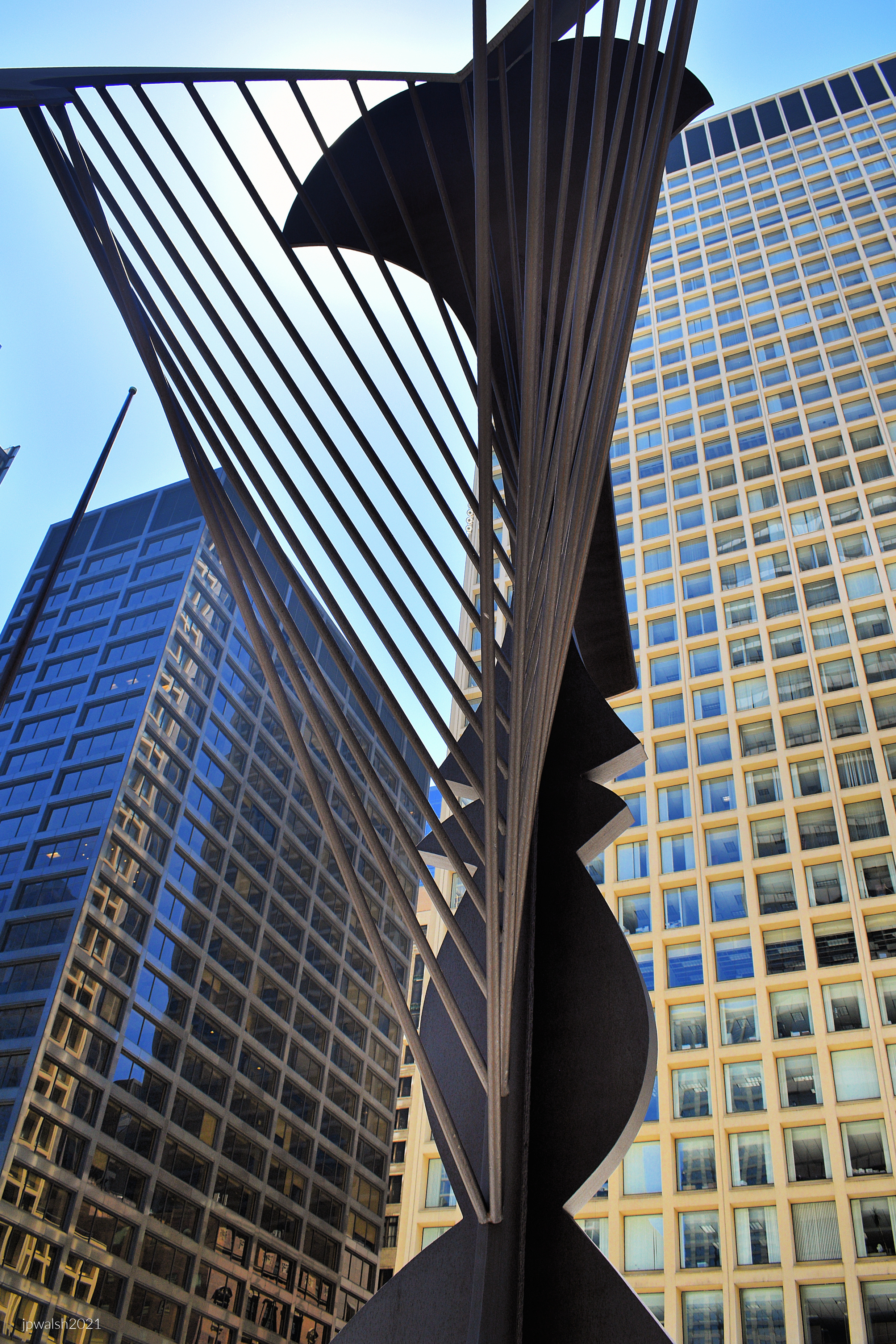
Rods of the Chicago Picasso in Daley Plaza, Author’s photo (July 2015).
“My job was to make an exact but giant likeness of Picasso’s 42-inch original. Being a follower of Picasso’s works, I knew that no snap judgement of this one would suffice. But those of us who built it accepted the challenge of its interpretation with as much enthusiasm as the challenge of its construction” (Chicago Tribune, August 20, 1967). Rychalski, a Polish immigrant to the U.S. in 1950 and, in 1967, senior designer in the American Bridge Division of U.S. Steel corporation, observed, “We had to roll steel to sizes which never have been rolled which means that the whole technology had to be to some extent improvised at the time.” Nearly 50 years later, in 2016, the 91-year-old Rychalski, said about the sculpture, “It defines the city as ‘spirit in flight.’ You look at the wings and the profile of an overwhelmingly powerful lady…the value of it is enormous.” (quoted in https://www.shawlocal.com/2016/07/28/shorewood-man-expresses-the-profound-through-his-acrylic-paintings/askc2p1/-retrieved June 9, 2021.)
Pablo Picasso and William E. Hartmann with the maquette in the artist’s Mougins studio in August 1966. This image appeared in the 1967 program pamphlet. Picasso made two maquettes – one he kept in his studio and the other he gave to The Art Institute of Chicago for the behalf of the people of Chicago.
Daley pulled the cord on the multi-color fabric that hid Picasso’s gift to the people of Chicago. Chicago poet Gweldolyn Brooks (1917-2000) read remarks and members of the Chicago Symphony Orchestra played music.
Collective gasp from the crowd followed by jeers at unveiling
With the veil removed, the crowd let out a collective gasp and began to shout negative comments about the art work. In its first public appearance, the crowd of potential Picasso admirers turned into a Picasso peanut gallery – an unintended, unwanted but not wholly unforeseen consequence by city authorities. Bemused criticisms of the Picasso were also part of what became – in the mayor’s words at the sculpture’s unveiling – “a permanent part of the Chicago scene.”
The Chicago Picasso at the dedication ceremony before the unveiling on August 15, 1967. Photo credit: case 69C353: The Letter Edged in Black Press, Inc. vs. Public Building Commission of Chicago in records of the U.S. District Court, Northern District of Illinois, Eastern Division, RG 21.
Controversial reaction better than “no reaction at all”
For William Hartmann and others responsible for bringing the Picasso to Chicago the local crowd’s visceral and negative reaction to the monumental public art work in the downtown location was better than no reaction at all.
“Picasso’s work, frequently, if not always has been the center of controversy,” Hartmann philosophically observed, “So it all fit into that pattern beautifully.”
A few days after the unveiling, Mayor Daley offers his thoughts at a press conference about the Picasso
A couple of days after the unveiling ceremony, Mayor Daley at a press conference offered what he thought about the Picasso sculpture. Though it was “wonderful,” Daley admitted like the rest of Chicago that he did not know what the sculpture really represents.
One idea the mayor floated was that it was a woman as some believed and that it was very appropriate that she stood in front of the courthouse.
“We’ve always looked at justice as a woman and it is outside a hall of justice,“ the 65-year-old Big-City Irish Democratic mayor said. He speculated further: “But it could also be a Phoenix. It would symbolize the rise of Chicago as a city of vitality out of the ashes caused by [the Great Chicago Fire]” (Chicago Tribune, August 19, 1967).
Considering the many conversations that were held over four years with city planners and the Spanish artist through William Hartmann about Chicago’s Picasso it is fair to say that the mayor – the city’s biggest booster – would state his interpretation on the art work based on what he believed he saw after talking to the experts.
Chicago’s Picasso in Daley Plaza, made from a 42-inch maquette in Mougins, France into a 50-foot-tall, 162-ton Cor-Ten steel sculpture in Gary, Indiana, is an engineering marvel. Author’s photo (July 2015).
From 42-inch maquette in Mougins, France, to 50-foot-tall, 162-ton Cor-Ten steel sculpture in Gary, Indiana
In those same days, Anatol Rychalski (b. 1925) was open-minded about the Picasso’s precise artistic representation. “It doesn’t really matter how you personally interpret the sculpture,“ he told the Chicago Tribune on August 20, 1967, “as long as you not ridicule for the sake of ridicule.” He then shared his interpretation: “To me it represents the winged spirit of justice, with the serenity and compassion of a woman. It is a benevolent but stern and powerful justice.”
LOOK magazine interviews Pablo and Jacqueline Picasso and they talk about Chicago’s Picasso
In November 1967, LOOK magazine interviewed Picasso and Jacqueline and the Chicago sculpture came up. They were both amused by the baffled reaction of Chicagoans to the art work. Jacqueline offered that it was obviously “a woman’s head” and shoulders but “no more.” Picasso observed that the “cage” of steel rods was more an aesthetic than a representation. In the LOOK interview Picasso observed: “I am touched that the [Chicago] public could mysteriously share my joy over the results of many years work in sculpture. In a way, my sculptures are more my children than my paintings. I am caught up in shaping my vision of the world. In sculpture, I cut through appearances to the marrow, and rebuild the essentials from there. I cannot invent a detail that has not been carefully planned and my wish is that the public, through thinking and meditation, may retrace my intentions” (LOOK, November 28, 1967). Picasso’s challenge to the viewer to discover an objective answer to his artistic intentions makes the sculpture’s meaning more intriguing.
Chicago’s Picasso in Daley Plaza. In a November 1967 LOOK magazine interview, Picasso and Jacqueline expressed amusement at Chicagoans’ reaction to the art work. Jacqueline said it was obviously “a woman’s head” and shoulders but “no more.” Author’s photo (July 2015).
“Eyes that are pitiless, cold, mean…”
Probing the artist’s intentions was met soon with succinct anecdotal insight from Chicago’s newspaperman, Mike Royko (1932-1997). Royko wrote creatively and personally about the significance of the art work for Chicago in 1967. The columnist’s cynical eye on the possible relationship of the modernist steel art work and the city he loved was published in the afternoon newspaper, the Chicago Daily News:
“That is all there is to it. Some soaring lines, yes. Interesting design, I’m sure. But the fact is, it has a long stupid face and looks like some giant insect that is about to eat a smaller, weaker insect. It has eyes that are pitiless, cold, mean.
But why not? Everybody said it had the spirit of Chicago. And from thousands of miles away, accidentally or on purpose, Picasso captured it.
Up there in that ugly face is the spirit of Al Capone, the Summerdale scandal cops, the settlers who took the Indians but good.
ITS EYES ARE LIKE the eyes of every slum owner who made a buck off the small and weak. And of every building inspector who took a wad from a slum owner to make it all possible.
It has the look of the dope pusher and of the syndicate technician as he looks for just the right wire to splice the bomb to.
Any bigtime real estate operator will be able to look into the face of the Picasso and see the spirit that makes the city’s rebuilding possible and profitable.
It has the look of the big corporate executive who comes face to face with the reality of how much water pollution his company is responsible for – and then thinks of the profit and loss and of his salary.
IT IS ALL THERE in that Picasso thing – the I will spirit. The I will get you before you will get me spirit.
Picasso has never been here, they say. You’d think he’s been riding the L all his life.”
Soft Version of Maquette for a Monument Donated to the City of Chicago by Pablo Picasso, Claes Oldenburg (b. 1929), 1969. Canvas and rope, painted with synthetic polymer, dimensions variable (38 x 28¾ x 21 inches, full height), Musée National d’Art Moderne, Centre Georges Pompidou, Paris.
What could be seen as an early parody of the Picasso sculpture by Claes Oldenburg is, in fact, the artist’s homage to the art work as well as conversation with it on aesthetics.
In Oldenburg’s version Picasso’s steel becomes soft cloth; straight rods become limp ropes. More malleable than the original, Oldenburg dubbed his work “Super-Cubism” in that where a Cubist work offers the viewer multiple viewpoints, Oldenburg’s piece offers viewpoints that are unlimited (Picasso and American Art, Michael FitzGerald, Whitney Museum of American Art, New York, 2006, p. 259).
Gertrude Stein by Pablo Picasso, 1905–6, The Metropolitan Museum of Art, New York. The Met writes about this work: “[Picasso] reduces her body to simple masses—a foreshadowing of his adoption of Cubism—and portrays her face like a mask with heavy lidded eyes, reflecting his recent encounter with Iberian sculpture.” see- https://www.metmuseum.org/art/collection/search/488221 – retrieved June 4, 2021.
Reaching farther back in Picasso’s career at the start of the 20th century, American writer Gertrude Stein (1874-1946) knew Picasso in Paris and later wrote about him. Stein observed that Picasso was “the only one in painting who saw the twentieth century with his eyes and saw its reality and consequently his struggle was terrifying …for himself and for the others, because he had nothing to help him…he had to do it all alone and, as in spite of much strength he is often very weak…” (Stein, Picasso, p. 22).
In 1906 when Picasso was 25 years old, he painted Gertrude Stein’s portrait. According to Stein, she posed for him in Paris “eighty times” but, finally, he “painted out the head” and, following a break in Spain, painted in a new head without seeing her again beforehand (see G. Stein, Picasso, 1938, p. 8). Though Stein was “satisfied” with the portrait and remained so over 30 years later, Picasso was criticized in 1906 for the depiction. The artist responded with a remark now considered famous and certainly, as Stein and the world discovered, prescient: “Everybody says that she does not look like it but that does not make any difference, she will.” (See G. Stein, The Autobiography of Alice B. Toklas).
The bold creative vision of the Cubist artist is very much in evidence in Picasso’s gift to the people of Chicago that stands in Daley Plaza. It may be that Picasso’s intentions for the iconic untitled sculpture may only be known in future days. For, at first, they said it did not look like Chicago, but it didn’t make any difference – because it will.
Chicago’s Picasso in Daley Plaza from the back looking to the southwest. Author’s photo (October 2015).
6/2022 5.98 mb 99%
Chicago’s Picasso (June 2022).
SOURCES:
Bach, Ira J. and Mary Lackritz Gray, A Guide to Chicago’s Public Sculpture, University of Chicago Press, 1983.
FitzGerald, Michael, Picasso and American Art, Exh. Cat. Whitney Museum of American Art/Yale University press, New York, 2006.
Rubin, William, Picasso in the Collection of the Modern of Modern Art, , MoMA, New York, 1972.
“The Chicago Picasso,” Progressive Architecture (November 1966), p. 66 (ill.).
The Art Institute of Chicago, Annual Report (1966–1967), pp. 26–27 (ill.).
Chicago Picasso Dedication program (August 15, 1967) (ill.).
Lael Wertenbaker, The World of Picasso (New York: Time-Life Books, 1967), p. 153 (ill.).
“A Picasso Statue for Chicago,” The Burlington Magazine 109:766 (January 1967), pp. 34–36, figs. 68 and 70.
Burton Wasserman, “Picasso: The Touch of Magic,” Art Education 21:4 (April 1968), p. 29 (ill.).
Clarence Page, “Giant Iron Sculpture: Picasso Leaves His Mark on the City,” Chicago Tribune (April 9, 1973), section 1, p. 6.
Roberto Otero, Forever Picasso: An Intimate Look at his Last Years (New York: Harry N. Abrams, 1974), pp. 46, 50, 52–55 (ill.).
Roberto Otero, “It’s more charming this way: How the master made us a gift,” Chicago Guide, vol. 23, no. 10 (October 1974), pp. 86–87.
Marilyn McCully, A Picasso Anthology: Documents, Criticism, Reminiscences (London: Arts Council of Great Britain, 1981), pp. 266–267 (ill.).
Sally Fairweather, Picasso’s Concrete Sculptures (New York: Hudson Hills Press, 1982), p. 85.
The Picasso Project, Picasso’s Paintings, Watercolors, Drawings, and Sculpture: A Comprehensive Illustrated Catalogue 1885–1973, The Sixties II 1964–1967 (San Francisco: Alan Wofsy Fine Arts, 2002), p. 133, no. 64–373 (ill.).
Gary Tinterow, Master Drawings by Picasso, exh. cat. (Cambridge, Mass., 1981), p. 255, no. 27.
Stephanie d’Alessandro, “Picasso and Chicago,” (Art Institute of Chicago, 2013), p.26, cat 245 (ill.)
Sofitel Chicago Magnificent Mile, Chicago, Illinois, Jean-Paul Viguier. At its opening the Chicago chapter of the American Institute of Architects (AIA) selected today’s Sofitel Chicago Magnificent Mile as the decade’s “best new building” in Chicago. The hotel opened in May 2002 with 415 rooms.
Jean-Paul Viguier (b.1946) is a leading modern Paris-based French architect. In 2003 his Sofitel Chicago Water Tower (renamed the Sofitel Chicago Magnificent Mile) was chosen by the Chicago chapter of the American Institute of Architects (AIA) as the “best new building in Chicago in the last ten years.” The hotel opened in May 2002 with 415 rooms. Its dramatic architecture made an immediate impression not only on the city’s denizens and visitors but much of the world.
The glass triangular tower ascends and thrusts over the intersection of Chestnut and Wabash Streets. Narrowing as it rises, the shape could evoke a ship’s prow—or a geometer’s trapezoid. 6/2014 5.49mb
The prism-shaped, 350,000-square-foot structure was chosen by nearly 350 established Chicago-based architects as one of the city’s most outstanding achievements in architecture. The glass triangular tower ascends and thrusts over the intersection of Chestnut and Wabash Streets. Narrowing as it rises, the shape could evoke a ship’s prow—or a geometer’s trapezoid. Its expansive façades allow generous exposures of natural light as it faces east to capture sunrise over the incredible natural backdrop of Lake Michigan and southwest towards the timeless Midwestern prairie. Adding to the building’s drama and welcome grace is its exterior of horizontal cladding of visible and opaque glass in synergy with the verticality of the building’s wedge and curve. Inside, the lobby continues this building’s dramatic modernity presenting a steely structural space that is airy, sleek, and soaring.
Mr. Viguier was selected to design Sofitel Chicago Magnificent Mile during a design competition in 1998 judged by Accor hotels leadership and others. Mr. Viguier is a member of the International Academy of Architecture (IAA) and was president of AFEX (French Architects Overseas) from 1999 to 2002.
Mr. Viguier’s other internationally recognized projects include the France Televisions headquarters in Paris as well as the Cœur Défense in 2001 and the Tour Majunja in 2014 both in La Défense, France. The French architect built a two story expansion at the McNay Museum of Modern Art in San Antonio, Texas. Mr. Viguier is also architect for the Maroc Telecom Tower in Rabat, Morocco in 2013, and, in 2015, the SFR Campus in Saint-Denis, France. Another highly regarded project is, in 2013, the Cancer University Institute in Toulouse, France.
The Sofitel Chicago Magnificent Mile is also listed at no. 82 in a public poll of 150 buildings of “America’s Favorite Architecture.” The poll was conducted by The American Institute of Architects (AIA) and Harris Interactive and in conjunction with the AIA’s 150th anniversary in 2007.
In 2005, Sofitel Chicago Magnificent Mile received the MIPIM Award at their international meeting of property market sector leaders gathering in Cannes, France. Created in 1991, the MIPIM Awards is an internationally-renowned real estate competition at MIPIM, the world’s property market. It honors the most outstanding and accomplished projects, completed or yet to be built, around the world, the very best of the real estate industry.
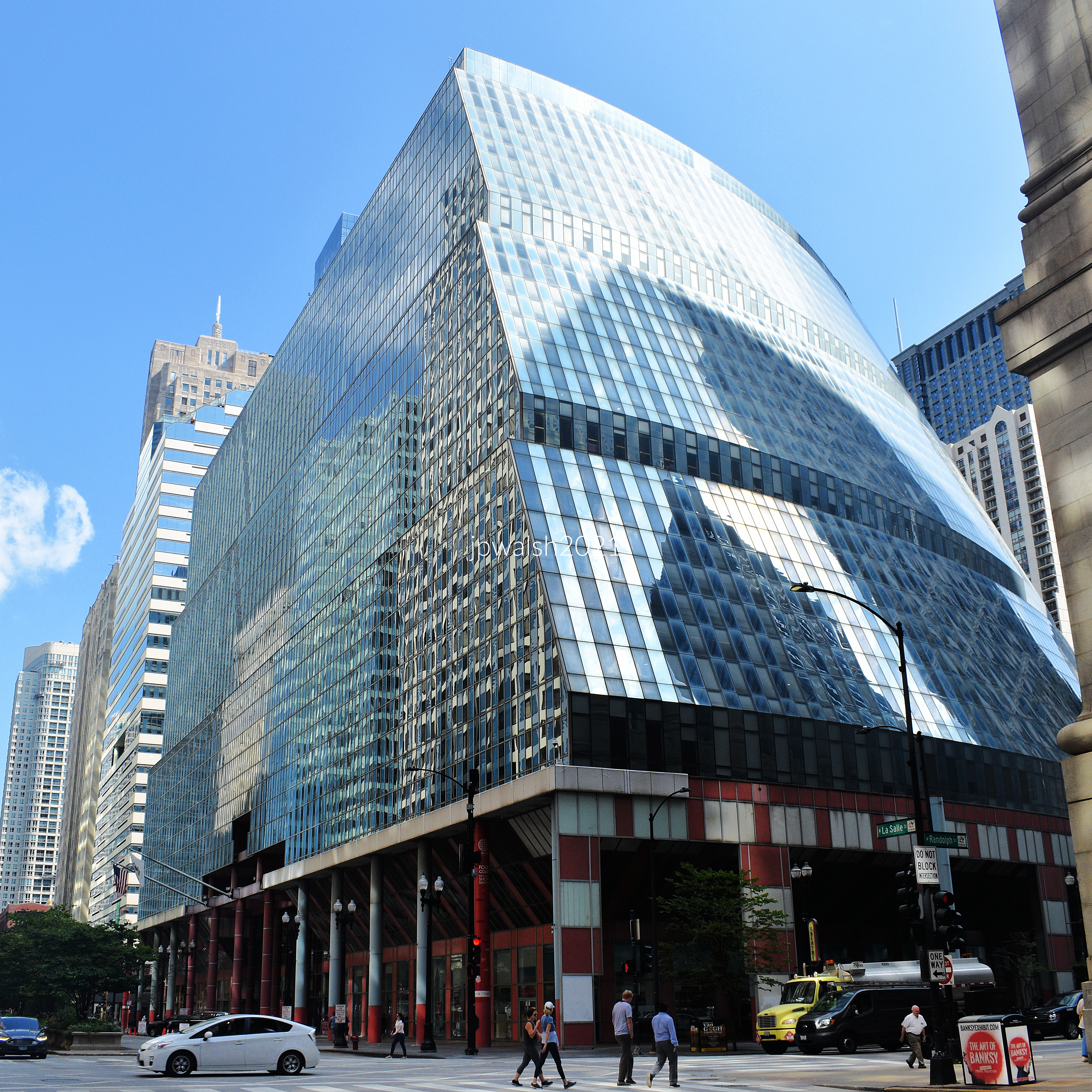
FEATURE image: Helmut Jahn, State of Illinois (Thompson) Center, 100 W. Randolph, Chicago, Illinois, 1979-1985. The Thompson Center was officially bought by Google in 2022 for a reported $105 million. Author’s photograph. 5/2014 4.75 mb
Helmut Jahn was famous in Chicago and around the world for his prolific postmodern architecture particularly his work in steel and glass.
Born in Germany near Nuremberg, in 1940, Jahn graduated from Technische Hochschule in Munich and moved to Chicago in 1966. Jahn arrived in Chicago just as “downtown development” during the administration of Mayor Richard J. Daley (1902-1976) was finding its greatest momentum. Jahn began to study under Ludwig Mies van der Rohe (1886-1969) at the Illinois Institute of Technology (IIT) and, in 1967, joined Charles (C.F.) Murphy Associates which later became Murphy/Jahn. The younger man would carry on the powerful influence and energy of these Chicago personalities for building big, creatively, and prolifically for the next fifty years into the first quarter of the 21st century. Jahn would add his own significant contribution and footprint in Chicago and around the nation and world in those same long years of his activity.
One of Jahn’s early projects in his first years in Chicago was McCormick Place. The original concrete and steel permanent exposition hall on the lakefront that opened in 1960 was destroyed in a fire in January 1967, just as Jahn was starting to work as a professional architect. Named for Col. McCormick of the Chicago Tribune, the newspaper owner and publisher had boosted the idea of a permanent exposition hall on Chicago’s lakefront for years prior to his death in 1955.
Jahn had come to Chicago at an exciting time to be building there — during Jahn’s first years in Chicago the John Hancock Building was completed in 1969 and the Sears Tower, the tallest building in the world for the next 24 years, was completed in 1974. In 1971, C.F. Murphy completed the new and massive McCormick Place, a powerful steel and glass structure with enormous cantilever eaves, on the same lakefront site as the old exposition hall. Out of that single successful building project, Helmut Jahn and the rest of the world saw the significant development in Chicago that would blossom around this important and functional modern architecture over ensuing decades — including the North building constructed across Lake Shore Drive in 1986; the South building built in 1996; a hotel built in 1998; the massive West building built in 2007; and, in 2017, the Wintrust Arena.
In the mid 1980’s one of Jahn’s most significant creations was the James R. Thompson Center in Chicago. Aesthetically grandiose and controversial, the “State of Illinois Building” was put up for sale in 2021 by the administration of Governor J.B. Pritzker, citing its historically high operating and maintenance costs.
Jahn designed the 23-story addition to the Chicago Board of Trade in 1980 and Accenture Tower at 500 W. Madison in the West Loop which opened in 1987. Across the nation and world Helmut Jahn’s fresh, grand, and innovative designs have made their way into the annals of postmodern architecture. Any complete list of Helmut Jahn’s active and completed projects extends necessarily into the many scores. A list of notable buildings could include the 1999 K St. NW, a 12-story structure, in Washington D.C. completed in 2009; the twin 37-story Veers Towers in Las Vegas, Nevada opened in 2010; and, in his native Germany, the 63-story Messeturm in Frankfurt opened in 1990 and the Sony Center, a complex of eight buildings, in Potsdamer Platz in Berlin completed in 2000. The hard-driving list goes on…and on.
In Chicago Jahn designed the exposed steel frame United Airlines Terminal 1 at O’Hare International Airport between 1985 and 1988. Air travelers for decades have enjoyably traversed its entertaining walkway connecting concourses that include moving sidewalks, colorful lighting and futuristic sounds.
At the time of his death at 81 years old on May 8, 2021 in a bike road accident in the far western suburbs of Chicago, Helmut Jahn was working on a 74-story residential building in Chicago at 1000 S. Michigan. It was scheduled to be opened in 2022 but its construction was already delayed because of the Covid-19 pandemic that postponed construction. Helmut Jahn taught at IIT, the University of Illinois-Chicago, Harvard University, and Yale University. In 2012 Murphy/Jahn became JAHN and, according to a recent report from Dun & Bradstreet, the firm had a total of 55 employees and generated a little over $6 million in annual sales.
Xerox Center, 55 West Monroe, Chicago, 1977-1980.
In what was one of Helmut Jahn’s first great urban achievements, the 40-story office tower on an important corner in downtown Chicago was built on speculation and soon took the name of its major tenant (Xerox). The sleek and simple curtain wall of enameled off-white fluoropolymer aluminum panels and reflective glass slide over a reinforced concrete structure and around its soft postmodern corners in contrast to the modernist box.
The tower is fitted to its site where the building’s corner is exaggerated at street level with varying glaze percentages, and the white-black-silver palette of the lobby follows a diagonal pattern (also on the roof) in contrast to the exterior curvilinear design.
Silver double-glazed reflective glass pays homage to 1950’s and 1960’s Chicago modernism and the Xerox building’s closest neighbors: the kitty-corner Inland Steel Building (1954-1958, Skidmore, Owings and Merrill) and, directly across to the north, the First National (today, Chase) Bank building (1964-1969, C.F. Murphy Associates with Perkins and Will).
Helmut Jahn (C.F. Murphy Associates)/Murphy Jahn. Xerox Center, 55 West Monroe, Chicago, 1977-1980. 12/2014 5.60 mb 99%
Some have observed that Jahn’s curving tower may have been inspired by Louis Sullivan’s 1899 Schlesinger and Mayer department store building on State Street (what became in 1904 Carson, Pirie, Scott and Company Building and today is The Sullivan Center). The 1980 project’s original conception was for two curvilinear towers though obviously only one was constructed obfuscating and negating the original design’s uniquely bold impacts.
The glass and aluminum are arranged to alternate in horizontal bands which have modernist predecessors in Chicago and Europe. Hidden from the street view are more diagonals that cut a pattern across the roof. The building is a major transition for Jahn who, steeped in mid-20th century Modernism, harkened back to earlier 1920s modernist sources for the 55 W. Monroe (Xerox) building. The author’s photograph was taken on December 24, 2014.
SOURCES for 55 W. Monroe: Building Chicago: The Architectural Masterworks, John Zukowsky, New York: Rizzoli with Chicago History Museum, 2016, p. 237.
AIA Guide to Chicago, 2nd Edition, Alice Sinkevitch, Harcourt, Inc., Orlando, 2004, p. 67.
The Sky’s The Limit: A Century of Chicago Skyscrapers, Jane H. Clarke, Pauline A. Saliga, John Zukowsky, New York: Rizzoli, 1990, p. 233.
Chicago Architecture and Design, 3rd Edition, Jay Pridmore and George A. Larson. New York: Abrams, 2018, pp. 210-211.
Helmut Jahn, Nory Miller, New York: Rizzoli, 1986, pp. 76-81.
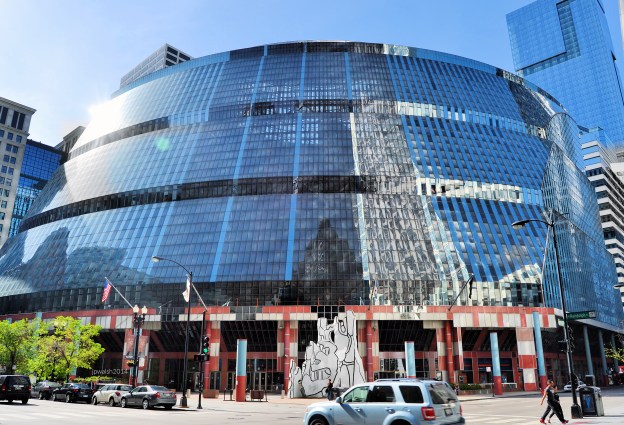
Thompson Center, 100 W. Randolph, Chicago, 1979-1985.
May 2014. Helmut Jahn, State of Illinois (Thompson) Center, 100 W. Randolph, Chicago, Illinois, 1979-1985. The building is massive at 1.15 million square feet. The rounded facade was intended to embody the traditional architectural history of monumental rotundas and domes. When it was built in the early 1980s it was one of the most exciting projects taking place downtown. Sitting across the street from a classical revival City Hall (1911) and a modernist Daley Center (1965), the postmodern 1980’s monstrosity by Murphy/Jahn was criticized for being out of context in the neighborhood. Yet, over the following decades, that criticism increasingly faded. 4.75 mb
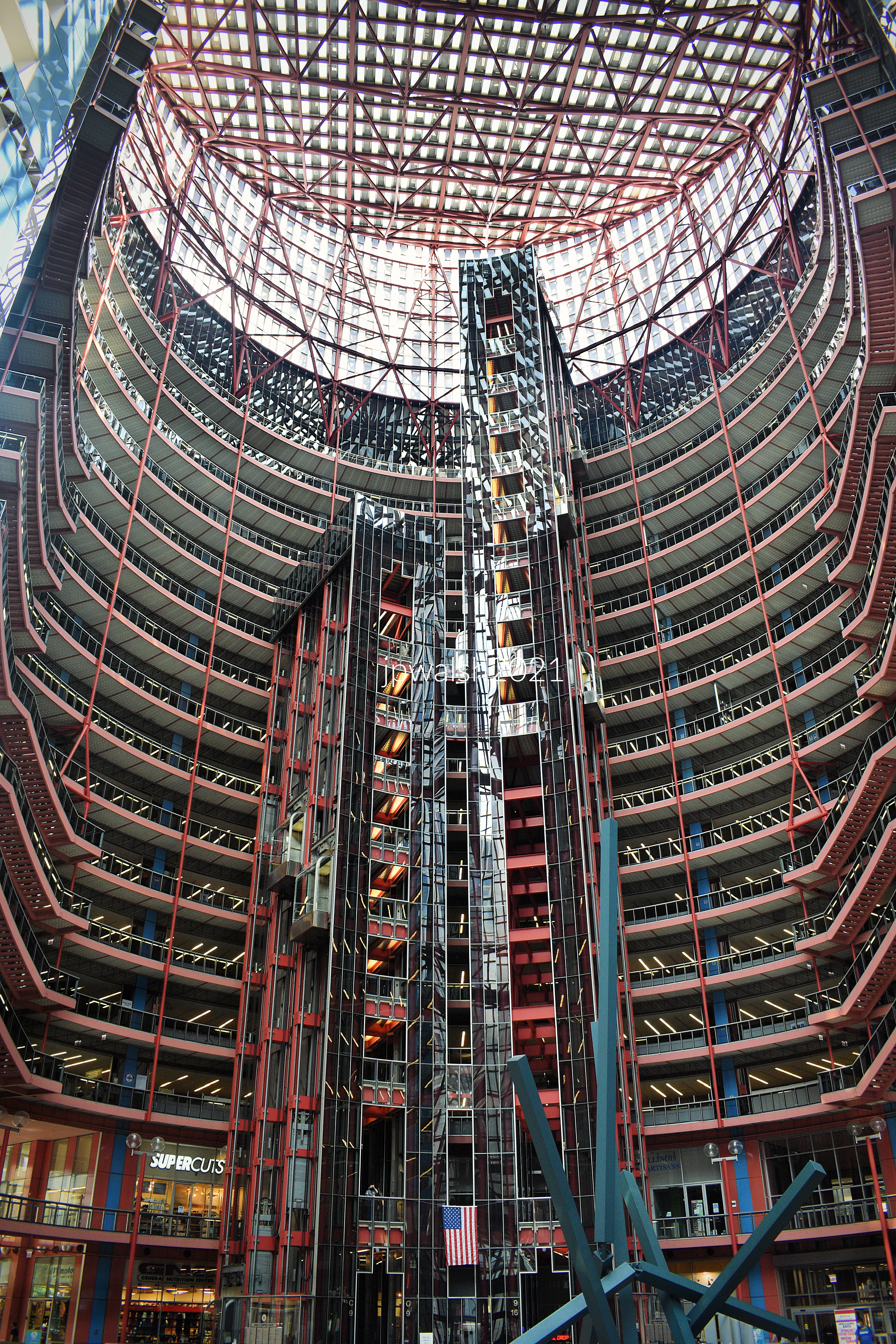
There were mixed reviews for Helmut Jahn’s massive semi-circular Thompson Center at 100 W. Randolph completed in 1985. The criticism begins at its entrance where Jahn saw placed “Outsider” French artist Jean Dubuffet’s fiberglass Monument with Standing Beast. During the building’s planning and construction some of the architect’s dazzling concepts met with resistance from contractors. For example, the contractors prevailed over Jahn’s idea for a completely locked-down outer skin using silicone glazing. In the final construction the appearance of red, white, and blue locked-down skin belies the several places throughout the design where windows are made to be opened. Inside, though its soaring 17-story atrium is airy and impressive exposing floors that hold various state bureaucracy—and signaling the idea of state government’s day-to-day practice towards transparency — the practicalities of the new building’s heating and cooling design proved seriously problematic during Chicago’s summer heat and winter cold though that major issue appeared to be eventually resolved. In 2021 Jahn’s mega-structure has been put up for sale by Illinois Gov. J.B. Pritzker from Chicago citing that the building costs hundreds of millions of dollars to operate and maintain. The photograph was taken by the author on May 25, 2014.
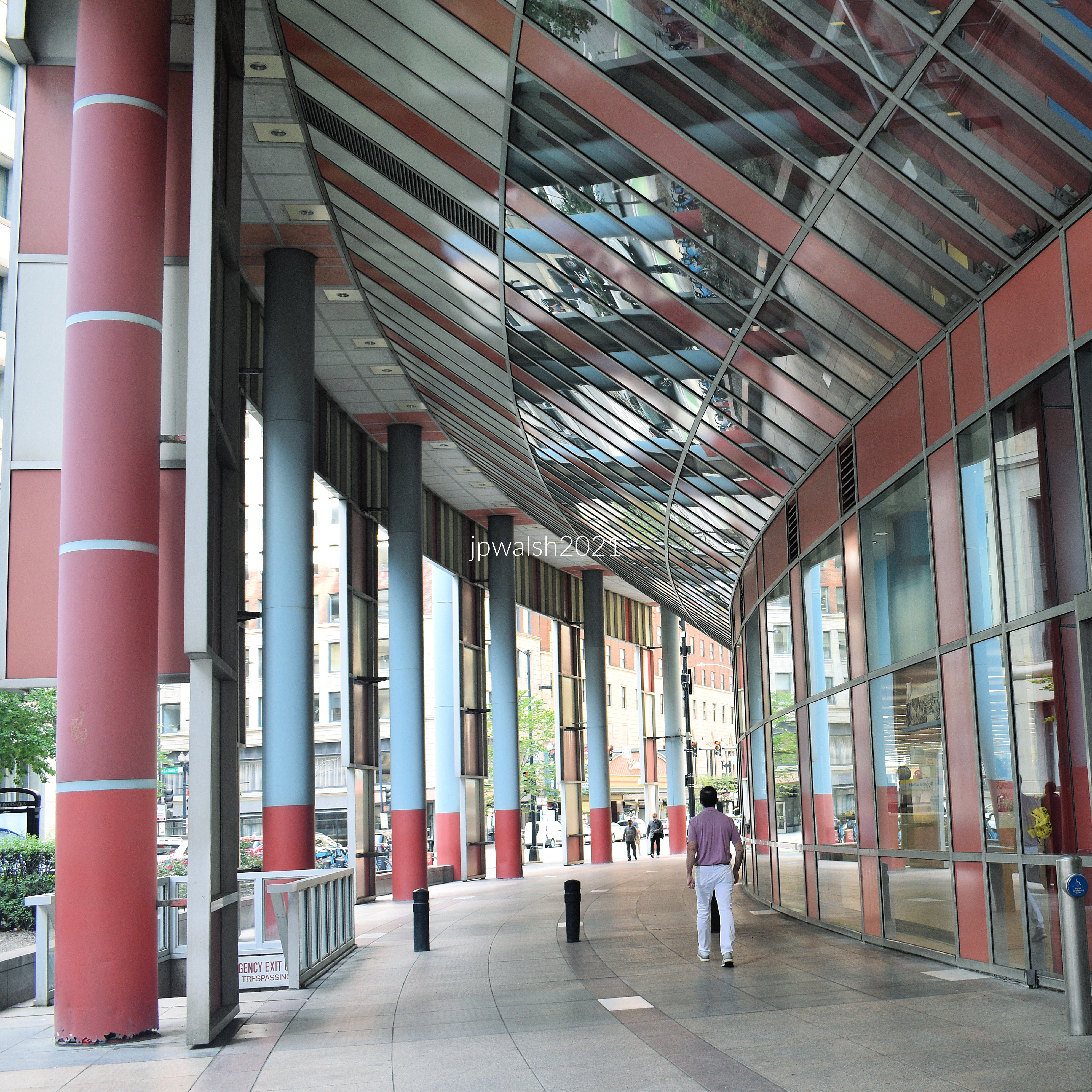
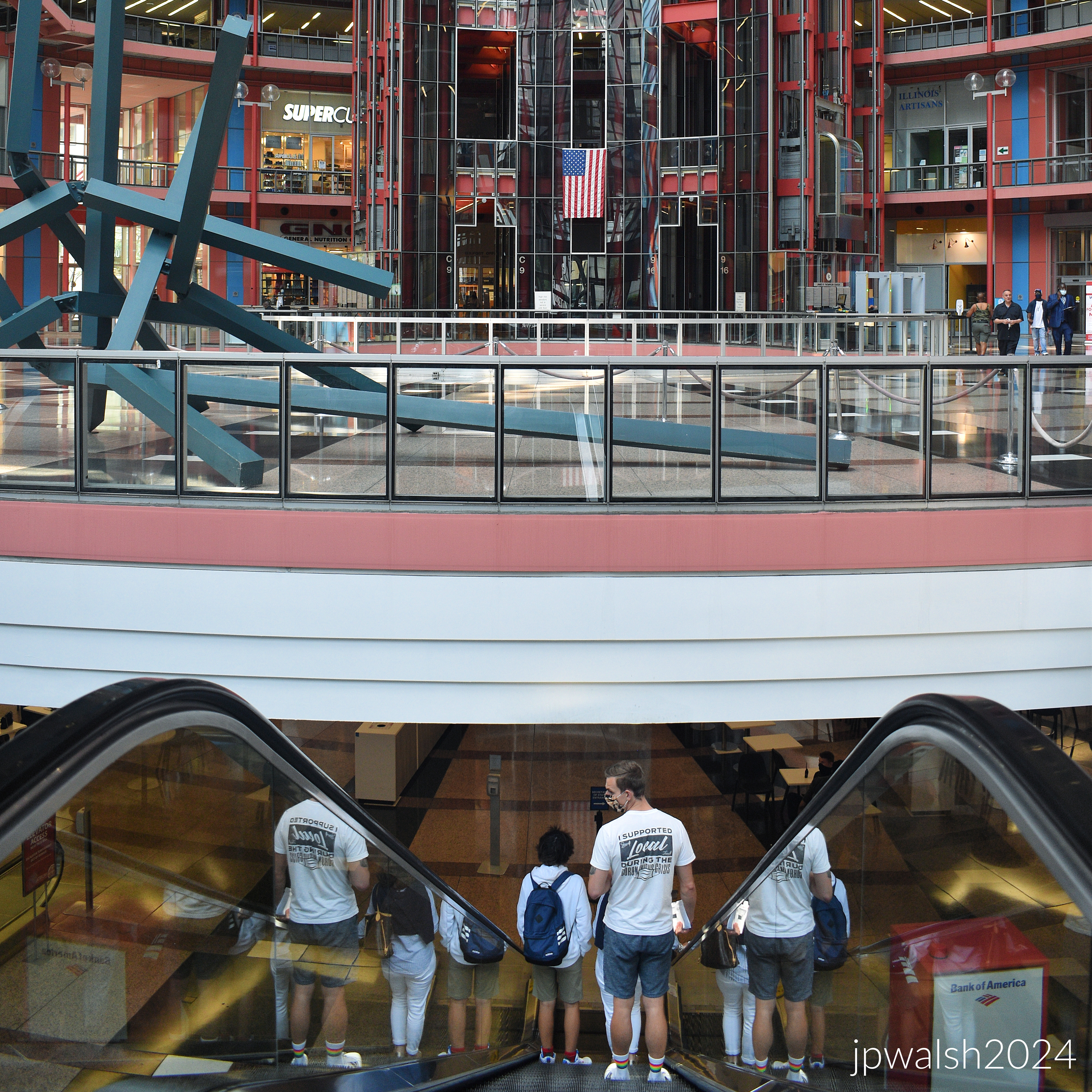
August 2021. The State of Illinois Center from the southwest Randolph and LaSalle Streets. Setbacks divide the building into three tiers seen here 99% 7.65mb _9369August 2021. The pink and gray granite arcade at street level is a contrast to the silver and opaque blue ornamental glass and provides a covered passageway. 99% 7.22mb_9380August 2021. The rotunda with its skylit atrium is 160 feet in diameter. The massive airy space is met by circular walkways and freestanding bank of glass elevators. 70% 7.87 mb_9381August 2021.The rotunda has an elaborately paved granite floor with tens of thosand of square feet of retail space. 99% 6.87 mb_9384
1 S. Wacker Drive, Chicago, 1982.
May 2014. Helmut Jahn, One South Wacker Drive, Chicago, Illinois, 1979-1982. On a corner site, Jahn’s design is a freely translated interpretation of a 1920s stepped back tower with the building’s skin a stylized exaggeration of vertical windows and stone facades of the same 1920s’ period structures. 4.45 mb
To the left is UBS Tower (1 N. Wacker) built in 2001 and to the right is Hyatt Center ( 71 S. Wacker) built in 2005. At 42 years old, Jahn spoke of his building at 1 S. Wacker as a synthesis of two major Chicago architectural styles—that of Louis Sullivan (1856-1924) and, Jahn’s mentor and fellow German, Mies van der Rohe (1886-1969). The building is a concrete stepped-back 50-story building with a curtain wall of dark glass defining the vertical bands of windows. Its vision remains fresh and stunning as it sits majestically between two postmodern buildings built in Chicago a generation later. The author’s photograph was taken on May 25, 2014.
August 2021. Floors in each section of the stepped back tower are of three different sizes, each 6,000 square feet less as the building ascends. The setbacks’ atria allow in natural daylight. 78% 7.77mb _9293December 2017. 6.27mb DSC_0567 (1)
IIT’s Rowe Village, Chicago, 2005.
Helmut Jahn, Jeanne and John Rowe Village at the Illinois Institute of Technology (IIT), Chicago, Illinois, 2003. 8/2015 3.67 mb
Originally called the State Street Village Dormitories, Jahn’s postmodern structure that anchors the campus to the east, consists of three five-story buildings. Jahn’s design was the first major architectural addition to the IIT campus since the early 1960’s. U.S. News & World Report called it one of the “coolest dorms in the nation.” Stretching one city block along busy State Street from 33rd to 34th Streets, Rowe Village is next to the El tracks whose Green Line zips back and forth to Chicago’s Loop. Each dorm building consists of two wings that flank an interior courtyard. The building is finished at the rear on 34th street by an insulated five-story glass wall. Entry is through the courtyard which leads into a corridor that connects the two wings. It is built of reinforced concrete with the front elevations and roof dressed in custom corrugated stainless steel panels and tinted glass framed in aluminum. The building’s sleek curvature, three compartments and chained block-long length, reflects and evokes the image of a streamlined train making for a building as Art Moderne object in the Miesian tradition. From its rooftop the Rowe Village looks north for views of Chicago’s downtown skyline while the dorm offers suite-style living in a modern setting surrounded by the mind, serious and playful, of Helmut Jahn. The photograph was taken by the author on August 21, 2015.
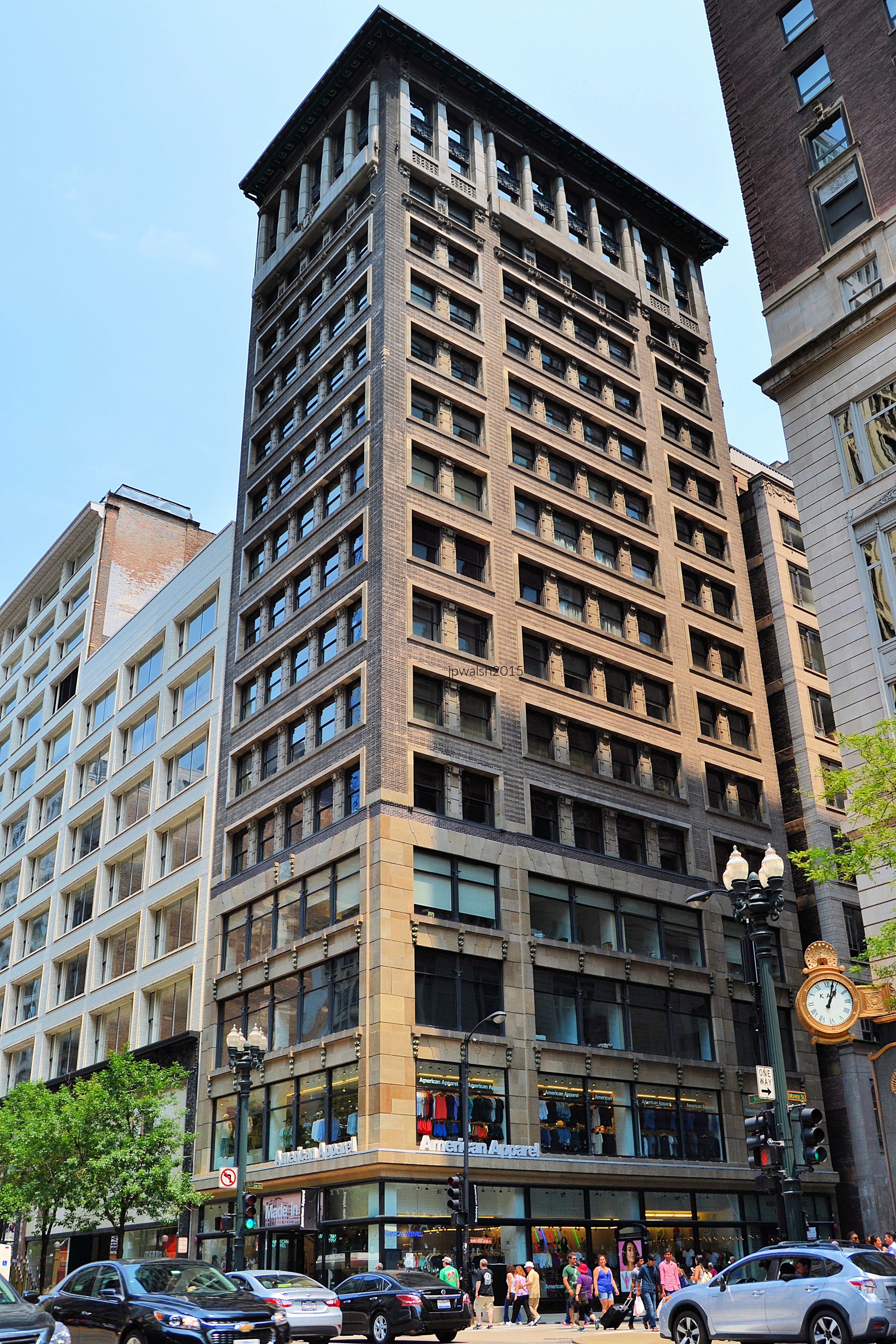
Howard Van Doren Shaw (1869-1926), 1906, THE MENTOR BUILDING, 39 S. State Street (6 E. Monroe Street), Chicago, from the southwest. Author’s photograph, 7/2015.
A Mentor building has stood on the northeast corner of State and Monroe Streets since 1873. Until 1906, a 7-story building was erected here.1
The 1906 building by Howard Van Doren Shaw (1869-1926) is 17 stories high with two basements on rock caissons.2 Shaw’s only skyscraper presents an unusual mixture of styles, a talent for which Shaw built his practice’s reputation starting in 1897. The building was designed as a mixed use skyscaper, including retail sales and commercial business.3
Inspired by the Prairie style, there are windows grouped in horizontal bands between a four-level base of large showroom windows. The top is classically inspired with details that are strong and idiosyncratic. The brown brick and terra cotta building retains the character of its classical sources though they are used as large-scale motifs.4
Howard Van Doren Shaw (1869-1926). Public Domain.
Shaw studied architecture at Yale University and apprenticed in Chicago for William Le Baron Jenney (1832-1907). In Chicago and its northern suburbs Shaw had an illustrious career designing major commercial, church, and museum buildings and projects as well as mansions for the area’s elites.5
1 Frank A. Randall, History of Development of Building Construction in Chicago, Second Edition, Revised and Expanded by John D. Randall, University of Illinois Press, Urbana and Chicago, 1999, p. 196.
2 Ibid., p. 265.
3 Saliga, Pauline A., editor, The Sky’s The Limit A Century of Chicago Skyscrapers, Rizzoli New York, 1990, p. 73.
4 Alice Sinkevitch, AIA Guide to Chicago, 2nd Edition, Harcourt, Inc., Orlando, 2004, p. 59.
FEATURED image: Napoleon near Borodino, Vasily Vereshchagin (1842–1904), 1897, oil on canvas, State Historical Museum, Moscow.
The Emperor Napoleon in His Study at the Tuileries, 1812, Jacques-Louis David (1748-1825), National Gallery of Art, Washington, D.C.
Major facts of the life of Napoleon Bonaparte (1769-1821) are well known. Known as Napoleon I, the French Emperor who died two centuries ago was a shrewd, ambitious and skilled military leader who conquered much of Europe in the early 19th century.
Born on the island of Corsica that had recently handed authority from Italy to France, Napoleon rose rapidly in the French military during the unsettled period of the French Revolution after 1789 and until 30-year-old Napoleon seized power in a coup d’état in 1799.
In 1804 Napoleon crowned himself emperor in Notre Dame Cathedral in Paris in the presence of the pope. In the next decade Napoleon successfully waged war against various coalitions of European nations and expanded his empire. Following his disastrous French invasion of Russia in 1812 explored in some detail in this post, Napoleon abdicated his throne in 1814 and was exiled to the island of Elba not far from his native Corsica in the Mediterranean Sea near Italy.
In 1815, he escaped Elba and returned to France where he briefly returned to power in his Hundred Days campaign. He received a crushing defeat at the Battle of Waterloo in today’s Belgium and was exiled until his death on May 5, 1821 to the remote island of Saint Helena in the South Atlantic Ocean. Napoleon Bonaparte was just 51 years old at the time of his death stemming from mysterious circumstances, though likely something such as stomach cancer.1
Napoleon on St. Helena, Franz Josef Sandmann (1805-1856), c. 1820. Musée national des châteaux de Malmaison et de Bois-Préau.
In 2021, the bicentenary of the death of Napoleon I is commemorated. While 200 years is a long time ago, in terms of History it is a relatively short span amount of time. In other words, Napoleon, who might have come to the United States (New Orleans) after his exile, is not very far away from modern times.
Napoleon Bonaparte, born in Corsica which had just switched allegiance from Italy to France, was born in 1769. In 1821 when he died on May 5 he was 51 years old. The former French emperor died far away from Europe on the island of Saint Helena in the middle of the South Atlantic Ocean. Napoleon had been exiled there following his defeat at Waterloo in Belgium in 1815 and escape from Elba in the Mediterranean, the British Government’s first location for his confinement.
Between the continents of Africa and South America, St. Helena is much more remote. The island built its first airport only in 2011.
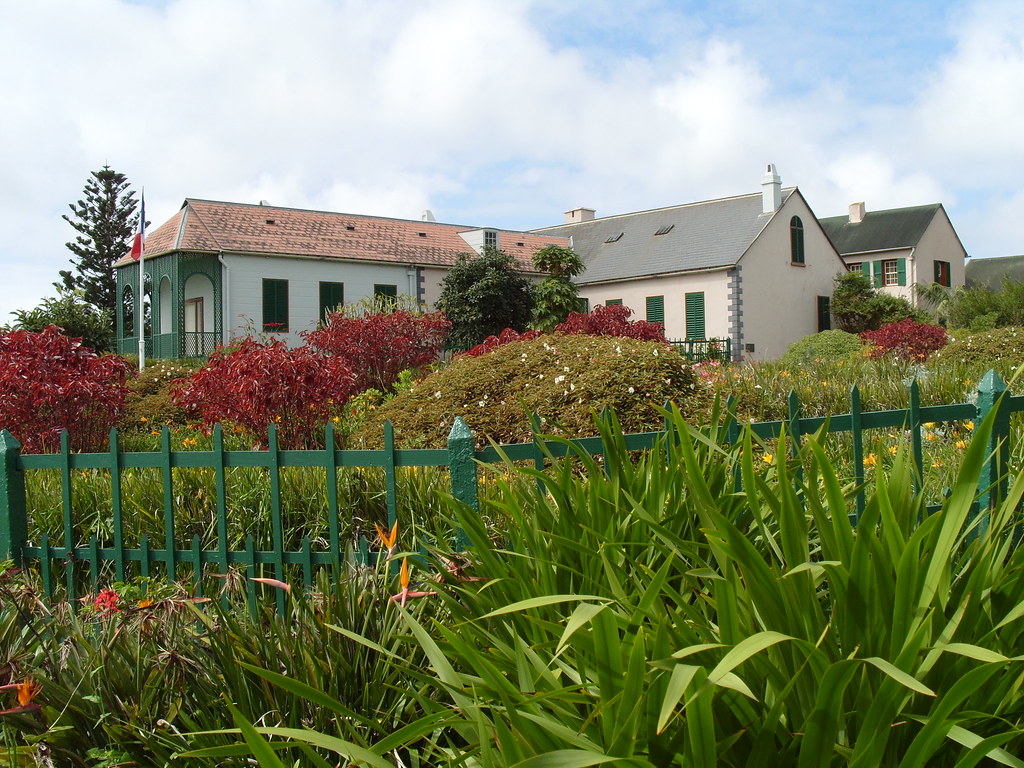
Napoleon lived on St. Helena for about 6 years and died there, somewhat unexpectedly, at Longwood House. Napoleon’s permanent residencewas completed for him in December 1815.
Napoleon was buried on St. Helena. In 1840, stirring old wounds of controversy, the remains of the warring General and French despot were transferred to Paris. Napoleon’s tomb in Les Invalides had been a military hospital whose construction was by Louis XIV (1638-1715).
Napoleon’s plaster death mask, known as the Malmaison mask, May 1821.
In 1858, French emperor Napoleon III, nephew of Napoleon I, purchased Longwood House and various other lands associated with Napoleon I on St. Helena for the French government. Though Napoleon’s remains were returned to France in 1840, Napoleon III’s purchase on St. Helena remains the property of France . It is administered by a French representative under the authority of the French Ministry of Foreign Affairs. (see –https://fondationnapoleon.org/en/activities-and-services/preserving-heritage/operation-st-helena/ – retrieved May 5, 2021).
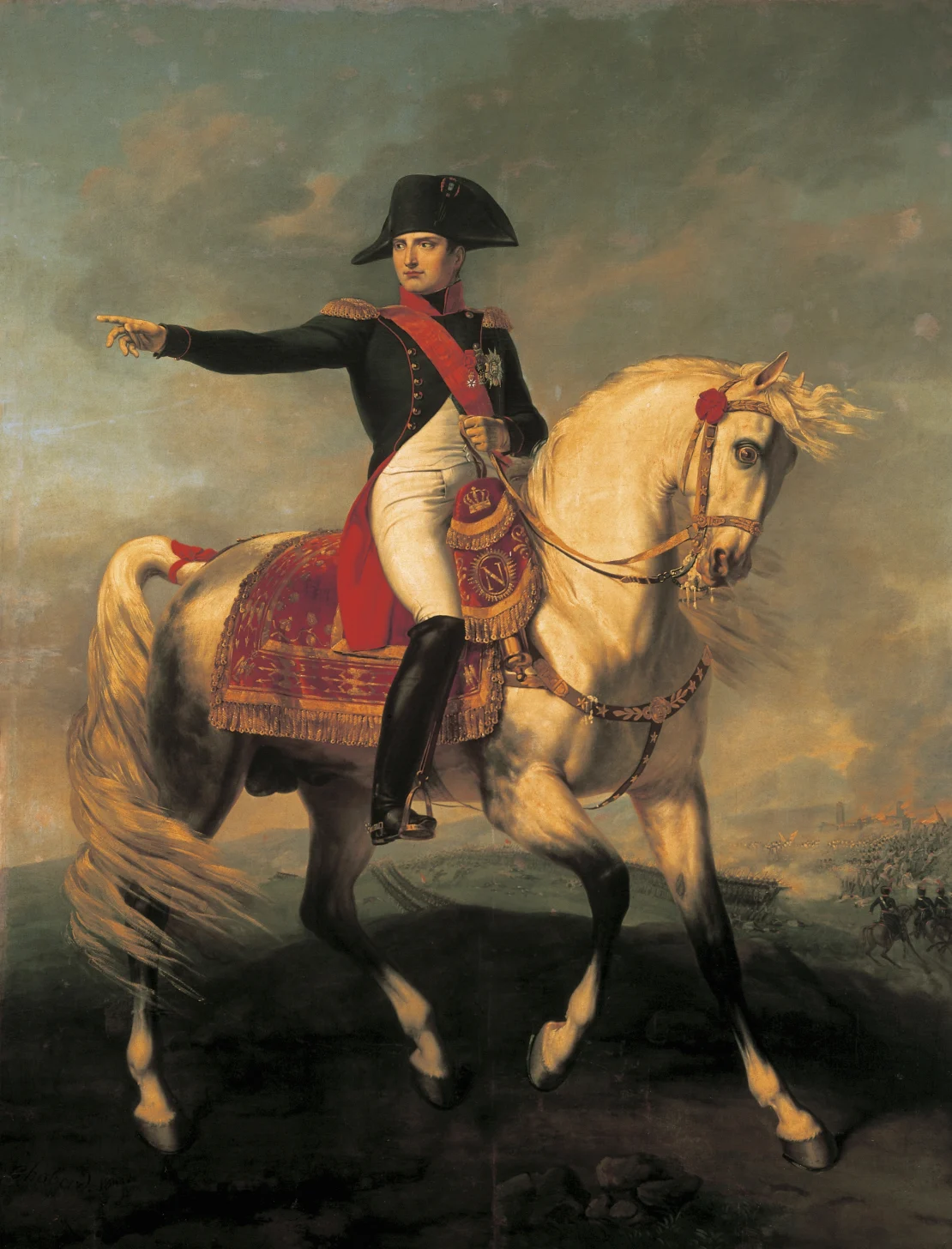
Napoléon at Battle of Wagram, July 5-6, 1809, Joseph Chabord (Chambèry 1786-Paris 1848), 293 cm (115.3 in) x 224 cm (88.1 in), Museo Napoleónico, Rome, Italy. On July 5-6, 1809 took place north of Vienna the greatest battle in world history up to that time – the Battle of Wagram. It was Napoleon’s last and greatest victory. It opposed the Austrian army led by Archduke Charles, Duke of Teschen (1771-1847) against the Franco-Italo-German army under Napoleon I, Emperor of the French, King of Italy, Protector of the Confederation of the Rhine. The painting depicts the plain of Wagram, the scene of the battle with the dominant figure of Napoleon, perfectly settled upon a wild-eyed horse. The Emperor wears the uniform of Colonel of the Chasseurs on Horseback with the insignia of the Legion of Honor and the Iron Crown. The grandeur of the rider-horse group, which contrasts with the small figures of the soldiers in the background, accentuates the heroic character of Napeoleon, a charismatic strategist who dominates the events. The commemoration painting probably was linked to an official commission. The painting was in the collection of Hortense de Beauharnais (1783-1837), the daughter of Napoleon’s first wife, Joséphine de Beauharnais. in Arenenberg, where the former Queen of Holland lived from 1817 until her death. It remained there until 1905, when the last owner of the castle, the former Empress Eugenie, wife of Napoleon III, donated it to Count Giuseppe Primoli. Public Domain. See – https://www.museonapoleonico.it/it/percorsi/percorsi_per_sale/sale_i_e_ii_il_primo_impero/napoleone_sul_campo_di_battaglia_di_wagram
IN THE YEAR 1812 – A BAD ECONOMY, CONTINENTAL BLOCKADES, AND A DISASTROUS INVASION OF RUSSIA BY NAPOLEON
During the War of 1812 which had ramifications for the U.S., world domination by Napoleon was being attempted within a sagging, uncooperative economy in Europe.
France had 300,000 French troops and a rafter of French generals occupying Spain to keep the blockaded British from invading. Napoleon, in a near constant state of war since 1793, had created an Empire whose subjected parts didn’t cooperate. In 1812, Napoleon had to choose between losing his blockade in Spain or in Russia.
Since the Treaty of Tilsit in 1807 which followed the Battle of Friedland where Napoleon defeated the Russian army, Russia continued to transact business with England. This was a violation of the agreement and the pretext for Napoleon’s invasion of Russia in 1812.
While over 1,500 miles away from Paris, Napoleon wanted to shut down Russia’s economy and take full control. For Russia, Napoleon’s invasion required the defense of their homeland.
NAPOLEON’S NEW WAR CAMPAIGN NEEDS 700,000 CONSCRIPTED SOLDIERS
Napoleon needed fresh conscripts but a third of Napoleon’s French draftees didn’t report for duty. Many of Napoleon’s generals advised the dictator to stay in Paris and enjoy life’s spoils. Napoleon refused. He explained that he would not rest until he fulfilled the dream to form a United States of Europe.2
Napoleon assembled 700,000 men with the monumental task to pay for it. For years the Emperor had been stockpiling supplies along the route to Russia and even arranged for their delivery on the battlefield.
Napoleon left St. Cloud for Moscow in June 1812. His high stakes gamble would affect not just Napoleon’s fortunes but the Empire’s inhabitants.
Ernest Meissonier (1815-1891), Campaign of France, 1814, 1864. Oil on wood, 51.5 x 76.5 cm, Paris, Musée d’Orsay.
Ernest Meissonier’s Campaign of France, 1814, was the artist’s first painting produced in a cycle of Napoleon’s conquests. Though the episode Meissonier depicts was painted for the fiftieth anniversary of Napoleon’s invasion of France from Elba in 1814, it captures the overall desolation that surrounded the former French Emperor by the time of his invasion of Russia in 1812.
The series made by the 49-year-old artist, an admirer of seventeenth-century Flemish and Dutch small-format painting, captures the desolate landscape the Grande Armée endured. It also depicted a solitary, unusually unkempt, and tenuous figure of Napoleon who is leading the General Staff and troops in an over-extended military campaign that spelled defeat.
For the painting, the artist’s imagination was informed by historical documentation including interviews of surviving eyewitnesses, including the detail of the Emperor’s grey coat. Its realist style was a prevailing aspect of mid-19th century artistic taste during the Second Empire headed by Napoleon III from 1852 to 1870.
The army marched 1,200 miles to Lithuania to defeat the Russian army. But the Russians had retreated. Napoleon’s men had to march another 550 miles to Moscow. The generous supply lines got snarled. French troops turned sick and exhausted.
In the Battle of Smolensk, the French invaders—viewed by some to be fighting for a united liberal Europe over small state autocrats—set that town on fire. Napoleon’s criminal reputation preceded him – he murdered without mercy and often by treachery. Royalists criticized him but also articulate liberals like Alexis de Tocqueville (1805-1859) and François-René de Chateaubriand (1768-1848). The emperor was the enemy of liberty. Chateaubriand wrote: “Les Français vont indistinctement au pouvoir, ils n’aiment pas la liberté, l’égalité est leur idole. Or l’égalité et le despotisme ont des liaisons secrètes” (“The French go to power indiscriminately, they don’t like liberty, equality is their idol. But equality and despotism have secret links”).
With casualties for the Battle of Smolensk around 15,000 for both sides, the Czar appointed Mikhail Kutuzov (1745-1813) as commander of Russian forces. Napoleon called Kutuzov, “The sly old fox of the north“ (cited in Roger Parkinson, The Fox of the North, 1976). At 67 years old, Kutuzov was lazy and lecherous, but knew how to fight—and, regarding Napoleon’s invasion of Russia, how to retreat strategically. It made Napoleon’s thirst for further battle on his own terms impossible.
Portrait of Mikhail Kutuzov, 1829, George Dawe (1781–1829). Oil on canvas, State Hermitage Museum, Winter Palace War Gallery, St. Petersburg, Russia.
70 MILES WEST OF MOSCOW, THE BATTLE OF BORODINO PITS 242,000 TOTAL COMBATANTS WITH OVER 1,000 BIG GUNS ON SEPTEMBER 7, 1812
In his address to troops before the Battle of Borodino General Kutuzov told his men: “Napoleon is a torrent we are yet unable to stem. Moscow will be the sponge that sucks him dry.”3 Napoleon knew what he was up against. Without supplies, Napoleon ordered his men to keep marching: “Motion alone keeps this army together.”4
The march from Smolensk to Moscow took 3 weeks. Many soldiers of the Grande Armée died on the march. Kutuzov set up a defensive position in Borodino, about 70 miles west of Moscow. On Sept. 7, 1812, French forces engaged the Russians. Both sides were evenly matched – Napoleon had 587 guns and 130,000 troops and the Russians had 640 guns and 112,000 troops.
Hanging over the battlefield was the feeling that the destiny of Europe lay in the balance. The battle’s outcome was a draw. The French were masters of the field as the Russians retreated. It was another day for war’s slaughter— combined French and Russian losses was 80,000 soldiers.
Battle of Moscow (or Borodino), the Capture of the Great Redoubt. Engraving by unknown artist, 1820’s. State Borodino Military Historical Museum, Russia.Battle of Moscow (or Battle of Borodino) in 1812. Attack of the Lithuanian Life Guards Regiment, oil on canvas, 1912, Nikolay Semyonovich Samokish (1860-1944). State Borodino Military Historical Museum, Russia.General Uvarov at Borodino, Auguste-Joseph Desarnod (1788-1840), State Hermitage Museum, St. Petersburg, Russia.
In the War of 1812 Fedor Petrovich Uvarov (1769 -1824) commanded the 1st Cavalry Corps and then the Cavalry of the 1st and 2nd Russian Armies. With the Cossacks of Matvei Platov (1753-1818), Uvarov distinguished himself in the Battle of Borodino when he turned the left flank of the French army and made a raid to its rear. The Russian attack of the main French forces delayed Napoleon’s battle plans for two crucial hours.
Napoleon near Borodino, Vasily Vereshchagin (1842–1904), 1897, oil on canvas, State Historical Museum, Moscow.
The image of a sullen dictator (above) seated on his field chair with boots raised onto a battle drum, as his General Staff views in their spyglasses the men of the Grande Armée in harm’s way at the Battle of Borodino, can be seen as indicative of Napoleon’s exercise of arbitrary power as the first of modern history’s tyrants.
Battle of Borodino, 7th September 1812, 1822, Louis-François Lejeune (1775-1848).
WHEN LEJEUNE’S BATTLE-PICTURES WERE SHOWN IN LONDON, EAGER CROWDS CAME TO SEE THEM FOR THEIR REALISTIC, DETAILED DEPICTIONS OF SIGNIFICANT CONTEMPORARY EVENTS.
In the French invasion of Russia in 1812, Lejeune was made général de brigade and chief of staff to Davout (1770-1823). During the retreat, Lejeune was frostbitten on the face and left his post where he was subsequently arrested on Napoleon’s orders.
During his military service, Lejeune produced a series of important battle-pictures based on his experiences. They were generally executed from sketches and studies made on the battlefield. Known for their lofty perspective which, according to Chase Maenius in The Art of War[s], “offer[ed] a panoramic view of the totality of the battle’s events,” the Battle of Borodino… of 1822 is considered his masterwork.
In his Memoirs of Baron Lejeune, aide-de-camp to marshals Berthier, Davout, and Oudinot (translation, 1897), Lejeune related one of the many wretched scenes that the Napoleonic Wars produced. He wrote: “As we were pushing on the next day, we came upon two poor creatures at a turn in the road whose condition tore our hearts. They were a handsome well-built man of about forty and a woman of about thirty, also with a fine figure, both stark naked. They approached us and said to us in very good French, ‘Our home has been sacked by Cossacks, who stripped us of everything and left us as you see us. For pity’s sake help us.’ We could do nothing for them but give them a little food, and we felt very wretched as we turned away. The next day at a bivouac some distance off a fresh irresistible demand was made upon our pity, and our stock of provisions was so much reduced that I don’t know what we should have done but that some German peasants brought us a few sheep, with which we replenished our larder.” (p. 158, https://archive.org/details/memoirsbaronlej01maurgoog/page/n170/mode/2up —retrieved May 5, 2021.)
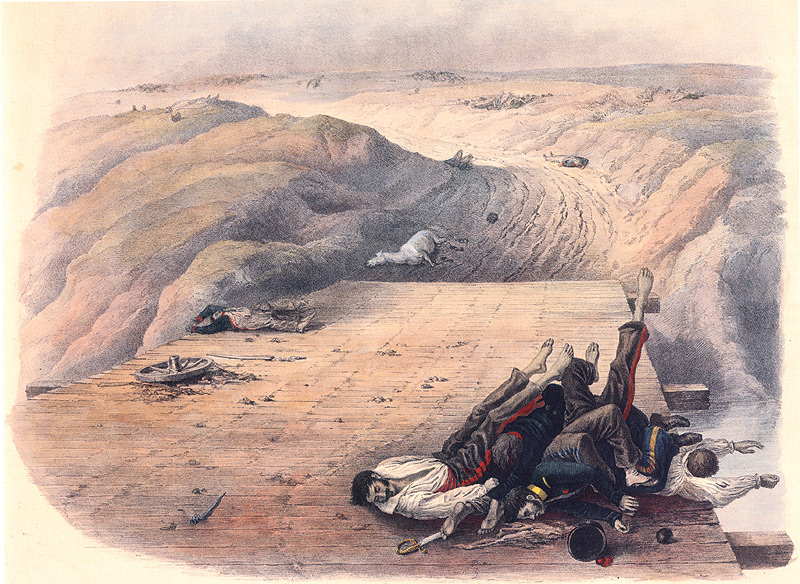
The bodies of dead soldiers of Napoleon’s Grand Armée left on the bridge over the River Kolocha after the Battle of Borodino, 1812. Christian Wilhelm von Faber du Faur (1780-1857), published 1830’s.Gen. Kutuzov at the conference of Fili deciding to surrender Moscow to Napoleon, Aleksey Kivshenko (1851–1895), 1880, oil on canvas, Tretyakov Gallery, Moscow.
Following the Battle of Borodino on September 7, 1812, the Russian army retreated towards Moscow and camped near Fili. A military council led by General Kutuzov assembled in a hut in Fili where, despite objections from younger generals, Kutuzov insisted on his plan to abandon Moscow.
The action not only saved the remains of the Russian army but worked to stymie and ultimately defeat Napoleon’s invasion drive. The personalities in the painting include Prince Michael Andreas Barclay de Tolly (1761-1818), who was replaced by Kutuzov on order of the Czar and sits in the corner below the Virgin Mary and Child Jesus icon. Fyodor Uvarov sits near Barclay holding a paper. Nikolay Raevsky (1771-1829) sits by the window with his fingers locked together. Aleksey Petrovich Yermolov (1777-1861) stands on the far right. The much younger Yermolov resented old general Kutuzov’s plan and demanded to fight the enemy.
Napoleon and about 100,000 French troops reached Moscow on September 8, 1812, Napoleon found only Russia’s poor and displaced. Moscow was Russia’s largest city, its capital, and its Holy City—and French troops of the Enlightenment set it ablaze. The fires burned for 4 days as Napoleon’s army looted it.
Napoleon wrote a letter of apology and condolence to the Czar, Alexander I Pavlovich, the Blessed (1777-1825). One result was that Tthe Russians resolved never to surrender to their would-be conqueror. Only some of the wealthy in Russia looked to negotiate with Napoleon mainly out of fear of losing their assets, that is, the serfs. Napoleon surmised, “I beat the Russians every time—but that does not get me anywhere.”5 Old general Kutuzov’s inaction attained his objective to defend Russia whereas 43-year-old Napoleon failed to rally his men for his Empire these many hundreds of miles from home.
In Ridley Scott’s Napoleon, after trudging with his conscripts through most of Europe, the French Emperor (Joaquin Phoenix) reaches Moscow in Russia. Itching for a fight, the Holy City is, instead, deserted. Disappointed and mocked, Moscow is looted and set ablaze by Napoleon’s men before they retreat. Posthumous Portrait of Czar Alexander I of Russia, 1826, George Dawe, State Hermitage Museum, St. Petersburg, Russia.
Napoleon’s interest became retreat. There was an intended coup d’état in Paris that Napoleon had to raise more fresh recruits to crush. Other parts of the Empire also raised their head following Napoleon’s inglorious retreat. But it grew worse to become one of world history’s worst defeats.
Weather in Russia turned to snow and ice. The Russians retreated into Mother Russia before they were defeated. The French retreated to the west in defeat. Reports of cannibalism among Napoleon’s army is recorded. Turning back to Paris, the French army lost another half of their men. All of Napoleon’s supply lines had been sacked. Adding further injury, the French were chased out of Russia by Kutuzov’s 80,000 troops.
Famous tell-all graph by French civil engineer Charles Joseph Minard (1781-1870) showing the size of Napoleon’s Grande Armée as it marched towards Moscow (top gray line, left to right) in summer of 1812 and its retreat (bottom black line, from right to left) in the late fall of 1812. Frozen temperatures during the humiliating retreat are plotted on the bottom graph.
On the retreat, surviving warriors fought among themselves over any existing supplies. Napoleon’s retreat included the humiliation of being chased out of Russia by Kutuzov’s redeployed 80,000 troops. The old man’s hot pursuit did not allow Napoleon, the once young Enlightenment military figure, to rest.
Under military surgeon Baron Dominique Jean Larrey (1766-1842), the Grand Army’s medical and sanitary measures were the finest in the world but the retreat route offered no food and no medical care. As a remedy for possible future ills, including his capture, Napoleon convinced his doctor to give him a vial of poison which the dictator could ingest if conditions deteriorated to become inescapably dire.
Portrait of Dominique-Jean Larrey, oil on canvas, 1804, Marie-Guillemine Benoist (1768-1826), Musée des Augustins, Toulouse, France.
Baron Dominique Jean Larrey was a French surgeon and military doctor who distinguished himself during the near endless wars of the French Revolution and under Napoleon. Baron Larrey served as the Grand Army’s medical and sanitation leader and was an important innovator in triage who is considered the first modern military doctor and surgeon.
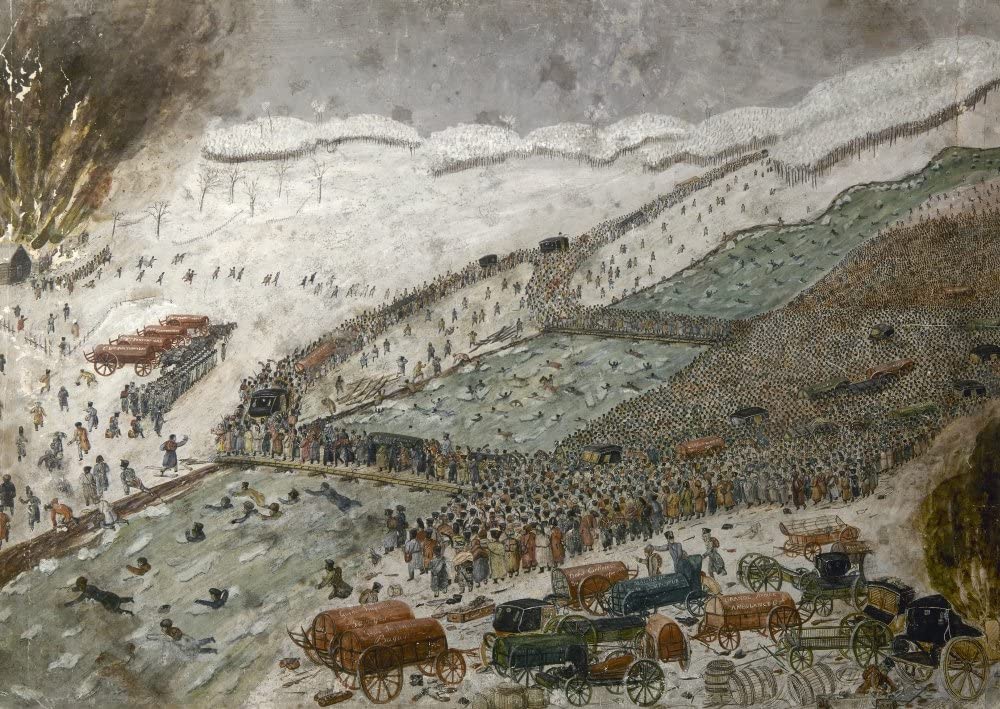
Napoleon: Retreat, 1812. /Ncrossing The Beresina River In Russia During The Retreat Of The Grand Army Under Napoleon Bonaparte, December 1812; Baggage Carts And Ambulances Have Been Abandoned In The Foreground. Watercolor, c. 1812, attributed to General François Louis Fournier-Sarlovèze (1773-1827).
During the Russian Campaign, Fournier commanded a brigade of light cavalry composed of French, German, and Central European horsemen, and led a noted cavalry charge at the Battle of Smolensk.
Generals Kutuzov and Wittgenstein attacked at a bridge crossing in what today is Belarus. Hundreds of Frenchmen drowned. To slow the attack, Napoleon ordered the bridges destroyed. In the process the general stranded hundreds of his troops to enemy gunfire.
Napoleon now told his aide-de-camp, Armand-Augustin-Louis de Caulaincourt, what the Russian campaign taught him: “I can hold my grip on Europe only from the Tuileries.” In Warsaw, Napoleon met Abbé de Pradt, his ambassador, and told him: “From the sublime to the ridiculous is but a step.”6
As Tchaikovsky’s 1812 Overture with its famous climax using cannon fire, ringing chimes and brass fanfare, commemorates a Russian defensive victory, French losses were staggering. Of Napoleon’s 700,000 men led into Russia, only 30,000 survived. Only 1,000 soldiers returned to active duty.7
NAPOLEON IN RUSSIA, HIS FORCES LOSE THE PENINSULAR WAR IN SPAIN; THE FOLLOWING YEAR, IN 1813, NAPOLEON LOSES THE BATTLE OF LIEPZIG, THE LARGEST LAND BATTLE UNTIL WORLD WAR I.
Simultaneous with the debacle of Napoleon’s Russian invasion, French forces lost the long fight (since 1808) in Spain and Portugal to keep the British off the Continent.
Significant losses in the east and west of the Empire were followed in 1813 by the Battle of Leipzig, Napoleon’s penultimate defeat by an international coalition that included Austria, Prussia, Russia and Sweden.
NAPOLEON FORCED TO ABDICATE IN 1814. EXILED TO ELBA; DEFEATED IN 1815 AT WATERLOO.
After Napoleon withdrew into France, in March 1814 these allied forces captured Paris. By early April 1814 Napoleon was forced to abdicate as Emperor. Napoleon had to go for his pursuit of glory had become a menace to his country and the world.
With the Treaty of Fontainebleau, Napoleon was exiled to Elba, and, following his brief escape into France in 1814, he was defeated for the final time at the Battle of Waterloo and exiled to St. Helena which held him until his death at 51 years old on May 5, 1821.
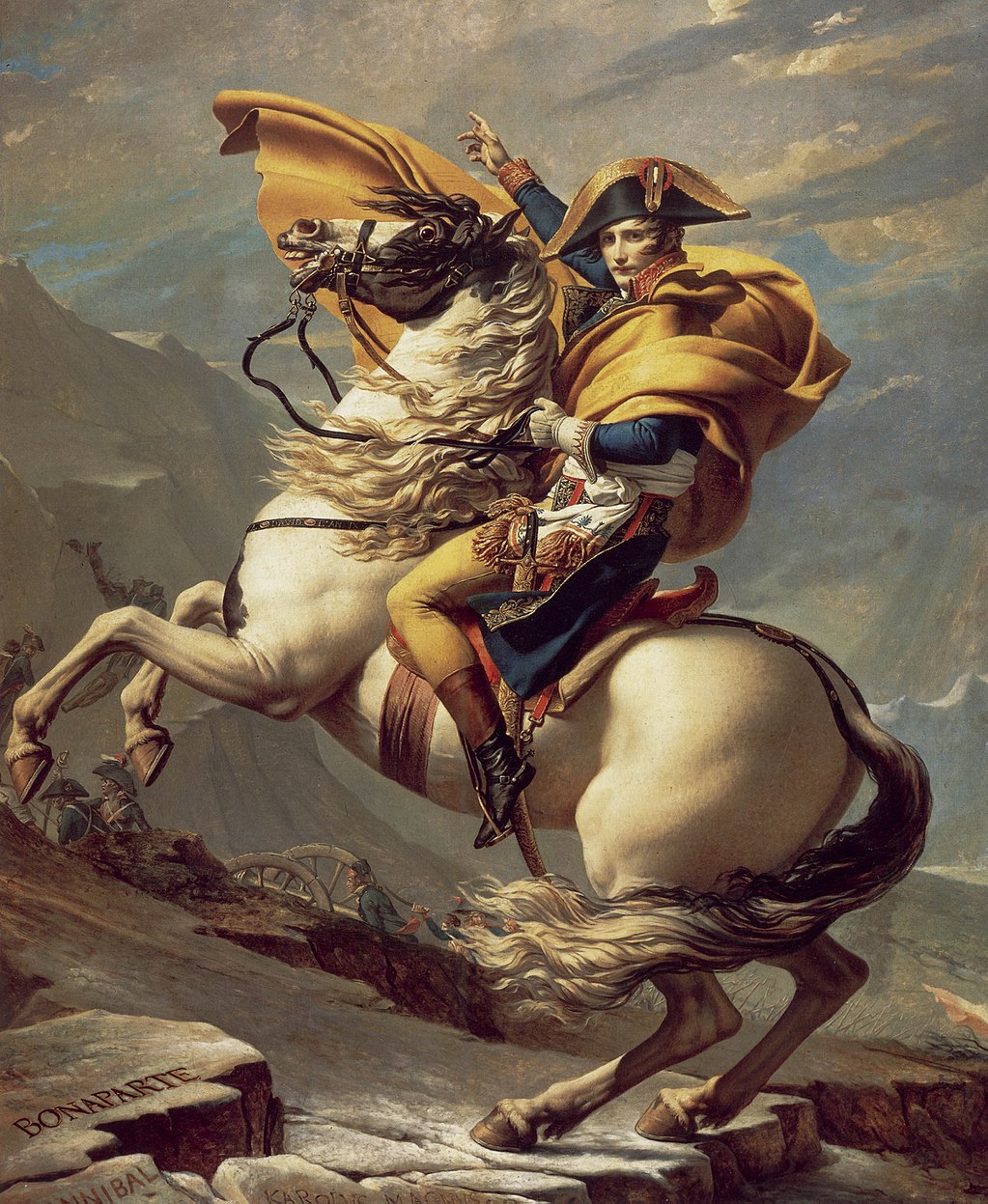
Napoleon Crossing the Alps, Jacques-Louis David, 1801, oil on canvas, 102 1⁄3 × 87 in., Château du Malmaison.
Known as the “Chicago Light,” the Chicago Harbor Lighthouse is an active automated lighthouse dating from 1893.
About one-half mile beyond Navy Pier, the lighthouse stands at the north of the main entrance of the Chicago Harbor in Lake Michigan. The lighthouse has had a significant role in the development of Chicago and the American Midwest and remains an active aid to nautical navigation today.
For more than a century, the U.S. Coast Guard has staffed this lighthouse at the breakwater outside the Chicago Harbor Lock. The lock separates Lake Michigan from the mouth of the Chicago River.
The lock was built in the mid-1930’s and is operated by the U.S. Army Corps of Engineers. The lock is one of the entrances into the Illinois Waterway system at the Great Lakes. The waterway system is a commercial and recreational shipping connection to the Gulf of Mexico by way of the Illinois and Mississippi rivers.
The “Chicago Light” is at that waterway system’s headwaters as it stands in the outer harbor constructed in 1880. The Chicago Light’s conical tower dates from 1893. Twenty-five years later, in 1918, the tower was reconstructed and the base building which contains a fog-signal room and boathouse was added. The architects are not identified.
Through its breakwaters, the main entrance into Chicago Harbor is 580 feet wide. The Chicago Harbor Lighthouse was designated a Chicago Landmark on April 9, 2003. It is the only surviving lighthouse in Chicago and one of two remaining examples in the state of Illinois.
Looking east from Chicago towards Lake Michigan, the mouth of the Chicago River.
About one mile ahead from this photograph’s location is the Chicago Harbor Lock. Built in the 1930’s, it provides the entrance/exit to the Illinois Waterway system at the Great Lakes. The waterway system is a commercial and recreational shipping connection from the Great Lakes to the Gulf of Mexico by way of the Illinois and Mississippi rivers.
What a view from the frozen waters of Lake Michigan! CBS 2 photojournalist Alfredo Roman shot this drone video of the Chicago Harbor Lighthouse, which has endured a lot of icy weather since it was built.
FEATURE image: Memorial Portrait of Hiroshige, 1858, Utagawa Kunisada (1786-1865), Museum of Fine Arts Boston.
Hiroshige is best known for his horizontal-format landscape series The Fifty-Three Stations of the Tōkaidō and his vertical format landscape series One Hundred Views of Edo.
His subjects are an expansion of the ukiyo-e genre, adding to its usual focus on beautiful women, popular actors, and scenes of urban pleasure districts during Japan’s Edo dynasty (1603–1868).
In 1603, the city of Edo (the earlier name for today’s Tokyo) became the urban center of the ruling Tokugawa shōgunate.
One Hundred Views of Edo is a series of ukiyo-e prints by the Japanese artist Hiroshige (1797–1858) that were published in serialized form between 1856 and 1859. Following Hiroshige’s death, the series was completed by his apprentice and posthumous son-in-law, Hiroshige II (1826-1869).
Utagawa Hiroshige (Japanese, 1797 –1858), The Chiyogaike Pond at Meguro (Meguro Chiyogaike), July 1856.
Meguro was a quiet outskirts of forest and fields at Edo. Megudo was named after Fudo-Myoo, an awesome guardian diety established during the reign of Tokugawa Ieyasu (1543-1616).
Tokugawa Ieyasu was the founder and first shōgun of the Tokugawa shōgunate of Japan. His great adviser was Tenkai (1536-1643), a Tendai Buddhist monk. The Tokugawa shōguns ruled Japan from the Battle of Sekigahara in 1600 until the Meiji Restoration in 1868.
Ieyasu Tokugawa (1543-1616) opened the Edo Shōgunate in 1603 and moved from a period in Japanese history of warring states to a stable society. Detail from artwork by Kanō Tan’yū (1602-1674).
Shōguns sometimes practiced falconry at this spot depicted in Hiroshige’s print. Each spring peasants gathered its bamboo shoots to sell. The old waterfall, which existed until the 1930’s, spilled into the O-Chiyo pond.
Hiroshige, in his depiction of springtime, included the shadows of trees in the pond which was an artistic device from European painting which the old artist mastered though rarely used.
Portrait of Tenkai (detail), colors on silk, 17th century.Utagawa Hiroshige (Japanese, 1797 –1858), In the Precincts of the Tenjin Shrine at Kameido (Kameido Tenjin keidai), July 1856.
The foreground of the color print depicts flowering wisteria (fuji)—a symbol of summer.
The shrine was dedicated in the 17th century. It is associated with Sugawara no Michizane, known as Kan Shōjō or Kanke (845-903), an excellent poet and politician in the Heian period (794-1185). He is the patron of scholars and students—and was deified as a thunder-god known as Tenman Tenjin.
Actor Nakamura Nakazō in the Role of Kan Shōjō (detail), late 18th century, The Metropolitan Museum of Art. By Katsukawa Shunshō (1726-1792).
In a popular Kabuki play, poet, scholar, and statesman Kan Shōjō is deified as Tenjin, the thunder god, so that his spirit may take proper vengeance for Kan Shōjō’s death in exile.
The shrine itself was built under Shōgun Tokugawa Ietsuna (1641-1680). It started as a small prayer house to protect against the kingdom of demons to the north-east.
Shōgun Tokugawa Ietsuna (1641-1680).
Tokugawa Ietsuna was the eldest son of the third shōgun Iemitsu and great-grandson of the first shōgun Ieyasu. A detail from a drawing attributable to Kanō Yasunobu (1614-1685).
In time, the shrine developed into a picturesque garden with a pond that was kokoro (heart or soul)-shaped. The pond had a pair of high-arched “drum” bridges (taikobashi). One of the bridges, made of wood, is impressively depicted in the Hiroshige print above.
Utagawa Hiroshige (Japanese, 1797 –1858), Scarlet Maple Trees at Mama by the Tekona-no yashiro shrine and the Tsugihashi Bridge, 1857.
This was a relatively level country of groves and ponds. The large maple depicted in the print and whose leaves fall in front of the viewer’s eyes was one of this area’s major attractions. The trunk was so big around that two people with their arms stretched out could not embrace the tree’s entire trunk.
Japan’s most beautiful autumn foliage– and a tragic love story.
The tree grew on the grounds of the ancient and revered Guhoji monastery. One of this place’s admired features was that it offered some of the finest autumnal foliage in Japan.
Hiroshige does not depict the monastery but the Tekona-no yashiro Shinto shrine.
The shrine is associated with Japan’s most ancient poetry of the Eighth Century.
Tekona was a beautiful village girl from Mama. She was courted by many wealthy and high ranking suitors who began to fight over her. Tekona was so upset by their fighting that she drowned herself in a nearby river to end the discord.
Her story passed on into the ancient poetry which led to building the shrine in her honor in the sixteenth century.
Tekona was a beautiful village girl who drowned herself after becoming upset by the disgraceful actions of her suitors.
The same poetry also mentions the “Linking Bridge” (Tsugihashi), a small bridge painted red which is depicted in Hiroshige’s mid-19th century print.
Mount Tsukuba, one of Japan’s most famous mountains, is depicted on the horizon. These mountains would be known to be covered by an abundance of trees and other flora as well as filled by animals. It is mentioned in the same ancient poetry as Tekona’s tale.
Melbourne Spurr (1888-1964) arrived in Hollywood around 1917 at 28 years old. Spurr first worked at the studio of photographer Fred Hartsook (1876-1930) where he shot portraits of silent film stars.
Melbourne Spurr (1888-1964). Public Domain.
GLAMOUR PHOTOGRAPHER MELBOURNE SPURR’S CAREER LAUNCHED BY SILENT SCREEN STAR MARY PICKFORD
After Spurr photographed Mary Pickford at the Hartsook studio, Pickford personally helped Spurr launch his career as a Hollywood portrait photographer. Regarding Mary Pickford, Spurr once said, “[she] always comes back to me, so I guess she thinks I’m not a bad photographer.”
By 1916 Mary Pickford (1892-1979) was a big star and had full authority over the films in which she appeared. She was earning a record-breaking $10,000 a week which was a staggering amount of money in the midteens (about $240,000 a week today).
Mary Pickford (1892-1979) in a photograph taken in about 1914 was a big star in Hollywood.
MELBOURNE SPURR BECAME ONE OF THE MOST POPULAR CELEBRITY PHOTOGRAPHERS IN THE WORLD
Pickford’s special personal interest in Spurr’s career was matched or exceeded by the popularity of his photographs her distributed to the public. The film indutrsy and public’s insatiable interest in Spurr’s portraits following his published Mary Pickford shots made Spurr overnight one of the most popular celebrity portrait photographer in Hollywood. By the mid1920’s Melbourne Spurr was one of the most popular celebrity photographers in the world.
Spurr’s sitters through the roaring 20’s included, among many others, Mary Astor, Marion Davies, Pola Negri, Theda Bara, Norma and Constance Talmadge, Harold Lloyd, Buster Keaton, Fatty Arbuckle, John Barrymore, Lucille Ricksen—and, of course, Alice Terry.
PORTRAIT PHOTOGRAPH OF ALICE TERRY, FILM ACTRESS AND DIRECTOR
Spurr’s portrait photograph of Alice Terry presents a very close-cropped close-up with piercing, radiant eyes, perfect lips, and rich toning.
Alice Terry (1900-1987) began her career as a film actress and director in the silent film era.
Between 1916 and 1933 Terry appeared in 39 films. She started in Not My Sister in 1916. That same year, Terry made the anti-war film, Civilization. In 1921 she starred as Marguerite Laurier, her most acclaimed role, in prominent Irish director Rex Ingram’s film, The Four Horsemen of the Apocalypse. Alice Terry and Rex Ingram married that same year.
In 1925, Rex Ingram (1892-1952), was a director on Ben-Hur, an extravaganza production that started in 1923 and became one of the biggest box-office hits of the decade. Working on this film in Italy gave Alice Terry and Rex Ingram the idea to relocate to Nice on the French Riviera and set up their own film studio. In the next years the expatriate actress-director and director made several films for M-G-M on-location in southern Europe and North Africa. Alice Terry made her final film in 1933 in an appearance in Baroud, a film she and Rex Ingram co-directed.
SPURR’S POPULARITY DECLINES AS STUDIO SYSTEM MANDATES IN-HOUSE PHOTOGRAPHERS
With studio consolidation and competition becoming more intense, major movie studios mandated that their stars be photographed only by studio photographers. So was inaugurated the age of motion picture inhouse operators heralding the legendary careers of glamour portrait photographers George Hurrell, Clarence Sinclair Bull, Eugene Robert Richee and others. Since Spurr chose to keep his own studio and not work for a major studio, he began to lose business. It had been for one glorious decade—the 1920’s— that Melbourne Spurr shined in Hollywood.