SPAIN. Review: PICASSO AND CHICAGO, The Art Institute of Chicago, February 20–May 12, 2013.

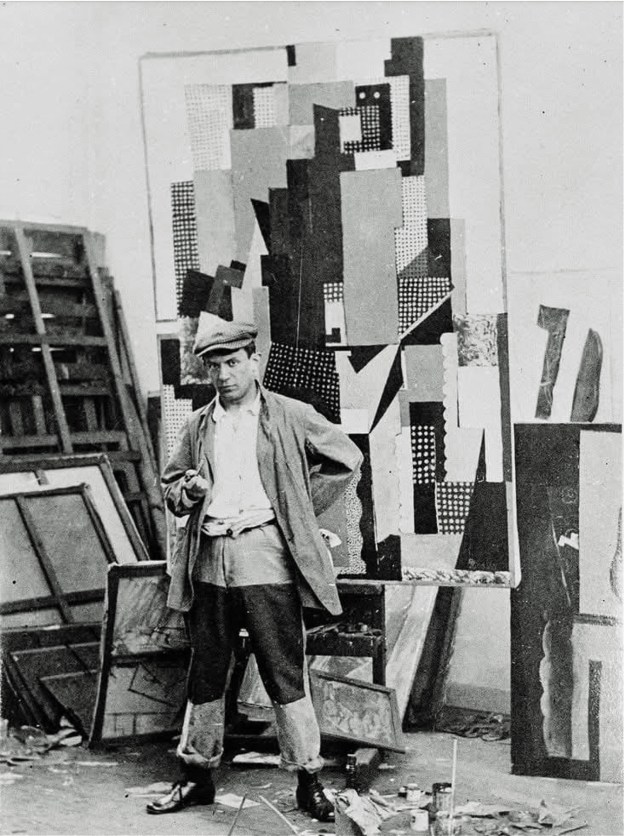
FEATURE image: Pablo Picasso IN STUDIO, c. 1915. Public Domain.
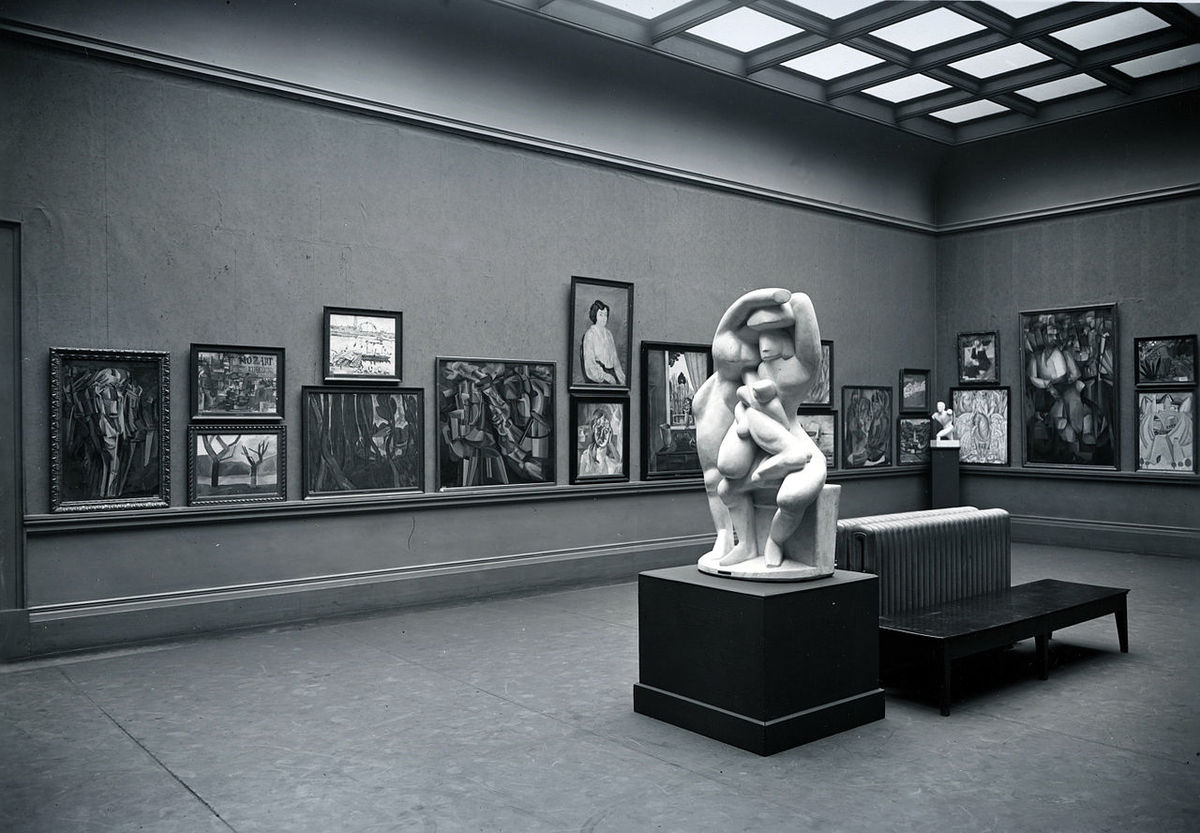
Armory Show, Art Institute of Chicago, March 24–April 16, 1913.

Armory Show, International Exhibition of Modern Art. The Cubist room, Gallery 53 (northeast view), Art Institute of Chicago, March 24–April 16, 1913. On the long wall are three of seven Picasso artworks included in that landmark exhibition. None are in “Picasso and Chicago” in 2013.

By John P. Walsh.

Almost as long as Pablo Picasso (1881-1973) was making his art, there have been bragging rights on the Catalan artist that have come from others. Even 40 years after the artist’s death at 91 years old, media talk in 2013 for Picasso and Chicago, a large art exhibition at The Art Institute of Chicago from February 20 to May 12, 2013, revolves around American collector “firsts” associated with Picasso.

Which institution collected Picasso first? The Art Institute of Chicago in 1923.

Which institution collected Picasso most? The Chicago Renaissance Society by 1930.

Which institution had the first Picasso exhibition? The Arts Club of Chicago in 1923.

Which institution had the first Picasso retrospective? The Wadsworth Atheneum in Hartford, Connecticut in 1934.

The Art Institute of Chicago is able to put imagination aside and quote itself in Picasso and Chicago. Nearly all of the same inventory of Picasso artwork in this 2013 show were assembled and displayed in the exact same order in a previous exhibition at the museum called Picasso in Chicago held from February 3 to March 31, 1968. According to the museum director writing at that time, that exhibition had been inspired by the dedication of the Picasso sculpture on August 15, 1967, a five-story Cor-10 steel Chicago icon that still stands enigimatically in Daley Plaza.  If public attention is what Pablo Picasso craves, then he should have no worries.
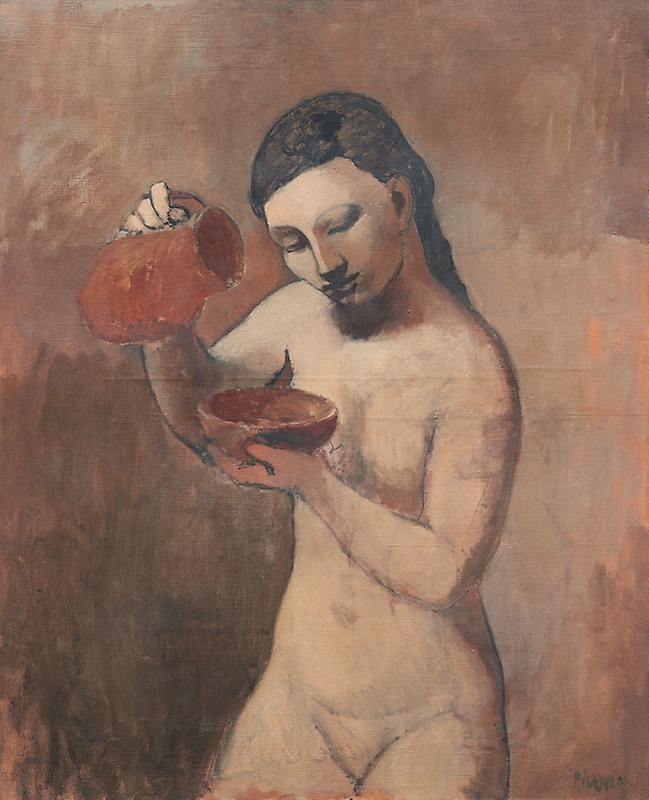
Picasso, Nude with a Pitcher, summer 1906.
Pablo Picasso, Nude with a Pitcher, Gósol, summer 1906, oil on canvas, 39 5/8 x 31 7/8 in. (100.6 x 81 cm), Signed, l.r.: “Picasso.” The Art Institute of Chicago.

In the summer of 1906, during a working sojourn to Gósol in the Spanish Pyrenees, Picasso painted his mistress and muse, Fernande Olivier (French, 1881-1966).

Picasso Nude with a pitcher summer 1906 Gosol Spain

Image above and below: Pablo Picasso, Nude with a Pitcher (detail).

nude-with-a-pitcher-detail-summer-1906-gosol-spain-2
fernande-1905

Fernande Olivier and Pablo Picasso in 1905 in Paris.

Pablo Picasso, Fernande Olivier, summer 1906. Charcoal, with stumping, on cream laid paper, 610 x 458 mm. Signed recto, lower right, in graphite: “Picasso” (underlined), The art Insitute of Chicago.
Pablo Picasso, The Two Saltimbanques, 1905, printed and published 1913. Drypoint on ivory wove paper 120 x 91 mm (image/plate); 193 x 129 mm (sheet) The Art Institute of Chicago.
Picasso, Study for La Coiffure, 1906.
Picasso, Study for “La Coiffure,” 1905-1906. Pen and brown ink, with colored crayons and charcoal applied with stump, over graphite, on blue-gray laid paper 184 x 307 m. Signed recto, upper right, in graphite: “Picasso.” The Art Institute of Chicago.

The pairs of figures are related by both being involved in intimate activities, but represent two different subjects Picasso studied months apart. One dates from 1905 and the other from 1906. The pair on the right is a study for a major painting, La Coiffure, in The Metropolitan Museum of Art in New York.

There are several excellent reasons to see Picasso and Chicago in 2013 and they don’t always revolve around his art. It is a matter for city pride to know that Chicago possesses within its own collections the breadth of art resources to showcase, in chronological order, this Picasso show comprehensive of every major period. In these tight economic times kudos goes out to museum curators who have effectively displayed a vast amount and range of artwork by Pablo Picasso to produce a blockbuster show. The chronological exhibition of Picasso’s art includes works from The Art Institute of Chicago, The Arts Club of Chicago and The Renaissance Society and is front loaded providing for immediate pleasures.

The visitor is greeted nearly at the door by The Old Guitarist painted by Picasso in 1903-1904—a revered Blue Period painting in the Art Institute—and for the viewer to be edified by its presence is worth any exhibition’s admission price though there was no special exhibition fee beyond the price of general admission to the museum.

Picasso, The Old Guitarist, 1903–1904.
Picasso, The Old Guitarist, 1903–1904, oil on panel, 48 3/8 x 32 1/2 in. signed, l.r.: “Picasso.” The Art Institute of Chicago.

If front-loaded, does the rest of the show retain the same high interest? The answer is: yes and no. For all future Picasso shows in Chicago, curators can find several avenues to whittle away at the volume of artwork on display for Picasso and Chicago to present its most interesting parts. That downsizing opportunity intimates this show’s arguable shortcoming: as it displays the Spanish master’s later, increasingly commercial artwork, the Art Institute of Chicago’s 500 Picasso works in all mediums begins to reveal the challenges of building a seamlessly qualitative collection of contemporary art even when the artist is Picasso.

Picasso woman with her hair up 1904
Picasso, Woman with her hair up, 1904, Gouache on tan wood pulp board, 427 x 313 mm, Signed and dated recto, upper left, in blue gouache: “Picasso / 1904.” The Art Institute of Chicago.
Picasso, "Beggar with Crutch," 1904.
Images above and below (detail): Pablo Picasso, Beggar with Crutch, Barcelona  1904, pen, brown ink and colored crayon on paper. The Art Institute of Chicago. 
beggar-with-crutch-barcelona-1904 pen-brown-ink-and-colored-crayon-on-paper-detail

Crazy Woman with Cats, 1901. Oil on pulp board 17 7/16 x 16 1/16 in. (44.3 x 40.8 cm). Signed. l.r.: “Picasso.” Amy McCormick Memorial Collection, 1942. The Art Institute of Chicago.
picasso-crazy-woman-with-cats-detail-early-summer-1901-paris-oil-on-cardboard

In late May 1901 Picasso came to Paris with three weeks to prepare for an exhibition at Vollard’s gallery. The exhibition was arranged by a Catalan dealer who roomed with the 19-year-old Picasso on the Boulevard de Clichy. Crazy Woman with Cats is one of the 64 paintings and several drawings Picasso prepared for the show. 

Picasso, Sketch of a young woman (detail), pen and brush and black ink on paper, Paris 1904, gift of Robert Allerton, 1924, The Art Institute of Chicago.

Robert Allerton, a museum trustee since 1918, began to acquire Picasso drawings in 1923 with the sole purpose of donating them to the museum. Sketch of a young woman was Allerton’s first Picasso drawing purchase and museum donation in 1923 purchased in Chicago from Albert Roullier Galleries.

Pablo Picasso. Salomé from the Saltimbanques series. 1905 102B0518 (1)
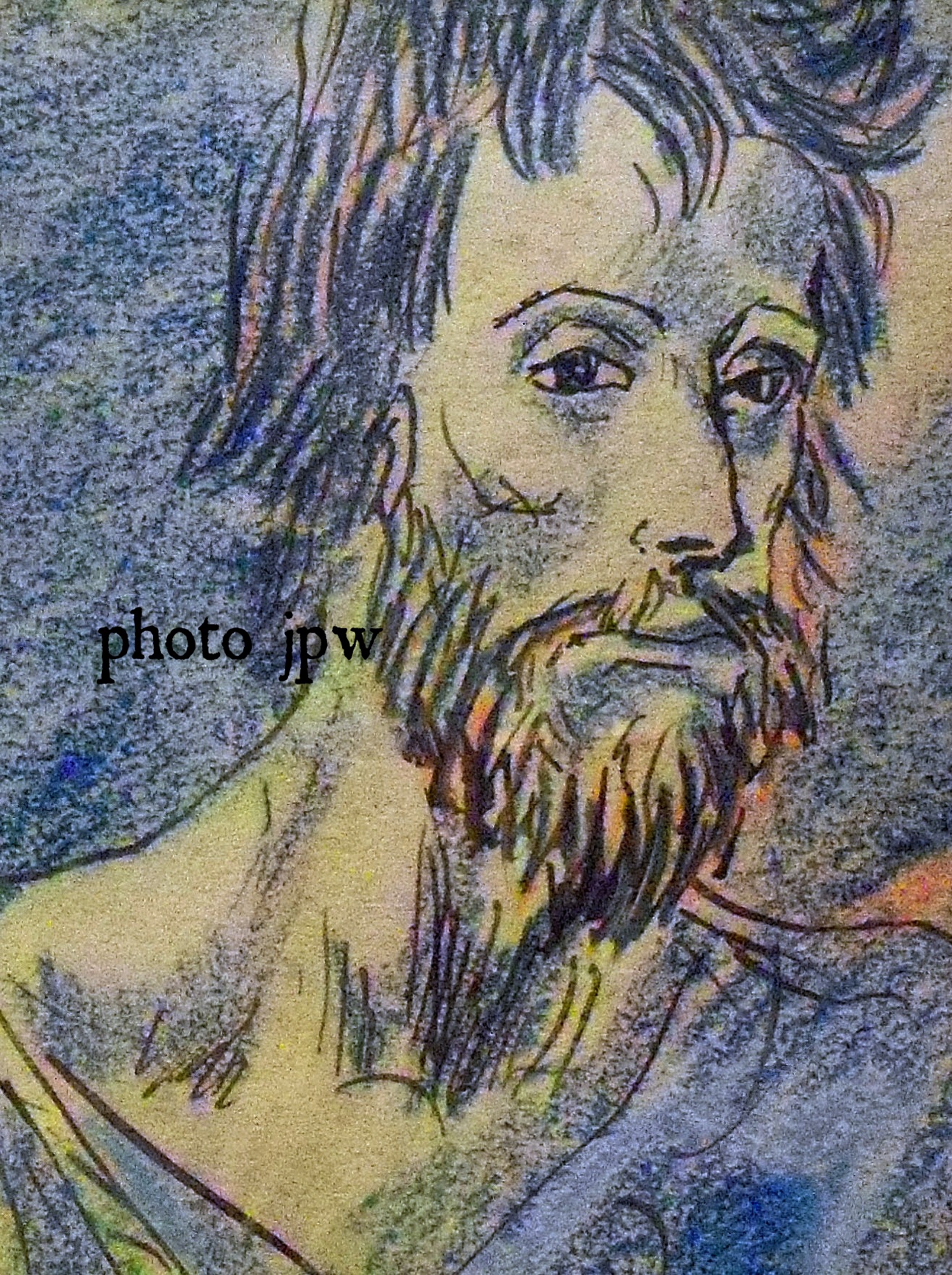
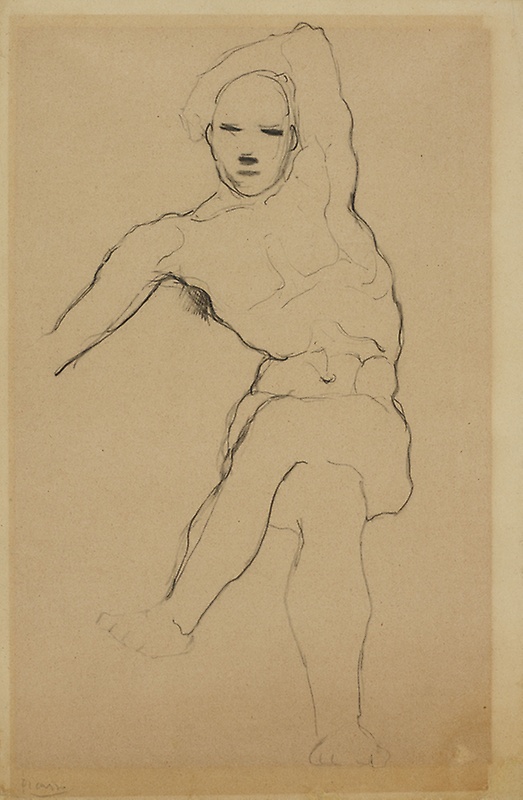
Picasso, Study of a Seated Man, 1905
Picasso, Portrait of a Seated Man, 1905. Black chalk on cream wove paper, laid down on cream Japanese paper, 329 x 216 mm, Signed recto, lower left, in graphite: “Picasso.”Gift of Robert Allerton, 1924. The Art Institute of Chicago.
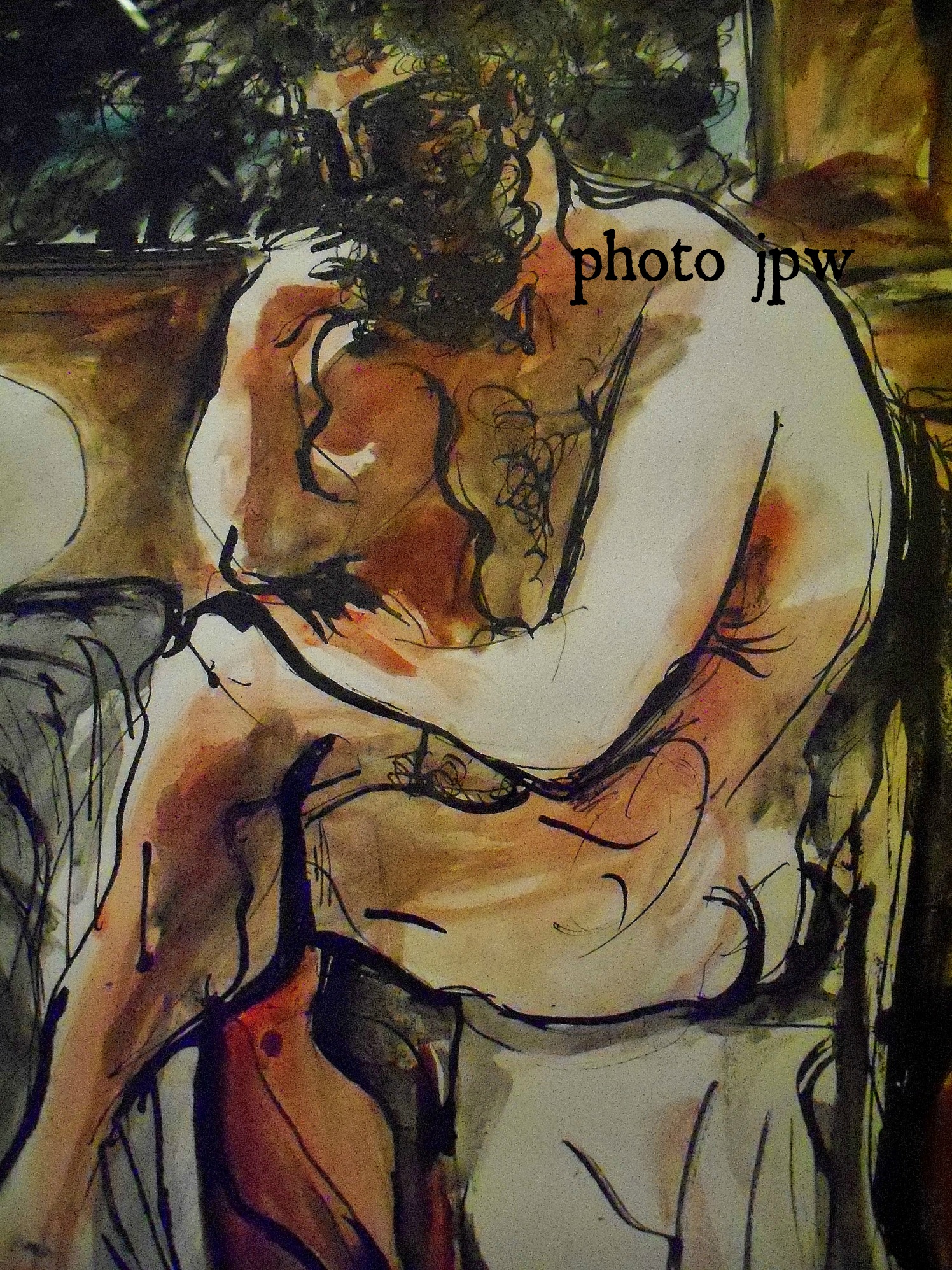
Picasso, Study of Four Nudes, Paris, 1906-07.
Picasso, Study of Four Nudes, Paris, 1906-07, black crayon paper, Johnson Family collection.

By the end of 1906 Picasso stopped painting and instead started to fill sketchbooks for a new major composition: Les Demoiselles d’Avignon (1907) today in The Metropolitan Museum of Art in New York.

Picasso, Female Nude, 1906. Fabricated Black chalk with graphite and smudging on paper, 31.8 x 23.5 cm. Gray Collection Trust. The Art Institute of Chicago.
Picasso, Two Nudes, Standing, fall 1906
Picasso, Two Nudes, Standing (detail), fall 1906 Graphite, with stumping, on cream laid paper (detail).

Picasso, Two Nudes, Standing, fall 1906 Graphite, with stumping, on cream laid paper (detail).

Picasso, Two Nudes, Standing, fall 1906 Graphite, with stumping, on cream laid paper 630 x 469 mm Signed verso, upper left, in graphite: “Picasso.” Gift of Mrs. Potter Palmer, 1944. The Art Institute of Chicago .

In the early 1920’s as Chicago started a buying frenzy of Picasso, another young Spanish painter twelve years younger than Picasso arrived into Paris and was immediately overtly critical of the great Picasso’s work at that time. That younger painter was Joan Miró (1893-1983).

Miró’s criticism of Picasso as well as of Henri Matisse (1869-1954)— it was more a kind of disgust—was basically that the pair, once young avant-gardists, were making all their art for their dealer. In other words, the older artists were making contemporary art mainly for the money. Such may be an inherent risk in making art that meets a market demand in that the artist is tempted to, after a fashion, sell-out. Miró knew at first look—and history has proven him basically correct—that the future of contemporary painting no longer rested in Picasso’s hands after about 1920. This is partly the reason why Miró turned to the “nonsense” art of the Dadaists for the future of his own painting.

Keeping Miro’s judgment in one’s mind at Picasso and Chicago one sees that, notable exceptions made, an earlier Picasso painting—from the Blue Period after 1901 to Picasso’s period of synthetic cubism until around 1920—offers cohesive artwork that contains a germ or seed of progress.  The art collection in Picasso and Chicago, much of it produced following Miró’s critical judgment of Picasso, shares his problematic.

The Red Armchair of 1931 is hung at what is about the show’s halfway point. At this point, I might have exited. Yet where Miró’s critical judgment lags for me is that Picasso’s art is never incompetent or boring. His art is perceptibly linear and, despite its erotic themes, often contains qualities which satisfy and cleanse an art-hungry eye. Picasso’s art is ever ancient and ever new, and distinctly European. For me, seeing a Picasso connotes a stroll in Paris or feeling a sunburn on the face after revelry and reverie along some Mediterranean coast. Quite readily the show produced these kinds of vicarious experiences for me as i soaked up a plethora of Picasso’s later, lesser work in utilitarian Regenstein Hall.

nessus-and-deianira-juan-les-pins-september-22-1920-graphite-on-papere-with-white-ground
Nessus and Deianira, September 22, 1920, Graphite on tan wove paper, prepared with a white ground, signed recto, upper left, in pen and blue ink: “Picasso” (underlined); inscribed upper left, in graphite: “22-9-20.”

Just before leaving Paris in September 1920, Picasso made a series of drawings of the Greek myth of the abduction of Hercules’ bride Deianira by the centaur Nessus. With this, Picasso became fascinated with Greek mythology and continued to make artwork using its themes.

Picasso, Head of A Woman (Fernande), Paris winter 1909-10, brush and gray wash on paper. Private Collection.

Paintings and drawings by Picasso in winter 1909-10 continued to explore Cubism as it related to the human face and figure and its surroundings. 

Picasso studio Horta de Ebro summer 1909.
Picasso’s studio at Horta de Ebro (now Horta de San Juan) in Spain between May and September 1909.

The painting (at left) of a Head of a Woman is one of the early Cubist artworks in “Picasso and Chicago.”

Picasso, Head of a Woman, summer 1909, Oil on canvas 23 3/4 x 20 1/8 in. (60.3 x 51.1 cm), Winterbotham Collection, 1940.

The painting above dates to one of the most productive and inventive periods of Pablo Picasso’s career, a summer stay in the town of Horta de Ebro (now Horta de San Juan) in Spain, which lasted, with minor interruptions, from May to September of 1909. In these months, Picasso produced a series of landscapes, heads, and still lifes that are among the most highly acclaimed achievements of early Cubism. Fernande Olivier, Picasso’s mistress, was the model for the series of heads that the artist produced at this time.
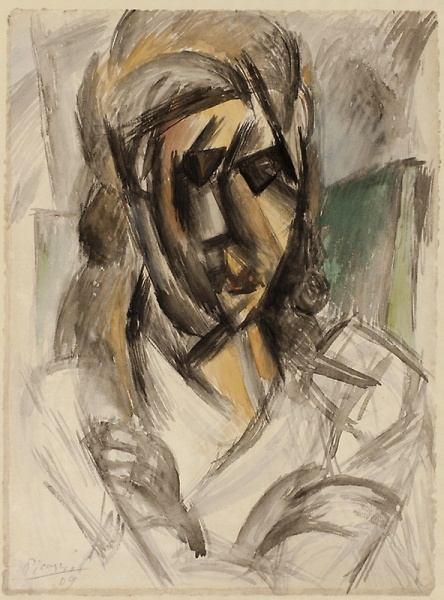
Picasso Bust of a Woman, late 1909
Picasso, Bust of a Woman, late 1909, Watercolor and gouache on cream laid paper, laid down on buff laid paper, 363 x 278 mm overall; signed recto, lower left, in graphite: “Picasso (underlined)/ 09” Gift of Mr. and Mrs. Roy J. Friedman, 1964. The Art Institute of Chicago.
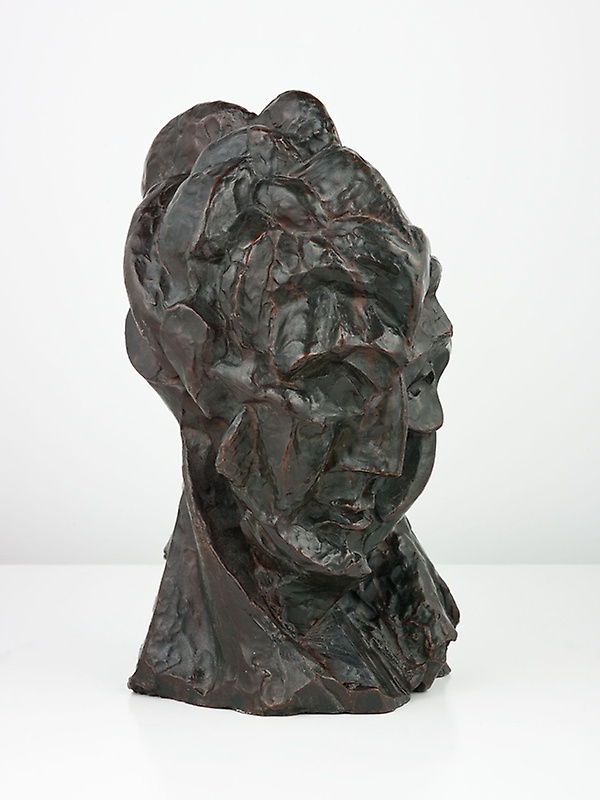
Head of a Woman (Fernande), fall 1909, bronze, 16 1/8 x 9 7/8 x 10 9/16 in. (40.7 x 20.1 x 26.9 cm), cast 1910, Alfred Stieglitz Collection, 1949.

This work is Pablo Picasso’s first large Cubist sculpture and represents the distinctive physiognomy of Fernande Olivier, who was the artist’s model and mistress from 1905 to 1912. Before making the bust, Picasso produced countless drawings and gouaches to explore the specific form and structure of his subject’s facial features. Her hair is in a coil and a topknot; her bulging jaw; her well-defined depression in the center of her upper lip. The Fernande series’ evolved from an agility of facial expression to fixed signs of its individual features.

artist-and-model-cannes-july-24-1933-watercolor-and-pen-and-black-ink-on-paper-1
Picasso, Artist and Model, 1933.
artist-and-model-cannes-july-24-1933-watercolor-and-pen-and-black-ink-on-paper-2
Picasso signature
Pablo Picasso (1881-1973), Artist and Model, Cannes, July 24, 1933, watercolor and pen and black ink on paper. Gray Collection trust.
Picasso, Daniel-Henry Kahnweiler, autumn 1910, Oil on canvas, 39 9/16 x 28 9/16 in. (100.4 x 72.4 cm) Gift of Mrs. Gilbert W. Chapman in memory of Charles B. Goodspeed, 1948. The Art Institute of Chicago.

German-born Daniel-Henry Kahnweiler (1884-1979) opened an art gallery in Paris in 1907. In 1908 Kahnweiler began representing Pablo Picasso (1881-1973) and introduced him to Georges Braque (1882-1963). Kahnweiler championed these artists’ revolutionary experiment with Cubism and purchased most of their paintings between 1908 and 1915. Kahnweiler sat for Picasso up to thirty times for this portrait.

Portrait_de_Picasso,_1908

Portrait photograph of Pablo Picasso, 1908.

Picasso, Head of Harlequin, 1916, The Art Institute of Chicagio. Photograph by author.
Picasso, Harlequin Playing the Guitar, c. 1916, Elden collection.
Picasso Head Arts Club
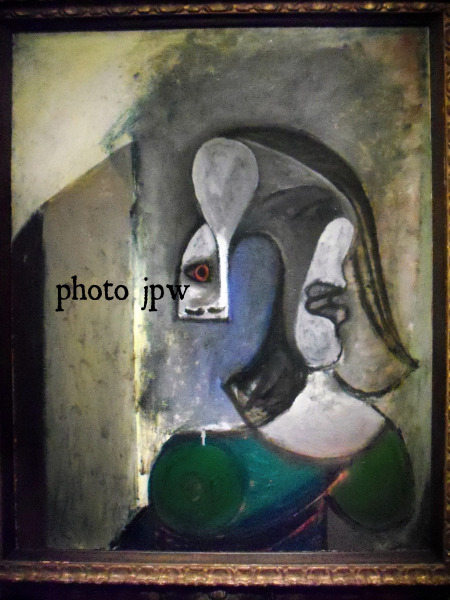
Picasso, Head of a Woman, 1922, The Arts Club of Chicago, purchased 1926.
Olga_Khokhlova_in_Picasso's_Montrouge_studio,_spring_1918 (1)

Olga Khokhlova (1891-1955) in Picasso’s Montrouge studio, spring 1918. Olga married Picasso on July 12, 1918, at the Russian Orthodox Cathedral in Paris. On February 4, 1921, she gave birth to their son Paulo (1921-1975). After that, Olga and Picasso’s relationship deteriorated though they never divorced. Olga died in Cannes in 1955.
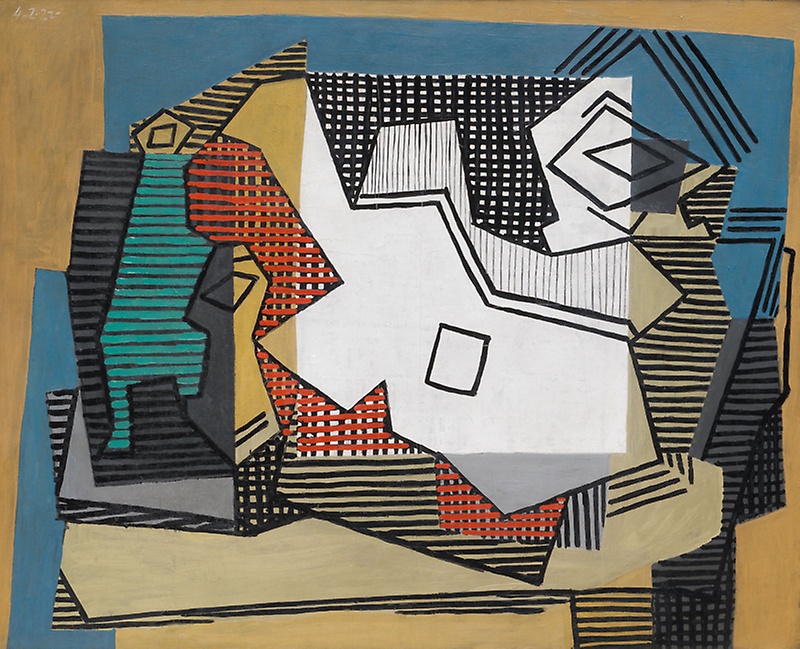
Picasso still life 1922

See article in Architectural Digest by Nick Mafi dated July 28, 2020 on the recent discovery associated with the Picasso painting above.  https://www.architecturaldigest.com/story/famed-pablo-picasso-painting-reveals-abandoned-artwork-beneath

Picasso, Still Life, February 4, 1922, Oil on canvas 32 1/8 x 39 5/8 in. (81.6 x 100.3 cm), Dated, u.l.: “4-2-22-.” Ada Turnbull Hertle Endowment, 1953. Picasso produced a series of Cubist still lifes in 1922 that are simplified to flat planes in a patterned framework. Gertrude Stein (1874-1946) bought this canvas in 1923 to add to her collection of more than 30 Picasso paintings and even more of his drawings and watercolors. This still life was Stein’s last purchase of a painting by Picasso.

Picasso flute and nude, 1932
Above: Picasso, Double Flute Player and Reclining Nude, October 22, 1932, pen and ink with brush and black wash and scraping on paper, Shapiro collection, 1992. The Art Institute of Chicago.

In late summer and fall of 1932, Picasso and Marie-Thérèse Walter (French, 1909-1977), the artist’s mistress from 1927 to 1935, were together in Boisgeloup. Picasso made three drawings on the same day on a theme of lovers serenading one another.
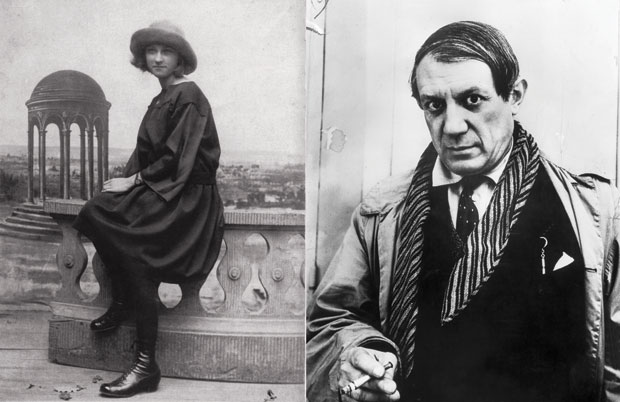
Picasso_marietherese

Marie-Thérèse Walter and Pablo Picasso. Their relationship began when she was seventeen and Picasso was 45 years old and married to Olga Khokhlova.
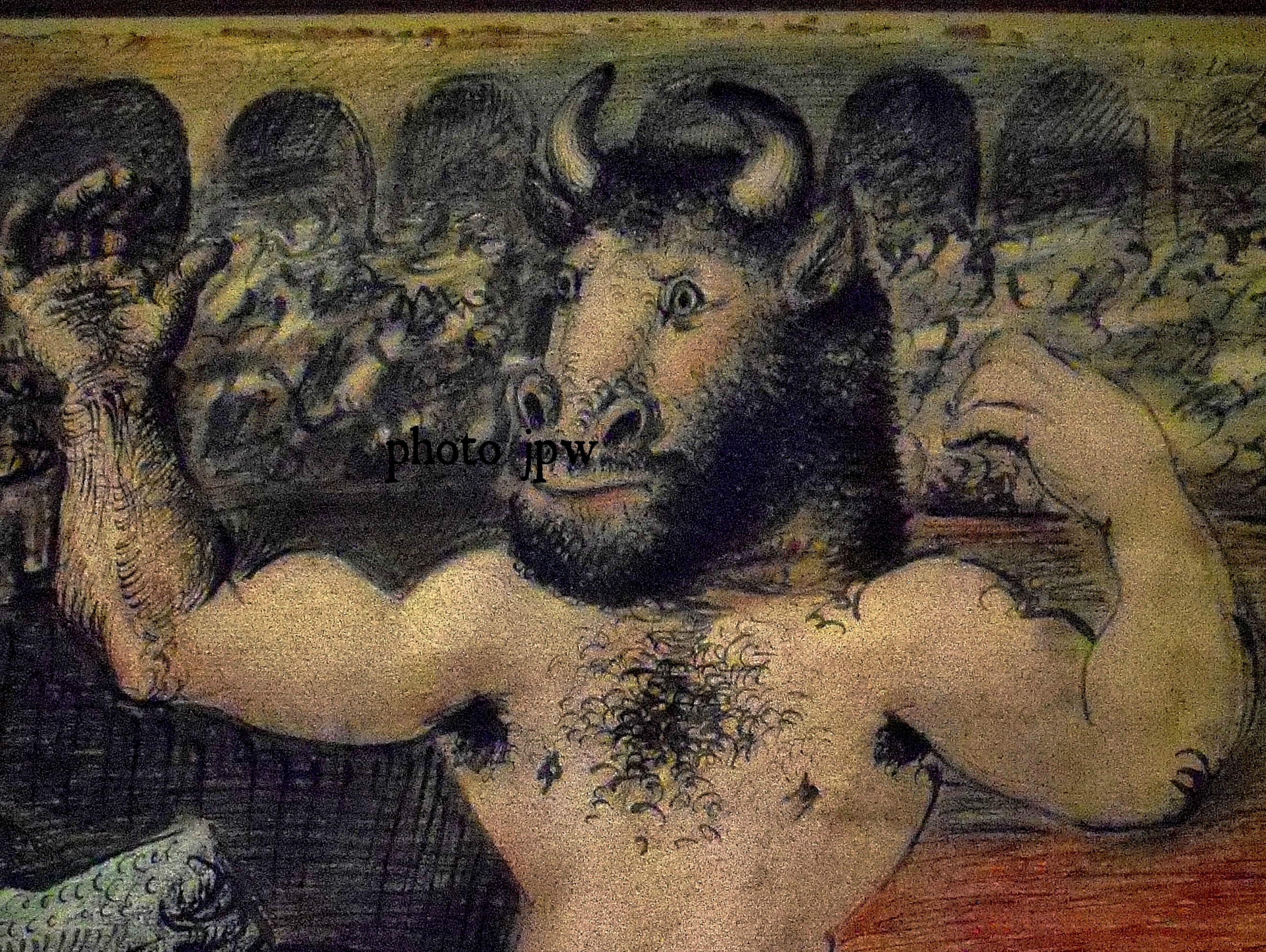
Picasso Minotaur and Wounded Horse 1935

Picasso transforms the bullfighting theme where the half-man and half-bull Minotaur is the aggressor in the ring terrorizing a horse.

Picasso, Minotaur and horse, 1935
Images above and below: Picasso, Minotaur and Wounded Horse, Boisgeloup, April 17, 1935, Pen and brush and black inks, graphite, and colored crayons, with smudging, over incising, on cream laid paper, 343 x 515 mm Signed recto, lower right, in graphite: “Picasso” (underlined); inscribed upper right, in graphite: “Boisgeloup–17 Avril XXXV” The Art Institute of Chicago.
Picasso
Picasso, The Red Armchair, and detail below, oil and ripolin on panel; signed, u.r.: “Picasso,” oil and ripolin on panel, The Art Institute of Chicago.
Picasso, Head of Woman (Dora Maar), Paris, April 1, 1939, oil on canvas, 92 x 73 cm. Private collection.

Dora Maar (French, 1907-1997) met Picasso in 1936 at the Café des Deux Magots in Paris. Her liaison with Picasso ended in 1943.

weeping woman dora maar 1937
Weeping Woman I, July 1, 1937. Drypoint, aquatint, and etching, with scraping on copper in black on ivory laid paper, 695 x 497 mm (plate); 774 x 568 mm (sheet). The Art Institute of Chicago.

About making portraits of his mistress Dora Maar weeping, Picasso explained: “For years, I’ve painted her in tortured forms, not through sadism and not through pleasure either – just obeying a vision that forced himself on me.” At the end of their relationship Picasso confessed, “I can only see her weeping.”
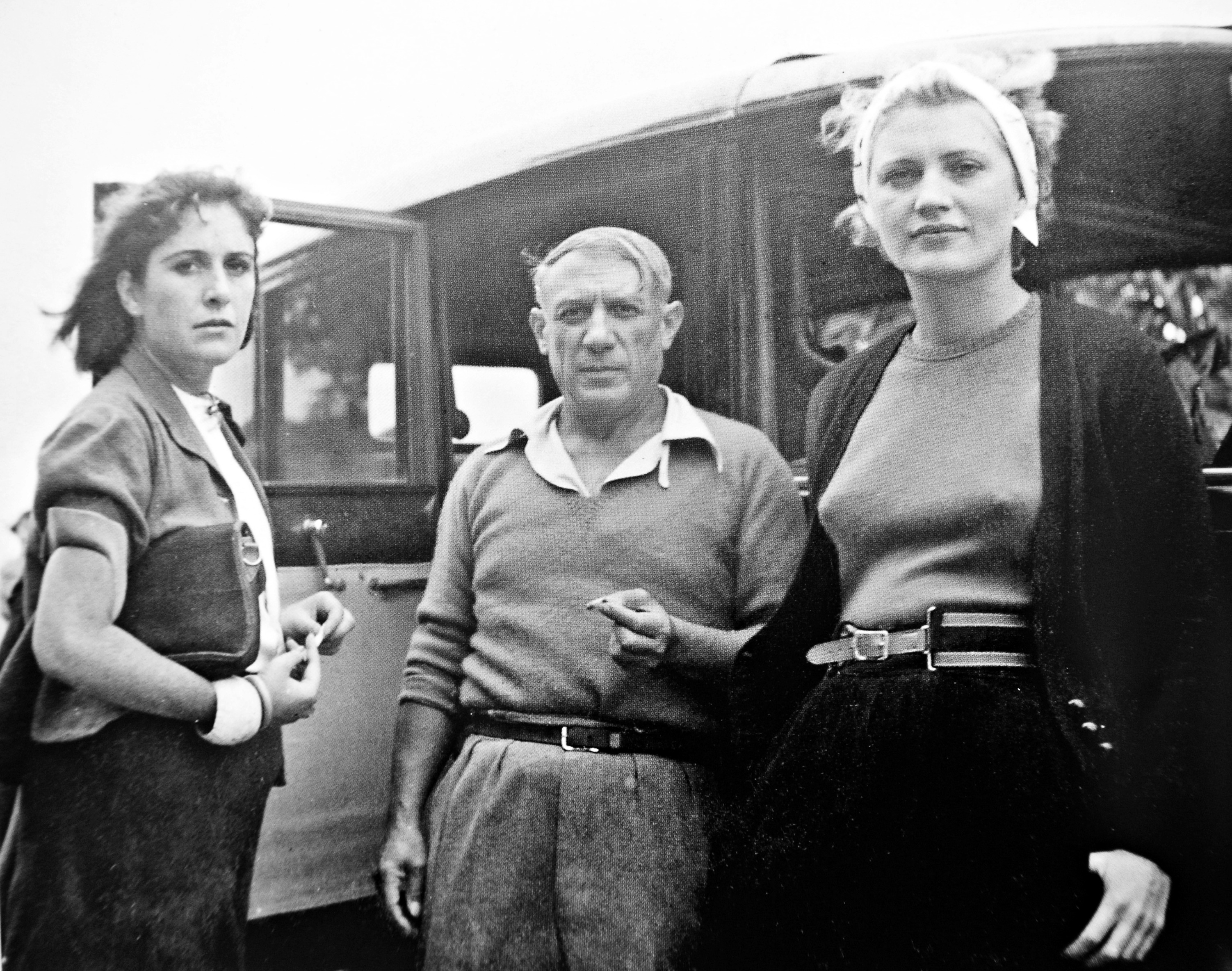
Dora Maar Picasso Lee Miller 1937
From left: Dora Maar, Picasso, Lee Miller in 1937.
1951 Villa in Vallauris
Picasso, Villa in Vallauris, Vallauris, Feb., 4, 1951, oil on panel. 88.9 x 116.2 cm, The Art Institute of Chicago.
Picasso, large vase with dancers, Vallauris, 1950, red earthenware clay, ground painted in white engobe, 71.2 cm Crown collection.
picasso-gilot-madoura-pottery
Picasso and Françoise Gilot (b. 1921) at Madoura pottery, Vallauris, 1953.

Gilot was lover and muse to Picasso from 1943 to 1953. In the early 1990s I met Françoise Gilot accompanied by her husband, Jonas Sauk (1914-1995), when she was the featured speaker at the Alliance Française in Chicago. That evening Gilot made it perfectly clear upfront that she was not going to talk about Picasso.

Picasso Jacqueline 1962
Picasso, Portrait of Jacqueline, Mougins, Dec. 28, 1962, graphite with smudging and black ballpoint pen on paper. 34.9 x 25 cm., Gray Collection Trust.
Picasso Jacqueline 1959
Picasso, Jacqueline, Cannes or Vauvenargues, October 17, 1959, Linocut in colors on paper, 63.8 x 53 cm., Crown collection.

Jacqueline Roque was muse and second wife of Pablo Picasso. Their marriage lasted 11 years until his death, during which time he created over 400 portraits of her, more than any of Picasso’s other loves.
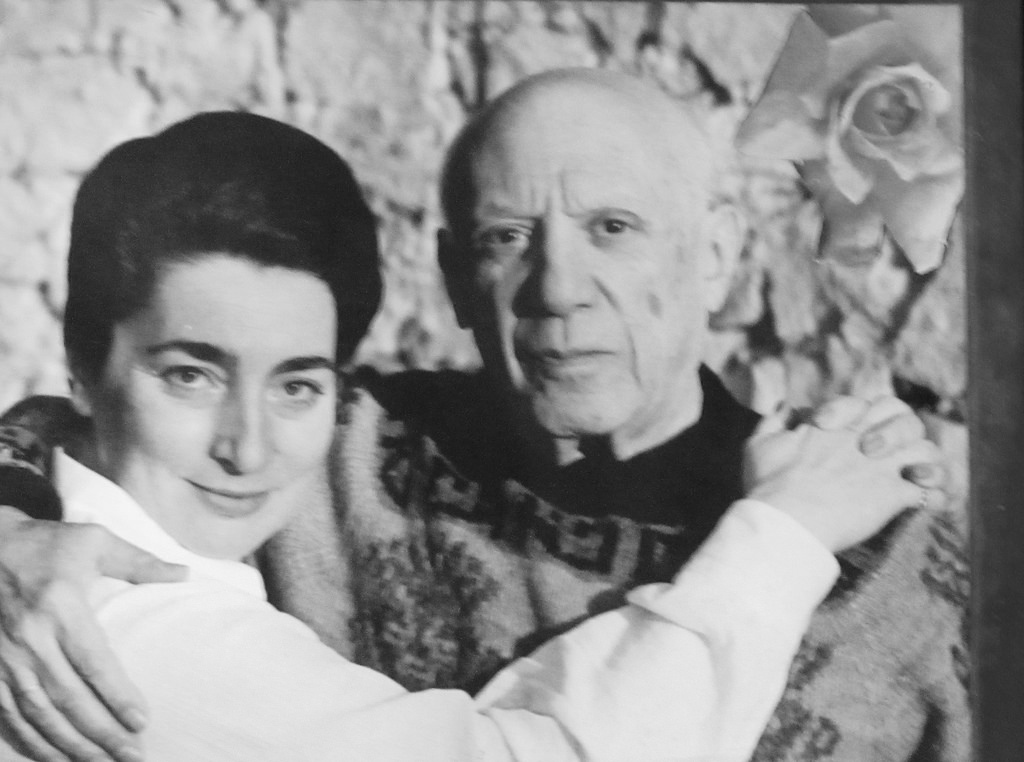
Jacqueline and Pablo Picasso.

Picasso and Jacqueline, his second wife. Pablo Picasso met Jacqueline Roque (1927-1986) in 1953 when she was 26 years old and he was 72. He romanced her until she agreed to date him. Only in 1955, when Picasso’s first wife Olga Khokhlova died, did Picasso decide to marry Jacqueline in Vallauris in 1961. They were married until Picasso’s death in 1973.

The Chicago Picasso, 1967. In situ in Daley Plaza in Downtown Chicago, July 2015. Photograph by author.

There are 250 items on display in Picasso and Chicago—including paintings, prints, drawings, sculptures, and ceramics—and only begins to manifest the prodigious genius of Pablo Picasso.

Picasso and Chicago may have closed, but many, if not most, of these works in Chicago’s cultural institutions and private collections can be savored with the simplicity of a museum visit. A visitor can do no better than visit The Art Institute of Chicago and see Picasso’s The Old Guitarist and The Red Armchair. By that begins one’s own new adventure of absorption of the Spanish master’s artwork whose home is Chicago. The 2013 show is over but more than a few of its best parts are on display right now in these institutions’ permanent collections.

SOURCES:
Miró, Janis Mink, Taschen, 2006.
Je suis Le Cahier: The Sketchbooks of Picasso, 1986, Arnoldo  Mondadori Editore, Verona, Italy.
Picasso and Chicago 100 years, 100 works, Stephanie D’Alessandro, The Art Institute of Chicago, 2013.
Picasso in Chicago, The Art Institute of Chicago, 1968.
http://michiganavemag.com/living/articles/aic-opens-picasso-and-chicago
http://www.indiebound.org/book/9780300184525http://chicagoist.com/2013/05/11/last_chance_to_see_picasso_and_chic.php

FRANCE. French Cartoonist fêted, later revealed as Nazi collaborator during World War II: CHAVAL (1915-1968) and the purpose of art history and today’s art exhibitions.

FEATURE image: Chaval’s cartoons, mainly wordless, are often derisive, ironic and filled with dark humor. In the 1950s Chaval was mentioned in American publications with cartoonists such as James Thurber, Charles Addams and William Steig.

By John P. Walsh

The 53-year-old French cartoonist’s suicide in Paris in winter 1968 served as a tragic end to a witty career. Born Yvan Le Louarn near Bordeaux in 1915, Chaval left a suicide note on the apartment door that read “Mind the gas.” But today it is his actions as a young man in his late 20s that mark him for controversy.

Chaval’s professional name is a bastardization of Chevel, an early twentieth century architect for whose work the term “architecture naïve” was coined. While Chevel came to fantastical architecture after being a poor farmer, Chaval trained for years at the École des Beaux-Arts in Paris, the nation’s foremost art school.

It is a specific period in the cartoonist’s past that erupted into a controversy in late spring 2008 as a major French art museum mounted a retrospective exhibition of Chaval’s career. 

During the nearly incredible period of World War II, Chaval created drawings after 1940 with a racist and anti-Semitic slant for publication in Le Progrès, a Vichy newspaper. His drawings were characterized as “Pro-German Vichy and not just” by Pascal Ory, a leading French cultural historian of the Université de Paris-I-Panthéon-Sorbonne. When the Musée des Beaux-Arts in Bordeaux hosted an exhibition of 120 of Chaval’s pen-and-ink cartoons in summer 2008 none of his wartime anti-Semitic drawings was displayed. In an article in La Croix, the daily Paris Roman Catholic newspaper, Professor Ory revealed the nature of some of these hidden racist works as the exhibition opened.

By the mid 1950s Chaval was an international sensation, his cartoon work mentioned in the same breath in American publications with icons such as James Thurber (1894-1961), Charles Addams (1912-1988) and William Steig (1907-2003). Immediately after the war Chaval was cleared of wrongdoing and started to be published in top French publications—Punch, Le Figaro, Le Nouvel Observateur, Paris Match. He won the industry’s highest awards and remained at the top of his field until the time of his death.
In a June 5, 2008 article Professor Ory described Chaval’s wartime cartoons as “compelling” of racist anti-Semitism.  One published Chaval wartime cartoon Professor Ory described—and the Bordeaux fine arts museum director confirmed its existence—shows two figures with exaggerated noses and wearing yellow stars on their coats. One of them wears two yellow stars and says to the other: “He made me a good price!” Professor Ory criticized not only the drawing’s crude racist ontology but that the Bordeaux art museum would seek to ignore or even cover up the cartoon’s existence in Chaval’s oeuvre. “I’m surprised,” Ory said, speaking in 2008, “that after thirty years of historiography, we are always looking to conceal the period of collaboration under the Occupation in France.”

That the art museum buried Chaval’s early racist work from view without explanation did not stop the museum director, M. Olivier Le Bihan, from defending an impugned Chaval after his controversial work was publicized: “We do not have the right to condemn a man because he made a tendentious drawing. Remember that after the war a trial cleared Chaval of some of the anti-Semitic cartoons ascribed to him. Chaval was called a humanist in Robert Merle’s 1954 Holocaust novel (“Death is my Trade”).”

Professor Ory, author of the classic Les Collaborateurs 1940-1945 (published in 1976), counters that it is “absurd” for the museum to justify the overriding purpose of an art exhibition as “first drawing” or that Chaval “does not deserve this trial of intent” because “he did it to eat.” Professor Ory states there is a “dialogue gap” between art historians and historians that leads to an “endemic lack of historical understanding” of the issues involved in an art exhibition resulting only in an ensuing public spectacle of controversy. Ory points to a similar mistake being made in another 2008 exhibition held in Paris of photographs by collaborationist André Zucca (French, 1897-1973). This exhibition caused a public furor for not being specific about the conditions under which these images of the city during the Nazi Occupation had been made.

Ory contends that Chaval’s case is not simply a matter of a hungry young artist making due in wartime. There is further documentation of Chaval’s friendly relations with racist editors and writers on the Vichy newspaper. Beyond these facts is Professor Ory’s principled belief that “the problem of political engagement is not secondary” to any artist’s life or work. Chaval, professor Ory concludes, is a “draftsman collaborationist” – and though his political affiliations do not detract from his artistic talent it becomes important for the art historian and curator to explain the historical context including “the artist’s overall character” to the viewer. This practices intellectual honesty and makes the enterprise of art making and art exhibition “more human,” according to Ory.

SOURCES: The Best Cartoons From France, Edna Bennett, Philippe Halsman, Simon & Schuster, 1953; C’est la vie: The Best Cartoons of Chaval, Citadel Press, 1957; http://www.la-croix.com/Culture-Loisirs/Culture/Actualite/A-Bordeaux-l-exposition-Chaval-souleve-la-polemique-_NG_-2008-06-05-672010.

My Architecture & Design Photography: AUGUST WALLBAUM, architect, St. Michael Church, 1869, in Old Town. Founded in 1852, it is Chicago’s Oldest German Parish. (27 Photos & Illustrations).

FEATURE image: At the top of the high altar’s retable in St. Michael Church in Chicago’s Old Town is the figure of St. Michael the Archangel, the parish church’s patron. St. Michael is mentioned in several places in both the Hebrew and Christian scriptures. The near northside Chicago parish has been administered by the Redemptorist Order since 1860.

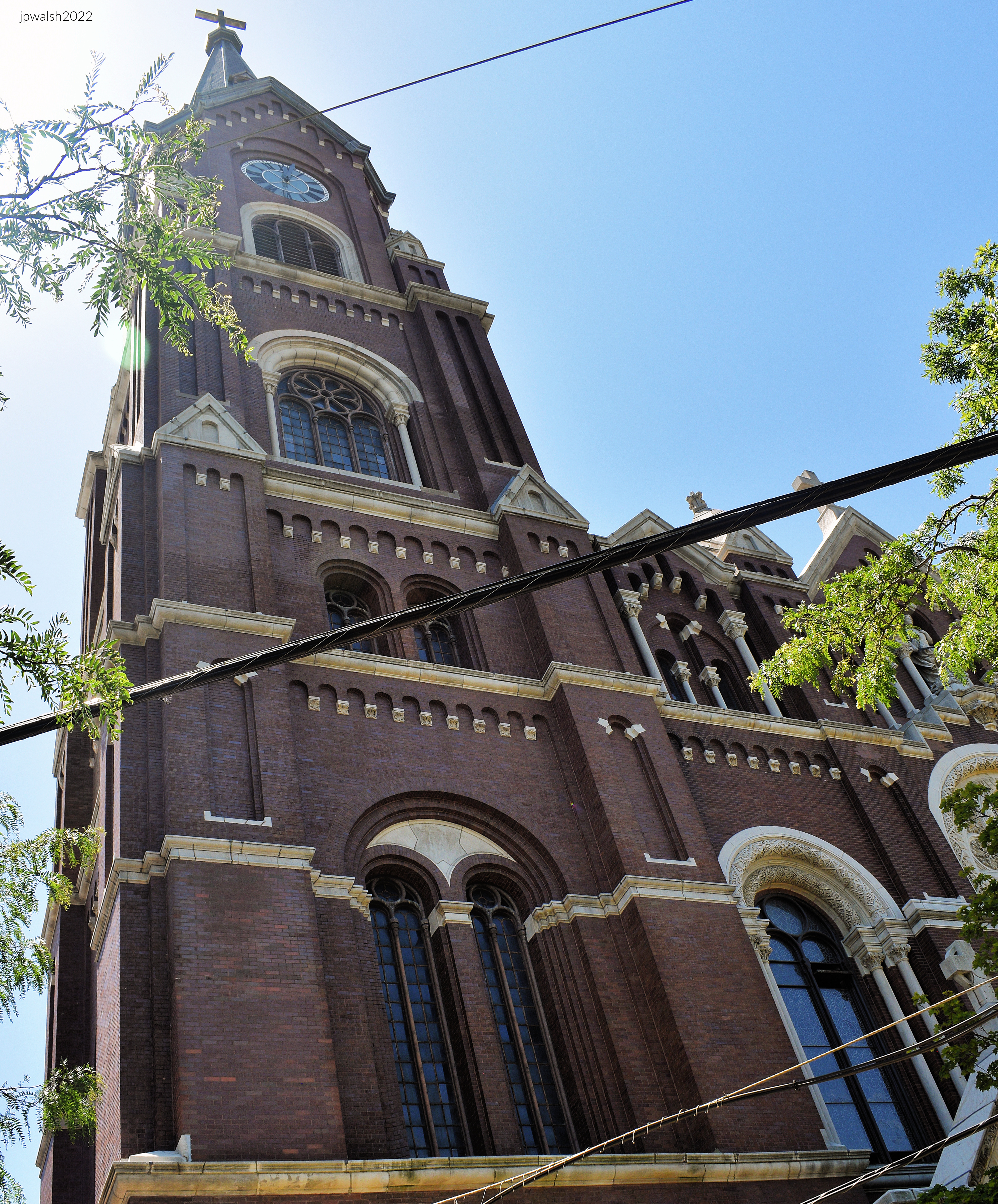
June 2022. The great tower of St. Michael Church on the Near North Side of Chicago identifies the Old Town Triangle historic district. St. Michael Old Town Chicago. 8.03mb

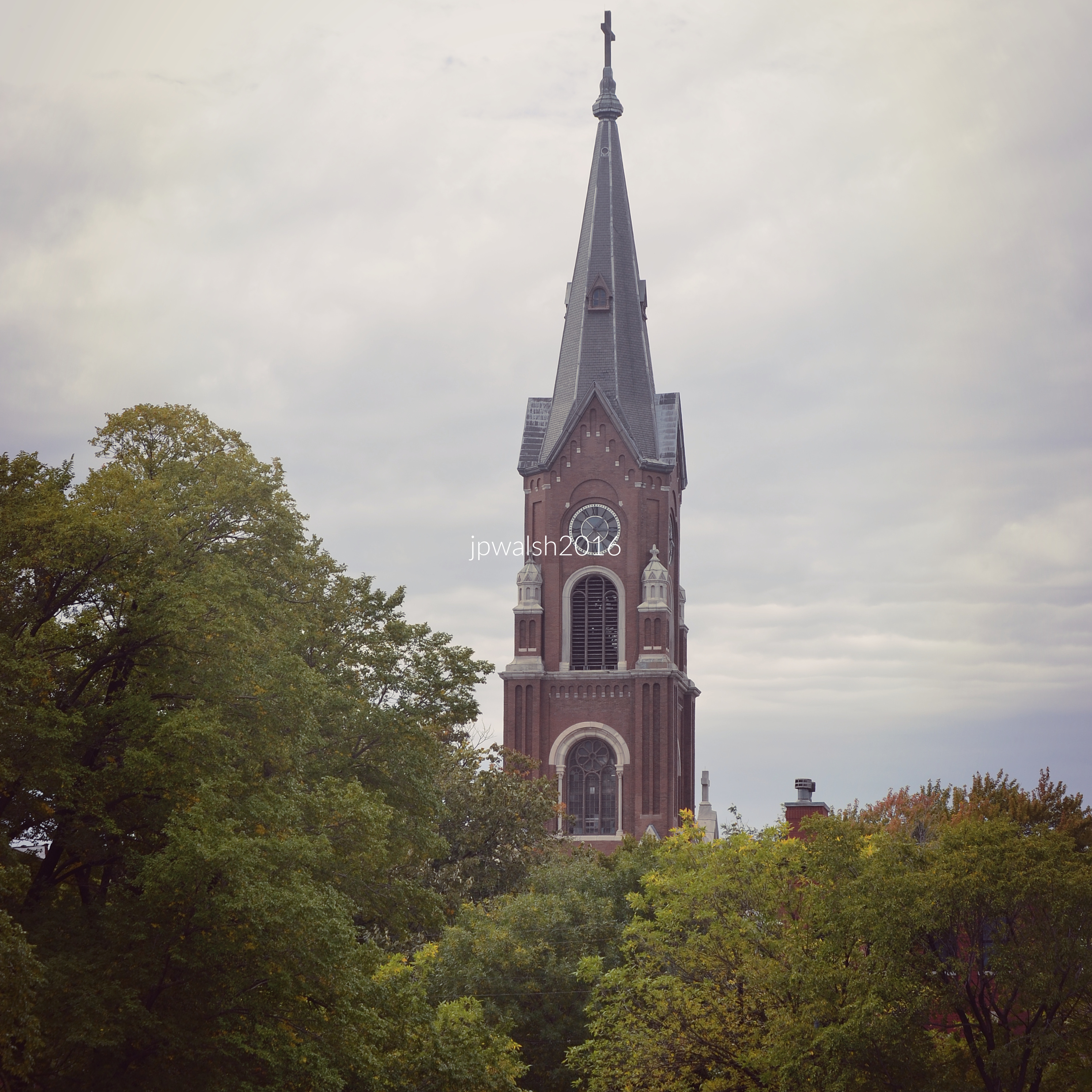
The bell tower of St. Michael Church in Chicago’s Old Town at 1633 N. Cleveland Avenue. From 1869 to 1885, this church tower was the tallest building in Chicago. It was surpassed by the old Board of Trade Building.

In 1876, five years after the Great Chicago Fire of 1871 that ravaged the city, the rebuilt St. Michael Church raised five new bells into the tower. They were cast by McShane Company. The tower’s four-sided clock was installed in 1888. Atop the steeple, the twenty-four-foot tall cross weighs over a ton.

Photographs taken by author in February 2013; May and October 2016; June 2022.

By John P. Walsh

The story is told that if you can hear the five 2-to-6-ton bells peel from the 290-feet-tall tower of St. Michael Church you live in Chicago’s Old Town. Yet it depends on which way the wind is blowing.  

St. Michael Church is one of Chicago’s oldest parishes and church buildings. It was founded by German Catholics in 1852. From their arrival in the 1830s and 1840s until World War I, German immigrants of all faiths made up Chicago’s most numerous nationality.

October 2016. Saint Michael Old Town Chicago. 2.31mb DSC_0941 (1)

German immigrants soon migrated out of downtown Chicago and about two miles north to North Avenue. The east-west thoroughfare became known as “German Broadway.”

This European immigrant community expanded to eventually settle a four-mile square area that was called “North Town.” St. Michael Church was situated in the virtual center of North Town on land donated by successful German-born Chicago businessman and brewer Michael Diversey (1810-1869). Diversey had immigrated to the United States in the 1830s from Saarland in western Germany.

Michael Diversey

St. Michael Church stands on land donated expressly for the purpose of building it by successful German-American brewer Michael Diversey (1810-1869). Diversey emigrated from Germany in 1830, and by 1844 he was a Chicago alderman. The church is named after the wealthy beer maker’s patron saint, St Michael the Archangel, whose limestone figure stands in the high niche on the façade (see photograph below). Diversey’s so-called Chicago Brewery, first established in Chicago in 1839, grew to become one of the most extensive establishments of its kind in the West.

June 2022. St. Michael Old Town Chicago 18.70mb

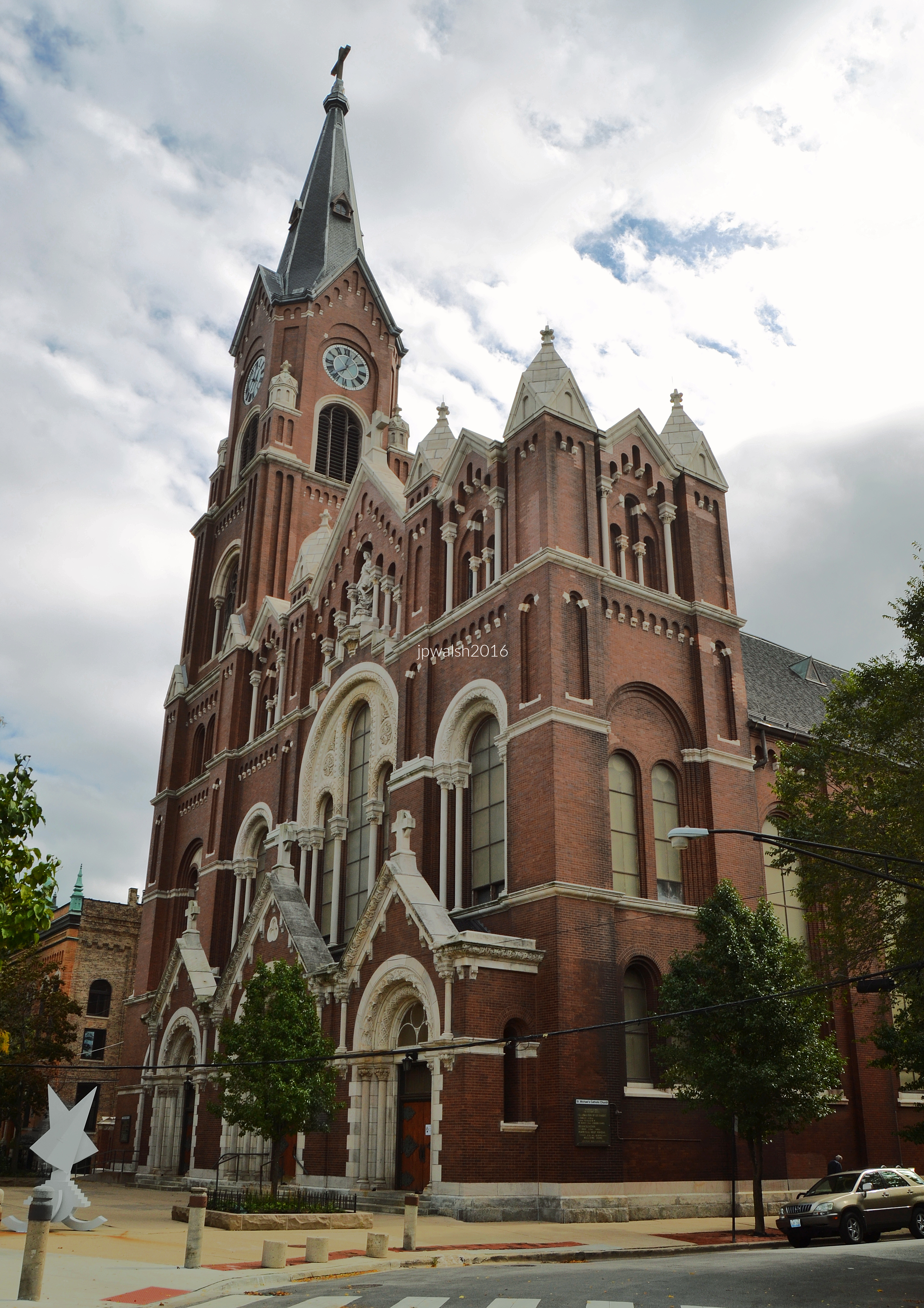
The church building is built of red brick with limestone trim in the Romanesque style. Construction started in 1866 and was finished three years later. In 1871 the new building was virtually destroyed in the Great Chicago Fire along with its North Town neighborhood. Only the church’s exterior walls remained. Using these existing walls, the fire-gutted St. Michael Church was rebuilt and rededicated in 1873. Ashes from that infamous conflagration can still be seen in the church’s basement.

June 2022. St. Michael Old Town Chicago 11.43 mb

Gabled three-portal main entrance (above) was added to the façade in 1913 by a Chicago architect. The architectural design harkens back to the cathedrals of Europe.

St. Michael Old Town Chicago 6/2022 10.01 mb

Main altar (above) at one end of a 190-foot central nave.

St Michael Church, interior.
February 2013. St. Michael Church, Chicago.
The High Altar
February 2013. Main altar.

Dating from 1902, the Main Altar of the Angels (above) is a cacophony of German-style wood carving.

In 1851 when St Michael was founded, Chicago’s total population was around 30,000 making it the twenty-fourth largest city in the United States.

Ten years later, in 1860, right before the outbreak of the American Civil War, Chicago’s population had nearly quadrupled and ranked in the nation’s top ten largest cities.

Chicago’s Catholic Church hierarchy in the middle of the nineteenth century was mostly Irish. These English-speaking bishops relied on religious orders to handle a tidal wave of non-English-speaking immigrants to Chicago, including the Germans.

In 1860, the St. Michael Church parish was entrusted to the Redemptorists, a religious order founded in 1748 in Italy. The Redemptorists with their German congregation built the St. Michael Church in Old Town that stands today. Over 170 years later, the Redemptorist order continues to shepherd the parish.

June 2022. St. Michael Old Town Chicago 14.16 mb
June 2022. St. Michael Old Town Chicago 12.62 mb

A mosaic of Saint Michael the Archangel (above) in the floor at the entrance of the church. “Archangel” is a title that signifies he is the leader of all God’s angels. 

The mosaic of the patron angel in the floor starts the church’s 190-foot-long nave. It is one of the many religious images—others in stone, wood and paint—that constitutes the interior and exterior decoration of  St. Michael Church.

St. Michael the Archangel is mentioned four times in the Bible: twice in the Book of Daniel and in the Epistle of Jude and the Book of Revelation. In the Book of Daniel, St. Michael the archangel helps the prophet Daniel and is linked to the “end times” of the world. In the Epistle of Jude, St. Michael the archangel guards the tombs of Eve and Moses and combats Satan to protect these holy sites.

In the Book of Revelation St. Michael and his angels do battle with the “dragon.” In addition to being charged with expelling Satan from Heaven (as depicted in the retable), St. Michael is charged with the care of all departed souls to introduce them to the holy light. St. Michael the Archangel is the patron saint of soldiers, police, and doctors.

June 2022. St. Michael Old Town Chicago 20%

Detail of the Main Altar retable depicts St. Michael the archangel (above) in the traditional iconography of armor with sword and shield casting Satan out of Heaven by God’s command. St. Michael the Archangel is the patron saint of soldiers, police, and doctors.

The spacious, airy, and dramatic church sanctuary today looks basically as it did by 1902. The motivation for the church’s extensive redecoration in 1902 was its Golden Jubilee as well as one expression of the parishioners’ decided prosperity by the later 1890s.

Some Stained Glass

Created and installed by Mayer & Company of Munich for St. Michael Church’s Golden Jubilee in 1902, the tall and thin stained glass windows —the fourth set of windows to be installed into architect August Walbaum’s original design— depicted Biblical and other scenes. The window’s artistic technique drew upon centuries of European craft and design – and were recently cleaned in 2012.

June 2022. Annunciation to Mary Window (Luke 1: 26-38. St. Michael Old Town Chicago 10.71 mb

Annunciation to Mary Window (Luke 1: 26-38). Mary’s virginal conception of Jesus is stated explicitly in verses 34-35. In Hebrew her name, Miryām, means “exalted one.”

In that Jubilee year, the stained glass was installed along with the 56-foot-high carved wood retable of the High (or main) Altar of the Angels. Though there are five altars in St. Michael Church, the main altar is the most spectacular, drawing the eye forward and upward from practically anywhere in the church. Crowning this painted construct—which is so heavy that it required a new local foundation to be dug for it—is the figure of St. Michael the Archangel described in the Book of Revelation. The angel is garbed in his panzer (“armor”) running rebellious angels out of heaven. St. Michael is flanked by the archangels Gabriel and Raphael. Nine choirs of angels and the saints Peter and Paul are also depicted in wood. Smaller human figures depict the four evangelists identified by their Christian symbols—specifically, the Winged Man (Matthew), Winged Lion (Mark), Winged Ox (Luke) and Eagle (John). All five altars were made by E. Hackner Company of La Crosse, Wisconsin, an early twentieth century designer, manufacturer and importer of artistic ecclesiastic furnishings.

ok 5503 - Copy
February 2013. Annunciation window (detail), 1902, Franz Mayer & Co. of Munich. St. Michael Church, Chicago.

Annunciation Window, detail (above). The angel Gabriel’s greeting, “Hail, full of grace,” is a greeting that is full of peace, joy and wisdom. Mary is the object of God’s grace and favor and is shown to be chosen for a long time past. The depiction of lilies, whether in the angel’s hand or arranged into a bouquet by Mary’s side, is traditional imagery for purity.

In 1869 the St. Michael Church building cost over $130,000 to build which is approximately $2.65 million today. After the fire the repairs in 1872 cost an additional $40,000 plus unknown amounts of insurance money–or upwards of $700,000 today. Reconstruction did not include the stained glass windows which were installed in 1902. For a history of the stained glass in St. Michael church go to: https://johnpwalshblog.com/2016/05/10/angels-in-stained-glass-1902-complete-st-michael-church-in-old-town-chicago/.

May 2016. Anointing of Jesus by Mary Magdalene (detail), 1902, Franz Mayer & Co. of Munich. St. Michael Church, Chicago.

Anointing of Jesus by Mary Magdalene at Bethany Window. The anointing of Jesus in Bethany by the sinful woman, traditionally the Magdalene. Though the story varies in certain details, all four gospels relate the anointing set in a house for a meal and a woman who pours expensive ointment on Jesus to which someone objects. In regard to the ointment, Mark’s account (Mark 14:3) records that it is the purest of spikenard which was very expensive costing over a year’s wages (Mark 14:5). Luke’s gospel speaks of Jesus’ feet being anointed by a woman who had been sinful all her life and who was crying (Luke 7:38). As her tears fall on the feet of Jesus, she kissed and wiped his feet with her hair. The iconography of the woman’s actions in the Gospels has traditionally been associated with Mary Magdalene though none of the biblical texts specify her as the story’s subject.

In 2020, the spikenard plant is part of Pope Francis’s coat of arms. He uses the image of the plant as does the Latin American church, as a symbol for St. Joseph.

Spikenard was grown in India, China, and Nepal and known in ancient Rome where it was used as a cooking agent. By the time of Jesus, in the early Roman Empire, spikenard was used primarily in perfume.

Coat of Arms of Pope Francis (2013-2025). According to the Vatican, the image of the plant to the right of the star on the blue background is spikenard and represents St. Joseph.

As with other American church building adaptations of earlier European architectural styles, the use of Romanesque rounded arches and corbels accentuated the use of Gothic-style glass in Chicago’s Old Town Roman Catholic church.

OK6089 - Copy

Let the Little Children Come to Me Window (above). In Jesus’s public ministry, crowds often followed and pressed in upon him and his disciples. Jesus’s famous words, “Let the little children come to me,” are cited in all three synoptic gospels: Matthew 19:14, Mark 10:14 and Luke 18:16. When the people’s children were brought to the miracle worker and teacher -even their infants- they wanted him to lay his hands on them and bless them. The disciples rebuked them and Jesus became “indiginant” as he said to them, “Let the children come to me; do not prevent them, for the kingdom of God belongs to such as these. Amen, I say to you, whoever does not accept the kingdom of God like a child will not enter it” (Mark 10:14-15).

June 2022. St. Michael Old Town Chicago 12.82 mb

Sacred Heart Window (above). The first of four great visions in which Jesus Christ revealed his Sacred Heart to French nun St. Margaret Mary Alacoque (1647-1690) took place on December 27, 1673 in her Visitation convent in Paray-le-Monial in Burgundy France. In each of these visions Christ revealed messages that the young saint was to communicate. The greatest of all the visions took place in 1676. Before the Tabernacle on the altar that exposed the Eucharist, Jesus said: “Behold this Heart which has so loved mankind, that it has spared nothing, even to exhausting and consuming itself in order to demonstrate and prove its love for them.” St. Margaret Mary was ordered by her confessor, St. Claude de la Colombière, a Jesuit priest, to write down all her visions. Afterwards, the saint suffered great persecutions from the Church and others for these visions until she fell ill and died in 1690 at 43 years old. She was beatified in 1864 and canonized in 1920.

June 2022. St. Michael Old Town Chicago 15.27 mb

Original Pulpit (above).

101_5458 - Copy - Copy
February 2023. Ceiling mural. St. Michael Church, Chicago.

Central nave ceiling mural (above) includes symbolic depictions of the four evangelists: the Winged Man (Matthew); Winged Lion (Mark); Winged Ox (Luke); Eagle (John).

Its filigree evokes medieval illuminated manuscripts and perhaps is inspired by a scene painted in the 15th century in the dome of The Basilica of St Mark in Venice.

June 2022. St. Michael Old Town Chicago 19.11 mb
June 2022. St. Michael Old Town Chicago 20%
June 2022. St. Michael Old Town Chicago 7.8mb 70%.

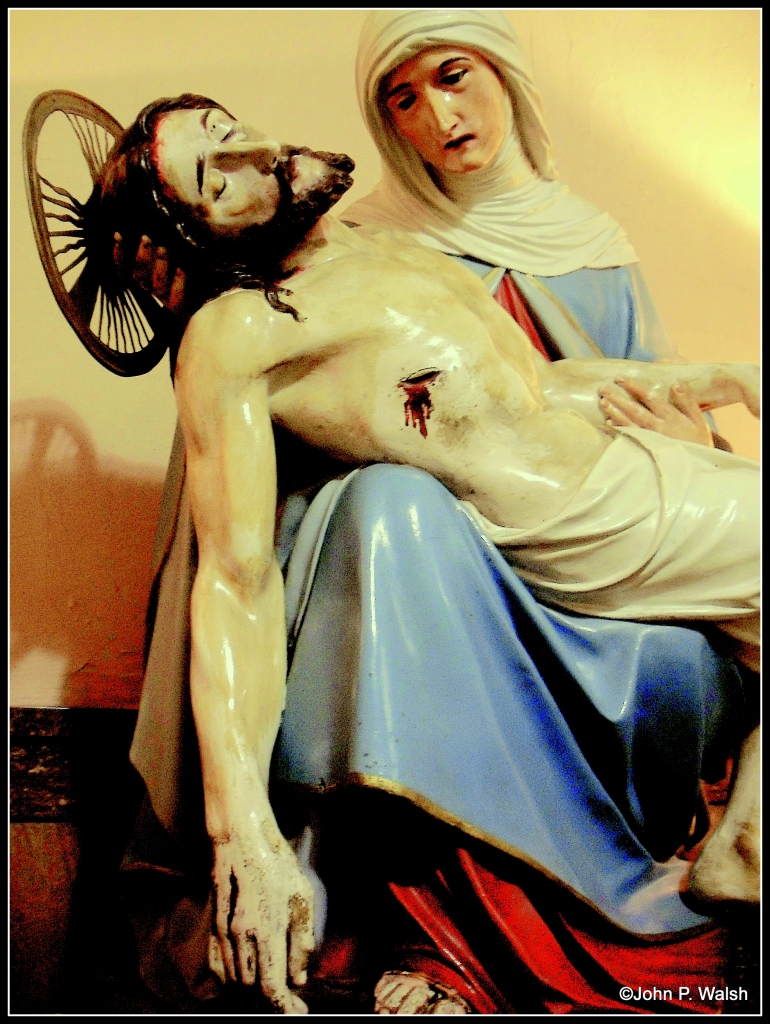
Pietà, copy of a 16th-century Swabian-style artwork made around 1913.

OK5477 - Copy
February 2013. Pieta. St. Michael Church, Chicago.
101_6110 - Copy - Copy
February 2013. Sacred Heart side altar.

The Sacred Heart side altar (east nave). In addition to the central statue of Christ are those depicting Redemptorist Order founder, St. Alphonsus Liguori (Italian, 1696-1787) and Discalced Carmelite Order founder, St. Teresa of Avila (Spanish, 1515-1582).


June 2022. St. Michael Old Town Chicago 25%

St. Joseph altar (west nave) with a mural above it of Redemptorists before Christ’s Heavenly throne. In this photograph’s foreground at right is a wood confessional box. Italian-born St. Alphonsus Liguori, founder of the Redemptorists, was highly educated and spent much of his life hearing the confessions of the ordinary people as a home missionary in his city of Naples, Italy.

June 2022. St. Michael Old Town Chicago 12.53 mb

Side altar honors Mary, Mother of Perpetual Help. This image was important to St. Alphonsus Liguori, founder of the Redemptorists, who have led St. Michael Church since 1860. In 1865 Pope Pius IX (1792–1878) gave this specific icon to the Chicago Redemptorists. After the Great Fire, the image was picked out of the charred embers, having survived intact in the rubble. It was taken as a sign to rebuild the church building and later set the icon into this German Baroque-style retable.

June 2022. St. Michael Old Town Chicago 12.60 mb

The 14 traditional Stations of the Cross whose ubiquitous artistic display are in church-wide use today were composed by St. Alphonsus Liguori (1696-1787) in 1761. A proverbial Renaissance Man, Bishop Liguori, whose feast day is August 1, was a highly educated Italian saint who was made a bishop in 1762 and Doctor of the Church in 1871. Bishop Liguori laid claim to many roles including being a pastor, spiritual writer, composer, musician, artist, poet, lawyer, scholastic philosopher, and theologian. In November 1732 he founded the Congregation of the Most Holy Redeemer, known as the Redemptorists. In Chicago St. Michael Church parish was entrusted to the Redemptorists in 1860. With their German congregation they built St. Michael Church in Old Town in 1869 that stands today having endured and survived the Great Fire of 1871. Over 165 years later, the Redemptorists still continue to lead the parish. Liguori’s stations of the cross were taken from the Gospels that chronicles Christ’s passion and are classic for their ability to stir the heart towards prayer, humility, and repentance. St. Alphonsus was born in 1696 in Naples, Italy and he lived to be 90 years old. After an early career in law, St. Alphonsus became a priest in 1726. His parents were devout Catholics but not pleased by their lawyer son’s decision mainly because the clergy at the time was notoriously corrupt. In 1748 he published his Moral Theology that received papal approbation (approval). Bishop Liguori was beloved by ordinary people in large part because he spent so much time among them, particularly in the confessional as a home missionary to his city of Naples, Italy.

The history of St. Michael Church is a study in the rise of the German population to a dominant position in a new American city that was itself rising as the City of the Century. Chicago in less than 50 years developed out of an onion swamp into the second most populated city in the United States.

Between 1874 and following World War I, Chicago’s rapid emergence on the world stage was accompanied by Deutschtum (or “Germanness”) in its culture.

While Deutschtum appeared to be invincible, the Kaiser’s defeat in 1918 in the European war signaled the beginning of the end for German cultural dominance in Chicago. Their cultural hegemony in Chicago was virtually completely dismantled by the start of World War II.

Sources:
G. Lane and A. Kezys, Chicago Churches and Synogogues.
P. d’A Jones and M.G. Holli, Ethnic Chicago.
D.A. Pacyga and E. Skerrett, Chicago, City of Neighborhoods.
D. McNamara, Heavenly City.
The Saints: A Concise Biographical Dictionary, edited by John Coulson, Guild Press, New York, 1957.
The New American Bible, Catholic Book Publishing Corp, New York, 1993.
Catechism of the Catholic Church, 2nd Edition, Doubleday, New York, 1997.
The Jerome Biblical Commentary, edited by Raymond E. Brown, S.S., Joseph a Fitzmyer, S.J., and Roland E. Murphy, O. Carm., 1982.
St. Michael Church website.
https://iamjesus.net/traditional-stations-of-the-cross/https://www.emporis.com/buildings/136851/st-michael-church-chicago-il-usa

October 2016. Saint Michael Old Town Chicago. 4.52mb DSC_0836 (5)

This explanatory article may be periodically updated.

More of St. Michael Church in Old Town, Chicago? Please see:

FRANCE. IMPRESSIONISM. The “Tricky Business” of the Caillebotte Bequest.

FEATURE image: Pierre-Auguste Renoir, The Swing, 1876, oil on canvas, 36 1/2 x 28 1/2 inches. Musée d’Orsay, Paris.

CAILLEBOTTE BEQUEST: L’Estaque, c. 1878/9, oil on canvas, 23 1/4 x 28 3/4 inches, Paul Cézanne. Musée d’Orsay, Paris.

By John P. Walsh

Gustave Caillebotte (1848-1894) and Pierre-Auguste Renoir (1841-1919) exhibited together in the Second Impressionist Exhibition in 1876 and became lifelong friends. Just two years later, in 1878, Caillebotte appointed Renoir to be executor of his will. Now in the wake of Caillebotte’s death in 1894, Renoir and Martial Caillebotte (1853-1910), the artist’s younger brother, were resolved to carry out Caillebotte’s final wishes to the letter. The most important charge given to Caillebotte’s advocates was to persuade the French State to accept their late friend’s collection of Impressionist art that came to be known as the “Caillebotte Bequest.” These 68 paintings were the wealthy artist’s assemblage of prime Impressionist art which today provides a glittering foundation for museum collections around the world, especially the Musée d’Orsay in Paris. An exact count of the bequest varies whether based on the inventories by the estate in 1894, by art writer Gustave Geffroy (1855-1926) also in 1894 or by Renoir, Martial Caillebotte and Léonce Bénédite (1859-1925) in 1896.

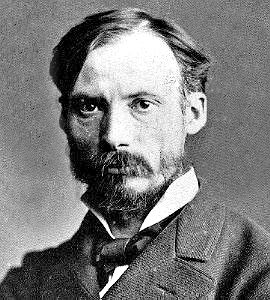
Pierre-Auguste Renoir (French, 1841-1919) at Montmartre in a photograph by Martial Caillebotte around 1885.
Martial Caillebotte (1853–1910), photographer and composer, with brother Gustave Caillebotte (1848-1894), artist, collector and arts organizer.
Gustave Geffroy (1855-1926) in a portrait photograph by Nadar.
Léonce Bénédite (1856 - 1925), at left, curator for the Caillebotte Bequest.
Léonce Bénédite (1856 – 1925), at left, curator for the Caillebotte Bequest.

In 1894 Caillebotte’s bequest included paintings by living artists such as Camille Pissarro, Edgar Degas, Paul Cézanne, Alfred Sisley, Claude Monet, and Pierre-Auguste Renoir. Two artists in the collection were already dead – and both Jean Millet (1814-1875) and Édouard Manet (1832-1883) were more highly prized than the others at the time. A vast majority of Caillebotte’s more than five dozen paintings were painted and purchased before 1880.

CAILLEBOTTE BEQUEST: Edouard Manet, The Balcony, 1868-69, oil on canvas, 67 3/4 x 40 1/4 inches,  Musée d’Orsay, Paris.

The French government was accustomed to selecting and purchasing works for the national collection on their own initiative and looked on Caillebotte’s donation as a “tricky business” as expressed by Republican Henry Roujon, Fine Arts administrator who had only recently worked for Jules Ferry. From a wanting-to-oblige Establishment viewpoint the bequest was complicated because Caillebotte boldly stipulated that all 68 works be accepted together and earmarked as a group for entrance into the Louvre. Up to now the French State only had experience in purchasing Sisley and Renoir (“Young Girls at the Piano,” acquired in 1892) for the national collection. Moreover the acceptance of Caillebotte’s collection would change State policy to exhibit no more than three works by any artist for Caillebotte’s bequest included more paintings than that number for each artist. Although twenty years had passed since the first Impressionist exhibition in Paris in 1874, the French State had never taken much of a public interest in this diverse group of nonacademic artists.  On the other side of the table as Renoir and Martial Caillebotte were primarily concerned with the State’s acceptance of the entire body of work, those living artists in the bequested collection had their concerns if they succeeded.

Henry Roujon (French, 1853-1914).
Henry Roujon (French, 1853-1914) in 1912.

One antidote to this attitude of entrenchment was that the Republican French state in 1894 was halfway into its second decade of shepherding progressive policies onto France and its cultural leaders realized this must extend to a determined national support for this windfall of abstruse avant-garde artists. Following a year of negotiation with executors Renoir and the younger Caillebotte the State cut its deal. They might have refused the whole lot of them, but accepted a majority of the bequest and more than one painting of each artist. Further they formally agreed to exhibit all 40 works and they were duly hung in the Musée du Luxembourg in February 1897. In addition to two by Millet, these 38 Impressionist masterworks are today in the Musée D’Orsay. None of Caillebotte’s own paintings were included in the legacy. Protests by traditional art voices were now useless: the Impressionists,  accused of “ruining young artists,” were now on national museum walls. Cézanne’s response to the inclusion of two of his paintings is forthright: “Now (William-Adolphe) Bouguereau can go to hell!” During this hard-edged contest to determine which artists and art works were included or excluded, it was not the museums that picked up the pieces but the mainly French and American collectors as well as the gallery dealers who mounted historic one-man shows for Caillebotte (at Durand-Ruel in June 1894), for Cézanne (at Ambroise Vollard in 1895) and for Monet (Durand-Ruel in May 1895).

CAILLEBOTTE BEQUEST: Claude Monet, Luncheon in the Garden, 1873-74, oil on canvas, 63 x 79 1/8 inches, Musée d’Orsay, Paris.
CAILLEBOTTE BEQUEST: Pierre-Auguste Renoir, Girl Reading, c. 1874, oil on canvas, 18 1/8 x 15 inches, Musée d’Orsay, Paris.
railway-bridge-at-chatou-1881
CAILLEBOTTE BEQUEST: Pierre-Auguste Renoir, Railroad Bridge at Chatou, 1881, oil on canvas, 21 1/4 x 25 1/2 inches. Musée d’Orsay, Paris.
study-torso-sunlight-effect
CAILLEBOTTE BEQUEST: Pierre-Auguste Renoir, Study (Nude in the sunlight), 1875, oil on canvas, 31 7/8 x 25 1/2 inches. Musée d’Orsay, Paris.
swing-renoir-jpeg
CAILLEBOTTE BEQUEST: Pierre-Auguste Renoir, The Swing, 1876, oil on canvas, 36 1/2 x 28 1/2 inches. Musée d’Orsay, Paris.
CAILLEBOTTE BEQUEST: Edgar Degas, Women on the Terrace of a cafe in the Evening, 1877, pastel over monotype, 16 1/2 x 23 5/8 inches, Musée d’Orsay, Paris.
917px-the_chorus_1876_edgar_degas
CAILLEBOTTE BEQUEST: Edgar Degas, The Chorus,1876/77, pastel over monotype, 10 5/8 x12 1/4 inches, Musée d’Orsay, Paris. In a suggested auditorium stage setting Degas depicts a group of costumed singers who perform with vivid gestures and expressions capturing the intensity of the moment and with a sense of energy and movement. Colors are warm and there is an emphasis on the effects of dramatic light as the artist uses loose brushstrokes that captures the excitementof a theatrical production. Degas’s perspective is up close and truncated which keeps the focus on the performers. https://www.artchive.com/artwork/the-chorus-edgar-degas-c-1877/ – retrieved June 14, 2025
the-star
CAILLEBOTTE BEQUEST: Edgar Degas, L’Etoile (the Star), 1876/77, pastel over monotype, 22 7/8 x 16 1/2 inches, Musée d’Orsay, Paris.
tmp_ccb4b0a947506c0edf00522d6fd0401f
CAILLEBOTTE BEQUEST: Edgar Degas, Femme sortant du bain, vers 1876, pastel sur monotype, H. 0.16 ; L. 0.215, musée d’Orsay, Paris, France.
CAILLEBOTTE BEQUEST: Camille Pissarro, Red Roofs, Village scene, Winter Effect, 1877, oil on canvas, 21 1/2 x 15 1/4 inches, Musée d’Orsay, Paris.
the-harvest-at-montfoucault-1876
CAILLEBOTTE BEQUEST: Camille Pissarro, Harvest at Montfoucault, 1876, oil on canvas, 25 1/2 x 36 1/4 inches, Musée d’Orsay, Paris.
the-vegetable-garden-with-trees-in-blossom-spring-pontoise-by-camille-pissarro-1877
CAILLEBOTTE BEQUEST: Camille Pissarro, The Vegetable Garden with Trees in Blossom, Spring, Pontoise, 1877, Oil on canvas, 25 1/2 x 31 7/8 inches, Musée d’Orsay, Paris.
Regatta at Argenteuil
CAILLEBOTTE BEQUEST: Claude Monet, Regattas at Argenteuil, c. 1872, oil on canvas, 17 3/4 x 29 1/2 inches, Musée d’Orsay, Paris.
CAILLEBOTTE BEQUEST: Alfred Sisley, Boat Races at Molesey, 1874, oil on canvas, 26 x 35 3/4 inches, Musée d’Orsay, Paris.
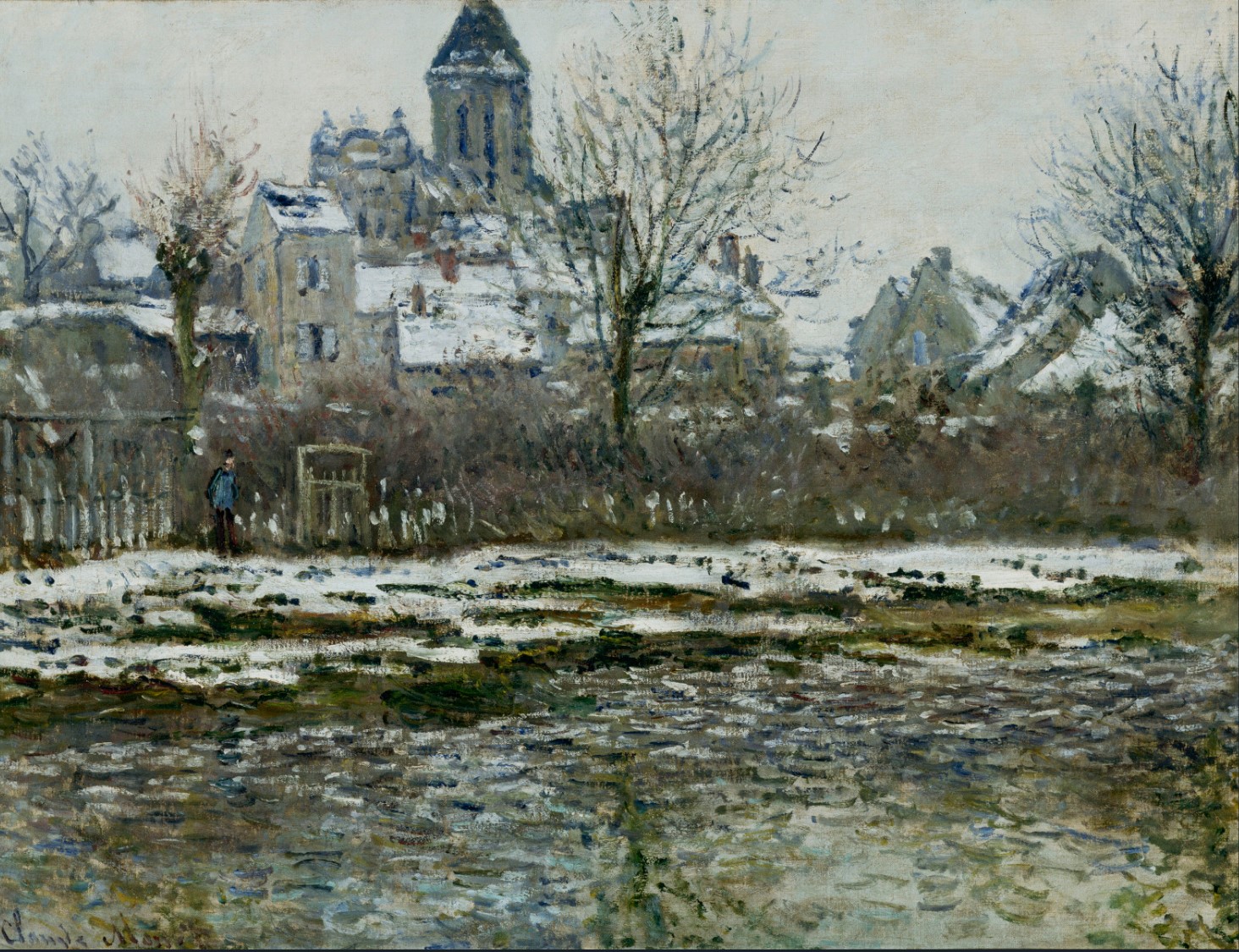
CAILLEBOTTE BEQUEST: Claude Monet, The Church at Vétheuil, Snow, 1878-79, oil on canvas, 20 1/2 x 28 in., Musée d’Orsay, Paris.
renoir_1876_lg
CAILLEBOTTE BEQUEST: Auguste Renoir, Dance at Le Moulin de la Galette, 1876, Oil on canvas, H. 131; W. 175 cm © RMN-Grand Palais (Musée d’Orsay) / Jean-Gilles Berizzi

The settlement accepted in January 1895 and promulgated a year later was not the last word for Renoir who continued to try to fully achieve his friend’s terms. On at least two occasions – in 1904 and 1908 –  the works refused by the State in 1894 were proffered to them. Both times these 28 remaining works were refused and as far as the French State was concerned the case of the Caillebotte Bequest was closed. Only by his death in 1919 were Renoir’s efforts to honor Caillebotte’s bequest to France halted (Martial had died in 1910). In 1928, over thirty years after Caillebotte’s death and bequest, the French State dared to make a legal claim to those remaining 28 works they had rejected three times previously. Inexorably cloaked in superiority, this latest endeavor of the official art establishment revealed its opportunism as the changing winds of taste now clearly favored Impressionism. Both original executors of Caillbotte’s bequest now dead, it was left to Martial Caillebotte’s son’s widow to respond to these highly-placed administrative scratchings. Her decision: she refused to hand over these works and placed them on the open market. The “rejected” and overlooked works of the “Caillebotte Bequest” were sold to private collectors all over the world, including to Americans Albert C. Barnes (1872-1951), and H.O. Havemeyer (1847-1907) and Louisine Havemeyer (1855-1929). Many of these remainder works’ locations are unknown.

Baigneurs au repos BAthers at rest Barnes 1876 7  oil on canvas
CAILLEBOTTE BEQUEST: Bathers at rest, (Baigneurs au repos), 1876/77, oil on canvas, 32 5/16 x 39 7/8 inches, Paul Cézanne. The Barnes Foundation.
CAILLEBOTTE BEQUEST: Edgar Degas, The Dance Lesson, c. 1879, pastel and black chalk on three pieces of wove paper, 25 3/8 x 22 1/8/inches, The Metropolitan Museum of Art, New York, NY.

SOURCES: Anne Distel, Impressionism: the First Collectors, Abrams, 1990; Anne Distel, Douglas W. Druick, Gloria Groom, Rodolphe Rapetti and Kirk Varnedoe, Gustave Caillebotte: Urban Impressionist, 1995; http://www.musee-orsay.fr/en/collections/history-of-the-collections/painting.html; http://www.philamuseum.org/exhibitions/312.html?page=2

My Architecture & Design Photography: FRANK LLOYD WRIGHT (1867-1959). Fallingwater, 1935, Mill Run, Pennsylvania. (7 Photos & Videos).

FEATURE image: Fallingwater, Frank Lloyd Wright, Mill Run, Pennsylvania. March 2010. Author’s photograph.

Fallingwater is a house designed in 1935 by American architect Frank Lloyd Wright (1867-1959). It is in the Laurel Highlands of southwest Pennsylvania, about 70 miles away from downtown Pittsburgh.

The house was intended as a weekend retreat for the Edgar J. Kaufmann and family, owners of a Pittsburgh department store. The area of land had been a summer camp for the department store employees. Wright’s house, completed in 1937, is built partly over a waterfall on Bear Run, a tributary of the Youghiogheny River, in the Appalachians.

Approach to the house.

Bear Run is a tributary of the Youghiogheny River, in the Appalachians.

Fallingwater remained in the Kaufmann family until 1963. Inherited by Edgar Kaufmann Jr. in 1955 following his father’s death, he donated the home and its nearly 2,000 acres of surrounding natural habitat to a nonprofit trust called the Western Pennsylvania Conservancy. Since 1964, around 5 million visitors have made the pilgrimage to Fallingwater, one of America’s most famous modern homes. The house and grounds receive over 160,000 visitors each year.

Fallingwater. The post’s photographs and videos were taken in March 2010.

Fallingwater is over 5000 square feet. The walls are constructed from local sandstone. The rocky landscape is incorporated into the home itself such as its main fireplace. Each bedroom has an individual terrace and there are a sea of windows that open outwards to nature. A glass hatch on the main level finds a short stairway that descends to Bear Run below.

Wright designed Fallingwater’s furnishings, much of it built into the house, In 2002, Fallingwater’s foundation was reinforced to support the first floor’s concrete skeleton that began to sag. The 21st century reconstruction process prevented further collapse but the house had its first level’s original stone floor and built-in furniture taken out.

Updated 5.30.23. All photographs, videos & text:

FRANCE. IMPRESSIONISM. Gustave Caillebotte (1848-1894) and the 4th, 5th, 6th and 7th IMPRESSIONIST ART EXHIBITIONS in Paris, 1879-1882.

FEATURE image: P.A.-Renoir, A Luncheon at Bougival, 1881, The Phillips Collection, Washington, D.C. The Seventh Impressionist Exhibition – 1882.

Gustave Caillebotte, The Bezique Game (Partie de bésigue), 1880, private collection. The Seventh Impressionist Exhibition-1882.

By John P. Walsh

In the five years between the “balanced and coherent” Third Impressionist Art Exhibition in April 1877 and the penultimate Seventh Impressionist Art Exhibition in March 1882 which included Gustave Caillebotte’s The Bezique Game, significant changes had occurred in the art world.

One major development that was especially impactful for the band of independent and ever-varying avant-garde artists known as the “impressionists” was that, after 1877, the group had fallen apart.

The Third Impressionist Exhibition in 1877 organized by Caillebotte and Camille Pissarro (1830-1903) demonstrated the benefit of a detailed marketing plan within a professional arts organization. Caillebotte’s attempted follow-up to host an impressionist exhibition in 1878, however, failed to get off the ground.

It wasn’t for any lack of his trying. In 1877, Caillebotte could measure success in the Third show by 18-count modern artists under a new brand name, along with 230 works. Show attendance numbers were up from the first and second exhibitions almost four fold. Picture sales were up.

In less than one year, the enterprise devolved to nothing tangible. This was because of a lack of collective coherence among the artists in terms of artistic and business outlook. Seeds of destruction among this klatch of mostly young, avant-garde artists became increasingly evident during the “glorious” 1877 show.

Caillebotte’s genius in the Third Exhibition was to know strengths to promote and problem to ignore. He avoided the veritable train wreck coming from associated artists who were antagonistic creatively by keeping them mostly literally physically apart. 

The Impressionists had two major factions. One was led by classically-trained Edgar Degas (1834-1917) with his realist urban figure drawing. The other was the nonacademic, “broken-brush” innovators or strict impressionists such as Claude Monet (1840-1926) and Pierre-Auguste Renoir (1841-1919) who explored the effects of light.

For the duration of the Third Impressionist exhibition, all of Degas’s 25 beach and ballet works hung in a room of their own. 

220px-Edgar_Degas_(1834-1917)
 EDGAR DEGAS (1834 – 1917).
cm_1860
CLAUDE MONET (1840-1926).
7601_m_gustave_caillebotte___french_artist
GUSTAVE CAILLEBOTTE (1848-1894).

As a business seeks popular and financial success, a caveat towards that objective for the third and upcoming 4th, 5th, 6th and 7th impressionist art shows was “the terrible Monsieur Degas.”

Although Degas had an argumentative personality, major reasons for Degas’s dispute with Caillebotte’s impresionist show were not Degas’ making. After 1877, the battle line which ensued between Degas and his group of trained artists and Monet and his nonacademic group affected every next impressionist show up to the 8th and last one in 1886.

The catalyst for the Impressionists’ artistic divisions was their different understandings of what became another major development to affect the art world and all contemporary artists.

Throughout the 1860s, the Salon continued to be anti-democratic. By the late 1870s, there was a clear trend towards a more liberalized Salon. In 1881, the French government took itself out of the Salon. Even before that, in 1878, the year of the scrapped 4th Impressionist show, the government allowed strict or “broken brush” Impressionists like Monet and Renoir to participate in their “Exhibition of Living Artists.”

Édouard Dantan, Un Coin du Salon en 1880 (A Corner of the Salon in 1880), 1880, oil on canvas, 97.2 x 130.2 cm (38.2 x 51.2 in.). Private collection.

Biggest art show in Paris.

Whatever its drawbacks, the Salon remained the biggest art show in Paris.

While Caillebotte’s Third Impressionist Exhibition in 1877 attracted 15,000 visitors in its one month run—a remarkable statistic—the Salon attracted 23,000 visitors per day.

The Salon displayed around 23x more art than the Impressionist show and attracted 50x more visitors. Opportunities for sales and new clients at one of these nineteenth-century warehouse events was immense.

In 1878, after years of fighting for greater participation in the Salon— the Salon des Refusés took place in 1863—innovative Impressionists were finally allowed to freely hang their artwork in an annual show that for hundreds of years had been the institurional enclave of the Paris art world’s elite.

Yet, In terms of the 4th impressionist art show, the bourgeois Degas devised an ingeniously small-minded idea that he presented ennobled by some principle.

Despite this historic opening of the Salon to young avant-garde artists—Monet and Renoir were in their late 30’s, Degas in his mid 40’s—the older and financially secure artist insisted that all impressionists must make a choice.

Either exhibit in the Salon or with the Impressionists.

Degas’s ultimatum was crafted to pressure the “broken brush” impressionists such as Renoir, Monet, Sisley and Cézanne to break ranks to the Salon—and likely improve their sales and reputations in a rapidly changing art market—and leave the impressionist art organization to Degas and his followers.

Degas’s wedge actually worked. By 1880, the “broken brush” impressionists were purged from the Impressionist exhibitions by their own choice to exhibit in the Salon. Though they saw no conflict with the Impressionist art organization per se that broken brush artists helped found, Degas’s ultimatum had been permitted to stand for the 4th, 5th, and 6th impressionist art shows and helped secure these Impressionist shows of 1879, 1880, and 1881 under the leadership of Degas.

Pierre-Auguste Renoir (French, 1841-1919).
Paul Cézanne (French 1839-1906) and Camille Pissarro (French, 1830-1903).
Alfred Sisley (British, born France, 1839-1899).

The 4th, 5th, and 6th exhibitions featured Degas and his favorite artists. It was in these Degas-led shows that the public had their first in-depth look at Mary Cassatt (1844-1926) and Paul Gauguin (1848-1903), among others.

Not all of the Impressionists’ original members and strict impressionists decided to exhibit in the Salon. Camille Pissarro and Berthe Morisot (1841-1895) chose to stay in the independent art group and continued doing so for the eight shows. (Morisot had a baby during the 4th and didn’t participate).

Gustave Caillebotte had invested his talent, reputation and resources into the independents since 1876 and continued to organize and exhibit with them in 1879 and 1880. Before the 6th show in 1881, Caillebotte himself finally broke with the Degas regime in a dispute nominally over a advertising issue.

As the calendar proclaimed a new decade, new opportunities for Impressionist exhibitions began percolating in Caillebotte’s head as he painted The Bezique Game (1880) within the shifting artistic environment.

Mary Cassatt (American, 1844 –1926) in later years.
Édouard Manet (French, 1832-1883).
Berthe Morisot (French, 1841-1895) in 1875.

Card games

The game of Bezique is a 64-card game for two players and curiously French. In the game two singles players sit across the net to compete to 1000 points. The rest are score keepers or observers. As the game carries on, card “tricks” pile up on the table.

Some art critics viewing Caillebotte’s contemporary subject of a popular game identified the painting as a “legible and tightly ordered” image out of the long-held pictorial tradition of card playing. Yet idiomatic clichés related to card playing such as “playing one’s cards right” or “holding one’s cards close to the chest” may be read into the painting. It is one of the canvasses painted by impressionist artists during this time that relate to the Impressionist group’s recent and ongoing exhibition experiences.

Nineteenth-century art critics usually grouped together the artwork of Caillebotte and Degas, Neither artist was among the “strict” impressionists such as of Monet and Renoir. Several critics wondered aloud in the newspaper why Caillebotte would even have dealings with those “broken-brush” daubers now at the Salon with Édouard Manet.

4th (1879):

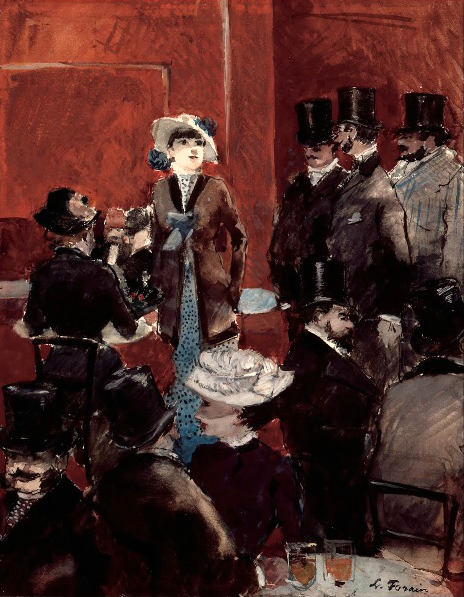
Competition between Degas’s partisans and the mostly younger strict impressionists such as Claude Monet, Renoir, and others, resulted in a schism in 1879. In addition to himself, Degas recruited talented newcomers such as Mary Cassatt (1844-1926), Jean-Louis Forain (1852-1931), and Federico Zandomeneghi (1841-1917) for the 4th.

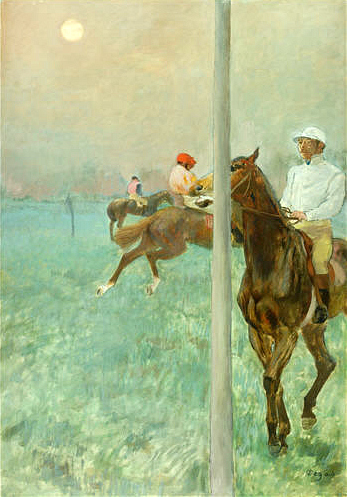
Edgar Degas, Chevaux de course (Jockeys before the Race), 1869-1872, oil, essence, pastel on paper, 107 x 73 cm, 42 1/8 x 28 3/4 in., The Barber Institute of Fine Arts, University of Birmingham. The Fourth Impressionist Exhibition-1879.
Gustave Caillebotte, The Skiffs, 1877, oil on canvas, 88.9 x 116.2 cm (35 x 45 3/4 in.), National Gallery of Art, Washington, D.C. The Fourth Impressionist Exhibition-1879.
Mary Cassatt, Femme dans une loge (Woman in a Loge), 1879, oil on canvas, 80.3 x 58.4 cm (31 5/8 x 23 in.), Philadelphia Museum of Art. The Fourth Impressionist Exhibition-1879.
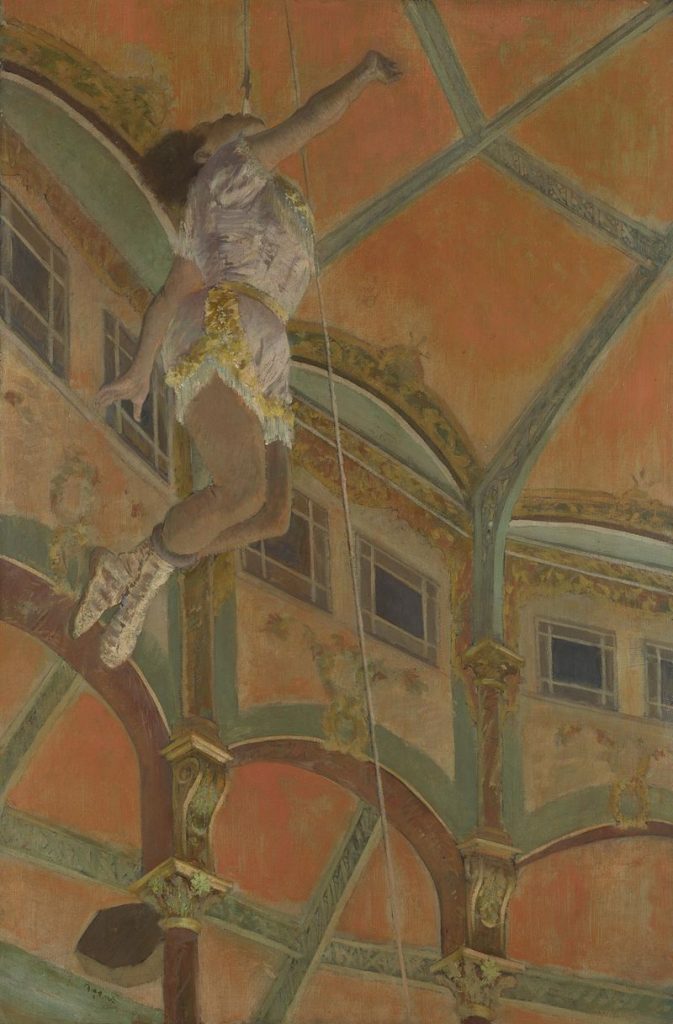
Edgar Degas, Miss Lola, au Cirque Fernando, 1879, oil on canvas, 117 x 77.5 cm ( 46 x 30 1/2 in.), National Gallery, London. The Fourth Impressionist Exhibition-1879.
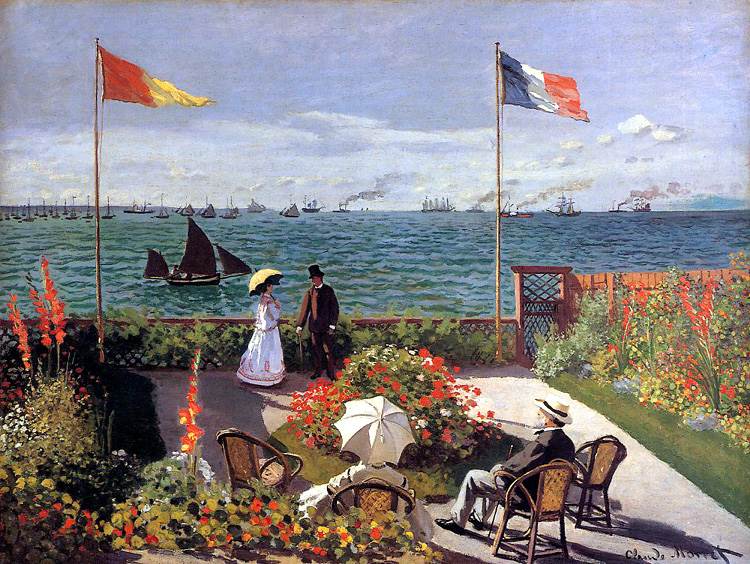
Claude Monet, Jardin à Sainte-Adresse (Garden at Sainte-Adresse), 1867, oil on canvas, 38 5/8 x 51 1/8 in. (98.1 X 129.9 cm), The Metropolitan Museum of Art, New York. The Fourth Impressionist Exhibition-1879.
Jean-Louis Forain, Café Interior, c.1879, gouache on paper, 12 7/8 x 10 in. (32.8 x 25.5 cm). The Fourth Impressionist Exhibition-1879.
Federico Zandomeneghi, Portrait of M. Diego Martelli, 1879, oil of canvas, 28 3/8 x 36 1/4 in. (72 x 92 cm), Galleria D’Arte Moderna, Florence. The Fourth Impressionist Exhibition-1879.

The Third Impressionist Art Exhibition held in April 1877 is known as “Caillebotte’s Exhibition.” It is the highlight of the eight Impressionist exhibitions held between 1874 and 1886. While scholars agree that the Third Impressionist Exhibition was in every sense “glorious,” the show’s euphoria was short lived. Two weeks after the show closed, as hope for picture sales grew high, there was a Constitutional crisis in the French government. The political turmoil resulted in a consolidation of Republican power defeating Royalists which led to a national economic recession. The Impressionist group, conceived and carefully built to unity by Gustave Caillebotte, resorted to squabbling as the artists jostled to survive in receding good times.

Gustave Caillebotte’s efforts for a fourth impressionist exhibition in 1878 were stymied and the next 3 exhibitions would be under Degas’s rule. In 1879 Degas exclude the “broken brish” artists Pierre-Auguste Renoir, Paul Cézanne and Alfred Sisley. In 1880, Degas cast out Claude Monet. The destructive outcome of these intramural politics was not lost on Caillebotte. 

Caillebotte built the group’s brand in the Third Impressionist Art Exhibition in 1877 largely on  “broken brush” impressionists nwho were excluded from Degas’s shows. Caillebotte, however, worked with Edgar Degas and his artistic coterie in 1879, 1880 and 1881. Oy was before the opening of the Sixth Impressionist Exhibition in 1881 that Caillebotte finally departed the Degas-led organization. Caillebotte cited differences on an advertising issue.

Yet Caillebotte’s nonparticipation with the Impressionists was short lived.

The 32-year-old Caillebotte looked to a retro-style vision for an Impressionist Art Exhibition in 1882. His emerging partner was 51-year-old Impressionist art dealer Paul Durand-Ruel (1831-1922).

5th (1880):

The Fifth exhibition lost Monet to the Salon which per Degas’s ultimatum excluded the figurehead through which the term “impressionism” received its label in 1874 from exhibiting with the group of independents in 1880. Other broken or free brush painters such as Camille Pissarro and Berthe Morisot did continue to exhibit in the 5th show. Ironically, critics responded to the truncated, Degas-led show, by wondering out loud what made this Impressionist show any different than a recently liberated Salon. While Morisot and American Mary Cassatt’s artwork received especial attention and praise in the 5th show, the month-long April 1880 show also introduced important newcomers to its Paris audience such as Paul Gauguin (1848-1903) and Jean-François Raffaëlli (1850-1924).

Marie Bracquemond (1840-1916), La dame en blanc Ithe woman in white), oil on canvas, 180×100 cm. Musée de Cambrai.
Marie Bracquemond (1840-1916), Sur la terrasse à Sèvres, 1880, oil on canvas, 88 x 155 cm, Petit Palais, Geneva.
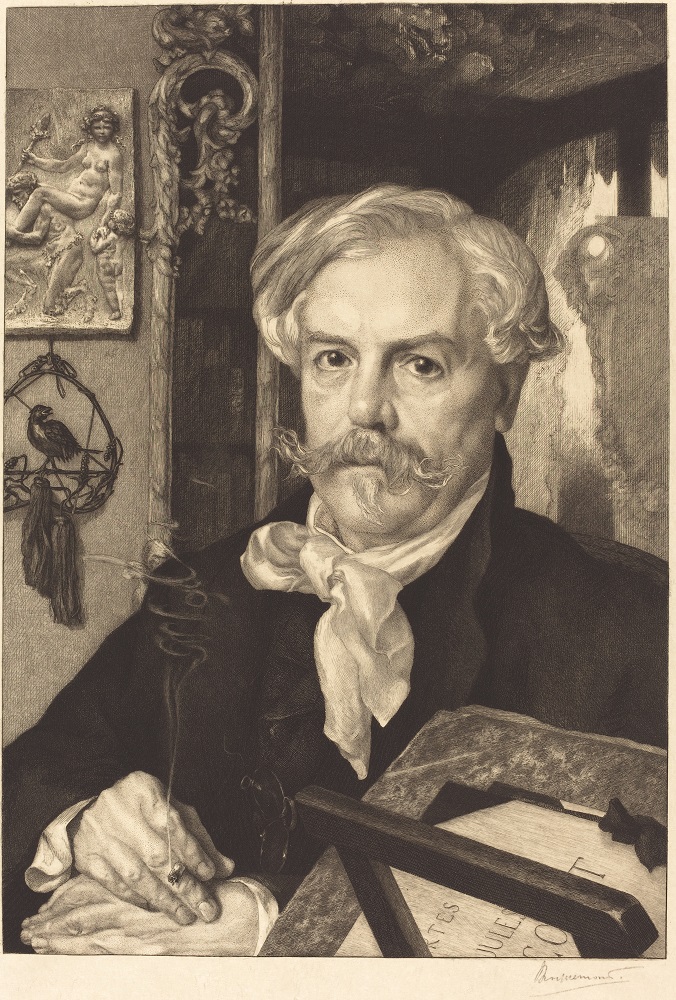
Félix Henri Bracquemond (1833-1914), Edmond de Goncourt, charcoal on canvas (original), 1880. Louvre. (This is a slightly later 1882 engraving.)
Gustave Caillebotte (1848-1894), Interior (Woman at the Window), 1880, 116×89 cm, private.
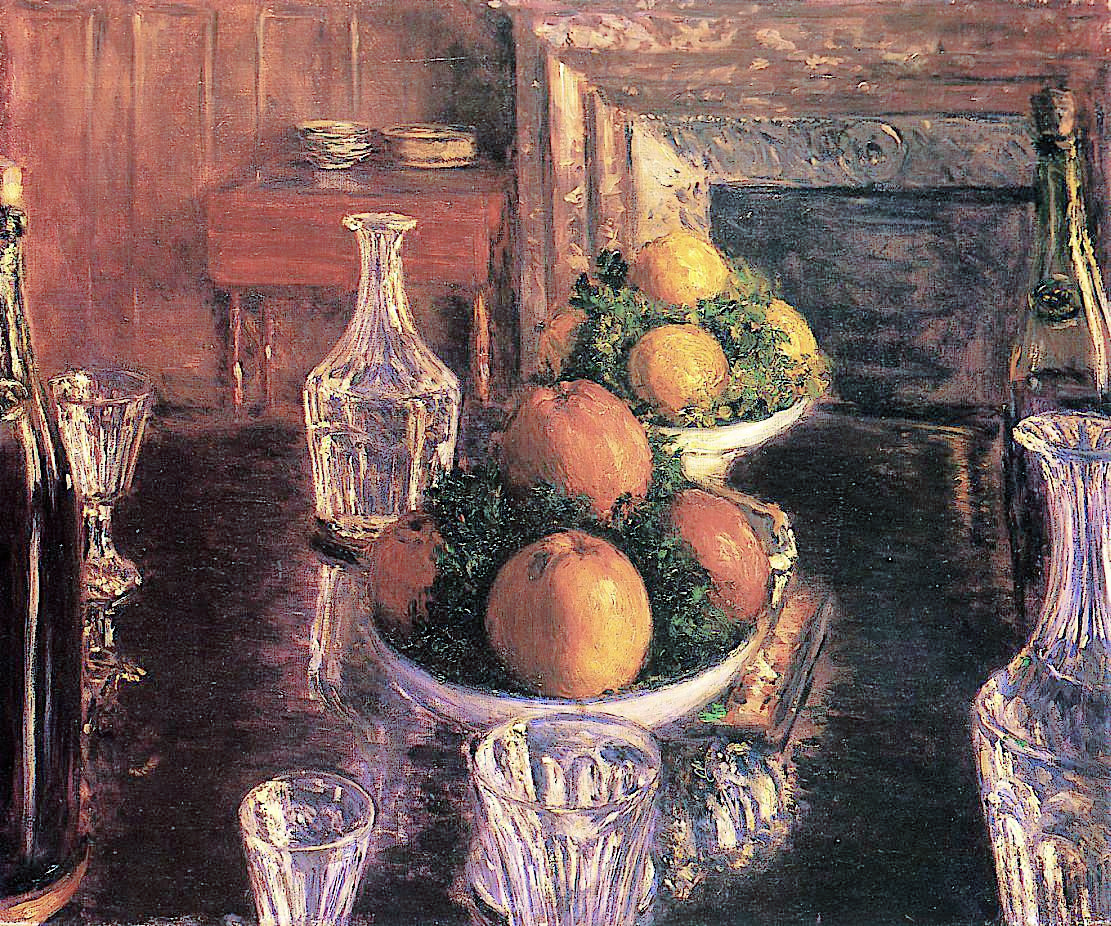
Gustave Caillebotte (1848-1894), Still Life, 1879, oil on canvas, 50×60 cm, private.
Mary Cassatt (1844-1926), Portrait of Madame J. , c. 1880, oil on canvas, 80.6×64.6 cm, The Peabody Institute, Baltimore MD.
Edgar Degas (1834-1917), Toilette, c. 1879, 21×15.9 cm. Private New York.
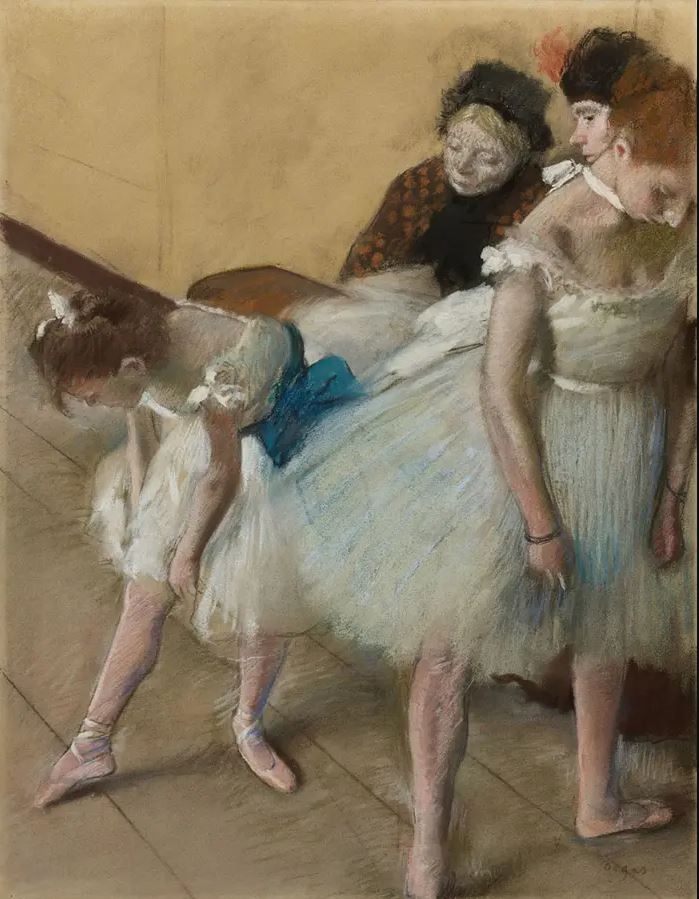
Edgar Degas (1834-1917), The Dance Examination, pastel and charcoal on paper, 63.4×48.2 cm, Denver Art Museum
Edgar Degas (1834-1917), The Dance Lesson, oil on canvas, 38×86.3 cm, Private Virginia.
Paul Gauguin (1848-1903), The Market Gardens of Vaugirard, c. 1879, oil on canvas, 65×100 cm, Smith College Museum of Art, Northampton MA.
Berthe Morisot (1841-1895), Summer (Young Woman By the Window), oil on canvas, 76×61 cm, Musée Fabre, Montpellier.
Berthe Morisot (1841-1895), Woman at Her Toilette, c. 1875, 60.3×80.4 cm, The Art Institute of Chicago.
Berthe Morisot (1841-1895), portrait (Young Woman Dressed for the Ball), oil on canvas, 71×54 cm, Musée d’Orsay.
Camille Pissarro (1830-1903), The Woodcutter, 1879, oil on canvas, 89×116.2 cm, Holmes à Court Gallery Australia.
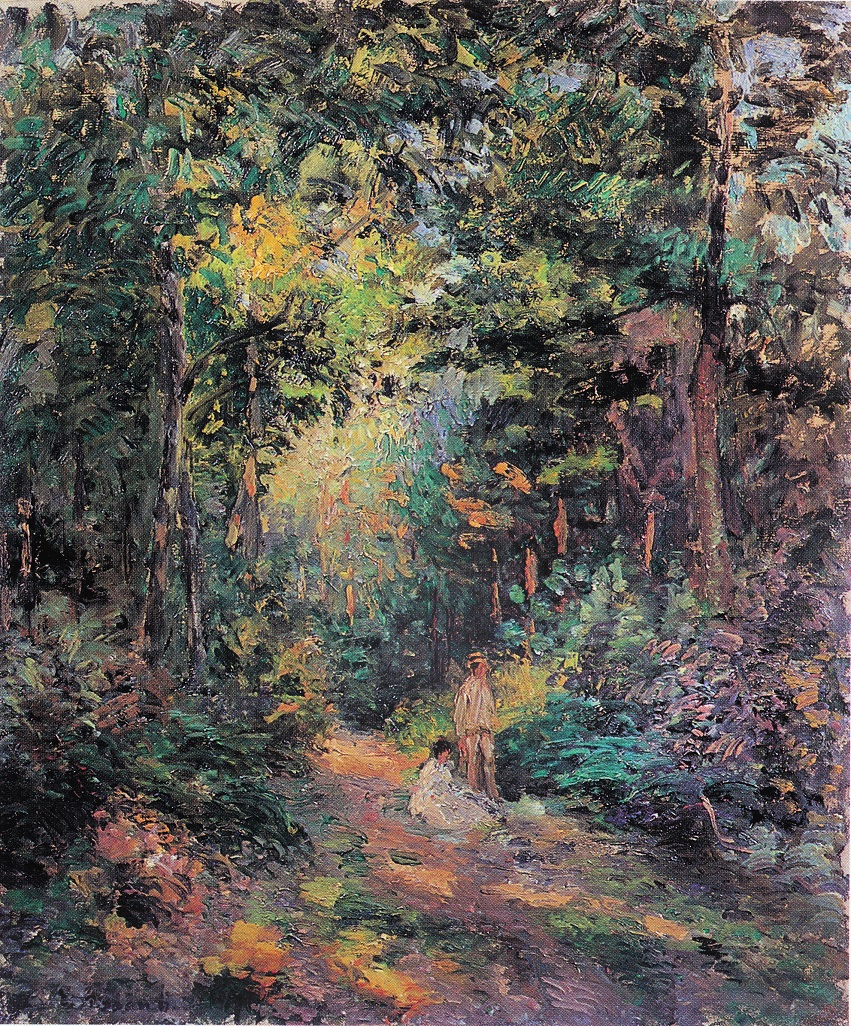
Camille Pissarro (1830-1903), Autumn Path through the Woods, oil on canvas, 81×65 cm, Private Paris.
Jean-François Raffaëlli (1850-1924), Mayor and Town Counselor, oil on canvas, 53.5×73 cm, Private New York.
Henri Rouart (1833-1912), Melun (Terrace on the Banks of the Seine), oil on canvas, 46.5×65.5 cm, Musée d’Orsay.
Federico Zandomeneghi (1841-1917), Mother and Daughter, 1879, oil on canvas, 62×52 cm, Private Italy.

6th (1881):

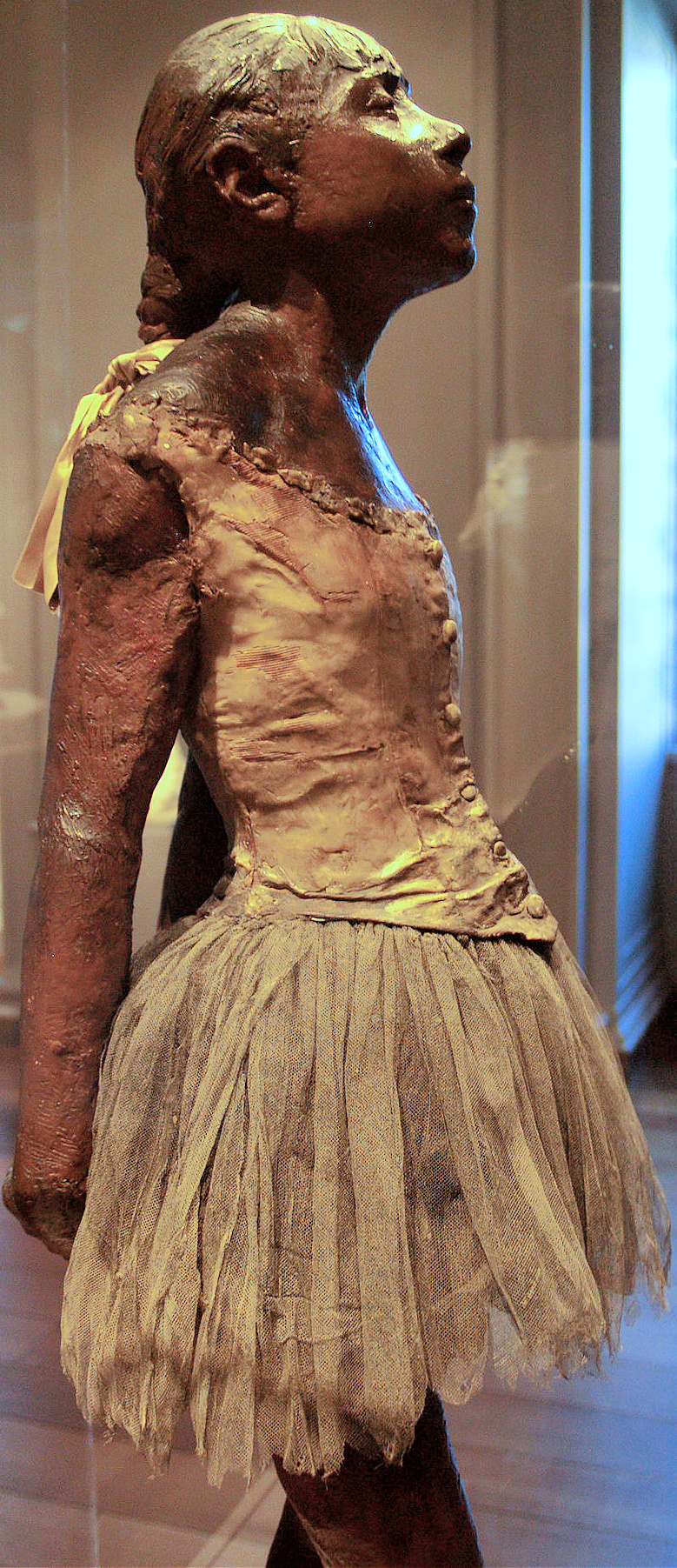
Mary Cassatt and Berthe Morisot continued their impact as the most progressive impressionists according to critics during the 6th Impressionist show in 1881. Morisot’s Nurse and Baby was startlingly abstract to viewers of the 1881 show. Zandomeneghi’s Place d’Anvers quietly inspired artists to explore anew early Renaissance Italian mural painting. Raffaëlli, displaying over 30 works in the 6th show, made a huge impact for his realist, socially aware artwork. The 6th show’s centerpiece was Degas’ statuette of the ballet student in a fabric tutu that put impressionism in 3D and affected modern sculpture going forward. Gustave Caillebotte who had participated in the 2nd, 3rd, 4th and 5th impressionist exhibitions (and would the 7th) as well as organized the 3rd, 4th, and 5th (and would the 7th), bowed out of participating at all in the 6th show.

Mary Cassatt (1844-1926), The Garden (Lydia Crocheting in the Garden at Marly), oil on canvas, 66×94 cm, The Metropolitan Museum of Art.
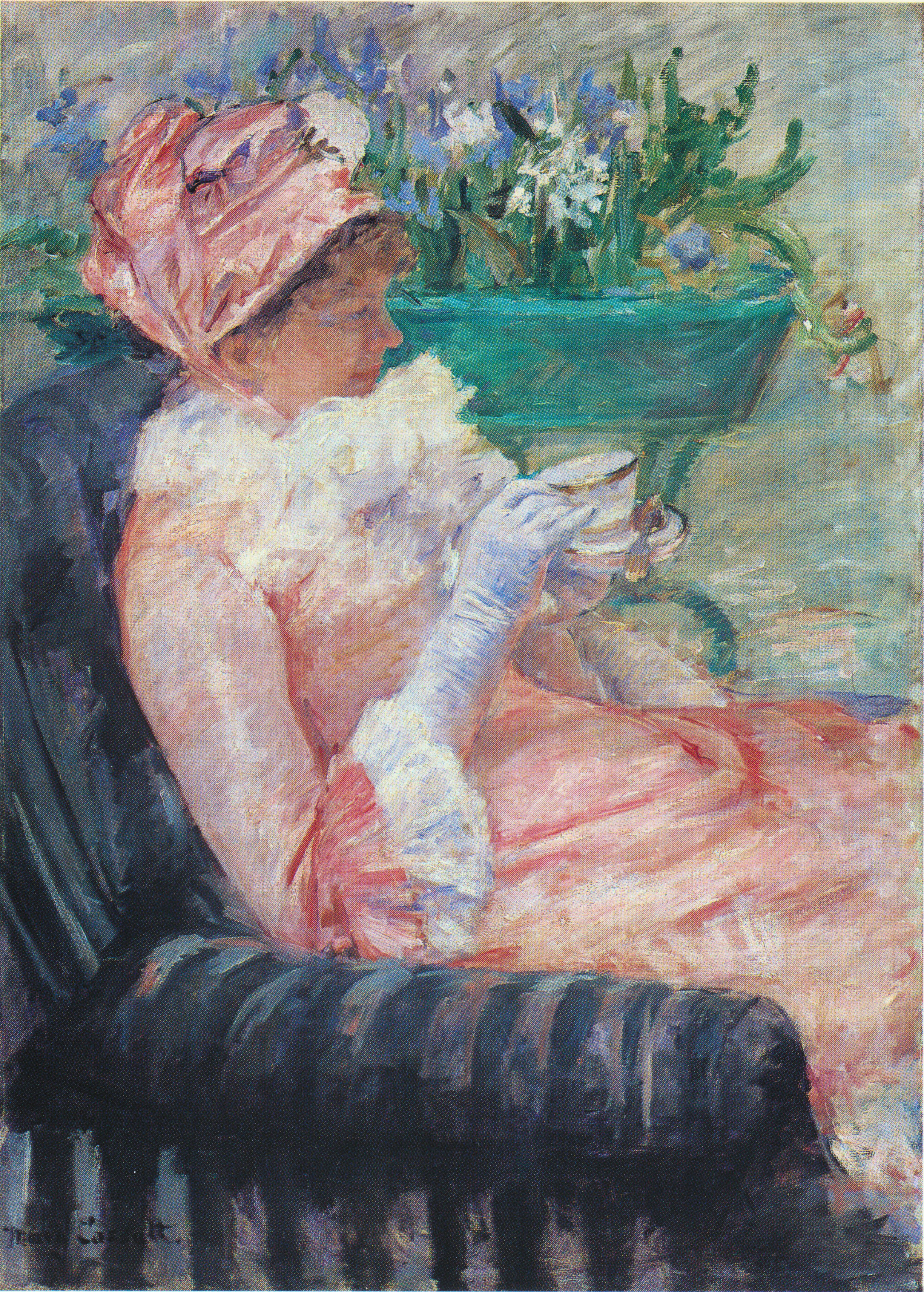
Mary Cassatt (1844-1926), The Cup of Tea, 1879, oil on canvas, 92.4×65.4 cm, The Metropolitan Museum of Art.
Edgar Degas (1834-1917), Cabaret, c. 1877, The National Gallery of Art, Washington, D.C., (Formerly, Corcoran Gallery of Art).
Edgar Degas (1834-1917), The Little 14-Year-Old Dancer, wax statuette, c.1881, The National Gallery of Art, Washington, D.C. Author’s photograph, 2010.
Edgar Degas (1834-1917), Room in a Brothel, monotype in black ink on laid paper, 21×15.9cm, The Iris & B. Gerald Cantor Center for Visual Arts at Stanford University, formerly the Stanford University Museum of Art
Jean-Louis Forain (1852-1931), Loge d’actrice, 1880, watercolor with gouache, 28×23 cm, private Paris.
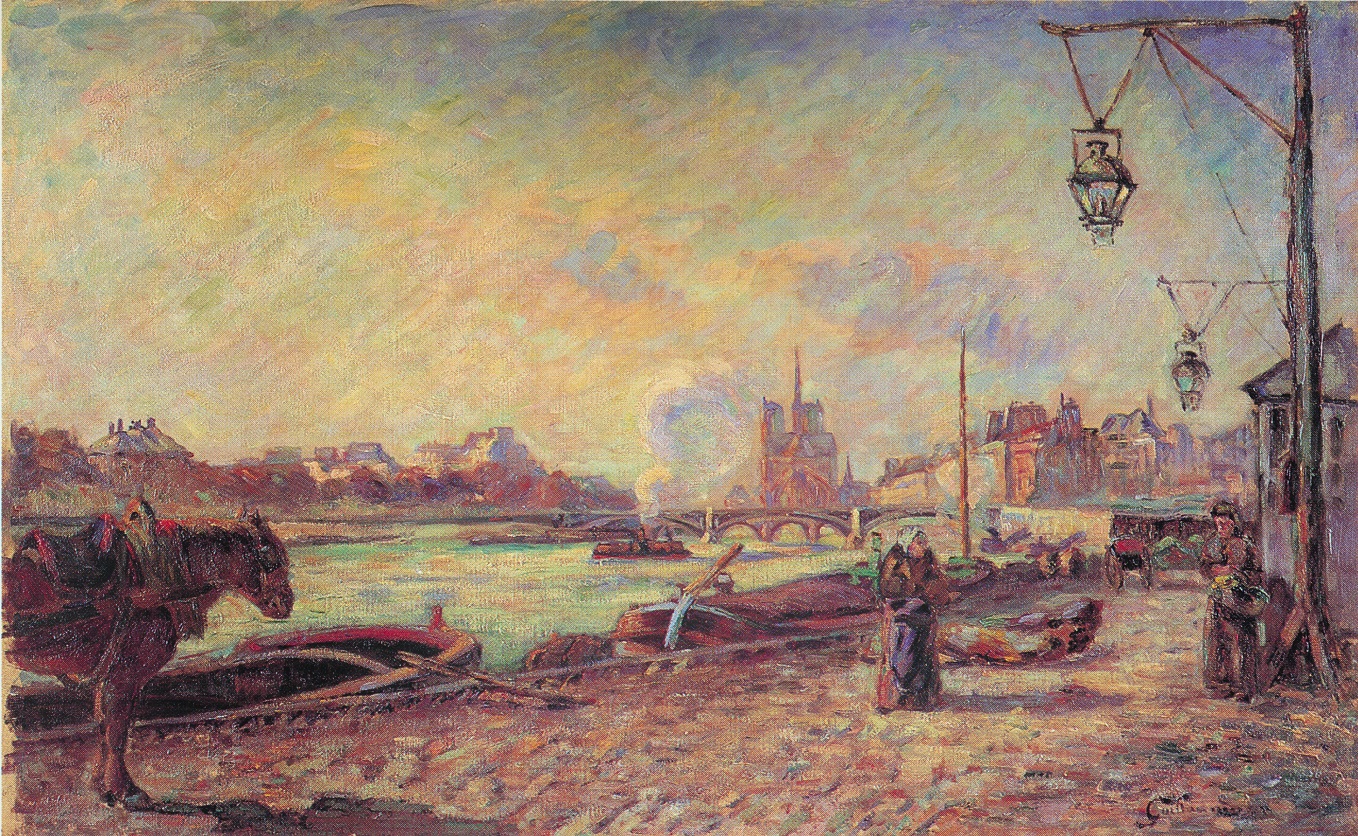
J.-B. Armand Guillaumin (1841-1927), Quai de la Rapée, oil on canvas,50×79 cm, Private Paris.
Berthe Morisot (1841-1895), Nurse and Baby, 1880, oil on canvas, 50.2 x 61 cm, Private New York.
Camille Pissarro (1830-1903), Thatched Cottages at Val Hermé, 54×64.7 cm, private.
Jean-François Raffaëlli (1850-1924), Les déclassés (Les buveurs d’abstinthe), oil on canvas, 110.2×110.2 cm, Private.
Federico Zandomeneghi (1841-1917), La place d’anvers, 1880, oil on canvas, 100×135 cm, Galleria d’arte moderna Ricci Oddi Piacenza.

The Seventh Impressionist Art Exhibition: Caillebotte and Paul Durand-Ruel (1831-1922)

The changing art market in the 1870s had taken a financial toll on the art dealer’s modern art business. Durand-Ruel re-tooled his dealership to focus not on large-scale group shows but small shows of individual artists. Overall the French economy had sunk into hard times and big shows cost more money. Following the disastrous Hôtel Drouot auction in 1875—which Durand-Ruel believed was an attempt by his critics to discredit him as an art dealer—the well-stocked Impressionist art dealer reluctantly agreed to go forward with Caillebotte’s exhibition plan for 1882. Caillebotte convinced the dealer that the Seventh show would earn a small profit.

P.A.-Renoir, A Luncheon at Bougival, 1881, The Phillips Collection, Washington, D.C. The Seventh Impressionist Exhibition – 1882.

Caillebotte’s main hook was to re-integrate the excluded “broken brush” or “strict” impressionists including Renoir and Claude Monet. Degas and his faction of artists including Mary Cassatt stayed away from the Seventh Impressionist exhibition though Paul Gauguin was represented. Also missing was the artist of Aix, Paul Cézanne, who was experimenting with volumes in the south of France. Cézanne would not be seen in a Paris art show until 1895 when a huge body of his work was featured in a landmark retrospective exhibition at Ambroise Vollard’s gallery.

Caillebotte’s first move was to secure the popular Renoir for the upcoming March 1882 show. Renoir sent 24 new works, including his iconic large-format A Luncheon at Bougival (Un déjeuner à Bougival). Durand-Ruel insisted on a standardized presentation, including simple white frames for every work. In addition to Monet and Renoir, the seventh show hailed a triumphant return for Alfred Sisley. Camille Pissarro displayed several paintings of peasant girls. His tiny pseudo-pointillist brushstrokes overlaid with occasional dabs of thicker paint, built up an uneven surface that integrated the figure and background which worked to visually mimic the textures of the sitter’s wool clothing.

Caillebotte, “Rising Road (Chemin Montant).” 1881. The Seventh Impressionist Art Exhibition-1882.

Caillebotte sent 17 works to the show. The Bezique Game (Partie de bésigue) painted in 1880, was joined by Rising Road (Chemin Montant) painted in 1881. This latter work’s path hardly rises—a feature that contributed to the canvas’s mystery. The question was asked whether it was a reprise of the “enhanced perspective” that aggravated critics in 1876 when they saw it in The Floor Scrapers.

Rising Road is painted with a free handling of colors in the loose brushwork style of Monet and Renoir whose closer re-acquaintance Caillebotte made. One critic poked fun at the painting’s mysterious pair as viewers wondered with him who is “the conjugal couple…seen from the back” ? Their identities and location are uncertain although speculation has put Caillebotte in the painting with his lifelong companion Charlotte Berthier.

Rising Road (Chemin Montant) has had only two owners since 1881. It sold in 2003 for nearly $7 million ($6,727,500) at Christie’s in New York City,

7th (1882):

Gustave Caillebotte and Impressionist art dealer Paul Durand-Ruel organized the exhibition which marked the triumphant return of the broken-brush or strict Impressionists, such as Claude Monet, Alfred Sisley, and Pierre-Auguste Renoir. In many ways it was Renoir’s wide-ranging artwork that was the star of the 7th show.

Gustave Caillebotte, Balcon (Balcony), 1880, oil on canvas, 26 1/4 x 24 in. (68 x 61 cm). Private Collection, Paris. The Seventh Impressionist Exhibition-1882.
Paul Gauguin, A la Fenêtre, nature morte (At the Window, Still Life),1881, oil on canvas, 7.5 x 10.625 in (19 x 27 cm), Musée des Beaux-Arts de Rennes. The Seventh Impressionist Exhibition-1882.
Jean-Baptiste-Armand Guillaumin (1841-1927), Paysage (fin octobre) (Landscape, End of October), c, 1876, oil on canvas, 17 7/8 x 48 1/8 in. (180 x 123 cm), Nasjonalgallereit, Oslo. The Seventh Impressionist Exhibition-1882.
Claude Monet (1840-1926), Soleil couchant, sur la Seine, effet d’hiver (Sunset on the Seine, Winter Effect), 1880, oil on canvas, 39 3/8 x 59 7/8 (100 x 152 cm), Musée du Petit Palais, Paris. The Seventh Impressionist Exhibition-1882.
Camille Pissarro, Jeune paysanne prenant son café, (Young Peasant Woman Drinking Her Coffee), 1881, oil on canvas, 65.3 × 54.8 cm (25 11/16 × 21 9/16 in.), The Art Institute of Chicago. The Seventh Impressionist Exhibition-1882.
Pierre-Auguste Renoir, Jongleuses au Cirque Fernando, (Jugglers/acrobats at the Cirque Fernando), 1879, oil on canvas, 131.2 × 99.2 cm (51 ½ × 39 1/16 in.), The Art Institute of Chicago. The Seventh Impressionist Exhibition-1882.
Alfred Sisley, Saint-Mammès, temps gris (Saint-Mammès, Cloudy Weather), c. 1880, oil on canvas, 21 5/8 x 29 1/8 in. (54.8 x 74 cm), Museum of Fine Arts, Boston. The Seventh Impressionist Exhibition-1882.
Claude Monet, Bouquet de soliels (Bouquet of Sunflowers), c. 1880, oil on canvas, 39 3/4 x 32 in. (101 x 81.3 cm), Metropolitan Museum of Art, New York. The Seventh Impressionist Exhibition-1882.

Sources: 
Charles Moffett, The New Painting, 1986.
Anne Distel, Urban Impressionist, 1995.
Ross King, The Judgment of Paris: The Decade that Gave Us Impressionism, 2006.
John Milner, The Studios of Paris, 1990.
Alfred Werner, Degas Pastels, 1998.
http://www.christies.com/LotFinder/lot_details.aspx?intObjectID=4181485

FRANCE. IMPRESSIONISM. Gustave Caillebotte (1848-1894) and the 2nd and 3rd IMPRESSIONIST ART EXHIBITIONS in Paris, 1876 and 1877.

FEATURE image: Gustave Caillebotte, Paris street; a rainy day (Rue de Paris, Temps de pluie), 1877, The Art Institute of Chicago. Caillebotte submitted his painting to the Third Impressionist Art Exhibition held in Paris in 1877.

The first Impressionist exhibition was held in Paris in 1874. Gustave Caillebotte (1848-1894) did not exhibit with the Impressionists in that watershed show. In 1875 the 27-year-old Caillebotte divided a more than two-million-franc inheritance with his older half-brother Alfred (1834-1896) who was a Catholic priest and younger brother Martial (1853-1910).

Henri Rouart (1833-1912) who was of the same high-class circle as his neighbor Gustave Caillebotte was one of the two signatures on a formal invitation to Caillebotte inviting him to exhibit in the Second Impressionist Exhibition in 1876. The other signatory was Pierre-Auguste Renoir (1841-1919).

Caillebotte accepted and sent eight paintings including his famous The Floor Scrapers (Les raboteurs de parquet) that today hangs in the Museé D’Orsay.

Gustave Caillebotte, Les raboteurs de parquet (The Floor Scrapers), 1875, oil on canvas, 102 x 146.5 cm (40.2 × 57.7 in.). It was originally bestowed by Caillebotte at his death in 1894 to the Musée du Luxembourg and, in 1929, transferred to the Musée du Louvre. In 1947, it was moved to the Galerie nationale du Jeu de Paume, and in 1986, brought to the Musée d’Orsay in Paris.

Rejected by the Salon.

The Impressionists were not purists to their collective cause and to varying degrees many of them, if reluctantly, also exhibited in the French Government’s huge annual exhibition known as the Salon. Despite its attempts at modernizing its policies and art stock, the Salon remained a conservative venue. While The Floor Scrapers of 1875 was exhibited in the Impressionist show in 1876 it had been rejected by the Salon in the previous year.

Artwork called “vulgar” and “leftist.”

In addition to its subject matter and artificially enhanced perspective, The Floor Scrapers was called “vulgar” and “leftist” by critics. This was because the painting commutes the nude—a traditional academic subject—into the Impressionist specialty of a modern life subject.

The floor scrapers in the painting are not removing old wax as might be first suspected. Their efforts show them working in a new building where they are preparing the wood by inducing its buckling with water and scraping it smooth.

Gustave Caillebotte, Raboteurs de parquets (The Floor Scrapers), 1876, oil on canvas, 80 x 100 cm (31.5 × 39.375 in.).

The other 6 paintings sent by Caillebotte to the 1876 show:

Gustave Caillebotte, Jeune homme jouant du piano (Young man Playing the Piano), 1876, oil on canvas, 80 x 166 cm (31.5 x 45.625 in.). Private collection.
Gustave Caillebotte, Déjeuner (Lunch), 1876, oil on canvas, 80 x 166 cm (31.5 x 45.625 in.). Private collection.
Gustave Caillebotte, Jeune Homme à sa fenêtre (Young Man at His Window), 1876, oil on canvas, 116.2 x 81 cm (45 3/4 x 31 7/8 in.). J. Paul Getty Museum, Los Angeles.
Gustave Caillebotte, Woman under a tree (Femme sous un arbre), 1872-73, oil on canvas, 46 x 38 cm. Private collection.
Gustave Caillebotte, Jardin à Yerres (Garden at Yerres), 1876, 59 x 82 cm. Private collection.
Gustave Caillebotte, Jardin à Yerres (Garden at Yerres), 1876, 65 x 92 cm

Gustave Caillebotte’s Dinner Invitation Leads to the Exquisite THIRD IMPRESSIONIST EXHIBITION of 1877.

Gustave Caillebotte, Rue Halévy, sixth floor view (Rue Halévy, vue d’un sixième étage), 1878. Private collection.

Richard R. Brettell, chair in Art and Aesthetics at the University of Texas at Dallas, states plainly that in January or February 1877 a soirée of seven male artists constituted what was “arguably the most important dinner party of painters held in the nineteenth century.”

The reason for this social occasion was all business—specifically, to ponder and discuss the future of French modern art. It was hosted in the well-appointed Paris apartment of fellow artist Gustave Caillebotte (1848-1894) on Rue Miromesnil in the Faubourg Saint- Honoré in Paris.

Richard R. Brettell. For much of the 1980’s, Brettell was Searle Curator of European Painting at The Art Institute of Chicago. Fair Use.

The clubby dinner idea and its invitation to artists ranging in age from 28-year-old Caillebotte to 49-year-old Pissarro was the initiative of those two arists as evidenced in a surviving letter from Caillebotte to Pissarro.  In the letter, haute bourgeois Caillebotte invites sometime anarchist and socialist Camille Pissarro (1830-1903) to this smart-set gathering and shares with Pissarro an advance guest list.

Monday night dinner of Impressionists.

Five of the greatest avant-garde painters of their generation joined Caillebotte and Pissarro on the next Monday night. They were: Edgar Degas (1834-1917), Claude Monet (1840-1926), Pierre-Auguste Renoir (1841-1919), Alfred Sisley (1839-1899), and Édouard Manet (1832-1883), “the dean” of modern artists. If Gustave Courbet (1819-1877) was not in self-imposed exile in Switzerland for being unwilling to pay a heavy indemnity to the French Government and Paul Cézanne (1839-1906) was not creating misunderstood masterpieces even by avant-garde standards, the tally in Caillebotte’s suite of rooms would still fit Richard Brettell’s description. 

Caillebotte’s aim was direct. He wanted to facilitate frank and fruitful discussion among these artists to set an agenda and strategy for the future of French modern painting. Their plans included a third exhibition of their so-called “new painting.” A likely agenda item was marketing for these modern artists’ first exhibition that was advertised as “Impressionist.” Such is the an ambiguous moniker of descriptive iconography and critical valuation that endured.

Modern art show on the new Paris Boulevards.

Caillebotte selected the venue for the April 1877 show. It was a five-room luxury apartment in the heart of Baron Haussmann’s newly-constructed Paris. The capital’s boulevards became a symbol of French wealth, modernity, and prestige.

Caillebotte’s organizational methods worked. The Third Impressionist Exhibition is judged to be “the most balanced and coherent” of the eight exhibitions held between 1874 and 1886. Gustave Caillebotte contrived, solicited and arranged for what he wanted to see as a “democratic” exhibition of 230 works representing 18 artists. In its 30-day run, the exhibition attracted 500 attendees per day. 

Gustave Caillebotte, Paris street; a rainy day (Rue de Paris, Temps de pluie), 1877, The Art Institute of Chicago.

Caillebotte sent six of his paintings to the show including his iconic Paris Street: A Rainy Day. It hangs today in The Art Institute of Chicago though in 2012 and until January 20, 2013 it was loaned out to the Musée d’Orsay in Paris. 

Brettell thinks it is fair to say that Caillebotte had just one notable set back during this third exhibition affair—the young art show producer and artist was unable to convince Édouard Manet to “desert the Salon and join forces with the Impressionists” to exhibit with them.

The other 5 paintings sent by Caillebotte to the 1877 show:

Gustave Caillebotte, Le Pont De L’Europe, 1876, oil on canvas, 125 x 181 cm, Petit Palais/Musée d’art moderne, Geneva, Switzerland.
Gustave Caillebotte, Portraits à la campagne, 1876. oil on canvas, 95 × 111 cm (37.4 × 43.7 in.), Musée Baron Gérard, Bayeux.
Gustave Caillebotte, Portrait de Madame Caillebotte (The Artist’s Mother), 1877, Private Collection.
Gustave Caillebotte, Portraits dans un intérieur (Portraits in an Interior), 1877, oil on canvas, 46 x 56 cm (18 1/8 x 22 in.). Private Collection, New York.
Gustave Caillebotte, Peintres en bâtiments (House Painters), 1877, 89 x 116 cm, Private Collection, Paris.

Sources:
The New Painting: Impressionism 1874-1886, 1986, Charles S. Moffet.

Gustave Caillebotte: Urban Impressionist, 1995, Anne Distel, editor.

https://gw.geneanet.org/pacret?lang=en&n=caillebotte&oc=0&p=alfred

one image:

UNITED STATES. My Art Photography: Made in 1990, a monumental Cor-10 steel sculpture by FERDINAND REBECHINI (American, 1923-2003) depicts a Kaskaskia leading Fr. Jacques Marquette, S.J. and Louis Jolliet through the Chicago Portage in 1673.

FEATURE image: Kaskaskia tribe member leads Fr. Jacques Marquette, S.J. and Louis Jolliet through the Chicago Portage, 1673. Cor-10 steel, Ferdinand Rebechini (1923-2003), The Chicago Portage National Historic Site, Lyons, Illinois, 1990. Author’s photograph taken in November 2012.

A Native American of the Kaskaskia tribe leading French explorers Father Jacques Marquette, S.J. and Louis Jolliet through The Chicago Portage. A Cor-10 steel sculpture by Ferdinand Rebechini (1923-2003) of Rebechini Studios Inc. of Elk Grove Village. The artwork was dedicated at The Chicago Portage National Historic Site in Lyons, Illinois, in April 1990. Author’s photograph.

In September 1673 members of the Kaskaskia, a Native American tribe of the Illinois Confederation, led French explorers Louis Jolliet (1645-1700) and Père Jacques Marquette, S.J. (1637-1675) through the portage that was well known to Native Americans for centuries and later called the Chicago Portage. The statue depicts that event, showing a Native American pulling the canoe where water meets land, and Jolliet in the middle and Father Marquette, a cross upon his chest, standing outside the canoe and pointing ahead. For hundreds of years, early travelers, traders, and settlers had to carry their canoes and its contents overland through the Chicago Portage between the Chicago and Des Plaines Rivers. It was on this tract of Illinois land – little changed since the mid17th century – where Marquette and Jolliet, the first French explorers to open up the Old Northwest Territory, once stood.

Cor-10 steel

Made of Cor-10 steel by Chicago-area artist Ferdinand Rebechini (1923-2003) and dedicated in April 1990, the sculpture at The Chicago Portage is made of the same material used to construct Chicago’s Picasso statue in Daley Plaza in downtown Chicago.

This outdoor sculpture stands at the western terminus of a nearly 8-mile-long water-and-overland travel route across the Continental Divide between the St. Lawrence and Mississippi River systems known as “the Chicago Portage.” Linking Lake Michigan (via the Chicago River) to the Mississippi River (via the Des Plaines River), the Chicago Portage became the key to expansion of travel and trade in the Old Northwest territory which later became the raison d’être for the founding of Chicago.

Portage Type and Length Could Widely Vary With the Weather and Seasons

The length of the portage varied with the weather. If water was high, canoes could be paddled longer from Portage Creek into Mud Lake and to the Chicago River without any overland portaging. In dry times, travelers would have to portage in the waist-high swamp waters of Mud Lake, and then drag their canoes through swamp, sloughs, and mud all the way to the Chicago River. The portage became no better in times of drought. Then the overland portage could be as long as upwards of 100 miles with no paddling between the Chicago River and the Illinois River near LaSalle/Peru.

Original section of the waterway at the Chicago Portage. The water originally flowed as part of the Des Plaines River. During construction of the Sanitary and Ship Canal in the late 1890’s it was cut off from the river and partially filled. For hundreds of years the Chicago Portage was that track of mostly land where in wet season travelers could mostly paddle from the Chicago River to the Des Plaines River and in dry or semi-dry season they had to carry canoes and supplies varying distances between rivers. It was here where the trio depicted in Ferdinand Rebechini’s sculpture pulled ashore in their canoe and once walked more than 300 years ago. Author’s photograph.
“Canoes in a Fog, Lake Superior,” 1869, Frances Anne Hopkins (1838–1919) Glenbow Museum, Alberta, Canada. Public Domain. In the 17th and 18th centuries the Chicago Portage welcomed a similar scene of paddling travelers such as Native Americans, missionaries, soldiers, pioneers, voyageurs, trappers, and traders on the waterways of Illinois wilderness.

Used and well-known by the Native Americans, the portage was first used by the Europeans in the mid-17th century. It became a major gateway for exploration and pioneer expansion to the West and for the fur trade. The portage at Chicago was discovered in September 1673 by Frenchmen Père Jacques Marquette and his guide Louis Jolliet as they returned from their voyage of exploration down the Mississippi River. A 36-year-old Marquette, already in bad health, spent his last winter of 1674-75 near the portage, and died in May 1675 near Ludington, Michigan. Numerous missionaries, soldiers, pioneers, voyageurs and traders into Illinois Country passed through the portage, including René Robert Cavelier, Sieur de la Salle (1643-1687) and Henry de Tonty (1649-1704). Starting around 1700, Europeans were kept out of the area by Native Americans who continued to use the portage extensively as the native peoples had done for centuries before the European arrival. Over the first half of the 18th century, the portage restricted non-Indian travel.

Ceded to the United States in 1795 in the Treaty of Greenville, the portage route was meticulously mapped and developed in the 19th century to meet the needs of greater interstate commerce. The Illinois and Michigan Canal was built along this route in 1848 mainly using Irish immigrant labor in its construction. In 1907, the Sanitary and Shipping Canal was built and remains in use today. The western terminus site is located in today’s city of Lyons, Illinois.

The artist signed his monumental Cor-Ten steel sculpture on the robe of the figure of Fr. Marquette. Author’s photograph.

The Chicago Portage, which made Chicago’s founding and thriving possible, is a U.S. Department of Interior National Historic Site

Since 1950, the historic Chicago Portage is owned and part of the Cook County Forest Preserve system. In 1952 the U.S. Department of Interior recognized the historic importance of the portage by officially designating it a National Historic Site.  The site is also part of the I & M Canal National Heritage Corridor. The eastern end of the portage route is the site of Fort Dearborn, by Lake Michigan at the mouth of the Chicago River near today’s high-traffic DuSable (Michigan Avenue) Bridge. Fort Dearborn was originally constructed in 1803 to protect the trade route made possible by the portage and through what would soon became Chicago, the “City of the Century.”

FURTHER READING:
https://web.archive.org/web/20121019040703/http://www.cr.nps.gov/history/online_books/explorers/siteb1.htm

Another view: Native American of Kaskaskia tribe leading French explorers Father Jacques Marquette, S.J. and Louis Jolliet through The Chicago Portage. Cor-10 steel sculpture by Ferdinand Rebechini (1923-2003) at The Chicago Portage National Historic Site in Lyons, Illinois, 11/2012 5.12 mb Author’s photograph.
Author and wife visit the Chicago Portage National Historic Site. Author’s photograph.

Photographs and text: