FEATURE image: 562 Keystone Avenue, River Forest, Illinois, is a house designed by Frank Lloyd Wright in 1909. It is an excellent example of Wright’s mature Prairie style including its original Prairie-style glass.
River Forest, Illinois is a suburb of Chicago in Cook County. River Forest is perhaps best known for its diversity of 19th and early 20th century American residential architecture. House designs and styles include those by Frank Lloyd Wright (1867-1959) and others in the Prairie School. Nestled near the Des Plaines River to the west, along heritage lands of the Menominee, Chippewa and, later, Potowatomi Native American tribes, today River Forest is an affluent residential suburb closely tied to its adjacent neighbor to the east, the suburb of Oak Park, Illinois. These communities share several affinities including its high school, namely, Oak Park and River Forest High School that is in Oak Park and was founded in 1871. River Forest’s population today approaches 12,000 residents and the suburb is home of two universities, including Dominican University founded in 1848 and Concordia University Chicago founded in 1864. River Forest’s train station is on Metra’s Union Pacific/West Line with service into nearby downtown Chicago, about 12 miles away.
These are my photographs of some of the residential architectural highlights to be seen in River Forest and were taken in June 2022.
603 Edgewood Place, River Forest, Illinois, 1908, Frank Lloyd Wright. Known as the Isabel Roberts House, it was remodeled in the 1950s. 69% 7.99 mb
Frank Lloyd Wright in 1903, likely a self-portrait. Public Domain.559 Edgewood Place, River Forest, Illinois, 1911, William Drummond (1876-1948). Drummond began his career working for architect Louis Sullivan (1856-1924). Working for Frank Lloyd Wright, Drummond became the chief draftsman for many of Wright’s well-known commissions. 89% 7.92mb559 Edgewood Place, River Forest, Illinois, 1911, William Drummond. 560 Edgewood Place, River Forest, Illinois, 1910, William Drummond. 98% 7.89 mbWilliam Drummond about 1901. Drummond was born in New Jersey into a family in the building trades. He moved to Chicago as a boy and later studied architecture at the University of Illinois but didn’t finish. At 23 years old he joined Frank Lloyd Wright’s studio and became his chief draftsman. Drummond obtained his architect’s license in 1901 and, while working part time for Wright, worked full time for Richard E. Schmidt (1865-1958) in 1901 and 1902 and for Daniel H. Burnham (1846-1912) in 1903 to 1905. In 1905 Drummond returned to working full-time for Wright until 1909 when Drummond went into private practice. Public Domain. 511 Edgewood Place, River Forest, Illinois, 1858, architect unknown. This early Italianate house was moved to its present location in1880 from a few blocks away. 77% 7.86 mb515 Auvergne Place, River Forest, Illinois, 1893, Frank Lloyd Wright. Known as the William H. Winslow House, this residence for an important industrialist is one of Wright’s earliest mature expressions of the Prairie style. 66% 7.90 mb344 Keystone Avenue, River Forest, Illinois, 1870, architect unknown. Fine and grandiose example of the Italianate style. 95% 7.85 mb517 Keystone Avenue, River Forest, Illinois, 1915, William Drummond. A simplified version of the expansive basic square house with a pitched roof and elaborated in the Prairie style.530 Keystone Avenue, River Forest, Illinois, 1915, Robert Spencer (1864-1953). Robert Spencer was born in Milwaukee, studied engineering at the University of Wisconsin and architecture at M.I.T. He practiced in Boston, married, and studied in Europe. At his return he relocated to Chicago through Shepley, Rutan & Coolidge. In 1895 Spencer established his own firm and located in the Schiller Building next to Frank Lloyd Wright. In 1905 Spencer partnered with Chicagoan Horace S. Powers, who studied at today’s I.I.T. The partnership built this house in River Forest which is a fine brick example of the Prairie School within a traditional framework. 97% 7.85 mbRobert Spencer (1864-1953). Unlike his slightly younger competitor, Frank Lloyd Wright, Spencer was a trained mechanical engineer and architect. Public Domain.
INTERLUDE: OTHER PERIOD HOMES in RIVER FOREST, ILLINOIS.
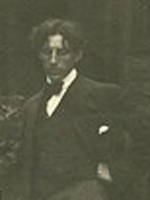
306 Keystone Avenue, River Forest, Illinois. A smaller second floor porch is fitted above the main ground entrance. 70% 7.90 mb.236 Keystone Avenue, River Forest, Illinois. Corner tower, multi-level wrap-around front porch. 73% 7.92 mb Row of late 19th/early 20th century houses, River Forest, Illinois. 78% 7.78 mb136 Keystone Avenue, River Forest, Illinois. The facade’s design elements are complex with intricate details. 90% 7.80 mb146 Keystone Avenue, River Forest, Illinois. Two big chimneys and a front porch swing makes for a timeless scene on a nice day. 90% 7.83 mb558 Keystone Avenue, River Forest, Illinois, 1860, architect unknown, This is an excellent example of a large Victorian Gothic cottage. 82% 7.62 mbFrank Lloyd Wright. Public Domain. 562 Keystone Avenue, River Forest, Illinois, 1909, Frank Lloyd Wright. The house’s projecting second-floor balcony and Prairie glass in a stucco surface is in evidence. 83% 7.93 mb.562 Keystone Avenue, River Forest, Illinois, 1909, Frank Lloyd Wright. The house’s prominent hipped roof with its simple fascia and stuccoed soffits are evident. Wright’s house design is characterized by the early, mature restraint and discipline of the Prairie School. 75% 7.91 mb.
SOURCES:
A Guide to Chicago’s Historic Suburbs on Wheels and on Foot, Ira J. Bach, Swallow Press/Ohio University Press, 1981, pp. 605-622.
FEATURE Image: St. Francis de Sales, 18th c, Besançon, 96 x 131 cm. Public Domain.
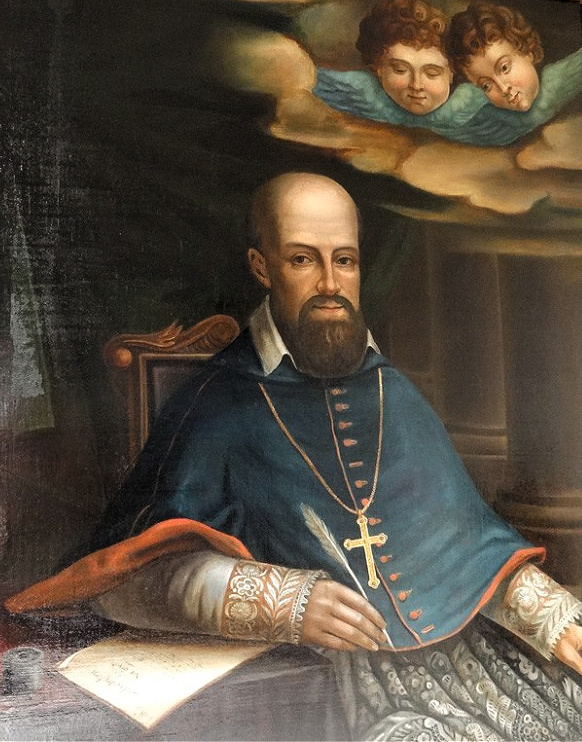
Saint Francis de Sales sitting in front of a copy of his work, “Introduction to the Devout Life,” oil on canvas, c.1790s, 77 cm x 99.5 cm, unknown artist. Hovering above the 17th century French Catholic bishop, saint, and Doctor of the Church are two cherubs who regard him with kindness. Public Domain. Francis de Sales became one of the most respected theologians in Christianity. A great preacher and writer, Francis de Sales ascended the seat of Bishop of Geneva, Switzerland, and, with widowed Baroness Jeanne de Chantal (1571-1641), founded the religious order of the Visitation. As a diplomat and man of prayer, Francis de Sales exerted a significant influence within the Catholic Church and among the temporal powers of the day. https://www.antiques-delaval.com/en/paintings/7068-hst-large-portrait-saint-francois-dirty-life-devote-cherubs-xviiieme.html -retrieved January 24, 2023. Public Domain.
CANONIZED ON APRIL 8, 1665, IN ROME BY POPE ALEXANDER VII, ST. FRANCIS DE SALES IS THE PATRON OF WRITERS, JOURNALISTS, THE CATHOLIC PRESS, CONFESSORS, THE DEAF AND EDUCATORS. ST. FRANCIS WAS DECLARED A DOCTOR OF THE CHURCH IN 1877 BY PIUS IX.
INTRODUCTION.
By all accounts, St. Francis de Sales (1567-1622), whose feast day is January 24, was a gracious and holy man. His writings were, similar to the Jesuits of whom Francis was a student, admirer and close friend, directed to society’s well-to-do and concerned with how, as society’s current elites, they can practice, most basically, Christian “noblesse oblige” within their privileged social station. St. Francis de Sales’ writing defended and explained Catholic doctrine to a Europe which, in an age of Renaissance and Reformation, was very much in revolt against it. To preserve and endorse (1) a social order and (2) perfect belief in doctrine, St. Francis de Sales communicated in everything that both were attainable simultaneously, and did so famously in his book, Introduction to the Devout Life (1608).
Like the sons of St. Ignatius of Loyola, St. Francis de Sales was active in the direction of souls. For Introduction to the Devout Life, Jesuit father Jean Fourier, S.J. strongly encouraged a noble lady around 1607 to prevail upon her local bishop (de Sales) to have his personal writings of spiritual direction to her and others printed to reach a wider audience at court and elsewhere among the ruling class. St. Francis de Sales was also eager to have his personal instructions in print for the advancement and perfection of individual souls. Introduction to the Devout Life became an instant international bestseller and, over 400 years later, remains a spiritual classic. As John K. Ryan, S.J. observed, “Its greatness lies in many things: in its originality, its completeness, its sincerity, its balance, its penetration and its style…(and) as such it is beyond adverse criticism in any important way.”1
Francis Bonaventure was born into nobility in August 1567 in Sales castle in Savoy, France, where there were tremendous social pressures to marry and settle into a life of wealth and prestige. Sent to Paris by his family, they wanted him to attend the prestigious College of Navarre in the fine hôtel de Navarre with its renowned library in rue Saint André des Arts, but Francis chose to attend the new Jesuit College of Clermont, which at that time was known for its religious and moral vision as much as its academic achievement.2 At the Jesuit school St. Francis de Sales came into contact with the post-Tridentine humanism taught by faculty such as Father Possevin, S.J. and Francis took to it like a duck to water so that he could express its intellectual tenets afterwards quite well.3 St. Francis de Sales worked out his spiritual life in prayer in Saint-Étienne-des-Grès in the Latin Quarter. The church (now demolished) on Rue Saint-Jacques was the center for Christianity among students. Another saintly Frenchman who later frequented Saint-Étienne-des-Grès was St. Vincent de Paul (1581-1660). Francis de Sales as a college-age layman was finding he had serious religious scruples and temptations to lust.4 it was in Saint-Étienne-des-Grès that St. Francis de Sales ultimately took a personal vow of chastity before a statue of the Virgin Mary which allowed him to pursue his spiritual desires.
After studying for five more years at the University of Padua, St. Francis de Sales emerged in 1591 with the equivalent of a J.D.- Ph.D. and was ordained a priest in 1593. In those years the young nobleman was surrounded by the Renaissance writings of philosophers and poets such as Marsiglio Ficino (1433-1499), Giovanni della Casa (1503-1556) and contemporary French theologian Pierre Charron (1541-1603).5 Now in his mid-20’s Francis was given by his bishop the nearly impossible task to reconvert John Calvin’s citizens of Geneva to Catholicism. Needless to say, Francis’s efforts failed. In fact, the Wars of Religion (1562-1598) were in full swing and made for impassioned attitudes on all sides and complicated factors in politics. An individual, Protestant or Catholic, had to practice their faith in a fragmented society.6
In 1602 St. Francis de Sales was sent to Paris to negotiate the condition of Catholics in reconverted territories in France. As a diplomat St. Francis de Sales was smooth – peaceful, positive, charitable and temperate in his words and persona. At meetings taking place at the court of French King Henry IV ( (1553-1610), St. Francis de Sales met some of the great figures of the religious and mystical revival occurring in France including Henri, Duc de Joyeuse (1563–1608), a General commander in the Wars of Religion and member of the Catholic League who became a Capuchin Franciscan after the death of his wife, Catherine de La Valette; Pierre de Bérulle (1575-1629), one of the most important mystics of 17th century France and, later, a Catholic cardinal; and Madame Acarie (1566-1618), mother of seven children, and foundress and lay sister of the Discalced Carmelites in France. She was perhaps the most widely respected religious person in Paris and certainly the go-to contact for the wealthy whenever they desired to help the poor because she made sure their alms got to the poor and not the professional charitable class. St. Francis de Sales, a respected theologian, also influenced the temporal powers – the dukes of Savoy, Charles Emmanuel I (1562-1630) and Victor Amadeus I (1587-1637), the regent of Savoy Christine de France and kings Henry IV and Louis XIII of France.
Charles Emmanuel I. Duke of Savoy (1562-1630) by Jan Kraeck. Public Domain. Victor Amadeus I (1587-1637), artist unknown. Public Domain.
In July 1602 following the death of Bishop Grenier, St. Francis de Sales became Bishop of Geneva. Francis de Sales traveled ceaselessly around the diocese and beyond, preaching and hearing confessions, and the people quickly realized they had a holy bishop. It was by way of one of his penitents, St. Jeanne-Françoise de Chantal (1572-1641), that St. Francis de Sales worked his vision of the foundation of a new order, the Visitation, whose charism was to serve the sick and the poor with “the charity and gentleness of Jesus Christ.”7
St. Francis de Sales with Sisters of the Visitation, Francisco Bayeu y Subias (1734-1795), c. 1760, oil on canvas, 56 x 34 cm, Prado, Madrid, Spain. The 18th century painting, once in the Royal Collection, is today housed in a regional art museum in Salamanca. Public Domain.It was by way of one of his penitents, St. Jeanne-Françoise de Chantal (1572-1641), that St. Francis de Sales worked his vision of the foundation of a new order, the Visitation, whose charism was to serve the sick and the poor with “the charity and gentleness of Jesus Christ.” https://www.museodelprado.es/coleccion/obra-de-arte/san-francisco-de-sales/540cb0b9-ca15-4c43-b011-d2d71f7c5820?searchMeta=san%20francis – retrieved January 24, 2023. Francisco Bayeu y Subías (1734-1795) is one of the leading of Spanish late Baroque painters using quick and fluid touches and vivid and exquisite colors though later assuming neoclassicism with formal, sometimes cold, pictures based rigorous observation of nature. Bayeu, born in Zaragoza, trained there in the workshop of Danish painter Juan Andrés Merklein (1716-1797) and in the drawing classes of José Luzán Martínez (1710-1785). In 1758 at 24 years old he obtained a two-year scholarship to the Academy of San Fernando in Madrid, but left two months later because of disputes with the professor Antonio González Velázquez (1723–1793). Bayeu returned to Zaragoza and painted several commissions for churches and convents. In 1762 he was helping German painter Anton Raphael Mengs (1728-1779) in the decoration of the Palacio Nuevo. Thanks to Mengs’ influence, Bayeu started his decorative collaborative undertakings that earned him the appointment of court painter in 1767. He worked mainly as a fresco painter. In addition to his courtly commissions, he did church commissions such as of the vaults of the Holy Chapel of the Basilica of Nuestra Señora del Pilar completed in 1776. He painted 11 scenes for the the cloister of the Cathedral of Toledo between 1776 and 1787. He was then entrusted with the decoration of the royal chapel in the Palace of Aranjuez. After Mengs’s departure in 1777 for Rome, Francesco Bayeu assumed all Mengs’ duties as first painter, though not obtaining the appointment. Like other Spanish artists he worked developing cartoons for Real Fábrica de Tapices de Santa Bárbara (Royal tapestry Factory). Bayeu supervised the work of a talented newcomer, Francisco Goya (1746- 1828) who was Bayeu’s brother-in-law since 1773. In 1785 Charles III entrusted Bayeu and Mariano Salvador Maella Pérez (1739 –1819) with the restoration of the paintings in the royal collections. When he fell ill in 1786, Goya replaced Bayeu at the Academy of San Fernando, which Bayeu had been director of painting. Despite declining health from overwork, the commissions kept coming in. The Prince and Princess of Asturias hired Bayeu for the decoration of the dining room vault in the Palace of El Pardo. Bayeu returned to Zaragoza in 1788 until he was called again in 1791 to Aranjuez where he painted for the oratory of the Royal Palace and the vault of the King’s bedroom. This would be his last work when he died, in Madrid, in 1795. see – https://www.museodelprado.es/coleccion/artista/bayeu-y-subias-francisco/b218fee4-053b-4656-8577-9aa001ad1989 – retrieved January 24, 2025.
It was in this first decade of the 17th century amidst this flurry of evangelizing and other activity that the 40-something bishop wrote the Introduction to the Devout Life (1608). The book, written in short chapters with titles on topical challenges, problems, and opportunities in the Christian life in the world, provides its responses based on practical counsels. The Introduction to the Devout Life much as his later work, On Love of God, are very reliant on the Bible for its teaching and sprang directly from the bishops’ care of souls that he was doing actively and sacramentally from his diocese in southeastern France. Francis’s generous range of literary sources reflected his education in Renaissance humanism and included classical authors, Montaigne, contemporary poets as well as medieval saints and spiritual writers such as Sts. Anselm, Bonaventure and Bernard. Francis was also familiar with the writings and religious vision of the 16th century Spanish mystics and saints such as Teresa of Avila and Ignatius of Loyola.8
The exceedingly practical St. Vincent de Paul observed about St. Francis de Sales’ On the Love of God: “A truly admirable book, which has as many admirers of the sweetness of its author as it has readers. I have carefully arranged that it shall be read throughout our Society [the Vincentians], as the universal remedy for all feeble ones, the good of slothful ones, the stimulus of love, and the ladder of those who are tending to perfection. Oh! that all would study it as it deserves! There should be no one to escape its heat.”9
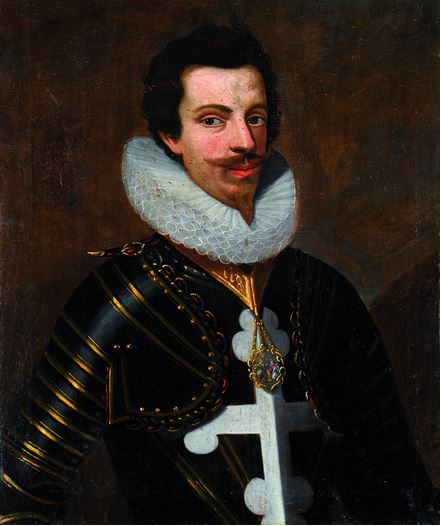
St. Francis de Sales by J. J. Owens. c. 1905, based on the Turin portrait. Public Domain.
St. Francis de Sales, now in his early 50s, visited Paris in 1618 where he preached sometimes twice each day. His great work was to show how ordinary daily life, particularly a busy and successful life, could be a path of holiness. No issue was too large or small for the saint to address – from parties, clothes, flirtations, daily life among marrieds – but all directed to the purpose of imitation of Christ and the love of God. St. Francis takes for granted one’s daily life in French society and proposes no maxim which involves any violent upheavals from it. Part of the saint’s genius is to see that there can be no dispute between the social order and the Christian life. At the same time, St. Francis is no easy teacher or grader – he asks that the Christian virtues be upheld and practiced. That insistence on Christian virtue informing one’s daily life is also the genius of his doctrine. While highly educated and imbued with the grace of mind of the Renaissance, St. Francis carried naturally within himself and conveyed the wisdom of the French soil of Savoy, its terroir. As Francis took one’s daily life in French society for granted, he took Catholic doctrine as if for granted. He then explained it with a highly cultivated mind and gracious spirit that expressed itself with a sweetness and gentleness of style that expounded it as “the universal remedy…the stimulus of love…the ladder …to perfection” as St. Vincent de Paul recognized to those with faith or not, or in trouble in day-to-day life.
St. Francis de Sales perhaps speaks to the 21st century most clearly by way of his theology that is presented without sentimentality or melodrama and is clearly explained and lived to be particularly possible and desirable. Francis said: “He who lives for God, frequently thinks of Him during all the occupations of life.”12
January 24 is the memorial feast day of St. Francis de Sales on the General Roman Calendar of 1969. St. Francis de Sales is the patron of writers, journalists, the Catholic press, confessors, the deaf and educators. He was proclaimed a saint and doctor of the Catholic Church. The following quotes are taken from his many published works of spiritual edification, counsel, exhortation, and solace.
NOTES:
Introduction to the Devout Life, St. Francis de Sales, trans. and edited by John K. Ryan, Image books (Doubleday) Garden City New York, 1955, p.11.
Francis de Sales and Jane de Chantal: Letters of Spiritual Direction, trans. by Péronne Marie Thibert, V.H.M. and selected and introduced by Wendy M. Wright and Joseph F. Power, O.S.F.S. Paulist Press New York, 1988 p.19.
CF. Elisabeth Stopp, “St. Francis de Sales at Clermont College,” in Salesian Studies, 6 (Winter 1969). pp. 42-43.
Wright & Power, p. 20.
Wright & Power, p. 22.
The Saints: A Concise Biographical Dictionary, edited by John Coulson, Guild Press, New York, 1957, p. 305.
Maxims and counsels of St. Francis de Sales for every day in the year, Ella McMahon, M.H. Gill & Son, Dublin, 1884, p. 12.
QUOTATIONS.
There are certain birds..(that) have such short and weak legs as to be of no use to them; it is as if they did not even have them. Should they fall to the ground, they remain there, unable to take flight because, without the use of legs or feet, they cannot rise and take wing. Consequently, they remain on the ground and die there, unless a gust of wind, compensating for their inability, lifts them up, as it often does with other things. If, in that case, they flap their wings in response to the thrust of the wind, the wind itself will continue to help them by thrusting them ever higher, in order to help them to fly higher and higher.Keep yourself faithfully in the presence of God. Avoid hurry and anxiety, for there are no greater obstacles to our progress in perfection.Cast your heart gently, not violently, into the wounds of our Savior and have an unlimited confidence in his mercy and goodness.To make good progress we must devote ourselves to getting over that portion of the path which lies close before us, and not amuse ourselves with the desire to attain the last step before we have accomplished the first.We must make our imperfections die with us from day to day. Dear imperfections, which cause us to recognize our misery, which exercise us in contempt of self, and the practice of virtue, and notwithstanding which God accepts the preparation of our hearts which is perfect.I recommend simplicity to you; look before you, and not at the dangers which you behold in the distance. Keep your will firmly bent upon serving God with your whole heart. While you are thus occupied in forecasting the future you expose yourself to some false step.Have no care for tomorrow. Think only of doing well today. And when tomorrow shall have become today, then we shall think about it.We must make a provision of manna for each day only. Let us not be afraid that God will fail to send down more upon us tomorrow and the day after tomorrow, and every day of our pilgrimage.Since the Heart of our Lord has no more loving law than meekness, humility, and charity, we must firmly maintain these dear virtues in us.True sanctity lies in love of God, and not in foolish imaginings, raptures, &c. Let us devote ourselves to the practice of true meekness and submission, to renouncement of self, to docility of heart, to love of abjection, to consideration for the wishes of others : this is true sanctity and the most amiable ecstasy of the children of God.May you belong to God forever in this mortal life, serving Him faithfully through its trials, bearing the cross after Him, and may you be His forever in life eternal with the whole celestial court!
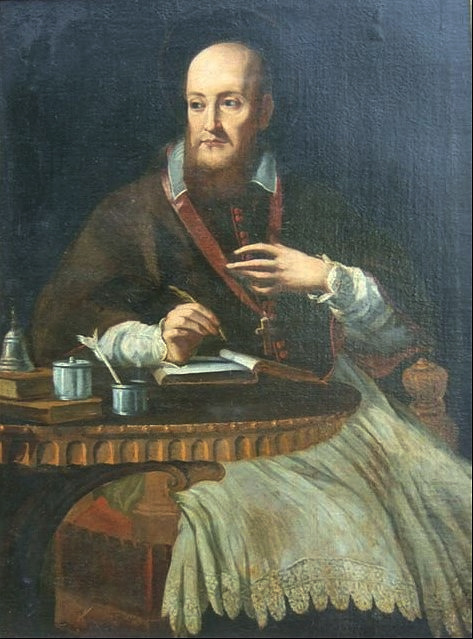
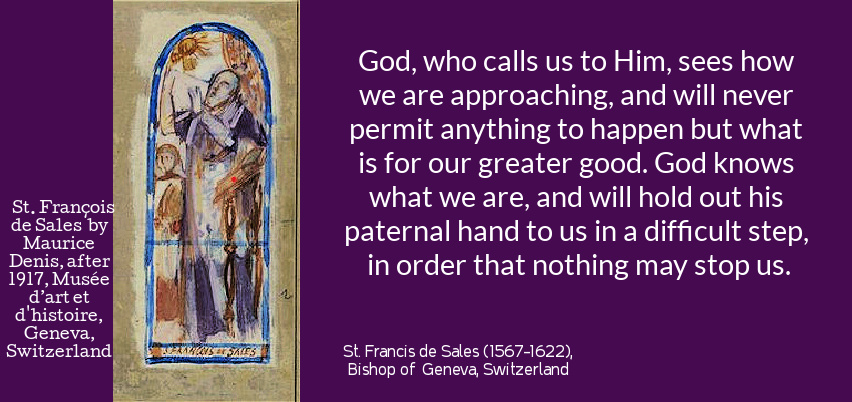
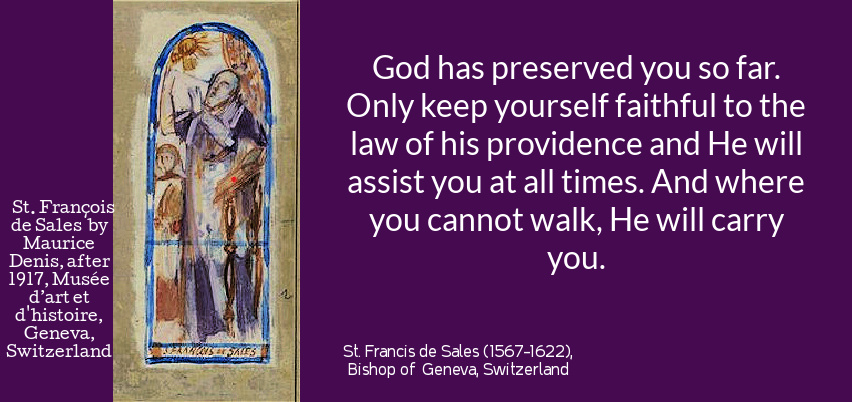
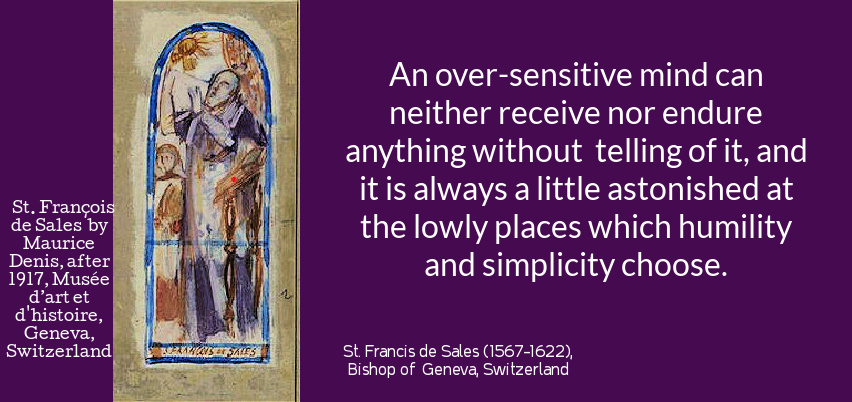
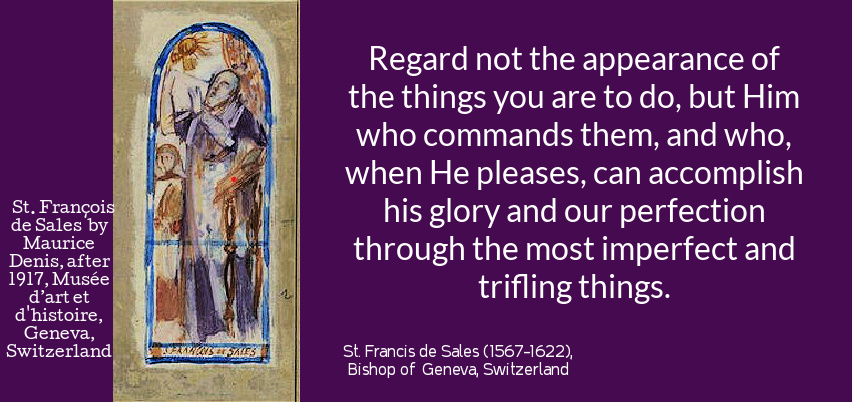
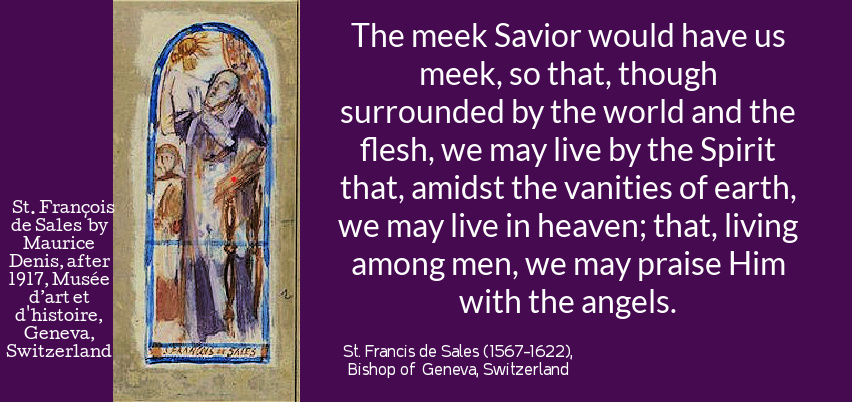
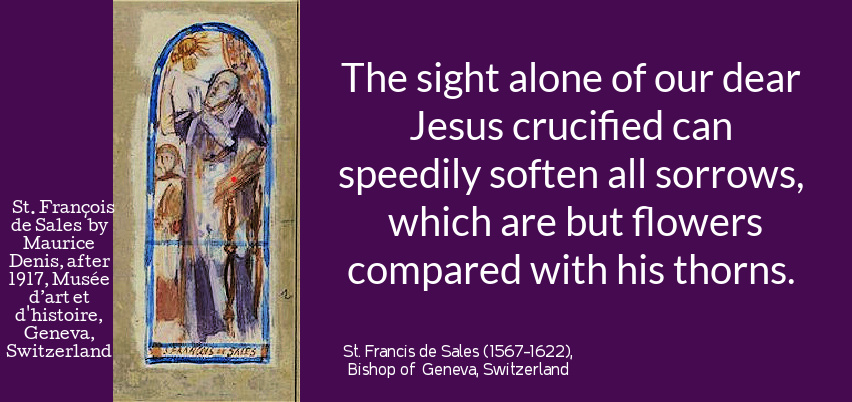
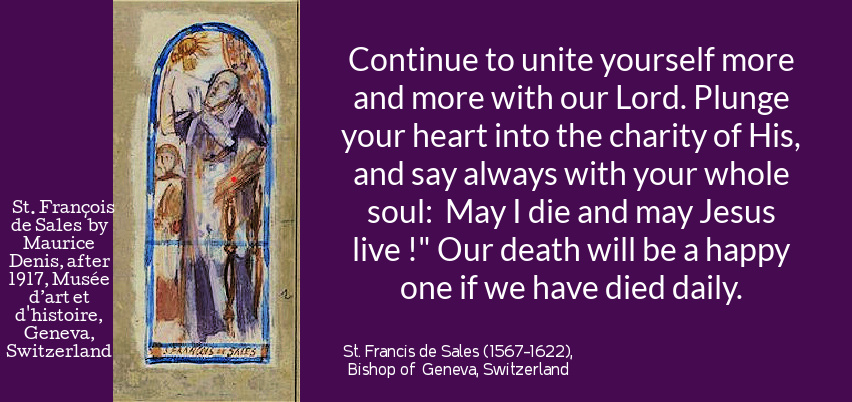
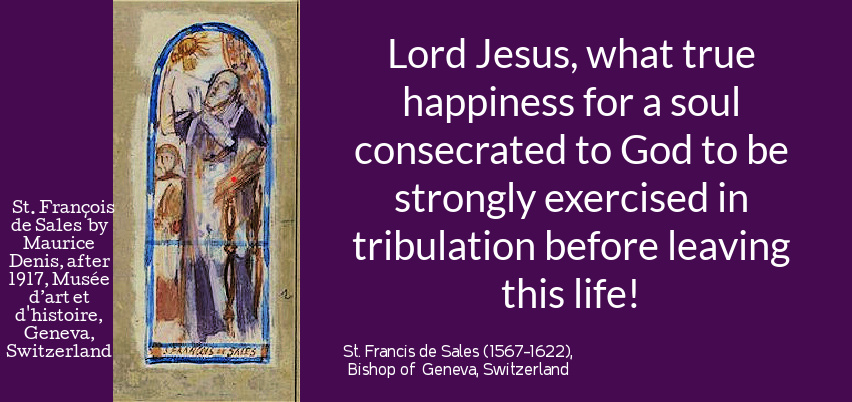
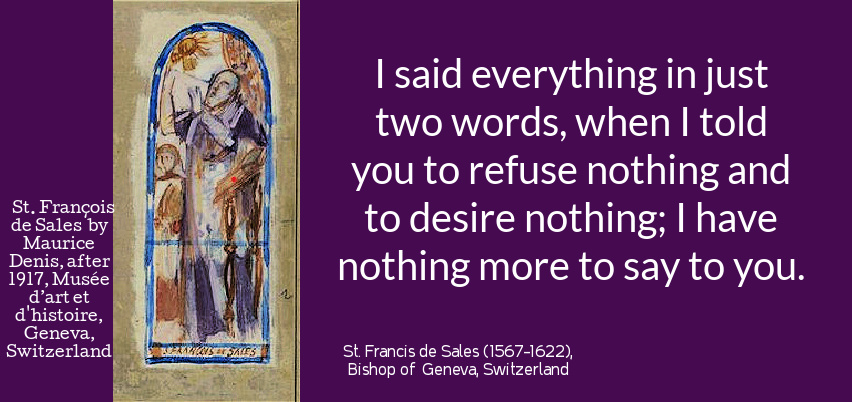
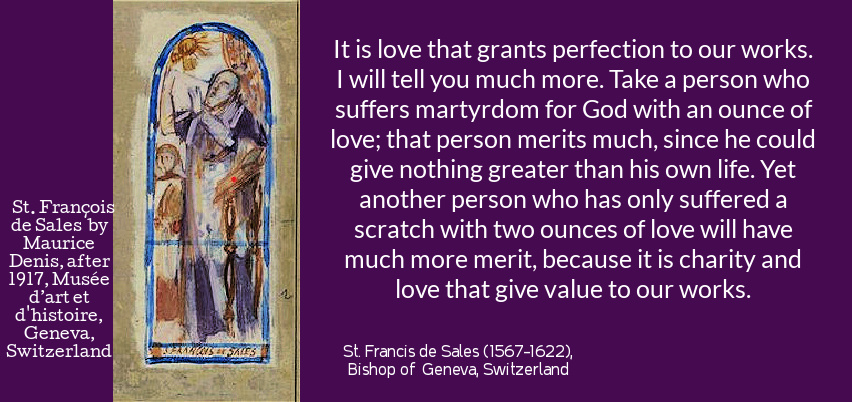
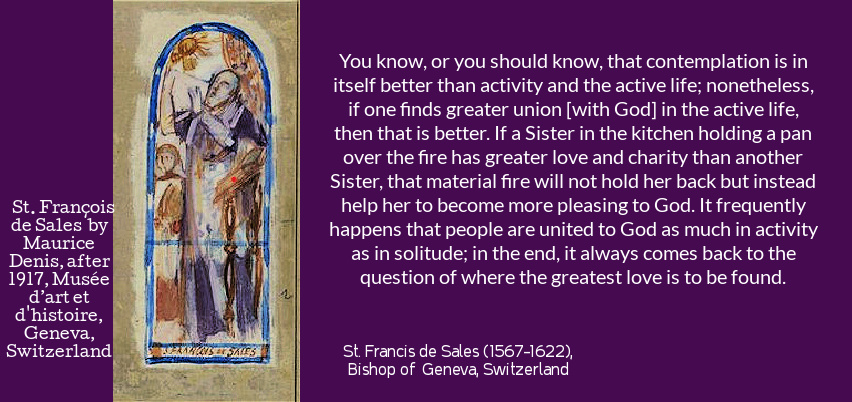
The great good of our souls is to live for God, and the greatest good to live for God alone. He who lives but for God is never sad, save at having offended God.He who lives for God, frequently thinks of Him during all the occupations of life.Saint Francis gives the rule to Saint Jeanne de Chantal (Study for the Chapel of the Visitation at Nantes), 19th century, Elie Delaunay (1828-1891), Louvre. Public Domain. The reason persons are in the world is to receive and carry the gentle Jesus: on our tongue by proclaiming him and in our arms by doing good works.I am as human as anyone could possibly be.See the divine lover at the gate. He does not simply knock once. He continues to knock. He calls the soul: come, arise my beloved, hurry!…In short, this divine Savior forgets nothing to show that his mercies are above all his works, are greater than his judgment.Solitude has its assaults, the world its busyness – in either place we must be courageous since in either place divine help is available to those who trust God and humbly and gently ask for his fatherly assistance.Since this congregation does not have as many austerities or indissoluble bonds as formal orders, the fervor of charity and force of a deep personal resolution must supply for all that…so that might be realized the saying of the Apostle which affirms that charity is the perfect bond.Saint François de Sales blesses Saint Jeanne de Chantal, Chapelle de la Visitation at Nantes n° 61 XIXe siècle. Elie Delaunay (1828-1891), Musée d’Arts de Nantes. Public Domain. It is the height of holy disinterestedness to be content with naked, dry, and insensible acts carried out by the superior will alone….In the end, the savior wants us to be His so perfectly that nothing else remains for us, and to abandon ourselves to His providence without reservation.Since the heart is the source of all our actions, as the heart is, so are they.For myself, I cannot approve the methods of those who try to reform a person by beginning with external things, such as bearings, dress or hair. On the contrary, it seems to me that we should begin inside.I beg you, my dear Sister, govern your community with a great expansiveness of heart…The more solicitous, open, and supportive you are with them, the more you will win their hearts.I had the courage to my give [my own dying mother] the last blessing, to close her eyes and mouth and to give her the last kiss of peace at the moment she passed away; after which my heart swelled and I wept….Saint Francis de Sales healing a lame man, Chapelle de la Visitation at Nantes n° 61 XIXe siècle. Elie Delaunay (1828-1891), Musée d’Arts de Nantes. Public Domain. Then let us belong wholly to Him, and live but for Him, desiring only to please Him, and for his creatures in Him, through Him, and for Him. Make your little efforts sweetly, peacefully, and amiably to please this Sovereign Goodness, and do not be astonished at difficulties.We must be constant in aspiring to the perfection of holy love, in order that love may be perfect. For the love which seeks anything less than perfection cannot fail to be imperfect.Never permit your soul to be sad and live in bitterness of spirit or scrupulous fear, since He who loved it and died to give it life is so good, so sweet, so amiable.God, who calls us to Him, sees how we are approaching, and will never permit anything to happen but what is for our greater good. God knows what we are, and will hold out his paternal hand to us in a difficult step, in order that nothing may stop us.God has preserved you so far. Only keep yourself faithful to the law of his providence and He will assist you at all times. And where you cannot walk, He will carry you.Saint Francis de Sales healing a lame man, Chapelle de la Visitation at Nantes n° 61 XIXe siècle. Elie Delaunay (1828-1891), Musée d’Arts de Nantes. Public Domain.An over-sensitive mind can neither receive nor endure anything without telling of it, and it is always a little astonished at the lowly places which humility and simplicity choose.I see you with your vigorous heart which loves and wills powerfully. I like it, for what are those half -dead hearts good for? We must make a particular exercise once every week of willing to love the will of God more tenderly, more affectionately than anything in the world, and that, too, not only in bearable but in the most unbearable events.Plant in your heart Jesus Christ Crucified, and all the crosses of this world will seem to you like roses.Lord Jesus, without reserve, without an if, or a but, without exception or limitation, may you holy will be done in all things and at all times.Regard not the appearance of the things you are to do, but Him who commands them, and who, when He pleases, can accomplish his glory and our perfection through the most imperfect and trifling things. Painting of St. Francis de Sales in Don Bosco’s rooms at the Oratory of St. Francis de Sales in Turin. Public Domain. Behold this great Artisan of mercy. He converts our miseries into graces and our iniquities into salutary remedies for our souls. Tell me, I pray, what will He not do with the afflictions, the labors, the persecutions which assail us?Never think you have attained the purity of heart which you owe to God until your will is freely and joyfully resigned to his holy will in all things, even in the most repugnant.Daily strengthen yourself more and more in the resolution, which you formed with so much affection, of serving God according to his good pleasure. Regard Him who commands them and, when He pleases, can accomplish his glory and our perfection through the most imperfect and trifling things.A true servant of God has no care for tomorrow, but performs faithfully what is required today, and tomorrow will do what is required without a word.The meek Savior would have us meek, so that, though surrounded by the world and the flesh, we may live by the Spirit that, amidst the vanities of earth, we may live in heaven; that, living among men, we may praise Him with the angels.St. Francis de Sales, 18th c, Besançon, 96 x 131 cm. Public Domain.Here is the great lesson – we must discover God’s will, and, recognizing it, endeavor to do it joyfully, or at least courageously.The sight alone of our dear Jesus crucified can speedily soften all sorrows, which are but flowers compared with his thorns.Our great rendezvous is an eternal heaven and compared with the price of eternity, what are the things which end with time?Continue to unite yourself more and more with our Lord. Plunge your heart into the charity of His, and say always with your whole soul: May I die and may Jesus live !” Our death will be a happy one if we have died daily.Lord Jesus, what true happiness for a soul consecrated to God to be strongly exercised in tribulation before leaving this life!Saint Francis Sales, antique pendant, Lyon, France. Public Domain. Nothing can give us deeper peace in this world than to frequently contemplate our Lord in all the afflictions He endured from his birth to his death. Contempt, calumnies, poverty, abjection, weariness, suffering, nakedness, wrongs, and grief of every kind.Let us faithfully cultivate that resignation and pure love of God which is never wholly practiced but amid sufferings. For to love God, when He feeds us with sweetness is nothing more than children do. But to love God when He feeds us with gall is to offer Him the cup of our loving fidelity.It is not in my power to propose to Him anything for you, save that He may, according to his holy will, fashion your heart for his dwelling, and reign there eternally. And whether He fashion it with the brush, hammer, or chisel, must be according to his good pleasure.I desire that your cross and mine should be wholly the cross of Jesus. This or that burden, or making any choice, God knows what He is doing and why He does it. It is certainly for our good.God wishes that, like Job, I should serve Him in the midst of dryness, suffering, and temptation. Like St Paul, that I serve Him according to His desire. You will see that one day He will do all and even more than you can desire.St. Francis de Sales. medallion. Public Domain. At the very thought of God, one immediately feels a certain delightful emotion of the heart, which testifies that God is God of the human heart.I said everything in just two words, when I told you to refuse nothing and to desire nothing; I have nothing more to say to you.Do you see the baby Jesus in the crib? He accepts all the discomforts of that season, the bitter cold and everything that the Father lets happen to him. He does not refuse the small consolations that his Mother gives him; we are not told that he ever reached out for his Mother’s breast, but left everything to her care and concern. So too, we ourselves should neither desire nor refuse anything, but accept all that God sends us, the bitter cold and the discomforts of the season.It is love that grants perfection to our works. I will tell you much more. Take a person who suffers martyrdom for God with an ounce of love; that person merits much, since he could give nothing greater than his own life. Yet another person who has only suffered a scratch with two ounces of love will have much more merit, because it is charity and love that give value to our works.You know, or you should know, that contemplation is in itself better than activity and the active life; nonetheless, if one finds greater union [with God] in the active life, then that is better. If a Sister in the kitchen holding a pan over the fire has greater love and charity than another Sister, that material fire will not hold her back but instead help her to become more pleasing to God. It frequently happens that people are united to God as much in activity as in solitude; in the end, it always comes back to the question of where the greatest love is to be found.In Holy Church, everything pertains to love, lives in love, is done for love and comes from love.Whatever may happen, Lord, you who hold everything in your hands and whose ways are all justice and truth, … I will love you, Lord, … I will love you here, O my God; I will hope always in your mercy and ever repeat your praise… O Lord Jesus, you will always be my hope and my salvation in the land of the living.I wonder whether another difficulty can also be raised concerning your reform: perhaps those who imposed it on you have treated the wound too harshly… I appreciate their method, although it is not what I am in the habit of using, especially with regard to noble and cultivated spirits like yours. I believe it is better simply to indicate the disease and put the scalpel in their hands, so that they themselves can make the necessary incision. Yet do not for this reason neglect the reform that you need.Saint Jeanne de Chantal. antique pendant, Lyon, France. Public Domain. The world is becoming so delicate that, in a little while, no one will dare any longer to touch it except with velvet gloves, or tend its wounds except with perfumed bandages; yet what does it matter, if only men and women are healed and finally saved? Charity, our queen, does everything for her children.My intention is but to represent, with simplicity and straightforwardly, without artifice and certainly without false colors, the history of the birth, progress, decline, operations, properties, advantages and sublime qualities of divine love.The power of grace does not constrain the heart, but attracts it. Grace possesses a holy violence, not to violate our liberty but to guide it to love. Grace acts strongly, yet in such a pleasing way that our will is not overwhelmed by so powerful a force; while pressing us, it does not oppress our liberty. Consequently, we are able, before all its might, to consent to or resist its promptings at our pleasure.God’s inspirations, Theotimos, anticipate us and make themselves felt before we are even aware of them, but once we become aware of them, it is up to us either to consent and follow their lead, or to refuse and reject them. They make themselves felt by us without us; yet without us they do not bring about our consent.All these fine people, commonly considered devout, most surely are not.In the end, charity and devotion can be said to differ from one another as fire from a flame. Charity is a spiritual fire that, when fanned into flame, is called devotion. Devotion thus adds nothing to the fire of charity but the flame that makes charity prompt, active and diligent, not only in the observance of God’s commandments but also in the exercise of his divine counsels and inspirations.Almost all those who have treated of devotion have sought to instruct persons living apart from the world, or at least they have taught a kind of devotion that leads to such isolation. I intend to offer my teachings to those who live in cities, in families, at court and who, by virtue of their state in life, are obliged to live in the midst of others.
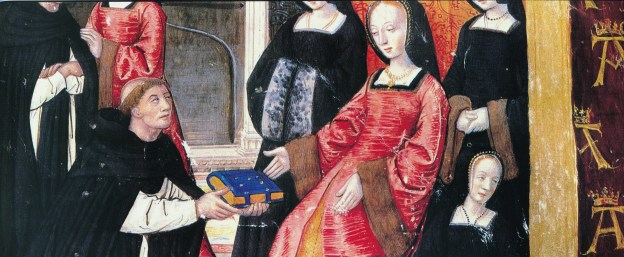
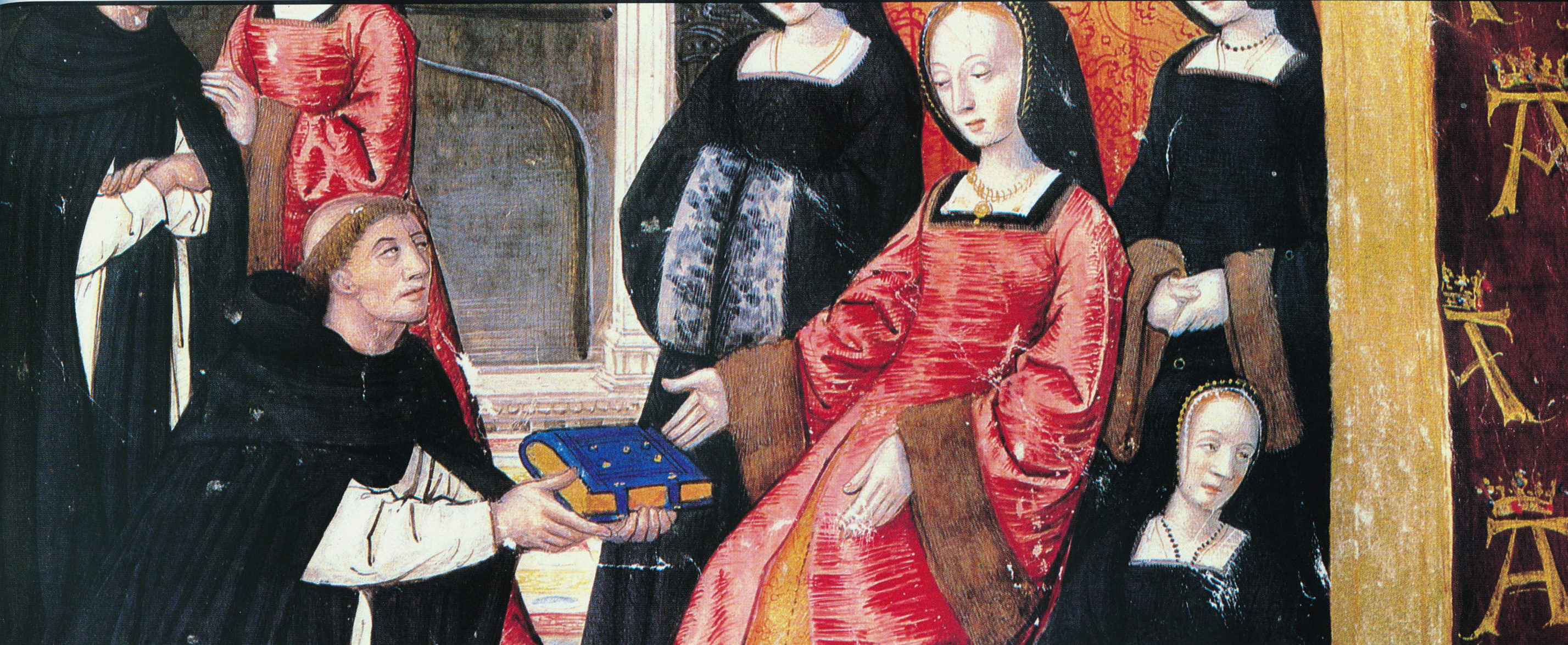
FEATURED image: Manuscript 16th century (detail): Queen consort Anne of Brittany (1477-1514) receiving a Book of Hours from her Dominican confessor, Antoine Dufour (d.1509). Montfort L’Amaury returned to the crown of France after Anne of Brittany married Charles VIII “the Affable” (1470-1498) in 1491.
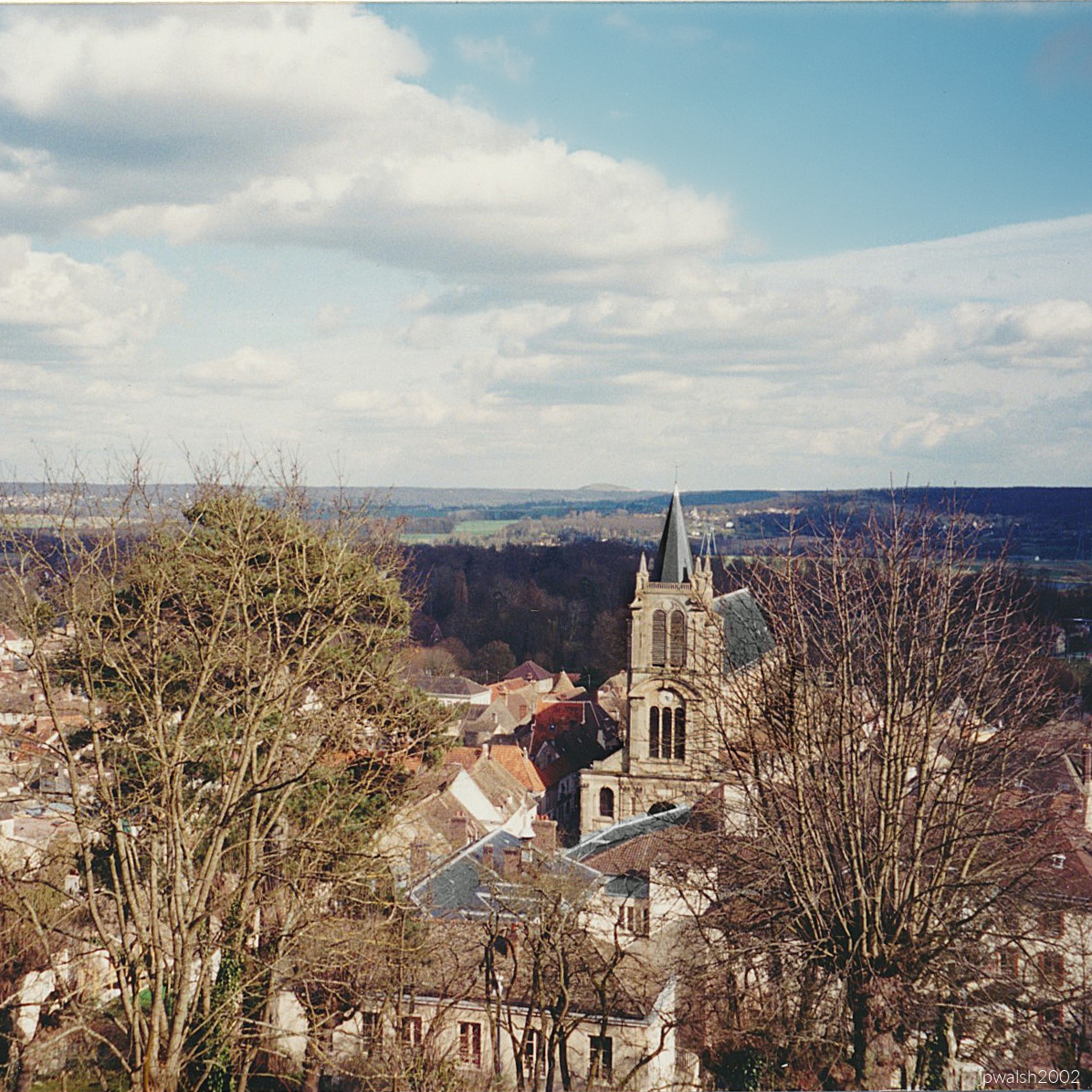
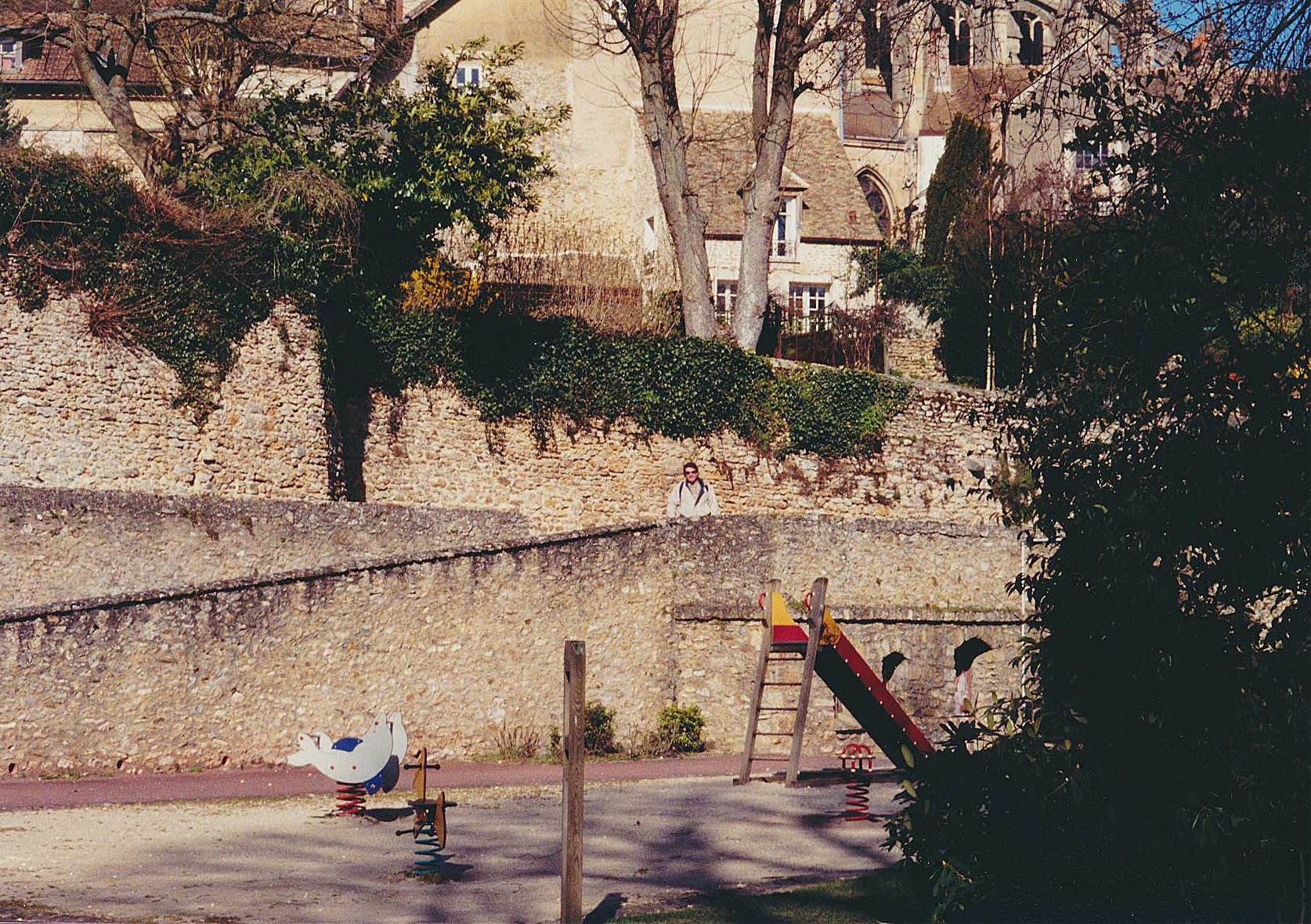
Started in the 11th century, L’Église St. Pierre anchors part of the centre ville of Montfort L’Amaury, a town in France about 30 miles west of Paris. The photograph is taken from the ruins of the chateau on the town’s heights. The late 10th century Frankish king Robert II built a castle in the hills of Montfort. From the start of the 11th century, Montfort-l’Amaury was the stronghold of the Montfort family. Author’s photograph.
At the north edge of the Rambouillet forest the city of Montfort L’Amaury spreads along the restored ruins of its ancient fortified castle. Founded under the Capetian kings, the city owes its fame to Simon de Montfort (1208-1265), Anne de Bretagne (1477-1514), the Valois royal dynasty, and Henry IV (1553-1610). Its monuments begin in the 11th century, stretch towards exceptional Renaissance stained-glass windows and half-timbered houses as its civilization has attracted writers, artists, and musicians to live there. This would include the house of Maurice Ravel (1875-1937) called Le Belvédère where he lived from 1921 until his death and where we were invited to sit at, and play, the piano where Ravel composed Boléro. It was in March 2002 during a visit to Paris and the Île-de France that we ventured through Yvelines by train to Montfort-L’Amaury for a day trip which included a memorable déjeuner in a restaurant that has since disappeared.
Interior, L’Église Saint-Pierre (Church of St. Peter), late 15th century, Montfort L’Amaury, France. Author’s photograph.
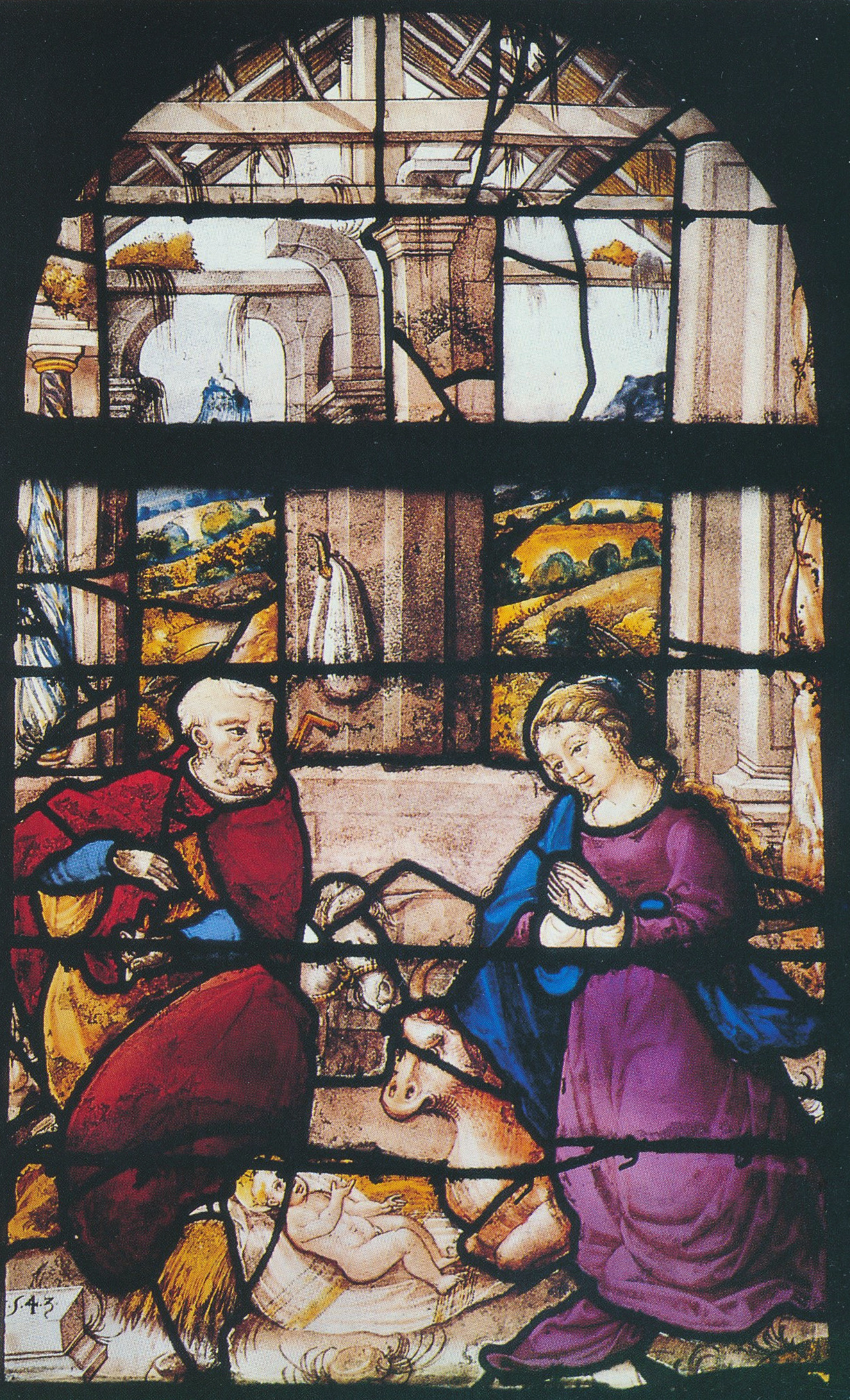
The interior of Saint Pierre church is bright and intimate. Like other French monuments, today’s Saint-Pierre was completed over many centuries. Its origin is in the 11th century. A notable reconstruction of the edifice began in the late 15th century by initiative of Queen Consort, Anne of Bretagne. There is a vast ambulatory around both sides of the nave. Since 1840, the church has been an historic monument because of its unique ensemble of 37 stained glass windows. The oldest date from the 1540s and 1570s. The others were installed in the late16th century. That ecclesial project was started by Catherine de Medicis (1519-1589) in 1562. The windows were installed during the time of the Council of Trent (1545-1563) and some of the glass commemorates that event. As none of the glasswork is signed, it is not known whether its painters are from Montfort L’Amaury or elsewhere.
St. Peter Window. L’Église Saint-Pierre, Montfort L’Amaury, France. Throughout France starting in the 1540s there was a growing taste and demand for stained glass windows in their local churches. The experimentation in glasswork and painting by the middle of the 16th century allowed for the iconography in these stained glass windows to express numerous details and refined techniques. Public Domain.Detail. St. Peter Window. Public Domain.Detail. Nativity Window. Public Domain.The south exterior of L’Église Saint-Pierre along Rue de Dion in Montfort L’Amaury. The exterior wall shows flying buttresses designed in the French Renaissance style as well as gargoyles that were sculpted in the late 15th century. The building is constructed of calcified stone that came from towns to the north, precisely, Maule, and a more distant Vernon on the Seine. The interior ambulatory that surrounds the nave on both sides and ends at the chevet expresses the building’s gothic aspect. Street lamps and a narrow street with tight parking has room for a small tree next to the church. Author’s photograph.Montfort L’Amaury has half-timbered houses dating to the 16th century. This is no. 16, Place de la Libération, just steps from the front entrance of Église St. Pierre. At the beginning of October 1825 young Victor Hugo (1802-1885) lived in Montfort L’Amaury for a few days. He wrote a letter to his father in Paris and described it as “a charming little town ten leagues from Paris, where there are ruins, woods, and one of my friends…” Author’s photograph.Portrait de Victor Hugo sur fond de Notre-Dame de Reims, Jean Alaux, 1825, Maison de Victor Hugo – Hauteville House, oil on cardboard. Public Domain. https://www.parismuseescollections.paris.fr/fr/maison-de-victor-hugo/oeuvres/portrait-de-victor-hugo-sur-fond-de-notre-dame-de-reimsView of the church from the east. The church of Saint Pierre is of late gothic origin. It was rebuilt and decorated in the 15th, 16th, and early 17th centuries. Following the French Revolution and its aftermath, the church building received an extensive restoration in the mid19th century, including a new steeple. Except for one stained glass window that was restored in situ, all the 16th-century stained glass windows were taken out, restored, and reinstalled by a master painter in Metz between 1851 and 1857. Author’s photograph.Chevet. L’Église Saint-Pierre. Public Domain.On Saint Pierre’s front stoop is busy Place de la Libération and with Rue de la Libération just beyond. At the end of the street is the rounded 16th century La Porte Bardoul, one of gateways to the chateau. It was named in the 16th century for the Captain who built the ramparts of Montfort L’Amaury in the 11th century (Hugues Bardoul). Author’s photograph.“Charles Aznavour – Disque D’Or” by Piano Piano! is licensed under CC BY 2.0. Charles Aznavour (1924-2018), dubbed France’s Frank Sinatra, never lived in Montfort L’Amaury. For 60 years, the singer lived in Galluis, a neighboring town just 5 minutes by car up the road. Yet, in those many years, Aznavour frequently came to Montfort L’Amaury, sometimes to go shopping or visit friends or eat at one of its excellent restaurants. In 2018 Aznavour was buried in the cemetery in Montfort L’Amaury and has become a pilgrimage site for his many fans.The cemetery at Montfort L’Amaury dates from the sixteenth century and is an interesting site to visit for its history, architecture, and people buried within. As dead bodies were originally buried in the ground as they are today, over the many centuries the bones were later exhumed and deposited in ossuaries. This was essential during epidemics that occurred regularly when ground-space for burials was at a premium for the bodies of the newly dead. Built to give the appearance of a cloister, these galleries are actually a mass grave. Its architecture is charming and conveys the aspect of a Romantic bone-yard. Fair Use. Ruins of the castle of Montfort-l’Amaury. In the foreground is Le Belvédère, the house of Maurice Ravel. Montfort-l’Amaury Donjon by ℍenry Salomé(Jaser !) 08:12, 21 November 2006 (UTC) – Cliché personnel, own work is licensed under CC BY-SA 3.0
The role of Montfort l’Amaury as a town began to develop in the High Middle Ages when Capetian king, Robert II (976-1031), built a castle there in the forest of Yvelines which was then a royal prerogative. William of Hainaut built the castle whose walls were finished around 1050. Hugues Bardoule was captain of the castle and thus a later 16th century gateway is named after him. It is in the 11th century that L’Église Saint-Pierre and L’Église Saint Laurent begin to be built. Robert II was married three times, and excommunicated by the Catholic Church – one of the early examples of French royals who married as they wished.
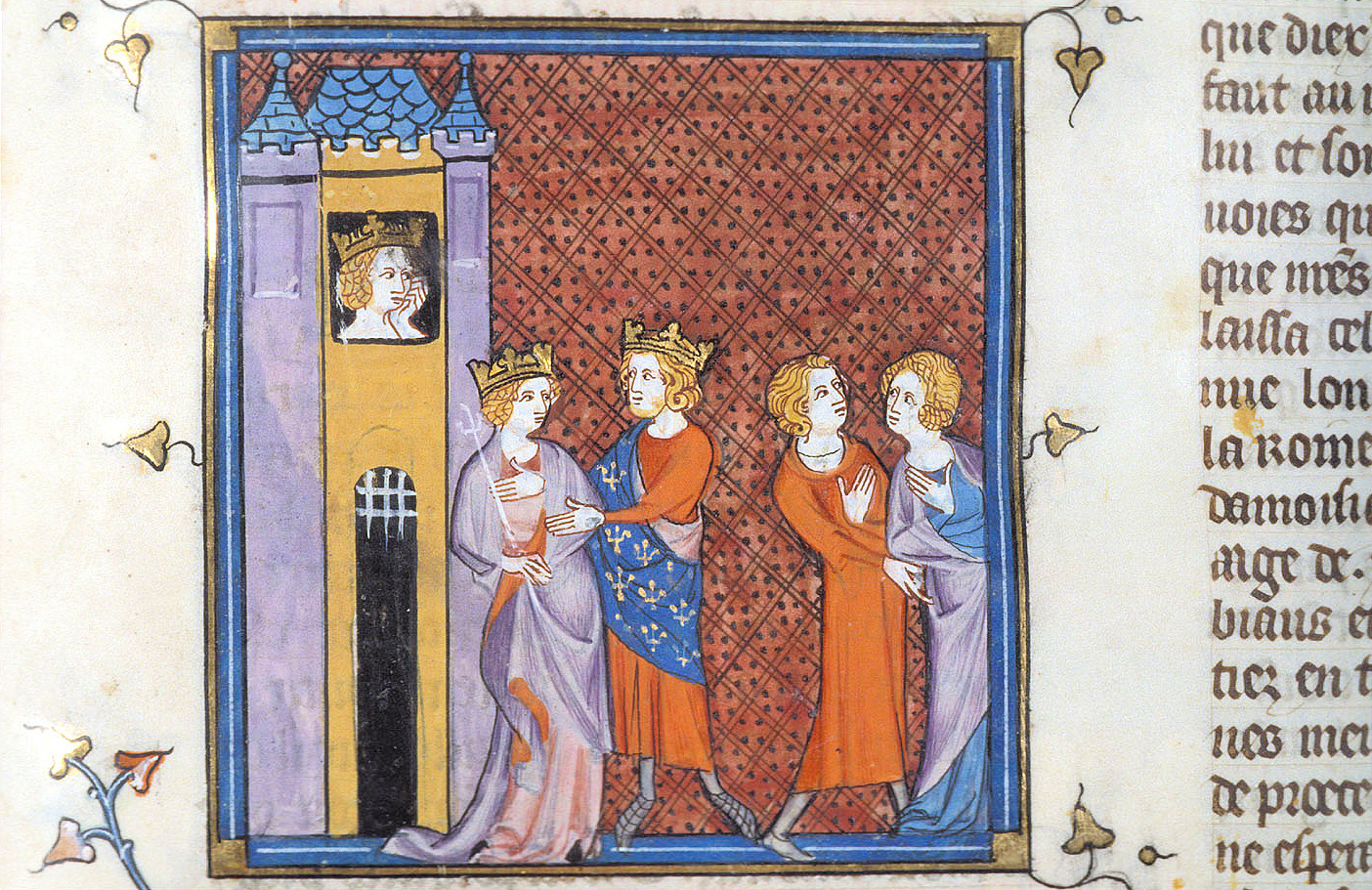
In the twelfth century, Bertrade de Montfort (1070-1117), after giving birth to a boy who would become King of Jerusalem, left her husband, the Duke of Anjou, Fulk IV (1043-1109) in 1092. She married the king of France, Philip I “the Amorous” whose spouse, Bertha of Holland, was also still living.
Philip was so in love with Bertrade that he refused to leave her even when threatened and finally excommunicated by Pope Urban II (1035-1099) in 1095. Because of his excommunication Philip was prevented from taking part in the First Crusade (1096-1099).
Bertrade de Montfort and King Philip I “the Amorous.” Chroniques de Saint-Denis (ou de France), British Library, Royal 16 G VI f. 271. 14th Century (1332-1350). https://www.bl.uk/IllImages/Kslides%5Cbig/K137/K137596.jpgThe ramparts and castle. Author’s photograph.
The ramparts and castle were destroyed by the English during the Hundred Years’ War in the 15th century. After the battle of Agincourt in 1419, the English occupied the French domain and it was during this time that the castle at Montfort was destroyed. The two rebuilt towers were named for Anne of Brittany after she assisted in the castle’s restoration. From this height, the fort overlooked the old Roman road from Beauvais to Chartres.
Also from this place, troops assembled at Montfort L’Amaury in the 12th century as Amaury III raised lords and knights to fight alongside Louis VI (1081-1137) against the Emperor of Germany. Simon IV fought alongside Philippe II Auguste (1165-1223) against the English as well as to the Crusades in the Middle East and the Albigensian Crusade in southern France. The Montforts distinguished themselves especially in this crusade against the Cathars.
At the beginning of the Third Crusade (1189-1192), not wanted by King Philippe Auguste (1165-1223), the future Louis VIII “the Lion” (1187-1226) was looking for companions. Simon IV, Lord of Montfort (1175-1218), embarked on the crusade where victory was equalled by its terror.
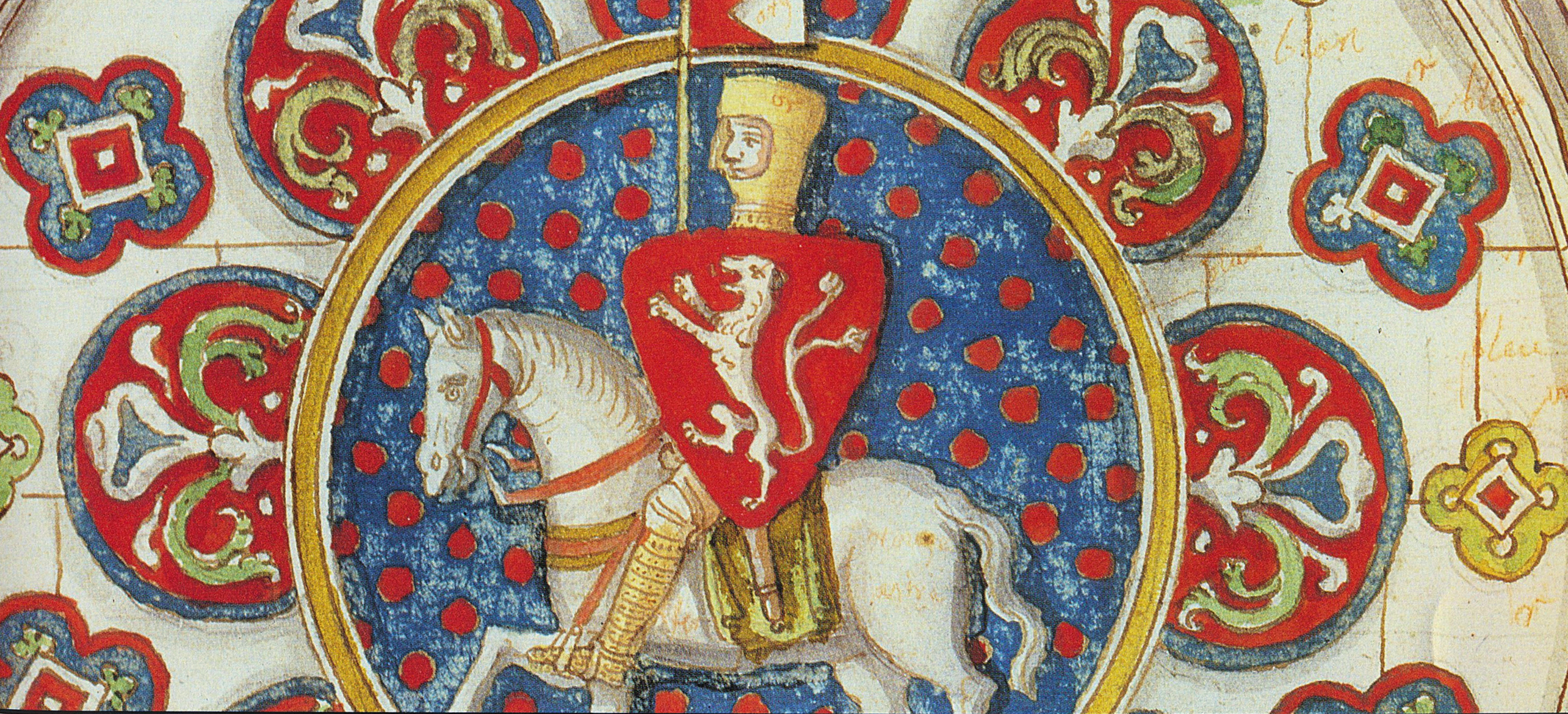
Stained glass (detail) Chartres cathedral: Simon de Montfort V (1208-1265). Simon was born in the chateau in 1208. Whereas his brother Amaury V (1191-1241) inherited his father’s French properties, including in the south of France owing to his father’s Cathar crusade, Simon V is known to history as having a major role in the constitutional development of England where he successfully led the barons’ opposition to the absolute rule of King Henry III (1207-1272) of England. During his rule of England Simon de Montfort V called two famous parliaments, one of which recognized the voices of ordinary town citizens in the affairs of government making him one of the progenitors of modern parliamentary democracy. Public Domain.
In January 1238, Montfort married Eleanor of England, daughter of King John and Isabella of Angoulême and sister of English King Henry III. While this marriage took place with the king’s approval, the act itself was performed secretly and without consulting the great barons. Eleanor had previously been married and swore a vow of perpetual widowhood after her husband died. This vow was broken when she married Montfort and, for that reason, the Archbishop of Canterbury condemned it. The English nobles protested the marriage of the king’s sister to a foreigner who was only of modest rank. Most notably, Richard, 1st Earl of Cornwell, the king’s and Eleanor’s brother, rose up in revolt over the marriage. King Henry III eventually bought off his brother and peace was restored. The marriage brought property to Montfort and when a child was born of the union in late 1238, he was baptized Henry, in honor of his uncle, the king. In February 1239, Montfort was finally invested as Earl of Leicester where he acted as the king’s advisor and became godfather to Henry’s eldest son, Edward, who became King Edward I (“Longshanks”).
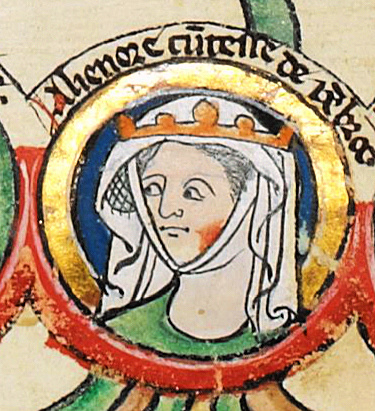
Eleanor of England who married Simon de Montfort V in 1238 in an early-fourteenth-century Genealogical Roll of the Kings of England. Public Domain.The author at the ramparts. These fortifications were originally built over 1000 years ago in the early 11th century by Amaury I. The walls run from east to west creating a superficial size of Montfort at about 4 to 5 hectares (one hectare equals about two and a half acres). Portions of the wall were dismantled during the 100 Years War but rebuilt during the Wars of Religion (1562-1598) as well as Montfort’s reception of a royal charter by Charles IX in the mid16th century. The rebuilt wall had to expand to meet the development of Montfort under Anne de Bretagne a half a century before, though substantial portions of the original 11th century wall were incorporated into the construction. Author’s collection.Manuscript 16th century (detail): Queen consort Anne of Brittany (1477-1514) receiving a Book of Hours from her Dominican confessor, Antoine Dufour (d.1509). Montfort L’Amaury returned to the crown of France after Anne of Brittany married Charles VIII “the Affable” (1470-1498) in 1491.
From Montfort L’Amaury, the lords continued to assist the French kings in the crusades. After John I, only a daughter allowed the continuity of the Montfort family. Beatrice d’Albidon married Robert, Count of Dreux. The Comté de Montfort was related to the Duchy of Brittany following the marriage of Yolande de Dreux-Montfort (1263-1330) with Arthur II of Brittany (1261-1312) in 1294. With their marriage in February 1492, Anne of Brittany became the first Queen of France crowned in St. Denis basilica. The marriage contract of Anne to Charles VIII “the Affable” stipulated a union of France and Brittany though the ruthless Charles forbade her to reign with her title, “Duchess of Brittany.” The contract also stated that if the queen were to die first and was childless, the king would inherit all her property. In this pre-nuptial agreement, it further stipulated that if Charles VIII died first Anne must marry his successor. This would be his cousin and brother-in-law, the handsome and seductive Louis II of Orléans, later, Louis XII (1462-1515). Though Charles and Anne often lived apart, she was pregnant for most of her married life with a child on average every fourteen months that produced two sons who died and two daughters who lived. After the accidental death of warring Charles in April 1498 (he hit his head on a door lintel), there was no male heir and 22-year-old Anne duly married Louis. Before she married French kings, Anne was engaged 8 times and briefly was married in 1490 to the Holy Roman Emperor, Maximilian, which the French did not like. Anne was still a married woman when she and Charles the Affable exchanged vows in December 1491. To prevent scandal the marriage had to be regularized by the pope who annulled Anne’s marriage to Maximilian in February 1492 and granted the royal couple a dispensation for each marrying their relative. Before new king Louis XII could marry Anne he had his 22-year marriage to Joan of France – a marriage of longer duration than Anne was then alive – annulled. In 1476 Louis believed he had had Joan forced on him by Louis XI (“The Universal Spider”) and never really cared for her. In what has been described as one of the seamiest lawsuits of the Middle Ages, Joan went on childless from her disappeared marriage to die in a nunnery. In 1499 it was the king’s second marriage and Anne’s third. Anne was quite aware that she was no longer a child but a 33-year-old woman, divorced and widowed with two children. She proceeded to actively insist at court on her rights and prerogatives. Though King Louis XII ruled Brittany, he officially recognized Anne’s title Charles had forbade and Louis promulgated decisions in her name. Their contract stipulated that Anne’s second child with Louis XII would rule Brittany. But with Anne’s death at 36 years old in 1514 this was not honored. Anne was coronated again in St. Denis basilica in 1504. She lived mostly at Blois and was an important patron of the Italian and French fine arts. Louis XII died the next year without a legitimate heir and his cousin and son-in-law Francis I mounted the throne. The couple were buried in St. Denis basilica. During the French Revolution in the wake of the frenzy of having decapitated the king in January 1793, revolutionaries made their way to St. Denis basilica and desecrated the graves of Anne of Brittany and Louis XII and threw their remains into a mass grave. This 15-16th century union of Brittany and France brought increased benefits to Montfort L’ Amaury compared to a union with Brittany alone. The new period saw the town’s castle ruins restored and there was new construction everywhere. The cemetery was relocated outside city walls. Churches were rebuilt and enhanced with that day’s art. While reaping these material improvements from its royal benefactors, Montfort maintained a semi-autonomy from the crown of France that would not be changed until 1550 when Brittany and the French Crown finally united under a single sovereign, Henry II (1519-1559).
Jean Perréal (1455-1529), Portrait Louis XII, c. 1514, Windsor collections de S.M. la Reine d’Angleterre. Jean Perréal’s most important attribution is this portrait of Louis XII who was King of France from 1498 to 1515. Louis XII was married three times – the first annulled; the second leaving the king a widower, and, in his last three months of life, to Mary Tudor (1496-1533), the favorite sister of King Henry VIII of England. Despite these wives, the king had no living sons. The Salic Law prohibited his line to continue on the French throne through his daughters. When Louis died in 1515, his throne eventually passed to his cousin, Francis I.
Under the Valois the Yvelines region of which Montfort is a central part received royal favor. Catherine de Medici (1519-1589) was named the Lady of Montfort in 1561. When the Wars of Religion broke out (1562-1598), the king, Charles IX (1550-1574), offered to the city home-rule in exchange for the reconstruction of its medieval ramparts at his expense. At the end of these wars, the passage of the future king, Henry IV (1553-1610) on the road that led him to Paris to take power, allowed Montfort L’Amaury to prove its loyalty to the new king. Montfort provided Henry Navarre with weapons and later obtained special rights in exchange. During the reigns of the first two Bourbon kings of France, Henry IV and Louis XIII (1601-1643), there are frequent royal visits to Montfort L’Amaury.
A canonized Catholic saint among the Valois- Joan of Valois (1464 – 1505), sister of Charles VIII, and betrothed of Louis XII.
Portrait of Joan of Valois as abbess by Jean Perréal (1455-1530).
The second daughter of Louis XI (1423-1483) and Charlotte of Savoy (1411-1483), Joan of Valois was a fleeting Queen of France as the wife of King Louis XII following the death of her brother, King Charles VIII. Her marriage was soon annulled so that Louis could, as pre-arranged by contract, marry Charles VIII’s widow, Anne of Brittany.
Joan’s demeanor was characterized by an accepting and placid countenance. When she retired from court politics to become Duchess of Berry, the former Queen of France remarked: “If so it is to be, praised be the Lord.”
In Bourges, Joan of Valois founded a monastic order of sisters and served them as their abbess. In terms of her personality, Joan could be autocratic as an administrator of her nuns, which may have been a vestige of her former high-born role. Joan was canonized in May 1950, almost 450 years after her death.
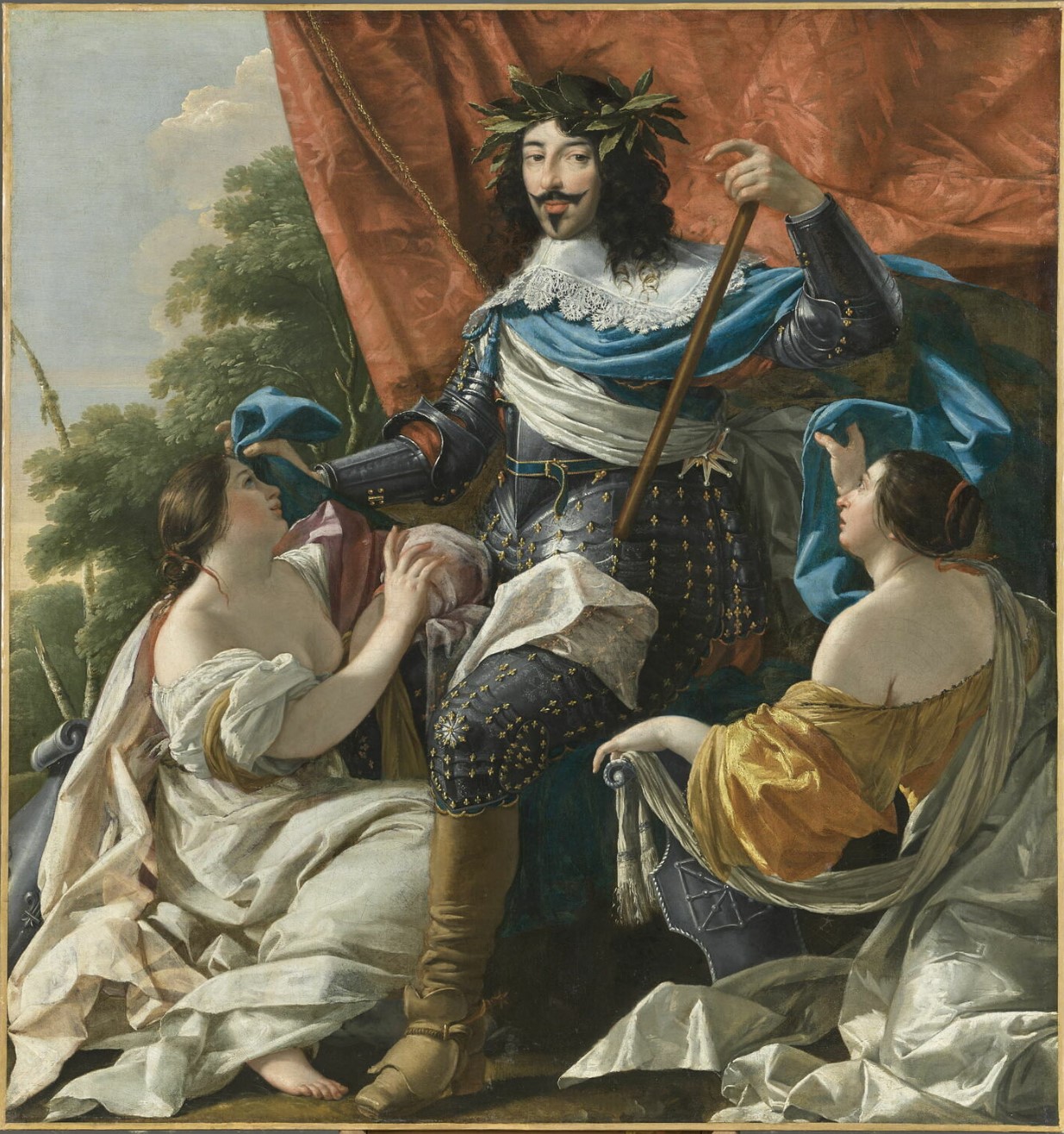
Workshop of François Clouet. Catherine de’ Medici wears the black cap and veil of widow, after 1559. Upon seeing Catherine in the flesh, an Italian diplomat noted that “her mouth is too large and her eyes too prominent and colorless for beauty. But she is very distinguished-looking, has beautiful skin, a shapely figure, and exquisitely made hands.”Portrait de Henri IV, roi de France et de Navarre (1553-1610) 1600 / 1700 (XVIIe siècle), Atelelier de Frans Pourbus II Louvre. Hung in Versailles chateau. https://collections.louvre.fr/en/ark:/53355/cl010057776Marie de’ Medici, 1616, Frans Pourbus the Younger (Flemish, 1569-1622), oil on canvas, The Art Institute of Chicago. Marie de Medici (1575-1642) married Henry IV of France in 1600. After the king was assassinated in Paris in 1610, Marie de Medici served as the regent for their young son, Louis XIII. Marie de Medici brought Frans Pourbus to the French court to make regal portraits of the royal family.Louis XIII between the figures of two young women symbolizing France and Navarre. 1636/38, School of Simon Vouet (1590-1649). Louvre, Paris. https://collections.louvre.fr/en/ark:/53355/cl010062003
Le Belvédère: the House of Maurice Ravel from 1921 to his death in 1937 at Montfort L’Amaury.
The author in front of Le Belvédère, the house of Maurice Ravel, and ready to go inside for a visit. Author’s collection.Pianist Jacques Février with Maurice Ravel in 1925 in Le Belvédère, the house of the composer in Montfort-l’Amaury. Public Domain.The salon of the Ravel house. Author’s photograph.
Ravel’s house sits on an ascent from the centre ville where Ravel could look out his garden-side window to back towards town and south and east to the green countryside between Montfort and Paris. Author’s photograph.
Jean Anouilh (1910-1987) was a French dramatist who lived in Montfort-L’Amaury in France. Anouilh’s 1944 play, Antigone, was an adaptation play of Sophocles’ play of the same name. The 34-year-old Anouilh’s work was seen as an attack on the Vichy government of Marshal Pétain (1856-1951) in World War II.
Anouiih also wrote Becket. The original French play is titled Becket ou l‘Honneur de Dieu. It was staged in Paris at the Théâtre Montparnasse-Gaston Baty in October 1959 and directed by Anouilh. The play dramatizes historical martyr and Catholic saint Thomas Becket (1120-1170), the Archbishop of Canterbury In England, whose feast day is December 29.
Becket was the best friend to younger King Henry II of England. Cunning and proud, vulnerable and lonely, pent-up King Henry is interested in hunting and women, and not necessarily in that order. Henry is bored with political affairs and as king has his one friend, Thomas Becket, who is his companion in vice and debauchery.
Becket serves his king loyally, without compromise. Wanting to strengthen his power over the Church in England and believing his idea to be an excellent one, Henry appoints Becket as chancellor of England and he later becomes Archbishop of Canterbury. But nothing goes as planned. Becket, on his path to sainthood, finds he cannot serve both king and God.
For Henry the arrangement is one of disillusionment, resentment, hatred, and torn friendship – and, later, repentance. For Becket it is a tale of courage, renunciation, and honor as the archbishop seeks to defend church freedom in England against an ambitious secular power. Such conflict provokes Becket’s murder by the king’s knights in the archbishop’s own cathedral.
Anouilh’s Becket became an international sensation. Successive productions in English translation were mounted in London (starring Christopher Plummer and Eric Porter) and in New York City (starring Laurence Olivier and Anthony Quinn). In 1964 Becket became a major motion picture starring Richard Burton and Peter O’Toole which won the Academy Award for Best Screenplay.
SOURCES:
Montfort L’Amaury de l’an mil à nos jours, Marie-Huguette Hadrot, Paris: Somogy Editions d’Art, 2002.
Montfort-L’Amaury, Le Syndicat d’Initiative des Fêtes et des Arts de Montfort-L’Amaury et ses Environs, 1972.
Montfort-L’Amaury Les Verrières de L’Eglise Paroissiale Saint-Pierre(Yvelines), Laurence de Finance and Marie-Huguette Hadrot, Paris: Centre de Documentation du Patrimoine, 1994.
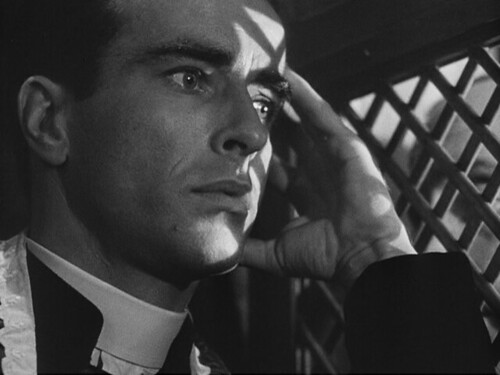
In I Confess, a 1953 film noir by Alfred Hitchcock (1899-1980) from Warner Bros., a Catholic priest, Fr. Logan (played by Montgomery Clift) hears the confession of a man who works in the rectory and just killed another man.
That killer had been dressed as a priest and, among other circumstances, points to Fr. Logan as the primary suspect for the police Inspector (Karl Malden) and prosecutor (Brian Aherne) for the murder of Villette, a prominent lawyer.
Because of the seal of confession – that is, when a person confesses his sins to a priest in Confession, the priest must maintain absolute secrecy about anything that the person confesses – Fr. Logan does not and cannot under any circumstances divulge the identity of the confessed killer though he (and the audience) knows it.
Even after Fr. Logan is arrested for the crime and put on trial for murder for it, the priest does not reveal the identity of the killer but only protests for his own innocence.
Hitchcock’s black-and-white film was shot by cinematographer Robert Burks (1909-1968) who would later shoot Hitchcock’s The Birds in 1964. It is edited by German-born Rudi Fehr (1911-1999) who in 1954 edited Hitchcock’s triumphant color feature, Dial M For Murder.
The story in I Confess was based on a 1902 play by Paul Anthelme Bourde (1851-1914), a French journalist who coined the term “decadent” for the avant-garde when he called indecipherable poets such as Symbolist Stéphane Mallarmé (1842-1898) one in the late 19th century.
The film follows the play which is about a killer who confesses to a priest knowing his crime cannot be betrayed. To complicate matters further, the killer blackmails the priest for a long-ago love affair he had with Ruth Grandfort (Anne Baxter), the wife of a leading citizen, and who still loves him. For the priest, the love affair is in the past though for Mrs. Grandfort it is not.
This work is in the public domain in the U.S. because it was published in the U.S. between 1927 and 1977, inclusive, without a copyright notice.
Clearly, for Hitchcock in I Confess, the priest in this situation is a highly curious figure. By the end of the film, it becomes clear that the seal of confession is a cross for the priest because of his priesthood – and though sins do not always deal with high crime – demonstrates the personified sacramental nature of self-sacrifice that is involved for the priest with each confession he hears. Throughout the film, Fr. Logan is a tragi-comic figure as he simply does not state the obvious of who the murderer is on behalf of social justice and his own innocence, but equally personifying the religious nature of living with and taking on another’s sin particularly when a person refuses their own responsibility and makes amends for it. In I Confess, the murderer has no intention of turning himself in and is content to let the priest under seal of confession take the rap in the courtroom of the law and public opinion.
Fr. Logan never impedes law enforcement’s investigation. He continually states his own innocence for which a jury of his peers is brought in to decide what to believe.
The sin of commission/omission – and in I Confess it is for and surrounds the gravity of murder – remains with the impenitent Otto Keller (O.E. Hasse) although his loving wife, Alma (Dolly Hass), to whom Keller confessed the crime outside confession’s seal, cannot abide by his secret.
If, despite the seal of confession, crimes can be revealed to government investigators then the sanctuary of the law of the cross is extricated to get at evil – which is not contradiction nor improvement to the confessional box (the priest may ask the penitent for a release from the sacramental seal to discuss the confession) but its obligatory public replacement. As there is often no transparency and plenty of state secrets in and around various government agencies, this becomes no less problematical than breaking down a Catholic (and Lutheran) church’s confessional door as well as, in the United States, violating the free exercise of religion (the First Amendment).
Although found “not guilty” for lack of evidence to convict, the presiding judge expresses his disbelief in Fr. Logan’s innocence. When Fr. Logan exits the court building, he is followed and faced by a hostile crowd – “Preach us a sermon, Logan!” The prosecutor, as he watches the ugly scene from his office above, is forced to lament his actions: ”Do you think I enjoyed it?” he says, washing his hands. After Fr. Logan is crashed into a car window in the crowd, Alma, Keller’s wife, (her name means “soul”) rushes in towards the priest to tell what she knows – and which an accompanying police guard relates to the Inspector – “She said he was innocent.”
Considered Hitchcock’s once most Catholic of films, I Confess is a tight drama with a truly despicable villain, whose murderous rampages continue. The film is ahead of its time in terms of direction – presaging some of the camera angles, editing, pacing and themes of international crime and psychological dramas that would come to greater fruition in the decades ahead.
An online search by title at the US copyright office yielded no copyright renewal. In the absence of renewal of the US copyright, this poster art entered the public domain 28 years after its US publication date.
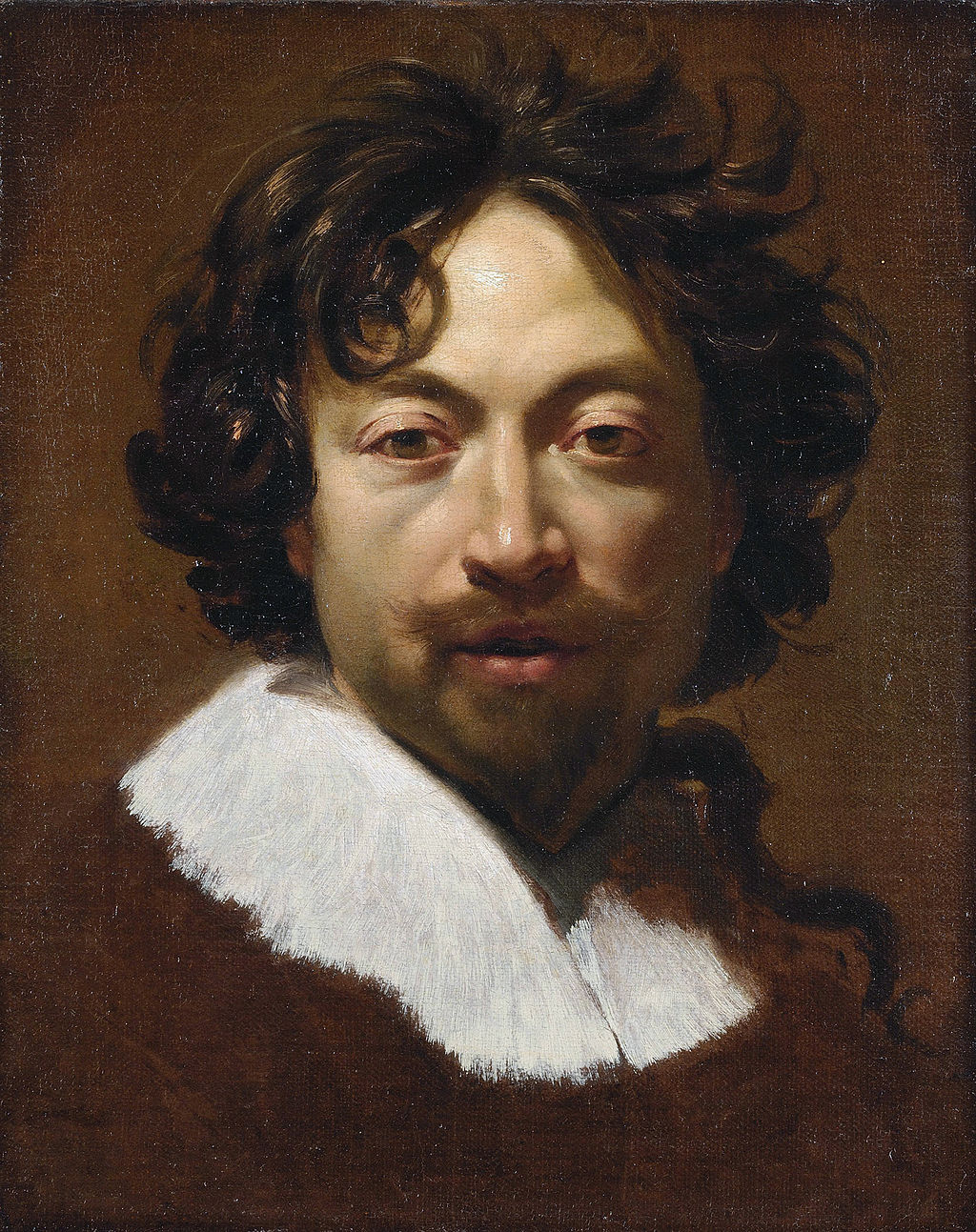
FEATURE Image: Simon Vouet (1590-1649), Self-portrait, c. 1626–1627, Musée des Beaux-arts de Lyon. https://www.mba-lyon.fr/fr/article/simon-vouet In Simon Vouet’s self portrait painted in his final years in Rome he displays his signature rapid brushwork and desire for movement in the picture.
Simon Vouet was born into modest circumstances in Paris on January 9, 1590. After stays in England in 1604, Constantinople in 1611 and Venice in 1613 of which little is known, the French painter Simon Vouet (1590-1649) spent nearly 15 years in Rome starting around 1614. In 1624 Vouet was elected to lead the Accademia di San Luca, an artists’ association founded in 1593 by Federico Zuccari (1539-1609).
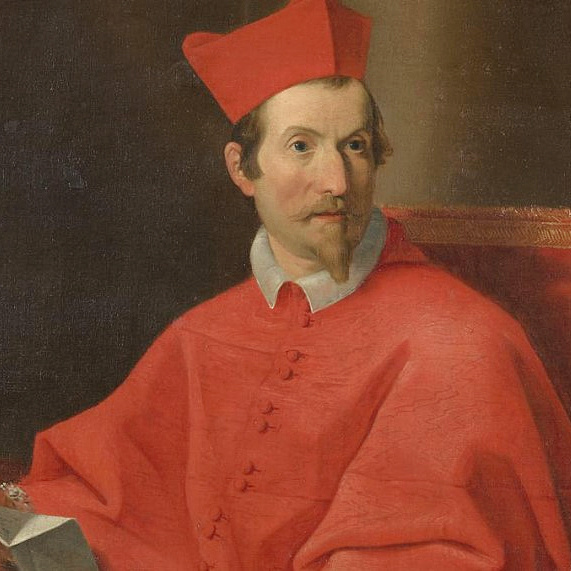
Most French painters born in the 1590s made a stay in Rome which influenced art in France in the 17th century. Vouet was in Italy, primarily in Rome, between around 1613 until 1627 and received a special privilege from the French crown in 1617. It was this traffic of young French, Flemish and other international artists between Italy and their home countries in the first third of the 17th century that, for France, helped revolutionize French art. This was achieved by way of the contemporary application of ideas and styles influenced by late Renaissance Italian realist artists such as the aesthetic of Caravaggio (1571-1610) and the history painting method of Annibale Carracci (1560-1609), among many others, to which French artists were exposed while in Italy. In Rome Vouet, like other French artists such as Valentin de Boulogne (1591-1632), was patronized by Cardinal Francesco Barberini (1597-1679) and Cavaliere del Pozzo (1588-1657), among others. In 1624 Vouet was commissioned to paint the fresco to accompany Michelangelo’s Pietà in St. Peter’s and while greatly admired it was destroyed in the 18th century.
In addition to Rome, Vouet traveled to Naples, Genoa in 1620 and 1621, and, in 1627, Modena, Florence, Parma, Milan, Piancenza, Bologna and again Venice where he copied Titian (1488-1576), Tintoretto (1518-1594) and Paolo Veronese (1528-1588). During these visits Vouet studied the chief art collections that informed Vouet’s own style which amounted to a free form of temperate, classicized Baroque. This is the style, along with the latest Venetian-influenced brighter colors, vivid light, and painterly execution that Vouet returned and introduced to France in the 1630s. In France, Vouet had taken to himself as a painter his particular appreciation for the classicized compositions of Nicolas Poussin (1594-1665) and the cool colors of Philippe de Champaigne (1602-1674).
In 1627, King Louis XIII (1601-1643) called Vouet back to Paris to be his court painter. Vouet refined Caravaggio’s innovations into a style that would become the French school of painting starting in the 1630s and extending into the middle of the 18th century. Until about 1630 it was Late Mannerism which dominated in French painting and included unnatural physiognomy, strained poses, and untenable draperies. This changed with Vouet’s return who brought back from Italy a style with classical, realist, and Baroque painting components that was unknown in France until then and which Vouet stamped with his own style.
This painting entered the Louvre as a work of the Neapolitan school. It was recent scholarship that attributed it to Vouet which would make it one of his earliest portraits in Rome. Building on the premise, scholars have proposed Francesco Maria Maringhi (1593-1653), a Florentine patrician and lover and protector of Italian Baroque painter Artemisia Gentileschi (1593-1656), as the model.
Vouet married twice. His first wife was a young Italian woman he met in 1625 – Virginia da Vezzo (1600–1638). In France Vouet’s wife, who bore him 4 children, was well received by the French court. After Virginia died in 1638, Vouet married Radegonde Béranger (b. 1615), a young beauty from Paris, in July 1640. Radegonde bore Vouet another 3 children (one died in infancy), and survived him.
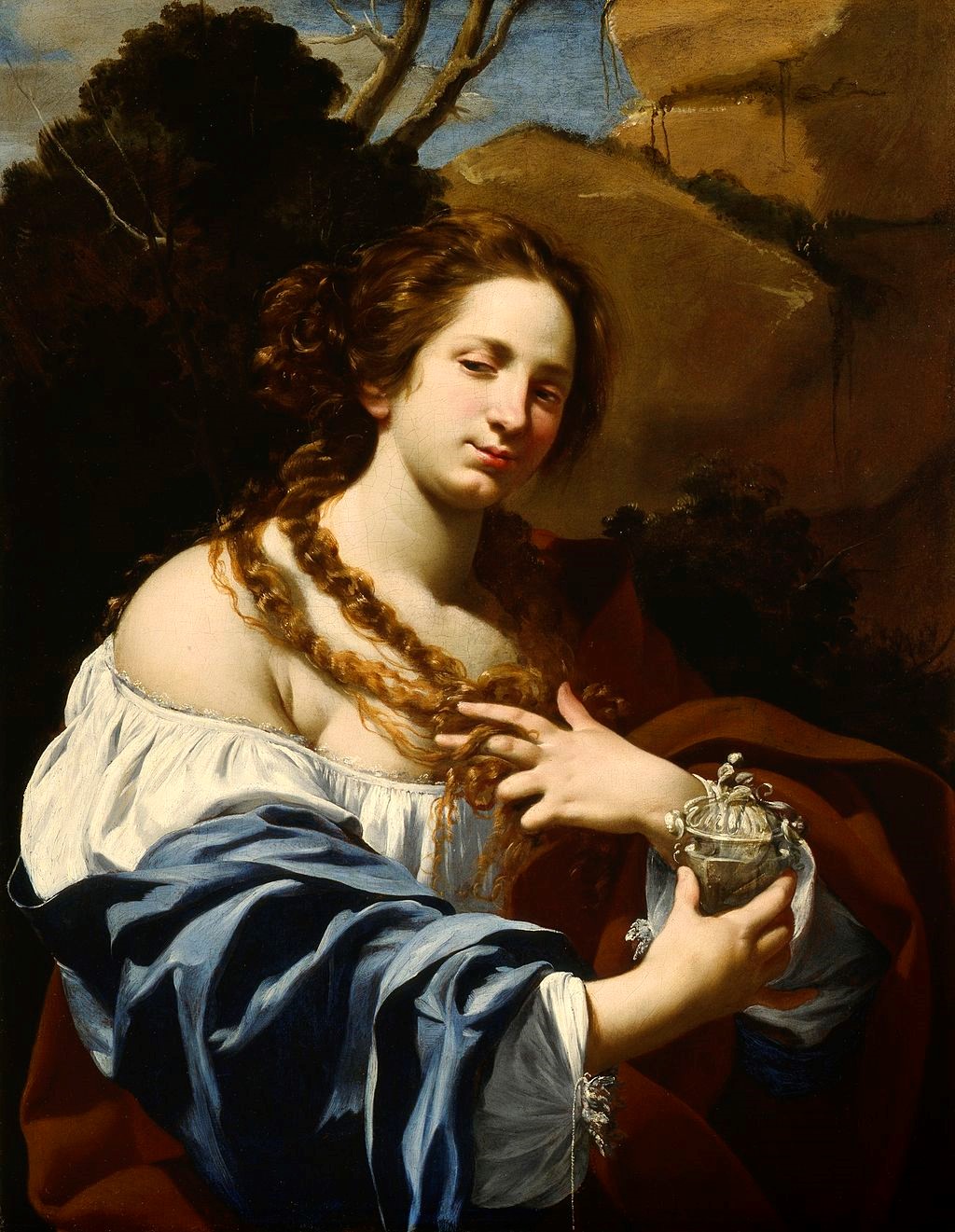
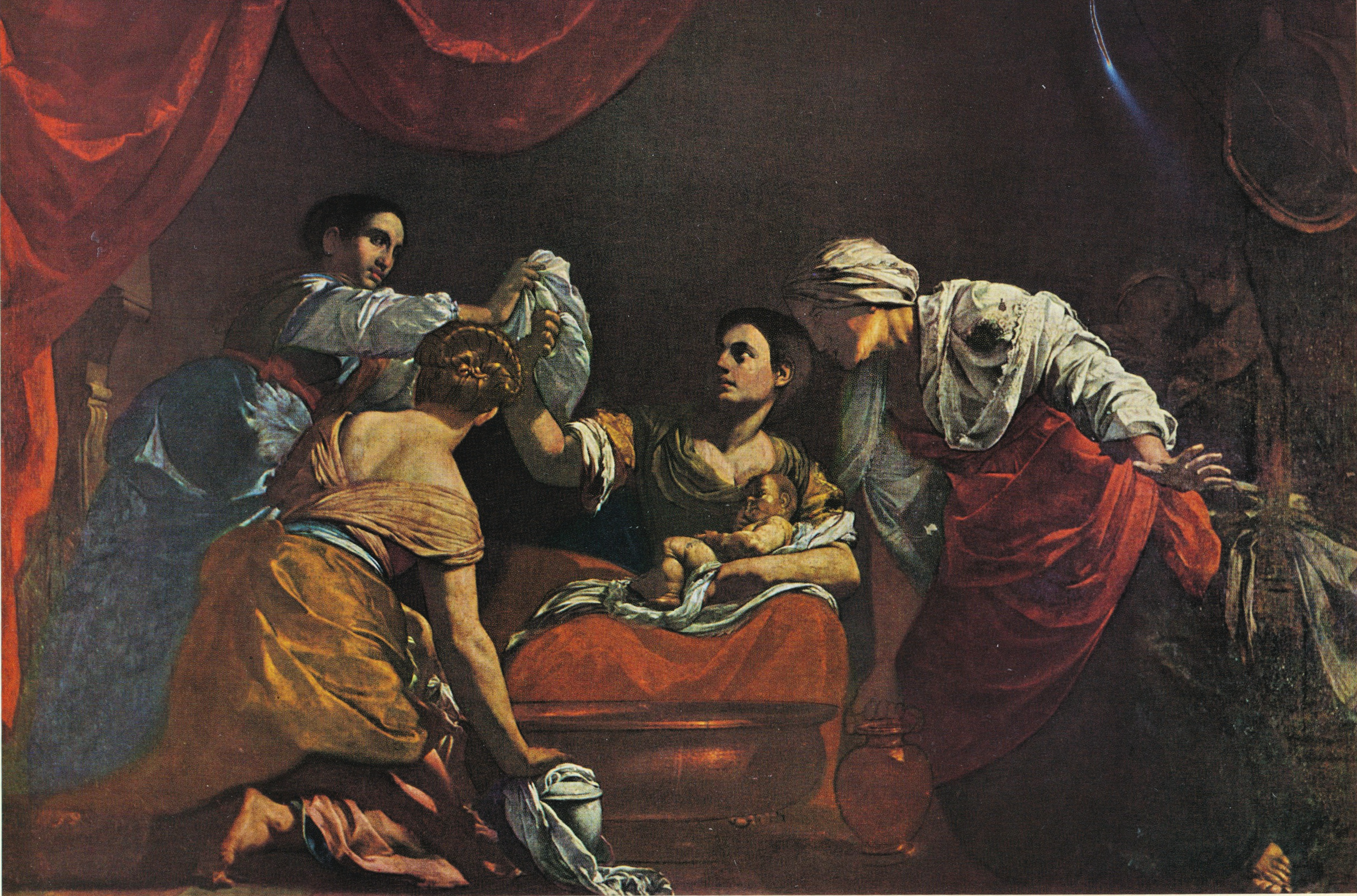
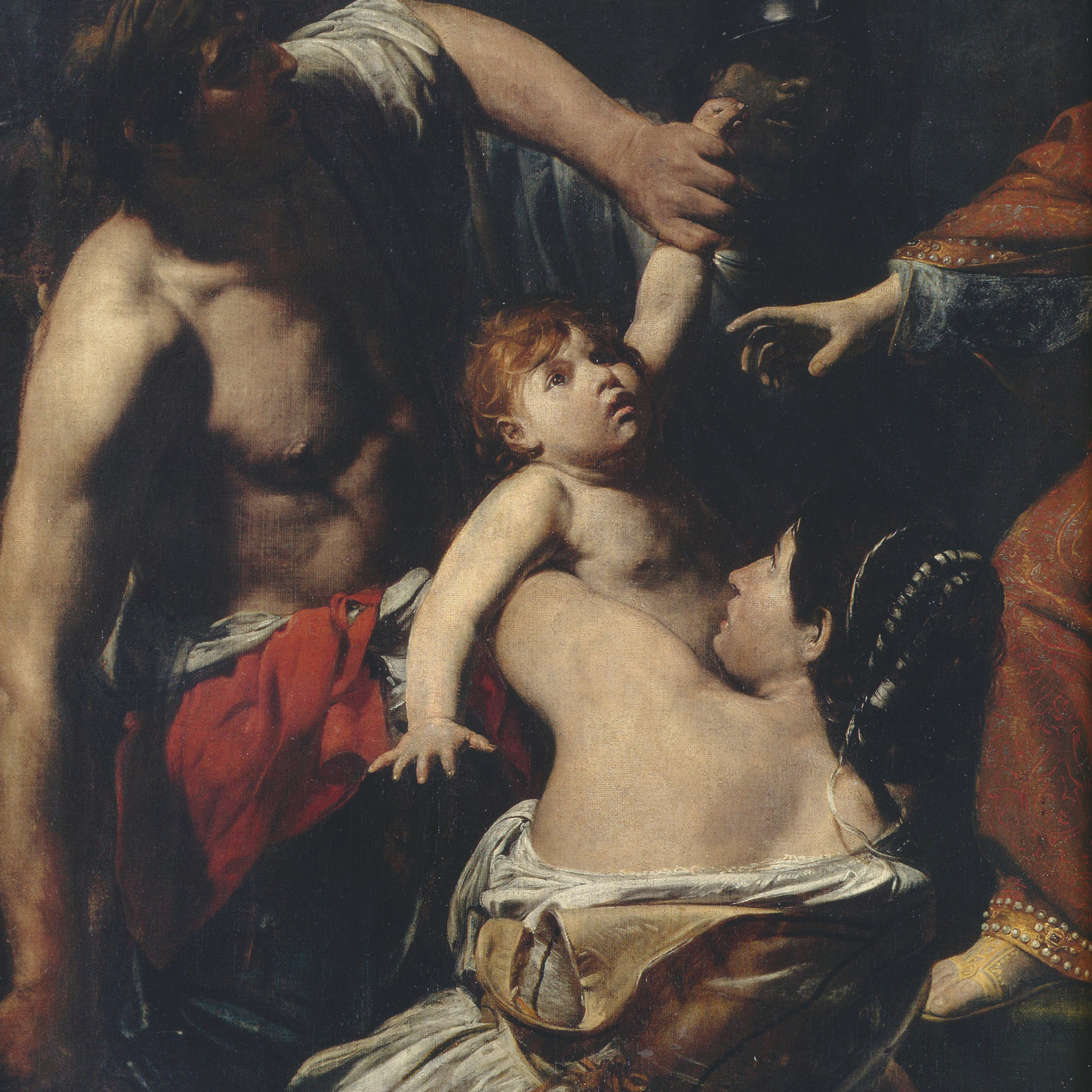
Simon Vouet (1590-1649), Virginia da Vezzo, the Artist’s Wife, as the Magdalen, oil on canvas, 40 × 31 in. (101.6 × 78.7 cm), oil on canvas, c. 1627, Los Angeles County Museum of Art. https://collections.lacma.org/node/247903Simon Vouet (1590-1649), Judith with the head of Holofernes, 1620/1625, 97 x 73,5 cm, oil on canvas, Bayerische Staatsgemäldesammlungen München-Alte Pinakothek, https://www.sammlung.pinakothek.de/de/artwork/jWLpZea4KY/simon-vouet/judith-mit-dem-haupt-des-holofernesSimon Vouet (1590-1649), The Birth of the Virgin c. 1620 Rome S. Francesco a Ripa.Detail: The Birth of the Virgin.
The Birth of the Virgin was one of many paintings in a somber palette that Vouet produced in Rome influenced by Caravaggio though its mood is more vibrant. The composition is broad, low and somewhat setback from the picture plane. Amidst the swirling movement and vitality of the drawing and figures, including sumptuous draperies, it is observed that the head of the maid servant in the middle of the composition is modeled on one by Michelangelo Buonarroti (1475-1564). These early qualities that Vouet had taken from Italian painting were, when he returned to France, taken over by a heightened decorative style in the 1630s and 1640s.
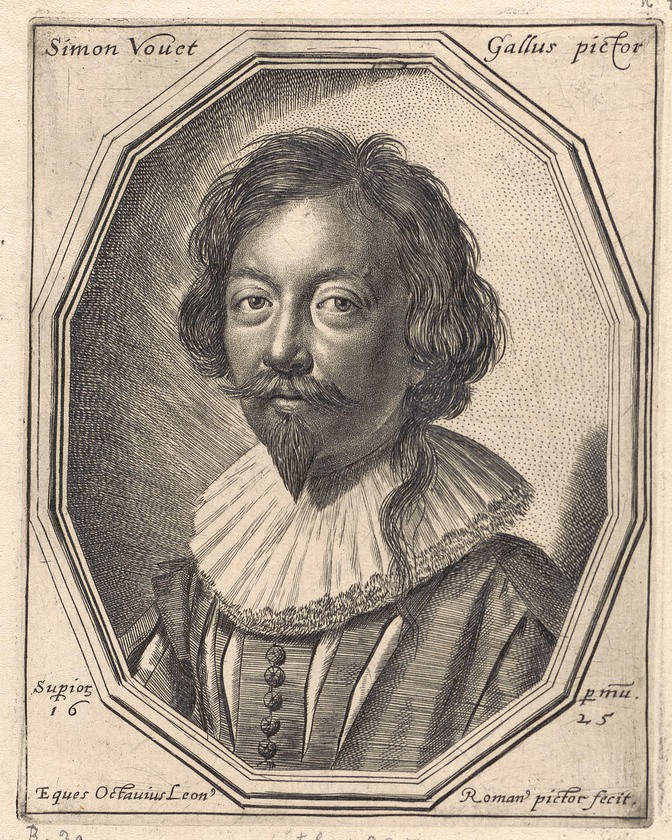
Ottavio Leoni (1578–1630), Simon Vouet in Italy, engraving, sheet 9 3/8 × 7 1/16 in. (23.34 × 17.94 cm), Carnegie Museum of Art, Pittsburgh.Simon Vouet (1590-1649), Portrait presumed of Aubin Vouet, c.1625. Musée Réattu, Arles. Simon Vouet (1590-1649), The Temptation of Saint Francis, c. 1620 Rome Basilica of Saint Lawrence in Lucina.
Simon Vouet (1590-1649), The Temptation of Saint Francis, c. 1620, Basilica of Saint Lawrence in Lucina, Rome. In Rome Frenchman Simon Vouet adopted a Caravaggesque style coupled with elements from Michelangelo such as in this painting for an ancient (4th century) church in Rome. While Vouet worked directly from the model and used closely observed poses from reality, the head of St. Francis of Assisi seems to be taken from one by Michelangelo. In Franciscan spirituality and tradition there is much greater emphasis on the presence of God and the joys of living the evangelical counsels (poverty, chastity, and obedience) in community and in nature than there is on the vocation’s temptations, trials or penances that could only be part of any religious saint’s story. While the early Franciscans tell tales of the devil, these are always quickly resolved as they relate the saint’s or another Franciscan brother’s beautiful victories over the Tempter by prayer, fasting and humility. Simon Vouet’s early painting in Rome presents an ostensibly Franciscan subject but with a Renaissance modern sensibility focusing on the twisting bodies of the figures of a contemporary woman presenting herself to the young Italian 13th century saint who, himself half naked, is all muscles and who gestures at the moment of first encounter with fleshly temptation to an unresolved ending adding to the painting’s worldly intrigue. see –https://www.finestresullarte.info/en/works-and-artists/-almost-as-unbelievable-as-a-church-painting–simon-vouet-and-his-saint-francis-tempted
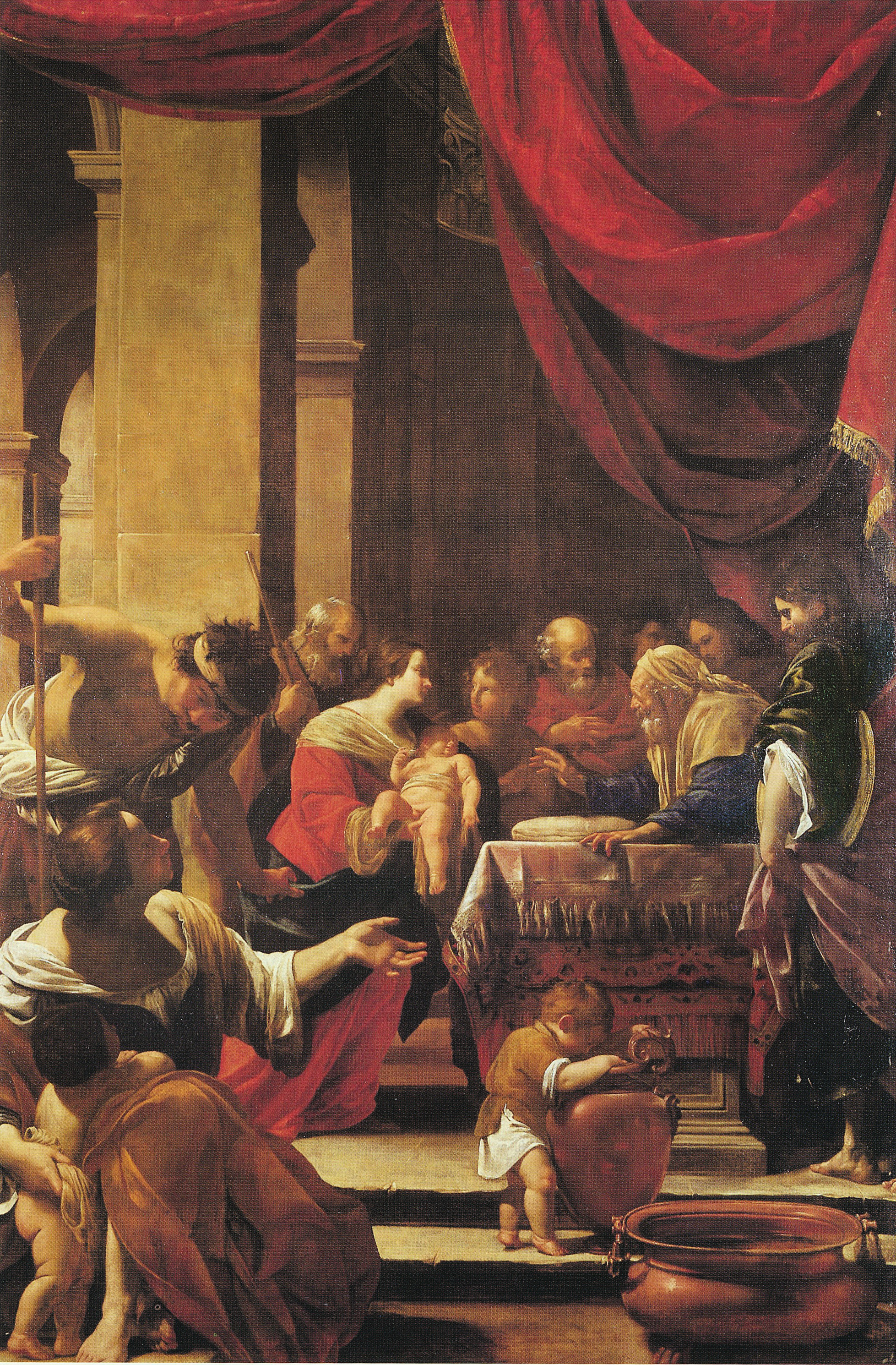
Attributed to Vouet, Annunciation, Uffizi, c. 1621. oil on canvas 1.20 x 0.86m (see Crelly, pp. 162-63). Simon Vouet (1590-1649), The Circumcision, oil on canvas, Church of Sant’ Angelo a Segno Naples.Simon Vouet (1590-1649), The Crucifixion with Mary and John, oil on canvas, Church of Jesus and Saints Ambrogio and Andrea GenoaSimon Vouet (1590-1649), Appearance of the Virgin to St Bruno, c. 1624, Naples, S. Martino.
As Vouet stayed in Italy he increasingly turned to a Baroque style of which The Crucifixion with Mary and John in Genoa is an early example. The Appearance of the Virgin to St. Bruno in the Carthusian monastery of San Martino in Naples is a later and more fully realized Baroque style example. The atmosphere of each showing saints in ecstasy is a clear element in Baroque’s intensified and elaborated religious representation. In Italy Vouet’s paintings are more restrained than the full contemporary Baroque art of Pietro da Cortona (1597-1669) and his followers such that the French painter’s figure of the Virgin in his Naples’ picture tends towards a classical Renaissance tradition that would be an important part of the expression of French taste in the 1630s and 1640s.
Simon Vouet (1590-1649), Modelli for Altarpiece St-Peters Rome, 1625, Los Angeles County Museum of Art.Simon Vouet, The Clothing of St. Francis of Assisi, Rome, S. Lorenzo in Lucina, Alaleoni Chapel, 1624. Vouet decorated the chapel with dozens of paintings. Simon Vouet, Allegory of the Human Soul, Rome, Capitoline Musem, 1.79 x 1.44 m. It probably entered the collection of the Capitoline Museum in the 17th century (See Crelly, p.213). Simon Vouet (1590-1649), The ill-matched couple (Vanitas), c. 1621.Simon Vouet (1590-1649), David with the Head of Goliath, c. 1621,Palazzo Bianco, Genoa.Simon Vouet (1590-1649), St. Catherine, c. 1621. Simon Vouet (1590-1649), Young Man wearing armor, c. 1625/271,165 m x .91 m, oil on canvas. Musée du Louvre. https://collections.louvre.fr/en/ark:/53355/cl010061299
The painting by Vouet towards the end of his Roman period, the identity of the young man above is unknown though speculation by modern scholars is impressive (i.e., St. Thomas Aquinas, among others). The painting’s copies are numerous which points to the composition’s success. These copies can be found in major museums throughout Europe.
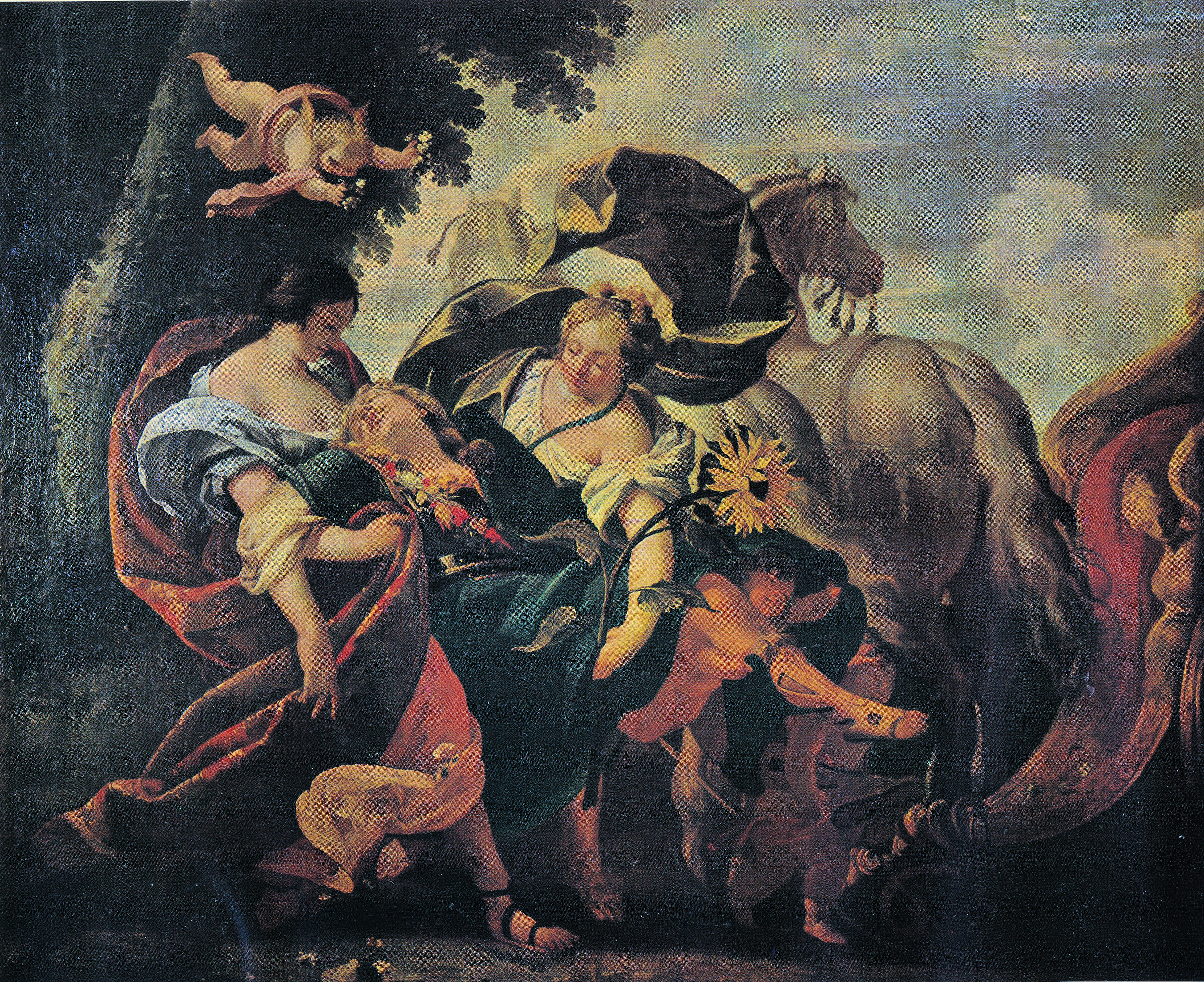
Vouet, Sophonisbe receives the poison cup through a messenger, c. 1623, oil on canvas, 125,5 x 156,5 cm, Kassel, Staatliche Gemäldegalerie. The painting was previously attributed to Guido Reni (1575-1642). The painting was in Kassel by 1738. (see Crelly, p. 167). https://altemeister.museum-kassel.de/33982/0/0/147/s1/0/100/objekt.html. The tragic events are condensed in the expressive eye contact. Sophonisbe, the patriotic daughter of the Carthaginian general Hasdrubal, knew how to keep her husband Syphax on the Carthaginian side in the war with Rome. He was captured by the Numidian prince Masinissa, who was allied with Rome, and Sophonisbe threatened with extradition to the Romans. When she begged Masinissa for protection, he fell in love with her and married her. Now the Romans sensed betrayal and demanded the surrender of the dangerous enemy. Masinissa did not dare to resist, but he sent Sophonisbe a servant with a poisoned cup, which she drank (Livy 30:15). The subject topic could also be Agrippina receives the poison cup sent by Nero.Simon Vouet (1590-1649), Saint Jerome and the Angel, c. 1622/1625, 144.8 x 179.8 cm (57 x 70 13/16 in.), oil on canvas, The National Gallery of Art, Washington D.C. https://www.nga.gov/collection/art-object-page.46151.html
In 1627 Vouet painted Saint Jerome and the Angel featuring an elderly bearded saint and a winged curly-haired angel holding a trumpet that signifies the Last Judgment. While the composition is Caravaggesque in its naturalistic depiction of half figures, stark lighting, and dark-brown palette, Vouet’s painting features brighter colors in the robes and clothes which was a departure from the Caravaggesque tradition and, among some contemporary artists in Rome in the late 1620s, an aesthetic innovation. The painting demonstrates Vouet’s superb fluid handling of paint which he brought back to and deployed in France starting in the 1630s.
Vouet was a leading French artist in Rome when asked to return to France by the king in 1627. At his arrival, though embraced by King Louis XIII and his mother, Marie de’ Medici, Vouet was kept at a distance by Cardinal Richelieu (1585-1642) who viewed the ambitious artist as a social climber. Though modest compared to the great collections in London and Madrid, Cardinal Richelieu collected about 272 pictures, the canvasses listed in an inventory compiled by Vouet and his student, Laurent de la Hyre. Though Richelieu succeeded in getting Poussin to return to France from Rome in 1641and as “First Painter,” this direct competition to Vouet was short-lived. Richelieu died in 1642 and Poussin left for Italy the same year.
The king set Vouet to the task of painting portraits of the court nobility though just one survives today – that of Richelieu’s secretary. In 1648, when the Académie Royale de Peinture et de Sculpture was established – an organization that held monopoly power over the arts in France for the next 150 years – Vouet was not invited to join. Vouet understood that the academy, which included his pupils Le Brun and Le Sueur, was established in part as a generational shift that challenged his influence and authority. Vouet countered by modernizing the old painter’s guild but did not live to see the battle joined. He died of exhaustion in June 1649. The Academy went on to school artists, provide access to prestigious commissions, and hosted the Salon to exhibit their work. After Vouet’s death, the Académie soon rose to prominence with Jean-Baptiste Colbert, First Minister of State from 1661 until his death in 1683 under Louis XIV, as its protector and Charles Le Brun as First Painter and the Académie’s director.
Atelier of Simon Vouet (1590-1649), Michel le Masle (1573-1662), 1628,, oil on canvas, musée Carnavalet, Paris.
Upon Vouet’s return to France in late November 1627, his French style set to work mainly on religious subjects which were admired by the public, particularly in diocesan and religious orders’ churches of Paris. As late as 1630, the eye of the Paris art consumer was used to prevailing late 16th century mannerism. It took time for the French to better accept Vouet’s new Caravaggesque naturalism. Further, while France was a so-called eldest daughter of the Catholic Church, Parisians did not share the intense religious enthusiasm that was the art expression in the papal states. Parisians did not fully accept the swirling heavenly masses found in Italian Baroque. In France Vouet had to temper his stylistic synthesis of classicism, naturalism and baroque as the French expression of and contribution to a great international style.
Vouet’s new and tempered French style is exquisitely represented in Madonna and Child (1633). During the religious reformation period in the 16th century one of the Catholic Church’s responses was the renewal of devotion to the Virgin Mary. This cult of the Virgin, once blossomed in the 12th century, was in renewed full maturity in the 1630s and even inspired the French king to dedicate his North American empire to her in 1638. Vouet painted more than a dozen compositions of the Virgin and her son at half-length. While the blank background and figurative monumentality remain from his Roman days, Vouet’s mastery of light and use of bright colors signal the realization of the new French style. The monumental figure of the seated Virgin depicted in a Mannerist and Classical synthesis holds her son on her lap and looks at him with drooping eyes.Her arm supported by the foundation of a classical column, Mary’s dark hair is held back by a fabric band as her neck and shoulder are exposed. The Christ child reaches up to kiss his mother, his body in a Baroque twist as he caresses her face. The brilliantly executed moment expresses intimacy and tenderness while maintaining religious seriousness.
The Bible story of depravity that Vouet depicts is that of Lot and his daughters found in Genesis 19. The angels have warned Lot who is an upright man that Sodom and Gomorrah are to be destroyed for its sins. As Lot’s family escapes, they are warned not to look back on the Divine destruction. Lot’s wife disobeys and is turned into a pillar of salt. Despairing of finding husbands where they are going and so carry on their own people, Lot’s daughters devise to get their father drunk and lie with him. Both daughters become pregnant in this way.
Vouet depicts Lot of the Old Testament story as they break the taboo of incest to carry on the race in desperate times using Renaissance artistic language of a god from pagan mythology. In place of moralizing, Vouet composes a sensual scene showing Lot, a male figure of late middle age, tasting the company of two nymph-like young women in a canvas filled with the attraction of the flesh and drunken debauchery. The lines and forms of Vouet’s new painting give priority to its narrative power which will be the manner of his artwork following his return to France. It is noted that Vouet used a contemporary engraving of an ancient relief to model the figure of the seated daughter.
Commissioned by Cardinal Richelieu for his Palais Royal’s Gallery of Illustrious Men the painting ofGaucher de Châtillon was set into one of its bays. The portrait was greatly admired in that generation for the figure’s resolute pose as well as the execution of Vouet’s drawing and painting. Critics assessed that since the pose and head were so artistically beautiful Vouet’s subject was not modeled from life but inspired by Carracci. Seeing the subject turned and from behind was in the Mannerist tradition that Vouet loved and adopted for this historical figure of Gaucher de Châtillon (1250-1328), a constable of France and advisor to Capet kings, Philip IV the Fair (1268-1314), and then to his sons, Louis X the Quarreler (1289-1316), Philip V the Tall (1293-1322) and Charles IV the Bald (1294-1328). The Louvre’s picture has been restored.
Back in France Vouet had a successful career as the painter of large decorations and religious and allegorical paintings. His studio was the largest international workshop and school in Paris. Vouet was a most sought-after and beloved teacher and his art collaborators were numerous (Le Brun, Le Sueur, Mignard, Du Fresnoy, Le Nostre, among others). Per usual practice among professional artists in Europe, those with talent were encouraged to marry into the master’s family so to keep the training, skill and social connections “in house.”
The 1630’s began an age of cultural realignment and reorientation in France that would remain until about the French Revolution. In 1634 the Académie Française was founded under Cardinal Richelieu. In 1637 René Descartes published in French his Discourse on Method (“Je pense, donc je suis” “I think, therefore I am”) ushering in radical subjectivity in philosophical thought. That same year Peter Corneille’s Le Cid was produced, the first great stage play. In 1640 the Imprimerie Royale was founded to publish scholarly books and improve societal erudition. The decade’s innovations continued to transform culture over the next 30 years. By the 1660s French artists, writers and others in France viewed their language, thought, and artistic culture as the world’s most refined and unparalleled in history. Vouet’s return in 1627 was well situated for him to contribute to this prolonged period of interest in artistic matters in France.
In the mid17th century, wealthy French patrons began to collect Italian and Italian-inspired art. This included Louis Phélypeaux de La Vrillière (1599-1681) who collected 240 major paintings for his house in Paris. Critics have observed about Vouet that as he played the role of art functionary by importing and translating Italian art tradition into France, he remained less of a truly profound original artist.
Louis Phélypeaux de La Vrillière, secrétaire d’Etat de la religion prétendue réformée. He built the Hôtel de la Vrillière in 1st arrondissement in Paris designed by François Mansart (1598-1666) between 1635 and 1650.
In the 1630s, classical understanding of Carraci from Domenichino (1581-1641) was giving way to a different understanding of history painting from Giovanni Lanfranco (1582-1647). Lanfranco viewed Caracci’s legacy as decoration in search of vitality more than a spatial or formal articulation which extended to include figures in action. Vouet worked rapidly to populate the churches, monasteries and abbeys, royal palaces and private mansions, many newly built, of Paris, with his artwork. Vouet also produced large public commissions, all of which expressed a prevailing Baroque potpourri.
Vouet’s most significant contribution to French painting is his innovations in decorative painting whose influence was felt in France into the mid18th century. Vouet’s influence may be out sized to his intellectual quality and artistic originality but he made a tremendous impression on his contemporaries and was the artist, in a city of intense competition, who was the leading figure of the new Italian art manner for the French public and in many different projects for over 20 years. Vouet’s position as painter is on par with architects Jacques Lemercier (c.1585-1654) and Louis Le Vau (1612-1660) as part of that same generation in France who formed the classicizing French Baroque. They used French art practice since King Francis I (1494-1547) and solid current Roman practice forged into a French synthesis associated with Cardinal Richelieu and Louis XIII. Vouet’s pupils, Charles Le Brun (1619-1690), Pierre Mignard (1612-1695), Nicolas Mignard (1606-1668). Le Sueur (1617-1655), and François Perrier (1590–1650) carried on the tradition of Vouet’s artwork.
Philippe de Champaigne (1602-1674), Jacques Lemercier with dome of Sorbonne.Louis le Vau.Philippe de Champaigne (1602-1674), Cardinal Richelieu, 1642, Musée des Beaux-Arts de Strabourg.Peter Paul Rubens (1577-1640), Young Louis XIII.
For his decorative work Vouet collaborated with artists in other media such as sculptor Jacques Sarrazin (1592-1660). Vouet painted large-scale decorations for royal patrons such as Anne of Austria (1601-1666), wife and mother of French Kings, at Fontainebleau in 1644 and at the Palais Royal between 1643 and 1647. Vouet did a decorative series at the Arsenal. At Hôtel Séguier (no. 16 rue Séguier) in Paris for the chancellor of France, Pierre Séguier (1588-1572), Vouet painted the chapel, library, and lower gallery. In these projects, Vouet reintroduced forgotten French painting traditions of illusionism practiced by Italian artists at Fontainebleau in the 1530s. Vouet synthesized it with the new Italian style in the 1630s, including imitating the use of gold mosaic and big oval designs derived from Venice. Today these decorations survive only by others’ engravings of them.
Pierre Séguier.
Some of Vouet’s decorative schemes survive at the Château de Wideville west of Paris. The castle was originally built in the late 16th century and sold to King Louis XIII’s minister of finances, Claude de Bullion (1569-1640), in 1630. Starting in 1632, the new owner set about building and expanding the castle in the Louis XIII style, with red bricks, white quoins and a pair of chimneys. Bullion involved the best decorators including Vouet for painting as well as Jacques Sarrazin (1591-1660) and Philippe de Buyster (1595-1653) for sculpture. Château de Wideville later became base for Louise de La Vallière (1644-1710), maitresse d’amour of King Louis XIV.
Claude de Bullion, oil on panel, 33 x 23,5 cm.
Vouet completed a later decorative panel, Muses Urania and Calliope in or around 1640, with the help of his studio. Likely commissioned as an altarpiece for the private chapel of a wealthy Parisian, the painting depicts porcelain skin women, bejeweled drapery, and putti in a classical architecture setting.
With his patrons Vouet was an amenable creator and he was a facile painter. His wealthy and powerful patrons wanted showy decorative artwork painted in the modern Italian manner without very serious religious or political messages for their often newly-acquired or built residences. The Toilet of Venus is exuberant and intriguing though based on the latest Italian art of the day – the theme is inspired by a treatment of Francesco Albani (1578-1660) while the figure of Venus is derived from Annibale Carracci. Though the figures remain weighty in the mode of Italian Naturalism, Vouet transforms the group into curvaceous polished and floating interlocking forms.
As many of Vouet’s large-scale decorative and other works were virtually systematically destroyed in the Revolution so that the connoisseur must assess Vouet’s artistic merit by way of surviving decorative schemes more than individual canvases or fragments, The Presentation in the Temple is an important extant painting by the hand of Vouet that allows qualitative comparisons to other 17th century French artists such as Laurent de La Hyre (1606-1656), Eustache Le Sueur, Charles Le Brun, and Jean-Baptiste Jouvenet (1644-1717). Commissioned for the Jesuits by Richelieu in 1641 for what is today’s Saint-Paul-Saint Louis in Paris’s Marais it was part of a rich ensemble of artifacts whose overall artistic scheme was dedicated to Christ and the French monarchy. Vouet’s presentation theme evokes the birth of Louis XIV and the painting was flanked by sculptures of Jesuit saints and French political figures.
There remains some similarity to what Vouet had produced in Italy in the mid1620s, particularly in The Appearance of the Virgin to St Bruno in Naples, such as his use of diagonals. Yet 15 years later in France Vouet’s composition is more classical in orientation including a rational not emotional or supernatural treatment of the subject more in the style of Nicolas Poussin who was called back to France from Italy the year before.
To give the illusion of grandeur, Vouet provides a very low position at the bottom of the stairs surrounded by gigantic religious architecture of which he paints a fragmentary synecdoche. For depth, Vouet interposes firmly-modeled foreground figures that partly mask more distant such figures in statuesque draping. Vouet’s cool colors reflect the influence of Philippe de Champaigne and the Baroque turning movement extends into the entablature of the architecture of the temple of Jerusalem, as well as the inclined position of the two angels painted in the upper portion.
By 1762, 20 years after Vouet painted The Presentation, politics changed unpleasantly for the Jesuits as they were suppressed by the Pope and their Paris flagship church’s high altar ensemble was dismantled. The painting was housed in the Royal Academy of Painting and Sculpture and later transferred to the Louvre during the French Revolution.
Simon Vouet (1590-1649), The Adoration of the Holy Name by Four Saints, oil on canvas,265 x176 cm, Église Saint Merri, Paris.Simon Vouet (1590-1649), Altar piece, Église Saint-Nicolas-des-Champs, Paris.Simon Vouet (1590-1649), Virgin with oak branch, known as Madonna Hesselin, c. 1640/1645, Musée du Louvre. https://collections.louvre.fr/en/ark:/53355/cl010067259
In 1651, two years after the death of Vouet, the painting above was inscribed in Latin to state that Vouet had painted the artwork and in the house of “very noble lord” Louis de Hesselin, one of the king’s advisors. The inscription also gives the meaning of the palm branch the Virgin holds – it is a sign of the means of her effectual assistance to the afflicted. Sieur Hesselin was a confident to the artist who was both godfather to Vouet’s eldest son in 1638 and witness to the marriage of Vouet’s daughter 10 years later. Two other known versions of the painting are found in the United States and in England. X-rays revealed that Vouet fully completed the neckline of the virgin before he added the painted golden robe upon it.
Simon Vouet (workshop), Christ at the Column, c. 1635/40, 1.28 m x .66m, oil on canvas. Musée du Louvre.
Louis XIV owned this painting of Christ being scourged by Roman soldiers at the pillar during his Passion. In the 18th century the painting was attributed to Eustache Le Sueur which still has its defenders today. Attribution to Simon Vouet began in the 20th century among scholars. In the 21st century scholars have proposed Charles le Brun (1619-1690) and the “Workshop of Simon Vouet” which the Louvre has settled upon. Preparatory drawings for the painting exist at the Bayerische Staatsbibliothek in Munich and at the Musée des Beaux-Arts in Besançon. The artwork may have come from a chapel of the Château in Saint-Germain-en-Laye. The painting was restored twice in the 18th century and in the 1960s.
At the same time that Vouet was painting religious subjects for churches in Paris he was painting allegorical and poetical artwork. For these paintings Vouet’s designs are freer, modeling looser and, in the Venetian style, the composition determined more by color and light.
Vouet painted this artwork and two other allegorical paintings for the decoration of the châteauneuf of Saint-Germain-en-Laye. In the 17th century the painting was known as “Seated Victory.” The female figure holds a flaming heart in her right hand and palm leaf in her left hand as a Cupid-like figure of love places a laurel wreath on her head. Later, the allegorical figure was called “Faith.” The painting was heavily restored in the mid1960s.
The painting was made for the decoration of the Château Neuf de Saint-Germain-en-Laye. In the 18th century the female figure wearing a laurel was described as “Victory” and holding Louis XIV in her arms. In the 19th century the female figure was viewed as an allegory for “Wealth” though other attributes such as the main figure’s foot resting on a cornerstone and strewn open books point to a figure representing “Christian Faith.” The standing cherub who offers her sparkling necklaces and the child on her lap have been interpreted as figures representing earthly and heavenly love, respectively.
Vouet depicts a scene on the standing silver vase of the nymph Daphne being pursued by Apollo, god of the arts. It is a classical mythological story which, despite aid from Cupid, the god of love, relates the vanity of earthly goods and pleasures. The scholarly theory of what is depicted in Vouet’s painting adds up to “Christian Faith” holding onto the figure of heavenly love as she is being tempted by baubles and pleasures of earthly love. The painting was restored in the 1950s and 1980s.
Beyond the thoughtful allegorical presentation, Vouet’s innovative style and reliance on lyrical emotion and sentiment more than ordered arrangement is in evidence as he presents a sensual winged goddess with healthy, chubby children in a fantasia of rich draperies and elegant linear architecture amid a metallic treasure hoard, all of which together enlivens the picture. Its languorous elegance derives from the Italian Baroque. Though a dictatorial teacher, unrivaled ambitious artist, and living in Paris during the grim era of the Thirty Years’ War, in Vouet’s painting for the French nobility there is no sense of unease and any subject’s forthrightness is tempered by superficiality.
Simon Vouet (1590-1649),The Three Marys at the Tomb, n.d., 52 1/4 x 66 1/2” Église Sainte Marie Madeleine de Davron Seine-et-Oise (11th century).
A chasm of space between the two angels holding up the shroud and the three women at the tomb before dawn on the third day delineates the heavenly from the earthly although all these figures are linked by vibrant colors and a reflective animation of spirals. Detailed drawing is forgone for conventional pose and vague, mannered forms. Inasmuch as Vouet is interested in the Biblical story or its meaning he is involved with the vivacity of the narrative by way of its stylistic elements. In contrast to Nicolas Poussin’s statuesque figures or Le Valentin’s introspective art, Vouet introduced Baroque lyricism and fancy into French art.
Saturn who represents Time in Roman mythology has tumbled next to a scythe and hourglass, his attributes. Holding him by the hair the bare breasted figure has been identified as Beauty but also Truth and is likely a portrait of Vouet’s Italian wife. Virginia da Vezzo. She holds a lance over him. To the left is Hope who holds out a hook, her symbol, as a trio of cupids pluck feathers from Time’s wings. The allegorical message may be that Love defies Time.
Simon Vouet (1590-1649), Saturn Conquered by Love, Venus and Hope, 1643/45, , Musée de Berry, Bourges.
In another allegorical painting of the same theme, Saturn is Father Time. The old man is overcome by Love (Cupid), Beauty or Truth (a bare breasted figure, perhaps Venus), and Hope (holding an anchor, her traditional symbol). Above these in colorful robes is Fama, the figure of fame, who announces herself blowing her trumpet. Fama embraces Occasio, her hair traditionally blowing forward, holding an emblem of wealth, and signifying the fortunate occasion. In Vouet’s picture which synthesizes classical elements such as statuesque figures in the style of Poussin and swirling masses and vibrant colors of the international Baroque style, Time is the victim of what he usually despoils. The large painting originally hung in the Hôtel de Bretonvilliers in Paris.
Simon Vouet (1590-1649), Allegory of Good Government, 1644/45, oil on canvas, 2.37 m x 2.71 m, Musée du Louvre.
In the collection of Louis-Philippe d’Orléans (1725-1785) in the Palais-Royal in Paris before 1785, it entered the collection of Louis Philippe Joseph d’Orléans (1747-1793), known as Philippe Égalité afterwards, and was sold in 1800. In 1961 Friends of the Louvre acquired it in New York City and donated it to the Louvre that same year.
The young woman seated on an elevated throne wearing armor is, according to the influential Iconologia of 1593 by Cesare Ripa (1555-1622), the allegory for Reason. The pair of young women, one offering an olive branch and the other a palm branch, are allegories for Peace and Prosperity. The golden vase is decorated with a bacchanalia. Above the main scene are two cherubs bringing a palm frond and laurel with a twisted column wrapped with a vine that symbolizes Friendship.
Vouet painted this allegory of good government about Anne of Austria as she cooperated with Cardinal Mazarin’s peace policies. The painting was probably commissioned for the decoration of Anne of Austria’s apartment at the Palais-Royal around 1645. It was kept in the collection of the Dukes of Orleans at the Palais-Royal in the 18th century. and moved to London after the death of Philippe Égalité. It was purchased in New York by the Société des Amis du Louvre in 1961. The work was re-oiled with glue by Jacques Joyerot and restored in a pictorial layer by Jeanine Roussel-Nazat between 1979 and 1981.
Simon Vouet died in Paris on June 30, 1649 at 59 years old. His burial details are unknown.
17th and 18th Century Art Baroque Painting Sculpture Architecture, Julius S. Held, Donald Posner, H.W. Janson, editor, Englewood Cliffs, N.J.: Prentice-Hall, Inc. and New York: Harry N. Abrams, Inc., 1972.
French Painting in the Seventeenth Century, Alain Mérot, trans. by Caroline Beamish, New Haven and London: Yale University Press, 1995.
Kings & Connoisseurs Collecting Art in Seventeenth-Century Europe, Jonathan Brown, The National Gallery of Art, Washington, D.C. and Princeton, NJ: Princeton University Press, 1995.
Mannerism: The Painting and Style of The Late Renaissance, Jacques Bousquet, trans, by Simon Watson Taylor, Braziller, 1964.
Valentin de Boulogne: Beyond Caravaggio, Annick Lemoine, Keith Christiansen, Patrizia Cavazzini, Jean Pierre Cuzin, Gianni Pappi, Metropolitan Museum of Art; 2016.
FEATURE IMAGE: Valentin de Boulogne (1591-1632), Allegory of Rome, 1628, oil on canvas, 330 x 245 cm, Villa Lante (Institutum Romanum Finlandiae Foundation). Villa Lante in Rome is an example of the work of the 16th century Raphael school in the reign of the Medici popes. The Renaissance villa, which was a residence for Roman aristocracy, was purchased in 1950 by the Finnish state. The Institutum Romanum Finlandiae Foundation started operating there in April 1954.
Ruins of the Coliseum in Rome, Circle of Willem van Nieuwlandt, II, c. 1600, Pen and brown ink, with brush and brown and gray wash, on pieced cream laid paper, 35.3 × 61.3 cm (13 15/16 × 24 3/16 in.) The Art Institute of Chicago. https://www.artic.edu/artworks/95904/ruins-of-the-coliseum-in-rome
INTRODUCTION.
Le Valentin de Boulogne (c.1591/1594-1632), sometimes called Jean Valentin, Jean de Boulogne Valentin, or simply Le Valentin, was a French painter. Born in Coulommiers-en-Brie about 35 miles east of Paris, Le Valentin may have been at least half Italian. His artwork was certainly influenced by Italian painting more than any other though he was familiar with Northern or Flemish painting. Le Valentin may have been in Rome as early as 1612 – German painter and art-historian Joachim von Sandrart (1606-1688) remarked in 1675 that Valentin reached Rome before Simon Vouet (1590-1649) who had arrived around 1614. Whether in 1612 or definitely by 1620 (Le Valentin appears in the census), Le Valentin spent the rest of his life In Rome. In the Eternal City Le Valentin was greatly influenced by Simon Vouet (French, 1590-1649) and Bartolomeo Manfredi (Italian, 1581-1622), a leading Caravaggiste or follower of Carravaggio (Italian, 1571-1610).
Joachim von Sandrart, Self Portrait, 1641.Bartolomeo Manfredi, The Martyrdom of St. Bartholomew (detail).Simon Vouet, Self-portrait, c. 1626–1627 Musée des Beaux-arts de Lyon.
Le Valentin’s oeuvre is today around 55-60 paintings, most of them identified by modern scholarship (i.e., Jacques Bousquet; Roberto Longhi). Le Valentin’s major commissions date from the last seven years of his life. Opportunities to acquire his artwork was rare, though avid collectors such as Cardinal Mazarin (1602-1661) and Louis XIV collected them.
Cardinal Mazarin by Pierre Mignard, Musée Condé, Chantilly, France.Louis XIV, Charles Le Brun, Château de Versailles.Piazza del Popolo, Rome. “Piazza del Popolo.. Rome” by Nick Kenrick.. is licensed under CC BY 2.0
In Rome Le Valentin forged close ties with other French artists and lived with many of them in and around the Piazza del Popolo to the Piazza di Spagna. Most French painters born in the 1590s made a stay in Rome – and influenced art in France in the 17th century. Reasons young painters fled to Italy in the early 17th century included depletion of opportunity in Paris due to the professionalization of artistic practice in and outside the capital although establishment French art was no longer flourishing. Conversely, Roman art – and not only the schools of Michelangelo and Raphael but new horizons afforded by Annibale Carracci (1560-1609) and Caravaggio (1571-1610) -was at an apex. The Eternal City was drawing international artists from Paris and elsewhere and, between 1610 and 1630, the Roman style became internationalized. The dialogue among artists in Rome in this period was exciting – and its outcomes often unpredictable. The culture of Rome (and the papacy) could actually be liberating for foreign, usually destitute, often libertine talented young artists who had great ambitions for a prominent commission as they were exposed to Rome’s virtue and vice almost equally. Many of these young artists, even ones whose artworks survive, exist today virtually anonymously. Le Valentin de Boulogne is one of the better-known artists of the period, although his precise name is uncertain and his artwork requires connoisseurship based on modern scholarship.
Annibile Carracci, Self-portrait, 1604, Hermitage Museum, St. Petersburg, Russia.Caravaggio, David with the Head of Goliath, included a self portrait of the artist, 1610, oil on canvas, Borghese Gallery, Rome.
In 1626 Valentin, in Rome several years, was invited by Vouet to organize with Nicolas Poussin (1594-1665) the festival of the Accademia di San Luca ‘s patron saint. Around the same age, Vouet led the academy whose artists’ association was founded in 1593 by Federico Zuccari (1539-1609). This appointment signaled that Valentin was an active and respected rising French artist in Rome in these years. Though Caravaggio died in 1610 his influence was still felt very strongly in Rome in the 1620s.
Two of Caravaggio’s masterpieces—The Martyrdom of Saint Peter and The Conversion of Saint Paul—hung in the neighboring church of Santa Maria del Popolo which Le Valentin certainly had opportunity to study. In Italy, Valentin took swift, direct, and enduring inspiration from Caravaggio’s chiaroscuro and realistic depiction of characters drawn from Roman street life, including extensive use of half figures. As one of the young Caravaggisti, Valentin applies these elements to his artwork, whether genre or, later, Biblical subjects.
None of the works from Le Valentin’s earliest Roman years is documented, but it is believed he produced his Card Sharps (Dresden, Staatliche Kunstsammlungen), The Fortune Teller (Toledo Museum of Art), and Soldiers Playing Cards and Dice (The Cheats) (NGA) – and probably in this order – between 1615 and 1620.
In Le Valentin’s compositions which often contain several actors in a scene, the French artist’s realism and Caravaggio-inspired technique is often imbued with energetic rhythm in which diagonals and geometric concurrences play a role. This schematic suggests animation in the subject matter while retaining the human figures’ inner reserve and mystery. This creates a psychological quality in his artwork that is unique whichever drama is unfolding in the picture. Louis XIV who was an admirer of le Valentin acquired and hung several of his paintings in his bedroom at Versailles. Cardinal Mazarin, another art collector with a keen eye, acquired works by Valentin, some of which today are in the Louvre.
Andrea Sacci, Cardinal Francesco Barberini, Wallraf-Richartz-Museum, Cologne, Germany, oil on canvas, c. 1631-1633 (detail).
By way of Le Valentin’s important young patron, Cardinal Francesco Barberini (1597-1679) – made a cardinal in 1624 by his uncle, Pope Urban VIII (1568-1644) – Valentin became a competitor to his artist friend Nicholas Poussin. Le Valentin’s first documented work commissioned in May 1629 and completed in the spring of 1630 called Martyrdom of SS. Processus and Martinian is a compendium to a slightly earlier work by Poussin–both in the Vatican (Poussin’s was a different stylistic statement called Martyrdom of S. Erasmus). Valentin had further won the patronage of Cavaliere del Pozzo (1588-1657), the secretary of Cardinal Francesco Barberini and one of Rome’s leading art patrons. Paid the handsome sum of 350 crowns for Martyrdom of SS. Processus and Martinian , after 1630 Valentin’s artwork continued to command high prices and prestige.
Valentin de Boulogne, Martyrdom of Saints Processus and Martinian, 1629–30, Oil on canvas, 118 7/8 × 75 9/16 in. (302 × 192 cm), Vatican Museums, Vatican City/Jan van den Hoecke (Flemish, 1611-1651), Portrait of Cassiano dal Pozzo. Pozzo’s portrait was painted by Le Valentin though it is lost.
Though SS. Processus and Martinian is Le Valentin’s most important public work, he also produced many pictures for private commissions. There are several pictures by, or today attributed to, Le Valentin in many of the world’s leading art museums. Le Valentin produced artwork especially for the ruling Barberini family and their circle.
How Le Valentin died in 1632 is not certain though it was sudden and of natural causes. The professional artist who is admired in today’s major art institutions reportedly left no money to pay for a funeral. Identified as a “Pictor famosus” on his death certificate, Le Valentin was buried at Santa Maria de Popolo on August 20, 1632 paid for by Cassiano dal Pozzo (1588-1657).
One of the most moving and beautiful stories in the Bible is the judgment of King Solomon in the case involving two disputing harlots over who was the mother of a living child (I Kings).
Both had had a child, though one died and the other lived. To have an offspring was considered a blessing. One harlot claimed that her living child had been taken from her bosom at night by the other harlot. She replaced the child with her dead child after “she had smothered him by lying on him” (I Kings 3:19).
Since this was a case of one harlot’s word against another’s Solomon had no simple and fair resolution at hand. King Solomon said: “Cut the child in two and give half to one woman and half to the other” (I Kings 3:25). Le Valentin shows the viewer what is at stake – a real flesh and blood child. The import of Solomon’s judgment could not be missed. Le Valentin’s women are modeled on those mothers and others the artist observed along Via Margutta.
Detail. Judgment of Solomon. Le Valentin.
When one harlot said, “Divide it! it shall be neither mine nor yours!” and the other harlot said, “Please, my lord, give her the living child. Please do not kill it!”, the king’s judgement changed.
Solomon spoke again and said, “Give her the child alive, and let no one kill him, for she is his mother” (1 Kings 3: 16-28). Solomon knew a woman privileged to be a mother would seek to see the child live most of all.
It is this final pronouncement that Solomon appears to give in Le Valentin’s painting, as the complete biblical episode can be readily seen in the gestures and expressions of its characters.
Acquired by Louis XIV at Cardinal Mazarin’s death in 1661, The Judgment of Solomon has long been presented as a counterpart to The Judgment of Daniel. These canvases, which may actually be pendants, share the same format and show examples of just judgment in the Bible. The Judgment of Solomon is dated later than The Judgment of Daniel. There is a variant of it by Le Valentin in Rome at the Barberini Gallery in the same format and oil medium. The Louvre painting was restored in 1966.
The subject is taken from chapter 13 of the Book of Daniel, the book’s addendum. In Babylon, a pair of wicked elders covet Suzanne, “a very beautiful and God-fearing woman” who was the wife of the “very rich” and “most respected” Joachim. After these wicked elders surprised Suzanne in her bath, she refuses their advances and they denounce her for adultery with the intent to put her to death.
Daniel condemns these wicked elders for “growing evil with age” including their past sins of “passing unjust sentences, condemning the innocent, and freeing the guilty.” Daniel interrogates them and, by their own words, shows the assembly they are lying. The painting depicts that moment of judgment.
Detail. Judgment of Daniel. Le Valentin.
Le Valentin depicts Daniel in the painting instead of Suzanne in her bath which was a more popular subject. Suzanne is at right, her hands across her chest, “As she wept, she looked up to heaven, for she trusted in the Lord wholeheartedly” (Daniel 13:35). A guard seizes one of the wicked elders as the other shows surprise and incredulity. Young Daniel, at left, is seated on a throne under a red canopy and stretches out his hand in judgment over the scene for their sin. For each judgment by Le Valentin the artist was inspired in some of its details by Raphael’s artwork in Rome. Louis XIV acquired the painting in 1662.
Valentin de Boulogne, Martyrdom of Saints Processus and Martinian, 1629–30, Oil on canvas, 118 7/8 × 75 9/16 in. (302 × 192 cm), Vatican Museums, Vatican City.
Within iconography that is cyclonic, two Roman soldiers are placed on the rack to be tortured after they refused their commander’s orders to sacrifice to an idol. The soldiers had been converted to Christianity by Saints Peter and Paul when they guarded them in prison. The altar to Jupiter is on the upper left while, at right, the commander clutches his eye with his left hand after God blinded him in retribution for the idolatry. The foreground figures build on 16th century Franco Italian Mannerist style. One has his back to the viewer; another grinds the wheel of the rack; and, a third bends down with his arm outstretched. All are advanced expressions of realistic figural development and rendered in spatial perspective correctly.
Le Valentin’s powerful painting is an artwork with a psychological dimension. To the left, a hooded figure, Lucina, is a Christian woman who encourages the martyrs to be steadfast as an angel out of heaven extends a palm of martyrdom. To the right, realistically portrayed, is a Roman soldier indifferent to another brutal slaying by the authoritarian government in the face of nascent, meddling, heroic, and expanding Christians in their pagan global empire.
With his attention to detail, Le Valentin’s picture accomplishes an exciting imagined drama based on Renaissance-inspired natural world observation and by way of colorful contemporary 17th century formulations that give a viewer visionary immersion into a complex and significant Bible scene.
Some of Le Valentin’s great ambition as an artist is demonstrated by this large format canvas whose composition includes eight realistically delineated figures including 5 musicians and 3 singing youths. The five instruments are depicted accurately as well as the demeanors of the musicians and singers. Instruments have been identified by others as a polyphonic spinet, an alto, a chitarrone, a bass viol and a cornetto.
Detail. Concert in an Interior. Le Valentin.
The painting had been dated at around 1626, though more recent connoisseurship dates it to around 1628 or 1630. It was restored in 1940. It was owned by that avid art collector, Cardinal Mazarin.
Valentin de Boulogne (1591-1632), The Concert in bas-relief, 1624/26, oil on canvas, 1.73 m x 2.14m, Louvre.Detail. The Concert in bas relief. Le Valentin. Detail. The Concert in bas relief. Le Valentin.
Le Valentin painted seven figures gathered around a classical bas-relief. There are a pair of drinkers, one in the foreground, the other in the background; two singers; and three musicians – a violinist, guitarist and lutenist.
The painting, filled with mystery and gravity, is Caravaggesque and not merely telling a story or depicting a genre scene of performance. The painting has been dated to as early as 1622 by some connoisseurs. It was owned by Cardinal Mazarin and restored in 1959. It entered the collection of the Louvre in 1742.
Valentin never ceased producing genre paintings as attested by Concert with Eight Figures and Fortune Teller (both Musée du Louvre, c. 1628), and what is thought to be his very last painting, the Gathering with a Fortune Teller (Vienna, Liechtenstein Collection) in 1632.
Valentin de Boulogne (1591-1632), Musicians and Soldiers, c. 1626, oil in canvas, 155 x 200 cm, Musée des Beaux-Arts, Strasbourg.
This is a tavern scene with impromptu music-making among transitory musicians. They are playing for a pair of drinking soldiers. Le Valentin’s painting is Caravaggesque with its interplay of shadows and light, dark palette, and depiction of realistic figures, and a psychological vivacity that is imbued by Le Valentin. It is by his passion and energy for Caravaggio that Le Valentin helped revolutionize art in 17th century Europe.
Valentin de Boulogne (1591-1632), Jesus and Caesar’s Coin, around 1624, oil on canvas, 1.11 m x 1.54m, Louvre.
In Matthew’s Gospel the Pharisees were plotting to entrap Jesus by his own words. They sent some of their followers along with local government types (“Herodians”) to flatter Jesus as a truthful and humble man. They asked him to reply to a question: “Is it lawful to pay the census tax to Caesar or not?” (Mt 22:17).
Jesus, knowing their motivation, responded hardly very nicely, by calling them “hypocrites.” He asked them to show the coin that paid Caesar’s tax.
Le Valentin’s painting depicts the moment when the Pharisee’s henchmen show Jesus the coin with Caesar’s image and inscription on it. Jesus tells them: ”Repay to Caesar what belongs to Caesar and to God what belongs to God” (Mt 22: 21).
Owned by Louis XIV it was put in his dressing room at Versailles in 1680. The Louvre acquired it during the French Revolution in 1793.
Valentin de Boulogne (1591-1632), Soldiers Playing Cards and Dice (The Cheats), c. 1618/1620, oil on canvas, 121 x 152 cm (47 5/8 x 59 13/16 in.), The National Gallery of Art, Washington DC. https://www.nga.gov/collection/art-object-page.107315.html
This painting is inspired by Caravaggio’s The Cheats in the Kimbell Art Museum in Fort Worth, Texas. Le Valentin’s painting, only discovered in 1989, shows a group of soldiers idling in Rome and identifiable by their piecemeal armor and other livery. The crowding of the figures into the picture space adds to the scene’s tension.
In this early painting in Rome, Le Valentin presents a scene of its contemporary street life. These figures are seriously gaming at a table where two players (center and right) roll dice and two others (left and center) play cards. A fifth figure in the background signals to his accomplice what is in the hand of the card player in a feathered hat. It is an early artwork that Le Valentin gives a psychological dimension.
As had been Caravaggio’s practice, the artwork is painted alla prima, that is, directly onto the prepared canvas without under-drawing or any preliminary work which works to give it greater spontaneity. The painting is indebted to Caravaggio not only for its subject, but for its vivid sense of actuality with which Le Valentin invested his protagonists as well as for the chiaroscuro, and a thinly and rapidly-applied brushed execution.
This painting is one of the first genre pictures Le Valentin painted in Rome. It is a pair of figures to which Le Valentin would soon numerically expand in his pictures. The composition is simple and sturdy.
Valentin de Boulogne (1591-1632), Herminia among the Shepherds, c. 1630, oil on canvas, 134.6 x 185.6 cm (53 1/8 x 61 5/8”) Bayerische Staatsgemäldesammlungen – Alte Pinakothek München. https://www.sammlung.pinakothek.de/de/artwork/RQ4XPr8410
Erminia, the king’s daughter, escapes her persecutors and asks a peaceful shepherd family for shelter. The scene is based on a contemporary (1576) epic poem The Liberated Jerusalem by Torquato Tasso (1544-1595). The picture was a private commission whose patron was likely a Roman art collector and cognoscente. Valentin’s painting combines Caravaggesque chiaroscuro with exquisite coloring. In this realistic depiction of a human encounter between characters who represent contrasting social experiences, the subject matter is rendered psychologically sensitively.
Valentin de Boulogne (1591-1632), Crowning of thorns of Christ, around 1616/17, oil on canvas, 173 x 241 cm Bayerische Staatsgemäldesammlungen München-Alte Pinakothek, Munich https://www.sammlung.pinakothek.de/de/artwork/bwx0jkJGm8
One of the great artworks of Le Valentin’s early phase in Rome, biblical subjects painted before 1620 such as The Crowning of Thorns of Christ were interpreted in the street-life idiom, with expressive protagonists and bystanders resembling the cast of characters in his genre paintings. Although the painting was earlier believed to be by Caravaggio, it may have been a pendant to Le Valentin’s much-later Abraham Sacrificing Isaac (c. 1629) in The Montreal Museum of Fine Arts.
This is Le Valentin’s most ambitious of 3 such “crowning with thorns” pictures. The artist in horizontal-format depicts Jesus before his going to Calvary. Christ is mocked and tormented; a crown of thorns is pressed onto his head (Matthew 27: 27-31; Mark 15:16-21; Luke 23:11; John 19: 1-3). With its dramatic lighting and shadows, the naturalistic depiction of Christ’s body and soldiers in contemporary costume is Caravaggesque.
Le Valentin’s scene adheres to the Bible episode: a whole cohort of soldiers surrounded Jesus, stripped off his clothes and threw a scarlet military cloak on him. Henchmen have weaved a crown out of thorns and are placing it on Jesus’s head. Another puts a reed as a faux scepter into Jesus’s right hand. To mock him they kneel before him and say: “Hail, King of the Jews!” The soldiers spit on Jesus and then take the reed away and strike him repeatedly with it. When they were done with these violent actions, the soldiers stripped Jesus of the military cloak, dressed him in his own clothes and led him out to be crucified.
Le Valentin’s Passion theme is a later vertical-format picture of a subject he had painted masterly before. In these last years the subject matter had gained in classical beauty as well as psychological involvement compared to Le Valentin’s earlier artwork. The painting covers over a discarded portrait of Cardinal Barberini which suggests Valentin’s close relationship with the ecclesial prince, very likely being in his employ. What caused the artist to revisit the subject of a brutalized Christ is unclear though it may have been based on the artist’s own struggles or that of his employer whose portrait he painted over.
Valentin de Boulogne (French, 1591–1632), Noli me tangere c. 1620. Oil on canvas. Perugia, Galleria Nazionale dell’Umbria.Valentin de Boulogne (French, 1591–1632), Christ and the Samaritan Woman c. 1620. Oil on canvas. Perugia, Galleria Nazionale dell’Umbria.Valentin de Boulogne (1591-1632), Martyrdom of St. Lawrence, 1622/24, oil on canvas, 195 x 261 cm, Prado, Madrid. Spain.
St. Laurence (225-258)—Laurentius is Latin for ”laurelled”—became a popular early Roman martyr. Laurence has been continually highly honored by the church since the 4th century and is a patron of Rome.
In the mid 3rd century, Laurence was archdeacon to the new pope, Sixtus II (257-258). Sixtus II was martyred along with his seven deacons, including Laurence, during the persecution of Christians by Emperor Valerian (199-264). When Laurence met the pope, the pope was under arrest and Laurence expressed the desire to join him in his sufferings. Sixtus promised Laurence that martyrdom would soon be his but in the meantime asked his archdeacon to distribute the church property among the poor. Word of this planned dispersal reached the ears of the Emperor and Laurence was arrested.
Following the pope’s martyrdom by decapitation, Laurence, in prison, was ordered three days’ reprieve to collect and hand over the church treasures to the emperor. Instead, Laurence gathered and distributed these goods to Rome’s poor folk and presented the people to the emperor. These paupers appeared in Le Valentin’s painting to the left.
Infuriated, the emperor ordered the Catholic deacon to sacrifice to Rome’s gods which Laurence refused to do (in prison Laurence converted his guard) and was summarily condemned. After undergoing a series of tortures, the 32-year-old Laurence was martyred by the method of being roasted alive over a fire on a spit. The saint is famously quoted as telling his executioners: “One side is roasted, so you can turn me over and roast the other side.”
In the Prado Le Valentin gives orderly arrangement to a complex scene of 15 figures and a horse. It shows the saint during his martyrdom isolated in the center of the composition. As with Caravaggio’s figures, the soldiers are in modern costume, use of chiaroscuro is evident, and further drama is added by the use of diagonals whose construction suggest movement that add to the tension of the naturally rendered figures. However, Le Valentin uses these derived elements unconventionally.
St. Laurence is the patron saint of people whose occupation involves working with fire such as traditionally cooks, bakers, brewers, textile cleaners, and tanners and also those whose occupation values fire prevention such as traditionally librarians, archivists, miners, and poor people. St. Laurence of Rome is also, truly, the patron saint of comedians.
Valentin de Boulogne (1591-1632), St Luke, Evangelist, 1624/26, oil on canvas, 120 x 146 cm, Palace of Versailles, Versailles.Detail. St. Luke Evangelist. Le Valentin.
Dating from the years 1624-1626, le Valentin painted all four Evangelists (Matthew, Mark, Luke and John) for the same religious order in Rome whose name is unknown. They entered the collections of the Sun King in 1670.
Valentin de Boulogne (1591-1632), The Last Supper, c. 1625, oil on canvas, Galleria Nazionale d’Arte Antica, Palazzo Barberini, Rome.
For his The Last Supper, Le Valentin was, at least through engravings, aware of Leonardo da Vinci’s Last Supper (c. 1495–1498) in Milan and Raphael’s Last Supper (1518-1519) in Palazzi Pontifici, Vatican. Le Valentin explores the 12 apostles’ reactions. Commissioned by Asdrubale Mattei (d. 1638), one of Rome’s nobili, to decorate a gallery in his family’s palace, the picture depicts a central event presented in the gospels. The moment that is depicted in these Last Supper paintings is when Christ announces that one of his disciples will betray him. Judas, in the foreground left, was treasurer for Jesus’s disciples and betrayed Jesus for a bribe payment of 30 pieces of silver. The picture, with its simple and monumental composition, so impressed Jacques-Louis David (1748-1825) in 1779 that he copied it and sent it from Rome to Paris.
An Old Testament Judge, Samson was born in a miraculous fashion and with an angel telling his mother and father, “No razor shall touch his head” (Judges 13:5). Samson is often depicted with his locks unshorn. As a youth Samson displayed an incredible physical strength attributed to “the spirit of the Lord rushing upon him” (Judges 14:6).
Le Valentin’s picture presents Samson’s legendary strength by showing the solid demeanor of his physical body as well as objects which hold symbolic value of his strength. These include that he killed a lion with his bare hands and liberated the Israelites by slaughtering a thousand Philistines with a donkey’s jawbone (Judges 15: 15-16). The strength of his arm is displayed as his fingers curl under his jaw as his wandering gaze looks off with intense interiority. One contemporary allusion in the painting is Samson’s breastplate which is joined at the shoulder by a clasp in the form of a bee which was the emblem of the Barberini family who commissioned the painting. It is speculated that the facial features of Samson in a picture before his fateful meeting with Delilah (Judges 16), may be a self-portrait of Le Valentin.
Valentin de Boulogne (1591–1632), Judith with the Head of Holofernes. c. 1626-27. Oil on canvas. Musée des Augustins, Toulouse.
The story of Judith in the Old Testament relates of a woman of great beauty and reverence to the God of Israel who is highly respected by her people and its leaders. The nation, desperate for survival, turns to Judith who is given the opportunity to kill their enemy’s military leader which she believes she can and must do and that all believed impossible as Israel’s military defeat by their enemies was a foregone conclusion.
The story has a femme fatale aspect as Holofernes was captivated by Judith’s physical appearance, but the Biblical episode of the execution, while a climax of her mission, pales in comparison with the relating of Judith’s overall dedication to her people and her God, a femme forte, which carries on into her long life of blessedness to her natural death. Le Valentin chooses that sacred element of the Bible book when he shows an iconic Judith, triumphant woman of Israel, holding in her hands the decapitated head of one of Israel’s once-formidable mortal enemies. Judith is shown as a heroic woman with her hand raised as she admonishes: “But the Almighty Lord hath disappointed them by the hand of a woman.”
For Le Valentin’s artwork, Judith is an icon of God’s justice to his obedient people. Purchased for French King Louis XIV from German banker Everhard Jabach, the picture was installed in the king’s bedroom at Versailles to be especially admired.
The picture belongs to Le Valentin’s period of maturity for it displays the artist’s full interpretation of the realism of Caravaggio and Manfredi though, as expressed here, with a new appreciation for colors. The pretext of a Judith who, according to the Bible, had adorned herself in her best finery so not to dissuade Holofernes’s gaze (Judith, 13, 14), allows le Valentin to illuminate the dress’s rich fabrics with monochrome refractions, while the jewels and hair are bathed in ethereal light.
The Four Ages of Man is a painting commissioned by Cardinal Barberini. It is an allegorical work whose human figures are painted by Le Valentin in natural poses. Groups of figures around a table were common in the work of Caravaggio and his northern followers. The allegory of the ages of man was a common subject for paintings during the sixteenth and seventeenth century, though its quantity of ages varied.
The allegory presents humanity in four categories of age – childhood (holding an empty bird trap); youth (playing a lute); adulthood (with a book and victor’s laurel); old age (with coins of wealth and delicate glassware).
The theme had its origin in classical literature: Ovid’s Metamorphoses and Dante’s Inferno acknowledged the stages of human life according to physical growth and decline. Contemporary poems were written on the subject that Le Valentin may have known.
In the 17th century, the painting was owned by Michel Particelli, seigneur d’Emery (1596–1650) in Paris. In the 18th century it was in the Orléans collection at the Palais Royal. During the French Revolution and the dispersal of the collection in 1791, the painting was brought to England where it is today.
Le Valentin painted many half- or three-quarter-length figures of saints, prophets and narrative scenes including this painting. The scene of Christ expelling the moneychangers from the Temple of Jerusalem is told in all four gospels of the New Testament. Le Valentin adapted the method of half-length, full size street figures depicted in dark, precisely lighted spaces and emerging in relief from the shadows from the Caravaggistes.
Gospel readers would recognize that the cleansing of the temple was prophesied in the Old Testament as a sign of the ushering in of the Messianic Age (Zechariah 14:21). In the synoptic gospels (Matthew, Mark and Luke) the episode appears at the close of Jesus’s public ministry and in John’s gospel at the start (2:13-17). The chronology of the episode in Jesus‘ ministry is generally not considered its most important element.
Le Valentin shows the “whip of cords” held by Christ, a detail mentioned only in John (Jn 2:15). There are overturned tables, a bench, and scattered coins. Le Valentin depicts the gestures, movements and emotions of the characters involved, focused on a wrathful Christ and fear of the unrighteous.
While in Synoptics the point of the episode appears to be the dishonesty of the Temple money changers, in John’s gospel Jesus’s wrath is directed to the Temple institution itself. In John’s Gospel Jesus declares the Temple is to be “My Father’s house.” Though not a term unique to John, he uses it more than any other Gospel writer (27 times).
Derived from Caravaggio are the types of ordinary people, distinct contrasts of light and shade and the natural plasticity of the figures involved in the composition.
The painting entered the Hermitage collection in 1772.
Valentin de Boulogne (French, 1591–1632), Expulsion of the Money Changers from the Temple. Oil on canvas, 195 x 260 cm (76 ¾ x 103 1/8 in.). Palazzo Corsini, Rome.
The painting’s structural asymmetry lends energy to the scene. With Christ’s raised arm, he is a menace to the money changers. Le Valentin, taking inspiration from Caravaggio, unabashedly renders a scene in grand format of violence in the gospels. The painting was rediscovered in Rome in the mid19th century.
The oil painting called Allegoria d’Italia by Le Valentin was originally called Historia d’Italia. Its massive volumes imbued with inner life are rendered using a brown palette and highlights that retained the Caravaggiste tradition. Le Valentin’s redoubling his commitment to Caravaggio in the late 1620s was on display in this painting as other leading painters, such as Vouet, Poussin, Giovanni Lanfranco (1582-1647) and Pietro da Cortona (1597-1669), were deploying brighter “modern” colors.
In March 1628 Cardinal Barberini gave Le Valentin the commission for the Extraordinary Jubilee of 1628 and paid 113 crowns for it. This major painting which renewed Caravaggio-inspired technique in the late 1620s attracted greater attention to Le Valentin’s artwork not only by Caravaggeschi but the broader Roman art circles.
A young Roman girl wears an emperor’s cuirass, holds a spear and shield, as the personification of Italy. At her feet are the fruit and nuts of the land’s bounty. Below her image are two male figures, naked and bearded, who represent the Tiber and the Arno, Italy’s great rivers. The figure of the Tiber is joined by Romulus and Remus and the suckling wolf who founded Rome and the later Papal States. The Arno that runs through Florence is joined by its symbol of the lion. In the top left corner, a tree stump with a bee swarm symbolizes the Barberini.
The gospel story that Le Valentin depicts using the typical Caravaggiste method (half-length, full size street figures in shadow and light) is from John 8. The story had been painted by the Flemish and the Venetians. The plump young woman in a torn garment exposing her shoulders and full-formed breasts is taken into custody by soldiers in armor to Jesus. According to the law the woman should be publicly stoned for adultery. The Pharisees lay verbal and other traps repeatedly in the gospels for Jesus to say or do something that is expungable. Jesus’s response moves past their premise. Whereas Jesus will soon be arrested, tried, and condemned by the authorities for his “transgressions,” the focus of le Valentin’s artwork is Jesus showing mercy to the sinful woman. From a theological viewpoint, Jesus’s innovative teaching is again based on the appeal to an extant biblical tradition of God’s anger towards, and forgiveness of, harlotry or unfaithfulness when such sin is repented (Hosea 5:4). Jesus tells her: “Go and sin no more” (John 8:11). While the woman’s disheveled look suggests the nature of her sin, she represents humankind and points to Christ, the God-Man and prophesied suffering servant (Isaiah 53). Christ takes the harlot’s place as the arrested agitator and manhandled by soldiers along the Via Dolorosa. In that episode, Christ goes to the cross to shed his blood in the new covenant whose outcome for “adulterous” humankind is eternal forgiveness of sins and rising to new life.
The image of a young soldier singing in armor breastplate a love madrigal is unique in Valentin’s oeuvre. The painting was part of the collection of Cardinal Mazarin, minister to Louis XIV.
Valentin de Boulogne (1591-1632), Return of the Prodigal Son, c. 1615–16, oil on canvas, 59 1/16 × 70 1/16 in. (150 × 178 cm), Museo della Venerabile Arciconfraternita della Misericordia, Florence.
One of Jesus’s most famous parables, The Prodigal Son tells the story of a young man who demanded his “full share of [his father’s] estate that should come to [him],” and departed to waste it “on a life of dissipation” (Luke 15). When the lost son falls on hard times, he seeks his father’s house though “only as a hired servant.” The forgiving father who has been on the look-out for his lost son (dressed in rags) since the day of his departure welcomes him back as a son “who was dead and has come back to life.” Which of the other figures may be the older brother who is unhappy about his dissolute brother’s return is not clear. Le Valentin treats the parable as a human story of repentance, forgiveness, and unconditional love.
The attribution to Le Valentin and its dating for this artwork is the result of modern scholarship. Art historians can thereby draw conclusions and make conjectures about the development of Le Valentin’s early artwork in Rome -he uses a larger format, growing complexity of compositional qualities and its subject matter, and the retention of low-life characters and stylistic indebtedness to Caravaggio as he moves beyond him.
A dark tavern filled with low-life characters provides the setting for a scene of fortune and deceit. As a gypsy fortuneteller reads the palm of a young soldier he is looking pensively as she speaks his fate, there are carousers and thieves in the scene. The picture is emblematic of Le Valentin – the techniques of a somber palette and dramatic lighting and tabletop groupings but also a mysterious mood and psychological depth to the complex interplay among its characters.
Valentin de Boulogne (French (active Rome), 1591-1632), Portrait of Roman Prelate, 128 x 94 cm, private collection.
The prelate is dressed in the robes of a papal chamberlain. Modern scholarship has proposed various individuals as the sitter from cardinals to lawyers.
Moses led the Israelites out the slavery of Egypt into the freedom of the Promised Land during the Exodus. The event is told and retold in the Old Testament and Moses as Liberator and Law Giver is its most significant figure. Le Valentin shows him holding a miraculous rod that he used to open the Red Sea (Exodus 14), struck the rock to produce water (Numbers 20) and, after its transformation into an iron snake, healed the ill (Numbers 21). Moses points to the stone tablets of the Ten Commandments of God (Exodus 20; Deuteronomy 5). This late work by Valentin is characteristic in its dark and pensive tone that is reminiscent of Caravaggio.
The picture is one of Valentin’s last paintings before his death in 1632. Prince Hans Adam Il von und zu Liechtenstein (b. 1945) acquired the work in 2004. Throughout his painting career, Le Valentin never ceased producing genre paintings.
SOURCES:
A Dictionary of Art and Artists, Peter and Linda Murray, Penguin Books; Revised,1998.
French Paintings of the Fifteenth through the Eighteenth Century, The Collection of the National Gallery of Art Systematic Catalogue, Philip Conisbee and Frances Gage, Washington, D.C., 2009 pp, 413-414.
Art for the Nation, text by Philip Conisbee, National Gallery of Art exhibition catalogue, 2000.
French Painting From Fouquet to Poussin, Albert Chatâlet and Jacques Thuillier, trans. from French by Stuart Gilbert, Skira, 1963.
The Saints: A Concise Biographical Dictionary, edited by John Coulson, Guild Press, New York, 1957.
The New American Bible, Catholic Book Publishing Corp, New York, 1993.
Mannerism: The Painting and Style of The Late Renaissance, Jacques Bousquet, trans, by Simon Watson Taylor, Braziller, 1964.
The Liberation of Jerusalem, Torquato Tasso, trans by Max Wicker, Oxford World’s Classics, 2009.
Valentin de Boulogne: Beyond Caravaggio, Annick Lemoine, Keith Christiansen, Patrizia Cavazzini, Jean Pieere Cuzin, Gianni Pappi, Metropolitan Museum of Art; 2016.
Raymond E. Brown, Joseph A. Fitzmyer, S.J, and Roland E. Murphy, O. Carm.,The Jerome Biblical Commentary, Prentice Hall Englewood Cliffs, NJ, 1968.
Lehmbeck, Leah, editor. Gifts of European Art from The Ahmanson Foundation. Vol. 2, French Painting and Sculpture. Los Angeles: Los Angeles County Museum of Art, 2019.
Marandel, J. Patrice and Gianni Papi. 2012. Caravaggio and his Legacy. Los Angeles: Los Angeles County Museum of Art.
Fried, Michael. After Caravaggio. New Haven: Yale University Press, 2016.
Schmid, Vanessa I., with Julia Armstrong-Totten. The Orléans Collection. New Orleans: New Orleans Museum of Art; Lewes: In association with D. Giles, 2018.
Merle Du Bourg, Alexis. “L’omniprésence de la musique.” Dossier de L’Art no.246 (2017): 64-67.
FEATURE Image: Old Testament prophets window, Mausoleum, Queen of Heaven Cemetery, Hillside, Illinois. This is one of scores of original stained glass and artifacts in the mausoleum in Chicago’s near western suburbs.
The Miraculous Crucifix in Hillside, Illinois.
The crucifix today is located in a southern section of Queen of Heaven cemetery in Hillside, Illinois. The cemetery is almost 500 acres that offers extensive in-ground burials as well as large indoor and outdoor mausoleum complexes where each year there are thousands of new burials. Since 1947, many notable Chicago-area figures from the world of politics, sports, religion, and business, including several gangland figures, are buried in these consecrated precincts. Overall, there are around 125,000 burials in the cemetery.
Queen of Heaven Mausoleum. This building alone houses more than 30,000 burials. St. Teresa of Avila window. Queen of Heaven Mausoleum, Hillside, Illinois.
In the expansive mausoleum is a gallery of stained glass, statuary and carved wood and statuary in marble, bronze and mosaic. The art of the main building was created mostly by DaPrato Studios of Chicago, with an international array of artists and architectural designers.
St. John of God window. Queen of Heaven Mausoleum, Hillside, Illinois. 4.15 mb DSC_0350
The miraculous crucifix’s connection to Medjugorje visionaries.
That there is a “miraculous” crucifix on the grounds of Queen of Heaven cemetery gained noteriety starting around 1990.
The story is told about Joe Reinholtz, a retired railroad worker from neighboring Westchester, Illinois, who had lost his sight in the early 1980’s. Reinholtz, according to a report in the Chicago Tribune published in July 1991 (see – https://www.chicagotribune.com/news/ct-xpm-1991-07-24-9103220302-story.html), claimed to have been directed to the 15-foot-tall crucifix by one of the Medjugorje visionaries when he visited the Catholic pilgrimage site in Bosnia on two occasions in the late 1980’s.
After being directed by the Medjugorje visionary to pray before the crucifix in Queen of Heaven, Reinholtz (who died in 1996) and others reported that the figure of Christ on the cross bled. When more visitors reported that they too had seen the crucifix bleed, the cemetery staff investigated. They reported that they found nothing out of the ordinary at the crucifix site.
Cures and signs.
At the same time that the crucifix was seen to bleed, Joe Reinholtz was healed of his blindness. He also reported having seen the Blessed Virgin Mary who appeared at the crucifix site, accompanied by angels, including St. Michael the Archangel.
More of these many kinds of appearances continued to take place in the late 1980s and early 1990s. These were accompanied by other miraculous signs, many defying ready explanations. For example, some claimed the beads of ordinary rosaries had turned to gold after they prayed with them at the site.
Despite an incident of vandalism in 1994 where the feet of Jesus were broken off, inexplicable occurrences continued to be reported regularly at the crucifix into the mid1990s when they slacked off.
Sunday afternoon at Queen of Heaven cemetery in Hillside, Illinois, in October 2016.
Into the first quarter of the 21st century, people still slowly drive past the crucifix, while others are found at the foot of the crucifix sometimes alone, or with family or friend, or in larger groups. Many look to be praying at the “miraculous” crucifix, some certainly looking for a healing miracle like Joe Reinholtz experienced there in 1986.
August 2024 Chicago 90% 7.91 mb1459 (1)September 2024 99% 7.23 mb_2004 (1)August 2015. Chicago. 3.53mb DSC_0697 (1)August 2024 74% 7.84 mb 0880 (1) (90)September 2024 8.96mb_2038 (1)September 2024 97% 7.92mb _2052 (1)July 2016. In business 1962 to 2022. 4.80mb DSC_0916 (1)Elk Grove Bowl: Bowling alley closing after nearly 60 years in Elk Grove Village – ABC7 Chicago – retrieved March 19, 2026. August 2016. In business from 1961 to 2015. 80 W Higgins Rd, Hoffman Estates, IL 60169 3.69mb DSC_0076 (1). REMEMBERING HOFFMAN LANES – History of Schaumburg Township – retrieved March 19, 2026. October 2022. 99% 7.05 mb 9395 (1)October 2024. 92% 7.82mb _2841 (1)October 2024. 6.75mb_2803 (1) to o&e11 – October 2024 80% 7.85mb_3929October 2024. 78% 7.92mb _4000November 2024. 91% 7.95mb 4514November 2024. 88%7.86mb _4986 0&eDecember 2024. 81% 7.87mb _5986May 2024. Fox River Valley. 99% 6.42mb _6451August 2015. 4.34 mb _0344 (1)January 2016. 3314 W. 63rd St., Chicago. Marquette Photo Supply opened in November 1944. Owner Joe Herbert sold and repaired photo equipment and processed film. His father and brother operated the barbershop next door. The family lived in an apartment behind the store. For decades, Mr. Herbert supplied equipment to photography students at many high schools, including nearby all-girls Mother McAuley. A beloved presence in the neighborhood, the shop closed in 2017 when Mr. Herbert passed away. 96% 7.91mb see – https://chicago.suntimes.com/2017/9/14/18318528/joseph-joe-herbert-dies-ran-marquette-photo-supply-for-73-years – retrieved January 30, 2025. May 2016. State & Chicago. 5.32mb DSCN2408 (1)November 2017. Below the fold. 4.85mb DSC_3148 July 2016. Established in 1928. 3259 E. 95th Street, Chicago. DSC_0793 (1)August 2017. Chicago. 7.57mb DSC_1554March 2025. 95% 7.91 mb DSC_7840October 2017. 5.38 mb DSC_2973November 2017. 89% 7.80mb DSC_3398April 2025. 99% 7.23mb DSC_8741May 2018. 90% 7.75mb DSC_7149January 2018. Chicago. Downtown. 3.71 mbMay 2025. 99% 6.99mb DSC_0078 (1)October 2024 3.87mb DSC_3187 (1)October 2015. October 2015. St Cornelius Church, 5430 W. Foster Ave, in Chicago when it was still an active parish church. Built in 1964, it closed in 2020 for lack of mass attendance and was desacralized in 2021. In 2024 the church building was sold to be redeveloped as a funky 1960’s style club and pickleball court. The site redevelopment will include parking and an event space with stage for pinball games, beverage lounge, and record spinning area. St. Cornelius for whom the church was named was a 3rd century pope who was banished from Rome by the Roman emperor Trebonianus Gallus and who died in exile. 5.91mb DSC_0311 (1) see – https://www.chicagobusiness.com/commercial-real-estate/former-st-cornelius-church-be-pickleball-court-and-club – retrieved June 23, 2025. June 2025. Downers Grove, Illinois. 97% 7.88mb DSC_1850July 2025. 99% 7.33mb DSC_3614June 2018. Chicago. 6.42mb DSC_9166 June 2018. Chicago. 6.25mb DSC_0827June 2025. 90% 7.90 mb DSC_2406 (1) January 2016. 3.70 mb DSCN1968 (1) July 2015. Chicago. 3.23 mb DSC_0387 (1)July 2015. Chicago. 3.19mb DSC_0592 (1)December 2017. Chicago. 89% 7.94mb DSC_3767 (1)November 2025. 99% 7.35mb DSC_8897December 2025. 6.27mb DSC_9476 (1)December 2025. Chicago 78% 7.83mb DSC_0012December 2025. Chicago. 81% 7.83mb DSC_0041February 2013. 1.64mb 2101_6381 (1)
Liberty Bank’s origin dates back to 1898 when parishioners of All Saints Polish National Catholic Church on Chicago’s North Side (2392 N. Milwaukee Avenue)came together to form a mutual savings institution committed to “neighbors helping neighbors.”
Richard Hunt (b. 1935, American), We Will, welded stainless steel, 35’x 8’ x 8’, Chicago, Illinois, in July 2016.
Chicagoan Richard Hunt has over 150 large-scale installations around the world. Since 2005, Richard Hunt’s We Will has stood proudly on the sidewalk by the intersection of Randolph Street and Garland Court near Chicago’s Cultural Center and Millennium Park. We Will stands 35 feet tall and is made of welded stainless steel. The public art is a sculpture of scale that is impressive on its downtown Chicago streets.
“I Will” is the long-time mantra of Chicago. Its roots trace to the Great Fire of 1871, and the dogged resiliency of its citizens to rebuild, to reinvent, and to grow to new heights. The sculpture evokes the licks of flame from that devastating event in the 19th century from which the city built back bigger, better, faster, and stronger – and whose title We Will indicates that Chicagoans in the 21st century continue this tradition of resilience and resolve by looking to do so together.
We Will was commissioned by the Mesa Development Company, the developers of a condominium and mixed-use building in Chicago. Hunt has his artwork installed for viewing across the city of Chicago including, in 2021, his Light of Truth Monument to Ida B. Wells in Bronzeville, Jacob’s Ladder in the Carter Woodson Regional Library, Farmer’s Dream at the MCA, and Flightforms at Midway Airport, among others.
“There are a range of possibilities for art on public buildings or in public places. To commemorate, to inspire. I think art can enliven and set certain standards for what is going on in and around it.” – Richard Hunt, sculptor.
Among these celebrated works by Richard Hunt is included the first artwork commissioned for the Obama Presidential Center in Chicago. Titled Book Bird, Hunt’s sculpture will be placed outdoors in the Library Reading Garden of the new Chicago Public Library branch at the Obama Presidential Center campus. The former 44th U.S. president in a Zoom call with the artist recently observed about Richard Hunt and his artwork: “[Hunt’s] personal story embodies what is hoped to be the experience at the center. To have one of the greatest artists Chicago ever produced and to participate in what we hope is an important cultural institution for the city and the South Side …it feels like a pretty good fit to me.”
Richard Hunt was born in 1935 in the Woodlawn neighborhood and lived at 63rd and Eberhart on the South Side of Chicago. His family moved to Englewood when Hunt was 4 years old. Hunt attended public schools and his family was very involved in visiting the city’s cultural institutions, particularly The Art Institute of Chicago and the Field Museum. Hunt received a B.A.E. from the School of the Art Institute of Chicago in 1957 and, afterwards, studied and traveled in Europe as well as served in the U.S. Army.
In the artist’s long career Hunt has received more than a dozen honorary degrees from leading educational institutions of higher learning across the country. He has also served at several prestigious universities as professor and artist in residence. Hunt made history when he became the first African-American artist to have a retrospective exhibition of his work at the Museum of Modern Art (MoMA) in New York City.
“There are a range of possibilities for art on public buildings or in public places,“ Hunt said recently in the context of his Obama Center work, “To commemorate, to inspire. I think art can enliven and set certain standards for what is going on in and around it.”
FEATURE Image: Flamingo by Alexander Calder is a masterwork stabile in Chicago’s downtown. It was unveiled on October 25, 1974 in a dedication ceremony with the artist. It is one of Chicago’s iconic outdoor public artworks. 6/2022 7.73 mb
In downtown Chicago’s Federal Center Plaza on South Dearborn Street between Adams Street and Jackson Boulevard is Alexander Calder’s 53-foot-tall painted steel plate “stabile object” entitled Flamingo. The Chicago Federal Center was completed in 1974 with Calder’s artwork. The design project began in 1958 and included three International-style government buildings by modernist architect Mies van der Rohe (1886-1969) within a public plaza design that was completed in 1974. Flamingo, commissioned after Mies’ death for $250,000 by the Government Services Administration, was unveiled on October 25, 1974 with the 76-year-old Calder present for its dedication ceremonies and festivities. With the commission Calder understood the significant impact of his artwork for the Federal Center Plaza in Chicago.
Calder’s prolific and impressive art career started in the early 1920s. Fifty years later, Flamingo (a.k.a., “the Calder”) in Chicago’s historic Federal Center Plaza is a later work, whose maquette Calder made before it was intended for Chicago.
During his artistic career’s many decades and years, Calder never stopped developing in his art. The 1974 steel sculpture painted red-orange is four stories tall and makes a powerful impact on the streetscape where it is an integral part. Along with Chicago’s Picasso in 1967 and Anish Kapoor’s Cloud Gate (“the Bean”) in 2004, Calder’s Flamingo in 1974 has taken its well-deserved place among Chicago’s most iconic outdoor public artworks.
From the inventor of the mobile, Calder turned later to the development of the stabile of which Flamingo is a masterwork. Starting in the mid1950s and into the 1970’s, Calder produced scores of stabiles in many shapes and sizes for display around the world.
“Most architects and city planners want to put my objects in front of trees or greenery. They make a huge error. My mobiles and stabiles ought to be placed in free spaces, like public squares, or in front of modern buildings, and that is true of all contemporary sculpture.” – Alexander Calder.
6/2022 7.24 mb
Titled Flamingo, the towering abstracted “Calder red” painted stabile object can evoke reactions to it that are unexpected. Calder’s stabile masterwork was unveiled in October 1974 which was the same year the Sears Tower (in the background) was completed and which was at that time the world’s tallest building (today it is ranked no. 26). From Federal Center Plaza, Chicago’s 20th century architectural history is readily on display in its downtown buildings in a range of shapes, sizes, textures and design styles.
5/2014 3.28 mb
Flamingo can be intimidating because of its monumental size. Actual flamingo shorebirds vary in size, but are usually no more than 3 to 5 feet tall, and weighing about 5 to 7 pounds. At 53 feet tall, Calder’s immense stabile in Chicago is about the size of a giant sauropod dinosaur which could weigh around 60 tons.
11/2015 260kb 25%
Alexander Calder trained and worked as a mechanical engineer before he became an artist. The graceful design and construction of Flamingo is expressed by nearly one-inch-thick steel plates buttressed by ribs and gussets joined overhead by lofty arches and resting on three legs as if it is nearly weightless. Even his largest stabiles (of which Flamingo is one) are made so they can be easily unbolted, and taken apart to be transported and assembled at the place of destination.
5/2014 4.82 mb
In Federal Center Plaza is a complex of three buildings of varying scales by Mies van der Rohe: the broad 30-floor Everett McKinley Dirksen Building at 219 S. Dearborn Street completed in 1964 (at right), the lean 45-floor John C. Kluczynski Building at 230 S. Dearborn Street completed in 1974 (not pictured), and the single-story U.S. Post Office building at 219 S. Clark Street (not pictured). Calder’s Flamingo sits on its three pillars like a lunar lander that reflects the arcaded bases of Mies van der Rohe’s buildings that surround it as well as provide a sweeping contrast of curves and bright stand-out color against the surrounding modernist buildings’ monochrome glass-and-steel grid appearance. Calder’s artwork achieved more than the sum of these parts – it transformed Mies’ overall somber architectural trio into a more dramatic and complex quartet that included Calder’s art. The 30-story Dirksen Building is across Dearborn Street.
11/2015 484 kb 25%
Calder’s Flamingo after dark with the one-story Post Office illumined within behind it.
6/2022 6.87mb
Calder’s stabile is one of the most monumental public art commissions in Chicago. Flamingo’s height and breadth (it fills a space of about 1440 square feet) achieves a largesse that does not forgo a human scale as it allows pedestrians to freely walk around, under and through it. The 45-story Kluczynski Building is at left.
11/2015 3.77mb
Flamingo lighted at night in late November where there is already a snow pile on the sidewalk in Chicago’s Federal Center Plaza presaging the Chicago winter. In summer months there is a regular farmer’s market on the Federal Center Plaza. It is also the location for a variety of political gatherings year-round.The Kluczynski Building is behind.
6/2022 6.20mb
In October 1974 Alexander Calder was in Chicago for a “Calder Festival” where two of his major works were being dedicated – Flamingo for Federal Center Plaza (depicted above with the Kluczynski Building) and Universe, a motorized mural for the Sears Tower. Reflecting the artist’s lifetime interest in circuses, Calder joined in the city’s circus-themed parade in his honor. In another major cultural event in Chicago, the Museum of Contemporary Art held a large retrospective exhibition of Calder’s art from October to December of 1974.
10/2015 3.90mb.
Looking from the Marquette Building south to Calder’s Flamingo in situ in Federal Center Plaza.