John P. Walsh is an art historian, writer and photographer. He has an M.A. in Modern Art History, Theory and Criticism from The School of the Art Institute of Chicago and taught Modern Art History at Northwestern University.
Follow his work @ http://johnpwalshblog.com/
Pinterest @ http://www.pinterest.com/lang52tr/
Facebook @ https://www.facebook.com/john.p.walshiii.
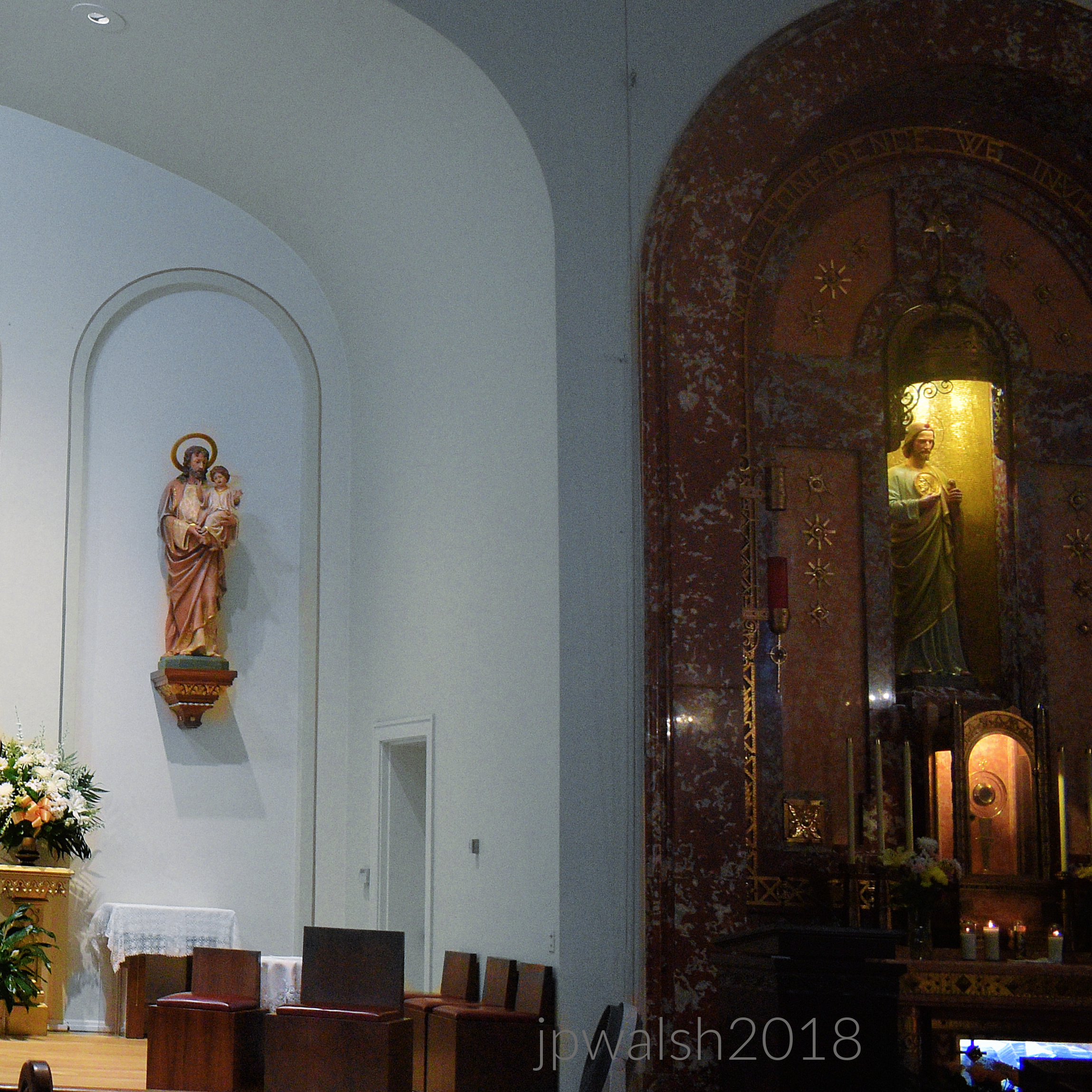
FEATURE Image: February 2018. Village “Art” Theatre, 1548-50 N. Clark Street, Chicago, Illinois 60610. The use of masks had been used in theatre since ancient times. They were usually tied to their dramatic source material and the inherent psychology of the characters. The Landmark Designation Report for the Village Theatre described this polychrome character head with musical instruments as “singing” in honor of the neighboring Germania Club, a German social club with its origins in men’s choral music. The head also wears a Baroque-style “wig” of oak leaves and acorns. In Germany, oak trees are revered, and acorns are a symbol of good luck. A decorative keystone on the theater’s round-arched window also has an acorn ornament. 88% 7.94mb DSC_4799 Author’s photograph.
Designed by architect Adolphe Woerner (born Stuttgart, Germany 1851- 1926), the Village (Art) Theatre opened as the Germania Theatre on July 29, 1916 and closed in its 91st year in March 2007. The building was erected by German-born Frank Schoeninger exclusively as a movie theater for $75,000 (about $2.2 million in 2025) and leased for an annual $7,000 rent (about $205,000 today) to Herman L. Gumbiner (Germany, 1879- 1952, Santa Monica, Calif.) in a 10-year contract with his company, The Villas Amusement Company (later Gumbiner Theatrical Enterprises). By 1910, buildings erected solely for the purpose to showcase motion pictures were becoming increasingly popular as the appetite to consume the latest silent motion pictures out of Hollywood was booming everywhere. These neighborhood movie houses, larger than dingy storefront nickelodeons and yet smaller than flamboyantly ornate vaudeville theatres, had movie “palace” touches while fitted conveniently into Chicago’s many local commercial strips. Nearly all of these first-generation movie theaters in Chicago have been demolished or remodeled for other purposes including those larger-scale theaters developed by major theater operators such as Balaban and Katz, Lubliner and Trinz, and the Marks Brothers. While those palatial theatres could hold between 2,000 and 4,000 movie-goers the Village Theatre, one of the last and best first generation movie houses to survive for so long, originally held 1,000 spectators. Originally named the Germania Theater because it was next door to the Germania Club, it looked to attract affluent club members to its flicks.
The Germania Theatre was built in 1916 on Frank Schoeninger’s open land pictured above between the Germania Club (completed in 1889) and his tavern and hotel on the corner of Clark Street and North Avenue. In 1986 the Germania Club, citing the dwindling numbers of members, finally disbanded. Public Domain.
Herman Gumbinger was a major film exhibitor who was busy in Chicago building his independent theatre chain in the 1910’s, with several new movie house projects and acquisitions throughout the city’s northside primarily. After building Chicago’s first independent movie house chain in the teens, Gumbinger relocated to Los Angeles, California, in 1921 where he built the famous Los Angeles Theatre in the Broadway Historic Theatre District of Downtown L.A. Erected at a cost of over $1.5 million ($31 million today) and designed by renowned movie theatre architect S. Charles Lee (1899-1990) Gumbinger’s theatre premiered Charlie Chaplin’s City Lights. Gumbinger Theatrical Enterprises finally dissolved in 1943.
Herman Gumbinger (1879-1956), c. 1924, built Chicago’s first independent movie chain, including what became the Village Art Theatre. By the end of the 1920s, Chicago had more than thirty of these movie palace theaters. Among its holdings, Herman Gubinger and his brothers operated the New Blaine which was renamed and is today the Music Box Theatre. Public Domain.
The Germania was one of the first-generation movie theatres built at the intersection of three Chicago neighborhoods – Gold Coast to the south and east, Old Town to the north and west and Lincoln Park to the north. An architectural mix of styles including Classical Revival (triangle pediments, pilasters and cornice with dentils fashioned in terra cotta) and Renaissance Revival (rusticated exterior and round-arched windows with keystones), the movie house also incorporated Germanic symbolism in its details reflecting the area’s then prominent ethnic group. During World War One, in a wave of anti-German sentiment, The Germania Club renamed itself the Lincoln Club. It changed its name back in 1921. The Germania Theatre changed its name to the Parkside and never looked back. In 1931 until 1962 it was known as the Gold Coast theatre. Meanwhile, prohibition closed down Frank Schoeninger’s tavern and he left for Wisconsin. In the 1960’s the theatre was updated and renamed the Globe Theatre. In 1967 the building was renamed the Village Theatre after it survived being demolished by the nearby Sandburg Village development.
Sandburg Village is a Chicago urban renewal project consisting of eight high-rise buildings, a mid-rise building and 60 townhomes and artists’ lofts. The development was first occupied In 1963 and completed in 1971. In the early 1960’s the Village Theatre was to be incorporated into the project until its landowner refused to sell. PHOTO: “20190323 08 Carl Sandburg Village (49490506022)” by David Wilson from Oak Park, Illinois, USA is licensed under CC BY 2.0.February 2018. The Village Theatre in the last days before its demolition. Its marquee from the 1960’s has been removed. The Village Theatre sat across the street from Latin School of Chicago at North and Clark Streets in Gold Coast/Old Town. In its Landmark Designation Report, the Village Theatre façade is described as having “a symmetrical arrangement, with a central theater entrance and separate entrances to the upstairs offices at opposite ends of the building. Each upper-story entrance has a deeply-recessed alcove lined with brick and white, carved-wood panels. A limestone slab step, inset with hexagonal tiles, is inside each alcove. Each alcove is framed with white terra cotta and brick pilasters on a base of gray terra cotta, made to imitate granite. The pilasters are topped with a triangular, white terra-cotta pediment.” 70% 7.93 mb DSC_4797. Author’s photograph.
The original two-story façade of red pressed brick and white beige glazed terra cotta decoration competed with a sizeable modern marquee that was removed before its demolition in 2018. Since after college I lived in Chicago for about 15 years, I recall seeing several films here. The ones I can remember seeing at the Village Theatre were Wall Street, House of Games, Fatal Attraction, Russia House, Michael Collins, and The Red Violin, among others of that period. In early 1991 the interior of the theater was divided into four screens and I didn’t stop going to movies there but just not as frequently as I did before. In April 2018, the Village Theatre and neighboring buildings along North Avenue were completely demolished to make way for construction of a condominium building. The ornate Clark Street frontage was stabilized as everything else crumbled to dust around it. The façade was repurposed to serve as the entrance for the new condo development known as Fifteen Fifty on the Park with units priced at opening at $1.625 to $5.85 million.
There had been at least three marquees for the Village Theatre: the original vertical Germania sign that was taken down almost as soon as it went up owing to anti-German sentiment in World War I; a horizontal, awning-style marquee like the one at the Biograph Theater (1914) at 2433 N. Lincoln Avenue in Chicago that was put up in conjunction with its existence as the Gold Coast theatre; and this prow-shaped marquee (pictured above) with steel-and glass doors believed to be part of the mid 1960s modifications when the movie house was the “Globe.” PHOTO: “Germania (Parkside, Gold Coast, Globe, Village) Theatre, Chicago, IL” by BWChicago is licensed under CC BY-NC 2.0.The Village Theatre took the moniker Village Art Theatre after The Chicago International Film Festival used the Village Theatre as a venue to screen “art house” films starting in 1969. PHOTO: “Village Art Theatre” by BWChicago is licensed under CC BY-NC 2.0.The rear of the 102-year-old Village Theatre before its impending destruction in 2018. “Germania (Parkside, Gold Coast, Globe, Village) Theatre, Chicago, IL” by BWChicago is licensed under CC BY-NC 2.0.October 2018. Author’s collection.
This explanatory article may be periodically updated.
Feature Image: June 2017. 4.37mb DSC_0785. The statue of Ronald Reagan by American sculptor Donald L. Reed in DIxon, Illinois, was dedicated on August 14, 2009. It is based on a photograph of Reagan when he visited Dixon in 1950 and rode a horse through its streets in a parade.The statue itself is nine feet high on its pedestal and called Begins the Trail. It is the first of a series that includes a life-sized statue for the Reagan Foundation at the Ronald Reagan Presidential Library in Simi Valley, California, called Along the Trail. These artworks capture Reagan’s rugged amiable nature and his natural ability throughout life when riding. see – https://www.cowboysindians.com/2016/02/ronald-reagan-rides-again/ – retrieved April 13, 2025.
All text and photographs (except where noted) by John P. Walsh.
June 2017. 4.76mb DSC_0797.
Considered the heart of Dixon, the memorial arch has been a landmark since the 1920s. The original arch, built in 1919, was made of beaver board and wood. It was built to celebrate the return of Dixon’s soldiers after World War One. In 1949, a new arch was constructed of wood. It was replaced in 1966 when Galena Avenue was widened. In 1985 the arch was replaced with this fiberglass one with the letters from the 1966 arch. In 2024 it went through a major restoration. See – https://www.wifr.com/2024/06/04/dixons-iconic-memorial-arch-facing-repairs/ – retrieved February 28, 2025.
June 2017. 5.41mb DSC_0822.
This helicopter (above and below) wears five Purple Hearts carved from enemy ground fire in Vietnam — battered, scorched, and shot to pieces, yet every time it clawed its way back through the smoke, it delivered its crew home alive. In Dixon’s (Illinois) Veterans Memorial Park founded in 2001 the 1967 AH-1F Cobra Attack Helicopter Gunship (serial #67-15475) was issued to the 7th Squadron of the First Calvary Divisions Aviation Group for its entire tour of duty. This helicopter arrived in Vietnam in March 1967. Following 1142 combat hours flown, the helicopter was damaged on July 27, 1969, because of a weapons malfunction. At 1792 hours flown it was shot down on February 6, 1970, by heavy enemy ground fire while providing armed escort to medivac helicopters with both crewmen wounded. On April 15, 1970, at 1954 hours flown, it was damaged while providing direct fire support to infantry. On July 13, 1970, it was shot down by small arms fire while providing escort at 2092 hours. At 2471 hours, on January 19, 1971, it was severely damaged by gunfire while providing direct escort protection to ground troops. On July 6, 1971, it was damaged by heavy ground fire on an armed escort mission at 2745 hours flown. see – Cobra Attack Helicopter – Veterans Memorial Park & Museum – retrieved April 13, 2025.
June 2017. 6.18mb DSC_0821 (2)June 2017. 3.12mb DSC_0751.
On June 5, Ronald Reagan’s death day, Honor Guard gather at the Reagan Boyhood Home in Dixon, Illinois.
June 2017. 4.13mb DSC_0845.
Reagan was a lifeguard at Lowell Park from 1926 to 1932. The original 200-acre public park opened in 1907 and began Dixon’s park system with the objective to preserve scenic beauty and establish civic beautification. From the start, Lowell Park attracted large numbers of people to its location along the Rock River. In this area, the valley of the Rock River contains bluffs and unique rock outcroppings that create a natural beauty. More than 100 years later, Lowell Park has maintained its distinctive scenic and natural recreational resources for free public use.
June 2017. 5.73mb DSC_0918.
Lowell Park predated the development of Illinois state parks in areas of outstanding natural attractions by many years. Lowell Park is the only public place in the Dixon area that preserves remnants of the Boles Trail established in 1826from Peoria, Illinois, to Galena, Illinois. The trail was replaced in popularity by the famous Kellogg Trail established in 1825 east of the Boles Trail route. See – https://historyillinois.org/boles-trail-the/ – retrieved March 3, 2025.
Lowell Park, Dixon’s first recreational park, was gifted in 1906 by Carlotta Lowell who was the niece of James Russell Lowell (1819-1891), a famous Boston (Cambridge) poet. The family came west on the invitation of Alexander Charters, a wealthy New York businessman, who purchased a large, wooded estate overlooking the river north of Dixon in 1837 and named it Hazelwood. His home later became the estate of Mr. & Mrs. Charles R. Walgreen, founder of the drug store chain that bears that name. Charles Lowell. a guest at Hazelwood, purchased the adjacent tract of land to live. Lowell married Josephine Shaw, also originally of Boston, and then of Staten Island in New York. When the Civil War broke out, Charles enlisted and was promoted to the rank of colonel and was killed in 1864 at the Battle of Cedar Creek in northern Virginia. Carlotta never knew her father as she was born after his death and the family never lived on their land in Dixon. In 1874, they moved to New York City and stayed there the rest of their lives. After her mother died, Carlotta offered the property in 1906 to the City of Dixon for a park in memory of her parents.
June 2017. 5.11mb DSC_0780.
40th U.S. president Ronald Reagan visiting the Rock River in Lowell Park where he was an effective and beloved lifeguard for seven consecutive summers. In July 1921 a longer dock had been installed at the beach, extending 75 feet into the river with a springboard platform. The new bathhouse was built in 1922 that accommodated hundreds of bathers. Electricity was installed at the park in 1922 with lighting that allowed the beach to remain open until after dark. Over those summers, Reagan saved 77 swimmers from drowning. Obviously proud of his achievement, President Reagan often showed his Oval Office visitors a picture of the Rock River while telling them that his lifeguarding there was “one of the best jobs I ever had.”
The original 200 acres of Lowell Park opened to the public in 1907. The park was designed by the Olmsted Brothers, a nationally prominent architecture firm headed by the sons of Frederick Law Olmsted. Lowell Park was designed in the American Romantic style which is characterized by its emphasis on natural scenery, native plant materials, native building materials, curvilinear roads, and minimum formality. In 1959 the beach was finally closed after ten years of declining usage due to the opening of Memorial Pool in Vaile Park in the city of Dixon. The Lowell Park bathhouse was used for storage as its concession stand continued to operate until the late 1980s.
June 2017. Lowell Park was designed in the American Romantic style by the Olmsted Brothers. 7.24mb DSC_0916 (1)
Rock River at Lowell Park is still the hub for recreational activities as it has been for over a century.
June 2017. 5.25mb DSC_0901.
President Reagan on his lifeguard years in Dixon: “One of the Best Jobs I Ever Had.”
Ronald Reagan as a lifeguard at Lowell Park in 1927. Public Domain.
June 2017. Lowell Park, Dixon, IL. DSC_0882June 2017. Diving top with changing rooms and concession behind. Lowell Park, Dixon, IL. 5.38mb DSC_0896
Bus service from Dixon city to the park started in 1921. This diving top was anchored to the river bottom during its swimming hole glory days when Reagan was lifeguard. Swimmers teetered, spun and jumped into the water during hot Illinois summers which Reagan knew and loved. The one-story bathhouse behind it was designed and built in 1922. When Reagan was a lifeguard the building served as the concession stand and the check area for clothing baskets. Under a hipped roof, the men’s wing was to the south and women’s wing out of sight to the west. The architect of the bathhouse is unknown. Native stone was used from the ground to the height of the concession building’s serving counters and for the foundations of the two wings. Above that the walls were stucco on the exterior. All stonework was coursed and roughly squared. It was ventilated by raising the hinged board covers of the screened window openings. The steel-supported roof was covered originally with black-blue slate shingles that were replaced in 1934 with asphalt shingles. The overhang is broad with exposed rafters.
June 2017. Lowell Park, Dixon, Illinois. 3.53mb DSC_0877
Ronald Reagan in Dixon, Illinois, in the early 1920’s. Public Domain.
June 2017. 5.93mb DSC_0774.
The Reagans settled in this rented house at 816 S. Hennepin Avenue in Dixon, Illinois, on December 6, 1920. The family of father Jack, mother Nelle, and 12-year-old Neil and 9-year-old Ronald lived here for three years. From 1921 to 1924, Neil and Ron attended South Side/Central School which still stands four blocks north of the house and is now the Dixon Historic Center. Reagan often walked along Hennepin Avenue going downtown to the Dixon Public Library at 221 South Hennepin Avenue and the First Christian Church at 123 South Hennepin Avenue where both Neil and Ron were baptized on June 1, 1922. Nelle taught Sunday school and sang in the church’s choir. Ronald and his mother were members of the Disciples of Christ church until 1937. Between 1924 and 1930, the Reagans lived in a rented house at 338 W. Everett Street in Dixon. Reagan lived in that house in Dixon when he was home from college after he began attending Eureka College in September 1928.
Reagan 1920s with family. Ronald Reagan sitting (hand on chin in front row) posing with other family members, Neil Reagan at far right (front row), Jack Reagan (middle row at left), Nelle Reagan (last row, second from left), Illinois. Public Domain.
Ronald Reagan sitting (hand on chin in front row) with other golf caddies for the Lincoln Highway Ladies Golf Tournament in 1922 in DeKalb, Illinois. Public Domain.
Reagan (second row, left) in 4th grade in Tampico, Illinois. Reagan was born in Tampico, Illinois, on February 6, 1911 in a second-floor apartment at 111 Main Street and, until 1914, at 104 W. Glassburn Street. Afterwards the family moved in sequence to Chicago, Galesburg, and Monmouth until they returned to Tampico in 1919-1920 and ultimately to Dixon in early December 1920. Reagan’s father was an alcoholic and they moved around a lot. As a young man Reagan became a lifesaver. Public Domain.
June 2017. Inside the Reagan Boyhood Home, Dixon, Illinois. 4.90mb DSC_0778 (1)
June 2017. Veterans Memorial Park, Dixon, Illinois. 6.41 mb DSC_0827.
The M60 tank is designed as one of the main assault vehicles of an Armor/Mechanized Infantry/ Infantry Division. It weighs about 105,000 pounds unloaded and has a 64,000 pound payload. The tank can travel at top speeds of 30 m.p.h. and can travel nearly 300 miles.
June 2017. Veterans Memorial Park, Dixon, Illinois. 7.05mb DSC_0831.
Republic F-105D Thunderchief (serial #60-455) was a new aircraft that served the U.S. Air Force from 1958 to 1984. This specific aircraft fought in Vietnam between 1968 and 1970. It was stationed at Takhli Airforce Base in Thailand with the 355 Tactical Fighter Wing that was established in April 1962 at George AFB in California and transferred to Thailand in 1965. This F-105D Thunderbird was one of 833 airplanes manufactured by Republic in Farmingdale, New York, with over half the fleet lost in combat or due to mechanical failures. With 610 built, this particular warbird was the definitive production model with all-weather capability because of advanced avionics, including AN/APN-131 navigational (Doppler) radar. This aircraft was retired with almost 6000 flying hours and two men who had flown it receiving the Medal of Honor. The plane’s maximum range is 2390 miles at a maximum ceiling of 48,500 feet and reached speeds of supersonic Mach 2 (1,534 m.p.h.) at over 36,000 feet. In addition to a Vulcan Gatling Gun the plane’s payload includes 750-pound conventional bombs (16 of them) or one nuclear bomb.
Capt. A. Lincoln, 16th president of the U.S., looking onto the Rock River in Dixon, Illinois, This 1930 statue by Leonard Crunelle (1872-1944) Reagan would have seen and known while living in Dixon. Young Lincoln enlisted in the Illinois Volunteers on April 21, 1832 and, following more enlistments, finally mustered out of military service on July 10, 1832. Across the Rock River is the modern Reagan statue.
June 2017. 4.37mb DSC_0785.
Ronald Reagan (1911-2004) lived in Dixon, Illinois from 1920 to 1933. Reagan always referred to Dixon as his “hometown.” Reagan made several visits to Dixon after he lived here, even when he was President of the United States. The statue is on the banks of the Rock River which is the same waterway where Reagan saved 77 lives as a lifeguard upstream at Lowell Park.
June 2017. 3.38mb DSC_0783.
After Reagan’s death in 2004 local donors commissioned this larger-than-life-sized statue of Dutch Reagan on a palomino horse and gifted it to the City of Dixon. It was dedicated to the eradication of Alzheimer’s that was a foe that President Reagan had to battle in last years.
June 2017. 5.28mb DSC_0786 (1)
Reagan in DIxon in the early 1920’s. Public Domain.
In 1982, President Reagan told the Eureka College audience, “Everything that has been good in my life began here.”
September 2016. Eureka College’s Burrus Dickinson Hall built in 1858. 3.87 mb
On campus at Eureka College in Eureka, Illinois, about 90 miles south of Dixon, where Reagan lived. The college, affiliated with the Disciples of Christ of which Ronald Reagan was a member, was founded in 1855. At the time of its founding Eureka was one of a handful of U.S. colleges that was co-ed. In 1856 Abraham Lincoln spoke on campus. After he graduated Reagan returned for campus visits at least a dozen times and served on its board of trustees. Reagan attended Eureka College from 1928 to June 10, 1932, when he graduated as the elected student body president with a degree in economics/sociology. Eureka College is the smallest college or university in American history to graduate a future U.S. president with a bachelor’s degree. The school is in Woodford County in Illinois.
On May 9, 1982, President Reagan announced the START treaty proposal in the Reagan Gym at Eureka’s commencement exercises. It resulted in a bilateral treaty signed in 1991 between the U.S. and U.S.S.R. on the reduction and the limitation of strategic offensive arms including nuclear warheads and intercontinental ballistic missiles and heavy bombers.
Ronald Reagan is the only U.S. president who was born, grew up and received his education in the state of Illinois.
September 2016. Part of the Berlin Wall. Eureka College. 2.40mb DSC_0493 (3)
Of Dixon the Gipper once said: “It was the place I really found myself.”
Portrait of Ronald Reagan in 1934 the year after he left Dixon, Illinois. His career led to Hollywood, California as a film actor and Screen Actors Guild president; to Sacramento, California as 33rd Governor of California (1967-1975); and to Washington, D.C., as 40th President of the United States of America (1981-1989). But it was to Dixon, Illinois, that Reagan always returned with its fond memories. Reagan graduated from Eureka College, a liberal arts school affiliated with the Disciples of Christ, in 1932 where he was active in sports and drama and elected student body president. Reagan’s first job was as a sports radio broadcaster in Davenport, Iowa, for Big Ten football games. Afterwards he was a sports announcer for Chicago Cubs’ baseball games on WHO-AM in Des Moines. Reagan arrived in Hollywood in 1937 and was cast in his first feature film Love is on the Air for Warner Bros. where he gets to play a newscaster. Fair use.
In Love is on the Air (1937) Ronald Reagan made his screen debut as a crusading radio reporter who takes on civic corruption.
This explanatory article may be periodically updated.
Reagan giving a speech in Liberty State Park in Jersey City, NJ on September 1, 1980. On a personal note, I met Ronald Reagan at the Palmer House in Chicago in June 1980 during a press conference. He was gracious and had movie star looks: tall and handsome. Reagan was elected the 40th U.S. president in a landslide over Jimmy Carter in November 1980 and re-elected in 1984. I later met Jimmy Carter in Chicago at a book signing in the 1990’s.
June 2017. 5.49 mb DSC_0776 (1)
Author and wife at Reagan Boyhood Home, Dixon, Illinois.
June 2017. 3.20mb DSC_0734 (2).
The Ronald Reagan Trail (IL-26) is a route in Illinois that follows sites of interest associated with the 40th president of the United States who was born in Tampico, Illinois and grew up in Dixon, Illinois. Route 26 originally ran north-to-south for about 25 miles from Freeport, Illinois to Polo, Illinois. In 1937, IL-26 was extended about 15 miles north to the Illinois-Wisconsin state line and about 15 miles south to Dixon, Illinois. In 1969, IL-26 was extended almost 100 miles south from Dixon to East Peoria, Illinois.
June 2017. Rock River at Lowell Park, Dixon, Illinois. 4.93 mb DSC_0865 (1). Author’s photograph.
I think – and I am sure this is the view of the people and the states- the right to vote is very basic. If we are going to neglect that right, then all of our talk about freedom is hollow. And therefore we shall give every protection that we can to anybody who is seeking the vote. News conference, September 13, 1962.
The men who create power make an indispensible contribution to the nation’s greatness. But the men who question power make a contribution just as indispensible for they determine whether we use power or power uses us. Remarks at Amherst College, October 26, 1963.
One of the rare joint appearances of Senators John Kennedy and Lyndon Johnson, the Democratic Presidential ticket, during the 1960 campaign which they prevailed over the Republican ticket of Nixon-Lodge. Here the two men make a joint campaign appearance in Grand Prairie, Texas, in September 1960. Kennedy nor Johnson were natural campaigners—Kennedy’s hands would be shaking hidden under a table or podium as he spoke, his voice growing hoarse. Johnson, who was uncomfortable in crowds and tried too hard, often worked himself on the campaign trail into a sick exhaustion.
Though both candidates wanted to have more joint appearances on the campaign trail, both senators’ aides mutually agreed it mostly hurt the ticket’s—and more precisely, Kennedy’s —image. Though Johnson was only nine years older than Kennedy—both men were the first U.S. presidents born in the 20th century— aides believed that wherever they showed up together Kennedy looked as if he might be LBJ’s son. However, the press and LBJ griped for weeks and months that the candidates should make more joint campaign appearances running as they were for the highest offices in the land.
When it was hinted in the press that there was a growing rift between the candidates and that that was to blame for their not campaigning together, another joint appearance of JFK and LBJ was scheduled in November 1960 five days before Election Day. For the campaign event at the Biltmore in Los Angeles Lyndon Johnson flew out especially to be there and the event received glowing national print and television coverage. On that Thursday before the Tuesday when Americans went to the polls, both candidates and their campaigns viewed the event as a big plus.
Let us not seek the Republican answer or the Democratic answer, but the right answer. Let us not seek to fix the blame for the past. Let us accept our own responsibility for the future. Speech at Loyola College Alumni Banquet, Baltimore, Maryland, February 18, 1958.
FROM 13 DAYS (2000). JFK: BOB, IS THERE ANY WAY TO AVOID STOPPING THE SUBMARINE FIRST? MCNAMARA: I’M AFRAID NOT MR. PRESIDENT. https://www.youtube.com/watch?v=gol-iCLcroY – retrieved April 20, 2026
In response to the rapid buildup of Soviet nuclear missiles in Cuba, President John F. Kennedy announced that the United States would impose a naval blockade—officially termed a “quarantine”—around the island. It went into effect on the morning of October 24, 1962, when American warships and aircraft tightened a ring around Cuba with orders to intercept any vessel suspected of carrying offensive military equipment.
Tension spiked almost immediately. Roughly 25 Soviet ships, some believed to be transporting nuclear missile components, continued steaming toward the quarantine line. U.S. commanders had standing instructions: any vessel refusing inspection could be stopped, diverted, and, if necessary, sunk. At 10:00 a.m., as the quarantine became active, Kennedy convened ExComm to assess the situation when new intelligence came in that made the situation immediately more precarious. Reports were that the approaching Soviet ships were joined by a Soviet sub armed with nuclear weapons, raising the risk of an existential, catastrophic confrontation. At the same time, aerial reconnaissance showed Soviet crews working feverishly in western Cuba to complete missile sites armed with nuclear warheads pointed at the U.S.—further evidence that the threat to U.S. national security, already considered imminent by the Kennedy Administration, was growing by the minute.
On the diplomatic front, the crisis was unresolved as it was debated by delegates at the U.N. whether Kennedy’s blockade was even legal under international law. Soviet leaders accused the United States of issuing an ultimatum and warned that force would be met with force. Meanwhile protests were organized on each side across the globe as political maneuvering accelerated.
By the end of October 24, 1962, the first signs of restraint appeared: several Soviet ships slowed or halted before reaching the quarantine line, suggesting Moscow might be reconsidering its next move. Even so, the world understood, some for the first time, that it stood on the precipice of nuclear war. The day ended with both superpowers locked in the most dangerous equilibrium of the crisis so far – both armed, alert, and waiting for the next move – with no one knowing whether diplomacy or confrontation would ultimately prevail.
Above: Rev. Dr. Michael Ramsey (1904-1988), Archbishop of Canterbury, and JFK, met on Halloween in 1962. Their Wednesday meeting took place just 3 days following the end of the Cuban Missile Crisis. The world breathed a great sigh of relief that armed confrontation which likely would lead to nuclear war between superpowers was avoided. The previous Saturday, October 27, 1962, was in fact one of the tensest days in the entire ordeal. A U-2 plane was shot down by Soviet-supplied SAM missiles. They killed the USAF pilot and Kennedy’s own ExCOMM demanded immediate military action against those sites. Kennedy resisted the advice. Upon shooting down and killing the U.S. pilot, the Soviets demanded tougher terms for negotiating the removal of 42 mid and long-range nuclear missiles in Cuba. That night, Robert Kennedy met secretly with Soviet Ambassador Anatoly Dobrynin in Washington, D.C. where they reached a basic understanding that only needed approval by Moscow. The next morning. Sunday, October 28, 1962, Radio Moscow announced that the Soviet Union had accepted Kennedy’s proposed solution. The 13-day Cuban Missile Crisis was over. Michael Ramsey was appointed Archbishop of Canterbury on May 31, 1961, and installed in June 1961. He served in this position until 1974. In 1962 Dr. Ramsey was then serving as president of the World Council of Churches (1961 to 1968) and, during his archbishopric, the first woman Anglican priest – Chicago-born high altitude balloonist Jeannette Piccard (1895 -1981) – was ordained in the United States in 1974.
This nation was founded on the principle that all men are created equal, and that the rights of every man are diminished when the rights of one man are threatened. Televised address to the nation on Civil Rights, June 11, 1963.
July 1989. John F. Kennedy Library, Columbia Point, Boston, MA.
President-Elect John F. Kennedy and Chester Bowles emerge from a breakfast conference at Kennedy’s Georgetown home in Washington, on Nov. 29, 1960. Bowles was appointed Under Secretary of State and later was Kennedy and Johnson’s ambassador to India.October 2003. 3307 N Street, Georgetown, Washington, D.C. In June 1957 Massachusetts Senator John F. Kennedy (1917-1963) bought this three story Federal-style house as a gift for his wife, Jackie, following the birth of their daughter, Caroline. John Jr. was also born while the Kennedys lived here. Jackie hosted teas in the house’s double living room after JFK’s 1958 Senate re-election campaign and during the 1960 presidential campaign. The front entrance became famous when President-elect Kennedy made regular announcements of national news such as cabinet appointments, including younger brother and campaign manager, Robert F. Kennedy as U.S. Attorney General. The house was sold when the Kennedys moved into the White House in 1961.August 2005. The John Fitzgerald Kennedy National Historic Site in Brookline, Massachusetts, a suburb adjacent to Boston, is the birthplace and childhood home of President John F. Kennedy. The house on Beals Street was purchased by Kennedy’s father, Joseph Patrick Kennedy in August 1914 in anticipation of his marriage to Rose Elizabeth Fitzgerald in October 1914. JFK’s father was a shrewd, opportunistic and driven bank president and businessman who started to make his fortune by building warships and transports in Quincy shipyards in World War I. Joe Kennedy was an affectionate father who instilled a spirited sense of competition in the Kennedy children starting in their years in Brookline.August 2005. The John Fitzgerald Kennedy National Historic Site in Brookline, Massachusetts. John Kennedy was born in this upstairs master bedroom on May 29, 1917. The family lived here until 1920 when they moved a 5-minute walk away to a larger home on Abbottsford where they lived until 1927. Then the Kennedys moved to New York. Rose Fitzgerald, who was the daughter of Boston’s first American-born Irish mayor, had seven of her nine children in Brookline and was reluctant to leave. Joe’s father was a saloonkeeper and politician. While Joe instilled the competitive spirit in to his children, Rose, who as a young woman studied in Europe, taught her children an appreciation of the arts: music, painting, and history. A deeply religious person she would take her young children on walks with the family dog in tow, as they went to the weekday market and afterward to the church so they would know that their faith was not restricted to Sunday. After JFK’s assassination in 1963, Rose Kennedy established this house as a gift to the American people so that, as she said, “Future generations will be able to visit it and see how people lived in 1917 and thus get a better appreciation of the history of this wonderful country.” see – https://www.nps.gov/jofi/index.htm – retrieved May 29, 2025.
(56 seconds). “We are not afraid to entrust the American people with unpleasant facts, foreign ideas, alien philosophies, and competitive values. For a nation that is afraid to let its people judge the truth and falsehood in an open market is a nation that is afraid of its people.” -John F. Kennedy, Voice of America speech, February 26, 1962.
SPEAKING OF FREEDOM OF INFORMATION IN A FREE COUNTRY TO THE ENTIRE WORLD. Voice of America speech, February 26, 1962. FULLER CONTEXT: “What we do here in this country, and what we are, what we want to be, represents really a great experiment in a most difficult kind of self-discipline, and that is the organization and maintenance and development of the progress of free government. And it is your task, as the executives and participants in the Voice of America, to tell that story around the world. This is an extremely difficult and sensitive task. On the one hand you are an arm of the Government and therefore an arm of the Nation, and it is your task to bring our story around the world in a way which serves to represent democracy and the United States in its most favorable light. But on the other hand, as part of the cause of freedom, and the arm of freedom, you are obliged to tell our story in a truthful way, to tell it, as Oliver Cromwell said.. with all our blemishes and warts, …And we hope that the bad and the good is sifted together by people of judgment and discretion and taste and discrimination, that they will realize what we are trying to do here. This presents to you an almost impossible challenge, ..The first words that the Voice of America spoke were [IN 1942]. They said, “The Voice of America speaks. Today America has been at war for 79 days. Daily at this time we shall speak to you about America and the war, and the news may be good or bad. We shall tell you the truth”… In 1946 the United Nations General Assembly passed a resolution reading in part, “freedom of information is a fundamental human right, and the touchstone of all the freedoms to which the United Nations is consecrated.” This is our touchstone…We seek a free flow of information across national boundaries and oceans, across iron curtains and stone walls. We are not afraid to entrust the American people with unpleasant facts, foreign ideas, alien philosophies, and competitive values. For a nation that is afraid to let its people judge the truth and falsehood in an open market is a nation that is afraid of its people. The Voice of America thus carries a heavy responsibility. Its burden of truth is not easy to bear. It must explain to a curious and suspicious world what we are. It must tell them of our basic beliefs. It must tell them of a country which is in some ways a rather old country–certainly old as republics go. And yet it must make our ideas alive and new and vital in the high competition which goes on around the world since the end of World War II. …The advent of the communications satellite, the modernization of education of less-developed nations, the new wonders of electronics and technology, all these and other developments will give our generation an unprecedented opportunity to tell our story. And we must not only be equal to the opportunity, but to the challenge as well. For in the next 20 years your problem and ours as a country, in telling our story, will grow more complex. … We believe that people are capable of standing the burdens and the pressures which choice places upon them, …And as you tell it, it spreads. And as it spreads, not only is the security of the United States assisted, but the cause of freedom.” See – https://www.presidency.ucsb.edu/documents/remarks-the-20th-anniversary-the-voice-america – retrieved May 29, 2025.
NOVEMBER 22, 1963, a portion of President John F. Kennedy’s remarks at the Citizen’s Rally in front of the Texas Hotel in Fort Worth, Texas on a rainy morning. In his brief speech the president explains that the country’s overall security relies on (1) military strength, (2) economic prosperity, and (3) superiority in space exploration and that Fort Worth again “will play its proper part.” KENNEDY: “What we are trying to do in this country and what we are trying to do around the world, I believe, is quite simple: and that is to build a military structure which will defend the vital interests of the United States. And in that great cause, Fort Worth, as it did in World War II, as it did in developing the best bomber system in the world, the B-58, and as it will now do in developing the best fighter system in the world, the TFX, Fort Worth will play its proper part. And that is why we have placed so much emphasis in the last 3 years in building a defense system second to none, until now the United States is stronger than it has ever been in its history. And secondly, we believe that the new environment, space, the new sea, is also an area where the United States should be second to none.”
Rose and Joe Kennedy were at the Hyannis Port compound on November 22, 1963. It was a clear, crisp day – a “bluebird.” Rose attended morning Mass, as usual, then returned to have lunch with Joe, who was still severely debilitated from his 1961 stroke. Afterward, they went for a short drive. When they returned, Rose received a call from her son, Attorney General Robert Kennedy: the President—her son Jack—had been shot. A second call followed, telling her he was dead. Rose withdrew to grieve alone, walking the beach and sitting quietly in her room. She later said she asked God how years of raising and preparing her children for service could be undone in seconds. Around 4:15 p.m., she took a call from the new president, Lyndon Johnson, speaking from Air Force One shortly after being sworn in and as he returned to Washington with President Kennedy’s body. Composed, Rose addressed him as “Mr. President.”
Report to the American People on Civil Rights – June 11, 1963.
June 11, 2025 – (13.23 minutes). On May 27, 1963 the Supreme Court stated that it was not going to tolerate the evasion of its 1954 landmark decision Brown v. Board of Education that segregated schools. They stated such in another desegregation case involving public parks. When the High Court made their decision in 1954, in no way could they have foreseen the years of delay. On June 5, 1963 a federal court enjoined Alabama Gov. George Wallace from in any way impeding the admission of two qualified Black citizens from enrolling in the University of Alabama. President John F. Kennedy, on June 10, 1963, reinforced this decision by writing to Gov. Wallace urging him not to interfere. The following day, June 11, 1963, Wallace carried out his pledge to “stand in the schoolhouse door” and blocked the Black students from enrolling. When Wallace was confronted by Kennedy’s federal marshals, and refused the students’ entry, the president nationalized the Alabama Guard. When troops appeared on the scene the governor relented and the Black students entered and registered for classes. That evening from the Oval Office Kennedy appeared on radio and television to deliver what is called the “Report to the American People on Civil Rights” in which he set out the moral and legal issues involved with Civil Rights and proposed legislation that would later become the landmark Civil Rights Act of 1964. In the first two years of Kennedy’s term, he had been slow and cautious in his support of civil rights and desegregation in the United States. Ever the politician he was concerned that any bold actions or initiatives on his part in this area would alienate Congressmen he needed to get through his stalled legislative agenda. On June 11, 1963 in a radical departure from his and the nation’s past Kennedy gave his full-throated endorsement to Civil Rights and Civil Rights legislation in this 13-minute speech. Later that night, in the early hours of June 12, 1963, civil rights activist Medgar Evers, who had been listening to Kennedy’s remarks on the radio, was killed by a sniper as he returned to his home in Jackson, Mississippi. On June 13, 1963 82 black marchers protesting Evers’ death were arrested by Jackson police. On June 19, 1963 Kennedy asked Congress to introduce his bill to desegregate public facilities, take federal action to end job discrimination, and allow the U.S. Attorney General to start desegregation suits. In the meantime, as Congressional negotiation and debate was beginning on the Civil Rights bill, Kennedy asked civil rights leaders to suspend protests and marches which they refused to do. Instead, in the face of a Congressional filibuster of Kennedy’s civil rights bill, they announced a March for Jobs and Freedom in Washington, D.C. to take place in August 1963. Within a week of Evers’s murder, a white suspect was arrested and charged with the slaying. See- Kennedy and the Press, edit. Harold W. Chase and Allen H. Lerman, introduction by Pierre Salinger, Thomas Y. Crowell Company, New York, 1965, p. 452.
(27 seconds). Berlin speech at Rudolph Wilde Platz, June 26 1963 Texas motorcade & remarks at the dedication of the Aerospace Medical Health Center, San Antonio – November 21, 1963 White house 1963 – color recording of remarks for “Seas around us”. Moon speech, Rice University, Houston, Texas – September 12, 1962.
On April 27, 1961, President John F. Kennedy delivered his 2400-word+ major speech known as “President and the Press” before the American Newspaper Publishers Association at the Waldorf-Astoria Hotel in New York City. In the speech delivered just days after the failed Bay of Pigs Invasion the new president made a plea for responsible journalism in the face of Cold War threats. The remarks remain relevant today on the topics of press freedom, misinformation, and national security.
When Franklin Delano Roosevelt signed the Social Security Act on August 14, 1935, the 32nd president called the program a “cornerstone.” In 1998 when I met Jimmy Carter, the 39th president, at a book signing (“The Virtues of Aging”) in Chicago I asked him if he thought that Social Security was destined to go away. He said to me he didn’t think so. In 2026, the federal retirement benefits program is under threat like never before. This is due for many reasons including a large aging population. There are 75 million seniors on Social Security today, three times more than in 1975. As well as a smaller work force who contribute payroll taxes to the program compared to the growing number of beneficiaries. Reserves are being depleted and insolvency is projected for the mid-2030s. In the presidential campaign of 1960 Democratic Party’s nominee John F Kennedy visited the national shrine home of Franklin Delano Roosevelt in Hyde Park, New York. It was the 25th anniversary of the signing of the Social Security law, The Democratic candidate for president spoke to 2,000 senior citizens who had come to honor the memory of the late president and to listen to the soon-to-be 35th president. Kennedy proposed a federal medical care bill (Medicare was signed into law in 1965). Social Security benefits to meet the rising cost of living (implemented in 1975). Incentivize workers to earn more money and still enjoy Social Security. Vocational guidance for persons of retirement age. Provide adequate housing for the aged. Expand research into the causes and prevention of diseases associated with advancing age. Increased survivor benefits for spouses responsible for under-age children.
News Conference 29 — March 29, 1962. THE PRESS CONFERENCE TOOK PLACE THE SAME WEEK THE HOUSE WAYS AND MEANS COMMITTEE PASSED THE PRESIDENT’S TAX CUT BILL. IN THIS SAME PRESS CONFERENCE JFK WAS CONCERNED TO CLOSE TAX LOOPHOLES THAT PERMIT AND ENCOURAGE AMERICAN INDUSTRY TO INVEST OVERSEAS. SIGNIFICANTLY THE CONGRESS WAS CONCERNED WITH REVENUE BALANCING BETWEEN WHAT WAS LOST FROM THE TAX CUTS AND WHAT WAS GAINED BY TAX REFORMS SO THAT THE TAX BILL WAS REVENUE NEUTRAL. IT WAS AN EXERCISE TO ECONOMIC STIMULUS AND NOT THE BROAD-BRUSH ANSWER THAT IT HAS BECOME IN REGARD TO THE COUNTRY’S ECONOMICS (OR, CONVERSELY, TAX HIKES FOR THAT MATTER). THE 1962 TAX BILL WAS MODIFIED AND PASSED ACCORDINGLY TO BALANCE THOSE FIGURES. KENNEDY PROPOSED SIGNIFICANT REDUCTIONS IN TAX RATES FOR INDIVIDUALS AND CORPORATIONS WHICH WOULD LEAD TO AN INITIAL LOSS OF TAX REVENUE FOR THE GOVERNMENT. BROADLY PRO-GROWTH, IT WAS NOT A TAX GIVEAWAY AS THE COUNTRY PRACTICES TODAY AS IT WAS SEEN AS NOT BEING ABLE TO AFFORD IT WHICH OF COURSE IT CAN’T. RATHER, THE GOAL WAS TO BALANCE OUT THE REVENUE LOST FROM THE TAX RATE CUTS AND TO GENERATE REVENUES BY REFORMS RESULTING IN REVENUE GAINS AND THUS A REVENUE-NEUTRAL BILL. THESE TAX GAINS FOR THE GOVERNMENT INCLUDED ELIMINATING THE DIVIDEND CREDIT AND EXCLUSION, INTRODUCING WITHHOLDING TAXES ON DIVIDENDS AND INTEREST INCOME, RESTRICTING CERTAIN BUSINESS EXPENSE DEDUCTIONS, PARTICULARLY FOR ENTERTAINMENT AND MEALS, ADDRESSING THE TAX TREATMENT OF COOPERATIVES AND FINANCIAL INSTITUTIONS, AND CHANGES TO THE TAXATION OF GAINS FROM THE SALE OF DEPRECIABLE PROPERTY. WHILE THE FINAL VERSION OF THE REVENUE ACT OF 1962, AS PASSED BY CONGRESS, ACTUALLY RESULTED IN A NET LOSS OF REVENUE IN THE SHORT TERM THE ADVENT OF REAGANOMICS HAS BROUGHT MASSIVE TAX CUTS SKEWED TO THE RICH WITH NO OFFSETTING TAX REVENUE STREAMS FOR THE GOVERNMENT BUT RELYING SOLELY ON REVENUE FROM THE GROWTH OF THE TAX STIMULUS AND, COUPLED TO OVERSPENDING, DEFICIT SPENDING (BORROWING) FOR THE REST. THIS HAS RESULTED IN MASSIVE BUDGET DEFICITS KENNEDY COULD NEVER HAVE IMAGINED. IN FACT, THAT YEAR OF 1962 THE PRESIDENT WAS AIMING FOR A TAX CUT AND A BALANCED BUDGET.
The line most associated with John F. Kennedy’s 1961 Inaugural Address—“Ask not what your country can do for you; ask what you can do for your country”—has endured as a defining call to civic action. Delivered by the nation’s first Catholic president, the phrase urged Americans to view national progress as a shared personal duty rather than a service provided by, or reliant on, the government.
Its resonance is echoed in the 1965 documentary, Years of Lightning, Day of Drums, one of the earliest films to chronicle Kennedy’s presidency and assassination. Near the conclusion, narrator Gregory Peck reflects, “All this took place in the early 1960s, and someday the early 1960s will be a long time ago.” Hearing that line as a child, I was struck by its existential reminder that even the most vivid present moments inevitably recede into memory and become history.
Some historians have suggested that Kennedy’s famous inaugural exhortation may trace back to his years at Choate, the Connecticut boarding school he entered in 1931 as a ninth-grade student. In his chapel addresses, headmaster George St. John frequently reminded students: “The youth who loves his alma mater will always ask not ‘what can she do for me?’ but ‘what can i do for her?’” Kennedy would have heard this refrain repeatedly during his formative years.
Kennedy arrived at Choate following his older brother, Joe Jr., a standout athlete two years ahead of him. By contrast, Kennedy was frail, thin, and saddled with the nickname “rat face” among classmates. His early years at the school were marked less by distinction than by mischief. He gathered around him a circle of friends he called “The Muckers Club,” a tongue-in-cheek embrace of headmaster St. John’s term for troublemakers. Their antics were largely harmless—witty pranks and playful irreverence—and the group included Kennedy’s roommate and lifelong friend, Lem Billings.
Despite his unremarkable start, Kennedy’s trajectory at Choate shifted. By the time he graduated in 1935, he was not valedictorian, but his peers voted him “Most Likely To Succeed,” a judgment that proved prescient.
JFK, May 4, 1963: First, it is to make sure that our private schools are increasingly representative of the diversity of American life. These schools will not survive if they become the exclusive possession of a single class or creed or color. They will enlarge their influence only as they incorporate within themselves the variety which accounts for so much of the drive and the creativity of the American tradition. The second is to make sure that our private schools prepare young men and women for service to the community and to the Nation. The inheritance of wealth creates responsibilities; so does privilege in education. https://www.youtube.com/watch?v=Zp4alOCiqCo – retrieved February 27, 2026.
Attributed to Michelangelo Buonarotti, 1513, terracotta, Casa Buonarroti, Florence, Italy. The work is a study of a male torso, conceived to be without the head and upper and lower limbs. The work has been identified as a preparatory model for one of the figures of the Prisoners, intended to decorate the tomb of Julius II in Rome. see – https://artsandculture.google.com/asset/torso-virile/zQGx46asE5jBIg?hl=it&ms=%7B%22x%22%3A0.5%2C%22y%22%3A0.5%2C%22z%22%3A9.086882915528859%2C%22size%22%3A%7B%22width%22%3A3.3866676762513332%2C%22height%22%3A1.2375000000000005%7D%7D – retrieved March 6, 2025. Michelangelo Buonarotti, Madonna della Scala, 1490. Casa Buonarroti, Florence, Italy. Though it is small-sized the relief subject of the Madonna and child presents a monumental scope. The female figure fills the entire space. The meaning of the ladder (“scala”) in the title is ambiguous and may have reference to the children playing and holding a drape behind the Madonna. The date of the relief has been much discussed. However, a placement around 1490, before the Battle of the Centaurs, seems to be confirmed.see – https://artsandculture.google.com/asset/madonna-della-scala/xQF2nwLhAXd26w?hl=it – retrieved March 6, 2025. Michelangelo Buonarotti, Nude female, 1533, Casa Buonarroti, Florence, Italy. This figure of a female nude is linked to the New Sacristy in Florence to accompany the marble effigy of Giuliano de’ Medici. It has been linked to the figure of the Earth that, together with the Sky, was to be part of Giuliano’s marble effigy. The project of building a proper Medici family mausoleum was conceived in 1520, when Michelangelo began work on the New Sacristy upon the request of Cardinal Giulio de Medici, the future Pope Clement VII, who expressed a desire to erect the mausoleum for some members of his family including Lorenzo the Magnificent and his brother Giuliano assassinated in Florence’s Duomo in 1478. After completing the architectural works in 1524, Michelangelo worked until 1533 on the sculptures and the sarcophagi that were to be featured on the chapel walls. The only ones actually completed were the statues of Lorenzo, the Duke of Urbino; Giuliano, the Duke of Nemours; the four statues of the allegories of Day and Night, and Dawn and Dusk; and the group representing the Madonna and Child. see – https://artsandculture.google.com/asset/nudo-femminile/xgHfNWIKU6r13g?hl=it – retrieved March 6, 2025 and http://www.museumsinflorence.com/musei/Medici_chapels.html#:~:text=The%20project%20of%20building%20a,the%20Magnificent%20and%20his%20brother – retrieved March 6, 2025. Michelangelo, crucifix, 1493, wood, Santo Spirito, Florence. It was placed by the artist in 1493 above the lunette of the high altar and has been there since.
The Italian Renaissance artist was born in Florentine territory in Caprese in the provinces of Tuscany where his father was a government bureaucrat. The family soon relocated to Florence where Michaelangelo grew up. Becoming friends with Francesco Granacci (1469-1543) who saw Michaelangelo’s drawing talent, at 13 years old Michelangelo announced he wanted to be an artist. Despite his parents objection, they eventually yielded to their son’s aspirations, and he was apprenticed to Domenico Ghirlandaio (1448-1494) for the next three years.
Domenico Ghirlandaio (1448-1494), Expulsion of Joachim From the Temple, fresco (detail), 1486-1490. Santa Maria Novella, Cappella Tornabuoni, Florence. In the background, the mitered high priest receives sacrificial lambs at the altar where a fire burns. Joachim, according to sacred tradition, father of the Virgin Mary and grandfather of Jesus Christ, is sent away at this time since he is childless. He is married to Anne. To the right Ghirlandaio depicts an assembled group of contemporary Florentines including, second from right, Ghirlandaio himself. In 2nd century apocryphal writings, childless Joachim left for the desert where he prayed and fasted for 40 days. Angels appeared to Joachim and his wife Anne, and promised them a child. Joachim then returned to Jerusalem and embraced Anne at the city gate, a scene popularly depicted in medieval and Renaissance art. After this, Anne became pregnant and became the mother of the Virgin Mary and Jesus’s grandmother. This apocryphal relating of Joachim and Anne to Biblical figures Elizabeth and Zechariah and the birth of their son, John the Baptist (Luke 1) and Abraham and Sarah and the birth of their son, Isaac (Genesis 21) was a popular subject depicted in Christian art until the Council of Trent (1545–1563) when the church restricted public displays of these simple stories and events from apocryphal sources in a severe reaction to the Protestant reformation.
Michelangelo’s training was erratic, likely having left Ghirlandaio before his contract was complete, and working under the city’s ruler, Lorenzo de Medici for his contracted master, Bertoldo (1420-1491). Later in life Michelangelo did not advertise his training credentials as he believed art – such as freeing subjects from stone – emerged by the sheer artistic power of the individual. In this period, as a teenager, Michelangelo learned the art of fresco painting and drawing, copying previous masters such as Giotto (1267-1337) and Masaccio (1401-1428). Michelangelo absorbed the artwork of the naturalists, such as Paolo Uccello (1397-1475), whose artwork looked to present subjects with a viewpoint like a scientist interested in objective fact rather than looking to convey some established figural attitude. Where young Michelangelo was materially as great as Giotto and Masaccio, he also possessed a new means undreamt by those previous masters, as he drunk of the art of Donatello (1386-1466), Pollaiuolo (1429-1498), Verrocchio (c.1435-1488) and Leonardo da Vinci (1452-1519). Further, Michelangelo understood better than these others, that the epitome of these Renaissance artistic studies was to be expressed by one subject above all: the human nude.
Bernard Berenson described Michelangelo as “the pupil of nobody, the heir of everybody, who felt profoundly and powerfully what to his precursors had been vague instinct, who saw and expressed the meaning of it all.”
Giotto, The Arrest of Christ (Kiss of Judas ), 1304, Padua, Scrovegni Chapel.
The Arena, or Scrovegni Chapel, was commissioned by Enrico Scrovegni in 1303. A nobleman of Padua, Enrico dedicated the chapel as an act of atonement for the sins of his father, Reginaldo, a moneylender whom Dante placed among the damned in the Inferno. The exterior of the chapel is austere, but its interior is filled with Giotto’s frescoes, completed by the time of the chapel’s dedication in late March 1305, with remaining work finished by March 1306. By this point, Giotto—then in his late thirties—was already a mature master, and in this cycle he transformed the course of Italian painting.
What had appeared as youthful brittleness and restlessness in his frescoes at Assisi in the late 1290s—works that had secured his fame and led to the Padua commission—has here developed into a fully realized visual language of narrative concision, solemnity, and decisive, almost fatalistic, plastic form. Although the subjects of the Life of the Virgin, the Life and Passion of Christ, and the Last Judgment draw upon a venerable medieval tradition, Giotto renders them with a striking immediacy. Human emotion, individualized gesture, and the presence of everyday life infuse the sacred narratives with a naturalism that conveys profound dignity and emotional gravity rather than rhetorical flourish.
The dramatic center of the Betrayal fresco is the confrontation between Christ and Judas. Once Christ accepts His fate in the agony of the garden, the world wastes no time in presenting Him with the cross He has embraced. One of His own apostles—an unsettling reminder of the failures of religious leaders across the ages—betrays Him with a kiss. Christ’s body nearly disappears beneath Judas’s enveloping cloak, yet His classical profile remains visible, fixed in a calm, penetrating gaze upon His betrayer. Judas’s pursed lips embody the chilling intimacy of treachery. As John 13 recounts, the devil—whether through possession or the alignment of Judas’s will with Satan’s designs—provides the impetus for the betrayal.
Giotto had previously depicted Judas as youthful and handsome, but here the apostle’s features bear the accumulated marks of moral decay. At the left, Peter lashes out at Malchus, the high priest’s servant, severing his ear; at the right, the high priest himself gestures toward the betrayal, yet his posture suggests a momentary hesitation before the full enormity of the act. Through these figures, Giotto constructs a scene of moral and emotional complexity, capturing the decisive moment when divine purpose and fallen humanity collide.
Michelangelo after Giotto, Drawing from “Ascension of the Evangelist,” 1490-1492. Louvre. see – https://collections.louvre.fr/en/ark:/53355/cl020001224 – retrieved March 6, 2025. Paolo Uccello, Sacrifice of Noah And Noah’s Drunkenness (detail), 1447-48. Uccello was not interested primarily in conveying in art the possible “artistic” intention of this story’s scene. Instead, as Bernard Berenson described it, the artist produced “nothing but the scientific intention to find out how a man swooping down head-foremost would have looked if at a given instant of his fall he had been suddenly congealed and suspended in space.” These studies of reproducing objects as they really are, in anatomy and perspective, had a great bearing for the art of Leonardo da Vinci and Michelangelo. quoted in Berenson, p.54.Masaccio, Distribution of Alms and Death of Ananias (detail), 1425-1427, Brancacci Chapel, Florence. An episode from Acts of the Apostles (4:43-37 and 5: 1-11) depicting Ananias’s wife and child whose husband withheld their tithe from the early church leaders with the outcome being that Ananias dropped dead in divine retribution. When it was painted, viewers in the 1420’s and afterwards, read it as an artistic display of a New Testament endorsement of the equitable redistribution of wealth and the divine punishment of death forthwith for those who falsely withheld their fair share. 67% 7.95mb
When the Medici fell and Florence became a theocracy under Savonarola (1452-1498), 19-year-old Michelangelo decided to leave Florence. He lamented the fall of Lorenzo the Magnificent, his artistic patron, and the young artist lived hand to mouth going to Bologna, then to Venice, and back to Bologna, and finally to Rome in June 1496. The popes’ tremendous influence in capitalist Italy started in the 13th century and augmented into the 17th century, leading to what art critic Bernard Berenson (1865-1959) called an encroachment of “soulless Vaticanism” towards modern art. But clearly Rome had no use for a firebrand friar who refused to support the pope’s troops against the invading French army. As Columbus set out to discover America, It was the unpleasant chapter of the Italian War of the 1490s that helped fill the times with ongoing brutality, duplicity, complicity, intrigue, opportunism and expedience. A looming danger of looting and violence of the invading French army were emphasized by the impassioned sermons of Girolamo Savonarola that frightened the people and led to their heightened resentment against the ruling Medici. Florence was traditionally pro-French, but Piero di Lorenzo de’ Medici (“Piero the Unfortunate”) (1472-1504), son of Lorenzo the Magnificent, had deployed against them to defend Naples. Under pressure from citizens and outside French forces promising church reforms and civic transparency, the Medici was forced to flee and the city was proclaimed a Republic. The Florentines, with Savonarola in the lead, facilitated the invasion of French king Charles VIII (1470-1498) and against the pope which they considered corrupt. Pope Alexander VI (1431-1503), a Borgia and one of the most corrupt popes in history, ascended to the papal throne in 1492 and was immediately condemned in fiery sermons by Savonarola. Yet all was not well between “liberator” Charles VIII and his Florentine supporters. Immediately the French king demanded a huge sum of money, a ransom payment of sorts, from the Florentines in appreciation, as well as to pay for, the pro-French liberation. The Florentine government refused and the king threatened to loot the city. Faced with a backlash and real threat of popular revolt, the French bully relented and continued onto Rome. Charles postured, but was constantly fearful of antagonizing the European powers and announced his decision that he would not depose the corrupt old pope after all. By having kidnapped the pope’s mistress Giulia Farnese, wife of the pope’s military ally Orsino Orsini, who commanded 4,000 Neapolitan soldiers freshly landed to defend papal interests on the peninsula, Charles VIII was able to extract full entry into Rome in exchange for her release. Once in Rome the French troops looted the city. The pope, in a panic, arranged a quick safe passage for Charles VIII out of the Papal States towards Naples during which the king’s army massacred many hundreds of local inhabitants.
Charles VIII, roi de France, anonymous, c. 1550. Entering Florence in a power vacuum the invading French king demanded a huge sum of money from the citizens who refused to pay and leading to a stand-off. Public Domain. Domenico Ghirlandaio’s 15th century portrait of Piero the Unfortunate. Eldest son of Lorenzo the Magnificent, Piero di Lorenzo de’ Medicisucceeded him as ruler of Florence in 1492. When Piero determined in 1494 to stay neutral during French king Charles VIII’s invasion of Italy, effectively defending Naples the object of the king’s campaign, he was challenged. Suffering from an abandonment of the Florentine elite under the spell of Savonarola, Piero totally capitulated to Charles VIIi’s demands. Having succeeded in alienatating everyone in Florence, Piero fled to Venice, aided by a French diplomat, in November 1494. Attempting to make a comeback several times to Florence he was constantly rebuked, Piero drowned in the Garigliano River while attempting to flee the aftermath of the Battle of Garigliano in 1503, Public Domain.Pope Alexander VI Borgia, c.1495, attributed to Spanish painter Pedro Berruguete (c. 1450-1504), Vatican Museums. Alexander Vi was a wily politician from a prominent family who practiced nepotism and sired several children by way of his many mistresses.
Savonarola played an important role in this French infiltration in Italy — and Rome did not forget. Then, in February 1497, during Mardi Gras of that year, Savonarola, whose message was a combination of religious purist and civic republican preached his most dramatic act of cultural desecration by seeking that artworks, books, clothing items and cosmetics were thrown into a bonfire of the vanities as a sign of monied and other social decadence. The flames became his final undoing: Savonarola was excommunicated for heresy and sedition by Pope Alexander VI on May 12, 1497 after the preacher called “the contemporary Church leadership…a pockmarked whore sitting on Solomon’s throne.” The pope also threatened Florence with severe interdictions if they continued to be a sanctuary for Savonarola and his ilk. Savonarola was imprisoned on April 7, 1498 after failing a literal public trial by fire (it rained). Finally, he was dragged from his prison cell and with two other contemptible friars was condemned as a heretic and schismatic and hanged and burned at the stake on May 23, 1498, with the Vatican and the Medici observing it all from a safe distance. Yet the cult of Savonarola, his person as well as his political and religious ideas, did not go quietly up in smoke. Though seen today as a sort of vile figure, his supporters around 1500 and afterwards saw him as a martyr and encouraged his veneration as a saint to which many complied. In Florence Savonarola’s disputed legacy went on until the Medici more or less permanently re-installed themselves in 1530. Yet Protestant reformers in Germany and Switzerland were intrigued and influenced by Savonarola’s ideas and, in 1558, even Pope Paul IV, who was 22 years old when Savonarola was executed, declared him not a heretic and always in communion with the Catholic Church. Saint Philip Neri (1515-1595), a Florentine established in Rome, and regularly characterized as a most relatable prelate of and for the masses, also defended Savonarola’s memory.
Francesco Rosselli (1445-1513), The Execution of Savonarola and Two Companions at Piazza della Signoria, 16th century, oil on canvas, Galeria CorsiniBernard Berenson as a young man, Berenson described Michelangelo as “the pupil of nobody, the heir of everybody, who felt profoundly and powerfully what to his precursors had been vague instinct, who saw and expressed the meaning of it all.” quoted in Berenson p. 72. Public Domain. “Donatello – David – Florença” by original file by Patrick A. Rodgers is licensed under CC BY-SA 2.0. Verrocchio, Equestrian Statue of Bartolomeo Colleoni, 1480s, Venice. Bartolomeo Colleoni (1400-1475) was an Italian condottiero, who became captain-general of the Republic of Venice. Colleoni gained a reputation as the foremost tactician and disciplinarian of the 15th century. “Bartolomeo Colleoni by Andrea del Verrocchio” by Didier Descouens is licensed under CC BY-SA 4.0.Antonio del Pollaiuolo, Nude Dancers, 1470s, Fresco Arcetri, Villa La Gallina. A fresco frieze of dancing nude figures, in a villa near Florence, shows the artist’s same interest in extreme body poses. Public Domain.
Meanwhile, in Rome, Michelangelo sculpted his first major marble works. The first, Bacchus, was commissioned by Cardinal Raffaele Riario (1461-1521) in partnership with Jacopo Galli, a Roman collector, that was displayed in Galli’s garden until it was sold in 1572 to the Medici and is today in the Bargello. The second is the sublime Pietà (St. Peter’s Basilica, Vatican City) that was commissioned by a French cardinal in Rome and placed in the Santa Maria della Febbre. Vasari described the Pietà as “a revelation of all the potentialities and force of the art of sculpture.” Though the Pietà made Michelangelo famous in Rome, he returned to Florence following its installation to work on the David, a commission made by the Florentine republic after the expulsion of the Medici.
Michelangelo, Bacchus, marble. 1497, Bargello, Florence.Michelangelo, Pietà, marble, 1498-1499, St. Peter’s Basilica, Rome. A 24-year-old Michelangelo was all the rage in Rome as an artist in the late 1490’s and wrote his name promonently across the sash of the Blessed Mother. The artist did this after it was completed and heard a group admiring the artwork and attributing it to a different artist. Michelangelo was having none of it and one night whet into the chapel and chiseled his name for none to miss seeing. “Pieta (Michelangelo)” by elixirk is licensed under CC BY-NC-SA 2.0.Galleria dell’Accademia, Florence, Italy, May 1983. Author’s collection.
Michelangelo’s David, created in c. 1501-1504, has been in the Galleria dell’Accademia since 1873, The biblical figure of David came to symbolize the defense of civil liberties embodied in the 1494 constitution of the Republic of Florence, an independent city-state threatened on all sides by more powerful rival states and by the political aspirations of the Medici family.
This explanatory article may be periodically updated.

SOURCES:
Bernard Berenson, The Italian Painters of the Renaissance, Phaidon, New York, 1959.
Ornella Casazza, Masaccio and the Brancacci Chapel, Scala, 1990.
Enzo Carli, translated by Susan Bellamy, Giotto and His Contemporaries, Crown Publishers, 1958.
Andreas Quermann, Ghirlandaio, Könemann, 1998.
A Dictionary of Art and Artists, Peter and Linda Murray, Penguin Books; Revised,1998.
Giorgio Vasari, trans. George Bull, Lives of the Artists, Penguin Books, Harmondsworth, Middlesex, England, 1965.
Feature image: The site of the Wilson family home in Hawthorne, California, where Brian Wilson composed Don’t Worry Baby with lyrics by then-collaborator Roger Christian, a DJ at KFWB in L.A., over the course of a couple days in 1963. The home where Brian, Dennis and Carl Wilson grew up with their parents Murray and Audree Wilson, and where they honed their musical skills and formed the Beach Boys with cousin Mike Love and friend Al Jardine in 1961, was lost to development in the name of progress (a new highway). Similarly, in February 1964, the Beach Boys, who had the no. 1 single of 1963 (Surfin’ U.S.A.), overnight had to rethink the direction of their opus in the wake of the Beatles and British Invasion that forever changed the trajectory of rock and roll and the recording industry in the 1960s and beyond. “Beach Boys Landmark – Plano general I” by tkksummers is licensed under CC BY-SA 2.0.
Beach Boys in 1963. Brian Wilson, Carl Wilson, Dennis Wilson, David Marks, Mike Love. Since spring of 1963 they had 3 top-5 hits (and two more top-10 hits). “Surfin’ U.S.A.” peaked at no. 3 in May 1963 and became Billboard’s no.1 song for the year. “Little Saint Nick” released in December 1963 peaked at no. 3 on the Billboard Christmas Singles chart. It was in this time period that Brian Wilson with Roger Christian wrote “Don’t Worry Baby,” one of the Beach Boys’ finest songs pre-British Invasion about a guy who agrees to drag race but regrets it and, confiding his situation to his girlfriend, is tenderly consoled by her with the song’s title phrase. Public Domain. This is a publicity still taken and publicly distributed to promote the subject or a work relating to the subject. As stated by film production expert Eve Light Honathaner in The Complete Film Production Handbook (Focal Press, 2001, p. 211.): “Publicity photos (star headshots) have traditionally not been copyrighted. Since they are disseminated to the public, they are generally considered public domain, and therefore clearance by the studio that produced them is not necessary.” Nancy Wolff, in The Professional Photographer’s Legal Handbook (Allworth Communications, 2007, p. 55.), notes: “There is a vast body of photographs, including but not limited to publicity stills, that have no notice as to who may have created them.” Film industry author Gerald Mast, in Film Study and the Copyright Law (1989, p. 87), writes: “According to the old copyright act, such production stills were not automatically copyrighted as part of the film and required separate copyrights as photographic stills. The new copyright act similarly excludes the production still from automatic copyright but gives the film’s copyright owner a five-year period in which to copyright the stills. Most studios have never bothered to copyright these stills because they were happy to see them pass into the public domain, to be used by as many people in as many publications as possible.” Kristin Thompson, committee chairperson of the Society for Cinema and Media Studies writes in the conclusion of a 1993 conference of cinema scholars and editors[1], that: “[The conference] expressed the opinion that it is not necessary for authors to request permission to reproduce frame enlargements… [and] some trade presses that publish educational and scholarly film books also take the position that permission is not necessary for reproducing frame enlargements and publicity photographs.”
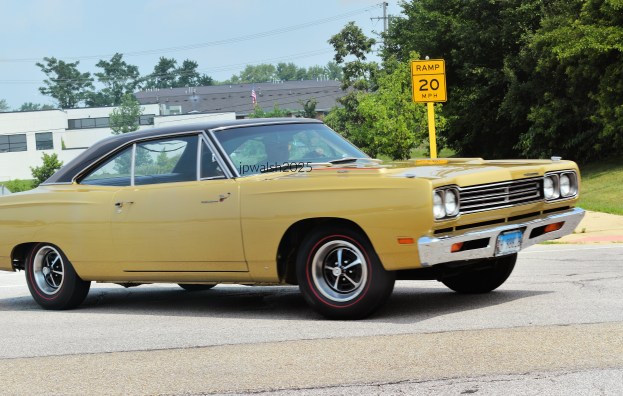
Brian Wilson’s first car was a light burgundy Mercury. It was passed down from his mother and Wilson called it “the Merc.” He failed his first driver’s test and got a reputation for being a bad driver because he was constantly distracted thinking about other things. His father tutored him behind the wheel and Brian started to get the hang of driving when he compared the car’s controls to playing a musical instrument. As the comparison dawned on him, it developed: like a musical instrument a driver had to play the car just right – not to hard or fast – so to get the results desired. But the comparison was also limited: Brian realized you could do a lot more unique things playing a musical instrument than driving a car. After he passed his driving test the second time, he drove “the Merc” for a year until he acquired a used 1957 Ford Fairlane. For Hawthorne, Brian knew it was a great car but he saw there were greater cars driven by other guys. He loved his used ’57 Ford and it was when he was in it that he first heard the Beach Boys’ first single, Surfin‘, playing on the radio in 1962. Brian said he revved and raced his Ford fast – but nobody believed it. (i am Brian Wilson a memoir, pp. 115-116).
At an August 1961 audition with Hite Morgan, a L.A. music publisher, Dennis Wilson said that Brian was working on a song about surfing. The truth was that no song existed. But the music publisher was intrigued and told the soon-to-be Beach Boys to come back when they had their new surfing song ready. “Surfin'” was recorded in October 1961 with Mike Love doing lead vocals, Brian on percussion/vocals, Carl Wilson on guitar/vocals, Al Jardine on acoustic bass/vocals and Dennis Wilson doing vocals. It was released in November 1961 on the independent label Candix. Though it peaked at no.75 on the Billboard Hot 100, its lyric which included the line”Surfin’ is the only life, the only way for me” capitivated listeners and was unique on the radio in late 1961. (Beach Boys FAQ, pp.25-26)
LYRICS Surfin’ is the only life, the only way for me Now surf Surf with me I got up this mornin’, turned on my radio (Ooh, surfin’) I was checkin’ out the surfin’ scene to see if I would go (Ooh, surfin’) And when the DJ tells me that the surfin’ is fine (Ooh, surfin’) That’s when I know my baby and I will have a good time We’re goin’ surfin’, surfin’ Surfin’, surfin’, surfin’ Surfin’, surfin’, surfin’ Surfin’ is the only life, the only way for me Now surf Surf with me From the early mornin’ to the middle of the night (Ooh, surfin’) Any time the surf is up, the time is right (Ooh, surfin’) And when the surf is down to take its place (Ooh, surfin’) We’ll do the Surfer’s Stomp, it’s the latest dance craze We’re goin’ surfin’, surfin’ Surfin’, surfin’, surfin’ Surfin’, surfin’, surfin’ Surfin’ is the only life, the only way for me Now surf Surf with me Now the dawn is breaking and we really gotta go (Ooh, surfin’) But we’ll be back here very soon, that you better know (Ooh, surfin’) Yeah, my surfer knots are rising and my board is losing wax (Ooh, surfin’) But that won’t stop me, baby, ’cause you know I’m comin’ back We’re goin’ surfin’, surfin’ Surfin’, surfin’, surfin’ Surfin’, surfin’, surfin’ Surfin’ is the only life, the only way for me Now come on, pretty baby and surf with me, yeah
Brian Wilson soon associated girls and cars. He was also beginning to understand the association of music and emotions after he heard Be My Baby by The Ronettes on the radio. Brian was also impressed by how simple vocal gestures, such as was achieved by Aretha Franklin and Dionne Warwick, could get maximum mileage from a listener’s reaction. (i am Brian Wilson a memoir, pp. 172).
In 1963 Brian Wilson offered Don’t Worry Baby to girl-group The Ronettes after the 21-year-old Wilson had become obsessed with their Be My Baby – a no. 1 hit (Cash Box) in August 1963. But they declined it and the Beach Boys produced it for themselves instead. It became one of the Beach Boys’s classics of the period. Wilson wrote Don’t Worry Baby as a response to Be My Baby and both songs have an affinity in pacing, structure, melodic lilt, and subject matter. Wilson wrote Don’t Worry Baby with lyrics by then-collaborator Roger Christian (1934-1991), a DJ at KFWB in L.A., over the course of a couple days at the Wilson family home in Hawthorne, California. It is ostensibly about a guy’s race car and his caring girlfriend, of which Wilson observed later: “It was a very simple and beautiful song. It’s a really heart and soul song, I really did feel that in my heart.” see – https://americansongwriter.com/brian-wilson-gods-messenger/4/ – retrieved February 24, 2025.
LYRICS Well, its been building up inside of me For, oh, I don’t know how long I don’t know why, but I keep thinking Something’s bound to go wrong But she looks in my eyes And makes me realize And she says (now don’t) (don’t worry, baby) Don’t worry, baby (don’t you worry) (don’t worry, baby) Everything will turn out alright (now don’t) (don’t worry, baby) Don’t worry, baby (don’t you worry) (don’t worry, baby) I guess I should’ve kept my mouth shut When I started to brag about my car But I can’t back down now, because I pushed the other guys too far She makes me come alive And makes me wanna drive When she says (now don’t) (don’t worry, baby) Don’t worry, baby (don’t you worry) (don’t worry, baby) Everything will turn out alright (now don’t) (don’t worry, baby) Don’t worry baby (don’t you worry) (don’t worry, baby) She told me, “Baby, when you race today Just take along my love with you And if you knew how much I loved you Baby, nothing could go wrong with you” Oh, what she does to me When she makes love to me And she says (now don’t) (don’t worry, baby) Don’t worry, baby (don’t you worry) (don’t worry, baby) Everything will turn out alright (now don’t) (don’t worry, baby) Don’t worry, baby (don’t you worry) (don’t worry, baby) Everything will turn out alright (now don’t) (don’t worry, baby) Don’t worry, baby (don’t you worry) (don’t worry, baby)
Feature Image: The Beach Boys in 1964; clockwise from left: Al Jardine, Mike Love, Brian Wilson, Carl Wilson, Dennis Wilson. Trade ad for The Beach Boys’s single “California Girls”/”Let Him Run Wild.” Public Domain. Permission details The ad appeared in the 11 September 1965 issue of Billboard and can be dated from that publication; it is pre-1978. There are no copyright markings as can be seen at the full view link. The ad is not covered by any copyrights for Billboard. US Copyright Office page 3-magazines are collective works (PDF) “A notice for the collective work will not serve as the notice for advertisements inserted on behalf of persons other than the copyright owner of the collective work. These advertisements should each bear a separate notice in the name of the copyright owner of the advertisement.”
Don’t Worry Baby was one of Brian Wilson’s strongest lead vocals countered by Mike Love singing bass, and Al Jardine, and Dennis and Carl Wilson singing back up. It was one of the last songs recorded before the Beatles’ appearances on Ed Sullivan that changed rock music’s trajectory. After the Beach Boys’ Surfin’ U.S.A. was ranked Billboard’s no.1 song of 1963 (Be My Baby was no. 35), Don’t Worry Baby was the second track and likely best song on Shut Down Volume 2, promoted as a “hot rod” album and released in February 1964 that rose to no.13 on the Billboard 200 and was certified Gold. It turned out that it was the final Beach Boys’ album exploring the dark and light of the California sound before the British invasion that shook things up fundamentally. Through the demise of their car and surfer music hastened by the Beatles – it can’t be known for sure what might have happened otherwise – Brian Wilson understood that a gauntlet for musical supremacy was thrown down to which he must respond. At first Wilson thought about quitting for he was so disappointed that what they had been working on and striving for since 1961 was eclipsed overnight. After Fun, Fun, Fun peaked at no. 5 in March 1964, I Get Around was released in May 1964 with Don’t Worry Baby on the B-side. I Get Around became the no. 1 song on the Billboard Hot 100 for two weeks in July 1964 while Don’t Worry Baby charted on its own at no.24.
With the Beatles in mind Brian Wilson set to work on new material, this time integrating older musical sources into something new, as well as being more open than ever before to experimenting with arrangements and instrumentation so to achieve a new sound. Wilson worked to reinvent the Beach Boys just as he had been succeeding in inventing them. By the end of 1964 it was the Beatles that secured not just the top spot on Billboard’s year-end singles (I Want To Hold Your Hand) but the second spot as well (She Loves You) though the Beach Boys were still in the top 5 with I Get Around.
This cover by Foxes and Fossils is a good one of the Beach Boys’ 1964 top-40 hit “Don’t Worry Baby.” The song has been covered many times through the years and Brian Wilson would probably like this cover since his song was originally inspired by, and intended for, a girl group. But also because the Beach Boys were always thrilled when a new generation was introduced to their music and embraced it as their own.
SOURCES:
The Beach Boys: America’s Band, Johnny Morgan, Union Square & Co.; Illustrated edition, 2015, p. 67.
Good Vibrations: My Life as a Beach Boy, Penguin Publishing Group, Mike Love, 2016, pp. 64-65, 96-97, and 248.
The Beach Boys FAQ, All That’s Left to Know about America’s Band, Jon Stebbins, Backbeat Books, 2011, pp. 8 and 49.
The Beach Boys: The Definitive Diary of America’s Greatest Band on Stage and in the Studio, Keith Badman, Backbeat Books; First Edition, 2004., p. 53.
Brian Wilson with Ben Greenman, Da Capo Press, Boston, Massachusetts. pp. 115-116
FEATURE Image: March 2016. Immanuel United Church of Christ, 1500 Old Church Road, Streamwood, Illinois. Built in 1868, it is the congregation’s second house of worship on the site and remains the congregation’s active sanctuary. 7.49mb _0979
IMMANUEL UCC in Streamwood, Illinois, has a unique history within the context of the similar histories of other early settlers in Northern Illinois beginning in the 1820’s. Though diverse settlement throughout this part of the state was feverish (Chicago incorporated as a city in 1837), the prairie landscape expanse remained sparsely populated into the 1830’s and 1840’s with its mixture of farms, industry, and trade. The Streamwood church and burial grounds were founded in 1852 when W.G. Hubbard donated its five acres of land for “the sole and exclusive use of erecting a house thereon for religious worship and a burying ground.”
It was a group of 13 farmers who organized the church and chose its name: Deutsche Vereingigte, Evangelische Lutherische Immanuael’s Germeinde. Apparently, as Illinois was the edge of the Western frontier, in those days there wasn’t anyone around, or very many, to enjoin them to state it in English. Of course, it translates as “United Evangelical Lutheran Immanuel Congregation.” Today, Streamwood is in Cook County and sits just on the other side of DuPage County to the south that broke off from Cook and was established in its own right in February 1839. The original relatively open site today is surrounded by tract housing and other modern development for as far as the eye can see or vehicle drives with Elgin about 9 miles to the west.
1851 map of Cook and Dupage Counties. Hanover is between Elgin and Schaumburg Townships. Public Domain.
Streamwood, incorporated in 1957, is one of three communities that comprise the so-called “Tri Village” area that includes Bartlett and Hanover Park. This part of Northern Illinois had served as a seasonal hunting and camping ground for the Cherokee, Miami, Potawatomi, and Ottawa Indians. In their turn, the land had been claimed by France, England, Spain, Virginia, and the Northwest Territory before it became part of the State of Illinois in 1818.
March 2016. The ImmanuelUCC church and burial ground were created in 1852 for German settlers in Hanover Township in today’s northwest DuPage/Cook Counties. Three U.S. Civil War veterans are buried here, including from the 127th Illinois Infantry; Volunteer 5th Calvary Illinois Regiment; and U.S. Calvary Co. H, 3rd Regiment. All three died and were buried in the cemetery decades after the war had ended. Author’s photograph.
While the church started out as Evangelical Lutheran, over time the congregation moved towards becoming part of the United Church of Christ. In 1959 the members changed its name to reflect that reality. The first church building that was completed in 1853 was replaced in 1868 and is the present one. Among other buildings added to the church complex, the same historic sanctuary remains this Chicago suburban congregation’s house of worship today.
March 2016. Landscape and grounds near ImmanuelUCC church in Streamwood. Hanover Township was an expansive area of farmland settled by mid-19th century German settlers to Illinois. Author’s photograph.
Sources:
DuPage Roots, Richard A. Thompson, editor, DuPage County Historical Society, 1985.
FEATURE Image: May 2024. 143 First Street, c. 1863. 7.52 mb_6360. Since the 19th century Batavia, Illinois, 40 miles west of Chicago, was a railroad and manufacturing center in addition to its farmsteads. This mid-19th century limestone factory building is testament to Batavia’s industrial heritage. After the U.S. Civil War, Batavia was a major manufacturer of Conestoga wagons used in the country’s westward expansion.
Text & Photographs John P. Walsh.
May 2024. 143 First Street, c. 1863. 7.52 mb_6360. The square shaped south façade’s stone cut is more grandiose than the longer west side indicating that it is the front face of the building. The tower at the north end likely held the building’s water tank and added more room and height for pulleys and other equipment.May 2024. Batavia is one of the towns along the Fox River settled in the 1830’s between Geneva and St. Charles to the north and larger Aurora to the south. 95% 7.75 mb DSC_6350.July 2016. Fermilab is to the east and adjacent to Batavia. Since 1969 it has housed a herd of bison when Fermilab’s first director, Robert Wilson, established the herd as a symbol of the history of the Midwestern prairie and the laboratory’s pioneering research at the frontiers of particle physics. Each spring new calves are born signaling the herd’s rejuvenation. 4.70mb _0577 see – https://www.fnal.gov/pub/about/bisoncam/ – retrieved 1.24.25.May 2024. Campana Sales Company Factory, Batavia, Illinois, East Elevation, 1936-1937. The Campana Factory was built in the International Style to manufacture cosmetics for The Campana Company. At the time Campana’s “Italian Balm,” heavily promoted on the radio, was the nation’s best-selling hand lotion. The building was designed by Frank D. Chase & Company (founded in 1913) with Childs and Smith in Chicago. Frank David Chase (1877-1937) built newspaper plants in St. Louis, Milwaukee and Oklahoma City and a number of important buildings in Chicago including hospitals and office buildings. The central tower reflects the 19th-century heritage of Batavia’s limestone factories. The one story wings on the extremity of the building were added in the late 1940’s. The factory was purchased by the laundry detergent brand Purex who later closed Campana operations in 1982. 77% 7.72mb _6437.https://www.artic.edu/artworks/102112/campana-sales-company-factory-batavia-illinois-east-elevation – retrieved January 22, 2025.https://www.artic.edu/artworks/102113/campana-sales-company-factory-batavia-illinois-landscape-perspective – retrieved January 22, 2025.May 2024. At the bottom of the tower of Campana Sales Company Factory the main entrance is stainless steel set into black polished marble. 7.48mb _6446.May 2024. The Congregational Church, 21 S. Batavia Avenue, 1856. 89% 7.73mb _6372. The locally quarried limestone central section dates to September 1856. The church displays the eclecticism of New England Colonial and Classical styles. Though the building’s classical detailing of capitals and pilasters is mostly missing, the precisely cut and laid stone are original. These cut ashlar blocks include neatly finished arches, sills, and entablatures. The church’s design is attributed to architect Elijah Shumway Town (1804-1890) who built Batavia’s Bellevue Place Sanitarium in 1853 where Mary Todd Lincoln was committed for 4 months in 1875. When the original steeple was knocked down in a storm in 1877 it wasn’t replaced until 97 years later in 1974 and is the tallest steeple in Kane County. There have been subsequent additions to the church in the last 60 years. Established in Thompson Paxton’s cabin in 1835 as “Church of the Big and Little Woods” and affiliated with the Presbyterians, the church relocated to Batavia Avenue in 1841. Sharing a common belief in the anti-slavery doctrine, the church was supported by church members and the community-at-large so that the church changed its name to “Congregational Church and Society of Bavaria” in 1843.May 2024. 355 First Street, 1852. 96% 7.83mb DSC_6389. This was the Methodist church built in the Greek Revival. The pilasters are Doric order that meet the main beam resting across the tops of columns (architrave), blank frieze, cornice, and classical pediment. After 1886 the building was used as a schoolhouse in the Batavia school system. Today it is law offices. In 1836 a group meeting in William Van Nortwick’s home in Batavia organized the “First Methodist Class” which marked the establishment of the Methodist church in Batavia.July 2013. West wall stone work and window of former Methodust Church built in 1852. 7.02mb _0004Born in Maine, Elijah Gammon (1819-1891) was a spiritual and business powerhouse. After he moved to Illinois he was the Methodist church’s first preacher in 1854. Having to give up preaching because of health in 1858, he changed careers to the manufacture of harvesting machinery. As he substantially contributed to the industry’s development and earned a fortune, his business responsibilities and success in no way limited his spiritual vision.https://aaregistry.org/story/elijah-gammon-supported-black-ministry/ – retrieved January 23, 2025.May 2024. United Methodist Church of Batavia, 8 N. Batavia, 1887. 87%7.91mb _6498. United Methodist Church of Batavia, 8 N. Batavia Avenue, Batavia, Illinois was built in 1887. The rugged eclectic Richardsonian Romanesque-type building was designed by Solon Spencer Beman (1853 –1914) and inspired by a church in France that its donors had admired. The structure was almost entirely the gift of abolitionist Elijah J. Gammon (1819-1891), the church’s first preacher and local businessman, and Captain Don Carlos Newton (1832-1893), another active local businessman who had a house investment property across the street. Beman was an architect of note as he designed the planned Pullman community and adjacent Pullman Company factory complex in Chicago as well as Chicago’s Fine Arts Building (1884) on Michigan Avenue. At the top of the tower is a Palladian window under a pyramidal roof while in the back are hipped roofs. The building’s boulders were taken from the contractor’s farm about a mile from the building site. The new church building replaced the first Methodist church in Batavia built in 1853 in Greek Revival and which still stands today.Born in New York, Captain Newton was a very active businessman. He died unexpectedly at his home in Batavia after attending the Chicago World’s Fair for a week with his family in 1893. He was described as ”a persevering, self-made man.” https://www.findagrave.com/memorial/16849480/don-carlos-newton – retrieved January 23, 2025.Chicago-based architect Solon Spencer Beman designed the United Methodist Church of Batavia in 1887. Beman is an architect of note as he designed the planned Pullman community and adjacent Pullman Company factory complex as well as Chicago’s Fine Arts Building (1884) on Michigan Avenue. Several of his largest commissions, including the Pullman Office Building, Pabst Building in Milwaukee (1891), and the Romanesque Revival Grand Central Station (1890) in Chicago, have since been demolished.A number of architects trained with Beman, including Prairie School architect William L. Steele (1875-1949), church architect Charles Draper Faulkner (1890-1979) and Spencer Solon Beman (1887-1952).May 2024. 415 Main Street, 1860. Eclectic Gothic Revival with Italianate features including scroll-cut square brackets tailored to the pitched roof line, segmental arches above the windows, and the heavy outlines of the door entrance. A polygonal bay and wings are informal features found in the Italianate that balances a formal façade. 89% 7.87mb. July 2011. 415 Main Street (1860). The door is larger than the windows and offset by the small ventilating window at the top in the gable. 2.54mb100_3328 (1)May 2024. 360 Main Street, 1855. 74% 7.72mb DSC_6409. The house is an example of the evolving transition from Greek Revival to Gothic Revival to Italianate. May 2024. 33 S. Lincoln Street, 1850. 73% 7.85mb DSC_6520. The lengthy 1850 Greek Revival is formal and simple. There are four pairs of windows and an architrave, frieze and cornice characteristic of the type as well as its corner pilasters. May 2024. 505 Main Street, 1858. The house is in the Swiss style and has a peacock feather spread motif above the second floor balcony. There are also trifoils set in circles in the gable. The brick sun room was added to the east around 1910. 92% 7.81mb DSC_6426 (1) July 2011. 505 Main Street’s in-vogue late 1850’s peacock feather motif was made by scroll cut boards nailed to a backing and long tubes made by a lathe. To the left under the roof extension there is incised ornamentation with a tall thistle plant motif. 1.54mb 100_3331 (1) May 2024. 356 First Street, c. 1850. 62% 7.80mb DSC_6395. Greek Revival frame clapboard house. May 2024. 637 N. Batavia Avenue, 1906. The Prairie style house was designed by Frank Lloyd Wright (1867-1959) in 1906. It is frame and stucco with massive chimneys. With its horizontals, low pitched roof, casement windows and thin eaves, it is the Prairie style fully developed. Frank Lloyd Wright in 1903, likely a self-portrait. Public Domain.July 2013. Fabyan Villa was the home of George and Nelle Fabyan from 1908 to 1939. A mid-19th century farmhouse was acquired by the Fabyans in 1905 and extensively remodeled by Frank Lloyd Wright in 1907. The house, on a hilltop looking east to the Fox River was the centerpiece of the Fabyans country estate called “Riverbank.” In 1914, the Fabyans purchased a windmill (photo below) that was located on a farm near Oakbrook, Illinois, and had it relocated opposite Riverbank on acreage that they acquired that same year.May 2024. 111 S. Lincoln Street, c. 1850 92% 7.84mb DSC_6396. Though obscured by modern adaptations, the severe cube of the structure indicates its Greek Revival roots. May 2024. 125 S. Lincoln, 1852. The Greek Revival style with the central section temple like with matching side pilaster ascending to a pediment as an incomplete entablature as one side is merely suggested by returns at the top of each pilaster. The wings include a one-story entrance and a two-story addition with cornice and dormers with window arches and tiny pitched roofs. 88% 7.78 mb DSC_6400May 2024. 432 Main Street, c. 1850. The front porch may or may not be original but befits the broad formal mid-19th century Greek Revival structure. 93% 7.82mb DSC_6431 (1)July 2011. Between Batavia and Geneva, Illinois, The Fabyan Windmill is an authentic, working Dutch windmill dating from the 1850s. It was built by a German craftsman, Louis Blackhaus, and moved to this location next to the Fox River from its original site near Oakbrook, Illinois, in July 1915. 2 mb 100_3357July 2011. 333 S. Jefferson Street, Batavia Institute, Bellevue Mental Hospital, 1853. Following the assassination of her husband, President Abraham Lincoln, Bellevue became the residence of Mary Todd Lincoln briefly in 1875. 2.87mb 100_3332 Mary Todd Lincoln in 1846. Mary Todd was 23 years old when she married 33-year-old Abraham Lincoln in Springfield, Illinois on November 4, 1842. Their four sons were all born in Springfield. In 1875 Robert Todd Lincoln (1843-1926), her eldest son, had her institutionalized following a jury trial. She was committed to this private asylum in Batavia on May 20, 1875. Estranged from her finances and her son, she fell into a deep depression in the mental institution. Making contact with her lawyer and the press, the former First Lady got the wheels of justice and public opinion on her side. The resulting bad publicity for Robert Lincoln prompted the asylum director to pre-emptively change his opinion of Mary’s mental fitness so that in September 1875 she was released into the care of her sister Elizabeth Todd Edwards (1813-1888) with whom she was close and moved to Springfield. Following a second jury trial on June 19, 1876 that declared Mary “restored to reason,” Mary Todd Lincoln was back in charge of her money and freedom and promptly fled the country. She lived in France for the next four years. When she returned to Springfield in poor health in 1880, she lived again with her sister in Springfield. On July 16, 1882. Mary Todd Lincoln died of a stroke in Elizabeth’s home. Mary was 63 years old. Before her burial in Oak Ridge Cemetery next to her slain husband, her funeral was held at First Presbyterian Church in Springfield. Just steps from the Lincoln home, this was the church Abraham Lincoln started attending in 1850 after the death of their second son, four-year-old Eddie. The present church building was dedicated in 1868 and remains standing at 7th Street and Capitol Avenue today. see – https://www.nps.gov/features/liho/25/25.htm – retrieved January 23, 2025. Elizabeth Todd Edwards. She and Mary were long close both in Springfield in the 1830’s and, later, at the White House. In 1875 Elizabeth accommodated her sister and the 64 trunks of her possessions with two rooms in her Springfield mansion. see – https://web.archive.org/web/20171201042129/https://www.civilwarwomenblog.com/elizabeth-todd-edwards/ – retrieved January 23, 2025.July 2013. 333 S. Jefferson Street, Batavia Institute, Bellevue Mental Hospital, 1853. The monumental Italianate structure was designed by Elijah Shumway Town (1804-1890) who built Batavia’s Congregational Church. Projecting two story wings with Mansard roof containing a third story is built of slightly cruder stone and added before 1870. July 2013. details. July 2013. details. 5.11mb 0479 July 2013. 419 Union Street, 1863. The exuberance of the Italianate style is manifest in a soaring polygonal bay on the facade’s one side and a cupola on the other. Large windows are characteristic of the Italianate as are multiple curved brackets. Contrasting textures of stucco and heavy stone provide interest and work to suggest the appearance of more expensive materials and construction than actually used. This was the residence of one of the doctors at the Batavia Institute across the street. 4.77mb _0092 (1)April 2016. Calvary Episcopal Church (222 Main Street), 1880. Designed in the “American Gothic” style, the medieval Gothic forms was a mid-to-late19th century revolt in English protestant churches to the prevailing neo-classicism of the previous 200 years. American influence included the stone building’s overall heaviness and particularly in its square-shaped tower that has a double pitched roof and with a sheet metal zone of bosses and discs between the levels and surrounding steeple dormers. 2.82 mb DSC_0476 (1)
Sources:
A Guide to Chicago’s Historic Suburbs on Wheels and on Foot, Ira J. Bach, Swallow Press/Ohio University Press, 1981, pp. 304-319.
FEATURE Image: Paris Bordon/e (1500-1571), Fisherman Presenting a Ring to the Doge Gradenigo, 1534, oil on canvas, 370 x 301 cm (145.7 in × 118.5 in), Gallerie dell’Accademia, Venice.
INTRODUCTION TO PART 1.
Venice is one of the great Italian cities for Renaissance art and its wide-ranging influences. Reflecting a city in the sea, its art is characterized by light and color. Its most remarkable artistic production was between 1470 and 1590 – the rise, height, and decline of the Italian Renaissance. Developed into a powerful maritime empire between the 9th and 11th centuries, Venice was an independent city state that rivaled all other Italian maritime empires such as Genoa, Pisa, and Amalfi; and lesser-known Ragusa, Ancona, Gaeta and Noli, and until the fall of the Republic in 1797. From its trade routes Venice inherited and fortified the coloristic tradition of Byzantium and the Eastern Mediterranean, Islamic countries and the Far East, Ravenna along the Italian coast to the south, and Aquileia near Trieste. Trade routes also included to the Free Cities of the North and its medieval Gothic culture. These activities led to a cosmopolitan culture manifested in Venice’s art and architecture. Around 1500 the Republic also had expanded its territorial holdings to a great extent across Italy, Dalmatia, the Alps, and the Aegean Sea.
The Tuscan Renaissance came to Venice starting around 1430 via Padua, a prestigious university town known for its science and philosophy departments, and part of the Venetian state. Artists such as Giotto (c.1267-1337), Filippo Lippi (c. 1406-1469), Donatello (c. 1386– 1466), Andrea Mantegna (1431-1506) and Paolo Uccello (1397-1475) brought essential elements of the Early Florentine Renaissance to Venice. Since 1469 Venice was a publishing center and had been a stop since late medieval times for humanist authors such as Petrarch (1304-1374). As the Mediterranean’s dominant naval force, Venice’s cosmopolitan mercantile culture brought financial and human capital to the lagoon city whose concentration spawned technological innovation. Politically, since Venice was a Republic and not a duchy or bishopric, publications and ideas were unencumbered by censorship present elsewhere. For example, Aldine Press established in 1495 began by printing Greek and Roman classics and later worked with leading humanists such as Desiderius Erasmus (1466 – 1536), Pietro Bembo (1470-1547) and Giovanni Pico (1463-1494). The Aldine Press also produced the first proto-type of today’s lightweight and portable paperbacks. By the 16th century over 250 publishing houses operated in Venice making the city a beacon for humanist writers and artists. (see – https://www.bbc.com/travel/article/20190708-the-city-that-launched-the-publishing-industry – retrieved December 15, 2024).
These propitious contacts and developments led to the establishment of Venetian Renaissance art by GIOVANNI BELLINI (c. 1430-1516). From an old family of painters, Bellini established a dialogue between Florentine artistic principles of space and form and its philosophy of the natural world with man at the center with Venetian painterly practice. His major discovery was, beginning in his artwork of the 1490s, the situating of naturalistic color to replace the urbane decorative palette used in medieval painting. He also moved past the older mythological subject matter to a naturalistic presentation of religious themes.
Bellini was joined by Sicilian painter Antonello da Messina (1430-1479) who studied with Piero della Francesca (c. 1416-1492) and introduced the influential geometric design to his compositions that influenced CIMA DA CONEGLIANO (c. 1459 – c. 1517). More isolated in his work – and thereby more important for art practice – was the work of VITTORE CARPACCIO (1465-1526) who introduced his synthesis of strict realism, including a sense of space and proportion. Carpaccio captured not only Venice’s contemporary architecture in the work of classicist Mauro Codussi (1440-1504) and sculptor Pietro Lombardo (1435-1515) but its social activity as well. Following Antonello da Messina and Piero della Francesca, Carpaccio used original and expressive colors. Though Carpaccio’s output faded before 1510, Bellini’s work continued until 1516 and through him formed a continuity of style between the late 1400’s and early 1500’s in Venice.
In this first period, GIORGIONE (1478–1510), a student of Bellini, was another important figure in exploring color in Venetian art. Though influenced by Bellini, Giorgione was original in his transformation of his teacher’s stoic elite classicism to a grounding in intimacy and humanity. Many of his religious subjects are based on individualized portraits. In his unidealized landscape painting based on the realism of German Albrecht Dürer (1471-1528), Giorgione replicates feelings produced in nature rather than rigid archeological reconstructions that Bellini, Mantegna and Donatello produced. Giorgione was also imbued in Flemish painting including Gerard David (c.1460-1523) and Hans Memling (c. 1433-1494). When Giorgione died at 32 years old in a pandemic in 1510, he left to others his melancholic contemplation of the natural world as a direction for Venetian painting, particularly TITIAN (1488-1576) who is to be featured in another post.
Titian was part of a family of artists who, in 13th-century and 14th century in Italy, had been civic leaders such as mayors, magistrates, and notaries. In Italian his name is Tiziano Vecellio, but in English the artist is famously known as Titian. Titian became the leading painter in Venice and an influential artist throughout sixteenth-century Italy. In the 15th century, two Vecellio brothers had children who became artists. Titian was the grandson of one of those brothers who was ambassador to Venice where the family had a timber trade. A follower of Giorgione, Titian was more intense and dominating in vision and style than the earlier master including his rich dark hues without drawing. Titian also took advantage of Germanic engraving and painting sources for his art, particularly its compositional realism, dynamism and classical references as manifest in Dürer. Though a perfunctory colorist, PARIS BORDON/E (1500-1571) was another artist who came under the influence of Titian’s imperially theatrical style and made a success of it.
There were other artists who followed Giorgione by way of his subject matter rather than, as Titian had, his color. This included artwork of SEBASTIANO DEL PIOMBO (1485-1547), particularly his early Venetian work before he departed for Rome in 1511, and JACOPO NEGRETTI, CALLED PALMA IL VECCHIO (c.1480–1528) who eventually fell into Titian’s orbit but painted arcadian subject matter inspired by Giorgione.
Prolific Venetian artist LORENZO LOTTO (c. 1480 – 1556) retained his independence and highly individual style in a prolific career influenced by Bellini’s composition, Antonello da Messina’s color, and Dürer’s realism. Lotto started in Treviso in 1503 and returned to Venice in 1525 via Recanati, Rome (where he worked with Raphael in the Vatican apartments making his drawing pliant and coloring mellow) and Bergamo. Lotto’s output was primarily deeply spiritual religious paintings and portraits which plumbed psychological depth, and were very popular. In Venice Lotto became one of the leading artists with Titian and Il Pordenone (1484-1539), painting altarpieces, devotional scenes, and portraits for wealthy patrons in the city. Lotto left Venice in 1533 to return to the papal states of the Marches where he intermittently returned to Venice. In 1554 Lotto became a lay brother at the Santa Casa in Loreto and died there in 1556.
ARTWORKS.
Giovanni Bellini (c. 1430-1516)Madonna with the Child, 1470-1476, oil on canvas transferred from wood, 20.4 in. x 16.9 in (52 x 43 cm), Museo Correr, Venice.
Giovanni Bellini came from a family of artists and began work in his father, Jacopo’s workshop. The Bellini brothers Giovanni and Gentile (d. 1507) were greatly influenced by their contemporary Andrea Mantegna who married their sister Nicolosia in 1454. The chronology of Bellini’s paintings is challenging to definitively settle upon since he ran a large workshop of pupils and assistants whose production output was signed with his name. Bellini’s pupils and influences extended to great names of Renaissance Venetian painting: Giorgione, Titian, Palma Vecchio, Sebastiano de Piombo and had influence beyond his direct contacts and into the future. Bellini also studied Donatello so to develop his personal style in the 1450’s and 1460’s. This is manifested in this Madonna and child of which there are several which expresses in light and color harmonious formal three-dimensional beauty and human feeling.
Giovanni Bellini (c. 1430-1516), Portrait of Joerg Fugger, 1474, oil on panel, 10.2 in. x 7.8 in., 26 cm x20 cm, Norton Simon Museum, Pasadena, California. https://www.nortonsimon.org/art/detail/M.1969.13.P – retrieved December 17, 2024.
In the mid 1470’s, following a practice popularized by Sicilian Antonello da Messina, Bellini moved from tempura painting to oil. Bellini began to use more rounded figures, also taken from Antonello. He also adapted Piero della Francesca’s perspective system. These artistic elements were evident in Northern European artwork commissioned by Italian families from Rogier Van der Weyden (1399-1464), Hugo Van Der Goes (c.1440-1482), Jan Van Eyck (c. 1385-1441), Petrus Christus (c. 1395-1472), Dieric Bouts (c. 1415-1475) and Hans Memling (c. 1433-1494). Bellini’s oil on panel portrait is the artist’s first. The sitter is of Joerg Fugger, the 21-year-old heir to a wealthy banking family in Germany. Bellini depicts his subject with small blue blossoms in his hair, the sign of a scholar. The portrait is three-quarter length instead of profile and set against a neutral background or, later, with landscape and sky. The portrait informed a coming generation of portraiture and religious images in Italy including Raphael (1483 – 1520), Leonardo da Vinci (1452-1519), and Fra Bartolomeo (1472-1517).
The 1470’s saw Bellini produce his most glorious landscapes including the warm and glowing St. Francis at the Frick. Specific details about this painting’s provenance are speculative. It is presumed to have been painted in the late 1470’s for Venetian patrician Zuan Michiel, and was destined for the monastery of San Francesco del Deserto on a remote Venetian island. By 1525, the painting hung in the palace of Taddeo Contarini in Venice. (further reading- https://www.frick.org/exhibitions/bellini_giorgione – retrieved December 17, 2024.). Francis is shown receiving the stigmata in a natural mystical light surrounded by a variety of animals. Bellini’s setting for this religious event that took place in September 1224 is a valley in the Venetian countryside (it took place in Umbria), with a small hilltop town in the background and Francis standing outside his hermit’s dwelling. Saint Francis is said to have composed his Canticle of Creatures also in late 1224, considered one of the first masterpieces of Italian verse.
“Bellini and Giorgione in the House of Taddeo Contarini” on view until February 4, 2024, reunited for the first time in about four hundred years the Frick’s “St. Francis in Ecstasy” by Giovanni Bellini with Giorgione’s “Three Philosophers,” on rare loan from Vienna’s Kunsthistorisches Museum which hung in the palace of Venetian art collector Taddeo Contarini.Giovanni Bellini (c. 1430-1516), Christ Blessing c. 1500, Tempera, oil, and gold on panel, 23 1/4 x 18 1/2 in. (59 x 47 cm), Kimbell Art Museum, Fort Worth, Texas. https://kimbellart.org/collection/ap-196707 – retrieved December 17, 2024.
In Bellini’s long career he depicted Jesus Christ differently over time. In his early years he often depicted the dead Christ in a lonely solitude. Later he added angels, and grief-stricken figures of his mother Mary and the apostle John. Bellini developed to depict Christ as triumphant or beatified in his miraculous apparitions of the Transfiguration, Resurrection and Ascension. In Christ Blessing Bellini animatedly portrays the God-Man sent to bless the world on one hand and holding the shepherd’s rod to guide his flock in the other (it may also be logically seen, though not completely in view, as his staff with the traditional red cross on a white flag atop symbolizing his triumph over death). A devotional image presenting the Resurrected Savior, its vibrant figure is brought close to the picture plane where his level gaze and shadowed arm of blessing informs the viewer of the matter-of-fact reality of the scene in quiet harmonious colors. Yet, at the same time, golden rays of light emanate from the top and sides of his head, making thoroughly evident His Divinity. In the background Bellini depicts prolific rabbits, shepherds tending their flock and three shrouded figures who likely are the three Marys at the tomb on Easter morning. There is also a lighted church bell tower to convey the presence of Christ in his Church.
Giovanni Bellini (c. 1430-1516), Drunkenness of Noah, oil on canvas, c. 1515, 40.5 in. x 61.8 in (103 cm x 157 cm), Musée des Beaux-Arts et d’Archéologie de Besançon.
In one of Bellini’s last works the master shows how he adapts his work to the developing artistic style after 1510 led by Giorgione and Titian: the composition is fluid and dynamically conceived, with dramatic realism, aqueous colors and excited brushstrokes. Its attribution to Bellini has been accepted by scholars since 1927 though it remains open to debate.
Cima da Conegliano (c. 1459-c.1518), Virgin and Child in a Landscape, 1496-99, North Carolina Museum of Art, Raleigh, oil on panel, 28 x 24 3/4 in. (71.1 x 62.9 cm). https://ncartmuseum.org/object/virgin-and-child-in-a-landscape/ – retrieved December 12, 2024.
Cima was a Venetian artist who admired Bellini’s use of color and Antonello’s style of the Netherlandish masters. In contrast to renewed classicism which appeared in Venice in its art and architecture, Cima attempted a sophisticated art reliant on the study of nature that was prevalent in the provinces. Born in Treviso in about 1459, Cima worked in Vicenza in Mantegna’s circle and then moved to Venice in 1492. He was associated with the school of Alvise Vivarini (1442/1453–1503/1505), though Cima remained linked to the gentle and rustic naturalism of the provinces. His models included Madonnas and religious figures in peaceful landscapes such as this painting of a peasant mother and her child in a landscape that includes behind them a monastery and hilltop fortification. The crystalline colors and fluid drawing indicate Antonello’s influence while its overall placidness is characteristic of Cimi’s artwork.
Vittore Carpaccio (1465-1526), Apparition of the Martyrs of the Mount Ararat in the Church of Sant’ Antonio di Castello, c.1513-14, oil on canvas, 47 5/8 x 68 ½ in. (121x 174 cm), Gallerie dell’ Accademia, Venice.
A pupil of Gentile Bellini (Giovanni’s brother), and a follower of Giovanni and Giorgione, his finest work began in 1490. The Legend of Saint Ursula and other pageant-type pictures was early and masterful Italian genre painting. Carpaccio depicted detailed episodes of sacred history and legend using the settings and minutiae of contemporary everyday Venetian society within a formal pictorial schema. This Apparition of the Martyrs of the Mount Ararat in the Church of Sant’ Antonio di Castello is a small canvas that captures the compelling simplicity and authentic emotion of a religious scene that was present in his earlier larger format cycles and series. The painting is of a vision of the prior of St. Anthony monastery kneeling at the altar on the far left. He turns to see the 10,000 martyrs of Mount Ararat he called upon in prayer during a plague that had broken out among the friars. As the martyrs process into the church, they are blessed by St. Peter, the first pope. Carpaccio depicts the interior of a Gothic Church – including an elaborate wooden screen at left and cargo ships suspended from the ceiling – that was demolished in 1807.
Vittore Carpaccio (1465-1526), Preaching of St. Stephen, 1500-1525, oil on canvas, 1.48 x 1.94m, Louvre. In place until the abolition of the brotherhood in 1806; P. Edwards, 1807; Pinacoteca di Brera, Milan, 1808; entered the Louvre by way of exchange, 1812. https://collections.louvre.fr/en/ark:/53355/cl010062650 – retrieved December 19, 2024. detail. detail. detail.
Preaching of Saint Stephen by Vittore Carpaccio was done on the first quarter of the 16th century. It depicts the first Christian martyr, St. Stephen, giving a sermon whose actions and words involve its audience as active witnesses. Set within a spacious landscape it reflects an ideal city view, reminiscent to Jerusalem. It is suggested that Carpaccio may have been in Jerusalem as this scene is reminiscent of life in that city and of the Haram-ash-Sharif with the Mosque of Omar.
Carpaccio’s realism in numerous portraits in his ceremonial pictures was influenced by the Flemish masters already popular in Italy in the 1490’s. This bust-length independent portrait of a woman set against a plain dark background is almost an abstract construct of eyes, mouth and hairstyle. Her large head is turned slightly in one direction while her limpid eyes look in the other direction. Her reddish hair is pulled loosely back from her face and, at the crown of her head she wears a yellow net to hold some of it. Her square-neck dress is slate blue edged in black, with a white and gold embroidered front panel. Around her neck she wears a choker of white and black beads.
Giorgione who moved to Venice around 1500 is the transitional figure between Bellini and Titian. Instead of a prevailing late 15th century practice of precise brushstrokes and sculptural composition in his art, Giorgio expressed his subject matter in studied tonal gradations of color and precise analysis of human emotional expression described in gentle brushstrokes. Vasari saw Giorgione’s painting as if having no intermediary between art and life. Painted in the same period as Old Woman (Gallerie dell’ Accademia, Venice), this Portrait of a Man epitomizes what Vasari called the “modern manner” where Giorgione sought to paint “living and natural things.” With its plain dark background and close head crop the man’s carefully observed turning gaze and ambiguous expression is wholly engaging and alive.
Giorgione (1478–1510), The Tempest, c. 1508, oil on canvas, 83 cm × 73 cm (33” × 29”), Gallerie dell’Accademia.
With Leonardo da Vinci, Giorgione is ranked as one of the founders of modern art. He was the first artist in Venice who often painted small artworks in oil of mysterious and evocative subjects for private commissions instead of public church works. The Tempest, originally commissioned by a Venetian noble of the House of Vendramin, is one of those artworks. Known as “a landscape of mood,” it has no discernable subject matter outside of expressing the tension and heat of an approaching storm. Its meaning remains elusive today. Giorgione’s career and personal life are equally mysterious. The artist is known to have shared a studio with Venetian painter Vincenzo Catena (c. 1480-1531) in Venice, worked on the Doges’ palace (though these works are lost) and on frescoes on the exterior of the German Merchants headquarters in Venice where Titian was working as well in a lesser role. Giorgione was an innovator but his known output is small, questionable, and, dying in the plague in 1510 at 32 years old, sometimes completed by others including his pupils, Titian and Sebastiano del Piombo, who were profoundly influenced by him.
Because of Giorgione’s early death in 1510 and other circumstances he did not complete many of his later paintings, making their ultimate identification difficult. That Titian completed many of these works is documented. Once in the collection of the House of Vendramin, this painting is such of jumble of painterly hands it is today attributed to the Circle of Titian though when earlier it was attributed to Giorgione the hand of Titian was apparent particularly in the figure of Christ. Titian was more aggressive in his use of colors –such as browns and grays- than Giorgione’s refined yellows and blues. X-rays reveal another composition – believed to be Giorgione-like- over the ponderous right hand of the angel painted over it.
Sebastiano de Piombo (1485-1547), Organ Shutters, Four Saints, c. 1507-09, 115.3 in. x 53.9 in., 293 cm x 137 cm Gallerie delle’ Accademia, Venice (formerly in the Church of San Bartolomeo al Rialto).
When the organ shutter doors closed they formed a single image of two martyrs: Saint Batholomeo and Saint Sebastian. These organ shutters for San Bartolomeo al Rialto are the earliest documented works of Sebastiano. Commissioned by the church’s vicar in late 1507, it was completed in 1509.
Detail of above. St. Louis of Toulouse.
St. Louis of Toulouse was a bishop of Toulouse in France consecrated by Boniface VIII in 1297. Because of his princely standing Louis won the episcopal appointment, but as bishop he turned his office and efforts to meeting the material and spiritual needs of the poor in his diocese, feeding the hungry, and ignoring his own material interests. After six months, exhausted by his labors, he abandoned the position of bishop and died at Brignoles of fever, possibly typhoid, at 23 years old. St. Louis of Toulouse is one of the inside panels inside a niche of gray stone and gold mosaic (the other is St. Sebald of Nürnberg) by Sebastiano in his first documented commission.
Sebastiano Luciani, a pupil of Giorgione who deeply influenced him, was born in Venice in 1485. He didn’t become “del Piombo” until after 1531 when he became Keeper of the Papal Seal (“Il Piombo”). After Giorgione’s death in 1510 del Piombo may have completed some of Giorgione’s work and, in 1511, moved to Rome. Working at Villa Farnesina in Raphael’s circle that included Baldassare Peruzzi (1481-1536), del Piombo fell out with Raphael and became a devoted follower of Michaelangelo (1475-1564). Both eagerly worked to outperform Raphael, an artistic rival, and Michelangelo lent del Piombo some of his drawings to work from for some of the main figures in the complex composition of The Raising of Lazarus. The gigantic painting was commissioned for Narbonne Cathedral in southern France by Cardinal Giulio de’ Medici (1478-1534), later pope Clement VII, who had also commissioned Raphael’s last painting Transfiguration for the same cathedral.
“The Raising of Lazarus” by Sebastiano del Piombo is introduced by curator Matthias Wivel in this talk as part of the series ‘The History of the National Gallery in Six Paintings.’Sebastiano del Piombo (1485-1547), Portrait of Clement VII, c. 1531, oil on slate, 105.4 × 87.6 cm (41 1/2 × 34 1/2 in.), J. Paul Getty Museum, Los Angeles. https://www.getty.edu/art/collection/object/103RJN – retrieved December 18, 2024.
The pope visited the artist’s studio and was pleased with his original three-quarter length portrait seated in a chair positioned diagonally, and ordered this oil copy on slate. The practice originated in Rome around 1500 in an attempt towards immortality in art. However, the material was heavy and would shatter if not handled with care. After 1531 del Piombo painted rather less and turned to making admirable portraits which combined his Venetian training in color and Roman discipline in form.
Sebastiano del Piombo (1485-1547), Portrait of a Man in Armor, c. 1511-15, oil on canvas, 34 ½ x 26 ¼ in (87.6 x 66.7 cm) Wadsworth Atheneum, Hartford.
Sebastiano made this portrait under the influence of Giorgione in terms of its gentle, engaging expression and subtly dramatic “over the shoulder” pose. Until more recently, this painting was attributed to Giorgione and, as it is Sebastiano, it recalls the deep influence Giorgione had on his pupils who imitated him profoundly. It has been postulated that the sitter is the Florentine general Francesco Ferrucci (1489-1530) who fought in the Italian Wars.
Jacopo Negretti called Palma il Vecchio (c. 1480-1528), Diana and Callisto, c. 1525/28, oil on canvas, 30 ½ x 48 ¾ in. (77.5 x 124 cm), Kunsthistorisches Museum, Vienna (Kunsthistorisches Museum Wien, Gemäldegalerie) https://www.khm.at/en/objectdb/detail/1291/?offset=34&lv=list – retrieved December 12, 2024.
Palma Il Vecchio was a Venetian painter who was a pupil of Bellini and influenced by Titian, Giorgione and Lotto. He is chiefly remembered for his paintings of female figures, particularly a blonde Venetian type of ample charm which extended even to paintings of several female saints. The subject of the naked woman located in a natural setting was pioneered by Giorgione and Titian but Palma Il Vecchio progressed the subject to work out the figure in three-dimensions and reliant on the linear curves in and of a complex assembly and interplay of naked female figures. In this painting, Palma il Vecchio adapted the poses of the sculptors of antiquity and drew on Mannerist contemporaries such as Giulio Romano (1499-1546) and Marc Antonio Raimondi (c. 1470/82–c. 1534). The sensuous surface texture typically found in Venetian art has given way to porcelain-like coolness.
Giovanni Cariani (a. 1490-1547), Portrait of a Man, 1525-30, oil on canvas, 36 1/2 x 36 1/2 in. (92.7 x 92.7 cm), National Gallery of Canada, Ottawa.
Little is known about Cariani’s biography though it is speculated he was born in Bergamo in or before 1490. In his gentle, soft shaded subjects and arcadian elements Cariani’s early work is Venetian influenced by Giorgione. The artist was also inspired by Bellini and close to Palma Il Vecchio. He moved to Bergamo before 1520 and mastered portraiture under the influence of Lorenzo Lotto which are the highlight of his career. One of Cariani’s masterpieces is this portrait of a man of letters holding a seal that is possibly imperial or papal. The luminous colors are influenced by Palma Il Vecchio while the psychological insight of the sitter is learned from Lorenzo Lotto. The sitter is believed to possibly be Giovanni Benedetto da Caravaggio, a professor and administrator at the University of Padua.
Lorenzo Lotto (c. 1480 – 1556), Fra Gregorio Belo of Vincenza, 1547, oil on canvas, 34 3/8 x 28 in (87.3 x 71.1 cm) The Metropolitan Museum of Art, New York City. https://www.metmuseum.org/art/collection/search/436917 – December 18, 2024.
The sitter beats his fist into his chest in penance, lifts an open book of Passion meditations, and is surrounded by a brooding sky and background living scene of Calvary, all of which works for the artist to scrutinize the mental state or inner thoughts of his sitter, here a religious brother in an order of poor hermits. Lotto had studied portraits of Albrecht Dürer, who made two trips to Venice, to learn to convey these deeper psychological states. Lotto’s assertively confessional portraits under his intense handling of light and dourly earthy colors, were astutely new and sometimes rejected by clients.
Lotto, a deeply religious man and one of the most independent of the 16th century Venetian artists, had a highly singular artistic vision with penetrating insight into the human personality. This painting is a mixture of the artist’s realism and idealism. The setting is natural as are the donors who Lotto draws with a Northern European Art sensibility. The Madonna and child are not derived from models, but expressed from an artistic conception of spiritual superiority. Kneeling donors in profile with the Virgin and Child was a motif developed in Venice in the 1490’s by Bellini. From the medieval period forward, donors were frequently portrayed in artworks they commissioned and such was more popular than ever in the early 1500’s.
Lorenzo Lotto (c. 1480 – 1556), Madonna and Child with Sts. Jerome and Anthony of Padua, 1521, oil on canvas, 37 1/8 x 30 5/8/ in. (94.3 x 77.8 cm), Museum of Fine Arts, Boston.
While strongly influenced by Bellini at the start Lotto developed an independent chameleon-like style influenced by a range of contemporary Renaissance artists such as Sandro Botticelli (1445-1510), Fra Bartolomeo, Raphael, Corregio (1489-1534), Giorgione, Titian, as well as Germans, Dürer and Hans Holbein the Elder (1460-1524). But Lotto’s well-known character of independence had as much an historical context as a personal one. About Lotto, Bernard Berenson observed that the Venetian painter was “a psychological painter in an age which ended by esteeming little but force and display, a personal painter at a time when personality was getting to be of less account than conformity, evangelical at heart in a country upon which a rigid and soulless Vaticanism was daily strengthening its hold” (quoted in Pignatti, page 66). This painting from the 1520’s is remarkable for its renewed vision of the picture plane, here with an interlocking group of figures filling a shallow foreground like a frieze and a delimited background.
Paris Bordon/e (1500-1571), Fisherman Presenting a Ring to the Doge Gradenigo, 1534, oil on canvas, 370 x 301 cm (145.7 in × 118.5 in), Gallerie dell’Accademia, Venice.
It was painted in Venice for the confraternity of San Marco in 1540. Bartolomeo Gradenigo (1263-1342) was the 53rd Doge of Venice for three years, from 1339 to 1342. He was born in Venice to an ancient noble family and was a rich trader who practiced politics from an early age and lived a life of luxury. The painting depicts a famous legend that occurred in Gradenigo’s reign when a storm was pushed back by the intercession of Venice’s saints. Afterwards the saints gave a humble fisherman the “Ring of the Fisherman” to present to the doge.
Accademia – Doge Bartolomeo Gradenigo by Paris Bordon/e.Paris Bordon/e (1500-1571), Portrait of a Knight in Armor, oil on canvas, 36 x 30 in. (91.4 x 76.2 cm) Frame: 44 3/4 x 38 x 3 1/2 in. (113.7 x 96.5 x 8.9 cm), North Carolina Museum of Art, Raleigh. https://ncartmuseum.org/object/portrait-of-a-man-in-armor/ – retrieved December 13, 2024.
Paris Bordon/e was born in Treviso in 1500 and moved to Venice in 1508. where he was based his entire life until his death in 1571. His training is unknown though apparently in Venice where he listed as an independent painter in 1518. As a young professional he reflected the influence of Giorgione in his sentimental portraits and Titian in his use of bold and fluid colors. In the mid 1520s he took on a figural monumentality reminiscent of Pordenone. In the late 1530s Bordon/e was in France at the court of Francis I making realistic portraits and, in 1540, in Augsburg, where he painted for the wealthy Fuggers. Bordon/e was well known for his subjects’ delineated costumes and detailed intellectual landscapes.
Paris Bordon/e (1500-1571). Gladiator fight, c. 1560, oil on canvas, 218 × 329 cm, Kunsthistorisches Museum Wien, Gemäldegalerie. https://www.khm.at/en/objectdb/detail/292/?offset=0&lv=list – retrieved December 13, 2024.Paris Bordon/e.Paris Bordon/e.Paris Bordon/e (1500-1571), Portrait of a Young Woman in a Green Coat, c. 1550, oil on canvas, 40 1/8 x 30 ½ in. (102 cm × 77.5 cm), Kunsthistorisches Museum Wien, Gemäldegalerie.https://www.khm.at/en/objectdb/detail/288/?offset=11&lv=list – retrieved December 13, 2024.
Bordon/e’s painting is closely related to Titian’s style yet in this female figure expresses with elegance and refinement Bordon/e’s own sophisticated stylistic vision. This may be a portrait of Veronica Franco, a Venetian courtesan who played an outsized role in the social and cultural life of the city in the mid16th century.
Paris Bordon/e (1500-1571), Nymph and hunter, 1550s, 45 × 61 × 2.4 cm, Kunsthistorisches Museum Wien, Gemäldegalerie.https://www.khm.at/en/objectdb/detail/294/?offset=1&lv=list – retrieved December 13, 2024.Titian (c.1511-1576), The Death of Actaeon. c. 1559-75, oil on canvas, 178.8 × 197.8 cm. National Gallery London.
SOURCES: The Golden Century of Venetian Painting, Terisio Pignatti, Los Angeles County Museum of Art and New York: George Braziller, Inc., 1979.
A Dictionary of Art and Artists, Peter and Linda Murray, Penguin Books; Revised,1998.
History of Italian Renaissance Art, 2nd edition, Frederick Hartt, Harry N Abrams. 1987.
Architectural History of Venice, 2nd edition, Deborah Howard, Yale University Press, New Haven and London, 2004.
FEATURE Image: El Greco (Domenikos Theotokopoulos), Laocoön, oil on canvas, 1604-1614, 55 7/8 x 76″, National Gallery of Art, Washington, D.C. In Greek and Roman mythology, Laocoön is a Trojan priest who warned the Trojans to destroy the Trojan Horse sent by the Athenians and is punished with death by the gods for it. See the artwork again below for details about El Greco’s painting.
The Agony in the Garden, Domenikos Theotokopoulos, called El Greco, c. 1590-1595, oil on canvas, 40 1/4 x 44 3/4 in. (102.2 x 113.7 cm) Toledo Museum of Art, Gallery 15.November 2012 .1.32mb 101_0977.
From the museum label: With his intensely personal style, El Greco (“the Greek”) is one of the most original artistic visionaries of any era. Born Doménikos Theotókopoulos on the Greek island of Crete, he trained in Venice and Rome before settling in Toledo, Spain, where he painted this picture. Jesus is shown praying in the Garden of Gethsemane, outside Jerusalem, just before his arrest for his teachings (Judas and the Roman soldiers are approaching at the right). His disciples Peter, James, and John sleep at left. The consciously manipulated scale of the elongated figures, the intentionally jarring colors, and the deliberately confusing space (where exactly is the angel in relationship to the sleeping apostles?) add to the drama and emotion of the scene and capture Christ’s spiritual struggle as he agonizes over his coming crucifixion. Combining aspects from all four biblical accounts of the narrative for his own interpretation of the story, El Greco gives visual form to Christ’s metaphor in Matthew 26:42—”Oh my Father, if this cup may not pass away from me, except I drink it, thy will be done.” see – The Agony in the Garden – Search el greco (Objects) – Search – eMuseum – retrieved December 10, 2025.
El Greco (Domenikos Theotokopoulos), Self-Portrait or Portrait of an Old Man, oil on canvas, 52.7 cm × 46.7 cm (20.7 in × 18.4 in), The Metropolitian Museum of Art, New York.
Usually identified as a self-portrait, it is supported by the fact that the same figure appears several times in El Greco’s oeuvre and ages alongside the artist. The portrait shows the influence of Titian (1489-1576) and Tintoretto (c.1518-1594) whose artwork El Greco saw in Venice.
THE ARTWORKS:
El Greco, The Assumption of the Virgin (Church of Santo Domingo el Antiguo, Toledo, Spain), 1577-79, The Art Institute of Chicago.
Part of an altar ensemble, Assumption of the Virgin is 13 feet high and 7 feet 6 inches wide. In the painting there are two principal groups – the Virgin and angels above and, below, the 12 apostles and an empty sarcophagus. It was the first major commission for El Greco for the Bernadine Convent Santo Domingo el Antiguo in Toledo, Spain. It was in the funerary chapel of Doña María de Silva. El Greco in Spain is first recorded on July 2, 1577 (Toledo Museum of Art, El Greco of Toledo, (exhibition catalog), Boston: Little, Brown and Company, 1982, p.16). On August 8, 1577 a contract was made for the main altar series which included The Assumption of the Virgin. El Greco agreed to complete the project in twenty months for a payment of 1500 ducats. The artist signed and dated The Assumption in 1577 and was paid in full in 1578. The painting was installed in September 1579 and remained in the church for the next almost 250 years. (Ibid., p 152; Wood, James, AIC – Essential Guide, Chicago, 2003, p.131). In 1827 The Assumption of the Virgin was purchased by Infante Don Sebastián Gabriel de Borbón (“S.G.”). An inventory of S.G.’s estate lists The Assumption as #26, one of only two sixteenth century Spanish paintings in his collection of more than 200 works. The listing reads: “Otro en id de 14 pies y 5 pulgadas de alto por 8 pies y 3 pulgadas de cnaho. Su asunto, la Ascension de la Virgen, y los Apóstoles, alrededor de Sepulcro. Esta restaurado por Bueno. Tiene marco tallado y dorado…Dominico Greco.” [“Another in dimension (ideación) of 14 feet and 5 inches high by 8 feet and 3 inches wide. Its subject, the Assumption of the Virgin, and the Apostles, around the sepulcher. It was restored on the up and up. It has carved and gilt markings.” – my translation.] (Agueda, Mercedes, “La colección de pinturas del infante Don Sebastián Gabriel,” Boletín del Museo de Prado, iii/8 (1982), pp.103 and 106; 102-17; American Art News, Jan. 7, 1905, Vol. III, p.1.; Toledo Museum of Art, El Greco of Toledo, p.153). In 1837 S.G.’s collection of paintings was confiscated because of his political (pro-Carlist) activities.Along with pictures acquired from the suppression of the religious orders during the Napoleonic occupation (1800-12) his collection of paintings (including presumably #26 in his 1835 inventory) was exhibited at the Museo de la Trinidad. (Boletín, p. 103; Groveart.com, “Borbón y Braganza, Don Infante Sebastián Gabriel.”) S.G.’s property was returned to him shortly before his death in 1875. The Prado describes events until 1902 like this: “La colección…a la muerte del Infante…fue nuevamente exhibida en publico por sus herederos con motivo de una venta realizada en Pau en 1876, añadiéndose al núcleo primitivo de la colección la parte correspondiente llevada al matrimonio por su segunda esposa, Ma Cristina de Borbón. En 1890, su hijo Pedro pone en venta en el Hotel Druot de Paris parte de la colección y unos años más tarde se hace lo mismo en Madrid, bajo el nombre de la Infanta Maria Cristina. De las tres ventas sucesivas 1876, 1890 y 1902 se desprende como los colecciónistas fueron despojando del conjunto todo lo que podriamos llamar grandes piezas…”[… the collection at the death of the Infante was exhibited anew in public in a sale held in Pau in 1876 for the benefit of his heirs. Adding itself to the primitive nucleus of the collection was that respective part brought to the marriage by his second wife, Mrs. Cristina de Borbón. In 1890, her son Pedro put up for sale at the Hotel Druot in Paris another part of the collection and some years later did the same thing in Madrid under the name of the Infanta Maria Cristina. From these three successive sales of 1876, 1890 and 1902 the collectors were divesting themselves of whatever would be called the great pieces…” – my translation]. It is not yet clear at which of these three sales if any The Assumption of the Virgin found itself. What remained after the final sale in 1902 stayed in the possession of Borbón heirs. (Boletín, p. 104). In January 1905 The Assumption of the Virgin was purchased by Durand-Ruel and exhibited in his Paris gallery. (American Art News, Jan. 7, 1905, vol. III, p.1). Durand-Ruel had purchased it from the Spanish Bourbon family into whose possession it came in 1811. The painting was being exhibited at the Prado when Durand-Ruel purchased it in January 1905. Durand-Ruel was dealing in other El Grecos around that time such as acquiring his Laocoön in 1910 and selling it to Paul Cassirer in Berlin by October 1915 (today it is in the National Gallery of Art in Washington, D.C.). On July 17, 1906, The Assumption of the Virgin was purchased by The Art Institute of Chicago for 200,000ff from Durand-Ruel in Paris. This purchase for an American museum reflected the daring and independent judgment of its purchasers. The painting had always been praised as the artist’s most beautiful and was considered a homage to Titian’s composition in the Church of Santa Maria Gloriosa dei Frari in Venice while also expressing Roman monumentality. (Horowitz, Helen L., Culture and the City: Cultural Philanthropy in Chicago from the 1880s to 1917, Lexington: The University Press of Kentucky, 1976, p. 101; The Art Institute Chicago 28th Annual Report, June 1, 1906-June 1, 1907, pp.20 and 59; Toledo Museum of Art, El Greco of Toledo, p.153). In February 1915 Mrs. Nancy Atwood Sprague, widow of Art Institute of Chicago Trustee Arnold Sprague, gave $50,000 to defray the artwork’s purchase expenses. From the very beginning this El Greco painting was considered the Museum’s most important acquisition of the year and called the greatest work of El Greco outside Spain. (Chicago Art Institute Bulletin, Mar. 1, 1915, p. 34).
El Greco (Domenikos Theotokopoulos), The Holy Trinity,1577–1579, 300 x 178 cm, oil on canvas, Museo del Prado, Madrid, Spain.
The painting of the Holy Trinity was part of the altar ensemble for El Greco’s first major commission. It was above The Assumptionof the Virgin with God the Father holding the dead Christ surrounded by angels and a white dove hovering above signifying the Holy Spirit.
El Greco painted this episode of the Purification of the Temple many times, a story that appears in all four Gospels. The artist used intense colors and exaggerated gestures to express the chaos and disruption of the moment when Jesus Christ, angry that the temple was being used for sinful commerce and not prayer, makes a whip and uses it to drive out the traders selling animals for sacrifice. In the upper left corner is a painted sculpture of the expulsion of Adam and Eve from the Garden by the Angel of God reinforcing the message of sinfulness in the trader’s actions in the scene. At right in contrast, Christ’s apostles stand beneath a painted relief sculpture of faithful Abraham. The story of the Purification of the Temple told in Chapter 2 of John’s Gospel relates: “…Jesus went up to Jerusalem. He found in the temple area those who sold oxen, sheep, and doves, as well as the money-changers seated there. He made a whip out of cords and drove them all out of the temple area, with the sheep and oxen, and spilled the coins of the money-changers and overturned their tables, and to those who sold doves he said, ‘Take these out of here, and stop making my Father’s house a marketplace.'” El Greco painted Christ’s body energetically twisted with his right arm raised and ready to strike the man draped in yellow cloth he is gazing at. The man in yellow mirrors Christ’s pose as he recoils, arching his back and raising his hand to protect himself. The figures behind him lean in the same direction backwards to avoid being struck in the melée. The painting shows El Greco’s debt to Renaissance art such as Titian and Michelangelo (1475-1564) whose artwork El Greco studied during his travels to Venice and Rome. The figures behind Christ are much calmer. The gray-bearded man with his hand on his knee looking up in a yellow and blue costume is identified as Simon Peter. While the foreground setting suggests a grand columned one that is only partially seen, the buildings in the background with their arched arcades were likely inspired by architecture El Greco saw in Venice in 1568.
El Greco (Domenikos Theotokopoulos), The Disrobing of Christ (“El Espolio”), 1577-1579, oil on canvas, 285 x 173 cm, Sacristy, Cathedral, Toledo.
One of the finest and most important paintings of El Greco’s career, El Espolio was commissioned on July 2, 1577, by Diego de Castilla, the dean of the cathedral in Toledo, Spain, and hung in the vestry (where clergy dress in their vestments). In 1612 it was moved into a re-modelled sacristy (where the sacred vessels are held) and placed in a new post and lintel frame in the 1790’s. El Greco shows Christ looking serenely skyward, a pathway of clouds signaling upwards to his Father in Heaven. In the center of the painting, Christ is dressed in a bright red robe as he is being tormented by his captors. A figure behind his left shoulder points at Christ accusingly while a man in green holds a rope tied around Christ with one hand as the other is ready to disrobe his garment. Two others behind Christ argue over who will get his garments. Christ’s imminent crucifixion is signaled by the man in yellow at the lower right bending over a cross and drilling holes into the wood preparing it for the nails to be driven through Christ’s feet. At the lower left are the three Mary’s who contemplate the crucifixion scene with distress. The man dressed in typical 16th century armor was likely a contemporary portrait and may be intended to represent the Roman centurion. The disrobing incident may be inferred by the mention in all four gospels of the Roman soldiers playing dice for his robe. Apocryphal sources describe this moment of disrobing that include the figural and narrative elements depicted in El Greco’s painting. The artwork was intended for the vestry where a priest dresses for the Mass, a ritual action that mystically re-presents under the sacramental signs of bread and wine the same sacrifice of Christ on Calvary’s cross. This significance becomes El Greco’s main focus in the picture as Christ’s blood red robe is executed with a dynamic and energetic technique. see – El Greco, David Davies, National Gallery Company, London, 2003, p.122.
Metropolitan. Philadelphia Museum of Art. Church of San Tomé, ToledoPrado. Museum of San Vicente, Toledo. National Gallery of Art, Washington, D.C.El Greco, Saint Martin of Tours and the Beggar, 1597-1599, oil on canvas, 193.5 × 103 cm (76 3/16 × 40 9/16 in.), National Gallery of Art, Washington, D.C. https://www.nga.gov/collection/art-object-page.1164.html – retrieved November 11, 2024.
The painting was commissioned by Martín Ramírez for the Chapel of San José in Toledo, Spain. El Greco painted miracles as matter of fact. St. Martin and The Beggar depicts a scene from a low vantage point looking up to a monumental knight sharing his cloak with an attenuated, nearly otherworldly figure of a naked beggar. St. Martin of Tours (d.397), part of the Imperial Calvary stationed near Amiens during the times of Roman Emperor Constantine, sits mounted on a magnificent white Arabian steed and is dressed in stylishly practical soldier regalia from head to foot signifying his noble role and power to survey this emerald green landscape that is Toledo and the Tagus river. Martin’s green cloak is one part of his regalia but, on a cold autumn or winter day, his heart burns to divide it with his sword so to share it with this naked bandaged stranger he meets on the road. The encounter and action are modest and profound simultaneously– a typical social setting yet not merely transactional within a rigidly conceived social order but a tender act of charity. Martin rode off with his half cloak and thought of his soldierly duties. Yet it afforded a miracle. That night, tradition relates, Christ appeared to Martin in a dream revealing that the beggar the knoght shared his cloak with was Him.
This painting shows St. John the Evangelist in a half-figure which has a clear precedent in the Venetian school where El Greco completed his training. Crete, where El Greco was born, was a Venetian possession. El Greco arrived to Venice as a teenager in the late 1550s or early 1560s where he worked with Titian (c. 1490-1576) but became the admirer and heir of Tintoretto (c. 1518-1594). El Greco, who studied icon painting in Crete, learned the medium of oil from its virtuoso Titian, but once in Venice, El Greco quite normally was attracted to Tintoretto, the city’s then-modern master. “The Greek” did not simply imitate Tintoretto’s exterior forms but very personally emulated his deeply spiritual and expressive Mannerism. In this later painting, El Greco depicts the tradition that John the Evangelist was in Rome when the Emperor Domitian (51-96) tried to assassinate Jesus of Nazareth’s young apostle by poisoning the wine in his Mass chalice. But the legend relates that the poison turned into a fabulous serpent tipping off John and his holy companions and doing them no harm. Like Lorenzo Lotto (c. 1480-1556), El Greco depicts this story’s externals surrounding John – be it the heavy chalice, poisonous serpent exorcised from it, or the expressive hands of the apostle holding the cup of sacrifice and motioning towards it – to scrutinize the inner conviction or character of the sitter, the young author of the Johannine corpus of a gospel, three letters, and the book of Revelation. On John’s Gospel Cornelius à Lapide (1567-1637) wrote that the Evangelist was indeed the eagle (inspired by a description in Ezekiel) who soars skyward and swoops down to earth for his prey. John wrote the last canonical gospel in 99 with combatting that day’s Christian heresies in mind, specifically those that denied Christ’s divinity – whom in his epistles he called “anti-Christs.” John conveys sacred ideas with a rusticity of style. The 17th century theologian and biblical scholar Cornelius à Lapide affirmed that “John was most like Christ” and that the disciple loved the master supremely and the master held the disciple most dear. Because of the relationship of Jesus and John, the biblical scholar claimed, “when you read and hear John [in his gospel, letters, and book of Revelation] think that you read and hear Christ.” He quotes St. Jerome who claimed that Christ transfused his own spirit and his own love including “the purest streams of Jesus Christ’s Doctrines” into Saint John. This relationship is signaled by John’s reclining on the breast of Christ at the Last Supper. John, now in old age, was pressed by all the bishops in Asia and many others to write a “breakthrough” account claiming of the deepest things of the Divinity of the savior. John agreed with the condition that the whole church fast before he embarked on the project and when the fast ended John began: “In the beginning was the Word, and the Word was with God, and the Word was God. 2He was in the beginning with God. 3All things came to be through him, and without him nothing came to be.” Nothing is stronger to attest to the origin, eternity, and generation of the divinity of the Christ. John wrote in the Greek language because he was addressing Greeks but, again according to Cornelius à Lapide, the gospel is filled with Hebrew phrases and idioms because St. John was a Hebrew who loved his native language. Though John relates Jesus’s miracles as proof that Christ was the Messiah, God as well as man – including the singular accounts of the changing water to wine at the wedding feast of Cana (chapter 2) and the raising of Lazarus from the dead (chapter 11) – John less relates actions of Christ as found in the synoptics Matthew, Mark, and L uke who focused on his humanity and much more of the discourses and disputations that Christ had with the Jews (mostly its rulers), again with none other than the same purpose to prove his theology meant for the whole world that Christ was “God as well as man.” In John’s gospel a careful examination of contexts needs to occur because Christ speaks sometimes as man and sometimes as God. Its high theology which dealt with the inspiration of the Holy Spirit, unity of the Godhead, and divine relations and attributes became that gospel in the next centuries that the bishops referenced to combat their day’s heresies such as Arianism (which denied Christ’s Divinity), the Docetists (who denied Christ’s humanity), and Nestorians (who denied Christ’s dual natures). John had favorite terms and ideas he repeated in his gospel – calling Christ “the Life” and “the Light.” Calling saints “the children of light.” Calling sin “darkness.”
Metropolitan.Museum of Fine Arts, Boston. Prado. Greco Museum, Toledo. Hospital of San Juan Bautista, ToledoGreco Museum, Toledo. Greco Museum Toledo.Metropolitan.National Gallery London.National Gallery of Art, Washington, D.C.
As mentioned in the feature image caption, Laocoön is a Trojan priest in Greek and Roman mythology who warned the Trojans to destroy the Trojan Horse sent by the Athenians by which they won the war. “I fear the Greeks even when they bear gifts,” he told them (see Edith Hamilton, Mythology, p. 285). Laocoön and his two sons are punished for revealing this truth by the gods. They are attacked by giant serpents sent out of the sea by Apollo and Artemis that bit and crushed them to death and then slithered away into Athena’s Temple in the city. The Trojans, instead of heeding their priest’s warning and seeing his death for what it was — the punishment for telling them the truth of the danger of the Trojan Horse — viewed it as warning not to question the entry of the monumental wooden horse into the city. They pulled it in, set it in front of Athena’s Temple, and went to their homes believing they had won a peace that had not happened in ten years. El Greco set the artwork outside Toledo giving the ancient tale a contemporary context and unique interpretation. Though Laocoön and his two sons’ fates are sealed, the artist captures a unified centrifugal movement with individualized figures in bare-faced struggle after exercising their prudential judgment that is witnessed by dispassionate onlookers as if in a dream.
Laocoön and His Sons, 1st CE?, marble, 242 cm high, Vatican Museums, Vatican City. The classical marble sculpture was unearthed in 1506 and housed in the Belvedere in the Vatican. Its discovery aroused great excitement in the Renaissancce art world and numerous copies were made. El Greco’s painted extrapolation was taking this passion of classical suffering to the level of one’s own modern synthetic invention where the colorful sensation of upheaval is dynamic. “Laocoön and His Sons” by JuanMa is licensed under CC BY-SA 3.0.Metropolitan.
SOURCES:
El Greco, Leo Bronstein, Harry N. Abrams, Inc. New York, 1990. El Greco of Toledo, Jonathan Brown, William B. Jordan, Richard L. Kagan, Alfonso E. Perez Sanchez, Little, Brown, Boston. 1982. El Greco, David Davies, National Gallery Company, London, 2003. Mythology Timeless Tales of Gods and Heroes, Edith Hamilton, Grand Central Publishing, New York and Boston (originally published in 1942).