FEATURE image: EXPO CHICAGO 2017, Festival Hall, Navy Pier.
EXPO CHICAGO 2017 is the 6th annual exhibition of international contemporary and modern art held in Chicago at Navy Pier’s Festival Hall. It took place September 13-17, 2017. Expo Chicago/2017 presented 135 galleries representing 25 countries and 58 cities from around the world.
Brian Calvin, Momentary Monument, 2017, acrylic on canvas, Anton Kern Gallery, New York. Expo Chicago 2017.
Admissions, Expo Chicago 2017.
Information desk, Expo Chicago 2017.
Lara Schnitger, Suffragette City, 2015-2017, Cotton, and linen, quilted and bleached, Anton Kern Gallery, New York. Expo Chicago 2017.
The War We Won, Roger Brown, oil on canvas, 80 x 120 in., Kavi Gupta Gallery, Chicago. Expo Chicago 2017.
Doug Argue, Dream Song 12, 2017, oil on paper, 40,x,60 in., Marc Straus, New York. Expo Chicago 2017.
CarrerasMugica Contemporary Art Gallery, Bilbao. Expo Chicago 2017.
Galerie Gmurzynska, Zurich, Switzerland, with booth design by Antonio Manfreda. Expo Chicago 2017. Germano Celant, theorist of the Arte Povera movement. From 2015 he was the artistic director of the Prada Foundation in Milan.
Matthew Monahan, Hurricane Nickel, 2016, and Aquarius Gemini, 2016, Anton Kern Gallery, New York. Expo Chicago 2017.
Anton Kern Gallery, New York. Expo Chicago 2017.
Rita McBride, Halicarnassus, 2010, bronze and grey limestone, and Pantheon 2, bronze and markina marble, CarrerasMugica Contemporary Art Gallery, Bilbao. Expo Chicago 2017.
Wardell Milan, The New Sun Will Warm our Proud and Naked Bodies, 2016, charcoal, oil, oil pastel, pastel, gesso, acrylic, color pencil, cut paper on paper, David Nolan Gallery, New York. Expo Chicago 2017.
Meleko Mokgosi, Honor Fraser Gallery, Los Angeles. Expo Chicago 2017.
John A. Seal, König Galerie, Berlin. Expo Chicago 2017.
Alfred Leslie, Oval Collage, 1959, Diana Moore, White Head, 1988 and Willem de Kooning, 1965, charcoal on paper, Alan Stone Projects, New York. Expo Chicago 2017.
Thinks I, To Myself. Expo Chicago 2017.
Expo Chicago 2017.
Expo Chicago 2017.
Jackie Saccoccio, Portrait (Bomba), 2017, and Faheem Majeed, Hopscotch I, 2011, and Pause, 2010, Rhona Hoffman Gallery Chicago. Expo Chicago 2017.
Expo Chicago 2017.
Garth Greenan Gallery, New York. Expo Chicago 2017.
Iva Gueorguieva, Listen, 2017, acrylic oil collage on canvas, Miles McEnery Gallery, New York. Expo Chicago 2017.
Hayal Pozanti, 70 (million m.p.h that the earth orbit around the sun), 2017, acrylic on canvas, 60 x 132 in., Jessica Silverman Gallery, San Francisco, California. Expo Chicago 2017.
Lavar Munroe, Instinctual, 2017, acrylic on canvas, 48 x 42 in., Jenkins Johnson Gallery, San Francisco. Expo Chicago 2017.
Expo Chicago 2017.
Peres Projects Berlin. Expo Chicago 2017.
Ransome Stanley, Untitled, 2017, oil on canvas, 59 x 78 in., Gallery MOMO, South Africa. Expo Chicago 2017.
Booth 839, Expo Chicago 2017.
Caroline Walker, Grimm Gallery Amsterdam New York. Expo Chicago 2017.
Expo Chicago 2017.
Nicolas Africano, Untitled, 2017, cast glass, Weinstein Gallery Minneapolis. Expo Chicago 2017.
FEATURE image: The Westwork of the Collegiate Church of St. Gertrude in Nivelles, Belgium, fronts an expansive historical building of the 11th century. Nivelles is an ancient settlement about 25 miles south-east of Brussels in Belgium’s French-speaking region of Wallonia. Author’s photograph. March 1992.
The Collegiate Church of St. Gertrude on Grand’ Place, c. 1050, Nivelles, Belgium. It contains the tombs of its foundress, Bl. Ita of Metz and her daugher, St. Gertrude of Nivelles, the monastery’s first abbess in the 7th century.
WHO IS ST. GERTRUDE OF NIVELLES, PATRON SAINT OF CATS, GARDENERS AND TRAVELLERS?
St. Gertrude of Nivelles (c. 628-659) was the daughter of Blessed Pepin of Landen (c. 580-640) and Blessed Ita of Metz, O.S.B. (592-652) who founded Nivelles monastery. Gertrude was born about 45 miles north east of Nivelles in Landen, Belgium on the boundary of Wallonia in Flanders.
St. Gertrude de Nivelles, from the Hours of Cardinal Albrecht of Brandenburg (1490-1545), Archbishop and Elector of Mainz, c. 1522. Opaque water-based paint mounted on board by Flemish artist Simon Bening (c.1484-1561). Carnegie Museum of Art, Pittsburgh, Pennsylvania.
St. Gertrude of Nivelles, patron saint of cats. Her feast day is March 17—the same as Ireland’s St. Patrick.
In the 7th century, the territory was part of the Austrasian Frankish kingdom and Pepin had established a personal presence there. Following Pepin’s death when Gertrude was about 12 years old, the bishop of Maastrict in today’s Netherlands encouraged Ita to transform Pepin’s royal villa into a monastery. Pepin and Ita’s daughter, Gertrude, become the monastery’s first abbess.
Ita joined her daughter in the monastery to live out their days in a life of work and prayer. In the distant past, older well-endowed individuals often retired to monasteries or convents. A modern corollary may be that some retirees today choose to establish themselves in church-sponsored retirement villages. Ita’s other daughter (Begga) also eventually became an abbess; another son (Bavo), a hermit. One final son (Grimoald) took his father’s place as Mayor of the Palace. (see – http://www.santiebeati.it/dettaglio/37900 and https://www.newadvent.org/cathen/06533c.htm)
In addition to being the patron of cats and gardeners, St. Gertrude was an early medieval patron of travelers. From her birthplace of Landen to Nivelles, Belgium, it is a distance of around 40-45 miles, or a one or two-day journey on foot.
St. Gertrude was superior of the monastery her parents established and, though a young abbess, Gertrude was known for her wise rule. St. Gertrude died at a young age on account of her personal austerities and was venerated as a saint.
The impressive appearance of the westwork of the Collegial Church of St Gertrude in Nivelles is the result of a reconstruction finished in 1984 following severe damage it sustained during World War II by bombing from the German Luftwaffe (air force) in May 1940.
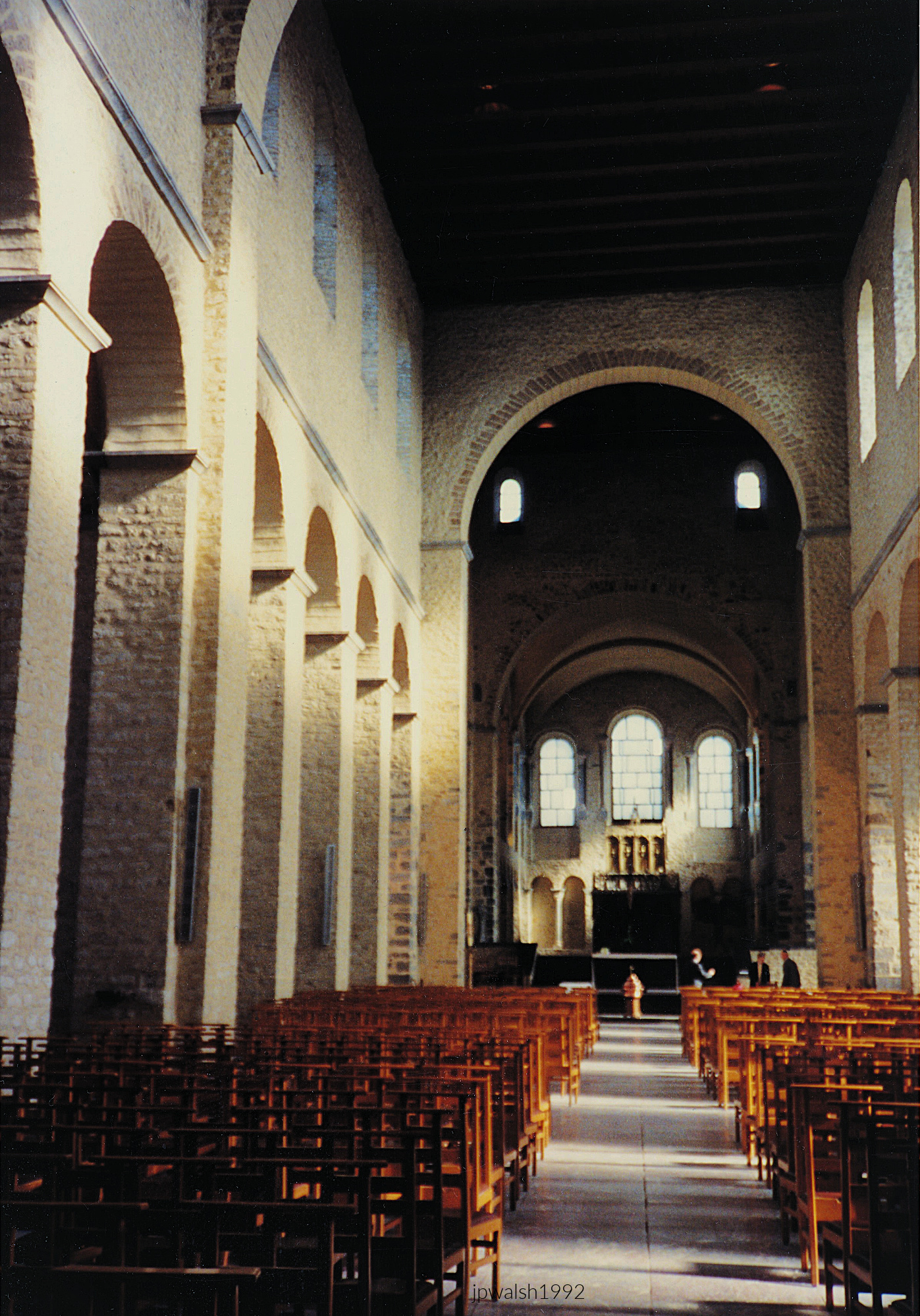
Interior, Minster (Collegiate Church of St. Gertrude), Nivelles, Belgium, c. 1050. This structure was built in the early 11th century and consecrated by Wazo of Liège (c.985-1048) in the presences of Henry III, Holy Roman Emperor (1016-1056). Photography by author, March 1992.
The church was built in the 11th century to serve as a Benedictine abbey of cloistered nuns whose first abbess was St. Gertrude of Nivelles. The community of nuns developed so that by the 15th century Nivelles became professionally staffed and was designated a collegiate church. The dramatic church building is classified a major European Heritage site and remains one of the finest examples of the pure Romanesque style in Belgium.
Its Romanesque crypt is one of the largest of its kind in Europe where tombs of the Merovingian (5th-7th centuries) and Carolingian (7th-9th centuries) periods have been found.
Another image of St. Gertrude of Nivelles.
SOURCE: The Saints: A Concise Biographical Dictionary, edited by John Coulson, Guild Press, New York, 1957.
June 2014. Chicago. 3.01 mb _0400July 2016. Chicago. 5.91mb DSC_0939July 2016. Chicago. 2.61 mb DSC_0055June 2018. Chicago. Pilsen. 3.23 mbApril 2013. Chicago (Back of the Yards). 1mb 35%December 2016. Dinkel’s bakery, 3329 N. Lincoln Ave. In business since 1922, Dinkel’s bakery closed in 2022. 25%.June 2018. Chicago. 2.41 mbJune 2018. Chicago. 4.0 mbJuly 2016. Chicago. 360 kb 25%September 2014. Chicago. Chinatown. 1.86 mbJune 2018. Chicago. Chinatown. 7.90 mb 97%August 2015. Chicago. 3.17mb DSC_0948December 2014. Chicago. Gold Coast. 2.53mbAugust 2017. Chicago. 6.75 mbSeptember 2015. Chicago. 4.92 mbSeptember 2013. Chicago. 4.28 mb (10)August 2015. Chicago. 3.40 mb DSC_0353June 2013. Chicago. Little India. 568 kbJune 2013. Chicago. Little India 3.17mb fsb 100_2560 (1)June 2013. Chicago. Little India 4.27 mb 100_2564 (1)June 2013. Chicago. Little India 4.27mb 100B2592 (1)June 2013. Chicago. Little India 3.01 mb 40% 100_2605 (1)June 2013. Chicago. Little India 3.22 mb 100_2572 (1)June 2013. Chicago. Little India2.31mbJune 2013. Chicago. Little India2.23mbJuly 2016. Chicago Loop. 7/2016 1.25 mb (20)September 2015. Chicago. 2.89 mbAugust 2014. Chicago. Adams/Wabash.1.60 mbJanuary 2018. Chicago. Millennium Station. 4.69 mbJune 2019. Oakbrook, IL. 1.79 mbJune 2019. Oakbrook, IL. 2.24 mbJune 2019. Oakbrook, IL. 2.36 mbJune 2019. Oakbrook, IL. 2.59 mbJune 2019. Oakbrook, IL. 1.52 mbMay 2016. Chicago. Michigan Avenue. 1.04 mbDecember 2017. Chicago. Millennium Park. 2.27 mbMay 2016. Chicago. Millennium Park. 4.32 mbJune 2019. Oakbrook, IL. 1.34 mb June 2018. Milwaukee, WI. 748 kbJune 2016. Milwaukee, WI. 2.94 mbOctober 2016. Chicago. Bridgeport. 4.30 mbMay 2015. Chicago. 2.98 mbJuly 2015. Chicago. Reliance Building (1895), State/Washington. 4.53 mbJune 2018. Chicago. United Center Park. 4.30 mbAugust 2016. Chicago. Goose Island. 4.75 mb (40)October 2014. Symphony Center Chicago. 1.94 mbOctober 2014. Symphony Center Chicago. 3.03mb DSC_0071 (1)October 2014. Symphony Center Chicago. 3.39mb DSC_0056 (1)October 2014. Symphony Center Chicago. 4.47mb DSC_0058 (1)February 2018. Chicago. River North. 765 kbMarch 2020. Downers Grove, IL. 2.74 mbMarch 2020. Downers Grove, IL. 3.10 mbMay 2020. Downers Grove, IL. 772 kbMay 2018. Wheaton, IL. 4.11 mbSeptember 2013. Chicago. New East Side. 3.12 mbJune 2019. Oakbrook, IL.1.44 mbJune 2018. Chicago. Chinatown. 8.64 mbSeptember 2015. Chicago. The Loop. 1.76 mb October 2015. Chicago. Rehearsal. 862 kb _0375August 2017. Chicago. 4.07 mbAugust 2015. Chicago. 3.23 mb DSC_0876August 2016. Chicago. Douglas Park, S. 16th Street/W. Kedzie Avenue. 4.15 mb
William C. “Bill” Henry (1935-1992) for which this portion of 16th Street is named, was a 24th Ward Chicago alderman. Ald. Henry put together the coalition of Black and white aldermen to elect Eugene Sawyer (1934-2008) as mayor of the City of Chicago following the sudden death of Harold Washington (1922-1987), the first black mayor elected in Chicago.
Responding to accusations of deal cutting, Ald. Henry declared during the debate in the City Council chamber: “Deals? We was all making deals!” Henry’s constituents voted their alderman out of office for helping Sawyer in preference to Tim Evans, the reform candidate. Ald. Henry passed away from cancer in 1992 at 56 years old. In 2021 Timothy C. Evans is the Chief Judge of the Circuit Court of Cook County.
It was fifty years ago today (June 8, 1968) that Senator Robert F. Kennedy had his funeral in Manhattan and a train procession to Washington D.C., for his burial. This after being shot on June 5, 1968 upon winning the California Democratic primary for president of the United States. His assassination, funeral, and the long train ride to Arlington National Cemetery are seared into the national memory as well as my own who heard and watched on radio and television all these historic events unfold as a child. It is a memorable series of life-changing happenings for the nation, similar to when President Abraham Lincoln was assassinated and his long funeral train procession from Washington, D.C. to Illinois took place in 1865. Before Lincoln’s funeral train went on to its final destination of Springfield, Illinois, the president’s body lay in state in Chicago. There, as it experienced in its other stops across several states, throngs greeted the Civil War president and, as History would have it, my great-grandfather who was in the Union army at that time served as one of Lincoln’s honor guards.
Robert F. Kennedy campaigns in 1968.
On June 8, 1968, brides and bridesmaids tossed their wedding bouquets at RFK’s funeral train when it passed in order to make their final good-byes. Though weddings and funerals are very different, they have similarities for being one of humanity’s great milestones, a significant rite of passage, where what was or has been, has died and what lies ahead is mysterious.
History records that one of RFK’s favorite songs was Where have all the flowers gone?, the modern folk song written by Pete Seeger which became a big hit, a number one musical sensation, in 1962, when RFK was Attorney General of the United States. The song is its own meditation on life’s transience – with its carriage of universal mortality – and whose lyrics, which Bobby Kennedy’s intuition understood perhaps more than he knew – grew more and more prophetic as the 1960’s moved forward.
Where have all the flowers gone? Long time passing Where have all the flowers gone? Long time ago Where have all the flowers gone? Girls have picked them every one When will they ever learn? When will they ever learn?
Where have all the young girls gone? Long time passing Where have all the young girls gone? Long time ago Where have all the young girls gone? Taken husbands every one When will they ever learn? When will they ever learn?
Where have all the young men gone? Long time passing Where have all the young men gone? Long time ago Where have all the young men gone? Gone for soldiers every one When will they ever learn? When will they ever learn?
Where have all the soldiers gone? Long time passing Where have all the soldiers gone? Long time ago…
RFK’s campaign schedule for president from June 7 to June 17, 1968. John F. Kennedy Library.
In the JFK Library in Boston, there’s a multi-page document which is RFK’s campaign schedule for president from June 7 to June 17, 1968. In the last 10 weeks the candidate had won four out of five state primaries he entered – in the Midwest (Indiana, Nebraska, and South Dakota) and California. Typed and single-spaced for over 11 pages, it became immediately moribund with his unexpected and premature rendezvous with death.
Robert Kennedy’s funeral. His widow, Ethel, and younger brother, Ted who delivered the oration, June 8, 1968, St. Patrick’s Cathedral, New York City.
On June 7, 1968, Senator Kennedy of New York was not to be lying in state at St. Patrick’s Cathedral in Manhattan but on a 6 a.m. flight from L.A. to St. Louis for a luncheon with convention delegates. He then was to fly to New York State for a flurry of campaign appearances starting at Niagara Falls which would literally take him working into the early hours of the next day. On June 8, 1968, RFK was not to be funeralized with a train procession to follow for burial at Arlington, but making campaign appearances all over New York State from dawn to dusk. On June 9 he was not to lay silent on a hill below Custis House, not far from his brother, the slain 35th President of the United States, but…
Perhaps RFK’s legacy for Democrats in 2018 and beyond is not that, as many insist, the New Deal Democratic coalition died along those rails on June 8, 1968 – fifty years ago today – but that it continues inherently with every progress and advancement made in society and, importantly, from and for all sides of American life. RFK’s brand of American politics for the Democratic Party is one that looks to include more of a wide array of political viewpoints than one would easily imagine possible or manageable. On June 8, 1968, Cecil Smith, of Charleston, South Carolina, was quoted in The Washington Evening Star as calling Kennedy “a wonderful man — a man of everybody.” Kennedy would never stop trying to govern from a grassroots political perspective which is creative and critical of extremes or mere pragmatism on behalf of the noble pursuit to be elected to high office so to effectively lead a diverse and great nation into a better future for all.
In today’s moribund politics of division, RFK’s ideals for America were no less difficult to achieve in 1968 than in 2018 – or beyond. After RFK was killed, an already-polarized presidential election of 1968 led to a predominance over the next fifty years of a strong brand of partisan politics. Kennedy’s more inclusive approach turned up historically truncated and, with decades of often mean-spirited political partisanship, is even chafed at as exotic or, at least, futile. Yet that Kennedy brand of democratic politics would never accept such defeatism then or now.
RFK’s at the podium to deliver a victory speech following the outcome of the California primary. These last words of 42-year-old Senator Kennedy to the American people, given shortly after midnight on June 5, 1968, and literally moments before he was shot, speaks volumes to his governing approach for the future. Its vision absolutely requires the many and diverse hands, voices, and votes of the American people to accomplish, which was true in 1968 and today.
“What I think is quite clear is that we can work together in the last analysis. What has been going on in the United States for the last three years – the divisions, the violence, the disenchantment with our society – the division, whether it’s between blacks and whites, the poor and the more affluent, or between different age groups or the war in Vietnam, that we can start to work together, that we are a great country, an unselfish country and a compassionate country. And I intend to make that my basis for running over the next few months… The country wants to move in a different direction. We want to deal with our own problems in our own country and we want peace in Vietnam…The fact is all of us are involved in this great effort – and it’s a great effort not on behalf of the Democratic Party – it’s a great effort on behalf of the United States – on behalf of our own people- on behalf of mankind all around the globe and the next generation of Americans… What we are going to do in the rural areas of our country? What we are going to do for those who still suffer in the United States from hunger? What we are going to do around the rest of the globe? And whether we are going to continue the policies that have been so unsuccessful, in Vietnam of American troops and American marines carrying the major burden of that conflict I do not want to and I think we should move in a different direction. So I thank all of you who made this possible this evening, all of the effort that you have made, and all of the people whose names I haven’t mentioned but did all of the work…So I thank all of you…And now it’s on to Chicago and let’s win there…”
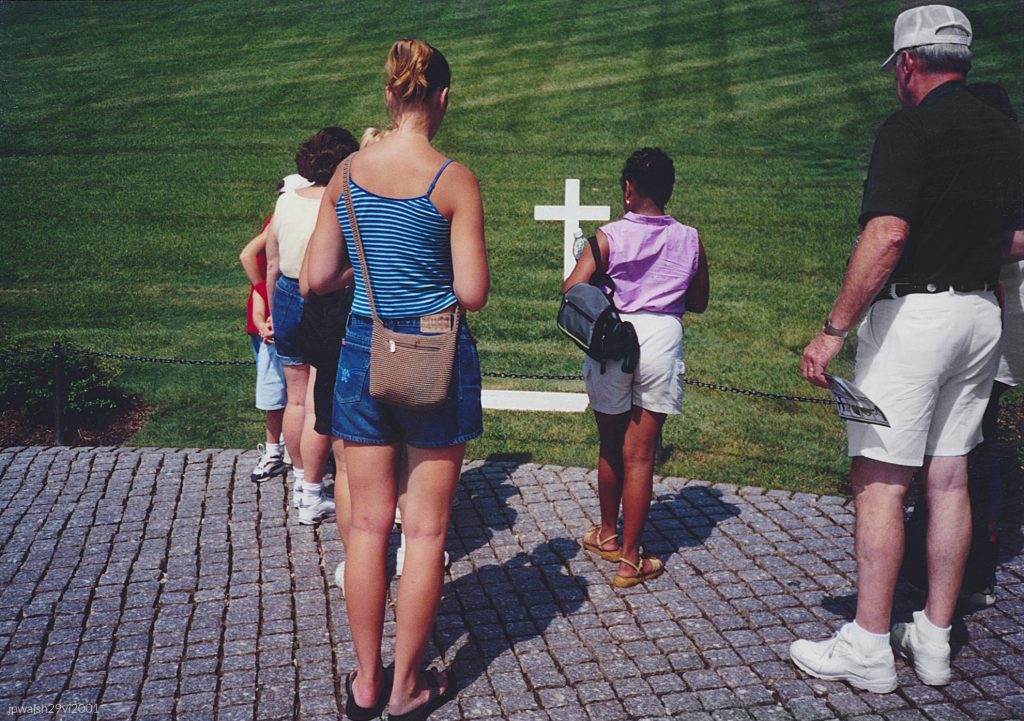
Visitors at RFK’s gravesite, Arlington National Cemetery, Arlington, Virginia, June 2001. Author’s photograph.
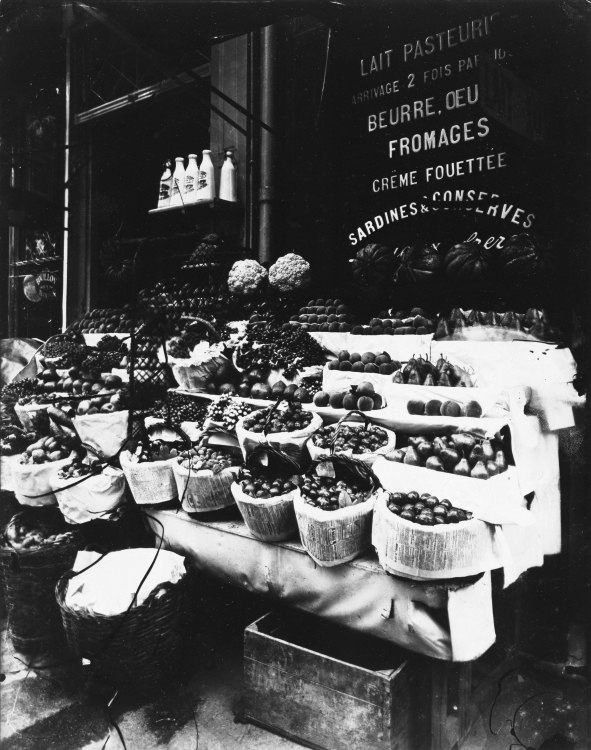
FEATURE image: Eugène Atget, Place Saint-Médard, 1889-99.
Eugène Atget in an anonymously-taken photograph.
Eugène Atget, Photographer’s Studio, c. 1910.
Atget was born in 1857 near Bordeaux (Libourne) and after his parents died in 1862, the 5-year-old boy was brought up by his grandparents in Bordeaux. Atget received a solid education and, similar to Paul Gauguin, eventually went to sea in the merchant navy and later, in 1878, settled in Paris where he aspired to be a dramatic actor. For the next decade, Atget was a traveling thespian in the Paris theaters. Even after he left Paris and the theater profession in 1888 to become a fine arts painter in the provinces, Atget always considered himself to be an actor. By 1890, his brief painting career over, Atget was back in Paris where he decided to become a documentary photographer.
There is a portrait of Eugène Atget (1857-1927) by Berenice Abbott created in 1927 that can be found here: https://www.icp.org/browse/archive/constituents/eug%C3%A8ne-atget?all/all/all/all/0. The portrait was taken in Berenice Abbott’s studio after Atget had recently taken up photography again. In August 1927, he died. It was at Man Ray’s suggestion that Berenice Abbott introduced herself to Atget in 1925 and began taking photographs of him. Of her subject she observed: “[Atget] will be remembered as an urbanist historian, a genuine romanticist, a lover of Paris, a Balzac of the camera, from whose work we can weave a large tapestry of French civilization.” (quoted in Paris Eugène Atget 1857-1927, Taschen, 2000, p. 22).
Eugène Atget, Children Playing, Luxembourg Gardens, c.1898. Atget created many photographs with people in them, including this straightforward portrayal of Parisian life that also serves as a document of historical interest.
Eugène Atget, The Old School of Medicine, Rue de la Bûcherie, 1898. Near the cathedral Notre Dame de Paris and the Place Maubert, between La Seine and Boulevard Saint-Germain, Rue de la Bûcherie is one of the oldest Left Bank streets. In the Middle Ages discarded meats were prepared here to feed the poor. The dome of this sixteenth-century building built for the University of Paris housed an auditorium in which classes were held. In Atget’s time it was a hotel that housed a street-level wine shop. After 1910 it became a school dormitory and a library after that. Today, the Old School of Medicine has been restored to original appearance.
Eugène Atget, Façade, St-Julien-le-Pauvre, 1898. The chapel on this site since the sixth century was destroyed in the ninth century by the Normans. Remnants of a twelfth century church that was sacked by students in 1524 remain after the church was reconstructed in 1651. During the French Revolution the church was used to store and sell various stock, and rededicated as a church in 1826. When Atget photographed it, St Julien-le-Pauvre was a Melkite Catholic Church which it is today. The arch at the top of Atget’s photograph is a camera effect from the glass plate not being covered by the lens. The church guard is seated to one side of the main door. The buildings to the side of the passageway in the photograph are largely gone today.
Eugène Atget, Place Saint-Médard, 1889-99.
Eugène Atget, Hôtel de Brinvilliers, Rue Charles V, 1900.
Eugène Atget, Au Bon Puits, rue Michel-Le-Comte, 1901.
Eugène Atget, Lampshade Seller, rue Lepic, 1901.
Eugène Atget, Ragpicker, avenue des Gobelins, 1901.
Eugène Atget, Fountains at Juvisy, 1902.
Eugène Atget, Petit Bacchus, rue-St-Louis-en-l’Ile, 1901-02.
Eugène Atget, detail, Petit Bacchus, rue-St-Louis-en-l’Ile, 1901-02.
Eugène Atget, The Temple of Love, the Petit Trianon, 1902.
Eugène Atget, Paris Antique Store, Rue du Faubourg-Saint-Honoré, 1902.
Eugène Atget, Façade du no 2 , Place du Caire, 1903.
Eugène Atget, Courtyard of Farewells, Fontainebleau, 1903.
Eugène Atget, Ancienne Barrière (tollgate) du Trône, Paris, 1903-04.
Eugène Atget, France Triumphant, Versailles, 1904.
Eugène Atget, Palais-Royal, Paris, 1904-05.
Eugène Atget, Tree Roots, Saint Cloud Park, 1906.
Eugène Atget, Rue Sainte Opportune, Paris, 1908 (or 1912).
Eugène Atget, Water Lilies, before 1911.
Eugène Atget, Old Courtyard, rue Quincampoix, 1908 or 1912.
Eugène Atget, Entrée du passage de la Réunion, 1 et 3 Rue du Maure, 3° arrondissement, 1911.
Eugène Atget, Tinsmith’s Shop, rue de la Reynie, 1912.
Eugène Atget, Dress shop, rue de la Corderie, 1920.
Eugène Atget, Hairdresser’s shop, boulevard de Strasbourg, 1912.
Eugène Atget, Ragpicker’s Hut, 1912.
Eugène Atget, Old Mill, Charenton, 1915.
Eugène Atget, Reflecting Pool, Saint-Cloud, 1915-19.
FEATURE image: Over the Top to Victory (“Doughboy”), 1921, John Paulding, Memorial Park, Wheaton, Illinois.
“Over the Top to Victory” is a bronze sculpture that depicts an American infantryman in World War I (known popularly as “doughboys”) that was created by American sculptor John Paulding (1883-1935).
The statue was cast in 1921 by the American Art Bronze Foundry in Chicago and stands in Memorial Park in Wheaton, Illinois.
Paulding studied sculpture at The School of the Art Institute of Chicago and is best remembered today for his World War I memorials.
When the United States entered World War I in April 1917 the soldiers fought valiantly. An armistice was signed on November 11, 1918—the origin of today’s Veterans Day—in a victory for the allies. The war had started in August 1914 and had gone on for over four years.
The statue was dedicated on Armistice Day, November 11, 1929, in honor of all World War I veterans in Wheaton, Illinois. Memorial Park had been established in central Wheaton in 1921 specifically to honor war veterans. Four months before this statue was dedicated—on July 12, 1929—the WheatonIllinoian opined about The Doughboy: “The statue is a fitting memorial to the soldiers of the community who died fighting for our cause. Let us not forget so easily!”
After more than 70 years standing proudly outside in the elements, the statue was refurbished and conserved in August 2000 by Venus Bronze Work, Inc., in Detroit, Michigan—and rededicated on Veteran’s Day of that year. The same local American Legion Post led the dedication ceremonies in both 1929 and 2000.
“Over the Top to Victory,” 1921, bronze, John Paulding (American, 1883-1935), Memorial Park, Wheaton, Illinois.
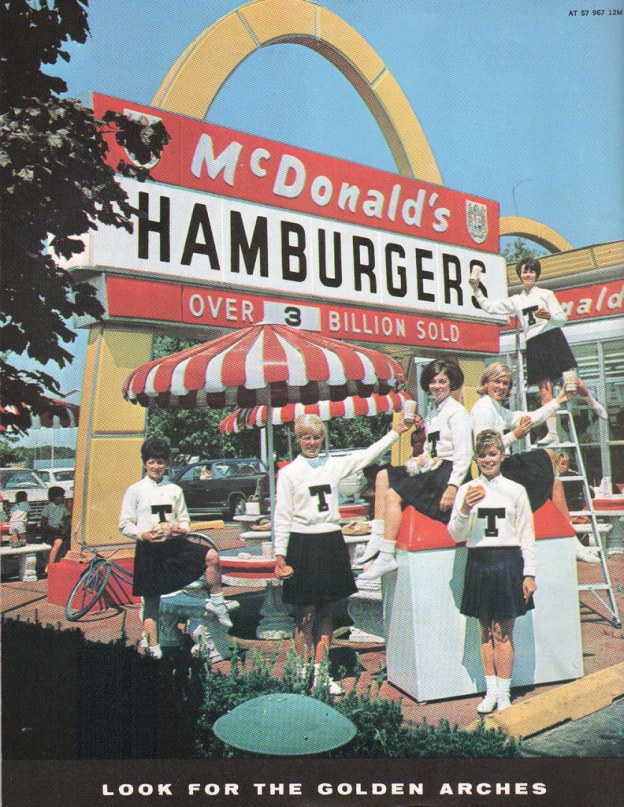
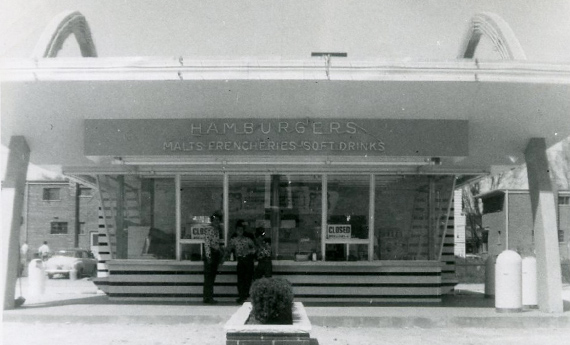
McDonald’s very first franchise restaurant on its original site, 1955 (replica, 1985). It is slated to be razed by McDonald’s Corporation immediately. Author’s photograph taken May 6, 2018.
By John P. Walsh
A closed-down weather-beaten replica of the very first McDonald’s franchise restaurant started by Ray Kroc (1902-1984) on April 15, 1955 standing on its original site in Des Plaines, Illinois, is slated to be demolished by McDonald’s Corporation with its land donated or possibly sold.
It was not long ago that McDonald’s touted that approximately one in every eight American workers had been employed by the company (Source: McDonald’s estimate in 1996) and that even today McDonald’s hires around 1 million workers in the U.S. every year. By 1961 there were 230 McDonald’s franchises in the United States. In 2017 there was 37, 241 McDonald’s restaurants worldwide. Not only historians and historic preservationists decry the imminent demolition of the first McDonald’s restaurant in Des Plaines, Illinois, just west of Chicago, but others impressed by its direct significance to the growth and impact to U.S. labor history as well as the American restaurant industry and American automotive culture in the post-World War II era. Further, McDonald’s restaurants today reach into 121 other countries around the world influencing and being influenced by global cuisine. That all of this cultural and business import was born on a now-threatened patch of land on Lee Street in Des Plaines, Illinois, is impressive.
It appears that if and when McDonald’s follows through on its November 2017 decision to raze the building and give up the site, this originally-designed McDonald’s restaurant on Ray Kroc’s original site in Des Plaines will be forever lost. The story of how that planned demolition of this unique piece of Americana came to be began 35 years ago. It was on March 3, 1984 that after 29 years of continual operation the original franchise restaurant on the original site was permanently closed and demolished. Founder and former McDonald’s Corporation chairman Ray Kroc had died less than six weeks before in January 1984 at 81 years old in San Diego, California.
The McDonald’s restaurant brand opened its first burger bar called McDonald’s Bar-B-Q in California in 1940 – and, by 1953, brothers Maurice and Richard McDonald started a small franchise business in Phoenix, Arizona and Downey, California. Today’s nationwide and global franchise empire that serves 75 burgers every second (Source: McDonald’s Operations and Training Manual) began when Oak Park, Illinois-born Ray Kroc, a paper-cup-turned-milkshake-machine salesman, convinced the McDonald brothers to let him franchise their business nationwide. Kroc offered to manage the franchises in the U.S., excepting the brothers’ first franchises in Arizona and California, and the pair were to receive a tiny percentage of gross sales nationwide in return.
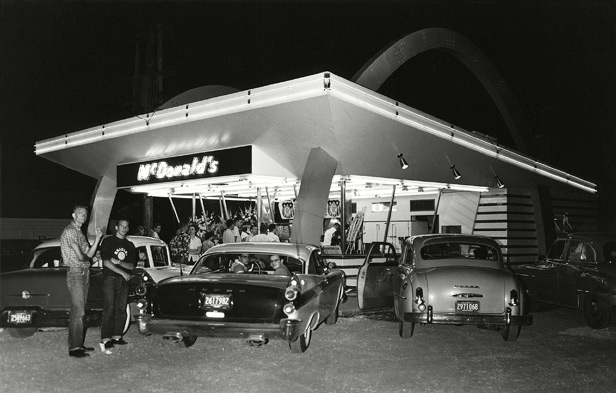
Historic photograph from 1955 of the original Des Plaines McDonald’s restaurant which was demolished in 1984. A replica restaurant was built in 1985 based on architectural plans of later McDonald’s restaurants. That replica on the historic site is awaiting immediate demolition announced by McDonald’s in late 2017. Fair Use.
Kroc’s first walk-up franchise McDonald’s restaurant at the “Five Corners” intersection in Des Plaines, Illinois, served an assembly-line format menu of hamburgers, cheeseburgers, french fries and a selection of drinks. In 1955, he founded McDonald’s System, Inc., a predecessor of the McDonald’s Corporation, and six years later bought the exclusive rights to the McDonald’s name and operating system. By 1961, Ray Kroc’s vision had clearly paid off for the now 59-year-old former paper cup salesman. That same year, Kroc bought out the McDonald brothers for $2.7 million and launched his strict training program, later called “Hamburger University, ” in nearby Elk Grove Village, Illinois, at another of his 230 new McDonald’s restaurants. Ray Kroc’s original vision was that there should be 1,000 McDonald’s restaurants in the United States. When Kroc died in January 1984, his goal had been exceeded six fold — there were 6,000 McDonald’s restaurants in the U.S. and internationally in 1980.
The Des Plaines suburban location of Ray Kroc’s very first McDonald’s franchise retains its relatively humble setting even as the McDonald’s Corporation it spawned earns $27 billion in annual sales making it the 90th-largest economy in the world (Source: SEC). Kroc, the milkshake machine salesman who convinced the McDonald brothers to let him franchise their fast-food operation nationwide, saw his original McDonald’s franchise at 400 Lee St. in Des Plaines open for business until, shortly after his death, it closed on Saturday, March 3, 1984.
Ray Kroc (1902-1984) photographed with an artist’s rendering of his highly successful McDonald’s franchise restaurant. The franchise started in Des Plaines, Illinois, in April 1955 and has had a significant impact on U.S. labor history and the American restaurant industry and automotive culture in the post-World war II era. Fair Use.
In 1984 there were no plans to preserve the site – its golden arches and road sign had been carted away – but a public outcry prompted McDonald’s in 1985 to return the restaurant’s restored original sign designed by Andrew Bork and Joe Sicuro of Laco Signs of Libertyville, Illinois, and dedicate a restaurant replica that still exists today on the original site though it is now slated for demolition. The historic red neon-lettered sign turned on for the opening of Kroc’s first store on April 15, 1955 – there is one similar to it preserved in The Henry Ford museum in Dearborn, Michigan dating from 1960 – proclaimed “McDonald’s Hamburgers” and “We Have Sold Over 1 Million” and, intersecting with an iconic golden arch displayed a neon-animated “Speedee” chef, the fast food chain’s original mascot. (The clown figure of Ronald McDonald first appeared in 1963).
Newspaper advertisement announcing the opening of Ray Kroc’s first McDonald’s in Des Plaines, Illinois, in 1955. It featured the franchise’s first mascot, Speedee, who was significant to the assembly-line format menu and prevailing automobile culture. Fair Use. Historic photograph of Ray Kroc’s first McDonald’s restaurant in Des Plaines, Illinois, on opening day, April 15, 1955. Fair Use. The replica of McDonald’s first franchise restaurant is missing its golden arches, “McDonald’s” sign over the entrance and its original 1955 Speedee neon lettered sign. They were dismantled and removed in January 2018 by McDonald’s to an undisclosed location out of public view. Photo by author, May 6, 2018.
The day after the original restaurant closed – Sunday, March 4, 1984 – a McDonald’s restaurant franchise moved across the street into a state-of-the-art new building on a site that once accommodated a Howard Johnson’s and, after that, a Ground Round. The full-service McDonald’s in Des Plaines, Illinois, today continues to operate out of that 1984 building. It may confuse the visitor which exactly is the original site of the first McDonald’s as the newer 1984 building not on the first site displays inside a high-relief metal sign that reads: “The national chain of McDonald’s was born on this spot with the opening of this restaurant.” Though undated, it is signed by Ray Kroc which points to it being brought over from the original restaurant when it was closed. At the replica restaurant on the original site two metal plaques (dated April 15, 1985) properly proclaim: “Ray A. Kroc, founder of McDonald’s Corporation, opened his first McDonald’s franchise (the ninth McDonald’s drive-in in the U.S.) on this site, April 15, 1955.”
A few months after the first franchise restaurant was closed and demolished in 1984, the parcel of land on which it sat – it had only always been leased since 1955 – was purchased by McDonald’s at the same time they announced plans for the replica landmark restaurant.
The original architectural plans by architect Robert Stauber from the mid1950’s were lost, so 1980’s planners applied architectural drawings of McDonald’s restaurants built in the late 1950’s for the replica. Its kitchen included refurbished equipment brought out of storage, including the restaurant’s original six-foot grill. It also displayed one of Ray Kroc’s original multimixers like the ones he sold to Maurice and Richard McDonald that started a fast-food partnership in the 1950’s which by the mid-1960’s inspired many well-known copy cats of McDonald’s model, including Burger King, Burger Chef, Arbys, KFC, and Hardee’s.
Soda fountain multimixer. Fair Use.
The original restaurant had been remodeled several times during its almost 30 years of operation but never had much in the way of indoor seating or a drive-through. It did feature a basement and furnace built for Chicago’s four seasons and was used by the replica museum to exhibit items. The McDonald’s Museum was open for tours until September 2008 when the site experienced record-setting flooding from the nearby Des Plaines River. In April 2013 another record flood in Des Plaines submerged the McDonald’s Museum and produced serious speculation that the site would be moved or permanently closed.
An aerial view during the April 2013 Des Plaines River flood shows the partially submerged replica first McDonald’s franchise restaurant (at right) with its original Speedee neon sign. Thesign was first lit on April 15, 1955, a Friday Night. Photo: Chris Walker, Chicago Tribune, April 19, 2013. Fair Use.
In mid-July 2017, only four years since the last significant flood, the area experienced its worst flooding on record. In November 2017 McDonald’s announced it would raze the replica restaurant structure and by May 2018 the site had had its utilities disconnected and its golden arches, Speedee sign, and main entrance McDonald’s sign dismantled and removed. These historically valuable items were taken by McDonald’s out of public view to an undisclosed location. Once again, and this time more seriously it appears, the prospect of pleas by Des Plaines municipal authorities, historic preservationists, social media and others for McDonald’s Corporation to preserve the site intact is murky at best.
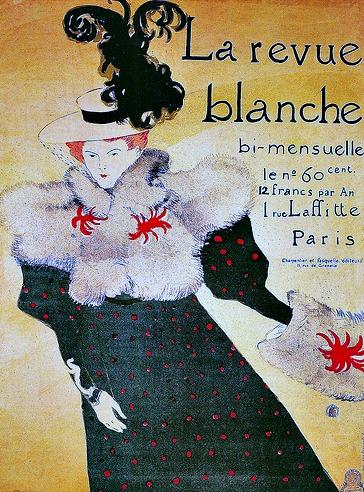
FEATURE image: Henri de Toulouse-Lautrec (1864-1901), La Revue Blanche, 1895, Paris. Lithograph in four colors.
By John P. Walsh
The nineteenth century in France brought about a radical transformation of the role of the artist. In place of artwork for aristocratic patrons, artists in all media were increasingly left to their own devices and began creating works of art in their studios and looking to sell them in the open marketplace. Innovative forms, new subjects, and new styles emerged from these changing economic structures brought about by the dawning of the industrial and technological age as well as the growing importance of cities.
In Paris and elsewhere, enterprising artists sought to attract new clients increasingly composed of the urban bourgeoisie. By the mid-to-late nineteenth century the involvement of the public in artistic matters became an irrevocable fact which had been secured by the improved means of mass production. New processes in lithographic and photographic printmaking, for example, made art widely available to a popular audience. The entry of this sort of democracy into artistic production coincided with current aesthetic influences such as a Japonisme movement prevalent in France in the years before 1890. In addition, there was a new understanding of modern beauty that began around 1830 that rejected traditional forms of beauty manifested in classical and later art forms.
By the early 1890’s when Henri Toulouse Lautrec (French, 1864-1901) created his mass-produced posters in Paris a new artistic practice had appeared whose idea of beauty was contemporary, sophisticated and subtly realistic. By 1890, Lautrec’s art could react in several ways to the modern art tradition. Toulouse-Lautrec repudiated the bourgeois modernity of the Impressionists from the 1870’s and 1880’s displayed in the drawing-room paintings of Claude Monet (French, 1840-1926) and Pierre-Auguste Renoir (French, 1841-1919) and, owing to cultural spaces that had shifted by the 1880’s to artistic cabarets and literary cafés, Lautrec could also claim to be a direct heir to an earlier 1830’s romantic bohemian and 1840’s flâneur.
There are several interpretations for this cultural shift and its effects on artists and artistic practice in the 1890’s including Toulouse-Lautrec’s mass-produced commercial posters. Building on a rejection of bourgeois art forms, Mary Gluck at Brown University argues that artists such as Toulouse-Lautrec—who with others was a creature of the cabarets and cafés—desired commercial mass media to be the means by which the public sphere would eclipse individual lives which modern society had fragmented. At the center of their art production, Gluck believes, is a distinct vision of modernity identified with a city’s public space as opposed to the private anonymity of bourgeois culture (see Popular Bohemia: Modernism and Urban Culture in Nineteenth-Century Paris, 2005). To strive to transform the public sphere by way of the legacy of the café-concert about and for which Toulouse-Lautrec created a significant amount of his mass-produced commercial art could only be an ambitious cultural task. These cabarets and café-concerts, mostly centered on and around Montmartre in Paris, were crowded, loud and often rowdy. Its performances and clientele were often unpolished and popular. Small but well-known art movements such as Les Arts incohérents and their Montmartre cabaret Les Hydropathes begin to describe the level of social parody and frivolity to be expected within these establishments. While Lionel Richard at the University of Picardy attributes these activities to social rebels (see Cabaret, Cabarets: Origines et décadence, 1991), Jerrold Seigel at New York University views it as a calculated new relationship between the popular classes and the bourgeoisie where the aspiring artist, such as Toulouse-Lautrec, could create art for potential customers (see Bohemian Paris: Culture, Politics, and the Boundaries of Bourgeois Life, 1830-1930, 1986). For T. J. Clark, the cabaret’s diverse audience as a venue for some form of cultural democracy by way of a mixing of classes is illusory (see “The Bar at the Folies-Bergères,” The Wolf and the Lamb: Popular Culture in France, From the Old Régime to the Twentieth Century, 1977). Charles Rearick of the University of Massachusetts, Amherst, casts an eye on those frivolous aspects of the Montmartre cabarets, dance halls, and literary cafés. His conclusion is that these activities allowed a Parisian to escape modern society’s social constraints of respectability typically found everywhere else (see Pleasures of the Belle Epoque: Entertainment & Festivity in Turn-Of-The-Century France, 1985). Phillip Dennis Cate at The Jane Voorhees Zimmerli Art Museum at Rutgers University viewed the role of cabarets in the artistic context of these bohemian antics being the genesis of what became twentieth-century avant-garde aesthetics (see The Spirit of Montmartre: Cabarets, Humor, and the Avant-Garde, 1875-1905, 1996). It is the affirmation of the values of spontaneous experience and direct communication as an integral aspect of the modern experience and, for the fin-de-siècle bohemian, parodic performances which helped criticize the official art establishment that carried forward into artistic attitudes in the new century.
The fruit of reflection for this late-nineteenth-century artistic period in Paris is numerous and diverse. It leads to the observation—whether of Henri de Toulouse-Lautrec or the variety of subjects in his mass-produced commercial art—that the stereotype of the artist, poet, or performer as bohemian, owing to their psychological nuance and stylistic antisepsis as aesthetic modernity—and possibly its inverse—becomes a source for their estrangement and alienation from modernity—that is, to emerge as an alienated human figure detached from their society and time. With Toulouse-Lautrec’s sixth poster (Divan Japonais, 1893) it is clear that his mass-produced commercial poster art in Paris was making an important impact on modern art in the 1890’s. It was a new art form for its deploying the rapidly developing technique of color printing. It utilized new approaches to composition and subject matter which were created for a mixture of new and popular commercial establishments. Finally, and perhaps most significantly, they became the first regularly displayed art commodity for public mass consumption. Each of these art principles and practices found in Toulouse-Lautrec’s posters of the 1890’s continue to impact contemporary art-making today.
1. Henri de Toulouse-Lautrec – Moulin Rouge-La Goulue, 1891.
1. Moulin Rouge-La Goulue is a lithograph done in 4 colors: yellow, blue, red, and black. The Moulin Rouge opened in 1889 and, in summer 1891, the poster was commissioned by its owners. It depicts La Goulue (“The Glutton”) who is 21-year-old Louis Weber (1870-1929) and Valentin-le-Désossé (“the Boneless”) (1843-1907). This is Toulouse-Lautrec’s first, largest, and many estimate, most complex and artistically important poster. Printed by Charles Levy, it is made up of two sheets although Toulouse-Lautrec thought the printer had made mistakes and didn’t use him again. When this poster was plastered around Paris, the artist knew that his own silhouetted profile could be found in the background of silhouetted figures. The art of the streets pioneered by Jules Chéret (1836-1932) and immediately recognized for its implications by writers such as the Goncourt brothers and J.K. Huysmans (1848-1907) Lautrec exploited in the 1890’s aided by technological advances in color printing that continued to improve throughout the decade.
2. Henri de Toulouse-Lautrec – Le Pendu, 1892
2. The poster Le Pendu is a lithograph done in 2 colors: black and dark green. It was commissioned by a magazine editor to publicize a new theater play. Based on a true story of a wrongful capital death, the poster depicts the son’s suicide. Created in charcoal in late 1891, it was printed in 1895 in a limited edition for collectors only.
3. Henri de Toulouse-Lautrec – Ambassadeurs Aristide Bruant, 1892.
3. The poster Ambassadeurs Aristide Bruant is a lithograph in 5 colors yellow, blue, red, black, and olive green. Aristide Bruant (1851-1923) was a singer and this was a promotional poster for a café concert that opened in June 1892. The poster appeared all over Paris and on stage during the performance. The café owner thought the poster was a “disgusting mess” and refused to hang it until Bruant threatened to cancel his show. The subject wears a heavy dark velvet jacket, red shirt scarf, and wide brimmed hat with a riding crop. His head rises out of a dark mass which is lifted wholesale from a Japanese print by Katsukawa Shunshō (1726-1792).
4. Henri de Toulouse-Lautrec – Eldorado Aristide Bruant. 1892.
4. The poster Eldorado Aristide Bruant is a lithograph in 5 colors (olive green, yellow, red, blue, and black). It includes the letters “TL” and signed monogram which will appear on other posters. The poster was created for the singer’s event on Boulevard de Strasbourg (north of Boulevard Montmartre at Sebastopol). With the same but reversed design, the customer and artist cut poster costs while increasing brand identity. In modern art the figure of the imposing heroic individual performer was new and Bruant became an overnight celebrity that year in Paris. Toulouse-Lautrec made no money on this project because the café owners were shocked by its content and refused to pay him.
5. Henri de Toulouse-Lautrec – Reine de Joie, 1892
5. The poster Reine de Joie is a lithograph in 4 colors (olive green, yellow, red, and black). It includes the emblematic letters “TL” and is signed. The poster was an advertisement for a suggestive new serialized novel by Victor Joze (1861-1933) and depicted the moment in the novel when the heroine kisses a fat banker, the latter being modeled by Georges Lasserre, a Lautrec friend. The poster, also used as the novel’s cover, caused a scandal across Paris and prompted a poster tear-down campaign. Speculation ran rampant as to who might be the real-life personalities on which characters in the novel were based.
6. Henri de Toulouse-Lautrec – Divan Japonais, 1892-93.
6. The poster Divan Japonais (1892-93) is a lithograph in 4 colors (olive green, yellow, red, and black). The cabaret on rue des Martyrs came under new ownership in 1892 and was totally refurbished in a trendy Japanese style. The poster depicts 24-year-old Jane Avril (1868-1943) with critic Edouard Dujarden (1861-1949) in the cabaret. On stage are shown the long black gloves of new singer Yvette Guilbert (1865-1944). In a stylistic move, the artist cuts off Guilbert’s head and shoulders in the poster much to the consternation of the young singer just getting started in her career. (She later commissioned a poster by another artist to depict her complete figure). When this poster went up all over Paris it created a sensation and was another triumph for Lautrec. In 1894 the Divan Japonais closed to be replaced by another establishment. As with his other posters, there were several preliminary sketches the artist made for Divan Japonais. The posters used the new and improving popular mechanical technique of color printing and applied it to commercial establishments and popular entertainers, subject matter usually reserved for cruder forms of advertisement.
Divan Japonais is one of Toulouse-Lautrec’s early posters. In his poster career the artist usually used anywhere from 2 to 5 colors. It is signed by Toulouse Lautrec. This Montmartre cabaret was taken over in 1892 by a new owner and totally refurbished in the avant-garde Japanese style which was the inspiration for the cabaret’s name. By February 1893 when this sixth poster was made by Lautrec and put up all around Paris, his 5 previous posters had already made him famous.
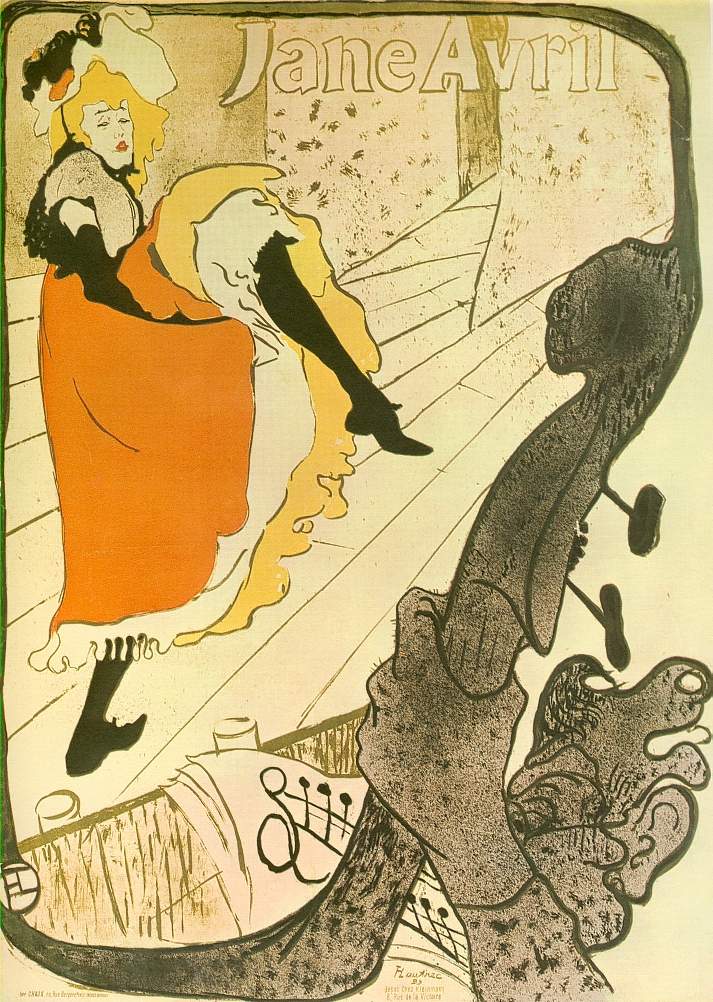
7. Henri de Toulouse-Lautrec – Jane Avril, 1893.
7. The poster Jane Avril is a lithograph in 5 colors (olive green, yellow, orange, red, and black). The same subject who appeared in Divan Japonais, Jane Avril commissioned this poster for her performance at the Jardin de Paris, a new café-concert. The letters for the name of the establishment were added later by someone other than Lautrec. The artist first produced 20 collector prints and after, with its newly-added letters, the poster went into mass production. Known as La Mélinite—a type of explosive—Jane Avril looked to this poster to reinvigorate her career as a performer in Paris. The poster helped her to take Paris by storm as she went on to perform at the Casino de Paris, the Moulin Rouge and the Folies-Bergères. In terms of composition, the poster is noteworthy for its strong diagonals inspired by Japanese prints and the detail of a large musical instrument—including the meticulously drawn hairs of a musician’s fingers—which rounds out the design and is seen as homage to Degas who used a similar motif in his artwork.
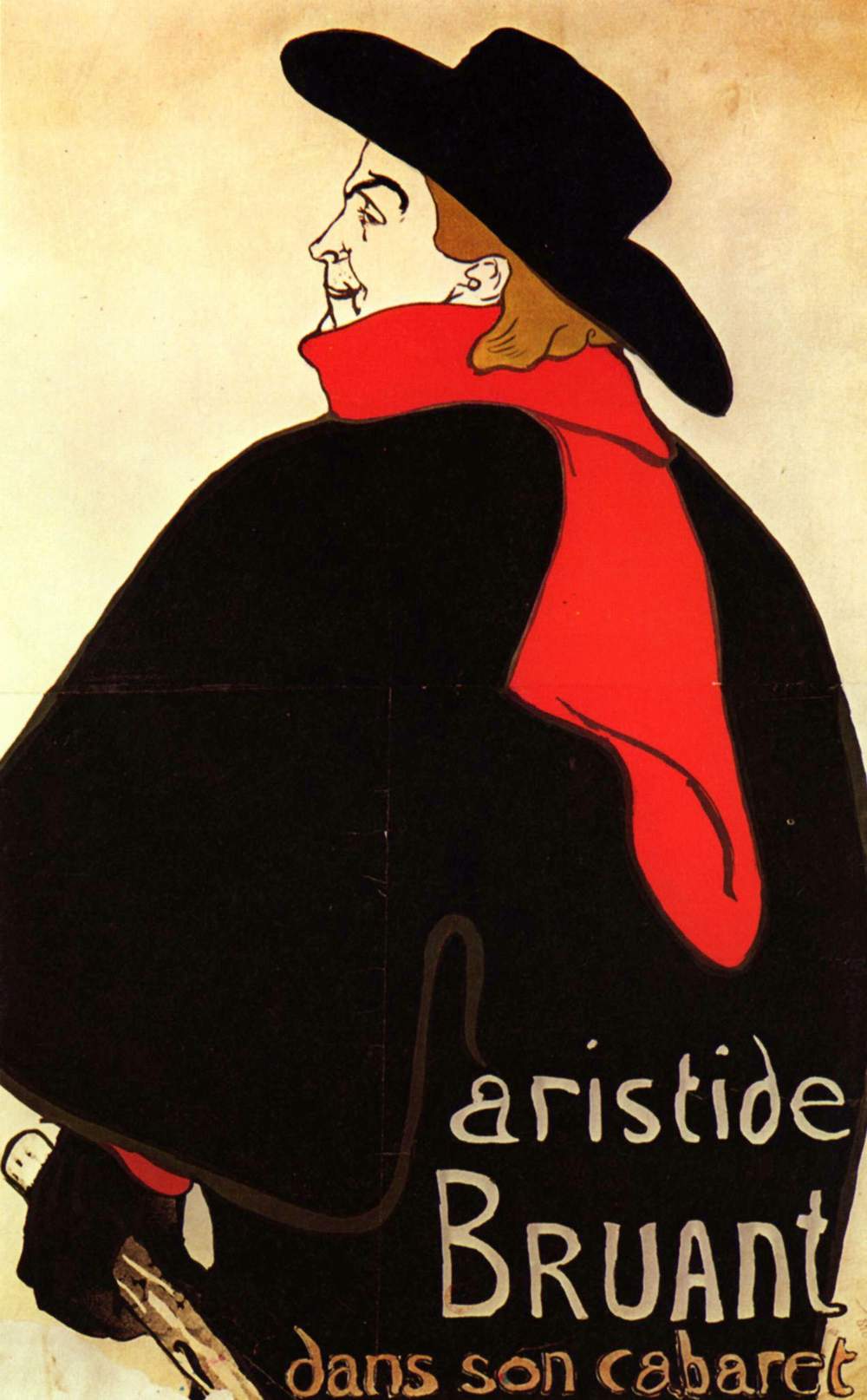
8. Henri de Toulouse-Lautrec – Aristide Bruant Dans Son Cabaret, 1893.
8. The poster Aristide Bruant Dans Son Cabaret is a lithograph in 4 colors (olive green, brown, red, and black). Lautrec’s third image of the singer became a Parisian icon. From the poster’s inception the singer used this image to promote his appearances—and for the next twenty years until 1912.
9. Henri de Toulouse-Lautrec – Au Pied De L’Echafaud, 1893.
9. The poster Au Pied De L’Echafaud is a lithograph in 4 colors (grey, red-brown, red, and black). The poster was an advertisement for the memoirs of a prison chaplain published in 1893.
10. Henri de Toulouse-Lautrec – Caudieux, 1893.
10. The poster Caudieux is a lithograph in 4 colors (olive green, yellow, red and black). Lautrec depicts Caudieux, who was a popular cabaret comedian, to be striding across the stage. Lautrec used the partial figure in the prompt box in other artwork.
11. Henri de Toulouse-Lautrec – Bruant Au Miriton, 1893.Bruant Au Miriton, 1893.
11. The poster Bruant Au Miriton is a lithograph in 2 colors (olive green or black and red). Represented with his back to the viewer, the popular performer is identified simply by his costume and the way he stands. This artistic device had already been used by Degas based on a theory by an art critic that a person’s economic and social class could be revealed simply by the way he or she comports themselves. The poster was recycled by Bruant as a songbook cover.
12. Henri de Toulouse-Lautrec – Babylone D’Allemagne, 1894
12. The poster Babylone D’Allemagne is a lithograph in 5 colors (olive green, yellow, red, dark blue and black). This was Lautrec’s second poster for another Victor Joze novel following his Reine de Joie. Lautrec wrote to his mother at this time to relate how busy he was with his art projects. Because of Joze’s anti-German message in the book, the author wanted the poster suppressed but it went up all over Paris nonetheless.
13. Henri de Toulouse-Lautrec – L’Artisan Moderne, 1894.
13. The poster L’Artisan Moderne is a lithograph in 4 colors (dark blue, yellow, green, and brown). The lettering is not done by Lautrec. Because of the impact of the cabaret and book posters, Lautrec began to be commissioned to make posters for the trades. This poster was provided to an interior design firm.
14. Henri de Toulouse-Lautrec – P. Sescau, Photographe, 1894
14. The poster P. Sescau, Photographe is a lithograph in 4 colors (dark red, yellow, green, and dark blue). The lettering is not done by Lautrec. This poster was provided to Paul Sescau, a professional photographer and personal friend of the artist.
15. Henri de Toulouse-Lautrec – Confetti, 1894.
15. The poster Confetti is a lithograph in 3 colors (dark olive green, red and yellow). This is Lautrec’s poster for the English paper manufacturer Bella & de Malherbe. The model is Jeanne Granier (1852-1939). These paper manufacturers hosted poster exhibitions in 1894 and 1896 to which Lautrec was invited.
16. Henri de Toulouse-Lautrec – May Belfort, 1895.
16. The poster May Belfort is a lithograph in 4 colors (olive black, red and yellow). Following his trades posters Lautrec returned to the subject of the single musical performer. May Egan (whose stage name was May Belfort) was an Irish singer who appeared at the Cabaret des Décadents where Jane Avril performed.
17. Henri de Toulouse-Lautrec – La Revue Blanche, 1895.
17. The poster La Revue Blanche is a lithograph in 4 colors (blue, red, black, and green). The subject is Misia Natanson (1872-1950) who was married to Thadée Natanson whose brother was editor of La Revue Blanche from 1891 to 1903. Misia was muse to a generation of avant-garde artists, composers, and writers as the publication itself was the remarkable meeting point for the Paris literary and artistic worlds in the 1890’s. Lautrec shows Misia wearing an ostrich feather hat, spotted dress, fur jacket and muff and ice skating which was a popular activity in Paris. Two preparatory drawings for this poster are known.
18. Henri de Toulouse-Lautrec – May Milton, 1895.
18. The poster May Milton is a lithograph in 5 colors (blue, red, black, yellow and olive green). This poster was never posted in Paris but produced as an advertisement in a magazine to promote the U.S. tour of May Milton, an English dancer at the Moulin Rouge in Paris. Picasso owned a copy of this poster and used some of its compositional elements in his own artwork. Art dealers would commission limited editions of black-and-white lithographs of performers such as May Milton because they sold quickly.
19. Henri de Toulouse-Lautrec – Napoleon, 1895.
19. The poster Napoleon is a lithograph in 5 colors (blue, reddish brown, black, yellow and olive green). Toulouse-Lautrec produced this poster for a book cover competition that he lost. Failing to sell this artwork, the artist produced a limited edition of 100 copies at the artist’s expense. The artist’s fee for his poster artwork varied a good deal, although during his career Lautrec clearly made more money from the output of his graphic work than his paintings.
20. Henri de Toulouse-Lautrec – Salon Des Cents, 1895.
20. The poster Salon Des Cents is a lithograph in 6 colors (blue, dark blue, black, yellow, ochre, and red). This poster is Lautrec’s homage to a married woman he met and became infatuated with during a summer cruise in 1895. The young woman sits in a deck chair under an awning facing out to sea. He produced the poster at his rentrée to Paris that fall and used it for international poster exhibitions sponsored by the journal La Plume at the Salon des Cent during winter 1895-96 and later in 1896 at the Libre Esthétique exhibition in Brussels.
21. Henri de Toulouse-Lautrec – The Chap Book, 1895.
21. The poster The Chap Book is a lithograph in 5 colors (olive green, blue, yellow, pink and red). The lettering is not done by Lautrec. The artist used the setting of an Irish-American bar near Place Madeleine in Paris to promote The Chap Book, an American magazine. Along with its identifiable characters, Lautrec includes the image of a bartender preparing a cocktail which was a libation newly introduced to Paris.
22. Henri de Toulouse-Lautrec – La Chatelaine, Ou ‘Le Tocsin’, 1895
22. The poster La Chatelaine, Ou ‘Le Tocsin’ is a lithograph in 2 colors (blue and blue-green). This poster was commissioned by former Republican politician and Editor-in-chief Arthur Huc (1854-1932) to advertise a novel by Jules de Gastyne (1847-1920) which appeared in his newspaper in popular serial form in 1895. Letters were added by others after copies of the poster were printed for collectors of Lautrec’s increasingly popular artwork.
23. Henri de Toulouse-Lautrec – Troupe De Mlle Églantine, 1896.
23. The poster Troupe De Mlle Églantine is a lithograph in 4 colors (green-blue, red, yellow and dark brown). The lettering is not designed by Lautrec. This was commissioned by Jane Avril for her work in London at the Palace Theatre and elsewhere. The formation dance was comprised of four identified dancers including Mlle Églantine and Jane Avril and derived from the famous French can-can.
24. Henri de Toulouse-Lautrec – La Vache Enragee, 1896.
24. The poster La Vache Enragée is a lithograph in 5 colors (dark blue, green-blue, red, yellow and black). The lettering is not designed by Lautrec. This was an advertisement for a new monthly magazine founded by Adolphe Willette (1857-1926). Its editor, Adolphe Roedel, organized an annual parade through Montmartre called the Vachalcade to lampoon the artist’s state of life in a major urban center.
25. Henri de Toulouse-Lautrec – Elles, 1896.
25. The poster Elles is a lithograph in 4 colors (yellow, dark green, orange and blue). Later lettering is not designed by Lautrec. Degas would visit a Paris brothel to sketch its denizens, but Lautrec moved in for weeks at a time to do his artwork. Elles is a series of lithographs of the lives of prostitutes. Although considered some of the finest of lithographs of the nineteenth century, its portfolio of prints could not find collectors and they had to be sold singly. An exhibition of the complete lithographic series was held at La Plume starting in April 1896 where Lautrec adapted Elles’ title-page lithograph as the poster to advertise the show.
26. Henri de Toulouse-Lautrec – L’Aube, 1896.
26. The poster L’Aube is a lithograph in 2 colors (dark blue and blue-green). The lettering is not designed by Lautrec. This was another advertisement for a new journal, the leftist L’Aube, first published in 1896. After its printing, the printer and artist had a rafter of remainders of this poster which they tried to sell for next to nothing.
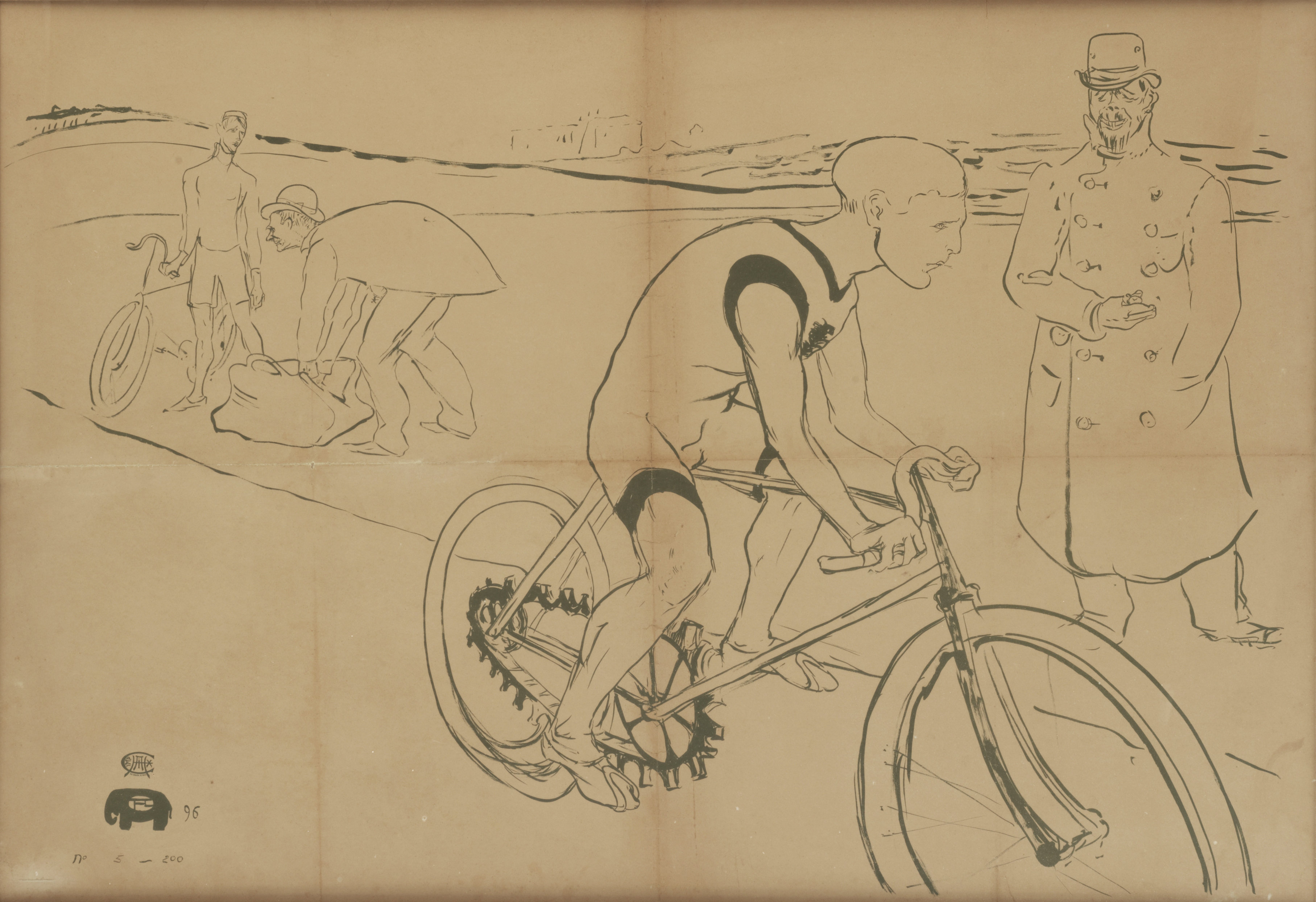
27. Henri de Toulouse-Lautrec – Cycle Michael, 1896.
27. The poster Cycle Michael is a lithograph in 1 color (olive green). Bicycling had developed into a cult sport in France by the 1890’s. Lautrec’s interest in the new sport led to this poster commission of British cyclist Jimmy Michael with his trainer (left background) and a sports writer with a hand in his coat pocket. The bicycle company rejected Lautrec’s design in part because the depiction of its mechanics was inaccurate which left the artist to print a limited edition for collectors at his own expense.
28. Henri de Toulouse-Lautrec – La Chaine Simpson, 1896
28. The poster La Chaîne Simpson is a lithograph in 3 colors (red, yellow and blue). The lettering is not designed by Lautrec. This is Lautrec’s second poster for the new sport of bicycling which had become immensely popular in France in the 1890’s. It depicts popular rider Constant Huret (left) and, in the background wearing hats, two British and French bicycle and chain manufacturers. Lautrec was fascinated with the cycling sport and its imagery appears in other of his artwork.
29. Henri de Toulouse-Lautrec – The Ault & Wiborg Co, 1896.
29. The poster The Ault & Wiborg Co is a zincograph in 4 colors (brown, red, yellow and black). The lettering is not designed by Lautrec. The smallest of Lautrec’s posters, it was commissioned by an American ink manufacturer whose sitters are not precisely identified. Before it became a poster advertisement, Lautrec had an edition of it printed which he titled Au Concert.
30. Henri de Toulouse-Lautrec – Henri de Toulouse-Lautrec – Jane Avril, 1899.
30. The poster Jane Avril is a zincograph in 4 colors (black, red, yellow and blue). After six years of intense poster production, Lautrec temporarily left its practice in 1897 and 1898. When he returned to it in 1899 he found that technology had advanced to make the printing technique for his artwork more efficient. This poster was commissioned by Jane Avril but never publicly displayed. Lautrec looked to capture her dancing style and graceful and wistful figure which the artist admired. The serpentine-themed dress Jane Avril wears was a popular motif in the Art Nouveau.
31. Henri de Toulouse-Lautrec – La Gitane, 1899-1900.
31. The poster La Gitane is a lithograph in 5 colors (black, grey, red, brown and blue). The lettering is designed by Lautrec. Lautrec’s last poster was produced for a Carmen-like play that opened in January 1900 at the Théâtre Antoine in the tenth arrondissment. The play was unpopular, the poster never published, and Lautrec’s modern art poster career had come to an end.
Select Bibliography: Ash, Russell, Toulouse-Lautrec:The Complete Posters, Pavilion Books Limited, London, 1991. Beauroy, Jacques, Bertrand, Marc, Gargan, Edward T., editors, The Wolf and the Lamb: Popular Culture in France, From the Old Régime to the Twentieth Century, Anma Libri, Saratoga, CA, 1977. Cate, Phillip Dennis, The Color Revolution: Color Lithography in France, 1890-1900, Peregrine Smith, Inc., Santa Barbara and Salt Lake City, 1978. Cate, Phillip Dennis and Shaw, Mary, editors, The Spirit of Montmartre: Cabarets, Humor, and the Avant-Garde, 1875-1905, Jane Voorhees Zimmerli Art Museum, Rutgers, New Brunswick, New Jersey, 1996. Denvir, Bernard, Toulouse-Lautrec, Thames and Hudson, London, 1991. Gluck, Mary, Popular Bohemia: Modernism and Urban Culture in Nineteenth-Century Paris, Harvard University Press, Cambridge, MA, 2005. Foxwell, Chelsea, Leonard, Anne, et.al. Awash in Color: French and Japanese Prints, Smart Museum of Art, University of Chicago, 2012. Oberthur, Mariel, Cafés and Cabarets of Montmartre, Peregrine Smith Books, Salt Lake City, 1984. Rearick, Charles, Pleasures of the Belle Époque: Entertainment & Festivity in Turn-Of-The-Century France, Yale University Press, New Haven and London, 1985. Seigel, Jerrold, Bohemian Paris: Culture, Politics, and the Boundaries of Bourgeois Life, 1830-1930, Penguin Books, New York, 1986. Thory-Frèches, Claire, Roquebert, Anne, Thomson, Richard, Toulouse-Lautrec, South Bank Center, 1991. Weisberg, Gabriel P., Montmartre and the Making of Mass Culture, Rutgers University Press, News Brunswick, New Jersey and London. 2001.
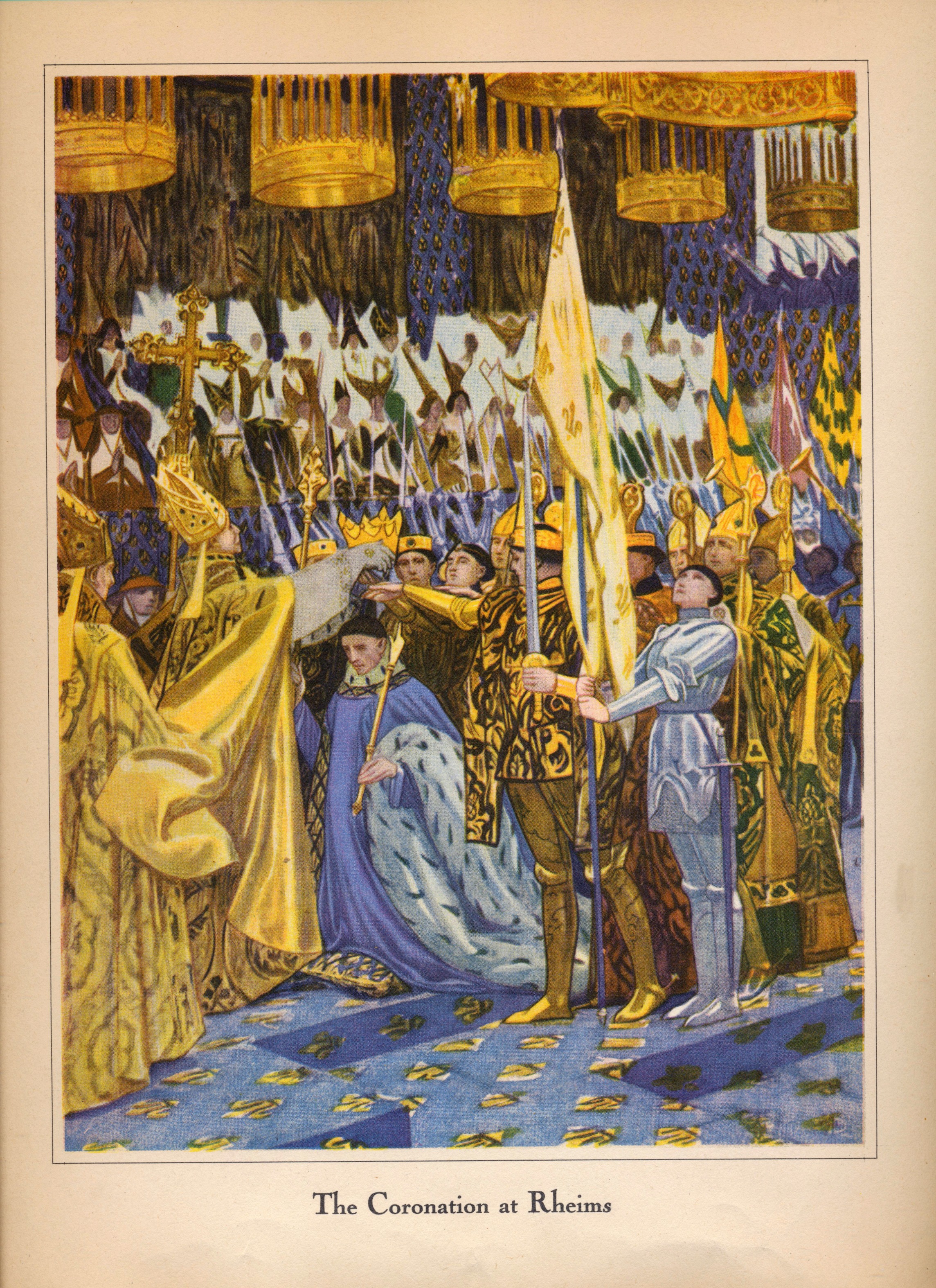
FEATURE image: King’s Coronation at Reims Cathedral. France was divided in the early 15th century when a teenage girl called Joan of Arc heard her Voices with their explicit instruction for her to go to the French royal court to aid France as a warrior-maid. For a young girl to dress and act as a military figure was shocking and unsettling to many who up to now had simply taken one side or another in the situation of France’s national divide.
JOAN OF ARC (French, 1412-1431) is one of the best documented and most popular of late medieval saints. The story of Jeanne La Pucelle, as she is known in France, has been beautifully depicted by artists and writers for centuries—as well as in films.
In France many of the places and sites associated with “the Maid” of 600 years ago are intact and can be visited today. Visiting the same buildings and places where Joan was in the late Middle Ages provides a concrete connection to and sense of her world.
There are stacks of academic and popular nonfiction as well as historical fiction about Joan. The fascination with her story started in her own century with her trial’s transcripts. Modern authors have also devoted their books and tomes to her, such as Mark Twain (Personal Recollections of Joan of Arc, 1896), George Bernard Shaw (Saint Joan, 1923), and Vita Sackville-West (Saint Joan of Arc, 1936) as well as, in our times, Helen Castor (Joan of Arc: A History, 2016), Kathryn Harrison (Joan of Arc: A Life Transfigured, 2014) and Kimberly Cutter (The Maid: A Novel of Joan of Arc, 2011). There are many, many more actually. Each and every year there are new scholarly tracts and other nonfiction to add to the long list of books and articles. Within this immense educational and informational field, there are several ways to approach the subject of France’s warrior-maid, Joan of Arc – and the combination of art and literature is one of them.
One approach is the artwork of Octave Denis Victor Guillonnet (1872-1967), a popular French illustrator.
Anyone interested in Joan of Arc first meets her when she is a humble peasant girl in the small village of Domrémy in eastern France.
Before Joan is a teenager, and for the rest of her life, Joan hears and is called by the heavenly voices of Saints Michael, Margaret, and Catherine of Alexandria.
Their explicit instruction is for the teenage girl to aid France as a warrior-maid.
Joan’s spiritual and military involvement started at a critical juncture in the king of France’s involvement in the Hundred Years’ War. The king of France was fighting against competing powers of England and Burgundy for control of France.
Joan’s military mission began in 1429 at 17 years old. Following fast and spectacular military successes, Joan led the dauphin to Reims Cathedral to be crownedas Charles VII (1401-1461), King of France, in 1429.
Joan’s military role ended abruptly with Joan’s capture on the battlefield.
Joan was held in prison for a ransom that her King never paid. There were attempts to rescue her but they failed.
Joan’s enemies put her on trial as a heretic. The result was that the Maid was infamously burned at the stake in Rouen, France, on May 30, 1431. Her condemnation by local Church officials sympathetic to England was overturned in 1456 by higher Church authorities which set justice aright in Joan’s case.
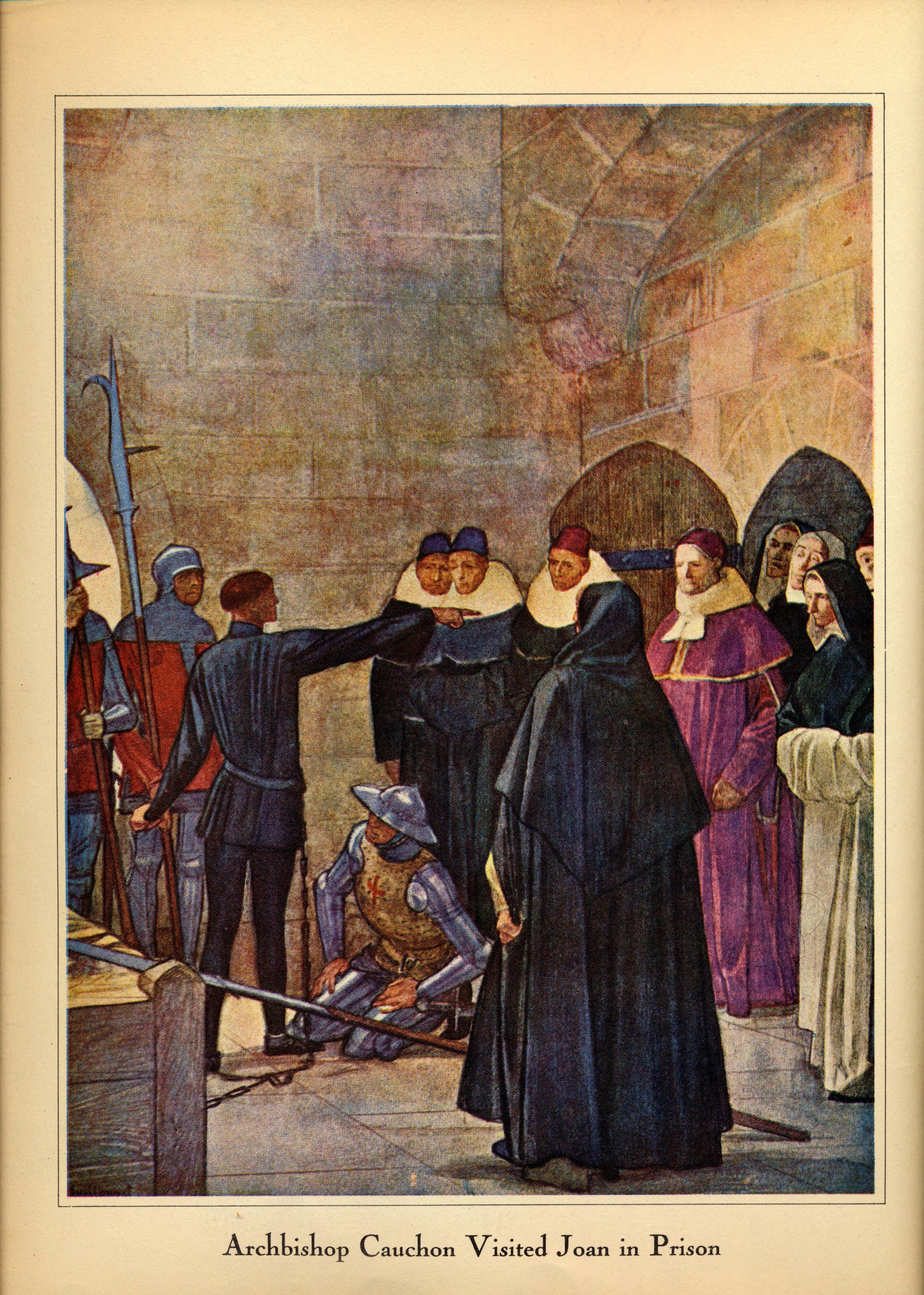
Joan of Arc was condemned as a heretic by 37 judges sympathetic to her enemies in England. The next day, May 30, 1431, the 19-year-old French visionary and soldier was burned at the stake in the market place of Rouen, France. Illustrations by French artist, Octave Denis Victor Guillonnet (1872-1967), are in the Public Domain.
In May 1920, Joan was consecrated as a Catholic saint. There are miracles attributed to the Maid’s intercession.
Joan was 19 years old when she died. Her brief and successful military and political career—as well as her unshakable belief under incredible duress that she was on God’s errand — put France on the path to sovereignty and earned Joan of Arc a place as a co-patron of France today.
GLOSSARY by John P. Walsh.
Versailles – The Palace of Versailles (French: Château de Versailles), or simply Versailles is a royal castle in Versailles, west of Paris in the Île-de-France region that includes Paris and its environs. The Château is open today as a museum and is a very popular tourist attraction. For more visit: http://en.chateauversailles.fr/
Joan of Arc – Joan of Arc (French: Jeanne d’Arc) was born January 6, 1412 and died by execution (burned at the stake) in Rouen, France, on May 30, 1431. Nicknamed “The Maid of Orléans” (French: La Pucelle d’Orléans) Joan of Arc is considered a heroine of France for her role during the The Hundred Years War and is a canonized Roman Catholic saint. She is one of several patrons of France today.
Domremy – (French: Domrémy, today Domrémy-la-Pucelle in reference to Joan of Arc.) Domremy is a small commune in the Vosges department in Grand Est in northeastern France. It is the birthplace of Joan of Arc. In 1429 Domrémy (and neighboring Greux) was exempted from taxes “forever” by King Charles VII which was the sole request made of the king by Joan of Arc when Charles asked her how he could show her his appreciation for seeing him made king. Taxes were imposed again upon Domrémy and Greux during the French Revolution and the people have had to pay taxes again ever since.
Meuse – (French: la Meuse.) The Meuse is a major European river, originating in France and flowing through Belgium and the Netherlands and draining into the North Sea. It has a total length of 925 km (575 miles).
Rivulet of Three-Fountains – (French: Le ruisseau des Trois Fontaines.) In Jeanne’s time, the village of Domremy was divided by the Creek of Three Fountains, so named because of three sources that fed it. To the south of it (right bank) is the Barrois and to the north of it (left bank) is Champagne. The stream also separates Domremy and Greux. Champagne was part of the royal domain, and when Joan left her home to aid the “Dauphin” Charles at Chinon or went to Nancy to visit the Duke of Lorraine, she had to seek safe conduct.
The Duchy of Lorraine – (French: Lorraine) was a duchy or dukedom that today is included in the larger region of Lorraine in northeastern France. Its capital was Nancy.
Province of Chaumont – Chaumont is a small commune of France which historically was the seat of the Counts of Champagne.
Jacques d’Arc – also Jacquot d’Arc. (b. 1375/80-d. 1431). Father of the Maid, he was born about 1375 at Ceffonds, in the diocese of Troyes, according to the Traité sommaire of Charles du Lys published in 1612. It was about the time of his marriage that he established himself at Domrémy, for his wife Isabelle Romée was from Vouthon, a village about seven kilometers away. He seems to have enjoyed an honorable position in this countryside, whether he was rich, as some have implied, or not. In 1419 he was the purchaser of the Chateau de I’Ile, with its appurtenances, put up at auction that year. In a document of 1423 he is described as doyen or sergeant of the village. He therefore took rank between the mayor and the provost, and was in charge of collecting taxes, and exercised functions similar to those of the garde Champêtre which is a combination of forest ranger, game warden, and policeman in certain rural communes in France. The same year finds him among the seven notables who responded for the village in the matter of tribute imposed by the damoiseau of Commercy. In 1427 in an important trial held before Robert de Baudricourt, captain of Vaucouleurs, he was again acting as a delegate of his fellow citizens. We know that he opposed with all his power the mission of his daughter, whom he wished to marry off. However, he went to Reims for the coronation of the King, and the King and the municipality defrayed his expenses and gave him a horse for his return to Domrémy. He was ennobled in December, 1429. Jacques d’Arc died 1431, it is said, from sorrowing over his daughter’s end.
Castle of the Island – In front of Domremy, and connected by a bridge, the Castle of the Island was the possession of the Bourlemont family, the lords of Domremy. It was rented by the inhabitants in the time of Joan and served, at times, as a refuge for their cattle.
Brothers Jacques, Jean, and Pierre, and sister, Catherine – Jacquemin d’Arc (b. 1402 d. 1450). There is very little known about Jacquemin, other than he was born 1402 in Vaudeville-le-Haut, and died in 1450. He was married to Catherine Corviset who was born in 1405 and died in 1430. They were married at Domremy.
Jean d’Arc (b. 1409 d. 1447) fled with his sister Joan to Neufchâteau; accompanied her to France; and was lodged at the house of Jacques Boucher at Orléans. With his father, he was ennobled in December 1429. As provost of Vaucouleurs he worked for the rehabilitation of his sister; appeared at bodies in Rouen and Paris; and formed a commission to get evidence from their native district and produce witnesses. He was Bailly of Vermandois and captain of Chartres.
Pierre d’Arc (b. 1408 d. ?) went to seek his sister in France; fought along with her at Orléans; lived in the same house with her in that city; accompanied her to Reims; and was ennobled with the rest of the family. He was captured with Jeanne at Compiègne, but was eventually released. Pierre retired to the city of Orléans where he received many gifts – from the King, the city of Orléans, and a pension from Duke Charles, among them the Île aux Boeufs in 1443. The descendants of Pierre had in their possession three of Jeanne’s letters and a sword that she had worn. The letters were saved but the sword was lost during the the French Revolution.
Catherine d’Arc (b. 1413 d. 1429). There is very little known about Catherine, other than she married Colin, the son of Greux’s mayor, and died very young in childbirth near the end of 1429.
Isabella Romée – Isabelle Romée (b. 1385 d. Dec. 8, 1458), known as Isabelle de Vouthon. Isabelle d’Arc and Ysabeau Romée, was the mother of Jeanne. She moved to Orléans in 1440 and received a pension from the city. She petitioned Pope Nicholas V to reopen the court case that had convicted Jeanne of heresy, and then, in her seventies, addressed the assembly delegation from the Holy See in Paris. On July 7, 1456 the appeals court overturned the conviction of Jeanne. Isabelle gave her daughter an upbringing in the Catholic religion and taught her the craft of spinning wool.
BIBLIOGRAPHY
The First Biography of Joan of Arc, with the Chronicle Record of a Contemporary Account. Translated and Annotated by Rankin, Daniel S., Quintal, Claire. [Pittsburgh] University of Pittsburgh Press [1964].
Joan of Arc by Herself and her Witnesses.Pernoud, Régine. Lanham, MD : Scarborough House, [1994]. Translation of: Jeanne d’Arc par elle-même et par ses témoins.
Joan of Arc: Her Story. Pernoud, Régine. New York: St. Martin’s Press, 1998. Translation of: Jeanne d’Arc.
Joan of Arc. Lucie-Smith, Edward,New York: Norton, 1977.
Joan of Arc. Twain, Mark, New York, Harper and Brothers [c.1924].
Joan of Arc. Boutet de Monvel, Louis Maurice (1850-1913), New York: Pierpont Morgan Library: Viking Press, 1980.
Joan of Arc : A Life Transfigured. Harrison, Kathryn, New York: Doubleday, 2014.
Joan of Arc : A History. Castor, Helen, New York, NY: HarperCollinsPublishers, [2015].
The Beautiful Story of Joan of Arc The Martyr Maid of France, Lowe, Viola Ruth, illustrations by O.D.V. Guillonnet, 1923, multiple U.S. editions.
The Saints: A Concise Biographical Dictionary, edited by John Coulson, Guild Press, New York, 1957, pp. 577; 399-402.
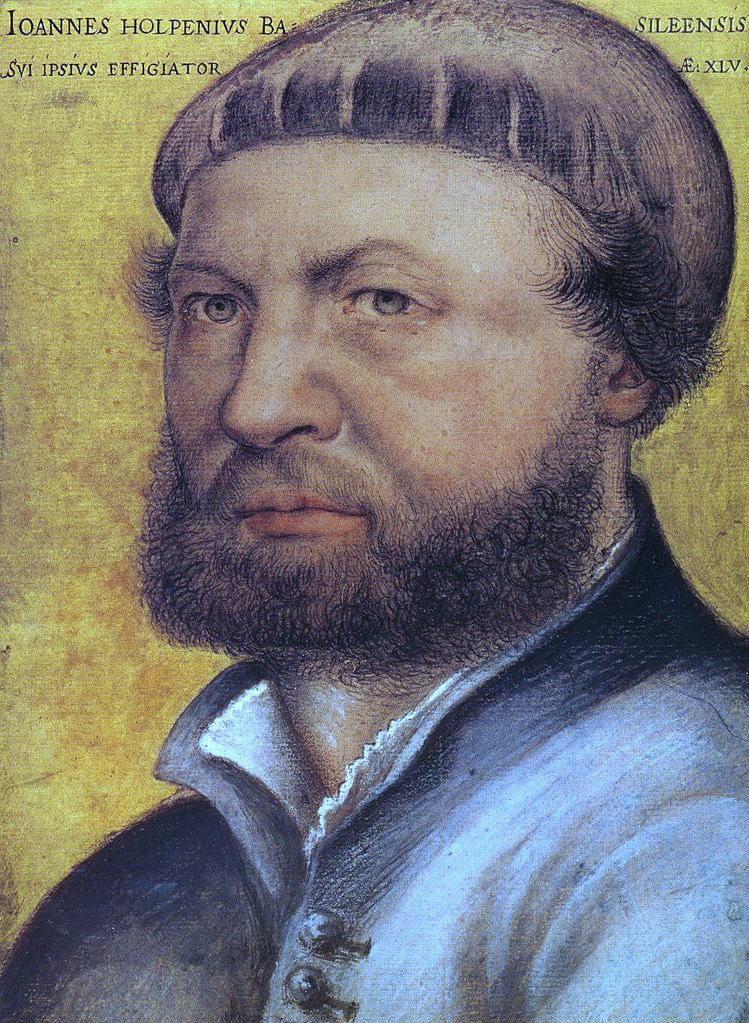
Featured Image: Self-Portrait, Hans Holbein the Younger, 1542/3, black and colored chalks, 23 x 18 cm, Florence, Galleria degli Uffizi. This is the only confirmed self portrait by Holbein.
Self-portrait Hans Holbein The Younger, Oil on paper, mounted on oak, 16.5 x 14 cm, inscribed on the left and right of the head: H H; on the left above the shoulder: AN [N] O. 1554 / ETATIS SVE/45, Kunstmuseum Basel, donated by Prof. J.J. Bachofen-Burckhardt Foundation in 2015. While Lüdin was probably working from a graphic reproduction, the unknown painter of this picture, if not Holbein’s own drawing, surely had one of the copies made shortly after his death in the narrow workshop environment. This is one more Hans Holbein self-portrait based on the secure Florentine drawing.
Self-Portrait Hans Holbein, copy by Johannes Lüdin, c. 1647-1667, Oil on canvas, 61.5 x 47.5 cm, Kunstmuseum Basel. In fall 1526 twenty-nine-year-old Hans Holbein crossed the channel from Antwerp to England where the German immigrant’s first concerns were to find work, useful friends, and a place to stay. While Lüdin’s painting was given as a gift to a major art collector in Basel and probably based on a graphic model whose type proliferated after 1600, it is the drawing in the Uffizi (see Featured Image) that remains the only secure self-portrait image according to current Holbein scholarship.
Introduction by John P. Walsh
Hans Holbein the Younger was born in Augsburg, Germany, in 1497. After 1515, he lived and trained in Basel, Switzerland. Over two visits, one starting in 1526 and another in 1532, Holbein spent a total of thirteen years in Henry VIII’s England until the artist’s death in 1543. The focus for this post is Holbein’s first visit to England which lasted two years – specifically, from around September 1526 to mid-August 1528. His second, more permanent, visit to England started in 1532 (Holbein likely arrived in the spring) and lasting to his death, almost certainly from plague, in late 1543. It was during that second, longer visit in England that Holbein became the most important court artist in the time of Henry VIII. His first visit is characterized by the activity of a young immigrant German artist – Holbein was about 29 years in 1526 – getting established in a foreign land and developing a mastery of his craft.
Holbein arrived in England in late 1526 with a letter of introduction from Dutch humanist Desiderius Erasmus (1466-1536) addressed to Sir Thomas More (1478-1535). This was not the first time Erasmus wrote to More asking him to temporarily lodge a friend.1 More would be appointed Lord Chancellor in 1529, but in 1526 Sir Thomas was the Speaker of the House of Commons and Chancellor of the Duchy of Lancaster. By 1526, Erasmus and More had been friends for more than a quarter century. They met during Erasmus’s first high-spirited stay in England in summer 1499. In that year, Erasmus was 33 years old and More twelve years his junior. Other major protagonists in this story – namely, Hans Holbein the Younger and the future King Henry VIII – were just children in 1499.2 While Erasmus began writing seriously on theological topics during his first English stay he also reveled in the gentle and happy personality of More. Part of More’s reception to Holbein in 1526 by way of Erasmus’s request may go back to the two old friends’ first meeting in England in 1499. After Erasmus had been encouraged by More to bring his money into England which More assured the relatively poor scholar would be safe, most of it was confiscated by English customs at Erasmus’ departure. This unpleasant shock not only left Erasmus with keen anger towards England for months afterwards—he never, however, blamed More (and one other English friend) for the misinformation—but left him lacking for money in Paris and elsewhere for several years thereafter.3 Similar to Holbein’s effort in 1526, Erasmus returned to England in 1505 to improve his fortunes by staying with his new friends, including Thomas More, and working to establish a network of influential English contacts. Erasmus emigrated in large part to access various English scholars as well as to counteract friends in the Netherlands who were mostly ignoring his work. It was by way of a new English contact that Erasmus in June 1506 ventured to Italy where he stayed for three years.4 Back in England on his third visit in 1509, Erasmus wrote his Praise of Folly, probably his most enduringly famous work, while living in the house of Thomas More. But writing and lecturing (at Cambridge) brought Erasmus little profit.5 It was only when the Archbishop of Canterbury, another English friend, gave him a stipend in 1512 that Erasmus was relieved of practical destitution. But the favored scholar would remain chronically in need of money and wrote more books to help fill the need. A scholar’s life in cold Britain, however, following three years in Italy’s southern climes, proved tiresome for Erasmus. He found his many months of writing and teaching at Cambridge to be like “a snail’s life, staying at home and plodding.”6 Erasmus was lonely; the plague was frequently about; and, for whatever his labors, he was making literally no money. Further, a state of war between England and France commenced in June 1513 which alarmed and depressed Erasmus, prompting him to publish his first anti-war writings and resolved to leave the island as soon as he could. He sailed for Antwerp in the summer of 1514.7
In 1526 when Erasmus wrote to More asking him to welcome German artist Han Holbein the Younger, both old friends had achieved literary fame in Europe. Thomas More’s Utopia appeared in Latin in 1516, edited by Erasmus and published in Louvain. During the first years of the Reformation, Erasmus remained More’s link to the Continent as they continued their amiable correspondence following Erasmus’ settling in Basel, Switzerland, in 1521. That city would be Erasmus’s dwelling place for the next eight years. Erasmus relied on More’s friendship in the 1520’s as the disputes of the Reformation intensified.8 In 1523 when Hans Holbein the Younger painted two portraits of Erasmus, the young German artist and the older Dutch humanist had been acquainted for some years. Before Holbein joined the workshop of Hans Herbst (c. 1470-1552) in 1516 or had been taken into the Basel painters’ guild in 1519, the teenage Holbein provided a pen and ink drawing for the Basel edition of Erasmus’s Praise of Folly in 1515 which apparently pleased the humanist. From 1519 to 1526 before his first visit to England, Holbein, now in his 20’s, was a whirlwind of artistic activity in Basel. His expressive drawings and paintings were a leading feature, but he demonstrated talent and skill in the many topical arts of his time, including printmaking, metal engraving, frescoes, and altarpieces.9
By 1523 Holbein desired to focus his talent on portrait painting.10 Basel’s most famous resident of Basel was certainly Erasmus. Before his relocation to the Swiss city, the writer and theologian had been famously embroiled in controversies swirling around German reformer Martin Luther (1482-1546). Erasmus came to Basel from Louvain to escape these difficulties and live in relative tranquility.11 In 1523 in Basel Holbein painted three portraits of Erasmus of Rotterdam. One exists today in Basel (in the Öffentliche Kunstsammlung), in Paris (Louvre) and in London (on loan from the Longford Castle collection to the National Gallery). The Reformation was, for the foreseeable future, taking its toll in terms of the visual and plastic arts. Erasmus described to More the state of the arts on the Continent, citing Basel in particular: “Here the arts freeze.”12
Historian David Starkey has called Holbein’s three-quarter profile portrait of Erasmus which was sent to the Archbishop of Canterbury William Warham (c.1450-1532) as a gift in 1524 as “the most important portrait in England”13 Starkey claims the painting is the beginning of portraiture itself when so-called “realism” was introduced into art. By way of Erasmus’s portrait to Warham, Thomas More learned of Holbein’s artwork up to two years prior to the young artist’s arrival in England. It is probable that like Erasmus before him, Holbein lodged in More’s house during his first English visit. Such accommodation provided practical hospitality to a friend’s friend on many levels including the fact that immigrant artists in England were disallowed from dwelling within the city gates of London (More’s house was in nearby Chelsea). Further, More, as a rising political figure in England, became Holbein’s first patron and in that way could secure Holbein’s modern art portraiture for himself. Indeed, the major work of Holbein’s first stay in England between 1526 and 1528 is the portrait of the household of Thomas More as well as the famous portrait of Sir Thomas painted around the same time. In this first two-year period in England Holbein also set to work on a variety of artistic projects, but the portraits highlighted the stay.
Like his famed classicist sponsor Erasmus before him, Holbein came to England to improve his fortunes as an artist. Holbein had visited France in 1524 with the hope for a royal commission but was ignored.14 While English guild artists required Holbein’s exclusion from London proper, the time restriction on his stay was owed to the city of Basel. At the cost of losing his citizenship, Holbein was allowed no more than two-year’s absence from the Swiss city. On August 29, 1528, Holbein returned to Basel.15 This marked the end of Holbein’s first visit to England, but not before he had developed many new influential contacts and established his mastery of craft within the orbit of one of Europe’s most dynamic royal courts. Little more than three years later, in spring 1532, with his old friend Thomas More in the last throes of service as Lord Chancellor (More would almost immediately resign that year as dangerous political storms grew), Holbein returned to England. The Continent’s political and religious revolution was creeping across the channel for England’s own idiosyncratic reasons such that the English world Holbein visited in the 1520’s was rapidly declining. A revolutionary zeal was emerging, especially under Thomas Cromwell between 1535 and 1539, which would inspire new challenges for artistic accomplishment which Hans Holbein the Younger met and engaged throughout his second rewarding visit in England from 1532 to 1543.16
Hans Holbein the Younger: Portrait of Erasmus, 1523, oil on wood, 42 x 32 cm, Louvre, Paris.
One of Holbein’s study drawings of Erasmus’s hands for the profile portraits, silverpoint and chalks, 1523. Louvre.
Hans Holbein the Younger: Portrait of Erasmus, 1523, oil on wood, 73.6 x 51.4 cm, London, National Gallery. Erasmus gifted this portrait to the Archbishop of Canterbury in 1524. The humanist is shown in three-quarter profile wearing a fur collar overcoat seated behind a table with his hands on an inscribed book. Behind the classicist and theologian are painted symbolic elements of the sitter’s profession and achievements: a Renaissance pilaster, green curtain and shelf of books with glass bottle. David Starkey of the National Gallery called this portrait “arguably the most important portrait in England” where “portraiture actually begins.”
Hans Holbein the Younger: Portrait of Erasmus, 1523, paper mounted on wood, 36.8 x 30.5 cm, Öffentliche Kunstsammlung, Basel. Closely related to the Louvre portrait, it is lightly smaller but offers the same strict profile of the sitter. The profile derives from an ancient classical pose signifying political or intellectual power. In this painting Erasmus’s writing can be discerned: it is the opening of a commentary on the gospel of St. Mark dedicated to the king of France. (Wolf, p. 39)
Hans Holbein the Younger in England, 1526 to 1528.
Hans Holbein the Younger: Thomas More (1477-1535), 1527, oil on oak panel, 29.5 in x 23.7 in. (74.9 cm x 60.3 cm), Frick Collection, New York. More became Lord Chancellor in 1529 where thereafter the great humanist scholar, author, and statesman, who resigned in 1532, defied the Act of Supremacy of 1534 that made Henry VIII head of the Church in England and was beheaded on July 6, 1535 for high treason. The “S-S” chain of office More wears in Holbein’s painting is an emblem of service to the King. (Frick, p. 48) More’s execution, coming in quick succession to John Fisher’s two weeks earlier, grieved Erasmus in Basel. Later, Erasmus in a letter lamented More’s involvement in “that dangerous business” which should have been left to “the theologians,” and ignored More’s plea on behalf of his conscience. (Huizinga, p. 183).
Hans Holbein the Younger: Thomas More, 1526/1527, black and colored chalks, 9.8 x 29.9 cm sheet of paper, outlines pricked for transfer. The inscription is a later addition (18th century). Royal Collection Windsor.
Hans Holbein the Younger: Thomas More, black and colored chalks, and brown wash on paper, 37.6 x 25.5 cm. Royal Collection Windsor. More’s career included study at Oxford and becoming a lawyer. He became a MP in 1504, King’s Councillor in 1518, was knighted in 1521, and became Speaker of the House of Commons in 1523. More became Lord Chancellor of England in 1529, but practical politics proved outside More’s forte. He resigned the office in 1532 and was beheaded for high treason in 1535. Thomas More was Holbein’s first patron in England, the German artist to enjoy a happier fate as the preeminent painter in the court of Henry VIII starting in the 1530’s. (Ganz, pp. 231-232)
Frick Collection, New York City. Holbein the Younger’s Thomas More (1527) and Thomas Cromwell (1533) with El Greco’s Saint Jerome (1610) above the fireplace.
Hans Holbein the Younger: Portrait of a Lady with a Squirrel and a Starling (Anne Lovell), 1528, oil on oak, 56 x 38.8 cm, National Gallery, London. Recent scholarship has produced interesting speculations as to the identity of this unknown woman who, in any case, was in Thomas More’s circle (Foister, p. 30; Ganz, p. 232).
Hans Holbein the Younger: Alice Middleton, Lady More, 1527, Corsham Court (private collection) near Bath, England, oil and tempera on oak, 14 1/2 x 10 5/8 in. This is a color study for the large family picture. The color chalk study is missing. Alice was Thomas More’s second wife.
Hans Holbein the Younger: Portrait of Thomas More with his family, 1527, pen and black ink on paper, Öffentliche Kunstsammlung, Basel. This is the preparatory drawing for a group portrait of the family of Sir Thomas More that was the major work of Holbein’s first period in England. The finished painting, whether on canvas or wood or a mural, is missing and was probably destroyed. It is the first nondevotional or ceremonial group portrait made north of the Alps (Ganz, p. 276). This is the household into which Holbein had taken up residence during his first visit to England. Thomas More lived outside London in a country house with his second wife Alice, his father John, his son John and bride to be Anne, three married daughters, eleven grandchildren and a live-in relative (Margaret Giggs). From left is Elizabeth Dauncy, More’s second daughter; Margaret Giggs; More’s father; Thomas More’s future daughter-in-law, Anne Cresacre; Sir Thomas More; More’s son; court entertainer Henry Patenson; More’s youngest daughter, Cecily Heron; eldest daughter, Margaret Roper; and More’s second wife, Alice. The Latin inscriptions in brown ink of the sitters’ names and ages were added by astronomer-in-residence Nikolaus Kratzer (whose portrait was painted by Holbein).
Holbein’s preparatory drawing of Elizabeth Dauncey, middle daughter of Thomas More. In 1525 she married Sir William Dauncey who served Henry VIII and was a member of parliament. This drawing’s later inscription (not by Nikolaus Kratzer) is inaccurate in its identification. (see – https://www.royalcollection.org.uk/collection/400046/sir-henry-guildford-1489-1532)
Margaret Giggs Clement was Thomas More’s foster daughter. In 1526 she married John Clement, a court physician. Margaret eventually had eleven children and died in exile in the Netherlands in 1570. While the extant More family group drawing by Holbein shows Margaret leaning towards John More, this drawing may actually have served as the now-lost or destroyed painting’s final study. The exact meaning of the inscription “Mother Iak” is unknown. Royal Collection, Windsor.
Hans Holbein the Younger: Anne Cresacre (c.1511-1577), for the More family portrait. Royal Collection, Windsor.
Hans Holbein the Younger: Cecily Heron (b, 1506 or 1507), youngest daughter of Sir Thomas More. She was married to Giles Heron, a Member of Parliament who was hanged for treason in 1540. Royal Collection, Windsor.
Hans Holbein the Younger: Sir John More (c.1451 – 1530), black and colored chalks, 35.1 x 27.3 cm. Thomas More’s father was a respected judge and described by a biographer as “very virtuous” and “merry.” Royal Collection, Windsor.
(Below) Hans Holbein the Younger: John More, black and colored chalks, 38.1 x 28.1 cm. Thomas More’s son. Royal Collection, Windsor.
Hans Holbein the Younger: Sir Henry Guildford (1478-1532), Controller of the Royal Household, inscribed and dated, 1527, oil and tempera on wood, 32 1/8 x 26 in. (82.6 x 66.4 cm), Royal Collection, Windsor. Wearing the collar of the garter for his military service – which was the occasion for the portrait – Guildford, a physical giant of a man, holds the wand of office as Comptroller of the King’s Household. Sir Henry stands against a deep blue background, decorated with the twisting vine found in several Holbein portraits. Above the sitter’s head is a curtain rail, from which hangs a rich green curtain. This detail has lost context in the separation of the portrait from its companion, that of Guildford’s wife Mary.
Sir Henry Guildford, Black and colored chalks, and pen and ink on paper, 38.3 x 29.4 cm. The drawing is a study for the painted portrait. Sir Henry was one of Henry VIII’s closest friends and an early patron of Holbein.
Hans Holbein the Younger: Mary Wotton, Lady Guildford, inscribed and dated, 1527, tempera and oil on oak, 34 1/4 x 27 13/16 in.( 87 × 70.6 cm), St. Louis Art Museum. Mary was Sir Henry Guildford’s second wife. They married in 1525. She holds a devotional book.
Mary Wotton, Lady Guildford, 1527, black and colored chalk on paper, 55.2 x 38.5 cm, Kunstmuseum Basel, Kupferstichkabinett. A study from life for the painted portrait. In the portrait Holbein muted the sitter’s overall playful expression and smile. Mary outlived Sir Henry to marry again.
Hans Holbein the Younger: William Warham (1456-1532), Archbishop of Canterbury (first version), 1527, Oil and tempera on wood, 30 in x 25.75 in., Lambeth Palace, London.
Hans Holbein the Younger: William Warham, Archbishop of Canterbury (second version), 1527, Tempera on wood, 32.3 in x 26.4 in. (82 cm x 67 cm), Musée du Louvre, Paris. Both versions include the episcopal crucifix of gold and jewels with Warham’s coat-of-arms and his motto, prayer books and the Archbishop’s jeweled miter. Warham had this “original replica” painted to reciprocate for a portrait of Erasmus he received. The color is richer in the replica. The brown curtain is replaced with a green one. A later copy of this painting resides in the National Portrait Gallery in London.
Hans Holbein the Younger: William Warham, Archbishop of Canterbury, 1527. Colored chalk on paper, 40.1 x 31 cm, The Royal Collection, Windsor. This is the preparatory drawing for the Louvre portrait. The sitter had been in his position since 1504 and remained there until his death in 1532. The similarities between the Holbein portrait of Erasmus (1523) and that of Warham (1527) are striking for their compositional elements and the conveyance of each sitter’s function by way of iconographical symbols so that these forms are a portrait template.
Hans Holbein the Younger, Portrait of Nikolaus Kratzer (1487-1550), 1528, Tempera on oak, 83 x 67 cm, Musée du Louvre, Paris. The sitter was born in Munich and studied in Cologne and Wittenberg. Appointed professor to Corpus Christi College in Oxford, Kratzer relocated to England. A humanist, he became friends with Thomas More and his family and, starting in 1519, served as astronomer to Henry VIII’s court. The painting, created during Holbein’s first stay in England, continues to exemplify Holbein’s lively style of illustrating a sitter’s career. Kratzer was a maker of mathematical and geometrical instruments and is shown in practical involvement with these tools. Compared with the Guildford portraits of the year before, Holbein expresses a new subtlety of lighting and refined range of tones.
Hans Holbein the Younger: Double Portrait of Sir Thomas Godsalve and His Son John, 1528, Resin tempera on oak, 35 x 36 cm, Gemäldegalerie, Dresden. Thomas Godsalve (1481-1542) was a notary from Norfolk. Holbein cleverly shows him writing his name and age on a sheet of paper. By 1528, the Godsalves were among London’s most wealthy and politically influential men. (Wolf, p. 51) His son John (1510-1556) later had a double portrait of himself and his wife painted by Holbein.
Hans Holbein the Younger: Sir Henry Wyatt of Allington Castle, c. 1528?, oil on oak, 15.4 × 12.2 in. (39 × 31 cm), Musée du Louvre, Paris. Sir Henry Wyatt served in the court of Henry VII and Henry VIII and a member of the latter’s Privy Council. Sir Henry was part of the circle of Thomas More. N.B. This portrait, once thought to have been painted during Holbein’s first visit to England from 1526 to 1528, is today believed to have been painted towards the end of Sir Henry’s life.
Hans Holbein the Younger: Sir Bryan Tuke, c. 1527/1528 or c. 1532/1534, oil on wood, 49 x 39 cm, National Gallery of Art, Washington, D.C. The sitter is about 57 years old. The date of the painting is unknown and its conjecture is based on its style although that leads to at least two possibilities. The physical mass of the body and the sitter’s expression suggest Holbein’s last year in England (mid 1528) although the painting’s other features (notably its horizontal lines of text) suggest the painting was made after Holbein’s return to London in 1532. There are further later additions after that. The subject, Bryan Tuke (1470-1545), was, starting in 1509, Clerk of the Signet and then Cardinal Wolsey’s secretary. By 1528 Sir Bryan was Treasurer of the Royal Household and secretary to the king for French affairs, a post he held until his death in 1545. There exist several versions of this portrait.
Hans Holbein the Younger: St. Thomas, 1527, Pen and black ink, brush and gray wash, heightened with white gouache, 8 1/16 x 4 1/8 in. (20.4 x 10.5 cm). Metropolitan Museum of Art, New York. Holbein produced a diversity of art in England, including design and decorative works (at Greenwich), book illuminations, and sacred art. St. Thomas is part of a series of apostles of which nine are known. The ultimate application of these drawings is not known and even may have reached their final form in these studies. (Foister, p. 128)
Hans Holbein the Younger: Noli Me Tangere, 1526-1528?, Oil on oak panel, 76.7 x 95.8 cm, Royal Collection Windsor. Holbein paints the gospel narrative of Mary Magdalen meeting Jesus Christ at his resurrection, with angels illuminating the tomb and night breaking for dawn. Between the major figures, a rushing Peter and John in the background are discussing matters. Royal Collection, Windsor.
Hans Holbein the Younger: Sir Nicholas Carew, 1527, black and colored chalk sheet: 54.8 x 38.5 cm, Kunstmuseum Basel, Kupferstichkabinett, Amerbach-Cabinet. Sir Nicholas was Henry VIII’s Master of the Horse until he was implicated in one of the various popular uprisings against the same king’s religious policies in the mid-1530’s, and summarily executed in 1539. (Foister, p.121)Hans Holbein the Younger: Portrait of an Unknown Englishman, 1527, black and colored chalk and leadpoint on prepared paper; outlines traced blind, 38.9 x 27.7 cm, Kunstmuseum Basel, Kupferstichkabinett.
Hans Holbein the Younger: Portrait of an Unknown Englishwoman, 1527, black and colored chalk and leadpoint on prepared paper; outlines traced blind, 38.9 x 27.7 cm, Kunstmuseum Basel, Kupferstichkabinett. These two drawings were prepared for transfer to panels for painting portraits, neither of which survive.
FOOTNOTES (Introduction).
Erasmus and the Age of Reformation, Johan Huizinga, Harper & Brothers, New York, reprint 1957, p. 223.
Huizinga, p. 29.
Huizinga, pp. 35-36.
Huizinga, p. 58.
Huizinga, pp. 79-81.
Huizinga, p. 83.
Huizinga, p. 85.
Huizinga, p. 87.
Hans Holbein The Younger: The German Raphael, Norbert Wolf, Taschen, Cologne, Germany, 2006, p. 28.
Holbein in England, Susan Foister, Tate Publishing, London, 2006, p. 13.
An Advanced History of Great Britain: From the Earliest Times To the Death of Edward VII, T.F. Tout, M.A., Longmans, Green, and Co, New York, London, Bombay and Calcutta, 1913, p.342.
SOURCES: An Advanced History of Great Britain: From the Earliest Times To the Death of Edward VII, T.F. Tout, M.A., Longmans, Green, and Co, New York, London, Bombay and Calcutta, 1913. Erasmus and the Age of Reformation, Johan Huizinga, Harper & Brothers, New York, reprint 1957. Five centuries of British painting: from Holbein to Hodgkin, Andrew Wilton, London: Thames & Hudson, 2001. Holbein in England, Susan Foister, Tate Publishing, London, 2006. Hans Holbein The Younger: The German Raphael, Norbert Wolf, Taschen, Cologne, Germany, 2006. The Frick Collection /A Tour, Edgar Munhall, et.al, The Frick Collection, New York, 1999. The Paintings of Hans Holbein: First Complete Edition, Paul Ganz, Phaidon, London, 1950.
Hans Holbein the Younger: ‘A man very excellent in taking of physionamies’ (sic) – Dr Susan Foister – https://www.youtube.com/watch?v=3UnbWlZnYv4 – retrieved February 26, 2018.


 FEATURE image: EXPO CHICAGO 2017, Festival Hall, Navy Pier.
 Admissions, Expo Chicago 2017.
 Lara Schnitger, Suffragette City, 2015-2017, Cotton, and linen, quilted and bleached, Anton Kern Gallery, New York. Expo Chicago 2017.
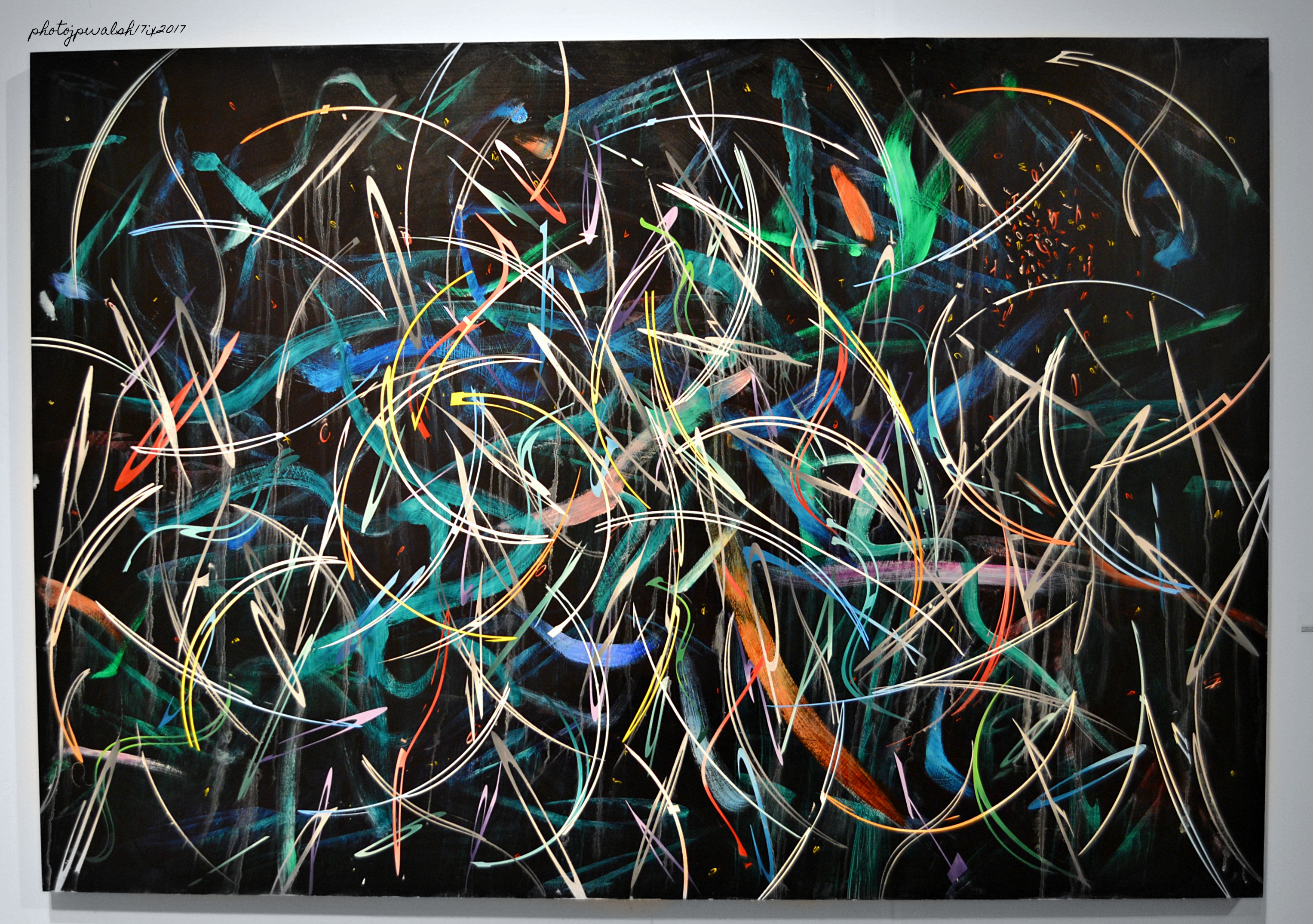
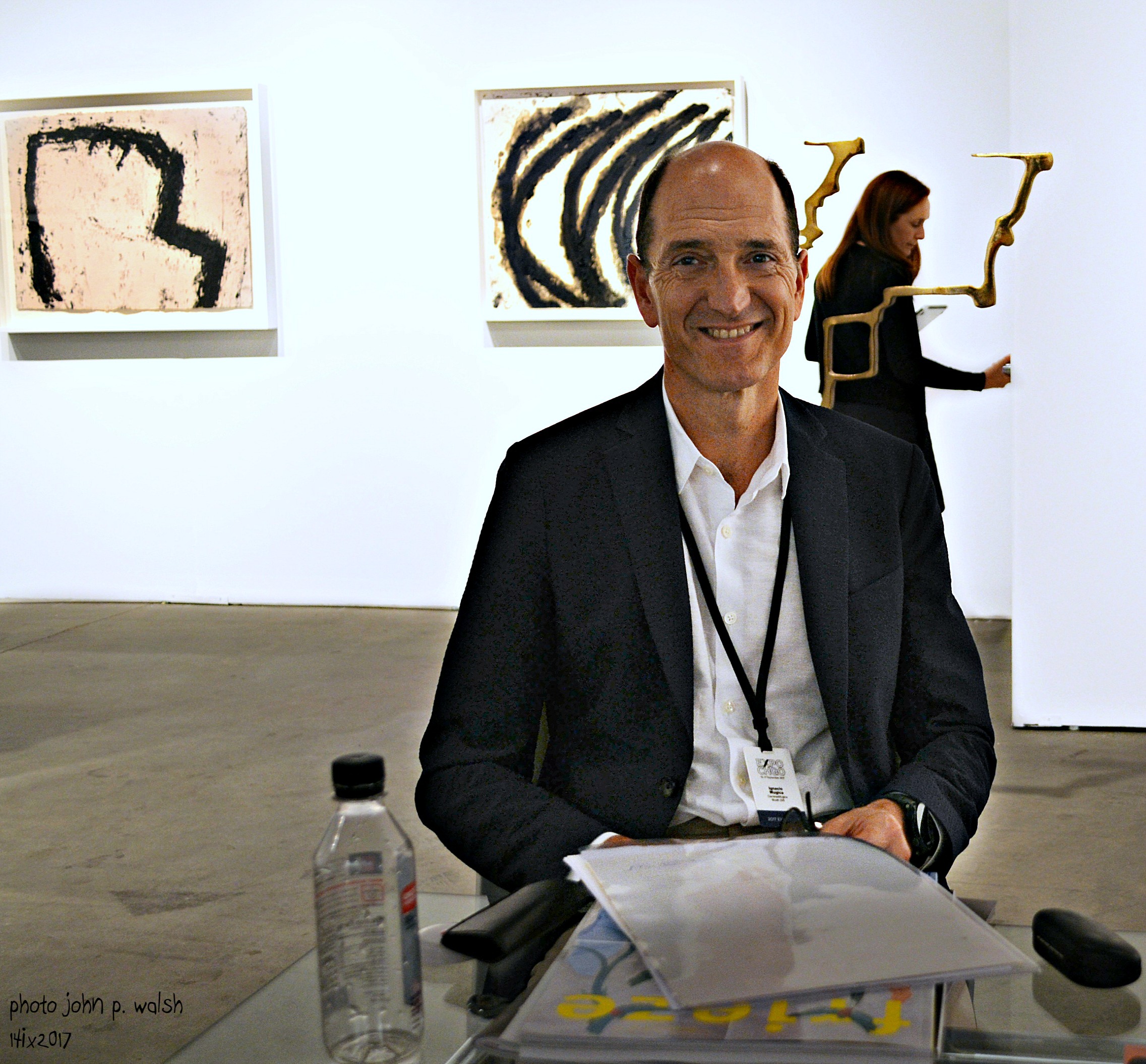
 Galerie Gmurzynska, Zurich, Switzerland, with booth design by Antonio Manfreda. Expo Chicago 2017. Germano Celant, theorist of the Arte Povera movement. From 2015 he was the artistic director of the Prada Foundation in Milan.
 Anton Kern Gallery, New York. Expo Chicago 2017.


 John A. Seal, König Galerie, Berlin. Expo Chicago 2017.
 Alfred Leslie, Oval Collage, 1959, Diana Moore, White Head, 1988 and Willem de Kooning, 1965, charcoal on paper, Alan Stone Projects, New York. Expo Chicago 2017.
 Thinks I, To Myself. Expo Chicago 2017.

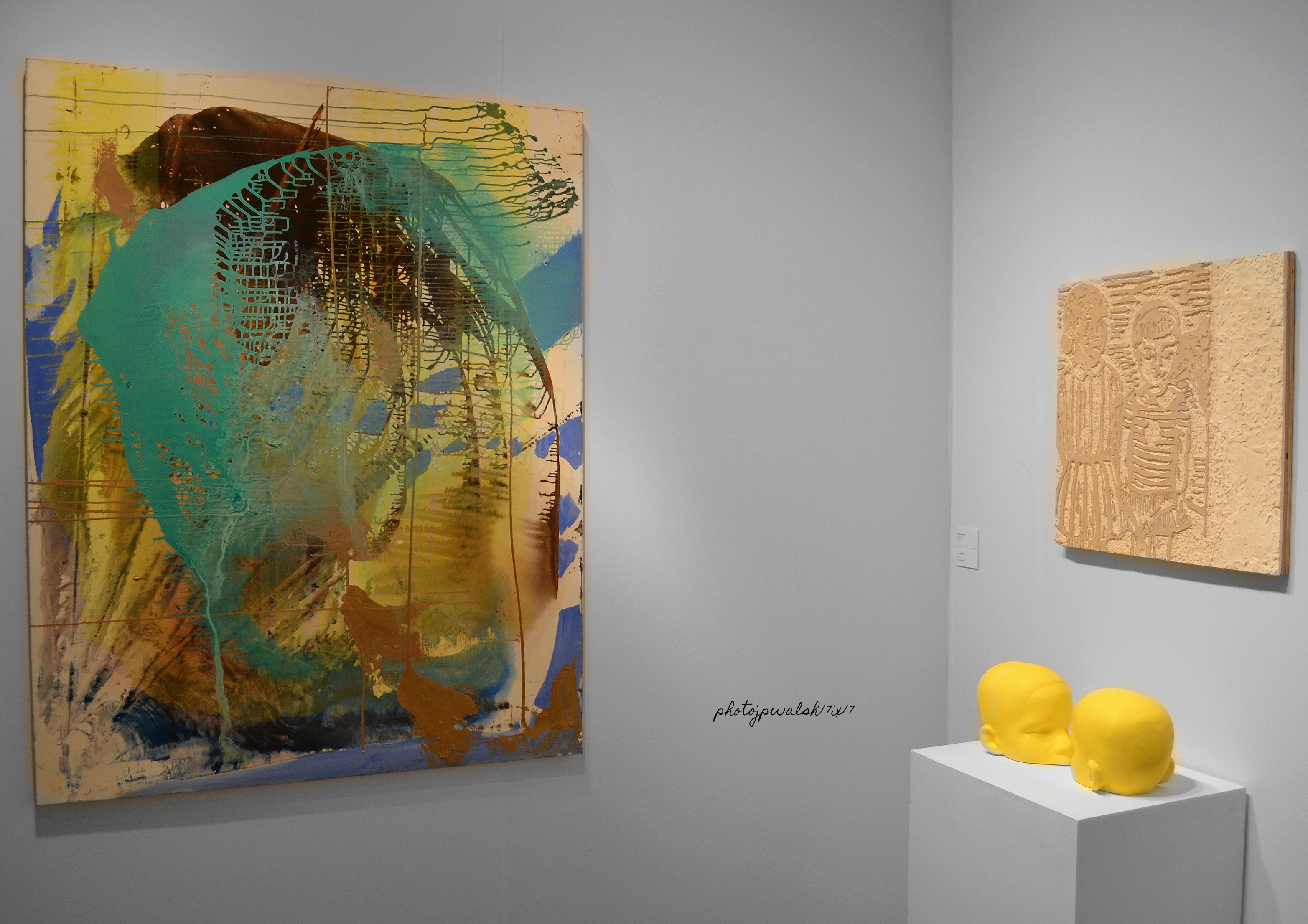 Jackie Saccoccio, Portrait (Bomba), 2017, and Faheem Majeed, Hopscotch I, 2011, and Pause, 2010, Rhona Hoffman Gallery Chicago. Expo Chicago 2017.


 Caroline Walker, Grimm Gallery Amsterdam New York. Expo Chicago 2017.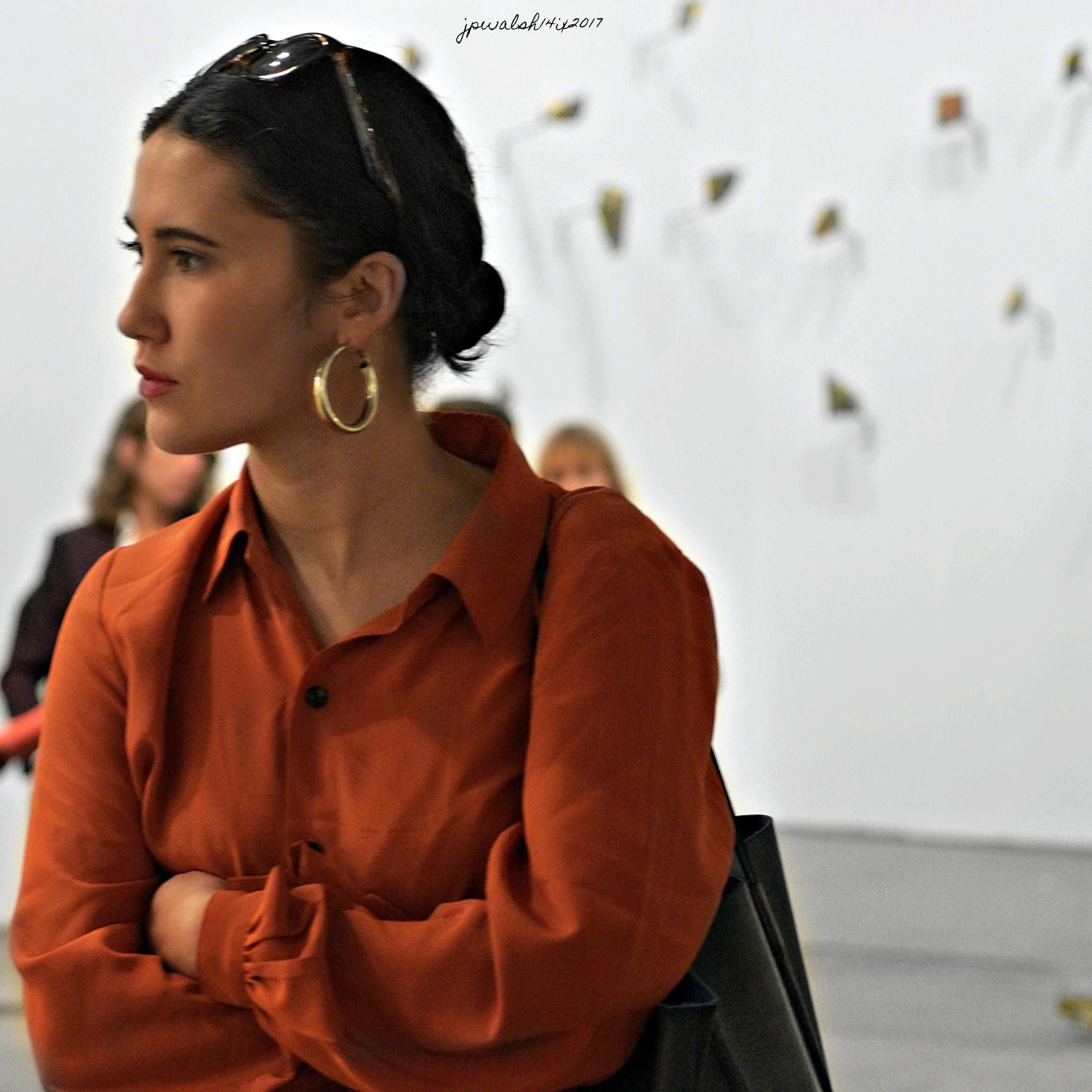

 Paul Kasmin Gallery New York. Expo Chicago 2017.
 Artist’s Signature (Miró). Expo Chicago 2017.