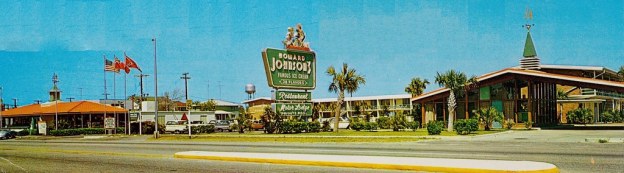
FEATURE Image: Howard Johnson’s Motor Lodge and Restaurant Myrtle Beach, SC. Howard Johnson’s reshaped the American roadside, turning a patchwork of unpredictable stops into a network of bright, dependable landmarks. Its orange roofs, neon signs, and motor lodges became part of the visual grammar of mid‑century travel, signaling consistency in an era when the open road beckoned for families. More than a brand, it became a kind of national shorthand — a promise that wherever you were headed, a familiar meal and a safe place to rest weren’t far away. PHOTO: “Howard Johnson’s Motor Lodge and Restaurant Myrtle Beach,SC” by romleys is licensed under CC BY-NC-SA 2.0.
By the 1950s, Howard Johnson’s had become the bright, orange roofed companion of the American highway. Aggressive franchising in the ’30s and ’40s grew into more than 400 restaurants, and by the late ’60s and early ’70s, HoJo’s was the nation’s largest restaurant chain, topping 1,000 locations.
Its story began when Howard Johnson (1897–1972) inherited his father’s debt burdened shop. At twenty eight, he liquidated it and opened a small drugstore and soda fountain in Quincy, Massachusetts. From those 28 flavors came a brand that shaped mid century travel.
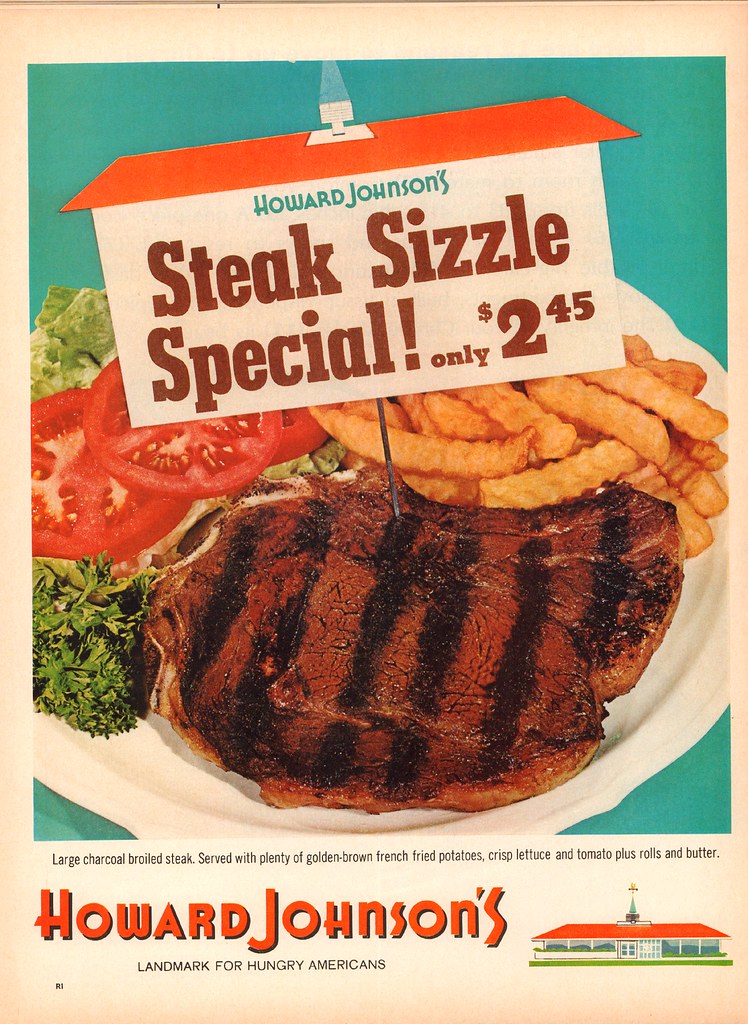
Founded in 1925, Howard Johnson’s didn’t just sell ice cream — it set the benchmark. Its rich 16%‑butterfat formula began with three simple flavors, then exploded into the famous 28 that defined mid‑century indulgence. From that creamy foundation, the company built a nationwide franchise empire, planting its bold orange roofs along America’s highways. For families on the road, a HoJo’s stop became a promise: dependable comfort food, a familiar welcome, and a scoop of the ice cream that made the brand a household name. PHOTO: Symbols – Daytime, Man and Boy with Dog – Howard Johnson’s, Art Deco, Free Standing, Neon Sign, Telephone Booth on Boylston Street Sidewalk off Copley Square” by MIT-Libraries is licensed under CC BY-NC 2.0.
Howard Deering Johnson (1897-1972) in 1955. Howard Johnson was an American entrepreneur who transformed his Massachusetts soda fountain into a massive restaurant and motel empire characterized by its iconic orange roofs. By pioneering the “28 flavors” of ice cream in the late 1920s and early 1930s featuring flavors such as Orange Pineapple and Burgundy Cherry, Howard Johnson established one of the nation’s first franchising models and became a central figure in 20th-century American roadside culture. PHOTO: “Howard Deering Johnson” by OptimistMover is licensed under CC BY-SA 4.0.
In the 1974 satirical Western Blazing Saddles, the town of Rock Ridge is populated by citizens who almost all share the last name “Johnson,” including a character specifically named Howard Johnson played by John Hillerman. The film parodies the famous restaurant chain by featuring a “Howard Johnson’s Ice Cream Parlor” that comically advertises only one flavor and poking fun at the real chain’s legendary “28 flavors.” (8) Johnson is Right – YouTube (https://www.youtube.com/watch?v=V8oaQhTYx2Q) – retrieved May 2, 2026.
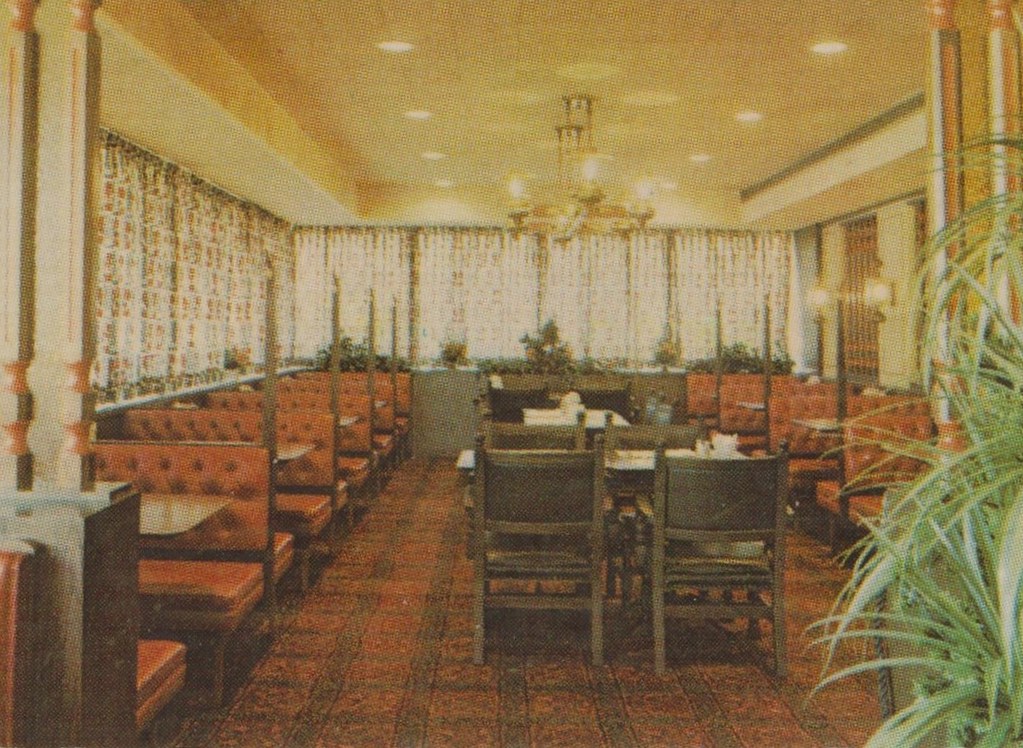
The dining room of Howard Johnson’s Motor Lodge and Restaurant in Middletown, New Jersey, glows with that classic Howard Johnson’s warmth — tufted booths, patterned curtains, and soft recessed lighting wrapping the space in mid‑century comfort. The wood dividers, carpeted floors, and pops of greenery give it the feel of a roadside refuge where families settled in for fried clams, creamed fricassee, ice cream, and a moment of personal refueling between miles. It’s a room that still carries the hum of long‑ago travelers and the promise of a familiar meal. Photo: “Howard Johnson’s Motor Lodge and Restaurant Middletown,NJ” by romleys is licensed under CC BY-NC-SA 2.0.
By the mid 1950s, the company expanded into motor lodges, pairing familiar meals with modern roadside rooms. Known for its orange roofs, family friendly dining, and early innovations in frozen entrées, Howard Johnson’s became a symbol of consistency — even as travelers swapped stories of sometimes uneven service.
The Vibe: An incandescent orange roof, bright turquoise shutters, and the electric glow of the neon Pied Piper — a roadside beacon promising weary travelers a safe, familiar harbor. PHOTO: “Howard Johnson’s St. Petersburg, Florida” by 1950sUnlimited is licensed under CC BY-NC 2.0.
Howard Johnson’s Motor Lodge, 1971 – Portage, Indiana. With its wood‑paneled walls, blue bedspreads, and floral curtains Howard Johnson’s rooms created a cozy, mid‑century vibe. Two chairs, a small table, and a vintage TV completed the retro roadside‑stop motel scene. PHOTO: “Howard Johnson’s Motor Lodge, 1971 – Portage, Indiana” by Shook Photos is licensed under CC BY 2.0.
But the landscape changed. Through the 1970s and 1980s, the chain declined, its restaurants and frozen foods slowly disappearing. When the last location closed in March 2022, Howard Johnson’s quietly ended a century as the old “Host of the Highway.”
Howard Johnson’s Restaurant, Lynchburg, shared the fate of hundreds of other HoJo’s across the nation since the 1980’s. The last restaurant closed in March 2022. PHOTO: “Howard Johnson’s Restaurant, Lynchburg” by Retronaut is licensed under CC BY-NC-ND 2.0.
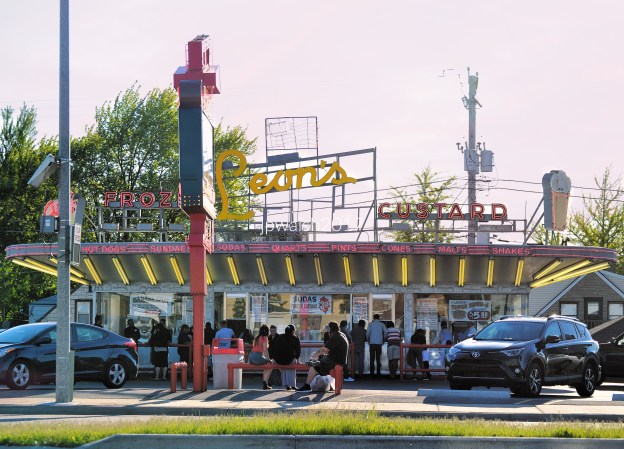
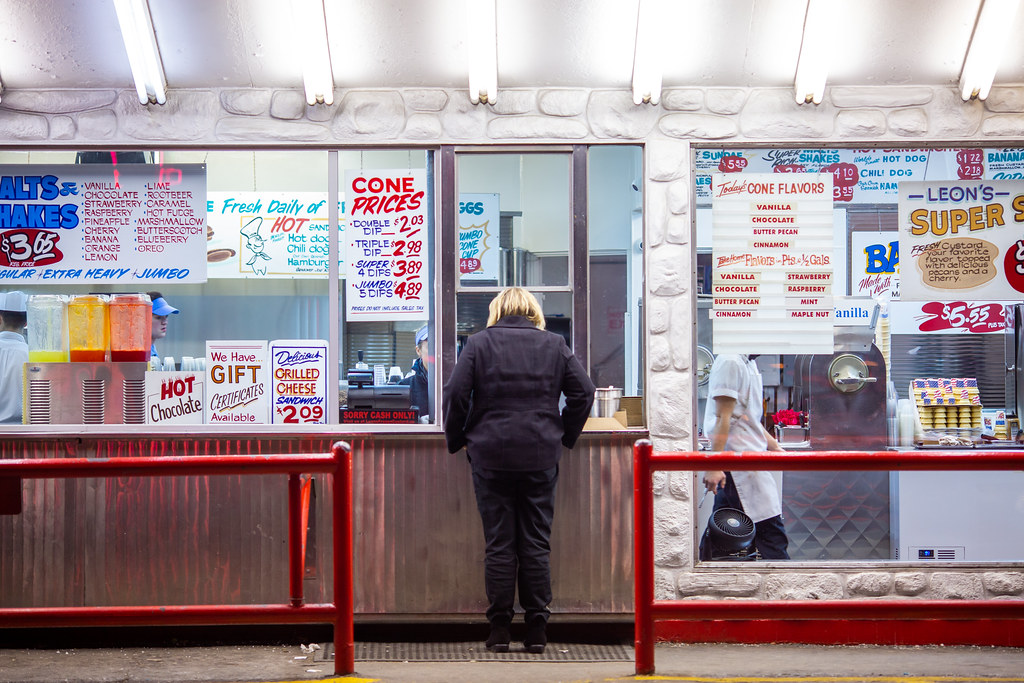
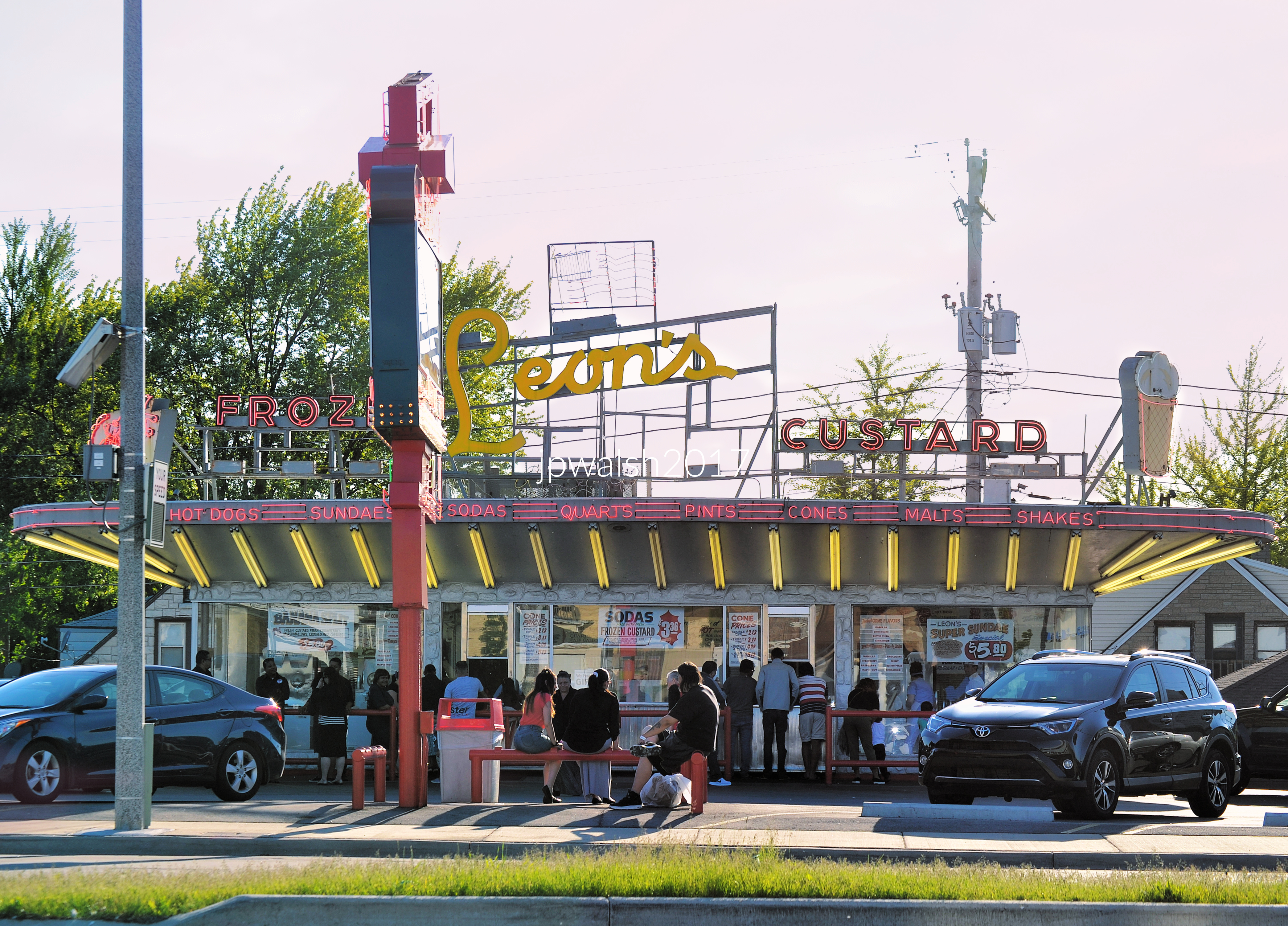
FEATURE image: Late afternoon at Leon’s Frozen Custard in Milwaukee, Wisconsin. June 2017.Author’s photograph. (4.53mb, DSC_0728).
Leon’s Frozen Custard is more than a beloved Milwaukee drive-in. Its remarkable continuity since 1942 and its influence on the creation of Arnold’s Drive-In in television’s Happy Days make it a living link between mid-century Americana, local business history, and popular culture.
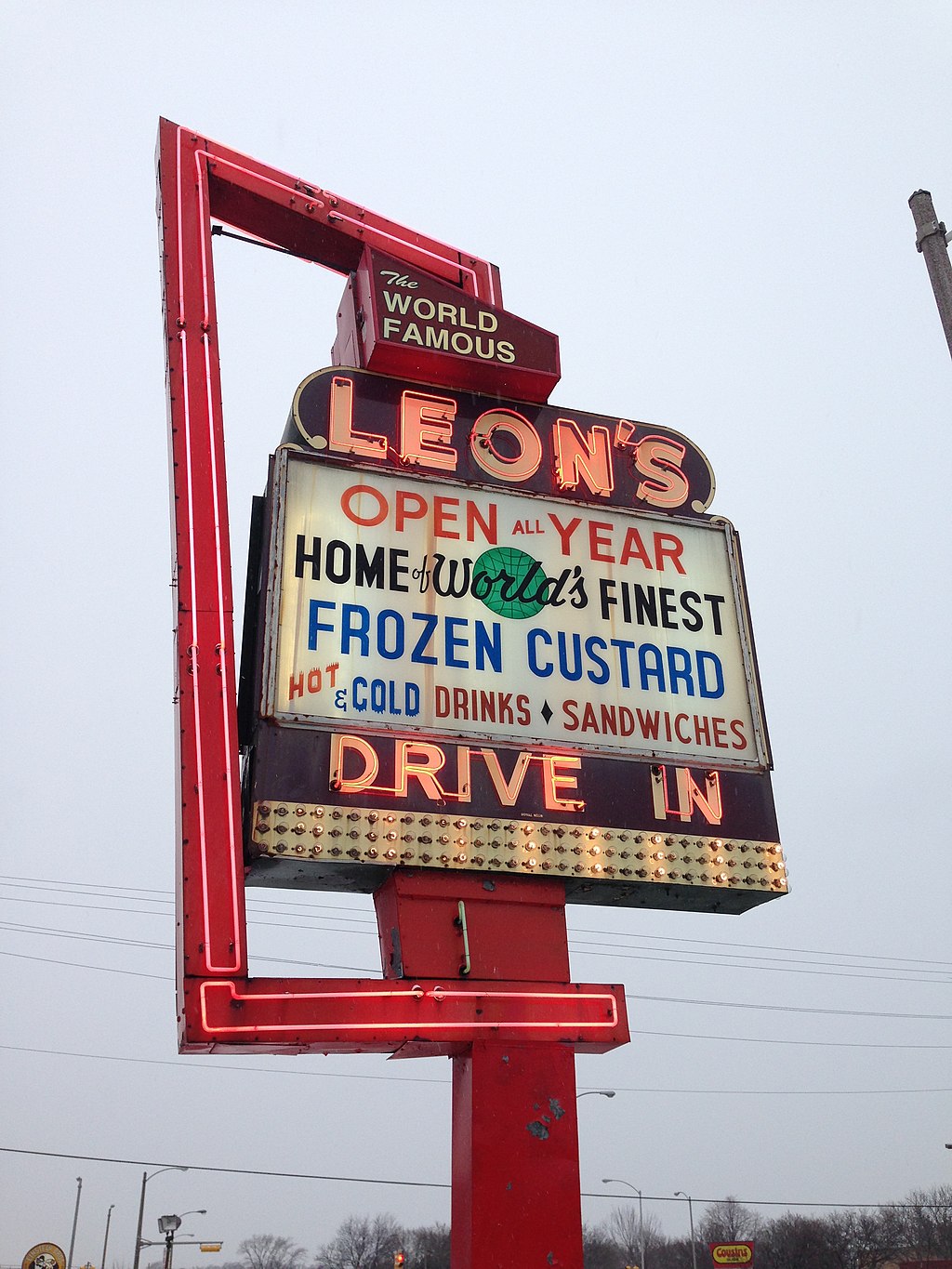
Leon’s original sign. By victorgrigas – Own work, CC BY-SA 3.0.
Leon’s is a family-owned drive-in in Milwaukee, Wisconsin, that opened 83 years ago – in 1942. The building was remodeled in the early 50’s and is what is seen today. Leon’s was inspiration for the original Arnold’s Drive-In in the 1970’s ABC television sitcom, Happy Days, that was also set during the 1950’s in Milwaukee, Wisconsin.
The building was remodeled in the early 1950s, giving it much of the appearance it maintains today.
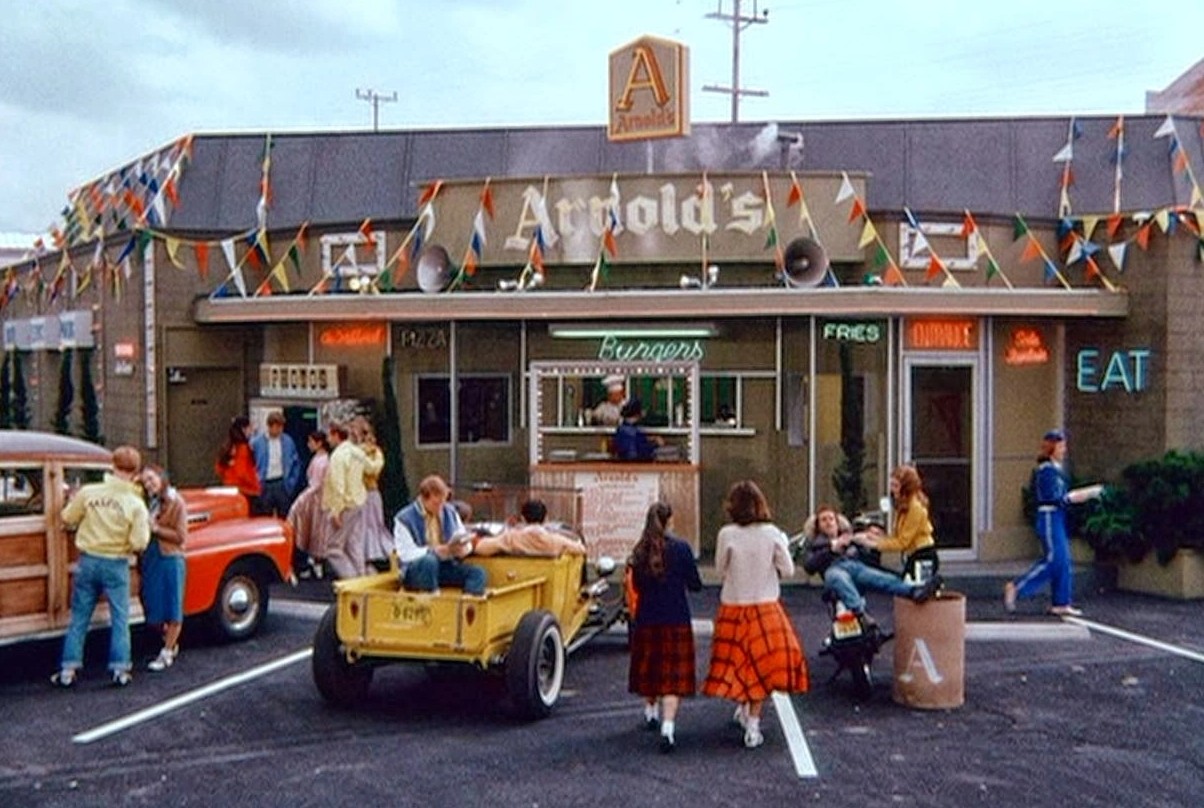
Leon’s served as the inspiration for Arnold’s Drive-In, the iconic gathering place featured in Happy Days, the hit television series set in 1950s Milwaukee.
The Happy Days season 2 intro settles into the warm glow of Arnold’s Drive‑In, where the cast dances, jokes, and moves through the set like regulars in a familiar hangout. The sequence plays over a freshly recorded version of “Rock Around the Clock”, a choice that instantly anchors the show in a 1950s jukebox mood. The season 2 also marks a shift in the show’s rising star power: Henry Winkler’s Arthur “Fonzie” Fonzarelli steps into the opening credits beside Ron Howard, reflecting what would be his iconic popularity with viewers.
Although the tune is the same one Bill Haley & His Comets first cut in 1954, the version heard in Happy Days wasn’t that original hit. The song had begun modestly as the B‑side of a single that only reached No. 23, but everything changed when it blasted through the opening credits of Blackboard Jungle in 1955. Practically overnight, it became a cultural earthquake, soaring to No. 1 that July and helping ignite the rock‑and‑roll era.
Nearly twenty years later, in the fall of 1973, ABC asked the band to re‑record the song specifically for the new TV series. When Happy Days became an instant sensation, viewers went hunting for the version they heard each week—only to discover it wasn’t sold in stores. Their search sent them back to the original 1954 single instead, giving that two‑decades‑old record an unexpected second wind and pushing it back into the Top 40 in 1974, a rare encore for a rock‑and‑roll classic.
Leon’s is a gateway into the broader cultural phenomenon of Happy Days, including its Milwaukee setting, characters, theme song, and enduring popularity.
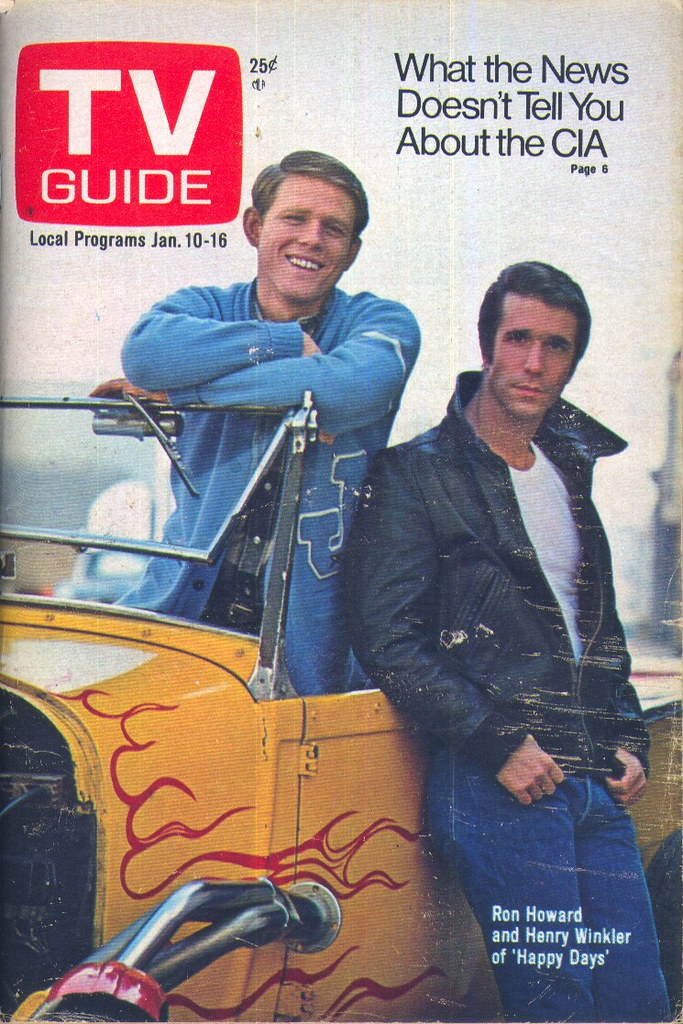
Fonzi played by Henry Winkler was a new character for the ABC TV series. He had just 6 lines in the first episode of “Happy Days” whose debut broadcast was January 15, 1974. In the series, Fonzie’s full name was Arthur Fonzarelli and called that by Richie’s mom. The original family name of series’ creator Garry Marshall (1923-2016) was Masciarelli and changed before Garry was born by his father, a man of Italian descent.“TV Guide #1189” by trainman74 is licensed under CC BY-NC 2.0.
At the 2024 Emmy Awards on September 15, Ron Howard and Henry Winkler reunited to mark Happy Days’ 50th anniversary. The longtime friends presented the award for Outstanding Directing for a Comedy Series from a lovingly recreated Arnold’s Drive‑In set, complete with a vintage jukebox, red‑leather booths, and classic sports pennants.
Leon’s is still owned and operated by the original family. The main focus of the business is, and always has been, to serve the freshest and finest frozen custard available anywhere. The business is open all year round and they have full soda fountain service, a sandwich menu, daily special flavors and take-out service.
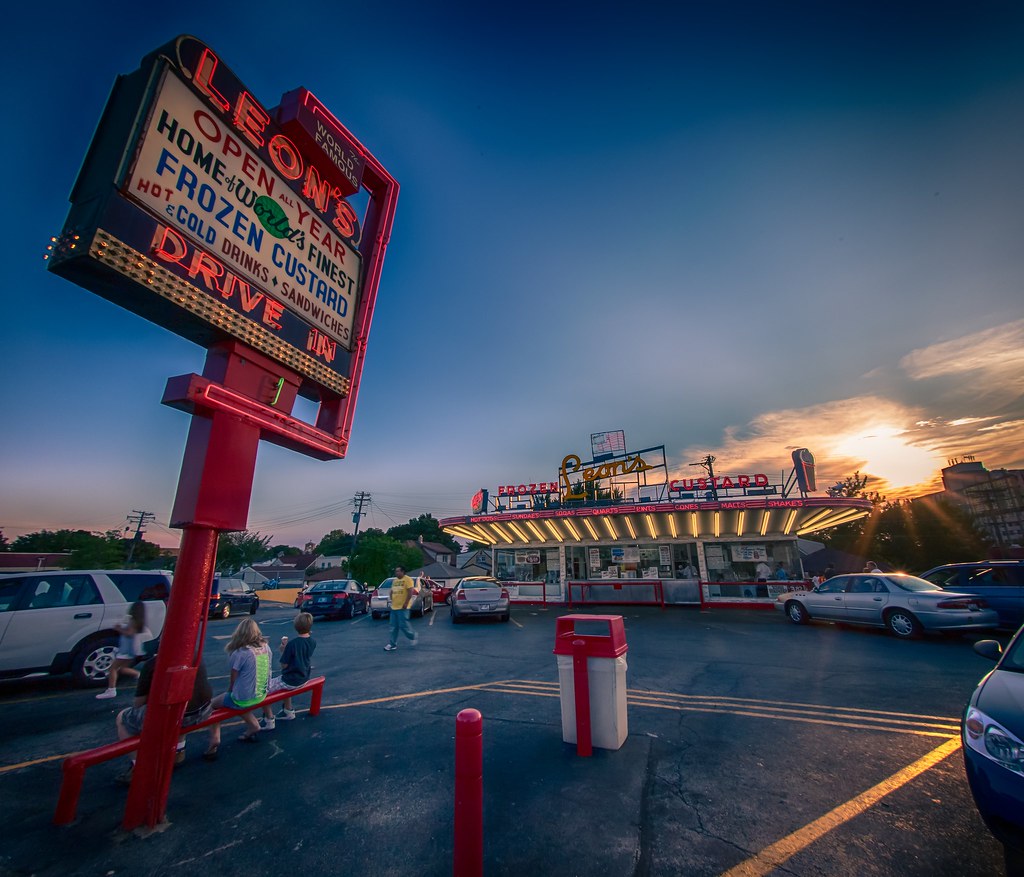
June 2017. Late afternoon at Leon’s, Milwaukee, Wisconsin. Leon’s was inspiration for Arnold’s on Happy Days, a popular 1970’s TV series set in Milwaukee in the 1950’s. Author’s photograph. 4.53 mb
Arnold’s was the name of the local Milwaukee drive-in hang out for most of the characters in Happy Days. Fair Use.
Ron Howard Signs On (1973)
At just 19 years old, Ron Howard signed a seven‑year contract to star in Happy Days. At the time, he was juggling an unusually heavy load: filming American Graffiti, attending USC, and mapping out an early directing career.
Becoming Richie Cunningham
Cast as Richie Cunningham, Howard earned $3,500 per episode—roughly $25,000 in 2025 dollars. He had already played Richie once before, in the February 1972 Love, American Style segment that inspired the new series, but still had to audition again for the TV version. At the first read‑through, Howard reunited with Anson Williams (“Potsie”) and Marion Ross (Richie’s mother)—both of whom had appeared with him in the Love, American Style pilot. He also met the rest of the soon‑to‑be iconic cast: Tom Bosley (“Richie’s dad”), Donny Most (“Ralph Malph”), and Henry Winkler, a 28‑year‑old Yale School of Drama graduate who would become “Fonzie”
A 1970s TV Powerhouse
Alongside M*A*S*H, All in the Family, The Mary Tyler Moore Show, and The Bob Newhart Show, Happy Days became one of the defining sitcoms of the 1970s. It aired for 11 seasons from January 15, 1974, to July 19, 1984 on the ABC network. There was a total of 255 half-hour episodes.
The enduring success of Leon’s reflects the survival of a classic American drive-in tradition that has largely disappeared elsewhere.
The planned demolition of the replica standing on the original site of Ray Kroc’s first McDonald’s franchise in Des Plaines, Illinois represents the potential loss of an important piece of American business, labor, automotive, and cultural history. What began as a single franchise opened on April 15, 1955, helped launch one of the world’s most influential restaurant chains, making the site’s preservation historically significant.
McDonald’s very first franchise restaurant on its original site, 1955 (replica, 1985). It is slated to be razed by McDonald’s Corporation immediately. Author’s photograph taken May 6, 2018.
By John P. Walsh
A closed-down weather-beaten replica of the very first McDonald’s franchise restaurant started by Ray Kroc (1902-1984) on April 15, 1955 standing on its original site in Des Plaines, Illinois, is slated to be demolished by McDonald’s Corporation with its land donated or possibly sold.
It was not long ago that McDonald’s touted that approximately one in every eight American workers had been employed by the company (Source: McDonald’s estimate in 1996) and that even today McDonald’s hires around 1 million workers in the U.S. every year. By 1961 there were 230 McDonald’s franchises in the United States. In 2017 there was 37, 241 McDonald’s restaurants worldwide. Not only historians and historic preservationists decry the imminent demolition of the first McDonald’s restaurant in Des Plaines, Illinois, just west of Chicago, but others impressed by its direct significance to the growth and impact to U.S. labor history as well as the American restaurant industry and American automotive culture in the post-World War II era. Further, McDonald’s restaurants today reach into 121 other countries around the world influencing and being influenced by global cuisine. That all of this cultural and business import was born on a now-threatened patch of land on Lee Street in Des Plaines, Illinois, is impressive.
Ray Kroc opened his first McDonald’s franchise in Des Plaines, Illinois, on April 15, 1955, on the site that would become synonymous with the chain’s expansion.
It appears that if and when McDonald’s follows through on its November 2017 decision to raze the building and give up the site, this originally-designed McDonald’s restaurant on Ray Kroc’s original site in Des Plaines will be forever lost. The story of how that planned demolition of this unique piece of Americana came to be began 35 years ago. It was on March 3, 1984 that after 29 years of continual operation the original franchise restaurant on the original site was permanently closed and demolished. Founder and former McDonald’s Corporation chairman Ray Kroc had died less than six weeks before in January 1984 at 81 years old in San Diego, California.
The McDonald’s restaurant brand opened its first burger bar called McDonald’s Bar-B-Q in California in 1940 – and, by 1953, brothers Maurice and Richard McDonald started a small franchise business in Phoenix, Arizona and Downey, California. Today’s nationwide and global franchise empire that serves 75 burgers every second (Source: McDonald’s Operations and Training Manual) began when Oak Park, Illinois-born Ray Kroc, a paper-cup-turned-milkshake-machine salesman, convinced the McDonald brothers to let him franchise their business nationwide. Kroc offered to manage the franchises in the U.S., excepting the brothers’ first franchises in Arizona and California, and the pair were to receive a tiny percentage of gross sales nationwide in return.
The structure slated for demolition was a 1985 replica built on the original location after the original restaurant was demolished in 1984.
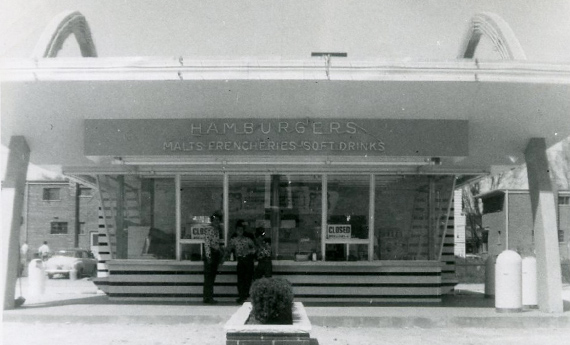
Historic photograph from 1955 of the original Des Plaines McDonald’s restaurant which was demolished in 1984. A replica restaurant was built in 1985 based on architectural plans of later McDonald’s restaurants. That replica on the historic site is awaiting immediate demolition announced by McDonald’s in late 2017. Fair Use.
Kroc’s first walk-up franchise McDonald’s restaurant at the “Five Corners” intersection in Des Plaines, Illinois, served an assembly-line format menu of hamburgers, cheeseburgers, french fries and a selection of drinks. In 1955, he founded McDonald’s System, Inc., a predecessor of the McDonald’s Corporation, and six years later bought the exclusive rights to the McDonald’s name and operating system. By 1961, Ray Kroc’s vision had clearly paid off for the now 59-year-old former paper cup salesman. That same year, Kroc bought out the McDonald brothers for $2.7 million and launched his strict training program, later called “Hamburger University, ” in nearby Elk Grove Village, Illinois, at another of his 230 new McDonald’s restaurants. Ray Kroc’s original vision was that there should be 1,000 McDonald’s restaurants in the United States. When Kroc died in January 1984, his goal had been exceeded six fold — there were 6,000 McDonald’s restaurants in the U.S. and internationally in 1980.
By 1961, there were 230 McDonald’s franchises, demonstrating the rapid success of Kroc’s franchising model.
The Des Plaines suburban location of Ray Kroc’s very first McDonald’s franchise retains its relatively humble setting even as the McDonald’s Corporation it spawned earns $27 billion in annual sales making it the 90th-largest economy in the world (Source: SEC). Kroc, the milkshake machine salesman who convinced the McDonald brothers to let him franchise their fast-food operation nationwide, saw his original McDonald’s franchise at 400 Lee St. in Des Plaines open for business until, shortly after his death, it closed on Saturday, March 3, 1984.
Ray Kroc (1902-1984) photographed with an artist’s rendering of his highly successful McDonald’s franchise restaurant. The franchise started in Des Plaines, Illinois, in April 1955 and has had a significant impact on U.S. labor history and the American restaurant industry and automotive culture in the post-World war II era. Fair Use.
In 1984 there were no plans to preserve the site – its golden arches and road sign had been carted away – but a public outcry prompted McDonald’s in 1985 to return the restaurant’s restored original sign designed by Andrew Bork and Joe Sicuro of Laco Signs of Libertyville, Illinois, and dedicate a restaurant replica that still exists today on the original site though it is now slated for demolition. The historic red neon-lettered sign turned on for the opening of Kroc’s first store on April 15, 1955 – there is one similar to it preserved in The Henry Ford museum in Dearborn, Michigan dating from 1960 – proclaimed “McDonald’s Hamburgers” and “We Have Sold Over 1 Million” and, intersecting with an iconic golden arch displayed a neon-animated “Speedee” chef, the fast food chain’s original mascot. (The clown figure of Ronald McDonald first appeared in 1963).
Newspaper advertisement announcing the opening of Ray Kroc’s first McDonald’s in Des Plaines, Illinois, in 1955. It featured the franchise’s first mascot, Speedee, who was significant to the assembly-line format menu and prevailing automobile culture. Fair Use.
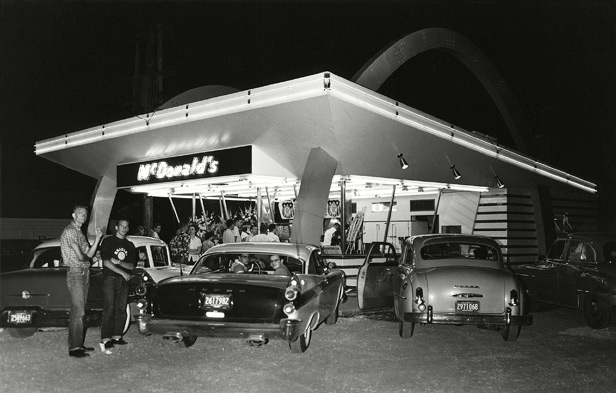
Historic photograph of Ray Kroc’s first McDonald’s restaurant in Des Plaines, Illinois, on opening day, April 15, 1955. Fair Use.
The replica of McDonald’s first franchise restaurant is missing its golden arches, “McDonald’s” sign over the entrance and its original 1955 Speedee neon lettered sign. They were dismantled and removed in January 2018 by McDonald’s to an undisclosed location out of public view. Photo by author, May 6, 2018.
The day after the original restaurant closed – Sunday, March 4, 1984 – a McDonald’s restaurant franchise moved across the street into a state-of-the-art new building on a site that once accommodated a Howard Johnson’s and, after that, a Ground Round. The full-service McDonald’s in Des Plaines, Illinois, today continues to operate out of that 1984 building. It may confuse the visitor which exactly is the original site of the first McDonald’s as the newer 1984 building not on the first site displays inside a high-relief metal sign that reads: “The national chain of McDonald’s was born on this spot with the opening of this restaurant.” Though undated, it is signed by Ray Kroc which points to it being brought over from the original restaurant when it was closed. At the replica restaurant on the original site two metal plaques (dated April 15, 1985) properly proclaim: “Ray A. Kroc, founder of McDonald’s Corporation, opened his first McDonald’s franchise (the ninth McDonald’s drive-in in the U.S.) on this site, April 15, 1955.”
The Des Plaines location symbolizes the beginning of a business that expanded into a global restaurant empire.
A few months after the first franchise restaurant was closed and demolished in 1984, the parcel of land on which it sat – it had only always been leased since 1955 – was purchased by McDonald’s at the same time they announced plans for the replica landmark restaurant.
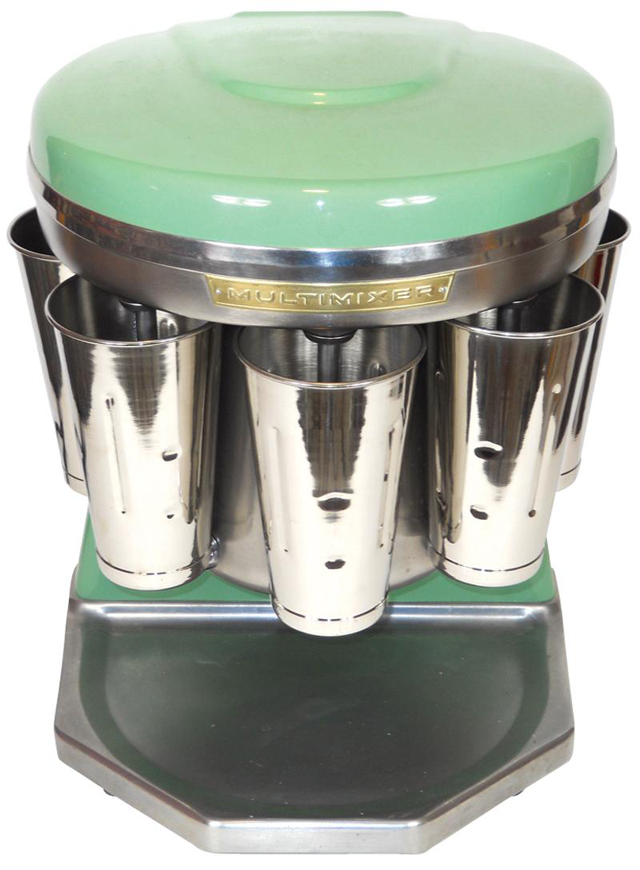
The original architectural plans by architect Robert Stauber from the mid1950’s were lost, so 1980’s planners applied architectural drawings of McDonald’s restaurants built in the late 1950’s for the replica. Its kitchen included refurbished equipment brought out of storage, including the restaurant’s original six-foot grill. It also displayed one of Ray Kroc’s original multimixers like the ones he sold to Maurice and Richard McDonald that started a fast-food partnership in the 1950’s which by the mid-1960’s inspired many well-known copy cats of McDonald’s model, including Burger King, Burger Chef, Arbys, KFC, and Hardee’s.
Soda fountain multimixer. Fair Use.
Public outcry previously led to preservation efforts, including the construction of the replica and restoration of historic signage. Repeated flooding from the nearby Des Plaines River contributed to concerns about maintaining the site.
The original restaurant had been remodeled several times during its almost 30 years of operation but never had much in the way of indoor seating or a drive-through. It did feature a basement and furnace built for Chicago’s four seasons and was used by the replica museum to exhibit items. The McDonald’s Museum was open for tours until September 2008 when the site experienced record-setting flooding from the nearby Des Plaines River. In April 2013 another record flood in Des Plaines submerged the McDonald’s Museum and produced serious speculation that the site would be moved or permanently closed.
An aerial view during the April 2013 Des Plaines River flood shows the partially submerged replica first McDonald’s franchise restaurant (at right) with its original Speedee neon sign. Thesign was first lit on April 15, 1955, a Friday Night. Photo: Chris Walker, Chicago Tribune, April 19, 2013. Fair Use.
In mid-July 2017, only four years since the last significant flood, the area experienced its worst flooding on record. In November 2017 McDonald’s announced it would raze the replica restaurant structure and by May 2018 the site had had its utilities disconnected and its golden arches, Speedee sign, and main entrance McDonald’s sign dismantled and removed. These historically valuable items were taken by McDonald’s out of public view to an undisclosed location. Once again, and this time more seriously it appears, the prospect of pleas by Des Plaines municipal authorities, historic preservationists, social media and others for McDonald’s Corporation to preserve the site intact is murky at best.
The site is a unique piece of Americana whose loss would erase a tangible connection to one of the most influential business stories of the 20th century. It has significance even beyond McDonald’s, touching on American labor history, restaurant culture, and postwar automobile culture.