FEATURE image: American flamethrowers in a foxhole on Iwo Jima, February 1945. Marine Flamethrowers in Foxholes, February 1945” by Archives Branch, USMC History Division is licensed under CC BY 2.0.

Fourth Division Marines in Foxhole on Beach, Iwo Jima, February 1945 “Fourth Division Marines in Foxhole on Beach, Iwo Jima, February 1945” by Archives Branch, USMC History Division is licensed under CC BY 2.0.

Advancing Marine Flamethrower Squad, Iwo Jima, February 1945. “Advancing Marine Flamethrower Squad, Iwo Jima, February 1945” by Archives Branch, USMC History Division is licensed under CC BY 2.0.
The Battle of Iwo Jima was a nearly 40-day battle campaign fought by the U.S. Marine Corps and U.S. Navy against the Japanese Imperial Army on the island of Iwo Jima in the Pacific. With 110,000 total battle personnel (over 70,000 troops), the American objective of their invasion (called “Operation Detachment”) was to capture the island and its airfields. Iwo Jima was situated between Japan and the American bomber bases in the Mariana Islands. Since summer 1944 unescorted American B-29 bombers were flying nearly 3000 miles roundtrip to bomb Japan and being lost at sea from entrenched Japanese defenses. With Iwo Jima in American hands U.S. fighter planes could escort the long-range bombers as well as have any damaged aircraft find sanctuary on the island. The American victory after a five week campaign resulted in the capture of Iwo Jima with its immediate benefit that, by war’s end, 2,400 B-29s were able to make safe forced landings on the island.

Iwo Jima in 1945. Mount Suribachi is a knob at the bottom of the map. “Map of Iwo Jima, 1945” by Archives Branch, USMC History Division is licensed under CC BY 2.0.
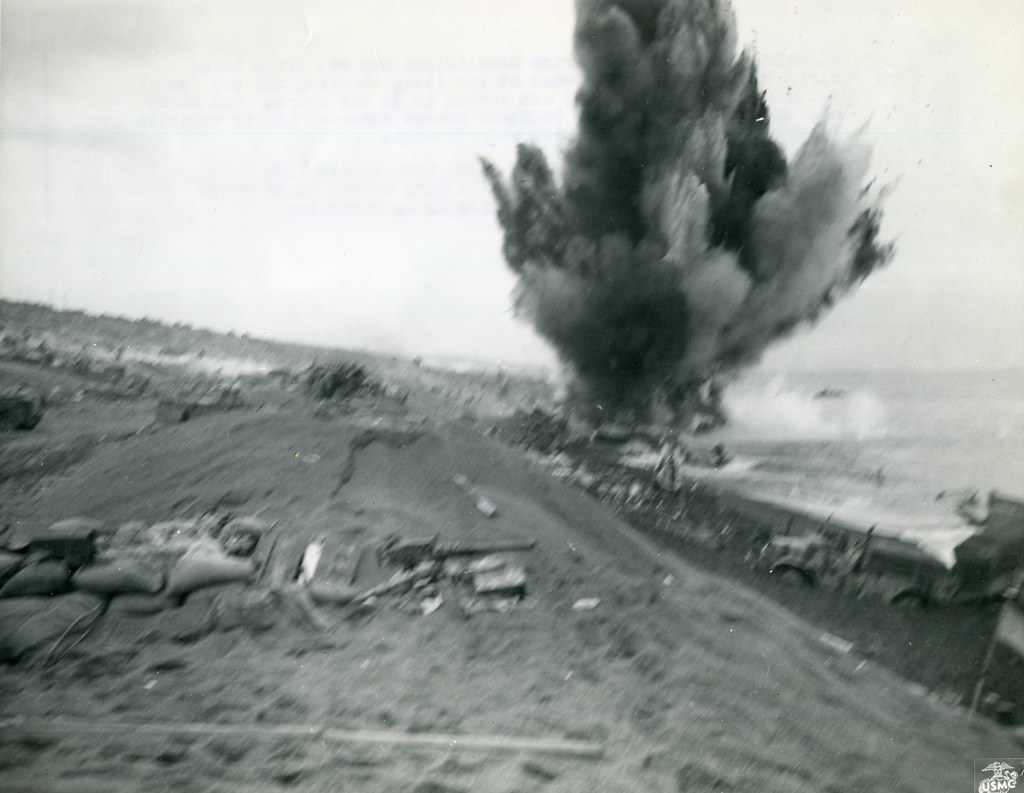
Marines Detonating Japanese Mine on Beach, Iwo Jima, February 1945. “Marines Detonating Japanese Mine on Beach, Iwo Jima, February 1945” by Archives Branch, USMC History Division is licensed under CC BY 2.0.

Marines Taking Shelter on the Beach, Iwo Jima, February 1945. “Marines Taking Shelter on Beach, Iwo Jima, February 1945” by Archives Branch, USMC History Division is licensed under CC BY 2.0.
There were 20,000 or so heavily-fortified Japanese defending the island to the death while U.S. Navy and Marine Corps aircrews had complete air superiority. The U.S. Navy provided heavy artillery gunfire support from the sea. The Battle of Iwo Jima, an American victory, took place from February 19 to March 26, 1945, and was one of the fiercest of World War II. That Americans could take the island was not the question. Its exact cost was. The casualty toll was heavy for both sides. The Japanese had 216 taken prisoner and up to 18,375 killed or missing in action. The American combat toll was also staggering: 6,821 killed in action, 19,217 wounded, and 2,648 experiencing battle trauma.
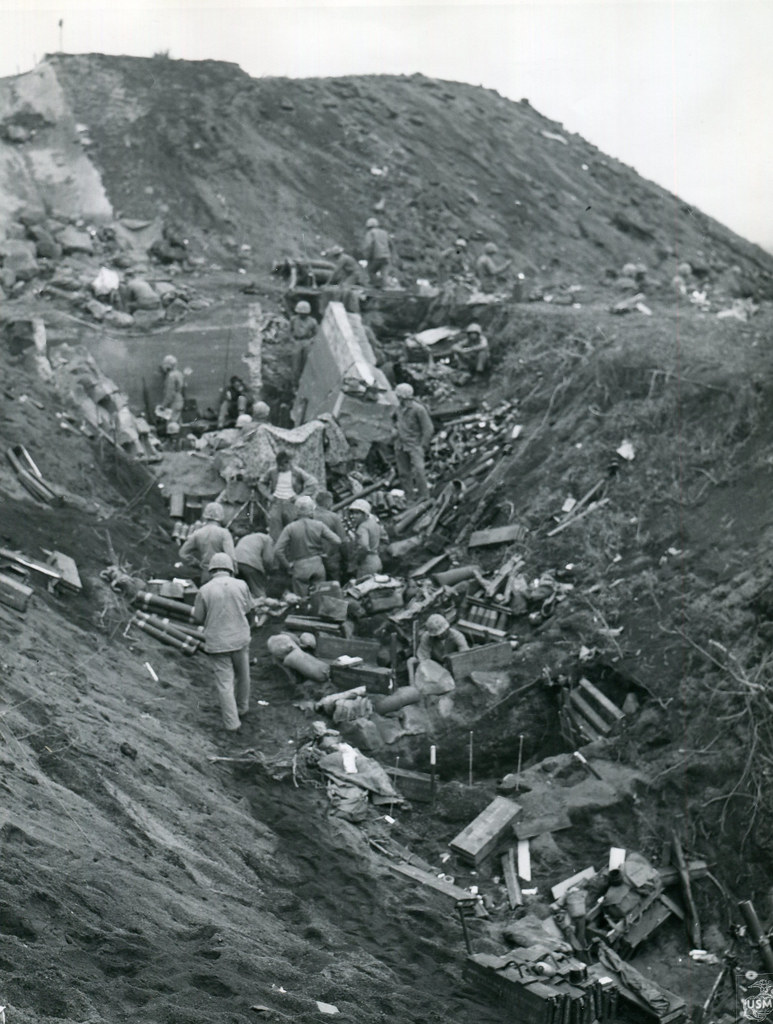
23d Regiment, Fourth Marine Division Command Post, Iwo Jima, 1945. “23d Regiment, Fourth Marine Division Command Post, Iwo Jima, 1945” by Archives Branch, USMC History Division is licensed under CC BY 2.0.
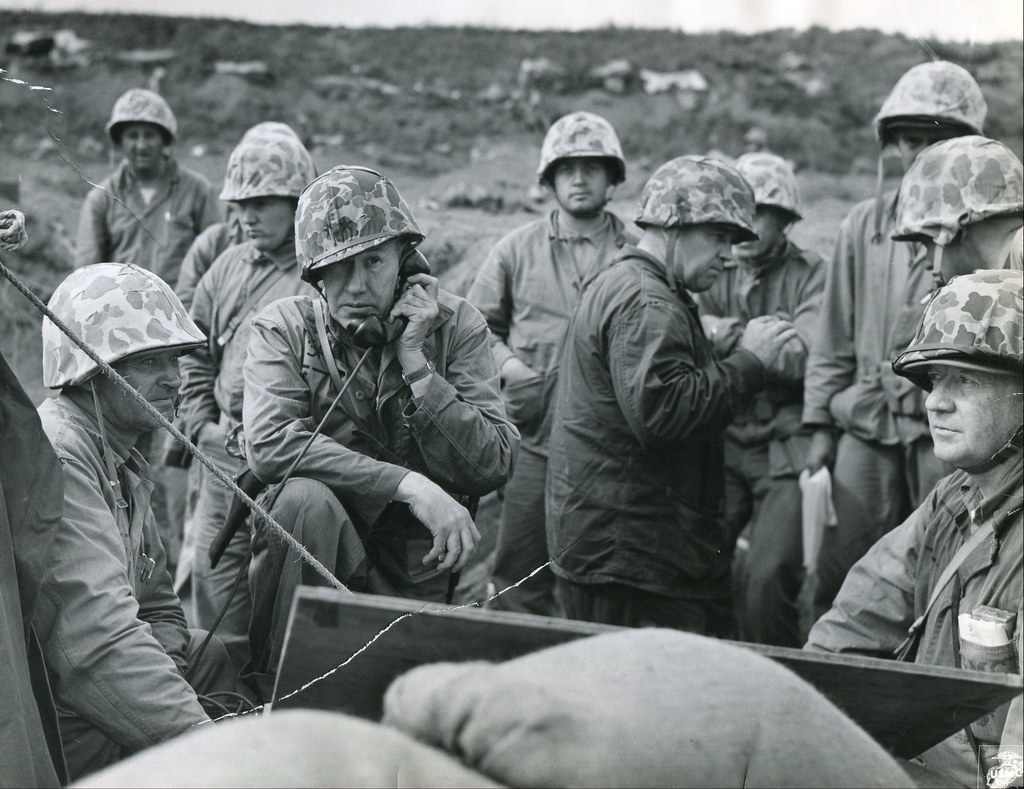
Fifth Marine Division Command Post, Iwo Jima, 1945. “Fifth Marine Division Command Post, Iwo Jima, 1945” by Archives Branch, USMC History Division is licensed under CC BY 2.0.

Joe Rosenthal (1911-2006), with his camera hanging at his side, surveys the landing beaches at Iwo Jima on March 7, 1945. Rosenthal was awarded the U.S. Navy Distinguished Public Service Award, as well as the Marine Corps Distinguished Public Service Award by the Marine Corps, for his war photography. Photo by AP/U.S. Marine Corps. Public Domain.
On Friday, February 23, 1945, Rosenthal landed on the island and heard that they were going to raise a flag on the highest point on the island which was the old volcano at the southwest end called Mount Suribachi. Rosenthal carried a Speed Graphic camera that was press standard issue and joined other photographers ready to ascend to the top. Halfway up they met a marine photographer coming down whose camera was obliterated by an enemy grenade explosion. Rosenthal and the others were told that the marines had already raised the flag. But the views were good from the summit anyway and still worth the climb. Once at the top Rosenthal and the rest saw marines who were working to affix a larger flag to a pipe under orders from a captain who wanted to replace it for the earlier smaller flag just raised. When the six marines started to raise that second larger flag on the heavy pole Rosenthal pushed his camera’s shutter. After taking the flag-raising photo, Rosenthal made his way back down Mount Suribachi to the shoreline. There, he took a transport boat out to the command ship, where he wrote captions for his photos and sent them, sight unseen, with the undeveloped film by seaplane to Guam.
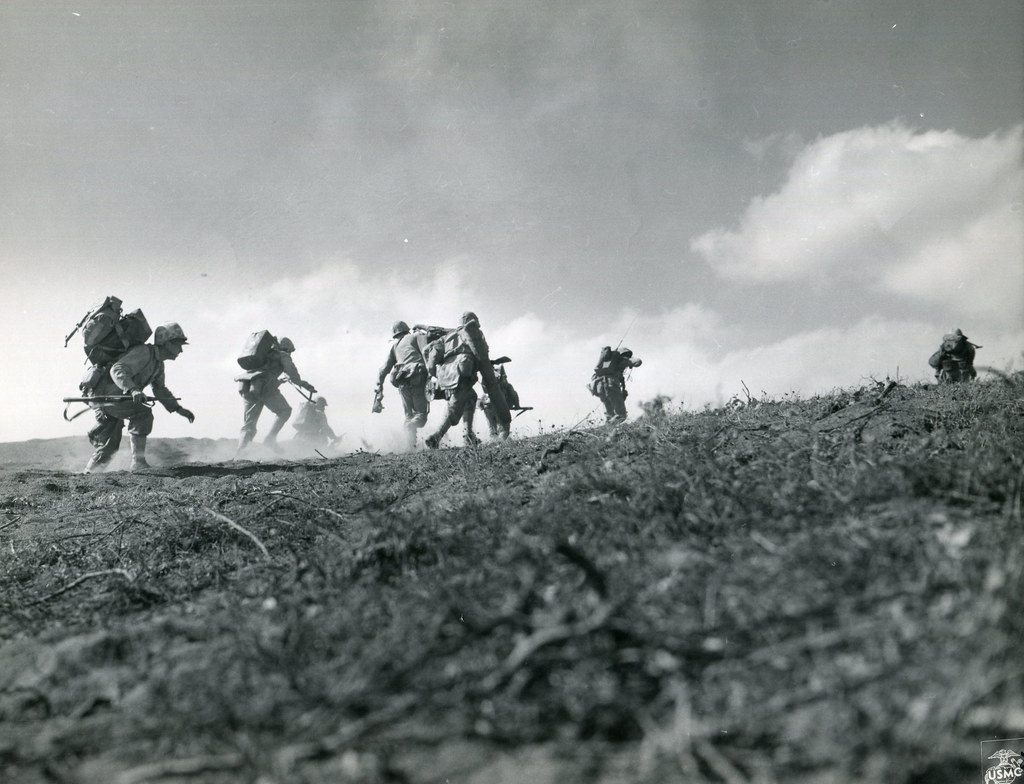
Marines on Beach, Iwo Jima, February 1945. “Marines on Beach, Iwo Jima, February 1945” by Archives Branch, USMC History Division is licensed under CC BY 2.0.

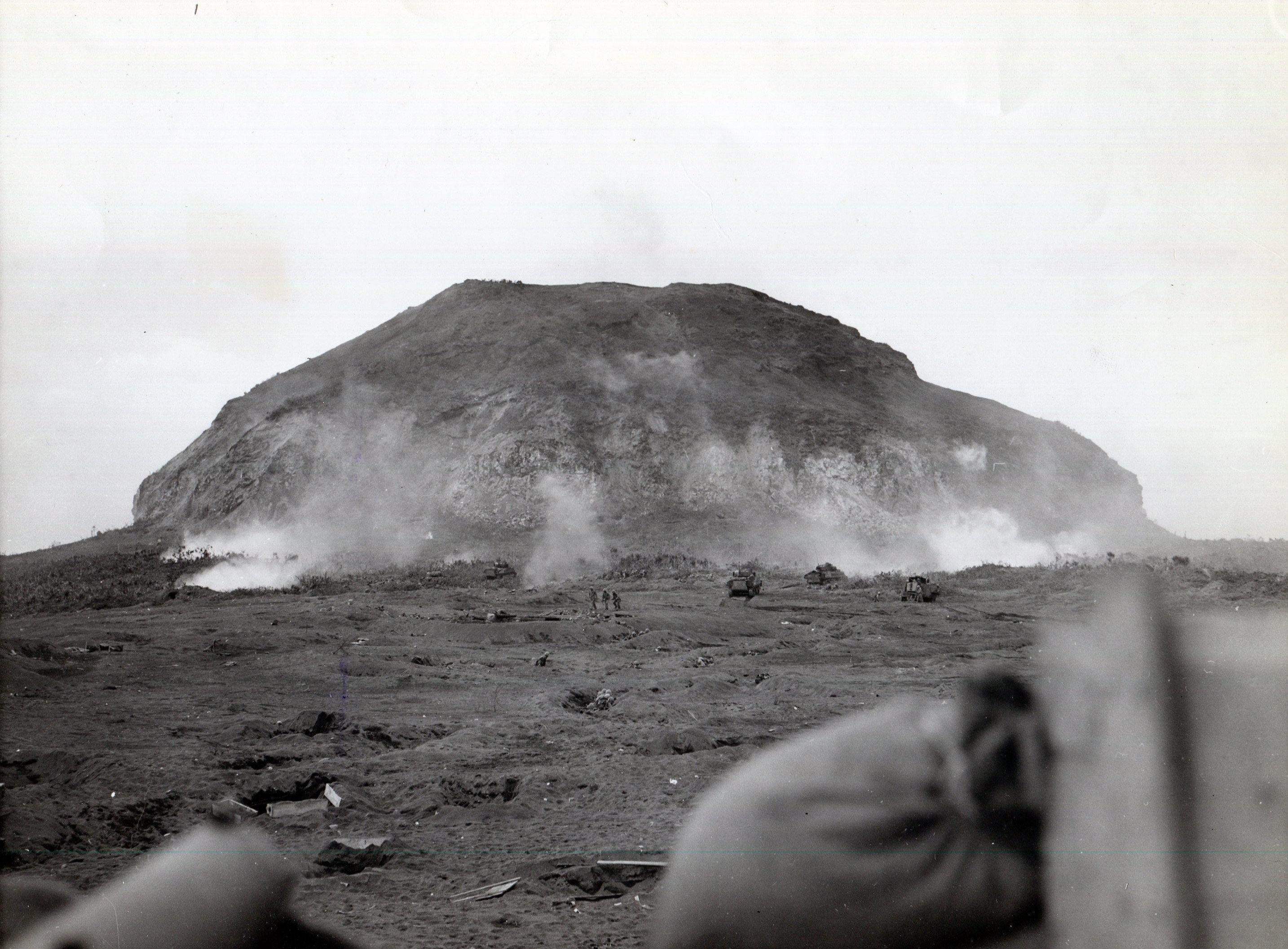
In the shadow of Mount Suribachi, Iwo Jima, 1945. “In the shadow of Suribachi, Iwo Jima, 1945” by Archives Branch, USMC History Division is licensed under CC BY 2.0.
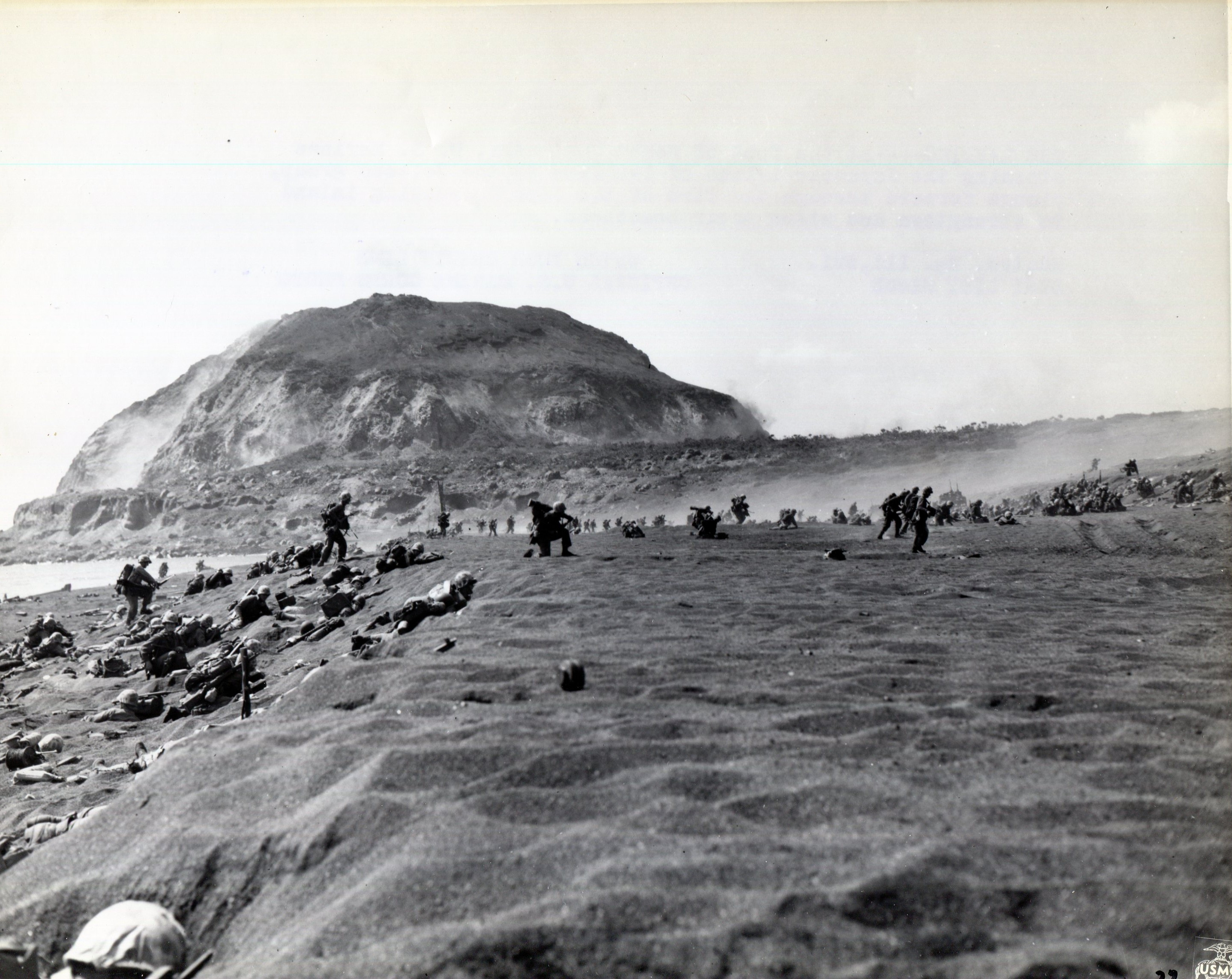
Marines Advancing on Beach, Iwo Jima, February 1945 – 36324610020. “Marines Advancing on Beach, Iwo Jima, February 1945 – 36324610020” by Archives Branch, USMC History Division is licensed under CC BY 2.0.

Marine Firing 30mm, Iwo Jima, 1945 “Marine Firing 30mm, Iwo Jima, 1945” by Archives Branch, USMC History Division is licensed under CC BY 2.0.

Iwo Jima – Mt Suribachi Detail. “Iwo Jima – Mt Suribachi Detail” by Agsftw is licensed under CC BY-SA 3.0
“I took the picture. But the Marines took Iwo Jima.”
In February 1945 Joe Rosenthal was a 33-year-old American photographer for the AP. Rosenthal’s poor eyesight prevented him from fighting in combat though his task as an embedded photographer placed him in Harm’s Way. Before Iwo Jima, Joe Rosenthal had landed with the marines on Guam and Peleliu. His Pulitzer Prize-winning photograph of the flag raising on Iwo Jima became a sign of hope for a war-weary American home front that victory in the Pacific would be theirs. It also became the iconic symbol of everything U.S. Marines. Rosenthal was very proud of his photograph of the six marines and the Marines overall, though modest about any accolades that came his way. Rosenthal put his role in perspective, saying: “I took the picture. But the Marines took Iwo Jima.” Yet it is not to be forgotten that Rosenthal was exposing himself to the same dangers as the six marines that day when he took his iconic photograph for history of the flag raising on Iwo Jima on February 23, 1945.

Original photograph by Joe Rosenthal, February 23, 1945. Public Domain.
Iwo Jima Flag Raising 1945 – Rare Color Film by Sgt Genaust [#Upscaled#1080p#60FPS#ww2]. Three feet to Joe Rosenthal’s right, Sgt. Genaust captured the flag-raising from nearly the same angle using color motion picture film.

Unveiled in November 1954, the Marine Corps War Memorial in Washington, D.C. was dedicated to all Marines who have given their lives in the defense of the U.S. since 1775. see – https://www.nps.gov/gwmp/learn/historyculture/usmcwarmemorial.htm – retrieved February 19, 2025. Author’s photograph, October 2003.

U.S. Marine Corps War Memorial (Iwo Jima Memorial) – (Arlington, Virginia) – August 1, 2015. “U.S. Marine Corps War Memorial (Iwo Jima Memorial) – (Arlington, Virginia) – August 1, 2015” by cseeman is licensed under CC BY-NC-SA 2.0.

US Marine Corps War Memorial, Washington, D.C. The centerpiece of the memorial is a colossal sculpture group by Felix Weihs de Weldon (1907-2003), then on duty with the U.S. Navy, depicting the six Marines who raised the second larger U.S. flag atop Mount Suribachi on Iwo Jima on February 23, 1945. The memorial was designed by Horace Whittier Peaslee, Jr. (1884-1959) and dedicated in November 1954 by President Dwight D. Eisenhower. Author’s photograph, October 2003.
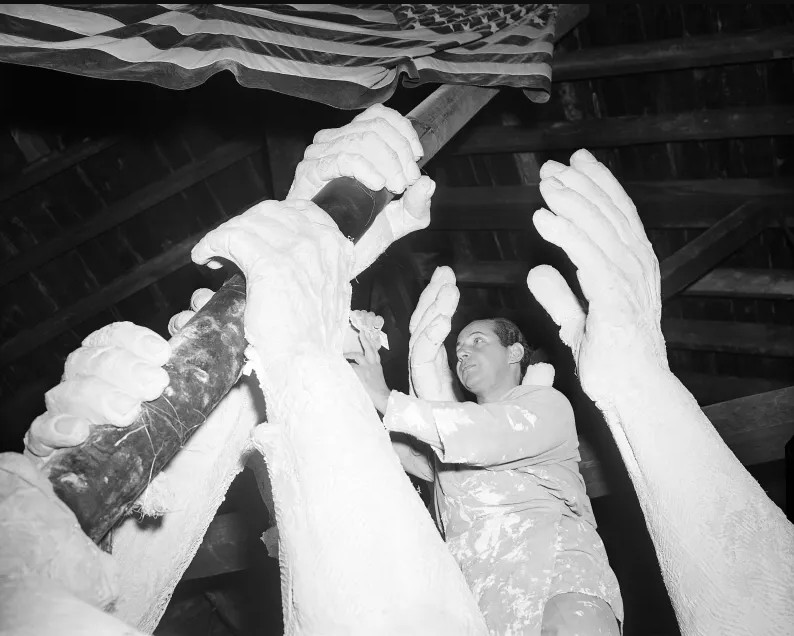
Felix Weihs de Weldon. Public Domain.
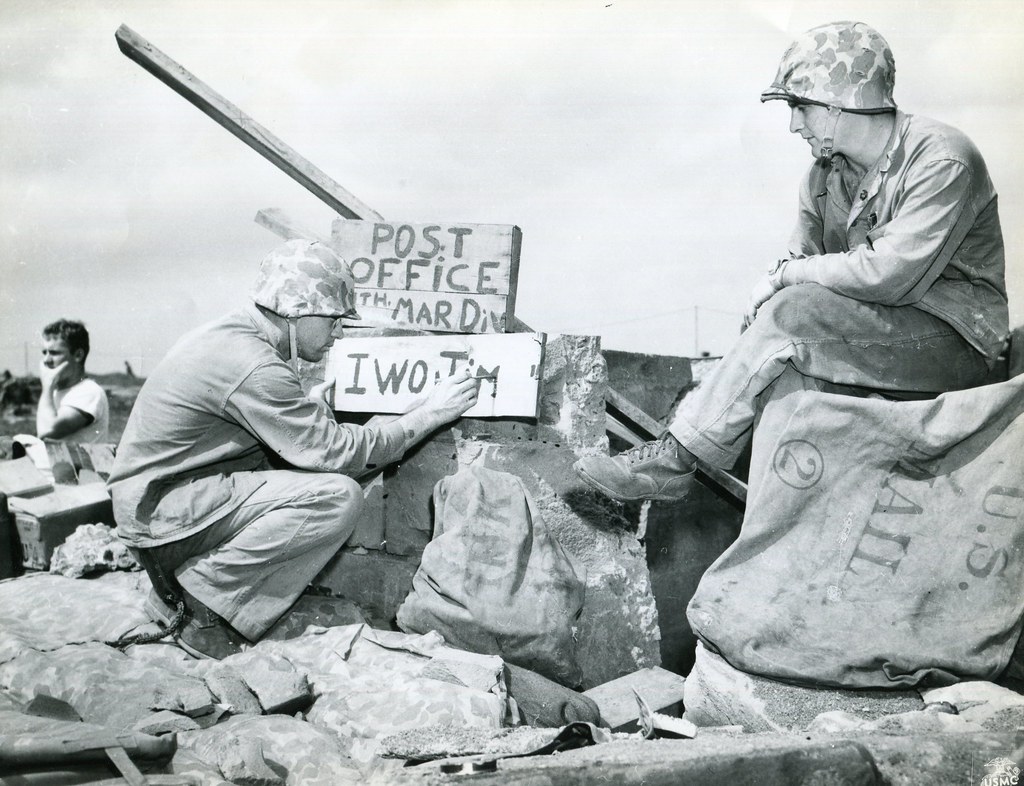
Marine Post Office, Iwo Jima, 1945. “Marine Post Office, Iwo Jima, 1945” by Archives Branch, USMC History Division is licensed under CC BY 2.0.

US Marine Corps War Memorial, Washington, D.C., was based on the iconic AP photograph by Joe Rosenthal taken on February 23, 1945 of the raising of the U.S. flag at the top of Mount Suribachi at the start of the Battle of Iwo Jima (February 19- March 26, 1945). Rosenthal’s photograph was flashed around the world for the first time on Sunday, February 25, 1945, and instantly became a symbol of the American war effort in the Pacific Theatre during World War II. The Marine Corps War Memorial Foundation organized the fundraising and creation of the monument. The complete cost of the memorial was $850,000 (about $10 million in 2025). The 32-foot-high bronze figures are erecting a 60-foot flag pole onto Mount Suribachi. Important dates in the history of the Marine Corps are burnished in gold into the Swedish marble base. The six marines who raised the flag on Iwo Jima have all been identified and include a sergeant, 2 corporals, and 3 privates first class. Unveiled in November 1954, the Marine Corps War Memorial was dedicated to all Marines who have given their lives in the defense of the U.S. since 1775. Author’s photograph, October 2003.
Flags of Our Fathers (2006) is an American war film about the Battle of Iwo Jima (February 19 – March 26, 1945) and its aftermath. The film was directed and co-produced by Clint Eastwood (who also composed the film’s score) and released with his smaller companion film Letters from Iwo Jima about the same battle from the Japanese viewpoint. Distributed by Paramount Pictures (U.S.) and Warner Bros. Pictures internationally, the films basically broke even at the box office as each received favorable critical reviews. Flags of Our Fathers is based on a 2000 book of the same name by James Bradley (with Ron Powers) about Bradley’s Navy corpsman father, John, and the five U.S. Marines who raised the flag at the top of Mount Suribachi on February 23, 1945 and that was made world famous by Joe Rosenthal’s AP photograph. (In 2016 the U.S. Marines announced that Bradley and others originally believed to be in the photograph, in fact, were not). In addition to its fierce battle depictions, Flags of Our Fathers dramatizes the ups and downs of the home front. Though three of the marines in the photograph – a private, corporal and the sergeant – had been killed in action less than a week after the iconic photograph, the photograph’s surviving marines became celebrities who returned stateside to participate in a war bond selling tour. With World War II ending in Europe, the Iwo Jima marines and their photograph came to symbolize American heroism and resolve for victory in the Pacific Theatre. Yet their uplifting mission also called for further individual sacrifice from these dedicated men.
See Iwo Jima war bond poster here = https://collections.ushmm.org/search/catalog/irn520954 – retrieved February 19, 2025.
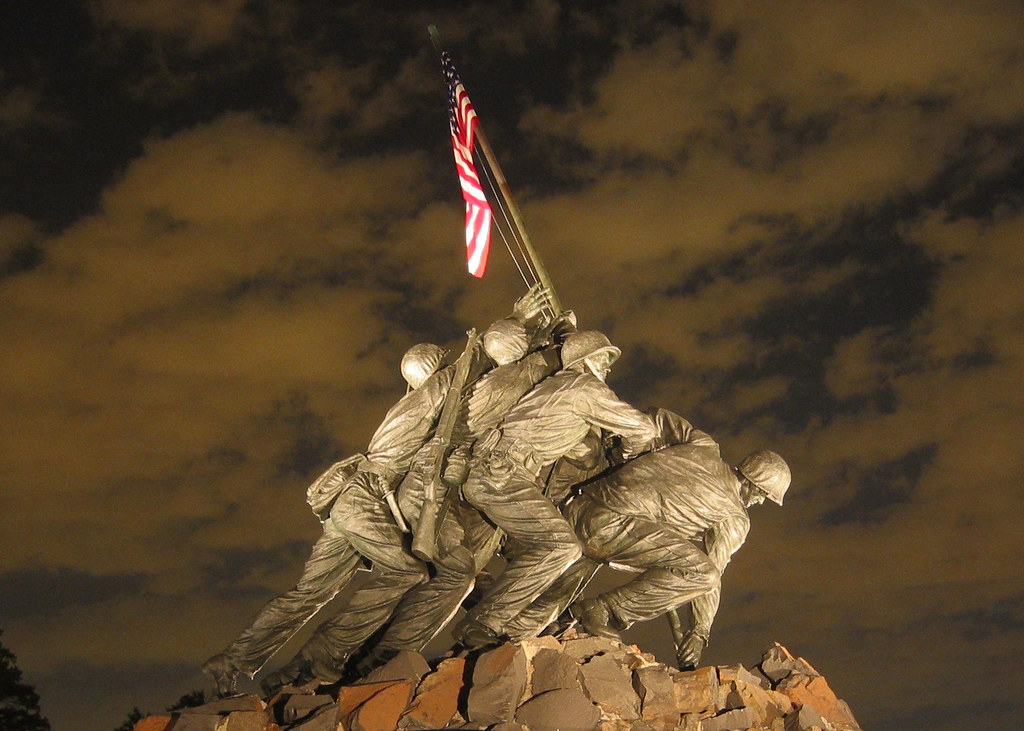
USMC Iwo Jima War Memorial at Night, World War II, Veteran Soldiers, American Flag. “USMC Iwo Jima War Memorial at Night, World War II, Veteran Soldiers, American Flag” by Beverly & Pack is licensed under CC BY 2.0.
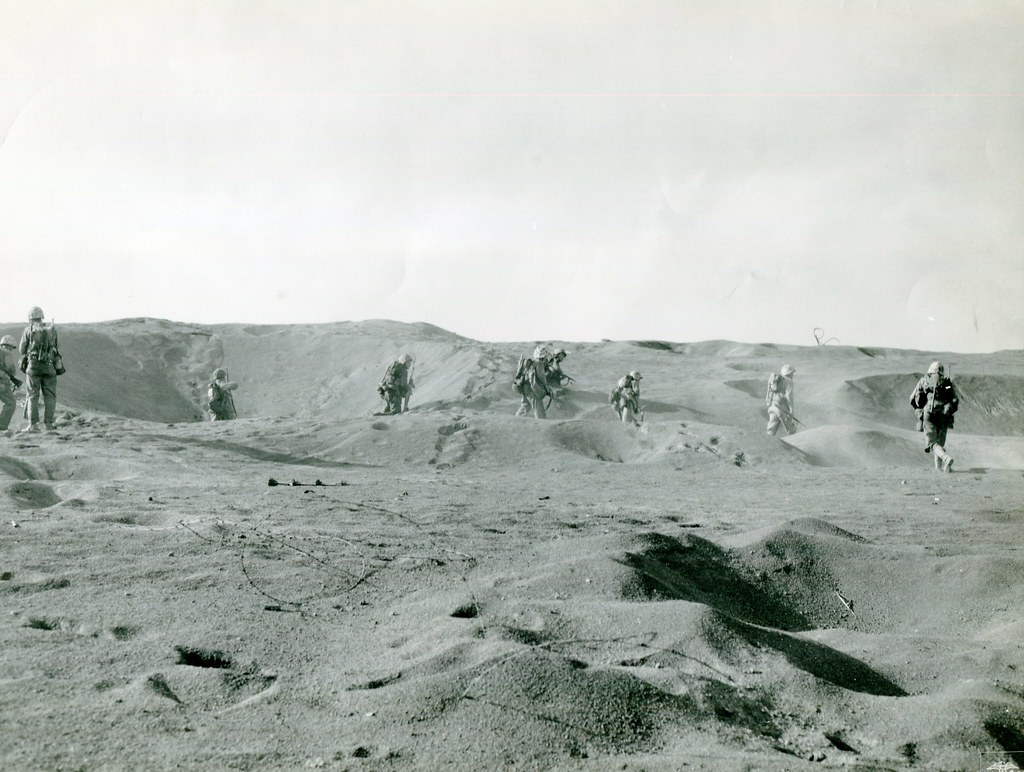
Marines Advancing on Beach, Iwo Jima, February 1945. “Marines Advancing on Beach, Iwo Jima, February 1945” by Archives Branch, USMC History Division is licensed under CC BY 2.0.
Marine Field Gun Emplacement on Beach, Iwo Jima, February 1945. “Marine Field Gun Emplacement on Beach, Iwo Jima, February 1945” by Archives Branch, USMC History Division is licensed under CC BY 2.0.
Rosenthal told Collier’s magazine: “The sky was overcast, but just enough sunlight fell from almost directly overhead, because it happened to be about noon, to give the figures a sculptural depth. The 20-foot pipe was heavy, which meant the men had to strain to get it up, imparting that feeling of action. The wind just whipped the flag out over the heads of the group, and at their feet the disrupted terrain and the broken stalks of the shrubbery exemplified the turbulence of war.” Quoted in https://www.usfca.edu/magazine/december-2024/feature/man-behind-the-camera – retrieved Feb. 19, 2025. Wire services flashed Joe Rosenthal’s photograph around the world where it was published on the front pages of more than 200 newspapers on Sunday, February 25, 1945. The photo appeared on magazine covers across the country as well. Following the battle of Iwo Jima, the photo was used for publicity in war bond drives from May 11 to July 4, 1945, which raised an amazing $26.3 billion – by far the biggest haul of any of the seven U.S. war loan drives during World War II.. Rosenthal’s photograph became an enduring icon.

Mount Suriarlington “Mount Suriarlington” by John Loo is licensed under CC BY 2.0.