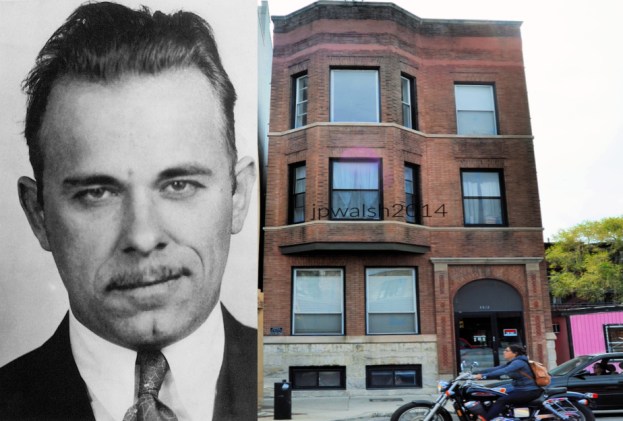
FEATURE IMAGE: On March 3, 1934, John Dillinger (left in a mug shot) used the second floor of this three-flat building on Chicago’s north side as his first hide out after he and another criminal, murderer Henry Youngblood, drove directly here from a jail in Crown Point, Indiana following their break-out. In January 1934 Dillinger had been extradited to Indiana from Arizona. Public domain. Author’s photograph. May 2014.
In the Great Depression many banks had failed wiping out entire savings of millions of ordinary Americans. Banks that stayed open saw their primary business becoming foreclosures on ordinary American’s homes, farms, and businesses. And the economy was not improving. Bank robberies were viewed by some as a sort of just retribution in desperate times or even sometimes more favorably since bank robberies could involve the destruction of bank records, including mortgages, so that the bank could not as easily foreclose. There was a myth of the glamorous getaway involving handsome celebrity robbers. Such was the story of John Dillinger (1903-1934) with his gangs including Harry “Pete” Pierpont, Lester “Baby Face Nelson” Gillis, John “Red” Hamilton, and Homer Van Meter and their girlfriends. John Dillinger, declared Public Enemy No. 1 by the FBI in June 1934, epitomized the early 1930’s Depression-era bank robber in America as he terrorized the Midwest following his release from jail from September 1933 until July 1934. In this period other robbers included “Pretty Boy” Floyd, “Machine Gun” Kelly, and Bonnie and Clyde who died in a hail of gunfire in May 1934 as these territorial and nomadic robbers’ crime sprees were splashed across newspaper headlines that the public consumed like that week’s latest movie serial.
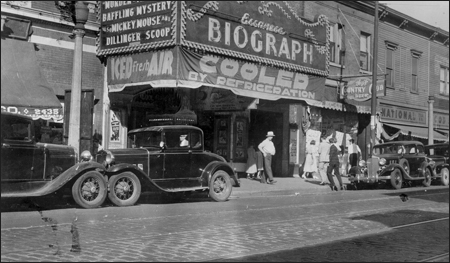
FBI photograph of the Biograph Theater in 1934 shortly after the shooting of Public Enemy No.1, John Dillinger. Public Domain
New federal anticrime laws targeted interstate criminals that made bank robbery, the transport of stolen goods or the flight of a felon over state lines, a federal crime and came under the jurisdiction of the FBI. That is where this three-flat in Chicago enters criminal and criminal law history. About midway between Lake Michigan and Wrigley Field in Chicago sits John Dillinger’s Hideout, a red brick three-flat at 3512 N. Halsted in the Uptown neighborhood. After his Indiana jail break on Saturday, March 3, 1934, John Dillinger, with murderer Henry Youngblood, headed directly to Chicago and hid out for one night in this building. Dillinger stayed on the second floor of an apartment owned by Frances “Patsy” Frechette, the half-sister of Dillinger’s girlfriend, Evelyn “Billie” Frechette (1907-1969). This break out gave FBI chief J. Edgar Hoover his first big chance to apply federal anticrime laws after Dillinger broke out of the “escape-proof” jail in Crown Point, Indiana, having used a fake gun, stole Sheriff Lillian Holley’s car and drove the 50 miles or so across state lines to this building in Chicago, Illinois. Dillinger violated the Dyer Act and put himself in the jurisdictional sights of the FBI. On March 7, 1934, Hoover mounted a special operation to capture Dillinger, dead or alive, that would come to a successful, and bloody, conclusion on the evening of July 22, 1934, outside the Biograph Theater, about a mile and half straight south from this site. On a swelteringly hot night, Dillinger went to the air-conditioned movies and, having been set up there by the “Woman in Red,” would find himself hours later chilling in a morgue.
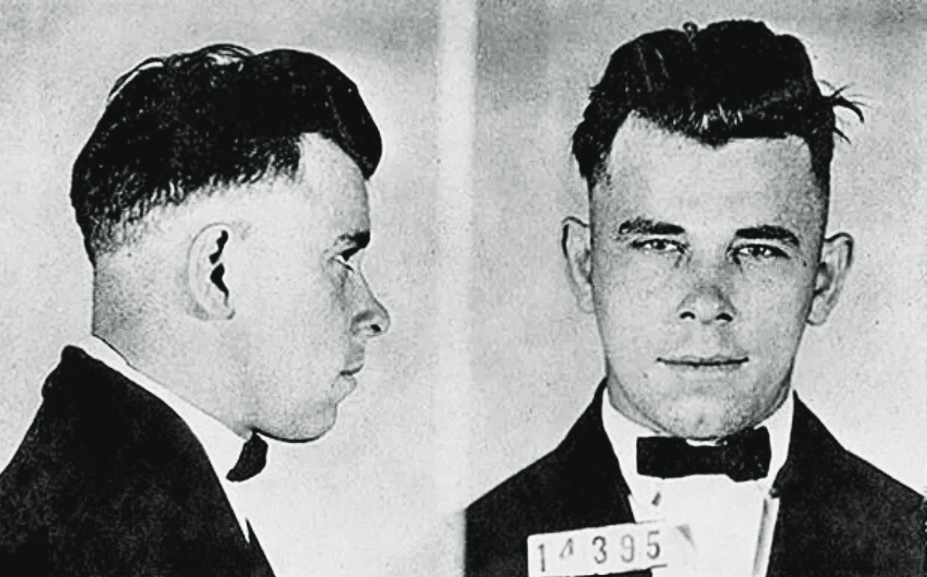
John Dillinger mug shot. Public domain.
Dillinger started early in a life of crime so that when he was 21 years old, he was serving what would be a nine-year sentence in an Indiana prison for robbery. Originally from Mooresville, Indiana, near Indianapolis, Dillinger and Chicago were paired for much of his adult criminal life. He joined the US Navy in Chicago in 1923 to escape an auto theft rap in Indiana. But 6 months later Dillinger gave up the ship, the USS Utah, and was dishonorably discharged. He was behind bars for that nine-year sentence for robbery starting in fall of 1924. When he was paroled in 1933, the ex-con turned to a life of violence as a bank robber. During his final 10-month crime spree Dillinger and his gang killed at least 10 people including a sheriff during one of their three jail breaks, and wounded seven more.
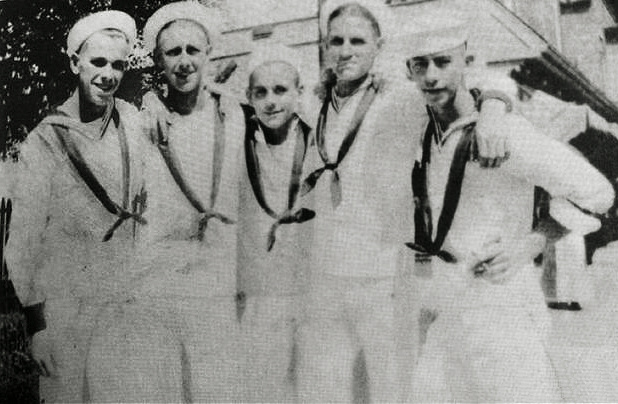
John Dillinger (left) with navy buds. Public domain.
To go from this hideout on March 3, 1934, to Dillinger’s death on July 22, 1934, was nearly half of Dillinger’s final 10-month episodic crime spree. In late January 1934 Dillinger and Billie and most of his gang was in Tucson, Arizona, with Dillinger checking escape routes to Mexico. Some of the gang was on the lam from a bank robbery in East Chicago, Indiana. Caught by local police, Dillinger was extradited by airplane to Indiana via Chicago and jailed in Crown Point, Indiana. It was there that he first hired Louis P. Piquett, a Chicago attorney known for close ties to the Chicago mob. Billie Frechette visited Dillinger at Crown Point in mid-February 1934. But, on March 3, 1934, Dillinger broke out of the jail and remained free until his death in late July 1934 at the hands of law enforcement.

3512 North Halsted, Chicago. Author’s photograph. May 2014.
There are many hideouts for Dillinger and his gang as they were highly peripatetic. But this hideout is significant since it is the first hideout for Dillinger on his final way to capture and death as Public Enemy No. 1 but also an American folk anti-hero. Dillinger arrived at the apartment of Patsy Frechette to hide out and reunite with Billie after crossing the state line in the stolen sheriff’s car. Dillinger was here for a significant rendezvous and transition though for too short a time for any law enforcement raid occurring at this specific address during his stay. The hideout is just steps – a literal 3-minute walk – from the long-established (1872) 42nd Precinct “Town Hall” police station. Instead, the FBI’s first major violent confrontation with the Dillinger gang following his escape took place weeks later at the Little Bohemia Lodge in northern Wisconsin in April 1934.
The next day, March 4, 1934, Dillinger set out for Minneapolis with Billie and rented an apartment (the Indiana sheriff’s stolen car was ditched in Edgewater) at Lincoln Court Apartments, Unit 303, at 95 Lexington Parkway in St Paul. On March 6, 1934, escaped con man Dillinger driving a 1934 Packard robbed a bank in Sioux Falls, North Dakota with gang members Homer Van Meter, Eddie Green, Tommy Carroll, and Baby Face Nelson. In the robbery a policeman was wounded and the gang took almost $50,000 ($1.2 million in 2026). One week later, on March 13, 1934, Dillinger, driving a Buick, robbed a bank in Mason City, Iowa, with the same gang members plus John Hamilton. Taking $52,000 in cash ($1.25 million today), a bystander was wounded as was Dillinger and Hamilton who returned to St. Paul for medical attention. That same day (March 14, 1934), Henry Youngblood, the murderer who escaped prison with Dillinger less than two weeks before, was shot and killed by law enforcement in Michigan. A deputy sheriff was killed in the capture.
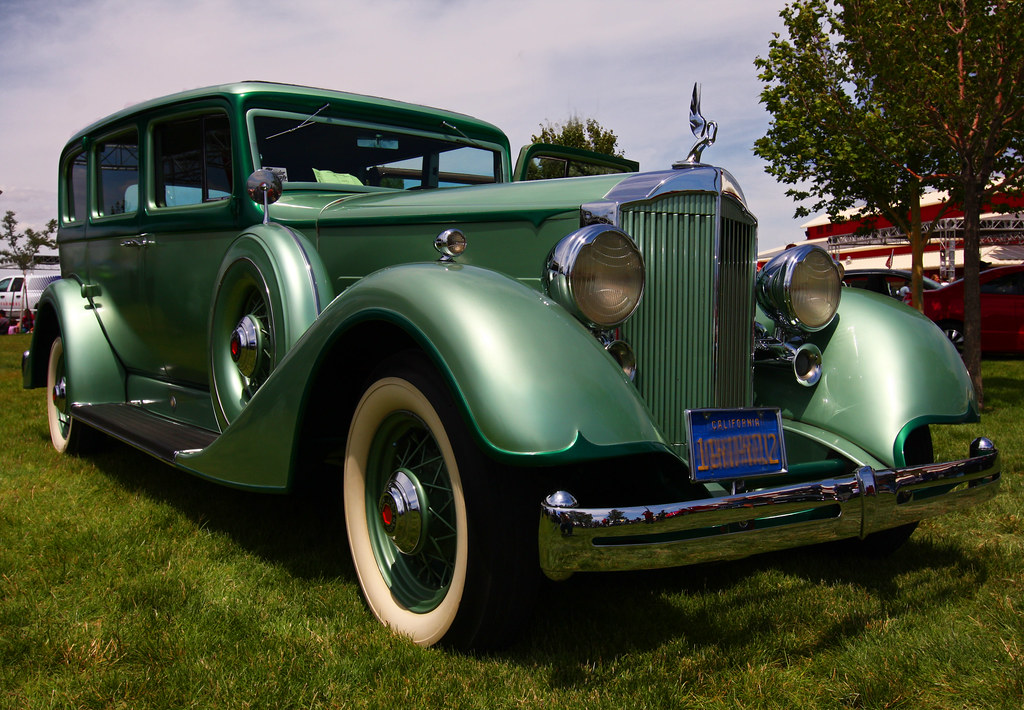
1934 Green Packard. “1934 Packard” by Rennett Stowe is licensed under CC BY 2.0.
Two days later, March 16, 1934, Dillinger and Billie return to Chicago. Days later he and Billie are back in St. Paul living together in the apartment under an alias (rent is $60 a month – about $1440 today). The criminal bank robber Dillinger drove to Ohio to see if he could spring from jail his mentor and partner Harry Pierpoint who had an impending death sentence but Pierpont, on October 17, 1934, was executed in the electric chair. On March 30, 1934, Dillinger was back in St. Paul with Billie and his gang members with girlfriends. At the same time, the FBI was tipped off as to Dillinger’s whereabouts and when three agents arrived at the apartment to investigate on March 31, 1934, Dillinger and Billie escaped though Dillinger was wounded in the leg. He sought medical attention across town in Minneapolis where he recovered during the next week though Eddie Green was shot and mortally wounded. The FBI, hot on Dillinger’s trail, raided the house of Dillinger’s half-brother Hubert in Indianapolis after Dillinger and Billie bought a car there with hot money and listed Hubert’s address as theirs. On Monday, April 9, 1934, Dillinger and Billie were back in Chicago where Billie was arrested at 416 North State as Dillinger escaped. Billie was held on a $60,000 bond ($1.44 million today) in response to the pair’s fleeing that shootout with law enforcement in St. Paul, Minnesota. Her trial in May 1934 resulted in a conviction. By Friday, April 13, 1934, Dillinger with Homer Van Meter had robbed a police supply station in Warsaw, Indiana, and stole firearms (Dillinger was partial to .38 revolvers throughout his career) and bulletproof vests.

Billie Frechette (1907-1969) was born on a Menominee Indian Reservation in Wisconsin. After her arrest she was tried and convicted of violating a federal law of harboring a criminal and served a two-year prison sentence without parole in a federal pen in Milan, Michigan. Public domain.
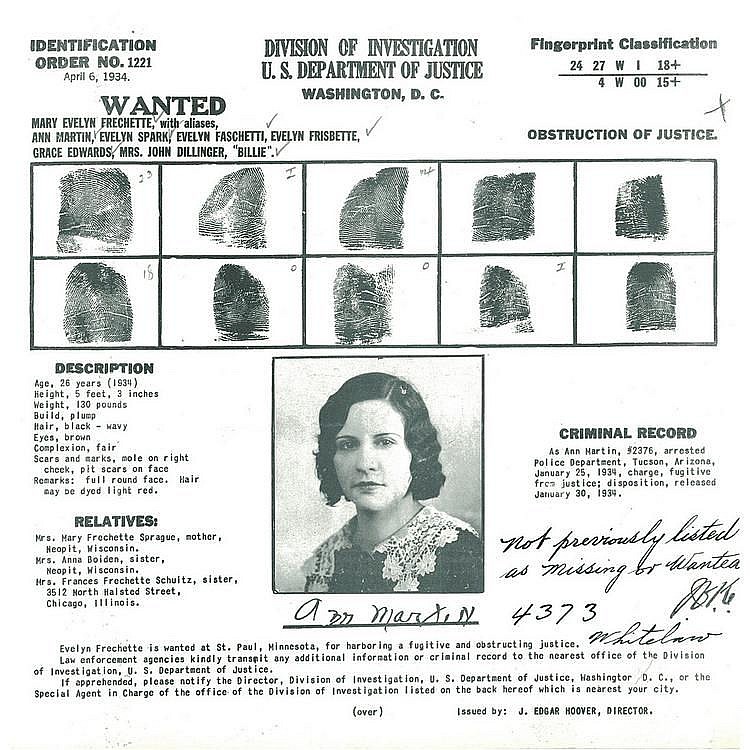
FBI wanted poster for Billie Frechette. Public Domain.
The next day Dillinger and Van Meter were in Cedar Rapids, Iowa where they broke into a tourist camp and stayed in a cabin for a few days. Dillinger then drove to Sault Ste. Marie, Michigan with John Hamilton. Meanwhile Homer Van Meter, Marie Comforti, and Pat Reilly arrived at Little Bohemia Lodge in Manitowish, Wisconsin where that evening of Friday, April 20, 1934, Dillinger, Hamilton, and others arrived for a three-day paid stay. The lodge was owned and built in 1929 by a Dillinger friend. The proprietor’s wife, hoping to secure the FBI’s $10,000 reward for Dillinger’s capture (about $250,000 today), tipped off law enforcement on many fronts after an elaborate feint of trust/ mistrust among the lodge’s owners and Dillinger’s gang. The G-men immediately chartered two airplanes full of agents from St. Paul and Chicago to Rhinelander Airport. Agents in communities surrounding the lodge were summoned to assist in the raid. There were complications: the weather was bad (snow and ice), and the agents on arrival found they had only one car when they needed 6 or 7. Meanwhile Dillinger announced he changed plans and was leaving the Lodge early. After renting cars agents arrived by nightfall of April 22, 1934, and surrounded the lodge on foot. The agents were protected by bulletproof vests and armed with machine guns, revolvers, and tear gas.

Little Bohemia Lodge where the FBI bungled the capture of Dillinger on April 22, 1934, and killed an innocent guest. It was a human and public relations disaster for the newly minted federal law enforcement group. Built in 1929, bullet holes can still be seen from that night in the northern Wisconsin lodge building today. “Little Bohemia Lodge” by nanaze is licensed under CC BY-NC-SA 2.0.
Inside the Lodge, it was Sunday night and the bar was busy with patrons. John Morris and Eugene Boiseneau, two young CCC workers, and a gas station attendant named John Hoffman had just finished their Sunday dinner and were about to leave. The snow in the night obscured everyone’s vision and when they approached the exit of the lodge they were ordered to halt by the FBI who thought they were Dillinger and his gang. The FBI soon opened fire. Their bullets pierced the car’s steel and hit its three occupants – wounding Morris and Hoffman and killing Boiseneau.

Mug shot of Lester Gillis, aka “Baby Face” Nelson. On July 22, 1934, Dillinger was ambushed and killed by FBI agents outside the Biograph Theater in Lincoln Park, Chicago. The next day the FBI announced that “Pretty Boy” Floyd was now Public Enemy No. 1. On October 22, 1934, Floyd was killed in a shootout with agents including Melvin Purvis. Subsequently, J. Edgar Hoover announced that Nelson was now Public Enemy No. 1. Unlike Dillinger who could be polite, the owners of the Little Bohemia Lodge thought Nelson was a “psychopath.” He died from gunshot wounds sustained in a fierce shootout with FBI agents on November 27, 1934, near Barrington, Illinois, though he managed to kill both agents. Fleeing, Nelson died in a safe house in Wilmette, Illinois. Public domain.
This gunfire alerted Dillinger inside the lodge playing cards to law enforcement’s presence. Agents then surrounded the Little Bohemia Lodge and opened fire with a hailstorm of bullets believing Dillinger and his gang inside. But Dillinger, Homer Van Meter, John Red Hamilton and Tommy Carroll escaped as did Baby Face Nelson who killed one agent and left the proprietor and wife with their other guests to suffer the carnage. The FBI left emptyhanded but for some of the gang’s girlfriends who surrendered without incident.
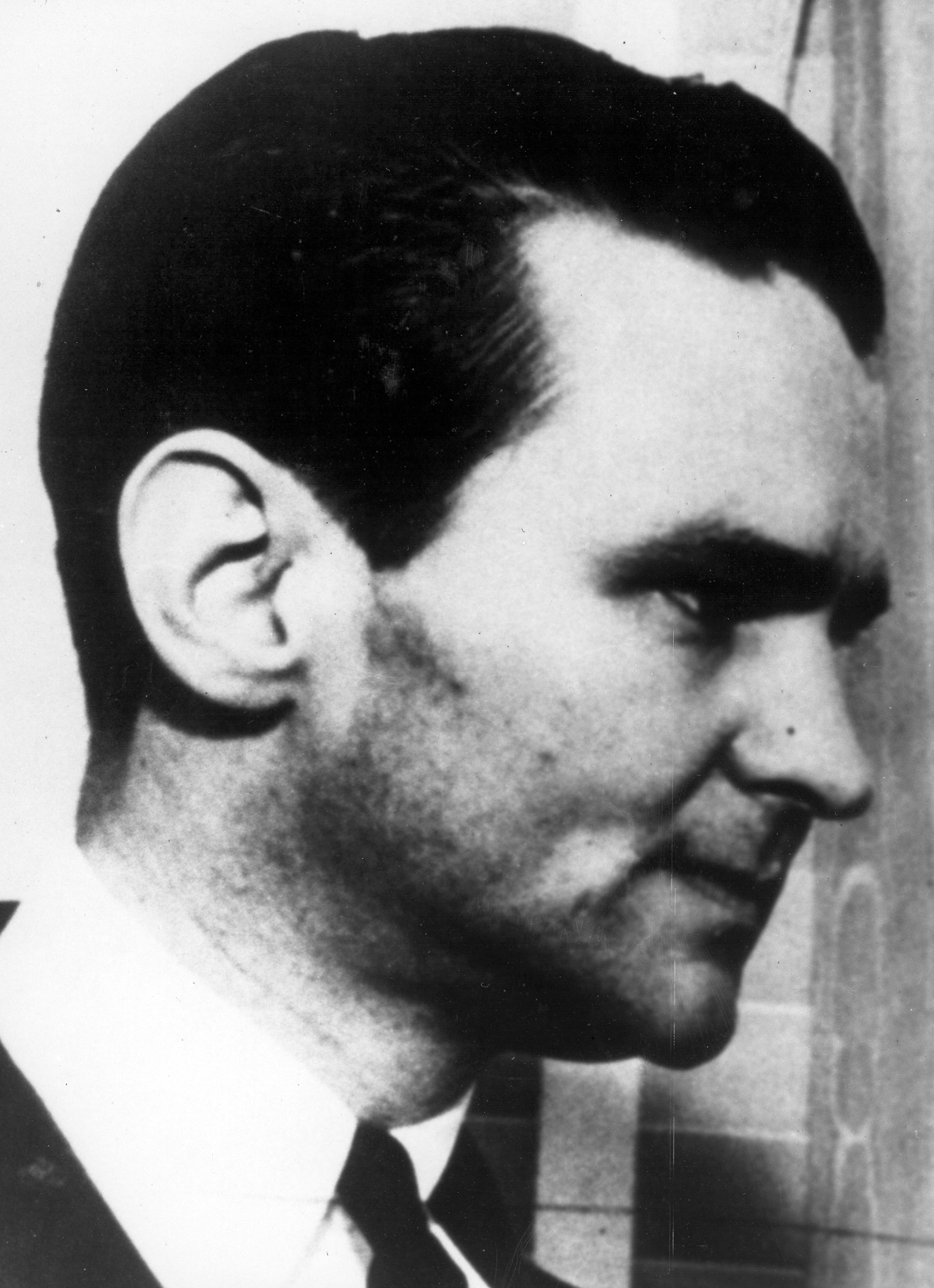
Head of the FBI case in Chicago to get Dillinger and his gang dead or alive was Melvin Purvis. Public domain.
Later that day (April 23, 1934), Dillinger, Van Meter and Hamilton engaged in a gun battle with police in Hastings, Minnesota, near St. Paul. When Hamilton was wounded Dillinger drove back to Chicago but failed to get him medical attention so that, a few days later, Hamilton died in Aurora, Illinois, and was buried by Dillinger and others in a gravel pit near Oswego, Illinois. The getaway car Dillinger stole in Wisconsin that night after escaping the lodge was found blood stained in Chicago at 3333 North Leavitt on May 2, 1934. The raid, led by FBI chief in Chicago Melvin Purvis (1903-1960), who liked publicity, was heavily criticized in the press for the agents’ brutal methods and stupidity and was one of the worst public relations fiascos in FBI history.
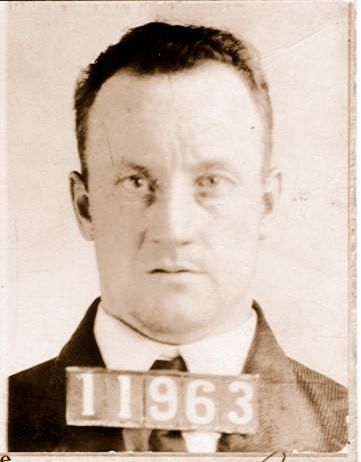
John “Red’ Hamilton. Mug shot. Public domain.
With the FBI in hot pursuit of Dillinger and his gang, episodes of violence occurred between law enforcement and gang members and other criminals throughout the Chicago area where people were killed. Dillinger, who had become an internationally known superstar criminal, had been thinking about getting plastic surgery to conceal his identity. His legal counsel, Louis P. Piquett, put Dillinger in touch with an off-the-books operating room by way of James Probasco, another of Piquett’s clients. The surgery price was high and almost all profit for Probasco: $80,000 cash (about $2 million today). Probasco recruited Dr. William Loeser, a German immigrant who fled to Mexico to escape serving time for violating the Harrison Anti-Narcotic Act of 1914 and developed a procedure to remove fingerprints. He was assisted by Dr. Harold Cassidy. Dillinger moved into Probasco’s home on Chicago’s north Crawford Road (now Pulaski Road) on May 27, 1934. The surgery took place the next day, with Dillinger opting to receive a general anesthetic. But a glitch in its application (Dillinger was swallowing his own tongue) made him choose a local anesthetic. For the next several hours, the doctors removed a mole from his forehead, dimple from his cheek, and changed the shape of his face and erased seams in his cheeks. They employed Loeser’s acid method to burn off Dillinger’s fingerprints.
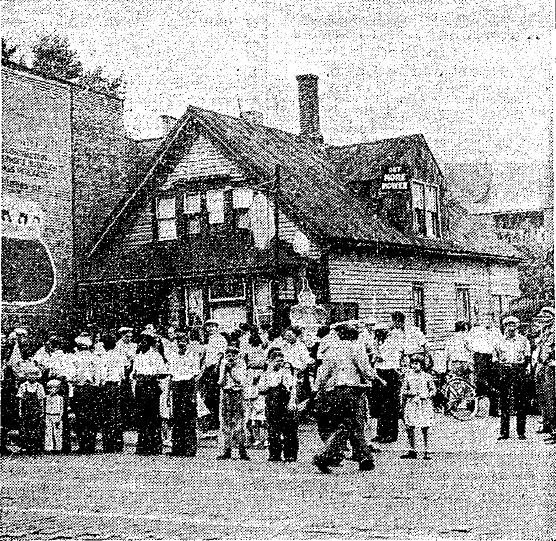
Tavern owner James Probasco’s house at 2509 N. Crawford Road in Chicago where Dillinger underwent plastic surgery on May 28, 1934. Public domain.
The surgery, however, was more cosmetic than plastic so that Dillinger was still completely recognizable and his fingerprints remained after he recovered. James Probasco, four days after Dillinger’s death, on July 26, 1934, was brought under questioning for this episode by the FBI at the Bankers’ Building in downtown Chicago. Mysteriously, a window was open and Probasco leapt to his death falling onto the pavement. Attorney Louis Piquett went on trial for harboring a fugitive (Dillinger) but was found not guilty. In 1936, Piquett was retried for the same charge regarding Homer van Meter. Found guilty he served two years in prison, was fined $10,000, and disbarred in Illinois. In 1950, Piquett was pardoned by President Truman. Dr. Loeser was sentenced to one day in prison but had to serve 18 months for the Harrison narcotics case from which he fled. Dr. Cassidy received probation, served honorably in the army medical corps in World War II, but in 1946 had a breakdown and committed suicide.
“All My Life I wanted to be a bank robber. Carry a gun and wear a mask. Now that it’s happened, I guess I’m just the best bank robber they ever had. And I am sure happy.” – John Dillinger. On the alley wall in Chicago near the Biograph Theater where the bank robber was captured, dead, by law enforcement.
On June 22, 1934, the same day Dillinger was officially named Public Enemy No. 1, the high-profile criminal celebrated his 31st birthday with his new girlfriend, 26-year-old Polly Hamilton (1908-1969) at the French Casino nightclub in The Rainbo [sic] Building, 4812-4836 North Clark Street, in Chicago’s Uptown. A former employee and friend of brothel madam Anna Sage (1889-1947), Polly Hamilton met Dillinger at a Chicago nightclub in early June 1934 when she was working as a waitress and prostitute.
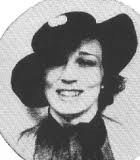
Polly Hamilton. Fair use.
The Rainbo, like many entertainment venues, struggled during the Great Depression. For a few months in 1934, the second year of the Century of Progress exposition in Chicago, the Rainbo Casino reopened as the “French Casino” (the building was demolished in 2003). A few days later (June 26, 1934), as Dillinger was watching the Chicago Cubs beat the Brooklyn Dodgers in Wrigley Field, his gang members, as informants increasingly came forward, were being squeezed around the city and in the Midwest by law enforcement, whether by being killed, or captured and tried. On June 30, 1934, Dillinger, driving a Hudson, with Van Meter, Baby Face Nelson and John Paul Chase pulled off their last bank heist in South Bend, Indiana, stealing $30,000 (over $700,000 today). One police officer was killed in the melée as a bank cashier, vice president, a bystander and a motorist, as well as Van Meter, were wounded.

Wanted poster: John Dillinger, published by U.S. Department of Justice. Public domain. Special Collections at Wofford College “[Recto] Wanted poster: John Dillinger, published by U.S. Department of Justice” by Special Collections at Wofford College is licensed under CC BY-NC-ND 2.0.
In July Dillinger began the month discussing Billie’s appeal, going to the movies, and attending the Chicago Century of Progress. On July 22, 1934, Anna Sage (the “Woman in Red”) contacted FBI head Melvin Purvis at 5:30 p.m. to inform him that Dillinger and their mutual friend, Polly Hamilton would be going to the movies that evening either at the Biograph Theater at 2433 N. Lincoln Avenue in Lincoln Park or at the palatial Marbro Theatre at 4110 W. Madison Street in West Garfield Park (the theater was demolished in 1964 and in 2026 its site remains an empty parking lot).
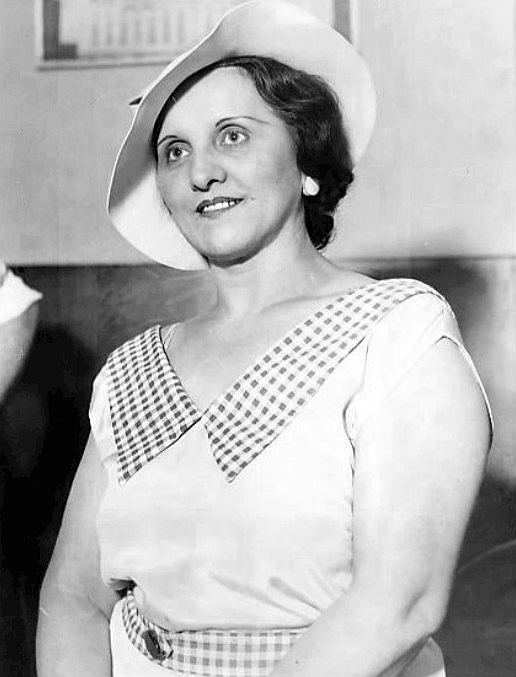
Anna Sage, “the woman in red” who set up John Dillinger to be shot outside the Biograph Theater in Chicago on July 22, 1934. Public domain.
At 8.15 p.m. Dillinger arrived at the Biograph Theater wearing a straw hat, white shirt, gray tie, white canvas shoes and gray trousers with Sage and Polly. When they entered the Biograph Theater to see “Manhattan Melodrama” with Clark Gable, 15 federal agents (according to the next day’s headline in the Altoona Tribune), including five East Chicago officers, descended on the area and staked it out. A little after 10:30 p.m. when the show emptied out, Sage, who was dressed in a bright orange-red dress, alerted officers to Dillinger’s identity in the crowd. Ambushed and shot without warning, Dillinger was killed instantly when two shots hit the face, one bullet exiting beneath the right eye. Witnesses described Dillinger being shot at very close range. The event caused a spectacle, with many onlookers dipping handkerchiefs and scraps of newspaper in his blood.

Dillinger’s body after the shooting was transported to Alexian Brothers Hospital at West Belden and North Racine Avenues (above). It then went to the Cook County morgue at West Polk and South Wood streets where large crowds gathered. There, an impromptu public display of the body took place, where thousands of the general public shambled by. A plaster death mask was made of the dead criminal at the morgue. See – Medical – Hospitals – Chicago History In Postcards – retrieved Jan. 24, 2026. Fair Use.
Dillinger’s remains were taken back to Mooresville, Indiana by Dillinger’s father, half-brother, and their undertaker who came to fetch it out from the crowds. In Indiana, Dillinger was identified by his sister and then buried on July 25, 1934, in Crown Hill Cemetery in Indianapolis. Anna and Polly had escaped Dillinger’s capture unharmed and relocated temporarily to Detroit. Sage collected the $5,000 reward (about $120,000 today) from the FBI but, two years later, was deported to Romania due to her conviction for operating a brothel where she died on April 25, 1947. Polly Hamilton moved back to Chicago under an assumed name, married, and died in 1969.
SOURCES
John Dillinger: Bank Robber or Robin Hood? – Crime Library – retrieved Jan. 22, 2026
Uptown Update: Notorious Uptown – retrieved Jan 22 2026
23rd District Police Station, Weather Underground Target, … | Flickr – retrieved Jan 22, 2026.
Vintage Chicago Tribune: John Dillinger’s final days — and the ‘Lady in red’ who helped trap him – Chicago Sports Today – retrieved Jan. 22, 2026.
History – LITTLE BOHEMIA LODGE – retrieved Jan. 23, 2026.
April 1934 – Dillinger LLC – retrieved Jan. 23, 2026.
The Chicago Crime Scenes Project: Dillinger’s Plastic Surgery on Pulaski Rd. (or Crawford Ave.?) – retrieved Jan. 23, 2026.
The Digital Research Library of Illinois History Journal™ : The Rainbo Building’s History, 4812-4836 North Clark Street, Chicago (Uptown Community), Illinois. – retrieved Jan. 23, 2026.
John Dillinger | Notable People Buried at Crown Hill Cemetery | Crown Hill Foundation | Indianapolis – retrieved Jan. 23, 2026.
Edyth Gertrude “Polly” Hamilton Black (1908-1969) – Find a Grave Memorial – retrieved Jan. 24, 2026.
http://www.historictwincities.com/2019/12/05/lincoln-court-apartments-st-paul/ – retrieved Jan. 25, 2026.