Tag Archives: Politics

80th Anniversary: Battle of Iwo Jima (Feb. 19-Mar. 26, 1945): American victory in the Pacific Theater which cost dearly and whose heroism was captured in photographs and color films, rallied a war-weary homefront to renewed resolve to finish the job in the last months of World War II.

FEATURE image: American flamethrowers in a foxhole on Iwo Jima, February 1945. Marine Flamethrowers in Foxholes, February 1945” by Archives Branch, USMC History Division is licensed under CC BY 2.0.

Fourth Division Marines in Foxhole on Beach, Iwo Jima, February 1945 “Fourth Division Marines in Foxhole on Beach, Iwo Jima, February 1945” by Archives Branch, USMC History Division is licensed under CC BY 2.0.

Advancing Marine Flamethrower Squad, Iwo Jima, February 1945. “Advancing Marine Flamethrower Squad, Iwo Jima, February 1945” by Archives Branch, USMC History Division is licensed under CC BY 2.0.

The Battle of Iwo Jima was a nearly 40-day battle campaign fought by the U.S. Marine Corps and U.S. Navy against the Japanese Imperial Army on the island of Iwo Jima in the Pacific. With 110,000 total battle personnel (over 70,000 troops), the American objective of their invasion (called “Operation Detachment”) was to capture the island and its airfields. Iwo Jima was situated between Japan and the American bomber bases in the Mariana Islands. Since summer 1944 unescorted American B-29 bombers were flying nearly 3000 miles roundtrip to bomb Japan and being lost at sea from entrenched Japanese defenses. With Iwo Jima in American hands U.S. fighter planes could escort the long-range bombers as well as have any damaged aircraft find sanctuary on the island. The American victory after a five week campaign resulted in the capture of Iwo Jima with its immediate benefit that, by war’s end, 2,400 B-29s were able to make safe forced landings on the island.

Iwo Jima in 1945. Mount Suribachi is a knob at the bottom of the map. “Map of Iwo Jima, 1945” by Archives Branch, USMC History Division is licensed under CC BY 2.0.
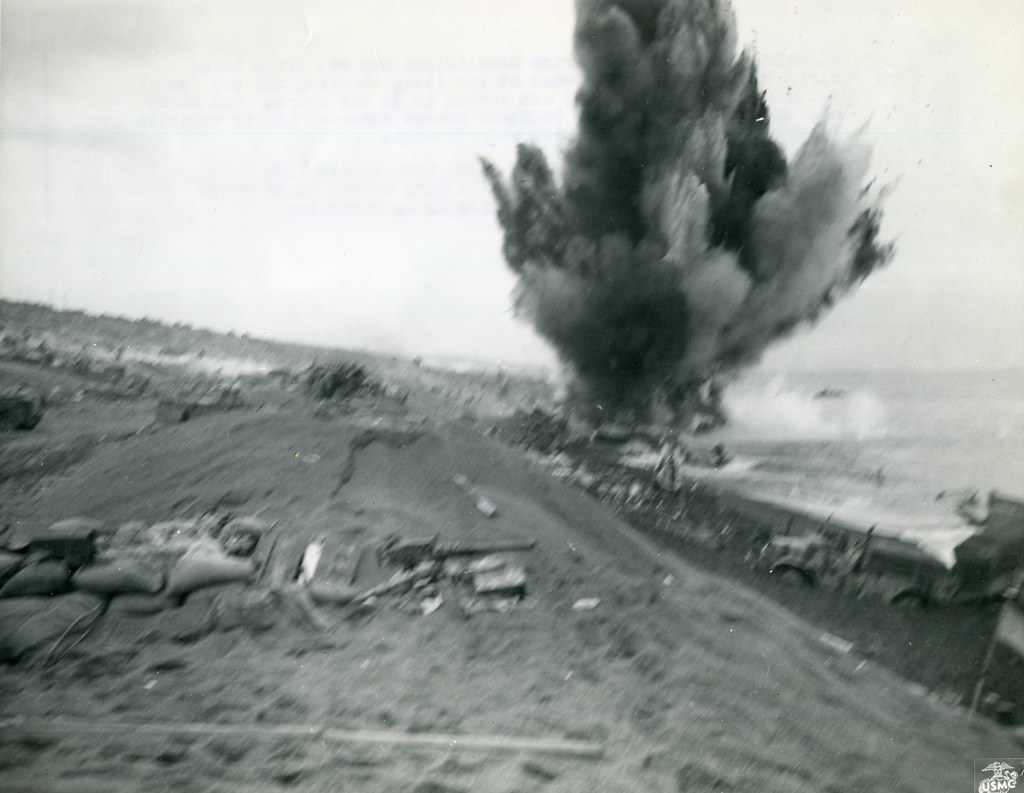
Marines Detonating Japanese Mine on Beach, Iwo Jima, February 1945. “Marines Detonating Japanese Mine on Beach, Iwo Jima, February 1945” by Archives Branch, USMC History Division is licensed under CC BY 2.0.

Marines Taking Shelter on the Beach, Iwo Jima, February 1945. Marines Taking Shelter on Beach, Iwo Jima, February 1945” by Archives Branch, USMC History Division is licensed under CC BY 2.0.

There were 20,000 or so heavily-fortified Japanese defending the island to the death while U.S. Navy and Marine Corps aircrews had complete air superiority. The U.S. Navy provided heavy artillery gunfire support from the sea. The Battle of Iwo Jima, an American victory, took place from February 19 to March 26, 1945, and was one of the fiercest of World War II. That Americans could take the island was not the question. Its exact cost was. The casualty toll was heavy for both sides. The Japanese had 216 taken prisoner and up to 18,375 killed or missing in action. The American combat toll was also staggering: 6,821 killed in action, 19,217 wounded, and 2,648 experiencing battle trauma.
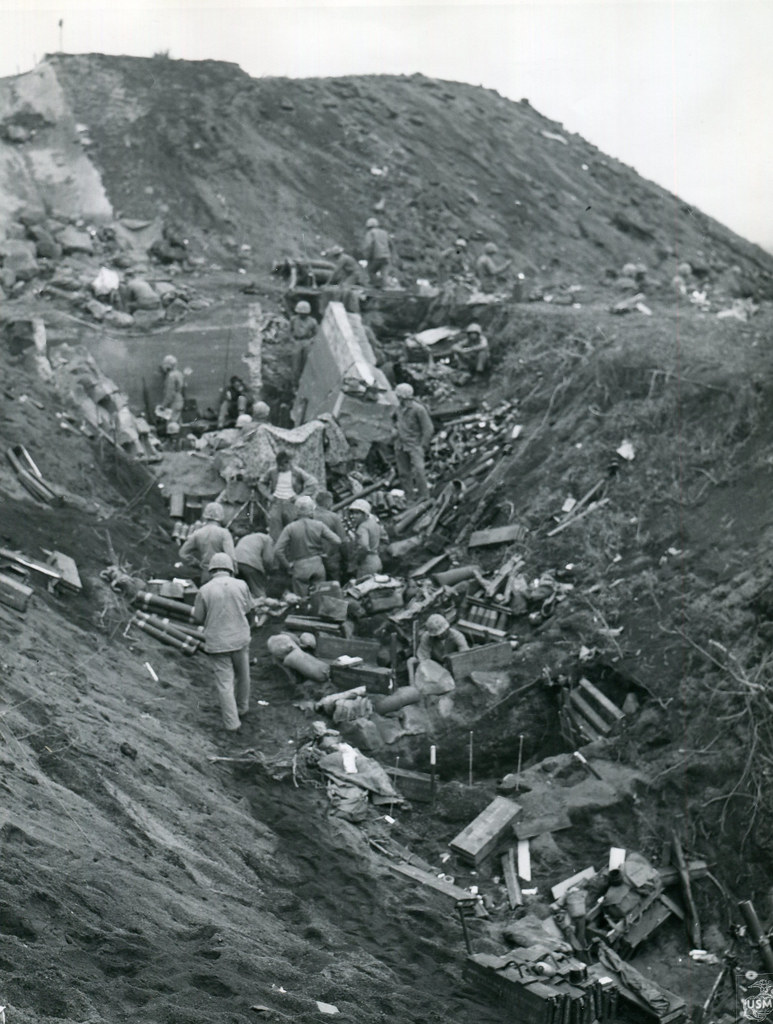
23d Regiment, Fourth Marine Division Command Post, Iwo Jima, 1945. “23d Regiment, Fourth Marine Division Command Post, Iwo Jima, 1945” by Archives Branch, USMC History Division is licensed under CC BY 2.0.
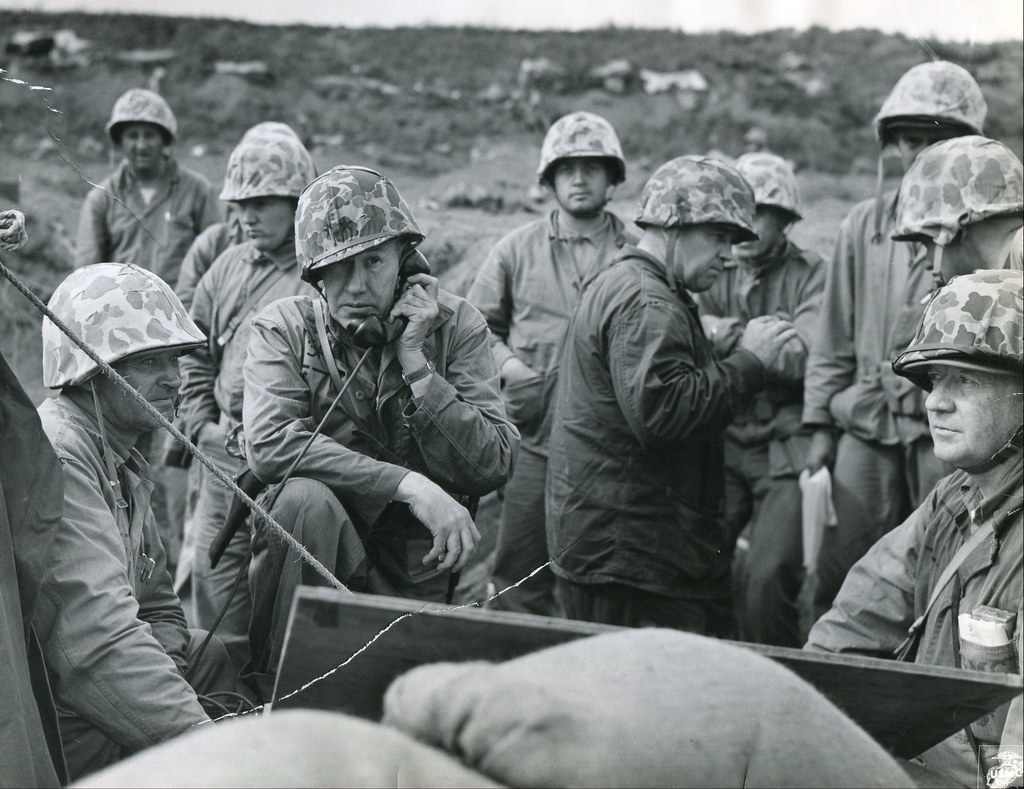
Fifth Marine Division Command Post, Iwo Jima, 1945. Fifth Marine Division Command Post, Iwo Jima, 1945” by Archives Branch, USMC History Division is licensed under CC BY 2.0.

Joe Rosenthal (1911-2006), with his camera hanging at his side, surveys the landing beaches at Iwo Jima on March 7, 1945. Rosenthal was awarded the U.S. Navy Distinguished Public Service Award, as well as the Marine Corps Distinguished Public Service Award by the Marine Corps, for his war photography. Photo by AP/U.S. Marine Corps. Public Domain.

On Friday, February 23, 1945, Rosenthal landed on the island and heard that they were going to raise a flag on the highest point on the island which was the old volcano at the southwest end called Mount Suribachi. Rosenthal carried a Speed Graphic camera that was press standard issue and joined other photographers ready to ascend to the top. Halfway up they met a marine photographer coming down whose camera was obliterated by an enemy grenade explosion. Rosenthal and the others were told that the marines had already raised the flag. But the views were good from the summit anyway and still worth the climb. Once at the top Rosenthal and the rest saw marines who were working to affix a larger flag to a pipe under orders from a captain who wanted to replace it for the earlier smaller flag just raised. When the six marines started to raise that second larger flag on the heavy pole Rosenthal pushed his camera’s shutter. After taking the flag-raising photo, Rosenthal made his way back down Mount Suribachi to the shoreline. There, he took a transport boat out to the command ship, where he wrote captions for his photos and sent them, sight unseen, with the undeveloped film by seaplane to Guam.
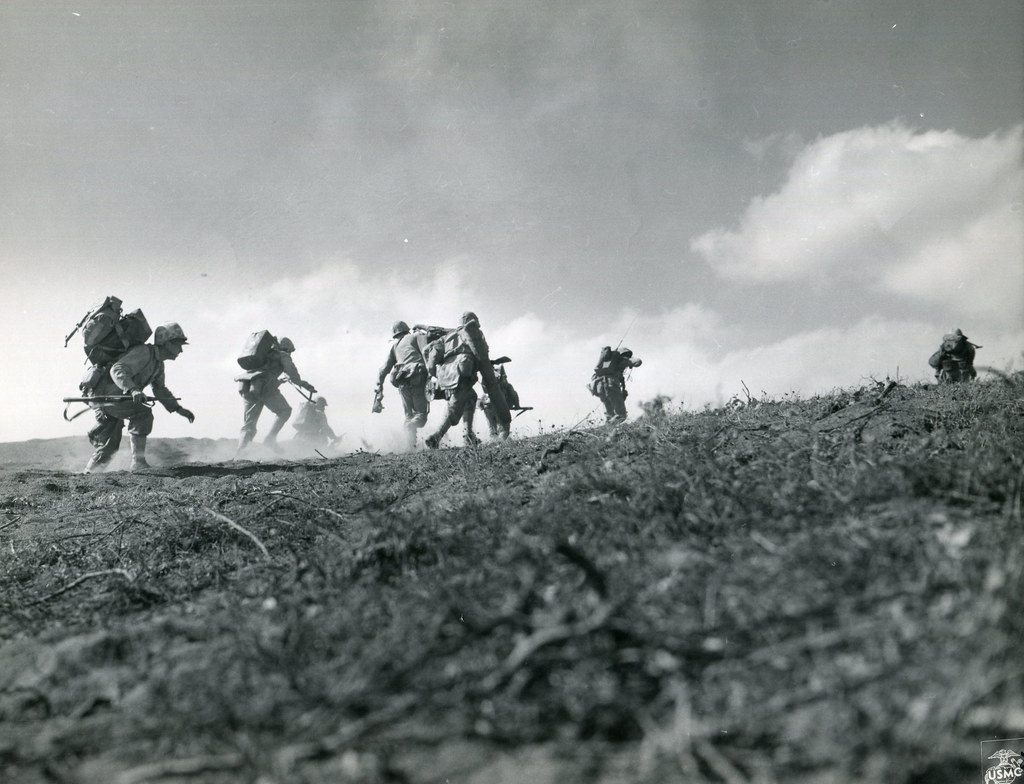
Marines on Beach, Iwo Jima, February 1945. “Marines on Beach, Iwo Jima, February 1945” by Archives Branch, USMC History Division is licensed under CC BY 2.0.

In the shadow of Mount Suribachi, Iwo Jima, 1945. “In the shadow of Suribachi, Iwo Jima, 1945” by Archives Branch, USMC History Division is licensed under CC BY 2.0.
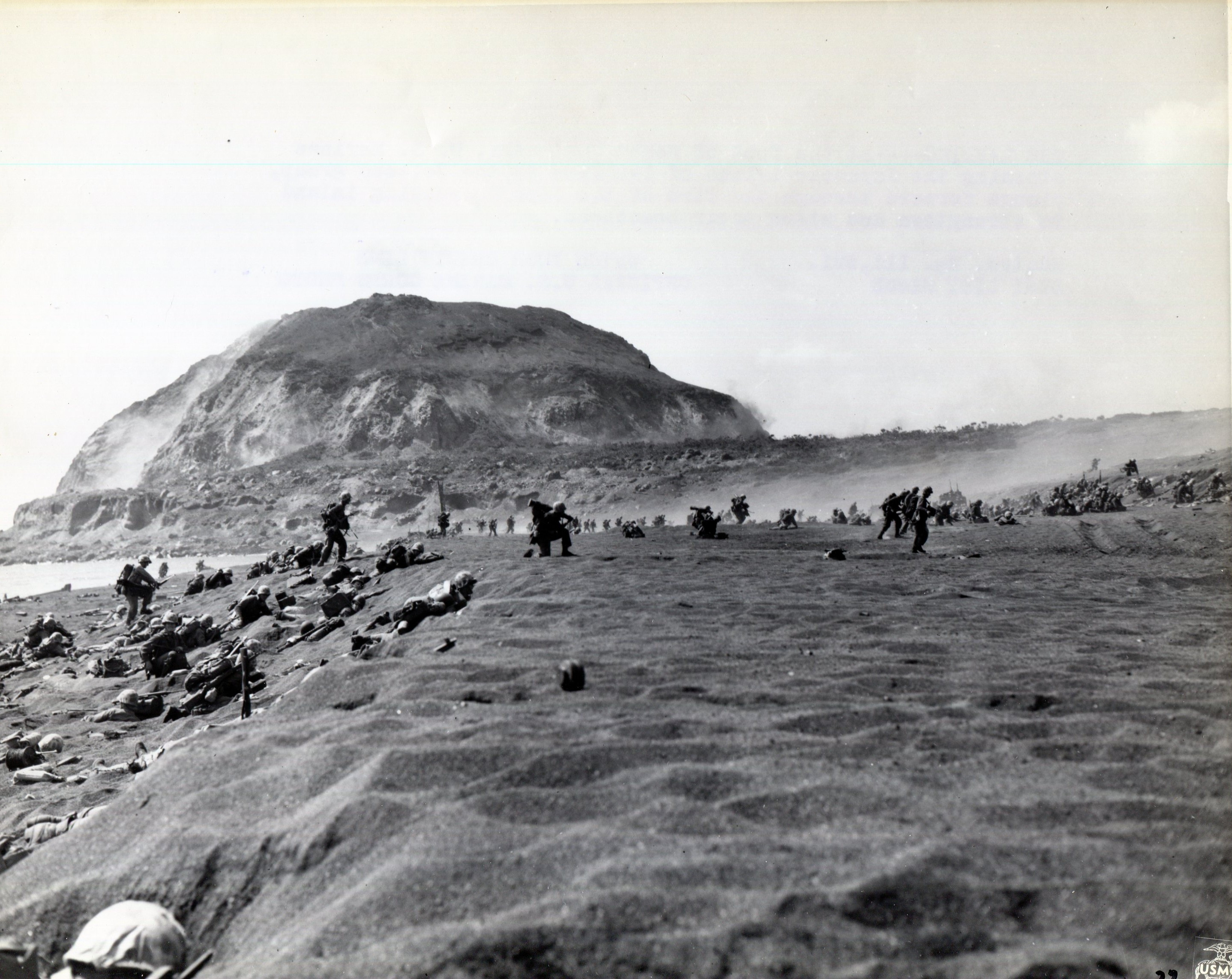
Marines Advancing on Beach, Iwo Jima, February 1945 – 36324610020. “Marines Advancing on Beach, Iwo Jima, February 1945 – 36324610020” by Archives Branch, USMC History Division is licensed under CC BY 2.0.

Marine Firing 30mm, Iwo Jima, 1945 “Marine Firing 30mm, Iwo Jima, 1945” by Archives Branch, USMC History Division is licensed under CC BY 2.0.

Iwo Jima – Mt Suribachi Detail. “Iwo Jima – Mt Suribachi Detail” by Agsftw is licensed under CC BY-SA 3.0

“I took the picture. But the Marines took Iwo Jima.”

In February 1945 Joe Rosenthal was a 33-year-old American photographer for the AP. Rosenthal’s poor eyesight prevented him from fighting in combat though his task as an embedded photographer placed him in Harm’s Way. Before Iwo Jima, Joe Rosenthal had landed with the marines on Guam and Peleliu. His Pulitzer Prize-winning photograph of the flag raising on Iwo Jima became a sign of hope for a war-weary American home front that victory in the Pacific would be theirs. It also became the iconic symbol of everything U.S. Marines. Rosenthal was very proud of his photograph of the six marines and the Marines overall, though modest about any accolades that came his way. Rosenthal put his role in perspective, saying: “I took the picture. But the Marines took Iwo Jima.” Yet it is not to be forgotten that Rosenthal was exposing himself to the same dangers as the six marines that day when he took his iconic photograph for history of the flag raising on Iwo Jima on February 23, 1945.

Original photograph by Joe Rosenthal, February 23, 1945. Public Domain.

Iwo Jima Flag Raising 1945 – Rare Color Film by Sgt Genaust [#Upscaled#1080p#60FPS#ww2]. Three feet to Joe Rosenthal’s right, Sgt. Genaust captured the flag-raising from nearly the same angle using color motion picture film.

Unveiled in November 1954, the Marine Corps War Memorial in Washington, D.C. was dedicated to all Marines who have given their lives in the defense of the U.S. since 1775. see – https://www.nps.gov/gwmp/learn/historyculture/usmcwarmemorial.htm – retrieved February 19, 2025. Author’s photograph, October 2003.

U.S. Marine Corps War Memorial (Iwo Jima Memorial) – (Arlington, Virginia) – August 1, 2015. U.S. Marine Corps War Memorial (Iwo Jima Memorial) – (Arlington, Virginia) – August 1, 2015” by cseeman is licensed under CC BY-NC-SA 2.0.

US Marine Corps War Memorial, Washington, D.C. The centerpiece of the memorial is a colossal sculpture group by Felix Weihs de Weldon (1907-2003), then on duty with the U.S. Navy, depicting the six Marines who raised the second larger U.S. flag atop Mount Suribachi on Iwo Jima on February 23, 1945. The memorial was designed by Horace Whittier Peaslee, Jr. (1884-1959) and dedicated in November 1954 by President Dwight D. Eisenhower. Author’s photograph, October 2003.
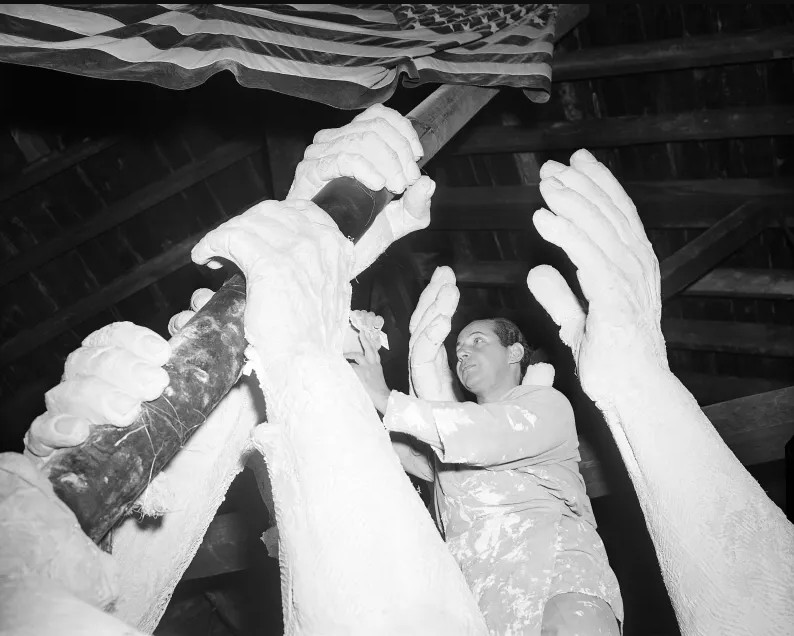
Felix Weihs de Weldon. Public Domain.
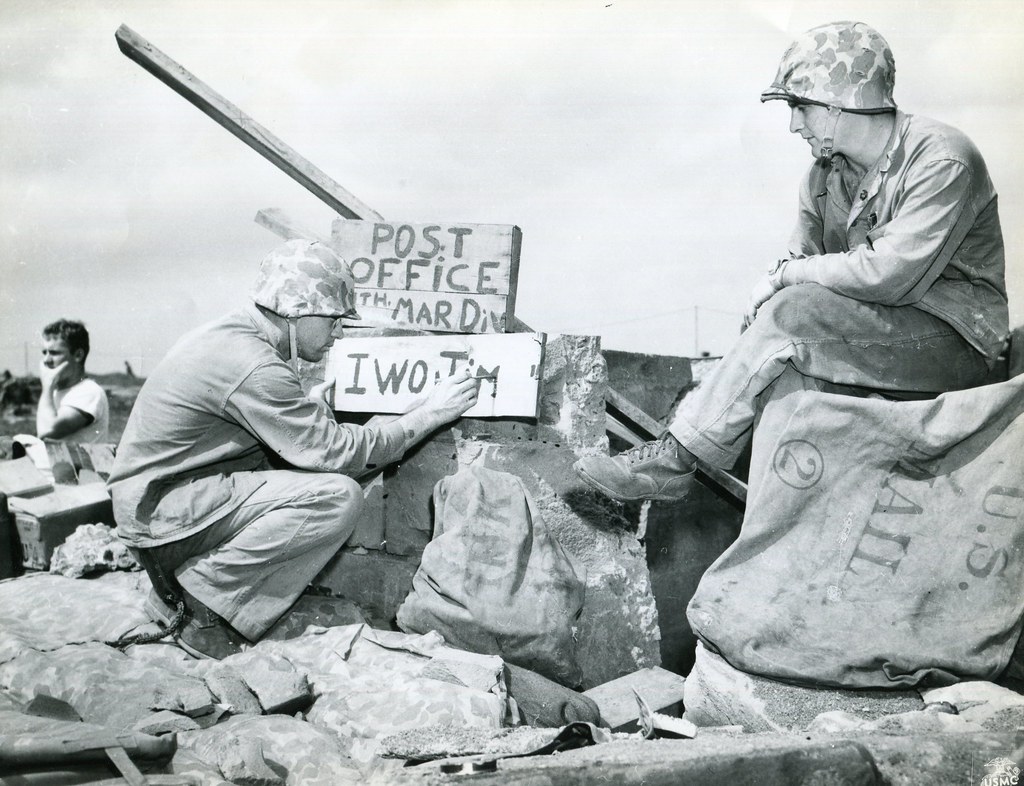
Marine Post Office, Iwo Jima, 1945. “Marine Post Office, Iwo Jima, 1945” by Archives Branch, USMC History Division is licensed under CC BY 2.0.

US Marine Corps War Memorial, Washington, D.C., was based on the iconic AP photograph by Joe Rosenthal taken on February 23, 1945 of the raising of the U.S. flag at the top of Mount Suribachi at the start of the Battle of Iwo Jima (February 19- March 26, 1945). Rosenthal’s photograph was flashed around the world for the first time on Sunday, February 25, 1945, and instantly became a symbol of the American war effort in the Pacific Theatre during World War II. The Marine Corps War Memorial Foundation organized the fundraising and creation of the monument. The complete cost of the memorial was $850,000 (about $10 million in 2025). The 32-foot-high bronze figures are erecting a 60-foot flag pole onto Mount Suribachi. Important dates in the history of the Marine Corps are burnished in gold into the Swedish marble base. The six marines who raised the flag on Iwo Jima have all been identified and include a sergeant, 2 corporals, and 3 privates first class. Unveiled in November 1954, the Marine Corps War Memorial was dedicated to all Marines who have given their lives in the defense of the U.S. since 1775. Author’s photograph, October 2003.

Flags of Our Fathers (2006) is an American war film about the Battle of Iwo Jima (February 19 – March 26, 1945) and its aftermath. The film was directed and co-produced by Clint Eastwood (who also composed the film’s score) and released with his smaller companion film Letters from Iwo Jima about the same battle from the Japanese viewpoint. Distributed by Paramount Pictures (U.S.) and Warner Bros. Pictures internationally, the films basically broke even at the box office as each received favorable critical reviews. Flags of Our Fathers is based on a 2000 book of the same name by James Bradley (with Ron Powers) about Bradley’s Navy corpsman father, John, and the five U.S. Marines who raised the flag at the top of Mount Suribachi on February 23, 1945 and that was made world famous by Joe Rosenthal’s AP photograph. (In 2016 the U.S. Marines announced that Bradley and others originally believed to be in the photograph, in fact, were not). In addition to its fierce battle depictions, Flags of Our Fathers dramatizes the ups and downs of the home front. Though three of the marines in the photograph – a private, corporal and the sergeant – had been killed in action less than a week after the iconic photograph, the photograph’s surviving marines became celebrities who returned stateside to participate in a war bond selling tour. With World War II ending in Europe, the Iwo Jima marines and their photograph came to symbolize American heroism and resolve for victory in the Pacific Theatre. Yet their uplifting mission also called for further individual sacrifice from these dedicated men.

See Iwo Jima war bond poster here = https://collections.ushmm.org/search/catalog/irn520954  – retrieved February 19, 2025.
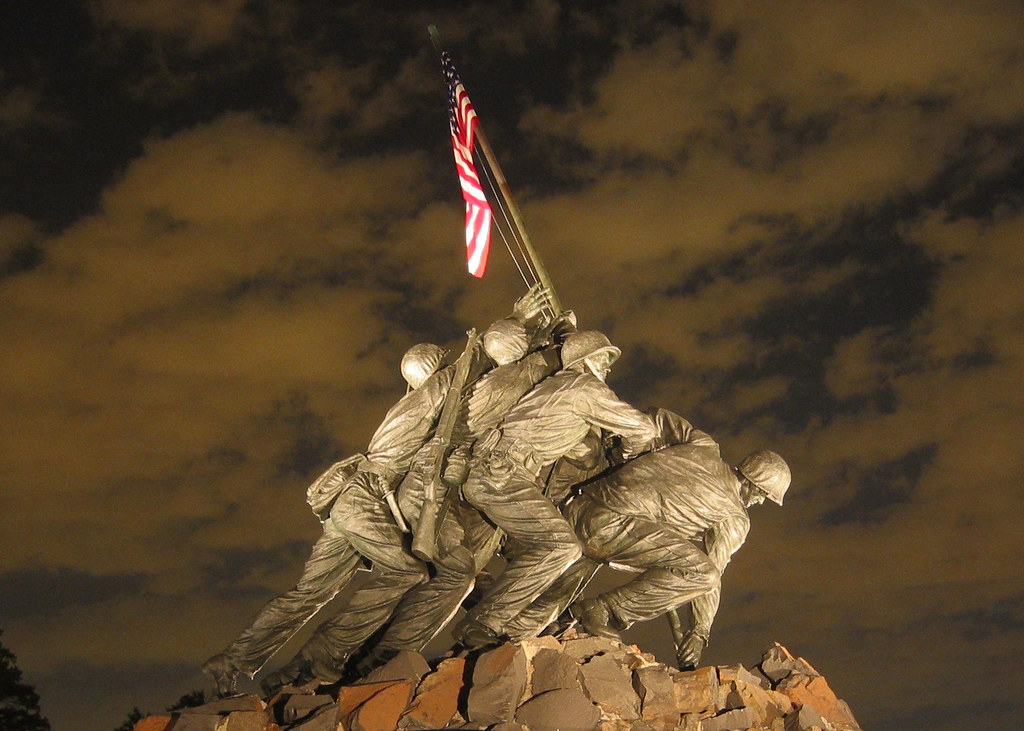
USMC Iwo Jima War Memorial at Night, World War II, Veteran Soldiers, American Flag. “USMC Iwo Jima War Memorial at Night, World War II, Veteran Soldiers, American Flag” by Beverly & Pack is licensed under CC BY 2.0.
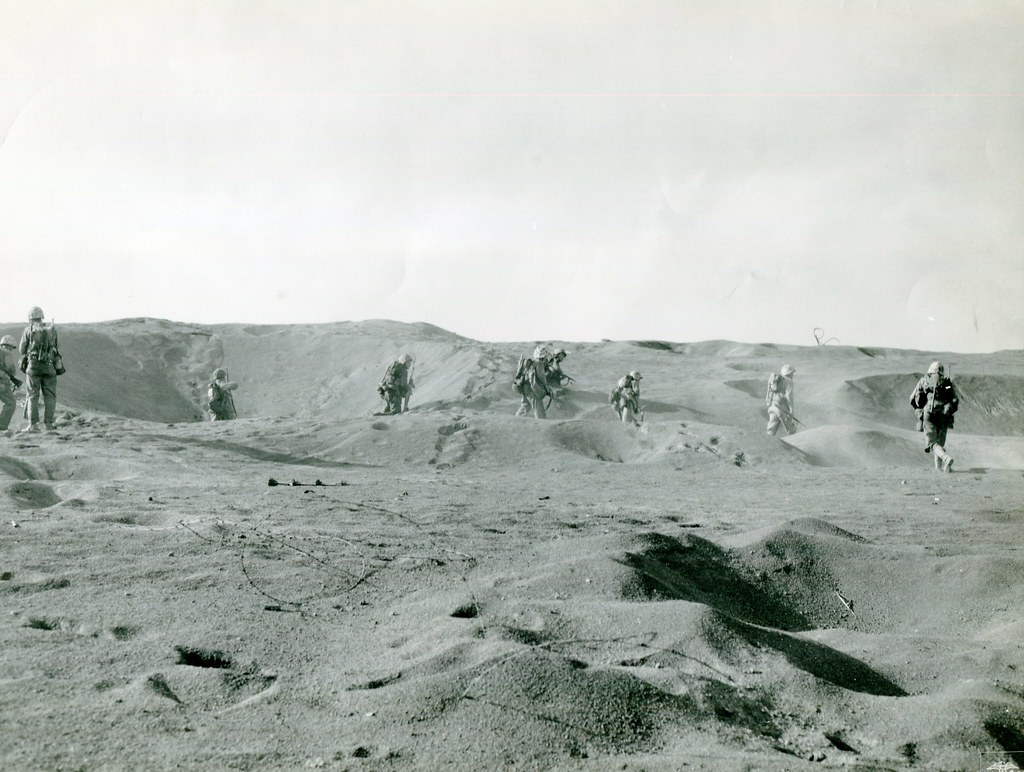
Marines Advancing on Beach, Iwo Jima, February 1945. “Marines Advancing on Beach, Iwo Jima, February 1945” by Archives Branch, USMC History Division is licensed under CC BY 2.0.
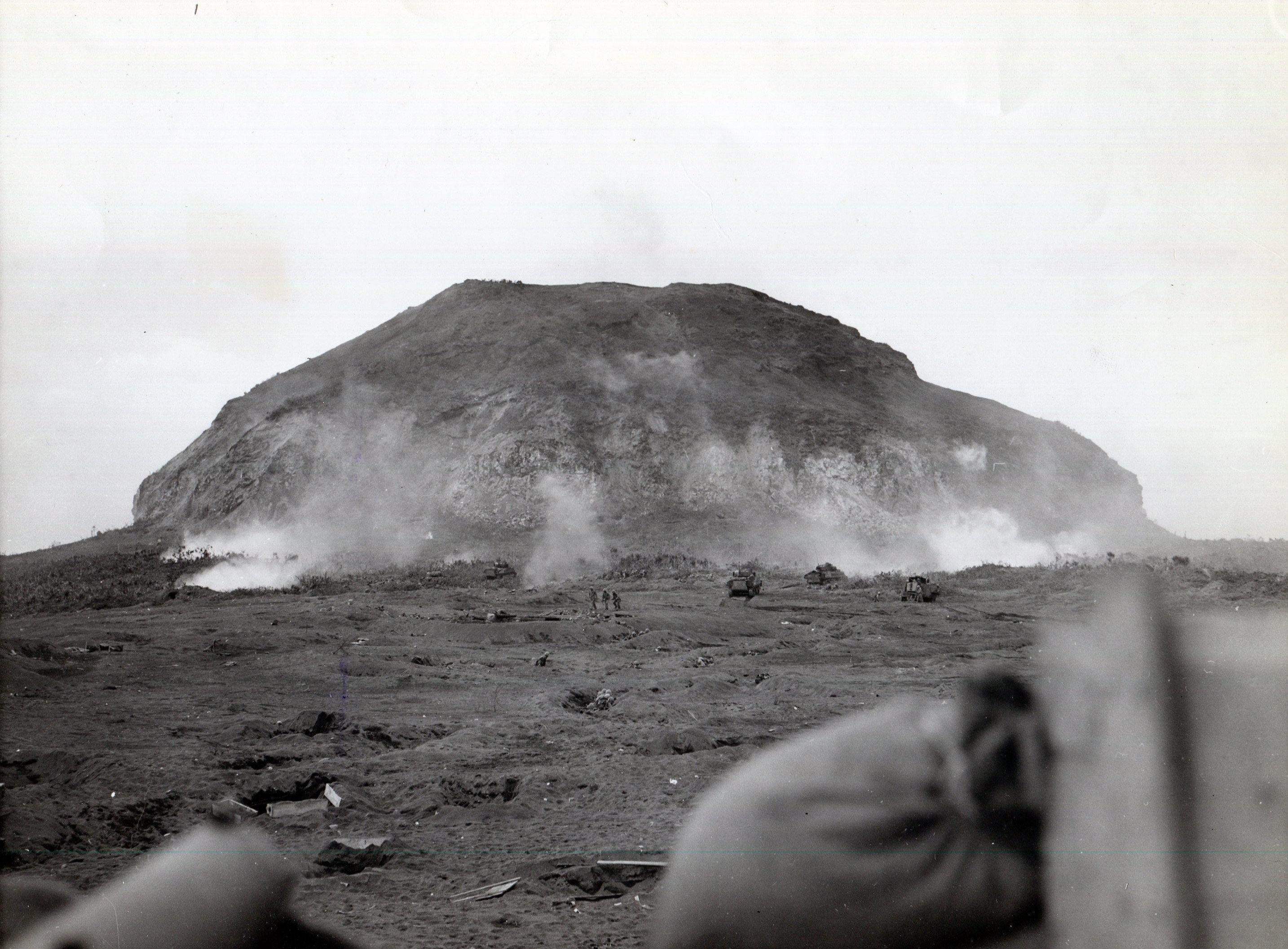
Marine Field Gun Emplacement on Beach, Iwo Jima, February 1945. “Marine Field Gun Emplacement on Beach, Iwo Jima, February 1945” by Archives Branch, USMC History Division is licensed under CC BY 2.0.

Rosenthal told Collier’s magazine: “The sky was overcast, but just enough sunlight fell from almost directly overhead, because it happened to be about noon, to give the figures a sculptural depth. The 20-foot pipe was heavy, which meant the men had to strain to get it up, imparting that feeling of action. The wind just whipped the flag out over the heads of the group, and at their feet the disrupted terrain and the broken stalks of the shrubbery exemplified the turbulence of war.” Quoted in https://www.usfca.edu/magazine/december-2024/feature/man-behind-the-camera – retrieved Feb. 19, 2025. Wire services flashed Joe Rosenthal’s photograph around the world where it was published on the front pages of more than 200 newspapers on Sunday, February 25, 1945. The photo appeared on magazine covers across the country as well. Following the battle of Iwo Jima, the photo was used for publicity in war bond drives from May 11 to July 4, 1945, which raised an amazing $26.3 billion – by far  the biggest haul of any of the seven U.S. war loan drives during World War II.. Rosenthal’s photograph became an enduring icon. 

Mount Suriarlington “Mount Suriarlington” by John Loo is licensed under CC BY 2.0.

In November 1963 FOR “BILL OF RIGHTS WEEK,” President John F. Kennedy made a short film introduction addressing the nation on the Bill of Rights in the U.S. Constitution that JFK called “the most extraordinary and detailed guarantees of individual liberty that any people on earth now possess.”

FEATURE Image: “bill of rights day tribute” by Demetrios Georgalas aka brexians is licensed under CC BY-NC-SA 2.0.

On November 5, 1963, President John F. Kennedy reminded his fellow Americans of the detailed guarantees of individual liberty found in the Bill of Rights that “perhaps we take for granted but which we are guaranteed in the United States Constitution…”President John F. Kennedy” by U.S. Embassy New Delhi is licensed under CC BY-ND 2.0.

In a letter dated September 24, 1963, Lawrence Speiser (1923-1991), Director of the Washington D.C. Office of the American Civil Liberties Union (ACLU) expressed his encouragement and support to the idea of the President of The United States addressing the nation in that auspicious time and place to commemorate that year’s U.S. Bill of Rights week. The Bill of Rights are the first ten amendments to the U.S. Constitution that were created on September 25, 1789 and ratified by the states on December 15, 1791. As the president listed in his remarks, they guarantee individual rights and liberties to every citizen including “freedom of speech, freedom of religion, freedom of the press, the right of assembly and petition, the right of trial by jury, the right to be secure in one’s own home, the protection of due process of law and private property and public trials, and many other things…” President Kennedy agreed to make a two-minute movie trailer for national showing on television and in theaters during “Bill of Rights Week” to be held that year from December 15 to 21.

In his letter, the ACLU Director in Washington, D.C. acknowledged the important relevance of the Bill of Rights in his day as it was when originally written and adopted. Just months since President Kennedy’s June 11, 1963 Civil Rights speech to the nation (https://www.jfklibrary.org/learn/about-jfk/historic-speeches/televised-address-to-the-nation-on-civil-rights – retrieved October 26, 2024) which advocated a fundamental support of the civil rights movement for Black Americans, and less than one month since the March on Washington and Martin Luther King Jr.’s “I Have A Dream” speech delivered from the steps of the Lincoln Memorial in the National Mall, ACLU Director Speiser pointed out to Kennedy’s Press Secretary in his letter the significance of the Bill of Rights to these actions: “Certainly the entire civil rights movement today for fair and equal treatment for Negroes has demonstrated the importance of basic freedoms of speech, press, religion and assembly as well as due process of law in attaining that ideal. The August 28th “March on Washington” was a massive demonstration in the time-honored tradition of a peaceable assembly to petition the government for a redress of grievance.”

On November 5, 1963, President John F. Kennedy recorded a short speech for Bill of Rights Day, which is celebrated on December 15. The speech was filmed at the request of the Council of Motion Picture Organizations and was distributed to theaters across the country. 

President Kennedy’s remarks from the Oval Office were filmed on November 5, 1963. They were to be broadcast nationwide in December 1963. A little over two weeks after Kennedy made these remarks, the 46-year-old president was assassinated in Dallas, Texas. In President Kennedy’s remarks on Bill of Rights Day he related the history of how the document came to be created and formed: “After the Constitution was written it was felt that while this was an extraordinary document it did not provide the kind of guarantees for our individual liberties that a free country required. Therefore, under the leadership of James Madison, the first 10 amendments were adopted to the Constitution. We call them the Bill of Rights.“

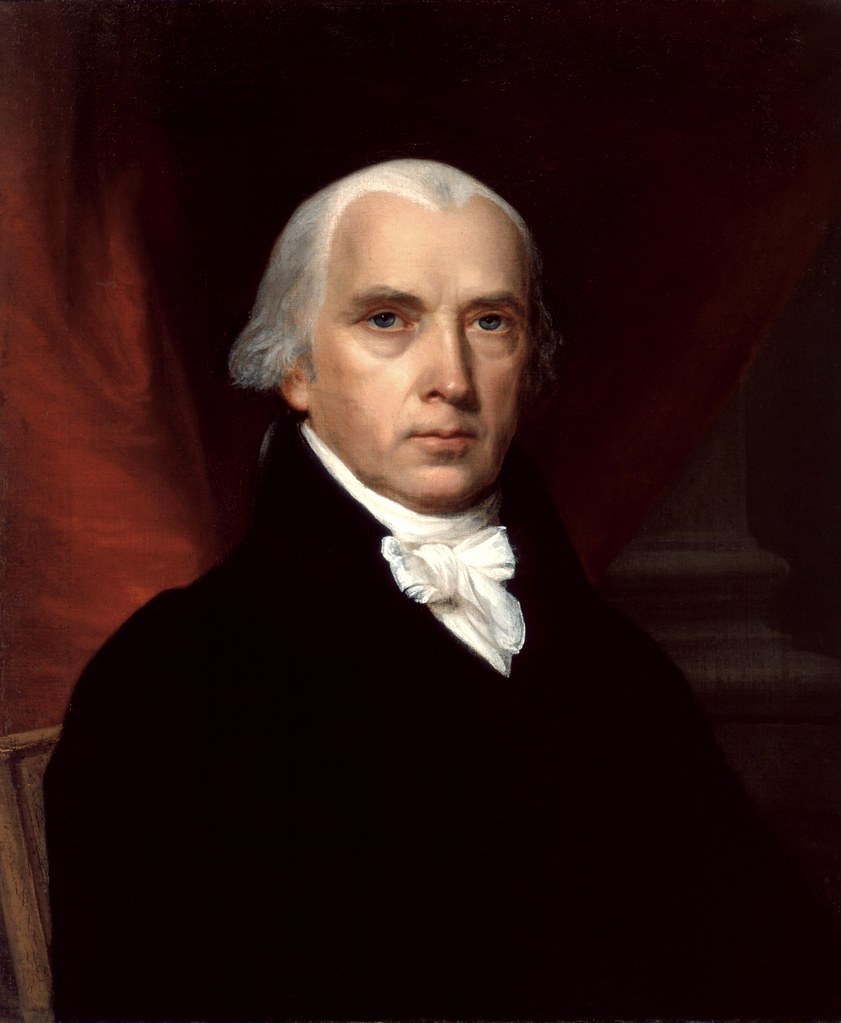
James Madison (1751-1836), who became the 4th president of the U.S. for two terms starting in 1808, introduced the Bill of Rights on June 8, 1789. His amendments contained numerous restrictions on the federal government and would protect, among other things, freedom of religion, freedom of speech, and the right to peaceful assembly. While most of his proposed amendments were drawn from the ratifying conventions, Madison was largely responsible for proposals to guarantee freedom of the press, protect property from government seizure, and ensure jury trials. President John F. Kennedy, 35th president of the United States, cited Madison in his remarks to the nation on November 5, 1963. 4 James Madison” by US Department of State is marked with Public Domain Mark 1.0.

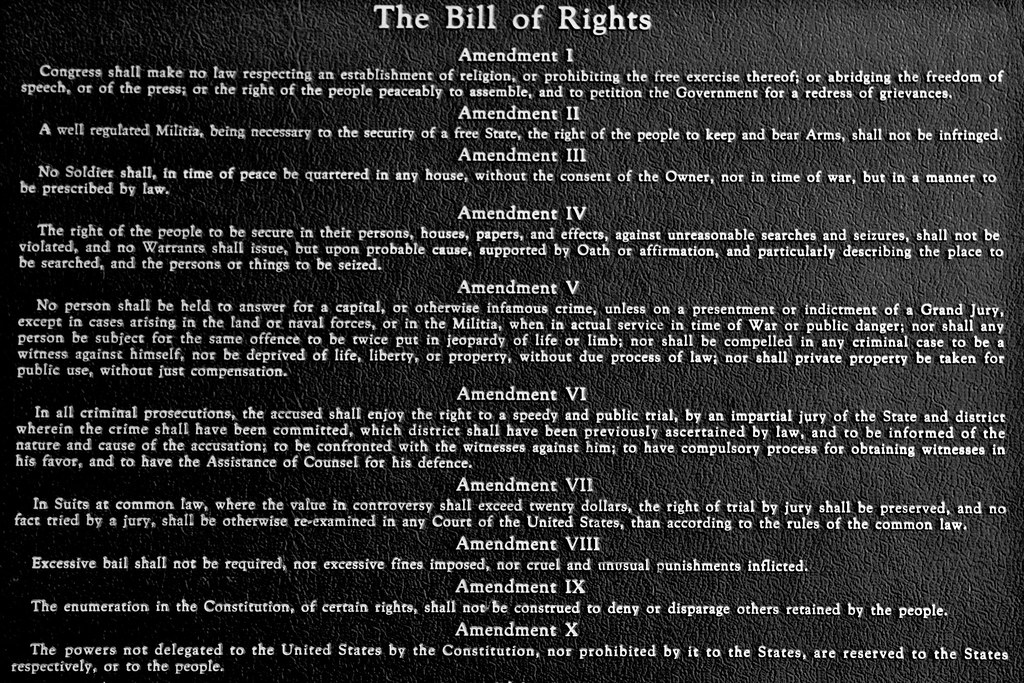
The U.S. Bill of Rights comprises the first ten amendments to the U.S. Constitution adopted in 1791. The Bill of Rights specifically adds to the Constitution specific and detailed guarantees of personal freedoms and rights, clear limitations on the government’s power in judicial and other proceedings, and explicit declarations that all powers not specifically granted to the federal government by the Constitution are reserved to the states or the people.The Bill of Rights” by eugevon is licensed under CC BY-SA 2.0.

President Kennedy pointed to the document’s profound meaning and relevance in the life of the nation – “We, The People.” Despite, or because of, the many struggles in the nation’s history, the Bill of Rights had proved vital and inseparable to the people in America – and mankind – in their guarantee of the sort of life its citizens seek to live and lead. “My fellow American citizens,” Kennedy said, “…They are the most extraordinary and detailed guarantees of individual liberty that any people on earth now possess. Because of the Bill of Rights, we are guaranteed freedom of speech, freedom of religion, freedom of the press, the right of assembly and petition, the right of trial by jury, the right to be secure in one’s own home, the protection of due process of law and private property and public trials, and many other things that perhaps we take for granted but which we are guaranteed in the United States Constitution…”

bill of rights day tribute” by Demetrios Georgalas aka brexians is licensed under CC BY-NC-SA 2.0.

2024 & THE CALIFORNICATION OF EVERYWHERE, U.S.A.

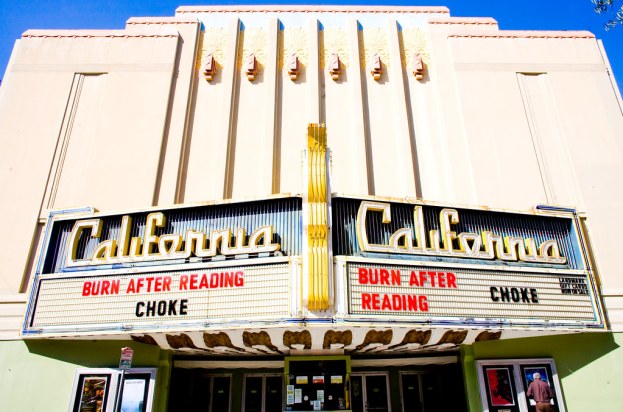
FEATURE Image: “California” by Thomas Hawk is licensed under CC BY-NC 2.0.

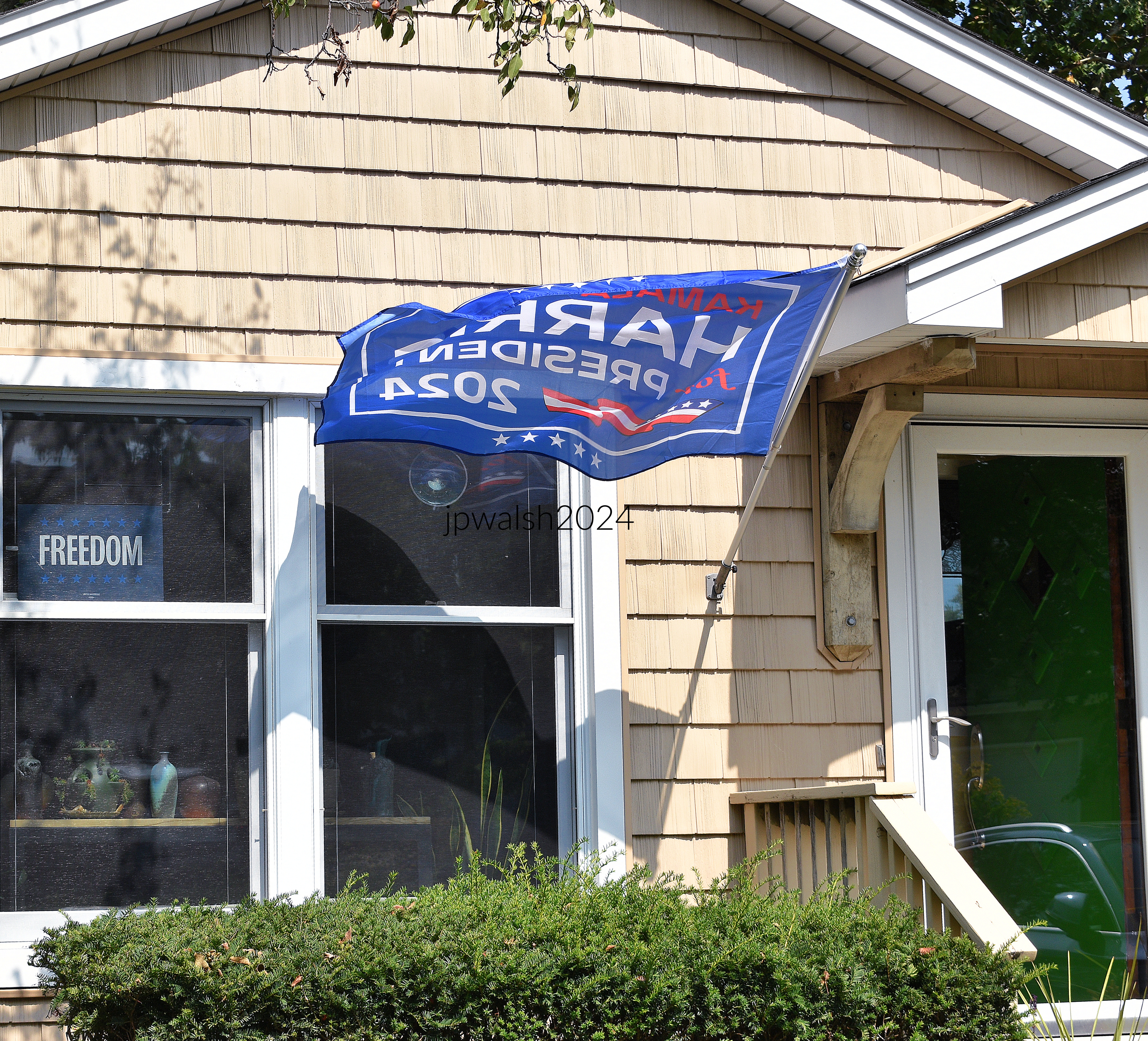
Vice President and Democratic presidential nominee Kamala Harris supporter in 2024. Author’s photograph. Sept 2024 8.96mb

California as National Vanguard

San Francisco Democrat and longtime U.S. House Representative Nancy Pelosi recently told Bill Maher on Real Time With Bill Maher (HBO) that California “is always in the lead” and that it is up to the rest of the country whether they choose to “follow that lead.” What the former Speaker said on August 31, 2024 is, in my view, both insightful and essentially correct.

Vice President Kamala Harris, the 2024 Democratic nominee for president, is herself a California native and former state Attorney General and U.S. Senator. Their shared California sensibility—rooted in diversity, demographic change, and a forward‑leaning cultural posture—is not only the state’s history but increasingly the nation’s trajectory.

The California Pattern: A Country Becoming California

It is often said today that “every state is a border state.” One could just as easily say that every state is now a state of California. The demographic, cultural, and political patterns that defined California for more than a century are now unfolding nationwide, whether chosen or not.

This dynamic is not merely demographic. It is historical, psychological, and structural.

L.A. as Prototype: A City Without a Past

In The Big Goodbye: Chinatown and the Last Years of Hollywood (2020), author Sam Wasson cites educator Richard G. Lillard (1909–1990), who chronicled Los Angeles’s explosive development from the 1880s onward. Lillard observed that L.A. was essentially an open‑border town that grew too fast for its own infrastructure.

Wasson also quotes journalist Morrow Mayo (1896–1983), who wrote that Los Angeles had always been a commodity, a place marketed to outsiders as somewhere to come to. When Vice President Harris said “Don’t come, don’t come” in Guatemala in June 2021, the remark can be read through this California lens—a familiar, almost resigned plea from a state that has spent 150 years absorbing wave after wave of newcomers.

Because of this constant churn, Los Angeles—unlike older American cities, and even less so than San Francisco—rarely speaks of its past. It lives in a perpetual present, always turning the page. Where other cities experienced a boom and then settled into normalcy, L.A. is a boomtown permanently in boom mode, with all the visionary energy and strange side effects that come with it.

Migration as California’s Defining Engine

California drew migrants from across the United States in the late 19th and 20th centuries; today it draws them from around the world. Between 2021 and 2024, nearly two million new migrants arrived—roughly 500,000 people every year. With or without adequate infrastructure, this is a massive human boom unmatched by any other state.

Since the 1880s, California has imported people and exported ideas. Increasingly, it is exporting its people as well—along with its political culture, its social norms, and its worldview.

The Spread of the California Model

This is the phenomenon Pelosi alludes to: a California model spreading beyond the state’s borders. The question is not whether the model exists, but whether other states choose to adopt, resist, or adapt it.

The “Californication” of the United States is already underway. The only remaining variables are the degree of acquiescence and the pace at which it unfolds.

The Limits of Reversal

If Donald Trump believes he can halt this momentum by deporting California’s undocumented population—and the undocumented population dispersed across all 50 states, which collectively equals California’s entire population—he faces a monumental challenge. The California state of mind is already planted, already influential, and already attractive to many.

The demographic and cultural forces shaping the country now are the same ones that shaped California long before. The state is not merely a place; it is a template, and the nation is increasingly living inside it.

Republican nominee and former president Donald Trump supporter in 2024. Author’s photograph. Sept 2024 7.92 mb

L.A. as a Lens for the National Experience

It is instructive to look closely at Los Angeles, because its pattern of constant booms mirrors what is now happening across the country. The city’s cycles—rapid growth, sudden reinvention, and equally rapid forgetting—offer a preview of the national experiential trajectory emerging under what might be called California’s literal and cultural leadership.

Boom, Erasure, and the California Condition

As Sam Wasson notes, L.A.’s booms bring an influx of the new that inevitably produces what he calls “destructive erasures” of what came before. This is not an occasional disruption but a perpetual condition—the defining rhythm of a place that never stops remaking itself.

Increasingly, the nation is entering this same mode. The California pattern—constant arrival, constant reinvention, constant shedding of the past—is becoming a national operating system.

A Political Culture Shaped by Perpetual Reinvention

This is the California way that Nancy Pelosi alluded to in her conversation with Bill Maher: a model that other states may choose to follow, consciously or not. The election becomes, in part, a referendum on whether the country embraces this California‑style dynamism, with all its gains and losses.

Even the political “flip‑flops” for which Vice President Harris has been criticized since becoming the Democratic nominee can be read through this lens. They echo a long California tradition of boom and erasure, where rapid change is not an anomaly but a structural feature of the culture she comes from.

California’s Pattern as National Future

Seen this way, Harris’s shifts are not merely tactical or personal—they reflect the deeper California historical pattern of constant adaptation. In a political moment shaped by demographic churn, cultural flux, and rapid realignment, that pattern may be less a liability than a preview of the country’s emerging identity.

Vice President and Democratic presidential nominee Kamala Harris supporter in 2024. Author’s photograph. Sept 2024 7.23 mb

Leaving California, Only to Carry It Elsewhere

The irony of the moment is that many Californians who leave the state—seeking relief from its pressures, costs, or pace—may be doing so in vain. In moving to other states, they often bring with them the very cultural, political, and economic sensibilities they hoped to escape. In that sense, they become agents of Californication, extending the state’s influence rather than diminishing it.

A California State of Mind on the Move

This California state of mind—restless, forward‑tilting, boom‑driven—now appears in places far from the Pacific coast. The rapid arrival of newcomers in cities like Springfield, Ohio, or the dramatic demographic and real‑estate shifts in Aurora, Colorado, reflect a broader national pattern: communities experiencing sudden change, rapid growth, and the accompanying sense of disruption that Sam Wasson describes as “destructive erasures.”

These are not uniquely California events. They are California‑style events, unfolding elsewhere.

The Californication of Everywhere U.S.A.

If this pattern has not reached a particular town yet, the logic of national migration and cultural diffusion suggests that it eventually will. The California model—constant influx, constant reinvention, constant shedding of what came before—has become a portable operating system, carried by both longtime Californians and new arrivals who first encountered American life in California.

This is the Californication of Everywhere U.S.A.: a spreading cultural template rather than a geographic one.

A Culture Without a Rearview Mirror

For Angelenos—and for many Californians—the absence of a stable past is not a flaw but a condition of life. The state lives in a perpetual present, defined by booms and erasures so frequent that they rarely register as events. What disappears is forgotten; what arrives becomes temporarily the new normal.

As this sensibility spreads, more of the country begins to resemble California: forward‑leaning, memory‑light, and always in motion.