
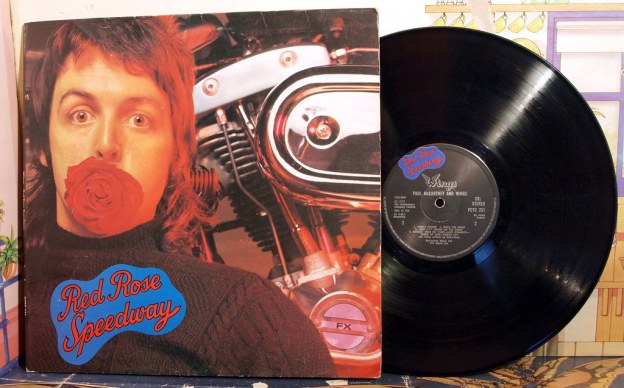

Feature Image: Red Rose Speedway is the second studio album by English-American rock band Wings, although credited to “Paul McCartney and Wings.” It was released through Apple Records on May 4, 1973, preceded by its lead single, the ballad My Love on March 23, 1973. It was Wings’ first no. 1 hit. PHOTO: “red rose speedway, PAUL MCCARTNEY,” by badgreeb RECORDS – art -photos is licensed under CC BY-SA 2.0.

Paul built “My Love” from the ground up: chords first, then melody, then words—a “pure love song,” as he later called it, written for his Wings bandmate and wife, Linda. PHOTO: “Linda McCartney Retrospective” by cezzie901 is licensed under CC BY 2.0.
Recording and Release
MY LOVE LYRICS:
And when I go away
I know my heart can stay with my love
It’s understood
It’s in the hands of my love
And my love does it good
Whoa, whoa, whoa, whoa
Whoa, whoa, whoa, whoa
My love does it good
And when the cupboard’s bare
I’ll still find something there with my love
It’s understood
It’s everywhere with my love
My love does it good
Whoa, whoa, whoa, whoa
Whoa, whoa, whoa, whoa
My love does it good
Whoa, whoa, I love
Whoa, whoa, my love
Only my love holds the other key to me
Whoa, whoa, I love
Whoa, whoa, my love
Only my love does it good to me
Whoa, whoa, whoa, whoa
Whoa, whoa, whoa, whoa
My love does it good
Don’t ever ask me why
I never say goodbye to my love
It’s understood
It’s everywhere with my love
And my love does it good
Whoa, whoa, whoa, whoa
Whoa, whoa, whoa, whoa
My love does it good
Whoa, whoa, I love
Whoa, whoa, my love
Only my love does it good to me
Whoa, whoa, whoa, whoa
Whoa, whoa, whoa, whoa
“My Love” was recorded by Paul and Linda McCartney in January 1973 and released on March 23 of that year. The single reached no. 1 on June 2, 1973, becoming one of Wings’ early chart‑topping successes. After four straight weeks at no. 1 on the Billboard Hot 100 beginning June 2, 1973, “My Love” finally slipped to no. 2 on June 30. Taking its place was the previous week’s no. 5 single—George Harrison’s “Give Me Love (Give Me Peace on Earth)”—which climbed into the top spot for a one‑week reign.
Henry McCullough’s Improvised Solo
The song’s signature guitar solo was improvised in the studio by Wings’ new lead guitarist Henry McCullough (1943–2016). Paul, playing electric piano on the track, had envisioned a different solo but chose to trust McCullough’s instinct. Reflecting in 2010, he recalled (quoted in NME): “It was like, ‘Do I believe in this guy?’ And he played the solo on ‘My Love’, which came right out of the blue. And I just thought, Fucking great. And so there were plenty of moments like that where somebody’s skill or feeling would overtake my wishes.”
A Song Built on Chords
Paul later noted that the way he had written “My Love”—chord‑based rather than melody‑and‑counterpoint driven—shaped the space McCullough stepped into. The guitarist’s spontaneous solo fit the harmonic structure so naturally that Paul regarded it as a moment when another musician’s creativity elevated the song beyond his original plan.

Wings bandmates in 1973. Guitarist Henry McCullough appears at left in the bottom photo. Before joining Wings, McCullough toured as a session guitarist with Jimi Hendrix and Pink Floyd, and in 1969 performed with Joe Cocker at Woodstock—making him the only Irish musician to take the stage at the legendary festival. PHOTO: “red rose speedway, PAUL MCCARTNEY,……” by badgreeb RECORDS – art -photos is licensed under CC BY-SA 2.0.
Grammar, Blues Influence, and Everyday Speech
The lyrics of “My Love” include deliberately ungrammatical phrasing—most famously, “My love does it good.” Paul McCartney knew exactly what he was doing. The line reflects a habit carried over from his Beatles‑era Hamburg days, when he absorbed the syntax of American blues, a tradition rich in mixed or non‑standard grammar. Paul liked the phrase because it sounded like real speech, the way people actually talk rather than the way grammar books prescribe.
Subverting the Rules
McCartney also enjoyed bending grammatical rules simply for the pleasure of it, something the Beatles had done to memorable effect in earlier songs. “My love does it good” functions as a value judgment about the beloved without specifying what “it” is—leaving the meaning open for listeners to fill in themselves.

“My Love,” with its deliberately ungrammatical charm, grew straight out of Paul McCartney’s Beatles‑era instincts and his 1969 marriage to Linda. A love song made by real life, it blends his old habit of bending language with the new domestic world he built with her and their four children. PHOTO:
여유로운 휴일… 따뜻한 감성의 사진을 만나다 #Seoul #Daelim #Gallery #Linda #McCartney #Photo #Exhibition” by IchStyle is licensed under CC BY 2.0.

Paul and Linda (née Eastman) McCartney first crossed paths on May 15, 1967 at London’s Bag O’Nails Club, just steps from Buckingham Palace. He was a Beatle; she was a rising photographer known for her striking prints. They married on March 12, 1969 and stayed together for 29 years. “My Love” arrived just after their fourth wedding anniversary—a love song rooted in the partnership that defined Paul’s post‑Beatles life. PHOTO: “Bag O’Nails, Victoria, London – geograph.org.uk – 1981720” by Graham Hogg is licensed under CC BY-SA 2.0.


Paul and Linda McCartney on the cover of LIFE on April 18, 1971. The couple’s second child together was born later that same year. PHOTO: “Life Magazine featuring Paul McCartney and his squeeze Linda” by vision63 is licensed under CC BY-NC 2.0.

Paul McCartney with Linda McCartney in concert with Wings in 1976. PHOTO: “Paul McCartney with Linda McCartney – Wings – 1976 (cropped)” by Jim Summaria is licensed under CC BY-SA 3.0.
Chart History and Cultural Reach
By the late 1970s, “My Love” had become one of the most frequently covered songs by any former Beatle—second only to George Harrison’s “My Sweet Lord”. During its original chart run, the single slipped from no. 1 to no. 2 on June 30, 1973, just as Harrison’s “Give Me Love (Give Me Peace on Earth)” rose to the top for a one‑week stay, a moment that underscored the commercial strength of both ex‑Beatles in the early 1970s.
McCullough’s Defining Moment
For Northern Irish guitarist Henry McCullough (1943–2016), the improvised solo on “My Love” remained the defining achievement of his career. He often described it as his proudest musical moment—a spontaneous, intuitive performance that became central to the song’s identity.
McCartney’s Later Reflections
Paul McCartney remembered the session with equal admiration. Looking back in 2016, he noted that “the solo [Henry] played on ‘My Love’ was a classic that he made up on the spot in front of a live orchestra,” a testament to McCullough’s instinct and to Paul’s willingness to let another musician reshape the emotional arc of his song.
SOURCES:
The Lyrics 1956 to the Present, Paul McCartney, Liveright Publishing Corporation, 2023, pp. 349-352.
Levine, Nick (15 June 2016), “Paul McCartney pays tribute to ‘super-talented’ Wings guitarist Henry McCullough”. nme.com. – retrieved September 2, 2024.
https://www.billboard.com/charts/hot-100/1973-06-30/ – retrieved September 1, 2024.
https://www.billboard.com/charts/hot-100/1973-06-23/ – retrieved September 1, 2024.


