
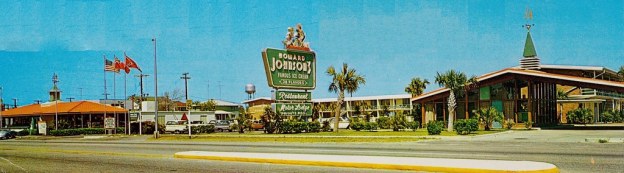
FEATURE Image: Howard Johnson’s Motor Lodge and Restaurant Myrtle Beach, SC. Howard Johnson’s reshaped the American roadside, turning a patchwork of unpredictable stops into a network of bright, dependable landmarks. Its orange roofs, neon signs, and motor lodges became part of the visual grammar of mid‑century travel, signaling consistency in an era when the open road beckoned for families. More than a brand, it became a kind of national shorthand — a promise that wherever you were headed, a familiar meal and a safe place to rest weren’t far away. PHOTO: “Howard Johnson’s Motor Lodge and Restaurant Myrtle Beach,SC” by romleys is licensed under CC BY-NC-SA 2.0.
By the 1950s, Howard Johnson’s had become the bright, orange roofed companion of the American highway. Aggressive franchising in the ’30s and ’40s grew into more than 400 restaurants, and by the late ’60s and early ’70s, HoJo’s was the nation’s largest restaurant chain, topping 1,000 locations.
Its story began when Howard Johnson (1897–1972) inherited his father’s debt burdened shop. At twenty eight, he liquidated it and opened a small drugstore and soda fountain in Quincy, Massachusetts. From those 28 flavors came a brand that shaped mid century travel.

Founded in 1925, Howard Johnson’s didn’t just sell ice cream — it set the benchmark. Its rich 16%‑butterfat formula began with three simple flavors, then exploded into the famous 28 that defined mid‑century indulgence. From that creamy foundation, the company built a nationwide franchise empire, planting its bold orange roofs along America’s highways. For families on the road, a HoJo’s stop became a promise: dependable comfort food, a familiar welcome, and a scoop of the ice cream that made the brand a household name. PHOTO: Symbols – Daytime, Man and Boy with Dog – Howard Johnson’s, Art Deco, Free Standing, Neon Sign, Telephone Booth on Boylston Street Sidewalk off Copley Square” by MIT-Libraries is licensed under CC BY-NC 2.0.

Howard Deering Johnson (1897-1972) in 1955. Howard Johnson was an American entrepreneur who transformed his Massachusetts soda fountain into a massive restaurant and motel empire characterized by its iconic orange roofs. By pioneering the “28 flavors” of ice cream in the late 1920s and early 1930s featuring flavors such as Orange Pineapple and Burgundy Cherry, Howard Johnson established one of the nation’s first franchising models and became a central figure in 20th-century American roadside culture. PHOTO: “Howard Deering Johnson” by OptimistMover is licensed under CC BY-SA 4.0.
In the 1974 satirical Western Blazing Saddles, the town of Rock Ridge is populated by citizens who almost all share the last name “Johnson,” including a character specifically named Howard Johnson played by John Hillerman. The film parodies the famous restaurant chain by featuring a “Howard Johnson’s Ice Cream Parlor” that comically advertises only one flavor and poking fun at the real chain’s legendary “28 flavors.” (8) Johnson is Right – YouTube (https://www.youtube.com/watch?v=V8oaQhTYx2Q) – retrieved May 2, 2026.
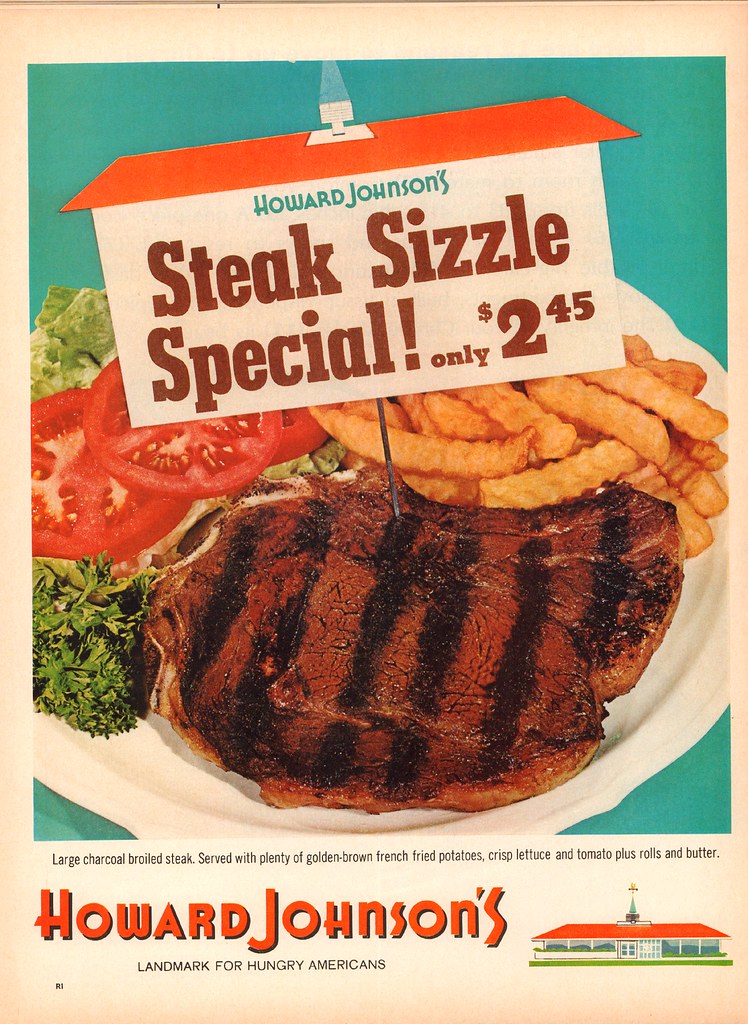
From crispy, golden-fried clams to creamy peppermint stick ice cream, HJ’s “family-friendly” dining experience set standards in brand consistency across mid-20th century America. PHOTO: “1965 Howard Johnsons Advertisement Life Magazine January 8 1965” by SenseiAlan is licensed under CC BY 2.0.
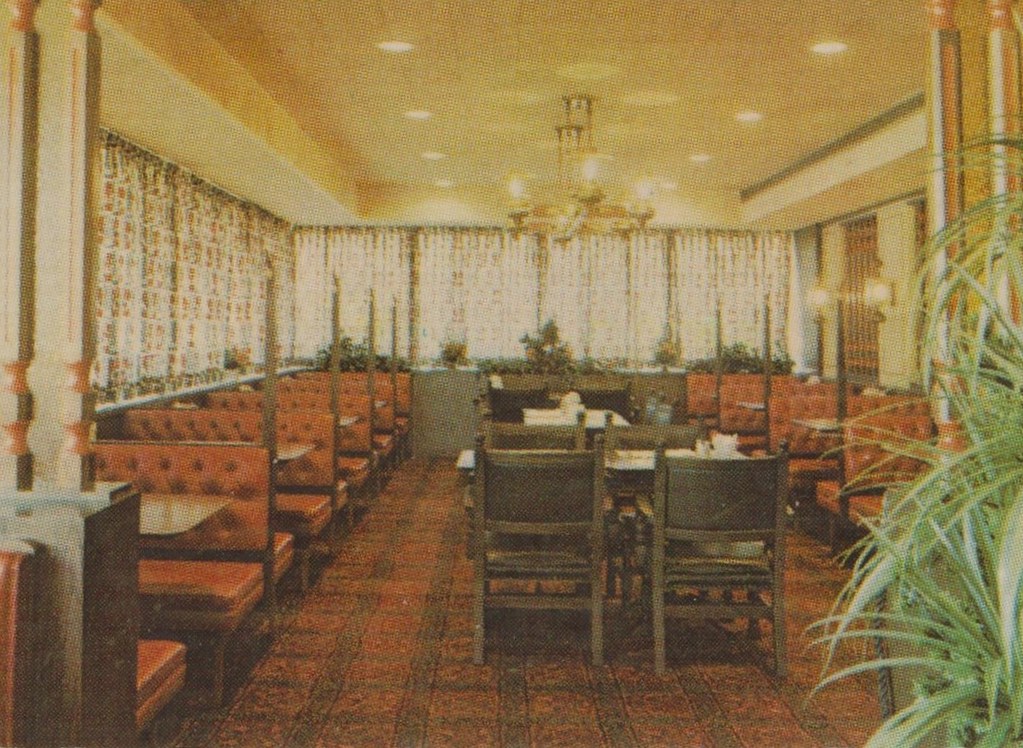
The dining room of Howard Johnson’s Motor Lodge and Restaurant in Middletown, New Jersey, glows with that classic Howard Johnson’s warmth — tufted booths, patterned curtains, and soft recessed lighting wrapping the space in mid‑century comfort. The wood dividers, carpeted floors, and pops of greenery give it the feel of a roadside refuge where families settled in for fried clams, creamed fricassee, ice cream, and a moment of personal refueling between miles. It’s a room that still carries the hum of long‑ago travelers and the promise of a familiar meal. Photo: “Howard Johnson’s Motor Lodge and Restaurant Middletown,NJ” by romleys is licensed under CC BY-NC-SA 2.0.
1965 Howard Johnson’s Restaurant Commercial Baked Haddock Au Gratin #hojos #howardjohnsons #retro – retrieved May 2, 2026.
By the mid 1950s, the company expanded into motor lodges, pairing familiar meals with modern roadside rooms. Known for its orange roofs, family friendly dining, and early innovations in frozen entrées, Howard Johnson’s became a symbol of consistency — even as travelers swapped stories of sometimes uneven service.

The Vibe: An incandescent orange roof, bright turquoise shutters, and the electric glow of the neon Pied Piper — a roadside beacon promising weary travelers a safe, familiar harbor. PHOTO: “Howard Johnson’s St. Petersburg, Florida” by 1950sUnlimited is licensed under CC BY-NC 2.0.

Howard Johnson’s Motor Lodge, 1971 – Portage, Indiana. With its wood‑paneled walls, blue bedspreads, and floral curtains Howard Johnson’s rooms created a cozy, mid‑century vibe. Two chairs, a small table, and a vintage TV completed the retro roadside‑stop motel scene. PHOTO: “Howard Johnson’s Motor Lodge, 1971 – Portage, Indiana” by Shook Photos is licensed under CC BY 2.0.
But the landscape changed. Through the 1970s and 1980s, the chain declined, its restaurants and frozen foods slowly disappearing. When the last location closed in March 2022, Howard Johnson’s quietly ended a century as the old “Host of the Highway.”

Howard Johnson’s Restaurant, Lynchburg, shared the fate of hundreds of other HoJo’s across the nation since the 1980’s. The last restaurant closed in March 2022. PHOTO: “Howard Johnson’s Restaurant, Lynchburg” by Retronaut is licensed under CC BY-NC-ND 2.0.


