FEATURE image: Over the Top to Victory (“Doughboy”), 1921, John Paulding, Memorial Park, Wheaton, Illinois. John Paulding’s 1921 Over the Top to Victory transforms the image of the American doughboy into a permanent public memorial that keeps the service and sacrifice of World War I veterans alive for succeeding generations. May 2018. Author’s photograph.
All photographs in this post are the author’s original work.
Doughboy. June 2021. Author’s photograph. 75% 7.93mb DSC_7581 (1)
Captured in a moment of forward motion, John Paulding’s bronze World War I “Doughboy” statue—standing proudly on its Memorial Park pedestal—is a perfect example of how memorials remain active instruments of remembrance rather than static historical objects. The history, symbolism, conservation, and continued prominence of the monument are beautifully reflected in the red, white, and blue wreath resting at its base, echoing the statue’s original 1929 Armistice Day dedication to Wheaton’s veterans. By preserving the sacrifice of local heroes through public art, the Doughboy serves as a lasting bridge between World War I service and present-day civic memory.
A Sculptor of Remembrance
John Paulding, who trained at the School of the Art Institute of Chicago, is best known for the World War I memorials he created in the years immediately following the conflict. The United States entered the war in April 1917, and American forces served with distinction on the Western Front. The fighting ended with the armistice of November 11, 1918, a date later commemorated annually as Veterans Day. Through works such as Over the Top to Victory, Paulding helped translate the sacrifices of the Great War into enduring public monuments.
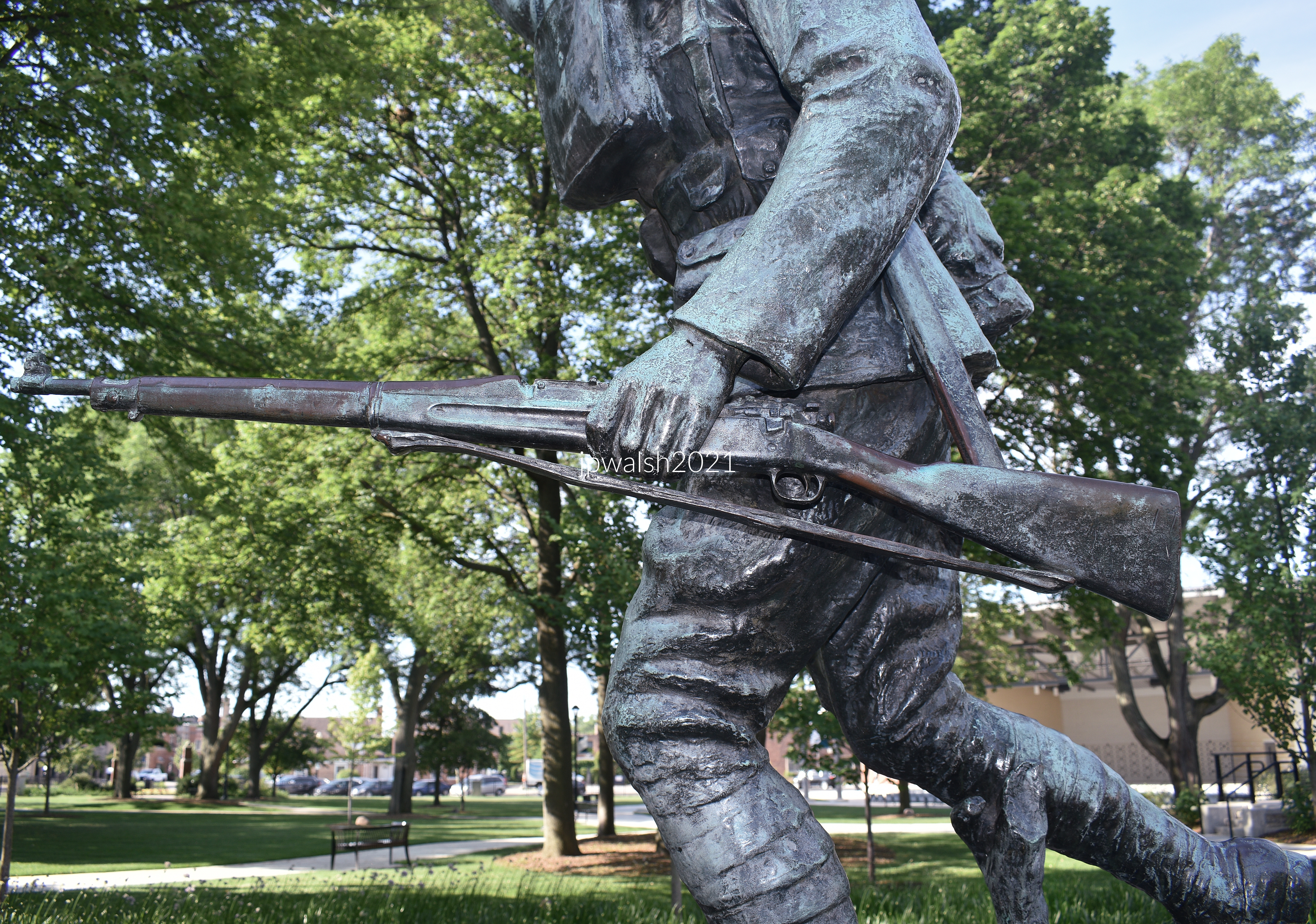
Doughboy (detail), in Wheaton’s Memorial Park. June 2021. Author’s photograph. 87% 7.81mb DSC_7589
The Paulding doughboy strides through Memorial Park, rifle in hand, its dynamic pose recalling the energy and sacrifice of American soldiers in the Great War. Set against the trees and open grounds, the memorial continues its role as a focal point of remembrance in the community.
Memorial Park and a Community Tribute
Wheaton established Memorial Park in 1921 as a dedicated place to honor local veterans. Eight years later, Paulding’s bronze doughboy was installed and formally dedicated on Armistice Day, November 11, 1929, as a tribute to the community’s World War I servicemen and women. Anticipating the unveiling, the Wheaton Illinoian praised the memorial’s purpose, declaring: “The statue is a fitting memorial to the soldiers of the community who died fighting for our cause. Let us not forget so easily!” The dedication cemented the sculpture’s role as the centerpiece of Wheaton’s public remembrance of the Great War.
Surrounded by memorial Park trees, Doughboy stands on its original pedestal. May 2018. Author’s photograph. 5.87mb DSC_8195 (2)
“Over the Top to Victory” is a bronze sculpture of an American World War I infantryman — one of the famed doughboys — created by American sculptor John Paulding (1883–1935). Cast in 1921 by the American Art Bronze Foundry of Chicago, the statue stands today in Memorial Park in Wheaton, Illinois.
Conservation and Renewal
After more than seven decades exposed to Midwestern weather, the bronze underwent professional conservation in August 2000 by Venus Bronze Works of Detroit. The restored memorial was rededicated on Veterans Day that same year, with the local American Legion Post once again leading the ceremony, continuing a tradition that stretched back to the statue’s original dedication in 1929.
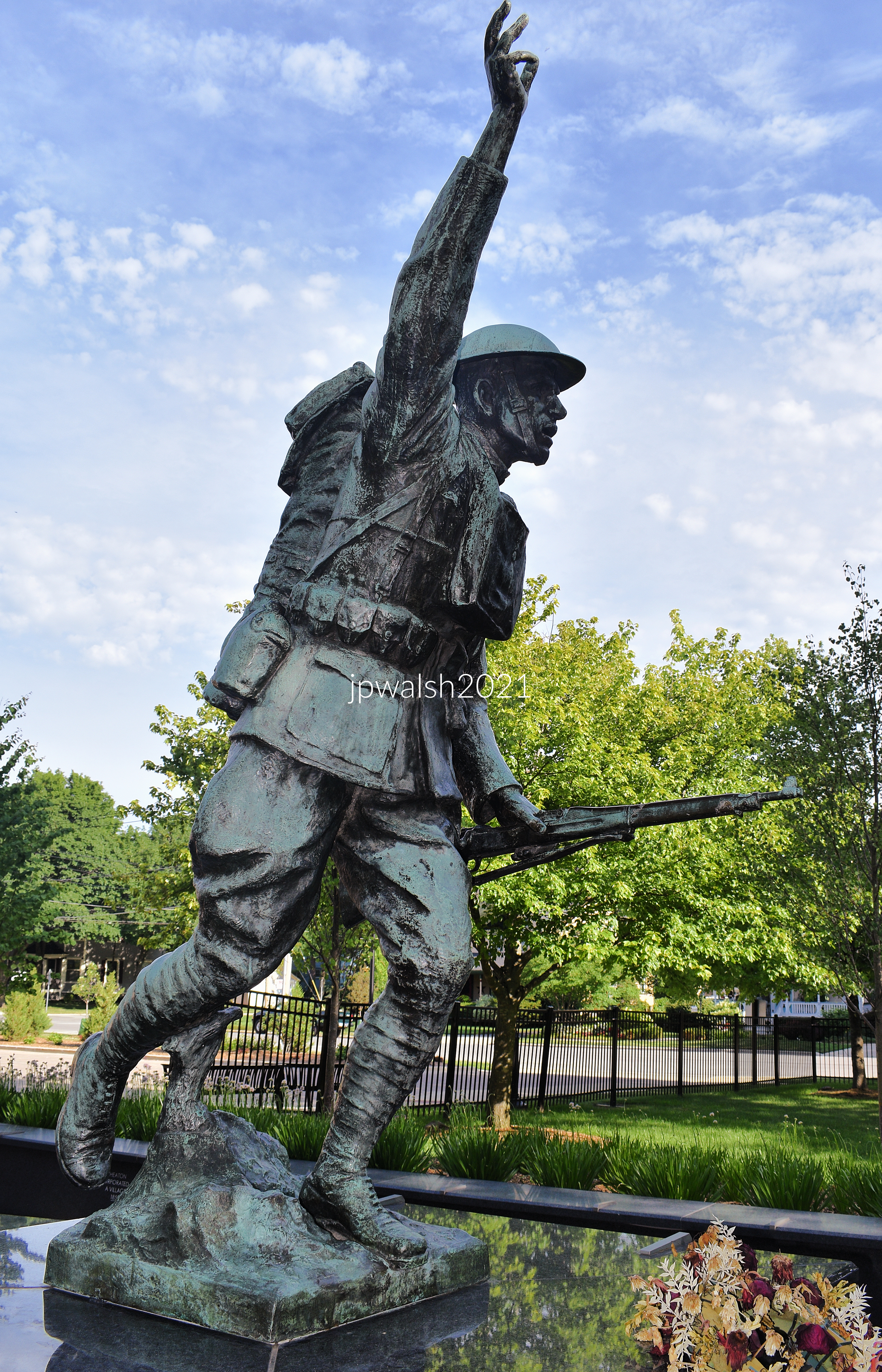
View of Doughboy on its newest pedestal. June 2021. Author’s photograph. 97% 7.85mb DSC_7614
Paulding’s World War I doughboy surges forward on its newest Memorial Park pedestal, the raised arm and shouldered rifle capturing the urgency of the American advance. Flowers at the base mark the memorial’s ongoing role as a site of remembrance for Wheaton’s veterans.
Connecting past sacrifice with present memory
In the summer of 2020, the Over the Top to Victory doughboy was reinstalled as part of a redesigned veterans memorial plaza in Memorial Park. Relocated to a more prominent position, the statue became the focal point of a unified memorial setting that brought together previously dispersed monuments. Nearly a century after its creation, Paulding’s advancing doughboy continues to serve not only as a work of public art but also as a living symbol of community memory, military service, and sacrifice.
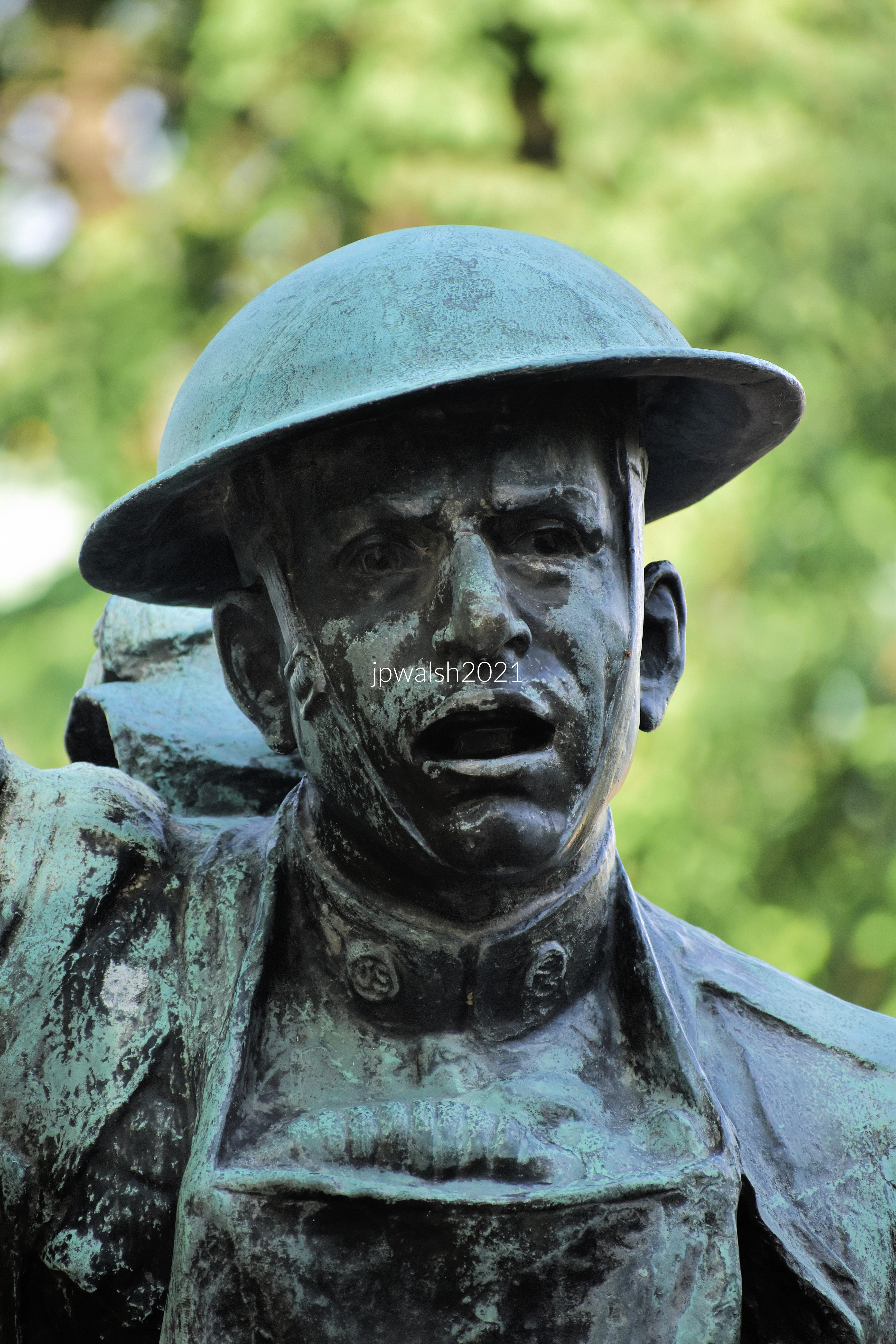
Close up view of the tense, expressive face of Paulding’s World War I doughboy in Wheaton, Illinois. June 2021. Author’s photograph. 92% 7.73mb DSC_6130 (2)
With his open mouth and tense expression, “Doughboy”, the popular nickname for American soldiers who served in Europe during World War I, embodies the strain, determination, and forward momentum of the U.S. infantryman in battle. Rather than portraying a figure at rest, sculptor John Paulding captured a soldier in the midst of action, projecting urgency and resolve. More than a century after its creation, the sculpture retains the same sense of movement and emotional immediacy that audiences experienced in the years following the Great War.
A Memorial for the Twenty-First Century
The continuing care of the monument, its rededications, and its prominent place within Memorial Park demonstrate how communities renew their commitment to remembrance over time. More than a bronze figure, Wheaton’s doughboy stands as a living link between those who served in the Great War and the citizens who continue to honor their sacrifice today and into the future.
This explanatory article may be periodically updated.
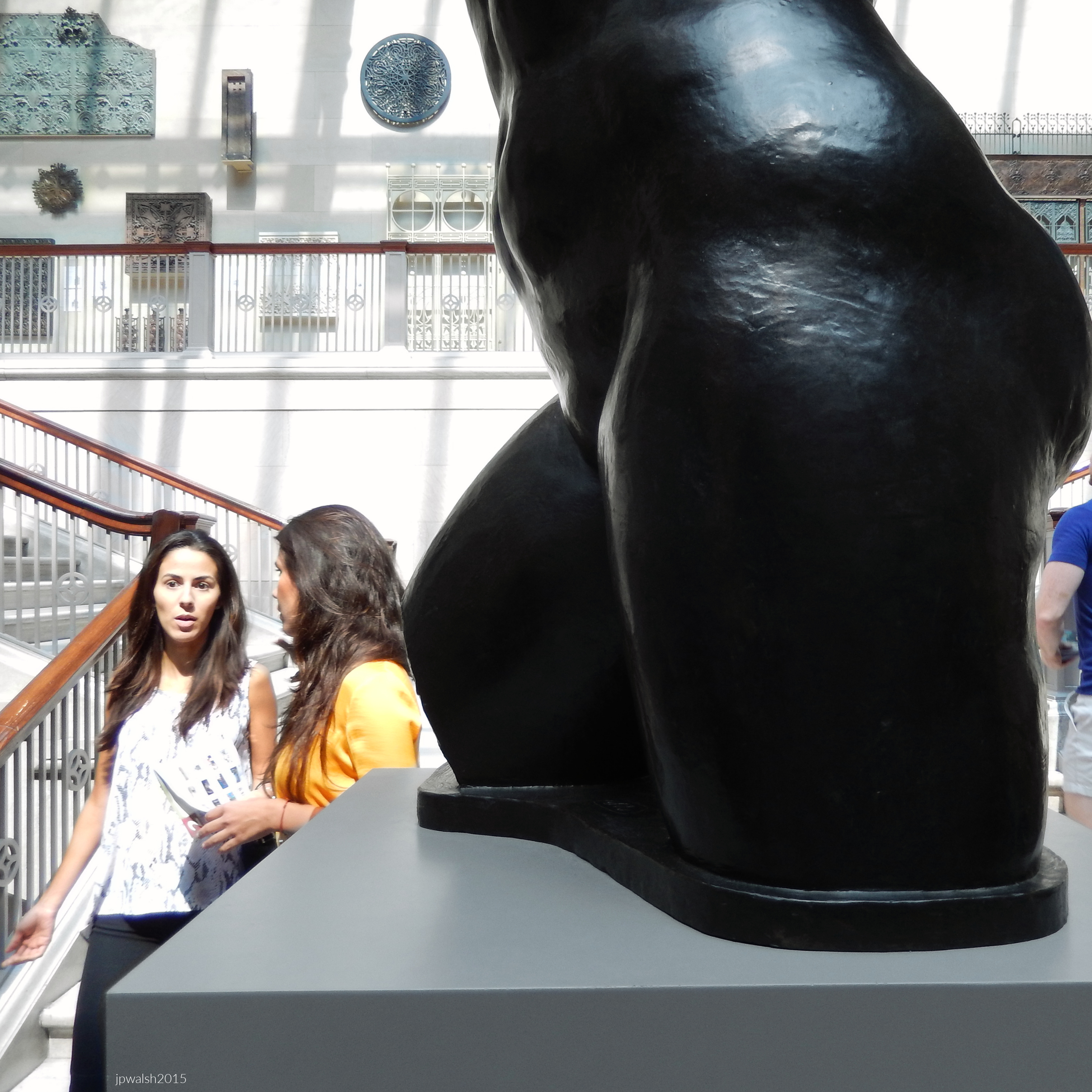
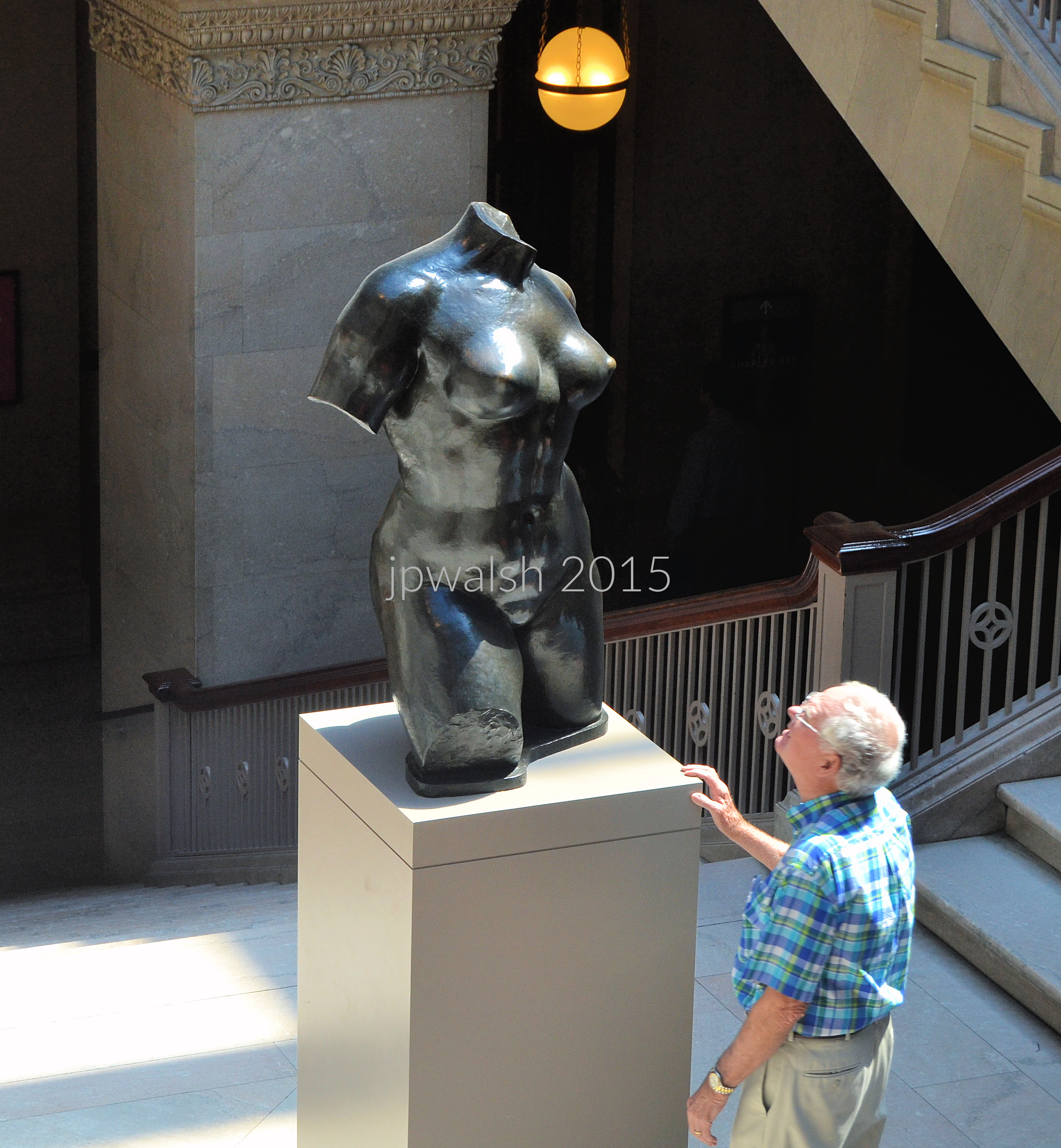
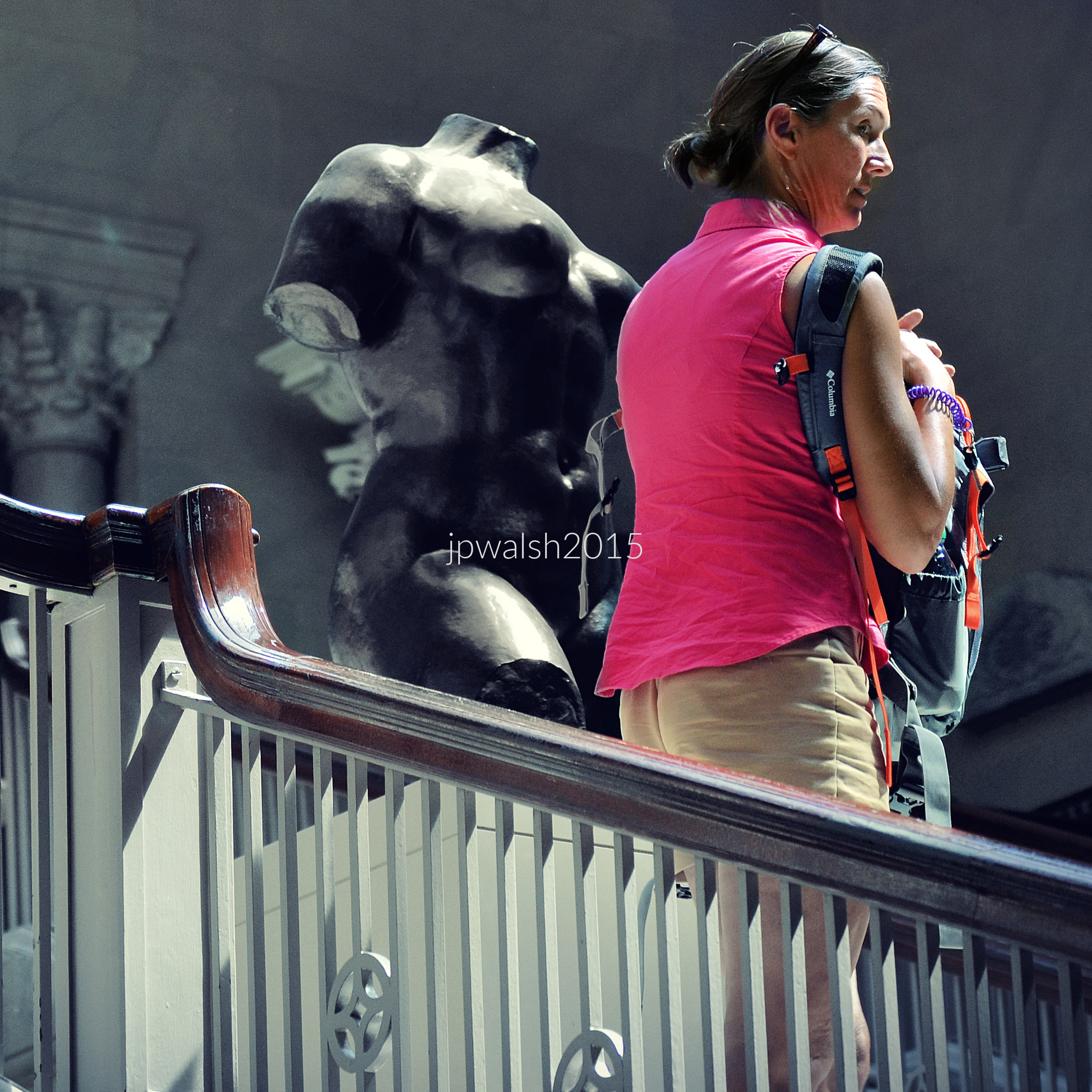
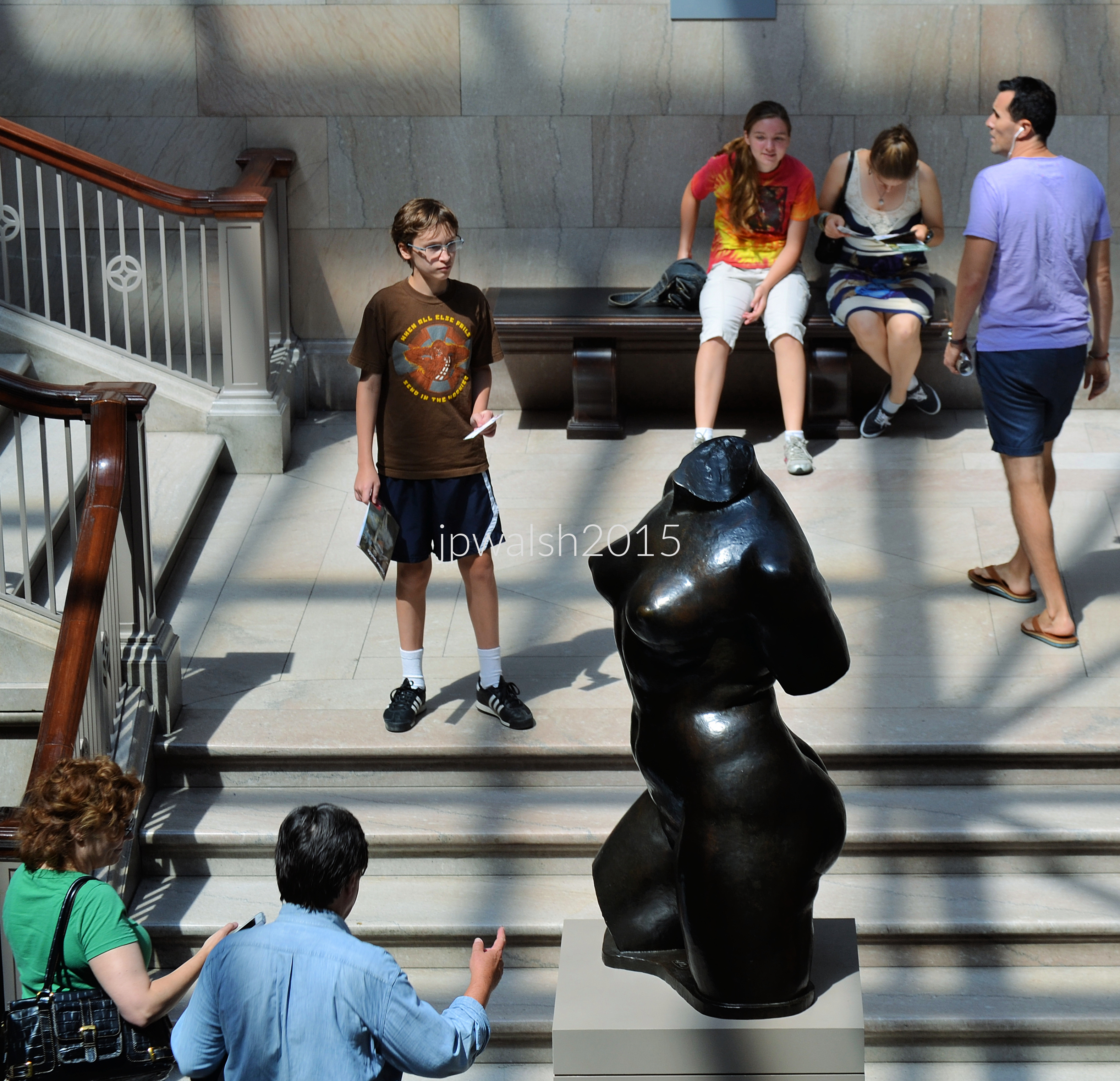
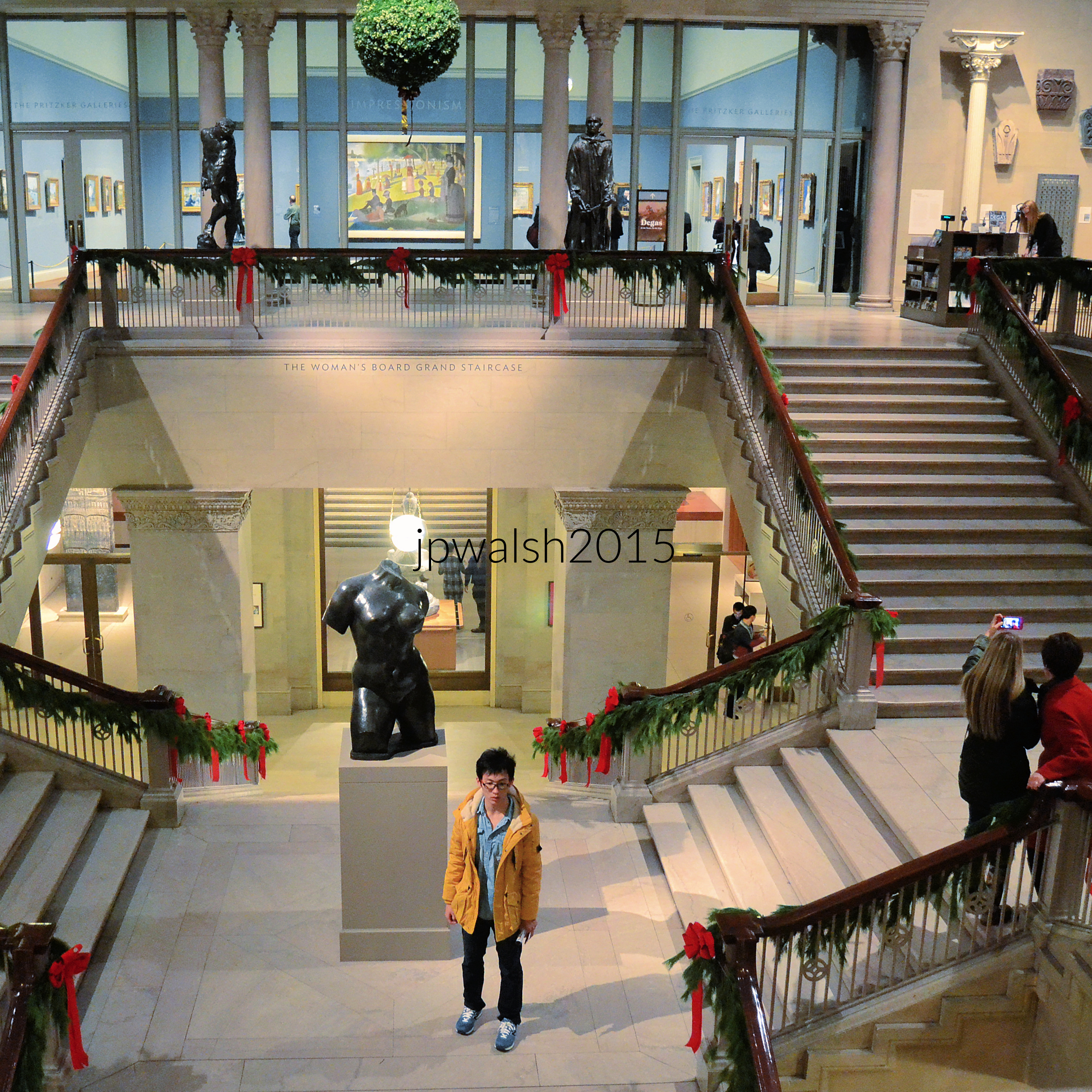
N.B. When this post was published in July 2016, Aristide Maillol’s Enchained Action — a torso cast in bronze and created in 1905 in France — enjoyed a lengthy time on the Women’s Board Grand Staircase at the Chicago art museum. In 2017 the torso was removed by museum curators and placed in an undisclosed location out of public view (see – https://www.artic.edu/artworks/82594/enchained-action). It was replaced by Hero Construction (1958), an early work by legendary Chicago sculptor Richard Hunt (see – https://www.artic.edu/artworks/8633/hero-construction). Why hidden? Because regardless of this or any museum’s intent, the practical effect on the gallery wall is one of erasure. The artwork’s full, true name is Torso of the Monument to Blanqui (Enchained Action). Yet, when you look at the museum’s catalog today or the once-placard on the Woman’s Board Grand Staircase, the work is labeled simply as Enchained Action. This abbreviated title drops “Louis-Auguste Blanqui,” effectively decoupling the sculpture from the specific socialist identity of the man it was created to publicly honor. Further, the fact that this piece was commissioned by a radical leftist committee to celebrate the consolidation of the French socialist movement is omitted from the display—if it is mentioned at all though of significant art historical interest. By focusing almost exclusively on formal aesthetics, standard museum presentation obscures the radical leftist martyrdom physically present within the work, reducing it to a generalized concept for unmoored appreciation. Blanqui, and the very concept of “enchained action” that the artwork conveys, fought to tear down bourgeois institutions, destroy elite hierarchies, and redistribute wealth. The work as presented can be applauded for its advanced irony—standing squarely on the Grand Staircase of a neoclassical civic art palace funded by wealthy, Gilded-Age industrial donors, its monumentality successfully fills and reverberates throughout the architectural space. Yet, it remains oriented to be perceived primarily as a voluptuous, modernist female nude. Without explicit explanatory signage, the physical shape of the sculpture acts as camouflage; set within a capitalistic grandeur met by tout le monde entering and exiting, the setting easily strips away the artwork’s primary revolutionary energy and purpose. The historical origins of Torso of the Monument to Blanqui (Enchained Action)—both in terms of its provocateur subject and as a gritty symbol of street revolution—are obscured in plain sight, ensuring its provocation remains seemingly entirely domesticated.
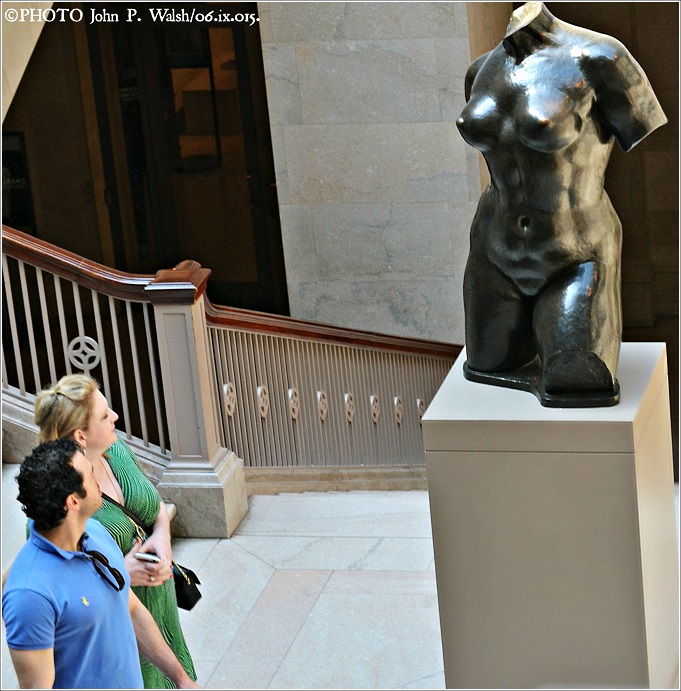
September 2015. 20th Century. France. Aristide Maillol (1861-1944), Enchained Action, c. 1906, Bronze. 47 1/2 × 28 × 21 in. (121.2 × 71 × 53.3 cm). The Art Institute of Chicago. August 2015. 20th Century. France. Aristide Maillol (1861-1944), Enchained Action, c. 1906, Bronze. 47 1/2 × 28 × 21 in. (121.2 × 71 × 53.3 cm). The Art Institute of Chicago.
Text and photographs by John P. Walsh.
In September 2016 the Musée Maillol re-opens in Paris following its unfortunate closure due to poor finances earlier in the year. Under the new management team of M. Olivier Lorquin, president of the Maillol Museum, and M. Bruno Monnier, chairman of Culturespaces, the museum’s new schedule calls for two major exhibitions each year which will look to honor the modernist legacy of the artist, Aristide Maillol (French, 1861-1944) and the museum’s founder, Maillol’s muse, Dina Vierny (1919-2009).
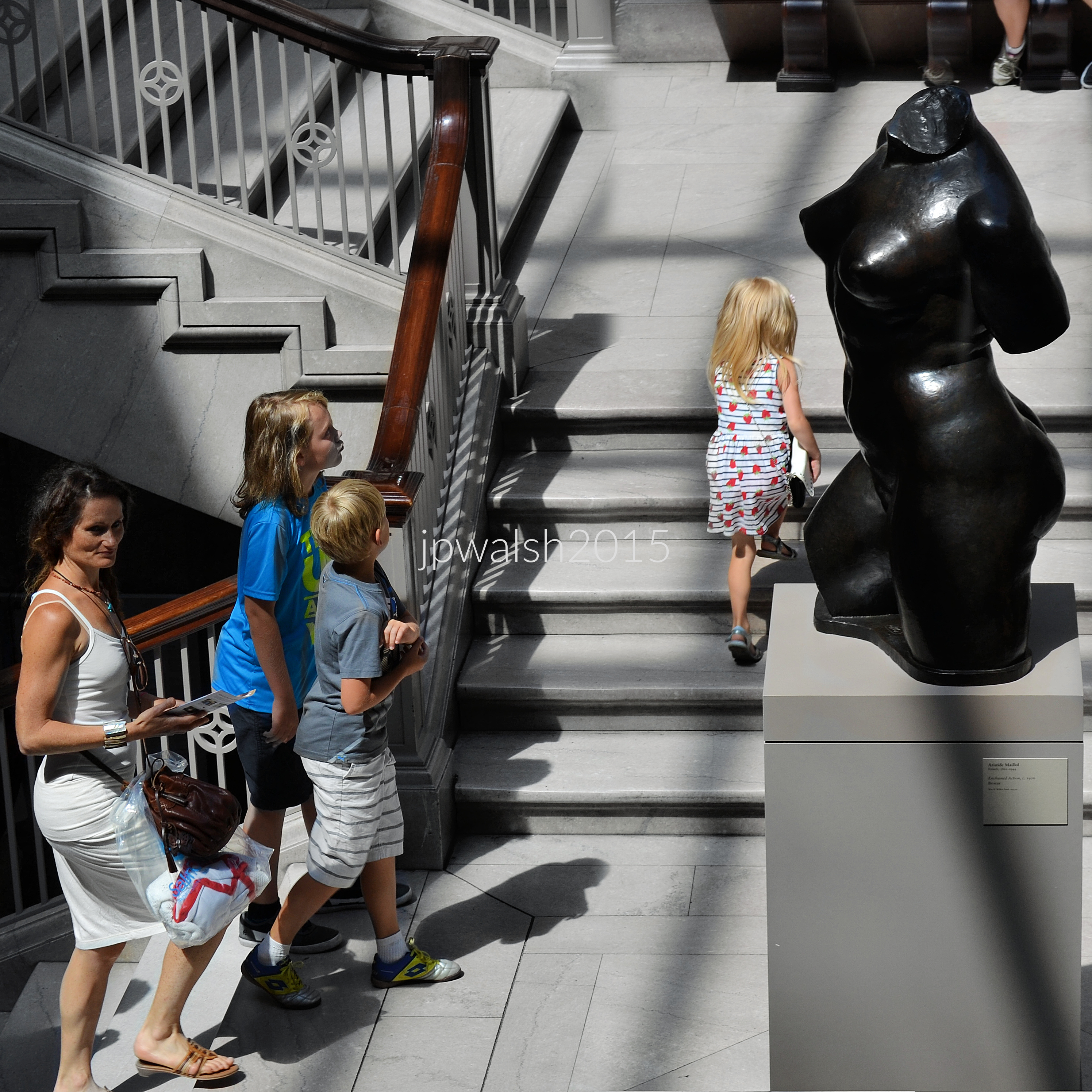
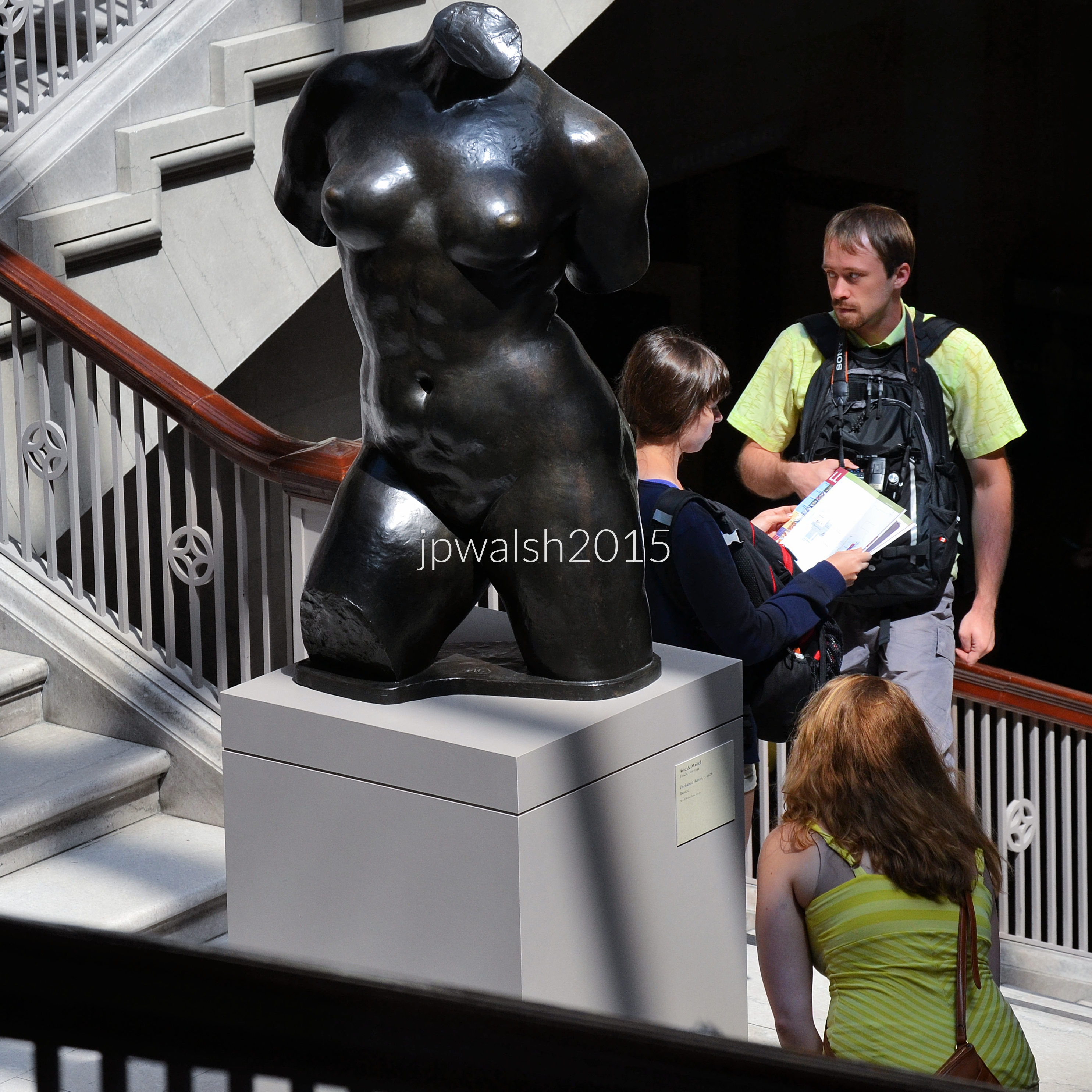
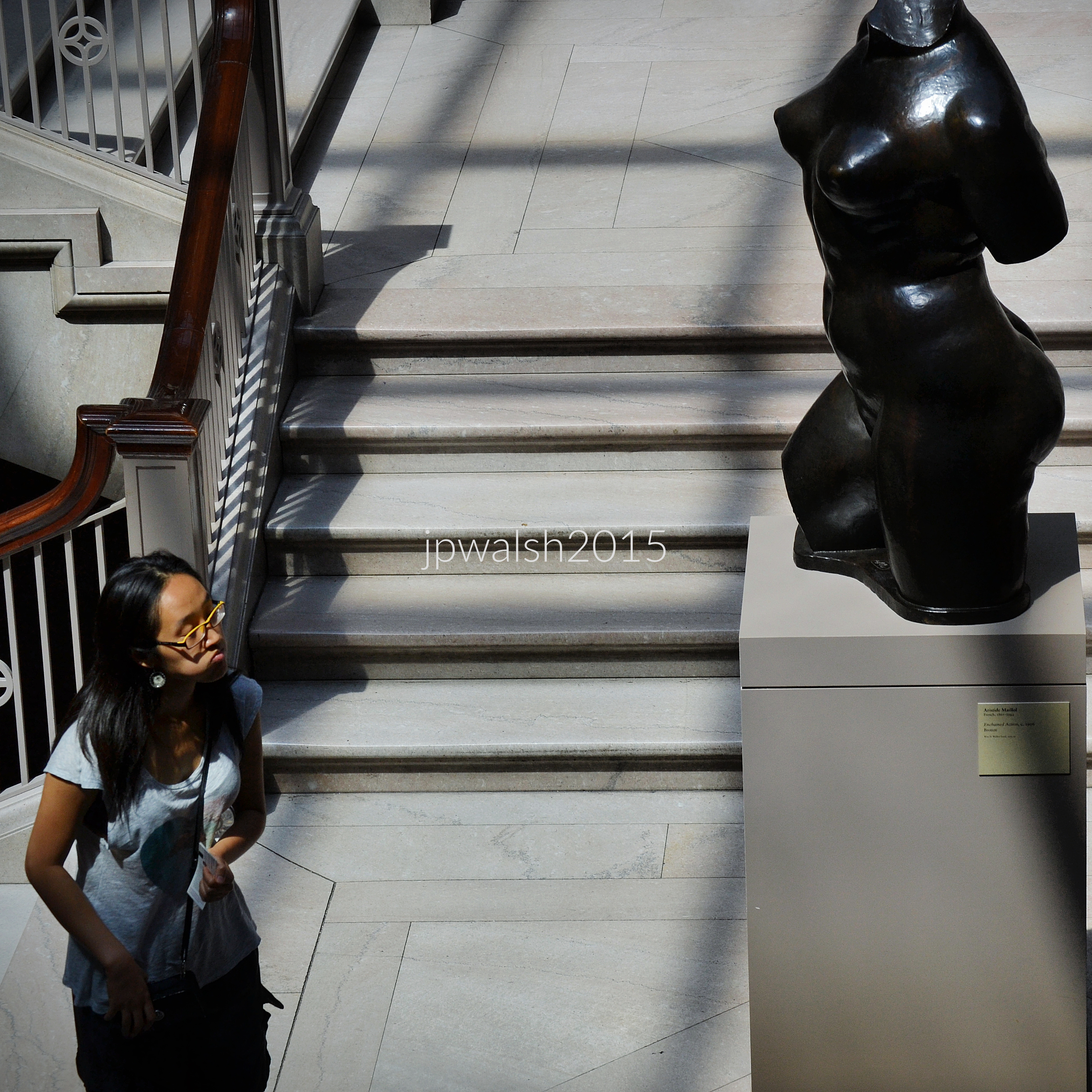
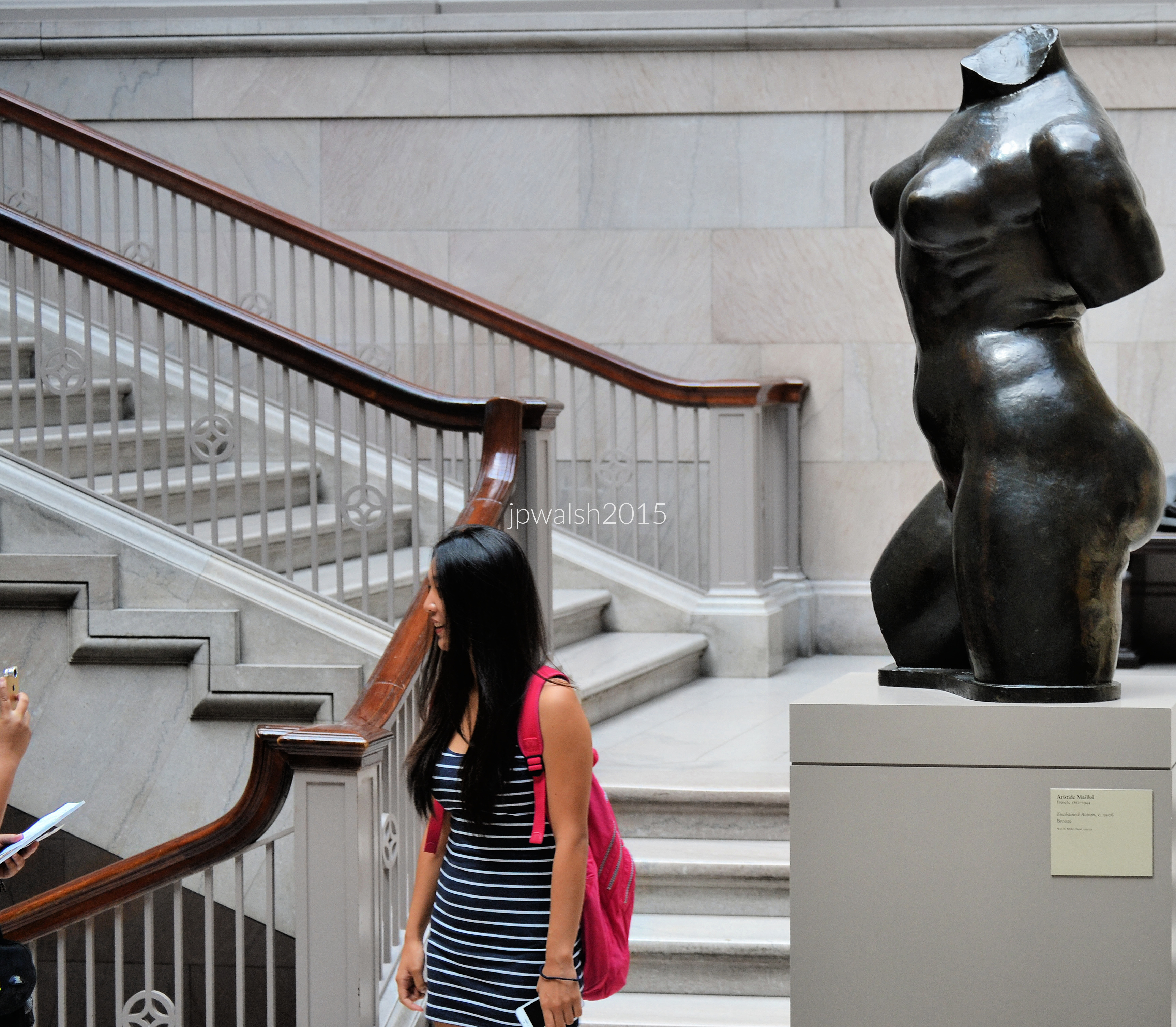
This photographic essay called “Encountering Maillol” is constituted by 34 photographs taken by the author in The Art Institute of Chicago from 2013 to 2016 of the artistically splendid and historically notable sculpture Enchained Action by Maillol and random museum patrons’ reactions when viewing it. The impressive bronze female nude from 1905 stands almost four feet tall atop a plain pedestal which greets every visitor who ascends the Grand Staircase from the Michigan Avenue entrance. Enchained Action is one of Maillol’s earliest modernist sculptures and is doubtless filled by a dynamism not encountered anywhere else in his oeuvre.1
Modelled in France in 1905 by a 44-year-old Maillol who by 1900 had abandoned Impressionist painting for sculpture (first in wood, then in bronze) Enchained Action is one of the artist’s most impressive early sculptures. From the start of his sculptural work around 1898 until his death in 1944, the female body, chaste but sensual, is Maillol’s central theme. What can be seen in Enchained Action expresses the intensity in his early sculptural work which is not found later on—particularly the artist’s natural dialogue among his experimental works in terracotta, lead, and bronze each of which is marked by an attitude of robust energy expressed in classical restraint and modernist simplicity. Enchained Action exhibits Maillol’s early facility for perfection of form within a forceful tactile expression which deeply impressed his first admirers such as Maurice Denis (1870-1943), Octave Mirbeau (1848-1917) and André Gide (1869-1951) and cannot fail to impress the museum goer today.2 By force of this new work in the first decade of the twentieth century, Maillol started on the path of becoming an alternative to and, dissonant heir of Auguste Rodin (1840-1917).3
Maillol’s early sculptural work is important for what it is—and is not. Modeled around three years after he completed his first version of La Méditerranée in 1902 in terracotta and for which his wife posed—a major modernist achievement of a seated woman in an attitude of concentration—and whose radically revised second version was exhibited at the 1905 Salon d’Automne, Enchained Action forms part of Maillol’s revolution for sculpture starting around 1900. Maillol made a radical break with neoclassicism and stifling academicism with its strange blend of realism and mythological forms—and with a rising generation of young sculptors such as Joseph Bernard (1866-1931), Charles Despiau (1874-1946) and Antoine Bourdelle (1861-1929)—blazed a new path for sculpture. Except for Maillol, all these young sculptors worked in menial jobs for Rodin. Because of Maillol’s chosen artistic distance from Rodin’s work, Maillol did not need to react to it and so rapidly achieved his own new style as soon as 1905, the year of Enchained Action.
Maillol’s concept and primary approach to the beauty of the human body was to simplify and subdue forms. This pursuit began in early 1900 and advanced until the artist’s first time outside France on his trip to Greece in 1908 with Count Kessler (1868-1937). An important early sculpture—Recumbent Nude, 1900—was cast with the help of his lifelong friend Henri Matisse (1869-1954). This friendship had ramifications for the Art Institute’s Enchained Action in that it was purchased from Henri Matisse’s son, art dealer Pierre Matisse in 1955 right after his father’s death. While it would prove quaint for The Art Institute of Chicago to install Maillol’s limbless torso of Enchained Action on The Grand Staircase to pay homage or evoke the Louvre’s Winged Victory or Venus de Milo, it is historically significant so to embody Maillol’s artistic outlook in 1905 for his new sculpture, of which Enchained Action is an example. In the years between 1900 and 1908, Maillol searched beyond realism and naturalism to create sculpture with an abstract anatomical structure that jettisoned the sign language of physical gestures which are emotional and where limbs could be problematic for Maillol’s end design. The human torso of Enchained Action foregoes limbs and head to alone embody and convey the artist’s import for it.4
On The Art Institute of Chicago’s Grand Staircase Enchained Action displays Maillol’s sensitive surface modeling capturing human flesh’s animation and sensual power more than its suppleness as found in Italian masters such as Bernini –such difference serves Maillol’s purpose for his subject matter. The torso is differently pliant—toned, muscular, and strident. It displays the humana ex machina whose stance and posture express the modern hero’s defiance and whose nakedness retains the beauty uniquely imbued in the female human body. Enchained Action is a different work altogether than every work Maillol modeled and cast up to 1905. His art progresses in experimentation by its direct interface with politics. Enchained Action is not only an artwork but a political artwork where Maillol empowers both spheres. For today’s viewer who reacts to nudity in art with the shame of eroticism, they may see (or avoid seeing) its sprightly breasts, taut stomach, and large buttocks of Enchained Action only in that mode. The museum limits such visitors to this narrow viewpoint because they do not explain to them Maillol’s artful technique, conceptual artistic revolution by 1905, or unique political and socioeconomic purpose for this imposing artwork in plain view.
With an aesthetic interest established for Enchained Action—for it signals a break with the artistic past and the birth of modern sculpture in its abstraction – a question is posed: what are the political and socioeconomic purposes for this work? Its original and full title reveals a radical social implication: Torso of the Monument to Blanqui ([En] Chained Action). Abbreviated titles—and such appear at The Art Institute of Chicago, The Metropolitan Museum of Art (Torso of Chained Action) and in the Jardin des Tuileries in Paris (L’Action enchaînée)—neatly avoids or even voids the sculpture’s original radical social message. Maillol’s Enchained Action is dedicated it to the French socialist revolutionary Louis Auguste Blanqui (1805-1881).
In 1905 Maillol’s Enchained Action was a public monument honoring the centenary of Blanqui’s birth and consolidation of the French socialist movement that same year into the Section Française de l’Internationale Ouvrière (SFIO), a single leftist political party that was replaced by the current Socialist Party (PS) in 1969. Given this background a visitor may simply stare at or bypass the torso but perhaps for reasons of politics rather than eroticism. The title omission—first promoted by André Malraux in 1964 for the Tuileries’ copy—does disservice to Maillol’s accomplishment and its full title should be restored. The Metropolitan has an incomplete title but on thee label includes information on Blanqui and clearly states their version was cast in 1929. The Art Institute of Chicago’s casting date for the torso is obscure. For a better appreciation of the artwork, familiarity with its social and political historical context is important to locate the intended nature of the energy expressed in it. Torso of the Monument to Blanqui ([En] Chained Action) is a figure study of a strident naked female torso and an expression of radical politics in France at the turn of the last century.
By 1905 Maillol’s new sculptural work attracted important collectors. Rodin introduced Maillol that year to Count Kessler at the Paris gallery of Ambroise Vollard (1866-1939) and to other progressive writers, art critics, and painters. Maillol’s work was a new art form for a new century. It was in 1905 that Paris friends, among them Anatole France (1844-1924), Georges Clemenceau (1841-1929), Gustave Geffroy (1855-1926), Jean Jaurès (1859-1914) and Octave Mirbeau, approached Maillol to persuade the avant-garde artist to accept a commission for the politically sectarian Blanqui monument. It would be a tribute très moderne to a fierce socialist revolutionary but and the entire Blanqui family tradition which had voted to guillotine Louis XVI in the French Revolution and plotted against each ruling regime in France afterwards. Immense confidence was placed in Maillol by these bold turn-of-the-century intelligentsia and by the artist himself who came from a generation that came to believe they were the torchbearers of a new art.
In France public opinion was frequently divided on art matters. When Rodin agreed to Maillol’s commission—he wanted Camille Claudel to do it, but she had become seriously psychotic by 1905—the older sculptor admired and purchased Maillol’s new sculpture—in addition to experiencing his own deep familiarity with the vagaries of creating public monuments. Committee members, by and large left-wing sympathizers, made a favorable impression on Maillol who agreed to do the work. On July 10, 1905, Maillol promised Georges Clemenceau, “I’ll make you a nice big woman’s ass and I’ll call it Liberty in Chains.”5 After that, Maillol’s new sculpture—a symbolic monument to a political revolutionary erected in October 1908 under protest of town leaders on the main square of Blanqui’s native village of Puget-Théniers in the south of France—became the subject of unending intense scrutiny. How to respond to a large and powerful standing figure, tense and in motion where human struggling is borne to the edge of absorbing mute serenity by restraint of chains symbolizing Blanqui’s thirty years in jails by successive French governments?6 In the first ten days of working on the new commission, Maillol made three small sketches and two maquettes of an armless torso followed by other preliminary work. He finished a final clay version in 1905 whose contemplative intimacy reflected socialist Jean Jaurès’sagenda for political life: “We are inclined to neglect the search for the real meaning of life, to ignore the real goals—serenity of the spirit and sublimity of the heart … To reach them—that is the revolution.”7 Sixty-five-year-old Rodin whose critical judgment of the new sculpture which undertook to streamline art forms to the point of austerity against Rodin’s “monstrous subjects, filled with pathos” remarked tersely on Enchained Action.8 Although Maillol saw this public monument as more reliant than ever on Rodin’s concepts, M. Rodin after seeing it was reported to ambiguously mutter: “It needs looking at again.”9
It may be better to judge Enchained Action inside its historical moment. Former Metropolitan curator Preston Remington (1897-1958) praised his museum’s copy of the torso calling it “splendid” and “impeccable” in its observation of the human form. Yet he concludes that it is “essentially typical” of the sculptor for it “transcends the realm of visual reality.”10Enchained Action displays none of the delicacy, awkwardness, luminosity, or calm of the artist’s earlier sculptures and predates major developments in Maillol’s oeuvre after 1909 which differs extensively from that of Enchained Action11 and for which is based much of the artist’s legacy, even by 1929 when Remington is writing. Is it fair to identify Enchained Action as “essentially typical” even as it sublimates form? Viewed in 1905—a watershed year for modern art, including an exhibition of Henri-Matisse’s first Fauvist canvases at the Salon des Indépendents and at the Salon d’Automne—Enchained Action became that year Maillol’s largest sculptural statement to date. The commission, while relying on Rodin’s concepts in its depiction of strenuous physical activity—a quality Preston Remington recognized as “exceptional” in the torso and yet as a critical judgment ambiguous as to whether it refers to Maillol’s reliance on Rodin—afforded Maillol further confidence to execute his monumental art after 1905 for which today he is famous. While for Mr. Remington the representative quality of Enchained Action was what he sought for a museum collection, its exceptional qualities in values that are literally not “essentially typical” for the sculptor.
The complete final figure of Monument to Blanqui([En] Chained Action)—and not only the torso that is displayed on the Grand Staircase of The Art Institute of Chicago—depicts a mighty and heroic woman struggling to free herself from chains binding her hands from behind. Both of these “complete” versions are in Paris and found in the Jardin des Tuileries and in the Musée Cognacq-Jay. Maillol’s later studies for Enchained Action commenced without its head and legs that expressed a heightened anatomical intensity in place of Rodin-like strife.12 Chicago and New York each have a bronze replica of the torso. The Tate Britain has one in lead. Following the Great War, Maillol’s Monument to Blanqui ([En] Chained Action) standing for 14 years in Puget-Théniers’ town square was taken down in 1922 so to erect a monument aux morts. During World War II fearing that the extant original sculpture would be melted down for Nazi bullets, Henri Matisse purchased it from Puget-Théniers and gave it to the city of Nice. The original bronze was saved and now stands in the Tuileries Gardens in Paris.13
NOTES
Dynamism not anywhere else in his oeuvre – “Maillol/Derré,” Sidney Geist, Art Journal, v.36, n.1 (Autumn 1976), p.14.
In 1964-65, 18 large bronzes were placed in the Jardins du Carrousel, Paris, owing to André Malraux and Dina Vierny, Maillol’s last model-http://www.sculpturenature.com/en/maillol-at-the-jardin-tuileries/ – retrieved July 26, 2016; Metropolitan copy cast in 1929 –http://www.metmuseum.org/collection/the-collection-online/search/196526; AIC cast date obscure- http://www.artic.edu/aic/collections/artwork/82594?search_no=6&index=12 – retrieved September 8, 2015; Maillol meets Count Kessler – http://www.metmuseum.org/art/collection/search/204794-retrieved May 25, 2016; torchbearers – Rodin: The Shape of Genius, Ruth Butler, Yale University Press, 1993, p.284; Rodin admired Maillol’s new sculpture- Lorquin, p.52; Rodin wanted Camille Claudel for commission– Lorquin, p. 55; “make you a nice big woman’s ass…”- quoted in Lorquin, p 56.
Sketches, maquettes, final version – Lorquin, p. 57-58.; Jaurès quoted in Uncertain Victory: Social Democracy and Progressivism in European and American Thought, 1870-1920, James T. Kloppenberg, Oxford University Press, New York & Oxford, 1986, p. 297.
“A Newly Acquired Sculpture by Maillol,” Preston Remington, The Metropolitan Museum of Art Bulletin, Vol. 24, No. 11, Part 1 (Nov., 1929), pp. 280-283.
Such works as Night (1909), Flora and Summer (1911), Ile de France (1910–25), Venus (1918–28), Nymphs of the Meadow (1930–37), Memorial to Debussy (marble, 1930–33; Saint-Germain-en-Laye) and Harmony (1944) which are composed, harmonious, and monumental nude female figures often labeled “silent” by critics.
Enchained Action was first modeled with arms. The story of how the first limbless final version came about involving Henri Matisse – see Lorquin, p.58.
May 2016. September 2015.May 2015. August 2015. August 2015. August 2015. July 2015.November 2015.September 2015.August 2015. September 2015.September 2015.August 2015.August 2015.May 2015. July 2015. May 2016. August 2015.September 2015. August 2015.July 2015. November 2015.September 2015. May 2015. September 2015. May 2016. August 2015. August 2015. July 2015. 20th Century. France. Aristide Maillol (1861-1944), Enchained Action, c. 1906, Bronze. 47 1/2 × 28 × 21 in. (121.2 × 71 × 53.3 cm). The Art Institute of Chicago.
In situ: Aristide Maillol’s Enchained Action. The torso is cast in bronze and created in France in 1905. It sits on the landing of the Grand Staircase (main entrance) of The Art Institute of Chicago.
August 2015. August 2015. August 2015. August 2015. September 2015. September 2015. September 2015. September 2015. 624kb 35%September 2015. 5.66 mbSeptember 2015. 6.70 mbSeptember 2015. 4.88 mbSeptember 2015. 668kb 30%September 2015. 30%May 2016. 3.67mb DSCN2516July 2015. 5.01 mb DSC_0539 (1)August 2015. 2.87mb DSC_0641 (2)August 2015. 2.01mb DSC_0964 (1)August 2015. 2.75mb DSC_0975 (1)August 2015. 2.75mb DSC_0976 (1)August 2015. 2.77mb DSC_0972 (1)August 2015. 3.28mb DSC_0983 (1)August 2015. 3.31mb DSC_0088 (1)November 2015. 3.64mb DSC_0314 (2)Maillol in 1925. Photograph by Alfred Kuhn. (Public Domain)https://www.academia.edu/27662632/ENCOUNTERING_MAILLOL_A_CONTEMPORARY_PHOTOGRAPHIC_ESSAY_OF_ARISTIDE_MAILLOLS_ENCHAINED_ACTION_ON_THE_GRAND_STAIRCASE_OF_THE_ART_INSTITUTE_OF_CHICAGO
FEATURE image: Paul Gauguin, Oviri (Savage),1894, stone, 75 x 19 x 27 cm, Musée d’Orsay, Paris. Public Domain.
By John P. Walsh
By 1887 French Post-Impressionist artist Paul Gauguin (1848-1903) had created over 50 ceramic sculptures and carved several decorative panels. So it may be expected that during his interlude in Paris between 1893 and 1895 that he would create a woodcut based on his most recent and important discovery of this Paris interval—the hideous Oviri.
Gauguin made a large ceramic of Oviri (fig. 13) in the winter of 1894-1895. The Tahitian name translates as “wild” or “savage” and, a more recent interpretation, “turned into oneself.” The artist submitted it to the annual exhibition of the Société Nationale des Beaux-Arts for April 1895.
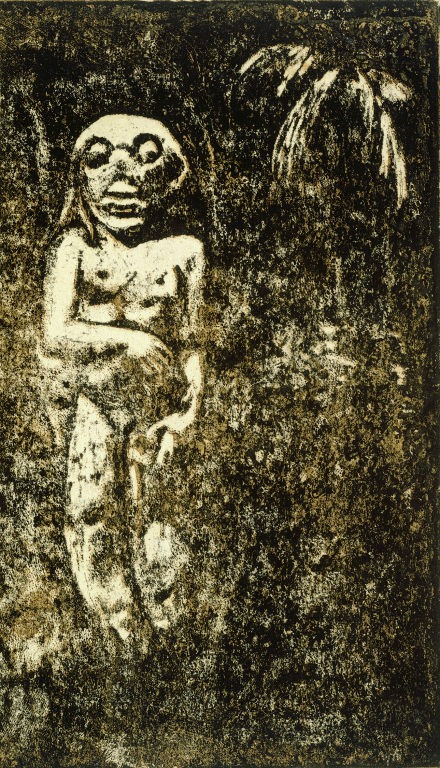
fig.12. Paul Gauguin, Oviri (Savage), 1894 – woodcut printed in black on cream Japan laid paper, 8.03 x 4.56 inches (204 x 116 mm). The Art Institute of Chicago, Clarence Buckingham Collection.
Submitted, Rejected, Overridden
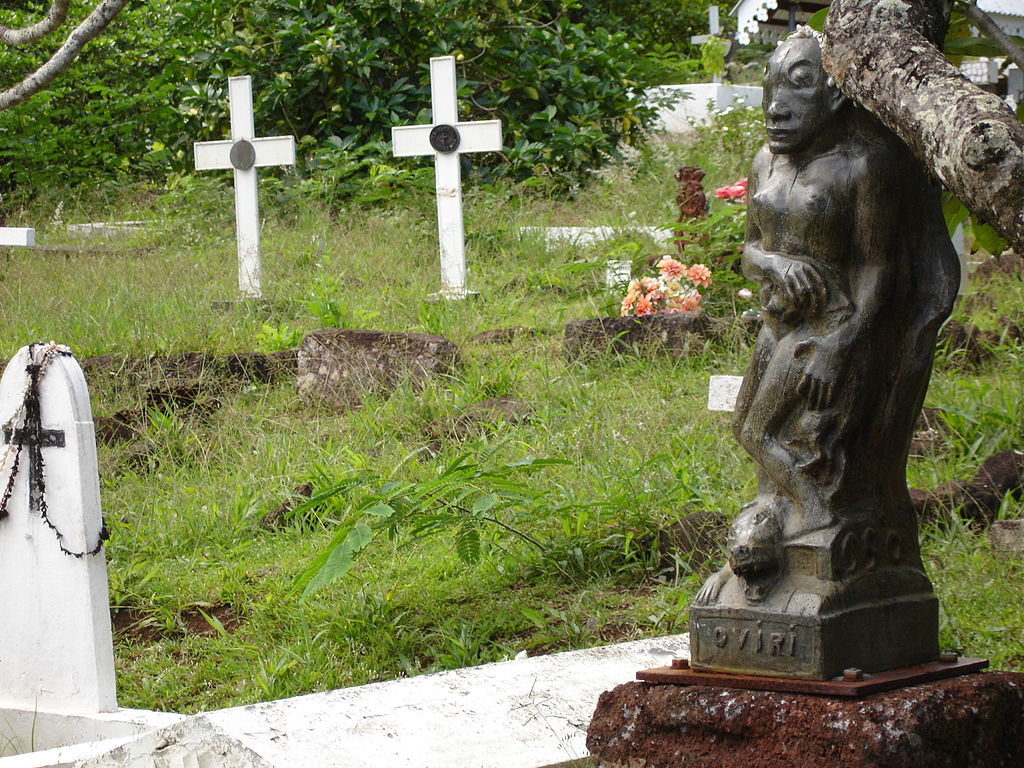
The ceramic, envisioned by the artist as a modern, savage funerary monument (fig.14), was rejected by the judges for inclusion into the salon of the Société Nationale des Beaux-Arts. Gauguin’s latest Tahiti-inspired art was deemed too ugly even by an organization of artists that, since its renewed inception in 1890, is seen as Europe’s first Secessionist movement. Although Auguste Rodin (1840-1917) was a founding member of the group and since 1891 working on his commission from the Société de Gens Lettres for a Paris Balzac statue (that “obese monstrosity”), it was ceramist Ernst Chaplet who insisted on Gauguin’s admittance.56
When Gauguin discovered this mysterious figure who holds a blunted she-wolf, crushing the life out of her cub — occasionally understood as a symbol of female sexual potency — he did not let her go.55 In the print impression — and he made 19 prints from the same wood block, none of which are exactly alike — Gauguin’s Oviri is encountered in the primeval forest as inky blackness.
Paul Marsan, called Dornac (1858-1941), photograph of Ernest Chaplet (Sèvres, 1836 – Choisy-le-Roi, 1909), octobre 21, 1904.fig. 14. Bronze Oviri on the grave of Paul Gauguin on the Marquesan island of Hiva Oa.
Where exactly the ceramic Oviri was displayed in the salon is unclear, but its subsequent route into the collection of the Musée d’Orsay in 1987 is highly circuitous.57 Gauguin often exploited favorite images by repeating them in various media — and the ceramic transposed to the print depicts his idol showering a black light that blots out most of the natural reality around her.
In another Gauguin print from the time period that can fit in the palm of the hand, the artist offers a splendor of darkness, the mystery of a palm frond forest, and a stark confrontation with Oviri who is, as Gauguin described to Stéphane Mallarmé on the poet’s version of the print, “a strange figure, cruel enigma.”58
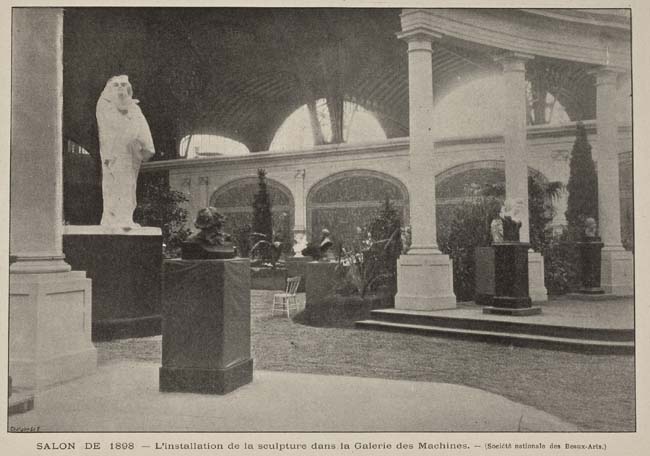
Société Nationale des Beaux-Arts in 1898.
NOTES:
“turned into oneself” – Anne Pingeot, “Oviri,” in Gauguin Tahiti, George T.M. Shackelford and Claire Frèches-Thory, MFA Publications, 2004, p. 140; “symbol of female sexual potency” – Mathews, p. 203; Gauguin’s ceramic and carved panel output -Barbara Stern Shapiro, “Shapes and Harmonies of Another World,” in Gauguin Tahiti, George T.M. Shackelford and Claire Frèches-Thory, MFA Publications, 2004, pp. 117 and 126.
19 prints from one wood block – Shapiro, p. 126; savage, modern funerary monument – Mathews, p.208; first secessionist movement – Hans-Ulrich Simon, Sezessionismus. Kunstgewerbe in literarischer und bildender Kunst,: J. B. Metzlersche Verlagsbuchhandlung, Stuttgart ,1976, p. 47; Gauguin and the 1895 Société Nationale des Beaux-Arts salon – Mathews, p. 208; “obese monstrosity” – Grunfeld, Frederic V., Rodin:A Biography, Henry Holt and Company, New York, 1987, p. 374.
Anne Pingeot, “Oviri,” in Gauguin Tahiti, George T.M. Shackelford and Claire Frèches-Thory, MFA Publications, 2004, pp. 136-138.
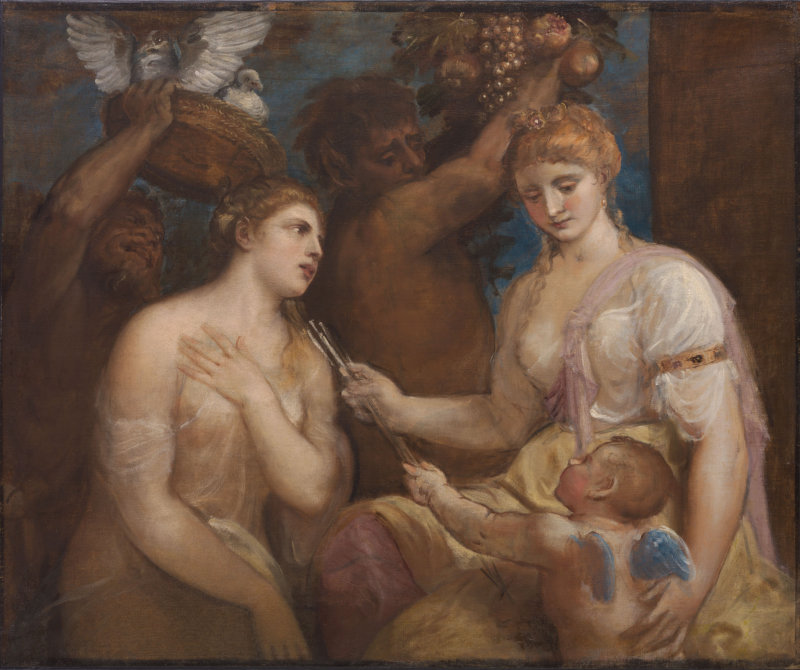
FEATURE image: Allegory of Venus and Cupid, c. 1600, Imitator of Titian (Tiziano Vecellio, Italian, c. 1485/90-1576), oil on canvas, 51 1/8 x 61 1/8 in. (129.9 x 155.3 cm). Charles H. and Mary F.S. Worcester Collection, 1943.90.
By John P. Walsh
The pleasant if heavily-restored late 16th century allegorical painting in the collection of The Art Institute of Chicago is today called Allegory of Venus and Cupid and dated to around 1600. Attributed to an “imitator” of Titian it remains in museum storage (“Not on Display”).
When this same painting was “rediscovered” around 1930 it was hailed as a Titian masterpiece and over the next 15 years was talked of that way in the general press and in some quarters of the art press. It delighted crowds who came to see it hang on the walls of The Art Institute of Chicago and The Cleveland Museum of Art. Called The Education of Cupid and dated to the 1550s, it was compared favorably with Titian’s famous allegorical subject paintings in Paris’s Louvre and in Rome’s Galleria Borghese.
The painting through the Great Depression and World War II was labeled “Titian,” but among expert connoisseurs there existed a longstanding dismissal of that attribution ever since its first known “resurfacing” in the mid1830s at Gosford House in Scotland.
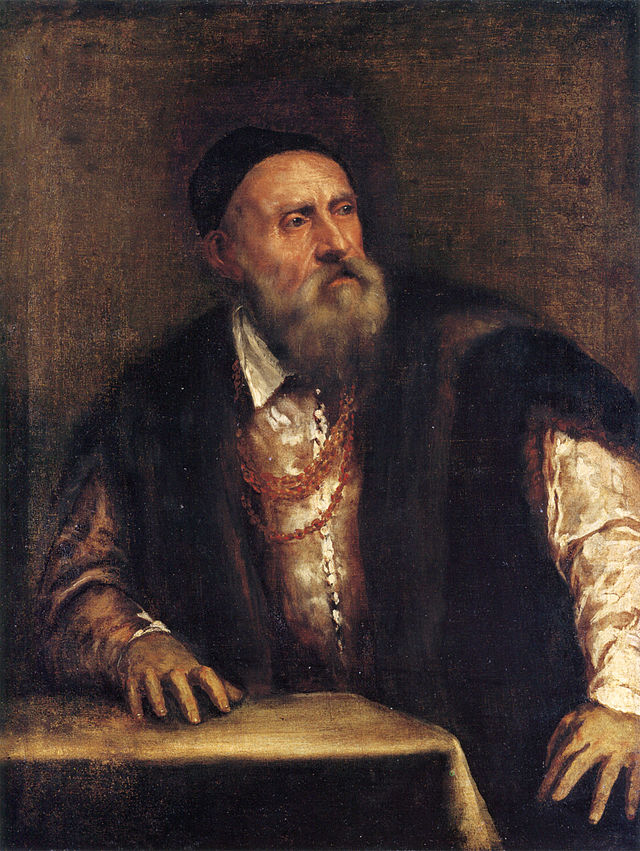
Titian, Self portrait, c. 1550, Gemäldegalerie, Berlin.
In Italian his name is Tiziano Vecellio, but in English the artist is famously known as Titian (1485-1576)
Titian was part of a family of artists who had been civic leaders in 13th-century and 14th-century Italy, such as mayors, magistrates, and notaries. In the 15th century, two Vecellio brothers had children who became artists. Titian was the grandson of one of those brothers who was ambassador to Venice where the family had a timber trade. Titian became the leading painter in Venice and an influential artist throughout sixteenth-century Italy. His cousin Cesare Vecellio (1530-1601) was an engraver and painter who trained in Titian’s workshop. The Vecellio cousins and their sons became artists and were allowed to use the appellation “di Tiziano” which would bring them attention.
The painter of The Art Institute of Chicago’s allegory entitled Allegory of Venus and Cupid is only identified as an “imitator” of Titian. Its allegorical motifs share similarities with Titian’s and this is perhaps partly why this Old Master painting by an unknown follower of Titian was mistaken for the master himself when it resurfaced on the art market in 1927.
Called The Education of Cupid and dated to the 1550s, it traded back and forth to the dealer for almost a decade until it was bought in 1936 by a well-connected Chicago couple who collected sixteenth-century Venetian paintings. The Wemyss ‘Allegory’ (named for its former British owner, Lord Wemyss) came to Chicago out of what amounted to be a Scottish attic.
It gained ready acclaim as a rediscovered Titian and since its subject was reminiscent of Titian’s Allegory of Marriage (1533) in the Louvre and a Titian subject allegory in the Galleria Borghese, the Wemyss ‘Allegory’ in Chicago was hailed as completing a triumvirate of Titian’s greatest allegorical compositions.
The problem was that this Chicago Titian was not a Titian at all, although it took about 10 years for that fact to gain modern acceptance.
After the purchase, the new owners immediately lent their Titian to The Art Institute to mount on its gallery walls. It would hang next to the collector couple’s verifiable Tintoretto, Veronese, and G.-B. Moroni. The museum eventually acquired the Wemyss ‘Allegory’ in 1943, but not before it toured The Cleveland Museum of Art during their “Twentieth Anniversary Exhibition” in 1936 and viewed with enthusiasm as a Titian.
The collector purchase and subsequent loan to the Art Institute was front page news in Chicago. The director of the museum at the time, Robert Harshe, compared the work in importance to only two others in The Art Institute at that time – El Greco’s Assumption of the Virgin (1577-79) and Girl at the Open Half Door (1645) attributed to Rembrandt. Curiously, this painting first attributed to Rembrandt has been itself increasingly questioned in terms of its high authorship. One of the first historical European paintings to enter the museum’s permanent collection, Girl at the Open Half Door is today identified with the moniker “and Workshop” to indicate the possibility that it was created by a student under the master’s supervision.
Soon after its acquisition by The Art Institute, the Titian attribution was loudly critiqued in print and eventually dropped. The subject of the painting is of a girl who appears before Venus to be initiated into the mysteries of Love. At the girl’s right are Venus and the boy Cupid with an arrow. In the background two satyrs raise items such as a basket with two doves and a bundle of fruit.
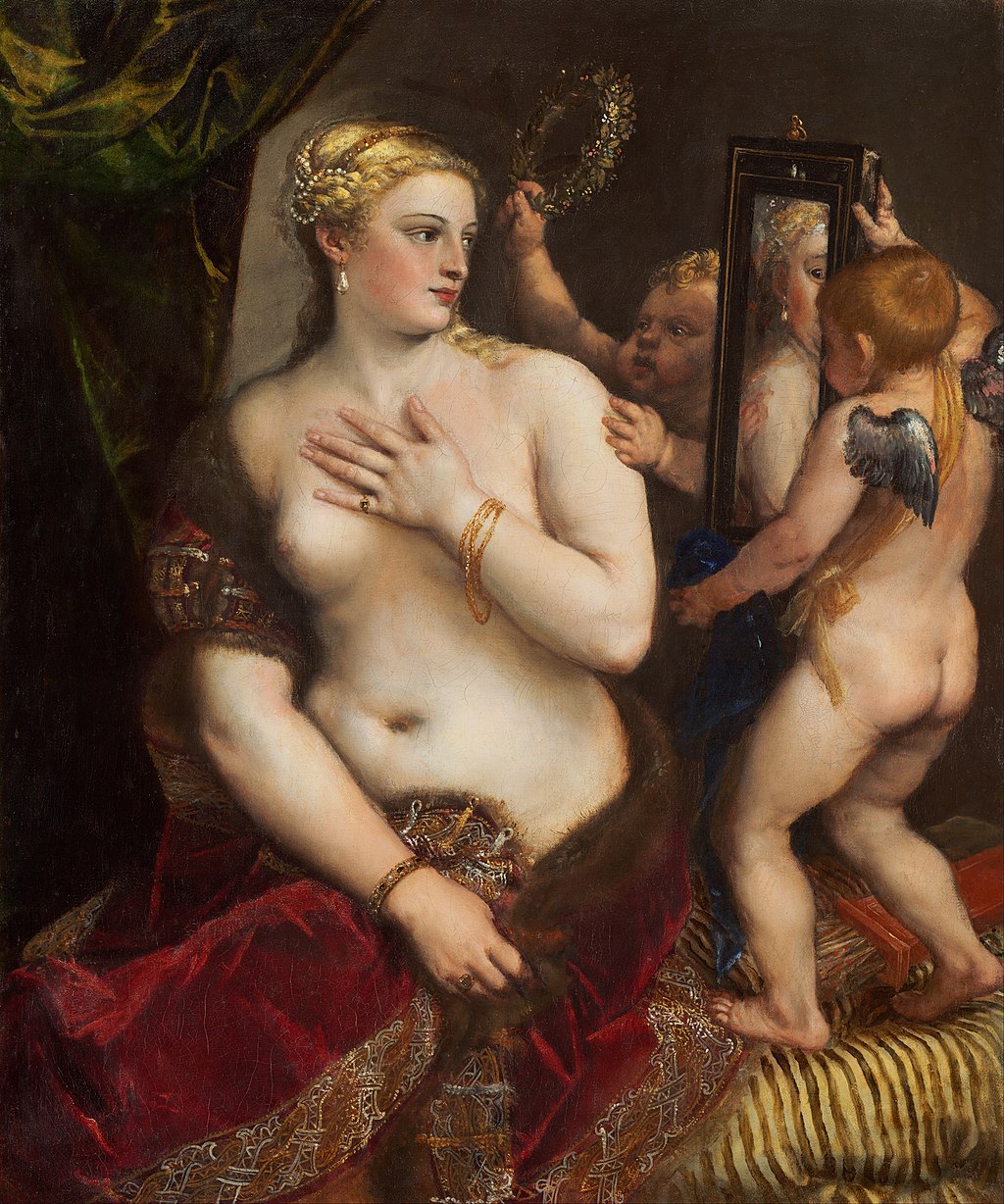
Allegories were popular in Italian Renaissance art to convey social, political, economic and religious messages using historical and mythological figures. This painting’s figures, however, appear to be derivative of specific Titian works. Further, it possesses little of the technical brilliance or psychological revelations found in Titian’s work such as in Triple Mask or Allegory of Prudence (c. 1570, London, National Gallery). For example, Titian’s imitator gives the figure of the girl the same dramatic hand gesture found in Titian’s Venus with a Mirror (c. 1555, The National Gallery of Art, Washington, D.C. ). Insofar as the girl’s skyward gaze and flowing hair, the imitator cites The Penitent Magdalene (1531-33, Florence, Palazzo Pitti).
Titian, Venus with a Mirror, 1555, National Gallery of Art, Washington, D.C.Titian, Penitent Magdalen, 1533, Pitti Palace.
In addition to the painting’s derivative character of well-known Titian works, what most connoisseurs recognized by 1945 was what they called its “very modern” execution. This referred to its sharp color contrasts and figurative forms which developed only after Titian’s time. Connoisseurs also noted that Titian differentiated sharply between hair and ornament and that his female figures’s hair is neatly braided, whereas the hair is “in a mass” in the Wemyss ‘Allegory’.
These characteristics pointed to the picture being related less to authentic Titians in Paris and Rome and more to those attributed dubiously, even spuriously, to Titian in Munich and at the Durazzo Palace in Genoa. Though this inauthenticity of Chicago’s Wemyss “Allegory” could have been questioned at the start of its appearance in Chicago in 1936, the museum was not adhering closely to the historical connoisseurship.
Sir Joseph Archer Crowe by Louis Kolitz (German, 1845-1914), London, National Portrait Gallery.
Giovanni Battista Cavalcaselle, 19th century.
Sir Joseph Archer Crowe (British, 1825-1896) and Giovanni Battista Cavalcaselle (Italian, 1819-1897) had seen all three of the spuriously attributed Titians in Munich, Genoa, and at Gosford House which was now in Chicago. It was well known the pair excluded all three from their Titian catalog except to note that they were imitations which had been notably damaged and restored. Chicago museum research in the late 1930s was also aware of Crowe and Cavalcaselle’s attributive work for they cited them in official publications on the Wemyss ‘Allegory,’ but overlooked their conclusions.
With the museum’s acquisition of the Wemyss ‘Allegory’ in 1943 Crowe and Cavalcaselle’s negative attribution for it was no longer ignored or denied. About its reworking in England one tempting and likely wishful speculation was that the Wemyss ‘Allegory’ was restored by Sir Joshua Reynolds (1723-1792) but that claim remains unsubstantiated. Further facts contextualized in the deft historical hands of modern connoisseurship left the Wemyss ‘Allegory’ out in the Titianesque cold as an imitator. In the case of the Chicago painting it was by historical comparison with compositional arrangements in known Titians that the compositional arrangements in the Munich and Chicago paintings were deemed by Crowe and Cavalcaselle to be done by imitators. Historically for Titian it would be nonsensical or “unique” for Titian to have manipulated the figures in that way at that time.
By the mid1940s the Chicago painting was searching for a new name attribution, since Crowe and Cavalcaselle did not give it one. The notion that it was done by Damiano Mazza (active after 1573), an obscure 16th century artist and student of Titian, was proposed but later dismissed.
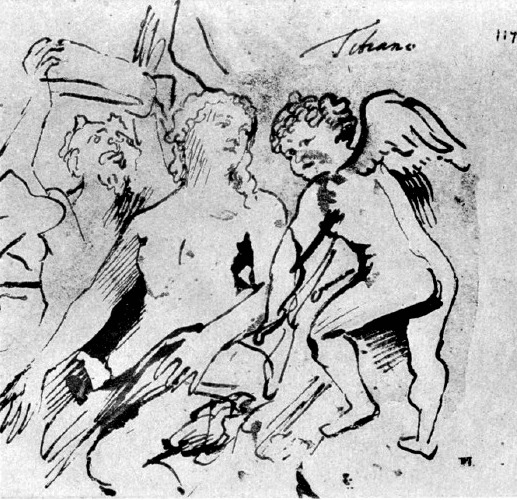
Chatsworth, Duke of Devonshire: Van Dyck, Sketchbook.Rome, Galleria Borghese: Venus and Cupid with Satyr Carrying a Basket with Fruit, attributed to Paolo Veronese.
Some of the confusion over the attribution to Titian of the Wemyss ‘Allegory’ is based on erring connections made using erring extant evidence. For example, the conjecture of Vienna School-trained art historian of Venetian art Hans Tietze (Czech, 1880-1954) that a sketch by Sir Anthony van Dyck (1599-1641)–which Tietze wrongly believed was made at Chatsworth House of a painting once attributed to Titian–shared similar motifs with the Wemyss ‘Allegory’ is a thin thread for possible attribution to Titian. It may be argued that the Wemyss ‘Allegory’ shares very little with the Van Dyck sketch except for the satyr lifting a basket. Further, the painting which Van Dyck sketched is no longer attributed to Titian and has long been in the Galleria Borghese in Rome as a minor Venus and Cupid with Satyr Carrying a Basket with Fruit now attributed to Paolo Veronese. It was in Rome where Van Dyck must have made his sketch, not England, and it was there he misidentified it as Titian. It is a tenous trail of misleading evidence that became the prompt to a connoisseur’s mistaken thought.
Paris, Louvre: Allegory of Marriage, Titian, 1533.
Nuptial paintings
One persuasive conclusion on attribution today for the Wemyss ‘Allegory’ was offered by Hans Tietze’s wife, the historian of Renaissance and Baroque art, Erika Tietze-Conrat (1883-1958). Tietze-Conrat believed that The Art Institute painting resides in a pool of works done by assistants and imitators who combined varied elements of Titian’s allegories as found in the Louvre’s Allegory of d’Avalos (the aforementioned Allegory of Marriage) and the Borghese’s Education of Cupid.
Erwin Panofsky (German, 1892-1968) postulated that those known Titians were nuptial paintings. Building on that premise, Tietze-Conrat postulated that numerous reproductions were made by Titian followers so to create nuptial paintings for their patrons to suit their needs. The derivative works shared the intimacy of a private format with a recognizable cast of 16th century depictions of mythological actors and the evocation of a Titianesque mood.
Today the Art Institute of Chicago has renamed their Wemyss “Allegory” as Allegory of Venus and Cupid and dated it to “around 1600.” The museum removed Titian and every other named attribution. Attribution has been returned to the term that connoisseurs Crowe and Cavalcaselle gave the painting in 1881, namely, “imitator.”
“The execution here is very modern,” the pair wrote in their Life and Times of Titian in 1881. “It is greatly injured, but was apparently executed by some imitator of Titian.” Their late 19th century judgment hold fast today.
On Titian and Vecellio family – Encyclopedia of Italian Renaissance & Mannerist Art, Volume II, edited by Jane Turner, Macmillan Reference Limited, 2000, p. 1695.
“ready acclaim as a rediscovered Titian…”; “lent their Titian to The Art Institute to mount……”; “Cleveland… ‘Twentieth Anniversary Exhibition’ in 1936…” – “A Great Titian,” Bulletin of the Art Institute of Chicago (1907-1951) Vol. 31, No. 1 (Jan., 1937), p. 8; “Famed Titian Work Acquired by Chicagoans,” Chicago Tribune, October 20, 1936, p. 28; “The Mr. and Mrs. Charles H. Worcester Gift,” Daniel Catton Rich, Bulletin of the Art Institute of Chicago, Vol. 24, No. 3 (Mar., 1930), pp. 29-31 and 40. The Chicago collectors were Mr. and Mrs. Charles H. Worcester, a museum Vice-President and lumber and paper manufacturer.
“…director of the museum… compared the work in importance to El Greco’s ‘Assumption of the Virgin’ and Rembrandt’s ‘Girl at the Open Half Door’” – “Famed Titian Work Acquired by Chicagoans,” Chicago Tribune, October 20, 1936, p. 28.
“little of the technical brilliance or psychological revelations found in…Triple Mask…” – H. E. Wethey, The Paintings of Titian: Complete Edition, vol. 2, The Portraits, Phaidon, New York, p. 50.
“its ‘very modern’ execution”; “in a mass” – The Wemyss Allegory in the Art Institute of Chicago, E. Tietze-Conrat. The Art Bulletin Vol. 27, No. 4 (Dec., 1945), p. 269.
“It was widely known the pair excluded all three from their Titian catalog…” – “A Great Titian Goes to Chicago,” Art News 35, 5 (1936), p.15 (ill.).
“Chicago museum research in the late 1930s was aware of Crowe and Cavalcaselle’s attributive work… overlooked their conclusions…” – Footnote #4, The Wemyss Allegory in the Art Institute of Chicago, E. Tietze-Conrat. The Art Bulletin Vol. 27, No. 4 (Dec., 1945), p. 269.
“…restored by Sir Joshua Reynolds…” – The Wemyss Allegory in the Art Institute of Chicago, E. Tietze-Conrat. The Art Bulletin Vol. 27, No. 4 (Dec., 1945), p. 269.
“done by Damiano Mazza…” Ibid., p. 270.
Conjecture of Hans Tietze; Erika Tietze-Conrat’s postulation – Ibid., p. 271.
“the execution here is very modern… It is greatly injured, but was apparently executed by some imitator of Titian.” – Crowe and Cavalcaselle, Life and Times of Titian, London, 1881, II, p. 468.
FEATURE image: Kaskaskia tribe member leads Fr. Jacques Marquette, S.J. and Louis Jolliet through the Chicago Portage, 1673. Cor-10 steel, Ferdinand Rebechini (1923-2003), The Chicago Portage National Historic Site, Lyons, Illinois, 1990. Author’s photograph taken in November 2012.
The Chicago Portage, which made Chicago’s founding and thriving possible, is a U.S. Department of Interior National Historic Site.
A Native American of the Kaskaskia tribe leading French explorers Father Jacques Marquette, S.J. and Louis Jolliet through The Chicago Portage. A Cor-10 steel sculpture by Ferdinand Rebechini (1923-2003) of Rebechini Studios Inc. of Elk Grove Village. The artwork was dedicated at The Chicago Portage National Historic Site in Lyons, Illinois, in April 1990. Author’s photograph.
In September 1673 members of the Kaskaskia, a Native American tribe of the Illinois Confederation, led French explorers Louis Jolliet (1645-1700) and Père Jacques Marquette, S.J. (1637-1675) through the portage that was well known to Native Americans for centuries and later called the Chicago Portage. The statue depicts that event, showing a Native American pulling the canoe where water meets land, and Jolliet in the middle and Father Marquette, a cross upon his chest, standing outside the canoe and pointing ahead. For hundreds of years, early travelers, traders, and settlers had to carry their canoes and its contents overland through the Chicago Portage between the Chicago and Des Plaines Rivers. It was on this tract of Illinois land – little changed since the mid17th century – where Marquette and Jolliet, the first French explorers to open up the Old Northwest Territory, once stood.
Cor-10 steel.
Made of Cor-10 steel by Chicago-area artist Ferdinand Rebechini (1923-2003) and dedicated in April 1990, the sculpture at The Chicago Portage is made of the same material used to construct Chicago’s Picasso statue in Daley Plaza in downtown Chicago.
This outdoor sculpture stands at the western terminus of a nearly 8-mile-long water-and-overland travel route across the Continental Divide between the St. Lawrence and Mississippi River systems known as “the Chicago Portage.” Linking Lake Michigan (via the Chicago River) to the Mississippi River (via the Des Plaines River), the Chicago Portage became the key to expansion of travel and trade in the Old Northwest territory which later became the raison d’être for the founding of Chicago.
Portage Type and Length Could Widely Vary With the Weather and Seasons.
The length of the portage varied with the weather. If water was high, canoes could be paddled longer from Portage Creek into Mud Lake and to the Chicago River without any overland portaging. In dry times, travelers would have to portage in the waist-high swamp waters of Mud Lake, and then drag their canoes through swamp, sloughs, and mud all the way to the Chicago River. The portage became no better in times of drought. Then the overland portage could be as long as upwards of 100 miles with no paddling between the Chicago River and the Illinois River near LaSalle/Peru.
Original section of the waterway at the Chicago Portage. The water originally flowed as part of the Des Plaines River. During construction of the Sanitary and Ship Canal in the late 1890’s it was cut off from the river and partially filled. For hundreds of years the Chicago Portage was that track of mostly land where in wet season travelers could mostly paddle from the Chicago River to the Des Plaines River and in dry or semi-dry season they had to carry canoes and supplies varying distances between rivers. It was here where the trio depicted in Ferdinand Rebechini’s sculpture pulled ashore in their canoe and once walked more than 300 years ago. Author’s photograph.
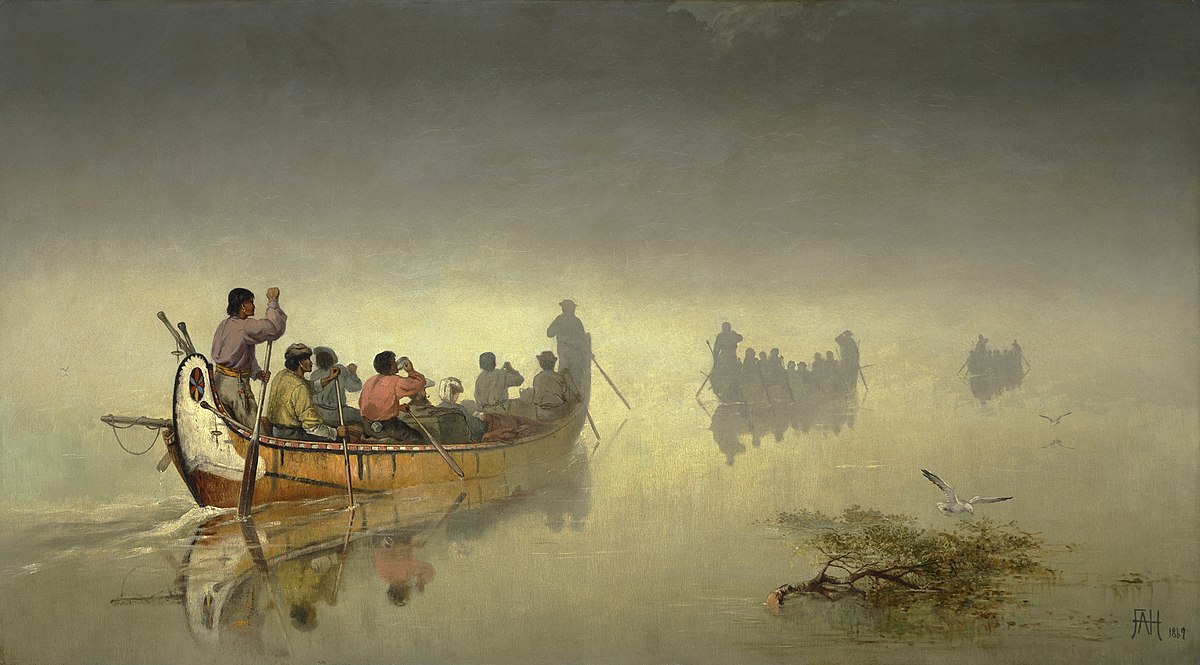
“Canoes in a Fog, Lake Superior,” 1869, Frances Anne Hopkins (1838–1919) Glenbow Museum, Alberta, Canada. Public Domain.In the 17th and 18th centuries the Chicago Portage welcomed a similar scene of paddling travelers such as Native Americans, missionaries, soldiers, pioneers, voyageurs, trappers, and traders on the waterways of Illinois wilderness. Public domain.
Used and well-known by the Native Americans, the portage was first used by the Europeans in the mid-17th century. It became a major gateway for exploration and pioneer expansion to the West and for the fur trade. The portage at Chicago was discovered in September 1673 by Frenchmen Père Jacques Marquette and his guide Louis Jolliet as they returned from their voyage of exploration down the Mississippi River. A 36-year-old Marquette, already in bad health, spent his last winter of 1674-75 near the portage, and died in May 1675 near Ludington, Michigan. Numerous missionaries, soldiers, pioneers, voyageurs and traders into Illinois Country passed through the portage, including René Robert Cavelier, Sieur de la Salle (1643-1687) and Henry de Tonty (1649-1704). Starting around 1700, Europeans were kept out of the area by Native Americans who continued to use the portage extensively as the native peoples had done for centuries before the European arrival. Over the first half of the 18th century, the portage restricted non-Indian travel.
Ceded to the United States in 1795 in the Treaty of Greenville, the portage route was meticulously mapped and developed in the 19th century to meet the needs of greater interstate commerce. The Illinois and Michigan Canal was built along this route in 1848 mainly using Irish immigrant labor in its construction. In 1907, the Sanitary and Shipping Canal was built and remains in use today. The western terminus site is located in today’s city of Lyons, Illinois.
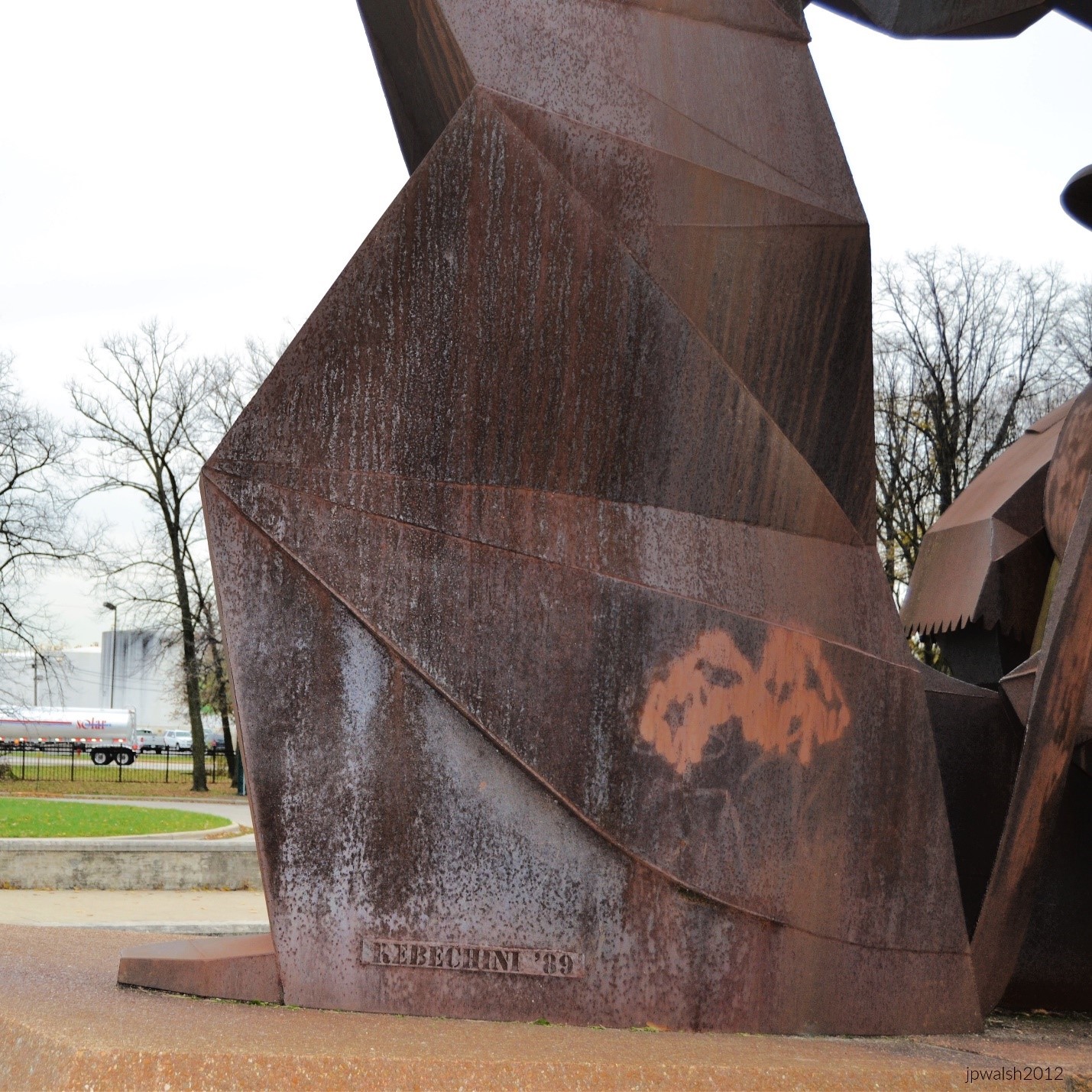
The artist signed his monumental Cor-Ten steel sculpture on the robe of the figure of Fr. Marquette. Author’s photograph.
Since 1950, the historic Chicago Portage is owned and part of the Cook County Forest Preserve system. In 1952 the U.S. Department of Interior recognized the historic importance of the portage by officially designating it a National Historic Site. The site is also part of the I & M Canal National Heritage Corridor. The eastern end of the portage route is the site of Fort Dearborn, by Lake Michigan at the mouth of the Chicago River near today’s high-traffic DuSable (Michigan Avenue) Bridge. Fort Dearborn was originally constructed in 1803 to protect the trade route made possible by the portage and through what would soon became Chicago, the “City of the Century.”
Another view: Native American of Kaskaskia tribe leading French explorers Father Jacques Marquette, S.J. and Louis Jolliet through The Chicago Portage. Cor-10 steel sculpture by Ferdinand Rebechini (1923-2003) at The Chicago Portage National Historic Site in Lyons, Illinois, 11/2012 5.12 mb Author’s photograph.
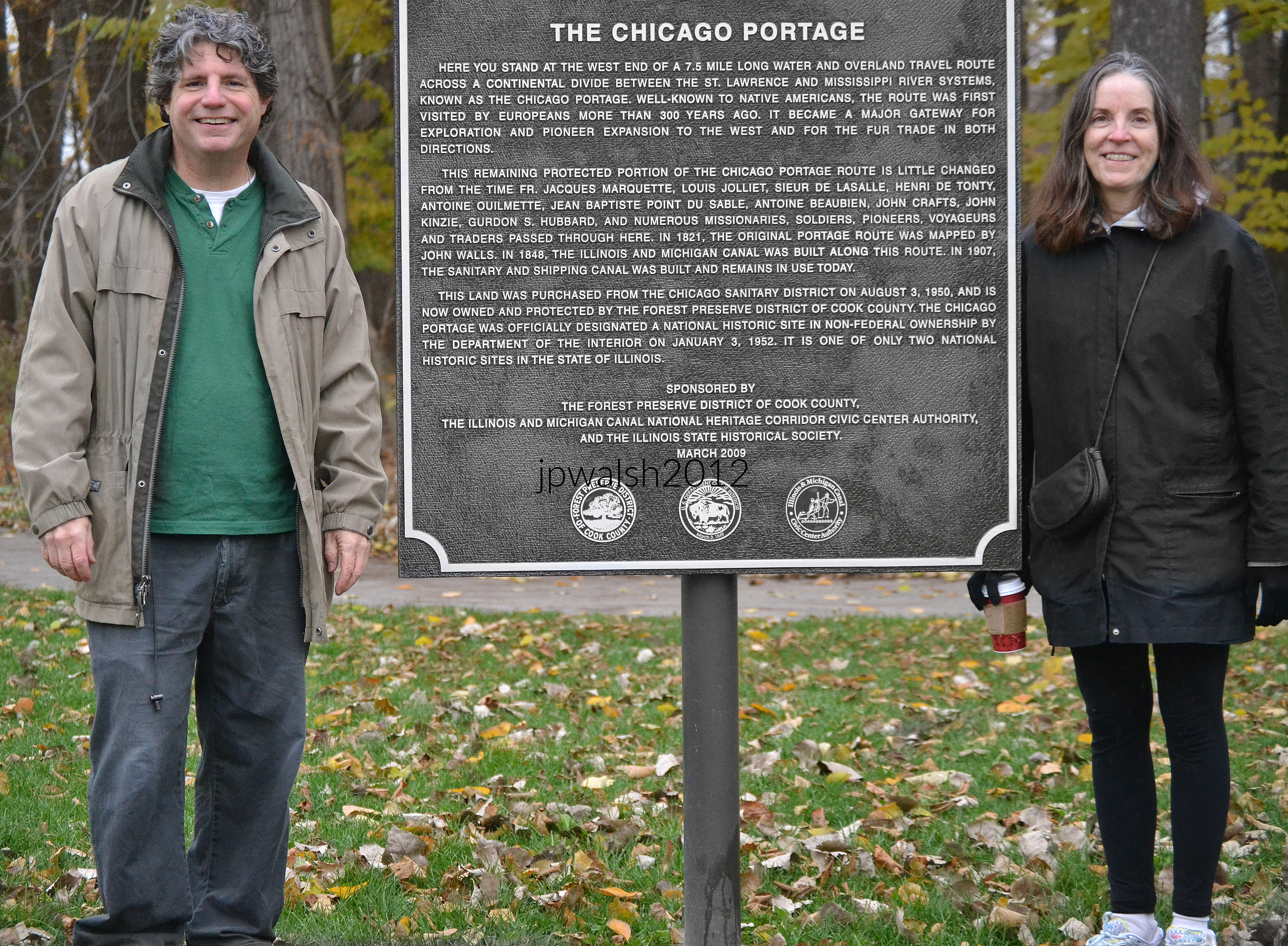
Author and wife visit the Chicago Portage National Historic Site. Author’s photograph.