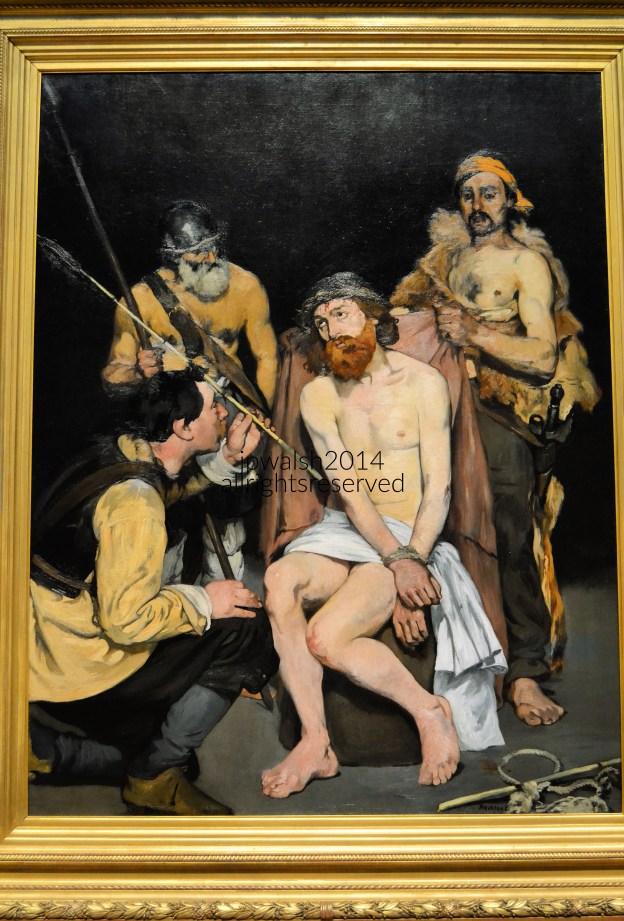
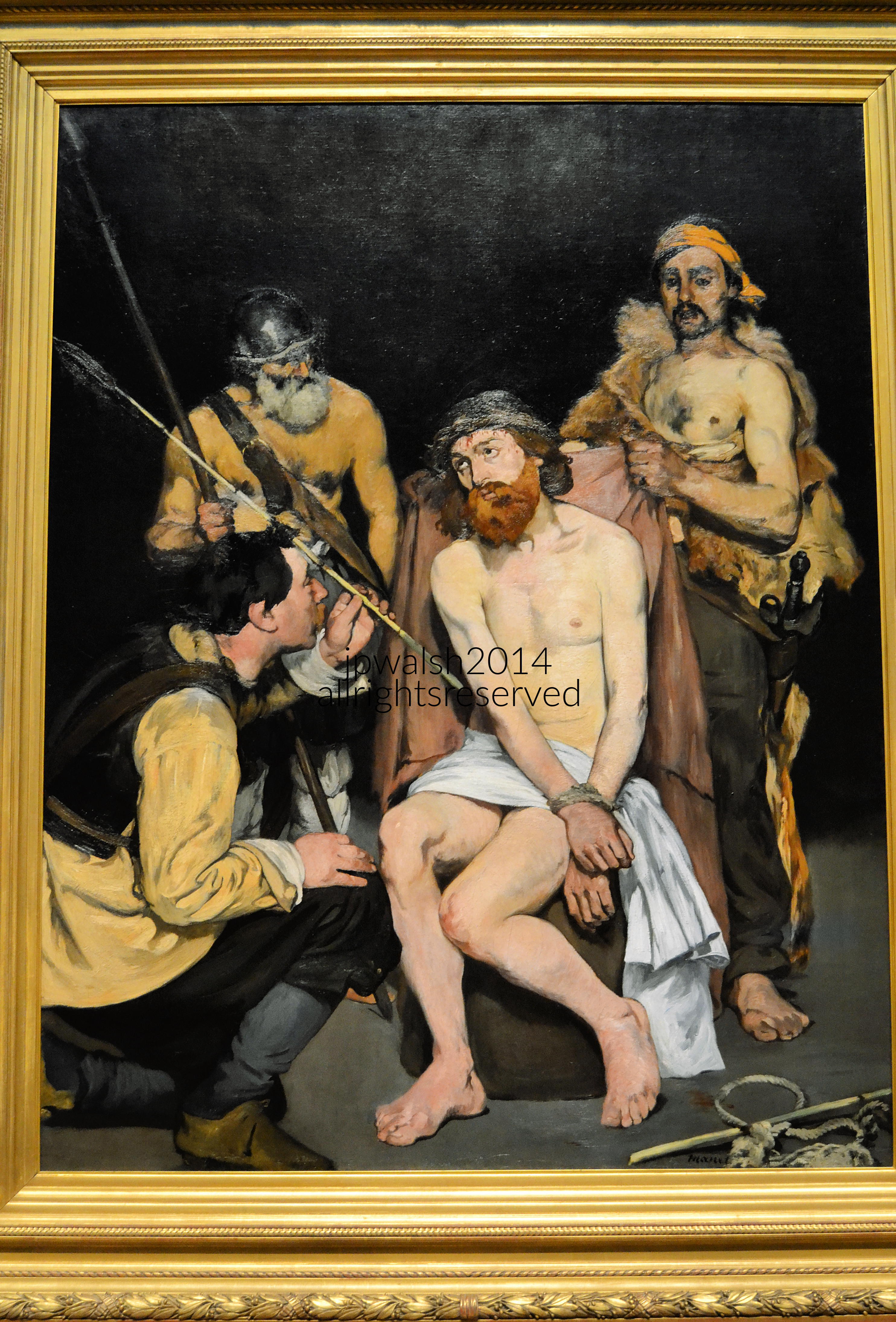
Feature image: Édouard Manet, Jesus Mocked by the Soldiers, 1865, oil on canvas, 190.8 × 148.3 cm (74 7/8 × 58 3/8 in.), transforms a traditional Passion scene into a striking meditation on artistic identity and public judgment. Rather than emphasizing spiritual transcendence, Manet presents Christ with an unsettling immediacy, drawing parallels between the mocked figure and the modern artist subjected to criticism, misunderstanding, and ridicule. Created during a period when Manet’s own work was regularly attacked by critics and rejected by academic convention, the painting blurs the boundary between religious narrative and contemporary experience, turning Christ’s humiliation into a powerful reflection on the costs of innovation and the burden of standing apart from public opinion. The Art Institute of Chicago. See – Jesus Mocked by the Soldiers | The Art Institute of Chicago – retrieved April 18, 2026. May 2014. Author’s photograph, 4.93mb DSC_0577 (1)
Christ as the Modern Artist
Even if Édouard Manet did not literally model Christ’s face on his own in Jesus Mocked by the Soldiers, the painting functions as an unmistakable act of self‑identification. Christ becomes a proxy for the embattled modern artist, a figure exposed, judged, and misunderstood by a hostile public. Manet selects the moment of Christ’s humiliation not to reenact a devotional scene but to stage a parallel between sacred suffering and his own experience before the Salon.
By mid‑century, French painting had turned decisively secular, yet Manet submitted two religious works to the Salons of 1864 and 1865, The Dead Christ with Angels and Jesus Mocked by the Soldiers. Both were accepted, and both were savaged. Critics called them vulgar, ignoble, even “contrary to art.” The public, accustomed to sentimentalized, idealized images of Jesus, recoiled from Manet’s starkly human Christ. Manet admitted to Baudelaire that the hostility unsettled him, even as Degas noted that the uproar made him famous. As Edmond Bazire observed, the Empire preferred idealized piety and bristled at seeing the Passion rendered with unvarnished realism, even when the scene followed Scripture closely.
Painting the Passion in a Secular Age
What, then, is a secular modern artist doing painting the Passion at all? Manet’s answer is to reframe Christ’s suffering as an analogue for the artist’s own embattled position, a truth‑teller punished by a complacent society. While many French moderns had drifted from Catholicism, Manet maintained ties to the faith, and he inherited a Renaissance tradition in which artists increasingly identified with Christ, blurring the line between human and divine as a form of imitatio Christi. By the 1860s this identification was a legitimate, if easily misunderstood, mode of artistic self‑expression. Manet was not conventionally pious, but he was close to several religious thinkers, and his engagement with sacred subjects was sincere enough that these works were conspicuously omitted from the 1884 retrospective after his death.
A Contemporary Christ
What makes Manet’s identification radical is the way he collapses the boundary between sacred history and modern experience. His Christ is rendered with the same realist immediacy, the same studio illumination, the same unidealized physicality that define his contemporary subjects. The result is a figure who is neither fully divine nor fully secular but unsettlingly both, a Christ startlingly contemporary. The frontal, confrontational composition intensifies this effect: Christ appears not as a distant theological symbol but as a vulnerable body exposed to judgment. The ambiguity, devotional image, critique of devotional imagery, or modern psychological drama, was precisely what scandalized a hierarchical society that depended on stable categories.
Édouard Manet’s Jesus Mocked by the Soldiers shocked 1865 Paris Salon critics with its radical portrayal of Christ. According to the Art Institute of Chicago, the painting’s profound ambiguity, heavy emphasis on Christ’s raw humanity, and Manet’s refusal to idealize the sacred figure ignited immediate controversy. Appearing deeply exhausted and vulnerable, Christ conspicuously lacks a traditional halo, forcing viewers to question whether they are looking at a divine being or merely an ordinary man.
Conservatives attacked the work as crude, irreverent, and a total violation of academic standards. Critics were particularly outraged that Manet treated a holy subject with the same blunt realism, flat lighting, and visible brushwork he used for modern, secular street scenes. Public and critical reception was so fiercely negative that the prominent critic Paul de Saint-Victor famously dismissed the masterpiece as “the horrible Ecce Homo by Monsieur Manet.”
The Passion as Artistic Self‑Portrait
The deeper provocation lies in Manet’s intervention into the history of painting. For a secular avant‑garde artist to take up a Passion subject in the 1860s was anomalous; to transform it into a conceptual self‑portrait was unprecedented. Manet’s Christ is not a theological claim but an artistic one: the modern painter, like the historical Jesus, confronts entrenched power, exposes uncomfortable truths, and endures public derision for doing so. The painting becomes a self‑portrait not of Manet’s face but of his artistic condition.
A Mockery of the Mockery
In this light, Jesus Mocked by the Soldiers is not a mockery of the sacred scene but a mockery of the mockery, a doubling of humiliation that implicates both Christ’s tormentors and Manet’s critics. The viewer’s unease arises from this conflation of registers: divine and human, biblical and modern, sacred narrative and artistic identity. Manet’s Christ stands under a bright studio light, stripped of idealization, exposed to judgment, just as Manet stood before the tribunal of the Salon.
The Suffering Artist
The scandal, then, lies not only in the subject but in the claim: that the modern artist, misunderstood and persecuted, belongs to a lineage of suffering truth‑tellers. If not a literal self‑portrait, the painting is unmistakably a portrait of artistic identity, asserting that the modern painter occupies a role once reserved for the sacred.
SOURCES:
Books: Brettell, Richard R. French Salon Artists, 1800–1900. New York: Harry N. Abrams, Inc.; Chicago: The Art Institute of Chicago, 1987. [See pp. 58–62.] Cachin, Françoise, and Charles S. Moffett. Manet, 1832–1883. New York: The Metropolitan Museum of Art and Harry N. Abrams, Inc., Publishers, 1983. [See pp. 226–229.]
Archival Documents & Reviews: Paris Salon of 1865. Historical Exhibition Records and Archives. Paris, 1865. Saint-Victor, Paul de. “Le Salon de 1865.” La Presse, May 28, 1865. Cited in the Bibliography Archives of the Art Institute of Chicago.
Websites: ArtWay. “Historical Essays on Manet.” Accessed September 2026. https://artway.eu. Wikipedia contributors. “Jesus Insulted by the Soldiers.” Wikipedia, The Free Encyclopedia. Accessed September 2026. https://wikipedia.org.
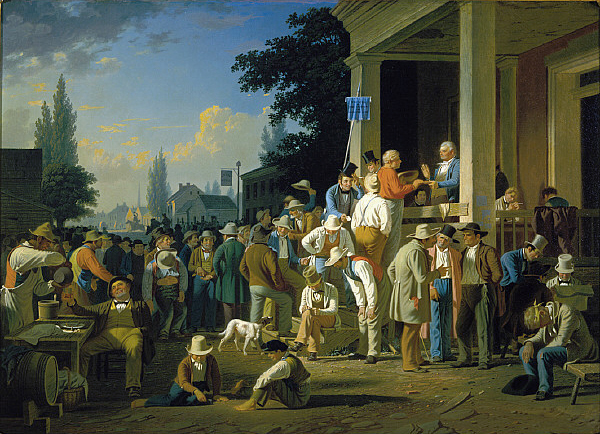
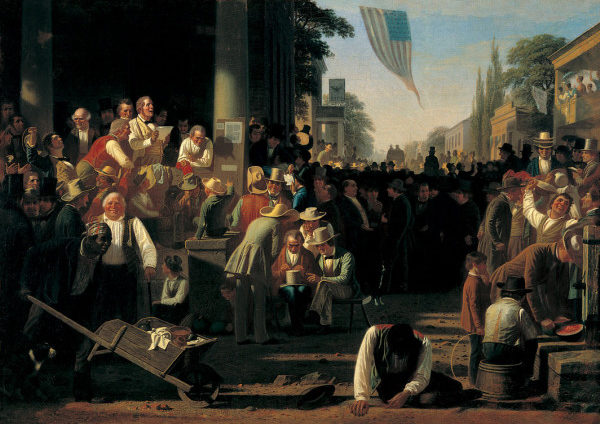
FEATURE IMAGE: George Caleb Bingham (1811-1879), Stump Speaking, 1854, oil on canvas, 42 1/2 x 58 in. (108 x 147.3 cm), St. Louis Museum of Art. The painting begun by Bingham in November 1853 was completed in February 1854 in Philadelphia. Stump Speaking is one of three paintings in a series representing to a national audience the idea of the American democratic process. Bingham exhibited Stump Speaking in a series with his The County Election and The Verdict of the People at the influential but short-lived (1856-1860) Washington Art Association, the Pennsylvania Academy of Art, and the Western Academy of Art in St. Louis. These election series paintings along with Bingham’s Jolly Flatboatmen in Port (see below) then went on view at the St. Louis Mercantile Library (founded 1846) until the 1930’s when the election series paintings were loaned to the City Art Museum (the future Saint Louis Art Museum). In 1941, The Mercantile Library sold Stump Speaking and The Verdict of the People to Boatmen’s National Bank of St. Louis (now Bank of America) and, in 2001, Bank of America gave Stump Speaking to the Saint Louis Art Museum. Public Domain. https://www.slam.org/collection/objects/29774/ – retrieved September 13, 2025.
Bingham, The County Election, 1852, oil on canvas, 38 x 52 in. (96.5 x132 cm), St. Louis Art Museum. It depicts an election in 1850 in Saline County, Missouri, located between Columbia and Kansas City in central Missouri. Bingham’s paintings depict a dispassionate electorate before the Civil War reflecting the Founders’ ideals in challenging times. A staunch Unionist, George Caleb Bingham’s own political views rejected radical politics whether an unrestrained northern Abolitionist cause or that of Southern Fire-Eaters and strived toward negotiation and minimally Federal regulation of slavery. Bingham opposed the proslavery wing of Missouri politics represented by Gov. Clairborne Fox Jackson (1806-1862) who appears in Stump Speaking. Though Bingham’s election series is painted before the Lincoln-Douglas debates in 1858 in neighboring Illinois, Bingham, a Whig, tended towards Lincoln’s characterization of democracy that government should provide “a fair chance” to all. Though depicted at the periphery in service roles to whites, Bingham’s artwork presented slaves sympathetically encouraging his viewers to acknowledge the slaves’ existence and to recognize that they are being excluded from the noble American democratic process. Public Domain. See – https://www.nytimes.com/2025/09/15/books/review/born-equal-akhil-reed-amar.html – retrieved September 28, 2025.
Bingham, Verdict of the People, 1854, 74 cm × 93 cm (29 in × 36.5 in), St. Louis Art Museum. When Donald Trump was inaugurated as the 45th president of the United States on Jan. 20, 2017, The Verdict of the People was the chosen painting, hanging on a partition wall behind the ceremonial head table in the Capitol’s Statuary Hall. Public Domain.
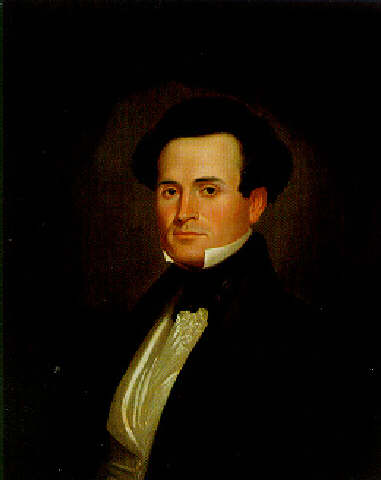
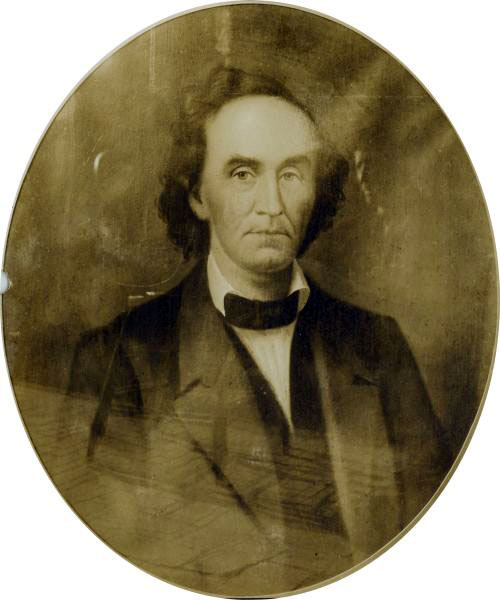
In Stump Speaking, Democrat Erasmus Darwin “E.D.” Sappington (1809-1858), born in Tennessee, is the main speaker shown leaning forward and pleading his case to a crowd of rural citizens. Behind him, with tablet in hand, sits his opponent taking notes in preparation for his turn at the make-shift podium. Candidate Sappington had married the eldest daughter of Kentucky Governor John Breathitt (1786-1834), Penelope Breathitt (1822/3-1904), and the couple had four children. Gov. Breathitt, a Jacksonian Democrat, had been elected as the Bluegrass State’s 11th Governor in 1832, serving until his death from tuberculosis at age 47. After his death, Breathitt County in Eastern Kentucky was created and named in his honor.
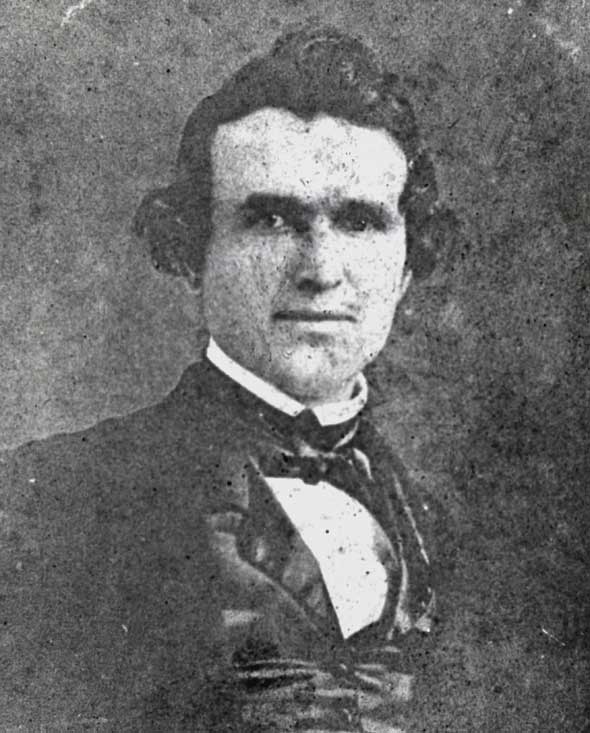
Bingham – portrait of Erasmus Darwin “E.D.” Sappington, 1844. Public Domain.
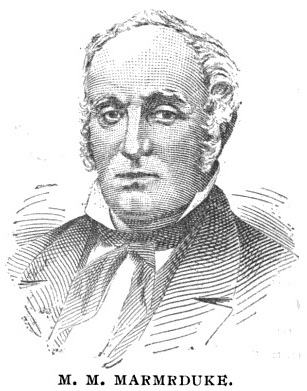
https://www.findagrave.com/memorial/86334793/penelope_c-sappington – retrieved September 26, 2025. https://www.findagrave.com/memorial/60353793/erasmus_darwin-sappington – retrieved September 26, 2025. The rotund man seated behind the speaker is Meredith Miles Marmaduke (1791-1864), part of the Missouri’s Democratic political machine. Born in Virginia, like Bingham, Marmaduke moved to Missouri in 1823 where he married Lavinia Sappington (1807-1885) whose mother, Jane Breathitt (1783-1852), was the older sister of Kentucky Governor Breathitt. The Marmadukes had 10 children together. Marmaduke was a trader on the Santa Fe Trail, surveyed and platted Arrow Rock in Saline County on the Missouri River where he had a plantation and was elected Lt. Governor of Missouri. When Governor Thomas Reynolds (1796-1844) died in office by suicide, Marmaduke assumed the Governorship from February 1844 until November 1844, finishing out the term. The Reynolds Administration was heavily criticized by conservative Whigs for championing the abolition of debtor’s prisons in the state which the Missouri General Assembly accomplished in February 1843. Reynolds whom Marmaduke succeeded also freed up voting requirements to provide greater voting access to the state’s residents, another issue opposed by Whigs. When the University of Missouri in Columbia was established in 1839 and became the first public university west of the Mississippi River, the Reynolds Administration achieved the education milestone of enrolling its first class. Meredith Miles Marmaduke, a former slaveholder, was a staunch Unionist during the U.S. Civil War, although four of his sons fought for the Confederacy which was a typical outcome of the conflict in the Border States. After the war, one of those sons, in 1885, became Missouri’s 25th governor.
“Historical, Pictorial and Biographical Record, of Chariton County, Missouri”, p. 30 (1896). Public Domain.
At right in Stump Speaking the man in the white coat and top hat is then-state senator Clairborne Fox Jackson (1806-1862) who became the secessionist governor of Missouri in 1861. Jackson was forced out by the Missouri General Assembly’s Unionist majority on July 30, 1861, and replaced by a former Chief Justice of the State Supreme Court as provisional governor for the rest of the war. During these contentious deliberations, Bingham was in the state capitol to dedicate portraits of Henry Clay and President Andrew Jackson. Asked to say a few words, Bingham praised the 7th president’s suppressing nullifiers in 1832-1833 and called secession treason which almost blew the roof off the Missouri House. See- https://archive.nytimes.com/opinionator.blogs.nytimes.com/2013/09/06/an-artists-revenge/– retrieved September 27, 2025. Removed Gov. Jackson did not recognize the assembly’s actions and issued a proclamation on August 5, 1861, declaring that Missouri would secede from the Union. Jackson then traveled to Richmond, Virginia, to meet Confederate President Jefferson Davis and seek support of local Confederate militia forces and recognition by the Confederate government, both of which the Confederacy did. Union forces, however, had occupied most of Missouri and the state’s Unionist versus Secessionist political impasse was basically moot. Jackson withdrew to Arkansas with Confederate militia but was defeated by Union forces at the Battle of Pea Ridge in March 1862. Violent skirmishes, often savage attacks, continued in Missouri as Confederate guerrillas, called bushwhackers, caused random fear and havoc. Missouri bushwhackers included outlaws Jesse James and his older brother Frank James. Quantrill’s raid on Lawrence, Kansas, in August 1863 killed no less than 150 men and boys and inflamed the border. Fleeing further south to regroup, Jackson died at 56 years old of pneumonia and stomach cancer. Claiborne Fox Jackson having, in 1831, married Jane Breathitt Sappington (1813-1831) and, in 1833, Louisa Catherine Sappington (1814-1838), sisters of Lavina Sappington Marmaduke, was brother-in-law to Meredith Miles Marmaduke. As “E.D.” Sappington was brother to these women, all three men in Bingham’s painting were brothers-in-law.
Bingham’s lively crowd evokes William Hogarth’s mid-18th century Election series, but with little to none of the British artist’s turbulent depictions. The American Bingham’s election series is orderly in its business. Bingham’s Stump Speaking depicts none of Hogarth’s corruption where the voter or politician is pictured as an idiot and fool whose election requires that he be bribed, threatened, conned, intoxicated, or generally pushed around. One of Hogarth’s voters has to be carried to the ballot box to cast his vote because he is already dead. By contrast, in mid-19th century America, the democratic process, while popularly engaging and verbally contentious, is a pictorial pantheon of virtue: calm, dignified, respectful, decent, honest, ethical, and incorruptible. The American people carry out their sacred duty of democratic self-governance accompanied by earnest and sober demeanor as all Americans, North and South, as Lincoln observed “pray to the same God.” See – https://www.nytimes.com/2025/09/15/books/review/born-equal-akhil-reed-amar.html – retrieved September 28, 2025. While depicting politicians in American art and illustration had been typical from the Republic’s earliest days, Bingham casts them in a context with their voters laboring together in a noble field of American politics and democracy. In a painting that depicts the nation’s spread of universal suffrage for adult white males in the pre-Civil War era and the mobilization by party organizations of popular politics, Bingham neither depicts an anonymous crowd nor one restricted in social type. It is a real, breathing American landscape attracting and engaging a variety of ages and occupations. One does not find a shouting match, let alone some kind of melée in Bingham’s American electorate. It is quite the opposite: the crowd is civilized. Though assembled haphazardly, they are seated in peaceable order where some, amused by the proceedings, can share their laughter good-naturedly. Bingham’s figures are stalwart and reliable who come to attentively learn and independently decide among candidates. For Americans, listening to and questioning what each candidate has to say, and then voting, is a sacred civic duty since 1789 that Bingham updates to his present day.
About the Artist.
George Caleb Bingham (1811-79), an artist and politician. Born in Virginia, Bingham grew up on the frontier land of the Missouri River, and he was largely self-taught. He is famous for his scenes of manly, everyday life, showing work and play, mostly along the Missouri and Mississippi Rivers. His most celebrated picture is Fur Traders Descending the Missouri. Public Domain.
After his first wife, Sarah Elizabeth Hutchinson Bingham, died in November 1848 at 28 years old following 12 years of marriage, she was buried in Sunset Hills Cemetery in Boonville, Missouri. The next year, on December 3, 1849, Bingham married Eliza Thomas of Columbia, Missouri. Bingham had one child each with both his first and second wife. In 1876, Eliza having developed mental health issues, Bingham was forced to commit her to a state mental institution in Fulton, Missouri. She died there later that same year. Eliza was buried next to her parents in Mount Washington Cemetery in Independence, Missouri. Now 55-year-old Bingham was a two-time widower with a 15-year-old son. Unfortunately, the artist, too, would not be long for this world.
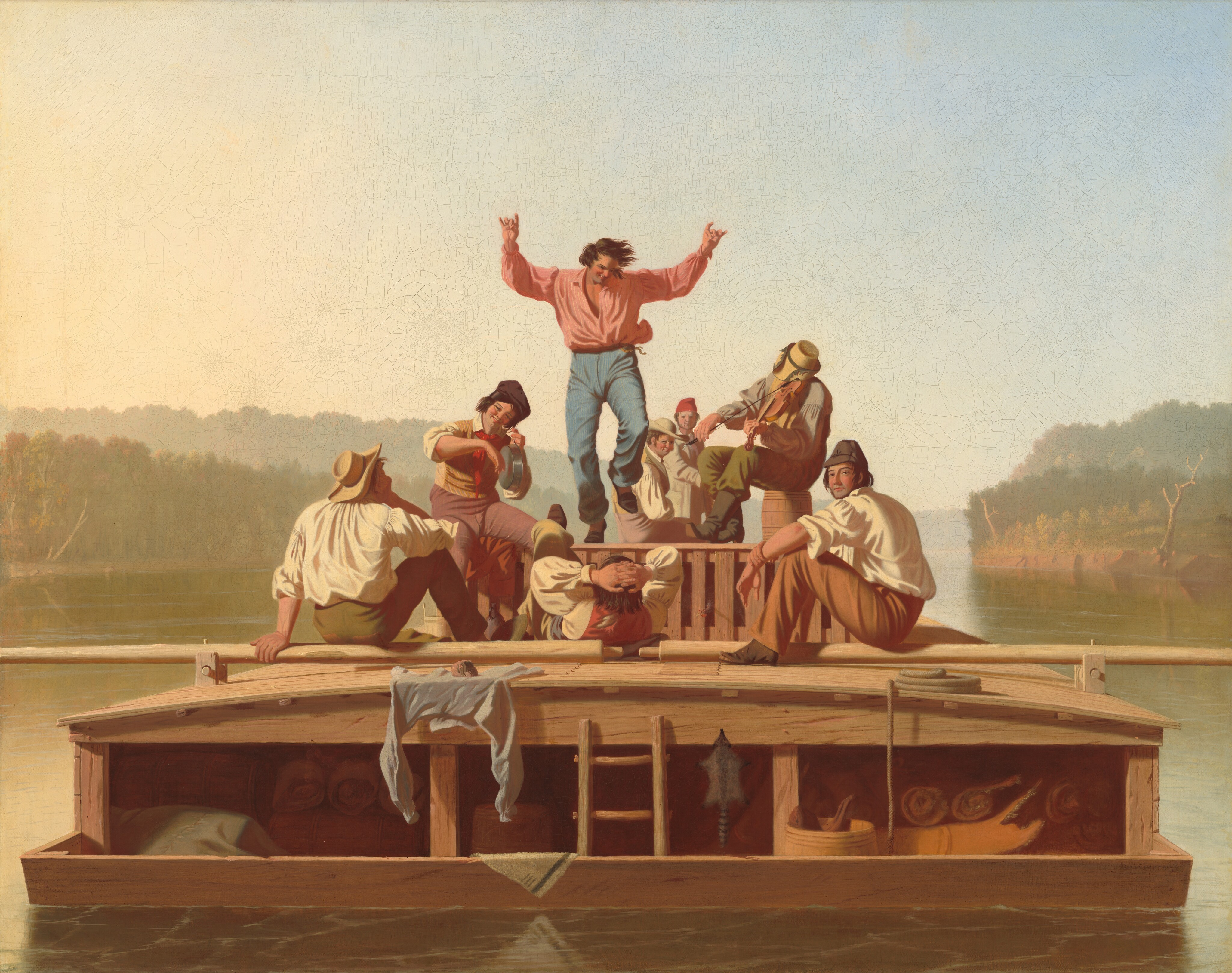
Bingham – The Jolly Flatboatmen, 1846, 96.8 x 123.2 cm (38 1/8 x 48 1/2 in.), National Gallery of Art, Washington, D.C. https://www.nga.gov/artworks/75206-jolly-flatboatmen – retrieved September 26, 2025. Scholars observe that Bingham’s paintings before the Civil War embody his partisan political views as a Whig Party politician with “his Western scenes a commentary on the importance of commerce and the need for federal funding for internal improvements.” Public Domain. See – https://archive.nytimes.com/opinionator.blogs.nytimes.com/2013/09/06/an-artists-revenge/ – retrieved September 27, 2025.
Bingham – Fur Traders Descending the Missouri, 1845, 29 x 36 1/2 in. (73.7 x 92.7 cm), The Metropolitan Museum of Art, New York, NY. The painting is Bingham’s most celebrated work. Public Domain.https://www.metmuseum.org/art/collection/search/10159 – retrieved September 26, 2025.
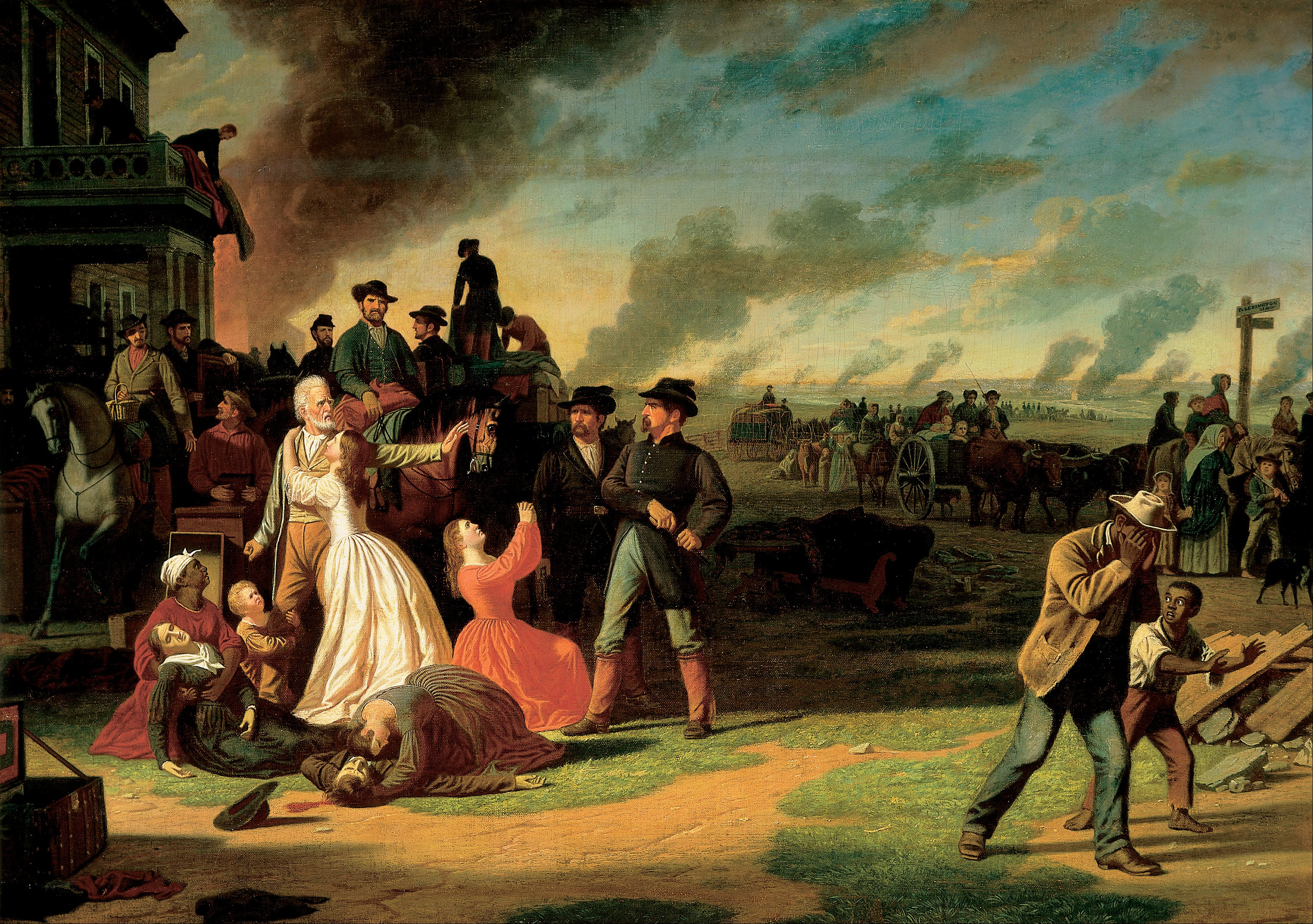
After the death of Eliza, Bingham married a third time in 1878. Martha Ann “Mattie” Livingston Lykins-Bingham (1824-1890) was a recent widow of one of Bingham’s friends in Kansas City. Mattie was a capable and dignified businesswoman with a big personality. Born in Kentucky and living In Lexington until she married Dr. Lykins, the Lykins’ were one of Kansas City’s power couples. At the outbreak of the Civil War, she and Dr. Lykins, along with a large swath of the local population in that part of western Missouri, were southern sympathizers. They and thousands more were expelled from the city by Order No. 11 of Brig. Gen. Thomas Ewing Jr., commander of the District of the Border, to rid Missouri of their political persuasion. The displacement caused tremendous suffering for Missouri civilians and Order No. 11 was very controversial. Bingham, then-state treasurer of Missouri who swore a loyalty oath to the Union, was appalled by the “military tyranny” of Order No. 11 where the refugees’ farms and fields were pillaged and burned. Many of its victims viewed the action as simply anti-American government retribution for the local population’s political beliefs. See – https://archive.nytimes.com/opinionator.blogs.nytimes.com/2013/09/06/an-artists-revenge/ – retrieved September 27, 2025.
Mattie and Dr. Lykins returned to Kansas City after the war and made a life there until Dr. Lykins’ death in 1876, the same year Eliza Bingham died. Two years later, Mattie married George Caleb Bingham. After Bingham’s death in 1879 from stomach flu, Mattie lived with his young son James Rollins Bingham (1861-1910) who never married. In 1890, following years of trouble with her health, Mattie died following surgery for a stomach tumor. Mrs. Lykins-Bingham was buried In Union Cemetery in Kansas City, Missouri, in the Bingham family plot.
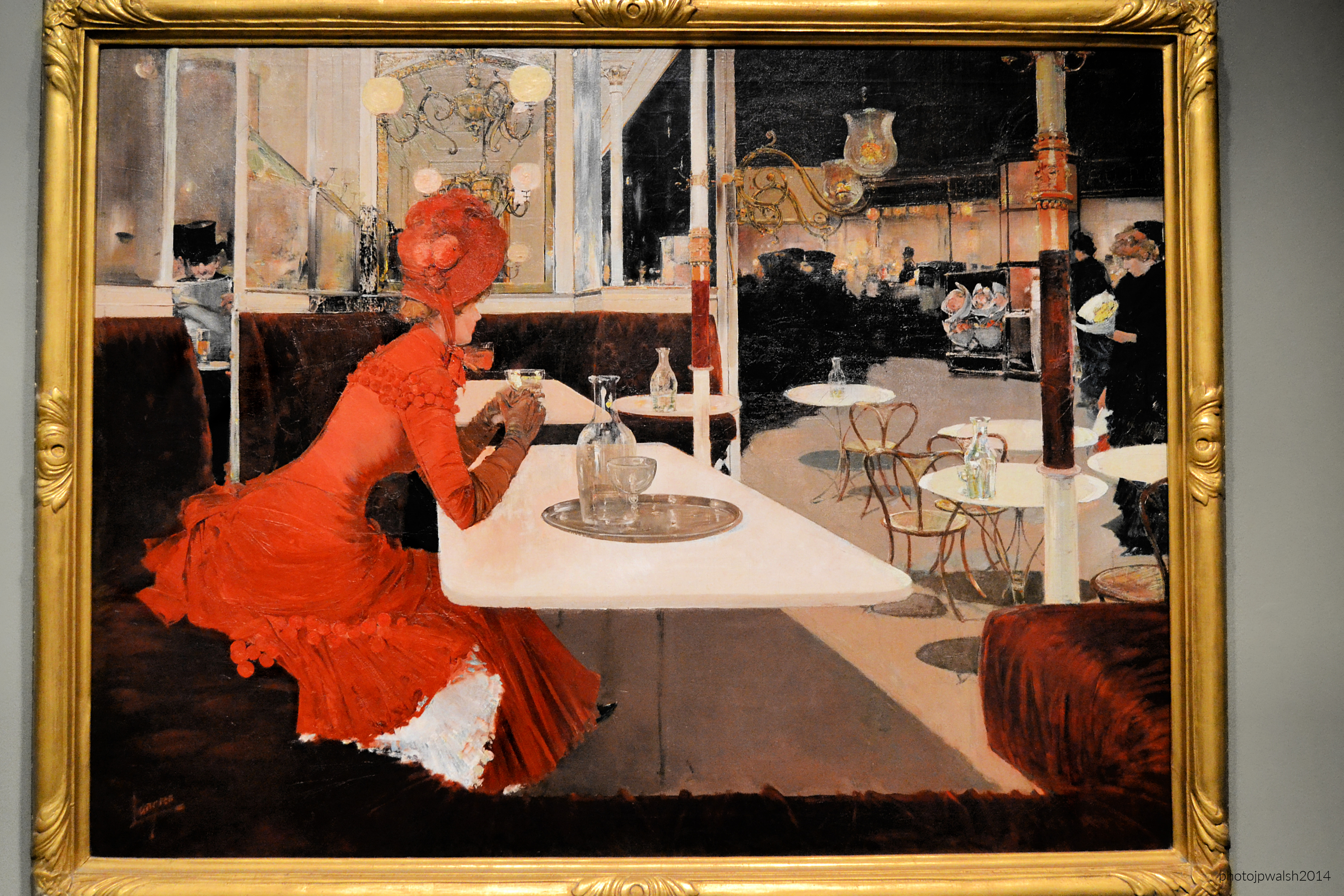
FEATURE Image: Fernand Harvey Lungren (1857-1932), The Café, 1882/84, oil on canvas. The Art Institute of Chicago. 9/2014.
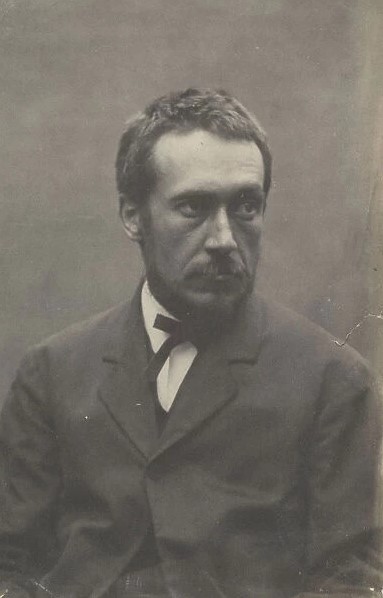
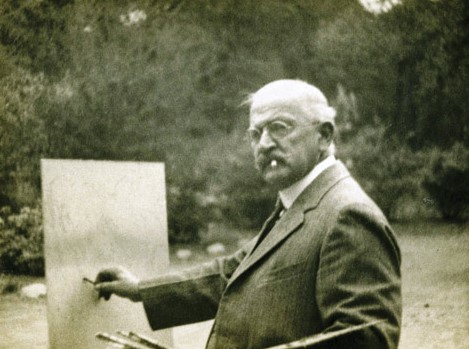
Fernand Lungren, c. 1900. The painting, The Café, is not simply a café interior. It is a study of modern Parisian life in the early electric age, where fashion, urban leisure, technology, and observation converge. In Lungren’s exposure to Paris, his interest in contemporary street life, and the contrast of electric and gas lighting as symbols of modernity, emerge. Public Domain.
The artist, born in Sweden, moved with his family to Toledo, Ohio, as a child. Lungren wanted to be an artist but his father objected, wanting him to be a mining engineer. For a brief time, in 1874, Lungren attended the University of Michigan at Ann Arbor to study his father’s preferred subject. But after two years—Lungren’s father still opposed to his son being an artist— saw the younger Lungren rebel and prevail. In 1876 Lungren was able to study under Thomas Eakins (1844-1916) at the Pennsylvania Academy in Philadelphia and had Robert Frederick Blum (1857-1903), Alfred Laurens Brennan (1853-1921) and Joseph Pennell (1857-1926) as fellow students.
Thomas Eakins, self-portrait, c. 1880. The 19-year-old Lungren studied under Eakins at the Pennsylvania Academy in Philadelphia. Public Domain.
In winter 1877 the 20-year-old Lungren moved to New York City. With his first illustration published in 1879, he worked as an illustrator for Scribner’s Monthly (renamed Century in 1881) as well as for Nicholas (a children’s magazine) and as a contributor until 1903. He later worked for Harper’s Bazaar, McClure’s and The Outlook. Lungren’s illustrations included portraits, and social and street scenes.
Paris in the 1880’s. Lungren was largely disappointed by his visit to Paris from June 1882 to December 1883 when he returned to New York. Public Domain.
In June 1882 Lungren sailed to Paris via Antwerp with a group of artists. In an 18-month stay in Paris he studied informally for two months at the Académie Julian, and viewed the latest French Impressionist artworks. He found his artistic purpose in Paris in direct observation and spent the balance of his time studying Parisian street scenes in the manner of the “new painting.”
Fernand Harvey Lungren (1857-1932), The Café, 1882/84, Dixon Gallery and Gardens, Memphis, Tennessee. In another painting by Lungren with the same title and painted during the artist’s formative stay in Paris, The Café captures a distinctly modern urban world shaped by fashion, leisure, and technological change. Two elegantly dressed women occupy a table in the foreground, their elaborate hats, fitted bodices, and bustled skirts reflecting the latest Parisian styles. Behind them, mirrored walls, plush red banquettes, electric globe lighting, and the presence of serving staff create the atmosphere of a fashionable public gathering place. Like Lungren’s related The Café at the Art Institute of Chicago, the painting examines the social rituals of café culture while celebrating the visual spectacle of modern city life. The carefully observed details of dress, lighting, and interior design transform an ordinary moment into a vivid record of Belle Époque Paris, where consumption, conversation, and public display had become defining features of modernity.
La France Élégante et Paris Élégant Réunis 1882.
Fernand Harvey Lungren (1857-1932), The Café, 1882/84, oil on canvas. The Art Institute of Chicago. 9/2014. Lungren paid special attention to the image presented by a woman in the details of her fashion from her hat with pom-poms, the size of her bustle, and even her shawl. Further, the bright electric lights above the woman’s head illustrate the intense competition and innovation of the late 1870’s and 1880’s in developing and marketing functional incandescent lamps. The contrast they provide to the dimmer gas lamps also depicted in the painting by Lungren are remarkable.
Fernand Harvey Lungren (1857-1932), The Café, 1882/84 (detail). In this revealing detail, Lungren dissolves the boundary between interior and exterior space, using the café’s broad windows and reflective surfaces to merge the fashionable world of urban leisure with the activity of the Paris street beyond. Elegant ironwork, luminous glass fixtures, and slender columns frame a scene animated by fleeting glimpses of modern life. At right, a stylish figure carrying a bouquet of yellow flowers appears poised between the public street and the social theater of the café, while in the background a coachman, illuminated by the glow of a shop window, emerges as a fleeting presence amid the movement of passing carriages. Rather than focusing on a single narrative, Lungren builds the composition from observations of contemporary life, capturing the constant flow of people, commerce, transportation, and spectacle that defined Paris in the early 1880s. The interplay of reflected light, transparent glass, and crowded urban space transforms an ordinary café interior into a vivid study of modernity, where the city itself becomes an ever-changing backdrop to daily experience.
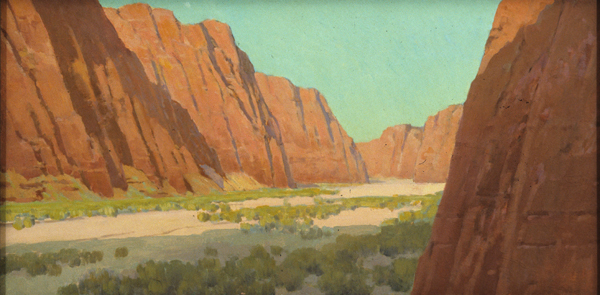
Lungren returned to New York City in 1883 and, soon afterwards, established a studio in Cincinnati, Ohio. Sponsored by the Santa Fe Railroad which wished to commission images of the Southwest to entice eastern tourists, Lungren made his first excursions west in the early 1890s. In 1892 he visited Santa Fe, New Mexico for the first time and, in the following years painted artworks inspired by his contact with American Indian culture and the desert landscape. This was the start of his lifelong association with American West and Southwest. In 1899 he showed these American desert works at the American Art Galleries in New York and afterwards at the Royal Academy in London and the Walker Art Gallery in Liverpool.
Fernand Harvey Lungren (1857-1932), Canyon de Chelly oil on canvas 18 3 /16 x 36″, c. 1903-1906. AD&A Museum, Santa Barbara, CA.
When Lungren was in London he made pictures of street life and met several artists, including James Abbott McNeill Whistler (1834-1903). In late 1900 Lungren traveled to Egypt with American pharmaceutical entrepreneur Henry Solomon Wellcome (1853-1936) and returned to New York via London in the next year. Lungren had married Henrietta Whipple in 1898 and they eventually moved to California in 1903, settling in Mission Canyon above Santa Barbara in 1906.
Theodore Roosevelt in 1906. The U.S. president and conservationist was one of the admirers of Lungren’s artwork. Fernand Harvey Lungren (1857-1932), Afterglow: Painted Desert oil on canvas 25 1/4 x 45 in.; framed: 29 3/4 x 49 3/4 x 2 in. AD&A Museum
Lungren lived and work in California—including several notable trips to Death Valley starting in 1909 —until his death in 1932. After Lungren’s wife died in 1917, the artist helped found the Santa Barbara School of the Arts in 1920 and remained on its board until his death in 1932. He became a charter member of the Santa Barbara Art League and executed two works for dioramas at the Santa Barbara Museum of Natural History. Most of Lungren’s artwork, including hundreds of his paintings (some 300 works), were bestowed to Santa Barbara State Teachers College, which became the University of California, Santa Barbara, and are part of the University Art Museum
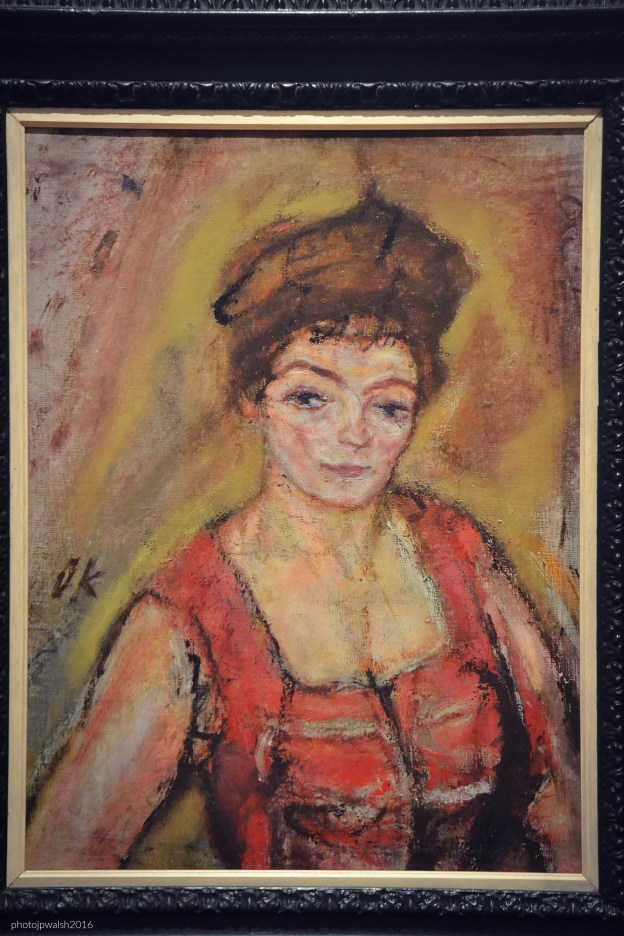
Feature Image: Oskar Kokoschka (Austrian, 1886-1980), Lady in Red(Dame in Rot), 1911, oil on canvas, 21 11/16 × 16 in. (55.09 × 40.64 cm), Milwaukee Art Museum. see – Collection | Milwaukee Art Museum – retrieved June 5, 2026. Author’s photograph, 2016.
Oskar Kokoschka’s Lady in Red (1911) serves as a defining declaration of his radically independent modernist vision, employing psychological intensity, emotional aggression, and expressive distortion to reveal the sitter’s inner life while deliberately resisting containment within the traditional boundaries of German Expressionism.
Lady in Red is not merely a portrait but a declaration of Oskar Kokoschka’s fiercely independent artistic identity at a pivotal moment in his early career. The painting embodies his emerging commitment to psychological intensity, expressive distortion, and individual vision while resisting easy classification within German Expressionism. Rather than offering a conventional likeness, Kokoschka sought to reveal the sitter’s inner life through emotionally charged color, fractured form, and confrontational presence. Kokoschka’s greatness stems precisely from his refusal to submit to artistic movements or ideological programs. Lady in Red (Dame in Rot) is an early manifestation of the independence that would define Kokoschka’s career and make him one of modern art’s most distinctive voices.
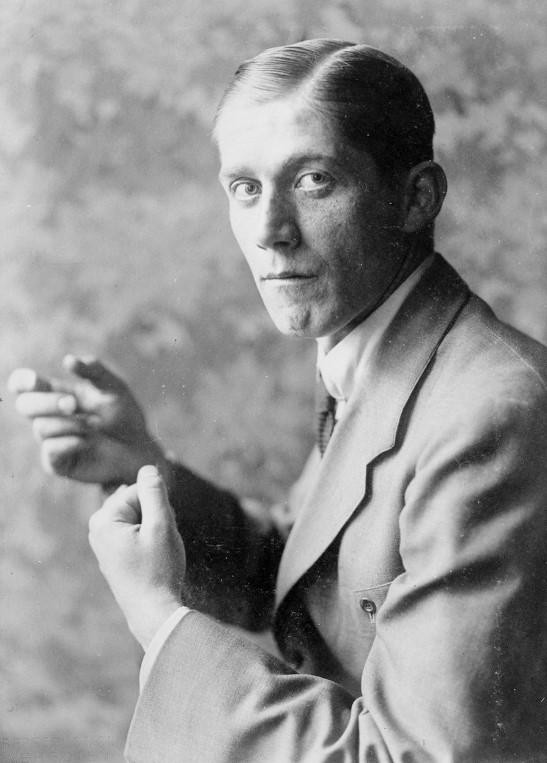
Oskar Kokoschka in 1916, photographed by Marta Wolff (1871–1942), a Berlin‑based portrait photographer. Wolff’s career—and life—were cut short under Nazi persecution. On September 1, 1942, she was deported from her last residence in Wiesbaden to Theresienstadt, where she died of pneumonia on September 22, 1942. see – https://oskar-kokoschka.ch/fr/1001/Biographie – retrieved May 1, 2024. Public Domain.
Early Berlin Years
When Austrian painter Oskar Kokoschka (1886–1980) created Lady in Red, now in the Milwaukee Art Museum, he was a struggling young artist living in Berlin. At just twenty‑four, he entered the city’s avant‑garde circles, moving among writers, painters, and theatre figures who were reshaping modern culture.
Connections to the Avant‑Garde
Kokoschka knew several members of Die Brücke as well as artists and writers associated with Der Sturm, the influential art and literary magazine. His visibility rose quickly: in June 1910, dealer Paul Cassirer organized Kokoschka’s first major exhibition, placing him in the center of Berlin’s experimental art world.
Independence from Expressionism
Despite these associations, Kokoschka’s involvement with the German Expressionists remained limited. He resisted being absorbed into any movement, insisting on developing his own artistic language. Reflecting on this independence, he later wrote that he was “not going to submit…to anyone else’s control. That is freedom as I understand it” (Oskar Kokoschka, My Life, translated from the German by David Britt, New York, Macmillan, 1974, p. 67).
Developing the Art of “Seeing”
As Kokoschka refined what he called the art of “seeing”—a method grounded in heightened depth perception and psychological intensity—the Berlin press seized on his volatility. Critics labeled him “the wildest beast of all,” a phrase that captured both his unpredictability and the raw emotional force of his early work.
Between 1900 and 1930, Berlin emerged as a world capital of modern art. Among its most influential figures was Paul Cassirer (1871–1926), a dynamic tastemaker with strong ties to the Paris market, particularly Galerie Durand‑Ruel. In 1910 Kunstsalon Paul Cassirer organized Oskar Kokoschka’s first major exhibition, the same year he mounted Berlin’s first significant show devoted to Édouard Manet. As secretary of the Berlin Secession (1898), the influential dealer Paul Cassirer had long championed artists working outside academic conventions. His decision to organize Kokoschka’s first major exhibition in 1910 introduced the young Austrian painter to Berlin’s avant-garde public and affirmed Cassirer’s commitment to artistic innovation. Although Kokoschka resisted affiliation with any movement, the dealer recognized in his psychologically intense and radically independent work the same spirit of rebellion that had inspired the Secession’s break with official art institutions. Public Domain.
Exchanges with the Expressionists
Though Kokoschka studied the art of past masters to forge a distinct personal style, he remained in conversation with the artists of Die Brücke. Their shared debates over form, color, and the expressive possibilities of the figure helped create the artistic climate of Berlin and Vienna in the years before the First World War.
Lady in Red: A Key Early Statement
Painted around 1911, Lady in Red at the Milwaukee Art Museum stands at a pivotal moment in Kokoschka’s early career, when he was forging the fiercely independent artistic identity that would define his oeuvre. The portrait belongs to the same period in which he was debating formal problems with Die Brücke, resisting the codification of Expressionism, and articulating his belief that the artist’s task was existential rather than ideological. In this sense, Lady in Red is not simply a portrait—it is a declaration of Kokoschka’s emerging stance as a radically individual modernist.
Oskar Kokoschka (Austrian, 1886-1980), Lady in Red, c. 1911. Author’s photograph, 2016.
Within Kokoschka’s oeuvre, Lady in Red stands as an early, forceful articulation of the qualities that would define his mature work:
Psychological penetration rather than surface likeness
Expressive distortion used as a tool of revelation
Emotional aggression that challenges the viewer
A refusal to submit to any movement’s stylistic program
Psychological Intensity and the Art of “Seeing”
The painting exemplifies Kokoschka’s developing method of “seeing,” his term for a heightened perceptual and psychological engagement with the sitter. Rather than offering a flattering likeness, Lady in Red confronts the viewer with the sitter’s emotional presence—rendered through agitated brushwork, acidic color contrasts, and angular distortions that destabilize the composition. These qualities align with the emotionally aggressive canvases meant to unsettle, provoke, and force the viewer into an encounter with the subject’s inner life.
A Portrait That Defies the “-ism” and Shaped by Upheaval
Although the painting shares Expressionism’s interest in subjective intensity, Lady in Red resists the movement’s stylistic conventions. Kokoschka’s palette is harsher, his forms more fractured, his psychological probing more confrontational than those of his contemporaries.
Created just before his catastrophic affair with Alma Mahler and the wartime traumas that would scar him physically and psychologically, Lady in Red captures Kokoschka at a moment of intense personal searching. The painting’s emotional volatility anticipates the turbulence that would soon engulf his life.
It is a portrait that embodies the very independence that earned him the label “the wildest beast of all.”
The Alma Mahler Affair
In 1912, Kokoschka entered a turbulent and ultimately destructive relationship with Alma Mahler (1879–1964), widow of composer Gustav Mahler (1860–1911). The affair consumed him emotionally and creatively. When it collapsed in 1915, the rupture was so profound that Kokoschka volunteered for frontline service in World War I.
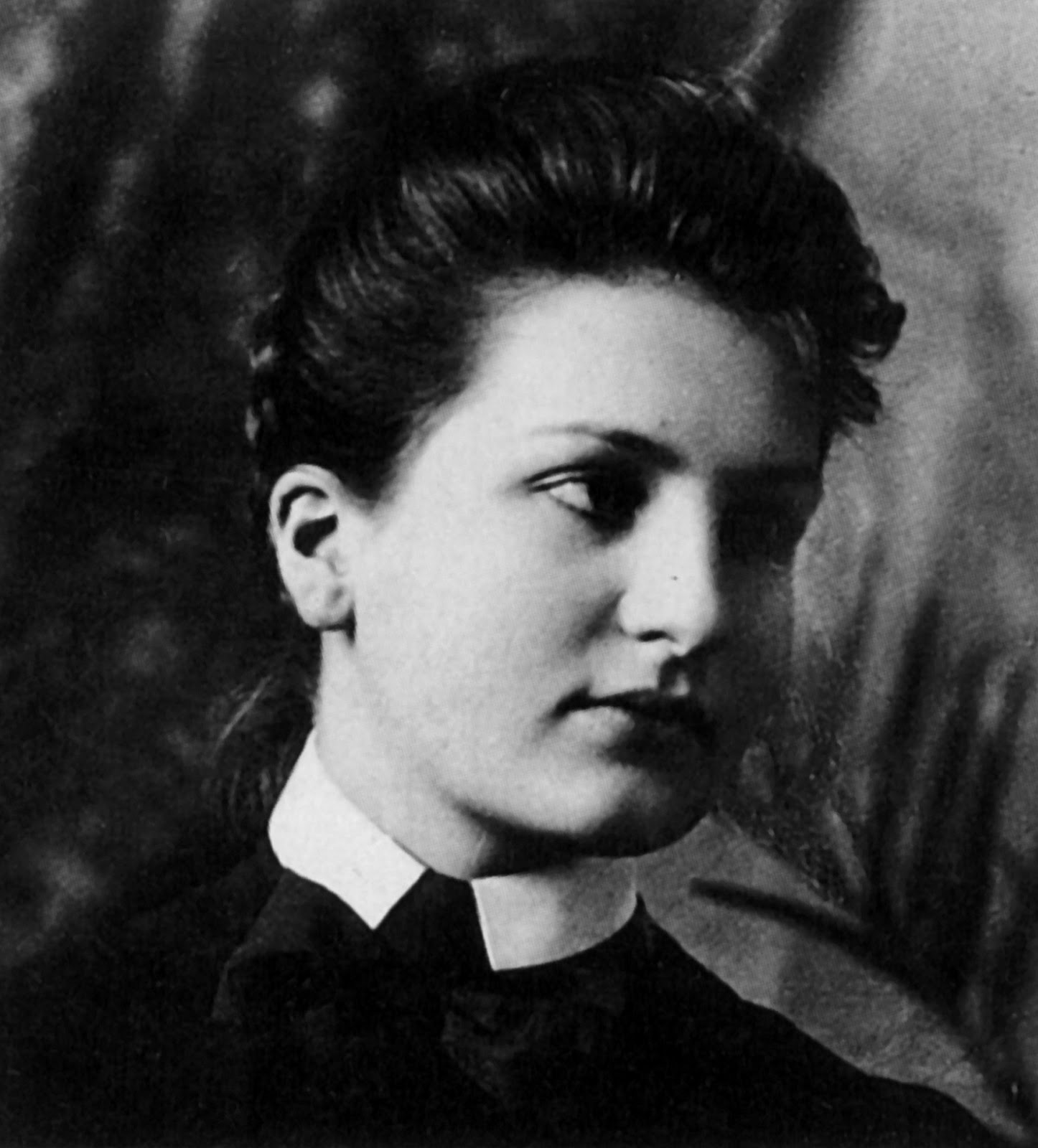
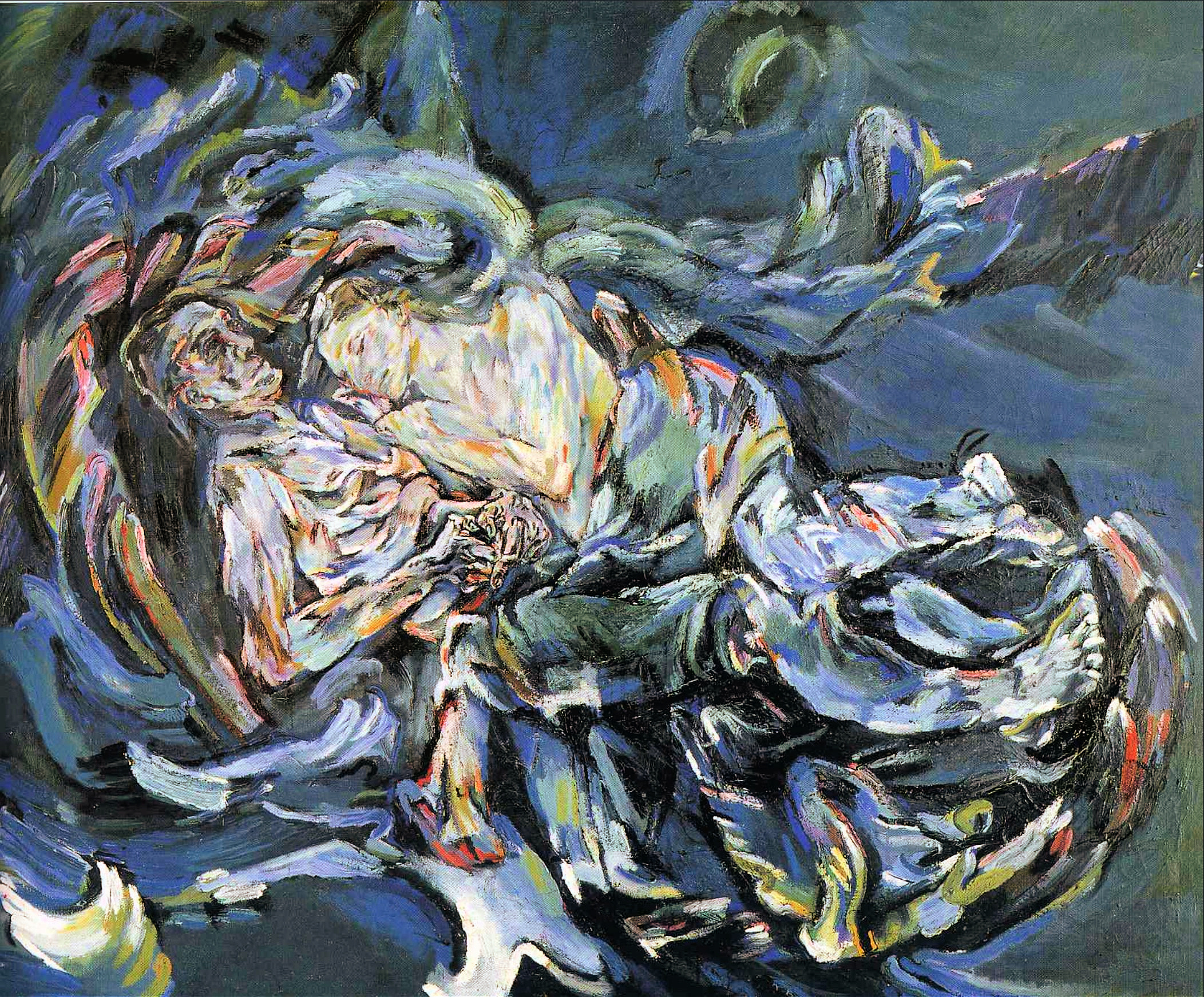
Alma Mahler, the young widow of composer Gustav Mahler (1860–1911), began a tumultuous affair with Kokoschka in 1912. During their 1913 trip to Italy, he cast their relationship into art, immortalizing them together in his 1914 masterpiece Die Windsbraut (Bride of the Wind), a swirling, dreamlike vision of passion and instability. Public Domain.
Oskar Kokoschka, Die Windsbraut (The Bride of the Wind), 1913. Oil on canvas, 180.4 x 220.2 cm, Kunstmuseum, Basel, Switzerland.Often read as an autobiographical testament to Kokoschka’s relationship with Alma Mahler, the painting features portrait‑like evocations of both figures. Alma, widow of composer Gustav Mahler, had begun a turbulent affair with the artist in 1912. Upon completing the work, Kokoschka described it to Berlin dealer Herwarth Walden as his “Tristan und Isolde” (Spielmann 2003, p. 153), invoking the unfulfillable nature of a difficult love. Later in 1914, the title Die Windsbraut (Bride of the Wind) emerged in conversation with the poet Georg Trakl. see – Kunstmuseum Basel – Sammlung Online – Die Windsbraut – retrieved May 1, 2024.
War Service and Wounds
Kokoschka enlisted in the 15th Austrian Dragoon Regiment, where he saw brutal combat. In 1915, on the Ukrainian front, he suffered a bullet wound to the head and a bayonet wound to the chest, injuries that nearly killed him. The following year, he was wounded again—this time by grenade fire on the Isonzo Front—adding to the physical and psychological scars that would shape his postwar work.
Expressionism and the Artist’s Role
The Expressionists’ intense engagement with the upheavals of their time influenced each artist’s creative process. Amid this turbulence, Kokoschka insisted that the artist’s vocation was not rooted in prefabricated ideologies or party programs, but in the existential task of forging a personal vision. For him, artistic identity was not a stylistic allegiance but a way of being in the world. “There is no such thing as a German, French, or Anglo‑American Expressionism!” he argued. “There are only young people trying to find their bearings in the world” (Kokoschka, My Life, p. 37).
Defying the “-ism”
Kokoschka’s fierce individualism made him one of the great masters of Expressionism precisely because he refused to be contained by it. His canvases—charged with harsh, clashing colors, fractured angles, and psychological intensity—were designed to unsettle. They confront the viewer, provoking discomfort, agitation, even rage. In rejecting the dominant currents of modernism to pursue his own path, Kokoschka became, like Max Beckmann, one of the major figures who often sits uneasily within the standard narratives of twentieth‑century art.
The Outsider as Master
This marginal position, however, aligns with Kokoschka’s self‑image. His refusal to conform—to movements, to expectations, to the tidy categories of art history—was central to his identity. For the artist once branded “the wildest beast of all,” exclusion from the mainstream was not a failure but a vindication of the independence he prized.
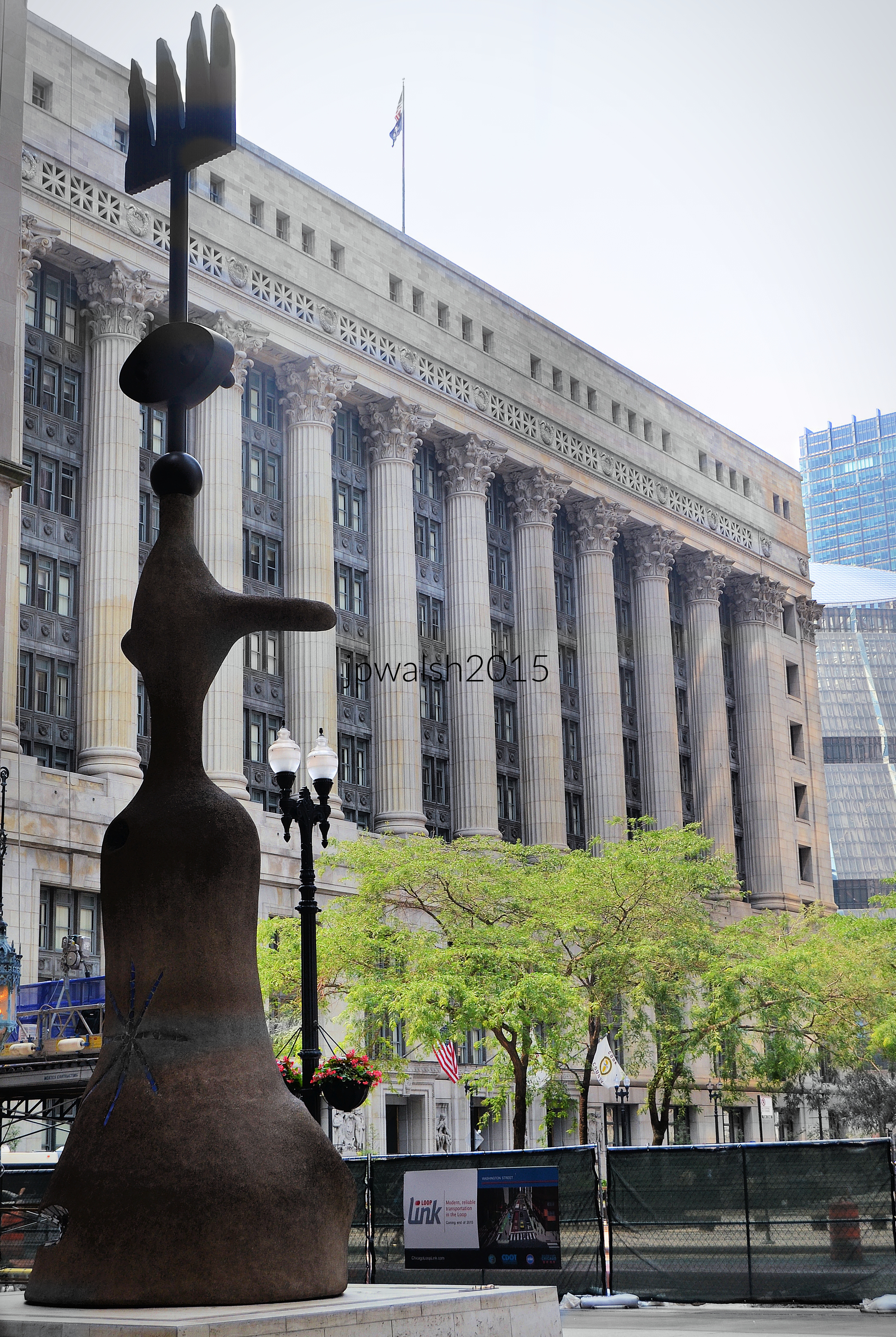
FEATURE image: Joan Miró, Joan Miró’s Chicago (sometimes Miss Chicago), steel reinforced-concrete, colored ceramics, 1967, Brunswick Building Plaza, 69 W. Washington Street, Chicago. Joan Miró’s Chicago is the Spanish artist’s only monumental sculpture. It embodies the artist’s lifelong commitment to Dada-inspired experimentation, independence, and the transformation of ordinary forms into poetic, imaginative symbols. The sculpture translates Miró’s playful visual language into monumental scale while demonstrating how his art challenged conventional ideas of representation and accepted artistic rules. The sculpture also serves as a landmark expression of Miró’s unique artistic vision within Chicago’s civic landscape. Positioned near the Chicago Picasso, the work brings European modernism into a major American city while remaining distinctly Miró in its combination of female imagery, found-object associations, ceramic color, and dreamlike symbolism. July 2015. 7.04 mb. Author’s photograph.
Joan Miró (1893-1983) is a Catalan who is a major dadaist artist “Dada” is a nonsense word but its artistic movement that started around 1915 in Zürich, Switzerland, has brought into existence many famous artworks by a range of artists. As World War I raged on in Europe between 1914 and 1918, young artists and intellectuals reacted with art, performance, and poetry that was radically experimental, dissident and anarchic. These artists countered the horrors of the war and capitalist culture by moving past a degradation of art to contributing to an anti-art under the banner of “dada.” These ideas and ideals of dada quickly spread to the art capitals of Paris and New York – and beyond.
Joan Miró’s Chicago is the artist’s first monumental sculpture in the world.
Joan Miró’s Chicago is in this dada milieu as it sits in the Brunswick Building Plaza, directly across Washington Street from another Spanish artist’s 50-foot-tall Cor-Ten steel sculpture from the same time (1967): Chicago’s Picasso in Daley Plaza. Miró’s sculpture expresses the neck, bustline, and slim and wasp-waisted hips of a woman’s torso with outstretched arms and a simplified head. She is made of steel-reinforced concrete with brightly colored ceramics that are added to the scooped-out hem of her skirt. Like other of Miró’s sculptures of female figures from the 1950s, the shape of the skirt is that of an overturned broad-lipped cup or chalice. The bronze, crown-like headdress is like the dadaist found objects that populated Miró’s artwork whether paintings, sculptures, ceramics and more throughout his career. Joan Miró’s Chicago possesses qualities evocative of primitive fertility or earth goddesses similar to those found in the ancient Mediterranean world.
One of Dada’s major sculptural forms to emerge and which was masterly accomplished by Marcel Duchamp (1887-1968), was the “readymade” which used familiar mass-produced objects (i.e., ceramic urinals, household tools, etc.) for high art pieces. The dada expression of the readymade increasingly asked the viewer to take seriously these consumer items and found objects as high art on an equal platform with lofty traditional productions of a monied arts establishment.
Dadaists experimented boldly with new media such as collage (Jean Arp, 1886-1966), airbrushed photography (Man Ray, 1890-1976) and nonsensical poetry (Hugo Ball, 1886-1927). These art forms freely combined as well as crossed over its categories, i.e., nonsensical poetry interpreted in performance art.
Joan Miró, Barcelona, June 13, 1935, by Carl Van Vechten (1880-1964). Public Domain. This work is from the Carl Van Vechten Photographs collection at the Library of Congress. According to the library, there are no known copyright restrictions on the use of this work. As the restrictions on this collection expired in 1986, the Library of Congress believes this image is in the public domain. The Carl Van Vechten estate has asked that use of Van Vechten’s photographs “preserve the integrity” of his work, i.e, that photographs not be colorized or cropped, and that proper credit is given to the photographer which is the photograph here.
Radical Independence: Miró’s Defiance of the Visible World
Miró’s art refuses to accept the world as it is, explicitly rejecting not only academic dogma but the corporate mechanics of an art market that demands commodified objects for dealers and rapid sales. In the 1930s and 1940s, he bypassed this commercial conveyor belt by constructing loose, playful assemblages from deliberately un-marketable materials like paper, twine, and toothbrushes, later incorporating organic objects such as stones and raw fruit. While many of these fragile compositions were lost to time or destruction, they established a vital philosophical foundation for his work. Miró chose not to transform or repurpose his found objects—whether bells, jars, or vases; instead, by leaving them entirely unaltered, he preserved what he termed their inherent “magical powers.” This deliberate randomness seamlessly filters into his more permanent creations across painting, ceramics, plaster, and bronze, calculated by the artist to reflect nature’s promiscuous progeny. By rejecting established aesthetic conventions, Miró pursued a fierce independence guided by intuition rather than a rigid, market-driven blueprint. His slow, deliberate creative process improbably marries disparate, recognizable forms into singular entities that transcend a single classification, ultimately birthing an artistic realm that does not always belong to this world.
Miró’s Chicago with Chicago’s columned City Hall in background. Author’s photograph. July 2015. 5.77mb DSC_0308 (1)
Though Miró completed a maquette of the sculpture in 1967 (called Project for a Monument for Barcelona), its production into a 40-foot sculpture was delayed until 1979. The hundreds of thousands of dollars for the production and installation of Joan Miró’s Chicago were provided by a private-public partnership in Chicago with the completed piece installed on April 20, 1981, the artist’s 88th birthday.
By translating his early, ephemeral anti-corporate assemblages into a massive, 40-foot public monument made of concrete, bronze, and vibrant ceramic tiles, Miró effectively dragged his intuitive, uncommercialized worldview out of the studio and private galleries and forced it into the heart of a corporate, concrete skyline. Instead of generating an elite luxury commodity to be traded by dealers, he donated his design to the people, erecting a monumental, cosmic earth-deity right on the pavement to ensure that nature’s untamed “promiscuous progeny” would directly disrupt the rigid architecture of the everyday financial world.
SOURCES:
Artland Magazine. “What Is Dadaism?” Accessed June 29, 2023. https://magazine.artland.com/what-is-dadaism/. Bach, Ira J., and Mary Lackritz Gray. A Guide to Chicago Public Sculpture. Chicago and London: The University of Chicago Press, 1983. Mink, Janis. Joan Miró. Cologne: Taschen, 2006. Weelen, Guy. Miró. Translated by Robert Erich Wolf. New York: Harry N. Abrams, Inc., 1989.
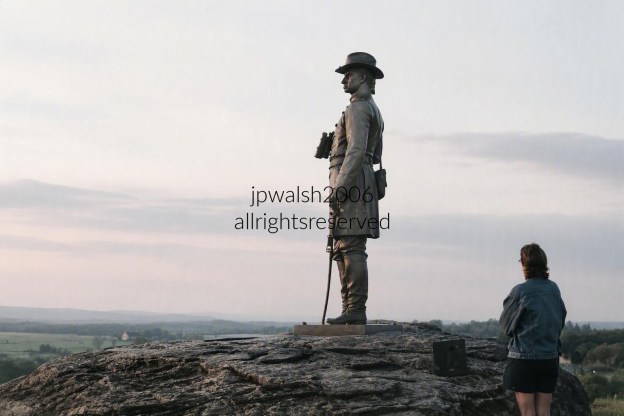
FEATURE image: Brigadier General Gouverneur Kemble Warren (1888) by Karl Gerhardt. Gettysburg National Military Park. Author’s photograph. April 2006.
Gettysburg. April 2006. Author’s photograph.
One of Gettysburg’s most famous statues among the park’s many hundreds of monuments, markers and plaques, Gouverneur (his first name, not his title) Kemble Warren (1830-1882) was a civil engineer and U.S Army general from New York. The statue, by Karl Gerhardt (1853-1940) was dedicated in 1888 and is on Little Round Top. Karl Gerhardt was an American sculptor who is famous for the death mask of President U.S. Grant in 1885.
Artwork subject; Brigadier General Gouverneur Kemble Warren during the Civil War. Public Domain.
The artist; Karl Gerhardt (1853-1940) around 1880. Public Domain.
At this spot, on July 2, 1863, General Warren, commander of the Second Army Corps (part of the Army of the Potomac) and its chief engineer, detected Confederate General John Hood’s flanking movement and, recognizing the importance of the undefended position on the left flank of the U.S. Army, directed on his own initiative, the brigade of Colonel Strong Vincent (1837-1863) from Pennsylvania to occupy it minutes before it was attacked. While this action saved the key Union position on Cemetery Ridge, Col. Vincent was carried off the field mortally wounded and died at a nearby farm on July 7, 1863.
Colonel Strong Vincent (1837-1863). Public Domain.
The statue was dedicated by veterans of the 5th New York Infantry Regiment (Duryee’s Zouaves). While Little Round Top is famous for the fighting on July 2, 1863, seven men were also killed around these rocks on the morning of July 3, 1863.
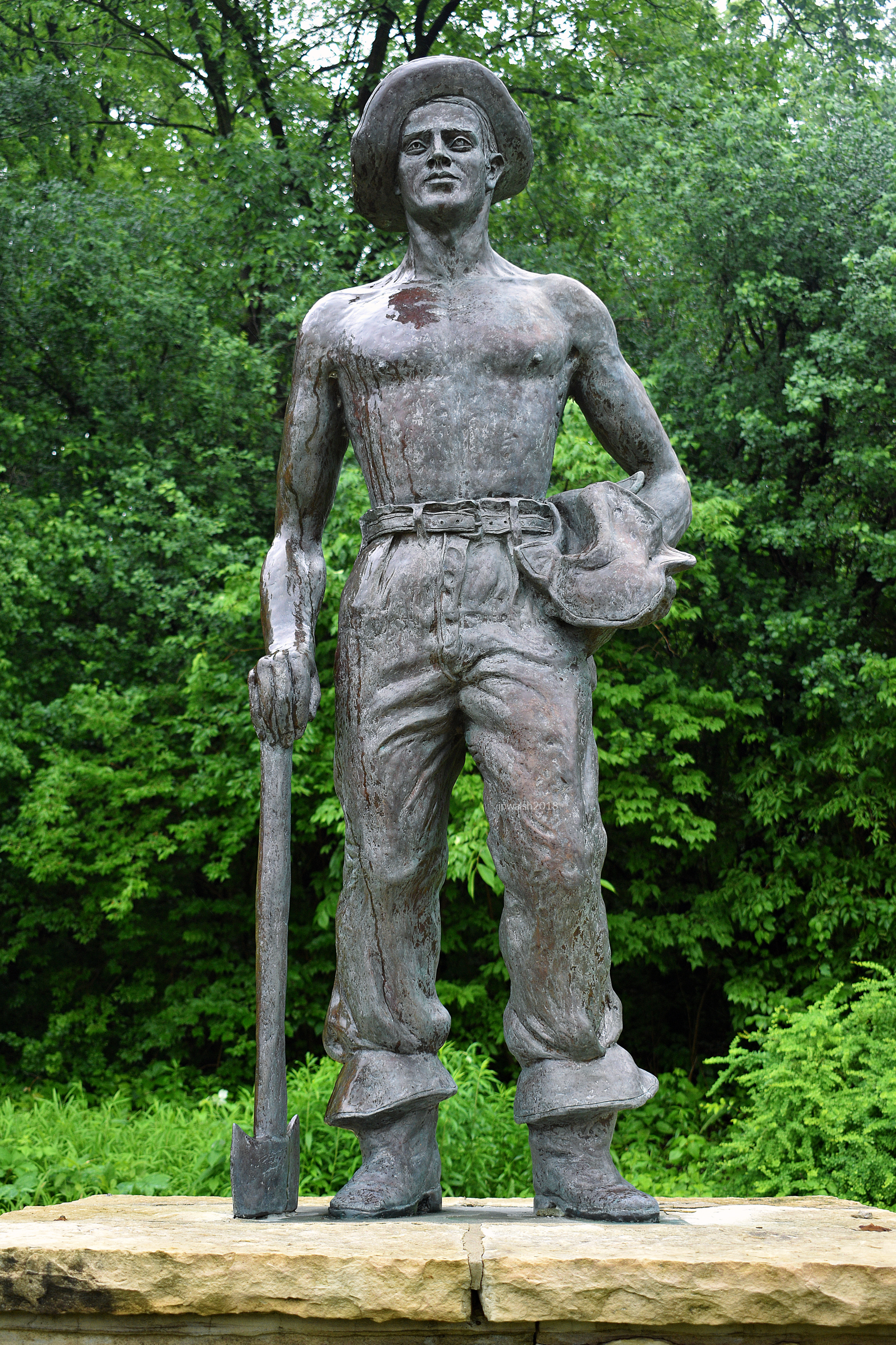
FEATURE Image: The Worker, Willow Springs, Illinois. June 2018. Author’s photograph 6mb.The Civilian Conservation Corps (CCC) stands as one of the most successful and far-reaching initiatives of FDR’s New Deal, providing vital economic relief during the Great Depression while leaving a permanent legacy of environmental conservation and infrastructural development that is beautifully commemorated today by The Worker statue in Willow Springs, Illinois.
FDR’s “Tree Army” Arrives in Illinois
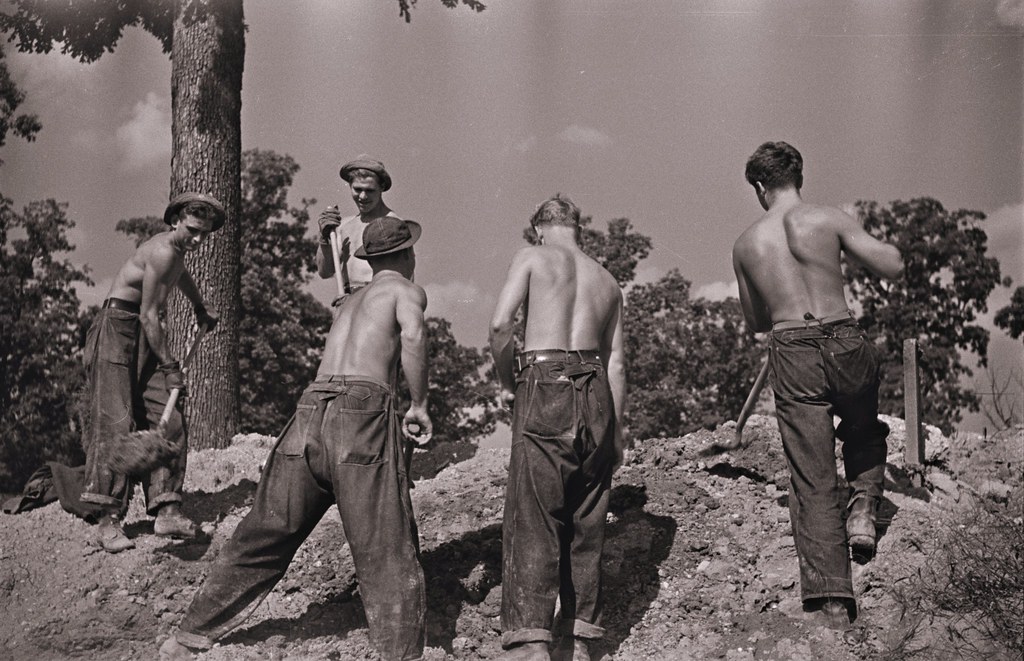
The Civilian Conservation Corps (CCC) was a cornerstone program of President Franklin D. Roosevelt’s New Deal, engineered to combat the devastating economic and social effects of the Great Depression. Affectionately dubbed “Mr. Roosevelt’s Tree Army,” the initiative established over 50 camps and launched more than 1,000 special projects across Illinois.
The camp at Willow Springs was among the very first wave of camps established under FDR’s vision. According to the Civilian Conservation Corps Legacy, Camp Chicago-Lemont, Company 612 officially opened its doors in Willow Springs on June 4, 1933.
Commemorating the Legacy of Company 612
To honor the unwavering dedication and work ethic of the young men—aged 17 to 28—who served in the CCC, a commemorative monument was dedicated on June 3, 2001. This larger-than-life bronze sculpture, titled The Worker, stands proudly at the intersection of Archer Avenue (Route 171) and Willow Boulevard in the Willow Springs Woods. Today, it serves as a striking local landmark and stands as one of many identical tribute statues scattered across the American landscape to honor the enduring spirit of the CCC.
A Blueprint for Economic Relief
As one of the New Deal’s most successful “alphabet soup” agencies, the CCC served a critical, multi-faceted purpose. Its immediate motivation was to combat staggering national unemployment rates that soared to 25% following the catastrophic Wall Street crash of October 1929. By providing meaningful manual labor jobs to young men, the program injected vital financial relief directly into struggling families who had spent years facing severe economic hardship.
Established on June 4, 1933, Civilian Conservation Corps Legacy, Camp Chicago-Lemont, Company 612 was one of the nation’s very first CCC camps located in Willow Springs, Illinois.
The Worker portrays a young man standing firmly atop a stone plinth in a setting of forest greenery. He is depicted with a muscular, bare chest, rolled-up work trousers, and heavy boots, capturing the demanding nature of manual field labor required for $30 a month government salary. In his right hand, he holds a standard planting spade or shovel resting on the ground, while his left hand holds a cloth work cap against his hip. His facial expression is determined and forward-looking, wearing a wide-brimmed campaign hat. June 2018. Author’s photograph. 6mb DSC_9132 (1)
This specific monument—dedicated on June 3, 2001—stands as a lasting local and national reminder of how manual civic labor rescued a generation of American boys from urban poverty while structurally rebuilding the country’s natural landscape. June 2018. Author’s photograph. 12.87mb.
CCC plaque, Willow Springs, Illinois. June 2013. Author’s photograph. 3.33mb
Life in the Camps and the $30 Promise
As the program expanded, camps quickly proliferated across every state in the nation. Over its nine years and three months of operation, the CCC employed upwards of three million young men. In exchange for their manual conservation labor, enrollees received essential provisions: food, clothing, lodging, and both medical and dental care.
They were also given a paycheck of $30 a month (equivalent to roughly $600 today), with a strict legal caveat: $25 of that sum had to be sent directly home to support their struggling families. Each camp housed around 200 men. While the lifestyle was notoriously basic and disciplined, for most enrollees, it was a far better alternative to panhandling on city streets. Consequently, the program enjoyed immense public and bipartisan support.
FDR during a presidential radio broadcast in 1933. Library of Congress. Public Domain.
The First 100 Days and the Mobilization of a Nation
The legislative foundation for the program began during the famous Emergency Session of the 73rd Congress, which FDR called on March 9, 1933, just days after taking office. Roosevelt boldly promised that if granted emergency powers, he would mobilize 250,000 men into field camps by the end of July. Senate Bill S. 598 was introduced on March 27, passed both houses swiftly, and was signed into law on March 31—less than a month into FDR’s first term.
The initiative faced early friction from Big Labor leaders, who worried this massive influx of non-union workers would undercut the private job market. Undeterred, the Roosevelt administration went ahead with a peacetime mobilization of men, materials, and transportation on a scale never before seen in American history. On April 15, 1933, Executive Order 6101 officially authorized the program, appointing labor leader Robert Fechner as its first director. Backed by an advisory council spanning the War, Labor, Agriculture, and Interior departments, the CCC became a hallmark achievement of FDR’s legendary “First 100 Days.”
Transforming the American Landscape
Operating primarily on public and government-owned rural lands, the federal program left a permanent environmental and physical mark on the country. CCC workers are widely credited with saving and renewing America’s decimated timberlands, planting an astonishing three billion trees between 1933 and 1942. Simultaneously, their labor laid the groundwork for modern infrastructure by building parks, fire towers, and access roads where none had existed before.
Despite its overwhelming popularity, the CCC came to an abrupt end following the attack on Pearl Harbor and America’s entry into World War II. With the establishment of the military draft and the rapid wartime mobilization of domestic manufacturing, the economic need for government-subsidized labor relief evaporated. By mid-1942, the final CCC camps were dismantled or repurposed as training grounds for the U.S. Army.
A Lasting Legacy in Illinois
With the exceptions of Social Security and the Rural Electrification Act, few New Deal programs have matched the profound, long-term influence of the CCC. In Illinois alone, the historical impact remains staggering. Over 92,000 men served within the state’s borders. Through their hard work, they successfully planted an estimated 60 million trees, constructed 400 bridges, cleared 1,200 miles of public trails, and installed nearly 5,000 flood-control structures that continue to shape the state’s parks and forest preserves today.
The historical setting of The Worker statue in Willow Springs, Illinois, standing as a permanent tribute to the legacy of the Civilian Conservation Corps (CCC). highlights the intersection of public memory, art, and the natural landscape that the CCC boys worked so hard to preserve during the Great Depression.
The Worker statue, Illinois Rte. 171 (Archer Avenue) in Willow Springs, Illinois. June 2013. Author’s photograph. 5.61mb
This exact site commemorates Camp Chicago-Lemont (Company 612), which was officially established on June 4, 1933, as one of the very first emergency New Deal camps in Illinois. The rustic limestone wall holding up the statue is highly symbolic. Constructing stone retaining walls, bridges, and erosion-control barriers was exactly the type of heavy manual labor the CCC boys performed across the state’s forest preserves.
McDonald, Jerry. “The Story of the CCC and Its Legacy in Illinois.” Illinois Country Living Magazine, January 2018. Accessed May 16, 2023. https://icl.coop/story-ccc-legacy-illinois/.
FEATURE image: The large bronze statue was the first prominent public depiction of the 16th U.S. president as a young adult man. June 2017. Author’s photograph. 4.70mb.
Capt. A. Lincoln stands watch over the Rock River in Dixon, Illinois. Unveiled in 1930 on the historic grounds of Fort Dixon, Leonard Crunelle’s statue captures a 23-year-old Lincoln during his frontier deployment in the 1832 Black Hawk War. Enlisting in the Illinois Volunteers on April 21, Lincoln served through consecutive re-enlistments as both a captain and a private before officially mustering out on July 10, 1832. June 2017. Author’s photograph. 8.26mb.
The Changing Illinois Frontier
In the early 1830s, Illinois marked the edge of the American frontier, existing virtually as an untamed wilderness. By the end of the 1820s, treaties with the federal government had forced the expulsion of most Native American tribes from the state’s northern tier, which had been established in 1818.
This displacement rapidly transformed the landscape. A massive wave of Eastern settlers arrived throughout the 1840s and 1850s, bringing ambitious commercial infrastructure in their wake. Driven by newly carved transportation canals and an expansive network of railroads, these projects successfully connected the American Midwest to global markets and sparked an era of industrial prosperity.
Lincoln’s Early Military Service
Abraham Lincoln was 21 years old when he arrived in Illinois in 1830, having moved with his family from Indiana. By 1832, the 23-year-old was living in New Salem when the Black Hawk War erupted. Lincoln enlisted in the Illinois Volunteers on April 21, 1832, near Richland Creek in Sangamon County—roughly halfway between New Salem and Springfield.
The very next day, he mustered into state service 40 miles west at Beardstown on the Illinois River. Standing an imposing 6 feet 4 inches tall, Lincoln was elected captain of his company, a leadership position he later noted left him both surprised and deeply proud.
From Captain to Private
On May 3, 1832, Lincoln officially mustered into U.S. military service near Janesville, Wisconsin. His initial term expired on May 27 in Ottawa, Wisconsin, without Lincoln ever firing a single shot in combat.
Undeterred, he immediately re-enlisted that same afternoon as a private in Captain Iles’ company. When that brief stint concluded, he signed on yet again, serving under Captain Early. Lincoln’s frontier military campaign finally drew to a close on July 10, 1832, when he officially mustered out at Whitewater, Wisconsin.
Capt. A. Lincoln 1832. Dixon, Illinois. The 6-foot-4-inch Lincoln was elected captain, a position he said he was both surprised and proud to receive. June 2017. Author’s photograph. 6.87mb.
Sculpting the Young President: Leonard Crunelle (1872–1944).
During his deployments, young Lincoln was stationed at Fort Dixon on the Rock River in Lee County, Illinois. Today, that exact historic ground is home to a heroic-sized bronze statue unveiled in late September 1930. The monument was crafted by French-born sculptor Leonard Crunelle (1872–1944).
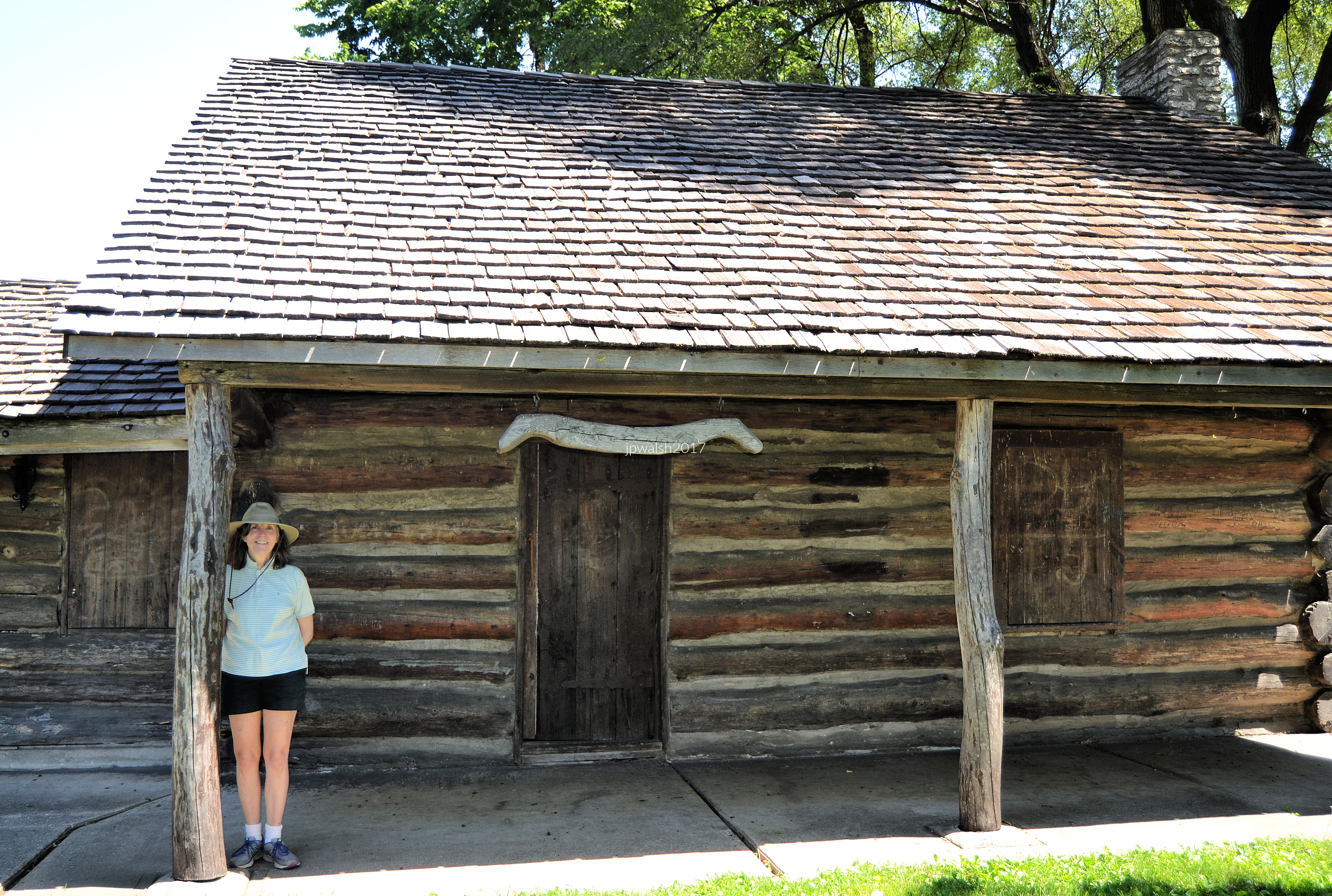
The Old Settlers’ Memorial Log Cabin in Young Captain Lincoln Statue Park on the north bank of the Rock River in Dixon, Illinois. While the cabin itself was built later in 1894 as a collective monument to honor the region’s early pioneers, it stands as a perfect architectural representation of the rugged, hand-hewn log structures that defined the Illinois frontier during the early 1830s. The site holds deep historical significance, as it rests directly on the former grounds of Fort Dixon, where a 23-year-old Abraham Lincoln was stationed a a young volunteer in the Illinois National Guard during the Black Hawk War of 1832. Originally established as a ferry service and trading post by a settler named John “Father” Dixon, the location was rapidly fortified into a military base by General Henry Atkinson in May 1832. It became a critical strategic hub connecting various frontier outposts, temporarily hosting young Abraham Lincoln as well as historical figures such as Winfield Scott, Zachary Taylor, and Jefferson Davis. June 2017. Author’s photograph. 6.75 mb.
View of the Rock River in Dixon, Illinois, from the grounds of Lincoln Statue Park—the former location of Fort Dixon where young Abraham Lincoln served in the state militia. Across the river is the dome of the Lee County Courthouse dome in Dixon, Illinois. PHOTO: “Rock River Fall_03” by markellis_1964 is licensed under CC BY-NC-SA 2.0.
Crunelle’s immigrant family had immigrated to Illinois in 1889, settling in Decatur. While working in the local coal mines, Crunelle began shaping fired clay sculptures. His raw talent eventually caught the attention of prominent American sculptor Lorado Taft, who brought the young artist to Chicago to study at the Art Institute.
The artist Leonard Crunelle (1872–1944) stands with the heroic-sized clay model ofLincoln the Debater in his studio before its 1929 dedication in Freeport, Illinois. The following year, Crunelle sculpted Capt. A. Lincoln for Dixon, Illinois—capturing an even younger portrait of the president. Scaled bronze replicas of both historic masterworks now decorate the interior corridors of Lincoln’s Tomb in Springfield. Public Domain.
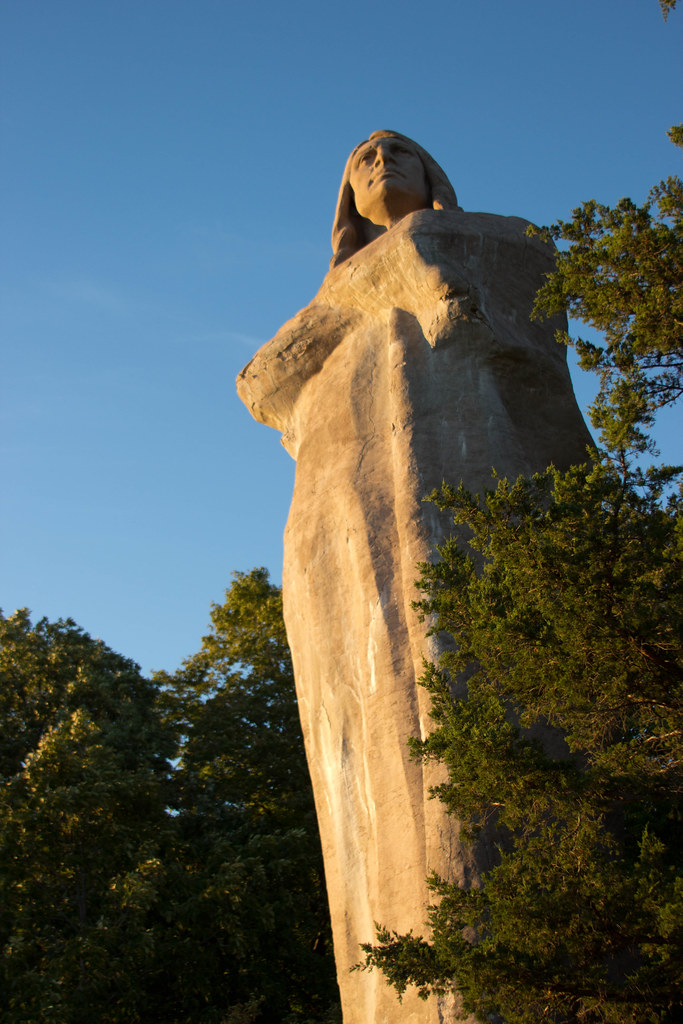
Lorado Taft made his Black Hawk statue monument in 1911 in Oregon, Illinois, also on the Rock River about 16 miles upstream from Dixon, Illinois. It is part of the area that saw action during the Black Hawk War in 1832 and led to the complete surrender and expulsion of the last Native American group in Illinois. “Black Hawk (aka ‘The Eternal Indian’)” by Dan Brekke is licensed under CC BY-NC 2.0.
A Milestone in Presidential Iconography
Crunelle’s Capt. A. Lincoln monument stands as a groundbreaking milestone in presidential artwork. While Lincoln frequently expressed pride in his brief military experience during his subsequent legal and political careers, traditional monuments rarely highlighted this era.
Though Crunelle had achieved acclaim for his 1929 statue Lincoln the Debater in Freeport, Illinois, his Dixon monument took a much bolder step backward in time. By capturing a 23-year-old soldier starting his public life, Crunelle introduced an entirely fresh, untapped chapter to the Great Emancipator’s ever-expanding public iconology.
The bronze plaque on the backside of the Capt. A. Lincoln statue base in Dixon, Illinois, details Abraham Lincoln’s 1832 Black Hawk War military record. Erected by the State of Illinois in 1930, the tablet stands on the historic site of the Fort Dixon block house.
The inscription lists the exact dates of Lincoln’s transitions from a volunteer private to an elected Captain, his subsequent re-enlistments under Captains Iles and Early, and his final discharge at Whitewater, Wisconsin. The bottom roster immortalizes the Fort Dixon Memorial Commission, highlighting prominent Illinois figures of the era, including Chicago sculptor Lorado Taft and the monument’s creator, Leonard Crunelle. June 2017. Author’s photograph. 9mb
FEATURE Image: Richard Hunt’s monumental welded stainless-steelsculpture We Will serves as a powerful symbol of modern Chicago’s collective resilience, updating the city’s historic “I Will” mantra to reflect a 21st-century spirit of unity and resolve. The sculpture’s flame-like forms evoke the rebuilding of the city after the Great Fire of 1871, showing that Chicagoans continue to move forward bigger and stronger—together.July 2016. Author’s photograph.
A Towering Sentinel in the Loop
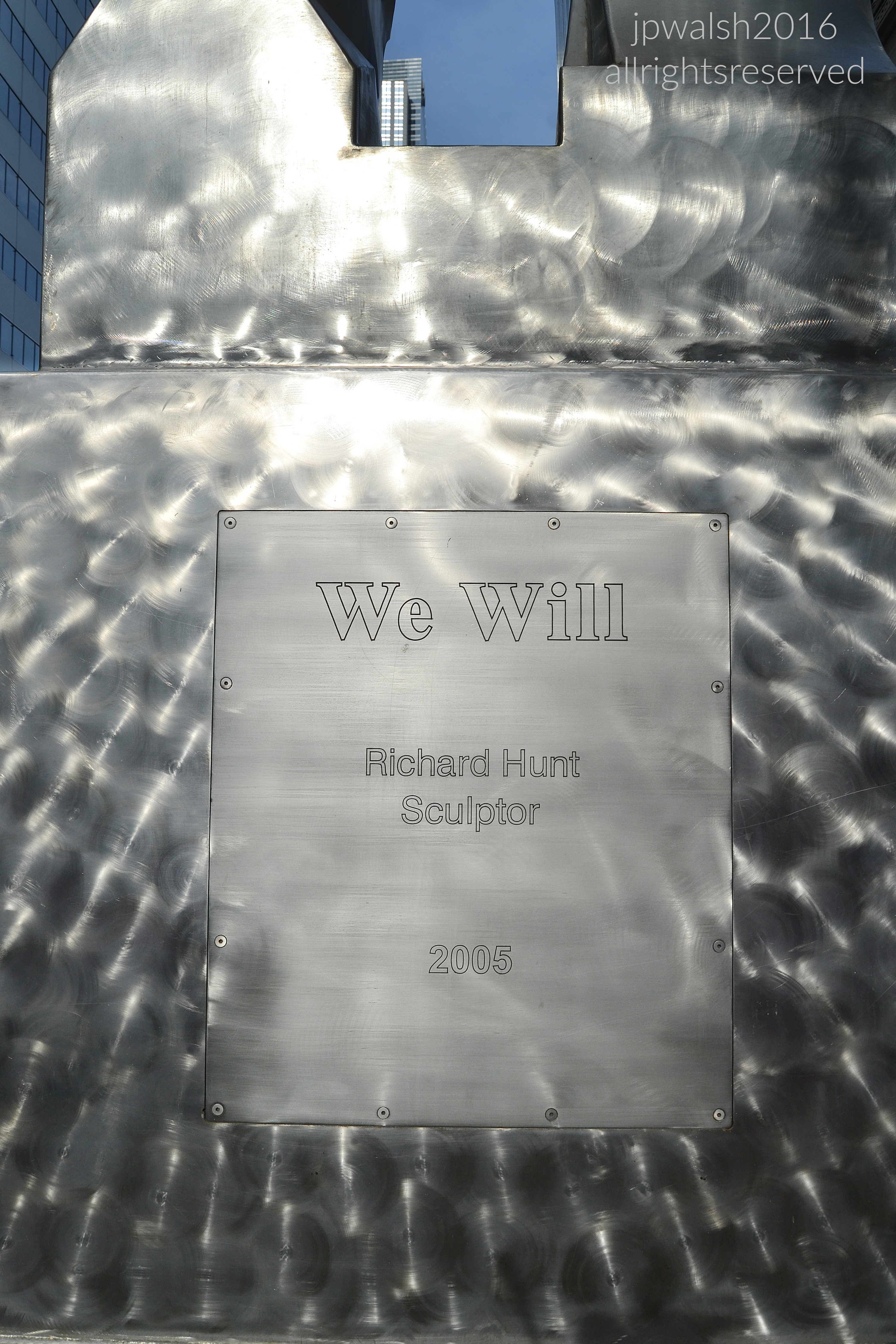
Chicagoan Richard Hunt has created over 150 large-scale installations around the globe, but some of his most resonant works reside right in his hometown. Since 2005, Hunt’s We Will has stood proudly on the sidewalk at the intersection of Randolph Street and Garland Court, steps from the Chicago Cultural Center and Millennium Park. Rising 35 feet tall (35’x 8’ x 8’) and crafted from welded stainless steel, this monumental sculpture commands an impressive presence on the downtown streets.
From “I Will” to “We Will”
The piece directly engages with Chicago’s long-standing municipal mantra, “I Will.” The roots of that phrase trace back to the Great Chicago Fire of 1871, reflecting the dogged resiliency of citizens determined to rebuild, reinvent, and grow to new heights. Visually, Hunt’s sculpture evokes the rising licks of flame from that devastating 19th-century event—the catalyst from which the city built back bigger, better, faster, and stronger. By pivoting the title to We Will, Hunt signals that 21st-century Chicagoans continue this tradition of absolute resolve, but choose to look toward the future together.
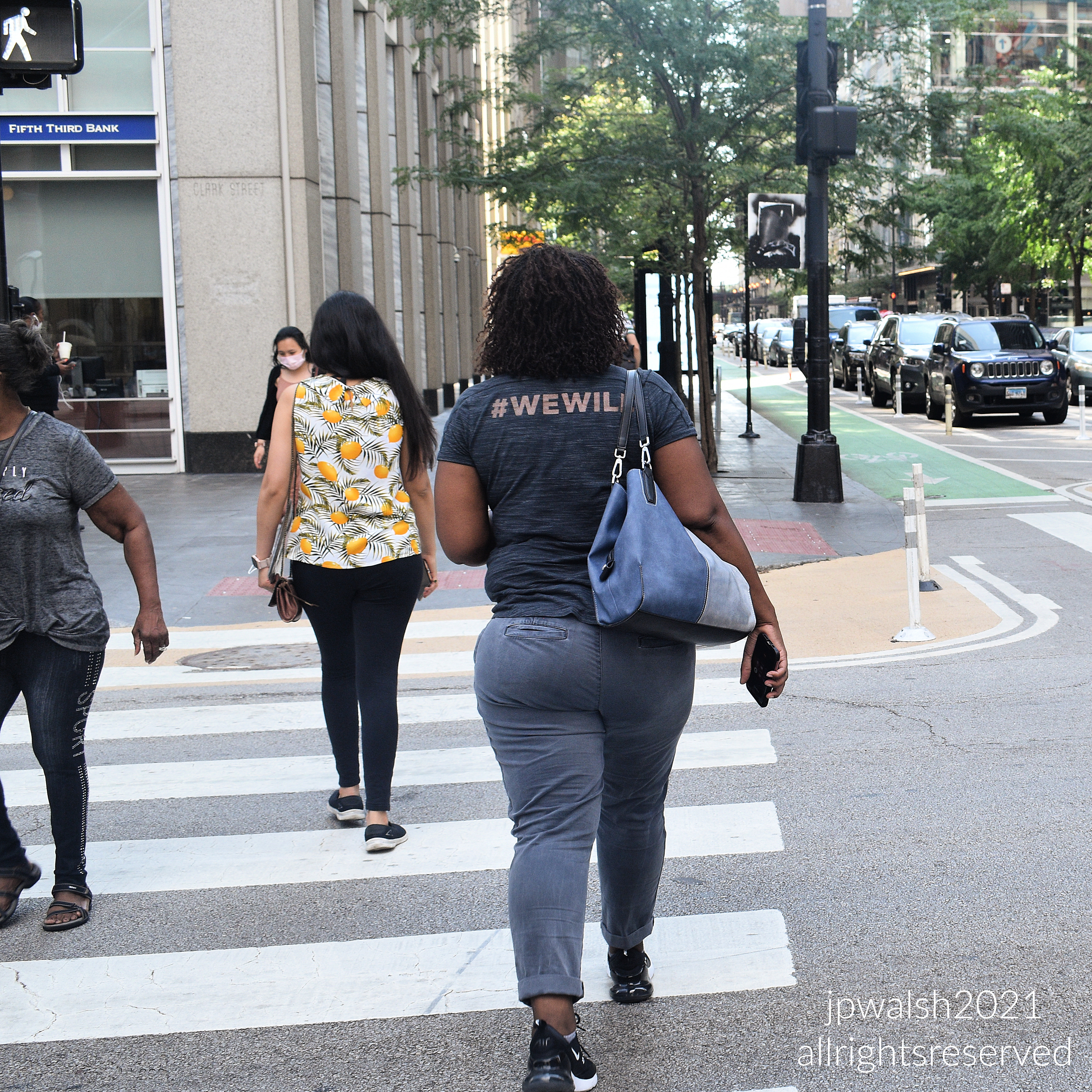
Chicago. August 2021. Author’s photograph.
Hunt’s choice to pivot the city’s historic singular mantra into a plural pledge is not just an abstract aesthetic exercise; it is an active, living street-level reality. As seen in a contemporary photograph of Chicago’s Loop, the collective resolve of the city manifests organically on the pavement. A pedestrian crossing the street bears a t-shirt emblazoned on the back with the hashtag #WEWILL, effortlessly carrying the artist’s message into the daily rhythm of the city. While elitist institutions risk domesticating radical art, Hunt’s public monuments thrive precisely because they are met by day-to-day denizens on the ground. By weaving his towering steel forms into the very crosswalks and thoroughfares of civic life, Hunt ensures that his art remains an active participant in Chicago’s ongoing story of shared resilience.
Mapping a Civic Legacy
Commissioned by the Mesa Development Company for a condominium and mixed-use development, We Will is part of a massive footprint Hunt left across the local landscape. His public masterworks define the city’s geography, including the Light of Truth Monument to Ida B. Wells in Bronzeville, Jacob’s Ladder at the Carter G. Woodson Regional Library, Farmer’s Dream at the Museum of Contemporary Art (MCA), and Flightforms at Midway International Airport.
A Fitting Legacy for the South Side
Among these celebrated civic contributions is the first artwork commissioned for the Obama Presidential Center in Chicago. Titled Book Bird, Hunt’s sculpture was designed for the outdoor Library Reading Garden at the center’s Chicago Public Library branch. In a call with the artist, former President Barack Obama observed that Hunt’s “personal story embodies what is hoped to be the experience at the center. To have one of the greatest artists Chicago ever produced and to participate in what we hope is an important cultural institution for the city and the South Side… it feels like a pretty good fit to me.”
Roots of a Chicago Master
Hunt’s deep connection to the city began in 1935 in the Woodlawn neighborhood on the South Side, before his family relocated to Englewood when he was four years old. Educated in local public schools, his family routinely immersed themselves in Chicago’s cultural anchors, fostering a young Hunt’s affinity for The Art Institute of Chicago and the Field Museum. He went on to earn a B.A.E. from the School of the Art Institute of Chicago (SAIC) in 1957, followed by periods of study and travel throughout Europe and service in the U.S. Army.
A 1962 studio portrait of Richard Hunt taken in Chicago, Illinois. In the definitive retrospective volume Richard Hunt published in 2022, explored Hunt’s early life and career trajectory and frames this precise moment as a crucial turning point in American sculpture. In 1955, at age 19, Hunt attended the open-casket funeral of his South Side Chicago neighbor, Emmett Till. This traumatic event deeply radicalized Hunt’s vision of public memory and freedom, inspiring his first welded masterwork, Hero’s Head (1956). Soon after graduating from The School of the Art Institute of Chicago in 1957, The Museum of Modern Art (MoMA) purchased his sculpture Unique Forms of Continuity in Space directly out of his studio. In 1962, the year of this portrait, Hunt received a Guggenheim Memorial Fellowship, giving him the financial freedom to become a full-time, self-sustaining artist. That same year, LIFE magazine featured Hunt as one of their “Red-Hot Hundred” young national leaders. He also stood as the youngest exhibiting artist at the historic Seattle World’s Fair exhibition, Art Since 1950. At the time this photo was taken, Hunt was running a vibrant studio practice centered around transforming urban detritus, frequently scouring junkyards at Clybourn and Sheffield Avenues to construct what he famously termed “three-dimensional drawings in space.”
Breaking Barriers on the Global Stage
Over the course of his monumental seven-decade career, Hunt received more than a dozen honorary degrees from top-tier institutions and served as a professor and artist-in-residence at several prestigious universities. He made history when he became the first African American artist to be honored with a solo retrospective exhibition at the Museum of Modern Art (MoMA) in New York City.
Reflecting on his lifelong commitment to civic spaces, Hunt noted, “There are a range of possibilities for art on public buildings or in public places. To commemorate, to inspire. I think art can enliven and set certain standards for what is going on in and around it.” Richard Hunt passed away in his beloved city on December 16, 2023, at the age of 88, leaving behind a legacy forever welded into the fabric of American art.
“There are a range of possibilities for art on public buildings or in public places. To commemorate, to inspire. I think art can enliven and set certain standards for what is going on in and around it.” – Richard Hunt, sculptor.
Richard Hunt’s We Will in situ. Chicago. July 2016. Author’s photograph. 5.48 mb DSC_0033
Standing on the sidewalk at the intersection of Randolph Street and Garland Court, Richard Hunt’s We Will (2005) interweaves seamlessly into a rich, layered Downtown Chicago streetscape. In the middle-left ground, the 35-foot welded stainless-steel form rises dynamically as an abstract, upward-striving silver monument. This outdoor setting acts as a powerful thesis statement for Hunt’s approach to civic engagement, especially when contrasted with the controlled confinement of traditional gallery spaces. Housed in the open elements, We Will resists institutional “domestication” because it belongs entirely to the street itself. It stands in the literal heart of the Loop—an area fundamentally reshaped by the Great Chicago Fire of 1871—anchoring the neighborhood’s historic recovery. By directly sharing the pavement with pedestrians and motorists navigating their daily routines, the monument demonstrates that Chicago’s resilient spirit is not a fossilized historical concept, but an ongoing, communal reality.
FEATURE Image: Alexander Calder’s Flamingo successfully transforms Chicago’s Federal Center Plaza by humanizing, energizing, and completing Mies van der Rohe’s austere modernist architectural ensemble through color, scale, movement, and sculptural form. Author’s photograph. June 2022. 7.73 mb
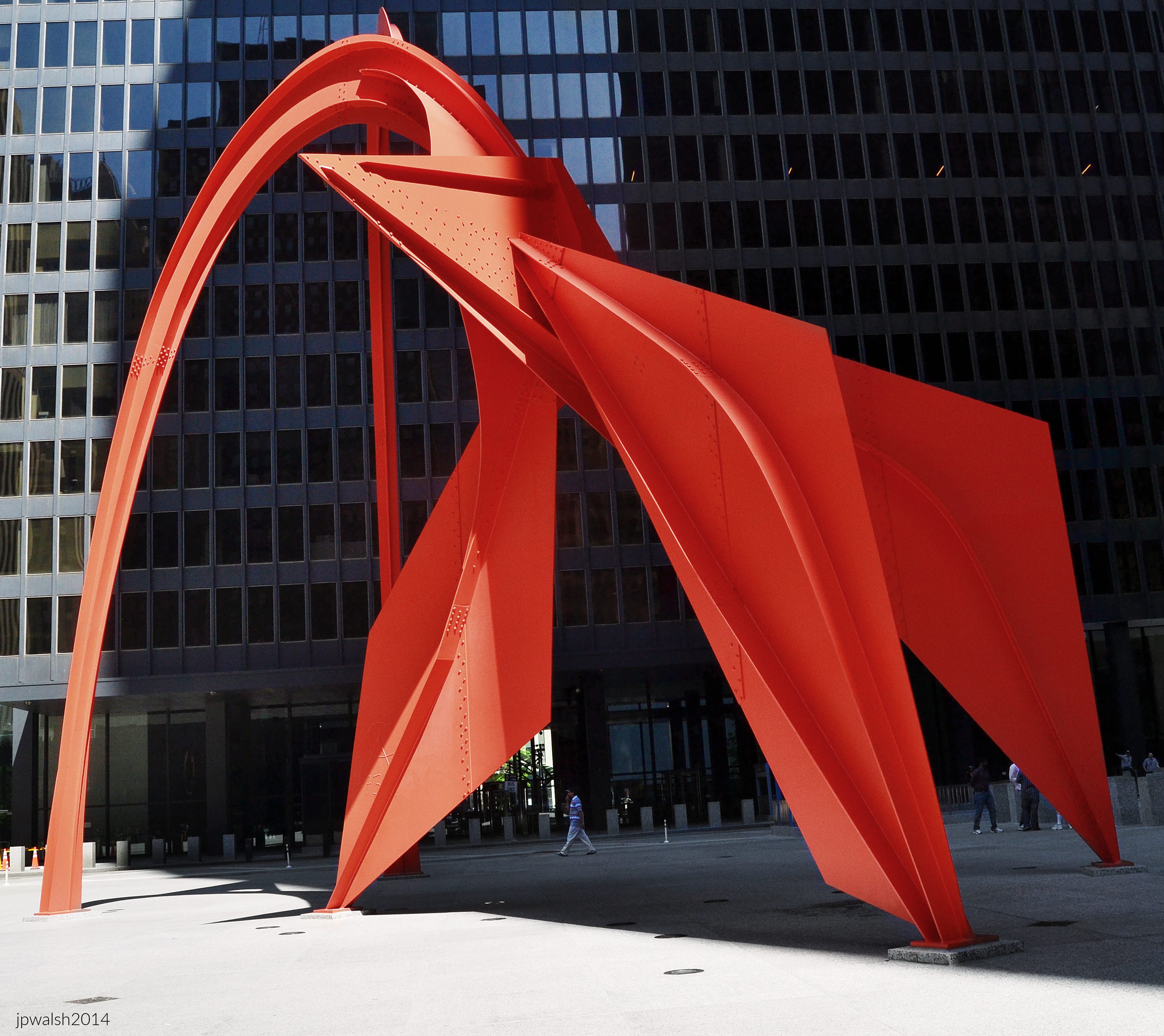
Alexander Calder’s Flamingo (1974) transformed Chicago’s Federal Center by introducing movement, whimsy, and human-scaled organic form into one of the city’s most rigorously ordered modernist spaces. Set amid Ludwig Mies van der Rohe’s rectilinear architecture, Calder’s monumental red stabile demonstrates how public art can soften, animate, and humanize the urban environment without diminishing its architectural power.Alexander Calder’s Flamingo was unveiled on October 25, 1974, in a dedication ceremony with the artist. Alongside Picasso and Cloud Gate, it is one of Chicago’s iconic outdoor public artworks.
In downtown Chicago’s Federal Center Plaza on South Dearborn Street between Adams Street and Jackson Boulevard is Alexander Calder’s 53-foot-tall painted steel plate “stabile object” entitled Flamingo. The Chicago Federal Center was completed in 1974 with Calder’s artwork. The design project began in 1958 and included three International-style government buildings by modernist architect Mies van der Rohe (1886-1969) within a public plaza design that was completed in 1974. Flamingo, commissioned after Mies’ death for $250,000 by the Government Services Administration, was unveiled on October 25, 1974 with the 76-year-old Calder present for its dedication ceremonies and festivities. With the commission Calder understood the significant impact of his artwork for the Federal Center Plaza in Chicago.
Calder’s prolific and impressive art career started in the early 1920s. Fifty years later, Flamingo (a.k.a., “the Calder”) in Chicago’s historic Federal Center Plaza is a later work, whose maquette Calder made before it was intended for Chicago.
During his artistic career’s many decades and years, Calder never stopped developing in his art. The 1974 steel sculpture painted red-orange is four stories tall and makes a powerful impact on the streetscape where it is an integral part. Along with Chicago’s Picasso in 1967 and Anish Kapoor’s Cloud Gate (“the Bean”) in 2004, Calder’s Flamingo in 1974 has taken its well-deserved place among Chicago’s most iconic outdoor public artworks.
From the inventor of the mobile, Calder turned later to the development of the stabile of which Flamingo is a masterwork. Starting in the mid1950s and into the 1970’s, Calder produced scores of stabiles in many shapes and sizes for display around the world.
“Most architects and city planners want to put my objects in front of trees or greenery. They make a huge error. My mobiles and stabiles ought to be placed in free spaces, like public squares, or in front of modern buildings, and that is true of all contemporary sculpture” – Alexander Calder. Quoted in Jed Perl, Calder: The Conquest of Space: The Later Years: 1940–1976 (New York: Alfred A. Knopf, 2020).
June 2022. Author’s photograph. 7.24 mb
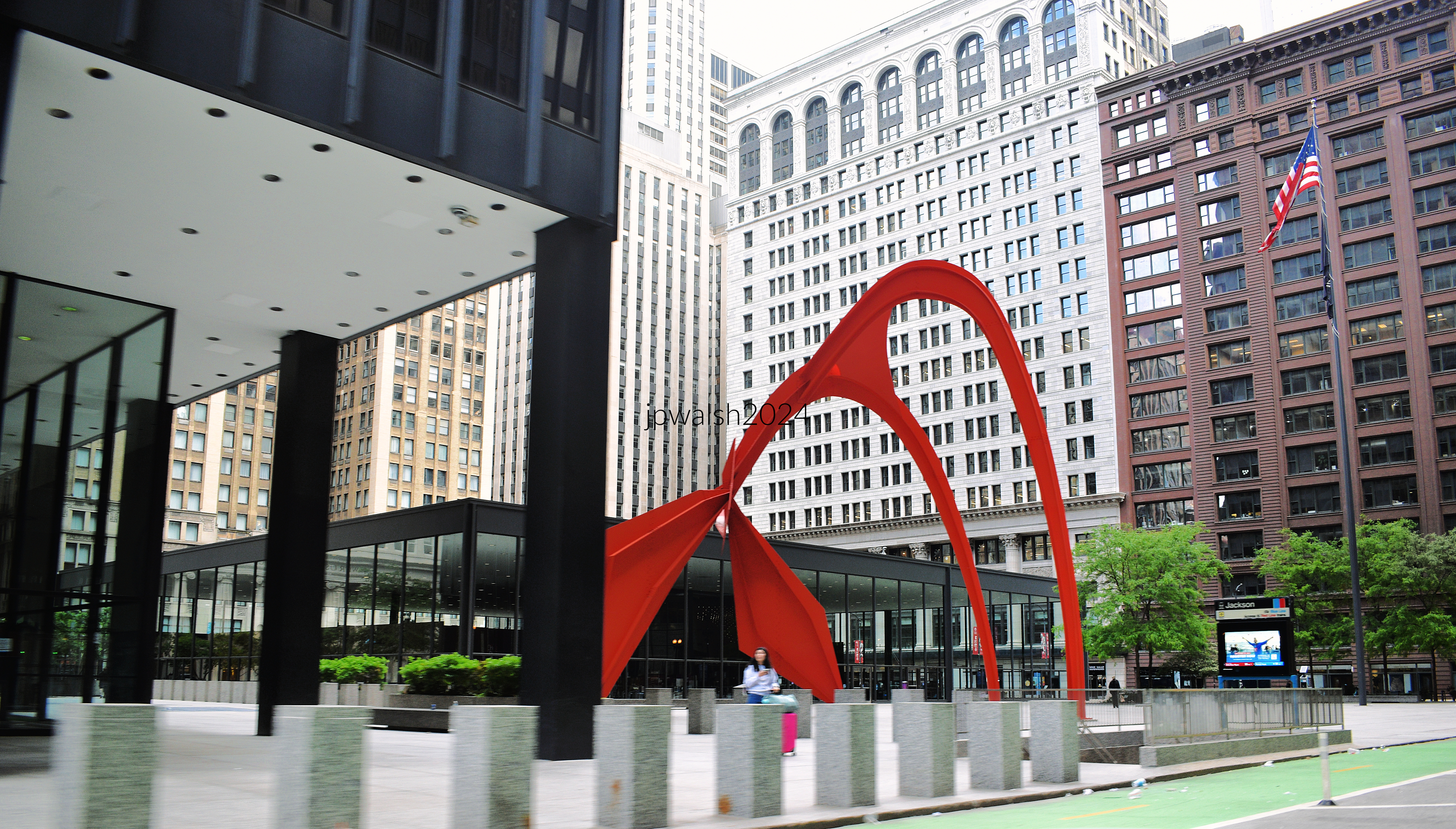
Above: On the west side of Clark Street between Adams Street and Jackson Boulevard—visible directly behind Alexander Calder’s Flamingo sculpture—the prominent structures are from left to right: The Commercial Office Building located at 118 South Clark Street (directly tucked between the Bankers Building and Jackson Boulevard)—was completed in 1920 and designed by the prolific Chicago architectural firm Holabird & Roche, Willis Tower in the distance, The Bankers Building (105 West Adams Street, completed in 1927 by the Burnham Brothers, a 476-foot Art Deco masterpiece featuring characteristic deep light courts and upper-tier setbacks), and, on the other side of Adams Street, The Field Building at 140 S. Clark. Completed in 1934 by Graham, Anderson, Probst & White, it stands as one of the finest premier masterpieces of Art Deco skyscraper design in the entire United States. A corner slice of the Edison Building is also pictured.
Titled Flamingo, the towering abstracted “Calder red” painted stabile object can evoke reactions to it that are unexpected. Calder’s stabile masterwork was unveiled in October 1974 which was the same year the Sears Tower (in the background) was completed, and which was at that time the world’s tallest building (today it is ranked no. 26). From Federal Center Plaza, Chicago’s 20th century architectural history is readily on display in its downtown buildings in a range of shapes, sizes, textures and design styles.
The work’s vivid red color and sweeping curves contrast with Mies van der Rohe’s black steel-and-glass buildings.
May 2014. Author’s photograph. 3.28 mb
Because of its monumental size, Flamingo can be intimidating. Actual flamingo shorebirds vary in size, but none are no more than 3 to 5 feet tall, and weigh about 5 to 7 pounds. At 53 feet tall, Calder’s immense stabile in Chicago is about the size of a giant sauropod dinosaur which would weigh around 60 tons.
“It’s really just for differentiation, but I love red so much that I almost want to paint everything red” – Alexander Calder. Katharine Kuh, The Artist’s Voice: Talks with Seventeen Artists (New York: Harper & Row, 1962).
November 2015. Author’s photograph. 260kb 25%
Alexander Calder trained and worked as a mechanical engineer before he became an artist. The graceful design and construction of Flamingo is expressed by nearly one-inch-thick steel plates buttressed by ribs and gussets joined overhead by lofty arches and resting on three legs as if it is nearly weightless. Even his largest stabiles (of which Flamingo is one) are made so they can be easily unbolted and taken apart to be transported and assembled at the place of destination.
Calder’s Flamingo demonstrates how monumental public sculpture can become an active architectural partner, transforming a formal modernist plaza into a more dynamic, accessible, and memorable civic space.
May 2014. Author’s photograph. 4.82 mb
In Federal Center Plaza is a complex of three buildings of varying scales by Mies van der Rohe: the broad 30-floor Everett McKinley Dirksen Building at 219 S. Dearborn Street completed in 1964 (at right), the lean 45-floor John C. Kluczynski Building at 230 S. Dearborn Street completed in 1974 (not pictured), and the single-story U.S. Post Office building at 219 S. Clark Street (not pictured). Calder’s Flamingo sits on its three pillars like a lunar lander that reflects the arcaded bases of Mies van der Rohe’s buildings that surround it as well as provide a sweeping contrast of curves and bright stand-out color against the surrounding modernist buildings’ monochrome glass-and-steel grid appearance. Calder’s artwork achieved more than the sum of these parts – it transformed Mies’ overall somber architectural trio into a more dramatic and complex quartet that included Calder’s art. The 30-story Dirksen Building is across Dearborn Street.
Flamingo by Alexander Calder is a masterwork stabile in Chicago’s downtown. Its monumental scale remains approachable because pedestrians can walk around, beneath, and through it.
May 2013. Author’s photograph. 3.60 mb 102_0480 (1)
November 2015. Author’s photograph. 484 kb 25%
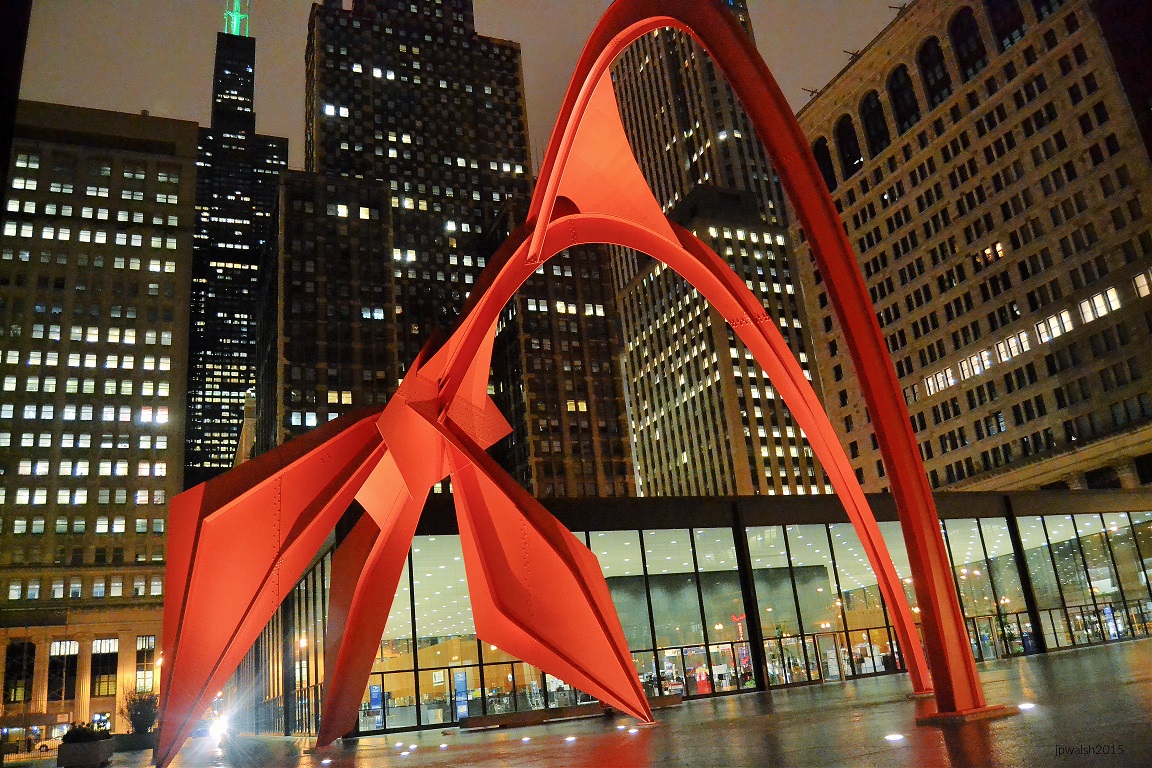
Above: Calder’s Flamingo after dark with the one-story Post Office illumined within behind it (above). Alexander Calder deliberately placed the sculpture in an open urban setting where contemporary sculpture could interact with modern architecture.
June 2022. Author’s photograph. 6.87mb
Above: Calder’s stabile is one of the most monumental public art commissions in Chicago. Flamingo’s height and breadth (it fills a space of about 1440 square feet) achieves a largesse that does not forgo a human scale as it allows pedestrians to freely walk around, under and through it. The 45-story Kluczynski Building is at left.
November 2015. Author’s photograph. 3.77mb
Above: Flamingo lighted at night in late November where there is already a snow pile on the sidewalk in Chicago’s Federal Center Plaza presaging the Chicago winter. In summer months there is a regular farmer’s market on the Federal Center Plaza. It is also the location for a variety of political gatherings year-round. The Kluczynski Building is behind.
Rather than functioning as an isolated object, the sculpture changes how viewers experience the entire Federal Center complex.
October 2015. Author’s photograph. 3.90mb.
Above: Alexander Calder’s Flamingo (1974) sits in Federal Plaza designed by modernist architect Mies Van Der Rohe. Behind it is Mies’ 45-floor John C. Kluczynski Building at 230 S. Dearborn Street and on a sunny east side of South Dearborn his 30-story Dirksen Federal Courthouse. Moving south across Jackson Boulevard is the 5-story 33 West Jackson Boulevard building built in 1910 (with additions/remodels stretching through 1917). Next to it is The Standard Club at 321 South Dearborn Street built in 1926 and designed by Albert Kahn. The Fisher Building (1896) at 343 South Dearborn Street and its annex is next further south. Designed by D.H. Burnham & Company, it was completed in 1896. The Old Colony building on the other side of the L tracks was built between 1893 and 1894, When it officially topped out, the 17-story, 215-foot high-rise briefly held the title of the tallest building in Chicago. It was designed by the legendary architectural firm of Holabird & Roche. The framework was engineered by Corydon T. Purdy who designed it with a highly advanced, pioneering skeletal steel-frame structure that carries the entirety of the building’s massive weight allowing the exterior features absolutely no self-supporting walls.
In October 1974 Alexander Calder was in Chicago for a “Calder Festival” where two of his major works were being dedicated – Flamingo for Federal Center Plaza (depicted above with the Kluczynski Building) and Universe, a motorized mural for the Sears Tower. Reflecting the artist’s lifetime interest in circuses, Calder joined in the city’s circus-themed parade in his honor. In another major cultural event in Chicago, the Museum of Contemporary Art held a large retrospective exhibition of Calder’s art from October to December of 1974.
June 2022. Author’s photograph. 6.20mb
Above: Flamingo sits within a classic Chicago Loop streetscape looking south down South Dearborn Street, framing a beautiful juxtaposition of the city’s architectural evolution. On the left side of the street sits the massive, dark steel-and-glass the Kluczynski Federal Building designed by Mies van der Rohe. On the immediate right foreground is the ornate, reddish-brown stone facade of the Marquette Building (1895). Directly past it rises the colossal, dark brick wall of the Monadnock Building (1891), showcasing its iconic, smooth masonry curves and deep-set bay windows stretching a full block south toward Van Buren Street. In the distant vista is the historic red brick tower of the Old Dearborn Station clock tower (1885) stands out against the sky, acting as a visual anchor at the very end of the street corridor.
May 2024. Author’s photograph. 88% 7.78 mb
Above: This wide angle of federal Plaza frames several historic and modernist landmarks surrounding Alexander Calder’s Flamingo sculpture. These include a portion of John C. Kluczynski Federal Building, Loop Station Post Office, The Commonwealth Edison Building and The Marquette Building.
May 2013. Author’s photograph. 2.80 mb 102_0488 (1)
August 2021. Author’s photograph. 96% 7.91mb DSC_6798
Above: Looking east along West Quincy Street toward Federal Plaza, this view captures a striking convergence of Chicago’s historic and modernist architecture. Framing the corridor is, on the left, a slice of the Rookery Building, completed in 1888 by the firm Burnham & Root, and the Clark Adams Building originally known as the Bankers Building, completed by the Burnam Brothers in 1927. On the right is the Central Standard Building, originally the Continental Illinois National Bank Building, completed in 1924 by Graham, Anderson, Probst & White. Anchoring the vista is the sweeping red curve of Alexander Calder’s Flamingo. Just in front of it stands the transparent glass entrance to the single-story United States Post Office (1973), an integral element of Ludwig Mies van der Rohe’s original Federal Plaza design. Rising behind the plaza and dominating the upper half of the scene is the John C. Kluczynski Federal Building, Mies’s landmark expression of modernist architecture, creating a dramatic contrast with the richly detailed Art Deco and classical forms that line Quincy Street.
By placing a monumental red sculpture of sweeping organic curves within Mies van der Rohe’s disciplined modernist complex, Alexander Calder transformed Chicago’s Federal Center into a dynamic conversation between art, architecture, and public space.
Sources:
Bach, Ira J., and Mary Lackritz Gray. A Guide to Chicago Public Sculpture. Chicago: The University of Chicago Press, 1983.