Feature Image: Freedom Bell at Union Station. “Freedom Bell at Union Station” by dbking is licensed under CC BY 2.0.
Early Encounters with History and Film
I first saw 1776 on an eighth‑grade field trip, and it hit perfectly. The music, the narrative, and the historical framing made it both fun and instructive. The year before, I had toured Washington, D.C.—the White House, Congress, the Library of Congress, the Supreme Court, the Washington Monument, the Lincoln and Jefferson Memorials, the National Archives, Arlington, Georgetown, Mount Vernon, Williamsburg, Patrick Henry’s Red Hill, Woodrow Wilson’s birthplace in Staunton, and Jefferson’s Monticello. My American‑history pump was primed, and 1776 met me at full readiness.
Philadelphia as the Stage of Independence
Set between May and July 1776, 1776 dramatizes the political struggle inside the Second Continental Congress as John Adams pushes the colonies toward independence. The film’s setting mirrors the real geography of the Revolution’s political machinery. Carpenters’ Hall, built between 1770 and 1774, hosted the First Continental Congress, bringing together delegates such as John Adams, Samuel Adams, George Washington, and Patrick Henry. The Second Continental Congress convened in Independence Hall beginning in May 1775.
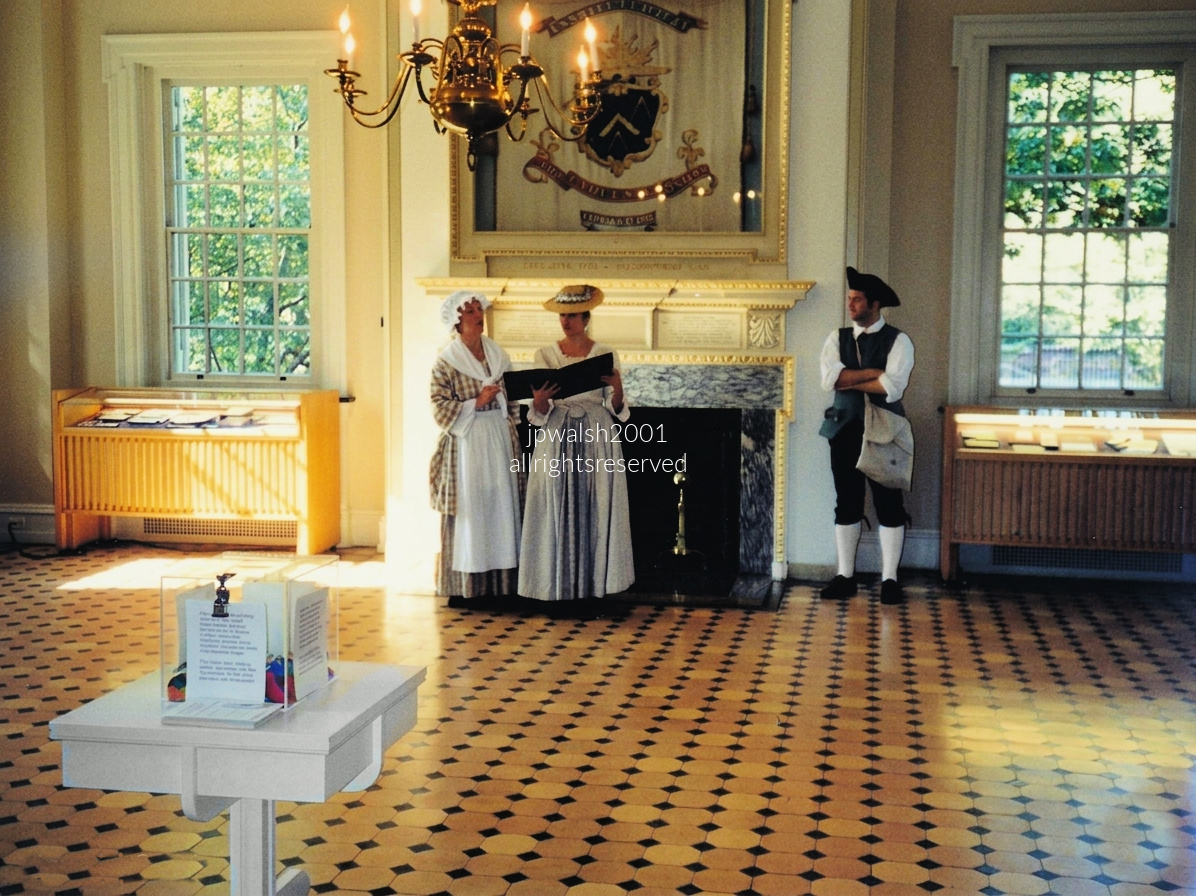
Carpenter’s Hall, Philadelphia. The First Continental Congress met in Carpenters’ Hall precisely because it was not a royal space — a deliberate choice to avoid British‑controlled government buildings while delegates privately weighed trade boycotts and articulated colonial grievances. September 2001. Author’s photograph.
Abigail and John Adams exchanged more than 1,100 letters between 1762 and 1801, beginning in their courtship and continuing through John’s long absences in the Continental Congress and his diplomatic missions in Europe. Their correspondence essentially ended when John retired (from the U.S. presidency) in 1801 and the couple settled together in Quincy. Abigail died at 73 in 1818; John died at 90 on July 4, 1826—two centuries ago today. I’ve visited their graves at United First Parish Church in Quincy, along with all three Adams homesteads: the John Adams Birthplace (1681), the John Quincy Adams Birthplace (1717), Peacefield (the estate they purchased in 1788), and the Stone Library built in 1870 under J.Q. Adams’s will.

Author at Peacefield, July 1989. Purchased in 1787, Peacefield became the home and farm of John and Abigail Adams. It later housed their son John Quincy Adams and his wife Louisa Catherine, followed by their son Charles Francis Adams and his sons, historians Henry and Brooks Adams. Both John and Abigail died at Peacefield in Quincy, Massachusetts—Abigail on October 28, 1818, and John on July 4, 1826.
Abigail’s March–April 1776 letters blend political urgency with personal strain. She presses John toward independence, criticizes Virginia’s hierarchy and its contradictions on liberty, and pointedly demands legal protections for women—warning they will “foment a rebellion” if excluded. Her letters then turn to the epidemic sweeping Braintree, the pressure of household work, and her need for news from Congress. John’s reply is teasing but defensive, treating her call for women’s rights as one more uprising in a year already crowded with political unrest, insisting men will never surrender their “masculine systems” even though husbands are, in practice, “subjects” at home.
The musical 1776 draws heavily from these letters. “Piddle, Twiddle, and Resolve / Till Then” captures their longing, their humor, and the shortages created by wartime separation. Peter Stone and Sherman Edwards lifted phrases directly from the correspondence, including Abigail’s complaints about scarce pins and John’s demands for saltpeter—details documented repeatedly in their late 1775 and early 1776 letters. Even the repeated sign off “Yours, yours, yours” comes straight from John’s actual closings.
“Piddle, Twiddle, and Resolve / Till Then” near the beginning of the show pairs John Adams’s fast, exasperated critique of Congress with a quieter imagined exchange as he reads Abigail’s letter. The shift from political frustration to intimate connection mirrors the rhythm of their real correspondence: public crisis and private devotion intertwined in the founding of our country 250 years ago which we celebrate today.
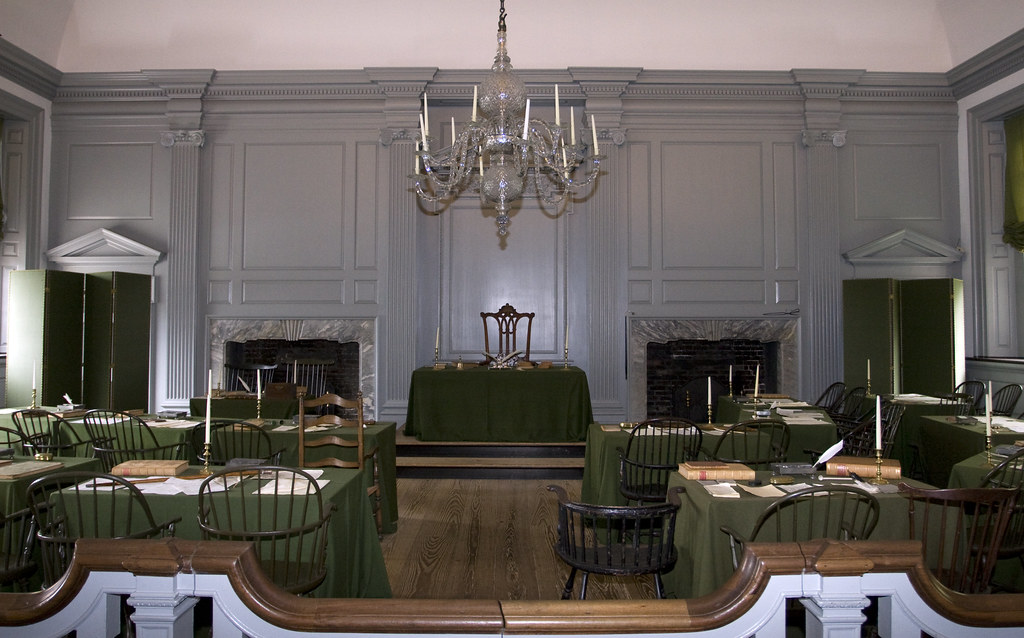
Independence Hall. Both historic sites sit within Independence National Historical Park in Philadelphia about 5 minutes apart on foot. In addition to the simple need for more space, by the time the Second Congress assembled, Lexington and Concord had already changed the stakes. The delegates were no longer a protest body; they were forced to operate as an emerging wartime government, making a formal legislative setting like the State House the appropriate venue. “Independence Hall” by michaelrighi is licensed under CC BY 2.0.
The Independence Debate
By late spring 1776, the question of independence could no longer be deferred. Benjamin Franklin and John Adams urged Richard Henry Lee to introduce a resolution severing ties with Britain and its mercantile system “that cheat and rob the colonies.” John Dickinson led the opposition, arguing independence was reckless. When Adams believed he had the votes, Dickinson countered with a motion requiring unanimity. The vote tied, and John Hancock unexpectedly sided with Dickinson. Adams and Franklin responded by proposing that Congress draft a Declaration before taking the final vote, shaping the political terrain and buying time.
Drafting the Declaration
On June 11, Congress appointed the Committee of Five—Adams, Franklin, Thomas Jefferson, Robert Livingston, and Roger Sherman. Jefferson drafted the Declaration in a rented room on High Street during a brutal heat wave. Adams wrote that the air felt like “the fierce Breath of a hot oven.” Horseflies swarmed the city out of its livery stables, biting delegates through stockings both wool and silk. Only in early July did the weather break; Jefferson recorded 68°F on the morning of July 4 and 76°F that afternoon.
War in Crisis
While Jefferson wrote, the war deteriorated. The failed invasion of Canada left the Continental Army retreating in disorder, ravaged by smallpox. Washington braced for a massive British fleet assembling off New York—the largest amphibious assault in British history. Inside Congress, delegates debated how to reinforce the army, secure gunpowder, procure ships, and recruit soldiers. Bounties rose from $4 to $10 to $20 across 1776, but payment came in Continental paper money, which rapidly inflated. By 1779, the currency was nearly worthless. Casualties in the Revolutionary War were severe: nearly 7,000 killed in combat, 9,000 wounded, roughly 19,000 dead from disease, and another12,000 who perished from horrific conditions and disease as prisoners of war aboard British prison ships.
Scaled to today’s United States population of roughly 343 million—up from about 2.5 million in 1776—the Revolutionary War casualty figures would rise by a factor of about 137. In modern‑day terms, the war’s human toll would equal nearly 960,000 killed in combat, about 1.23 million wounded, roughly 2.6 million dead from disease, and approximately 1.64 million prisoners of war who died, compared with the original totals of 7,000 killed, 9,000 wounded, 19,000 dead from disease, and 12,000 POW deaths.
The Musical and Its Moment
The film’s musical centerpiece, “The Egg,” performed by Ken Howard, Howard Da Silva, and William Daniels, captures the moment when Adams, Franklin, and Jefferson commit themselves to the Declaration. Sherman Edwards—who wrote the show’s book, music, and lyrics—had been a successful pop songwriter before deciding to create “the great American musical.” 1776 opened on Broadway in March 1969, ran for 1,217 performances, won the Tony Award for Best Musical, and brought much of its original cast into the 1972 film.
Slavery and the Declaration’s Deleted Passage
The show does not avoid the era’s darker realities. Jefferson’s original draft included a forceful denunciation of slavery, describing King George as having “waged cruel war against human nature itself.” Congress removed the passage to preserve unity. Jefferson’s use of “Men” explicitly recognized the humanity of enslaved people—an acknowledgment absent from the final Declaration. Jefferson remained a lifelong slaveholder, yet he pursued legislation against the transatlantic trade, including Virginia’s 1778 ban and the 1807 federal prohibition he signed as president.
The July 2 Vote
The vote for independence on July 2 could not be delayed. British forces were landing on Staten Island that very day. Any hesitation would signal weakness to the colonies—and to British intelligence. Delaware’s vote depended on Caesar Rodney’s overnight ride; had he missed the session, the colony’s vote would have been discarded. Congress needed a clear, unanimous decision.
Crisis and Recovery
By December 1776, Washington’s army had shrunk by nearly 90 percent. British forces had captured Manhattan, taken thousands of prisoners, and seized artillery and ammunition. Thomas Paine, serving in the army, wrote The American Crisis, beginning with the line: “These are the times that try men’s souls.” Washington wrote more soberly: “Our affairs are in a very bad way . . . the game is pretty near up.” His crossing of the Delaware on Christmas night reversed the momentum, but only barely.
Adams, Franklin, and the Diplomatic Front in France
A Young Nation Meets Old‑World Diplomacy
John Adams did not speak French, the dominant diplomatic language of the era. Benjamin Franklin was nearly thirty years older than Adams, while France’s new king, Louis XVI, was only twenty‑one. At his coronation, Marie Antoinette—just twenty—remarked, “God help us, for we reign too young.”
France Enters the Global Conflict
By late 1777, American finances were collapsing, and Philadelphia had fallen to the British. Many Americans believed trade ties with France were insufficient; military assistance was essential. The American victory at Saratoga convinced France to intervene. This decision launched the Anglo‑French (Bourbon) War, a global conflict (1778–1783) fought from the Caribbean to the Indian Ocean, overlapping almost entirely with the American Revolution.
Adams Arrives in France
Adams’s first diplomatic mission to France in 1778 produced little. He was largely ignored at Versailles. At forty‑two, he had been chosen partly for his vigor, while Franklin—now in his seventies—was seen as charming but indulgent. In one dramatized exchange, Louis XVI asks Franklin whether his fame in Paris comes from “science or the ladies,” to which Franklin replies, “Day and night, I am hard at work.”
A Fractured American Delegation
America’s other minister, Arthur Lee, was anti‑slavery but ineffective. Franklin and Lee led the delegation, while Adams worked behind the scenes. By late 1778, Congress promoted Franklin to minister plenipotentiary, leaving Adams sidelined and eventually sent home.
Adams Returns, Learns French, and Grows Frustrated
Adams returned to Paris in 1779 and this time learned French. After Lee was recalled, Adams joined Franklin in leading negotiations. But Adams believed the alliance had stalled. He wrote that the French intended “to keep their hands above our chin to prevent us from drowning—but not to lift our heads out of water.”
Confrontation with Vergennes
In March 1780, France’s foreign minister, Vergennes, summoned Adams to discuss American currency deflation. Adams instead aired grievances about French military inaction. The French had sent soldiers but few warships, diverting naval power to protect Caribbean interests. Adams insisted France must fully commit to the alliance. Vergennes bristled and declared he would deal only with Franklin going forward. Adams left France empty‑handed for the second time.
Valley Forge, Pennsylvania: General Washington’s Winter Encampment and Headquarters, 1777-1778.
During the American Revolutionary War, the Continental Army encamped at Valley Forge from December 1777 to June 1778. The stone house built between 1757 and 1773 by the family of Isaac Potts served as General George Washington’s headquarters.
Retreat After Brandywine and Collapse of Supply Lines
After Washington’s defeat at the Battle of Brandywine in September 1777, the Second Continental Congress fled Philadelphia, and Washington withdrew his force of roughly 12,000 soldiers to the strategically chosen high ground at Valley Forge, only a day’s march from the city. This third winter encampment quickly became defined by collapsing supply lines. On December 23, 1777, Washington wrote the President of Congress, then meeting 90 miles away in York, Pennsylvania, reporting that his officers had barely suppressed a “dangerous mutiny” driven by shortages of food, clothing, and basic provisions.
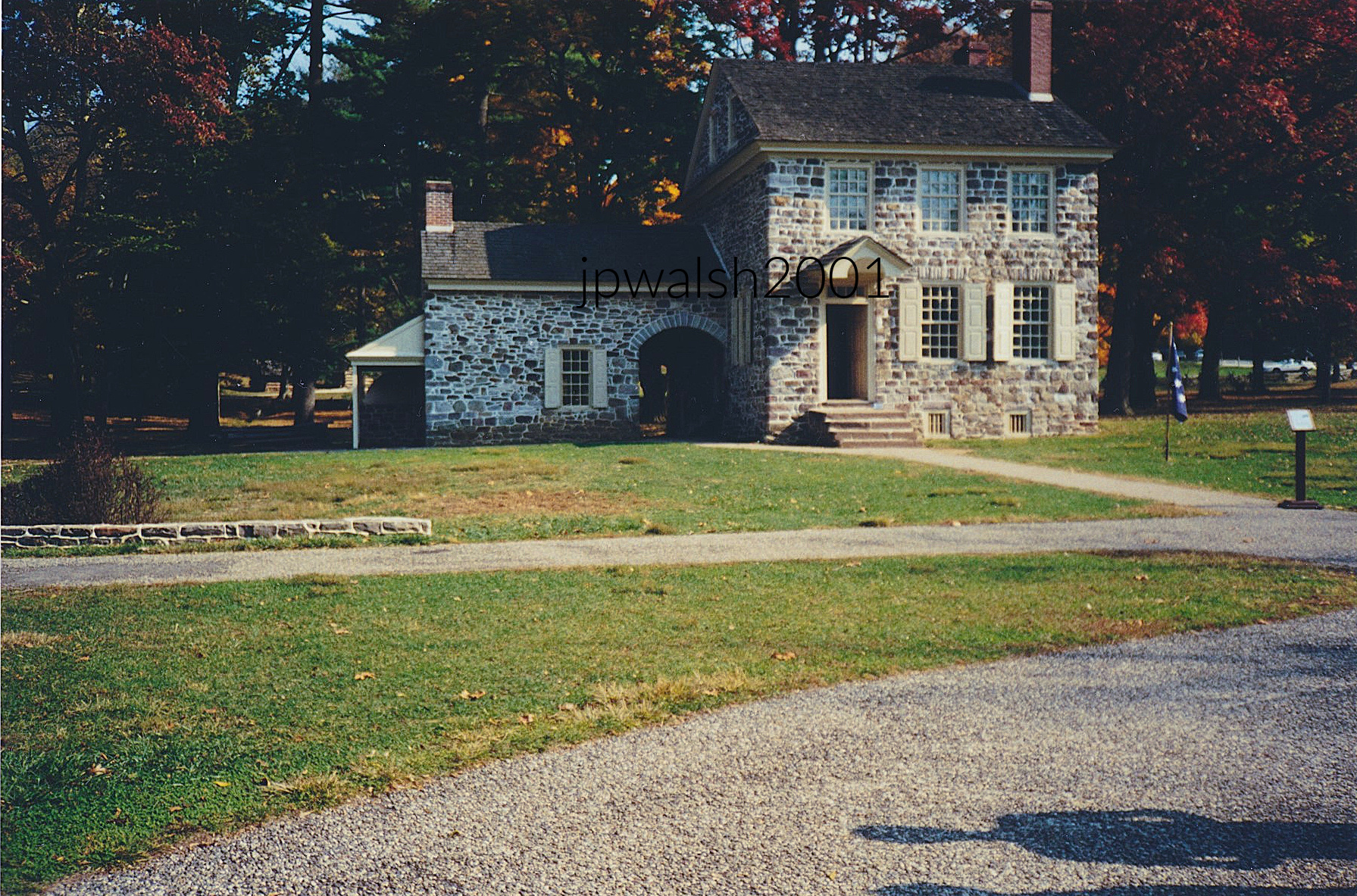
Washington’s Headquarters, Valley Forge Historical Park, Valley Forge, Pennsylvania. June 2001. Author’s photograph.
Human Cost of the Winter
Washington understood the consequences of these conditions: malnutrition, exposure, and disease would kill about 2,000 soldiers—more than fifteen percent of the army—over the course of the winter. He warned Congress that “unless some great and capital change suddenly takes place in that [supply] line, this Army must inevitably be reduced to one or other of these three things, Starve, dissolve, or disperse, in order to obtain subsistence in the best manner they can.”
Congressional Intervention and Administrative Reform
The crisis marked a low point for the Continental Army, but Washington’s blunt communications forced action. A congressional delegation visited Valley Forge in late January 1778, and in March Congress created the office of Quartermaster General, appointing Maj. Gen. Nathanael Greene to stabilize the army’s supply system—an administrative reform that proved vital to the war effort.
Washington’s First Inauguration, April 30, 1789: A Dramatized Moment in World History
This sequence is a dramatization of the first presidential inauguration from John Adams (2008). David Morse appears as Washington, while Paul Giamatti portrays the title character, anchoring the scene in the political and symbolic weight of the early republic.
George Washington was sworn in by New York Supreme Court Justice Robert Livingston (portrayed here by Alex Draper). Livingston was on the Committee of Five tasked with drafting the Declaration of Independence. Washington took the oath on Thursday, April 30, 1789, on the balcony of Federal Hall in New York City, which served as the nation’s capital at the time. It was a moment of global significance—the formal launch of the American presidency and the constitutional republic.
In 1790, the capital moved to Philadelphia, where Washington’s second inauguration took place on March 4, 1793, inside the Senate chamber of Congress Hall. Philadelphia remained the national capital until 1800, when the government relocated permanently to Washington, D.C.
Adams and Jefferson: A Final Chapter
Jefferson’s narrow victory in 1800 made Adams the first one‑term president and sent him home to Quincy, resentful after years of partisan attacks. Their correspondence resumed only in 1812, beginning with Adams’s New Year’s greeting. They wrote steadily until July 4, 1826—the day both men died, fifty years after the Declaration.
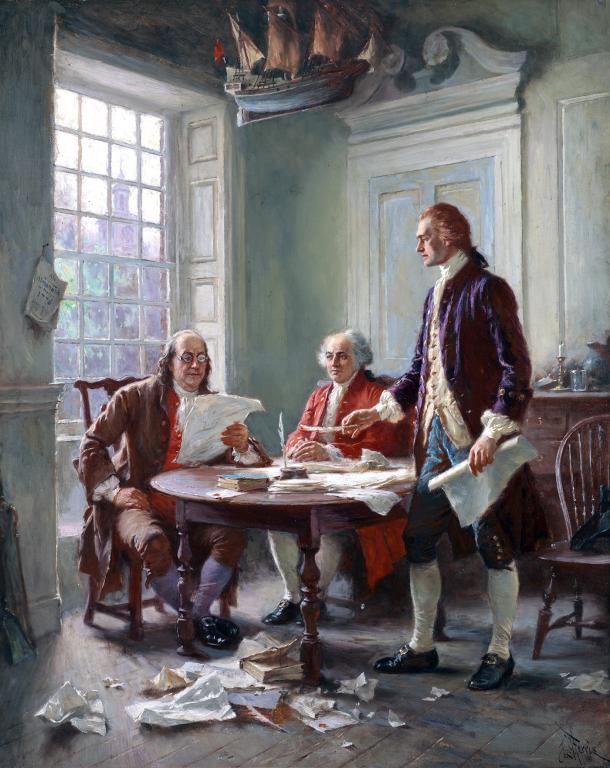
Writing the Declaration of Independence, 1776, J.L.G. Ferris, 1921, Virginia Museum of History & Culture, Richmond, Virginia. Part of the famous America Series, this iconic painting depicts Franklin, Adams and Jefferson congregated at a table inside Jefferson’s Philadelphia lodgings to carefully review and revise the draft he delivered to Congress on June 28, 1776. Public Domain.
This explanatory article may be periodically updated.