
Category Archives: 19th Century

Auvers, 1890: The Final Chapter That Secured Vincent van Gogh’s Place in Modern Art.

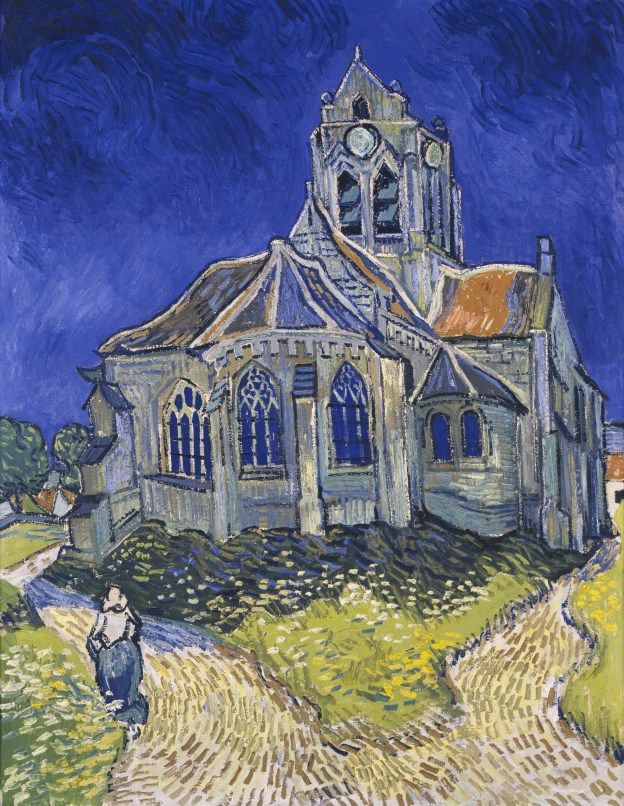
FEATURE Image: Vincent Van Gogh (1853-1890), L’église d’Auvers-sur-Oise, vue du chevet (“The Church at Auvers”), June 1890, oil on canvas, 94 cm x 74 cm (37 in x 29.1 in), Musée d’Orsay, Paris. Vincent Van Gogh (1853-1890), staying in Auvers starting on May 20, 1890, liked the small farm town about 20 miles west of Paris with its artistic pedigree (Corot, Daubigny, Cézanne) and spoke of settling into permanent quarters in the village after renting an attic room in a local café. About his experience at Auvers Van Gogh wrote: “[C]es toiles vous diront ce que je ne sais dire en paroles, ce que je vois de sain et de fortifiant dans la campagne” (“[T]hese canvases will tell you what I can’t say in words, what I consider healthy and fortifying about the countryside.”) During his more than two months stay in Auvers, the artist made more than 100 drawings and paintings of local landscapes, gardens, and village scenes such as its Catholic church. On the evening of July 27, 1890, Van Gogh had acquired a pistol and shot himself in the chest near the Auvers chateau. After languishing in pain for two days, he died on the morning of July 29, 1890. Vincent Van Gogh was 37 years old. Public Domain.

Auvers-sur-Oise was the decisive final chapter of Vincent van Gogh’s life and career, where in just over two months he created an extraordinary body of work that secured his enduring place in artistic modernism, even as his life moved toward its tragic conclusion. In May 2005 I made a pilgrimage to the town where I visited the places associated with the artist’s final days, including Ravoux Inn, Dr. Gachet’s house, the church at Auvers, the wheat fields, and his grave.

Vincent van Gogh, Garden in Auvers, July 1890, oil on canvas, 64×80 cm, private collection. Though Van Gogh died in July 1890 his modernist artistic influence forged deep ties with the European avant-garde art movement throughout the 1890’s and beyond. Public Domain.

By John P. Walsh

Auvers-sur-Oise: Van Gogh’s Final Home

In a peripatetic life, the last place where Vincent Van Gogh (1853-1890) lived was Auvers-sur-Oise, a small commune, a short distance northwest of Paris. Since Auvers was on a rail line in the orbit of Paris, Van Gogh moved to the small town with its farming community so he could live independently yet remain close to his art dealer younger brother Theo Van Gogh (1857-1891) who lived with his wife and family in the hustle and bustle of Paris. After leaving Saint-Paul Asylum, Saint-Rémy, where Van Gogh had admitted himself as a patient since May 1889, he traveled to the French capital in May 1890 where he visited Theo and Jo. He was then onwards to Auvers where, by arrangement of Theo, the artist was under the supervision of Dr. Paul Gachet (1828-1909), a mental health physician who was also an avid modern art collector and had his house, family and practice in the town.

After leaving the asylum at Saint-Rémy in May 1890, Van Gogh settled in Auvers-sur-Oise under the supervision of Dr. Paul Gachet while remaining close to his brother Theo in Paris.

Author at the graves of Vincent Van Gogh (1853-1890) and his brother, Paris art dealer Theo Van Gogh (1857-1891). They have been side by side in the Auvers cemetery in France since 1914. Photo: Author’s collection. May 2005.

During his stay from May to July 1890, Van Gogh produced more than 100 drawings and paintings, making it one of the most prolific periods of his career.

Life at the Ravoux Inn

Vincent arrived to Auvers on May 20, 1890 and stayed in the Saint-Aubin hotel until he moved into a rented attic room in a café of Arthur Gustave Ravoux and his wife, Adeline Louise Touillet, who charged him three and a half francs per night for room and board. Located in Place de la Mairie, a 5-minute walk from the train station, the artist’s daily schedule involved rising at dawn and going outside to draw and paint.
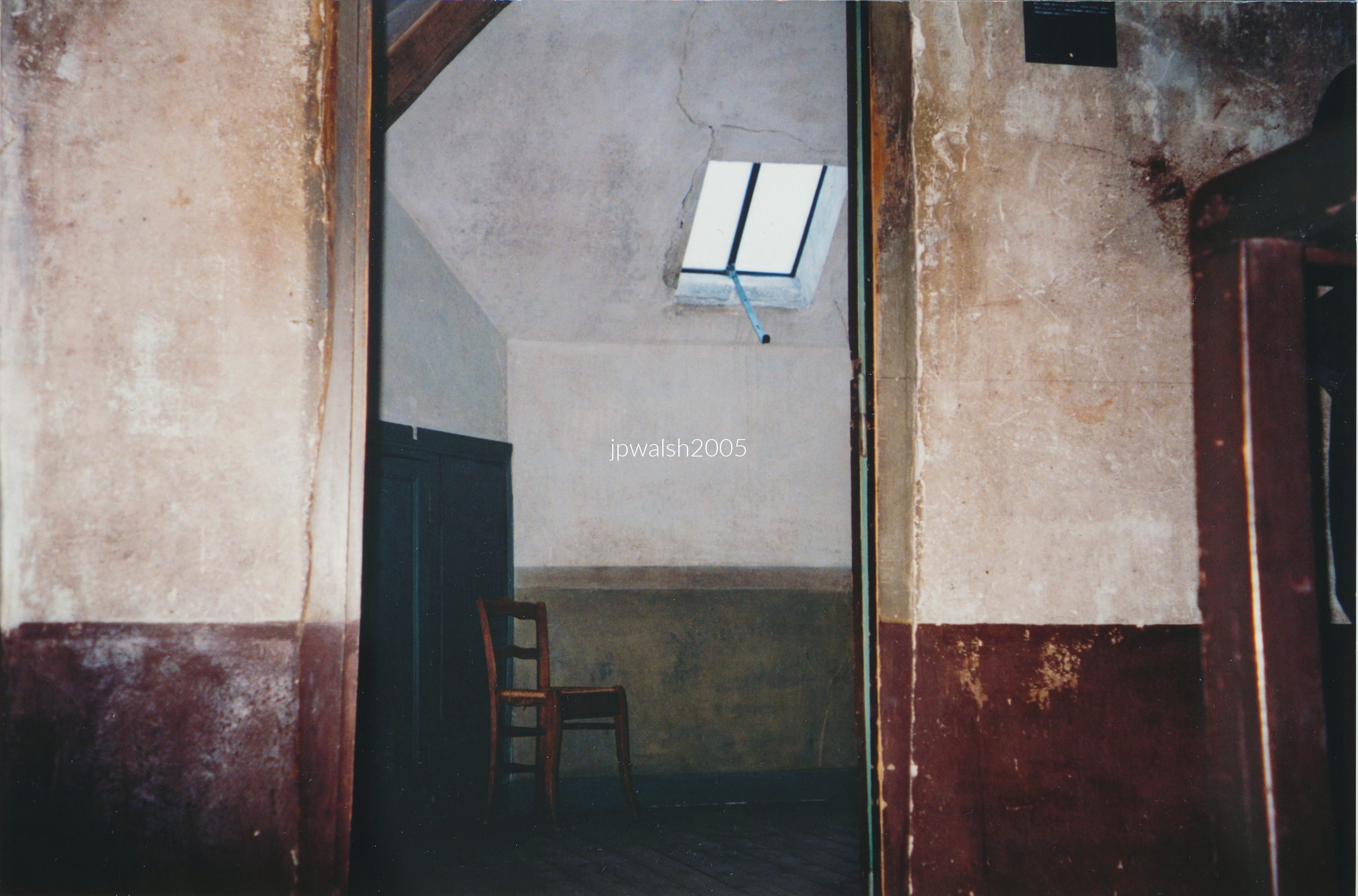
Entrance to Vincent Van Gogh’s rented room in Ravoux’s inn in Auvers. It was here that the artist lived for two months in the town. This is the same room is where Van Gogh returned after he shot himself on July 27, 1890, and died two days later here surrounded by family and friends. Author’s photograph, May 2005.

After roaming the town where he made friends of villagers, visited Dr. Gachet’s, and journeyed into nearby farm fields, Van Gogh returned to Ravoux’s café for lunch that was served at noon. In the afternoon he might sometimes work in the “painters’ room” at the inn or visit with other painters staying at the inn, such as compatriot Anton Matthias Hirschig (1867-1939) and Spanish painter Martinez de Valdivielse. These acquaintances proved more significant for history insofar as they provided eyewitness testimony of Van Gogh’s death and funeral. Following dinner at Ravoux’s, Van Gogh climbed the inn’s simple staircase to his single room in the center of the attic landing and retired at about nine in the evening.

Vincent Van Gogh, View of Vessenots near Auvers, May 1890, oil on canvas, 55×65 cm, Thyssen-Bornemisza, Madrid, Spain. Public Domain.
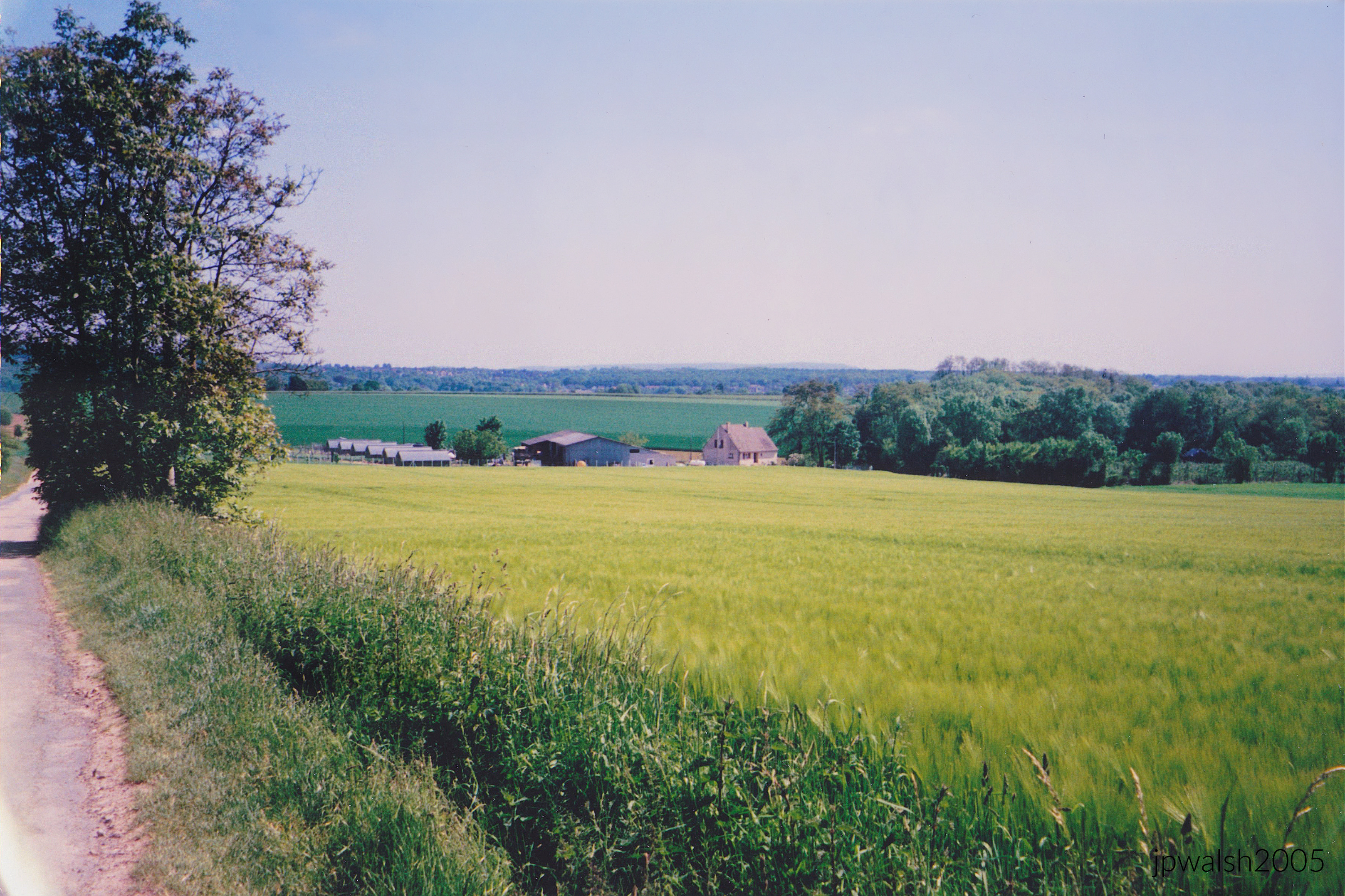
Fields of Auvers. Author’s photograph, May 2005.

Vincent Van Gogh, Daubigny’s Garden, midJune 1890, oil on canvas, 51 cm x 51.2 cm, Van Gogh Museum, Amsterdam. Other versions of Daubigny’s Garden are in the Hiroshima Museum of Art in Japan. see – https://www.hiroshima-museum.jp/en/collection/eu/vangogh.html – retrieved March 11, 2024) and the Van Gogh Museum in Amsterdam (see – https://www.vangoghmuseum.nl/en/collection/s0104V1962 – retrieved March 11, 2024. The square-format flat decorative painting, painted on a simple tea towel that was mounted to canvas, became Van Gogh’s first painted attempt of the garden. It acts as a modernist talisman reminiscent of Paul Sérusier’s 1888 cigar box painting and looks ahead to the decorative landscapes of the Nabis in the 1890’s and of Gustave Klimt (1862-1918) 15 years later. Public Domain.
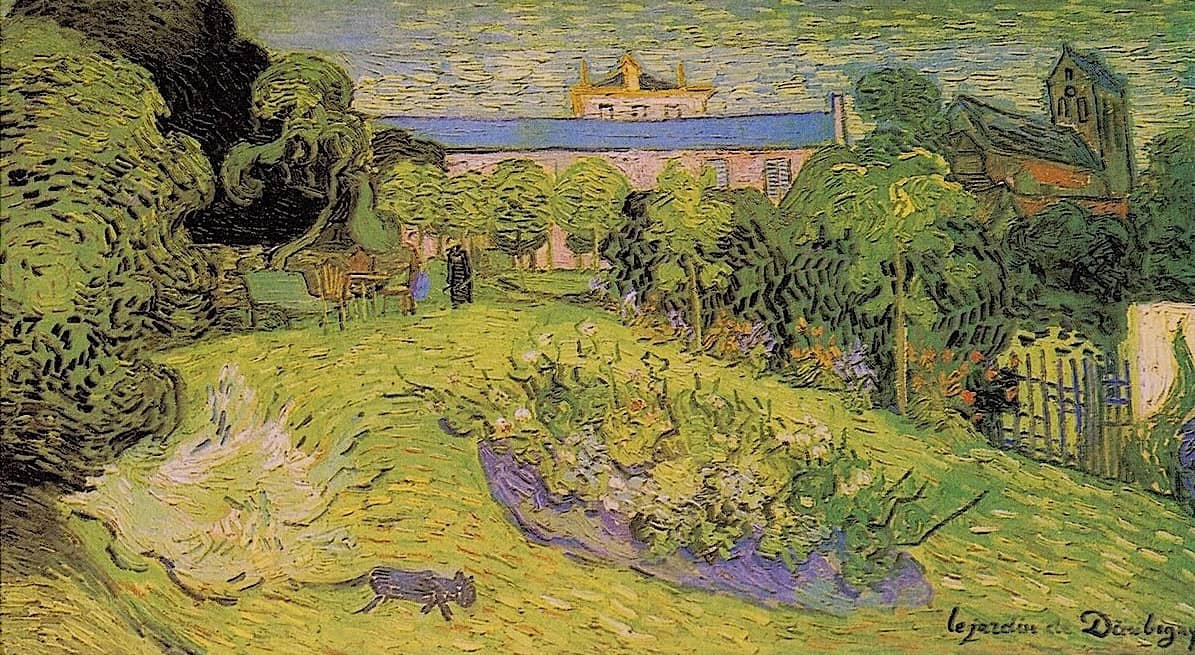
Vincent Van Gogh, Daubigny’s Garden, 1890, oil on canvas, 56 cm × 101 cm (22 in × 39.8 in), Kunstmuseum Basel, Basel, Switzerland. Van Gogh made three versions of the Auvers garden of Barbizon artist Charles-François Daubigny (1817-1878) between May and July 1890. Daubigny, who moved to Auvers in 1860. was a landscape artist who painted en plein aire. A short walk from the Ravoux inn, Daugigny’s widow still lived in the house in Auvers in 1890. For this painting Van Gogh stepped outdoors into Daubigny’s garden to look back towards the house (the Church of Auvers is distinctly drawn in the painting’s upper right corner). Van Gogh admired Daubigny since the 1870’s as he other Barbizon painters such as Jean-François Millet (1814-1875) and Camille Corot (1796-1875). see – https://www.vincentvangogh.org/garden-of-daubigny.jsp – retrieved March 11, 2024. Public Domain.

Van Gogh’s Auvers paintings reveal artistic innovations that anticipated later modernist movements and influenced future generations of artists.

Little has changed in appearance in Auvers from the time of Van Gogh’s stay in May-July 1890. Author’s photograph, May 2005.

Irises bloom along the side of a road in Auvers that leads to Dr. Gachet’s house. Author’s photograph, May 2005.
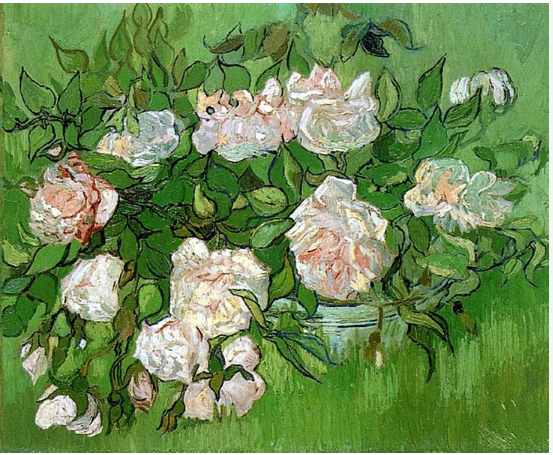
Vincent Van Gogh, Still Life Pink Roses, June 1890, oil on canvas, 32 x 40.5 cm, Ny Carlsberg Glyptotek, Copenhagen, Denmark. Public Domain.
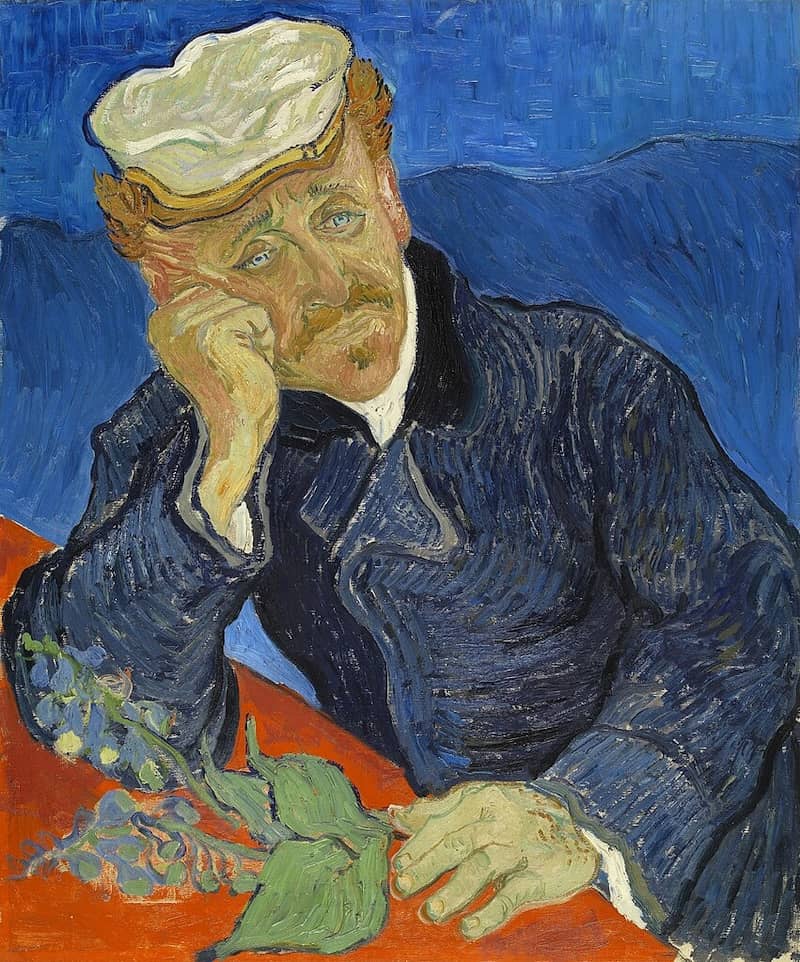
Van Gogh, Dr. Gachet (second version), June 1890, Musée d’Orsay, Paris. As a token of friendship, Van Gogh painted two authenticated versions of Dr. Gachet’s portrait in June 1890 at Auvers. Van Gogh came to Auvers because of the role Dr. Gachet played as the artist’s therapist. The well-regarded physician was an avid modern art collector and painter who had participated in art circles since the 1850’s with Gustave Courbet (1819-1877). Dr. Gachet was instrumental in having Paul Cézanne come to Auvers to paint in 1873. In anticipation of Vincent’s arrival from Saint-Rémy, it was Camille Pissarro (1830-1903) living in Pontoise who recommended Dr. Gachet to Theo Van Gogh. Vincent Van Gogh thought fondly of Dr. Gachet as a brother. When Dr. Gachet visited Theo in Paris in early July 1890, he told him he believed that Vincent was “completely recovered” and “that there need be no fears of a further attack” (quoted in Complete Paintings, p. 718). Van Gogh saw Dr. Gachet as another brand of eccentric and painted him in these portraits as a deep thinker who reflected a sensitive nature tending to melancholy. Public Domain.

Van Gogh, Portrait of Adeline Ravoux, June 1890, oil on canvas, 52x 52 cm, Cleveland Museum of Art. In their therapeutic conversations, Dr. Gachet in June 1890 encouraged Van Gogh to make portraits of local sitters in Auvers. Van Gogh had done portraits of Arlesiens in the “Studio of the South” in 1888 and many self-portraits. Adeline Ravoux was the 15-year-old daughter of Van Gogh’s Auvers innkeepers. About one month after this portrait was made, the girl with her parents witnessed Vincent’s return to the café after he shot himself. Later, in a memoir she wrote: “Vincent walked bent, holding his stomach, again exaggerating his habit of holding one shoulder higher than the other. Mother asked him: “M. Vincent, we were anxious, we are happy to see you to return; have you had a problem?” He replied in a suffering voice: “No, but I have…” He did not finish, crossed the hall, took the staircase and climbed to his bedroom.” see –  http://www.vggallery.com/misc/archives/a_ravoux.htm – retrieved March 11, 2024. Public Domain.
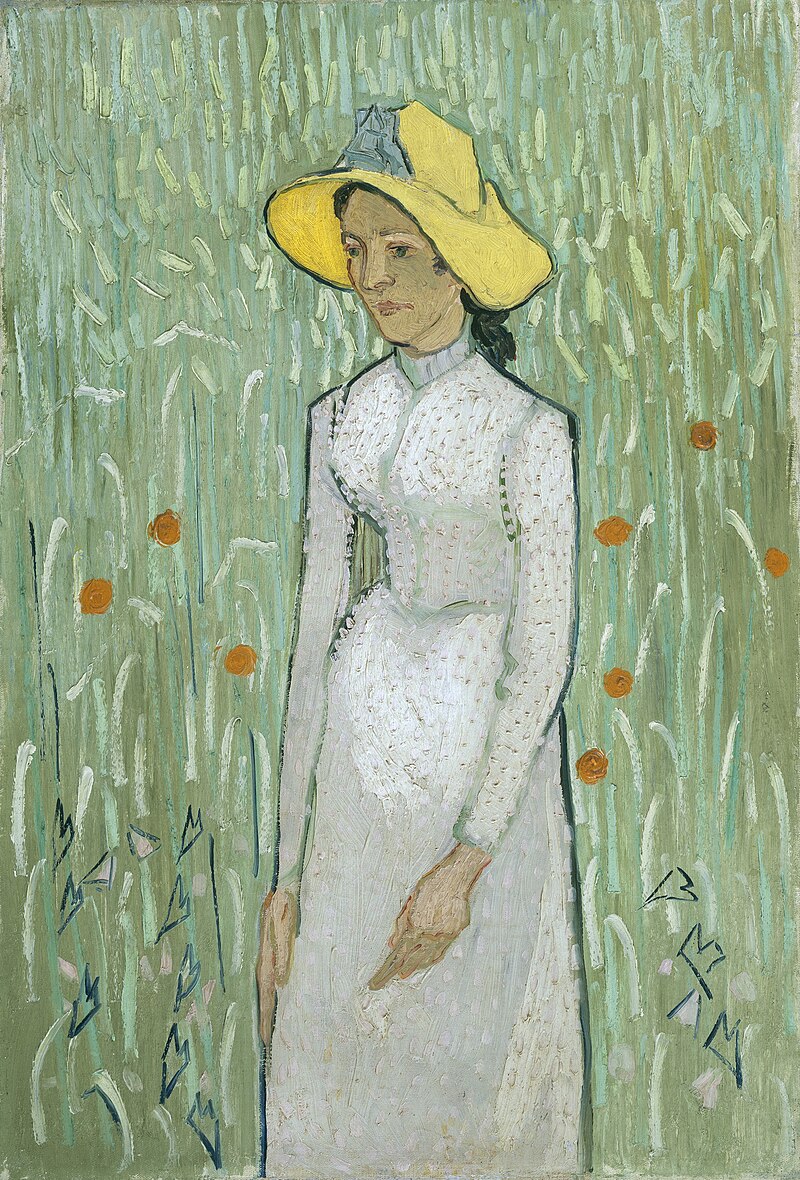
Van Gogh, Young Girl Standing Against Wheat, late June 1890, 66.7 x 45.8 cm (26 1/4 x 18 1/16 in.), National Gallery of Art, Washington, D.C. The painting’s lack of horizon creates a flat wall behind the sitter who appears in close proximity to the picture plane as she fills the pictorial space. Van Gogh shadowed her face under her hat and gave her a “distant, unfocused” gaze. All of these elements contribute to the portrait’s emotional distance. see – Painting the Difference: Sex and Spectator in Modern Art by Charles Harrison, University of Chicago Press, 2006. Public Domain.
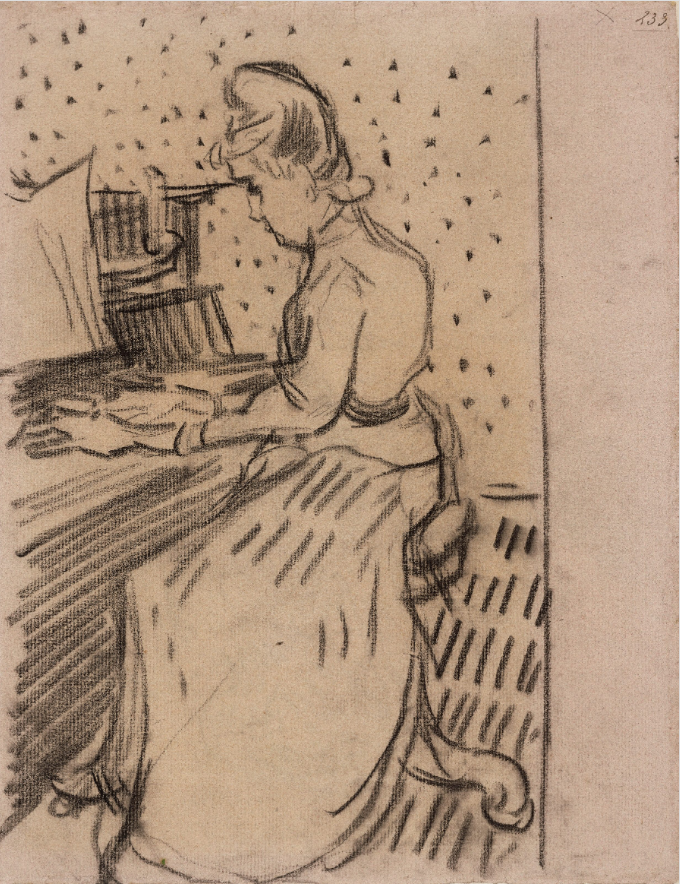
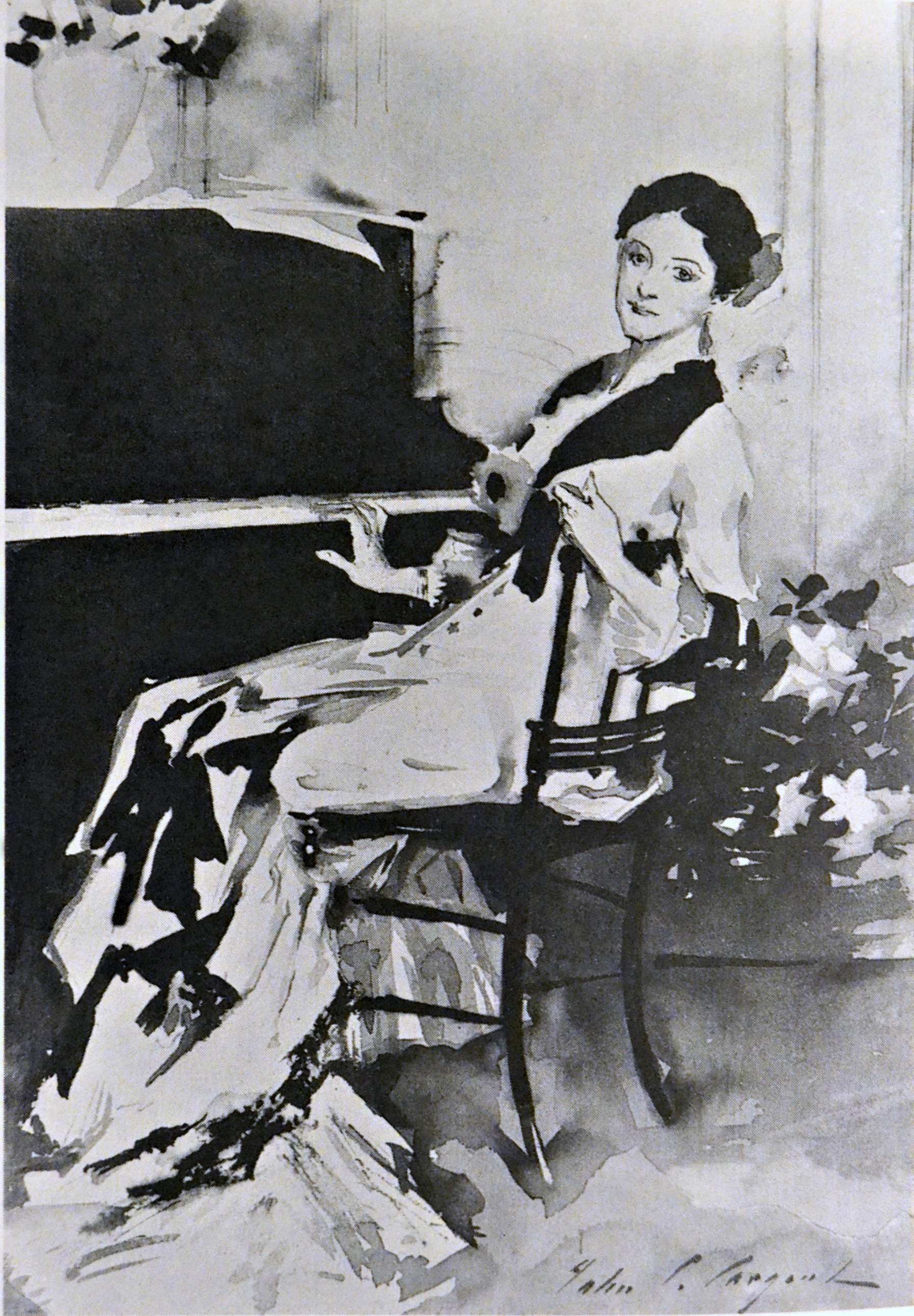
Van Gogh, Marguerite Gachet at the Piano, June 1890, chalk on paper, 30.5 cm x 23.8 cm, Van Gogh Museum, Amsterdam. Marguerite Gachet was the daughter of Dr. Gachet. In this sketch which resulted in a similarly composed painting, the sitter had recently turned 21 years old. For the painting that is today in the Kunstmuseum Basel, Van Gogh made two sketches in late June 1890. https://www.vangoghmuseum.nl/en/collection/d0427V1962r – retrieved March 11, 2024.  Public Domain.
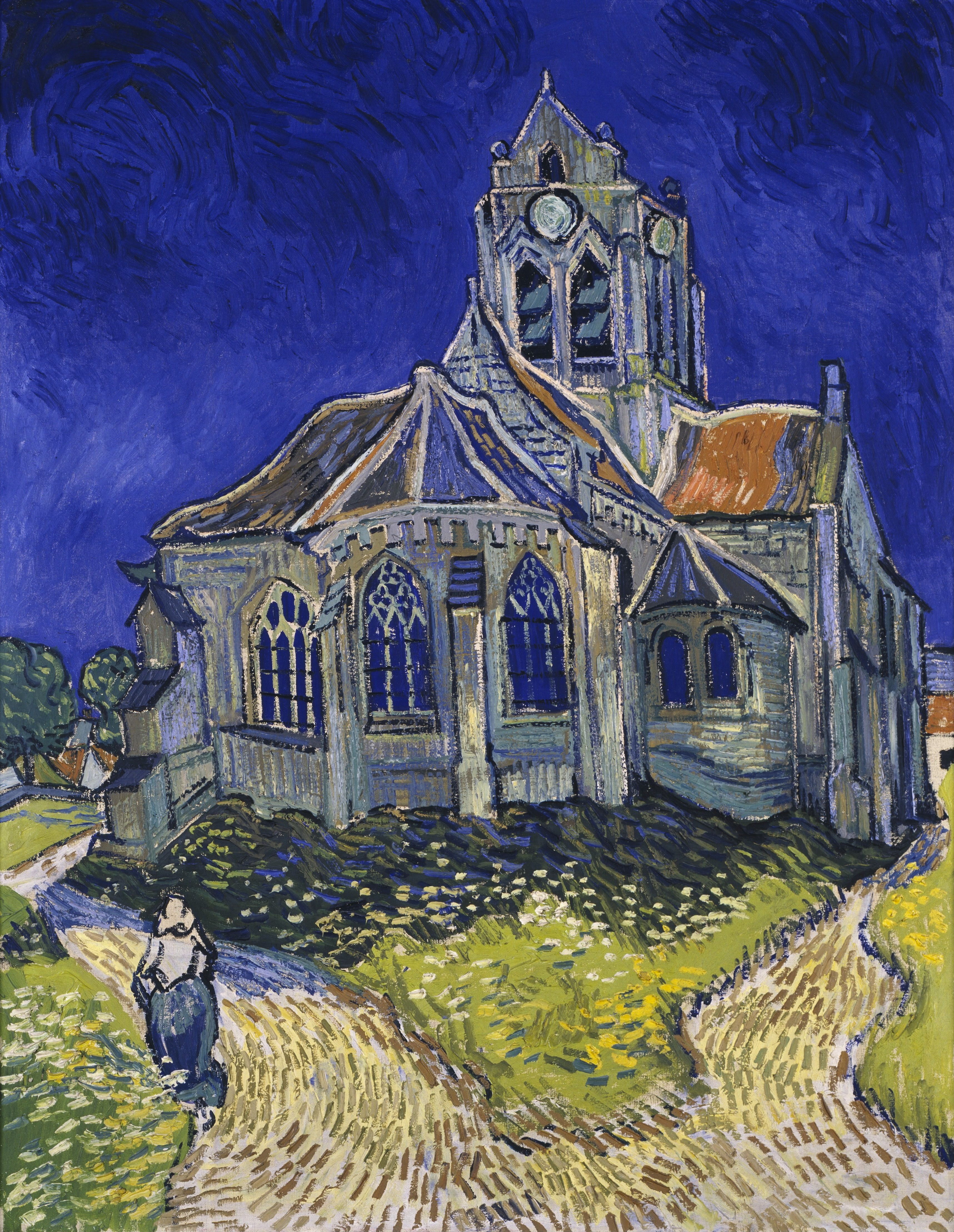
Van Gogh, L’église d’Auvers-sur-Oise, vue du chevet (“The Church at Auvers”), June 1890, oil on canvas, 94 cm x 74 cm (37 in x 29.1 in), Musée d’Orsay. Public Domain.

As in Van Gogh’s 1890 painting above, the church at Auvers (“Notre-Dame-de-l’Assomption”), situated in a bright midday sun, sits in deep shadow. Author’s photograph, May 2005.

An Extraordinary Final Burst of Creativity

Van Gogh proved quite productive in Auvers, painting several notable canvasses in and around the town and countryside, particularly landscapes and other outdoor subjects en plein aire. In these two months, the painter produced 74 paintings and 33 drawings, including the portraits of Dr. Gachet and Adeline Ravoux, The Church of Auvers, and Field of Wheat with Crows. In a letter of around July 10, 1890, Van Gogh wrote to Theo and Jo that he painted three large canvases at Auvers since visiting them in Paris on July 6, 1890. During that visit the artist also met with Henri Toulouse-Lautrec (1864-1901) and art critic Gabriel-Albert Aurier (1865-1892). In addition to Daubigny’s Garden, these large canvasses likely included Wheatfield with Crows and Wheatfields Thunderclouds (both Van Gogh Museum Amsterdam). Van Gogh described them as “immense stretches of wheatfields under turbulent skies…searching to express sadness [and] extreme loneliness” (“immenses étendues de blés sous des ciels troublés… chercher à exprimer de la tristesse, de la solitude extreme”). See – https://vangoghletters.org/vg/letters/let898/print.html – retrieved March 11, 2024.

Vincent Van Gogh, Sorrowing Old Man (“At Eternity’s Gate”), 1890, 80 cm × 64 cm (31.5 in × 21.2 in), oil on canvas, Kröller-Müller Museum, Otterlo, The Netherlands. The painting was completed at St. Rémy shortly before Van Gogh moved to Auvers-sur-Oise. 

Van Gogh, Wheatfield with Crows. July 1890, oil on canvas, 50.2 cm × 103 cm (19.8 in × 41 in), Van Gogh Museum, Amsterdam. Many have claimed this to be Van Gogh’s last painting.

At the wheatfield in Auvers where Van Gogh painted “Wheatfield with Crows,” one of his last paintings, in July 1890. Author’s photograph, May 2005.

Van Gogh, Wheatfield Thunderclouds, July 1890, oil on canvas, 50.4 cm × 101.3 cm (19.8 in × 39.9 in), Vincent Van Gogh Museum, Amsterdam.

Auvers fields. Author’s photograph, May 2005.

The Tragic Events of July 1890

On July 27, 1890, Vincent, as he did each day, went into the fields to paint. Though the artist appeared to be in good spirits, the artist shot himself later that day near the chateau after going for a walk towards evening. Though able to walk the 10 minutes back mortally wounded to Ravoux’s inn, he told them nothing upon entering the café. The Ravoux’s, sensing something was wrong, called for Mazery, the village doctor and Dr. Gachet. Though these doctors bandage the wound, Van Gogh’s condition is inoperable. In the hot attic room, Van Gogh suffered into the next day, when Theo was sent for. He arrived immediately on July 28 from Paris to be by his brother’s side. Van Gogh died the next morning of July 29, 1890.

Funeral in the Wheat Fields

This suicide sent ripples of shock through the village, as some townspeople had witnessed these events. During my visit to Auvers in May 2005, after exiting Van Gogh’s room where he died, I told the innkeeper that the story was sad (“c’est triste”). She countered, “C’est emouvante” (“It’s moving”). Vincent was buried the next day, July 30, 1890, in Auvers’ new graveyard. His funeral was attended by Theo, Dr. Gachet, the Ravoux’s, assorted villagers, and friends from Paris. These last included artists Emile Bernard (1868-1941), Charles Laval (1862-1894), and Lucien Pissarro (1863- 1944), Camille Pissarro’s son. Petit boulevard art dealer and art materials supplier Julien (Père) Tanguy (1825-1894) was also in attendance. Van Gogh’s casket was strewn with yellow dahlias and sunflowers and Dr. Gachet gave remarks as did Theo Van Gogh. Later, in a letter to his wife, Theo wrote about the proceedings: “[Vincent] was buried in a sunny spot among the cornfields, and the cemetery does not have that unpleasant character of Parisian cemeteries.” (see- Kort geluk, 1999, p. 281). The mortal remains of Van Gogh were transported to the cemetery by a rented hearse from the next town because Auvers’ Catholic priest would not allow the community’s hearse to be used. A proposed church service was also cancelled. The homiletics were left to Dr. Gachet who said: “Vincent was an honest man and a great artist, and there were only two things for him – humanity and art. Art mattered to Vincent Van Gogh more than anything else and he will live on through it” (quoted in Complete Paintings, p. 719).

Graves of Vincent and Theo Van Gogh, Auvers-sur-Oise, France. Author’s photograph, May 2005.

Eyewitness Accounts of Van Gogh’s Last Days

Three days after the funeral, Emile Bernard wrote to Aurier about “our dear friend Vincent.” Aurier had written in January 1890 about the intense fixity of Van Gogh’s art. The art critic conjectured that it may be the catalyst for change in French art. In his essay entitled Les Isolés: Vincent van Gogh published in Mercure de France, Aurier prophesied for an artist-savior figure: “A man must come, a Messiah, a sower of Truth, to rejuvenate our geriatric art, indeed perhaps the whole of our geriatric, feeble minded, industrial society” (quoted in Complete Paintings, p. 698). Van Gogh, aware of these statements, did not think he was Aurier’s man. On August 2, 1890 Emile Bernard wrote to Aurier: “On Sunday evening [Vincent] went out into the countryside near Auvers, placed his easel against a haystack and went behind the chateau and fired a revolver shot at himself. Under the violence of the impact (the bullet entered his body below the heart) he fell, but he got up again, and fell three times more, before he got back to the inn where he was staying (Ravoux, place de la Mairie) without telling anyone about his injury. He finally died on Monday evening, still smoking his pipe which he refused to let go of, explaining that his suicide had been absolutely deliberate and that he had done it in complete lucidity…. On the walls of the room where his body was laid out all his last canvases were hung making a sort of halo for him and the brilliance of the genius that radiated from them made this death even more painful for us artists who were there. The coffin was covered with a simple white cloth and surrounded with masses of flowers, the sunflowers that he loved so much, yellow dahlias, yellow flowers everywhere. It was, you will remember, his favorite color, the symbol of the light that he dreamed of as being in people’s hearts as well as in works of art….The sun was terribly hot outside. We climbed the hill outside Auvers talking about him, about the daring impulse he had given to art, of the great projects he was always thinking about, and of the good he had done to all of us. We reached the cemetery, a small new cemetery strewn with new tombstones. It is on the little hill above the fields that were ripe for harvest under the wide blue sky that he would still have loved…perhaps.Then he was lowered into the grave…Then we returned. Theodore Van Ghog [sic] was broken with grief; everyone who attended was very moved, some going off into the open country while others went back to the station…” see – https://www.webexhibits.org/vangogh/letter/21/etc-Bernard-Aurier.htm – retrieved March 11, 2024.

Van Gogh, Two Women Crossing the Fields, July 1890, oil on paper on canvas, Marion Koogler McNay Art Museum, San Antonio, Texas.

By contrast, Anton Hirschig, the Dutch artist who roomed next door to Van Gogh at Ravoux’s, wrote a letter much later, in 1911, to Albert Plasschaert (1874-1941) in which he recounted a more terrible scene following Van Gogh’s shooting himself. Hirschig wrote: “He lay in his attic room under a tin roof. It was terribly hot. It was August. He stayed there alone for some days. Perhaps only a few. Perhaps many. It seemed to me like a lot. At night he cried out, cried out loud. His bed stood just beside the partition of the other attic room where I slept: Isn’t there anyone willing to open me up! I don’t think there was anyone with him in the middle of the night and it was so hot. I don’t think I ever saw any other doctor like his friend the retired army doctor: It’s your own fault, what did you have to go kill yourself for? He didn’t have any instruments this doctor. He lay there until he died.”

The Beginning of a Legacy

Theo Van Gogh died in Holland on January 25, 1891, nearly 6 months to the day after Vincent’s death. Theo was buried in Holland but exhumed and reinterred next to his older brother Vincent’s grave in Auvers cemetery in 1914. While Vincent Van Gogh, the man, was never larger than life, as an artist he produced an explosion of life on paper and canvas. Van Gogh came to art late (30 years old in 1883) and produced incessantly for the next 7 years. His oeuvre was beautifully powerful, and none of it more remarkably for the future of modernism than that done in Auvers-sur-Oise in May to July 1890.

SOURCES –

Harrison, Charles. Painting the Difference: Sex and Spectator in Modern Art. Chicago: University of Chicago Press, 2006.

Musée d’Orsay. “Van Gogh à Auvers-sur-Oise: Les derniers mois.” Accessed March 8, 2024. https://www.musee-orsay.fr/fr/agenda/expositions/van-gogh-auvers-sur-oise.

Van Gogh Letters. “Bibliography.” Van Gogh Museum / Huygens Institute. Accessed March 8, 2024. https://vangoghletters.org/vg/bibliography.html.

Van Gogh Museum. “Collection.” Accessed March 10, 2024. https://www.vangoghmuseum.nl/nl?page=3263&collection=451〈=en.

Van Gogh Museum. “Collection Item d0427V1962r.” Accessed March 11, 2024. https://www.vangoghmuseum.nl/en/collection/d0427V1962r.

Van Gogh Route. “Van Gogh in Auvers-sur-Oise.” Accessed March 8, 2024. https://vangoghroute.com/france/auvers-sur-oise/.

Van Gogh Route. “Van Gogh in Cemetery.” Accessed March 8, 2024. https://vangoghroute.com/france/auvers-sur-oise/cemetery/.

Vincent van Gogh Gallery. “Archives: Adeline Ravoux.” Accessed March 11, 2024. http://www.vggallery.com/misc/archives/a_ravoux.htm.

Walther, Ingo F., and Rainer Metzger. Vincent Van Gogh: The Complete Paintings. Cologne: Benedikt Taschen, 1996.

WebExhibits. “Van Gogh’s Letters: Letter to Émile Bernard / G.-Albert Aurier.” Accessed March 8, 2024. https://www.webexhibits.org/vangogh/letter/21/etc-Bernard-Aurier.htm.

http://www.vincentvangogh.org. “Portrait of Dr. Gachet, 1890 by Vincent van Gogh.” Accessed March 10, 2024. https://www.vincentvangogh.org/portrait-of-dr-gachet.jsp.


Van Gogh, View of Auvers-sur-Oise, July 1890, oil on canvas, 34 x 42.1 cm (13 3/8 x 16 9/16 inches), Museum of Art, Rhode Island School of Design. See – https://risdmuseum.org/art-design/collection/view-auvers-sur-oise-35770?return=%2Fart-design%2Fcollection%3Fsearch_api_fulltext%3Dvan%2Bgogh%26op%3D#content__section–description–1567076 – retrieved March 11, 2024.

The Melody of Color and Symphony of Form: Albert Joseph Moore’s Art of Pure Beauty.

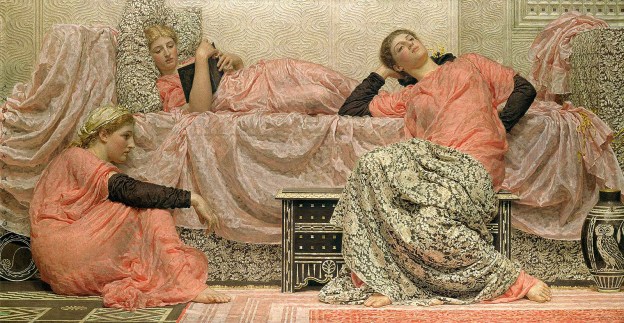
FEATURE image: Albert Joseph Moore (1841-1893), READING ALOUD, 1884, oil on canvas, 42.24 x 81 in., Glasgow Art Gallery & Museum.

The artist: Albert Joseph Moore (1841-1893).

Albert Joseph Moore was one of the leading figures of the British Aesthetic Movement, creating meticulously crafted paintings that placed beauty, harmony, color, form, and decoration above narrative or moral instruction. His idealized female figures inhabit timeless settings that blend classical inspiration with Victorian artistic experimentation, making him a unique voice in nineteenth-century British art.

Albert Moore: Life and Artistic Legacy

Albert Joseph Moore was born in 1841 into a family of artists in North Yorkshire in England. Moore through his own advanced aesthetic experiments in the milieu of theoretical and practical advancements of mid-to-late 19th century modern art in England and France – such as a systematic analysis of nature, mathematical plotting, and principles for quintessential combinations of color, line and form – created art that was, in formal terms, in its conception and execution, on the cutting edge of abstraction that would continue to develop and blossom into early 20th century Cubism. Moore’s art gained the respect of other progressive artists (Moore was called “a painter’s painter”), patrons and collectors, if not always the critics and contemporaries who viewed Moore’s work as merely decorative. Moore was actively collected in his lifetime and exhibited regularly in major venues such as the Royal Academy. Unmarried and of a lifelong independent disposition, Moore died in 1893 at 52 years old, having just completed his last monumentally ambitious artwork (“The Loves of the Winds and the Seasons,” Blackburn Museum and Art Gallery, posted below) a handful of days before. Several of Moore’s pictures are now in public collection throughout the UK, including the Tate and the British Museum in London. 

Moore became a major representative of the Aesthetic Movement, often summarized by the ideal of “art for art’s sake.”

Azaleas (1867-1868)

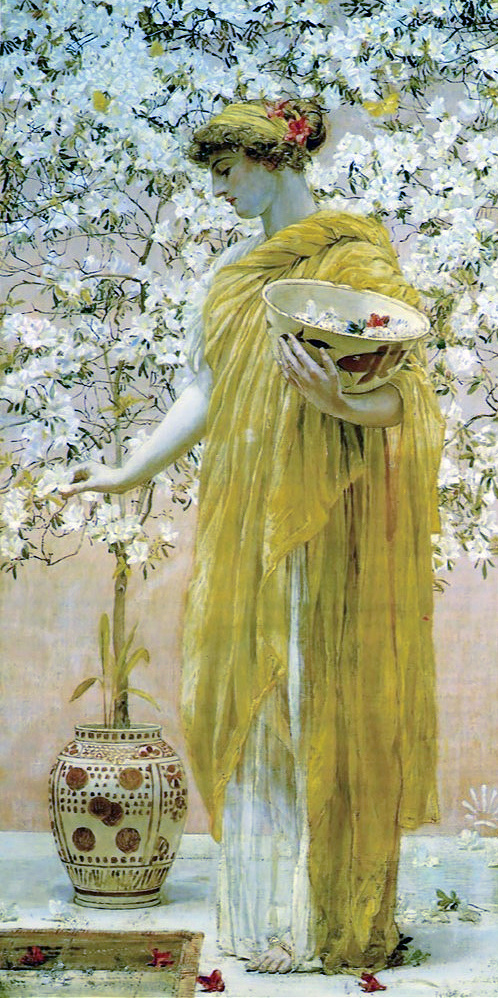
Albert Joseph Moore (1841-1893), AZALEAS, 1867, Hugh Lane Municipal Gallery of Modern Art, Dublin, Ireland.

Azaleas was a popular artwork by Albert Moore for its harmonies of color and the “Greek refinement” that the artist infused into his work. This bigger-than-life-size canvas called Azaleas was painted in 1867, exhibited in 1868 and demonstrates the artist’s ability to represent the human figure on a grand scale.

The featured works depict idealized women in dreamlike environments that feel both classical and modern. His paintings emphasize decorative harmony, color relationships, pattern, and graceful composition rather than storytelling.

Geometry and Preparation

The 26-year-old artist had some architectural design experience in theory and practice and used this in his preparatory process. This artwork incorporated ideal geometry along with typical academic methods.

Moore’s process followed, first, making studies of the nude figure and draped figure. Moore next made a larger-than-life-sized full-scale nude figure cartoon which, at this stage, was informed by geometric abstraction of the figure in a setting guided by, or through, the milieu of the object in the artist’s hands.

The geometric quality guided the composition rather than was externally imposed by the artist. Moore’s “system of line arrangement” sought the directions of the prominent lines of the composition so to plot parallels of them throughout the drawing resulting in a statuesque yet corporeally vivacious figure.

Nature, specifically the landscape, ultimately served as the inspiration for the manifestation of line parallels and optical balance rather than the mathematically ideal. Moore’s geometric construct and its interplay determined every element of the composition – from the position and placement of the figure to the location of accessories, such as wall hangings, distribution of drapery folds, and architectural elements. The canvas’s shape and size also were ultimately determined by this idiosyncratic geometric arrangement.

Traces of Moore’s preparatory practice are in evidence in Azaleas’ full size nude cartoon with its vestiges of diagonal and horizontal lines through the midsection of the figure and near to her feet. Using these lines in the nude drawing it is apparent that Moore experimented with the placement of the figure’s head, the extended hand, and a raised heel which was ultimately hidden under opaque drapery. Moore used a live model for his figure.

Technique and Execution

The final nude cartoon was transferred to the canvas and this outline was built up with oil colors. A drapery cartoon was then transferred on top of the transferred, built-up nude figure cartoon. Using this method Moore rendered greater transparency of the fabric since the underlying nude cartoon showed through faintly. This painstaking preparation was masked by Moore’s fresh and free style of painting. For instance, the drape folds of the left shoulder are painted in long, fluent, and elegant strokes while the azaleas are rendered in energetic strokes. Moore’s objective was for the final painting to look like an impromptu and expressive sketch when, in fact, it was carefully planned and executed.

About painting Moore taught his students to think long about it but execute with quickness and determination. This technique aided in transforming oil painting into the manner of Graeco-Roman fresco in that Moore’s working method allowed for painting only what could be finished in a day.

Japonisme and Color Harmony

Moore’s careful planning, rapid execution, and brush technique also suggested the influence of Japonisme. Asian influences in Azaleas included the carp bowl held in the women’s arm (an actual studio prop) and the geometric pattern in the azalea pot whose symmetry Moore saw as part of both Greek and Japanese art. To integrate and transition the predominantly yellow figure in the predominantly white background Moore used a device taken from Japanese art of painting flitting butterflies around the azalea bush. Moore also painted russet blossoms in the woman’s hair and bowl and on the floor that further unites the monumental composition.

Moore’s observation of Japanese prints also likely influenced the English artist’s color scheme in Azaleas. This is identifiable in its limited schematic of hues. The color placement, however, was also subject to the geometric practices in the whole composition.

Critical Reception

When Azaleas was exhibited at the Royal Academy in 1868 it was consigned to an out of the way place on the wall of its North Room. It was observed that Moore’s canvas looked more like a tapestry than an oil painting. In this way, Moore anticipated James McNeill Whistler’s comment about color in that it should appear “embroidered” on the canvas, in the same way a thread is embroidered on fabric. Whistler attributed this color quality to Japanese art in that those artists looked for repetition in color application and not contrast.

Architecture critics in 1868 noticed and especially admired Moore’s Azaleas. Its systematic repetitions and geometric construction were labeled the only “decorative” painting in the 1868 English exhibition. Art critics were less generous. Straining with opera glasses just to see the work they recognized its beauty and Moore’s talent but called its design and execution eccentric. Others turned up their critical nose to the new decorative work as “curious” and little more than a luxurious indulgence of art for art’s sake. Art critics were unhappy with the paintings’ colors as they found they lacked the requisite black that marked contemporary French art and, instead, opted for a quiet and delicate dreamscape.

English writer William Michael Rossetti (1829-1919) declared Azaleas one of the most important English pictures of 1868 and decried those looking to judge it by way of actual historical pictures from Greek antiquity. With Algernon Swinburne (1837-1909), Rossetti compared Moore’s artwork to another painting in the 1868 exhibition: “The Wife of Pygmalion, A Translation from the Greek” by the older George Frederic Watts (1817-1904). In that work Watts sought to create a painterly equivalent of classical sculpture. William Gladstone (1809-1898) wanted to purchase Watts’ picture after seeing it at the Academy in 1868. In a letter to Gladstone in May 1868 Watts informed Gladstone that it had been “claimed” but invited Gladstone to visit him in his studio to see the cast of the fragmentary Greek original from which the painting was derived.

Swinburne saw the poetry and musicality of Moore’s artwork .While most art critics snubbed the painting (and by extension the painter) for its art for art’s sake qualities, Swinburne praised them. Of Azaleas, Swinburne wrote: “The melody of color, the symphony of form is complete: one more beautiful thing is achieved, one more delight is born into the world; and its meaning is beauty; and its reason for being is to be.”

Sea-gulls (1871)

Albert Joseph Moore (1841-1893), SEA-GULLS, 1870/71, oil on canvas, 27 x 61 inches (68.5 x 154.8 cm), Williamson Art Gallery & Museum, Birkenhead, UK.

The Whistler Controversy

Sea-gulls was accepted for the 1871 Royal Academy exhibition. It was the third painting for Albert Moore to exhibit at the Royal Academy. Moore was absorbed in painting Sea-gulls, a major work, for British shipping magnate Frederic Leyland (1831-1892) and this work occupied him up to the Royal Academy Exhibition that spring.

Its creation by the 36-year-old Moore was not without headaches owing to controversy. Moore’s friend and admirer, American ex-patriate artist, James Abbott McNeill Whistler (1834-1903), had learned of Moore’s preliminary work on the painting through Leyland, a major art collector and the artists’ mutual friend.

Whistler expressed concern that Moore’s work perhaps overlapped adversely with some of Whistler’s own preliminary sketches for a painting. Whistler saw a pair of sketches Moore had sent to Leyland as potential commissions. Whistler felt that Moore’s sketch may have been influenced by seeing one of Whistler’s sketches. Whistler feared that if Moore’s painting was exhibited first, it would reflect badly on Whistler as an imitator when in fact the artwork Whistler was working on ante-dated Moore’s conceptions. This was a mortifying prospect for Whistler who prided himself on originality.

Whistler’s anxiety may have also stemmed from the fact that with Sea-gulls, Moore would fulfill his second commission for Leyland, while Whistler who introduced them had yet to complete a picture for Leyland that had been commissioned in 1867.

To ease Whistler’s fears, the American artist proposed that Moore accompany another mutual friend, architect William Nesfield (1835-1888), to Whistler’s studio in Chelsea to inspect his older original sketch that Moore had seen.

Nesfield, acting as mediator, concluded in September 1870 that the recent work of the two artists shared themes, but each maintained their own artistic originality. The crisis was averted and led to Moore exhibiting Sea-gulls.

Completion and Artistic Development

During this crisis and shortly thereafter, Moore did not finish to his satisfaction his painting when it was time for its exhibition in April 1871. A major effort required to complete Sea-gulls had deeply undermined Moore’s health. After the exhibition the painting was returned to the artist, but he could not yet immediately set to work on it to completion. Months later it was finished and sold to Leyland.

Nature, Movement, and Surface Effects

In Sea-gulls Moore introduced obvious analogies between the liquid patterns of the sea and the rippling and splashing motion of the figure’s hair and drapery. Moore’s intention was to discern patterns inherent in nature. The drawings also suggest that he exaggerated the effect of air currents by employing the revolving fans that were simultaneously in use for Sea-gulls and another painting titled Shells.

Much of Moore’s work to complete the painting after the exhibition revolved around redressing the picture surface. Moore had been experimenting for some time with the surface quality of his paintings. In the early 1870s, Moore’s technique had developed to combine transparent and opaque fabrics that created unusual layering effects. Following the 1871 exhibition, Moore seemed to apply this technique in Sea-gulls that involved unusually thick paint layers.

Grosvenor Gallery and Lasting Friendship with Whistler

Much later, during the winter of 1880, Sir Coutts Lindsay (1824-1913) – the British artist and watercolorist founded Grosvenor Gallery on Bond Street as an alternative exhibition space to the Royal Academy which became a venue for avant-garde artists, particularly those associated with art for art’s sake – mounted a show on the subject of artists’ working sketches. Moore contributed the preparatory studies for Sea-gulls to the show that included his sketches of hands, heads, drapery, plants and flowers, as well as the painting’s cartoon.

Although biographers of Whistler and Moore have attached no importance to their friendship, particularly after the September 1870 controversy over Sea-gulls which they claim ended it, the artists in fact remained on intimate terms unbroken until Moore’s death in 1893. In the later 1870s they again were thrust together in a contentious situation but this time on the same side of sorts. When Whistler became involved in libel proceedings against Ruskin in later 1878 Albert Moore was the only artist who the American ex-patriate artist could rely on to both publicly attend the proceedings and actually give evidence on Whistler’s behalf. 

Albert Joseph Moore was highly admired by James McNeill Whistler, who regarded him as his favorite contemporary British artist.

Reading Aloud (1884)

Albert Joseph Moore (1841-1893), READING ALOUD, 1884, oil on canvas, 42.24 x 81 in., Glasgow Art Gallery & Museum.

Conception and Working Method

Reading Aloud was one of three large-format paintings Albert Moore completed in the 1880s. Completed in 1884, Moore had been working on Reading Aloud for years – at least since 1881. Moore had drawn a chalk sketch of the geometrically designed composition over which the artist would lay a piece of translucent glass. By painting directly on the glass, he could experiment with colors without redrawing the picture. He then could transfer the trial color experiment on glass (as well as a final drawing) onto tracing paper by which the final artwork was then made by pinning the tracing paper to the canvas. The artist then painted the composition directly to the canvas, section by section, working as he painted to unify color scheme and, as figural poses and other details are different in the final artwork than surviving preparatory materials, drawing. It was meticulous organizing and harmonizing creative work that helps to explain why Moore labored for years on the almost 7×4 foot oil on canvas.

Works such as Reading Aloud demonstrate his pursuit of beauty through carefully controlled arrangements of figures, fabrics, colors, and space.

Composition and Symbolism

While these three reclining figures are static their contrasting drapery folds whether they are swirls, zigzags or sweeping diagonals – with the sofa’s swags to unite them – enliven the picture. As classicism revivalists are noted for their mere realism and moralistic anecdote, Moore’s evocation of classicism, though containing allegorical qualities, belies a modernity by way of its abstract combination of line and form in the depiction of languid female figures in a neutral setting. The black-and-white owl vase that Moore included in the lower right corner of the painting had been absent from previous studies (originally it was a seated cat) and provides a narrative sign. It connotes the quality of wisdom as well as perhaps the goddess Athena with which the owl is associated so to apply it to the various states of the readers though the overall picture with its fascination with repose is more subtly mysterious than anecdotal. Yet the classicism/modernity enigma continues as the honey bee which Moore paints on the face of the owl vase was the symbol used by the picture’s purchaser, pig iron industrialist William Connal (1819-1898), for himself.

Moore, Albert Joseph; William Connal; York Museums Trust; http://www.artuk.org/artworks/william-connal-8009

William Connal and the Painting’s Patronage

After his wife of 25 years Emelia Jessie (Campbell) Connal died in 1877, 56-year-old industrialist William Connal faced life alone at Solsgirth, his Scottish country manor. Connal turned his attention to the arts and, in addition to Moore, became an avid collector of contemporary art by such painters as Edward Burne Jones (1833-1898), Edward Poynter (1836-1919), Frederick Sandys (1829-1904), Roddam Spencer Stanhope (1829-1908), Fernand Knopff (1858-1921) and Adolphe Monticelli (1824-1886) along with the Old Masters. Connal owned Symphony in Silver and Grey by American artist James McNeill Whistler (1834-1903) who greatly admired Moore. In 1883, Connal invited Moore to stay at Solsgirth House in Perthshire for a month allowing the artist to recuperate after a serious illness. It was during this stay that Connal commissioned Moore to paint his portrait that shows him wearing a honeybee brooch, the emblem that Connal used on his personal items (Connal’s portrait today is in York Art Gallery).

Geometry, Abstraction, and Critical Response

Moore’s pictorial methodology which he continued to develop over his artistic career is in evidence in Reading Aloud. Moore works out and unifies various and moving parts depicting a scene’s animating personality based in psychology with its physical forms that are mathematically contrived by way of lines and curves and, ultimately, color and texture, and whose impact on the viewer of the completed artwork is allowed to be emotional rather than cerebral. In Reading Aloud Moore constructed the image based on two pairs of diagonals that intersect into a pattern. Though the geometric system is visually subdued, it is evident in the figure on the right whose arms coincide with a set of diagonals. It is obvious also in the picture’s overall use of contrasting bold colors – the fabrics’ pinks and creams are integrated to, though angularly distinct from, the charcoal greys of the covered limbs and book cover. The edges of the book cover also coincide with some of the complex design of diagonal lines whose subliminal quality is an intrinsic expression of the psychic nature of the artwork. This angularity based on diagonals was a deliberate strategy for Moore when he painted the final artwork. There is also the horizontal lines component in the painting manifested in the outstretched arms of the crouching figure at left and the table and vase. Moore’s design strategies were innovative in 1884 startling contemporary viewers approaching to what Cubism would accomplish 25 years later. Critics when viewing Reading Aloud, being neither particularly understanding nor sympathetic to Moore’s methods or intentions, praised the picture’s overall gracefulness but impugned his drawing skills and identified the painting as mostly static decoration. Yet the static figures form part of a complex array of abstract and naturalistic patterns that fill every inch of canvas. Reading Aloud is a testament to the artist’s ability to translate such natural phenomena into a stylized form. Most prominent among them is a fabric effect found in other of Moore’s paintings of the period, in which white lace is layered over cloth of a darker color. Reading aloud was exhibited at the Royal Academy where, starting in 1883, Moore chose to exhibit annually.

The Loves of the Winds and the Summer (1893)

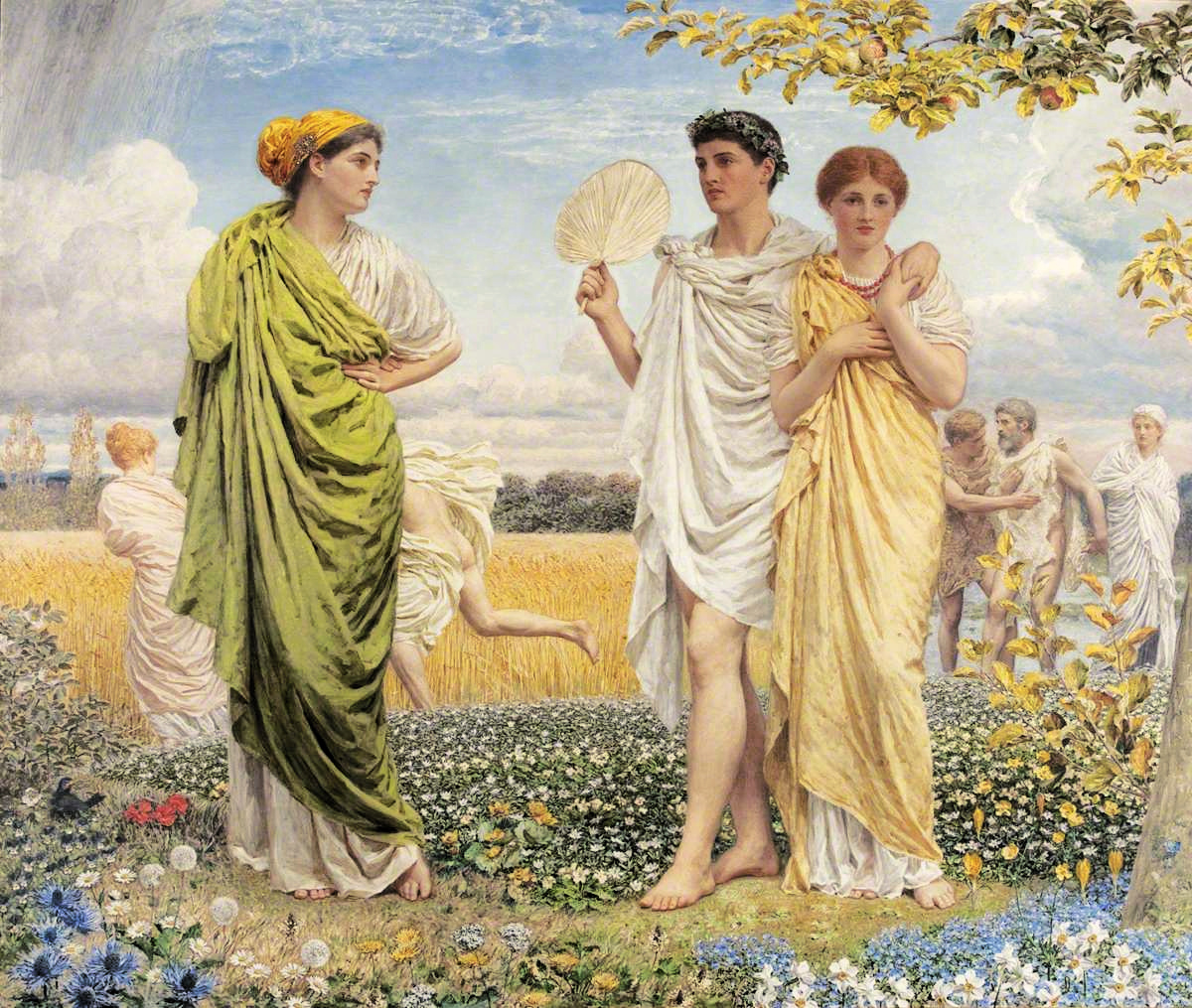
Albert Joseph Moore (1841-1893), The Loves of the Winds and the Seasons, 1893, oil on canvas, Blackburn Museum and Art Gallery, Blackburn, UK.

Moore’s Final Masterpiece

The Loves of the Winds and the Summer was English artist Albert Moore’s final and largest artwork of his career. It is 6 feet tall and 7 feet wide and is the jewel in the crown of the Blackburn Museum and Art Gallery near Manchester, England. It is the result of Moore’s study of the psychology of his subject matter, that of love. Love begins to manifest formally for Moore by the expression of soft bodily postures, changing and harmonious curves, and piercing gazes expressed in deep coral colors. The male figure of the Wind is flanked by the spurned female figure of Summer to the left and the embraced female figure of Autumn to the right. Moore was so enveloped in his amorous themes that while working on this picture he was writing poetry about what the human face was like when in love – and it is found in his picture. The Love of the Winds and the Seasons is Moore’s fullest expression of animating personality united to depicted physical forms that are first lines, curves and color, with the result being an emotional impact on the viewer who encounters the artwork.

Moore drew inspiration from ancient Greek sculpture and classical forms but was not attempting archaeological reconstruction.

Art in the Face of Terminal Illness

This exquisite artistic sensitivity by Moore is made more remarkable since the artist was dying in 1893. In the company of his young and attractive live models in his new capacious art studio, Moore worked day after day on this work. Moore had cancer (a tumor on his thigh) and had submitted to three operations to keep ahead of it. When his doctors told him they could operate no more, and that the cancer continued to spread throughout his body, Moore was resigned to his situation. He is reported to have said: “Well, there’s an end of it.” In the limited time left to him Moore intended to finish his painting of love, The Loves of the Winds and the Seasons. The artist did not want to lose any time. His legs had swollen to twice their size and had to be drained. In acute pain he worked around the clock for the next six months. His friends thought the intense work as well as the cancer was killing Moore but as the painting progressed to completion, they observed that the artist’s personal tranquility and happiness became apparent.

Geometry, Design, and Creative Process

The project was monumental – numerous preparatory studies, drapery studies, full scale and life-sized cartoons (i.e., 4’ 9” tall by 1’4” wide for Autumn) , nude studies – all technically meticulous and versatile- and that underwent the artist’s elaborate and idiosyncratic geometric platting system that he began in the late 1870s. Moore was the consummate auteur that slightly older American ex-patriate painter James Abbott McNeill Whistler (1834-1904) most admired in England. Moore conceived his paintings from start to finish – and The Loves of the Winds and the Seasons was at once its pinnacle and completion. Moore, as Whistler aspired to be, was sole master of his work. In 1893 Moore now expanded this mathematical process to amalgamate his diagonals with horizontals so that his creative process could not suffer the critique that Ruskin hurled at Whistler of “ask(ing) 200 guineas for flinging a pot of paint in the public’s face.” The painting was a commission for the Australian mine-owner George McCulloch (1848-1907). Moore’s calculations included various adjustments of the models’ natural poses to submit to the mathematical formulas on the canvas. This formal submission of subjects to linear construction extended to each detail in the entire composition, such as the flowers for which also study drawings were made. Within these design rigidities, the preparatory drawings of the live models and subjects were transferred to the artwork with little idealization though slight but important adjustments were made, such as to Summer’s hairstyle. Knowing his own time was short, Moore made his cartoons in color so that his transfer to the canvas was as efficient as possible as he painted the final artwork. Critics have observed that despite the intense planning and preparation, the final artwork is executed unevenly – parts are meticulous and vigorous, mostly in the foreground, while others in the background are loose and crude. To what degree this is the artist’s intention or the result of his declining health, is a matter for speculation. During the artistic process the terminally ill artist isolated himself mostly. His handful of visitors remarked that the artist was cheerful, cracked jokes, told funny stories, and smoked his pipe. These select parties knew, however, that their social calls were in the context of final good-byes. In those last days and months of Moore’s life, the artist’s mind, by evidence of the art from his past that he referenced in 1893, stretched back to an earlier career which shared long-held important aspects with The Loves of the Winds and the Summer.

Poetry and Meaning

For his last artwork. Albert Moore glossed the picture’s narrative in verses he wrote to accompany it:

Lo! fickle Zephyr chaseth wayward Spring,
It is a merry race;
Flowers laugh to birds that sing,
Yet frequent tears shall cloud her comely face.
The South Wind shall with blushing Autumn mate,
Contented with her lot;
Summer sigheth – such her fate
She and her burning kisses are forgot.
Two lovers rough for shudd’ring Winter strive,
Beneath a shroud of snow;
Heaven haply shall contrive
Their violence she may not further know.

Legacy and Death

Through its figural and intellectual prism of ancient classical mythology, Moore worked in his career to update the complex equation of the natural world’s varying and transitory seasons to human life’s copious physical, emotional, and spiritual expressions and contradictions. With their immersion in Moore’s modern art, the painter achieved a graciously-contrived visual dramatic interplay of nature and humanity, ancient and present-day, whose quest is eternal in time and space.

Albert Joseph Moore passed away in the middle of the night on September 25, 1893. He died 9 days after finishing his last painting, The Loves of the Winds and the Summer. Moore was 52 years old.

Albert Joseph Moore’s art transformed Victorian classicism into a sophisticated decorative vision that influenced later developments in modern art and design.

SOURCES: ALBERT MOORE, Robyn Asleson, Phaidon, 2000, pgs. 70, 97-100, 104, 108. 164, 166-168, 177, 179, 185, 199-202; https://houseandheritage.org/2017/05/19/solsgirth-house/ – retrieved September 5, 2023.

“King of the Skies!”: Eugène Boudin, Monet’s Mentor, and the Origins of French Impressionism.

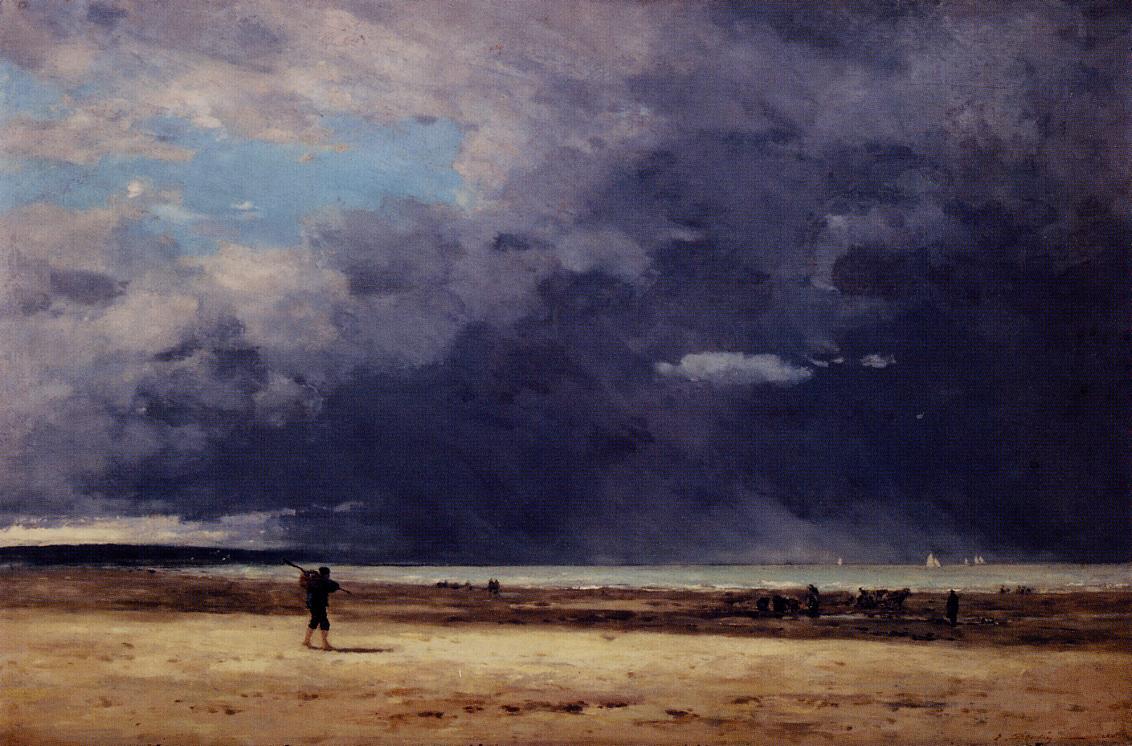
FEATURE image: Eugène Boudin, The Beach at Villerville, 1864, Oil on canvas, 18 × 30 1/16 in. (45.7 × 76.4 cm), National Gallery of Art, Washington, D.C.

Eugène Boudin was far more than a painter of Normandy beaches. He was a pioneering observer of light, atmosphere, sky, and modern life whose artistic innovations helped lay the groundwork for Impressionism, even though he remained independent of the movement and received full recognition only late in life.

Return to Normandy: Boudin’s Final Coastal Masterpieces

In 1893, in the last years of his long and successful art career, 69-year-old Eugène Boudin returned to the Normandy coast for which this French painter of skies and beaches is rightly associated. It was at this time that he painted Sunset on the Beach (below) in a private collection. After Boudin began to be widely collected in the 1870’s and 1880’s he traveled and lived and worked far away from the region where he was born and grew up and had embarked on a career as an artist. Yet, as soon as the mid-to-late 1850’s, important artists and writers were already appreciating the sensitivity to which Boudin painted artwork in nature. Charles Baudelaire (1821-1867) believed he could identify with precision the season and hour of Boudin’s subject matter. Realist painter Gustave Courbet (1819-1877) who once said “show me an angel and I will paint him” called Boudin a “seraph.” Remarkably, Barbizon painter Camille Corot (1796-1875) exclaimed: “Boudin, you are king of the skies!”

Eugène Boudin (1824-1898), Sunset on the Beach, oil on canvas, 1893, private collection. 

Painter of Sky, Sea, and Modern Life

Throughout the mid-to-late nineteenth century, Boudin’s subject matter was timeless land, sea and skyscapes which he sometimes populated with contemporary human figures in modern bourgeois costume and dress. Often, the landscapes are devoid of human presence excepting the artist’s gaze.

Eugène Boudin, White Clouds over the Estuary, c.1857.
Eugène Boudin, Crinolines on the Beach, 1863.
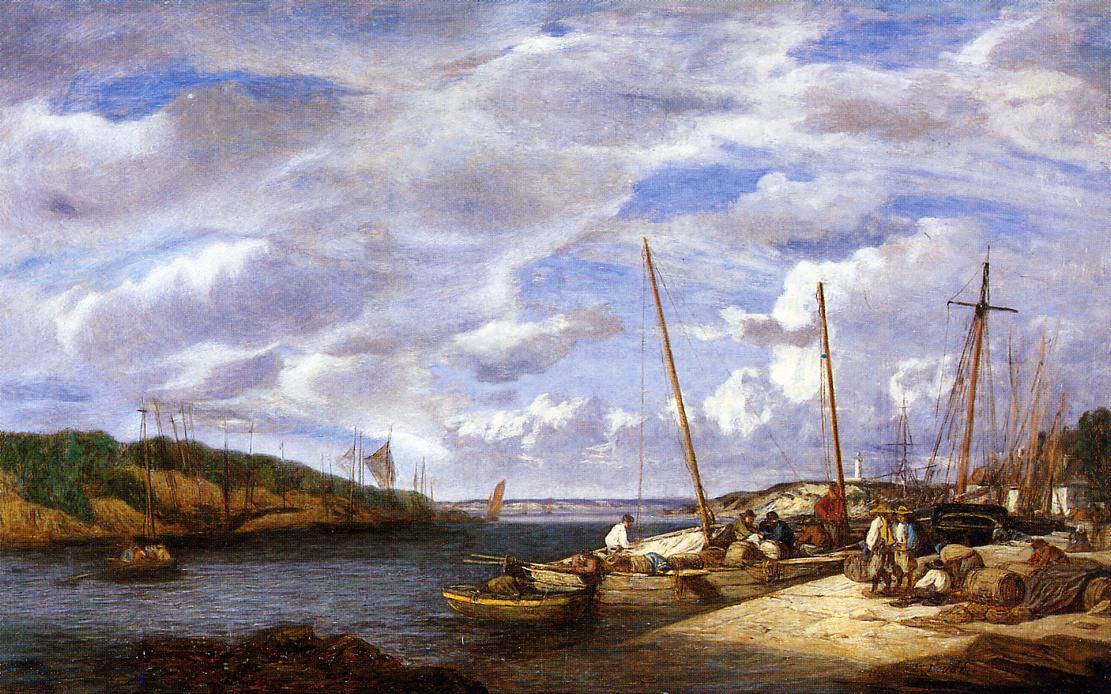
Eugène Boudin, Douarnenez, Fishing Boats at Dockside, 1855.
Eugène Boudin, Deauville, Low Tide, c.1863.
Eugène Boudin, The Beach at Villerville, 1864, Oil on canvas, 18 × 30 1/16 in. (45.7 × 76.4 cm), National Gallery of Art, Washington, D.C.

Boudin and the Impressionists

Boudin was a friend of the Impressionists and exhibited in their first exhibition in Paris in 1874. Claude Monet (1840-1926), born in Paris, also grew up in Normandy. Boudin and Monet painted together en plein aire as each sought, discovered, and honed their artistic styles.
Boudin did not think of himself primarily as an avant-garde artist and did not exhibit in the Impressionist exhibitions after 1874. Yet, with these Impressionists, Boudin’s artwork depicted light and its reflections, especially its darker filaments, in preference to volumes and forms.

Eugène Boudin ,Seascape with Large Sky, 1860.

Expanding Subjects and Artistic Development

In addition to beach scenes, skies, sea, and countryside, Boudin painted still life, animals, and a few portraits. In the 1870s Boudin painted harbors and ships. In his subject matter his pictures presented a complete and even-handed depiction, evocative of eighteenth-century genre paintings.

Slightly older Dutch painter Johan Jongkind (1819-1891) had encouraged Boudin to paint outdoors. Boudin, now surrounded by nature, became increasingly spontaneous in his artwork and used brighter colors.1

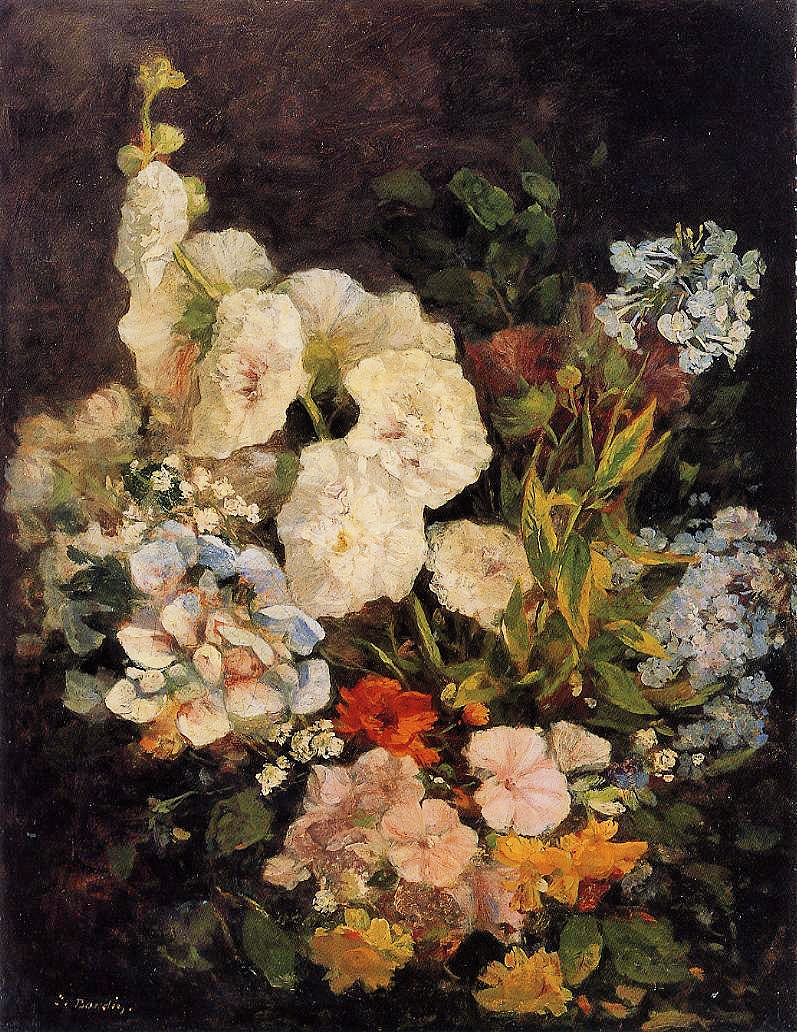
Eugène Boudin, Spray of Flowers – Hollyhocks, 1858.
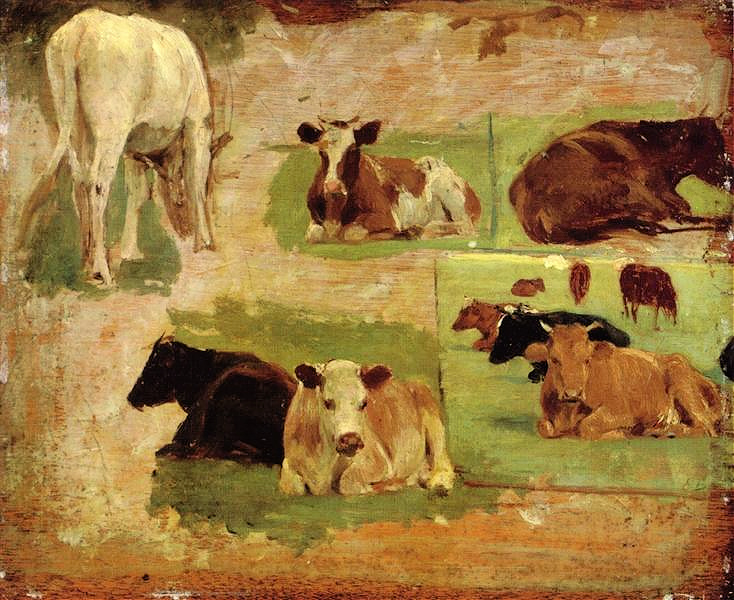
Eugène Boudin, study of cows, c. 1860.
Eugène Boudin, Vue de Trouville, 1873.
Eugène Boudin, Entrance to the Harbor, Le Havre, 1883, National Gallery of Art, Washington, D.C.
Eugène Boudin, Trouville, Shore and Rocks, c.1862.

Debut at the Paris Salon

In 1859, 35-year-old Eugène Boudin, the painter of seascapes and beaches, made his debut at the Salon. The annual Salon began in the late 17th century (1667). It was sponsored by the monarchy and highlighted artwork of members of the Academie royale de peinture et de sculpture. The all-important Salon operated in this basic form for almost 200 years. It was held  irregularly at first (frequently there would be no exhibition held for years) though between 1774 to 1792 the Salon was held biennially.

The Salon’s Importance in the Art World

This elite Salon was a competitive platform for artists to display their work where the goal was to gain public and private commissions. The Salon was the sole venue in France for contemporary fine art and was popular to visit by a cross-section of society where many purchased the livret, the Salon’s official catalogue. In 1795 during the French Revolution the historically royal venue was opened to all artists. This more inclusive Salon experience led to the extension of official French art’s influence throughout Europe. In the Salon of 1800, American artists exhibited for the first time.2

Recognition Comes Slowly

Between 1864 and 1879 Boudin exhibited in the Salon every year.3 However, important critics, such as the influential Albert Wolff (1835-1891), ignored Boudin for much of this time. It was in 1881, 22 years after Boudin’s Salon debut, that M. Wolff published an article in Le Figaro that led to Boudin’s greater official recognition.4 

In the last decades of the 19th century, Boudin exhibited yearly from 1880 to 1889 at the Salon des Société des Artistes Français5 and, with a single exception, from 1890 to 1897 at the Société National des Beaux-Arts.6  Some of Boudin’s works were bought by the State in the late 1880’s and early 1890’s.7 Ernest Chesneau (1833-1890) had written on Boudin in Paris-Journal that while the painter was ignored by official art world critics he was a “real talent” among the Salon’s “latest banalities.”

The Rise of Independent Exhibitions

In 1881 control of the Salon was ceded to the Société des Artistes Français. In the 1880’s and 1890’s there were several groups outside the Salon who mounted exhibitions. These included the one-time Salon des Refusés in 1863, the Société des Artistes Indépendants or Salon des Indépendants, beginning in summer 1884, and the salons of the Société nationale des beaux-arts, from 1890. These types of independent, unofficial exhibitions, continued into the 20th century with the Salon d’automne in 1903.8

Eugène Boudin, Elegant Women on the Beach, 1863.

Praise from Courbet, Corot, and Baudelaire

In 1859 Boudin met Gustave Courbet who introduced Boudin to the poet and art critic Charles Baudelaire. Courbet, painting at Boudin’s side, exclaimed: “Mon Dieu, you are a seraph, Boudin! You are the only one of us who really knows the sky!” In 1861 Boudin met Camille Corot who called Boudin the “king of the skies.”

Charles Baudelaire noted in 1859 that  he had seen in Boudin’s studio “hundreds of pastel studies improvised before the sea and the sky.” Baudelaire described these artworks as “the prodigious magic of air and water.”9 The economy of Boudin’s artwork with its summary figures of modern life attracted Baudelaire’s praise during the 1859 Salon. Baudelaire became convinced, when looking at a Boudin painting, that he could identify the season, hour and wind direction of the subject matter depicted in pastel or paint.10

Eugène Boudin, Near Honfluer, c.1856.

Growing Reputation and Market Success

At the Impressionist Exhibition of 1874, the critic Castagnary (1830-1888), author of “The Triumph of Naturalism” in 1868, wrote on Boudin in Le Siècle. He cited “the very high prices” that Boudin was experiencing as collectors “fought over” his beach scenes and seascapes. Castagnary concluded in 1874 that the 50-year-old Boudin had “commanded respect for years.”11 In 1868 Boudin’s auction of 40 paintings and 100 watercolors and pastels at the Hôtel Drouot had been quite successful. That same year Boudin won a silver medal at the Exposition maritime international exhibiting with Courbet, Charles-François Daubigny (1817-1878), Monet and Édouard Manet (1832-1883).

In 1874, Marc de Montifaud (Marie Amélie Chartroule, 1850-c.1912), art critic for L’Artiste and soon to found L’Art modern magazine in 1875 (and which merged with Les Beaux-Arts in 1877) cited the titles of a few paintings by Boudin out of the 13 works he exhibited which included watercolors and pastels. Yet De Montifaud’s placement of Boudin’s work under the category of “marine paintings,” did little to elucidate exact canvasses when the time came later to identify such.12

Travel, Patronage, and Durand-Ruel

In the 1860’s Paris dealers such as Martin, Hagerman and Gauchez were regularly buying his work. Boudin’s growing reputation and financial security enabled him to travel extensively in the 1870s and 1880s. Boudin, who married Marie-Ane Guédès in 1863, painted in Belgium, the Netherlands and southern France in that period. From 1892 to 1895 he regularly visited Italy, traveling to Venice. In addition to being awarded medals at the Salon, the Exposition Universelle in 1889, and other exhibitions, Boudin, in 1881, became represented by Paul Durand-Ruel (1831-1922).

Eugène Boudin, Place Ary Scheffer, Dordrecht, 1884, oil on panel 27×21.5 cm Dordrecht Museum, Netherlands.

Solo Exhibitions and International Success

In the late 1870s Boudin, then without dealer representation, held several auctions of his artwork which produced varying sales results. In 1881, Durand-Ruel bought all of Boudin’s studio inventory. In 1883 Boudin had a solo exhibition at Durand-Ruel’s that featured 150 paintings, and pastels and watercolors and in 1886 an exhibition of 23 works at Durand-Ruel’s in New York City. From July 8 to August 14, 1889 – the year Boudin’s wife died – the artist staged a one-man exhibition in Paris at Durand-Ruel’s featuring 98 pictures.13 In 1890 Boudin held an exhibition at Durand Ruel’s in Boston featuring 13 paintings and a solo exhibition in Paris at Durand-Ruel’s with 34 paintings, and as many pastels and several drawings in 1891.

Eugène Boudin, Le port d’Antibes, 1893, Musée d’ Orsay.

Boudin’s reputation grew steadily from overlooked Salon painter to respected master, championed by figures such as Baudelaire, Courbet, Corot, Monet, Durand-Ruel, and later generations of critics.

Final Years and Return to Normandy

As a refuge for his ill-health, Boudin lived in the south of France for many years but finally returned to Deauville. In 1898 Boudin died at 74 years old under the skies of La Manche which he had been inspired to paint often.

Honors and Legacy

In 1892 Eugène Boudin was made a knight of the Légion d’honneur which recognized the artist’s talent and influence on the art of his contemporaries. Today, the Société Nationale des Beaux-Arts gives the Eugène Boudin Prize.

After Boudin’s death, his artistic reputation continued to grow. In 1899, The École des Beaux Arts held a major retrospective with 457 works (including 364 paintings, 73 pastels, and 20 watercolors). Boudin was praised by art critics Roger Marx (1859-1913), Arsène Alexandre (1859-1937), and Guillaume Apollinaire (1880-1918), among others,

Eugène Boudin, Étretat 1891,Chazen Museum of Art, Madison, Wisconsin.

An Overlooked Pioneer of Modern Art

Despite the artist’s modest consideration for his art, Boudin was viewed in retrospect by 20th century’s critics as an initiator of the avant-garde, though he did not quite ascend to the turbulent aesthetic heights of Manet and Monet.14. 

In 1872, art critic Louis Duranty (1833 -1880) published a short story that included fictional and historical characters including artists such as Boudin, Manet, Corot, Jean-François Millet (1814-1875), Edgar Degas (1834-1917), and Courbet. Of Boudin, Duranty wrote: “Here is a simple, sagacious, conscientious mind who puts forward (the artwork’s) feeling in gray, fine, fair notes.” 

Eugène Boudin by Pierre Petit.

NOTES:

Never Sell the Bones of Your Father and Mother: Chief Joseph and the Nez Percé Fight for the Wallowa Homeland.

FEATURE image: Portrait of Chief Joseph in native dress with ornaments, 1900, by Lee Moorhouse (1850–1926). Public Domain.

Chief Joseph became the moral voice of the Nez Percé struggle against dispossession, forced removal, and broken treaties, using dignity, reason, and appeals to justice even as his people lost their homeland. His life story and quotations reveal not simply a military defeat in the Nez Percé War, but a powerful indictment of how the United States acquired Native lands and treated Native peoples.

INTRODUCTION.
by John P. Walsh

Chief Joseph, 1877. Chief Joseph inherited his father’s determination never to sell the Wallowa homeland.

Chief Joseph and the Wallowa Valley

Joseph (1840-1904) was the leader of one of the Nez Percé tribes. The band amounted to about 200 people who lived in the Wallowa Valley in northeastern Oregon. White settlers wanted their grazing lands. After the death of Wellamotkin in 1871, a Nez Percé chief and Joseph’s father, the 31-year-old tall and handsome Joseph began to have conflict with the whites.

The Nez Percé Before White Contact

At the time of Joseph’s birth in 1840 there were around 6,000 Nez Percé, most of them living in small fishing villages next to fecund streams and rivers. Each village had its own “chief” and young Joseph visited these villages with his father where he learned about the people and the lore of his nation.

Once each winter was over, the Nez Percé, like other Native American tribes ranged beyond their own territory. These could be friendly visits like buffalo hunts or more contentious meetings. These cultural interchanges influenced Nez Percé as they influenced others. For hundreds of years the Nez Percé were mostly influenced by the Pacific Coast culture through the Chinook tribes more than the Plains tribes.

Horses and the Transformation of Nez Percé Culture

In the 1730s the Nez Percé learned about horses from Native Americans like the Apache who had contact with Spanish settlements in the south. With horses the Nez Percé traveled farther and more often into the Plains so that by the 1800s the Nez Percé were more a Plains tribe though they maintained their roots in the Pacific Northwest.

First Encounters With Europeans

It was at the start of the 19th century that those venturing Nez Percé came into contact with whites and bought guns. The home tribe didn’t have to wait long to encounter the whites – in 1805 Lewis and Clark reached the Columbia River. Promised more guns, none appeared for a couple of years and these by way of a Canadian trader.

The Nez Percé got their name from this French-Canadian trader who saw the nose piercings that the tribe used to affix ornaments to themselves. In 1812 the American traders that Lewis and Clark promised finally arrived but quickly left and the Canadians took over.

Missionaries, Christianity, and Growing Divisions

By the late 1820s the Nez Percé roamed farther east and encountered more white fur traders among whom they lived, traded, fought, and frequently intermarried. It was in this period that the first Christian missions, both protestant and Catholic, began their influence among the Nez Percé. In the 1830s the Nez Percé journeyed to St. Louis to recruit missionaries which was successful. Joseph’s father, Wellamotkin, became a Presbyterian and Joseph was baptized at birth. By 1850, with the influx of white settlers into Oregon, the Native Americans expelled the missionaries though this divided the tribe. Joseph retreated to the Wallowa Valley away from contact – and conflict – with the new arrivals.

Treaties, Gold, and Broken Promises

In 1855 the Nez Percé signed a treaty that created a large reservation for themselves. Joseph was considered a Christian and friendly to the whites. In 1860 when gold was discovered on the Nez Percé reservation the rampant trespassing of whites was unacceptable to Joseph. White crime against Nez Percé went up and whites built settlements on Indian land. Federal agents arrived and offered a smaller new reservation to the Nez Percé. The proposal was initially opposed by Indian leaders but Federal agents bought off the local chiefs one-by-one and, in 1863, a treaty was signed.

The new reservation was one quarter the size of what it was and did not include the Wallowa Valley. Joseph and most of the rest of the chiefs refused to sign. It was at this time that Joseph renounced his protestant Christianity as the white man’s religion. The Nez Percé on the new reservation saw the arrival of more and more whites. Though the Wallowa Valley where Joseph lived remained outside the white settlements’ orbit that changed over a short time.

Chief Joseph Takes Leadership

In 1871, after Joseph buried his father and became chief, white settlers began moving into the Wallowa Valley. Joseph protested to the U.S. Government and, in 1873, President U.S. Grant ordered the whites to withdraw and formally recognized the Wallowa reservation.

But the White House in Washington D.C. was far away and the whites refused to leave. They threatened Joseph with extermination if the Nez Percé didn’t leave – and invited increasing numbers of white settlers who poured into the valley. The Oregon governor took the side of the white settlers and President Grant was forced to rescind his decision that favored Chief Joseph.

Mounting Tensions and Federal Intervention

Chief Joseph – known as Heinmot Tooyalakekt (“thunder travels to lofty mountains”) – counseled delay. He moved his tribe farther from the encroaching white settlers and appealed to the U.S. Government again whose review of land claims and treaties advised siding with the Indians.

The U.S. Government did nothing until they appointed a panel in November 1876 with the power to make a final decision about the competing claims. Looking to dominate and persuade Chief Joseph, they were not able to do so by argument.

Chief Joseph, before 1877. Photographed by William H. Jackson. Joseph consistently preferred negotiation and diplomacy over war, even as violence escalated.

But events on the ground were intensifying between whites and Nez Percé so much so that violence between them was expected. The commissioners made their decision. Whether Nez Percé signed the 1863 or not all Nez Percé must go to the new small reservation or be taken there by force. The whites would get the Wallowa Valley. The deadline was April 1,1877.

The Deadline and the Outbreak of War

As the deadline approached the Nez Percé appealed to the commission to let them continue to live in the Wallowa Valley but the decision was final. A new deadline of June 12, 1877 was set. Joseph was called a coward by his tribe for abiding by the order to go to the reservation.

That night a Nez Percé youth avenged the murder of his father by whites by killing 4 whites and wounding 1 more. Nez Percé killed 15 more whites in the next couple of days – and struck terror in the hearts of white settlers.

Chief Joseph counseled diplomacy but most of the Nez Percé didn’t listen to him and left for hiding places. Joseph was watched closely by his own tribe that he would not abandon them or betray them to the soldiers. Chief Joseph and his buffalo-hunting younger brother Ollokot finally decided to join the Nez Percé to fight the whites.

Early Nez Percé Victories

Soldiers were deployed to force the Nez Percé onto the reservation. With Nez Percé informants they planned to attack the hostile Nez Percé in their encampment. The Indian response was to buy time to escape. A white flag of truce went on ahead of the small Nez Percé party to meet the soldiers. There was an exchange of gunfire and the battle was on. The soldiers lost 34 dead, a third of the command, while the Nez Percé lost none and two wounded. The victors retrieved scores of guns and ammo that the fleeing soldiers left behind.

Reinforcements were called in – on both sides. Rumors ran wild. There was a massacre of reservation Nez Percé mistaken for hostiles. As the soldiers advanced the hostiles cut in behind them and the white settlers the soldiers were supposed to be protecting lay exposed to the hostiles. These Nez Percé advanced and massacred parties of soldiers, civilian volunteers, and terrified settlers.

Nez Percé picked up about 40 warriors but also whole communities of women and children to protect. Joseph was being given credit for this successful war campaign though it was other war leaders who led the strategy and tactics.

The Fighting Retreat

By July 11, 1877, there was 400 soldiers and 180 others who were pursuing the Nez Percé. They attacked and the Nez Percé responded. The battle went on for two days though the Nez Percé were outnumbered 6 to 1. The army lost 13 killed and 27 wounded and the Nez Percé lost 4 killed and 6 wounded – and escaped again. The Nez Percé decided it was time to evacuate the area.

On July 16, 1877 Chief Joseph agreed to the exodus to Montana. The army decided to pursue them. Army reinforcements were called out of Montana to intercept the Nez Percé. Chief Joseph decided to talk with them. Promising to be peaceful and pay for any supplies on his way to the Crows, he reassured the volunteers. In Montana. the Nez Percé rested though they were being pursued by new reinforcements. On August 8, 1877, the Nez Percé were attacked. The Nez Percé were surprised but reorganized and counter attacked and escaped with much of the army’s hardware and ammo. The army lost 33 soldiers dead and 38 wounded. Fourteen of 17 officers were among the casualties. But at least 60 Nez Percé were killed in the battle of Big Hole.

The Flight Toward Canada

The Nez Percé decided to escape to Canada. Lean Elk replaced Looking Glass as supreme war chief. On and on the Indians hurried. On September 13, 1877 the Nez Percé were overtaken by U.S. cavalry. But, at Canyon Creek, the Nez Percé escaped with three wounded while 3 cavalrymen were killed and 11 were wounded.

Nez Percé, c. 1910. The Nez Percé conducted one of the most remarkable fighting retreats in American history before being cornered near the Canadian border.

Just 30 miles from the Canada border and confident that they had outrun their pursuers, the Nez Percé took a much-needed rest. This pause became their last stand.

The Final Siege and Surrender

The army arrived with 600 men that included infantry, cavalry, and Cheyenne warriors. This force intercepted the Nez Percé on September 30, 1877. They attacked and, from Nez Percé gunfire, the army had 2 officers and 22 soldiers killed and 4 officers and 38 soldiers wounded. Another contingent of army successfully worked to cut the Nez Percé camp into pieces. A siege ensued. The army commander lured Joseph to a diplomatic talk and then took him prisoner/hostage. The Nez Percé retaliated by taking an army officer prisoner/hostage. A swap was quickly agreed to.

The arrival of army reinforcements on October 4, 1877 spelled the end for the Nez Percé hold outs. Negotiations began and the Nez Percé were split – some argued to keep fighting. Joseph agreed to surrender. When the parlay ended one of chiefs who argued to keep fighting was shot in the head by a stray bullet as he stood up from discussion with the white man.

Bibliography: The Patriot Chiefs, Alvin M. Josephy, Jr., Viking Press, NY, 1961, pp. 312-340.
Saga of Chief Joseph, Helen Addison Howard, 1978.

Following the Battle of Bear Paw, non-treaty (of 1863) groups of the Nez Percé surrendered to the United States Army on October 5, 1877, ending the Nez Percé War.  Even after surrender, Joseph remained committed to peaceful advocacy for Native rights. His famous surrender speech expresses grief for his people rather than personal defeat, making him an enduring symbol of Native resistance and moral leadership.

When I am gone, think of your country. You are the chief of these people. They look to you to guide them. Always remember that your father never sold the country. You must stop your ears whenever you are asked to sign a treaty selling your home. They have their eyes on this land. My son, never forget my dying words, this country holds your father’s body. Never sell the bones of your father and mother. Wellamotkin to Chief Joseph (c.1840-1904), Nez Percé, 1871.

Somebody has got our horses. Reaction to violation of surrender treaty terms by U.S. Government. “When the terms of surrender were violated by the government, [Chief] Joseph did not dig up the tomahawk and go on the warpath again…. He…. spoke with a straight tongue , and was a gentleman of his word. Nor did he blame [Maj. Gen. O. O.] Howard or [Col. Nelson A.] Miles for what his people suffered. He remarked only the above. (Quoted in Saga of Chief Joseph, H. A. Howard, University of Nebraska Press, 1978, p. 348.)

We love the land. It is our home. Chief Joseph (c.1840-1904), Nez Percé, November 1876.

Suppose a white man goes to my neighbor and says to him, ‘Joseph has some good horses. I want to buy them, but he refuses to sell.’ My neighbor answers, ‘Pay me the money, and I will sell you Joseph’s horses.’ The white man returns to me and says, ‘Joseph, I have bought your horses and you must let me have them.’ If we sold our lands to the government, this is the way they were bought. Chief Joseph (c.1840-1904), Nez Percé, November 1876.

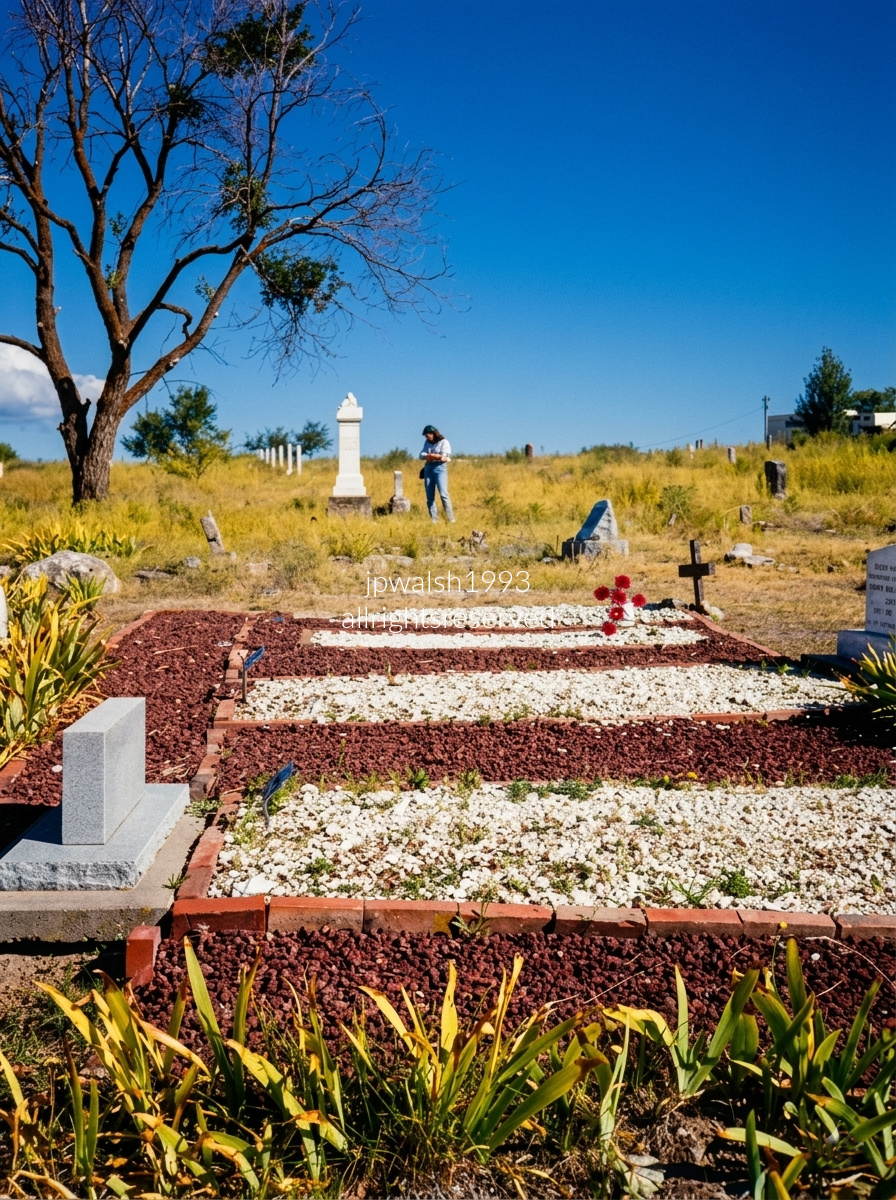
Gravesite of Chief Joseph, Nez Percé Cemetery, Nespelem, Washington — 1993 Chief Joseph’s grave lies in the tribal cemetery at Nespelem, where he spent the final decades of his life after years of forced displacement. In October 1877, with his band exhausted and cornered in northern Montana—just 40 miles from Canada—Joseph surrendered under the belief that his people would be allowed to return to their Idaho homeland. Instead, they were shuttled among forts and reservations across the southern Plains before being relocated to the Colville Reservation in east‑central Washington. Joseph died there in 1904, far from the Wallowa Valley he had fought to preserve. Author’s photograph.

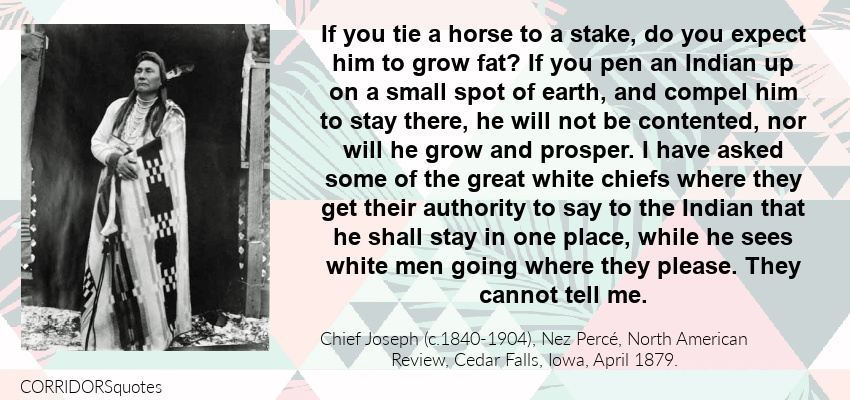
If you tie a horse to a stake, do you expect him to grow fat? If you pen an Indian up on a small spot of earth, and compel him to stay there, he will not be contented, nor will he grow and prosper. I have asked some of the great white chiefs where they get their authority to say to the Indian that he shall stay in one place, while he sees white men going where they please. They cannot tell me. Chief Joseph (c.1840-1904), Nez Percé, North American Review, Cedar Falls, Iowa, April 1879.


I am tired of fighting. Our chiefs are killed…The old men are all dead. It is the young men who say yes or no. He who led the young men are dead. Chief Joseph (c.1840-1904), Nez Percé, 1877.

It is cold and we have no blankets. The little children are freezing to death. My people, some of them, have run away to the hills, and have no blankets, no food, no one knows where they are – perhaps freezing to death. Chief Joseph (c.1840-1904), Nez Percé, 1877.

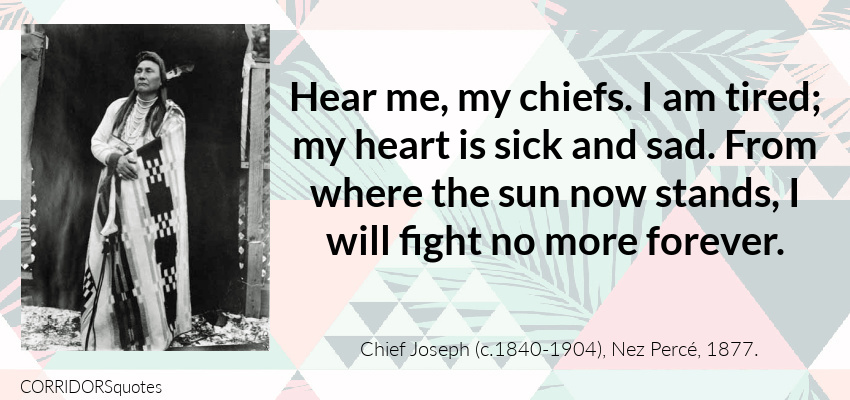
I want to have time to look for my children and see how many I can find. Maybe I shall find them among the dead. Hear me, my chiefs. I am tired; my heart is sick and sad. From where the sun now stands, I will fight no more forever. Chief Joseph (c.1840-1904), Nez Percé, 1877.

Chief Joseph, c. 1903.

Hear me, my chiefs. I am tired; my heart is sick and sad. From where the sun now stands, I will fight no more forever. Chief Joseph (c.1840-1904), Nez Percé, 1877.

Gravesite of Chief Joseph and war followers, Nez Percé Cemetery, Nespelem, Washington — 1993. Colville Indian Reservation, Okanogan Co., Washington. Chief Joseph’s gravesite is in the distance marked by the tall memorial pillar. Author’s photograph.

From Oxford to Rome: How St. John Henry Newman (1801-1890) Followed Conscience in Search of Religious Truth.

N.B. – Vatican City, July 31, 2025 (UPI) — Pope Leo XIV will bestow St. John Henry Newman, the influential 19th-century Anglican convert, with the honor of “Doctor of the Church” [today].” Cardinal Newman was beatified by Pope Benedict XVI in 2010 and canonized by Pope Francis in 2019. With Pope Leo XIV’s action Card. St. Newman is now one of 38 “Doctors of the Church” whose ranks include four women. St. John Henry Newman became the first saint canonized from Britain since 1976.

FEATURE image: Photographic portrait, John Henry Cardinal Newman, 1880.

Canonized in 2019 and later declared a Doctor of the Church, Newman is a thinker whose relevance extends well beyond the 19th century.

 John Henry Newman, Oratory of St. Philip Neri, Birmingham, England.  London; New York; Bombay; Calcutta: Longmans, Green. Newman’s method of composing a sermon was to do so by heart and then write it down afterwards. English theologian James Mozley (1813-1878) who was active in the Oxford Movement, observed about these sermons: “A sermon of Mr. Newman’s enters into our feelings, ideas, and modes of viewing things. Persons look into Mr. Newman’s sermons and see their own thoughts in them.”

John Henry Newman was one of the most influential Christian thinkers of the modern era, whose journey from Anglican leader to Catholic cardinal, combined with his profound writings on truth, conscience, faith, reason, and holiness, continues to offer a model for navigating religious, intellectual, and cultural divisions.

Introduction by John P. Walsh

John Henry Newman (1801-1890) was a theologian and poet who was first an Anglican priest and later a Roman Catholic priest and cardinal. In the 1830’s and until his conversion to Catholicism in 1845, Newman was a leading figure in the Oxford Movement. They were a group of Anglicans who looked to create a bridge between the Church of England and the Catholic Church by adopting many Catholic beliefs and liturgical rituals from before the English Reformation. Newman eventually came to believe for himself that these religious efforts proved insufficient and he left the Anglican Communion for the Catholic Church in 1845. Already an articulate and influential religious leader in Britain, Newman’s decision brought with it the burden of having upset his friends as well as being challenged by them and others for his changed religious opinions on polemical grounds. Newman, a longtime writer and speaker, responded after a while with his now-celebrated Apologia Pro Vita Sua (1865–1866), which served as a defense of his religious opinions after he quit his position as Anglican vicar at Oxford. Newman, a 19th-century master of English prose and poetry, had already published The Idea of a University (1852) and went on to publish Grammar of Assent (1870) as well as several poems, some of which were set to music or served as hymns. In 1879, at the age of 78 years old, Pope Leo XIII named Newman a cardinal for his work on behalf of the Catholic Church in England as well as his having co-founded the Catholic University of Ireland in 1854, which today as University College Dublin is Ireland’s largest institution of higher learning. On October 13, 2019, John Henry Newman was canonized a Catholic saint at the Vatican by Pope Francis. St. John Henry Newman became the first saint canonized from Britain since 1976. In remarks by Prince Charles who led the British delegation to the Vatican for Newman’s canonization, the Prince of Wales said: “In the age in which he [Newman] attains sainthood, his example is needed more than ever – for the manner in which, at his best, he could advocate without accusation, could disagree without disrespect and, perhaps most of all, could see differences as places of encounter rather than exclusion.” London-born Cardinal Newman died in England in 1890 at 89 years old. He founded the Oratory at Birmingham in 1848 and through his writings spoke to many about the issues of faith, education, and conscience.

John Henry Newman began as an Anglican priest and leading figure in the Oxford Movement before converting to Catholicism in 1845. Newman became a major Catholic intellectual, publishing influential works on education, belief, doctrine, and the development of Christian thought.

A given opinion, as held by several individuals, even when of the most congenial views, is as distinct as are their faces. Oxford University sermons, 1843.

It is as absurd to argue men, as to torture them, into believing. Oxford University sermon, December 11, 1831.

His conversion cost him friendships and provoked controversy, prompting him to write Apologia Pro Vita Sua, one of the great religious autobiographies and defenses of conscience.

From the age of fifteen, dogma has been the fundamental principle of my religion: I know of no other religion; I cannot enter into the idea of any other sort of religion; religion, as a mere sentiment, is to me a dream and a mockery. Apologia Pro Vita Sua, 1864.

I used to wish the Arabian Tales were true; my imagination ran on unknown influences, on magical powers, and talismans. I thought life might be a dream, or I an Angel, and all this world a deception, my fellow-angels by a playful device concealing themselves from me, and deceiving me from the semblance of a material world. Apologia Pro Vita Sua (Up to 1833).

I was brought up from a child to take great delight in reading the Bible; but I had formed no religious convictions till I was fifteen. Of course I had perfect knowledge of my Catechism. Apologia Pro Vita Sua (Up to 1833).

I read Joseph Milner’s Church History, and was nothing short of enamoured of the long extracts from St. Augustine and the other Fathers which I found there. I read them as being the religion of the primitive Christians. Apologia Pro Vita Sua (Part III).

I read Newton on the Prophecies, and in consequence became most firmly convinced that the Pope was the Antichrist predicted by Daniel, St. Paul and St. John. My imagination was stained by the effects of this doctrine up to the year 1843. Apologia Pro Vita Sua (Part III).

There are virtues indeed, which the world is not fitted to judge about or to uphold, such as faith, hope and charity; but it can judge about Truthfulness; it can judge about the natural virtues, and truthfulness is one of them. Natural virtues may also become supernatural; Truthfulness is such… Apologia Pro Vita Sua (Part II).

Newman sought truth above party loyalty, holiness above comfort, and intellectual honesty above ideological conformity.

John Newman, 1841, Thomas Robinson Green?, collotype, 7 5/8 in. x 10 in. (195 mm x 255 mm). National Portrait Gallery, St Martin’s Place, London. https://www.npg.org.uk/collections/search/portrait/mw39717/John-Newman?LinkID=mp03281&wPage=1&role=sit&rNo=21

Catholics on the other hand shade and soften the awful antagonism between good and evil, which is one of their dogmas, by holding that there are different degrees of justification, that there is a great difference in point of gravity between sin and sin, that there is a possibility and the danger of falling away, and that there is no certain knowledge given to anyone that he is simply in a state of grace, and much less that he is to persevere to the end. Apologia Pro Vita Sua (Part III).

Let us seek the grace of a cheerful heart, an even temper, sweetness, gentleness, and brightness of mind, as well as walking in His light, and by His grace. Let us pray to Him to give us the ever-abundant, ever-springing love, which overpowers and sweeps away the vexations of life by its own richness and strength, and which above all unites us to Him, Who is the fountain and center of all mercy, loving kindness and joy. 17, Religious Joy (Sermon for Christmas Day), 1868.

Ex Umbris et Imaginibus in Veritatem! (From shadows and symbols into the truth!) Epitaph at Edgbaston.

He believed faith and reason worked together and rejected both blind skepticism and rigid rationalism. His writings emphasize the importance of truthfulness, conscience, reverence, humility, and intellectual integrity. His famous hymn Lead, Kindly Light emerged from a difficult period of illness, uncertainty, and spiritual reflection.

Lead, kindly Light, amid the encircling gloom; Lead thou me on! The night is dark, and I am far from home; Lead thou me on! Keep thou my feet: I do not ask to see the distant scene; one step enough for me. The Pillar of the Cloud, 1833.

Lead, Kindly Light is a hymn with words written in 1833 by Saint John Henry Newman as a poem titled “The Pillar of the Cloud.” The impetus for the poem was that young Newman, traveling in Italy, became ill and found himself stranded in Palermo, Sicily, without any passage out for almost a month.

To occupy his time, the 32-year-old Newman visited the many churches in Palermo but only when they were dark, abandoned and silent. Newman, then still an Anglican, didn’t attend any services.

Newman finally got a ship to England that sailed direct for Marseilles yet, between Corsica and Sardinia, the ship lay idle for a week from lack of wind. It was just at that point in his far-flung journey that the words, Lead Kindly Light, articulated themselves in Newman’s mind as he ached to go home.

This is what the Church is said to want, not party men, but sensible, temperate, sober, well-judging persons, to guide it through the channel of no-meaning, between the Scylla and Charybdis of Aye and no. St. John Henry Cardinal Newman (1801-1890), Apologia Pro Vita Sua, “History of My Religious Opinions from 1839-1841” (1864).

John Henry Cardinal Newman, 1881, Sir John Everett Millais, 1st Baronet, President Royal Academy of Arts (1829-1896). National Portrait Gallery, London: https://www.npg.org.uk/collections/search/portrait/mw07727/John-Newman

Nature was a parable: Scripture was an allegory: pagan literature, philosophy, and mythology, properly understood, were but a preparation for the Gospel. St. John Henry Cardinal Newman (1801-1890), Apologia Pro Vita Sua, “History of My Religious Opinions from 1839-1841” (1864).

The Greek poets and sages were in a certain sense prophets; for “thoughts beyond their thought to those high bards were given.” St. John Henry Cardinal Newman (1801-1890), Apologia Pro Vita Sua, “History of My Religious Opinions from 1839-1841” (1864).

Holy Church in her sacraments and her hierarchical appointments, will remain even to the end of the world. Her mysteries are but expressions in human language of truths to which the human mind is unequal. St. John Henry Cardinal Newman (1801-1890), Apologia Pro Vita Sua, “History of My Religious Opinions from 1839-1841” (1864).

We may not speak of [Jesus] as we speak of any individual man, acting from and governed by a human intelligence within Him, but He was God, acting not only as God, but now through the flesh also, when He would. St. John Henry Cardinal Newman (1801-1890), Parochial and Plain Sermons, volume 6.

[Prophetic tradition] permeates the Church like an atmosphere, irregular in shape from its very profusion and exuberance. St. John Henry Cardinal Newman (1801-1890), Lectures on the Prophetical Office of the Church (1837).

Newman viewed disagreement as an opportunity for encounter rather than exclusion, a theme highlighted by then-Prince Charles at his canonization.

John Newman by George Richmond, chalk, 1844, 16 1/4 in. x 13 1/4 in. (413 mm x 337 mm), National Portrait Gallery, St Martin’s Place, London. https://www.npg.org.uk/collections/search/portrait/mw04655/John-Newman

John Henry Newman, after 1844. https://archive.org/details/newmanfran00barruoft/page/48/mode/2up?view=theater

The more claim an idea has to be considered living, the more various will be its aspects; and the more social and political is its nature, the more complicated and subtle will be its issues. St. John Henry Cardinal Newman (1801-1890), An Essay on the Development of Christian Doctrine.

And such mainly is the way in which all men, gifted or not gifted, commonly reason – not by rule, but by an inward faculty. St. John Henry Cardinal Newman (1801-1890), Fifteen Sermons preached before the University of Oxford.

If we insist upon being as sure as is conceivable, in every step of our course, we must be content to creep along the ground, and can never soar. St. John Henry Cardinal Newman (1801-1890), Fifteen Sermons preached before the University of Oxford.

If we are intended for great ends, we are called to great hazards; and, whereas we are given absolute certainty in nothing, we must in all things choose between doubt and inactivity. St. John Henry Cardinal Newman (1801-1890), Fifteen Sermons preached before the University of Oxford.

I am what I am, or I am nothing. I cannot think, reflect, or judge about my being, without starting from the very point which I am concluding…I cannot avoid being sufficient for myself, for I cannot make myself anything else, and to change me is to destroy me. St. John Henry Cardinal Newman (1801-1890), The Grammar of Assent (1870).

John Newman, 1864, McLean & Haes, albumen carte-de-visite, 3 5/8 in. x 2 1/4 in. (93 mm x 57 mm). National Portrait Gallery, St Martin’s Place, London. https://www.npg.org.uk/collections/search/portrait/mw125777/John-Newman?LinkID=mp03281&role=sit&rNo=10

A man who said “I cannot trust a cable, I must have an iron bar,” would, in certain given cases, be irrational and unreasonable: so too is a man who says I must have a rigid demonstration, not moral demonstration, of religious truth. St. John Henry Cardinal Newman (1801-1890), Letters & Diaries, volume 21.

We differ in our sense and use of the word “certain.” I use it of minds, you of propositions. I fully grant the uncertainty of all conclusions in your sense of the word, but I maintain that minds may in my sense be certain of conclusions which are uncertain in yours. St. John Henry Cardinal Newman (1801-1890), Letter to William Froude, April 29, 1879.

There is a great attempt to bring a new theory of Papal Infallibility, which would make it a mortal sin not to hold the Temporal Power necessary to the papacy. No one answers them and multitudes are being carried away. The pope gives ear to them and the consequence is there is a very extreme prejudice in the highest quarters at Rome against such as me. St. John Henry Cardinal Newman (1801-1890), Letter to James Hope Scott, April 11, 1867.

Really and truly I am NOT a theologian. A theologian is one who has mastered theology…and a hundred things besides. And this I am not and never shall be. St. John Henry Cardinal Newman (1801-1890), Letter to Maria Giberne, February 10, 1869.

To write theology is like dancing on the tight-rope some hundred feet above ground: it is hard to keep from falling, and the fall is great. St. John Henry Cardinal Newman (1801-1890), Letter to Emily Bowles, April 16, 1866.

Cardinal Henry Edward Manning is not a theologian, the pope is not a theologian, and therefore theology has gone out of fashion. I don’t profess to be a theologian, but at all events I should have been able to show a side of the Catholic religion more theological, more exact, than theirs. St. John Henry Cardinal Newman (1801-1890), Letter to Lord Blatchford, February 5, 1875.

There was true private judgment in the primitive and medieval schools. There are no schools now, no private judgment (in the religious sense of the phrase), no freedom of opinion. That is, no exercise of the intellect. This is a way of things which in God’s own time, will work its own cure of necessity. St. John Henry Cardinal Newman (1801-1890), Letter to Emily Bowles, May 19, 1863.

John Newman, c. 1845, Richard Woodman, after Sir William Charles Ross, stipple engraving, 11 1/2 in. x 9 1/2 in. (291 mm x 241 mm) plate size, National Portrait Gallery, St Martin’s Place, London. https://www.npg.org.uk/collections/search/portrait/mw198540/John-Newman?LinkID=mp03281&wPage=1&role=sit&rNo=24

This age of the Church is peculiar. St. John Henry Cardinal Newman (1801-1890), Letter to Emily Bowles, May 19, 1863.

Everything is good which brings matters to a crisis. It is not the matter of the document, but the animus of its authors, and their mode of doing it, which is so trying. Will not the next century demand Popes who are not Italians? St. John Henry Cardinal Newman (1801-1890), Letter to William Monsell, January 12, 1865.

The Fathers made me a Catholic, and I am not going to kick down the ladder by which I ascended into the Church. It is a ladder quite as serviceable for that purpose now, as it was twenty years ago. St. John Henry Cardinal Newman (1801-1890), Letter to Rev. E. B. Pusey, D.D.

He maintained an independent mind, sometimes criticizing excesses and abuses within church governance while remaining deeply loyal to Catholic doctrine.

We have come to a climax of tyranny. It is not good for a Pope to live 20 years. It is an anomaly and bears no good fruit; he becomes a god, has no one to contradict him, does not know facts, and does cruel things without meaning it. St. John Henry Cardinal Newman (1801-1890), Letter to Lady Simeon, November 18, 1870.

There is no evil without its alleviation. St. John Henry Cardinal Newman (1801-1890), Letter to Bishop David Moriarty, November 14, 1866.

To be at once infallible in religion and a despot in temporals is perhaps too great for mortal man. St. John Henry Cardinal Newman (1801-1890), Letter to Mrs. William Frounde, January 2, 1871.

Truth is the guiding principle of theology and theological inquiries; devotion and edification, of worship; and of government, expedience. St. John Henry Cardinal Newman (1801-1890), The Via Media of the Anglican Church Illustrated in Lectures, Letters and Tracts written between 1830 and 1841.

The instrument of theology is reasoning; of worship, our emotional nature; of rule, command and coercion. Further, as man is, reasoning tends to rationalism; devotion to superstition and enthusiasm; and power to ambition and tyranny. St. John Henry Cardinal Newman (1801-1890), The Via Media of the Anglican Church Illustrated in Lectures, Letters and Tracts written between 1830 and 1841.

Now all of us are sinners, all of us have need to come to God as the Publican did; every one, if he does but search his heart, and watch his conduct, and try to do his duty, will find himself to be full of sins which provoke God’s wrath. I do not mean to say that all men are equally sinners; some are wilful sinners, and of them there is no hope, till they repent; others sin, but they try to avoid sinning, pray to God to make them better, and come to church to be made better; but all men are quite sinners enough to make it their duty to behave as the Publican. Every one ought to come into Church as the Publican did, to say in his heart, “Lord, I am not worthy to enter this sacred place; my only plea for coming is the merits of Jesus Christ my Saviour.” St. John Henry Cardinal Newman (1801-1890), Sermon, Reverence in Worship, October 30, 1836 (PPS-8).

To believe and not to revere, to worship familiarly and at one’s ease, is an anomaly and a prodigy unknown even to false religions, to say nothing of the true one…Worship, forms of worship — such as bowing the knee, taking off the shoes, keeping silence, a prescribed dress and the like — are considered as necessary for a due approach to God. Parochial and Plain Sermons, Vol. VIII — “Reverence in Worship,” October 30, 1836.

[Christ] is not past, He is present now. And though He is not seen, He is here. The same God who walked the water, who did miracles, etc., is in the Tabernacle. We come before Him, we speak to Him just as He was spoken to 1800 years ago, etc. This [is] how He counteracts time and the world… It is this that makes devotion in lives. It is the life of our religion. We are brought into the unseen world. St. John Henry Cardinal Newman (1801-1890), SN 127: May 25, 1856.

To consider the world in its length and breadth, its various history, the many races of man, their starts, their fortunes, their mutual alienation, their conflicts; and then their ways, habits, governments, forms of worship; their enterprises, their aimless courses, their random achievements and acquirements, the impotent conclusion of long-standing facts, the tokens so faint and broken of a superintending design, the blind evolution of what turn out to be great powers or truths, the progress of things, as if from unreasoning elements, not towards final causes, the greatness and littleness of man, his far-reaching aims, his short duration, the curtain hung over his futurity, the disappointments of life, the defeat of good, the success of evil, physical pain, mental anguish, the prevalence and intensity of sin, the pervading idolatries, the corruptions, the dreary hopeless irreligion, that condition of the whole race, so fearfully yet exactly described in the Apostle’s words, “having no hope and without God in the world,”—all this is a vision to dizzy and appal; and inflicts upon the mind the sense of a profound mystery, which is absolutely beyond human solution. St. John Henry Cardinal Newman (1801-1890), Apologia Pro Vita Sua, Chapter 5: Position of My Mind Since 1845.

What shall be said to this heart-piercing, reason-bewildering fact? I can only answer, that either there is no Creator, or this living society of men is in a true sense discarded from His presence. Did I see a boy of good make and mind, with the tokens on him of a refined nature, cast upon the world without provision, unable to say whence he came, his birth-place or his family connections, I should conclude that there was some mystery connected with his history, and that he was one, of whom, from one cause or other, his parents were ashamed. Thus only should I be able to account for the contrast between the promise and the condition of his being. And so I argue about the world;—if there be a God, since there is a God, the human race is implicated in some terrible aboriginal calamity. It is out of joint with the purposes of its Creator. This is a fact, a fact as true as the fact of its existence; and thus the doctrine of what is theologically called original sin becomes to me almost as certain as that the world exists, and as the existence of God. St. John Henry Cardinal Newman (1801-1890), Apologia Pro Vita Sua, Chapter 5: Position of My Mind Since 1845.

On October 13, 2019 in Rome then-Prince Charles attended the canonization of St. John Henry Newman (1801-1890) by Pope Francis. On July 31, 2025 Cardinal Newman—English Catholic theologian, academic, philosopher, historian, writer, and poet—was declared Doctor of the Church by Pope Leo XIV. On September 4, 2025, King Charles III became the first British monarch to visit the Oratory of St. Philip Neri in Birmingham which served as headquarters for the 19th century Catholic cardinal’s life and activities. On his visit, Charles III viewed the cardinal’s library as well as his personal items and the room where Newman died which has remained unchanged. John Henry Newman was born in London and grew up in the Church of England. He became an Anglican priest in 1825 and a leader of the Oxford Movement which sought affinities with Roman Catholicism. In 1845, in his mid-40’s, Newman became a Catholic and studied in Rome where he became a Catholic priest. Newman was always a prolific writer of letters, sermons and articles, and this continued throughout his life. The Cardinal often fell between the cracks – Anglicans mistrusting his Catholic “betrayal” and Catholics mistrusting his having been an Anglican. A cloud lifted in 1879 when Newman was named a cardinal of the Roman Church by Pope Leo XIII (1878-1903). After Rome, Newman returned to England in 1847 and founded the first English Oratory in 1848 here in Birmingham. Newman was soon joined by other English converts, including Father Wilfrid Faber (1814-1863) who Newman sent to London to establish its Oratory in 1849. After Newman was made a Cardinal in 1879, he lived at the Birmingham Oratory and died there in 1890. In 2008 Newman’s grave was opened so to move his remains into the Birmingham Oratory. But his wooden coffin was found to have disintegrated and no bones were found.

St. Philip Neri, Birmingham Oratory.

St. Philip Neri (1515-1595) who founded the Oratory in Rome in 1550 came from Florence where his family were Tuscan nobles who practicied the learned professions. Like some saints do, Philip tore up these family pedigrees in preference for the poor and itinerant. Once in Rome Philip never made study his central occupation and was reticent to talk about it, but he surprised professional scholars not only by his natural wit and humor but his learned depth and the clearness of his theological thinking and knowledge.

“Holiness rather than peace.” St. John Henry Cardinal Newman, (1801-1890), Motto which he had taken from his youth.

His lifelong motto was “Holiness rather than peace,” reflecting his belief that truth and sanctity mattered more than comfort or popularity.

This explanatory article may be periodically updated.

The Gilded Brush: John Singer Sargent’s Early Portraits of the 1870s & 1880s.

FEATURE image: Margaret Stuyvesant Rutherfurd White (Mrs. Henry White), 1883, oil on canvas, 225.1 × 143.8 cm (88 5/8 × 56 5/8 in.), National Gallery of Art, Washington, D.C. from Corcoran Collection, 2014.

The formative years and professional evolution of American expatriate painter John Singer Sargent during the 1870s and 1880s, tracing how his work progressed from intimate studies of family and friends into high-society commissions that defined Gilded Age portraiture. The post captures the crucial creative window where Sargent’s expanding elite social network catalyzed his rise to prominence, culminating in some of his most legendary and controversial masterpieces.


By John P. Walsh

The art works by John Singer Sargent (1856-1925) in this post are ones in oil, watercolor, and pastel. They begin to present Sargent’s professional output during his formative years in France, England and his trips to the United States.

While Sargent’s early portrait subjects range from famous people such as writer Robert Louis Stevenson (1850-1894) and actress Ellen Terry (1847-1928) in her role as Lady Macbeth, Sargent’s first portraits were mostly of family and friends. These included artists, writers, musicians, and some of the artist’s romantic interests.

Sargent’s artistic practice developed within a swiftly expanding social circle of prominent American expatriates and Europeans which included portrait commissions from business, military, legal and medical practitioners. His portrait work extended to their wives and children. It was during this creative period that Sargent painted his well-known group portrait The Daughters of Edward D. Boit (1882) and the portrait of an exotic and controversial Madame X  (Mme. Virginie Amélie Avegno Gautreau).  

Each of the following art works are identified and described with a brief caption. These include the art work’s title (usually a sitter’s name), date created, and dimensions, markings and location, when known. Further, it often discusses how the sitter knew Sargent and the historical context of the art work including some of its particular provenance and exhibition history.

The survey covers Sargent’s diverse early outputs in oil, watercolor, and pastel during his foundational years traveling between France, England, and the United States.

1fixed

Violet Sargent, c. 1875, oil on panel, 27.7 x 23.5 cm (10 ½ x 9 ¼ in.), private collection. Originally inscribed across the top “Violet” but removed in a later cleaning. The sitter was the artist’s youngest sister (1870-1955).

2fixed

Resting, c. 1875, oil on canvas, 8½ x 10 9/16 in. (21.6 x 26.8 cm), inscribed upper right: John S. Sargent, Sterling and Francine Clark Art Institute, Williamstown, Massachusetts. Informal pose and setting, bold treatment of light, this is one of the artist’s early outdoor works. The identity of the sitter is unknown.

3-john_singer_sargent_emily_sargent_pleasantsfixed

Mrs. Emily Sargent Pleasants, c. 1876, oil on canvas, 55.8 x 40.6 cm (22 x 16 inches), private collection. The artist’s aunt (his father’s sister). Dr. Pleasants (Emily’s husband) visited the artist’s family in France in 1875, but it is not known if she came along. The next year the 20-year-old American artist, born in Florence, Italy,  visited the United States for the first time and went to the Pleasants home in Radnor, Pennsylvania. The high-backed rocking chair in the painting points to this portrait being done there.

The O’Meara Love Triangle: Sargent painted a portrait of his classmate Frank O’Meara specifically so O’Meara could give it to a girl during a summer romance; the girl eventually returned home and married someone else.

5fixed

Frank O’Meara, c. 1876, oil on canvas, 44.5 x 39.5 cm (17½ x 15½ inches), inscribed upper left: John S. Sargent. Inscribed upper right:1875. Typewritten label on reverse signed by Austin Strong, 14/5/1931, The Century Association, New York. O’Meara was an “impecunious and dreamy” Irish art student with Sargent in Carolus-Duran’s atelier. Sargent painted it for O’Meara to give to an American girl during a summer romance. Then Isobel Osbourne (1858-1953) returned home and married somebody else.

The Posthumous Commission: For the portrait of Mrs. Charles Deering, Sargent agreed to a tragic request by a grieving widower to paint a posthumous image of his wife after she died in childbirth.

7fixed

Mrs. Charles Deering, c.1877, oil on canvas, 55.8 x 43.2 cm (22 x 17 in.), Rhode Island School of Design. The family of Annie Rogers Case (1848-1876) met the Sargents in Florence in the 1860s. Her father (“the Admiral”) owned a Sargent Salon picture and dined with them on Christmas Day 1874. In 1876 JSS visited with the Deerings at Newport, Rhode Island,  but did not paint Annie’s portrait. Mrs. Deering died the next year in childbirth. In the Sargent-Deering letters preserved at Chicago the artist agreed to the widower’s request to paint a posthumous work of his wife.

8-fixed-dsc_0533

Violet Sargent, 1877, oil on canvas, 34.9 x 25.4 cm (13 3/4 x 10 in), inscribed upper right: Violet 17th May 1877/7 years old. Location unknown. Sargent’s younger sister, the later Mrs. Frances Ormond. It had been owned by French Academic painter Auguste-Alexandre Hirsch (1833 -1911).

9-dsc_0534

Harriet Louise Warren, 1877, oil on panel, 26.7 x 21 cm (10 1/2 x 8 1/4 in), inscribed lower right: JSS/Jan 18 1877. Private collection. Harriet Louise Warren (1854-1919) and Sargent were early friends. Later, in 1890, the artist painted her daughter, Beatrice.

Inseparable Siblings: His sister Emily, a naturally cheerful watercolorist born just a year after him, traveled roamed Europe and America constantly by his side.

11

Emily Sargent, c.1877, oil on canvas, 31.1 x 22.9 cm (12 ¼ x 9 in.), private collection. Six siblings comprised the FitzWilliam and Mary Newbold Singer Sargent family. John was the second oldest and only boy. Of his five sisters only two lived to adulthood. This is JSS’s sister Emily (1857-1936) born one year after him. About 20 years old in this painting, the two were inseparable at home and roamed Europe and America together. Emily was a watercolorist and naturally cheerful.

12-eugene-juillerat

Eugène Juillerat, c. 1877-78, oil on canvas, 40.6 x 31.1 (16 x 12 ¼ in.), inscribed upper right: à mon ami Juillerat/J.S. Sargent. Inscribed on label on back by sitter on April 19, 1927. Private collection. Juillerat and Sargent were the same age and both studied under Carolus-Duran in Paris. Juillerat was an award-winning lithographer and sculptor receiving medals at the Salons of 1895 and 1899 and at the Exposition Universelle in 1900.

13-head-of-an-italian-girl

Head of an Italian Girl, 1878, oil on canvas, 45.7 x 38.1 (18 x 15 in.), Inscribed upper center: To my cousin Kitty Austin/ John S. Sargent; upper left: 1878. The Sargents had roots in New England yet resettled in Philadelphia where JSS’s father was a surgeon and married JSS’s mother. With the death of their firstborn, the Sargents left for Europe and stayed. JSS was born in Italy in 1856. He first visited the U.S.A. at 20 years old. This painting’s whereabouts and sitter’s identity are unknown.

14-mary-turner-austin

Mary Turner Austin, oil on canvas, 45.7 x 38.1 (18 x 15 in.), Inscribed upper left: to my friend, Mary, John S. Sargent. The Christopher Whittle Collection. The Austins, like the Sargents, were American expats in Europe. Dr. Sargent mentions the Austins in correspondence and writes that the girls are “quite attractive.” Mary was an art student. Chicago artist J.C. Beckwith at dinner with the Sargents hoped to see “the pretty Miss Austin.” French artist Auguste Hirsch owned this portrait.

15-head-of-an-italian-womanfixed

Head of an Italian Woman, c. 1878-1881, oil on canvas, 45.7 x 38.1 (18 x 15 in.), Inscribed upper right: J. S. Sargent. The Arkell Museum, Canajoharie, New York. Gift of Bartlett Arkell. Hair piled at the nape of the neck is a typical mid1870s woman’s hairstyle, though the dress is less fashionable. The model may be a Sargent cousin – a later Mrs. Wurts – who owned this picture in 1926.

15-1958-21-fixed

Portrait Sketch c. 1910, graphite on thin, slightly textured off-white laid paper (tissue) 10 x 9.1 cm (3 15/16 x 3 9/16 in.). Gift of Mrs. Francis Henry Taylor, The Worcester Art Museum, Worcester, Massachusetts. Dated c.1910, this drawing had been only recently identified as the same model as “Head of an Italian Woman” painted by Sargent sometime between 1878 and 1881 and today in the Arkell Museum.

16-john_singer_sargent_-_carmela_bertagna_c-_1880

Carmela Bertagna, c.1879, oil on canvas, 59.7 x 49.5 (23.5 x 19.5 in.), inscribed upper L: à mon ami Poirson; upper R: John S. Sargent; lower L: Carmela Bertagna/rue du/16 Maine. Bequest F.W. Schumacher. The picture’s history is muddled by the sitter’s questioned identity (a professional model, possibly Carmela B.), its stylistic clues (no later than 1880), diverse inscriptions (to later friends) and exactly from whom it was acquired before it was given to the Columbus Museum of Fine Arts.

Unhappy Clients: Sargent’s studio and speed sometimes caused friction. Boston lawyer Henry St. John Smith visited the studio and openly disliked it, requiring mutual friends to intervene. Meanwhile, Mme. François Buloz openly complained that her portrait was painted in such a haste that it made her look ten years older than she actually was.

17-madame-francois-buloz-1879fixed

Mme. François Buloz, 1879, oil on canvas, 54 x 46.2 cm (21.25 x 18.25 in.), Inscribed lower L: à mon amie Me Buloz/John S. Sargent/Ronjoux 1879, Los Angeles County Museum of Art. Mme. Buloz was from a family of writers and musicians. In summer 1879, Sargent was in the Savoy to paint her daughter Marie’s full length portrait for her marriage. Madame complained that this portrait, painted in haste, made her look ten years older than she was.

18-fix

Marie-Louise Pailleron, 1879, 38.7 x 45.1 cm (15.25 x 17.75 in.), Inscribed, upper R: à ma petite amie Marie-Louise/John S. Sargent 1880, private collection. Daughter of Marie (Buloz) and Edward Pailleron, Sargent’s first important patrons. Two years after this portrait, Marie-Louise (1870-1950) was the subject of an important double portrait with her brother Edouard.

19-fixed-dsc_0879

Marie-Louise Pailleron, 1879, watercolor on paper? Dimensions? Untraced. Sargent did other wash drawings of Marie-Louise that are better documented. The head on the left has a halo or other decorative design. This image is taken from a photograph the sitter made available in 1948 when the sketch was in her house at Ronjoux.

The Interrupted Romance of Fanny Watts: Described by his father as his “first serious work,” this Salon painting was an attempt to reminisce about their romance, which had been explicitly “nixed” by Sargent’s mother.

20-frances_sherborne_fanny_ridley_watts-largefixed

Fanny Watts, 1877, oil on canvas, 105.7 x 83.5 cm (41.5/8 x 32.7/8 in.), inscribed upper R: John S. Sargent. Philadelphia Museum of Art. Following money reverses in the U.S., Fanny’s New York family traveled to Nice and Florence in the 1860s and met the Sargents. The young Sargent and Fanny began a romance in 1876 that was nixed by Mrs. Sargent. The portrait is the artist’s attempt to reminisce about their time together. Dr. Sargent thought this portrait was his son’s “first serious work” and had it shown at the Salon. Fanny and the artist stayed lifelong friends.

21fixed

Carolus-Duran, 1879, oil on canvas, 116.8 x 95.9 cm (46 x 37 3/4 in.), inscribed upper R: à mon cher maître M. Carolus Duran, sur élève affectioné/John S. Sargent 1879. Clark Art Institute, Massachusetts. Teacher and portrait painter Carolus-Duran (1838-1917) had a profound influence on JSS’s artistic practice in the mid to late 1870s. The sitter wears a red ribbon of the Légion d’honneur in his buttonhole. It was Sargent’s second portrait exhibited at the Salon and this painting received critical praise in Europe and America.

The First Major Patron: Famed poet and playwright Edouard Pailleron was Sargent’s very first major patron, though how the unknown 23-year-old met him remains a mystery.

24

Edouard Pailleron, 1879, oil on canvas, 127 x 94 cm (50 x 37 in.), Inscribed lower L: John S. Sargent. Musée d’Orsay. Edouard Pailleron (1834-99) was JSS’s first major patron. How the 45-year-old famed poet and playwright met the unknown 23-year-old painter is a mystery. One impetus may be the favored portrait of Carolus-Duran at the Salon of 1879. This casually posed portrait of studied bohemianism was painted in Paris in  summer 1879 and soon paired with one of Mme. Pailleron.

Fashion Controversies: Critics at the 1880 Salon heavily mocked his first full-length portrait (Madame Edouard Pailleron), remarking that her black satin dress looked completely bizarre and out of place in an outdoor garden setting.

25-madame-edouard-pailleron-1879fixed

Madame Edouard Pailleron, 1879, oil on canvas, 208.3 x 100.3 cm (82 x 39.5 in.), Inscribed lower R: John S. Sargent/Ronjoux 1879. National Gallery of Art, Washington D.C. Sargent’s first full length portrait depicts Mme. Pailleron (1840-1913). It was painted at her parents’ house at Chambéry in the Savoy. She posed at the entrance to the allée des Tilleuls with house and garden behind. At the Salon of 1880 critics remarked that the black satin dress was out of place in an outdoor setting.

Madame Edouard Pailleron, 1879, study. The painting was Sargent’s first full length portrait.

The Watershed Salon of 1879: This exhibition was the ultimate turning point for Sargent’s career, directly yielding six distinct portrait commissions in Paris right as he was described by some as “practically starving”.

26-john_singer_sargent_-_robert_de_cevrieuxfixed

Robert de Cévrieux, 1879, oil on canvas, 84.5 x 48 cm (33.25 x 18.875 in.), inscribed lower L: John S. Sargent, 1879. Museum of Fine Arts, Boston. The Salon of 1879 was a watershed for JSS’s artistic career. Out of it came six portrait commissions in Paris including presumably this 6-year-old and his terrier. Carolus-Duran, by now JSS’s former teacher, painted children holding pets which were exhibited in mid1870s Salons. The child wears a velvet suit with no pant legs and matching jacket.

27-portrait-of-jeanne-kieffer-1879fixed

Jeanne Kieffer, 1879, oil on canvas, 43.2 x 35.6 cm (17 x 14 in.), inscribed upper right: John S. Sargent 1879. Private collection. By his early 20s some saw Sargent as an artist of “great talent and a real future.” He was also described as “practically starving.” This portrait of a 7-year-old sitter is quirky for the direct frontal pose and that the pink dress was an afterthought. The artist had originally painted her in a black velvet dress.

The Going Rate: For standard portraits of connected professionals (like well-connected soldier Le Vicomte de Saint-Périer and Boston lawyer Henry St. John Smith), Sargent commanded 1,500 francs, which was equivalent to a typical French worker’s entire annual wage.

29-john_singer_sargent_vicomte_saint_perierfixed

Le Vicomte de Saint-Périer, 1879, oil on canvas, 61 x 50.5 cm (24 x 19.875 in.), inscribed upper L: John S. Sargent. Musée d’Orsay. Sargent was paid 1,500 francs – a typical French worker’s annual wages – for this portrait of a well-connected professional soldier. The expressive realism of the head recalls his recent portraits of Edouard Pailleron and Carolus-Duran.

30-john_singer_sargent_henry_john_smith-2new-clean-fixed

Henry St. John Smith, 1880, oil on canvas, 62.2 x 49.5 cm (24.5 x 19.5 in.), inscribed upper R: John S. Sargent 1880. Portland Museum of Art, Maine. Boston lawyer Henry St. John Smith (1852-1896) graduated from Harvard in 1872 and went to Europe virtually annually. In 1880 he was an eligible bachelor. Smith saw Sargent’s studio in Paris and didn’t like it. Friends Augustus Jay and Boston artist Francis Brooks Chadwick intervened and the result is this head-and-shoulders portrait that earned Sargent a commission of 1,500 francs.

32fixed

Peter Augustus Jay, 1880, oil on canvas, 45.8 x 37.5 cm (18 x 14.75 in.), inscribed upper L: John S. Sargent 1880. Private collection. The future U.S. Ambassador to Argentina is painted when he was a 3-year-old with golden shoulder-length hair and dressed in a bibbed white blouse. It was when Henry St. John Smith was with the boy’s father Augustus “Gussie” Jay at Sargent’s Paris studio when St. John Smith was having his portrait painted that the commission for the child’s portrait probably originated.

33fixed-john_singer_sargent_eleanor_jay_chapmandraft-2clean

Eleanor Jay Chapman, c.1881, oil on canvas, 43.8 x 53.3 cm (17.25 x 21 in.), inscribed upper L: John S. Sargent. Private collection. In 1881, Eleanor Jay Chapman was the 16-year-old daughter of a stockbroker. Through her mother, she was a descendant of John Jay, first Chief Justice of the U.S. Eleanor and her younger sister Beatrix had their portraits painted by Sargent in Paris (Beatrix’s was later destroyed). There is no evidence for how the Chapmans met Sargent, but it happened before her father’s financial collapse in 1882.

34-dsc_0876-3draftcleanfixed

Edward Burckhardt, 1880, oil on canvas, 55.2.x 46.4 cm (21.75 x 18.25 in.), inscribed lower L: To my friend Valerie/John S. Sargent Paris June 1880. Private collection. Sargent was an intimate friend of Swiss businessman Edward Burckhardt (1815-1903) and his American wife and their family. The portrait, painted in Paris in May 1880, has inspired little positive critical commentary.

Destroyed by Fire: Companion portraits of Boston’s James Lawrence and his new wife Caroline Estelle Mudge were completely lost to history when they were destroyed in a house fire in Hingham, Massachusetts, in 1939.

36-john_singer_sargent_mrs_james_lawrence-new-fixed

Mrs. James Lawrence, oil on canvas, 61 x 45.7 cm (24 x 18 in.), inscribed upper R: John S. Sargent 1881. Sargent painted companion portraits of Boston’s James Lawrence (1853-1914) and his new wife Caroline Estelle Mudge (1850-1920). Neither portrait has survived. Both were destroyed by fire in Hingham, Massachusetts, in 1939. In 1888 it was noted that the sitter wore a black dress in front of a red background.

The Torturous 83 Sittings: For The Pailleron Children double portrait, the 10-year-old Marie-Louise was so uncooperative and exasperated by Sargent making her wear her hair “up” that his teacher, Carolus-Duran, had to step in to calm her down across 83 separate sittings.

37-edouard-and-marie-louise-pailleron-1881-fixed

The Pailleron Children, 1881, oil on canvas, 152.4 x 175.3 cm (60 x 69 in.), upper right: John S. Sargent. Des Moines Art Center. Édouard (b.1865) and Marie-Louise (b.1870) are children of Sargent’s first patron. Seated on a bench, the boy is dressed in a suit with an Eton collar and silk bow tie and the girl, hair up, is wearing a satin dress with lace trim. Carolus-Duran had to calm Marie-Louise to cooperate for a double portrait that required 83 sittings done in Sargent’s studio. It was exhibited at the Salon of 1881.

38-fixed-john_singer_sargent_marie_louise_pailleron

Marie-Louise Pailleron, c.1881, watercolor, 27 x 20 cm (10.625 x 7.875 in.). Private collection. Aside from a couple of dabs of blue, the portrait is executed nearly in one color, that is, en grisaille. Marie-Louise wears her hair “down” unlike in the formal portrait with her older brother done at the same time where the 10-year-old was exasperated by the artist’s insistence that she wear her hair “up.”

39-a-john_singer_sargent_marie_louise_pailleronfixed

Marie-Louise Pailleron, c.1881, pen, ink and wash on paper, 23.2 x 18.1 cm (9.125 x 7.125 in.), Metropolitan Museum of Art, New York. A second monochrome facial study of 10-year-old Marie-Louise by JSS. The work has a playful aspect in that the paper’s back side (or verso) has a child’s drawing of a house.

His portrait practice grew within a expanding network of prominent American expatriates and Europeans. This network brought in commissions from professionals in business, the military, law, and medicine, as well as their wives and children.

40-dr_pozzi_at_homefixed

Dr. Pozzi (or Dr. Pozzi at Home), 1881. Oil on canvas, 204.5 x 111.4 cm (80 ½ x 43 7/8 in.). Inscribed upper right: John S. Sargent 1881. UCLA at the Armand Hammer Museum of Art and Cultural Center, Los Angeles.

Below: Detail of left hand, Dr. Pozzi, 1881.

40-bfixed

42-dsc_0533-3

Madame Ramón Subercaseaux, c. 1881, sepia wash, 22.2 x 32.4 cm (12 ¾ x 8 ¾ in.), inscribed, lower right: John S. Sargent. Private collection. This is not a study for the painting below but a derivation from it. The artist made it for the painting’s reproduction in the Salon catalog.

41-madame-ramon-subercaseaux

Madame Ramón Subercaseaux, c. 1880-81, oil on canvas, 165.1 x 109.9 cm (65 x 43 ¼ in.). Inscribed, lower right: John S. Sargent. Private collection.

43-portrait-of-mrs-john-joseph-townsend-catherine-rebecca-bronson-1881

Mrs. John Joseph Townsend, 1881, oil on canvas, 124.5 x 83.8 cm (49 x 33 in.). Inscribed, upper right: John S. Sargent Paris 1881. Location unknown. Catherine Rebecca Bronson (1833-1926) was from a family of U.S. politicians and married a New York businessman. The Bronsons were part of the American expatriate community in Florence and Venice with the Sargents. This is Sargent’s first portrait of the old family friend. She sits on a low couch, right elbow on pillows and holds a swan’s-down fan.

44-dsc_0535fixed

Mrs. John Joseph Townsend, c. 1882, oil on canvas, 69.9 x 56.5 cm (27½ x 22¼ in.). Inscribed, upper left: to my dear friend Mrs Townsend/John S. Sargent. Location unknown.

45-dsc_0536fixed

John Joseph Townsend, 1882, oil on canvas, 128.9 x 86.4 cm (50 ¾ x 34 in.). Incribed, upper right: John S. Sargent/Paris 1882. Private collection. Mr. Townsend (1825-1889) was a New York lawyer who served in the State Assembly. A Columbia University trustee and Union Club president, he married Catherine Bronson, a Sargent family friend, in 1854.

The Tragedy of Beatrice Townsend: Painted as a vibrant teenager holding a dog, Beatrice tragically died just two years later from peritonitis.

46-john_singer_sargent_-_miss_beatrice_townsend

Beatrice Townsend, c. 1882, oil on canvas, 81.9 x 58.4 cm (32 ¼ x 23 in.). Inscribed, upper center: to my friend/Mrs. Townsend/John S. Sargent. National Gallery of Art, Washington, D.C. (Mellon Collection). (Eleanor) Beatrice Townsend (1870-1884), born in New York, was the sixth of seven children of Mr. and Mrs. Townsend. The teenager died tragically of peritonitis, an abdominal disease in 1884.

47-mr-and-mrs-john-w-field-1882

Mr. and Mrs. John Field, 1882, oil on canvas, 111.8 x 82.5 cm (44 x 32½ in.). Inscribed, upper right: John S. Sargent, Paris 1882. Pennsylvania Academy of Fine Arts, Philadelphia. Gilbert Stuart painted the father of Mrs. Field (Eliza Willing Spring Peters, 1820-1897) and she was painted by Thomas Sully in 1841– and now by Sargent. European travel led Mr. Field (1815-1887), a trader, into art collecting. In a June 1882 letter, British writer Vernon Lee noted that it was the Fields (or possibly the Townsends) who were nonstop talkers.

48-isabel-valle-1882

Isabel Vallé, 1882, oil on canvas, 132.1 x 81.3 cm (52 x 32 in.). Inscribed, upper left: John Singer Sargent; upper right: Paris 1882. Private collection. Likely exhibited at the third exhibition of the Cercle des arts libéraux in 1882 on rue Vivienne in Paris, Isabel Vallé (1864-1947) became Mrs. Austin but later divorced. The three-quarter-length portrait of the 18-year-old possesses a “soft, liquid beauty.”

49-dsc_0534-2fixed

Mrs. Jules Félix Vallé, 1882, 50.8 x 40.6 cm (20 x 16 in.), Inscribed, upper right: John S. Sargent/1882. Lost. Mrs. Vallé was Isabel Vallé’s mother.

50c-fixed

Mrs. Daniel Sargent Curtis, 1882, oil on canvas, 71.1 x 53.3 cm (28 x 21 in.). Inscribed, upper left: Venice 1882; upper right: John S. Sargent/to his kind friend Mrs Curtis. Spencer Museum of Art, Lawrence, Kansas. Ariana Randolph Wormeley (1833-1922) came from a family of writers and linguists. At 20 years old she married Dr. Sargent’s cousin and moved from Boston to a palazzo in Venice where she established a fashionable salon. Sargent called her the “Dogaressa” and was a frequent guest in later years.

51-mademoiselle-boussenet-duclos-fixed

Mademoiselle Boussenet-Duclos, 1882, oil on canvas, 55.6 x 46 cm (21 7/8 x 18 7/8 in.). Inscribed, upper left: John S. Sargent; upper right: 1882. Verso: Mr. John Sargent/ 8….. Private collection. The whereabouts of this portrait of a young woman dressed in a black outdoor coat with fur edging was unknown until it reappeared in public in 1988.

52-fixed-john_singer_sargent_madame_allouard_jouanfixed

Madame Allouard-Jouan, c. 1882, oil on canvas, 74.9 x 55.9 cm (29½ x 22 in.). Inscribed, upper left: à Mme Allouard Jouan/témoignage d’amitié; upper right: John S. Sargent. Musée du Petit Palais, Paris. In 1882 the portrait was exhibited at French art dealer Georges Petit’s gallery. The portrait was described as being painted “with verve, by the hand of a master.”

53-fixed-madame-paul-escudier-louise-lefevre-1882

Madame Paul Escudier, 1882, oil on canvas, 128.3 x 90.2 cm (50½ x 35½ in.). Inscribed, lower right: John S. Sargent 1882. Private collection. Louise Lefevre (1861-1950) married Paul Escudier (1858-1931), a sometime French entertainment lawyer. This informal portrait with a beautiful subject and setting in delightful light, the sitter’s identity is not certain. Sometimes compared to Belgian artist Alfred Stevens, the work’s reflection in the mirror seems to evoke Jan Van Eyck.

54-fixed-john_singer_sargent_madame_paul_escudier

Madame Paul Escudier, c. 1882, oil on canvas, 73.2 x 59.5 cm (18 ¾ x 23 ½ in.). Inscribed, upper left: à Madame Escudier/John S. Sargent. Clark Art Institute, Massachusetts. The sitter is dressed in a black coat and diamond pin, ready for a possible soirée. She is wearing a fashionable white-ribboned black hat for a finish.

55-louise-burckhardt-also-known-as-lady-with-a-rose-1882

Louise Burckhardt (or, Lady With a Rose), 1882, oil on canvas, 213.4 x 113.7 cm (84 x 44¾ in.). The Metropolitan Museum of Art, New York.

Below: detail, Louise Burckhardt (or, Lady With a Rose), 1882.

55-lady_with_the_rose_d

This specific era of Sargent’s career produced his famous group portrait, The Daughters of Edward D. Boit (1882), and his controversial portrait of Madame X.

56-the_daughters_of_edward_darley_boit_john_singer_sargent_1882_unfree_frame_crop

Daughters of Edward D. Boit, 1882, oil on canvas, 221.9 x 221.6 cm (87 3/8 x 87 5/8 in.). Museum of Fine Arts, Boston, 1882. The group portrait depicts the four daughters of Sargent’s friend and fellow American painter, Edward Boit and his wife, Mary Louisa. In Europe the Boits lived in Rome and Paris where this painting, directly influenced by Velázquez, was painted in the family flat on Avenue de Friedland. Exhibited at Georges Petit and the Salon. The Japanese vases remain in the family today.

John Singer Sargent, Judith Gautier, 1883-85

Judith Gautier, c. 1883-1885. Detroit Institute of Arts, oil on panel. 39 x 24 1/2 in., (99.1 x 62.2 cm)

JSS, Judith Gautier or Gust of Wind, c, 1883-1885, private collection, oil on canvas, 24 1/8 x 15 in. (61.3 x 38.1 cm).

Judith Gautier or Gust of Wind, c, 1883-1885, private collection, oil on canvas, 24 1/8 x 15 in. (61.3 x 38.1 cm).

While his earliest portraits focused tightly on his personal inner circle—including family, fellow artists, writers, musicians, and romantic interests—he quickly expanded to paint prominent cultural figures like author Robert Louis Stevenson and actress Ellen Terry.

John Singer Sargent, Mrs. Henry White, 1883

Margaret Stuyvesant Rutherfurd White (Mrs. Henry White), 1883, oil on canvas, 225.1 × 143.8 cm (88 5/8 × 56 5/8 in.), National Gallery of Art, Washington, D.C. from Corcoran Collection, 2014.

REFERENCE: John Singer Sargent, Complete Paintings, Volume 1: The Early Portraits by Richard Ormond and Elaine Kilmurray, Yale University Press/Paul Mellon Centre, 1998.

The War for the Impressionists’ Future, 1877-1882, and the 4th, 5th, 6th and 7th Exhibitions.

FEATURE image: P.A.-Renoir, A Luncheon at Bougival, 1881, The Phillips Collection, Washington, D.C. The Seventh Impressionist Exhibition – 1882.

The story of Gustave Caillebotte’s The Bezique Game is really the story of the Impressionist movement’s internal struggle for survival between 1877 and 1882. After the triumphant Third Impressionist Exhibition of 1877, factional disputes, especially Edgar Degas’s campaign against the “broken brush” Impressionists, fractured the group. Caillebotte ultimately engineered the Seventh Impressionist Exhibition of 1882 to reunite many of the excluded artists and restore the original vision of the movement.

Gustave Caillebotte, The Bezique Game (Partie de bésigue), 1880, private collection. The Seventh Impressionist Exhibition-1882.

By John P. Walsh

The Impressionists After 1877: A Movement Begins to Fracture

In the five years between the “balanced and coherent” Third Impressionist Art Exhibition in April 1877 and the penultimate Seventh Impressionist Art Exhibition in March 1882 which included Gustave Caillebotte’s The Bezique Game, significant changes had occurred in the art world.

One major development that was especially impactful for the band of independent and ever-varying avant-garde artists known as the “impressionists” was that, after 1877, the group had fallen apart.

Caillebotte’s Triumph and the Failure of a Fourth Exhibition

The Third Impressionist Exhibition in 1877 organized by Caillebotte and Camille Pissarro (1830-1903) demonstrated the benefit of a detailed marketing plan within a professional arts organization. Caillebotte’s attempted follow-up to host an impressionist exhibition in 1878, however, failed to get off the ground.

It wasn’t for any lack of his trying. In 1877, Caillebotte could measure success in the Third show by 18-count modern artists under a new brand name, along with 230 works. Show attendance numbers were up from the first and second exhibitions almost four fold. Picture sales were up.

In less than one year, the enterprise devolved to nothing tangible. This was because of a lack of collective coherence among the artists in terms of artistic and business outlook. Seeds of destruction among this klatch of mostly young, avant-garde artists became increasingly evident during the “glorious” 1877 show.

Degas Versus the “Broken Brush” Impressionists

Caillebotte’s genius in the Third Exhibition was to know strengths to promote and problem to ignore. He avoided the veritable train wreck coming from associated artists who were antagonistic creatively by keeping them mostly literally physically apart. 

The Impressionists had two major factions. One was led by classically-trained Edgar Degas (1834-1917) with his realist urban figure drawing. The other was the nonacademic, “broken-brush” innovators or strict impressionists such as Claude Monet (1840-1926) and Pierre-Auguste Renoir (1841-1919) who explored the effects of light.

For the duration of the Third Impressionist exhibition, all of Degas’s 25 beach and ballet works hung in a room of their own. 

220px-Edgar_Degas_(1834-1917)
 EDGAR DEGAS (1834 – 1917).
cm_1860
CLAUDE MONET (1840-1926).
7601_m_gustave_caillebotte___french_artist
GUSTAVE CAILLEBOTTE (1848-1894).

As a business seeks popular and financial success, a caveat towards that objective for the third and upcoming 4th, 5th, 6th and 7th impressionist art shows was “the terrible Monsieur Degas.”

Although Degas had an argumentative personality, major reasons for Degas’s dispute with Caillebotte’s impresionist show were not Degas’ making. After 1877, the battle line which ensued between Degas and his group of trained artists and Monet and his nonacademic group affected every next impressionist show up to the 8th and last one in 1886.

The Salon Opens and Changes the Rules

The catalyst for the Impressionists’ artistic divisions was their different understandings of what became another major development to affect the art world and all contemporary artists.

Throughout the 1860s, the Salon continued to be anti-democratic. By the late 1870s, there was a clear trend towards a more liberalized Salon. In 1881, the French government took itself out of the Salon. Even before that, in 1878, the year of the scrapped 4th Impressionist show, the government allowed strict or “broken brush” Impressionists like Monet and Renoir to participate in their “Exhibition of Living Artists.”

Édouard Dantan, Un Coin du Salon en 1880 (A Corner of the Salon in 1880), 1880, oil on canvas, 97.2 x 130.2 cm (38.2 x 51.2 in.). Private collection.

Biggest art show in Paris

Whatever its drawbacks, the Salon remained the biggest art show in Paris.

While Caillebotte’s Third Impressionist Exhibition in 1877 attracted 15,000 visitors in its one month run—a remarkable statistic—the Salon attracted 23,000 visitors per day.

The Salon displayed around 23x more art than the Impressionist show and attracted 50x more visitors. Opportunities for sales and new clients at one of these nineteenth-century warehouse events was immense.

In 1878, after years of fighting for greater participation in the Salon— the Salon des Refusés took place in 1863—innovative Impressionists were finally allowed to freely hang their artwork in an annual show that for hundreds of years had been the institurional enclave of the Paris art world’s elite.

Degas’s Ultimatum

Yet, In terms of the 4th impressionist art show, the bourgeois Degas devised an ingeniously small-minded idea that he presented ennobled by some principle.

Despite this historic opening of the Salon to young avant-garde artists—Monet and Renoir were in their late 30’s, Degas in his mid 40’s—the older and financially secure artist insisted that all impressionists must make a choice.

Either exhibit in the Salon or with the Impressionists.

Degas’s ultimatum was crafted to pressure the “broken brush” impressionists such as Renoir, Monet, Sisley and Cézanne to break ranks to the Salon—and likely improve their sales and reputations in a rapidly changing art market—and leave the impressionist art organization to Degas and his followers.

Degas’s wedge actually worked. By 1880, the “broken brush” impressionists were purged from the Impressionist exhibitions by their own choice to exhibit in the Salon. Though they saw no conflict with the Impressionist art organization per se that broken brush artists helped found, Degas’s ultimatum had been permitted to stand for the 4th, 5th, and 6th impressionist art shows and helped secure these Impressionist shows of 1879, 1880, and 1881 under the leadership of Degas.

Pierre-Auguste Renoir (French, 1841-1919).
Paul Cézanne (French 1839-1906) and Camille Pissarro (French, 1830-1903).
Alfred Sisley (British, born France, 1839-1899).

The Degas Years and Caillebotte’s Break

The 4th, 5th, and 6th exhibitions featured Degas and his favorite artists. It was in these Degas-led shows that the public had their first in-depth look at Mary Cassatt (1844-1926) and Paul Gauguin (1848-1903), among others.

Not all of the Impressionists’ original members and strict impressionists decided to exhibit in the Salon. Camille Pissarro and Berthe Morisot (1841-1895) chose to stay in the independent art group and continued doing so for the eight shows. (Morisot had a baby during the 4th and didn’t participate).

Gustave Caillebotte had invested his talent, reputation and resources into the independents since 1876 and continued to organize and exhibit with them in 1879 and 1880. Before the 6th show in 1881, Caillebotte himself finally broke with the Degas regime in a dispute nominally over a advertising issue.

Mary Cassatt (American, 1844 –1926) in later years.
Édouard Manet (French, 1832-1883).
Berthe Morisot (French, 1841-1895) in 1875.

The Bezique Game and the Politics of Card Playing

As the calendar proclaimed a new decade, new opportunities for Impressionist exhibitions began percolating in Caillebotte’s head as he painted The Bezique Game (1880) within the shifting artistic environment.

The game of Bezique is a 64-card game for two players and curiously French. In the game two singles players sit across the net to compete to 1000 points. The rest are score keepers or observers. As the game carries on, card “tricks” pile up on the table.

Some art critics viewing Caillebotte’s contemporary subject of a popular game identified the painting as a “legible and tightly ordered” image out of the long-held pictorial tradition of card playing. Yet idiomatic clichés related to card playing such as “playing one’s cards right” or “holding one’s cards close to the chest” may be read into the painting. It is one of the canvasses painted by impressionist artists during this time that relate to the Impressionist group’s recent and ongoing exhibition experiences.

Nineteenth-century art critics usually grouped together the artwork of Caillebotte and Degas, Neither artist was among the “strict” impressionists such as of Monet and Renoir. Several critics wondered aloud in the newspaper why Caillebotte would even have dealings with those “broken-brush” daubers now at the Salon with Édouard Manet.

4th (1879): Competition between Degas’s partisans and the mostly younger strict impressionists such as Claude Monet, Renoir, and others, resulted in a schism in 1879. In addition to himself, Degas recruited talented newcomers such as Mary Cassatt (1844-1926), Jean-Louis Forain (1852-1931), and Federico Zandomeneghi (1841-1917) for the 4th.

Edgar Degas, Chevaux de course (Jockeys before the Race), 1869-1872, oil, essence, pastel on paper, 107 x 73 cm, 42 1/8 x 28 3/4 in., The Barber Institute of Fine Arts, University of Birmingham. The Fourth Impressionist Exhibition-1879.
Gustave Caillebotte, The Skiffs, 1877, oil on canvas, 88.9 x 116.2 cm (35 x 45 3/4 in.), National Gallery of Art, Washington, D.C. The Fourth Impressionist Exhibition-1879.
Mary Cassatt, Femme dans une loge (Woman in a Loge), 1879, oil on canvas, 80.3 x 58.4 cm (31 5/8 x 23 in.), Philadelphia Museum of Art. The Fourth Impressionist Exhibition-1879.
Edgar Degas, Miss Lola, au Cirque Fernando, 1879, oil on canvas, 117 x 77.5 cm ( 46 x 30 1/2 in.), National Gallery, London. The Fourth Impressionist Exhibition-1879.
Claude Monet, Jardin à Sainte-Adresse (Garden at Sainte-Adresse), 1867, oil on canvas, 38 5/8 x 51 1/8 in. (98.1 X 129.9 cm), The Metropolitan Museum of Art, New York. The Fourth Impressionist Exhibition-1879.
Jean-Louis Forain, Café Interior, c.1879, gouache on paper, 12 7/8 x 10 in. (32.8 x 25.5 cm). The Fourth Impressionist Exhibition-1879.
Federico Zandomeneghi, Portrait of M. Diego Martelli, 1879, oil of canvas, 28 3/8 x 36 1/4 in. (72 x 92 cm), Galleria D’Arte Moderna, Florence. The Fourth Impressionist Exhibition-1879.

From the Glory of 1877 to Internal Collapse

The Third Impressionist Art Exhibition held in April 1877 is known as “Caillebotte’s Exhibition.” It is the highlight of the eight Impressionist exhibitions held between 1874 and 1886. While scholars agree that the Third Impressionist Exhibition was in every sense “glorious,” the show’s euphoria was short lived. Two weeks after the show closed, as hope for picture sales grew high, there was a Constitutional crisis in the French government. The political turmoil resulted in a consolidation of Republican power defeating Royalists which led to a national economic recession. The Impressionist group, conceived and carefully built to unity by Gustave Caillebotte, resorted to squabbling as the artists jostled to survive in receding good times.

Gustave Caillebotte’s efforts for a fourth impressionist exhibition in 1878 were stymied and the next 3 exhibitions would be under Degas’s rule. In 1879 Degas exclude the “broken brish” artists Pierre-Auguste Renoir, Paul Cézanne and Alfred Sisley. In 1880, Degas cast out Claude Monet. The destructive outcome of these intramural politics was not lost on Caillebotte. 

Caillebotte built the group’s brand in the Third Impressionist Art Exhibition in 1877 largely on  “broken brush” impressionists nwho were excluded from Degas’s shows. Caillebotte, however, worked with Edgar Degas and his artistic coterie in 1879, 1880 and 1881. Oy was before the opening of the Sixth Impressionist Exhibition in 1881 that Caillebotte finally departed the Degas-led organization. Caillebotte cited differences on an advertising issue.

Yet Caillebotte’s nonparticipation with the Impressionists was short lived.

5th (1880): The Fifth exhibition lost Monet to the Salon which per Degas’s ultimatum excluded the figurehead through which the term “impressionism” received its label in 1874 from exhibiting with the group of independents in 1880. Other broken or free brush painters such as Camille Pissarro and Berthe Morisot did continue to exhibit in the 5th show. Ironically, critics responded to the truncated, Degas-led show, by wondering out loud what made this Impressionist show any different than a recently liberated Salon. While Morisot and American Mary Cassatt’s artwork received especial attention and praise in the 5th show, the month-long April 1880 show also introduced important newcomers to its Paris audience such as Paul Gauguin (1848-1903) and Jean-François Raffaëlli (1850-1924).

Marie Bracquemond (1840-1916), La dame en blanc Ithe woman in white), oil on canvas, 180×100 cm. Musée de Cambrai.
Marie Bracquemond (1840-1916), Sur la terrasse à Sèvres, 1880, oil on canvas, 88 x 155 cm, Petit Palais, Geneva.
Félix Henri Bracquemond (1833-1914), Edmond de Goncourt, charcoal on canvas (original), 1880. Louvre. (This is a slightly later 1882 engraving.)
Gustave Caillebotte (1848-1894), Interior (Woman at the Window), 1880, 116×89 cm, private.
Gustave Caillebotte (1848-1894), Still Life, 1879, oil on canvas, 50×60 cm, private.
Mary Cassatt (1844-1926), Portrait of Madame J. , c. 1880, oil on canvas, 80.6×64.6 cm, The Peabody Institute, Baltimore MD.
Edgar Degas (1834-1917), Toilette, c. 1879, 21×15.9 cm. Private New York.
Edgar Degas (1834-1917), The Dance Examination, pastel and charcoal on paper, 63.4×48.2 cm, Denver Art Museum
Edgar Degas (1834-1917), The Dance Lesson, oil on canvas, 38×86.3 cm, Private Virginia.
Paul Gauguin (1848-1903), The Market Gardens of Vaugirard, c. 1879, oil on canvas, 65×100 cm, Smith College Museum of Art, Northampton MA.
Berthe Morisot (1841-1895), Summer (Young Woman By the Window), oil on canvas, 76×61 cm, Musée Fabre, Montpellier.
Berthe Morisot (1841-1895), Woman at Her Toilette, c. 1875, 60.3×80.4 cm, The Art Institute of Chicago.
Berthe Morisot (1841-1895), portrait (Young Woman Dressed for the Ball), oil on canvas, 71×54 cm, Musée d’Orsay.
Camille Pissarro (1830-1903), The Woodcutter, 1879, oil on canvas, 89×116.2 cm, Holmes à Court Gallery Australia.
Camille Pissarro (1830-1903), Autumn Path through the Woods, oil on canvas, 81×65 cm, Private Paris.
Jean-François Raffaëlli (1850-1924), Mayor and Town Counselor, oil on canvas, 53.5×73 cm, Private New York.
Henri Rouart (1833-1912), Melun (Terrace on the Banks of the Seine), oil on canvas, 46.5×65.5 cm, Musée d’Orsay.
Federico Zandomeneghi (1841-1917), Mother and Daughter, 1879, oil on canvas, 62×52 cm, Private Italy.

6th (1881): Mary Cassatt and Berthe Morisot continued their impact as the most progressive impressionists according to critics during the 6th Impressionist show in 1881. Morisot’s Nurse and Baby was startlingly abstract to viewers of the 1881 show. Zandomeneghi’s Place d’Anvers quietly inspired artists to explore anew early Renaissance Italian mural painting. Raffaëlli, displaying over 30 works in the 6th show, made a huge impact for his realist, socially aware artwork. The 6th show’s centerpiece was Degas’ statuette of the ballet student in a fabric tutu that put impressionism in 3D and affected modern sculpture going forward. Gustave Caillebotte who had participated in the 2nd, 3rd, 4th and 5th impressionist exhibitions (and would the 7th) as well as organized the 3rd, 4th, and 5th (and would the 7th), bowed out of participating at all in the 6th show.

Mary Cassatt (1844-1926), The Garden (Lydia Crocheting in the Garden at Marly), oil on canvas, 66×94 cm, The Metropolitan Museum of Art.
Mary Cassatt (1844-1926), The Cup of Tea, 1879, oil on canvas, 92.4×65.4 cm, The Metropolitan Museum of Art.
Edgar Degas (1834-1917), Cabaret, c. 1877, The National Gallery of Art, Washington, D.C., (Formerly, Corcoran Gallery of Art).
Edgar Degas (1834-1917), The Little 14-Year-Old Dancer, wax statuette, c.1881, The National Gallery of Art, Washington, D.C. Author’s photograph, 2010.
Edgar Degas (1834-1917), Room in a Brothel, monotype in black ink on laid paper, 21×15.9cm, The Iris & B. Gerald Cantor Center for Visual Arts at Stanford University, formerly the Stanford University Museum of Art
Jean-Louis Forain (1852-1931), Loge d’actrice, 1880, watercolor with gouache, 28×23 cm, private Paris.
J.-B. Armand Guillaumin (1841-1927), Quai de la Rapée, oil on canvas,50×79 cm, Private Paris.
Berthe Morisot (1841-1895), Nurse and Baby, 1880, oil on canvas, 50.2 x 61 cm, Private New York.
Camille Pissarro (1830-1903), Thatched Cottages at Val Hermé, 54×64.7 cm, private.
Jean-François Raffaëlli (1850-1924), Les déclassés (Les buveurs d’abstinthe), oil on canvas, 110.2×110.2 cm, Private.
Federico Zandomeneghi (1841-1917), La place d’anvers, 1880, oil on canvas, 100×135 cm, Galleria d’arte moderna Ricci Oddi Piacenza.

Reviving the Seventh Impressionist Exhibition: Caillebotte and Paul Durand-Ruel

The 32-year-old Caillebotte looked to a retro-style vision for an Impressionist Art Exhibition in 1882. His emerging partner was 51-year-old Impressionist art dealer Paul Durand-Ruel (1831-1922).

The changing art market in the 1870s had taken a financial toll on the art dealer’s modern art business. Durand-Ruel re-tooled his dealership to focus not on large-scale group shows but small shows of individual artists. Overall the French economy had sunk into hard times and big shows cost more money. Following the disastrous Hôtel Drouot auction in 1875—which Durand-Ruel believed was an attempt by his critics to discredit him as an art dealer—the well-stocked Impressionist art dealer reluctantly agreed to go forward with Caillebotte’s exhibition plan for 1882. Caillebotte convinced the dealer that the Seventh show would earn a small profit.

The struggle between Degas’s faction and Caillebotte’s vision for the Impressionist movement played out through the Fourth, Fifth, Sixth, and Seventh Impressionist Exhibitions, culminating in the partial reunification of the movement in 1882.

P.A.-Renoir, A Luncheon at Bougival, 1881, The Phillips Collection, Washington, D.C. The Seventh Impressionist Exhibition – 1882.

Reuniting the “Broken Brush” Impressionists

Caillebotte’s main hook was to re-integrate the excluded “broken brush” or “strict” impressionists including Renoir and Claude Monet. Degas and his faction of artists including Mary Cassatt stayed away from the Seventh Impressionist exhibition though Paul Gauguin was represented. Also missing was the artist of Aix, Paul Cézanne, who was experimenting with volumes in the south of France. Cézanne would not be seen in a Paris art show until 1895 when a huge body of his work was featured in a landmark retrospective exhibition at Ambroise Vollard’s gallery.

Caillebotte’s first move was to secure the popular Renoir for the upcoming March 1882 show. Renoir sent 24 new works, including his iconic large-format A Luncheon at Bougival (Un déjeuner à Bougival). Durand-Ruel insisted on a standardized presentation, including simple white frames for every work. In addition to Monet and Renoir, the seventh show hailed a triumphant return for Alfred Sisley. Camille Pissarro displayed several paintings of peasant girls. His tiny pseudo-pointillist brushstrokes overlaid with occasional dabs of thicker paint, built up an uneven surface that integrated the figure and background which worked to visually mimic the textures of the sitter’s wool clothing.

Caillebotte, “Rising Road (Chemin Montant).” 1881. The Seventh Impressionist Art Exhibition-1882.

Caillebotte’s Contribution to the Seventh Exhibition

Caillebotte sent 17 works to the show. The Bezique Game (Partie de bésigue) painted in 1880, was joined by Rising Road (Chemin Montant) painted in 1881. This latter work’s path hardly rises—a feature that contributed to the canvas’s mystery. The question was asked whether it was a reprise of the “enhanced perspective” that aggravated critics in 1876 when they saw it in The Floor Scrapers.

Rising Road is painted with a free handling of colors in the loose brushwork style of Monet and Renoir whose closer re-acquaintance Caillebotte made. One critic poked fun at the painting’s mysterious pair as viewers wondered with him who is “the conjugal couple…seen from the back” ? Their identities and location are uncertain although speculation has put Caillebotte in the painting with his lifelong companion Charlotte Berthier.

Rising Road (Chemin Montant) has had only two owners since 1881. It sold in 2003 for nearly $7 million ($6,727,500) at Christie’s in New York City,

7th (1882): Gustave Caillebotte and Impressionist art dealer Paul Durand-Ruel organized the exhibition which marked the triumphant return of the broken-brush or strict Impressionists, such as Claude Monet, Alfred Sisley, and Pierre-Auguste Renoir. In many ways it was Renoir’s wide-ranging artwork that was the star of the seventh show.

Gustave Caillebotte, Balcon (Balcony), 1880, oil on canvas, 26 1/4 x 24 in. (68 x 61 cm). Private Collection, Paris. The Seventh Impressionist Exhibition-1882.
Paul Gauguin, A la Fenêtre, nature morte (At the Window, Still Life),1881, oil on canvas, 7.5 x 10.625 in (19 x 27 cm), Musée des Beaux-Arts de Rennes. The Seventh Impressionist Exhibition-1882.
Jean-Baptiste-Armand Guillaumin (1841-1927), Paysage (fin octobre) (Landscape, End of October), c, 1876, oil on canvas, 17 7/8 x 48 1/8 in. (180 x 123 cm), Nasjonalgallereit, Oslo. The Seventh Impressionist Exhibition-1882.
Claude Monet (1840-1926), Soleil couchant, sur la Seine, effet d’hiver (Sunset on the Seine, Winter Effect), 1880, oil on canvas, 39 3/8 x 59 7/8 (100 x 152 cm), Musée du Petit Palais, Paris. The Seventh Impressionist Exhibition-1882.
Camille Pissarro, Jeune paysanne prenant son café, (Young Peasant Woman Drinking Her Coffee), 1881, oil on canvas, 65.3 × 54.8 cm (25 11/16 × 21 9/16 in.), The Art Institute of Chicago. The Seventh Impressionist Exhibition-1882.
Pierre-Auguste Renoir, Jongleuses au Cirque Fernando, (Jugglers/acrobats at the Cirque Fernando), 1879, oil on canvas, 131.2 × 99.2 cm (51 ½ × 39 1/16 in.), The Art Institute of Chicago. The Seventh Impressionist Exhibition-1882.
Alfred Sisley, Saint-Mammès, temps gris (Saint-Mammès, Cloudy Weather), c. 1880, oil on canvas, 21 5/8 x 29 1/8 in. (54.8 x 74 cm), Museum of Fine Arts, Boston. The Seventh Impressionist Exhibition-1882.
Claude Monet, Bouquet de soliels (Bouquet of Sunflowers), c. 1880, oil on canvas, 39 3/4 x 32 in. (101 x 81.3 cm), Metropolitan Museum of Art, New York. The Seventh Impressionist Exhibition-1882.

In 1882, Caillebotte partnered with dealer Paul Durand-Ruel to revive the Impressionist organization. The Seventh Impressionist Exhibition reunited Monet, Renoir, Sisley, and other excluded artists. The exhibition represented Caillebotte’s attempt to restore the broader coalition that had made the Impressionists successful in 1877.

Sources: 
Charles Moffett, The New Painting, 1986.
Anne Distel, Urban Impressionist, 1995.
Ross King, The Judgment of Paris: The Decade that Gave Us Impressionism, 2006.
John Milner, The Studios of Paris, 1990.
Alfred Werner, Degas Pastels, 1998.
http://www.christies.com/LotFinder/lot_details.aspx?intObjectID=4181485

The Architect of Impressionist Success: Gustave Caillebotte and the 2nd and 3rd Exhibitions of 1876 and 1877.

FEATURE image: Gustave Caillebotte, Paris street; a rainy day (Rue de Paris, Temps de pluie), 1877, The Art Institute of Chicago. Caillebotte submitted his painting to the Third Impressionist Art Exhibition held in Paris in 1877.

Gustave Caillebotte was not merely an important Impressionist painter but a crucial organizer, strategist, and financial supporter whose participation in the Second Impressionist Exhibition of 1876 and leadership in the Third Impressionist Exhibition of 1877 helped transform Impressionism from a loose collection of artists into a more coherent and successful movement.

The first Impressionist exhibition was held in Paris in 1874. Gustave Caillebotte (1848-1894) did not exhibit with the Impressionists in that watershed show. In 1875 the 27-year-old Caillebotte divided a more than two-million-franc inheritance with his older half-brother Alfred (1834-1896) who was a Catholic priest and younger brother Martial (1853-1910).

Henri Rouart (1833-1912) who was of the same high-class circle as his neighbor Gustave Caillebotte was one of the two signatures on a formal invitation to Caillebotte inviting him to exhibit in the Second Impressionist Exhibition in 1876. The other signatory was Pierre-Auguste Renoir (1841-1919).

Caillebotte accepted and sent eight paintings including his famous The Floor Scrapers (Les raboteurs de parquet) that today hangs in the Museé D’Orsay.

Gustave Caillebotte, Les raboteurs de parquet (The Floor Scrapers), 1875, oil on canvas, 102 x 146.5 cm (40.2 × 57.7 in.). It was originally bestowed by Caillebotte at his death in 1894 to the Musée du Luxembourg and, in 1929, transferred to the Musée du Louvre. In 1947, it was moved to the Galerie nationale du Jeu de Paume, and in 1986, brought to the Musée d’Orsay in Paris.

Rejected by the Salon

The Impressionists were not purists to their collective cause and to varying degrees many of them, if reluctantly, also exhibited in the French Government’s huge annual exhibition known as the Salon. Despite its attempts at modernizing its policies and art stock, the Salon remained a conservative venue. While The Floor Scrapers of 1875 had been rejected by the Salon that year, it was exhibited in the Second Impressionist exhibition in 1876.

Artwork called “vulgar” and “leftist”

In addition to its subject matter and artificially enhanced perspective, The Floor Scrapers was called “vulgar” and “leftist” by critics. This was because the painting commutes the nude—a traditional academic subject—into the Impressionist specialty of a modern life subject.

The floor scrapers in the painting are not removing old wax as might be first suspected. Their efforts show them working in a new building where they are preparing the wood by inducing its buckling with water and scraping it smooth.

Gustave Caillebotte, Raboteurs de parquets (The Floor Scrapers), 1876, oil on canvas, 80 x 100 cm (31.5 × 39.375 in.).

The 6 other paintings sent by Caillebotte to the 1876 2nd Impressionist exhibition:

Gustave Caillebotte, Jeune homme jouant du piano (Young man Playing the Piano), 1876, oil on canvas, 80 x 166 cm (31.5 x 45.625 in.). Private collection.
Gustave Caillebotte, Déjeuner (Lunch), 1876, oil on canvas, 80 x 166 cm (31.5 x 45.625 in.). Private collection.
Gustave Caillebotte, Jeune Homme à sa fenêtre (Young Man at His Window), 1876, oil on canvas, 116.2 x 81 cm (45 3/4 x 31 7/8 in.). J. Paul Getty Museum, Los Angeles.
Gustave Caillebotte, Woman under a tree (Femme sous un arbre), 1872-73, oil on canvas, 46 x 38 cm. Private collection.
Gustave Caillebotte, Jardin à Yerres (Garden at Yerres), 1876, 59 x 82 cm. Private collection.
Gustave Caillebotte, Jardin à Yerres (Garden at Yerres), 1876, 65 x 92 cm

Gustave Caillebotte’s Dinner Invitation Leads to the Exquisite THIRD IMPRESSIONIST EXHIBITION of 1877.

In early 1877 Caillebotte and Camille Pissarro organized a pivotal gathering of leading modern painters to discuss the future of French art and a third exhibition. Caillebotte selected the venue, coordinated the exhibition, and helped create the most balanced and coherent of the eight Impressionist exhibitions.

Gustave Caillebotte, Rue Halévy, sixth floor view (Rue Halévy, vue d’un sixième étage), 1878. Private collection.

Richard R. Brettell, chair in Art and Aesthetics at the University of Texas at Dallas, states plainly that in January or February 1877 a soirée of seven male artists constituted what was “arguably the most important dinner party of painters held in the nineteenth century.”

The reason for this social occasion was all business—specifically, to ponder and discuss the future of French modern art. It was hosted in the well-appointed Paris apartment of fellow artist Gustave Caillebotte (1848-1894) on Rue Miromesnil in the Faubourg Saint- Honoré in Paris.

Richard R. Brettell. For much of the 1980’s, Brettell was Searle Curator of European Painting at The Art Institute of Chicago. Fair Use.

The clubby dinner idea and its invitation to artists ranging in age from 28-year-old Caillebotte to 49-year-old Pissarro was the initiative of those two arists as evidenced in a surviving letter from Caillebotte to Pissarro.  In the letter, haute bourgeois Caillebotte invites sometime anarchist and socialist Camille Pissarro (1830-1903) to this smart-set gathering and shares with Pissarro an advance guest list.

Monday night dinner of Impressionists

Five of the greatest avant-garde painters of their generation joined Caillebotte and Pissarro on the next Monday night. They were: Edgar Degas (1834-1917), Claude Monet (1840-1926), Pierre-Auguste Renoir (1841-1919), Alfred Sisley (1839-1899), and Édouard Manet (1832-1883), “the dean” of modern artists. If Gustave Courbet (1819-1877) was not in self-imposed exile in Switzerland for being unwilling to pay a heavy indemnity to the French Government and Paul Cézanne (1839-1906) was not creating misunderstood masterpieces even by avant-garde standards, the tally in Caillebotte’s suite of rooms would still fit Richard Brettell’s description. 

Caillebotte’s aim was direct. He wanted to facilitate frank and fruitful discussion among these artists to set an agenda and strategy for the future of French modern painting. Their plans included a third exhibition of their so-called “new painting.” A likely agenda item was marketing for these modern artists’ first exhibition that was advertised as “Impressionist.” Such is the an ambiguous moniker of descriptive iconography and critical valuation that endured.

Modern art show on the new Paris Boulevards

Caillebotte selected the venue for the April 1877 show. It was a five-room luxury apartment in the heart of Baron Haussmann’s newly-constructed Paris. The capital’s boulevards became a symbol of French wealth, modernity, and prestige.

Caillebotte’s organizational methods worked. The Third Impressionist Exhibition is judged to be “the most balanced and coherent” of the eight exhibitions held between 1874 and 1886. Gustave Caillebotte contrived, solicited and arranged for what he wanted to see as a “democratic” exhibition of 230 works representing 18 artists. In its 30-day run, the exhibition attracted 500 attendees per day. 

The Third Impressionist Exhibition featured 230 works by 18 artists and drew significantly larger audiences than previous shows. Caillebotte exhibited major works including Paris Street: A Rainy Day, one of the masterpieces of Impressionism.

Gustave Caillebotte, Paris street; a rainy day (Rue de Paris, Temps de pluie), 1877, The Art Institute of Chicago.

Caillebotte sent six of his paintings to the show including his iconic Paris Street: A Rainy Day. It hangs today in The Art Institute of Chicago though in 2012 and until January 20, 2013 it was loaned out to the Musée d’Orsay in Paris. 

Brettell thinks it is fair to say that Caillebotte had just one notable set back during this third exhibition affair—the young art show producer and artist was unable to convince Édouard Manet to “desert the Salon and join forces with the Impressionists” to exhibit with them.

The 5 other paintings sent by Caillebotte to the 1877 3rd Impressionist exhibition:

Gustave Caillebotte, Le Pont De L’Europe, 1876, oil on canvas, 125 x 181 cm, Petit Palais/Musée d’art moderne, Geneva, Switzerland.
Gustave Caillebotte, Portraits à la campagne, 1876. oil on canvas, 95 × 111 cm (37.4 × 43.7 in.), Musée Baron Gérard, Bayeux.
Gustave Caillebotte, Portrait de Madame Caillebotte (The Artist’s Mother), 1877, Private Collection.
Gustave Caillebotte, Portraits dans un intérieur (Portraits in an Interior), 1877, oil on canvas, 46 x 56 cm (18 1/8 x 22 in.). Private Collection, New York.
Gustave Caillebotte, Peintres en bâtiments (House Painters), 1877, 89 x 116 cm, Private Collection, Paris.

Caillebotte’s role extended beyond painting to leadership, diplomacy, planning, and promotion of the Impressionist cause. The success of the 1877 exhibition was largely due to his vision and organizational abilities.

Sources:
The New Painting: Impressionism 1874-1886, 1986, Charles S. Moffet.

Gustave Caillebotte: Urban Impressionist, 1995, Anne Distel, editor.

https://gw.geneanet.org/pacret?lang=en&n=caillebotte&oc=0&p=alfred

one image: