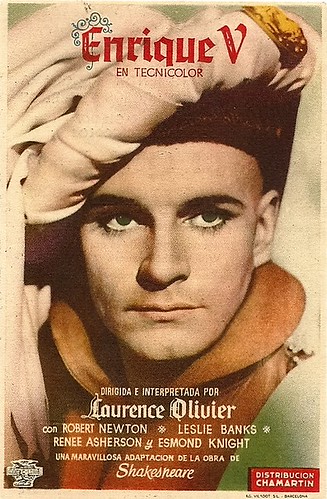
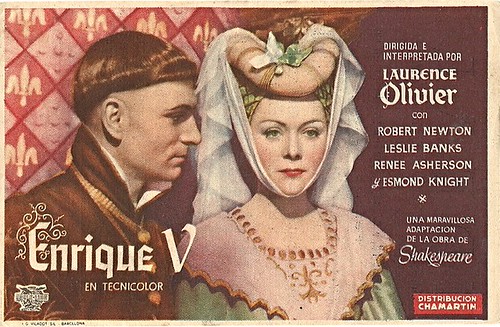
Feature Image: Movie poster in Spanish for Laurence Olivier’s 1944 Technicolor adaptation of William Shakespeare’s play, Henry V (1599). Produced in Ireland to serve as a British morale-boosting propaganda tool during WWII, the film achieved global distribution through theatrical releases and subsequent re-releases and is today frequently used in university studies (e.g., Cambridge Core) on cinematic Shakespeare. Photo: “Enrique V” by Kirby York is marked with Public Domain Mark 1.0.
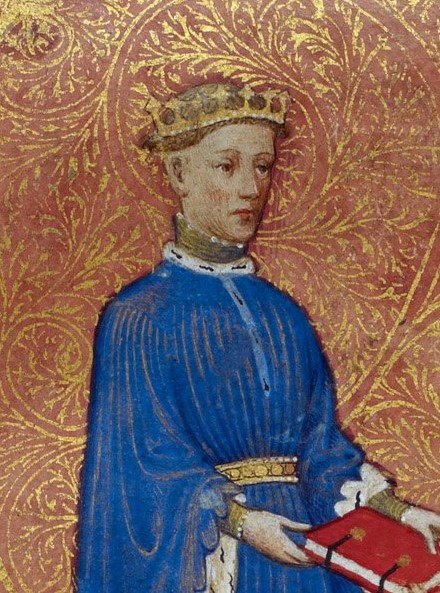
Henry V in the Regement of Princes, c. 1411–1413. Henry V died in 1422 at the age of 35, likely from dysentery contracted in the unsanitary conditions of his military camp. In his will, he named his brother, John of Bedford, as regent for his infant son, the future Henry VI, who would not be crowned in his own right until 1437. Although the Treaty of Troyes had positioned Henry V to inherit the French crown, he never became King of France; Charles VI outlived him, preventing the succession. His son, Henry VI—often described as gentle, passive, and averse to violence and warfare—proved unable to sustain his father’s hard‑won claims. His authority in France collapsed, and at home he was deposed in March 1461 by the Yorkist Edward IV. A brief restoration in 1470 returned him to the throne, but only for months; Henry VI was permanently deposed and killed in May 1471. Public Domain.
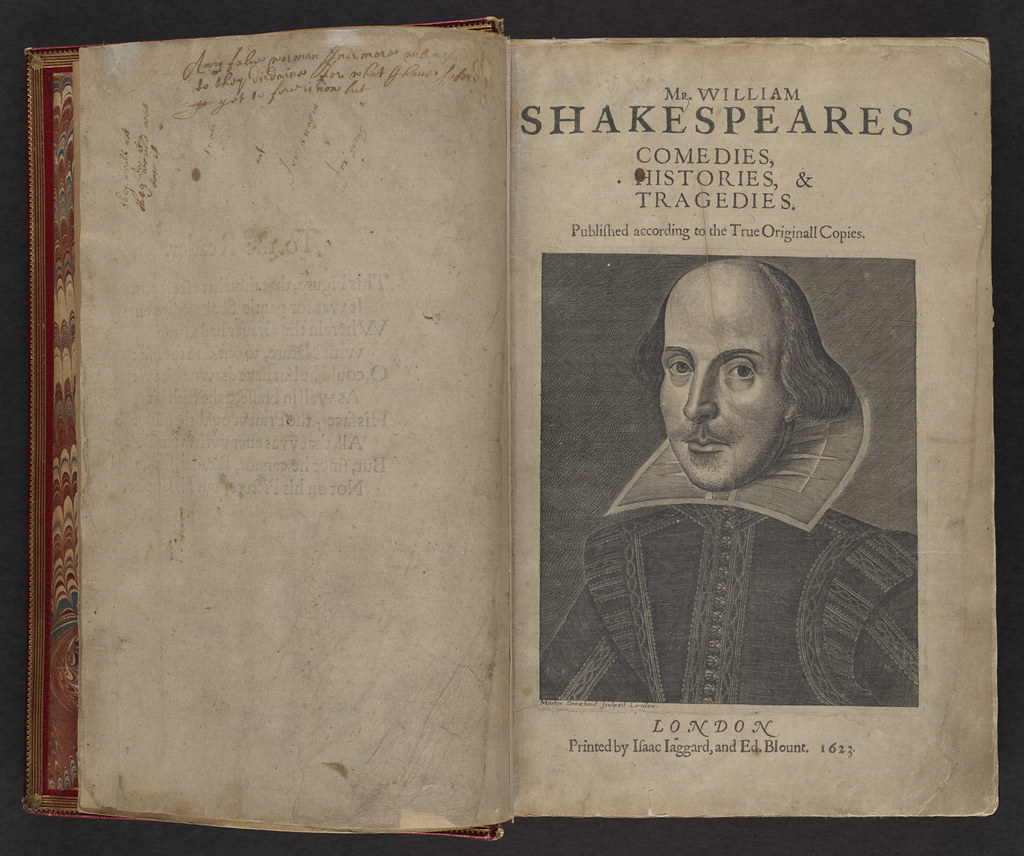
William Shakespeare likely wrote Henry V in spring 1599. The play dramatizes the 28-year-old English king’s campaign to claim the French throne, culminating in his victory at Agincourt on October 15, 1415—a battlefield I visited in 1993, still largely unchanged after six centuries. Henry based his claim on his ancestor Edward III, and his triumph was aided by a France divided by civil war between Burgundians and Orléanists.
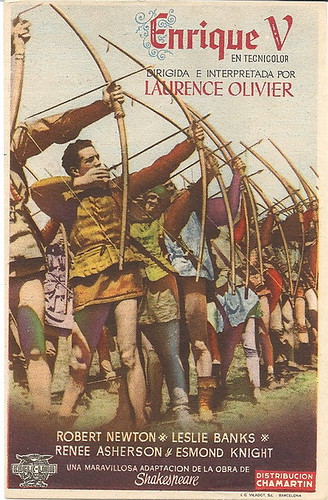
At the Battle of Agincourt (1415), roughly 80% of Henry V’s army were longbowmen—an overwhelming concentration of missile power that defined the fight. Henry deployed thousands of archers along his flanks and center, unleashing relentless, high‑velocity arrow storms that tore through the densely packed, heavily armored French ranks. Behind their sharpened stakes, these archers acted as an offensive engine, cutting down waves of advancing knights before they ever reached English lines. The result was one of military history’s most lopsided victories. Estimates suggest 6,000–10,000 French dead—including more than ninety nobles—against only a few hundred English losses. French formations collapsed, morale shattered, and an army that outnumbered the English by as much as six to one simply disintegrated. Agincourt proved that disciplined, trained, often low‑born archers could annihilate superior numbers of elite, armored cavalry. It didn’t just win a battle—it rewrote the rules of medieval warfare. Photo: “Enrique V (3)” by Kirby York is marked with Public Domain Mark 1.0.
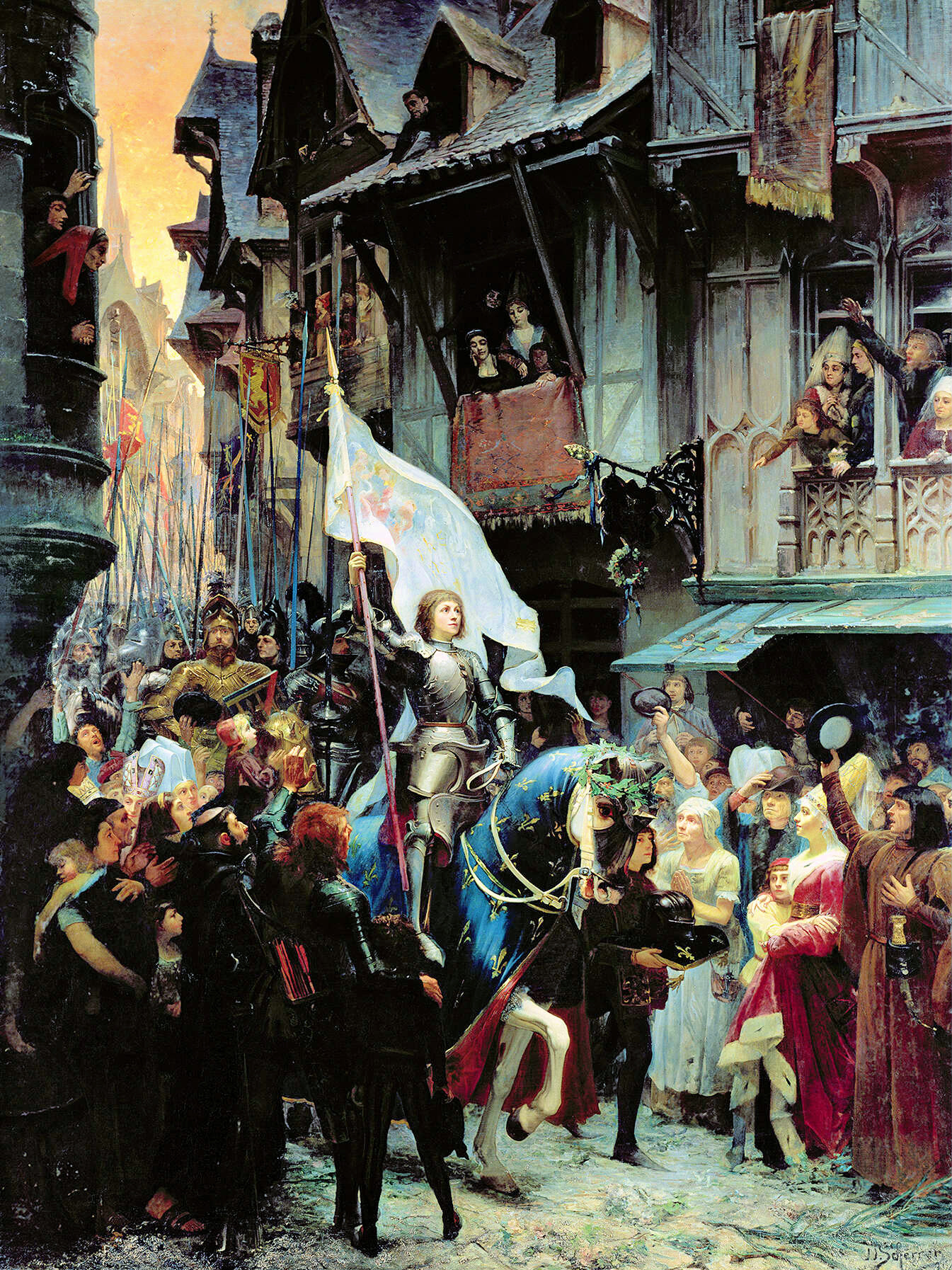
Entrée de Jeanne d’Arc à Orléans (“Entrance of Joan of Arc into Orléans”), painted in 1887 by the academic artist Jacques Scherrer (1855-1916), portrays Joan’s triumphant arrival in Orléans on May 8, 1429, after she lifted the city’s siege during the Hundred Years’ War. Her victory set in motion the campaign that culminated in the Dauphin’s coronation as King Charles VII at Reims on July 17, 1429. Public Domain.
Within fifteen years, Jeanne la Pucelle—Joan of Arc—led Orléanist and Armagnac forces to lift the siege of Orléans in 1429. Captured by Burgundians in 1430, she was handed to the English and condemned by their puppet ecclesiastical court before being burned in Rouen. Henry’s 1415 victory enabled the 1420 Treaty of Troyes, which disinherited the Dauphin, named Henry regent and heir to Charles VI, and arranged his marriage to Catherine of Valois, sister of the future Charles VII. On July 17, 1429, after Joan’s visions and military successes, she stood beside the Dauphin as he was crowned at Reims. By 1453, the French had expelled the English entirely from France.
The 1944 Technicolor film follows a performance of Shakespeare’s history play at the Globe in 1603 as it evolves toward a sharper, more realistic style. Laurence Olivier’s bold, experimental film adaptation—directing and starring in the title role—reimagined Shakespeare for the screen centuries after the play’s premiere. The production became a landmark of cinematic Shakespeare, celebrated for its visual flair and Olivier’s command of film technique, especially in the sweeping, meticulously staged battle sequences.(8) William Walton : Henry V : Touch her soft lips and part. Film clips. – YouTube (https://www.youtube.com/watch?v=pnQl4Wj8NXc) – retrieved April 23, 2026.
The play Henry V emerged during an intensely creative year for Shakespeare and was likely among the first plays staged at the new Globe Theatre. Though often read as patriotic, it also probes the ethical and personal costs of war, exposing its brutality and questioning the justice of Henry’s campaign. Laurence Olivier’s 1944 Technicolor adaptation transformed the play into wartime propaganda to bolster British morale and later earned recognition as a landmark Shakespearean film. Its iconic score was composed by William Walton.
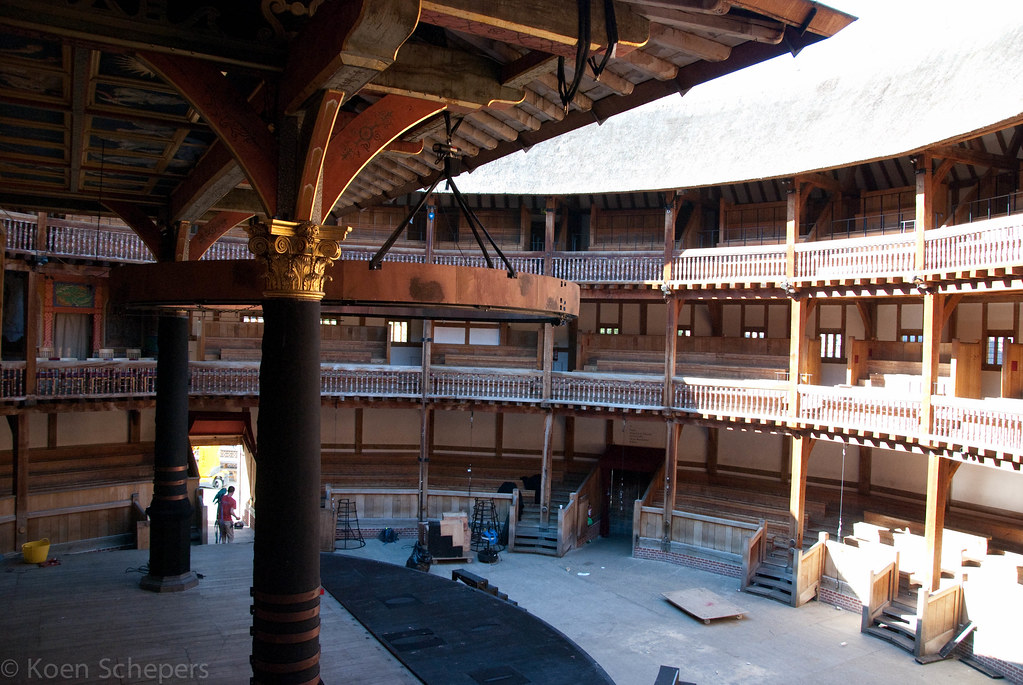
The original Globe Theatre opened in summer of 1599 in Southwark, London, built by the Lord Chamberlain’s Men which was the company William Shakespeare wrote for and part-owned. It is widely believed that the first play by Shakespeare performed at the Globe was Julius Caesar, likely alongside Henry V and As You Like It. Today’s Globe Theatre in London is the third Globe. see – Globe Theatre | About us | Discover | Shakespeare’s Globe – retrieved April 23, 2026. Photo: “Shakespeare’s Globe” by Werkmens is licensed under CC BY-NC-ND 2.0.
Canadian singer-songwriter Gordon Lightfoot began releasing solo albums in 1966. The first six were on United Artists label and sold moderately well (up to 200,000 copies). Switching to Reprise in 1969 his debut album with the label, Sit Down Young Stranger, coincided with his first U.S. hit, If You Could Read My Mind, in 1970 and became Lightfoot’s first Gold album. This was followed by Lightfoot’s second Gold album (Platinum today) and no.1 single both called Sundown in 1974. The Wreck of the Edmund Fitzgerald – a true story of an ore vessel named after a Milwaukee, Wisconsin, civic leader, that sank in a Lake Superior storm in November 1975 – was Lightfoot’s next big hit appearing on Summertime Dream, a 1976 album that has gone Platinum.1
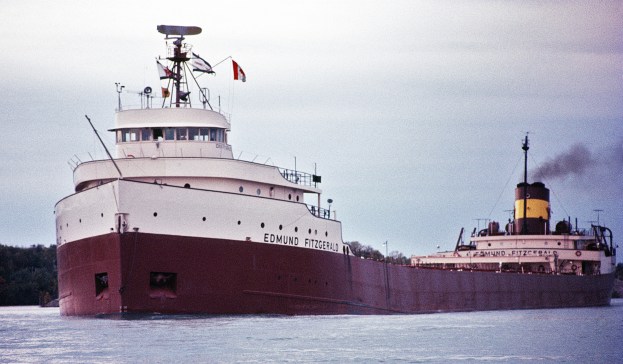
On November 10, 1975, during basically the colliding of two freshwater storms on Lake Superior, the largest of the five Great Lakes, the SS Edmund Fitzgerald, in service since 1958 and, when launched, the largest ship on the Great Lakes at over 700 feet long, went down into deep waters. For a cargo ship that should have normally expected more decades of service, the sinking caused the loss of its entire crew of 29 men. At 7 p.m. on November 10, 1975, the Fitzgerald radioed another cargo ship, the Anderson, telling them that, despite losing their radar, they were “holding their own.” Shortly thereafter the Fitzgerald was lost.
Location of the SS Edmund Fitzgerald wreck in Lake Superior approximately 17 miles (27 kilometers) north-northwest of Whitefish Point, Michigan. The ship now rests beneath about 535 feet (165 meters) of water and is considered a protected gravesite.2
Recovery Efforts involved the U.S. Navy and U.S. Coast Guard.
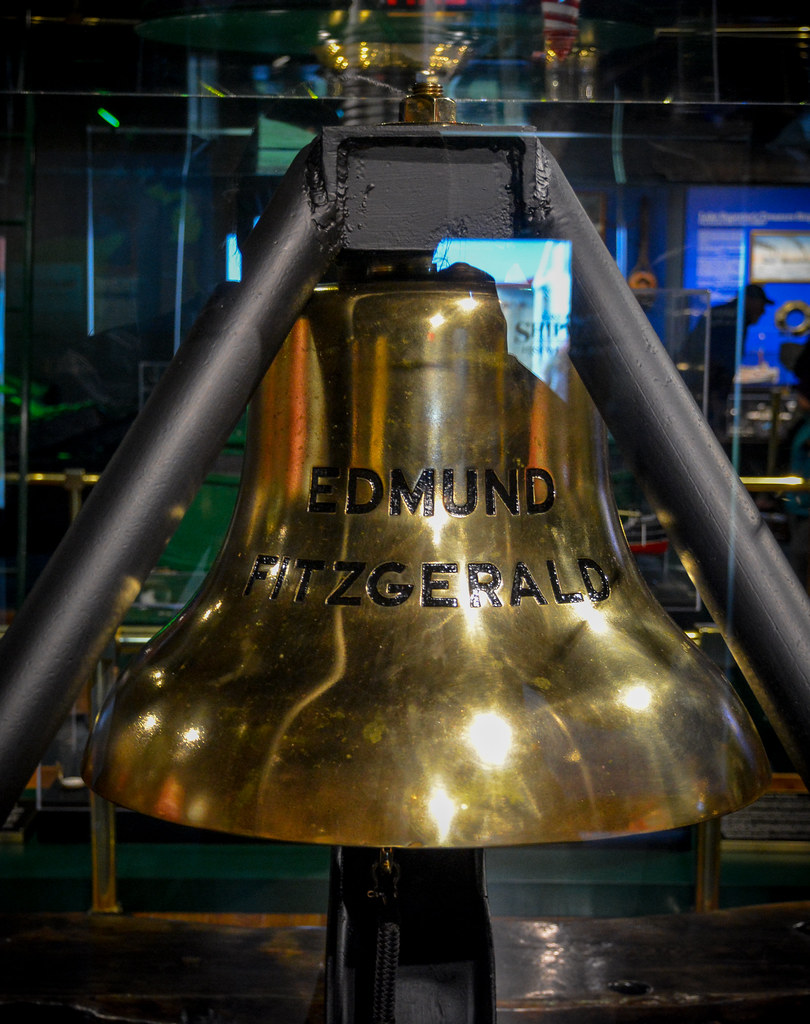
Whitefish Point, located on the southeastern shore of Lake Superior in Michigan, houses the Great Lakes Shipwreck Museum, which holds memorial events for the SS Edmund Fitzgerald each November. The wreck’s location, being 17 miles north-northwest of the point, places it beyond safe navigation lines, illustrating why the ship never reached shelter that fateful night. On a personal note, I have had the opportunity to visit the Great Lakes Shipwreck Museum in Whitefish Point, Michigan that contains the bell from the SS Edmund Fitzgerald recovered in 1995.3
The ultimate cause and circumstances of the wreck of the SS Edmund Fitzgerald in Lake Superior remain a mystery, weather conditions surrounding the sinking are well known – extraordinarily severe storm conditions, including 60 m.p.h. winds, towering waves of 25-30 feet, and heavy thick ice, which impacted possible structural vulnerabilities of the large, nearly 20-year-old cargo ship. The exact sequence of the events leading to the sinking are also unknown, as no distress signal detailing mechanical failure was received, so that the wreck has been attributed to adverse weather and lake conditions that impacted the vessel suddenly.4
The disaster, unlike the other hundreds of shipwrecks that have taken place on the Great Lakes, has entered into American mythology with Gordon Lightfoot’s ballad The Wreck of the Edmund Fitzgerald, written within a couple weeks after the disaster that same November 1975. Though the song by a bestselling recording artist about a recent shipwreck carried some risk where it was too early to know every fact, the verses are meticulously based on news stories of the basics that were known. By Lightfoot’s 7th studio album, Don Quixote, released in 1972, the Canadian singer-songwriter had begun in earnest to explore nautical themes. The Wreck of the Edmund Fitzgerald, released in June 1976 on Lightfoot’s 11th studio album, Summertime Dream, stayed on the same course.
Summertime Dream was released in June 1976 and peaked at no. 12 on the Billboard 200 (no. 1 on Canada Top Albums). The Wreck of the Edmund Fitzgerald was the album’s second track and, in August 1976, became its second single peaking at no. 2 in the U.S. and no. 1 in Canada.
The song was getting local airplay from the album in Minnesota, Wisconsin, and Michigan. Its popularity led to its release as a single in August 1976 and became Lightfoot’s biggest and most unlikely hit record commemorating the sinking of a transport cargo ship with its lives lost from less than a year before. The six-and-one-half minute folk rock song reached no. 1 in Canada and no. 2 in the U.S. where it was kept out of the top spot by Rod Stewart’s Tonight’s the Night. After the song’s release, Lightfoot never lost contact with the surviving family members of that shipwreck. Gordon Lightfoot, who was born in a town on Lake Simcoe in Ontario, Canada, died less than 90 miles away on Lake Ontario in Toronto in May 2023 at 84 years old.
The legend lives on from the Chippewa on down Of the big lake, they called Gitche Gumee The lake, it is said, never gives up her dead When the skies of November turn gloomy With a load of iron ore, twenty-six thousand tons more Than the Edmund Fitzgerald weighed empty That good ship and true was a bone to be chewed When the gales of November came early
The ship was the pride of the American side Coming back from some mill in Wisconsin As the big freighters go, it was bigger than most With a crew and good captain well seasoned Concluding some terms with a couple of steel firms When they left fully loaded for Cleveland And later that night when the ship’s bell rang Could it be the north wind they’d been feeling?
The wind in the wires made a tattle-tale sound And a wave broke over the railing And every man knew, as the captain did too ‘Twas the witch of November come stealing The dawn came late, and the breakfast had to wait When the gales of November came slashin’ When afternoon came, it was freezin’ rain In the face of a hurricane west wind
When suppertime came, the old cook came on deck sayin’ “Fellas, it’s too rough to feed ya” At seven p.m., a main hatchway caved in, he said “Fellas, it’s been good to know ya” The captain wired in he had water comin’ in And the good ship and crew was in peril And later that night when his lights went outta sight Came the wreck of the Edmund Fitzgerald
Does anyone know where the love of God goes When the waves turn the minutes to hours? The searchers all say they’d have made Whitefish Bay If they’d put 15 more miles behind her They might have split up or they might have capsized They may have broke deep and took water And all that remains is the faces and the names Of the wives and the sons and the daughters
Lake Huron rolls, Superior sings In the rooms of her ice-water mansion Old Michigan steams like a young man’s dreams The islands and bays are for sportsmen And farther below Lake Ontario Takes in what Lake Erie can send her And the iron boats go as the mariners all know With the gales of November remembered
In a musty old hall in Detroit, they prayed In the Maritime Sailors’ Cathedral The church bell chimed ’til it rang twenty-nine times For each man on the Edmund Fitzgerald The legend lives on from the Chippewa on down Of the big lake, they call Gitche Gumee Superior, they said, never gives up her dead When the gales of November come early
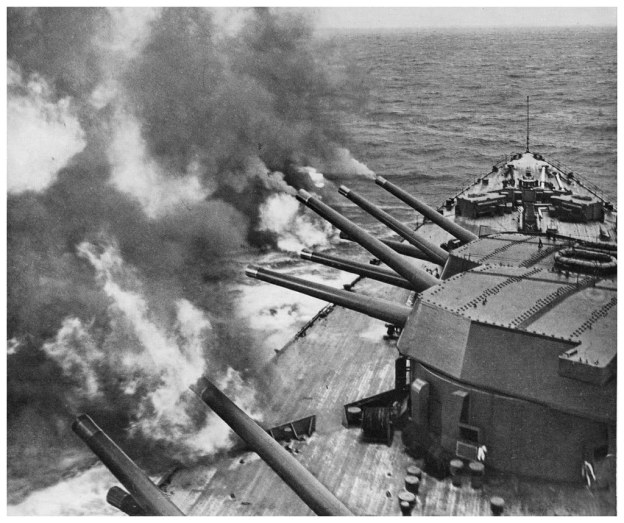
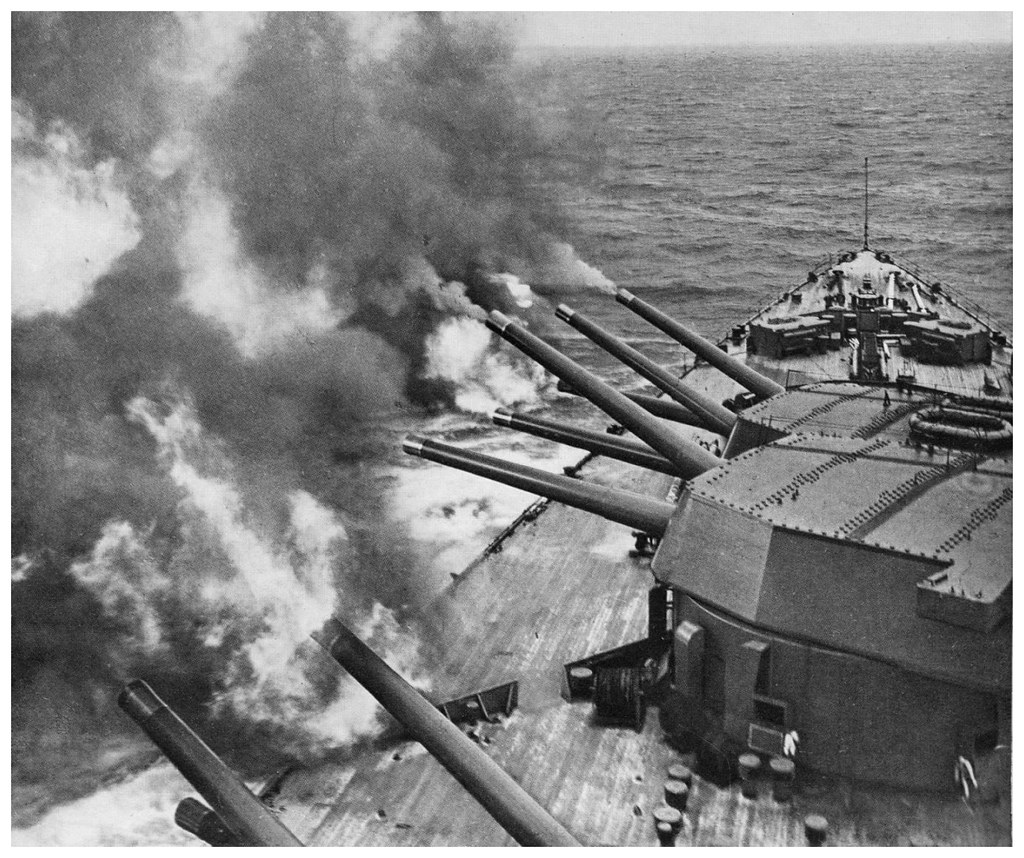
FEATURE image: HMS Rodney unloading her guns. HMS Rodney’s 16-inch guns played a pivotal role at the last battle with the Bismarck in the North Atlantic in May 1941. The British battleship’s powerful broadsides at the Bismarck caused significant structural damage that sunk the German warship. “HMS Rodney lightens her load sometime in the 1930’s.” by WWII in View is marked with Public Domain Mark 1.0.
In 1941 the Allies determined the war would need to be won in the Atlantic.1From 1939 to 1945 the Battle of the Atlantic was the longest continuous military campaign in World War II. It stemmed from the start of the war in Europe with Hitler’s invasion of Poland on September 1, 1939, and the declaration of war by France and Britain on the Third Reich. This was followed by the Battle of Britain and Fall of France in 1940 and the Allies’ declaration of war on Italy on June 10, 1941. The United States, as a non-belligerent and working through its neutrality laws, aided the Allies, namely Britain, through cash and carry and lend-lease purchases of large amounts of American-made armaments as well as providing reconnaissance to the British navy and air force who were in the fight against German U-boats and battleships aggressively attacking and sinking the merchant ships headed for Britain.
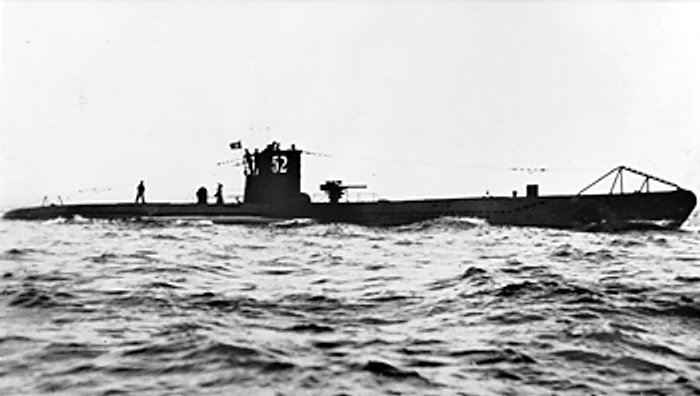
German submarine U-52. Public Domain.
A massive nearly square-shaped zone of conflict surrounded Great Britain and Iceland with its approximate boundaries from the southeast coast of Greenland across the Atlantic to France and north between Britain and Norway and back around Iceland towards Greenland. Since Denmark was occupied by German forces, the United States in April 1941 occupied their abandoned colony of Greenland and designated it as part of the Western hemisphere to categorize American non-belligerent military activity as self-defense. The Americans took the same approach with Iceland sending troops as a forward, if ostensibly defensive, posture.2
This situation brought the navies of the United States, Canada and Great Britain together as the Allies provided escort to the merchant ships into a combat zone with the German Kriegsmarine (navy), specifically U-boats (submarines) and warships, as well as the Luftwaffe (air force), who were severely disrupting the supply line. The commanders of the opposing forces were both World War I veterans. Vice-Admiral Gilbert O. Stephenson (1878-1972), a pioneer of anti-submarine techniques in the First World War, was training commander of the British escort groups while Admiral Karl Dönitz (1891-1980), whose navy career began before the Great War was the commander of the German U-boat fleet.
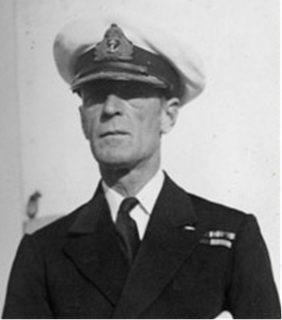
Vice-Admiral Gilbert O. Stephenson, 1929. Stephenson who served in World War I was recalled at the start of World War II and aided in the evacuation of Dunkirk. In 1940 Stephenson was tasked with setting up the training base at Tobermory on the Isle of Mull in the Scottish Inner Hebrides. Stephenson was a noteworthy disciplinarian, and his training vision and methods had an influence within the service after the war ended. The Vice-Admiral believed the most important priorities for trainees were, in order, (1) to instill the will to win; (2) to accept discipline; (3) to execute a highly competent administration; and, (4) to display technical proficiency. Public domain.
German officer Karl Dönitz on the U-39 during World War I. Public domain.
Until the attack on Pearl Harbor by Japan on December 7, 1941 the United States was a non-belligerent and Hitler wanted to keep it that way. Germany was mounting its invasion of Russia called Operation Barbarossa, which, involving almost 4 million troops, was the largest offensive operation in military history. For American internationalists looking for a way into the war in 1941, American neutrality and Lend-Lease laws along with public opinion complicated that desire. American opinion, markedly isolationist through the 1930’s and into the early 1940’s, was, in spring and summer 1941, split on whether the U.S. should escort merchant marine vessels while a large majority was against entering the war. Most Americans polled believed the United States had already been doing too much for Britain.3 In April 1941, after a year of the largest armament production program in U.S. history, President Roosevelt decided for American patrols comprised of ships and airplanes, rather than escorts or convoys, to insure the delivery of needed supplies to Britain and other Allied combatants. The mission, started without diplomatic or public fanfare, gave solely reconnaissance aid to Britain. This role in an expanding territory in the Atlantic was justified by FDR as hemispheric self-defense from the Nazis. This position was reinforced by Roosevelt in a fireside chat with the American people on May 27, 1941. By then the Bismarck was under attack and sunk. FDR’s rationale was based on the premise that the “supreme purpose” of the Axis powers was to achieve world domination by its control of the high seas and the capture of Great Britain was key to that endeavor.4
In 1941, before America’s entry as a belligerent into World War II, President Roosevelt aided the Allies with immense U.S. armament production sent to Britain and American patrols in the North Atlantic to provide intelligence to the British navy to assure their safe delivery to Britain. Further, FDR worked within the parameters of U.S. laws as well as listening to, and helping shape, the American people’s sentiments as to how much to aid Britain short of war.President Roosevelt with Microphones, September 11, 1941 (NARA). “Public Domain: President Roosevelt with Microphones, September 11, 1941 (NARA)” by pingnews.com is marked with Public Domain Mark 1.0.
In the face of these American patrols that FDR spoke of, Hitler was, after the fall of Denmark, Norway, the Low Countries, and France, looking east. The Germans were on the offensive from Yugoslavia to Greece to North Africa. Though the invasion of Britain was off, the Atlantic remained under siege. In April and May 1941 German wolfpacks (coordinated attacks by U-boats on convoys) took a heavy toll on British merchant shipping in the combat zone south of Iceland.5
May 24, 1941.
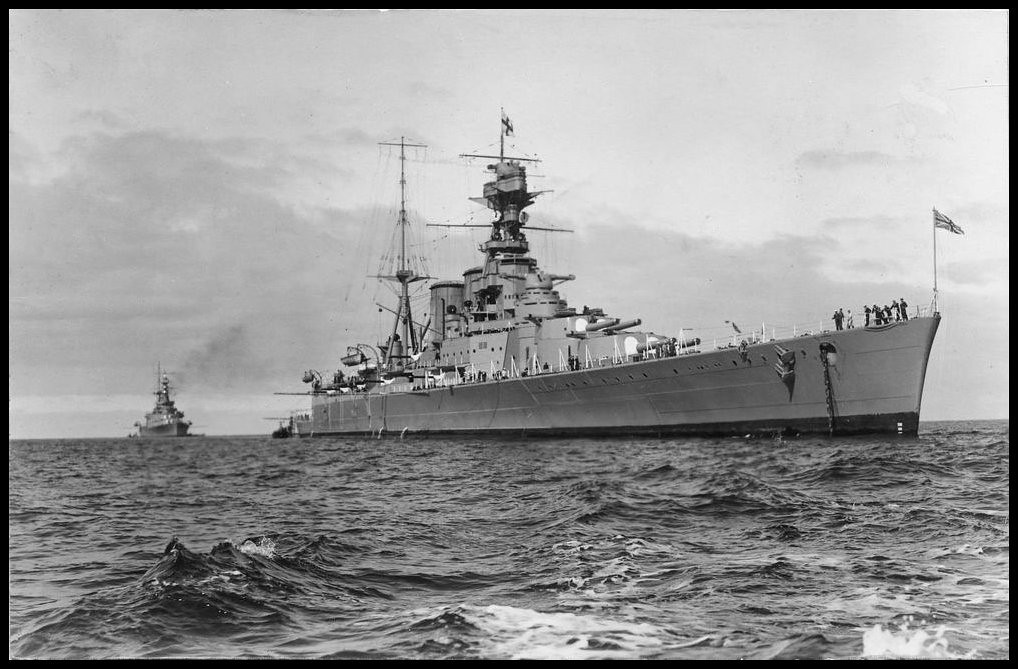
On May 24, 1941, the German battleship Bismarck, accompanied by the cruiser Prinz Eugen, left Norway for the Atlantic. The British intercepted the German ships in the Denmark Strait between Greenland and Iceland, but the Bismarck fought back and sank the HMS Hood, the biggest battlecruiser in the world at that time, which exploded with the loss of 1,415 of its crew. The sinking of the Hood marked what remains the single greatest loss of life in Royal Navy history.
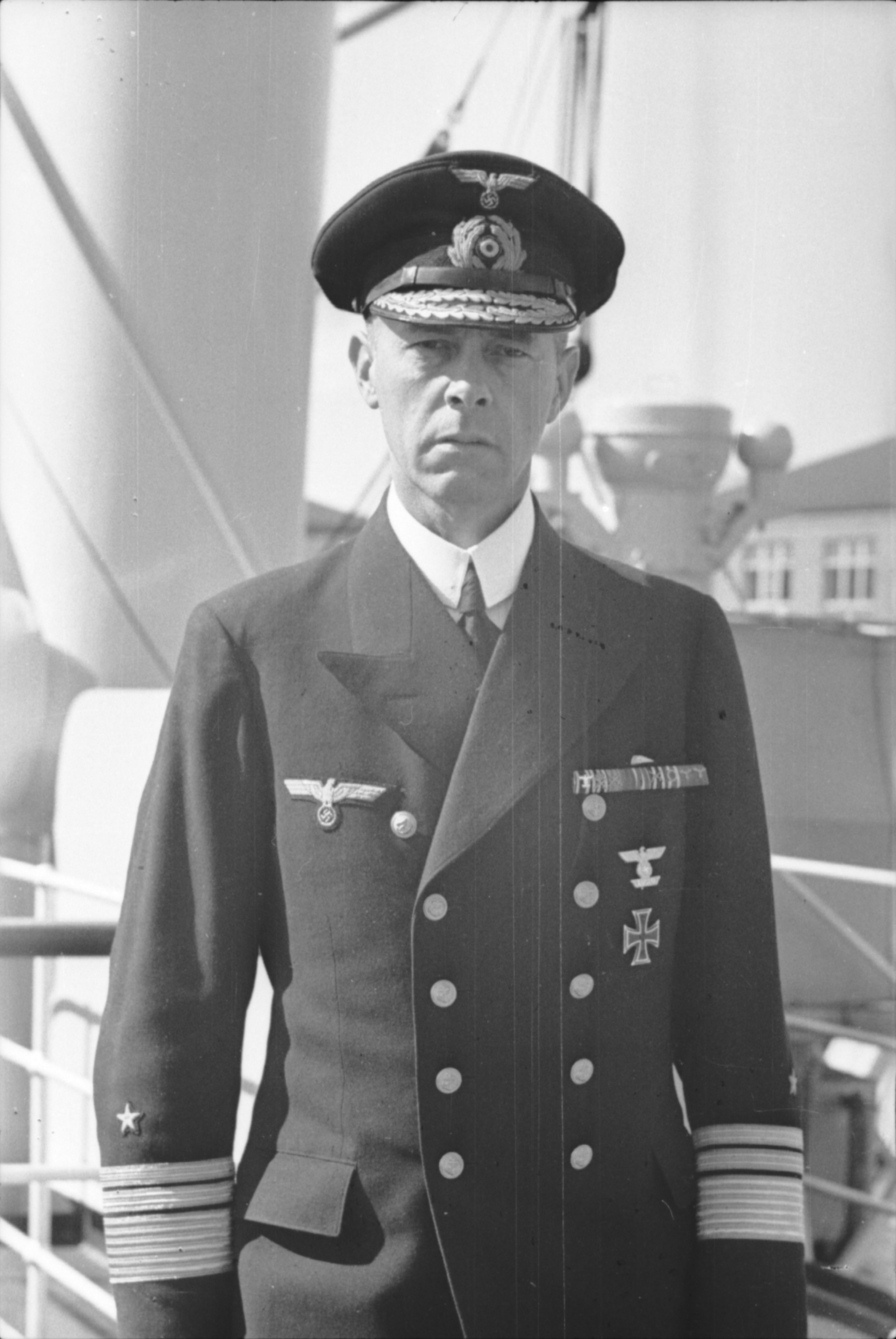
The battle also damaged the Prince of Wales. The Bismarck,under the command of Günther Lütjens (1887-1941), continued its passage south to the convoy routes but had sustained battle damage to its fuel tanks which led to subsequent flooding. Pursued by the damaged Prince of Wales and cruisers Norfolk and Suffolk, the Bismarck, traveling more slowly and trailing oil, changed course to head to Brest for ship repairs. In short order, the Bismarck turned on the British pursuers to allow the Prinz Eugen to escape into the Atlantic.
British battleship Hood. The biggest battleship in the British navy, the Hood was sunk in the Denmark Strait by the German Bismarck on May 24, 1941, with a staggering British loss of 1,415 crew lives. “H.M.S. Hood 1924” by State Library of South Australia is licensed under CC BY 2.0.
The film is recorded from the Prinz Eugen with Bismarck firing.
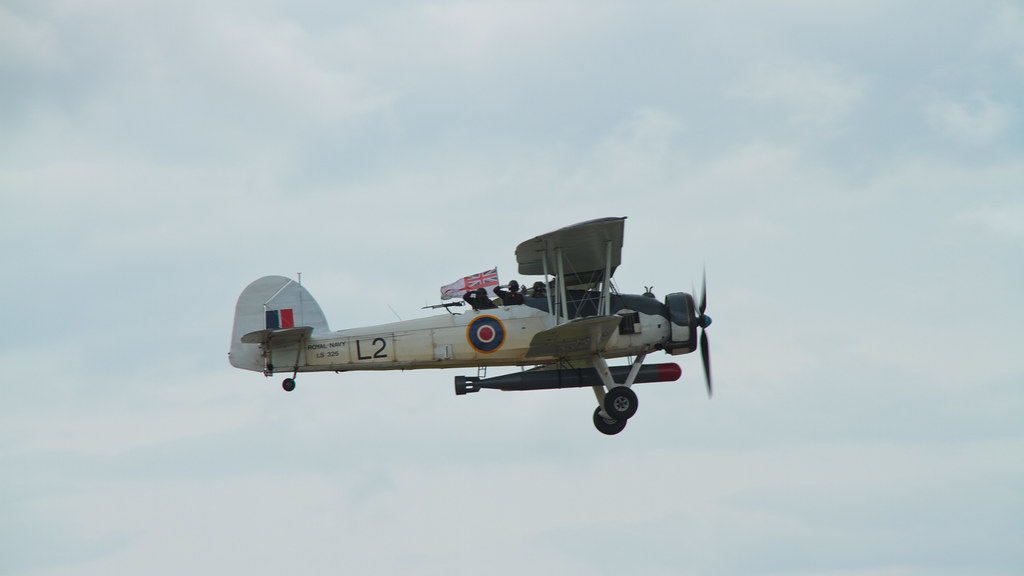
That evening, Fairey Swordfish planes— a resilient British torpedo bomber biplane that originated in the early 1930s —took off from the Home Fleet’s aircraft carrier Victorious for its first attack on the Bismarck. They engaged the warship but without important effect. For the next 31 hours, since the sinking of the Hood, the Bismarck eluded the English fleet which was looking for it further to the west.
Commander Lütjens was not aware that the British had lost him. In the early hours of May 25, 1941, he broke radio silence to send a coded message to Germany. Though its content was indecipherable, the British heard it and observed that the German commander had stopped communicating with Wilhelmhaven in Germany and began talking with Paris. This was a break that allowed the British to figure closely the actual vicinity of the enemy warship and that it was heading to France. British warships in search of the Bismarck were provided the new coordinates and the orders to pursue accordingly. This included King George V and Norfolk to be joined by a flotilla of 5 destroyers under the command of Captain Philip Vian (1894-1968).
British Captain Philip Vian in 1940. Taken before 1957, this work created by the United Kingdom Government is in the Public Domain.
May 26, 1941.
At 10 a.m. the Bismarck was spotted by an American pilot in one of the American-made Catalinas provided by Roosevelt to the British war effort. Flying out of a base in Northern Ireland, the plane was part of a squadron that had been assigned a specific search area for the Bismarck. It was piloted by American Ensign Leonard “Tuck” Smith (1915-2006) whose role was to familiarize RAF Pilot Officer, Dennis Briggs, with the plane’s controls. Though revealed long after the war’s end, Smith was credited with being the first person to spot the Bismarck before the final battle. He was awarded the Navy’s Distinguished Flying Cross for his role in the sinking of the Bismarck. Leaving in the middle of the night on May 26, 1941, the weather was bad with a ceiling of about 100 feet. According to Smith’s report, it took six hours to reach the search area. As soon as they spotted the Bismarck, they came under intense anti-aircraft fire from the warship and Smith had to take violent evasive action to escape getting blown out of the sky. Smith and the crew soon lost contact with the battleship, but their messages as to its precise location had been received. British ships and planes soon converged on an intercept course. Already the aircraft carrier Ark Royal had sent scouting planes and a pair of Swordfish spotted the enemy warship shortly after Smith did. When Smith landed his Catalina back in Northern Ireland at 9: 30 p.m., 18 hours after having taken off, it would be just 12 more hours that the 35,000-ton Bismarck would be at the bottom of the Atlantic Ocean.
After the Bismarck’s location was known, Captain Philip Vian’s flotilla that was to join King George V in the search for Bismarck, changed course and headed directly for the Bismarck. Three days earlier, on May 23, 1941, the British naval formation known as Force H had left Gibraltar for convoy duties that included the aircraft carrier HMS Ark Royal, battlecruiser Renown, and light cruiser Sheffield. On May 26, 1941, Force H set course to intercept the Bismarck.
Starting late on Monday, May 26, 1941, the last battle of the German battleship Bismarck started in the Atlantic Ocean The ship was sunk about 350 miles west of the port city of Brest in France. At 2:50 p.m. on May 26, 1941, fifteen Fairey Swordfish planes took off from the aircraft carrier HMS Ark Royal to attack the Bismarck.
The attack failed and the British cruiser Sheffield fell under friendly fire. The British staked everything on one more attack to stop the Bismarck before it could safely enter into Brest harbor the next day. At 7:10 p.m., a second sortie of 15 Swordfish planes took off from the HMS Ark Royal armed with conventional torpedoes. At 8:47 p.m., these Swordfish began their attack. The Bismarck received a direct hit but it was not mortal. A second torpedo hit the ship’s stern that jammed and disabled the battleship’s rudders crippling it. The King George V and HMS Rodney joined the fray from the northwest about 6.00 p.m. and, at 10:00 p.m., the Sheffield directed Captain Vian’s destroyers towards the target where they harassed an unmaneuverable Bismarck with torpedo attacks through the night.
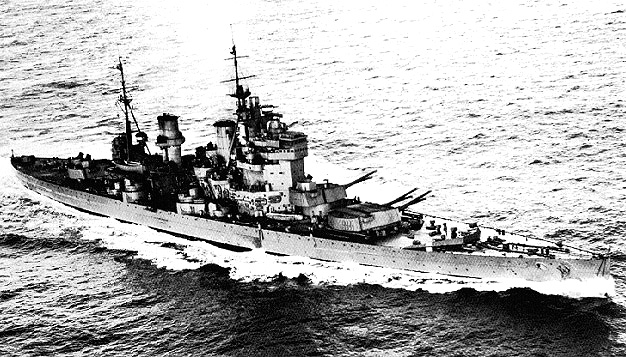
The battleship HMS King George V in 1941. Commanded by Admiral Sir John Tovey, it was one of the ships which sank the Bismarck. Public Domain.
May 27, 1941.
The next day, Tuesday, May 27, 1941, the Bismarck, unable to steer or repair the rudder, expected an attack from the British battleships. At 8:30 a.m., they readied battle stations. At 8:43 a.m. the HMS Rodney and HMS King George V, joined by cruisers and destroyers, including the HMS Norfolk and HMS Dorsetshire, spotted the Bismarck. At 8:47 a.m., from a distance of over 10 miles, the battleship HMS Rodney opened fire commencing the final battle. Though Bismarck returned fire, with its disabled rudder, its gun platforms were unstable due to uncontrollable movements on a rising sea in gale-force winds. At two minutes past 9 a.m. the HMS Rodney unloaded its 16-inch guns and hit the Bismarck’s forward superstructure, severely damaging the bridge, command facilities, fire control, and observation posts, as well as killing most of the warship’s senior officers. Both HMS Rodney and HMS King George V engaged Bismarck in heavy gunfire with increasing precision as British shells dismantled the ship’s command structure and gun turrets making the Bismarck a floating hulk. With Bismarck’s ability to return fire random and infrequent the British warships came into closer range for the German warship’s final neutralization. HMS Norfolk and HMS Dorsetshire joined HMS Rodney to fire on Bismarck with its 8 -inch guns and torpedoes. With its four main gun turrets inoperable, at 9.31 a.m., the Bismarck had lost the capacity to fight back with orders down the chain of German officers to scuttle and abandon the ship.
Nearly 3,000 projectiles were used against the Bismarck to achieve this outcome in the final battle. In the final stages of the battle the British ships surrounded the Bismarck in a crossfire that overpowered the German crew. In addition to significant structural damage, this intense continuous British gunfire set off fires on the Bismarck that caused secondary explosions.
Following the battle with the Bismarck, the HMS Rodney continued its service in World War II. In November 1942, the HMS Rodney provided naval gunfire support in Operation Torch for the Allied landings of North Africa. In 1943 during the Italian Campaign the HMS Rodney provided support for the Allied landing in Sicily (Operation Husky). In 1944, as part of Operation Neptune (the navy component of Operation Overlord), the HMS Rodney provided gunfire support during the D-Day Normandy beach landings. Following the war, in 1948, the HMS Rodney was sold for scrap. “HMS Rodney lightens her load sometime in the 1930’s.” by WWII in View is marked with Public Domain Mark 1.0.
The British kept firing, the HMS Rodney at point-blank range and the King George V from a greater distance to lob in shells. At 10:05 a.m., the Bismarck was sunk. In the battle’s last stage, the British torpedoes tore holes in the Bismarck’s hull hastening the ship’s decline into the sea. Of the Bismarck’s crew of 2, 200 men only 114 survived. The Luftwaffe that the Bismarck hoped would intervene was not able to fly in meaningful number due to bad weather. The British left the rescue mission with hundreds of German sailors still in the water as a German U-boat periscope had been spotted.
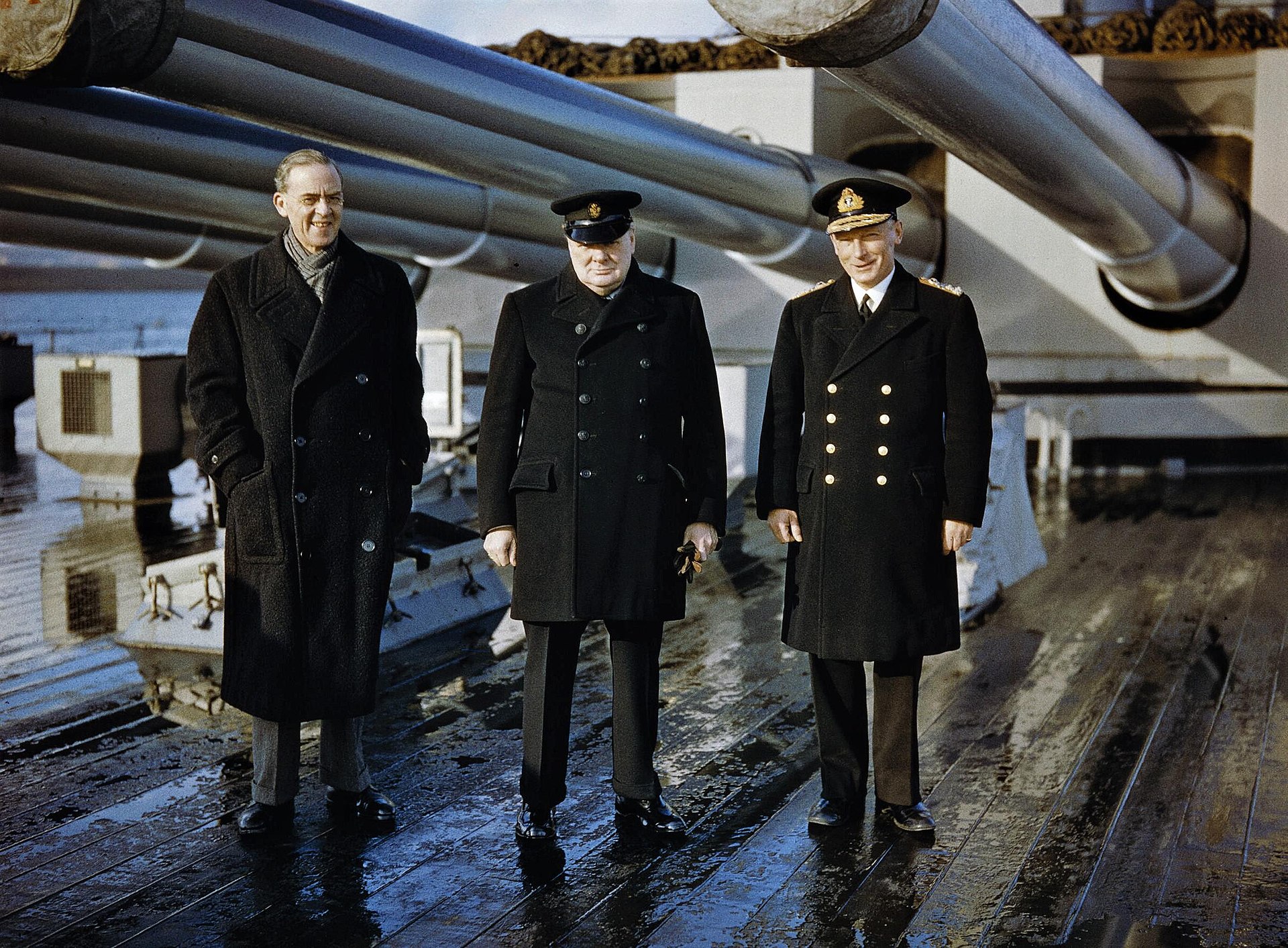
Winston Churchill with the Lord Privy Seal, Sir Stafford Cripps, and the Commander-in-Chief Home Fleet, Admiral Sir John Tovey, on the quarterdeck of HMS KING GEORGE V at Scapa Flow, 11 October 1942. Adm. Tovey who made the above observations about the Bismarck served as Commander in Chief of the Home Fleet from 1940 to 1943 and served as Commander in Chief, Nore from 1943 to 1946. Adm. Tovey was First and Principal Naval Aide de Campe to the King from January 1945. Public Domain.
After the sinking, Admiral John Tovey (1885-1971) said: “The Bismarck had put up a most gallant fight against impossible odds worthy of the old days of the Imperial German Navy, and she went down with her colours flying.”6
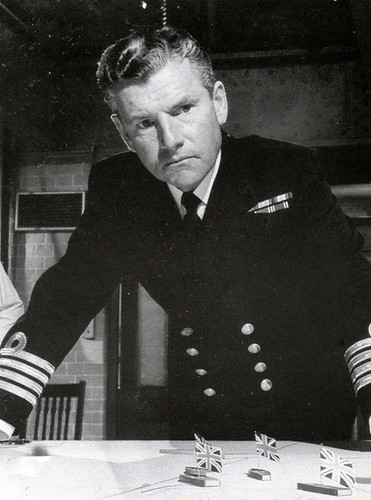
Sink the Bismarck! is a 1960 black-and-white CinemaScope British war film based on the 1959 book The Last Nine Days of the Bismarck by C. S. Forester. It stars Kenneth More and Dana Wynter and was directed by Lewis Gilbert. Norman Shelley was the uncredited voice of Winston Churchill: “I want to make it unmistakably clear that there is absolutely nothing as vital to the nation at this moment as the destruction of the Bismarck. You are authorized to employ any means at your disposal regardless of risk and regardless of the price that must be paid. This is a battle we cannot afford to lose. I don’t care how you do it, you must sink the Bismarck!“
In 1960 the British black-and-white film production, Sink the Bismarck!, was a hit in the United States and, after its first run, regularly broadcast on TV through the 1960’s and 1970’s in reruns. It co-starred Kenneth More as Captain Jonathan Shepard who coordinates the hunt for Bismarck aided by Women’s Royal Naval Service Second Officer Anne Davis (Dana Wynter). More had served as a Royal Navy lieutenant on HMS Victorious during World War II. “Kenneth More, ‘Sink the Bismarck’, 1960” by thefoxling is licensed under CC BY-NC-SA 2.0.
FOOTNOTES:
1. Freedom From Fear: The American People In Depression and War, 1929-1945, David M. Kennedy, NY: Oxford University Press, 1999, pp. 490 and 493.
2. Freedom from Fear, p. 492.
3. Operation Barbarossa – Freedom from Fear, p. 495; polls- Ibid., p. 491.
4. Freedom from Fear, pp. 492-493.
5. The Reluctant Belligerent: American Entry Into World War II, 2nd edition, Robert A. Divine, NY: John Wiley & Sons, 1979, p. 117.
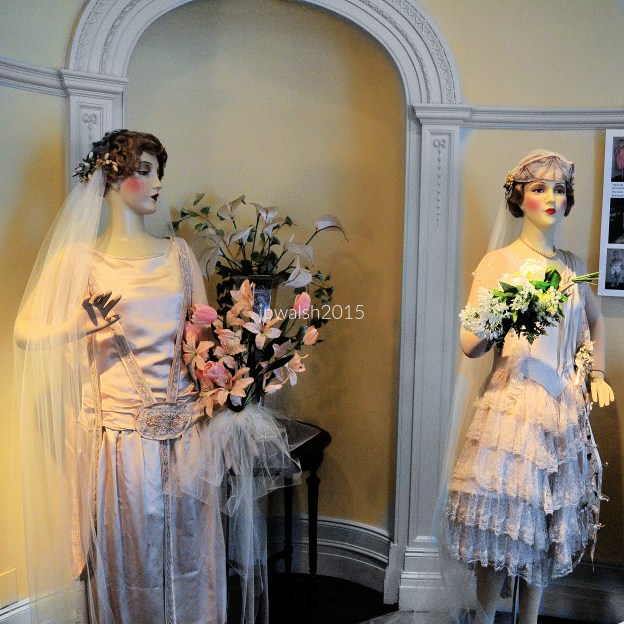
Feature Image: On Saturday, June 7, 1924, Ruth M. Anderson was married in this sleeveless wedding dress (left) to William Noling in Evanston, Illinois. The dress is now on display in the Charles Gates Dawes House in Evanston. Dawes was Vice President of the United States from 1925 to 1929 under President Calvin Coolidge. Author’s photograph (October 2015).
Wedding at the House of the Bride’s family
The Noling-Anderson wedding was held in the house of the bride and her parents, Isak and Jennie (née Johnson) Anderson, at 1035 Ridge Avenue in Evanston. Built in 1914, the house still stands as it did over 100 years ago.
Noling-Anderson Bridal Party Dresses, 1924. Charles Gates Dawes House, Evanston, Illinois. Author’s photograph, October 2015. 7.44 mb DSC_0893 (1)
The dress is made of silk satin in an egg shell color. It is accented by an oval medallion with bands also made of silk satin. The medallion is embroidered with faux pearl and other glass beads.
Thoroughly modern flapper style
While her wedding dress was very fashionable for the mid1920’s – sleeveless tops of all shapes and sizes were the rage in 1924 – it probably was not allowed in one of Evanston’s houses of worship. The fact that it was sleeveless and au courant would be deemed by many as risqué for showing too much bare skin inspired by a thoroughly modern flapper style. It was only in 1924, for instance, that the Methodist Episcopal General Conference first lifted its ban on going to the theater as well as dancing though dance music was the radio’s most popular programming.
The bridesmaid dress (right) was the height of women’s style in 1924 – a mainly straight, knee-length skirt gathered slightly or cut with front pleats. Short sleeve and sleeveless tops were the rage in 1924 reflected in Hollywood by the Mack Sennett girls who starred in movies where they pranced on the beach in a chorus line in not much more than bathing caps and short swim suits.
The fashionable bride and her court might have sported the latest style of facial make-up which is hinted at in the display– masklike with garish, even orange, lipstick and heavy red rouge on the cheeks. Popular fashion accessories from 1924 are also evident – pearls knotted at the neck and simple, though elegant, arm bracelets.
Father of the bride was an Evanston banker, local businessman, andSwedish immigrant
The bride’s father, Isak Anderson, was born in Sweden and came to the United States at 20 years old in 1890. In 1891 he married Jennie Johnson and they had Ruth and another child. Ruth’s father was a bank director and partner in a local tailoring business in downtown Evanston at 608 Davis that today is a noodle shop.
They served “Prohibition highballs”
With Prohibition starting in 1920, guests at the wedding may have been served the latest popular highball whose recipe called for fruit juice and raw eggs. Their morning might have started with a bowl of Wheaties at breakfast, since the cereal of champions made its first appearance in 1924.
Ruth Anderson married William Noling in this house wearing that dress at 1035 Ridge Avenue in Evanston, Illinois, on June 7, 1924. Author’s photograph, May 2024 92% 7.81 mb
SOURCES: Dawes House, Evanston Illinois; The Swedish Element in Illinois: Survey of the Past Seven Decades, Ernst Wilhelm Olson, p. 586; American Chronicle, Lois Gordon & Alan Gordon, Yale University Press, New Haven & London,1999, pp. 230-238; Chicago: The Glamour Years (1919-1941), Thomas G. Aylesworth & Virginia Aylesworth, Gallery Books, NY, 1986, p.14.
Brian Wilson was not simply a successful songwriter or Beach Boys leader, but a transformative musical innovator whose emotional songwriting, sophisticated studio experimentation, and groundbreaking harmonic arrangements expanded the artistic possibilities of pop music in the 1960’s and beyond.
Founding a Family Band
In 1961, Brian Wilson formed the Beach Boys with his brothers Carl and Dennis, their cousin Mike Love, and school friend Al Jardine. Brian, the eldest Wilson brother, quickly emerged as the group’s musical center of gravity. The family story would later carry deep shadows: Dennis drowned in 1983, and Carl died of cancer in 1998. But in the early 1960s, the band’s rise was swift and bright.
Chart Breakthrough and an American Peak
By December 1963, the Beach Boys had reached a national summit with “Surfin’ U.S.A.”, the number‑one song in America. Their sound—sun‑drenched, harmony‑driven, and unmistakably Californian—seemed to define the country’s musical mood. Brian’s melodic instincts and arranging talent were already pushing the group beyond surf‑rock formulas toward something more ambitious.
Wilson’s response to the Beatles and the British Invasion was artistic innovation rather than imitation.
The British Invasion Arrives
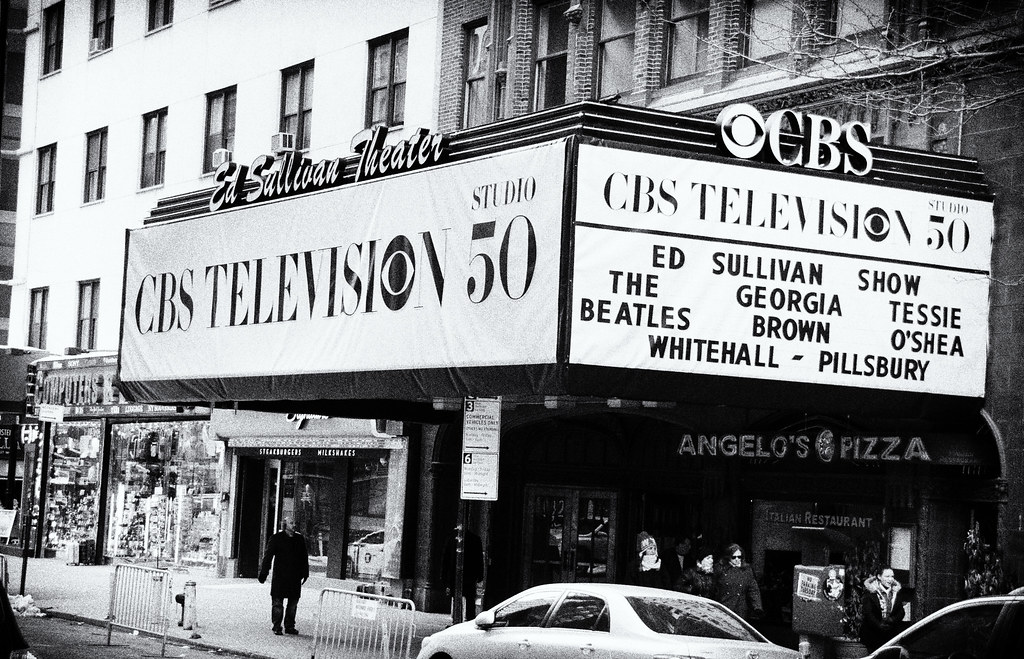
Everything changed two months later. On February 9, 1964, the Beatles appeared on The Ed Sullivan Show before an audience of 73 million Americans (see – https://www.edsullivan.com/the-beatles-on-the-ed-sullivan-show-on-february-9-1964/ – retrieved June 11, 2025). Overnight, the British Invasion reshaped the pop landscape. For Brian Wilson, the moment landed like a challenge. The Beach Boys—still riding high—suddenly found themselves in an informal, transatlantic competition with the Fab Four, especially Paul McCartney, for the artistic future of 1960s pop.
Rather than retreat, Brian accelerated. He began writing more original material, experimenting with new arrangements, unusual instrumentation, and increasingly sophisticated harmonic structures. His goal was not imitation but innovation—a new sound that could stand beside the Beatles’ evolving artistry and, at times, even inspire it.
A Remarkable Run of Hits
The result was one of the most productive bursts in American pop history. Between “Surfin’ U.S.A.” (1963) and “God Only Knows” (1966), the Beach Boys scored 15 top‑20 hits, including two number‑ones that held the top spot for multiple weeks. Brian’s studio experiments—lush textures, emotional directness, and fluid four‑part harmonies—reshaped what pop music could be and earned the admiration of McCartney himself.
A New Era of Studio Experimentation
Pet Sounds marked a turning point for rock and pop bands, ushering in an era of studio experimentation. It predated—and directly inspired—the Beatles’ Sgt. Pepper’s Lonely Hearts Club Band in 1967, one of pop’s first concept albums and a catalyst for the psychedelic imagery that shaped mainstream culture into the mid‑1970s.
God Only Knows exemplified Wilson’s blend of vulnerability, spirituality, orchestral ambition, and emotional depth.Wilson’s true significance lies in his artistic innovation and enduring influence, not merely his commercial success.
Though not fully recognized at the time, God Only Knows and Pet Sounds are some the clearest evidence of Wilson’s genius and his achievement and has since been acknowledged as trendsetting and profoundly influential.
Crafting the Sound of “God Only Knows”
For God Only Knows, the Beach Boys assembled a 15‑piece orchestra alongside a rock band of top Los Angeles session players to realize Brian Wilson’s “sophisticated soundscape.” The group’s 11th studio album represented a clear break from their earlier catalog—described not as rock and roll but as “futuristic, progressive and experimental.” (Stebbins, The Beach Boys FAQ, p. 74)
Writing a Song of Faith and Vulnerability
According to Brian Wilson, God Only Knows was written in about 45 minutes. For many listeners, it stands as the greatest Beach Boys song—and, for some, the greatest song of its era or perhaps of all time. Its lyrics revolve around faith, emotion, and the fear of losing a deep personal connection. The stakes are high throughout.
Carl Wilson’s Defining Vocal
Brian gave the lead vocal to his brother Carl, believing Carl could deliver the words with clarity and meaning—without the self‑consciousness Brian feared in his own voice. Carl’s performance became one of the defining moments of the Beach Boys’ recorded legacy.
A Private Vision of the Divine and Message of Feeling and Eternity
Wilson’s use of the word “God” was unusual in a pop context. But it was not the public God of church or country. For him, God was a private force who “helps a person control their hopes and doubts.” (I Am Brian Wilson, p. 180). Brian Wilson remained most proud of God Only Knows because he believed it carried a genuine message—one rooted in feeling, vulnerability, and a sense of eternity.
“God Only Knows” by andreboeni is licensed under CC BY 2.0. When Pet Sounds was released in May 1966, reviews In America were largely tepid and sales did not match previous albums. The album—featuring Brian Wilson and Tony Asher’s God Only Knows—would not be certified Gold for 30 years. At the time, critics were praising Dylan’s Blonde on Blonde, the Rolling Stones’ Aftermath, and the Beatles’ Revolver, artists whose roles as rock’s new masters were already clear. Brian Wilson, still reinventing himself, was instead seen as a poignant and possibly troubled pop figure. Later reevaluations of Pet Sounds, including God Only Knows, now regard the album as the trendsetting work of a genius.
Carl Wilson’s Voice and the Song’s Reception
Mike Love agreed that God Only Knows “became one of the album’s most celebrated numbers,” noting that Carl Wilson’s “dulcet voice” actually heightened the song’s “spiritual dimensions.” Love also believed it marked a moment when Carl—four and a half years younger than Brian—emerged as a talented leader within the Beach Boys. (Love, Good Vibrations, pp. 130–131)
Brian Wilson’s Studio Authority
During the Pet Sounds sessions, Brian acted as a virtual dictator in the studio, prompting Love to nickname him “General Patton,” a reference to the four‑star American general of World War II. Other nicknames were less patriotic. Love also confirmed Brian’s reluctance to use the word “God” in the song and, by inference, the courage and honesty required to include it.
With Carl Wilson on lead vocals, the lyrics of God Only Knows speak from the perspective of someone who believes that life without his lover can only be fathomed by God. Brian Wilson was married to Marilyn Rovell at the time, though in a 1976 radio interview he said the song was not written for anyone in particular, even if he had written other songs with specific girls in mind. Wilson and Rovell divorced amicably in 1979.
Brian Wilson on Love and Meaning
In 2016, Brian Wilson reflected on the emotional core that shaped so much of his writing: “I wasn’t in love often. I thought about girls, but if they didn’t think about me, how was that love? …When friends would tell me that they were seeing a new girl, I would ask them if they were really in love. That was important to me. It seemed like a real thing. Were they in love? Did something happen inside them that made them feel closer to that other person and closer to themselves? It’s why I wrote so many love songs, because it’s the real thing.” (I Am Brian Wilson, p. 124)
The initial commercial and critical underappreciation for Pet Sounds stands in stark contrast to its later recognition as a timeless masterpiece. At the heart of this legacy is “God Only Knows,” a track that perfectly captured Brian Wilson’s unique blend of vulnerability, spirituality, and orchestral ambition. This emotional depth was not lost on live audiences at the time, who famously fell into a hushed, captivated silence to listen closely whenever the song was performed.
Release and Chart Performance
God Only Knows was issued in the United States in July 1966 as the B‑side to “Wouldn’t It Be Nice,” peaking at no. 39 on the Billboard Hot 100. Abroad, the song fared far better, reaching no. 2 in the United Kingdom and entering the top ten in Canada and across Europe.
Bruce Johnston remembered squeezing into the tiny studio one Wednesday night as Brian Wilson recorded “God Only Knows.” A full ensemble jammed shoulder‑to‑shoulder — violinists perched on French horn players, Carl playing his guitar from a booth, and the room overflowing with bodies and sounds. It was, he said, “incredible.”
A Shared Session and a Distinctive Sound
Both God Only Knows and “Wouldn’t It Be Nice” were recorded during the same session on April 11, 1966. Brian Wilson worked on an 8‑track recorder at Columbia, and Terry Melcher—California producer and singer‑songwriter—was present to provide backup vocals for “God Only Knows.” The session reflected Wilson’s increasingly intricate studio methods during the Pet Sounds period.
A Song Written for Carl
Carl Wilson later said that Brian told him he had written God Only Knows for him to sing as recognition of his “beautiful spirit” (Badman, The Beach Boys: The Definitive Diary, Backbeat Books, 2004, p. 126). Carl’s vocal would become one of the defining performances in the Beach Boys’ catalog, carrying the emotional clarity Brian believed the song required.
A Closing Perspective
Taken together—the modest U.S. chart showing, the strong international reception, the shared April 11 session, Melcher’s presence, and Brian’s intention for Carl’s voice—God Only Knows stands as a carefully crafted work whose meaning was shaped as much by the people in the room as by the song on the page. It remains one of the most personal statements in Brian Wilson’s body of work, anchored in the bond between two brothers and the evolving artistry of the Beach Boys at their creative peak.
God Only Knows LYRICS I may not always love you But long as there are stars above you You never need to doubt it I’ll make you so sure about it God only knows what I’d be without you If you should ever leave me Though life would still go on, believe me The world could show nothing to me So what good would living do me? God only knows what I’d be without you God only knows what I’d be without you If you should ever leave me Though life would still go on, believe me The world could show nothing to me So what good would living do me? God only knows what I’d be without you God only knows what I’d be without you (God only knows what I’d be without you) God only knows what I’d be without you (ooh-ooh) (God only knows what I’d be without you) God only knows God only knows what I’d be without you (ooh-ooh) (God only knows what I’d be without you) God only knows God only knows what I’d be without you (ooh-ooh) (God only knows what I’d be without you) God only knows God only knows what I’d be without you (ooh-ooh) (God only knows what I’d be without you) God only knows God only knows what I’d be without you (ooh-ooh) (God only knows what I’d be without you) God only knows
SOURCES:
Badman, Keith. The Beach Boys: The Definitive Diary of America’s Greatest Band on Stage and in the Studio. 1st ed. New York: Backbeat Books, 2004, p. 126.
Love, Mike. Good Vibrations: My Life as a Beach Boy. New York: Penguin Publishing Group, 2016, pp. 130-131.
Morgan, Johnny. The Beach Boys: America’s Band. Illustrated ed. New York: Union Square & Co., 2015, pp. 108-109.
Stebbins, Jon. The Beach Boys FAQ: All That’s Left to Know about America’s Band. New York: Backbeat Books, 2011, p. 74.
Wilson, Brian, with Ben Greenman. I Am Brian Wilson: A Memoir. Boston: Da Capo Press, 2016, pp. 124 and 180.
Derek Worlock was one of the most important ecumenical church leaders in modern Britain, whose lasting legacy was not simply his role as Roman Catholic Archbishop of Liverpool but his determined effort to bridge historic divisions between Catholics and Anglicans through friendship, collaboration, social engagement, and practical Christian unity.
Derek Worlock: Archbishop of Liverpool
Derek Worlock (February 4, 1920 – February 6, 1996) was an English priest of the Roman Catholic Church who served as Archbishop of Liverpool. A leading figure in post‑war British Catholicism, he became known for his pastoral warmth, public presence, and commitment to unity among Christians.
A Ministry Shaped by Collaboration
Worlock devoted his episcopal life to fostering cooperation across Christian traditions. His partnership with Anglican Bishop of Liverpool David Sheppard became one of the most celebrated ecumenical friendships in modern Britain. Together they co‑authored Better Together and With Hope in our Hearts (both 1995), works that embodied their shared vision for a reconciled, outward‑facing Church. His episcopal motto, Caritas Christi eluceat—“For the Shining Light of Christ”—captured the spirit of his ministry.
His partnership with Anglican Bishop David Sheppard became one of Britain’s most influential and visible examples of Christian cooperation. Their efforts sought to overcome centuries of Catholic-Anglican rivalry and demonstrate that reconciliation between churches could help foster reconciliation within society.
Bishop Worlock’s mitre, placed at his tomb, recalls a pivotal moment in his early episcopal ministry. In 1973, while serving as Bishop of Portsmouth, Worlock was preparing to attend the upcoming Roman Synod of Bishops. Asked to suggest a theme for the Synod’s work, he proposed “Evangelization”—a choice Pope Paul VI accepted.Worlock’s proposal did more than set the agenda for a major global gathering. It highlighted two convictions that shaped his entire episcopate:
that evangelization is rooted in the Church’s ancient mission shared by all the baptized, and
that the spirit of Vatican II’s outreach to others—its ecumenical openness, its desire for dialogue, its pastoral warmth—must animate that mission.
In 1994, Worlock received the Freedom of the City of Liverpool, a civic acknowledgment of his decades of service to the city. Two years later, in 1996, he was appointed a Companion of Honour, one of the United Kingdom’s most distinguished awards.
A Memorial on Hope Street
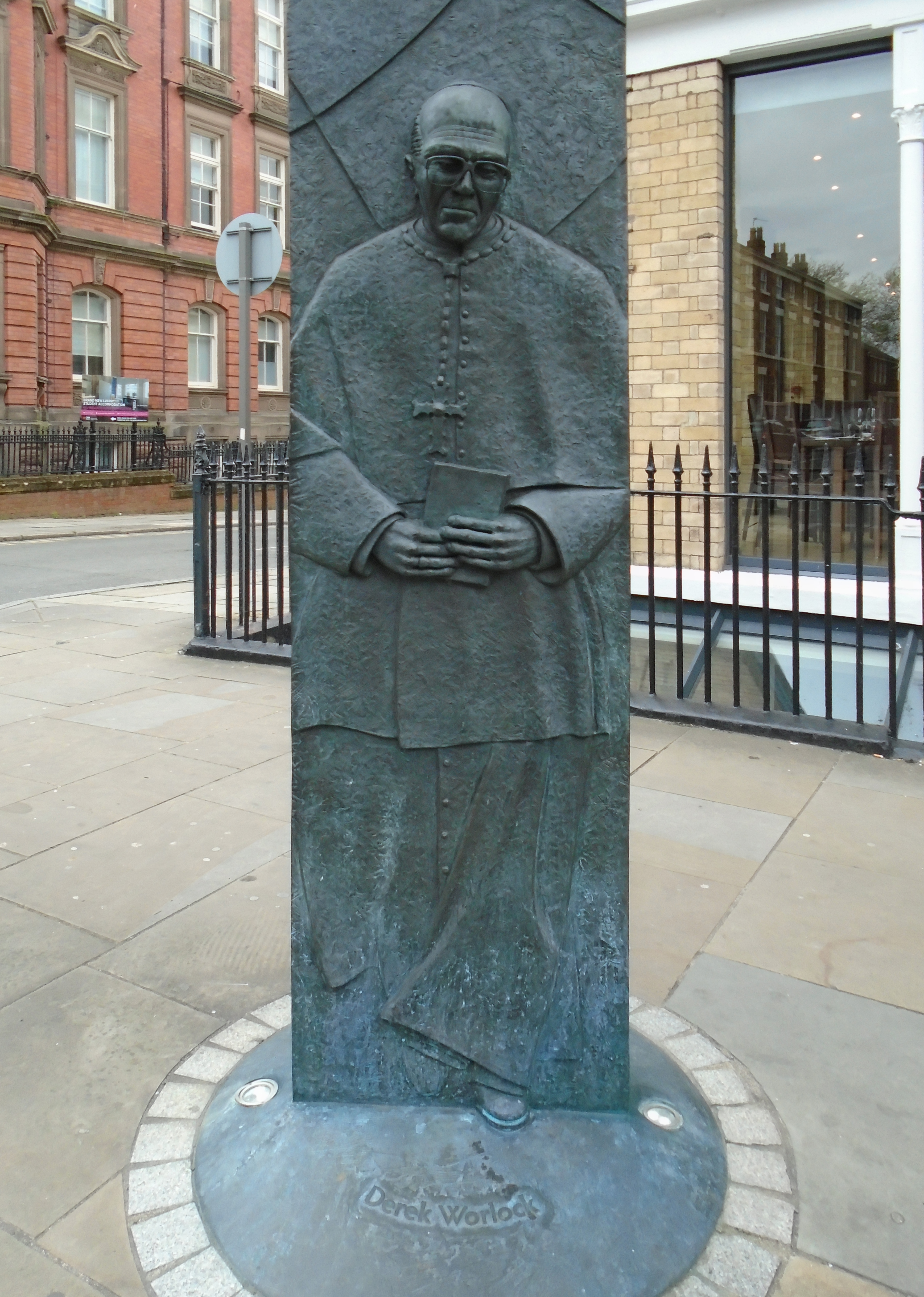
After his death in 1996, plans began for a public memorial. Commissioned in 2005 and funded through widespread public donations, the sculpture was created by British artist Stephen Broadbent (b. 1961). Placed at the midpoint of Liverpool’s Hope Street, the memorial stands symbolically between the city’s Anglican and Roman Catholic cathedrals—an architectural embodiment of the unity Worlock championed throughout his life.See it here: https://www.flickr.com/photos/newfolder/2535308455
Worlock and Sheppard worked together through joint pastoral letters, civic leadership, public appearances, and shared responses to social crises, giving Liverpool a united Christian voice. The Hope Street memorial sculpture symbolizes their shared ministry, standing midway between Liverpool’s Anglican and Catholic cathedrals.
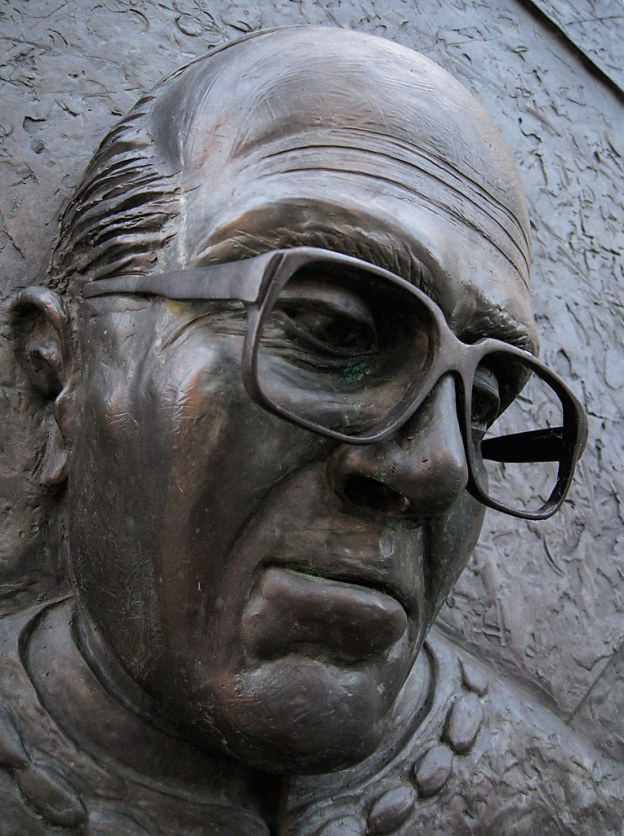
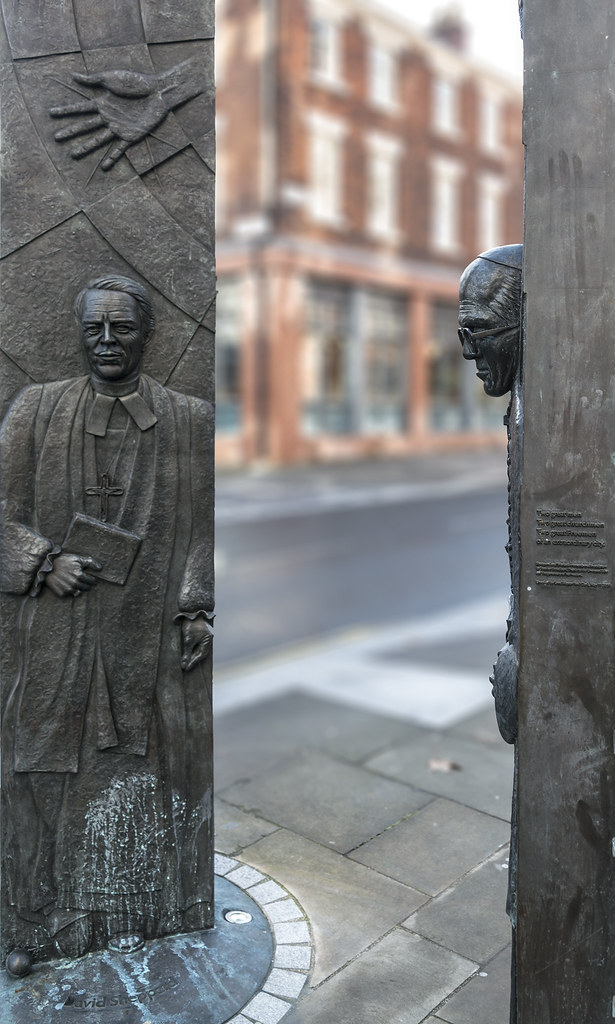
David Sheppard and Derek Worlock memorial, Hope Street, Liverpool.The placement is deliberate: halfway between the two cathedrals, exactly where their work met with space between them for everyone. PHOTO: “DSCF0029” by geraldmurphyx is licensed under CC BY-ND 2.0.
A Shared Mission of Reconciliation
The statue commemorates the extraordinary partnership between Archbishop Derek Worlock and Bishop David Sheppard, two churchmen who refused to let centuries of division define Liverpool’s Christian life. At a time when Catholic–Anglican relations still could be frosty and suspicious, they pointed to a a different path of public friendship, joint action, and a united moral voice for their city.
Their collaboration was not symbolic but deeply practical. They issued joint pastoral letters, appeared together at civic events, and spoke with one voice during moments of crisis. In a city marked by economic hardship, sectarian memory, and social fragmentation, they insisted that Christian leadership must be shared leadership. Their partnership became a model for ecumenical cooperation across Britain.
Healing Historic Divisions
Worlock and Sheppard understood that Liverpool’s religious landscape had long been shaped by rivalry—Catholic and Anglican identities often hardened by class, migration, and political history. Their work aimed to soften those boundaries. They promoted joint prayer services, encouraged cooperation between parishes, and supported community initiatives that crossed denominational lines.
Their message was simple but radical: unity was not an optional ideal but a pastoral necessity. They believed that reconciliation between churches could help foster reconciliation within the city itself.
A Memorial to Unity
The statue’s purpose was to create a permanent reminder of this shared ministry. It honors not only two individual leaders but the ecumenical vision they embodied. Positioned on Liverpool’s Hope Street—linking the Anglican Cathedral at one end and the Catholic Cathedral at the other—the memorial stands as a physical metaphor for the bridge they built.
Above: Archbishop Derek Worlock London‑born Derek Worlock was ordained a Catholic priest in 1944 and began his ministry as curate at Our Lady of Victories, Kensington, then London’s wartime pro‑cathedral. For nearly two decades he served at the heart of English Catholic leadership as private secretary to three Archbishops of Westminster, a role that shaped his administrative skill and national profile. He later spent a year as Rector and Rural Dean of the Church of SS Mary and Michael—one of London’s historically largest parishes—before being appointed Bishop of Portsmouth, serving the English Channel region for eleven years. In 1976 he became Metropolitan Archbishop of Liverpool, the post that defined his public legacy. PHOTO: “File:Sheppard-Worlock Statue 2017-2.jpg” by Rodhullandemu is licensed under CC BY-SA 4.0.
Detail from the Sheppard-Worlock statue Liverpool. Anglican Bishop David Sheppard was Worlock’s closest ecumenical partner and the other half of Liverpool’s most influential Christian alliance. Before Derek Worlock’s appointment as Roman Catholic Archbishop of Liverpool in 1976, the Anglican archbishop of Liverpool, David Sheppard, was consulted over a meal together with Pope Paul VI’s Papal Nuncio in Britain, Archbishop Bruno Heim. Before he became one of Liverpool’s most respected church leaders, David Sheppard was a national sporting hero—a stylish right‑handed batsman whose cricketing career made him a household name across Britain. His cricketing fame gave him a public platform long before he entered the clergy, and he later used that visibility to speak on issues of poverty, racial justice, and urban renewal. Public Domain (Man vyi – Self-photographed. Own work, all rights released).
The ecclesiastical Coat of Arms of Archbishop Derek Worlock, Metropolitan Archbishop of Liverpool. The green galero with fifteen tassels and the golden double-barred cross denote his rank as an archbishop. The shield combines the pallium and Lancaster Rose of Lancashire with a fleur-de-lis and blazing sunburst. The scroll below bears his motto, + CARITAS + CHRISTI + ELUCEAT + (“May the love of Christ shine forth”), expressing the pastoral vision that guided his ministry. PHOTO: “Uk rc liverpool worlock” by EborArmorist is licensed under CC BY 3.0.
Influenced by the reforms of Vatican II, Derek Worlock viewed Christian unity as a pastoral duty rather than an abstract theological goal.
This striking bronze monument honors the powerful ecumenical alliance between Bishop David Sheppard (left) and Archbishop Derek Worlock (right), whose joint leadership provided comfort and unity to Liverpool during severe social and economic hardships in the late 20th century. Designed by sculptor Stephen Broadbent and unveiled on Hope Street in 2008, the statue features two bronze panels facing each other across the sidewalk, symbolizing their historic partnership in building bridges across deep religious and political divides. PHOTO: “5783 Sheppard Worlock Statue” by steeljam is licensed under CC BY-NC-ND 2.0.
Worlock’s commitment to ecumenism predated his Liverpool years. As Bishop of Portsmouth, he developed practical approaches to interchurch cooperation, including the famous “Portsmouth solution” involving a Catholic-Anglican marriage.
Worlock’s Early Ecumenical Leadership
Archbishop Derek Worlock served as bishop and archbishop from 1965 to 1996—years that spanned the close of the Second Vatican Council and the unfolding of its new teaching on ecumenism. From the beginning of his episcopal ministry, he treated the Council’s call to Christian unity not as an abstract ideal but as a pastoral responsibility.
The Portsmouth Years: Learning to Live Together in Love
As Bishop of Portsmouth, Worlock was already experimenting with practical ways for Catholics and Anglicans to share life, sacraments, and community with greater charity. His most famous initiative, later nicknamed the “Portsmouth solution,” emerged in the early 1970s when the daughter of a local Anglican bishop wished to marry a Catholic.Worlock crafted a pastoral compromise that honored both traditions:
The marriage rite and promises were celebrated first in the Catholic church, fulfilling canonical requirements.
Later that same day, the couple’s marriage was celebrated again in the bride’s Anglican parish, with her father—the Anglican bishop—presiding.
This arrangement was bold for its time. It respected Catholic sacramental discipline while acknowledging the Anglican family’s pastoral and emotional needs. More importantly, it modeled the kind of mutual recognition, goodwill, and shared joy that Worlock believed should characterize Christian life.
Worlock played a significant role in broader Church leadership, supporting evangelization, lay participation, justice, peace initiatives, and advocacy for the poor and homeless.
A Foreshadowing of His Liverpool Partnership
The Portsmouth solution was not an isolated gesture but an early sign of the ecumenical instincts that would later define his partnership with David Sheppard in Liverpool. It showed Worlock’s willingness to take risks, to trust the good faith of other Christians, and to build unity through concrete acts rather than theoretical statements.
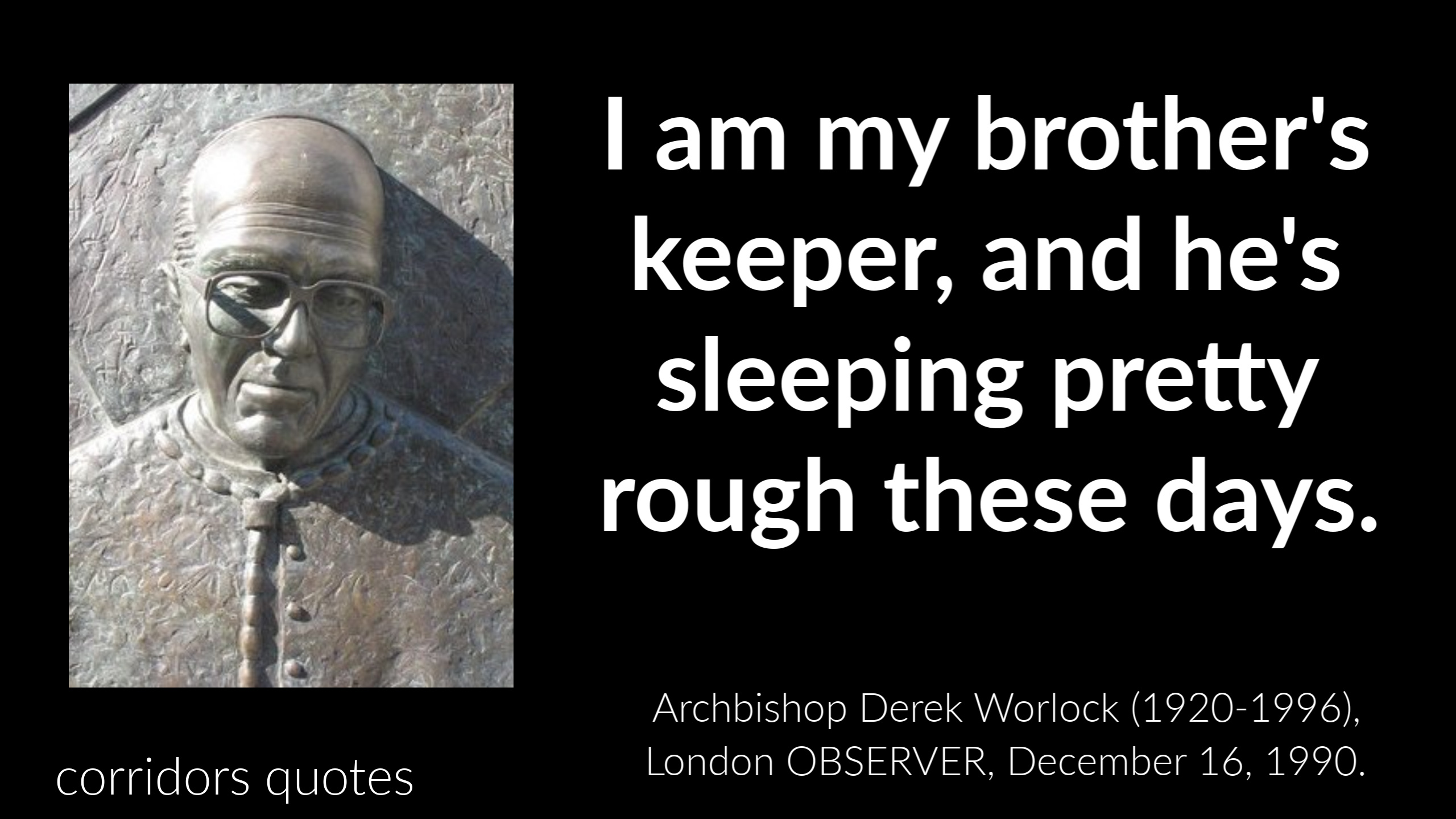
The precise source for this quote is an interview published in the London Observer newspaper on December 16, 1990. In the article, Archbishop Derek Worlock used this poignant phrasing to address the growing homelessness and poverty crisis in the United Kingdom during the winter of 1990. He directly reframed the biblical “brother’s keeper” concept to highlight the urgent moral duty society has toward marginalized individuals struggling with homelessness (“sleeping rough”). This sentence distills the core of his ministry: the conviction that Christian leadership must be measured by its solidarity with the most vulnerable.
Building bridges across historic divisions
Archbishop Worlock’s mitre, resting at his tomb, evokes a churchman whose influence extended far beyond Liverpool. Over more than three decades as bishop and archbishop, he became a driving force within the episcopal conference, shaping how the Catholic Church in Britain engaged with the modern world.
He helped lead national initiatives on the media, the laity, and justice and peace, urging the Church to speak with clarity, courage, and compassion. His advocacy for the poor was especially memorable. When drawing attention to Britain’s growing homelessness crisis, he captured the moral urgency in a single, searing line: “I am my brother’s keeper, and he’s sleeping pretty rough these days.” London OBSERVER, December 16, 1990. (on the homeless).
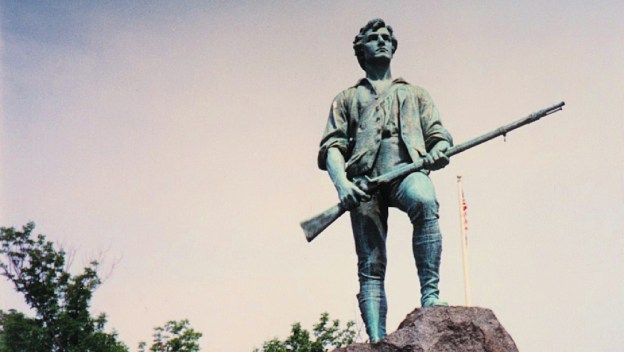
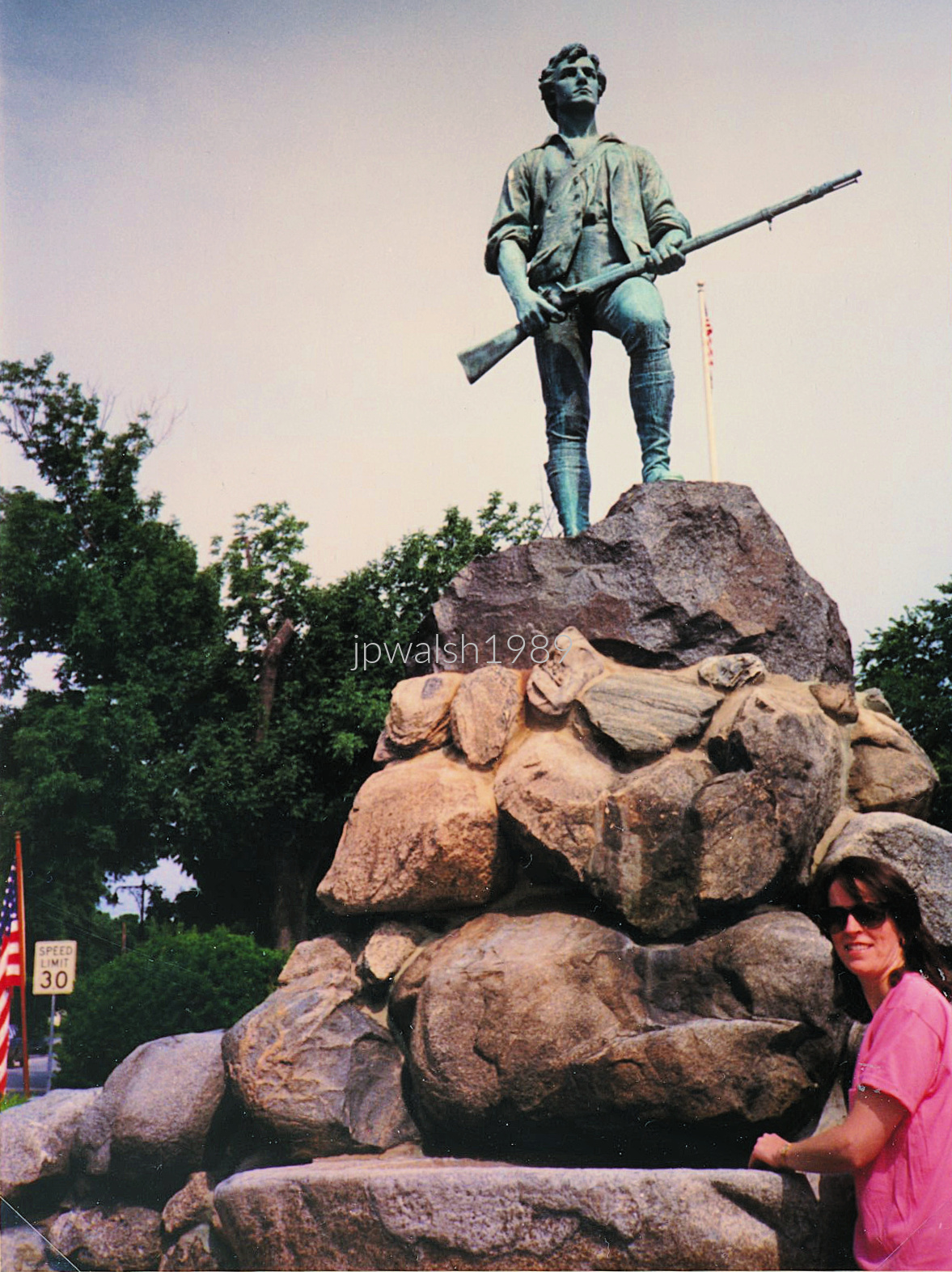
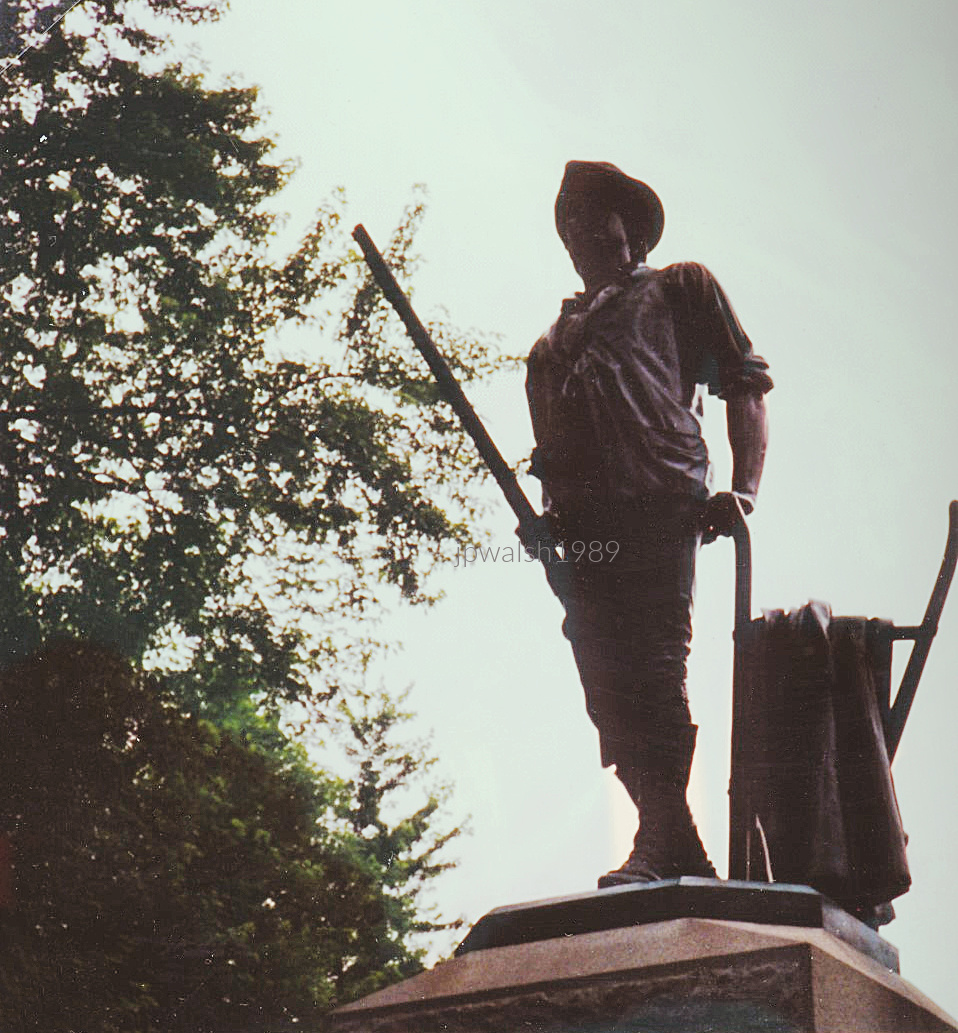
PUBLISHED APRIL 19, 2025 7pm CT. Feature image: Lexington Minute Man, 1899, by H. H. Kitson (c.1863-1947) stands in Lexington Green west of Boston, Massachusetts. Although called Minute Man, the statue is meant to represent the local Lexington militiaman, colonists of many ages and backgrounds, who volunteered to be first responders to military and other threats. The actual “minute men” was part of an elite subset of militia who were young and fit and able to respond to the greatest danger and challenge. Author’s photograph, July 1989.
At the foot of the minuteman monument, visitors arrive in a steady flow, drawn to this enduring chapter of early American history. The bronze figure, rifle held in the classic Revolutionary‑era stance, recalls the citizen‑soldiers who first stepped forward to defend their towns. According to the National Park Service, the Minute Man National Historical Park—which includes Battle Road and its surrounding historic sites—welcomes more than 1 million visitors each year. see – Tourism to Minute Man National Historical Park contributes $102 million to local economy – Minute Man National Historical Park (U.S. National Park Service) – retrieved April 19, 2025.
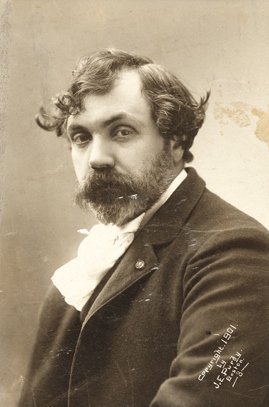
H.H. Kitson, sculptor of the famed Lexington Minuteman, was born in England and immigrated to the United States as a teenager. After studying art in Paris, he returned to New York in 1884 and moved to Boston two years later, where he established a studio, taught, married one of his students, and raised three children. The monument was commissioned in 1898 for $10,000 by railroad executive and U.S. Congressman Francis Brown Hayes, erected in 1899 facing the route of the British advance, and formally unveiled on April 19, 1900, for the 125th anniversary of the battle.Public Domain. see – https://monuments.freedomsway.org/monuments/minute-man-statue/ – retrieved April 19, 2025.
On April 19, 1775, local militiamen stepped out from Buckman Tavern beside the Lexington common and formed two lines to face the advancing British troops. Their stand resulted in the first casualties of the American Revolution. During our visit, we also learned that the phrase “sleep tight” comes from the rope‑laced frames that supported Colonial‑era mattresses. Author’s photograph, July 1989.
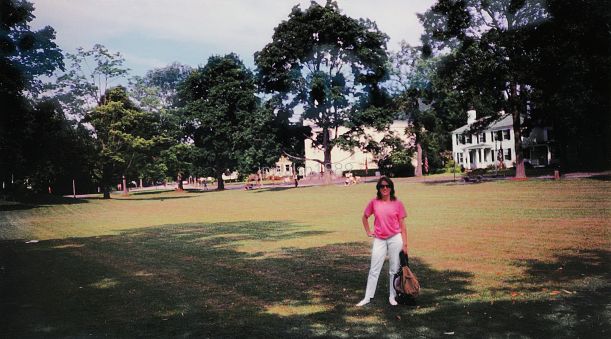
Author’s wife on Lexington Green where the first shots of the War of American Independence were fired on April 19, 1775. Author’s photograph, July 1989.
Also on April 19, 1775, the British approached the town of Concord where the American colonists sprang into action. After an alarm rider notified minutemen and militia, scouts were sent out to reconnoiter British movements. They heard the cackle of gunfire at Lexington Green and, learning of this martial situation, Concord prepared. The British advanced to Concord and the colonial militia strategically retreated past the North Bridge to watch what the British would do. Meanwhile the colonists were checking on the safety of their own military stores. With Concord effectively in British hands the Regulars moved out to take the town’s two bridges over the Concord River. The South Bridge was taken but the North Bridge proved more problematic. They crossed the bridge but encountered the colonists who had moved past it and into an elevated position. Loyalists in town informed the British where the colonists kept their military stores filled with supplies such as gun powder, cannon, shot, and flour. The colonists had their own intelligence network and had moved these stores to other hidden locations. At a farm where they thought the military supplies to be stored, the British forced a woman who lived there, one Rebecca Barrett, to make them breakfast as they searched the premises. But they found, as the colonists planned, nothing. Although there were kegs of gunpowder stored in the farm next door, the British didn’t go look.
DO NOT FIRE UNLESS FIRED UPON.
Meanwhile, the British held the two Concord bridges and waited for their search party to return. At the same time, the American colonists were getting a better look at their red-coat adversaries. As the Americans held a military council, their growing military presence forced the British who had crossed the bridge to retreat back to it. Armed militiamen were streaming in from several towns and formed a formidable front. As the British were setting fires in downtown Concord, the American colonists could see the flames rising from their position on the high ground. Because of these fires (the British were burning carriages) the Americans decided to march to the North Bridge so to cross into town to prevent the British from burning it down. Fully expecting a confrontation with the British, the militia companies loaded their weapons but were told not to fire unless fired upon. Approximately 400 militia men marched in order by company seniority down towards the North Bridge. There were less than 100 British guarding the bridge. With the coming American militia the British retreated around the bridge and considered this American action as an attack. There were a flurry of orders flying around the field of action to the point of chaos. The British debated marching into the field to meet the approaching Americans. They also debated ripping up the bridge so the Americans could not cross. They finally decided on a firing formation in the street at the base of the bridge.
SHOT HEARD ‘ROUND THE WORLD.
In the chaos the Americans arrived to the bridge. The British fired directly into the group and wounded and killed men. “The balls whistled well,” recalled a militia soldier. One American was shot through the throat. Another under and through the eye. One more through the heart. In a matter of seconds there were six total casualties. The Americans were then ordered: “Fire, for God’s sake fire!” A hail of bullets was shot into the British. Three were killed and nine wounded. Many of the British fled towards town. As the Americans chased the British, one militiaman struck a hatchet blow into the head of a wounded British soldier.
The British were quickly reinforced and ordered to march back to the bridge. But there was no more firing. The militia dispersed from the bridge though there was a huge influx of militia coming into Concord from several towns in all directions. The militiamen knew the terrain and its backroads and could converge quickly, directly and stealthily. Though the British asked for reinforcements (1,000 men) from Boston, nothing happened. The British retreated though Concord Bridge marked the beginning of a massive battle that raged over 16 miles along the Bay Road from Boston to Concord, and included some 1,700 British regulars and over 4,000 Colonial militia. see – https://www.nps.gov/mima/north-bridge-questions.htm – retrieved April 19, 2025.
The Minute Man statue of 1875, created by Daniel Chester French (1850–1931), was unveiled on April 19, 1875, during the centennial commemoration of the battles of Lexington and Concord. Set near the site where the first colonial militiamen fell in Concord, the seven‑foot bronze was cast from old Civil War cannons by the Ames Foundry of Chicopee, Massachusetts. Its stone pedestal bears the opening lines of Ralph Waldo Emerson’s Concord Hymn, honoring the “shot heard round the world.” BY THE RUDE BRIDGE THAT ARCHED THE FLOOD, THEIR FLAG TO APRIL’S BREEZE UNFURLED, HERE ONCE THE EMBATTLED FARMERS STOOD, AND FIRED THE SHOT HEARD ROUND THE WORLD. https://www.nps.gov/mima/learn/historyculture/the-minute-man-statue-by-daniel-chester-french.htm – retrieved April 19, 2025. Author’s photograph, July 1989.
Daniel Chester French (1850–1931) was born in New Hampshire and, at seventeen, moved to Concord to be near Ralph Waldo Emerson and the Alcott family, where he received his first art lessons. After further study in Boston, he was only twenty‑one when he received the commission for The Minute Man. The statue was unveiled to critical acclaim in 1875, though French himself was in Europe studying art at the time. Upon returning to the United States, he worked in studios in Washington, Boston, and eventually New York City. In 1897 he purchased the Stockbridge, Massachusetts estate that became Chesterwood, his longtime home and workspace. Over the following decades, French produced major public monuments in Boston, Cambridge, New York, Chicago, and Washington, D.C., and he is best known today for his Seated Lincoln in the Lincoln Memorial. He is buried in Sleepy Hollow Cemetery in Concord alongside Emerson, the Alcotts, and Henry David Thoreau. https://www.nps.gov/mima/learn/historyculture/sculptor-daniel-chester-french.htm – retrieved April 19, 2025.
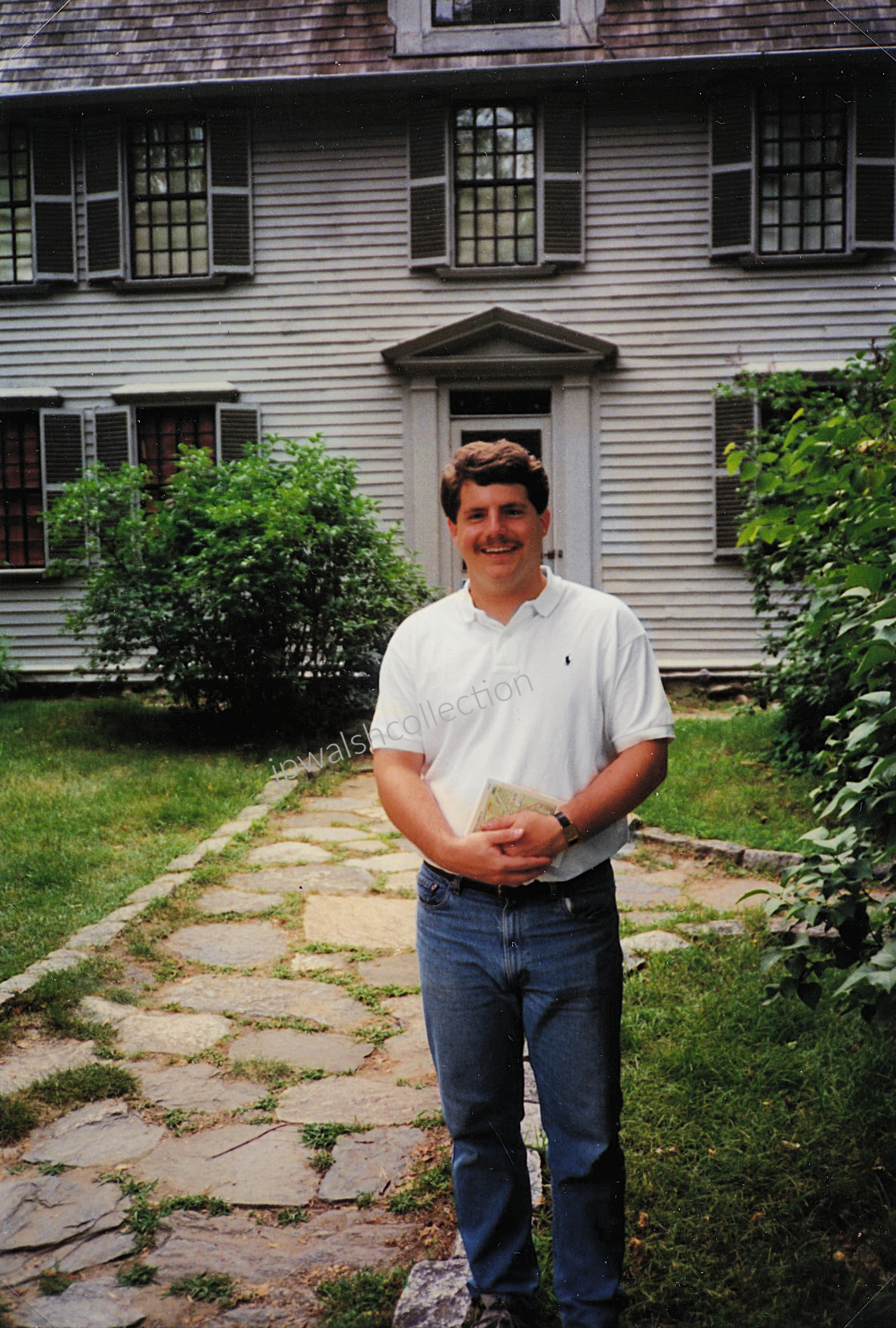
The author stands at the Old Manse in Concord, Massachusetts, a house on Monument Street with the Concord River just behind it and the North Bridge—now part of Minute Man National Historical Park—beside the property. Built in 1770 for Rev. William Emerson (1743–1776), the home later became central to the Emerson family line: William’s son, minister William Emerson, and his grandson, the transcendentalist Ralph Waldo Emerson. The elder Rev. Emerson served as Concord’s minister, chaplain to the Provincial Congress in 1774, and later chaplain to the Continental Army; he watched the fighting at the North Bridge from his fields while his family witnessed it from the upstairs windows. Decades later, Ralph Waldo Emerson drafted his foundational essay Nature here, and during his stay in the mid‑1830s he proposed to Lydia Jackson before the couple moved to what is now known as the Emerson House. Author’s collection, July 1989.
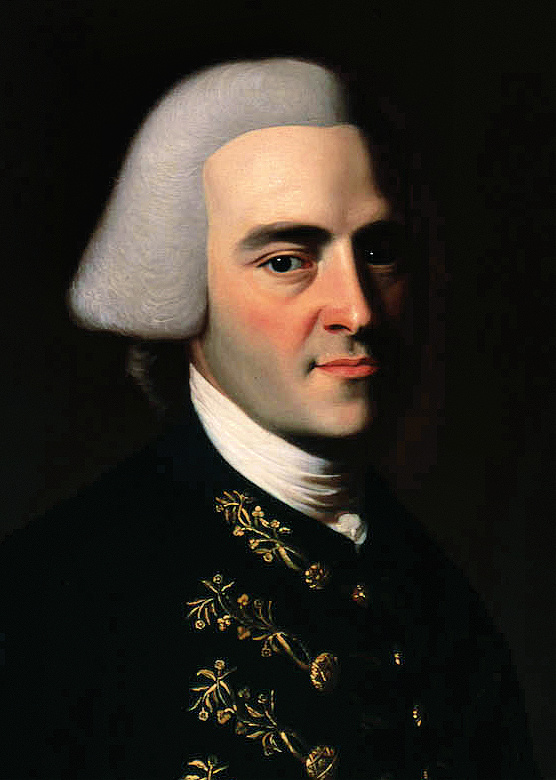
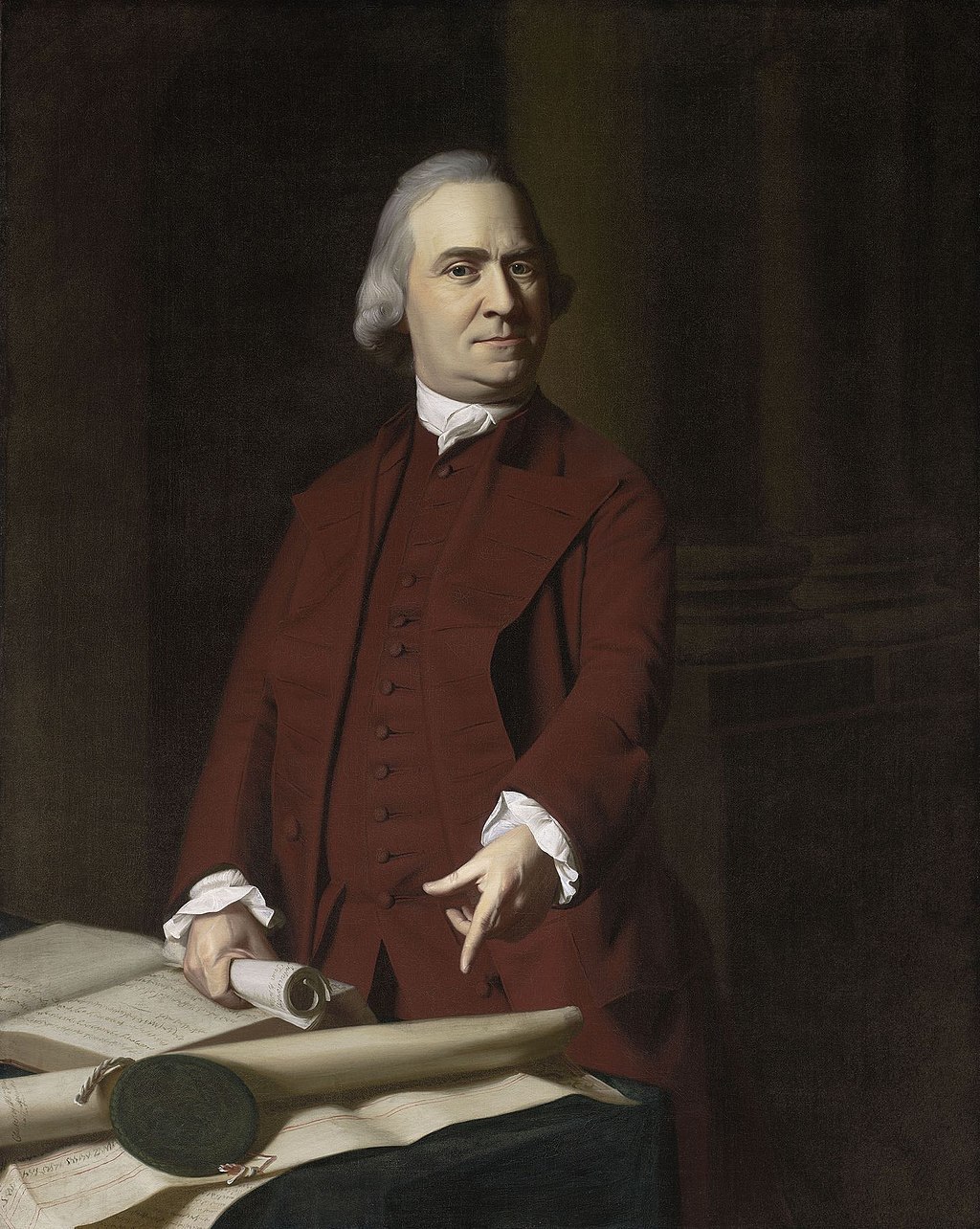
John Hancock, 1770, by John Singleton Copley (1738-1815) in the Massachusetts Historical Society. Public Domain.
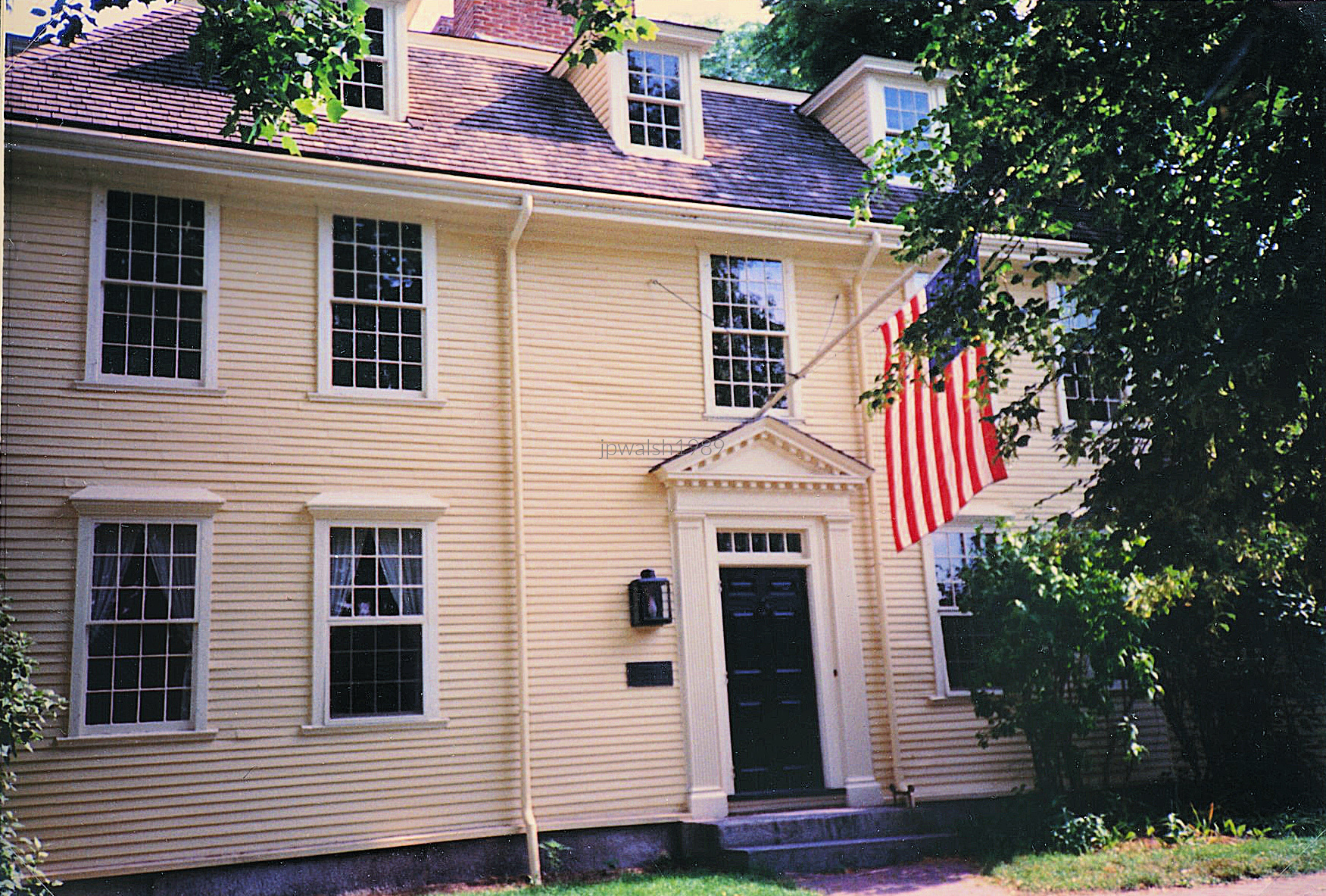
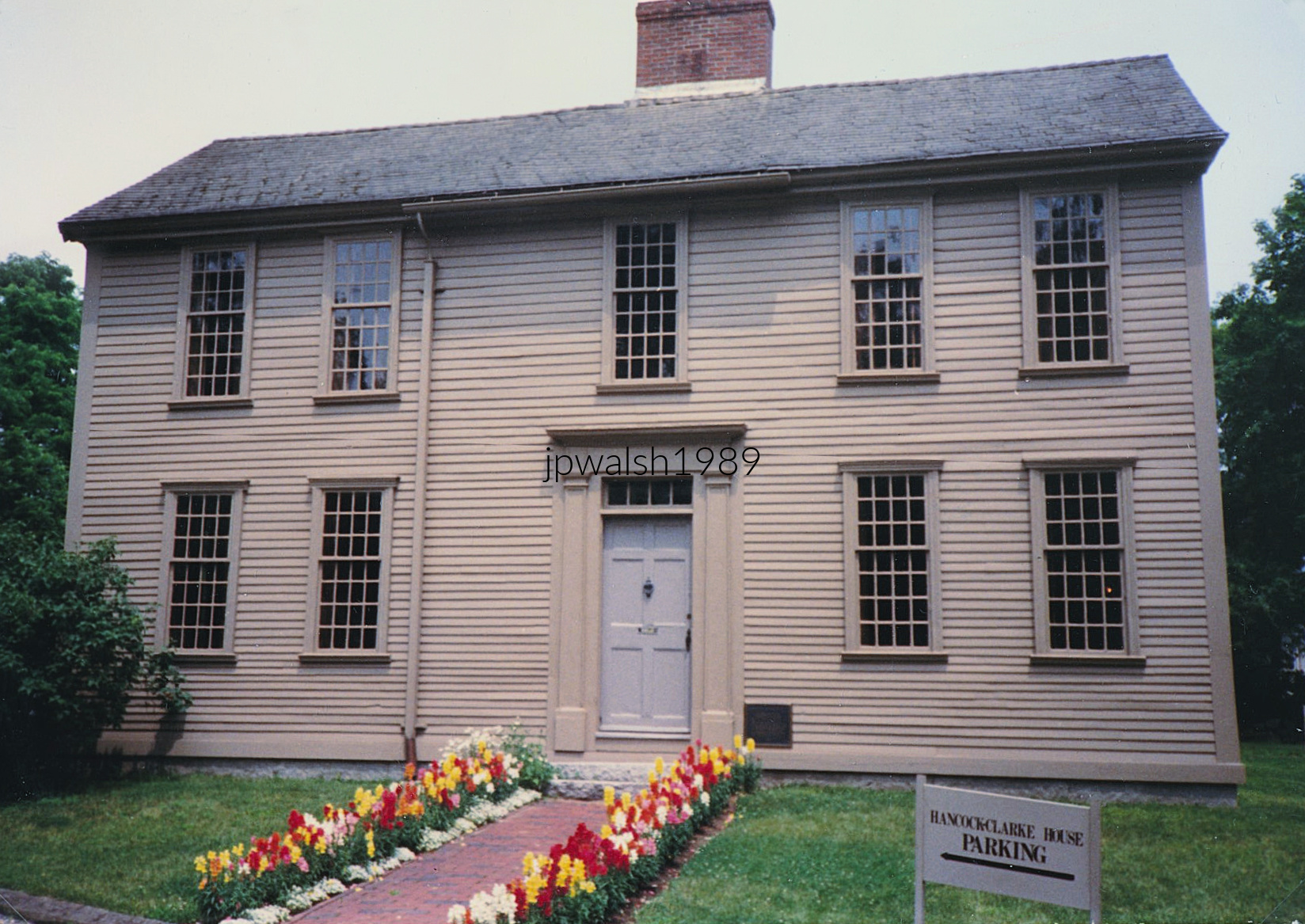
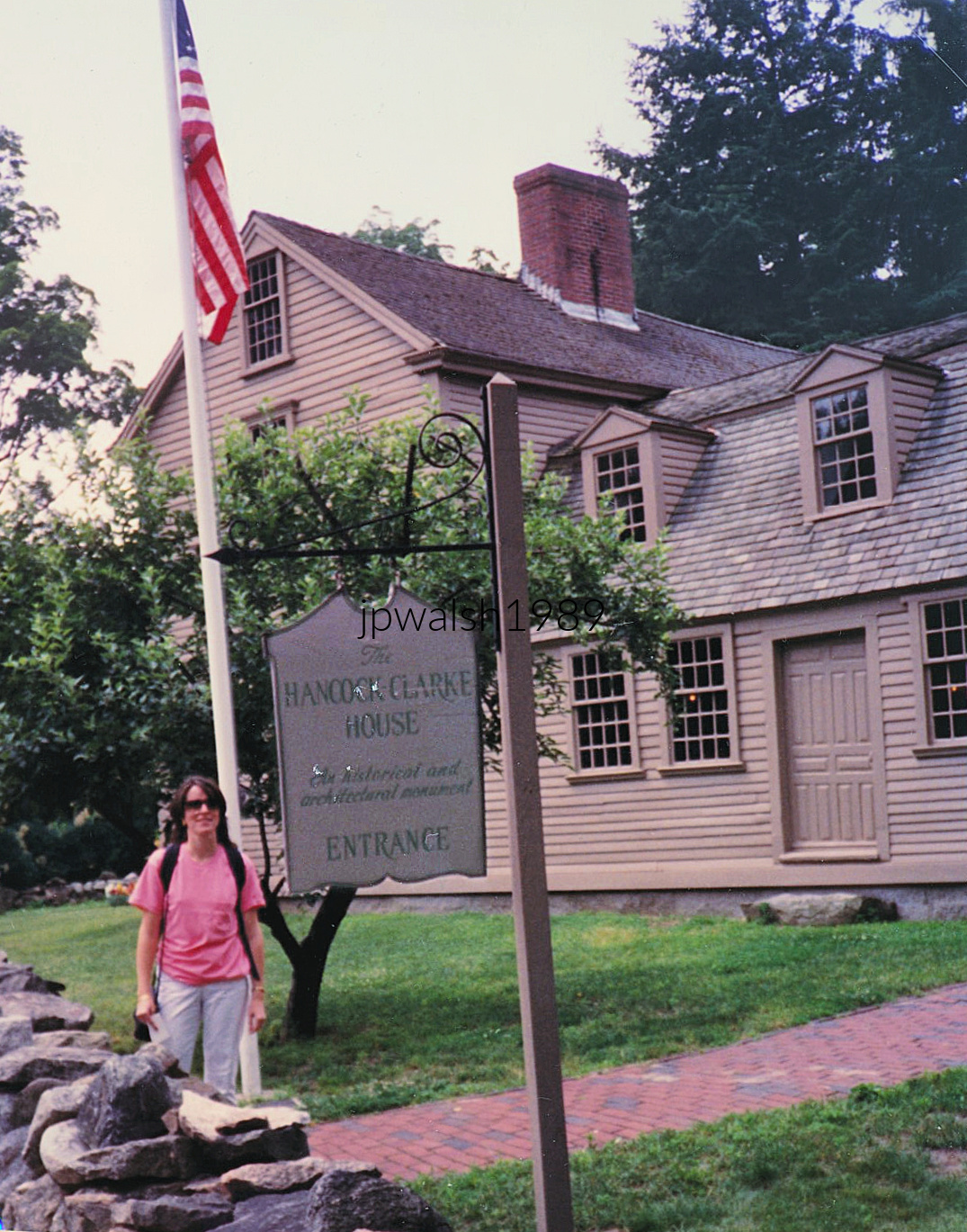
Built in 1738, the Hancock–Clarke House at 36 Hancock Street in Lexington, Massachusetts—less than half a mile from Lexington Green—is the historic residence where John Hancock (1737–1793) and Samuel Adams (1722–1803) were staying on the eve of the Battle of Lexington and Concord on April 19, 1775. Author’s photograph, July 1989.
John Hancock and Samuel Adams attended the Massachusetts Provincial Congress in Concord on the evening of April 18, 1775, and spent the night in Lexington as guests of Rev. Jonas Clarke (1730–1805). Clarke, a Harvard graduate and Lexington’s pastor since 1755, feared the two leaders might be seized by the advancing British. In Boston, Joseph Warren (1741–1775) dispatched William Dawes (1745–1799) and Paul Revere (1734–1818) to warn them; arriving separately at the Hancock–Clarke House around midnight, both riders delivered the alarm before continuing on toward Concord. Hancock and Adams then left for Burlington, about a half‑hour away by horseback, to ensure their safety. Author’s photograph, July 1989.
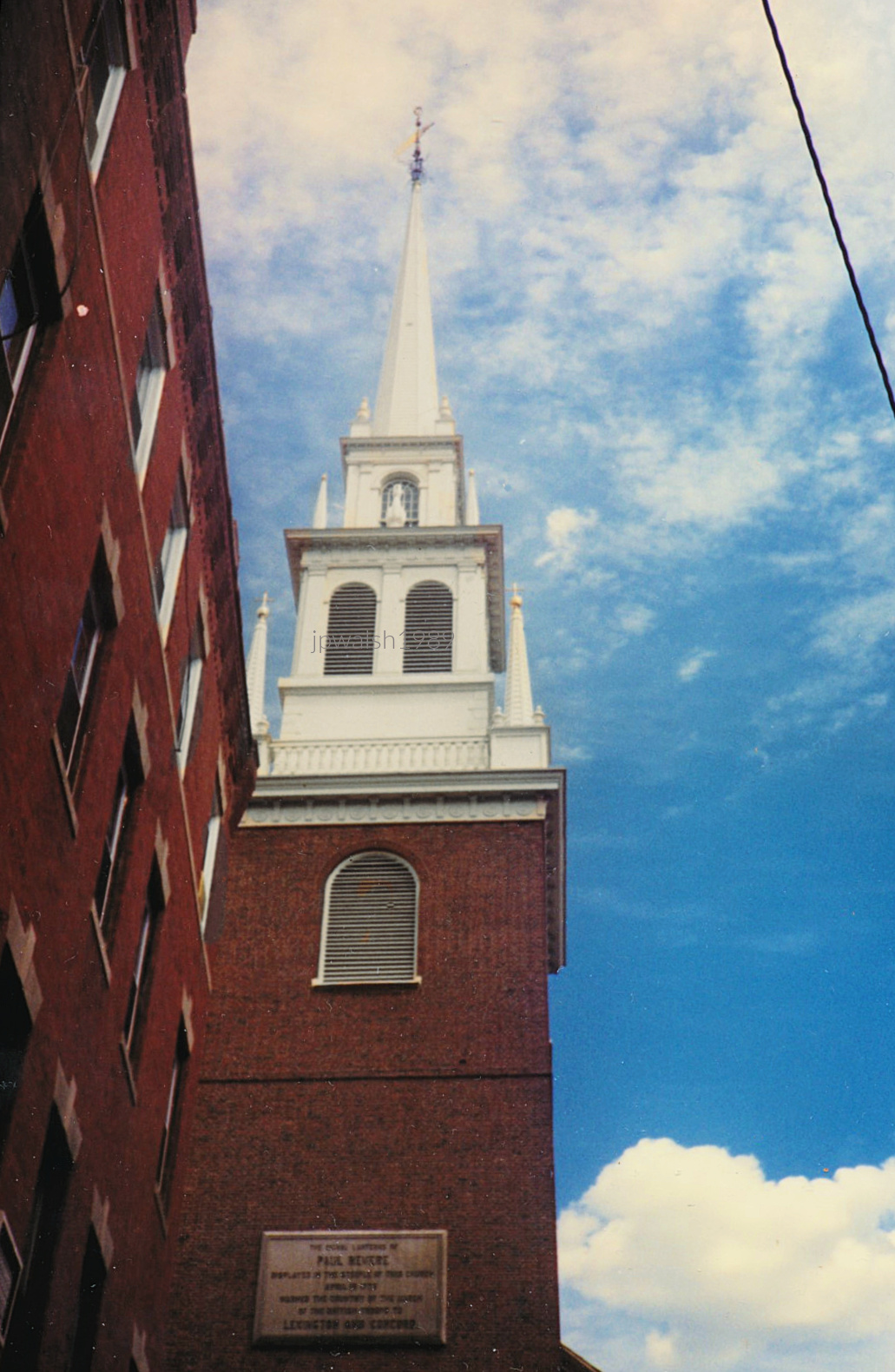
Old North Church, founded in 1723 as Christ Church, is best known for the night of April 18, 1775, when sexton Robert Newman and vestryman Capt. John Pulling Jr. climbed the steeple to display two lanterns. Their signal—alerting Paul Revere’s network that British troops were crossing the Charles River “by sea” toward Lexington and Concord—set in motion the opening moments of the American Revolution. see – https://www.oldnorth.com/ – retrieved April 19, 2025. Author’s photograph, July 1989.
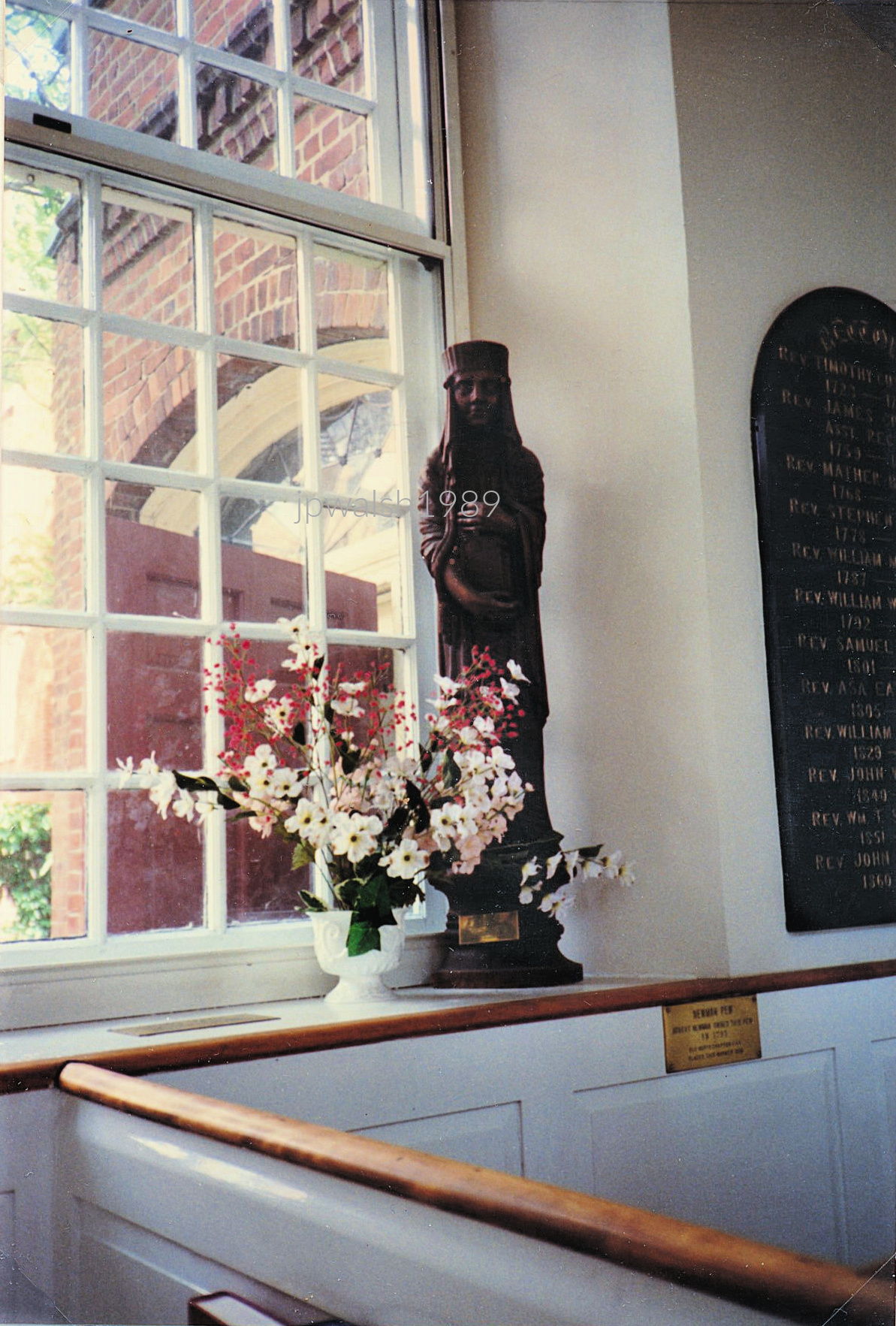
Inside Old North Church, visitors stand only a short walk from Copp’s Hill Burying Ground, where Increase Mather (1639–1723) and his son Cotton Mather (1663–1728) are buried. Both served as Puritan ministers whose era of leadership overlapped with the notorious Salem witch trials. Author’s photograph, July 1989.
Paul Revere, c. 1770, by John Singleton Copley (1738–1815), Museum of Fine Arts, Boston. Public Domain. Unlike Copley’s formal portraits of Samuel Adams and John Hancock—both displayed in Boston’s Faneuil Hall—Revere’s portrait was long kept in the Revere family attic, disliked for its informality. After Revere’s fame surged with Henry Wadsworth Longfellow’s 1861 poem Paul Revere’s Ride, the painting was restored in 1875, though it was not publicly exhibited until 1928. Revere’s descendants donated it to the Museum of Fine Arts in 1930.https://collections.mfa.org/objects/32401/paul-revere?ctx=00d797a8-0c5a-4d78-ba26-db22eb858902&idx=5 – retrieved April 19, 2025.
Author at the Paul Revere House in Boston with a work friend of my dad. March 1976. Author’s collection.
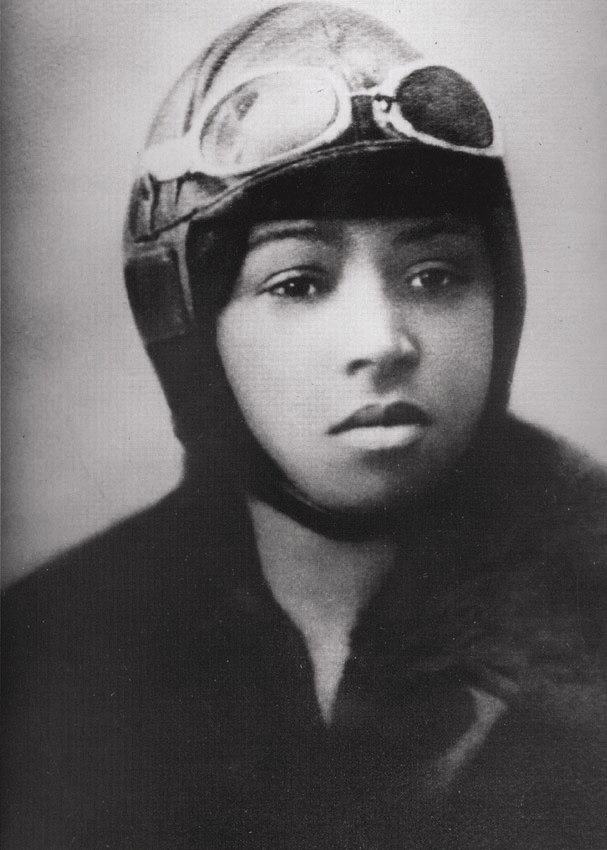
Bessie Coleman, the first licensed Black female aviator, was born on January 26, 1892, in Texas. Her father, who was American Indian, left the family for Oklahoma when she was seven. Bessie stayed in Texas with her mother while her older siblings moved away. In the deeply segregated America of the late 19th and early 20th centuries, racism shaped nearly every aspect of life. Even so, Bessie’s mother encouraged her to excel in school, where Bessie became an avid reader.
Education and Early Work
At 18, Bessie attended what is now Langston University for one semester but lacked the funds to continue. She returned home to work alongside her mother, who labored as a maid and sharecropper.
At 23, ambitious and restless, Bessie moved to Chicago to live with her brothers. She worked menial jobs — manicurist, restaurant server — but found the city’s atmosphere freer than the Jim Crow South.
A New Possibility: France
During World War I, her brothers served in France and returned with stories of a society where women and Black people were treated with more dignity than in the United States. They told her that in France, women even flew airplanes — a revelation that electrified her.
In America, flying was largely a pastime for wealthy white men. Still, Bessie applied to U.S. flight schools and was rejected everywhere.
Support from Robert Abbott
Enter Robert Abbott, the influential Black Chicago newspaper owner of the Chicago Defender. Impressed by her determination, he urged her to go to France to earn her license. The French accepted her application, and Bessie crossed the Atlantic to begin training.
Training in a Dangerous Era
Flying in the 1910s was perilous. Open cockpits had no seat belts, aircraft were fragile, and accidents were common. Despite the risks, Bessie excelled. She became the first Black and American Indian woman to earn a pilot’s license.
She returned to the United States determined to build a career — but she lacked money and access.
Barnstorming Dreams and Barriers
To earn enough to buy her own plane and inspire other women and people of color, Bessie sought work as a stunt pilot. But once again, American flight schools refused to train a Black woman, even one already licensed.
Her dream would require the same persistence that had carried her from Texas to Chicago to France — and back again.
Bessie Coleman’s photo on her first pilot’s license, issued June 15, 1921. Public Domain.
Returning to France for Advanced Training
Bessie returned to France to get the specialized aviation training she still couldn’t access in the United States. Her determination — and the barriers she faced — had not gone unnoticed back home. By the time she returned to America for the second time, now a licensed pilot and trained stunt performer, the press greeted her with mostly positive attention.
1922: A Breakthrough Year
It was 1922, and Bessie was ready to take off. Her longtime supporter Robert Abbott arranged her first major air show in New York City, which immediately set reporters buzzing. Back in Chicago, her adopted home, Bessie began performing in more and more air shows, each one building her reputation.
A Rising Star of the Air Shows
To be a stunt pilot required absolute fearlessness, and Bessie’s daring routines — her figure eights, her loop‑the‑loops — made her a sensation across the country. She wanted to maintain and eventually own her own plane, but she didn’t yet have the money. So she borrowed whatever aircraft she could, determined to keep flying and to keep proving what a Black woman pilot could do.
“Queen Bess” Takes the Roaring Twenties by Storm
While some women performed wing‑walking stunts, none piloted the plane and performed aerial maneuvers the way Bessie did. Her skill, charisma, and courage made her a cultural phenomenon. Americans began calling her “Queen Bess” and “Brave Bess,” names that captured her place in the imagination of the roaring 1920s.
Bessie Coleman and airplane, 1922. Public Domain.
Aviation as Activism
As she was determined to do so, Bessie Coleman was making a difference in the nation. Of all these remarkable things in the air Bessie was known for, none was more significant than what she also achieved on the ground. Bessie Coleman told show promoters and managers that she would not perform at any show whose audience or performers were segregated by race or anything else. “Brave Bess” insisted that for all shows she performed in, there had to be just one gate for all people to walk through. At the time this was a profoundly radical request, particularly south of the Mason-Dixon line.
Speaking, Teaching, and Inspiring
Beyond stunt flying, Bessie lectured at schools and churches, urging young people — especially Black children — to pursue aviation. She saw flight not only as a career but as a path to dignity, opportunity, and pride.
Setbacks and Recovery
Still hoping to buy her own airplane, Bessie finally purchased one in 1923. But during a test flight, she crashed, breaking her leg and several ribs. She spent a year recovering in Chicago, grounded but not defeated.
A Return to the Skies
By 1926, Bessie was ready to fly again. She had no funds for a new aircraft, but a wealthy businessman donated a used plane. It was far from ideal — rickety, temperamental — and she hired a mechanic, William Wills, to get it into working shape.
Wills flew the plane from Texas to Florida for her next show, but along the way he had to make several emergency landings as the engine repeatedly failed. After repairs in Florida, he and Bessie took the plane up for a test flight on April 30, 1926, the day before the show.
The Fatal Flight
They tested the plane as Bessie hunted for locations for her stunts. During the practice run, Bessie leaned out of the open cockpit — without a seatbelt, standard for stunt pilots — to scout locations for her aerial maneuvers. Something went wrong mechanically. The plane lurched, and Bessie fell to her death. Moments later, the aircraft crashed, killing Wills as well. Bessie was 34. Wills was 24.
A Nation Mourns
By the time of her third memorial service in Chicago, more than 20,000 people had paid their respects. At the Chicago service alone, 15,000 mourners gathered as journalist Ida B. Wells read an essay honoring Bessie’s courage and legacy. Bessie Coleman was laid to rest at Lincoln Cemetery in Blue Island, among many of Chicago’s Black notables.
A Legacy That Took Flight
In 1929, Black engineer and aviator William J. Powell founded the Bessie Coleman Aero Club in Los Angeles, training Black men and women to fly. By the 1930s, groups of Black female stunt pilots — including the Blackbirds — carried her inspiration into the sky.
In 1940, Bessie’s early champion, millionaire newspaper publisher Robert Abbott, was also buried in Lincoln Cemetery, not far from the woman whose dreams he helped launch.
Bessie Coleman, first Black and American Indian licensed aviator, two days before her 31st birthday, January 24, 1923. Public Domain.
SOURCES:
Bessie Coleman Bold Pilot Who Gave Women Wings, Martha London, 2021, Capstone Press, North Mankato, MN.
Feature image: Three reindeer, one mission: stack the holiday cheer sky‑high. Bringing some serious retro California sunshine to the winter chill, this stacked reindeer yard display perfectly channels the festive, energetic groove of The Beach Boys’ 1963 classic “Little Saint Nick.” Just like Santa’s legendary bobsled, these three are hauling holiday spirit through the neighborhood at a frightening speed. December 2024. Author’s photograph. All rights reserved.
At Christmas 1963, “Little Saint Nick” was more than a successful Beach Boys Christmas novelty record. Its B-side, “The Lord’s Prayer,” revealed Brian Wilson’s emerging artistic ambition, sophisticated vocal arranging, and willingness to push beyond the group’s surf-pop image, making the single an important milestone just before the Beatles and the British Invasion transformed popular music.
The Road to the Top
The Beach Boys finally reached the top of the Billboard Hot 100 in May 1964 with “I Get Around.” The breakthrough felt overdue. Throughout 1963, the California surf pop group had dominated American radio: five Top 10 singles, including three that cracked the Top 5, and three Top 10 albums. They completed their first national tour that April, and “Surfin’ U.S.A.” finished the year as Billboard’s No. 1 song. By December, with their first holiday single “Little Saint Nick” climbing the charts, the Beach Boys looked like America’s most celebrated pop band. Only Newark’s The Four Seasons rivaled their chart power.
Shifting Tides
Then, just two months later, everything changed. The British Invasion hit. The Beatles arrived in early 1964 and turned the rock ’n’ roll world upside down. Overnight, the Beach Boys found themselves challenged—creatively and commercially—by the Fab Four, who were suddenly setting the pace the rest of the pop world had to match.
The 1963 single “Little Saint Nick” endures because it transformed the band’s surf‑and‑speed aesthetic into holiday magic and was an early step toward the ambitious studio craft of The Beach Boys’ Christmas Album the following year.
Little Saint Nick LYRICS:
(Ooooooooh, merry Christmas Saint Nick) (Christmas comes this time each year) (Oooooooo-ooooooooh)
Well, way up north where the air gets cold There’s a tale about Christmas that you’ve all been told And a real famous cat all dressed up in red And he spends the whole year workin’ out on his sled
It’s the little Saint Nick (Oooooh, little Saint Nick) It’s the little Saint Nick (Oooooh, little Saint Nick)
Just a little bobsled, we call it old Saint Nick But she’ll walk a toboggan with a four speed stick She’s candy-apple red with a ski for a wheel And when Santa hits the gas, man, just watch her peel
It’s the little Saint Nick (Oooooh, little Saint Nick) It’s the little Saint Nick (Oooooh, little Saint Nick)
Run, run, reindeer Run, run, reindeer (Oh-oh-oh-oh) Run, run, reindeer Run, run, reindeer He don’t miss no one
And haulin’ through the snow at a frightenin’ speed With a half a dozen deer with Rudy to lead He’s gotta wear his goggles ’cause the snow really flies And he’s cruisin’ every pad with a little surprise
It’s the little Saint Nick (Oooooh, little Saint Nick) It’s the little Saint Nick (Oooooh, little Saint Nick)
(Aaa-aaa-aaah) (Ooooooooh, merry Christmas Saint Nick) (Christmas comes this time each year) (Aaa-aaa-aaah) (Ooooooooh, merry Christmas Saint Nick) (Christmas comes this time each year) (Aaa-aaa-aaah) (Ooooooooh, merry Christmas Saint Nick) (Christmas comes this time each year) (Aaa-aaa-aaah) (Ooooooooh, merry Christmas Saint Nick) (Christmas comes this time each year)
A Holiday Blueprint and Spiritual Depth
“Little Saint Nick” was released on December 9, 1963, climbing to No. 3 on Billboard’s Christmas Singles chart. Brian Wilson had composed the music that August, building it on the same brisk, compact structure he used for “Little Deuce Coupe.” Mike Love supplied most of the lyrics, shifting his focus from hot rods to a holiday bobsled.
The single’s B side carried a more reflective but remarkable achievement: “The Lord’s Prayer,” Albert Hay Malotte’s 1935 setting, adapted and arranged by Brian Wilson. Sung a cappella in four interlocking harmonies, it revealed a creative and spiritual depth unusual for a band of early twenty somethings. By Christmas 1963, the Beach Boys were firmly established as America’s No. 1 pop group.
“Little Saint Nick” successfully adapted the Beach Boys’ hot-rod and surf formula into a Christmas song, helping cement their status as America’s leading pop group in late 1963.
Brian Wilson dreamed up “The Lord’s Prayer” as a bold holiday B‑side—an intricate, five‑part a cappella arrangement blending barbershop, jazz‑pop, and church hymnals. Released December 9, 1963, it showcased his rising studio ambition long before fans were ready for it.The Beach Boys poured long hours into reshaping their signature harmonies for Christianity’s most venerated prayer. In doing so, they hoped to elevate the sacred text while proving that their so‑called surfer sound carried far more depth than lightweight pop. Their intricate vocal blend became both a devotional experiment and an early declaration of artistic ambition.
“The Lord’s Prayer” was an unusually ambitious B-side, featuring intricate a cappella harmonies and spiritual subject matter that demonstrated Brian Wilson’s growing sophistication as an arranger and producer.
Another clear indicator of the band’s rapid evolution can be found in Shut Down Volume 2, released in March 1964 at the absolute peak of the initial Beatlemania hurricane, where it climbed to No. 13 on the Billboard 200. Written and recorded just before the British Invasion transformed the American airwaves, the album’s opening track and lead single, “Fun, Fun, Fun,” was released a mere six days before the Beatles’ historic debut on The Ed Sullivan Show. Written by Brian Wilson and Mike Love, the track was recorded on New Year’s Day 1964 as a sunny California anthem wrapped around a story of teenage rebellion. The lyrics follow a girl who deceives her father, taking his Ford Thunderbird under the guise of going to the library, only to cruise the town to enjoy the thrill of speed and peer admiration that comes with driving a cool car. Rather than offering a rigid moral lesson, the song unapologetically celebrates the carefree, defiant spirit of youth. The driving hook—”she’ll have fun, fun, fun till her daddy takes the T-bird away”—promises that her freedom will last right up until she is caught, though the narrative ends with the narrator rescuing her from being grounded so the joyride can continue. While the Beatles already held the top slots on the charts in early 1964, the Beach Boys were still chasing their first chart-topper; “Fun, Fun, Fun” peaked at No. 5 that March, paving the way for their first No. 1 hit with “I Get Around” later that July.
The Ed Sullivan Shockwave
In mid January 1964, they left for their first international tour, performing in Australia and New Zealand. When they returned on February 2, their next single—“Fun, Fun, Fun”—was released the following day. It reached No. 5 on March 21.
But in the brief window between its release and its chart peak, the rock ’n’ roll landscape shifted beneath their feet. On February 9, 1964, the British Invasion began in earnest. The Beatles—John, Paul, George, and Ringo—made their first appearance on The Ed Sullivan Show, performing before an audience of roughly 74 million Americans, nearly half the country. The Beach Boys, still the top U.S. pop band, had not yet been invited onto that stage. The Beatles’ explosive debut instantly reshaped the pop hierarchy, and the Beach Boys suddenly found themselves facing a new and formidable rival.
The single stands at a historical crossroads, representing the Beach Boys at the peak of their pre-Beatles success just before the British Invasion challenged them and inspired the artistic competition that would lead to their greatest innovations.
The Packaging Gap
Overnight, the Beach Boys suddenly looked almost bush league next to the British newcomers—not musically, since both groups drew from the same exuberant teenage world, but in publicity, packaging, and sheer media savvy. It was a preview of what would happen again in the 1980s, when British acts outpaced Americans in the emerging music video era.
A Five-Year Revolution
In the long wake of that shock, as the Beatles returned to The Ed Sullivan Show twice more in February 1964 and again that May, Brian Wilson’s quiet but fierce competition with them began. Rock ’n’ roll would never be the same. Over the next five years, the music exploded into something more original, experimental, and sonically adventurous—a transformation that fueled breakthroughs for the Beach Boys, the Beatles, and countless others.
And sitting right on the cusp of that revolution was “Little Saint Nick.” With its hook and beat, the 1963 single endures today as a bright artifact from the moment just before rock ’n’ roll reinvented itself.
SOURCES:
Badman, Keith. The Beach Boys: The Definitive Diary of America’s Greatest Band on Stage and in the Studio. 1st ed. San Francisco: Backbeat Books, 2004, pp. 45-54. Love, Mike. Good Vibrations: My Life as a Beach Boy. New York: Penguin Publishing Group, 2016, pp. 84-88. Morgan, Johnny. The Beach Boys: America’s Band. Illustrated ed. New York: Union Square & Co., 2015, pp. 61-65. Whitburn, Joel. Joel Whitburn’s Top Pop Singles, 1955-1999. Menomonee Falls, WI: Record Research, Inc., 2000, pp.38-39.